DE102004019203B3 - Process for the gasification of storage-stable biomass to synthesis gas - Google Patents
Process for the gasification of storage-stable biomass to synthesis gas Download PDFInfo
- Publication number
- DE102004019203B3 DE102004019203B3 DE102004019203A DE102004019203A DE102004019203B3 DE 102004019203 B3 DE102004019203 B3 DE 102004019203B3 DE 102004019203 A DE102004019203 A DE 102004019203A DE 102004019203 A DE102004019203 A DE 102004019203A DE 102004019203 B3 DE102004019203 B3 DE 102004019203B3
- Authority
- DE
- Germany
- Prior art keywords
- pyrolysis
- mixture
- coke particles
- storage
- gasification
- Prior art date
- Legal status (The legal status is an assumption and is not a legal conclusion. Google has not performed a legal analysis and makes no representation as to the accuracy of the status listed.)
- Expired - Fee Related
Links
Classifications
-
- C—CHEMISTRY; METALLURGY
- C10—PETROLEUM, GAS OR COKE INDUSTRIES; TECHNICAL GASES CONTAINING CARBON MONOXIDE; FUELS; LUBRICANTS; PEAT
- C10J—PRODUCTION OF PRODUCER GAS, WATER-GAS, SYNTHESIS GAS FROM SOLID CARBONACEOUS MATERIAL, OR MIXTURES CONTAINING THESE GASES; CARBURETTING AIR OR OTHER GASES
- C10J3/00—Production of combustible gases containing carbon monoxide from solid carbonaceous fuels
- C10J3/58—Production of combustible gases containing carbon monoxide from solid carbonaceous fuels combined with pre-distillation of the fuel
- C10J3/60—Processes
- C10J3/64—Processes with decomposition of the distillation products
- C10J3/66—Processes with decomposition of the distillation products by introducing them into the gasification zone
-
- C—CHEMISTRY; METALLURGY
- C10—PETROLEUM, GAS OR COKE INDUSTRIES; TECHNICAL GASES CONTAINING CARBON MONOXIDE; FUELS; LUBRICANTS; PEAT
- C10J—PRODUCTION OF PRODUCER GAS, WATER-GAS, SYNTHESIS GAS FROM SOLID CARBONACEOUS MATERIAL, OR MIXTURES CONTAINING THESE GASES; CARBURETTING AIR OR OTHER GASES
- C10J2300/00—Details of gasification processes
- C10J2300/09—Details of the feed, e.g. feeding of spent catalyst, inert gas or halogens
- C10J2300/0913—Carbonaceous raw material
- C10J2300/0916—Biomass
-
- C—CHEMISTRY; METALLURGY
- C10—PETROLEUM, GAS OR COKE INDUSTRIES; TECHNICAL GASES CONTAINING CARBON MONOXIDE; FUELS; LUBRICANTS; PEAT
- C10J—PRODUCTION OF PRODUCER GAS, WATER-GAS, SYNTHESIS GAS FROM SOLID CARBONACEOUS MATERIAL, OR MIXTURES CONTAINING THESE GASES; CARBURETTING AIR OR OTHER GASES
- C10J2300/00—Details of gasification processes
- C10J2300/09—Details of the feed, e.g. feeding of spent catalyst, inert gas or halogens
- C10J2300/0913—Carbonaceous raw material
- C10J2300/0926—Slurries comprising bio-oil or bio-coke, i.e. charcoal, obtained, e.g. by fast pyrolysis of biomass
-
- C—CHEMISTRY; METALLURGY
- C10—PETROLEUM, GAS OR COKE INDUSTRIES; TECHNICAL GASES CONTAINING CARBON MONOXIDE; FUELS; LUBRICANTS; PEAT
- C10J—PRODUCTION OF PRODUCER GAS, WATER-GAS, SYNTHESIS GAS FROM SOLID CARBONACEOUS MATERIAL, OR MIXTURES CONTAINING THESE GASES; CARBURETTING AIR OR OTHER GASES
- C10J2300/00—Details of gasification processes
- C10J2300/09—Details of the feed, e.g. feeding of spent catalyst, inert gas or halogens
- C10J2300/0953—Gasifying agents
- C10J2300/0956—Air or oxygen enriched air
-
- C—CHEMISTRY; METALLURGY
- C10—PETROLEUM, GAS OR COKE INDUSTRIES; TECHNICAL GASES CONTAINING CARBON MONOXIDE; FUELS; LUBRICANTS; PEAT
- C10J—PRODUCTION OF PRODUCER GAS, WATER-GAS, SYNTHESIS GAS FROM SOLID CARBONACEOUS MATERIAL, OR MIXTURES CONTAINING THESE GASES; CARBURETTING AIR OR OTHER GASES
- C10J2300/00—Details of gasification processes
- C10J2300/09—Details of the feed, e.g. feeding of spent catalyst, inert gas or halogens
- C10J2300/0953—Gasifying agents
- C10J2300/0959—Oxygen
-
- C—CHEMISTRY; METALLURGY
- C10—PETROLEUM, GAS OR COKE INDUSTRIES; TECHNICAL GASES CONTAINING CARBON MONOXIDE; FUELS; LUBRICANTS; PEAT
- C10J—PRODUCTION OF PRODUCER GAS, WATER-GAS, SYNTHESIS GAS FROM SOLID CARBONACEOUS MATERIAL, OR MIXTURES CONTAINING THESE GASES; CARBURETTING AIR OR OTHER GASES
- C10J2300/00—Details of gasification processes
- C10J2300/09—Details of the feed, e.g. feeding of spent catalyst, inert gas or halogens
- C10J2300/0953—Gasifying agents
- C10J2300/0973—Water
-
- C—CHEMISTRY; METALLURGY
- C10—PETROLEUM, GAS OR COKE INDUSTRIES; TECHNICAL GASES CONTAINING CARBON MONOXIDE; FUELS; LUBRICANTS; PEAT
- C10J—PRODUCTION OF PRODUCER GAS, WATER-GAS, SYNTHESIS GAS FROM SOLID CARBONACEOUS MATERIAL, OR MIXTURES CONTAINING THESE GASES; CARBURETTING AIR OR OTHER GASES
- C10J2300/00—Details of gasification processes
- C10J2300/16—Integration of gasification processes with another plant or parts within the plant
- C10J2300/164—Integration of gasification processes with another plant or parts within the plant with conversion of synthesis gas
- C10J2300/1643—Conversion of synthesis gas to energy
- C10J2300/1646—Conversion of synthesis gas to energy integrated with a fuel cell
-
- Y—GENERAL TAGGING OF NEW TECHNOLOGICAL DEVELOPMENTS; GENERAL TAGGING OF CROSS-SECTIONAL TECHNOLOGIES SPANNING OVER SEVERAL SECTIONS OF THE IPC; TECHNICAL SUBJECTS COVERED BY FORMER USPC CROSS-REFERENCE ART COLLECTIONS [XRACs] AND DIGESTS
- Y02—TECHNOLOGIES OR APPLICATIONS FOR MITIGATION OR ADAPTATION AGAINST CLIMATE CHANGE
- Y02E—REDUCTION OF GREENHOUSE GAS [GHG] EMISSIONS, RELATED TO ENERGY GENERATION, TRANSMISSION OR DISTRIBUTION
- Y02E50/00—Technologies for the production of fuel of non-fossil origin
- Y02E50/10—Biofuels, e.g. bio-diesel
-
- Y—GENERAL TAGGING OF NEW TECHNOLOGICAL DEVELOPMENTS; GENERAL TAGGING OF CROSS-SECTIONAL TECHNOLOGIES SPANNING OVER SEVERAL SECTIONS OF THE IPC; TECHNICAL SUBJECTS COVERED BY FORMER USPC CROSS-REFERENCE ART COLLECTIONS [XRACs] AND DIGESTS
- Y02—TECHNOLOGIES OR APPLICATIONS FOR MITIGATION OR ADAPTATION AGAINST CLIMATE CHANGE
- Y02P—CLIMATE CHANGE MITIGATION TECHNOLOGIES IN THE PRODUCTION OR PROCESSING OF GOODS
- Y02P20/00—Technologies relating to chemical industry
- Y02P20/141—Feedstock
- Y02P20/145—Feedstock the feedstock being materials of biological origin
Landscapes
- Chemical & Material Sciences (AREA)
- Engineering & Computer Science (AREA)
- Combustion & Propulsion (AREA)
- Oil, Petroleum & Natural Gas (AREA)
- Organic Chemistry (AREA)
- Processing Of Solid Wastes (AREA)
Abstract
Verfahren zur Vergasung von lagerstabiler Biomasse zu Synthesegas, umfassend die folgenden Verfahrensschritte: Schnellpyrolyse der kohlenstoffhaltigen Einsatzstoffe unter Bildung von Pyrolysekondensat und porösen Pyrolysekokspartikeln, Einmischen der Pyrolysekokspartikel in das Pyrolysekondensat zu einer Mischung, bis in diesem die Sedimentationsdichte erreicht oder überschritten ist, Einleitung der Mischung in einen auf einem Überdruck gehaltenen Flugstrom-Druckvergaser sowie Umsetzung der Mischung zu Synthesegas unter einer Sauerstoffatmosphäre im Flugstrom-Druckvergaser. Aufgabe ist es, ein Verfahren zur Vergasung von lagerungsstabiler Biomasse mit geringem Gefährdungspotential bei der Vergasung anzugeben. Die Aufgabe wird durch ein Verfahren gelöst, bei dem die Pyrolysekokspartikel eine offene Porosität oberhalb von 50% aufweisen sowie eine Zerkleinerung der Pyrolysekokspartikel in der Mischung vor der Einleitung in den Flugstrom-Druckvergaser stattfindet.Process for the gasification of storage-stable biomass to synthesis gas, comprising the following process steps: rapid pyrolysis of the carbonaceous feedstocks to form pyrolysis condensate and porous pyrolysis coke particles, mixing the pyrolysis coke particles in the pyrolysis condensate to a mixture until the sedimentation is reached or exceeded in this, initiation of the mixture in a held on an overpressure entrained flow pressure carburetor and reaction of the mixture to synthesis gas under an oxygen atmosphere in the entrained-flow pressure carburetor. The object is to provide a method for the gasification of storage-stable biomass with low hazard potential in the gasification. The object is achieved by a method in which the pyrolysis coke particles have an open porosity of more than 50% and a comminution of the pyrolysis coke particles in the mixture takes place prior to introduction into the air flow pressure gasifier.
Description
Die Erfindung betrifft ein Verfahren zur Vergasung von lagerstabiler Biomasse zu Synthesegas gemäß des ersten Patentanspruchs. Das Verfahren ist wesentlicher Bestandteil einer Verfahrenskette zur Erzeugung von synthetischen Treibstoffen und chemischen Grundstoffen aus Biomasse und auch anderen kohlenstoffhaltigen Einsatzstoffen allgemein.The The invention relates to a process for the gasification of storage-stable Biomass to syngas according to the first Claim. The process is an integral part of a Process chain for the production of synthetic fuels and chemical raw materials from biomass and other carbonaceous materials Starting materials in general.
Biomasse (Abfallstoffe pflanzlicher oder tierischer Herkunft wie Tierfette, Tiermehle, Restöle, aber auch Altöle etc.) konkurriert mit anderen kohlenstoffhaltigen Einsatzstoffen wie Erdöl, Erdgas und Kohle als Energieträger in der Energiewirtschaft und gleichzeitig als Kohlenstoff-Rohstoff für die Chemie. Sie ist im Gegensatz zu den drei genannten Alternativen eine regenerative Energiequelle, was sie im Hinblick auf die zukünftige Energieversorgung zunehmend interessant macht. Biomasse umfasst grundsätzlich alle holz- und krautartigen kohlenstoffhaltigen regenerativen Stoffe wie beispielsweise Holz, Stroh, Exkremente, aber auch organische brennbare Abfällen.biomass (Waste of plant or animal origin such as animal fats, Animal meal, residual oils, but also waste oils etc.) competes with other carbonaceous feedstocks like petroleum, Natural gas and coal as energy source in the energy industry and at the same time as carbon raw material for the Chemistry. It is in contrast to the three alternatives mentioned a regenerative energy source, what they are in terms of future energy supply makes it increasingly interesting. Biomass basically includes all woody and herbaceous carbonaceous regenerative substances such as wood, straw, excrement, but also organic combustible waste.
Für die Handhabung der eingangs genannten Energieträger ist es von Vorteil, wenn sie möglichst in fluider, d.h. in flüssiger oder gasförmiger Form vorliegen. Folglich gibt es eine Reihe von Ansätzen, die feste, umständlich zu handhabende und inhomogene Biomasse in solche Modifikationen zu konvertieren.For handling the energy source mentioned above it is beneficial if possible in fluid, i. in liquid or gaseous Form present. Consequently, there are a number of approaches that solid, awkward to handle and inhomogeneous biomass in such modifications to convert.
In
der
Das genannte Verfahren weist jedoch einige entscheidende Nachteile auf, welche die Anwendung erschweren, erheblich einschränken oder besondere Vorkehrungen erforderlich machen.The However, this method has some significant disadvantages, which severely restrict the use of the application make special arrangements necessary.
Vor allem ist das Zwischenprodukt, der Ölschlamm (Slurry) in der genannten Zusammensetzung häufig nicht stabil und lagerfähig, d.h. es ist nach einer mehr oder weniger langen Lager- oder Transportzeit mit einer Entmischung zu rechnen. Einerseits setzt sich der Pyrolysekoksanteil im Slurry ab andererseits entmischt sich der Bioölanteil, wobei sich eine wässrige und eine organische Phase bilden. Die wässrige Phase kann mehr oder weniger große Mengen wasserlöslicher organischer Verbindungen enthalten, insbesondere Essigsäure, Alkohole und andere Kohlenwasserstoffe mit Sauerstoff oder weiteren Heteroatomen.In front all is the intermediate, the sludge (Slurry) in the mentioned Composition often not stable and storable, i.e. it is after a more or less long storage or transport time to count on a demixing. On the one hand, the Pyrolysiskoksanteil in the slurry on the other hand, the bio-oil content segregates, with an aqueous and form an organic phase. The aqueous phase may be more or less big Quantities of water-soluble contain organic compounds, in particular acetic acid, alcohols and other hydrocarbons with oxygen or other heteroatoms.
Gefährlich wird insbesondere ein lokal erhöhter wässriger Anteil im Ölschlamm, d. h. überwiegend wässrige Phase mit nur geringen Anteilen an organischer Phase und Pyrolysekoks, bei der Vergasung unter Sauerstoff in einem Flugstrom-Druckvergaser. Weist die wässrige Phase nämlich aufgrund einer stattgefundenen Entmischung einen niedrigen Brennwert auf, d.h. sie enthält kaum brennbare Verbindungen in gelöster oder dispergierter Form, stellt sich im Flugstrom-Druckvergaser ein Sauerstoffüberschuss ein, der in Folge einer Vermischung mit zuvor erzeugtem Synthesegas (Biogas) zu einer Explosion führen kann. Sofern keine Maßnahmen, welche eine Entmischung behindern, eingeleitet wurden, sollte der Ölschlamm unverzüglich weiterverarbeitet werden.Becomes dangerous especially a locally elevated aqueous Proportion in the oil sludge, d. H. predominantly aqueous phase with only small amounts of organic phase and pyrolysis coke, during the gasification under oxygen in an airstream pressure carburetor. Rejects the watery Phase namely due to a demixing occurred a low calorific value on, i. it contains hardly combustible compounds in dissolved or dispersed form, an excess of oxygen arises in the compressed air pressure gasifier one resulting from mixing with previously generated syngas (Biogas) cause an explosion can. Unless action is taken, which impede segregation were introduced, the oil sludge immediately be further processed.
Die genannten Gefahren und Einschränkungen erschweren bislang eine Biomassennutzung im großen Stil. Besonders schränken die vorgenannten Entmischungen den Transport des Zwischenprodukts, dem Ölschlamm (Slurry) von einer dezentralen Pyrolyse möglichst direkt beim Erzeuger der Biomasse zu einem zentralen Flugstrom- Druckvergaser zur Erzeugung von Biogas stark ein. Zudem lassen sich Slurrys aus saisonal anfallenden Abfällen aus der Land- und Forstwirtschaft als Zwischenprodukt nur begrenzte Zeit in einem Tank lagern.The mentioned dangers and restrictions So far, biomass utilization on a large scale is making it difficult. Especially the limit The aforementioned demixing the transport of the intermediate product, the oil sludge (Slurry) of a decentralized pyrolysis as directly as possible at the producer the biomass to a central Flugstrom- pressure carburetor for the production of biogas strong. In addition, slurries are made from seasonal waste agriculture and forestry store as intermediate for a limited time in a tank.
Auch stellen die möglicherweise dem Slurry kurz vor der Vergasung hinzu zumischende Bio- oder Pyrolysekondensate im Flugstrom-Druckvergaser ein aus vorgenannten Gründen gravierendes Sicherheitsproblem dar. Da auch das hinzu zumischende zusätzliche Bioöl oder Pyrolysekondensat in einem Tank teilweise auch über größere Zeiträume bevorratet werden muss, besteht auch hier die Gefahr, dass aus dem Tank zeitweise ausschließlich die wässrige Phase des Bioöls entnommen wird. Die Gefahr besteht insbesondere dann, wenn der Tankinhalt nicht kontinuierlich und nicht ausreichend effizient durchmischt werden kann.Also, the possibly the slurry just before the gasification to be added to mixing bio- or pyrolysis condensates in the entrained-pressure gasifier for the above reasons a serious security problem. Since the addition of mixing additional bio-oil or pyrolysis condensate must be stored in a tank partly over longer periods, there is Again, the danger that from the tank temporarily only the aqueous phase of the bio-oil is removed. The danger is especially if the tank contents can not be mixed continuously and efficiently enough.
Hinzu kommt, dass die Zusammensetzungen der organischen und der wässrigen Phase je nach Art der Lagerung bei ein und demselben Bioöl unterschiedlich sein können, etwa weil sich niedrig siedende Bestandteile verflüchtigt haben.in addition comes that the compositions of the organic and the aqueous Depending on the type of storage in the same bio-oil different phase could be, because, for example, low-boiling constituents have volatilized.
Davon ausgehend liegt der Erfindung die Aufgabe zugrunde, ein Verfahren zur Vergasung von lagerungsstabilen Biomasse ohne die vorgenannten Nachteile und Einschränkungen anzugeben.From that The invention is based on the object, a method for the gasification of storage-stable biomass without the aforementioned Disadvantages and limitations specify.
Die Aufgabe wird durch ein Verfahren mit den Merkmalen von Anspruch 1 gelöst. Bevorzugte Ausgestaltungen des Verfahrens geben die Unteransprüche wieder.The The object is achieved by a method having the features of claim 1 solved. Preferred embodiments of the method give the dependent claims.
Der Grundgedanke des Verfahrens liegt in der Verwendung eines offenporigen Pyrolysekoks in der Mischung, welcher in der Lage ist, bei einer Einmischung in das Pyrolysekondensat oder in das Bioöl dieses in seinen Poren nahezu vollständig aufzunehmen. Bevorzugt weist der Pyrolysekoks dabei eine offene Porosität von oberhalb 50%, vorzugsweise über 60% oder gar 75% auf, sodass bei der Einmischung eine Mischung von pastöser oder gar feucht-krümeliger Konsistenz und mit einem sehr hohen Flüs sigphasenanteil oberhalb 50, 60 bzw. bis 75% entsteht. Die flüssigen Bestandteile werden praktisch komplett und langzeitstabil in der offenen Porosität des Pyrolysekoks gelagert, wobei die zusammenhängenden Volumina der einzelnen Poren die flüssigen Bestandteile in Teilvolumina partitionieren.Of the The basic idea of the method lies in the use of an open-pore Pyrolysis coke in the mixture, which is capable of a Interference in the pyrolysis condensate or in the bio-oil of this almost completely in his pores take. The pyrolysis coke preferably has an open one Porosity of above 50%, preferably above 60% or even 75%, so that when mixing a mixture of pasty or even damp-crumbly Consistency and with a very high liq siphphasenanteil above 50, 60 or to 75% arises. The liquid ones Ingredients become practically complete and long-term stable in the open porosity stored pyrolysis, wherein the contiguous volumes of the individual Pores the liquid Partition components into sub-volumes.
Eine derartige Einmischung ist grundsätzlich dann abgeschlossen, wenn die Porosität keine weitere flüssige Phase mehr aufnimmt. Insofern kann die Sedimentationsdichte in der Mischung auch erst nach einer gewissen Zeit eingestellt oder überschritten werden. Die lässt sich aber beispielsweise durch eine leichte Anhebung der Mischungstemperatur (z.B. auf 40°C) wie auch durch eine Größenbegrenzung der Pyrolysekokspartikel (z.B. auf 300 μm) gewährleisten. Auch Dispergierungsmittel (z.B. Tenside) können als weitere Option hierfür zur Anwendung kommen.A such interference is fundamental then completed when the porosity no further liquid phase absorb more. In this respect, the sedimentation density in the mixture also set or exceeded only after a certain time become. That leaves but, for example, by a slight increase in the mixing temperature (e.g., at 40 ° C) as well as by a size limit the pyrolysis coke particles (e.g., to 300 μm). Also dispersants (e.g., surfactants) as another option for this come into use.
Eine feucht-krümelige Konsistenz entsteht dann, wenn die flüssige Phase vollständig in den Poren eingelagert ist nur eine gewisse Restfeuchtigkeit auf den Partikeloberflächen des Pyrolysekoks zurückbleibt. Durch diese Restfeuchtigkeit kann es zu einer Agglomeration von einzelnen Teilchen kommen. Feucht-krümelige Partikel sind gegenüber dem trockenen Zustand schwerer, weisen auch deswegen eine höhere Schüttdichte (bezogen auf das spezifische Volumen und auf die Dichte) und neigen beim vorliegenden Einsatzzweck in besonders vorteilhafter Weise nicht mehr zur Staubbildung.A moist crumbly Consistency arises when the liquid phase is completely in the pores are stored only a certain residual moisture the particle surfaces the pyrolysis coke remains. By This residual moisture may cause an agglomeration of individual Particles come. Moist crumbly particles are opposite heavier in the dry state, therefore also have a higher bulk density (based on specific volume and density) and tilt in the present application in a particularly advantageous manner no more for dust formation.
Bei pastöse Konsistenzen einer Mischung ist mehr flüssige Phase vorhanden, als durch die Porosität der Pyrolysekokspartikel aufgenommen werden kann. Im Gegensatz zu einem Schlamm, z.B. Ölschlamm, verhält sich eine pastöse Mischung nicht sedimentativ, d. h. sie ist sedimentationsstabil. Es bleiben die Pyrolysekokspartikel gegenseitig im Kontakt und bilden eine Matrix, während die nicht in der Porosität gebundene flüssige Phase durch die Kapillar- und Adhäsionswirkung zwischen den Partikeln gebunden wird. Pyrolysekoks ist in Mischungen mit pastösen Konsistenzen in der Sedimentationsdichte oder darüber eingemischt.at pasty Consistencies of a mixture is more liquid phase present than through the porosity of Pyrolysis Kokspartikel can be added. Unlike one Mud, e.g. Oil sludge, behave a pasty one Mixture not sedimentative, d. H. it is sediment stable. The pyrolysis coke particles remain in contact with each other and form a matrix while not in porosity bound liquid Phase through the capillary and adhesion action between the particles is bound. Pyrolysis coke is in mixtures with pasty consistencies mixed in the sedimentation density or above.
Insofern ist bei Mischungen mit pastöser Konsistenz anders wie beispielsweise bei Schlämmen in positiver Weise nicht mit einer Entmischung oder Verflüchtigung der flüssigen Phase zu rechnen.insofar is with pasty mixtures Consistency unlike, for example, sludge in a positive way not with a segregation or volatilization the liquid Phase to count.
Eine Mischung mit dem zuvor beschriebenen hohen im Feststoffanteil fest eingebundenen flüssigen Phaseanteil hat mehrere Vorteile. Zum einen verhindert die vorgenannte Einbindung der flüssigen Phase in die Poren ein Auslaufen dieser, andererseits können Sedimentationen des Feststoffanteils in minimal verbleibenden nicht eingebundenen flüssigen Phasenanteil auch bei länger andauernder Lagerung praktisch ausgeschlossen werden.A Mixture with the previously described high in solids integrated liquid phase component has several advantages. On the one hand, prevents the aforementioned involvement the liquid Phase in the pores leaking this, on the other hand, can cause sedimentation of the solids content in minimally unbacked liquid Phase share even with longer permanent storage are practically excluded.
Eine weitere positive Wirkung ist durch die vorgenannte Partitionierung der flüssigen Phasenanteile gewährleistet, welche die Entmischung dieser auf die jeweiligen Teilvolumina beschränkt und ein Aufkonzentration größerer Mengen von wässrigen Bestandteilen in der Mischung praktisch unmöglich macht und somit die eingangs beschriebene Explosionsgefahr bei einer Vergasung im Flugstrom-Druckvergaser wirksam unterbindet.A Another positive effect is through the aforementioned partitioning the liquid Ensures phase proportions, which limits the segregation of these to the respective sub-volumes and a concentration of larger quantities of watery Ingredients in the mixture makes virtually impossible and thus the beginning described explosion hazard at a gasification in the air flow pressure carburetor effectively prevented.
Die vorgenannte in pastöser oder krümeliger Form vorliegende Mischung kann beispielsweise nach einer Lagerung oder einem Transport erneut verflüssigt werden, indem die festen Bestandteile (Pyrolysekokspartikel) beispielsweise durch einen vorzugsweise nassen Mahlprozess, beispielsweise in einer Kolloidmühle, zerkleinert werden, wodurch ein Teil der Porosität zerstört wird und die darin eingelagerten flüssigen Phasenteile nicht mehr als eingebundene Phasenanteile in der Mischung vorliegen. Mit zunehmender Zerkleinerung wird also eine zunehmende Menge der flüssigen Phasenanteile für eine zunehmende Verflüssigung der Mischung (abnehmende Viskosität) freigesetzt; die Mischung wird so zu einem zunehmend pumpfähigen Ölschlamm. Dieser Prozess der Verflüssigung kann mit einer Einmischung von zusätzlichen Pyrolysekondensaten, wässrigen Lösungen und/oder Wasser in die Mischung oder durch ein moderates Aufheizen je nach Zusammensetzung und Viskosität auf ein Temperaturniveau zwischen 50 bis 250°C unter Druck unterstützt werden. Der Zeit raum zwischen Zerkleinerung und Einleitung der Mischung in den Flugstrom-Druckvergaser sollte zur Vermeidung von Entmischungsvorgängen 200 Sekunden, vorzugsweise 20 Sekunden nicht überschreiten. Dabei lässt sich auch die zeitabhängig reduzierte Viskosität durch thixotropes Verhalten ausnutzen.The aforementioned mixture present in pasty or crumbly form can, for example, be be re-liquefied in a storage or transport by the solid components (pyrolysis coke particles), for example, by a preferably wet grinding process, for example in a colloid mill, are crushed, whereby a portion of the porosity is destroyed and the incorporated therein liquid phase parts no more than integrated phase components in the mixture is present. With increasing size reduction, therefore, an increasing amount of the liquid phase portions is released for increasing liquefaction of the mixture (decreasing viscosity); the mixture thus becomes an increasingly pumpable oil sludge. This process of liquefaction may be assisted with an admixture of additional pyrolysis condensates, aqueous solutions and / or water into the mixture or by moderate heating depending on the composition and viscosity to a temperature level between 50 to 250 ° C under pressure. The time between comminution and introduction of the mixture in the compressed air pressure gasifier should, for avoiding segregation operations, not exceed 200 seconds, preferably 20 seconds. The time-dependent reduced viscosity can also be exploited by thixotropic behavior.
Offenporigen Pyrolysekoks mit dem vorgenannten Eigenschaftsprofil erhält man durch eine Schnellpyrolyse von kohlenstoffhaltigen Einsatzstoffen wie Biomasse. Wesentlich dabei ist, dass sich bei der Pyrolyse eine statistische Nahordnung ausbildet, d.h. eine Kohlenstoffmatrix ohne regelmäßige Geometrie. Dies kann vor allem durch die Art der Biomasse und durch die Reaktionsbedingungen beeinflusst werden. Mineralische Biomassebestandteile stören in jedem Fall das Kohlenstoffgerüst und führen zu Fehlordnungen. Zusätzlich werden sie im Koks angereichert, da sowohl Pyrolysekondensat als auch Pyrolysegas annähernd mineralstofffrei sind. Hohe Konzentrationen von anorganischen Bestandteilen findet man generell bei schnell wachsenden Biomassen. Dazu gehören halmartige Gewächse, wie Getreide, aber auch Baumrinde, Stroh (vorzugsweise mit maximalen Durchmesser von 500 μm) oder grün geschnittene Einjahrespflanzen wie Raps. Der zweite wesentliche Einflussfaktor ist die Reaktionsgeschwindigkeit: Je schneller die Pyrolyse, desto mehr Fehlordnungen weist der Koks auf. Kurze Pyrolysezeiten werden dadurch gewährleistet, dass die Biomasse durch 500°C heißen Sand zur Pyrolyse gebracht wird. Liegt die Temperatur im Sand deutlich niedriger, beispielsweise bei nur 300°C, würde ebenfalls eine Pyrolysereaktion stattfinden. Da die Geschwindigkeit einer Pyrolyse mit der Temperatur sinkt, kann sich bei der vorgenannten vergleichsweise geringen Temperatur auch in Sand eine Nahordnung ausbilden (Beispiel: Holzkohleproduktion). Würde man die Biomasse mit 500°C heißen Verbrennungsgasen anstatt mit Sand aufheizen, würde die Pyrolyse ebenfalls langsamer ablaufen, da der entsprechende Wärmeübergang schlechter ist. Der Wärmeübergang zwischen heißem Sand und dem Biomassepartikel findet an der Berührungsfläche beider Feststoffe statt. Diese wird maxi miert, indem eine feinkörnige Sandfraktion verwendet wird und das Sand/Biomasse – Gemisch z.B. mechanisch verwirbelt wird.open-pored Pyrolysis coke with the aforementioned property profile is obtained by a rapid pyrolysis of carbonaceous feedstocks such Biomass. It is essential that in the pyrolysis one forms statistical proximity, i. a carbon matrix without regular geometry. This is mainly due to the nature of the biomass and the reaction conditions to be influenced. Mineral biomass components disturb in everyone Case the carbon skeleton and lead to misconduct. In addition will be They enriched in coke, as both pyrolysis condensate and pyrolysis gas nearly are mineral-free. High concentrations of inorganic components generally found in fast growing biomasses. These include halm-like growths like grain, but also tree bark, straw (preferably with maximum Diameter of 500 μm) or green cut annual plants like rape. The second essential Influencing factor is the reaction rate: the faster the Pyrolysis, the more disorder the coke has. Short pyrolysis times are ensured by that the biomass through 500 ° C hot sand is brought to pyrolysis. Is the temperature in the sand clear? lower, for example at only 300 ° C, would also be a pyrolysis reaction occur. As the speed of pyrolysis with temperature decreases, can be at the aforementioned comparatively low temperature also form a close order in sand (example: charcoal production). Would you the biomass at 500 ° C be called Combustion gases instead of heating up with sand, pyrolysis would also run slower, since the corresponding heat transfer is worse. Of the Heat transfer between hot Sand and the biomass particles take place at the interface of both solids. This is maximized by using a fine-grained sand fraction and the sand / biomass mixture e.g. is mechanically swirled.
Mit dem vorgeschlagenen Verfahren lassen sich folgende vor allem sicherheits- und kostenrelevante Vorteile realisieren und der Transfer in einen Flugstrom-Druckvergaser vereinfachen:
- 1. Die hochporösen Pyrolysekokse sind pyrophor und beim Transport an Luft empfindlich gegen Selbstentzündung. (VCI Lagerklasse 4.2: selbstentzündliche Stoffe). Mit der vorgenannten Mischung in pastöser oder krümeliger Form lassen sich Pyrolysekokse sicher lagern und transportieren.
- 2. Im Bereich der Sedimentationsdichte und darüber ist eine sedimentationsstabile Lagerung von noch einfach förderbaren Mischungen auch ohne Stabilisator möglich.
- 3. Hochpastöse (stichfeste) Mischungen können auch nach dem sicheren Transport zu einer Zentralanlage auf eine einfacher zu pumpende und zerstäubende Feststoffkonzentration verdünnt werden.
- 4. Bei Tankleckagen oder anderen Unfällen können derartige Mischungen nicht oder nur schwer (Grenze zwischen pastös und schlammförmig) auslaufen, sich verteilen und im Boden versickern. Dadurch wird die Ausbreitung der Kontamination insbesondere von Böden durch toxische Stoffe verhindert und der weitaus größte Teil der Mischung kann wieder geborgen werden. Auch die Verdampfungsrate von brennbaren und flüchtigen toxischen Bestandteilen wird auf diese Weise drastisch reduziert. Dadurch wird eine Brand- und Explosionsgefahr deutlich vermindert.
- 5. Eine Reduktion der Viskosität der Mischung zum besseren Fördern und Zerstäuben durch Aufwärmen erfolgt unmittelbar, d.h. erst kurz vor der Vergasung durch die vorgenannte Zerkleinerung. Dadurch werden thermisch induzierte Veränderungen der Mischung während Lagerung und Transport vermieden. Die Abfallwär me aus dem Mahlprozess (Zerkleinerung) lässt sich so nützlich verwerten. Eine Viskositätsreduktion kann auch durch leichtes Verdünnen mit geeigneten flüssigen organischen Abfällen erreicht werden, für deren Entsorgung eine Gutschrift erfolgt.
- 1. The highly porous pyrolysis cokes are pyrophoric and sensitive to auto-ignition when transported in air. (VCI storage class 4.2: self-igniting substances). With the aforementioned mixture in pasty or crumbly form pyrolysis coke can be stored and transported safely.
- 2. In the area of sedimentation density and above a sedimentation stable storage of still easily recoverable mixtures is possible even without stabilizer.
- 3. High-pasty mixtures can be diluted to a more easily pumped and atomized solids concentration even after safe transport to a central facility.
- 4. In the case of tank leaks or other accidents, such mixtures can not or only with difficulty (border between pasty and muddy) leak, spread and seep into the soil. This prevents the spread of contamination, in particular of soils, by toxic substances, and the vast majority of the mixture can be recovered. Also, the rate of evaporation of combustible and volatile toxic components is drastically reduced in this way. This significantly reduces the risk of fire and explosion.
- 5. A reduction in the viscosity of the mixture for better conveying and atomizing by warming takes place immediately, ie only shortly before the gasification by the aforementioned comminution. This avoids thermally induced changes in the mixture during storage and transport. The waste heat from the grinding process (comminution) can be used so useful. Viscosity reduction can also be achieved by gentle dilution with suitable liquid organic wastes, for which disposal a credit is taken.
Die Erfindung wird anhand von Ausführungsbeispielen, welche sich auf den Gesamtprozess oder bestimmte Verfahrensschritte davon beziehen, näher erläutert.The Invention will be described with reference to exemplary embodiments, which affect the overall process or certain process steps refer to, closer explained.
Beispiel 1:Example 1:
Sedimentationsdichte definiert den Punkt, bei der die Feststoffkonzentration einer Suspension so hoch ist, dass sich die Feststoffpartikel in einer Mischung nicht aufgrund des Erdgravitationsfeldes nach unten absetzen. Die Sedimentationsdichte ist abhängig von Porosität, wahrer Dichte und Partikelgrößenverteilung des Feststoffes, sowie Dichte und Viskosität der Flüssigkeit. Bei Mischungen aus Pyrolysekondensat wie Bioöl und Koksstäuben (Pyrolysekoks) liegt die Sedimentationsdichte zwischen 20 und 35 Gew.-% Feststoffanteil.sedimentation density defines the point at which the solids concentration of a suspension so high is that the solid particles do not mix in a mixture settle down due to the earth gravity field. The sedimentation density depends on of porosity, true density and particle size distribution of the solid, as well as density and viscosity of the liquid. For mixtures of Pyrolysis condensate such as bio-oil and coke dust (Pyrolysis), the sedimentation density is between 20 and 35 Wt .-% solids.
Beispielhaft
wurden die Sedimentationsdichten von vier verschiedenen Pyrolysekoksen
gemessen, indem der Feststoffgehalt im untenliegenden Bodenbereich
der Mischung nach halbjährlicher
Lagerung bestimmt wurde (vgl. folgende Tabelle): 
Die Partikel wurden der Größe nach sortiert. 10 % der Partikel waren kleiner als der angegebene x10-Wert, 50 % der Partikel kleiner als der x50-Wert und 90 % kleiner als x90-Wert. Diese Werte wurden gewählt, um mit Hilfe der x10-Werte und der x90-Werte den Beginn und das Ende der Partikelverteilung zu defi nieren und zu erfassen. Der x50-Wert ist ein Maß für die mittlere Partikelgröße. Als Größenmaß diente die zweidimensionale Projektion der Partikel (statistische Auswertung einer optischen Mikroskopaufnahme). Wegen der besseren Anschaulichkeit wurde nicht die Partikelfläche, sondern der Äquivalentkreisdurchmesser angegeben.The particles were sorted by size. 10% of the particles were smaller than the specified x 10 value, 50% of the particles smaller than the x 50 value and 90% smaller than x 90 value. These values were chosen to define and record the beginning and end of the particle distribution using the x 10 values and the x 90 values. The x 50 value is a measure of the mean particle size. The size measure used was the two-dimensional projection of the particles (statistical evaluation of an optical microscope image). Because of the better clarity not the particle area, but the equivalent circle diameter was given.
Die Porosität ist eine wesentliche Größe für die Sedimentationsdichte, weil Flüssigkeit in das Porenvolumen eindringt, ohne zur Fließfähigkeit der Mischung beizutragen. Empirisch hatte sich gezeigt, dass der Anteil der größeren Poren (> 2 μm) die Fließfähigkeit wesentlich beeinflusst, während der Einfluss der kleineren Poren (< 2 μm) statistisch nicht nachweisbar war.The porosity is an essential quantity for the sedimentation density, because liquid penetrates into the pore volume, without contributing to the flowability of the mixture. Empirically, it had been shown that the proportion of larger pores (> 2 μm) the flowability significantly influenced while the influence of the smaller pores (<2 μm) statistically was undetectable.
Bei der Synthese (Schnellpyrolyse) von Strohkoks als Pyrolysekoks stellte sich eine Porosität zwischen 60–90 % ein, wobei die Makroporosität > 2 μm allein 50–80 % ausmachte. Die Werte änderten sich bei der Synthese von Buchenholzkoks auf 50 – 75 Porosität (Makroporosität > 2 μm davon 10–60 %).at the synthesis (rapid pyrolysis) of straw coke as pyrolysis coke a porosity between 60-90 %, with macroporosity> 2 μm alone accounting for 50-80%. The values changed in the synthesis of beechwood coke to 50-75 porosity (macroporosity> 2 μm of which 10-60%).
Beispiel 2:Example 2:
Zur Herstellung von 4–4,6 t einer Mischung aus Pyrolyseteer (Pyrolysekondensat) und Pyrolysekoks wurden Kokspartikel mit einer Kugelmühle in einem kontinuierlichen Mahlvorgang auf folgendes Partikelspektrum gemahlen: x10 = 1,5 μm bis 4 μm, x50 = 6 μm bis 30 μm, x90 = 15 μm bis 120 μm. (Das Korngrößenspektrum bestimmt wesentlich die mechanischen Eigenschaften der Mischung mit, während der Kohlenstoffkonversionsgrad bei der Flugstromvergasung bei > 1000°C unabhängig von der Korngröße > 99 war). 3,2 t Pyrolyseteer wurden in einem Tank mit Rührwerk vorgelegt und auf 40–60°C temperiert. Durch das natürliche Gefälle lief der Teer zunächst in ein 1 m3 großes Rührgefäß und wurde dann in den Tank zurück gepumpt. Mittels einer Zellradschleuse auf dem Rührgefäß wurde Koks zu dem gerührten Teer gegeben. Bei der Dosierung war darauf zu achten, dass eine homogene Mischung in den Tank zurück gepumpt wurde. Um eine fertige Mischung für einen Vergasungsversuch oder eine Probenahme zu entnehmen wurde ein T-Ventil hinter der Pumpe umgestellt.To produce 4-4.6 t of a mixture of pyrolysis tar (pyrolysis condensate) and pyrolysis coke, coke particles were ground in a continuous grinding process to the following particle spectrum using a ball mill: x 10 = 1.5 μm to 4 μm, x 50 = 6 μm to 30 μm, x 90 = 15 μm to 120 μm. (The grain size spectrum significantly determines the mechanical properties of the mixture, while the carbon conversion degree in the entrainment gasification at> 1000 ° C irrespective of the grain size was> 99). 3.2 t pyrolysis tar were placed in a tank with stirrer and tempered to 40-60 ° C. Due to the natural gradient, the tar first ran into a 1 m 3 stirred vessel and was then pumped back into the tank. Coke was added to the stirred tar by means of a rotary valve on the mixing vessel. When dosing, it was important to ensure that a homogeneous mixture was pumped back into the tank. In order to take a ready mixture for a gasification test or a sampling a T-valve was rearranged behind the pump.
Es wurden 1400 kg Pyrolysekoks eingemischt, wobei sich ein Feststoffgehalt von 30,4 % einstellte. Kriterium für den maximal vorgesehen Feststoffgehalt war hierbei die freie Fließbarkeit durch die Rohr- und Schlauchleitungen der Anmischstation. Vorteilhaft ist also eine Dosierungsregelung über die Viskosität der Mischung im Rührgefäß oder in der Rohrleitung zwischen Rührgefäß und gerührtem Tank.It 1400 kg of pyrolysis coke were mixed in, resulting in a solids content of 30.4%. Criterion for the maximum intended solids content here was the free flowability through the pipe and hose lines of the mixing station. Advantageous So is a dosage control over the viscosity of the mixture in the mixing vessel or in the pipeline between the mixing vessel and the stirred tank.
Beispiel 3:Example 3:
In der gleichen Vorrichtung wie in Beispiel 2 wurden 3,2 t Pyrolyseessig (Pyrolysekondensat) auf 20–30°C temperiert. Der Pyrolysekoks hat die gleiche Körnung wie in Beispiel 2. Unter Erhalt der freien Fließbarkeit werden maximal 2,2 t Pyrolysekoks hinzugemischt (40,7 % Feststoffgehalt in der Mischung). Die geringere Viskosität und geringere Dichte des Pyrolyseessigs verglichen mit Pyrolyseteer machen eine höhere Rühr- und Pumpleistung im Tankbehälter notwendig, um Sedimentation während der Verarbeitung zu vermeiden.In the same apparatus as in Example 2, 3.2 t of pyrolysis vinegar (pyrolysis condensate) were heated to 20-30 ° C. The pyrolysis coke has the same grain size as in Example 2. To obtain the free flow In addition, a maximum of 2.2 t of pyrolysis coke is added (40.7% solids content in the mixture). The lower viscosity and lower density of the pyrolysis compared to Pyrolyseteer make a higher stirring and pumping capacity in the tank container necessary to avoid sedimentation during processing.
Beispiel 4:Example 4:
In einem Rührbehälter mit einem Rührer, der für hochviskose Materialien geeignet ist (Kolloidmischer), wurden 3 l Pyrolyseteer eingefüllt. Anschließend wurde Pyrolysekoks mit der in Beispiel 2 angegebenen Körnung bis zu einem Feststoffgehalt von 45 % zugegeben. Beim Mischen erwärmt sich der Slurry je nach Mischdauer auf bis zu 90°C. Kriterium für den Feststoffgehalt war in diesem Fall, dass die Mischung in heißem Zustand noch pumpbar, jedoch in kaltem Zustand nicht frei fließbar ist, dabei aber noch eine zusammenklebende dicke Paste oberhalb der Sedimentationsdichte) bildet. Diese Mischung erwies sich als besonders sicher zu transportieren, da bei Leckagen die Kapillar- und Adhäsionskräfte zwischen Koks und Teer ein Auslaufen des Teeres verhindern.In a stirred tank with a stirrer, the for highly viscous materials is suitable (colloid mixer), were 3 1 pyrolysis tea filled. Subsequently was pyrolysis coke with the grain size specified in Example 2 to added to a solids content of 45%. When mixing warms up Depending on the mixing time, the slurry can reach up to 90 ° C. Criterion for the solids content In this case, the mixture was still pumpable in a hot state, however in the cold state is not freely flowable, but still one sticking thick paste above the sedimentation density) forms. This mixture proved to be particularly safe to transport, because of leaks the capillary and adhesion forces between coke and tar prevent the tar from leaking.
Im Labor wurden 50 g der o.g. Mischung mit 45 % Feststoffgehalt hergestellt und auf mehrere Lagen saugfähiges Filterpapier gegeben. Die Mischung war nicht fließfähig. Auch nach 15 Stunden waren nur 1,4 % des Rohteers in das Filterpapier eingedrungen, davon allein zwei Drittel in die oberste Lage des Filterpapiers. Ein nachträgliches Verdünnen der Mischung, um die Fließfähigkeit wieder herzustellen und die Verarbeitung in einer Vergasungsanlage zu erleichtern, war mit einem geeigneten Rührsystem einfach zu erreichen.in the 50 g of the o.g. Mixture made with 45% solids content and absorbent on several layers Given filter paper. The mixture was not flowable. Also After 15 hours, only 1.4% of the crude tar was in the filter paper penetrated, of which alone two thirds in the uppermost position of the Filter paper. An afterthought Dilute the mixture to the fluidity restore and processing in a gasification plant was easy to achieve with a suitable stirring system.
Beispiel 5:Example 5:
In einem inerten Rührbehälter mit einem schnell drehenden Rührer, der für Aufwirbelungen von Stäuben geeignet ist, wurde unter Luft-, bzw. Sauerstoffausschluss Pyrolysekokspulver mit einem Korngrößenspektrum entsprechend des Beispiels 2 eingefüllt. Während des Rührvorganges wurde dieses Pyrolysekokspulver aufgewirbelt. Dabei wurde über einen Zerstäuber Flüssigkeit eingedüst, bis zu einer Zusammensetzung von ca. 30 % Flüssigkeit und ca. 70 % Feststoff. Diese Flüssigkeit kann sowohl durch Pyrolyseteer oder Pyrolyseessig gebildet sein, aber auch eine zu ent sorgende Abfallflüssigkeit wie Black Liquor der Zellstoffindustrie, wässrige Lösungen oder Wasser. Der gewünschte Feststoffgehalt ergab sich über die Forderung, den Koks vollständig zu benetzen, damit er nicht mehr staubte, aber noch körnig und leicht förderbar war (ähnlich eines körnigen Schüttguts). Bei diesem geringen Flüssigkeitsgehalt waren die Poren der Koksoberfläche gefüllt und die Reaktivität gegenüber Luftsauerstoff deutlich reduziert. Die Kokspartikel mit einem Korngrößenspektrum entsprechend dem Beispiel 2 klebten zusammen und bilden Agglomerate mit einem Durchmesser im Millimeterbereich (bis ca. 3 mm). Der Flüssigkeitsgehalt in der Mischung reichte allerdings nicht aus, um diese Körner zu einem Schlamm zu verbinden.In an inert stirred tank with a fast rotating stirrer, the for Whirling up of dusts is suitable, was under exclusion of air or oxygen pyrolysis coke with a grain size spectrum filled in accordance with Example 2. During the stirring process, this pyrolysis coke powder became whirled. It was about a nebulizer liquid injected, up to a composition of about 30% liquid and about 70% solids. This liquid may be formed by pyrolysis tar or pyrolysis vinegar, but also a waste fluid such as Black Liquor Pulp industry, aqueous solutions or water. The desired Solids content was about the demand, the coke completely to moisten so that he no longer dusted, but still grainy and easily recoverable was (similar a grainy Bulk material). With this low liquid content were the pores of the coke surface filled and the reactivity across from Significantly reduced atmospheric oxygen. The coke particles corresponding to a particle size spectrum Example 2 glued together to form agglomerates with one Diameter in the millimeter range (up to approx. 3 mm). The liquid content in the mix, however, was not enough to get these grains to connect a mud.
Eine solche Mischung mit sehr hohem Feststoffgehalt bot sicherheitstechnisch die gleichen Vorteile wie eine unter Beispiel 2 beschriebene hochviskose Mischung. Gleichzeitig bietet sie den Vorteil, dass sie genauso einfach zu lagern, transportieren und verarbeiten ist, wie ein körniges Schüttgut. Vor Ort in einer Vergasungsanlage kann sie bei Bedarf ohne Probleme zu einem Schlamm mit niedrigerem Feststoffgehalt und normalen Flüssigkeitseigenschaften vermischt werden.A such mixture with very high solids content offered safety the same advantages as a highly viscous described in Example 2 Mixture. At the same time it offers the advantage of being the same Easy to store, transport and process like a granular bulk material. In front Place in a gasification plant they can if necessary without problems to a sludge with lower solids content and normal liquid properties be mixed.
Beispiel 6:Example 6:
In einem inerten Rührbehälter mit einem schnelldrehenden Rührer, der für Aufwirbelungen von Stäuben geeignet ist, wurde unter Luft-, bzw. Sauerstoffausschluss Kokspulver mit einem Korngrößenspektrum entsprechend dem Beispiel 2 vorgelegt. Während das Kokspulver aufgewirbelt wurde, gab man über einen Zerstäuber Pyrolyseteer hinzu (bis zu einer Zusammensetzung von max. 30 % Flüssigkeit und min. 70 % Feststoff). Kriterium für den Feststoffgehalt war, dass der Koks vollständig benetzt wurde und nicht mehr staubte, aber dennoch sehr feinkörnig war (z.B. Durchmesser ca. 0,5 mm). Danach wird genau so viel Pyrolyseessig hinzugefügt, dass die Mischung eine ausreichende Förderbarkeit hat. Vorteil dieser Mischung ist, dass er je nach Feststoffgehalt eine Binghamsche Rheologie aufweist: Ähnlich wie Ketchup ist die Mischung in Ruhe nicht fließfähig und hat daher gute Sicherheitseigenschaften. Wird sie bewegt, verhielt sie sich aber niedrigviskos und ließ sich im Flugstrom-Druckvergaser leicht pumpen und zerstäuben.In an inert stirred tank with a fast-moving stirrer, the for Whirling up of dusts is suitable, was under air or oxygen exclusion coke powder with a grain size spectrum submitted according to Example 2. While the coke powder stirred up was handed over a nebulizer Pyrolysis tar (up to a composition of max 30% liquid and min. 70% solids). Criterion for the solids content was, that the coke is complete was wetted and no longer dusty, but was still very fine-grained (e.g., diameter about 0.5 mm). Thereafter, just as much pyrolysis vinegar is added that the mixture has sufficient conveyability Has. The advantage of this mixture is that it depends on the solids content has a Bingham rheology: Similar to ketchup is the Mix at rest not flowable and therefore has good safety properties. If she is moved, acted but they were low-viscous and settled in the airstream pressure carburetor easily pump and atomize.
Beispiel 7Example 7
Die Ausgangsstoffe für die Pyrolyseprodukte (Pyrolysekoks und Pyrolysekondensat) bestanden aus kontaminierten Biomassen, z.B. schwermetallhaltigem Industrieholz oder Stroh aus belasteten Landwirtschaftsflächen. Gleichsam eignete sich auch kunststoffbeschichtete, d. h. nicht kompostierbare Biomasse (z.B. sogar mit PVC). Aus diesen Materialien wurden Pyrolyseprodukte hergestellt und daraus wiederum die vorgenannten Mischungen gemäß der Beispiele 2 bis 6, die im Flugstrom zu Synthesegas umgesetzt wurden.The starting materials for the pyrolysis products (pyrolysis coke and pyrolysis condensate) consisted of Contaminated biomass, eg heavy metal-containing industrial wood or straw from polluted agricultural land. Similarly, plastic-coated, ie non-compostable biomass (eg even with PVC) was also suitable. From these materials pyrolysis products were prepared and in turn the aforementioned mixtures according to Examples 2 to 6, which were reacted in the flow stream to synthesis gas.
Vorhandene Schwermetalle wurden in der Schlacke des Flugstromvergasers gebunden und verglast (z.B. Chrom und andere Schwermetalle), bzw. bei der Prozesswasserreinigung entfernt (z.B. Cadmium). Die Schlacke ermöglichte eine sehr komprimierte und daher preiswerte Deponierung der Schwermetallabfälle (Schüttdichte 1200 ± 200 kg/m3, grobkörnige Partikel < 1 cm).Existing heavy metals were bound in the slag of the entrained flow gasifier and glazed (eg chromium and other heavy metals), or removed during process water purification (eg cadmium). The slag allowed a very compressed and therefore inexpensive dumping of heavy metal waste (bulk density 1200 ± 200 kg / m 3 , coarse particles <1 cm).
Je nach Eluatverhalten und Grenzwerten konnte sogar auf eine Behandlung als gefährlicher Reststoff verzichtet werden. Bei einer Chlorbelastung der Biomasse wurden keine chlorierten Furane oder Dioxinen gebildet (bzw. nur an der Grenze der Nachweisbarkeit), da die Pyrolyse unterhalb der für die de-novo-Synthese notwendigen Temperatur abläuft, die Gaserzeugung wesentlich darüber.ever after eluate behavior and limits could even to treatment as dangerous Residual material are dispensed with. At a chlorine load of the biomass No chlorinated furans or dioxins were formed (or only at the limit of detectability), since the pyrolysis below the for the de novo synthesis necessary Temperature expires, the gas production significantly above.
Beispiel 8:Example 8:
Das
Anmischen von flüssigen
Slurries (Beispiel 2 und 3) wurde mit der Mahlung der Pyrolysekokspartikel
kombiniert. Anmischen und Mahlen konnte gleichzeitig geschehen,
z.B. in einer mit Py rolyseflüssigkeit (Teer
oder Essig) gefüllten
Kugelmühle,
oder hintereinander, z.B. durch Druckzerkleinerung in einer Presse oder
in Walzen gefolgt vom Zusammenrühren
(Einmischen). In einer diskontinuierlich arbeitenden Trommelmühle (Mahlraumabmessungen
305 mm × 305
mm, 20 mm und 45 mm Mahlkörper,
Verhältnis
Mahlkörper/Mahlgut
= 10/1) wurde Strohkoks und Buchenholzkoks trocken und als Teermaische
aufgemahlen. In der folgenden Tabelle ist die benötigte Mahldauer
angegeben, um einen Siebdurchsatz von 80 % bei der angegebnen Maschenweite
zu erreichen: 
In
einem Laborversuch wurde der Pressdruck für die Zerkleinerung von Strohkoks
und Büchenholzkoks
bis zu 562 MPa variiert. Je größer der
Druck desto größer die
(Makro-) Porositätserniedrigung
des Kokses. Nach Anwendung eines hohen Drucks bei der Zerkleinerung
kann man höhere
Feststoffgehalte bei gleichzeitiger Fließbarkeit erhalten als nach
Anwendung eines niedrigen Drucks. Dies wird an den Messergebnissen der
beiden folgenden Tabellen deutlich: 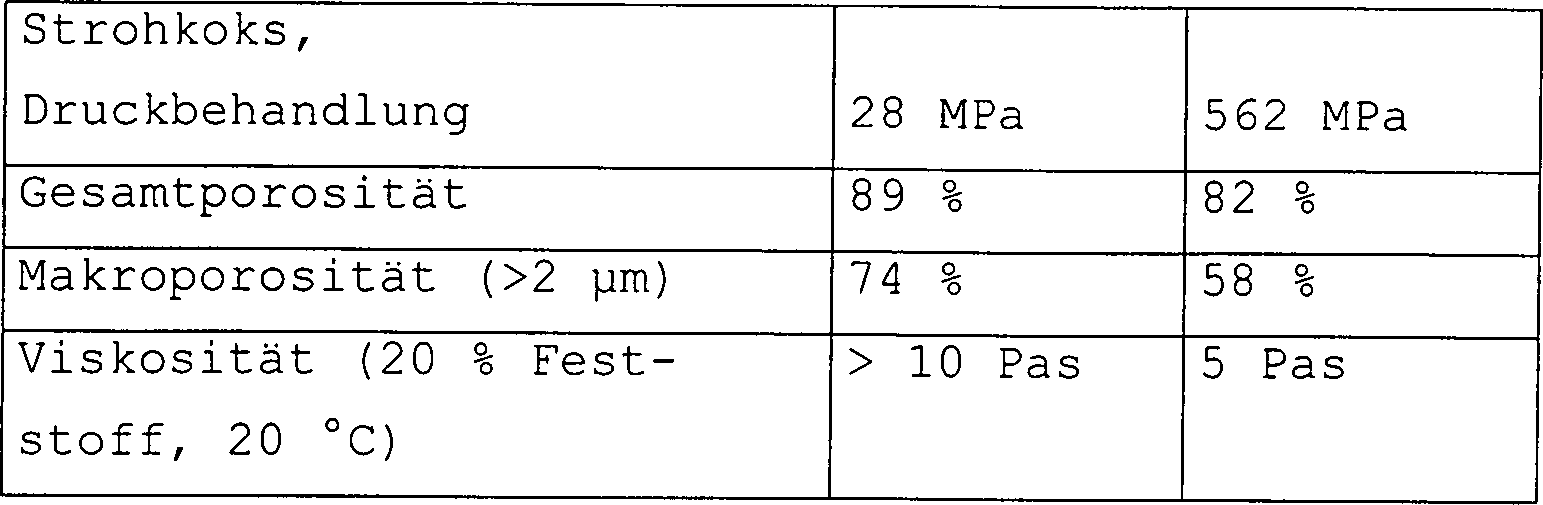

Claims (6)
Priority Applications (2)
| Application Number | Priority Date | Filing Date | Title |
|---|---|---|---|
| DE102004019203A DE102004019203B3 (en) | 2004-04-16 | 2004-04-16 | Process for the gasification of storage-stable biomass to synthesis gas |
| EP05006694A EP1586621B1 (en) | 2004-04-16 | 2005-03-26 | Process for gasifying carbonaceous matter into syngas |
Applications Claiming Priority (1)
| Application Number | Priority Date | Filing Date | Title |
|---|---|---|---|
| DE102004019203A DE102004019203B3 (en) | 2004-04-16 | 2004-04-16 | Process for the gasification of storage-stable biomass to synthesis gas |
Publications (1)
| Publication Number | Publication Date |
|---|---|
| DE102004019203B3 true DE102004019203B3 (en) | 2005-12-22 |
Family
ID=34934539
Family Applications (1)
| Application Number | Title | Priority Date | Filing Date |
|---|---|---|---|
| DE102004019203A Expired - Fee Related DE102004019203B3 (en) | 2004-04-16 | 2004-04-16 | Process for the gasification of storage-stable biomass to synthesis gas |
Country Status (2)
| Country | Link |
|---|---|
| EP (1) | EP1586621B1 (en) |
| DE (1) | DE102004019203B3 (en) |
Cited By (3)
| Publication number | Priority date | Publication date | Assignee | Title |
|---|---|---|---|---|
| DE102006049781A1 (en) * | 2006-10-21 | 2008-04-24 | Andrzej Sakowicz | Gasification of organic materials by air, comprises gasifying the organic materials to a raw product gas in a first gasification reactor, separating the coke from the product gas by a cyclone and feeding the coke to a further reactor |
| DE102008012154A1 (en) | 2008-03-01 | 2009-09-03 | Karl-Heinz Tetzlaff | Biomass conveyor for feeding into a pressure vessel |
| DE102008012156A1 (en) | 2008-03-01 | 2009-09-03 | Karl-Heinz Tetzlaff | Screw conveyor for feeding biomass into a pressure vessel |
Families Citing this family (3)
| Publication number | Priority date | Publication date | Assignee | Title |
|---|---|---|---|---|
| DE102006007457B4 (en) * | 2006-02-17 | 2007-12-27 | Native Power Solutions Gmbh & Co. Kg | Method and apparatus for producing gas from carbonaceous material |
| FR2924437B1 (en) * | 2007-11-30 | 2010-11-05 | Denis Hanriot | PROCESS FOR PRODUCING ENERGY FROM LIGNO-CELLULOSIC BIOMASS BY PYROLYSIS AND GASIFICATION ON DISTINCT SITES |
| EP2236588B1 (en) * | 2009-04-02 | 2012-07-04 | General Electric Company | Process for use of pyrolysis water |
Citations (1)
| Publication number | Priority date | Publication date | Assignee | Title |
|---|---|---|---|---|
| DE10151054A1 (en) * | 2001-10-16 | 2003-04-30 | Karlsruhe Forschzent | Process for the treatment of biomass |
Family Cites Families (3)
| Publication number | Priority date | Publication date | Assignee | Title |
|---|---|---|---|---|
| GB2109400B (en) * | 1981-10-02 | 1985-08-14 | Foster Wheeler Power Prod | Thermal conversion systems |
| DE19925316A1 (en) * | 1999-05-27 | 2000-11-30 | Technip Benelux B V | Process and plant for the autothermal gasification of solid fuels |
| DK200000417A (en) * | 2000-03-15 | 2001-09-16 | Cowi Radgivende Ingeniorer As | Process and plant for decomposition, gasification and / or combustion of moist fuel. |
-
2004
- 2004-04-16 DE DE102004019203A patent/DE102004019203B3/en not_active Expired - Fee Related
-
2005
- 2005-03-26 EP EP05006694A patent/EP1586621B1/en not_active Expired - Lifetime
Patent Citations (1)
| Publication number | Priority date | Publication date | Assignee | Title |
|---|---|---|---|---|
| DE10151054A1 (en) * | 2001-10-16 | 2003-04-30 | Karlsruhe Forschzent | Process for the treatment of biomass |
Non-Patent Citations (3)
| Title |
|---|
| Henrich, E., Dinjus, E. und Meier, D.: Biomasse- nutzung durch Flugstrom-Druckvergasung von Pyro- lyseprodukten. FSV Fachtagung 2003. Ergänzende Beiträge. * |
| Henrich, E., Dinjus, E. und Meier, D.: Hochwertige Biomassenutzung durch Flugstrom-Druckvergasung von Pyrolyseprodukten. 13. Internationales Sonnen- forum, Berlin, 12.-14. September 2002 |
| Henrich, E., Dinjus, E. und Meier, D.: HochwertigeBiomassenutzung durch Flugstrom-Druckvergasung vonPyrolyseprodukten. 13. Internationales Sonnen- forum, Berlin, 12.-14. September 2002 * |
Cited By (5)
| Publication number | Priority date | Publication date | Assignee | Title |
|---|---|---|---|---|
| DE102006049781A1 (en) * | 2006-10-21 | 2008-04-24 | Andrzej Sakowicz | Gasification of organic materials by air, comprises gasifying the organic materials to a raw product gas in a first gasification reactor, separating the coke from the product gas by a cyclone and feeding the coke to a further reactor |
| DE102008012154A1 (en) | 2008-03-01 | 2009-09-03 | Karl-Heinz Tetzlaff | Biomass conveyor for feeding into a pressure vessel |
| DE102008012156A1 (en) | 2008-03-01 | 2009-09-03 | Karl-Heinz Tetzlaff | Screw conveyor for feeding biomass into a pressure vessel |
| WO2009112163A2 (en) | 2008-03-01 | 2009-09-17 | Karl-Heinz Tetzlaff | Biomass transport installation for introduction into a pressurised container |
| US8403127B2 (en) | 2008-03-01 | 2013-03-26 | Karl-Heinz Tetzlaff | Biomass transport installation for introduction into a pressurised container |
Also Published As
| Publication number | Publication date |
|---|---|
| EP1586621B1 (en) | 2013-02-27 |
| EP1586621A1 (en) | 2005-10-19 |
Similar Documents
| Publication | Publication Date | Title |
|---|---|---|
| EP1934306B1 (en) | Process for production and preparation of rapid pyrolysis products from biomass for pressurized entrained-flow gasification | |
| DE2642201C2 (en) | Pumpable fuel mixture and method for producing the same | |
| DE4446401C2 (en) | Solid fuel made from porous coal and method and apparatus for producing the same | |
| DE112009002456B9 (en) | A method of producing a briquetted solid fuel using porous coal as the starting material | |
| DE3537485C2 (en) | Coal ash removal process | |
| DE3213307A1 (en) | METHOD FOR ASHING AND CONVEYING COAL | |
| DE2809627A1 (en) | STABLE SUSPENSION OF CARBON IN A HYDROCARBON FUEL AND METHOD OF MAKING THE SAME | |
| DE102004019203B3 (en) | Process for the gasification of storage-stable biomass to synthesis gas | |
| DE3685902T2 (en) | METHOD AND DEVICE FOR LIQUIDIZING CHARCOAL TEAR SLUDGE. | |
| DE2629797C3 (en) | Method of transporting coal | |
| EP3504294A1 (en) | Process for upgrading solid fossil fuels by means of a pyrolysis reactor | |
| DE1185148B (en) | Process for eliminating the differences in surface properties of fine-grained and / or dust-like substances, especially fuels | |
| DE2328777C2 (en) | Process for separating organic substances that are sparingly soluble in water from aqueous multiphase systems by adsorption | |
| DE3506439C2 (en) | ||
| DE3606704C2 (en) | Process for the production of high-calorific cheap industrial fuels with simultaneous disposal of industrial and / or municipal sewage sludge and use of the resulting suspension | |
| DE2838884A1 (en) | METHOD FOR PRODUCING COOKS FROM CELLULAR MATERIALS AND FOR PROCESSING FUELS FROM THE COCK | |
| DE2944737C2 (en) | Process for obtaining coal with a low pyrite content | |
| DE3636118C2 (en) | ||
| DE102004030398A1 (en) | Production of secondary fuel from slurry-like recycling residues, especially paper slurry, comprises forming pellet starting material having specified dry residue content from slurry-like residues and pelleting into fuel pellets | |
| DE69214139T2 (en) | METHOD FOR TREATING HUMIDIFYING CARBONATIVES | |
| DE3128528A1 (en) | Process for preparing a mixture of pulverised coal and refuse compost | |
| DD156712A5 (en) | METHOD FOR PRODUCING A FINISHING PRODUCT HAVING HIGH ENERGY DILUTIONS FROM STUCCY, WATERPROOF RAW BROWN COAL | |
| DE3619725A1 (en) | Process for producing an upgraded product from sewage sludges | |
| DE3431465A1 (en) | METHOD FOR PRODUCING AN AQUEOUS, CONVEYABLE FUEL SLUDGE FROM CARBONATED MATERIAL | |
| AT87675B (en) | Process for the production of a colloidal fuel. |
Legal Events
| Date | Code | Title | Description |
|---|---|---|---|
| 8100 | Publication of patent without earlier publication of application | ||
| 8363 | Opposition against the patent | ||
| 8327 | Change in the person/name/address of the patent owner |
Owner name: KARLSRUHER INSTITUT FUER TECHNOLOGIE, 76131 KA, DE |
|
| R030 | Patent maintained unamended by decision of federal patent court | ||
| R119 | Application deemed withdrawn, or ip right lapsed, due to non-payment of renewal fee | ||
| R119 | Application deemed withdrawn, or ip right lapsed, due to non-payment of renewal fee |
Effective date: 20141101 |