CN1664617B - System for combining signals of pressure sensors and particle motion sensors in marine seismic streamers - Google Patents
System for combining signals of pressure sensors and particle motion sensors in marine seismic streamers Download PDFInfo
- Publication number
- CN1664617B CN1664617B CN2005100518929A CN200510051892A CN1664617B CN 1664617 B CN1664617 B CN 1664617B CN 2005100518929 A CN2005100518929 A CN 2005100518929A CN 200510051892 A CN200510051892 A CN 200510051892A CN 1664617 B CN1664617 B CN 1664617B
- Authority
- CN
- China
- Prior art keywords
- mrow
- signal
- msub
- particle motion
- signals
- Prior art date
- Legal status (The legal status is an assumption and is not a legal conclusion. Google has not performed a legal analysis and makes no representation as to the accuracy of the status listed.)
- Expired - Fee Related
Links
- 239000002245 particle Substances 0.000 title claims abstract description 73
- 238000000034 method Methods 0.000 claims description 60
- XLYOFNOQVPJJNP-UHFFFAOYSA-N water Substances O XLYOFNOQVPJJNP-UHFFFAOYSA-N 0.000 claims description 50
- 238000001228 spectrum Methods 0.000 claims description 23
- 238000012545 processing Methods 0.000 claims description 9
- 230000000694 effects Effects 0.000 claims description 8
- 238000012937 correction Methods 0.000 claims description 7
- 230000004044 response Effects 0.000 claims description 3
- 230000015572 biosynthetic process Effects 0.000 description 11
- 238000005755 formation reaction Methods 0.000 description 11
- 230000001902 propagating effect Effects 0.000 description 8
- 230000003595 spectral effect Effects 0.000 description 7
- 238000001514 detection method Methods 0.000 description 4
- 230000001133 acceleration Effects 0.000 description 3
- 238000006073 displacement reaction Methods 0.000 description 3
- 238000000205 computational method Methods 0.000 description 2
- 238000012986 modification Methods 0.000 description 2
- 230000004048 modification Effects 0.000 description 2
- 230000000644 propagated effect Effects 0.000 description 2
- 238000012546 transfer Methods 0.000 description 2
- 238000013459 approach Methods 0.000 description 1
- 230000002238 attenuated effect Effects 0.000 description 1
- 230000009286 beneficial effect Effects 0.000 description 1
- 238000004364 calculation method Methods 0.000 description 1
- 230000008859 change Effects 0.000 description 1
- 238000006243 chemical reaction Methods 0.000 description 1
- 230000001427 coherent effect Effects 0.000 description 1
- 239000003673 groundwater Substances 0.000 description 1
- 238000012886 linear function Methods 0.000 description 1
- 230000003287 optical effect Effects 0.000 description 1
- 230000008569 process Effects 0.000 description 1
- 230000009291 secondary effect Effects 0.000 description 1
- 230000035945 sensitivity Effects 0.000 description 1
- 238000013519 translation Methods 0.000 description 1
Images


Classifications
-
- G—PHYSICS
- G01—MEASURING; TESTING
- G01V—GEOPHYSICS; GRAVITATIONAL MEASUREMENTS; DETECTING MASSES OR OBJECTS; TAGS
- G01V1/00—Seismology; Seismic or acoustic prospecting or detecting
- G01V1/28—Processing seismic data, e.g. for interpretation or for event detection
- G01V1/284—Application of the shear wave component and/or several components of the seismic signal
-
- G—PHYSICS
- G01—MEASURING; TESTING
- G01V—GEOPHYSICS; GRAVITATIONAL MEASUREMENTS; DETECTING MASSES OR OBJECTS; TAGS
- G01V1/00—Seismology; Seismic or acoustic prospecting or detecting
- G01V1/38—Seismology; Seismic or acoustic prospecting or detecting specially adapted for water-covered areas
- G01V1/3808—Seismic data acquisition, e.g. survey design
-
- G—PHYSICS
- G01—MEASURING; TESTING
- G01V—GEOPHYSICS; GRAVITATIONAL MEASUREMENTS; DETECTING MASSES OR OBJECTS; TAGS
- G01V1/00—Seismology; Seismic or acoustic prospecting or detecting
- G01V1/28—Processing seismic data, e.g. for interpretation or for event detection
- G01V1/36—Effecting static or dynamic corrections on records, e.g. correcting spread; Correlating seismic signals; Eliminating effects of unwanted energy
- G01V1/364—Seismic filtering
- G01V1/366—Seismic filtering by correlation of seismic signals
Landscapes
- Life Sciences & Earth Sciences (AREA)
- Physics & Mathematics (AREA)
- Engineering & Computer Science (AREA)
- Remote Sensing (AREA)
- General Physics & Mathematics (AREA)
- Environmental & Geological Engineering (AREA)
- Geology (AREA)
- General Life Sciences & Earth Sciences (AREA)
- Acoustics & Sound (AREA)
- Geophysics (AREA)
- Oceanography (AREA)
- Geophysics And Detection Of Objects (AREA)
- Measurement Of Mechanical Vibrations Or Ultrasonic Waves (AREA)
- Measuring Fluid Pressure (AREA)
- Force Measurement Appropriate To Specific Purposes (AREA)
- Measurement Of The Respiration, Hearing Ability, Form, And Blood Characteristics Of Living Organisms (AREA)
- Investigating Or Analyzing Materials By The Use Of Ultrasonic Waves (AREA)
Abstract
Signals of pressure sensors and particle motion sensors located in marine seismic streamers are combined to generate pressure sensor data and particle motion data with substantially the same broad bandwidth. The noisy low frequency part of the motion signals are calculated from the recorded pressure signals and merged with the non-noisy motion signals. The two broad bandwidth data sets can then be combined to calculate the full up- and down-going wavefields.
Description
Technical Field
The present invention relates generally to the field of geophysical prospecting. In particular, the present invention relates to the field of marine seismic exploration. In particular, the invention is a system for combining the signals of pressure sensors and particle motion sensors in marine seismic streamers.
Background
In seismic exploration, geophysical data are acquired by applying acoustic energy from an acoustic source to the earth's surface and detecting seismic energy reflected by interfaces between different layers in subsurface formations. Seismic wavefields are reflected when there is a difference in acoustic impedance between the formations above the interface and the formations below the interface. When towing streamers are employed in marine seismic exploration, the seismic streamers are typically towed behind the exploration vessel at water depths between about six and nine meters, but may be towed shallower or deeper. Hydrophones are included in the streamer cable for detecting seismic signals. A hydrophone is a type of underwater pressure ramp sensor that converts pressure waves into electrical or optical signals that are typically recorded for signal processing and evaluated to determine characteristics of the subsurface of the earth.
In a typical geophysical exploration configuration, a plurality of streamer cables are towed behind a vessel. One or more seismic sources are also typically towed behind the vessel. The seismic source, which typically is an air gun array but may also be a water gun array or other type of energy source known to those skilled in the art, transmits seismic energy or waves to the surface which are reflected by reflectors in the surface and recorded by sensors in the streamers. Paravanes are typically used to maintain the cable in a desired horizontal position while being towed. Alternatively, the seismic cable may be held substantially in a fixed position in the body of water, floating at a selected depth or at the bottom of the body of water, in which case the source may be towed behind a ship to generate acoustic energy at different locations, or the source may be held in a fixed position.
After the reflected wave reaches the streamer cable, the wave continues to propagate to the water/air interface at the water surface where it is reflected downward and is once again detected by the hydrophones in the streamer cable. The water surface is a good reflector and the reflection coefficient at the water surface is almost 1 and of opposite sign to the pressure signal. The wave reflected at the surface is thus phase-shifted by 180 degrees compared to the upwardly propagating wave. The downward propagating wave recorded by the receiver is commonly referred to as a surface reflection or "ghost" signal. Due to this surface reflection, the water surface acts like a filter creating spectral notches in the recorded signal, which makes it difficult to record data outside the selected bandwidth. Some frequencies in the recorded signal are enhanced and some frequencies are attenuated due to the influence of surface reflections.
The maximum attenuation occurs at frequencies where the propagation distance between the detecting hydrophone and the water surface is equal to one-half wavelength. The maximum enhancement will occur at frequencies where the propagation distance between the detecting hydrophone and the water surface is a quarter wavelength. The wavelength of the sound wave is equal to the velocity divided by the frequency, and the velocity of the sound wave in water is about 1500 m/s. Accordingly, the position in the spectral frequency of the resulting spectral bin can be easily determined. For example, for seismic streamers at a depth of 7 meters, and for normal incidence waves, the maximum attenuation will occur at a frequency of about 107Hz, while the maximum enhancement will occur at a frequency of about 54 Hz.
It is not conventional to tow streamer cables at depths greater than about nine meters because the location of the spectral slots in the spectrum of the signal detected by the hydrophone substantially reduces the usefulness of the recorded data. Streamers also conventionally cannot be towed at depths less than six meters because of the significant increase in surface associated with noise induced in seismic streamer data.
Marine seismic operations are also conventionally performed in which sensors are placed at the water bottom. Such operations are typically referred to as "ocean bottom seismic" operations. In ocean bottom seismic operations, both pressure sensors (hydrophones) and particle motion sensors (geophones, accelerometers) are placed on the ocean floor to record seismic data.
Particle motion sensors, such as seismic detection sensors, have directional sensitivity, while pressure sensors, such as hydrophones, do not. Accordingly, the up-going wavefield signals detected by the geophone and hydrophone located close together are in phase, while the down-going wavefield signals to be recorded are 180 degrees out of phase. Various techniques have been proposed to exploit the phase difference to reduce the spectral notches caused by surface reflections and also to attenuate water borne multiples if the recordings are made on the seafloor (water borne multiples). It is noted that an alternative to arranging both geophones and hydrophones is to have enough sensors in spatial density so that the respective wavefields recorded by the hydrophones and geophones can be interpolated or extrapolated to produce two wavefields at the same location.
A system that suppresses ghosting by combining the outputs of pressure and velocity detectors is described in U.S. patent 4,486,865 to Ruehle. The detectors are paired, one pressure detector and one velocity detector in each pair. A filter is said to alter the frequency content of at least one of the detectors so that ghosting is cancelled when the outputs are combined.
Also described in U.S. patent 5,621,700 to Moldovenu is a method for attenuating ghosts and water layer reflections that utilizes at least one sensor pair comprising a pressure sensor and a velocity sensor in an undersea cable.
A marine seismic reflection detection system that detects seismic waves propagating in water using pressure sensor-particle velocity sensor pairs (e.g., hydrophone-geophone pairs) or alternatively using vertical-space pressure sensors is described in U.S. patent No. 4,935,903 to Sanders et al. The system causes an enhancement of the raw reflection data for use in pre-stack processing by adding ghost data.
U.S. patent No. 4,979,150 to Barr provides a method for marine seismic exploration that purportedly attenuates coherent noise caused by water column reflections by applying a scaling factor to the outputs of pressure and particle velocity sensors located approximately close to each other in the water. As described in this patent, the sensors may be located at the sea floor, preferably at the sea floor, but may also be located in the water above the floor.
Co-pending us patent application 10/233,266 entitled "apparatus and method for multivariate marine geophysical data acquisition" filed on 8/30/2002, having a common inventor with the present invention and assigned to the assignee of the present invention, describes a particle motion sensor for use in a streamer cable and a method for compensating and combining the output signals of the particle motion sensor and a co-located pressure gradient sensor.
As shown in the cited patent, it is well known in the art that pressure and particle motion signals can be combined to derive up-going and down-going wavefields. For seafloor recording, the up-going and down-going wavefields may then be combined to eliminate surface reflection effects and attenuate water borne multiples (water borne multiples) in the seismic signal. However, for towed streamer operation, particle motion signals are considered to be of limited utility due to the high noise levels in the particle motion signals. However, if a particle motion signal can be provided for towed streamer operation, surface reflection effects can be eliminated from the data.
Co-pending us patent application 10/233,266 entitled "method of seismic exploration using motion sensor and pressure sensor data", filed on 7/16/2003 and assigned to the assignee of the present invention, describes a method of attenuating multiplications (multiples) by combining upward and downward propagating wavefields measured in a water column, where the wavefields are calculated from a combination of pressure sensors, such as hydrophones, and motion sensors, such as geophones. However, this method assumes that both pressure and motion data have the same bandwidth.
However, it is difficult to achieve the same bandwidth in the motion sensor data as in the pressure sensor data due to noise caused by vibrations in the streamers, which is detected by the particle motion sensors. However, the noise is mainly limited to low frequencies. One way to reduce the noise is to connect several sensors in series or in parallel. However, this approach does not always reduce enough noise to produce a signal-to-noise ratio suitable for further seismic processing.
Thus, there is a need for a method to obtain an effective particle motion signal that has a satisfactory signal-to-noise ratio at low frequencies. In particular, a method is needed to generate a particle motion signal having approximately the same bandwidth as the recorded pressure signal for particle motion sensors and pressure sensors located in a towed streamer.
Disclosure of Invention
The invention is a method for combining signals of pressure sensors and particle motion sensors located in a marine seismic streamer. Therefore, the particle motion sensor signal is calculated from the pressure sensor signal in the low frequency region using the depth of the streamer and the acoustic velocity in the water.
In a further embodiment of the invention, a purely three-dimensional mathematical solution takes into account the fact that energy returning from the earth's surface reaches the receiver at a range of angles of incidence, rather than only in a coaxial or given direction, such as the vertical direction.
Drawings
The invention and its advantages may be more readily understood by reference to the following detailed description and the accompanying drawings, in which:
FIG. 1 is a schematic illustration of a method for obtaining marine seismic data that may be employed by the method of the present invention;
FIG. 2 is a flow chart showing the processing steps of an embodiment of the method of the present invention for combining signals from pressure sensors, such as hydrophones, and particle motion sensors, such as geophones, located in a marine seismic streamer;
FIG. 3 is a section of a hydrophone signal recorded at 13m depth.
FIG. 4 is a graph of a corresponding segment of the geophone signal recorded simultaneously with the hydrophone signal of FIG. 2;
FIG. 5 is a plot of the amplitude spectra of the hydrophone and geophone signals from FIGS. 2 and 3, respectively;
FIG. 6 is a plot of the amplitude spectrum of the hydrophone signal and the tapered geophone signal of FIG. 5;
FIG. 7 is a plot of the amplitude spectra of the hydrophone signal and the tapered geophone signal as shown in FIG. 5, and also a plot of the calculated, tapered geophone signal amplitude spectrum.
FIG. 8 is a plot of the amplitude spectra of the hydrophone signal and the combined geophone signal of FIG. 7; and
FIG. 9 is a plot of the amplitude spectrum of the up-going wavefield produced by adding the hydrophone and geophone signals from FIG. 7.
While the invention will be described in conjunction with the preferred embodiments, it will be understood that they are not intended to limit the invention to these embodiments. On the contrary, the invention is intended to cover all alternatives, modifications, and equivalents, which may be included within the scope of the invention as defined by the appended claims.
Detailed Description
FIG. 1 illustrates a schematic (not to scale) of a method for obtaining marine seismic data that can be used in the method of the invention. A seismic vessel 101 is located in a body of water 102 above the earth's surface 103. Below the water bottom 104, the earth's surface 103 contains subsurface formations of interest, such as formations 105, located between an upper boundary 106 and a lower boundary 107. The seismic vessel 101 moves over the water surface 108 and contains seismic acquisition control equipment, generally designated 109. The seismic acquisition control equipment 109 includes navigation controls, seismic source controls, seismic sensor controls, and recording devices, all of the types known in the seismic acquisition art.
The seismic acquisition control equipment 109 causes a seismic acoustic source 110 towed in the body of water 102 by the seismic vessel 101 to be activated at selected times. The seismic source 110 may be any type of seismic acquisition known in the art, including an air gun or water gun, or particularly a bank of air guns. Seismic streamers 111 are also towed in the water 102 by the seismic vessel 101 to record acoustic wavefields originating from the seismic source 110 and reflected by interfaces in the environment. Although only one seismic streamer 111 is shown here for purposes of illustration, typically a plurality of seismic streamers 111 are towed behind the seismic vessel 101. The seismic streamers 111 contain sensors to detect the reflected wavefields originating from the seismic acoustic source 110. Typically, the seismic streamers 111 contain pressure sensors, such as hydrophones 112, but dual-sensor seismic streamers 111 also contain water particle motion sensors, such as geophones 113. The hydrophones 112 and geophones 113 are typically arranged in pairs or pairs at regular intervals along the seismic streamers 111. However, the type of sensors 112, 113 or their location in the seismic streamers 111 is not intended to limit the invention.
Each time the seismic source 110 is activated, the acoustic wavefield travels upward and downward in a spherically expanding wave array. The propagation of the wave front will be illustrated here by the ray path perpendicular to the wave front. The upwardly traveling wavefield, represented by ray path 114, will reflect off of the water-air interface at the water surface 108 and then travel downwardly, as ray path 115, where the wavefield is detected by hydrophones 112 and geophones 113 in seismic streamers 111. Unfortunately, such reflections at the water surface 108 as ray path 115 do not contain useful information about the subsurface formations of interest.
The downwardly traveling wavefield in ray path 116 will reflect off of the ground-water interface at the water bottom 104 and then travel upwardly, as in ray path 117, where the wavefield is detected by the hydrophones 112 and geophones 113. Such a reflection at the water bottom 104 as in ray path 117 contains information about the water bottom 104. Ray path 117 is an embodiment of a primary reflection that has one reflection in the subsurface earth. The downwardly propagating wavefield, as shown in ray path 116, may propagate through the water bottom 104, as shown in ray path 118, reflect off a layer boundary, as shown at 107, of a formation, such as 105, and then propagate upwardly, as shown in ray path 119. Thus, the upwardly traveling wavefield, shown by ray path 119, may be detected by the hydrophones 112 and geophones 113. This reflection back at the layer boundary 107 contains useful information about the formation of interest 105 and is also an example of a primary reflection, with the primary reflection at a subsurface formation.
Unfortunately, the acoustic wavefields will continue to reflect back at interfaces such as the water bottom 104, the water surface 108, and the formation interfaces 106, 107 and combine the reflections. For example, an upwardly traveling wavefield in ray path 117 will reflect off the water surface 108, continue traveling downwardly in ray path 120, reflect off the water bottom 104, and continue traveling upwardly again in ray path 121, where the wavefield may be detected by the hydrophones 112 and geophones 113. Ray path 121 is an embodiment of multiple reflections, also referred to simply as "multiple reflections," which have multiple reflections at interfaces. Likewise, the upwardly traveling wavefield in ray path 119 will reflect off the water surface 108, continue traveling downwardly in ray path 122, reflect off the layer boundary 106 and continue traveling upwardly again in ray path 123, where the wavefield may be detected by the hydrophones 112 and geophones 113. Ray path 123 is another multiple reflection embodiment, also having multiple reflections in the subsurface earth. The multiple reflections contain redundant information about the formations of interest and are typically removed from the seismic data prior to further processing.
The present invention is a method for combining the signals of pressure sensors (typically hydrophones) and particle motion sensors (typically geophones or accelerometers) located in seismic streamers. The combined signals are then utilized to generate downward and upward propagating wavefields that are beneficial for further seismic processing, such as multi-reflection attenuation in marine seismic data. The recorded particle motion signals are often disturbed by low frequency noise due to vibrations in the towed streamers, and therefore the signal-to-noise ratio of the combined signal will be small. If the frequency spectrum of the pressure sensor signal has a satisfactory signal-to-noise ratio in a given frequency range (and no slots in this frequency range) and the depth of the pressure and particle motion sensors is known, then the particle motion signal can be calculated from the pressure sensor signal in this frequency range. If the depth of the sensor is not known, it can be calculated from the spectral bin frequency caused by surface reflections, a method well known in the art.
Because it has a low signal-to-noise ratio, it is typically necessary to replace the low frequency portion of the particle motion signal. This low frequency portion is referred to as the 'frequency range'. The corresponding portion of the pressure sensor signal used to calculate the particle motion signal typically has a good signal-to-noise ratio in this frequency range. Therefore, the depth of the pressure sensor is preferably chosen such that the frequency of the first spectral bin in the pressure sensor signal caused by surface reflections is higher than said frequency range.
The method of the invention is particularly useful for towing marine seismic streamers, since the vibrations of towed streamers add significant noise to the signal of the particle motion sensor. Thus, the method of the invention will be described in terms of towed streamers.
The method of the present invention uses a pressure sensor that is responsive to pressure changes in a medium to which the pressure sensor is coupled. The medium is typically water. The method of the invention is illustrated with hydrophones only for clarity, but this is not meant to limit the invention.
The method of the present invention uses particle motion sensors that respond to motion in water particles, which are coupled to the water. In general, particle motion sensors may respond to particle displacement, particle velocity, or acceleration of a particle in a medium. In the present invention, particle velocity sensors are preferred. Thus, if a motion sensor is employed that responds to displacement, it is preferable to differentiate the displacement signal to convert it to a velocity signal by computational methods well known in the art. If a motion sensor responsive to acceleration (typically referred to as a geophone) is employed, the acceleration signal is preferably integrated to be converted to a velocity signal by computational methods well known in the art.
In an alternative embodiment of the invention, a multicomponent motion sensor is employed in the seismic cable. This embodiment of the invention is illustrated using geophones for clarity purposes only, but is not meant to limit the invention. In a three-element geophone embodiment, a geophone is added to detect particle velocity in the vertical direction. This geophone is called a vertical geophone. Two geophones are added in orthogonal directions relative to each other and to the vertically fixed geophone to detect horizontal motion. Typically, a ternary geophone is positioned to detect motion in the vertical direction, motion in the linear direction, and motion in the orthogonal direction. Positioning these geophones in these three directions makes it possible to detect the direction of propagation of the incoming signal. It also enables the detection of the flutter or other mechanical activity of the seismic cable. The method of the present invention is illustrated using vertical geophones for clarity purposes, but this is not meant to limit the invention.
Although it is necessary to integrate the output signal to obtain velocity, a geophone can be used as a particle motion sensor as an alternative to using a geophone. Some accelerometers produce an output signal that indicates a change in orientation of the accelerometer relative to a selected orientation. Accordingly, with a two geophone configuration (for use where the linear direction is known) or a three geophone configuration (if the linear direction is not known), the sensor orientation can be calculated without having to hold the geophones in a particular orientation.
The method of the invention is illustrated by reference to the representation in the flow chart of fig. 2. The method of the present invention is described herein using hydrophones as pressure sensors and vertical geophones as particle motion sensors, but this is not meant to limit the invention. In the embodiments discussed below with reference to fig. 3-9, hydrophones and geophone systems are placed every 0.7m in towed seismic streamers that are 1300m in length and 13m in depth, with one seismic source at 13m depth. The horizontal distance between the seismic source and the hydrophone/geophone system was approximately 1300 m. These specific examples are for illustrative purposes only and are not intended to limit the present invention.
FIG. 2 illustrates a flow chart illustrating the processing steps in an embodiment of the method of the present invention for computing geophone signals from hydrophone signals and then combining the signals from hydrophones and geophones located in streamers.
In the following alternative discussion, signals in the space-time domain are represented by lower case letters, while the same signals in the frequency wave-number domain are represented by corresponding upper case letters (upper case letters).
In a preferred embodiment of the present invention,(space) is a vector and is equal to (x, y), where x is the direction along the streamers and y is the direction of the orthogonal line. In other embodiments, y may be held constant so that each cable is analyzed individually. One possible reason for choosing this solution is to arrange the cables at significantly different depths. Meanwhile, in other embodiments, x may also be kept constant in order to analyze each sensor separately. The latter is typically the preferred option if the depth of the sensors within each cable is significantly different.
In a preferred embodiment of the present invention, (wave number) is a vector and is equal to (k)x,ky) Wherein k isxIs the wave number in the x-axis direction and kyIs the wave number in the y-direction. In other embodiments, kyMay be disregarded in order to analyze each cable individually. In this case, a fixed direction of orthogonal line propagation for each cable is selected. This direction may be vertical or any other direction. A possible reason for choosing this solution is to arrange the cables at significantly different depths. Likewise, in other embodiments, kxAnd kyMay be disregarded so that each sensor is analyzed separately and only the frequency spectrum of each recorded trace is used. The latter is typically a preferred solution if the depth of the sensors within each cable is significantly different. In this case, the translation data would be in the f-x domain
The following discussion employs an embodiment of marine seismic exploration for targets located at depths of several hundred meters to several kilometers, so-called deep seismic exploration. However, the invention is also applicable to the detection of deeper and shallower targets.
At the step of FIG. 2Step 21, a set of hydrophone data is acquiredAnd a corresponding set of geophone dataConversion from the space-time domain to the frequency-wavenumber domain, each producing a converted hydrophone signalAnd a converted geophone signalThe transform is preferably a fourier transform, but this is not a limitation of the invention.
The method of the present invention may be performed in a variety of transform domains that separate the wavefield into angular components (angular components), including but not limited to wavenumbers or slowdowns. The method of the invention is not limited to the frequency-wavenumber domain or to the fourier transform. For illustrative purposes only the frequency-wavenumber domain and fourier transform are used below.
At step 22 of FIG. 2, the converted hydrophone and geophone signals from step 21 are separately processed in the instrument transfer functionAnda correction (relative differences) is made for the relative difference, the instrument transfer function corresponding to the instrument impulse response in the time domain. These corrections may be to correct the amplitude and phase of the hydrophone data to match the geophone data, or in alternative embodiments, to correct the geophone data for geophone offsetThe sensor data is corrected to match the hydrophone data or, in a further alternative embodiment, the two data sets are corrected to a common basis. Correction of relative differences in instrument impulse response is well known in the art. Finally, an amplitude ratio equal to the inverse of the acoustic impedance in the water is preferably applied to the geophone data to correct for the relative differences in pressure and particle velocity amplitudes. This is also well known in the art.
In step 23 of FIG. 2, the corrected geophone signal from step 22 is correctedThe correction of the incident angle is further performed. While a hydrophone records the entire wavefield, a vertical geophone only records the vertical portion of the wavefield. It is equal to the entire wavefield only for a signal that propagates vertically, i.e., at an angle of incidence of 0. For any other value of φ, the geophone signal needs to be calculated according to the following equation:
wherein,is the entire wavefield and cos (φ) is given by the equation:
and v is the speed of sound in water.
The speed of sound in water is known in the art to be approximately 1500 m/sec. Thus, if v is known, equation (2) gives a direct link between the angle of incidence φ, the wave number value k, and the frequency f. If v is unknown for some reason, it can be calculated by methods well known in the art. Likewise, as can be seen from equation (2), cos (φ) is real and not equal to 0 when the value of k is given by:
an embodiment of a single curve record to which the above-described correction has been applied is shown in fig. 3 and 4. FIG. 3 is a plot of amplitude versus time for a hydrophone signal recorded at a depth of 13 m. FIG. 4 is a plot of amplitude versus time for a corresponding geophone signal recorded simultaneously with the hydrophone signal of FIG. 3. The corresponding amplitude spectra (shown as amplitude versus frequency curves) of the hydrophone and geophone signals are shown in FIG. 5. The solid line 51 is the spectrum of the hydrophone signal and the dashed line 52 is the spectrum of the geophone signal. Higher noise levels can be seen in the geophone data compared to fig. 3 and 4. Also, it can be seen from FIG. 5 that the noise in the geophone signal is primarily limited to low frequencies 53.
In step 24 of FIG. 2, the low frequency portion of the geophone signal is calculated from the recorded hydrophone signal. Thus, for f1≤f≤f2I.e. for the frequency range f1,f2]From In generating the data set
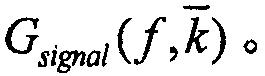 This process is described in detail below.
The hydrophone signal and the geophone signal can be represented in terms of their up-going and down-going portions, where the hydrophone signal (pressure wavefield) is given by the equation:
wherein Is a hydrophone signalIs propagated upward, and
 is a hydrophone signal
 The downward propagation portion of (a). Likewise, the geophone signal (velocity wavefield) is given by the equation:
wherein Is a seismic wave-detecting sensor signalIs propagated upward, and
 is a seismic wave-detecting sensor signalThe downward propagation portion of (a).
The up-going portions of the hydrophone and geophone signals are assumed to be identical. Namely:
then, substituting equation (6) into equation (5) yields:
let τ be the surface reflection time lag, i.e., the time lag between the wavefield propagating straight up to arrival and the corresponding reflection back from the surface. With the definition of cos (φ) given by equation (2), the time lag τ is given by the following equation:
,
where D is the depth of the hydrophone and geophone. The depth D may be set in all ways known in the art, such as by a depth sensor or calculation. Assume that for a pressure signal, the reflection coefficient at the sea surface is c, and thus, -c is the reflection coefficient of the particle velocity signal. The absolute value of c is very close to 1. Also, as is well known in the art, the reflection coefficient is a function of the angle of incidence and, in the case of sea surfaces that are not always planar, also of the frequency. However, these effects are minor with respect to the method of the present invention and are therefore not discussed further. Another secondary effect, which is well known but not included in the following discussion, is the difference in geometrical propagation between the recorded direct wave and the recorded corresponding surface reflection. Thus, using τ, the downward-propagating portion of the hydrophone signal can be given by the following equation
Likewise, the downward-propagating portion of the geophone signalThis can be given by the following equation:
given equations (9) and (10), respectively Andsubstituting equations (4) and (7) yields:
and
next, the hydrophone and geophone signals, represented by the up-and down-going portions of the hydrophone and geophone signals according to equations (11) and (12), are converted to the frequency-wavenumber domain. Preferably, the transform is a fourier transform, but this is not a limitation of the invention. Transform equation (11) to the frequency-wavenumber domain by the following formula:
solving equation (13) for the up-propagating portion of the hydrophone signal, yields:
as described above, equation (12) is transformed into the frequency-wavenumber domain to obtain:
now, the hydrophone signal can be used in the frequency-wavenumber domainTo calculate the geophone signal Will be given by equation (14)Substituting into equation (15) produces a geophone signal calculated from the hydrophone signal, resulting in:
wherein the frequency f is defined by1≤f≤f2Given, the wave number k is as shown in equation (3). Equation (16) can be used to calculate a geophone signal from a recorded hydrophone signal at low frequencies where the signal-to-noise ratio of the recorded geophone signal does not meet processing requirements.
If the denominator on the right is not 0, then equation (16) is identical. Assuming that exactly c is-1, then
1=exp(-i2πfτ),(17)
The time denominator is 0, i.e., for f-0, 1/τ, 2/τ. Thus, f1Must be greater than 0. A typical value is 3 Hz. To avoid artifacts in the time domain, it is known in the art to apply appropriate attenuation to the low frequency portion of the calculated geophone signal spectrum.
As can be seen in equation (8):
it has a minimum value when phi is 0, i.e., a vertically propagating signal. This means that f2Must be less than v/2D. Suppose the geophone signal is too noisy to be used at frequencies below fnoiseUnder f, thennoise<f2<v/2D。
Preferably, f is2And fnoiseThe difference between (16) is large enough that the measured geophone signals can be used to compare and correct the geophone signals calculated in (16). The range of interleaved frequencies preferably combines the calculated portion of the geophone signal with the measured portion. Typically, f2Ratio fnoiseIs 5-10Hz higher. In order to maintain a good signal-to-noise ratio of the hydrophone signal, f2Should be significantly below v/2D and preferably not more than 75% of v/2D.
In the data embodiment shown in fig. 3-5, the depth D of the sensor is 13 m. It is assumed that a water velocity v of 1500m/s creates a first trough in the hydrophone spectrum at about v/2D or about 58 Hz. This means f2Should be less than about 75% of v/2D or about 43 Hz.
In step 25 of FIG. 2, the calculated and recorded portions of the geophone signals are combined into a data set. To avoid artifacts in the data, especially in the time domain, the merging is preferably done using attenuation regions. Even if a narrower frequency region is selected, in practice this attenuation region will still be fnoiseAnd f2The frequency in between.
The following is one method of applying a weight to two data sets before merging them. Other methods of calculating weights are known in the art and, therefore, are not a limitation of the present invention. The weight w (f) is calculated according to the following equation:
therefore, when f ═ fnoiseWhen w (f) is 0, and when f is f2When w (f) is 1. Then the total geophone data combined will be:
there are various methods known in the art for calculating weights to combine signals, and the above is used as an example only. Alternatively, it is possible to combine the amplitude and phase spectra of the two data sets separately. In this alternative embodiment, the actual weighting function is complex.
In the following embodiments shown in fig. 6-9, the data in fig. 5 is used to illustrate the method of steps 24 and 25 in fig. 2. From FIG. 5, f can be estimatednoiseAbout 20 Hz. To obtain the spacing for merging, f2Set to 25 Hz. FIG. 6 is a plot of the amplitude spectra of the hydrophone and geophone signals of FIG. 5. The solid line 61 is the spectrum of the hydrophone signal and the dashed line 62 is the spectrum of the geophone signal. The amplitude of the geophone signal in FIG. 5 tapers off as a linear function between 20 and 25Hz and is set to 0 (reference numeral 63) below 20Hz to give the amplitude of the geophone signal 61 in FIG. 6. FIG. 7 includes a geophone signal 73 calculated using hydrophone signals according to equation (11) over the frequency range of 3-25 Hz. The solid line 71 is the spectrum of the hydrophone signal and the dashed line 72 is the spectrum of the geophone signal from FIG. 6.
FIG. 8 illustrates the amplitude spectra of the recorded hydrophone data 81 and the combined (constructed) geophone data 82. The geophone signals 82 have been combined using equation (20). It can be seen that the hydrophone and geophone data sets now have substantially the same bandwidth.
In step 26 of FIG. 2, the full bandwidth constructed from the geophone data set and the full bandwidth recorded from the hydrophone data set are added or subtracted to calculate the full bandwidth of the up-and down-going wavefields, respectively. This can be given by the following equation:
Where u (x, t) and d (x, t) are the up-going and down-going wavefields, respectively. The spacing may also be derived in the frequency domain by the following equation:
After the data from the hydrophone 81 and the geophone 82 of FIG. 8 are added using equation (23), the amplitude spectrum of the up-going wavefield is shown in FIG. 9. As can be seen in fig. 9, the effect of surface reflections is eliminated at the receiver end. The trough 91 at around 125Hz is a surface reflection trough on the side of the seismic source, which is about 6m deep.
It should be understood that the foregoing is only a detailed description of specific embodiments of the invention and that numerous changes, modifications, and alternatives to the disclosed embodiments can be made in accordance with the disclosure herein without departing from the scope of the invention. The above description is therefore not meant to limit the scope of the invention. Rather, the scope of the invention is to be determined solely by the appended claims and their equivalents.
Claims (22)
1. A method for combining pressure sensor signals and particle motion sensor signals recorded in a marine seismic streamer to reduce noise in the combined pressure sensor signals and particle motion sensor signals, the recorded pressure signals having a bandwidth including a first frequency range and a second frequency range, the first frequency range being at a lower frequency than the second frequency range, and the recorded particle motion sensor signals having a bandwidth including at least the second frequency range, the method comprising:
calculating from the recorded pressure sensor signalA particle motion sensor signal in a frequency range, wherein in the frequency-wavenumber domain the recorded pressure signal is determined from the following formula Calculating the low frequency portion of the analog particle motion signal
Wherein, f is the frequency,is the wave number, kxIs the wave number in the x-axis direction, and kyIs the wave number in the y-direction, c is the sea surface reflection coefficient, τ is the time lag between the direct wave and the surface reflection, thereby producing an analog particle motion sensor signal in a first frequency range;
combining the analog particle motion sensor signal at only the first frequency range with the recorded particle motion sensor signal at the second frequency range to produce a combined particle motion sensor signal having the same bandwidth as the bandwidth of the recorded pressure sensor signal; and
the recorded pressure sensor signals are combined with the combined particle motion sensor signals for further processing.
2. The method of claim 1, wherein: the pressure sensor comprises a hydrophone.
3. The method of claim 1, wherein: the particle motion sensors include geophones.
4. The method of claim 1, wherein: the particle motion sensor comprises a seismic accelerometer.
5. The method of claim 1, wherein: particle motion sensors include sensors that measure more than one component of a particle motion wavefield.
6. The method of claim 1, wherein: the particle motion sensor and the pressure sensor are co-located.
7. The method of claim 1, wherein: the particle motion sensor and the pressure sensor are positioned so that the recorded signals from the sensors are used to calculate the corresponding data set at the same location.
8. The method of claim 1, wherein: corrections are made for relative differences in instrument impulse responses for the recorded pressure sensor signals and the recorded particle motion signals.
9. The method of claim 1, wherein: corrections are made for the relative magnitudes of the recorded pressure sensor signals and the recorded particle motion signals for the relative differences in pressure and particle motion magnitudes.
10. The method of claim 1, wherein: in the frequency-wavenumber domain (f, k)x,ky) The recorded particle motion signals comprising multiple streamers are compensated with respect to the incidence angle difference effect.
11. The method of claim 1, wherein: in the frequency-wavenumber domain (f, k)x) Compensation of recorded particle motion signals comprising a streamer with respect to the effect of differences in angle of incidence, maintaining a respective wavenumber k in the y-direction for each streameryIs constant.
12. The method of claim 1, wherein: compensating recorded particle motion signals comprising one or a group of sensors for the effect of differences in incident angle in the frequency domain, maintaining for each sensor a wave number k in the x-axis and y-axis directions, respectivelyxAnd kyIs constant.
13. The method of claim 1, wherein: the time lag τ is given by the following equation:
where D is the depth of the pressure sensor and particle motion sensor, k is the wave number, and v is the speed of sound in water.
14. The method of claim 1, wherein: the simulated particle motion signals are combined with the recorded particle motion signals to produce a high signal-to-noise ratio wide bandwidth particle motion signal.
15. The method of claim 14, wherein: the combining is done during the attenuation of the signals at a staggered frequency interval.
16. The method of claim 15, wherein: the attenuation of the signal is performed by combining the amplitude and phase spectra separately.
17. The method of claim 1, wherein: according to the following formula, in the frequency-wavenumber domain (f, k)x,ky) Using the recorded pressure signal Hsignal(f,kx,ky) Calculating a low frequency portion G of the simulated particle motion signalcalculated(f,kx,ky) Recorded pressure signal Hsignal(f,kx,ky) Containing data from a plurality of streamers,
18. the method of claim 1, wherein: according to the following formula, in the frequency-wavenumber domain (f, k)x) Using the recorded pressure signal Hsignal(f,kx) Calculating a low frequency portion G of the simulated particle motion signalcalculated(f,kx) Recorded pressure signal Hsignal(f,kx) Containing data from a single streamer,
wherein k is for each streameryAnd remain constant.
19. The method of claim 1, wherein: the recorded pressure signal H is used in the frequency (f) domain according to the following formulasignal(f) Calculating the low frequency part G of the analog particle motion signalcalculated(f) Recorded pressure signal Hsignal(f) Including data from one or a group of sensors,
wherein for each sensor kxHeld constant, k for each sensoryAnd remain constant.
20. The method of claim 1, wherein: the recorded pressure signals and the combined particle motion signals having the same bandwidth are combined to calculate the total up-going and down-going wavefields.
21. The method of claim 1, wherein: the first frequency range includes low frequencies within a bandwidth of the recorded pressure sensor signal.
22. The method of claim 1, wherein: the first frequency range is a frequency range in which the particle motion sensor signals have a low signal-to-noise ratio.
Applications Claiming Priority (2)
| Application Number | Priority Date | Filing Date | Title |
|---|---|---|---|
| US10/792,510 US7359283B2 (en) | 2004-03-03 | 2004-03-03 | System for combining signals of pressure sensors and particle motion sensors in marine seismic streamers |
| US10/792510 | 2004-03-03 |
Publications (2)
| Publication Number | Publication Date |
|---|---|
| CN1664617A CN1664617A (en) | 2005-09-07 |
| CN1664617B true CN1664617B (en) | 2010-05-26 |
Family
ID=34218267
Family Applications (1)
| Application Number | Title | Priority Date | Filing Date |
|---|---|---|---|
| CN2005100518929A Expired - Fee Related CN1664617B (en) | 2004-03-03 | 2005-03-03 | System for combining signals of pressure sensors and particle motion sensors in marine seismic streamers |
Country Status (9)
| Country | Link |
|---|---|
| US (2) | US7359283B2 (en) |
| CN (1) | CN1664617B (en) |
| AU (1) | AU2005200195B2 (en) |
| BR (1) | BRPI0500722B1 (en) |
| CA (2) | CA2491340C (en) |
| EG (1) | EG23702A (en) |
| GB (1) | GB2411722B (en) |
| MX (1) | MXPA05002448A (en) |
| NO (5) | NO337755B1 (en) |
Families Citing this family (148)
| Publication number | Priority date | Publication date | Assignee | Title |
|---|---|---|---|---|
| GB2410551B (en) * | 2004-01-30 | 2006-06-14 | Westerngeco Ltd | Marine seismic acquisition system |
| US7926614B2 (en) * | 2004-03-03 | 2011-04-19 | Pgs Americas, Inc. | Particle motion sensor mounting for marine seismic sensor streamers |
| GB2414299B (en) * | 2004-05-21 | 2006-08-09 | Westerngeco Ltd | Interpolation and extrapolation method for seismic recordings |
| KR100741875B1 (en) * | 2004-09-06 | 2007-07-23 | 동부일렉트로닉스 주식회사 | CMS image sensor and its manufacturing method |
| US7336561B2 (en) * | 2004-09-07 | 2008-02-26 | Pgs Americas, Inc. | System for attenuation of water bottom multiples in seismic data recorded by pressure sensors and particle motion sensors |
| US7319636B2 (en) * | 2005-03-14 | 2008-01-15 | Westerngeco, L.L.C. | Calibration of pressure gradient recordings |
| US7656746B2 (en) | 2005-04-08 | 2010-02-02 | Westerngeco L.L.C. | Rational motion compensated seabed seismic sensors and methods of use in seabed seismic data acquisition |
| US7660191B2 (en) * | 2005-07-12 | 2010-02-09 | Westerngeco L.L.C. | Methods and apparatus for acquisition of marine seismic data |
| US20100135112A1 (en) * | 2005-07-12 | 2010-06-03 | Johan Olof Anders Robertsson | Methods and Apparatus for Acquisition of Marine Seismic Data |
| US7623414B2 (en) * | 2006-02-22 | 2009-11-24 | Westerngeco L.L.C. | Particle motion vector measurement in a towed, marine seismic cable |
| US7466625B2 (en) | 2006-06-23 | 2008-12-16 | Westerngeco L.L.C. | Noise estimation in a vector sensing streamer |
| US7379386B2 (en) * | 2006-07-12 | 2008-05-27 | Westerngeco L.L.C. | Workflow for processing streamer seismic data |
| US7835225B2 (en) * | 2006-10-11 | 2010-11-16 | Pgs Geophysical As | Method for attenuating particle motion sensor noise in dual sensor towed marine seismic streamers |
| US7835223B2 (en) * | 2006-12-21 | 2010-11-16 | Westerngeco L.L.C. | Removing noise from seismic data obtained from towed seismic sensors |
| US8593907B2 (en) * | 2007-03-08 | 2013-11-26 | Westerngeco L.L.C. | Technique and system to cancel noise from measurements obtained from a multi-component streamer |
| US20080253226A1 (en) * | 2007-04-11 | 2008-10-16 | Stig Rune Lennart Tenghamn | System and method for marine seismic surveying |
| US20090027648A1 (en) * | 2007-07-25 | 2009-01-29 | Asml Netherlands B.V. | Method of reducing noise in an original signal, and signal processing device therefor |
| EP2176688A1 (en) * | 2007-08-10 | 2010-04-21 | ExxonMobil Upstream Research Company | Underseas seismic acquisition |
| US20090092003A1 (en) * | 2007-10-08 | 2009-04-09 | Nicolas Goujon | Controlling a seismic survey to reduce the effects of vibration noise |
| US8553490B2 (en) * | 2007-11-09 | 2013-10-08 | Pgs Geophysical As | Array grouping of seismic sensors in a marine streamer for optimum noise attenuation |
| US20090161487A1 (en) * | 2007-12-19 | 2009-06-25 | Per Kjellgren | Technique and system to cancel noise in measurements provided by sensors of a multi-component streamer |
| US8077544B2 (en) * | 2008-03-28 | 2011-12-13 | Westerngeco L.L.C. | Dual-wavefield multiple attenuation |
| US7835224B2 (en) * | 2008-03-31 | 2010-11-16 | Westerngeco L.L.C. | Reconstructing low frequency data recordings using a spread of shallow and deep streamers |
| US7957906B2 (en) * | 2008-05-07 | 2011-06-07 | Pgs Geophysical As | Method for attenuating low frequency noise in a dual-sensor seismic streamer |
| US9291731B2 (en) * | 2008-05-29 | 2016-03-22 | Westerngeco L.L.C | Noise reduction in particle motion sensing seismic streamer |
| US20090326895A1 (en) * | 2008-06-30 | 2009-12-31 | Beasley Craig J | Technique and system for seismic source separation |
| US8811113B2 (en) * | 2008-08-01 | 2014-08-19 | Pgs Geophysical As | Method of summing dual-sensor towed streamer signals using seismic reflection velocities |
| US8811115B2 (en) * | 2008-08-14 | 2014-08-19 | Pgs Geophysical As | Attenuating seismic interference noise using a dual sensor recording system |
| US9229128B2 (en) * | 2008-08-17 | 2016-01-05 | Westerngeco L.L.C. | Estimating and correcting perturbations on seismic particle motion sensors employing seismic source signals |
| US9207349B2 (en) | 2008-08-27 | 2015-12-08 | Pgs Geophysical As | Methods and apparatus for determining seismic streamer array geometry and seismic sensor response |
| US20100054080A1 (en) * | 2008-08-27 | 2010-03-04 | Guillaume Cambois | Determining Seismic Streamer Array Geometry And Seismic Sensor Response Using Dual Sensor Seismic Streamer Arrays |
| US8089825B2 (en) * | 2008-08-29 | 2012-01-03 | Pgs Geophysical As | Method of summing dual-sensor towed streamer signals using cross-ghosting analysis |
| US20100097886A1 (en) * | 2008-10-20 | 2010-04-22 | Anthony James Day | Method for determining formation quality factor from dual-sensor marine seismic signals |
| US7616523B1 (en) | 2008-10-22 | 2009-11-10 | Pgs Geophysical As | Method for combining pressure and motion seismic signals from streamers where sensors are not at a common depth |
| US7957221B2 (en) * | 2008-11-14 | 2011-06-07 | Pgs Geophysical As | Method for optimum combination of pressure and particle motion sensors for a 3-D spread of dual-sensor marine seismic streamers |
| US7929373B2 (en) * | 2008-11-19 | 2011-04-19 | Pgs Geophysical As | Method of wavefield extrapolation for single-station, dual-sensor towed streamer signals |
| US8456949B2 (en) | 2008-12-03 | 2013-06-04 | Pgs Geophysical As | Method for determining signal quality in dual sensor seismic streamer signals |
| US8174927B2 (en) * | 2008-12-17 | 2012-05-08 | Westerngeco L.L.C. | Method for optimizing acoustic source array performance |
| US8098542B2 (en) * | 2009-01-05 | 2012-01-17 | Pgs Geophysical As | Combined electromagnetic and seismic acquisition system and method |
| US20100172208A1 (en) * | 2009-01-07 | 2010-07-08 | Ashok Belani | System and technique for local in-sea processing of particle motion data |
| US8174926B2 (en) * | 2009-01-20 | 2012-05-08 | Pgs Geophysical As | Method for wavefield separation for dual-sensor data using kirchhoff-type datuming and migration |
| US8451687B2 (en) * | 2009-02-06 | 2013-05-28 | Westerngeco L.L.C. | Imaging with vector measurements |
| US8699297B2 (en) * | 2009-02-13 | 2014-04-15 | Westerngeco L.L.C. | Deghosting and reconstructing a seismic wavefield |
| US20100211322A1 (en) * | 2009-02-13 | 2010-08-19 | Massimiliano Vassallo | Interpolating a pressure wavefield along an undersampled direction |
| US20100211320A1 (en) * | 2009-02-13 | 2010-08-19 | Massimiliano Vassallo | Reconstructing a seismic wavefield |
| US8554484B2 (en) * | 2009-02-13 | 2013-10-08 | Westerngeco L.L.C. | Reconstructing seismic wavefields |
| US8239135B2 (en) * | 2009-05-07 | 2012-08-07 | Pgs Geophysical As | Method for calculation of seismic attributes from seismic signals |
| US9285493B2 (en) | 2009-08-27 | 2016-03-15 | Pgs Geophysical As | Sensor grouping for dual sensor marine seismic streamer and method for seismic surveying |
| US8208342B2 (en) * | 2009-09-14 | 2012-06-26 | Pgs Geophysical As | Method for combining signals of pressure and particle motion sensors in marine seismic streamers |
| WO2011059896A1 (en) | 2009-11-11 | 2011-05-19 | Conocophillips Company | Seismic acquisition in marine environments using survey paths following a series of linked deviated paths and methods of use |
| US8427901B2 (en) * | 2009-12-21 | 2013-04-23 | Pgs Geophysical As | Combined impulsive and non-impulsive seismic sources |
| RU2569414C2 (en) | 2010-01-19 | 2015-11-27 | Ион Геофизикал Корпорейшн | Noise suppression system with dual transducer for underwater hydrophone streamer |
| US8730766B2 (en) * | 2010-01-22 | 2014-05-20 | Ion Geophysical Corporation | Seismic system with ghost and motion rejection |
| US8995220B2 (en) | 2010-01-28 | 2015-03-31 | Pgs Geophysical As | Method and system for streamer depth control |
| US20110182138A1 (en) * | 2010-01-28 | 2011-07-28 | Suedow Gustav Goeran Mattias | Method and system for streamer depth control |
| US8902699B2 (en) | 2010-03-30 | 2014-12-02 | Pgs Geophysical As | Method for separating up and down propagating pressure and vertical velocity fields from pressure and three-axial motion sensors in towed streamers |
| US8694299B2 (en) | 2010-05-07 | 2014-04-08 | Exxonmobil Upstream Research Company | Artifact reduction in iterative inversion of geophysical data |
| AU2011264929B2 (en) | 2010-06-09 | 2014-08-07 | Shearwater Geoservices Software Inc. | Seismic data acquisition using designed non-uniform receiver spacing |
| US20110310698A1 (en) * | 2010-06-21 | 2011-12-22 | Sercel, Inc. | Dual Axis Geophones For Pressure/Velocity Sensing Streamers Forming a Triple Component Streamer |
| US8456950B2 (en) | 2010-07-30 | 2013-06-04 | Pgs Geophysical As | Method for wave decomposition using multi-component motion sensors |
| US10838095B2 (en) | 2010-08-05 | 2020-11-17 | Pgs Geophysical As | Wavefield deghosting of seismic data recorded using multiple seismic sources at different water depths |
| US8339896B2 (en) | 2010-08-16 | 2012-12-25 | Pgs Geophysical As | Method for separating seismic sources in marine seismic surveys |
| RU2562711C2 (en) | 2010-09-02 | 2015-09-10 | Ион Геофизикал Корпорейшн | Multicomponent acoustic wave sensor and methods |
| US9091783B2 (en) * | 2010-11-04 | 2015-07-28 | Westerngeco L.L.C. | Computing a calibration term based on combining divergence data and seismic data |
| US9256001B2 (en) * | 2010-12-28 | 2016-02-09 | Solid Seismic, Llc | Bandwidth enhancing liquid coupled piezoelectric sensor apparatus and method of use thereof |
| CN103703391B (en) | 2011-03-30 | 2017-05-17 | 埃克森美孚上游研究公司 | System of full wavefield inversion using spectral shaping and computer implementing method |
| US20140043939A1 (en) * | 2011-05-24 | 2014-02-13 | Westerngeco L.L.C. | Imaging by extrapolation of vector-acoustic data |
| WO2013012496A1 (en) * | 2011-07-19 | 2013-01-24 | Conocophillips Company | Multiple frequency geophone strings |
| US20130083625A1 (en) * | 2011-09-29 | 2013-04-04 | Ralf Ferber | Demodulating a wavefield |
| US20130088939A1 (en) * | 2011-10-10 | 2013-04-11 | Pascal Edme | Wavefield separation using a gradient sensor |
| US9103941B2 (en) * | 2011-12-21 | 2015-08-11 | Cggveritas Services Sa | Device and method for deghosting variable depth streamer data |
| FR2985039B1 (en) * | 2011-12-21 | 2015-07-03 | Cggveritas Services Sa | SUBMARINE NODE TORQUE WITH WATER FOR SEISMIC STUDIES |
| US9448315B2 (en) * | 2011-12-27 | 2016-09-20 | Cgg Services Sa | Device and method for denoising ocean bottom data |
| MX346820B (en) * | 2012-02-03 | 2017-03-31 | Ion Geophysical Corp | Method and apparatus for processing seismic data. |
| US9411062B2 (en) * | 2012-02-07 | 2016-08-09 | Pgs Geophysical As | Method and system for determining source signatures after source ghost removal |
| US9423518B2 (en) * | 2012-02-09 | 2016-08-23 | Pgs Geophysical As | Method for processing dual-sensor streamer data with anti-alias protection |
| US9448318B2 (en) * | 2012-02-29 | 2016-09-20 | Pgs Geophysical As | Determination of particle displacement or velocity from particle acceleration measurements |
| US9007870B2 (en) * | 2012-05-31 | 2015-04-14 | Pgs Geophysical As | Seismic surveying techniques with illumination areas identifiable from primary and higher-order reflections |
| US9442209B2 (en) * | 2012-07-10 | 2016-09-13 | Pgs Geophysical As | Methods and systems for reconstruction of low frequency particle velocity wavefields and deghosting of seismic streamer data |
| RU2501043C1 (en) * | 2012-07-17 | 2013-12-10 | Федеральное государственное бюджетное учреждение науки Тихоокеанский океанологический институт им. В.И. Ильичева Дальневосточного отделения Российской академии наук (ТОИ ДВО РАН) | Combined hydroacoustic receiver for flexible extended trailing antenna |
| US9335430B2 (en) | 2012-07-18 | 2016-05-10 | Pgs Geophysical As | Wave field separation by mixed domain inversion |
| CA2892041C (en) | 2012-11-28 | 2018-02-27 | Exxonmobil Upstream Research Company | Reflection seismic data q tomography |
| US9377545B2 (en) | 2013-03-07 | 2016-06-28 | Pgs Geophysical As | Streamer design for geophysical prospecting |
| EP2962131A2 (en) | 2013-03-14 | 2016-01-06 | ION Geophysical Corporation | Seismic sensor devices, systems, and methods including noise filtering |
| US9696445B2 (en) | 2013-03-14 | 2017-07-04 | Pgs Geophysical As | Systems and methods for frequency-domain filtering and space-time domain discrimination of seismic data |
| US9322944B2 (en) | 2013-03-15 | 2016-04-26 | Pgs Geophysical As | Wavefield regularization by 3-D wavefield decomposition for geophysical data |
| US9784869B2 (en) * | 2013-05-15 | 2017-10-10 | Pgs Geophysical As | Noise models by selection of transform coefficients |
| CA2909105C (en) | 2013-05-24 | 2018-08-28 | Ke Wang | Multi-parameter inversion through offset dependent elastic fwi |
| US10459117B2 (en) | 2013-06-03 | 2019-10-29 | Exxonmobil Upstream Research Company | Extended subspace method for cross-talk mitigation in multi-parameter inversion |
| US10459100B2 (en) | 2013-06-27 | 2019-10-29 | Pgs Geophysical As | Survey techniques using streamers at different depths |
| US11092710B2 (en) * | 2013-06-27 | 2021-08-17 | Pgs Geophysical As | Inversion techniques using streamers at different depths |
| US9678235B2 (en) | 2013-07-01 | 2017-06-13 | Pgs Geophysical As | Variable depth multicomponent sensor streamer |
| US9702998B2 (en) | 2013-07-08 | 2017-07-11 | Exxonmobil Upstream Research Company | Full-wavefield inversion of primaries and multiples in marine environment |
| US9568493B2 (en) | 2013-07-10 | 2017-02-14 | Pgs Geophysical As | In situ accelerometer calibration |
| DK3036566T3 (en) | 2013-08-23 | 2018-07-23 | Exxonmobil Upstream Res Co | SIMILAR SOURCE APPLICATION DURING BOTH SEISMIC COLLECTION AND SEISMIC INVERSION |
| US9874647B2 (en) | 2013-09-03 | 2018-01-23 | Pgs Geophysical As | Distributed multi-sensor streamer |
| US10036818B2 (en) | 2013-09-06 | 2018-07-31 | Exxonmobil Upstream Research Company | Accelerating full wavefield inversion with nonstationary point-spread functions |
| US9651695B2 (en) | 2013-09-19 | 2017-05-16 | Pgs Geophysical As | Construction and application of angle gathers from three-dimensional imaging of multiples wavefields |
| US9664807B2 (en) | 2013-09-26 | 2017-05-30 | Ion Geophysical Corporation | Seismic sensor |
| US9817143B2 (en) | 2013-10-30 | 2017-11-14 | Pgs Geophysical As | Methods and systems for constraining multiples attenuation in seismic data |
| US20150276955A1 (en) * | 2013-11-06 | 2015-10-01 | Robert H. Brune | Method and System for Extending Spatial Wavenumber Spectrum Of Seismic Wavefields On Land Or Water Bottom Using Rotational Motion |
| CN103675910B (en) * | 2013-11-29 | 2017-01-04 | 中国石油天然气集团公司 | A kind of land and water detector seismic data calibration factor inversion method |
| MX388342B (en) * | 2014-03-20 | 2025-03-19 | Reflection Marine Norge As | GENERATION OF A WAVE FIELD BY USING AN ARRAY OF SEISMIC VIBRATORS. |
| US9910189B2 (en) | 2014-04-09 | 2018-03-06 | Exxonmobil Upstream Research Company | Method for fast line search in frequency domain FWI |
| EP3137926A4 (en) * | 2014-04-28 | 2017-12-13 | Westerngeco LLC | Wavefield reconstruction |
| EP3140675A1 (en) | 2014-05-09 | 2017-03-15 | Exxonmobil Upstream Research Company | Efficient line search methods for multi-parameter full wavefield inversion |
| US10185046B2 (en) | 2014-06-09 | 2019-01-22 | Exxonmobil Upstream Research Company | Method for temporal dispersion correction for seismic simulation, RTM and FWI |
| US9689999B2 (en) | 2014-06-13 | 2017-06-27 | Pgs Geophysical As | Seismic imaging using higher-order reflections |
| MX362753B (en) | 2014-06-17 | 2019-02-07 | Exxonmobil Upstream Res Co | Fast viscoacoustic and viscoelastic full-wavefield inversion. |
| US10838092B2 (en) | 2014-07-24 | 2020-11-17 | Exxonmobil Upstream Research Company | Estimating multiple subsurface parameters by cascaded inversion of wavefield components |
| US10422899B2 (en) | 2014-07-30 | 2019-09-24 | Exxonmobil Upstream Research Company | Harmonic encoding for FWI |
| US10132946B2 (en) | 2014-08-13 | 2018-11-20 | Pgs Geophysical As | Methods and systems that combine wavefields associated with generalized source activation times and near-continuously recorded seismic data |
| US10317553B2 (en) | 2014-08-13 | 2019-06-11 | Pgs Geophysical As | Methods and systems of wavefield separation applied to near-continuously recorded wavefields |
| US9964656B2 (en) | 2014-08-29 | 2018-05-08 | Pgs Geophysical As | Methods and systems to remove particle-motion-sensor noise from vertical-velocity data |
| US10444386B2 (en) | 2014-08-29 | 2019-10-15 | Pgs Geophysical As | Methods and systems that determine a velocity wavefield from a measured pressure wavefield |
| US10386511B2 (en) | 2014-10-03 | 2019-08-20 | Exxonmobil Upstream Research Company | Seismic survey design using full wavefield inversion |
| US10228477B2 (en) | 2014-10-17 | 2019-03-12 | Pgs Geophysical As | Method and system of calculating hypocenters of microseismic events |
| US10082560B2 (en) | 2014-10-17 | 2018-09-25 | Pgs Geophysical As | Sensor receiver nulls and null steering |
| US9977141B2 (en) | 2014-10-20 | 2018-05-22 | Exxonmobil Upstream Research Company | Velocity tomography using property scans |
| US11163092B2 (en) | 2014-12-18 | 2021-11-02 | Exxonmobil Upstream Research Company | Scalable scheduling of parallel iterative seismic jobs |
| US10605941B2 (en) | 2014-12-18 | 2020-03-31 | Conocophillips Company | Methods for simultaneous source separation |
| US10520618B2 (en) | 2015-02-04 | 2019-12-31 | ExxohnMobil Upstream Research Company | Poynting vector minimal reflection boundary conditions |
| EP3256886B1 (en) | 2015-02-13 | 2020-01-29 | Exxonmobil Upstream Research Company | Efficient and stable absorbing boundary condition in finite-difference calculations |
| AU2015383134B2 (en) | 2015-02-17 | 2018-01-25 | Exxonmobil Upstream Research Company | Multistage full wavefield inversion process that generates a multiple free data set |
| MX381934B (en) | 2015-05-01 | 2025-03-13 | Reflection Marine Norge As | PROSPECTING WITH DIRECTIVE SOURCES OF MARINE VIBRATORS. |
| WO2016179206A1 (en) | 2015-05-05 | 2016-11-10 | Schlumberger Technology Corporation | Removal of acquisition effects from marine seismic data |
| US10416327B2 (en) | 2015-06-04 | 2019-09-17 | Exxonmobil Upstream Research Company | Method for generating multiple free seismic images |
| US9915745B2 (en) | 2015-06-29 | 2018-03-13 | Pgs Geophysical As | Separation of up-going and down-going wavefields including the direct arrival |
| US10838093B2 (en) | 2015-07-02 | 2020-11-17 | Exxonmobil Upstream Research Company | Krylov-space-based quasi-newton preconditioner for full-wavefield inversion |
| US10267939B2 (en) | 2015-09-28 | 2019-04-23 | Conocophillips Company | 3D seismic acquisition |
| RU2693495C1 (en) | 2015-10-02 | 2019-07-03 | Эксонмобил Апстрим Рисерч Компани | Complete wave field inversion with quality factor compensation |
| US10436922B2 (en) | 2015-10-05 | 2019-10-08 | Cgg Services Sas | Device and method for constrained wave-field separation |
| US10520619B2 (en) | 2015-10-15 | 2019-12-31 | Exxonmobil Upstream Research Company | FWI model domain angle stacks with amplitude preservation |
| US10274627B2 (en) | 2015-10-30 | 2019-04-30 | Ion Geophysical Corporation | Ocean bottom seismic systems |
| MX392202B (en) | 2015-12-02 | 2025-03-21 | Schlumberger Technology Bv | LAYING OF LAND-BASED SEISMIC SENSORS WITH PAIRS OF ADJACENT MULTI-COMPONENT SEISMIC SENSORS AT AN AVERAGE DISTANCE OF AT LEAST TWENTY METERS. |
| US10126464B2 (en) | 2015-12-16 | 2018-11-13 | Pgs Geophysical As | Marine streamer handling |
| US10338255B2 (en) | 2016-04-15 | 2019-07-02 | Pgs Geophysical As | Noise attenuation |
| US10768324B2 (en) | 2016-05-19 | 2020-09-08 | Exxonmobil Upstream Research Company | Method to predict pore pressure and seal integrity using full wavefield inversion |
| GB2566240A (en) | 2016-06-15 | 2019-03-06 | Schlumberger Technology Bv | Systems and methods for acquiring seismic data with gradient data |
| US11079506B2 (en) | 2016-12-16 | 2021-08-03 | Pgs Geophysical As | Multicomponent streamer |
| US10838107B2 (en) | 2017-05-03 | 2020-11-17 | Pgs Geophysical As | Sensor system for measuring acceleration and pressure |
| US11307326B2 (en) | 2017-05-03 | 2022-04-19 | Pgs Geophysical As | Calibration of combined acceleration and pressure sensors |
| US10809402B2 (en) | 2017-05-16 | 2020-10-20 | Conocophillips Company | Non-uniform optimal survey design principles |
| AU2018368796B2 (en) | 2017-11-20 | 2023-10-12 | Shearwater Geoservices Software Inc. | Offshore application of non-uniform optimal sampling survey design |
| US11204365B2 (en) | 2018-09-13 | 2021-12-21 | Ion Geophysical Corporation | Multi-axis, single mass accelerometer |
| WO2020069143A1 (en) | 2018-09-30 | 2020-04-02 | Conocophillips Company | Machine learning based signal recovery |
| CN112505750B (en) * | 2020-11-18 | 2021-06-08 | 广州海洋地质调查局 | Deep-towed multi-channel seismic streamer attitude determination method and processing terminal |
| CN114488286B (en) * | 2022-01-25 | 2023-03-10 | 中国海洋大学 | Amplitude weighting-based towline and seabed seismic data joint waveform inversion method |
Citations (1)
| Publication number | Priority date | Publication date | Assignee | Title |
|---|---|---|---|---|
| CN1301350A (en) * | 1998-05-20 | 2001-06-27 | 施鲁博格控股有限公司 | Marine seismic acquisition system and method |
Family Cites Families (26)
| Publication number | Priority date | Publication date | Assignee | Title |
|---|---|---|---|---|
| US4486865A (en) | 1980-09-02 | 1984-12-04 | Mobil Oil Corporation | Pressure and velocity detectors for seismic exploration |
| US4520467A (en) * | 1982-03-18 | 1985-05-28 | Shell Oil Company | Marine seismic system |
| US4752916A (en) * | 1984-08-28 | 1988-06-21 | Dan Loewenthal | Method and system for removing the effect of the source wavelet from seismic data |
| US5193077A (en) * | 1989-05-15 | 1993-03-09 | Atlantic Richfield Company | Method and apparatus for improved seismic prospecting |
| US4935903A (en) | 1989-05-30 | 1990-06-19 | Halliburton Geophysical Services, Inc. | Reinforcement of surface seismic wavefields |
| EG19158A (en) * | 1989-08-25 | 1996-02-29 | Halliburton Geophys Service | System for attenuation of water-column reverberation |
| US5235554A (en) * | 1991-03-11 | 1993-08-10 | Halliburton Geophysical Services, Inc. | Method for correcting impulse response differences of hydrophones and geophones as well as geophone coupling to the water-bottom in dual-sensor, bottom-cable seismic operations |
| US5396472A (en) * | 1993-09-24 | 1995-03-07 | Western Atlas International | Method for deriving water bottom reflectivity in dual sensor seismic surveys |
| US5774416A (en) | 1995-04-07 | 1998-06-30 | Pgs, Tensor, Inc. | Method and device for attenuating water column reverberations using co-located hydrophones and geophones in ocean bottom seismic processing |
| FR2743896B1 (en) * | 1996-01-23 | 1998-04-10 | Geophysique Cie Gle | METHOD FOR PROCESSING FOR CALIBRATION OF A PAIR OF HYDROPHONE/GEOPHONE SENSORS AND METHOD FOR SEISMIC PROSPECTING IMPLEMENTING THIS PROCESSING |
| FR2743897B1 (en) * | 1996-01-23 | 1998-04-10 | Geophysique Cie Gle | PROCESS FOR MARINE SEISMIC PROSPECTION USING A COUPLE OF HYDROPHONE AND GEOPHONE SENSORS |
| US5621700A (en) | 1996-05-20 | 1997-04-15 | Schlumberger Technology Corporation, Geco-Prakla Div. | Method for attenuation of reverberations using a pressure-velocity bottom cable |
| US5774417A (en) * | 1996-10-25 | 1998-06-30 | Atlantic Richfield Company | Amplitude and phase compensation in dual-sensor ocean bottom cable seismic data processing |
| US6021090A (en) * | 1997-10-22 | 2000-02-01 | Western Atlas International, Inc. | Horizontal and vertical receiver-consistent deconvolution for an ocean bottom cable |
| GB9800741D0 (en) * | 1998-01-15 | 1998-03-11 | Geco As | Multiple attenuation of multi-component sea-bottom data |
| GB9906456D0 (en) * | 1999-03-22 | 1999-05-12 | Geco Prakla Uk Ltd | Method and system for reducing effects of sea surface ghost contamination in seismic data |
| US6141623A (en) * | 1999-05-06 | 2000-10-31 | Baker Hughes Incorporated | Method of deriving water bottom reflectivities in the presence of geologic interference |
| US6539308B2 (en) | 1999-06-25 | 2003-03-25 | Input/Output Inc. | Dual sensor signal processing method for on-bottom cable seismic |
| US6263285B1 (en) | 1999-09-15 | 2001-07-17 | Pgs Tensor, Inc. | Amplitude spectra estimation |
| US6512980B1 (en) * | 1999-10-19 | 2003-01-28 | Westerngeco Llc | Noise reference sensor for use in a dual sensor towed streamer |
| GB0015810D0 (en) * | 2000-06-29 | 2000-08-23 | Geco As | A method of processing seismic data |
| US20020118602A1 (en) * | 2001-02-27 | 2002-08-29 | Sen Mrinal K. | Angle dependent surface multiple attenuation for two-component marine bottom sensor data |
| WO2002097472A2 (en) * | 2001-05-25 | 2002-12-05 | Exxonmobil Upstream Research Company | Multiple suppression for ocean bottom seismic data |
| US7239577B2 (en) | 2002-08-30 | 2007-07-03 | Pgs Americas, Inc. | Apparatus and methods for multicomponent marine geophysical data gathering |
| US6894948B2 (en) * | 2003-01-29 | 2005-05-17 | Pgs Exploration (Uk) Limited | Method for processing dual sensor seismic data to attenuate noise |
| US7123543B2 (en) * | 2003-07-16 | 2006-10-17 | Pgs Americas, Inc. | Method for seismic exploration utilizing motion sensor and pressure sensor data |
-
2004
- 2004-03-03 US US10/792,510 patent/US7359283B2/en not_active Expired - Lifetime
- 2004-12-23 CA CA2491340A patent/CA2491340C/en not_active Expired - Lifetime
- 2004-12-23 CA CA2792023A patent/CA2792023C/en not_active Expired - Lifetime
-
2005
- 2005-01-06 GB GB0500186A patent/GB2411722B/en not_active Expired - Lifetime
- 2005-01-16 EG EG2005010027A patent/EG23702A/en active
- 2005-01-17 AU AU2005200195A patent/AU2005200195B2/en not_active Expired
- 2005-02-01 NO NO20050530A patent/NO337755B1/en unknown
- 2005-03-02 BR BRPI0500722-4A patent/BRPI0500722B1/en active IP Right Grant
- 2005-03-03 MX MXPA05002448A patent/MXPA05002448A/en active IP Right Grant
- 2005-03-03 CN CN2005100518929A patent/CN1664617B/en not_active Expired - Fee Related
-
2008
- 2008-04-14 US US12/082,804 patent/US7684281B2/en not_active Expired - Lifetime
-
2012
- 2012-11-19 NO NO20121365A patent/NO337083B1/en unknown
-
2016
- 2016-03-08 NO NO20160395A patent/NO342805B1/en unknown
-
2018
- 2018-07-10 NO NO20181019A patent/NO344449B1/en unknown
-
2019
- 2019-11-28 NO NO20191413A patent/NO20191413A1/en not_active Application Discontinuation
Patent Citations (1)
| Publication number | Priority date | Publication date | Assignee | Title |
|---|---|---|---|---|
| CN1301350A (en) * | 1998-05-20 | 2001-06-27 | 施鲁博格控股有限公司 | Marine seismic acquisition system and method |
Also Published As
| Publication number | Publication date |
|---|---|
| NO20050530D0 (en) | 2005-02-01 |
| NO344449B1 (en) | 2019-12-09 |
| NO342805B1 (en) | 2018-08-06 |
| GB0500186D0 (en) | 2005-02-16 |
| CA2491340A1 (en) | 2005-09-03 |
| US20050195686A1 (en) | 2005-09-08 |
| NO20050530L (en) | 2005-09-05 |
| NO337755B1 (en) | 2016-06-13 |
| NO20191413A1 (en) | 2005-09-05 |
| NO20181019A1 (en) | 2005-09-05 |
| BRPI0500722B1 (en) | 2018-04-10 |
| BRPI0500722A (en) | 2005-10-18 |
| NO20121365L (en) | 2005-09-05 |
| CN1664617A (en) | 2005-09-07 |
| AU2005200195A1 (en) | 2005-09-22 |
| GB2411722A (en) | 2005-09-07 |
| NO337083B1 (en) | 2016-01-18 |
| US20080192571A1 (en) | 2008-08-14 |
| AU2005200195B2 (en) | 2010-02-18 |
| GB2411722B (en) | 2008-08-13 |
| CA2792023A1 (en) | 2005-09-03 |
| EG23702A (en) | 2007-05-24 |
| GB2411722A8 (en) | 2005-09-12 |
| CA2491340C (en) | 2013-01-29 |
| CA2792023C (en) | 2016-02-09 |
| NO20160395A1 (en) | 2016-03-08 |
| US7684281B2 (en) | 2010-03-23 |
| MXPA05002448A (en) | 2005-09-30 |
| US7359283B2 (en) | 2008-04-15 |
Similar Documents
| Publication | Publication Date | Title |
|---|---|---|
| CN1664617B (en) | System for combining signals of pressure sensors and particle motion sensors in marine seismic streamers | |
| AU2008201434B2 (en) | Method for prediction of surface related multiples from marine towed dual sensor seismic streamer data | |
| US4979150A (en) | System for attenuation of water-column reverberations | |
| US7835225B2 (en) | Method for attenuating particle motion sensor noise in dual sensor towed marine seismic streamers | |
| US7957906B2 (en) | Method for attenuating low frequency noise in a dual-sensor seismic streamer | |
| US8937848B2 (en) | Methods and systems to eliminate undesirable variations in time-lapse seismic surveys | |
| US7957221B2 (en) | Method for optimum combination of pressure and particle motion sensors for a 3-D spread of dual-sensor marine seismic streamers | |
| US8239135B2 (en) | Method for calculation of seismic attributes from seismic signals | |
| US8089825B2 (en) | Method of summing dual-sensor towed streamer signals using cross-ghosting analysis | |
| GB2448831A (en) | Combining the signals from pressure and particle motion sensors in marine seismic streamers |
Legal Events
| Date | Code | Title | Description |
|---|---|---|---|
| C06 | Publication | ||
| PB01 | Publication | ||
| C10 | Entry into substantive examination | ||
| SE01 | Entry into force of request for substantive examination | ||
| C14 | Grant of patent or utility model | ||
| GR01 | Patent grant | ||
| CF01 | Termination of patent right due to non-payment of annual fee |
Granted publication date: 20100526 Termination date: 20210303 |
|
| CF01 | Termination of patent right due to non-payment of annual fee |