CN1378567A - Method for producing aqueous dispersion of particles that are made up of polymers and inorganic solid matter which consists of fine particles - Google Patents
Method for producing aqueous dispersion of particles that are made up of polymers and inorganic solid matter which consists of fine particles Download PDFInfo
- Publication number
- CN1378567A CN1378567A CN00813929A CN00813929A CN1378567A CN 1378567 A CN1378567 A CN 1378567A CN 00813929 A CN00813929 A CN 00813929A CN 00813929 A CN00813929 A CN 00813929A CN 1378567 A CN1378567 A CN 1378567A
- Authority
- CN
- China
- Prior art keywords
- acid
- particles
- aqueous
- weight
- dispersion
- Prior art date
- Legal status (The legal status is an assumption and is not a legal conclusion. Google has not performed a legal analysis and makes no representation as to the accuracy of the status listed.)
- Granted
Links
Classifications
-
- C—CHEMISTRY; METALLURGY
- C08—ORGANIC MACROMOLECULAR COMPOUNDS; THEIR PREPARATION OR CHEMICAL WORKING-UP; COMPOSITIONS BASED THEREON
- C08F—MACROMOLECULAR COMPOUNDS OBTAINED BY REACTIONS ONLY INVOLVING CARBON-TO-CARBON UNSATURATED BONDS
- C08F2/00—Processes of polymerisation
- C08F2/44—Polymerisation in the presence of compounding ingredients, e.g. plasticisers, dyestuffs, fillers
-
- C—CHEMISTRY; METALLURGY
- C04—CEMENTS; CONCRETE; ARTIFICIAL STONE; CERAMICS; REFRACTORIES
- C04B—LIME, MAGNESIA; SLAG; CEMENTS; COMPOSITIONS THEREOF, e.g. MORTARS, CONCRETE OR LIKE BUILDING MATERIALS; ARTIFICIAL STONE; CERAMICS; REFRACTORIES; TREATMENT OF NATURAL STONE
- C04B20/00—Use of materials as fillers for mortars, concrete or artificial stone according to more than one of groups C04B14/00 - C04B18/00 and characterised by shape or grain distribution; Treatment of materials according to more than one of the groups C04B14/00 - C04B18/00 specially adapted to enhance their filling properties in mortars, concrete or artificial stone; Expanding or defibrillating materials
- C04B20/0004—Microcomposites or nanocomposites, e.g. composite particles obtained by polymerising monomers onto inorganic materials
-
- C—CHEMISTRY; METALLURGY
- C04—CEMENTS; CONCRETE; ARTIFICIAL STONE; CERAMICS; REFRACTORIES
- C04B—LIME, MAGNESIA; SLAG; CEMENTS; COMPOSITIONS THEREOF, e.g. MORTARS, CONCRETE OR LIKE BUILDING MATERIALS; ARTIFICIAL STONE; CERAMICS; REFRACTORIES; TREATMENT OF NATURAL STONE
- C04B40/00—Processes, in general, for influencing or modifying the properties of mortars, concrete or artificial stone compositions, e.g. their setting or hardening ability
- C04B40/0028—Aspects relating to the mixing step of the mortar preparation
- C04B40/0039—Premixtures of ingredients
-
- C—CHEMISTRY; METALLURGY
- C08—ORGANIC MACROMOLECULAR COMPOUNDS; THEIR PREPARATION OR CHEMICAL WORKING-UP; COMPOSITIONS BASED THEREON
- C08F—MACROMOLECULAR COMPOUNDS OBTAINED BY REACTIONS ONLY INVOLVING CARBON-TO-CARBON UNSATURATED BONDS
- C08F220/00—Copolymers of compounds having one or more unsaturated aliphatic radicals, each having only one carbon-to-carbon double bond, and only one being terminated by only one carboxyl radical or a salt, anhydride ester, amide, imide or nitrile thereof
- C08F220/02—Monocarboxylic acids having less than ten carbon atoms; Derivatives thereof
- C08F220/10—Esters
- C08F220/12—Esters of monohydric alcohols or phenols
- C08F220/14—Methyl esters, e.g. methyl (meth)acrylate
-
- C—CHEMISTRY; METALLURGY
- C08—ORGANIC MACROMOLECULAR COMPOUNDS; THEIR PREPARATION OR CHEMICAL WORKING-UP; COMPOSITIONS BASED THEREON
- C08L—COMPOSITIONS OF MACROMOLECULAR COMPOUNDS
- C08L51/00—Compositions of graft polymers in which the grafted component is obtained by reactions only involving carbon-to-carbon unsaturated bonds; Compositions of derivatives of such polymers
- C08L51/10—Compositions of graft polymers in which the grafted component is obtained by reactions only involving carbon-to-carbon unsaturated bonds; Compositions of derivatives of such polymers grafted on to inorganic materials
-
- C—CHEMISTRY; METALLURGY
- C09—DYES; PAINTS; POLISHES; NATURAL RESINS; ADHESIVES; COMPOSITIONS NOT OTHERWISE PROVIDED FOR; APPLICATIONS OF MATERIALS NOT OTHERWISE PROVIDED FOR
- C09D—COATING COMPOSITIONS, e.g. PAINTS, VARNISHES OR LACQUERS; FILLING PASTES; CHEMICAL PAINT OR INK REMOVERS; INKS; CORRECTING FLUIDS; WOODSTAINS; PASTES OR SOLIDS FOR COLOURING OR PRINTING; USE OF MATERIALS THEREFOR
- C09D151/00—Coating compositions based on graft polymers in which the grafted component is obtained by reactions only involving carbon-to-carbon unsaturated bonds; Coating compositions based on derivatives of such polymers
- C09D151/10—Coating compositions based on graft polymers in which the grafted component is obtained by reactions only involving carbon-to-carbon unsaturated bonds; Coating compositions based on derivatives of such polymers grafted on to inorganic materials
-
- C—CHEMISTRY; METALLURGY
- C09—DYES; PAINTS; POLISHES; NATURAL RESINS; ADHESIVES; COMPOSITIONS NOT OTHERWISE PROVIDED FOR; APPLICATIONS OF MATERIALS NOT OTHERWISE PROVIDED FOR
- C09J—ADHESIVES; NON-MECHANICAL ASPECTS OF ADHESIVE PROCESSES IN GENERAL; ADHESIVE PROCESSES NOT PROVIDED FOR ELSEWHERE; USE OF MATERIALS AS ADHESIVES
- C09J151/00—Adhesives based on graft polymers in which the grafted component is obtained by reactions only involving carbon-to-carbon unsaturated bonds; Adhesives based on derivatives of such polymers
- C09J151/10—Adhesives based on graft polymers in which the grafted component is obtained by reactions only involving carbon-to-carbon unsaturated bonds; Adhesives based on derivatives of such polymers grafted on to inorganic materials
-
- C—CHEMISTRY; METALLURGY
- C08—ORGANIC MACROMOLECULAR COMPOUNDS; THEIR PREPARATION OR CHEMICAL WORKING-UP; COMPOSITIONS BASED THEREON
- C08F—MACROMOLECULAR COMPOUNDS OBTAINED BY REACTIONS ONLY INVOLVING CARBON-TO-CARBON UNSATURATED BONDS
- C08F212/00—Copolymers of compounds having one or more unsaturated aliphatic radicals, each having only one carbon-to-carbon double bond, and at least one being terminated by an aromatic carbocyclic ring
- C08F212/02—Monomers containing only one unsaturated aliphatic radical
- C08F212/04—Monomers containing only one unsaturated aliphatic radical containing one ring
- C08F212/06—Hydrocarbons
- C08F212/08—Styrene
-
- C—CHEMISTRY; METALLURGY
- C08—ORGANIC MACROMOLECULAR COMPOUNDS; THEIR PREPARATION OR CHEMICAL WORKING-UP; COMPOSITIONS BASED THEREON
- C08F—MACROMOLECULAR COMPOUNDS OBTAINED BY REACTIONS ONLY INVOLVING CARBON-TO-CARBON UNSATURATED BONDS
- C08F212/00—Copolymers of compounds having one or more unsaturated aliphatic radicals, each having only one carbon-to-carbon double bond, and at least one being terminated by an aromatic carbocyclic ring
- C08F212/02—Monomers containing only one unsaturated aliphatic radical
- C08F212/04—Monomers containing only one unsaturated aliphatic radical containing one ring
- C08F212/14—Monomers containing only one unsaturated aliphatic radical containing one ring substituted by heteroatoms or groups containing heteroatoms
- C08F212/30—Sulfur
Landscapes
- Chemical & Material Sciences (AREA)
- Engineering & Computer Science (AREA)
- Organic Chemistry (AREA)
- Chemical Kinetics & Catalysis (AREA)
- Inorganic Chemistry (AREA)
- Materials Engineering (AREA)
- Ceramic Engineering (AREA)
- Polymers & Plastics (AREA)
- Health & Medical Sciences (AREA)
- Medicinal Chemistry (AREA)
- Structural Engineering (AREA)
- Composite Materials (AREA)
- Nanotechnology (AREA)
- Life Sciences & Earth Sciences (AREA)
- Wood Science & Technology (AREA)
- Polymerisation Methods In General (AREA)
- Processes Of Treating Macromolecular Substances (AREA)
Abstract
Description
本发明涉及一种制备由加聚物和细碎无机固体组成的颗粒(复合颗粒)的水分散体的方法,在该方法中至少一种烯属不饱和单体分散性地分布在含水介质中并借助至少一种游离基聚合引发剂在至少一种分散性分布的细碎无机固体和至少一种分散剂存在下由游离基水乳液聚合方法进行聚合。本发明还涉及复合颗粒的水分散体的应用以及复合颗粒粉末。The invention relates to a process for the preparation of aqueous dispersions of particles (composite particles) consisting of addition polymers and finely divided inorganic solids, in which process at least one ethylenically unsaturated monomer is dispersedly distributed in an aqueous medium and The polymerization is carried out by a free-radical aqueous emulsion polymerization process by means of at least one free-radical polymerization initiator in the presence of at least one dispersedly distributed finely divided inorganic solid and at least one dispersant. The invention also relates to the use of aqueous dispersions of composite particles and composite particle powders.
复合颗粒的水分散体是公知的。它们是这样的流体体系,其含水分散介质中的分散相包含由许多互相缠绕的聚合物链组成的聚合物卷-称作聚合物基体-和由细碎无机固体组成的颗粒,后者呈分散性分布。复合颗粒的直径通常在50-5,000nm范围内。Aqueous dispersions of composite particles are well known. They are fluid systems in which the dispersed phase in an aqueous dispersion medium comprises polymer coils composed of many intertwined polymer chains - called the polymer matrix - and particles composed of finely divided inorganic solids, which are dispersed distributed. Composite particles typically have diameters in the range of 50-5,000 nm.
与溶剂蒸发时的聚合物溶液和含水分散介质蒸发时的含水聚合物分散体一样,复合颗粒的水分散体具有形成含细碎无机固体的改性聚合物膜的趋势,且由于这一趋势,它们作为用于例如油漆或用于涂敷皮革、纸张或塑料膜的组合物的改性粘结剂具有特殊意义。此外,一般可由复合颗粒的水分散体得到的复合颗粒粉末可以作为塑料添加剂、调色剂配料组分或电摄影应用中的添加剂。Like polymer solutions upon evaporation of the solvent and aqueous polymer dispersions upon evaporation of the aqueous dispersion medium, aqueous dispersions of composite particles have a tendency to form modified polymer films containing finely divided inorganic solids, and due to this tendency, they They are of particular interest as modifying binders for compositions such as paints or for coating leather, paper or plastic films. In addition, composite particle powders generally obtainable from aqueous dispersions of composite particles can be used as plastic additives, toner formulation components, or additives in electrophotographic applications.
复合颗粒的水分散体的制备基于下列现有技术。The preparation of the aqueous dispersion of composite particles is based on the following prior art.
借助水乳液聚合制备聚合物包封的无机颗粒的方法公开于US-A3,544,500中。在该方法中,无机颗粒在实际发生水乳液聚合之前被水不溶性聚合物包敷。在费力的方法中如此处理的无机颗粒使用特殊稳定剂分散在含水介质中。A method of preparing polymer-encapsulated inorganic particles by means of aqueous emulsion polymerization is disclosed in US-A 3,544,500. In this method, inorganic particles are coated with a water-insoluble polymer before aqueous emulsion polymerization actually occurs. Inorganic particles thus treated are dispersed in an aqueous medium using special stabilizers in a laborious process.
EP-A 104 498涉及一种制备聚合物包封的固体的方法。该方法的特征在于具有最小表面电荷的细碎固体借助非离子保护性胶体分散在含水聚合介质中且加入的烯属不饱和单体借助非离子聚合引发剂聚合。EP-A 104 498 relates to a process for the preparation of polymer-encapsulated solids. The process is characterized in that finely divided solids with minimal surface charge are dispersed in an aqueous polymerization medium by means of a nonionic protective colloid and the added ethylenically unsaturated monomers are polymerized by means of a nonionic polymerization initiator.
US-A 4,421,660公开了一种制备水分散体的方法,该分散体的分散颗粒的特征在于无机颗粒被聚合物壳完全包围。该水分散体通过疏水性烯属不饱和单体在呈分散性分布的无机颗粒存在下的游离基引发水乳液聚合制备。US-A 4,421,660 discloses a process for preparing aqueous dispersions whose dispersed particles are characterized in that the inorganic particles are completely surrounded by a polymer shell. The aqueous dispersion is prepared by free radical initiated aqueous emulsion polymerization of hydrophobic ethylenically unsaturated monomers in the presence of dispersed inorganic particles.
US-A 4,608,401公开了一种在稳定于含水反应介质中的不带电无机固体颗粒存在下聚合烯属不饱和单体的方法。US-A 4,608,401 discloses a process for polymerizing ethylenically unsaturated monomers in the presence of uncharged inorganic solid particles stabilized in an aqueous reaction medium.
苯乙烯在改性二氧化硅颗粒存在下的游离基引发水乳液聚合由Furusawa等描述于《胶体和界面科学杂志》(Journal of Colloid andInterface Science)109(1986)69-76中。使用羟丙基纤维素改性平均直径为190nm的球形二氧化硅颗粒。Free radical initiated aqueous emulsion polymerization of styrene in the presence of modified silica particles is described by Furusawa et al. in Journal of Colloid and Interface Science 109 (1986) 69-76. Spherical silica particles with an average diameter of 190 nm were modified with hydroxypropyl cellulose.
Hergeth等(参见《聚合物》(Polymer)30(1989)254-258)描述了甲基丙烯酸甲酯和乙酸乙烯酯分别在聚集的细碎石英粉末存在下的游离基引发水乳液聚合。所用聚集的石英粉末的粒度为1-35μm。Hergeth et al. (see Polymer 30 (1989) 254-258) describe the free-radically initiated aqueous emulsion polymerization of methyl methacrylate and vinyl acetate, respectively, in the presence of aggregated finely divided quartz powder. The aggregated quartz powder used has a particle size of 1-35 μm.
GB-A 2 227 739涉及一种特殊的乳液聚合方法,其中在具有阳离子电荷的分散无机粉末存在下使用超声波聚合烯属不饱和单体。分散的固体颗粒的阳离子电荷通过用阳离子试剂,优选铝盐处理颗粒而产生。但该文献并未给出有关固体的水分散体的粒度和稳定性的详情。GB-A 2 227 739 relates to a special emulsion polymerization process in which ultrasonic waves are used to polymerize ethylenically unsaturated monomers in the presence of dispersed inorganic powders with cationic charges. The cationic charge of the dispersed solid particles is created by treating the particles with a cationic agent, preferably an aluminum salt. But this document does not give details about the particle size and stability of aqueous dispersions of solids.
EP-A 505 230公开了烯属不饱和单体在表面改性的二氧化硅颗粒存在下的游离基水乳液聚合。使用含硅烷醇基团的特殊丙烯酸酯将其官能化。EP-A 505 230 discloses the free-radical aqueous emulsion polymerization of ethylenically unsaturated monomers in the presence of surface-modified silica particles. It is functionalized with special acrylates containing silanol groups.
US-A 4,981,882涉及通过特殊乳液聚合方法制备复合颗粒。该方法的必要特征在于细碎无机颗粒通过碱性分散剂分散在含水介质中;用烯属不饱和羧酸处理这些无机颗粒;以及加入至少一种两亲组分以在乳液聚合过程中稳定固体的分散体。细碎无机颗粒的尺寸优选为100-700nm。US-A 4,981,882 relates to the preparation of composite particles by a special emulsion polymerization method. The essential features of the process are dispersion of finely divided inorganic particles in an aqueous medium by means of a basic dispersant; treatment of these inorganic particles with an ethylenically unsaturated carboxylic acid; and addition of at least one amphiphilic component to stabilize the solids during emulsion polymerization. Dispersions. The size of the finely divided inorganic particles is preferably 100-700 nm.
Haga等(参见Angewandte Makromolekulare Chemie,189(1991),23-34)描述了单体的性质和浓度、聚合引发剂的性质和浓度以及聚合物形成时的pH对分散在含水介质中的二氧化钛颗粒的影响。若聚合物链和二氧化钛颗粒具有相反电荷,则二氧化钛颗粒的包封率高(参见上述出版物,第3.1节,包封时的聚合行为,以及第4节,结论)。然而,该出版物并未公开有关二氧化钛分散体粒度和稳定性的信息。Haga et al. (see Angewandte Makromolekulare Chemie, 189 (1991), 23-34) describe the effect of the nature and concentration of the monomer, the nature and concentration of the polymerization initiator, and the pH at the time of polymer formation on titanium dioxide particles dispersed in an aqueous medium. Influence. If the polymer chains and the titania particles have opposite charges, the encapsulation efficiency of the titania particles is high (see above publication, Section 3.1 Polymerization Behavior upon Encapsulation, and Section 4, Conclusions). However, this publication does not disclose information on the particle size and stability of the titanium dioxide dispersion.
在《天津大学学报》4(1991)第10-15页中,Long等人描述了甲基丙烯酸甲酯分别在二氧化硅和铝的细碎颗粒存在下的无分散剂聚合。若聚合物链的端基与无机颗粒具有相反电荷,则无机颗粒的包封率高。In Tianjin University Journal 4 (1991), pp. 10-15, Long et al. describe the dispersant-free polymerization of methyl methacrylate in the presence of finely divided particles of silica and aluminum, respectively. If the end groups of the polymer chains have opposite charges to the inorganic particles, the encapsulation efficiency of the inorganic particles is high.
EP-A 572 128涉及一种制备复合颗粒的方法,其中无机颗粒用有机多元酸或其盐在含水介质中于给定pH下处理且随后在pH<9下进行烯属不饱和单体的游离基引发水乳液聚合。EP-A 572 128 relates to a process for the preparation of composite particles, wherein the inorganic particles are treated with an organic polybasic acid or a salt thereof in an aqueous medium at a given pH and the subsequent freeing of ethylenically unsaturated monomers is carried out at a pH<9 base to initiate aqueous emulsion polymerization.
Bourgeat-Lami等(参见Angewandte Makromolekulare Chemie242(1996)105-122)描述了可由丙烯酸乙酯在官能化和未官能化二氧化硅颗粒存在下的游离基水乳液聚合得到的反应产物。聚合试验通常使用带阴离子电荷的二氧化硅颗粒、非离子性壬基酚乙氧基化物NP30和阴离子性十二烷基硫酸钠(SDS)作为乳化剂且使用过二硫酸钾(Kalium-peroxodisulfat)作为游离基聚合引发剂进行。作者将所得反应产物描述为含有一个以上二氧化硅颗粒的聚集体或在二氧化硅表面上形成的聚合物团簇。Bourgeat-Lami et al. (see Angewandte Makromolekulare Chemie 242 (1996) 105-122) describe reaction products obtainable from the free-radical aqueous emulsion polymerization of ethyl acrylate in the presence of functionalized and unfunctionalized silica particles. Polymerization tests generally use anionically charged silica particles, nonionic nonylphenol ethoxylate NP30 and anionic sodium dodecyl sulfate (SDS) as emulsifiers and use potassium peroxodisulfate (Kalium-peroxodisulfat) Performed as a radical polymerization initiator. The authors describe the resulting reaction products as aggregates containing more than one silica particle or polymer clusters formed on the silica surface.
Paulke等(参见“顺磁性聚苯乙烯胶乳颗粒在磁性载体的科学和临床应用中的合成研究(Synthesis Studies of Paramagnetic PolystyreneLatex Particles in Scientific and Clinical Applications of MagneticCarriers”),第69-76页,Plenum Press,纽约,1997)描述了制备含氧化铁的含水聚合物分散体的三种基本合成途径。由于固体的水分散体稳定性不足,对于所有合成途径来说,使用新沉淀的水合氧化铁(II/III)是不可避免的先决条件。在第一种合成途径中,在该新沉淀的水合氧化铁(II/III)存在下,使用SDS作为乳化剂以及过二硫酸钾作为聚合引发剂进行苯乙烯的游离基引发水乳液聚合。在作者偏好的第二种合成途径中,苯乙烯和甲基丙烯酸在新沉淀的水合氧化铁(II/III)、乳化剂N-十六烷基-N-三甲基溴化铵(CTAB)和特殊的表面活性聚合引发剂(PEGA600)存在下在甲醇/含水介质中聚合。第三种合成途径使用乙醇和甲氧基乙醇作为聚合介质、羟丙基纤维素作为乳化剂、过氧苯甲酰作为聚合引发剂以及特殊氧化铁(II/III)/苯乙烯混合物来制备含氧化铁的聚合物分散体。Paulke et al (see "Synthesis Studies of Paramagnetic Polystyrene Latex Particles in Scientific and Clinical Applications of Magnetic Carriers"), pp. 69-76, Plenum Press, New York, 1997) describe three basic synthetic routes for the preparation of aqueous polymer dispersions containing iron oxide. Due to the insufficient stability of aqueous dispersions of solids, the use of freshly precipitated hydrated iron(II/III) oxides is an unavoidable prerequisite for all synthetic routes. In the first synthetic route, free radical-initiated aqueous emulsion polymerization of styrene was carried out in the presence of the freshly precipitated hydrated iron(II/III) oxide using SDS as emulsifier and potassium peroxodisulfate as polymerization initiator. In the second synthetic route preferred by the authors, styrene and methacrylic acid were prepared in freshly precipitated hydrated iron oxides (II/III), the emulsifier N-hexadecyl-N-trimethylammonium bromide (CTAB) Polymerization in methanol/aqueous medium in the presence of a special surface-active polymerization initiator (PEGA600). The third synthetic route uses ethanol and methoxyethanol as polymerization medium, hydroxypropyl cellulose as emulsifier, benzoyl peroxide as polymerization initiator and special iron oxide(II/III)/styrene mixture to prepare Polymer Dispersions of Iron Oxide.
日本专利公开JP 11-209 622公开了一种制备包含二氧化硅颗粒核和聚合物壳的核/壳颗粒的方法。该核/壳颗粒通过如下方式制备:用阳离子性乙烯基单体或阳离子性游离基引发剂预处理以胶体形式存在于含水介质中的二氧化硅颗粒,随后用烯属不饱和单体进行游离基引发的水乳液聚合。Japanese Patent Publication JP 11-209 622 discloses a method for preparing core/shell particles comprising a silica particle core and a polymer shell. The core/shell particles are prepared by pretreating silica particles in colloidal form in an aqueous medium with cationic vinyl monomers or cationic free radical initiators, followed by free radical radical-initiated aqueous emulsion polymerization.
Armes等(参见《高级材料》(Advanced Materials)11(5)(1999)408-410)描述了二氧化硅复合颗粒的制备,它们可通过在分散的二氧化硅颗粒存在下用特殊的烯属不饱和单体进行无乳化剂的游离基引发水乳液聚合得到。在所形成的聚合物和所使用的酸性二氧化硅颗粒之间的强酸/碱相互作用被认为是形成含二氧化硅的聚合物颗粒的先决条件。含二氧化硅的聚合物颗粒使用聚-4-乙烯基吡啶以及苯乙烯和甲基丙烯酸甲酯分别与4-乙烯基吡啶的共聚物得到。Armes et al. (see Advanced Materials 11(5) (1999) 408-410) describe the preparation of silica composite particles by using specific olefinic compounds in the presence of dispersed silica particles. The unsaturated monomer is obtained by free-radical initiated aqueous emulsion polymerization without emulsifier. A strong acid/base interaction between the formed polymer and the acidic silica particles used is believed to be a prerequisite for the formation of silica-containing polymer particles. Silica-containing polymer particles were obtained using poly-4-vinylpyridine and copolymers of styrene and methyl methacrylate with 4-vinylpyridine, respectively.
德国专利申请19942777.1(其在本专利申请的优先权日前还未公开)描述了一种制备复合颗粒的水分散体的方法,其中分散的无机固体颗粒和在游离基引发税乳液聚合中使用的基团产生和/或分散组分呈相反电荷。German patent application 19942777.1 (which was not published at the priority date of this patent application) describes a process for preparing an aqueous dispersion of composite particles in which dispersed inorganic solid particles and radicals used in free-radical initiated tax emulsion polymerization The cluster generating and/or dispersing components are oppositely charged.
本发明的目的是提供一种由游离基引发水乳液聚合方法制备复合颗粒的水分散体的改进方法,该方法不受已知方法的缺点所限制或较少受其限制,并且提供具有平衡的优良性能的分散颗粒。It is an object of the present invention to provide an improved process for the preparation of aqueous dispersions of composite particles by a free-radical initiated aqueous emulsion polymerization process which is not limited or less limited by the disadvantages of known processes and which provides a balanced Dispersed particles with excellent properties.
我们发现该目的可由一种制备由加聚物和细碎无机固体组成的复合颗粒的水分散体的方法达到,在该方法中烯属不饱和单体混合物分散性地分布在含水介质中并借助至少一种游离基聚合引发剂在至少一种分散性分布的细碎无机固体和至少一种分散剂存在下由游离基水乳液聚合方法进行聚合,其中We have found that this object is achieved by a process for the preparation of aqueous dispersions of composite particles consisting of addition polymers and finely divided inorganic solids, in which process the mixture of ethylenically unsaturated monomers is distributed dispersedly in an aqueous medium with the aid of at least A free radical polymerization initiator is polymerized by a free radical aqueous emulsion polymerization process in the presence of at least one dispersedly distributed finely divided inorganic solid and at least one dispersant, wherein
a)使用所述至少一种无机固体的稳定水分散体,所述分散体的特征在于在基于所述至少一种固体的水分散体为≥1重量%的起始固体浓度下,它在其制备1小时后仍以分散形式含有大于90重量%的原始分散固体且其分散固体颗粒具有的重均直径≤100nm,a) using a stable aqueous dispersion of the at least one inorganic solid, which dispersion is characterized in that at an initial solids concentration of ≥ 1% by weight, based on the aqueous dispersion of the at least one solid, it is at its still contain more than 90% by weight of the original dispersed solids in dispersed form after 1 hour of preparation and whose dispersed solid particles have a weight-average diameter of ≤ 100 nm,
b)所述至少一种无机固体的分散颗粒在pH对应于乳液聚合开始时含水反应介质的pH下在标准氯化钾水溶液中呈现非零电泳淌度,和b) the dispersed particles of said at least one inorganic solid exhibit non-zero electrophoretic mobility in standard potassium chloride aqueous solution at a pH corresponding to the pH of the aqueous reaction medium at the initiation of the emulsion polymerization, and
c)所述烯属不饱和单体混合物含有,基于其总量计,>0和≤4重量%至少一种烯属不饱和单体A,其含有c) the ethylenically unsaturated monomer mixture contains, based on its total amount, >0 and ≤4% by weight of at least one ethylenically unsaturated monomer A containing
-至少一个酸根和/或其相应的阴离子,这适用于所述至少一种无机固体的分散颗粒在上述条件下电泳淌度为正的情况;或- at least one acid group and/or its corresponding anion, this applies if the dispersed particles of said at least one inorganic solid have a positive electrophoretic mobility under the above conditions; or
-至少一个氨基,酰胺基,脲基或N-杂环基和/或其烷基化或质子化铵衍生物,这适用于所述至少一种无机固体的分散颗粒在上述条件下电泳淌度为负的情况。- at least one amino group, amide group, ureido group or N-heterocyclic group and/or its alkylated or protonated ammonium derivatives, which is suitable for the electrophoretic mobility of dispersed particles of said at least one inorganic solid under the above conditions negative case.
适于本发明方法的细碎无机固体是所有形成稳定水分散体的那些,这些水分散体在起始固体浓度基于所述至少一种固体的水分散体为≥1重量%时在其制备1小时后仍以分散形式含有大于90重量%的原始分散固体且其分散固体颗粒的重均直径≤100nm,此外,它们在pH对应于乳液聚合开始时含水反应介质的pH下呈现非零电泳淌度。Finely divided inorganic solids suitable for the process according to the invention are all those which form stable aqueous dispersions at an initial solids concentration of ≥ 1% by weight, based on the aqueous dispersion of the at least one solid, within 1 hour of its preparation still contain more than 90% by weight of the original dispersed solids in dispersed form and their dispersed solid particles have a weight-average diameter of ≤ 100 nm, and moreover, they exhibit non-zero electrophoretic mobility at a pH corresponding to the pH of the aqueous reaction medium at the beginning of the emulsion polymerization.
起始固体浓度和1小时后固体浓度的测定以及重均颗粒直径的测定例如可以用分析超速离心方法测定(例如参见S.E.Harding等,生物化学和聚合物科学中的分析超速离心,Royal Society of Chemistry,Cambridge,Great Britain 1992,第10章,用Eight-Cell-AUC-Multiplexer分析聚合物分散体:高分辨率粒度分布和密度梯度技术,W.Mchtle,第147-175页)。The determination of the initial solids concentration and the solids concentration after 1 hour and the determination of the weight-average particle diameter can be determined, for example, by analytical ultracentrifugation (see for example S.E. Harding et al., Analytical Ultracentrifugation in Biochemistry and Polymer Science, Royal Society of Chemistry , Cambridge, Great Britain 1992, Chapter 10, Analysis of Polymer Dispersions with the Eight-Cell-AUC-Multiplexer: High Resolution Particle Size Distribution and Density Gradient Technique, W. Mächtle, pp. 147-175).
适用于本发明的细碎无机固体包括金属、金属化合物如金属氧化物和金属盐以及半金属化合物和非金属化合物。可以使用的细碎金属粉末是贵金属胶体,如钯、银、钌、铂、金和铑,及其合金。可以提及的细碎金属氧化物的实例包括二氧化钛(以例如Hombitec品级购自Sachtleben Chemie GmbH)、氧化锆(IV)、氧化锡(II)、氧化锡(IV)(以例如NyacolSN品级购自Akzo-Nobel)、氧化铝(以例如NyacolAL品级购自Akzo-Nobel)、氧化钡、氧化镁、各种铁氧化物如氧化铁(II)(铁酸盐)、氧化铁(III)(赤铁矿)和氧化铁(II/III)(磁铁矿)、氧化铬(III)、氧化锑(III)、氧化铋(III)、氧化锌(以例如Sachtotec品级购自Sachtleben Chemie GmbH)、氧化镍(II)、氧化镍(III)、氧化钴(II)、氧化钴(III)、氧化铜(II)、氧化钇(III)(以例如NyacolYTTRIA品级购自Akzo-Nobel)、氧化铈(IV)(以例如NyacolCEO2品级购自Akzo-Nobel),呈无定形和/或呈其不同晶型,还有它们的羟基氧化物(Hydroxyoxide),如氧化羟基钛(IV)(Hydroxytitan-(IV)-oxid)、氧化羟基锆(IV)、氧化羟基铝(以例如Disperal品级购自Condea-Chemie GmbH)和氧化羟基铁(III),呈无定形和/或呈其不同晶型。在本发明方法中原则上可以使用下列无定形和/或不同晶型的金属盐:硫化物,如硫化铁(II)、硫化铁(III)、二硫化铁(II)(黄铁矿)、硫化锡(II)、硫化锡(IV)、硫化汞(II)、硫化镉(II)、硫化锌、硫化铜(II)、硫化银、硫化镍(II)、硫化钴(II)、硫化钴(III)、硫化锰(II)、硫化铬(III)、硫化钛(II)、硫化钛(III)、硫化钛(IV)、硫化锆(IV)、硫化锑(III)和硫化铋(III),氢氧化物,如氢氧化锡(II)、氢氧化铝、氢氧化镁、氢氧化钙、氢氧化钡、氢氧化锌、氢氧化铁(II)和氢氧化铁(III),硫酸盐,如硫酸钙、硫酸锶、硫酸钡和硫酸铅(IV),碳酸盐,如碳酸锂、碳酸镁、碳酸钙、碳酸锌、碳酸锆(IV)、碳酸铁(II)和碳酸铁(III),正磷酸盐,如正磷酸锂、正磷酸钙、正磷酸锌、正磷酸镁、正磷酸铝、正磷酸锡(III)、正磷酸铁(II)和正磷酸铁(III),偏磷酸盐,如偏磷酸锂、如偏磷酸钙和偏磷酸铝,焦磷酸盐,如焦磷酸镁、焦磷酸钙、焦磷酸锌、焦磷酸铁(III)和焦磷酸锡(II),铵盐,如磷酸铵镁、磷酸铵锌,羟基磷灰石[Ca5{(PO4)3OH}],原硅酸盐,如原硅酸锂、原硅酸钙/镁、原硅酸铝、原硅酸铁、原硅酸镁、原硅酸锌和原硅酸锆,硅酸盐,如硅酸锂、硅酸钙/镁、硅酸钙、硅酸镁、硅酸锌,片状硅酸盐,如硅酸铝钠和硅酸镁钠,尤其是以自发脱层形式,如OptigelSH(Südchemie AG的商标)、SaponitSKS-20和HektoritSKS 21(Hoechst AG的商标)以及LaponiteRD和LaponiteGS(Laporte Industries Ltd.的商标),铝酸盐,如铝酸锂、铝酸钙和铝酸锌,硼酸盐,如偏硼酸镁和原硼酸镁,草酸盐,如草酸钙、草酸锆(IV)、草酸镁、草酸锌和草酸铝,酒石酸盐,如酒石酸钙,乙酰丙酮化物,如乙酰丙酮铝和乙酰丙酮铁(III),水杨酸盐,如水杨酸铝,柠檬酸盐,如柠檬酸钙、柠檬酸铁(II)和柠檬酸锌,棕榈酸盐,如棕榈酸铝、棕榈酸钙和棕榈酸镁,硬脂酸盐,如硬脂酸铝、硬脂酸钙、硬脂酸镁和硬脂酸锌,月桂酸盐,如月桂酸钙,亚油酸盐,如亚油酸钙,以及油酸盐,如油酸钙、油酸铁(II)和油酸锌。Finely divided inorganic solids suitable for use in the present invention include metals, metal compounds such as metal oxides and metal salts, and semi-metallic and non-metallic compounds. Finely divided metal powders that can be used are noble metal colloids such as palladium, silver, ruthenium, platinum, gold and rhodium, and alloys thereof. Examples of finely divided metal oxides that may be mentioned include titanium dioxide (available, for example, in the Hombitec® grade from Sachtleben Chemie GmbH), zirconium(IV), tin(II), tin(IV) oxide (available, for example, in the Nyacol® SN grade), from Akzo-Nobel), aluminum oxide (commercially available from Akzo - Nobel as e.g. Nyacol® AL grade), barium oxide, magnesium oxide, various iron oxides such as iron(II) oxide (ferrite), iron(III) oxide (hematite) and iron(II/III) oxides (magnetite), chromium(III) oxide, antimony(III) oxide, bismuth(III) oxide, zinc oxide (available, for example, in Sachtotec® grades from Sachtleben Chemie GmbH ), nickel(II) oxide, nickel(III) oxide, cobalt(II) oxide, cobalt(III) oxide, copper(II) oxide, yttrium(III) oxide (commercially available from Akzo-Nobel as e.g. Nyacol® YTTRIA grade) , cerium(IV) oxide (commercially available from Akzo-Nobel as e.g. Nyacol® CEO2 grade), in amorphous form and/or in its different crystalline forms, and also their oxyhydroxides, such as titanium(IV) oxyhydroxide (Hydroxytitan-(IV)-oxid), zirconium(IV) oxyhydroxide, aluminum oxyhydroxide (commercially available as Disperal® grade from Condea-Chemie GmbH, for example) and iron(III) hydroxyoxide, in amorphous and/or different forms crystal form. In principle the following amorphous and/or different crystalline metal salts can be used in the process of the invention: sulfides such as iron(II) sulfide, iron(III) sulfide, iron(II) sulfide (pyrite), Tin(II) sulfide, tin(IV) sulfide, mercury(II) sulfide, cadmium(II) sulfide, zinc sulfide, copper(II) sulfide, silver sulfide, nickel(II) sulfide, cobalt(II) sulfide, cobalt sulfide (III), manganese(II) sulfide, chromium(III) sulfide, titanium(II) sulfide, titanium(III) sulfide, titanium(IV) sulfide, zirconium(IV) sulfide, antimony(III) sulfide and bismuth(III) sulfide ), hydroxides such as tin(II) hydroxide, aluminum hydroxide, magnesium hydroxide, calcium hydroxide, barium hydroxide, zinc hydroxide, iron(II) and iron(III), sulfates , such as calcium sulfate, strontium sulfate, barium sulfate and lead(IV) sulfate, carbonates such as lithium carbonate, magnesium carbonate, calcium carbonate, zinc carbonate, zirconium carbonate(IV), iron(II) carbonate and iron(III ), orthophosphates such as lithium orthophosphate, calcium orthophosphate, zinc orthophosphate, magnesium orthophosphate, aluminum orthophosphate, tin(III) orthophosphate, iron(II) and iron(III) orthophosphate, metaphosphate , such as lithium metaphosphate, such as calcium metaphosphate and aluminum metaphosphate, pyrophosphate salts such as magnesium pyrophosphate, calcium pyrophosphate, zinc pyrophosphate, iron(III) pyrophosphate and tin(II) pyrophosphate, ammonium salts such as Ammonium magnesium phosphate, ammonium zinc phosphate, hydroxyapatite [Ca 5 {(PO 4 ) 3 OH}], orthosilicates such as lithium orthosilicate, calcium/magnesium orthosilicate, aluminum orthosilicate, orthosilicon Iron, magnesium orthosilicate, zinc and zirconium orthosilicate, silicates such as lithium silicate, calcium/magnesium silicate, calcium silicate, magnesium silicate, zinc silicate, sheet silicate , such as sodium aluminum silicate and sodium magnesium silicate, especially in spontaneously exfoliated form, such as Optigel® SH (trademark of Südchemie AG), Saponit® SKS-20 and Hektorit® SKS 21 (trademark of Hoechst AG) and Laponite® RD and Laponite® GS (trademark of Laporte Industries Ltd.), aluminates such as lithium aluminate, calcium aluminate and zinc aluminate, borates such as magnesium metaborate and magnesium orthoborate, oxalates such as oxalic acid Calcium, zirconium(IV), magnesium oxalate, zinc oxalate, and aluminum oxalate, tartrates, such as calcium tartrate, acetylacetonates, such as aluminum acetylacetonate and iron(III) acetylacetonate, salicylates, such as aluminum salicylate, Citrates, such as calcium citrate, iron(II) citrate, and zinc citrate, palmitates, such as aluminum palmitate, calcium palmitate, and magnesium palmitate, stearates, such as aluminum stearate, stearin calcium, magnesium and zinc stearates, laurates such as calcium laurate, linoleates such as calcium linoleate, and oleates such as calcium oleate, iron(II) oleate and Zinc oleate.
作为可用于本发明中的必要半金属化合物,可以提及无定形二氧化硅和/或以不同晶体结构存在的二氧化硅。适用于本发明的二氧化硅可市购且例如以如下商品名得到:Aerosil(Degussa AG的商标)、Levasil(Bayer AG的商标)、Ludox(DuPont的商标)、Nyacol和Bindzil(Akzo-Nobel的商标)以及Snowtex(Nissan Chemical Industries,Ltd.的商标)。适用于本发明的非金属化合物例如有胶态石墨和金刚石。As essential semimetallic compounds usable in the present invention, mention may be made of amorphous silica and/or silica present in different crystal structures. Silicas suitable for use in the present invention are commercially available and are available, for example, under the trade names Aerosil® (trademark of Degussa AG), Levasil® (trademark of Bayer AG), Ludox® (trademark of DuPont), Nyacol® and Bindzil® (trademark of Akzo-Nobel) and Snowtex® (trademark of Nissan Chemical Industries, Ltd.). Non-metallic compounds suitable for use in the present invention are, for example, colloidal graphite and diamond.
作为所述至少一种细碎的无机固体,还可以使用其表面已用聚合化合物或无机材料改性的所有上述化合物。As the at least one finely divided inorganic solid, it is also possible to use all the aforementioned compounds whose surface has been modified with polymeric compounds or inorganic materials.
特别合适的细碎无机固体是在20℃和1巴(绝对)下在水中的溶解度≤1g/l、优选≤0.1g/l且尤其≤0.01g/l的那些。特别优选的化合物选自二氧化硅、氧化铝、氧化锡(IV)、氧化钇(III)、氧化铈(IV)、氧化羟基铝、碳酸钙、碳酸镁、正磷酸钙、正磷酸镁、偏磷酸钙、偏磷酸镁、焦磷酸钙、焦磷酸镁、氧化铁(II)、氧化铁(III)、氧化铁(II/III)、二氧化钛、羟基磷灰石、氧化锌和硫化锌。更为优选的是二氧化硅、氧化铝、氧化羟基铝、碳酸钙、碳酸镁、正磷酸钙、羟基磷灰石和二氧化钛。Particularly suitable finely divided inorganic solids are those whose solubility in water at 20° C. and 1 bar (absolute) is ≦1 g/l, preferably ≦0.1 g/l and especially ≦0.01 g/l. Particularly preferred compounds are selected from the group consisting of silica, alumina, tin(IV) oxide, yttrium(III) oxide, cerium(IV) oxide, aluminum hydroxy oxide, calcium carbonate, magnesium carbonate, calcium orthophosphate, magnesium orthophosphate, meta Calcium phosphate, magnesium metaphosphate, calcium pyrophosphate, magnesium pyrophosphate, iron(II) oxide, iron(III) oxide, iron(II/III) oxide, titanium dioxide, hydroxyapatite, zinc oxide and zinc sulfide. More preferred are silica, alumina, aluminum oxyhydroxide, calcium carbonate, magnesium carbonate, calcium orthophosphate, hydroxyapatite and titanium dioxide.
在本发明方法中还可有利地使用如下市售化合物:Aerosil、Levasil、Ludox、Nyacol和Bindzil品级(二氧化硅),Disperal注册品级(氧化羟基铝),NyacolAL品级(氧化铝),Hombitec品级(二氧化钛),NyacolSN品级(氧化锡(IV)),NyacolYTTRIA品级(氧化钇(III)),NyacolCEO2品级(氧化铈(IV))和Sachtotec品级(氧化锌)。The following commercially available compounds can also advantageously be used in the process according to the invention: Aerosil® , Levasil® , Ludox® , Nyacol® and Bindzil® grades (silicon dioxide), Disperal® registered grades (aluminum oxyhydroxide), Nyacol® AL grades (alumina), Hombitec® grades (titanium dioxide), Nyacol® SN grades (tin(IV oxide)), Nyacol® YTTRIA grades (yttrium(III) oxide), Nyacol® CEO2 grades (cerium(IV) oxide) and Sachtotec® Grade (zinc oxide).
可用于本发明方法中的细碎无机固体具有的颗粒分散在含水反应介质中的重均粒径≤100nm。成功使用的细碎无机固体是其分散颗粒的重均直径>0nm但≤90nm、≤80nm、≤70nm、≤60nm、≤50nm、≤40nm、≤30nm、≤20nm或≤10nm且为落入其间的所有值的那些。重均粒径例如可以用分析超速离心方法测定(例如参见S.E.Harding等,生物化学和聚合物科学中的分析超速离心,Royal Society of Chemistry,Cambridge,Great Britain 1992,第10章,用Eight-Cell-AUC-Multiplexer分析聚合物分散体:高分辨率粒度分布和密度梯度技术,W.Mchtle,第147-175页)。The finely divided inorganic solids useful in the process of the invention have particles dispersed in the aqueous reaction medium with a weight average particle size < 100 nm. Finely divided inorganic solids are those whose dispersed particles have a weight-average diameter > 0 nm but ≤ 90 nm, ≤ 80 nm, ≤ 70 nm, ≤ 60 nm, ≤ 50 nm, ≤ 40 nm, ≤ 30 nm, ≤ 20 nm or ≤ 10 nm and all that fall in between worthwhile ones. The weight-average particle size can be determined, for example, by analytical ultracentrifugation (see for example S.E. Harding et al., Analytical Ultracentrifugation in Biochemistry and Polymer Science, Royal Society of Chemistry, Cambridge, Great Britain 1992, Chapter 10, with Eight-Cell - AUC-Multiplexer analysis of polymer dispersions: high resolution particle size distribution and density gradient techniques, W. Möchtle, pp. 147-175).
细碎固体的制备原则上讲对熟练技术人员而言是已知的且例如通过气相中的沉淀反应或化学反应得到(参见E.Matijevic,Chem.Mater.5(1993)412-416;Ullmann工业化学大全,第A23卷,第583-660页,VerlagChemie,Weinheim,1992;D.F.Evans,H.Wennerstrm,胶体领域(TheColloidal Domain),第363-405页,Verlag Chemie,Weinheim,1994,以及R.J.Hunter,胶体科学基础(Foundations of Colloid Science),第I卷,第10-17页,Clarendon Press,Oxford,1991)。The preparation of finely divided solids is known in principle to the skilled worker and is obtained, for example, by precipitation or chemical reactions in the gas phase (cf. E. Matijevic, Chem. Mater. 5 (1993) 412-416; Ullmann Ind. Chem. Encyclopedia, Vol. A23, pp. 583-660, Verlag Chemie, Weinheim, 1992; D.F. Evans, H. Wennerstr. m, The Colloidal Domain, pp. 363-405, Verlag Chemie, Weinheim, 1994, and R.J. Hunter , Foundations of Colloid Science, Vol. I, pp. 10-17, Clarendon Press, Oxford, 1991).
固体的稳定分散体通过将细碎无机固体分散到含水介质中而制备。取决于固体的制备方式,也可以例如在沉淀或热解二氧化硅、氧化铝等情况下直接进行,或加入适当助剂如分散剂而进行。Stable dispersions of solids are prepared by dispersing finely divided inorganic solids in an aqueous medium. Depending on how the solid is prepared, it can also be carried out, for example, directly with precipitated or pyrogenic silica, alumina, etc., or with the addition of suitable auxiliaries such as dispersants.
对本发明方法而言,所用分散剂通常是不仅维持细碎无机固体颗粒而且维持单体液滴和所得复合颗粒在水相中呈分散性分布并因而确保所生产的复合颗粒的水分散体的稳定性的那些。合适的分散剂包括常用于进行游离基水乳液聚合的保护性胶体和乳化剂二者。For the process according to the invention, the dispersants used are generally those which maintain not only the finely divided inorganic solid particles but also the monomer droplets and the resulting composite particles in a dispersive distribution in the aqueous phase and thus ensure the stability of the aqueous dispersion of the composite particles produced. Those ones. Suitable dispersants include both protective colloids and emulsifiers commonly used in carrying out free radical aqueous emulsion polymerizations.
合适的保护性胶体的实例是聚乙烯醇、聚亚烷基二醇、聚丙烯酸和聚甲基丙烯酸的碱金属盐、纤维素衍生物、淀粉衍生物和明胶衍生物,或含丙烯酸、甲基丙烯酸、马来酸酐、2-丙烯酰胺基-2-甲基丙磺酸和/或苯乙烯磺酸的共聚物,以及这些共聚物的碱金属盐,还有含N-乙烯基吡咯烷酮、N-乙烯基己内酰胺、N-乙烯基咔唑、1-乙烯基咪唑、2-乙烯基咪唑、2-乙烯基吡啶、4-乙烯基吡啶、丙烯酰胺、甲基丙烯酰胺、氨基官能丙烯酸酯、甲基丙烯酸酯、丙烯酰胺和/或甲基丙烯酰胺的均聚物和共聚物。其他合适的保护性胶体的详细描述给于Houben-Weyl,《有机化学方法》(Methoden der organischen Chemie),第XIV/1卷、大分子物质(Makromolekulare Stoffe),Georg-Thieme-Verlag,Stuttgart,1961,第411-420页。Examples of suitable protective colloids are polyvinyl alcohols, polyalkylene glycols, alkali metal salts of polyacrylic acid and polymethacrylic acid, cellulose derivatives, starch derivatives and gelatin derivatives, or Copolymers of acrylic acid, maleic anhydride, 2-acrylamido-2-methylpropanesulfonic acid and/or styrenesulfonic acid, and the alkali metal salts of these copolymers, also containing N-vinylpyrrolidone, N- Vinylcaprolactam, N-vinylcarbazole, 1-vinylimidazole, 2-vinylimidazole, 2-vinylpyridine, 4-vinylpyridine, acrylamide, methacrylamide, amino functional acrylate, methyl Homopolymers and copolymers of acrylates, acrylamides and/or methacrylamides. A detailed description of other suitable protective colloids is given in Houben-Weyl, "Methods of Organic Chemistry" (Methoden der organischen Chemie), Volume XIV/1, Makromolekulare Stoffe, Georg-Thieme-Verlag, Stuttgart, 1961 , pp. 411-420.
如果分散的无机固体颗粒的电泳淌度为负,根据本发明,非常适用的保护性胶体的实例例如有中性的保护性胶体如聚乙烯醇、聚亚烷基二醇、纤维素衍生物、淀粉衍生物和明胶衍生物以及阴离子保护性胶体,即其分散性组分具有至少一个负电荷的保护性胶体,如聚丙烯酸和聚甲基丙烯酸的碱金属盐,含丙烯酸、甲基丙烯酸、2-丙烯酰胺基-2-甲基丙烯酸、苯乙烯磺酸和/或马来酸酐的共聚物以及这些共聚物的碱金属盐,还有高分子量化合物如聚苯乙烯的磺酸碱金属盐。如果分散的无机固体颗粒的电泳淌度为正,根据本发明,非常适用的保护性胶体的实例例如有上述的中性的保护性胶体如聚乙烯醇、聚亚烷基二醇、纤维素衍生物、淀粉衍生物和明胶衍生物以及阳离子保护性胶体,即其分散性组分具有至少一个正电荷的保护性胶体,如含N-乙烯基吡咯烷酮、N-乙烯基己内酰胺、N-乙烯基咔唑、1-乙烯基咪唑、2-乙烯基咪唑、2-乙烯基吡啶、4-乙烯基吡啶、丙烯酰胺、甲基丙烯酰胺、氨基官能丙烯酸酯、甲基丙烯酸酯、丙烯酰胺和/或甲基丙烯酰胺的均聚物和共聚物的N-质子化和/或N-烷基化衍生物。原则上,如果分散的无机固体颗粒的电泳淌度为负,也可以使用非干扰中性保护性胶体和阴离子保护性胶体的混合物。同样,如果分散的无机固体颗粒的电泳淌度为正,也可以使用非干扰中性保护性胶体和阳离子保护性胶体的混合物。If the electrophoretic mobility of the dispersed inorganic solid particles is negative, examples of very suitable protective colloids according to the invention are, for example, neutral protective colloids such as polyvinyl alcohols, polyalkylene glycols, cellulose derivatives, Starch derivatives and gelatin derivatives and anionic protective colloids, i.e. protective colloids whose dispersing components have at least one negative charge, such as alkali metal salts of polyacrylic acid and polymethacrylic acid, containing acrylic acid, methacrylic acid, 2 - Copolymers of acrylamido-2-methacrylic acid, styrenesulfonic acid and/or maleic anhydride and alkali metal salts of these copolymers, but also alkali metal sulfonates of high molecular weight compounds such as polystyrene. If the electrophoretic mobility of the dispersed inorganic solid particles is positive, examples of very suitable protective colloids according to the invention are, for example, the abovementioned neutral protective colloids such as polyvinyl alcohols, polyalkylene glycols, cellulose-derived Starch derivatives and gelatin derivatives and cationic protective colloids, that is, protective colloids whose dispersing components have at least one positive charge, such as N-vinylpyrrolidone, N-vinylcaprolactam, N-vinylcarba azole, 1-vinylimidazole, 2-vinylimidazole, 2-vinylpyridine, 4-vinylpyridine, acrylamide, methacrylamide, amino functional acrylate, methacrylate, acrylamide and/or formazan N-protonated and/or N-alkylated derivatives of homopolymers and copolymers of acrylamides. In principle, mixtures of non-interfering neutral protective colloids and anionic protective colloids can also be used if the electrophoretic mobility of the dispersed inorganic solid particles is negative. Likewise, mixtures of non-interfering neutral protective colloids and cationic protective colloids may be used if the electrophoretic mobility of the dispersed inorganic solid particles is positive.
当然还可以使用乳化剂和/或保护性胶体的混合物。作为分散剂通常仅使用这样的乳化剂,其相对分子量不像保护性胶体的相对分子量,通常低于1500。它们可以是阴离子、阳离子或非离子性质。当使用表面活性物质的混合物时,各组分当然必须相互相容,在对此存在疑问时可以借助几个初步试验来检测。通常而言,阴离子乳化剂相互相容且与非离子乳化剂相容。阳离子乳化剂的情况也一样,而阴离子乳化剂与阳离子乳化剂通常并不相互相容。合适乳化剂的综述给于Houben-Weyl,《有机化学方法》,第XIV/1卷,《大分子物质》,Georg-Thieme-Verlag,Stuttgart,1961,第192-208页。It is of course also possible to use mixtures of emulsifiers and/or protective colloids. As dispersants generally only emulsifiers are used whose relative molecular weight is not like that of protective colloids, usually below 1500. They can be anionic, cationic or nonionic in nature. When mixtures of surface-active substances are used, the components must of course be compatible with one another, and in case of doubt this can be checked by means of a few preliminary tests. In general, anionic emulsifiers are compatible with each other and with nonionic emulsifiers. The same is true for cationic emulsifiers, whereas anionic and cationic emulsifiers are generally not compatible with each other. A review of suitable emulsifiers is given in Houben-Weyl, Methods in Organic Chemistry, Vol. XIV/1, Macromolecular Substances, Georg-Thieme-Verlag, Stuttgart, 1961, pp. 192-208.
常用非离子乳化剂的实例是乙氧基化单-、二-和三-烷基酚(EO单元:3-50,烷基:C4-C12)和乙氧基化脂肪醇(EO单元:3-80,烷基:C8-C36)。具体实例有LutensolA品级(乙氧基化C12C14脂肪醇,EO单元:3-8),LutensolAO品级(乙氧基化C13C15氧化醇,EO单元:3-30),LutensolAT品级(乙氧基化C16C18脂肪醇,EO单元:11-80),LutensolON品级(乙氧基化C10氧代醇,EO单元:3-11)和LutensolTO品级(乙氧基化C13氧代醇,EO单元:3-20)。以上均为BASF公司产品。Examples of commonly used nonionic emulsifiers are ethoxylated mono-, di- and tri-alkylphenols (EO units: 3-50, alkyl: C 4 -C 12 ) and ethoxylated fatty alcohols (EO units : 3-80, alkyl: C 8 -C 36 ). Specific examples are Lutensol® A grades (ethoxylated C 12 C 14 fatty alcohols, EO units: 3-8), Lutensol® AO grades (ethoxylated C 13 C 15 oxygenated alcohols, EO units: 3-30) , Lutensol® AT grades (ethoxylated C 16 C 18 fatty alcohols, EO units: 11-80), Lutensol® ON grades (ethoxylated C 10 oxoalcohols, EO units: 3-11) and Lutensol® TO grade (ethoxylated C 13 oxoalcohols, EO units: 3-20). All of the above are BASF products.
常用阴离子乳化剂例如是烷基硫酸(烷基:C8-C12)的碱金属盐和铵盐、硫酸与乙氧基化链烷醇的单酯(EO单元:4-30,烷基:C12-C18)的碱金属盐和铵盐、硫酸与乙氧基化烷基酚的单酯(EO单元:3-50,烷基:C4-C12)的碱金属盐和铵盐、烷基磺酸(烷基:C12-C18)的碱金属盐和铵盐以及烷基芳基磺酸(烷基:C9-C18)的碱金属盐和铵盐。Commonly used anionic emulsifiers are, for example, alkali metal and ammonium salts of alkylsulfuric acid (alkyl: C 8 -C 12 ), monoesters of sulfuric acid and ethoxylated alkanols (EO units: 4-30, alkyl: Alkali metal and ammonium salts of C 12 -C 18 ), monoesters of sulfuric acid and ethoxylated alkylphenols (EO units: 3-50, alkyl: C 4 -C 12 ) , alkali metal and ammonium salts of alkylsulfonic acids (alkyl: C 12 -C 18 ) and alkali metal and ammonium salts of alkylarylsulfonic acids (alkyl: C 9 -C 18 ).
已证明适于用作为阴离子乳化剂的化合物还有式I化合物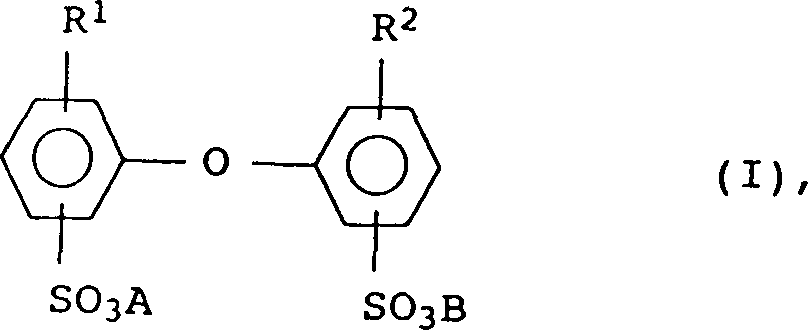
其中R1和R2为氢或C4-C24烷基,但二者不同时为氢,A和B可以是碱金属离子和/或铵离子。在式I中,R1和R2优选为6-18个碳,尤其是6、12和16个碳的直链或支化烷基,或-H,R1和R2二者不同时为氢。A和B优选为钠、钾或铵,尤其优选钠。特别有利的化合物I是其中A和B为钠、R1为12个碳的支化烷基且R2为氢或R1的那些。通常使用含50-90重量%单烷基化产物的工业级混合物;如Dowfax2A1(DowChemical Company的商标)。化合物I由例如US-A4,269,749广泛已知且可市购。Wherein R 1 and R 2 are hydrogen or C 4 -C 24 alkyl, but they are not hydrogen at the same time, and A and B can be alkali metal ions and/or ammonium ions. In formula I, R 1 and R 2 are preferably straight chain or branched alkyl groups of 6-18 carbons, especially 6, 12 and 16 carbons, or -H, and both R 1 and R 2 are not at the same time hydrogen. A and B are preferably sodium, potassium or ammonium, especially sodium. Particularly advantageous compounds I are those in which A and B are sodium, R 1 is a branched alkyl group of 12 carbons and R 2 is hydrogen or R 1 . Typically a technical grade mixture containing 50-90% by weight of monoalkylated product is used; eg Dowfax® 2A1 (trademark of the Dow Chemical Company). Compound I is widely known and commercially available from eg US-A 4,269,749.
合适的阳离子乳化剂,即其分散性组分具有至少一个正电荷的乳化剂通常是含C6-C18烷基、芳烷基或杂环基的伯、仲、叔或季铵盐、链烷醇铵盐、吡啶鎓盐,咪唑啉鎓盐、恶唑啉鎓盐、吗啉鎓盐、噻唑啉鎓盐以及氧化胺的盐、喹啉鎓盐、异喹啉鎓盐,鎓盐、锍盐和磷盐。此外,聚二醇醚衍生物还可由于形成氧鎓结构而在酸性介质中携带至少一个正电荷。可以提及的实例包括十二烷基乙酸铵或对应的盐酸盐、各种链烷酸三甲基铵乙酯、N-十六烷基氯化吡啶鎓、N-月桂基硫酸吡啶鎓,还有N-十六烷基三甲基溴化铵、N-十二烷基三甲基溴化铵、N-辛基三甲基溴化铵、N-二硬脂基二甲基氯化铵和双结构(Gemini)表面活性剂N,N’-(月桂基二甲基)乙二胺二溴化物。许多其他实例可以在H.Stache,Tensid-Taschenbuch,Carl-Hanser-Verlag,Munich,Vienna,1981和McCutcheon乳化剂和洗涤剂,MC Publishing Company,Glen Rock,1989中找到。Suitable cationic emulsifiers, i.e. emulsifiers whose dispersing components have at least one positive charge, are generally primary, secondary, tertiary or quaternary ammonium salts, chains containing C6 - C18 alkyl, aralkyl or heterocyclic groups. Alkanolammonium salts, pyridinium salts, imidazolinium salts, oxazolinium salts, morpholinium salts, thiazolinium salts, and amine oxide salts, quinolinium salts, isoquinolinium salts, zeolium salts, Sulfonium and phosphorus salts. Furthermore, the polyglycol ether derivatives can also carry at least one positive charge in acidic media due to the formation of oxonium structures. Examples that may be mentioned include ammonium lauryl acetate or the corresponding hydrochloride, trimethylammonium ethyl various alkanoates, pyridinium N-hexadecyl chloride, pyridinium N-lauryl sulfate, There are also N-hexadecyltrimethylammonium bromide, N-dodecyltrimethylammonium bromide, N-octyltrimethylammonium bromide, N-distearyldimethylammonium chloride Ammonium and dual structure (Gemini) surfactant N,N'-(lauryldimethyl)ethylenediamine dibromide. Many other examples can be found in H. Stache, Tensid-Taschenbuch, Carl-Hanser-Verlag, Munich, Vienna, 1981 and McCutcheon Emulsifiers and Detergents, MC Publishing Company, Glen Rock, 1989.
由于非离子乳化剂可以用于电泳淌度符号为正或为负的分散的固体颗粒,它们特别适用于本发明。在分散的固体颗粒电泳淌度符号为正的情况下,还可以使用阳离子乳化剂或互不干扰的非离子乳化剂和阳离子乳化剂的混合物。同样,在分散的固体颗粒电泳淌度符号为负的情况下,还可以使用阴离子乳化剂或互不干扰的非离子乳化剂和阴离子乳化剂的混合物。Since nonionic emulsifiers can be used with dispersed solid particles having positive or negative electrophoretic mobility signs, they are particularly suitable for use in the present invention. In the case of positive electrophoretic mobility of the dispersed solid particles, it is also possible to use cationic emulsifiers or non-interfering mixtures of nonionic and cationic emulsifiers. Likewise, in the case of dispersed solid particles with negative electrophoretic mobility, anionic emulsifiers or non-interfering mixtures of nonionic and anionic emulsifiers may also be used.
通常而言,分散剂的用量为0.05-20重量%,优选0.1-5重量%,更优选为0.2-3重量%,在各种情况下基于所述至少一种细碎无机固体和所述至少一种用于聚合的单体的总重量。某些或全部用于本发明方法中的至少一种分散剂可以作为最初加料引入固体的水分散体中,其余的(若有的话)可以在游离基引发水乳液聚合过程中连续或断续加入。另一种方案是根据需要仅将一部分至少一种分散剂以最初加料包含到固体的水分散体中并将全部量或合适的话,剩余量的所述至少一种分散剂在游离基乳液聚合过程中连续或断续加入。In general, dispersants are used in amounts of 0.05-20% by weight, preferably 0.1-5% by weight, more preferably 0.2-3% by weight, based in each case on the at least one finely divided inorganic solid and the at least one The total weight of the monomers used in the polymerization. Some or all of the at least one dispersant used in the process of the present invention can be introduced as an initial charge into the aqueous dispersion of solids, the rest, if any, can be introduced continuously or discontinuously during the free radical initiated aqueous emulsion polymerization join in. Another solution is to include only a part of the at least one dispersant with the initial charge in the aqueous dispersion of solids, and the entire amount or, if appropriate, the remaining amount of the at least one dispersant in the free radical emulsion polymerization process. Added continuously or intermittently.
然而,根据本发明,合适的固体仅是这样一些,其水分散体在起始固体浓度基于固体的水分散体为≥1重量%时在其制备1小时后仍以分散形式含有大于90重量%的原始分散固体且其分散固体颗粒的重均直径≤100nm。通常起始固体浓度≤60重量%。然而,有利的是还可以使用≤55重量%、≤50重量%、≤45重量%、≤40重量%、≤35重量%、≤30重量%、≤25重量%、≤20重量%、≤15重量%、≤10重量%且≥1重量%、≥3重量%或≥5重量%的起始固体浓度,在各种情况下均基于固体的水分散体,且包括其间的所有值。According to the invention, however, suitable solids are only those whose aqueous dispersions still contain more than 90 wt. % The original dispersed solid and the weight-average diameter of the dispersed solid particles is ≤100nm. Typically the starting solids concentration is ≦60% by weight. However, it is also advantageous to use ≤55% by weight, ≤50% by weight, ≤45% by weight, ≤40% by weight, ≤35% by weight, ≤30% by weight, ≤25% by weight, ≤20% by weight, ≤15% by weight The starting solids concentrations of % by weight, ≤10% by weight and ≥1% by weight, ≥3% by weight or ≥5% by weight are based in each case on the aqueous dispersion of solids and include all values in between.
本发明的必要特征是分散的固体颗粒在pH对应于乳液聚合开始时含水反应介质的pH下在标准氯化钾水溶液具有非零电泳淌度。对该文献而言,乳液聚合开始时含水反应介质为刚好在加入所述至少一种游离基聚合引发剂之前存在的含水反应介质。pH使用常规商业pH计在20℃和1巴(绝对)下测量。因此,取决于所进行的方法,仅对含至少一种无机固体或此外还有至少一种分散剂和/或此外还有用于乳液聚合的单体以及还有任何其他助剂的水分散体测量pH。An essential feature of the present invention is that the dispersed solid particles have non-zero electrophoretic mobility in standard aqueous potassium chloride solution at a pH corresponding to the pH of the aqueous reaction medium at the initiation of the emulsion polymerization. For the purposes of this document, the aqueous reaction medium at the start of the emulsion polymerization is the aqueous reaction medium present just before the addition of the at least one free-radical polymerization initiator. The pH is measured at 20°C and 1 bar (absolute) using a conventional commercial pH meter. Therefore, depending on the method carried out, it is only measured on aqueous dispersions containing at least one inorganic solid or additionally at least one dispersant and/or additionally monomers for emulsion polymerization and also any other auxiliaries pH.
测量电泳淌度的方法对熟练技术人员而言是已知的(参见例如R.J.Hunter,《现代胶体科学导论》,第8.4节,第241-248页,OxfordUniversity Press,Oxford,1993和K.Oka和K.Furusawa,界面电现象,表面活性剂科学丛书,第76卷,第8章,第151-232页,Marcel Dekker,纽约,1998)。分散在含水反应介质中的固体颗粒的电泳淌度使用商业电泳仪(一个实例是Malvern Instruments Ltd.的Zetasizer 3000)在20℃和1巴(绝对)下测量。为此将固体颗粒的水份散体用pH呈中性的10mM氯化钾溶液(标准氯化钾溶液)稀释至固体颗粒浓度为约50-100mg/l。将样品的pH调节为乳液聚合开始时含水反应介质所具有的pH通过使用常规无机酸如稀盐酸或硝酸,或碱如稀氢氧化钠溶液或氢氧化钾溶液来进行。分散的固体颗粒在电场中的迁移通过已知为电泳光散射的方法检测(参见例如B.R.Ware和W.H.Flygare,Chem.Phys.Lett.12(1917)81-85)。在该方法中,电泳淌度的符号由分散的固体颗粒的迁移方向限定,也就是说,若分散的固体颗粒向阴极迁移,其电泳淌度为正,而若向阳极迁移,电泳淌度为负。Methods of measuring electrophoretic mobility are known to the skilled person (see for example R.J. Hunter, "Introduction to Modern Colloid Science", Section 8.4, pp. 241-248, Oxford University Press, Oxford, 1993 and K. Oka and K. Furusawa, Interfacial Electric Phenomena, Surfactant Science Series, Vol. 76, Chapter 8, pp. 151-232, Marcel Dekker, New York, 1998). The electrophoretic mobility of solid particles dispersed in an aqueous reaction medium is measured using a commercial electrophoresis apparatus (an example is the Zetasizer 3000 from Malvern Instruments Ltd.) at 20°C and 1 bar (absolute). For this purpose, the aqueous dispersion of solid particles is diluted with a pH-neutral 10 mM potassium chloride solution (standard potassium chloride solution) to a solid particle concentration of approximately 50-100 mg/l. Adjusting the pH of the sample to that which the aqueous reaction medium had at the start of the emulsion polymerization is carried out by using conventional mineral acids such as dilute hydrochloric or nitric acid, or bases such as dilute sodium or potassium hydroxide solutions. The migration of dispersed solid particles in an electric field is detected by a method known as electrophoretic light scattering (see eg B.R. Ware and W.H. Flygare, Chem. Phys. Lett. 12 (1917) 81-85). In this method, the sign of the electrophoretic mobility is defined by the direction of migration of the dispersed solid particles, that is, if the dispersed solid particles migrate towards the cathode, their electrophoretic mobility is positive, while if they migrate towards the anode, their electrophoretic mobility is burden.
若使用例如现有技术中所述的表面改性的固体颗粒,则使用这些表面改性的颗粒测量电泳淌度。另一方面,若细碎无机颗粒仅借助分散剂才能分散,则必须使用合适的非离子分散剂测量电泳淌度,不论在本发明方法中实际使用阳离子还是阴离子分散剂。这是必需的,因为离子分散剂吸附在分散的固体颗粒上并因此可改变或逆转其电泳淌度。If surface-modified solid particles such as those described in the prior art are used, the electrophoretic mobility is measured using these surface-modified particles. On the other hand, if the finely divided inorganic particles can be dispersed only by means of a dispersant, the electrophoretic mobility must be measured using a suitable nonionic dispersant, regardless of whether a cationic or anionic dispersant is actually used in the process of the invention. This is necessary because ionic dispersants adsorb on dispersed solid particles and thus can alter or reverse their electrophoretic mobility.
在一定程度上影响或调整分散的固体颗粒的电泳淌度的合适参数是含水反应介质的pH。分散的固体颗粒的质子化和脱质子化分别在酸性pH范围(pH<7)和碱性pH范围(pH>7)使电泳淌度变正和变负。适于本发明方法的pH范围是这样一个范围,即在其中可以进行游离基引发水乳液聚合。该pH范围通常为1-12,优选1.5-11,更优选2-10。A suitable parameter to influence or adjust to some extent the electrophoretic mobility of the dispersed solid particles is the pH of the aqueous reaction medium. Protonation and deprotonation of dispersed solid particles positively and negatively electrophoretic mobility in the acidic pH range (pH<7) and basic pH range (pH>7), respectively. The pH range suitable for the process of the present invention is the range in which free radical initiated aqueous emulsion polymerization can be carried out. The pH range is usually 1-12, preferably 1.5-11, more preferably 2-10.
含水反应介质的pH可以使用市售的酸,例如稀盐酸,或碱,例如稀释的氢氧化钠溶液来调节。通常有利的是在加入所述至少一种细碎分散的无机固体之前加入部分或全部量的用于调节pH的酸或碱。The pH of the aqueous reaction medium can be adjusted using commercially available acids, such as dilute hydrochloric acid, or bases, such as dilute sodium hydroxide solution. It is often advantageous to add part or all of the amount of acid or base used to adjust the pH before adding the at least one finely divided inorganic solid.
烯属不饱和单体的游离基引发水乳液聚合在许多情况下描述于现有技术中且因此为熟练技术人员所熟知(参见例如《聚合物科学和工程大全》,第8卷,第659-677页,John Wiley & sons,Inc.,1987;D.C.Blackley,《乳液聚合》,第155-465页,Applied Science Publishers,Ltd.,Essex,1975;D.C.Blackley,《高聚物胶乳》,第二版,第1卷,第35-415页,Chapman& Hall,1977;H.Warson,《合成树脂乳液的应用》,第49-244页,ErnestBenn,Ltd.,London,1972;D.Diederich,Chemie in unserer Zeit 24(1990),第135-142页,Verlag Chemie,Wienheim;J.Piirma,《乳液聚合》,第1-287页,Academic Press,1982;F.Hoelscher,“Dispersionensynthetischer Hochpolymerer”,第1-160页,Springer-Verlag,Berlin,1969以及德国专利文件DE-A 40 03 422)。通常通过分散性分布所述至少一种烯属不饱和单体于含水介质中,通常使用分散剂,并使用至少一种游离基聚合引发剂聚合该单体而进行。本发明方法与该程序的不同仅在于额外存在至少一种具有非零电泳淌度的细碎无机颗粒以及存在至少一种单体A。The free radical-initiated aqueous emulsion polymerization of ethylenically unsaturated monomers is described in many cases in the prior art and is therefore well known to the skilled person (see for example Encyclopedia of Polymer Science and Engineering, Vol. 8, No. 659- 677 pages, John Wiley & sons, Inc., 1987; D.C. Blackley, "Emulsion Polymerization", pp. 155-465, Applied Science Publishers, Ltd., Essex, 1975; D.C.Blackley, "Polymer Latex", 2nd Edition, Vol. 1, pp. 35-415, Chapman & Hall, 1977; H.Warson, "Application of Synthetic Resin Emulsions", pp. 49-244, ErnestBenn, Ltd., London, 1972; D.Diederich, Chemie in unserer Zeit 24 (1990), pp. 135-142, Verlag Chemie, Wienheim; J.Piirma, "Emulsion Polymerization", pp. 1-287, Academic Press, 1982; F.Hoelscher, "Dispersionensynthetischer Hochpolymerer", pp. 1- 160 pages, Springer-Verlag, Berlin, 1969 and German Patent Document DE-A 40 03 422). This is usually done by dispersively distributing the at least one ethylenically unsaturated monomer in an aqueous medium, usually using a dispersant, and polymerizing the monomer using at least one free radical polymerization initiator. The method according to the invention differs from this procedure only in the additional presence of at least one finely divided inorganic particle with a non-zero electrophoretic mobility and the presence of at least one monomer A.
适于用作本发明方法的具有至少一个烯属不饱和基团的单体尤其包括易于游离基聚合的非离子单体,如乙烯,乙烯基芳烃单体,如苯乙烯,α-甲基苯乙烯、邻-氯苯乙烯或乙烯基甲苯,乙烯醇和C1-C18单羧酸的酯,如乙酸乙烯酯、丙酸乙烯酯、正丁酸乙烯酯、月桂酸乙烯酯和硬脂酸乙烯酯,优选C3-C6α,β-单烯属不饱和单-和二羧酸如尤其是丙烯酸、甲基丙烯酸、马来酸、富马酸和衣康酸与通常为C1-C12、优选C1-C8且尤其C1-C4链烷醇的酯,尤其如丙烯酸和甲基丙烯酸的甲酯、乙酯、正丁酯、异丁酯和2-乙基己酯、马来酸二甲酯和马来酸二正丁酯,α,β-单烯属不饱和羧酸的腈类,如丙烯腈,以及C4-8共轭二烯烃,如1,3-丁二烯和异戊二烯。这些单体通常构成主要的单体,基于待由本发明方法聚合的单体总量,其通常占大于86重量%的比例。通常而言,这些单体在标准条件(20℃,1巴(绝对))下在水中仅具有中到差的溶解性。Monomers having at least one ethylenically unsaturated group which are suitable for use in the process according to the invention include in particular nonionic monomers which are susceptible to free-radical polymerization, such as ethylene, vinylaromatic monomers, such as styrene, α-methylbenzene Esters of ethylene, o-chlorostyrene or vinyltoluene, vinyl alcohol and C 1 -C 18 monocarboxylic acids, such as vinyl acetate, vinyl propionate, vinyl n-butyrate, vinyl laurate and vinyl stearate Esters, preferably C 3 -C 6 α,β-monoethylenically unsaturated mono- and dicarboxylic acids such as especially acrylic acid, methacrylic acid, maleic acid, fumaric acid and itaconic acid with usually C 1 -C 12. Esters of preferably C 1 -C 8 and especially C 1 -C 4 alkanols, such as especially methyl, ethyl, n-butyl, isobutyl and 2-ethylhexyl acrylic acid and methacrylic acid, Dimethyl and di-n-butyl maleate, nitriles of α,β-monoethylenically unsaturated carboxylic acids, such as acrylonitrile, and C4-8 conjugated dienes, such as 1,3-butane dienes and isoprene. These monomers generally constitute the main monomers, which generally represent a proportion of more than 86% by weight, based on the total amount of monomers to be polymerized by the process according to the invention. In general, these monomers have only moderate to poor solubility in water under standard conditions (20° C., 1 bar (abs.)).
常规来说增加聚合物基体的薄膜内部强度的单体通常具有至少一个环氧基、羟基、N-羟甲基或羰基或至少两个非共轭烯属不饱和双键。实例是具有两个乙烯基的单体、具有两个亚乙烯基的单体和具有两个链烯基的单体。此时特别有利的是二元醇与α,β-单烯属不饱和羧酸(其中优选丙烯酸和甲基丙烯酸)的二酯。这类具有两个非共轭烯属不饱和双键的单体实例是亚烷基二醇二丙烯酸酯和二甲基丙烯酸酯,如乙二醇二丙烯酸酯、1,2-丙二醇二丙烯酸酯、1,3-丙二醇二丙烯酸酯、1,3-丁二醇二丙烯酸酯、1,4-丁二醇二丙烯酸酯以及乙二醇二甲基丙烯酸酯、1,2-丙二醇二甲基丙烯酸酯、1,3-丙二醇二甲基丙烯酸酯、1,3-丁二醇二甲基丙烯酸酯、1,4-丁二醇二甲基丙烯酸酯,还有二乙烯基苯、甲基丙烯酸乙烯基酯、丙烯酸乙烯基酯、甲基丙烯酸烯丙酯、丙烯酸烯丙酯、马来酸二烯丙酯、富马酸二烯丙酯、亚甲基双丙烯酰胺、丙烯酸环戊二烯基酯、氰脲酸三烯丙酯和异氰脲酸三烯丙酯。此时特别重要的是甲基丙烯酸和丙烯酸的C1-C8羟烷基酯,如丙烯酸和甲基丙烯酸的n-羟乙基酯、n-羟丙基酯或n-羟丁基酯,以及化合物如双丙酮丙烯酰胺以及丙烯酸和甲基丙烯酸的乙酰乙酰氧乙基酯。根据本发明,上述单体通常以基于待聚合单体总量计为高达10重量%的量共聚。Monomers that conventionally increase the film internal strength of a polymer matrix generally have at least one epoxy, hydroxyl, N-methylol or carbonyl group or at least two non-conjugated ethylenically unsaturated double bonds. Examples are monomers having two vinyl groups, monomers having two vinylidene groups and monomers having two alkenyl groups. Particularly advantageous here are diesters of diols with α,β-monoethylenically unsaturated carboxylic acids, among which acrylic acid and methacrylic acid are preferred. Examples of such monomers having two non-conjugated ethylenically unsaturated double bonds are alkylene glycol diacrylates and dimethacrylates such as ethylene glycol diacrylate, 1,2-propanediol diacrylate , 1,3-propanediol diacrylate, 1,3-butanediol diacrylate, 1,4-butanediol diacrylate and ethylene glycol dimethacrylate, 1,2-propanediol dimethacrylate ester, 1,3-propanediol dimethacrylate, 1,3-butanediol dimethacrylate, 1,4-butanediol dimethacrylate, divinylbenzene, vinyl methacrylate Acrylate, vinyl acrylate, allyl methacrylate, allyl acrylate, diallyl maleate, diallyl fumarate, methylenebisacrylamide, cyclopentadienyl acrylate , triallyl cyanurate and triallyl isocyanurate. Of particular importance here are C 1 -C 8 hydroxyalkyl esters of methacrylic acid and acrylic acid, such as n-hydroxyethyl, n-hydroxypropyl or n-hydroxybutyl acrylic acid and methacrylic acid, and compounds such as diacetone acrylamide and acetoacetoxyethyl esters of acrylic and methacrylic acid. According to the invention, the aforementioned monomers are generally copolymerized in amounts of up to 10% by weight, based on the total amount of monomers to be polymerized.
本发明中使用的单体A是含有至少一个酸根和/或其相应的阴离子或含有至少一个氨基、酰胺基、脲基或N-杂环基和/或其相应的在氮原子上烷基化或质子化的铵衍生物的烯属不饱和单体。The monomer A used in the present invention contains at least one acid radical and/or its corresponding anion or contains at least one amino group, amide group, urea group or N-heterocyclic group and/or its corresponding alkylation on the nitrogen atom or protonated ammonium derivatives of ethylenically unsaturated monomers.
当所述至少一种无机固体的分散颗粒的电泳淌度为正时,所使用的单体A包括含有至少一个选自羧酸、磺酸、硫酸、磷酸和膦酸的酸根的烯属不饱和单体。具体实例有丙烯酸、甲基丙烯酸、马来酸、富马酸、衣康酸、巴豆酸、4-苯乙烯磺酸、2-甲基丙烯酰氧乙基磺酸、乙烯基磺酸和乙烯基膦酸,以及丙烯酸n-羟烷基酯的磷酸单酯和甲基丙烯酸n-羟烷基酯的磷酸单酯,其实例有丙烯酸2-羟乙酯、丙烯酸3-羟丙酯、丙烯酸4-羟丁酯和甲基丙烯酸2-羟乙酯、甲基丙烯酸3-羟丙酯或甲基丙烯酸4-羟丁酯的磷酸单酯。然而,根据本发明,也可以使用上述含至少一个酸根的烯属不饱和单体的铵盐和碱金属盐。特别优选的碱金属是钠和钾。盐的实例有丙烯酸、甲基丙烯酸、马来酸、富马酸、衣康酸、巴豆酸、4-苯乙烯磺酸、2-甲基丙烯酰氧乙基磺酸、乙烯基磺酸和乙烯基膦酸的铵盐、钠盐和钾盐以及丙烯酸2-羟乙酯、丙烯酸3-羟丙酯、丙烯酸4-羟丁酯和甲基丙烯酸2-羟乙酯、甲基丙烯酸3-羟丙酯或甲基丙烯酸4-羟丁酯的磷酸单酯的单或双铵盐、钠盐和钾盐。还可以使用烯属不饱和酸的酸酐,例如马来酸酐,以及具有至少一个CH-酸性官能的烯属不饱和单体,例如甲基丙烯酸2-(乙酰乙酰氧基)乙酯,作为单体A。When the electrophoretic mobility of the dispersed particles of the at least one inorganic solid is positive, the monomer A used comprises an ethylenically unsaturated monomer. Specific examples are acrylic acid, methacrylic acid, maleic acid, fumaric acid, itaconic acid, crotonic acid, 4-styrenesulfonic acid, 2-methacryloyloxyethylsulfonic acid, vinylsulfonic acid and vinyl Phosphonic acids, and phosphoric monoesters of n-hydroxyalkyl acrylates and n-hydroxyalkyl methacrylates, examples of which are 2-hydroxyethyl acrylate, 3-hydroxypropyl acrylate, 4- Phosphate monoesters of hydroxybutyl and 2-hydroxyethyl methacrylate, 3-hydroxypropyl methacrylate or 4-hydroxybutyl methacrylate. According to the invention, however, it is also possible to use the ammonium and alkali metal salts of the aforementioned ethylenically unsaturated monomers containing at least one acid group. Particularly preferred alkali metals are sodium and potassium. Examples of salts are acrylic acid, methacrylic acid, maleic acid, fumaric acid, itaconic acid, crotonic acid, 4-styrenesulfonic acid, 2-methacryloyloxyethylsulfonic acid, vinylsulfonic acid and ethylene Ammonium, sodium and potassium salts of phosphonic acid and 2-hydroxyethyl acrylate, 3-hydroxypropyl acrylate, 4-hydroxybutyl acrylate and 2-hydroxyethyl methacrylate, 3-hydroxypropyl methacrylate Mono- or di-ammonium, sodium and potassium salts of phosphoric acid monoester or 4-hydroxybutyl methacrylate. Anhydrides of ethylenically unsaturated acids, such as maleic anhydride, and ethylenically unsaturated monomers having at least one CH-acid function, such as 2-(acetoacetoxy)ethyl methacrylate, can also be used as monomers a.
优选使用丙烯酸、甲基丙烯酸、马来酸、富马酸、衣康酸、巴豆酸、4-苯乙烯磺酸、2-甲基丙烯酰氧乙基磺酸、乙烯基磺酸和乙烯基膦酸。Preference is given to using acrylic acid, methacrylic acid, maleic acid, fumaric acid, itaconic acid, crotonic acid, 4-styrenesulfonic acid, 2-methacryloyloxyethylsulfonic acid, vinylsulfonic acid and vinylphosphine acid.
然而,当所述至少一种无机固体的分散颗粒的电泳淌度为负时,所使用的单体A是含有至少一个氨基、酰胺基、脲基或N-杂环基和/或其在氮原子上烷基化或质子化铵衍生物的烯属不饱和单体。However, when the electrophoretic mobility of the dispersed particles of the at least one inorganic solid is negative, the monomer A used contains at least one amino group, amide group, urea group or N-heterocyclic group and/or its nitrogen Ethylenically unsaturated monomers of atomically alkylated or protonated ammonium derivatives.
含有至少一个氨基的单体A的实例有丙烯酸2-氨基乙酯、甲基丙烯酸2-氨基乙酯、丙烯酸3-氨基丙酯、甲基丙烯酸3-氨基丙酯、丙烯酸4-氨基正丁酯、甲基丙烯酸4-氨基正丁酯、丙烯酸2-(N-甲氨基)乙酯、甲基丙烯酸2-(N-甲氨基)乙酯、丙烯酸2-(N-乙氨基)乙酯、甲基丙烯酸2-(N-乙氨基)乙酯、丙烯酸2-(N-正丙氨基)乙酯、甲基丙烯酸2-(N-正丙氨基)乙酯、丙烯酸2-(N-异丙氨基)乙酯、甲基丙烯酸2-(N-异丙氨基)乙酯、丙烯酸2-(N-叔丁氨基)乙酯、甲基丙烯酸2-(N-叔丁氨基)乙酯(市售产品,例如NorsocrylTBAEMA,Elf Atochem公司)、丙烯酸2-(N,N-二甲氨基)乙酯(市售产品,例如NorsocrylADAME,Elf Atochem公司)、甲基丙烯酸2-(N,N-二甲氨基)乙酯(市售产品,例如NorsocrylMADAME,Elf Atochem公司)、丙烯酸2-(N,N-二乙氨基)乙酯、甲基丙烯酸2-(N,N-二乙氨基)乙酯、丙烯酸2-(N,N-二正丙氨基)乙酯、甲基丙烯酸2-(N,N-二正丙氨基)乙酯、丙烯酸2-(N,N-二异丙氨基)乙酯、甲基丙烯酸2-(N,N-二异丙氨基)乙酯、丙烯酸3-(N甲氨基)丙酯、甲基丙烯酸3-(N-甲氨基)丙酯、丙烯酸3-(N-乙氨基)丙酯、甲基丙烯酸3-(N-乙氨基)丙酯、丙烯酸3-(N-正丙氨基)丙酯、甲基丙烯酸3-(N-正丙氨基)丙酯、丙烯酸3-(N-异丙氨基)丙酯、甲基丙烯酸3-(N-异丙氨基)丙酯、丙烯酸3-(N-叔丁氨基)丙酯、甲基丙烯酸3-(N-叔丁氨基)丙酯、丙烯酸3-(N,N-二甲氨基)丙酯、甲基丙烯酸3-(N,N-二甲氨基)丙酯、丙烯酸3-(N,N-二乙氨基)丙酯、甲基丙烯酸3-(N,N-二乙氨基)丙酯、丙烯酸3-(N,N-二正丙氨基)丙酯、甲基丙烯酸3-(N,N-二正丙氨基)丙酯、丙烯酸3-(N,N-二异丙氨基)丙酯和甲基丙烯酸3-(N,N-二异丙氨基)丙酯。Examples of monomers A containing at least one amino group are 2-aminoethyl acrylate, 2-aminoethyl methacrylate, 3-aminopropyl acrylate, 3-aminopropyl methacrylate, 4-aminon-butyl acrylate , 4-amino-n-butyl methacrylate, 2-(N-methylamino)ethyl acrylate, 2-(N-methylamino)ethyl methacrylate, 2-(N-ethylamino)ethyl acrylate, methyl 2-(N-ethylamino)ethyl acrylate, 2-(N-n-propylamino)ethyl acrylate, 2-(N-n-propylamino)ethyl methacrylate, 2-(N-isopropylamino)acrylate ) ethyl ester, 2-(N-isopropylamino)ethyl methacrylate, 2-(N-tert-butylamino)ethyl acrylate, 2-(N-tert-butylamino)ethyl methacrylate (commercially available product , such as Norsocryl® TBAEMA, Elf Atochem Company), 2-(N, N-dimethylamino) ethyl acrylate (commercially available product, such as Norsocryl® ADAME, Elf Atochem Company), methacrylic acid 2-(N, N- Dimethylamino) ethyl ester (commercially available product, such as Norsocryl MADAME, Elf Atochem company), 2-(N, N-diethylamino) ethyl acrylate, 2-(N, N-diethylamino) methacrylate Ethyl ester, 2-(N,N-di-n-propylamino)ethyl acrylate, 2-(N,N-di-n-propylamino)ethyl methacrylate, 2-(N,N-diisopropylamino) acrylate Ethyl methacrylate, 2-(N,N-diisopropylamino)ethyl methacrylate, 3-(N-methylamino)propyl acrylate, 3-(N-methylamino)propyl methacrylate, 3-( N-ethylamino)propyl, 3-(N-ethylamino)propyl methacrylate, 3-(N-n-propylamino)propyl acrylate, 3-(N-n-propylamino)propyl methacrylate, 3-(N-isopropylamino)propyl acrylate, 3-(N-isopropylamino)propyl methacrylate, 3-(N-tert-butylamino)propyl acrylate, 3-(N-tert-methacrylate Butylamino)propyl, 3-(N,N-dimethylamino)propyl acrylate, 3-(N,N-dimethylamino)propyl methacrylate, 3-(N,N-diethylamino)acrylate Propyl ester, 3-(N,N-diethylamino)propyl methacrylate, 3-(N,N-di-n-propylamino)propyl methacrylate, 3-(N,N-di-n-propylamino)methacrylate ) propyl ester, 3-(N,N-diisopropylamino)propyl acrylate and 3-(N,N-diisopropylamino)propyl methacrylate.
含有至少一个酰胺基的单体A的实例有丙烯酰胺、甲基丙烯酰胺、N-甲基丙烯酰胺、N-甲基甲基丙烯酰胺、N-乙基丙烯酰胺、N-乙基甲基丙烯酰胺、N-正丙基丙烯酰胺、N-正丙基甲基丙烯酰胺、N-异丙基丙烯酰胺、N-异丙基甲基丙烯酰胺、N-叔丁基丙烯酰胺、N-叔丁基甲基丙烯酰胺、N,N-二甲基丙烯酰胺、N,N-二甲基甲基丙烯酰胺、N,N-二乙基丙烯酰胺、N,N-二乙基甲基丙烯酰胺、N,N-二正丙基丙烯酰胺、N,N-二正丙基甲基丙烯酰胺、N,N-二异丙基丙烯酰胺、N,N-二异丙基甲基丙烯酰胺、N,N-二正丁基丙烯酰胺、N,N-二正丁基甲基丙烯酰胺、N-(3-N’,N’-二甲氨基丙基)甲基丙烯酰胺、双丙酮丙烯酰胺、N,N-二亚甲双丙烯酰胺、N-(二苯甲基)丙烯酰胺、N-环己基丙烯酰胺,以及N-乙烯基吡咯烷酮和N-乙烯基己内酰胺。Examples of monomers A containing at least one amide group are acrylamide, methacrylamide, N-methacrylamide, N-methylmethacrylamide, N-ethylacrylamide, N-ethylmethacrylamide Amide, N-n-propylacrylamide, N-n-propylmethacrylamide, N-isopropylacrylamide, N-isopropylmethacrylamide, N-tert-butylacrylamide, N-tert-butylmethacrylamide N,N-dimethylacrylamide, N,N-dimethylacrylamide, N,N-diethylacrylamide, N,N-diethylmethacrylamide, N, N-di-n-propylacrylamide, N,N-di-n-propylmethacrylamide, N,N-diisopropylacrylamide, N,N-diisopropylmethacrylamide, N,N- Di-n-butylacrylamide, N, N-di-n-butyl methacrylamide, N-(3-N', N'-dimethylaminopropyl) methacrylamide, diacetone acrylamide, N, N-di Methylenebisacrylamide, N-(benzhydryl)acrylamide, N-cyclohexylacrylamide, and N-vinylpyrrolidone and N-vinylcaprolactam.
含有至少一个脲基的单体A的实例有N,N’-二乙烯基亚乙基脲和甲基丙烯酸2-(1-咪唑啉-2-酮基)乙酯(市售产品,例如Norsocryl100,Elf Atochem公司产品)。Examples of monomers A containing at least one urea group are N,N'-divinylethylene urea and 2-(1-imidazolin-2-onyl)ethyl methacrylate (commercially available products such as Norsocryl ® 100, product of Elf Atochem Company).
含有至少一个杂环基的单体A的实例有2-乙烯基吡啶、4-乙烯基吡啶、1-乙烯基咪唑、2-乙烯基咪唑和N-乙烯基咔唑。Examples of the monomer A containing at least one heterocyclic group are 2-vinylpyridine, 4-vinylpyridine, 1-vinylimidazole, 2-vinylimidazole and N-vinylcarbazole.
优选使用下列化合物:2-乙烯基吡啶、4-乙烯基吡啶、2-乙烯基咪唑、丙烯酸2-(N,N-二甲氨基)乙酯、甲基丙烯酸2-(N,N-二甲氨基)乙酯、丙烯酸2-(N,N-二乙氨基)乙酯、甲基丙烯酸2-(N,N-二乙氨基)乙酯、甲基丙烯酸2-(N-叔丁基氨基)乙酯、N-(3-N’,N’-二甲氨基丙基)甲基丙烯酰胺和甲基丙烯酸2-(1-咪唑啉-2-酮基)乙酯。根据含水反应介质的pH,上述含氮的单体A部分或全部以氮原子质子化了的季铵盐形式存在。The following compounds are preferably used: 2-vinylpyridine, 4-vinylpyridine, 2-vinylimidazole, 2-(N,N-dimethylamino)ethyl acrylate, 2-(N,N-dimethylmethacrylate Amino)ethyl ester, 2-(N,N-diethylamino)ethyl acrylate, 2-(N,N-diethylamino)ethyl methacrylate, 2-(N-tert-butylamino)methacrylate ethyl ester, N-(3-N',N'-dimethylaminopropyl)methacrylamide and 2-(1-imidazolin-2-onyl)ethyl methacrylate. Depending on the pH of the aqueous reaction medium, the abovementioned nitrogen-containing monomers A are partly or completely present in the form of quaternary ammonium salts protonated with nitrogen atoms.
作为在氮原子上具有烷基季铵结构的单体A可以列举的实例有丙烯酸2-(N,N,N-三甲基铵)乙酯氯化物(市售产品,例如NorsocrylADAMQUAT MC 80,Elf atochem公司产品),甲基丙烯酸2-(N,N,N-三甲基铵)乙酯氯化物(市售产品,例如NorsocrylMADQUAT MC 75,Elf atochem公司产品),丙烯酸2-(N-甲基-N,N-二乙基铵)乙酯氯化物,丙烯酸2-(N-甲基-N,N-二正丙基铵)乙酯氯化物,甲基丙烯酸2-(N-甲基-N,N-二正丙基铵)乙酯氯化物,丙烯酸2-(N-苄基-N,N-二甲基铵)乙酯氯化物,(市售产品,例如NorsocrylADAMQUAT BZ 80,Elf Atochem公司产品),甲基丙烯酸2-(N-苄基-N,N-二甲基铵)乙酯氯化物(市售产品,例如NorsocrylMADQUAT BZ 75,Elf Atochem公司产品),丙烯酸2-(N-苄基-N,N-二乙基铵)乙酯氯化物,甲基丙烯酸2-(N-苄基-N,N-二乙基铵)乙酯氯化物,丙烯酸2-(N-苄基-N,N-二正丁基铵)乙酯氯化物,甲基丙烯酸2-(N-苄基-N,N-二正丁基铵)乙酯氯化物,丙烯酸3-(N,N,N-三甲基铵)丙酯氯化物,甲基丙烯酸3-(N,N,N-三甲基铵)丙酯氯化物,丙烯酸3-(N-甲基-N,N-二乙基铵)丙酯氯化物,甲基丙烯酸3-(N-甲基-N,N-二乙基铵)丙酯氯化物,丙烯酸3-(N-甲基-N,N-二正丙基铵)丙酯氯化物,甲基丙烯酸3-(N-甲基-N,N-二正丙基铵)丙酯氯化物,丙烯酸3-(N-苄基-N,N-二甲基铵)丙酯氯化物,甲基丙烯酸3-(N-苄基-N,N-二甲基铵)丙酯氯化物,丙烯酸3-(N-苄基-N,N-二乙基铵)丙酯氯化物,甲基丙烯酸3-(N-苄基-N,N-二乙基铵)丙酯氯化物,丙烯酸3-(N-苄基-N,N-二正丙基铵)丙酯氯化物和甲基丙烯酸3-(N-苄基-N,N-二正丙基铵)丙酯氯化物。Examples that can be cited as the monomer A having an alkyl quaternary ammonium structure on the nitrogen atom are 2-(N,N,N-trimethylammonium) ethyl acrylate chloride (commercially available product, for example Norsocryl® ADAMQUAT MC 80 , Elfatochem company product), methacrylic acid 2-(N, N, N-trimethylammonium) ethyl ester chloride (commercially available product, such as Norsocryl® MADQUAT MC 75, Elfatochem company product), acrylic acid 2-( N-methyl-N, N-diethylammonium) ethyl chloride, 2-(N-methyl-N, N-di-n-propylammonium) ethyl acrylate chloride, 2-(N-methacrylic acid -Methyl-N,N-di-n-propylammonium)ethyl chloride, 2-(N-benzyl-N,N-dimethylammonium)ethyl acrylate chloride, (commercially available products such as Norsocryl® ADAMQUAT BZ 80, product of Elf Atochem Company), 2-(N-benzyl-N, N-dimethylammonium) ethyl methacrylate chloride (commercially available product, for example Norsocryl® MADQUAT BZ 75, product of Elf Atochem Company ), 2-(N-benzyl-N, N-diethylammonium) ethyl acrylate chloride, 2-(N-benzyl-N, N-diethylammonium) ethyl methacrylate chloride, 2-(N-Benzyl-N,N-di-n-butylammonium)ethyl acrylate chloride, 2-(N-Benzyl-N,N-di-n-butylammonium)ethyl methacrylate chloride, 3-(N,N,N-trimethylammonium)propyl acrylate chloride, 3-(N,N,N-trimethylammonium)propyl methacrylate chloride, 3-(N-methylammonium acrylate -N,N-diethylammonium)propyl chloride, 3-(N-methyl-N,N-diethylammonium)propyl methacrylate chloride, 3-(N-methyl-N-methacrylate , N-di-n-propylammonium) propyl chloride, 3-(N-methyl-N, N-di-n-propylammonium) propyl chloride, 3-(N-benzyl-N , N-dimethylammonium) propyl chloride, methacrylate 3-(N-benzyl-N, N-dimethylammonium) propyl chloride, acrylate 3-(N-benzyl-N, N -Diethylammonium)propyl chloride, 3-(N-benzyl-N,N-diethylammonium)propyl methacrylate chloride, 3-(N-benzyl-N,N-diethylammonium acrylate n-propylammonium) propyl chloride and 3-(N-benzyl-N,N-di-n-propylammonium) propyl methacrylate chloride.
除了以上所述氯化物,当然还可以使用相应的溴化物和硫酸盐。In addition to the chlorides mentioned above, it is of course also possible to use the corresponding bromides and sulfates.
优选使用丙烯酸2-(N,N,N-三甲基铵)乙酯氯化物,甲基丙烯酸2-(N,N,N-三甲基铵)乙酯氯化物,丙烯酸2-(N-苄基-N,N-二甲基铵)乙酯氯化物,甲基丙烯酸2-(N-苄基-N,N-二甲基铵)乙酯氯化物。Preferably, 2-(N,N,N-trimethylammonium)ethyl acrylate chloride, 2-(N,N,N-trimethylammonium)ethyl methacrylate chloride, 2-(N- Benzyl-N,N-dimethylammonium) ethyl ester chloride, 2-(N-benzyl-N,N-dimethylammonium) ethyl methacrylate chloride.
在本发明的方法中,烯属不饱和单体混合物,基于其总量计,含有>0且<4重量%,一般0.05-3.0重量%,优选0.1-2.5重量%,更优选0.2-2.0重量%所述的至少一种单体A。In the process of the present invention, the ethylenically unsaturated monomer mixture, based on its total amount, contains >0 and <4 wt%, generally 0.05-3.0 wt%, preferably 0.1-2.5 wt%, more preferably 0.2-2.0 wt% % said at least one monomer A.
所述烯属不饱和单体混合物基于所述至少一种细碎无机固体和所述烯属不饱和单体混合物的总重量的重量分数通常为10-99重量%,优选25-90重量%,更优选40-80重量%。根据本发明,所述单体混合物的全部可以作为最初加料与所述至少一种细碎无机固体一起引入反应介质中。也可以选择在初始时向含水的分散的固体中先加入一些单体混合物,剩余的(若合适)可以以其在游离基乳液聚合过程中以消耗的速率连续或断续加入。The weight fraction of said ethylenically unsaturated monomer mixture based on the total weight of said at least one finely divided inorganic solid and said ethylenically unsaturated monomer mixture is usually 10-99% by weight, preferably 25-90% by weight, more preferably Preferably 40-80% by weight. According to the invention, the entirety of said monomer mixture can be introduced into the reaction medium as an initial charge together with said at least one finely divided inorganic solid. Alternatively, some of the monomer mixture can be initially added to the aqueous dispersed solids and the remainder (if appropriate) can be added continuously or intermittently at the rate at which it is consumed during the free radical emulsion polymerization.
适用作本发明游离基水乳液聚合的所述至少一种游离基聚合引发剂的引发剂是所有能在所述至少一种细碎无机固体存在下引发游离基水乳液聚合的那些。引发剂原则上可以包括过氧化物和偶氮化合物。氧化还原引发剂体系当然也合适。所用过氧化物原则上可以是无机过氧化物,如过氧化氢或过二硫酸盐,如过二硫酸的单-或二碱金属盐或铵盐,实例是单-和二-钠盐及钾盐,或铵盐,还有有机过氧化物,如烷基过氧化氢,实例是叔丁基、对孟基和枯基过氧化氢,还有过氧化二烷基或二芳基,如过氧化二叔丁基或过氧化二枯基。所用偶氮化合物主要是2,2’-偶氮双(异丁腈)、2,2’-偶氮双(2,4-二甲基戊腈)和2,2’-偶氮双(脒基丙基)二盐酸盐(AIBA,对应于Wako Chemicals的商业产品V-50)。氧化还原引发剂体系的合适氧化剂主要是上述过氧化物。所用的对应还原剂可以是低氧化态的硫化合物,如碱金属亚硫酸盐,如亚硫酸钾和/或钠,碱金属亚硫酸氢盐,如亚硫酸氢钾和/或钠,碱金属偏亚硫酸氢盐,如偏亚硫酸氢钾和/或钠,甲醛合次硫酸氢盐,如甲醛合次硫酸氢钾和/或钠,脂族亚磺酸的碱金属盐,尤其是钾盐和/或钠盐,以及碱金属氢硫化物,如氢硫化钾和/或钠,多价金属的盐,如硫酸铁(II)、硫酸铁(II)/铵、磷酸铁(II),烯二醇,如二羟基马来酸,苯偶姻和/或抗坏血酸,以及还原性糖,如山梨糖、葡萄糖、果糖和/或二羟基丙酮。通常而言,游离基聚合引发剂的用量基于待聚合单体总量为0.1-3重量%。Initiators suitable as said at least one free-radical polymerization initiator for the free-radical aqueous emulsion polymerization according to the invention are all those which are capable of initiating free-radical aqueous emulsion polymerization in the presence of said at least one finely divided inorganic solid. Initiators may in principle include peroxides and azo compounds. Redox initiator systems are of course also suitable. The peroxides used may in principle be inorganic peroxides, such as hydrogen peroxide or peroxodisulfates, such as mono- or dialkali metal or ammonium salts of peroxodisulfate, examples being mono- and di-sodium salts and potassium salts, or ammonium salts, and organic peroxides, such as alkyl hydroperoxides, examples being tert-butyl, p-menthyl and cumyl hydroperoxides, and dialkyl or diaryl peroxides, such as peroxides Di-tert-butyl oxide or dicumyl peroxide. The azo compounds used are mainly 2,2'-azobis(isobutyronitrile), 2,2'-azobis(2,4-dimethylvaleronitrile) and 2,2'-azobis(amidine propyl) dihydrochloride (AIBA, corresponding to Wako Chemicals' commercial product V-50). Suitable oxidizing agents for redox initiator systems are primarily the abovementioned peroxides. The corresponding reducing agents used can be sulfur compounds in a low oxidation state, such as alkali metal sulfites, such as potassium sulfite and/or sodium, alkali metal bisulfites, such as potassium bisulfite and/or sodium, alkali metal partial Bisulfites, such as potassium and/or sodium metabisulfite, formaldehyde sulfoxylates, such as potassium and/or sodium formaldehyde sulfoxylate, alkali metal salts of aliphatic sulfinic acids, especially potassium salts and and/or sodium salts, as well as alkali metal hydrosulfides, such as potassium and/or sodium hydrosulfide, salts of polyvalent metals, such as iron(II) sulfate, iron(II) sulfate/ammonium, iron(II) phosphate, alkene Alcohols such as dihydroxymaleic acid, benzoin and/or ascorbic acid, and reducing sugars such as sorbose, glucose, fructose and/or dihydroxyacetone. Generally speaking, the radical polymerization initiator is used in an amount of 0.1 to 3% by weight based on the total amount of monomers to be polymerized.
所述至少一种无机固体分散颗粒的电泳淌度符号为负时,所使用的至少一种游离基聚合引发剂包括过二硫酸盐,如过二硫酸的单-或二-碱金属盐或铵盐,实例是过二硫酸的单钠、二钠、单钾、二钾和铵盐,还有在碱性介质中的过氧化氢。When the sign of the electrophoretic mobility of the at least one inorganic solid dispersed particle is negative, the at least one free radical polymerization initiator used comprises a peroxodisulfate, such as a mono- or di-alkali metal salt or an ammonium peroxodisulfate Salts, examples are the monosodium, disodium, monopotassium, dipotassium and ammonium peroxydisulfuric acid salts, and also hydrogen peroxide in alkaline media.
所述至少一种无机固体分散颗粒的电泳淌度符号为正时,所使用的至少一种游离基聚合引发剂例子包括AIBA。When the electrophoretic mobility sign of the at least one inorganic solid dispersed particle is positive, examples of the at least one radical polymerization initiator used include AIBA.
根据本发明,所有所述至少一种游离基聚合引发剂可以作为最初加料与所述至少一种细碎无机固体一起引入反应介质中。另一方案是在固体的水分散体中仅以最初加料引入一些所述至少一种游离基聚合引发剂,然后在本发明的游离基乳液聚合过程中以其消耗速率连续或断续加入全部量或合适的话,剩余量。According to the invention, all of said at least one free-radical polymerization initiator can be introduced into the reaction medium as an initial charge together with said at least one finely divided inorganic solid. Another option is to introduce some of said at least one free-radical polymerization initiator in an aqueous dispersion of solids only as an initial charge, and then to add the entire amount continuously or intermittently at its consumption rate during the free-radical emulsion polymerization of the present invention. or, as appropriate, the remainder.
在所述至少一种细碎无机固体存在下本发明游离基水乳液聚合的合适反应温度包括0-170℃的整个范围。通常而言,所用温度为50-120℃,优选60-110℃,更优选≥70-100℃。本发明的游离基水乳液聚合可以在低于、等于或大于1巴(绝对)的压力下进行,从而聚合温度可以超过100℃且可以高达170℃。优选在加压下聚合高挥发性单体如乙烯、丁二烯或氯乙烯。此时压力可以为1.2、1.5、2、5、10或15巴或更高。当在低于1大气压下进行乳液聚合时,使用950毫巴、优选900毫巴、更优选850毫巴(绝对)的压力。本发明的游离基水乳液聚合有利的是在1巴(绝对)下于惰性气体气氛如氮气或氩气下进行。Suitable reaction temperatures for the free radical aqueous emulsion polymerization of the present invention in the presence of said at least one finely divided inorganic solid include the entire range of 0-170°C. Generally speaking, the temperature used is 50-120°C, preferably 60-110°C, more preferably ≧70-100°C. The free radical aqueous emulsion polymerization of the present invention can be carried out at a pressure lower than, equal to or higher than 1 bar (absolute), so that the polymerization temperature can exceed 100°C and can be as high as 170°C. Preferably, highly volatile monomers such as ethylene, butadiene or vinyl chloride are polymerized under pressure. In this case the pressure may be 1.2, 1.5, 2, 5, 10 or 15 bar or higher. When the emulsion polymerization is carried out at a pressure below 1 atmosphere, a pressure of 950 mbar, preferably 900 mbar, more preferably 850 mbar (absolute) is used. The free-radical aqueous emulsion polymerization of the invention is advantageously carried out at 1 bar (absolute) under an atmosphere of an inert gas, such as nitrogen or argon.
含水反应介质原则上可包括水溶性有机溶剂,如甲醇、乙醇、异丙醇、丁醇、戊醇等,还可包括丙酮。但本发明方法优选在不存在这类溶剂下进行。The aqueous reaction medium may in principle comprise water-miscible organic solvents, such as methanol, ethanol, isopropanol, butanol, pentanol, etc., and may also comprise acetone. However, the process according to the invention is preferably carried out in the absence of such solvents.
本发明的必要特征是所述至少一种无机固体的分散颗粒在上述条件下具有非零电泳淌度的符号。如果电泳淌度符号为正,所使用的单体A包括含至少一个酸根和/或其相应的阴离子的烯属不饱和单体。如果电泳淌度符号为负,所使用的单体A包括含至少一个氨基、酰胺基、脲基或N-杂环基和/或其铵衍生物的烯属不饱和单体。An essential feature of the present invention is that the dispersed particles of said at least one inorganic solid have a sign of non-zero electrophoretic mobility under the above conditions. If the sign of the electrophoretic mobility is positive, the monomer A used comprises an ethylenically unsaturated monomer containing at least one acid group and/or its corresponding anion. If the electrophoretic mobility sign is negative, the monomers A used include ethylenically unsaturated monomers containing at least one amino, amide, ureido or N-heterocyclic group and/or ammonium derivatives thereof.
本发明方法例如可按如下进行:将含有一些或所有所需的水、所需的至少一种分散剂、至少一种聚合引发剂和/或烯属不饱和单体混合物以及任何其他常规助剂和添加剂的所述至少一种细碎无机固体的稳定水分散体引入反应容器中并加热反应容器的内容物到反应温度。在该温度下,将任何剩余量的水、至少一种分散剂、单体混合物以及任何其他常用助剂和添加剂在搅拌下连续或断续加入,然后,若需要,将反应混合物进一步保持在该反应温度下。The process of the present invention can be carried out, for example, as follows: a mixture containing some or all of the required water, the required at least one dispersant, at least one polymerization initiator and/or ethylenically unsaturated monomer mixture and any other customary auxiliaries A stable aqueous dispersion of said at least one finely divided inorganic solid and additives is introduced into a reaction vessel and the contents of the reaction vessel are heated to a reaction temperature. At this temperature, any remaining quantity of water, at least one dispersant, monomer mixture and any other usual auxiliaries and additives are added continuously or discontinuously with stirring, and then, if necessary, the reaction mixture is kept further at this temperature at the reaction temperature.
本发明方法还可以按如下进行:将含有一些或所有所需的水、至少一种分散剂和/或任何其他常用助剂和添加剂以及若需要的话,一些单体混合物和/或所述至少一种聚合引发剂的所述至少一种细碎无机固体的稳定水分散体引入反应容器中并加热反应容器内容物至反应温度。在该温度下,将所有或合适的话,剩余的单体混合物和/或所述至少一种聚合引发剂以及任何剩余量的水、至少一种分散剂和/或任何其他常用助剂和添加剂在搅拌下连续或断续加入,然后,若需要,将反应混合物进一步保持在反应温度下。The process of the invention can also be carried out as follows: some or all of the required water, at least one dispersant and/or any other usual auxiliaries and additives and, if desired, some monomer mixture and/or the at least one A stable aqueous dispersion of said at least one finely divided inorganic solid of a polymerization initiator is introduced into a reaction vessel and the contents of the reaction vessel are heated to a reaction temperature. At this temperature, all or, if appropriate, the remaining monomer mixture and/or the at least one polymerization initiator as well as any remaining amounts of water, at least one dispersant and/or any other customary auxiliaries and additives are placed in The addition is continued or intermittently with stirring, and then, if necessary, the reaction mixture is further maintained at the reaction temperature.
可按本发明得到的复合颗粒通常具有的粒径≤5,000nm,优选≤1,000nm,更优选≤400nm。粒径通常由透射电镜分析测量(参见例如L.Reimer,透射电子显微术,Springer-Verlag,柏林,Heidelberg,1989;D.C.Joy,The Basic Principles of EELS in Principles of AnalyticalElectron Microscopy,D.C.Joy,A.D.Romig Jr.和J.I.Goldstein编,Plenum Press,纽约,1986;L.C.Sawyer和D.T.Grupp,聚合物显微术,Chapman and Hall,伦敦,1987)。The composite particles obtainable according to the invention generally have a particle size ≤ 5,000 nm, preferably ≤ 1,000 nm, more preferably ≤ 400 nm. Particle size is usually measured by transmission electron microscopy (see e.g. L. Reimer, Transmission Electron Microscopy, Springer-Verlag, Berlin, Heidelberg, 1989; D.C. Joy, The Basic Principles of EELS in Principles of Analytical Electron Microscopy, D.C. Joy, A.D. Romig Jr. and J.I. Goldstein, eds., Plenum Press, New York, 1986; L.C. Sawyer and D.T. Grupp, Polymer Microscopy, Chapman and Hall, London, 1987).
可由本发明方法得到的复合颗粒可以具有不同结构。通常得到具有树莓形结构的复合颗粒。本发明的复合颗粒可包含一种或多种细碎固体颗粒。细碎固体颗粒可以被聚合物基体完全包封。或者可以是一些细碎固体颗粒被聚合物基体包封,而另一些排列在聚合物基体表面上。当然还有可能的是大多数细碎固体颗粒结合在聚合物基体表面上。优选≥50重量%或≥60重量%,通常≥70重量%或≥80重量%,更常见的是≥85重量%或≥90重量%的细碎固体颗粒,在各种情况下基于复合颗粒中存在的细碎固体颗粒总量,结合在聚合物基体表面上。应注意的是在某些情况下,取决于分散的复合颗粒的固体浓度,还可能存在复合颗粒的部分附聚。The composite particles obtainable by the process according to the invention may have different structures. Composite particles with a raspberry-shaped structure are generally obtained. The composite particles of the present invention may comprise one or more finely divided solid particles. Finely divided solid particles can be completely encapsulated by the polymer matrix. Or it may be that some finely divided solid particles are encapsulated by the polymer matrix while others are arranged on the surface of the polymer matrix. It is of course also possible that most of the finely divided solid particles are bound to the surface of the polymer matrix. Preferably ≥ 50% by weight or ≥ 60% by weight, usually ≥ 70% by weight or ≥ 80% by weight, more often ≥ 85% by weight or ≥ 90% by weight of finely divided solid particles, based in each case on the presence in the composite particle The total amount of finely divided solid particles, bound to the surface of the polymer matrix. It should be noted that in some cases, depending on the solids concentration of the dispersed composite particles, there may also be partial agglomeration of the composite particles.
主聚合反应结束后在复合颗粒的水分散体中残留的单体残留物当然可以通过蒸汽汽提和/或惰性气体汽提和/或通过化学脱臭除去,例如如文献DE-A 4 419 518、EP-A 767180和DE-A 3 834 734所述,而不会不利地影响复合颗粒的水分散体的性能。Monomer residues remaining in the aqueous dispersion of composite particles after the main polymerization has ended can of course be removed by steam stripping and/or inert gas stripping and/or by chemical deodorization, for example as described in documents DE-A 4 419 518, EP-A 767180 and DE-A 3 834 734 without adversely affecting the properties of the aqueous dispersion of composite particles.
由本发明所述方法制备的复合颗粒的水分散体适合用作制备粘合剂如压敏粘合剂、建筑粘合剂或工业粘合剂,粘结剂如纸涂布用粘结剂,乳胶漆,或印刷油墨和印刷塑料膜的印刷清漆,生产无纺织物,以及生产保护性涂层和水蒸汽阻隔层(如底漆中)的原料。此外,可由本发明方法得到的复合颗粒的分散体可用于改性水泥配料和灰浆配料。可由本发明方法得到的复合颗粒还可原则上用于药学诊断和其他药学应用中(参见例如K.Mosbach和L.Andersson,《自然》270(1977)259-261;P.L.Kronick,《科学》200(1978)1074-1076;和US-A4,157,323)。此外,复合颗粒还可在各种水分散体系中用作催化剂。The aqueous dispersions of composite particles prepared by the process according to the invention are suitable for the preparation of adhesives such as pressure-sensitive adhesives, construction adhesives or industrial adhesives, adhesives such as paper coating adhesives, latex Lacquers, or printing inks and printing varnishes for printed plastic films, raw materials for the production of nonwovens, and for the production of protective coatings and water vapor barriers (such as in primers). Furthermore, the dispersions of composite particles obtainable by the process of the invention can be used to modify cement and mortar formulations. The composite particles obtainable by the process according to the invention can also in principle be used in pharmaceutical diagnostics and other pharmaceutical applications (see e.g. K. Mosbach and L. Andersson, "Nature" 270 (1977) 259-261; P.L. Kronick, "Science" 200 (1978) 1074-1076; and US-A 4,157,323). In addition, composite particles can also be used as catalysts in various aqueous dispersion systems.
还应注意可按本发明得到的复合颗粒的水分散体可以简单方式干燥而得到可再分散的复合颗粒粉末(例如通过冷冻或喷雾干燥)。特别是在可按本发明得到的复合颗粒的聚合物基体的玻璃化转变温度≥50℃,优选≥60℃,特别优选≥70℃,非常特别优选≥80℃且尤其优选≥90℃或100℃时更是如此。复合颗粒粉末尤其适合用作塑料添加剂、调色剂配料的组分以及电摄影应用中的添加剂。It should also be noted that the aqueous dispersions of composite particles obtainable according to the invention can be dried in a simple manner to give redispersible composite particle powders (for example by freezing or spray drying). In particular, the glass transition temperature of the polymer matrix of the composite particles obtainable according to the invention is ≥50° C., preferably ≥60° C., particularly preferably ≥70° C., very particularly preferably ≥80° C. and especially preferably ≥90° C. or 100° C. Even more so. The composite particle powders are especially suitable as plastic additives, components of toner formulations and additives in electrophotographic applications.
实施例Example
用于下列实施例的细碎无机固体是二氧化硅、氧化钇(III)和氧化铈(IV)。作为代表性实例使用的是Bayer AG的市售二氧化硅溶胶Akzo-Nobel的Nyacol2040(20nm)和Nyacol830(10nm)以及DuPont的LudoxHS30(12nm)。还使用NyacolYTTRIA[氧化钇(III)](10nm)和NyacolCEO2{ACT}[氧化铈(IV)](10-20nm)。根据制造商的说明,圆括号中所示值对应于各无机固体颗粒的直径。The finely divided inorganic solids used in the following examples were silica, yttrium(III) oxide and cerium(IV) oxide. As representative examples used are commercially available silica sols from Bayer AG, Nyacol® 2040 (20 nm) and Nyacol® 830 (10 nm) from Akzo-Nobel and Ludox® HS30 (12 nm) from DuPont. Nyacol® YTTRIA [yttrium (III) oxide] (10 nm) and Nyacol® CEO2 {ACT} [cerium (IV) oxide] (10-20 nm) were also used. The values indicated in parentheses correspond to the diameter of the respective inorganic solid particle according to the manufacturer's instructions.
实施例中使用的固体分散体满足对其所有的要求,即基于固体水分散体,起始固体浓度为≥1重量%,且制备1小时后,仍以分散的形式含有大于90重量%的初始分散的固体,分散的固体的重均直径100nm,而且在标准的氯化钾水溶液中在相应于乳液聚合开始时含水反应介质的pH下,分散的无机固体颗粒呈非零电泳淌度。The solid dispersions used in the examples fulfill all the requirements for them, i.e., based on the aqueous solid dispersion, the initial solids concentration is ≥ 1% by weight, and after 1 hour of preparation, they still contain more than 90% by weight of the initial solids in dispersed form Dispersed solids, the dispersed solids have a weight average diameter of 100 nm, and the dispersed inorganic solid particles exhibit non-zero electrophoretic mobility in standard potassium chloride aqueous solution at the pH corresponding to the aqueous reaction medium at the beginning of the emulsion polymerization.
实施例1Example 1
在氮气气氛下于20℃和1巴(绝对)下向装有回流冷凝器、温度计、机械搅拌器和计量装置的500ml四颈烧瓶中加入80g去离子无氧水和0.04g 1M氢氧化钠水溶液,并在搅拌(250转/分钟)下首先加入20gNyacol2040。然后将混合物加热到75℃的反应温度。该含水反应介质的pH在室温下测量为10。Into a 500 ml four-necked flask equipped with a reflux condenser, thermometer, mechanical stirrer and metering device at 20 °C and 1 bar (abs) under a nitrogen atmosphere was charged 80 g of deionized oxygen-free water and 0.04 g of 1 M aqueous sodium hydroxide solution , and first 20 g of Nyacol® 2040 were added under stirring (250 rpm). The mixture was then heated to a reaction temperature of 75°C. The pH of the aqueous reaction medium was measured to be 10 at room temperature.
同时,制备由10g苯乙烯、10g丙烯酸正丁酯、0.19g 1M氢氧化钠水溶液、80g去离子无氧水、1g 20重量%强度的非离子乳化剂LutensolAT18(BASF公司商标,C16C18乙氧化脂肪醇,具有18个氧化乙烯单元)和0.25gNorsocrylADAMQUAT MC(80重量%强度的丙烯酸2-(N,N,N-三甲基铵)乙酯氯化物)组成的水乳液(料流1)。由0.23g过二硫酸铵和45g去离子无氧水制备引发剂溶液(料流2)。Simultaneously, prepare nonionic emulsifier Lutensol® AT18 (BASF company trademark, C 16 C 18 ethoxylated fatty alcohols with 18 ethylene oxide units) and 0.25 g of Norsocryl® ADAMQUAT MC (80% strength by weight 2-(N,N,N-trimethylammonium) ethyl acrylate chloride) in water ( Stream 1). An initiator solution (stream 2) was prepared from 0.23 g ammonium peroxodisulfate and 45 g deionized oxygen-free water.
在反应温度下,将5g料流2加入搅拌的反应介质中。5分钟过后,同时开始将料流1在反应温度下经2小时计量加入搅拌的反应介质中并在2.5小时内加入剩余的料流2。然后在反应温度下搅拌反应混合物1小时,接着冷却到室温。At the reaction temperature, 5 g of stream 2 are added to the stirred reaction medium. After 5 minutes had elapsed, stream 1 was simultaneously metered into the stirred reaction medium at the reaction temperature over 2 hours and the remainder of stream 2 was added within 2.5 hours. The reaction mixture was then stirred at the reaction temperature for 1 hour, followed by cooling to room temperature.
所得复合颗粒分散体的固体含量基于含水复合颗粒分散体总重量为11.4重量%。The resulting composite particle dispersion had a solids content of 11.4% by weight, based on the total weight of the aqueous composite particle dispersion.
用去离子水稀释复合颗粒水分散体至固体含量约0.01重量%,用Zeiss 902进行透射电镜分析表明存在直径约250nm的树莓形复合颗粒。基本上不可能检测到任何游离二氧化硅颗粒。The aqueous dispersion of composite particles was diluted with deionized water to a solid content of about 0.01% by weight. Transmission electron microscopy analysis with Zeiss 902 showed the presence of raspberry-shaped composite particles with a diameter of about 250 nm. It was virtually impossible to detect any free silica particles.
离心分离复合颗粒分散体(3,000转/分,共20分钟)导致复合颗粒完全沉降。在清澈透明的上层含水反应介质中通过透射电镜分析也基本上未检测到游离二氧化硅颗粒。Centrifugation of the composite particle dispersion (3,000 rpm for 20 minutes) resulted in complete settling of the composite particles. Free silica particles were also substantially undetectable by transmission electron microscopy in the clear, transparent upper aqueous reaction medium.
对细碎无机固体而言,通常借助Malvern Instruments Ltd.的Zetasizer 3000测定电泳淌度的符号。为此将细碎无机固体的分散体用pH呈中性的10mM氯化钾溶液(标准氯化钾溶液)稀释到其固体颗粒浓度为50-100mg/l。使用稀盐酸或稀氢氧化钠溶液在刚好加入聚合引发剂之前调节含水反应介质所具有的pH。For finely divided inorganic solids, the sign of electrophoretic mobility is usually determined with the aid of a Zetasizer 3000 from Malvern Instruments Ltd. For this purpose, the dispersion of finely divided inorganic solids is diluted with a pH-neutral 10 mM potassium chloride solution (standard potassium chloride solution) to a solid particle concentration of 50-100 mg/l. The pH of the aqueous reaction medium is adjusted using dilute hydrochloric acid or dilute sodium hydroxide solution just before the addition of the polymerization initiator.
使用1M氢氧化钠溶液在稀释到二氧化硅固体含量为60mg/l的Nyacol2040分散体中产生10的pH。Nyacol2040中二氧化硅颗粒的电泳淌度符号为负。A pH of 10 was produced using 1 M sodium hydroxide solution in a Nyacol® 2040 dispersion diluted to a silica solids content of 60 mg/l. The electrophoretic mobility of silica particles in Nyacol® 2040 has a negative sign.
固体含量通常通过在开口铝坩埚(内径约3cm)中在干燥箱中于150℃下干燥约1g复合颗粒分散体2小时而测定。为测定固体含量,在每种情况下进行两次单独测量并形成相应的平均值。The solids content is typically determined by drying about 1 g of the composite particle dispersion in an open aluminum crucible (inner diameter about 3 cm) in a drying cabinet at 150° C. for 2 hours. For the determination of the solids content, two separate measurements are carried out in each case and a corresponding average value is formed.
对比例1Comparative example 1
重复实施例1,不同的是使用0.25g去离子无氧水代替0.25gNorsocrylADAMQUAT MC 80。Example 1 was repeated except that 0.25 g of Norsocryl® ADAMQUAT MC 80 was replaced with 0.25 g of deionized anaerobic water.
所得复合颗粒分散体的固体含量基于含水复合颗粒分散体总重量为11.1重量%。通过透射电镜测量来分析所得浑浊反应混合物,未检测到树莓形复合颗粒。The resulting composite particle dispersion had a solids content of 11.1% by weight, based on the total weight of the aqueous composite particle dispersion. The resulting cloudy reaction mixture was analyzed by transmission electron microscopy measurements, and no raspberry-shaped composite particles were detected.
浑浊分散体的离心分离(3,000转/分,共20分钟)并未导致分散颗粒的沉降。Centrifugation of the turbid dispersion (3,000 rpm for 20 minutes) did not result in sedimentation of the dispersed particles.
对比例2Comparative example 2
重复实施例1,不同的是使用0.2g 4-苯乙烯磺酸钠盐代替0.25gNorsocrylADAMQUAT MC 80。Example 1 was repeated except that 0.2 g of 4-styrenesulfonic acid sodium salt was used instead of 0.25 g of Norsocryl® ADAMQUAT MC 80.
所得复合颗粒分散体的固体含量基于含水复合颗粒分散体总重量为11.4重量%。通过透射电镜测量来分析所得浑浊反应混合物,未检测到树莓形复合颗粒。The resulting composite particle dispersion had a solids content of 11.4% by weight, based on the total weight of the aqueous composite particle dispersion. The resulting cloudy reaction mixture was analyzed by transmission electron microscopy measurements, and no raspberry-shaped composite particles were detected.
浑浊分散体的离心分离(3,000转/分,共20分钟)并未导致分散颗粒的沉降。Centrifugation of the turbid dispersion (3,000 rpm for 20 minutes) did not result in sedimentation of the dispersed particles.
实施例2Example 2
在氮气气氛下于20℃和1巴(绝对)下向500ml四颈烧瓶中加入60g去离子无氧水和1.5g 1M盐酸,并在搅拌(250转/分钟)下加入20gNyacol2040。然后用1.62g 1M盐酸将含水相的pH调至2.5,再用水(其pH已用盐酸调至2.5)使总量达到100g。将反应混合物加热到75℃的反应温度。该含水反应介质的pH在室温下测量为2.5。Into a 500 ml four-necked flask at 20° C. and 1 bar (abs) under nitrogen atmosphere, 60 g of deionized oxygen-free water and 1.5 g of 1M hydrochloric acid were added, and 20 g of Nyacol® 2040 were added under stirring (250 rpm). The pH of the aqueous phase was then adjusted to 2.5 with 1.62 g of 1M hydrochloric acid and the total was brought to 100 g with water (the pH of which had been adjusted to 2.5 with hydrochloric acid). The reaction mixture was heated to a reaction temperature of 75°C. The pH of the aqueous reaction medium was measured to be 2.5 at room temperature.
同时,制备由10g苯乙烯、10g丙烯酸正丁酯、80g去离子无氧水、0.44g 45重量%强度的Dowfax2A1水溶液和0.2g 4-乙烯基吡啶组成的水乳液(料流1)。由0.23g过二硫酸铵和45g去离子无氧水制备引发剂溶液(料流2)。Simultaneously, an aqueous emulsion (stream 1) consisting of 10 g of styrene, 10 g of n-butyl acrylate, 80 g of deionized oxygen-free water, 0.44 g of a 45% strength by weight solution of Dowfax® 2A1 in water and 0.2 g of 4-vinylpyridine was prepared. An initiator solution (stream 2) was prepared from 0.23 g ammonium peroxodisulfate and 45 g deionized oxygen-free water.
在反应温度下,将5g料流2加入搅拌的反应介质中。5分钟过后,同时开始将料流1在反应温度下经2小时计量加入搅拌的反应介质中并在2.5小时内加入剩余的料流2。然后在反应温度下搅拌反应混合物1小时,接着冷却到室温。At the reaction temperature, 5 g of stream 2 are added to the stirred reaction medium. After 5 minutes had elapsed, stream 1 was simultaneously metered into the stirred reaction medium at the reaction temperature over 2 hours and the remainder of stream 2 was added within 2.5 hours. The reaction mixture was then stirred at the reaction temperature for 1 hour, followed by cooling to room temperature.
所得复合颗粒分散体的固体含量基于含水复合颗粒分散体总重量为11.5重量%。透射电镜分析表明存在直径约200-300nm的树莓形复合颗粒。基本上不可能检测到任何游离二氧化硅颗粒。The resulting composite particle dispersion had a solids content of 11.5% by weight, based on the total weight of the aqueous composite particle dispersion. TEM analysis indicated the presence of raspberry-shaped composite particles with a diameter of approximately 200-300 nm. It was virtually impossible to detect any free silica particles.
在pH2.5下Nyacol2040中二氧化硅颗粒的电泳淌度符号为负。The sign of the electrophoretic mobility of silica particles in Nyacol® 2040 is negative at pH 2.5.
离心分离复合颗粒分散体(3,000转/分,共20分钟)导致复合颗粒完全沉降。在清澈透明的上层含水反应介质中通过透射电镜分析也基本上未检测到游离二氧化硅颗粒。Centrifugation of the composite particle dispersion (3,000 rpm for 20 minutes) resulted in complete settling of the composite particles. Free silica particles were also substantially undetectable by transmission electron microscopy in the clear, transparent upper aqueous reaction medium.
对比例3Comparative example 3
重复实施例1,不同的是使用0.2g去离子无氧水代替0.2g 4-乙烯基吡啶。Example 1 was repeated except that 0.2 g of deionized oxygen-free water was used instead of 0.2 g of 4-vinylpyridine.
所得复合颗粒分散体的固体含量基于含水复合颗粒分散体总重量为11.6重量%。通过透射电镜测量来分析所得浑浊反应混合物,未检测到树莓形复合颗粒。The resulting composite particle dispersion had a solids content of 11.6% by weight, based on the total weight of the aqueous composite particle dispersion. The resulting cloudy reaction mixture was analyzed by transmission electron microscopy measurements, and no raspberry-shaped composite particles were detected.
浑浊分散体的离心分离(3,000转/分,共20分钟)并未导致分散颗粒的沉降。Centrifugation of the turbid dispersion (3,000 rpm for 20 minutes) did not result in sedimentation of the dispersed particles.
对比例4Comparative example 4
重复实施例2,不同的是使用0.2g 4-苯乙烯磺酸钠盐代替0.2g 4-乙烯基吡啶。Example 2 was repeated except that 0.2 g of 4-styrenesulfonic acid sodium salt was used instead of 0.2 g of 4-vinylpyridine.
所得复合颗粒分散体的固体含量基于含水复合颗粒分散体总重量为11.5重量%。通过透射电镜测量来分析所得浑浊反应混合物,未检测到树莓形复合颗粒。The resulting composite particle dispersion had a solids content of 11.5% by weight, based on the total weight of the aqueous composite particle dispersion. The resulting cloudy reaction mixture was analyzed by transmission electron microscopy measurements, and no raspberry-shaped composite particles were detected.
浑浊分散体的离心分离(3,000转/分,共20分钟)并未导致分散颗粒的沉降。Centrifugation of the turbid dispersion (3,000 rpm for 20 minutes) did not result in sedimentation of the dispersed particles.
实施例3Example 3
在氮气气氛下于20℃和1巴(绝对)下向500ml四颈烧瓶中加入60g去离子无氧水和1.5g 1M盐酸,并在搅拌(250转/分钟)下加入20gNyacol2040。然后用1.62g 1M盐酸将含水相的pH调至2.5,再用水(其pH已用盐酸调至2.5)使总量达到100g。然后将混合物加热到75℃的反应温度。该含水反应介质的pH在室温下测量为2.5。Into a 500 ml four-necked flask at 20° C. and 1 bar (abs) under nitrogen atmosphere, 60 g of deionized oxygen-free water and 1.5 g of 1M hydrochloric acid were added, and 20 g of Nyacol® 2040 were added under stirring (250 rpm). The pH of the aqueous phase was then adjusted to 2.5 with 1.62 g of 1M hydrochloric acid and the total was brought to 100 g with water (the pH of which had been adjusted to 2.5 with hydrochloric acid). The mixture was then heated to a reaction temperature of 75°C. The pH of the aqueous reaction medium was measured to be 2.5 at room temperature.
同时,制备由10g苯乙烯、10g丙烯酸正丁酯、80g去离子无氧水、1g 20重量%强度的非离子乳化剂LutensolAT18和0.05g 4-乙烯基吡啶组成的水乳液(料流1)。由0.23g过二硫酸铵和45g去离子无氧水制备引发剂溶液(料流2)。Simultaneously, an aqueous emulsion consisting of 10 g of styrene, 10 g of n-butyl acrylate, 80 g of deionized oxygen-free water, 1 g of 20% by weight strength nonionic emulsifier Lutensol AT18 and 0.05 g of 4-vinylpyridine was prepared (stream 1 ). An initiator solution (stream 2) was prepared from 0.23 g ammonium peroxodisulfate and 45 g deionized oxygen-free water.
在反应温度下,将5g料流2加入搅拌的反应介质中。5分钟过后,同时开始将料流1在反应温度下经2小时计量加入搅拌的反应介质中并在2.5小时内加入剩余的料流2。然后在反应温度下搅拌反应混合物1小时,接着冷却到室温。At the reaction temperature, 5 g of stream 2 are added to the stirred reaction medium. After 5 minutes had elapsed, stream 1 was simultaneously metered into the stirred reaction medium at the reaction temperature over 2 hours and the remainder of stream 2 was added within 2.5 hours. The reaction mixture was then stirred at the reaction temperature for 1 hour, followed by cooling to room temperature.
所得复合颗粒分散体的固体含量基于含水复合颗粒分散体总重量为11.1重量%。透射电镜分析表明存在直径约220nm的树莓形复合颗粒。仅检测到痕量的游离二氧化硅颗粒。The resulting composite particle dispersion had a solids content of 11.1% by weight, based on the total weight of the aqueous composite particle dispersion. TEM analysis showed the presence of raspberry-shaped composite particles with a diameter of about 220 nm. Only traces of free silica particles were detected.
实施例4Example 4
在氮气气氛下于20℃和1巴(绝对)下向500ml四颈烧瓶中加入60g去离子无氧水和1.5g 1M盐酸,并在搅拌(250转/分钟)下加入20gNyacol2040。然后用0.5g 1M盐酸将含水相的pH调至7,再用去离子无氧水使总量达到100g。然后将混合物加热到85℃的反应温度。该含水反应介质的pH在室温下测量为7。Into a 500 ml four-necked flask at 20° C. and 1 bar (abs) under nitrogen atmosphere, 60 g of deionized oxygen-free water and 1.5 g of 1M hydrochloric acid were added, and 20 g of Nyacol® 2040 were added under stirring (250 rpm). The pH of the aqueous phase was then adjusted to 7 with 0.5 g of 1M hydrochloric acid, and the total was brought up to 100 g with deionized oxygen-free water. The mixture was then heated to a reaction temperature of 85°C. The pH of the aqueous reaction medium was measured to be 7 at room temperature.
同时,制备由20g苯乙烯、80g去离子无氧水、1g 20重量%强度的非离子乳化剂LutensolAT18和0.2g 4-乙烯基吡啶组成的水乳液(料流1)。由0.45g过二硫酸钠和45g去离子无氧水制备引发剂溶液(料流2)。Simultaneously, an aqueous emulsion was prepared (stream 1) consisting of 20 g of styrene, 80 g of deionized oxygen-free water, 1 g of the 20% by weight strength nonionic emulsifier Lutensol® AT18 and 0.2 g of 4-vinylpyridine. An initiator solution (stream 2) was prepared from 0.45 g sodium persulfate and 45 g deionized oxygen-free water.
在反应温度下,将5g料流2加入搅拌的反应介质中。5分钟过后,同时开始将料流1在反应温度下经2小时计量加入搅拌的反应介质中并在2.5小时内加入剩余的料流2。然后在反应温度下搅拌反应混合物1小时,接着冷却到室温。At the reaction temperature, 5 g of stream 2 are added to the stirred reaction medium. After 5 minutes had elapsed, stream 1 was simultaneously metered into the stirred reaction medium at the reaction temperature over 2 hours and the remainder of stream 2 was added within 2.5 hours. The reaction mixture was then stirred at the reaction temperature for 1 hour, followed by cooling to room temperature.
所得复合颗粒分散体的固体含量基于含水复合颗粒分散体总重量为11.6重量%。透射电镜分析表明存在直径约140-220nm的树莓形复合颗粒。仅检测到痕量的游离二氧化硅颗粒。The resulting composite particle dispersion had a solids content of 11.6% by weight, based on the total weight of the aqueous composite particle dispersion. TEM analysis indicated the presence of raspberry-shaped composite particles with a diameter of approximately 140-220 nm. Only traces of free silica particles were detected.
Nyacol2040中二氧化硅颗粒在pH为7的电泳淌度符号为负。Silica particles in Nyacol® 2040 have a negative electrophoretic mobility sign at pH 7.
实施例5Example 5
重复实施例4的程序,不同的是将含水反应介质的pH调节为为5。The procedure of Example 4 was repeated, except that the pH of the aqueous reaction medium was adjusted to 5.
最初加料按如下制备:首先在氮气气氛下于20℃和1巴(绝对)下引入60g去离子无氧水和1.5g1M盐酸并在搅拌(250转/分)下加入20gNyacol2040。然后用1.0g 1M盐酸将水相pH调为5并用其pH已用1M盐酸调节为5的水补足到100g。将反应混合物加热至85℃的反应温度。含水相的pH在室温下为5。The initial charge was prepared as follows: first 60 g of deionized anaerobic water and 1.5 g of 1M hydrochloric acid were introduced under a nitrogen atmosphere at 20° C. and 1 bar (abs.) and 20 g of Nyacol® 2040 were added under stirring (250 rpm). The aqueous phase was then adjusted to pH 5 with 1.0 g of 1M hydrochloric acid and made up to 100 g with water whose pH had been adjusted to 5 with 1M hydrochloric acid. The reaction mixture was heated to a reaction temperature of 85°C. The pH of the aqueous phase was 5 at room temperature.
所得复合颗粒分散体的固体含量基于含水复合颗粒分散体的总重量为11.6重量%。透射电镜分析表明存在直径约170nm的树莓形复合颗粒。仅检测到痕量的游离二氧化硅颗粒。The resulting composite particle dispersion had a solids content of 11.6% by weight, based on the total weight of the aqueous composite particle dispersion. TEM analysis showed the presence of raspberry-shaped composite particles with a diameter of about 170 nm. Only traces of free silica particles were detected.
在pH5下Nyacol2040中二氧化硅颗粒的电泳淌度为负。The electrophoretic mobility of silica particles in Nyacol® 2040 is negative at pH 5.
实施例6Example 6
在氮气气氛下于20℃和1巴(绝对)下向500ml四颈烧瓶中加入60g去离子无氧水和1.5g 1M盐酸,并在搅拌(250转/分钟)下加入20gNyacol2040。然后用1.62g 1M盐酸将含水相的pH调至2.5,再用水(其pH已用盐酸调至2.5)使总量达到100g。将反应混合物加热到85℃的反应温度。该含水反应介质的pH在室温下测量为2.5。Into a 500 ml four-necked flask at 20° C. and 1 bar (abs) under nitrogen atmosphere, 60 g of deionized oxygen-free water and 1.5 g of 1M hydrochloric acid were added, and 20 g of Nyacol® 2040 were added under stirring (250 rpm). The pH of the aqueous phase was then adjusted to 2.5 with 1.62 g of 1M hydrochloric acid and the total was brought to 100 g with water (the pH of which had been adjusted to 2.5 with hydrochloric acid). The reaction mixture was heated to a reaction temperature of 85°C. The pH of the aqueous reaction medium was measured to be 2.5 at room temperature.
同时,制备由20g苯乙烯、80g去离子无氧水、2g 20重量%强度的LutensolAT18水溶液和0.2g 4-乙烯基吡啶组成的水乳液(料流1)。由0.45g过二硫酸钠和45g去离子无氧水制备引发剂溶液(料流2)。Simultaneously, an aqueous emulsion was prepared consisting of 20 g of styrene, 80 g of deionized oxygen-free water, 2 g of a 20% strength by weight aqueous solution of Lutensol AT18 and 0.2 g of 4-vinylpyridine (stream 1). An initiator solution (stream 2) was prepared from 0.45 g sodium persulfate and 45 g deionized oxygen-free water.
在反应温度下,将5g料流2加入搅拌的反应介质中。5分钟过后,同时开始将料流1在反应温度下经2小时计量加入搅拌的反应介质中并在2.5小时内加入剩余的料流2。然后在反应温度下搅拌反应混合物1小时,接着冷却到室温。At the reaction temperature, 5 g of stream 2 are added to the stirred reaction medium. After 5 minutes had elapsed, stream 1 was simultaneously metered into the stirred reaction medium at the reaction temperature over 2 hours and the remainder of stream 2 was added within 2.5 hours. The reaction mixture was then stirred at the reaction temperature for 1 hour, followed by cooling to room temperature.
所得复合颗粒分散体的固体含量基于含水复合颗粒分散体总重量为10.5重量%。透射电镜分析表明存在直径约140-180nm的树莓形复合颗粒。仅检测到痕量的游离二氧化硅颗粒。The resulting composite particle dispersion had a solids content of 10.5% by weight, based on the total weight of the aqueous composite particle dispersion. TEM analysis indicated the presence of raspberry-shaped composite particles with a diameter of approximately 140-180 nm. Only traces of free silica particles were detected.
实施例7Example 7
重复实施例6,不同的是使用由0.2g NorsocrylMADAME[甲基丙烯酸2-(N,N-(二甲基氨基)乙酯)代替0.2g 2-乙烯基吡啶制备料流1。Example 6 was repeated except that Stream 1 was prepared using 0.2 g of Norsocryl® MADAME [2-(N,N-(dimethylamino)ethyl methacrylate) instead of 0.2 g of 2-vinylpyridine.
所得复合颗粒分散体的固体含量基于含水复合颗粒分散体的总重量为11.8重量%。透射电镜分析表明存在直径约170nm的树莓形复合颗粒。基本上不可能检测到任何游离二氧化硅颗粒。The resulting composite particle dispersion had a solids content of 11.8% by weight, based on the total weight of the aqueous composite particle dispersion. TEM analysis showed the presence of raspberry-shaped composite particles with a diameter of about 170 nm. It was virtually impossible to detect any free silica particles.
实施例8Example 8
在氮气气氛下于20℃和1巴(绝对)下向500ml四颈烧瓶中加入60g去离子无氧水和1.5g 1M盐酸,并在搅拌(250转/分钟)下加入20gNyacol2040。然后用1.62g 1M盐酸将含水相的pH调至2.5,再用水(其pH已用盐酸调至2.5)使总量达到100g。将反应混合物加热到85℃的反应温度。该含水反应介质的pH在室温下测量为2.5。Into a 500 ml four-necked flask at 20° C. and 1 bar (abs) under nitrogen atmosphere, 60 g of deionized oxygen-free water and 1.5 g of 1M hydrochloric acid were added, and 20 g of Nyacol® 2040 were added under stirring (250 rpm). The pH of the aqueous phase was then adjusted to 2.5 with 1.62 g of 1M hydrochloric acid and the total was brought to 100 g with water (the pH of which had been adjusted to 2.5 with hydrochloric acid). The reaction mixture was heated to a reaction temperature of 85°C. The pH of the aqueous reaction medium was measured to be 2.5 at room temperature.
同时,制备由10g苯乙烯、10g丙烯酸2-乙基己酯、80g去离子无氧水、1g 20重量%强度的非离子乳化剂LutensolAT18水溶液和0.05g 4-乙烯基吡啶组成的水乳液(料流1)。由0.45g过二硫酸钠和45g去离子无氧水制备引发剂溶液(料流2)。Simultaneously, an aqueous emulsion consisting of 10 g of styrene, 10 g of 2-ethylhexyl acrylate, 80 g of deionized oxygen-free water, 1 g of 20% by weight strength nonionic emulsifier Lutensol AT18 in water and 0.05 g of 4-vinylpyridine was prepared (stream 1). An initiator solution (stream 2) was prepared from 0.45 g sodium persulfate and 45 g deionized oxygen-free water.
在反应温度下,将5g料流2加入搅拌的反应介质中。5分钟过后,同时开始将料流1在反应温度下经2小时计量加入搅拌的反应介质中并在2.5小时内加入剩余的料流2。然后在反应温度下搅拌反应混合物1小时,接着冷却到室温。At the reaction temperature, 5 g of stream 2 are added to the stirred reaction medium. After 5 minutes had elapsed, stream 1 was simultaneously metered into the stirred reaction medium at the reaction temperature over 2 hours and the remainder of stream 2 was added within 2.5 hours. The reaction mixture was then stirred at the reaction temperature for 1 hour, followed by cooling to room temperature.
所得复合颗粒分散体的固体含量基于含水复合颗粒分散体总重量为11.5重量%。透射电镜分析表明存在直径约300nm的树莓形复合颗粒。仅检测到痕量的游离二氧化硅颗粒。The resulting composite particle dispersion had a solids content of 11.5% by weight, based on the total weight of the aqueous composite particle dispersion. TEM analysis showed the presence of raspberry-shaped composite particles with a diameter of about 300 nm. Only traces of free silica particles were detected.
实施例9Example 9
重复实施例8,不同的是用10g甲基丙烯酸甲酯(MMA)代替10g苯乙烯制备料流1Example 8 was repeated except that 10 g of methyl methacrylate (MMA) was used instead of 10 g of styrene to prepare stream 1
所得复合颗粒分散体的固体含量基于含水复合颗粒分散体的总重量为11.1重量%。透射电镜分析表明存在直径约220nm的树莓形复合颗粒。基本上不可能检测到任何游离二氧化硅颗粒。The resulting composite particle dispersion had a solids content of 11.1% by weight, based on the total weight of the aqueous composite particle dispersion. TEM analysis showed the presence of raspberry-shaped composite particles with a diameter of about 220 nm. It was virtually impossible to detect any free silica particles.
实施例10Example 10
重复实施例9,不同的是使用由10g丙烯酸正丁酯10g丙烯酸2-乙基己酯制备料流1。Example 9 was repeated except that stream 1 was prepared from 10 g of n-butyl acrylate to 10 g of 2-ethylhexyl acrylate.
所得复合颗粒分散体的固体含量基于含水复合颗粒分散体的总重量为11.4重量%。透射电镜分析表明存在直径约220nm的树莓形复合颗粒。基本上不可能检测到任何游离二氧化硅颗粒。The solids content of the resulting composite particle dispersion was 11.4% by weight, based on the total weight of the aqueous composite particle dispersion. TEM analysis showed the presence of raspberry-shaped composite particles with a diameter of about 220 nm. It was virtually impossible to detect any free silica particles.
实施例11Example 11
在氮气气氛下,在20℃和1巴(绝对)下将40g去离子无氧水和1.5g1M盐酸加入500ml四颈烧瓶中,并在搅拌(250转/分)下加入40g Nyacol2040。然后用3.99g 1M盐酸调节水相pH至2.5,并用其pH已经用1M盐酸调节到2.5的水补足到100g。然后加热反应混合物到85℃的反应温度。该含水相的pH在室温下测量为2.5。Under a nitrogen atmosphere, 40 g of deionized oxygen-free water and 1.5 g of 1M hydrochloric acid were added to a 500 ml four-necked flask at 20° C. and 1 bar (abs.), and 40 g of Nyacol® 2040 were added under stirring (250 rpm). The pH of the aqueous phase was then adjusted to 2.5 with 3.99 g of 1M hydrochloric acid and made up to 100 g with water whose pH had been adjusted to 2.5 with 1M hydrochloric acid. The reaction mixture was then heated to a reaction temperature of 85°C. The pH of the aqueous phase was measured to be 2.5 at room temperature.
平行地制备由20g苯乙烯、20g丙烯酸正丁酯、60g去离子无氧水和2g 20重量%强度的非离子乳化剂LutensolAT18水溶液和0.1g 4-乙烯基吡啶组成的水乳液(料流1)。由0.9g过二硫酸铵和45g去离子无氧水制备引发剂溶液(料流2)。An aqueous emulsion consisting of 20 g of styrene, 20 g of n-butyl acrylate, 60 g of deionized oxygen-free water and 2 g of 20% by weight strength nonionic emulsifier Lutensol® AT18 in water and 0.1 g of 4-vinylpyridine was prepared in parallel (stream 1). An initiator solution (stream 2) was prepared from 0.9 g ammonium peroxodisulfate and 45 g deionized oxygen-free water.
在反应温度下,将5g料流2加入搅拌的反应介质中。5分钟过后,同时开始将料流1在反应温度下经2小时计量加入搅拌的反应介质中并在2.5小时内加入剩余的料流2。然后在反应温度下搅拌反应混合物1小时,接着冷却到室温。At the reaction temperature, 5 g of stream 2 are added to the stirred reaction medium. After 5 minutes had elapsed, stream 1 was simultaneously metered into the stirred reaction medium at the reaction temperature over 2 hours and the remainder of stream 2 was added within 2.5 hours. The reaction mixture was then stirred at the reaction temperature for 1 hour, followed by cooling to room temperature.
所得复合颗粒分散体的固体含量基于含水复合颗粒分散体总重量为22.9重量%。透射电镜分析表明存在直径约120-300nm的树莓形复合颗粒。基本上不可能检测到任何游离二氧化硅颗粒。The resulting composite particle dispersion had a solids content of 22.9% by weight, based on the total weight of the aqueous composite particle dispersion. TEM analysis indicated the presence of raspberry-shaped composite particles with a diameter of approximately 120-300 nm. It was virtually impossible to detect any free silica particles.
实施例12Example 12
在氮气气氛下,在20℃和1巴(绝对)下将15g去离子无氧水和1.5g1M盐酸加入500ml四颈烧瓶中,并在搅拌(250转/分)下加入73.5gNyacol2040。然后用8.24g 1M盐酸调节水相pH至2.5,并用其pH已经用1M盐酸调节到2.5的水补足到100g。然后加热反应混合物到85℃的反应温度。该含水相的pH在室温下测量为2.5。Under a nitrogen atmosphere, 15 g of deionized oxygen-free water and 1.5 g of 1M hydrochloric acid were added to a 500 ml four-neck flask at 20° C. and 1 bar (abs.), and 73.5 g of Nyacol® 2040 were added under stirring (250 rpm). The pH of the aqueous phase was then adjusted to 2.5 with 8.24 g of 1M hydrochloric acid and made up to 100 g with water whose pH had been adjusted to 2.5 with 1M hydrochloric acid. The reaction mixture was then heated to a reaction temperature of 85°C. The pH of the aqueous phase was measured to be 2.5 at room temperature.
平行地制备由34.3g苯乙烯、34.3g丙烯酸正丁酯、31.4g去离子无氧水、3.43g 20重量%强度的非离子乳化剂LutensolAT18水溶液和0.1g4-乙烯基吡啶组成的水乳液(料流1)。由1.54g过二硫酸铵和45g去离子无氧水制备引发剂溶液(料流2)。An aqueous emulsion consisting of 34.3 g of styrene, 34.3 g of n-butyl acrylate, 31.4 g of deionized oxygen-free water, 3.43 g of 20% strength by weight of the nonionic emulsifier Lutensol AT18 in water and 0.1 g of 4-vinylpyridine was prepared in parallel (stream 1). An initiator solution (stream 2) was prepared from 1.54 g ammonium peroxodisulfate and 45 g deionized oxygen-free water.
在反应温度下,将5g料流2加入搅拌的反应介质中。5分钟过后,同时开始将料流1在反应温度下经2小时计量加入搅拌的反应介质中并在2.5小时内加入剩余的料流2。然后在反应温度下搅拌反应混合物1小时,接着冷却到室温。At the reaction temperature, 5 g of stream 2 are added to the stirred reaction medium. After 5 minutes had elapsed, stream 1 was simultaneously metered into the stirred reaction medium at the reaction temperature over 2 hours and the remainder of stream 2 was added within 2.5 hours. The reaction mixture was then stirred at the reaction temperature for 1 hour, followed by cooling to room temperature.
所得复合颗粒分散体的固体含量基于含水复合颗粒分散体总重量为37.5重量%。透射电镜分析表明存在直径约120-300nm的树莓形复合颗粒。基本上不可能检测到任何游离二氧化硅颗粒。The resulting composite particle dispersion had a solids content of 37.5% by weight, based on the total weight of the aqueous composite particle dispersion. TEM analysis indicated the presence of raspberry-shaped composite particles with a diameter of approximately 120-300 nm. It was virtually impossible to detect any free silica particles.
实施例13Example 13
在氮气气氛下,在20℃和1巴(绝对)下将50g去离子无氧水和1.5g1M盐酸加入500ml四颈烧瓶中,并在搅拌(250转/分)下加入26.7gNyacol830(二氧化硅固体浓度30重量%)。然后用4.06g 1M盐酸调节水相pH至2.5,并用其pH已经用1M盐酸调节到2.5的水补足到100g。然后加热反应混合物到85℃的反应温度。该含水相的pH在室温下测量为2.5。Under a nitrogen atmosphere, 50 g of deionized oxygen-free water and 1.5 g of 1M hydrochloric acid were added to a 500 ml four-necked flask at 20° C. and 1 bar (absolute), and 26.7 g of Nyacol® 830 (two Silica solid concentration 30% by weight). The pH of the aqueous phase was then adjusted to 2.5 with 4.06 g of 1M hydrochloric acid and made up to 100 g with water whose pH had been adjusted to 2.5 with 1M hydrochloric acid. The reaction mixture was then heated to a reaction temperature of 85°C. The pH of the aqueous phase was measured to be 2.5 at room temperature.
平行地制备由20g苯乙烯、80g去离子无氧水、2g 20重量%强度的非离子乳化剂LutensolAT18水溶液和0.2g NorsocrylMADAME组成的水乳液(料流1)。由0.45g过二硫酸铵和45g去离子无氧水制备引发剂溶液(料流2)。In parallel, an aqueous emulsion was prepared (stream 1) consisting of 20 g of styrene, 80 g of deionized oxygen-free water, 2 g of a 20% by weight strength aqueous solution of the nonionic emulsifier Lutensol® AT18 and 0.2 g of Norsocryl® MADAME. An initiator solution (stream 2) was prepared from 0.45 g ammonium peroxodisulfate and 45 g deionized oxygen-free water.
在反应温度下,将5g料流2加入搅拌的反应介质中。5分钟过后,同时开始将料流1在反应温度下经2小时计量加入搅拌的反应介质中并在2.5小时内加入剩余的料流2。然后在反应温度下搅拌反应混合物1小时,接着冷却到室温。At the reaction temperature, 5 g of stream 2 are added to the stirred reaction medium. After 5 minutes had elapsed, stream 1 was simultaneously metered into the stirred reaction medium at the reaction temperature over 2 hours and the remainder of stream 2 was added within 2.5 hours. The reaction mixture was then stirred at the reaction temperature for 1 hour, followed by cooling to room temperature.
所得复合颗粒分散体的固体含量基于含水复合颗粒分散体总重量为12.0重量%。透射电镜分析表明存在直径约160-200nm的树莓形复合颗粒。基本上不可能检测到任何游离二氧化硅颗粒。The resulting composite particle dispersion had a solids content of 12.0% by weight, based on the total weight of the aqueous composite particle dispersion. TEM analysis indicated the presence of raspberry-shaped composite particles with a diameter of approximately 160-200 nm. It was virtually impossible to detect any free silica particles.
在pH5下Nyacol830中二氧化硅颗粒的电泳淌度为负。The electrophoretic mobility of silica particles in Nyacol(R ) 830 is negative at pH 5.
实施例14Example 14
在氮气气氛下,在20℃和1巴(绝对)下将50g去离子无氧水和1.5g1M盐酸加入500ml四颈烧瓶中,并在搅拌(250转/分)下加入26.7gLudoxHS300(二氧化硅固体含量30重量%)。然后用1.88g 1M盐酸调节水相pH至2.5,并用其pH已经用1M盐酸调节到2.5的水补足到100g。然后加热反应混合物到85℃的反应温度。该含水相的pH在室温下测量为2.5。Under a nitrogen atmosphere, 50 g of deionized oxygen-free water and 1.5 g of 1M hydrochloric acid were added to a 500 ml four-neck flask at 20° C. and 1 bar (absolute), and 26.7 g of Ludox® HS300 (two Silica solids content 30% by weight). The pH of the aqueous phase was then adjusted to 2.5 with 1.88 g of 1M hydrochloric acid and made up to 100 g with water whose pH had been adjusted to 2.5 with 1M hydrochloric acid. The reaction mixture was then heated to a reaction temperature of 85°C. The pH of the aqueous phase was measured to be 2.5 at room temperature.
平行地制备由10g苯乙烯、10g丙烯酸正丁酯、80g去离子无氧水、1g 20重量%强度的非离子乳化剂LutensolAT18水溶液和0.05g 4-乙烯基吡啶组成的水乳液(料流1)。由0.45g过二硫酸铵和45g去离子无氧水制备引发剂溶液(料流2)。An aqueous emulsion consisting of 10 g of styrene, 10 g of n-butyl acrylate, 80 g of deionized oxygen-free water, 1 g of 20% by weight strength aqueous solution of the nonionic emulsifier Lutensol AT18 and 0.05 g of 4-vinylpyridine was prepared in parallel (stream 1). An initiator solution (stream 2) was prepared from 0.45 g ammonium peroxodisulfate and 45 g deionized oxygen-free water.
在反应温度下,将5g料流2加入搅拌的反应介质中。5分钟过后,同时开始将料流1在反应温度下经2小时计量加入搅拌的反应介质中并在2.5小时内加入剩余的料流2。然后在反应温度下搅拌反应混合物1小时,接着冷却到室温。At the reaction temperature, 5 g of stream 2 are added to the stirred reaction medium. After 5 minutes had elapsed, stream 1 was simultaneously metered into the stirred reaction medium at the reaction temperature over 2 hours and the remainder of stream 2 was added within 2.5 hours. The reaction mixture was then stirred at the reaction temperature for 1 hour, followed by cooling to room temperature.
所得复合颗粒分散体的固体含量基于含水复合颗粒分散体总重量为9.7重量%。透射电镜分析表明存在直径约200nm的树莓形复合颗粒。基本上不可能检测到任何游离二氧化硅颗粒。The resulting composite particle dispersion had a solids content of 9.7% by weight, based on the total weight of the aqueous composite particle dispersion. TEM analysis showed the presence of raspberry-shaped composite particles with a diameter of about 200 nm. It was virtually impossible to detect any free silica particles.
在pH2.5下Nyacol830中二氧化硅颗粒的电泳淌度为负。The electrophoretic mobility of silica particles in Nyacol(R ) 830 is negative at pH 2.5.
实施例15Example 15
在氮气气氛下,在20℃和1巴(绝对)下将60g去离子无氧水和0.01g1M盐酸加入500ml四颈烧瓶中,并在搅拌(250转/分)下加入40g NyacolCEO2{ACT}(氧化铈(IV)固体含量20重量%)。然后加热反应混合物到85℃的反应温度。该含水相的pH在室温下测量为3。Under a nitrogen atmosphere, 60 g of deionized oxygen-free water and 0.01 g of 1M hydrochloric acid were added to a 500 ml four-neck flask at 20° C. and 1 bar (absolute), and 40 g of Nyacol® CEO2{ACT were added under stirring (250 rpm). } (cerium(IV) oxide solids content 20% by weight). The reaction mixture was then heated to a reaction temperature of 85°C. The pH of the aqueous phase was measured to be 3 at room temperature.
平行地制备由20g苯乙烯、80g去离子无氧水、1g 20重量%强度的非离子乳化剂LutensolAT18水溶液和0.2g 4-苯乙烯磺酸的钠盐组成的水乳液(料流1)。由0.45g AIBA和45g去离子无氧水制备引发剂溶液(料流2)。An aqueous emulsion (stream 1) consisting of 20 g of styrene, 80 g of deionized oxygen-free water, 1 g of a 20% by weight strength aqueous solution of the nonionic emulsifier Lutensol AT18 and 0.2 g of the sodium salt of 4-styrenesulfonic acid was prepared in parallel . An initiator solution (stream 2) was prepared from 0.45 g AIBA and 45 g deionized oxygen-free water.
在反应温度下,将5g料流2加入搅拌的反应介质中。5分钟过后,同时开始将料流1在反应温度下经2小时计量加入搅拌的反应介质中并在2.5小时内加入剩余的料流2。然后在反应温度下搅拌反应混合物1小时,接着冷却到室温。At the reaction temperature, 5 g of stream 2 are added to the stirred reaction medium. After 5 minutes had elapsed, stream 1 was simultaneously metered into the stirred reaction medium at the reaction temperature over 2 hours and the remainder of stream 2 was added within 2.5 hours. The reaction mixture was then stirred at the reaction temperature for 1 hour, followed by cooling to room temperature.
所得复合颗粒分散体的固体含量基于含水复合颗粒分散体总重量为11.2重量%。透射电镜分析表明存在直径约200-400nm的树莓形复合颗粒。基本上不可能检测到任何游离氧化铈(IV)颗粒。The resulting composite particle dispersion had a solids content of 11.2% by weight, based on the total weight of the aqueous composite particle dispersion. TEM analysis indicated the presence of raspberry-shaped composite particles with a diameter of approximately 200-400 nm. It was essentially impossible to detect any free cerium(IV) oxide particles.
在pH3下NyacolCEO2{ACT}的氧化铈(IV)颗粒的电泳淌度为负。The electrophoretic mobility of the cerium (IV) oxide particles of Nyacol(R) CEO2 {ACT} is negative at pH 3.
离心分离复合颗粒分散体(3,000转/分,共20分钟)导致复合颗粒完全沉降。Centrifugation of the composite particle dispersion (3,000 rpm for 20 minutes) resulted in complete settling of the composite particles.
对比例5Comparative example 5
重复实施例15,不同的是使用0.25g NorsocrylADAMQUATMC80代替0.2g 4-苯乙烯磺酸的钠盐制备料流1。Example 15 was repeated except that 0.25 g of Norsocryl® ADAMQUATMC80 was used instead of 0.2 g of the sodium salt of 4-styrenesulfonic acid to prepare stream 1.
所得复合颗粒分散体的固体含量基于含水复合颗粒分散体总重量为11.4重量%。浑浊的反应混合物经透射电镜分析,不能检测到树莓形复合颗粒的存在。The resulting composite particle dispersion had a solids content of 11.4% by weight, based on the total weight of the aqueous composite particle dispersion. The turbid reaction mixture was analyzed by transmission electron microscopy, and the presence of raspberry-shaped composite particles could not be detected.
离心分离复合颗粒分散体(3,000转/分,共20分钟)没有复合颗粒沉降。The composite particle dispersion was centrifuged (3,000 rpm for 20 minutes) without sedimentation of the composite particles.
实施例16Example 16
在氮气气氛下,在20℃和1巴(绝对)下将42.9g去离子无氧水加入500ml四颈烧瓶中,在搅拌(250转/分)下加入57.1g NyacolYTTRIA(氧化钇(III)固体含量14重量%)。然后加热反应混合物到85℃的反应温度。该含水相的pH在室温下测量为7.2。Under a nitrogen atmosphere, 42.9 g of deionized oxygen-free water was added to a 500 ml four-necked flask at 20° C. and 1 bar (absolute), and 57.1 g of Nyacol® YTTRIA (yttrium oxide (III ) solids content 14% by weight). The reaction mixture was then heated to a reaction temperature of 85°C. The pH of the aqueous phase was measured to be 7.2 at room temperature.
平行地制备由20g苯乙烯、80g去离子无氧水、1g 20重量%强度的非离子乳化剂LutensolAT18水溶液和0.2g甲基丙烯酸组成的水乳液(料流1)。由0.45g AIBA和45g去离子无氧水制备引发剂溶液(料流2)。In parallel, an aqueous emulsion was prepared (stream 1) consisting of 20 g of styrene, 80 g of deionized oxygen-free water, 1 g of a 20% by weight strength aqueous solution of the nonionic emulsifier Lutensol® AT18 and 0.2 g of methacrylic acid. An initiator solution (stream 2) was prepared from 0.45 g AIBA and 45 g deionized oxygen-free water.
在反应温度下,将5g料流2加入搅拌的反应介质中。5分钟过后,同时开始将料流1在反应温度下经2小时计量加入搅拌的反应介质中并在2.5小时内加入剩余的料流2。然后在反应温度下搅拌反应混合物1小时,接着冷却到室温。At the reaction temperature, 5 g of stream 2 are added to the stirred reaction medium. After 5 minutes had elapsed, stream 1 was simultaneously metered into the stirred reaction medium at the reaction temperature over 2 hours and the remainder of stream 2 was added within 2.5 hours. The reaction mixture was then stirred at the reaction temperature for 1 hour, followed by cooling to room temperature.
所得复合颗粒分散体的固体含量基于含水复合颗粒分散体总重量为13.7重量%。透射电镜分析表明存在直径约90nm的树莓形复合颗粒。基本上不可能检测到任何游离氧化钇(III)颗粒。The resulting composite particle dispersion had a solids content of 13.7% by weight, based on the total weight of the aqueous composite particle dispersion. TEM analysis showed the presence of raspberry-shaped composite particles with a diameter of about 90 nm. It was virtually impossible to detect any free yttrium(III) oxide particles.
在pH7.2下NyacolYTTRIA的氧化钇(III)颗粒的电泳淌度为正。The electrophoretic mobility of the yttrium(III) oxide particles of Nyacol(R) YTTRIA is positive at pH 7.2.
Claims (13)
Applications Claiming Priority (4)
| Application Number | Priority Date | Filing Date | Title |
|---|---|---|---|
| DE19950464.4 | 1999-10-20 | ||
| DE19950464A DE19950464A1 (en) | 1999-10-20 | 1999-10-20 | Production of an aqueous dispersion, useful as an adhesive, comprises emulsion polymerization of ethylenically unsaturated monomers in the presence of a dispersed fine particulate inorganic solid |
| DE2000100281 DE10000281A1 (en) | 2000-01-07 | 2000-01-07 | Production of an aqueous dispersion, useful as an adhesive, comprises emulsion polymerization of ethylenically unsaturated monomers in the presence of a dispersed fine particulate inorganic solid |
| DE10000281.1 | 2000-01-07 |
Publications (2)
| Publication Number | Publication Date |
|---|---|
| CN1378567A true CN1378567A (en) | 2002-11-06 |
| CN1247640C CN1247640C (en) | 2006-03-29 |
Family
ID=26003751
Family Applications (1)
| Application Number | Title | Priority Date | Filing Date |
|---|---|---|---|
| CNB008139296A Expired - Fee Related CN1247640C (en) | 1999-10-20 | 2000-10-10 | Process for preparing aqueous dispersions of particles consisting of addition polymers and finely divided inorganic solids |
Country Status (11)
| Country | Link |
|---|---|
| US (1) | US6833401B1 (en) |
| EP (1) | EP1235869B1 (en) |
| JP (1) | JP4488475B2 (en) |
| CN (1) | CN1247640C (en) |
| AT (1) | ATE283875T1 (en) |
| AU (1) | AU776547B2 (en) |
| BR (1) | BR0014888B1 (en) |
| CA (1) | CA2387816A1 (en) |
| DE (1) | DE50008869D1 (en) |
| ES (1) | ES2231276T3 (en) |
| WO (1) | WO2001029106A1 (en) |
Cited By (9)
| Publication number | Priority date | Publication date | Assignee | Title |
|---|---|---|---|---|
| CN100441643C (en) * | 2004-02-06 | 2008-12-10 | 香港大学 | Electrophoretic nanocoating |
| CN102056998A (en) * | 2008-04-25 | 2011-05-11 | 巴斯夫欧洲公司 | Method for improving the storage stability of aqueous composite particle dispersions |
| CN103421143A (en) * | 2012-05-16 | 2013-12-04 | 中国石油化工股份有限公司 | A kind of powder rubber and preparation method thereof |
| CN103421144A (en) * | 2012-05-16 | 2013-12-04 | 中国石油化工股份有限公司 | A kind of masterbatch and its preparation method and vulcanized rubber and its application |
| CN104093778A (en) * | 2011-10-05 | 2014-10-08 | 瓦克化学股份公司 | Dry construction material formulation containing polymer powder |
| CN104693843A (en) * | 2015-02-16 | 2015-06-10 | 扬州佩恩橡胶科技有限公司 | Preparation method of environment-friendly white carbon black |
| CN107502109A (en) * | 2017-08-29 | 2017-12-22 | 珠海市盟友化工有限公司 | Aqueous wooden ware enamel seal coat and preparation method thereof |
| CN112313301A (en) * | 2018-06-28 | 2021-02-02 | 诺力昂化学品国际有限公司 | Adhesive composition |
| CN116814187A (en) * | 2023-06-29 | 2023-09-29 | 深圳市研一新材料有限责任公司 | A kind of water-based conductive adhesive and its preparation method and application |
Families Citing this family (43)
| Publication number | Priority date | Publication date | Assignee | Title |
|---|---|---|---|---|
| DE10129537A1 (en) | 2001-06-21 | 2003-01-09 | Basf Ag | Process for producing an aqueous dispersion of particles built up from polymer and finely divided inorganic solid |
| TWI250894B (en) * | 2002-01-03 | 2006-03-11 | Sipix Imaging Inc | Functionalized halogenated polymers for microencapsulation |
| WO2004000916A2 (en) * | 2002-02-04 | 2003-12-31 | Nanophase Technologies Corporation | Stable dispersions of nanoparticles in aqueous media |
| TWI229115B (en) * | 2002-02-11 | 2005-03-11 | Sipix Imaging Inc | Core-shell particles for electrophoretic display |
| US7382514B2 (en) * | 2002-02-11 | 2008-06-03 | Sipix Imaging, Inc. | Core-shell particles for electrophoretic display |
| DE60319202T2 (en) * | 2002-12-19 | 2009-02-12 | Rohm & Haas Company | Pigmentationspolymerzusammensetzung |
| DE10260337A1 (en) * | 2002-12-20 | 2004-07-08 | Basf Ag | Use of aqueous dispersions of polymer and finely divided inorganic solid to prime mineral substrates |
| EP1445288B1 (en) * | 2003-01-24 | 2017-03-08 | Rohm And Haas Company | Organic-inorganic composite particle and process for preparation thereof |
| DE10315363A1 (en) | 2003-04-03 | 2004-10-14 | Basf Ag | Aqueous slurries of finely divided fillers, process for their preparation and their use for the production of filler-containing papers |
| DE102004010155A1 (en) | 2004-02-27 | 2005-09-15 | Basf Ag | Process for improving the storage stability of composite particle dispersions |
| DE102005000824A1 (en) | 2005-01-05 | 2006-07-13 | Consortium für elektrochemische Industrie GmbH | Nanoparticle-containing organocopolymers |
| DE102005000918A1 (en) | 2005-01-06 | 2006-07-20 | Basf Ag | Process for the preparation of aqueous composite-particle dispersions |
| EP1818380A1 (en) * | 2006-02-08 | 2007-08-15 | Solvay Infra Bad Hönningen GmbH | Adhesive dispersion |
| DE102006007564A1 (en) * | 2006-02-16 | 2007-08-30 | Röhm Gmbh | Nanoscale superparamagnetic poly (meth) acrylate polymers |
| FR2897870A1 (en) * | 2006-02-27 | 2007-08-31 | Cray Valley S A Sa | Aqueous polymer nanocomposite dispersion, useful e.g. in coating composition, particularly protective coating composition e.g. as varnishes, comprises polymerized product of monomers and an aqueous dispersion of silica nanoparticles |
| DE102006050336A1 (en) * | 2006-10-25 | 2008-05-08 | Wacker Polymer Systems Gmbh & Co. Kg | Gemini surfactant-containing dispersion powder compositions |
| EP2102247A1 (en) * | 2006-12-15 | 2009-09-23 | Basf Se | Production of polymer dispersions in the presence of inorganic polymer particles |
| EP2147020B1 (en) * | 2007-05-04 | 2011-04-13 | Basf Se | Method for producing an aqueous composite particle dispersion |
| GB2449306A (en) * | 2007-05-18 | 2008-11-19 | Univ Sheffield | Composite particles |
| ES2370565T3 (en) | 2007-10-24 | 2011-12-20 | Basf Se | PROCEDURE FOR OBTAINING A WATERPROOF DISPERSION OF COMPOSITE PARTICLES. |
| JP2009209354A (en) * | 2008-02-07 | 2009-09-17 | Nitto Denko Corp | Manufacturing method for inorganic composite water dispersion type resin |
| JP2009209355A (en) * | 2008-02-07 | 2009-09-17 | Nitto Denko Corp | Manufacturing method for inorganic composite water dispersion type resin |
| JP5497300B2 (en) * | 2008-02-07 | 2014-05-21 | 日東電工株式会社 | Inorganic-polymer composite, adhesive layer and adhesive film |
| EP2161304B1 (en) * | 2008-09-04 | 2014-04-23 | Rohm and Haas Company | Opacifying pigment particle |
| JP5302089B2 (en) * | 2008-12-26 | 2013-10-02 | 日東電工株式会社 | Method for producing inorganic porous body |
| ES2402109T3 (en) | 2009-04-15 | 2013-04-29 | Basf Se | Method for the production of an aqueous dispersion of compound particles |
| EP2424910B1 (en) * | 2009-04-27 | 2014-07-16 | Basf Se | Organic-inorganic composite particles |
| EP2253676A1 (en) * | 2009-05-19 | 2010-11-24 | Rohm and Haas Company | Opacifying pigment particle |
| EP2253677B1 (en) * | 2009-05-19 | 2017-01-25 | Rohm and Haas Company | Opacifying pigment particle |
| DE102009046664A1 (en) | 2009-11-12 | 2011-05-19 | Wacker Chemie Ag | Composite particles with organic and inorganic domains |
| WO2011092130A1 (en) | 2010-01-27 | 2011-08-04 | Basf Se | Coating means comprising composite particles |
| JP6008856B2 (en) | 2010-08-16 | 2016-10-19 | ビーエーエスエフ ソシエタス・ヨーロピアBasf Se | Method for improving the storage stability of aqueous dispersions of composite particles |
| DE102010062054A1 (en) | 2010-11-26 | 2012-05-31 | Wacker Chemie Ag | Aqueous hybrid binder for grout |
| JP2012140625A (en) * | 2012-01-23 | 2012-07-26 | Nitto Denko Corp | Adhesive heat-conducting member and method for producing the same |
| JP2015527413A (en) | 2012-05-31 | 2015-09-17 | ビーエーエスエフ ソシエタス・ヨーロピアBasf Se | Binder |
| KR101928616B1 (en) | 2013-03-20 | 2018-12-12 | 캐보트 코포레이션 | Composite particles and a process for making the same |
| WO2014179419A1 (en) | 2013-05-03 | 2014-11-06 | Cabot Corporation | Chemical mechanical planarization slurry composition comprising composite particles, process for removing material using said composition, cmp polishing pad and process for preparing said composition |
| US9819023B2 (en) | 2013-11-22 | 2017-11-14 | Henkel Ag & Co. Kgaa | Conductive primer compositions including phosphorus based acid bound to water soluble polymer for a non-aqueous electrolyte electrical energy storage device |
| WO2015095154A1 (en) | 2013-12-20 | 2015-06-25 | Cabot Corporation | Metal oxide-polymer composite particles for chemical mechanical planarization |
| JP6343623B2 (en) | 2014-01-10 | 2018-06-13 | 旭化成株式会社 | Aqueous composite particle dispersion |
| US10703928B2 (en) | 2016-04-04 | 2020-07-07 | Rohm And Haas Company | Aqueous coating compositions having low or zero VOCs and comprising encapsulated or polymer adsorbed pigments and letdown binders |
| CN109071829A (en) | 2016-04-14 | 2018-12-21 | 巴斯夫欧洲公司 | Process for the preparation of core-shell particles having a polymer core and a continuous silica shell, aqueous polymer dispersions obtainable by said process, redispersible polymer powders and compositions comprising redispersible polymer powders |
| WO2017178422A1 (en) | 2016-04-14 | 2017-10-19 | Basf Se | A process for modifying polymer particles of an aqueous polymer dispersion, an aqueous polymer dispersion obtainable by said process, a redispersible polymer powder, and a composition comprising the redispersible polymer powder |
Family Cites Families (15)
| Publication number | Priority date | Publication date | Assignee | Title |
|---|---|---|---|---|
| GB1172513A (en) | 1965-11-11 | 1969-12-03 | Ici Ltd | Polymer Coated Particles |
| US4609608A (en) | 1980-12-15 | 1986-09-02 | The Dow Chemical Company | Colloidal size hydrophobic polymer particulate having discrete particles of a metal dispersed therein |
| US4421660A (en) * | 1980-12-15 | 1983-12-20 | The Dow Chemical Company | Colloidal size hydrophobic polymers particulate having discrete particles of an inorganic material dispersed therein |
| US4608401A (en) | 1982-09-02 | 1986-08-26 | Union Carbide Corporation | Method of encapsulating finely divided solid particles |
| CA1255031A (en) | 1982-09-02 | 1989-05-30 | Robert W. Martin | Polymer encapsulated dispersed solids and methods |
| DE68924579T2 (en) * | 1988-11-30 | 1996-03-28 | Mita Industrial Co Ltd | Process for the production of polymer particles and toner particles. |
| GB8902293D0 (en) | 1989-02-02 | 1989-03-22 | Tioxide Group Plc | Treatment process |
| US4981882A (en) | 1989-03-31 | 1991-01-01 | Union Carbide Chemicals And Plastics Company Inc. | Method for enhancing encapsulation efficiency in coating particles in aqueous dispersions |
| GB2250020B (en) * | 1990-11-26 | 1994-12-07 | Tioxide Group Services Ltd | Process for preparing pigments |
| FR2674251B1 (en) | 1991-03-22 | 1994-04-29 | Rhone Poulenc Chimie | NOVEL MIXED PARTICLES BASED ON SILICA AND POLYMERS, FILM-FORMING COMPOSITIONS CONTAINING THEM, FILMS OBTAINED FROM SAID COMPOSITIONS AND PROCESS FOR PREPARING THE SAME. |
| DK0572128T3 (en) * | 1992-05-29 | 1998-10-26 | Tioxide Group Services Ltd | Process for preparing coated inorganic particles |
| DE19649331A1 (en) | 1996-02-29 | 1997-09-04 | Bayer Ag | Production of diene (co)polymer latex giving strong, abrasion-resistant film |
| JPH11209622A (en) | 1998-01-27 | 1999-08-03 | Mizutani Paint Co Ltd | Aqueous dispersion, its production, and coating composition |
| DE19942777A1 (en) | 1999-09-08 | 2001-03-15 | Basf Ag | Aqueous dispersion of a polymer and fine particulate inorganic particles, useful as an adhesive, is prepared by a radical aquoeus emulsion polymerization in the presence of the dispersed particles. |
| US6455219B1 (en) | 2001-06-22 | 2002-09-24 | Xerox Corporation | Semicontinuous emulsion polymerization process for making silica-containing latex for toners |
-
2000
- 2000-10-10 AU AU79174/00A patent/AU776547B2/en not_active Ceased
- 2000-10-10 JP JP2001531898A patent/JP4488475B2/en not_active Expired - Fee Related
- 2000-10-10 ES ES00969468T patent/ES2231276T3/en not_active Expired - Lifetime
- 2000-10-10 EP EP00969468A patent/EP1235869B1/en not_active Expired - Lifetime
- 2000-10-10 BR BRPI0014888-1A patent/BR0014888B1/en not_active IP Right Cessation
- 2000-10-10 CA CA002387816A patent/CA2387816A1/en not_active Abandoned
- 2000-10-10 US US10/088,518 patent/US6833401B1/en not_active Expired - Fee Related
- 2000-10-10 AT AT00969468T patent/ATE283875T1/en not_active IP Right Cessation
- 2000-10-10 DE DE50008869T patent/DE50008869D1/en not_active Expired - Lifetime
- 2000-10-10 WO PCT/EP2000/009915 patent/WO2001029106A1/en not_active Ceased
- 2000-10-10 CN CNB008139296A patent/CN1247640C/en not_active Expired - Fee Related
Cited By (13)
| Publication number | Priority date | Publication date | Assignee | Title |
|---|---|---|---|---|
| CN100441643C (en) * | 2004-02-06 | 2008-12-10 | 香港大学 | Electrophoretic nanocoating |
| CN102056998A (en) * | 2008-04-25 | 2011-05-11 | 巴斯夫欧洲公司 | Method for improving the storage stability of aqueous composite particle dispersions |
| CN104093778A (en) * | 2011-10-05 | 2014-10-08 | 瓦克化学股份公司 | Dry construction material formulation containing polymer powder |
| CN104093778B (en) * | 2011-10-05 | 2016-01-27 | 瓦克化学股份公司 | Dry construction material formulation containing polymer powder |
| CN103421143B (en) * | 2012-05-16 | 2015-11-25 | 中国石油化工股份有限公司 | Powder rubber and preparation method thereof |
| CN103421144A (en) * | 2012-05-16 | 2013-12-04 | 中国石油化工股份有限公司 | A kind of masterbatch and its preparation method and vulcanized rubber and its application |
| CN103421143A (en) * | 2012-05-16 | 2013-12-04 | 中国石油化工股份有限公司 | A kind of powder rubber and preparation method thereof |
| CN103421144B (en) * | 2012-05-16 | 2016-03-30 | 中国石油化工股份有限公司 | Masterbatch and preparation method thereof, vulcanized rubber and application thereof |
| CN104693843A (en) * | 2015-02-16 | 2015-06-10 | 扬州佩恩橡胶科技有限公司 | Preparation method of environment-friendly white carbon black |
| CN107502109A (en) * | 2017-08-29 | 2017-12-22 | 珠海市盟友化工有限公司 | Aqueous wooden ware enamel seal coat and preparation method thereof |
| CN112313301A (en) * | 2018-06-28 | 2021-02-02 | 诺力昂化学品国际有限公司 | Adhesive composition |
| CN112313301B (en) * | 2018-06-28 | 2022-05-10 | 诺力昂化学品国际有限公司 | adhesive composition |
| CN116814187A (en) * | 2023-06-29 | 2023-09-29 | 深圳市研一新材料有限责任公司 | A kind of water-based conductive adhesive and its preparation method and application |
Also Published As
| Publication number | Publication date |
|---|---|
| BR0014888A (en) | 2002-06-11 |
| JP2003512485A (en) | 2003-04-02 |
| CA2387816A1 (en) | 2001-04-26 |
| AU776547B2 (en) | 2004-09-16 |
| EP1235869A1 (en) | 2002-09-04 |
| US6833401B1 (en) | 2004-12-21 |
| ES2231276T3 (en) | 2005-05-16 |
| DE50008869D1 (en) | 2005-01-05 |
| EP1235869B1 (en) | 2004-12-01 |
| BR0014888B1 (en) | 2010-11-03 |
| CN1247640C (en) | 2006-03-29 |
| WO2001029106A1 (en) | 2001-04-26 |
| ATE283875T1 (en) | 2004-12-15 |
| JP4488475B2 (en) | 2010-06-23 |
| AU7917400A (en) | 2001-04-30 |
Similar Documents
| Publication | Publication Date | Title |
|---|---|---|
| CN1239548C (en) | Method for producing aqueous dispersion of particles made up of polymerisate and fine inorganic solid material | |
| CN1378567A (en) | Method for producing aqueous dispersion of particles that are made up of polymers and inorganic solid matter which consists of fine particles | |
| CN1235929C (en) | Process for preparing aqueous dispersions of particles consisting of polymers and finely divided inorganic solids | |
| JP5734275B2 (en) | Method for producing an aqueous dispersion of composite particles | |
| US8258234B2 (en) | Process for preparing an aqueous composite-particle dispersion | |
| CN101675081A (en) | A method for preparing composite particle aqueous dispersion | |
| JP4571796B2 (en) | Mineral primer | |
| CN101056951A (en) | Coating materials | |
| CN102056998A (en) | Method for improving the storage stability of aqueous composite particle dispersions | |
| CN1922277B (en) | Method for Improving Storage Stability of Composite Particle Dispersion | |
| CN102459419A (en) | Method for Improving Storage Stability of Aqueous Composite Particle Dispersions | |
| CN103167905B (en) | Process for improving the storage stability of aqueous composite particle dispersions |
Legal Events
| Date | Code | Title | Description |
|---|---|---|---|
| C06 | Publication | ||
| PB01 | Publication | ||
| C10 | Entry into substantive examination | ||
| SE01 | Entry into force of request for substantive examination | ||
| C14 | Grant of patent or utility model | ||
| GR01 | Patent grant | ||
| C17 | Cessation of patent right | ||
| CF01 | Termination of patent right due to non-payment of annual fee |
Granted publication date: 20060329 Termination date: 20131010 |