CN1355713A - Releasable bond and composition containing same - Google Patents
Releasable bond and composition containing same Download PDFInfo
- Publication number
- CN1355713A CN1355713A CN00807707A CN00807707A CN1355713A CN 1355713 A CN1355713 A CN 1355713A CN 00807707 A CN00807707 A CN 00807707A CN 00807707 A CN00807707 A CN 00807707A CN 1355713 A CN1355713 A CN 1355713A
- Authority
- CN
- China
- Prior art keywords
- poly
- compositions
- mpeg
- amine
- chemical compound
- Prior art date
- Legal status (The legal status is an assumption and is not a legal conclusion. Google has not performed a legal analysis and makes no representation as to the accuracy of the status listed.)
- Granted
Links
Images




Classifications
-
- A—HUMAN NECESSITIES
- A61—MEDICAL OR VETERINARY SCIENCE; HYGIENE
- A61K—PREPARATIONS FOR MEDICAL, DENTAL OR TOILETRY PURPOSES
- A61K47/00—Medicinal preparations characterised by the non-active ingredients used, e.g. carriers or inert additives; Targeting or modifying agents chemically bound to the active ingredient
- A61K47/50—Medicinal preparations characterised by the non-active ingredients used, e.g. carriers or inert additives; Targeting or modifying agents chemically bound to the active ingredient the non-active ingredient being chemically bound to the active ingredient, e.g. polymer-drug conjugates
-
- A—HUMAN NECESSITIES
- A61—MEDICAL OR VETERINARY SCIENCE; HYGIENE
- A61K—PREPARATIONS FOR MEDICAL, DENTAL OR TOILETRY PURPOSES
- A61K9/00—Medicinal preparations characterised by special physical form
- A61K9/10—Dispersions; Emulsions
- A61K9/127—Synthetic bilayered vehicles, e.g. liposomes or liposomes with cholesterol as the only non-phosphatidyl surfactant
- A61K9/1271—Non-conventional liposomes, e.g. PEGylated liposomes or liposomes coated or grafted with polymers
-
- A—HUMAN NECESSITIES
- A61—MEDICAL OR VETERINARY SCIENCE; HYGIENE
- A61K—PREPARATIONS FOR MEDICAL, DENTAL OR TOILETRY PURPOSES
- A61K31/00—Medicinal preparations containing organic active ingredients
- A61K31/185—Acids; Anhydrides, halides or salts thereof, e.g. sulfur acids, imidic, hydrazonic or hydroximic acids
- A61K31/19—Carboxylic acids, e.g. valproic acid
- A61K31/195—Carboxylic acids, e.g. valproic acid having an amino group
- A61K31/196—Carboxylic acids, e.g. valproic acid having an amino group the amino group being directly attached to a ring, e.g. anthranilic acid, mefenamic acid, diclofenac, chlorambucil
-
- A—HUMAN NECESSITIES
- A61—MEDICAL OR VETERINARY SCIENCE; HYGIENE
- A61K—PREPARATIONS FOR MEDICAL, DENTAL OR TOILETRY PURPOSES
- A61K31/00—Medicinal preparations containing organic active ingredients
- A61K31/33—Heterocyclic compounds
- A61K31/395—Heterocyclic compounds having nitrogen as a ring hetero atom, e.g. guanethidine or rifamycins
- A61K31/40—Heterocyclic compounds having nitrogen as a ring hetero atom, e.g. guanethidine or rifamycins having five-membered rings with one nitrogen as the only ring hetero atom, e.g. sulpiride, succinimide, tolmetin, buflomedil
- A61K31/407—Heterocyclic compounds having nitrogen as a ring hetero atom, e.g. guanethidine or rifamycins having five-membered rings with one nitrogen as the only ring hetero atom, e.g. sulpiride, succinimide, tolmetin, buflomedil condensed with other heterocyclic ring systems, e.g. ketorolac, physostigmine
-
- A—HUMAN NECESSITIES
- A61—MEDICAL OR VETERINARY SCIENCE; HYGIENE
- A61K—PREPARATIONS FOR MEDICAL, DENTAL OR TOILETRY PURPOSES
- A61K31/00—Medicinal preparations containing organic active ingredients
- A61K31/33—Heterocyclic compounds
- A61K31/395—Heterocyclic compounds having nitrogen as a ring hetero atom, e.g. guanethidine or rifamycins
- A61K31/495—Heterocyclic compounds having nitrogen as a ring hetero atom, e.g. guanethidine or rifamycins having six-membered rings with two or more nitrogen atoms as the only ring heteroatoms, e.g. piperazine or tetrazines
- A61K31/505—Pyrimidines; Hydrogenated pyrimidines, e.g. trimethoprim
- A61K31/519—Pyrimidines; Hydrogenated pyrimidines, e.g. trimethoprim ortho- or peri-condensed with heterocyclic rings
-
- A—HUMAN NECESSITIES
- A61—MEDICAL OR VETERINARY SCIENCE; HYGIENE
- A61K—PREPARATIONS FOR MEDICAL, DENTAL OR TOILETRY PURPOSES
- A61K31/00—Medicinal preparations containing organic active ingredients
- A61K31/56—Compounds containing cyclopenta[a]hydrophenanthrene ring systems; Derivatives thereof, e.g. steroids
-
- A—HUMAN NECESSITIES
- A61—MEDICAL OR VETERINARY SCIENCE; HYGIENE
- A61K—PREPARATIONS FOR MEDICAL, DENTAL OR TOILETRY PURPOSES
- A61K38/00—Medicinal preparations containing peptides
- A61K38/04—Peptides having up to 20 amino acids in a fully defined sequence; Derivatives thereof
- A61K38/14—Peptides containing saccharide radicals; Derivatives thereof, e.g. bleomycin, phleomycin, muramylpeptides or vancomycin
-
- A—HUMAN NECESSITIES
- A61—MEDICAL OR VETERINARY SCIENCE; HYGIENE
- A61K—PREPARATIONS FOR MEDICAL, DENTAL OR TOILETRY PURPOSES
- A61K47/00—Medicinal preparations characterised by the non-active ingredients used, e.g. carriers or inert additives; Targeting or modifying agents chemically bound to the active ingredient
- A61K47/50—Medicinal preparations characterised by the non-active ingredients used, e.g. carriers or inert additives; Targeting or modifying agents chemically bound to the active ingredient the non-active ingredient being chemically bound to the active ingredient, e.g. polymer-drug conjugates
- A61K47/51—Medicinal preparations characterised by the non-active ingredients used, e.g. carriers or inert additives; Targeting or modifying agents chemically bound to the active ingredient the non-active ingredient being chemically bound to the active ingredient, e.g. polymer-drug conjugates the non-active ingredient being a modifying agent
- A61K47/54—Medicinal preparations characterised by the non-active ingredients used, e.g. carriers or inert additives; Targeting or modifying agents chemically bound to the active ingredient the non-active ingredient being chemically bound to the active ingredient, e.g. polymer-drug conjugates the non-active ingredient being a modifying agent the modifying agent being an organic compound
-
- A—HUMAN NECESSITIES
- A61—MEDICAL OR VETERINARY SCIENCE; HYGIENE
- A61K—PREPARATIONS FOR MEDICAL, DENTAL OR TOILETRY PURPOSES
- A61K47/00—Medicinal preparations characterised by the non-active ingredients used, e.g. carriers or inert additives; Targeting or modifying agents chemically bound to the active ingredient
- A61K47/50—Medicinal preparations characterised by the non-active ingredients used, e.g. carriers or inert additives; Targeting or modifying agents chemically bound to the active ingredient the non-active ingredient being chemically bound to the active ingredient, e.g. polymer-drug conjugates
- A61K47/51—Medicinal preparations characterised by the non-active ingredients used, e.g. carriers or inert additives; Targeting or modifying agents chemically bound to the active ingredient the non-active ingredient being chemically bound to the active ingredient, e.g. polymer-drug conjugates the non-active ingredient being a modifying agent
- A61K47/54—Medicinal preparations characterised by the non-active ingredients used, e.g. carriers or inert additives; Targeting or modifying agents chemically bound to the active ingredient the non-active ingredient being chemically bound to the active ingredient, e.g. polymer-drug conjugates the non-active ingredient being a modifying agent the modifying agent being an organic compound
- A61K47/542—Carboxylic acids, e.g. a fatty acid or an amino acid
-
- A—HUMAN NECESSITIES
- A61—MEDICAL OR VETERINARY SCIENCE; HYGIENE
- A61K—PREPARATIONS FOR MEDICAL, DENTAL OR TOILETRY PURPOSES
- A61K47/00—Medicinal preparations characterised by the non-active ingredients used, e.g. carriers or inert additives; Targeting or modifying agents chemically bound to the active ingredient
- A61K47/50—Medicinal preparations characterised by the non-active ingredients used, e.g. carriers or inert additives; Targeting or modifying agents chemically bound to the active ingredient the non-active ingredient being chemically bound to the active ingredient, e.g. polymer-drug conjugates
- A61K47/51—Medicinal preparations characterised by the non-active ingredients used, e.g. carriers or inert additives; Targeting or modifying agents chemically bound to the active ingredient the non-active ingredient being chemically bound to the active ingredient, e.g. polymer-drug conjugates the non-active ingredient being a modifying agent
- A61K47/54—Medicinal preparations characterised by the non-active ingredients used, e.g. carriers or inert additives; Targeting or modifying agents chemically bound to the active ingredient the non-active ingredient being chemically bound to the active ingredient, e.g. polymer-drug conjugates the non-active ingredient being a modifying agent the modifying agent being an organic compound
- A61K47/543—Lipids, e.g. triglycerides; Polyamines, e.g. spermine or spermidine
-
- A—HUMAN NECESSITIES
- A61—MEDICAL OR VETERINARY SCIENCE; HYGIENE
- A61K—PREPARATIONS FOR MEDICAL, DENTAL OR TOILETRY PURPOSES
- A61K47/00—Medicinal preparations characterised by the non-active ingredients used, e.g. carriers or inert additives; Targeting or modifying agents chemically bound to the active ingredient
- A61K47/50—Medicinal preparations characterised by the non-active ingredients used, e.g. carriers or inert additives; Targeting or modifying agents chemically bound to the active ingredient the non-active ingredient being chemically bound to the active ingredient, e.g. polymer-drug conjugates
- A61K47/51—Medicinal preparations characterised by the non-active ingredients used, e.g. carriers or inert additives; Targeting or modifying agents chemically bound to the active ingredient the non-active ingredient being chemically bound to the active ingredient, e.g. polymer-drug conjugates the non-active ingredient being a modifying agent
- A61K47/54—Medicinal preparations characterised by the non-active ingredients used, e.g. carriers or inert additives; Targeting or modifying agents chemically bound to the active ingredient the non-active ingredient being chemically bound to the active ingredient, e.g. polymer-drug conjugates the non-active ingredient being a modifying agent the modifying agent being an organic compound
- A61K47/543—Lipids, e.g. triglycerides; Polyamines, e.g. spermine or spermidine
- A61K47/544—Phospholipids
-
- A—HUMAN NECESSITIES
- A61—MEDICAL OR VETERINARY SCIENCE; HYGIENE
- A61K—PREPARATIONS FOR MEDICAL, DENTAL OR TOILETRY PURPOSES
- A61K47/00—Medicinal preparations characterised by the non-active ingredients used, e.g. carriers or inert additives; Targeting or modifying agents chemically bound to the active ingredient
- A61K47/50—Medicinal preparations characterised by the non-active ingredients used, e.g. carriers or inert additives; Targeting or modifying agents chemically bound to the active ingredient the non-active ingredient being chemically bound to the active ingredient, e.g. polymer-drug conjugates
- A61K47/51—Medicinal preparations characterised by the non-active ingredients used, e.g. carriers or inert additives; Targeting or modifying agents chemically bound to the active ingredient the non-active ingredient being chemically bound to the active ingredient, e.g. polymer-drug conjugates the non-active ingredient being a modifying agent
- A61K47/54—Medicinal preparations characterised by the non-active ingredients used, e.g. carriers or inert additives; Targeting or modifying agents chemically bound to the active ingredient the non-active ingredient being chemically bound to the active ingredient, e.g. polymer-drug conjugates the non-active ingredient being a modifying agent the modifying agent being an organic compound
- A61K47/554—Medicinal preparations characterised by the non-active ingredients used, e.g. carriers or inert additives; Targeting or modifying agents chemically bound to the active ingredient the non-active ingredient being chemically bound to the active ingredient, e.g. polymer-drug conjugates the non-active ingredient being a modifying agent the modifying agent being an organic compound the modifying agent being a steroid plant sterol, glycyrrhetic acid, enoxolone or bile acid
-
- A—HUMAN NECESSITIES
- A61—MEDICAL OR VETERINARY SCIENCE; HYGIENE
- A61K—PREPARATIONS FOR MEDICAL, DENTAL OR TOILETRY PURPOSES
- A61K47/00—Medicinal preparations characterised by the non-active ingredients used, e.g. carriers or inert additives; Targeting or modifying agents chemically bound to the active ingredient
- A61K47/50—Medicinal preparations characterised by the non-active ingredients used, e.g. carriers or inert additives; Targeting or modifying agents chemically bound to the active ingredient the non-active ingredient being chemically bound to the active ingredient, e.g. polymer-drug conjugates
- A61K47/51—Medicinal preparations characterised by the non-active ingredients used, e.g. carriers or inert additives; Targeting or modifying agents chemically bound to the active ingredient the non-active ingredient being chemically bound to the active ingredient, e.g. polymer-drug conjugates the non-active ingredient being a modifying agent
- A61K47/56—Medicinal preparations characterised by the non-active ingredients used, e.g. carriers or inert additives; Targeting or modifying agents chemically bound to the active ingredient the non-active ingredient being chemically bound to the active ingredient, e.g. polymer-drug conjugates the non-active ingredient being a modifying agent the modifying agent being an organic macromolecular compound, e.g. an oligomeric, polymeric or dendrimeric molecule
- A61K47/59—Medicinal preparations characterised by the non-active ingredients used, e.g. carriers or inert additives; Targeting or modifying agents chemically bound to the active ingredient the non-active ingredient being chemically bound to the active ingredient, e.g. polymer-drug conjugates the non-active ingredient being a modifying agent the modifying agent being an organic macromolecular compound, e.g. an oligomeric, polymeric or dendrimeric molecule obtained otherwise than by reactions only involving carbon-to-carbon unsaturated bonds, e.g. polyureas or polyurethanes
- A61K47/60—Medicinal preparations characterised by the non-active ingredients used, e.g. carriers or inert additives; Targeting or modifying agents chemically bound to the active ingredient the non-active ingredient being chemically bound to the active ingredient, e.g. polymer-drug conjugates the non-active ingredient being a modifying agent the modifying agent being an organic macromolecular compound, e.g. an oligomeric, polymeric or dendrimeric molecule obtained otherwise than by reactions only involving carbon-to-carbon unsaturated bonds, e.g. polyureas or polyurethanes the organic macromolecular compound being a polyoxyalkylene oligomer, polymer or dendrimer, e.g. PEG, PPG, PEO or polyglycerol
-
- A—HUMAN NECESSITIES
- A61—MEDICAL OR VETERINARY SCIENCE; HYGIENE
- A61K—PREPARATIONS FOR MEDICAL, DENTAL OR TOILETRY PURPOSES
- A61K47/00—Medicinal preparations characterised by the non-active ingredients used, e.g. carriers or inert additives; Targeting or modifying agents chemically bound to the active ingredient
- A61K47/50—Medicinal preparations characterised by the non-active ingredients used, e.g. carriers or inert additives; Targeting or modifying agents chemically bound to the active ingredient the non-active ingredient being chemically bound to the active ingredient, e.g. polymer-drug conjugates
- A61K47/69—Medicinal preparations characterised by the non-active ingredients used, e.g. carriers or inert additives; Targeting or modifying agents chemically bound to the active ingredient the non-active ingredient being chemically bound to the active ingredient, e.g. polymer-drug conjugates the conjugate being characterised by physical or galenical forms, e.g. emulsion, particle, inclusion complex, stent or kit
- A61K47/6905—Medicinal preparations characterised by the non-active ingredients used, e.g. carriers or inert additives; Targeting or modifying agents chemically bound to the active ingredient the non-active ingredient being chemically bound to the active ingredient, e.g. polymer-drug conjugates the conjugate being characterised by physical or galenical forms, e.g. emulsion, particle, inclusion complex, stent or kit the form being a colloid or an emulsion
- A61K47/6911—Medicinal preparations characterised by the non-active ingredients used, e.g. carriers or inert additives; Targeting or modifying agents chemically bound to the active ingredient the non-active ingredient being chemically bound to the active ingredient, e.g. polymer-drug conjugates the conjugate being characterised by physical or galenical forms, e.g. emulsion, particle, inclusion complex, stent or kit the form being a colloid or an emulsion the form being a liposome
-
- A—HUMAN NECESSITIES
- A61—MEDICAL OR VETERINARY SCIENCE; HYGIENE
- A61K—PREPARATIONS FOR MEDICAL, DENTAL OR TOILETRY PURPOSES
- A61K9/00—Medicinal preparations characterised by special physical form
- A61K9/0012—Galenical forms characterised by the site of application
- A61K9/0019—Injectable compositions; Intramuscular, intravenous, arterial, subcutaneous administration; Compositions to be administered through the skin in an invasive manner
-
- A—HUMAN NECESSITIES
- A61—MEDICAL OR VETERINARY SCIENCE; HYGIENE
- A61P—SPECIFIC THERAPEUTIC ACTIVITY OF CHEMICAL COMPOUNDS OR MEDICINAL PREPARATIONS
- A61P35/00—Antineoplastic agents
-
- C—CHEMISTRY; METALLURGY
- C07—ORGANIC CHEMISTRY
- C07C—ACYCLIC OR CARBOCYCLIC COMPOUNDS
- C07C323/00—Thiols, sulfides, hydropolysulfides or polysulfides substituted by halogen, oxygen or nitrogen atoms, or by sulfur atoms not being part of thio groups
- C07C323/10—Thiols, sulfides, hydropolysulfides or polysulfides substituted by halogen, oxygen or nitrogen atoms, or by sulfur atoms not being part of thio groups containing thio groups and singly-bound oxygen atoms bound to the same carbon skeleton
- C07C323/18—Thiols, sulfides, hydropolysulfides or polysulfides substituted by halogen, oxygen or nitrogen atoms, or by sulfur atoms not being part of thio groups containing thio groups and singly-bound oxygen atoms bound to the same carbon skeleton having the sulfur atom of at least one of the thio groups bound to a carbon atom of a six-membered aromatic ring of the carbon skeleton
- C07C323/19—Thiols, sulfides, hydropolysulfides or polysulfides substituted by halogen, oxygen or nitrogen atoms, or by sulfur atoms not being part of thio groups containing thio groups and singly-bound oxygen atoms bound to the same carbon skeleton having the sulfur atom of at least one of the thio groups bound to a carbon atom of a six-membered aromatic ring of the carbon skeleton with singly-bound oxygen atoms bound to acyclic carbon atoms of the carbon skeleton
-
- C—CHEMISTRY; METALLURGY
- C07—ORGANIC CHEMISTRY
- C07D—HETEROCYCLIC COMPOUNDS
- C07D239/00—Heterocyclic compounds containing 1,3-diazine or hydrogenated 1,3-diazine rings
- C07D239/02—Heterocyclic compounds containing 1,3-diazine or hydrogenated 1,3-diazine rings not condensed with other rings
- C07D239/24—Heterocyclic compounds containing 1,3-diazine or hydrogenated 1,3-diazine rings not condensed with other rings having three or more double bonds between ring members or between ring members and non-ring members
- C07D239/28—Heterocyclic compounds containing 1,3-diazine or hydrogenated 1,3-diazine rings not condensed with other rings having three or more double bonds between ring members or between ring members and non-ring members with hetero atoms or with carbon atoms having three bonds to hetero atoms with at the most one bond to halogen, directly attached to ring carbon atoms
- C07D239/46—Two or more oxygen, sulphur or nitrogen atoms
- C07D239/52—Two oxygen atoms
- C07D239/54—Two oxygen atoms as doubly bound oxygen atoms or as unsubstituted hydroxy radicals
- C07D239/545—Two oxygen atoms as doubly bound oxygen atoms or as unsubstituted hydroxy radicals with other hetero atoms or with carbon atoms having three bonds to hetero atoms with at the most one bond to halogen, directly attached to ring carbon atoms
- C07D239/553—Two oxygen atoms as doubly bound oxygen atoms or as unsubstituted hydroxy radicals with other hetero atoms or with carbon atoms having three bonds to hetero atoms with at the most one bond to halogen, directly attached to ring carbon atoms with halogen atoms or nitro radicals directly attached to ring carbon atoms, e.g. fluorouracil
-
- C—CHEMISTRY; METALLURGY
- C07—ORGANIC CHEMISTRY
- C07D—HETEROCYCLIC COMPOUNDS
- C07D487/00—Heterocyclic compounds containing nitrogen atoms as the only ring hetero atoms in the condensed system, not provided for by groups C07D451/00 - C07D477/00
- C07D487/12—Heterocyclic compounds containing nitrogen atoms as the only ring hetero atoms in the condensed system, not provided for by groups C07D451/00 - C07D477/00 in which the condensed system contains three hetero rings
- C07D487/14—Ortho-condensed systems
-
- C—CHEMISTRY; METALLURGY
- C07—ORGANIC CHEMISTRY
- C07H—SUGARS; DERIVATIVES THEREOF; NUCLEOSIDES; NUCLEOTIDES; NUCLEIC ACIDS
- C07H17/00—Compounds containing heterocyclic radicals directly attached to hetero atoms of saccharide radicals
- C07H17/04—Heterocyclic radicals containing only oxygen as ring hetero atoms
- C07H17/08—Hetero rings containing eight or more ring members, e.g. erythromycins
-
- C—CHEMISTRY; METALLURGY
- C07—ORGANIC CHEMISTRY
- C07H—SUGARS; DERIVATIVES THEREOF; NUCLEOSIDES; NUCLEOTIDES; NUCLEIC ACIDS
- C07H19/00—Compounds containing a hetero ring sharing one ring hetero atom with a saccharide radical; Nucleosides; Mononucleotides; Anhydro-derivatives thereof
- C07H19/02—Compounds containing a hetero ring sharing one ring hetero atom with a saccharide radical; Nucleosides; Mononucleotides; Anhydro-derivatives thereof sharing nitrogen
- C07H19/04—Heterocyclic radicals containing only nitrogen atoms as ring hetero atom
- C07H19/12—Triazine radicals
-
- C—CHEMISTRY; METALLURGY
- C07—ORGANIC CHEMISTRY
- C07H—SUGARS; DERIVATIVES THEREOF; NUCLEOSIDES; NUCLEOTIDES; NUCLEIC ACIDS
- C07H19/00—Compounds containing a hetero ring sharing one ring hetero atom with a saccharide radical; Nucleosides; Mononucleotides; Anhydro-derivatives thereof
- C07H19/02—Compounds containing a hetero ring sharing one ring hetero atom with a saccharide radical; Nucleosides; Mononucleotides; Anhydro-derivatives thereof sharing nitrogen
- C07H19/04—Heterocyclic radicals containing only nitrogen atoms as ring hetero atom
- C07H19/16—Purine radicals
-
- Y—GENERAL TAGGING OF NEW TECHNOLOGICAL DEVELOPMENTS; GENERAL TAGGING OF CROSS-SECTIONAL TECHNOLOGIES SPANNING OVER SEVERAL SECTIONS OF THE IPC; TECHNICAL SUBJECTS COVERED BY FORMER USPC CROSS-REFERENCE ART COLLECTIONS [XRACs] AND DIGESTS
- Y10—TECHNICAL SUBJECTS COVERED BY FORMER USPC
- Y10T—TECHNICAL SUBJECTS COVERED BY FORMER US CLASSIFICATION
- Y10T428/00—Stock material or miscellaneous articles
- Y10T428/29—Coated or structually defined flake, particle, cell, strand, strand portion, rod, filament, macroscopic fiber or mass thereof
- Y10T428/2982—Particulate matter [e.g., sphere, flake, etc.]
- Y10T428/2984—Microcapsule with fluid core [includes liposome]
Landscapes
- Health & Medical Sciences (AREA)
- Chemical & Material Sciences (AREA)
- Life Sciences & Earth Sciences (AREA)
- General Health & Medical Sciences (AREA)
- Organic Chemistry (AREA)
- Medicinal Chemistry (AREA)
- Animal Behavior & Ethology (AREA)
- Pharmacology & Pharmacy (AREA)
- Public Health (AREA)
- Veterinary Medicine (AREA)
- Epidemiology (AREA)
- Engineering & Computer Science (AREA)
- Bioinformatics & Cheminformatics (AREA)
- Molecular Biology (AREA)
- Biochemistry (AREA)
- Biotechnology (AREA)
- Genetics & Genomics (AREA)
- Dispersion Chemistry (AREA)
- Biophysics (AREA)
- Immunology (AREA)
- Proteomics, Peptides & Aminoacids (AREA)
- Gastroenterology & Hepatology (AREA)
- Dermatology (AREA)
- Botany (AREA)
- General Chemical & Material Sciences (AREA)
- Nuclear Medicine, Radiotherapy & Molecular Imaging (AREA)
- Chemical Kinetics & Catalysis (AREA)
- Medicinal Preparation (AREA)
- Pharmaceuticals Containing Other Organic And Inorganic Compounds (AREA)
- Acyclic And Carbocyclic Compounds In Medicinal Compositions (AREA)
- Medicines That Contain Protein Lipid Enzymes And Other Medicines (AREA)
- Manufacturing Of Micro-Capsules (AREA)
- Cosmetics (AREA)
- Compositions Of Macromolecular Compounds (AREA)
- Dental Preparations (AREA)
- Solid-Sorbent Or Filter-Aiding Compositions (AREA)
- Detergent Compositions (AREA)
- Steroid Compounds (AREA)
Abstract
Description
发明领域Field of Invention
本发明涉及一种化合物,该化合物含有可断裂地连接到含胺配体上的亲水性聚合物如聚乙二醇,在优选实施方案中该含胺配体可以是含胺脂质、药物或蛋白质。在温和的硫解条件下该化合物能够离解,再生成其初始形式的含胺配体。The present invention relates to a compound comprising a hydrophilic polymer such as polyethylene glycol cleavably attached to an amine-containing ligand which in a preferred embodiment may be an amine-containing lipid, drug or protein. The compound dissociates under mild thiolysis conditions to regenerate the amine-containing ligand in its original form.
发明背景Background of the Invention
亲水性聚合物,如聚乙二醇(PEG),已用于修饰各种底物如多肽、药物和脂质体,以降低底物的免疫原性和/或改善其血液循环寿命。Hydrophilic polymers, such as polyethylene glycol (PEG), have been used to modify various substrates such as peptides, drugs, and liposomes to reduce their immunogenicity and/or improve their blood circulation lifetime.
例如,蛋白质肠胃外给药可以是致免疫的,并可能具有短药理学半衰期。而且蛋白质是较不溶于水的。所以,要使蛋白质在病人体内达到治疗有效量的血液水平是困难的。将PEG缀合到蛋白质上被认为是克服这些困难的一种途径。Davis等在美国专利4,179,337中公开了将PEG缀合到蛋白质如酶和胰岛素以形成具有较低免疫原性但仍保持相当程度的生理活性的PEG-蛋白质缀合物。Veronese等(Applied Biochem.和Biotech,11:141-152(1985))公开了用氯甲酸苯酯活化聚乙二醇以修饰核糖核酸酶和超氧化物歧化酶。Katre等人在美国专利号4,766,106和4,917,888中公开了通过聚合物缀合而增溶蛋白质。PEG和其它聚合物缀合到重组蛋白质上以降低免疫原性和增大半衰期(Nitecki等人,美国专利号4,902,502;Enzon,Inc.,PCT/US90/02133)。Garman(美国专利号4,935,465)描述了用水溶性聚合物修饰的蛋白质,该聚合物通过一种可逆键合基团结合到该蛋白质上。For example, parenteral administration of proteins may be immunogenic and may have a short pharmacological half-life. Also protein is relatively insoluble in water. Therefore, it has been difficult to achieve therapeutically effective blood levels of the protein in patients. Conjugation of PEG to proteins is thought to be one way to overcome these difficulties. Davis et al. in US Pat. No. 4,179,337 disclose conjugation of PEG to proteins such as enzymes and insulin to form PEG-protein conjugates that are less immunogenic but retain a considerable degree of physiological activity. Veronese et al. (Applied Biochem. and Biotech, 11:141-152 (1985)) disclose the activation of polyethylene glycol with phenyl chloroformate to modify ribonucleases and superoxide dismutases. Katre et al. in US Patent Nos. 4,766,106 and 4,917,888 disclose solubilization of proteins by polymer conjugation. PEG and other polymers have been conjugated to recombinant proteins to reduce immunogenicity and increase half-life (Nitecki et al., US Patent No. 4,902,502; Enzon, Inc., PCT/US90/02133). Garman (US Patent No. 4,935,465) describes proteins modified with water-soluble polymers bound to the protein by a reversible bonding group.
但是,至今所述的PEG-蛋白质缀合物受损于许多缺陷。例如,用PEG修饰蛋白质经常钝化蛋白质从而使所得缀合物具有不良的生物活性。在现有技术中一般期望具有稳定结合到该蛋白质上的PEG以保持PEG提供的有益性能。某些蛋白质-PEG缀合物的另一问题在于分解该缀合物时可能会产生不良的产物。However, the PEG-protein conjugates described to date suffer from a number of drawbacks. For example, modifying proteins with PEG often inactivates the protein so that the resulting conjugate has poor biological activity. It is generally desirable in the art to have PEG stably bound to the protein in order to maintain the beneficial properties provided by PEG. Another problem with certain protein-PEG conjugates is that undesired products may be produced when the conjugate is decomposed.
PEG还被描述用于改善脂质体的血液循环寿命(美国专利号5,103,556)。这里的PEG共价结合到该脂质的极性头基团上以掩蔽或屏蔽脂质体免受识别和通过网状内皮系统被除去。还描述了具有可释放的PEG链的脂质体,其中PEG链在受到适宜的刺激如pH的变化时从该脂质体中释放出来(PCT/US97/18813)。但是,从该脂质体中释放出PEG链受损于该缺陷,即分解产物是化学修饰的并可能具有不可预知的潜在的体内负作用。PEG has also been described for improving the blood circulation life of liposomes (US Patent No. 5,103,556). Here PEG is covalently bound to the polar headgroup of the lipid to mask or shield the liposome from recognition and removal by the reticuloendothelial system. Liposomes having releasable PEG chains have also been described, wherein the PEG chains are released from the liposomes upon exposure to a suitable stimulus, such as a change in pH (PCT/US97/18813). However, the release of PEG chains from the liposome is compromised by the drawback that breakdown products are chemically modified and may have unpredictable potential adverse effects in vivo.
发明简述Brief description of the invention
因此,本发明的一个目的在于提供一种化合物,其中一配体共价而可逆地连接到亲水性聚合物上。在断裂该键时再生其天然形式的配体。It is therefore an object of the present invention to provide a compound wherein a ligand is covalently and reversibly attached to a hydrophilic polymer. Upon breaking of this bond the ligand regenerates its native form.
在另一方面,本发明包括具有以下一般结构的化合物:
其中R1为含有用于连接到二硫代苄基部分的键的亲水性聚合物;R2选自H、烷基和芳基;R3选自O(C=O)R4、S(C=O)R4和O(C=S)R4;R4包括含胺配体;而R5选自H、烷基和芳基;其中CH2-R3的取向选自邻位和对位。wherein R 1 is a hydrophilic polymer containing a bond to a dithiobenzyl moiety; R 2 is selected from H, alkyl, and aryl; R 3 is selected from O(C=O)R 4 , S (C=O)R 4 and O(C=S)R 4 ; R 4 includes amine-containing ligands; and R 5 is selected from H, alkyl, and aryl; wherein the orientation of CH 2 -R 3 is selected from ortho and counterpoint.
在一个实施方案中,R5为H而R2选自CH3、C2H5和C3H8。在另一实施方案中,R2和R5为烷基。In one embodiment, R5 is H and R2 is selected from CH3 , C2H5 and C3H8 . In another embodiment, R2 and R5 are alkyl.
在另一实施方案中,含胺配体R4选自多肽、含胺药物和含胺脂质。在一个实施方案中,含胺配体R4为含胺脂质,该脂质包括单烃尾或双烃尾。在一个优选的实施方案中,该脂质为具有双烃尾的磷脂。In another embodiment, the amine-containing ligand R4 is selected from polypeptides, amine-containing drugs, and amine-containing lipids. In one embodiment, the amine-containing ligand R4 is an amine-containing lipid comprising a single or double hydrocarbon tail. In a preferred embodiment, the lipid is a phospholipid with a double hydrocarbon tail.
在另一实施方案中,该亲水性聚合物R1可选自聚乙烯吡咯烷酮、聚乙烯基甲基醚、聚甲基噁唑啉、聚乙基噁唑啉、聚羟基丙基噁唑啉、聚羟基丙基-甲基丙烯酰胺、聚甲基丙烯酰胺、聚二甲基-丙烯酰胺、聚羟基丙基甲基丙烯酸酯、聚羟基乙基丙烯酸酯、羟甲基纤维素、羟乙基纤维素、聚乙二醇、聚天冬酰胺、它们的共聚物,以及聚环氧乙烷-聚环氧丙烷。In another embodiment, the hydrophilic polymer R can be selected from polyvinylpyrrolidone, polyvinylmethylether, polymethyloxazoline, polyethyloxazoline, polyhydroxypropyloxazoline , polyhydroxypropyl-methacrylamide, polymethacrylamide, polydimethyl-acrylamide, polyhydroxypropyl methacrylate, polyhydroxyethyl acrylate, hydroxymethyl cellulose, hydroxyethyl Cellulose, polyethylene glycol, polyasparagine, their copolymers, and polyethylene oxide-polypropylene oxide.
在一个优选的实施方案中,该亲水性聚合物R1为聚乙二醇。In a preferred embodiment, the hydrophilic polymer R1 is polyethylene glycol.
在另一个实施方案中,当R1为聚乙二醇时,R5为H而R2为CH3或C2H5。In another embodiment, when R1 is polyethylene glycol , R5 is H and R2 is CH3 or C2H5 .
在另一实施方案中,该含胺配体R4为多肽。在另一实施方案中,该多肽可以是重组多肽。示范性的和优选的多肽包括细胞因子如干扰素、白介素、生长因子和酶。In another embodiment, the amine-containing ligand R4 is a polypeptide. In another embodiment, the polypeptide may be a recombinant polypeptide. Exemplary and preferred polypeptides include cytokines such as interferons, interleukins, growth factors and enzymes.
在另一方面,本发明包括一种组合物,它包含可通过与具有以下一般结构式的化合物的反应而得到的缀合物:
其中R1为含有用于连接到二硫代苄基部分的键的亲水性聚合物;R2选自H、烷基和芳基;R3选自O(C=O)R4、S(C=O)R4和O(C=S)R4;R4包括离去基团;而R5选自H、烷基和芳基;其中CH2-R3的取向选自邻位和对位。该组合物还包括药学上可接受的载体如盐水、缓冲剂等等。wherein R 1 is a hydrophilic polymer containing a bond to a dithiobenzyl moiety; R 2 is selected from H, alkyl, and aryl; R 3 is selected from O(C=O)R 4 , S (C=O)R 4 and O(C=S)R 4 ; R 4 includes a leaving group; and R 5 is selected from H, alkyl, and aryl; wherein the orientation of CH 2 -R 3 is selected from ortho and counterpoint. The composition also includes pharmaceutically acceptable carriers such as saline, buffers and the like.
在这方面的另一实施方案中,R2选自CH3,C2H5和C3H8。In another embodiment of this aspect, R2 is selected from CH3 , C2H5 and C3H8 .
在另一实施方案中,R3为O(C=O)R4而R4为含羟基或含氧的离去基团。在另一实施方案中,该离去基团源于选自氯化物、对硝基苯酚、邻硝基苯酚、N-羟基-四氢邻苯二甲酰亚胺、N-羟基琥珀酰亚胺、N-羟基戊二酰亚胺、N-羟基降冰片烯-2,3-二羧基亚胺、1-羟基苯并三唑、3-羟基吡啶、4-羟基吡啶、2-羟基吡啶、1-羟基-6-三氟甲基苯并三唑、咪唑、三唑、N-甲基-咪唑、五氟苯酚、三氟苯酚和三氯苯酚的化合物。In another embodiment, R3 is O(C=O) R4 and R4 is a hydroxyl-containing or oxygen-containing leaving group. In another embodiment, the leaving group is derived from the group consisting of chloride, p-nitrophenol, o-nitrophenol, N-hydroxy-tetrahydrophthalimide, N-hydroxysuccinimide , N-hydroxyglutarimide, N-hydroxynorbornene-2,3-dicarboxyimine, 1-hydroxybenzotriazole, 3-hydroxypyridine, 4-hydroxypyridine, 2-hydroxypyridine, 1 - Compounds of hydroxy-6-trifluoromethylbenzotriazole, imidazole, triazole, N-methyl-imidazole, pentafluorophenol, trifluorophenol and trichlorophenol.
在另一实施方案中,所要求的化合物与代替R4的含胺配体反应形成包括该含胺配体的缀合物。例如该含胺配体可以是磷脂。In another embodiment, the desired compound is reacted with an amine-containing ligand in place of R4 to form a conjugate comprising the amine-containing ligand. For example, the amine-containing ligand can be a phospholipid.
在一个优选的实施方案中,该亲水性聚合物R1为聚乙二醇,R5为H而R2为CH3或C2H5。In a preferred embodiment, the hydrophilic polymer R1 is polyethylene glycol , R5 is H and R2 is CH3 or C2H5 .
在该实施方案的另一方面,含有该缀合物的组合物包括脂质体。该脂质体可以进一步包括截留治疗剂。In another aspect of this embodiment, the composition comprising the conjugate comprises liposomes. The liposomes can further include entrapped therapeutic agents.
在另一实施方案中,该含胺配体包括多肽。In another embodiment, the amine-containing ligand comprises a polypeptide.
在另一方面,本发明包括含有脂质体的脂质体组合物,该脂质体包括亲水性聚合物链的表面包被,其中至少一部分亲水性聚合物链具有一般结构:
其中R1为含有用于连接到二硫代苄基部分的键的亲水性聚合物;R2选自H、烷基和芳基;R3选自O(C=O)R4、S(C=O)R4和O(C=S)R4;R4包括含胺配体;而R5选自H、烷基和芳基;其中CH2-R3的取向选自邻位和对位。该脂质体与具有通过脂族二硫键连接到脂质体上的亲水性聚合物链的脂质体相比,具有更长的血液循环寿命。wherein R 1 is a hydrophilic polymer containing a bond to a dithiobenzyl moiety; R 2 is selected from H, alkyl, and aryl; R 3 is selected from O(C=O)R 4 , S (C=O)R 4 and O(C=S)R 4 ; R 4 includes amine-containing ligands; and R 5 is selected from H, alkyl, and aryl; wherein the orientation of CH 2 -R 3 is selected from ortho and counterpoint. The liposomes have a longer blood circulation lifetime than liposomes having hydrophilic polymer chains attached to the liposomes by aliphatic disulfide bonds.
在另一实施方案中,该脂质体进一步包括截留治疗剂。In another embodiment, the liposome further comprises entrapped therapeutic agent.
在另一方面,本发明包括一种改善具有可释放亲水性聚合物链的表面包被脂质体的血液循环寿命的方法。该方法包括制备具有约1%-约20%的具有以下通式结构的化合物的脂质体: In another aspect, the invention includes a method of improving the blood circulation life of surface-coated liposomes having releasable hydrophilic polymer chains. The method involves preparing liposomes having from about 1% to about 20% of a compound having the general structure:
其中R1、R2、R3和R5如以上所述,R4包括含胺脂质。Wherein R 1 , R 2 , R 3 and R 5 are as described above, and R 4 includes amine-containing lipids.
在这方面的一个优选的实施方案中,R5为H而R2选自CH3、C2H5和C3H8。In a preferred embodiment of this aspect R5 is H and R2 is selected from CH3 , C2H5 and C3H8 .
在另一实施方案中,该含胺脂质包括磷脂而R1为聚乙二醇。In another embodiment, the amine-containing lipid comprises a phospholipid and R 1 is polyethylene glycol.
在这方面,该脂质体可以进一步包括截留治疗剂。In this regard, the liposomes can further comprise entrapped therapeutic agents.
结合附图阅读以下本发明的详细描述将更为全面地理解本发明的这些和其它目的及特征。These and other objects and features of the present invention will be more fully understood from the following detailed description of the invention when read in conjunction with the accompanying drawings.
附图的简要说明A brief description of the drawings
图1A显示了本发明的一个实施方案,其中二硫代苄基(DTB)连接甲氧基-聚乙二醇(mPEG)部分和含胺配体;Figure 1A shows an embodiment of the invention wherein a dithiobenzyl group (DTB) is attached to a methoxy-polyethylene glycol (mPEG) moiety and an amine-containing ligand;
图1B显示了图1A的化合物硫解断裂后的产物;Figure 1B shows the products after thiolytic cleavage of the compound of Figure 1A;
图2说明了合成mPEG-DTB-胺-脂质的合成反应方案,其中该胺-配体为脂质二硬脂酰磷脂酰乙醇胺(DSPE);Figure 2 illustrates a synthetic reaction scheme for the synthesis of mPEG-DTB-amine-lipid, wherein the amine-ligand is the lipid distearoylphosphatidylethanolamine (DSPE);
图3说明了对二硫代苄基尿烷(DTB)-连接的mPEG-DSPE缀合物的硫解断裂机理;Figure 3 illustrates the mechanism of thiolytic cleavage of dithiobenzylurethane (DTB)-linked mPEG-DSPE conjugates;
图4A-4B显示了根据本发明制备mPEG-DTB-DSPE化合物的合成反应方案,其中DTB键被烷基位阻;Figures 4A-4B show a synthetic reaction scheme for the preparation of mPEG-DTB-DSPE compounds according to the present invention, wherein the DTB bond is sterically hindered by an alkyl group;
图5显示了根据本发明制备mPEG-DTB-配体化合物的另一合成反应方案;Figure 5 shows another synthetic reaction scheme for the preparation of mPEG-DTB-ligand compounds according to the present invention;
图6A为合成mPEG-DTB-脂质的合成反应方案,它通过硫解断裂产生阳离子脂质;Figure 6A is a synthetic reaction scheme for the synthesis of mPEG-DTB-lipids, which generate cationic lipids by thiolytic cleavage;
图6B显示了图6A的化合物硫解断裂后的产物;Figure 6B shows the products after thiolytic cleavage of the compound of Figure 6A;
图7A显示了邻mPEG-DTB-DSPE和对mPEG-DTB-DSPE缀合物在溶液中断裂以单独在缓冲剂中(邻缀合物(*)、对缀合物(+))和在150μM的半胱氨酸的存在下(邻缀合物(空心圆)、对缀合物(空心正方形))产生胶束的速率;Figure 7A shows the fragmentation of ortho-mPEG-DTB-DSPE and p-mPEG-DTB-DSPE conjugates in solution to buffer alone (ortho-conjugate (*), p-conjugate (+)) and at 150 μM The rate of generation of micelles in the presence of cysteine (ortho-conjugate (open circle), opposite-conjugate (open square));
图7B显示了图7A所述的胶束mPEG-DTB-DSPE缀合物和在脂质体中形成并在150μM的半胱氨酸的存在下温育的邻mPEG-DTB-DSPE(实心圆)和对mPEG-DTB-DSPE(实心正方形)缀合物的断裂速率;Figure 7B shows the micellar mPEG-DTB-DSPE conjugate described in Figure 7A and ortho-mPEG-DTB-DSPE formed in liposomes and incubated in the presence of 150 μM cysteine (closed circles) and the fragmentation rate for mPEG-DTB-DSPE (solid squares) conjugates;
图8A-8B显示了在指示浓度的半胱氨酸的存在下温育的含有DOPE:邻mPEG-DTB-DSPE(图8A)或DOPE:对mPEG-DTB-DSPE(图8B)的脂质体上释放的截留荧光团的含量百分率;Figures 8A-8B show liposomes containing DOPE:o-mPEG-DTB-DSPE (Figure 8A) or DOPE:p-mPEG-DTB-DSPE (Figure 8B) incubated in the presence of cysteine at the indicated concentrations The content percentage of the trapped fluorophore released above;
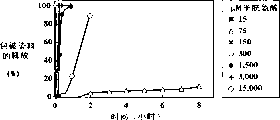
图9A显示了含有DOPE和对mPEG-DTB-DSPE的脂质体的归一化的截留荧光团释放百分率对时间的函数。截留荧光团的释放百分率是相对于不存在半胱氨酸时温育的脂质体上荧光团的释放百分率而归一化的。显示了在存在15μM(实心正方形)、75μM(空心三角形)、150μM(X符号)、300μM(空心圆),1500μM(实心圆),3000μM(+符号)和15000μM(空心菱形)浓度的半胱氨酸的情况下温育的脂质体的释放率;Figure 9A shows the normalized percentage of trapped fluorophore release as a function of time for liposomes containing DOPE and for mPEG-DTB-DSPE. The percent release of trapped fluorophores was normalized to the percent release of fluorophores from liposomes incubated in the absence of cysteine. Cysteine is shown in the presence of 15 μM (closed squares), 75 μM (open triangles), 150 μM (X symbols), 300 μM (open circles), 1500 μM (closed circles), 3000 μM (+ signs) and 15000 μM (open diamonds) concentrations Release rate of liposomes incubated under acid conditions;
图9B显示了含有DOPE和对mPEG-MeDTB-DSPE的脂质体的归一化的截留荧光团释放百分率对时间的函数。截留荧光团的释放百分率是相对于不存在半胱氨酸时温育的脂质体上荧光团的释放百分率而归一化的。显示了在存在15μM(实心正方形)、75μM(空心三角形)、150μM(X符号)、300μM(空心圆),1500μM(实心圆),3000μM(+符号)和15000μM(空心菱形)浓度的半胱氨酸的情况下温育的脂质体的释放率;Figure 9B shows the normalized percent release of trapped fluorophores as a function of time for liposomes containing DOPE and for mPEG-MeDTB-DSPE. The percent release of trapped fluorophores was normalized to the percent release of fluorophores from liposomes incubated in the absence of cysteine. Cysteine is shown in the presence of 15 μM (closed squares), 75 μM (open triangles), 150 μM (X symbols), 300 μM (open circles), 1500 μM (closed circles), 3000 μM (+ signs) and 15000 μM (open diamonds) concentrations Release rate of liposomes incubated under acid conditions;
图9C显示了含有DOPE和图6A的mPEG-meDTB-二硬脂酰-甘油化合物的脂质体的归一化的截留荧光团释放百分率对时间的函数。截留荧光团的释放百分率是相对于在不存在半胱氨酸时温育的脂质体上荧光团的释放百分率而归一化的。显示了在存在15μM(实心正方形)、75μM(空心三角形)、150μM(X符号)、300μM(空心圆),1500μM(实心圆),3000μM(+符号)和15000μM(空心菱形)浓度的半胱氨酸的情况下温育的脂质体上断裂出化合物时染料的释放率;Figure 9C shows the normalized percent release of trapped fluorophores as a function of time for liposomes containing DOPE and the mPEG-meDTB-distearoyl-glycerol compound of Figure 6A. The percent release of trapped fluorophores was normalized to the percent release of fluorophores from liposomes incubated in the absence of cysteine. Cysteine is shown in the presence of 15 μM (closed squares), 75 μM (open triangles), 150 μM (X symbols), 300 μM (open circles), 1500 μM (closed circles), 3000 μM (+ signs) and 15000 μM (open diamonds) concentrations The release rate of the dye when the compound is cleaved from the liposomes incubated in the presence of acid;
图10显示了在注射含有PHPC∶胆固醇∶mPEG-DTB-DSPE(55∶40∶5摩尔比率)的脂质体的不同时间后的小鼠身上所取血样中脂质体的数量,以每分钟计数/ml含有截留In111的脂质体表示。一组动物在时间零(实心正方形)接受200μL注射的200mM半胱氨酸。对照组在时间零(空心圆)时注射盐水;Figure 10 shows the number of liposomes in blood samples taken from mice at different times after injection of liposomes containing PHPC:cholesterol:mPEG-DTB-DSPE (55:40:5 molar ratio), expressed in minutes Counts/ml liposomes containing cut-off In 111 are expressed. One group of animals received a 200 μL injection of 200 mM cysteine at time zero (closed squares). Control group was injected with saline at time zero (open circle);
图11A显示了根据本发明的另一实施方案合成mPEG-DTB-蛋白质化合物的合成反应方案;Figure 11A shows a synthetic reaction scheme for the synthesis of mPEG-DTB-protein compounds according to another embodiment of the present invention;
图11B显示了图11A的化合物硫解断裂后的分解产物;Figure 11B shows the decomposition products of the compound of Figure 11A after thiolytic cleavage;
图12为与mPEG-MeDTB-氯甲酸硝基苯基酯反应15分钟(泳道1)或1小时(泳道2)形成mPEG-MeDTB-溶菌酶缀合物的溶菌酶、天然溶菌酶(泳道3)、与mPEG-氯甲酸硝基苯基酯反应1小时的溶菌酶(泳道4)、分子量标志(泳道5)和用2%β-巯基乙醇在70℃下处理10分钟的泳道1-4的试样(泳道6-9)的十二烷基硫酸钠聚丙烯酰胺凝胶电泳(SDS-PAGE)曲线的示意图;Figure 12 is lysozyme and natural lysozyme (swimming lane 3) that form mPEG-MeDTB-lysozyme conjugates with mPEG-MeDTB-nitrophenyl chloroformate reacted for 15 minutes (swimming lane 1) or 1 hour (swimming lane 2) , lysozyme reacted with mPEG-nitrophenyl chloroformate for 1 hour (lane 4), molecular weight markers (lane 5) and assays of lanes 1-4 treated with 2% β-mercaptoethanol at 70°C for 10 minutes The schematic diagram of the sodium dodecyl sulfate polyacrylamide gel electrophoresis (SDS-PAGE) curve of sample (swimming lane 6-9);
图13显示了mPEG-DTB-p-硝基酰苯胺缀合物硫解断裂后的分解产物;Figure 13 shows the decomposition products of mPEG-DTB-p-nitroanilide conjugate after thiolytic cleavage;
图14A显示了mPEG-MeDTB-对硝基酰苯胺(封闭的菱形)和在体外用5mM半胱氨酸温育2分钟(封闭的正方形)、5分钟(x符号)、10分钟(空心正方形)、20分钟(三角形)、40分钟(空心菱形)和80分钟(封闭的圆)后的吸光度对波长的函数,单位nm;Figure 14A shows mPEG-MeDTB-p-nitroanilide (closed diamonds) and in vitro incubation with 5 mM cysteine for 2 minutes (closed squares), 5 minutes (x symbols), 10 minutes (open squares) , 20 minutes (triangle), 40 minutes (hollow diamond) and 80 minutes (closed circle) after the absorbance function of the wavelength, unit nm;
图14B显示了在体外在5mM半胱氨酸(封闭的圆)、1mM半胱氨酸(封闭的正方形)和0.15mM半胱氨酸(封闭的菱形)的存在下温育的mPEG-MeDTB-对硝基酰苯胺缀合物上释放的对硝基酰苯胺数量(单位:mole/L)对时间(单位:分钟)的函数。Figure 14B shows mPEG-MeDTB-mPEG-MeDTB- The amount of p-nitroanilide released on the p-nitroanilide conjugate (in mole/L) as a function of time (in minutes).
发明详述Detailed description of the invention
I.定义I. Definition
这里所用的“多肽”指氨基酸聚合物,而不指氨基酸聚合物的具体长度。因此,如术语肽、寡肽、蛋白质和酶包括在多肽的定义范围内。该术语还包括多肽的表达后修饰如糖基化、乙酰化、磷酸化等等。As used herein, "polypeptide" refers to an amino acid polymer without referring to a specific length of the amino acid polymer. Thus, for example, the terms peptide, oligopeptide, protein and enzyme are included within the definition of polypeptide. The term also includes post-expression modifications of the polypeptide such as glycosylation, acetylation, phosphorylation, and the like.
“含胺”意指任何这样的化合物,它们具有通过由烷基或芳基取代一或两个氢原子得到通式结构RNH2(伯胺)和R2NH(仲胺)而得自氨的部分,其中R为任何烃基。"Amine-containing" means any compound having the characteristic of ammonia derived from the general structure RNH2 (primary amine) and R2NH (secondary amine) by substituting one or two hydrogen atoms with an alkyl or aryl group. moiety, wherein R is any hydrocarbyl.
这里的“亲水性聚合物”指具有水溶性部分的聚合物,该水溶性部分赋予该聚合物在室温下一定程度的水溶性。亲水性聚合物的例子包括聚乙烯吡咯烷酮,聚乙烯基甲基醚,聚甲基噁唑啉,聚乙基噁唑啉,聚羟基丙基噁唑啉,聚羟基丙基-甲基丙烯酰胺,聚甲基丙烯酰胺,聚二甲基-丙烯酰胺,聚羟基丙基甲基丙烯酸酯,聚羟基乙基丙烯酸酯,羟甲基纤维素,羟乙基纤维素、聚乙二醇、聚天冬酰胺、上述聚合物的共聚物以及聚环氧乙烷-聚环氧丙烷共聚物。在美国专利号5,395,619和5,631,018中描述了这些聚合物中的许多的性质和反应。"Hydrophilic polymer" herein refers to a polymer having a water-soluble moiety which imparts a degree of water solubility to the polymer at room temperature. Examples of hydrophilic polymers include polyvinylpyrrolidone, polyvinylmethyl ether, polymethyloxazoline, polyethyloxazoline, polyhydroxypropyloxazoline, polyhydroxypropyl-methacrylamide , polymethacrylamide, polydimethyl-acrylamide, polyhydroxypropyl methacrylate, polyhydroxyethyl acrylate, hydroxymethyl cellulose, hydroxyethyl cellulose, polyethylene glycol, polytian Paragine, copolymers of the aforementioned polymers, and polyethylene oxide-polypropylene oxide copolymers. The properties and reactions of many of these polymers are described in US Patent Nos. 5,395,619 and 5,631,018.
“包括反应官能团的聚合物”或“包括用于连接的键的聚合物”指已在用于与另一种化合物反应形成共价键的末端部分被修饰(通常但不是必需的)的聚合物。官能化聚合物以具有这样的一个反应官能团部分的反应方案可由本领域技术人员容易地确定和/或已在例如美国专利号5,613,018或由Zalipsky等人在例如Eur.Polymer.J.,19(12):1177-1183(1983);Bioconj.Chem.,4(4):296-299(1993)所描述。"Polymer comprising reactive functional groups" or "Polymer comprising linkages for attachment" refers to polymers which have been modified (usually, but not necessarily) at terminal moieties for reaction with another compound to form a covalent bond . Reaction schemes for functionalizing polymers to have such a reactive functional moiety can be readily determined by those skilled in the art and/or have been described, for example, in U.S. Patent No. 5,613,018 or by Zalipsky et al. ): 1177-1183 (1983); Bioconj. Chem., 4(4): 296-299 (1993).
“重组多肽”中的“重组”意指通过实验操作将氨基酸结合到期望的序列上。"Recombinant" in "recombinant polypeptide" means the incorporation of amino acids into a desired sequence by experimental manipulation.
这里所用的“烷基”意指来源于烷烃,通过从任何碳原子除去氢原子得到的基团:“CnH2n+1”。由不分枝的烷烃的末端碳原子上除去氢原子而得到的基团形成了正常烷基(正烷基)的亚组H[CH2]n。基团RCH2-、R2CH-(R不为H)和R3C-(R不为H)分别为伯、仲和叔烷基。"Alkyl" as used herein means a group derived from an alkane by removal of a hydrogen atom from any carbon atom: " CnH2n +1 ". The groups resulting from the removal of hydrogen atoms from the terminal carbon atoms of unbranched alkanes form the subgroup H[ CH2 ] n of normal alkyls (n-alkyls). The groups RCH2- , R2CH- (R is other than H) and R3C- (R is other than H) are primary, secondary and tertiary alkyl groups, respectively.
“芳基”指具有单环(如苯)或两个稠合环(如萘基)的取代或未取代的一价芳族基。该术语包括杂芳基,它们是在环上具有一或多个氮、氧或硫原子的芳环基,如呋喃基、吡咯、吡啶基和吲哚。“取代”指该芳基上的一或多个环氢被卤化物如氟、氯或溴取代;被含一或两个碳原子的低级烷基取代;被硝基、氨基、甲氨基、二甲氨基、甲氧基、卤甲氧基、卤甲基或卤乙基取代。"Aryl" refers to a substituted or unsubstituted monovalent aromatic radical having a single ring (eg, benzene) or two fused rings (eg, naphthyl). The term includes heteroaryl groups, which are aromatic ring groups having one or more nitrogen, oxygen or sulfur atoms in the ring, such as furyl, pyrrole, pyridyl and indole. "Substitution" means that one or more ring hydrogens on the aryl group are replaced by halides such as fluorine, chlorine or bromine; by lower alkyl groups containing one or two carbon atoms; by nitro, amino, methylamino, di Substitution with methylamino, methoxy, halomethoxy, halomethyl or haloethyl.
“脂族二硫化物”键指R′-S-S-R″形式的键,其中R′和R″为可被进一步取代的直链或支链烷基链。An "aliphatic disulfide" linkage refers to a linkage of the form R'-S-S-R", wherein R' and R" are straight or branched alkyl chains which may be further substituted.
这里采用以下的缩写:PEG,聚(乙二醇);mPEG,甲氧基-PEG;DTB,二硫代苄基;MeDTB,甲基-二硫代苄基;EtDTB,乙基-二硫代苄基;DSPE,二硬脂酰磷脂酰乙醇胺;DOPE,二油酰磷脂酰乙醇胺;PHPC,部分氢化的磷脂酰胆碱;MALDI-TOFMS,基体辅助激光解吸/电离时间飞行质谱。The following abbreviations are used here: PEG, poly(ethylene glycol); mPEG, methoxy-PEG; DTB, dithiobenzyl; MeDTB, methyl-dithiobenzyl; EtDTB, ethyl-dithiobenzyl; Benzyl; DSPE, distearoylphosphatidylethanolamine; DOPE, dioleoylphosphatidylethanolamine; PHPC, partially hydrogenated phosphatidylcholine; MALDI-TOFMS, matrix-assisted laser desorption/ionization time-of-flight mass spectrometry.
II.本发明化合物II. Compounds of the Invention
在一方面,本发明包括下式的化合物:
其中R1包括一种亲水性聚合物,该亲水性聚合物含有适宜将该聚合物共价结合到二硫代苄基部分的官能团。R2和R5独立地选自H、烷基或芳基,并可见它可变化以配合二硫化物的断裂速率。例如,为了获得更快的断裂速率,R2和R5为氢。通过为R2和R5之一或两者选择烷基或芳基对二硫化物进行位阻而获得较慢的断裂速率。R3包括与R4连接的连接部分,它包括含胺配体。在优选的实施方案中,该连接部分为O(C=O)、S(C=O)或O(C=O)。该含胺配体R4可以是伯或仲胺并可以选自任何数量的底物,包括但不限于脂质、药物、多肽、病毒、生物材料的表面和氨基糖苷。在优选的实施方案中,R4为含伯或仲胺的脂质、药物或多肽。在本发明的化合物中,基团CH2-R3的取向可以是邻或对位。wherein R1 comprises a hydrophilic polymer containing functional groups suitable for covalently bonding the polymer to dithiobenzyl moieties. R2 and R5 are independently selected from H, alkyl or aryl, and it can be seen that it can be varied to match the rate of cleavage of the disulfide. For example, for faster fragmentation rates, R2 and R5 are hydrogen. A slower cleavage rate was obtained by sterically hindering the disulfide by choosing an alkyl or aryl group for one or both of R2 and R5 . R3 includes a linking moiety attached to R4 , which includes an amine-containing ligand. In preferred embodiments, the linking moiety is O(C=O), S(C=O) or O(C=O). The amine-containing ligand R4 can be a primary or secondary amine and can be selected from any number of substrates including, but not limited to, lipids, drugs, polypeptides, viruses, surfaces of biological materials, and aminoglycosides. In preferred embodiments, R4 is a lipid, drug or polypeptide containing a primary or secondary amine. In the compounds of the invention, the orientation of the groups CH2 - R3 can be ortho or para.
图1A显示了本发明的示范化合物的结构,其中R1为亲水性聚合物甲氧基-聚乙二醇、mPEG=CH3O(CH2CH2O)n,其中n为约10-约2300,其对应的分子量为约440道尔顿-约100,000道尔顿。该聚合物的分子量在一定程度上取决于R3的选择。在R3为用于脂质体的含胺脂质的实施方案中,优选的PEG分子量范围为约750-约10,000道尔顿,更优选为约2,000-约5,000道尔顿。该实施方案中的mPEG包括尿烷连接部分。在R3为含胺多肽的实施方案中,优选的PEG分子量范围为约2,000-约40,000道尔顿,更优选为约2,000-约20,000道尔顿。可以理解,R1可选自各种亲水性聚合物,而示范性的聚合物如上述。还可以理解,对某些配体如多肽,聚合物的分子量可取决于结合到该配体上的聚合物链的数量,其中在结合的聚合物链数量较小时通常选择更大分子量的聚合物。Figure 1A shows the structure of exemplary compounds of the present invention, wherein R 1 is the hydrophilic polymer methoxy-polyethylene glycol, mPEG=CH 3 O(CH 2 CH 2 O) n , where n is about 10- About 2300, which corresponds to a molecular weight of about 440 Daltons to about 100,000 Daltons. The molecular weight of this polymer depends to some extent on the choice of R3 . In embodiments where R3 is an amine-containing lipid for use in liposomes, preferred PEG molecular weights range from about 750 to about 10,000 Daltons, more preferably from about 2,000 to about 5,000 Daltons. The mPEG in this embodiment includes a urethane linker moiety. In embodiments where R3 is an amine-containing polypeptide, preferred PEG molecular weights range from about 2,000 to about 40,000 Daltons, more preferably from about 2,000 to about 20,000 Daltons. It is understood that R1 can be selected from a variety of hydrophilic polymers, with exemplary polymers being as described above. It is also understood that for certain ligands, such as polypeptides, the molecular weight of the polymer may depend on the number of polymer chains bound to the ligand, with larger molecular weight polymers generally being selected when the number of bound polymer chains is small .
继续参照图1a,在该示范性化合物中的R2和R5为H,但是R2和R5之一或二者还可以是直链或支链烷基或芳基。在一个优选的实施方案中,R5为H而R2为烷基,以下给出一些实施例。在图1A所示的化合物中,R3取通式O(C=O)-(NH2-配体),其中该NH2-配体可以是任何含胺多肽、药物或脂质,以下给出各实施方案的特定实施例。R3还可以是式O(C=S)-(NH2-配体)或S(C=O)-(NH2-配体)。Continuing to refer to Figure 1a, R2 and R5 in this exemplary compound are H, but one or both of R2 and R5 can also be straight chain or branched chain alkyl or aryl. In a preferred embodiment, R5 is H and R2 is alkyl, some examples are given below. In the compound shown in Figure 1A, R 3 takes the general formula O(C=O)-(NH 2 -ligand), wherein the NH 2 -ligand can be any amine-containing polypeptide, drug or lipid, given below Specific examples of various embodiments are given. R 3 may also be of the formula O(C=S)-(NH 2 -ligand) or S(C=O)-(NH 2 -ligand).
图1B显示了图1A的mPEG-DTB-(NH2-配体)化合物的硫解断裂的机理。氨基甲酸邻或对二硫代苄基酯部分在温和的硫解条件下如在半胱氨酸或其它天然还原剂的存在下可断裂。在断裂时,含胺配体再生其天然的未修饰的形式。以下所述的支持本发明的研究表明天然的体内生理学条件足以引发和实现DTB键的断裂。考虑该还原剂还可给药至足以断裂和分解该化合物的人工诱发硫解条件。Figure IB shows the mechanism of thiolytic cleavage of the mPEG-DTB-( NH2 -ligand) compound of Figure IA. The ortho- or para-dithiobenzyl carbamate moieties are cleaved under mild thiolysis conditions, such as in the presence of cysteine or other natural reducing agents. Upon cleavage, the amine-containing ligand regenerates its native, unmodified form. The studies described below in support of the present invention demonstrate that natural in vivo physiological conditions are sufficient to initiate and effect cleavage of DTB bonds. It is contemplated that the reducing agent may also be administered to artificially induced thiolysis conditions sufficient to cleave and decompose the compound.
如上述,R3的一般形式为连接部分,如结合到含胺配体上的O(C=O)、S(C=O)或O(C=S)。在优选的实施方案中,该含胺配体包括含胺多肽、药物或脂质。现在将描述这些实施方案的实施例As noted above, the general form of R3 is a linking moiety, such as O(C=O), S(C=O), or O(C=S) bound to an amine-containing ligand. In preferred embodiments, the amine-containing ligand comprises an amine-containing polypeptide, drug or lipid. Examples of these embodiments will now be described
A.含胺脂质A. Amine-containing lipids
在一个实施方案中,该含胺配体为含胺脂质。这里所指的脂质意指具有至少一个含有至少约8个碳原子的酰基链,更优选含约8-24个碳原子的酰基链的不溶于水的分子。优选的脂质为具有含胺极性头基团和酰基链的脂质。示范性的脂质为具有单酰基链(如硬脂酰胺)或两个酰基链的磷脂。优选的具有含胺头基团的磷脂包括磷脂酰乙醇胺和磷脂酰丝氨酸。该脂质尾部可以具有约12-约24个碳原子,并可以是完全饱和或不饱和的。一种优选的脂质为二硬脂酰磷脂酰乙醇胺(DSPE),但是本领域技术人员将考虑落在该说明书范围内的大量脂质。还考虑该脂质可天然地包含胺基或可以衍生为包括胺基。其它不具酰基尾部的脂质部分如胆固醇胺也是合适的。In one embodiment, the amine-containing ligand is an amine-containing lipid. Lipid as used herein means a water-insoluble molecule having at least one acyl chain containing at least about 8 carbon atoms, more preferably an acyl chain containing about 8-24 carbon atoms. Preferred lipids are those having an amine-containing polar head group and an acyl chain. Exemplary lipids are phospholipids with a single acyl chain (eg, stearylamide) or two acyl chains. Preferred phospholipids with amine-containing head groups include phosphatidylethanolamine and phosphatidylserine. The lipid tail can have from about 12 to about 24 carbon atoms and can be fully saturated or unsaturated. One preferred lipid is distearoylphosphatidylethanolamine (DSPE), but those skilled in the art will contemplate numerous lipids that fall within the scope of this specification. It is also contemplated that the lipid may naturally contain amine groups or may be derivatized to include amine groups. Other lipid moieties without an acyl tail such as cholesterylamine are also suitable.
聚合物-DTB-脂质化合物的合成如图2的图示。通过2-(甲氧基羰基二硫代)乙烷胺与mPEG-氯甲酸酯的反应而制得具有甲氧基羰基二硫代烷基末端基团的mPEG衍生物(MW 2000和5000道尔顿),该mPEG-氯甲酸酯已通过光气化干燥的mPEG-OH溶液(Zalipsky,S.,等人,Biotechnol.Appl.Biochem.15:100-114(1992).)制得。根据公开的方法(Brois,S.J.,等人,J.Amer.Chem.Soc.92:7629-7631(1970);Koneko,T.,等人,Bioconjugate Chem.2:133-141(1991)),通过2-氨基乙硫醇盐酸盐与等量的甲氧基羰基硫化氯的反应得到前一化合物。巯基苄基醇的对和邻位异构体(Grice,R.,等人,J.Chem.Soc.1947-1954(1963))都干净地与所得的PEG-连接的酰基二硫化物偶合,得到含有二硫代苄基醇末端基团的mPEG。活性碳酸盐的引入与采用未衍生的mPEG-OH一样进行,得到对硝基苯基碳酸酯。在乙醇胺中加入DSPE形成期望的mPEG-DTB-DSPE产物。通过硅胶色谱制备和纯化邻和对DTB-脂质化合物,用NMR和MALDI-FOFMS进行表征,其具体情况由实施例1给出。The synthesis of the polymer-DTB-lipid compound is schematically shown in FIG. 2 . mPEG derivatives with methoxycarbonyldithioalkyl end groups (MW 2000 and 5000 channels) prepared by reaction of 2-(methoxycarbonyldithio)ethaneamine with mPEG-chloroformate Dayton), the mPEG-chloroformate has been prepared by phosgenation of dried mPEG-OH solution (Zalipsky, S., et al., Biotechnol. Appl. Biochem. 15:100-114 (1992).). According to published methods (Brois, S.J., et al., J.Amer.Chem.Soc. 92:7629-7631 (1970); Koneko, T., et al., Bioconjugate Chem.2:133-141 (1991)), The former compound is obtained by reaction of 2-aminoethanethiol hydrochloride with an equivalent amount of methoxycarbonylsulfide chloride. Both para and ortho isomers of mercaptobenzyl alcohol (Grice, R., et al., J. Chem. Soc. 1947-1954 (1963)) couple cleanly to the resulting PEG-linked acyl disulfide, mPEG containing dithiobenzyl alcohol end groups was obtained. The introduction of activated carbonate was carried out as with underivatized mPEG-OH to give p-nitrophenyl carbonate. Addition of DSPE in ethanolamine forms the desired mPEG-DTB-DSPE product. Ortho and para DTB-lipid compounds were prepared and purified by silica gel chromatography, and characterized by NMR and MALDI-FOFMS, the details of which are given in Example 1.
图3显示了mPEG-DTB-DSPE缀合物的硫解断裂机理。在断裂时,磷脂酰乙醇胺脂质再生其天然、未修饰的形式。Figure 3 shows the mechanism of thiolytic cleavage of mPEG-DTB-DSPE conjugates. Upon cleavage, the phosphatidylethanolamine lipid regenerates its native, unmodified form.
图4A-4B显示了用于合成具有与二硫键(例如更受阻的二硫键)相邻的烷基的mPEG-DTB-DSPE缀合物的反应方案。如在实施例2A中更为全面的描述,二氯甲烷中的mPEG-OH在三乙胺(TEA)的存在下与氯甲酸对硝基苯基酯反应形成mPEG-碳酸硝基苯基酯。氨基醇如在二甲基甲酰胺(DMF)中的1-氨基-2-丙醇或1-氨基-2-丁醇在TEA的存在下与mPEG-碳酸硝基苯基酯反应形成连接到PEG上的仲醇。然后将该仲醇转化为期望的如图4A所示的以在实施例2A中所述的mPEG-DTB-DSPE化合物。Figures 4A-4B show reaction schemes for the synthesis of mPEG-DTB-DSPE conjugates with alkyl groups adjacent to disulfide bonds (eg, more hindered disulfide bonds). As described more fully in Example 2A, mPEG-OH in dichloromethane was reacted with p-nitrophenyl chloroformate in the presence of triethylamine (TEA) to form mPEG-nitrophenyl carbonate. Amino alcohols such as 1-amino-2-propanol or 1-amino-2-butanol in dimethylformamide (DMF) react with mPEG-nitrophenyl carbonate in the presence of TEA to form secondary alcohols on This secondary alcohol was then converted to the desired mPEG-DTB-DSPE compound as shown in Figure 4A and described in Example 2A.
在该反应方案中,mPEG-甲基-二硫代苯基-氯甲酸硝基苯基酯与DSPE反应形成期望的化合物。在该mPEG-甲基-二硫代苯基-氯甲酸硝基苯基酯化合物中的氯甲酸硝基苯基酯部分作为离去基团在与选择的脂质反应时产生期望的产物。本发明在另一方面构想了一种组合物,它包括通过与化合物如mPEG-甲基-二硫苄基-R3的反应而产生的化合物其中R3代表通过连接部分连接到苯环上的离去基团。该离去基团在与含胺配体如DSPE、多肽或含胺药物反应时被取代。该离去基团的选择根据配体中胺的反应性,并优选来自各种具有含羟基或含氧的离去基团的酸性醇。它们包括氯化物、对硝基苯酚、邻硝基苯酚、N-羟基-四氢邻苯二甲酰亚胺、N-羟基琥珀酰亚胺、N-羟基-戊二酰亚胺、N-羟基降冰片烯-2,3-二羧基亚胺、1-羟基苯并三唑、3-羟基吡啶、4-羟基吡啶、2-羟基吡啶、1-羟基-6-三氟甲基苯并三唑、咪唑、三唑、N-甲基-咪唑、五氟苯酚、三氟苯酚和三氯苯酚。In this reaction scheme, mPEG-methyl-dithiophenyl-nitrophenyl chloroformate reacts with DSPE to form the desired compound. The nitrophenyl chloroformate moiety in the mPEG-methyl-dithiophenyl-nitrophenyl chloroformate compound acts as a leaving group to produce the desired product upon reaction with the selected lipid. In another aspect the present invention contemplates a composition comprising a compound produced by reaction with a compound such as mPEG-methyl-dithiobenzyl- R wherein R represents a compound attached to a benzene ring via a linking moiety leaving group. The leaving group is substituted upon reaction with an amine-containing ligand such as DSPE, a polypeptide, or an amine-containing drug. The choice of the leaving group depends on the reactivity of the amine in the ligand, and is preferably derived from various acidic alcohols with hydroxyl- or oxygen-containing leaving groups. They include chloride, p-nitrophenol, o-nitrophenol, N-hydroxy-tetrahydrophthalimide, N-hydroxysuccinimide, N-hydroxy-glutarimide, N-hydroxy Norbornene-2,3-Dicarboxyimine, 1-Hydroxybenzotriazole, 3-Hydroxypyridine, 4-Hydroxypyridine, 2-Hydroxypyridine, 1-Hydroxy-6-trifluoromethylbenzotriazole , imidazole, triazole, N-methyl-imidazole, pentafluorophenol, trifluorophenol and trichlorophenol.
实施例2B描述了mPEG-EtDTB-脂质缀合物的制备,其中的二硫键被乙基部分位阻。Example 2B describes the preparation of mPEG-EtDTB-lipid conjugates in which the disulfide bonds are sterically hindered by ethyl moieties.
图5显示了根据本发明制备mPEG-DTB-配体化合物的另一合成反应方案。该反应过程的细节在实施例3A-3B中给出。简言之,冷1-氨基-2-丙醇与硫酸反应形成硫酸2-氨基-1-甲基乙基氢酯。该产物在含水乙醇中与二硫化碳和氢氧化钠反应形成5-甲基噻唑烷-2-硫酮。往该5-甲基噻唑烷-2-硫酮中加入盐酸水溶液并加热。在回流一周后,结晶并回收产物1-巯基(甲基)乙基氯化铵。产物与甲氧基羰基硫化氯反应得到2-(甲氧基羰基二硫代)乙烷胺。采用上述图2的方法进行的2-(甲氧基羰基二硫代)乙烷胺与mPEG-氯甲酸酯的反应获得期望mPEG-DTB-硝基苯基化合物,该化合物适于与选择的含胺配体反应形成本发明的化合物。Figure 5 shows another synthetic reaction scheme for the preparation of mPEG-DTB-ligand compounds according to the present invention. Details of this reaction procedure are given in Examples 3A-3B. Briefly, cold 1-amino-2-propanol reacts with sulfuric acid to form 2-amino-1-methylethylhydrogensulfate. This product is reacted with carbon disulfide and sodium hydroxide in aqueous ethanol to form 5-methylthiazolidine-2-thione. Aqueous hydrochloric acid was added to the 5-methylthiazolidine-2-thione and heated. After one week of reflux, the product 1-mercapto(methyl)ethylammonium chloride was crystallized and recovered. Reaction of the product with methoxycarbonyl sulfide chloride affords 2-(methoxycarbonyldithio)ethanamine. The reaction of 2-(methoxycarbonyldithio)ethaneamine with mPEG-chloroformate using the method of Figure 2 above yields the desired mPEG-DTB-nitrophenyl compound, which is suitable for use with selected Amine-containing ligands react to form compounds of the invention.
实施例3B描述了合成mPEG-(乙基)DTB硝基苯基的反应。Example 3B describes the reaction for the synthesis of mPEG-(ethyl)DTB nitrophenyl.
图6A显示了根据本发明的制备另一种mPEG-DTB-脂质化合物的反应方案。该反应的细节由实施例4提供。将脂质1,2-二硬脂酰-sn-甘油活化以与按图4A或图5所述制备的mPEG-DTB-硝基苯基反应。所得的mPEG-DTB-脂质与上述化合物不同之处在于缺乏磷酸酯头基团。图6A的mPEG-DTB-脂质在断裂前为中性。如在图6B中所示,在硫解还原该二硫键时,该化合物分解形成阳离子脂质。带正电的脂质在体内提供静电相互作用并同样有助于在体内的靶向。Figure 6A shows a reaction scheme for preparing another mPEG-DTB-lipid compound according to the present invention. Details of this reaction are provided in Example 4.
在上述的反应方案中,所要求的化合物的R5为H。但是,在另一实施方案中,R5为烷基或芳基部分。例如,在该方法中,R2和R5都为CH3部分,α,β-未饱和的酰基氯(R’R”C=CHCOCl,其中R’为例如CH3而R”为CH3,但可考虑任何烷基或芳基)与胺结尾的PEG反应得到对应的N-PEG-取代的α,β-未饱和的酰胺。该化合物与硫羟乙酸反应,通过将缀合物加到C=C键上而得到对应的N-PEG-取代的β-(乙酰硫基)酰胺。将该乙酰硫基(-SCOCH3)水解成硫羟基(-SH),然后与甲基(氯亚磺酰)甲酸酯(CISCOOCH3)反应,产生甲氧基羰基二硫基(-SSCOOCH3);然后将该中间产物与对巯基苄基醇反应得到N-PEG-取代的β-(二硫代苄基醇)酰胺(具有结构PEG-NH-CO-CH2CR’R”-SS-p-苯基-CH2OH)。然后将该苄基醇部分与氯甲酸硝基苯基酯反应得到上述的碳酸硝基苯基酯离去基团。In the above reaction schemes, R5 of the desired compound is H. However, in another embodiment R5 is an alkyl or aryl moiety. For example, in this approach, R2 and R5 are both CH3 moieties, α,β-unsaturated acid chlorides (R'R"C=CHCOCl, where R' is, for example, CH3 and R" is CH3 , However, it is contemplated that any alkyl or aryl group) can be reacted with an amine-terminated PEG to give the corresponding N-PEG-substituted α,β-unsaturated amides. This compound is reacted with thiolacetic acid to give the corresponding N-PEG-substituted [beta]-(acetylthio)amide by adding the conjugate to the C=C bond. The acetylthio group (-SCOCH 3 ) is hydrolyzed to a thiol group (-SH), which is then reacted with methyl (chlorosulfinyl) formate (CISCOOCH 3 ) to produce a methoxycarbonyldithio group (-SSCOOCH 3 ); this intermediate is then reacted with p-mercaptobenzyl alcohol to give N-PEG-substituted β-(dithiobenzyl alcohol) amides (with the structure PEG-NH-CO-CH 2 CR'R"-SS- p-phenyl- CH2OH ). This benzyl alcohol moiety is then reacted with nitrophenyl chloroformate to obtain the nitrophenyl carbonate leaving group described above.
1.mPEG-DTB-DSPE化合物的体外断裂1. In Vitro Cleavage of mPEG-DTB-DSPE Compounds
通过在缓冲的水溶液(pH7.2)中制备化合物的胶束溶液来研究邻mPEG-DTB-DSPE和对mPEG-DTB-DSPE(按实施例1所述制备)的体外断裂。如实施例5所述,在存在和不存在150μM半胱氨酸下通过HPLC分析该化合物的消失来监测该化合物的硫解断裂。结果如在图7A中所示,其中邻和对位化合物在不存在半胱氨酸(分别为*符号和+符号)下没有显示出断裂并在这些条件下在不存在半胱氨酸时表现稳定。图7A中显示了邻和对位化合物在存在150μM半胱氨酸下的断裂,分别由空心圆和空心正方形表示。该邻位化合物表现出比对位对应物稍快的分解速率(T1/2≈12分钟对≈18分钟)。In vitro cleavage of ortho-mPEG-DTB-DSPE and p-mPEG-DTB-DSPE (prepared as described in Example 1) was studied by preparing micellar solutions of the compounds in buffered aqueous solution (pH 7.2). Thiolytic cleavage of the compound was monitored by analyzing the disappearance of the compound by HPLC in the presence and absence of 150 [mu]M cysteine as described in Example 5. The results are shown in Figure 7A, where the ortho and para compounds showed no fragmentation in the absence of cysteine (* and + symbols, respectively) and behaved in the absence of cysteine under these conditions. Stablize. Fragmentation of ortho and para compounds in the presence of 150 [mu]M cysteine is shown in Figure 7A, represented by open circles and open squares, respectively. The ortho compound exhibited a slightly faster decomposition rate than the para counterpart (T 1/2 ≈12 min vs. ≈18 min).
2.含有mPEG-DTB-脂质化合物的脂质体组合物2. Liposome composition containing mPEG-DTB-lipid compound
a.体外表征a. In vitro characterization
在一个实施方案中,将mPEG-DTB-脂质化合物制成脂质体。脂质体为封闭的脂质囊,用于各种治疗目的,特别是通过脂质体的系统给药而携带治疗剂至靶区域或细胞。具体而言。具有亲水性聚合物链如聚乙二醇(PEG)的表面包被的脂质体为期望的药物载体,因为这些脂质体与缺少该聚合物包被的脂质体相比延长了血液循环寿命。该聚合物包被中的聚合物链屏蔽了脂质体并形成该脂质体的水溶剂化聚合物链周围的“刚性刷”。因此,该聚合物用作血液蛋白质的屏障,防止蛋白质的结合和脂质体的识别而被巨噬细胞和其它网状内皮系统细胞摄取和除去。In one embodiment, the mPEG-DTB-lipid compound is formulated into liposomes. Liposomes are enclosed lipid vesicles that are used for various therapeutic purposes, particularly to carry therapeutic agents to target areas or cells by systemic administration of liposomes. in particular. Surface-coated liposomes with hydrophilic polymer chains such as polyethylene glycol (PEG) are desirable drug carriers because these liposomes prolong blood flow compared to liposomes lacking the polymer coat. cycle life. The polymer chains in the polymer coat shield the liposome and form a "rigid brush" around the liposome's water-solvating polymer chains. Thus, the polymer acts as a barrier to blood proteins, preventing protein binding and liposome recognition for uptake and removal by macrophages and other cells of the reticuloendothelial system.
具有聚合物链的表面包被的脂质体一般通过在脂质混合物中包含约1-约20摩尔百分率的由该聚合物衍生的脂质而制得。聚合物衍生的脂质的实际数量可以更高或更低,取决于该聚合物的分子量。在本发明中,通过往其它脂质体脂质双层组分中加入约1-约20摩尔百分率的聚合物-DTB-脂质缀合物而制备脂质体。如在以下的研究中所示,本发明的含有聚合物-DTB-脂质缀合物的脂质体比含有聚合物-脂质缀合物,且其中的聚合物和脂质通过可断裂的脂肪族二硫键结合的脂质体具有更长的血液循环寿命。Surface-coated liposomes having polymer chains are generally prepared by including in the lipid mixture about 1 to about 20 mole percent lipids derived from the polymers. The actual amount of polymer-derived lipid can be higher or lower, depending on the molecular weight of the polymer. In the present invention, liposomes are prepared by adding about 1 to about 20 mole percent of the polymer-DTB-lipid conjugate to other liposome lipid bilayer components. As shown in the following studies, liposomes of the present invention containing polymer-DTB-lipid conjugates are more complex than those containing Aliphatic disulfide-bonded liposomes have a longer blood circulation life.
在支持本发明的研究中,如在实施例6中所述制备包括成囊脂质部分氢化的磷脂酰胆碱和胆固醇以及邻mPEG-DTB-DSPE或对mPEG-DTB-DSPE化合物的脂质体。在存在和不存在处于含水缓冲剂的150μM半胱氨酸下监测半胱氨酸介导的mPEG-DTB-DSPE化合物的断裂。结果如图7B所示,它包括图7A的数据以进行比较。在图7B中,不存在半胱氨酸(分别为*符号和+符号)下,胶束形式邻和对位化合物没有显示断裂,它表明该缀合物在不存在硫醇时的稳定性。空心圆和空心正方形分别对应于上面图7A所讨论的在存在半胱氨酸下胶束形式的邻和对位化合物。实心圆和实心正方形分别对应于在半胱氨酸的存在下的脂质体形式的邻和对位化合物。In studies in support of the present invention, liposomes comprising partially hydrogenated phosphatidylcholine and cholesterol and ortho-mPEG-DTB-DSPE or para-mPEG-DTB-DSPE compounds were prepared as described in Example 6 . Cysteine-mediated cleavage of mPEG-DTB-DSPE compounds was monitored in the presence and absence of 150 μM cysteine in aqueous buffer. The results are shown in Figure 7B, which includes the data from Figure 7A for comparison. In Figure 7B, micellar ortho and para compounds show no fragmentation in the absence of cysteine (* and + symbols, respectively), which demonstrates the stability of the conjugate in the absence of thiols. Open circles and open squares correspond to the ortho and para compounds, respectively, in micellar form in the presence of cysteine as discussed above for Figure 7A. Filled circles and filled squares correspond to ortho and para compounds, respectively, in liposomal form in the presence of cysteine.
图7B中的数据表明邻和对位化合物在被掺到脂质体中时稍微更耐受硫解断裂。硫解反应产物的TLC(硅胶G,氯仿/甲醇/水90∶18∶2)(Dittmer,J.C.,等人,J.lipid Res.5:126-127(1964))检查表明DSPE是唯一的脂质组分而另一点对应于含硫醇、不含脂质的mPEG衍生物。The data in Figure 7B indicate that the ortho and para compounds are somewhat more resistant to thiolytic cleavage when incorporated into liposomes. TLC (silica gel G, chloroform/methanol/water 90:18:2) (Dittmer, J.C., et al., J.lipid Res. 5:126-127 (1964)) examination of the thiolysis reaction product showed that DSPE was the only lipid lipid components and another point corresponds to thiol-containing, lipid-free mPEG derivatives.
在支持本发明的另一研究中,由脂质二油酰磷脂酰乙醇胺(DOPE)制得脂质体并制得邻mPEG-DTB-DSPE或对mPEG-DTB-DSPE化合物。DOPE为六角形相脂质,它单独不形成脂质囊。但是,当DOPE与少量摩尔百分率的mPEG-DTB-DSPE化合物结合时将形成脂质体。mPEG-DTB-DSPE化合物的断裂引发脂质体的分解和脂质体-截留含量的释放。因此,这种脂质体的含量释放特征为可断裂的含PEG的脂质体提供了一种方便的定量评价。In another study in support of the present invention, liposomes were prepared from the lipid dioleoylphosphatidylethanolamine (DOPE) and either ortho-mPEG-DTB-DSPE or p-mPEG-DTB-DSPE compounds were prepared. DOPE is a hexagonal phase lipid which alone does not form lipid vesicles. However, liposomes will form when DOPE is combined with a small mole percent of the mPEG-DTB-DSPE compound. Fragmentation of the mPEG-DTB-DSPE compound triggers disintegration of the liposomes and release of the liposome-entrapped content. Thus, the content release profile of this liposome provides a convenient quantitative assessment of cleavable PEG-containing liposomes.
如实施例7A所述采用截留荧光团、对二甲苯-双-溴化吡啶鎓和8-羟基芘三磺酸三钠制得含有DOPE和邻或对mPEG-DTB-DSPE化合物的脂质体。如实施例7B所述监测在各种浓度的半胱氨酸的存在下温育的脂质体上的荧光团的释放。Liposomes containing DOPE and ortho- or p-mPEG-DTB-DSPE compounds were prepared as described in Example 7A using entrapped fluorophores, p-xylene-bis-pyridinium bromide, and trisodium 8-hydroxypyrenetrisulfonate. The release of fluorophores from liposomes incubated in the presence of various concentrations of cysteine was monitored as described in Example 7B.
含有邻位化合物的脂质体的结果如图8A所示,其中显示了在15μM(实心菱形)、150μM(实心反转的三角形)、300μM(实心三角形)和1.5mM(实心圆)浓度的半胱氨酸的存在下温育的脂质体上的截留荧光团的含量释放百分率。图8B为含有对位化合物的脂质体的类似的图形,其中在15μM(实心菱形)、300μM(实心三角形)、1μM(实心正方形)和1.5mM(实心圆)浓度的半胱氨酸中温育该脂质体。The results for liposomes containing the ortho compound are shown in Figure 8A, which shows the hemispheres at concentrations of 15 μM (solid diamonds), 150 μM (solid inverted triangles), 300 μM (solid triangles) and 1.5 mM (solid circles). Percent content release of entrapped fluorophores on liposomes incubated in the presence of cystine. Figure 8B is a similar graph of liposomes containing para compounds incubated in cysteine at concentrations of 15 μM (solid diamonds), 300 μM (solid triangles), 1 μM (solid squares) and 1.5 mM (solid circles) The liposome.
图8A-8B显示了邻和对位化合物在被掺到脂质体内时都断裂,它可由速度取决于半胱氨酸浓度的截留染料的释放来证明。用含有不可断裂的mPEG-DSPE的脂质体的对照研究没有产生含量释放(这里没有显示结果)。这些结果还表明邻位缀合物某种程度上更易于硫解断裂,例如,300μM的半胱氨酸在20分钟内释放出绝大部分含量的DOPE脂质体。在同一条件下,只有部分具有对mPEG-DTB-DSPE的脂质体分解。类似地,在150μM的半胱氨酸下温育20分钟后,含有邻位化合物的脂质体释放出半数的截留含量,而含有对位化合物的脂质体只有约10%的含量释放。邻位和对位化合物的半衰期在半胱氨酸水平为150μM时都小于20分钟(见图7B中的数据)。这表明半数以上的最初三摩尔百分率的mPEG-DTB-脂质必须断裂以从脂质体上观测含量释放。Figures 8A-8B show that both ortho and para compounds fragment when incorporated into liposomes, as evidenced by the release of entrapped dye at a rate dependent on cysteine concentration. Control studies with liposomes containing non-cleavable mPEG-DSPE did not result in content release (results not shown here). These results also suggest that the ortho-conjugates are somewhat more susceptible to thiolytic cleavage, eg, 300 μM cysteine releases most of the DOPE liposome content within 20 minutes. Under the same conditions, only some had liposome breakdown for mPEG-DTB-DSPE. Similarly, after 20 minutes of incubation at 150 [mu]M cysteine, liposomes containing the ortho compound released half of the retained content, whereas liposomes containing the para compound released only about 10% of the content. The half-lives of both ortho and para compounds were less than 20 minutes at a cysteine level of 150 [mu]M (see data in Figure 7B). This indicates that more than half of the original three mole percent of the mPEG-DTB-lipid must be fragmented to release the observed content from the liposome.
mPEG-DTB-DSPE/DOPE脂质体在15μM的半胱氨酸中的分解、人和啮齿动物身上的平均血浆浓度(Lash,L.H.,等人,Arch.Biochem.Biophys.240:583-592(1985))在这些实验的时间范围内(60分钟)最小。这表明mPEG-DTB-脂质化合物在血浆中应具有足够长的寿命以使PEG移植囊在体内的系统分布或在特定的部位被动地或通过配体介导的靶向蓄积。半胱氨酸浓度的局部或短期增大可由其静脉内的或动脉内给药有效地实现。图8A-8B所示的结果还表明延长与天然血浆半胱氨酸浓度(≈15μM)的接触将足以分解大部分的这些化合物。在体内实验中研究这些建议,并如下所示。Disassembly of mPEG-DTB-DSPE/DOPE liposomes in cysteine at 15 μM, mean plasma concentrations in humans and rodents (Lash, L.H., et al., Arch.Biochem.Biophys.240:583-592( 1985)) was minimal in the time frame of these experiments (60 minutes). This suggests that mPEG-DTB-lipid compounds should have a sufficiently long lifetime in plasma to allow for systemic distribution of PEG-grafted vesicles in vivo or passive or ligand-mediated targeted accumulation at specific sites. Local or short-term increases in cysteine concentrations can be effectively achieved by its intravenous or intraarterial administration. The results shown in Figures 8A-8B also suggest that prolonged exposure to natural plasma cysteine concentrations (≈15 μΜ) will be sufficient to decompose most of these compounds. These proposals were investigated in in vivo experiments and presented below.
在另一支持本发明的研究中,制备含有DOPE和三种不同mPEG-DTB-脂质化合物的脂质体。该脂质体如实施例7所述制备并包括和截留荧光团。三种mPEG-DTB-脂质化合物为图1A中所示的mPEG-DTB-DSPE、图4B中所示的mPEG-MeDTB-DSPE,其中R为CH3,和图6A中所示的mPEG-MeDTB-二硬脂酰甘油。该脂质体含有97摩尔百分率的DOPE和3摩尔百分率的一种mPEG-DTB-脂质化合物。在各种半胱氨酸浓度下通过监测截留荧光团的释放作为时间的函数而测定由半胱氨酸介导的该化合物的断裂速率。结果如在图9A-9C中所示,其中截留荧光团的释放百分率相对于在单独在缓冲剂中温育的脂质体的释放速率进行归一化。In another study in support of the present invention, liposomes containing DOPE and three different mPEG-DTB-lipid compounds were prepared. The liposomes were prepared as described in Example 7 and included and entrapped the fluorophore. The three mPEG-DTB-lipid compounds are mPEG-DTB-DSPE shown in Figure 1A, mPEG-MeDTB-DSPE shown in Figure 4B, where R is CH3 , and mPEG-MeDTB shown in Figure 6A - Distearoylglycerol. The liposomes contained 97 mole percent of DOPE and 3 mole percent of an mPEG-DTB-lipid compound. The rate of cysteine-mediated cleavage of the compound was determined by monitoring the release of the trapped fluorophore as a function of time at various cysteine concentrations. The results are shown in Figures 9A-9C, where the percent release of trapped fluorophores was normalized to the release rate of liposomes incubated in buffer alone.
图9A显示了含有DOPE和对mPEG-DTB-DSPE(图1A的化合物)的脂质体的截留荧光团的释放百分率作为时间的函数。显示了含有该缀合物并在15μM(实心正方形)、75μM(空心三角形)、150μM(X符号)、300μM(空心圆)、1500μM(实心圆)、3000μM(+符号)和15000μM(空心菱形)浓度的半胱氨酸的存在下温育的脂质体上的释放率。Figure 9A shows the percent release of entrapped fluorophores as a function of time for liposomes containing DOPE and for mPEG-DTB-DSPE (compound of Figure 1A). Tables containing the conjugate and at 15 μM (closed squares), 75 μM (open triangles), 150 μM (X symbols), 300 μM (open circles), 1500 μM (closed circles), 3000 μM (+ signs) and 15000 μM (open diamonds) are shown. Release rates on liposomes incubated in the presence of concentrations of cysteine.
图9B显示了含有DOPE和对mPEG-MeDTB-DSPE(图4B的化合物)的脂质体的截留荧光团的释放百分率作为时间的函数。显示了在15μM(实心正方形)、75μM(空心三角形)、150μM(X符号)、300μM(空心圆)、1500μM(实心圆)、3000μM(+符号)和15000μM(空心菱形)浓度的半胱氨酸的存在下温育的脂质体上荧光团的释放率。Figure 9B shows the percent release of entrapped fluorophores as a function of time for liposomes containing DOPE and for mPEG-MeDTB-DSPE (compound of Figure 4B). Cysteine at concentrations of 15 μM (closed square), 75 μM (open triangle), 150 μM (X symbol), 300 μM (open circle), 1500 μM (closed circle), 3000 μM (+ sign) and 15000 μM (open diamond) are shown The release rate of fluorophores from liposomes incubated in the presence of .
图9C为采用DOPE和mPEG-MeDTB-二硬脂酰甘油(图6A的化合物)制成的脂质体的类似的图形。显示了在15μM(实心正方形)、75μM(空心三角形)、150μM(X符号)、300μM(空心圆)、1500μM(实心圆)、3000μM(+符号)和15000μM(空心菱形)浓度的半胱氨酸的存在下温育的脂质体上染料的释放率。Figure 9C is a similar profile of liposomes made with DOPE and mPEG-MeDTB-distearoylglycerol (compound of Figure 6A). Cysteine at concentrations of 15 μM (closed square), 75 μM (open triangle), 150 μM (X symbol), 300 μM (open circle), 1500 μM (closed circle), 3000 μM (+ sign) and 15000 μM (open diamond) are shown The release rate of the dye from liposomes incubated in the presence of .
图9A-9C表明mPEG-MeDTB-脂质断裂的速率取决于半胱氨酸浓度,由截留荧光的释放表明在15-75μM的半胱氨酸浓度下的断裂速度缓慢。对比图9A和图9B中的数据,表明mPEG-MeDTB-DSPE化合物(图9B)的断裂比mPEG-DTB-DSPE化合物(图9A)约慢10倍。因此,可以根据DTB键中的R部分(见图2)调节断裂的速率。Figures 9A-9C show that the rate of mPEG-MeDTB-lipid cleavage is dependent on cysteine concentration, with the release of trapped fluorescence indicating a slow rate of cleavage at cysteine concentrations of 15-75 μΜ. Comparing the data in Figure 9A and Figure 9B shows that the mPEG-MeDTB-DSPE compound (Figure 9B) cleaves approximately 10 times slower than the mPEG-DTB-DSPE compound (Figure 9A). Thus, the rate of fragmentation can be tuned according to the R moiety in the DTB bond (see Figure 2).
b.体内表征b. In vivo characterization
在小鼠身上测定如在实施例8所述制备并包括本发明的聚合物-DTB-脂质缀合物的脂质体的血液循环寿命。将In111截留在脂质体内并通过静脉内注射给予该脂质体。一组受试动物额外接受注射半胱氨酸,对照组动物额外接受注射盐水。在各时间处取血样并分析脂质体的存在,这种存在由In111的存在来证明。The blood circulation lifetime of liposomes prepared as described in Example 8 and comprising a polymer-DTB-lipid conjugate of the invention was determined in mice. In 111 was entrapped within liposomes and administered to the liposomes by intravenous injection. One group of test animals received an additional injection of cysteine, and a control group of animals received an additional injection of saline. Blood samples were taken at various times and analyzed for the presence of liposomes, evidenced by the presence of In 111 .
图10显示了结果,其中显示了每分钟In111的计数(CPM)作为作为注射脂质体和盐水(空心圆)或200mM半胱氨酸(实心正方形)后的时间的函数。可见,mPEG-DTB-DSPE在暴露于天然生理条件下发生断裂,这由在给予脂质体后用盐水处理的小鼠的组中的断裂来证明。对小鼠给予外源性还原剂、半胱氨酸有效地增大在约2-约8小时的时间范围内mPEG-DTB-脂质化合物的断裂速率。Figure 10 shows the results, showing In 111 counts per minute (CPM) as a function of time after injection of liposomes and saline (open circles) or 200 mM cysteine (closed squares). It can be seen that mPEG-DTB-DSPE undergoes fragmentation upon exposure to natural physiological conditions, as evidenced by fragmentation in the group of mice treated with saline following liposome administration. Administration of the exogenous reducing agent, cysteine, to mice effectively increases the rate of fragmentation of the mPEG-DTB-lipid compound over a period of about 2 to about 8 hours.
重要的是,本发明聚合物-DTB-脂质化合物的断裂导致再生初始的未修饰形式的脂质。这是期望的,因为非天然的、修饰的脂质可能具有不期望的体内作用。同时该化合物在不存在还原剂的情况下储存时稳定。Importantly, cleavage of the polymer-DTB-lipid compounds of the invention leads to regeneration of the original unmodified form of the lipid. This is desirable since non-natural, modified lipids may have undesired effects in vivo. At the same time the compound is stable on storage in the absence of reducing agents.
在这里没有显示的其它研究中,对比了含有mPEG-DTB-脂质的脂质体和含有聚合物-脂质缀合物的脂质体的血液循环寿命,在含有聚合物-脂质缀合物的脂质体中,聚合物和脂质通过可断裂的脂肪族二硫键结合。脂肪族二硫键容易在体内断裂,而具有通过脂肪族二硫化物移植到其表面的聚合物链的脂质体的血液循环寿命一般不具有在含稳定连接的聚合物链的脂质体上观察到的延长的血液循环寿命。本发明的二硫醇苄基键,尤其是更受阻的DTB键在体内更稳定且与具有通过脂肪族二硫键结合的聚合物链的脂质体相比获得了更长的血液循环寿命。In other studies not shown here, the blood circulation lifetimes of liposomes containing mPEG-DTB-lipid and those containing polymer-lipid conjugates were compared, In liposomes, polymers and lipids are joined by cleavable aliphatic disulfide bonds. Aliphatic disulfide bonds are easily broken in vivo, and the blood circulation life of liposomes with polymer chains grafted to their surface via aliphatic disulfides is generally not as good as that of liposomes with stably attached polymer chains Prolonged circulatory life observed. The dithiol benzyl linkages of the present invention, especially the more hindered DTB linkages are more stable in vivo and achieve longer blood circulation lifetimes compared to liposomes with polymer chains bound by aliphatic disulfide bonds.
B.含胺多肽B. Amine-containing polypeptides
在另一实施方案中,本发明包括图1A所述的化合物,其中该含胺配体为多肽。图11A显示了表明制备聚合物-DTB-多肽的合成反应方案,其中mPEG作为示范性的聚合物。一般而言,根据上述图2、4A和5中所述的合成途径之一制备mPEG-DTB-离去基团化合物。该离去基团可以是碳酸硝基苯基酯或上述其它之任一种。该mPEG-DTB-碳酸硝基苯基酯化合物通过尿烷键偶联到多肽中的胺部分。与化合物中的二硫化物邻近的R基团可以是H、CH3、C2H5等等,并可根据所期望的二硫化物断裂速率来选择。In another embodiment, the present invention includes the compound depicted in Figure 1A, wherein the amine-containing ligand is a polypeptide. Figure 11A shows a synthetic reaction scheme demonstrating the preparation of a polymer-DTB-polypeptide, with mPEG as an exemplary polymer. In general, mPEG-DTB-leaving group compounds were prepared according to one of the synthetic pathways described in Figures 2, 4A and 5 above. The leaving group can be nitrophenyl carbonate or any of the others mentioned above. The mPEG-DTB-nitrophenyl carbonate compound is coupled to the amine moiety in the polypeptide through a urethane bond. The R group adjacent to the disulfide in the compound can be H, CH3 , C2H5 , etc., and can be selected according to the desired rate of disulfide cleavage.
图11B显示了在化合物的半胱氨酸介导的断裂时的分解产物。可见天然蛋白质(没有修饰其蛋白质胺基)在断裂时发生再生。Figure 1 IB shows the breakdown products upon cysteine-mediated cleavage of the compound. It can be seen that native proteins (without modification of their protein amine groups) regenerate upon fragmentation.
聚合物链如PEG与多肽的连接经常减小多肽的酶或其它生物活性,例如受体结合。但是,多肽的聚合物修饰增加了多肽的血液循环寿命。在本发明中,给予受试者聚合物修饰的多肽。由于聚合物修饰的多肽循环,接触生理还原条件如血液半胱氨酸和其它体内硫醇引发了多肽上聚合物链的断裂。在聚合物链从多肽上释放时,逐渐地恢复多肽的生物学活性。通过这种方式,多肽最初具有足够的用于生物分布的血液循环寿命,并在聚合物链断裂时在一定期间内恢复其全部生物活性。Attachment of a polymer chain, such as PEG, to a polypeptide often reduces the enzymatic or other biological activity of the polypeptide, such as receptor binding. However, polymer modification of the polypeptide increases the blood circulation lifetime of the polypeptide. In the present invention, a polymer-modified polypeptide is administered to a subject. As the polymer-modified polypeptide circulates, exposure to physiological reducing conditions such as blood cysteine and other in vivo thiols triggers scission of the polymer chains on the polypeptide. Upon release of the polymer chains from the polypeptide, the biological activity of the polypeptide is gradually restored. In this way, the polypeptide initially has sufficient blood circulation lifetime for biodistribution and restores its full biological activity within a certain period of time when the polymer chain is broken.
在一个支持本发明的研究中,溶菌酶用作模型多肽,并通过与上述类似的合成途径制备了mPEG-MeDTB-溶菌酶缀合物。在0.1M硼酸盐中,在pH9和2∶1的碳酸硝基苯基酯与溶菌酶的氨基的比率下温育该溶菌酶。在反应15分钟和3小时后,由SDS-PAGE表征试样。通过在相同的条件下溶菌酶与mPEG-碳酸硝基苯基酯缀合物反应60分钟制备对比化合物,它将形成稳定的mPEG-溶菌酶缀合物。In a study in support of the present invention, lysozyme was used as a model polypeptide, and a mPEG-MeDTB-lysozyme conjugate was prepared by a synthetic route similar to that described above. The lysozyme was incubated in 0.1 M borate at
图12显示了SDS-PAGE凝胶的示意图。泳道1对应于在溶菌酶与mPEG-MeDTB-碳酸硝基苯基酯反应15分钟后形成的化合物,而泳道2对应于在同样的化合物反应1小时后形成的化合物。泳道3代表天然溶菌酶而泳道4对应于与mPEG-碳酸硝基苯基酯反应1小时的溶菌酶。从上向下泳道5中分子量标记如下:
比较泳道1和泳道2表明,更长的反应时间导致化合物分子量的增大,并与在更长的温育时间内缀合到多肽上的其它mPEG链一致。Comparing
SDS-PAGE曲线的泳道6-9对应于在70℃下用2%β-巯基乙醇处理10分钟后的泳道1-4中的试样。mPEG-MeDTB-溶菌酶缀合物在与还原剂接触后分解再生天然溶菌酶,这可由在14.4kDa处的泳道6和7中的带证明。与此相对照,在用还原剂温育时并不影响稳定的mPEG-溶菌酯化合物,这可由泳道9和泳道4曲线上的一致性证明。Lanes 6-9 of the SDS-PAGE curve correspond to samples in lanes 1-4 after treatment with 2% β-mercaptoethanol for 10 minutes at 70°C. The mPEG-MeDTB-lysozyme conjugate decomposes to regenerate native lysozyme upon contact with a reducing agent, as evidenced by the bands in
从SDS-PAGE曲线还是清楚可见的是,mPEG-MeDTB与蛋白质的共价结合形成含有各种mPEG-蛋白质比率的缀合物的混合物。该比率取决于反应时间和条件。它可由观察泳道1和2上的带而清楚可见,其中泳道1表示由约1-6个PEG链衍生的溶菌酶。在泳道2中,更长的反应时间获得具有更高mPEG-蛋白质比率的mPEG-MeDTB-溶菌酶缀合物。所有可断裂的缀合物易于断裂再生天然蛋白质,这可由泳道6和7上的带表明。It is also clear from the SDS-PAGE curves that the covalent binding of mPEG-MeDTB to the protein forms a mixture of conjugates containing various mPEG-protein ratios. This ratio depends on reaction time and conditions. It can be clearly seen by observing the bands on
考虑使用上述的任何亲水性聚合物。该聚合物分子量的选择取决于多肽、多肽上反应性胺的数量和期望的该聚合物修饰的化合物的大小。Any of the hydrophilic polymers described above are contemplated for use. The choice of molecular weight of the polymer depends on the polypeptide, the number of reactive amines on the polypeptide and the desired size of the polymer-modified compound.
考虑使用的多肽是非限制性的并可以是天然或重组产生的多肽。优选小的人重组多肽,并优选范围为10-30KDa的多肽。示范性的多肽包括细胞因子,如肿瘤坏死因子(TNF)、白介素和干扰素、红细胞生成素(EPO)、粒细胞集落刺激因子(GCSF)、酶等等。还考虑病毒多肽,其中将该病毒的表面修饰为包括一或多种通过DTB可逆键连接的聚合物链。修饰含有用于细胞转染的基因的病毒将延长病毒的循环时间并减小它的免疫原性,借此改善外源性基因的递送。The polypeptides contemplated for use are non-limiting and may be naturally or recombinantly produced polypeptides. Small human recombinant polypeptides are preferred, and polypeptides in the range of 10-30 KDa are preferred. Exemplary polypeptides include cytokines, such as tumor necrosis factor (TNF), interleukins and interferons, erythropoietin (EPO), granulocyte colony stimulating factor (GCSF), enzymes, and the like. Also contemplated are viral polypeptides wherein the surface of the virus is modified to include one or more polymer chains linked by DTB reversible bonds. Modification of viruses containing genes for cell transfection will increase the circulation time of the virus and reduce its immunogenicity, thereby improving the delivery of exogenous genes.
C.含胺药物C. Amine-containing drugs
在本发明的另一实施方案中,考虑聚合物-DTB-含胺药物形式的化合物。该化合物的结构如上所述,尤其是根据图1A所述,其中该图中的含胺配体为含胺药物。用PEG修饰治疗药物有效地改善药物的血液循环寿命并减少任何免疫原性。In another embodiment of the present invention, polymer-DTB-amine-containing drug form compounds are contemplated. The structure of this compound is described above, especially with reference to Figure 1A, wherein the amine-containing ligand in the figure is an amine-containing drug. Modification of therapeutic drugs with PEG effectively improves the blood circulation life of the drug and reduces any immunogenicity.
根据上述任一反应方案制备聚合物-DTB-含胺药物,其中为特定的药物提供必要的修饰。大量的治疗药物具有反应性胺部分,如丝裂霉素C、博莱霉素、阿霉素和环丙氟哌酸,且本发明无限制性地考虑这些药物中任一种。还可考虑本发明还用于含有醇或羧基部分的药物。在该药物含有适于反应的羟基或羧基部分的情况下,该聚合物-DTB部分可以通过尿烷、酯、醚、硫醚或硫酯键连接到药物上。在所有这些实施方案中,该聚合物-DTB-药物化合物在体内给药后硫解分解而再生天然的活性形式的含胺药物,在修饰后和给药前的化合物的治疗活性不是必需的。因此,在给药和从药物上断裂DTB-聚合物之后用DTB-聚合物修饰该药物导致治疗活性的减小或丧失的情况下,再次得到该药物的活性。The polymer-DTB-amine-containing drug is prepared according to any of the reaction schemes described above, where the necessary modifications are provided for the particular drug. A large number of therapeutic drugs have reactive amine moieties, such as mitomycin C, bleomycin, doxorubicin, and ciprofloxacin, and the present invention contemplates any of these drugs without limitation. It is also contemplated that the invention is also applicable to drugs containing alcohol or carboxyl moieties. In cases where the drug contains a suitable reactive hydroxyl or carboxyl moiety, the polymer-DTB moiety may be linked to the drug via a urethane, ester, ether, thioether or thioester linkage. In all of these embodiments, the polymer-DTB-drug compound thiolytically breaks down after in vivo administration to regenerate the native active form of the amine-containing drug, and the therapeutic activity of the compound after modification and prior to administration is not necessary. Thus, in the event that modification of the drug with the DTB-polymer after administration and cleavage of the DTB-polymer from the drug results in a reduction or loss of therapeutic activity, the activity of the drug is regained.
在支持本发明的研究中,如图13所示,药物硝基酰苯胺与mPEG-MeDTB-碳酸硝基苯基酯反应形成mPEG-MeDTB-对硝基酰苯胺化合物。该化合物在与还原剂接触时分解产生图中所示的产物,其中该药物对硝基酰苯胺再生未修饰的状态。In studies supporting the present invention, as shown in Figure 13, the drug nitroanilide was reacted with mPEG-MeDTB-nitrophenyl carbonate to form the mPEG-MeDTB-p-nitroanilide compound. This compound decomposes upon contact with a reducing agent to yield the product shown in the figure, where the drug p-nitroanilide regenerates to its unmodified state.
在体外在含有5mM半胱氨酸的缓冲剂中温育该mPEG-MeDTB-对硝基酰苯胺化合物,并在图14A中显示了在各时间处提取的试样的吸光度。在图中可见在以下时间点处测得的试样:时间零(封闭的菱形)、2分钟(封闭的正方形)、5分钟(x符号)、10分钟(空心正方形)、20分钟(三角形)、40分钟(空心菱形)和80分钟(封闭的圆)。UV光谱的变化作为在半胱氨酸中温育时间的函数是明显的,它显示了半胱氨酸介导的mPEG-MeDTB-对硝基酰苯胺化合物上对硝基酰苯胺的释放。The mPEG-MeDTB-p-nitroanilide compound was incubated in vitro in a buffer containing 5 mM cysteine, and the absorbance of samples extracted at various times is shown in Figure 14A. Visible in the graph are samples measured at the following time points: time zero (closed diamonds), 2 minutes (closed squares), 5 minutes (x symbols), 10 minutes (open squares), 20 minutes (triangles) , 40 minutes (open diamonds) and 80 minutes (closed circles). Changes in the UV spectrum are evident as a function of incubation time in cysteine, showing cysteine-mediated release of p-nitroanilide from the mPEG-MeDTB-p-nitroanilide compound.
图14B显示了在5mM半胱氨酸(封闭的圆)、1mM半胱氨酸(封闭的正方形)和0.15mM半胱氨酸(封闭的菱形)的存在下温育的mPEG-MeDTB-对硝基酰苯胺缀合物上释放的对硝基酰苯胺的数量,单位mole/L。缀合物上的药物释放速率取决于存在的还原剂的浓度。Figure 14B shows mPEG-MeDTB-p-Nitrate incubated in the presence of 5 mM cysteine (closed circles), 1 mM cysteine (closed squares) and 0.15 mM cysteine (closed diamonds). The amount of p-nitroanilide released from the anilide conjugate, in mole/L. The rate of drug release from the conjugate depends on the concentration of reducing agent present.
根据前述可以看出如何满足本发明的各种目的和特征。本发明的化合物包括通过苄基尿烷键的邻或对位二硫化物而可逆地结合到亲水性聚合物上的含胺配体。该键在接受温和硫解条件时断裂再生初始的未修饰形式的含胺配体。可以通过该键中二硫化物的立体位阻和/或通过体内的硫解条件的控制来控制断裂的速率。在二硫代苄基键断裂前提供具有增大的血液循环寿命、改善的稳定性和降低的免疫原性的化合物。From the foregoing it can be seen how the various objects and features of the invention are met. The compounds of the present invention include amine-containing ligands reversibly bound to hydrophilic polymers through ortho- or para-disulfides of benzylurethane linkages. Cleavage of this bond when subjected to mild thiolysis conditions regenerates the original unmodified form of the amine-containing ligand. The rate of cleavage can be controlled by the steric hindrance of the disulfides in the bond and/or by control of the thiolysis conditions in vivo. Provides compounds with increased blood circulation lifetime, improved stability and reduced immunogenicity prior to cleavage of the dithiobenzyl bond.
III.实施例III. Example
以下的实施例进一步例举了这里所述发明,并不意图以任何方式限定本发明的范围。The following examples further illustrate the invention described herein and are not intended to limit the scope of the invention in any way.
材料Material
所有的材料商购自合适的销售商,如Aldrich公司。All materials are commercially available from suitable vendors such as Aldrich Corporation.
实施例1Example 1
合成mPEG-DTB-DSPESynthesis of mPEG-DTB-DSPE
将mPEG-MeDTB-碳酸硝基苯基酯(300mg,0.12mmol,1.29eq)溶于CHCl3(3ml)。往PEG-溶液中加入DSPE(70mg,0.093mol)和TEA(58.5μl,0.42mmol,4.5eq),并在50℃(油浴温度)下搅拌。15分钟后,TLC表明反应没有完全。然后每10分钟后加入两部分的TEA(10μl,和20μl)和若干部分mPEG-MeDTB-碳酸硝基苯基酯(50mg,30mg,10mg),直至反应完全。蒸发溶剂。将反应混合物溶于MeOH,并加入1g C8二氧化硅。再次蒸发溶剂。将含有C8二氧化硅的产物加到柱顶部,并用以下溶剂洗脱:MeOH∶H2O梯度(压力)、MeOH∶H2O=30∶70,60ml;MeOH∶H2O=50∶50,60ml;MeOH∶H2O=70∶30,140ml(起始物质洗脱);MeOH∶H2O=75∶25=40ml;MeOH∶H2O=80∶20,80ml(洗脱产物);MeOH∶H2O=85∶15,40ml;MeOH∶H2O=90∶10,40ml;MeOH=40ml;CHCl3∶MeOH∶H2O=90∶18∶10,40ml。合并含纯产物的部分并蒸发得到无色浓液体产物。向其加入叔丁醇(5ml),冻干并在P2O5上真空干燥得到产物,为白色蓬松固体(252mg,89%产率)。mPEG-MeDTB-nitrophenyl carbonate (300mg, 0.12mmol, 1.29eq) was dissolved in CHCl3 (3ml). DSPE (70 mg, 0.093 mol) and TEA (58.5 μl, 0.42 mmol, 4.5 eq) were added to the PEG-solution and stirred at 50° C. (oil bath temperature). After 15 minutes, TLC indicated that the reaction was not complete. Two portions of TEA (10 μl, and 20 μl) and several portions of mPEG-MeDTB-nitrophenyl carbonate (50 mg, 30 mg, 10 mg) were then added after every 10 minutes until the reaction was complete. The solvent was evaporated. The reaction mixture was dissolved in MeOH and 1 g of C8 silica was added. The solvent was evaporated again. The product containing C8 silica was added to the top of the column and eluted with the following solvents: MeOH: H2O gradient (pressure), MeOH: H2O =30:70, 60ml; MeOH: H2O =50:50 , 60ml; MeOH:H2O= 70 :30, 140ml (elution of starting material); MeOH: H2O =75:25=40ml; MeOH:H2O = 80:20, 80ml (elution product) ; MeOH:H 2 O=85:15, 40ml; MeOH:H 2 O=90:10, 40ml; MeOH=40ml; CHCl 3 : MeOH:H 2 O=90:18:10, 40ml. Fractions containing pure product were combined and evaporated to give the product as a colorless concentrated liquid. To this was added tert-butanol (5ml), lyophilized and vacuum dried over P2O5 to give the product as a white fluffy solid (252mg, 89% yield).
邻和对DTB-DSPE化合物通过硅胶色谱法(甲醇梯度0-10%在氯仿中,≈70%分离产率)纯化,并由NMR和MALDI-TOFMS确定其结构。(对位缀合物的1H NMR:(d6-DMSO,360MHz)δ0.86(t,CH3,6H),1.22(s,脂质的CH2,56H),1.57(m,CH2CH2CO2,4H),2.50(2xt,CH2CO2,4H),2.82(t,CH2S,2H),3.32(s,OCH3,3H),3.51(m,PEG,≈180H),4.07(t,PEG-CH2OCONH,2H),4.11 & 4.28(2 x dd甘油的CH2CH,2H),4.98(s,苄基-CH2,2H),5.09(m,脂质的CHCH2),7.35 & 7.53(2 x d,芳基,4H)ppm。该邻位缀合物的不同仅在于苄基和芳基信号在5.11(s,CH2,2H),和7.31(d,1H),7.39(m,2H)7.75(d,1H)ppm处。The ortho and p DTB-DSPE compounds were purified by silica gel chromatography (methanol gradient 0-10% in chloroform, ≈70% isolated yield) and their structures were confirmed by NMR and MALDI-TOFMS. ( 1H NMR of para-conjugate: (d 6 -DMSO, 360MHz) δ 0.86(t, CH 3 , 6H), 1.22(s, CH 2 of lipid, 56H), 1.57(m, CH 2 CH 2 CO 2 , 4H), 2.50(2xt, CH 2 CO 2 , 4H), 2.82(t, CH 2 S, 2H), 3.32(s, OCH 3 , 3H), 3.51(m, PEG, ≈180H) , 4.07 (t, PEG-CH 2 OCONH, 2H), 4.11 & 4.28 (CH 2 CH, 2H of 2 x dd glycerol), 4.98 (s, benzyl-CH 2 , 2H), 5.09 (m, lipid CHCH 2 ), 7.35 & 7.53 (2 x d, aryl, 4H) ppm. The ortho conjugates differ only in the benzyl and aryl signals at 5.11 (s, CH 2 , 2H), and 7.31 (d, 1H), 7.39 (m, 2H) and 7.75 (d, 1H) ppm.
MALDI-TOFMS产生以相同的44Da间隔分隔的离子的分布,对应于环氧乙烷重复单元。化合物的平均分子量对于对位和邻位异构体而言分别为3127和3139Da(理论分子量≈3100Da)。MALDI-TOFMS yielded a distribution of ions separated by the same 44 Da spacing, corresponding to the oxirane repeat unit. The average molecular weight of the compound is 3127 and 3139 Da for the para and ortho isomers, respectively (theoretical molecular weight ≈3100 Da).
反应方案如图2中所示。The reaction scheme is shown in FIG. 2 .
实施例2Example 2
合成mPEG-DTB-DSPESynthesis of mPEG-DTB-DSPE
A.mPEG-MeDTB-DSPEA. mPEG-MeDTB-DSPE
该反应方案如图4A-4B所示。用甲苯(总体积为270ml,250ml通过Dean-Stark法蒸馏出)共沸干燥mPEG(5K)-OH(40g,8mmol)。将二氯甲烷(100ml)加到mPEG-OH中。在4℃下(冰水)将氯甲酸对硝基苯基酯(2.42g,12mmol,1.5eq)和TEA(3.3ml,24mmol,3eq)加到PEG溶液,同时小心防止湿气。形成浅黄色TEA盐酸盐。15分钟后移去冷却浴,在室温下将反应混合物搅拌过夜。TLC表明(CHCl3∶MeOH∶H2O=90∶18∶2)反应完全。蒸发溶剂。将残留物溶于乙酸乙酯(50℃)。滤去TEA盐酸盐并用温热乙酸乙酯洗涤。蒸发溶剂并用异丙醇重结晶产物(三次)。产量:38.2g(92%)。1H NMR(DMSO-d6,360MHz)δ3.55(s,PEG,450H);4.37(t,PEG-CH2,2H);7.55(d,C6H5,2H);8.31(d,C6H5,2H)。The reaction scheme is shown in Figures 4A-4B. mPEG(5K)-OH (40 g, 8 mmol) was azeotropically dried with toluene (total volume 270 ml, 250 ml distilled by Dean-Stark method). Dichloromethane (100ml) was added to mPEG-OH. p-Nitrophenyl chloroformate (2.42g, 12mmol, 1.5eq) and TEA (3.3ml, 24mmol, 3eq) were added to the PEG solution at 4°C (ice water) while being careful to protect from moisture. Pale yellow TEA hydrochloride was formed. After 15 minutes the cooling bath was removed and the reaction mixture was stirred overnight at room temperature. TLC showed (CHCl 3 :MeOH:H 2 O=90:18:2) that the reaction was complete. The solvent was evaporated. The residue was dissolved in ethyl acetate (50°C). TEA hydrochloride was filtered off and washed with warm ethyl acetate. The solvent was evaporated and the product was recrystallized from isopropanol (three times). Yield: 38.2 g (92%). 1 H NMR (DMSO-d 6 , 360MHz) δ3.55(s, PEG, 450H); 4.37(t, PEG-CH 2 , 2H); 7.55(d, C 6 H 5 , 2H); 8.31(d, C 6 H 5 , 2H).
将1-氨基-2-丙醇(1.1ml,14.52mmol,3eq)和TEA(2.02ml,14.52mmol,3eq)加到在DMF(60ml)和CH2Cl2(40ml)中的mPEG(5K)-碳酸硝基苯基酯(25g,4.84mmol)。它是一种黄色清澈溶液。室温下搅拌反应混合物30分钟。TLC(CHCl3∶MeOH=90∶10)表明反应完全。蒸发溶剂(二氯甲烷)。往DMF(60ml)中的产物混合物中加入异丙醇(250ml)。产物立即沉淀,然后用iPrOH重结晶(三次)。产量:22.12g(90%)。1H NMR(DMSO-d6,360MHz)δ.98(d,CH3CH(OH)CH2,3H);3.50(s,PEG,180H);4.03(t,PEG-CH2,2H);4.50(d,CH3CHOH,1H);7.0(t,mPEG-OCONH)。1-Amino-2-propanol (1.1ml, 14.52mmol, 3eq) and TEA (2.02ml, 14.52mmol, 3eq) were added to mPEG (5K) in DMF (60ml) and CH2Cl2 ( 40ml ) - Nitrophenyl carbonate (25 g, 4.84 mmol). It is a yellow clear solution. The reaction mixture was stirred at room temperature for 30 minutes. TLC (CHCl 3 :MeOH=90:10) showed that the reaction was complete. The solvent (dichloromethane) was evaporated. To the product mixture in DMF (60ml) was added isopropanol (250ml). The product precipitated immediately and was recrystallized from iPrOH (three times). Yield: 22.12 g (90%). 1 H NMR (DMSO-d 6 , 360MHz) δ.98(d, CH 3 CH(OH)CH 2 , 3H); 3.50(s, PEG, 180H); 4.03(t, PEG-CH 2 , 2H); 4.50 (d, CH3CHOH , 1H); 7.0 (t, mPEG-OCONH).
用甲苯(45ml)共沸干燥mPEG(5K)-尿烷-2-甲基丙醇(22.12g,4.34mmol)。往其加入二氯甲烷(60ml)。0℃下将甲烷磺酰氯(604.6μl,7.81mmol,1.8eq)和TEA(3.93ml,28.21mmol,6.5eq)加到mPEG-溶液,同时保持搅拌并小心防湿气。30分钟后移去冷却浴并在室温下搅拌反应混合物16小时。蒸发溶剂。加入乙酸乙酯除去TEA盐。产物用异丙醇重结晶(三次)。产量:20.27g(90%)。1HNMR(DMSO-d6,360MHz)δ1.27(d,CH3CHOSO2CH3,3H);3.162(s,CH3O2SOCH,3H);3.50(s,PEG,180H);4.07(t,PEG-CH2,2H);4.64(q,CH3CHOH,1H);7.43(t,mPEG-OCONH)。mPEG(5K)-urethane-2-methylpropanol (22.12g, 4.34mmol) was azeotropically dried with toluene (45ml). Dichloromethane (60ml) was added thereto. Methanesulfonyl chloride (604.6 μl, 7.81 mmol, 1.8 eq) and TEA (3.93 ml, 28.21 mmol, 6.5 eq) were added to the mPEG-solution at 0° C. while maintaining stirring and taking care against moisture. After 30 minutes the cooling bath was removed and the reaction mixture was stirred at room temperature for 16 hours. The solvent was evaporated. Ethyl acetate was added to remove the TEA salt. The product was recrystallized from isopropanol (three times). Yield: 20.27 g (90%). 1 HNMR (DMSO-d 6 , 360 MHz) δ1.27 (d, CH 3 CHOSO 2 CH 3 , 3H); 3.162 (s, CH 3 O 2 SOCH, 3H); 3.50 (s, PEG, 180H); 4.07 ( t, PEG- CH2 , 2H); 4.64 (q, CH3CHOH , 1H); 7.43 (t, mPEG-OCONH).
将mPEG(5K)-尿烷-2甲基-甲烷砜(10.27g,1.98mmol)与甲苯(每次20ml)共沸干燥。0℃下将氢化钠(377mg,9.4mmol,4.75eq)加到无水甲苯(60ml)中(在冰水中)。5分钟后,三苯基甲烷硫醇(3.92g,14.6mmol,7.15eq)加到该溶液。10分钟后,将mPEG-尿烷-2-甲基-甲烷砜(10.27gm,1.98mmol)加到反应混合物。它成为黄色溶液。45分钟后,TLC(CHCl3∶MeOH∶H2O=90∶18∶2)表明反应完全。往该反应混合物中加入乙酸(445.57μl,7.42mmol,3.75eq)以中和过量的氢化钠。该溶液变稠和发白。蒸发溶剂并用乙酸乙酯(30ml)和异丙醇(70ml)重结晶固体。反应混合物没有完全溶解而被滤出。然后用异丙醇/叔丁醇(100ml/20ml)重结晶产物混合物。产量:8.87g(84%)。1H NMR(DMSO-d6,360MHz)δ.74(d,CH3CHSC(C6H5)3,3H),3.50(s,PEG,180H),4.0(t,PEG-CH2,2H),4.64(q,CH3CHOH,1H);7.49(t,mPEG-OCONH);7.20-7.41(m,SC(C6H5)3,15H)。mPEG(5K)-urethane-2methyl-methanesulfone (10.27g, 1.98mmol) was dried azeotropically with toluene (20ml each). Sodium hydride (377mg, 9.4mmol, 4.75eq) was added to anhydrous toluene (60ml) (in ice water) at 0°C. After 5 minutes, triphenylmethanethiol (3.92 g, 14.6 mmol, 7.15 eq) was added to the solution. After 10 minutes, mPEG-urethane-2-methyl-methanesulfone (10.27 gm, 1.98 mmol) was added to the reaction mixture. It becomes a yellow solution. After 45 minutes, TLC (CHCl 3 :MeOH:H 2 O=90:18:2) showed that the reaction was complete. Acetic acid (445.57 μl, 7.42 mmol, 3.75 eq) was added to the reaction mixture to neutralize excess sodium hydride. The solution became thick and whitish. The solvent was evaporated and the solid recrystallized from ethyl acetate (30ml) and isopropanol (70ml). The reaction mixture was not completely dissolved and was filtered off. The product mixture was then recrystallized from isopropanol/tert-butanol (100ml/20ml). Yield: 8.87 g (84%). 1 H NMR (DMSO-d 6 , 360MHz) δ.74(d, CH 3 CHSC(C 6 H 5 ) 3 , 3H), 3.50(s, PEG, 180H), 4.0(t, PEG-CH 2 , 2H ), 4.64 (q, CH 3 CHOH, 1H); 7.49 (t, mPEG-OCONH); 7.20-7.41 (m, SC(C 6 H 5 ) 3 , 15H).
0℃下将mPEG(5K)-尿烷-2甲基-三苯基甲烷硫醇(8.87g,1.65mmol)溶于TFA/CH2Cl2(10ml/10ml)。剧烈搅拌下将甲氧基羰基硫化氯(185.5μl,1.99mmol,1.2eq)加到该溶液。室温下搅拌反应混合物15分钟。TLC(CHCl3∶MeOH=90∶10)表明反应完全。蒸发溶剂。用异丙醇∶叔丁醇(80ml∶20ml)重结晶产物混合物两次。往该产物中加入叔丁醇(5ml),然后冻干并在P2O5上真空干燥得到产物,为白色蓬松固体(8.32g,97%产率)。1H NMR(DMSO-d6,360MHz)δ1.17(d,CH3CHSSCOOCH3,3H);3.42(s,PEG,180H);3.84(s,CH3OCOSSCH,3H);4.05(t,mPEG-CH2,2H);7.38(t,mPEG-OCONH,1H)。mPEG(5K)-urethane-2methyl-triphenylmethanethiol (8.87g, 1.65mmol ) was dissolved in TFA/ CH2Cl2 (10ml/10ml) at 0°C. Methoxycarbonyl sulfide chloride (185.5 [mu]l, 1.99 mmol, 1.2 eq) was added to the solution with vigorous stirring. The reaction mixture was stirred at room temperature for 15 minutes. TLC (CHCl 3 :MeOH=90:10) showed that the reaction was complete. The solvent was evaporated. The product mixture was recrystallized twice from isopropanol:tert-butanol (80ml:20ml). To this product was added tert-butanol (5ml), then lyophilized and vacuum dried over P2O5 to give the product as a white fluffy solid ( 8.32g , 97% yield). 1 H NMR (DMSO-d 6 , 360MHz) δ1.17(d, CH 3 CHSSCOOCH 3 , 3H); 3.42(s, PEG, 180H); 3.84(s, CH 3 OCOSSCH, 3H); 4.05(t, mPEG -CH2 , 2H); 7.38 (t, mPEG-OCONH, 1H).
将mPEG(5K)-尿烷乙基(甲基)二硫代羰基甲醇盐(8.32g,1.6mmol)溶于干甲醇(20ml)和氯仿(2.5ml)。往该PEG-溶液中加入在干甲醇(2ml)中的巯基苄基醇溶液(592mg,4mmol,2.5eq)。室温下搅拌反应混合物18小时。蒸发溶剂,用乙酸乙酯/异丙醇,30ml/100ml重结晶产物混合物(3次)。NMR表明形成16%的产物。因此在0℃(冰水)下将另一部分在MeOH(2ml)中的巯基苄基醇(322mg,2.18mmol,1.8eq)滴加到在MeOH/CHCl3(24ml/1ml)中的产物混合物。完成加入(10分钟)后,除去冰浴,并在室温下搅拌反应混合物24小时。TLC(CHCl3∶MeOH∶H2O=90∶18∶2)表明反应完全。蒸发溶剂,然后用乙酸乙酯/异丙醇,30ml/100ml重结晶产物混合物。产量:7.25g,(94%)。1H NMR(DMSO-d6,360MHz)δ1.56(d,CH3CHSSC6H5CH2OH,3H);3.29(CH3O-PEG,3H);3.50(s,PEG,450H);4.03(t,mPEG-CH2,2H);4.46(d,HOCH2C6H5,2H);5.16(t,HOCH2C6H5,1H);7.30(d,C6H5,2H);7.40(br t,mPEG-OCONH,1H);7.50(d,C6H5,2H)。mPEG(5K)-urethaneethyl(methyl)dithiocarbonylmethoxide (8.32g, 1.6mmol) was dissolved in dry methanol (20ml) and chloroform (2.5ml). To this PEG-solution was added a solution of mercaptobenzyl alcohol (592 mg, 4 mmol, 2.5 eq) in dry methanol (2 ml). The reaction mixture was stirred at room temperature for 18 hours. The solvent was evaporated and the product mixture was recrystallized (3 times) from ethyl acetate/isopropanol, 30ml/100ml. NMR indicated 16% product formation. A further portion of mercaptobenzyl alcohol (322mg, 2.18mmol, 1.8eq) in MeOH (2ml) was therefore added dropwise to the product mixture in MeOH/ CHCl3 (24ml/1ml) at 0°C (ice water). After the addition was complete (10 minutes), the ice bath was removed and the reaction mixture was stirred at room temperature for 24 hours. TLC (CHCl 3 :MeOH:H 2 O=90:18:2) showed that the reaction was complete. The solvent was evaporated and the product mixture was recrystallized from ethyl acetate/isopropanol, 30ml/100ml. Yield: 7.25 g, (94%). 1 H NMR (DMSO-d 6 , 360 MHz) δ1.56 (d, CH 3 CHSSC 6 H 5 CH 2 OH, 3H); 3.29 (CH 3 O-PEG, 3H); 3.50 (s, PEG, 450H); 4.03 (t, mPEG-CH 2 , 2H); 4.46 (d, HOCH 2 C 6 H 5 , 2H); 5.16 (t, HOCH 2 C 6 H 5 , 1H); 7.30 (d, C 6 H 5 , 2H ); 7.40 (br t, mPEG-OCONH, 1H); 7.50 (d, C 6 H 5 , 2H).
将mPEG(5K)-尿烷-乙基(甲基)-二硫代苄基醇(6.75g,1.27mmol)溶于CHCl3(30ml)。0℃(冰水)往其加入氯甲酸对硝基苯基酯(513mg,2.54mmol,2eq)。5分钟后加入三乙胺(531μl,3.81mmol,3eq)。30分钟后除去冰浴,室温下搅拌反应混合物过夜。蒸发溶剂。将产物混合物溶于乙酸乙酯。滤出TEA盐,然后蒸发溶剂。随着用乙酸乙酯/异丙醇,30ml/100ml重结晶该产物混合物(三次)。产量:6.55g(94%)。1H NMR(DMSO-d6,360MHz)δ1.17(d,CH3CHSSC6H5,3H);3.24(CH3O-PEG,3H);3.40(s,PEG,180H);4.03(br t,mPEG-CH2,2H);5.28(S,C6H5CH2OCO,2H);7.45-8.35(m,C6H5)2,8H)。mPEG(5K)-urethane-ethyl(methyl)-dithiobenzyl alcohol (6.75 g, 1.27 mmol) was dissolved in CHCl3 (30 ml). To it was added p-nitrophenyl chloroformate (513mg, 2.54mmol, 2eq) at 0°C (ice water). After 5 minutes triethylamine (531 μl, 3.81 mmol, 3 eq) was added. After 30 minutes the ice bath was removed and the reaction mixture was stirred overnight at room temperature. The solvent was evaporated. The product mixture was dissolved in ethyl acetate. The TEA salt was filtered off and the solvent was evaporated. The product mixture was then recrystallized (three times) with ethyl acetate/isopropanol, 30ml/100ml. Yield: 6.55 g (94%). 1 H NMR (DMSO-d 6 , 360MHz) δ1.17 (d, CH 3 CHSSC 6 H 5 , 3H); 3.24 (CH 3 O-PEG, 3H); 3.40 (s, PEG, 180H); 4.03 (br t, mPEG- CH2 , 2H ) ; 5.28 (S , C6H5CH2OCO , 2H); 7.45-8.35 ( m, C6H5 ) 2 , 8H).
将mPEG-MeDTB-碳酸硝基苯基酯(766mg,0.14mmol,1.29eq)溶于CHCl3(5ml)。将DSPE(70mg,0.093mol)和TEA(58.5μl,0.42mmol,4.5eq)加到PEG-溶液,并在50℃(油浴温度)下搅拌。20分钟后,TLC表明反应未完全。加入更多的mPEG-MeDTB-碳酸硝基苯基酯(共计1239mg,0.23mmol,2.47eq)和1-羟基苯并三唑(HOBt)(25mg,0.19mmol,2eq)。20分钟后,TLC(CHCl3∶MeOH∶H2O=90∶18∶2,有钼和茚三酮)表明反应完全。蒸发溶剂。将产物混合物溶于温(42℃)乙酸乙酯。它是混浊的溶液(TEA盐沉淀)。过滤该溶液并蒸发溶剂。往产物混合物中加入MeOH和2g的C8二氧化硅。再次蒸发溶剂。将含有C8二氧化硅的产物加到柱顶,并用以下溶剂洗脱:MeOH∶H2O梯度(压力),MeOH∶H2O 30∶70,100ml;MeOH H2O 50∶50,100ml;MeOH H2O 70∶30,250ml(起始物质洗脱);MeOH H2O 75∶25=40ml;MeOH H2O 80∶20,200ml(洗脱产物);MeOH=100ml;CHCl3∶MeOH∶H2O=90∶18∶2,100ml;CHCl3∶MeOH H2O=75∶36∶6,100ml。合并含有纯净产物的部分并蒸发得到无色浓稠液体产物。向其加入叔丁醇(5ml)、冻干然后在P2O5上真空干燥得到白色蓬松固体产物(467mg,83%产率)。1H NMR(DMSO-d6,360MHz)δ0.83(d,2(CH3),3H);1.16(d,CH3CHSSC6H5,3H);1.21(s,28(CH2,56H);1.47(brm,CH2CH2CO,4H);2.23(2 x t,CH2CH2CO,4H);3.50(s,PEG,180H);4.04(br t,mPEG-CH2,2H);4.05(反式d,PO4CH2CHCH2,1H);4.24(顺式d,PO4CH2CHCH2,1H);4.97(s,C6H5CH2OCO-DSPE,2H);5.03(brs,(PO4CH2CH,1H);7.32(d,C6H5,2H);7.53(d,C6H5,2H);7.52(br s,mPEG-OCONH,1H)。MALDI-TOFMS产生以相同44Da间隔分隔的钟状离子的分布,对应于环氧乙烷重复单元。该缀合物和mPEG-硫醇(大部分断裂的二硫化物)的平均分子量为6376和5368Da(理论分子量6053和5305道尔顿)。mPEG-MeDTB-nitrophenyl carbonate (766mg, 0.14mmol, 1.29eq) was dissolved in CHCl3 (5ml). DSPE (70 mg, 0.093 mol) and TEA (58.5 μl, 0.42 mmol, 4.5 eq) were added to the PEG-solution and stirred at 50° C. (oil bath temperature). After 20 minutes, TLC indicated that the reaction was not complete. More mPEG-MeDTB-nitrophenyl carbonate (total 1239 mg, 0.23 mmol, 2.47 eq) and 1-hydroxybenzotriazole (HOBt) (25 mg, 0.19 mmol, 2 eq) were added. After 20 minutes, TLC ( CHCl3 :MeOH : H2O = 90:18:2 with molybdenum and ninhydrin) showed that the reaction was complete. The solvent was evaporated. The product mixture was dissolved in warm (42°C) ethyl acetate. It was a cloudy solution (TEA salt precipitated). The solution was filtered and the solvent was evaporated. MeOH and 2 g of C8 silica were added to the product mixture. The solvent was evaporated again. The product containing C8 silica was added to the top of the column and eluted with the following solvents: MeOH: H2O gradient (pressure), MeOH: H2O 30:70, 100ml; MeOHH2O 50:50, 100ml; MeOH H 2 O 70:30, 250 ml (elution of starting material); MeOH H 2 O 75:25 = 40 ml; MeOH H 2 O 80:20, 200 ml (elution product); MeOH = 100 ml; CHCl 3 : MeOH :H 2 O=90:18:2, 100ml; CHCl 3 :MeOH H 2 O=75:36:6, 100ml. Fractions containing pure product were combined and evaporated to give the product as a colorless thick liquid. To this was added tert-butanol (5ml) , lyophilized and then vacuum dried over P2O5 to give the product as a white fluffy solid (467mg, 83% yield). 1 H NMR (DMSO-d 6 , 360MHz) δ0.83(d, 2(CH 3 ), 3H); 1.16(d, CH 3 CHSSC 6 H 5 , 3H); 1.21(s, 28(CH 2 , 56H ); 1.47 (brm, CH 2 CH 2 CO, 4H); 2.23 (2 x t, CH 2 CH 2 CO, 4H); 3.50 (s, PEG, 180H); 4.04 (br t, mPEG-CH 2 , 2H) ; 4.05 (trans d, PO 4 CH 2 CHCH 2 , 1H); 4.24 (cis d, PO 4 CH 2 CHCH 2 , 1H); 4.97 (s, C 6 H 5 CH 2 OCO-DSPE, 2H); 5.03 (brs, ( PO4CH2CH , IH); 7.32 (d, C6H5 , 2H) ; 7.53 (d, C6H5, 2H ); 7.52 (brs , mPEG-OCONH, IH). MALDI-TOFMS produced a distribution of bell ions separated by the same 44 Da interval, corresponding to the oxirane repeat unit. The average molecular weights of this conjugate and mPEG-thiol (mostly fragmented disulfide) were 6376 and 5368 Da (Theoretical molecular weight 6053 and 5305 Daltons).
B.mPEG-乙基DTB-DSPEB. mPEG-ethyl DTB-DSPE
mPEG-尿烷乙基(乙基)二硫代羰基甲醇盐(2g,0.90mmol)溶于干甲醇(8ml)。溶液开始时混浊,但5分钟后变为澄清溶液。将巯基苄基醇(265.2mg,1.79mmol,2eq)加到该PEG-溶液。室温下搅拌该反应混合物30小时。将乙醚(70ml)加到该反应溶液以沉淀出产物,在4℃下保持过夜。过滤该白色固体并用乙酸乙酯/乙醚,30ml/70ml重结晶。产量:1.96g,(94%)。1H NMR(DMSO-d6,360MHz)δ0.86(d,CH3CH2CHSSC6H5CH2OH,3H);1.42(p,CH3CH2CHSSC6H5CH2OH,1H);1.64(p,CH3CH2CHSSC6H5CH2OH,1H);3.51(s,PEG,180H);4.03(t,mPEG-CH2,2H);4.47(d,HOCH2C6H5,2H);5.20(t,HOCH2C6H5,1H);7.31(d,C6H5,2H);7.42(br t,mPEG-OCONH,1H);7.49(d,C6H5,2H)。mPEG-urethane ethyl(ethyl)dithiocarbonylmethoxide (2g, 0.90mmol) was dissolved in dry methanol (8ml). The solution was cloudy initially but became a clear solution after 5 minutes. Mercaptobenzyl alcohol (265.2 mg, 1.79 mmol, 2 eq) was added to the PEG-solution. The reaction mixture was stirred at room temperature for 30 hours. Diethyl ether (70 ml) was added to the reaction solution to precipitate the product, which was kept at 4°C overnight. The white solid was filtered and recrystallized from ethyl acetate/ether, 30ml/70ml. Yield: 1.96 g, (94%). 1 H NMR (DMSO-d 6 , 360 MHz) δ0.86 (d, CH 3 CH 2 CHSSC 6 H 5 CH 2 OH, 3H); 1.42 (p, CH 3 CH 2 CHSSC 6 H 5 CH 2 OH, 1H) 1.64(p, CH3CH2CHSSC6H5CH2OH, 1H) ; 3.51(s, PEG , 180H); 4.03 ( t, mPEG- CH2 , 2H ); 4.47 (d, HOCH2C6H 5 , 2H); 5.20(t, HOCH 2 C 6 H 5 , 1H); 7.31(d, C 6 H 5 , 2H); 7.42(br t, mPEG-OCONH, 1H); 7.49(d, C 6 H 5 , 2H).
在50℃(油浴温度)下将N-羟基-s-降冰片烯-2,3-二羧酸亚胺(HONB)(48mg,0.269mmol)加到CHCl3(3ml)中的DSPE(55mg,0.073mmol)。3-4分钟后,它变为澄清溶液。然后加入mPEG-EtDTB-氯甲酸硝基苯基酯(334mg,0.134mmol),随后加入三乙胺(TEA,45μl,0.329mmol)。20分钟后,TLC(CHCl3∶MeOH∶H2O=90∶18∶2)表明反应完全(钼和茚三酮喷雾)。蒸发溶剂。将产物混合物溶于甲醇,与C8二氧化硅(1g)混合,并通过旋转蒸发除去溶剂。将固体残留物加到C8-柱顶,然后用以下溶剂洗脱:MeOH∶H2O梯度(压力),MeOH∶H2O=30∶70,60ml;MeOH∶H2O=50∶50,60ml;MeOH∶H2O=70∶30,140ml;MeOH∶H2O=75∶25=140ml(起始物质洗脱);MeOH-H2O=80∶20,80ml;MeOH∶H2O=90∶10,140ml(洗脱产物);MeOH=40ml;CHCl3∶MeOH∶H2O=90∶18∶10,40ml。合并含有纯产物的部分并蒸发得到无色浓稠液体产物。加入叔丁醇(5ml)、冻干、然后在P2O5上真空干燥得到白色蓬松固体产物(175mg,78%产率)。1HNMR(DMSO-d6,360MHz)δ0.85(d,2(CH3),6H;d,CH3CHSSC6H5,3H);1.22(s,28(CH2),56H);1.49(br m,CH2CH2CO,4H);2.24(2 x t,CH2CH2CO,4H);3.50(s,PEG,180H);4.04(br t,mPEG-CH2,2H);4.08(反式d,PO4CH2CHCH2,1H);4.27(顺式d,PO4CH2CHCH2,1H);4.98(s,C6H5CH2OCO-DSPE,2H);5.06(br s,(PO4CH2CH,1H);7.34(d,C6H5,2H);7.53(d,C6H5,2H);7.55(br s,mPEG-OCONH,1H)。N-Hydroxy-s-norbornene-2,3-dicarboxyimide (HONB) (48mg, 0.269mmol ) was added to DSPE (55mg , 0.073mmol). After 3-4 minutes it became a clear solution. Then mPEG-EtDTB-nitrophenyl chloroformate (334 mg, 0.134 mmol) was added, followed by triethylamine (TEA, 45 μl, 0.329 mmol). After 20 minutes, TLC ( CHCl3 :MeOH: H2O = 90:18:2) showed complete reaction (molybdenum and ninhydrin spray). The solvent was evaporated. The product mixture was dissolved in methanol, mixed with C8 silica (1 g), and the solvent was removed by rotary evaporation. The solid residue was added to the top of a C8-column and then eluted with the following solvents: MeOH: H2O gradient (pressure), MeOH: H2O =30:70, 60ml; MeOH :H2O =50:50, 60ml; MeOH:H2O=70:30 , 140ml; MeOH:H2O=75:25 = 140ml (elution of starting material); MeOH- H2O = 80:20, 80ml; MeOH:H2O =90:10, 140ml (eluted product); MeOH = 40ml; CHCl 3 : MeOH:H 2 O =90:18:10, 40ml. Fractions containing pure product were combined and evaporated to give the product as a colorless thick liquid. Addition of tert-butanol (5ml), lyophilization, and vacuum drying over P2O5 afforded the product as a white fluffy solid (175mg, 78% yield). 1 HNMR (DMSO-d 6 , 360MHz) δ0.85(d, 2(CH 3 ), 6H; d, CH 3 CHSSC 6 H 5 , 3H); 1.22(s, 28(CH2), 56H); 1.49( br m, CH 2 CH 2 CO, 4H); 2.24 (2 x t, CH 2 CH 2 CO, 4H); 3.50 (s, PEG, 180H); 4.04 (br t, mPEG-CH 2 , 2H); 4.08 ( trans d, PO 4 CH 2 CHCH 2 , 1H); 4.27 (cis d, PO 4 CH 2 CHCH 2 , 1H); 4.98 (s, C 6 H 5 CH 2 OCO-DSPE, 2H); 5.06 (br s, (PO4CH2CH , IH); 7.34 (d, C6H5 , 2H); 7.53 (d, C6H5 , 2H ); 7.55 (br s, mPEG - OCONH , IH).
实施例3Example 3
合成mPEG-DTB-氯甲酸硝基苯基酯Synthesis of mPEG-DTB-nitrophenyl chloroformate
A.合成1-(巯基甲基)乙基氯化铵的方法A. The method for synthesizing 1-(mercaptomethyl) ethyl ammonium chloride
1. 2-氨基-1-甲基乙基硫酸氢酯。在冰浴中剧烈搅拌1-氨基-2-丙醇(22.53g,0.3mol)。在1小时内非常缓慢地加入硫酸(16.10ml,0.3mol)。在烧瓶中形成浓蒸汽和非常稠的溶液。在完成加入后,在170℃~180℃下与室内真空连接进行减压加热。在加热时,反应物变浅褐色。在除去所有的水后(大约1小时),冷却至室温。在冷却时形成褐色、玻璃状固体,它在用甲醇研制时可结晶。在60℃的水(50ml)中溶解它。加入足量的温甲醇而制得80%甲醇溶液。在冷却时,形成晶体,然后过滤晶体并在P2O5上干燥。产量:17.17g(37%)。1HNMR(D6-DMSO):δ1.16(d,CH3,3H);δ2.78(dd,NH3-CH2,1H);δ2.97(dd,NH3-CH2,1H);δ4.41(m,CH-OSO3,1H);δ7.69(s,H3N,3H)。熔点:248°-250℃(lit:250℃)1. 2-Amino-1-methylethyl hydrogensulfate. 1-Amino-2-propanol (22.53 g, 0.3 mol) was vigorously stirred in an ice bath. Sulfuric acid (16.10ml, 0.3mol) was added very slowly over 1 hour. Thick vapor and a very thick solution formed in the flask. After the addition was completed, heating under reduced pressure was carried out at 170°C to 180°C connected to a house vacuum. Upon heating, the reaction turned light brown. After removing all the water (approximately 1 hour), cool to room temperature. A brown, glassy solid formed on cooling which crystallized on trituration with methanol. It was dissolved in water (50ml) at 60°C. Sufficient warm methanol was added to make an 80% methanol solution. On cooling, crystals formed , which were then filtered and dried over P2O5 . Yield: 17.17 g (37%). 1 H NMR (D 6 -DMSO): δ1.16 (d, CH 3 , 3H); δ2.78 (dd, NH 3 -CH 2 , 1H); δ2.97 (dd, NH 3 -CH 2 , 1H) ; δ4.41 (m, CH-OSO 3 , 1H); δ7.69 (s, H 3 N, 3H). Melting point: 248°-250°C (lit: 250°C)
2. 5-甲基噻唑烷-2-硫酮。在250ml圆底烧瓶内在50%含水乙醇(40ml)中搅拌2-氨基-1-甲基乙基硫酸氢酯(23.03g,148mmol)和二硫化碳(10.71ml,178mmol,1.2eq.)。向其非常缓慢地滴加入在50%含水乙醇(50ml)中的氢氧化钠(13.06g,327mmol,2.2eq.)。在加入氢氧化钠时,将所有的起始物质溶解,溶液变橙色。回流反应物(85℃)40分钟,此后溶液变为亮黄色并形成浓稠沉淀。蒸发乙醇,然后加热该含水溶液,随后通过布氏漏斗过滤除去所有水溶性杂质。将残留的结晶溶于温乙醇,然后加入温水直至溶液含80%的水。将混合物冷却,然后离心,得到长针状晶体。产量:14.64g(75%)。1H NMR(D6-DMSO):δ1.33(d,CH3,3H);δ3.50(m,R3CH,1H);δ3.95(dd,N-CH2,1H);δ4.05(m,N-CH2,1H);δ10.05(s,NH,1H)。熔点:92.5-93.5(lit:94-95)。2. 5-Methylthiazolidine-2-thione. 2-Amino-1-methylethylhydrogensulfate (23.03g, 148mmol) and carbon disulfide (10.71ml, 178mmol, 1.2eq.) were stirred in 50% aqueous ethanol (40ml) in a 250ml round bottom flask. Sodium hydroxide (13.06 g, 327 mmol, 2.2 eq.) in 50% aqueous ethanol (50 ml) was added very slowly dropwise. Upon addition of sodium hydroxide, all starting material dissolved and the solution turned orange. The reaction was refluxed (85°C) for 40 minutes, after which time the solution turned bright yellow and a thick precipitate formed. The ethanol was evaporated, then the aqueous solution was heated and then filtered through a Buchner funnel to remove any water soluble impurities. The remaining crystals were dissolved in warm ethanol, then warm water was added until the solution contained 80% water. The mixture was cooled and then centrifuged to obtain long needle-like crystals. Yield: 14.64 g (75%). 1 H NMR (D 6 -DMSO): δ1.33 (d, CH 3 , 3H); δ3.50 (m, R 3 CH, 1H); δ3.95 (dd, N-CH 2 , 1H); δ4 .05 (m, N-CH 2 , 1H); δ 10.05 (s, NH, 1H). Melting point: 92.5-93.5 (lit: 94-95).
3. 1-(巯基甲基)乙基氯化铵。将5-甲基噻唑烷-2-硫酮(6.5g,49mmol)置于250ml圆底烧瓶。加入含水盐酸溶液(40ml,18%在H2O中)并在油浴中加热该烧瓶。将反应物回流(120℃)一周。在整周内三次加入1ml浓盐酸。采用以乙酸乙酯作为洗脱剂的TLC监测反应。采用UV、茚三酮和碘蒸汽可视检验。在几乎整周的时间反应物为不均匀的混合物,其中油状起始物质比水浓。一周后油状起始物质消失,虽然在TLC仍可见。不再加热反应物并将其冷却至室温,然后冷冻至结晶起始物质。过滤结晶的起始物质。蒸发滤液并在P2O5和NaOH上干燥除去所有的水和HCl。用两部分的二乙醚(每次50ml)洗涤粗产物以除去所有的起始物质。再次在P2O5上干燥。产量:2.83g(45%)。1H NMR(D6 DMSO):δ1.33(d,CH3,3H);δ2.92(m,N-CH2,2H);δ3.12(m,SH,1H);δ3.18(m,R3-CH,1H);δ8.23(bs,NH3,3H)。熔点:80-82℃(lit:92-94)。3. 1-(Mercaptomethyl)ethylammonium chloride. 5-Methylthiazolidine-2-thione (6.5 g, 49 mmol) was placed in a 250 ml round bottom flask. Aqueous hydrochloric acid solution (40 ml, 18% in H2O) was added and the flask was heated in an oil bath. The reaction was refluxed (120°C) for one week. 1 ml of concentrated hydrochloric acid was added three times throughout the week. The reaction was monitored by TLC with ethyl acetate as eluent. Visual inspection with UV, ninhydrin and iodine vapor. The reaction was a heterogeneous mixture with oily starting material more concentrated than water for almost the entire week. The oily starting material disappeared after one week, although still visible on TLC. The reaction was not heated again and was cooled to room temperature, then frozen to crystallize the starting material. The crystallized starting material was filtered. The filtrate was evaporated and dried over P2O5 and NaOH to remove all water and HCl. The crude product was washed with two portions of diethyl ether (50 ml each) to remove all starting material. Dry again on P2O5 . Yield: 2.83 g (45%). 1 H NMR (D 6 DMSO): δ1.33 (d, CH 3 , 3H); δ2.92 (m, N-CH 2 , 2H); δ3.12 (m, SH, 1H); δ3.18 ( m, R 3 -CH, 1H); δ 8.23 (bs, NH 3 , 3H). Melting point: 80-82°C (lit: 92-94).
反应方案如图5所示。The reaction scheme is shown in Figure 5.
B.合成mPEG-乙基-DTB-氯甲酸硝基苯基酯B. Synthesis of mPEG-ethyl-DTB-nitrophenyl chloroformate
1. 2-氨基-1-乙基乙基硫酸氢酯。在100ml的圆底烧瓶中在冰浴内剧烈搅拌1-氨基-2-丁醇(15ml,158mmol)。在1小时内非常缓慢地加入硫酸(8.43ml,158mmol)。在该烧瓶中形成浓蒸汽和非常稠的溶液。在添加完成后,在170和180℃之间在连接室内真空的减压下加热反应物。在加热时反应物变浅褐色。除去所有的水后(大约1小时),将其冷却至室温。在冷却时形成褐色、玻璃状固体。将其溶于热水(50ml),然后将其冷冻放置过夜。在冷却时,形成结晶然后过滤并在P2O5上干燥。产量:9.98g(37%)。1H NMR(D6-DMSO):δ0.87(t,CH3,3H);δ1.51(q,CH3-CH2,2H);δ2.82(dd,NH3-CH2,1H);δ3.00(dd,NH3-CH2,1H);δ4.21(m,CH-OSO3,1H);δ7.70(s,H3N,3H)。1. 2-Amino-1-ethyl ethyl hydrogen sulfate. 1-Amino-2-butanol (15ml, 158mmol) was stirred vigorously in an ice bath in a 100ml round bottom flask. Sulfuric acid (8.43ml, 158mmol) was added very slowly over 1 hour. Thick vapor and a very thick solution formed in the flask. After the addition was complete, the reaction was heated between 170 and 180°C under reduced pressure connected to the house vacuum. The reaction turned light brown on heating. After removing all the water (about 1 hour), it was cooled to room temperature. A brown, glassy solid formed on cooling. It was dissolved in hot water (50ml) and then left overnight in the freezer. On cooling, crystals formed which were then filtered and dried over P2O5 . Yield: 9.98 g (37%). 1 H NMR (D 6 -DMSO): δ0.87(t, CH 3 , 3H); δ1.51(q, CH 3 -CH 2 , 2H); δ2.82(dd, NH 3 -CH 2 , 1H ); δ3.00 (dd, NH 3 -CH 2 , 1H); δ4.21 (m, CH-OSO 3 , 1H); δ7.70 (s, H 3 N, 3H).
2. 5-乙基噻唑烷-2-硫酮。在100ml圆底烧瓶内在50%含水乙醇(15ml)中搅拌2-氨基-1-乙基-乙基硫酸氢酯(9.98g,59mmol)和二硫化碳(4.26ml,71mmol,1.2eq.)。向其非常缓慢地滴加在50%含水乙醇(20ml)中的氢氧化钠(5.20g,130mmol,2.2eq.)。在加入氢氧化钠时,将所有的起始物质溶解,溶液变橙色。将反应物回流(85℃)40分钟,随后溶液变为亮黄并形成浓稠沉淀。蒸发乙醇,然后加热含水溶液,随后通过布氏漏斗过滤除去所有水溶性杂质。将残留晶体溶于温乙醇,然后加入温水直至溶液含80%水。将混合物冷却然后离心,得到针状晶体。产量:7.28g(86%)。1H NMR(D6-DMSO):δ0.88(t,CH3,3H);δ1.66(in,CH3-CH2,2H);δ3.58(m,R3CH,1H);δ3.93(m,N-CH2,2H);δ10.06(s,NH,1H)。熔点:76-78°(lit:76.6-76.9)。2. 5-Ethylthiazolidine-2-thione. 2-Amino-1-ethyl-ethylhydrogensulfate (9.98g, 59mmol) and carbon disulfide (4.26ml, 71mmol, 1.2eq.) were stirred in 50% aqueous ethanol (15ml) in a 100ml round bottom flask. Sodium hydroxide (5.20 g, 130 mmol, 2.2 eq.) in 50% aqueous ethanol (20 ml) was very slowly added dropwise thereto. Upon addition of sodium hydroxide, all starting material dissolved and the solution turned orange. The reaction was refluxed (85° C.) for 40 minutes, after which time the solution turned bright yellow and a thick precipitate formed. Ethanol was evaporated, then the aqueous solution was heated, followed by filtration through a Buchner funnel to remove all water soluble impurities. The residual crystals were dissolved in warm ethanol, then warm water was added until the solution contained 80% water. The mixture was cooled and centrifuged to obtain needle crystals. Yield: 7.28 g (86%). 1 H NMR (D 6 -DMSO): δ0.88 (t, CH 3 , 3H); δ1.66 (in, CH 3 -CH 2 , 2H); δ3.58 (m, R 3 CH, 1H); δ 3.93 (m, N-CH 2 , 2H); δ 10.06 (s, NH, 1H). Melting point: 76-78° (lit: 76.6-76.9).
3. 1-(巯基乙基)乙基氯化铵。将5-乙基噻唑烷-2-硫酮(7.24g,50mmol)置于250ml圆底烧瓶。加入含水盐酸溶液(45ml,18%在H2O中)并在油浴中加热烧瓶。在加热时,起始物质熔化,形成不均匀的混合物。将反应物回流(120℃)一周。在整周内四次加入1ml浓盐酸。采用以乙酸乙酯作为洗脱剂的TLC监测反应。采用UV、茚三酮和碘蒸汽可视检验。在整周的时间反应物为不均匀的混合物,其中油状起始物质比水浓。不再加热反应物并将其冷却至室温,然后冷冻至结晶起始物质。过滤结晶的起始物质。蒸发滤液并在P2O5和NaOH上干燥除去所有的水和HCl。用两部分的二乙醚(每次50ml)洗涤粗产物以除去所有的起始物质。再次在P2O5上干燥。产量:3.66g(52%).1H NMR(D6-DMSO):3. 1-(Mercaptoethyl)ethylammonium chloride. 5-Ethylthiazolidine-2-thione (7.24 g, 50 mmol) was placed in a 250 ml round bottom flask. Aqueous hydrochloric acid solution (45ml, 18% in H2O ) was added and the flask was heated in an oil bath. On heating, the starting material melted, forming an inhomogeneous mixture. The reaction was refluxed (120°C) for one week. 1 ml of concentrated hydrochloric acid was added four times throughout the week. The reaction was monitored by TLC with ethyl acetate as eluent. Visual inspection with UV, ninhydrin and iodine vapor. The reaction was a heterogeneous mixture throughout the week with the oily starting material being more concentrated than water. The reaction was not heated again and was cooled to room temperature, then frozen to crystallize the starting material. The crystallized starting material was filtered. The filtrate was evaporated and dried over P2O5 and NaOH to remove all water and HCl. The crude product was washed with two portions of diethyl ether (50 ml each) to remove all starting material. Dry again on P2O5 . Yield: 3.66 g (52%). 1 H NMR (D 6 -DMSO):
该反应方案如图5所示。The reaction scheme is shown in Figure 5.
实施例4Example 4
合成mPEG-DTB-脂质Synthesis of mPEG-DTB-lipid
将1,2-二硬脂酰-sn-甘油(500mg,0.8mmol)与苯共沸干燥(3次)。将氯甲酸对硝基苯基酯(242mg,1.2mmol,1.5eq)、二甲基氨基吡啶(DMAP)(10mg,0.08mmol,0.1eq)和TEA(334.5μl,2.4mmol,3eq)加到在CHCl3(5ml)中的1,2-二硬脂酰甘油。室温下将反应混合物搅拌2h。TLC(甲苯∶乙酸乙酯=7∶3)表明反应完全。然后用10%柠檬酸提取产物混合物以除去二甲基氨基吡啶(DMAP),用乙腈(3ml,4次)洗涤以除去过量的氯甲酸对硝基苯基酯。在P2O5上真空干燥纯产物。产量:557mg(88%).%)。1H NMR(CHCl3,360MHz)δ0.88(t,end CH3,6H);1.25(s,28xCH2,56H);1.58(m,CH2CH2CO,4H);2.34(2xt,CH2CO,4H);4.22(反式d,CH2OCOC17H35,1H);4.35(m,OCOOCH2CH,2H);4.51(顺式d,CH2OCOC17H35,1H);5.37(m,OCOOCH2CH,1H);7.39(d,C6H5,2H);8.28(d,C6H5,2H)。1,2-Distearoyl-sn-glycerol (500 mg, 0.8 mmol) was azeotropically dried with benzene (3 times). p-Nitrophenyl chloroformate (242 mg, 1.2 mmol, 1.5 eq), dimethylaminopyridine (DMAP) (10 mg, 0.08 mmol, 0.1 eq) and TEA (334.5 μl, 2.4 mmol, 3 eq) were added in 1,2-Distearoylglycerol in CHCl3 (5ml). The reaction mixture was stirred at room temperature for 2 h. TLC (toluene:ethyl acetate=7:3) showed that the reaction was complete. The product mixture was then extracted with 10% citric acid to remove dimethylaminopyridine (DMAP) and washed with acetonitrile (3 ml, 4 times) to remove excess p-nitrophenyl chloroformate. The pure product was vacuum dried over P2O5 . Yield: 557 mg (88%).%). 1 H NMR (CHCl 3 , 360MHz) δ0.88(t, end CH 3 , 6H); 1.25(s, 28xCH 2 , 56H); 1.58(m, CH 2 CH 2 CO, 4H); 2.34(2xt, CH 2 CO, 4H); 4.22 (trans d, CH 2 OCOC 17 H 35 , 1H); 4.35 (m, OCOOCH 2 CH, 2H); 4.51 (cis d, CH 2 OCOC 17 H 35 , 1H); 5.37 (m, OCOOCH2CH , IH) ; 7.39 (d , C6H5 , 2H); 8.28 (d, C6H5 , 2H).
将乙二胺(42μl,0.63mmol,5倍过量)和吡啶(200μl)加到CHCl3(1ml)。将2-二硬脂酰-sn-碳酸对硝基苯基酯(100mg,0.13mmol)溶于CHCl3(1ml)并在0℃(冰水)下用巴斯德移液管滴加到乙二胺溶液并持续过夜(16小时)。TLC(CHCl3∶MeOH∶H2O 90∶18∶2,和CHCl3∶MeOH=90∶10)表明反应完全。蒸发溶剂除去吡啶。然后将产物混合物溶于CHCl3,装载到柱上(Aldrich,硅胶,60°A,200-400目),并用以下溶剂洗脱:CHCl3∶CH3COCH3,和CHCl3∶MeOH梯度,CHCl3∶CH3COCH3=90∶10,60ml(upper spot eluted);CHCl3∶NeOH=90∶10,60ml(洗脱产物)。合并含有纯产物的部分并蒸发。加入叔丁醇并在P2O5上真空干燥。产量:64mg(75%)。1H NMR(DMSO-d6,360MHz)δ.83(t,终点CH3,6H);1.22(s,28xCH2,56H);1.51(m,CH2CH2CO,4H);2.25(2xt,CH2CO,4H);2.83(m,H2NCH2CH2NH,2H);3.21(m,H2NCH2CH2NH,2H);4.10-4.14(m & 顺式d,COOCH2CHCH2,4H);5.17(m,OCOOCH2CH,1H);7.78(m,H2NCH2CH2NH,2H)。Ethylenediamine (42 μl, 0.63 mmol, 5-fold excess) and pyridine (200 μl) were added to CHCl 3 (1 ml). 2-Distearoyl-sn-p-nitrophenylcarbonate (100mg, 0.13mmol) was dissolved in CHCl3 (1ml) and added dropwise to EtOH at 0°C (ice water) with a Pasteur pipette. diamine solution and continued overnight (16 hours). TLC ( CHCl3 :MeOH:H2O 90:18: 2 , and CHCl3 :MeOH=90:10) showed that the reaction was complete. The solvent was evaporated to remove pyridine. The product mixture was then dissolved in CHCl3 , loaded onto a column (Aldrich, silica gel, 60°A, 200-400 mesh), and eluted with the following solvents: CHCl3 : CH3COCH3 , and CHCl3: MeOH gradient, CHCl 3 : CH3COCH3 =90:10, 60ml (upper spot eluted); CHCl3 : NeOH = 90:10, 60ml (eluted product). Fractions containing pure product were combined and evaporated. Add tert-butanol and dry under vacuum over P2O5 . Yield: 64 mg (75%). 1 H NMR (DMSO-d 6 , 360MHz) δ.83(t, end point CH 3 , 6H); 1.22(s, 28xCH 2 , 56H); 1.51(m, CH 2 CH 2 CO, 4H); 2.25(2xt , CH 2 CO, 4H); 2.83 (m, H 2 NCH 2 CH 2 NH, 2H); 3.21 (m, H 2 NCH 2 CH 2 NH, 2H); 4.10-4.14 (m & cis d, COOCH 2 CHCH2 , 4H ) ; 5.17 (m, OCOOCH2CH , 1H); 7.78 (m, H2NCH2CH2NH , 2H).
将mPEG-MeDTB-氯甲酸硝基苯基酯(400mg,0.162mmol,2.2eq)溶于CHCl3in(2ml)。将1,2-硬脂酰基-sn-亚乙胺(51mg,0.075mmol)和TEA(37μl,0.264mmol,3.52eq)加到溶液。然后在45℃下将反应混合物搅拌20分钟。TLC(CHCl3∶MeOH∶H2O=90∶18∶2,和CHCl3∶MeOH=90∶10)表明反应完全。蒸发溶剂。将产物混合物溶于甲醇。加入2g的C8二氧化硅然后蒸发溶剂。将含有产物混合物的C8二氧化硅加到C8柱顶((Supelco,Supel clean.Lot no.SP0824),用以下溶剂洗脱:MeOH∶H2O梯度(压力)、MeOH∶H2O=60∶40,40ml、MeOH∶H2O=70∶30,80ml(起始物质洗脱)、MeOH∶H2O=80∶20,40ml、MeOH∶H2O=90∶10=20ml、CHCl3∶MeOH∶H2O=5∶80∶15,20ml、CHCl3∶MeOH∶H2O=90∶18∶10,40ml(产物洗脱)。合并含有纯产物的部分并蒸发得到无色浓稠液体产物。加入叔丁醇(5ml)并冻干溶液,然后在P2O5上真空干燥得到白色固体产物(200mg,89%产率)。1H NMR(DMSO-d6,360MHz)δδ.83(t,endCH3,6H);1.22(s,28xCH2,56H);1.48(m,CH2CH2CO,4H);2.25(2 x t,CH2CO,4H);3.10(m,HNCH2CH2NH,4H);3.50(s,PEG,180H);4.04(t,mPEG-CH2,2H);4.09(反式d,COOCH2CHCH2,1H);4.25(顺式d,COOCH2CHCH2,1H);4.98(s,C6H5CH2OCO,2H);5.23(m,COOCH2CHCH2,1H);7.18(m,NHCH2CH2NH,2H);7.33(d,C6H5,2H);7.38(m,mPEG-OCONH,1H);7.52(d,C6H5,2H)。mPEG-MeDTB-nitrophenyl chloroformate (400 mg, 0.162 mmol, 2.2 eq) was dissolved in CHCl 3 in (2 ml). 1,2-Stearyl-sn-ethyleneamine (51 mg, 0.075 mmol) and TEA (37 μl, 0.264 mmol, 3.52 eq) were added to the solution. The reaction mixture was then stirred at 45°C for 20 minutes. TLC (CHCl 3 :MeOH: H 2 O=90:18:2, and CHCl 3 :MeOH=90:10) showed that the reaction was complete. The solvent was evaporated. The product mixture was dissolved in methanol. 2 g of C8 silica were added and the solvent was evaporated. The C8 silica containing the product mixture was added to the top of a C8 column ((Supelco, Supel clean. Lot no. SP0824) and eluted with the following solvents: MeOH: H2O gradient (pressure), MeOH: H2O =60 : 40, 40ml, MeOH: H 2 O = 70: 30, 80 ml (elution of starting material), MeOH: H 2 O = 80: 20, 40 ml, MeOH: H 2 O = 90: 10 = 20 ml, CHCl 3 : MeOH:H2O=5:80:15, 20ml, CHCl3 :MeOH : H2O=90:18:10, 40ml (product eluted). Fractions containing pure product were combined and evaporated to give a colorless thick Liquid product. Tert - butanol (5ml) was added and the solution was lyophilized, then vacuum dried over P2O5 to give the product as a white solid (200mg, 89% yield) .1H NMR (DMSO- d6 , 360MHz) δδ. 83(t, endCH3 , 6H); 1.22(s, 28xCH2 , 56H); 1.48(m, CH2CH2CO , 4H); 2.25 (2 x t, CH2CO , 4H); 3.10(m, HNCH 2 CH 2 NH, 4H); 3.50 (s, PEG, 180H); 4.04 (t, mPEG-CH 2 , 2H); 4.09 (trans d, COOCH 2 CHCH 2 , 1H); 4.25 (cis d, COOCH 2CHCH2 , 1H); 4.98(s, C6H5CH2OCO , 2H) ; 5.23(m, COOCH2CHCH2 , 1H); 7.18 ( m, NHCH2CH2NH, 2H) ; 7.33(d , C 6 H 5 , 2H); 7.38 (m, mPEG-OCONH, 1H); 7.52 (d, C 6 H 5 , 2H).
该反应方案如图6A所示。The reaction scheme is shown in Figure 6A.
实施例5Example 5
体外断裂mPEG-DTB-DSPE化合物Cleavage of mPEG-DTB-DSPE compounds in vitro
将邻mPEG-DTB-DSPE和对mPEG-DTB-DSPE(如实施例1所述制备)在存在和不存在150μM半胱氨酸下加到缓冲的含水溶液(pH7.2)。HPLC(Phenomenex C8 Prodigy,4.6×50mm柱,在277nm处检测,流动相甲醇/水95∶5和0.1%三氟乙酸,流速1mL/min)监测到缀合物消失。结果如图7A所示,其中邻缀合物由空心圆表示而对缀合物由空心正方形表示。Ortho-mPEG-DTB-DSPE and p-mPEG-DTB-DSPE (prepared as described in Example 1) were added to buffered aqueous solutions (pH 7.2) in the presence and absence of 150 [mu]M cysteine. The disappearance of the conjugate was monitored by HPLC (Phenomenex C8 Prodigy, 4.6×50 mm column, detection at 277 nm, mobile phase methanol/water 95:5 and 0.1% trifluoroacetic acid, flow
实施例6Example 6
体外断裂脂质体中的邻和对mPEG-DTB-DSPE化合物In vitro fragmentation of ortho and para mPEG-DTB-DSPE compounds in liposomes
A.脂质体制备A. Liposome Preparation
将部分氢化的脂质磷脂酰胆碱(PHPC)、胆固醇和邻或对mPEG-DTB-DSPE(如实施例1所述制备,mPEG MW=1980道尔顿)以95∶5∶3的摩尔比率分别溶于适宜的有机溶剂,一般为1∶1或1∶3比率的氯仿/甲醇。通过旋转蒸发除去溶剂形成干燥的脂质薄膜。用含水缓冲剂水合该薄膜,通过挤压到120nm平均直径的大小形成脂质体。Partially hydrogenated lipid phosphatidylcholine (PHPC), cholesterol and ortho- or p-mPEG-DTB-DSPE (prepared as described in Example 1, mPEG MW = 1980 Daltons) were mixed in a molar ratio of 95:5:3 respectively dissolved in a suitable organic solvent, generally 1:1 or 1:3 ratio of chloroform/methanol. The solvent was removed by rotary evaporation to form a dry lipid film. The film is hydrated with an aqueous buffer and liposomes are formed by extrusion to a size of 120 nm mean diameter.
B.体外表征B. In Vitro Characterization
在37℃、pH7.2、含有5mM EDTA的磷酸盐缓冲盐水中,在150μM半胱氨酸的存在下温育脂质体。HPLC(Phenomenex C8 Prodigy,4.6×50mm柱,在277nm处检测,流动相甲醇/水95∶5和0.1%三氟乙酸,流速1mL/min)监测到缀合物消失。结果如图7B所示,其中含有邻缀合物的脂质体由实心圆表示而含对缀合物的脂质体由实心正方形表示。空心圆和空心正方形对应于胶束形式的邻mPEG-DTB-DSPE和对mPEG-DTB-DSPE(如以上在实施例5所讨论,图7A)。Liposomes were incubated in the presence of 150 μΜ cysteine at 37°C, pH 7.2, in phosphate buffered saline containing 5 mM EDTA. The disappearance of the conjugate was monitored by HPLC (Phenomenex C 8 Prodigy, 4.6×50 mm column, detection at 277 nm, mobile phase methanol/water 95:5 and 0.1% trifluoroacetic acid, flow
实施例7Example 7
体外断裂脂质体中的邻和对mPEG-DTB-DSPE化合物In vitro fragmentation of ortho and para mPEG-DTB-DSPE compounds in liposomes
A.脂质体制备A. Liposome Preparation
将脂质二油酰磷脂酰乙醇胺(DOPE)和邻或对mPEG-DTB-DSPE(如实施例1所述制备,mPEG Mw=1980道尔顿)以97∶3的摩尔比率溶于氯仿/甲醇1∶1。通过旋转蒸发除去溶剂形成干燥的脂质薄膜。用含有各30mM的每种荧光团对二甲苯-双-溴化吡啶鎓和8-羟基芘三磺酸三钠的含水溶液水合该脂质薄膜。用含水缓冲剂水合该薄膜,通过挤压到100nm平均直径的大小形成脂质体。The lipid dioleoylphosphatidylethanolamine (DOPE) and ortho- or p-mPEG-DTB-DSPE (prepared as described in Example 1, mPEG Mw = 1980 Daltons) were dissolved in chloroform/methanol at a molar ratio of 97:3 1:1. The solvent was removed by rotary evaporation to form a dry lipid film. The lipid film was hydrated with an aqueous solution containing 30 mM each of each fluorophore p-xylene-bis-pyridinium bromide and trisodium 8-hydroxypyrenetrisulfonate. The film is hydrated with an aqueous buffer and liposomes are formed by extrusion to a size of 100 nm average diameter.
B.体外表征B. In Vitro Characterization
在37℃、pH7.2的HEPES缓冲剂中,在15μM、150μM、300μM和1.5mM浓度的半胱氨酸的存在下温育脂质体。测定染料的释放百分率作为高于预温育的试样(零释放)的试样荧光(λem=512nm,λem=413nm-pH-独立性等消光点)的增长,将这些试样归一化为在用0.2%的Triton X-100溶解预温育的试样后得到的荧光增长(100%释放)(Kirpotin,D.等人,FEBS Letters,388:115-118(1996))。各种半胱氨酸浓度下的含邻位化合物脂质体的结果如图8A所示,含对位化合物的脂质体的结果如图8B所示。Liposomes were incubated at 37°C in HEPES buffer, pH 7.2, in the presence of cysteine at concentrations of 15 μM, 150 μM, 300 μM and 1.5 mM. The percent release of the dye was determined as the increase in sample fluorescence (λem = 512 nm, λem = 413 nm-pH-independent iso-extinction point) above that of the pre-incubated sample (zero release), normalizing these samples to Fluorescence increase (100% release) obtained after dissolution of preincubated samples with 0.2% Triton X-100 (Kirpotin, D. et al., FEBS Letters, 388:115-118 (1996)). The results of liposomes containing ortho compounds at various concentrations of cysteine are shown in Figure 8A, and the results of liposomes containing para compounds are shown in Figure 8B.
实施例8Example 8
体内表征含有mPEG-DTB-DSPE化合物的脂质体In vivo characterization of liposomes containing mPEG-DTB-DSPE compound
A.脂质体制备A. Liposome Preparation
将部分氢化的脂质磷脂酰胆碱(PHPC)、胆固醇和对mPEG-DTB-DSPE(如实施例1所述制备,mPEG MW=1980道尔顿)以55∶40∶5的摩尔百分比率分别溶于有机溶剂。通过旋转蒸发除去溶剂形成干燥的脂质薄膜。用含有二亚乙基三胺五乙酸(EDTA)的含水缓冲剂水合该薄膜形成脂质体。将脂质体小型化至平均直径为120nm,然后除去未截留的EDTA并往外部介质中加入In111。将脂质体温育充足的时间以使In111穿过脂质双层和与EDTA螯合。Partially hydrogenated lipid phosphatidylcholine (PHPC), cholesterol and p-mPEG-DTB-DSPE (prepared as described in Example 1, mPEG MW = 1980 Daltons) were prepared at a molar ratio of 55:40:5, respectively Soluble in organic solvents. The solvent was removed by rotary evaporation to form a dry lipid film. The film is hydrated with an aqueous buffer containing diethylenetriaminepentaacetic acid (EDTA) to form liposomes. Liposomes were miniaturized to an average diameter of 120nm before removal of non-entrapped EDTA and addition of In111 to the external medium. Liposomes were incubated for sufficient time to allow In 111 to cross the lipid bilayer and sequester with EDTA.
B.体内给药B. In vivo administration
将小鼠分成两个研究小组。将上述的脂质体组合物注射进所有的受试动物。一组受试动物还在脂质体注射后的1、3和5小时接受200μL注射的200mM半胱氨酸。另一受试组在相同的时间点接受注射盐水。通过监测血样中的In111来测定血液中脂质体的含量。结果如图10所示。Divide the mice into two study groups. The liposome composition described above was injected into all test animals. A group of test animals also received a 200 [mu]L injection of 200 mM cysteine at 1, 3 and 5 hours after liposome injection. Another group of subjects received saline injections at the same time points. The content of liposomes in blood was determined by monitoring In 111 in blood samples. The results are shown in Figure 10.
虽然已描述了本发明的特定实施方案,但对本领域技术人员来说显然可以在不背离本发明的情况下进行各种改变和修正。While particular embodiments of the present invention have been described, it will be apparent to those skilled in the art that various changes and modifications can be made without departing from the invention.
Claims (41)


Applications Claiming Priority (2)
| Application Number | Priority Date | Filing Date | Title |
|---|---|---|---|
| US13089799P | 1999-04-23 | 1999-04-23 | |
| US60/130,897 | 1999-04-23 |
Publications (2)
| Publication Number | Publication Date |
|---|---|
| CN1355713A true CN1355713A (en) | 2002-06-26 |
| CN1244376C CN1244376C (en) | 2006-03-08 |
Family
ID=22446872
Family Applications (2)
| Application Number | Title | Priority Date | Filing Date |
|---|---|---|---|
| CNB008079013A Expired - Lifetime CN100512879C (en) | 1999-04-23 | 2000-04-21 | Conjugate having cleavable linkage for use in liposome |
| CNB00807707XA Expired - Fee Related CN1244376C (en) | 1999-04-23 | 2000-04-21 | Releasable bond and composition containing same |
Family Applications Before (1)
| Application Number | Title | Priority Date | Filing Date |
|---|---|---|---|
| CNB008079013A Expired - Lifetime CN100512879C (en) | 1999-04-23 | 2000-04-21 | Conjugate having cleavable linkage for use in liposome |
Country Status (18)
| Country | Link |
|---|---|
| US (8) | US6342244B1 (en) |
| EP (3) | EP1880736A1 (en) |
| JP (1) | JP4558952B2 (en) |
| KR (2) | KR100642955B1 (en) |
| CN (2) | CN100512879C (en) |
| AT (1) | ATE340592T1 (en) |
| AU (1) | AU769425B2 (en) |
| CA (1) | CA2369595C (en) |
| DE (1) | DE60030965T2 (en) |
| DK (1) | DK1173222T3 (en) |
| ES (1) | ES2272280T3 (en) |
| HK (1) | HK1041820B (en) |
| HU (2) | HUP0200797A3 (en) |
| IL (2) | IL146055A0 (en) |
| MX (2) | MXPA01010750A (en) |
| NO (1) | NO20015144L (en) |
| WO (1) | WO2000064484A2 (en) |
| ZA (2) | ZA200108726B (en) |
Cited By (2)
| Publication number | Priority date | Publication date | Assignee | Title |
|---|---|---|---|---|
| CN106519211A (en) * | 2015-09-10 | 2017-03-22 | 中国科学院高能物理研究所 | Amphipathic polymer, magnetic micelle nano carrier formed by same and use of magnetic micelle nano carrier |
| CN106519221A (en) * | 2015-09-10 | 2017-03-22 | 中国科学院高能物理研究所 | Polyethylene glycol/polyamidoamine copolymer and preparation method thereof as well as amphiphilic siRNA (small interfering Ribonucleic Acid) vector containing copolymer |
Families Citing this family (94)
| Publication number | Priority date | Publication date | Assignee | Title |
|---|---|---|---|---|
| US5981501A (en) * | 1995-06-07 | 1999-11-09 | Inex Pharmaceuticals Corp. | Methods for encapsulating plasmids in lipid bilayers |
| US7422902B1 (en) * | 1995-06-07 | 2008-09-09 | The University Of British Columbia | Lipid-nucleic acid particles prepared via a hydrophobic lipid-nucleic acid complex intermediate and use for gene transfer |
| AU733310C (en) | 1997-05-14 | 2001-11-29 | University Of British Columbia, The | High efficiency encapsulation of charged therapeutic agents in lipid vesicles |
| US7303760B2 (en) | 1999-04-23 | 2007-12-04 | Alza Corporation | Method for treating multi-drug resistant tumors |
| ATE340592T1 (en) * | 1999-04-23 | 2006-10-15 | Alza Corp | CONJUGATES CONTAINING A CLIVABLE BOND FOR USE IN A LIPOSOME |
| US7238368B2 (en) * | 1999-04-23 | 2007-07-03 | Alza Corporation | Releasable linkage and compositions containing same |
| US7112337B2 (en) * | 1999-04-23 | 2006-09-26 | Alza Corporation | Liposome composition for delivery of nucleic acid |
| GB9915074D0 (en) * | 1999-06-28 | 1999-08-25 | Cortecs Plc | Ligand-binding composition |
| US7094423B1 (en) * | 1999-07-15 | 2006-08-22 | Inex Pharmaceuticals Corp. | Methods for preparation of lipid-encapsulated therapeutic agents |
| WO2002076428A1 (en) * | 2001-03-26 | 2002-10-03 | Alza Corporation | Liposome composition for improved intracellular delivery of a therapeutic agent |
| ATE427948T1 (en) | 2001-04-24 | 2009-04-15 | Purdue Research Foundation | FOLATE MIMETICS AND THEIR FOLATE RECEPTOR-BINDING CONJUGATES |
| EP1441763A2 (en) * | 2001-11-07 | 2004-08-04 | Inex Pharmaceuticals Corp. | Mucosal adjuvants comprising an oligonucleotide and a cationic lipid |
| US7842498B2 (en) * | 2001-11-08 | 2010-11-30 | Bio-Rad Laboratories, Inc. | Hydrophobic surface chip |
| US7211440B2 (en) | 2002-03-08 | 2007-05-01 | Wallac Oy | Dissociative fluorescence enhancement assay |
| US6737524B2 (en) * | 2002-03-25 | 2004-05-18 | Paul K. Smith | Activated polyethylene glycol compounds |
| US20040009944A1 (en) * | 2002-05-10 | 2004-01-15 | Inex Pharmaceuticals Corporation | Methylated immunostimulatory oligonucleotides and methods of using the same |
| WO2003097805A2 (en) | 2002-05-15 | 2003-11-27 | California Pacific Medical Center | Delivery of nucleic acid-like compounds |
| CA2484640C (en) * | 2002-05-15 | 2012-01-17 | Endocyte, Inc. | Vitamin-mitomycin conjugates |
| JP4995423B2 (en) * | 2002-12-03 | 2012-08-08 | ブランシェット・ロックフェラー・ニューロサイエンスィズ・インスティテュート | Artificial low density lipoprotein carrier for transporting substances across the blood-brain barrier |
| WO2004069159A2 (en) | 2003-01-27 | 2004-08-19 | Endocyte, Inc. | Vitamin receptor binding drug delivery conjugates |
| CA2542099A1 (en) * | 2003-10-11 | 2005-04-21 | Inex Pharmaceuticals Corporation | Methods and compositions for enhancing innate immunity and antibody dependent cellular cytotoxicity |
| US20050191344A1 (en) * | 2004-01-15 | 2005-09-01 | Samuel Zalipsky | Liposome composition for delivery of therapeutic agents |
| US7282590B2 (en) * | 2004-02-12 | 2007-10-16 | The Research Foundation Of State University Of New York | Drug conjugates |
| US7931693B2 (en) * | 2004-02-26 | 2011-04-26 | Endosphere, Inc. | Method and apparatus for reducing obesity |
| US9592277B2 (en) * | 2004-04-14 | 2017-03-14 | Avirid, Inc. | Compositions with modified nucleases targeted to viral nucleic acids and methods of use for prevention and treatment of viral diseases |
| JP2007533750A (en) * | 2004-04-21 | 2007-11-22 | アルザ コーポレイション | Polymer conjugates releasable under mild thiol degradation conditions |
| WO2005105154A1 (en) * | 2004-04-21 | 2005-11-10 | Alza Corporation | Polymer conjugate releasable under mild thiolytic conditions |
| CN101098854B (en) * | 2004-07-23 | 2012-12-05 | 恩多塞特公司 | Bivalent linkers and conjugates thereof |
| AU2005282463A1 (en) * | 2004-09-03 | 2006-03-16 | Alza Corporation | Endogenously-formed conjugate of albumin |
| TW200612993A (en) * | 2004-10-08 | 2006-05-01 | Alza Corp | Lipopolymer conjugates |
| WO2006050327A2 (en) * | 2004-10-28 | 2006-05-11 | Alza Corporation | Lyophilized liposome formulations and method |
| CN101175757B (en) * | 2005-03-16 | 2012-11-14 | 恩多塞特公司 | Synthesis and purification of pteroic acid and conjugates thereof |
| BRPI0615354A2 (en) * | 2005-08-19 | 2011-05-17 | Endocyte, Inc. | receptor binding drug release conjugate, pharmaceutical composition comprising it, as well as its use |
| EP2382995A3 (en) * | 2005-08-19 | 2013-09-25 | Endocyte, Inc. | Ligand conjugates of Vinca alkaloids, analogs and derivatives |
| US7700651B2 (en) * | 2006-07-19 | 2010-04-20 | The Board Of Regents Of The University Of Texas System | Preparations of phospholipids and pharmaceuticals containing 5-amino salicylic acid for the treatment of inflammatory bowel disease |
| US20100329664A1 (en) * | 2007-01-23 | 2010-12-30 | Lim Dae-Soon | Shutter device for camera |
| US20100104626A1 (en) * | 2007-02-16 | 2010-04-29 | Endocyte, Inc. | Methods and compositions for treating and diagnosing kidney disease |
| AU2008224988A1 (en) * | 2007-03-14 | 2008-09-18 | Endocyte, Inc. | Binding ligand linked drug delivery conjugates of tubulysins |
| ITRM20070327A1 (en) * | 2007-06-11 | 2008-12-12 | Univ Palermo | COLLOIDAL VECTORS WITH POLYAMINOACIDIC STRUCTURE FOR THE ORAL RELEASE OF PEPTIDES AND PROTEINS AND ITS RELATED PRODUCTION METHOD. |
| US9877965B2 (en) | 2007-06-25 | 2018-01-30 | Endocyte, Inc. | Vitamin receptor drug delivery conjugates for treating inflammation |
| CN101784565B (en) | 2007-06-25 | 2014-12-10 | 恩多塞特公司 | Conjugates containing a hydrophilic spacer linker |
| WO2009006311A2 (en) * | 2007-06-29 | 2009-01-08 | Wisconsin Alumni Research Foundation | Structuring effect of cholesterol in peg-phospholipid micelles, drug delivery of amphotericin b, and combination antifungals |
| WO2009013115A2 (en) * | 2007-07-20 | 2009-01-29 | Basf Se | Vesicles comprising a transmembrane transport trigger system |
| US8440787B2 (en) * | 2007-10-23 | 2013-05-14 | Nektar Therapeutics | Hydroxyapatite-targeting multiarm polymers and conjugates made therefrom |
| CN101909441B (en) | 2007-10-25 | 2015-05-13 | 恩多塞特公司 | Tubulysins and processes for preparing |
| US9259398B1 (en) * | 2007-11-26 | 2016-02-16 | Abbott Cardiovascular Systems Inc. | Bioactive agent-loaded targeting micelles |
| KR101975843B1 (en) * | 2008-05-23 | 2019-05-09 | 더 유니버시티 오브 브리티쉬 콜롬비아 | Modified drugs for use in liposomal nanoparticles |
| US9393227B2 (en) * | 2009-02-04 | 2016-07-19 | The Brigham And Women's Hospital, Inc. | Nanoscale platinum compounds and methods of use thereof |
| BRPI1012036A2 (en) | 2009-05-27 | 2017-10-10 | Selecta Biosciences Inc | nanocarriers that have components with different release rates |
| ES2641892T3 (en) * | 2009-08-26 | 2017-11-14 | Selecta Biosciences, Inc. | Compositions that induce the help of T cells |
| EP2496262A2 (en) * | 2009-11-02 | 2012-09-12 | Université de Genève | Stabilized protein formulations and use thereof |
| EP3318248B1 (en) | 2009-12-01 | 2019-04-10 | Translate Bio, Inc. | Delivery of mrna for the augmentation of proteins and enzymes in human genetic diseases |
| WO2011119995A2 (en) | 2010-03-26 | 2011-09-29 | Cerulean Pharma Inc. | Formulations and methods of use |
| DE102010042338A1 (en) * | 2010-10-12 | 2012-04-12 | Bayer Technology Services Gmbh | A composition for the treatment of controlled release cancer of the active ingredient |
| EA201390660A1 (en) | 2010-11-05 | 2013-11-29 | Селекта Байосайенсиз, Инк. | MODIFIED NICOTINE COMPOUNDS AND RELATED METHODS |
| MX374963B (en) | 2011-04-29 | 2025-03-06 | Selecta Biosciences Inc | SYNTHETIC TOLEROGENETIC NANOCARRIERS TO REDUCE ANTIBODY RESPONSES. |
| ES2795110T3 (en) | 2011-06-08 | 2020-11-20 | Translate Bio Inc | Cleavable lipids |
| RU2013154295A (en) | 2011-06-08 | 2015-07-20 | Шир Хьюман Дженетик Терапис, Инк. | COMPOSITIONS OF LIPID NANOPARTICLES AND METHODS FOR DELIVERY OF mRNA |
| EP2606884A1 (en) | 2011-12-21 | 2013-06-26 | Ecole Polytechnique Fédérale de Lausanne (EPFL) | Inhibitors of notch signaling pathway and use thereof in treatment of cancers |
| US10080805B2 (en) | 2012-02-24 | 2018-09-25 | Purdue Research Foundation | Cholecystokinin B receptor targeting for imaging and therapy |
| US20140080175A1 (en) | 2012-03-29 | 2014-03-20 | Endocyte, Inc. | Processes for preparing tubulysin derivatives and conjugates thereof |
| AU2013237874B2 (en) | 2012-03-29 | 2018-01-18 | Translate Bio, Inc. | Lipid-derived neutral nanoparticles |
| WO2013185067A1 (en) | 2012-06-08 | 2013-12-12 | Shire Human Genetic Therapies, Inc. | Nuclease resistant polynucleotides and uses thereof |
| BR112015008365A2 (en) | 2012-10-16 | 2017-07-04 | Endocyte Inc | compound of the formula bl (d) x, or a pharmaceutically acceptable salt thereof, pharmaceutical composition, use of a compound, unit dosage form or unit dose composition, composition for treating a cancer in a patient, and method for treating a cancer in a patient |
| RS57739B1 (en) | 2013-03-14 | 2018-12-31 | Translate Bio Inc | Cftr mrna compositions and related methods and uses |
| JP6586075B2 (en) | 2013-03-14 | 2019-10-02 | トランスレイト バイオ, インコーポレイテッド | Method for purifying messenger RNA |
| US9827552B2 (en) | 2013-07-17 | 2017-11-28 | Clemson University | Functionalized lipid modification of solid phase surfaces for use in chromatography |
| ES3032935T3 (en) | 2013-10-22 | 2025-07-29 | Translate Bio Inc | Lipid formulations for delivery of messenger rna |
| CN106413811A (en) | 2013-10-22 | 2017-02-15 | 夏尔人类遗传性治疗公司 | Mrna therapy for argininosuccinate synthetase deficiency |
| JP6506749B2 (en) | 2013-10-22 | 2019-04-24 | シャイアー ヒューマン ジェネティック セラピーズ インコーポレイテッド | MRNA therapy for phenylketonuria |
| US9850269B2 (en) | 2014-04-25 | 2017-12-26 | Translate Bio, Inc. | Methods for purification of messenger RNA |
| JP6557722B2 (en) | 2014-05-30 | 2019-08-07 | シャイアー ヒューマン ジェネティック セラピーズ インコーポレイテッド | Biodegradable lipids for delivery of nucleic acids |
| WO2015191563A1 (en) | 2014-06-09 | 2015-12-17 | Lipomedix Pharmaceuticals Ltd. | Combination chemotherapy comprising a liposomal prodrug of mitomycin c |
| KR102559979B1 (en) | 2014-06-24 | 2023-07-25 | 샤이어 휴먼 지네틱 테라피즈 인크. | Stereochemically enriched compositions for delivery of nucleic acids |
| WO2016149516A1 (en) | 2015-03-17 | 2016-09-22 | Lipomedix Pharmaceuticals Ltd. | Methods for the treatment of bladder cancer |
| CN105866311B (en) * | 2016-05-25 | 2017-05-31 | 福建出入境检验检疫局检验检疫技术中心 | Determine the UPLC MS/MS methods of antiviral drugs residual in chicken |
| GB2552301A (en) * | 2016-07-11 | 2018-01-24 | Evox Therapeutics Ltd | Metabolic drug loading of EVs |
| WO2018089481A1 (en) | 2016-11-08 | 2018-05-17 | Mallinckrodt Llc | Mitomycin c prodrug liposome formulations and uses thereof |
| EA201991747A1 (en) | 2017-02-27 | 2020-06-04 | Транслейт Био, Инк. | NEW CODON-OPTIMIZED CFTR mRNA |
| MX2019013752A (en) | 2017-05-16 | 2020-07-20 | Translate Bio Inc | Treatment of cystic fibrosis by delivery of codon-optimized mrna encoding cftr. |
| WO2019016208A1 (en) * | 2017-07-17 | 2019-01-24 | Technische Universiteit Eindhoven | Applicable chemical composition comprising an agent conjugated to a hydrophobic moiety and a carrier |
| ES2951817T3 (en) | 2017-08-22 | 2023-10-25 | Dynavax Tech Corp | Alkyl chain modified imidazoquinoline derivatives as TLR7/8 agonists and uses thereof |
| US10722591B2 (en) | 2017-11-14 | 2020-07-28 | Dynavax Technologies Corporation | Cleavable conjugates of TLR7/8 agonist compounds, methods for preparation, and uses thereof |
| WO2019243523A1 (en) | 2018-06-21 | 2019-12-26 | Cellestia Biotech Ag | Process for making amino diaryl ethers and amino diaryl ethers hydrochloride salts |
| KR102950141B1 (en) | 2018-08-24 | 2026-04-07 | 트랜슬레이트 바이오 인코포레이티드 | Method for purifying messenger RNA |
| WO2020106946A1 (en) | 2018-11-21 | 2020-05-28 | Translate Bio, Inc. | TREATMENT OF CYSTIC FIBROSIS BY DELIVERY OF NEBULIZED mRNA ENCODING CFTR |
| KR20210114971A (en) | 2019-01-11 | 2021-09-24 | 리포메딕스 파마슈티컬스 리미티드 | Liposome composition comprising liposomal prodrug of mitomycin C and preparation method |
| BR112021020226A2 (en) | 2019-04-10 | 2021-12-07 | Cellestia Biotech Ag | Notch signaling pathway inhibitors and their use in the treatment of cancer |
| EP4031662A1 (en) | 2019-09-20 | 2022-07-27 | Translate Bio, Inc. | Mrna encoding engineered cftr |
| WO2022122667A1 (en) | 2020-12-07 | 2022-06-16 | Cellestia Biotech Ag | Pharmaceutical combinations for treating cancer |
| EP4008324A1 (en) | 2020-12-07 | 2022-06-08 | Cellestia Biotech AG | Combinations comprising an inhibitor of an anti-apoptotic protein, such as bcl-2, bcl-xl, bclw or mcl-1, and a notch signaling pathway inhibitor for treating cancer |
| TW202313020A (en) | 2021-06-02 | 2023-04-01 | 瑞士商西萊絲蒂亞生物科技股份有限公司 | Method for treating an autoimmune and inflammatory disease |
| EP4429661A1 (en) | 2021-11-08 | 2024-09-18 | Cellestia Biotech AG | Pharmaceutical combinations for treating cancer |
| EP4223292A1 (en) | 2022-02-07 | 2023-08-09 | Cellestia Biotech AG | Pharmaceutical combinations for treating cancer |
Family Cites Families (38)
| Publication number | Priority date | Publication date | Assignee | Title |
|---|---|---|---|---|
| US4179337A (en) | 1973-07-20 | 1979-12-18 | Davis Frank F | Non-immunogenic polypeptides |
| JPS5240B2 (en) * | 1973-12-17 | 1977-01-05 | ||
| GB8430252D0 (en) | 1984-11-30 | 1985-01-09 | Beecham Group Plc | Compounds |
| US5059421A (en) | 1985-07-26 | 1991-10-22 | The Liposome Company, Inc. | Preparation of targeted liposome systems of a defined size distribution |
| US4766106A (en) | 1985-06-26 | 1988-08-23 | Cetus Corporation | Solubilization of proteins for pharmaceutical compositions using polymer conjugation |
| US4917888A (en) | 1985-06-26 | 1990-04-17 | Cetus Corporation | Solubilization of immunotoxins for pharmaceutical compositions using polymer conjugation |
| JPH0615532B2 (en) * | 1986-02-03 | 1994-03-02 | テルモ株式会社 | 5-Fluorouracil derivative and pharmaceutical preparation containing the same |
| US4766105A (en) * | 1986-10-31 | 1988-08-23 | Shell Oil Company | Ethylene oxide catalyst and process for preparing the catalyst |
| JPH01113391A (en) * | 1987-10-24 | 1989-05-02 | Kyowa Hakko Kogyo Co Ltd | Mitomycin derivative |
| US4952394A (en) * | 1987-11-23 | 1990-08-28 | Bristol-Myers Company | Drug-monoclonal antibody conjugates |
| ZA886812B (en) * | 1987-11-23 | 1989-07-26 | Bristol Myers Co | Anti-tumor prodrugs |
| US5103556A (en) | 1988-05-05 | 1992-04-14 | Circon Corporation | Method of manufacturing an electrohydraulic probe |
| US4902502A (en) | 1989-01-23 | 1990-02-20 | Cetus Corporation | Preparation of a polymer/interleukin-2 conjugate |
| US5585112A (en) | 1989-12-22 | 1996-12-17 | Imarx Pharmaceutical Corp. | Method of preparing gas and gaseous precursor-filled microspheres |
| TW211015B (en) * | 1990-01-11 | 1993-08-11 | Nippon Shinyaku Co Ltd | |
| US5169934A (en) * | 1990-05-14 | 1992-12-08 | Anergen, Inc. | Intracellularly cleavable compounds |
| ATE194767T1 (en) * | 1992-03-23 | 2000-08-15 | Univ Georgetown | TAXOL ENCAPSULATED IN LIPOSOMES AND METHOD OF USE |
| JP2813511B2 (en) * | 1992-06-10 | 1998-10-22 | 大日本スクリーン製造株式会社 | Method of applying coating liquid to substrate surface using roll coater |
| WO1994005259A1 (en) * | 1992-09-02 | 1994-03-17 | Georgetown University | Method of encapsulating anthracycline glycosides in liposomes |
| US5395619A (en) | 1993-03-03 | 1995-03-07 | Liposome Technology, Inc. | Lipid-polymer conjugates and liposomes |
| US5820873A (en) * | 1994-09-30 | 1998-10-13 | The University Of British Columbia | Polyethylene glycol modified ceramide lipids and liposome uses thereof |
| US5952499A (en) * | 1995-01-16 | 1999-09-14 | Commonwealth Scientific And Industrial Research Organisation | Therapeutic compound-fatty acid conjugates |
| AU4857796A (en) | 1995-01-20 | 1996-08-07 | Florida State University | Sex-specific dna probe for parrots, methods and kits |
| JPH09268190A (en) * | 1996-04-02 | 1997-10-14 | Sagami Chem Res Center | Mitomycin C derivative and non-receptor tyrosine kinase inhibitor |
| TW520297B (en) * | 1996-10-11 | 2003-02-11 | Sequus Pharm Inc | Fusogenic liposome composition and method |
| JP2001503396A (en) | 1996-10-11 | 2001-03-13 | アルザ コーポレイション | Therapeutic liposome compositions and methods |
| JPH1160499A (en) | 1997-08-22 | 1999-03-02 | Hiroshi Maeda | Antitumor agent |
| SE513149C2 (en) * | 1997-12-05 | 2000-07-17 | Katarina Edwards | Drug distribution system with two-step targeting, to specific cells or tissue and to its cell nucleus |
| US6180095B1 (en) * | 1997-12-17 | 2001-01-30 | Enzon, Inc. | Polymeric prodrugs of amino- and hydroxyl-containing bioactive agents |
| EE05214B1 (en) * | 1998-04-28 | 2009-10-15 | Applied Research Systems ARS Holding N.V. | Polyol-IFN-β conjugate, process for its preparation and pharmaceutical composition |
| US7112337B2 (en) | 1999-04-23 | 2006-09-26 | Alza Corporation | Liposome composition for delivery of nucleic acid |
| US7238368B2 (en) | 1999-04-23 | 2007-07-03 | Alza Corporation | Releasable linkage and compositions containing same |
| JP2002542386A (en) | 1999-04-23 | 2002-12-10 | アルザ・コーポレーション | Releasable bonds and compositions containing the same |
| US7303760B2 (en) | 1999-04-23 | 2007-12-04 | Alza Corporation | Method for treating multi-drug resistant tumors |
| ATE340592T1 (en) * | 1999-04-23 | 2006-10-15 | Alza Corp | CONJUGATES CONTAINING A CLIVABLE BOND FOR USE IN A LIPOSOME |
| WO2001026625A2 (en) | 1999-10-08 | 2001-04-19 | Alza Corp | Neutral-cationic lipid for nucleic acid and drug delivery |
| EP2295450B1 (en) | 2000-09-29 | 2015-01-28 | Merck Sharp & Dohme Corp. | Pegylated interleukin-10 |
| US7260330B2 (en) * | 2002-11-04 | 2007-08-21 | The Boeing Company | Optical communication system using correlation receiver |
-
2000
- 2000-04-21 AT AT00928321T patent/ATE340592T1/en not_active IP Right Cessation
- 2000-04-21 MX MXPA01010750A patent/MXPA01010750A/en active IP Right Grant
- 2000-04-21 HU HU0200797A patent/HUP0200797A3/en unknown
- 2000-04-21 CA CA2369595A patent/CA2369595C/en not_active Expired - Lifetime
- 2000-04-21 IL IL14605500A patent/IL146055A0/en active IP Right Grant
- 2000-04-21 KR KR1020017013588A patent/KR100642955B1/en not_active Expired - Fee Related
- 2000-04-21 WO PCT/US2000/010922 patent/WO2000064484A2/en not_active Ceased
- 2000-04-21 DE DE60030965T patent/DE60030965T2/en not_active Expired - Lifetime
- 2000-04-21 DK DK00928321T patent/DK1173222T3/en active
- 2000-04-21 KR KR1020017013571A patent/KR100669053B1/en not_active Expired - Fee Related
- 2000-04-21 HK HK02103601.3A patent/HK1041820B/en not_active IP Right Cessation
- 2000-04-21 EP EP07018132A patent/EP1880736A1/en not_active Withdrawn
- 2000-04-21 JP JP2000613474A patent/JP4558952B2/en not_active Expired - Fee Related
- 2000-04-21 EP EP00928321A patent/EP1173222B1/en not_active Expired - Lifetime
- 2000-04-21 ES ES00928321T patent/ES2272280T3/en not_active Expired - Lifetime
- 2000-04-21 EP EP05008357A patent/EP1579874A3/en not_active Withdrawn
- 2000-04-21 CN CNB008079013A patent/CN100512879C/en not_active Expired - Lifetime
- 2000-04-21 CN CNB00807707XA patent/CN1244376C/en not_active Expired - Fee Related
- 2000-04-21 US US09/556,056 patent/US6342244B1/en not_active Expired - Lifetime
- 2000-04-21 US US09/556,610 patent/US6365179B1/en not_active Expired - Lifetime
- 2000-04-21 AU AU46577/00A patent/AU769425B2/en not_active Ceased
- 2000-04-21 HU HU0201425A patent/HUP0201425A3/en unknown
- 2000-04-21 MX MXPA01010751A patent/MXPA01010751A/en not_active Application Discontinuation
-
2001
- 2001-10-15 US US09/982,336 patent/US6605299B2/en not_active Expired - Lifetime
- 2001-10-18 IL IL146055A patent/IL146055A/en not_active IP Right Cessation
- 2001-10-22 NO NO20015144A patent/NO20015144L/en not_active Application Discontinuation
- 2001-10-23 ZA ZA200108726A patent/ZA200108726B/en unknown
- 2001-10-23 ZA ZA200108724A patent/ZA200108724B/en unknown
-
2002
- 2002-01-25 US US10/057,839 patent/US6984396B2/en not_active Expired - Lifetime
-
2003
- 2003-02-21 US US10/371,169 patent/US6849270B2/en not_active Expired - Lifetime
-
2005
- 2005-01-14 US US11/035,707 patent/US7285622B2/en not_active Expired - Lifetime
- 2005-08-12 US US11/202,913 patent/US7276248B2/en not_active Expired - Lifetime
-
2007
- 2007-09-19 US US11/903,199 patent/US7608687B2/en not_active Expired - Fee Related
Cited By (3)
| Publication number | Priority date | Publication date | Assignee | Title |
|---|---|---|---|---|
| CN106519211A (en) * | 2015-09-10 | 2017-03-22 | 中国科学院高能物理研究所 | Amphipathic polymer, magnetic micelle nano carrier formed by same and use of magnetic micelle nano carrier |
| CN106519221A (en) * | 2015-09-10 | 2017-03-22 | 中国科学院高能物理研究所 | Polyethylene glycol/polyamidoamine copolymer and preparation method thereof as well as amphiphilic siRNA (small interfering Ribonucleic Acid) vector containing copolymer |
| CN106519221B (en) * | 2015-09-10 | 2019-04-26 | 中国科学院高能物理研究所 | A kind of polyethylene glycol/polyamidoamine copolymer, its preparation method and the amphiphilic siRNA carrier comprising the copolymer |
Also Published As
Similar Documents
| Publication | Publication Date | Title |
|---|---|---|
| CN1244376C (en) | Releasable bond and composition containing same | |
| US7592307B2 (en) | Releasable linkage and compositions containing same | |
| CN1068585C (en) | Cationic lipids for gene therapy | |
| CN1617710A (en) | Liposome composition for delivery of nucleic acid | |
| CN1607962A (en) | Process for producing polyglutamic acid-therapeutic agent conjugates | |
| JP2012067100A (en) | Il-21 derivatives | |
| CN1168711C (en) | Reversible aqueous pH sensitive lipidation reagents, compositions and methods of use | |
| JP2024546769A (en) | Hydrophilic tetrazine-functionalized payloads for the preparation of targeted conjugates | |
| US20050265925A1 (en) | Releasable linkage and compositions containing same | |
| AU770390B2 (en) | Releasable linkage and compositions containing same | |
| JP2007533750A (en) | Polymer conjugates releasable under mild thiol degradation conditions | |
| RU2798085C2 (en) | Prodrug containing a self-cleavable linker | |
| WO2025261479A1 (en) | Conjugate using succinyl as linker, and preparation method therefor and use thereof |
Legal Events
| Date | Code | Title | Description |
|---|---|---|---|
| C06 | Publication | ||
| C10 | Entry into substantive examination | ||
| PB01 | Publication | ||
| SE01 | Entry into force of request for substantive examination | ||
| C14 | Grant of patent or utility model | ||
| GR01 | Patent grant | ||
| C17 | Cessation of patent right | ||
| CF01 | Termination of patent right due to non-payment of annual fee |
Granted publication date: 20060308 Termination date: 20100421 |