CN116346641A - A Control Plane Policy Verification Method Based on GNN Fault Model Learning - Google Patents
A Control Plane Policy Verification Method Based on GNN Fault Model Learning Download PDFInfo
- Publication number
- CN116346641A CN116346641A CN202310260306.XA CN202310260306A CN116346641A CN 116346641 A CN116346641 A CN 116346641A CN 202310260306 A CN202310260306 A CN 202310260306A CN 116346641 A CN116346641 A CN 116346641A
- Authority
- CN
- China
- Prior art keywords
- network
- fault
- policy
- gnn
- strategy
- Prior art date
- Legal status (The legal status is an assumption and is not a legal conclusion. Google has not performed a legal analysis and makes no representation as to the accuracy of the status listed.)
- Granted
Links
Images


Classifications
-
- H—ELECTRICITY
- H04—ELECTRIC COMMUNICATION TECHNIQUE
- H04L—TRANSMISSION OF DIGITAL INFORMATION, e.g. TELEGRAPHIC COMMUNICATION
- H04L41/00—Arrangements for maintenance, administration or management of data switching networks, e.g. of packet switching networks
- H04L41/16—Arrangements for maintenance, administration or management of data switching networks, e.g. of packet switching networks using machine learning or artificial intelligence
-
- H—ELECTRICITY
- H04—ELECTRIC COMMUNICATION TECHNIQUE
- H04L—TRANSMISSION OF DIGITAL INFORMATION, e.g. TELEGRAPHIC COMMUNICATION
- H04L41/00—Arrangements for maintenance, administration or management of data switching networks, e.g. of packet switching networks
- H04L41/06—Management of faults, events, alarms or notifications
- H04L41/0631—Management of faults, events, alarms or notifications using root cause analysis; using analysis of correlation between notifications, alarms or events based on decision criteria, e.g. hierarchy, tree or time analysis
-
- H—ELECTRICITY
- H04—ELECTRIC COMMUNICATION TECHNIQUE
- H04L—TRANSMISSION OF DIGITAL INFORMATION, e.g. TELEGRAPHIC COMMUNICATION
- H04L41/00—Arrangements for maintenance, administration or management of data switching networks, e.g. of packet switching networks
- H04L41/12—Discovery or management of network topologies
-
- H—ELECTRICITY
- H04—ELECTRIC COMMUNICATION TECHNIQUE
- H04L—TRANSMISSION OF DIGITAL INFORMATION, e.g. TELEGRAPHIC COMMUNICATION
- H04L41/00—Arrangements for maintenance, administration or management of data switching networks, e.g. of packet switching networks
- H04L41/14—Network analysis or design
- H04L41/142—Network analysis or design using statistical or mathematical methods
-
- H—ELECTRICITY
- H04—ELECTRIC COMMUNICATION TECHNIQUE
- H04L—TRANSMISSION OF DIGITAL INFORMATION, e.g. TELEGRAPHIC COMMUNICATION
- H04L41/00—Arrangements for maintenance, administration or management of data switching networks, e.g. of packet switching networks
- H04L41/14—Network analysis or design
- H04L41/145—Network analysis or design involving simulating, designing, planning or modelling of a network
-
- Y—GENERAL TAGGING OF NEW TECHNOLOGICAL DEVELOPMENTS; GENERAL TAGGING OF CROSS-SECTIONAL TECHNOLOGIES SPANNING OVER SEVERAL SECTIONS OF THE IPC; TECHNICAL SUBJECTS COVERED BY FORMER USPC CROSS-REFERENCE ART COLLECTIONS [XRACs] AND DIGESTS
- Y04—INFORMATION OR COMMUNICATION TECHNOLOGIES HAVING AN IMPACT ON OTHER TECHNOLOGY AREAS
- Y04S—SYSTEMS INTEGRATING TECHNOLOGIES RELATED TO POWER NETWORK OPERATION, COMMUNICATION OR INFORMATION TECHNOLOGIES FOR IMPROVING THE ELECTRICAL POWER GENERATION, TRANSMISSION, DISTRIBUTION, MANAGEMENT OR USAGE, i.e. SMART GRIDS
- Y04S10/00—Systems supporting electrical power generation, transmission or distribution
- Y04S10/50—Systems or methods supporting the power network operation or management, involving a certain degree of interaction with the load-side end user applications
Landscapes
- Engineering & Computer Science (AREA)
- Signal Processing (AREA)
- Computer Networks & Wireless Communication (AREA)
- Evolutionary Computation (AREA)
- Algebra (AREA)
- Medical Informatics (AREA)
- Software Systems (AREA)
- Computer Vision & Pattern Recognition (AREA)
- Artificial Intelligence (AREA)
- Physics & Mathematics (AREA)
- Databases & Information Systems (AREA)
- General Physics & Mathematics (AREA)
- Mathematical Analysis (AREA)
- Mathematical Optimization (AREA)
- Mathematical Physics (AREA)
- Probability & Statistics with Applications (AREA)
- Pure & Applied Mathematics (AREA)
- Data Exchanges In Wide-Area Networks (AREA)
Abstract
The invention develops a control plane strategy verification method based on GNN fault model learning, which comprises the following steps: obtaining network topology information, dividing equivalence classes by using a K-Means clustering method, and generating a corresponding fault model; designing a GNN fault learning model based on a message passing mechanism; training a GNN fault learning model based on a message passing mechanism for each equivalence class; constructing a network policy diagram conforming to the network topology characteristics; preprocessing a strategy directed graph, extracting characteristic data, inputting the characteristic data into a trained GNN model, and generating an accurate network environment; and respectively carrying out network policy verification according to the network policy category. According to the invention, the situation that the actual network has faults is considered, the actual network environment corresponding to the network strategy to be verified is inferred by using the GNN auxiliary fault model, the equivalent class division is carried out by the K-Means clustering algorithm, the network scale is reduced, the verification speed is improved, and the data enhancement module is added, so that the trained GNN has certain generalization capability, and the multi-type network strategy verification is accurately and rapidly realized.
Description
Technical Field
The invention relates to the technical field of network policy verification, in particular to a control plane policy verification method based on GNN fault model learning.
Background
The increase in network complexity may lead to various failures in the network, such as misconfigurations, software vulnerabilities, and malicious attacks. These faults may deviate the network from the policy objectives, thereby affecting its availability. However, the conventional manual failure removal method, for example, using Ping to detect the delay and the packet loss rate, or using Traceroute to detect the delay, the reachability and the packet loss rate, is not only inefficient, but also usually causes the network to stop for several hours, thereby causing serious loss. Therefore, how to prevent the occurrence of network faults and ensure the correct operation of the network becomes a fundamental problem faced by network operators and researchers.
Network policy validation techniques are used to solve this problem. Compared with the traditional manual fault removal mode, the network strategy verification technology not only can realize quick, real-time and automatic detection and improve the efficiency and accuracy of network strategy verification, but also improves the reliability and accuracy of verification results by combining a formal verification method and utilizing a mathematical model and algorithm. Currently, there are two main types of network policy verification technologies: data plane analysis and control plane verification. Data plane analysis is primarily used to infer policies that apply to a particular data plane, which can infer that all policies under that data plane are expected within seconds or minutes. Whereas control plane authentication is the authentication of a single policy under a particular network configuration. In order to enable the network policy validation technique to be applied to an actual network, it is necessary to model faults that may occur in the network with a fault model. However, if existing data plane analysis and control plane verification tools are deployed in a network that considers failure models, it is necessary to traverse all possible failure environments to determine an accurate environment that complies with network policies. Therefore, with the exponential increase of the network scale, the accurate network environment conforming to the network policy is difficult to find, the direct use of the data plane analysis or control plane verification tool can result in high computational complexity, slow verification speed, and the accuracy of the verification result can be reduced.
The network specifications with high accuracy and recall rate can be generated In a large network by analyzing historical iteration information and fault models, combining the advantages of both data plane verification methods and control plane verification methods, and switching back and forth In both data plane analysis and control plane verification methods using a phase predictor to obtain the optimal verification method, as a typical network policy verification tool taking into account the fault models, as mentioned In paper Birkner, r, draghsler-Cohen, d., vanbever, l., and vechev, m.t. (2020, february), "Config2Spec: mining Network Specifications from Network Configurations," In NSDI (pp. 969-984). However, the tool is still limited by the verification capabilities of existing data plane analysis and control plane verification methods, which are difficult to meet with the need for fast verification in large scale network topologies where network conditions are poor. Furthermore, config2Spec may produce false specifications because the network profile may contain inconsistent or erroneous information, which may affect the accuracy of the specifications generated by Config2 Spec.
Disclosure of Invention
Therefore, the present invention is directed to a control plane policy verification method based on GNN fault model learning, which is used for solving the technical problems mentioned in the background art. For large-scale complex dynamic networks, it is apparent that the reliability of the network policy verification results is reduced regardless of the existence of faults in the network. Therefore, the invention fully utilizes the graph representation learning capability of the GNN neural network and fully learns the network structure when faults exist by combining the fault model, thereby positioning an accurate fault environment for the network strategy and carrying out more accurate network strategy verification. In addition, since the GNN is an efficient neural network model, large-scale network data can be processed, which greatly improves the speed of network policy verification and helps to quickly discover network faults.
In order to achieve the above purpose, the present invention adopts the following technical scheme:
a control plane strategy verification method based on GNN fault model learning comprises the following steps:
s1, obtaining network topology information, dividing equivalence classes by using a K-Means clustering method, reducing the network scale, setting the maximum fault number in the network according to requirements, and generating a corresponding fault model;
s2, designing a GNN fault learning model based on a message passing mechanism, wherein the model comprises a linear transformation layer, a graph roll lamination layer and a full connection layer, inputting an adjacent matrix of network topology and a corresponding fault model, and outputting probability distribution of fault probability among feature nodes;
step S3, training a GNN fault learning model based on a message transmission mechanism for each equivalence class, and using the trained model for network policy verification;
step S4, collecting network policy information to be verified by an administrator, generating a network policy set according to requirements, and constructing a network policy diagram conforming to network topology characteristics;
s5, preprocessing a strategy directed graph, extracting feature data, inputting the feature data into a trained GNN model, acquiring probability distribution of fault probability among feature nodes, and generating an accurate network environment;
and step S6, respectively carrying out network policy verification according to the network policy category under the accurate network environment to obtain a final verification result.
Preferably, step S1 comprises the steps of:
step S1.1: obtaining network topology information, calculating node degree and degree centrality, realizing the division of equivalent classes by training a K-Means clustering model of the network topology through the node degree and degree centrality, selecting the optimal cluster number as the optimal class number of the equivalent classes by using an elbow rule, and generating a unique label and a topological graph corresponding to the equivalent class for each equivalent class;
step S1.2: setting the maximum fault number k in the network topology according to the requirement max GeneratingMontecalo Monte Carlo simulation-based fault model = { env 1 ,...env q }, wherein env q Representing each possible fault environment in which the fault probability P is calculated by Monte Carlo simulation fail ;
Assuming that the probability of failure of one edge (u, v) of the topology in step S1.1 is p, then at k max In the step, the fault probability P fail Expressed in binomial distribution:

wherein the method comprises the steps of Represented at k max In the step, q (q is more than or equal to 0 and less than or equal to k) max ) The number of combinations of secondary faults; probability of failure P fail Expressed in the maximum failure number k max In, one edge (u, v) fails.
Preferably, in step S2:
constructing a graph neural network GNN fault learning model, wherein the graph neural network GNN fault learning model comprises a linear transformation layer, a graph roll lamination layer and a full connection layer:
the linear transformation layer:
h i (1) =σ(W (1) x i +b (1) ) (2)
wherein: h is a i (1) Is the feature vector of the hidden layer, σ is the ReLU activation function, W (1) ∈R din×dout Is the weight matrix of the input layer, x i ∈R din Is the input eigenvector of node i, b (1) Is the bias vector of the linear transformation layer;
the picture volume is laminated:

wherein: is the set of neighbor nodes of node i, AGGREGATE represents an aggregation function, +.>
 Is the weight matrix of the convolutionally layer of the k-th layer diagram,>
 feature vector representing node j of the layer-1 graph roll stack, +.>
 A feature vector representing node i of the convolutionally layer of the k-th layer graph;
the full connection layer:

wherein: w (W) (L) ∈R dout×dout And the weight and bias matrix of the full connection layer, respectively,>
 representing the feature vector output by the node i at the full connection layer;
and then the feature vector is used for The final probability distribution of failure probability is obtained by a Softmax activation function:

wherein: h is a ij (L) Representing probability of failure between full connection layer node i and node jCharacteristic value, h im (L) Representing the mth feature, p, of the ith node in the full connectivity layer output ij A probability distribution representing the probability of failure between the slave node i and the node j.
Preferably, in step S3:
the graph neural network GNN fault learning model adopts MSE mean square error loss function during training

Where output is the output of the graph neural network GNN fault learning model and adj is the adjacency matrix of the actual network topology.
Preferably, step S4 comprises the steps of:
step S4.1: generating a network policy set according to requirements, wherein the network policy set comprises: policy sequence number, policy type, source device, destination device and latency constraint, wherein the policy type comprises: policy reachability, policy Isolation, and policy load balancing are represented by reach (src, dst, delay), isolation (src, dst), and Loadbalancing (src, dst), respectively, where src represents a source device, dst represents a destination device, and delay represents a latency constraint; the reach (src, dst, delay) indicates that network traffic reaches dst from src under the premise of delay constraint delay; isolation (src, dst) means that network traffic does not reach dst from src; loadbalancing (src, dst) means that network traffic is load balanced on at least two paths from src to dst;
step S4.2: constructing a strategy directed graph G according to a network strategy set, wherein G= (V, E); wherein v= { d|d=1,..n } is the set of all physical devices in the network, where d e V is the physical device with sequence number d in the strategy graph; e= { E (a, b) |a, b E V } is a set of policy state transitions between physical devices, where a represents a source device number, b represents a destination device number, E (a, b) ∈e represents a link exists between a device with device number a and a device with device number b so that network traffic is transferred from device a to device b.
Preferably, step S5 comprises the steps of:
step S5.1: preprocessing the strategy directed graph G by combining clipping and filling modes: if the number of the nodes or edges of the strategy directed graph G is larger than that of the nodes or edges of the network topology, cutting operation is carried out, and the nodes or edges which do not exist in the original network topology in the strategy directed graph G are deleted until the scale of the strategy directed graph G is the same as that of the original network topology; if the number of nodes or edges of the strategy directed graph G is smaller than that of the nodes or edges of the original network topology, filling operation is carried out, and virtual nodes or edges are added until the scale of the strategy directed graph G is the same as that of the original network topology;
step S5.2: inputting a trained K-Means model into the preprocessed strategy directed graph G, dividing the strategy directed graph G to obtain strategy subgraphs, wherein each strategy subgraph corresponds to a network topology subgraph under a label, and extracting the characteristics of each strategy subgraph;
step S5.3: inputting the features of the extracted strategy subgraph into a trained graph neural network GNN fault learning model under the corresponding label, and carrying out output results Is transformed and binary classification is carried out; introducing a threshold value theta, judging the probability of being larger than the threshold value as 1, and judging the probability of being smaller than or equal to the threshold value as 0, namely:

where Edge represents the state of each Edge, i and j represent the source and destination devices of the Edge, respectively, and values 0 and 1 represent the failure and failure of the Edge, respectively, representing connection probability between node i and node j learned by graph neural network GNN fault learning modelProbability distribution of (2); and obtaining the fault environment corresponding to the strategy subgraph according to the obtained link states among the nodes of the accurate fault environment.
Preferably, step S6 comprises the steps of:
step S6.1: classifying network policies according to requirements to obtain network policy sets under different policy types;
step S6.2: if the reachability of the network policy needs to be verified, a depth-first search algorithm is used to determine whether an reachable path exists from the source node to the target node in the given policy subgraph, and the maximum distance of the search is limited;
step S6.3: if the isolation of the network policy needs to be verified, a depth-first search algorithm is used for judging whether an reachable path from a source node to a target node exists in a given policy subgraph, the maximum distance of search is limited, and the result is inverted;
step S6.4: if the load balance of the network strategy needs to be verified, ensuring the load balance by checking whether a node arrival distance does not exceed a certain multiple of the average shortest path length; wherein, the average shortest path length is calculated by calculating the shortest path length from the source node to all other nodes, and then averaging.
Compared with the prior art, the invention has the beneficial effects that:
1. the network policy verification method based on the GNN fault model learning utilizes the GNN learning network environment, and can better learn the performance and the characteristics of the network compared with the common verification method, thereby determining the accurate fault environment for the policy to be verified and realizing accurate network policy verification.
2. According to the network policy verification method based on GNN fault model learning, the fault model is introduced during GNN learning, and reinforcement learning is combined, so that the influence of noise and error data on a network policy verification result is reduced, the robustness of decision is improved, and the network policy verification result is more accurate.
3. The network policy verification method based on the GNN fault model learning uses the K-Means clustering method to assist the GNN in carrying out network policy verification, reduces the network scale, ensures that the verification process is faster, and effectively relieves the state explosion problem of the reference tool.
Drawings
FIG. 1 is a schematic flow chart of the present invention;
FIG. 2 is a schematic diagram of a message passing mechanism used in the present invention;
FIG. 3 is a graph of model structure calculations based on GNN fault model learning as used in the present invention;
FIG. 4 is a schematic representation of a network policy expression defined in the present invention;
FIG. 5 is a comparison of verification times for the present invention and baseline methods when different maximum numbers of faults are considered.
Detailed Description
For the purpose of making the objects, technical solutions and advantages of the embodiments of the present invention more apparent, the technical solutions of the embodiments of the present invention will be clearly and completely described below with reference to the accompanying drawings in the embodiments of the present invention, and it is apparent that the described embodiments are some embodiments of the present invention, but not all embodiments of the present invention. All other embodiments, which can be made by those skilled in the art based on the embodiments of the invention without making any inventive effort, are intended to be within the scope of the invention.
As shown in fig. 1, the present invention provides a control plane policy verification method based on GNN fault model learning, which includes the following steps:
step S1, generating a corresponding fault model according to network topology information and the maximum fault number in the network set according to the requirement:
specifically, in this embodiment, the step S1 includes:
firstly, network topology information is obtained from public configuration data set of 5 months in 2015 of Internet2 network, the network topology comprises 33 nodes and 96 edges, and the calculated node degree D E R of the network topology is calculated n Degree of sum centrality node centrality C epsilon R n Wherein n is represented as the number 33 of devices in the network topology, the two features are taken as the standard to realize the division of equivalence classes for the training K-Means cluster model of the network topology, and the method is utilizedThe elbow rule selects the optimal equivalence class number as 8, and then generates a unique label and a topological graph corresponding to the equivalence class for each equivalence class.
Then, setting the maximum fault number k in the network topology according to the requirement max . In the present embodiment, let k be max =1, at maximum failure number k max Under the limitation of (1), enumerating all possible failure environments. In order to avoid the explosion of the number caused by enumeration, the number num_combinations=100 of Montecello simulation is set, the number num_combinations=10 of fault combinations to be simulated is required, and the fault probability of each edge is calculated by Montecello simulation and added into the corresponding fault environment feature vector.
Step S2, designing a GNN fault learning model based on a message transmission mechanism, adopting a three-layer network structure, and comprising the following steps: linear transformation layer, picture convolution layer and full connection layer. The model is input into an original network topology adjacency matrix A epsilon R n×n Fault model F e R l×m (l represents the number of fault environments in the fault model, m represents the number of edges in the network), and the node centrality C E R n And node degree D epsilon R n Node characteristics expressed together, probability distribution p of failure probability between output nodes ij 。
Specifically, as shown in FIG. 2, in the present embodiment, the input dimension is N in =96, hidden layer dimension is N hid =16, the output dimension is N out =96, the activation function employs a nonlinear activation function ReLU. First, the input features undergo linear transformation and a ReLU activation function to obtain hidden layer features.
h i (1) =ReLU(W (1) x i +b (1) ) (1)
Wherein W is (1) Is a weight matrix of the input layer, with dimension [ N ] in ,N hid ],x i Is of dimension [ N ] in ,N in ]Input features of b) (1) Is the bias vector of the linear transformation layer, and is output as the feature vector h of the hidden layer i (1) 。
Then, taking the first layer hidden layer characteristic as input, and obtaining a new hidden layer characteristic through a graph convolution layer:

wherein the method comprises the steps of Is the neighbor node set of node i, c ij The normalization coefficient between the node i and the node j is adopted, and the aggregation function adopts addition, W (k) Is the weight matrix of the convolutionally layer of the k-th layer diagram,>
 feature vector representing node j of the layer-1 graph roll stack, +.>
 A feature vector representing node i of the convolution layer of the k-th layer graph. As shown in fig. 2, the neighboring nodes of the destination node add the features element by element according to a certain rule, collect the features to the destination node for information transfer, and connect the nodes themselves by self-connection in order to consider the information quantity of the source node itself.
The third layer is a multi-layer perceptron (MLP) layer consisting of three linear layers and two ReLU activation functions, converts the output result of the graph convolution layer into a final output result, and obtains probability distribution of fault probability among nodes through an activation function Softmax:
p ij =Softmax(W (L) h i (L-1) +b (L) ) (3)
wherein,, and->
and-> The weight and bias matrix of the full connection layer are respectively output p ij A probability distribution representing the probability of failure between the slave node i and the node j.
And S3, training the GNN model after the GNN model is designed, wherein the whole calculation diagram is shown in fig. 3, training data come from the original network topology, a Mean Square Error (MSE) loss function is adopted to measure the difference between the output of the GNN model and the adjacency matrix adj of the actual network topology of the real result, and an Adam optimizer is used to update model parameters.
And S4, generating a network policy map according to the network policy information which needs to be verified by the administrator.
Specifically, as shown in fig. 3, each network policy is represented by a five-tuple, including: policy sequence number, policy type, source device, destination device and latency constraints. Wherein the policy types include: policy reachability (src, dst, delay): indicating that network traffic can reach dst from src under the premise of time delay limitation delay; policy Isolation (src, dst): indicating that network traffic may not reach dst from src; load balancing Loadbalancing (src, dst) of the policy: indicating that network traffic is load balanced on at least two paths from src to dst. Where src denotes a source device, dst denotes a destination device, and delay denotes a delay constraint.
Then, constructing a strategy directed graph G according to the network strategy set, wherein G= (V, E); wherein v= { d|d=1,..n } is the set of all physical devices in the network, where d e V is the physical device with sequence number d in the strategy graph; e= { E (a, b) |a, b E V } is a set of policy state transitions between physical devices, where a represents a source device number, b represents a destination device number, E (a, b) ∈e represents a link exists between a device with device number a and a device with device number b so that network traffic is transferred from device a to device b.
S5, preprocessing a strategy directed graph, extracting feature data, inputting the feature data into a trained GNN model, acquiring probability distribution of fault probability among feature nodes, and generating an accurate network environment;
specifically, if the number of nodes or edges of the policy map is greater than the number of nodes or edges of the network topology, performing cutting operation, and deleting nodes or edges which do not exist in the original topology in the policy map; if the number of nodes or edges of the policy graph is smaller than that of the nodes or edges of the original topology, filling operation is carried out, and virtual nodes or edges are added.
And then inputting the preprocessed strategy diagram into a trained K-Means model to realize the division of strategy subgraphs, wherein each strategy subgraph corresponds to a network topology subgraph under one label, and extracting the characteristics of each strategy subgraph.
Finally, inputting the features of the extracted strategy subgraph into the trained GNN model under the corresponding label, and carrying out output result The transformation of (a) to obtain the connection probability between nodes +.>
 Then, binary classification is performed, a threshold value theta is introduced, the probability of the probability being larger than the threshold value is judged to be 1, and the probability of the probability being smaller than or equal to the threshold value is judged to be 0, namely:

where Edge represents the state of each Edge, i and j represent the source and destination devices of the Edge, respectively, the values 0 and 1 represent whether the Edge has a fault, 0 represents a fault, 1 represents no fault,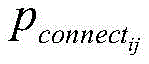 the probability distribution indicating the probability of connection between the slave node i and the node j obtained by GNN learning. And obtaining the fault environment corresponding to the strategy subgraph according to the obtained link states among the nodes of the accurate fault environment.
Step S6, respectively verifying the network policies of different types in an accurate fault environment;
specifically, network policies are classified according to requirements, and policy sets under different policy types are obtained.
If the reachability of the policy consideration delay needs to be verified, a depth-first search algorithm is used to determine if there is a reachable path from the source node to the target node in a given policy sub-graph, and to limit the maximum distance of the search.
If the isolation of the strategy needs to be verified, the method is consistent with the accessibility, and the final result is reversed.
If the policy's load balancing needs to be verified, load balancing is ensured by checking if there is a node arriving at a distance not exceeding a certain multiple of the average shortest path length. The average shortest path length is obtained by calculating the shortest path length from the source node to all other nodes and then averaging.
In summary, the present invention proposes a control plane policy verification method based on GNN fault model learning, as shown in fig. 4, with the increase of the maximum fault number, the present invention can quickly locate the accurate environment where the policy to be verified is located in the complex fault model, and realize accurate and quick network policy verification compared with the reference method. In addition, the method has certain generalization capability and is suitable for verification of different network strategies under various network topologies.
The present invention is not described in detail in the present application, and is well known to those skilled in the art.
The foregoing describes in detail preferred embodiments of the present invention. It should be understood that numerous modifications and variations can be made in accordance with the concepts of the invention by one of ordinary skill in the art without undue burden. Therefore, all technical solutions which can be obtained by logic analysis, reasoning or limited experiments based on the prior art by the person skilled in the art according to the inventive concept shall be within the scope of protection defined by the claims.
Claims (7)
1. The control plane strategy verification method based on GNN fault model learning is characterized by comprising the following steps:
s1, obtaining network topology information, dividing equivalence classes by using a K-Means clustering method, reducing the network scale, setting the maximum fault number in the network according to requirements, and generating a corresponding fault model;
s2, designing a GNN fault learning model based on a message passing mechanism, wherein the model comprises a linear transformation layer, a graph roll lamination layer and a full connection layer, inputting an adjacent matrix of network topology and a corresponding fault model, and outputting probability distribution of fault probability among feature nodes;
step S3, training a GNN fault learning model based on a message transmission mechanism for each equivalence class, and using the trained model for network policy verification;
step S4, collecting network policy information to be verified by an administrator, generating a network policy set according to requirements, and constructing a network policy diagram conforming to network topology characteristics;
s5, preprocessing a strategy directed graph, extracting feature data, inputting the feature data into a trained GNN model, acquiring probability distribution of fault probability among feature nodes, and generating an accurate network environment;
and step S6, respectively carrying out network policy verification according to the network policy category under the accurate network environment to obtain a final verification result.
2. The control plane policy verification method based on GNN fault model learning of claim 1, wherein step S1 comprises the steps of:
step S1.1: obtaining network topology information, calculating node degree and degree centrality, realizing the division of equivalent classes by training a K-Means clustering model of the network topology through the node degree and degree centrality, selecting the optimal cluster number as the optimal class number of the equivalent classes by using an elbow rule, and generating a unique label and a topological graph corresponding to the equivalent class for each equivalent class;
step S1.2: setting the maximum fault number k in the network topology according to the requirement max Generating a fault model fault_model= { env based on Monte Carlo simulation 1 ,...env q }, wherein env q Representing each possible fault environment in which the fault probability P is calculated by Monte Carlo simulation fail ;
Assuming that the probability of failure of one edge (u, v) of the topology in step S1.1 is p, then at k max In the step, the fault probability P fail Expressed in binomial distribution:

wherein the method comprises the steps of Represented at k max In the step, q (q is more than or equal to 0 and less than or equal to k) max ) The number of combinations of secondary faults; probability of failure P fail Expressed in the maximum failure number k max In, one edge (u, v) fails.
3. The control plane policy verification method based on GNN fault model learning according to claim 2, wherein in step S2:
constructing a graph neural network GNN fault learning model, wherein the graph neural network GNN fault learning model comprises a linear transformation layer, a graph roll lamination layer and a full connection layer:
the linear transformation layer:
h i (1) =σ(W (1) x i +b (1) ) (2)
wherein: h is a i (1) Is the feature vector of the hidden layer, σ is the ReLU activation function, W (1) ∈R din×dout Is the weight matrix of the input layer, x i ∈R din Is the input eigenvector of node i, b (1) Is the bias vector of the linear transformation layer;
the picture volume is laminated:

wherein: is the set of neighbor nodes of node i, AGGREGATE represents an aggregation function, +.>
 Is the weight matrix of the convolutionally layer of the k-th layer diagram,>
 feature vector representing node j of the layer-1 graph roll stack, +.>
 A feature vector representing node i of the convolutionally layer of the k-th layer graph;
the full connection layer:
h i (L) =W (L) h i (L-1) +b (L) (4)
wherein: w (W) (L) ∈R dout×dout And the weight and bias matrix of the full connection layer, respectively,>
 representing the feature vector output by the node i at the full connection layer;
and then the feature vector is used for The final probability distribution of failure probability is obtained by a Softmax activation function:

wherein: h is a ij (L) Characteristic value h representing failure probability between full connection layer node i and node j im (L) Representing the mth feature, p, of the ith node in the full connectivity layer output ij A probability distribution representing the probability of failure between the slave node i and the node j.
4. A control plane policy verification method based on GNN fault model learning according to claim 3, wherein in step S3:
the graph neural network GNN fault learning model adopts MSE mean square error loss function during training

Where output is the output of the graph neural network GNN fault learning model and adj is the adjacency matrix of the actual network topology.
5. The control plane policy verification method based on GNN fault model learning of claim 4 wherein step S4 comprises the steps of:
step S4.1: generating a network policy set according to requirements, wherein the network policy set comprises: policy sequence number, policy type, source device, destination device and latency constraint, wherein the policy type comprises: policy reachability, policy Isolation, and policy load balancing are represented by reach (src, dst, delay), isolation (src, dst), and Loadbalancing (src, dst), respectively, where src represents a source device, dst represents a destination device, and delay represents a latency constraint; the reach (src, dst, delay) indicates that network traffic reaches dst from src under the premise of delay constraint delay; isolation (src, dst) means that network traffic does not reach dst from src; loadbalancing (src, dst) means that network traffic is load balanced on at least two paths from src to dst;
step S4.2: constructing a strategy directed graph G according to a network strategy set, wherein G= (V, E); wherein v= { d|d=1,..n } is the set of all physical devices in the network, where d e V is the physical device with sequence number d in the strategy graph; e= { E (a, b) |a, b E V } is a set of policy state transitions between physical devices, where a represents a source device number, b represents a destination device number, E (a, b) ∈e represents a link exists between a device with device number a and a device with device number b so that network traffic is transferred from device a to device b.
6. The control plane policy verification method based on GNN fault model learning of claim 5, wherein step S5 comprises the steps of:
step S5.1: preprocessing the strategy directed graph G by combining clipping and filling modes: if the number of the nodes or edges of the strategy directed graph G is larger than that of the nodes or edges of the network topology, cutting operation is carried out, and the nodes or edges which do not exist in the original network topology in the strategy directed graph G are deleted until the scale of the strategy directed graph G is the same as that of the original network topology; if the number of nodes or edges of the strategy directed graph G is smaller than that of the nodes or edges of the original network topology, filling operation is carried out, and virtual nodes or edges are added until the scale of the strategy directed graph G is the same as that of the original network topology;
step S5.2: inputting a trained K-Means model into the preprocessed strategy directed graph G, dividing the strategy directed graph G to obtain strategy subgraphs, wherein each strategy subgraph corresponds to a network topology subgraph under a label, and extracting the characteristics of each strategy subgraph;
step S5.3: inputting the features of the extracted strategy subgraph into a trained graph neural network GNN fault learning model under the corresponding label, and carrying out output results Is transformed and binary classification is carried out; introducing a threshold value theta, judging the probability of being larger than the threshold value as 1, and judging the probability of being smaller than or equal to the threshold value as 0, namely:

where Edge represents the state of each Edge, i and j represent the source and destination devices of the Edge, respectively, and values 0 and 1 represent the failure and failure of the Edge, respectively, the probability distribution of connection probability between the node i and the node j obtained through the learning of the graph neural network GNN fault learning model is represented; and obtaining the fault environment corresponding to the strategy subgraph according to the obtained link states among the nodes of the accurate fault environment.
7. The control plane policy verification method based on GNN fault model learning of claim 6 wherein step S6 includes the steps of:
step S6.1: classifying network policies according to requirements to obtain network policy sets under different policy types;
step S6.2: if the reachability of the network policy needs to be verified, a depth-first search algorithm is used to determine whether an reachable path exists from the source node to the target node in the given policy subgraph, and the maximum distance of the search is limited;
step S6.3: if the isolation of the network policy needs to be verified, a depth-first search algorithm is used for judging whether an reachable path from a source node to a target node exists in a given policy subgraph, the maximum distance of search is limited, and the result is inverted;
step S6.4: if the load balance of the network strategy needs to be verified, ensuring the load balance by checking whether a node arrival distance does not exceed a certain multiple of the average shortest path length; wherein, the average shortest path length is calculated by calculating the shortest path length from the source node to all other nodes, and then averaging.
Priority Applications (2)
| Application Number | Priority Date | Filing Date | Title |
|---|---|---|---|
| CN202310260306.XA CN116346641B (en) | 2023-03-17 | 2023-03-17 | A Control Plane Strategy Validation Method Based on GNN Fault Model Learning |
| PCT/CN2023/083530 WO2024192782A1 (en) | 2023-03-17 | 2023-03-24 | Control plane policy verification method based on gnn failure model learning |
Applications Claiming Priority (1)
| Application Number | Priority Date | Filing Date | Title |
|---|---|---|---|
| CN202310260306.XA CN116346641B (en) | 2023-03-17 | 2023-03-17 | A Control Plane Strategy Validation Method Based on GNN Fault Model Learning |
Publications (2)
| Publication Number | Publication Date |
|---|---|
| CN116346641A true CN116346641A (en) | 2023-06-27 |
| CN116346641B CN116346641B (en) | 2026-04-03 |
Family
ID=86892414
Family Applications (1)
| Application Number | Title | Priority Date | Filing Date |
|---|---|---|---|
| CN202310260306.XA Active CN116346641B (en) | 2023-03-17 | 2023-03-17 | A Control Plane Strategy Validation Method Based on GNN Fault Model Learning |
Country Status (2)
| Country | Link |
|---|---|
| CN (1) | CN116346641B (en) |
| WO (1) | WO2024192782A1 (en) |
Cited By (3)
| Publication number | Priority date | Publication date | Assignee | Title |
|---|---|---|---|---|
| CN118200047A (en) * | 2024-05-14 | 2024-06-14 | 南昌大学 | A network traffic anomaly detection method and system based on graph representation |
| CN119249329A (en) * | 2024-09-21 | 2025-01-03 | 上海航数智能科技有限公司 | Self-learning fault knowledge management method and system based on artificial intelligence |
| CN119629106A (en) * | 2025-02-14 | 2025-03-14 | 中国人民解放军国防科技大学 | A control plane verification method and system for distributed routing protocols |
Families Citing this family (22)
| Publication number | Priority date | Publication date | Assignee | Title |
|---|---|---|---|---|
| CN118862950B (en) * | 2024-09-29 | 2025-03-07 | 烟台大学 | Industrial equipment fault diagnosis method and system based on graph structure joint optimization |
| CN119291378B (en) * | 2024-10-11 | 2025-07-25 | 南京迅集科技有限公司 | Intelligent power grid power transmission line fault positioning system |
| CN119438786A (en) * | 2024-10-18 | 2025-02-14 | 贵州电网有限责任公司 | A real-type experimental distribution line fault location method and system |
| CN118972900B (en) * | 2024-10-18 | 2025-02-11 | 南京邮电大学 | Space-sky-ground network traffic unloading decision-making method and system based on graph neural network |
| CN119402988B (en) * | 2024-10-23 | 2025-08-01 | 周刚照明科技(成都)有限公司 | Lamp networking method |
| CN119477258B (en) * | 2024-10-24 | 2025-10-10 | 云南电网有限责任公司红河供电局 | Prediction method of implicit relations in equipment fault text based on graph structure learning model |
| CN119544596B (en) * | 2024-10-25 | 2026-03-03 | 中国电子科技集团公司第五十四研究所 | A Two-Stage Depth-First Search Route Calculation Method for Narrowband Communication Networks |
| CN119601254B (en) * | 2024-10-28 | 2025-10-17 | 四川大学 | Complex network disease transmission tracing method based on graph neural network |
| CN119415744B (en) * | 2024-11-04 | 2025-11-28 | 南京邮电大学 | Graph similarity searching method based on sub-graph matching |
| CN119722929B (en) * | 2024-11-26 | 2025-09-05 | 山东鲁软数字科技有限公司 | A method for building an intelligent power protection scenario based on digital twins |
| CN119835147A (en) * | 2024-11-28 | 2025-04-15 | 天翼云科技有限公司 | Cloud network fault detection method, device, equipment, storage medium and program product |
| CN120354193A (en) * | 2025-03-14 | 2025-07-22 | 广西南宁西子科技有限公司 | Method for driving multi-layer perceptron in node classification by multi-granularity contrast learning |
| CN119903763B (en) * | 2025-03-31 | 2025-06-20 | 航天智控(北京)监测技术有限公司 | A monitoring and processing system and method for rotating equipment alarm |
| CN120470269B (en) * | 2025-07-15 | 2025-10-24 | 国网江西省电力有限公司南昌供电分公司 | Ground fault prediction method based on IP-GNN and federal learning |
| CN120512714B (en) * | 2025-07-18 | 2025-09-12 | 江苏食品药品职业技术学院 | Agricultural wireless sensor network topology reconstruction method based on energy consumption balance model |
| CN120727290B (en) * | 2025-08-14 | 2025-12-30 | 烟台大学 | Disease risk prediction method and system based on balanced neighbor awareness and metric learning |
| CN121353741A (en) * | 2025-09-28 | 2026-01-16 | 北京信息职业技术学院 | A Feasibility Assessment Method and System for Programming Information in Industrial Control Systems |
| CN120956614B (en) * | 2025-10-15 | 2026-01-23 | 西安星讯智能通信科技有限公司 | Space-time big data-oriented dynamic graph neural network modeling method |
| CN120995100B (en) * | 2025-10-24 | 2026-02-03 | 徐州驷马科技有限公司 | Engineering machinery fault prediction and prevention method based on machine learning |
| CN121166493B (en) * | 2025-11-20 | 2026-02-10 | 济南浪潮数据技术有限公司 | Equipment Failure Prediction Methods and Devices, Electronic Equipment, Storage Media |
| CN121568147B (en) * | 2026-01-26 | 2026-04-28 | 南京航空航天大学 | A method for predicting the end-to-end reliability of UAV swarm communication networks based on GNN and network signatures |
| CN121615053B (en) * | 2026-02-02 | 2026-04-07 | 昆明理工大学 | Unknown working condition equipment state anomaly detection method based on graph neural network |
Citations (6)
| Publication number | Priority date | Publication date | Assignee | Title |
|---|---|---|---|---|
| US20180351788A1 (en) * | 2017-05-31 | 2018-12-06 | Cisco Technology, Inc. | Fault localization in large-scale network policy deployment |
| US10771319B1 (en) * | 2020-04-15 | 2020-09-08 | Deke Guo | Robustness verification method and apparatus for distributed control plane in software-defined network |
| CN112437065A (en) * | 2020-11-12 | 2021-03-02 | 安徽大学 | Strategy conflict detection and solution method based on graphic representation under SDN environment |
| CN113660140A (en) * | 2021-08-17 | 2021-11-16 | 北京交通大学 | Service function chain fault detection method based on data control plane hybrid sensing |
| CN113676371A (en) * | 2021-07-27 | 2021-11-19 | 南京邮电大学 | Network fault detection and diagnosis method based on deep Q learning |
| CN115225561A (en) * | 2022-08-15 | 2022-10-21 | 南京邮电大学 | Route optimization method and system based on graph structure characteristics |
Family Cites Families (1)
| Publication number | Priority date | Publication date | Assignee | Title |
|---|---|---|---|---|
| CN112054921B (en) * | 2020-08-06 | 2021-09-03 | 清华大学 | Network verification method and device, computer storage medium and electronic equipment |
-
2023
- 2023-03-17 CN CN202310260306.XA patent/CN116346641B/en active Active
- 2023-03-24 WO PCT/CN2023/083530 patent/WO2024192782A1/en not_active Ceased
Patent Citations (6)
| Publication number | Priority date | Publication date | Assignee | Title |
|---|---|---|---|---|
| US20180351788A1 (en) * | 2017-05-31 | 2018-12-06 | Cisco Technology, Inc. | Fault localization in large-scale network policy deployment |
| US10771319B1 (en) * | 2020-04-15 | 2020-09-08 | Deke Guo | Robustness verification method and apparatus for distributed control plane in software-defined network |
| CN112437065A (en) * | 2020-11-12 | 2021-03-02 | 安徽大学 | Strategy conflict detection and solution method based on graphic representation under SDN environment |
| CN113676371A (en) * | 2021-07-27 | 2021-11-19 | 南京邮电大学 | Network fault detection and diagnosis method based on deep Q learning |
| CN113660140A (en) * | 2021-08-17 | 2021-11-16 | 北京交通大学 | Service function chain fault detection method based on data control plane hybrid sensing |
| CN115225561A (en) * | 2022-08-15 | 2022-10-21 | 南京邮电大学 | Route optimization method and system based on graph structure characteristics |
Non-Patent Citations (2)
| Title |
|---|
| JUNJIE XIE等: ""Validation of Distributed SDN Control Plane Under Uncertain Failures"", 《IEEE/ACM TRANSACTIONS ON NETWORKING》, 15 May 2019 (2019-05-15), pages 1234 - 1247 * |
| YUQI DAI等: ""Multimodal Multitask Control Plane Verification Framework"", 《IEEE TRANSACTIONS ON NETWORK AND SERVICE MANAGEMENT 》, 12 August 2024 (2024-08-12), pages 6684 * |
Cited By (5)
| Publication number | Priority date | Publication date | Assignee | Title |
|---|---|---|---|---|
| CN118200047A (en) * | 2024-05-14 | 2024-06-14 | 南昌大学 | A network traffic anomaly detection method and system based on graph representation |
| CN118200047B (en) * | 2024-05-14 | 2024-09-13 | 南昌大学 | Network traffic anomaly detection method and system based on graph characterization |
| CN119249329A (en) * | 2024-09-21 | 2025-01-03 | 上海航数智能科技有限公司 | Self-learning fault knowledge management method and system based on artificial intelligence |
| CN119629106A (en) * | 2025-02-14 | 2025-03-14 | 中国人民解放军国防科技大学 | A control plane verification method and system for distributed routing protocols |
| CN119629106B (en) * | 2025-02-14 | 2025-04-29 | 中国人民解放军国防科技大学 | Control plane verification method and system for distributed routing protocol |
Also Published As
| Publication number | Publication date |
|---|---|
| CN116346641B (en) | 2026-04-03 |
| WO2024192782A1 (en) | 2024-09-26 |
Similar Documents
| Publication | Publication Date | Title |
|---|---|---|
| CN116346641B (en) | A Control Plane Strategy Validation Method Based on GNN Fault Model Learning | |
| Su et al. | Redundant rule detection for software-defined networking | |
| CN118884191A (en) | Integrated circuit testing method and system | |
| CN112769869B (en) | A SDN network security prediction method and corresponding system based on Bayesian attack graph | |
| CN118802651B (en) | Ship electronic information system fault propagation path identification method based on public computing environment | |
| US20230208724A1 (en) | Methods and systems for distributed network verification | |
| CN109815507B (en) | Fault sample selection method of flight control system based on sign directed graph | |
| CN111835537A (en) | A method, device and equipment for node identification in cascading faults in a communication network | |
| CN109767006A (en) | A fault prediction system and method based on Bayesian belief network | |
| CN120856537A (en) | IT operation and maintenance fault tracing method and device based on knowledge graph | |
| CN116049832A (en) | Asset vulnerability assessment method, device and equipment, medium and product | |
| CN115423041A (en) | Edge cloud fault prediction method and system based on deep learning | |
| CN120128467A (en) | A method and system for tracing fault paths in distribution communication networks based on knowledge graph | |
| CN114244713A (en) | Resource backup method and device for power 5G network slice | |
| CN107896168A (en) | A kind of power telecom network multiple domain method for diagnosing faults under network virtualization environment | |
| Liu et al. | Node Importance Evaluation of Cyber‐Physical System Under Cyber‐Attacks Spreading | |
| CN115729728A (en) | Method and device for identifying root cause fault node | |
| CN115333958B (en) | Software-defined network performance prediction method and device, electronic equipment and storage medium | |
| Seth et al. | LDES: Detector design for version number attack detection using linear temporal logic based on discrete event system | |
| CN115630367A (en) | XGboost-based routing algorithm key fault point identification method | |
| CN114785879A (en) | Method and system for identifying OSPF protocol abnormal behavior | |
| US11516089B2 (en) | Methods and systems for network verification using hierarchy-based model | |
| JP2020141242A (en) | A network scanning device, a program to be executed by a computer, and a computer-readable recording medium on which the program is recorded. | |
| JP7180879B2 (en) | Network scanning device, computer-readable recording medium recording programs and programs to be executed by a computer | |
| CN119135238A (en) | A GCN-based SDC vulnerability prediction method for low-orbit Internet routing mechanism |
Legal Events
| Date | Code | Title | Description |
|---|---|---|---|
| PB01 | Publication | ||
| PB01 | Publication | ||
| SE01 | Entry into force of request for substantive examination | ||
| SE01 | Entry into force of request for substantive examination | ||
| GR01 | Patent grant | ||
| GR01 | Patent grant |