CN115427543A - Processing of low rank coal - Google Patents
Processing of low rank coal Download PDFInfo
- Publication number
- CN115427543A CN115427543A CN202180015138.7A CN202180015138A CN115427543A CN 115427543 A CN115427543 A CN 115427543A CN 202180015138 A CN202180015138 A CN 202180015138A CN 115427543 A CN115427543 A CN 115427543A
- Authority
- CN
- China
- Prior art keywords
- coal
- mixture
- fuel composition
- binder
- vessel
- Prior art date
- Legal status (The legal status is an assumption and is not a legal conclusion. Google has not performed a legal analysis and makes no representation as to the accuracy of the status listed.)
- Pending
Links
Classifications
-
- C—CHEMISTRY; METALLURGY
- C10—PETROLEUM, GAS OR COKE INDUSTRIES; TECHNICAL GASES CONTAINING CARBON MONOXIDE; FUELS; LUBRICANTS; PEAT
- C10L—FUELS NOT OTHERWISE PROVIDED FOR; NATURAL GAS; SYNTHETIC NATURAL GAS OBTAINED BY PROCESSES NOT COVERED BY SUBCLASSES C10G OR C10K; LIQUIFIED PETROLEUM GAS; USE OF ADDITIVES TO FUELS OR FIRES; FIRE-LIGHTERS
- C10L5/00—Solid fuels
- C10L5/02—Solid fuels such as briquettes consisting mainly of carbonaceous materials of mineral or non-mineral origin
- C10L5/06—Methods of shaping, e.g. pelletizing or briquetting
- C10L5/10—Methods of shaping, e.g. pelletizing or briquetting with the aid of binders, e.g. pretreated binders
- C10L5/14—Methods of shaping, e.g. pelletizing or briquetting with the aid of binders, e.g. pretreated binders with organic binders
-
- C—CHEMISTRY; METALLURGY
- C10—PETROLEUM, GAS OR COKE INDUSTRIES; TECHNICAL GASES CONTAINING CARBON MONOXIDE; FUELS; LUBRICANTS; PEAT
- C10F—DRYING OR WORKING-UP OF PEAT
- C10F5/00—Drying or de-watering peat
-
- C—CHEMISTRY; METALLURGY
- C10—PETROLEUM, GAS OR COKE INDUSTRIES; TECHNICAL GASES CONTAINING CARBON MONOXIDE; FUELS; LUBRICANTS; PEAT
- C10B—DESTRUCTIVE DISTILLATION OF CARBONACEOUS MATERIALS FOR PRODUCTION OF GAS, COKE, TAR, OR SIMILAR MATERIALS
- C10B53/00—Destructive distillation, specially adapted for particular solid raw materials or solid raw materials in special form
- C10B53/08—Destructive distillation, specially adapted for particular solid raw materials or solid raw materials in special form in the form of briquettes, lumps and the like
-
- C—CHEMISTRY; METALLURGY
- C10—PETROLEUM, GAS OR COKE INDUSTRIES; TECHNICAL GASES CONTAINING CARBON MONOXIDE; FUELS; LUBRICANTS; PEAT
- C10F—DRYING OR WORKING-UP OF PEAT
- C10F7/00—Working-up peat
- C10F7/02—Disintegrating peat
-
- C—CHEMISTRY; METALLURGY
- C10—PETROLEUM, GAS OR COKE INDUSTRIES; TECHNICAL GASES CONTAINING CARBON MONOXIDE; FUELS; LUBRICANTS; PEAT
- C10F—DRYING OR WORKING-UP OF PEAT
- C10F7/00—Working-up peat
- C10F7/08—Working-up peat by extrusion combined with cutting
-
- C—CHEMISTRY; METALLURGY
- C10—PETROLEUM, GAS OR COKE INDUSTRIES; TECHNICAL GASES CONTAINING CARBON MONOXIDE; FUELS; LUBRICANTS; PEAT
- C10L—FUELS NOT OTHERWISE PROVIDED FOR; NATURAL GAS; SYNTHETIC NATURAL GAS OBTAINED BY PROCESSES NOT COVERED BY SUBCLASSES C10G OR C10K; LIQUIFIED PETROLEUM GAS; USE OF ADDITIVES TO FUELS OR FIRES; FIRE-LIGHTERS
- C10L5/00—Solid fuels
- C10L5/02—Solid fuels such as briquettes consisting mainly of carbonaceous materials of mineral or non-mineral origin
- C10L5/04—Raw material of mineral origin to be used; Pretreatment thereof
-
- C—CHEMISTRY; METALLURGY
- C10—PETROLEUM, GAS OR COKE INDUSTRIES; TECHNICAL GASES CONTAINING CARBON MONOXIDE; FUELS; LUBRICANTS; PEAT
- C10L—FUELS NOT OTHERWISE PROVIDED FOR; NATURAL GAS; SYNTHETIC NATURAL GAS OBTAINED BY PROCESSES NOT COVERED BY SUBCLASSES C10G OR C10K; LIQUIFIED PETROLEUM GAS; USE OF ADDITIVES TO FUELS OR FIRES; FIRE-LIGHTERS
- C10L5/00—Solid fuels
- C10L5/02—Solid fuels such as briquettes consisting mainly of carbonaceous materials of mineral or non-mineral origin
- C10L5/06—Methods of shaping, e.g. pelletizing or briquetting
- C10L5/10—Methods of shaping, e.g. pelletizing or briquetting with the aid of binders, e.g. pretreated binders
- C10L5/22—Methods of applying the binder to the other compounding ingredients; Apparatus therefor
-
- C—CHEMISTRY; METALLURGY
- C10—PETROLEUM, GAS OR COKE INDUSTRIES; TECHNICAL GASES CONTAINING CARBON MONOXIDE; FUELS; LUBRICANTS; PEAT
- C10L—FUELS NOT OTHERWISE PROVIDED FOR; NATURAL GAS; SYNTHETIC NATURAL GAS OBTAINED BY PROCESSES NOT COVERED BY SUBCLASSES C10G OR C10K; LIQUIFIED PETROLEUM GAS; USE OF ADDITIVES TO FUELS OR FIRES; FIRE-LIGHTERS
- C10L5/00—Solid fuels
- C10L5/02—Solid fuels such as briquettes consisting mainly of carbonaceous materials of mineral or non-mineral origin
- C10L5/34—Other details of the shaped fuels, e.g. briquettes
- C10L5/36—Shape
- C10L5/366—Powders
-
- C—CHEMISTRY; METALLURGY
- C10—PETROLEUM, GAS OR COKE INDUSTRIES; TECHNICAL GASES CONTAINING CARBON MONOXIDE; FUELS; LUBRICANTS; PEAT
- C10L—FUELS NOT OTHERWISE PROVIDED FOR; NATURAL GAS; SYNTHETIC NATURAL GAS OBTAINED BY PROCESSES NOT COVERED BY SUBCLASSES C10G OR C10K; LIQUIFIED PETROLEUM GAS; USE OF ADDITIVES TO FUELS OR FIRES; FIRE-LIGHTERS
- C10L9/00—Treating solid fuels to improve their combustion
- C10L9/08—Treating solid fuels to improve their combustion by heat treatments, e.g. calcining
-
- C—CHEMISTRY; METALLURGY
- C10—PETROLEUM, GAS OR COKE INDUSTRIES; TECHNICAL GASES CONTAINING CARBON MONOXIDE; FUELS; LUBRICANTS; PEAT
- C10L—FUELS NOT OTHERWISE PROVIDED FOR; NATURAL GAS; SYNTHETIC NATURAL GAS OBTAINED BY PROCESSES NOT COVERED BY SUBCLASSES C10G OR C10K; LIQUIFIED PETROLEUM GAS; USE OF ADDITIVES TO FUELS OR FIRES; FIRE-LIGHTERS
- C10L9/00—Treating solid fuels to improve their combustion
- C10L9/10—Treating solid fuels to improve their combustion by using additives
-
- C—CHEMISTRY; METALLURGY
- C10—PETROLEUM, GAS OR COKE INDUSTRIES; TECHNICAL GASES CONTAINING CARBON MONOXIDE; FUELS; LUBRICANTS; PEAT
- C10L—FUELS NOT OTHERWISE PROVIDED FOR; NATURAL GAS; SYNTHETIC NATURAL GAS OBTAINED BY PROCESSES NOT COVERED BY SUBCLASSES C10G OR C10K; LIQUIFIED PETROLEUM GAS; USE OF ADDITIVES TO FUELS OR FIRES; FIRE-LIGHTERS
- C10L2230/00—Function and purpose of a components of a fuel or the composition as a whole
- C10L2230/22—Function and purpose of a components of a fuel or the composition as a whole for improving fuel economy or fuel efficiency
-
- C—CHEMISTRY; METALLURGY
- C10—PETROLEUM, GAS OR COKE INDUSTRIES; TECHNICAL GASES CONTAINING CARBON MONOXIDE; FUELS; LUBRICANTS; PEAT
- C10L—FUELS NOT OTHERWISE PROVIDED FOR; NATURAL GAS; SYNTHETIC NATURAL GAS OBTAINED BY PROCESSES NOT COVERED BY SUBCLASSES C10G OR C10K; LIQUIFIED PETROLEUM GAS; USE OF ADDITIVES TO FUELS OR FIRES; FIRE-LIGHTERS
- C10L2250/00—Structural features of fuel components or fuel compositions, either in solid, liquid or gaseous state
- C10L2250/04—Additive or component is a polymer
-
- C—CHEMISTRY; METALLURGY
- C10—PETROLEUM, GAS OR COKE INDUSTRIES; TECHNICAL GASES CONTAINING CARBON MONOXIDE; FUELS; LUBRICANTS; PEAT
- C10L—FUELS NOT OTHERWISE PROVIDED FOR; NATURAL GAS; SYNTHETIC NATURAL GAS OBTAINED BY PROCESSES NOT COVERED BY SUBCLASSES C10G OR C10K; LIQUIFIED PETROLEUM GAS; USE OF ADDITIVES TO FUELS OR FIRES; FIRE-LIGHTERS
- C10L2290/00—Fuel preparation or upgrading, processes or apparatus therefore, comprising specific process steps or apparatus units
- C10L2290/02—Combustion or pyrolysis
-
- C—CHEMISTRY; METALLURGY
- C10—PETROLEUM, GAS OR COKE INDUSTRIES; TECHNICAL GASES CONTAINING CARBON MONOXIDE; FUELS; LUBRICANTS; PEAT
- C10L—FUELS NOT OTHERWISE PROVIDED FOR; NATURAL GAS; SYNTHETIC NATURAL GAS OBTAINED BY PROCESSES NOT COVERED BY SUBCLASSES C10G OR C10K; LIQUIFIED PETROLEUM GAS; USE OF ADDITIVES TO FUELS OR FIRES; FIRE-LIGHTERS
- C10L2290/00—Fuel preparation or upgrading, processes or apparatus therefore, comprising specific process steps or apparatus units
- C10L2290/06—Heat exchange, direct or indirect
-
- C—CHEMISTRY; METALLURGY
- C10—PETROLEUM, GAS OR COKE INDUSTRIES; TECHNICAL GASES CONTAINING CARBON MONOXIDE; FUELS; LUBRICANTS; PEAT
- C10L—FUELS NOT OTHERWISE PROVIDED FOR; NATURAL GAS; SYNTHETIC NATURAL GAS OBTAINED BY PROCESSES NOT COVERED BY SUBCLASSES C10G OR C10K; LIQUIFIED PETROLEUM GAS; USE OF ADDITIVES TO FUELS OR FIRES; FIRE-LIGHTERS
- C10L2290/00—Fuel preparation or upgrading, processes or apparatus therefore, comprising specific process steps or apparatus units
- C10L2290/08—Drying or removing water
-
- C—CHEMISTRY; METALLURGY
- C10—PETROLEUM, GAS OR COKE INDUSTRIES; TECHNICAL GASES CONTAINING CARBON MONOXIDE; FUELS; LUBRICANTS; PEAT
- C10L—FUELS NOT OTHERWISE PROVIDED FOR; NATURAL GAS; SYNTHETIC NATURAL GAS OBTAINED BY PROCESSES NOT COVERED BY SUBCLASSES C10G OR C10K; LIQUIFIED PETROLEUM GAS; USE OF ADDITIVES TO FUELS OR FIRES; FIRE-LIGHTERS
- C10L2290/00—Fuel preparation or upgrading, processes or apparatus therefore, comprising specific process steps or apparatus units
- C10L2290/22—Impregnation or immersion of a fuel component or a fuel as a whole
-
- C—CHEMISTRY; METALLURGY
- C10—PETROLEUM, GAS OR COKE INDUSTRIES; TECHNICAL GASES CONTAINING CARBON MONOXIDE; FUELS; LUBRICANTS; PEAT
- C10L—FUELS NOT OTHERWISE PROVIDED FOR; NATURAL GAS; SYNTHETIC NATURAL GAS OBTAINED BY PROCESSES NOT COVERED BY SUBCLASSES C10G OR C10K; LIQUIFIED PETROLEUM GAS; USE OF ADDITIVES TO FUELS OR FIRES; FIRE-LIGHTERS
- C10L2290/00—Fuel preparation or upgrading, processes or apparatus therefore, comprising specific process steps or apparatus units
- C10L2290/24—Mixing, stirring of fuel components
-
- C—CHEMISTRY; METALLURGY
- C10—PETROLEUM, GAS OR COKE INDUSTRIES; TECHNICAL GASES CONTAINING CARBON MONOXIDE; FUELS; LUBRICANTS; PEAT
- C10L—FUELS NOT OTHERWISE PROVIDED FOR; NATURAL GAS; SYNTHETIC NATURAL GAS OBTAINED BY PROCESSES NOT COVERED BY SUBCLASSES C10G OR C10K; LIQUIFIED PETROLEUM GAS; USE OF ADDITIVES TO FUELS OR FIRES; FIRE-LIGHTERS
- C10L2290/00—Fuel preparation or upgrading, processes or apparatus therefore, comprising specific process steps or apparatus units
- C10L2290/28—Cutting, disintegrating, shredding or grinding
-
- C—CHEMISTRY; METALLURGY
- C10—PETROLEUM, GAS OR COKE INDUSTRIES; TECHNICAL GASES CONTAINING CARBON MONOXIDE; FUELS; LUBRICANTS; PEAT
- C10L—FUELS NOT OTHERWISE PROVIDED FOR; NATURAL GAS; SYNTHETIC NATURAL GAS OBTAINED BY PROCESSES NOT COVERED BY SUBCLASSES C10G OR C10K; LIQUIFIED PETROLEUM GAS; USE OF ADDITIVES TO FUELS OR FIRES; FIRE-LIGHTERS
- C10L2290/00—Fuel preparation or upgrading, processes or apparatus therefore, comprising specific process steps or apparatus units
- C10L2290/30—Pressing, compressing or compacting
-
- C—CHEMISTRY; METALLURGY
- C10—PETROLEUM, GAS OR COKE INDUSTRIES; TECHNICAL GASES CONTAINING CARBON MONOXIDE; FUELS; LUBRICANTS; PEAT
- C10L—FUELS NOT OTHERWISE PROVIDED FOR; NATURAL GAS; SYNTHETIC NATURAL GAS OBTAINED BY PROCESSES NOT COVERED BY SUBCLASSES C10G OR C10K; LIQUIFIED PETROLEUM GAS; USE OF ADDITIVES TO FUELS OR FIRES; FIRE-LIGHTERS
- C10L2290/00—Fuel preparation or upgrading, processes or apparatus therefore, comprising specific process steps or apparatus units
- C10L2290/46—Compressors or pumps
-
- C—CHEMISTRY; METALLURGY
- C10—PETROLEUM, GAS OR COKE INDUSTRIES; TECHNICAL GASES CONTAINING CARBON MONOXIDE; FUELS; LUBRICANTS; PEAT
- C10L—FUELS NOT OTHERWISE PROVIDED FOR; NATURAL GAS; SYNTHETIC NATURAL GAS OBTAINED BY PROCESSES NOT COVERED BY SUBCLASSES C10G OR C10K; LIQUIFIED PETROLEUM GAS; USE OF ADDITIVES TO FUELS OR FIRES; FIRE-LIGHTERS
- C10L5/00—Solid fuels
- C10L5/02—Solid fuels such as briquettes consisting mainly of carbonaceous materials of mineral or non-mineral origin
- C10L5/34—Other details of the shaped fuels, e.g. briquettes
- C10L5/36—Shape
- C10L5/363—Pellets or granulates
-
- Y—GENERAL TAGGING OF NEW TECHNOLOGICAL DEVELOPMENTS; GENERAL TAGGING OF CROSS-SECTIONAL TECHNOLOGIES SPANNING OVER SEVERAL SECTIONS OF THE IPC; TECHNICAL SUBJECTS COVERED BY FORMER USPC CROSS-REFERENCE ART COLLECTIONS [XRACs] AND DIGESTS
- Y02—TECHNOLOGIES OR APPLICATIONS FOR MITIGATION OR ADAPTATION AGAINST CLIMATE CHANGE
- Y02E—REDUCTION OF GREENHOUSE GAS [GHG] EMISSIONS, RELATED TO ENERGY GENERATION, TRANSMISSION OR DISTRIBUTION
- Y02E50/00—Technologies for the production of fuel of non-fossil origin
- Y02E50/30—Fuel from waste, e.g. synthetic alcohol or diesel
Landscapes
- Chemical & Material Sciences (AREA)
- Oil, Petroleum & Natural Gas (AREA)
- Organic Chemistry (AREA)
- Environmental & Geological Engineering (AREA)
- Geochemistry & Mineralogy (AREA)
- Geology (AREA)
- General Life Sciences & Earth Sciences (AREA)
- Life Sciences & Earth Sciences (AREA)
- Engineering & Computer Science (AREA)
- Combustion & Propulsion (AREA)
- Thermal Sciences (AREA)
- Physics & Mathematics (AREA)
- Materials Engineering (AREA)
- Solid Fuels And Fuel-Associated Substances (AREA)
- Electrical Discharge Machining, Electrochemical Machining, And Combined Machining (AREA)
- Disintegrating Or Milling (AREA)
- Coke Industry (AREA)
Abstract
制备燃料组合物的方法包括将具有在约3,000BTU/lb和约9,000BTU/lb之间的热含量和在约20wt%和约60wt%之间的水分含量的煤放置在容器中。在容器内将煤暴露于热和低于大气压的压力,由此使煤减小,使得煤的平均初级粒度小于1毫米。将粘合剂引入至容器,使得煤与粘合剂结合以产生混合物。将混合物成形以产生燃料组合物。A method of preparing a fuel composition includes placing coal having a heat content of between about 3,000 BTU/lb and about 9,000 BTU/lb and a moisture content of between about 20 wt% and about 60 wt% in a container. The coal is reduced in size by exposing the coal to heat and subatmospheric pressure within the vessel such that the average primary particle size of the coal is less than 1 mm. A binder is introduced into the vessel such that the coal is combined with the binder to create a mixture. The mixture is shaped to produce a fuel composition.
Description
相关申请的交叉引用Cross References to Related Applications
本申请要求于2020年1月15日提交的题为“PROCESSING OF LOW RANK COAL(低阶煤的加工)”的美国临时申请号62/961,552的优先权,该申请的内容通过引用的方式并入本文。This application claims priority to U.S. Provisional Application No. 62/961,552, filed January 15, 2020, entitled "PROCESSING OF LOW RANK COAL," the contents of which are incorporated by reference This article.
技术领域technical field
本公开内容涉及低阶煤例如褐煤的加工。The present disclosure relates to the processing of low rank coals such as lignite.
背景技术Background technique
与“硬”煤(例如烟煤、次烟煤、无烟煤)相比,低阶煤(例如褐煤)更软,CO2密集度(intensive)更高,具有更高的水分含量和更低的燃料价值。褐煤,最低阶的煤,典型地具有在30-60wt%的范围内的水分含量和在4,000-8,300BTU/lb的范围内的热含量。相比之下,次烟煤典型地具有在10-45wt%的范围内的水分含量和在8,500-13,000BTU/lb的范围内的能量含量,以及烟煤典型地具有在2-15wt%的范围内的水分含量和在11,000-15,000BTU/lb的范围内的热含量。由于其高水分含量和易碎的性质,低阶煤的加工需要显著的能量输入,并且导致产生煤细粒(例如粉尘),这带来燃烧危险并且几乎不能使用。Low-rank coals (eg lignite) are softer, more CO2 intensive, have higher moisture content and lower fuel value than "hard" coals (eg bituminous, sub-bituminous, anthracite). Lignite, the lowest rank coal, typically has a moisture content in the range of 30-60 wt% and a heat content in the range of 4,000-8,300 BTU/lb. In contrast, subbituminous coal typically has a moisture content in the range of 10-45 wt% and an energy content in the range of 8,500-13,000 BTU/lb, and bituminous coal typically has an energy content in the range of 2-15 wt%. Moisture content and heat content in the range of 11,000-15,000 BTU/lb. Due to its high moisture content and brittle nature, the processing of low rank coal requires significant energy input and results in coal fines (eg dust) which pose a combustion hazard and are hardly usable.
发明内容Contents of the invention
所描述的主题的某些方面可作为一种方法或制备燃料组合物(一种制备燃料组合物的方法)来实现。该方法包括将具有在约3,000BTU/lb和约9,000BTU/lb之间的热含量和在约20wt%和约60wt%之间的水分含量的煤放置在容器中。在容器内将煤暴露于热和低于大气压的压力,由此减小煤的初级粒度(primary particle size,一次颗粒尺寸),使得煤的平均初级粒度小于1毫米。将粘合剂引入至容器,使得煤与粘合剂结合(combine,组合)以产生混合物。将混合物成形以产生燃料组合物。Certain aspects of the described subject matter can be implemented as a method or as a method of making a fuel composition (a method of making a fuel composition). The method includes placing coal in a vessel having a heat content between about 3,000 BTU/lb and about 9,000 BTU/lb and a moisture content between about 20 wt% and about 60 wt%. The coal is exposed to heat and subatmospheric pressure within the vessel, thereby reducing the primary particle size of the coal such that the average primary particle size of the coal is less than 1 mm. A binder is introduced into the vessel so that the coal is combined with the binder to create a mixture. The mixture is shaped to produce a fuel composition.
这和其他方面可包括以下特征中的一个或多个。This and other aspects can include one or more of the following features.
在一些实施方案中,在将煤和粘合剂结合之前将煤暴露于热。在一些实施方案中,将煤暴露于热包括通过传导加热煤。在一些实施方案中,将煤暴露于热包括使煤与加热的表面接触。在一些实施方案中,加热的表面包括旋转叶片(blade,刀片)。In some embodiments, the coal is exposed to heat prior to combining the coal and binder. In some embodiments, exposing the coal to heat includes heating the coal by conduction. In some embodiments, exposing the coal to heat includes contacting the coal with a heated surface. In some embodiments, the heated surface includes a rotating blade (blade).
在一些实施方案中,在容器中搅动煤。在一些实施方案中,搅动煤包括间歇地搅动容器中的煤。In some embodiments, the coal is agitated in the vessel. In some embodiments, agitating the coal includes intermittently agitating the coal in the vessel.
在一些实施方案中,在容器内将煤暴露于低于大气压的压力包括间歇地降低容器内的压力。In some embodiments, exposing the coal to subatmospheric pressure within the vessel includes intermittently reducing the pressure within the vessel.
在一些实施方案中,将混合物通过传导加热。在一些实施方案中,粘合剂包括基本上不含氯的塑料(plastic,塑性物)。在一些实施方案中,加热混合物包括提高塑料的延展性。在一些实施方案中,加热混合物包括使塑料熔化或软化。In some embodiments, the mixture is heated by conduction. In some embodiments, the adhesive comprises substantially chlorine-free plastic. In some embodiments, heating the mixture includes increasing the ductility of the plastic. In some embodiments, heating the mixture includes melting or softening the plastic.
在一些实施方案中,燃料组合物包括分布在塑料基质中的煤。In some embodiments, the fuel composition includes coal distributed in a plastic matrix.
在一些实施方案中,将燃料组合物成形包括切割、切碎或碾磨混合物以形成燃料组合物的离散部分。在一些实施方案中,在切割、切碎或碾磨煤和粘合剂的混合物之前,将混合物挤出以产生经挤出的燃料产品。在一些实施方案中,经挤出的燃料产品包括分布在塑料基质中的煤。In some embodiments, shaping the fuel composition includes cutting, chopping, or milling the mixture to form discrete portions of the fuel composition. In some embodiments, prior to cutting, chopping, or milling the mixture of coal and binder, the mixture is extruded to produce an extruded fuel product. In some embodiments, the extruded fuel product includes coal distributed in a plastic matrix.
在一些实施方案中,燃料组合物包括约5wt%至约50wt%的粘合剂。In some embodiments, the fuel composition includes from about 5 wt% to about 50 wt% binder.
在一些实施方案中,将混合物加热至在100℃和250℃之间、在110℃和240℃之间、在120℃和230℃之间、在130℃和220℃之间或在140℃和210℃之间的温度。In some embodiments, the mixture is heated to between 100°C and 250°C, between 110°C and 240°C, between 120°C and 230°C, between 130°C and 220°C, or between 140°C and 210°C. The temperature between ℃.
在一些实施方案中,放置在容器中的煤是未压碎的(uncrushed)。In some embodiments, the coal placed in the container is uncrushed.
所描述的主题的某些方面可作为燃料组合物来实现。燃料组合物包括具有在约4,000BTU/lb和约8,300BTU/lb之间的热含量的煤以及包括塑料的粘合剂。燃料组合物包括小于5wt%的具有75微米或更小的平均初级粒度的煤粉尘。Certain aspects of the described subject matter can be implemented as fuel compositions. The fuel composition includes coal having a heat content between about 4,000 BTU/lb and about 8,300 BTU/lb and a binder including plastic. The fuel composition includes less than 5 wt% coal dust having an average primary particle size of 75 microns or less.
这和其他方面可包括以下特征中的一个或多个。This and other aspects can include one or more of the following features.
在一些实施方案中,煤包括褐煤。In some embodiments, the coal includes lignite.
在一些实施方案中,粘合剂呈塑料基质的形式。在一些实施方案中,煤粘合(bound)在塑料基质中。In some embodiments, the adhesive is in the form of a plastic matrix. In some embodiments, the coal is bound in a plastic matrix.
在一些实施方案中,燃料组合物包括约5wt%至约50wt%的粘合剂。在一些实施方案中,燃料组合物包括约5wt%至约40wt%的粘合剂。在一些实施方案中,燃料组合物包括约5wt%至约30wt%的粘合剂。在一些实施方案中,燃料组合物包括约5wt%至约25wt%的粘合剂。在一些实施方案中,燃料组合物包括约5wt%至约20wt%的粘合剂。在一些实施方案中,燃料组合物包括约5wt%至约15wt%的粘合剂。在一些实施方案中,燃料组合物包括约5wt%至约10wt%的粘合剂。在一些实施方案中,燃料组合物包括约10wt%的粘合剂。In some embodiments, the fuel composition includes from about 5 wt% to about 50 wt% binder. In some embodiments, the fuel composition includes from about 5 wt% to about 40 wt% binder. In some embodiments, the fuel composition includes from about 5 wt% to about 30 wt% binder. In some embodiments, the fuel composition includes from about 5 wt% to about 25 wt% binder. In some embodiments, the fuel composition includes from about 5 wt% to about 20 wt% binder. In some embodiments, the fuel composition includes from about 5 wt% to about 15 wt% binder. In some embodiments, the fuel composition includes from about 5 wt% to about 10 wt% binder. In some embodiments, the fuel composition includes about 10 wt% binder.
在一些实施方案中,燃料组合物呈固体不均匀混合物的形式。In some embodiments, the fuel composition is in the form of a heterogeneous mixture of solids.
在一些实施方案中,塑料包括聚乙烯。在一些实施方案中,燃料组合物包括聚对苯二甲酸乙二醇酯。在一些实施方案中,塑料不含氯。In some embodiments, the plastic includes polyethylene. In some embodiments, the fuel composition includes polyethylene terephthalate. In some embodiments, the plastic is chlorine free.
在一些实施方案中,燃料组合物具有在约1wt%和约3wt%之间或在约2wt%和约3wt%之间的水分含量。In some embodiments, the fuel composition has a moisture content between about 1 wt % and about 3 wt % or between about 2 wt % and about 3 wt %.
在一些实施方案中,燃料组合物的热含量为至少约9,000BTU/lb。在一些实施方案中,燃料组合物的热含量为至少约10,000BTU/lb。在一些实施方案中,燃料组合物的热含量在约10,000BTU/lb和约11,000BTU/lb之间。在一些实施方案中,燃料组合物的热含量是煤的热含量的至少约1.5、1.6、1.7、1.8、1.9或1.95倍大。In some embodiments, the fuel composition has a heat content of at least about 9,000 BTU/lb. In some embodiments, the fuel composition has a heat content of at least about 10,000 BTU/lb. In some embodiments, the fuel composition has a heat content between about 10,000 BTU/lb and about 11,000 BTU/lb. In some embodiments, the heat content of the fuel composition is at least about 1.5, 1.6, 1.7, 1.8, 1.9, or 1.95 times greater than the heat content of the coal.
具体实施方式Detailed ways
“低阶煤”是典型地具有在约4,000BTU/lb和约8,300BTU/lb之间的热含量(例如,较高热值(HHV))和在约20wt%和约60wt%之间或在约40wt%和约50wt%之间的水分含量的煤。在一些实施方案中,低阶煤具有在约30wt%和约70wt%之间的固定碳含量(fixedcarbon content)。在一些实施方案中,低阶煤具有小于约10wt%的灰分含量。在一些实施方案中,低阶煤具有在约5wt%和约50wt%之间的挥发物含量。低阶煤的一个实例是褐煤。"Low rank coal" is one that typically has a heat content (e.g., higher heating value (HHV)) between about 4,000 BTU/lb and about 8,300 BTU/lb and between about 20 wt% and about 60 wt% or between about 40 wt% and about Coal with a moisture content between 50 wt%. In some embodiments, the low rank coal has a fixed carbon content between about 30 wt% and about 70 wt%. In some embodiments, the low rank coal has an ash content of less than about 10 wt%. In some embodiments, the low rank coal has a volatiles content between about 5 wt% and about 50 wt%. An example of a low rank coal is lignite.
由于其高的水分含量,未加工的低阶煤的运输可被认为是低效的。实际上,为运输未加工的低阶煤支付费用可被认为是浪费地为运输按重量计可为约一半水的资源而支付费用。因此,在运输之前从低阶煤除去水分可为有益的。已经采用了除去褐煤中的水分的方法,但带来特定的挑战。这样的挑战之一是褐煤通常必须在有效除去水分之前作为单独的步骤被压碎(crushed)或粉碎(pulverized)。例如,为了从低阶煤除去水分,需要将低阶煤的尺寸减小(例如,粉碎),使得捕获在低阶煤中的水可逸出。然而,粉碎低阶煤以降低水分含量可产生煤粉尘,并且可带来处理、物流(logistics)和运输方面的挑战,包括由于粉尘的产生而导致的。例如,粉碎低阶煤以降低水分含量可产生煤粉尘,并且可将低阶煤转化成不可运输的形式(例如,危险粉末)。因此,在降低低阶煤的水分含量之后,低阶煤需要重新包装和/或加工成可运输的形式。Due to its high moisture content, the transportation of raw low-rank coal can be considered inefficient. In fact, paying for shipping raw low-rank coal can be considered wasteful paying for shipping a resource that can be about half water by weight. Accordingly, it may be beneficial to remove moisture from low rank coal prior to transportation. Methods of removing moisture from lignite have been employed, but present certain challenges. One of such challenges is that lignite typically must be crushed or pulverized as a separate step before moisture can be effectively removed. For example, to remove moisture from low-rank coals, the low-rank coals need to be reduced in size (eg, pulverized) so that water trapped in the low-rank coals can escape. However, pulverizing low-rank coal to reduce moisture content can generate coal dust and can present handling, logistics, and transportation challenges, including due to the generation of dust. For example, comminuting low-rank coal to reduce moisture content can generate coal dust and can convert the low-rank coal into an untransportable form (eg, a hazardous fine). Therefore, after reducing the moisture content of the low-rank coal, the low-rank coal needs to be repackaged and/or processed into a transportable form.
可实施在本公开内容中描述的方法以在单个批次过程中完成从低阶煤除去水分和将具有降低的水分含量的低阶煤重新包装成可运输的形式的步骤。本文描述的方法的一个示例性优点是煤的能量含量以单位重量为基础增加,同时还用原本(否则,otherwise)将不被有益地使用的废物材料置换一定百分比的煤,因此由于较高的能量含量而允许运营者所需的煤的量的短期内减少,并且减少煤燃烧排放的负面环境影响和对于煤的总需求。如本公开内容所描述,在一些实施方案中,将低阶煤与粘合剂结合以产生包括粘合剂的燃料组合物。The methods described in this disclosure can be implemented to complete the steps of removing moisture from low-rank coal and repackaging the low-rank coal with reduced moisture content into a transportable form in a single batch process. An exemplary advantage of the methods described herein is that the energy content of the coal is increased on a unit weight basis while also replacing a certain percentage of the coal with waste material that would otherwise (otherwise) not be beneficially used, thus due to the higher energy content while allowing a short-term reduction in the amount of coal required by operators and reducing the negative environmental impact of coal combustion emissions and overall demand for coal. As described in the present disclosure, in some embodiments, low rank coal is combined with a binder to produce a fuel composition that includes the binder.
合适的粘合剂包括一种或多种塑料,例如低、中和高密度聚乙烯。合适的粘合剂的一些另外的实例包括聚对苯二甲酸乙二醇酯、聚苯乙烯、聚酯、聚酰胺、丙烯腈丁二烯苯乙烯、聚乙烯/丙烯腈丁二烯苯乙烯、聚碳酸酯、聚碳酸酯/丙烯腈丁二烯苯乙烯、聚氨酯、马来酰亚胺/双马来酰亚胺、三聚氰胺甲醛、苯酚甲醛、聚环氧化物、聚醚醚酮、聚醚酰亚胺、聚酰亚胺、聚乳酸、聚甲基丙烯酸甲酯、聚四氟乙烯、脲-甲醛、和聚丙烯。燃料组合物典型地包括在5wt%和50wt%之间的粘合剂(例如,在5wt%和40wt%之间,在5wt%和30wt%之间,在5wt%和25wt%之间,在5wt%和20wt%之间,在5wt%和15wt%之间,或在5wt%和10wt%之间)。在一个实例中,燃料组合物包括约10wt%的粘合剂。粘合剂典型地不含氯。在一些实施方案中,粘合剂基本上不含含氯塑料,例如聚氯乙烯。燃料组合物呈固体、不均匀混合物的形式(例如,塑料基质,其中煤粘合在塑料基质中)。粘合剂可从城市废物或再循环物(recycling)回收。粘合剂可直接使用,或可在与煤结合之前切割或切碎(shredded)。Suitable binders include one or more plastics such as low, medium and high density polyethylene. Some additional examples of suitable binders include polyethylene terephthalate, polystyrene, polyester, polyamide, acrylonitrile butadiene styrene, polyethylene/acrylonitrile butadiene styrene, Polycarbonate, polycarbonate/acrylonitrile butadiene styrene, polyurethane, maleimide/bismaleimide, melamine formaldehyde, phenol formaldehyde, polyepoxide, polyetheretherketone, polyetheramide imide, polyimide, polylactic acid, polymethylmethacrylate, polytetrafluoroethylene, urea-formaldehyde, and polypropylene. The fuel composition typically comprises between 5 wt % and 50 wt % binder (e.g., between 5 wt % and 40 wt %, between 5 wt % and 30 wt %, between 5 wt % and 25 wt %, between 5 wt % % and 20wt%, between 5wt% and 15wt%, or between 5wt% and 10wt%). In one example, the fuel composition includes about 10 wt% binder. Adhesives are typically chlorine free. In some embodiments, the adhesive is substantially free of chlorine-containing plastics, such as polyvinyl chloride. The fuel composition is in the form of a solid, heterogeneous mixture (eg, a plastic matrix in which coal is bound). Adhesives can be recovered from municipal waste or recycling. The binder can be used directly, or can be cut or shredded prior to combining with the coal.
加工低阶煤包括将具有在约4,000BTU/lb和约8,300BTU/lb之间的热含量的煤放置在容器中。煤可为未压碎的(例如,直接来自矿井)或压碎的。在某些情况下(例如,当煤为压碎的时),在加热之前将粘合剂与煤结合。在其他情况下(例如,当煤为未压碎的时),在添加粘合剂之前将煤加热。煤(或煤-粘合剂混合物)可被密封在容器中。Processing the low rank coal includes placing coal having a heat content between about 4,000 BTU/lb and about 8,300 BTU/lb in a vessel. Coal may be uncrushed (eg, directly from the mine) or crushed. In some cases (eg, when the coal is crushed), the binder is combined with the coal prior to heating. In other cases (eg, when the coal is uncrushed), the coal is heated prior to adding the binder. The coal (or coal-binder mixture) can be sealed in the container.
将煤(或煤-粘合剂混合物)通过传导加热。通过传导加热煤(或煤-粘合剂混合物)包括使煤(或煤-粘合剂混合物)与加热的表面接触。可在不向容器提供经加热的气体(例如空气)的情况下发生煤(或煤-粘合剂混合物)的加热。在一个实例中,加热的表面包括一个或多个叶片,其被配置为在容器中旋转。可将煤(或煤-粘合剂混合物)加热至最高达约250℃的温度。在一些实例中,将煤(或煤-粘合剂混合物)加热至在100℃和250℃之间、在110℃至240℃之间、在120℃和230℃之间、在130℃和220℃之间或在140℃和210℃之间的温度。提供的热不足以热解煤。此外,在一些实施方案中,不向容器提供经加热的流体(例如,以蒸汽或空气的形式)。The coal (or coal-binder mixture) is heated by conduction. Heating the coal (or coal-binder mixture) by conduction involves contacting the coal (or coal-binder mixture) with a heated surface. Heating of the coal (or coal-binder mixture) may occur without providing heated gas (eg, air) to the vessel. In one example, the heated surface includes one or more blades configured to rotate within the container. The coal (or coal-binder mixture) may be heated to a temperature up to about 250°C. In some examples, the coal (or coal-binder mixture) is heated to between 100°C and 250°C, between 110°C and 240°C, between 120°C and 230°C, between 130°C and 220°C °C or a temperature between 140 °C and 210 °C. The heat provided is insufficient to pyrolyze the coal. Furthermore, in some embodiments, no heated fluid (eg, in the form of steam or air) is provided to the container.
当通过被配置为在容器中旋转的叶片来加热煤(或煤-粘合剂混合物)时,叶片可以在约1和约10转/分钟之间的速度旋转。叶片可间歇地旋转,使得叶片有时是静止的,而有时是运动的。间歇性旋转可以一定模式发生(例如,周期性地)或随机发生。可搅动煤(或煤-粘合剂混合物)(例如,通过叶片的旋转)。搅动可间歇地发生(例如,在叶片的旋转期间)。在一些实施方案中,搅动以约1分钟的间隔间歇地进行,被约1分钟至约3分钟的搅动中的停顿间隔。在一些实施方案中,叶片从中心杆径向向外突出并且偶联至中心杆。在一些实施方案中,中心杆例如通过马达旋转以使叶片旋转,从而导致容器内的煤的搅动。虽然本文提供的方法可在加工期间产生细粒和/或粉尘,但一旦加工已经完成,细粒和/或粉尘就会在很大程度上被稳定,从而显著减少系统所产生的细粒和/或粉尘副产物的量。例如,在加工期间,可通过将细粒和/或粉尘致密化成固体燃料产品和/或通过添加塑料将细粒和/或粉尘粘合在一起以形成固体燃料产品来稳定细粒和/或粉尘。可选择搅动的模式、持续时间和程度以减少或最小化煤的粉碎,并且从而减少或最小化从煤产生的细粒和/或粉尘副产物的量。When the coal (or coal-binder mixture) is heated by the blades configured to rotate in the vessel, the blades may rotate at a speed of between about 1 and about 10 revolutions per minute. The blades may rotate intermittently such that the blades are sometimes stationary and sometimes moving. Intermittent rotation may occur in a pattern (eg, periodically) or randomly. The coal (or coal-binder mixture) may be agitated (eg, by rotation of the blades). Agitation may occur intermittently (eg, during rotation of the blades). In some embodiments, agitation is performed intermittently at intervals of about 1 minute, separated by pauses in agitation of about 1 minute to about 3 minutes. In some embodiments, the vanes project radially outward from and are coupled to the central rod. In some embodiments, the central rod is rotated, such as by a motor, to rotate the blades, thereby causing agitation of the coal within the vessel. While the methods provided herein can generate fines and/or dust during processing, once processing has been completed the fines and/or dust are largely stabilized, thereby significantly reducing the generation of fines and/or dust from the system or the amount of dust by-products. For example, the fines and/or dust may be stabilized during processing by densifying the fines and/or dust into a solid fuel product and/or by adding plastic to bind the fines and/or dust together to form a solid fuel product . The mode, duration and degree of agitation may be selected to reduce or minimize pulverization of the coal, and thereby reduce or minimize the amount of fines and/or dust by-products produced from the coal.
在一些实施方案中,叶片以小于25转/分钟(rpm)、小于20rpm、小于15rpm、小于10rpm或小于5rpm的速度旋转。在一些实施方案中,叶片以在2rpm和25rpm之间的速度旋转。在一些实施方案中,叶片旋转的速度是变化的。在一些实施方案中,叶片旋转的速度在1rpm和25rpm之间变化。在一些实施方案中,叶片根本不旋转或在期望的持续时间(例如,1min至5min)内不旋转。在一些实施方案中,叶片旋转的速度在逐渐减小和逐渐增加之间交替。在一些实施方案中,叶片不旋转的持续时间在1分钟和3分钟之间。在一些实施方案中,叶片围绕由中心杆限定的纵向轴线旋转,使得叶片的最外尖端具有约20英寸/秒(in/s)或约15in/s的最大切向速度。在一些实施方案中,叶片围绕由中心杆限定的纵向轴线旋转,使得叶片的最外尖端具有在5in/s和15in/s之间的切向速度。In some embodiments, the blades rotate at a speed of less than 25 revolutions per minute (rpm), less than 20 rpm, less than 15 rpm, less than 10 rpm, or less than 5 rpm. In some embodiments, the blades rotate at a speed between 2 rpm and 25 rpm. In some embodiments, the speed at which the blades rotate is varied. In some embodiments, the speed at which the blades rotate varies between 1 rpm and 25 rpm. In some embodiments, the blades do not rotate at all or for a desired duration (eg, 1 min to 5 min). In some embodiments, the speed at which the blades rotate alternates between gradually decreasing and gradually increasing. In some embodiments, the duration of non-rotation of the blades is between 1 minute and 3 minutes. In some embodiments, the blades rotate about a longitudinal axis defined by the central rod such that the outermost tips of the blades have a maximum tangential velocity of about 20 inches per second (in/s), or about 15 in/s. In some embodiments, the blades rotate about a longitudinal axis defined by the central rod such that the outermost tips of the blades have a tangential velocity of between 5 in/s and 15 in/s.
容器中的压力可降低至大气压以下(below atmospheric pressure)(真空)。如在本公开内容中使用的,术语“真空”可涵盖小于大气压(1个大气压)的任何压力。可间歇地降低容器中的压力。间歇性压力降低可以一定模式发生(例如,周期性地)或随机发生。即,可降低压力,然后允许增加(例如,至大气压),然后再次降低。可将容器中的压力降低至在10torr和150torr之间、在50torr和150torr之间或在50torr和100torr之间的压力。在容器中的降低的压力的情况下,可将煤加热至在约30℃和约100℃之间的温度。降低容器中的压力(例如,至约50torr)和加热至较低温度(例如,40℃)可产生与在较大压力(例如,大气压)和较高温度(例如,140℃)下加热相同的结果。降低压力促进热转变、除去水分(例如,以水蒸气的形式),并且还促进除去氧,从而减轻和/或防止煤着火。The pressure in the container can be reduced below atmospheric pressure (vacuum). As used in this disclosure, the term "vacuum" may encompass any pressure less than atmospheric pressure (1 atmosphere). The pressure in the vessel can be reduced intermittently. Intermittent pressure reductions can occur in a pattern (eg, periodically) or randomly. That is, the pressure can be lowered, then allowed to increase (eg, to atmospheric pressure), then lowered again. The pressure in the vessel can be reduced to a pressure between 10 torr and 150 torr, between 50 torr and 150 torr, or between 50 torr and 100 torr. With reduced pressure in the vessel, the coal may be heated to a temperature between about 30°C and about 100°C. Reducing the pressure in the vessel (e.g., to about 50 torr) and heating to a lower temperature (e.g., 40°C) can produce the same result. Reducing the pressure facilitates thermal transition, removes moisture (eg, in the form of water vapor), and also facilitates removal of oxygen, thereby mitigating and/or preventing coal ignition.
容器内的压力降低可使用例如真空泵来进行。降低容器中的压力可涉及使用真空泵从容器的内部排出蒸气。例如,将容器的蒸气空间的出口连接至真空泵,并且在运行期间,真空泵将蒸气从容器的蒸气空间抽出。连接至真空泵的容器的蒸气空间的出口位于距离容器的包括旋转叶片的加工区预定距离处。在一些实施方案中,出口位于距离旋转叶片的最外尖端至少一个半径处,其中半径定义为在中心杆和旋转叶片的最外尖端之间的距离。例如,对于从中心杆径向突出十二英寸的混合叶片,半径为十二英寸,并且出口位于距离旋转叶片的最外尖端至少十二英寸处。在此实例中,这也意味着出口位于距离中心杆至少24英寸处。在一些实施方案中,出口位于距离旋转叶片的最外尖端至少一个半径处,并且还相对于重力在旋转叶片上方。出口的方向和距离加工区(旋转叶片)的距离可减轻和/或防止煤粉尘与蒸气一起被真空泵排出。间歇性搅动也可减轻和/或防止煤粉尘与蒸气一起被真空泵排出。例如,通过间歇地暂停搅动,可允许煤粉尘通过重力沉降以减轻和/或防止煤粉尘与蒸气一起被真空泵排出。The pressure reduction in the container can be performed using, for example, a vacuum pump. Reducing the pressure in the container may involve using a vacuum pump to evacuate vapors from the interior of the container. For example, the outlet of the vapor space of the container is connected to a vacuum pump, and during operation, the vacuum pump draws vapor out of the vapor space of the container. The outlet of the vapor space of the container connected to the vacuum pump is located at a predetermined distance from the processing zone of the container including the rotating blades. In some embodiments, the outlet is located at least one radius from the outermost tips of the rotating blades, where radius is defined as the distance between the central stem and the outermost tips of the rotating blades. For example, for mixing blades projecting twelve inches radially from the central stem, the radius is twelve inches and the outlet is located at least twelve inches from the outermost tips of the rotating blades. In this example, this also means that the outlet is located at least 24 inches from the center pole. In some embodiments, the outlet is located at least one radius from the outermost tips of the rotating blades and also above the rotating blades relative to gravity. The direction of the outlet and the distance from the processing zone (rotating blades) mitigate and/or prevent coal dust from being discharged by the vacuum pump along with the steam. Intermittent agitation also mitigates and/or prevents coal dust from being removed by the vacuum pump along with the steam. For example, by intermittently suspending agitation, the coal dust may be allowed to settle by gravity to mitigate and/or prevent the coal dust from being ejected by the vacuum pump along with the steam.
在一些实施方案中,在出口和真空泵之间包括用于收集水的分离(knockout)罐。在一些实施方案中,在出口和真空泵之间包括过滤器,用于减轻和/或防止颗粒到达真空泵。在一些实施方案中,过滤器在分离罐的下游。在一些实施方案中,过滤器是单级过滤器。在一些实施方案中,过滤器是多级过滤器,例如双级过滤器或三级过滤器。例如,过滤器是多级过滤器,其具有限定最大尺寸在30微米和50微米之间的开口的第一级过滤器、限定最大尺寸在10微米和20微米之间的开口的第二级过滤器和限定最大尺寸在2微米和10微米之间的开口的第三级过滤器。In some embodiments, a knockout tank for collecting water is included between the outlet and the vacuum pump. In some embodiments, a filter is included between the outlet and the vacuum pump to mitigate and/or prevent particles from reaching the vacuum pump. In some embodiments, the filter is downstream of the separation tank. In some embodiments, the filter is a single stage filter. In some embodiments, the filter is a multi-stage filter, such as a two-stage filter or a three-stage filter. For example, the filter is a multi-stage filter having a first stage filter defining openings with a maximum dimension between 30 microns and 50 microns, a second stage filter defining openings with a maximum dimension between 10 microns and 20 microns filter and a tertiary filter defining openings with a maximum dimension between 2 microns and 10 microns.
因此,将煤(或煤-粘合剂混合物)引入至单个容器,并且通过低速度、中到高扭矩的机械共混进行加工,同时暴露于热(即,接触加热的表面)。容器内的热和/或真空暴露可引起煤的尺寸减小,而不需要机械地减小煤的时间和/或能量密集型的过程(例如,通过使用显著的力进行粉碎或剧烈搅动,和/或投入数小时的时间进行加工)。在一些情况下,在容器内被暴露于热和真空的短时间(例如,在5-30分钟之间)内将煤粉碎成细粒和/或粉尘。在一些实施方案中,在预定时间内将煤减小至具有小于1毫米的平均初级粒度。如本文所使用,“初级粒度”是指初级颗粒的最长线性尺寸,例如最大长度或最大直径。如本文所使用,“初级颗粒”是单独的单个颗粒,而不是两个或更多个颗粒的聚集体。在一些实施方案中,初级颗粒可通过显微镜目测识别并且基于尺寸、形状或这两者与两个或更多个初级颗粒的附聚体区分开来。Thus, the coal (or coal-binder mixture) is introduced into a single vessel and processed by low speed, medium to high torque mechanical blending while exposed to heat (ie, contacting a heated surface). Heat and/or vacuum exposure within the vessel can induce size reduction of the coal without the time and/or energy intensive process of mechanically reducing the coal (e.g., by crushing or vigorous agitation using significant force, and /or invest hours in processing). In some cases, the coal is comminuted into fines and/or dust within a short time (eg, between 5-30 minutes) of being exposed to heat and vacuum within the vessel. In some embodiments, the coal is reduced to have an average primary particle size of less than 1 millimeter within a predetermined time. As used herein, "primary particle size" refers to the longest linear dimension of a primary particle, eg, maximum length or maximum diameter. As used herein, a "primary particle" is an individual individual particle rather than an aggregate of two or more particles. In some embodiments, primary particles can be visually identified by microscopy and distinguished from agglomerates of two or more primary particles based on size, shape, or both.
在一些实施方案中,将煤减小至具有在1微米和1毫米之间、在1微米和500微米之间或在1微米和100微米之间的平均初级粒度。在一些实施方案中,将煤减小至具有大约或小于100微米(例如,或大约或小于90微米,80微米,70微米,60微米,50微米,40微米,30微米,20微米,10微米,9微米,8微米,7微米,6微米,5微米,3微米,或1微米)的平均初级粒度。In some embodiments, the coal is reduced to have an average primary particle size between 1 micron and 1 millimeter, between 1 micron and 500 microns, or between 1 micron and 100 microns. In some embodiments, the coal is reduced to a size of about or less than 100 microns (e.g., or about or less than 90 microns, 80 microns, 70 microns, 60 microns, 50 microns, 40 microns, 30 microns, 20 microns, 10 microns , 9 microns, 8 microns, 7 microns, 6 microns, 5 microns, 3 microns, or 1 micron) average primary particle size.
在一些实施方案中,达到期望的平均初级粒度的预定时间是在容器内暴露于热和/或真空大约或不大于5分钟、10分钟、15分钟、20分钟、25分钟、30分钟、1小时、2小时或大约或不大于3小时。In some embodiments, the predetermined time to achieve the desired average primary particle size is about or not greater than 5 minutes, 10 minutes, 15 minutes, 20 minutes, 25 minutes, 30 minutes, 1 hour of exposure to heat and/or vacuum in the container , 2 hours or about or not more than 3 hours.
在包括粘合剂的情况下,热暴露引起粘合剂熔化或软化。在某些情况下,在添加粘合剂之前将煤预热(例如,10至20分钟)。在添加粘合剂之后,加工煤-粘合剂混合物直到粘合剂达到至少180℃的温度(例如,足以使塑料熔化或软化)。熔化或软化的塑料可用作煤的粘合剂,所述煤因暴露于容器内的热和真空而已经减小了尺寸。可机械地迫使煤或煤-粘合剂混合物(这两者都可被认为是燃料组合物)通过挤出模头,以产生成形的燃料组合物。可将成形的燃料组合物切割、切碎或碾磨以形成燃料组合物的离散部分。在一些情况下,离散部分可包括丸粒或团块。在一些情况下,煤-粘合剂混合物不经历挤出(其可为能量密集型的)并且被简单地切割、切碎或碾磨以形成燃料组合物的离散部分。Where an adhesive is involved, heat exposure causes the adhesive to melt or soften. In some cases, the coal is preheated (eg, 10 to 20 minutes) prior to adding the binder. After adding the binder, the coal-binder mixture is processed until the binder reaches a temperature of at least 180°C (eg, sufficient to melt or soften the plastic). Molten or softened plastic can be used as a binder for coal that has been reduced in size by exposure to the heat and vacuum inside the container. Coal or a coal-binder mixture (both of which can be considered a fuel composition) can be mechanically forced through an extrusion die to produce a shaped fuel composition. The shaped fuel composition may be cut, chopped or ground to form discrete portions of the fuel composition. In some cases, discrete portions may comprise pellets or agglomerates. In some cases, the coal-binder mixture is not subjected to extrusion (which can be energy intensive) and is simply cut, chopped or milled to form discrete portions of the fuel composition.
燃料组合物具有小于3wt%、小于2wt%或小于1wt%的水分含量和未加工的煤的热含量的至少约1.5、1.6、1.7、1.8、1.9或1.95倍大的热含量(例如,至少约9,000BTU/lb,至少约10,000BTU/lb,或在约10,000BTU/lb和约11,000BTU/lb之间)。在一些实施方案中,燃料组合物具有在约40wt%和约70wt%之间或在约50wt%和约60wt%之间的固定碳含量。在一些实施方案中,燃料组合物具有在约5wt%和20wt%之间或在约10wt%和约20wt%之间的灰分含量。在一些实施方案中,燃料组合物具有在约40wt%和约70wt%之间、在约40wt%和约60wt%之间或在约40wt%和约50wt%之间的挥发物含量。The fuel composition has a moisture content of less than 3 wt%, less than 2 wt%, or less than 1 wt% and a heat content at least about 1.5, 1.6, 1.7, 1.8, 1.9, or 1.95 times greater than that of raw coal (e.g., at least about 9,000 BTU/lb, at least about 10,000 BTU/lb, or between about 10,000 BTU/lb and about 11,000 BTU/lb). In some embodiments, the fuel composition has a fixed carbon content between about 40 wt% and about 70 wt%, or between about 50 wt% and about 60 wt%. In some embodiments, the fuel composition has an ash content between about 5 wt% and 20 wt%, or between about 10 wt% and about 20 wt%. In some embodiments, the fuel composition has a volatiles content between about 40 wt% and about 70 wt%, between about 40 wt% and about 60 wt%, or between about 40 wt% and about 50 wt%.
在一些实施方案中,在已经形成燃料组合物之后,其基本上不含煤粉尘(例如,燃料组合物基本上不含具有75微米或更小的平均尺寸的煤颗粒)。术语“基本上不含”可指燃料组合物含有小于1wt%(例如,小于0.5wt%,小于0.1wt%,小于0.01wt%,或小于0.001wt%)的材料,例如煤粉尘。在一些实施方案中,在已经形成燃料组合物之后,其包含小于20wt%煤粉尘,小于15wt%煤粉尘,小于10wt%煤粉尘,小于5wt%煤粉尘,小于4wt%煤粉尘,小于3wt%煤粉尘,小于2wt%煤粉尘,小于1wt%煤粉尘,小于0.5wt%煤粉尘,或小于0.1wt%煤粉尘。在一些实施方案中,在已经形成燃料组合物之后,其基本上不含煤粉尘。在一些实施方案中,在已经形成燃料组合物之后,其释放小于20wt%煤粉尘,小于15wt%煤粉尘,小于10wt%煤粉尘,小于5wt%煤粉尘,小于4wt%煤粉尘,小于3wt%煤粉尘,小于2wt%煤粉尘,小于1wt%煤粉尘,小于0.5wt%煤粉尘,或小于0.1wt%煤粉尘。In some embodiments, after the fuel composition has been formed, it is substantially free of coal dust (eg, the fuel composition is substantially free of coal particles having an average size of 75 microns or less). The term "substantially free" can mean that the fuel composition contains less than 1 wt% (eg, less than 0.5 wt%, less than 0.1 wt%, less than 0.01 wt%, or less than 0.001 wt%) of materials, such as coal dust. In some embodiments, after the fuel composition has been formed, it comprises less than 20 wt% coal dust, less than 15 wt% coal dust, less than 10 wt% coal dust, less than 5 wt% coal dust, less than 4 wt% coal dust, less than 3 wt% coal Dust, less than 2 wt% coal dust, less than 1 wt% coal dust, less than 0.5 wt% coal dust, or less than 0.1 wt% coal dust. In some embodiments, after the fuel composition has been formed, it is substantially free of coal dust. In some embodiments, after the fuel composition has been formed, it releases less than 20 wt% coal dust, less than 15 wt% coal dust, less than 10 wt% coal dust, less than 5 wt% coal dust, less than 4 wt% coal dust, less than 3 wt% coal Dust, less than 2 wt% coal dust, less than 1 wt% coal dust, less than 0.5 wt% coal dust, or less than 0.1 wt% coal dust.
可实施本文所描述的方法以在1小时内、在55分钟内、在50分钟内、在45分钟内、在40分钟内、在35分钟内、在30分钟内、在25分钟内或在20分钟内将未加工的、未压碎的低阶煤转化成本文提供的燃料组合物。The methods described herein can be performed to within 1 hour, within 55 minutes, within 50 minutes, within 45 minutes, within 40 minutes, within 35 minutes, within 30 minutes, within 25 minutes, or within 20 minutes Raw, uncrushed low-rank coal is converted into the fuel compositions provided herein within minutes.
实施例Example
直接取自密西西比(Mississipi)煤矿的未压碎(uncrushed)的褐煤显示出典型特征:43.22wt%水分,26.4wt%挥发物,5922BTU/lb的HHV,0.012wt%硫,和6.63wt%灰分。未压碎且未加工的褐煤的组成提供在表1中。Uncrushed lignite taken directly from the Mississippi coal mine showed typical characteristics: 43.22 wt% moisture, 26.4 wt% volatiles, HHV of 5922 BTU/lb, 0.012 wt% sulfur, and 6.63 wt% ash. The composition of the uncrushed and raw lignite is provided in Table 1.
表1:未压碎的褐煤的组成Table 1: Composition of uncrushed lignite
将煤暴露于范围为140-208℃的热大约60分钟的持续时间。热传递的机理是传导。低速度(最高达25rpm)、高扭矩的机械叶片用于促进与褐煤的间歇接触,并且保持谨慎(careful)的平衡以减少煤粉尘的产生。使机械叶片间歇地旋转,并且旋转速度在0rpm和25rpm之间变化,逐渐增加和减少。使机械叶片的旋转暂停(即,不旋转)在1分钟和2分钟之间的持续时间。将煤一直保持在容器中,间歇性暴露于真空。引入真空(1)以除去氧,并且从而降低煤着火的可能性,以及(2)以促进热转变。加工室内的压力,在加工期间的各个点处,都保持在150torr或更低。热与慢速度间歇性机械加工的结合促进了煤的自然分解。The coal was exposed to heat in the range of 140-208°C for a duration of approximately 60 minutes. The mechanism of heat transfer is conduction. Low speed (up to 25 rpm), high torque mechanical blades are used to facilitate intermittent contact with the lignite and maintain a careful balance to reduce coal dust generation. The mechanical blades were rotated intermittently, and the rotation speed was varied between 0 rpm and 25 rpm, gradually increasing and decreasing. The rotation of the mechanical blades is paused (ie, not rotated) for a duration of between 1 and 2 minutes. The coal is kept in the container at all times, with intermittent exposure to vacuum. A vacuum is introduced (1) to remove oxygen, and thereby reduce the likelihood of the coal igniting, and (2) to facilitate thermal transition. The pressure within the process chamber was maintained at 150 torr or less at various points during the process. The combination of heat and slow intermittent machining promotes the natural decomposition of coal.
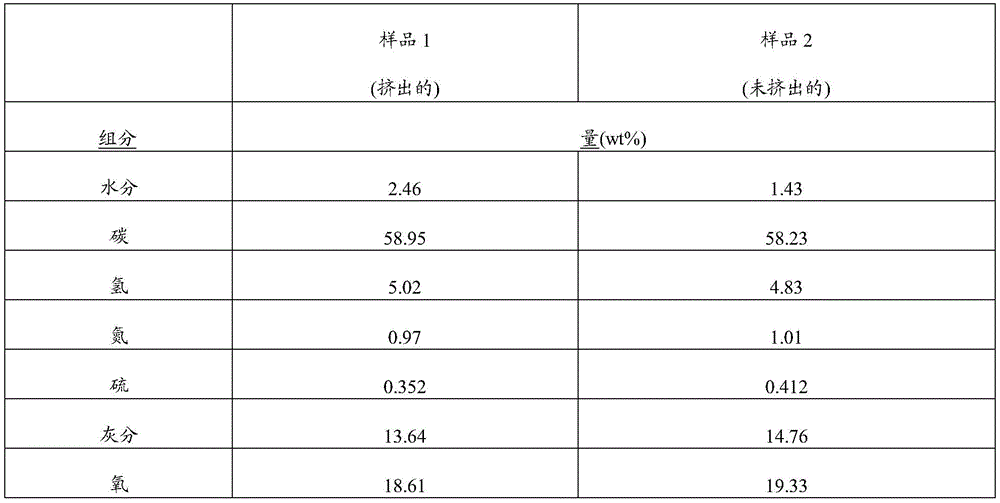
在已经将煤预热之后,通过在10和20分钟的时间间隔之间引入塑料,将10wt%的塑料(高密度聚乙烯、低密度聚乙烯和聚对苯二甲酸乙二醇酯的共混物)与煤结合。样品1和2是在将煤加工并且与塑料结合之后得到的燃料组合物。在样品1中,将煤和塑料混合物挤出。在样品2中,没有将煤和塑料混合物挤出。褐煤的加工导致水分从43.22wt%降低到小于3wt%(对于样品1和2分别为2.46wt%和1.43wt%),以及对于样品1和2分别地能量含量从5,922BTU/lb增加到10,649和10,285BTU/lb(HHV)。样品1和2的组成提供在表2中。After the coal has been preheated, 10 wt% of plastic (a blend of high-density polyethylene, low-density polyethylene and polyethylene terephthalate) is introduced by introducing the plastic between 10 and 20 minute intervals matter) combined with coal. Samples 1 and 2 are fuel compositions obtained after coal processing and combining with plastic. In Sample 1, a coal and plastic mixture was extruded. In sample 2, the coal and plastic mixture was not extruded. Processing of lignite resulted in a decrease in moisture from 43.22 wt% to less than 3 wt% (2.46 wt% and 1.43 wt% for samples 1 and 2, respectively), and an increase in energy content from 5,922 BTU/lb to 10,649 and 10,285 BTU/lb (HHV). The compositions of Samples 1 and 2 are provided in Table 2.
表2:样品1和2的组成Table 2: Composition of samples 1 and 2
如在本公开内容中使用,除非上下文另有明确规定,否则术语“一个(种)(a)”、“一个(种)(an)”或“所述(该)(the)”用于包括一个(种)或多于一个(种)。除非另有说明,否则术语“或”用于指非排他性的“或”。陈述“A和B中的至少一个”与“A、B、或A和B”具有相同的含义。此外,应理解,在本公开内容中使用的措辞或术语,并且没有另外定义,仅用于描述的目的而不是限制的目的。任何章节标题的使用都旨在帮助阅读文件,并且不应被解释为限制;与章节标题相关的信息可出现在该特定章节之内或之外。As used in this disclosure, unless the context clearly dictates otherwise, the terms "a (a)", "an" or "the" are used to include One (species) or more than one (species). Unless stated otherwise, the term "or" is used to mean a non-exclusive "or". The statement "at least one of A and B" has the same meaning as "A, B, or A and B". Furthermore, it is to be understood that phraseology or terms used in this disclosure, and not otherwise defined, are for the purpose of description only and not limitation. The use of any section headings is intended to aid in reading the document and should not be construed as limiting; information related to a section heading may appear within or outside of that particular section.
如在本公开内容中使用,术语“约”或“大约”可允许值或范围内的可变程度,例如,在陈述的值或陈述的范围限制的10%内、5%内或1%内。As used in this disclosure, the term "about" or "approximately" may allow for a degree of variability within a value or range, for example, within 10%, within 5%, or within 1% of a stated value or a stated range limit .
如在本公开内容中使用,术语“基本上”是指大多数,或大部分,如至少约50%,60%,70%,80%,90%,95%,96%,97%,98%,99%,99.5%,99.9%,99.99%,或至少约99.999%或更大。As used in this disclosure, the term "substantially" refers to the majority, or majority, such as at least about 50%, 60%, 70%, 80%, 90%, 95%, 96%, 97%, 98% %, 99%, 99.5%, 99.9%, 99.99%, or at least about 99.999% or greater.
以范围格式表示的值应以灵活的方式解释,不仅包括明确列举为范围限制的数值,还包括包含在该范围内的所有单个数值或子范围,就如每个数值和子范围都被明确地列举一样。例如,“在0.1%和约5%之间”或“在0.1%和5%之间”的范围应解释为包括约0.1%至约5%,以及指定范围内的单个值(例如,1%,2%,3%和4%)和子范围(例如,在0.1%和0.5%之间,在1.1%和2.2%之间,以及在3.3%和4.4%之间)。除非另有说明,否则陈述“X至Y”和“在X和Y之间”与“约X至约Y”和“在约X和约Y之间”具有相同的含义。同样,除非另有说明,否则陈述“X、Y或Z”与“约X、约Y或约Z”具有相同的含义。Values expressed in range format should be interpreted in a flexible manner to include not only the values expressly recited as limitations of the range, but also all individual values or subranges subsumed within that range, as if each value and subrange were expressly recited Same. For example, ranges "between 0.1% and about 5%" or "between 0.1% and 5%" should be construed to include about 0.1% to about 5%, as well as individual values within the specified range (e.g., 1%, 2%, 3% and 4%) and subranges (eg, between 0.1% and 0.5%, between 1.1% and 2.2%, and between 3.3% and 4.4%). Unless stated otherwise, the statements "X to Y" and "between X and Y" have the same meaning as "about X to about Y" and "between about X and about Y". Likewise, the statement "X, Y, or Z" has the same meaning as "about X, about Y, or about Z" unless stated otherwise.
本公开内容的主题的一个或多个实施方案的细节在附图和描述中阐述。主题的其他特征、方面和优点将从描述、附图和权利要求中变得明晰。The details of one or more implementations of the subject matter of this disclosure are set forth in the accompanying drawings and the description. Other features, aspects and advantages of the subject matter will be apparent from the description, drawings and claims.
尽管本公开内容含有许多特定的实施方案细节,但这些不应被解释为对主题的范围或可要求保护的范围的限制,而是对可能特定于特定实施方案的特征的描述。在单独实施方案的上下文中在本公开内容中描述的某些特征也可在单个实施方案中组合实施。相反,在单个实施方案的上下文中描述的各种特征也可在多个实施方案中,单独地或以任何合适的子组合实施。此外,尽管先前描述的特征可被描述为在某些组合中起作用并且甚至最初如此要求保护,但是在某些情况下,要求保护的组合中的一个或多个特征可从组合移除,并且要求保护的组合可针对子组合或子组合的变体。While this disclosure contains many specific implementation details, these should not be construed as limitations on the scope of subject matter or of what may be claimed, but rather as descriptions of features that may be specific to particular implementations. Certain features that are described in this disclosure in the context of separate implementations can also be implemented in combination in a single implementation. Conversely, various features that are described in the context of a single implementation can also be implemented in multiple implementations, separately or in any suitable subcombination. Furthermore, although previously described features may be described as functioning in certain combinations and even initially claimed as such, in some cases one or more features in a claimed combination may be removed from the combination, and A claimed combination may be directed to a subcombination or a variation of a subcombination.
已经描述了本主题的特定实施方案。所描述的实施方案的其他实施方案、改变和排列在所附权利要求的范围内,这对于本领域的技术人员来说是明晰的。尽管在附图或权利要求书中以特定顺序描述了操作,但这不应被理解为要求以所示特定顺序或按序列顺序进行这样的操作,或者进行所有所示操作(一些操作可能被认为是任选的),以获得期望的结果。Certain embodiments of the subject matter have been described. Other embodiments, modifications and permutations of the described embodiments are within the scope of the appended claims, which will be apparent to those skilled in the art. Although operations are described in a particular order in the figures or claims, this should not be understood as requiring that such operations be performed in the particular order shown, or in a sequential order, or that all illustrated operations be performed (some operations may be considered is optional) to get the desired result.
相应地,先前描述的示例性实施方案不限定或限制本公开内容。在不背离本公开内容的精神和范围的情况下,其他变化、替换和改变也是可能的。Accordingly, the previously described exemplary embodiments do not define or limit the present disclosure. Other changes, substitutions and alterations are also possible without departing from the spirit and scope of the present disclosure.
Claims (15)
Applications Claiming Priority (3)
| Application Number | Priority Date | Filing Date | Title |
|---|---|---|---|
| US202062961552P | 2020-01-15 | 2020-01-15 | |
| US62/961,552 | 2020-01-15 | ||
| PCT/US2021/013700 WO2021146600A1 (en) | 2020-01-15 | 2021-01-15 | Processing of low rank coal |
Publications (1)
| Publication Number | Publication Date |
|---|---|
| CN115427543A true CN115427543A (en) | 2022-12-02 |
Family
ID=76760859
Family Applications (1)
| Application Number | Title | Priority Date | Filing Date |
|---|---|---|---|
| CN202180015138.7A Pending CN115427543A (en) | 2020-01-15 | 2021-01-15 | Processing of low rank coal |
Country Status (8)
| Country | Link |
|---|---|
| US (2) | US11407954B2 (en) |
| EP (1) | EP4090720A4 (en) |
| CN (1) | CN115427543A (en) |
| AU (1) | AU2021208625A1 (en) |
| BR (1) | BR112022014039A2 (en) |
| CO (1) | CO2022010354A2 (en) |
| MX (1) | MX2022008761A (en) |
| WO (1) | WO2021146600A1 (en) |
Families Citing this family (1)
| Publication number | Priority date | Publication date | Assignee | Title |
|---|---|---|---|---|
| CN113686105B (en) * | 2021-08-26 | 2022-08-26 | 中国矿业大学(北京) | Coal slime freeze drying dehydration and system |
Citations (6)
| Publication number | Priority date | Publication date | Assignee | Title |
|---|---|---|---|---|
| US4249909A (en) * | 1979-05-30 | 1981-02-10 | Hydrocarbon Research, Inc. | Drying and passivating wet coals and lignite |
| US4725337A (en) * | 1984-12-03 | 1988-02-16 | Western Energy Company | Method for drying low rank coals |
| JPH02225007A (en) * | 1989-02-27 | 1990-09-07 | Sanyo Electric Co Ltd | Microwave drying equipment |
| JPH09310079A (en) * | 1996-05-21 | 1997-12-02 | Ube Ind Ltd | Method for reforming coal and method for producing CWM |
| US6165238A (en) * | 1999-06-14 | 2000-12-26 | Cq Inc. | Fuel pellet and method for its production |
| CN1507487A (en) * | 2001-03-28 | 2004-06-23 | SGT�ع��������ι�˾ | Reducing SO2 Emissions from Coal Combustion |
Family Cites Families (9)
| Publication number | Priority date | Publication date | Assignee | Title |
|---|---|---|---|---|
| US852025A (en) * | 1906-07-03 | 1907-04-30 | George J Mashek | Process of preparing pulverulent materials for molding or briqueting. |
| US1734992A (en) * | 1927-07-18 | 1929-11-12 | Ruth Hull Barrows | Process and apparatus for drying and pulverizing coal |
| JPS5962696A (en) | 1982-10-01 | 1984-04-10 | Hitachi Ltd | Coal reforming method |
| AU8483398A (en) | 1998-06-30 | 2000-01-17 | Duquesne Energy, Inc. | Coal-based pelletized fuel composition and method of manufacturing same |
| US8579999B2 (en) | 2004-10-12 | 2013-11-12 | Great River Energy | Method of enhancing the quality of high-moisture materials using system heat sources |
| WO2006135340A1 (en) * | 2005-06-17 | 2006-12-21 | Calrex Investments Pte Ltd | Method and apparatus for treating coal |
| WO2009128819A1 (en) | 2008-04-15 | 2009-10-22 | Larry Hunt | Coal enhancement process |
| KR101090750B1 (en) | 2009-07-31 | 2011-12-08 | 한국에너지기술연구원 | Drying Apparatus by Heated Disc and Rotating Blade |
| TWI687511B (en) * | 2014-10-30 | 2020-03-11 | 美商艾科詹瑟斯有限公司 | Solid fuel composition formed from mixed solid waste |
-
2021
- 2021-01-15 CN CN202180015138.7A patent/CN115427543A/en active Pending
- 2021-01-15 MX MX2022008761A patent/MX2022008761A/en unknown
- 2021-01-15 EP EP21741123.0A patent/EP4090720A4/en not_active Withdrawn
- 2021-01-15 WO PCT/US2021/013700 patent/WO2021146600A1/en not_active Ceased
- 2021-01-15 BR BR112022014039A patent/BR112022014039A2/en not_active Application Discontinuation
- 2021-01-15 US US17/150,904 patent/US11407954B2/en active Active
- 2021-01-15 AU AU2021208625A patent/AU2021208625A1/en not_active Abandoned
-
2022
- 2022-07-11 US US17/862,008 patent/US20220348837A1/en not_active Abandoned
- 2022-07-22 CO CONC2022/0010354A patent/CO2022010354A2/en unknown
Patent Citations (6)
| Publication number | Priority date | Publication date | Assignee | Title |
|---|---|---|---|---|
| US4249909A (en) * | 1979-05-30 | 1981-02-10 | Hydrocarbon Research, Inc. | Drying and passivating wet coals and lignite |
| US4725337A (en) * | 1984-12-03 | 1988-02-16 | Western Energy Company | Method for drying low rank coals |
| JPH02225007A (en) * | 1989-02-27 | 1990-09-07 | Sanyo Electric Co Ltd | Microwave drying equipment |
| JPH09310079A (en) * | 1996-05-21 | 1997-12-02 | Ube Ind Ltd | Method for reforming coal and method for producing CWM |
| US6165238A (en) * | 1999-06-14 | 2000-12-26 | Cq Inc. | Fuel pellet and method for its production |
| CN1507487A (en) * | 2001-03-28 | 2004-06-23 | SGT�ع��������ι�˾ | Reducing SO2 Emissions from Coal Combustion |
Also Published As
| Publication number | Publication date |
|---|---|
| BR112022014039A2 (en) | 2022-09-27 |
| CO2022010354A2 (en) | 2022-08-09 |
| WO2021146600A1 (en) | 2021-07-22 |
| US11407954B2 (en) | 2022-08-09 |
| US20220348837A1 (en) | 2022-11-03 |
| EP4090720A4 (en) | 2023-07-05 |
| MX2022008761A (en) | 2022-10-13 |
| EP4090720A1 (en) | 2022-11-23 |
| AU2021208625A1 (en) | 2022-08-11 |
| US20210214629A1 (en) | 2021-07-15 |
Similar Documents
| Publication | Publication Date | Title |
|---|---|---|
| JP4593657B2 (en) | Solid fuel | |
| KR101134809B1 (en) | Method for producing pulverized waste plastic | |
| CN115315476B (en) | Resin material for molding and method for producing the same | |
| CN106414678B (en) | Method for burning an industrial furnace using coal or coke with a second fuel | |
| CN115427543A (en) | Processing of low rank coal | |
| US12269926B2 (en) | Process of production of a polymer product | |
| KR101701248B1 (en) | Preparation method of composite pellets for fuel using wooden byproducts | |
| WO2006081645A1 (en) | A process for the preparation of pellets from biomass residues, and a product obtained by such a process | |
| TW201515727A (en) | Manufacturing method of solid refuse derived fuel for automobile shredder residue | |
| CN115397957A (en) | Processing of low rank coal | |
| CN101189108A (en) | Mixed plastic micropowder and its manufacturing method | |
| JP4733822B2 (en) | Molding method and molding apparatus for waste plastic granulated material | |
| JP2023550519A (en) | Composite materials and methods for obtaining them | |
| JP4724521B2 (en) | Molding method of waste plastic granulation for chemical raw materials | |
| JP5303855B2 (en) | Method for producing coke for blast furnace using waste plastic | |
| JP2007022061A (en) | Recycling method of plastic mixture | |
| JP2007015340A (en) | Recycling method of plastic mixture, plastic raw material and plastic molded body | |
| JP2017137467A (en) | Recycling method of polypropylene resin molding waste | |
| JP2017031248A (en) | Recycling method of polypropylene resin molding waste | |
| KR20240021392A (en) | Manufacturing Method of Solid Fuel Using Waste Powdery Paint and Sawdust | |
| CN120936665A (en) | Method for producing granulated material for chemical recycling and granulated material for chemical recycling | |
| JP2006056267A (en) | Molding method of waste plastic |
Legal Events
| Date | Code | Title | Description |
|---|---|---|---|
| PB01 | Publication | ||
| PB01 | Publication | ||
| SE01 | Entry into force of request for substantive examination | ||
| SE01 | Entry into force of request for substantive examination |