CN115397969A - System for producing cultured meat, tissue and related products from cells - Google Patents
System for producing cultured meat, tissue and related products from cells Download PDFInfo
- Publication number
- CN115397969A CN115397969A CN202080095335.XA CN202080095335A CN115397969A CN 115397969 A CN115397969 A CN 115397969A CN 202080095335 A CN202080095335 A CN 202080095335A CN 115397969 A CN115397969 A CN 115397969A
- Authority
- CN
- China
- Prior art keywords
- cells
- unit
- fluid
- medium
- cell culture
- Prior art date
- Legal status (The legal status is an assumption and is not a legal conclusion. Google has not performed a legal analysis and makes no representation as to the accuracy of the status listed.)
- Pending
Links
Images




Classifications
-
- C—CHEMISTRY; METALLURGY
- C12—BIOCHEMISTRY; BEER; SPIRITS; WINE; VINEGAR; MICROBIOLOGY; ENZYMOLOGY; MUTATION OR GENETIC ENGINEERING
- C12M—APPARATUS FOR ENZYMOLOGY OR MICROBIOLOGY; APPARATUS FOR CULTURING MICROORGANISMS FOR PRODUCING BIOMASS, FOR GROWING CELLS OR FOR OBTAINING FERMENTATION OR METABOLIC PRODUCTS, i.e. BIOREACTORS OR FERMENTERS
- C12M21/00—Bioreactors or fermenters specially adapted for specific uses
- C12M21/08—Bioreactors or fermenters specially adapted for specific uses for producing artificial tissue or for ex-vivo cultivation of tissue
-
- C—CHEMISTRY; METALLURGY
- C12—BIOCHEMISTRY; BEER; SPIRITS; WINE; VINEGAR; MICROBIOLOGY; ENZYMOLOGY; MUTATION OR GENETIC ENGINEERING
- C12M—APPARATUS FOR ENZYMOLOGY OR MICROBIOLOGY; APPARATUS FOR CULTURING MICROORGANISMS FOR PRODUCING BIOMASS, FOR GROWING CELLS OR FOR OBTAINING FERMENTATION OR METABOLIC PRODUCTS, i.e. BIOREACTORS OR FERMENTERS
- C12M23/00—Constructional details, e.g. recesses, hinges
- C12M23/02—Form or structure of the vessel
- C12M23/14—Bags
-
- A—HUMAN NECESSITIES
- A23—FOODS OR FOODSTUFFS; TREATMENT THEREOF, NOT COVERED BY OTHER CLASSES
- A23L—FOODS, FOODSTUFFS OR NON-ALCOHOLIC BEVERAGES, NOT OTHERWISE PROVIDED FOR; PREPARATION OR TREATMENT THEREOF
- A23L13/00—Meat products; Meat meal; Preparation or treatment thereof
-
- A—HUMAN NECESSITIES
- A23—FOODS OR FOODSTUFFS; TREATMENT THEREOF, NOT COVERED BY OTHER CLASSES
- A23L—FOODS, FOODSTUFFS OR NON-ALCOHOLIC BEVERAGES, NOT OTHERWISE PROVIDED FOR; PREPARATION OR TREATMENT THEREOF
- A23L17/00—Food-from-the-sea products; Fish products; Fish meal; Fish-egg substitutes; Preparation or treatment thereof
-
- A—HUMAN NECESSITIES
- A61—MEDICAL OR VETERINARY SCIENCE; HYGIENE
- A61P—SPECIFIC THERAPEUTIC ACTIVITY OF CHEMICAL COMPOUNDS OR MEDICINAL PREPARATIONS
- A61P17/00—Drugs for dermatological disorders
- A61P17/02—Drugs for dermatological disorders for treating wounds, ulcers, burns, scars, keloids, or the like
-
- C—CHEMISTRY; METALLURGY
- C12—BIOCHEMISTRY; BEER; SPIRITS; WINE; VINEGAR; MICROBIOLOGY; ENZYMOLOGY; MUTATION OR GENETIC ENGINEERING
- C12M—APPARATUS FOR ENZYMOLOGY OR MICROBIOLOGY; APPARATUS FOR CULTURING MICROORGANISMS FOR PRODUCING BIOMASS, FOR GROWING CELLS OR FOR OBTAINING FERMENTATION OR METABOLIC PRODUCTS, i.e. BIOREACTORS OR FERMENTERS
- C12M29/00—Means for introduction, extraction or recirculation of materials, e.g. pumps
-
- C—CHEMISTRY; METALLURGY
- C12—BIOCHEMISTRY; BEER; SPIRITS; WINE; VINEGAR; MICROBIOLOGY; ENZYMOLOGY; MUTATION OR GENETIC ENGINEERING
- C12M—APPARATUS FOR ENZYMOLOGY OR MICROBIOLOGY; APPARATUS FOR CULTURING MICROORGANISMS FOR PRODUCING BIOMASS, FOR GROWING CELLS OR FOR OBTAINING FERMENTATION OR METABOLIC PRODUCTS, i.e. BIOREACTORS OR FERMENTERS
- C12M29/00—Means for introduction, extraction or recirculation of materials, e.g. pumps
- C12M29/04—Filters; Permeable or porous membranes or plates, e.g. dialysis
-
- C—CHEMISTRY; METALLURGY
- C12—BIOCHEMISTRY; BEER; SPIRITS; WINE; VINEGAR; MICROBIOLOGY; ENZYMOLOGY; MUTATION OR GENETIC ENGINEERING
- C12M—APPARATUS FOR ENZYMOLOGY OR MICROBIOLOGY; APPARATUS FOR CULTURING MICROORGANISMS FOR PRODUCING BIOMASS, FOR GROWING CELLS OR FOR OBTAINING FERMENTATION OR METABOLIC PRODUCTS, i.e. BIOREACTORS OR FERMENTERS
- C12M35/00—Means for application of stress for stimulating the growth of microorganisms or the generation of fermentation or metabolic products; Means for electroporation or cell fusion
-
- C—CHEMISTRY; METALLURGY
- C12—BIOCHEMISTRY; BEER; SPIRITS; WINE; VINEGAR; MICROBIOLOGY; ENZYMOLOGY; MUTATION OR GENETIC ENGINEERING
- C12M—APPARATUS FOR ENZYMOLOGY OR MICROBIOLOGY; APPARATUS FOR CULTURING MICROORGANISMS FOR PRODUCING BIOMASS, FOR GROWING CELLS OR FOR OBTAINING FERMENTATION OR METABOLIC PRODUCTS, i.e. BIOREACTORS OR FERMENTERS
- C12M47/00—Means for after-treatment of the produced biomass or of the fermentation or metabolic products, e.g. storage of biomass
- C12M47/12—Purification
-
- C—CHEMISTRY; METALLURGY
- C12—BIOCHEMISTRY; BEER; SPIRITS; WINE; VINEGAR; MICROBIOLOGY; ENZYMOLOGY; MUTATION OR GENETIC ENGINEERING
- C12N—MICROORGANISMS OR ENZYMES; COMPOSITIONS THEREOF; PROPAGATING, PRESERVING, OR MAINTAINING MICROORGANISMS; MUTATION OR GENETIC ENGINEERING; CULTURE MEDIA
- C12N15/00—Mutation or genetic engineering; DNA or RNA concerning genetic engineering, vectors, e.g. plasmids, or their isolation, preparation or purification; Use of hosts therefor
- C12N15/09—Recombinant DNA-technology
- C12N15/11—DNA or RNA fragments; Modified forms thereof; Non-coding nucleic acids having a biological activity
- C12N15/113—Non-coding nucleic acids modulating the expression of genes, e.g. antisense oligonucleotides; Antisense DNA or RNA; Triplex- forming oligonucleotides; Catalytic nucleic acids, e.g. ribozymes; Nucleic acids used in co-suppression or gene silencing
-
- C—CHEMISTRY; METALLURGY
- C12—BIOCHEMISTRY; BEER; SPIRITS; WINE; VINEGAR; MICROBIOLOGY; ENZYMOLOGY; MUTATION OR GENETIC ENGINEERING
- C12N—MICROORGANISMS OR ENZYMES; COMPOSITIONS THEREOF; PROPAGATING, PRESERVING, OR MAINTAINING MICROORGANISMS; MUTATION OR GENETIC ENGINEERING; CULTURE MEDIA
- C12N5/00—Undifferentiated human, animal or plant cells, e.g. cell lines; Tissues; Cultivation or maintenance thereof; Culture media therefor
- C12N5/0068—General culture methods using substrates
-
- C—CHEMISTRY; METALLURGY
- C12—BIOCHEMISTRY; BEER; SPIRITS; WINE; VINEGAR; MICROBIOLOGY; ENZYMOLOGY; MUTATION OR GENETIC ENGINEERING
- C12N—MICROORGANISMS OR ENZYMES; COMPOSITIONS THEREOF; PROPAGATING, PRESERVING, OR MAINTAINING MICROORGANISMS; MUTATION OR GENETIC ENGINEERING; CULTURE MEDIA
- C12N5/00—Undifferentiated human, animal or plant cells, e.g. cell lines; Tissues; Cultivation or maintenance thereof; Culture media therefor
- C12N5/06—Animal cells or tissues; Human cells or tissues
- C12N5/0602—Vertebrate cells
- C12N5/0652—Cells of skeletal and connective tissues; Mesenchyme
-
- C—CHEMISTRY; METALLURGY
- C12—BIOCHEMISTRY; BEER; SPIRITS; WINE; VINEGAR; MICROBIOLOGY; ENZYMOLOGY; MUTATION OR GENETIC ENGINEERING
- C12N—MICROORGANISMS OR ENZYMES; COMPOSITIONS THEREOF; PROPAGATING, PRESERVING, OR MAINTAINING MICROORGANISMS; MUTATION OR GENETIC ENGINEERING; CULTURE MEDIA
- C12N5/00—Undifferentiated human, animal or plant cells, e.g. cell lines; Tissues; Cultivation or maintenance thereof; Culture media therefor
- C12N5/06—Animal cells or tissues; Human cells or tissues
- C12N5/0602—Vertebrate cells
- C12N5/0652—Cells of skeletal and connective tissues; Mesenchyme
- C12N5/0656—Adult fibroblasts
-
- C—CHEMISTRY; METALLURGY
- C12—BIOCHEMISTRY; BEER; SPIRITS; WINE; VINEGAR; MICROBIOLOGY; ENZYMOLOGY; MUTATION OR GENETIC ENGINEERING
- C12N—MICROORGANISMS OR ENZYMES; COMPOSITIONS THEREOF; PROPAGATING, PRESERVING, OR MAINTAINING MICROORGANISMS; MUTATION OR GENETIC ENGINEERING; CULTURE MEDIA
- C12N5/00—Undifferentiated human, animal or plant cells, e.g. cell lines; Tissues; Cultivation or maintenance thereof; Culture media therefor
- C12N5/06—Animal cells or tissues; Human cells or tissues
- C12N5/0602—Vertebrate cells
- C12N5/0652—Cells of skeletal and connective tissues; Mesenchyme
- C12N5/0662—Stem cells
-
- C—CHEMISTRY; METALLURGY
- C12—BIOCHEMISTRY; BEER; SPIRITS; WINE; VINEGAR; MICROBIOLOGY; ENZYMOLOGY; MUTATION OR GENETIC ENGINEERING
- C12N—MICROORGANISMS OR ENZYMES; COMPOSITIONS THEREOF; PROPAGATING, PRESERVING, OR MAINTAINING MICROORGANISMS; MUTATION OR GENETIC ENGINEERING; CULTURE MEDIA
- C12N5/00—Undifferentiated human, animal or plant cells, e.g. cell lines; Tissues; Cultivation or maintenance thereof; Culture media therefor
- C12N5/06—Animal cells or tissues; Human cells or tissues
- C12N5/0602—Vertebrate cells
- C12N5/0679—Cells of the gastro-intestinal tract
-
- C—CHEMISTRY; METALLURGY
- C12—BIOCHEMISTRY; BEER; SPIRITS; WINE; VINEGAR; MICROBIOLOGY; ENZYMOLOGY; MUTATION OR GENETIC ENGINEERING
- C12N—MICROORGANISMS OR ENZYMES; COMPOSITIONS THEREOF; PROPAGATING, PRESERVING, OR MAINTAINING MICROORGANISMS; MUTATION OR GENETIC ENGINEERING; CULTURE MEDIA
- C12N5/00—Undifferentiated human, animal or plant cells, e.g. cell lines; Tissues; Cultivation or maintenance thereof; Culture media therefor
- C12N5/06—Animal cells or tissues; Human cells or tissues
- C12N5/0602—Vertebrate cells
- C12N5/0696—Artificially induced pluripotent stem cells, e.g. iPS
-
- C—CHEMISTRY; METALLURGY
- C12—BIOCHEMISTRY; BEER; SPIRITS; WINE; VINEGAR; MICROBIOLOGY; ENZYMOLOGY; MUTATION OR GENETIC ENGINEERING
- C12N—MICROORGANISMS OR ENZYMES; COMPOSITIONS THEREOF; PROPAGATING, PRESERVING, OR MAINTAINING MICROORGANISMS; MUTATION OR GENETIC ENGINEERING; CULTURE MEDIA
- C12N5/00—Undifferentiated human, animal or plant cells, e.g. cell lines; Tissues; Cultivation or maintenance thereof; Culture media therefor
- C12N5/06—Animal cells or tissues; Human cells or tissues
- C12N5/0697—Artificial constructs associating cells of different lineages, e.g. tissue equivalents
-
- A—HUMAN NECESSITIES
- A23—FOODS OR FOODSTUFFS; TREATMENT THEREOF, NOT COVERED BY OTHER CLASSES
- A23V—INDEXING SCHEME RELATING TO FOODS, FOODSTUFFS OR NON-ALCOHOLIC BEVERAGES AND LACTIC OR PROPIONIC ACID BACTERIA USED IN FOODSTUFFS OR FOOD PREPARATION
- A23V2002/00—Food compositions, function of food ingredients or processes for food or foodstuffs
-
- C—CHEMISTRY; METALLURGY
- C12—BIOCHEMISTRY; BEER; SPIRITS; WINE; VINEGAR; MICROBIOLOGY; ENZYMOLOGY; MUTATION OR GENETIC ENGINEERING
- C12M—APPARATUS FOR ENZYMOLOGY OR MICROBIOLOGY; APPARATUS FOR CULTURING MICROORGANISMS FOR PRODUCING BIOMASS, FOR GROWING CELLS OR FOR OBTAINING FERMENTATION OR METABOLIC PRODUCTS, i.e. BIOREACTORS OR FERMENTERS
- C12M47/00—Means for after-treatment of the produced biomass or of the fermentation or metabolic products, e.g. storage of biomass
- C12M47/06—Hydrolysis; Cell lysis; Extraction of intracellular or cell wall material
-
- C—CHEMISTRY; METALLURGY
- C12—BIOCHEMISTRY; BEER; SPIRITS; WINE; VINEGAR; MICROBIOLOGY; ENZYMOLOGY; MUTATION OR GENETIC ENGINEERING
- C12N—MICROORGANISMS OR ENZYMES; COMPOSITIONS THEREOF; PROPAGATING, PRESERVING, OR MAINTAINING MICROORGANISMS; MUTATION OR GENETIC ENGINEERING; CULTURE MEDIA
- C12N2310/00—Structure or type of the nucleic acid
- C12N2310/10—Type of nucleic acid
- C12N2310/14—Type of nucleic acid interfering nucleic acids [NA]
- C12N2310/141—MicroRNAs, miRNAs
-
- C—CHEMISTRY; METALLURGY
- C12—BIOCHEMISTRY; BEER; SPIRITS; WINE; VINEGAR; MICROBIOLOGY; ENZYMOLOGY; MUTATION OR GENETIC ENGINEERING
- C12N—MICROORGANISMS OR ENZYMES; COMPOSITIONS THEREOF; PROPAGATING, PRESERVING, OR MAINTAINING MICROORGANISMS; MUTATION OR GENETIC ENGINEERING; CULTURE MEDIA
- C12N2501/00—Active agents used in cell culture processes, e.g. differentation
- C12N2501/10—Growth factors
- C12N2501/105—Insulin-like growth factors [IGF]
-
- C—CHEMISTRY; METALLURGY
- C12—BIOCHEMISTRY; BEER; SPIRITS; WINE; VINEGAR; MICROBIOLOGY; ENZYMOLOGY; MUTATION OR GENETIC ENGINEERING
- C12N—MICROORGANISMS OR ENZYMES; COMPOSITIONS THEREOF; PROPAGATING, PRESERVING, OR MAINTAINING MICROORGANISMS; MUTATION OR GENETIC ENGINEERING; CULTURE MEDIA
- C12N2501/00—Active agents used in cell culture processes, e.g. differentation
- C12N2501/10—Growth factors
- C12N2501/11—Epidermal growth factor [EGF]
-
- C—CHEMISTRY; METALLURGY
- C12—BIOCHEMISTRY; BEER; SPIRITS; WINE; VINEGAR; MICROBIOLOGY; ENZYMOLOGY; MUTATION OR GENETIC ENGINEERING
- C12N—MICROORGANISMS OR ENZYMES; COMPOSITIONS THEREOF; PROPAGATING, PRESERVING, OR MAINTAINING MICROORGANISMS; MUTATION OR GENETIC ENGINEERING; CULTURE MEDIA
- C12N2501/00—Active agents used in cell culture processes, e.g. differentation
- C12N2501/10—Growth factors
- C12N2501/115—Basic fibroblast growth factor (bFGF, FGF-2)
-
- C—CHEMISTRY; METALLURGY
- C12—BIOCHEMISTRY; BEER; SPIRITS; WINE; VINEGAR; MICROBIOLOGY; ENZYMOLOGY; MUTATION OR GENETIC ENGINEERING
- C12N—MICROORGANISMS OR ENZYMES; COMPOSITIONS THEREOF; PROPAGATING, PRESERVING, OR MAINTAINING MICROORGANISMS; MUTATION OR GENETIC ENGINEERING; CULTURE MEDIA
- C12N2501/00—Active agents used in cell culture processes, e.g. differentation
- C12N2501/20—Cytokines; Chemokines
- C12N2501/23—Interleukins [IL]
- C12N2501/2306—Interleukin-6 (IL-6)
-
- C—CHEMISTRY; METALLURGY
- C12—BIOCHEMISTRY; BEER; SPIRITS; WINE; VINEGAR; MICROBIOLOGY; ENZYMOLOGY; MUTATION OR GENETIC ENGINEERING
- C12N—MICROORGANISMS OR ENZYMES; COMPOSITIONS THEREOF; PROPAGATING, PRESERVING, OR MAINTAINING MICROORGANISMS; MUTATION OR GENETIC ENGINEERING; CULTURE MEDIA
- C12N2501/00—Active agents used in cell culture processes, e.g. differentation
- C12N2501/20—Cytokines; Chemokines
- C12N2501/23—Interleukins [IL]
- C12N2501/2311—Interleukin-11 (IL-11)
-
- C—CHEMISTRY; METALLURGY
- C12—BIOCHEMISTRY; BEER; SPIRITS; WINE; VINEGAR; MICROBIOLOGY; ENZYMOLOGY; MUTATION OR GENETIC ENGINEERING
- C12N—MICROORGANISMS OR ENZYMES; COMPOSITIONS THEREOF; PROPAGATING, PRESERVING, OR MAINTAINING MICROORGANISMS; MUTATION OR GENETIC ENGINEERING; CULTURE MEDIA
- C12N2501/00—Active agents used in cell culture processes, e.g. differentation
- C12N2501/30—Hormones
- C12N2501/33—Insulin
-
- C—CHEMISTRY; METALLURGY
- C12—BIOCHEMISTRY; BEER; SPIRITS; WINE; VINEGAR; MICROBIOLOGY; ENZYMOLOGY; MUTATION OR GENETIC ENGINEERING
- C12N—MICROORGANISMS OR ENZYMES; COMPOSITIONS THEREOF; PROPAGATING, PRESERVING, OR MAINTAINING MICROORGANISMS; MUTATION OR GENETIC ENGINEERING; CULTURE MEDIA
- C12N2501/00—Active agents used in cell culture processes, e.g. differentation
- C12N2501/998—Proteins not provided for elsewhere
-
- C—CHEMISTRY; METALLURGY
- C12—BIOCHEMISTRY; BEER; SPIRITS; WINE; VINEGAR; MICROBIOLOGY; ENZYMOLOGY; MUTATION OR GENETIC ENGINEERING
- C12N—MICROORGANISMS OR ENZYMES; COMPOSITIONS THEREOF; PROPAGATING, PRESERVING, OR MAINTAINING MICROORGANISMS; MUTATION OR GENETIC ENGINEERING; CULTURE MEDIA
- C12N2510/00—Genetically modified cells
-
- C—CHEMISTRY; METALLURGY
- C12—BIOCHEMISTRY; BEER; SPIRITS; WINE; VINEGAR; MICROBIOLOGY; ENZYMOLOGY; MUTATION OR GENETIC ENGINEERING
- C12N—MICROORGANISMS OR ENZYMES; COMPOSITIONS THEREOF; PROPAGATING, PRESERVING, OR MAINTAINING MICROORGANISMS; MUTATION OR GENETIC ENGINEERING; CULTURE MEDIA
- C12N2513/00—3D culture
-
- C—CHEMISTRY; METALLURGY
- C12—BIOCHEMISTRY; BEER; SPIRITS; WINE; VINEGAR; MICROBIOLOGY; ENZYMOLOGY; MUTATION OR GENETIC ENGINEERING
- C12N—MICROORGANISMS OR ENZYMES; COMPOSITIONS THEREOF; PROPAGATING, PRESERVING, OR MAINTAINING MICROORGANISMS; MUTATION OR GENETIC ENGINEERING; CULTURE MEDIA
- C12N2531/00—Microcarriers
-
- C—CHEMISTRY; METALLURGY
- C12—BIOCHEMISTRY; BEER; SPIRITS; WINE; VINEGAR; MICROBIOLOGY; ENZYMOLOGY; MUTATION OR GENETIC ENGINEERING
- C12N—MICROORGANISMS OR ENZYMES; COMPOSITIONS THEREOF; PROPAGATING, PRESERVING, OR MAINTAINING MICROORGANISMS; MUTATION OR GENETIC ENGINEERING; CULTURE MEDIA
- C12N2533/00—Supports or coatings for cell culture, characterised by material
- C12N2533/50—Proteins
- C12N2533/54—Collagen; Gelatin
-
- C—CHEMISTRY; METALLURGY
- C12—BIOCHEMISTRY; BEER; SPIRITS; WINE; VINEGAR; MICROBIOLOGY; ENZYMOLOGY; MUTATION OR GENETIC ENGINEERING
- C12N—MICROORGANISMS OR ENZYMES; COMPOSITIONS THEREOF; PROPAGATING, PRESERVING, OR MAINTAINING MICROORGANISMS; MUTATION OR GENETIC ENGINEERING; CULTURE MEDIA
- C12N2533/00—Supports or coatings for cell culture, characterised by material
- C12N2533/70—Polysaccharides
- C12N2533/74—Alginate
Landscapes
- Health & Medical Sciences (AREA)
- Engineering & Computer Science (AREA)
- Life Sciences & Earth Sciences (AREA)
- Biomedical Technology (AREA)
- Chemical & Material Sciences (AREA)
- Organic Chemistry (AREA)
- Bioinformatics & Cheminformatics (AREA)
- Zoology (AREA)
- Wood Science & Technology (AREA)
- Genetics & Genomics (AREA)
- Biotechnology (AREA)
- General Health & Medical Sciences (AREA)
- General Engineering & Computer Science (AREA)
- Microbiology (AREA)
- Biochemistry (AREA)
- Cell Biology (AREA)
- Sustainable Development (AREA)
- Developmental Biology & Embryology (AREA)
- Molecular Biology (AREA)
- Rheumatology (AREA)
- Transplantation (AREA)
- Polymers & Plastics (AREA)
- Food Science & Technology (AREA)
- Nutrition Science (AREA)
- Public Health (AREA)
- Animal Behavior & Ethology (AREA)
- Veterinary Medicine (AREA)
- Dermatology (AREA)
- Chemical Kinetics & Catalysis (AREA)
- General Chemical & Material Sciences (AREA)
- Medicinal Chemistry (AREA)
- Pharmacology & Pharmacy (AREA)
- Nuclear Medicine, Radiotherapy & Molecular Imaging (AREA)
- Clinical Laboratory Science (AREA)
- Physics & Mathematics (AREA)
- Biophysics (AREA)
- Plant Pathology (AREA)
- Marine Sciences & Fisheries (AREA)
- Gastroenterology & Hepatology (AREA)
- Micro-Organisms Or Cultivation Processes Thereof (AREA)
Abstract
一种可提高细胞产量并降低细胞培养成本的细胞培养系统。该系统通过稳定培养基中的营养物质水平和/或维持最低水平的生长抑制剂来维持最佳培养条件。该系统包括被配置为容纳至少一种类型的细胞的细胞培养单元;新鲜培养基单元,以向细胞培养单元供应和接收第一流体;废物去除单元,以供应和从新鲜培养基单元接收第二流体;透析单元以将废物从第一流体提取到第二流体并且将营养物质从第二流体供应到第一流体。A cell culture system that increases cell yield and reduces cell culture costs. The system maintains optimal culture conditions by stabilizing nutrient levels in the medium and/or maintaining minimal levels of growth inhibitors. The system includes a cell culture unit configured to hold at least one type of cell; a fresh medium unit to supply and receive a first fluid to the cell culture unit; a waste removal unit to supply and receive a second fluid from the fresh medium unit. Fluid; a dialysis unit to extract waste from the first fluid to the second fluid and supply nutrients from the second fluid to the first fluid.
Description
技术领域technical field
本发明的实施例涉及细胞培养的改良系统和方法。本发明的实施例还涉及肉类生产和组织结构/工程的改良系统和方法。Embodiments of the invention relate to improved systems and methods for cell culture. Embodiments of the invention also relate to improved systems and methods for meat production and tissue structure/engineering.
背景技术Background technique
动物肉蛋白质含量高,足够提供构建用于支持身体所需蛋白质的所有氨基酸。传统食用肉是从农场饲养的动物或鱼类中获取的。然而,农业和水产养殖业消耗大量的能源和资源,其碳足印亦高。农业或水产养殖生产的肉类亦会对公共健康造成威胁,因为肉类可能在生产过程中接触到致病原、污染物和毒素。人口增长、肉类需求增加、环境问题、土地和水资源有限、生物多样性丧失以及对动物屠宰的负面看法等一系列问题促使科学家开发出替代生产肉类的技术。Animal meat is high in protein, providing all the amino acids needed to build the protein needed to support the body. Meat is traditionally obtained from farm-raised animals or fish. However, agriculture and aquaculture consume large amounts of energy and resources and have a high carbon footprint. Meat produced in agriculture or aquaculture also poses a public health threat due to possible exposure of meat to pathogens, contaminants and toxins during production. A growing population, increasing demand for meat, environmental concerns, limited land and water resources, loss of biodiversity, and negative perceptions of animal slaughter have prompted scientists to develop alternative technologies for producing meat.
体外细胞培养肉生产是指利用细胞培养技术在实验室中培养动物肌肉组织或器官组织以制造肉类和肉制品的过程。如本文所述,体外细胞培养肉和肉制品包括动物蛋白制品以及可溶性和固体的非肉制品。虽然体外细胞培养肉和肉制品仍处于早期开发阶段,与传统肉制品相比,体外细胞培养肉和肉制品具有更多优势,例如健康和环境上的优势,以及对动物的好处。体外细胞培养肉和肉制品是下一代新兴技术,属于比细胞农业或从细胞培养制造农产品更广阔的领域。In vitro cell culture meat production refers to the process of cultivating animal muscle tissue or organ tissue in the laboratory using cell culture technology to produce meat and meat products. As described herein, in vitro cell cultured meat and meat products include animal protein products as well as soluble and solid non-meat products. Although in vitro cell cultured meat and meat products are still in the early stages of development, compared with conventional meat products, in vitro cell cultured meat and meat products have more advantages, such as health and environmental advantages, as well as benefits for animals. In vitro cell culture of meat and meat products is an emerging next-generation technology that belongs to a broader field than cellular agriculture or the manufacture of agricultural products from cell culture.
从动物活检中获取的细胞(例如肌肉细胞、体细胞、干细胞等)可以作为用于生产体外细胞培养肉的细胞,这些细胞被放在生物反应器或其他无菌环境的培养基中独立于动物活体生长。细胞可以通过在生物反应器中的可食用三维支架上,模仿动物器官生长成半固体或固体。起始细胞可以是直接从动物组织中获得的原代细胞,也可以是连续细胞系。如果在正确的条件下及适当的培养基中生长,原代细胞将根据其细胞脱氧核糖核酸末端端粒的长度所限的次数生长和增殖。而连续细胞系则可以在体外长期培养。细胞生物学端粒研究已经能够将原代细胞转化为不朽的连续细胞系。通过利用病毒癌基因、化学处理或端粒酶逆转录酶的过度表达,我们可以将原代细胞转化为连续的细胞系,以防止端粒缩短。Cells obtained from animal biopsies (e.g. muscle cells, somatic cells, stem cells, etc.) can be used as cells for the production of meat from in vitro cell cultures, which are placed in a medium in a bioreactor or other sterile environment independent of the animal live growth. Cells can be grown semi-solid or solid by mimicking animal organs on edible three-dimensional scaffolds in bioreactors. Starting cells can be primary cells obtained directly from animal tissues or continuous cell lines. If grown under the correct conditions and in the proper medium, primary cells will grow and proliferate a number of times limited by the length of the telomere at the end of their cellular DNA. Continuous cell lines, on the other hand, can be cultured in vitro for long periods of time. Cell Biology Telomere studies have been able to convert primary cells into immortal continuous cell lines. By utilizing viral oncogenes, chemical treatment, or overexpression of telomerase reverse transcriptase, we can transform primary cells into continuous cell lines to prevent telomere shortening.
培养基含有细胞增殖所需的成分,如氨基酸、盐、维生素、生长因子和缓冲系统,以控制pH值。目前的方法是向培养基中添加胎牛血清(FBS),以提供重要的大分子、生长因子和免疫分子。然而,胎牛血清来自未出生的小牛不符合不含动物产品的指标。因此从事生产体外细胞培养肉研究的科学家认为在无动物成分的培养基中培养细胞是的一个重要的因素。而某些生长因子可能来自于人类。Culture media contain components needed for cell proliferation, such as amino acids, salts, vitamins, growth factors, and buffer systems to control pH. The current approach is to supplement the culture medium with fetal bovine serum (FBS) to provide important macromolecules, growth factors and immune molecules. However, fetal bovine serum derived from unborn calves does not qualify as free of animal products. Scientists working on the production of meat from in vitro cell cultures therefore believe that culturing cells in animal component-free media is an important factor. And some growth factors may come from humans.
目前的体外细胞培养肉生产涵盖大多数商品肉类种类,例如基于细胞的牛肉、猪肉和家禽肉类。然而,这些肉类具有复杂的组织结构和涉及多种细胞,当前的生物医学技术难以生产这些肉类,成本也很高。体外细胞培养肉生产还缺乏提高肉类蛋白质水平和生物产量的非转基因方法。此外,如上所述,当前的细胞培养技术仍然依赖动物成分(如胎牛血清)作为营养源,以及昂贵的非食品级生长因子。Current in vitro cell-cultured meat production covers most commercial meat types, such as cell-based beef, pork, and poultry meats. However, these meats have complex tissue structures and involve many kinds of cells, and current biomedical technology is difficult to produce these meats, and the cost is also high. In vitro cell culture meat production also lacks non-GMO methods to increase protein levels and biomass in meat. Furthermore, as mentioned above, current cell culture techniques still rely on animal components such as fetal bovine serum as a source of nutrients, as well as expensive non-food-grade growth factors.
在养殖肉的生产或再生医学/组织工程/组织构建的临床应用中,收获足够数量的细胞是至关重要的。在养殖肉的生产应用中,一公斤的蛋白质大约含有8×1012个肌肉细胞。在再生医学的应用中,大多数应用的治疗每次需要大约1010到1012个细胞。例如,需要1x 109到2x 10⁹心肌细胞来替换成人受损的心脏组织。治疗肝功能衰竭需要1010个肝细胞。Harvesting sufficient numbers of cells is critical in the production of cultured meat or clinical applications in regenerative medicine/tissue engineering/tissue construction. In the production application of cultured meat, one kilogram of protein contains about 8×10 12 muscle cells. In regenerative medicine applications, most applied treatments require approximately 10 10 to 10 12 cells per session. For example, 1x 10 9 to 2x 10 9 cardiomyocytes are required to replace damaged heart tissue in adults. It takes 10 10 liver cells to treat liver failure.
当前的细胞培养方法是在培养基的存在下将细胞接种在培养容器的二维培养表面上。一般来说,培养基中含有葡萄糖、维生素、无机盐、氨基酸等营养物质。随着细胞的生长,营养物质逐渐耗尽,代谢废物积累。因此,每二至三天更换一次培养基,以补充营养和去除废物。这种细胞培养方法存在几个问题。首先,细胞在培养基更换之间的次优条件下生长。特别是如果细胞高度增殖并具有高代谢率,细胞会在短时间内消耗葡萄糖等营养物质并积累乳酸和氨等废物。代谢废物或生长抑制剂水平升高会抑制细胞生长。这会阻碍细胞在下一轮培养基更换之前以最佳速率生长。其次,更换培养基会浪费营养物质和生长因子;并增加生产成本。用过的培养基中被更换时仍含有营养物质。特别是,用过的培养基中的生长因子(来自血清补充剂或由细胞分泌)在培养基更换期间被去除。这增加了血清补充剂的使用,血清补充剂占培养基成本和生产成本的很大一部分。第三,需要手动更换培养基,这增加了生产成本和在大规模生产中污染的机会。The current cell culture method is to seed cells on the two-dimensional culture surface of the culture vessel in the presence of culture medium. Generally speaking, the medium contains nutrients such as glucose, vitamins, inorganic salts, and amino acids. As cells grow, nutrients are gradually depleted and metabolic waste accumulates. Therefore, change the medium every two to three days to replenish nutrients and remove waste. There are several problems with this cell culture method. First, cells grow under suboptimal conditions between media changes. Especially if cells are highly proliferative and have a high metabolic rate, cells consume nutrients such as glucose and accumulate waste products such as lactic acid and ammonia in a short period of time. Elevated levels of metabolic waste or growth inhibitors inhibit cell growth. This prevents cells from growing at an optimal rate until the next medium change. Second, changing media wastes nutrients and growth factors; and increases production costs. The spent medium still contains nutrients when it is replaced. In particular, growth factors (either from serum supplements or secreted by cells) in spent media are removed during media exchange. This increases the use of serum supplements, which account for a significant portion of media costs and production costs. Third, manual media changes are required, which increases production costs and the chance of contamination in large-scale production.
发明概要Summary of the invention
本发明提供可供人类食用的体外细胞培养肉类的生产方法,为上述挑战提供解决方案。The present invention provides a solution to the above challenges by providing a method for the production of in vitro cell cultured meat for human consumption.
本发明的一个目的是提供一种用于扩大细胞生产的替代系统和方法,从而降低养殖肉类和组织工程/再生医学/组织构建应用的成本并扩大生产。本发明的另一个目的是提供一种用于细胞生产的系统,该系统维持最佳培养条件、稳定的营养水平和/或的最低水平的生长抑制剂。本发明的又一目的在于提供一种大规模细胞培养系统,该系统能够自动补充养分,去除细胞产生的生长抑制剂,同时保留未使用的生长因子以提高产量和降低成本。It is an object of the present invention to provide an alternative system and method for scaling up cell production, thereby reducing costs and scaling up production for cultured meat and tissue engineering/regenerative medicine/tissue construction applications. Another object of the present invention is to provide a system for cell production that maintains optimal culture conditions, stable nutrient levels and/or minimal levels of growth inhibitors. Another object of the present invention is to provide a large-scale cell culture system, which can automatically replenish nutrients, remove growth inhibitors produced by cells, and retain unused growth factors to increase production and reduce costs.
本发明的另一个目的是提供一种使用细胞培养系统制作肉制品的方法。此外,本发明的一个目的是提供一种使用该培养系统进行组织工程/构建的方法。最后,本发明的一个目的是提供一种用于将细胞扩增至临床相关数量以用于再生医学应用的方法。Another object of the present invention is to provide a method for producing meat products using a cell culture system. Furthermore, an object of the present invention is to provide a method for tissue engineering/construction using the culture system. Finally, it is an object of the present invention to provide a method for expanding cells to clinically relevant quantities for regenerative medicine applications.
本发明具有以下优点:(1)将培养基中的营养物质如葡萄糖保持在最佳水平,将废物如氨和乳酸保持在低水平,以实现最佳的细胞活力和细胞生长;(2)于培养基中保留细胞分泌的生长因子和减少源自动物的血清的使用。生长因子是昂贵的,因此本发明通过将生长因子保留在培养基同时去除废物来帮助降低成本并优化培养基的使用。The present invention has the following advantages: (1) maintain optimal levels of nutrients such as glucose and low levels of waste products such as ammonia and lactic acid in the culture medium to achieve optimal cell viability and cell growth; (2) Growth factors secreted by cells are retained in the medium and the use of animal-derived serum is reduced. Growth factors are expensive, so the present invention helps reduce costs and optimize media usage by retaining growth factors in the media while removing waste.
如下文将更详细讨论的,与常规技术相比,本发明显着地(1)减少了从细胞培养系统中排放的废物,并且(2)增加了细胞的大量生产。As will be discussed in more detail below, the present invention significantly (1) reduces waste emissions from cell culture systems and (2) increases cell mass production compared to conventional techniques.
根据本发明的一个实施例,本发明提供一个细胞培养系统,该系统包括被配置为容纳至少一种类型的细胞的细胞培养单元;一个新鲜培养基单元,以向细胞培养单元供应和接收第一流体;一个废物去除单元,以供应和从新鲜培养基单元接收第二流体;第一个泵,该泵连接在细胞培养单元和新鲜培养基单元之间,用于循环第一流体;第二个泵,该泵连接在新鲜培养基单元和废物去除单元之间,用于循环第二流体,其中细胞培养单元、新鲜培养基单元和废物去除单元彼此分开以避免交叉污染。According to one embodiment of the present invention, the present invention provides a cell culture system comprising a cell culture unit configured to accommodate at least one type of cell; a fresh medium unit to supply and receive a first fluid; a waste removal unit to supply and receive the second fluid from the fresh medium unit; a first pump connected between the cell culture unit and the fresh medium unit for circulating the first fluid; a second A pump connected between the fresh medium unit and the waste removal unit for circulating the second fluid, wherein the cell culture unit, the fresh medium unit and the waste removal unit are separated from each other to avoid cross-contamination.
根据本发明的另一个实施例,本发明提供一种使用本发明的细胞培养系统培养细胞培养物的方法,该方法包括如下步骤:将至少一种类型的细胞放入细胞培养单元的;在细胞培养单元和新鲜培养基单元之间循环第一流体;在新鲜培养基单元和废物清除单元之间循环第二流体;在新鲜培养基单元处将废物从第一流体提取到第二流体;在新鲜培养基单元处从第二流体向第一流体补充营养。According to another embodiment of the present invention, the present invention provides a method for culturing a cell culture using the cell culture system of the present invention, the method comprising the steps of: putting at least one type of cell into the cell culture unit; Circulating the first fluid between the culture unit and the fresh medium unit; circulating the second fluid between the fresh medium unit and the waste removal unit; extracting waste from the first fluid to the second fluid at the fresh medium unit; Nutrients are supplied from the second fluid to the first fluid at the culture medium unit.
本发明的实施例应用用于人类食用和/或组织工程/组织构造/再生医学应用的体外细胞培养肉类生产的系统和方法,其为上述挑战提供解决方案。Embodiments of the present invention apply systems and methods of in vitro cell culture meat production for human consumption and/or tissue engineering/tissue construction/regenerative medicine applications, which provide solutions to the above-mentioned challenges.
附图简要说明Brief description of the drawings
为更好地理解本发明,可以参考详细说明并结合附图一并考虑。图中的组件不一定按比例缩放,而是强调解说本发明背后的原理。For a better understanding of the invention, reference should be made to the detailed description taken in conjunction with the accompanying drawings. The components in the figures are not necessarily to scale, emphasis instead being placed upon illustrating the principles behind the invention.
图1是根据本发明一个实施例的通过体外细胞培养进行肉类生产的方法的流程图。FIG. 1 is a flowchart of a method for meat production by in vitro cell culture according to an embodiment of the present invention.
图2是根据本发明一个实施例用于增强转录后蛋白质表达的方法的示意图。FIG. 2 is a schematic diagram of a method for enhancing post-transcriptional protein expression according to one embodiment of the present invention.
图3是根据本发明一个实施例用于增强转录后表达胶原1型α1(COL1A1)的方法的示意图。3 is a schematic diagram of a method for enhancing post-transcriptional expression of
图4是根据本发明一个实施例用于增强转录后表达胶原1型α2(COL1A2)的方法的示意图。4 is a schematic diagram of a method for enhancing post-transcriptional expression of
图5是根据本发明一个实施例,用于体外细胞培养肉类生产的具有固相生物反应器的示意图或概念横截面图。Figure 5 is a schematic or conceptual cross-sectional view of a solid phase bioreactor for in vitro cell culture meat production according to one embodiment of the present invention.
图6是根据本发明的一个与图5类似的实施例,但具有第二固相的生物反应器的示意图或概念横截面图。Figure 6 is a schematic or conceptual cross-sectional view of a bioreactor according to an embodiment similar to Figure 5, but with a second solid phase, according to the present invention.
图7是根据本发明一个实施例的细胞培养系统的示意图。Figure 7 is a schematic diagram of a cell culture system according to one embodiment of the present invention.
图8是根据本发明一个实施例的新鲜培养基单元的示意图。Figure 8 is a schematic diagram of a fresh medium unit according to one embodiment of the present invention.
图9是根据本发明一个实施例的废物去除单元的示意图。Figure 9 is a schematic diagram of a waste removal unit according to one embodiment of the present invention.
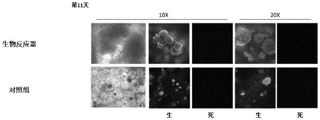
图10A显示在第0天在基于胶原的支架中培养的HEK293细胞的明场图像和LIVE/DEAD染色图像。图10B显示第4天在基于胶原的支架中培养的HEK293细胞的明场图像和LIVE/DEAD染色图像。图10C显示在第11天在基于胶原的支架中培养的HEK293细胞的明场图像和LIVE/DEAD染色图像。Figure 10A shows bright field and LIVE/DEAD stained images of HEK293 cells cultured in collagen-based scaffolds at
图11显示了经图7的细胞培养系统中培养11天后产生及从此提取的细胞团的图像,细胞团通过胰蛋白酶消化和离心从基于胶原的支架提取。在细胞培养系统中生长的细胞生长形成比对照组中体积大得多的微组织。微组织团块在细胞培养系统中观察到,但在对照组中则没有。生物反应器,在细胞培养系统原型中培养的细胞。对照组,在6孔板中培养的细胞。FIG. 11 shows images of cell pellets produced after 11 days of culture in the cell culture system of FIG. 7 and extracted from collagen-based scaffolds by trypsinization and centrifugation. Cells grown in the cell culture system grew to form microtissues that were much larger in volume than those in the control group. Microtissue clumps were observed in the cell culture system but not in the control group. Bioreactor, cells grown in a prototype cell culture system. Control group, cells cultured in 6-well plates.
图12是在细胞培养系统和6孔板中细胞培养11天后培养基中葡萄糖浓度的变化图。Fig. 12 is a graph showing changes in glucose concentration in the culture medium after 11 days of cell culture in the cell culture system and in a 6-well plate.
详细说明Detailed description
图1显示用于生产体外细胞培养肉的方法10。如本文所述,“体外细胞培养肉生产”是指基于细胞的肉类生产过程或基于细胞的农业过程,其中来自动物和/或植物的组织在实验室中使用细胞培养技术增长以制造肉类和肉类产品。在区块12,组织从动物或植物中分离。在一个实施例中,该组织源自硬骨鱼纲的骨性鱼,包括咸水鱼,例如石斑鱼、鲈鱼或黄鱼。在其他实施例中,其他类型的动物组织也可以被分离,例如牛组织。在一些实施例中,区块12可从鱼收集器官组织,例如鱼鳔,并制备细胞悬浮液。尽管以下描述主要源自鱼类的组织,但这些概念可应用于源自其他动物和/或植物的组织,以提供其他类型的体外细胞培养肉和/或动物蛋白产品,以及素食肉和/或蛋白产品。Figure 1 shows a
许多分离的细胞是成体细胞,可以使用医学研究中已建立的各种方法使其持续增殖(区块14)。例如,特定基因,如山中(Yamanaka)因子,可用于将成年细胞重新编程为干细胞,如诱导多能干细胞(iPSC)。作为替代选择,分离的成年细胞可以通过端粒酶逆转录酶的过度表达转化为连续的细胞系。在其他实施例中,可分离其他类型的细胞,例如成体干细胞和胚胎干细胞。在这方面,应当理解,本发明的方法包括细胞系的所有来源。Many of the isolated cells are adult cells that can be sustained using various methods established in medical research (block 14). For example, specific genes, such as Yamanaka factors, can be used to reprogram adult cells into stem cells, such as induced pluripotent stem cells (iPSCs). As an alternative, isolated adult cells can be transformed into continuous cell lines by overexpression of telomerase reverse transcriptase. In other embodiments, other types of cells may be isolated, such as adult stem cells and embryonic stem cells. In this regard, it is to be understood that the methods of the invention include all sources of cell lines.
在下一个区块16中,通过在无菌室或容器(如生物反应器)中附着/粘附食品级生物兼容性支架,将细胞生长为模拟动物器官(如鱼器官)的固体或半固体结构。无菌室或容器可进行温度控制,并可具有入口和出口,用于引入和移除化学物、营养素和细胞等物质。食品级生物兼容性支架最终成为食用产品的一部分,由基于植物或基于真菌的材料制成,例如但不限于琼脂糖、海藻酸钠、壳聚糖、菌丝体和魔芋葡甘聚糖。海藻酸钠是一种从褐藻中自然提取的生物聚合物,具有生物兼容性。此外,从真菌中提取的植物性壳聚糖具有抗菌性能。在一些实施例中,区块16在没有抗生素或抗菌化合物的无菌容器中进行。区块18涉及向生物反应器提供培养基以支持细胞存活和生长。培养基可以是含有不同成分的缓冲溶液,所述成分包括但不限于无机盐(例如氯化钙(CaCl2)、氯化钾(KCl)、氯化钠(NaCl)、碳酸氢钠(NaHCO3)、磷酸二氢钠(NaH2PO4)、硫酸镁(MgSO4)等)、氨基酸、维生素(例如硫胺素、核黄素、叶酸等),和其他成分如葡萄糖,β-巯基乙醇、乙二胺四乙酸(EDTA)和丙酮酸钠。生长培养基的非限制性示例包括但不限于莱柏维兹的L-15(Leibovitz’s L-15)培养基、Eagle’s培养基(MEM)、培养基199、杜尔贝科的改良Eagle培养基(DMEM)、Ham’s F12营养混合液、Ham’s F10营养混合液、MacCoy’s 5A培养基、Glasgow改良Eagle培养基(GMEM)、Iscove’s改良Dulbecco培养基和RPMI 1640。In the next block 16, the cells are grown into solid or semi-solid structures mimicking animal organs (such as fish organs) by attaching/adhering food-grade biocompatible scaffolds in a sterile room or container (such as a bioreactor) . A sterile room or container can be temperature controlled and can have inlets and outlets for the introduction and removal of substances such as chemicals, nutrients and cells. Food-grade biocompatible scaffolds that eventually become part of edible products are made from plant-based or fungi-based materials such as, but not limited to, agarose, sodium alginate, chitosan, mycelium, and konjac glucomannan. Sodium Alginate is a naturally derived biopolymer from brown algae that is biocompatible. Additionally, plant-based chitosan, derived from fungi, has antibacterial properties. In some embodiments, block 16 is performed in a sterile container without antibiotics or antimicrobial compounds. Block 18 involves providing media to the bioreactor to support cell survival and growth. The medium may be a buffered solution containing various components including, but not limited to, inorganic salts such as calcium chloride ( CaCl2 ), potassium chloride (KCl), sodium chloride (NaCl), sodium bicarbonate ( NaHCO3 ), sodium dihydrogen phosphate (NaH 2 PO 4 ), magnesium sulfate (MgSO 4 ), etc.), amino acids, vitamins (such as thiamine, riboflavin, folic acid, etc.), and other components such as glucose, β-mercaptoethanol, Ethylenediaminetetraacetic acid (EDTA) and sodium pyruvate. Non-limiting examples of growth media include, but are not limited to, Leibovitz's L-15 (Leibovitz's L-15) Medium, Eagle's Medium (MEM), Medium 199, Dulbecco's Modified Eagle Medium ( DMEM), Ham's F12 Nutrient Mixture, Ham's F10 Nutrient Mixture, MacCoy's 5A Medium, Glasgow's Modified Eagle Medium (GMEM), Iscove's Modified Dulbecco's Medium, and RPMI 1640.
根据区块20,将食品级生长因子和细胞因子引入生物反应器中的培养基中能够支持细胞生长和增殖。生长因子和细胞因子可包括但不限于胰岛素生长因子1(IGF-1)、胰岛素、白细胞介素6(IL-6)、白细胞介素6受体(IL-6R)、白细胞介素11(IL-11)、成纤维细胞生长因子(FGF)、表皮生长因子(EGF)和转铁蛋白。区块20可涉及在没有胎牛血清(FBS)的情况下共同培养生物工程细胞和分离细胞。生物工程细胞被改造以分泌上述生长因子和细胞因子,并根据生长和增殖的需要向分离细胞提供这些生物分子。According to block 20, the introduction of food grade growth factors and cytokines into the medium in the bioreactor can support cell growth and proliferation. Growth factors and cytokines may include, but are not limited to, insulin growth factor 1 (IGF-1), insulin, interleukin 6 (IL-6), interleukin 6 receptor (IL-6R), interleukin 11 (IL -11), fibroblast growth factor (FGF), epidermal growth factor (EGF) and transferrin.
如本文所述,“生物工程”细胞并不等同于转基因细胞。生物工程细胞有一个特定的基因,该基因过度表达一种或多种特定的蛋白质。生物工程细胞可以是鱼细胞,也可以是其他类型的动物细胞,如牛细胞。生物工程细胞不存在于最终的肉制品中。作为非限制性示例,生物工程鱼细胞可与分离的鱼细胞共同培养,或生物工程牛细胞可与分离的牛细胞共同培养。本发明的共同培养方法消除了培养基中对动物源性胎牛血清(FBS)的需要。此外,该共同培养方法在原位向正在生长的分离细胞持续提供食品级特异性生长因子和细胞因子,并简化生产过程和降低生产成本。然而,在其他实施例中,FBS或其他血清可用于供应生长因子、细胞因子和其他营养物以支持块16期间的细胞生长。As described herein, "bioengineered" cells are not equivalent to transgenic cells. Bioengineered cells have a specific gene that overexpresses one or more specific proteins. The bioengineered cells can be fish cells or other types of animal cells such as bovine cells. Bioengineered cells are not present in the final meat product. As a non-limiting example, bioengineered fish cells can be co-cultured with isolated fish cells, or bioengineered bovine cells can be co-cultured with isolated bovine cells. The co-cultivation method of the present invention eliminates the need for animal-derived fetal bovine serum (FBS) in the culture medium. In addition, the co-cultivation method continuously provides food-grade specific growth factors and cytokines in situ to the growing isolated cells, and simplifies the production process and reduces production costs. However, in other embodiments, FBS or other serum can be used to supply growth factors, cytokines and other nutrients to support cell growth during block 16.
此外,根据区块22,细胞中的蛋白质表达或可被增加以提高所得肉制品中的生物量产量。如本文所用,“生物量产量”是指所得肉制品中可消化物质(例如蛋白质)的量,该物质在消耗后可用于能源生产。具体来说,区块22涉及通过改变细胞中的微核糖核酸水平来增加蛋白质表达,并在培养之前对细胞进行操纵。微核糖核酸是一种内源性的、短的、非编码的单链核糖核酸序列,涉及调节转录后基因的表达。区块22涉及通过促进信使核糖核酸(mRNA)翻译增加蛋白表达的上调微核糖核酸的数量,和/或通过抑制信使核糖核酸翻译减少蛋白表达的下调微核糖核酸的数量。通过向细胞中引入微核糖核酸、微核糖核酸模拟物或微核糖核酸抑制剂,可以增加或减少微核糖核酸的水平。微核糖核酸模拟物具有与微核糖核酸相同的功能,但在调节蛋白质表达方面可能更稳定和有效。在一些实施例中,电穿孔法可用于将游离型载体引入执行表达特定微核糖核酸指令的细胞。作为替代选择,或与此相互结合,腺相关病毒可以用作携带游离型指令的载体,以表达特定的微核糖核酸。通过转染将目标微核糖核酸抑制剂引入细胞,可以减少目标下调微核糖核酸的数量。要注意的是,根据本发明增加蛋白质表达/生物量产量的方法是在不修改细胞基因组的情况下进行的。Furthermore, according to block 22, protein expression in the cells may be increased to increase biomass production in the resulting meat product. As used herein, "biomass yield" refers to the amount of digestible material (eg, protein) in the resulting meat product that can be used for energy production after consumption. Specifically,
图2概要性地描绘了细胞系中增强转录后蛋白质表达的方法。可以增加一个或多个上调微核糖核酸(miRNA),以增加所选蛋白质的信使核糖核酸翻译和蛋白质生产。作为替代选择,或与此相互结合,一个或多个下调微核糖核酸可被抑制剂(抗微核糖核酸)阻断,以增加所选蛋白质的信使核糖核酸翻译和蛋白质生产。Figure 2 schematically depicts methods for enhancing post-transcriptional protein expression in cell lines. One or more up-regulated microRNAs (miRNAs) can be added to increase mRNA translation and protein production of selected proteins. Alternatively, or in combination therewith, one or more down-regulated microRNAs can be blocked by inhibitors (anti-microRNAs) to increase mRNA translation and protein production of selected proteins.
鱼鳔主要包括成纤维细胞和胶原蛋白。I型胶原(胶原蛋白I)是鱼鳔中的主要蛋白质,增加培养的鱼鳔细胞中I型胶原的表达可能会提高生物产量。鱼鳔细胞中的I型胶原包括胶原1型α1(COL1A1)和胶原1型α2(COL1A2)。COL1A1和COL1A2的表达通过上调微核糖核酸21(miR-21)而增加,因此提高上调微核糖核酸21的水平可提高鱼鳔细胞中胶原1型α1和胶原1型α2的生成。此外,下调微核糖核酸29a(miR-29a)可降低胶原1型α1和胶原1型α2的表达,因此降低下调微核糖核酸29a的水平或阻断下调微核糖核酸29a的作用可提高鱼鳔细胞中胶原1型α1和胶原1型α2的生成。图3-4显示通过提高上调微核糖核酸21水平和通过使用抑制剂(抗miR29a)阻断下调微核糖核酸29a的作用来提高胶原1型α1(图3)和胶原1型α2(图4)的生成。胶原1型α1和胶原1型α2产量的增加使肉制品的产量增加。类似的策略可用于提高其他类型动物细胞中的相关蛋白质水平。The swim bladder mainly consists of fibroblasts and collagen. Collagen type I (collagen I) is the major protein in the swim bladder, and increasing the expression of collagen I in cultured swim bladder cells may increase bioproduction. Type I collagen in swim bladder cells includes
图5显示用于培养分离细胞的示例性生物反应器30。细胞附着在由食品级支架34提供的固相支架32上并在其上生长,该支架34固定在生物反应器30的无菌室36中。支架34可以决定肉制品的形状。食品级支架34由基于植物或基于真菌的材料制成,例如但不限于琼脂糖、海藻酸钠、壳聚糖、菌丝体和魔芋葡甘聚糖。固相支架32可以是多孔的,以便细胞可以附着支架32的内表面并在其上生长。向细胞提供营养的培养基通过入口38引入生物反应器30,并通过出口40从生物反应器30中排空。Figure 5 shows an
图6所示的生物反应器50类似于图5的生物反应器30,不同的是生物反应器50还包括第二固相52,而第二固相52通过细网54与固相支架32分隔开。第二固相52可包含或支持生物工程细胞,该生物工程细胞会在其原本位置为固相支架32上生长的细胞分泌营养素、生长因子和细胞因子,并可将生物工程细胞与固相支架32上的细胞分离。第二固相52由基于植物的材料制成,类似于固相支架32。营养素、生长因子和细胞因子可渗透网54,细胞则不能渗透网54。图6的生物反应器50允许生物工程细胞与生长细胞共同培养。在某些实施例中,图5和6的生物反应器可以串联布置。在其他实施例中,多个生物反应器30可以与多个生物反应器50或生物反应器30和50的混合串联布置,以扩大规模。生物反应器30可主要用于生物质生产,而生物反应器50则可用于向生长细胞提供营养、生长因子和细胞因子。The
图7示例性地演示细胞培养系统100:包括细胞培养单元102、新鲜培养基单元104和废物去除单元106。细胞培养单元102通过泵108a和108b连接到新鲜培养基单元104使得第一流体可以通过泵108a从细胞培养单元102流到新鲜培养基单元104,并且第一流体可以通过泵108b从新鲜培养基单元104流到细胞培养单元102。从而第一流体在细胞培养单元102和新鲜培养基单元104之间循环。FIG. 7 exemplarily demonstrates a cell culture system 100: comprising a
新鲜培养基单元104通过泵108c和108d进一步连接到废物去除单元106,使得第二流体可以通过泵108c从新鲜培养基单元104流到废物去除单元106并且第二流体可以通过泵108d从废物去除单元106流到新鲜培养基单元104。从而,第二流体在新鲜培养基单元104和废物去除单元106之间循环。第一流体可以是细胞培养基,其可以包括补充有FBS、生长因子或细胞因子的基础培养基。生长因子或细胞因子可包括但不限于胰岛素生长因子1(IGF-1)、胰岛素、白细胞介素6(IL-6)、白细胞介素6受体(IL-6R)、白细胞介素11(IL-11)、成纤维细胞生长因子(FGF)、表皮生长因子(EGF)和转铁蛋白。第二流体可以是新鲜的基础培养基,其可以包括缓冲溶液,该缓冲溶液含有诸如但不限于无机盐(例如氯化钙(CaCl2)、氯化钾(KCl)、氯化钠(NaCl)、碳酸氢钠(NaHCO3)、磷酸二氢钠(NaH2PO4)、硫酸镁(MgSO4)等)、氨基酸、维生素(如硫胺素、核黄素、叶酸等),以及其他成分如葡萄糖、β-巯基乙醇、乙二胺四乙酸(EDTA)和丙酮酸钠等成分。生长培养基的非限制性示例包括但不限于莱柏维兹的L-15(Leibovitz’s L-15)培养基、Eagle’s培养基(MEM)、培养基199、杜尔贝科的改良Eagle培养基(DMEM)、Ham’s F12营养混合液、Ham’s F10营养混合液、MacCoy’s 5A培养基、Glasgow改良Eagle培养基(GMEM)、Iscove’s改良Dulbecco培养基和RPMI 1640。Fresh
泵108可以是蠕动泵或任何其他类似的合适的泵。Pump 108 may be a peristaltic pump or any other similar suitable pump.
细胞培养系统100包括一个或多个容器。每个细胞培养单元102、新鲜培养基单元104和废物去除单元106可以是一个容器。在一些实施例中,细胞培养系统100可以包括多于一个的细胞培养单元102、新鲜培养基单元104和废物去除单元106。多个细胞培养单元102可以并联或串联连接并且彼此靠近设置。多个新鲜培养基单元104可以并联或串联连接并且彼此靠近设置。多个废物去除单元106可以并联或串联连接并且彼此靠近设置。
在一些实施例中,细胞培养系统100还可以包括气源,该气源被配置为向细胞培养单元102中的细胞供应气体。气源可以是氧气或二氧化碳。In some embodiments,
细胞培养单元102被配置为支持支架和培养基,使得细胞可以生长成固体或半固体结构。在一些实施例中,通过将食品级生物兼容性支架附着/粘附到细胞培养单元102的内部,细胞生长成模拟动物器官例如鱼器官的固体或半固体结构。细胞培养物单元102可以被配置为包含至少一种类型的细胞。合适的细胞类型包括但不限于骨、软骨、肌肉、肝脏、皮肤、心脏、肺及其任何组合。在本发明中可以使用其他类型的哺乳动物细胞或鱼细胞。亦可以使用来自其他植物和动物物种的细胞。其他起始细胞可以是各种来源的干细胞,例如间充质干细胞、诱导多能干细胞和卫星细胞。起始细胞也可以是转基因细胞或任何细胞系。也可以使用生物工程细胞。
在细胞培养单元102中扩增的不同类型的特化细胞可以通过活体动物的活检获得。The different types of specialized cells expanded in the
细胞培养单元102还可以包括入口和出口,入口被配置成通过泵108b从新鲜培养基单元104接收第一流体,出口被配置成通过泵108a将第一流体移出/释放到新鲜培养基单元104。细胞培养单元102还可以包括被配置为将细胞培养单元102的内部加热到预定温度的加热装置和将细胞培养单元102内的温度保持在所述预定温度的温度控制单元。预定温度可以在大约25℃到45℃的范围内。
细胞培养物还可以包括至少一个搅拌器,该搅拌器被配置为以预定速度搅拌细胞培养单元102内的第一流体。预定值可以是大约从每分钟10转(rpm)到300rpm。The cell culture may also include at least one agitator configured to agitate the first fluid within the
细胞培养单元102还可以包括出气口和与气源相连的进气口,气源可以是氧气或二氧化碳。氧气或二氧化碳可以通过气体入口供给到细胞培养单元102中以优化细胞培养条件。废气可通过气体出口排放。气体的流动可以由阀门控制。The
在一些实施例中,细胞培养单元102可以是如图5所示的生物反应器30。然而在一些实施例中,细胞培养单元102可以是如图6所示的生物反应器50。在一些实施例中,细胞培养单元102是容器。在一些实施例中,细胞培养单元102可以是任何尺寸。在一些实施例中,细胞培养单元102的体积可以在0.1L-2000L的范围内。In some embodiments,
参照图8,新鲜培养基单元104可以包括第一流体入口110和第一流体出口112,其被配置为分别连接到泵108a和泵108b。此外,新鲜培养基单元104还可以包括分别连接泵108d和泵108c的第二流体入口114和第二流体出口116。此外,新鲜培养基单元104可包括至少一个第一透析单元118,第一透析单元118具有由第一透析膜123隔开的第一流体隔室120和第二流体隔室122。第一流体入口110和第一流体出口112连接到第一流体隔室120。第二流体入口114和第二流体出口116连接到第二流体隔室122。不同类型的透析膜123包括纤维素酯(CE)、再生纤维素(RC)或聚偏二氟乙烯(PVDF)可被使用。不同截留分子量(MWCO)的透析膜123可用于将所需的大分子保留在第一流体中(例如培养容器中细胞所分泌的生长因子)并允许在第一透析单元118中的第一流体中去除废物。例如,100Da–1,000,000Da的MWCO膜,优选500Da的MWCO膜,可用于保留胰岛素样生长因子(IGF,重组形式的大小为7.5kDa)和转化生长因子-β(TGF beta,pro TGF-beta大小为44kDa)并允许从第一液体中去除乳酸(89Da)和氨(17Da)。这种膜还可以允许第二流体中的营养物质例如葡萄糖(180Da)穿过膜进入第一流体以进行补充。Referring to FIG. 8 , fresh
新鲜培养基单元104可以在任何一个或两个隔室中包括至少一个搅拌器,该搅拌器被配置为以预定速度搅拌透析单元内的流体。预定速度可以是大约从10rpm到500rpm。The fresh
新鲜培养基单元104还可以包括分离的入口和出口,其连接到一个或两个隔室以添加、补充和去除所需的流体。所需的流体可以是细胞培养基、新鲜的基础培养基和/或分化培养基。
如图9所示,废物去除单元106可以包括废物入口124和补足出口126,其被配置为分别连接到泵108c和泵108d。此外,废物去除单元106还可以包括废物去除入口128和废物去除出口130。此外,废物去除单元106可以包括至少一个第二透析单元132,第二透析单元132具有一个废物隔室134和一个废物去除隔室136,两者以第二透析膜137隔开。废物入口124和新鲜介质出口116连接到废物隔室134。废物去除入口128和废物出口130连接到废物去除隔室136。废物去除单元106可以使用其他废物去除技术以去除第二流体中的废物。例如,可以通过使第二流体通过沸石作为吸附剂来进行废物去除。沸石是微孔的铝硅酸盐矿物。例如是方沸石、菱沸石、斜发沸石、片沸石、钠沸石、钙沸石和辉沸石。废物去除单元106可以包括填充床沸石柱。第二流体从废物去除单元106的一端流入,穿过沸石并从废物去除单元106的另一端离开。沸石吸收第二流体中的有毒化学物质或抑制细胞生长的化学物质,例如氨和乳酸。As shown in FIG. 9,
废物去除单元106被配置为去除第二流体中的代谢废物,例如氨和乳酸,并允许废物培养基保留最大量的营养物,例如葡萄糖。100Da–1,000,000Da MWCO,优选100Da MWCO的透析膜可用于允许氨和乳酸进入透析液,而葡萄糖保留在第二流体中。进入废物去除隔室136的透析液可以是磷酸盐缓冲盐水(PBS)或任何其他缓冲液。The
在一些实施例中,细胞培养单元102、新鲜培养基单元104和废物去除单元106中的每一个可以是可移除的插件模块。上述单元的入口和出口中的每一个可以与细胞培养系统100的泵的入口和出口连接和/或断开。例如,新鲜培养基单元104或废物去除单元106可以被快速更换为将其从系统中拔出并将新单元插入细胞培养系统100。如果其中一个单元发生故障,本实施例可以减少停机时间。此外,每个单元都可以从细胞培养系统100中拔出并独立运行以独立使用。In some embodiments, each of
现在阐述有关于利用细胞培养系统100来培养细胞培养物的方法。本文所述的方法可用于培养细胞,例如皮肤、肌肉、脂肪和骨细胞,以生产培养肉。该方法包括提供细胞培养系统100、将含有代谢废物或生长抑制剂的培养基转移到新鲜培养基单元104的第一透析单元118中、在新鲜培养基单元104的第一透析单元118中补充营养物和去除生长抑制剂,将含有代谢废物或生长抑制剂的基础培养基从新鲜培养基单元104的第一透析单元118转移到废物去除单元106,并在废物去除单元106中去除生长抑制剂。Methods for cultivating cell cultures using the
将至少一种类型的细胞添加到细胞培养单元102中。合适类型的细胞包括但不限于骨、软骨、肌肉、肝脏、皮肤、心脏、肺及其任何组合。在本发明中可以使用其他类型的哺乳动物细胞或鱼细胞。可以使用来自其他植物和动物物种的细胞。At least one type of cell is added to
在培养容器中扩增的不同类型的特化细胞可以通过活体动物的活检获得。其他起始细胞可以是各种来源的干细胞,例如间充质干细胞、诱导多能干细胞和卫星细胞。起始细胞也可以是转基因细胞或任何细胞系。Different types of specialized cells expanded in culture vessels can be obtained by biopsy of living animals. Other starting cells can be stem cells of various origins such as mesenchymal stem cells, induced pluripotent stem cells and satellite cells. The starting cells can also be transgenic cells or any cell line.
通过在无菌室或容器(如细胞培养单元102)中附着/粘附到食品级生物兼容性支架,将细胞生长成模拟动物器官(如鱼器官)的固体或半固体结构。控制细胞培养单元102的温度,于细胞培养单元102的入口引入培养基并从细胞培养单元102的出口释放培养基,以去除化学物质、营养物质和细胞等物质。食品级生物兼容性支架最终成为可食用产品的一部分。Cells are grown into solid or semi-solid structures that mimic animal organs (eg, fish organs) by attaching/adhering to food-grade biocompatible scaffolds in a sterile room or container (eg, cell culture unit 102). Control the temperature of the
将来自胎牛血清(FBS)补充剂或来自重组来源的生长因子和细胞因子引入生物反应器的培养基中以支持细胞生长和增殖。生长因子和细胞因子可以包括但不限于胰岛素生长因子1(IGF-1)、胰岛素、白细胞介素6(IL-6)、白细胞介素6受体(IL-6R)、白细胞介素11(IL-11)、成纤维细胞生长因子(FGF)、表皮生长因子(EGF)和转铁蛋白。此应用可以在不存在FBS的情况下,将生物工程细胞与细胞培养单元102中的培养细胞共同培养。生物工程细胞被设计为分泌上述生长因子和细胞因子,并根据生长和增殖的需要将这些生物分子提供给培养的细胞。本公开的共培养方法消除了培养基中对动物源性胎牛血清(FBS)的需要。此外,该共同培养方法在原位向正在生长的分离细胞持续提供食品级特异性生长因子和细胞因子,并简化生产过程和降低生产成本。然而,在其他实施方案中,FBS、来自重组来源的其他血清或蛋白质可用于提供生长因子、细胞因子和其他营养物质以支持细胞生长。Growth factors and cytokines from fetal bovine serum (FBS) supplements or from recombinant sources are introduced into the medium of the bioreactor to support cell growth and proliferation. Growth factors and cytokines may include, but are not limited to, insulin growth factor 1 (IGF-1), insulin, interleukin 6 (IL-6), interleukin 6 receptor (IL-6R), interleukin 11 (IL -11), fibroblast growth factor (FGF), epidermal growth factor (EGF) and transferrin. This application allows co-cultivation of bioengineered cells with cultured cells in
在一些实施例中,可以引入气体以优化细胞培养条件。可以使用氧气和二氧化碳。细胞培养单元102可以包含0-10%的二氧化碳。细胞培养单元102可以包含15-30%的氧气。In some embodiments, gas can be introduced to optimize cell culture conditions. Oxygen and carbon dioxide can be used.
在一些实施例中,可以控制温度以优化细胞培养条件。不同类型的细胞可能具有不同的最佳培养温度。温度范围可以为25-45℃。In some embodiments, temperature can be controlled to optimize cell culture conditions. Different types of cells may have different optimal culture temperatures. The temperature range may be 25-45°C.
在一些实施例中,细胞培养单元102中的培养基被搅拌。由于细胞对剪切应力的反应不同,可以优化培养容器中的搅拌速度以增强细胞的扩增。还可以优化搅拌速度以增强入流培养基和细胞培养单元102内的培养基的混合。搅拌速度可以在10rpm-300rpm的范围内。In some embodiments, the medium in
泵108a可以将培养基从细胞培养单元102转移到新鲜培养基单元104的第一透析单元118。
在第一透析单元118中,可以使用不同类型的透析膜,包括CE、RC或PVDF。不同截留分子量(MWCO)的透析膜可用于将所需的大分子保留在培养基中(例如,培养容器中的细胞所分泌的生长因子)并允许在第一透析单元118中从培养基中去除废物。例如,100Da-1,000,000Da MWCO膜,优选500Da MWCO膜,可用于保留胰岛素样生长因子(IGF,重组形式的大小为7.5kDa)和转化生长因子-β(TGF beta,pro TGF-beta大小为44kDa)并允许从培养基中去除乳酸(89Da)和氨(17Da)。这种膜还可用于允许新鲜基础培养基的营养物质如葡萄糖(180Da)穿过膜进入培养基以进行补充。In the
新鲜的基础培养基填充第二流体隔室122,而培养基填充第一流体隔室120以进行透析。例如,乳酸、氨和其他废物通过第一透析膜123从培养基转移到新鲜基础培养基中,并且葡萄糖和其他促进生长的化合物通过第一透析膜123从新鲜基础培养基转移到培养基中。透析速率可以通过改变新鲜基础培养基的体积、透析膜中包含的培养基的体积、膜表面积、温度和通过在透析单元中搅拌的搅动来控制。对于从细胞培养单元102流入第一次透析单元118的第一流体隔室120的流体,也可以通过改变泵送速度(1mL/min-10L/min的范围内)来控制透析单元中培养基的营养补充和废物去除的速率。Fresh basal medium fills the
代谢废物或生长抑制剂从培养基移动到第一透析单元118内的新鲜基础培养基中。生长抑制剂随着时间在新鲜基础培养基中积累。含有积累的生长抑制剂(包括但不限于乳酸、氨)的基础培养基在本文中称为废弃培养基。废弃培养基可以通过泵108c传送到废物去除单元106。废弃培养基中的代谢废物如氨和乳酸可通过废物去除单元106的第二透析单元132处通过透析原理去除。废物去除方法应允许在废弃培养基保留最大量的营养物如葡萄糖。可以使用100Da–1,000,000Da WMCO膜,优选100Da MWCO膜的透析膜,以允许氨和乳酸进入透析液,而葡萄糖保留在废弃培养基中。透析液可以是磷酸盐缓冲液(PBS)或任何其他的缓冲液。透析速率可以通过改变透析液的体积、透析膜137中包含的废弃培养基的体积、膜表面积、温度和通过在透析单元132中搅拌的搅拌来控制。搅拌速度可以在10rpm-500rpm的范围内。废物去除单元106中的废物去除速率也可以通过改变从新鲜介质单元104的第一透析单元118流入废物去除单元106的流体的泵送速度来控制。通过透析清洁的废弃培养基可以被传送回至新鲜培养基单元104的第一透析单元118。泵送速度可以在1mL/min-10L/min的范围内。Metabolic waste or growth inhibitors are moved from the medium into fresh basal medium within the
培养物与新鲜基础培养基单元104和废弃培养基单元106的分离允许细胞培养单元102在整个生产过程中保持安全封闭。任何单元中的污染将仅限于受影响的单元,不会影响其他单元。The separation of the culture from the fresh
此外,废物去除单元106通过从第二流体中提取代谢废物来帮助集中、提取和/或收集来自整个细胞培养系统100的代谢废物。然后可以容易地收集和排放整个细胞培养系统100的废物。与传统的细胞培养技术相比,它减少了排放的废物和细胞培养的总体运行成本。如背景部分所讨论的,传统的细胞培养技术丢弃含有营养物质和废物的用过的培养基,并用新的培养基代替它。因此,在常规方法中产生的废物(即用过的培养基)的量/体积大于在本发明中产生的废物的量/体积。Additionally, the
然而,新鲜培养基单元104和废物去除单元106有助于降低运行成本并优化用于生长细胞培养物的培养基使用。细胞培养基通常比基础培养基更昂贵,因为细胞培养基含有昂贵的FBS、生长因子或细胞因子。在新鲜培养基单元104的帮助下,细胞培养基不需要被过早丢弃并且可以被更新(即去除其废物并从基础培养基中获得营养)。However,
不同类型的细胞包括但不限于皮肤、骨、软骨、心脏和肝脏,可以在合适的支架中培养以在细胞培养单元102中形成工程组织。各种来源的干细胞,例如间充质干细胞、诱导多能干细胞和卫星细胞也可以在适合组织工程应用的支架中培养。可以将分化培养基的成分添加到第一透析单元118或第二透析单元132中的基础培养基中,用于后续分化在支架中扩增后的干细胞以形成功能性工程组织。例如,骨诱导培养基成分如地塞米松、抗坏血酸和β-甘油磷酸盐可以添加到基础培养基中,用于支架中干细胞的成骨分化。第一透析膜123的MWCO可以在100Da-1,000,000Da的范围内,优选500Da MWCO,应该选择允许骨诱导培养基的组分进入培养基。Different types of cells, including but not limited to skin, bone, cartilage, heart, and liver, can be cultured in suitable scaffolds to form engineered tissues in the
或者,可以在细胞培养单元102中的2D培养表面上扩增干细胞。可以扩增干细胞并用胰蛋白酶消化以获得用于再生医学应用的高密度细胞悬浮液。例如,人间充质干细胞可以从患者中分离出来,并在细胞培养单元102的培养皿中扩增。汇合后,细胞被胰蛋白酶消化以形成高密度细胞悬液。然后将细胞悬液注射到患者的损伤部位进行愈合。Alternatively, stem cells can be expanded on a 2D culture surface in
例子一example one
HEK293细胞培养物在PBS中洗涤并用胰蛋白酶消化以形成细胞密度为2.5e6细胞/mL的细胞悬液。将来自2.5e6细胞/mL悬浮液的200μL细胞悬浮液加到预先切割的方形胶原基支架(1cm x 1cm)上,以制备总细胞数为5e5细胞的组织构建体。组织构建体在37℃和5%CO2下孵育4小时。沿每个孔的侧面轻轻加入800μL培养基。然后将组织构建体转移到细胞培养单元102的生物反应器和用于对照的6孔培养板中。在第0天、第4天和第11天,通过明场显微镜捕获支架内的细胞图像。在第0天、第4天和第11天,根据以下方案进行LIVE/DEAD染色。在第0天、第4天和第11天,收集来自组织培养瓶、对照组和透析单元的培养基用于测量葡萄糖。HEK293 cell cultures were washed in PBS and trypsinized to form a cell suspension with a cell density of 2.5e6 cells/mL. Add 200 µL of cell suspension from the 2.5e6 cells/mL suspension onto pre-cut square collagen-based scaffolds (1 cm x 1 cm) to prepare tissue constructs with a total cell count of 5e5 cells. Tissue constructs were incubated for 4 h at 37 °C and 5% CO2 . Gently add 800 µL of medium along the side of each well. The tissue constructs were then transferred to the bioreactors of
支架中细胞的LIVE/DEAD染色LIVE/DEAD Staining of Cells in Scaffolds
1.将Calcein AM和Ethidium homodimer-1(来自thermofisher的LIVE/DEAD试剂盒)以1:1000加入DPBS以获得染色试剂。1. Add Calcein AM and Ethidium homodimer-1 (LIVE/DEAD kit from thermofisher) to DPBS at 1:1000 to obtain staining reagents.
2.将样品在DPBS中洗涤一次。2. Wash the sample once in DPBS.
3.将样品在200-250μL染色试剂中染色30分钟。3. Stain the sample in 200-250 μL staining reagent for 30 minutes.
4.将样品在DPBS中洗涤一次并在荧光显微镜下观察。4. The samples were washed once in DPBS and observed under a fluorescent microscope.
结果result
在生物反应器中形成了可观察到的微组织,但在对照组中没有形成Observable microstructures formed in the bioreactor but not in the control
图10A-C显示了生物反应器原型和对照组中组织构建体的生长和细胞活力。生物反应器行显示在工作细胞培养系统原型中培养的细胞。对照行显示在6孔板中培养的细胞。在第0天,如图10A所示,细胞以细胞聚集体的形式附着在支架上。在第4天,如图10B所示,细胞聚集体在生物反应器中长成更大的球状体。在第11天,如图10C所示,球状体在生物反应器中聚集在一起形成微组织,而对照组中的球状体似乎没有明显的生长。LIVE/DEAD染色表明,生物反应器中的微组织是通过连接有活力的球体形成的,它们比对照组大得多。Figures 10A-C show growth and cell viability of tissue constructs in bioreactor prototypes and controls. The bioreactor row shows cells cultured in a working cell culture system prototype. Control row shows cells cultured in 6-well plates. On
图11显示了在第11天形成的微组织。在生物反应器中,支架中形成了可观察到的微组织团块,而在对照组中未观察到这些微组织。在胰蛋白酶消化支架后,微组织被释放出来,值得注意的是,生物反应器中的微组织的体积比对照组中的要大得多。Figure 11 shows the microtissues formed on
图12显示了在生物反应器的细胞培养单元102的培养容器中维持葡萄糖水平。Figure 12 shows maintaining glucose levels in the culture vessels of the
在第0天,本发明的培养容器细胞培养单元102中的葡萄糖浓度=18.8mmol/L。对照培养板中的葡萄糖浓度=18.7mmol/L。第一透析单元118中的葡萄糖浓度=20.9mmol/L。On
在第4天,本发明的培养容器细胞培养单元102中的葡萄糖浓度=19.1mmol/L。对照培养板中的葡萄糖浓度=4.9mmol/L。第一透析单元118中的葡萄糖浓度=20.0mmol/L。On
在第11天,本发明的培养容器细胞培养单元102中的葡萄糖浓度=10.4mmol/L。对照培养板中的葡萄糖浓度=不可检测。第一透析单元118中的葡萄糖浓度=12.5mmol/L。On
如上所示,本发明还将诸如葡萄糖的营养物维持在最佳水平,并且将诸如氨和乳酸的生长抑制剂维持在低水平以实现最佳细胞活力和细胞生长。As shown above, the present invention also maintains optimal levels of nutrients such as glucose and low levels of growth inhibitors such as ammonia and lactic acid for optimal cell viability and cell growth.
此外,本发明通过保留细胞分泌的生长因子和减少培养基中动物源性血清的使用来增强细胞扩增过程并降低培养肉工业和组织工程的生产成本。本发明可用于大规模肉类生产。Furthermore, the present invention enhances the cell expansion process and reduces production costs for the cultured meat industry and tissue engineering by retaining growth factors secreted by the cells and reducing the use of animal-derived serum in the medium. The invention can be used in large-scale meat production.
本发明的体外细胞培养肉生产方法提供了具有单个细胞类型的简单组织的肉制品。与其他具有多个细胞类型的养殖肉类相比,具有单个细胞类型的肉类产品更容易制造、开发和商业化。本发明的其他实施例提供了具有多个细胞类型的肉制品。此外,申请人发现一种通过改变生长细胞中的微核糖核酸水平或活性来增加生物质/蛋白质生产的方法。例如,两个关键的微核糖核酸(上调微核糖核酸21和下调微核糖核酸29a)被用于提高鱼鳔细胞中的主要蛋白质(胶原蛋白I)的水平。据申请人所知,改变微核糖核酸水平或活性以提高养殖肉制品中蛋白质/生物量产量的做法尚未被其他人用于开发养殖肉制品此领域。与已知的基因敲入或敲除方法相比,将目标放在微核糖核酸以增加蛋白质产量可能会对细胞造成更少的压力。生物工程细胞将会与生长中的动物细胞共同培养,为生长中的鱼类细胞提供用于原位细胞生长和增殖的食物级生长因子和细胞因子,减少或消除培养基中对源自于动物的胎牛血清需求。共同培养技术亦能够简化生产过程和降低生产成本。The in vitro cell culture meat production method of the present invention provides a simple tissue meat product with a single cell type. Meat products with a single cell type are easier to manufacture, develop and commercialize than other cultured meats with multiple cell types. Other embodiments of the invention provide meat products having multiple cell types. In addition, applicants have discovered a method to increase biomass/protein production by altering microRNA levels or activity in growing cells. For example, two key microRNAs (upregulated microRNA 21 and downregulated microRNA 29a) were used to increase the level of a major protein (collagen I) in swim bladder cells. To the applicant's knowledge, altering microRNA levels or activity to increase protein/biomass production in cultured meat has not been used by others in the field of developing cultured meat. Targeting microRNAs to increase protein production may be less stressful for cells than known gene knock-in or knock-out methods. Bioengineered cells will be co-cultured with growing animal cells to provide food-grade growth factors and cytokines for in situ cell growth and proliferation to growing fish cells, reducing or eliminating the need for animal-derived fetal bovine serum requirements. Co-cultivation technology can also simplify the production process and reduce production costs.
此外,养殖肉制品中的营养素可以被定制成更健康的食品。例如,养殖肉制品可根据营养师或个人基因测试的饮食建议来定制。在特定条件下培养细胞可以丰富肉制品中的高密度胆固醇、多不饱和脂肪酸和单不饱和脂肪酸等健康营养素。作为替代选择,或与此相互结合,可以通过在特定条件下培养细胞来减少对健康有害的营养素,如低密度胆固醇和饱和脂肪酸。微量营养素,如维生素和矿物质,也可能得到加强。养殖肉制品的营养定制可通过各种方式取得,例如但不限于:1)在细胞培养过程中调整喂给生长细胞的营养,和/或2)控制带有不同细胞的分层支架的比例。Additionally, the nutrients in cultured meat products can be tailored into healthier foods. For example, cultured meat products can be customized based on dietary recommendations from nutritionists or individual genetic testing. Cultivating cells under specific conditions can enrich healthy nutrients such as HDL cholesterol, polyunsaturated fatty acids and monounsaturated fatty acids in meat products. As an alternative, or in combination with this, health-damaging nutrients such as LDL cholesterol and saturated fatty acids can be reduced by culturing cells under specific conditions. Micronutrients, such as vitamins and minerals, may also be fortified. Nutritional customization of cultured meat products can be achieved in various ways, such as but not limited to: 1) adjusting the nutrients fed to growing cells during cell culture, and/or 2) controlling the ratio of layered scaffolds with different cells.
养殖食品的生产是在清洁、无菌和高度控制的过程中进行的。因此,可将食品中的营养素被微生物(如细菌或真菌)降解此类不希望发生的情形被最小化。因分解营养物质而产生的不良味道和气味亦会被最小化。这种特性使养殖食品在烹饪中有新的用途,并有助于创造出新的食谱。养殖食品的一个例子是从鱼鳔中提取的养殖鱼肚。传统鱼肚中的胺由于在生产过程中被细菌降解而产生不良的鱼腥味和气味。这种不受欢迎的特性限制了食物的用途,导致鱼肚只能用于热食或暖食的菜肴。采用细胞培养技术生产的养殖鱼肚没有令人讨厌的鱼腥味和气味。除了热菜外,养殖鱼肚还可以用于甜品或在冷冻或室温下食用的即食菜。The production of cultured food takes place in a clean, sterile and highly controlled process. Thus, undesired degradation of nutrients in foodstuffs by microorganisms such as bacteria or fungi can be minimized. Unpleasant tastes and odors due to the breakdown of nutrients are also minimized. This property enables new culinary uses for farmed foods and helps create new recipes. An example of a farmed food is farmed fish maw, which is extracted from the swim bladder of fish. The amines in traditional fish maw produce undesirable fishy taste and odor due to degradation by bacteria during production. This undesirable property limits food use, resulting in fish maw being used only in hot or warm dishes. Farmed fish maw produced by cell culture technology has no unpleasant fishy smell and smell. In addition to hot dishes, farmed fish maw can be used in desserts or ready-to-eat dishes served frozen or at room temperature.
示例性操作程序Exemplary Operating Procedure
A.鱼鳔细胞系的开发A. Development of swim bladder cell lines
1.从当地鱼市购买健康的黄鱼、鲈鱼或类似类别的鱼。1. Buy healthy yellow croaker, sea bass, or similar types of fish from your local fish market.
2.将鱼放在冰上直到细胞分离。2. Keep the fish on ice until the cells detach.
3.将鱼浸在10%的漂白剂中。3. Dip the fish in 10% bleach.
4.在无菌条件下从鱼身上取出鱼鳔。4. Remove the swim bladder from the fish under sterile conditions.
5.用次氯酸清洗器官一次或多次。5. Clean the organs with hypochlorous acid one or more times.
6.在抗生素培养基(含有400lU/mL青霉素、400pg/mL链霉素的Leibovitz's L-15或DMEM或EMEM)清洗器官一次或多次。6. Wash the organ one or more times in antibiotic medium (Leibovitz's L-15 or DMEM or EMEM containing 400 IU/mL penicillin, 400 pg/mL streptomycin).
7.清洗后,将器官切成小块(2-3立方毫米)。7. After cleaning, cut the organ into small pieces (2-3 mm3).
8.将切成小块的器官转移到含有0.25%胰蛋白酶/乙二胺四乙酸的磷酸盐缓冲生理盐水的离心管中。8. Transfer the diced organs to centrifuge tubes containing 0.25% trypsin/EDTA in phosphate-buffered saline.
9.在室温下连续振荡孵育1小时。9. Incubate with continuous shaking for 1 hour at room temperature.
10.用100皮米网孔过滤上清液以去除未消化的组织。10. Filter the supernatant through a 100 picometer mesh to remove undigested tissue.
11.将滤液以200克离心5分钟。11. Centrifuge the filtrate at 200 g for 5 minutes.
12.用完全培养基(含有200lU/mL青霉素、200pg/mL链霉素、10%牛血清的Leibovitz's L-15或DMEM或EMEM)重悬细胞沉淀物。12. Resuspend the cell pellet with complete medium (Leibovitz's L-15 or DMEM or EMEM containing 200 IU/mL penicillin, 200 pg/mL streptomycin, 10% bovine serum).
13.将细胞接种到T25培养瓶中。13. Inoculate cells into T25 culture flasks.
14.在24至28℃下孵育。14. Incubate at 24 to 28°C.
15.第二天去除未附上在组织培养瓶上的细胞。15. Remove cells that are not attached to the tissue culture flask the next day.
16.每2至3天用新鲜培养基更换一半培养基。16. Replace half of the medium with fresh medium every 2 to 3 days.
17.当细胞形成完整的单层时,细胞被认为已建立。已建立的细胞可以进行继代培养。17. Cells were considered established when they formed a complete monolayer. Established cells can be subcultured.
B.以组织外植体开发鱼鳔细胞系B. Development of swim bladder cell lines from tissue explants
1.从当地鱼市购买健康的黄鱼、鲈鱼或类似类别的鱼。1. Buy healthy yellow croaker, sea bass, or similar types of fish from your local fish market.
2.将鱼放在冰上直到细胞分离。2. Keep the fish on ice until the cells detach.
3.将鱼浸在10%的漂白剂中。3. Dip the fish in 10% bleach.
4.在无菌条件下从鱼身上取出鱼鳔。4. Remove the swim bladder from the fish under sterile conditions.
5.用次氯酸清洗器官一次或多次。5. Clean the organs with hypochlorous acid one or more times.
6.在抗生素培养基(含有400lU/mL青霉素、400pg/mL链霉素的Leibovitz's L-15或DMEM或EMEM)清洗器官一次或多次。6. Wash the organ one or more times in antibiotic medium (Leibovitz's L-15 or DMEM or EMEM containing 400 IU/mL penicillin, 400 pg/mL streptomycin).
7.清洗后,将器官切成小块(1-2立方毫米)。7. After cleaning, cut the organ into small pieces (1-2 mm3).
8.将器官碎片分别放入含有完全培养基(含有200lU/mL青霉素、200pg/mL链霉素、10%牛血清的Leibovitz's L-15或DMEM或EMEM)的24孔板中。8. Put the organ fragments into 24-well plates containing complete medium (Leibovitz's L-15 or DMEM or EMEM containing 200 IU/mL penicillin, 200 pg/mL streptomycin, 10% bovine serum) respectively.
9.在24至28℃下孵育。9. Incubate at 24 to 28°C.
10.每2至3天用新鲜培养基更换一半培养基,不要干扰组织外植体。10. Replace half of the medium with fresh medium every 2 to 3 days without disturbing the tissue explants.
11.孵育组织外植体,直至观察到贴壁细胞。11. Incubate tissue explants until adherent cells are observed.
12.取出组织外植体。12. Remove the tissue explants.
13.当细胞形成完整的单层时,细胞被认为已建立。已建立的细胞可以进行继代培养。13. Cells were considered established when they formed a complete monolayer. Established cells can be subcultured.
C.以组织外植体开发鱼肌肉细胞系C. Development of Fish Muscle Cell Lines from Tissue Explants
1.从当地鱼市购买健康的石斑鱼、鳕鱼、比目鱼、大比目鱼、比目鱼或类似类别的鱼。1. Buy healthy grouper, cod, flounder, halibut, flounder, or similar types of fish from your local fish market.
2.将鱼放在冰上直到细胞分离。2. Keep the fish on ice until the cells detach.
3.将鱼浸在10%的漂白剂中。3. Dip the fish in 10% bleach.
4.在无菌条件下去除鱼的肌肉。4. Remove the muscle from the fish under sterile conditions.
5.用次氯酸清洗组织一次或多次。5. Wash the tissue one or more times with hypochlorous acid.
6.在抗生素培养基(含有400lU/mL青霉素、400pg/mL链霉素的Leibovitz's L-15或DMEM或EMEM)清洗组织一次或多次。6. Wash the tissue one or more times in antibiotic medium (Leibovitz's L-15 or DMEM or EMEM containing 400 IU/mL penicillin, 400 pg/mL streptomycin).
7.清洗后,将组织切成小块(2-3立方毫米)7. After washing, cut the tissue into small pieces (2-3 mm3)
8.将切成小块的组织转移到含有胶原酶和散酶的磷酸盐缓冲生理盐水的离心管中。8. Transfer the diced tissue to a centrifuge tube of phosphate-buffered saline containing collagenase and dispase.
9.在室温下连续振荡孵育1小时。9. Incubate with continuous shaking for 1 hour at room temperature.
10.用100皮米网孔过滤上清液以去除未消化的组织。10. Filter the supernatant through a 100 picometer mesh to remove undigested tissue.
11.将滤液以200克离心5分钟。11. Centrifuge the filtrate at 200 g for 5 minutes.
12.用完全培养基(含有200lU/mL青霉素、200pg/mL链霉素、10%牛血清的Leibovitz's L-15或DMEM或EMEM)重悬细胞沉淀物。12. Resuspend the cell pellet with complete medium (Leibovitz's L-15 or DMEM or EMEM containing 200 IU/mL penicillin, 200 pg/mL streptomycin, 10% bovine serum).
13.将细胞接种到T25培养瓶中。13. Inoculate cells into T25 culture flasks.
14.在24至28℃下孵育。14. Incubate at 24 to 28°C.
15.第二天去除未附上在组织培养瓶上的细胞。15. Remove cells that are not attached to the tissue culture flask the next day.
16.每2至3天用新鲜培养基更换一半培养基。16. Replace half of the medium with fresh medium every 2 to 3 days.
17.当细胞形成完整的单层时,细胞被认为已建立。已建立的细胞可以进行继代培养。17. Cells were considered established when they formed a complete monolayer. Established cells can be subcultured.
D.从组织外植体开发鱼肌肉细胞系D. Development of Fish Muscle Cell Lines from Tissue Explants
1.从当地鱼市购买健康的石斑鱼、鳕鱼、比目鱼、大比目鱼、比目鱼或类似类别的鱼。1. Buy healthy grouper, cod, flounder, halibut, flounder, or similar types of fish from your local fish market.
2.将鱼放在冰上直到细胞分离。2. Keep the fish on ice until the cells detach.
3.将鱼浸在10%的漂白剂中。3. Dip the fish in 10% bleach.
4.在无菌条件下去除鱼的肌肉。4. Remove the muscle from the fish under sterile conditions.
5.用次氯酸清洗组织一次或多次。5. Wash the tissue one or more times with hypochlorous acid.
6.在抗生素培养基(含有400lU/mL青霉素、400pg/mL链霉素的Leibovitz's L-15或DMEM或EMEM)清洗组织一次或多次。6. Wash the tissue one or more times in antibiotic medium (Leibovitz's L-15 or DMEM or EMEM containing 400 IU/mL penicillin, 400 pg/mL streptomycin).
7.清洗后,将肌肉切成小块(1-2立方毫米)。7. After washing, cut the muscle into small pieces (1-2 mm3).
8.将肌肉块分别放入含有完全培养基(含有200lU/mL青霉素、200pg/mL链霉素、10%牛血清的Leibovitz's L-15或DMEM或EMEM)的24孔板中。8. Put the muscle pieces into 24-well plates containing complete medium (Leibovitz's L-15 or DMEM or EMEM containing 200 lU/mL penicillin, 200 pg/mL streptomycin, 10% bovine serum) respectively.
9.在24至28℃下孵育。9. Incubate at 24 to 28°C.
10.每2至3天用新鲜培养基更换一半培养基,不要干扰组织外植体。10. Replace half of the medium with fresh medium every 2 to 3 days without disturbing the tissue explants.
11.孵育组织外植体,直至观察到贴壁细胞。11. Incubate tissue explants until adherent cells are observed.
12.取出组织外植体。12. Remove the tissue explants.
13.当细胞形成完整的单层时,细胞被认为已建立。已建立的细胞可以进行继代培养。13. Cells were considered established when they formed a complete monolayer. Established cells can be subcultured.
E.成体干细胞分离和培养E. Adult Stem Cell Isolation and Culture
1.从当地鱼市购买健康的石斑鱼、鳕鱼、比目鱼、大比目鱼、比目鱼或6个月或更小的类似类别的鱼。1. Buy healthy grouper, cod, flounder, halibut, flounder, or similar types of fish that are 6 months or younger from your local fish market.
2.将鱼放在冰上直到细胞分离。2. Keep the fish on ice until the cells detach.
3.将鱼浸在10%的漂白剂中。3. Dip the fish in 10% bleach.
4.在无菌条件下去除鱼的肌肉。4. Remove the muscle from the fish under sterile conditions.
5.用次氯酸清洗组织一次或多次。5. Wash the tissue one or more times with hypochlorous acid.
6.在抗生素培养基(含有400lU/mL青霉素、400pg/mL链霉素的Leibovitz's L-15或DMEM或EMEM)清洗组织一次或多次。6. Wash the tissue one or more times in antibiotic medium (Leibovitz's L-15 or DMEM or EMEM containing 400 IU/mL penicillin, 400 pg/mL streptomycin).
7.清洗后,将组织切成小块(2-3立方毫米)。7. After washing, cut the tissue into small pieces (2-3 mm3).
8.将切成小块的组织转移到含有胶原酶和散酶的磷酸盐缓冲生理盐水的离心管中。8. Transfer the diced tissue to a centrifuge tube of phosphate-buffered saline containing collagenase and dispase.
9.在室温下连续振荡孵育1小时。9. Incubate with continuous shaking for 1 hour at room temperature.
10.用100皮米网孔过滤上清液以去除未消化的组织。10. Filter the supernatant through a 100 picometer mesh to remove undigested tissue.
11.将滤液以200克离心5分钟。11. Centrifuge the filtrate at 200 g for 5 minutes.
12.用完全培养基(含有200lU/mL青霉素、200pg/mL链霉素、10%牛血清、100ng/mL碱性成纤维细胞生长因子的Leibovitz's L-15或DMEM或EMEM)重悬细胞沉淀。12. Resuspend the cell pellet with complete medium (Leibovitz's L-15 or DMEM or EMEM containing 200 lU/mL penicillin, 200 pg/mL streptomycin, 10% bovine serum, 100 ng/mL basic fibroblast growth factor).
13.在24至28℃下将细胞铺板在未有涂层的板上1小时。13. Plate the cells on uncoated plates for 1 hour at 24 to 28°C.
14.收集上清液并置于涂有粘连蛋白、明胶、基质胶或类似基质的板上。14. Collect the supernatant and place on plates coated with fibronectin, gelatin, matrigel or similar matrix.
15.在24至28℃下孵育。15. Incubate at 24 to 28°C.
16.24小时后,洗去任何松散附着和未附上的细胞。16. After 24 hours, wash off any loosely attached and unattached cells.
17.每天用完全培养基更换培养基(含有200lU/mL青霉素、200pg/mL链霉素、10%牛血清、100ng/mL碱性成纤维细胞生长因子的Leibovitz'sL-15或DMEM或EMEM)。17. Replace the medium with complete medium every day (Leibovitz's L-15 or DMEM or EMEM containing 200 lU/mL penicillin, 200 pg/mL streptomycin, 10% bovine serum, 100 ng/mL basic fibroblast growth factor) .
F.生成和培养诱导性多能干细胞F. Generation and Culture of Induced Pluripotent Stem Cells
1.转染前2至4天,将细胞置于放有完整培养基(含10%胎牛血清的L15)的组织培养瓶中。转染当天(第0天),细胞应约75至90%汇合。1. Two to four days before transfection, place cells in tissue culture flasks with complete medium (L15 with 10% fetal calf serum). On the day of transfection (Day 0), cells should be approximately 75 to 90% confluent.
2.从涂有明胶的6孔板中吸取培养基,并在每孔更换2毫升新鲜完整培养基。将有涂层的板放置在37℃下,直到可以使用为止。2. Aspirate the medium from the gelatin-coated 6-well plate and replace with 2 ml of fresh complete medium in each well. The coated plates were kept at 37°C until ready for use.
3.置于37℃下解冻Epi5TM载体,将其放置在湿冰上直到可以使用为止。使用前,对解冻的载体进行短暂离心,将其收集在试管底部。3. Thaw the Epi5 ™ vector at 37°C and place it on wet ice until ready to use. Before use, briefly centrifuge the thawed vector to collect it at the bottom of the tube.
4.在磷酸盐缓冲生理盐水中清洗细胞。4. Wash the cells in phosphate buffered saline.
5.在含有细胞的培养瓶中添加3毫升0.05%的胰蛋白酶/乙二胺四乙酸。5. Add 3 mL of 0.05% Trypsin/EDTA to the culture flask containing the cells.
6.在室温下放置培养瓶3分钟。6. Leave the flask at room temperature for 3 minutes.
7.在每个培养瓶添加5至8毫升完整培养基。小心地将细胞转移到一个空的、无菌的15毫升锥形管中。7. Add 5 to 8 ml of complete medium to each flask. Carefully transfer the cells to an empty, sterile 15 mL conical tube.
8. 用台盼蓝染料排斥细胞活性测定法检查活性。8. Check viability with trypan blue dye exclusion cell viability assay.
9.离心200克细胞2分钟。9. Centrifuge 200 g of cells for 2 minutes.
10.小心吸取大部分上清液,用完整培养基重新悬浮。10. Carefully aspirate most of the supernatant and resuspend with complete medium.
11.将涂有明胶的培养皿上的细胞接种到6孔培养皿中,每孔培养50000至100000个细胞,在2毫升完整培养基中以30至60%的汇合度,并在24至28℃下培养过夜。11. Seed cells on gelatin-coated dishes into 6-well dishes at 50,000 to 100,000 cells per well at 30 to 60% confluence in 2 mL of complete medium and at 24 to 28 Cultivate overnight at ℃.
12.预热Opti-MEM/减血清培养基至室温,并按如下所述制备试管A和试管B。12. Pre-warm Opti-MEM/Reduced Serum Medium to room temperature and prepare tubes A and B as described below.
13.在标记为试管A的1.5毫升微型离心管中,分别将1.2微升的两个Epi5TM重新编程矢量混合物(总计2.4微升)添加到118微升的Opti-MEM培养基中。添加4.8微升的P3000TM试剂并充分混合。13. In a 1.5 ml microcentrifuge tube labeled Tube A, add 1.2 µl each of the two Epi5 TM reprogramming vector mixes (2.4 µl total) to 118 µl of Opti-MEM medium. Add 4.8 microliters of P3000 ™ Reagent and mix well.
14.在标记为试管b含有预先加热121L的Opti MEM培养基的1.5毫升微型离心管中,稀释3.6微升的Lipofectamine 3000试剂。14. In a 1.5 ml microcentrifuge tube labeled Tube b containing 121 L of pre-warmed Opti MEM medium, dilute 3.6 µl of Lipofectamine 3000 Reagent.
15.为了制备转染主混合物,将试管A的内容物添加到试管B中,并充分混合。15. To prepare the transfection master mix, add the contents of tube A to tube B and mix well.
16.将转染主混合物在室温下培养5分钟。16. Incubate the transfection master mix for 5 minutes at room temperature.
17.再混合一次,将250微升的转染主混合物加入到向每个孔中。17. Mix one more time and add 250 microliters of Transfection Master Mix to each well.
18.在24-28℃下培养过夜。18. Incubate overnight at 24-28°C.
19.转染后24小时,从平板中吸取培养基。向每个孔中添加2毫升N2B27培养基(含有IX N-2补充剂,IX B27补充剂,100ng/mL碱性成纤维细胞生长因子重组蛋白的L15)。19. 24 hours after transfection, aspirate the medium from the plate. Add 2 mL of N2B27 medium (L15 containing IX N-2 supplement, IX B27 supplement, 100 ng/mL basic fibroblast growth factor recombinant protein) to each well.
20.每天以2毫升N2B27培养基更换旧培养基的方式更换N2B27培养基,共14天。20. Replace the N2B27 medium by replacing the old medium with 2 ml of N2B27 medium every day for a total of 14 days.
21.第14天吸取用过的N2B27培养基,更换为完整培养基。随后每天在每个孔中更换2毫升的培养基。21. On day 14, pipette the used N2B27 medium and replace it with complete medium. Subsequent daily 2 ml medium changes were made in each well.
22.每隔一天在显微镜下观察培养板是否出现表明细胞已转化的细胞团。在转染后15至21天内,诱导性多能干细胞菌落将生长到合适的大小以进行转移。22. Observe the plate under the microscope every other day for cell clumps that indicate that the cells have been transformed. Within 15 to 21 days after transfection, iPS cell colonies will grow to an appropriate size for transfer.
23.菌落在第21天是不同的,可以挑选出来进行进一步的培养和扩展。23. Colonies are distinct on day 21 and can be picked for further culture and expansion.
G.细胞继代培养方法G. Cell Subculture Method
1.取出并丢弃培养基。1. Remove and discard the medium.
2.用磷酸盐缓冲生理盐水简短地冲洗细胞,去除所有含有胰蛋白酶抑制剂的微量血清。2. Rinse the cells briefly with phosphate-buffered saline to remove any traces of serum containing trypsin inhibitors.
3.向培养瓶添加2至3毫0.25%胰蛋白酶/乙二胺四乙酸溶液。3. Add 2 to 3 milliliters of 0.25% Trypsin/EDTA solution to the flask.
4.在室温下培养1分钟。4. Incubate for 1 minute at room temperature.
5.加入5至8毫升完整生长培养基。5. Add 5 to 8 ml of complete growth medium.
6.轻轻移液吸取细胞。6. Pipette gently to aspirate the cells.
7.以1比2至1比3的继代培养比率将适当等分的细胞悬浮液添加到新的培养瓶中。7. Add appropriate aliquots of the cell suspension to new flasks at a subculture ratio of 1:2 to 1:3.
8.在24至28℃下培养。8. Cultivate at 24 to 28°C.
H.悬浮培养适应性H. Suspension Culture Adaptability
1.以适合所述细胞的频率通过胰蛋白酶传代单层培养。1. Passage the monolayer by trypsin at a frequency appropriate for the cells in question.
2.每次传代时,用磷酸盐缓冲生理盐水清洗细胞单层,并用0.25%胰蛋白酶覆盖。2. At each passage, wash the cell monolayer with phosphate-buffered saline and cover with 0.25% trypsin.
3.室温孵育5分钟。3. Incubate at room temperature for 5 minutes.
4.用完全培养基灭活酶。4. Inactivate the enzyme with complete medium.
5.收获细胞悬液,用台盼蓝染料排斥细胞活力测定法检测细胞活力。5. The cell suspension was harvested, and the cell viability was detected by trypan blue dye exclusion cell viability assay.
6.将细胞悬浮液接种到另一个培养瓶中。6. Inoculate the cell suspension into another culture flask.
7.重复传代,直至悬浮细胞活力等于或大于90%。7. Repeat the passage until the suspension cell viability is equal to or greater than 90%.
8.在细胞密度为每毫升0.1至0.5百万的旋转瓶或摇瓶中,用50毫升完整培养基建立悬浮培养基。8. Establish a suspension medium with 50 ml of complete medium in a spinner flask or shake flask at a cell density of 0.1 to 0.5 million per ml.
9.在二氧化碳培养箱中,在最适合单层培养的相同温度、湿度和大气条件下,培养旋转瓶或摇瓶悬浮培养物。9. Grow spinner or shake flask suspension cultures in a carbon dioxide incubator under the same temperature, humidity, and atmospheric conditions that are optimal for monolayer cultures.
10.每隔2至3天用新鲜培养基将细胞密度调节到每毫升0.1至0.5百万。10. Adjust the cell density to 0.1 to 0.5 million per ml with fresh medium every 2 to 3 days.
11.通过台盼蓝染料排斥细胞活性测定检查活性。11. Check viability by trypan blue dye exclusion cell viability assay.
12.于可促进健康细胞生长的细胞密度下建立多个平行培养物。12. Establish multiple parallel cultures at cell densities that promote healthy cell growth.
13.使用部分培养物将细胞密度逐渐增加至每毫升100万。13. Use aliquots of the culture to gradually increase the cell density to 1 million per ml.
14.如果细胞密度增加导致细胞死亡,则丢弃高密度培养物。14. If the increase in cell density results in cell death, discard the high density culture.
15.从步骤12重新启动细胞高密度培养的适应。15. Restart the adaptation of cells to high density culture from
16.当细胞适应悬浮生长时,使用3L生物反应器扩大培养。16. When the cells are adapted to suspension growth, expand the culture using a 3L bioreactor.
I.适应无血清培养基(植物水解液)I. Adapt to serum-free medium (plant hydrolyzate)
1.在DMEM/F12完全培养基(1:1DMEM培养基和Ham's F12培养基,2至4mM谷氨酰胺,10%胎牛血清)中培养细胞。1. Culture cells in DMEM/F12 complete medium (1:1 DMEM medium and Ham's F12 medium, 2 to 4 mM glutamine, 10% fetal bovine serum).
2.制备无血清培养基(1:1DMEM培养基和Ham's F12培养基,2至4mM谷氨酰胺,20%植物水解物例如大豆、棉籽、油菜、小麦、酵母或等效物)。2. Prepare serum-free medium (1:1 DMEM medium and Ham's F12 medium, 2 to 4 mM glutamine, 20% plant hydrolyzate such as soybean, cottonseed, canola, wheat, yeast or equivalent).
3.当细胞达到汇合时,用适应培养基I(40%新鲜完整培养基,40%前代条件培养基,20%无血清培养基)代替培养基。3. When the cells reached confluence, replace the medium with Adaptive Medium I (40% fresh complete medium, 40% previous passage conditioned medium, 20% serum-free medium).
4.每2至3天用台盼蓝染料排斥细胞活性测定法检查活性。4. Check viability with trypan blue dye exclusion cell viability assay every 2 to 3 days.
5.如果适应导致细胞死亡,则丢弃培养物并重复步骤3。5. If adaptation results in cell death, discard the culture and repeat step 3.
6.当细胞达到汇合时,用适应培养基II(30%新鲜完整培养基,30%步骤1中细胞的条件培养基,40%无血清培养基)替换培养基。6. When cells reached confluence, replace medium with Adaptive Medium II (30% fresh complete medium, 30% conditioned medium from cells from
7.每2至3天通过台盼蓝染料排斥细胞活性测定检查活性。7. Check viability every 2 to 3 days by trypan blue dye exclusion cell viability assay.
8.如果适应导致细胞死亡,则丢弃培养物并重复步骤6。8. If adaptation results in cell death, discard the culture and repeat step 6.
9.当细胞达到汇合时,用适应培养基III(20%新鲜完整培养基,20%步骤1中细胞的条件培养基,60%无血清培养基)替换培养基。9. When the cells reached confluence, replace the medium with Adaptive Medium III (20% fresh complete medium, 20% conditioned medium from the cells in
10.每2至3天通过台盼蓝染料排斥细胞活性测定检查活性。10. Check viability every 2 to 3 days by trypan blue dye exclusion cell viability assay.
11.如果适应导致细胞死亡,则丢弃培养物并重复步骤9。11. If adaptation results in cell death, discard the culture and repeat step 9.
12.当细胞达到汇合时,用适应培养基IV(10%新鲜完整培养基,10%步骤1中细胞的条件培养基,80%无血清培养基)替换培养基。12. When the cells reached confluence, replace the medium with Adaptive Medium IV (10% fresh complete medium, 10% conditioned medium from cells from
13.每2至3天通过台盼蓝染料排斥细胞活性测定检查活性。13. Check viability every 2 to 3 days by trypan blue dye exclusion cell viability assay.
14.如果适应导致细胞死亡,则丢弃培养物并重复步骤12。14. If adaptation results in cell death, discard the culture and
15.当细胞汇合时,用无血清培养基代替培养基。15. When cells are confluent, replace medium with serum-free medium.
16.每2至3天通过台盼蓝染料排斥细胞活性测定检查活性。16. Check viability every 2 to 3 days by trypan blue dye exclusion cell viability assay.
17.如果适应导致细胞死亡,则丢弃培养物并重复步骤15。17. If adaptation results in cell death, discard the culture and
18.无血清培养基的使用量可在每一步骤中逐步增加,即每一步骤增加20%或更少。18. The amount of serum-free medium used can be gradually increased in each step, that is, each step increases by 20% or less.
J.适应无血清培养基(化学定义)J. Adaptation to Serum-Free Medium (Chemical Definition)
1.在DMEM/F12完全培养基中培养细胞(1:1DMEM培养基和Ham'sF12培养基,2至4mM谷氨酰胺,10%胎牛血清)。1. Culture cells in DMEM/F12 complete medium (1:1 DMEM medium and Ham's F12 medium, 2 to 4 mM glutamine, 10% fetal bovine serum).
2.制备无血清培养基(1:1DMEM培养基和Ham's F12培养基,2至4mM谷氨酰胺,65-130ug/mL抗坏血酸2-磷酸,550-1100ug/mL碳酸氢钠锭,14-28ng/mL亚硒酸钠,19-38ug/mL胰岛素,11-22ug/mL转铁蛋白,100-200ng/mL成纤维细胞生长因子,2-4ng/mL乙型转化生长因子)。2. Prepare serum-free medium (1:1 DMEM medium and Ham's F12 medium, 2 to 4mM glutamine, 65-130ug/mL ascorbic acid 2-phosphate, 550-1100ug/mL sodium bicarbonate tablet, 14-28ng/ mL sodium selenite, 19-38ug/mL insulin, 11-22ug/mL transferrin, 100-200ng/mL fibroblast growth factor, 2-4ng/mL transforming growth factor beta).
3.当细胞达到汇合时,用适应培养基I(40%新鲜完全培养基、40%前传代条件培养基、20%无血清培养基)更换培养基。3. When the cells reached confluence, replace the medium with Adaptive Medium I (40% fresh complete medium, 40% pre-passaging conditioned medium, 20% serum-free medium).
4.每2至3天通过台盼蓝染料排除细胞活力测定检查活力。4. Check viability by trypan blue dye exclusion cell viability assay every 2 to 3 days.
5.如果适应导致细胞死亡,丢弃培养物并重复步骤3。5. If adaptation results in cell death, discard the culture and repeat step 3.
6.当细胞达到汇合时,用适应培养基II(30%新鲜完全培养基、30%步骤1中细胞的条件培养基、40%无血清培养基)更换培养基6. When cells reach confluence, replace medium with Adaptive Medium II (30% fresh complete medium, 30% conditioned medium from cells from
7.每2至3天通过台盼蓝染料排除细胞活力测定检查活力。7. Check viability by trypan blue dye exclusion cell viability assay every 2 to 3 days.
8.如果适应导致细胞死亡,丢弃培养物并重复步骤6。8. If adaptation results in cell death, discard the culture and repeat step 6.
9.当细胞达到汇合时,用适应培养基III(30%新鲜完全培养基、30%步骤1中细胞的条件培养基、40%无血清培养基)更换培养基。9. When the cells reached confluence, replace the medium with Adaptive Medium III (30% fresh complete medium, 30% conditioned medium from the cells in
10.每2至3天通过台盼蓝染料排除细胞活力测定检查活力。10. Check viability by trypan blue dye exclusion cell viability assay every 2 to 3 days.
11.如果适应导致细胞死亡,丢弃培养物并重复步骤9。11. If adaptation results in cell death, discard the culture and repeat step 9.
12.当细胞达到汇合时,用适应培养基IV(10%新鲜完全培养基、10%步骤1中细胞的条件培养基、80%无血清培养基)更换培养基。12. When cells reach confluence, replace medium with Adaptive Medium IV (10% fresh complete medium, 10% conditioned medium from cells from
13.每2至3天通过台盼蓝染料排除细胞活力测定检查活力。13. Check viability by trypan blue dye exclusion cell viability assay every 2 to 3 days.
14.如果适应导致细胞死亡,丢弃培养物并重复步骤12。14. If adaptation results in cell death, discard the culture and
15.当细胞达到汇合时,用无血清培养基更换培养基。15. When cells reach confluence, replace medium with serum-free medium.
16.每2至3天通过台盼蓝染料排除细胞活力测定检查活力。16. Check viability by trypan blue dye exclusion cell viability assay every 2 to 3 days.
17.如果适应导致细胞死亡,丢弃培养物并重复步骤15。17. If adaptation results in cell death, discard the culture and
18.无血清培养基的用量可在每一步骤逐渐增加。例如,每一步骤增加20%或更少。18. The amount of serum-free medium can be gradually increased at each step. For example, each step increases by 20% or less.
K.增强转录后蛋白质表达K. Enhanced post-transcriptional protein expression
1.在完全培养基(Leibovitz's L-15或DMEM或EMEM与200IU/mL青霉素、200pg/mL链霉素、10%胎牛血清)或无血清培养基(DMEM/F12包含植物水解物或化学定义的化合物)中培养细胞。1. In complete medium (Leibovitz's L-15 or DMEM or EMEM with 200IU/mL penicillin, 200pg/mL streptomycin, 10% fetal bovine serum) or serum-free medium (DMEM/F12 containing plant hydrolyzate or chemically defined The cells were cultured in the compound).
2.移除并丢弃培养基。2. Remove and discard the medium.
3.使用PBS短暂地冲洗细胞以去除所有含有胰蛋白酶抑制剂的血清。3. Rinse the cells briefly with PBS to remove any serum containing trypsin inhibitors.
4.将2-3mL的0.25%胰蛋白酶/EDTA溶液添加到培养瓶中。4. Add 2-3 mL of 0.25% trypsin/EDTA solution to the flask.
5.在室温下孵育1分钟。5. Incubate at room temperature for 1 minute.
6.通过轻轻移液吸出细胞。6. Aspirate the cells by gently pipetting.
7.以200g离心细胞2分钟。7. Centrifuge cells at 200g for 2 minutes.
8.在完全培养基或无血清培养基中重悬细胞。8. Resuspend cells in complete medium or serum-free medium.
9.向6孔板的每个孔中加入50万个细胞。9. Add 500,000 cells to each well of a 6-well plate.
10.在24-28℃下孵育过夜。10. Incubate overnight at 24-28°C.
11.使用聚乙烯亚胺、脂质体、电穿孔法将微RNA寡核苷酸(miR-21、miR-29a、miR-21模拟物、miR-29a模拟物、抗miR-21、抗miR-29a或等效物)转染到细胞中,或其他方法。11. MicroRNA oligonucleotides (miR-21, miR-29a, miR-21 mimics, miR-29a mimics, anti-miR-21, anti-miR -29a or equivalent) into cells, or other methods.
12.在24-28℃下孵育过夜。12. Incubate overnight at 24-28°C.
13.在相同的温度、湿度和大气的最佳培养条件下,将细胞转移至多层培养瓶、转瓶或摇瓶中的CO2培养箱中。13. Under the same optimal culture conditions of temperature, humidity and atmosphere, transfer the cells to a CO2 incubator in a multilayer culture flask, spinner flask or shake flask.
L.细胞培养支架(魔芋+树胶)L. Cell culture scaffold (konjac + gum)
1.用几片藏红花烧开水,直至颜色变成淡黄色。1. Boil water with a few pieces of saffron until the color turns pale yellow.
2.取出藏红花,将溶液静置至温热。2. Remove the saffron and let the solution stand until warm.
3.准备所有干料3. Prepare all dry ingredients
a.魔芋–0.5至5%,优选地3%a. Konjac – 0.5 to 5%, preferably 3%
b.泡打粉–0.3至3%,优选地3%b. Baking powder – 0.3 to 3%, preferably 3%
c.完善的黄原胶–0.2至2%,优选地1.5%c. Perfect Xanthan Gum – 0.2 to 2%, preferably 1.5%
4.量取100毫升藏红花溶液。4. Measure 100ml of saffron solution.
5.依次加入泡打粉、刺槐豆胶、黄原胶。加入每种成分后,充分搅拌混合物。5. Add baking powder, locust bean gum, and xanthan gum in sequence. After adding each ingredient, stir the mixture well.
6.将魔芋一点一点洒在溶液上。继续搅拌。溶液应该变得糊状。6. Sprinkle konjac on the solution bit by bit. Continue to stir. The solution should become pasty.
7.将魔芋混合物铺在模具中,厚度约为1至15毫米。7. Spread the konjac mixture in the mold to a thickness of about 1 to 15 mm.
8.盖上模具,在室温下静置30分钟以上。8. Cover the mold and let it stand at room temperature for more than 30 minutes.
9.将模具放入4℃冰箱4小时。9. Put the mold in a 4°C refrigerator for 4 hours.
10.将模具用小火蒸40分钟。10. Steam the mold on low heat for 40 minutes.
11.将模具在室温下静置2小时。11. Let the mold stand at room temperature for 2 hours.
12.将支架在45至55℃下脱水15分钟。12. Dehydrate the scaffold at 45 to 55°C for 15 minutes.
M.细胞培养支架(藻酸盐+糯米粉)M. Cell culture scaffold (alginate + glutinous rice flour)
1.称取0.1至2克(0.1至2%),优选地约1克(1%)海藻酸钠。1. Weigh 0.1 to 2 grams (0.1 to 2%), preferably about 1 gram (1%) of sodium alginate.
2.在搅拌机中加入100毫升水。2. Add 100ml of water to the blender.
3.将海藻酸盐粉末加入搅拌机,搅拌至溶解。3. Add the alginate powder into the blender and stir until dissolved.
4.用塑料薄膜盖住容器,将藻酸盐溶液放入冰箱过夜,以消除气泡。4. Cover the container with plastic film and place the alginate solution in the refrigerator overnight to eliminate air bubbles.
5.称取1至10克(1-10%),优选地5克(5%)左右的糯米粉,放入模具中。5.
6.将海藻酸盐溶液加入模具中,约1至15毫米厚。6. Add the alginate solution to the mold, about 1 to 15 mm thick.
7.搅拌混合物直至所有粉末溶解。7. Stir the mixture until all the powder is dissolved.
8.用小火蒸30分钟直至定型。8. Steam over low heat for 30 minutes until set.
9.盖上模具,在室温下静置30分钟。9. Cover the mold and let it rest at room temperature for 30 minutes.
10.称取1%的乳酸钙,搅拌溶解在水中。10. Weigh 1% calcium lactate, stir and dissolve in water.
11.将支架浸入1%的乳酸钙溶液中至少2.5小时,以便在支架周围形成膜。11. Immerse the stent in 1% calcium lactate solution for at least 2.5 hours to form a film around the stent.
Claims (17)
Applications Claiming Priority (3)
| Application Number | Priority Date | Filing Date | Title |
|---|---|---|---|
| US201962942568P | 2019-12-02 | 2019-12-02 | |
| US62/942,568 | 2019-12-02 | ||
| PCT/IB2020/061257 WO2021111270A1 (en) | 2019-12-02 | 2020-11-30 | System for producing cultivated meats, tissues and associated products from cells |
Publications (1)
| Publication Number | Publication Date |
|---|---|
| CN115397969A true CN115397969A (en) | 2022-11-25 |
Family
ID=76221512
Family Applications (5)
| Application Number | Title | Priority Date | Filing Date |
|---|---|---|---|
| CN202080095304.4A Pending CN115443330A (en) | 2019-12-02 | 2020-07-28 | Method for producing meat using in vitro cell culture |
| CN202080095338.3A Pending CN115298319A (en) | 2019-12-02 | 2020-11-14 | Method for culturing cells, preparation of hydrolysate from cells and use thereof |
| CN202080095346.8A Pending CN115443072A (en) | 2019-12-02 | 2020-11-27 | Methods of improving cell growth using species-specific or genus-specific proteins and uses thereof |
| CN202080095335.XA Pending CN115397969A (en) | 2019-12-02 | 2020-11-30 | System for producing cultured meat, tissue and related products from cells |
| CN202280059599.9A Pending CN117957304A (en) | 2019-12-02 | 2022-04-10 | Systems for producing cultured meat, tissue and related products from cells |
Family Applications Before (3)
| Application Number | Title | Priority Date | Filing Date |
|---|---|---|---|
| CN202080095304.4A Pending CN115443330A (en) | 2019-12-02 | 2020-07-28 | Method for producing meat using in vitro cell culture |
| CN202080095338.3A Pending CN115298319A (en) | 2019-12-02 | 2020-11-14 | Method for culturing cells, preparation of hydrolysate from cells and use thereof |
| CN202080095346.8A Pending CN115443072A (en) | 2019-12-02 | 2020-11-27 | Methods of improving cell growth using species-specific or genus-specific proteins and uses thereof |
Family Applications After (1)
| Application Number | Title | Priority Date | Filing Date |
|---|---|---|---|
| CN202280059599.9A Pending CN117957304A (en) | 2019-12-02 | 2022-04-10 | Systems for producing cultured meat, tissue and related products from cells |
Country Status (16)
| Country | Link |
|---|---|
| US (3) | US20240093153A1 (en) |
| EP (5) | EP4069824A1 (en) |
| JP (5) | JP2023507242A (en) |
| KR (5) | KR20220110798A (en) |
| CN (5) | CN115443330A (en) |
| AU (5) | AU2020396360A1 (en) |
| BR (4) | BR112022010814A2 (en) |
| CA (5) | CA3163651A1 (en) |
| CO (4) | CO2022009121A2 (en) |
| EC (4) | ECSP22051770A (en) |
| IL (4) | IL293492A (en) |
| MX (4) | MX2022006590A (en) |
| PE (4) | PE20221184A1 (en) |
| PH (4) | PH12022551329A1 (en) |
| TW (1) | TW202322704A (en) |
| WO (5) | WO2021111196A1 (en) |
Cited By (1)
| Publication number | Priority date | Publication date | Assignee | Title |
|---|---|---|---|---|
| CN116751742A (en) * | 2023-06-29 | 2023-09-15 | 中国海洋大学 | A method for extracting salmon muscle satellite cells |
Families Citing this family (8)
| Publication number | Priority date | Publication date | Assignee | Title |
|---|---|---|---|---|
| AU2020396360A1 (en) * | 2019-12-02 | 2022-06-16 | Avant Meats Company Limited | Methods of meat production by in vitro cell cultivation |
| US11319520B1 (en) | 2021-09-21 | 2022-05-03 | Upside Foods, Inc. | Filter cake-based systems and methods for the cultivation of cells and cell biomass |
| CN114181888B (en) * | 2021-11-24 | 2023-12-08 | 汕头大学 | Establishment method and application of light-colored spotted maigre swim bladder cell line |
| WO2023233340A1 (en) * | 2022-06-02 | 2023-12-07 | Avant Meats Company Limited | Genetically engineered yeast cells, recombinant proteins produced thereof and applications thereof |
| WO2024028439A1 (en) | 2022-08-03 | 2024-02-08 | Novelty For Them Gmbh | Complexed asthaxanthin undergoing a hypsochromic shift upon heating and application in food products |
| WO2024134658A1 (en) * | 2022-12-22 | 2024-06-27 | Sea2Cell Ltd. | Compositions and methods for culturing cells of aquatic species |
| WO2025048697A1 (en) * | 2023-08-25 | 2025-03-06 | Re:Meat Ab | A method for cultivating food and beverages in a bioreactor |
| CN117770404B (en) * | 2023-12-14 | 2026-04-21 | 中国海洋大学 | A 3D-printed cell-cultured fish meat and its preparation method |
Citations (7)
| Publication number | Priority date | Publication date | Assignee | Title |
|---|---|---|---|---|
| DE3641824A1 (en) * | 1986-12-06 | 1988-06-16 | Bayer Ag | METHOD AND DEVICE FOR THE CULTURE OF IMMOBILIZED OR ADHESIVE SUCTION CELLS AND THE USE THEREOF IN THE PRODUCTION OF PROTEINS |
| WO1989011529A1 (en) * | 1988-05-23 | 1989-11-30 | The Regents Of The University Of Minnesota | Bioreactor device |
| WO2008109880A1 (en) * | 2007-03-08 | 2008-09-12 | The Johns Hopkins University | Bioreactor system for pharmacokinetic-pharmacodynamic analysis |
| CN101918532A (en) * | 2007-08-22 | 2010-12-15 | 普罗柏欧贞股份公司 | Culture systems and methods for in vitro testing of immunogenicity and immune function |
| CN103328625A (en) * | 2010-11-24 | 2013-09-25 | 帝国创新有限公司 | Bioreactor |
| CN107400633A (en) * | 2017-08-17 | 2017-11-28 | 上海白泽医疗器械有限公司 | Doughnut exchanger and doughnut switch type culture systems |
| CN108823072A (en) * | 2018-09-19 | 2018-11-16 | 中国科学院青岛生物能源与过程研究所 | A kind of culture of microalgae cell-harvesting integral system and method |
Family Cites Families (44)
| Publication number | Priority date | Publication date | Assignee | Title |
|---|---|---|---|---|
| US3418208A (en) * | 1966-02-28 | 1968-12-24 | Mobil Oil Corp | Growing increased yields of micro-organisms |
| FR2594847B1 (en) * | 1986-02-25 | 1989-06-02 | Moet Hennessy Rech | PROCESS FOR THE PREPARATION OF BIOLOGICALLY ACTIVE POLYPEPTIDES, POLYPEPTIDES OBTAINED AND COMPOSITIONS CONTAINING THEM |
| US6126935A (en) * | 1991-11-20 | 2000-10-03 | N.V. Innogenetics S.A. | Pellets obtained from cell cultures of keratinocytes and their use in wound healing |
| WO1999031222A1 (en) * | 1997-12-18 | 1999-06-24 | Willem Frederik Van Eelen | Industrial scale production of meat from in vitro cell cultures |
| US8026096B1 (en) * | 1998-10-08 | 2011-09-27 | Protein Sciences Corporation | In vivo active erythropoietin produced in insect cells |
| US6878540B2 (en) * | 1999-06-25 | 2005-04-12 | Cepheid | Device for lysing cells, spores, or microorganisms |
| US20070122904A1 (en) | 2000-09-29 | 2007-05-31 | Unisearch Limited | Method and apparatus for culturing cells |
| AU2002361549A1 (en) * | 2001-07-13 | 2003-04-14 | Paul L. Deangelis | Glycosaminoglycan polymers and methods of making and using same |
| JP2003047461A (en) * | 2001-07-31 | 2003-02-18 | Astec:Kk | High-density cell culture method and culture apparatus for cells using apatite sheet, cell culture module |
| US7264826B2 (en) * | 2002-12-03 | 2007-09-04 | Celltran Limited | Pharmaceutical compositions of cell lysate and processes for the production and use thereof |
| US7563869B2 (en) * | 2003-01-23 | 2009-07-21 | Ono Pharmaceutical Co., Ltd. | Substance specific to human PD-1 |
| US20060153797A1 (en) * | 2004-06-11 | 2006-07-13 | Bortolotto Susan K | Tissue material and matrix |
| PL1789063T3 (en) * | 2004-09-17 | 2012-05-31 | Hampton Creek Inc | Tissue engineered meat for consumption and a method for producing tissue engineered meat for consumption |
| EP2027247B1 (en) * | 2006-05-22 | 2011-01-26 | Biovest International, Inc. | Extra-capillary fluid cycling system and method |
| US20080254167A1 (en) * | 2007-04-10 | 2008-10-16 | Solae, Llc | Seafood Compositions Comprising Structured Protein Products |
| EP2176397A2 (en) * | 2007-07-31 | 2010-04-21 | Inserm (Institut National de la Santé et de la Recherche Scientifique) | Method for culturing mammalian stem cells |
| EP2356213B1 (en) * | 2008-11-04 | 2019-05-29 | Viacyte, Inc. | Stem cell aggregate suspension compositions and methods for differentiation thereof |
| WO2011002926A2 (en) * | 2009-07-01 | 2011-01-06 | The General Hospital Corporation | Isolated adult cells, artificial organs,rehabilitated organs, research rools, organ encasements, organ perfusion systems, and methods for preparing and utilizing the same |
| US20110091604A1 (en) * | 2009-10-21 | 2011-04-21 | Seth Adrian Miller | Synthetic meat |
| US8592151B2 (en) * | 2009-11-17 | 2013-11-26 | Musc Foundation For Research Development | Assessing left ventricular remodeling via temporal detection and measurement of microRNA in body fluids |
| WO2011103359A2 (en) * | 2010-02-17 | 2011-08-25 | Inq Biosciences Corporation | Culture systems, apparatus, and related methods and articles |
| US20140206056A1 (en) * | 2011-01-31 | 2014-07-24 | Red Patent B.V. | Installation and method for biomass conversion into methane |
| JP2014520123A (en) * | 2011-06-17 | 2014-08-21 | アムジエン・インコーポレーテツド | Methods of treating or ameliorating metabolic disorders using CLEC-2 |
| WO2014028642A1 (en) * | 2012-08-17 | 2014-02-20 | Easel Biotechnologies, Llc | Two stage production of higher alcohols |
| ES2782380T5 (en) * | 2013-10-30 | 2023-05-08 | Univ Missouri | Scalable Skeletal Muscle Lineage Culture and Specification Method |
| CN103992385B (en) | 2014-05-22 | 2017-05-10 | 浙江海洋学院 | Pseudosciaena crocea swim bladder antioxidant collagen peptide and preparation method and application thereof |
| CN104109705B (en) * | 2014-06-19 | 2017-10-31 | 广东省农业科学院蚕业与农产品加工研究所 | A kind of enzyme process prepares the method with the marine collagen protein peptides for promoting Wound healing activity |
| CN104313098A (en) | 2014-10-28 | 2015-01-28 | 威海市桢昊生物技术有限公司 | Method for preparing swimming bladder collagen powder |
| MX2017010217A (en) * | 2015-02-09 | 2017-11-10 | Univercells Nv | System, apparatus and method for the production of cells and/or cell products. |
| CN105219827B (en) | 2015-11-10 | 2020-09-01 | 浙江海洋学院 | Preparation method of fish bladder collagen multifunctional peptide |
| IL302693B2 (en) * | 2016-07-11 | 2025-10-01 | Yissum Res Dev Co Of Hebrew Univ Jerusalem Ltd | Systems and methods for growing cells in vitro |
| SG10202100843TA (en) * | 2016-07-28 | 2021-03-30 | Fonterra Cooperative Group Ltd | Dairy product and process |
| CN106749634B (en) * | 2017-01-17 | 2020-09-15 | 北京鸿顺养源生物科技有限公司 | Porcine hemoglobin glycopeptide with antioxidant activity and preparation method and application thereof |
| CN106805252A (en) * | 2017-01-22 | 2017-06-09 | 福州大学 | A kind of fish small peptide and its application in nutrition fortifier |
| WO2018227016A1 (en) * | 2017-06-07 | 2018-12-13 | Wild Type, Inc. | Ex vivo meat production |
| US12123025B2 (en) * | 2017-07-15 | 2024-10-22 | Aleph Farms Ltd. | Cultured meat compositions |
| JP6279801B1 (en) * | 2017-09-19 | 2018-02-14 | 株式会社らいむ | Composition and method for producing the same |
| US10669524B2 (en) * | 2018-06-12 | 2020-06-02 | Fork & Goode, Inc. | Large scale cell culture system for making meat and associated products |
| CN110117527A (en) | 2019-05-15 | 2019-08-13 | 刘宝全 | A kind of reinforcing discharge method of stem cell metabolic waste |
| CN110257227B (en) * | 2019-06-20 | 2020-08-04 | 江南大学 | A bioreactor for animal cell culture |
| CN110201000A (en) * | 2019-07-11 | 2019-09-06 | 广东海洋大学 | A kind of preparation method and applications with the Sipunculus nudus enzymolysis protein Gly-His-Lys for promoting Wound Healing |
| CN110317848B (en) * | 2019-08-08 | 2020-02-18 | 北京工商大学 | Preparation method of collagen peptide |
| US11306342B2 (en) | 2019-12-02 | 2022-04-19 | Avant Meats Company Limited | Cell hydrolysate composition from cultivated cells and applications thereof |
| AU2020396360A1 (en) * | 2019-12-02 | 2022-06-16 | Avant Meats Company Limited | Methods of meat production by in vitro cell cultivation |
-
2020
- 2020-07-28 AU AU2020396360A patent/AU2020396360A1/en not_active Abandoned
- 2020-07-28 EP EP20895121.0A patent/EP4069824A1/en not_active Withdrawn
- 2020-07-28 US US17/782,148 patent/US20240093153A1/en not_active Abandoned
- 2020-07-28 CA CA3163651A patent/CA3163651A1/en active Pending
- 2020-07-28 IL IL293492A patent/IL293492A/en unknown
- 2020-07-28 CN CN202080095304.4A patent/CN115443330A/en active Pending
- 2020-07-28 MX MX2022006590A patent/MX2022006590A/en unknown
- 2020-07-28 JP JP2022558364A patent/JP2023507242A/en active Pending
- 2020-07-28 PE PE2022001001A patent/PE20221184A1/en unknown
- 2020-07-28 PH PH1/2022/551329A patent/PH12022551329A1/en unknown
- 2020-07-28 BR BR112022010814A patent/BR112022010814A2/en not_active IP Right Cessation
- 2020-07-28 WO PCT/IB2020/057119 patent/WO2021111196A1/en not_active Ceased
- 2020-07-28 KR KR1020227022731A patent/KR20220110798A/en not_active Withdrawn
- 2020-11-14 IL IL293495A patent/IL293495A/en unknown
- 2020-11-14 PH PH1/2022/551338A patent/PH12022551338A1/en unknown
- 2020-11-14 JP JP2022558365A patent/JP2023504216A/en active Pending
- 2020-11-14 MX MX2022006593A patent/MX2022006593A/en unknown
- 2020-11-14 PE PE2022001000A patent/PE20221183A1/en unknown
- 2020-11-14 CN CN202080095338.3A patent/CN115298319A/en active Pending
- 2020-11-14 BR BR112022010822A patent/BR112022010822A2/en unknown
- 2020-11-14 AU AU2020397620A patent/AU2020397620A1/en active Pending
- 2020-11-14 WO PCT/IB2020/060727 patent/WO2021111219A1/en not_active Ceased
- 2020-11-14 KR KR1020227022735A patent/KR20220110265A/en not_active Ceased
- 2020-11-14 CA CA3163662A patent/CA3163662A1/en active Pending
- 2020-11-14 EP EP20897222.4A patent/EP4069861A4/en active Pending
- 2020-11-27 PE PE2022001005A patent/PE20221185A1/en unknown
- 2020-11-27 AU AU2020396377A patent/AU2020396377A1/en not_active Abandoned
- 2020-11-27 MX MX2022006591A patent/MX2022006591A/en unknown
- 2020-11-27 IL IL293493A patent/IL293493A/en unknown
- 2020-11-27 JP JP2022558366A patent/JP2023504217A/en active Pending
- 2020-11-27 CA CA3173727A patent/CA3173727A1/en active Pending
- 2020-11-27 BR BR112022010816A patent/BR112022010816A2/en not_active IP Right Cessation
- 2020-11-27 PH PH1/2022/551331A patent/PH12022551331A1/en unknown
- 2020-11-27 WO PCT/IB2020/061200 patent/WO2021111263A1/en not_active Ceased
- 2020-11-27 CN CN202080095346.8A patent/CN115443072A/en active Pending
- 2020-11-27 KR KR1020227022732A patent/KR20220111310A/en active Pending
- 2020-11-27 EP EP20894949.5A patent/EP4068987A4/en not_active Withdrawn
- 2020-11-30 EP EP20895302.6A patent/EP4069821A4/en not_active Withdrawn
- 2020-11-30 BR BR112022010817A patent/BR112022010817A2/en not_active Application Discontinuation
- 2020-11-30 KR KR1020227022733A patent/KR20220110541A/en active Pending
- 2020-11-30 CN CN202080095335.XA patent/CN115397969A/en active Pending
- 2020-11-30 AU AU2020398072A patent/AU2020398072A1/en not_active Abandoned
- 2020-11-30 PH PH1/2022/551330A patent/PH12022551330A1/en unknown
- 2020-11-30 PE PE2022001006A patent/PE20221274A1/en unknown
- 2020-11-30 CA CA3163663A patent/CA3163663A1/en active Pending
- 2020-11-30 IL IL293494A patent/IL293494A/en unknown
- 2020-11-30 MX MX2022006592A patent/MX2022006592A/en unknown
- 2020-11-30 WO PCT/IB2020/061257 patent/WO2021111270A1/en not_active Ceased
- 2020-11-30 JP JP2022558367A patent/JP2023504218A/en active Pending
-
2021
- 2021-08-05 US US17/395,452 patent/US12084641B2/en active Active
-
2022
- 2022-04-10 EP EP22852401.3A patent/EP4381044A1/en active Pending
- 2022-04-10 WO PCT/IB2022/053341 patent/WO2023012523A1/en not_active Ceased
- 2022-04-10 KR KR1020247007207A patent/KR20240041372A/en active Pending
- 2022-04-10 AU AU2022324741A patent/AU2022324741A1/en active Pending
- 2022-04-10 CA CA3228282A patent/CA3228282A1/en active Pending
- 2022-04-10 CN CN202280059599.9A patent/CN117957304A/en active Pending
- 2022-04-10 JP JP2024506562A patent/JP2024528972A/en active Pending
- 2022-06-02 US US17/831,351 patent/US20220298480A1/en not_active Abandoned
- 2022-06-30 CO CONC2022/0009121A patent/CO2022009121A2/en unknown
- 2022-06-30 CO CONC2022/0009119A patent/CO2022009119A2/en unknown
- 2022-06-30 CO CONC2022/0009114A patent/CO2022009114A2/en unknown
- 2022-07-01 EC ECSENADI202251770A patent/ECSP22051770A/en unknown
- 2022-07-01 EC ECSENADI202251779A patent/ECSP22051779A/en unknown
- 2022-07-01 CO CONC2022/0009288A patent/CO2022009288A2/en unknown
- 2022-07-01 EC ECSENADI202252002A patent/ECSP22052002A/en unknown
- 2022-07-01 EC ECSENADI202251806A patent/ECSP22051806A/en unknown
- 2022-08-05 TW TW111129593A patent/TW202322704A/en unknown
Patent Citations (7)
| Publication number | Priority date | Publication date | Assignee | Title |
|---|---|---|---|---|
| DE3641824A1 (en) * | 1986-12-06 | 1988-06-16 | Bayer Ag | METHOD AND DEVICE FOR THE CULTURE OF IMMOBILIZED OR ADHESIVE SUCTION CELLS AND THE USE THEREOF IN THE PRODUCTION OF PROTEINS |
| WO1989011529A1 (en) * | 1988-05-23 | 1989-11-30 | The Regents Of The University Of Minnesota | Bioreactor device |
| WO2008109880A1 (en) * | 2007-03-08 | 2008-09-12 | The Johns Hopkins University | Bioreactor system for pharmacokinetic-pharmacodynamic analysis |
| CN101918532A (en) * | 2007-08-22 | 2010-12-15 | 普罗柏欧贞股份公司 | Culture systems and methods for in vitro testing of immunogenicity and immune function |
| CN103328625A (en) * | 2010-11-24 | 2013-09-25 | 帝国创新有限公司 | Bioreactor |
| CN107400633A (en) * | 2017-08-17 | 2017-11-28 | 上海白泽医疗器械有限公司 | Doughnut exchanger and doughnut switch type culture systems |
| CN108823072A (en) * | 2018-09-19 | 2018-11-16 | 中国科学院青岛生物能源与过程研究所 | A kind of culture of microalgae cell-harvesting integral system and method |
Cited By (1)
| Publication number | Priority date | Publication date | Assignee | Title |
|---|---|---|---|---|
| CN116751742A (en) * | 2023-06-29 | 2023-09-15 | 中国海洋大学 | A method for extracting salmon muscle satellite cells |
Also Published As
Similar Documents
| Publication | Publication Date | Title |
|---|---|---|
| CN115397969A (en) | System for producing cultured meat, tissue and related products from cells | |
| CN116057172A (en) | Systems and methods for cell transformation | |
| HK40084480A (en) | System for producing cultivated meats, tissues and associated products from cells | |
| HK40090199A (en) | Methods for improving cell growth with species-specific or genus-specific proteins and the applications thereof | |
| HK40084827A (en) | Methods of meat production by in vitro cell cultivation | |
| HK40083328A (en) | Method for culturing cells, preparation of hydrolysate from cells and use thereof |
Legal Events
| Date | Code | Title | Description |
|---|---|---|---|
| PB01 | Publication | ||
| PB01 | Publication | ||
| SE01 | Entry into force of request for substantive examination | ||
| SE01 | Entry into force of request for substantive examination | ||
| REG | Reference to a national code |
Ref country code: HK Ref legal event code: DE Ref document number: 40084480 Country of ref document: HK |
|
| WD01 | Invention patent application deemed withdrawn after publication | ||
| WD01 | Invention patent application deemed withdrawn after publication |
Application publication date: 20221125 |