CN115170923B - Fault identification method for loss of railway wagon supporting plate nut - Google Patents
Fault identification method for loss of railway wagon supporting plate nut Download PDFInfo
- Publication number
- CN115170923B CN115170923B CN202210849772.7A CN202210849772A CN115170923B CN 115170923 B CN115170923 B CN 115170923B CN 202210849772 A CN202210849772 A CN 202210849772A CN 115170923 B CN115170923 B CN 115170923B
- Authority
- CN
- China
- Prior art keywords
- image
- nut
- target
- network
- layer
- Prior art date
- Legal status (The legal status is an assumption and is not a legal conclusion. Google has not performed a legal analysis and makes no representation as to the accuracy of the status listed.)
- Active
Links
Images


Classifications
-
- G—PHYSICS
- G06—COMPUTING OR CALCULATING; COUNTING
- G06V—IMAGE OR VIDEO RECOGNITION OR UNDERSTANDING
- G06V10/00—Arrangements for image or video recognition or understanding
- G06V10/70—Arrangements for image or video recognition or understanding using pattern recognition or machine learning
- G06V10/82—Arrangements for image or video recognition or understanding using pattern recognition or machine learning using neural networks
-
- G—PHYSICS
- G06—COMPUTING OR CALCULATING; COUNTING
- G06N—COMPUTING ARRANGEMENTS BASED ON SPECIFIC COMPUTATIONAL MODELS
- G06N3/00—Computing arrangements based on biological models
- G06N3/02—Neural networks
- G06N3/08—Learning methods
-
- G—PHYSICS
- G06—COMPUTING OR CALCULATING; COUNTING
- G06V—IMAGE OR VIDEO RECOGNITION OR UNDERSTANDING
- G06V10/00—Arrangements for image or video recognition or understanding
- G06V10/40—Extraction of image or video features
-
- Y—GENERAL TAGGING OF NEW TECHNOLOGICAL DEVELOPMENTS; GENERAL TAGGING OF CROSS-SECTIONAL TECHNOLOGIES SPANNING OVER SEVERAL SECTIONS OF THE IPC; TECHNICAL SUBJECTS COVERED BY FORMER USPC CROSS-REFERENCE ART COLLECTIONS [XRACs] AND DIGESTS
- Y02—TECHNOLOGIES OR APPLICATIONS FOR MITIGATION OR ADAPTATION AGAINST CLIMATE CHANGE
- Y02T—CLIMATE CHANGE MITIGATION TECHNOLOGIES RELATED TO TRANSPORTATION
- Y02T10/00—Road transport of goods or passengers
- Y02T10/10—Internal combustion engine [ICE] based vehicles
- Y02T10/40—Engine management systems
Landscapes
- Engineering & Computer Science (AREA)
- Theoretical Computer Science (AREA)
- Physics & Mathematics (AREA)
- Evolutionary Computation (AREA)
- General Physics & Mathematics (AREA)
- Computing Systems (AREA)
- Artificial Intelligence (AREA)
- General Health & Medical Sciences (AREA)
- Multimedia (AREA)
- Software Systems (AREA)
- Health & Medical Sciences (AREA)
- Life Sciences & Earth Sciences (AREA)
- Computer Vision & Pattern Recognition (AREA)
- Medical Informatics (AREA)
- Databases & Information Systems (AREA)
- Biomedical Technology (AREA)
- Biophysics (AREA)
- Computational Linguistics (AREA)
- Data Mining & Analysis (AREA)
- Molecular Biology (AREA)
- General Engineering & Computer Science (AREA)
- Mathematical Physics (AREA)
- Image Analysis (AREA)
Abstract
A fault identification method for loss of a railway wagon supporting plate nut belongs to the technical field of railway wagon safety detection. The invention aims at the problem that the existing deep learning neural network is used for detecting the nut loss fault and has low accuracy. The method comprises the following steps: constructing an improved ResNet50 feature extraction network and an improved CenterNet network; acquiring a sample data set; carrying out first-stage training on the improved ResNet50 feature extraction network and the positioning module by adopting a sample image, and after the accuracy of the positioning module reaches a preset threshold value, training the trained improved ResNet50 feature extraction network and the trained CenterNet network together by adopting the sample image, wherein the trained integral network is used as a nut loss recognition network; and acquiring an image of the supporting plate to be identified of the running railway wagon, identifying the image of the supporting plate to be identified by adopting a nut loss identification network, and acquiring a nut loss fault identification result. The method is used for detecting the nut loss fault of the railway wagon supporting plate.
Description
Technical Field
The invention relates to a fault identification method for loss of a railway wagon supporting plate nut, and belongs to the technical field of railway wagon safety detection.
Background
For the safety detection of the railway freight car, the traditional method is that after a detection device takes a picture, the fault point of the train is found through manual observation. This method enables fault detection during train travel without stopping. However, the defects of easy fatigue, high strength, need of training and the like exist in manual observation.
At present, more and more work is being done using machines instead of human labor. The machine detection has the characteristics of low cost, unified rule and no fatigue within 24 hours, so the machine image recognition technology is used for replacing the traditional manual detection, and the feasibility is realized.
The railway wagon supporting plate nut belongs to a small part, and the leakage detection is easy to occur when people observe the nut losing fault. The traditional image processing method has high requirements on the quality of small parts, and for low-quality small part images, the problem of low accuracy and more false alarms exist when the deep learning neural network is adopted for fault identification.
Disclosure of Invention
The invention provides a fault identification method for the nut loss of a railway wagon supporting plate, aiming at the problems that the existing deep learning neural network is used for the nut loss fault detection and has low accuracy.
The invention relates to a fault identification method for the loss of a railway wagon supporting plate nut, which comprises the following steps,
constructing an improved ResNet50 feature extraction network: sequentially comprises a convolution Layer, a maximum pooling Layer, a Layer1, a Layer2, a Layer3, a Layer4, an Up0, an Up1 and an Up 2;
constructing an improved centrnet network: the system comprises a positioning module and a target type prediction module; the positioning module comprises a central point positioning module, a central point offset module and a target radius identification module;
the output of the Up2 layer is used as the input of the positioning module;
acquiring a supporting plate sub-image containing a nut area, marking a corresponding position of a nut on the supporting plate sub-image by using a square frame to obtain a sample image, and forming a sample data set by all the sample images; the side length of the square frame is equal to the diameter of the nut;
carrying out first-stage training on the improved ResNet50 feature extraction network and the positioning module by adopting a sample image, and after the accuracy of the positioning module reaches a preset threshold value, training the trained improved ResNet50 feature extraction network and the trained CenterNet network together by adopting the sample image, wherein the trained integral network is used as a nut loss recognition network;
and acquiring an image of the supporting plate to be identified of the railway wagon in operation, identifying the image of the supporting plate to be identified by adopting a nut loss identification network, and acquiring a nut loss fault identification result.
According to the fault identification method for the loss of the railway wagon supporting plate nut, the method for acquiring the supporting plate sub-image comprises the following steps:
and acquiring an original image through a high-speed linear array camera installed in the rail edge detection station, and intercepting a sub-image of the supporting plate on the original image according to the position information.
According to the fault identification method for the loss of the railway wagon supporting plate nut, the brightness of the supporting plate sub-image is adjusted when the image gray value calculation result is less than 30.
According to the fault identification method for the loss of the railway wagon supporting plate nut, the process of training the improved ResNet50 characteristic extraction network by adopting the sample image comprises the following steps:
the sample image is convolved by a convolution Layer to obtain a characteristic image with the size of 1/2 sample image, then processed by a maximum pooling Layer to obtain a characteristic image with the size of 1/4 sample image, extracted by a Layer1 to obtain a characteristic image with the size of 1/4 sample image, extracted by a Layer2 to obtain a characteristic image with the size of 1/8 sample image, extracted by a Layer3 to obtain a characteristic image with the size of 1/16 sample image, and extracted by a Layer4 to obtain a characteristic image with the size of 1/32 sample image;
the characteristic image of 1/32 sample image size output by the Layer4 Layer is used as the input of the Up0 Layer after being subjected to convolution processing by a convolution kernel of 1 × 1, and the Up0 Layer performs convolution processing on the input image to obtain the characteristic image of 1/32 sample image size after primary Up-sampling;
after 2 times of Up-sampling is carried out on the feature image with the size of 1/32 sample image after primary Up-sampling, the feature image with the size of 1/16 sample image output by the Layer3 Layer is added with the result after 1 multiplied by 1 convolution kernel convolution processing to obtain the input of the Up1 Layer;
after 2 times of Up sampling is carried out on the input of the Up1 Layer, the Up1 Layer is added with the result of carrying out 1 x 1 convolution kernel convolution processing on the feature image with the size of 1/8 sample image output by the Layer2 Layer, and then the input of the Up2 Layer is obtained;
after the input of the Up2 Layer is Up-sampled by 2 times and added with the result of the convolution processing of the characteristic image with the size of 1/4 sample image output by the Layer1 Layer by a convolution kernel of 1 multiplied by 1, and obtaining a final characteristic diagram.
According to the fault identification method for the loss of the railway wagon supporting plate nut, the process of training the positioning module comprises the following steps:
the final characteristic diagram passes through a central point positioning module and then determines the position of the central point of the nut;
after the final characteristic graph passes through a central point offset module, central point offset displacement between a predicted central point and a standard central point of the nut is determined;
and determining the predicted value of the nut radius by the target radius identification module through the final characteristic diagram.
According to the fault identification method for the loss of the pallet nut of the railway wagon, the process of training the target type prediction module comprises the following steps:
the target type prediction module determines a target identification frame on the final characteristic diagram according to the obtained nut central point position, the central point offset displacement and the nut radius predicted value; carrying out weight adjustment on the final target feature map in the target identification frame by adopting a reverse Gaussian kernel function, and then carrying out classification identification on the final target feature map after weight adjustment to obtain a classification identification result; the identification result comprises that the nut is lost and the nut is not lost.
According to the fault identification method for the railway wagon pallet nut loss, the target type prediction module adjusts the weights of the target edge and the central point of the final target feature graph in the target identification frame by using the inverse Gaussian kernel function in the classification identification process, so that the weight of the position of the target central point is 0, and the weight of the target edge is 0.865.
According to the fault identification method for the loss of the pallet nut of the railway wagon, the reverse Gaussian kernel function is as follows:
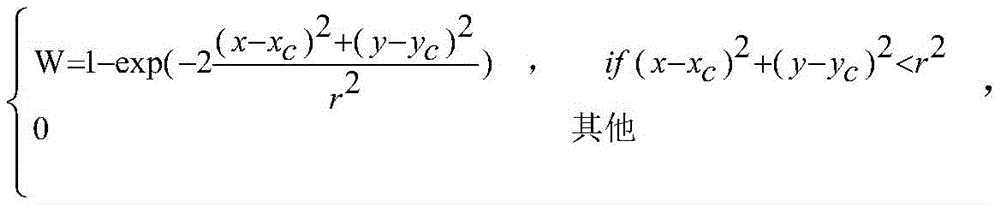
wherein x is the coordinate of the horizontal axis of the characteristic point in the final characteristic diagram, y is the coordinate of the vertical axis of the characteristic point in the final characteristic diagram, and x c Predicting the abscissa, y, of the center point for the nut c And (4) predicting the longitudinal axis coordinate of the central point of the nut, wherein r is the predicted value of the nut radius, and W is the weight adjustment value of the final target characteristic diagram.
According to the fault identification method for the loss of the railway wagon supporting plate nut, the preset threshold value is 95%.
According to the fault identification method for the loss of the railway wagon supporting plate nut, the labelImg is used as a square frame mark on the supporting plate subimage.
The invention has the beneficial effects that: the invention uses the image automatic identification technology to replace manual detection, can solve the fatigue problem of manual detection in repeated pictures for a long time, and can improve the detection efficiency and accuracy for the unified standard of the same fault.
The improved ResNet50 characteristic extraction network and the improved CenterNet network designed by the invention can identify the nut loss fault, and the detection capability of the invention has higher overlapping degree on the nut contour and has rotation invariance. According to the characteristics of faults and normal images, the positioning and classification in the image identification process are carried out in steps, the positioning mainly depends on the characteristics of bolts, and the identification mainly depends on the characteristics of nuts and edges, so that the accuracy of fault identification is improved.
Drawings
FIG. 1 is a block flow diagram of a fault identification method for missing a railroad freight car pallet nut according to the present invention;
FIG. 2 is a flow diagram of an improved ResNet50 feature extraction network image process;
FIG. 3 is a flow chart of an overall implementation of the method of the present invention;
FIG. 4 is a schematic diagram of a fault versus normal sample image comparison; the left side of the figure is the lost state of the nut, and the right side is the normal state of the nut.
Detailed Description
The technical solutions in the embodiments of the present invention will be clearly and completely described below with reference to the drawings in the embodiments of the present invention, and it is obvious that the described embodiments are only a part of the embodiments of the present invention, and not all of the embodiments. All other embodiments, which can be derived by a person skilled in the art from the embodiments given herein without making any creative effort, shall fall within the protection scope of the present invention.
It should be noted that the embodiments and features of the embodiments may be combined with each other without conflict.
The invention is further described with reference to the following drawings and specific examples, which are not intended to be limiting.
First embodiment, referring to fig. 1 to 4, the present invention provides a method for identifying a missing nut fault of a railway wagon pallet, including,
constructing an improved ResNet50 feature extraction network: sequentially comprises a convolution Layer, a maximum pooling Layer, a Layer1, a Layer2, a Layer3, a Layer4, an Up0, an Up1 and an Up 2;
constructing an improved centrnet network: the system comprises a positioning module and a target type prediction module; the positioning module comprises a central point positioning module, a central point offset module and a target radius identification module;
the output of the Up2 layer is used as the input of the positioning module;
acquiring a supporting plate sub-image containing a nut area, marking a corresponding position of a nut on the supporting plate sub-image by using a square frame to obtain a sample image, and forming a sample data set by all the sample images; the side length of the square frame is equal to the diameter of the nut;
carrying out first-stage training on the improved ResNet50 feature extraction network and the positioning module by adopting a sample image, and after the accuracy of the positioning module reaches a preset threshold value, training the trained improved ResNet50 feature extraction network and the trained CenterNet network together by adopting the sample image, wherein the trained integral network is used as a nut loss recognition network;
and acquiring an image of the supporting plate to be identified of the running railway wagon, identifying the image of the supporting plate to be identified by adopting a nut loss identification network, and acquiring a nut loss fault identification result.
Further, the method for acquiring sub-images of the plates comprises the following steps:
and acquiring an original image through a high-speed linear array camera arranged at a rail edge detection station, and intercepting a sub-image of the supporting plate on the original image according to the position information.
And the high-speed linear array camera obtains a 2D linear array image when the truck group passes through the detection station. Because the cameras are consistent, the shooting range and the size change are small, the supporting plate and the bolt subgraphs can be intercepted on the original image according to the hardware and the wheel base information, and the supporting plate and the bolt subgraphs can be used for training the recognition network.
According to the embodiment, through image analysis of the loss of the supporting plate nut and the normal nut, a split target detection network is designed, so that different characteristics are respectively emphasized in network positioning and classification, and the accuracy of an identification algorithm is improved. As shown in connection with fig. 3, a nut loss identification network may be deployed to the identification server, and the identification procedure is initiated when the server receives a signal that a vehicle has passed. When the vehicle passes and has a fault, alarm information is output and uploaded to a platform for manual confirmation and alarm.
When the sample images are obtained, the passing images in different weather, different time periods and different months are collected at detection stations in different areas, so that the comprehensiveness of the data samples is ensured, and preparation is made for subsequent models.
And when the image gray value calculation result of the supporting plate sub-image is less than 30, adjusting the brightness, and increasing the image brightness to enable the target to be more clearly visible.
Still further, with reference to fig. 2, the process of training the improved ResNet50 feature extraction network by using the sample image includes:
the method comprises the steps that a sample image is subjected to convolutional Layer convolution processing to obtain a characteristic image with the size of 1/2 of the sample image, then the characteristic image with the size of 1/4 of the sample image is obtained after maximum pooling Layer processing, the characteristic image with the size of 1/4 of the sample image is obtained after Layer1 characteristic extraction, the characteristic image with the size of 1/8 of the sample image is obtained after Layer2 characteristic extraction, the characteristic image with the size of 1/16 of the sample image is obtained after Layer3 characteristic extraction, and the characteristic image with the size of 1/32 of the sample image is obtained after Layer4 characteristic extraction;
the feature image of 1/32 sample image size output by the Layer4 Layer is subjected to convolution processing by a 1 × 1 convolution kernel to be used as the input of an Up0 Layer, and the Up0 Layer performs convolution processing on the input image to obtain the feature image of 1/32 sample image size after primary Up-sampling;
after 2 times of Up-sampling is carried out on the feature image with the size of 1/32 sample image after primary Up-sampling, the feature image with the size of 1/16 sample image output by the Layer3 Layer is added with the result after 1 multiplied by 1 convolution kernel convolution processing to obtain the input of the Up1 Layer; the size of the Up1 layer input image is 1/16 sample image;
after 2 times of Up sampling is carried out on the input of the Up1 Layer, the Up1 Layer is added with the result of carrying out 1 x 1 convolution kernel convolution processing on the feature image with the size of 1/8 sample image output by the Layer2 Layer, and then the input of the Up2 Layer is obtained; the size of the Up2 layer input image is 1/8 sample image;
after the input of the Up2 Layer is Up-sampled by 2 times and added with the result of 1 × 1 convolution kernel convolution processing of the characteristic image with the size of 1/4 sample image output by the Layer1 Layer, and obtaining a final characteristic diagram. The size of the final feature map is 1/4 of the sample image.
Still further, with reference to fig. 1, the process of training the positioning module includes:
the final characteristic graph passes through a central point positioning module and then the position of the central point of the nut is determined;
after the final characteristic graph passes through a central point offset module, central point offset displacement between a predicted central point and a standard central point of the nut is determined;
and determining the predicted value of the nut radius by the target radius identification module through the final characteristic diagram.
Still further, with reference to fig. 1, the process of training the target class prediction module includes:
the target type prediction module determines a target identification frame on the final characteristic diagram according to the obtained nut central point position, the central point offset displacement and the nut radius predicted value; carrying out weight adjustment on the final target feature map in the target identification frame by adopting a reverse Gaussian kernel function, and carrying out classification identification on the final target feature map after the weight adjustment to obtain a classification identification result; the identification result comprises that the nut is lost and the nut is not lost.
And (3) building and training a network:
network construction: according to the invention, a circular target detection algorithm is designed based on the CenterNet network according to the characteristics of the nut, so that target edge information can be better utilized, and the detection result and the target have higher overlapping degree. And optimizing the network structure according to the structural characteristics of the components during failure and normal times, and splitting, positioning and predicting the network. The method has the advantages that only the positioning position is determined without distinguishing the type during positioning, the Gaussian kernel function is used for increasing the weight of central data to reduce the weight of an edge area, and for nut loss and normal images, the used characteristics are mainly bolt characteristics, so that the positioning is simpler. When classification is carried out, the outer ring edge information weight for distinguishing the target type is increased, the influence of the inner bolt information is reduced, and the identification accuracy is improved.
A feature extraction network: the invention uses the resnet50 as a feature extraction network, but the traditional RestNet50 is down-sampled by 32 times, the diameter size of the shot image is about 40-55 pixels according to the identification component, and when the down-sampling is 32 times, the identification is influenced by less information of the target in the feature map. So that the feature map is subjected to FPN-like feature linking. The FPN structure has good detection effect when being used for multi-scale targets with large size difference, but the distance between a camera and a truck is unchanged, and the size and the shooting range of the targets are unchanged at a fixed detection station, so that the FPN structure has no requirement on multi-scale. By using the concept of feature fusion, the feature map is subjected to up-sampling and transverse fusion, so that the size of the feature map can be increased, and more target information is reserved. The feature extraction network structure is shown in fig. 2.
A target location classification branch (Head), a network layer for outputting location and category information:
the improved CenterNet is adopted to detect the round nut target, the fault point is detected as the nut loss, the normal target image is bolt and nut added with a gasket, and the fault image only leaves the bolt and leaves a gasket and supporting plate scratch mark or only the bolt per se. It can be seen from fig. 4 that the normal and fault targets are quasi-circular, the width and height of the rectangular detection of the original target detection network is predicted, only the radius r needs to be predicted after the detection is modified into the circular target detection, the prediction parameters are reduced, the area where the target is located can be better represented by the larger overlapping degree of the circular target and the rectangle, and the circular target has rotation invariance and can be better adapted to the small-range distorted station of the image.
In the embodiment of the improved centret network output layer, a target positioning and classification branch heat map (heatmap) in an original network is N feature maps, wherein N is the number of target categories, each feature map is responsible for predicting the target position of one category, and the same feature map both predicts the position and distinguishes the categories.
In the invention, the failure is that the nut and the gasket are lost, but the bolt still exists, and the characteristics of the target central area bolt are kept unchanged when the failure occurs and when the target central area bolt is normal. Therefore, when the feature of the fault image in the central point region is the same as that of the normal image, and when the Gaussian kernel function is used, the central point position weight is large, and the edge position weight is small, for classification, the features important for classification are faded, the fault image and the normal image are difficult to be accurately distinguished, the classification effect is influenced, and the false alarm is increased. Because the positioning information is mainly the characteristics of the target central area and the fault is similar to the characteristics of the central area of the normal image, the positioning and classifying functions of the original heatmap are split, only the positioning function is reserved, and different types of images are positioned by using the same characteristic diagram.
In the invention, a target type prediction module (ClassMap) is added on the basis of the CenterNet network, and after a target prediction central point, a displacement offset and a radius are obtained, type identification is carried out according to the information and the ClassMap.
Further, the target type prediction module adjusts the weights of the target edge and the center point of the final target feature map in the target identification frame by using a reverse gaussian kernel function in the process of classification identification, so that the weight of the position of the target center point is 0, and the weight of the target edge is 0.865. The inverse Gaussian kernel function can increase the influence of the edge on classification, reduce the influence of the central area and increase the identification accuracy. The overall network structure is shown in fig. 1.
The inverse gaussian kernel function is as follows:

wherein x is the coordinate of the horizontal axis of the characteristic point in the final characteristic diagram, y is the coordinate of the vertical axis of the characteristic point in the final characteristic diagram, and x c Predicting the abscissa, y, of the center point for the nut c And (3) predicting the coordinate of a longitudinal axis of the central point of the nut, wherein r is the predicted value of the radius of the nut, and W is the weight adjustment value of the final target characteristic diagram.
In the reverse Gaussian kernel function, if part indicates whether the feature points in the final feature graph are in the predicted nut range or not, if the feature points in the final feature graph are located within the predicted value of the nut radius, weighting is carried out by using a corresponding formula, and the influence of edge information on classification is increased. And when the characteristic points in the final characteristic diagram are positioned outside the predicted value of the nut radius, the weight is set to zero, and the classification is not influenced.
As an example, the preset threshold is 95%.
The invention adopts sectional type network training, preferentially trains the network branches of the target positioning, deviation and radius parts, and freezes the classified network branches; and unfreezing the classification network when the accuracy of the positioning network reaches 95%, and carrying out overall training on all models.
As an example, labelImg is used as a square box mark on the pallet subimage, the width of the square box being higher than the target diameter. And (5) correspondingly making the data set images and the labeled data one by one as training samples.
The specific implementation process of the invention is as follows: when the truck passes through the detection base station, the camera acquires a linear array image. And intercepting the partial image of the supporting plate by using the prior knowledge, hardware data and the like. And inputting the image into an identification network, and if a target of bolt loss is identified, outputting an alarm signal to an image area and uploading the alarm signal to a platform. Otherwise, it is determined to be normal, as shown in fig. 3.
Although the invention herein has been described with reference to particular embodiments, it is to be understood that these embodiments are merely illustrative of the principles and applications of the present invention. It is therefore to be understood that numerous modifications may be made to the illustrative embodiments and that other arrangements may be devised without departing from the spirit and scope of the present invention as defined by the appended claims. It should be understood that features described in different dependent claims and herein may be combined in ways different from those described in the original claims. It is also to be understood that features described in connection with individual embodiments may be used in other described embodiments.
Claims (5)
1. A fault identification method for the loss of a railway wagon supporting plate nut is characterized by comprising the following steps,
constructing an improved ResNet50 feature extraction network: sequentially comprises a convolution Layer, a maximum pooling Layer, a Layer1, a Layer2, a Layer3, a Layer4, an Up0, an Up1 and an Up 2;
constructing an improved centrnet network: the system comprises a positioning module and a target type prediction module; the positioning module comprises a central point positioning module, a central point offset module and a target radius identification module;
the output of the Up2 layer is used as the input of the positioning module;
acquiring a supporting plate subimage containing a nut area, marking a corresponding position of a nut on the supporting plate subimage by using a square frame to obtain a sample image, and forming a sample data set by all the sample images; the side length of the square frame is equal to the diameter of the nut;
carrying out first-stage training on the improved ResNet50 feature extraction network and the positioning module by adopting a sample image, and after the accuracy of the positioning module reaches a preset threshold value, training the trained improved ResNet50 feature extraction network and the trained CenterNet network together by adopting the sample image, wherein the trained integral network is used as a nut loss recognition network;
acquiring a to-be-identified supporting plate image of a running railway wagon, identifying the to-be-identified supporting plate image by adopting a nut loss identification network, and acquiring a nut loss fault identification result;
the process of training the improved ResNet50 feature extraction network by using the sample image comprises the following steps:
the method comprises the steps that a sample image is subjected to convolutional Layer convolution processing to obtain a characteristic image with the size of 1/2 of the sample image, then the characteristic image with the size of 1/4 of the sample image is obtained after maximum pooling Layer processing, the characteristic image with the size of 1/4 of the sample image is obtained after Layer1 characteristic extraction, the characteristic image with the size of 1/8 of the sample image is obtained after Layer2 characteristic extraction, the characteristic image with the size of 1/16 of the sample image is obtained after Layer3 characteristic extraction, and the characteristic image with the size of 1/32 of the sample image is obtained after Layer4 characteristic extraction;
the feature image of 1/32 sample image size output by the Layer4 Layer is subjected to convolution processing by a 1 × 1 convolution kernel to be used as the input of an Up0 Layer, and the Up0 Layer performs convolution processing on the input image to obtain the feature image of 1/32 sample image size after primary Up-sampling;
after 2 times of Up-sampling is carried out on the feature image with the size of 1/32 sample image after primary Up-sampling, the feature image with the size of 1/16 sample image output by the Layer3 Layer is added with the result of 1 multiplied by 1 convolution kernel convolution processing to obtain the input of the Up1 Layer;
after 2 times of Up sampling is carried out on the input of the Up1 Layer, the Up1 Layer is added with the result of carrying out 1 x 1 convolution kernel convolution processing on the feature image with the size of 1/8 sample image output by the Layer2 Layer, and then the input of the Up2 Layer is obtained;
after 2 times of Up-sampling is carried out on the input of the Up2 Layer, the Up 2-time Up-sampling is added with the result of 1/4 sample image size characteristic image output by the Layer1 Layer after 1 × 1 convolution kernel convolution processing, and then a final characteristic image is obtained;
the process of training the positioning module comprises the following steps:
the final characteristic graph passes through a central point positioning module and then the position of the central point of the nut is determined;
after the final characteristic graph passes through a central point offset module, central point offset displacement between a predicted central point and a standard central point of the nut is determined;
the final characteristic diagram determines a predicted value of the nut radius through a target radius identification module;
the process of training the target class prediction module comprises the following steps:
the target type prediction module determines a target recognition frame on the final characteristic diagram according to the obtained nut central point position, the central point offset displacement and the nut radius predicted value; carrying out weight adjustment on the final target feature map in the target identification frame by adopting a reverse Gaussian kernel function, and then carrying out classification identification on the final target feature map after weight adjustment to obtain a classification identification result; the identification result comprises that the nut is lost and the nut is not lost;
the target type prediction module adjusts the weights of a target edge and a central point of a final target feature map in a target recognition frame by using a reverse Gaussian kernel function in the process of classification recognition, so that the weight of the position of the target central point is 0 at minimum, and the weight of the target edge is 0.865 at maximum;
the inverse gaussian kernel function is as follows:

wherein x is the coordinate of the horizontal axis of the characteristic point in the final characteristic diagram, y is the coordinate of the vertical axis of the characteristic point in the final characteristic diagram, and x c Predicting the abscissa, y, of the center point for the nut c And (4) predicting the longitudinal axis coordinate of the central point of the nut, wherein r is the predicted value of the nut radius, and W is the weight adjustment value of the final target characteristic diagram.
2. A method for fault identification of rail wagon pallet nut loss as claimed in claim 1,
the method for acquiring the supporting plate sub-images comprises the following steps:
and acquiring an original image through a high-speed linear array camera installed in the rail edge detection station, and intercepting a sub-image of the supporting plate on the original image according to the position information.
3. A method for fault identification of rail wagon pallet nut loss as claimed in claim 2,
and when the image gray value calculation result of the supporting plate sub-image is less than 30, adjusting the brightness.
4. A fault identification method of a railway wagon pallet nut loss according to claim 1,
the preset threshold is 95%.
5. A fault identification method of a railway wagon pallet nut loss according to claim 1,
the plate subimages are marked with squares using labelImg.
Priority Applications (1)
| Application Number | Priority Date | Filing Date | Title |
|---|---|---|---|
| CN202210849772.7A CN115170923B (en) | 2022-07-19 | 2022-07-19 | Fault identification method for loss of railway wagon supporting plate nut |
Applications Claiming Priority (1)
| Application Number | Priority Date | Filing Date | Title |
|---|---|---|---|
| CN202210849772.7A CN115170923B (en) | 2022-07-19 | 2022-07-19 | Fault identification method for loss of railway wagon supporting plate nut |
Publications (2)
| Publication Number | Publication Date |
|---|---|
| CN115170923A CN115170923A (en) | 2022-10-11 |
| CN115170923B true CN115170923B (en) | 2023-04-07 |
Family
ID=83496040
Family Applications (1)
| Application Number | Title | Priority Date | Filing Date |
|---|---|---|---|
| CN202210849772.7A Active CN115170923B (en) | 2022-07-19 | 2022-07-19 | Fault identification method for loss of railway wagon supporting plate nut |
Country Status (1)
| Country | Link |
|---|---|
| CN (1) | CN115170923B (en) |
Families Citing this family (3)
| Publication number | Priority date | Publication date | Assignee | Title |
|---|---|---|---|---|
| CN116580277B (en) * | 2023-05-10 | 2024-01-30 | 哈尔滨市科佳通用机电股份有限公司 | Deep learning-based bottom electronic identification tag missing image identification method |
| CN117152096B (en) * | 2023-09-05 | 2026-01-06 | 河北科技大学 | A method and apparatus for bolt inspection |
| CN118658004B (en) * | 2024-07-11 | 2025-02-07 | 慧铁科技股份有限公司 | A fault detection method for the loss of bolts at the end of rolling bearings of railway freight cars |
Family Cites Families (9)
| Publication number | Priority date | Publication date | Assignee | Title |
|---|---|---|---|---|
| CN111091545B (en) * | 2019-12-12 | 2021-01-22 | 哈尔滨市科佳通用机电股份有限公司 | Method for detecting loss fault of bolt at shaft end of rolling bearing of railway wagon |
| CN111080600A (en) * | 2019-12-12 | 2020-04-28 | 哈尔滨市科佳通用机电股份有限公司 | Fault identification method for split pin on spring supporting plate of railway wagon |
| CN111079818A (en) * | 2019-12-12 | 2020-04-28 | 哈尔滨市科佳通用机电股份有限公司 | Railway wagon coupler joist breakage detection method |
| CN111274930B (en) * | 2020-04-02 | 2022-09-06 | 成都鼎安华智慧物联网股份有限公司 | Helmet wearing and smoking behavior identification method based on deep learning |
| CN112232449B (en) * | 2020-12-14 | 2021-04-27 | 浙江大华技术股份有限公司 | Neural network training method, electronic device, and storage medium |
| CN113420819B (en) * | 2021-06-25 | 2022-12-06 | 西北工业大学 | Lightweight underwater target detection method based on CenterNet |
| CN113255837A (en) * | 2021-06-29 | 2021-08-13 | 南昌工程学院 | Improved CenterNet network-based target detection method in industrial environment |
| CN113869246B (en) * | 2021-09-30 | 2022-04-01 | 安徽大学 | Wheat stripe rust germ summer spore microscopic image detection method based on improved CenterNet technology |
| CN114743084B (en) * | 2022-03-22 | 2024-11-01 | 三峡大学 | A transmission line fault detection method based on super-resolution preprocessing and improved YOLOv5x |
-
2022
- 2022-07-19 CN CN202210849772.7A patent/CN115170923B/en active Active
Also Published As
| Publication number | Publication date |
|---|---|
| CN115170923A (en) | 2022-10-11 |
Similar Documents
| Publication | Publication Date | Title |
|---|---|---|
| CN115170923B (en) | Fault identification method for loss of railway wagon supporting plate nut | |
| CN111784633B (en) | Insulator defect automatic detection algorithm for electric power inspection video | |
| CN114627286B (en) | Detection method of weighbridge intrusion based on PSPNet and improved YOLOv4 | |
| CN110261436A (en) | Rail deformation detection method and system based on infrared thermal imaging and computer vision | |
| CN114926456A (en) | Rail foreign matter detection method based on semi-automatic labeling and improved deep learning | |
| CN111080600A (en) | Fault identification method for split pin on spring supporting plate of railway wagon | |
| CN110910354A (en) | Road detection vehicle and road detection method and device | |
| CN113788051A (en) | Train on-station running state monitoring and analyzing system | |
| CN112329858B (en) | Image recognition method for breakage fault of anti-loosening iron wire of railway motor car | |
| CN113221839B (en) | Automatic truck image identification method and system | |
| CN113837007B (en) | Bridge load distribution identification method based on vehicle matching deep learning in bridge monitoring video | |
| CN111723706A (en) | Box type freight car door opening monitoring device and system based on raspberry group | |
| CN111080607B (en) | Rolling bearing oil slinging fault detection method based on image recognition | |
| CN113516629A (en) | TFDS passed the job intelligent detection system | |
| CN110991447B (en) | Train number accurate positioning and identifying method based on deep learning | |
| CN111723704A (en) | Raspberry pie-based van body door opening monitoring method | |
| WO2025145485A1 (en) | Railway foreign object intrusion detection method and system, device and medium | |
| CN115272236A (en) | A method for detecting the loading state of rolled steel goods in railway transportation | |
| CN118247215A (en) | Method for detecting loss of fastening bolt of railway wagon locking plate based on deep learning | |
| CN114511519A (en) | An image processing-based detection method for missing bolts at the bottom of trains | |
| CN117274967A (en) | A multi-modal fusion license plate recognition algorithm based on convolutional neural network | |
| CN110316630B (en) | Deviation early warning method and system for installation angle of elevator camera | |
| Wu et al. | Automated anomaly detection of catenary split pins using unsupervised learning | |
| CN107967445A (en) | A kind of car installs the intelligent checking system and method for skylight additional | |
| CN111080599A (en) | A fault identification method for the hook lift rod of a railway freight car |
Legal Events
| Date | Code | Title | Description |
|---|---|---|---|
| PB01 | Publication | ||
| PB01 | Publication | ||
| SE01 | Entry into force of request for substantive examination | ||
| SE01 | Entry into force of request for substantive examination | ||
| GR01 | Patent grant | ||
| GR01 | Patent grant |