CN115087619A - Process for the preparation of phosphoric acid and calcium sulphate of clinker processing of quality suitable for commercial and industrial use - Google Patents
Process for the preparation of phosphoric acid and calcium sulphate of clinker processing of quality suitable for commercial and industrial use Download PDFInfo
- Publication number
- CN115087619A CN115087619A CN202180008341.1A CN202180008341A CN115087619A CN 115087619 A CN115087619 A CN 115087619A CN 202180008341 A CN202180008341 A CN 202180008341A CN 115087619 A CN115087619 A CN 115087619A
- Authority
- CN
- China
- Prior art keywords
- acid
- calcium sulphate
- suspension
- unit
- phosphoric acid
- Prior art date
- Legal status (The legal status is an assumption and is not a legal conclusion. Google has not performed a legal analysis and makes no representation as to the accuracy of the status listed.)
- Granted
Links
Images


Classifications
-
- C—CHEMISTRY; METALLURGY
- C01—INORGANIC CHEMISTRY
- C01B—NON-METALLIC ELEMENTS; COMPOUNDS THEREOF; METALLOIDS OR COMPOUNDS THEREOF NOT COVERED BY SUBCLASS C01C
- C01B17/00—Sulfur; Compounds thereof
- C01B17/69—Sulfur trioxide; Sulfuric acid
- C01B17/74—Preparation
-
- C—CHEMISTRY; METALLURGY
- C01—INORGANIC CHEMISTRY
- C01B—NON-METALLIC ELEMENTS; COMPOUNDS THEREOF; METALLOIDS OR COMPOUNDS THEREOF NOT COVERED BY SUBCLASS C01C
- C01B17/00—Sulfur; Compounds thereof
- C01B17/48—Sulfur dioxide; Sulfurous acid
- C01B17/50—Preparation of sulfur dioxide
- C01B17/501—Preparation of sulfur dioxide by reduction of sulfur compounds
- C01B17/506—Preparation of sulfur dioxide by reduction of sulfur compounds of calcium sulfates
-
- C—CHEMISTRY; METALLURGY
- C01—INORGANIC CHEMISTRY
- C01B—NON-METALLIC ELEMENTS; COMPOUNDS THEREOF; METALLOIDS OR COMPOUNDS THEREOF NOT COVERED BY SUBCLASS C01C
- C01B25/00—Phosphorus; Compounds thereof
- C01B25/16—Oxyacids of phosphorus; Salts thereof
- C01B25/18—Phosphoric acid
- C01B25/22—Preparation by reacting phosphate-containing material with an acid, e.g. wet process
- C01B25/222—Preparation by reacting phosphate-containing material with an acid, e.g. wet process with sulfuric acid, a mixture of acids mainly consisting of sulfuric acid or a mixture of compounds forming it in situ, e.g. a mixture of sulfur dioxide, water and oxygen
- C01B25/232—Preparation by reacting phosphate containing material with concentrated sulfuric acid and subsequently lixiviating the obtained mass, e.g. clinker process
-
- C—CHEMISTRY; METALLURGY
- C01—INORGANIC CHEMISTRY
- C01B—NON-METALLIC ELEMENTS; COMPOUNDS THEREOF; METALLOIDS OR COMPOUNDS THEREOF NOT COVERED BY SUBCLASS C01C
- C01B25/00—Phosphorus; Compounds thereof
- C01B25/16—Oxyacids of phosphorus; Salts thereof
- C01B25/18—Phosphoric acid
- C01B25/234—Purification; Stabilisation; Concentration
-
- C—CHEMISTRY; METALLURGY
- C01—INORGANIC CHEMISTRY
- C01F—COMPOUNDS OF THE METALS BERYLLIUM, MAGNESIUM, ALUMINIUM, CALCIUM, STRONTIUM, BARIUM, RADIUM, THORIUM, OR OF THE RARE-EARTH METALS
- C01F11/00—Compounds of calcium, strontium, or barium
- C01F11/02—Oxides or hydroxides
- C01F11/08—Oxides or hydroxides by reduction of sulfates
-
- C—CHEMISTRY; METALLURGY
- C01—INORGANIC CHEMISTRY
- C01F—COMPOUNDS OF THE METALS BERYLLIUM, MAGNESIUM, ALUMINIUM, CALCIUM, STRONTIUM, BARIUM, RADIUM, THORIUM, OR OF THE RARE-EARTH METALS
- C01F11/00—Compounds of calcium, strontium, or barium
- C01F11/46—Sulfates
- C01F11/468—Purification of calcium sulfates
-
- C—CHEMISTRY; METALLURGY
- C04—CEMENTS; CONCRETE; ARTIFICIAL STONE; CERAMICS; REFRACTORIES
- C04B—LIME, MAGNESIA; SLAG; CEMENTS; COMPOSITIONS THEREOF, e.g. MORTARS, CONCRETE OR LIKE BUILDING MATERIALS; ARTIFICIAL STONE; CERAMICS; REFRACTORIES; TREATMENT OF NATURAL STONE
- C04B11/00—Calcium sulfate cements
- C04B11/005—Preparing or treating the raw materials
-
- C—CHEMISTRY; METALLURGY
- C04—CEMENTS; CONCRETE; ARTIFICIAL STONE; CERAMICS; REFRACTORIES
- C04B—LIME, MAGNESIA; SLAG; CEMENTS; COMPOSITIONS THEREOF, e.g. MORTARS, CONCRETE OR LIKE BUILDING MATERIALS; ARTIFICIAL STONE; CERAMICS; REFRACTORIES; TREATMENT OF NATURAL STONE
- C04B11/00—Calcium sulfate cements
- C04B11/26—Calcium sulfate cements strating from chemical gypsum; starting from phosphogypsum or from waste, e.g. purification products of smoke
-
- C—CHEMISTRY; METALLURGY
- C04—CEMENTS; CONCRETE; ARTIFICIAL STONE; CERAMICS; REFRACTORIES
- C04B—LIME, MAGNESIA; SLAG; CEMENTS; COMPOSITIONS THEREOF, e.g. MORTARS, CONCRETE OR LIKE BUILDING MATERIALS; ARTIFICIAL STONE; CERAMICS; REFRACTORIES; TREATMENT OF NATURAL STONE
- C04B7/00—Hydraulic cements
- C04B7/02—Portland cement
- C04B7/04—Portland cement using raw materials containing gypsum, i.e. processes of the Mueller-Kuehne type
-
- C—CHEMISTRY; METALLURGY
- C01—INORGANIC CHEMISTRY
- C01P—INDEXING SCHEME RELATING TO STRUCTURAL AND PHYSICAL ASPECTS OF SOLID INORGANIC COMPOUNDS
- C01P2004/00—Particle morphology
- C01P2004/60—Particles characterised by their size
- C01P2004/61—Micrometer sized, i.e. from 1-100 micrometer
-
- C—CHEMISTRY; METALLURGY
- C01—INORGANIC CHEMISTRY
- C01P—INDEXING SCHEME RELATING TO STRUCTURAL AND PHYSICAL ASPECTS OF SOLID INORGANIC COMPOUNDS
- C01P2004/00—Particle morphology
- C01P2004/60—Particles characterised by their size
- C01P2004/62—Submicrometer sized, i.e. from 0.1-1 micrometer
-
- C—CHEMISTRY; METALLURGY
- C04—CEMENTS; CONCRETE; ARTIFICIAL STONE; CERAMICS; REFRACTORIES
- C04B—LIME, MAGNESIA; SLAG; CEMENTS; COMPOSITIONS THEREOF, e.g. MORTARS, CONCRETE OR LIKE BUILDING MATERIALS; ARTIFICIAL STONE; CERAMICS; REFRACTORIES; TREATMENT OF NATURAL STONE
- C04B2235/00—Aspects relating to ceramic starting mixtures or sintered ceramic products
- C04B2235/02—Composition of constituents of the starting material or of secondary phases of the final product
- C04B2235/30—Constituents and secondary phases not being of a fibrous nature
- C04B2235/44—Metal salt constituents or additives chosen for the nature of the anions, e.g. hydrides or acetylacetonate
- C04B2235/447—Phosphates or phosphites, e.g. orthophosphate or hypophosphite
Landscapes
- Chemical & Material Sciences (AREA)
- Organic Chemistry (AREA)
- Inorganic Chemistry (AREA)
- Engineering & Computer Science (AREA)
- Ceramic Engineering (AREA)
- Materials Engineering (AREA)
- Structural Engineering (AREA)
- Life Sciences & Earth Sciences (AREA)
- Geology (AREA)
- Compounds Of Alkaline-Earth Elements, Aluminum Or Rare-Earth Metals (AREA)
Abstract
The invention relates to a method for producing phosphorus by reacting crude phosphate with sulfuric acidAn acid and a process for purifying calcium sulfate, the process comprising the steps of: a) decomposing the crude phosphate with concentrated sulfuric acid in a first step and converting to calcium sulfate in the form of dihydrate, hemihydrate or a combination of hemihydrate and dihydrate and phosphoric acid; b) separating calcium sulphate as a solid from the liquid phase of the suspension obtained; c) treating the calcium sulphate separated from the phosphoric acid in step b) and/or the reserve calcium sulphate/phosphogypsum with an acid to obtain a calcium sulphate with a purified content of calcium and containing P 2 O 5 A suspension of the acid solution of (a); d) the purified calcium sulphate is separated as a solid from the liquid phase of the suspension obtained after step c); e) the P-containing compound obtained in step d) 2 O 5 The liquid phase of (a) is used as feed to step a), in particular as part of the sulfuric acid required for decomposing the crude phosphate; and/or the P-containing compound obtained in step d) 2 O 5 Is used as a process for treating the feed from the stockpiled phosphogypsum according to step c) to obtain a product with purified calcium sulphate and containing P 2 O 5 Is then processed as in step d) and step e).
Description
Technical Field
The present application relates to a process for the preparation of phosphoric acid and purified calcium sulphate, which can be used for the preparation of cement clinker and sulphuric acid, and to an apparatus for carrying out the process.
Background
The quality of phosphogypsum obtained from a phosphoric acid process depends on various factors, such as the crude phosphate used and the process conditions under which the crude phosphate is decomposed with sulphuric acid. Depending on the Phosphoric Acid process chosen, up to 98.5% phosphorus yield has been achieved up to now from crude phosphates by wet-chemical methods (see, for example, Ullmann's Encyclopedia of Industrial Chemistry,5th edition,1991, vol. A19, "phosphorus Acid and phosphorus", pp. 470-473).
Calcium sulfate is a waste product of the phosphoric acid production industry and is produced in dihydrate and/or hemihydrate form during the decomposition of phosphate ore with sulfuric acid. The calcium sulphate formed in the phosphoric acid production is also known as phosphogypsum.
Calcium sulfate has three forms: dihydrate (also known as gypsum), hemihydrate (also known as bixbyite) and anhydrite. This occurs during the phosphoric acid production, which is characterized by a different amount of crystal water. There are two dihydrate species, the hemihydrate has half the water of crystallization, and the anhydrous crystal does not have any water of crystallization.
The reaction kinetics and thermodynamic stability of different forms of calcium sulfate in aqueous media have been studied extensively, as can be read, for example, in the review article by Freyer and Voigt (Monatsheftete fur Chemie,134,693-719, 2003). It is well known that the dihydrate form is a stable form up to about 50 ℃. In addition to this, anhydrite is the stable phase. In contrast, hemihydrate is metastable throughout the temperature range. Accordingly, starting from gypsum, in the temperature range of 42-60 ℃ (different temperature ranges are assumed in the literature), the aqueous solution is expected to gradually convert to anhydrous gypsum. The solubility of anhydrite decreases continuously with increasing temperature. On the other hand, for gypsum, the solubility initially rises to a high point at about 50 ℃ and then decreases slightly as the temperature increases. This results in the two forms having molar solubilities which cross over the temperature range mentioned above, above which anhydrous gypsum and the precipitate below the dihydrate are the less soluble salts. Over the entire range, hemihydrate is more soluble than the other two forms.
The document American mineral, vol.52,1967, Hardie states that sulfuric acid has a great influence on the kinetics of the recrystallization of gypsum to anhydrite, due to the altered activity of water. The activity of the water lowers the equilibrium temperature between the dihydrate and the anhydrite, thereby facilitating recrystallization to anhydrite at lower temperatures.
The kinetic studies on the recrystallization of gypsum into anhydrite and vice versa are mostly based on mineralogical time measurements of the precipitated product. The mechanism of recrystallization has not been clearly explained.
Calcium sulfate produced in the conventional method for producing phosphoric acid contains impurities such as phosphorus, fluorine, radioactive components and heavy metals, and thus calcium sulfate is currently used only in a limited amount, for example, as a cement admixture, a fertilizer, a mortar or a road construction material, and thus only 15% of calcium sulfate produced in phosphoric acid production is used worldwide. The remaining 85% of the annual production of calcium sulfate is either stored or dumped into the sea.
Due to the current environmental conditions, either ore deposits for landfill of phosphogypsum or dumping of phosphogypsum in the sea are only approved under more severe conditions or not at all.
The processed crude phosphate can be used for phosphogypsum preparation by a possible phosphoric acid process according to the following processing method: 1. calcining, 2, floating, 3, converting into monocalcium phosphate or dicalcium phosphate by using inorganic acid. The methods mentioned are known to the skilled worker, for example, Physical and thermal protocols of phosphate orders-An overview; int.j.miner.process.85(2008) 59-84; Abdel-Zaher M.Abouzeid; the Fertilizer Manual 3rd Edition; published by UNIDO & IFDC,1998 edition; 07923503249780792350323 parts of ISBN; pyroprocessing for the minerals industry; thyssenkrupp Polysius; identifier:1625/D (1.012.11 Stu).
Depending on the preparation process, 4 to 5 tons of calcium sulfate are produced for every 1 ton of phosphoric acid produced. Due to the different natural qualities/compositions of phosphate ore and the different process parameters for preparing phosphoric acid, calcium sulfate of different quality is also produced accordingly.
The requirement for the treatment of the prepared calcium sulphate or phosphogypsum is increased, which brings complex challenges to the phosphoric acid preparation industry. For manufacturing enterprises, the lifetime storage of phosphogypsum is estimated to be up to $ 25 per ton of gypsum.
As an example of the possible commercial and large-scale use of calcium sulphate/phosphogypsum, the conversion of phosphogypsum into cement clinker or cement and SO is often mentioned in the literature 2 Or sulfuric acid. The conversion of gypsum and phosphogypsum into cement and sulphuric acid according to the Muller-Kuhne process or the OSW-Krupp process has long been known, see for example patent specification AT 292539B.
DE 3222721C 2 describes an improved process based on the Muller-Kuhne process, i.e. gypsum is partially dewatered upstream by centrifugation and dried in two stages downstream, the SO-containing product discharged from the first drying stage 2 The off-gas of (a) is fed directly to the gas scrubber of the sulfuric acid plant. The process does not mention the quality of certain components of phosphogypsum, nor the SO of the downstream sulphuric acid plant 2 The quality of the exhaust gas.
Comparable processes according to the anhydrite process, like the process according to the invention, are known from the patent literature (Hammaren US 2531977 and Weterings EP 0044120).
Patent specification US 2531977 describes a process in which a phosphorus-containing calcium salt is first converted into calcium sulfate, which in a second step is converted into anhydrite. According to said patent, this second conversion step requires a reaction time of at least 2 hours. It is described that this results in an increase in the yield of phosphorus, while also allowing the anhydrite to be purified. However, the patent text does not give any specific information about the increase in production or the cleaning efficiency of the process. As described in patent EP 004120, one disadvantageous fact is that according to the process only about half of the calcium sulphate can be converted into anhydrite, since according to the process the water balance of the phosphoric acid plant is otherwise severely negatively affected.
EP 004120 describes an improved process of US 2531977. In order not to affect the water balance of the phosphoric acid plant, in the process, the dihydrate-phosphoric acid suspension obtained after the first step is separated into a fine fraction and a coarse fraction at great expense by means of several hydrocyclones, the liquid fraction is withdrawn through a thickener in order to avoid as far as possible an effect on the water balance, and finally separated by means of a further filtration device before the dihydrate is fed to the recrystallization step to form anhydrite. This process has some significant disadvantages, namely (i) the need for various additional process steps, such as hydrocyclones, concentrators and additional filtration units, (ii) the necessity to discard 5-15% of the dihydrate, (iii) the interconnection and operating costs of the equipment are greatly increased, and therefore integration with existing equipment is significantly more difficult, and (iv) significantly higher investment and operating costs will result from the process.
In Journal of Radiation Research and Applied Sciences; 10; 2017, Kandil et al, describe a process for the preparation of ammonium sulphate from phosphogypsum, where the first step uses sulphuric acid to leach P 2 O 5 F, lanthanides and other ingredients. The process is independent of the conversion of phosphogypsum into cement clinker and sulphuric acid.
EP 0041761 Al relates to a process for converting phosphogypsum into cement clinker and SO 2 And (4) gas, namely recrystallizing the calcium sulfate dihydrate into anhydrous calcium sulfate. In anhydrous calcium sulfate, P 2 O 5 May amount to less than 0.01 wt% and fluorine may amount to less than 0.05 wt%. The calcium component and sulfur dioxide can be recovered from the anhydrous gypsum thus obtained at high temperature. The possibility of recycling the spent sulfuric acid to the phosphoric acid process is mentioned, but without taking into account influencing factors, such as the particle size and the solid to liquid ratio (S/L) of the gypsum, which have a direct influence on the water balance of the phosphoric acid complex.
CA 886485A relates to a method for treating dihydrate gypsum in phosphoric acid production to reduce P 2 O 5 The content is determined by recrystallizing the dihydrate gypsum in an acid at 50 to 150 ℃ to form hemihydrate gypsum or anhydrite gypsum, the acid concentration being 0.5 to 60% by weight. The residence time is from 0.5 to 2 hours. The obtained gypsum can be used as an additive in the cement industry.
CN 101486536 a relates to a method for treating phosphogypsum with sulfuric acid. Its main purpose is to reduce the phosphorus in gypsum. After treatment with sulfuric acid, the gypsum is further neutralized with a calcium product. Gypsum treated in this manner will be used as a feed for cement or as an additive.
CN 105859167 a describes a method for preparing white anhydrous calcium sulfate. Screened phosphogypsum as starting material is treated by sulphuric acid and an extractant, in particular to reduce the phosphorus content.
GB 1007898 relates to a process for the preparation of phosphoric acid based on the HDH (hemihydrate-dihydrate) process. This is achieved by setting the process parameters for the respective hydration.
GB 1128104 relates to a process for the preparation of concentrated phosphoric acid wherein the gypsum is in the form of anhydrite having reduced P 2 O 5 And the content of fluorine.
Singh and Garg; production of modified phosphorus for center Manufacture; journal of Scientific & Industrial Research; 61; 2002 reports the purification of phosphogypsum in terms of phosphorus and fluoride impurities, a process which combines washing of phosphogypsum with wet sieving of the suspension to a particle size of over 300 μm. The disadvantage of this process is that depletion of P or F is only possible to a certain extent, successful purification depends mainly on the nature of the gypsum and the associated particle size distribution, and a large share of phosphogypsum is produced as waste.
Aliedeh;Factorial Design Study of P 2 O 5 Reduction for Jordania phosphorus using Sulfuric and Nitric Acids Solutions; journal of Chemical Technology and metals, 53,2018, selected a method of wet Chemical leaching of gypsum using nitric acid and sulfuric acid, respectively, with particular attention paid to reducing the P content. The concentrations of the two acids used are each H 2 SO 4 0.5 to 1.5% by weight of (A) and HNO 3 1 to 5 wt%. According to the results, the number of washes had a great influence on the leaching behavior, while the influence of the concentration and the S/L ratio was small. From the leaching results presented, it is clear that a large amount of washing liquid is required.
The prior art processes provide for improved phosphorus yields from crude phosphate. There is also a need for improvement in the purification of the calcium sulphate obtained.
Leaching efficiency refers to the percentage of the substance under consideration that is transferred (or extracted) from the starting phase (e.g. solid) to another phase (e.g. liquid) based on the total amount of the substance under consideration in the starting phase.
Only the respective individual processes, such as the preparation of phosphogypsum, its thermal decomposition into cement clinker and sulphur dioxide, are generally described in one document. Only occasionally may a possible connection to an upstream and/or downstream process be mentioned.
A prerequisite for the use of calcium sulphate/phosphogypsum as a base material for clinker production is that certain constituents in phosphogypsum meet limits or guidelines which have a negative effect on the quality of the cement produced from the clinker. Including phosphorus, fluoride and possibly radioactive components.
It is an object of the present invention to provide a process for the preparation of phosphoric acid and purified calcium sulphate in such a way that the maximum P possible is obtained 2 O 5 Yield and the purified calcium sulphate (phosphogypsum) can be used on an industrial scale for the preparation of valuable products to meet environmental and economic requirements. Another object is to improve or optimize the leaching efficiency and filterability of phosphogypsum and calcium sulphate, respectively.
According to the invention, this object is achieved by a method according to claim 1. In particular, the object is achieved by a process for the preparation of phosphoric acid and the purification of calcium sulfate by reacting a crude phosphate with sulfuric acid, comprising the steps of:
a) decomposing the crude phosphate with concentrated sulfuric acid in a first step and converting to calcium sulfate in the form of dihydrate, hemihydrate or a combination of hemihydrate and dihydrate and phosphoric acid;
b) separating calcium sulphate as a solid from the liquid phase of the suspension obtained;
c) treating the calcium sulphate separated from the phosphoric acid in step b) and/or the stock calcium sulphate/phosphogypsum with an acid to obtain a suspension with purified calcium sulphate and an acid solution containing P2O 5;
d) the purified calcium sulphate is separated as a solid from the liquid phase of the suspension obtained after step c);
e) e1) converting the P-containing fraction obtained in step d) 2 O 5 The liquid phase of (a) is used as feed to step a), in particular as part of the sulfuric acid required for decomposing the crude phosphate; and/or
e2) The P-containing compound obtained in step d) 2 O 5 Is used as a feed for treating phosphogypsum from stock according to step c) to obtain a product with purified calcium sulphate and containing P 2 O 5 Of an acid solution.
According to the invention, in a further sense, this object is also achieved by a method according to claim 2. In particular, this relates to a process for the preparation of sulphuric acid and cement clinker, wherein the process comprises the steps of:
a) decomposing the crude phosphate with concentrated sulfuric acid in a first step and converting to calcium sulfate in the form of dihydrate, hemihydrate or a combination of hemihydrate and dihydrate and phosphoric acid;
b) separating calcium sulphate as a solid from the liquid phase of the suspension obtained;
c) treating the calcium sulphate separated from the phosphoric acid in step b) and/or calcium sulphate/phosphogypsum from a reserve with an acid to obtain calcium sulphate with a purification and containing P 2 O 5 A suspension of the acid solution of (a);
d) separating the purified calcium sulphate after step c) as a solid from the liquid phase of the resulting suspension;
e) mixing the separated and purified calcium sulfate obtained in the step d) with an additive and a reducing agent to obtain a raw material mixture for preparing cement clinker;
f) burning the raw mix to obtain cement clinker, wherein sulphur dioxide is formed as exhaust gas; and
g) the formed sulphur dioxide is supplied as a raw material to a sulphuric acid production for producing sulphuric acid, wherein the produced sulphuric acid can be used as a feed in a phosphoric acid production and/or for other uses.
In a preferred embodiment of the above process e1) contains P from step d) 2 O 5 Is used as feed in step a), in particular as part of the sulfuric acid required for the decomposition of the crude phosphate, and/or e2) the P-containing product obtained from step d) 2 O 5 As feed with the liquid phase ofTreating phosphogypsum from the store according to step c) to obtain a mixture with purified calcium sulphate and containing P 2 O 5 Of an acid solution.
The following explanations of the methods apply to both methods of the present invention, as long as they apply and are not otherwise specified. They are also suitable, where applicable and not stated otherwise, for the apparatus according to the invention and the devices used therein mentioned below. The details of method steps or apparatus relating only to a more comprehensive method or more comprehensive device are relevant to it by nature.
The process according to the invention is in particular an integrated process. In the integrated process, the integrated approach from phosphogypsum to calcium sulphate or to cement clinker and sulphur dioxide as a whole concept enables a coordination of various dependency/influencing factors to optimize the process selection and the flexibility of process control associated therewith, which is possible to connect to existing phosphoric and sulphuric acid plant complex. Thus, all process parameters and process stages of the overall composite plant can be coordinated to achieve a specific product quality starting from variable feed components, such as reactant properties of the apatite used in the phosphoric acid production or the currently produced or stockpiled phosphogypsum. This has not been considered so far. Combinations of features of the integrated method according to the invention are not available from the prior art.
Hereinafter, the terms composite device and device are used interchangeably herein. The separated liquid phase obtained in step d) may be introduced as a feed into a reaction unit for the production of phosphoric acid.
By the method according to the invention, impurities that adversely affect the quality of the cement produced from the clinker, such as phosphorus, fluorine and possibly radioactive constituents, can be removed from the calcium sulphate/phosphogypsum, so that the existing limit values or guideline values for such impurities in the clinker can be compounded. One advantage of this process is flexibility, since the P required for the phosphoric acid process can be adjusted and controlled by matching the parameters 2 O 5 The degree of optimization of the yield and thus also the purification of phosphogypsum can be adjusted and controlled. Thus, the calcium sulphate produced according to the process of the invention can be used as a basis for clinker productionMaterial while meeting the limit values and/or guideline values.
By adding an acid to the calcium sulphate produced in the phosphoric acid production of step b) and treating the calcium sulphate by the process according to the invention, the P in the phosphoric acid process can be increased depending on the acid concentration, residence time, solid/liquid ratio and temperature 2 O 5 The yield, at the same time, the concentration of impurities that impair the clinker method and the cement quality can be reduced to the desired level. The impurity concentration in the treated calcium sulphate can be specified according to the raw material components required by the clinker process. The concentration of impurities can be monitored and controlled by an analytical program. The assay may be a direct or indirect assay.
As an advantage of the process according to the invention, in particular of the integrated process, the following can be mentioned in particular:
1. increasing the phosphorus yield of the orthophosphates and thus better utilization of the crude phosphates used for the purpose of phosphoric acid production
2. Using the calcium sulphate/phosphogypsum produced as a feedstock for the production of valuable products
3. Converting calcium sulfate/phosphogypsum into cement clinker to be used as a feed material for preparing cement, and using sulfur dioxide as a feed material for preparing sulfuric acid
4. The preparation process of the cement clinker or the cement can be flexibly controlled according to the initial quality of the phosphogypsum and by combining a phosphoric acid process,
5. the purification efficiency and filterability of phosphogypsum used for the preparation of cement clinker can be specifically adjusted, optimized and controlled by simple analytical procedures (off-line and/or on-line).
6. From SO 2 The sulfuric acid produced in the offgas can be introduced into the entire complex and consumed, and prepared and introduced, for example, into the circuit
7. Reducing the environmental impact of landfills and/or dumping of calcium sulfate/phosphogypsum
8. Sulphur is recovered and recycled for use in the phosphoric acid process and/or further use, so that only fresh sulphur is used to compensate for losses. A common example is the recycling of sulphuric acid or the use of stockpiled phosphogypsum. In the latter case, the sulfuric acid must be exported; sulphur compensation is only necessary in the case of sulphuric acid recovery.
9. CO reduction by using calcium sulphate/phosphogypsum as feed for cement clinker preparation 2 Discharge capacity
10. Integrated utilization of existing phosphoric and sulfuric acid plant components, thereby reducing additional capital costs
The integrated processes described herein can be summarized as class 6 fabrication processes.
Production of phosphates and purified calcium sulphate from phosphogypsum according to the method steps a) to d) of the invention, and optimization of phosphorus production,
preparing phosphogypsum of suitable quality for use in the cement clinker process according to steps c) and d) of the method according to the invention,
-preparing a raw mix specific for the cement clinker method according to step e) of the method according to the invention,
preparing cement clinker according to step f) of the method according to the invention, optionally further processing the cement clinker into cement,
sulphur dioxide gas of a quality suitable for the sulphuric acid process is prepared according to step f) of the process according to the invention, which sulphur dioxide gas still has to be subjected to waste gas purification before being fed to step g) if necessary.
-preparing sulfuric acid according to step g) of the process according to the invention.
The process for the preparation of phosphoric acid and for the purification of calcium sulphate according to the invention can also be used to optimize existing phosphoric acid plants. According to the process of the present invention, the phosphoric acid preparation in step a) may be a conventional wet process in which the crude phosphate is reacted with sulfuric acid or decomposed to form phosphoric acid (decomposed phosphoric acid).
Sedimentary and magma-type phosphate rocks are used as raw phosphate and are usually processed before use. Processing typically includes grinding and concentrating the phosphorus content. In beneficiation, phosphate or phosphate rock, particularly apatite-containing ores, can be calcined, floated, and/or converted to monocalcium phosphate or dicalcium phosphate using mineral acids and the like.
The preparation of phosphoric acid according to step a) is carried out according to customary wet methods, generally known to the skilled worker. For example, a general description of the process can be found in Ullmann's Encyclopedia of Industrial Chemistry,5th edition,1991, vol. A19, "phosphorus Acid and phosphorus alpha", pp.465-505.
The following are known methods for preparing phosphoric acid to those skilled in the art: 1. a Dihydrate (DH) process, 2. a hemihydrate (HH) process, 3. a dihydrate-hemihydrate (DHH) process, 4. a hemihydrate-dihydrate (HDH) process, and 5. a dihydrate attack-hemihydrate filtration (DA-HF) process.
For the purposes of the present invention, one of the five processes mentioned above is generally used, but in the case of processes 3.5 to 5.(DHH/HDH/DA-HF) there is recrystallization of the calcium sulfate, which is not necessary for the process according to the invention.
According to the process of the invention, in step a), for example calcium sulphate obtained according to one of the five processes described above, is treated with acid after separation from the phosphoric acid preparation, thereby increasing P 2 O 5 And (4) yield.
The calcium sulphate formed in step a) is calcium sulphate in the form of dihydrate, hemihydrate or a combination thereof.
The phosphoric acid production plant known to the skilled person comprises: preferably a phosphate ore processing unit, a reaction unit for reacting phosphate ore with sulfuric acid; and a separation unit; preferably a filtration unit for separating calcium sulphate. Typically, the phosphoric acid production facility also includes a sulfuric acid production facility, thus forming a phosphoric acid-sulfuric acid complex.
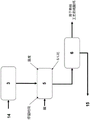
According to the method of the present invention, a phosphoric acid production apparatus comprises: preferably a phosphate rock processing unit, a reaction unit for reacting phosphate rock with sulfuric acid; and a first separation unit for separating calcium sulfate; preferred are filtration units. Furthermore, the phosphoric acid production plant of the method or plant according to the invention comprises a treatment unit for optimizing the production of phosphorus while purifying calcium sulphate from the phosphoric acid plant and/or the stock, comprising a purification/reaction unit for calcium sulphate and a second separation unit, in particular a filtration unit, for separating the purified calcium sulphate. According to the method of the present invention, the phosphoric acid production equipment generally further comprises a sulfuric acid production equipment, so that a phosphoric acid-sulfuric acid complex equipment can be obtained.
In one embodiment of the method according to the present invention, the sulfuric acid production plant may optionally be combined with a phosphoric acid production plant to form a phosphoric acid-sulfuric acid combined plant.
In the production of phosphoric acid, calcium sulfate is formed as a solid by-product in the reaction of the crude phosphate with sulfuric acid to form phosphoric acid according to step a), and calcium sulfate is separated from the phosphoric acid according to step b). The separation can be carried out, for example, by centrifugation, filtration, precipitation or evaporation, but mechanical separation is preferred. The solid calcium sulfate is preferably isolated by filtration of the phosphoric acid. The separation comprises or comprises separating the calcium sulphate formed from the phosphoric acid (product acid) (first separation), preferably by filtration. Depending on the process, the calcium sulfate solid (preferably the filter cake) separated off by the first separation can, if necessary, be further washed one or more times with a liquid, in particular water, and the liquid subsequently separated off, preferably filtered.
For the calcium sulphate used in step c) which is separated from the phosphoric acid, it is possible to use the calcium sulphate obtained directly after the first separation from the phosphoric acid after step b), since further washing is not absolutely necessary. This allows the filtration area in the phosphoric acid process to be reduced. However, it is also possible to use calcium sulphate separated from the phosphoric acid used in step c), which has been washed one or more times with a liquid, preferably water, after the first separation from the phosphoric acid according to step b) before being supplied to step c).
In a preferred embodiment of the process according to the invention, the suspension obtained after step a) is separated only into a liquid phase containing phosphoric acid and a solid phase containing calcium sulphate and having residual moisture, wherein the solid phase containing calcium sulphate and having residual moisture can be fed directly to step c).
An advantage of this embodiment is that the water balance of the phosphoric acid plant is only minimally affected after step e1) and/or step e2) of the method according to the invention.
As an alternative to steps a) and b), or in addition, calcium sulphate from phosphoric acid production and calcium sulphate already stored can be used as calcium sulphate in step c). In one embodiment, the calcium sulphate obtained from steps a) and b) and optionally a stock of calcium sulphate, preferably calcium sulphate from phosphoric acid production and a stock of calcium sulphate are used in step c).
In a complex plant for the production of phosphoric acid, the reaction of crude phosphate with sulfuric acid takes place in the reaction unit of the phosphoric acid plant. The reaction mixture obtained is then passed to a separation unit, preferably a filtration unit, of the phosphoric acid plant, in which the phosphoric acid is separated from the calcium sulfate formed in one or more separation stages or filtered. The calcium sulphate used in step c) comes from the separation unit or filtration unit of step b), preferably from the first separation stage, and/or from stock in the production of phosphoric acid is used as calcium sulphate in step c).
The isolated calcium sulfate used in step c) is preferably calcium sulfate in the form of dihydrate, hemihydrate or a combination thereof.
After separation from the phosphoric acid, the calcium sulphate may be added directly to step c), or optionally washed once, twice or more with water before addition to step c). Preferably, the content of free water in the separated calcium sulphate used in step c) is of the order of magnitude such that the addition of the respective acid in step c) sets an acid concentration in the range of 1 to 12 moles, preferably in the range of 3 to 10 moles, more preferably in the range of 5 to 8 moles.
In step c) of the process according to the invention, the calcium sulphate separated from the phosphoric acid production is treated with an acid. Acid is added to the calcium sulfate for treatment. Thus, a purified calcium sulfate suspension is obtained after the treatment. The suspension obtained may be, for example, a slurry or a slurry. By the treatment, impurities in the calcium sulphate that have a negative impact on downstream cement clinker processing and cement quality can be reduced to the levels required for downstream cement clinker processing.
In step c) acid is added to treat the calcium sulphate. The acid is preferably a diluent acid. The diluted acid refers to an acid (aqueous acid solution) diluted with water. The acid, preferably the diluent acid, is preferably a mineral acid, for example hydrochloric acid, nitric acid, sulfurous acid and/or sulfuric acid being particularly preferred.
In step c), the acid is added in an amount such that the solid to liquid ratio (S/L ratio) in the suspension is between 1/10 and 1/1, preferably between 1/5 and 1/1, more preferably between 1/5 and 1/1.3, more preferably between 1/4 and 1/2. The solid-to-liquid ratio (S/L ratio) is based on the mass of the solid in kilograms and the volume of the liquid in liters at a reference temperature of 20 ℃.
Herein, the concentration of the acid used is selected such that the acid produced according to the treatment of step c), which is an aqueous acid solution, is for example in the range of 1 to 12 moles, preferably in the range of 3 to 10 moles, more preferably in the range of 5 to 8 moles. As used herein, 1 mole means that 1 mole of acid is contained in 1 liter of solution at 20 ℃. Since the calcium sulfate to be treated contains water and water of crystallization may be released during the reaction, the concentration of the acid added may be higher than the concentration of the acid generated after the addition. In case of high residual acid content in the used phosphogypsum, like free phosphoric acid, the concentration of the added acid may also be lower than the concentration of the acid generated after the addition. The concentration of the acid produced fluctuates throughout the reaction. In general, the number of moles of acid added is preferably within the ranges given above and below for the acid produced.
At the beginning of the leaching of step c) of the method according to the invention, the concentration of the acid may be increased. This may be explained by the free acids contained in the contaminated phosphogypsum: ( Acids, such as phosphoric acid and/or Lewis acids, such as ferric iron). The concentration of the acid can be measured to indirectly estimate the free acid contained, depending on the reaction conditions. However, the concentration of the added acid inevitably (again) decreases due to the release of crystal water of gypsum and/or hemihydrate during the recrystallization in step c). Conversely, the release of water of crystallization can be used as a marker for the progress of the reaction. Now it isIt has been found that the acid concentration does not drop continuously, but rises after a minimum point. The intersection of this minimum value simultaneously represents the maximum conversion of dihydrate and/or hemihydrate to anhydrite. At the same time, due to P during recrystallization 2 O 5 And F, leaching efficiency is close to the maximum value. The leaching efficiency increases only slightly after the maximum conversion of anhydrite is reached. F/P 2 O 5 The leaching efficiency of (A) is in turn an important parameter for the quality of cement clinker prepared with phosphogypsum, since F/P 2 O 5 The content of (a) has a great influence on the properties of the clinker in particular. From a process economics perspective, it is advantageous to run a given process in as short a time as possible to achieve as much conversion of the flow (Mengenstrom) as possible. Thus, in the process according to the invention, the F/P is increased to the maximum extent if desired 2 O 5 It is also useful to keep the reaction time for recrystallization as short as possible to maximize the conversion of dihydrate and/or hemihydrate to anhydrite and thereby increase the production capacity. At the same time, in order to make necessary marginal parameters (e.g. F/P) 2 O 5 Leaching) to the desired level, a minimum recrystallization time is required. Thus, the process economics can be determined around t MIN A time interval of (1), where t MIN Is characterized in that a minimum acid concentration is present during the recrystallization of the dihydrate and/or hemihydrate to anhydrite. Thus, in a preferred embodiment, the separation process after step d) should be around t MIN Begins within this time interval.
Thus, in a preferred embodiment, the point in time when the calcium sulphate is separated from the suspension in step d) (or the solid is separated from the liquid phase of the suspension in step c)) starts at t MIN +30 minutes to t MIN -30 minutes, more preferably at t MIN +25 minutes to t MIN In the range of-25 minutes, still more preferably at t MIN +20 minutes to t MIN -20 minutes. More preferably at t MIN +15 minutes to t MIN In the range of-15 minutes, most preferably in the range oft MIN +10 minutes to t MIN In the range of-10 minutes, where t MIN Refers to the point in time during the treatment of step c) when the acid concentration has passed a minimum.
The starting acid concentration refers to the acid concentration measured over a period of at most one minute after the addition of the treated acid in step c).
As mentioned above, during the treatment, the concentration of the acid will decrease, at time t MIN The minimum acid concentration C is reached MIN And then increased again. The concentration of the acid and the time course can be determined according to the general analytical methods described below, simplifying the calculation assuming that the measured concentration of the acid is entirely due to the acid added for the treatment.
It has also been found that the point in time at which the above-described process is economically optimal can be further determined by the reduction in acid concentration, which is reduced by at least the minimum of its initial acid concentration. Likewise, dilution of the acid represents the progress of recrystallization and thus the F/P achieved 2 O 5 The leaching level of (a). Thus, at time t 1 A time interval in the vicinity of where t 1 Is characterized in that during the recrystallization of the dihydrate and/or hemihydrate to anhydrite in step c), the acid concentration is reduced by at least 1.0%, more preferably by at least 2.0%, more preferably by at least 4.0%, more preferably by at least 5.0%, more preferably by at least 7.0% of the initial acid concentration. Thus, in another preferred embodiment, the separation process after step d) should be around t 1 Begins within this time interval.
Thus, in a preferred embodiment, the time for separating calcium sulphate from the suspension in step d) is at t 1 +20 minutes to t 1 Starting in the range of-20 minutes, preferably at t 1 To t 1 Within +20 minutes, where t 1 Defined as the time during which the acid concentration in the treatment of step c) is reduced by at least 1.0%, preferably by at least 4.0%, compared to the initial acid concentration.
The above applies with respect to the starting acid concentration and the acid concentration during the treatment. At time t 1 A1% decrease in the upper starting acid concentration means that the acid concentration is the starting acid99% of the concentration.
In a preferred embodiment, the time interval t is defined by 1 The initial acid concentration is reduced by 1.0 to 15.0%; 3.0 to 12.0%; 4.0 to 10.0%; 4.5 to 10.0%; 5.0 to 9.0%; 5.0 to 8.5%; 5.5 to 8.0%; 6.0 to 8.0%, preferably calcium sulphate is separated from the suspension in step d) starting from the point in time at which the acid concentration falls within one of the above-mentioned ranges.
At t MIN And t 1 In terms of t 1 Can be smaller (e.g., in terms of cement clinker quality, with a minimum P 2 O 5 Leaching requires maximization of conversion), larger (e.g., P) 2 O 5 Maximization of leaching, thereby increasing the efficiency of the integrated phosphoric acid plant) or t MIN (e.g., high efficiency P 2 O 5 Leaching and as good filterability as possible), depending on the optimal definition of the process-economy.
In a further preferred embodiment, it is advantageous to carry out the separation process d) of the process according to the invention at a point in time to separate the solids from the liquid phase of the suspension of step c), at which point in time t 1 +30 minutes to t 1 In the range of-30 minutes, preferably t 1 To t 1 Within +30 minutes, t is more preferred 1 +25 minutes to t 1 In the range of-25 minutes, more preferably t 1 To t 1 Within +25 minutes, still more preferably from t 1 +20 minutes to t 1 In the range from-20 minutes, preferably from t 1 To t 1 Within +20 minutes, particularly preferably from t 1 +15 minutes to t 1 In the range from-15 minutes, preferably from t 1 To t 1 Within +15 minutes, most preferably from t 1 +10 minutes to t 1 In the range of-10 minutes, preferably at t 1 To t 1 Within +10 minutes.
In another preferred embodiment, the separation process of the liquid phase from which the solids of the suspension from step c) are introduced can be carried out according to step d) 20 minutes, 15 minutes or but 10 minutes before the minimum acid concentration is reached. After step d), the introduction of the separation process may further be carried out 5 minutes, 10 minutes or 15 minutes after the minimum acid concentration is reached. The introduction of the separation process according to step d) may also preferably take place within a time interval of 20 minutes before and 10 minutes after, or 15 minutes before and 5 minutes after, or 10 minutes before and 5 minutes after, the minimum acid concentration is reached.
In a further preferred embodiment, it is possible according to step d) to reach the point in time t 1 Before 20 minutes, 15 minutes, 10 minutes or 5 minutes, the separation process of the solid and liquid phases of the suspension introduced from step c) is carried out. The separation process can also be carried out when the point in time t is reached 1 After 5, 10 or 15 minutes. In a preferred embodiment, the separation process may be at t 1 First 15 minutes and t 1 At a time interval of the last 10 minutes, or 1 First 10 minutes and t 1 Last 10 minutes, or t 1 First 10 minutes and t 1 Last 5 minutes, or t 1 First 5 minutes and t 1 Last 10 minutes, or t 1 First 5 minutes and t 1 The last 5 minutes.
The determination of the acid concentration, including the determination of the lowest acid concentration, may be continuous or discontinuous. The measurement and/or determination of the minimum acid concentration may be direct or indirect. For the measurement, online and/or offline analysis may be used. For example, the concentration of the acid may be determined using a combination of acid-base titration (e.g., potentiometry, thermometry, or by acid-base indicators, etc.), determination of the pH of the acid or a determined defined dilution of the acid, determination of the density and/or sound velocity and/or refractive index of the acid. The examples chosen to determine acidity are not intended to limit the scope of the claimed invention in any way.
In a preferred embodiment, the concentration of the acid is determined by at least one measuring device in the reaction vessel or in the circulation stream of the reaction vessel. In general, the acid concentration is measured or calculated directly or indirectly, the parameters or measurement points required for this being determined at the appropriate points in the process for this. The skilled person is familiar with the choice of measurement and calculation methods, as well as the positioning of the measurement points.
Advantageously, the acid concentration is actively measured or calculated, directly or indirectly, by means of one or more recorded process parameters. It is further preferred that the treatment in step c) is monitored by analytical methods. It is further preferred that the analytical method can directly and/or indirectly determine the change in concentration of the acid used in step c) and/or that the analytical method can directly determine the content of P and/or F and/or the mineralogy of the solids.
It is further preferred that the analytical method used is an acid-base titration method, wherein the determination of the equivalence point of the acid is preferably carried out by means of a potentiometer and/or a thermometer and/or an acid-base indicator. It is further preferred that the analytical method used is a combined method of pH determination of the acid and/or pH determination of a defined dilution of the acid and/or densitometry of the acid and/or density and/or sound velocity and/or refractive index. It is further preferred that the analytical method is an online method, preferably a process analyzer.
Further preferred is the particle size distribution D of the calcium sulfate obtained in step D), especially anhydrous calcium sulfate v (50) The value is between 0.5 and 100. mu.m, preferably between 1 and 50 μm, in particular between 2 and 30 μm.
The acid produced by the treatment according to step c) is preferably from 1 to 12 mol, preferably from 5 to 8 mol of sulfurous acid or from 1 to 12 mol, preferably from 5 to 8 mol of sulfuric acid. Thus, the acid added is preferably sulfurous acid or sulfuric acid.
The treatment in step c) is carried out at a reaction temperature between ambient temperature and the boiling point of the reaction mixture, for example at a temperature between 15 ℃ and 100 ℃, preferably between 30 ℃ and 80 ℃, more preferably between 45 and 75 ℃.
The treatment time in step c) or the reaction residence time for adjusting the impurity content in the acid is between 5 minutes and 120 minutes, preferably between 15 and 100 minutes, more preferably between 15 and 90 minutes, particularly preferably between 20 and 60 minutes.
In a particularly preferred embodiment, 5 to 8 mol of acid, in particular sulfurous acid and/or sulfuric acid, with an S/L ratio of 1/5 to 1/1, preferably 1/5 to 1/1.3, more preferably 1/4 to 1/2, are used for the treatment, which is carried out at a temperature of 30 to 80 ℃, preferably 45 to 75 ℃, and with a residence time of 15 to 90 minutes, preferably 20 to 60 minutes. The reaction parameters are preferably adjusted and optimized by on-line and/or off-line analysis based on dilution of the acid used by the water of crystallization released as a result of recrystallization of phosphogypsum to at least partially anhydrite. For good separation of the purified calcium sulphate (e.g. during filtration) 5 to 7 moles of acid and high temperature are preferred, whereas at higher concentrations (e.g. 6.5-8 moles) shorter residence times and/or lower temperatures are sufficient to achieve the same purification efficiency.
Good filterability is achieved in particular by the presence of larger crystals. To favor crystal growth, on the one hand, lower temperatures and/or lower concentrations of acids, in particular sulfuric acid, are suitable. With regard to the process according to the invention, such a combination of temperature and acid concentration is preferred, in particular the formation of anhydrous calcium sulphate.
Furthermore, good filterability under otherwise constant conditions is favoured by keeping the residence time as short as possible (without loss of leaching efficiency). The end point of the reaction for optimal filterability can also be determined by determining the concentration of the acid. According to the front pair t MIN By definition of (2), we have found that at less than or equal to t MIN The best filterability of the purified calcium sulphate is achieved within the time interval (time point of minimum acid concentration).
As mentioned above, the purification efficiency, in particular the content of P and F, is directly related to the recrystallization to anhydrous calcium sulfate. The freely available phosphate, especially phosphoric acid remaining in phosphogypsum, is easily removed even at short residence times and/or low acid concentrations and/or high S/L ratios. When contaminated calcium sulfate dihydrate is used, recrystallization is not necessary. To increase the cleaning efficiency of phosphogypsum, it is preferred to use higher acid concentrations and/or higher temperatures and/or smaller S/L ratios. This facilitates the conversion to at least partially anhydrite.
Under selected reaction conditions, such as starting acid concentration, reaction temperature and S/L ratio, the determination of the acid concentration during the time course of the reaction can be carried out in advance, for example in a laboratory (off-line), to determine the desired reaction parameters of the process.
In a preferred embodiment, the concentration of the acid is determined during the time of the reaction during the preparation. In such a case, the acid concentration can be determined off-line (e.g., in a laboratory) and/or on-line (e.g., by an on-line analyzer). An advantage of this embodiment is that the process can be monitored directly and manufacturing variations (e.g. impurities of phosphogypsum, residual and/or total water content, temperature variations in the process, water balance of the total complex plant, etc.) can be accommodated by appropriate adjustment of the reaction parameters.
During the treatment in step c), the suspension or the reaction mixture is preferably kept in motion to adjust the content of impurities, for example by circulation, stirring or injection of a gas.
For step c), the calcium sulphate produced in the phosphoric acid production is fed from the first separation unit, preferably a filtration unit, and/or from a stock of calcium sulphate, preferably from the phosphoric acid production, to a purification unit (calcium sulphate reaction unit). Furthermore, in step e2), or in step e2), the P-containing compound obtained in step d) 2 O 5 The liquid phase of (a), preferably the acid filtrate, can be used to purify the stock calcium sulfate (step c). The resulting suspension may then be fed to step d) again to separate the solid from the liquid phase. The purification unit used in step c) may be a simple stirring device, such as a stirred tank.
In one embodiment of the process according to the invention, the purification of calcium sulphate from a stock, preferably from a phosphoric acid production, and the purification of calcium sulphate from the first separation unit may be carried out in different purification units.
In step d) of the process according to the invention, after the treatment, the purified calcium sulphate is separated as a solid from the liquid phase of the resulting suspension. The suspension obtained may be a slurry. The separation of the solid or purified calcium sulphate from the suspension and the liquid phase, in particular mechanical separation, can be carried out, for example, by centrifugation or filtration, with filtration being preferred.
The purified calcium sulphate obtained in step d) after separation may be a dihydrate, a hemihydrate, a calcium sulphate, a calcium,Anhydrous or as a mixture of at least two of said ingredients, calcium sulphate in the form of an anhydrous compound being preferred. The desired calcium sulphate content depends on the desired (cement/clinker manufacturer) and/or desired (phosphoric acid manufacturer) P 2 O 5 The level of reduction. The treatment with acid and subsequent separation from the liquid phase makes it possible in particular to reduce the content of phosphorus and fluorine as impurities in calcium sulfate. The separated liquid phase is usually an acidic aqueous solution, in particular comprising water and P 2 O 5 。
In a preferred embodiment, the isolated and purified calcium sulphate obtained in step d) contains at least 5 wt. -%, preferably at least 30 wt. -%, more preferably at least 50 wt. -% anhydrite based on the anhydrous calcium sulphate, based on the dry calcium sulphate.
Calcium sulfate, in particular anhydrous calcium sulfate, prepared in step D) has a particle size distribution D after purification v (50) The value is, for example, from 0.5 to 100. mu.m, more preferably from 1 to 50 μm, in particular from 2 to 30 μm. D v (50) The value is defined as the extent to which 50% by volume of the particles have a diameter greater than a specified value.
The isolated and purified calcium sulphate obtained in step d), optionally after drying, has a moisture content of 0 to 60 wt. -%, preferably 10 to 50 wt. -%. The water content is referred to as free water, and the possible presence of crystal water is not taken into account.
In a preferred embodiment, in step d), the liquid phase obtained after separation of the solids is used as feed for the phosphoric acid preparation step a). Alternatively or additionally, the liquid phase may be used to treat a stock of phosphogypsum before use in the phosphoric acid production step a) and, after subsequent separation as in step d), fed as a feed to the phosphoric acid production step a). The liquid phase or filtrate can be used for the existing phosphoric acid production, in particular in the presence of a phosphoric acid-sulfuric acid complex, as so-called "regenerating acid" (return acid), which can be supplied to the reaction unit for phosphoric acid production for reaction with the crude phosphate.
For step d), the suspension/slurry contained in the purification unit is transferred to a second separation unit (calcium sulphate separation unit), in which the liquid and the resulting solid (purified calcium sulphate) can be separated from each other. The second separation unit may be, for example, a filtration unit or a centrifugation unit, preferably a filtration unit.
In one embodiment of the process according to the invention, the separation of the obtained calcium sulphate suspension/slurry from a stock, preferably a stock prepared from phosphoric acid, and the separation of the obtained calcium sulphate suspension/slurry from the first separation unit, can be performed in different calcium sulphate separation units (and thus different second separation units). In this embodiment, the purification of calcium sulphate from the stock (preferably from the stock of phosphoric acid production) and the purification of calcium sulphate from the first separation unit are preferably performed in different purification units.
The content of phosphorus and fluorine and other impurities, such as heavy metals, radioactive elements, rare earths (lanthanides), trace elements, in calcium sulphate can be reduced by treatment with dilute acid and subsequent separation from the liquid phase. The process according to the invention makes it possible to prepare the quality of calcium sulphate as a feed product, which is required for the clinker/cement process. The content of impurities can be flexibly adjusted. Among the impurities contained in calcium sulfate, the contents of phosphorus and fluorine are preferably specifically adjusted to desired contents.
The separated and purified calcium sulphate obtained in step d) can be used directly as separated, purified and processed calcium sulphate. However, it is also possible to subject the calcium sulfate obtained in step d) to one or more further purification steps, in particular for the removal of rare earths, optionally also for the removal of radioactive elements and/or heavy metals, such as Cd, Pb, Hg, in particular before the purified calcium sulfate is fed to step e). Optional additional purification steps are explained below.
The calcium sulphate obtained after step d), and in the case of the more comprehensive process according to the invention, the calcium sulphate used in step e) is generally anhydrous or dried, with a water content preferably below 15 wt. -%, preferably below 10 wt. -%, more preferably below 5 wt. -%, even more preferably below 1 wt. -%, most preferably below 0.1 wt. -%. The water content here refers only to free water, irrespective of the possible presence of water of crystallization.
Purified obtained after step d)Calcium sulphate, and in the case of a more comprehensive process according to the invention, the purified calcium sulphate used in step e) preferably has a P of less than 0.5 wt.%, preferably less than 0.25 wt.%, more preferably less than 0.05 wt.% 2 O 5 And a fluoride content of less than 0.5 wt.%, preferably less than 0.25 wt.%, more preferably less than 0.15 wt.%, even more preferably less than 0.05 wt.%. Preferably, P has been obtained after step d) 2 O 5 And a degree of purification of fluorine. The undesirable heavy metals and/or radioactive elements, in particular radioactive elements, contained in the calcium sulphate can optionally also be removed completely or partially by the purification steps according to steps c) and d) and optionally a purification step for removing rare earths.
In step e) of the method according to the invention, the separated purified calcium sulphate is mixed with an additive and a reducing agent to obtain a raw mix for the preparation of cement clinker. The calcium sulphate is mixed with the required additives in the correct ratio to achieve the required cement clinker quality. As previously described, the Muller-Kuhne and OSW-Krupp processes convert calcium sulfate with admixtures and reducing agents into cement clinker and SO 2 Or sulfuric acid, which has been known for a long time. Further details can be found in the technical literature, for example in Ullmann's Encyclopedia of Industrial Chemistry,5th edition,1986, vol.A5, "centre and Concret", pp.489-537 or patent text AT 292539B.
Generally, Cement clinker is prepared from a feed mixture called raw meal containing calcium oxide, silica and oxides of aluminium and iron, see, for example, Ullmann's Encyclopedia of Industrial Chemistry,5th edition,1986, vol.A5, "Cement and Concrete", pp.489-537.
The ingredients used in step e) for the preparation of the raw meal, in addition to the purified phosphogypsum, may also be clinker ingredient admixtures known to the person skilled in the art, which are mixed with calcium sulphate, so that in the raw meal mixture the calcium ingredient is formed entirely from the separately purified calcium sulphate. "completely" in this context does not exclude the possibility of calcium being present in the admixture, in which case calcium is preferably present in the admixture only in small amounts or as impurities. By "completely" is meant herein that the calcium component used, preferably the calcium contained in the cement clinker, is at least 95 wt%, more preferably at least 99 wt%, even more preferably at least 99.9 wt% derived from the isolated purified calcium sulphate. This means that the admixture used is preferably free or substantially free of calcium. However, it is also possible to contain calcium in the additive, for example in an Al support, an Si support and/or an Fe support. The admixture is especially an aluminum support such as alumina, clay and claystone, shale, and the like. Iron carriers, such as iron ore, laterites etc., and silicon carriers, such as sand, sandstone, quartzite, clay and mudstone, shale etc., and one or more reducing agents, such as carbon and/or hydrocarbon carriers, such as coal, coke, petroleum coke or coal/coke (bio-coal/coke) prepared from renewable feedstocks and/or elemental sulphur.
It will be appreciated that the type and amount of the admixture is chosen such that it, together with the calcium sulphate, produces a raw meal having a chemical composition suitable for cement clinker.
In a preferred embodiment, the separated and purified calcium sulphate used in step d) of step e) represents more than 70 wt. -%, preferably more than 80 wt. -%, more preferably more than 90 wt. -% of the total amount of calcium sulphate in the raw mix. For the remaining calcium sulphate in the raw mixture obtained in step e), in addition to the isolated and purified calcium sulphate obtained in step d), it is possible to use calcium sulphate from other common sources.
Suitable fuels include solid fuels such as coal, coke, petroleum coke, solid secondary or alternative fuels, and the like, as well as liquid fuels such as petroleum, heavy oil, liquid secondary fuels, and the like, or gaseous fuels such as natural gas, biogas, hydrogen, and combinations thereof.
Additives and/or mineralizers may also be added to accelerate the decomposition of the purified calcium sulfate and/or to improve the formation of clinker minerals.
The raw meal used to prepare the cement clinker is defined as a mixture of calcium sulfate, all conventional cement admixtures and admixtures/minerals including reducing agents.
For the preparation of raw meal in step e) the purified calcium sulphate is preferably dried to the desired residual moisture, e.g. in a drum dryer and/or an entrainment dryer and/or a fluidized bed, the water content of the dried calcium sulphate being e.g. below 22 wt. -%, preferably between 12 and 14 wt. -%, more preferably below 5 wt. -%, even more preferably below 1 wt. -%. The water content here is only free water, irrespective of the possible presence of water of crystallization.
The dried calcium sulfate and all other additives were fed to a conventional storage and/or mixing apparatus. For this purpose, for example, longitudinal mixing beds and/or circular mixing beds and/or trough storage and/or open storage and/or conventional silos, such as tangential mixing silos, multi-chamber silos, conical silos or multi-chamber silos, may be used. Such mixed beds are described, for example, in DE 10252585, or such silos are described in more detail in DE10118142 or DE 10344040. The raw materials (calcium sulfate and additives) are ground individually or together to the fineness required for clinker processing. This comminution may be carried out as a polish-drying process in which waste heat from the process (e.g. preheated gas) and/or a specially provided heat (e.g. waste gas from a hot gas generator) is used.
For the comminution, at least one vertical roller mill and/or roller press and/or agitator ball mill and/or roller bowl mill and/or rod mill and/or magnetic mill or the like is used for comminuting the aggregates. Corresponding aggregates are known, for example, from patent rights DE 102012111217, DE 102014108334 or DE 102017114831.
The ground feed materials are supplied together or separately to one or more silos for intermediate storage and/or homogenization.
The chemical composition of the raw mix is continuously checked before the clinker feeding method and if it deviates from a predetermined target value, it is corrected by changing the dosage.
The raw meal pretreated in this way is supplied in portions to the clinker plant, optionally together with a reducing agent.
The reducing agent is used to support the separation of SO during the thermal decomposition of purified calcium sulfate 2 . The reducing agent being separately comminuted and/or ground to the desired finenessAnd (4) degree. This comminution may be carried out as a polish-drying process. The reducing agent prepared in this way is supplied to the clinker plant separately from the pretreated raw meal and/or at one or more points of the clinker plant.
Alternatively, at a liquid content of the mixture of 9% to 22% by weight, preferably 12% to 14% by weight, the raw meal may be fed to a forming apparatus to produce agglomerates (agglomerates). These agglomerates can be dried and temporarily stored in a separate apparatus. The green material of such agglomerates is then fed to a preheating device and to the firing process. The size of the agglomerates exceeds 250 μm, preferably exceeds 500 μm, down to the lower millimetre range. The forming device may be, for example, a press and/or a plate and/or a drum and/or a mechanical fluidized bed reactor and/or a forming agitator mixer.
In step f) of the method according to the invention, the raw meal prepared in step e) is converted into cement clinker by thermal processing, in particular in a cement clinker processing plant, whereby sulphur dioxide is formed as exhaust gas. The cement clinker prepared in step f) can be used for cement preparation.
In step f), the raw material is preferably preheated to a temperature of up to 800 ℃ by the process gas generated during combustion or cooling to reduce energy consumption, thereby removing adhering surface moisture and at least partially calcining the admixture.
With further preheating above 800 ℃, the major part of the calcium sulfate is decomposed under the action of the reducing agent to form SO 2 。
The preheating and decomposition of the raw meal can be carried out, for example, in a heat exchanger, preferably a double-flow heat exchanger.
Thus, containing SO 2 Preferably after the preheating device, is taken off by a separation system and fed to a process of use, for example a sulfuric acid plant.
In a subsequent step, the final decomposition of the raw meal and the subsequent formation of cement clinker (clinker combustion) are carried out; the process gas of this step is supplied to a heat exchanger. The combustion of the raw meal is carried out in a kiln, preferably a rotary kiln. The combustion temperature for the production of cement clinker can be, for example, between 1200 ℃ and 1600 ℃, preferably between 1200 ℃ and 1500 ℃. The burning time may be, for example, 5 minutes to 60 minutes.
In a preferred embodiment, the green stock is fired with oxygen in an amount of more than 21% by volume, preferably more than 45% by volume, more desirably more than 60% by volume, and up to 100% by volume of process air. The corresponding process air can be easily generated by mixing in oxygen.
Here, one particularly preferred embodiment is an oxyfuel process. Details of the oxyfuel process are described, for example, in EP 2449328 Al, EP 1037005 Bl, WO 2019-211196 Al, WO 2019-211202 Al or JP 2007-126328A, to which reference is made.
By using oxygen-enriched process air, the SO content of the process gas can be increased 2 Concentration of SO from the solution 2 Recovering sulfuric acid from the gas. In further measures to increase SO in the process gas 2 The SO in the process gas can be realized under the support of the concentration 2 The concentration is preferably 13 to 15%, more preferably 18 to 20%.
The above-mentioned process air may have been used in advance for cooling the fired material. It is also conceivable that this process air is supplied directly into the kiln. It is also conceivable that the process gas is at least partially extracted in a bypass system and/or from the entrained flow reactor, then enriched with oxygen and fed back to the firing process.
The clinker leaving the kiln is preferably cooled to below 120 c, preferably below 100 c, by a suitable cooling system. The cooled exhaust gases can be fed at least partly to a combustion process and/or a preheating process and/or a raw meal production and/or calcium sulphate drying process. The process air provided to the cooling system may be at least partially enriched in oxygen. It is also conceivable that at least a part of the cooler exhaust gases is used for the generation of electricity. After possible further processing steps, the material cooled by the cooling process is supplied to a storage and/or packaging device.
The cement clinker prepared in this way can be further processed to cement. The cement clinker or cement produced by the method has lower CO than ordinary clinker or cement produced on the basis of carbonate-containing rock 2 And (4) discharging the amount.
The above processes, such as using phosphogypsum as a carbon dioxide neutral feed and using oxy-fuel combustion processes, reduce the CO of cement plants 2 And (4) discharging the amount. Furthermore, operating components of the device using at least partially renewable power may further reduce carbon dioxide emissions.
In step g) of the process according to the invention, the sulphur dioxide formed in step f) is fed as a feed to a sulphuric acid production to produce sulphuric acid, for example according to a single-contact or double-contact process. The preparation of sulfuric acid on the basis of sulfur dioxide is well known to those skilled in the art. Details can be found in the technical literature, for example, Ullmann's Encyclopedia of Industrial Chemistry,5th edition,1994, vol.A25, "Sulfuric Acid and Sulfur Trioxide", pp.635-705, or Handbook of Sulfuric Acid Manufacturing,2008edition, DKL Engineering, ISBN 978-0-9738992-0-7.
The sulfuric acid produced in step g) can be used, for example, in the production of phosphoric acid as a feed for the reaction with the crude phosphate. In addition, the sulfuric acid produced may be used for further or other uses as desired. The treated sulfur dioxide gas can be selectively supplied to the existing sulfuric acid preparation equipment or new sulfuric acid preparation equipment in the phosphoric acid preparation equipment.
In a preferred embodiment, the sulphur dioxide discharged as off-gas from the cement clinker processing unit in step f) is subjected to sulphur dioxide off-gas treatment before being supplied to the sulphuric acid preparation unit according to step g). Exhaust gas treatment is preferably exhaust gas purification for SO removal 2 Solid particles in the gas and residual moisture.
In an optional variant of the process according to the invention, the process comprises an additional purification step of the calcium sulphate obtained according to step d), in particular when the calcium sulphate is subsequently mixed with the admixture and the reducing agent according to step e). In this additional purification step, the rare earth metals can be washed out of the calcium sulfate, which are present as impurities if necessary.
In an optional additional purification step for removing rare earths from the calcium sulphate, in particular before being fed to step e), the purified calcium sulphate obtained in step d) is preferably treated with a liquid, preferably water or an aqueous solution containing salts and/or chelating ligands. After the treatment, calcium sulfate is separated as a solid from the liquid phase of the suspension thus obtained.
The calcium sulphate thus further purified and separated is then fed to step e). The liquid phase contains one or more rare earths as dissolved ions, which can be fed to further processing for recovery of the rare earths. For example, such processing includes converting the sparingly soluble rare earth sulfate salt to a soluble form.
The method according to the invention can further be used for removing radioactive elements and/or heavy metals. If the reaction conditions (S/L ratio, residence time, acid concentration and temperature) are suitably adjusted, the purified calcium sulphate obtained after step d) shows a significant loss of radioactive elements, such as thorium and uranium. In a further optional purification step for extracting rare earths, heavy metals (and other radioactive constituents), such as cadmium and lead, can also be removed by appropriate selection of the treatment steps. Thus, the purified calcium sulphate may reduce the content of phosphorus and fluorine, and optionally rare earths, radioactive elements and/or heavy metals, before entering step e). It is understood that a reduction in the content of the respective elements is referred to in comparison with the content of the respective elements in the calcium sulphate supplied to step c).
The integrated mode or integrated process of the invention is characterized in particular by the following process technology operations, which can be combined in their entirety or selectively, for the production of cement clinker/cement and sulfuric acid from calcium sulfate:
o chemically and thermally reforming the phosphoric acid process to purposefully prepare phosphogypsum suitable for the cement clinker method and improve the phosphorus yield of the orthophosphate;
o mechanical separation of the phosphogypsum in the ongoing phosphoric acid process, e.g. by centrifugation, filtration, evaporation or sedimentation/precipitation of a calcium sulphate/phosphogypsum-slurry;
o chemical-thermal and mechanical separation of phosphorus from phosphogypsum, for example by chemical transformation, recrystallization, precipitation, flocculation;
o chemical-thermal and mechanical separation of fluorine from phosphogypsum, for example, by chemical transformation, recrystallization, precipitation, flocculation;
o chemical-thermal and mechanical separation of radioactive components from phosphogypsum, for example by chemical transformation, recrystallization, precipitation, flocculation under heating/cooling;
o chemical-thermal and mechanical separation of heavy metals from phosphogypsum, e.g. by chemical conversion under heating/cooling, recrystallization, precipitation, flocculation;
o chemical-thermal and mechanical separation of rare earths from phosphogypsum, for example by chemical transformation under heating/cooling, recrystallization, precipitation, flocculation;
chemical and/or thermal and/or mechanical dewatering of phosphogypsum, for example by heating/cooling, flocculation and precipitation, filtration;
mechanical treatment of the dry phosphogypsum, for example by crushing, sieving;
o mixing phosphogypsum with additives to a raw mix to achieve specific and commercially common cement clinker/cement qualities;
o thermally and mechanically separating sulphur dioxide in the green mixture within the scope of the firing process for cement clinker preparation;
o thermally and chemically converting the raw mix into cement clinker;
o chemically and mechanically converting cement clinker into commercially common cement qualities;
dry and wet chemical purification of the separated sulphur dioxide containing off-gas, for example by electro-filtration, absorption;
o chemically and thermally reforming the sulfuric acid process to incorporate and use the generated sulfur dioxide in the plant for the production of sulfuric acid;
o converting the purified exhaust gas containing sulphur dioxide by chemical means into sulphuric acid of a quality which is common on the market and which can be reused in a phosphoric acid process, for example by a single or double contact process.
Depending on the quality of the phosphate feed used and the calcium sulfate desired, the manufacturing process must be flexibly selected and coordinated in the selection of process operations and parameters.
From phosphoric acid chemical industryThe quality of the calcium sulphate obtained in the process depends on various factors, such as the crude phosphate used, the process conditions when decomposing the crude phosphate with sulphuric acid after step a), and the purification/addition of P after step c) 2 O 5 Process conditions for yield.
The degree of purification of the calcium sulphate in step c), in particular in terms of reducing the phosphorus and/or fluorine content, can be adjusted according to the impurities contained in the admixtures used and the guideline values for phosphorus and fluorine to be met in the cement clinker. The phosphorus guide value is preferably not more than 1.0 wt.%, more preferably not more than 0.5 wt.%, even more preferably not more than 0.1 wt.% of P 2 O 5 And/or the fluorine guide value is preferably not more than 0.5 wt%, more preferably not more than 0.25 wt%, even more preferably not more than 0.1 wt% F. This is possible due to the integrated process, since the respective requirements are taken into account in the case that all process steps are taken together. Adjustment of the purification range can be done by matching parameters in step c), such as S/L ratio, concentration of acid, treatment temperature and duration. Here, the purification efficiency is preferably determined indirectly by measuring the acid concentration during the calcium sulphate leaching reaction in step c) on-line and/or off-line.
The liquid balance, in particular the water balance, of the phosphoric acid preparation does not change or only slightly changes, in particular because the liquid input, in particular the water input, for purifying the calcium sulphate can be linked to the liquid balance, in particular the water balance, of the phosphoric acid preparation during the process according to step c). The liquid balance or water balance of phosphoric acid production includes the input of produced liquid or water and the liquid or water removed from production. Changes in the fluid balance, particularly in the water balance, have a large influence on the efficiency of the process steps for the preparation of phosphoric acid.
The invention also relates to a plant for producing phosphoric acid and for purifying calcium sulphate by reacting a crude phosphate with sulphuric acid, comprising:
a) a reaction unit at least having
i. Feeding of crude phosphate and
at least one feed line for concentrated sulfuric acid,
wherein the reaction unit is configured to form a suspension comprising at least phosphoric acid and calcium sulfate, wherein the calcium sulfate is present as dihydrate, hemihydrate or a combination of hemihydrate and dihydrate, and the reaction unit comprises an outlet for the suspension,
b) a first separation unit configured to separate a suspension from the reaction unit a), comprising calcium sulphate as a solid and a liquid phase from step a), and comprising at least one outlet for a substantially solid-containing phase and one outlet for a substantially liquid-containing phase, wherein the separation unit is in fluid connection with the reaction unit from step a),
c) a purification unit fluidly connected to the first separation unit b) and having at least one feed for acid, wherein the purification unit is configured to convert the calcium sulphate separated in b) and/or a stock of calcium sulphate/phosphogypsum into a suspension with the acid fed to the purification unit, wherein the suspension comprises at least calcium sulphate and P-containing P 2 O 5 And the purification unit further has an outlet line for the suspension,
d) a second separation unit configured to treat the suspension from c), wherein the second separation unit has at least one for containing P 2 O 5 And at least one outlet for solid calcium sulphate, wherein a second separation unit is arranged downstream of the purification unit, and
e) e1) at least one fluid connection configured to connect the P-containing stream from the second separation unit of d) 2 O 5 Is conveyed back to or upstream of the reaction unit, and/or
e2) At least one further fluid connection, starting from the second separation unit of d), is provided upstream of the second separation unit of step d) and downstream of the first separation unit of step b).
The invention also relates to a plant for the production of sulphuric acid and cement clinker, which plant utilizes calcium sulphate formed and separated as a solid by-product in the reaction of crude phosphate with sulphuric acid to form phosphoric acid, the plant comprising:
a) a reaction unit at least having
i. A crude phosphate feed, and
at least one feed line for concentrated sulfuric acid, wherein the reaction unit is configured to form a suspension comprising at least phosphoric acid and calcium sulfate, the calcium sulfate being present as dihydrate, hemihydrate or a combination of hemihydrate and dihydrate, and the reaction unit comprises an outlet for said suspension,
b) a first separation unit configured to separate a suspension from a liquid phase, said suspension comprising calcium sulphate as a solid from step a) of the reaction unit, and comprising at least one outlet for a substantially solid-containing phase and one outlet for a substantially liquid-containing phase, wherein said separation unit is in fluid connection with said reaction unit of step a),
c) a purification unit fluidly connected to the first separation unit of step b) and having at least one feed for acid, wherein the purification unit is configured to convert the calcium sulphate separated in step b) and/or a stock of calcium sulphate/phosphogypsum together with the acid supplied to the purification unit into a suspension, wherein the suspension comprises at least calcium sulphate and P 2 O 5 And the purification unit further has an outlet line for the suspension,
d) a further second separation unit configured for treating the suspension from step c), wherein the further second separation unit has at least one for containing P 2 O 5 And at least one outlet for solid calcium sulphate, wherein the further second separation unit is arranged downstream of the purification unit, and
e) a raw meal mixing unit adapted to mix therein the separated purified calcium sulfate with the admixture and the reducing agent to obtain a raw meal mixture for cement clinker preparation,
f) cement clinker processing unit, in particular a combination of a preheater, at least one combustion device and a cooler, suitable for preheating, combusting and cooling a raw meal mixture to obtain cement clinker, wherein sulphur dioxide is formed as exhaust gas, and/or
g) A sulphuric acid production plant, wherein sulphur dioxide offgas formed and optionally purified in a cement clinker processing unit is supplied as a feed for the production of sulphuric acid, wherein the sulphuric acid production plant may be part of a phosphoric acid production plant or an external sulphuric acid production plant.
In a preferred embodiment, the above apparatus further comprises e1) at least one fluid connection provided upstream of the reaction unit configured for the P-containing of the further second separation unit from step d) 2 O 5 The acid solution is sent back and/or e2) at least one further fluid connection is provided starting from the second separation unit of step d), upstream of the further second separation unit from step d) and downstream of the first separation unit of step b).
These devices can be used in the method according to the invention described above. For details of the individual devices or units, reference is made to the details in this respect. The details of the above procedure apply accordingly to this unit. The method according to the invention described above and in the claims is preferably carried out in an apparatus as described in the description and in the claims.
According to the method and apparatus of the present invention, a reaction unit, such as a crude phosphate reaction unit, refers to a reaction unit having a decomposition unit and a crystal formation unit. The two units may be separate or may be contained in one device, such as a container.
Preferably, in the plant according to the invention, the second separation unit or the calcium sulphate separation unit is fluidly connected, for example by means of a pipeline, to the reaction unit of an existing and/or new plant for the production of phosphoric acid or to the reaction unit of the process according to the invention (after step a), so that the liquid phase obtained in the calcium sulphate separation unit can be introduced as feed into the production of phosphoric acid.
Preferably, in the plant according to the invention, the separated calcium sulphate used in step c) can be fed from an existing separation unit for phosphoric acid production or a separation unit for a phosphoric acid production process according to step b), which separates phosphoric acid from calcium sulphate, or from a calcium sulphate stock for phosphoric acid production.
In one embodiment of the apparatus according to the invention, after step c), the separated P-containing fraction 2 O 5 The acid solution of (a) is supplied to a purification unit. Here, the plant may have a second calcium sulphate reaction unit (16) configured to react calcium sulphate/phosphogypsum from the store with P-containing from step d) 2 O 5 And/or a P-containing acid solution from an additional second separation unit or an additional calcium sulphate separation unit (6') 2 O 5 Is treated together and converted into at least calcium sulfate and P-containing 2 O 5 Of an acid solution. Here, the second calcium sulphate reaction unit (16) has an outlet for the suspension.
In another embodiment, the plant according to the invention has a second or calcium sulphate separation unit (6') specially configured to treat said suspension formed by calcium sulphate/phosphogypsum from the reserve. This second separation unit or calcium sulphate separation unit (6') may be in the form of a second separation unit or calcium sulphate separation unit in parallel with the second separation unit according to step d). The second separation unit (6') has at least one inlet for said suspension from the second calcium sulphate reaction unit (16), at least one outlet for separated calcium sulphate and at least one outlet for separated P-containing material 2 O 5 An outlet for the acid solution of (a). This embodiment of the apparatus according to the invention is optionally further arranged to introduce P-containing from said second separation unit (6') into the reactor 2 O 5 Is in fluid connection with the reaction unit of the phosphoric acid plant according to step a) or upstream of said reaction unit of the phosphoric acid plant. This may be an existing or new phosphoric acid plant. This embodiment of the plant according to the invention is optionally further provided with P-containing starting from the second separation unit or the calcium sulphate separation unit (6') 2 O 5 Is in fluid connection with the purification unit according to step c) or the calcium sulphate reaction unit (5).
In another embodiment of the plant according to the present invention, it is possible to optionally feed at least one concentrated sulfuric acid in addition to the feeding of at least one concentrated sulfuric acid in step a) to a purification unit or a calcium sulfate reaction unit according to step c) and/or to feed at least one concentrated sulfuric acid to a second calcium sulfate reaction unit (16), the plant being configured for treating calcium sulfate/phosphogypsum from a stock, preferably a stock of phosphoric acid production.
In a further embodiment of the apparatus according to the invention, one or more of the fluid compounds can optionally be connected directly to the apparatus unit or, where technically reasonable and possible, to an existing stream upstream or downstream of the apparatus unit in order to supply the medium to the apparatus unit by means of the fluid compound.
Drawings
Hereinafter, the present invention will be described with reference to examples, which will be explained in more detail with reference to the figures. These examples are not intended to limit the scope of the claimed invention in any way.
Fig. 1 shows a schematic flow diagram of the treatment of calcium sulphate produced from phosphoric acid after one sub-step of the process according to the invention.
Fig. 2 shows a schematic flow diagram for utilizing calcium sulphate in phosphoric acid production by means of an integrated complex plant for producing cement clinker and sulphuric acid.
Fig. 3 shows a schematic flow diagram of calcium sulphate in the production with phosphoric acid by means of the integrated complex plant of cement clinker and sulphuric acid production in fig. 2, wherein alternative or additional process steps are also shown.
Fig. 4 shows an integrated total complex plant for the production of phosphoric acid, calcium sulfate for suitable cement clinker, cement clinker and sulfuric acid according to the method of the invention, wherein alternative or additional method steps are also shown.
Fig. 5 shows an integrated total complex plant for the production of phosphoric acid, calcium sulphate for suitable cement clinker, cement clinker and sulphuric acid according to the method of the invention, in which further preferred embodiments of the invention are shown, which may be present individually or cumulatively.
FIG. 6 is a graph of acid concentration in sulfuric acid versus residence time for PG B gypsum of example 9.
FIG. 7 is the acid concentration (left axis), anhydrite content (right axis) and in view of P of the residence time of PG B gypsum of example 9 in sulfuric acid 2 O 5 Graph of leaching efficiency of content (right axis).
FIG. 8 is a graph of the acid concentration of gypsum PG A in sulfuric acid residence time for example 10.
FIG. 9 is the mineralogical composition of the residence time of PG A gypsum in sulfuric acid (left axis) and in view of P in example 10 2 O 5 Graph of leaching efficiency of content (right axis).
Detailed Description
Figure 1 shows a flow diagram of the treatment of calcium sulfate produced by phosphoric acid according to the process of the present invention. The calcium sulphate slurry 14 from the orthophosphate reaction unit of the phosphoric acid plant is fed to a first separation unit, preferably a filtration unit 3, of the phosphoric acid plant, where the calcium sulphate produced in the orthophosphate reaction unit is separated from the phosphoric acid. The separated calcium sulphate is fed to a purification unit 5 where it is acid treated. In this process, impurities in the calcium sulfate that negatively impact the downstream clinker process and cement quality are reduced to the levels required by the clinker process. This is an integrated process in which process parameters, such as residence time, acid, temperature and S/L ratio, can be coordinated with the quality of the reactants and the desired properties of the obtained product for further processing. In a second separation unit (calcium sulphate separation unit) 6, preferably a filtration unit, the liquid of the suspension obtained in step c) and the obtained solid are separated from each other. The liquid 15, particularly as a filtrate, can be used in existing phosphoric acid-sulfuric acid complex plants. The treated calcium sulfate may be further processed in a clinker process.
Figure 2 shows a flow diagram of a phosphoric acid production (existing integrated complex) and an integrated process for producing cement clinker and sulphuric acid from calcium sulphate produced in the phosphoric acid production (integrated complex). In the processing unit 1, phosphate rock is processed to obtain phosphate rock. The crude phosphate is reacted in a crude phosphate reaction unit of the phosphoric acid plant 2 with sulfuric acid from the sulfuric acid production plant to form phosphoric acid and solid calcium sulfate as by-products. Calcium sulphate produced in the phosphoric acid production plant is separated from the phosphoric acid in a first separation unit 3 of the phosphoric acid plant, which is preferably a filtration unit, and fed to a purification unit 5. There, an acid is added to the calcium sulphate in order to obtain, for example, 1 to 12 mol of acid, in particular 1 to 12 mol of sulphuric acid, after the treatment. For example, 1 to 12 moles of sulfuric acid may be added during the treatment. The treatment can be carried out after the addition of the acid, for example at a temperature of from 15 to 100 ℃ for from 5 to 120 minutes, preferably by moving the resulting suspension, for example by stirring. In this process, impurities in the calcium sulfate that negatively impact downstream cement clinker processing and cement quality are reduced to levels required for cement clinker processing. In the second separation unit 6, preferably a filtration unit, the liquid and the produced solids are separated from each other. The liquid, particularly as a filtrate, can be used in existing phosphoric acid-sulfuric acid complex equipment. The treated calcium sulphate is fed to an upstream raw meal mixer unit 7 for cement clinker processing. There, the calcium sulphate is mixed with the required aggregate in the correct proportion to achieve the required cement clinker quality. The prepared cement clinker raw meal is supplied to the cement clinker processing unit 8, whereby the raw meal is preferably preheated in a heat exchanger (not shown) before being supplied to the processing unit 8. In the cement clinker processing unit 8 sulphur dioxide is separated from the calcium sulphate and fed as waste gas from the cement clinker processing unit to a sulphur dioxide waste gas treatment unit 9. The treated sulfur dioxide gas may be selectively supplied to an existing sulfuric acid production facility 4. In addition, the treated sulfur dioxide gas may be optionally supplied to a new sulfuric acid production facility (see 13 of fig. 3). The calcium remaining in the cement clinker processing unit reacts with the aggregate to form cement clinker. The combustion temperature for cement clinker production may be, for example, between 1200 ℃ and 1600 ℃ and the combustion time between 5 minutes and 60 minutes. The cement clinker prepared in this way can be further processed to cement.
Fig. 3 shows a schematic flow diagram of the integrated plant for the production of cement clinker and sulfuric acid according to fig. 2, using calcium sulfate in the production of phosphoric acid, wherein alternative or additional process steps are also shown. Alternative or additional methods will be discussed belowOtherwise please refer to the explanation of fig. 2. Figure 3 shows another source of calcium sulphate for use in step c). The calcium sulphate used in step c) may not be calcium sulphate from the filtration unit of the phosphoric acid plant 3 but calcium sulphate from the stock 10, i.e. from landfill calcium sulphate produced from phosphoric acid. Further shown in fig. 3 are optional rare earth removal treatment steps including a reaction unit to recover rare earth metals from calcium sulfate 11 and a calcium sulfate separation unit 12 to separate the liquid phase from the purified calcium sulfate. Furthermore, shown in FIG. 3, from SO 2 The sulphur dioxide obtained in the treatment 9 can be used for sulphuric acid recovery in the existing sulphuric acid production plant 4 and/or in the new sulphuric acid production plant 13.
Fig. 4 shows a schematic flow diagram of a complete phosphoric acid production plant and a method for producing cement clinker and sulfuric acid from calcium sulfate obtained in the phosphoric acid production. In a variant of this flowchart, unlike the concepts of fig. 2 and 3, a new integrated total compound device is depicted, instead of an integration of an existing compound device. In the phosphate rock processing unit 1a, phosphate rock is processed to obtain phosphate rock. The crude phosphate is reacted in the crude phosphate reaction unit of the phosphoric acid plant 2a with sulfuric acid originating from the sulfuric acid production unit 13 to form phosphoric acid and solid calcium sulfate as a by-product, wherein according to the process of the invention the by-product calcium sulfate may be present as dihydrate, hemihydrate or a combination of hemihydrate and dihydrate as desired. Calcium sulphate produced in the production of phosphoric acid is separated from phosphoric acid in a first separation unit 3a of the phosphoric acid plant, which is preferably a filtration unit, and fed to a purification unit 5. Here the calcium sulphate is treated with acid, as already described in fig. 2, and the resulting suspension is separated into liquid and solid in a second separation unit 6.
This liquid, in particular as filtrate, can be used in existing phosphoric acid-sulfuric acid complex plants and/or optionally in the second calcium sulfate reaction unit 16 for processing calcium sulfate from the stock 10, the reaction conditions of the second calcium sulfate reaction unit 16 being within the parameters of the purification unit 5. The suspension with calcium sulfate treated in the second calcium sulfate reaction unit 16 is fed to a second separation unit6 and further processed as described in figure 2. As illustrated in fig. 3, further purification steps may optionally be performed by a calcium sulfate separation unit 12 to recover the rare earth metals 11 and subsequently separate the calcium sulfate. The treated calcium sulphate is then further treated in a raw mix unit 7, as described in figure 2, and then fed to a cement clinker processing unit 8 from the SO 2 The sulphur dioxide obtained in the treatment 9 is used in a new sulphuric acid production plant 13 for extracting sulphuric acid. The suspension in the optional calcium sulphate reaction unit 16 may also be transferred to a separate calcium sulphate separation unit (not shown) instead of the second separation unit 6 for separation, and the separated calcium sulphate is then fed to the raw meal mixing unit 7 and/or to an optional unit for recovering rare earths from the calcium sulphate 11.
Fig. 5 shows an expanded representation of fig. 2 to 4. Here, the explanations so far for fig. 2 to 4 apply correspondingly. Furthermore, a feed line for acid, preferably sulphuric acid, is shown, forming a circuit according to the idea of the invention by supplying sulphuric acid from the sulphuric acid preparation plant 4 and/or 13 to the reaction unit in the phosphoric acid plant 2 and/or 2 a. The sulfuric acid units 4 and 13 may be present simultaneously. Likewise, the phosphoric acid apparatuses 2 and 2a may exist simultaneously. In addition, an acid, preferably sulfuric acid, may be introduced into the process from an external source. The sulfuric acid produced in the sulfuric acid plant 4 and/or 13 can be introduced into the second calcium sulfate reaction unit 16. Alternatively, an acid from the outside, preferably sulfuric acid, may be used to provide the acid to the second calcium sulfate reaction unit 16. Likewise, the sulfuric acid from 4 and/or 13 can also be introduced into the purification unit or the calcium sulfate reaction unit 5. For the sake of clarity, such fluid connections are not directly indicated by arrows in fig. 5, but are illustrated by asterisks. In order to treat the stock of calcium sulphate/phosphogypsum from the stock, preferably the stock of phosphoric acid plant, the suspension obtained by combining the acid from e.g. 4 and/or 13 with the calcium sulphate/phosphogypsum of the stock 10 in the second calcium sulphate reaction unit 16 may be transferred in a further second separation unit or calcium sulphate separation unit 6'. Here, the suspension is separated into calcium sulfate and P-containing substances 2 O 5 An acid solution of (a). Thus, calcium sulphate from 6' can be selectively supplied to the raw meal preparation 7. Second calcium sulfate reaction unitThe suspension of 16 can also optionally be transferred to a second separation unit or a calcium sulphate separation unit 6. P-containing substances produced in the second or calcium sulfate separation unit 6 and/or in the additional second or calcium sulfate separation unit 6 2 O 5 The acid solution of (a) may be recycled to the purification unit or calcium sulphate reaction unit 5 and/or the reaction unit of the phosphoric acid plant 2 and/or 2a and/or optionally to the second calcium sulphate reaction unit 16. Thus, the dashed lines/arrows represent alternative material flows, which may occur separately or simultaneously.
Examples
The following are some examples of purification of different phosphogypsum. According to said procedure, the phosphated gypsum is dried at 50 ℃ for at least 24 hours before and after the treatment in order to remove free water. The chemical composition of the gypsum was subjected to X-Ray Fluorescence Analysis (RFA) before and after treatment by an Axios Advanced spectrometer from PANalytical and software package SuperQ 5.3B. For this purpose, gypsum was decomposed using lithium tetraborate. The loss on ignition of the gypsum was determined at 1050 ℃. After decomposing gypsum using sodium peroxide and hydrochloric acid, the fluoride content was determined by ion selective electrode. All values of the RFA results given below refer to gypsum samples with no ignition loss. The mineralogical composition of some gypsum before and after treatment was also examined by powder diffraction using a D4 Endevor diffractometer from Brukeer. The Brukeer Topas 4.2 software package was used for evaluation using the Rietveld method. D of the particle size distribution v (50) Values were determined on a Mastersizer 3000 from marwin using ethanol as the dispersion medium. The Fraunhofer model was used as a dispersion model.
Example 1:
50 g of P are stirred with a KPG stirrer 2 O 5 Phosphogypsum with a content of 1.29 wt% and a content of F of 1.25 wt% was stirred with 200 ml (S/L ═ 0.25) of 8 mol sulphuric acid at 60 ℃ for 30 minutes. At the end of the time, the suspension was filtered rapidly and washed twice with 57.5 ml of water at room temperature. After treatment, P 2 O 5 And the content of F was still 0.02 and 0.01 wt%, respectively (corresponding leaching efficiencies of 98% and 99%, respectively). The mineralogical composition before treatment was determined to be 2.8% by weight of quartz, 91.5% by weight of quartzHydrate (CaSO 2H) 2 O), 3.7% by weight of flying hydrate (CaSO 0.5H) 2 O) and 2.9 wt% anhydrite (CaSO). After treatment, the following ingredients were measured: 3.3% by weight of quartz, 1.2% by weight of dihydrate (CaSO 2H) 2 O), 0.1% by weight of flying hydrate (CaSO 0.5H) 2 O) and 95.5% by weight of anhydrite (CaSO) 2 )。
Example 2:
in a further experiment, 75 g of the same gypsum PG a as in example 1 were stirred with 150 ml (S/L ═ 0.5) 6mol sulfuric acid with a KPG stirrer at 60 ℃ for 30 minutes. After this time, the suspension was filtered rapidly and washed twice with 86.3 ml of water at room temperature. After treatment, P 2 O 5 And the content of F was still 0.29 and 0.03 wt%, respectively (corresponding to leaching efficiencies of 78% and 98%, respectively). After treatment, the following mineralogical components were determined: 3.2 wt% quartz, 73.2 wt% dihydrate (CaSO 2H20), 2.4 wt% hemihydrate (CaS04 0.5H20) and 21.2 wt% anhydrite (CaSO). Treated D v (50) The value was 59.1. mu.m.
Example 3:
in another experiment, 75 grams of P was mixed using a KPG mixer 2 O 5 Another gypsum (designated PG B) having a content of 1.70 wt% and a content of F of 2.13 wt% was stirred with 150 ml (S/L ═ 0.5) 6mol sulfuric acid at 75 ℃ for 30 minutes. After the time has elapsed, the suspension is filtered rapidly and washed twice with 86.3 ml of water at room temperature. After treatment, P 2 O 5 And the content of F was still 0.07 and 0.12 wt%, respectively (corresponding leaching efficiencies of 96% and 94%, respectively). The mineralogical composition prior to treatment was determined to be 3% by weight quartz and 97% by weight dihydrate (CaSO 2H) 2 O). After treatment, the following ingredients were determined: 2.5% by weight of quartz, 0.4% by weight of dihydrate (CaS04 × 2H) 2 O) and 97.2 wt% anhydrite (CaSO). Treated D v (50) The value was 9.77. mu.m.
Example 4:
in a further experiment, 75 g of the same gypsum (PG B) were mixed with 150 ml (S/L ═ 0.5) 6mol sulfuric acid using a KPG stirrerStirring was carried out at 75 ℃ for 45 minutes. After this time, the suspension was filtered rapidly and washed twice with 86.3 ml of water at 75 ℃. After treatment, P 2 O 5 And the content of F was still 0.03 and 0.11 wt%, respectively (corresponding leaching efficiencies of 98% and 95%, respectively). After treatment, the following mineralogical composition was determined: 2.9% by weight of quartz, 0.2% by weight of dihydrate (CaSO 2H20) and 97.0% by weight of anhydrite (CaSO). Treated D v (50) The value was 9.34. mu.m.
Example 5
In another experiment, 75 g of the same gypsum (PG B) was stirred with 150 ml (S/L ═ 0.5)7 mol sulfuric acid at 75 ℃ for 30 minutes using a KPG stirrer. After this time, the suspension was filtered rapidly and washed twice with 86.3 ml of water at room temperature. After treatment, P 2 O 5 And the content of F was still 0.03 and 0.06 wt%, respectively (corresponding leaching efficiencies of 98% and 97%, respectively). Treated D v (50) The value was 6.99. mu.m.
Example 6:
in another experiment, 75 g of the same gypsum (PG B) was stirred with 150 ml (S/L ═ 0.5) of 4 mol sulfuric acid at 30 ℃ for 20 minutes using a KPG stirrer. After this time, the suspension was filtered rapidly and washed twice with 86.3 ml of water at room temperature. After treatment, P 2 O 5 And the content of F was still 0.43 and 0.17 wt%, respectively (corresponding leaching efficiencies of 75% and 92%, respectively). After treatment, the following mineralogical components were determined: 1.7% by weight of quartz, 96.3% by weight of dihydrate (CaSO 2H) 2 O), 2.0% by weight of flying hydrate (CaSO 0.5H) 2 O) and 0% by weight of anhydrite (CaSO). Treated D v (50) The value was 16.1. mu.m.
Example 7:
to evaluate whether the described method can also be used for phosphogypsum in a phosphoric acid plant which was only isolated and therefore not cleaned, 75 g of the same PG B gypsum as in example 3 were mixed with 25 g of a 25% solution of P20S (in the form of phosphoric acid) and 150 ml (S/L0.5; 25 g of P20S solution not considered) of 7 mol of sulfuric acid were stirred with a KPG stirrer for 30 minutes at 75 ℃. After the time has elapsed, the suspension is filtered rapidly and at room temperatureThe column was washed twice with 86.3 ml of water. After treatment, P 2 O 5 And the content of F was still 0.07 and 0.08 wt%, respectively (corresponding leaching efficiencies of 96% and 96%, respectively). After treatment, the following mineralogical composition was determined: 2.5% by weight of quartz, 0.2% by weight of dihydrate (CaSO 2H) 2 O) and 97.3 wt% anhydrite (CaSO). Treated D v (50) The value was 6.62. mu.m.
Example 8:
in order to evaluate the filterability of the suspensions in relation to the influencing variables, such as temperature, residence time and acid concentration, a filtration area of 56cm was used 2 The filtration time of the suspensions of examples 3, 4 and 5 was determined under a vacuum of 500 mbar. In all cases, the filter cake height was between 13 and 14.5 mm. The filtration times for the suspension of example 5 in the 1st and 2 nd washes were 30 and 52 and 39 seconds, respectively. In the suspension of example 3, the filtration times for the 1st and 2 nd washes were 11 and 22 and 19 seconds, respectively. In the suspension of example 4, the filtration times were 11 seconds and 20 seconds and 11 seconds for the 1st and 2 nd washes, respectively. It can be seen that by adjusting the influencing variables, filterability can be optimized while maintaining cleaning quality.
Example 9:
to test the feasibility of integrating the process analysis by determining the acid concentration, in a further experiment 150 g of PG B gypsum were stirred with 300 ml (S/L ═ 0.5) 5mol sulfuric acid at 75 ℃ with a KPG stirrer. Samples were taken (approximately 1.5 hours) at specified time intervals of 10 minutes, directly after the start (t ═ 1 minute). 12 ml of suspension) and washed twice with about 6 ml of water. The filtrate from the first filtration step was collected and used for further analysis. The reaction was stopped after 100 minutes, so a total of 11 samples were taken. To determine the acid concentration of each filtrate sample, 0.5 ml of the filtrate was diluted with approximately 20-40 ml of ultrapure water and titrated with 1M sodium hydroxide solution. In addition, the concentration of the acid used was also checked. The equivalence point was potentiometrically determined using a commercial autotitrator from Metrohm. Filtered and washed phosphogypsum samples are at least dry at 50 DEG CDried for 24 hours and then analyzed for mineralogy and P 2 O 5 And (4) content.
Table 1 acid concentration of PG B gypsum after the corresponding residence time in sulfuric acid; reaction conditions are as follows: c is 5 mol/l; t is 75 ℃; S/L is 0.5. The concentration of the acid used was also investigated.


i) The acid used; control measurement
ii) the acid concentration measured after one minute; defined as the initial concentration after direct addition of acid
FIG. 6 is a graph of the acid concentration of PG B gypsum in sulfuric acid as a function of residence time.
TABLE 2 mineralogy of Gypsum Fibrosum PG B after a corresponding residence time in sulfuric acid and in view of P 2 O 5 Leaching efficiency of the content; reaction conditions are as follows: c is 5 mol/l; t is 75 ℃; S/L is 0.5.

FIG. 7 is the acid concentration (left axis), anhydrite content (right axis) and in view of P of PG B gypsum over the residence time in sulfuric acid 2 O 5 Graph of leaching efficiency of content (right axis).
Example 10:
for the same purpose as example 9, in a further experiment 150 g of PG a gypsum were stirred with 300 ml (S/L ═ 0.5) 6mol sulfuric acid at 75 ℃ using a KPG stirrer. After a specified time interval of about 6 minutes, directly after the start (t ═ 0.5 minutes), one sample each (about 12 ml of suspension) was withdrawn, filtered and washed twice with about 6 ml of water. The filtrate from the first filtration step was collected and used for further analysis. The reaction was stopped after 55 minutes, whereupon a total of9 samples. To determine the acid concentration of each filtrate sample, 0.5 ml of the filtrate was diluted with approximately 20-40 ml of ultrapure water and titrated with 1M sodium hydroxide solution. In addition, the concentration of the acid used was also checked. The equivalence point was potentiometrically determined using a commercial autotitrator from Metrohm. The filtered and washed phosphogypsum samples were dried at 50 ℃ for at least 24 hours and then analyzed for mineralogy and P 2 O 5 And (4) content.
Table 3 acid concentration of PG a gypsum after appropriate residence time in sulfuric acid; the reaction conditions are as follows: c is 6 mol/l; t is 75 ℃; S/L is 0.5. The concentrations of the acids used were also investigated.

i) The acid used; control measurement
ii) the acid concentration measured after half a minute; defined as the initial concentration after direct addition of acid
FIG. 8 is a graph of the acid concentration of gypsum PG A over the residence time in sulfuric acid.
TABLE 4 mineralogy of Gypsum Fibrosum PG A after a corresponding residence time in sulfuric acid and in view of P 2 O 5 The content leaching efficiency; reaction conditions are as follows: c is 6 mol/l; t is 75 ℃; S/L is 0.5.

FIG. 9 is the mineralogical composition of the residence time of PG A gypsum in sulfuric acid (left axis) and in view of P 2 O 5 Graph of leaching efficiency of content (right axis).
Example 11:
another example, shows that filterability is optimized by monitoring the course of the reaction. For this purpose, 150 g of PG A gypsum are stirred with 150 ml (S/L ═ 0.5) of 5mol sulfuric acid at 75 ℃ for 100 minutes, and then the same amount of gypsum is stirred again with a KPG stirrer at the same acid concentration, the same S/L ratio and the same temperature, but only for 40 minutes (at the minimum acid concentration)The optimum state determined in the preliminary test; similar to example 9). After this time, the suspension was filtered rapidly and washed twice with 172.5 ml of water each at room temperature. After the treatment, the reaction time is 100 minutes, P 2 O 5 And F were still present in amounts of 0.02 and 0.03% by weight (corresponding to leaching efficiencies of 98% and 98%, respectively), and 0.06 and 40 minutes<0.01 wt% (corresponding to leaching efficiencies of 95% and close to 100%, respectively). After treatment, the following mineralogical components were determined. (for a reaction time of 100 minutes) 5.7% by weight of quartz, 0.1% by weight of dihydrate (CaSO 2H) 2 O), 0.0% by weight of hemihydrate (CaSO 0.5H) 2 O) and 94.2 wt% anhydrite (CaSO). (for a reaction time of 40 minutes) 2.3 wt.% quartz, 18.3 wt.% dihydrate (CaSO H) 2 O), 0.2% by weight of hemihydrate (CaSO 0.5H) 2 O) and 79.3% by weight of anhydrite (CaSO). D after a reaction time of 100 minutes v (50) The value was 12.8. mu.m, and the reaction time after 40 minutes was 18.0. mu.m. With respect to the filtration time, a significant improvement is obtained if the reaction is stopped after 40 minutes and the suspension is filtered. Both suspensions were filtered and the filter cake was washed twice as described in example 8, using a filter tank and under vacuum. Already a clear difference in the height of the filter cake can be determined. This is 24 mm after a reaction time of 100 minutes and 29 mm after a reaction time of 40 minutes. The suspension after 100 minutes showed a filtration time of 27 and 55 seconds, and 55 seconds in the 1st and 2 nd washes. The suspension after 40 minutes showed filtration times of 21 and 35 seconds, and 38 seconds for the first and second washes. If the filtration time and the number of washing times are added, about 31% improvement in filterability can be obtained by optimizing only the reaction end time (40 minutes instead of 100 minutes) with almost constant leaching efficiency.
List of reference numerals
Processing unit for phosphate rock/phosphate ore
1a phosphate rock/phosphate ore processing unit (new).
Reaction unit of 2 phosphoric acid equipment
2a reaction Unit of phosphoric acid plant (New)
3 first separation unit, preferably filtration unit, of phosphoric acid plant
First separation unit (New), preferably filtration unit, of a 3a phosphoric acid plant
4 sulfuric acid production facility (existing)
5 purification unit or calcium sulfate reaction unit
6 second separation unit or calcium sulphate separation unit
7 raw meal mixing unit
8 cement clinker processing unit
9 sulfur dioxide waste gas treatment
10 calcium sulphate from stock (preferably from phosphoric acid production)
11 extracting rare earth from calcium sulfate
12 calcium sulphate separation unit
13 sulfuric acid production equipment (New)
Calcium sulfate slurry of reaction unit of 14 phosphoric acid equipment
15 separated liquid to the existing sulfuric acid/phosphoric acid compound equipment
16 second calcium sulfate reaction unit
Claims (28)
1. A process for the preparation of phosphoric acid and purification of calcium sulphate by reaction of a crude phosphate with sulphuric acid, the process comprising the steps of:
a) the crude phosphate is decomposed in a first step with concentrated sulfuric acid and converted into calcium sulfate in the form of dihydrate, hemihydrate or a combination of hemihydrate and dihydrate and phosphoric acid,
b) calcium sulphate is separated as a solid from the liquid phase of the suspension obtained,
c) treating the calcium sulphate separated from phosphoric acid of step b) and/or the reserve calcium sulphate/phosphogypsum with an acid to obtain a calcium sulphate with a purified content of calcium and containing P 2 O 5 The suspension of the acid solution of (a) is,
d) separating the calcium sulphate purified after step c) as a solid from the liquid phase of the resulting suspension,
e) e1) converting the P-containing fraction obtained in step d) 2 O 5 Is used as feed for step a), in particular as part of the sulfuric acid required for decomposing the crude phosphate, and/or e2) the P-containing product obtained from step d) 2 O 5 As a feed for treating phosphogypsum from the store according to step c) to obtain purified calcium sulphate and P-containing 2 O 5 Of an acid solution.
2. A process for the preparation of sulphuric acid and cement clinker, wherein the process comprises the steps of:
a) decomposing the crude phosphate with concentrated sulfuric acid in a first step and converting to calcium sulfate in the form of dihydrate, hemihydrate or a combination of hemihydrate and dihydrate and phosphoric acid;
b) separating calcium sulphate as a solid from the liquid phase of the suspension obtained;
c) treating the calcium sulphate separated from the phosphoric acid in step b) and/or calcium sulphate/phosphogypsum from a reserve with an acid to obtain a calcium sulphate with a purified content of P and 2 O 5 a suspension of the acid solution of (a);
d) separating the calcium sulphate purified after step c) as a solid from the liquid phase of the resulting suspension;
e) mixing the separated and purified calcium sulfate obtained in the step d) with an additive and a reducing agent to obtain a raw material mixture for preparing cement clinker;
f) combusting the raw mix to obtain cement clinker, wherein sulphur dioxide is formed as exhaust gas; and
g) the sulfur dioxide formed is supplied as a raw material to a sulfuric acid production for producing sulfuric acid, wherein the produced sulfuric acid can be used as a starting material in a phosphoric acid production and/or for other uses.
3. The process according to claim 1 or 2, wherein the point in time for separating calcium sulphate from the suspension in step d) is at t 1 +20 minutes to t 1 Starting in the range of-20 minutes, preferablyAt t 1 To t 1 Within +20 minutes, where t 1 Defined as the point in time at which the acid concentration is reduced by at least 1.0%, preferably by at least 4.0%, in the treatment of step c).
4. The method according to any of the preceding claims, characterized in that the time for separating calcium sulphate from the suspension in step d) is at t MIN +30 minutes to t MIN Starting in the range of-30 minutes, preferably at t MIN +15 minutes to t MIN -starting in the range of 15 minutes, where t MIN Defined as the point in time at which the acid concentration has passed through a minimum during the treatment of step c).
5. Process according to any one of claims 2 to 4, characterized in that e1) contains P resulting from step d) 2 O 5 Is used as feed in step a), more particularly as part of the sulfuric acid required for the decomposition of the crude phosphate, and/or e2) the P-containing product obtained from step d) 2 O 5 As a feed for treating phosphogypsum from the store according to step c) to obtain a product with purified calcium sulphate and containing P 2 O 5 Of an acid solution.
6. The method according to any of the preceding claims, characterized in that P is leached from phosphogypsum/calcium sulphate according to step d) 2 O 5 The efficiency of the content is at least 75%, preferably at least 90%, more preferably at least 98%.
7. The process according to any of the preceding claims, characterized in that the P-containing from step d) is 2 O 5 Is used as part of the acid supplied in step c).
8. A method according to any of the preceding claims, characterized in that calcium sulphate/phosphogypsum from a reserve, which does not have calcium sulphate from step b), is treated with acid in a separate step, and
-the formed suspension is fed to step d), or
The suspension formed is fed to a separate separation unit, and the solids and the P-containing solids are carried out in this unit 2 O 5 Separation of the liquid phase of the acid solution.
9. The process according to claim 8, wherein the P-containing compound obtained in step d) is used 2 O 5 Is supplied to step a) and/or step c) and/or as a feed for treating phosphogypsum from a store to obtain purified calcium sulphate and a phosphorus-containing product 2 O 5 Of an acid solution.
10. A process according to claim 8 or claim 9, characterised in that it contains P 2 O 5 Replaces at least a portion of the supplied acid.
11. The method according to any one of the preceding claims, characterized in that the method is an integrated method.
12. The method according to any one of the preceding claims, characterized in that step a) is carried out according to a process selected from: a Dihydrate (DH) process, a hemihydrate (HH) process, a dihydrate-hemihydrate (DHH) process, a hemihydrate-dihydrate (HDH) process and a dihydrate-attack-hemihydrate-filtration (DA-HF) process, preferably selected from the Dihydrate (DH) process and the hemihydrate (HH) process.
13. The method according to any of the preceding claims, characterized in that calcium sulphate is separated from phosphoric acid in step b) by filtration.
14. The process according to any of the preceding claims, characterized in that the calcium sulphate used in step c) comprises the calcium sulphate obtained from the separation unit of step b), wherein the preferably calcium sulphate solids obtained after the first separation from phosphoric acid, preferably a calcium sulphate filter cake, is used directly or after washing one or more times with a liquid, and/or in that the calcium sulphate/phosphogypsum stored in a reserve is fed to step c).
15. The method according to any of the preceding claims, characterized in that, in step c), the acid is added in such an amount that the weight ratio of solids to liquid (S/L ratio) in the suspension is in the range of 1/5 to 1/1, preferably in the range of 1/5 to 1/1.3, more preferably in the range of 1/4 to 1/2, and/or the acid produced by the treatment according to step c) is from 3 to 10 mol, preferably from 5 to 8 mol, and/or wherein the acid is selected from hydrochloric acid, nitric acid, sulfurous acid and/or sulfuric acid, and/or wherein the treatment in step c) is carried out at a temperature in the range of from 30 to 80 ℃, preferably from 40 to 80 ℃, more preferably from 45 to 75 ℃, and/or wherein the treatment time in step c) is between 15 and 90 minutes, preferably between 20 and 60 minutes.
16. The process according to any one of the preceding claims, characterized in that the particle size distribution D of the calcium sulfate obtained in step D), in particular anhydrous calcium sulfate v (50) The value is between 0.5 and 100. mu.m, preferably between 1 and 50 μm, more preferably between 2 and 30 μm.
17. The method according to any of the preceding claims, characterized in that the purified calcium sulphate obtained and isolated in step d) preferably contains at least 5 wt. -%, preferably at least 30 wt. -%, more preferably at least 50 wt. -% of anhydrite based on the dry calcium sulphate.
18. The method according to any of the preceding claims, characterized in that in step d) the solids are separated from the liquid phase by centrifugation, filtration or evaporation and/or the suspension is kept in motion during the treatment of step c) by circulation, stirring or injection of a gas.
19. The method of any preceding claimProcess, characterized in that the purified calcium sulphate has a reduced phosphorus and fluorine content, preferably not more than 1.0 wt. -%, preferably not more than 0.5 wt. -%, more preferably not more than 0.1 wt. -% of P, before it is fed to step e) 2 O 5 And/or preferably not more than 0.5 wt%, preferably not more than 0.25 wt%, more preferably not more than 0.1 wt% F, and optionally having a reduced content of rare earths, radioactive elements and/or heavy metals.
20. The method according to any of the preceding claims, characterized in that the extent of purification of calcium sulphate in step c) is set taking into account impurities contained in the admixture for the raw meal and the guiding values of phosphorus and fluorine observed in the cement clinker, and/or
The liquid balance, preferably the water balance, of the phosphoric acid production is not changed or only slightly if any by the integrated process, in particular due to the liquid addition, preferably water addition, used for purifying calcium sulphate in the integrated process in combination with the liquid balance, preferably the water balance, of the phosphoric acid production.
21. The method according to any of the claims 2 to 20, characterized in that the separated and purified calcium sulphate used in step d) of step e) constitutes more than 70 wt. -%, preferably more than 80 wt. -%, more preferably more than 90 wt. -% of the total amount of calcium sulphate in the raw mix.
22. An apparatus for producing phosphoric acid and purifying calcium sulfate by reacting a crude phosphate with sulfuric acid, the apparatus comprising:
a) a reaction unit at least having
i) Feeding of crude phosphate and
ii) at least one feed line for concentrated sulfuric acid,
wherein the reaction unit is configured to form a suspension comprising at least phosphoric acid and calcium sulfate, wherein the calcium sulfate is present as dihydrate, hemihydrate or a combination of hemihydrate and dihydrate, and the reaction unit comprises an outlet for the suspension,
b) a first separation unit configured to separate a suspension from the reaction unit a), comprising calcium sulphate as a solid and a liquid phase from step a), and comprising at least one outlet for a substantially solid-containing phase and one outlet for a substantially liquid-containing phase, wherein the separation unit is in fluid connection with the reaction unit from step a),
c) a purification unit fluidly connected to the first separation unit b) and having at least one feed for acid, wherein the purification unit is configured to convert the calcium sulphate separated in b) and/or a stock of calcium sulphate/phosphogypsum into a suspension with the acid fed to the purification unit, wherein the suspension comprises at least calcium sulphate and P-containing P 2 O 5 And the purification unit further has an outlet line for the suspension,
d) a second separation unit configured to treat the suspension from c), wherein the second separation unit has at least one for containing P 2 O 5 And at least one outlet for solid calcium sulphate, wherein a second separation unit is arranged downstream of the purification unit, and
e) e1) at least one fluid connection configured to connect the P-containing stream from the second separation unit of d) 2 O 5 Is conveyed back to or upstream of the reaction unit, and/or
e2) At least one further fluid connection, starting from the further separation unit of d), is provided upstream of the second separation unit of step d) and downstream of the first separation unit of step b).
23. An apparatus for producing sulfuric acid and cement clinker, the apparatus utilizing calcium sulfate formed and separated as a solid byproduct during the reaction of crude phosphate with sulfuric acid to form phosphoric acid, the apparatus comprising:
a) a reaction unit at least having
i. A crude phosphate feed, and
at least one feed line for concentrated sulfuric acid,
wherein the reaction unit is configured to form a suspension comprising at least phosphoric acid and calcium sulphate, the calcium sulphate being present in the form of dihydrate, hemihydrate or a combination of hemihydrate and dihydrate, and the reaction unit comprises an outlet for the suspension,
b) a first separation unit configured to separate a suspension from a liquid phase, the suspension comprising calcium sulphate as a solid from step a) of the reaction unit, and the separation unit comprising at least one outlet for a substantially solid-containing phase and one outlet for a substantially liquid-containing phase, wherein the separation unit is in fluid connection with the reaction unit of step a),
c) a purification unit fluidly connected to the first separation unit of step b) and having at least one feed for acid, wherein the purification unit is configured to convert the calcium sulphate separated in step b) and/or a stock of calcium sulphate/phosphogypsum into a suspension with the acid supplied to the purification unit, wherein the suspension comprises at least calcium sulphate and P-containing phosphorus 2 O 5 And the purification unit further has an outlet line for the suspension,
d) a further second separation unit configured for treating the suspension from step c), wherein the further second separation unit has at least one for containing P 2 O 5 And at least one outlet for solid calcium sulphate, wherein the further second separation unit is arranged downstream of the purification unit, and
e) a raw meal mixing unit adapted to mix therein the separated purified calcium sulfate with the admixture and the reducing agent to obtain a raw meal mixture for cement clinker preparation,
f) cement clinker processing unit, in particular a combination of a preheater, at least one combustion device and a cooler, suitable for preheating, combusting and cooling a raw meal mixture to obtain cement clinker, wherein sulphur dioxide is formed as exhaust gas, and/or
g) A sulphuric acid production plant, wherein sulphur dioxide offgas formed and optionally purified in a cement clinker processing unit is supplied as a feed for the production of sulphuric acid, wherein the sulphuric acid production plant may be part of a phosphoric acid production plant or an external sulphuric acid production plant.
24. The apparatus of claim 23,
e1) at least one fluid connection provided upstream of the reaction unit, configured for the P-containing of the further second separation unit from step d) 2 O 5 Return delivery of acid solution, and/or
e2) At least one further fluid connection, starting from the second separation unit of step d), is provided upstream of the further second separation unit from step d) and downstream of the first separation unit from step b).
25. The plant according to claim 22, 23 or 24, characterized in that the purification unit c) and the second separation unit d) are configured in such a way that the point in time at which the separation of calcium sulphate from the suspension of step c) starts is at t 1 +20 minutes to t 1 In the range of-20 minutes, preferably at t 1 To t 1 Within +20 minutes, where t 1 Defined as the point in time during the treatment of step c) at which the acid concentration decreases by at least 1.0%, preferably at least 4.0%, of its starting acid concentration.
26. The plant according to any one of claims 22 to 25, characterized in that the purification unit c) and the second separation unit d) are configured in such a way that the point in time at which the separation of calcium sulphate from the suspension in step d) starts is at t MIN +30 minutes to t MIN In the range of-30 minutes, preferably at t MIN +15 minutes to t MIN In the range of-15 minutes, where t MIN Defined as the time during which the acid concentration has passed the minimum value during the treatment of step c).
27. The apparatus according to claim 22 or claim 24, wherein the further fluid connection according to e2) is configured to contain P 2 O 5 The acid solution from step c) is supplied as a purified solutionAnd (5) Yuan.
28. The plant as claimed in any of claims 22 to 27, characterized in that, in the continuous operation of the plant, the P content from c) is based on 2 O 5 At least 15% by weight of a total mass flow of the acid stream containing P 2 O 5 Is fed upstream of the reaction unit according to step a).
Applications Claiming Priority (3)
| Application Number | Priority Date | Filing Date | Title |
|---|---|---|---|
| DE102020100241.6A DE102020100241A1 (en) | 2020-01-08 | 2020-01-08 | Process for the production of phosphoric acid and calcium sulphate quality suitable for clinker process for the commercial and industrial utilization of calcium sulphate |
| DE102020100241.6 | 2020-01-08 | ||
| PCT/EP2021/050033 WO2021140074A1 (en) | 2020-01-08 | 2021-01-05 | Method for producing phosphoric acid and calcium sulphate quality suitable for a clinker process for the commercial and industrial utilisation of calcium sulphate |
Publications (2)
| Publication Number | Publication Date |
|---|---|
| CN115087619A true CN115087619A (en) | 2022-09-20 |
| CN115087619B CN115087619B (en) | 2024-09-17 |
Family
ID=74191697
Family Applications (1)
| Application Number | Title | Priority Date | Filing Date |
|---|---|---|---|
| CN202180008341.1A Active CN115087619B (en) | 2020-01-08 | 2021-01-05 | Process for preparing phosphoric acid and calcium sulfate of a quality suitable for clinker processing for commercial and industrial use |
Country Status (8)
| Country | Link |
|---|---|
| US (1) | US12583747B2 (en) |
| EP (1) | EP4087817B1 (en) |
| CN (1) | CN115087619B (en) |
| DE (1) | DE102020100241A1 (en) |
| MA (1) | MA58301B1 (en) |
| PL (1) | PL4087817T3 (en) |
| SA (1) | SA522433252B1 (en) |
| WO (1) | WO2021140074A1 (en) |
Families Citing this family (3)
| Publication number | Priority date | Publication date | Assignee | Title |
|---|---|---|---|---|
| DE102024127763A1 (en) | 2024-09-25 | 2026-03-26 | Thyssenkrupp Ag | Method for purifying calcium sulfate-containing material |
| LU103390B1 (en) | 2024-09-25 | 2026-03-26 | Thyssenkrupp AG | Method for purifying calcium sulfate-containing material |
| WO2026068581A1 (en) | 2024-09-25 | 2026-04-02 | Thyssenkrupp Uhde Gmbh | Method for purifying calcium-sulfate-containing material |
Citations (2)
| Publication number | Priority date | Publication date | Assignee | Title |
|---|---|---|---|---|
| DE2323292A1 (en) * | 1973-05-09 | 1974-11-21 | Kali & Salz Ag | Alkali phosphate prodn from low-calcium solns - obtd by dissolving phosphate ores with acids, and adding sulphate ions |
| US20190322540A1 (en) * | 2016-06-23 | 2019-10-24 | Prayon Technologies | Method for producing calcium sulfate |
Family Cites Families (67)
| Publication number | Priority date | Publication date | Assignee | Title |
|---|---|---|---|---|
| CA886485A (en) | 1971-11-23 | Pavonet Engelhard | Process for the purification of residual gypsum | |
| CA828060A (en) | 1969-11-25 | Chemical Construction Corporation | Production of sulfuric acid | |
| GB120991A (en) | 1917-12-05 | 1918-12-05 | Frederick Thomas Walker | Improvements in Built Up Box Girders of Wood. |
| US2222740A (en) | 1937-04-15 | 1940-11-26 | Chemische Werke Vorm H & E Alb | Production of sulphur dioxide from calcium sulphate |
| US2528103A (en) * | 1946-01-07 | 1950-10-31 | Robert M Willson | Method of producing sulfuric acid and hydraulic cement from gypsum |
| US2531977A (en) | 1948-01-22 | 1950-11-28 | Allied Chem & Dye Corp | Process for manufacture of phosphoric acid |
| NL270658A (en) | 1960-10-26 | |||
| GB1128104A (en) | 1965-05-25 | 1968-09-25 | Chem & Phosphates Ltd | A process for the production of concentrated phosphoric acid |
| DE1671215B2 (en) | 1966-08-23 | 1975-04-17 | Veb Stickstoffwerk Piesteritz X 4602 Wittenberg Lutherstadt-Piesteritz | Process for the production of raw meal for the extraction of sulfuric acid and cement from calcium sulphate residues that arise in the course of other processes |
| US3984525A (en) | 1967-02-01 | 1976-10-05 | Albright & Wilson Limited | Manufacture of phosphoric acid |
| AT273042B (en) | 1967-04-07 | 1969-07-25 | Chemie Linz Ag | Process for removing fluorine and phosphate from phosphoric acid precipitation gypsum |
| DE1646647C3 (en) | 1967-09-01 | 1975-10-30 | Kloeckner-Humboldt-Deutz Ag, 5000 Koeln | Process for the production of cement according to the gypsum-sulfuric acid process in a rotary kiln |
| US3607036A (en) | 1968-02-09 | 1971-09-21 | Cities Service Co | Recovery of sulfur from gypsum |
| AT292539B (en) | 1968-07-17 | 1971-08-25 | Chemie Linz Ag | Process for the preparation of a raw mixture for the gypsum-sulfuric acid process |
| AT284701B (en) | 1969-03-06 | 1970-09-25 | Chemie Linz Ag | Process for the production of low-fluorine cement clinker from phosphoric acid waste gypsum |
| DE1912183B2 (en) | 1969-03-11 | 1976-05-26 | Lentia GmbH, Chem. u. pharm. Erzeugnisse - Industriebedarf, 8000 München | PROCESS FOR MANUFACTURING LOW FLUORINE CEMENT CLINKER FROM PHOSPHORIC ACID BY-PRODUCT PLASTER |
| US3717489A (en) | 1971-01-04 | 1973-02-20 | Dungemittelkombinat Veb Sticks | Process for increasing the strength of cement obtained from calcium sulfate |
| GB1432110A (en) | 1973-07-24 | 1976-04-14 | Chemie Linz Ag | Process for the defluorination of waste gypsum from the phos phonic acid process |
| DE2810563C2 (en) | 1978-03-10 | 1982-10-28 | Theodorus Henricus Dipl.-Ing. Delft Korse | Gear machine (pump or motor) |
| NL7812109A (en) * | 1978-12-13 | 1980-06-17 | Stamicarbon | PROCESS FOR PREPARING CALCIUM SULPHATE ANHYDRITE AND CALCIUM SULPHATE ANHYDRITE OBTAINED BY THIS PROCESS. |
| US4312842A (en) * | 1980-02-12 | 1982-01-26 | Wilson Sr Eddie K | Process of manufacture of phosphoric acid with recovery of co-products |
| US4415543A (en) | 1980-02-12 | 1983-11-15 | Wilson Sr Eddie K | Process for treating phospho-gypsum waste product from wet-acid process of making phosphoric acid |
| NL8003307A (en) | 1980-06-06 | 1982-01-04 | Stamicarbon | PROCESS FOR THE EXTRACTION OF CALCIUM COMPOUNDS AND SULFUR DIOXIDE FROM CALCIUM SULFATE, AND CALCIUM COMPOUNDS AND SULFUR DIOXIDE OBTAINED BY THIS PROCESS. |
| NL8004058A (en) | 1980-07-15 | 1982-02-16 | Stamicarbon | PROCESS FOR PREPARING PHOSPHORIC ACID AND CALCIUM SULPHATE ANHYDRITE, AND PHOSPHORIC ACID AND CALCIUM SULPHATE ANHYDRITE OBTAINED BY THIS PROCESS. |
| SU947032A1 (en) | 1980-09-22 | 1982-07-30 | Северо-Западный Заочный Политехнический Институт | Process for producing sulphur dioxide and portland cement from calcium sulphate |
| US4388292A (en) | 1981-12-14 | 1983-06-14 | United States Gypsum Company | Process for reducing radioactive contamination in phosphogypsum |
| DE3222721A1 (en) | 1982-06-18 | 1983-12-22 | Krupp-Koppers Gmbh, 4300 Essen | Process for operating a gypsum/sulphuric acid plant |
| LU84713A1 (en) * | 1983-03-25 | 1984-11-14 | Prayon Soc | PROCESS AND PREPARATION OF PHOSPHORIC ACID AND CALCIUM HEMIHYDRATE ALPHA SULFATE |
| CH662310A5 (en) | 1983-11-22 | 1987-09-30 | Grapha Holding Ag | BOOKBINDING MACHINE. |
| US4608238A (en) | 1984-07-27 | 1986-08-26 | Wilson Sr Eddie K | Process for treating phospho-gypsum waste product from wet-acid process of making phosphoric acid |
| JPS63144107A (en) * | 1986-12-08 | 1988-06-16 | Mitsui Toatsu Chem Inc | Filtration of highly concentrated phosphoric acid-hemihydrate slurry |
| DE3622688A1 (en) | 1986-07-05 | 1988-01-14 | Metallgesellschaft Ag | METHOD FOR PRODUCING CEMENT CLINKER AND EXHAUST GASES CONTAINING 2 (ARROW DOWN) |
| SU1604730A1 (en) | 1987-09-04 | 1990-11-07 | Предприятие П/Я А-1157 | Method of producing sulphur dioxide and portland cement clinker |
| DE4447602C2 (en) | 1994-09-16 | 1998-11-05 | Babcock Bsh Ag | Plants for the production of gas containing SO¶2¶ and cement clinker from waste gypsum, paper fibers and aggregates |
| DK0728713T3 (en) | 1995-02-13 | 2001-08-20 | Schwenk Baustoffwerke Kg E | Process for the utilization of residues in cement production |
| US6309210B1 (en) | 1999-03-16 | 2001-10-30 | L'air Liquide, Societe Anonyme Pour L'etude Et, L'exploitation Des Procedes Georges Claude | Kiln universal oxygen enrichment |
| BE1012781A3 (en) | 1999-07-09 | 2001-03-06 | Sonaca Sa | Assembly method of a panel on flexible structure open and installation for implementing the method. |
| DE10118142A1 (en) | 2001-04-11 | 2002-10-17 | Krupp Polysius Ag | Production of fired material from raw material, especially raw cement material, comprises grinding the raw material to form a ground material, storing in silos, and firing the ground material released from the silos |
| DE10252585A1 (en) | 2002-11-12 | 2004-05-27 | Polysius Ag | Device to build and reclaim ring tips for bulk goods, e.g. limestone consists of turning central column with support and traveling to support platform on ring rail track, and boom dredger |
| DE10344040A1 (en) | 2003-09-23 | 2005-04-14 | Polysius Ag | Method and device for producing a hydraulic binder |
| RU2296723C2 (en) | 2005-06-27 | 2007-04-10 | Владимир Федорович Рассказов | Power-saving method of utilization of the calcium sulfates - the phosphogypsum and the sediments of the sewage disposal plants with production of the cement clinker and the sulfur dioxide gas for production of the sulfuric acid |
| JP4777044B2 (en) | 2005-11-04 | 2011-09-21 | 太平洋セメント株式会社 | Cement manufacturing apparatus and cement manufacturing method |
| CN100453450C (en) | 2006-10-31 | 2009-01-21 | 李光明 | Coproducing cement technological method of producing acid using phosphogypsum and sulfur |
| CN101186284B (en) | 2007-12-18 | 2010-07-21 | 贵州蓝天科大矿业发展有限公司 | A process for preparing phosphoric acid by wet method and extracting rare earth from phosphorite ore as raw material |
| CN101486536A (en) | 2008-01-15 | 2009-07-22 | 詹骏 | Sulfuric acid modified method for phosphogypsum |
| CN101597687A (en) | 2008-06-03 | 2009-12-09 | 贵州光大能源发展有限公司 | The sulfuric acid rare earth that goes out from the phosphogypsum leaching solution crystallization is converted into the method for rare earth chloride |
| FR2947542B1 (en) | 2009-07-02 | 2011-07-29 | Fives Fcb | METHOD FOR MANUFACTURING CEMENT CLINKER IN A CEMENT CLINKER MANUFACTURING PLANT AND INSTALLATION AS SUCH |
| RU2412265C1 (en) | 2009-07-16 | 2011-02-20 | Закрытое Акционерное Общество "Твин Трейдинг Компани" | Procedure for extraction of rare earth elements from phospho-gypsum |
| NO2771280T3 (en) | 2011-10-24 | 2018-07-21 | ||
| CN102502524B (en) | 2011-10-28 | 2014-05-07 | 云南云天化国际化工股份有限公司 | Method for producing sulfur dioxide from calcium sulfate and sulfur |
| RU2471011C1 (en) | 2011-11-16 | 2012-12-27 | Общество с ограниченной ответственностью "Научно-производственное предприятие Уралхим" | Extraction method of rare-earth metals from phosphogypsum |
| RU2487834C1 (en) | 2011-12-27 | 2013-07-20 | Общество С Ограниченной Ответственностью "Лаборатория Инновационных Технологий" | Method of extracting rare-earth metals from phosphogypsum |
| DE102012111217A1 (en) | 2012-11-21 | 2014-05-22 | Thyssenkrupp Resource Technologies Gmbh | Roller mill has actuatable clearing device which is arranged at preset distance from rolling mill roller on grinding table for removing grinding stock on grinding table in which mill roller and grinding roller drive are arranged |
| RU2510186C1 (en) | 2012-11-27 | 2014-03-27 | Олег Иванович Квасенков | Method for production of preserves "organ meat goulash in tomato sauce" |
| RU2528573C1 (en) | 2013-03-05 | 2014-09-20 | Открытое акционерное общество "Объединенная химическая компания "УРАЛХИМ" | Method of extracting rare-earth metals and producing gypsum plaster from phosphogypsum hemihydrate |
| CN103466982B (en) | 2013-09-30 | 2015-10-28 | 达州市清扬再生资源综合利用有限公司 | A kind of modified gypsum |
| CN104005086B (en) * | 2014-04-04 | 2016-08-17 | 贵州开磷集团股份有限公司 | The method of Dihydrate gypsum whiskers prepared by a kind of ardealite |
| DE102014108334A1 (en) | 2014-06-13 | 2015-12-17 | Thyssenkrupp Ag | Grinding plant and process for the comminution of regrind |
| DE102014116532A1 (en) | 2014-11-12 | 2016-05-12 | Thyssenkrupp Ag | A method for reducing a pollutant content of an exhaust gas stream produced or used during a thermal treatment of a material |
| CN105859167B (en) | 2015-01-21 | 2019-04-23 | 中国科学院过程工程研究所 | A kind of method for preparing high-white, high-purity anhydrous calcium sulfate from phosphogypsum |
| RU2607862C1 (en) | 2015-09-07 | 2017-01-20 | Акционерное общество "Объединенная химическая компания "УРАЛХИМ" (АО "ОХК "УРАЛХИМ") | Method of extracting rare-earth metals and producing gypsum plaster from anhydrite |
| RU2630072C2 (en) | 2016-01-29 | 2017-09-05 | Акционерное общество "Научно-производственное предприятие "Радий" | Method of providing environmental safety of production waste as phosphogypsum with production of two-component target product |
| DE102017114831A1 (en) | 2017-07-04 | 2019-01-10 | Thyssenkrupp Ag | Process for the processing of fly ash and plant and process for the production of cement |
| DE102018206673A1 (en) | 2018-04-30 | 2019-10-31 | Thyssenkrupp Ag | Oxyfuel clinker production with special oxygen supply |
| DE102018206674A1 (en) | 2018-04-30 | 2019-10-31 | Thyssenkrupp Ag | Oxyfuel clinker production without recirculation of preheater exhaust gases |
| FR3086672B1 (en) | 2018-09-28 | 2020-11-13 | Ocp Sa | PROCESS FOR PURIFICATION AND CONCENTRATION OF RARE EARTHS FROM PHOSPHOGYPSE |
| RU2708718C1 (en) | 2019-06-13 | 2019-12-11 | Общество с ограниченной ответственностью "ХАММЕЛЬ" | Method of processing phosphogypsum wastes to obtain a concentrate of ree and gypsum plaster |
-
2020
- 2020-01-08 DE DE102020100241.6A patent/DE102020100241A1/en active Pending
-
2021
- 2021-01-05 US US17/791,687 patent/US12583747B2/en active Active
- 2021-01-05 PL PL21700822.6T patent/PL4087817T3/en unknown
- 2021-01-05 EP EP21700822.6A patent/EP4087817B1/en active Active
- 2021-01-05 CN CN202180008341.1A patent/CN115087619B/en active Active
- 2021-01-05 MA MA58301A patent/MA58301B1/en unknown
- 2021-01-05 WO PCT/EP2021/050033 patent/WO2021140074A1/en not_active Ceased
-
2022
- 2022-07-07 SA SA522433252A patent/SA522433252B1/en unknown
Patent Citations (2)
| Publication number | Priority date | Publication date | Assignee | Title |
|---|---|---|---|---|
| DE2323292A1 (en) * | 1973-05-09 | 1974-11-21 | Kali & Salz Ag | Alkali phosphate prodn from low-calcium solns - obtd by dissolving phosphate ores with acids, and adding sulphate ions |
| US20190322540A1 (en) * | 2016-06-23 | 2019-10-24 | Prayon Technologies | Method for producing calcium sulfate |
Also Published As
| Publication number | Publication date |
|---|---|
| US12583747B2 (en) | 2026-03-24 |
| CN115087619B (en) | 2024-09-17 |
| US20230373789A1 (en) | 2023-11-23 |
| EP4087817C0 (en) | 2025-11-26 |
| EP4087817A1 (en) | 2022-11-16 |
| PL4087817T3 (en) | 2026-04-07 |
| EP4087817B1 (en) | 2025-11-26 |
| MA58301B1 (en) | 2026-01-30 |
| SA522433252B1 (en) | 2024-03-24 |
| DE102020100241A1 (en) | 2021-07-08 |
| WO2021140074A1 (en) | 2021-07-15 |
Similar Documents
| Publication | Publication Date | Title |
|---|---|---|
| CN114929618B (en) | Integrated process for producing sulfur dioxide of a quality suitable for sulfuric acid production from calcium sulfate/phosphogypsum from phosphoric acid production | |
| US11912582B2 (en) | Systems and methods to recover value-added materials from gypsum | |
| JP7621949B2 (en) | Lithium Chemicals and Metallic Lithium Production | |
| CN114981208B (en) | Integrated process for commercial and industrial utilization of calcium sulfate while obtaining rare earth elements from phosphoric acid production | |
| US11148956B2 (en) | Systems and methods to treat flue gas desulfurization waste to produce ammonium sulfate and calcium carbonate products | |
| CN115087619B (en) | Process for preparing phosphoric acid and calcium sulfate of a quality suitable for clinker processing for commercial and industrial use | |
| EP4087816B1 (en) | Integrated method for producing a building material from phosphogypsum | |
| WO2020154699A1 (en) | Systems and methods to treat flue gas desulfurization and metal-bearing waste streams to recover value-added materials | |
| Li et al. | Effect of temperature on properties of Ⅱ-anhydrite prepared by phosphogypsum with high-temperature fluidized calcination | |
| RU2798658C1 (en) | Method for producing phosphoric acid and calcium sulfate of a quality suitable for the process of obtaining clinker for commercial and industrial use of calcium sulfate | |
| RU2800449C1 (en) | Integrated method of profitable and industrial utilization of calcium sulfate with obtaining rare earth elements in the production of phosphoric acid | |
| CA3218330A1 (en) | Systems and methods to recover value-added materials from gypsum | |
| DE102020100238A1 (en) | Integrated process for the commercial and industrial utilization of calcium sulfate from phosphoric acid production | |
| RU2800415C1 (en) | Integrated method for producing sulphur dioxide suitable in quality for use in the process of sulphuric acid production from calcium sulphate/phosphogypsum produced in the process of phosphoric acid production | |
| Deng et al. | Regulating co–crystalline phosphorus content in wet–process phosphoric acid via synergistic calcium sulfate crystallization and hydration | |
| EP3898518A1 (en) | Systems and methods to treat flue gas desulfurization and metal-bearing waste streams to recover value-added materials | |
| Rajković et al. | A new procedure for obtaining calcium sulphate α-hemihydrate on the basis of waste phosphogypsum |
Legal Events
| Date | Code | Title | Description |
|---|---|---|---|
| PB01 | Publication | ||
| PB01 | Publication | ||
| SE01 | Entry into force of request for substantive examination | ||
| SE01 | Entry into force of request for substantive examination | ||
| GR01 | Patent grant | ||
| GR01 | Patent grant |