CN114723522A - Comment text-oriented graph neural network recommendation method - Google Patents

Comment text-oriented graph neural network recommendation method Download PDF

Info

Publication number
CN114723522A
CN114723522A CN202210345556.9A CN202210345556A CN114723522A CN 114723522 A CN114723522 A CN 114723522A CN 202210345556 A CN202210345556 A CN 202210345556A CN 114723522 A CN114723522 A CN 114723522A
Authority
CN
China
Prior art keywords
user
product
formula
vector
graph
Prior art date
Legal status (The legal status is an assumption and is not a legal conclusion. Google has not performed a legal analysis and makes no representation as to the accuracy of the status listed.)
Granted
Application number
CN202210345556.9A
Other languages
Chinese (zh)
Other versions
CN114723522B (en
Inventor
张琨
帅杰
吴乐
洪日昌
汪萌
Current Assignee (The listed assignees may be inaccurate. Google has not performed a legal analysis and makes no representation or warranty as to the accuracy of the list.)
Hefei University of Technology
Original Assignee
Hefei University of Technology
Priority date (The priority date is an assumption and is not a legal conclusion. Google has not performed a legal analysis and makes no representation as to the accuracy of the date listed.)
Filing date
Publication date
Application filed by Hefei University of Technology filed Critical Hefei University of Technology
Priority to CN202210345556.9A priority Critical patent/CN114723522B/en
Publication of CN114723522A publication Critical patent/CN114723522A/en
Application granted granted Critical
Publication of CN114723522B publication Critical patent/CN114723522B/en
Active legal-status Critical Current
Anticipated expiration legal-status Critical

Links

Images

Classifications

    • GPHYSICS
    • G06COMPUTING OR CALCULATING; COUNTING
    • G06QINFORMATION AND COMMUNICATION TECHNOLOGY [ICT] SPECIALLY ADAPTED FOR ADMINISTRATIVE, COMMERCIAL, FINANCIAL, MANAGERIAL OR SUPERVISORY PURPOSES; SYSTEMS OR METHODS SPECIALLY ADAPTED FOR ADMINISTRATIVE, COMMERCIAL, FINANCIAL, MANAGERIAL OR SUPERVISORY PURPOSES, NOT OTHERWISE PROVIDED FOR
    • G06Q30/00Commerce
    • G06Q30/06Buying, selling or leasing transactions
    • G06Q30/0601Electronic shopping [e-shopping]
    • G06Q30/0631Recommending goods or services
    • GPHYSICS
    • G06COMPUTING OR CALCULATING; COUNTING
    • G06NCOMPUTING ARRANGEMENTS BASED ON SPECIFIC COMPUTATIONAL MODELS
    • G06N3/00Computing arrangements based on biological models
    • G06N3/02Neural networks
    • G06N3/04Architecture, e.g. interconnection topology
    • G06N3/045Combinations of networks
    • GPHYSICS
    • G06COMPUTING OR CALCULATING; COUNTING
    • G06NCOMPUTING ARRANGEMENTS BASED ON SPECIFIC COMPUTATIONAL MODELS
    • G06N3/00Computing arrangements based on biological models
    • G06N3/02Neural networks
    • G06N3/04Architecture, e.g. interconnection topology
    • G06N3/048Activation functions
    • GPHYSICS
    • G06COMPUTING OR CALCULATING; COUNTING
    • G06NCOMPUTING ARRANGEMENTS BASED ON SPECIFIC COMPUTATIONAL MODELS
    • G06N3/00Computing arrangements based on biological models
    • G06N3/02Neural networks
    • G06N3/08Learning methods
    • GPHYSICS
    • G06COMPUTING OR CALCULATING; COUNTING
    • G06QINFORMATION AND COMMUNICATION TECHNOLOGY [ICT] SPECIALLY ADAPTED FOR ADMINISTRATIVE, COMMERCIAL, FINANCIAL, MANAGERIAL OR SUPERVISORY PURPOSES; SYSTEMS OR METHODS SPECIALLY ADAPTED FOR ADMINISTRATIVE, COMMERCIAL, FINANCIAL, MANAGERIAL OR SUPERVISORY PURPOSES, NOT OTHERWISE PROVIDED FOR
    • G06Q10/00Administration; Management
    • G06Q10/04Forecasting or optimisation specially adapted for administrative or management purposes, e.g. linear programming or "cutting stock problem"
    • GPHYSICS
    • G06COMPUTING OR CALCULATING; COUNTING
    • G06QINFORMATION AND COMMUNICATION TECHNOLOGY [ICT] SPECIALLY ADAPTED FOR ADMINISTRATIVE, COMMERCIAL, FINANCIAL, MANAGERIAL OR SUPERVISORY PURPOSES; SYSTEMS OR METHODS SPECIALLY ADAPTED FOR ADMINISTRATIVE, COMMERCIAL, FINANCIAL, MANAGERIAL OR SUPERVISORY PURPOSES, NOT OTHERWISE PROVIDED FOR
    • G06Q10/00Administration; Management
    • G06Q10/06Resources, workflows, human or project management; Enterprise or organisation planning; Enterprise or organisation modelling
    • G06Q10/063Operations research, analysis or management
    • G06Q10/0639Performance analysis of employees; Performance analysis of enterprise or organisation operations
    • G06Q10/06393Score-carding, benchmarking or key performance indicator [KPI] analysis

Landscapes

  • Engineering & Computer Science (AREA)
  • Business, Economics & Management (AREA)
  • Theoretical Computer Science (AREA)
  • Physics & Mathematics (AREA)
  • Human Resources & Organizations (AREA)
  • General Physics & Mathematics (AREA)
  • Strategic Management (AREA)
  • Economics (AREA)
  • Development Economics (AREA)
  • Software Systems (AREA)
  • Life Sciences & Earth Sciences (AREA)
  • Molecular Biology (AREA)
  • Computing Systems (AREA)
  • General Engineering & Computer Science (AREA)
  • Evolutionary Computation (AREA)
  • Mathematical Physics (AREA)
  • Data Mining & Analysis (AREA)
  • Computational Linguistics (AREA)
  • Biophysics (AREA)
  • Biomedical Technology (AREA)
  • Artificial Intelligence (AREA)
  • General Business, Economics & Management (AREA)
  • General Health & Medical Sciences (AREA)
  • Entrepreneurship & Innovation (AREA)
  • Marketing (AREA)
  • Health & Medical Sciences (AREA)
  • Game Theory and Decision Science (AREA)
  • Operations Research (AREA)
  • Quality & Reliability (AREA)
  • Tourism & Hospitality (AREA)
  • Educational Administration (AREA)
  • Accounting & Taxation (AREA)
  • Finance (AREA)
  • Machine Translation (AREA)
  • Information Retrieval, Db Structures And Fs Structures Therefor (AREA)

Abstract

The invention discloses a comment text-oriented graph neural network recommendation method, which comprises the following steps: 1. constructing a bipartite graph of the user and the commodity by utilizing the comment and the score of the user on the product, wherein the bipartite graph comprises the following steps: the system comprises a user node set, a product node set, a scoring matrix and a comment feature tensor. 2. And constructing a graph convolution method facing the comment text, taking the comment and the score as edge features to participate in graph convolution, and coding user and product representation. 3. The graph contrast learning is used for enhancing the characterization of the user and the product. 4. And constructing an interaction layer, and encoding an interaction vector from the representation of the user and the product. 5. And drawing up the distribution of the interactive representation and the comment vector through comparison learning. 6. And predicting the score according to the interactive representation, thereby realizing product recommendation. According to the method, the comments and the scores are used as interactive characteristics of the user and the product, the interaction between the user and the product is learned in a self-adaptive manner, and more accurate node characteristics and finer user preferences are learned, so that the recommendation performance can be improved.

Description

一种面向评论文本的图神经网络推荐方法A Graph Neural Network Recommendation Method for Review Text

技术领域technical field

本发明设计个性化推荐领域,具体来说是一种面向评论文本的图神经网络推荐方法。The present invention is designed in the field of personalized recommendation, specifically, a graph neural network recommendation method oriented to comment text.

背景技术Background technique

随着互联网技术的飞速发展,网络服务平台中涌现了大量的信息供用户选择,信息过载问题日益突出。个性化推荐系统通过分析用户历史行为,挖掘用户兴趣偏好,从而推荐用户感兴趣的产品。电子商务网站中大量的用户评论信息有助于进一步挖掘用户喜好,提高推荐效果。当前利用评论文本的主流方法将历史评论视作用户和产品的描述文本,从中提取语义特征增强用户和产品的表征。With the rapid development of Internet technology, a large amount of information has emerged in the network service platform for users to choose, and the problem of information overload has become increasingly prominent. Personalized recommendation system recommends products that users are interested in by analyzing user's historical behavior and mining user's interest preferences. A large amount of user comment information in e-commerce websites can help to further explore user preferences and improve the recommendation effect. The current mainstream methods for utilizing review texts regard historical reviews as descriptive texts of users and products, and extract semantic features from them to enhance the representation of users and products.

现有基于评论的推荐方法虽然取得了比传统推荐模型更准确的推荐结果,然而这些方法忽略了用户与产品交互可以自然地用二部图进行建模:用户和产品为节点,评分和评论文本反应了节点之间连边特征。从二部图的角度,现有基于评论的推荐方法将边上评论文本直接作为节点属性,无可避免在节点表征学习引入了噪声,使得节点表征难以反应真实的用户偏好和产品特征,从而限制了推荐效果。Although existing review-based recommendation methods achieve more accurate recommendation results than traditional recommendation models, these methods ignore that user-product interactions can be naturally modeled with bipartite graphs: users and products are nodes, ratings and review texts. It reflects the connection characteristics between nodes. From the perspective of bipartite graph, the existing comment-based recommendation methods directly use the comment text on the edge as the node attribute, which inevitably introduces noise in the node representation learning, making it difficult for the node representation to reflect the real user preferences and product characteristics, thus limiting the recommended effect.

发明内容SUMMARY OF THE INVENTION

本发明是为解决现有基于评论的推荐模型的不足,提出一种面向评论文本的图神经网络推荐方法,以期能更加充分挖掘评论,实现对用户和产品表征更精确的建模,从而提高推荐性能。In order to solve the deficiencies of the existing review-based recommendation models, the present invention proposes a graph neural network recommendation method oriented to review texts, in order to more fully mine reviews, realize more accurate modeling of user and product representation, and improve recommendation. performance.

本发明为解决技术问题采用如下技术方案:The present invention adopts the following technical scheme for solving the technical problem:

本发明一种面向评论文本的图神经网络推荐方法的特点在于,是按如下步骤进行:The feature of a graph neural network recommendation method for review text of the present invention is that it is performed according to the following steps:

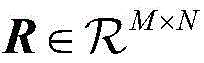
步骤1、根据用户对产品的评分和评论构建用户与商品的二部图,包括:用户集合

Figure BDA0003576415240000011
产品集合
Figure BDA0003576415240000012
评分矩阵
Figure BDA0003576415240000013
和评论张量
Figure BDA0003576415240000014
其中,令
Figure BDA0003576415240000015
表示第i个用户,M表示用户集合
Figure BDA0003576415240000016
的用户总数,令
Figure BDA0003576415240000017
表示第j个产品,N表示产品总数;评分矩阵R中第i行第j列元素rij表示第i个用户ui对第j个产品vj的评分,
Figure BDA0003576415240000018
表示所有评分取值的集合;令
Figure BDA0003576415240000019
表示第i个用户ui对第j个产品vj的评论向量,从而由评分矩阵R和评论张量E共同组成用户与商品之间的交互集合ε={R,E},并用二部图
Figure BDA00035764152400000110
表示用户与商品的交互;Step 1. Build a bipartite graph of users and products based on user ratings and comments on products, including: user sets
Figure BDA0003576415240000011
product collection
Figure BDA0003576415240000012
Scoring Matrix
Figure BDA0003576415240000013
and comment tensor
Figure BDA0003576415240000014
Among them, let
Figure BDA0003576415240000015
represents the i-th user, and M represents the set of users
Figure BDA0003576415240000016
the total number of users, let
Figure BDA0003576415240000017
represents the jth product, and N represents the total number of products; the element r ij in the ith row and the jth column of the rating matrix R represents the rating of the jth product vj by the ith user u i ,
Figure BDA0003576415240000018
represents the set of all scoring values; let
Figure BDA0003576415240000019
Represents the comment vector of the i-th user ui to the j-th product v j , so that the rating matrix R and the comment tensor E together form the interaction set ε={R, E} between the user and the product, and use the bipartite graph
Figure BDA00035764152400000110
Represents the user's interaction with the product;

步骤2、通过面向评论文本的图卷积进行特征传播,获得用户与产品表征:Step 2. Feature propagation through graph convolution for review text to obtain user and product representations:

步骤2.1、通过独热编码获取用户的嵌入矩阵

Figure BDA0003576415240000021
和产品的嵌入矩阵
Figure BDA0003576415240000022
并分别作为相应节点的初始表征;其中,用户的嵌入矩阵
Figure BDA0003576415240000023
的第i行向量
Figure BDA0003576415240000024
表示第i个用户ui的表征向量;同理,产品的嵌入矩阵
Figure BDA0003576415240000025
的第j行向量
Figure BDA0003576415240000026
表示第j个产品vj的嵌入向量;Step 2.1. Obtain the user's embedding matrix through one-hot encoding
Figure BDA0003576415240000021
and the embedding matrix of the product
Figure BDA0003576415240000022
and respectively as the initial representation of the corresponding node; among them, the user's embedding matrix
Figure BDA0003576415240000023
The ith row vector of
Figure BDA0003576415240000024
Represents the characterization vector of the i -th user ui; similarly, the embedding matrix of the product
Figure BDA0003576415240000025
The jth row vector of
Figure BDA0003576415240000026
represents the embedding vector of the jth product v j ;

定义有L层图卷积;Defined with L layer graph convolution;

步骤2.2、在第l层卷积层中利用式(1)计算从第j个产品vj到第i个用户ui的特征信息传播向量

Figure BDA0003576415240000027
Step 2.2, in the lth convolutional layer, use formula (1) to calculate the feature information propagation vector from the jth product vj to the ith user ui
Figure BDA0003576415240000027

Figure BDA0003576415240000028

式(1)中,

Figure BDA0003576415240000029
表示第l-1卷积层获得的第j个产品vj的表征向量;当l=1时,令
Figure BDA00035764152400000210
Figure BDA00035764152400000211
Figure BDA00035764152400000212
分别表示第j个产品vj和第i个用户ui的邻居节点集合;|·|表示计算集合元素的数量;
Figure BDA00035764152400000213
Figure BDA00035764152400000214
表示在第l卷积层中评分rij指定的两个参数向量,
Figure BDA00035764152400000215
Figure BDA00035764152400000216
表示在第l卷积层中评分rij指定的两个参数矩阵;σ(·)表示Sigmoid激活函数;
Figure BDA00035764152400000224
表示转置;In formula (1),
Figure BDA0003576415240000029
represents the characterization vector of the jth product v j obtained by the l-1th convolutional layer; when l=1, let
Figure BDA00035764152400000210
Figure BDA00035764152400000211
and
Figure BDA00035764152400000212
represent the neighbor node sets of the jth product v j and the ith user ui respectively; |·| represents the number of elements in the calculation set;
Figure BDA00035764152400000213
and
Figure BDA00035764152400000214
represents the two parameter vectors specified by the score r ij in the lth convolutional layer,
Figure BDA00035764152400000215
and
Figure BDA00035764152400000216
represents the two parameter matrices specified by the score r ij in the lth convolutional layer; σ( ) represents the sigmoid activation function;
Figure BDA00035764152400000224
means transpose;

步骤2.3、在第l层卷积层中利用式(2)计算从第i个用户ui到第j个产品vj的特征信息传播向量

Figure BDA00035764152400000217
Step 2.3: Calculate the feature information propagation vector from the i-th user u i to the j-th product v j using the formula (2) in the l-th convolutional layer
Figure BDA00035764152400000217

Figure BDA00035764152400000218

式(2)中,

Figure BDA00035764152400000219
表示第l-1卷积层获得的第i个用户ui表征向量;当l=1时,令
Figure BDA00035764152400000220
In formula (2),
Figure BDA00035764152400000219
represents the i-th user ui characterization vector obtained by the l-1th convolutional layer; when l=1, let
Figure BDA00035764152400000220

步骤2.4、利用式(3)聚合第l层卷积层的信息传播向量,从而相应获得第i个用户ui和第j个产品vj在第l层卷积层的表征向量

Figure BDA00035764152400000221
Figure BDA00035764152400000222
Step 2.4, use formula (3) to aggregate the information propagation vector of the lth convolutional layer, so as to obtain the representation vector of the ith user ui and the jth product vj in the lth convolutional layer accordingly.
Figure BDA00035764152400000221
and
Figure BDA00035764152400000222

Figure BDA00035764152400000223

式(3)中,W(l)为第l层卷积层的参数矩阵;In formula (3), W (l) is the parameter matrix of the lth convolutional layer;

步骤2.5、将l+1赋值给l后,返回步骤2.2执行,直到经过L层图卷积计算后,将最后一层的节点表征作为最终的用户表征

Figure BDA0003576415240000031
和产品表征
Figure BDA0003576415240000032
Step 2.5. After assigning l+1 to l, go back to step 2.2 to execute until after the L layer graph convolution calculation, the node representation of the last layer is used as the final user representation
Figure BDA0003576415240000031
and product characterization
Figure BDA0003576415240000032

步骤3、利用图对比学习增强用户与产品的表征向量:Step 3. Use graph comparison learning to enhance the representation vector of users and products:

步骤3.1、通过对比学习增强用户表征:Step 3.1. Enhance user representation through contrastive learning:

对用户-商品二部图

Figure BDA0003576415240000033
按照概率ρ随机丢弃图中产品节点以进行二次扰动,从而得到两个用户子图
Figure BDA0003576415240000034
Figure BDA0003576415240000035
并按照步骤2.2-步骤2.5的过程进行处理,从而得到两组用户表征向量
Figure BDA0003576415240000036
Figure BDA0003576415240000037
Figure BDA0003576415240000038
表示从子图
Figure BDA0003576415240000039
获取第i个用户ui的表征向量,
Figure BDA00035764152400000310
表示从子图
Figure BDA00035764152400000311
获取第i个用户ui的表征向量;Bipartite graph for users-products
Figure BDA0003576415240000033
According to the probability ρ, the product nodes in the graph are randomly discarded for secondary perturbation, so as to obtain two user subgraphs
Figure BDA0003576415240000034
and
Figure BDA0003576415240000035
And process according to the process of step 2.2-step 2.5, so as to obtain two sets of user characterization vectors
Figure BDA0003576415240000036
and
Figure BDA0003576415240000037
Figure BDA0003576415240000038
Represents a subgraph from
Figure BDA0003576415240000039
Get the characterization vector of the i -th user ui,
Figure BDA00035764152400000310
Represents a subgraph from
Figure BDA00035764152400000311
Obtain the characterization vector of the i -th user ui;

根据式(4)建立用户的对比学习损失函数

Figure BDA00035764152400000312
According to formula (4), the user's contrastive learning loss function is established
Figure BDA00035764152400000312

Figure BDA00035764152400000313

式(4)中,

Figure BDA00035764152400000314
表示对用户集合
Figure BDA00035764152400000315
随机抽样用户ui求期望;
Figure BDA00035764152400000316
表示先从用户集合
Figure BDA00035764152400000317
先抽样用户ui,再从用户集合
Figure BDA00035764152400000318
抽样用户ui'后求两次采样的期望;
Figure BDA00035764152400000319
表示计算两个节点特征向量相似度;In formula (4),
Figure BDA00035764152400000314
Represents a collection of users
Figure BDA00035764152400000315
Randomly sample user u i to find the expectation;
Figure BDA00035764152400000316
Indicates first from the user collection
Figure BDA00035764152400000317
First sample user u i , then from user set
Figure BDA00035764152400000318
After sampling user u i' , find the expectation of two samplings;
Figure BDA00035764152400000319
Represents the calculation of the similarity of the feature vector of two nodes;

步骤3.2、增强产品表征向量:Step 3.2. Enhance product representation vector:

对用户-商品二部图

Figure BDA00035764152400000320
按照概率ρ随机丢弃图中用户节点以进行二次扰动,从而得到两个产品子图并按照步骤2.2-步骤2.5的过程进行处理,从而得到两组产品表征向量
Figure BDA00035764152400000321
Figure BDA00035764152400000322
Figure BDA00035764152400000335
表示从子图
Figure BDA00035764152400000323
获取第j个用户vj的表征向量,
Figure BDA00035764152400000324
表示从子图
Figure BDA00035764152400000325
获取第j个用户vj的表征向量。Bipartite graph for users-products
Figure BDA00035764152400000320
According to the probability ρ, the user nodes in the graph are randomly discarded for secondary perturbation, so as to obtain two product subgraphs and process them according to the process of step 2.2-step 2.5, thereby obtaining two sets of product characterization vectors
Figure BDA00035764152400000321
and
Figure BDA00035764152400000322
Figure BDA00035764152400000335
Represents a subgraph from
Figure BDA00035764152400000323
Get the characterization vector of the jth user v j ,
Figure BDA00035764152400000324
Represents a subgraph from
Figure BDA00035764152400000325
Get the representation vector of the jth user v j .

利用式(4)建立产品的对比学习损失函数

Figure BDA00035764152400000326
Use Equation (4) to establish a product contrastive learning loss function
Figure BDA00035764152400000326

Figure BDA00035764152400000327

式(4)中,

Figure BDA00035764152400000328
表示对产品集合
Figure BDA00035764152400000329
随机抽样用户vj求期望;
Figure BDA00035764152400000330
表示先从产品集合
Figure BDA00035764152400000331
先抽样用户vj,再从产品集合
Figure BDA00035764152400000332
抽样用户vj',求两次抽样的期望;In formula (4),
Figure BDA00035764152400000328
Represents a collection of products
Figure BDA00035764152400000329
Randomly sample users v j to find the expectation;
Figure BDA00035764152400000330
Indicates first from the product collection
Figure BDA00035764152400000331
First sample user v j , then from product set
Figure BDA00035764152400000332
Sampling user v j' , find the expectation of two sampling;

步骤3.3、利用式(6)得到节点增强的对比损失函数

Figure BDA00035764152400000333
Step 3.3, use formula (6) to obtain the contrast loss function of node enhancement
Figure BDA00035764152400000333

Figure BDA00035764152400000334

步骤4、利用式(7)计算第i个用户ui和第j个产品vj的交互表征向量hijStep 4: Calculate the interaction representation vector h ij of the i-th user ui and the j-th product v j by using the formula (7):

Figure BDA0003576415240000041

式(7)中,MLP表示多层感知机,[,]表示向量拼接操作;In formula (7), MLP represents a multi-layer perceptron, and [,] represents a vector stitching operation;

步骤5、根据式(8)计算交互对比损失

Figure BDA0003576415240000042
Step 5. Calculate the interactive contrast loss according to formula (8).
Figure BDA0003576415240000042

Figure BDA0003576415240000043

式(8)中,

Figure BDA0003576415240000044
表示从交互集合ε中抽样用户-产品对(ui,vj)计算期望,
Figure BDA0003576415240000045
表示先从交互集合ε中抽样用户-产品对(ui,vj),再从交互集合ε中抽样用户-产品对(ui',vj')中抽取负样本对(i',j')后求期望;ei′j′表示第i'个用户ui'对第j'个产品vj'的评论向量;In formula (8),
Figure BDA0003576415240000044
represents the expected calculation of sampling user-product pairs (u i ,v j ) from the interaction set ε,
Figure BDA0003576415240000045
Indicates that the user-product pair (u i ,v j ) is sampled from the interaction set ε first, and then the negative sample pair (i',j is sampled from the user-product pair (u i' ,v j' ) from the interaction set ε ') and then find the expectation; e i'j' represents the comment vector of the i'th user u i' to the j'th product v j' ;

步骤6、根据式(9)得到第i个用户ui对第j个产品vj的预测评分

Figure BDA0003576415240000046
Step 6. Obtain the predicted score of the i-th user u i to the j-th product v j according to formula (9).
Figure BDA0003576415240000046

Figure BDA0003576415240000047

式(9)中;w为参数向量;In formula (9); w is the parameter vector;

步骤6.1、根据式(10)计算评分预测的损失函数

Figure BDA0003576415240000048
Step 6.1. Calculate the loss function of score prediction according to formula (10)
Figure BDA0003576415240000048

Figure BDA0003576415240000049

式(10)中,

Figure BDA00035764152400000410
表示所有的用户-产品对的集合;In formula (10),
Figure BDA00035764152400000410
represents the set of all user-product pairs;

步骤6.2、根据式(11)构建总损失函数

Figure BDA00035764152400000411
Step 6.2, construct the total loss function according to formula (11)
Figure BDA00035764152400000411

Figure BDA00035764152400000412

式(11)中,α和β是用于平衡三个损失函数的超参数;In Equation (11), α and β are hyperparameters used to balance the three loss functions;

步骤6.3、利用梯度下降法优化所有参数,使得损失函数

Figure BDA00035764152400000413
收敛至最小,从而得到预测评分误差最小的最优推荐模型,用于实现对产品的推荐。Step 6.3. Use gradient descent to optimize all parameters so that the loss function
Figure BDA00035764152400000413
Convergence to the minimum, so as to obtain the optimal recommendation model with the minimum prediction score error, which is used to implement product recommendation.

与现有技术相比,本发明有益效果体现在:Compared with the prior art, the beneficial effects of the present invention are reflected in:

1、本发明针对现有推荐模型建模不符合评论作为交互特征的缺点,提出了一种面向评论文本的图神经网络推荐方法,通过步骤1构建用户-产品二部图,并将评论文本和评分作为边的特征。该建模方式更符合评论的属性,从而避免了在节点表征中引入不相关噪声。1. Aiming at the shortcomings that the existing recommendation model modeling does not conform to comments as interactive features, the present invention proposes a review text-oriented graph neural network recommendation method. Scores as edge features. This modeling approach is more in line with the properties of reviews, thus avoiding the introduction of irrelevant noise in node representations.

2、本发明针对用户-产品二部图,通过步骤2在图卷积中引入边上的评分和评论特征计算节点和用户表征,该建模符合评分和评论作为用户与产品交互的实际情况,通过评论和评分自适应学习产品和用户之间相互影响,更准确捕获二者之间的协同信号,学习更准确的节点表征,从而提高了推荐性能。2. The present invention is aimed at the user-product bipartite graph, by introducing the rating and comment features on the edge into the graph convolution in step 2 to calculate the node and user representation, and the modeling conforms to the actual situation that the rating and comment are used as the interaction between the user and the product, By adaptively learning the interaction between products and users through reviews and ratings, the synergistic signals between the two can be more accurately captured, and more accurate node representations can be learned, thereby improving the recommendation performance.

3、本发明通过步骤3的图对比学习技术增强用户与产品的表征。约束节点表征在不同图扰动下的一致性,迫使模型从二部图中学习与节点最相关的信息,不仅缓解节点表征的噪声而且提高节点表征的鲁棒性,从而有效提升了评分预测的准确性。3. The present invention enhances the representation of users and products through the graph comparison learning technique in step 3. Constraining the consistency of node representations under different graph disturbances forces the model to learn the most relevant information about nodes from the bipartite graph, which not only alleviates the noise of node representations but also improves the robustness of node representations, thereby effectively improving the accuracy of score prediction sex.

4、本发明利用对比学习,将评论文本作为监督信号,在训练时不仅以目标评分作为训练目标而且学习更细腻丰富的评论信息。具体来说,本发明不仅学习用户的评分而且学习为什么给出对应的评分,从而获得更优的模型参数和更准确的推荐精度。4. The present invention utilizes comparative learning, takes the comment text as a supervision signal, and not only takes the target score as the training target during training, but also learns more delicate and rich comment information. Specifically, the present invention not only learns the user's rating but also learns why the corresponding rating is given, thereby obtaining better model parameters and more accurate recommendation accuracy.

附图说明Description of drawings

图1为本发明一种面向评论文本的图神经网络推荐方法的流程图。FIG. 1 is a flowchart of a method for recommending a review text-oriented graph neural network according to the present invention.

具体实施方式Detailed ways

本实施例中,一种面向评论文本的图神经网络推荐方法,考虑了现有基于评论推荐模型中对评论文本建模不切合评论作为交互特征的实际情况,通过在图卷积中将评论作为边特征对用户和产品建模,更准确地利用评论计算用户和产品表征。在此基础上,引入图对比学习增强节点表征的鲁棒性,并利用对比学习将评论作为监督信号引导模型学习用户更细腻的偏好,从而提高推荐性能。具体的说,如图1所示,该方法是按照以下步骤进行。In this embodiment, a graph neural network recommendation method oriented to review texts takes into account the fact that review text modeling in existing review-based recommendation models is not in line with the actual situation that reviews are used as interactive features. Edge features model users and products, and more accurately use reviews to compute user and product representations. On this basis, graph contrastive learning is introduced to enhance the robustness of node representation, and contrastive learning is used to guide the model to learn more delicate preferences of users by using reviews as a supervision signal, thereby improving recommendation performance. Specifically, as shown in Figure 1, the method is performed according to the following steps.

步骤1、根据用户对产品的评分和评论构建用户与商品的二部图,包括:用户集合

Figure BDA0003576415240000051
产品集合
Figure BDA0003576415240000052
评分矩阵
Figure BDA0003576415240000053
和评论张量
Figure BDA0003576415240000054
其中,令
Figure BDA0003576415240000055
表示第i个用户,M表示用户集合
Figure BDA0003576415240000056
的用户总数,令
Figure BDA0003576415240000057
表示第j个产品,N表示产品总数;评分矩阵R中第i行第j列元素rij表示第i个用户ui对第j个产品vj的评分,
Figure BDA0003576415240000058
表示所有评分取值的集合;令
Figure BDA0003576415240000059
表示第i个用户ui对第j个产品vj的评论向量,从而由评分矩阵R和评论张量E共同组成用户与商品之间的交互集合ε={R,E},并用二部图
Figure BDA00035764152400000510
表示用户与商品的交互;Step 1. Build a bipartite graph of users and products based on user ratings and comments on products, including: user sets
Figure BDA0003576415240000051
product collection
Figure BDA0003576415240000052
Scoring Matrix
Figure BDA0003576415240000053
and comment tensor
Figure BDA0003576415240000054
Among them, let
Figure BDA0003576415240000055
represents the i-th user, and M represents the set of users
Figure BDA0003576415240000056
the total number of users, let
Figure BDA0003576415240000057
represents the jth product, and N represents the total number of products; the element r ij in the ith row and the jth column of the rating matrix R represents the rating of the jth product vj by the ith user u i ,
Figure BDA0003576415240000058
represents the set of all scoring values; let
Figure BDA0003576415240000059
Represents the comment vector of the i-th user ui to the j-th product v j , so that the rating matrix R and the comment tensor E together form the interaction set ε={R, E} between the user and the product, and use the bipartite graph
Figure BDA00035764152400000510
Represents the user's interaction with the product;

步骤2、通过面向评论文本的图卷积进行特征传播,获得用户与产品表征:Step 2. Feature propagation through graph convolution for review text to obtain user and product representations:

步骤2.1、通过独热编码获取用户的嵌入矩阵
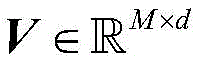
Figure BDA00035764152400000511
和产品的嵌入矩阵
Figure BDA00035764152400000512
并分别作为相应节点的初始表征;其中,用户的嵌入矩阵
Figure BDA00035764152400000513
的第i行向量
Figure BDA00035764152400000514
表示第i个用户ui的表征向量;同理,产品的嵌入矩阵
Figure BDA0003576415240000061
的第j行向量
Figure BDA0003576415240000062
表示第j个产品vj的嵌入向量;Step 2.1. Obtain the user's embedding matrix through one-hot encoding
Figure BDA00035764152400000511
and the embedding matrix of the product
Figure BDA00035764152400000512
and respectively as the initial representation of the corresponding node; among them, the user's embedding matrix
Figure BDA00035764152400000513
The ith row vector of
Figure BDA00035764152400000514
Represents the characterization vector of the i -th user ui; similarly, the embedding matrix of the product
Figure BDA0003576415240000061
The jth row vector of
Figure BDA0003576415240000062
represents the embedding vector of the jth product v j ;

定义有L层图卷积;Defined with L layer graph convolution;

步骤2.2、在第l层卷积层中利用式(1)计算从第j个产品vj到第i个用户ui的特征信息传播向量

Figure BDA0003576415240000063
Step 2.2, in the lth convolutional layer, use formula (1) to calculate the feature information propagation vector from the jth product vj to the ith user ui
Figure BDA0003576415240000063

Figure BDA0003576415240000064

式(1)中,

Figure BDA0003576415240000065
表示第l-1卷积层获得的第j个产品vj的表征向量;当l=1时,令
Figure BDA0003576415240000066
Figure BDA0003576415240000067
Figure BDA0003576415240000068
分别表示第j个产品vj和第i个用户ui的邻居节点集合;|·|表示计算集合元素的数量;
Figure BDA0003576415240000069
Figure BDA00035764152400000610
表示在第l卷积层中评分rij指定的两个参数向量,
Figure BDA00035764152400000611
Figure BDA00035764152400000612
表示在第l卷积层中评分rij指定的两个参数矩阵;σ(·)表示Sigmoid激活函数;
Figure BDA00035764152400000620
表示转置;In formula (1),
Figure BDA0003576415240000065
represents the characterization vector of the jth product v j obtained by the l-1th convolutional layer; when l=1, let
Figure BDA0003576415240000066
Figure BDA0003576415240000067
and
Figure BDA0003576415240000068
represent the neighbor node sets of the jth product v j and the ith user ui respectively; |·| represents the number of elements in the calculation set;
Figure BDA0003576415240000069
and
Figure BDA00035764152400000610
represents the two parameter vectors specified by the score r ij in the lth convolutional layer,
Figure BDA00035764152400000611
and
Figure BDA00035764152400000612
represents the two parameter matrices specified by the score r ij in the lth convolutional layer; σ( ) represents the sigmoid activation function;
Figure BDA00035764152400000620
means transpose;

该方法在信息传播中有效融合二部图结构和评论信息,提高模型表征。具体来说,传统方法用评分衡量信息转播向量的影响力,本发明用细腻的评论学习产品对用户的影响力大小。同样,对边上的评论,本发明采用相同的方法在传播中引入评论特征丰富信息特征。This method effectively fuses bipartite graph structure and comment information in information dissemination, and improves model representation. Specifically, the traditional method uses the score to measure the influence of the information broadcast vector, and the present invention uses the detailed comments to learn the influence of the product on the user. Similarly, for the side comments, the present invention adopts the same method to introduce the comment feature to enrich the information feature in the dissemination.

步骤2.3、在第l层卷积层中利用式(2)计算从第i个用户ui到第j个产品vj的特征信息传播向量

Figure BDA00035764152400000613
Step 2.3: Calculate the feature information propagation vector from the i-th user u i to the j-th product v j using the formula (2) in the l-th convolutional layer
Figure BDA00035764152400000613

Figure BDA00035764152400000614

式(2)中,

Figure BDA00035764152400000615
表示第l-1卷积层获得的第i个用户ui表征向量;当l=1时,令
Figure BDA00035764152400000616
In formula (2),
Figure BDA00035764152400000615
represents the i-th user ui characterization vector obtained by the l-1th convolutional layer; when l=1, let
Figure BDA00035764152400000616

步骤2.4、利用式(3)聚合第l层卷积层的信息传播向量,从而相应获得第i个用户ui和第j个产品vj在第l层卷积层的表征向量

Figure BDA00035764152400000617
Figure BDA00035764152400000618
Step 2.4, use formula (3) to aggregate the information propagation vector of the lth convolutional layer, so as to obtain the representation vector of the ith user ui and the jth product vj in the lth convolutional layer accordingly.
Figure BDA00035764152400000617
and
Figure BDA00035764152400000618

Figure BDA00035764152400000619

式(3)中,W(l)为第l层卷积层的参数矩阵;In formula (3), W (l) is the parameter matrix of the lth convolutional layer;

步骤2.5、将l+1赋值给l后,返回步骤2.2执行,直到经过L层图卷积计算后,将最后一层的节点表征作为最终的用户表征

Figure BDA0003576415240000071
和产品表征
Figure BDA0003576415240000072
Step 2.5. After assigning l+1 to l, go back to step 2.2 to execute until after the L layer graph convolution calculation, the node representation of the last layer is used as the final user representation
Figure BDA0003576415240000071
and product characterization
Figure BDA0003576415240000072

步骤3、利用图对比学习增强用户与产品的表征向量:Step 3. Use graph comparison learning to enhance the representation vector of users and products:

步骤3.1、通过对比学习增强用户表征:Step 3.1. Enhance user representation through contrastive learning:

对用户-商品二部图

Figure BDA0003576415240000073
按照概率ρ随机丢弃图中产品节点以进行二次扰动,从而得到两个用户子图
Figure BDA0003576415240000074
Figure BDA0003576415240000075
并按照步骤2.2-步骤2.5的过程进行处理,从而得到两组用户表征向量
Figure BDA0003576415240000076
Figure BDA0003576415240000077
Figure BDA0003576415240000078
表示从子图
Figure BDA0003576415240000079
获取第i个用户ui的表征向量,
Figure BDA00035764152400000710
表示从子图
Figure BDA00035764152400000711
获取第i个用户ui的表征向量。Bipartite graph for users-products
Figure BDA0003576415240000073
According to the probability ρ, the product nodes in the graph are randomly discarded for secondary perturbation, so as to obtain two user subgraphs
Figure BDA0003576415240000074
and
Figure BDA0003576415240000075
And process according to the process of step 2.2-step 2.5, so as to obtain two sets of user characterization vectors
Figure BDA0003576415240000076
and
Figure BDA0003576415240000077
Figure BDA0003576415240000078
Represents a subgraph from
Figure BDA0003576415240000079
Get the characterization vector of the i -th user ui,
Figure BDA00035764152400000710
Represents a subgraph from
Figure BDA00035764152400000711
Get the characterization vector of the ith user ui.

根据式(4)建立用户的对比学习损失函数

Figure BDA00035764152400000712
According to formula (4), the user's contrastive learning loss function is established
Figure BDA00035764152400000712

Figure BDA00035764152400000713

式(4)中,

Figure BDA00035764152400000714
表示对用户集合
Figure BDA00035764152400000715
随机抽样用户ui求期望;
Figure BDA00035764152400000716
表示先从用户集合
Figure BDA00035764152400000717
先抽样用户ui,再从用户集合
Figure BDA00035764152400000718
抽样用户ui',求两次采样的期望。
Figure BDA00035764152400000719
用于计算两个节点特征向量相似度。In formula (4),
Figure BDA00035764152400000714
Represents a collection of users
Figure BDA00035764152400000715
Randomly sample user u i to find the expectation;
Figure BDA00035764152400000716
Indicates first from the user collection
Figure BDA00035764152400000717
First sample user u i , then from user set
Figure BDA00035764152400000718
Sample user u i' , and find the expectation of two samples.
Figure BDA00035764152400000719
Used to calculate the similarity of two node feature vectors.

该方法约束同一节点的表征在不同子图下趋于一致。具体来说,该方法迫使从不同邻居节点和评论提取的共有的信息特征,这些共有的信息特征更准确的反应了用户的偏好,例如某位用户喜欢看硬科幻的电影。因此,该步骤能有效提高节点特征的准确性和鲁棒性,从而提升推荐性能。This method constrains the representation of the same node to be consistent under different subgraphs. Specifically, the method enforces shared information features extracted from different neighbor nodes and reviews, which more accurately reflect the user's preference, such as a certain user likes to watch hard sci-fi movies. Therefore, this step can effectively improve the accuracy and robustness of node features, thereby improving recommendation performance.

步骤3.2、增强产品表征向量:Step 3.2. Enhance product representation vector:

对用户-商品二部图

Figure BDA00035764152400000720
按照概率ρ随机丢弃图中用户节点以进行二次扰动,从而得到两个产品子图并按照步骤2.2-步骤2.5的过程进行处理,从而得到两组产品表征向量
Figure BDA00035764152400000721
Figure BDA00035764152400000722
Figure BDA00035764152400000723
表示从子图
Figure BDA00035764152400000724
获取第j个用户vj的表征向量,
Figure BDA00035764152400000725
表示从子图
Figure BDA00035764152400000726
获取第j个用户vj的表征向量。Bipartite graph for users-products
Figure BDA00035764152400000720
According to the probability ρ, the user nodes in the graph are randomly discarded for secondary perturbation, so as to obtain two product subgraphs and process them according to the process of step 2.2-step 2.5, thereby obtaining two sets of product characterization vectors
Figure BDA00035764152400000721
and
Figure BDA00035764152400000722
Figure BDA00035764152400000723
Represents a subgraph from
Figure BDA00035764152400000724
Get the characterization vector of the jth user v j ,
Figure BDA00035764152400000725
Represents a subgraph from
Figure BDA00035764152400000726
Get the representation vector of the jth user v j .

利用式(4)建立产品的对比学习损失函数

Figure BDA00035764152400000727
Use Equation (4) to establish a product contrastive learning loss function
Figure BDA00035764152400000727

Figure BDA00035764152400000728

式(4)中,

Figure BDA00035764152400000729
表示对产品集合
Figure BDA00035764152400000730
随机抽样用户vj求期望;
Figure BDA00035764152400000731
表示先从产品集合
Figure BDA0003576415240000081
先抽样用户vj,再从产品集合
Figure BDA0003576415240000082
抽样用户vj',求两次抽样的期望。In formula (4),
Figure BDA00035764152400000729
Represents a collection of products
Figure BDA00035764152400000730
Randomly sample users v j to find the expectation;
Figure BDA00035764152400000731
Indicates first from the product collection
Figure BDA0003576415240000081
First sample user v j , then from product set
Figure BDA0003576415240000082
Sampling user v j' , find the expectation of two samplings.

步骤3.3、利用式(6)得到节点增强的对比损失函数

Figure BDA0003576415240000083
Step 3.3, use formula (6) to obtain the contrast loss function of node enhancement
Figure BDA0003576415240000083

Figure BDA0003576415240000084

步骤4、利用式(7)计算第i个用户ui和第j个产品vj的交互表征向量hijStep 4: Calculate the interaction representation vector h ij of the i-th user ui and the j-th product v j by using the formula (7):

Figure BDA0003576415240000085

式(7)中,MLP表示多层感知机,[,]表示向量拼接操作;In formula (7), MLP represents a multi-layer perceptron, and [,] represents a vector stitching operation;

步骤5、根据式(8)计算交互对比损失

Figure BDA0003576415240000086
Step 5. Calculate the interactive contrast loss according to formula (8).
Figure BDA0003576415240000086

Figure BDA0003576415240000087

式(8)中,

Figure BDA0003576415240000088
表示从交互集合ε中抽样用户-产品对(ui,vj)计算期望,
Figure BDA0003576415240000089
表示先从ε中抽样用户-产品对(ui,vj),再从ε中抽样用户-产品对(ui',vj')中抽取负样本对(i',j')求期望;ei′j′表示第i'个用户ui'对第j'个产品vj'的评论向量。In formula (8),
Figure BDA0003576415240000088
represents the expected calculation of sampling user-product pairs (u i ,v j ) from the interaction set ε,
Figure BDA0003576415240000089
Indicates that the user-product pair (u i , v j ) is sampled from ε first, and then the negative sample pair (i ' , j ' ) is sampled from ε. ; e i'j' represents the comment vector of the i'th user ui ' to the j'th product v j' .

传统推荐模型以评分为目标训练模型参数。本发明通过对比学习引入评论作为目标,使模型在训练时不仅学习如何准确预测数值评分,而且学习用户给出评论中的详细原因。因为提供了额外有效的监督信号,模型的评分预测性能可以进一步提高。Traditional recommendation models train model parameters with scoring as the goal. In the present invention, reviews are introduced as a target through comparative learning, so that the model not only learns how to accurately predict the numerical rating during training, but also learns the detailed reasons in the reviews given by the user. The score prediction performance of the model can be further improved by providing an additional effective supervision signal.

步骤6、根据式(9)得到第i个用户ui对第j个产品vj的预测评分

Figure BDA00035764152400000810
Step 6. Obtain the predicted score of the i-th user u i to the j-th product v j according to formula (9).
Figure BDA00035764152400000810

Figure BDA00035764152400000811

式(9)中;w为参数向量;In formula (9); w is the parameter vector;

步骤6.1、根据式(10)计算评分预测的损失函数

Figure BDA00035764152400000812
Step 6.1. Calculate the loss function of score prediction according to formula (10)
Figure BDA00035764152400000812

Figure BDA00035764152400000813

式(10)中,

Figure BDA00035764152400000814
表示所有的用户-产品对的集合;In formula (10),
Figure BDA00035764152400000814
represents the set of all user-product pairs;

步骤6.2、根据式(11)构建总损失函数

Figure BDA00035764152400000815
Step 6.2, construct the total loss function according to formula (11)
Figure BDA00035764152400000815

Figure BDA00035764152400000816

其中,α和β是用于平衡三个损失函数的超参数;where α and β are hyperparameters used to balance the three loss functions;

步骤6.3、利用梯度下降法优化所有参数,使得损失函数

Figure BDA00035764152400000817
收敛至最小,从而得到预测评分误差最小的最优推荐模型,用于实现对产品的推荐。Step 6.3. Use gradient descent to optimize all parameters so that the loss function
Figure BDA00035764152400000817
Convergence to the minimum, so as to obtain the optimal recommendation model with the minimum prediction score error, which is used to implement product recommendation.

实验例:Experimental example:

为了验证本方法的有效性,本发明在五个推荐系统常用的公开数据集:DigitalMusic,Toys and Games,Clothing,CDs和Yelp上进行实验,比较本发明的方法(RGCL)与10种现有推荐方法:SVD,NCF,DeepCONN,NARRE,DAML,SDNet,TransNet,GC-MC,RMG和SSG的推荐性能,评价指标采用推荐系统种常用的MSE,越小的MSE表示评分预测的误差越小,推荐精度越高。In order to verify the effectiveness of this method, the present invention conducts experiments on five public datasets commonly used in recommender systems: DigitalMusic, Toys and Games, Clothing, CDs and Yelp, and compares the method of the present invention (RGCL) with 10 existing recommendations Method: Recommendation performance of SVD, NCF, DeepCONN, NARRE, DAML, SDNet, TransNet, GC-MC, RMG and SSG. The evaluation index adopts MSE commonly used in recommender systems. The smaller the MSE, the smaller the error of score prediction is. higher precision.

表1Table 1

推荐方法Recommended method Digital MusicDigital Music Toys and GamesToys and Games ClothingClothing CDsCDs YelpYelp SVDSVD 0.85230.8523 0.80860.8086 1.11671.1167 0.86620.8662 1.19391.1939 NCFNCF 0.84030.8403 0.80780.8078 1.10941.1094 0.87810.8781 1.18961.1896 DeepCoNNDeepCoNN 0.83780.8378 0.80280.8028 1.11841.1184 0.86210.8621 1.18771.1877 NARRENARRE 0.81720.8172 0.79620.7962 1.10641.1064 0.84950.8495 1.18621.1862 DAMLDAML 0.82370.8237 0.79360.7936 1.10651.1065 0.84830.8483 1.17931.1793 SDNetSDNet 0.83310.8331 0.80060.8006 1.1081.108 0.86540.8654 1.18371.1837 TransNetsTransNets 0.82730.8273 0.7980.798 1.11411.1141 0.8440.844 1.18551.1855 GC-MCGC-MC 0.8090.809 0.79860.7986 1.10881.1088 0.84040.8404 1.17371.1737 RMGRMG 0.80740.8074 0.79010.7901 1.10641.1064 0.84250.8425 1.17051.1705 SSGSSG 0.82180.8218 0.80640.8064 1.12281.1228 0.84580.8458 1.18071.1807 RGCLRGCL 0.77350.7735 0.77710.7771 1.08581.0858 0.8180.818 1.16091.1609

表1为本发明方法与对比方法的推荐效果比较。从实验结果可以看出,本发明提出的方法在MSE指标上都优于现有方法。Table 1 is a comparison of the recommended effects between the method of the present invention and the comparison method. It can be seen from the experimental results that the method proposed by the present invention is superior to the existing method in terms of MSE index.

综上所述,本方法将评论和评分作为用户与产品的交互特征,自适应学习二者之间的相互影响,学习更精准的节点表征和更细腻的用户偏好,从而提高了推荐性能。In summary, this method regards reviews and ratings as the interaction features between users and products, adaptively learns the interaction between the two, and learns more accurate node representations and more delicate user preferences, thereby improving the recommendation performance.

Claims (1)

1. A comment text-oriented graph neural network recommendation method is characterized by comprising the following steps:
step 1, constructing a bipartite graph of a user and a commodity according to the scores and comments of the user on the product, wherein the bipartite graph comprises the following steps: user collection
Figure FDA0003576415230000011
Product collection
Figure FDA0003576415230000012
Scoring matrix
Figure FDA0003576415230000013
And comment tensor
Figure FDA0003576415230000014
Wherein, it is made
Figure FDA0003576415230000015
Represents the ith user, M represents the user set
Figure FDA0003576415230000016
Total number of users of
Figure FDA0003576415230000017
Represents the jth product, and N represents the total number of products; element R in ith row and jth column in scoring matrix RijRepresents the ith user uiFor jth product vjR represents the set of all score values; order to
Figure FDA0003576415230000018
Represents the ith user uiTo the firstj products vjSo that the set of interactions E between the user and the commodity is composed of the scoring matrix R and the comment tensor E, and a bipartite graph is used
Figure FDA0003576415230000019
Representing user interaction with the merchandise;
step 2, carrying out feature propagation through a graph volume facing to a comment text to obtain user and product representations:
step 2.1, obtaining the embedded matrix of the user through the one-hot coding
Figure FDA00035764152300000110
And embedded matrix of products
Figure FDA00035764152300000111
And respectively as the initial representation of the corresponding node; wherein the embedded matrix of the user
Figure FDA00035764152300000112
Ith row vector of
Figure FDA00035764152300000113
Represents the ith user uiThe characterization vector of (2); similarly, the embedded matrix of the product
Figure FDA00035764152300000114
J (th) row vector of
Figure FDA00035764152300000115
Denotes the jth product vjThe embedded vector of (2);
defining L-layer graph convolution;
step 2.2, calculating the v from the jth product in the first layer convolution layer by using the formula (1)jTo the ith user uiCharacteristic information propagation vector of
Figure FDA00035764152300000116
Figure FDA00035764152300000117
In the formula (1), the reaction mixture is,
Figure FDA00035764152300000118
denotes the jth product v obtained from the l-1 th convolutional layerjThe characterization vector of (2); when l is 1, let
Figure FDA00035764152300000119
Figure FDA00035764152300000120
And
Figure FDA00035764152300000121
respectively represent the jth product vjAnd the ith user uiThe neighbor node set of (2); | represents the number of compute collection elements;
Figure FDA00035764152300000122
and
Figure FDA00035764152300000123
indicates the score r in the first convolutional layerijTwo of the parameter vectors are specified,
Figure FDA00035764152300000124
and
Figure FDA00035764152300000125
indicates the score r in the first convolutional layerijTwo specified parameter matrixes; σ (-) denotes Sigmoid activation function;
Figure FDA00035764152300000127
representing a transposition;
step 2.3, in the first layer convolution layer, the i-th user u is calculated by using the formula (2)iTo the jth product vjCharacteristic information propagation vector of
Figure FDA00035764152300000126
Figure FDA0003576415230000021
In the formula (2), the reaction mixture is,
Figure FDA0003576415230000022
represents the ith user u obtained from the l-1 convolutional layeriCharacterizing the vector; when l is 1, let
Figure FDA0003576415230000023
Step 2.4, aggregating the information propagation vector of the first layer convolution layer by using the formula (3) so as to correspondingly obtain the ith user uiAnd the jth product vjCharacterization vectors in convolutional layer of layer I
Figure FDA0003576415230000024
And
Figure FDA0003576415230000025
Figure FDA0003576415230000026
in formula (3), W(l)A parameter matrix of the first convolution layer;
step 2.5, after L +1 is assigned to L, the step 2.2 is returned to execute until the last layer of node representation is taken as the final user representation after the L-layer graph convolution calculation
Figure FDA0003576415230000027
And product characterization
Figure FDA0003576415230000028
Step 3, utilizing the graph to compare and learn the characterization vectors of the enhanced user and the enhanced product:
step 3.1, enhancing user representation through contrast learning:
for user-commodity bipartite graph
Figure FDA0003576415230000029
Randomly discarding product nodes in the graph according to the probability rho to carry out secondary disturbance, thereby obtaining two user subgraphs
Figure FDA00035764152300000210
And
Figure FDA00035764152300000211
and processing according to the process from step 2.2 to step 2.5 to obtain two groups of user characterization vectors
Figure FDA00035764152300000212
And
Figure FDA00035764152300000213
Figure FDA00035764152300000214
representing slave subgraphs
Figure FDA00035764152300000215
Obtaining the ith user uiThe characterization vector of (a) is determined,
Figure FDA00035764152300000216
representing slave subgraphs
Figure FDA00035764152300000217
Obtaining the ith user uiThe characterization vector of (2);
establishing a comparative learning loss function of the user according to the formula (4)
Figure FDA00035764152300000218
Figure FDA00035764152300000219
In the formula (4), the reaction mixture is,
Figure FDA00035764152300000220
representing a set of users
Figure FDA00035764152300000221
Randomly sampling users uiCalculating expectation;
Figure FDA00035764152300000222
representing a set of first-come users
Figure FDA00035764152300000223
Sampling user u firstiFrom the user set
Figure FDA00035764152300000224
Sampling user ui'Then, calculating the expectation of two times of sampling;
Figure FDA00035764152300000225
representing and calculating the similarity of the feature vectors of the two nodes;
step 3.2, enhancing a product characterization vector:
for user-commodity bipartite graph
Figure FDA00035764152300000226
Randomly discarding user nodes in the graph according to the probability rho to carry out secondary disturbance, thereby obtaining two product subgraphs, and processing according to the processes of the step 2.2 to the step 2.5, thereby obtaining two groups of productsToken vector
Figure FDA0003576415230000031
And
Figure FDA0003576415230000032
Figure FDA0003576415230000033
representing slave subgraphs
Figure FDA0003576415230000034
Obtaining the jth user vjThe characterization vector of (a) is determined,
Figure FDA0003576415230000035
representing slave subgraphs
Figure FDA0003576415230000036
Obtaining the jth user vjThe characterization vector of (2);
establishing a comparative learning loss function of a product using equation (4)
Figure FDA0003576415230000037
Figure FDA0003576415230000038
In the formula (4), the reaction mixture is,
Figure FDA0003576415230000039
representing a set of products
Figure FDA00035764152300000310
Randomly sampling users vjCalculating expectation;
Figure FDA00035764152300000311
representing a first-from product set
Figure FDA00035764152300000312
Sampling user v firstjFrom the product collection
Figure FDA00035764152300000313
Sampling users vj'Calculating the expectation of two times of sampling;
step 3.3, obtaining the node enhanced contrast loss function by using the formula (6)
Figure FDA00035764152300000314
Figure FDA00035764152300000315
Step 4, calculating the ith user u by using the formula (7)iAnd jth product vjIs characterized by an interaction characterization vector hij
Figure FDA00035764152300000316
In the formula (7), MLP represents a multilayer perceptron, [, ] represents a vector stitching operation;
step 5, calculating the interactive contrast loss according to the formula (8)
Figure FDA00035764152300000317
Figure FDA00035764152300000318
In the formula (8), the reaction mixture is,
Figure FDA00035764152300000319
representing a sampling of user-product pairs (u) from an interaction set epsiloni,vj) The expectation is calculated and the result is,
Figure FDA00035764152300000320
means that the user-product pairs (u) are first sampled from the interaction set epsiloni,vj) And then sampling user-product pairs (u) from the interaction set epsiloni',vj') Extracting negative sample pair (i ', j') and then obtaining expectation; e.g. of a cylinderi′j′Represents the ith' user ui'For the j' th product vj'The comment vector of (1);
step 6, obtaining the ith user u according to the formula (9)iFor jth product vjPredictive scoring of
Figure FDA00035764152300000321
Figure FDA00035764152300000322
In formula (9); w is a parameter vector;
step 6.1, calculating a score-predicted loss function according to the formula (10)
Figure FDA00035764152300000323
Figure FDA00035764152300000324
In the formula (10), the compound represented by the formula (10),
Figure FDA00035764152300000325
representing a collection of all user-product pairs;
step 6.2, constructing a total loss function according to the formula (11)
Figure FDA0003576415230000041
Figure FDA0003576415230000042
In the formula (11), α and β are hyper-parameters for balancing the three loss functions;
and 6.3, optimizing all parameters by using a gradient descent method to ensure that the loss function L converges to the minimum, thereby obtaining an optimal recommendation model with the minimum prediction scoring error and being used for realizing the recommendation of the product.
CN202210345556.9A 2022-03-31 2022-03-31 A graph neural network recommendation method for review text Active CN114723522B (en)

Priority Applications (1)

Application Number Priority Date Filing Date Title
CN202210345556.9A CN114723522B (en) 2022-03-31 2022-03-31 A graph neural network recommendation method for review text

Applications Claiming Priority (1)

Application Number Priority Date Filing Date Title
CN202210345556.9A CN114723522B (en) 2022-03-31 2022-03-31 A graph neural network recommendation method for review text

Publications (2)

Publication Number Publication Date
CN114723522A true CN114723522A (en) 2022-07-08
CN114723522B CN114723522B (en) 2024-11-26

Family

ID=82241245

Family Applications (1)

Application Number Title Priority Date Filing Date
CN202210345556.9A Active CN114723522B (en) 2022-03-31 2022-03-31 A graph neural network recommendation method for review text

Country Status (1)

Country Link
CN (1) CN114723522B (en)

Cited By (5)

* Cited by examiner, † Cited by third party
Publication number Priority date Publication date Assignee Title
CN115329159A (en) * 2022-08-18 2022-11-11 中国银行股份有限公司 User screening method, device, equipment and storage medium based on graph comparison learning
CN115829159A (en) * 2022-12-29 2023-03-21 人民网股份有限公司 Social media fan newly-increased prediction method, device, equipment and storage medium
CN116167828A (en) * 2023-04-25 2023-05-26 江苏亿友慧云软件股份有限公司 Article recommendation method based on graph cooperation and contrast learning
CN116737934A (en) * 2023-06-20 2023-09-12 合肥工业大学 An algorithm for detecting troll fake comments based on semi-supervised graph neural network
CN121190165A (en) * 2025-11-24 2025-12-23 安徽思高智能科技有限公司 Comment recommendation methods, media, and devices based on semantic feature and graph feature fusion.

Citations (11)

* Cited by examiner, † Cited by third party
Publication number Priority date Publication date Assignee Title
WO2019236560A1 (en) * 2018-06-04 2019-12-12 The Regents Of The University Of California Pair-wise or n-way learning framework for error and quality estimation
CN111368197A (en) * 2020-03-04 2020-07-03 哈尔滨理工大学 A review recommendation system and method based on deep learning
CN111753207A (en) * 2020-06-29 2020-10-09 华东师范大学 A Review-Based Neural Graph Collaborative Filtering Model
CN112100485A (en) * 2020-08-20 2020-12-18 齐鲁工业大学 A review-based rating prediction method and system for item recommendation
CN112231577A (en) * 2020-11-06 2021-01-15 重庆理工大学 A Recommendation Method Fusing Text Semantic Vectors and Neural Collaborative Filtering
CN112328900A (en) * 2020-11-27 2021-02-05 北京工业大学 Deep learning recommendation method integrating scoring matrix and comment text
CN112650929A (en) * 2020-12-31 2021-04-13 安徽农业大学 Graph neural network recommendation method integrating comment information
CN112905894A (en) * 2021-03-24 2021-06-04 合肥工业大学 Collaborative filtering recommendation method based on enhanced graph learning
CN113343113A (en) * 2021-07-05 2021-09-03 合肥工业大学 Cold start entity recommendation method for knowledge distillation based on graph convolution network
KR20210144331A (en) * 2020-05-22 2021-11-30 주식회사 스타일셀러 Method and apparatus for recommending selling item to seller of on-line shopping mall
WO2022007526A1 (en) * 2020-07-07 2022-01-13 云境商务智能研究院南京有限公司 Travel package recommendation method based on multi-view attention mechanism

Patent Citations (11)

* Cited by examiner, † Cited by third party
Publication number Priority date Publication date Assignee Title
WO2019236560A1 (en) * 2018-06-04 2019-12-12 The Regents Of The University Of California Pair-wise or n-way learning framework for error and quality estimation
CN111368197A (en) * 2020-03-04 2020-07-03 哈尔滨理工大学 A review recommendation system and method based on deep learning
KR20210144331A (en) * 2020-05-22 2021-11-30 주식회사 스타일셀러 Method and apparatus for recommending selling item to seller of on-line shopping mall
CN111753207A (en) * 2020-06-29 2020-10-09 华东师范大学 A Review-Based Neural Graph Collaborative Filtering Model
WO2022007526A1 (en) * 2020-07-07 2022-01-13 云境商务智能研究院南京有限公司 Travel package recommendation method based on multi-view attention mechanism
CN112100485A (en) * 2020-08-20 2020-12-18 齐鲁工业大学 A review-based rating prediction method and system for item recommendation
CN112231577A (en) * 2020-11-06 2021-01-15 重庆理工大学 A Recommendation Method Fusing Text Semantic Vectors and Neural Collaborative Filtering
CN112328900A (en) * 2020-11-27 2021-02-05 北京工业大学 Deep learning recommendation method integrating scoring matrix and comment text
CN112650929A (en) * 2020-12-31 2021-04-13 安徽农业大学 Graph neural network recommendation method integrating comment information
CN112905894A (en) * 2021-03-24 2021-06-04 合肥工业大学 Collaborative filtering recommendation method based on enhanced graph learning
CN113343113A (en) * 2021-07-05 2021-09-03 合肥工业大学 Cold start entity recommendation method for knowledge distillation based on graph convolution network

Non-Patent Citations (4)

* Cited by examiner, † Cited by third party
Title
YEJIN TAN ET AL.: "A Fine-grained Sentiment Analysis Method Based on Dependency Tree and Graph Attention Network", JOURNAL OF PHYSICS: CONFERENCE SERIES, vol. 1651, 31 December 2020 (2020-12-31) *
丁锋等: "基于注意力机制和BiLSTM-CRF的消极情绪意见目标抽取", 计算机科学, vol. 49, no. 02, 28 February 2022 (2022-02-28) *
汤颖;钟南江;范菁;: "一种结合用户评分信息的改进好友推荐算法", 计算机科学, vol. 43, no. 09, 30 September 2016 (2016-09-30) *
谭云志;张敏;刘奕群;马少平;: "基于用户评分和评论信息的协同推荐框架", 模式识别与人工智能, vol. 29, no. 04, 30 April 2016 (2016-04-30) *

Cited By (7)

* Cited by examiner, † Cited by third party
Publication number Priority date Publication date Assignee Title
CN115329159A (en) * 2022-08-18 2022-11-11 中国银行股份有限公司 User screening method, device, equipment and storage medium based on graph comparison learning
CN115829159A (en) * 2022-12-29 2023-03-21 人民网股份有限公司 Social media fan newly-increased prediction method, device, equipment and storage medium
CN115829159B (en) * 2022-12-29 2023-11-10 人民网股份有限公司 Social media vermicelli newly-added prediction method, device, equipment and storage medium
CN116167828A (en) * 2023-04-25 2023-05-26 江苏亿友慧云软件股份有限公司 Article recommendation method based on graph cooperation and contrast learning
CN116737934A (en) * 2023-06-20 2023-09-12 合肥工业大学 An algorithm for detecting troll fake comments based on semi-supervised graph neural network
CN116737934B (en) * 2023-06-20 2024-03-22 合肥工业大学 Naval false comment detection algorithm based on semi-supervised graph neural network
CN121190165A (en) * 2025-11-24 2025-12-23 安徽思高智能科技有限公司 Comment recommendation methods, media, and devices based on semantic feature and graph feature fusion.

Also Published As

Publication number Publication date
CN114723522B (en) 2024-11-26

Similar Documents

Publication Publication Date Title
CN114723522A (en) Comment text-oriented graph neural network recommendation method
CN113254803B (en) A social recommendation method based on multi-feature heterogeneous graph neural network
CN111797321B (en) A method and system for personalized knowledge recommendation for different scenarios
CN106055661B (en) More interest resource recommendations based on more Markov chain models
CN115840853A (en) Course recommendation system based on knowledge graph and attention network
CN113420221B (en) An interpretable recommendation method that integrates user implicit item preference and explicit feature preference
CN114997476B (en) A commodity prediction method integrating commodity association relationships
CN104199818B (en) Method is recommended in a kind of socialization based on classification
CN113918833A (en) Product recommendation method realized through graph convolution collaborative filtering of social network relationship
CN111538841A (en) Review sentiment analysis method, device and system based on knowledge mutual distillation
CN105389590A (en) Video clustering recommendation method and apparatus
CN115203550A (en) Social recommendation method and system for enhancing neighbor relation
CN115171842A (en) Graph neural network traditional Chinese medicine recommendation method based on syndrome information
CN113918834A (en) Graph convolution collaborative filtering recommendation method fusing social relations
CN115525819A (en) A cross-domain recommendation method for information cocoons
Zhang et al. Double bayesian pairwise learning for one-class collaborative filtering
CN117951375A (en) An item recommendation method based on multi-task training item attribute graph
CN114637920A (en) Object recommendation method and device
CN113837266A (en) A software defect prediction method based on feature extraction and stacking ensemble learning
CN117216382A (en) An interactive processing method, model training method and related devices
CN121352873A (en) A method, device, and medium for predicting content popularity.
CN116401450A (en) A recommendation method, device and computer equipment based on knowledge graph
CN115858945A (en) Article recommendation method and system, electronic device and storage medium
US20250190433A1 (en) Search data processing method, computer device, and storage medium
CN118657582A (en) A personalized style-guided multimodal clothing matching recommendation method

Legal Events

Date Code Title Description
PB01 Publication
PB01 Publication
SE01 Entry into force of request for substantive examination
GR01 Patent grant
GR01 Patent grant