CN114679361A - OFDM modulation method and communication device - Google Patents
OFDM modulation method and communication device Download PDFInfo
- Publication number
- CN114679361A CN114679361A CN202210225134.8A CN202210225134A CN114679361A CN 114679361 A CN114679361 A CN 114679361A CN 202210225134 A CN202210225134 A CN 202210225134A CN 114679361 A CN114679361 A CN 114679361A
- Authority
- CN
- China
- Prior art keywords
- time domain
- subcarrier
- subcarriers
- constellation
- contribution
- Prior art date
- Legal status (The legal status is an assumption and is not a legal conclusion. Google has not performed a legal analysis and makes no representation as to the accuracy of the status listed.)
- Granted
Links
- 238000000034 method Methods 0.000 title claims abstract description 62
- 230000006854 communication Effects 0.000 title claims abstract description 35
- 238000004891 communication Methods 0.000 title claims abstract description 34
- 238000012545 processing Methods 0.000 claims abstract description 41
- 230000021615 conjugation Effects 0.000 claims description 13
- 238000012986 modification Methods 0.000 claims description 12
- 230000004048 modification Effects 0.000 claims description 12
- 238000003860 storage Methods 0.000 claims description 9
- 238000005070 sampling Methods 0.000 claims description 8
- 239000000969 carrier Substances 0.000 claims description 4
- 238000013461 design Methods 0.000 abstract description 22
- 230000000875 corresponding effect Effects 0.000 description 75
- 238000010586 diagram Methods 0.000 description 16
- 230000006870 function Effects 0.000 description 11
- 238000004590 computer program Methods 0.000 description 8
- 238000005516 engineering process Methods 0.000 description 8
- 230000008569 process Effects 0.000 description 7
- 238000005457 optimization Methods 0.000 description 6
- 230000009467 reduction Effects 0.000 description 5
- 230000035945 sensitivity Effects 0.000 description 5
- 239000000243 solution Substances 0.000 description 5
- 230000008859 change Effects 0.000 description 4
- 238000010295 mobile communication Methods 0.000 description 4
- 230000000694 effects Effects 0.000 description 3
- 238000013507 mapping Methods 0.000 description 3
- 238000004422 calculation algorithm Methods 0.000 description 2
- 230000001268 conjugating effect Effects 0.000 description 2
- 230000002596 correlated effect Effects 0.000 description 2
- 230000003287 optical effect Effects 0.000 description 2
- 230000003190 augmentative effect Effects 0.000 description 1
- 230000009286 beneficial effect Effects 0.000 description 1
- 230000005540 biological transmission Effects 0.000 description 1
- 238000004364 calculation method Methods 0.000 description 1
- 230000015556 catabolic process Effects 0.000 description 1
- 230000000295 complement effect Effects 0.000 description 1
- 230000001186 cumulative effect Effects 0.000 description 1
- 238000006731 degradation reaction Methods 0.000 description 1
- 238000011161 development Methods 0.000 description 1
- 238000005315 distribution function Methods 0.000 description 1
- 238000002347 injection Methods 0.000 description 1
- 239000007924 injection Substances 0.000 description 1
- 238000004519 manufacturing process Methods 0.000 description 1
- 238000003672 processing method Methods 0.000 description 1
- 230000003068 static effect Effects 0.000 description 1
Images


Classifications
-
- H—ELECTRICITY
- H04—ELECTRIC COMMUNICATION TECHNIQUE
- H04L—TRANSMISSION OF DIGITAL INFORMATION, e.g. TELEGRAPHIC COMMUNICATION
- H04L27/00—Modulated-carrier systems
- H04L27/26—Systems using multi-frequency codes
- H04L27/2601—Multicarrier modulation systems
- H04L27/2614—Peak power aspects
-
- H—ELECTRICITY
- H04—ELECTRIC COMMUNICATION TECHNIQUE
- H04L—TRANSMISSION OF DIGITAL INFORMATION, e.g. TELEGRAPHIC COMMUNICATION
- H04L27/00—Modulated-carrier systems
- H04L27/26—Systems using multi-frequency codes
- H04L27/2601—Multicarrier modulation systems
- H04L27/2614—Peak power aspects
- H04L27/2621—Reduction thereof using phase offsets between subcarriers
Landscapes
- Engineering & Computer Science (AREA)
- Computer Networks & Wireless Communication (AREA)
- Signal Processing (AREA)
- Digital Transmission Methods That Use Modulated Carrier Waves (AREA)
Abstract
An OFDM modulation method and a communication device are provided, wherein the method comprises the following steps: carrying out QAM modulation and IFFT processing on bit data to obtain a time domain signal; for the time domain signal in each time domain unit, if the PAPR of the time domain signal is greater than a first set threshold, performing the following processing: determining M peak values of the time domain signal, which are larger than a second set threshold value, and determining a candidate subcarrier set according to the contribution of each subcarrier on the frequency domain to the M peak values and the expected contribution of each subcarrier to the updated module values of the M peak values after the constellation corresponding to each subcarrier is modified; and modifying the constellation corresponding to the Q subcarriers in the candidate subcarrier set, and performing IFFT processing again according to the modified constellation corresponding to each subcarrier in the frequency domain to obtain an updated time domain signal. According to the technical scheme, the PAPR of the time domain signal can be effectively reduced by modifying the constellation, the design pressure of the PA is relieved, and the power consumption of the PA is reduced.
Description
Technical Field
The present application relates to the field of wireless communication technologies, and in particular, to an OFDM modulation method and a communication apparatus.
Background
With the development of mobile communication technology, Orthogonal Frequency Division Multiplexing (OFDM) technology is widely used. The OFDM technology mainly modulates information on each subcarrier of frequency, and then performs Inverse Fast Fourier Transform (IFFT) on the modulated information to obtain a time domain signal, and sends out the time domain signal. However, an important drawback of OFDM technology is that it results in a high Peak-to-Average-Power-Ratio (PAPR), which is a great challenge for radio frequency Power Amplifier (PA) design and Power consumption.
Aiming at the problem of high peak-to-average power ratio of an OFDM system, some methods are proposed in the industry to solve the problem. As shown in fig. 1, the most common processing method in the prior art is to generate a time domain waveform through IFFT by clipping (clip), saturate the amplitude of a point higher than a certain threshold to a set threshold, and then filter. This method is simple to implement, but it causes Error Vector Magnitude (EVM) degradation and adjacent channel leakage, and the more clipping, the greater the influence on EVM and adjacent channel leakage.
Disclosure of Invention
The application provides an OFDM modulation method and a communication device, which are used for reducing the PAPR of a time domain signal in an OFDM system.
In a first aspect, an embodiment of the present application provides an OFDM modulation method, which is applicable to various communication apparatuses in a wireless communication system, such as a terminal device, an access network device, a wireless relay device, and the like, and is used to implement a signal modulation function when the communication apparatus performs wireless communication with other communication apparatuses, and in particular, the method is applicable to a sending end of a signal during wireless communication.
The method comprises the following steps: carrying out QAM modulation and IFFT processing on bit data to obtain a time domain signal; for the time domain signal in each time domain unit, if the PAPR of the time domain signal in the time domain unit is greater than a first set threshold, performing the following processing: searching M peak values of the time domain signal in the time domain unit, wherein the modulus value of the time domain signal is larger than a second set threshold value, and M is a positive integer; determining a candidate subcarrier set according to the contribution of each subcarrier on the frequency domain to the M peak values and the expected contribution of each subcarrier on the updated module values of the M peak values after the constellation corresponding to each subcarrier is modified; modifying the constellation corresponding to Q subcarriers in the candidate subcarrier set, wherein Q is a positive integer; and carrying out IFFT processing again according to the modified constellation corresponding to each subcarrier on the frequency domain to obtain an updated time domain signal, and sending the updated time domain signal.
According to the technical scheme, the peak value of the time domain signal in each time domain unit can be firstly found out according to the time domain signal in each time domain unit, and then partial subcarriers are selected from each subcarrier in the frequency domain to modify the constellation according to the contribution of each subcarrier in the frequency domain to the peak value and the change condition of the peak value after the constellation corresponding to the subcarrier is modified, so that the peak value in the time domain signal is reduced, the PAPR of the time domain signal is reduced, the design pressure of the PA is relieved, the power consumption of the PA is reduced, and the efficiency of the PA is improved.
In one possible design, the modifying the constellation corresponding to Q subcarriers in the candidate subcarrier set includes: and carrying out negation operation, or conjugate operation, or negation operation of conjugate on the constellation corresponding to each subcarrier in the Q subcarriers.
According to the technical scheme, the constellation is modified for each screened subcarrier by adopting the three constellation operation modes, so that the contribution of the subcarriers to the peak value of the time domain signal can be reduced, for example, the contribution is changed from positive to negative, and the peak value of the time domain signal is further reduced.
In one possible design, the determining a candidate subcarrier set according to the contribution of each subcarrier on the frequency domain to the M peaks and the expected contribution of each subcarrier to the updated modulus of the M peaks after modifying the constellation corresponding to each subcarrier includes: selecting P subcarriers with the modulus values of the corresponding constellations larger than a third set threshold from each subcarrier on the frequency domain, wherein P is a positive integer; and determining the candidate subcarrier set according to the contribution of the P subcarriers to the M peaks and the expected contribution of the P subcarriers to the updated modulus of the M peaks after the constellation corresponding to the P subcarriers is modified.
According to the technical scheme, before the subcarriers in the candidate subcarrier set are determined according to the contribution of the subcarriers to the peak value of the time domain signal and the change condition of the peak value of the time domain signal after the constellation corresponding to the subcarriers is expected to be modified, the subcarriers can be preliminarily screened according to the modulus of the constellation corresponding to each subcarrier, so that the selection range is narrowed, and the efficiency is improved.
In one possible design, the determining the candidate subcarrier set according to the contribution of the P subcarriers to the M peaks and the expected contribution of the P subcarriers to the updated modulus values of the M peaks after the constellation corresponding to the P subcarriers is modified includes: determining the modification of the constellation corresponding to the subcarriers so that the maximum value of the updated modulus values of the M peaks is the first Q subcarriers with the minimum value, wherein Q is a positive integer, according to the contribution of each subcarrier of the P subcarriers to each peak of the M peaks and the expected contribution of each subcarrier to the updated modulus value of each peak of the M peaks after modifying the constellation corresponding to each subcarrier of the P subcarriers; and taking the Q subcarriers as subcarriers in the candidate subcarrier set.
In the technical solution of the present application, when selecting a subcarrier in a candidate subcarrier set, a maximum value of updated modulus values of M peak values, which are caused by modifying a constellation corresponding to each subcarrier in a frequency domain, is considered, instead of only a single peak value (for example, a maximum value of original M peak values). By comprehensively considering a plurality of peaks of the time domain signal, the situation that some peak is reduced but other peaks are not increased due to constellation modification can be effectively avoided.
In one possible design, the method further includes: for each subcarrier k in the P subcarriers, determining a maximum value in the updated modulus values of the M peaks after modifying the constellation corresponding to the subcarrier k by traversing the time domain position n where the M peaks are located; for time domain position n where each peak value of the M peak values is located, the expected updated module value of the peak value is equal to the module value of the peak value minus the contribution of the subcarrier k to the peak value, plus the expected contribution of the subcarrier k to the updated module value of the peak value after the constellation corresponding to the subcarrier k is modified.
According to the technical scheme, the constellations of the multiple subcarriers can be combined and optimized under the condition that all the peaks in the time domain are considered, so that the maximum peak in the time domain can be as small as possible after the constellations are modified each time.
In one possible designK, a subcarrier of the P subcarriers0For the peak value x [ n ] in the M peak values0]The contribution of (A) is as follows:

wherein, x [ n ]0]Is any one of the M peaks, n0Is said peak value x [ n ]0]Position in the time domain, k0For the position of any one of the P subcarriers in each subcarrier on the frequency domain,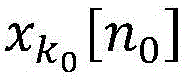 for the sub-carrier k0For the peak value x [ n0]Contribution of (1), X [ k ]0]For the sub-carrier k0Corresponding constellation, N is the number of IFFT points.
In one possible design, the desired modification of subcarrier k of the P subcarriers0The sub-carrier k after the corresponding constellation0For the peak value x [ n ] in the M peak values0]The contribution of the updated modulus value is:


wherein, for the sub-carrier k0The sub-carrier k after the inversion operation of the corresponding constellation0For the peak value x [ n0]The contribution of the updated modulus value is,
 for the sub-carrier k0The sub-carrier k after the conjugation operation is carried out on the corresponding constellation0For the peak value x [ n0]The contribution of the updated modulus value is,
 for the sub-carrier k0The subcarrier k is obtained after the inverse operation of taking conjugation of the corresponding constellation0For the peak value x [ n0]Contribution of updated modulus value.
In one possible design, the method further includes: and determining the number Q of subcarriers in the candidate subcarrier set according to the PAPR of the time-domain signal in the time-domain unit.
According to the technical scheme, the number of subcarriers needing to be processed or the number of bits needing to be turned over in original data can be controlled according to the PAPR, so that the influence of the processing of the sending end on the coding and decoding of the receiving end is reduced. Optionally, the Q value may be positively correlated with the PAPR value, for example, when the PAPR is larger, more subcarriers may be processed, the Q value is correspondingly larger, when the PAPR is smaller, less subcarriers may be processed, and the Q value is correspondingly smaller, so as to balance between reducing the PAPR of the transmitting end and reducing the influence on the codec of the receiving end.
In one possible design, the sampling rate of the time domain signal is more than 2 times the bandwidth.
According to the technical scheme, the peak value of the time domain signal can be found more accurately by setting the sampling rate of the time domain signal, so that the effect of reducing the PAPR is improved.
In a second aspect, the present embodiments provide a communication device, which is used to implement the functions of the method in any one of the possible designs of the first aspect, and the functions of the communication device may be implemented by hardware or by hardware executing corresponding software, where the hardware or software includes one or more modules or units or means (means) corresponding to the functions.
Illustratively, the communication device may include:
the processing module is used for carrying out Quadrature Amplitude Modulation (QAM) modulation and fast inverse Fourier transform (IFFT) processing on the bit data to obtain a time domain signal; for the time domain signal in each time domain unit, if the PAPR of the time domain signal in the time domain unit is greater than a first set threshold, performing the following processing: determining M peak values of the time domain signals in the time domain unit, wherein the modulus values of the time domain signals are larger than a second set threshold value, and M is a positive integer; determining a candidate subcarrier set according to the contribution of each subcarrier on the frequency domain to the M peak values and the expected contribution of each subcarrier on the updated module values of the M peak values after the constellation corresponding to each subcarrier is modified; modifying constellations corresponding to Q subcarriers included in the candidate subcarrier set, wherein Q is a positive integer; and performing IFFT processing again according to the modified constellation corresponding to each subcarrier on the frequency domain to obtain an updated time domain signal.
And the transceiver module is used for transmitting the updated time domain signal.
In a third aspect, an embodiment of the present application further provides a communication apparatus, including:
a memory for storing program instructions;
A processor for calling the program instructions stored in said memory and for executing the method as described in the various possible designs of the first aspect according to the obtained program instructions.
In a fourth aspect, the present application further provides a computer-readable storage medium, in which computer-readable instructions are stored, and when the computer-readable instructions are read and executed by a computer, the method described in any one of the possible designs of the first aspect is implemented.
Drawings
In order to more clearly illustrate the technical solutions in the embodiments of the present application, the drawings needed to be used in the description of the embodiments will be briefly introduced below, and it is obvious that the drawings in the following description are only some embodiments of the present application, and it is obvious for those skilled in the art to obtain other drawings based on these drawings without inventive exercise.
Fig. 1 is a diagram illustrating PAPR reduction by clipping a time domain signal in the prior art;
fig. 2 is a schematic network architecture of a communication system according to an embodiment of the present application;
fig. 3 is a schematic flowchart of an OFDM modulation method according to an embodiment of the present application;
Fig. 4 is a flowchart illustrating a process of determining a candidate subcarrier set according to an embodiment of the present application;
fig. 5 is a schematic diagram of three constellation operation modes of a constellation corresponding to a modified subcarrier in an embodiment of the present application;
fig. 6 is a schematic vector relationship diagram of reducing a time domain signal peak by modifying a constellation corresponding to a subcarrier in the embodiment of the present application;
fig. 7 is a schematic diagram comparing a conventional OFDM modulation procedure provided in an embodiment of the present application with an OFDM modulation procedure in the present application;
FIGS. 8a and 8b are schematic diagrams of a PAPR curve and a sensitivity curve in one particular example provided by an embodiment of the present application;
fig. 9 and fig. 10 are schematic structural diagrams of a communication device according to an embodiment of the present application.
Detailed Description
In order to make the objects, technical solutions and advantages of the present application clearer, the present application will be described in further detail with reference to the accompanying drawings, and it is obvious that the described embodiments are only a part of the embodiments of the present application, and not all embodiments. All other embodiments, which can be derived by a person skilled in the art from the embodiments given herein without making any creative effort, shall fall within the protection scope of the present application.
Fig. 2 illustrates a network architecture of a communication system to which an OFDM modulation method provided in the embodiment of the present application is applied. As shown in fig. 2, a radio access network device 210, a terminal device 210, and a terminal device 220 may be included in the communication system. The number of the various types of devices shown in the figures is exemplary. Optionally, the communication system may further include a core network device and other types of network devices, such as a wireless relay device and the like, which are not shown in the drawings, and the present application is not limited in particular.
The terminal equipment can be connected with the wireless access network equipment in a wireless mode so as to access the mobile communication system. The terminal device and the terminal device may also communicate via device-to-device (D2D) technology.
The terminal device may also be referred to as a terminal, a User Equipment (UE), a mobile station, a mobile terminal, or the like. The terminal device can be a mobile phone, a tablet computer, a computer with a wireless transceiving function, a virtual reality terminal device, an augmented reality terminal device, a wireless terminal in industrial control, a wireless terminal in unmanned driving, a wireless terminal in remote operation, a wireless terminal in a smart grid, a wireless terminal in transportation safety, a wireless terminal in a smart city, a wireless terminal in a smart home and the like. The embodiment of the present application does not limit the specific technology and the specific device form adopted by the terminal device.
The radio access network device may be a base station (base station), an evolved NodeB (eNodeB), a Transmission Reception Point (TRP), a next generation base station (gNB) in a 5G mobile communication system, a base station in a future mobile communication system, or an access node in a WiFi system, etc.; the present invention may also be a module or a unit that performs part of the functions of the base station, and for example, the module may be a Centralized Unit (CU) or a Distributed Unit (DU). The embodiments of the present application do not limit the specific technologies and the specific device forms adopted by the radio access network device.
The method is applied to a sending end in the wireless communication process, and when the sending end judges that the PAPR of the time domain signal is greater than a first set threshold value, the sending end can modify a constellation corresponding to one or more subcarriers which contribute to each peak value of the time domain signal to a greater extent, then perform IFFT again, and send out the time domain signal.
As shown in fig. 3, the method includes:
step 301, performing Quadrature Amplitude Modulation (QAM) Modulation and fast inverse fourier transform (IFFT) processing on the bit data to obtain a time domain signal.
In the present application, the encoded bit data may be QAM modulated in groups of every S bits, where S is a positive integer, for example, when 256QAM modulation is used, S is equal to 8. After QAM modulation, a group of bits in the bit data are mapped into one constellation (constellation) in a constellation diagram, each constellation represents one complex symbol in a complex plane, and then each constellation is mapped onto each subcarrier in a frequency domain, which means that the amplitude and phase of the subcarrier are modulated according to the complex symbol represented by the constellation, and then transformed into a time domain through IFFT, so as to obtain a time domain signal. The time domain signal in each time domain unit is a superposition of the time domain waveforms of the subcarriers in the frequency domain in the time domain unit, and more specifically, the modulus of the time domain signal at each time domain position is equal to the superposition of the moduli of the subcarriers in the frequency domain.
The IFFT formula is:
wherein, N is the number of sampling points of a time domain signal in a time domain unit and is the number of IFFT points; n is an index in the time domain and represents a time domain position, and the value range of N is [0, N-1 ]; x [ n ] is the modulus of the time domain signal at time domain position n; k is the number of subcarriers in the frequency domain; k is an index in the frequency domain, and represents a frequency domain position, namely a subcarrier; and X [ k ] is a constellation value corresponding to the subcarrier k.
Step 302, for the time domain signal in each time domain unit, if the peak to average power ratio PAPR of the time domain signal in the time domain unit is greater than a first set threshold, then the following processing from step 103 to step 106 is performed.
In the present application, the time domain signal is adjusted by using the time domain unit as the granularity. One time domain unit refers to a time length occupied by one OFDM symbol in the time domain.
After a group of bit data is subjected to QAM modulation and IFFT, a time domain signal of a time domain unit can be obtained. Further, the PAPR of the current time domain signal of the time domain unit may be calculated, if the PAPR is greater than the first set threshold, the processing in the following steps is performed, otherwise, the QAM modulation and IFFT of the next time domain unit are continuously performed.
Optionally, considering that the PAPR is equal to the ratio of the power peak value to the power average value, and the power average value in a short period of time may be regarded as approximately stable, therefore, the present application may also trigger the following steps when the modulus of the time domain signal of the current time domain unit is judged to be greater than the corresponding set threshold, and otherwise, continue to perform QAM modulation and IFFT of the next time domain unit.
Considering that the peak values of the same signal may be different at different sampling rates, the higher the sampling rate is, the more real the observed peak value is, and the more accurate the peak value is. Therefore, for more accurate peak finding later, the time domain signal x [ n ] in the present application can employ at least 2 times of upsampling, i.e. the sampling rate is at least 2 times of the bandwidth.
Step 303, determining M peak values of the time domain signal in the time domain unit, where the modulus value is greater than a second set threshold, where M is a positive integer.
In this application, the peak refers to a local peak in the time domain signal, and the peak of the time domain signal may also be referred to as a time domain peak. The fact that the modulus of the time domain signal is greater than the second set threshold means that the modulus of the time domain signal at the time domain position where the peaks are located is greater, and the PAPR is determined, so that the peaks need to be found out and the time domain signal needs to be adjusted in a targeted manner.
Specifically, after determining that the PAPR of the time domain signal in the current time domain unit is greater than the first set threshold, M peak values whose modulus values are greater than the second set threshold may be found from the time domain signal in the current time domain unit, and the time domain positions where the M peak values are located are determined. For example, the M peaks may be combinedThe time domain position of the value is recorded in the set S TThe method comprises the following steps:
ST={n|x[n]belongs to the largest several piont in time domain}
step 304, determining a candidate subcarrier set according to the contribution of each subcarrier on the frequency domain to the M peaks and the expected contribution of each subcarrier to the updated modulus of the M peaks after the constellation corresponding to each subcarrier is modified, where the candidate subcarrier set includes Q subcarriers, and Q is a positive integer.
In this application, it is assumed that the bandwidth occupied by the time domain signal includes K subcarriers in total, where K is a positive integer.
As shown in fig. 4, the determining Q subcarriers included in the candidate subcarrier set may include:
step 401, select P subcarriers, whose module values of the constellation corresponding to the current time domain unit are greater than a third set threshold, from K subcarriers of the time domain signal to narrow the selection range of the candidate subcarriers, where P is a positive integer.
For example, the constellation X [ k ] corresponding to the current time domain unit of each subcarrier obtained by QAM modulation]Finding P constellations with the constellation module value larger than a third set threshold value and the positions of the subcarriers corresponding to the P constellations, and recording the positions in the set SFThe method comprises the following steps:
SF={{k,X[k]}|X[k]>th}
step 402, determining a candidate subcarrier set according to the contributions of the P subcarriers to the M peaks and the expected contributions of the P subcarriers to the updated modulus values of the M peaks after the constellation corresponding to the P subcarriers is modified.
Specifically, in this step 402, first, the contribution of each of the P subcarriers to each of the M peaks may be calculated separately. For example, one subcarrier k of the P subcarriers0For one peak value x [ n ] in the M peak values0]The contribution of (c) can be expressed as:

wherein, x [ n ]0]Is any one of the M peaks, n0Is said peak value x [ n ]0]Position in the time domain, k0For any one of the P subcarriers, for the sub-carrier k0For the peak value x [ n0]Contribution of (1), X [ k ]0]For the sub-carrier k0Corresponding constellation, N is the IFFT points.
Then, the expected contribution of each subcarrier to the updated modulus value of each peak in the M peaks after modifying the constellation corresponding to each subcarrier in the P subcarriers can be calculated respectively.
In this application, modifying the constellation corresponding to the subcarrier may include three possible constellation operation modes: and carrying out negation operation, or conjugate operation, or negation operation of conjugate on the constellation corresponding to the subcarrier.
As shown in fig. 5, taking a WIFI 256-QAM constellation as an example, if a constellation (shown in the upper right square box) mapped by a bit "10001000" in the first quadrant is inverted, a constellation (shown in the lower left square box) mapped by a bit "000000000000" in the third quadrant is obtained, which means that the constellation obtained by inverting the original constellation is symmetrical to the original constellation along the center of the origin, which is equivalent to rotating the original constellation by 180 degrees along the origin, and inverting the original constellation is equivalent to inverting 2 bits of a group of bits represented by the original constellation.
If the conjugate operation is performed on the constellation mapped by the bit "10001000" in the first quadrant (shown in the upper right square box), the constellation mapped by the bit "10000000" in the fourth quadrant (shown in the lower right square box) is obtained, which means that the constellation obtained by performing the conjugate operation on the original constellation is symmetrical to the original constellation along the X axis, and performing the conjugate operation on the original constellation is equivalent to flipping 1 bit of a group of bits represented by the original constellation.
If the inverse operation of conjugate taking is performed on the constellation (shown in the upper-right square box) mapped by the bit "10001000" in the first quadrant, the constellation (shown in the upper-left square box) mapped by the bit "00001000" in the second quadrant is obtained, which means that the constellation obtained after the inverse operation of conjugate taking is performed on the original constellation is symmetrical to the original constellation along the Y axis, and the operation of conjugate taking is performed on the original constellation is equivalent to flipping 1 bit of a group of bits represented by the original constellation.
For many systems, the constellation arrangement is very regular, and the constellation value is changed from X [ k ] to X [ k ] compared with the WIFI 256-QAM constellation as shown in the figure0]Is changed to-X [ k ]0]The corresponding bit data needs to be flipped 2 bits at a time. Since the current communication systems have strong channel coding and decoding capability, the 2-bit flipping can be corrected by coding and decoding (e.g. Low Density Parity Check (LDPC), convolutional Code, Turbo Code). Therefore, this process is equivalent to sacrificing sensitivity of the receiving end in exchange for a reduction in PAPR at the originating end.
The expected modification of the sub-carrier k of the P sub-carriers corresponds to the three possible constellation operation modes described above0The sub-carrier k after the corresponding constellation0For the peak value x [ n ] in the M peak values0]The contribution of the updated modulus values can be expressed as one of the following three:


wherein, for the sub-carrier k0Corresponding constellationAfter the negation operation is carried out, the subcarrier k0For the peak value x [ n0]The influence of (a) on the performance of the device,
 for the sub-carrier k0The sub-carrier k is obtained after the conjugate operation is carried out on the corresponding constellation0For the peak value x [ n0]The influence of (a) on the performance of the device,
 for the sub-carrier k0The subcarrier k is obtained after the inverse operation of taking conjugation of the corresponding constellation0For the peak value x [ n0]The influence of (c).
In the present application, modifying the constellation corresponding to the subcarrier can reduce the modulus of the time domain signal, and the principle is described below with reference to the vector diagram shown in fig. 6.
When the subcarrier k is obtained by calculation0For time domain position n0Peak value x n0]Contribution of (1) Then, if
 Then it indicates the subcarrier k0For peak value x [ n ]0]Plays a positive role. At this time, if the subcarrier k is modified0Corresponding constellations, e.g. for sub-carrier k0The corresponding constellation is subjected to negation operation, or conjugation operation, or negation operation of conjugation, which is beneficial to further reducing the time domain position n 0Thereby reducing the PAPR of the time domain signal.
To subcarrier k0Taking the inverse operation of the corresponding constellation as an example, the subcarrier k is obtained0After the inversion operation is performed on the corresponding constellation, the subcarrier k0Corresponding constellation value from X k0]Is changed to-X [ k ]0]Correspondingly, for time domain position n0The contribution of the updated module value of the peak value is Thus, as shown in FIG. 6, at a time domain position n0Original peak value x [ n ] of0]On the basis of (1), subtracting the time domain position n of the original constellation0Contribution of (A)
 And the constellation after the operation of negating the constellation is added to the time domain position n0Contribution of the updated peak
 Then, the time domain position n after the inversion operation of the constellation can be obtained0At the peak value of
 It can be seen that if the condition is satisfied
 Then the constellation is from X k0]Is changed to-X [ k ]0]So that the time domain position n can be reduced0At the peak of the time domain signal, the subcarrier k satisfying the condition0May participate in the adjustment and optimization of the time domain signal.
Similarly, when sub-carrier k is being transmitted0When the corresponding constellation is subjected to the conjugate taking operation, the subcarrier k0Corresponding constellation value from X k0]Is changed into X*[k0]Correspondingly, for time domain position n0The contribution of the updated module value of the peak value is Thus, at time domain position n0Original peak value x [ n ] of0]Is subtracted from the original constellation contribution to the time domain position n0
  And the constellation time domain position n after the conjugate operation is taken to the constellation0At an updated peak value(Contribution)
 Then, the time domain position n after the conjugate operation is carried out on the constellation can be obtained0At the peak value of
 It can be seen that if the condition is satisfied
 Then the constellation is driven from X k0]Change to X*[k0]The time domain position n can also be reduced0At the peak of the time domain signal, the subcarrier k satisfying the condition0And may also participate in the adjustment and optimization of the time domain signal.
When it is to subcarrier k0When the corresponding constellation is subjected to the inverse operation of taking the conjugate, the subcarrier k0Corresponding constellation value from X k0]Is changed into-X*[k0]Correspondingly, for time domain position n0The contribution of the updated module value of the peak value is Thus, at time domain position n0Original peak value x [ n ] of0]On the basis of (1), subtracting the time domain position n of the original constellation0Contribution of (A)
 And the constellation time domain position n after the inverse operation of taking the conjugate to the constellation0Contribution of the updated peak
 Then, the inverse time domain position n for conjugating the constellation can be obtained0At the peak value of
 It can be seen that if the strip is satisfiedPiece
 Then the constellation is driven from X k0]to-X*[k0]The time domain position n can also be reduced0At the peak of the time domain signal, the subcarrier k satisfying the condition0And may also participate in the adjustment and optimization of the time domain signal.
Since the constellation is inverted each time (from x) kBecomes-xk) It is necessary to invert the 2-bit data and take the conjugate (from x)kBecomes conj (x)k) Or-conj (x)k) Only 1 bit data needs to be inverted, so that the operation of taking conjugation or the inverse of conjugation is performed on the constellation, the influence on the encoding and decoding of the receiving end can be further reduced, and the loss of the sensitivity of the receiving end is reduced.
Furthermore, in a possible implementation manner, Q subcarriers that contribute most to the peak value and can reduce the peak value after modifying the corresponding constellation may be selected as subcarriers in the candidate subcarrier set, and then the constellation corresponding to the candidate subcarriers is modified through the subsequent steps, and a round of IFFT is performed again to obtain the time domain signal with reduced PAPR.
In another possible implementation, since each subcarrier contributes to all peaks in the time domain, when modifying the constellation corresponding to a certain subcarrier, although the original maximum peak may be reduced, there is a possibility that one original secondary large peak may become larger and even larger than the original maximum peak, which may result in the PAPR being increased instead. Therefore, it is not enough to consider one or two peaks in the time domain, and the constellation of multiple subcarriers needs to be optimized in combination in consideration of all peaks, so that the maximum peak in the time domain can be as small as possible after the constellation is modified each time.
The performing the combinatorial optimization on the plurality of subcarriers may include: according to the calculated contribution of each subcarrier in the P subcarriers to each peak value in the M peak values and the updated mode value contribution of each subcarrier to each peak value in the M peak values after the constellation corresponding to each subcarrier in the P subcarriers is modified, the modification of the constellation corresponding to the subcarriers is determined so that the maximum value in the updated mode values of the M peak values is the first Q subcarriers with the minimum value, and then the Q subcarriers are used as the subcarriers in the candidate subcarrier set.
In a specific implementation, for each subcarrier k in the P subcarriers, determining a maximum value of updated modulus values of the M peaks after modifying constellations corresponding to the subcarrier k by traversing time domain positions n where the M peaks are located; then, the sub-carriers corresponding to the first Q smallest maximum values are determined as the sub-carriers in the candidate sub-carrier set.
For time domain position n where each peak value of the M peak values is located, the expected updated module value of the peak value is equal to the module value of the peak value minus the contribution of the subcarrier k to the peak value, plus the expected contribution of the subcarrier k to the updated module value of the peak value after the constellation corresponding to the subcarrier is modified.
The above method for performing combinatorial optimization can be expressed as the following formula:
Sk=argmink(maxn(|x[n]-2·xk[n]|)) s.t.no_of_bit_flip<TH
it can be understood that the optimization method can be simplified in actual hardware implementation to obtain a plurality of k values satisfying conditions, modify a plurality of constellations, and further superimpose the effect of peak reduction.
It should be noted that, in the present application, the number Q of subcarriers in the candidate subcarrier set may be determined according to the PAPR of the time domain signal, and the value of Q is positively correlated with the size of the PAPR. For example, when the PAPR equals 8dB, Q may equal 1; when the PAPR is equal to 9dB, Q may be equal to 2; when the PAPR is equal to 10dB, Q may be equal to 4, i.e. when the PAPR is larger, a larger Q value is needed to suppress the PAPR.
By the above method, the number of subcarriers to be processed, or the number of bits to be inverted in the original data, can be controlled according to the PAPR, so as to reduce the influence of the processing of the transmitting end on the encoding and decoding of the receiving end. Therefore, the number of bits that need to be reversed for different PAPRs can be different, more bits can be reversed for OFDM symbols with high PAPR, and fewer bits, for example, 1-2 bits, can be used for OFDM symbols with slightly low PAPR.
Step 305, modifying the constellation corresponding to the Q subcarriers included in the candidate subcarrier set.
As described above, modifying the constellation may be performing an inverse operation on the constellation, or performing a conjugate operation, or performing an inverse operation on the conjugate, which is not described in detail herein.
Step 306, performing IFFT again according to the modified constellation corresponding to each subcarrier in the frequency domain to obtain an updated time domain signal, and sending the updated time domain signal.
Fig. 7 illustrates the difference between the modulation procedure in the present application and the conventional modulation procedure in the prior art, and as shown in fig. 7, the modulation procedure in the present application may include one or more feedback procedures. After the data in the bit domain is subjected to QAM modulation in step 1 and IFFT in step 2, a time domain peak value may be found in step 3 according to the generated time domain signal, then a candidate constellation which has a relatively large contribution to the time domain peak value is found in step 4, then the candidate constellation is modified in step 5, or some bits corresponding to the candidate constellation in the original data are modified, and then a round of IFFT is performed again.
In summary, the modulation scheme provided in the present application can change the constellation by flipping some bits in the original data, thereby reducing the time domain PAPR, effectively relieving the design pressure of the PA, reducing the PA power consumption, and improving the PA efficiency. Moreover, the method of reducing PAPR by modifying constellation can be completely realized on number, has no influence on EVM, does not breed adjacent channel interference, and is completely protocol compatible. It is very important to replace the reduction of the power consumption of the PA by adding a part of digital logic circuits.
In a specific implementation, the technical solution in the present application may include the following modules.
And the module 1 is used for executing constellation mapping according to the protocol designation and finishing the mapping of data from a bit domain to a frequency domain.
And the module 2 is used for executing IFFT according to the protocol specification to complete the mapping of the data from the frequency domain to the time domain.
And the module 3 is used for calculating a plurality of peak values and positions thereof in the time domain.
A module 4, configured to calculate a set Sk of candidate constellation points in the frequency domain, where the candidate constellation points satisfy: the modulus of itself is large enough and inverting it or conjugating it or inverting it can make the maximum of the time domain small.
And a module 5, configured to rank the sks obtained by the module 4, where the ranking criterion is to perform corresponding negation, conjugation, or inverse conjugation on the constellation points with the highest sensitivity according to the amplitude of reduction of the time domain peak. Specifically, the PAPR of the original time domain signal can be referred to for processing several constellation points, for example, the PAPR is greater than 10dB, 4 constellations are processed, 3 constellations are processed by 9dB < PAPR < >10dB, and the like. For simplicity, this process can be performed in bulk directly after the first IFFT without re-finding peak, Sk each time with multiple IFFTs. This approximation process makes the result suboptimal, but allows implementation complexity to be greatly reduced.
The technical effect of the technical solution in the present application is described below by a specific example.
Taking WIFI HT20M MCS7 signal as an example, the AWGN channel, the low density parity check code (LDPC) codec, and the receiving end performs LDPC decoding by using min-sum algorithm, where the length of a physical layer Service Data Unit (PSDU) is 1000 bytes, and 10000 Data packets are simulated, as shown in fig. 8a and 8b, it can be seen that the point of a PAPR Complementary Cumulative Distribution Function (CCDF) curve 1e-4 can be reduced by 1.3dB by using the new algorithm, and the cost is that the sensitivity loss of PER 0.1 is about 0.25 dB.
The technical scheme in the application can overcome the problems of EVM drop and adjacent channel interference in a clip (clip) scheme in the prior art, is completely protocol-compatible, has low implementation complexity relative to other technical schemes (such as low PAPR coding) in the prior art, does not introduce new power overhead like tone injection, and can also achieve the purposes of reducing PAPR and power consumption of PA.
Based on the same inventive concept, the present application further provides a communication apparatus for implementing the OFDM modulation method in the above method embodiment.
As shown in fig. 9, the apparatus 900 includes: a communication module 910 and a processing module 920.
The processing module 920 is configured to perform quadrature amplitude modulation QAM modulation and fast inverse fourier transform IFFT processing on the bit data to obtain a time domain signal; for the time domain signal in each time domain unit, if the PAPR of the time domain signal in the time domain unit is greater than a first set threshold, performing the following processing: determining M peak values of the time domain signals in the time domain unit, wherein the modulus values of the time domain signals are larger than a second set threshold value, and M is a positive integer; determining a candidate subcarrier set according to the contribution of each subcarrier on the frequency domain to the M peak values and the expected contribution of each subcarrier to the updated modulus values of the M peak values after the constellation corresponding to each subcarrier is modified; modifying the constellation corresponding to Q subcarriers in the candidate subcarrier set, wherein Q is a positive integer; and performing IFFT processing again according to the modified constellation corresponding to each subcarrier on the frequency domain to obtain an updated time domain signal.
The communication module 910 is configured to send the updated time domain signal.
In one possible design, the processing module 920 is specifically configured to: and carrying out negation operation, or conjugate operation, or negation operation of conjugate on the constellation corresponding to each subcarrier in the Q subcarriers.
In one possible design, the processing module 920 is specifically configured to: selecting P subcarriers of which the modulus values of corresponding constellations are larger than a third set threshold from each subcarrier on the frequency domain, wherein P is a positive integer; and determining the candidate subcarrier set according to the contribution of the P subcarriers to the M peaks and the expected contribution of the P subcarriers to the updated modulus of the M peaks after the constellations corresponding to the P subcarriers are modified.
In one possible design, the processing module 920 is specifically configured to: determining, according to the contribution of each subcarrier of the P subcarriers to each peak of the M peaks and the expected contribution of each subcarrier to the updated modulus of each peak of the M peaks after modifying the constellation corresponding to each subcarrier of the P subcarriers, the modification of the constellation corresponding to the subcarrier such that the maximum value of the updated moduli of the M peaks is the first Q subcarriers with the minimum value, where Q is a positive integer; and taking the Q subcarriers as subcarriers in the candidate subcarrier set.
In one possible design, the processing module 920 is specifically configured to: for each subcarrier k in the P subcarriers, determining the maximum value in the updated modulus values of the M peaks after the constellation corresponding to the subcarrier k is modified by traversing the time domain position n where the M peaks are located; for the time domain position n where each peak value of the M peak values is located, the expected updated module value of the peak value is equal to the module value of the peak value minus the contribution of the subcarrier k to the peak value, plus the expected contribution of the subcarrier to the updated module value of the peak value after the constellation corresponding to the subcarrier is modified.
In one possible design, the processing module 920 is specifically configured to determine the subcarrier k of the P subcarriers by0For the peak value x [ n ] in the M peak values0]The contribution of (c):

wherein x [ n ]0]Is any one of the M peaks, n0Is said peak value x [ n ]0]Position in the time domain, k0For the position of any one of the P subcarriers in each subcarrier on the frequency domain, for the sub-carrier k0For the peak value x [ n0]Contribution of (1), X [ k ]0]For the sub-carrier k0Corresponding constellation, N is the number of IFFT points.
In one possible design, the processing module 920 is specifically configured to determine that the desired modification of the subcarrier k of the P subcarriers is expected as follows0The sub-carrier k after the corresponding constellation0For the peak value x [ n ] in the M peak values0]The contribution of the updated modulus value is:


wherein, for the sub-carrier k0The sub-carrier k after the inversion operation of the corresponding constellation0For the peak value x [ n0]The contribution of the updated modulus value is,
 for the sub-carrier k0The sub-carrier k is obtained after the conjugate operation is carried out on the corresponding constellation0For the peak value x [ n0]The contribution of the updated modulus value is,
 for the sub-carrier k 0The sub-carrier k after the inverse operation of taking conjugation is carried out on the corresponding constellation0For the peak value x [ n0]Contribution of updated modulus value.
In one possible design, the processing module 920 is further specifically configured to: and determining the quantity Q of subcarriers in the candidate subcarrier set according to the PAPR of the time domain signal in the time domain unit.
In one possible design, the sampling rate of the time domain signal is more than 2 times the bandwidth.
Based on the same technical concept, the embodiment of the present application further provides a communication device, as shown in fig. 10, the communication device 1000 includes at least one processor 1001 and a memory 1002 connected to the at least one processor, in this embodiment of the present application, a specific connection medium between the processor 1001 and the memory 1002 is not limited, and in fig. 10, the processor 1001 and the memory 1002 are connected through a bus 1004 as an example. The bus may be divided into an address bus, a data bus, a control bus, etc.
In the embodiment of the present application, the memory 1002 stores instructions executable by the at least one processor 1001, and the at least one processor 1001 may implement the steps of the secret sharing method by executing the instructions stored in the memory 1002.
The processor 1001 is a control center of the communication apparatus, and can connect various parts of the communication apparatus by using various interfaces and lines, and perform resource setting by executing or executing instructions stored in the memory 1002 and calling data stored in the memory 1002. Alternatively, the processor 1001 may include one or more processing units, and the processor 1001 may integrate an application processor and a modem processor, wherein the application processor mainly processes an operating system, a user interface, an application program, and the like, and the modem processor mainly processes wireless communication. It will be appreciated that the modem processor described above may not be integrated into the processor 1001. In some embodiments, the processor 1001 and the memory 1002 may be implemented on the same chip, or in some embodiments, they may be implemented separately on separate chips.
The processor 1001 may be a general-purpose processor, such as a Central Processing Unit (CPU), a digital signal processor, an Application Specific Integrated Circuit (ASIC), a field programmable gate array or other programmable logic device, discrete gate or transistor logic, discrete hardware components, or any combination thereof, and may implement or perform the methods, steps, and logic blocks disclosed in the embodiments of the present Application. A general purpose processor may be a microprocessor or any conventional processor or the like. The steps of a method disclosed in connection with the embodiments of the present application may be directly implemented by a hardware processor, or may be implemented by a combination of hardware and software modules in a processor.
The memory 1002, which is a non-volatile computer-readable storage medium, may be used to store non-volatile software programs, non-volatile computer-executable programs, and modules. The Memory 1002 may include at least one type of storage medium, and may include, for example, a flash Memory, a hard disk, a multimedia card, a card-type Memory, a Random Access Memory (RAM), a Static Random Access Memory (SRAM), a Programmable Read Only Memory (PROM), a Read Only Memory (ROM), a charge Erasable Programmable Read Only Memory (EEPROM), a magnetic Memory, a magnetic disk, an optical disk, and so on. The memory 1002 is any other medium that can be used to carry or store desired program code in the form of instructions or data structures and that can be accessed by a computer, but is not limited to such. The memory 1002 in the embodiments of the present application may also be circuitry or any other device capable of performing a storage function for storing program instructions and/or data.
Based on the same technical concept, embodiments of the present application further provide a computer-readable storage medium, where computer-readable instructions are stored, and when the computer reads and executes the computer-readable instructions, the method in the foregoing method embodiments is implemented.
Based on the same technical concept, embodiments of the present application further provide a computer program product, which includes computer readable instructions that, when executed by a processor, enable the method in the foregoing method embodiments to be implemented.
As will be appreciated by one skilled in the art, embodiments of the present application may be provided as a method, system, or computer program product. Accordingly, the present application may take the form of an entirely hardware embodiment, an entirely software embodiment or an embodiment combining software and hardware aspects. Furthermore, the present application may take the form of a computer program product embodied on one or more computer-usable storage media (including, but not limited to, disk storage, CD-ROM, optical storage, and the like) having computer-usable program code embodied therein.
The present application is described with reference to flowchart illustrations and/or block diagrams of methods, apparatus (systems), and computer program products according to the application. It will be understood that each flow and/or block of the flow diagrams and/or block diagrams, and combinations of flows and/or blocks in the flow diagrams and/or block diagrams, can be implemented by computer program instructions. These computer program instructions may be provided to a processor of a general purpose computer, special purpose computer, embedded processor, or other programmable data processing apparatus to produce a machine, such that the instructions, which execute via the processor of the computer or other programmable data processing apparatus, create means for implementing the functions specified in the flowchart flow or flows and/or block diagram block or blocks.
These computer program instructions may also be stored in a computer-readable memory that can direct a computer or other programmable data processing apparatus to function in a particular manner, such that the instructions stored in the computer-readable memory produce an article of manufacture including instruction means which implement the function specified in the flowchart flow or flows and/or block diagram block or blocks.
These computer program instructions may also be loaded onto a computer or other programmable data processing apparatus to cause a series of operational steps to be performed on the computer or other programmable apparatus to produce a computer implemented process such that the instructions which execute on the computer or other programmable apparatus provide steps for implementing the functions specified in the flowchart flow or flows and/or block diagram block or blocks.
It will be apparent to those skilled in the art that various changes and modifications may be made in the present application without departing from the spirit and scope of the application. Thus, if such modifications and variations of the present application fall within the scope of the claims of the present application and their equivalents, the present application is intended to include such modifications and variations as well.
Claims (12)
1. An OFDM modulation method, the method comprising:
carrying out Quadrature Amplitude Modulation (QAM) modulation and fast inverse Fourier transform (IFFT) processing on bit data to obtain a time domain signal;
for the time domain signal in each time domain unit, if the PAPR of the time domain signal in the time domain unit is greater than a first set threshold, performing the following processing:
determining M peak values of the time domain signals in the time domain unit, wherein the modulus values of the time domain signals are larger than a second set threshold value, and M is a positive integer;
determining a candidate subcarrier set according to the contribution of each subcarrier on the frequency domain to the M peak values and the expected contribution of each subcarrier on the updated module values of the M peak values after the constellation corresponding to each subcarrier is modified;
modifying constellations corresponding to Q subcarriers included in the candidate subcarrier set, wherein Q is a positive integer;
and performing IFFT processing again according to the modified constellation corresponding to each subcarrier on the frequency domain to obtain an updated time domain signal, and sending the updated time domain signal.
2. The method of claim 1, wherein the modifying the constellation corresponding to the Q subcarriers of the candidate subcarrier set comprises:
And performing inversion operation, or conjugation operation, or inversion operation of conjugation on the constellation corresponding to each subcarrier in the Q subcarriers.
3. The method according to claim 2, wherein the determining the candidate subcarrier sets according to the contribution of each subcarrier in the frequency domain to the M peaks in the time domain and the expected contribution of each subcarrier to the updated modulus of the M peaks after modifying the constellation corresponding to each subcarrier comprises:
selecting P subcarriers of which the modulus values of corresponding constellations are larger than a third set threshold from each subcarrier on the frequency domain, wherein P is a positive integer;
and determining the candidate subcarrier set according to the contribution of the P subcarriers to the M peaks and the expected contribution of the P subcarriers to the updated modulus of the M peaks after the constellations corresponding to the P subcarriers are modified.
4. The method according to claim 3, wherein the determining the candidate subcarrier set according to the contribution of the P subcarriers to the M peaks and the expected contribution of the P subcarriers to the updated modulus of the M peaks after modifying the constellations corresponding to the P subcarriers comprises:
Determining the modification of the constellation corresponding to the subcarriers so that the maximum value of the updated modulus values of the M peaks is the first Q subcarriers with the minimum value, wherein Q is a positive integer, according to the contribution of each subcarrier of the P subcarriers to each peak of the M peaks and the expected contribution of each subcarrier to the updated modulus value of each peak of the M peaks after modifying the constellation corresponding to each subcarrier of the P subcarriers;
and taking the Q subcarriers as subcarriers in the candidate subcarrier set.
5. The method of claim 4, further comprising:
for each subcarrier k in the P subcarriers, determining a maximum value in the updated modulus values of the M peaks after modifying the constellation corresponding to the subcarrier k by traversing the time domain position n where the M peaks are located;
for the time domain position n where each peak value of the M peak values is located, the expected updated module value of the peak value is equal to the module value of the peak value minus the contribution of the subcarrier k to the peak value, and the expected contribution of the subcarrier k to the updated module value of the peak value after the constellation corresponding to the subcarrier is modified.
6. The method of claim 5, wherein any one of the P sub-carriers k is k0For the peak value x [ n ] in the M peak values0]The contribution of (A) is as follows:

wherein, x [ n ]0]Is any one of the M peaks, n0Is said peak value x [ n ]0]Position in the time domain, k0For the position of any one of the P subcarriers in each subcarrier on the frequency domain, for the sub-carrier k0For the peak value x [ n0]Contribution of (1), X [ k ]0]For the sub-carrier k0Corresponding constellation, N is the number of IFFT points.
7. The method of claim 5, wherein the desired modification of k subcarriers of the P subcarriers is performed0The sub-carrier k after the corresponding constellation0For the peak value x [ n ] in the M peak values0]The contribution of the updated modulus value is:


wherein, for the sub-carrier k0The sub-carrier k after the inversion operation of the corresponding constellation0For the peak value x [ n0]The contribution of the updated modulus value is,
 for the sub-carrier k0The sub-carrier k is obtained after the conjugate operation is carried out on the corresponding constellation0For the peak value x [ n0]The contribution of the updated modulus value is,
 for the sub-carrier k0The subcarrier k is obtained after the inverse operation of taking conjugation of the corresponding constellation 0For the peak value x [ n0]Contribution of the updated modulus value.
8. The method of claim 4, further comprising:
and determining the number Q of subcarriers in the candidate subcarrier set according to the PAPR of the time-domain signal in the time-domain unit.
9. The method according to any of claims 1 to 8, characterized in that the sampling rate of the time domain signal is more than 2 times the bandwidth.
10. A communication apparatus, characterized in that the communication apparatus comprises:
the processing module is used for carrying out Quadrature Amplitude Modulation (QAM) modulation and fast inverse Fourier transform (IFFT) processing on the bit data to obtain a time domain signal; for the time domain signal in each time domain unit, if the PAPR of the time domain signal in the time domain unit is greater than a first set threshold, performing the following processing: searching M peak values of the time domain signal in the time domain unit, wherein the modulus value of the time domain signal is greater than a second set threshold value, and M is a positive integer; determining a candidate subcarrier set according to the contribution of each subcarrier on the frequency domain to the M peaks and the expected contribution of each subcarrier to the M peaks after the constellation corresponding to each subcarrier is modified; modifying the constellation corresponding to Q subcarriers in the candidate subcarrier set, wherein Q is a positive integer; performing IFFT processing again according to the modified constellation corresponding to each subcarrier on the frequency domain to obtain an updated time domain signal;
And the communication module is used for sending the updated time domain signal.
11. A communications apparatus, comprising:
a memory for storing program instructions;
a processor for calling program instructions stored in said memory and for executing the method of any one of claims 1 to 9 in accordance with the obtained program instructions.
12. A computer readable storage medium comprising computer readable instructions which, when read and executed by a computer, cause the computer to perform the method of any one of claims 1 to 9.
Priority Applications (1)
| Application Number | Priority Date | Filing Date | Title |
|---|---|---|---|
| CN202210225134.8A CN114679361B (en) | 2022-03-09 | 2022-03-09 | OFDM modulation method and communication device |
Applications Claiming Priority (1)
| Application Number | Priority Date | Filing Date | Title |
|---|---|---|---|
| CN202210225134.8A CN114679361B (en) | 2022-03-09 | 2022-03-09 | OFDM modulation method and communication device |
Publications (2)
| Publication Number | Publication Date |
|---|---|
| CN114679361A true CN114679361A (en) | 2022-06-28 |
| CN114679361B CN114679361B (en) | 2023-11-21 |
Family
ID=82071456
Family Applications (1)
| Application Number | Title | Priority Date | Filing Date |
|---|---|---|---|
| CN202210225134.8A Active CN114679361B (en) | 2022-03-09 | 2022-03-09 | OFDM modulation method and communication device |
Country Status (1)
| Country | Link |
|---|---|
| CN (1) | CN114679361B (en) |
Cited By (2)
| Publication number | Priority date | Publication date | Assignee | Title |
|---|---|---|---|---|
| CN121125426A (en) * | 2025-11-13 | 2025-12-12 | 北京广世无限科技有限责任公司 | A Selective PAPR Reduction Method and System Based on Frequency Domain Subcarrier Contribution Measurement |
| US20260089047A1 (en) * | 2024-09-26 | 2026-03-26 | Qualcomm Incorporated | Embedded constellation |
Citations (5)
| Publication number | Priority date | Publication date | Assignee | Title |
|---|---|---|---|---|
| US20060268672A1 (en) * | 2005-04-14 | 2006-11-30 | Hikmet Sari | Peak power reduction method for wireless communication systems and corresponding transmitter |
| CN102497350A (en) * | 2011-12-23 | 2012-06-13 | 中国人民解放军国防科学技术大学 | OFDM (Orthogonal Frequency Division Multiplexing) peak-to-average power ratio lowering method based on constellation linear expansion |
| CN104468455A (en) * | 2014-12-29 | 2015-03-25 | 西安电子科技大学 | LTE system OFDM signal peak-to-average ratio suppression method combining constellation expansion with tone reservation |
| WO2015149553A1 (en) * | 2014-04-02 | 2015-10-08 | 东南大学 | Low peak average ratio wireless optical transmission method based on dynamic scalar adjustment |
| CN110768921A (en) * | 2018-07-25 | 2020-02-07 | 中国移动通信集团有限公司 | Method and device for reducing PAPR based on reserved symbol-free initial phase sequence |
-
2022
- 2022-03-09 CN CN202210225134.8A patent/CN114679361B/en active Active
Patent Citations (5)
| Publication number | Priority date | Publication date | Assignee | Title |
|---|---|---|---|---|
| US20060268672A1 (en) * | 2005-04-14 | 2006-11-30 | Hikmet Sari | Peak power reduction method for wireless communication systems and corresponding transmitter |
| CN102497350A (en) * | 2011-12-23 | 2012-06-13 | 中国人民解放军国防科学技术大学 | OFDM (Orthogonal Frequency Division Multiplexing) peak-to-average power ratio lowering method based on constellation linear expansion |
| WO2015149553A1 (en) * | 2014-04-02 | 2015-10-08 | 东南大学 | Low peak average ratio wireless optical transmission method based on dynamic scalar adjustment |
| CN104468455A (en) * | 2014-12-29 | 2015-03-25 | 西安电子科技大学 | LTE system OFDM signal peak-to-average ratio suppression method combining constellation expansion with tone reservation |
| CN110768921A (en) * | 2018-07-25 | 2020-02-07 | 中国移动通信集团有限公司 | Method and device for reducing PAPR based on reserved symbol-free initial phase sequence |
Cited By (3)
| Publication number | Priority date | Publication date | Assignee | Title |
|---|---|---|---|---|
| US20260089047A1 (en) * | 2024-09-26 | 2026-03-26 | Qualcomm Incorporated | Embedded constellation |
| CN121125426A (en) * | 2025-11-13 | 2025-12-12 | 北京广世无限科技有限责任公司 | A Selective PAPR Reduction Method and System Based on Frequency Domain Subcarrier Contribution Measurement |
| CN121125426B (en) * | 2025-11-13 | 2026-03-17 | 北京广世无限科技有限责任公司 | A Selective PAPR Reduction Method and System Based on Frequency Domain Subcarrier Contribution Measurement |
Also Published As
| Publication number | Publication date |
|---|---|
| CN114679361B (en) | 2023-11-21 |
Similar Documents
| Publication | Publication Date | Title |
|---|---|---|
| KR101822763B1 (en) | Method and apparatus for transmitting a signal with constant envelope | |
| US8379619B2 (en) | Subcarrier permutation to achieve high frequency diversity of OFDMA systems | |
| CN107222293B (en) | Information transmission method and device, electronic equipment and storage medium | |
| CN109088840B (en) | An information transmission method and device | |
| US12137016B2 (en) | Data modulation method and apparatus, device, and storage medium | |
| CN112187690B (en) | Method and device for processing symbols | |
| US12199804B2 (en) | Communication method, apparatus, and device | |
| CN115865590A (en) | Signal modulation method, apparatus and storage medium | |
| WO2023116613A1 (en) | Communication method and apparatus | |
| CN114679361B (en) | OFDM modulation method and communication device | |
| US20240283686A1 (en) | Reference signal configuration method and device, and storage medium | |
| US10999108B2 (en) | Wireless communication method, apparatus, and system | |
| US11329854B2 (en) | Data modulation method and apparatus | |
| CN104823421B (en) | Method for multi-carrier signal transmission, and corresponding transmission equipment | |
| US7856064B2 (en) | OFDM communication apparatus and OFDM communication method | |
| CN113824667A (en) | Method and device for sending information | |
| CN107819721B (en) | A high spectral efficiency multi-carrier modulation method with multi-dimensional sub-carrier index activation | |
| CN102387105B (en) | Modulating method and device | |
| CN106572042A (en) | Method and equipment for data transmission | |
| CN112235087B (en) | Demodulation reference signal configuration method, terminal and network side equipment | |
| CN115002913B (en) | Communication method and communication device | |
| CN108365875B (en) | Method for reducing PAPR (peak to average power ratio) of multiple antennas based on precoding and MIMO (multiple input multiple output) system | |
| WO2023005944A1 (en) | Data transmission method and related apparatus | |
| CN115913853A (en) | A transmission method and device for a phase tracking reference signal | |
| CN108574555B (en) | Interference randomization method and device |
Legal Events
| Date | Code | Title | Description |
|---|---|---|---|
| PB01 | Publication | ||
| PB01 | Publication | ||
| SE01 | Entry into force of request for substantive examination | ||
| SE01 | Entry into force of request for substantive examination | ||
| GR01 | Patent grant | ||
| GR01 | Patent grant |