Disclosure of Invention
The application aims to provide an industrial task execution system and method based on data flow, which can reduce the time wasted by industrial equipment due to waiting for data and improve the production efficiency.
In a first aspect, the present application provides a data flow-based industrial task execution system, including at least two industrial devices, each of the industrial devices being in communication connection with at least one other industrial device, at least one of the industrial devices including a cache module, a state machine module, and a data processing module;
the cache module is used for caching task data from other industrial equipment in real time;
the state machine module is used for initializing according to a task instruction when the industrial equipment to which the state machine module belongs receives the task instruction so as to load an operation program corresponding to the task instruction, and circularly executing after initialization: entering a waiting state to detect whether complete task data corresponding to the task instruction exists in the cache module, and if so, entering a triggering state to place an operation program and task data corresponding to the task instruction into a process pool;
and the data processing module is used for processing tasks according to the operation programs and the task data in the process pool.
When the data processing module completes one-time task processing and the cache module has complete task data, the execution of the task is triggered again, and the process is circulated in the process; therefore, non-preemptive triggering of tasks is achieved, a processing mode of data stream priority is achieved, waste of a large amount of time caused by the fact that data acquisition is started after processing action is triggered when the processing action is triggered through the instruction stream is avoided, and improvement of production efficiency is facilitated.
Preferably, after the state machine module puts the operation program and the task data corresponding to the task instruction into the process pool, if the data processing module completes task processing according to the operation program and the task data in the process pool, the state machine module exits the trigger state and enters the waiting state again.
Therefore, only after one task is processed, the next task is processed, so that the task execution process is not interrupted, and the task execution integrity is ensured.
Preferably, the data flow-based industrial task execution system further comprises a certificate management center, and each industrial device is in communication connection with the certificate management center;
the state machine module is used for executing the following steps when the initialization is carried out according to the task instruction:
acquiring an address of a data source according to the task instruction; the data source is other industrial equipment which sends the task data to the industrial equipment to which the state machine module belongs;
creating a key according to the task instruction, and registering in the certificate management center to generate a digital certificate;
initiating a connection request with the data source to the certificate management center according to the address;
after certificate verification by the certificate management center and connection with the data source is established, the key is sent to the data source;
and the task data is data which is sent by the data source after being encrypted according to the secret key.
The industrial equipment executing the task sends the same key to all data sources, so that all the data sources encrypt the task data according to the same key, on one hand, the safety of the data communication process of an industrial field can be ensured, on the other hand, data misuse can be avoided, and the management difficulty and complexity of the key can be reduced.
Preferably, the task data is data sent by the data source after being encrypted by using a TEA algorithm according to the key.
Preferably, the state machine module is configured to, when initializing according to the task instruction, further perform:
acquiring the dependency relationship information of the current task according to the task instruction; the dependency relationship information comprises identity information of executing parties of all prior tasks, wherein the prior tasks refer to related tasks needing to be completed before the current task is executed;
and the state machine module is also used for judging whether all the prior tasks are finished according to the dependency relationship information when complete task data corresponding to the task instruction exist in the cache module, and entering a trigger state if the prior tasks are finished.
Preferably, the state machine module is configured to, when entering a waiting state to detect whether there is complete task data corresponding to the task instruction in the cache module, perform:
detecting whether the continuous receiving time of the task data in the cache module is overtime or not;
and if the time is out, controlling the cache module to clear the task data.
Preferably, the state machine module is further configured to, when detecting that there is complete task data corresponding to the task instruction in the cache module, perform:
detecting whether the task data is wrong or not;
if the error exists, the initialization is carried out again.
In a second aspect, the present application provides a method for executing an industrial task based on data flow, which is applied to the state machine module of the industrial task executing system based on data flow described above, and includes the following steps:
when the industrial equipment receives a task instruction, initializing according to the task instruction to load an operation program corresponding to the task instruction;
after initialization, loop execution: and entering a waiting state to detect whether complete task data corresponding to the task instruction exists in the corresponding cache module, and entering a triggering state to place the operation program and the task data corresponding to the task instruction into a process pool if the complete task data corresponding to the task instruction exists in the corresponding cache module.
Preferably, the step of initializing according to the task instruction includes:
acquiring an address of a data source according to the task instruction; the data source is other industrial equipment which sends the task data to the industrial equipment to which the state machine module belongs;
creating a key according to the task instruction, and registering in a certificate management center to generate a digital certificate;
initiating a connection request with the data source to the certificate management center according to the address;
after certificate verification by the certificate management center and connection with the data source is established, the key is sent to the data source;
and the task data is data which is sent by the data source after being encrypted according to the secret key.
Preferably, the task data is data sent by the data source after being encrypted by using a TEA algorithm according to the key.
Has the beneficial effects that:
when the complete task data are obtained, namely the execution of a task is triggered, the state machine module puts the task data and a corresponding operation program into a process pool, a data processing module executes task processing immediately according to the task data and the operation program in the process pool, a cache module caches subsequent task data in real time during the task processing, and when the data processing module completes one task processing and the cache module has the complete task data, the execution of the task is triggered again, and the process is circulated; therefore, non-preemptive triggering of tasks is achieved, a processing mode of data stream priority is achieved, waste of a large amount of time caused by the fact that data acquisition is started after processing action is triggered when the processing action is triggered through the instruction stream is avoided, and improvement of production efficiency is facilitated.
Additional features and advantages of the application will be set forth in the description which follows, and in part will be obvious from the description, or may be learned by the practice of the application.
Detailed Description
The technical solutions in the embodiments of the present application will be clearly and completely described below with reference to the drawings in the embodiments of the present application, and it is obvious that the described embodiments are only a part of the embodiments of the present application, and not all of the embodiments. The components of the embodiments of the present application, generally described and illustrated in the figures herein, can be arranged and designed in a wide variety of different configurations. Thus, the following detailed description of the embodiments of the present application, presented in the accompanying drawings, is not intended to limit the scope of the claimed application, but is merely representative of selected embodiments of the application. All other embodiments, which can be derived by a person skilled in the art from the embodiments of the present application without making any creative effort, shall fall within the protection scope of the present application.
It should be noted that: like reference numbers and letters refer to like items in the following figures, and thus, once an item is defined in one figure, it need not be further defined and explained in subsequent figures. Meanwhile, in the description of the present application, the terms "first", "second", and the like are used only for distinguishing the description, and are not to be construed as indicating or implying relative importance.
Referring to fig. 1, fig. 1 is a data flow-based industrial task execution system according to some embodiments of the present disclosure, which includes at least two industrial devices 100, each industrial device 100 being communicatively connected to at least one other industrial device 100, at least one industrial device 100 including a cache module 101, a state machine module 102, and a data processing module 103;
the cache module 101 is used for caching task data from other industrial equipment 100 in real time;
the state machine module 102 is configured to, when the associated industrial device 100 receives a task instruction, perform initialization according to the task instruction to load an operation program corresponding to the task instruction, and after the initialization, perform loop execution: entering a waiting state to detect whether complete task data corresponding to the task instruction exists in the cache module 101, and if so, entering a triggering state to place an operation program and task data corresponding to the task instruction into a process pool;
the data processing module 103 is configured to perform task processing according to the operation programs and the task data in the process pool.
When the data flow-based industrial task execution system obtains complete task data, namely, triggering the execution of a task, the state machine module 102 puts the task data and a corresponding operation program into a process pool, the data processing module 103 executes task processing immediately according to the task data and the operation program in the process pool, during the task processing, the cache module 101 caches subsequent task data in real time, and when the data processing module 103 completes one task processing and the cache module 101 has complete task data, the execution of the task is triggered again, and the process is circulated; therefore, non-preemptive triggering of tasks is achieved, a processing mode of data stream priority is achieved, waste of a large amount of time caused by the fact that data acquisition is started after processing action is triggered when the processing action is triggered through the instruction stream is avoided, production efficiency is improved, and especially in a scene that the calculation performance is larger than the data transmission performance, the effect of improving the production efficiency is obvious.
It should be noted that, although fig. 1 only shows a case where there are three industrial devices 100, and each industrial device 100 is provided with the buffer module 101, the state machine module 102 and the data processing module 103, the number of the industrial devices 100 is not limited thereto, and is not limited to that each industrial device 100 is provided with the buffer module 101, the state machine module 102 and the data processing module 103 (for example, if some industrial devices 100 are sensing devices such as temperature sensors and pressure sensors, they may not include the buffer module 101, the state machine module 102 and the data processing module 103).
The task data is data required for completing one task processing according to the corresponding task instruction. For example, the task instruction is to calculate a periodic power consumption of a certain device (i.e., a power consumption in a preset period, for example, a power consumption per minute), the data required to be used is current data of the device in the preset period, and the corresponding periodic power consumption can be obtained by integrating the current data in the preset period, so that the task processing is completed once the periodic power consumption is calculated every time, the corresponding task data is current data in a preset period, and the current data can be measured by a current sensor (the current sensor is a data source of the task data).
In practical applications, the same industrial device 100 may receive a plurality of task instructions, so that during initialization, a corresponding operation program is loaded according to each task instruction, and in a subsequent process, task data corresponding to which task instruction is aligned first, and task processing of which task instruction is executed first. For example, if an industrial device 100 currently receives 2 task instructions and task data of a first task instruction is first completed, the state machine module 102 puts an operation program and task data corresponding to the first task instruction into a process pool and the data processing module 103 processes the operation program and task data, and after the data processing module 103 completes one task process, if the next task data that is first completed is task data of a second task instruction, the state machine module 102 puts an operation program and task data corresponding to the second task instruction into the process pool and the data processing module 103 processes the operation program and task data, and so on. By the mode, the idle time of the data processing module 103 can be effectively reduced, and the production efficiency is improved.
The state machine module 102 may be a hardware module or a program module.
The cache module 101 is further configured to, after the state machine module 102 puts the operation program and the task data corresponding to the task instruction into the process pool, clear the task data from the cache module 101, so as to avoid that the task data occupies too much space to affect reception of subsequent task data, and avoid that the state machine module 102 reuses used task data subsequently to cause an error.
In some preferred embodiments, after the state machine module 102 puts the operation program and the task data corresponding to the task instruction into the process pool, if the data processing module 103 completes the task processing according to the operation program and the task data in the process pool, the state machine module 102 exits the trigger state and enters the wait state again. Therefore, only after one task is processed, the next task is processed, so that the task execution process is not interrupted, and the task execution integrity is ensured.
In some preferred embodiments, the data flow-based industrial task execution system further includes a certificate management center 200, and each industrial device 100 is communicatively connected to the certificate management center 200;
the state machine module 102 is configured to, when initializing according to the task instruction:
acquiring an address of a data source according to the task instruction (for example, address information of the data source is included in the task instruction, so that the address information is directly extracted from the task instruction); the data source is other industrial equipment 100 (which may be a sensor, computer, or other production equipment) that sends task data to the industrial equipment 100 to which the state machine module 102 belongs;
creating a key according to the task instruction, and registering in the certificate management center 200 to generate a digital certificate;
initiating a connection request with the data source to the certificate management center 200 according to the address of the data source;
after certificate verification by the certificate management center 200 and connection with the data source is established, a key is sent to the data source;
the task data is data sent by the data source after being encrypted according to the key.
The industrial equipment 100 executing the task sends the same key to all data sources, so that all the data sources encrypt the task data according to the same key, on one hand, the safety of the data communication process of an industrial field can be ensured, on the other hand, data misuse can be avoided, and on the other hand, all the data sources related to the same task adopt the same key to encrypt the data, so that the generation, exchange and unified management of the key are more organized, and the management difficulty and complexity of the key can be reduced. Further, when performing task processing according to the operation program and the task data in the process pool, the data processing module 103 executes:
decrypting the task data according to the key;
and loading the operation program and the task data after decryption to execute task processing.
Wherein, the security verification process can refer to fig. 2, where node a is a state machine module 102, node B is a data source, after receiving a task instruction, the industrial device 100 to which the state machine module 102 belongs enters an initialization state, loads an operation program corresponding to the task instruction, creates a secret key, and registers a digital certificate in the certificate management center 200, the certificate management center 200 performs identity verification on the state machine module 102 (the existing identity verification method can be used for identity verification, and the limitation is not performed here), if the identity verification is passed, a digital certificate is generated, otherwise, terminal verification and registration failure are performed, after generating a data certificate, the state machine module 102 can initiate a connection request with the data source to the certificate management center 200 according to the address of the data source, the certificate management center 200 performs certificate verification on the state machine module 102 (the existing certificate verification method can be used for certificate verification, not limited to the above), after the verification, a secure connection between the state machine module 102 and the data source is established, and then the state machine module 102 may send the key to the data source (so that the data source encrypts the task data), and when the data source sends the task data to the industrial device 100 to which the state machine module 102 belongs, the data source encrypts the task data to be sent according to the key.
In this embodiment, the task data is data sent by the data source after being encrypted by using a TEA algorithm according to the key. The TEA algorithm is a symmetric encryption algorithm, can realize rapid encryption of data, is not influenced by the difference of heterogeneous hardware and systems, and has strong differential analysis resistance. In practice, encryption may also be performed by other encryption algorithms, such as the AES algorithm.
In practical applications, the task execution result of one industrial apparatus 100 may be a condition triggered by a task of another industrial apparatus 100, and only after the task of one industrial apparatus 100 is executed, the other industrial apparatus 100 can execute a subsequent task, otherwise the production scheduling process may be confused. To this end, in some embodiments, the state machine module 102 is configured to, when initialized according to the task instruction, further perform:
acquiring dependency relationship information of a current task according to the task instruction (for example, the dependency relationship information is contained in the task instruction, so that the dependency relationship information is directly extracted from the task instruction); the dependency information includes identity information (e.g., ip information, number information, etc.) of all executing parties of previous tasks (the executing parties are other industrial devices 100 except the industrial device 100 to which the state machine module 102 belongs), and the previous tasks refer to related tasks that need to be completed (by other industrial devices 100) before the current task is executed;
the state machine module 102 is further configured to, when there is complete task data corresponding to the task instruction in the cache module 101, first determine whether all previous tasks are completed according to the dependency relationship information, and if so, enter a trigger state.
Thus, it can be ensured that prior tasks are completely completed before the tasks are executed, and confusion caused in the production scheduling process is avoided.
When the executing party of the previous task completes the previous task, the corresponding prompt information is sent to the industrial equipment 100 to which the state machine module 102 belongs, and the state machine module 102 determines whether all the tasks are completed by detecting whether the prompt information of the executing parties of all the previous tasks is received.
If it is determined that not all the previous tasks have been completed according to the dependency information, the state machine module 102 may enter the waiting state again to detect whether there is complete task data corresponding to other task instructions in the cache module 101, so as to execute the task with the complete task data of other tasks first.
In some preferred embodiments, the state machine module 102 is configured to, when entering the waiting state to detect whether there is complete task data corresponding to the task instruction in the cache module 101, perform:
detecting whether the continuous receiving time of the task data in the cache module 101 is overtime;
if the time is out, the control cache module 101 clears the task data.
Generally, when a data source fails or a data transmission line fails, a transmission time of task data is overtime, so that the buffer module 101 continues to receive the same set of task data for too long, and at this time, the obtained task data may be unreliable due to the failure of the data source, or the data may be incomplete due to the failure of the data transmission line, and therefore, the task data needs to be cleared, so as to avoid causing operation errors.
In fact, when detecting whether the continuous receiving time of the task data in the cache module 101 is overtime, an alarm may also be given, so that the staff can know the abnormal condition in time, and take countermeasures in time if necessary. Therefore, in some embodiments, the state machine module 102 is configured to, when entering the waiting state to detect whether there is complete task data corresponding to the task instruction in the cache module 101, further perform:
if the continuous receiving time of the task data in the cache module 101 is overtime, an alarm signal (which may be at least one of an acoustic alarm signal, an optical alarm signal, and a text alarm signal) is sent out.
Preferably, the state machine module 102 is further configured to, when detecting that there is complete task data corresponding to the task instruction in the cache module 101, perform:
detecting whether the task data is wrong;
if the error exists, the initialization is carried out again.
The detection rule can be set according to actual needs, and the task data is detected according to the detection rule so as to determine whether the task data is wrong or not. For example, the correctness of the data source address, the data format, the data type, and the like of the task data is detected, and if at least one item is wrong, it is determined that the task data is wrong.
Sometimes, the task data is wrong due to the error of the initialization process, and therefore, the problem can be solved by re-initialization.
From the above, the data flow-based industrial task execution system has the following advantages:
1. by utilizing the state machine module 102, the non-preemptive triggering of the task is realized by utilizing the data stream computing idea, the task processing mode of the data stream priority is ensured, the problem that a large amount of time is wasted by starting to acquire data after the processing action is triggered when the processing action is triggered by the instruction stream is avoided, the production efficiency is favorably improved, and particularly, in the scene that the computing performance is greater than the data transmission performance, the effect of improving the production efficiency is more obvious;
2. the safety of data transmission among the industrial equipment 100 is ensured through a safety verification method;
3. the rapid encryption of the data is realized by using a TEA symmetric encryption algorithm;
4. the industrial devices 100 related to the same task share the secret key, so that the management difficulty and complexity of the secret key are reduced while data misuse is avoided.
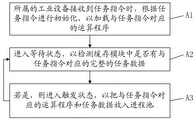
Referring to fig. 3, the present application provides a method for executing an industrial task based on data flow, which is applied in the state machine module 102 of the aforementioned industrial task execution system based on data flow, and includes the steps of:
A1. when the industrial device 100 receives a task instruction, initializing according to the task instruction to load an operation program corresponding to the task instruction (the specific process refers to the foregoing);
after initialization, loop execution: A2. entering a waiting state to detect whether complete task data corresponding to the task instruction exists in the corresponding cache module 101 (i.e., the cache module 101 belonging to the same industrial device 100 as the state machine module 102); A3. if so, entering a trigger state to put the operation program and the task data corresponding to the task instruction into the process pool (the specific process refers to the above).
Preferably, the step of initializing according to the task instruction includes:
acquiring an address of a data source according to the task instruction; the data source is other industrial equipment 100 which sends task data to the industrial equipment 100 to which the state machine module 102 belongs;
creating a key according to the task instruction, and registering in the certificate management center 200 to generate a digital certificate;
initiating a connection request with the data source to the certificate authority 200 according to the address;
after certificate verification by the certificate management center 200 and connection with the data source is established, a key is sent to the data source;
preferably, the task data is data sent by the data source after being encrypted by using a TEA algorithm according to the key.
From the above, the data flow-based industrial task execution method has the following advantages:
1. the task processing method has the advantages that non-preemptive triggering of the tasks is achieved by using the data stream computing idea, the task processing mode with the data stream priority is guaranteed, the problem that a large amount of time is wasted due to the fact that data acquisition is started after the processing action is triggered when the processing action is triggered through the instruction stream is avoided, production efficiency is improved, and particularly in the scene that computing performance is larger than data transmission performance, the effect of improving the production efficiency is obvious;
2. the safety of data transmission among the industrial equipment 100 is ensured through a safety verification method;
3. the rapid encryption of the data is realized by using a TEA symmetric encryption algorithm;
4. the industrial devices 100 related to the same task share the secret key, so that the management difficulty and complexity of the secret key are reduced while data misuse is avoided.
Furthermore, the functional modules in the embodiments of the present application may be integrated together to form an independent part, or each module may exist separately, or two or more modules may be integrated to form an independent part.
In this document, relational terms such as first and second, and the like may be used solely to distinguish one entity or action from another entity or action without necessarily requiring or implying any actual such relationship or order between such entities or actions.
The above description is only an example of the present application and is not intended to limit the scope of the present application, and various modifications and changes may be made by those skilled in the art. Any modification, equivalent replacement, improvement and the like made within the spirit and principle of the present application shall be included in the protection scope of the present application.