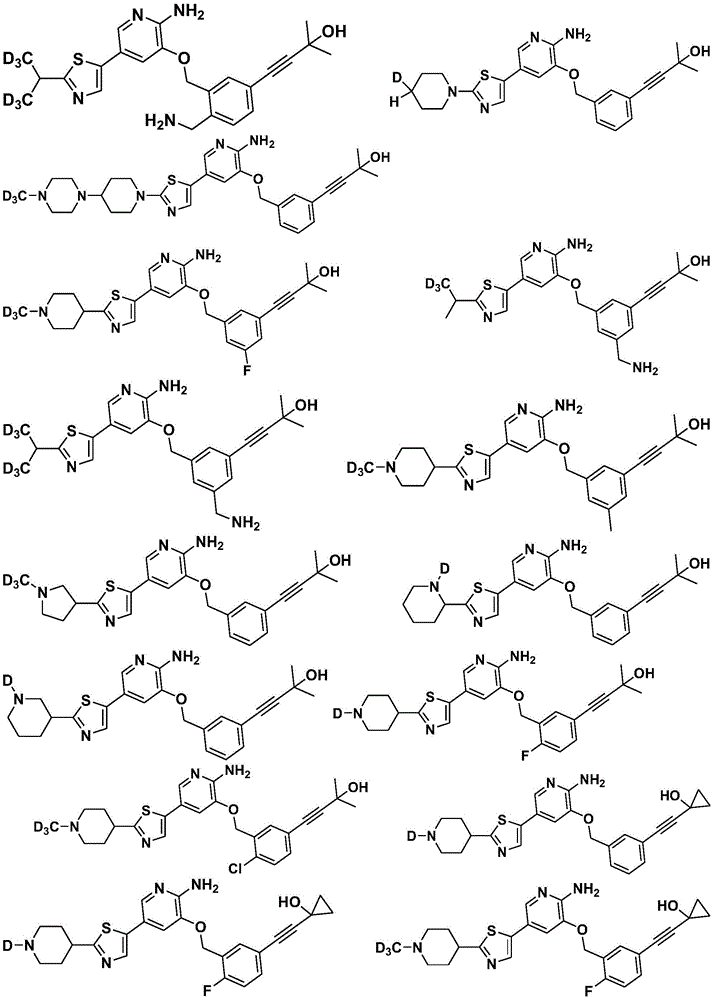
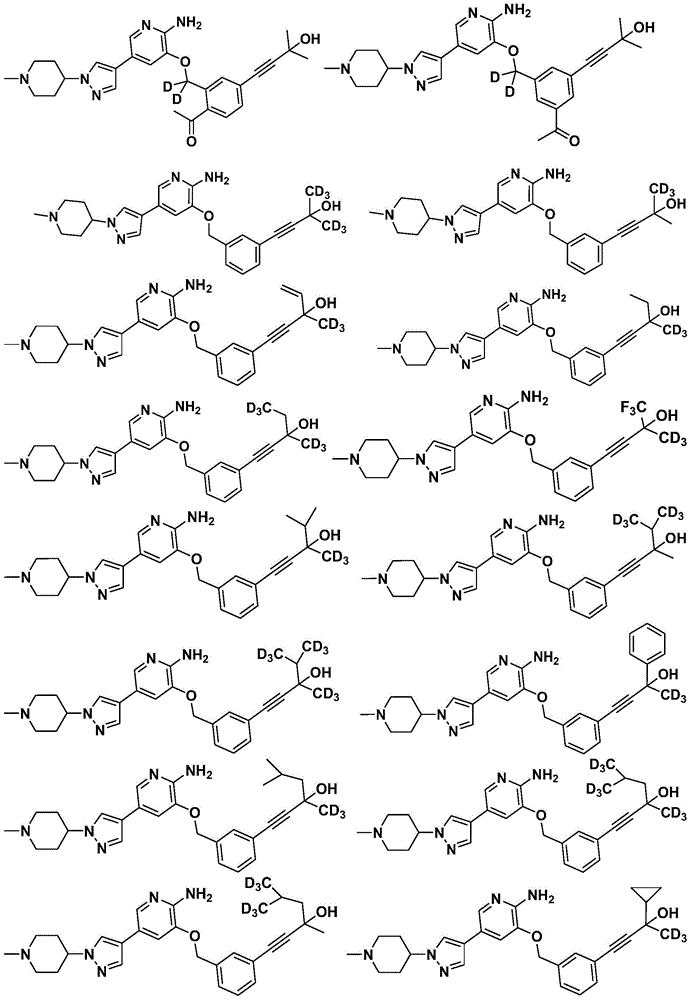
Disclosure of Invention
The invention provides a compound shown as a general formula I:
wherein:
a is selected from CR10Or N;
q is selected from O or S;
x and z are independently selected from integers between 0 and 6 (e.g., 0, 1,2, 3, 4, 5, 6);
y is 0 or 1;
ar is selected from aromatic five-membered heterocyclic group, aromatic six-membered heterocyclic group or phenyl, wherein the aromatic five-membered heterocyclic group is selected from: furyl, thienyl, pyrrolyl, pyrazolyl, imidazolyl, oxazolyl, thiazolyl or selenothiazolyl, and the aromatic six-membered heterocyclic group is selected from: pyridyl, pyridazinyl, pyrimidinyl or pyrazinyl, optionally, H on an aromatic five-membered heterocyclic group, an aromatic six-membered heterocyclic group or phenyl may be substituted by: -D, -SO2、-SO2N(C0-10Alkyl) (C0-10Alkyl), -N (C)0-10Alkyl) SO2(C0-10Alkyl), -CON (C)0-10Alkyl) (C0-10Alkyl), -N (C)0-10Alkyl) CO (C)0-10Alkyl), -N (C)0-10Alkyl) COO (C)0-10Alkyl), -OCON (C)0-10Alkyl) (C0-10Alkyl), halogen, -CN, -OCH2F、-OCHF2、-OCF3、C1-10A linear/branched alkyl group,-N(C0-10Alkyl) (C0-10Alkyl), -OC0-10Alkyl radical, C3-10Cycloalkyl, -O heterocycloalkyl, -N heterocycloaryl, -O heterocycloaryl or-S heterocycloaryl, wherein the alkyl moiety may be optionally substituted with one or more of the following groups: -SO2、-SO2N(C0-10Alkyl) (C)0-10Alkyl), -N (C)0-10Alkyl) SO2(C0-10Alkyl), -CON (C)0-10Alkyl) (C0-10Alkyl), -N (C)0-10Alkyl) CO (C)0-10Alkyl), -N (C)0-10Alkyl) COO (C)0-10Alkyl), -OCON (C)0-10Alkyl) (C0-10Alkyl), halogen, -CN, -OCH2F、-OCHF2、-OCF3、-N(C0-10Alkyl) (C0-10Alkyl), -OC0-10Alkyl, -CO (C)0-10Alkyl), -COO (C)0-10Alkyl), -N-heterocyclic aromatic group, -O-heterocyclic aromatic group or-S-heterocyclic aromatic group; wherein one or more H atoms to which the C atom or heteroatom is attached may be substituted by deuterium;
R2selected from: -H, -D, halogen, -NO2、-CN、C1-10Straight chain/branched alkyl, C3-10Cycloalkyl, -N (C)0-10Alkyl) (C0-10Alkyl), -CF3、-OCF3、-OCHF2、-OCH2F or-OC0-10An alkyl group; wherein one or more H atoms to which the C atoms are attached may be substituted by deuterium;
B1、B2、B3、B4and B5Independently selected from C or N (when B1、B2、B3、B4Or B5When N is, its corresponding R3、R4、R5、R6、R7Absent);
when present, R3、R4、R5、R6And R7Independently selected from: -H, -D, halogen, -CN, -OC0-10Alkyl, -CO (C)0-10Alkyl), -CON (C)0-10Alkyl) (C0-10Alkyl group), C1-10Straight chain/branched alkyl radical, containingHeteroalkyl of O or N, -N (C)0-10Alkyl) (C0-10Alkyl group), C3-10Cycloalkyl, -C ≡ C-R10-O heterocycloalkyl, -N heterocycloalkyl, or R5And R4、R4And R3、R3And R7、R7And R6With carbon atoms in between to form C3-8Cycloalkyl or C containing-O-, -S-3-8Heterocycloalkyl, -N-heterocycloaryl, -O-heterocycloaryl or-S-heterocycloaryl, phenyl, wherein the alkyl moiety may be optionally substituted with one or more of the following groups: -SO2、-SO2N(C0-10Alkyl) (C0-10Alkyl), -N (C)0-10Alkyl) SO2(C0-10Alkyl), -CON (C)0-10Alkyl) (C)0-10Alkyl), -N (C)0-10Alkyl) CO (C)0-10Alkyl), -N (C)0-10Alkyl) COO (C)0-10Alkyl), -OCON (C)0-10Alkyl) (C0-10Alkyl), halogen, -CN, -OCH2F、-OCHF2、-OCF3、C1-10Straight/branched alkyl, -N (C)0-10Alkyl) (C0-10Alkyl), -OC0-10Alkyl radical, C3-10Cycloalkyl, -O heterocycloalkyl, -N heterocycloaryl, -O heterocycloaryl or-S heterocycloaryl; wherein one or more H atoms to which the C atom or heteroatom is attached may be substituted by deuterium;
R8and R9Independently selected from: -H, -D, halogen, C1-10Straight/branched alkyl; wherein one or more H atoms to which the C atoms are attached may be substituted by deuterium;
R
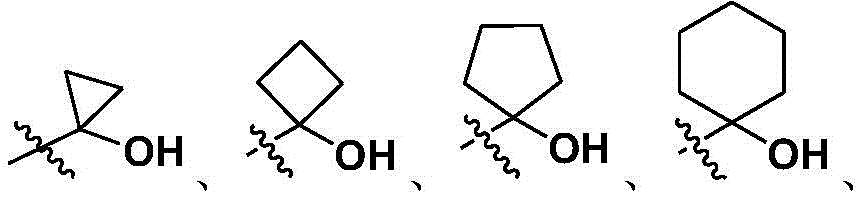
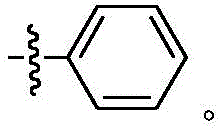
10selected from: H. -D, C
1-5Straight chain/branched alkyl, C
3-10A cycloalkyl group, a,
Wherein one or more H atoms to which the C atoms are attached may be substituted with deuterium;
R11、R12independently selected from: -H, -D, -CF3、-CHF2H、-CH2F、C1-10Straight/branched alkyl, -CH ═ C (C)0-10Alkyl) (C0-10Alkyl), -C ≡ C (C)0-10Alkyl group), C3-10Cycloalkyl, an aromatic five-membered or aromatic six-membered ring group, or R11、R12And R11And R12Form C with carbon atoms in between3-8Cycloalkyl or C containing-O-, -S-3-8Heterocycloalkyl radical, C4-9Condensed ring alkyl, C5-10Spirocycloalkyl, C4-9Bridged cycloalkyl radical, C3-7Cyclic lactam, C3-7Cyclic lactone, C3-7Cyclic ketones wherein the alkyl moiety may be optionally substituted with one or more of the following groups: -SO2、-SO2N(C0-10Alkyl) (C0-10Alkyl), -N (C)0-10Alkyl) SO2(C0-10Alkyl), -CON (C)0-10Alkyl) (C0-10Alkyl), -N (C)0-10Alkyl) CO (C)0-10Alkyl), -N (C)0-10Alkyl) COO (C)0-10Alkyl), -OCON (C)0-10Alkyl) (C0-10Alkyl), halogen, -CN, -OCH2F、-OCHF2、-OCF3、-N(C0-10Alkyl) (C0-10Alkyl), -OC0-10Alkyl, -N-heterocyclic aromatic group, -O-heterocyclic aromatic group or-S-heterocyclic aromatic group; wherein one or more H atoms to which the C atom or heteroatom is attached may be substituted by deuterium;
and the compounds of formula I contain at least one deuterium atom.
In one embodiment of the invention, A is CR10In particular CH.
In one embodiment of the invention, Q is O.
In one embodiment of the present invention, x is 0.
In one embodiment of the invention, z is 1.
In one embodiment of the invention, y is 1.
In one embodiment of the present invention, B
1、B
2、B
3、B
4And B
5Are all C, i.e. in the formula I,
is composed of
In another embodiment of the present invention, B1、B2、B3、B4And B5At least one of which is N.
Specifically, B2Is C, B1、B3、B4And B5At least one of which is N.
More specifically, B2Is C, B1Is N.
More specifically, B2Is C, B3Is N.
More specifically, B2Is C, B4Is N.
More specifically, B2Is C, B5Is N.
More specifically, B2Is C, B3And B4Is N or B3And B5Are all N.
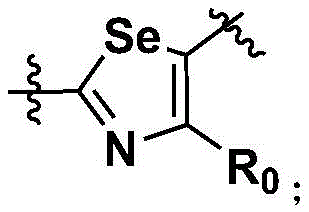
Specifically, Ar is selected from: thiazolyl, selenothiazolyl, imidazolyl, pyrazolyl and pyridyl.
In one embodiment of the invention, the compounds of formula i have the following structure:
wherein, ring E is selected from:
in the E ring, each R0Independently selected from: -H, -D, C1-10Straight/branched alkyl, -N (C)0-10Alkyl) (C0-10Alkyl), -OC0-10Alkyl, -CO (C)0-10Alkyl) or C3-10A cycloalkyl group; wherein the H attached to the above C atom or heteroatom may be substituted by deuterium;
R1selected from: -H, -D, -O heterocycloalkyl, -N-heterocycleAlkyl radical, C1-10Straight chain/branched alkyl, C3-10Cycloalkyl, -OC0-10Alkyl, -N (C)0-10Alkyl) (C0-10Alkyl), -SO2(C0-10Alkyl), -CO (C)0-10Alkyl), -O-phenyl, -S (C)0-10Alkyl), -N-heterocyclic aromatic group, -O-heterocyclic aromatic group or-S-heterocyclic aromatic group; wherein the H attached to the above C atom or heteroatom may be substituted by deuterium;
R2-9having the corresponding definitions of the invention as defined above;
and wherein R is0-9At least one of which contains a deuterium atom.
In one embodiment of the present invention, in formula II, R1Containing at least one deuterium atom; more specifically, for example, R1In which at least one deuterium atom is present, and R2-9Do not contain deuterium atoms.
In another embodiment of the present invention, in formula II, R2Containing at least one deuterium atom.
In another embodiment of the present invention, in formula II, R3Containing at least one deuterium atom.
In another embodiment of the present invention, in formula II, R4Containing at least one deuterium atom.
In another embodiment of the present invention, in formula II, R5Containing at least one deuterium atom.
In another embodiment of the present invention, in formula II, R6Containing at least one deuterium atom.
In another embodiment of the present invention, in formula II, R8And/or R9Containing at least one deuterium atom.
Specifically, each R0Independently selected from: c1-5Straight/branched alkyl or-N (C)0-10Alkyl) (C0-10Alkyl) in which H attached to the C atom may be substituted by deuterium.
More specifically, each R0Independently selected from: -H, -D, -CH3、-CH2CH3or-NH2。
Specifically, R1Selected from: -O-heterocycloalkyl or-N-heterocycloalkyl, -SO2(C0-3Alkyl), -O-phenyl, -S (C)0-4Alkyl group), C3-6Cycloalkyl or C3-5Straight/branched alkyl wherein the H attached to the C atom or heteroatom may be substituted with deuterium.
More specifically, R
1Selected from:
-CH
3、
wherein the H attached to the C atom or N atom may be substituted by deuterium.
More specifically, R
1Selected from:
-CH
2D、-CHD
2、-CD
3、
specifically, when R is0And R1When adjacent to each other, R0And R1With carbon atoms in between to form C3-8Cycloalkyl or C containing-O-, -S-3-8Heterocycloalkyl, -N-heterocyclic aryl, -O-heterocyclic aryl or-S-heterocyclic aryl, phenyl.
Specifically, R2Selected from: -H, -D, halogen, -NO2、-CN、C1-5Straight chain/branched alkyl, C3-10Cycloalkyl, -N (C)0-10Alkyl) (C0-10Alkyl), -CF3、-OCF3、-OCHF2、-OCH2F or-OC0-10Alkyl, wherein the H attached to the C atom or N atom may be substituted with deuterium.
More specifically, R2Selected from: -NO2、-N(C0-10Alkyl) (C0-10Alkyl), -OC0-10Alkyl and-OCF3Wherein the H attached to the C atom or N atom may be substituted by deuterium.
Further specifically, R2Selected from: -NH2、-NHD、-ND2or-NO2。
Specifically, R3Selected from: -H, -D, halogen, -OC0-10Alkyl, -CO (C)0-10Alkyl group), C1-10Straight/branched alkyl, -N (C)0-10Alkyl) (C0-10Alkyl) or C3-10Cycloalkyl, wherein the H attached to the C atom may be substituted by deuterium.
More specifically, R3Selected from: -H, -D, halogen, -OC0-10Alkyl radical, C1-10Straight/branched alkyl wherein the H attached to the C atom may be substituted by deuterium.
Further specifically, R3Selected from: -H, -D, -F, -OCH3、-OCH2D、-OCHD2、-OCD3。
Specifically, R4Selected from: -H, -D, halogen, -OC0-10Alkyl, -CO (C)0-10Alkyl), -CN, C3-10Cycloalkyl, -C ≡ C-R10、C1-10Straight/branched alkyl, -N (C)0-10Alkyl) (C0-10Alkyl), -O-heterocycloalkyl or-N-heterocycloalkyl, wherein the H attached to the C atom or N atom may be substituted by deuterium.
More specifically, R4Selected from the group consisting of: -H, -D, halogen, -OC0-10Alkyl, -CN, C3-10Cycloalkyl or-C ≡ C-R10Wherein the H attached to the C atom may be substituted with deuterium. In one embodiment of the invention, R10The H attached to the C atom in (a) may be substituted by deuterium.
In one embodiment of the inventionIn the examples, R
4Selected from: -H, -D, -F, -Cl, -OCH
3、-OCH
2D、-OCHD
2、-OCD
3、-CN、
or-C.ident.C-R
10。
Specifically, R5、R6、R7Independently selected from: -H, -D, halogen, -CN, -OC0-10Alkyl, -CO (C)0-10Alkyl group), C1-10Straight/branched alkyl, -N (C)0-10Alkyl) (C)0-10Alkyl group), C3-10Cycloalkyl, -C ≡ C-R10-O-heterocycloalkyl or-N-heterocycloalkyl, C containing O or N1-5Straight chain/branched alkyl, or R6、R7And R6And R7Form C with carbon atoms in between3-8Cycloalkyl or C containing-O-, -S-3-8Heterocycloalkyl, wherein the H attached to the C atom or heteroatom may be substituted with deuterium.
More specifically, R5、R6、R7Independently selected from: -H, -D, halogen, -CN, C1-3Straight chain/branched alkyl, -OC0-3Alkyl, -CO (C)0-3Alkyl), N-containing C1-3Straight chain/branched alkyl, or R6、R7And R6And R7Form C with carbon atoms in between3-8Cycloalkyl or-O-containing C3-8Heterocycloalkyl in which the H attached to the C or N atom may be replaced by deuterium.
Further specifically, R5、R6、R7Independently selected from: -H, -D, -F, -Cl, -CH3、-CH2NH2、-CH2NH(CH3)、-CH2N(CH3)2、-CN、-OCH3、-COCH3Or R is6、R7And R6And R7Form an-O-containing five-membered cycloalkyl group in which the H attached to the C atom or N atom may be replaced by deuterium.
In one embodiment of the invention, R5Selected from: -H, -D, -F, -Cl, -CH3、-CH2D、-CHD2、-CD3、-OCH3、-COCH3、-CH2NH2、-CH2N(CH3)2、-CN、-OCH2D、-OCHD2、-OCD3、-COCD3、-CH2N(CD3)2、、-CH2N(CH3)(CD3)。
In one embodiment of the invention, R6Selected from: -H, -D, -F, -Cl, -CH3、-CH2D、-CHD2、-CD3、-OCH3、-COCH3、-CH2NH2、-CH2N(CH3)2、-CN、-OCH2D、-OCHD2、-OCD3、-COCD3、-CH2N(CD3)2、、-CH2N(CH3)(CD3)。
In one embodiment of the invention, R7Selected from: -H, -D, -F, -Cl, -CH3、-CH2D、-CHD2、-CD3、-OCH3、-COCH3、-CH2NH2、-CH2N(CH3)2、-CN、-OCH2D、-OCHD2、-OCD3、-COCD3、-CH2N(CD3)2、-CH2N(CH3)(CD3)。
In one embodiment of the invention, R
10Is composed of
In one embodiment of the invention, R
10The H attached to the C atom in (a) may be substituted by deuterium.
In particular, R11And R12Independently selected from: -H, -D, -CF3、-CHF2H、-CH2F、C1-10Straight/branched alkyl, -CH ═ C (C)0-10Alkyl) (C)0-10Alkyl group), C3-10Cycloalkyl or aromatic six-membered ring radicals, or R11、R12And R11And R12Form C with carbon atoms in between3-8Cycloalkyl, C4-7Condensed ring alkyl, C5-9Spiro cycloalkyl, C4-9Bridged cycloalkyl radical, C3-7Cyclic lactam, C3-7Cyclic lactone, C3-7Cyclic ketones, wherein H on the C atom may be substituted with: -SO2、-SO2N(C0-10Alkyl) (C0-10Alkyl), -N (C)0-10Alkyl) SO2(C0-10Alkyl), -CON (C)0-10Alkyl) (C0-10Alkyl), -N (C)0-10Alkyl) CO (C)0-10Alkyl), -N (C)0-10Alkyl) COO (C)0-10Alkyl), -OCON (C)0-10Alkyl) (C0-10Alkyl), halogen, -CN, -OCH2F、-OCHF2、-OCF3、C1-10Straight/branched alkyl, -N (C)0-10Alkyl) (C0-10Alkyl), -OC0-10Alkyl, -CO (C)0-10Alkyl group), C3-10Cycloalkyl, -O heterocycloalkyl, -N heterocycloaryl, -O heterocycloaryl or-S heterocycloaryl, wherein the alkyl moiety may be optionally substituted with one or more of the following groups: -SO2、-SO2N(C0-10Alkyl) (C0-10Alkyl), -N (C)0-10Alkyl) SO2(C0-10Alkyl), -CON (C)0-10Alkyl) (C0-10Alkyl), -N (C)0-10Alkyl) CO (C)0-10Alkyl), -N (C)0-10Alkyl) COO (C)0-10Alkyl), -OCON (C)0-10Alkyl) (C0-10Alkyl), halogen, -CN, -OCH2F、-OCHF2、-OCF3、-N(C0-10Alkyl) (C0-10Alkyl), -OC0-10Alkyl, -CO (C)0-10Alkyl), -N-heterocyclic aromatic group, -O-heterocyclic aromatic group or-S-heterocyclic aromatic group; wherein the H attached to the C atom or heteroatom may be substituted with deuterium.
More specifically, R11And R12Independently selected from: -H, -D, -CF3、-CHF2、-CH2F、C1-5Straight/branched alkyl, -CH ═ CH (C)0-10Alkyl group), C3-10A cycloalkyl group or an aromatic six-membered ring group,or R11、R12And R11And R12Form C with carbon atoms in between3-6Cycloalkyl radical, C4-6Condensed ring alkyl, C5-8Spirocycloalkyl, C4-8Bridged cycloalkyl radical, C3-7Cyclic lactam, C3-7Cyclic lactone, C3-7Cyclic ketones, wherein the alkyl moiety may be substituted with: -SO2、-SO2N(C0-10Alkyl) (C0-10Alkyl), -N (C)0-10Alkyl) SO2(C0-10Alkyl), -CON (C)0-10Alkyl) (C0-10Alkyl), -N (C)0-10Alkyl) CO (C)0-10Alkyl), -N (C)0-10Alkyl) COO (C)0-10Alkyl), -OCON (C)0-10Alkyl) (C0-10Alkyl), halogen, -CN, -OCH2F、-OCHF2、-OCF3、C1-10Straight/branched alkyl, -N (C)0-10Alkyl) (C0-10Alkyl), -OC0-10Alkyl, -CO (C)0-10Alkyl group), C3-10Cycloalkyl, -O heterocycloalkyl, -N heterocycloaryl, -O heterocycloaryl or-S heterocycloaryl, wherein the alkyl moiety may be optionally substituted with one or more of the following groups: -SO2、-SO2N(C0-10Alkyl) (C0-10Alkyl), -N (C)0-10Alkyl) SO2(C0-10Alkyl), -CON (C)0-10Alkyl) (C0-10Alkyl), -N (C)0-10Alkyl) CO (C)0-10Alkyl), -N (C)0-10Alkyl) COO (C)0-10Alkyl), -OCON (C)0-10Alkyl) (C)0-10Alkyl), halogen, -CN, -OCH2F、-OCHF2、-OCF3、-N(C0-10Alkyl) (C0-10Alkyl), -OC0-10Alkyl, -CO (C)0-10Alkyl), -N-heterocyclic aromatic group, -O-heterocyclic aromatic group or-S-heterocyclic aromatic group; wherein the H attached to the C atom or heteroatom may be substituted with deuterium.
Further specifically, R
11And R
12Independently selected from: -H, -D, -CF
3、-CHF
2、-CH
2F、-CH
3、-CH
2CH
3、-CH=CH
2、
Or R
11、R
12And R
11And R
12Formation of carbon atoms between
Wherein the H attached to the C atom or N atom may be substituted by deuterium.
Still more specifically, R
11And R
12Independently selected from: -H, -D, -CF
3、-CHF
2、-CDF
2、-CH
2F、-CD
2F、-CH
3、-CH
2D、-CHD
2、-CD
3、-CH
2CH
3、-CH
2CD
3、
Specifically, R8And R9Independently selected from: -H, -D, C1-10Straight/branched alkyl wherein the H attached to the C atom may be substituted by deuterium.
More specifically, R8And R9Independently selected from: -H, -D, C1-3Straight/branched alkyl wherein the H attached to the C atom may be substituted by deuterium.
Further specifically, R8And R9Independently selected from: -H, -D, -CH3、-CH2D、-CHD2、-CD3。
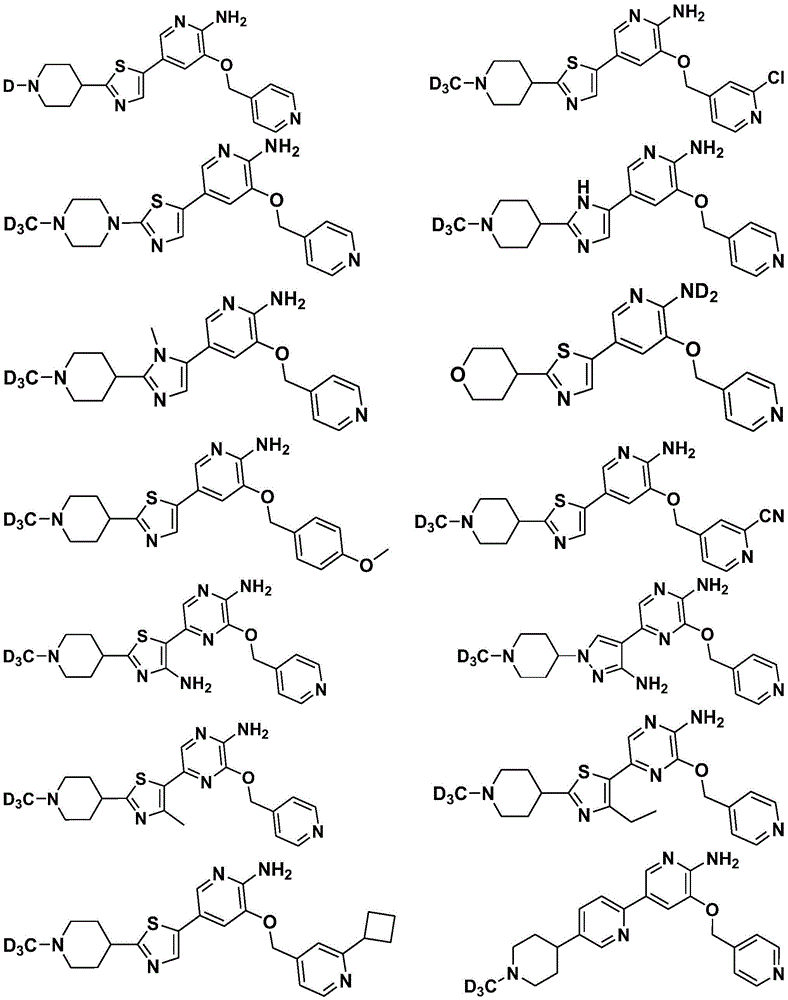
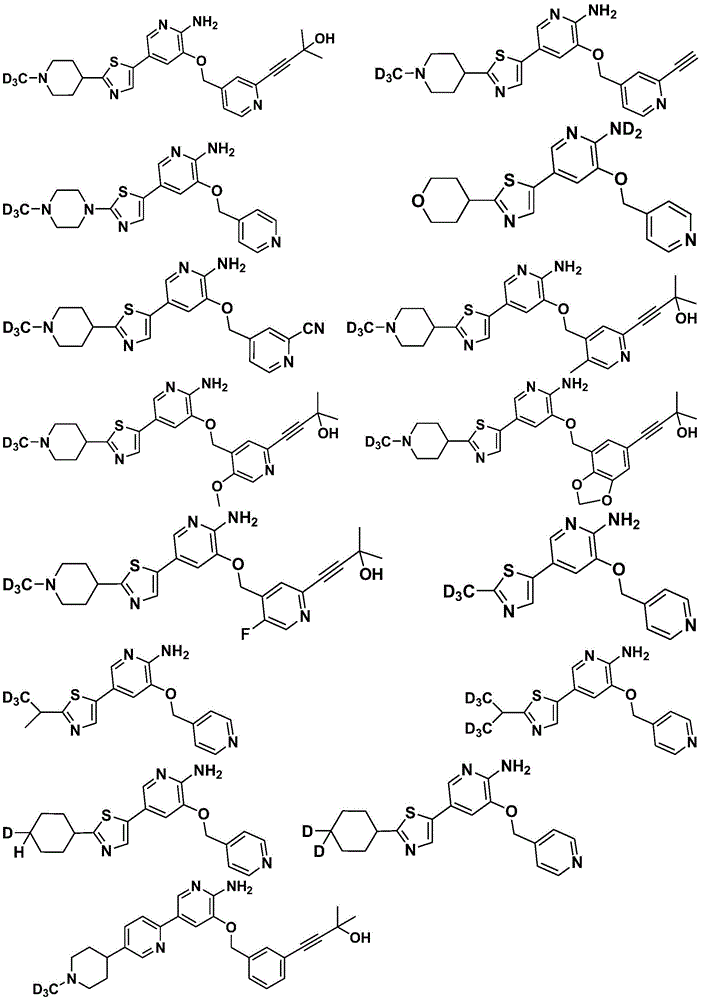
Specifically, the compounds of formula i have the following structure:
(1)
(2)
(3)
(4)
(5)
specifically, in the above compounds, any atom not designated as deuterium is present in its natural isotopic abundance.
Specifically, in the above compounds, the position designated as "deuterium" has at least (for example) 95% deuterium incorporation.
The invention provides a preparation method of a compound of a general formula I, which comprises the following steps:
(1)
and
is subjected to condensation reaction to generate
R
13Selected from: halogen or
R
14Selected from the group consisting of: -OH or-F;
(2)
with Ar-R
15Is subjected to condensation reaction to generate
R
15Selected from: -Br or-SnBu
3。
Specifically, R in the above step (1)13is-Br.
Specifically, R in the above step (2)
13is-Br or
When R is
13When is-Br, R
15is-SnBu
3When R is
13Is that
When R is
15is-Br.
The invention also provides pharmaceutically acceptable salts, stereoisomers, esters, prodrugs and solvates of the compounds of formula I.
Specifically, the pharmaceutically acceptable salts include acid addition salts and base addition salts.
Specifically, the above-mentioned acid addition salts include, but are not limited to, salts derived from inorganic acids such as hydrochloric acid, nitric acid, phosphoric acid, sulfuric acid, hydrobromic acid, hydroiodic acid, and phosphonic acid, and salts derived from organic acids such as aliphatic monocarboxylic and dicarboxylic acids, phenyl-substituted alkanoic acids, hydroxyalkanoic acids, alkanedioic acids, aromatic acids, and aliphatic and aromatic sulfonic acids. Thus, these salts include, but are not limited to, sulfate, pyrosulfate, bisulfate, sulfite, bisulfite, nitrate, phosphate, monohydrogen phosphate, dihydrogen phosphate, metaphosphate, pyrophosphate, hydrochloride, hydrobromide, iodate, acetate, propionate, caprylate, isobutyrate, oxalate, malonate, succinate, suberate, sebacate, fumarate, maleate, mandelate, benzoate, chlorobenzoate, methylbenzoate, dinitrobenzoate, phthalate, benzenesulfonate, tosylate, phenylacetate, citrate, lactate, maleate, tartrate, and mesylate, and salts of amino acids such as arginate, gluconate, galacturonate, and the like. Acid addition salts may be prepared by contacting the free base form with a sufficient amount of the desired acid to form the salt in a conventional manner. The free base form can be regenerated by contacting the salt form with a base and isolating the free base in a conventional manner.
In particular, the above base addition salts are formed with metals or amines, such as hydroxides of alkali metals and alkaline earth metals, or with organic amines. Examples of metals useful as cations include, but are not limited to, sodium, potassium, magnesium, and calcium. Examples of suitable amines include, but are not limited to, N' -dibenzylethylenediamine, chloroprocaine, choline, diethanolamine, ethylenediamine (ethane-1, 2-diamine), N-methylglucamine, and procaine. Base addition salts can be prepared by contacting the free acid form with a sufficient amount of the desired base to form the salt in a conventional manner. The free acid form can be regenerated by contacting the salt form with an acid and isolating the free acid in a conventional manner.
In one embodiment of the present invention, the pharmaceutically acceptable salt is hydrochloride.
Specifically, the stereoisomers include enantiomeric, diastereomeric and geometric isomeric forms. Some of the compounds of the present invention have cycloalkyl groups which may be substituted on more than one carbon atom, in which case all geometric forms thereof, including cis and trans, and mixtures thereof, are within the scope of the present invention.
In particular, the solvates described above refer to physical association of the compounds of the present invention with one or more solvent molecules. The physical bonding includes various degrees of ionic and covalent bonding, including hydrogen bonding. In some cases, the solvate may be isolated, for exampleWhen one or more solvent molecules are incorporated into the crystal lattice of the crystalline solid. "solvates" includes both solution phase and isolatable solvates. Representative solvates include ethanolates, methanolates, and the like. A "hydrate" is one in which one or more solvent molecules is H2A solvate of O.
In particular, the prodrugs are those forms of the compounds of formula I, including acetals, esters, and zwitterions, which are suitable for administration to patients without undue toxicity, irritation, allergic response, and the like, and which are effective for their intended use. The prodrug is converted in vivo (e.g., by hydrolysis in blood) to yield the parent compound of the above formula.
The invention also provides a crystal form of the compound shown in the general formula I and pharmaceutically acceptable salts, stereoisomers, esters, prodrugs and solvates thereof.
Specifically, the present invention provides crystalline forms of 4- (3- (((2-amino-5- (1- (1-trideuteromethylpiperidin-4-yl) -1H-pyrazol-4-yl) pyridin-3-yl) oxy) methyl) phenyl) -2-methylbut-3-yn-2-ol (which has the structure below).
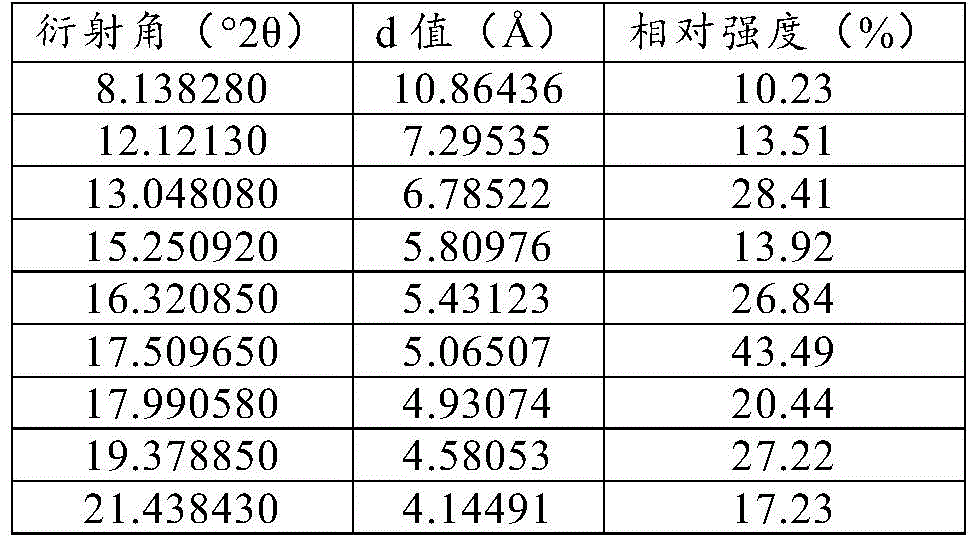
Specifically, the crystal form is a crystal form A, and the XRPD pattern of the crystal form A has characteristic peaks (main characteristic diffraction peaks) at least three (or all) positions of positions with 2 theta values of 13.1 +/-0.2 degrees, 16.3 +/-0.2 degrees, 17.5 +/-0.2 degrees and 23.8 +/-0.2 degrees.
Specifically, the XRPD pattern of form a above also has characteristic peaks (secondary characteristic diffraction peaks) at least three (at least four, at least five, at least six, at least seven, or all) of the positions having 2 Θ values of 8.1 ° ± 0.2 °, 12.2 ° ± 0.2 °, 15.3 ° ± 0.2 °, 18.0 ° ± 0.2 °,19.3 ° ± 0.2 °, 19.5 ° ± 0.2 °, 21.3 ° ± 0.2 °,21.6 ° ± 0.2 °.
Specifically, form a above has an XRPD pattern substantially as shown in figure 1.
Specifically, the DSC pattern of the crystal form A has an endothermic peak at about 168.8 ℃.
Specifically, the form a has a DSC profile substantially as shown in figure 2.
Specifically, the weight loss of form a above upon heating from room temperature to 170 ℃ is about 1.1%.
Specifically, the above form a has a TGA profile substantially as shown in figure 2.
Specifically, the crystal form A is an anhydrous crystal form.
Specifically, the crystal form is a crystal form B, and an XRPD pattern of the crystal form B has characteristic peaks (main characteristic diffraction peaks) at least three (or all) positions of positions with 2 theta values of 5.7 +/-0.2 degrees, 11.3 +/-0.2 degrees, 22.7 +/-0.2 degrees and 23.5 +/-0.2 degrees.
In particular, the XRPD pattern of form B above also has characteristic peaks (secondary characteristic diffraction peaks) at least three (at least four, at least five, or all) of the positions having 2 Θ values of 7.1 ° ± 0.2 °, 8.8 ° ± 0.2 °,14.1 ° ± 0.2 °, 17.0 ° ± 0.2 °, 18.0 ° ± 0.2 °.
Specifically, form B above has an XRPD pattern substantially as shown in figure 6.
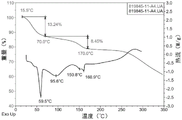
Specifically, the DSC pattern of form B has endothermic peaks at least one of about 59.5 ℃, 95.6 ℃, 150.8 ℃ and 160.9 ℃.
Specifically, the form B has a DSC profile substantially as shown in figure 7.
Specifically, the weight loss of form B above is about 13.2% upon heating from room temperature to 70 ℃ and about 8.5% upon continued heating to 170 ℃.
Specifically, form B above has a TGA profile substantially as shown in figure 7.
Specifically, form B above is an EtOAc solvate.
In particular, the invention also provides a crystalline form of 4- (3- (((2-amino-5- (1- (1-trideuteromethylpiperidin-4-yl) -1H-pyrazol-4-yl) pyridin-3-yl) oxy) methyl) phenyl) -2-methylbut-3-yn-2-ol hydrochloride.
Specifically, the crystal form is a crystal form A, and an XRPD pattern of the crystal form A has characteristic peaks (main characteristic diffraction peaks) at least three (at least four or all) positions of positions with 2 theta values of 13.0 +/-0.2 degrees, 16.3 +/-0.2 degrees, 17.5 +/-0.2 degrees, 19.4 +/-0.2 degrees and 23.8 +/-0.2 degrees.
Specifically, the XRPD pattern of form a above also has characteristic peaks (minor characteristic diffraction peaks) at least three (at least four, or all) of the positions having 2 Θ values of 8.1 ° ± 0.2 °, 12.1 ° ± 0.2 °, 15.3 ° ± 0.2 °, 18.0 ° ± 0.2 °, 21.4 ° ± 0.2 °.
Specifically, form a above has an XRPD pattern substantially as shown in figure 11.
Specifically, the DSC pattern of the crystal form A has an endothermic peak at about 81.9 ℃ and about 156.0 ℃.
Specifically, the form a has a DSC profile substantially as shown in figure 12.
Specifically, the weight loss of form a above upon heating from room temperature to 150 ℃ is about 8.6%.
Specifically, the above form a has a TGA profile substantially as shown in figure 12.
The invention also provides a preparation method of the crystal form.
Specifically, the preparation method is selected from: anti-solvent addition, anti-solvent addition, gas-solid diffusion, room-temperature suspension stirring, 5 ℃ suspension stirring, slow volatilization, slow cooling, gas-liquid diffusion and high polymer induction.
Specifically, the antisolvent addition method includes: the objective product is dissolved with a good solvent, and then an antisolvent is added to the resulting solution (which is then, for example, volatilized at room temperature to give a solid, or stirred at-20 ℃ to give a solid).
Specifically, the above-mentioned anti-antisolvent addition method comprises: the target product is dissolved with a good solvent, and the resulting solution is then added to an antisolvent (which is then, for example, volatilized at room temperature to give a solid, or stirred at-20 ℃ to give a solid).
Specifically, the gas-solid diffusion method, the room temperature suspension stirring method, the 5 ℃ suspension stirring method, the slow volatilization method, the slow cooling method and the gas-liquid diffusion method all comprise the following steps: the target product is dissolved with a solvent and then dried to obtain a solid.
Specifically, the polymer induction method includes: dissolving the target product with solvent, adding high polymer, and volatilizing at room temperature to obtain solid.
Specifically, the preparation method of the crystalline form a of 4- (3- (((2-amino-5- (1- (1-trideuteromethylpiperidin-4-yl) -1H-pyrazol-4-yl) pyridin-3-yl) oxy) methyl) phenyl) -2-methylbut-3-yn-2-ol is selected from the following steps: anti-solvent addition, anti-solvent addition, gas-solid diffusion, room-temperature suspension stirring, 5 ℃ suspension stirring, slow volatilization, slow cooling, gas-liquid diffusion and high polymer induction.
Specifically, for the preparation of form a above, for the anti-solvent addition method, the good solvent may be selected from: MeOH, acetone, DMSO, EtOAc, EtOH, DCM, CHCl3, THF, IPA, ACN, 1, 4-dioxane, and the anti-solvent may be selected from: MTBE, toluene, n-heptane and water.
In one embodiment of the present invention, in the antisolvent addition method, the good solvent may be selected from: MeOH, acetone, DMSO, and the anti-solvent MTBE.
In another embodiment of the present invention, in the anti-solvent addition method, the good solvent may be selected from: EtOH, DCM and the anti-solvent is toluene.
In another embodiment of the present invention, in the anti-solvent addition method, the good solvent may be selected from: CHCl3THF, IPA, and the anti-solvent is n-heptane.
In another embodiment of the present invention, in the anti-solvent addition method, the good solvent may be selected from: acetone, ACN, 1, 4-dioxane and water as anti-solvent.
Specifically, for the preparation of form a above, for the trans-antisolvent addition method, the good solvent may be selected from: MeOH, MIBK, acetone, anisole, EtOH, THF, EtOAc, DCM, the anti-solvent may be selected from: toluene, n-heptane, water, MTBE.
In one embodiment of the present invention, in the anti-solvent addition method, the good solvent may be MIBK and the anti-solvent may be toluene.
In another embodiment of the present invention, in the anti-solvent addition method, the good solvent may be selected from: acetone, anisole and the anti-solvent may be n-heptane.
In another embodiment of the present invention, in the anti-solvent addition method, the good solvent may be selected from: EtOH, THF, and the anti-solvent may be water.
In another embodiment of the present invention, in the anti-solvent addition method, the good solvent may be selected from: EtOAc, DCM, and the anti-solvent can be MTBE.
Specifically, for the preparation of form a above, for the gas-solid diffusion process, the solvent may be selected from: water, DCM, EtOH, MeOH, ACN, THF, CHCl3Acetone, DMSO, EtOAc, 1, 4-dioxane, IPA.
Specifically, for the preparation of form a above, for the room temperature suspension stirring method, the solvent may be selected from: MTBE, IPAc, n-heptane, toluene, water, EtOH/toluene (e.g., at a ratio of 1:3, v/v), DMSO/MTBE (e.g., at a ratio of 1:4, v/v), acetone/water (e.g., at a ratio of 1:4, v/v), IPA/n-heptane (e.g., at a ratio of 1:4, v/v), EtOAc/n-heptane (e.g., at a ratio of 1:4, v/v), anisole/toluene (e.g., at a ratio of 1:4, v/v), DMAc/water (e.g., at a ratio of 1:4, v/v), THF/water (e.g., at a ratio of 1:4, v/v).
Specifically, for the preparation of form a above, for the 5 ℃ suspension stirring process, the solvent may be selected from: MTBE, toluene, water, IPA/n-heptane (e.g., at a ratio of 1:2, v/v), MEK/n-heptane (e.g., at a ratio of 1:2, v/v), EtOAc/toluene (e.g., at a ratio of 1:2, v/v), CPME/toluene (e.g., at a ratio of 1:2, v/v), NMP/water (e.g., at a ratio of 1:4, v/v), THF/water (e.g., at a ratio of 1:4, v/v), ACN/water (e.g., at a ratio of 1:2, v/v), IPAc/DCM (e.g., at a ratio of 1:1, v/v), MeOH/toluene (e.g., at a ratio of 1:4, v/v), DCM/MTBE (e.g., at a ratio of 1:4, v/v), THF/n-heptane (e.g., at a ratio of 1:4, v/v).
Specifically, for the preparation of form a above, for the slow evaporation process, the solvent may be selected from: EtOH, acetone, IPAc, THF, CPME, anisole, ACN/water (e.g., at a 9:1 ratio, v/v), MeOH/DCM (e.g., at a 1:1 ratio, v/v), acetone/EtOAc (e.g., at a 2:1 ratio, v/v), THF/water (e.g., at a 4:1 ratio, v/v).
Specifically, for the preparation of form a above, for the slow cooling method, the solvent may be selected from: CPME, toluene, ACN/toluene (e.g., at a ratio of 1:2, v/v), acetone/n-heptane (e.g., at a ratio of 1:1, v/v), THF/toluene (e.g., at a ratio of 1:2, v/v), MeOH/water (e.g., at a ratio of 1:1, v/v), CHCl3MTBE (e.g. in a ratio of 1:1, v/v).
Specifically, for the preparation of the above form a, for the gas-liquid diffusion method, the good solvent may be selected from: EtOH, THF, DMSO, the anti-solvent may be selected from: n-heptane, MTBE, toluene, cyclohexane, water.
In one embodiment of the present invention, in the gas-liquid diffusion method, the good solvent is EtOH, and the anti-solvent may be selected from: n-heptane, MTBE, toluene.
In another embodiment of the present invention, in the gas-liquid diffusion method, the good solvent is THF, and the anti-solvent may be selected from: n-heptane, cyclohexane, MTBE.
In another embodiment of the present invention, in the gas-liquid diffusion method, the good solvent is DMSO, and the anti-solvent may be selected from: toluene, MTBE and water.
Specifically, for the preparation of the above form a, for the high polymer induction method, the solvent may be selected from: MEK, ACN/toluene (e.g. in a 4:1 ratio, v/v), THF/water (e.g. in a 9:1 ratio, v/v), EtOAc, acetone/2-MeTHF (e.g. in a 1:1 ratio, v/v), MeOH/DCM (e.g. in a 1:1 ratio, v/v), and the polymer may be selected from: polyvinyl pyrrolidone, polyvinyl alcohol, polyvinyl chloride, polyvinyl acetate, hydroxypropyl methylcellulose, polycaprolactone, polyethylene glycol, polymethyl methacrylate, sodium alginate and hydroxyethyl cellulose.
In one embodiment of the present invention, in the high polymer inducing method, the high polymer is a mixture of polyvinylpyrrolidone, polyvinyl alcohol, polyvinyl chloride, polyvinyl acetate, hypromellose, and methylcellulose (for example, in a mass ratio of 1:1:1:1: 1), and the solvent may be selected from: MEK, ACN/toluene (e.g. in a 4:1 ratio, v/v), THF/water (e.g. in a 9:1 ratio, v/v).
In another embodiment of the present invention, in the polymer inducing method, the polymer is a mixture of polycaprolactone, polyethylene glycol, polymethyl methacrylate, sodium alginate and hydroxyethyl cellulose (for example, in a mass ratio of 1:1:1:1: 1), and the solvent may be selected from: EtOAc, acetone/2-MeTHF (e.g., in a 1:1 ratio, v/v).
Specifically, the preparation method of the crystalline form B of 4- (3- (((2-amino-5- (1- (1-trideuteromethylpiperidin-4-yl) -1H-pyrazol-4-yl) pyridin-3-yl) oxy) methyl) phenyl) -2-methylbut-3-yn-2-ol is an antisolvent addition method.
In one embodiment of the present invention, for the preparation of form B above, the good solvent is EtOAc and the anti-solvent is toluene.
The invention also provides a pharmaceutical composition which comprises the compound shown in the general formula I or pharmaceutically acceptable salts, stereoisomers, esters, prodrugs and solvates thereof, or the crystal forms thereof, and pharmaceutically acceptable auxiliary materials.
Specifically, the auxiliary materials are selected from: one or more of a carrier, diluent, binder, lubricant, wetting agent, and the like. In particular, the pharmaceutical compositions described above comprise a therapeutically effective amount of a compound of formula I. In certain embodiments, these pharmaceutical compositions are useful for treating diseases or conditions mediated by HPK1 kinase.
Specifically, the above-mentioned pharmaceutical composition may be a tablet (e.g., sugar-coated tablet, film-coated tablet, sublingual tablet, orally disintegrating tablet, buccal tablet, etc.), a pill, a powder, a granule, a capsule (e.g., soft capsule, microcapsule), a lozenge, a syrup, an emulsion, a suspension, a controlled release preparation (e.g., instantaneous release preparation, sustained release microcapsule), an aerosol, a film (e.g., oral disintegrating film, oral mucosa-adhering film), an injection (e.g., subcutaneous injection, intravenous injection, intramuscular injection, intraperitoneal injection), intravenous drip, a transdermal absorption preparation, an ointment, a lotion, an adhering preparation, a suppository (e.g., rectal suppository, vaginal suppository), a pellet, a nasal preparation, a pulmonary preparation (inhalant), an eye drop, etc.
Specifically, various dosage forms of the above pharmaceutical composition can be prepared according to conventional production methods in the pharmaceutical field. For example, the active ingredient may be mixed with one or more excipients and then formulated into the desired dosage form.
Specifically, the pharmaceutical composition may contain 0.1-99.5% (e.g., 0.1%, 1%, 5%, 10%, 20%, 30%, 40%, 50%, 60%, 70%, 80%, 90%, 95%, 99%, 99.5%) by weight of the active ingredient.
The invention also provides the compound of the general formula I, and pharmaceutically acceptable salts, stereoisomers, esters, prodrugs and solvates thereof, or the crystal form, or the application of the pharmaceutical composition in preparing medicaments for preventing and/or treating tumors.
The invention also provides the compound of the general formula I and pharmaceutically acceptable salts, stereoisomers, esters, prodrugs and solvates thereof, the crystal forms are combined with PD-1, PD-L1, CTLA-4, TIM-3, TGF-beta and receptors thereof, LAG3 antagonist or TLR4, TLR7, TLR8, TLR9 and STING agonist for the application in tumor immunotherapy.
The invention also provides a compound of the general formula I, pharmaceutically acceptable salts, stereoisomers, esters, prodrugs and solvates thereof, and application of the crystal form in tumor immunotherapy by combining the crystal form with CAR-T immunotherapy.
Specifically, the CAR-T immunotherapy described above refers to: the chimeric antigen receptor T cell immunotherapy, which is a cell therapy based on the principle that cancer cells are eliminated by using the patient's own immune cells, is provided.
Specifically, the above-mentioned tumor is a malignant tumor, which includes but is not limited to: lymphoma, blastoma, medulloblastoma, retinoblastoma, sarcoma, liposarcoma, synovial cell sarcoma, neuroendocrine tumor, carcinoid tumor, gastrinoma, islet cell carcinoma, mesothelioma, schwannoma, acoustic neuroma, meningioma, adenocarcinoma, melanoma, leukemia or lymphoid malignancy, squamous cell carcinoma, epithelial squamous cell carcinoma, lung cancer, small-cell lung cancer, non-small-cell lung cancer, adenocarcinoma lung cancer, squamous cell carcinoma, peritoneal cancer, hepatocellular carcinoma, gastric cancer, intestinal cancer, pancreatic cancer, glioblastoma, cervical cancer, ovarian cancer, liver cancer, bladder cancer, liver cancer, breast cancer, metastatic breast cancer, colon cancer, rectal cancer, colorectal cancer, uterine cancer, salivary gland carcinoma, kidney cancer, prostate cancer, vulval cancer, thyroid cancer, hepatic carcinoma, anal cancer, penile cancer, merkel cell carcinoma, esophageal cancer, biliary tract tumor, Head and neck cancer and hematologic malignancies.
The invention also provides application of the compound of the general formula I and pharmaceutically acceptable salts, stereoisomers, esters, prodrugs and solvates thereof, or the crystal form thereof, or the pharmaceutical composition in preparing medicaments for preventing and/or treating diseases caused by pathogen infection or related to the pathogen infection.
In particular, the pathogen may be a microorganism, a parasite (protozoa, worms, etc.) or other vector. Specifically, the above microorganisms may be selected from: one or more of viruses, chlamydia, rickettsia, mycoplasma, bacteria, spirochetes, fungi, etc.
In one embodiment of the invention, the pathogen is a virus, for example, but not limited to, adenoviridae (e.g., adenovirus), herpesviridae (e.g., HSV1 (oral herpes), HSV2 (external genital herpes), VZV (chicken pox), EBV (epstein-barr virus), CMV (cytomegalovirus)), poxviridae (e.g., smallpox virus, vaccinia virus), papovaviridae (e.g., Human Papilloma Virus (HPV)), parvoviridae (e.g., B19 virus), hepadnaviridae (e.g., Hepatitis B Virus (HBV)), polyomaviridae (e.g., polyomavirus), reoviridae (e.g., reovirus, rotavirus), picornaviridae (e.g., enterovirus, foot and mouth disease virus), caliciviridae (e.g., voronox virus, hepatitis e virus), togaviridae (e.g., rubella virus), arenaviridae (e.g., lymphocytic choriomeningitis virus), and, The family of Retroviridae (HIV), the family of Flaviviridae (e.g., dengue virus, Zika virus, Japanese encephalitis virus, chikungunya virus, yellow fever virus, Hepatitis C Virus (HCV), West Nile virus, etc.), the family of Orthomyxoviridae (e.g., influenza A virus, influenza B virus, influenza C virus, etc.)), the family of Paramyxoviridae (e.g., human parainfluenza virus type 1 (HPV), HPV type 2, HPV type 3, HPV type 4, Sendai virus, mumps virus, measles virus, respiratory syncytial virus, Newcastle disease virus, etc.), the family of Bunyaviridae (e.g., California encephalitis virus, Hantaan virus), the family of Rhabdoviridae (e.g., rabies virus), the family of filoviridae (e.g., Ebola virus, Marburg virus), the family of Coronaviridae (e.g., HCoV-229E, HCoV-OC43, HCoV-NL63, HCoV-HKU1, SARS-CoV, MERS-CoV, SARS-CoV-2, etc.), Astroviridae (e.g., astrovirus), Borna viridae (e.g., Borna virus).
Specifically, in the above application, the virus is HBV, HIV, HCV, HPV, Ebola virus, Marburg virus, influenza virus, parainfluenza virus, dengue virus, SARS-CoV-2, etc.
Specifically, the above-mentioned diseases caused by or associated with infection by a pathogen include, but are not limited to, influenza, SARS, COVID-19, viral hepatitis (e.g., hepatitis B, hepatitis C, etc.), AIDS, dengue fever, Ebola virus disease, Marburg virus disease, etc.
The present invention also provides a method for preventing and/or treating tumors, which comprises the step of administering to a subject in need thereof an effective amount of the above-described compound of formula i of the present invention and pharmaceutically acceptable salts, stereoisomers, esters, prodrugs and solvates thereof, or the above-described crystalline forms thereof, or the above-described pharmaceutical composition of the present invention.
In particular, the tumor has the corresponding definition of the invention as described above.
The present invention also provides a method for the prophylaxis and/or treatment of diseases caused by or associated with pathogenic infections, comprising the step of administering to a subject in need thereof an effective amount of a compound of the above general formula i of the present invention and pharmaceutically acceptable salts, stereoisomers, esters, prodrugs and solvates thereof, or a crystalline form thereof, or a pharmaceutical composition thereof as described above.
In particular, pathogens and diseases have the respective definitions of the invention described above.
Detailed Description
Unless defined otherwise, all scientific and technical terms used herein have the same meaning as commonly understood by one of ordinary skill in the art to which this invention pertains.
The term "C" in the present invention0-10Alkyl radical ", C0Alkyl means H, thus, C0-10Alkyl includes H, C1Alkyl radical, C2Alkyl radical, C3Alkyl radical, C4Alkyl radical, C5Alkyl radical, C6Alkyl radical, C7Alkyl radical, C8Alkyl radical, C9Alkyl radical, C10An alkyl group.
The term "C" in the present invention1-10Straight/branched alkyl "including methyl, ethyl, C3Straight chain/branched alkyl, C4Straight chain/branched alkyl, C5Straight chain/branched alkyl, C6Straight chainBranched alkyl radical, C7Straight chain/branched alkyl, C8Straight chain/branched alkyl, C9Straight chain/branched alkyl, C10Straight chain/branched alkyl.
The term "C" in the present invention3-10Branched alkyl groups "include isopropyl, isobutyl, tert-butyl, isopentyl.
The term "C" in the present invention3-10Cycloalkyl radicals "including C3Cycloalkyl radical, C4Cycloalkyl radical, C5Cycloalkyl radical, C6Cycloalkyl radical, C7Cycloalkyl radical, C8Cycloalkyl, C9Cycloalkyl radical, C10A cycloalkyl group.
The term "C" in the present invention3-8Cycloalkyl radicals "including C3Cycloalkyl radical, C4Cycloalkyl radical, C5Cycloalkyl radical, C6Cycloalkyl radical, C7Cycloalkyl radical, C8A cycloalkyl group.
The term "C" in the present invention4-8Cycloalkyl radicals "including C4Cycloalkyl radical, C5Cycloalkyl radical, C6Cycloalkyl radical, C7Cycloalkyl radical, C8A cycloalkyl group.
The term "C" in the present invention4-6Cycloalkyl radicals "including C4Cycloalkyl radical, C5Cycloalkyl radical, C6A cycloalkyl group.
The term "halogen" as used herein includes fluorine, chlorine, bromine, iodine.
The term "heterocycloalkyl" according to the present invention denotes a non-aromatic saturated monocyclic or polycyclic ring system containing 3 to 10 ring atoms, preferably 5 to 10 ring atoms, wherein one or more ring atoms are not carbon atoms, but are, for example, nitrogen, oxygen or sulfur atoms. Preferred heterocycloalkyl groups contain 5 to 6 ring atoms. The prefix aza, oxa or thia before heterocycloalkyl means that there is at least one nitrogen, oxygen or sulfur atom as ring atom, respectively.
The term "heterocycloaromatic" means according to the invention an aromatic monocyclic or polycyclic ring system of 5 to 14 ring atoms, preferably 5 to 10 ring atoms, in which one or more ring atoms are not carbon atoms but are, for example, nitrogen, oxygen or sulfur atoms. Preferred heterocyclic aromatic groups contain 5 to 6 ring atoms. Representative heterocyclic aromatic groups include pyrazinyl, furyl, thienyl, pyridyl, pyrimidinyl, isoxazolyl, isothiazolyl, oxazolyl, thiazolyl, pyrazolyl, furazanyl, pyrrolyl, pyrazolyl, triazolyl, 1,2, 4-thiadiazolyl, pyrazinyl, pyridazinyl, quinoxalinyl, 2, 3-naphthyridinyl, imidazo [1,2-a ] pyridine, imidazo [2,1-b ] thiazolyl, benzofurazanyl, indolyl, azaindolyl, benzimidazolyl, benzothienyl, quinolyl, imidazolyl, thienopyridyl, quinazolinyl, thienopyrimidinyl, pyrrolopyridyl, imidazopyridinyl, isoquinolyl, benzazepindolyl, 1,2, 4-triazinyl, benzothiazolyl, and the like.
In the present invention, "D" means deuterium; "substituted with deuterium" means that one or more hydrogen atoms are replaced with the corresponding number of deuterium atoms.
It will be appreciated that there is some variation in the abundance of natural isotopes in the synthesized compounds depending on the source of the chemical materials used in the synthesis. Thus, the compounds of the present invention will inherently contain small amounts of deuterated isotopologues. Despite this variation, the concentration of such naturally abundant stable hydrogen and carbon isotopes is low and inconsequential compared to the degree of stable isotopic substitution of the compounds of the present invention. See, e.g., Wada, E et al, Seikagaku,1994,66: 15; gannes, LZ et al, Comp Biochem Physiol Mol Integr Physiol,1998,119: 725.
In the compounds of the present invention, any atom not designated as deuterium is present in its natural isotopic abundance. Unless otherwise indicated, when a position is specifically designated as "H" or "hydrogen," the position is understood to have hydrogen in its natural abundance isotopic composition. Likewise, unless otherwise specified, when a position is specifically designated as "D" or "deuterium", that position is to be understood as deuterium having an abundance that is at least 3000 times greater than the natural abundance of deuterium (which is 0.015%) (i.e., at least 45% deuterium incorporation).
The term "isotopic enrichment factor" as used herein refers to the ratio between the isotopic abundance and the natural abundance of a particular isotope.
In other embodiments, the isotopic enrichment factor for each designated deuterium atom of the compounds of the present invention is at least 3500 (52.5% deuterium incorporation at each designated deuterium atom), at least 4000 (60% deuterium incorporation), at least 4500 (67.5% deuterium incorporation), at least 5000 (75% deuterium incorporation), at least 5500 (82.5% deuterium incorporation), at least 6000 (90% deuterium incorporation), at least 6333.3 (95% deuterium incorporation), at least 6466.7 (97% deuterium incorporation), at least 6600 (99% deuterium incorporation), or at least 6633.3 (99.5% deuterium incorporation).
The term "isotopologues" refers to substances in which the chemical structure differs from a particular compound of the invention only in its isotopic composition.
The term "compound," when referring to a compound of the invention, refers to a collection of molecules having the same chemical structure except that isotopic variations among the constituent atoms of the molecules are possible. It will therefore be clear to those skilled in the art that compounds represented by specific chemical structures containing the indicated deuterium atoms also contain a lesser amount of isotopologues having hydrogen atoms at one or more of the indicated deuterium positions of the structure. The relative amounts of such isotopologues in the compounds of the present invention will depend on a variety of factors, including the isotopic purity of the deuteration agent used to make the compound and the efficiency of deuterium incorporation during the various synthetic steps used to prepare the compound. However, as noted above, the overall relative amount of such isotopologues will be less than 49.9% of the compound. In other embodiments, the overall relative amount of such isotopologues will be less than 47.5%, less than 40%, less than 32.5%, less than 25%, less than 17.5%, less than 10%, less than 5%, less than 3%, less than 1%, or less than 0.5% of the compound.
The partial abbreviations used in the present invention are explained as follows:
XRPD: powder X-ray diffraction
DSC: differential scanning calorimetry
TGA: thermogravimetric analysis
1H HMR: liquid nuclear magnetic hydrogen spectrum
In the present invention, the term "crystalline form" is confirmed by X-ray powder diffractogram characterization. One skilled in the art will appreciate that the physicochemical properties discussed herein can be characterized with experimental error depending on the conditions of the instrument, sample preparation, and purity of the sample, among other things. In particular, it is well known to those skilled in the art that the X-ray diffraction pattern will generally vary with the conditions of the instrument. It is particularly noted that the relative intensities of the X-ray powder diffraction patterns may also vary with the experimental conditions, so that the order of the peak intensities cannot be considered as the sole or determining factor. Indeed, the relative intensities of the diffraction peaks in the XRPD pattern are related to the preferred orientation of the crystals, and the peak intensities shown herein are illustrative and not for absolute comparison. In addition, experimental errors in peak angles are typically 5% or less, and these angle errors should also be taken into account, typically allowing for errors of ± 0.2 °. In addition, due to the influence of experimental factors such as sample thickness, an overall shift in peak angle is caused, and a certain shift is usually allowed. Thus, it will be understood by those skilled in the art that the X-ray powder diffraction pattern of a crystalline form of the present invention need not be identical to the X-ray powder diffraction patterns of the examples referred to herein, that "the XRPD patterns are identical" is not meant to be absolutely identical, that the same peak positions may differ by + -0.2 deg. and that the peak intensities are subject to some variability. Any crystalline form having the same or similar pattern as the characteristic peaks in these patterns is within the scope of the present invention. One skilled in the art can compare the profiles listed in the present invention with a profile of an unknown crystalline form to confirm whether the two sets of profiles reflect the same or different crystalline forms.
In some embodiments, form a of the present invention is pure, single, and substantially free of any other forms in admixture. As used herein, "substantially free" when used in reference to a novel form means that the form contains less than 20% by weight of the other form, particularly less than 10% by weight of the other form, more particularly less than 5% by weight of the other form, and even more particularly less than 1% by weight of the other form.
It is to be understood that the numerical values and ranges of numerical values set forth herein are not to be construed narrowly as to the numerical values or ranges themselves and that those skilled in the art will recognize that they may be varied around specific values without departing from the spirit and principles of the invention, which ranges are contemplated by those skilled in the art as being limited to the term "about". When the term "about" is used in front of the numerical values of the present invention and refers to said numerical values, it means any value within a range of ± 10%, preferably within a range of ± 5%, more preferably within a range of ± 2%, preferably within a range of ± 1% of the value. For example, "about 10" should be interpreted to mean 9 to 11, preferably 9.5 to 10.5, more preferably 9.8 to 10.2, more preferably 9.9 to 10.1.
In the present invention, the term "room temperature" means that the temperature of the article is close to or the same as the temperature of the space (e.g. the location of a fume hood in which the article is located). Typically, room temperature is from about 20 ℃ to about 30 ℃, or from about 22 ℃ to 27 ℃, or about 25 ℃.
The antisolvent addition (also referred to as antisolvent crystallization, precipitation crystallization, salting out or detrusor) method is generally a method of precipitating crystals after bringing a solution into a supersaturated state by adding one or more antisolvents to a solution in which a target product is dissolved with a good solvent, the product being in a slightly soluble state in the solution. Anti-solvent addition is generally a process in which a solution of the desired product in a good solvent is dissolved and then added to one or more anti-solvents, the product being in a slightly soluble state in said solution, so that crystals are precipitated after the solution has reached a supersaturated state.
The anti-solvent is relatively poor in its ability to dissolve the target product compared to a good solvent, e.g., by more than 10%, 20%, 30%, 40%, 50%, 60%, 70%, or 80%. The good and anti-solvents may be polar or non-polar solvents, such as may be selected from: one or more of Dimethylformamide (DMF), dimethyl sulfoxide (DMSO), water, alcohol solvent, ether solvent, ketone solvent, ester solvent, alkane solvent, aromatic solvent and nitrile solvent. Wherein, the alcoholic solvent includes but is not limited to methanol, ethanol, propanol, isopropanol or 1, 3-propanediol, 1, 2-propanediol or chlorobutanol or their combination; ether solvents include, but are not limited to, solvents such as tetrahydrofuran, methyl tert-butyl ether, or 1, 4-dioxane, or combinations thereof; ketone solvents include, but are not limited to, acetone, methyl ethyl ketone, or 4-methyl-2-pentanone, or combinations thereof; ester solvents include, but are not limited to, ethyl acetate, isopropyl acetate, n-butyl acetate, or t-butyl acetate, or combinations thereof; alkane solvents include, but are not limited to, dichloromethane, chloroform, n-hexane, cyclohexane or pentane or n-heptane or combinations thereof; aromatic hydrocarbon solvents include, but are not limited to, benzene, toluene, or combinations thereof; nitrile solvents include, but are not limited to, acetonitrile, malononitrile.
The anti-solvent addition, anti-solvent addition, may be by batch, semi-batch or continuous crystallization operations. The anti-solvent is added to the solution (anti-solvent crystallization) or the product solution is added to the anti-solvent (anti-solvent crystallization) either dropwise at a constant rate or slowly initially and then gradually at increasing rates.
The disclosures of the various publications, patents, and published patent specifications cited herein are hereby incorporated by reference in their entirety.
The technical solutions of the present invention will be described clearly and completely with reference to the following embodiments of the present invention, and it should be understood that the described embodiments are only a part of the embodiments of the present invention, and not all of the embodiments. All other embodiments, which can be derived by a person skilled in the art from the embodiments given herein without making any creative effort, shall fall within the protection scope of the present invention.
Example 1: synthesis of Compound A2
The experimental procedure was as follows:
step 1:
in a 500mL one-necked flask were added 1(11.3g,23.7mmol), pinacol diboron diboronate (9.06g,35.6mmol), bis (diphenylphosphino) ferrocene dichloropalladium (1.74g,2.37mmol), potassium acetate (6.99g,71.3mmol) and dimethyleneSulfone (150mL), nitrogen protection, 95 ℃ reaction for 16 hours. Quenched with water (300mL), extracted with ethyl acetate (150 mL. times.3), washed with saturated brine (150 mL. times.2), and spun to give a black solid as the title product (13.0g, crude). LC-MS 463[ M + Na ]]+
Step 2:
in a 500mL three-necked flask, 3(15g,74.6mmol), triethylamine (22.7g,223.8mmol) and dichloromethane (150mL) were added, and methanesulfonyl chloride (12.1g,111.9mmol) was added under ice bath and reacted for 1 hour under ice bath. Quenched with water (300mL), extracted with dichloromethane (100mL × 3), washed with saturated brine, dried over anhydrous sodium sulfate, spun dry and purified by column chromatography (petroleum ether: ethyl acetate ═ 40: 1) to give the title product as a yellow solid (20.7g, crude). LC-MS: 280[ M + H ] +
And step 3:
a500 mL single vial was charged with 5(7.27g,49.4mmol) and DMF (200mL), and 60% NaH (2.96g,74.1mmol) was added portionwise at 0 deg.C and allowed to react at room temperature for 1 hour, followed by addition of 4(20.7g,74.1mmol) under nitrogen at 70 deg.C for 16 hours. After quenching with water (500mL), extraction with ethyl acetate (200mL × 3) and washing of the organic phase with saturated brine (200mL × 2), drying over anhydrous sodium sulfate, spin-drying and column chromatography (petroleum ether: ethyl acetate: 30: 1) gave the desired product as a white solid (9.8g, yield: 61.2%). LC-MS: 330[ M + H ] +
And 4, step 4:
in a 500mL single vial, 6(9.8g,35.8mmol) was dissolved in DCM (80mL), and TFA (16mL) was added dropwise at 0 deg.C and reacted at room temperature for 16 h. Cryo-concentrated and diluted with DCM (200mL)After that, the mixture was quenched with ice water, adjusted to pH 10 with aqueous ammonia at 0 ℃ and extracted with DCM (200 mL. times.3), and the organic phase was washed with saturated brine (200 mL. times.2), dried over anhydrous sodium sulfate and spin-dried to obtain 6.59g of the objective product as a white solid (yield: 96.6%). LC-MS: 230[ M + H [ ]]+
And 5:
in a 250mL three-necked flask, 7(5.53g,24.0mmol) and TEA (10mL,72.1mmol) were dissolved in THF (80mL) and reacted at room temperature for 1 hour. Cooling to 0 deg.C in ice bath, and adding CD dropwise3I (1.65mL,26.4mmol), under nitrogen, was reacted at room temperature for 2 hours. Water was added thereto, the mixture was quenched, extracted with DCM (100 mL. times.3), and the organic phase was washed with saturated brine (100 mL. times.2), dried over anhydrous sodium sulfate, and then spin-dried to obtain 3.1g of a yellow oily substance as an aimed product (yield: 52.2%). LC-MS: 248[ M + H]+
Step 6:
a500 mL single neck flask was charged with 2(7.13g,16.2mmol), 8(2.67g,10.8mmol), xphosPdGII (850mg,1.08mmol), xphos (515mg,1.08mmol), potassium phosphate (4.58g,21.6mmol) and DMF/H2O (150mL/30mL), reacted at 95 ℃ for 2.5 hours under nitrogen. Quenched with water (300mL), extracted with ethyl acetate (150 mL. times.3), washed with saturated brine (150 mL. times.2), dried over anhydrous sodium sulfate, spun dry and purified by Flash to give the title product as a black oil (3.3g, crude). LC-MS:563[ M + H]+
And 7:
a250 mL three-necked flask was charged with 9(3.3g,7.14mmol), Fe (2.0g,35.7mmol), ammonium chloride (1.93g,35.7mmol), ethanol (40mL) and water (8mL), and reacted at 85 ℃ for 2.5 hours. And (4) carrying out suction filtration, and concentrating the filtrate to obtain a black solid crude product which is 3.5g of a target product. LC-MS: 533[ M + H ] +
And 8:
in a 250mL three-necked flask, 10(3.5g,6.55mmol) was dissolved in tetrahydrofuran (40mL), and HCl/Dioxane (8mL) was added dropwise at 0 ℃ to react at room temperature for 1 hour. After concentration at low temperature, DCM (100mL) was added for dilution, and the mixture was quenched with ice water, adjusted to pH 10 with aqueous ammonia at 0 ℃, extracted with DCM (100mL × 3), and the organic phase was washed with saturated brine (100mL × 2), dried over anhydrous sodium sulfate, and dried by spin-drying, and purified by Prep-HPLC to obtain 450mg of the objective product as a white solid (yield: 15.3%). LC-MS: 449[ M + H ] +,1H NMR (400MHz, MeOD) δ 8.38(s,1H),8.01(s,1H),7.81(s,1H),7.73(d, J ═ 1.5Hz,1H),7.54(s,1H),7.48(td, J ═ 4.7,1.7Hz,1H),7.38(s,2H),5.21(s,2H),4.51(t, J ═ 6.9Hz,1H),3.59(d, J ═ 12.6Hz,2H),3.19(s,2H), 2.37-2.32 (M,4H),1.56(s,6H).
Example 2: synthesis of Compound B2
The experimental procedure was as follows:
step 1:
a2000 mL single-necked flask was charged with 1(25.0g,102mmol), an aqueous solution of chloroacetaldehyde (12.0g,154mmol) and acetone (500mL), and reacted at 50 ℃ for 16 hours. Dry by spinning and column chromatography (MeOH in DCM, from 0% to 10%, v/v) gave the title product as a yellow oil (9.20g, yield: 53.4%). LC-MS: 169[ M + H ] +
Step 2:
a1000 mL single-neck flask was charged with 3(4.00g,23.8mmol), triethylamine (6.01g,59.5mmol), and tetrahydrofuran (200 mL). Deuterated iodomethane (3.62g,25.0mmol) was added at room temperature and stirred at room temperature for 2 hours. The spin-dried was quenched by addition of water (250mL), extracted with ethyl acetate (150mLx3) dried over anhydrous sodium sulfate and spin-dried. Column chromatography (MeOH in DCM, from 0% to 10%, v/v) gave the title product as a yellow solid (2.70g, yield: 61.3%). LC-MS: 186[ M + H ] +
And 3, step 3:
4(2.70g,14.6mmol) and tetrahydrofuran (100mL) were added to a 500mL three-necked flask, with nitrogen protection, n-butyllithium (2.4M in tetrahydrofuran,7.30mL,17.5mmol) was added dropwise at-78 deg.C, stirring was continued for 1h while maintaining the temperature, then tri-n-butylstannous chloride (7.14g,21.9mmol) was added dropwise, and reaction was continued for 1h at-78 deg.C. After completion of the reaction, the reaction was quenched with saturated aqueous ammonium chloride (100mL), extracted with ethyl acetate (120mLx3), and the organic layer was washed with saturated brine, dried over anhydrous sodium sulfate, filtered with suction, and concentrated under reduced pressure to give a yellow oil free of the desired product. Can be directly used in the next step. (7.05g, crude). LC-MS: 476[ M + H ] +
And 4, step 4:
6(59.4g,707mmol) and tetrahydrofuran (1.5L) were charged in a 3L one-necked flask, and DHP (68.4g,813mmol) and PPTS (3.55g,14.1mmol) were added, respectively, and the reaction was carried out at room temperature for 16 hours. The reaction solution was quenched and washed with saturated sodium bicarbonate (1000mL × 3), washed with saturated brine (500mL), dried over anhydrous sodium sulfate, and spun-dried to obtain a colorless oil as the target product (120g, crude), which was used directly in the next reaction. LC-MS: 169[ M + H ] +
And 5:
in a 3L one-necked flask were added 7(35.8g,213.15mmol), 8(47.5g,203.00mmol), bis-triphenylphosphine palladium dichloride (1.43g,2.03mmol), cuprous iodide (1.93g, 10.16mmol), triethylamine (40.01g,406.00mmol) and anhydrous dichloromethane (1L) and reacted at room temperature under nitrogen for 16 hours. The reaction mixture was washed with saturated ammonium chloride (1000Ml × 3) and saturated brine (500Ml), dried over anhydrous sodium sulfate, and spin-dried to give a yellow oil as the title compound (59.4g, crude) which was used directly in the next reaction. LC-MS: 275[ M + H ] +
Step 6:
in a 2000mL three-necked flask, 9(50.3g,184mmol), tetrahydrofuran (500mL), 10(40.1g,184mmol) and triphenylphosphine (72.3g, 276mmol) were added under nitrogen, diethyl azodicarboxylate (55.8g,276mmol) was added under stirring at room temperature, reacted at room temperature for 16 hours, dried by spinning, and column chromatography (petroleum ether: ethyl acetate ═ 10: 1) gave the desired product as a yellow solid (70.2g, yield: 80.6%). LC-MS: 476[ M + H ]]+
And 7:
in a 1000mL single vial was added 11(5.05g,10.7mmol), 5(9.15g,19.3mmol), bis (triphenylphosphine) palladium (II) dichloride (376mg,0.535mmol), cuprous iodide (305mg, 1.61mmol) and 1, 4-dioxane (200mL), under nitrogen, and stirred at 90 ℃ for 5 h. Ethyl acetate (400mL) was added for dilution, washed with saturated aqueous ammonium chloride (300mLx3), spun dry, and separated by column chromatography (MeOH in DCM, from 0% to 5%, v/v) to give the desired product as a yellow solid (2.50g, yield: 40.5%) LC-MS: 580[ M + H ]]+
And 8:
a500 mL single-neck flask was charged with 12(2.50g,4.32mmol), reduced iron powder (1.21g, 21.6mmol), ammonium chloride (1.14g, 21.6mmol), ethanol (100mL) and water (20mL) and reacted at 80 ℃ for 2 hours. Dilute with dichloromethane (100mL), filter with suction, spin dry, and column chromatographically separate (MeOH in DCM, from 0% to 12%, v/v) to give the desired product as a yellow solid (1.40mg, 59.1%). LC-MS: 550[ M + H ] +
And step 9:
13(1.02g,1.86mmol) and tetrahydrofuran (25mL) were added to a 250mL single-neck flask, stirred under ice-bath, and then 4M/L1, 4-dioxane solution of hydrochloric acid gas (5mL) was added dropwise, reacted at room temperature for 20 minutes, spun dry, dissolved in dichloromethane, adjusted to pH 9 with ammonia water, spun dry with dichloromethane (30mLx3), and prepared by high pressure liquid phase to give the title product as a pale yellow solid (350mg, 40.5%). LC-MS: 466[ M + H]+1H NMR(400MHz,DMSO)δ7.88(s,1H),7.77(d,J=1.8Hz,1H),7.54(d,J=5.4Hz,2H),7.42–7.37(m,1H),7.34(dd,J=5.4,1.6Hz,2H),6.10(s,2H),5.50(s,1H),5.22(s,2H),2.96–2.78(m,3H),2.02(dd,J=16.9,6.7Hz,4H),1.72(qd,J=12.5,3.6Hz,2H),1.47(s,6H).
Example 3: synthesis of Compound C
The experimental procedure was as follows:
step 1:
a2000 mL single neck flask was charged with 1(7.86g,30.0mmol) and tetrahydrofuran (500mL) and deuterated lithium aluminum hydride (3.15g,75.0 mm) was added portionwise at 0 deg.Col), and reacted at 0 ℃ for 1 hour. After quenching with acetic acid (50mL), extraction was performed with ethyl acetate (500 mL. times.3), and the extract was washed with saturated brine (500 mL. times.3) and dried by spinning to obtain a yellow solid as the objective product (3.50g, crude product). LC-MS 259[ M + Na]+
Step 2:
a250 mL three-necked round bottom flask was charged with 3(3.50g,14.8mmol), bis triphenylphosphine palladium dichloride (519mg,0.740mmol), cuprous iodide (281mg,1.48mmol), triethylamine (4.48g,44.4mmol) and dichloromethane (60mL), and 3(2.50g,14.8mmol) was added under nitrogen at room temperature and reacted at room temperature for 16 hours. Dichloromethane (400mL) was added for dilution, washed with saturated aqueous ammonium chloride (300mLx3), spin-dried, and column chromatographed (petroleum ether: ethyl acetate: 4: 1) to give the title product as a yellow solid (1.03g, yield: 25.2%). LC-MS 299[ M + Na ]]+
And step 3:
a250 mL three-necked flask was charged with 4(1.03g,3.73mmol), tetrahydrofuran (30mL), 5(854mg,3.92mmol), and triphenylphosphine (1.47g,5.60 mmol). Diethyl azodicarboxylate (1.13g,5.60mmol) was added dropwise at 0 ℃ under nitrogen protection. The reaction was carried out at room temperature for 16 hours under nitrogen atmosphere. Spin-dried, and column chromatographed (petroleum ether: ethyl acetate: 10: 1) to give the title product as a yellow solid (1.30g, yield: 73.2%). LC-MS: 499[ M + Na ] +
And 4, step 4:
a100 mL single-neck flask was charged with 6(300mg,0.630mmol), bis-pinacolato borate (240mg,0.945mmol), Pd (dppf) Cl2(23.5mg,0.0315mmol), potassium acetate (154mg,1.58mmol) and dimethyl sulfoxide (10mL) nitrogenThe reaction was carried out at 90 ℃ for 16 hours under an atmosphere. Quenched with water (80mL), extracted with ethyl acetate (50mLx3), washed with saturated brine (50mLx2), dried over anhydrous sodium sulfate, and spin-dried to give a brown oil as the desired product (400mg, crude). LC-MS: 443[ M + H ]]+
And 5:
a100 mL single neck flask was charged with 7(400mg,0.905mmol), 8(200mg,0.905mmol), XPhosPdG2(35.6mg,0.0453mmol), XPhos (43.2mg,0.0905mmol), potassium phosphate (384mg,1.81mmol), DMF (10mL) and water (2mL) and reacted at 90 ℃ for 2 hours under nitrogen. Quenched with water (80mL), extracted with ethyl acetate (50mLx3), washed with saturated brine (50mLx2), dried over anhydrous sodium sulfate, spun-dried, and column chromatographed (dichloromethane: methanol 18: 1) to give the title product as a yellow solid (250mg, yield: 49.2%). LC-MS: 562[ M + H ]]+
Step 6:
9(250mg,0.446mmol), reduced iron powder (125mg, 2.23mmol), ammonium chloride (118mg, 2.23mmol), ethanol (10mL) and water (2mL) were added to a 100mL single-neck flask and reacted at 80 ℃ for 2 hours. Dichloromethane (50mL) was added for dilution, suction filtered, spin dried, and column chromatographed (dichloromethane: methanol ═ 10: 1) to give the desired product as a yellow solid (220mg, 93.0%). LC-MS: 532[ M + H ] +
And 7:
10(220mg,0.414mmol) and tetrahydrofuran (10mL) were added to a 250mL single-neck flask, stirred in ice bath, then 4M/L1, 4-dioxane solution of hydrochloric acid (3mL) was added dropwise, reacted at room temperature for 20 minutes, spun dry, dissolved in dichloromethane, adjusted to pH 9 with ammonia, and dichloromethane (30)mLx3) was spin-dried and prepared by high pressure liquid phase as the title product as a pale yellow solid (85.0mg, 45.9%). LC-MS: 448[ M + H ]]+1H NMR(400MHz,DMSO)δ8.10(s,1H),7.79(d,J=1.8Hz,1H),7.75(s,1H),7.58–7.49(m,2H),7.44–7.30(m,3H),5.66(s,2H),5.49(s,1H),4.14–4.00(m,1H),2.86(d,J=11.5Hz,2H),2.21(s,3H),1.99(d,J=3.1Hz,6H),1.46(s,6H).
Example 4: synthesis of Compound D
The experimental procedure was as follows:
step 1:
a100 mL three-necked flask was charged with 1(3.0g,30.61mmol and tetrahydrofuran (30mL) under nitrogen, and n-butyllithium (2.4M in) was added dropwise at-78 deg.Ctetrahydrofuran,12.75mL30.61mmol), stirring for 1h while keeping the temperature constant, then dropping 2(2.0g,30.61mmol)78The reaction is continued for 1h, and the temperature is raised to room temperature for 2 h. After the reaction was completed, saturated aqueous ammonium chloride solution was used (30mL) Quenching reaction, ethyl acetate: (100mLx3) The organic layer was washed with saturated brine, dried over anhydrous sodium sulfate, filtered under vacuum, and the yellow oily substance obtained by concentration under reduced pressure was free of the desired product and used directly in the next step. (6.1g, crude). LC-MS: 163[ M + H]+
Step 2:
in a 250mL single-neck flask, 3(6.1g,37.65mmol) and tetrahydrofuran (50mL) were charged, and DHP (4.76g,56.63mmol) and PPTS (158.8mg,0.63mmol) were added, respectively, and the reaction was carried out at room temperature for 16 hours. Quenching and washing with saturated sodium bicarbonate (100mLx3), washing with saturated saline (100mL), drying with anhydrous sodium sulfate, and spin-drying to obtain colorless oily substanceThe product (8.5g, crude) was used directly in the next reaction. LC-MS: 247[ M + H]+
And step 3:
a250 mL single-neck flask was charged with 4(8.5g,34.55mmol), methanol and dichloromethane (10mL/10mL) and potassium carbonate (7.15g,51.83mmol), and reacted at room temperature for 3 hours. Suction filtration, filtrate concentration, spin drying to obtain colorless oily matter as target product (6.3g, crude product), which can be directly used in the next step of reaction. LC-MS: 175[ M + H ]]+
And 4, step 4:
in a 250mL one-neck flask were added 5(6.3g,36.21mmol), 6(8.05g,34.40mmol), bis triphenylphosphine palladium dichloride (238mg,0.34mmol), cuprous iodide (322mg, 1.69mmol), triethylamine (6.95g,68.8mmol) and anhydrous dichloromethane (80mL) and reacted at room temperature under nitrogen for 16 h. The reaction mixture was washed with saturated ammonium chloride (200mL × 3) and saturated brine (100mL), dried over anhydrous sodium sulfate, and spin-dried, followed by column chromatography (petroleum ether: ethyl acetate: 10: 1) to obtain a yellow oily substance as an objective compound (3.2g) LC-MS: 281[ M + H]+
And 5:
in a 100mL three-necked flask were charged 7(1.5g,5.36mmol), 8(1.752g, 8.04mmol), triphenylphosphine (2.106g, 8.04mmol) and anhydrous tetrahydrofuran (20mL), and diisopropyl azodicarboxylate (1.624g,8.04mmol) was added under nitrogen stirring at room temperature, reacted at room temperature for 16 hours, followed by spin-drying to obtain the desired product as a yellow solid by column chromatography (petroleum ether: ethyl acetate 4: 1) (450mg, yield: 17.50%). LC-MS: 481[ M + H]+
Step 6:
in a 100mL one-neck flask was added 9(450mg,0.94mmol), pinacol borate (359mg,1.41mmol), bis (diphenylphosphino) ferrocene dichloropalladium (35mg,0.047mmol), potassium acetate (276mg,2.82mmol) and dimethyl sulfoxide (10mL), under nitrogen, and reacted at 90 ℃ for 16 hours. Quenched with water (30mL), extracted with ethyl acetate (50 mL. times.3), washed with saturated brine (100 mL. times.2), and spun to give a black solid as the desired product (500mg, crude). LC-MS:447[ M + H]+
And 7:
a100 mL single-neck flask was charged with 10(363mg,0.81mmol),11(178g,0.73mmol), chlorine (2-dicyclohexylphosphino-2 ',4',6 '-triisopropyl-1, 1' -biphenyl) [2- (2 '-amino-1, 1' -biphenyl)]Palladium (II) (59mg,0.081mmol), 2-dicyclohexylphosphorus-2, 4, 6-triisopropylbiphenyl (39mg,0.082mmol), potassium phosphate (343mg,1.62mmol), DMF (10mL) and H2O (2mL), under nitrogen, and stirred at 95 ℃ for 1.5 h). Quenched with water (30mL), extracted with ethyl acetate (100mL × 3), the organic phases were combined and washed with saturated brine (100mL × 3), dried over anhydrous sodium sulfate, spun-dried, and separated by TCL (dichloromethane: methanol ═ 15: 1) to give a brown liquid as the target product (266mg, yield: 57.9%) LC-MS: 566[ M + H]+
And 8:
in a 100mL single-neck flask were added 12(266mg,0.47mmol), iron powder (201mg, 3.77mmol), ammonium chloride (203mg, 3.77mmol), ethanol (10mL) and water (2mL) and reacted at 80 ℃ for 1 h. Cooling to room temperature, suction filtering, and concentrating the filtrate. Separation by TLC (methanol: dichloromethane ═ 1: 10, v)V) to yield a yellow solid as the desired product (95mg, 37.6%) LC-MS: 536[ M + H]+
And step 9:
13(95mg,0.17mmol) and tetrahydrofuran (5mL) were added to a 50mL single-neck flask, stirred in ice bath, and then 4M/L1, 4-dioxane hydrochloride solution (0.01mL, 0.34mmol) was added dropwise, reacted at room temperature for 1h, and dried by spinning at 0 ℃ to prepare a black solid as the target product (15mg, 18.7%) by high pressure liquid phase. LC-MS: 452[ M + H]+1H NMR(400MHz,DMSO)δ8.20(s,1H),8.10(s,1H),7.80(d,J=1.7Hz,1H),7.76(s,1H),7.52(d,J=1.4Hz,2H),7.40(s,1H),7.35–7.32(m,2H),5.67(s,2H),5.18(s,2H),4.09(dd,J=10.4,5.1Hz,1H),2.89(d,J=11.1Hz,2H),2.24(s,3H),2.10(d,J=11.3Hz,2H),2.00(d,J=3.3Hz,4H).
Example 5: compound A2 free base form A
Compound a2 prepared in example 1 was applied to a silica gel column to obtain 1.6 g of crude product (purity: about 80%), which was then separated from preparative high performance liquid, concentrated to 100ml, adjusted to pH 9 with sodium bicarbonate solution, and extracted three times with dichloromethane (100 ml). The organic phase was washed once with saturated sodium chloride solution (80ml), dried over sodium sulfate and spin dried to give 570 mg (97% pure) of a pale yellow solid. The solid was slurried with 50ml of petroleum ether/ethyl acetate (3: 1) and filtered to provide 460 mg of an off-white solid (> 99% pure).
The preparation is repeated:
(1) weighing 230.9mg of the free alkali sample in a 20mL glass bottle, and adding 1mL of IPAc to obtain a clear solution;
(2) after stirring (1000rpm) for about 5 minutes at room temperature, a large amount of solid precipitated and 1mL of IPAc was added;
(3) after suspension stirring at room temperature for about 1 day, centrifuging (10000rpm, 2min) to obtain a solid;
(4) after drying under vacuum at room temperature for 3 hours, a total of 195.4mg of sample was collected (recovery: 84.6%).
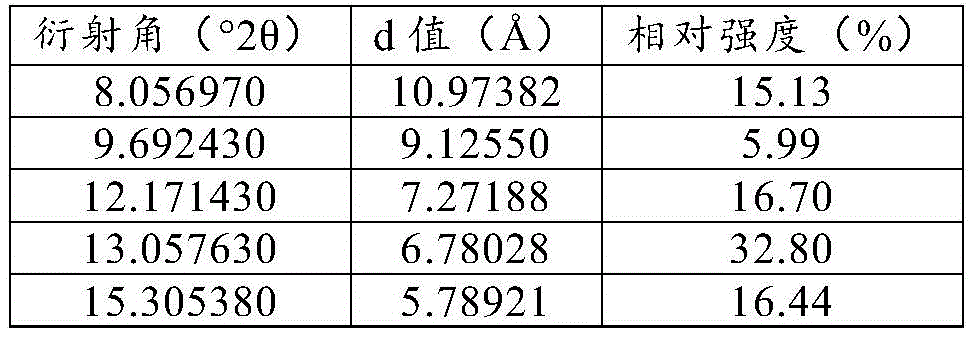
The XRPD pattern of the sample is shown in figure 1, the XRPD test parameters and the result data table are respectively shown in tables 1 and 2, which shows that the sample is a crystal, is named as free form A and can be repeatedly prepared. The entire list of peaks or corresponding d values in table 2, or a subset thereof, and XRPD patterns substantially similar to figure 1, may be sufficient to characterize the crystalline form.
The TGA/DSC pattern of compound A2 free base form A is shown in figure 2, and the test parameters of TGA and DSC are shown in Table 3. In fig. 2, TGA results indicate that it loses 1.3% weight by heating from room temperature to 170 ℃; the DSC result showed a sharp endothermic peak at 168.8 deg.C (onset temperature).
Process for preparing compound A2 free base form A1The H NMR spectrum is shown in FIG. 3.1H NMR results showed a molar ratio of residual solvent IPAc to free base form a of 0.01:1 (corresponding to TGA weight loss of 0.2%).
The HPLC profile of compound a2 free base form a is shown in fig. 4, with the results shown in table 4.
Compound a2 free base form a is presumed to be the anhydrous form.
TABLE 1 XRPD test parameters
Table 2 XRPD data table for compound a2 free base form a
TABLE 3 TGA and DSC testing parameters
| Parameter(s)
|
TGA
|
DSC
|
| Method
|
Linear temperature rise
|
Linear temperature rise
|
| Sample plate
|
Aluminum dish, open
|
Aluminum plate and gland
|
| Temperature range
|
Room temperature-350 deg.C
|
25-350℃
|
| Rate of heating
|
10℃/min
|
10℃/min
|
| Protective gas
|
Nitrogen gas
|
Nitrogen gas |
Table 4 HPLC results of compound a2 free base form a
| Peak(s)
|
RRT
|
Area (%)
|
| 1
|
0.95
|
0.42
|
| 2
|
1.00
|
99.26
|
| 3
|
1.05
|
0.22
|
| 4
|
1.06
|
0.10 |
Solid state stability of free base form a
The XRPD patterns of the starting and sample of form a of the free base described above after 1 day of closed mouth standing at 60 ℃ are shown in figure 5 and the HPLC results are shown in table 5.
Table 5 HPLC results of compound a2 free base form a
Example 6: compound A2 free base crystalline form B
(1) A9.9 sample of the free base (as described in example 5) was weighed into a 20mL glass vial, and 2mL of EtOAc was added to dissolve the sample and filtered through a 0.45 μm PTFE filter to provide a clear API solution;
(2) dropwise adding an anti-solvent Toluene into the API solution while magnetically stirring (1000rpm), and adding 10mL of Toluene in total;
(3) stirring the obtained clear solution at room temperature for 2 hours, transferring the solution to 5 ℃, and stirring the solution for about 15 hours to obtain the clear solution;
(4) transferring to-20 deg.C, stirring for about 6hr to obtain clear solution;
(5) the clear solution was allowed to evaporate at room temperature for 8 days to give a solid.
The XRPD pattern of the above sample is shown in fig. 6, the XRPD test parameters are shown in table 1 above, and the results data are shown in table 6, indicating that it is crystalline, designated as free form B. The entire list of peaks or corresponding d values in table 6, or a subset thereof, and XRPD patterns substantially similar to figure 5 may be sufficient to characterize the crystalline form.
Table 6 XRPD data table for compound a2 free base form B
The TGA/DSC profile of compound a2 free base form B is shown in figure 7, with the TGA and DSC testing parameters shown in table 3 above. The TGA results indicated that the sample heated from room temperature to 70 ℃ lost 13.2% weight and continued heating to 170 ℃ lost 8.5% weight. The DSC results showed that the sample had four endothermic peaks at 59.5 deg.C, 95.6 deg.C, 150.8 deg.C and 160.9 deg.C (peak temperature).
Process for preparing compound A2 free base form B1The H NMR spectrum is shown in FIG. 8.1H NMR results indicated a molar ratio of residual solvent EtOAc to free base of 0.8:1 (corresponding to TGA weight loss of 18.1%).
The XRPD pattern of compound a2 free base form B before and after standing at room temperature is shown in figure 9. The results show that after the free base crystal form B is placed in a closed state for 5 days at room temperature, a diffraction peak of the free base crystal form A appears, and the trend that the free base crystal form B is converted to the free base crystal form A after being placed at room temperature is shown.
The XRPD pattern of compound a2 free base form B before and after nitrogen purging is shown in figure 10. The results show that the free base form B (containing one diffraction peak of form a) undergoes a crystal transformation after nitrogen purge at 30 ℃ for 20 minutes. It is hypothesized that removal of EtOAc after nitrogen purge of the free base form B resulted in a crystal transformation.
Taken together, the characterization results suggest that the free base form B is EtOAc solvate.
Example 7: preparation of compound a2 hydrochloride salt:
100 mg (0.223mmol) of Compound A2 was dissolved in 5ml of anhydrous dichloromethane, stirred at room temperature for 5 minutes, 1.11 ml of ethereal HCl (1N) was added dropwise, and stirring was continued at room temperature for 30 minutes after the completion of the addition. TLC showed complete disappearance of starting material. Nitrogen was passed through for 10 minutes and concentrated under reduced pressure at 10 ℃ to give an off-white solid (purity > 99%). The solid was placed in a lyophilizer for 12 hours to give 108 mg of a2 hydrochloride salt (off-white, purity > 99%).
The XRPD pattern of compound a2 hydrochloride salt is shown in fig. 11, the XRPD test parameters are shown in table 1 of example 5, and the XRPD results data are shown in table 7, indicating that it is crystalline, designated as hydrochloride form a. The entire list of peaks or corresponding d values in table 7, or a subset thereof, and XRPD patterns substantially similar to figure 11 may be sufficient to characterize the crystalline form.
The TGA/DSC profile of the hydrochloride salt of compound A2 is shown in FIG. 12, and the TGA and DSC testing parameters are shown in Table 3 of example 5. TGA results indicate that it loses 8.6% weight from room temperature to 150 ℃; the DSC results showed two endothermic peaks at 81.9 ℃ and 156.0 ℃ (peak temperature).
Table 7 XRPD data table for compound a2 hydrochloride
The XRPD pattern overlay of compound a2 free base form a and compound a2 hydrochloride salt is shown in fig. 13, and the XRPD results are substantially identical, but the hydrochloride salt is less crystalline.
Example 8
The microsome metabolite identification operation step:
weighing compounds (test compounds and numbers are shown below, wherein compounds A1 and B1 are prepared by referring to the related method disclosed in CN 110396087A) and dissolving in dimethyl sulfoxide to prepare 20mM solution, and diluting compound stock solution with 50% acetonitrile water solution (v/v) to 1.0mM concentration as working solution; liver microsomes (20mg/mL) were diluted with 50mM dipotassium phosphate buffer to 1.27mg/mL as a liver microsome working solution; reduced coenzyme was weighed and dissolved in 3307. mu.L of phosphate buffer (50mM) to 5.0mM as a reduced coenzyme working solution. For the sample with the T being 60 minutes, 4 mu L of the sample working solution (1.0mM) is added, 316 mu L of the liver microsome working solution (1.27mg/mL) is added, and 80 mu L of the reduced coenzyme working solution is added to start the reaction; for the sample with the time of T being 0min, 316 mu L of liver microsome working solution (1.27mg/mL) is added, and 80 mu L of reduced coenzyme working solution is added to start reaction, and no test article is incubated; after incubation at 37 ℃ for 60 minutes, 1200. mu.L of stop buffer was added to stop the enzymatic reaction; for the T-0 min samples, 4 μ L of test article working solution (1.0mM) was added. The sample plate was placed on a vortexer and vortexed at 600 rpm for 5 minutes. Then, the mixture was centrifuged at 4000 rpm for 10 minutes, and the supernatant was removed, mixed and blown dry with nitrogen at room temperature. The residue was dried by re-dissolving nitrogen in 300. mu.L of 10% acetonitrile (0.1% FA) solvent, then centrifuged at 4000 rpm for 15 minutes, and the supernatant was removed to a detection plate for mass spectrometry. Mass spectrometry was detected using LC/Q-active plus.
7-ethoxycoumarin (10 μ M) was selected as a positive control compound, using a parallel protocol with the compound.
The remaining percentage of the mother nucleus after 60min is shown in the following table:
table 8 stability test results of the compounds
| Test species
|
A1(%)
|
A2(%)
|
B1(%)
|
B2(%)
|
| Mouse
|
1.13
|
55.0
|
1.24
|
42.8
|
| Rat
|
2.44
|
52.1
|
11.21
|
43.9
|
| Beagle dog
|
0.17
|
7.0
|
0.12
|
8.9
|
| Macaca fascicularis
|
0.36
|
29.6
|
9.11
|
23.4
|
| Human being
|
43.84
|
83.9
|
51.82
|
70.4 |
Example 9 pharmacokinetic experiments
Pharmacokinetic experiment of rat
Single doses in 6 male Sprague Dawley rats were administered by intravenous (iv, n-3) and oral (po, n-3) administration, respectively. Compounds were formulated as 0.25mg/mL or 0.5mg/mL solutions for intravenous injection in 10% DMSO/30% PEG 400/60% Water, administered at a volume of 2 mL/kg. Oral administration the compounds were formulated as homogeneous suspensions of 0.6mg/mL or 2.0mg/mL with 0.5% Methelculose and administered in a volume of 5 mL/kg. Specific doses of administration are shown in the table below.
TABLE 9 dosage of administration
| Compound (I)
|
iv(mg/kg)
|
po(mg/kg)
|
| A1
|
1
|
10
|
| A2
|
1
|
10
|
| C
|
0.5
|
3
|
| D
|
0.3
|
2 |
Following administration, intravenous and oral blood samples were collected at 0.0833, 0.25, 0.5, 1,2,4, 8 and 24 hours, and the concentration of the compound in the samples was measured using LC-MS/MS with a quantitative lower limit of 1ng/mL and the pharmacokinetic parameters of the compound were calculated using the WinNolin non-compartmental model.
The structures and numbers of the compounds involved in this example are shown below:
results
In vivo exposure (AUC) of A1, A2, C and D after intravenous administrationlast) Respectively, 116hr ng/mL, 247hr ng/mL, 74.8hr ng/mL, and 28.7hr ng/mL, and the average total Clearance (CL) was 129mL/min/kg, 71mL/min/kg, 101mL/min/kg, and 151mL/min/kg, respectively.
In vivo exposure (AUC) of A1, A2, C and D after oral administrationlast) 79.8ng × hr/mL, 572ng × hr/mL, 42.8ng × hr/mL, and 9.94ng × hr/mL, respectively. The oral bioavailability in rats was 6.84%, 23.2%, 9.52%, 5.2%, respectively, compared to the intravenous data.
Cynomolgus pharmacokinetic experiment
3 male cynomolgus monkeys were administered a single dose by intravenous injection (iv,1mg/kg, n-3), one week after elution (po,10mg/kg, n-3). The compounds were formulated as 1.0mg/mL solutions in Water for intravenous injection or 10% DMSO/30% PEG400/Water, and administered at a volume of 1 mL/kg. Oral administration the compounds were formulated as 2.0mg/mL solutions or suspensions in water or 0.5% methylcellulose/1.7 meq 1N hydrochloric acid and administered at a volume of 5 mL/kg.
Following administration, intravenous and oral blood samples were collected at 0.0833, 0.25, 0.5, 1,2,4, 8, 12 and 24 hours, and the concentration of the compound in the samples was measured using LC-MS/MS with a quantitative lower limit of 1ng/mL and the pharmacokinetic parameters of the compound were calculated using the WinNolin non-compartmental model.
Results
In vivo exposure (AUC) of A1 and A2 following intravenous administrationlast) 881hr ng/mL and 949hr ng/mL, respectively, with mean total Clearance (CL) of 18.9mL/min/kg and 16.7mL/min/kg, respectively.
In vivo exposure (AUC) of A1 and A2 following oral administrationlast) 388ng hr/mL and 1758ng hr/mL, respectively. The oral bioavailability of cynomolgus monkeys was 4.61% and 18.8% compared to the intravenous data, respectively.
The above description is only for the purpose of illustrating the preferred embodiments of the present invention and should not be taken as limiting the scope of the present invention, which is intended to cover any modifications, equivalents and the like included within the spirit and scope of the present invention.
The foregoing embodiments and methods described in this disclosure may vary based on the abilities, experience, and preferences of those skilled in the art.
The mere order in which the steps of a method are listed in the present invention does not constitute any limitation on the order of the steps of the method.