Detailed Description
The drawings illustrated in the present specification and the contents described with reference to the drawings are provided only as exemplary contents to assist those having ordinary knowledge in the technical field of the present invention to more easily understand the present invention. Accordingly, the drawings and detailed description of the invention for practicing the invention are not intended to limit the scope of the claims of the invention. The scope of the claims of the present invention should be defined only by the following claims.
Next, the non-lambertian surface inspection system for line scanning according to the present invention will be described in detail with reference to the drawings of the following embodiments of the present invention. However, in order to more clearly and concisely describe the present invention, a non-lambertian surface inspection system for line scanning will be briefly described with reference to fig. 1 and 2. Further, the constituent elements constituting the non-lambert surface inspection system for line scanning will be described in detail with reference to fig. 3 to 7.
Fig. 1 is a state diagram of a line-scanning non-lambert surface inspection system to which an embodiment of the present invention is applied, and fig. 2 is a schematic diagram illustrating a plurality of composite images applied to a final inspection by the line-scanning non-lambert surface inspection system to which an embodiment of the present invention is applied.
The line scanning non-lambert surface inspection system 1 of the present invention includes a surface inspection unit 10, an image pickup head unit 20, and a controller unit 30 as components, and the controller unit 30 can drive the surface inspection unit 10 and the image pickup head unit 20 to operate. At this time, the plurality of illumination modules included in the surface inspection section 10 output light in a predetermined combination order according to the operation of the controller section 30, and the reflector 113 re-irradiates the object a to be inspected with the light output and scattered from the illumination modules 121 to 12 n.
Further, the controller section 30 of the line-scanning non-lambert surface inspection system 1 drives the camera head section 20 according to the operation of the illumination module to photograph the inspection object a, and acquires the entire reception image C received from the camera head section 20 including surface information under illumination in a plurality of directions.
At this time, the overall received image C can be deformed into a plurality of illumination images E1 to E4 (see fig. 11) by the line images D1 to D4 compounding the respective illumination characteristics contained inside.
At this time, the controller unit 30 of the line-scanning non-lambert surface inspection system 1 may divide the generated illumination images E1 to E4 into regions of rows (Row) or columns (Column) and align the regions of rows (Row) or columns (Column) to generate the individual images F1 to F4, and then may divide the images F1 to F4 (see fig. 13) into blocks, calculate reflectance values of the blocks, and compare the calculated reflectance values with a preset reference reflectance value to remove blocks higher than the reference reflectance value. Further, the block correction image is generated by interpolating the block corresponding to the removed portion with the other effective images.
The block correction images G1-G4 may be formed according to the number of the lighting modules 121-12 n. As an example, in the case of having four lighting modules, the first to fourth area correction images G1 to G4 may be generated.
Next, the line scanning non-lambert surface inspection system 1 may generate the synthesized image H by synthesizing at least 2 of the generated plurality of patch correction images G1 to G4. Specifically, as shown in fig. 2, at least 2 of the first to fourth block corrected images G1 to G4 may be synthesized to be processed into a reflectance image H1, an image H2 partially differentiated in the X direction, an image H3 partially differentiated in the Y direction, a 2-th-order partial differential image H4, and a vertical vector image H5.
Accordingly, the non-lambert surface inspection system 1 for line scanning according to the present invention can solve the problem of the conventional surface inspection system, that is, prevent the occurrence of the glare phenomenon when inspecting the surface of the model having the curved surface form, by using the camera head 20 and the plurality of illumination modules 121 to 124 deflected to different angles, and by using the reflectance and the shadow in different illumination directions.
Further, the line-scanning non-lambert surface inspection system 1 of the present invention can improve the reliability of inspection of an object to be inspected by selecting and combining the images in accordance with the measurement and the inspection object.
With this, the line-scanning non-lambert surface inspection system 1 can accurately detect black stains and black scratches, puncture marks, and other flaws formed on the inspection object a in the industrial field, particularly, in the objects subjected to smoke and carbonization stains such as welding.
Next, the components constituting the non-lambert surface inspection system for line scanning will be described in detail with reference to fig. 3 to 7.
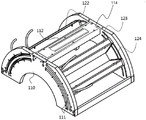
Fig. 3 is a block diagram of a non-lambertian surface inspection system for line scanning according to an embodiment of the present invention, and fig. 4 is an oblique view of the surface inspection part in fig. 1. Fig. 5 is a schematic view illustrating a state in which the lighting module mounted on the frame module illustrated in fig. 4 is rotated and light is diagonally output from the first lighting module and the second lighting module, and fig. 6 is a schematic view illustrating the surface inspection unit in a state in which the reflector is mounted on the frame module illustrated in fig. 4. Further, fig. 7 is a schematic view schematically illustrating a plurality of lighting modules mounted on the frame module illustrated in fig. 4.
The surface inspection unit 10 is a device that irradiates light onto an object a to be inspected at a plurality of different angles in order to image the object a to be inspected with the image pickup head 20. The surface inspection part 10 as described above is formed in a shape included in a hemisphere, and includes a frame module 110 formed with a photographing hole 112 at an upper end, and an illumination module mounted on the frame module 110 and rotated and moved.
As shown in fig. 4, a curved rest hole 111 is formed in at least one of one side surface and the other side surface of the frame module 110, and a plurality of illumination modules for diagonally outputting light to the inspected object a placed on the bottom surface are installed in the rest hole 111.
In this case, the plurality of illumination modules are illumination for a Shadow Metric System (SMS) optimized for Line Scan (Line Scan). In this specification, the first illumination module 121, the second illumination module 122, the third illumination module 123, and the fourth illumination module 124 will be taken as an example in order to more simply and clearly describe the plurality of illumination modules mounted in the surface inspection unit 10. At this time, the first, second, third, and fourth illumination modules 121, 122, 123, and 124 may be illumination for a Shadow-metric System (SMS) optimized for Line Scan (Line Scan). The first to fourth illumination modules 121 to 124 as described above may be selectively rotated in the rest hole 111 as shown in fig. 5 (a), or may output light in a state of being inclined at 45 degrees as shown in fig. 5 (b) and (c).
Further, the surface inspection part 10 may include a reflection plate 113 installed on an upper side of the frame module 110 as shown in fig. 6 so as to be irradiated again onto the inspection object a by reflecting the light outputted and scattered from the plurality of illumination modules. At this time, the first lighting module 121 is installed at the lower end of the placement hole 111 at the left side, and the second lighting module 122 is installed at the upper end of the placement hole 111 at the left side with a certain interval from the first lighting module 121. In addition, a third lighting module 123 is installed at an upper end of the resting hole 111 at the right side, and a fourth lighting module 124 is installed at a lower end of the resting hole 111 at the right side with a certain interval from the third lighting module 123.
As described above, the first to 4 th illumination modules 121 to 124 installed at intervals in the rest hole 111 may be rotated at the installed position and irradiate light toward the inspected object a in various different directions. Further, the light may be irradiated to the inspection object a at a plurality of different positions while moving along the placement hole 111.
The camera head 20 is located above the imaging hole 112 and shoots the inspection object a located on the bottom surface B through the imaging hole 112, thereby receiving the whole image C including the first illumination image E1 and the second illumination image E2.
Specifically, the camera head portion 20 may be attached to the upper side of the shooting hole 112 in such a manner that the lens is positioned to overlap the shooting hole 112. The camera head 20 as described above can shoot the object a to be inspected on the bottom surface through the shooting hole 112, thereby generating an illumination image.
The camera head section 20 as described above operates in accordance with a control signal output from the controller section 30. In particular, the operation of the camera head 20 may be synchronized with the operation of the illumination modules 121 to 12n, so that the camera head operates only when the illumination modules 121 to 12n are turned on and photographs the object a to be inspected.
The camera head 20 as described above may generate the first illumination image E1 to the fourth illumination image E4 when the first illumination module 121, the second illumination module 122, the third illumination module 123, and the fourth illumination module 124 are turned on in combination and in a designated order according to an inspection object. As an example, the camera head 20 captures a first illumination image E1 when the first illumination module 121 is turned on, a second illumination image E2 when the second illumination module 122 is turned on, a third illumination image E3 when the third illumination module 123 is turned on, and a fourth illumination image E4 when the fourth illumination module 124 is turned on.
The controller section 30 is a computer that generates a control signal and receives and processes data. The controller section 30 described above can control the illumination time and the delay time in nanoseconds (nanoseconds) in the cross illumination control by Line Scan (Line Scan). The controller unit 30 includes a separate control board on which a Field Programmable Gate Array (FPGA) chip is mounted because the conventional controller control board using a Microcontroller central processing unit (Microcontroller CPU) is limited.
Therefore, the controller section 30 can immediately reflect problems occurring in the field such as the lighting order, frequency division, and noise removal into the program according to the inspection object. As shown in fig. 3, the controller unit 30 may include an illumination image receiving module 310, an alignment module 320, a histogram module 330, a removal module 340, a patch correction image module 350, a composite image generation module 360, a control signal generation module 370, and the like.
The controller unit 30 as described above may generate a control signal in the control signal generation module 370 and drive the plurality of illumination modules 12 and the camera head unit 20 to operate. As an example, the controller part 30 may turn off after turning on the first lighting module 121 for a certain time, and turn on the second lighting module 122 while turning off the first lighting module 121. Further, the third lighting module 123 may be turned on when the second lighting module 122 is turned off, and the fourth lighting module 124 may be turned on when the third lighting module 123 is turned off.
The controller part 30 is used to turn on and off the first to fourth lighting modules 121 to 124, and may turn on the first to fourth lighting modules 121 to 124. The controller unit 30 may periodically turn on the particular individual illuminations while excluding them or adjusting their brightness according to a preset reference based on the inspection speed efficiency every line scan. As an example, for an a inspected object, the first illumination module 121, the second illumination module 122, and the fourth illumination module 124 may be sequentially turned on and generate a first illumination image, a second illumination image, and a fourth illumination image, and for a B inspected object, the first illumination module 121, the second illumination module 122, and the third illumination module 123 may be sequentially turned on and generate a first illumination image, a second illumination image, and a third illumination image.
Further, the controller section 30 may drive the camera section 20 to generate the first to fourth illumination images and receive the generated respective illumination images. The controller section 30 can generate processed images, that is, a reflectance image H1, an image H2 partially differentiated in the X direction, an image H3 partially differentiated in the Y direction, an image H4 partially differentiated 2 times, and a vertical vector image H5 by processing the illumination image.
Specifically, the controller section 30 may acquire the whole image C including a plurality of image information from the camera section 20 through the illumination image receiving module 310. Further, image divisions D1 to D4 of different illumination groups are selectively extracted from the whole image C and first to fourth illumination images E1 to E4 are generated, and then the respective images are divided in the set Row (Row) or Column (Column) regions.
In addition, the partial images D1 to D4 of the rows (Row) or columns (Column) of the first illumination image E1 and the partial images D1 to D4 of the rows (Row) or columns (Column) of the second illumination image E2 are aligned by the alignment module 320. In addition, the blocks are partitioned into the same size by the histogram module 330 and the reflectivity values of the blocks are extracted after the position numbers are allocated to the blocks. In addition, the removal module 340 deletes a patch having a reflectance value larger than the reference reflectance value by comparing the set reference reflectance value with the reflectance value measured from the patch. In addition, the block correction image module 350 and the removal module 340 interpolate the block corresponding to the removed portion by using the other effective images to generate the first block correction image G1 and the second block correction image G2, respectively.
As an example, when the reflectance value of the first patch HU2 of the second illumination image is greater than the reference reflectance value, the reflectance value of the first patch HU2 is changed to 0. In addition, the average of the reflectance values of the first patch HU1 of the first illumination image and the reflectance values of the first patch HU3 of the third illumination image and the reflectance values of the first patch HU4 of the fourth illumination image is reflected in the first patch HU2 of the second illumination image.
Further, when the luminosity value of the second block HD3 of the third illumination image is larger than the reference luminosity value, the luminosity value of the second block HD2 is changed to 0. Further, the average of the reflectance value of the second section HD2 of the first illumination image, the reflectance value of the second section HD2 of the second illumination image, and the reflectance value of the second section HD4 of the fourth illumination image is reflected into the second section HD3 of the third illumination image.
The first and second block corrected images G1 and G2 are combined by the combined image generation module 360 to generate a combined image H.
In addition to the above features, the controller unit 30 may be configured by a computer to freely adjust the lighting order of the plurality of lighting modules, and may adjust the brightness of each of the lighting modules by a Pulse Width Modulation (PWM) method from the first to fourth lighting modules. Further, since the brightness of illumination at different illumination angles may differ depending on the characteristics of the inspected object, a normalized inspection result can be obtained by managing the illumination value to be irradiated to the inspected object a.
Next, the operation of the non-lambertian surface inspection system for line scanning will be described in detail with reference to fig. 8 to 14.
Fig. 8 is a sequence diagram related to the operation of the non-lambert line scanning surface inspection system according to an embodiment of the present invention, and fig. 9 to 13 are schematic diagrams illustrating the operation and images of the non-lambert line scanning surface inspection system according to an embodiment of the present invention. Fig. 14 is a schematic diagram illustrating a plurality of block correction images.
As shown in fig. 8, the controller unit 30 operates in a series of procedures to generate a reflectance image H1, an image H2 partially differentiated in the X direction, an image H3 partially differentiated in the Y direction, an image H4 partially differentiated 2 times, and a vertical vector image (Norm image), which are processed images.
Specifically, as shown in fig. 9, the controller section 30 sequentially drives the plurality of illumination modules to operate when the object a to be inspected enters the surface inspection section 10, and generates a plurality of illumination images by the camera section 20. At this time, the first to fourth illumination modules 121 to 124 irradiate light to the inspection object a in different directions as shown in fig. 10. The controller part 30 may receive the entire image C according to the operations of the first to fourth illumination modules 121 to 124. Further, the partial images D1 to D4 of a plurality of rows (Row) or columns (Column) may be extracted from the received overall composite image C, and the first illumination image E1 to the fourth illumination image E4 may be generated by aligning the extracted respective partial images.
The controller unit 30 divides the block into a plurality of blocks as shown in fig. 13, extracts a reflectance value from the divided blocks, and compares the reflectance value of the extracted block with a preset reference reflectance value. Among them, the histogram module 330 of the controller part 30 divides the first through fourth illumination images E1 through E4 into blocks F and assigns position numbers to the blocks F, and then extracts reflectance values from the respective blocks. Further, a graph corresponding to the reflectance value may be formed.
In addition, the patches F generated in the histogram module 330 may be pixels, and the reflectance values included in each patch may be extracted within a range of 0 to 255.
Further,
histogram module 330 may extract reflectance values based on the illustrated tokens using the formulas described below. In this case, the unit vector to each illumination module 12 is L ═ s (cos τ · sin σ, sin σ · sin τ, cos σ). Further, the unit vector of the normal line of the point (x, y) on the surface of the object a to be inspected is
The partial differentiation is performed on the surface along the axis and at a point (x, y) on the surface of the object to be inspected
Where σ is the oblique (slant) angle of illumination and τ is the oblique (tilt) angle of illumination. ρ is a constant of the surface. Further, λ is the intensity of illumination. In the coordinates of the image, the Intensity (Intensity) of the image may be
At this time, the removal module 340 of the controller part 30 includes a reference reflectance value so as to compare the reflectance value measured from each block F with the reference reflectance value. In addition, the removing module 340 deletes the block F having the reflectivity value greater than the reference reflectivity value. As an example, the removal module 340 includes the reflectance value corresponding to 254 as the reference reflectance value, and deletes the block F having the reflectance value greater than the reference reflectance value.
As described above, the controller 30 retains the block when the reflectance value of the block is less than the reference reflectance value, deletes the block when the reflectance value of the block is equal to or greater than the reference reflectance value, and merges the block corresponding to the position of the deleted block and the block extracted from the other illumination image by interpolation after deleting the block exceeding the reference reflectance value. Alternatively, the block is deleted when the reflectance value of the block is equal to or greater than the reference reflectance value, and after the block exceeding the reference reflectance value is deleted, the block extracted from the other illumination image is mapped onto the block corresponding to the position of the deleted block.
The controller unit 30 corrects a part of the blocks by interpolation to generate the first block corrected image G1, the second block corrected image G2, the third block corrected image G3, and the fourth block corrected image G4.
As shown in fig. 14 (a), the first block correction image G1 may be an image captured by light emitted from the first illumination module 121 or an image in which a part of blocks are corrected after the image is captured. As shown in fig. 14 (b), the second block correction image G2 may be an image captured by light emitted from the second illumination module 122 or an image in which a part of the blocks are corrected after the image is captured. As shown in fig. 14 (b), the third block correction image G3 may be an image captured by light emitted from the third illumination module 123 or an image in which a part of the blocks are corrected after the image is captured. As shown in fig. 14 (b), the fourth block corrected image G4 may be an image captured by light emitted from the fourth illumination module 124 or an image in which a part of the blocks are corrected after the image is captured.
Further, the synthesized image generation module 360 may be processed into the reflectance image H1, or into the X-axis partial differential image H2 by calculating the amount of change in the surface height of the inspection object from the synthesized image H along the X-axis direction, or into the Y-axis partial differential image H3 by calculating the amount of change in the surface height of the inspection object along the Y-axis direction, or into the 2-time partial differential image H4 by calculating the amount of change in the surface height of the inspection object from the X-axis partial differential image and the Y-axis partial differential image along the X-axis direction and the Y-axis direction.
Specifically, the synthetic image generation module 360 may find the reflectance image H1 from the synthetic image by the following formula.
In this case, the brightness due to the scattered light may be removed from the brightness that would occur when the surface of the object is illuminated.
In addition, the synthetic
image generation module 360 may calculate the formula of the amount of change in the surface height of the target object, that is, the formula along the X-axis direction
As shown in fig. 2, an image H2 of partial differential in the X-axis direction, which clearly shows the characteristic of the change in the height of the surface of the object in the X-axis direction, is obtained.
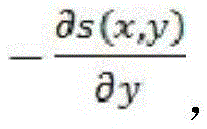
In addition, the amount of change in the surface height of the target object can be calculated along the y-axis direction by using a formula
As shown in fig. 2, an image H3 that is partially differentiated in the Y-axis direction and that clearly shows the characteristic of the change in the surface height of the object in the Y-axis direction is obtained. Further, the synthetic image generation module may calculate a formula, which is a formula of the amount of change in the surface height of the target object, from the acquired image
A curvature image that can clearly express the curvature characteristic of the surface height of the target object is obtained as shown in fig. 2.
Further, the synthetic
image generation module 360 may calculate a formula of a value in a direction perpendicular to the surface, that is, a formula by calculating the value from the synthetic image H
A normal vector (Norm) image is obtained which converts light received normal to the surface into an image in the manner shown in fig. 2.
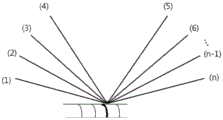
The controller unit 30 may measure, in real time, 3 or more combinations of the illuminations directly entering the camera head 20 from the light source directions (1) to (n) shown in fig. 7 by total reflection, and exclude them from the synthesized image, thereby improving the overall image quality.
The line-scanning non-lambertian surface inspection system 1 can generate a reflectance image H1, an X-axis partial differential image H2, a Y-axis partial differential image H3, a 2-order partial differential image H4 obtained by differentiating a vertical vector (Norm) image and a curvature image 2 times, and an inspection image, thereby accurately inspecting an irregular surface and a non-lambertian surface of an object to be inspected.
Fig. 15 is a perspective view illustrating a form in which the light-transmitting plate is attached to the frame module, fig. 16 is a perspective view illustrating a state in which the light-transmitting plate and the reflecting plate are attached to the frame module, fig. 17 is a front view and a side view illustrating a form in which scattered light is emitted through the light-transmitting plate, and fig. 18 is a plan view illustrating the light-transmitting plate.
Referring to fig. 15-18, the frame module 110 of the line-scan non-lambertian surface inspection system 1 further includes a transparent plate 114 and an auxiliary illumination module 125.
The transparent plate 114 is mounted in the photographing hole 112, and a Dot pattern (Dot pattern) for reflecting light in a lower direction is formed on an upper side surface.
The auxiliary lighting modules 125 are installed at a side surface of the light-transmitting plate 114 to irradiate light to the inside of the light-transmitting plate 114.
Wherein the brightness of the auxiliary lighting module 125 is adjusted by the controller portion 20.
The above-described structure can be more effectively reduced in size than the conventional method of indirectly and manually using scattered light through the dome-shaped frame module 110, and can directly control the intensity (illuminance) of the scattered light alone, thereby more effectively controlling noise in the surface inspection image.
Noise in the surface inspection image includes Dark Current Noise (Dark Current Noise) generated under low illumination conditions of the camera sensor and shot Noise (shot Noise) due to fine uneven characteristics of the surface of the product.
In the case of too little reflected light at the surface of the product, the whole image becomes dark, and dark current generated due to the low light sensitivity of the sensor causes light of a vertical component that requires a certain amount or more.
Dark current noise can be reduced by supplementing light in the vertical direction with parallel scattered light.
In addition, when the surface of the product exhibits a large difference in scattered light due to a fine polished state or a fine defect (within 1 to 2 μm), the surface defect (a mark or scratch of 10 μm or more) which is actually required to be inspected is difficult to detect, and the shot noise as described above is attenuated by the parallel scattered light illumination, and an image after the noise is removed is presented.
Therefore, the invention can remove noise by using the active scattered light when acquiring the reflectivity image, and can adjust the separately separated active scattered light, so that the image of the curvature (curvature radius/differential) image is smaller.
Thereby, an excellent surface inspection image can be obtained.
By Mie Scattering theory, light Scattering is the Scattering of light when it strikes an irregular surface below a certain size, and Mie Scattering occurs when the particles are similar to the wavelength of light or reach below a certain size.
The intensity of the scattered light depends on the angle of incidence of the light.
In order to accurately calculate the surface roughness of the inspection object, the calculation may be performed using the maxwell equation.
When the incident light is scattered on the surface of the inspection object, the density M of the particles and the brightness of the scattered light satisfy the following formula.
Where γ is the distance between the camera and the object under examination, ρ is the density of small particles on the surface, lkIs the brightness of the scattered wavelength k, ik0Is the brightness, λ, of incident light of wavelength kkThe wavelength k of the incident light, S, is the surface area of the inspection object.
Furthermore, lk1And lk2Is the vertical and horizontal polarization components of the scattered light, which is the refractive index of the objectnA function related to the scattering angle theta.
α(Di) M is the number of different distribution functions for the surface particle distribution function of the examination object.
The concentration of surface particles has a linear relationship with the brightness of the scattered light.
The present invention is designed to appropriately adjust the distance from the camera and the brightness of the auxiliary lighting module on the basis of the formula, thereby maximizing the difference between the brightness of light scattered due to the inherent surface roughness of the inspection object and the brightness due to the surface defect.
When the surface of the inspection object is contaminated by welding but is not defective, or the surface is in a dirty state due to the buckling of the surface but is not classified as defective, there is a possibility that the defect such as a scratch or a puncture occurring in the surface cannot be distinguished.
In the present invention, it is possible to acquire an image while adjusting the brightness of the auxiliary lighting module and to detect the contamination or surface buckling due to welding as described above from the defect by using the image.
Fig. 19 is an explanatory diagram illustrating an image difference (a: illumination without scattered light, b: illumination with scattered light) in relation to whether scattered light illumination is applied or not.
The (a) image in fig. 19 is an image taken without the scattered light system, and the (b) image is a result of synthesis using scattered light.
In the image shown in fig. 19, a lighter portion is a scratch or a poor puncture, and a darker portion is the surface of the inspection target object.
(a) The image and (b) the image have almost no brightness change, but as the illumination of the auxiliary illumination module becomes brighter, the brightness of the surface of the object becomes brighter.
Therefore, a portion where the luminance change of the illumination is small is extracted as a defect (scratch or stab mark).
In principle, when the size D of the surface particles of the inspection target object is within the Mie Scattering (Mie Scattering), there is a linear relationship between the surface luminance of the inspection target object and the luminance of the auxiliary lighting module, but when the size D of the particles is larger than the Mie Scattering (Mie Scattering) range (e.g., a scratch or a puncture), there is almost no relationship with the luminance of the auxiliary lighting module.
Fig. 20 is an illustrative view illustrating a process of detecting a scratch and a stab mark.
Referring to fig. 20, as the brightness of the Diffuse reflection Module (Diffuse Module), after the Image 0(Image 0) is acquired from the Intensity 0(Intensity 0) and the Image n (Image n) is acquired from the Intensity n (Intensity n), the difference between the Image 0(Image 0) and the Image n (Image n) is calculated, and the Scratch (Scratch) and the stamp mark are detected from the images.
FIG. 21 is a graph relating to whether scattered light is present or absent (a: noise is serious, b: noise has been removed).
The green line in fig. 21 is the outline of the corresponding image.
As can be seen from the profile of the image (b) in fig. 21, the standard deviation value decreases from 20 to 15.
FIG. 22 is a histogram of the surface histogram with respect to the presence or absence of scattered light (a: higher deviation due to smoothing and b: lower deviation due to lower smoothing).
It can be known from the histogram of the green region that the base noise information can be greatly reduced by the scattered light, so that the standard deviation value is reduced from the original 23 to 15.
Although the embodiments of the present invention have been described above with reference to the drawings, it will be understood by those having ordinary skill in the art to which the present invention pertains that the present invention may be embodied in other specific forms without changing its technical or essential features. The embodiments described in the foregoing are therefore to be considered in all respects only as illustrative and not restrictive.