CN114209324B - Psychological assessment data acquisition method and VR system based on image visual cognition - Google Patents
Psychological assessment data acquisition method and VR system based on image visual cognition Download PDFInfo
- Publication number
- CN114209324B CN114209324B CN202210154330.0A CN202210154330A CN114209324B CN 114209324 B CN114209324 B CN 114209324B CN 202210154330 A CN202210154330 A CN 202210154330A CN 114209324 B CN114209324 B CN 114209324B
- Authority
- CN
- China
- Prior art keywords
- module
- pupil
- image
- data
- tester
- Prior art date
- Legal status (The legal status is an assumption and is not a legal conclusion. Google has not performed a legal analysis and makes no representation as to the accuracy of the status listed.)
- Active
Links
- 238000000034 method Methods 0.000 title claims abstract description 42
- 230000019771 cognition Effects 0.000 title claims abstract description 28
- 230000000007 visual effect Effects 0.000 title claims abstract description 28
- 210000001747 pupil Anatomy 0.000 claims abstract description 89
- 230000004424 eye movement Effects 0.000 claims abstract description 70
- 238000007405 data analysis Methods 0.000 claims abstract description 40
- 238000011156 evaluation Methods 0.000 claims abstract description 36
- 230000006996 mental state Effects 0.000 claims abstract description 24
- 238000012360 testing method Methods 0.000 claims abstract description 15
- 238000013480 data collection Methods 0.000 claims abstract description 12
- 230000002996 emotional effect Effects 0.000 claims description 16
- 230000006870 function Effects 0.000 claims description 16
- 238000010801 machine learning Methods 0.000 claims description 13
- 238000004458 analytical method Methods 0.000 claims description 12
- 238000007781 pre-processing Methods 0.000 claims description 12
- 230000008569 process Effects 0.000 claims description 11
- 238000005070 sampling Methods 0.000 claims description 10
- 230000003993 interaction Effects 0.000 claims description 7
- 238000012216 screening Methods 0.000 claims description 7
- 238000012546 transfer Methods 0.000 claims description 7
- 238000012937 correction Methods 0.000 claims description 6
- 238000009499 grossing Methods 0.000 claims description 6
- 230000004446 light reflex Effects 0.000 claims description 6
- 238000012952 Resampling Methods 0.000 claims description 5
- 230000008451 emotion Effects 0.000 claims description 5
- 230000006397 emotional response Effects 0.000 claims description 5
- 238000012544 monitoring process Methods 0.000 claims description 5
- 238000013507 mapping Methods 0.000 claims description 4
- 238000012706 support-vector machine Methods 0.000 claims description 4
- 230000004397 blinking Effects 0.000 claims description 3
- 238000000605 extraction Methods 0.000 claims description 3
- 230000004434 saccadic eye movement Effects 0.000 claims description 3
- 230000001179 pupillary effect Effects 0.000 claims 2
- 230000008602 contraction Effects 0.000 claims 1
- 230000036632 reaction speed Effects 0.000 claims 1
- 230000035484 reaction time Effects 0.000 claims 1
- 238000007654 immersion Methods 0.000 abstract 1
- 230000003340 mental effect Effects 0.000 abstract 1
- 238000007726 management method Methods 0.000 description 17
- 238000002474 experimental method Methods 0.000 description 8
- 238000010586 diagram Methods 0.000 description 6
- 230000015654 memory Effects 0.000 description 6
- 230000004044 response Effects 0.000 description 6
- 230000035945 sensitivity Effects 0.000 description 6
- 230000000994 depressogenic effect Effects 0.000 description 5
- 238000001514 detection method Methods 0.000 description 5
- 208000020401 Depressive disease Diseases 0.000 description 4
- 238000012545 processing Methods 0.000 description 4
- 230000004439 pupillary reactions Effects 0.000 description 4
- 230000002452 interceptive effect Effects 0.000 description 3
- 230000007935 neutral effect Effects 0.000 description 3
- 230000002159 abnormal effect Effects 0.000 description 2
- 238000004364 calculation method Methods 0.000 description 2
- 238000013145 classification model Methods 0.000 description 2
- 238000011161 development Methods 0.000 description 2
- 238000011835 investigation Methods 0.000 description 2
- 238000012986 modification Methods 0.000 description 2
- 230000004048 modification Effects 0.000 description 2
- 230000003287 optical effect Effects 0.000 description 2
- 230000000638 stimulation Effects 0.000 description 2
- 238000012549 training Methods 0.000 description 2
- 208000027534 Emotional disease Diseases 0.000 description 1
- 230000009286 beneficial effect Effects 0.000 description 1
- 238000002790 cross-validation Methods 0.000 description 1
- 238000013500 data storage Methods 0.000 description 1
- 230000010339 dilation Effects 0.000 description 1
- 230000000694 effects Effects 0.000 description 1
- 238000001914 filtration Methods 0.000 description 1
- 238000003384 imaging method Methods 0.000 description 1
- 230000006872 improvement Effects 0.000 description 1
- 238000007477 logistic regression Methods 0.000 description 1
- 239000000463 material Substances 0.000 description 1
- 230000004630 mental health Effects 0.000 description 1
- 230000010344 pupil dilation Effects 0.000 description 1
- 238000013102 re-test Methods 0.000 description 1
- 230000001360 synchronised effect Effects 0.000 description 1
Images


Classifications
-
- A—HUMAN NECESSITIES
- A61—MEDICAL OR VETERINARY SCIENCE; HYGIENE
- A61B—DIAGNOSIS; SURGERY; IDENTIFICATION
- A61B5/00—Measuring for diagnostic purposes; Identification of persons
- A61B5/16—Devices for psychotechnics; Testing reaction times ; Devices for evaluating the psychological state
- A61B5/165—Evaluating the state of mind, e.g. depression, anxiety
-
- A—HUMAN NECESSITIES
- A61—MEDICAL OR VETERINARY SCIENCE; HYGIENE
- A61B—DIAGNOSIS; SURGERY; IDENTIFICATION
- A61B3/00—Apparatus for testing the eyes; Instruments for examining the eyes
- A61B3/10—Objective types, i.e. instruments for examining the eyes independent of the patients' perceptions or reactions
- A61B3/11—Objective types, i.e. instruments for examining the eyes independent of the patients' perceptions or reactions for measuring interpupillary distance or diameter of pupils
-
- A—HUMAN NECESSITIES
- A61—MEDICAL OR VETERINARY SCIENCE; HYGIENE
- A61B—DIAGNOSIS; SURGERY; IDENTIFICATION
- A61B3/00—Apparatus for testing the eyes; Instruments for examining the eyes
- A61B3/10—Objective types, i.e. instruments for examining the eyes independent of the patients' perceptions or reactions
- A61B3/113—Objective types, i.e. instruments for examining the eyes independent of the patients' perceptions or reactions for determining or recording eye movement
-
- A—HUMAN NECESSITIES
- A61—MEDICAL OR VETERINARY SCIENCE; HYGIENE
- A61B—DIAGNOSIS; SURGERY; IDENTIFICATION
- A61B5/00—Measuring for diagnostic purposes; Identification of persons
- A61B5/0033—Features or image-related aspects of imaging apparatus, e.g. for MRI, optical tomography or impedance tomography apparatus; Arrangements of imaging apparatus in a room
-
- A—HUMAN NECESSITIES
- A61—MEDICAL OR VETERINARY SCIENCE; HYGIENE
- A61B—DIAGNOSIS; SURGERY; IDENTIFICATION
- A61B5/00—Measuring for diagnostic purposes; Identification of persons
- A61B5/0059—Measuring for diagnostic purposes; Identification of persons using light, e.g. diagnosis by transillumination, diascopy, fluorescence
Landscapes
- Health & Medical Sciences (AREA)
- Life Sciences & Earth Sciences (AREA)
- Engineering & Computer Science (AREA)
- General Health & Medical Sciences (AREA)
- Veterinary Medicine (AREA)
- Biophysics (AREA)
- Physics & Mathematics (AREA)
- Public Health (AREA)
- Biomedical Technology (AREA)
- Heart & Thoracic Surgery (AREA)
- Medical Informatics (AREA)
- Molecular Biology (AREA)
- Surgery (AREA)
- Animal Behavior & Ethology (AREA)
- Pathology (AREA)
- Ophthalmology & Optometry (AREA)
- Psychiatry (AREA)
- Child & Adolescent Psychology (AREA)
- Human Computer Interaction (AREA)
- Radiology & Medical Imaging (AREA)
- Nuclear Medicine, Radiotherapy & Molecular Imaging (AREA)
- Developmental Disabilities (AREA)
- Educational Technology (AREA)
- Hospice & Palliative Care (AREA)
- Psychology (AREA)
- Social Psychology (AREA)
- Eye Examination Apparatus (AREA)
- Measurement Of The Respiration, Hearing Ability, Form, And Blood Characteristics Of Living Organisms (AREA)
Abstract
Description
技术领域technical field
本发明涉及心理评估系统技术领域,特别是指一种基于图像视觉认知的心理状态数据分析方法及VR系统。The invention relates to the technical field of psychological evaluation systems, in particular to a psychological state data analysis method and a VR system based on image visual cognition.
背景技术Background technique
近年来,随着注意偏向理论以及瞳孔反应理论的发展,眼动追踪已经被证明是研究抑郁症的重要技术方法。注意偏向理论指出,抑郁人群要比正常人群对于负性刺激拥有更大的注意偏向。瞳孔反应理论指出,抑郁人群在光刺激以及情绪刺激任务下比正常人具有更大的瞳孔扩张程度和扩张时间。随着眼动仪的发明给通过眼动追踪来研究抑郁提供了工具,眼动仪可以获取测试者实验时的注视方向、注视轨迹坐标和瞳孔直径等信息,这些生理信息可以客观准确地反应出测试者的心理状态,从而评估其眼动状态是否异常。In recent years, with the development of attentional bias theory and pupillary response theory, eye tracking has proven to be an important technical method for studying depression. Attentional Bias Theory states that depressed people have a greater attentional bias to negative stimuli than normal people. The pupillary response theory points out that depressed people have greater pupil dilation and dilation time than normal people under light stimulation and emotional stimulation tasks. With the invention of the eye tracker, it provides a tool to study depression through eye tracking. The eye tracker can obtain information such as the tester's gaze direction, gaze trajectory coordinates, and pupil diameter during the experiment. These physiological information can objectively and accurately reflect the test. The psychological state of the subjects, so as to assess whether their eye movement state is abnormal.
现有技术中,眼动数据常常因成因复杂而难以被准确获取,并且传统的心理状态评估方法依赖结构化量表,其准确性会因测试者刻意隐瞒而不易被发现,另一方面也可能会存在一些主观偏差,同时耗时长,需要大量人力物力资源。In the prior art, eye movement data is often difficult to obtain accurately due to complex causes, and traditional psychological state assessment methods rely on structured scales, and their accuracy will not be easily discovered because the tester deliberately conceals them. There will be some subjective deviations, and at the same time, it will take a long time and require a lot of human and material resources.
因此,亟需实现一种客观、准确、便携的眼动状态数据获取方法和系统来量化评估测试者的状态。Therefore, there is an urgent need to implement an objective, accurate and portable eye movement state data acquisition method and system to quantitatively evaluate the tester's state.
发明内容SUMMARY OF THE INVENTION
针对现有技术中传统测评方法存在主观偏差,同时耗时长,需要大量医疗资源的问题,本发明提出了一种基于图像视觉认知的心理状态数据分析方法及VR系统。Aiming at the problems of subjective bias in the traditional evaluation methods in the prior art, time-consuming and requiring a lot of medical resources, the present invention proposes a mental state data analysis method and VR system based on image visual cognition.
为解决上述技术问题,本发明提供如下技术方案:In order to solve the above-mentioned technical problems, the present invention provides the following technical solutions:
一方面,提供了一种基于图像视觉认知的心理状态数据分析方法及VR系统,该系统应用于电子设备,包括:In one aspect, a mental state data analysis method and VR system based on image visual cognition are provided. The system is applied to electronic equipment, including:
实验范式呈现模块,用于向测试者呈现图像观看实验数据;The experimental paradigm presentation module is used to present images to the testers to watch the experimental data;
VR端数据采集模块,用于采集测试者的原始眼动数据和瞳孔数据,将所述原始眼动数据和瞳孔数据上传至多终端PC管理模块;The VR terminal data collection module is used to collect the tester's original eye movement data and pupil data, and upload the original eye movement data and pupil data to the multi-terminal PC management module;
心理状态评估算法模块,用于将所述VR端数据采集模块采集到的原始眼动数据和瞳孔数据分别进行预处理和分析,提取测试者的心理特征;将所述心理特征通过预设模型算法进行分析;The mental state evaluation algorithm module is used to preprocess and analyze the original eye movement data and pupil data collected by the VR terminal data acquisition module, respectively, to extract the psychological characteristics of the tester; pass the psychological characteristics through a preset model algorithm to analyze;
多终端PC管理模块,用于对所述实验范式呈现模块、所述VR端数据采集模块以及所述心理状态数据分析模块进行管控。The multi-terminal PC management module is used to manage and control the experimental paradigm presentation module, the VR terminal data acquisition module and the psychological state data analysis module.
可选地,实验范式呈现模块,包括:Optionally, an experimental paradigm presentation module, including:
语音提示子模块,用于在测试任务开始之前,以文字和语音的形式向测试者说明实验流程及测试者需要做的任务;The voice prompt sub-module is used to explain the experimental process and the tasks that the tester needs to do to the tester in the form of text and voice before the test task starts;
瞳孔修正子模块,用于在暗背景的环境下向测试者展示校准内容,对测试者的瞳孔位置进行校准;The pupil correction sub-module is used to display the calibration content to the tester in a dark background environment, and to calibrate the pupil position of the tester;
自由观看子模块,用于在暗背景的环境下向测试者展示测试内容,所述测试内容包括三张不同情绪图像;A free viewing sub-module, used to show test content to testers in a dark background environment, and the test content includes three different emotional images;
注意框跟踪子模块,用于通过注意框随机锁定所述三张不同情绪图像的其中一张。The attention frame tracking sub-module is used to randomly lock one of the three different emotion images through the attention frame.
可选地,三张不同情绪的图像的位置关系为等腰三角形。Optionally, the positional relationship of the three images with different emotions is an isosceles triangle.
可选地,注意框跟踪子模块,还用于检测测试者的注意力停留在注意框所在图像上的时长,当时长达到预设值,注意框转移并锁定下一张图像;否则继续停留在当前图像上。Optionally, the attention frame tracking sub-module is also used to detect the length of time that the tester's attention stays on the image where the attention frame is located. When the time length reaches a preset value, the attention frame is transferred and the next image is locked; on the current image.
可选地,VR端数据采集模块在内置眼动追踪的VR设备上搭建,所述VR端数据采集模块包括:Optionally, a VR-side data collection module is built on a VR device with built-in eye tracking, and the VR-side data collection module includes:
VR呈现子模块,用于通过VR设备将预设的实验范式实验过程呈现给测试者;The VR presentation sub-module is used to present the experimental process of the preset experimental paradigm to the tester through the VR device;
信息采集子模块,用于通过内置的眼动仪采集测试者的眼动轨迹信息和瞳孔信息;The information collection sub-module is used to collect the eye movement track information and pupil information of the tester through the built-in eye tracker;
数据交互子模块,用于与多终端PC管理模块进行数据交互。The data interaction sub-module is used for data interaction with the multi-terminal PC management module.
可选地,VR端数据采集模块采集到的原始眼动轨迹数据和瞳孔数据的格式为t,x,y,r1,r2;Optionally, the format of the original eye movement track data and pupil data collected by the VR end data collection module is t, x, y, r 1 , r 2 ;
其中,t为采样时刻,x,y为眼动轨迹的横纵坐标,r1为左眼瞳孔直径值,r2为右眼的瞳孔直径值。Among them, t is the sampling time, x and y are the horizontal and vertical coordinates of the eye movement trajectory, r 1 is the pupil diameter value of the left eye, and r 2 is the pupil diameter value of the right eye.
可选地,心理状态数据分析模块,包括:Optionally, a mental state data analysis module, including:
数据分析与预处理子模块,用于对所述眼动轨迹信息进行重采样、模拟眼动速度填补缺失值、坐标-位置-情绪属性映射、位置跳变比较后平滑以及注视点识别;对所述瞳孔信息的采样点不均问题进行重采样处理;针对眨眼导致数据缺失问题进行检测并删除;针对VR设备采样导致的缺失值进行直径插值填补缺失值;针对左右眼孔径值不一致的问题进行双眼信号一致化;针对信号的毛刺与抖动问题采用滑动平均法进行平滑处理;针对测试者瞳孔孔径的个体差异问题采用基线校准方法进行校准;The data analysis and preprocessing sub-module is used for resampling the eye movement track information, simulating eye movement speed to fill in missing values, coordinate-position-emotion attribute mapping, smoothing after position jump comparison, and fixation point identification; For the problem of uneven sampling points of pupil information, re-sampling is carried out; for the problem of missing data caused by blinking, it is detected and deleted; for the missing values caused by VR equipment sampling, diameter interpolation is performed to fill in the missing values; Signal uniformity; smoothing by moving average method for signal glitches and jitters; baseline calibration method for individual differences in pupil apertures of testers;
特征提取子模块,用于对预处理后的所述眼动轨迹信息以及瞳孔信息,基于注意偏向理论,提取自由观看阶段的基础心理特征和注意框跟踪阶段的基础心理特征;The feature extraction sub-module is used to extract the basic psychological characteristics of the free viewing stage and the basic psychological characteristics of the attention frame tracking stage based on the attention bias theory from the preprocessed eye movement track information and pupil information;
特征筛选子模块,用于根据提取出的述眼动轨迹信息以及瞳孔信息的特征筛选出测试者的眼动状态评估特征。The feature screening sub-module is used for screening out the eye movement state evaluation features of the tester according to the features of the extracted eye movement track information and pupil information.
可选地,数据分析与预处理子模块进行分析和预处理后的数据格式为tbegin,tend,x,y,r1,r2,p;Optionally, the data format after analysis and preprocessing performed by the data analysis and preprocessing submodule is t begin ,t end ,x,y,r 1 ,r 2 ,p;
其中,tbegin为各阶段注视点开始时间,tend为各阶段注视点结束时间,x,y分别为注视点的横纵坐标,r1为处理后的左眼瞳孔直径值,r2为处理后的右眼瞳孔直径值,p为注视点对应的图像位置序号。Among them, t begin is the start time of the fixation point of each stage, t end is the end time of the fixation point of each stage, x and y are the horizontal and vertical coordinates of the fixation point, respectively, r 1 is the processed left eye pupil diameter value, and r 2 is the processed The right eye pupil diameter value, p is the image position number corresponding to the fixation point.
可选地,多终端PC管理模块,包括:Optionally, a multi-terminal PC management module, including:
主控功能子模块,用于自动检测连接成功的VR设备,展示VR运行监控界面;The main control function sub-module is used to automatically detect the successfully connected VR devices and display the VR operation monitoring interface;
VR功能子模块,用于初始化同步主控功能子模块发送的测试者的基本信息;使VR端测评运行时的所有控制入口自动进入眼动校准应用程序;The VR function sub-module is used to initialize the basic information of the tester sent by the synchronization main control function sub-module; all control entries during the running of the VR-side assessment will automatically enter the eye-tracking calibration application;
评测算法子模块,用于通过将处理和分析后的数据传输给机器学习算法,通过机器学习算法分析完成后的简化版测评结果发送至VR设备进行显示,将完整版测评报告保存在PC端指定路径下。The evaluation algorithm sub-module is used to transmit the processed and analyzed data to the machine learning algorithm, send the simplified version of the evaluation results after the analysis by the machine learning algorithm to the VR device for display, and save the full version of the evaluation report on the PC for specified under the path.
一方面,提供了一种基于图像视觉认知的心理测评数据获取方法,该方法应用于电子设备,该方法包括:In one aspect, a method for acquiring psychological evaluation data based on image visual cognition is provided, the method is applied to electronic equipment, and the method includes:
S1:获取测试者的瞳孔校准数据、以及图像观看实验数据;S1: Obtain the tester's pupil calibration data and image viewing experimental data;
S2:通过VR设备采集测试者的眼动轨迹数据和瞳孔数据;S2: Collect the tester's eye movement track data and pupil data through the VR device;
S3:对原始眼动轨迹数据和瞳孔数据进行数据分析以及预处理;S3: Perform data analysis and preprocessing on the original eye movement track data and pupil data;
S4:通过眼动状态评估算法,对VR设备采集的实验数据进行评估,完成基于图像视觉认知的心理状态数据的分析。S4: Through the eye movement state evaluation algorithm, evaluate the experimental data collected by the VR device, and complete the analysis of the psychological state data based on image visual cognition.
一方面,提供了一种电子设备,所述电子设备包括处理器和存储器,所述存储器中存储有至少一条指令,所述至少一条指令由所述处理器加载并执行以实现上述基于图像视觉认知的心理状态数据分析方法。In one aspect, an electronic device is provided, the electronic device includes a processor and a memory, the memory stores at least one instruction, and the at least one instruction is loaded and executed by the processor to implement the above-mentioned image-based visual recognition Known mental state data analysis methods.
一方面,提供了一种计算机可读存储介质,所述存储介质中存储有至少一条指令,所述至少一条指令由处理器加载并执行以实现上述基于图像视觉认知的心理状态数据分析方法。In one aspect, a computer-readable storage medium is provided, wherein at least one instruction is stored in the storage medium, and the at least one instruction is loaded and executed by a processor to implement the above-mentioned method for analyzing mental state data based on image visual cognition.
本发明实施例的上述技术方案至少具有如下有益效果:The above-mentioned technical solutions of the embodiments of the present invention have at least the following beneficial effects:
上述方案中,首次提出基于注意偏向理论和瞳孔反应理论的图像自由观看范式和任务驱动范式;在轻量级VR设备上搭建了一套具有沉浸感和交互性的基于图像的心理测评系统,可实现多台设备同时进行测试;提出了基于眼动信号和瞳孔信号的抑郁检测的机器学习模型不再是一个“黑盒子”,而是结合心理学理论的可解释模型。Among the above schemes, the free image viewing paradigm and task-driven paradigm based on attentional bias theory and pupil response theory are proposed for the first time; an immersive and interactive image-based psychological evaluation system is built on a lightweight VR device, which can Realize the simultaneous testing of multiple devices; propose a machine learning model for depression detection based on eye movement signals and pupil signals is no longer a "black box", but an interpretable model combined with psychological theory.
附图说明Description of drawings
为了更清楚地说明本发明实施例中的技术方案,下面将对实施例描述中所需要使用的附图作简单地介绍,显而易见地,下面描述中的附图仅仅是本发明的一些实施例,对于本领域普通技术人员来讲,在不付出创造性劳动的前提下,还可以根据这些附图获得其他的附图。In order to illustrate the technical solutions in the embodiments of the present invention more clearly, the following briefly introduces the accompanying drawings used in the description of the embodiments. Obviously, the accompanying drawings in the following description are only some embodiments of the present invention. For those of ordinary skill in the art, other drawings can also be obtained from these drawings without creative effort.
图1是本发明实施例提供的一种基于图像视觉认知的心理状态数据分析VR系统的结构框图;1 is a structural block diagram of a VR system for mental state data analysis based on image visual cognition provided by an embodiment of the present invention;
图2是本发明实施例提供的一种基于图像视觉认知的心理状态数据分析VR系统的实验范式流程图;2 is a flow chart of an experimental paradigm of a VR system for mental state data analysis based on image visual cognition provided by an embodiment of the present invention;
图3是本发明实施例提供的一种基于图像视觉认知的心理状态数据分析方法的评估算法框架图;3 is a framework diagram of an evaluation algorithm of a mental state data analysis method based on image visual cognition provided by an embodiment of the present invention;
图4是本发明实施例提供的一种基于图像视觉认知的心理状态数据分析方法的流程图;4 is a flowchart of a mental state data analysis method based on image visual cognition provided by an embodiment of the present invention;
图5是本发明实施例提供的一种电子设备的结构示意图。FIG. 5 is a schematic structural diagram of an electronic device provided by an embodiment of the present invention.
具体实施方式Detailed ways
为使本发明要解决的技术问题、技术方案和优点更加清楚,下面将结合附图及具体实施例进行详细描述。In order to make the technical problems, technical solutions and advantages to be solved by the present invention more clear, the following will be described in detail with reference to the accompanying drawings and specific embodiments.
本发明实施例提供了一种基于图像视觉认知的心理状态数据分析方法及VR系统,该系统可以由电子设备实现,该电子设备可以是终端或服务器。如图1所示的一种基于图像视觉认知的心理状态数据分析VR系统结构框图,该系统包括:Embodiments of the present invention provide a mental state data analysis method and a VR system based on image visual cognition. The system can be implemented by an electronic device, and the electronic device can be a terminal or a server. As shown in Figure 1, a structural block diagram of a VR system for mental state data analysis based on image visual cognition, the system includes:
实验范式呈现模块,用于向测试者呈现图像观看实验数据。The experimental paradigm presentation module is used to present images to testers to watch experimental data.
一种可行的实施方式中,实验范式由瞳孔修正部分和图像实验部分组成,一共有30组任务,如图2所示,为一组任务的实验流程图。任务开始之前会在一个暗背景下的屏幕中央呈现一个白色小十字,测试者需要注视小十字10秒。在30组任务中,每组任务包含正性/负性/中性三张图像,同时保证每个位置出现各情绪属性的图像次数相等,每个位置出现首/末注意框次数相等,首/末注意框框住的各情绪属性的图像次数相等,图像来源主要是OASIS(Open Access Series of Imaging Studies,开放获取影像研究系列)和ThuPis(the Tsinghua Psychological Image System,清华心理图像系统)这两个情绪图像库。In a feasible implementation, the experimental paradigm consists of a pupil correction part and an image experiment part, and there are 30 groups of tasks in total, as shown in FIG. 2 , which is an experimental flow chart of a group of tasks. Before the task starts, a small white cross will be displayed in the center of the screen against a dark background, and the tester needs to stare at the small cross for 10 seconds. In the 30 groups of tasks, each group of tasks contains three images of positive/negative/neutral, and at the same time, it is ensured that the images of each emotional attribute appear in each position equally, and the number of first/last attention boxes appearing in each position is equal. Finally, note that the number of images of each emotional attribute in the box is equal, and the image sources are mainly OASIS (Open Access Series of Imaging Studies) and ThuPis (the Tsinghua Psychological Image System, Tsinghua Psychological Image System). image gallery.
VR端数据采集模块,用于采集测试者的原始眼动数据和瞳孔数据,将原始眼动数据和瞳孔数据上传至多终端PC管理模块。The VR-side data collection module is used to collect the tester's original eye movement data and pupil data, and upload the original eye movement data and pupil data to the multi-terminal PC management module.
一种可行的实施方式中,VR端数据采集模块是在内置眼动追踪的VR设备上搭建基于Unity 3D开发引擎的评测端。In a feasible implementation manner, the VR terminal data acquisition module is to build an evaluation terminal based on the Unity 3D development engine on a VR device with built-in eye tracking.
心理状态数据分析模块,用于将VR端数据采集模块采集到的原始眼动数据和瞳孔数据分别进行预处理和分析,提取测试者的心理特征;将心理特征通过预设模型算法进行分析。The psychological state data analysis module is used to preprocess and analyze the original eye movement data and pupil data collected by the VR terminal data acquisition module, respectively, to extract the psychological characteristics of the tester; analyze the psychological characteristics through a preset model algorithm.
一种可行的实施方式中,心理状态数据分析模块用于将VR端数据采集模块采集到的原始眼动数据和瞳孔数据分别进行预处理和分析,提取关于注意偏向和瞳孔反应的高阶认知心理特征,将筛选后的特征使用多种分类模型进行训练以完成抑郁状态的检测(是否处于潜在抑郁状态以及抑郁状态的程度),图3为机器学习算法的整体框架图。In a feasible implementation, the mental state data analysis module is used to preprocess and analyze the raw eye movement data and pupil data collected by the VR end data collection module, respectively, to extract higher-order cognition about attentional bias and pupillary response. Psychological characteristics, the screened characteristics are trained with various classification models to complete the detection of depressive state (whether it is in a potential depressive state and the degree of depressive state). Figure 3 is the overall framework diagram of the machine learning algorithm.
多终端PC管理模块,用于对述实验范式呈现模块、VR端数据采集模块以及心理状态数据分析模块进行管控。The multi-terminal PC management module is used to manage and control the experimental paradigm presentation module, the VR-side data acquisition module and the psychological state data analysis module.
一种可行的实施方式中,多终端PC管理模块是基于PC搭建评估系统的管理端软件和数据库,完成多终端控制界面和数据交互逻辑。通过6台VR评测端搭配一台PC管理端的方式,实现多人实时的抑郁状态评估和管控。管理端软件编写基于WPF框架,管理端数据库基于SQLite3数据库引擎。管理端软件可满足的需求具体包括主控功能需求、VR功能需求、评测算法功能需求。In a feasible implementation manner, the multi-terminal PC management module is based on the PC-based management software and database of the evaluation system to complete the multi-terminal control interface and data interaction logic. Through the combination of 6 VR evaluation terminals and one PC management terminal, the real-time assessment and management of depression status of multiple people can be realized. The management-side software is written based on the WPF framework, and the management-side database is based on the SQLite3 database engine. The requirements that the management software can meet include the main control function requirements, VR function requirements, and evaluation algorithm function requirements.
优选地,实验范式呈现模块,包括:Preferably, the experimental paradigm presentation module includes:
语音提示子模块,用于在测试任务开始之前,以文字和语音的形式向测试者说明实验流程及测试者需要做的任务。The voice prompt sub-module is used to explain the experimental process and the tasks that the tester needs to do to the tester in the form of text and voice before the test task starts.
一种可行的实施方式中,任务开始之前,以文字的形式向测试者说明实验流程及测试者需要做的任务,提醒测试者在瞳孔修正阶段要注视白色小十字10秒,在小十字阶段需要注视白色小十字直至消失,图像出现后无需按照图像顺序进行观看,可以按照自己的意愿自由观看三张图像,注意框出现时需要注视被注意框锁定的图像,并且视线跟随注意框的移动而转移,整个实验大约需要6-8分钟。In a feasible implementation, before the task starts, the tester is explained to the tester in the form of text about the experimental process and the tasks that the tester needs to do, reminding the tester to stare at the small white cross for 10 seconds during the pupil correction stage. Look at the small white cross until it disappears. After the images appear, you do not need to watch the images in the order of the images. You can freely watch the three images according to your own wishes. When the attention frame appears, you need to look at the image locked by the attention frame, and follow the movement of the attention frame. , the whole experiment takes about 6-8 minutes.
瞳孔修正子模块,用于在暗背景的环境下向测试者展示校准内容,对测试者的瞳孔位置进行校准。The pupil correction sub-module is used to display the calibration content to the tester in a dark background environment, and to calibrate the position of the tester's pupil.
一种可行的实施方式中,该阶段仅在正式进入第一组图像任务之前出现。在一个黑色暗背景下的屏幕中央呈现一个白色小十字,持续时间为10秒,要求测试者需要持续注视小十字10秒。在这个过程中测试者的瞳孔在暗背景下得到充分扩张且不受强光和情绪刺激的干扰,目的是为了获取瞳孔直径基准值。In a possible implementation, this stage occurs only before the formal entry into the first set of image tasks. A small white cross appears in the center of the screen against a dark background for 10 seconds, and the tester is required to keep looking at the small cross for 10 seconds. During this process, the pupils of the test subjects are fully dilated under the dark background and are not disturbed by strong light and emotional stimuli, in order to obtain the benchmark value of pupil diameter.
自由观看子模块,用于在暗背景的环境下向测试者展示测试内容,测试内容包括三张不同情绪图像。The free viewing sub-module is used to show the test content to the tester in a dark background environment, and the test content includes three different emotional images.
一种可行的实施方式中,每组任务开始之前,在黑色暗背景下的屏幕中央呈现一个白色的小十字,确保测试者的初始注意力在小十字上后(300毫秒)小十字消失,并进入下一阶段。屏幕同时呈现三张不同情绪属性的图像并持续5秒,图像位置关系为等腰三角形。在此期间,被试自由观看这三张图像,由眼动仪记录测试者的眼动轨迹信息和瞳孔反应信息。In a feasible implementation, before the start of each group of tasks, a small white cross is presented in the center of the screen under a dark dark background to ensure that the tester's initial attention is on the small cross (300 milliseconds) after the small cross disappears, and to the next stage. The screen presents three images with different emotional attributes at the same time for 5 seconds, and the positional relationship of the images is an isosceles triangle. During this period, the subjects watched the three images freely, and the tester's eye movement track information and pupil response information were recorded by the eye tracker.
注意框跟踪子模块,用于通过注意框随机锁定三张不同情绪图像的其中一张。The attention box tracking submodule is used to randomly lock one of the three images with different emotions through the attention box.
一种可行的实施方式中,5秒自由观看阶段完成后,其中一张图像会被注意框锁定,此时要求测试者注视并观察被注意框锁定的图像,当检测到测试者的注意力停留在注意框所在图像上500-1000毫秒时,注意框会转移并锁定另一张图像,要求测试者尽快注视注意框最新锁定的图像,当检测到测试者已经注视被注意框最新锁定的图像,或者注意框跟踪阶段持续3秒时,该阶段结束,同时本组任务结束。In a feasible implementation, after the 5-second free viewing phase is completed, one of the images will be locked by the attention frame. At this time, the tester is required to watch and observe the image locked by the attention frame. When it is detected that the tester's attention stops When the attention frame is on the image for 500-1000 milliseconds, the attention frame will transfer and lock another image, and the tester is required to stare at the latest locked image of the attention frame as soon as possible. Or when the attention box tracking phase lasts for 3 seconds, the phase ends and the group of tasks ends.
优选地,三张不同情绪的图像的位置关系为等腰三角形。Preferably, the positional relationship of the three images with different emotions is an isosceles triangle.
优选地,注意框跟踪子模块,还用于检测测试者的注意力停留在注意框所在图像上的时长,当时长达到预设值,注意框转移并锁定下一张图像;否则继续停留在当前图像上。Preferably, the attention frame tracking sub-module is also used to detect the length of time that the tester's attention stays on the image where the attention frame is located. When the time length reaches a preset value, the attention frame is transferred and the next image is locked; otherwise, it continues to stay on the current image. on the image.
本发明实施例中,实验提示语阶段是为了让测试者了解实验流程以及需要完成的任务;瞳孔修正阶段的目的是获取测试者的瞳孔直径基准值,用于消除个体之间本身存在的瞳孔直径差异;小十字阶段是为了确保测试者在一组任务结束之后仍然保持注意力集中,用于进行任务完成度判断;自由观看阶段是基于注意偏向理论和瞳孔反应理论提取出注视时长与注视点个数(注意分配)、首视图像类型(注意定向)、瞳孔直径相对值(瞳孔反应)等特征,也可以提取出扫视轨迹长度、注视点时长分布等有关自由观看注意模式的特征;注意框跟踪阶段是基于注意解除提取注意转移时间、注意转移速度等特征。In the embodiment of the present invention, the experimental prompt language stage is to let the tester understand the experimental process and the tasks to be completed; the purpose of the pupil correction stage is to obtain the tester's pupil diameter reference value, which is used to eliminate the pupil diameter that exists between individuals. Difference; the small cross stage is to ensure that the tester still maintains attention after a set of tasks is completed, which is used to judge the completion of the task; the free viewing stage is based on the attentional bias theory and pupil response theory to extract fixation duration and fixation point. features such as number (attention assignment), first-view image type (attention orientation), relative pupil diameter (pupil response), etc., and can also extract features related to free-viewing attention patterns such as saccade track length and fixation point duration distribution; attention frame tracking The stage is based on attention disengagement to extract features such as attention transfer time and attention transfer speed.
优选地,VR端数据采集模块包括:Preferably, the VR terminal data acquisition module includes:
VR呈现子模块,用于通过VR设备将预设的实验范式实验过程呈现给测试者。The VR presentation sub-module is used to present the experimental process of the preset experimental paradigm to the tester through the VR device.
一种可行的实施方式中,VR呈现子模块通过VR设备将设计好的实验范式实现,其具体包括测试者确认个人信息后开启眼动校准,校准成功后自动进入实验流程。实验流程包括实验范式呈现模块中的各个阶段,实验完成后可在VR设备中查看到5张结果敏感图,完整测评报告需在电脑端查看。In a feasible implementation, the VR presentation sub-module implements the designed experimental paradigm through the VR device, which specifically includes opening the eye movement calibration after the tester confirms personal information, and automatically enters the experimental process after the calibration is successful. The experimental process includes various stages in the experimental paradigm presentation module. After the experiment is completed, you can view 5 result sensitivity maps in the VR device, and the complete evaluation report needs to be viewed on the computer.
信息采集子模块,用于通过内置的眼动仪采集测试者的眼动轨迹信息和瞳孔信息。The information collection sub-module is used to collect the tester's eye movement track information and pupil information through the built-in eye tracker.
一种可行的实施方式中,测试者在实验过程中需要通过VR设备内置的眼动仪采集眼动轨迹信息和瞳孔信息,并将其上传至多终端PC管理模块调用机器学习算法进行处理分析,得到测评结果。In a feasible implementation, the tester needs to collect the eye movement track information and pupil information through the built-in eye tracker of the VR device during the experiment, and upload it to the multi-terminal PC management module to call the machine learning algorithm for processing and analysis, and obtain the result. assessment results.
数据交互子模块,用于与多终端PC管理模块进行数据交互。The data interaction sub-module is used for data interaction with the multi-terminal PC management module.
优选地,VR端数据采集模块采集到的原始眼动轨迹数据和瞳孔数据的格式为t,x,y,r1,r2;Preferably, the format of the original eye movement trajectory data and pupil data collected by the VR end data collection module is t,x,y,r 1 ,r 2 ;
其中,t为采样时刻,x,y为眼动轨迹的横纵坐标,r1为左眼瞳孔直径值,r2为右眼的瞳孔直径值。Among them, t is the sampling time, x and y are the horizontal and vertical coordinates of the eye movement trajectory, r 1 is the pupil diameter value of the left eye, and r 2 is the pupil diameter value of the right eye.
优选地,心理状态数据分析模块,包括:Preferably, the mental state data analysis module includes:
数据分析与预处理子模块,用于对眼动轨迹信息进行重采样、模拟眼动速度填补缺失值、坐标-位置-情绪属性映射、位置跳变比较后平滑以及注视点识别;对瞳孔信息的采样点不均问题进行重采样处理;针对眨眼导致数据缺失问题进行检测并删除;针对VR设备采样导致的缺失值进行直径插值填补缺失值;针对左右眼孔径值不一致的问题进行双眼信号一致化;针对信号的毛刺与抖动问题采用滑动平均进行平滑;针对测试者瞳孔孔径的个体差异问题采用基线校准方法进行校准。Data analysis and preprocessing sub-modules are used for resampling eye movement trajectory information, simulating eye movement velocity to fill missing values, coordinate-position-emotion attribute mapping, smoothing after position jump comparison, and gaze point recognition; Perform resampling for uneven sampling points; detect and delete data missing caused by blinking; perform diameter interpolation to fill in missing values for missing values caused by VR device sampling; perform binocular signal consistency for the problem of inconsistent left and right eye aperture values; For the glitches and jitters of the signal, the sliding average is used for smoothing; for the individual differences of the pupil apertures of the testers, the baseline calibration method is used for calibration.
特征提取子模块,用于对预处理后的眼动轨迹信息以及瞳孔信息,基于注意偏向理论,提取自由观看阶段的基础心理特征和注意框跟踪阶段的基础心理特征。The feature extraction sub-module is used to extract the basic psychological features of the free viewing stage and the basic psychological features of the attention frame tracking stage based on the attention bias theory from the preprocessed eye movement track information and pupil information.
一种可行的实施方式中,针对预处理后的眼动数据,基于注意偏向理论,分别提取了自由观看阶段的7个基础心理特征和注意框跟踪阶段的2个基础心理特征,具体含义见表1。针对预处理后的瞳孔数据,基于瞳孔的光反射和情绪反应特性,分别提取了光反射的3个基础特征和情绪反应的2个基础心理特征,具体含义见表2。其中孔径秩(ROD)是为了消除不同任务中图像的亮度对瞳孔直径的影响,通过计算30组任务中每组任务中测试者浏览正/负/中性图像时的平均瞳孔直径,并按照从低到高的顺序排序,记录序数值,并对30组任务的序数值进行累加,最后进行归一化。计算公式为:In a feasible implementation, for the preprocessed eye movement data, based on the theory of attentional bias, 7 basic psychological features in the free viewing stage and 2 basic psychological features in the attention frame tracking stage are respectively extracted, and the specific meanings are shown in the table. 1. For the preprocessed pupil data, based on the pupil’s light reflex and emotional response characteristics, three basic features of light reflex and two basic psychological features of emotional response were extracted respectively. The specific meanings are shown in Table 2. Among them, the rank of aperture (ROD) is to eliminate the influence of the brightness of the images in different tasks on the pupil diameter, by calculating the average pupil diameter of the testers browsing the positive/negative/neutral images in each of the 30 groups of tasks, and according to from Sort from low to high, record the ordinal values, accumulate the ordinal values of 30 groups of tasks, and finally normalize them. The calculation formula is:

孔径秩反映了对于30组任务下正/负/中性图像瞳孔直径的排序,孔径秩越大反应测试者在该类型图像下的瞳孔直径越大。为了消除图像位置对于瞳孔直径的影响,同样计算位置的孔径秩,计算公式为:The aperture rank reflects the ordering of pupil diameters for positive/negative/neutral images for the 30 groups of tasks, and the larger the aperture rank, the larger the pupil diameter of the subjects under that type of image. In order to eliminate the influence of the image position on the pupil diameter, the aperture rank of the position is also calculated, and the calculation formula is:

表1基于注意偏向的基础心理特征Table 1 Basic psychological characteristics based on attentional bias


表2基于瞳孔反应的基础特征Table 2 Basic features based on pupillary response


特征筛选子模块,用于根据提取出的眼动轨迹信息以及瞳孔信息的特征筛选出测试者的眼动状态评估特征。The feature screening sub-module is used to screen out the eye movement state evaluation features of the tester according to the features of the extracted eye movement track information and pupil information.
一种可行的实施方式中,从提取出的大量关于眼动和瞳孔的特征中,筛选出对抑郁状态检测最有帮助的特征。为了平衡筛选效果和解释性,采用相关性过滤和嵌入法进行特征筛选,然后进行特征去共线性处理去除相关性较大的特征。In a feasible implementation manner, from a large number of extracted features about eye movement and pupils, the features that are most helpful for the detection of depressive state are selected. In order to balance the screening effect and interpretability, correlation filtering and embedding method are used for feature screening, and then feature decollinearity processing is performed to remove features with greater correlation.
优选地,数据分析与预处理子模块进行分析和预处理后的数据格式为tbegin,tend,x,y,r1,r2,p;Preferably, the data format after analysis and preprocessing performed by the data analysis and preprocessing submodule is t begin , t end , x, y, r 1 , r 2 , p;
其中,tbegin为各阶段注视点开始时间,tend为各阶段注视点结束时间,x,y分别为注视点的横纵坐标,r1为处理后的左眼瞳孔直径值,r2为处理后的右眼瞳孔直径值,p为注视点对应的图像位置序号。Among them, t begin is the start time of the fixation point of each stage, t end is the end time of the fixation point of each stage, x and y are the horizontal and vertical coordinates of the fixation point, respectively, r 1 is the processed left eye pupil diameter value, and r 2 is the processed The right eye pupil diameter value, p is the image position number corresponding to the fixation point.
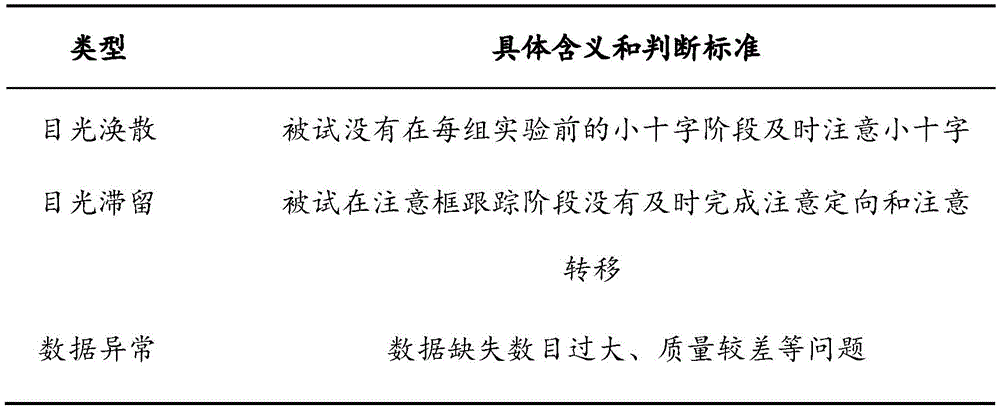
一种可行的实施方式中,本发明的实验范式不是纯自由观看范式,具有一定的任务驱动性,所以存在任务完成度差的现象,其具体含义和判决标准见表3。实验发现,任务完成度较差的测试者中抑郁人群占多数,其原因可能是由于测试者对负性注意偏向过强而无法及时控制注意力或者因为易倦怠和走神而无法坚持完成整个实验。因此,本发明在训练模型之前加入任务完成度的判断,将任务完成度较差的测试者判定为抑郁类别进行召回。上述原因可能是:原因1:任务完成度差可能会导致一些特征失效,不适合将特征数据输入到分类模型进行判别;原因2:根据结果来看,正常人群和抑郁人群在任务完成度上具有明显差异,所以完成度差的人群可能是由于抑郁导致;原因3:本发明的最终目的是将判定为有抑郁倾向的测试者召回进行下一步的排查和干预,所以对于任务完成度差的测试者有必要召回进行重新测试或排查。In a feasible implementation manner, the experimental paradigm of the present invention is not a pure free viewing paradigm, but has a certain task-driven nature, so there is a phenomenon of poor task completion. See Table 3 for its specific meaning and judgment criteria. The experiment found that most of the testers with poor task completion were depressed. The reason may be that the testers were too biased towards negative attention and could not control their attention in time, or could not persist in completing the entire experiment because of easy burnout and distraction. Therefore, the present invention adds the judgment of the task completion degree before training the model, and judges the tester with poor task completion degree as a depression category for recall. The above reasons may be: Reason 1: Poor task completion may cause some features to fail, and it is not suitable to input the feature data into the classification model for discrimination; Reason 2: According to the results, the normal population and the depressed population have the same degree of task completion. There are obvious differences, so the people with poor completion degree may be caused by depression; Reason 3: The ultimate purpose of the present invention is to recall testers who are judged to be prone to depression for further investigation and intervention. It is necessary to recall for re-testing or investigation.
表3任务完成度差的具体含义和判决标准Table 3 The specific meaning and judgment criteria of poor task completion
目前采集的样本量为59(29抑郁个体+30正常个体),考虑到样本量较小,最终选择融合眼动特征和瞳孔特征的SVM(Support Vector Machine,支持向量机模型)作为分类器,在该数据集下模型五折交叉验证的敏感度为93.1%,特异度为73.3%,平均准确率为83.0%。使用PDP(Partial Dependence Plots,部分依赖图)做模型解释,结果符合抑郁的情绪刺激理论。模型的结果输出一个决策函数decision function,即样本点到超平面的距离,对结果使用基于John C.Platt提出的Platt Scaling方法对SVM输出的超平面距离decision function上使用LR(logistics regression,逻辑回归模型),即通过训练一个双参数的Sigmoid函数拟合后验概率,并映射为0-100分的分值,实现抑郁状态的量化评估,60分以上为眼动状态良好,40-60分可能存在轻微压力或情绪问题,40分以下为眼动状态异常,且分数越低程度越趋于严重。The sample size currently collected is 59 (29 depressed individuals + 30 normal individuals). Considering the small sample size, SVM (Support Vector Machine), which integrates eye movement features and pupil features, is finally selected as the classifier. The five-fold cross-validation of the model under this dataset has a sensitivity of 93.1%, a specificity of 73.3%, and an average accuracy of 83.0%. Using PDP (Partial Dependence Plots, Partial Dependence Plots) for model interpretation, the results are in line with the emotional stimulus theory of depression. The result of the model outputs a decision function, that is, the distance from the sample point to the hyperplane. For the result, use the Platt Scaling method proposed by John C.Platt to use the LR (logistics regression, logistic regression) on the hyperplane distance decision function output by the SVM. Model), that is, by training a two-parameter Sigmoid function to fit the posterior probability and mapping it to a score of 0-100 to achieve a quantitative assessment of depression state, a score above 60 is a good eye movement state, and a score of 40-60 may be There is mild stress or emotional problems, and the eye movement state is abnormal with a score below 40, and the lower the score, the more serious it is.
一种可行的实施方式中,将每位测试者获得的眼动状态评分和一些重要特征数值进行可视化,生成一份个性化眼动状态评估报告,报告内容包括个人基本信息、心理健康指数和结果说明、详细分析报告。详细分析报告包括自由观看阶段的注视时长、正负图片注视比例详图、眼动轨迹敏感图、瞳孔敏感图和注意框跟踪阶段的注意转移时间敏感图、瞳孔敏感因子。In a feasible implementation, the eye movement state score and some important characteristic values obtained by each tester are visualized, and a personalized eye movement state assessment report is generated, and the report content includes personal basic information, mental health index and results. Description, detailed analysis report. The detailed analysis report includes the fixation duration in the free viewing stage, the details of the positive and negative image fixation ratio, the eye movement track sensitivity map, the pupil sensitivity map and the attention shift time sensitivity map and pupil sensitivity factor in the attention frame tracking stage.
优选地,多终端PC管理模块,包括:Preferably, the multi-terminal PC management module includes:
主控功能子模块,用于自动检测连接成功的VR设备,展示VR运行监控界面。The main control function sub-module is used to automatically detect the successfully connected VR devices and display the VR operation monitoring interface.
一种可行的实施方式中,管理端自动检测并链接成功VR设备,并展示VR运行监控界面,可实现测试者基本信息的添加和修改,同时可实现VR设备的运行状态监测。In a feasible implementation, the management terminal automatically detects and links the successful VR device, and displays the VR operation monitoring interface, which can realize the addition and modification of the tester's basic information, and at the same time, can realize the operation status monitoring of the VR device.
VR功能子模块,用于初始化同步主控功能子模块发送的测试者的基本信息;使VR端测评运行时的所有控制入口自动进入眼动校准应用程序。The VR function sub-module is used to initialize the basic information of the tester sent by the synchronization main control function sub-module; all control entries during the running of the VR-side assessment will automatically enter the eye movement calibration application.
一种可行的实施方式中,初始化同步主控功能发送的测试者基本信息,并实现VR端测评运行时的所有控制入口,可自动进入眼动校准应用程序,并在校准过后自动进入测评界面。In a feasible implementation, the basic information of the tester sent by the synchronous master control function is initialized, and all control entries during the VR end evaluation operation are realized, which can automatically enter the eye movement calibration application, and automatically enter the evaluation interface after calibration.
评测算法子模块,用于通过将处理和分析后的数据传输给机器学习算法,通过机器学习算法分析完成后的简化版测评结果发送至VR设备进行显示,将完整版测评报告保存在PC端指定路径下。The evaluation algorithm sub-module is used to transmit the processed and analyzed data to the machine learning algorithm, send the simplified version of the evaluation results after the analysis by the machine learning algorithm to the VR device for display, and save the full version of the evaluation report on the PC for specified under the path.
一种可行的实施方式中,实验完成后,测试数据从VR端传给PC上的管理端,管理端把数据通过http接口服务程序传给机器学习算法,机器学习算法分析完成后将测评结果返回管理端,管理端获取保存简易版测评报告并传给VR端显示,同时完整版测评报告保存在PC端指定路径下。In a feasible implementation, after the experiment is completed, the test data is transmitted from the VR terminal to the management terminal on the PC, the management terminal transmits the data to the machine learning algorithm through the http interface service program, and the evaluation result is returned after the machine learning algorithm analysis is completed. On the management side, the management side obtains and saves the simplified version of the evaluation report and transmits it to the VR side for display, while the full version of the evaluation report is saved in the specified path on the PC side.
本发明实施例中,首次提出基于注意偏向理论和瞳孔反应理论的图像自由观看范式和任务驱动范式;在轻量级VR设备上搭建了一套具有沉浸感和交互性的基于图像的心理测评系统,可实现多台设备同时进行测试;提出了基于眼动信号和瞳孔信号的抑郁检测的机器学习模型不再是一个“黑盒子”,而是结合心理学理论的可解释模型。In the embodiment of the present invention, the image free viewing paradigm and task-driven paradigm based on attentional bias theory and pupil response theory are proposed for the first time; a set of immersive and interactive image-based psychological evaluation system is built on a lightweight VR device , which can be tested by multiple devices at the same time; the proposed machine learning model for depression detection based on eye movement signals and pupil signals is no longer a "black box", but an interpretable model combined with psychological theory.
本发明实施例提供了一种基于图像视觉认知的心理状态数据分析方法,该方法可以由电子设备实现,该电子设备可以是终端或服务器。如图4所示的基于图像视觉认知的心理测评数据获取方法流程图,该方法的处理流程可以包括如下的步骤:An embodiment of the present invention provides a method for analyzing mental state data based on image visual cognition, and the method can be implemented by an electronic device, and the electronic device can be a terminal or a server. As shown in the flowchart of the method for obtaining psychological evaluation data based on image visual cognition as shown in Figure 4, the processing flow of the method may include the following steps:
S101:获取测试者的瞳孔校准数据、以及图像观看实验数据;S101: Acquire pupil calibration data and image viewing experimental data of the tester;
S102:通过VR设备采集测试者的眼动轨迹数据和瞳孔数据;S102: Collect the eye movement track data and pupil data of the tester through the VR device;
S103:对原始眼动轨迹数据和瞳孔数据进行数据分析以及预处理;S103: Perform data analysis and preprocessing on the original eye movement track data and pupil data;
S104:通过眼动状态评估算法,对VR设备采集的实验数据进行评估,完成基于图像视觉的眼动状态数据的获取及心理状态测评。S104: Evaluate the experimental data collected by the VR device through the eye movement state evaluation algorithm, and complete the acquisition of the eye movement state data and the psychological state evaluation based on image vision.
本发明实施例中,首次提出基于注意偏向理论和瞳孔反应理论的图像自由观看范式和任务驱动范式;在轻量级VR设备上搭建了一套具有沉浸感和交互性的基于图像的心理测评系统,可实现多台设备同时进行测试;提出了基于眼动信号和瞳孔信号的抑郁检测的机器学习模型不再是一个“黑盒子”,而是结合心理学理论的可解释模型。In the embodiment of the present invention, the image free viewing paradigm and task-driven paradigm based on attentional bias theory and pupil response theory are proposed for the first time; a set of immersive and interactive image-based psychological evaluation system is built on a lightweight VR device , which can be tested by multiple devices at the same time; the proposed machine learning model for depression detection based on eye movement signals and pupil signals is no longer a "black box", but an interpretable model combined with psychological theory.
图5是本发明实施例提供的一种电子设备500的结构示意图,该电子设备500可因配置或性能不同而产生比较大的差异,可以包括一个或一个以上处理器(centralprocessing units,CPU)501和一个或一个以上的存储器502,其中,所述存储器502中存储有至少一条指令,所述至少一条指令由所述处理器501加载并执行以实现下述基于图像视觉认知的心理状态数据分析方法的步骤:5 is a schematic structural diagram of an electronic device 500 according to an embodiment of the present invention. The electronic device 500 may vary greatly due to different configurations or performances, and may include one or more processors (central processing units, CPU) 501 and one or more memories 502, wherein, at least one instruction is stored in the memory 502, and the at least one instruction is loaded and executed by the processor 501 to realize the following mental state data analysis based on image visual cognition The steps of the method:
S1:获取测试者的瞳孔校准数据、以及图像观看实验数据;S1: Obtain the tester's pupil calibration data and image viewing experimental data;
S2:通过VR设备采集测试者的眼动轨迹数据和瞳孔数据;S2: Collect the tester's eye movement track data and pupil data through the VR device;
S3:对原始眼动轨迹数据和瞳孔数据进行数据分析以及预处理;S3: Perform data analysis and preprocessing on the original eye movement track data and pupil data;
S4:通过眼动状态评估算法,对VR设备采集的实验数据进行评估,完成基于图像视觉认知的心理状态数据的分析。S4: Through the eye movement state evaluation algorithm, evaluate the experimental data collected by the VR device, and complete the analysis of the psychological state data based on image visual cognition.
在示例性实施例中,还提供了一种计算机可读存储介质,例如包括指令的存储器,上述指令可由终端中的处理器执行以完成上述基于图像视觉认知的心理状态数据分析方法。例如,所述计算机可读存储介质可以是ROM、随机存取存储器(RAM)、CD-ROM、磁带、软盘和光数据存储设备等。In an exemplary embodiment, a computer-readable storage medium, such as a memory including instructions, is also provided, and the instructions can be executed by a processor in the terminal to complete the above-mentioned method for analyzing mental state data based on image visual cognition. For example, the computer-readable storage medium may be ROM, random access memory (RAM), CD-ROM, magnetic tape, floppy disk, optical data storage device, and the like.
本领域普通技术人员可以理解实现上述实施例的全部或部分步骤可以通过硬件来完成,也可以通过程序来指令相关的硬件完成,所述的程序可以存储于一种计算机可读存储介质中,上述提到的存储介质可以是只读存储器,磁盘或光盘等。Those of ordinary skill in the art can understand that all or part of the steps of implementing the above embodiments can be completed by hardware, or can be completed by instructing relevant hardware through a program, and the program can be stored in a computer-readable storage medium. The storage medium mentioned may be a read-only memory, a magnetic disk or an optical disk, etc.
以上所述仅为本发明的较佳实施例,并不用以限制本发明,凡在本发明的精神和原则之内,所作的任何修改、等同替换、改进等,均应包含在本发明的保护范围之内。The above descriptions are only preferred embodiments of the present invention, and are not intended to limit the present invention. Any modification, equivalent replacement, improvement, etc. made within the spirit and principle of the present invention shall be included in the protection of the present invention. within the range.
Claims (8)


Priority Applications (1)
| Application Number | Priority Date | Filing Date | Title |
|---|---|---|---|
| CN202210154330.0A CN114209324B (en) | 2022-02-21 | 2022-02-21 | Psychological assessment data acquisition method and VR system based on image visual cognition |
Applications Claiming Priority (1)
| Application Number | Priority Date | Filing Date | Title |
|---|---|---|---|
| CN202210154330.0A CN114209324B (en) | 2022-02-21 | 2022-02-21 | Psychological assessment data acquisition method and VR system based on image visual cognition |
Publications (2)
| Publication Number | Publication Date |
|---|---|
| CN114209324A CN114209324A (en) | 2022-03-22 |
| CN114209324B true CN114209324B (en) | 2022-07-15 |
Family
ID=80708966
Family Applications (1)
| Application Number | Title | Priority Date | Filing Date |
|---|---|---|---|
| CN202210154330.0A Active CN114209324B (en) | 2022-02-21 | 2022-02-21 | Psychological assessment data acquisition method and VR system based on image visual cognition |
Country Status (1)
| Country | Link |
|---|---|
| CN (1) | CN114209324B (en) |
Families Citing this family (8)
| Publication number | Priority date | Publication date | Assignee | Title |
|---|---|---|---|---|
| CN114898447B (en) * | 2022-07-13 | 2022-10-11 | 北京科技大学 | Personalized fixation point detection method and device based on self-attention mechanism |
| CN115035974B (en) * | 2022-08-11 | 2022-11-15 | 北京科技大学 | Psychological assessment data management system and method |
| CN115253007A (en) * | 2022-08-11 | 2022-11-01 | 应急管理部上海消防研究所 | Attention Bias Training System Based on Virtual Reality and Its Using Method |
| CN115670373B (en) * | 2022-10-27 | 2023-06-16 | 北京中科睿医信息科技有限公司 | Eye movement detection method, device, equipment and medium |
| CN115607159B (en) * | 2022-12-14 | 2023-04-07 | 北京科技大学 | Depression state identification method and device based on eye movement sequence space-time characteristic analysis |
| CN116705212B (en) * | 2023-06-16 | 2025-08-05 | 元惟(深圳)科技有限公司 | Psychological assessment method and system based on the Internet of Things |
| CN117854714B (en) * | 2024-03-07 | 2024-05-24 | 之江实验室 | Information recommendation method and device based on eye movement tracking |
| CN120616465B (en) * | 2025-08-14 | 2025-10-28 | 卓道医疗科技(浙江)有限公司 | Cognitive ability training assessment method, device, equipment and medium |
Citations (2)
| Publication number | Priority date | Publication date | Assignee | Title |
|---|---|---|---|---|
| CN109222888A (en) * | 2018-11-05 | 2019-01-18 | 温州职业技术学院 | A method of psychological test reliability is judged based on eye movement technique |
| CN112472089A (en) * | 2020-11-17 | 2021-03-12 | 衡阳师范学院 | System and method for judging reliability of psychological test based on eye movement technology |
Family Cites Families (5)
| Publication number | Priority date | Publication date | Assignee | Title |
|---|---|---|---|---|
| CN103169485B (en) * | 2013-02-01 | 2015-05-27 | 广东平成广告有限公司 | Cognition curve generation system and cognition curve generation method based on video |
| EP4135561A4 (en) * | 2020-04-15 | 2024-05-22 | Icahn School of Medicine at Mount Sinai | MODULAR PLATFORM FOR EYE EVALUATIONS |
| CN112674771A (en) * | 2020-12-22 | 2021-04-20 | 北京科技大学 | Depression crowd identification method and device based on image fixation difference |
| CN113658697B (en) * | 2021-07-29 | 2023-01-31 | 北京科技大学 | Psychological assessment system based on video fixation difference |
| CN113837153B (en) * | 2021-11-25 | 2022-03-18 | 之江实验室 | A real-time emotion recognition method and system integrating pupil data and facial expressions |
-
2022
- 2022-02-21 CN CN202210154330.0A patent/CN114209324B/en active Active
Patent Citations (2)
| Publication number | Priority date | Publication date | Assignee | Title |
|---|---|---|---|---|
| CN109222888A (en) * | 2018-11-05 | 2019-01-18 | 温州职业技术学院 | A method of psychological test reliability is judged based on eye movement technique |
| CN112472089A (en) * | 2020-11-17 | 2021-03-12 | 衡阳师范学院 | System and method for judging reliability of psychological test based on eye movement technology |
Also Published As
| Publication number | Publication date |
|---|---|
| CN114209324A (en) | 2022-03-22 |
Similar Documents
| Publication | Publication Date | Title |
|---|---|---|
| CN114209324B (en) | Psychological assessment data acquisition method and VR system based on image visual cognition | |
| Niehorster et al. | The impact of slippage on the data quality of head-worn eye trackers | |
| KR102155309B1 (en) | Method for predicting cognitive impairment, server, user device and application implementing the method | |
| CN120227030B (en) | Intelligent System and Method for Early Screening of Depression Based on EEG-Eye Tracking Multimodal Data Fusion | |
| JP2009530071A (en) | Visual attention and emotional reaction detection display system | |
| CN104219992A (en) | Asperger's diagnosis assistance method and system, and asperger's diagnosis assistance device | |
| CN117442154B (en) | A visual detection system based on children's attention | |
| CN112890815A (en) | Autism auxiliary evaluation system and method based on deep learning | |
| CN107348962B (en) | A method and device for measuring personality traits based on brain-computer interface technology | |
| CN111743553B (en) | Emotion feature extraction method and system based on eye movement data | |
| CN113658697B (en) | Psychological assessment system based on video fixation difference | |
| CN115429271A (en) | Autism spectrum disorder screening system and method based on eye movement and facial expression | |
| CN114220522B (en) | Method and system of psychological assessment data collection and intervention based on visual cognitive attention | |
| KR20210084443A (en) | Systems and methods for automatic manual assessment of spatiotemporal memory and/or saliency | |
| CN106175657A (en) | A kind of vision automatic checkout system | |
| CN116483209A (en) | Cognitive disorder man-machine interaction method and system based on eye movement regulation and control | |
| WO2023060720A1 (en) | Emotional state display method, apparatus and system | |
| CN111738234B (en) | Automatic empathy ability recognition method based on individual eye movement characteristics | |
| CN111341444B (en) | Intelligent painting scoring method and system | |
| CN117056793B (en) | Attention level monitoring and predicting method, device, equipment and storage medium | |
| CN110765987B (en) | Methods, devices and electronic devices for quantifying innovative behavioral characteristics | |
| CN117409966A (en) | An eye health management method and system | |
| Praditsangthong et al. | A fear detection method based on palpebral fissure | |
| CN118452925A (en) | Eye movement detection system based on augmented reality | |
| CN115813343A (en) | Method and system for evaluating abnormal behavior of children |
Legal Events
| Date | Code | Title | Description |
|---|---|---|---|
| PB01 | Publication | ||
| PB01 | Publication | ||
| SE01 | Entry into force of request for substantive examination | ||
| SE01 | Entry into force of request for substantive examination | ||
| GR01 | Patent grant | ||
| GR01 | Patent grant |