Disclosure of Invention
The purpose of the invention is as follows: the invention provides a signal lamp control method based on a two-stage attention mechanism and deep reinforcement learning, which can adjust the phase of an intersection according to the current road condition state, so that the current traffic lamp control strategy is favorable for minimizing the regional intersection congestion.
The technical scheme is as follows: the invention relates to a signal lamp control method based on a two-stage attention mechanism and deep reinforcement learning, which comprises the following steps of:
(1) According to the actual situation of the road section of the intersection, a tensor capable of reflecting the current traffic network state is established;
(2) Performing state preprocessing by using a two-stage attention mechanism network; first layer attention mechanism recurrent neural network f 1 Adaptively selecting each time step state x t Grasping the detailed information of the spatial distribution of the traffic state; second layer attention mechanism recurrent neural network f 2 The first three historical states of each time step are used as input, and the active control capability of the signal control model is enhanced by utilizing the characteristic of high time sequence correlation of traffic states;
(3) Establishing an intersection signal control neural network model based on a deep reinforcement learning algorithm A2C;
(4) Training an intersection signal control neural network model by using a PPO algorithm: building a simulation environment of a road network and traffic flow by utilizing the SUMO, interacting the neural network model with the simulation environment through a Traci interface of the SUMO, and preprocessing the state in the
step 2
Status as reinforcement learning>
Training a network by utilizing a PPO algorithm to obtain an optimal intersection signal control neural network model;
(5) Splicing the current phase of the intersection with the characteristics output by the optimal intersection signal control neural network model to serve as the input of an Actor action probability network; and selecting a final phase result of the intersection signal lamp control model according to the action probability output by the Actor network.
Further, the step (1) comprises the steps of:
(11) Equally-spaced cellular division is carried out on lanes of each road section entering the intersection according to the distance between the lanes and the intersection, and traffic state information of each lane is obtained;
(12) Repeating the step (11), splicing the lane information in each direction to obtain a state vector containing each lane information;
(13) The four-phase operation design is adopted, and the four-phase operation design respectively corresponds to 4 green light phases at the intersection: a south-north direction green light, an east-west direction green light, a south-north direction left-turn green light and a east-west direction left-turn green light;
(14) The instantaneous reward R is defined as the difference in the cumulative average wait time for all vehicles at the intersection between adjacent time steps t:
R t =α(T T+1 -T t ) (4)
wherein, T t Is the cumulative average waiting time, T, of all vehicles in the road network in the T-th time step t+1 The accumulated average waiting time of all vehicles in the road network in the t +1 th time step is alpha, which is a constant value and avoids overlarge fluctuation of the reward value range.
Further, the step (2) comprises the steps of:
(21) The first layer of attention mechanism cyclic neural network adaptively selects each characteristic of the state: state input x for the current time
t ∈R
n By introducing an attention mechanism to adaptively select individual features, i.e. for the state x at time t
t ;x
t The different characteristics of the traffic state cell information comprise the traffic state cell information of different lanes and different distances from the intersection; the neural network gives certain attention weight to each feature
Measure the input x at the time t
t The importance of the kth feature of (1);
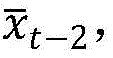
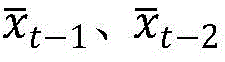
(22) The second layer of attention mechanism cyclic neural network is used for processing the state sequence prediction problem; for the current time t, establishing the current time state
In combination with the status of the preceding two time steps>
And the output at the current instant t->
The relationship between them; enter into the attention mechanism, utilize different network parameters, to the ^ er at different moments>
Taking the state at the moment t by adopting different weight coefficients>
And two time step status before time t>
And &>
Get->
Namely the real input state of the reinforcement learning network model.
Further, the intersection signal lamp control neural network model established in the step (3) comprises a first layer of circulating neural network GRU and a second layer of circulating neural network GRU, and the third layer to the sixth layer are all-connected neural networks; the first layer of recurrent neural network GRU is the recurrent neural network f of the first layer of attention mechanism in the step 2 1 (ii) a The second layer of recurrent neural network GRU is the second layer of attention mechanism recurrent neural network f in the step 2 2 (ii) a And the sixth layer of fully-connected neural network splices the output of the last layer of network with the current phase state as input, and the output is an Actor action probability network and a Critic value network respectively.
Further, the step (4) comprises the steps of:
(41) Respectively establishing a random parameter theta a Actor action network and random parameter theta based c As newRespectively establishing an old strategy network pi which has the same structure as an Actor network and a criticic evaluation network;
(42) Initializing neural network parameters, traffic simulation states and simulation times, a track pool and the like;
(43) At each decision time step, the state S to be obtained from the current simulation window t Inputting the data into an Actor network of an old strategy pi, after the state is preprocessed by two layers of cyclic neural networks, the Actor network randomly selects an action according to output probability parameters, SUMO simulation software executes a corresponding phase according to the selected action and obtains an award R of environmental feedback t And the next S t+1 ;
(44) Constructing a target function by utilizing a PPO2 algorithm provided by OpenAI, and obtaining an optimal intersection signal lamp control model through a learning process of continuously interacting with the environment; the objective function is:
where ε represents the threshold of clip, A θ′ (s t ,a t ) Represents the merit function, and ratio represents the new and old strategy ratios:
has the advantages that: compared with the prior art, the invention has the beneficial effects that: the intersection signal lamp control neural network model is established based on deep reinforcement learning, wherein a PPO algorithm is well balanced among the difficulty degree of realization, the sampling complexity and the time required by debugging; the influence of the number, the length, the phase design and the like of the intersection lanes on the neural network structure is not great, so that the method is widely suitable for controlling signal lamps of various urban road intersections; in order to better acquire traffic state information by a control model, a circulating network of a two-stage attention mechanism is innovatively added in the aspect of designing a deep neural network structure, wherein a spatial double-attention network extracts differentiated influences of different characteristics of states on decision making of the control model by applying a learning method; the time attention network emphasizes the differential influence of learning different historical time states on decision making of the control model; based on this, the signal control model has stronger ability to cope with the changing traffic state, and is more active in signal control strategy.
Detailed Description
The present invention will be described in further detail with reference to the accompanying drawings.
The invention provides a signal lamp control method based on a two-stage attention mechanism and deep reinforcement learning, which is characterized in that a deep neural network structure is optimized, a two-stage attention mechanism network is fused, a first-stage attention mechanism model enables a neural network to more accurately master traffic state space distribution detail information, a second-stage attention mechanism model predicts a future traffic state by using three pieces of historical state information, and the characteristic of large time sequence correlation of the traffic state is utilized to overcome the defect that model regulation and control have certain hysteresis so that a signal control strategy has more initiative and advance. The method specifically comprises the following steps:
step 1: according to the actual situation of the road section of the intersection, a tensor capable of reflecting the current traffic network state is established; the three factors of reinforcement learning comprise state, action and reward, parameter design reference road section length width, lane number, real-time road condition traffic data, phase schemes of traffic signal machines at intersections and the like. The steps of establishing the road junction capable of reflecting the original traffic state of the road junction are as follows:
(1.1) carrying out equidistant cellular division on each section of lane entering the intersection according to the distance between each section of lane and the intersection to obtain the traffic state information of each lane.
As shown in fig. 1, a common intersection with four phases is shown, wherein the four sides of the intersection are connected with a bidirectional six-lane road, and all lanes drive towards the right side and drive in the direction indicated by the arrow in the figure. In order to extract the original traffic state information quickly and efficiently and save computing resources, each lane of each road section connected with the intersection is divided into equidistant cells, as shown in figure 2, the length of a vehicle in the simulation setting is 4.5m, so that the length of the cell is 5m. Therefore, if there are vehicles in the cell, the number of the vehicles can only be 1, and the information of the cell i is M in the invention i ,M i The calculation formula of (c) is as follows:
wherein d is i Represents vehicle delay:
wherein v is i When there is a vehicle in the cell, the vehicle speed is 0,v if there is no vehicle in the cell f Limit speed, v, allowed to travel for the current road section f =20m/s,w i Comprises the following steps:
wherein D is i And L is the distance from the cell i to the intersection, L is the total length of the lanes to which the cells belong, and L =400m is set here.
And (1.2) repeating the step (1.1), and splicing the lane information in each direction to obtain a state vector containing each lane information. After obtaining the information of each cell, combining and splicing the information of the cells of each lane into a vector of (1,n) dimension, and obtaining tensor representation of the original traffic state.
(1.3) the action defines four phase combinations as shown in fig. 2, which correspond to 4 green light phases at the intersection, and as shown in fig. 3, there are a north-south green light (NSG), an east-west green light (EWG), a north-south left green light (NSLG) and a west-east left green light (EWLG) in sequence from left to right.
(1.4) define the instantaneous reward R as the difference between the cumulative average wait times for all vehicles at the intersection between adjacent time steps t:
R t =α(T T+1 -T t ) (4)
wherein, T t Is the cumulative average waiting time, T, of all vehicles in the road network in the T-th time step t+1 The accumulated average waiting time of all vehicles in the road network in the t +1 th time step is alpha, which is a constant value and avoids overlarge fluctuation of the reward value range.
Step 2: performing state preprocessing by using a two-stage attention mechanism network: first layer attention mechanism recurrent neural network f 1 Adaptively selecting each time step state x t Grasping the traffic state space distribution detail information; second layer attention mechanism recurrent neural network f 2 And the first three historical states of each time step are used as input, and the active control capability of the signal control model is enhanced by utilizing the characteristic of high time sequence correlation of traffic states.
And (2.1) the first layer of attention mechanism recurrent neural network adaptively selects each characteristic of the state. In order to learn and extract spatial distribution detail information contained in the traffic signal state, the invention selects a GRU recurrent neural network to realize a first-layer nonlinear activation function f 1 ,f 1 The structure is shown in FIG. 3, for the state input x at the current time t ∈R n By introducing an attention mechanism to adaptively select individual features, i.e. for the state x at time t t The method comprises the following steps:
the neural network gives a certain attention weight to each feature thereof
Measure the input x at the time t
t Is greater than or equal to>
By>
And normalizing by a softmax function. Updated->
The expression is as follows:
wherein x is t The different characteristics of (2) include the traffic state cell information of different lanes and different distances from the intersection.
(2.2) second layer attention mechanism recurrent neural network for processing state sequence prediction problem, second layer nonlinear activation function f
2 Still implemented using a GRU volume neural network, as shown in fig. 4. For the current time t, we need to establish the current time state
Status in relation to the preceding two time steps>
And the output at the current instant t->
Is close toIs described. Here too, attention is drawn to the mechanism whereby different network parameters are used to assert or assert a signal at different times>
Different weighting factors are used, namely: pick the status at the moment t>
And two time step status before time t>
And &>
Get->
The expression is as follows:
namely the real input state of the reinforcement learning network model.
Neural network parameters in FIG. 4
The definition is as follows:
and finally:
and step 3: an intersection signal lamp control neural network model is designed based on a deep reinforcement learning algorithm (A2C), as shown in fig. 5.
The established intersection signal lamp control neural network model comprises a first layer of circulating neural network GRU and a second layer of circulating neural network GRU, and the third to the sixth are full connection layers.
A first layer of recurrent neural network GRU, i.e. the recurrent neural network f of the first layer of attention mechanism in step 2 1 ,f 1 Adaptively selecting each time step state x t Learning and extracting spatial distribution detail information contained in the traffic signal state.
A second layer of recurrent neural network GRU, which is the second layer of attention mechanism recurrent neural network f in step 2 2 ,f 2 And (4) paying attention to the difference of the influence degree of the historical state and the current state at different moments on the current decision.
And the sixth layer of fully-connected neural network splices the output of the last layer of network with the current phase state as input, and the output is an Actor action probability network and a Critic value network respectively.
The Actor network and the Critic network have the same structure except the last layer is different. Wherein the two layers of GRU recurrent neural network involved in the
step 2 is also the front end part of the deep reinforcement learning network structure, and the output of the state preprocessing network in the
step 2
I.e. the state input of the reinforcement learning network framework.
And 4, step 4: and training an intersection signal lamp control neural network by using a PPO algorithm. Building a simulation environment of a road network and traffic flow by utilizing the SUMO, interacting the neural network model with the simulation environment through a Traci interface of the SUMO, and preprocessing the state in the
step 2
Status as reinforcement learning>
Training network by utilizing PPO algorithm to obtain optimal nerveAnd (4) network model. The method comprises the following steps:
(4.1) establishing a random parameter theta a Actor action network and random parameter theta based c The criticic evaluation network is used as a new strategy network pi', and then an old strategy network pi which is completely the same as the action network and the criticic evaluation network is respectively established.
And (4.2) initializing neural network parameters, the state and simulation times of the traffic simulation, a track pool and the like.
(4.3) at each decision time step, the state S to be obtained from the current simulation window t Inputting the data into an Actor network of an old strategy pi, after the state is preprocessed by two layers of cyclic neural networks, the Actor network randomly selects an action according to output probability parameters, SUMO simulation software executes a corresponding phase according to the selected action and obtains an award R of environmental feedback t And the next S t+1 。
And (4.4) constructing an objective function by utilizing a PPO2 algorithm provided by OpenAI, and obtaining an optimal intersection signal lamp control model through a learning process of continuously interacting with the environment. The objective function is:
wherein ε represents the threshold of clip, A θ′ (s t ,a t ) Expressing the advantage function, and ratio expressing the new and old strategy ratios:
in supervised learning, the loss function is designed and gradient reduction is realized easily, but in reinforcement learning, the training process is extremely unstable due to a plurality of changed parts in an algorithm, and PPO (polyphenylene oxide) achieves a good balance among difficulty in realization, sampling complexity and time required by debugging.
Training a neural network model based on a near-end strategy PPO algorithm, wherein network parameters and partial indexes are obtained as shown in FIG. 6, and the overall process specifically comprises the following steps:
1) Initializing network parameters of an Actor action network and a Critic evaluation network, states and simulation times of traffic simulation, a track pool and the like.
2) At each decision time step, the environmental state S t Input to Actor of old strategy pi old Network, the network randomly selecting an action a according to the output probability parameter t The SUMO simulation software executes the corresponding phase according to the selected action and obtains the reward R fed back by the environment t And the next S t+1 。
3) Loop step 2), store [(s) t ,a t ,r t ),s t+1 ]And probability of action prob old . Actor in this process old The network is not updated.
4) Using all stored instantaneous rewards r t Calculating a discount reward R t 。
5) Store all the states S t Input Critic new Network, obtaining all state value states values Computing the dominance function A t =R-state values 。
6) Using Critic loss =mean(square(A t ) Update the criticic network.
7) Inputting the stored state set states action set actions to the Actor new Network obtains action probability set prob new This results in a policy update ratio.
8) Constructing an objective function by utilizing a PPO2 algorithm provided by OpenAI, and updating the Actor new A network.
9) Repeating the steps 5) to 8) for a certain number of steps, and utilizing the Actor new Actor for updating network parameters old A network. And the intelligent agent obtains an optimal intersection signal lamp control model through the learning process of continuously interacting with the environment.
And 5: splicing the current phase of the intersection with the neural network output in the step 4, and selecting a final phase result of the intersection signal lamp control model by the Actor action network according to the network output and the probability;
the intersection is a junction and a key node of the urban traffic network, and signal optimization of the intersection is a main mode for improving the traffic and transportation efficiency of the urban traffic network. The invention aims at the problems that the DRL is applied to the traffic signal control, the spatial coupling relation of the traffic state is ignored, the time sequence correlation of the traffic state is neglected is large, and the initiative strain capacity of the traffic flow facing the change is not outstanding; the two-layer attention mechanism network model can improve the initiative and flexibility of Agent signal control, and help the control model to better learn the information of the traffic state in the space and time dimensions so as to better adapt to the control problem of the urban traffic signal lamp with complex change.