CN114019597A - Method for designing diffractive optical element, and structured light projector - Google Patents
Method for designing diffractive optical element, and structured light projector Download PDFInfo
- Publication number
- CN114019597A CN114019597A CN202111338383.XA CN202111338383A CN114019597A CN 114019597 A CN114019597 A CN 114019597A CN 202111338383 A CN202111338383 A CN 202111338383A CN 114019597 A CN114019597 A CN 114019597A
- Authority
- CN
- China
- Prior art keywords
- light
- diffraction
- optical element
- function
- transmitting surface
- Prior art date
- Legal status (The legal status is an assumption and is not a legal conclusion. Google has not performed a legal analysis and makes no representation as to the accuracy of the status listed.)
- Pending
Links
- 230000003287 optical effect Effects 0.000 title claims abstract description 159
- 238000000034 method Methods 0.000 title claims abstract description 34
- 238000002834 transmittance Methods 0.000 claims abstract description 52
- 239000000758 substrate Substances 0.000 claims abstract description 46
- 230000010076 replication Effects 0.000 claims abstract description 29
- 238000005530 etching Methods 0.000 claims abstract description 23
- 238000004519 manufacturing process Methods 0.000 claims abstract description 4
- 238000009826 distribution Methods 0.000 claims description 44
- 230000001427 coherent effect Effects 0.000 claims description 11
- 230000005540 biological transmission Effects 0.000 claims description 8
- 238000005315 distribution function Methods 0.000 claims description 3
- 238000009792 diffusion process Methods 0.000 claims 1
- 238000010586 diagram Methods 0.000 description 21
- 230000008569 process Effects 0.000 description 3
- 230000008859 change Effects 0.000 description 2
- 230000000694 effects Effects 0.000 description 2
- 230000003362 replicative effect Effects 0.000 description 2
- 238000000926 separation method Methods 0.000 description 2
- 238000000149 argon plasma sintering Methods 0.000 description 1
- 239000008358 core component Substances 0.000 description 1
- 238000003384 imaging method Methods 0.000 description 1
- 239000011159 matrix material Substances 0.000 description 1
- 230000007480 spreading Effects 0.000 description 1
- 238000003892 spreading Methods 0.000 description 1
Images


Classifications
-
- G—PHYSICS
- G02—OPTICS
- G02B—OPTICAL ELEMENTS, SYSTEMS OR APPARATUS
- G02B5/00—Optical elements other than lenses
- G02B5/18—Diffraction gratings
- G02B5/1866—Transmission gratings characterised by their structure, e.g. step profile, contours of substrate or grooves, pitch variations, materials
- G02B5/1871—Transmissive phase gratings
-
- G—PHYSICS
- G02—OPTICS
- G02B—OPTICAL ELEMENTS, SYSTEMS OR APPARATUS
- G02B27/00—Optical systems or apparatus not provided for by any of the groups G02B1/00 - G02B26/00, G02B30/00
- G02B27/0012—Optical design, e.g. procedures, algorithms, optimisation routines
-
- G—PHYSICS
- G03—PHOTOGRAPHY; CINEMATOGRAPHY; ANALOGOUS TECHNIQUES USING WAVES OTHER THAN OPTICAL WAVES; ELECTROGRAPHY; HOLOGRAPHY
- G03B—APPARATUS OR ARRANGEMENTS FOR TAKING PHOTOGRAPHS OR FOR PROJECTING OR VIEWING THEM; APPARATUS OR ARRANGEMENTS EMPLOYING ANALOGOUS TECHNIQUES USING WAVES OTHER THAN OPTICAL WAVES; ACCESSORIES THEREFOR
- G03B21/00—Projectors or projection-type viewers; Accessories therefor
- G03B21/14—Details
- G03B21/20—Lamp housings
- G03B21/2006—Lamp housings characterised by the light source
- G03B21/2033—LED or laser light sources
-
- G—PHYSICS
- G03—PHOTOGRAPHY; CINEMATOGRAPHY; ANALOGOUS TECHNIQUES USING WAVES OTHER THAN OPTICAL WAVES; ELECTROGRAPHY; HOLOGRAPHY
- G03B—APPARATUS OR ARRANGEMENTS FOR TAKING PHOTOGRAPHS OR FOR PROJECTING OR VIEWING THEM; APPARATUS OR ARRANGEMENTS EMPLOYING ANALOGOUS TECHNIQUES USING WAVES OTHER THAN OPTICAL WAVES; ACCESSORIES THEREFOR
- G03B21/00—Projectors or projection-type viewers; Accessories therefor
- G03B21/14—Details
- G03B21/20—Lamp housings
- G03B21/208—Homogenising, shaping of the illumination light
Landscapes
- Physics & Mathematics (AREA)
- General Physics & Mathematics (AREA)
- Optics & Photonics (AREA)
- Diffracting Gratings Or Hologram Optical Elements (AREA)
Abstract
The invention discloses a design method of a diffraction optical element, the diffraction optical element and a structured light projector, wherein the method comprises the following steps: manufacturing an optical element substrate for a spherical wave optical field; etching a diffraction light-transmitting surface on a light-transmitting surface of the optical element substrate according to a diffraction transmittance function; or a collimation light-transmitting surface is formed on the first light-transmitting surface of the optical element substrate according to a collimation transmittance function, and a diffraction light-transmitting surface is etched on the second light-transmitting surface of the optical element substrate according to a replica diffraction function; or a collimation and diffraction light-transmitting surface is integrally formed on one light-transmitting surface of the optical element substrate by etching according to the collimation and replication diffraction function, and the collimation and diffraction light-transmitting surface comprises collimation and replication diffraction functions. The method, the optical device and the system integrate the light beam collimation and diffraction functions on a diffraction optical element, so that the light emitted by the laser light source can be distributed in the speckle point optical field directly through the diffraction optical element.
Description
Technical Field
The invention relates to the technical field of three-dimensional imaging, in particular to a design method of a diffractive optical element, the diffractive optical element, a structured light projector and a structured light 3D vision system.
Background
With the continuous deep application in life of face identification, AR/VR etc. and the burst period must be met to the structured light three-dimensional sensing technique, hopefully really become the eyes of machine or smart mobile phone, make the robot can more accurately perceive the environment, discernment user. The three-dimensional sensing technology based on the structured light has the advantages of large measuring range, non-contact, high speed, good system flexibility, moderate precision and the like.
The core component in the structured light three-dimensional sensing technology is a structured light projector, the structured light projector emits light spots with specific coding characteristics, the light spots are projected on an object, the object reflects infrared light, an infrared camera receives reflected light to form a structured light infrared image with the specific coding characteristics, the currently collected structured light infrared image and a reference structured light image which is collected in advance and stored are matched and calculated, and matched pixel points are found along the line-by-line scanning direction of the infrared image in practical application to obtain the deviation amount of pixels in the current structured light image relative to corresponding pixels in the reference structured light image. Based on the principle of triangulation, the depth value of the pixel can be calculated by using the deviation amount, so that the depth image of the whole picture is obtained. The deviation amount here generally refers to the deviation amount along the infrared image scanning direction, so that the structured light scattering spots are generally required to have very high randomness along the infrared image scanning direction to prevent the mismatching phenomenon.
The common structured light projector is formed by assembling precise and complex devices such as a light source, a collimating mirror, a diffractive optical element and the like together, the structured light module calculates the depth information of an object based on the principle of optical triangulation, the requirement on the assembling precision of each part is extremely high, the volume of the structured light module is increased by assembling a plurality of optical elements, fine errors exist among the elements all the time, and certain accumulated errors are formed after the plurality of optical elements of the structured light module are assembled.
Therefore, improvements in the existing structured light projection technology are needed.
Disclosure of Invention
Based on the above, in order to solve the technical problems in the prior art, the invention provides a design method of a diffractive optical element, a structured light projector and a structured light 3D vision system, which integrate a light beam collimation and diffraction function on the diffractive optical element, so that light emitted by a laser light source can be distributed to structured light speckle point optical fields directly through the diffractive optical element, and the use of the optical element is reduced, the size of the whole projector is reduced, and the device cost and the assembly difficulty are reduced.
In a first aspect, the present embodiment provides a method for designing a diffractive optical element, including the steps of:
manufacturing an optical element substrate for a spherical wave optical field;
etching a diffraction light-transmitting surface on a light-transmitting surface of the optical element substrate according to a diffraction transmittance function;
or a collimation light-transmitting surface is formed on the first light-transmitting surface of the optical element substrate according to a collimation transmittance function, and a diffraction light-transmitting surface is etched on the second light-transmitting surface of the optical element substrate according to a replica diffraction function;
or a collimation and diffraction light-transmitting surface is integrally formed on one light-transmitting surface of the optical element substrate by etching according to the collimation and replication diffraction function, and the collimation and diffraction light-transmitting surface comprises collimation and replication diffraction functions.
In a second aspect, embodiments of the present application provide a diffractive optical element, comprising an optical element matrix for a spherical wave optical field,
etching a diffraction light-transmitting surface on a light-transmitting surface of the optical element substrate according to a diffraction transmittance function;
or a collimation light-transmitting surface is formed on the first light-transmitting surface of the optical element substrate according to a collimation transmittance function, and a diffraction light-transmitting surface is etched on the second light-transmitting surface of the optical element substrate according to a replica diffraction function;
or a light-passing surface of the optical element substrate is integrally etched according to the collimation replication diffraction function to form a collimation diffraction light-transmitting surface, and the collimation diffraction light-transmitting surface comprises collimation and replication diffraction functions.
In a third aspect, embodiments of the present application provide a structured light projector comprising a laser light source emitting spherical waves and a diffractive optical element as described above.
In a fourth aspect, the present application provides a structured light 3D vision system comprising a structured light projector, an infrared image sensor and an image processing chip, the structured light projector comprising a laser light source emitting spherical waves and a diffractive optical element as described above for measuring and calculating 3D image depth.
It can be seen that the design method of the diffractive optical element, the structured light projector and the structured light 3D vision system of the embodiment of the present application are applied to a spherical wave light field, and a diffraction phase plane is set according to a diffraction transmittance function; or setting a collimation phase plane according to the collimation transmittance function and setting a diffraction phase plane according to the replica diffraction function; forming a collimating diffraction light-transmitting surface by integrating and etching according to the collimating replication diffraction function; such that the diffractive optics include collimating and replicating diffractive functionality. In addition, the randomness of scattered spots of each sub-block of the laser light source on the receiving screen is determined by the light spot distribution of the light source, and the optical patterns of different sub-blocks have certain offset along the Y-axis direction, so that the randomness of the spots among the sub-blocks is increased, and the accuracy of depth identification is improved. In the superimposed embodiment of the replica diffraction on the receiving screen, the randomness of the scattered spots is determined by the phase plane distribution of the replica diffraction. The brightness of each light spot is the superposition of the brightness of all the light spots of the light source, and the brightness and the definition are higher, so that the three-dimensional image depth recognition is facilitated.
The embodiment of the application integrates the beam collimation diffraction function on the diffraction optical element, so that light emitted by the laser light source can be directly distributed to the structured light speckle point optical field through the diffraction optical element, the use of the optical element is reduced, the size of the whole projector is reduced, and the device cost and the assembly difficulty are reduced.
Drawings
In order to more clearly illustrate the embodiments of the present invention or the technical solutions in the prior art, the drawings used in the description of the embodiments or the prior art will be briefly described below, it is obvious that the drawings in the following description are only some embodiments of the present invention, and for those skilled in the art, other drawings can be obtained according to the drawings without creative efforts.
Wherein:
FIG. 1 is a main flowchart of a method for designing a diffractive optical element according to this embodiment;
FIG. 2 is a schematic configuration diagram of a first embodiment of the diffractive optical element of this embodiment;
FIG. 3 is a schematic structural diagram of a second embodiment of the diffractive optical element of this embodiment;
FIG. 4 is a schematic diagram illustrating an integrated collimating diffractive optical surface design in the design method of the diffractive optical element according to this embodiment;
FIG. 5 is a schematic diagram of the distribution of light-emitting points of the laser light source of this embodiment;
FIG. 6 is a schematic diagram of the optical path of design one shown in FIG. 4;
FIG. 7 is a schematic diagram showing the distribution of speckle points of a single point light source of the laser light source of FIG. 5 after passing through the diffractive optical element of FIG. 4;
FIG. 8 is a schematic diagram of the distribution of speckle points after the whole light source in FIG. 5 passes through the diffractive optical element in FIG. 4;
FIG. 9 is a schematic diagram of a second design method for using a diffraction transmittance function for a spherical light field in the design method of the diffractive optical element according to this embodiment;
FIG. 10 is a schematic diagram of the optical path of design two shown in FIG. 9;
FIG. 11 is a schematic diagram of a design of an integrated collimating diffractive transparent surface in the method for designing a diffractive optical element according to this embodiment;
FIG. 12 is a schematic optical path diagram of design three shown in FIG. 11;
FIG. 13 is a diagram illustrating a fourth principle of the design of the integrated collimating diffractive optical surface in the method for designing a diffractive optical element according to this embodiment;
FIG. 14 is a schematic optical path diagram of design four shown in FIG. 13;
FIG. 15 is a schematic view of the speckle point distribution of the entire light source of FIG. 5 and after passing through the diffractive optical element of FIGS. 9, 11, and 13;
fig. 16 is a schematic diagram of hardware modules of the structured light 3D vision system according to the embodiment.
Detailed Description
The technical solutions in the embodiments of the present invention will be clearly and completely described below with reference to the drawings in the embodiments of the present invention, and it is obvious that the described embodiments are only a part of the embodiments of the present invention, and not all of the embodiments. All other embodiments, which can be derived by a person skilled in the art from the embodiments given herein without making any creative effort, shall fall within the protection scope of the present invention.
The terms "including" and "having," and any variations thereof, in the description and claims of this application and the drawings described above, are intended to cover non-exclusive inclusions. For example, a process, method, system, article, or apparatus that comprises a list of steps or elements is not limited to only those steps or elements listed, but may alternatively include other steps or elements not listed, or inherent to such process, method, article, or apparatus.
Reference herein to "an embodiment" means that a particular feature, structure, or characteristic described in connection with the embodiment can be included in at least one embodiment of the application. The appearances of the phrase in various places in the specification are not necessarily all referring to the same embodiment, nor are separate or alternative embodiments mutually exclusive of other embodiments. It is explicitly and implicitly understood by one skilled in the art that the embodiments described herein can be combined with other embodiments.
The design method of the diffractive optical element, the structured light projector and the structured light 3D vision system are applied to spherical wave light fields.
As shown in fig. 1, the method for designing a diffractive optical element according to an embodiment of the present application includes the steps of:
step 100: the optical element substrate for the spherical wave optical field is manufactured, and the following three light-transmitting surface etching processes can be selected on the optical element substrate.
Step 101: and etching a diffraction light-transmitting surface on a light-transmitting surface of the optical element substrate according to the diffraction transmittance function. The diffraction light-transmitting surface generates the technical effect of integrating the functions of collimation and diffraction in a spherical wave light field.
Step 102: a collimating transmissive surface is formed on the first transmissive surface of the optical element substrate according to a collimating transmittance function, and a diffracting transmissive surface is etched on the second transmissive surface of the optical element substrate according to a replica diffraction function.
Referring to fig. 3, the diffractive optical element 6 is shown with the collimating and diffractive transparent surfaces separated, with the first light-passing surface 62 forming the collimating transparent surface and the second light-passing surface 61 forming the diffractive transparent surface according to the replicated diffraction function.
Step 103: and integrally etching a light-transmitting surface of the optical element substrate according to the collimation replication diffraction function to form a collimation diffraction light-transmitting surface, wherein the collimation diffraction light-transmitting surface comprises collimation and replication diffraction functions.
Referring to fig. 2, a diffractive optical element 5 is shown in which collimating and diffractive light-transmitting surfaces are disposed together, and the light-transmitting surface of the integrated etching is referred to as a collimating diffractive light-transmitting surface. The collimating diffractive transparent surface is arranged on one surface, such as the first light-transmitting surface 52, the collimating phase surface is made on the first light-transmitting surface 52, meanwhile, the diffractive phase surface is etched on the collimating phase surface, and the input spherical wave is collimated, copied and diffused by the collimating diffractive transparent surface.
The design method of the diffractive optical element of the embodiment of the application integrates the functions of two elements on one optical element, including the collimation and the replication diffraction functions. The use of optical elements is reduced, the size of the whole projector is reduced, and the cost and the assembly difficulty of the device are reduced. In addition, different functions are combined on the optical element substrate to form different diffractive optical elements, for example, in the first design, the randomness of scattered spots of the laser light source on the receiving screen is determined by the distribution of light spots of the light source, and the optical patterns of different sub-blocks have a certain offset along the Y-axis direction, so that the randomness of the spots among the sub-blocks is increased, and the accuracy of three-dimensional image depth recognition can be improved. In the superposition embodiment of the replica diffraction on the receiving screen, such as design two, design three and design four, the randomness of the scattered spots is determined by the phase plane distribution of the replica diffraction, the brightness of each light spot is the superposition of the brightness of all the light spots of the light source, the brightness and the definition are higher, and the three-dimensional image depth recognition is facilitated.
Design one
Please refer to fig. 4, which is a design of forming a collimating diffractive transparent surface by integrated etching of the optical element substrate according to the collimating replication diffraction function:
the laser source emits spherical waves 1.
A collimation transmittance function is obtained, and the spherical wave is converted into a plane wave by the collimation function.
And obtaining a replica diffraction function, wherein the plane wave is changed into a plurality of parallel beams with different angle distributions through the replica diffraction function.
The collimated replica diffraction function is equal to the product of the collimated transmittance function and the replica diffraction function.
Fig. 5 is a schematic diagram of the distribution of the light emitting points of the laser light source. The light source surface consists of M point light sources (M is more than or equal to 2), each light spot has different offset relative to other light spots, and the positions of the light spots have strong randomness.
FIG. 6 is a schematic diagram of the optical path corresponding to FIG. 4;
1 denotes a light source, which includes A, B two points, and the actual number of light spots is not constant and is determined as required.
2(a) represents a diffractive optical element;
21(a) denotes a collimation phase plane;
22(a) denotes a diffraction phase plane, which is drawn in two planes for convenience of explanation in fig. 6, and the functional plane of the actual diffraction optical element has only one collimated diffraction transmission plane in which two phase functions are integrated.
And 3(b) denotes a reception screen.
RA1Representing the light of spot a to the collimated phase plane,
RA2represents RA1After passing through the collimation phase surface, the light beam is collimated into a light beam parallel to the Z axis,
RA3represents RA2The light beam replicated and diffused after passing through the diffraction phase plane,
in the same way as RB1Representing the light of spot B to the collimated phase plane,
RB2represents RB1After passing through the collimation phase plane, the phase is collimated into RA2A parallel light beam with a certain included angle,
RB3represents RB2A light beam that is replicated and diffused after passing through the diffraction phase plane.
The point light source a in the laser light source 1 emits a spherical wave, and the complex amplitude distribution before 21(a) is:

The transmittance function of the collimated phase plane is t0(x0,y0),

The complex amplitude distribution of the spherical wave after passing through the collimation phase surface is


and the plane wave can be expressed as:


Then is covered with Through the diffraction phase plane 22(a), the complex amplitude distribution of the plane wave after passing through the diffraction phase plane is
 The transmittance function of the diffraction phase plane is t1(x1,y1)。


The complex amplitude distribution of the plane wave after passing through the diffractive optical element is

Finally, the Of complex amplitude at a point (x, y) on 3(a), 3(a) over a distance rDistribution is RA2The result of coherent addition of all wavelets at that point on the diffractive optical phase plane, i.e.
 Where K (θ) is a tilt factor and C is a constant, is known
 And
And the transmittance function of the diffraction phase plane can be solved.
The final transmittance function t (x, y) of 2(a) is t0(x0,y0)×t1(x1,y1)。
The point A is copied into A through 2(a)1’、A2’、A3'.. (only 3 dots are drawn here for the sake of simplicity, the actual number of dots depends on the specific requirements), and the randomness of these dots is determined by the randomness of the distribution of the source dots, the position of the point B on the source is offset from the position of A, and the point B is copied as B through 2(B)1’、B2’、B3’...B1’、B2’、B3' and A1’、A2’、A3' with some offset, the speckle point distribution at 3(a) is a replica of all the spots in fig. 2.
FIG. 7 is a schematic diagram of the distribution of speckle points of a single point light source of the light source of FIG. 5 after passing through the diffractive optical element of FIG. 6; one spot is copied into N spots after 2 (a).
Fig. 8 is a schematic diagram of the distribution of speckle points of the whole light source in fig. 5 after passing through the diffractive optical element in fig. 6. The laser source in fig. 2 is replicated to M x N scattered spots after 2(a), and each scattered spot has a certain interval. It can be seen that the speckle point at this time is a copy of the light spot of the light source into a number of blocks, the shape of which conforms to the distribution of the light spot with the light source, and each of which is close together. At the moment, the randomness of scattered spots of each sub-block is determined by the distribution of light spots of the laser light source, and the optical patterns of different sub-blocks have certain offset along the Y-axis direction, so that the randomness of the spots among the sub-blocks is increased. The principle of the structured light depth map is that the offset of the speckle points on the surface of the object to be detected and the corresponding scattered spots in the pre-stored reference map is calculated, and the better the randomness between the speckle points is, the more accurately the corresponding speckle points can be found.
Design two
Please refer to fig. 9, which is a design of the optical device substrate with diffractive transparent surface according to the diffractive transmittance function.
The laser light source emits spherical waves;
according to the formula: the spherical wave multiplied by the diffraction transmittance function is the speckle point optical field distribution function on the receiving screen, and the diffraction transmittance function is calculated by knowing the spherical wave and the final speckle point optical field distribution function.
Fig. 10 is a schematic diagram of the optical path corresponding to fig. 9:
1 denotes a laser light source;
2(b) represents a diffractive optical element;
3(b) denotes a reception screen;
the single point light source A in the laser light source 1 emits spherical waves, and the complex amplitude distribution before 2(b) is as follows:

The transmittance function of the diffractive optical element is as follows.


The complex amplitude distribution of the spherical wave after passing through the diffractive optical element is

Finally, the complex amplitude distribution at a certain point (x, y) on 3(b) is reached through the distance r, and the complex amplitude distribution at the point (x, y) on the phase plane of the diffractive optical element is the result of coherent superposition of all wavelets at the point on the phase plane of the point light source A.


The point A is copied into A through 2(b)1’、A2’、A3'.. only 3 copy points are drawn here for the sake of simplicity, the actual number of copy points being according to the specific requirements. And the randomness of these replication points is completely determined by the diffractive optical element DOE. The position of the point B on the light source has a certain offset with the position of the point A, and the point B is copied into B through 2(B)1’、B2’、B3’...B1’、B2’、B3' respective A1’、A2’、A3' superposition of coincidence, and the point where the other luminous points of the light source are duplicated by 3(b) will also coincide with A1’、A2’、A3' superposition, so that the intensity of each spot in the scattered spot on 3(b) is the superposition at which the intensities of all the spots of the light source are superimposed. The brightness of each light spot in the scattered spots is the superposition of the brightness of all the light spots of the laser light source, the brightness and the definition are higher, and the three-dimensional image depth recognition is facilitated.
Design III
Please refer to fig. 11, which is a design of the optical device substrate with diffractive transparent surface according to the diffractive transmittance function.
The laser light source emits incoherent spherical waves;
obtaining a collimation transmittance function, wherein the incoherent spherical wave is changed into a plane wave through the collimation function;
obtaining a replica diffraction function, wherein the plane wave is changed into a plurality of parallel light beams with different angle distributions through the replica diffraction function;
the collimated replica diffraction function is equal to the product of the collimated transmittance function and the replica diffraction function.
The difference between design three and design one is mainly that the randomness of the resulting scattered-spot light field is mainly controlled by the diffractive optical element DOE.
FIG. 12 is a schematic view of the optical path corresponding to FIG. 11;
1(a) represents a laser light source comprising A, B points, AB is not incoherent light;
2(c) represents a diffractive optical element;
21(c) denotes a collimation phase plane;
22(c) represents a diffraction phase plane, and the functional plane of the actual diffraction optical element is only one plane, and integrates two phase functions, and the two planes are drawn for convenience of explanation;
3(c) a receiving screen;
RA1light rays representing the light spot a to the collimated phase plane;
RA2represents RA1After passing through a collimation phase surface, collimating into a light beam parallel to the Z axis;
RA3represents RA2A light beam which is replicated and diffused after passing through a diffraction phase plane;
RB1light rays representing the light spot B to the collimated phase plane;
RB2represents RB1After passing through the collimation phase plane, the phase is collimated into RA2Parallel light beams forming a certain included angle;
RB3represents RB2Through a diffraction phaseA post-facet replicated and diffused beam;
1(c) the point source A emits a spherical wave, the complex amplitude distribution before 21(c) is:
and is Wherein R is the distance from A to 21 (c);
the transmittance function of the collimated phase plane is t0(x0,y0),

The complex amplitude distribution of the spherical wave after passing through the collimation phase surface is


here cos α, cos β, cos γ are directional cosines of the wave vector k, and are known And
And can solve t0(x0,y0)。
Then is covered with Through the diffraction phase plane 22(c), the complex amplitude distribution of the plane wave after passing through the diffraction phase plane is
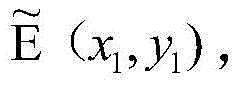 The transmittance function of the diffraction phase plane is t1(x1,y1)。


The complex amplitude distribution of the plane wave after passing through the diffractive optical element is

Finally, the The distribution of complex amplitudes at a point (x, y) on 3(c) over a distance R to 3(c) is RA2The result of coherent addition of all wavelets at that point on the diffractive optical phase plane, i.e.


The final transmittance function t (x, y) of 2(c) is t0(x0,y0)×t1(x1,y1). The solving method is similar to the method one, and the difference is that the focal length f of the collimation phase surface is designed1Is large enough to ensure RA2And RB2The angle of separation is sufficiently small that the final point A is replicated as A by 2(c)1’、A2’、A3'.. and point B are copied into B through 2(c)1’、B2’、B3' superposition of coincidences, the intensity of each spot in the 3(c) scattered spot is the superposition at which the intensities of all the spots of the light source are superimposed.
Design four
Please refer to fig. 13, which is a design of the optical device substrate with diffractive transparent surface according to the diffractive transmittance function.
The laser light source emits coherent spherical waves;
calculating a collimation transmittance function, wherein the coherent spherical wave is changed into a plane wave through the collimation function;
obtaining a replica diffraction function, wherein the plane wave is changed into a plurality of parallel light beams with different angle distributions through the replica diffraction function;
the collimated replica diffraction function is equal to the product of the collimated transmittance function and the replica diffraction function. The difference between the design four and the design one is mainly that each point in the laser source is a coherent light beam.
Fig. 14 is a schematic diagram of the optical path corresponding to fig. 13.
1(b) denotes a light source comprising A, B points, AB is not incoherent light;
2(d) represents a diffractive optical element;
21(d) denotes a collimation phase plane;
22(d) represents a diffraction phase plane, the functional plane of the actual diffraction optical element is only one plane, and the functions of collimation and diffraction phase are integrated, and the two planes are drawn for convenience of explanation;
3(d) a receiving screen;
RA1light rays representing the light spot a to the collimated phase plane;
RA2represents RA1After passing through a collimation phase surface, collimating into a light beam parallel to the Z axis;
RA3represents RA2A light beam which is replicated and diffused after passing through a diffraction phase plane;
RB1light rays representing the light spot B to the collimated phase plane;
RB2represents RB1Collimated parallel beam after passing through the phase plane and parallel to RA2The included angle of the parallel light is 0 degree, the embodiment is designed according to the 0 degree, and the actual production may have some deviation;
RB3represents RB2A light beam that is replicated and diffused after passing through the diffraction phase plane.
1(d) the point light source A emits coherent spherical waves, and the complex amplitude distribution before 21(d) is: and is
 Wherein R is the distance from A to 21 (d).
The transmittance function of the quasi-phase plane is t0(x0,y0), Wherein (x)0,y0) Representing the spatial coordinates on the collimated phase plane.
The complex amplitude distribution of the spherical wave after passing through the collimation phase surface is

It is known that Is a plane wave, and the plane wave can be expressed as:


Then is covered with Through the diffraction phase plane 22(d), the complex amplitude distribution of the plane wave after passing through the diffraction phase plane is
 The transmittance function of the diffraction phase plane is t1(x1,y1):


The complex amplitude distribution of the plane wave after passing through the diffractive optical element is

Finally, the The complex amplitude distribution at a point (x, y) on 3(d) is RA2The result of the coherent addition of all wavelets at this point on the diffractive optical phase plane is:


The final transmittance function t (x, y) of 2(a) is t0(x0,y0)×t1(x1,y1). The solving method is similar to the method III, and the difference is that; designing a fourth requirement light source as a coherent light source; the theoretical basis of solving the collimation function is diffraction optics and is not limited by geometric optics solving, so that no special requirement is required for the focal length of the collimation function, and the effect is to ensure RA2And RB2The angle of separation is sufficiently small. The final point A is copied into A through 2(d)1’、A2’、A3' and Point B is duplicated as B by 2(d)1’、B2’、B3' superposition of coincidences, the intensity of each spot in the 3(d) scattered spot is the superposition at which the intensities of all the spots of the light source are superimposed.
Fig. 15 is a schematic diagram of the speckle point distribution of the whole light source in fig. 5 after passing through the diffractive optical element in fig. 10, 12 and 14. Wherein the brightness of each of the scattered spots is the superposition of the brightness of all the spots of the light source at this point, the size of each scattered spot is larger relative to the size of the speckle spot after replication of a single spot, and the randomness between the spots is not determined by the distribution of the spots of the light source, but is determined entirely by the phase distribution of the diffractive optical element.
Referring to fig. 2 and fig. 3 again, the present embodiment further relates to a diffractive optical element. The diffractive optical elements 2(a), 2(b), 2(c) and 2(d) include optical element substrates 5 and 6 for a spherical wave light field and diffractive light transmitting surfaces formed on the optical element substrates, or a combination of a collimating light transmitting surface and a diffractive light transmitting surface determined by a replica diffraction function, or a collimating diffractive light transmitting surface. The collimating diffractive light transmitting surface includes collimating and replicating diffractive functionality.
In specific implementation, under a spherical wave light field, the single diffraction light-transmitting surface is formed on one light-transmitting surface of the optical element substrate by etching according to a diffraction transmittance function.
The combination of the collimating transparent surface and the diffractive transparent surface determined by the replica diffraction function is formed on the light input surface and the light output surface of the optical element substrate, respectively. A collimating transmissive surface is formed on the first transmissive surface of the optical element substrate according to a collimating transmittance function, and a diffracting transmissive surface is etched on the second transmissive surface of the optical element substrate according to a replica diffraction function.
The collimating diffractive light transmitting surface is formed by: the collimating diffraction light-transmitting surface is formed on one light-transmitting surface of the optical element substrate by integrated etching according to the collimating replication diffraction function, and comprises collimating and replication diffraction functions.
Wherein, the diffraction optical element, the diffraction light transmission surface made by the diffraction transmittance function is used for collimating and diffracting the spherical wave light field.
Or the collimating light-transmitting surface is used for collimating the spherical wave light field; the diffractive optical transmission surface produced by the replica diffraction function is used for laser light source replication and beam spreading.
Or a collimation diffraction light transmission surface formed by the collimation replication diffraction function integrated etching is used for simultaneously carrying out collimation and replication diffraction functions on the laser light source.
The present embodiments also relate to structured light projectors. The structured light projector includes a laser light source emitting spherical waves and the diffractive optical element.
Referring to fig. 16, the present embodiment further relates to a structured light 3D vision system 200. The 3D vision system 200 mainly includes a structured light projector 201, an infrared image sensor 202 and an image processing chip 203, where the structured light projector 201 includes laser light sources 1, 1(a), 1(b) emitting spherical waves and the aforementioned diffractive optical elements (5, 6), the infrared image sensor 202 receives reflected light of structured light speckles after the spherical waves pass through the diffractive optical elements, collects structured light speckle information with phase change, and transmits the structured light speckle information with phase change to the image processing chip 203 for measuring and calculating 3D image depth.
The above disclosure is only for the purpose of illustrating the preferred embodiments of the present invention, and it is therefore to be understood that the invention is not limited by the scope of the appended claims.
Claims (10)
1. A method of designing a diffractive optical element, comprising the steps of:
manufacturing an optical element substrate for a spherical wave optical field;
etching a diffraction light-transmitting surface on a light-transmitting surface of the optical element substrate according to a diffraction transmittance function;
or a collimation light-transmitting surface is formed on the first light-transmitting surface of the optical element substrate according to a collimation transmittance function, and a diffraction light-transmitting surface is etched on the second light-transmitting surface of the optical element substrate according to a replica diffraction function;
or forming a collimation diffraction light transmission surface on one light transmission surface of the optical element substrate by integrated etching according to the collimation replication diffraction function, wherein the collimation diffraction light transmission surface comprises collimation and replication diffraction functions.
2. The method of claim 1, wherein the step of etching a diffractive optical surface on a light-passing surface of the optical element substrate according to the diffractive transmittance function further comprises:
the laser light source emits spherical waves;
according to the formula: and (3) calculating the diffraction transmittance function by knowing the spherical wave and the final speckle point optical field distribution function.
3. The method of designing a diffractive optical element according to claim 1,
the step of forming a collimated diffractive light transmitting surface by integrated etching on a light transmitting surface of the optical element substrate according to the collimated replica diffraction function further comprises:
the laser light source emits spherical waves;
calculating a collimation transmittance function, wherein the spherical wave is changed into a plane wave through the collimation function;
obtaining a replication diffraction function, wherein the plane wave is changed into a plurality of parallel light beams with different angle distributions through the replication diffraction function;
the collimated replica diffraction function is equal to the product of the collimated transmittance function and the replica diffraction function;
the optical pattern of the receiving screen is a copy sub-block of the laser light source, and the randomness of speckle points of each copy sub-block is determined by the light spot distribution of the laser light source.
4. The method of designing a diffractive optical element according to claim 1,
the step of forming a collimated diffractive light transmitting surface by integrated etching on a light transmitting surface of the optical element substrate according to the collimated replica diffraction function further comprises:
the laser light source emits incoherent spherical waves;
calculating a collimation transmittance function, wherein the incoherent spherical wave is changed into a plane wave through the collimation function;
obtaining a replication diffraction function, wherein the plane wave is changed into a plurality of parallel light beams with different angle distributions through the replication diffraction function;
the collimated replica diffraction function is equal to a product of the collimated transmittance function and the replica diffraction function.
5. The method of designing a diffractive optical element according to claim 1,
the step of forming a collimated diffractive light transmitting surface by integrated etching on a light transmitting surface of the optical element substrate according to the collimated replica diffraction function further comprises:
the laser light source emits coherent spherical waves;
calculating a collimation transmittance function, wherein the coherent spherical wave is changed into a plane wave through the collimation function;
obtaining a replication diffraction function, wherein the plane wave is changed into a plurality of parallel light beams with different angle distributions through the replication diffraction function;
the collimated replica diffraction function is equal to a product of the collimated transmittance function and the replica diffraction function.
6. A method of designing a diffractive optical element according to any one of claims 2, 4, and 5, wherein the intensity of each of the replica light spots in the optical pattern of the receiving screen is a superposition of the intensities of all the light spots of the laser light source at the spot, and the randomness of each of the replica light spots is determined by the phase distribution of the diffractive optical element.
7. A diffractive optical element comprising an optical element substrate for a spherical wave optical field,
etching a diffraction light-transmitting surface on one light-transmitting surface of the optical element substrate according to the diffraction transmittance function;
or a collimation light-transmitting surface is formed on the first light-transmitting surface of the optical element substrate according to a collimation transmittance function, and a diffraction light-transmitting surface is etched on the second light-transmitting surface of the optical element substrate according to a replica diffraction function;
or the collimating diffraction light-transmitting surface is formed on the light-transmitting surface of the optical element substrate by integrated etching according to the collimating and copying diffraction function, and the collimating diffraction light-transmitting surface comprises the collimating and copying diffraction functions.
8. The diffractive optical element according to claim 7,
the diffraction light-transmitting surface made by the diffraction transmittance function is used for collimating and diffracting a spherical wave light field;
or the collimating light-transmitting surface is used for collimating the spherical wave light field; the diffraction light-transmitting surface made of the replica diffraction function is used for laser light source replication and light beam diffusion;
or a collimation and diffraction light transmission surface formed by the collimation and replication diffraction function integrated etching is used for simultaneously carrying out collimation and replication diffraction functions on the laser light source.
9. A structured light projector comprising a laser light source emitting spherical waves and a diffractive optical element as claimed in claim 7 or 8.
10. A structured light 3D vision system comprising a structured light projector, an infrared image sensor and an image processing chip, characterized in that the structured light projector comprises a laser light source emitting spherical waves and a diffractive optical element according to claim 7 or 8 for measuring and calculating the 3D image depth.
Priority Applications (1)
| Application Number | Priority Date | Filing Date | Title |
|---|---|---|---|
| CN202111338383.XA CN114019597A (en) | 2021-11-12 | 2021-11-12 | Method for designing diffractive optical element, and structured light projector |
Applications Claiming Priority (1)
| Application Number | Priority Date | Filing Date | Title |
|---|---|---|---|
| CN202111338383.XA CN114019597A (en) | 2021-11-12 | 2021-11-12 | Method for designing diffractive optical element, and structured light projector |
Publications (1)
| Publication Number | Publication Date |
|---|---|
| CN114019597A true CN114019597A (en) | 2022-02-08 |
Family
ID=80063749
Family Applications (1)
| Application Number | Title | Priority Date | Filing Date |
|---|---|---|---|
| CN202111338383.XA Pending CN114019597A (en) | 2021-11-12 | 2021-11-12 | Method for designing diffractive optical element, and structured light projector |
Country Status (1)
| Country | Link |
|---|---|
| CN (1) | CN114019597A (en) |
Cited By (2)
| Publication number | Priority date | Publication date | Assignee | Title |
|---|---|---|---|---|
| CN115356798A (en) * | 2022-09-15 | 2022-11-18 | 深圳市安思疆科技有限公司 | Diffractive optical element and preparation method thereof |
| CN115922754A (en) * | 2022-11-30 | 2023-04-07 | 安思疆科技(南京)有限公司 | A panoramic solid-state lidar and mobile robot navigation system |
Citations (8)
| Publication number | Priority date | Publication date | Assignee | Title |
|---|---|---|---|---|
| JP2006227503A (en) * | 2005-02-21 | 2006-08-31 | Sumitomo Electric Ind Ltd | Diffraction optical component and design method thereof |
| CN105700155A (en) * | 2014-11-14 | 2016-06-22 | 华锦光电科技股份有限公司 | Diffractive optical element and semiconductor laser-diffractive optical element module |
| CN109521639A (en) * | 2019-01-15 | 2019-03-26 | 深圳市安思疆科技有限公司 | A kind of project structured light mould group and 3D imaging device without collimation lens |
| CN110596894A (en) * | 2019-10-25 | 2019-12-20 | 清华大学深圳国际研究生院 | Method and system for designing diffractive optical element |
| CN110850390A (en) * | 2019-11-26 | 2020-02-28 | 广东博智林机器人有限公司 | Optical collimator and lidar |
| CN111522190A (en) * | 2019-02-01 | 2020-08-11 | 无锡奥普顿光电子有限公司 | Projection device based on surface emitting laser and manufacturing method thereof |
| CN112835139A (en) * | 2021-03-04 | 2021-05-25 | 浙江水晶光电科技股份有限公司 | Optical element and optical module |
| US20210325686A1 (en) * | 2020-04-21 | 2021-10-21 | Magik Eye Inc. | Diffractive optical element with collimator function |
-
2021
- 2021-11-12 CN CN202111338383.XA patent/CN114019597A/en active Pending
Patent Citations (8)
| Publication number | Priority date | Publication date | Assignee | Title |
|---|---|---|---|---|
| JP2006227503A (en) * | 2005-02-21 | 2006-08-31 | Sumitomo Electric Ind Ltd | Diffraction optical component and design method thereof |
| CN105700155A (en) * | 2014-11-14 | 2016-06-22 | 华锦光电科技股份有限公司 | Diffractive optical element and semiconductor laser-diffractive optical element module |
| CN109521639A (en) * | 2019-01-15 | 2019-03-26 | 深圳市安思疆科技有限公司 | A kind of project structured light mould group and 3D imaging device without collimation lens |
| CN111522190A (en) * | 2019-02-01 | 2020-08-11 | 无锡奥普顿光电子有限公司 | Projection device based on surface emitting laser and manufacturing method thereof |
| CN110596894A (en) * | 2019-10-25 | 2019-12-20 | 清华大学深圳国际研究生院 | Method and system for designing diffractive optical element |
| CN110850390A (en) * | 2019-11-26 | 2020-02-28 | 广东博智林机器人有限公司 | Optical collimator and lidar |
| US20210325686A1 (en) * | 2020-04-21 | 2021-10-21 | Magik Eye Inc. | Diffractive optical element with collimator function |
| CN112835139A (en) * | 2021-03-04 | 2021-05-25 | 浙江水晶光电科技股份有限公司 | Optical element and optical module |
Cited By (3)
| Publication number | Priority date | Publication date | Assignee | Title |
|---|---|---|---|---|
| CN115356798A (en) * | 2022-09-15 | 2022-11-18 | 深圳市安思疆科技有限公司 | Diffractive optical element and preparation method thereof |
| CN115356798B (en) * | 2022-09-15 | 2025-12-12 | 深圳市安思疆科技有限公司 | A diffractive optical element and its fabrication method |
| CN115922754A (en) * | 2022-11-30 | 2023-04-07 | 安思疆科技(南京)有限公司 | A panoramic solid-state lidar and mobile robot navigation system |
Similar Documents
| Publication | Publication Date | Title |
|---|---|---|
| US11373321B2 (en) | Projector including meta-lens | |
| EP3644110B1 (en) | Optical element and optical system | |
| US9142025B2 (en) | Method and apparatus for obtaining depth information using optical pattern | |
| US9885459B2 (en) | Pattern projection using micro-lenses | |
| CN109752905A (en) | Projector including first lens | |
| US20140293011A1 (en) | Scanner System for Determining the Three Dimensional Shape of an Object and Method for Using | |
| US20120038986A1 (en) | Pattern projector | |
| CN110133853B (en) | Method for adjusting adjustable speckle pattern and projection method thereof | |
| CN109739027B (en) | Dot Matrix Projection Module and Depth Camera | |
| EP3664447A1 (en) | Structured light projector, three-dimensional camera module and terminal device | |
| CN106952309A (en) | The device and method of Fast Calibration TOF depth camera many kinds of parameters | |
| CN105681687B (en) | Image processing apparatus and mobile camera including the same | |
| US10317684B1 (en) | Optical projector with on axis hologram and multiple beam splitter | |
| CN116224607B (en) | Structured light projector and 3D structured light module | |
| JP2015534091A (en) | Method for controlling the linear dimension of a three-dimensional object | |
| CN114019597A (en) | Method for designing diffractive optical element, and structured light projector | |
| CN112880600A (en) | Imaging device and equipment for detecting glass | |
| KR20190000052A (en) | Light transmission apparatus and tof module using the same | |
| US7830605B2 (en) | Longitudinal interference fringe pattern projection lens, optical system, and three-dimensional image acquisition apparatus | |
| CN110784694B (en) | Structured light projector and 3D image sensing module | |
| CN121925578A (en) | Optical system device | |
| JP2005331413A (en) | Distance image acquiring system | |
| CN117369197B (en) | 3D structure optical module, imaging system and method for obtaining depth map of target object | |
| CN222813014U (en) | Point cloud transmitting device based on superlens | |
| US12493195B1 (en) | Projector and sensing system used therefor |
Legal Events
| Date | Code | Title | Description |
|---|---|---|---|
| PB01 | Publication | ||
| PB01 | Publication | ||
| SE01 | Entry into force of request for substantive examination | ||
| SE01 | Entry into force of request for substantive examination | ||
| RJ01 | Rejection of invention patent application after publication | ||
| RJ01 | Rejection of invention patent application after publication |
Application publication date: 20220208 |