CN113930501A - Digital PCR detection method for human EGFR gene mutation and application - Google Patents
Digital PCR detection method for human EGFR gene mutation and application Download PDFInfo
- Publication number
- CN113930501A CN113930501A CN202010671353.XA CN202010671353A CN113930501A CN 113930501 A CN113930501 A CN 113930501A CN 202010671353 A CN202010671353 A CN 202010671353A CN 113930501 A CN113930501 A CN 113930501A
- Authority
- CN
- China
- Prior art keywords
- probe
- egfr
- seq
- mutation
- primer pair
- Prior art date
- Legal status (The legal status is an assumption and is not a legal conclusion. Google has not performed a legal analysis and makes no representation as to the accuracy of the status listed.)
- Pending
Links
Images


Classifications
-
- C—CHEMISTRY; METALLURGY
- C12—BIOCHEMISTRY; BEER; SPIRITS; WINE; VINEGAR; MICROBIOLOGY; ENZYMOLOGY; MUTATION OR GENETIC ENGINEERING
- C12Q—MEASURING OR TESTING PROCESSES INVOLVING ENZYMES, NUCLEIC ACIDS OR MICROORGANISMS; COMPOSITIONS OR TEST PAPERS THEREFOR; PROCESSES OF PREPARING SUCH COMPOSITIONS; CONDITION-RESPONSIVE CONTROL IN MICROBIOLOGICAL OR ENZYMOLOGICAL PROCESSES
- C12Q1/00—Measuring or testing processes involving enzymes, nucleic acids or microorganisms; Compositions therefor; Processes of preparing such compositions
- C12Q1/68—Measuring or testing processes involving enzymes, nucleic acids or microorganisms; Compositions therefor; Processes of preparing such compositions involving nucleic acids
- C12Q1/6876—Nucleic acid products used in the analysis of nucleic acids, e.g. primers or probes
- C12Q1/6883—Nucleic acid products used in the analysis of nucleic acids, e.g. primers or probes for diseases caused by alterations of genetic material
- C12Q1/6886—Nucleic acid products used in the analysis of nucleic acids, e.g. primers or probes for diseases caused by alterations of genetic material for cancer
-
- C—CHEMISTRY; METALLURGY
- C12—BIOCHEMISTRY; BEER; SPIRITS; WINE; VINEGAR; MICROBIOLOGY; ENZYMOLOGY; MUTATION OR GENETIC ENGINEERING
- C12Q—MEASURING OR TESTING PROCESSES INVOLVING ENZYMES, NUCLEIC ACIDS OR MICROORGANISMS; COMPOSITIONS OR TEST PAPERS THEREFOR; PROCESSES OF PREPARING SUCH COMPOSITIONS; CONDITION-RESPONSIVE CONTROL IN MICROBIOLOGICAL OR ENZYMOLOGICAL PROCESSES
- C12Q1/00—Measuring or testing processes involving enzymes, nucleic acids or microorganisms; Compositions therefor; Processes of preparing such compositions
- C12Q1/68—Measuring or testing processes involving enzymes, nucleic acids or microorganisms; Compositions therefor; Processes of preparing such compositions involving nucleic acids
- C12Q1/6844—Nucleic acid amplification reactions
- C12Q1/6858—Allele-specific amplification
-
- C—CHEMISTRY; METALLURGY
- C12—BIOCHEMISTRY; BEER; SPIRITS; WINE; VINEGAR; MICROBIOLOGY; ENZYMOLOGY; MUTATION OR GENETIC ENGINEERING
- C12Q—MEASURING OR TESTING PROCESSES INVOLVING ENZYMES, NUCLEIC ACIDS OR MICROORGANISMS; COMPOSITIONS OR TEST PAPERS THEREFOR; PROCESSES OF PREPARING SUCH COMPOSITIONS; CONDITION-RESPONSIVE CONTROL IN MICROBIOLOGICAL OR ENZYMOLOGICAL PROCESSES
- C12Q2600/00—Oligonucleotides characterized by their use
- C12Q2600/106—Pharmacogenomics, i.e. genetic variability in individual responses to drugs and drug metabolism
-
- C—CHEMISTRY; METALLURGY
- C12—BIOCHEMISTRY; BEER; SPIRITS; WINE; VINEGAR; MICROBIOLOGY; ENZYMOLOGY; MUTATION OR GENETIC ENGINEERING
- C12Q—MEASURING OR TESTING PROCESSES INVOLVING ENZYMES, NUCLEIC ACIDS OR MICROORGANISMS; COMPOSITIONS OR TEST PAPERS THEREFOR; PROCESSES OF PREPARING SUCH COMPOSITIONS; CONDITION-RESPONSIVE CONTROL IN MICROBIOLOGICAL OR ENZYMOLOGICAL PROCESSES
- C12Q2600/00—Oligonucleotides characterized by their use
- C12Q2600/156—Polymorphic or mutational markers
Landscapes
- Chemical & Material Sciences (AREA)
- Life Sciences & Earth Sciences (AREA)
- Health & Medical Sciences (AREA)
- Organic Chemistry (AREA)
- Proteomics, Peptides & Aminoacids (AREA)
- Zoology (AREA)
- Wood Science & Technology (AREA)
- Engineering & Computer Science (AREA)
- Genetics & Genomics (AREA)
- Analytical Chemistry (AREA)
- Immunology (AREA)
- Molecular Biology (AREA)
- General Engineering & Computer Science (AREA)
- Biotechnology (AREA)
- Biophysics (AREA)
- Physics & Mathematics (AREA)
- Biochemistry (AREA)
- Bioinformatics & Cheminformatics (AREA)
- Microbiology (AREA)
- General Health & Medical Sciences (AREA)
- Pathology (AREA)
- Hospice & Palliative Care (AREA)
- Oncology (AREA)
- Chemical Kinetics & Catalysis (AREA)
- Measuring Or Testing Involving Enzymes Or Micro-Organisms (AREA)
Abstract
本发明提供了一种人EGFR基因突变的数字PCR检测方法及应用。具体地,提供了优选的针对EGFR S768、EGFR L861和EGFR G719所在序列的引物对、扩增方法、核酸探针以及检测体系,进一步还提供了用于检测EGFR基因突变的试剂盒。本发明通过优化的引物对和探针以及相应反应条件,从而可以对不同样本高灵敏度、强特异性地检测EGFR基因突变。The invention provides a digital PCR detection method and application of human EGFR gene mutation. Specifically, the preferred primer pairs, amplification methods, nucleic acid probes and detection systems for the sequences of EGFR S768, EGFR L861 and EGFR G719 are provided, and a kit for detecting EGFR gene mutation is further provided. The present invention can detect EGFR gene mutation with high sensitivity and strong specificity for different samples through optimized primer pairs, probes and corresponding reaction conditions.
Description
技术领域technical field
本发明涉及基因检测领域,具体地,涉及人EGFR基因突变的数字PCR检测方法及应用。The invention relates to the field of gene detection, in particular to a digital PCR detection method and application of human EGFR gene mutation.
背景技术Background technique
对于发生EGFR突变的晚期非小细胞肺癌患者,应用表皮生长因子受体-酪氨酸抑制剂(EGFR-TKIs)类靶向药物治疗非常有效,例如吉非替尼(gefitinib)、厄洛替尼(erlotinib)、阿法特罗(afatinib)、达沙替尼(dasatinib)和奥希替尼(osimertinib)。For patients with advanced non-small cell lung cancer with EGFR mutation, epidermal growth factor receptor-tyrosine inhibitors (EGFR-TKIs) targeted drugs are very effective, such as gefitinib, erlotinib (erlotinib), afatinib, dasatinib, and osimertinib.
EGFR突变,尤其是19号外显子缺失、21号外显子(L858R,L861)、18号外显子(G719X,G719)和20号外显子(S768I)突变,与EGFR类酪氨酸激酶抑制剂敏感性高度相关。因此,检测EGFR基因是否突变成为肺癌病人是否使用EGFR靶向药物的前提条件。EGFR mutations, especially exon 19 deletion, exon 21 (L858R, L861), exon 18 (G719X, G719) and exon 20 (S768I) mutations, are sensitive to EGFR-type tyrosine kinase inhibitors Sex is highly correlated. Therefore, detecting whether the EGFR gene is mutated becomes a prerequisite for the use of EGFR-targeted drugs in lung cancer patients.
19外显子缺失和L858R突变为常见突变,针对这两种突变的肺癌患者,一代EGFR抑制剂吉非替尼,厄洛替尼和二代EGFR抑制剂阿法替尼可以被推荐用于一线治疗。国产药埃克替尼也在CSCO指南中推荐用于一线治疗。Exon 19 deletion and L858R mutation are common mutations. For lung cancer patients with these two mutations, the first-generation EGFR inhibitors gefitinib, erlotinib and the second-generation EGFR inhibitor afatinib can be recommended for first-line use treat. The domestic drug icotinib is also recommended for first-line treatment in the CSCO guidelines.
19外显子缺失和L858R突变之外的称之为罕见突变,如L861Q,G719X,S768I等,这些突变位点适合使用第二代靶向药物阿法替尼。Exon 19 deletion and L858R mutation are called rare mutations, such as L861Q, G719X, S768I, etc. These mutation sites are suitable for the use of the second-generation targeted drug afatinib.
因此,检测EGFR基因罕见突变S768I、L861Q、G719X(包括G719S、G719C、G719A)可供医生在非小细胞肺癌患者中选择靶向药物治疗提供参考,是EGFR常见突变检测的重要补充。Therefore, the detection of rare mutations of EGFR gene S768I, L861Q, G719X (including G719S, G719C, G719A) can provide reference for doctors to select targeted drug therapy in patients with non-small cell lung cancer, and is an important supplement to the detection of common EGFR mutations.
然而,在实际检测EGFR基因罕见突变的过程中,仍然面临着检测样本质量等问题。尽管肿瘤组织和肿瘤细胞学样本是突变检测的最佳样本,但此类样本获取难度大。检测血浆中的游离核酸(Circulating free DNA,简称“cfDNA”),又称“液体活检”,避免了需要肿瘤组织的活检,在临床上是一种非常有用的诊断应用。使用液体活检提供了重复采血的可能性,从而允许在肿瘤发生过程中或者癌症治疗期间追踪cfDNA的变化,进而监控病情变化。However, in the process of actually detecting rare mutations of the EGFR gene, there are still problems such as the quality of the detection samples. Although tumor tissue and tumor cytology samples are the best samples for mutation detection, such samples are difficult to obtain. Detection of free nucleic acid (Circulating free DNA, "cfDNA") in plasma, also known as "liquid biopsy", avoids the need for biopsy of tumor tissue, and is a very useful diagnostic application in clinical practice. The use of liquid biopsies offers the possibility of repeated blood sampling, allowing the tracking of cfDNA changes during tumorigenesis or during cancer treatment, thereby monitoring disease changes.
然而,采用无细胞的核酸(如cfDNA)作为肿瘤患者中的生物标志物存在一定难度,尤其是应用cfDNA检测准确并特异地检测基因突变目前存在巨大的技术挑战。首先,血液中的cfDNA含量因人而异,而且大部分情况都非常低,而其中肿瘤来源的游离核酸(Circulating tumor DNA,简称“ctDNA”)的质量更是参差不齐、含量高低不一。However, it is difficult to use cell-free nucleic acid (such as cfDNA) as a biomarker in tumor patients, especially the application of cfDNA detection to accurately and specifically detect gene mutations currently has huge technical challenges. First, the content of cfDNA in blood varies from person to person, and in most cases it is very low, and the quality and content of tumor-derived cell-free nucleic acid (Circulating tumor DNA, referred to as "ctDNA") is even more uneven.
不仅如此,cfDNA检测方法特异性有待提高。Douillard等人报道,使用血浆检测EGFR突变与肿瘤组织检测结果的符合度仅为65%。Not only that, the specificity of cfDNA detection methods needs to be improved. Douillard et al. reported that the detection of EGFR mutations using plasma was only 65% concordant with tumor tissue detection.
此外,目前虽然有一些基于cfDNA来检测EGFR罕见基因突变的方法,但是这些方法的灵敏度和特异性尚难以令人满意。In addition, although there are some methods based on cfDNA to detect rare gene mutations of EGFR, the sensitivity and specificity of these methods are still unsatisfactory.
因此,本领域迫切需要开发基于cfDNA的高灵敏度和高特异性检测EGFR基因突变的方法。Therefore, there is an urgent need in the art to develop a cfDNA-based method for detecting EGFR gene mutations with high sensitivity and high specificity.
发明内容SUMMARY OF THE INVENTION
本发明的目的在于提供一种基于cfDNA的高灵敏度和高特异性检测EGFR基因突变的方法。The purpose of the present invention is to provide a method for detecting EGFR gene mutation with high sensitivity and high specificity based on cfDNA.
在本发明的第一方面,提供了一种用于检测基因突变的试剂,所述试剂选自下组:In a first aspect of the present invention, there is provided a reagent for detecting gene mutation, the reagent is selected from the group consisting of:
(a)用于检测EGFR S768突变的第一引物对,其中第一引物对包括SEQ ID No:1和2所示的引物;(a) a first primer pair for detecting EGFR S768 mutation, wherein the first primer pair includes primers shown in SEQ ID Nos: 1 and 2;
(b)用于检测EGFR L861突变的第二引物对,其中第二引物对包括SEQ ID No:5和6所示的引物;(b) a second primer pair for detecting EGFR L861 mutation, wherein the second primer pair includes primers shown in SEQ ID Nos: 5 and 6;
(c)用于检测EGFR G719突变的第三引物对,其中第三引物对包括SEQ ID No:9和10所示的引物;(c) a third primer pair for detecting EGFR G719 mutation, wherein the third primer pair includes the primers shown in SEQ ID Nos: 9 and 10;
(d)上述(a)、(b)(c)的组合。(d) A combination of the above (a), (b) and (c).
在另一优选例中,所述的EGFR S768所在序列位于NG_007726.3:167254~167377。In another preferred embodiment, the sequence of the EGFR S768 is located in NG_007726.3:167254~167377.
在另一优选例中,所述的EGFR S768的野生型序列的核酸序列如SEQ ID NO.:15所示。In another preferred embodiment, the nucleic acid sequence of the wild-type sequence of EGFR S768 is shown in SEQ ID NO.:15.
在另一优选例中,所述EGFR S768I突变指EGFR蛋白氨基酸序列的第768位的丝氨酸S突变为异亮氨酸I(即S768I)。In another preferred embodiment, the EGFR S768I mutation refers to the mutation of serine S at position 768 of the EGFR protein amino acid sequence to isoleucine I (ie, S768I).
在另一优选例中,所述EGFR S768I突变指EGFR基因核酸序列的第2303位的鸟嘌呤G突变为胸腺嘧啶T(EGFR c.2303G>T)。In another preferred embodiment, the EGFR S768I mutation refers to the mutation of guanine G at position 2303 of the EGFR gene nucleic acid sequence to thymine T (EGFR c.2303G>T).
在另一优选例中,所述的EGFR L861所在序列位于NG_007726.3:177753~177832。In another preferred example, the sequence of the EGFR L861 is located in NG_007726.3:177753-177832.
在另一优选例中,所述的EGFR L861的野生型序列的核酸序列如SEQ ID NO.:17所示。In another preferred example, the nucleic acid sequence of the wild-type sequence of EGFR L861 is shown in SEQ ID NO.:17.
在另一优选例中,所述EGFR L861Q突变指EGFR蛋白氨基酸序列的第861位的亮氨酸L突变为谷氨酰胺Q(即L861Q)。In another preferred embodiment, the EGFR L861Q mutation refers to the mutation of leucine L at position 861 of the EGFR protein amino acid sequence to glutamine Q (ie, L861Q).
在另一优选例中,所述EGFR L861Q突变指EGFR基因核酸序列的第2582位的胸腺嘧啶T突变为腺嘌呤A(EGFR c.2582T>A)。In another preferred embodiment, the EGFR L861Q mutation refers to the mutation of thymine T at position 2582 of the EGFR gene nucleic acid sequence to adenine A (EGFR c.2582T>A).
在另一优选例中,所述的EGFR G719所在序列位于NG_007726.3:159920~160027。In another preferred embodiment, the sequence of the EGFR G719 is located in NG_007726.3:159920~160027.
在另一优选例中,所述的EGFR G719的野生型序列的核酸序列如SEQ ID NO.:19所示。In another preferred example, the nucleic acid sequence of the wild-type sequence of EGFR G719 is shown in SEQ ID NO.:19.
在另一优选例中,所述EGFR G719突变指G719S、G719C、G719A突变。In another preferred embodiment, the EGFR G719 mutation refers to G719S, G719C, and G719A mutations.
在另一优选例中,所述EGFR G719S突变是指EGFR蛋白氨基酸序列的第719位的甘氨酸G突变为丝氨酸S(即G719S)。In another preferred embodiment, the EGFR G719S mutation refers to the mutation of glycine G at position 719 of the EGFR protein amino acid sequence to serine S (ie, G719S).
在另一优选例中,所述EGFR G719S突变指EGFR基因核酸序列的第2155位的鸟嘌呤G突变为腺嘌呤A(EGFR c.2155G>A)。In another preferred embodiment, the EGFR G719S mutation refers to the mutation of guanine G at position 2155 of the EGFR gene nucleic acid sequence to adenine A (EGFR c.2155G>A).
在另一优选例中,所述EGFR G719C突变是指EGFR蛋白氨基酸序列的第719位的甘氨酸G突变为半胱氨酸C(即G719C)。In another preferred embodiment, the EGFR G719C mutation refers to the mutation of glycine G at position 719 of the EGFR protein amino acid sequence to cysteine C (ie, G719C).
在另一优选例中,所述EGFR G719C突变指EGFR基因核酸序列的第2155位的鸟嘌呤G突变为胸腺嘧啶T(即2155G>T)。In another preferred embodiment, the EGFR G719C mutation refers to the mutation of guanine G at position 2155 of the EGFR gene nucleic acid sequence to thymine T (ie, 2155G>T).
在另一优选例中,所述EGFR G719A突变是指EGFR蛋白氨基酸序列的第719位的甘氨酸G突变为丙氨酸A(即G719A)。In another preferred embodiment, the EGFR G719A mutation refers to the mutation of glycine G at position 719 of the EGFR protein amino acid sequence to alanine A (ie, G719A).
在另一优选例中,所述EGFR G719A突变指EGFR基因核酸序列的第2156位的鸟嘌呤G突变为胞嘧啶C(EGFR c.2156G>C)。In another preferred embodiment, the EGFR G719A mutation refers to the mutation of guanine G at position 2156 of the EGFR gene nucleic acid sequence to cytosine C (EGFR c.2156G>C).
在另一优选例中,所述试剂还包括:In another preferred embodiment, the reagent also includes:
(a1)与第一引物对配合使用的第一探针,其中所述的第一探针选自下组:SEQ IDNo:3所示的探针、SEQ ID No:4所示的探针、或其组合;(a1) the first probe used in combination with the first primer pair, wherein the first probe is selected from the group consisting of: the probe shown in SEQ ID No: 3, the probe shown in SEQ ID No: 4, or a combination thereof;
在另一优选例中,所述试剂还包括:In another preferred embodiment, the reagent also includes:
(b1)与第二引物对配合使用的第二探针,其中所述的第二探针选自下组:SEQ IDNo:7所示的探针、SEQ ID No:8所示的探针、或其组合。(b1) a second probe used in conjunction with a second primer pair, wherein the second probe is selected from the group consisting of: the probe shown in SEQ ID No: 7, the probe shown in SEQ ID No: 8, or a combination thereof.
在另一优选例中,所述试剂还包括:In another preferred embodiment, the reagent also includes:
(c1)与第三引物对配合使用的第三探针,其中所述的第三探针选自下组:SEQ IDNo:11所示的探针、SEQ ID No:12所示的探针、SEQ ID No:13所示的探针、SEQ ID No:14所示的探针、或其组合。(c1) a third probe used in conjunction with a third primer pair, wherein the third probe is selected from the group consisting of the probe shown in SEQ ID No: 11, the probe shown in SEQ ID No: 12, The probe set forth in SEQ ID No: 13, the probe set forth in SEQ ID No: 14, or a combination thereof.
在另一优选例中,所述的第一探针、第二探针和第三探针为单链的核酸探针。In another preferred embodiment, the first probe, the second probe and the third probe are single-stranded nucleic acid probes.
在另一优选例中,所述的核酸探针含有一个或多个锁核苷酸。In another preferred embodiment, the nucleic acid probe contains one or more locked nucleotides.
在另一优选例中,所述第一探针的结构(5'-3')如式I所示:In another preferred embodiment, the structure (5'-3') of the first probe is shown in formula I:
Z1-Z2-Z3 IZ1-Z2-Z3 I
其中,in,
Z1为荧光基团;Z1 is a fluorescent group;
Z2为含有锁核苷酸或不含有锁核苷酸的特异性互补核酸序列;Z2 is a specific complementary nucleic acid sequence containing or not containing locked nucleotides;
Z3为淬灭基团;Z3 is a quenching group;
“-”为化学键、连接基团、或1-3个核苷酸构成的接头。"-" is a chemical bond, a linking group, or a linker composed of 1-3 nucleotides.
在另一优选例中,所述的Z2特异性核酸序列靶向野生型EGFR S768位点。In another preferred embodiment, the Z2-specific nucleic acid sequence targets the S768 site of wild-type EGFR.
在另一优选例中,所述的Z2特异性核酸序列靶向突变型EGFR S768I位点。In another preferred embodiment, the Z2-specific nucleic acid sequence targets the mutant EGFR S768I site.
在另一优选例中,所述的Z2含有锁核苷酸修饰。In another preferred embodiment, the Z2 contains locked nucleotide modifications.
在另一优选例中,所述的Z2的序列选自下组:In another preferred embodiment, the sequence of described Z2 is selected from the following group:
TGGCCA+GCGTGGACA(SEQ ID No:3);TGGCCA+GCGTGGACA (SEQ ID No: 3);
TGGCC+A+T+CGTGGACA(SEQ ID No:4);TGGCC+A+T+CGTGGACA (SEQ ID No: 4);
各式中,“+T”表示锁核苷酸T,“+C”表示锁核苷酸C,“+G”表示锁核苷酸G。In each formula, "+T" represents a locked nucleotide T, "+C" represents a locked nucleotide C, and "+G" represents a locked nucleotide G.
在另一优选例中,所述的荧光基团各自独立地位于所述核酸探针的5'端、3'端和中部。In another preferred embodiment, the fluorescent groups are independently located at the 5' end, the 3' end and the middle of the nucleic acid probe.
在另一优选例中,所述的荧光基团和淬灭基团各自独立地位于所述的5'端、3'端、和/或中部。In another preferred embodiment, the fluorescent group and the quenching group are each independently located at the 5' end, the 3' end, and/or the middle.
在另一优选例中,所述荧光基团包括与DNA探针交联的荧光基团。In another preferred embodiment, the fluorescent group includes a fluorescent group cross-linked with the DNA probe.
在另一优选例中,所述荧光基团选自下组:FAM、VIC、HEX、FITC、BODIPY-FL、G-Dye100、FluorX、Cy3、Cy5、Texas Red,或其组合。In another preferred embodiment, the fluorescent group is selected from the group consisting of FAM, VIC, HEX, FITC, BODIPY-FL, G-Dye100, FluorX, Cy3, Cy5, Texas Red, or a combination thereof.
在另一优选例中,所述淬灭基团选自下组:DABCYL、TAMRA、BHQ1、BHQ2、BHQ3、MGB、BBQ-650、TQ1-TQ6、QSY 7carboxylic acid、TQ7、eclipse,或其组合。In another preferred embodiment, the quenching group is selected from the group consisting of DABCYL, TAMRA, BHQ1, BHQ2, BHQ3, MGB, BBQ-650, TQ1-TQ6, QSY 7carboxylic acid, TQ7, eclipse, or a combination thereof.
在另一优选例中,所述的核酸探针为WTP-EGFR S768(SEQ ID No:3)。In another preferred embodiment, the nucleic acid probe is WTP-EGFR S768 (SEQ ID No: 3).
在另一优选例中,所述的核酸探针为MTP-EGFR S768I(SEQ ID No:4)。In another preferred embodiment, the nucleic acid probe is MTP-EGFR S768I (SEQ ID No: 4).
在另一优选例中,所述第二探针的结构(5'-3')如式II所示:In another preferred example, the structure (5'-3') of the second probe is shown in formula II:
Z1'-Z2'-Z3' IIZ1'-Z2'-Z3' II
其中,in,
Z1'为荧光基团;Z1' is a fluorescent group;
Z2’为含有锁核苷酸或不含有锁核苷酸的特异性互补核酸序列;Z2' is a specific complementary nucleic acid sequence containing or not containing locked nucleotides;
Z3'为淬灭基团;Z3' is a quenching group;
“-”为化学键、连接基团、或1-3个核苷酸构成的接头。"-" is a chemical bond, a linking group, or a linker composed of 1-3 nucleotides.
在另一优选例中,所述的Z2'特异性核酸序列靶向野生型EGFR L861位点。In another preferred embodiment, the Z2'-specific nucleic acid sequence targets the L861 site of wild-type EGFR.
在另一优选例中,所述的Z2'特异性核酸序列靶向突变型EGFR L861Q位点。In another preferred embodiment, the Z2'-specific nucleic acid sequence targets the mutant EGFR L861Q site.
在另一优选例中,所述的Z2’含有锁核苷酸修饰。In another preferred embodiment, the Z2' contains a locked nucleotide modification.
在另一优选例中,所述的Z2'的序列选自下组:In another preferred embodiment, the sequence of described Z2' is selected from the following group:
CAAA+C+T+GCTGGGTG(SEQ ID No:7);CAAA+C+T+GCTGGGTG (SEQ ID No: 7);
CAAA+C+A+GCTGGGTG(SEQ ID No:8);CAAA+C+A+GCTGGGTG (SEQ ID No: 8);
各式中,“+T”表示锁核苷酸T,“+C”表示锁核苷酸C,“+G”表示锁核苷酸G。In each formula, "+T" represents a locked nucleotide T, "+C" represents a locked nucleotide C, and "+G" represents a locked nucleotide G.
在另一优选例中,所述的核酸探针为WTP-EGFR L861(SEQ ID No:7)。In another preferred embodiment, the nucleic acid probe is WTP-EGFR L861 (SEQ ID No: 7).
在另一优选例中,所述的核酸探针为MTP-EGFR L861Q(SEQ ID No:8)。In another preferred embodiment, the nucleic acid probe is MTP-EGFR L861Q (SEQ ID No: 8).
在另一优选例中,所述第三探针的结构(5'-3')如式III所示:In another preferred example, the structure (5'-3') of the third probe is shown in formula III:
Z1”-Z2”-Z3” IIIZ1”-Z2”-Z3” III
其中,in,
Z1”为荧光基团;Z1" is a fluorescent group;
Z2’'为含有锁核苷酸或不含有锁核苷酸的特异性互补核酸序列;Z2'' is a specific complementary nucleic acid sequence that contains locked nucleotides or does not contain locked nucleotides;
Z3”为淬灭基团;Z3" is a quenching group;
“-”为化学键、连接基团、或1-3个核苷酸构成的接头。"-" is a chemical bond, a linking group, or a linker composed of 1-3 nucleotides.
在另一优选例中,所述的Z2”特异性核酸序列靶向野生型EGFR G719位点。In another preferred embodiment, the Z2" specific nucleic acid sequence targets the G719 site of wild-type EGFR.
在另一优选例中,所述的Z2”特异性核酸序列靶向选自下组的突变型EGFR位点:G719S、G719C、G719A或其组合。In another preferred embodiment, the Z2" specific nucleic acid sequence targets a mutant EGFR site selected from the group consisting of G719S, G719C, G719A or a combination thereof.
在另一优选例中,所述的Z2”含有锁核苷酸修饰。In another preferred embodiment, the Z2" contains a locked nucleotide modification.
在另一优选例中,所述的Z2”的序列选自下组:In another preferred embodiment, the sequence of said Z2" is selected from the following group:
TGCTGG+GCTCCGGT(SEQ ID No:11);TGCTGG+GCTCCGGT (SEQ ID No: 11);
TGCTG+A+GCTCCGGT(SEQ ID No:12);TGCTG+A+GCTCCGGT (SEQ ID No: 12);
TGCTGG+CCTCCGGT(SEQ ID No:13);TGCTGG+CCTCCGGT (SEQ ID No: 13);
TGCTG+T+GCTCCGGT(SEQ ID No:14);TGCTG+T+GCTCCGGT (SEQ ID No: 14);
各式中,“+A”表示锁核苷酸A“+T”表示锁核苷酸T,“+C”表示锁核苷酸C,“+G”表示锁核苷酸G。In each formula, "+A" means locked nucleotide A, "+T" means locked nucleotide T, "+C" means locked nucleotide C, and "+G" means locked nucleotide G.
在另一优选例中,所述的核酸探针为WTP-EGFR G719(SEQ ID No:11)。In another preferred embodiment, the nucleic acid probe is WTP-EGFR G719 (SEQ ID No: 11).
在另一优选例中,所述的核酸探针为MTP-EGFR G719S(SEQ ID No:12)。In another preferred embodiment, the nucleic acid probe is MTP-EGFR G719S (SEQ ID No: 12).
在另一优选例中,所述的核酸探针为MTP-EGFR G719C(SEQ ID No:13)。In another preferred embodiment, the nucleic acid probe is MTP-EGFR G719C (SEQ ID No: 13).
在另一优选例中,所述的核酸探针为MTP-EGFR G719A(SEQ ID No:14)。In another preferred embodiment, the nucleic acid probe is MTP-EGFR G719A (SEQ ID No: 14).
在本发明的第二方面,提供了一种试剂盒,所述的试剂盒含有第一方面所述的用于检测基因突变的试剂。In the second aspect of the present invention, a kit is provided, the kit contains the reagent for detecting gene mutation according to the first aspect.
在另一优选例中,所述的试剂盒还含有与第一引物对配合使用的第一探针;和/或与第二引物对配合使用的第二探针;和/或与第三引物对配合使用的第三探针。In another preferred example, the kit further contains a first probe used in conjunction with the first primer pair; and/or a second probe used in conjunction with the second primer pair; and/or a third primer used in conjunction For use with the third probe.
在另一优选例中,所述的第一引物对、第二引物对、第三引物对、第一探针、第二探针、第三探针如上所述。In another preferred embodiment, the first primer pair, the second primer pair, the third primer pair, the first probe, the second probe, and the third probe are as described above.
在另一优选例中,所述的试剂盒包括SEQ ID No:1和2所示的第一引物对,SEQ IDNo:3和4所示的第一探针。In another preferred embodiment, the kit includes the first primer pair shown in SEQ ID Nos: 1 and 2, and the first probe shown in SEQ ID Nos: 3 and 4.
在另一优选例中,所述的试剂盒包括SEQ ID No:5和6所示的第二引物对,SEQ IDNo:7和8所示的第二探针。In another preferred embodiment, the kit includes the second primer pair shown in SEQ ID Nos: 5 and 6, and the second probe shown in SEQ ID Nos: 7 and 8.
在另一优选例中,所述的试剂盒包括SEQ ID No:9和10所示的第三引物对,SEQ IDNo:11、12、13和14所示的第三探针。In another preferred embodiment, the kit includes the third primer pair shown in SEQ ID Nos: 9 and 10, and the third probes shown in SEQ ID Nos: 11, 12, 13 and 14.
在本发明的第三方面,提供了一种如第一方面所述的用于检测基因突变的试剂或第二方面所述的试剂盒的用途,用于制备一诊断产品,所述诊断产品用于预先评估对象采用EGFR靶向药物的效果。In the third aspect of the present invention, there is provided the use of the reagent for detecting gene mutation according to the first aspect or the use of the kit according to the second aspect, for preparing a diagnostic product, the diagnostic product using The effect of using EGFR-targeted drugs in pre-assessed subjects.
在另一优选例中,所述的EGFR靶向药物选自下组:如西妥昔单抗、帕尼单抗、吉非替尼,厄洛替尼、阿法替尼、埃克替尼。In another preferred embodiment, the EGFR-targeted drug is selected from the following group: such as cetuximab, panitumumab, gefitinib, erlotinib, afatinib, icotinib .
在另一优选例中,所述的产品是针对cfDNA样本进行检测。In another preferred embodiment, the product is for detection of cfDNA samples.
在另一优选例中,所述的cfDNA来自对象的血液、血浆、或血清。In another preferred embodiment, the cfDNA is from the blood, plasma, or serum of the subject.
在另一优选例中,所述的对象为肿瘤患者。In another preferred embodiment, the subject is a tumor patient.
在另一优选例中,所述的肿瘤为EGFR阳性的肿瘤。In another preferred embodiment, the tumor is an EGFR-positive tumor.
在另一优选例中,所述的肿瘤选自下组:肠癌、肝癌、肺癌、胃癌、乳腺癌、或其组合。In another preferred embodiment, the tumor is selected from the group consisting of colon cancer, liver cancer, lung cancer, gastric cancer, breast cancer, or a combination thereof.
在本发明的第四方面,提供了一种检测待测样本是否含有基因突变的方法,包括步骤:In a fourth aspect of the present invention, a method for detecting whether a sample to be tested contains a gene mutation is provided, comprising the steps of:
(S1)提供一PCR反应体系,所述PCR反应体系中含有作为模板的待测样本、以及用于扩增的引物对,所述的引物对选自下组:(S1) a PCR reaction system is provided, the PCR reaction system contains a sample to be tested as a template and a primer pair for amplification, and the primer pair is selected from the following group:
(a)用于检测EGFR S768突变的第一引物对,其中第一引物对包括SEQ ID No:1和2所示的引物;(a) a first primer pair for detecting EGFR S768 mutation, wherein the first primer pair includes primers shown in SEQ ID Nos: 1 and 2;
(b)用于检测EGFR L861突变的第二引物对,其中第二引物对包括SEQ ID No:5和6所示的引物;(b) a second primer pair for detecting EGFR L861 mutation, wherein the second primer pair includes primers shown in SEQ ID Nos: 5 and 6;
(c)用于检测EGFR G719突变的第三引物对,其中第三引物对包括SEQ ID No:9和10所示的引物;(c) a third primer pair for detecting EGFR G719 mutation, wherein the third primer pair includes the primers shown in SEQ ID Nos: 9 and 10;
(d)上述(a)、(b)、(c)的组合;(d) a combination of (a), (b) and (c) above;
第一方面所述的检测基因突变的试剂;The reagent for detecting gene mutation described in the first aspect;
(S2)对步骤(S1)的所述PCR反应体系进行PCR反应,从而获得扩增产物;(S2) PCR reaction is performed on the PCR reaction system of step (S1), thereby obtaining an amplification product;
(S3)对步骤(S2)中产生的扩增产物进行分析,从而获得所述待测样本是否含有基因突变的分析结果。(S3) Analyzing the amplification product generated in step (S2) to obtain an analysis result of whether the sample to be tested contains a gene mutation.
在另一优选例中,所述的分析结果为定性结果。In another preferred embodiment, the analysis result is a qualitative result.
在另一优选例中,所述的基因突变选自:S768I、L861Q、G719X(包括G719S、G719C、G719A)或其组合。In another preferred embodiment, the gene mutation is selected from: S768I, L861Q, G719X (including G719S, G719C, G719A) or a combination thereof.
在另一优选例中,所述的PCR反应体系为数字PCR反应体系。In another preferred embodiment, the PCR reaction system is a digital PCR reaction system.
在另一优选例中,所述的数字PCR为ddPCR。In another preferred embodiment, the digital PCR is ddPCR.
在另一优选例中,所述ddPCR中的待检测的靶标核酸分子在微滴中的浓度为1至1×10¹⁵拷贝/毫升,较佳地1至1010拷贝/毫升,更佳地1至105拷贝/毫升。In another preferred example, the concentration of the target nucleic acid molecule to be detected in the ddPCR droplet is 1 to 1×10 15 copies/ml, preferably 1 to 10 10 copies/ml, more preferably 1 to 10 5 copies/ml.
在另一优选例中,步骤(S2)中,S768I基因突变检测的PCR反应的退火温度为60±2℃,较佳地60±1℃,更佳地60±0.5℃。In another preferred embodiment, in step (S2), the annealing temperature of the PCR reaction for S768I gene mutation detection is 60±2°C, preferably 60±1°C, more preferably 60±0.5°C.
在另一优选例中,步骤(S2)中,L861Q基因突变检测的PCR反应的退火温度为56±2℃,较佳地56±1℃,更佳地56±0.5℃。In another preferred embodiment, in step (S2), the annealing temperature of the PCR reaction for L861Q gene mutation detection is 56±2°C, preferably 56±1°C, more preferably 56±0.5°C.
在另一优选例中,步骤(S2)中,G719X基因突变检测的PCR反应的退火温度为58±2℃,较佳地58±1℃,更佳地58±0.5℃。In another preferred embodiment, in step (S2), the annealing temperature of the PCR reaction for G719X gene mutation detection is 58±2°C, preferably 58±1°C, more preferably 58±0.5°C.
在另一优选例中,所述的PCR反应体系中,还含有:In another preferred example, the PCR reaction system also contains:
(a1)与第一引物对配合使用的第一探针,其中所述的第一探针选自下组:SEQ IDNo:3所示的探针、SEQ ID No:4所示的探针、或其组合;和/或(a1) the first probe used in combination with the first primer pair, wherein the first probe is selected from the group consisting of: the probe shown in SEQ ID No: 3, the probe shown in SEQ ID No: 4, or a combination thereof; and/or
(b1)与第二引物对配合使用的第二探针,其中所述的第二探针选自下组:SEQ IDNo:7所示的探针、SEQ ID No:8所示的探针、或其组合。(b1) a second probe used in conjunction with a second primer pair, wherein the second probe is selected from the group consisting of: the probe shown in SEQ ID No: 7, the probe shown in SEQ ID No: 8, or a combination thereof.
(c1)与第三引物对配合使用的第三探针,其中所述的第三探针选自下组:SEQ IDNo:11所示的探针、SEQ ID No:12所示的探针、SEQ ID No:13所示的探针、SEQ ID No:14所示的探针、或其组合。(c1) a third probe used in conjunction with a third primer pair, wherein the third probe is selected from the group consisting of the probe shown in SEQ ID No: 11, the probe shown in SEQ ID No: 12, The probe set forth in SEQ ID No: 13, the probe set forth in SEQ ID No: 14, or a combination thereof.
在另一优选例中,用于检测野生型基因的探针(SEQ ID No:3、SEQ ID No:7和SEQID No:11)采用相同的第一荧光标记物(如HEX、FAM)。In another preferred example, the probes (SEQ ID No: 3, SEQ ID No: 7 and SEQ ID No: 11) used to detect wild-type genes use the same first fluorescent label (eg HEX, FAM).
在另一优选例中,用于检测突变型基因的探针(SEQ ID No:4、8、12、13和14)采用相同的第二荧光标记物(如HEX、FAM),并且第一荧光标记物和第二荧光标记物是不同的。In another preferred example, the probes (SEQ ID Nos: 4, 8, 12, 13 and 14) used to detect mutant genes use the same second fluorescent label (such as HEX, FAM), and the first fluorescent The label and the second fluorescent label are different.
在另一优选例中,所述的探针中含有锁核苷酸。In another preferred embodiment, the probe contains locked nucleotides.
在另一优选例中,所述的方法为非诊断和非治疗性的。In another preferred embodiment, the method is non-diagnostic and non-therapeutic.
在另一优选例中,所述的方法为体外方法。In another preferred embodiment, the method is an in vitro method.
在另一优选例中,所述方法检测精确度为0.06%-1%,较佳地为0.0625%-0.08%。In another preferred embodiment, the detection accuracy of the method is 0.06%-1%, preferably 0.0625%-0.08%.
应理解,在本发明范围内中,本发明的上述各技术特征和在下文(如实施例)中具体描述的各技术特征之间都可以互相组合,从而构成新的或优选的技术方案。限于篇幅,在此不再一一累述。It should be understood that within the scope of the present invention, the above-mentioned technical features of the present invention and the technical features specifically described in the following (eg, the embodiments) can be combined with each other to form new or preferred technical solutions. Due to space limitations, it is not repeated here.
附图说明Description of drawings
图1显示了EGFR S768 5对引物PCR电泳结果(M:DNA Marker)。Figure 1 shows the results of EGFR S768 5-pair primer PCR electrophoresis (M: DNA Marker).
图2显示了EGFR L861 5对引物PCR电泳结果(M:DNA Marker)。Figure 2 shows the results of EGFR L861 5-pair primer PCR electrophoresis (M: DNA Marker).
图3显示了EGFR G719 5对引物PCR电泳结果(M:DNA Marker)。Figure 3 shows the results of EGFR G719 5-pair primer PCR electrophoresis (M: DNA Marker).
图4显示了检测EGFR基因S768I突变Taqman-ddPCR方法的退火温度优化,孔C01、C06、C12代表退火温度梯度60℃、58℃、56℃。其中A是FAM通道检测阳性对照(100%S768I突变)的1-D振幅图;B是HEX通道检测阴性对照1-D振幅图Figure 4 shows the optimization of the annealing temperature of the Taqman-ddPCR method for the detection of the EGFR gene S768I mutation. Wells C01, C06, and C12 represent annealing temperature gradients of 60°C, 58°C, and 56°C. Where A is the 1-D amplitude map of the positive control (100% S768I mutation) detected by the FAM channel; B is the 1-D amplitude map of the negative control detected by the HEX channel
图5显示了检测EGFR基因L861Q突变Taqman-ddPCR方法的退火温度优化,孔A-H代表退火温度梯度65℃、64.5℃、63.3℃、61.4℃、59℃、57℃、56℃、55℃。其中A是FAM通道检测阳性对照(100%L861Q突变)的1-D振幅图;B是HEX通道检测阴性对照1-D振幅图。Figure 5 shows the optimization of the annealing temperature of the Taqman-ddPCR method for the detection of EGFR gene L861Q mutation. Wells A-H represent annealing temperature gradients of 65°C, 64.5°C, 63.3°C, 61.4°C, 59°C, 57°C, 56°C, 55°C. Wherein A is the 1-D amplitude map of the positive control (100% L861Q mutation) detected by the FAM channel; B is the 1-D amplitude map of the negative control detected by the HEX channel.
图6显示了检测EGFR基因G719X突变Taqman-ddPCR方法的退火温度优化,孔F10、F06、F02代表退火温度梯度58℃、56℃、54℃。其中A是FAM通道检测阳性对照(100%G719S/A/C突变)的1-D振幅图;B是HEX通道检测阴性对照1-D振幅图Figure 6 shows the optimization of the annealing temperature of the Taqman-ddPCR method for the detection of the EGFR gene G719X mutation. Wells F10, F06, and F02 represent annealing temperature gradients of 58°C, 56°C, and 54°C. Where A is the 1-D amplitude map of the positive control (100% G719S/A/C mutation) detected by the FAM channel; B is the 1-D amplitude map of the negative control detected by the HEX channel
图7显示了对于EGFR S768I基因突变检测浓度的验证。由图可知,本检测方法在所有检测浓度(0.06%-1%)内的线性度都非常好,即本方法的灵敏度达到0.06%Figure 7 shows the validation of the detection concentration for the EGFR S768I gene mutation. It can be seen from the figure that the linearity of this detection method is very good in all detection concentrations (0.06%-1%), that is, the sensitivity of this method reaches 0.06%
图8显示了对于EGFR L861Q基因突变检测浓度的验证。由图可知,本检测方法在所有检测浓度(0.06%-1%)内的线性度都非常好,即本方法的灵敏度达到0.06%。Figure 8 shows the validation of the detection concentration for the EGFR L861Q gene mutation. It can be seen from the figure that the linearity of this detection method is very good in all detection concentrations (0.06%-1%), that is, the sensitivity of this method reaches 0.06%.
图9显示了对于EGFR G719X基因突变检测浓度的验证。由图可知,本检测方法在所有检测浓度(0.06%-1%)内的线性度都非常好,即本方法的灵敏度达到0.06%。Figure 9 shows the validation of the detection concentration for the EGFR G719X gene mutation. It can be seen from the figure that the linearity of this detection method is very good in all detection concentrations (0.06%-1%), that is, the sensitivity of this method reaches 0.06%.
图10显示了病例“HP159”经数字PCR检测为EGFR阴性。从上至下分别为S768I、L861Q、G719X的检测二维图(FAM-HEX通道的2D振幅图)。其中绿色为野生型信号。Figure 10 shows that case "HP159" was negative for EGFR by digital PCR. From top to bottom are the detection 2D map of S768I, L861Q, G719X (2D amplitude map of FAM-HEX channel). where green is the wild-type signal.
图11显示了病例“HP186”经数字PCR检测EGFR S768I检测的二维图(FAM-HEX通道的2D图)。其中蓝色和橙色为突变信号,表明了病例“HP186”经数字PCR检测为EGFR S768I阳性。Figure 11 shows a two-dimensional map of case "HP186" detected by digital PCR for EGFR S768I (2D map of the FAM-HEX channel). Among them, blue and orange are mutation signals, indicating that the case "HP186" was positive for EGFR S768I by digital PCR.
图12显示了病例“BH0139”经数字PCR检测EGFR L861Q检测的二维图(FAM-HEX通道的2D图)。其中蓝色和橙色为突变信号,表明了经数字PCR检测为EGFR L861Q阳性。Figure 12 shows a two-dimensional map (2D map of the FAM-HEX channel) for the detection of EGFR L861Q by digital PCR in case "BH0139". Among them, blue and orange are mutation signals, indicating that they are positive for EGFR L861Q detected by digital PCR.
图13显示了病例“MS1025”经数字PCR检测EGFR G719S检测的二维图(FAM-HEX通道的2D图)。其中蓝色和橙色为突变信号,表明了经数字PCR检测为EGFR G719S阳性。Figure 13 shows a two-dimensional map (2D map of the FAM-HEX channel) for the detection of EGFR G719S by digital PCR in case "MS1025". Among them, blue and orange are mutation signals, indicating that they are positive for EGFR G719S detected by digital PCR.
图14显示了病例“MS3248”经数字PCR检测为EGFR G719C阳性。FAM-HEX通道的2D图;蓝色和橙色为突变信号。Figure 14 shows that case "MS3248" was positive for EGFR G719C by digital PCR. 2D map of the FAM-HEX channel; blue and orange are mutant signals.
图15显示了病例“MS2006”经数字PCR检测EGFR G719A检测的二维图(FAM-HEX通道的2D图)。其中蓝色和橙色为突变信号,表明了经数字PCR检测为EGFR G719A阳性。Figure 15 shows a 2D plot (2D plot of FAM-HEX channel) for the detection of EGFR G719A by digital PCR in case "MS2006". Among them, blue and orange are mutation signals, indicating that they are positive for EGFR G719A detected by digital PCR.
图16显示了病例“MS2006”经数字PCR检测EGFR G719X检测的二维图(FAM-HEX通道的2D图)。其中蓝色和橙色为突变信号,表明了经数字PCR检测为EGFR G719X阳性。Figure 16 shows a two-dimensional plot (2D plot of FAM-HEX channel) for the detection of EGFR G719X by digital PCR in case "MS2006". Among them, blue and orange are mutation signals, indicating that they are positive for EGFR G719X detected by digital PCR.
具体实施方式Detailed ways
本发明人经过广泛而深入的研究,通过大量筛选,尤其是通过优化引物序列和探针的优化,再结合数字PCR平台,可以有效提高基因突变检测效果,并突破了现有基因突变检测技术中病理组织作为起始材料、准确度低、灵敏度低等问题,提供了一种高特异性、高灵敏度、抗干扰能力强地检测EGFR基因突变的方法。在此基础上,本发明人完成了本发明。After extensive and in-depth research, the inventors can effectively improve the effect of gene mutation detection through a large number of screenings, especially by optimizing the optimization of primer sequences and probes, combined with the digital PCR platform, and break through the existing gene mutation detection technology. Pathological tissue as a starting material has problems such as low accuracy and low sensitivity, and provides a method for detecting EGFR gene mutation with high specificity, high sensitivity and strong anti-interference ability. On this basis, the present inventors have completed the present invention.
具体地,本发明提供了一种针对EGFR S768I、EGFR L861Q、EGFR G719S、G719C、G719A、突变基因的检测方法,即通过提供特别优化的3对针对在EGFR S768、EGFR L861、EGFR G719所在序列的引物对和以及针对EGFR S768I、EGFR L861Q、EGFR G719S、G719C、G719A突变基因的特别优化的探针,建立数字PCR检测体系,从而定性定量的检测出EGFR基因的突变情况。本发明的方法和试剂用于检测EGFR基因突变时,具有出乎意料的高灵敏和高特异性,并且可以检测不同难度样本。Specifically, the present invention provides a detection method for EGFR S768I, EGFR L861Q, EGFR G719S, G719C, G719A and mutated genes, that is, by providing three pairs of specially optimized EGFR S768, EGFR L861, and EGFR G719. Primer pairs and specially optimized probes for EGFR S768I, EGFR L861Q, EGFR G719S, G719C, and G719A mutant genes were used to establish a digital PCR detection system to qualitatively and quantitatively detect the mutation of EGFR genes. When the method and reagent of the present invention are used to detect EGFR gene mutation, it has unexpectedly high sensitivity and high specificity, and can detect samples of different difficulty.
术语the term
为了可以更容易地理解本公开,首先定义某些术语。如本申请中所使用的,除非本文另有明确规定,否则以下术语中的每一个应具有下面给出的含义。在整个申请中阐述了其它定义。In order that the present disclosure may be more readily understood, certain terms are first defined. As used in this application, unless expressly stated otherwise herein, each of the following terms shall have the meaning given below. Additional definitions are set forth throughout the application.
术语“约”可以是指在本领域普通技术人员确定的特定值或组成的可接受误差范围内的值或组成,其将部分地取决于如何测量或测定值或组成。例如,如本文所用,表述“约100”包括99和101和之间的全部值(例如,99.1、99.2、99.3、99.4等)。The term "about" may refer to a value or composition within an acceptable error range of a particular value or composition as determined by one of ordinary skill in the art, which will depend in part on how the value or composition is measured or determined. For example, as used herein, the expression "about 100" includes all values between 99 and 101 and (eg, 99.1, 99.2, 99.3, 99.4, etc.).
如本文所用,术语“含有”或“包括(包含)”可以是开放式、半封闭式和封闭式的。换言之,所述术语也包括“基本上由…构成”、或“由…构成”。As used herein, the terms "containing" or "including (including)" can be open, semi-closed, and closed. In other words, the term also includes "consisting essentially of," or "consisting of."
序列同一性通过沿着预定的比较窗(其可以是参考核苷酸序列或蛋白的长度的50%、60%、70%、80%、90%、95%或100%)比较两个对齐的序列,并且确定出现相同的残基的位置的数目来确定。通常地,这表示为百分比。核苷酸序列的序列同一性的测量是本领域技术人员熟知的方法。Sequence identity is obtained by comparing two aligned sequence, and determine the number of positions where identical residues occur. Typically, this is expressed as a percentage. The measurement of sequence identity of nucleotide sequences is a method well known to those skilled in the art.
数字PCR(digital PCR)技术Digital PCR (digital PCR) technology
数字PCR(digital PCR)技术,基于单分子PCR方法来进行计数的核酸定量,是一种绝对定量的方法。主要采用当前分析化学热门研究领域的微流控或微滴化方法,将大量稀释后的核酸溶液分散至芯片的微反应器或微滴中,每个反应器的核酸模板数少于或者等于1个。这样经过PCR循环之后,扩增结束后对各个微滴的荧光信号进行分析,有核酸分子模板的反应器就会给出荧光信号,没有模板的反应器就没有荧光信号。根据相对比例和反应器的体积,就可以推算出原始溶液的核酸浓度。Digital PCR (digital PCR) technology, based on single-molecule PCR method for counting nucleic acid quantification, is an absolute quantitative method. It mainly adopts the microfluidic or microdroplet method in the current hot research field of analytical chemistry to disperse a large amount of diluted nucleic acid solution into the microreactors or microdroplets of the chip, and the number of nucleic acid templates in each reactor is less than or equal to 1 indivual. In this way, after the PCR cycle, the fluorescence signal of each droplet is analyzed after the amplification, the reactor with the nucleic acid molecule template will give a fluorescence signal, and the reactor without the template will have no fluorescence signal. Based on the relative proportions and the volume of the reactor, the nucleic acid concentration of the original solution can be calculated.
数字PCR与常规的qPCR相比,其能够精确地定量分析和高灵敏度地检测靶核酸分子。分析常规qPCR的结果的方法是模拟方法,其中,所述数字PCR方法,其结果是通过数字方法(因为得到的信号具有“0”或“1”的数值)分析的,具有可分析大体积样本、可同时检测不同样本以及同时进行不同测试的优点。数字PCR技术是一种可使用不具有标准曲线的单分子计数法来绝对定量DNA样本的技术,并且可以通过PCR对每孔单个液滴进行更精确的绝对定量(参见Gudrun Pohl和le-Ming Shih,数字PCR的原理和应用(Principle andapplications of digital PCR),Expert Rev.Mol.Diagn.4(1),41-47(2004))。数字PCR具有灵敏度高、无需标准曲线即可准确定量、操作简单等优点。Compared with conventional qPCR, digital PCR can accurately quantitatively analyze and detect target nucleic acid molecules with high sensitivity. The method of analyzing the results of conventional qPCR is an analog method, wherein the digital PCR method, the results of which are analyzed by digital methods (since the resulting signal has a value of "0" or "1"), has the ability to analyze large volume samples. , The advantages of simultaneous detection of different samples and different tests at the same time. Digital PCR is a technique that allows absolute quantification of DNA samples using single-molecule counting without a standard curve, and allows for more precise absolute quantification of individual droplets per well by PCR (see Gudrun Pohl and le-Ming Shih). , Principle and applications of digital PCR (Principle and applications of digital PCR), Expert Rev. Mol. Diagn. 4(1), 41-47 (2004)). Digital PCR has the advantages of high sensitivity, accurate quantification without standard curve, and simple operation.
在数字PCR中,含有经制备从而可用于稀释至平均拷贝数目为0.5-1的样本基因模板、扩增引物和荧光探针的各液滴分配到单个孔中,并进行微乳液PCR。然后,显示荧光信号的孔计数为数值“1”,因为具有基因拷贝数目为1的样本分配到所述孔中并且扩增后显示荧光信号,而没有显示信号的孔计数为“0”,因为具有基因拷贝数目为0的样本分配到所述孔中,由于无扩增,不显示荧光信号。采用这种方式,可以实现绝对定量。In digital PCR, each droplet containing the sample gene template, amplification primers and fluorescent probes prepared for dilution to an average copy number of 0.5-1 is dispensed into a single well and microemulsion PCR is performed. Wells showing a fluorescent signal are then counted as a value of "1" because samples with a gene copy number of 1 were assigned to the wells and showed a fluorescent signal after amplification, while wells that did not show a signal were counted as "0" because Samples with a gene copy number of 0 were dispensed into the wells and showed no fluorescent signal due to no amplification. In this way, absolute quantification can be achieved.
引物primer
引物,是指在核苷酸聚合作用起始时,刺激合成的一种具有特定核苷酸序列的大分子,与反应物以共价键形式连接。引物通常是人工合成的两段寡核苷酸序列,一个引物与靶区域一端的一条DNA模板链互补,另一个引物与靶区域另一端的另一条DNA模板链互补。Primer refers to a macromolecule with a specific nucleotide sequence that stimulates synthesis at the initiation of nucleotide polymerization, and is linked to the reactant in the form of covalent bonds. The primers are usually two synthetic oligonucleotide sequences, one primer is complementary to a DNA template strand at one end of the target region, and the other primer is complementary to another DNA template strand at the other end of the target region.
在本发明中,为了提高检测体系的灵敏度,预先扩增检测体系中对应基因片段,因而设计了对应于突变所在序列的引物。In the present invention, in order to improve the sensitivity of the detection system, the corresponding gene fragments in the detection system are pre-amplified, so that primers corresponding to the sequences where the mutation is located are designed.
在一个优选例中,针对EGFR S768所在序列,分别在EGFR基因S768位点上下游设计了多对引物,经过实验测试,最终确定了最优的引物对为SEQ ID No:1和2。In a preferred example, according to the sequence of EGFR S768, multiple pairs of primers are designed at the upstream and downstream of the EGFR gene S768 site respectively. After experimental testing, the optimal primer pair is finally determined to be SEQ ID Nos: 1 and 2.
在另一优选例中,针对EGFR L861所在序列,分别在EGFR基因L861位点上下游设计了多对引物,经过实验测试,最终确定了最优的引物对为SEQ ID No:5和6。In another preferred example, according to the sequence of EGFR L861, multiple pairs of primers were designed on the upstream and downstream of the EGFR gene L861 site respectively. After experimental tests, the optimal primer pairs were finally determined as SEQ ID Nos: 5 and 6.
在另一优选例中,针对EGFR G719所在序列,分别在EGFR基因G719位点上下游设计了多对引物,经过实验测试,最终确定了最优的引物对为SEQ ID No:9和10。In another preferred example, according to the sequence of EGFR G719, multiple pairs of primers were designed at the upstream and downstream of the EGFR gene G719 site respectively. After experimental tests, the optimal primer pairs were finally determined to be SEQ ID Nos: 9 and 10.
探针probe
在本文中,“探针”、“核酸探针”、“基因探针”可以替换,是指一段带有检测标记且顺序已知的、与目的基因互补的核酸序列(DNA或RNA)。基因探针通过分子杂交与目的基因结合,产生杂交信号,能从浩瀚的基因组中把目的基因显示出来。根据杂交原理,作为探针的核酸序列至少必须具备以下两个条件:①应是单链,若为双链,必须先行变性处理;②应带有容易被检测的标记。核酸探针可以包括整个基因,也可以仅仅是基因的一部分;可以是DNA本身,也可以是由之转录而来的RNA。本发明中,所述的探针也指一种修饰引物,所述修饰引物的两端或中间带有化学修饰基团,这些化学修饰具有特殊功能包括但不限于:信号指示作用,增强与反应物的连接作用等。In this context, "probe", "nucleic acid probe" and "gene probe" can be replaced, and refer to a nucleic acid sequence (DNA or RNA) with a detectable label and a known sequence that is complementary to the target gene. The gene probe is combined with the target gene through molecular hybridization to generate a hybridization signal, which can display the target gene from the vast genome. According to the hybridization principle, the nucleic acid sequence used as a probe must meet at least the following two conditions: ① It should be single-stranded, if it is double-stranded, it must be denatured first; ② It should have a label that can be easily detected. Nucleic acid probes can include the entire gene or only a part of the gene; it can be DNA itself or RNA transcribed from it. In the present invention, the probe also refers to a modified primer, and the modified primer has chemical modification groups at both ends or in the middle. These chemical modifications have special functions including but not limited to: signal indication, enhancement and reaction connection of substances, etc.
本发明所述第一探针的结构(5'-3')如式I所示:The structure (5'-3') of the first probe of the present invention is shown in formula I:
Z1-Z2-Z3 IZ1-Z2-Z3 I
其中,in,
Z1为荧光基团;Z1 is a fluorescent group;
Z2为含有锁核苷酸或不含有锁核苷酸的特异性互补核酸序列;Z2 is a specific complementary nucleic acid sequence containing or not containing locked nucleotides;
Z3为淬灭基团;Z3 is a quenching group;
“-”为化学键、连接基团、或1-3个核苷酸构成的接头。"-" is a chemical bond, a linking group, or a linker composed of 1-3 nucleotides.
在另一优选例中,所述的Z2特异性核酸序列靶向野生型EGFR S768位点。In another preferred embodiment, the Z2-specific nucleic acid sequence targets the S768 site of wild-type EGFR.
在另一优选例中,所述的Z2特异性核酸序列靶向突变型EGFR S768I位点。In another preferred embodiment, the Z2-specific nucleic acid sequence targets the mutant EGFR S768I site.
在另一优选例中,所述的Z2含有锁核苷酸修饰。In another preferred embodiment, the Z2 contains locked nucleotide modifications.
在另一优选例中,所述的Z2的序列选自下组:In another preferred embodiment, the sequence of described Z2 is selected from the following group:
TGGCCA+GCGTGGACA(SEQ ID No:3);TGGCCA+GCGTGGACA (SEQ ID No: 3);
TGGCC+A+T+CGTGGACA(SEQ ID No:4);TGGCC+A+T+CGTGGACA (SEQ ID No: 4);
各式中,“+T”表示锁核苷酸T,“+C”表示锁核苷酸C,“+G”表示锁核苷酸G。In each formula, "+T" represents a locked nucleotide T, "+C" represents a locked nucleotide C, and "+G" represents a locked nucleotide G.
在另一优选例中,所述的荧光基团各自独立地位于所述核酸探针的5'端、3'端和中部。In another preferred embodiment, the fluorescent groups are independently located at the 5' end, the 3' end and the middle of the nucleic acid probe.
在另一优选例中,所述的荧光基团和淬灭基团各自独立地位于所述的5'端、3'端、和/或中部。In another preferred embodiment, the fluorescent group and the quenching group are each independently located at the 5' end, the 3' end, and/or the middle.
在另一优选例中,所述荧光基团包括与DNA探针交联的荧光基团。In another preferred embodiment, the fluorescent group includes a fluorescent group cross-linked with the DNA probe.
在另一优选例中,所述荧光基团选自下组:FAM、VIC、HEX、FITC、BODIPY-FL、G-Dye100、FluorX、Cy3、Cy5、Texas Red,或其组合。In another preferred embodiment, the fluorescent group is selected from the group consisting of FAM, VIC, HEX, FITC, BODIPY-FL, G-Dye100, FluorX, Cy3, Cy5, Texas Red, or a combination thereof.
在另一优选例中,所述淬灭基团选自下组:DABCYL、TAMRA、BHQ1、BHQ2、BHQ3、MGB、BBQ-650、TQ1-TQ6、QSY 7carboxylic acid、TQ7、eclipse,或其组合。In another preferred embodiment, the quenching group is selected from the group consisting of DABCYL, TAMRA, BHQ1, BHQ2, BHQ3, MGB, BBQ-650, TQ1-TQ6, QSY 7carboxylic acid, TQ7, eclipse, or a combination thereof.
在另一优选例中,所述的核酸探针为WTP-EGFR S768(SEQ ID No:3)。In another preferred embodiment, the nucleic acid probe is WTP-EGFR S768 (SEQ ID No: 3).
在另一优选例中,所述的核酸探针为MTP-EGFR S768I(SEQ ID No:4)。In another preferred embodiment, the nucleic acid probe is MTP-EGFR S768I (SEQ ID No: 4).
本发明所述第二探针的结构(5'-3')如式II所示:The structure (5'-3') of the second probe of the present invention is shown in formula II:
Z1'-Z2'-Z3' IIZ1'-Z2'-Z3' II
其中,in,
Z1'为荧光基团;Z1' is a fluorescent group;
Z2’为含有锁核苷酸或不含有锁核苷酸的特异性互补核酸序列;Z2' is a specific complementary nucleic acid sequence containing or not containing locked nucleotides;
Z3'为淬灭基团;Z3' is a quenching group;
“-”为化学键、连接基团、或1-3个核苷酸构成的接头。"-" is a chemical bond, a linking group, or a linker composed of 1-3 nucleotides.
在另一优选例中,所述的Z2'特异性核酸序列靶向野生型EGFR L861位点。In another preferred embodiment, the Z2'-specific nucleic acid sequence targets the L861 site of wild-type EGFR.
在另一优选例中,所述的Z2'特异性核酸序列靶向突变型EGFR L861Q位点。In another preferred embodiment, the Z2'-specific nucleic acid sequence targets the mutant EGFR L861Q site.
在另一优选例中,所述的Z2’含有锁核苷酸修饰。In another preferred embodiment, the Z2' contains a locked nucleotide modification.
在另一优选例中,所述的Z2'的序列选自下组:In another preferred embodiment, the sequence of described Z2' is selected from the following group:
CAAA+C+T+GCTGGGTG(SEQ ID No:7);CAAA+C+T+GCTGGGTG (SEQ ID No: 7);
CAAA+C+A+GCTGGGTG(SEQ ID No:8);CAAA+C+A+GCTGGGTG (SEQ ID No: 8);
各式中,“+T”表示锁核苷酸T,“+C”表示锁核苷酸C,“+G”表示锁核苷酸G。In each formula, "+T" represents a locked nucleotide T, "+C" represents a locked nucleotide C, and "+G" represents a locked nucleotide G.
在另一优选例中,所述的核酸探针为WTP-EGFR L861(SEQ ID No:7)。In another preferred embodiment, the nucleic acid probe is WTP-EGFR L861 (SEQ ID No: 7).
在另一优选例中,所述的核酸探针为MTP-EGFR L861Q(SEQ ID No:8)。In another preferred embodiment, the nucleic acid probe is MTP-EGFR L861Q (SEQ ID No: 8).
本发明所述第三探针的结构(5'-3')如式III所示:The structure (5'-3') of the third probe of the present invention is shown in formula III:
Z1”-Z2”-Z3” IIIZ1”-Z2”-Z3” III
其中,in,
Z1”为荧光基团;Z1" is a fluorescent group;
Z2’'为含有锁核苷酸或不含有锁核苷酸的特异性互补核酸序列;Z2'' is a specific complementary nucleic acid sequence that contains locked nucleotides or does not contain locked nucleotides;
Z3”为淬灭基团;Z3" is a quenching group;
“-”为化学键、连接基团、或1-3个核苷酸构成的接头。"-" is a chemical bond, a linking group, or a linker composed of 1-3 nucleotides.
在另一优选例中,所述的Z2”特异性核酸序列靶向野生型EGFR G719位点。In another preferred embodiment, the Z2" specific nucleic acid sequence targets the G719 site of wild-type EGFR.
在另一优选例中,所述的Z2”特异性核酸序列靶向选自下组的突变型EGFR位点:G719S、G719C、G719A或其组合。In another preferred embodiment, the Z2" specific nucleic acid sequence targets a mutant EGFR site selected from the group consisting of G719S, G719C, G719A or a combination thereof.
在另一优选例中,所述的Z2”含有锁核苷酸修饰。In another preferred embodiment, the Z2" contains a locked nucleotide modification.
在另一优选例中,所述的Z2”的序列选自下组:In another preferred embodiment, the sequence of said Z2" is selected from the following group:
TGCTGG+GCTCCGGT(SEQ ID No:11);TGCTGG+GCTCCGGT (SEQ ID No: 11);
TGCTG+A+GCTCCGGT(SEQ ID No:12);TGCTG+A+GCTCCGGT (SEQ ID No: 12);
TGCTGG+CCTCCGGT(SEQ ID No:13);TGCTGG+CCTCCGGT (SEQ ID No: 13);
TGCTG+T+GCTCCGGT(SEQ ID No:14);TGCTG+T+GCTCCGGT (SEQ ID No: 14);
各式中,“+A”表示锁核苷酸A“+T”表示锁核苷酸T,“+C”表示锁核苷酸C,“+G”表示锁核苷酸G。In each formula, "+A" means locked nucleotide A, "+T" means locked nucleotide T, "+C" means locked nucleotide C, and "+G" means locked nucleotide G.
在另一优选例中,所述的核酸探针为WTP-EGFR G719(SEQ ID No:11)。In another preferred embodiment, the nucleic acid probe is WTP-EGFR G719 (SEQ ID No: 11).
在另一优选例中,所述的核酸探针为MTP-EGFR G719S(SEQ ID No:12)。In another preferred embodiment, the nucleic acid probe is MTP-EGFR G719S (SEQ ID No: 12).
在另一优选例中,所述的核酸探针为MTP-EGFR G719C(SEQ ID No:13)。In another preferred embodiment, the nucleic acid probe is MTP-EGFR G719C (SEQ ID No: 13).
在另一优选例中,所述的核酸探针为MTP-EGFR G719A(SEQ ID No:14)。In another preferred embodiment, the nucleic acid probe is MTP-EGFR G719A (SEQ ID No: 14).
引物和探针的修饰Modification of primers and probes
在本发明中,所述引物的核酸序列包括未修饰的或经修饰的的引物序列。In the present invention, the nucleic acid sequences of the primers include unmodified or modified primer sequences.
优选地,本发明人通过对探针用锁核苷酸进行修饰,可以显著提高探针的特异性,从而提高检测结果的灵敏度和特异性。Preferably, the inventors can significantly improve the specificity of the probe by modifying the probe with locked nucleotides, thereby improving the sensitivity and specificity of the detection result.
在本发明的一个优选例中,所述修饰的方式选自:磷酸化(Phosphorylation)、生物素(Biotin)、地高新(Digoxigenin)、内部氨基修饰、5'氨基修饰、3'氨基修饰、巯基(Thiol)、间臂(Spacer)、硫代(Phosphorthioate)、脱氧脲嘧啶(DeoxyUridine,dU)、脱氧次黄嘌呤(deoxyInosine,dI)、或其组合。In a preferred embodiment of the present invention, the modification is selected from: Phosphorylation, Biotin, Digoxigenin, internal amino modification, 5' amino modification, 3' amino modification, sulfhydryl group (Thiol), Spacer, Phosphorthioate, DeoxyUridine (dU), DeoxyInosine (dI), or a combination thereof.
磷酸化修饰:5'磷酸化可用于接头、克隆和基因构建以及连接酶催化的连接反应。3'磷酸化可抗3'外切酶消化的相关实验中,也用于阻止DNA聚合酶催化的DNA链延伸反应。Phosphorylation modification: 5' phosphorylation can be used for linkers, cloning and gene construction, and ligase-catalyzed ligation reactions. 3' phosphorylation is resistant to 3' exonuclease digestion in related experiments, and is also used to prevent DNA polymerase-catalyzed DNA chain extension reactions.
生物素修饰:引物生物素标记,可用于非放射性免疫分析来检测蛋白质、胞内化学染色、细胞分离、核酸分离、杂交检测特异性的DNA/RNA序列、离子通道构象变化等。Biotin modification: The primers are labeled with biotin, which can be used for non-radioactive immunoassays to detect proteins, intracellular chemical staining, cell isolation, nucleic acid isolation, hybridization to detect specific DNA/RNA sequences, ion channel conformational changes, etc.
地高新修饰:地高新经由一个11个原子的间臂连接到脲嘧啶的C5位置,杂交的地高新探针可以由抗地高新抗体来检测。地高新标记的探针可用于各种杂交反应,如DNA-DNA杂交(Southern blotting)、DNA-RNA杂交(Northern blotting)、斑点杂交(Dotblotting)、克隆杂交、原位杂交以及酶联免疫分析(ELISA)。Modification of Digaoxin: Digaoxin is linked to the C5 position of uracil through an 11-atom spacer arm, and the hybridized Digaoxin probe can be detected by anti-Digaoxin antibody. Digao-labeled probes can be used in various hybridization reactions, such as DNA-DNA hybridization (Southern blotting), DNA-RNA hybridization (Northern blotting), dot blotting (Dotblotting), clone hybridization, in situ hybridization and enzyme-linked immunoassay ( ELISA).
内部氨基修饰:主要用C6-dT aminolinker来加到胸腺嘧啶残基上来进行内部修饰。修饰后氨基与主链相距10个原子距离,可用于进一步的标记和酶连接(如碱性磷酸酶),目前提供内部氨基修饰介导的dT-Dabcyl、dT-Biotin和dT-Digoxingenin修饰。Internal amino modification: C6-dT aminolinker is mainly used to add to thymine residues for internal modification. The modified amino group is 10 atoms away from the main chain, which can be used for further labeling and enzymatic ligation (such as alkaline phosphatase), and dT-Dabcyl, dT-Biotin, and dT-Digoxingenin modifications mediated by internal amino modifications are currently available.
5'氨基修饰:可用于制备功能化的寡核苷酸,广泛应用在DNA芯片(DNAMicroarray)和多重标记诊断系统。目前提供5'C6氨基修饰和5'C12氨基修饰两种,前者可用于连接一些即便靠近寡核苷酸也不会影响其功能的化合物,后者用于亲和纯化基团的连接和一些荧光标记,尤其是当荧光可能会因标记太靠近DNA链而被淬灭时。5' Amino Modification: It can be used to prepare functionalized oligonucleotides, which are widely used in DNA chips (DNA Microarray) and multiple labeling diagnostic systems. At present, there are two kinds of 5'C6 amino modification and 5'C12 amino modification. The former can be used to connect some compounds that will not affect their function even if they are close to the oligonucleotide, and the latter is used for the connection of affinity purification groups and some fluorescence labeling, especially when fluorescence may be quenched by the label being too close to the DNA strand.
3'氨基修饰:目前提供3'C6氨基修饰。它可用于设计新的诊断探针和反义核苷酸,例如5'端可用高度敏感的32P或荧光素标记的同时3'可用氨基修饰以进行其他的连接。此外,3'修饰可以抑制3'外切酶酶解,从而可用于反义实验。3' Amino Modifications: 3'C6 Amino Modifications are currently available. It can be used to design new diagnostic probes and antisense nucleotides, for example, the 5' end can be labeled with highly sensitive 32P or fluorescein while the 3' can be modified with amino groups for other linkages. In addition, 3' modification can inhibit 3' exonuclease digestion, which can be used in antisense experiments.
巯基修饰:5'-巯基在很多方面与氨基修饰类似。巯基可用于加附各种修饰如荧光标记物和生物素。例如可以在碘乙酸和马来酰亚胺衍生物存在下来制作巯基连接的荧光探针。5'的巯基修饰主要用5'巯基修饰单体(5'-Thiol-Modifier C6-CE Phosphoramidite或Thiol-Modifier C6 S-S CE Phosphoramidite)。用5'-Thiol-Modifier C6-CE单体修饰后必须进行硝酸银氧化以去除保护基(trityl),而Thiol-Modifier C6 S-S CE单体修饰后须用DTT将二硫键还原成巯基。Sulfhydryl Modifications: 5'-Sulfhydryl groups are similar in many ways to amino modifications. Thiol groups can be used to attach various modifications such as fluorescent labels and biotin. For example, thiol-linked fluorescent probes can be prepared in the presence of iodoacetic acid and maleimide derivatives. The sulfhydryl modification of 5' mainly uses 5' sulfhydryl to modify the monomer (5'-Thiol-Modifier C6-CE Phosphoramidite or Thiol-Modifier C6 S-S CE Phosphoramidite). After modification with 5'-Thiol-Modifier C6-CE monomer, silver nitrate must be oxidized to remove the protective group (trityl), while Thiol-Modifier C6 S-S CE monomer must be modified with DTT to reduce the disulfide bond to sulfhydryl.
间臂修饰:Spacer可为寡核苷酸标记提供必要的间隔以减少标记基团与寡核苷酸间的相互作用,主要应用于DNA发夹结构和双链结构研究。C3 spacer主要用于模仿核糖的3'和5'羟基间的三碳间隔,或"替代"一个序列中未知的碱基。3'-Spacer C3用于引进一个3'间臂从而阻止3'端外切酶和3'端聚合酶发挥作用。Spacer 18常用于引进一个强亲水基团。Spacer modification: Spacer can provide the necessary space for oligonucleotide labeling to reduce the interaction between the labeling group and oligonucleotide. It is mainly used in the study of DNA hairpin structure and double-stranded structure. The C3 spacer is primarily used to mimic the three-carbon spacer between the 3' and 5' hydroxyls of ribose, or to "replace" an unknown base in a sequence. 3'-Spacer C3 is used to introduce a 3' spacer to prevent the 3' exonuclease and 3' polymerase from functioning. Spacer 18 is often used to introduce a strongly hydrophilic group.
硫代修饰:硫代修饰的寡核苷酸主要用于反义实验中防止被核酸酶降解。您可以选择全硫代,但随着硫代碱基的增加,寡核苷酸的Tm值会降低,为了降低这种这种影响,可以对引物两端2-5个碱基进行硫代修饰,通常可以选择5'和3'各3个碱基进行硫代修饰。Thio-modified: Thio-modified oligonucleotides are mainly used in antisense experiments to prevent degradation by nucleases. You can choose all-thio, but the Tm value of the oligonucleotide will decrease with the increase of thio bases. To reduce this effect, 2-5 bases at both ends of the primer can be thio-modified , usually 3 bases at 5' and 3' can be selected for sulfur modification.
脱氧脲嘧啶修饰:脱氧脲嘧啶可以插进寡核苷酸来增加双链的熔点温度从而增长双链的稳定性。每个脱氧胸腺嘧啶被脱氧脲嘧啶替代可以增长双链熔点温度1.7℃。Deoxyuracil modification: Deoxyuracil can be inserted into oligonucleotides to increase the melting point temperature of the duplex to increase the stability of the duplex. The replacement of each deoxythymine by deoxyuracil can increase the double-stranded melting point temperature of 1.7°C.
脱氧次黄嘌呤修饰:脱氧次黄嘌呤是一个自然存在的碱基,虽然不是真正意义上的通用碱基,但当与其它碱基结合时,会比其它碱基错配相对更稳定。脱氧次黄嘌呤与其它碱基的结合能力为dI:dC>dI:dA>dI:dG>dI:dT.在DNA聚合酶的催化下,脱氧次黄嘌呤首选与dC结合。Deoxyhypoxanthine modification: Deoxyhypoxanthine is a naturally occurring base. Although it is not a universal base in the true sense, it is relatively more stable than other base mismatches when combined with other bases. The binding ability of deoxyhypoxanthine to other bases is dI:dC>dI:dA>dI:dG>dI:dT. Under the catalysis of DNA polymerase, deoxyhypoxanthine is firstly combined with dC.
cfDNAcfDNA
血浆中的游离核酸(Circulating free DNA,简称“cfDNA”),又称“液体活检”,避免了需要肿瘤组织的活检,在临床上是一种非常有用的诊断应用。使用液体活检提供了重复采血的可能性,从而允许在肿瘤发生过程中或者癌症治疗期间追踪cfDNA的变化,进而监控病情变化(Cell-free nucleic acids as biomarkers in cancer patients)。但是应用cfDNA检测准确并特异地检测基因突变目前存在巨大的技术挑战。首先,血液中的cfDNA含量因人而异,而且大部分情况都非常低,而其中肿瘤来源的游离核酸(Circulating tumorDNA,简称“ctDNA”)质量更是参差不齐、含量高低不一。不仅如此,cfDNA检测方法特异性有待提高。Douillard et al报道,使用血浆检测EGFR突变与肿瘤组织检测结果的符合度仅为65%。Circulating free DNA ("cfDNA") in plasma, also known as "liquid biopsy", avoids the need for biopsy of tumor tissue and is a very useful diagnostic application in clinical practice. The use of liquid biopsies offers the possibility of repeated blood sampling, allowing the tracking of cfDNA changes during tumorigenesis or during cancer treatment to monitor disease changes (Cell-free nucleic acids as biomarkers in cancer patients). However, the application of cfDNA detection to accurately and specifically detect gene mutations currently has huge technical challenges. First of all, the content of cfDNA in blood varies from person to person, and in most cases it is very low, and the quality and content of tumor-derived cell-free nucleic acid (Circulating tumorDNA, referred to as "ctDNA") is even more uneven. Not only that, the specificity of cfDNA detection methods needs to be improved. Douillard et al reported that the concordance between the detection of EGFR mutations in plasma and tumor tissue detection results was only 65%.
本发明的主要优点包括:The main advantages of the present invention include:
1、灵敏度高:由于本方法采用数字PCR平台,能将反应体系分成约20000个微小反应,理论上能够检测到单个拷贝突变,具有其他技术无法匹敌的灵敏优势。本发明的检测方法通过验证能达到0.06%的最低检测限。1. High sensitivity: Since this method adopts a digital PCR platform, the reaction system can be divided into about 20,000 micro-reactions, and a single copy mutation can theoretically be detected, which has the advantage of sensitivity unmatched by other technologies. The detection method of the present invention can reach the lowest detection limit of 0.06% through verification.
2、特异性强:设计的特异性引物分别针对EGFR基因S768、EGFR基因L861、EGFR基因G719所在的序列,能特异性扩增目标位置的野生型和突变型模板;设计的特异性探针覆盖突变位点,针对EGFR S768、L861、G719的野生型(共3条)和突变型分别设计(共5条),野生型探针5'端有HEX荧光基团修饰,突变型探针5'端有FAM应该基团修饰,同时,EGFR探针在突变碱基处带有锁核酸(LNA)修饰,大大增强此处核苷酸的结合力,EGFR探针在3'端带有BHQ1,能有效区分一个碱基差异的模板,上述引物和探针的设计大大提高了检测的特异性。2. Strong specificity: The designed specific primers are respectively aimed at the sequences of EGFR gene S768, EGFR gene L861, and EGFR gene G719, which can specifically amplify the wild-type and mutant templates of the target position; the designed specific probe covers Mutation sites, designed for wild-type (3 in total) and mutant (5 in total) of EGFR S768, L861, and G719. The 5' end of the wild-type probe is modified with a HEX fluorophore, and the 5' of the mutant probe At the same time, the EGFR probe has a locked nucleic acid (LNA) modification at the mutated base, which greatly enhances the binding force of the nucleotide here. The EGFR probe has BHQ1 at the 3' end, which can The design of the above-mentioned primers and probes greatly improves the specificity of detection by effectively distinguishing templates with a base difference.
3、对样本的类型与质量要求宽松,抗干扰力强。由于其灵敏度高的特性,本发明适用的样本类型除了一般方法常用的新鲜组织样本、石蜡切片,还可以使用的外周血样本(此样本较容易获得,但DNA含量低且破碎);并且,由于其数字PCR平台的独特性,即能将反应体系分成约20000个小体系,同时也能将干扰物质分成约20000份,能够大大减少干扰物质对反应的影响,当然也就可以检测更复杂背景的样本。这是其他平台无法做到的。3. The requirements for the type and quality of the samples are loose, and the anti-interference ability is strong. Due to its high sensitivity, the applicable sample types of the present invention are not only fresh tissue samples and paraffin sections commonly used in general methods, but also peripheral blood samples (this sample is easier to obtain, but the DNA content is low and fragmented); The uniqueness of its digital PCR platform is that the reaction system can be divided into about 20,000 small systems, and the interfering substances can also be divided into about 20,000 parts, which can greatly reduce the impact of interfering substances on the reaction, and of course can detect more complex backgrounds. sample. This is something no other platform can do.
4、阳性判读方法简单:由于本发明采用的是绝对定量的方法,无须设置对照标准曲线,结果根据荧光的二维图,即可判定是否含有目标突变模板(表1)。4. The positive interpretation method is simple: since the present invention adopts the absolute quantitative method, it is not necessary to set a reference standard curve, and the result can be determined whether it contains the target mutation template according to the two-dimensional graph of fluorescence (Table 1).
表1.检测结果表Table 1. Test result table
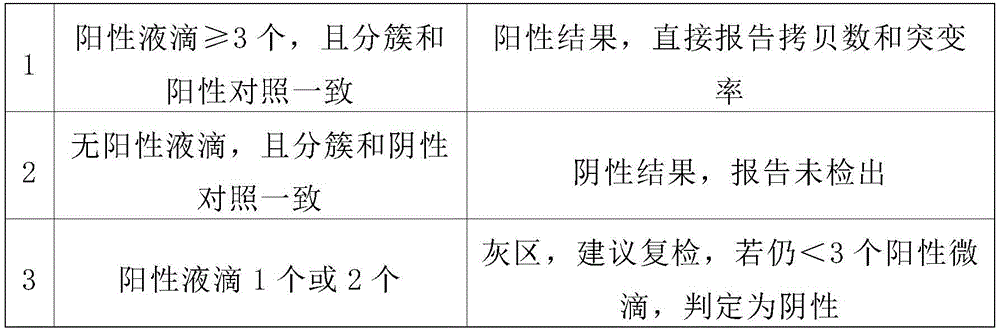
下面结合具体实施例,进一步阐述本发明。应理解,这些实施例仅用于说明本发明而不用于限制本发明的范围。下列实施例中未注明具体条件的实验方法,通常按照常规条件,例如Sambrook等人,分子克隆:实验室手册(NewYork:ColdSpringHarborLaboratoryPress,1989)中所述的条件,或按照制造厂商所建议的条件。除非另外说明,否则百分比和份数是重量百分比和重量份数。The present invention will be further described below in conjunction with specific embodiments. It should be understood that these examples are only used to illustrate the present invention and not to limit the scope of the present invention. The experimental method of unreceipted specific conditions in the following examples, usually according to conventional conditions, such as people such as Sambrook, molecular cloning: conditions described in laboratory manual (NewYork:ColdSpringHarborLaboratoryPress, 1989), or according to the conditions suggested by the manufacturer . Percentages and parts are weight percentages and parts unless otherwise specified.
除非特别说明,否则本发明实施例中所用材料和试剂均为市售产品。Unless otherwise specified, the materials and reagents used in the examples of the present invention are all commercially available products.
引物、探针和扩增片段的序列Sequences of primers, probes and amplified fragments
实施例中,使用的引物、探针及扩增的DNA片段的核酸序列信息如表2所示:In the embodiment, the nucleic acid sequence information of the primers, probes and amplified DNA fragments used are shown in Table 2:
表2:引物、探针及DNA片段的核酸序列Table 2: Nucleic acid sequences of primers, probes and DNA fragments


注:“+A”表示锁核苷酸A,“+T”表示锁核苷酸T,“+C”表示锁核苷酸C,“+G”表示锁核苷酸G。Note: "+A" means locked nucleotide A, "+T" means locked nucleotide T, "+C" means locked nucleotide C, "+G" means locked nucleotide G.
实施例1引物对的筛选Example 1 Screening of primer pairs
根据EGFR S768位点,设计5对引物对(引物合成自上海生工生物有限公司),具体序列如下表3。According to the EGFR S768 site, 5 pairs of primers were designed (primers were synthesized from Shanghai Sangon Biological Co., Ltd.), and the specific sequences were shown in Table 3 below.
表3.筛选用于扩增EGFR S768的5对引物对Table 3. Screening of 5 primer pairs for amplification of EGFR S768


根据EGFR L861位点,设计5对引物对(引物合成自上海生工生物有限公司),具体序列如下表4。According to the EGFR L861 site, 5 pairs of primers were designed (primers were synthesized from Shanghai Sangon Biological Co., Ltd.), and the specific sequences were shown in Table 4 below.
表4.筛选用于扩增EGFR L861的5对引物对Table 4. Screening of 5 primer pairs for amplification of EGFR L861

根据EGFR G719位点序列,设计5对引物对(引物合成自上海生工生物有限公司),具体序列如表5:According to the EGFR G719 site sequence, 5 pairs of primers were designed (the primers were synthesized from Shanghai Sangon Biological Co., Ltd.), and the specific sequences are shown in Table 5:
表5.筛选用于扩增EGFR G719的5对引物对Table 5. Screening of 5 primer pairs for amplification of EGFR G719


筛选PCR体系:Taq HS聚合酶0.2ul,10×HS PCR缓冲液2ul,dNTP混合物1.6ul,上游引物1ul,下游引物1ul,tgDNA(人白细胞基因组DNA,作为模板)5ul,水补齐体系至20ul。Screening PCR system: 0.2ul of Taq HS polymerase, 2ul of 10×HS PCR buffer, 1.6ul of dNTP mixture, 1ul of upstream primer, 1ul of downstream primer, 5ul of tgDNA (human leukocyte genomic DNA, as template), and water to make up the system to 20ul .
筛选PCR程序:95℃10min,30个循环(94℃30s,55℃30s,72℃20s)。Screening PCR program: 95°C for 10 min, 30 cycles (94°C for 30s, 55°C for 30s, 72°C for 20s).
经过PCR筛选,S768引物对2(S768-F2/S768-R2)、L861引物对5(L861-F5/L861-R5)和G719引物对1(G719-F1/G719-R1)对目的片段扩增效率较高(条带亮),扩增产物较短,且不产生引物二聚体,整体效果最好,可作为EGFR基因突变检测的引物对。见图1至图3。After PCR screening, S768 primer pair 2 (S768-F2/S768-R2), L861 primer pair 5 (L861-F5/L861-R5) and G719 primer pair 1 (G719-F1/G719-R1) amplified the target fragment The efficiency is high (bright band), the amplification product is short, and no primer-dimer is produced. The overall effect is the best, and it can be used as a primer pair for EGFR gene mutation detection. See Figures 1 to 3.
实施例2Taqman探针和数字PCR反应程序的优化Example 2 Optimization of Taqman probe and digital PCR reaction program
在本实施例中,合成了Taqman探针并进行优化,并基于优化的Taqman探针对数字PCR反应程序进行优化。In this example, Taqman probes were synthesized and optimized, and the digital PCR reaction program was optimized based on the optimized Taqman probes.
2.1 Taqman探针2.1 Taqman probe
在本实施例中,所检测EGFR基因突变为对应于S768I、L861Q、G719S、G719C、G719A的核苷酸突变(表6);In this example, the detected EGFR gene mutations are nucleotide mutations corresponding to S768I, L861Q, G719S, G719C, and G719A (Table 6);
表6:EGFR基因突变信息表Table 6: EGFR gene mutation information table
基于人EGFR的基因组序列和突变位点,设计相应的Taqman探针并进行优化,优化后的Taqman探针含有特定的锁核苷酸(+N),分别为WTP-S768、MTP-S768I、WTP-L861、MTP-L861Q、WTP-G719、MTP-G719S、MTP-G719A、MTP-G719C,探针的具体信息见表2.Based on the genome sequence and mutation sites of human EGFR, the corresponding Taqman probes were designed and optimized. The optimized Taqman probes contained specific locked nucleotides (+N), namely WTP-S768, MTP-S768I, WTP -L861, MTP-L861Q, WTP-G719, MTP-G719S, MTP-G719A, MTP-G719C, the specific information of the probe is shown in Table 2.
2.2数字PCR反应程序的优化2.2 Optimization of digital PCR reaction program
基于实施例1确定的最优引物对(SEQ ID No:1和2;SEQ ID No:5和6;SEQ ID No:9和10)和实施例2.1确定的优化的探针,对于数字PCR反应程序进行进一步优化。数字PCR反应程序优化实验,需要综合分析随着退火温度的变化,野生型模板和突变型模板的数字PCR扩增情况。最优的退火温度应满足两个条件:阴性对照(野生型模板)背景干净(FAM通道无微滴)、突变型模板内阳性信号和阴性信号容易区分(FAM通道和HEX通道荧光强度高)。Based on the optimal primer pairs determined in Example 1 (SEQ ID Nos: 1 and 2; SEQ ID Nos: 5 and 6; SEQ ID Nos: 9 and 10) and the optimized probes determined in Example 2.1, for digital PCR reactions The program is further optimized. The digital PCR reaction program optimization experiment needs to comprehensively analyze the digital PCR amplification of wild-type template and mutant template with the change of annealing temperature. The optimal annealing temperature should satisfy two conditions: the negative control (wild-type template) has a clean background (no droplets in the FAM channel), and the positive and negative signals in the mutant template are easy to distinguish (high fluorescence intensity in the FAM and HEX channels).
实验方法如下:The experimental method is as follows:
S768I、L861Q采用单重检测体系,配制如下:2×ddPCR Supermix for Probe(NodUTP)11ul,引物1(F)1.1ul,引物2(R)1.1ul,探针1(WTP)0.55ul,探针2(MTP)0.55ul,模板5.5ul,加水补齐至22ul。(F代表上游引物,R代表下游引物,WTP代表野生型探针,MTP代表突变型探针,根据检测的目标位点加入相对应的引物探针)S768I and L861Q use a single-plex detection system. The preparation is as follows: 2×ddPCR Supermix for Probe (NodUTP) 11ul, primer 1 (F) 1.1ul, primer 2 (R) 1.1ul, probe 1 (WTP) 0.55ul, probe 2 (MTP) 0.55ul, template 5.5ul, add water to make up to 22ul. (F stands for upstream primer, R stands for downstream primer, WTP stands for wild-type probe, MTP stands for mutant probe, and the corresponding primer probe is added according to the detected target site)
G719X采用三重检测体系,配制如下:2×ddPCR Supermix for Probe(No dUTP)11ul,引物1(G719-F)1.1ul,引物2(G719-R)1.1ul,探针1(WTP-G719)0.55ul,探针2(MTP-G719S)0.55ul,探针3(MTP-G719C)0.55ul,探针4(MTP-G719A)0.55ulG719X adopts triple detection system, the preparation is as follows: 2×ddPCR Supermix for Probe(No dUTP) 11ul, Primer 1(G719-F) 1.1ul, Primer 2(G719-R) 1.1ul, Probe 1(WTP-G719) 0.55 ul, probe 2 (MTP-G719S) 0.55ul, probe 3 (MTP-G719C) 0.55ul, probe 4 (MTP-G719A) 0.55ul
在样本制备区按照以下顺序加入模板:阴性对照、阳性对照。阴性对照为为正常人白细胞基因组(tgDNA),阳性对照分别为含1%S768I突变基因组DNA溶液(将含S768I突变序列的质粒转染到293T细胞后提取基因组DNA,并掺入tgDNA得到)、含1%L861Q突变基因组DNA溶液(将含L861Q突变序列的质粒转染到293T细胞后提取基因组DNA,并掺入tgDNA得到)、含1%G719X突变基因组DNA溶液(含G719S、含G719C、含G719A突变序列的基因组DNA,三种突变含量各1%,此对照可作为单独G719X某个突变检测的对照,也可以作为多重检测的对照)。根据检测的内容选择阳性对照。Add templates in the sample preparation area in the following order: negative control, positive control. The negative control was normal human leukocyte genome (tgDNA), the positive controls were a solution containing 1% S768I mutant genomic DNA (the plasmid containing the S768I mutant sequence was transfected into 293T cells, and the genomic DNA was extracted and incorporated into tgDNA), containing 1% L861Q mutant genomic DNA solution (transfect the plasmid containing L861Q mutant sequence into 293T cells, extract genomic DNA, and incorporate tgDNA), 1% G719X mutant genomic DNA solution (containing G719S, containing G719C, containing G719A mutations) Sequenced genomic DNA, the content of each of the three mutations is 1%, this control can be used as a control for a single mutation detection of G719X, or as a control for multiple detection). Select a positive control according to the content of the assay.
在微滴生成区,按照仪器要求进行微滴生成。In the droplet generation area, droplet generation is performed according to the requirements of the instrument.
在样本分析区进行PCR。PCR is performed in the sample analysis area.
S768I PCR程序:95℃10min,40个循环{94℃30s,退火温度梯度(60℃、58℃、56℃)15s,72℃15s},98℃10min,升降温速率2℃/s。S768I PCR program: 95°C for 10 min, 40 cycles {94°C for 30s, annealing temperature gradient (60°C, 58°C, 56°C) for 15s, 72°C for 15s}, 98°C for 10 min,
L861Q PCR程序95℃10min,40个循环{94℃30s,退火温度梯度(65℃、64.5℃、63.3℃、61.4℃、59℃、57℃、56℃、55℃)15s,72℃15s},98℃10min,升降温速率2℃/s。L861Q PCR program 95°C for 10min, 40 cycles {94°C for 30s, annealing temperature gradient (65°C, 64.5°C, 63.3°C, 61.4°C, 59°C, 57°C, 56°C, 55°C) for 15s, 72°C for 15s}, 98°C for 10min, the heating and cooling rate is 2°C/s.
G719X PCR程序:95℃10min,40个循环{94℃30s,退火温度梯度(58℃、56℃、54℃)15s,72℃15s},98℃10min,升降温速率2℃/s。G719X PCR program: 95°C for 10min, 40 cycles {94°C for 30s, annealing temperature gradient (58°C, 56°C, 54°C) for 15s, 72°C for 15s}, 98°C for 10min,
完成PCR后,按照仪器及实验要求进行设置,选择FAM/HEX检测通道,开始读板。After completing the PCR, set according to the instrument and experimental requirements, select the FAM/HEX detection channel, and start reading the plate.
结果见图4~图6。其中,FAM通道指示MTP探针检测突变型模板的微滴及其荧光强度(Amplitude),HEX通道指示WTP探针检测野生型模板的微滴及其荧光强度(Amplitude)。FAM-HEX双阳性的微滴代表既有野生型模板又有突变型模板存在。通过FAM通道的微滴数可以推测数字PCR体系中是否存在突变型模板并可精确计算拷贝数(copies/ul)。The results are shown in Figures 4 to 6. Wherein, the FAM channel indicates that the MTP probe detects the droplets of the mutant template and their fluorescence intensity (Amplitude), and the HEX channel indicates that the WTP probe detects the droplets of the wild-type template and its fluorescence intensity (Amplitude). FAM-HEX double-positive droplets represent the presence of both wild-type and mutant templates. The number of droplets in the FAM channel can infer whether there is a mutant template in the digital PCR system and can accurately calculate the copy number (copies/ul).
图4~图6的结果表明,S768I 60℃退火15s,L861Q 56℃退火15s,G719X58℃退火15s,数字PCR阴性对照无污染、阴性信号和阳性信号之间区分最明显,整体效果较好,为最优退火温度。The results shown in Figures 4 and 6 show that S768I was annealed at 60°C for 15s, L861Q was annealed at 56°C for 15s, and G719X58°C was annealed for 15s. The digital PCR negative control was free of contamination, and the distinction between negative and positive signals was the most obvious, and the overall effect was better. optimal annealing temperature.
实施例3数字PCR法检测EGFR基因突变的灵敏度验证Example 3 Sensitivity verification of detection of EGFR gene mutation by digital PCR method
根据实施例1计算野生型模板拷贝数(copies/ul)、突变型模板基因组拷贝数(copies/ul)和突变率(%),用TE将二者均稀释至4000copies/ul。将含突变基因组模板中掺入tgDNA,使得突变模板比例分别为0.06%、0.13%、0.25%、0.5%、1%,制作成梯度稀释模板。The wild-type template copy number (copies/ul), mutant template genome copy number (copies/ul) and mutation rate (%) were calculated according to Example 1, and both were diluted to 4000 copies/ul with TE. The tgDNA was incorporated into the mutant-containing genome template, so that the proportion of mutant template was 0.06%, 0.13%, 0.25%, 0.5%, and 1%, respectively, to prepare a gradient dilution template.
S768I、L861Q采用单重检测体系,配制如下:2×ddPCR Supermix for Probe(NodUTP)11ul,引物1(F)1.1ul,引物2(R)1.1ul,探针1(WTP)0.55ul,探针2(MTP)0.55ul,模板5.5ul,加水补齐至22ul。(F代表上游引物,R代表下游引物,WTP代表野生型探针,MTP代表突变型探针,根据检测的目标位点加入相对应的引物探针)S768I and L861Q use a single-plex detection system. The preparation is as follows: 2×ddPCR Supermix for Probe (NodUTP) 11ul, primer 1 (F) 1.1ul, primer 2 (R) 1.1ul, probe 1 (WTP) 0.55ul, probe 2 (MTP) 0.55ul, template 5.5ul, add water to make up to 22ul. (F stands for upstream primer, R stands for downstream primer, WTP stands for wild-type probe, MTP stands for mutant probe, and the corresponding primer probe is added according to the detected target site)
G719X采用三重检测体系,配制如下:2×ddPCR Supermix for Probe(No dUTP)11ul,引物1(G719-F)1.1ul,引物2(G719-R)1.1ul,探针1(WTP-G719)0.55ul,探针2(MTP-G719S)0.55ul,探针3(MTP-G719C)0.55ul,探针4(MTP-G719A)0.55ulG719X adopts triple detection system, the preparation is as follows: 2×ddPCR Supermix for Probe(No dUTP) 11ul, Primer 1(G719-F) 1.1ul, Primer 2(G719-R) 1.1ul, Probe 1(WTP-G719) 0.55 ul, probe 2 (MTP-G719S) 0.55ul, probe 3 (MTP-G719C) 0.55ul, probe 4 (MTP-G719A) 0.55ul
在样本制备区按照以下顺序加入模板:空白对照、阴性对照、梯度稀释模板。空白对照为水,阴性对照为tgDNA,梯度稀释模板为掺入0.06%-1%突变型模板的野生型模板。Add templates in the following order in the sample preparation area: blank control, negative control, serial dilution template. The blank control is water, the negative control is tgDNA, and the gradient dilution template is the wild-type template incorporating 0.06%-1% mutant template.
按照实施例1相同方法将PCR反应体系生成微滴。按照优化PCR程序进行PCR:95℃10min,40个循环(94℃30s,60℃/56℃/58℃15s,72℃15s),98℃10min,升降温速率2℃/s。根据仪器要求开始读板。The PCR reaction system was formed into droplets according to the same method as in Example 1. PCR was performed according to the optimized PCR program: 95°C for 10 min, 40 cycles (94°C for 30s, 60°C/56°C/58°C for 15s, 72°C for 15s), 98°C for 10min, and the ramp rate was 2°C/s. Start the plate reading according to the instrument requirements.
数字PCR结果如图7~图9所示。本发明数字PCR法以水或者tgDNA为模板,背景干净,无污染。此外,本发明数字PCR法在野生型模板中掺入0.06%-1%突变型模板,检测野生型模板拷贝数正常,检测突变型模板比例(突变型模板除以总模板乘以100%)与理论比例相符,且呈线性相关,R2值大于0.98。即本发明数字PCR法在0.06%-1%灵敏度区间内,检测值准确,即本发明数字PCR法最低检测灵敏度为0.06%。The digital PCR results are shown in Figures 7 to 9. The digital PCR method of the present invention uses water or tgDNA as a template, and has clean background and no pollution. In addition, the digital PCR method of the present invention incorporates 0.06%-1% mutant template into the wild-type template, detects that the copy number of the wild-type template is normal, and detects that the proportion of mutant templates (mutant template divided by total template multiplied by 100%) and The theoretical ratios were consistent and linearly correlated with R2 values greater than 0.98. That is, the detection value of the digital PCR method of the present invention is accurate within the sensitivity range of 0.06%-1%, that is, the minimum detection sensitivity of the digital PCR method of the present invention is 0.06%.
实施例4数字PCR法检出患者EGFR突变指导肿瘤靶向药物用药Example 4 Detection of EGFR mutation in patients by digital PCR method to guide tumor-targeted drug use
病例“HP159”、“HP186”、“BH0139”、“MS1025”、“MS3248”、“MS2006”、“MS1039”,均为均为肺腺癌IV期病人。通过采集静脉血,两次离心分离血浆,通过游离核酸抽提试剂盒抽提血浆游离核酸。抽提核酸经Qubit定量。定量后储存于样本制备室-20℃冰箱内。The cases "HP159", "HP186", "BH0139", "MS1025", "MS3248", "MS2006", and "MS1039" were all patients with stage IV lung adenocarcinoma. The venous blood was collected, the plasma was centrifuged twice, and the plasma free nucleic acid was extracted by a free nucleic acid extraction kit. The extracted nucleic acid was quantified by Qubit. Store in a -20°C refrigerator in the sample preparation room after quantification.
本发明数字PCR检测体系见实施例2。See Example 2 for the digital PCR detection system of the present invention.
在样本制备区按照以下顺序加入模板:空白对照、阴性对照、病例游离核酸、阳性对照(1%)。Templates were added in the following order in the sample preparation area: blank control, negative control, case-free nucleic acid, and positive control (1%).
按照实施例1相同方法将PCR反应体系生成微滴。按照优化PCR程序进行PCR:95℃10min,40个循环(94℃30s,60℃/56℃/58℃15s,72℃15s),98℃10min,升降温速率2℃/s。打开仪器,按照要求进行设置,开始读板。本次EGFR检测以空白对照和阴性对照背景干净,阳性对照拷贝数和突变比例正常。The PCR reaction system was formed into droplets according to the same method as in Example 1. PCR was performed according to the optimized PCR program: 95°C for 10 min, 40 cycles (94°C for 30s, 60°C/56°C/58°C for 15s, 72°C for 15s), 98°C for 10min, and the ramp rate was 2°C/s. Turn on the instrument, set up as required, and start reading the plate. In this EGFR detection, the background of blank control and negative control was clean, and the copy number and mutation ratio of positive control were normal.
病例核酸样本检测结果见下表7。The nucleic acid sample test results of the cases are shown in Table 7 below.
HP159判读为阴性(见附图10),不含有S768I突变、L861Q突变及G719X突变,后续可以继续检测其他基因突变,进而进行用药指导。HP159 was interpreted as negative (see Figure 10), and it did not contain S768I mutation, L861Q mutation and G719X mutation, and other gene mutations could be detected in the follow-up, and then medication guidance could be provided.
HP186判读为S768I阳性(见附图11;突变率为23.5%),建议使用阿法替尼等靶向药治疗;HP186 was interpreted as S768I positive (see Figure 11; the mutation rate was 23.5%), and targeted drug therapy such as afatinib is recommended;
病例BH0139判读为L861Q阳性(见附图12;突变率为1.8%),建议使用阿法替尼治疗等靶向药治疗;Case BH0139 was interpreted as L861Q positive (see Figure 12; mutation rate was 1.8%), and targeted drug therapy such as afatinib is recommended;
病例MS1025判读为G719S阳性(见附图13;突变率为0.21%),建议使用阿法替尼治疗等靶向药治疗;Case MS1025 was interpreted as G719S positive (see Figure 13; mutation rate was 0.21%), and targeted drug therapy such as afatinib is recommended;
病例MS3248判读为G719C阳性(见附图14;突变率为1.6%),建议使用阿法替尼治疗等靶向药治疗;Case MS3248 was interpreted as G719C positive (see Figure 14; mutation rate was 1.6%), and targeted drug therapy such as afatinib is recommended;
病例MS2006判读为G719A阳性(见附图15;突变率为0.14%),建议使用阿法替尼治疗等靶向药治疗;Case MS2006 was interpreted as G719A positive (see Figure 15; mutation rate was 0.14%), and targeted drug therapy such as afatinib is recommended;
病例MS1039判读为G719X阳性(见附图16;突变率为2.3%),建议使用阿法替尼治疗等靶向药治疗。Case MS1039 was interpreted as G719X positive (see Figure 16; mutation rate was 2.3%), and targeted drug therapy such as afatinib therapy is recommended.
上述病例的具体检测数据见下表7:The specific test data of the above cases are shown in Table 7 below:
表7:病例检测基因突变结果Table 7: Gene mutation results of case detection

讨论:discuss:
目前,检测基因突变的方法主要有:At present, the methods for detecting gene mutations mainly include:
(1)高分辨率熔解曲线(HRM)。HRM是一种基于单核苷酸熔解温度不同而形成不同形态熔解曲线的基因分析技术。检测敏感度在1-10%左右。然而,由于染料法假阳性高,后期需要测序验证,导致检测周期较长。(1) High resolution melting curve (HRM). HRM is a gene analysis technique that forms different morphological melting curves based on the different melting temperatures of single nucleotides. The detection sensitivity is around 1-10%. However, due to the high false positive rate of the dye method, sequencing verification is required in the later stage, resulting in a longer detection cycle.
(2)探针扩增阻滞突变法(ARMS-qPCR)。利用PCR引物的3'端末位碱基必须与其模板DNA互补才能有效扩增的原理,将有某种点突变的模板与正常模板区分开来,该检测方法的灵敏度高于HRM,约为1%(CN104099422A)。(3)等位基因特异的Taqman聚合酶链式反应(CAST-PCR)。CAST-PCR通过一段特异设计的MGB探针来阻止引物与野生型DNA结合,选择性地优先扩增突变型DNA,该检测方法的灵敏度在0.1%-1%左右(专利号CN104099422A)。BarbanoR.etal应用CAST-PCR技术检测临床样本BRAF基因的V600E和V600K突变,其方法的灵敏度为1%(Competitive allele-specific TaqMan PCR(Cast-PCR)is a sensitive, specific and fast method for BRAF V600 mutation detection in Melanoma patients)。 (2) Probe amplification block mutation method (ARMS-qPCR). Using the principle that the 3'-terminal base of the PCR primer must be complementary to its template DNA to effectively amplify, the template with a certain point mutation can be distinguished from the normal template. The sensitivity of this detection method is higher than that of HRM, about 1% (CN104099422A). (3) Allele-specific Taqman polymerase chain reaction (CAST-PCR). CAST-PCR uses a specially designed MGB probe to prevent the primer from binding to wild-type DNA, and selectively and preferentially amplifies mutant DNA. The sensitivity of this detection method is about 0.1%-1% (Patent No. CN104099422A) . BarbanoR.etal applied CAST-PCR technology to detect V600E and V600K mutations of BRAF gene in clinical samples, and the sensitivity of the method was 1% (Competitive allele-specific TaqMan PCR (Cast-PCR) is a sensitive, specific and fast method for BRAF V600 mutation detection in Melanoma patients).
综上所述,现有基因突变检测技术大都为染料法或者探针法荧光定量PCR技术,该技术存在灵敏度低、准确率低、阳性判读方法复杂等问题,且对于样本的类型与质量要求高,例如有的方法要求提供组织样本,部分方法可以处理血浆/血清样本但要求为肿瘤三期或者四期病人。To sum up, most of the existing gene mutation detection technologies are dye-based or probe-based fluorescence quantitative PCR technology, which has problems such as low sensitivity, low accuracy, complex positive interpretation methods, and high requirements for the type and quality of samples. For example, some methods require tissue samples, and some methods can process plasma/serum samples but require patients with stage III or IV tumors.
本发明使用了数字PCR(digital PCR)技术,将一个样本分配至几万个相互独立的小微滴,每个微滴分别对目标分子进行PCR扩增,扩增结束后对各个微滴的荧光信号进行分析。数字PCR具有灵敏度高、无需标准曲线即可准确定量、操作简单等优点。The invention uses digital PCR (digital PCR) technology to distribute a sample to tens of thousands of independent small droplets. signal for analysis. Digital PCR has the advantages of high sensitivity, accurate quantification without standard curve, and simple operation.
本发明针对EGFR S768I/EGFR L861Q/EGFR G719X(G719S、G719C、G719A)突变,开发了一种高灵敏度和高特异性数字PCR方法,与现有技术HRM、Arms-qPCR、CAST-PCR等相比,本发明采用Taqman探针并结合数字PCR法,可解决灵敏度低、特异性差、对样本的类型与质量要求高、阳性判读方法复杂等问题。经验证本发明方法灵敏度最高可达到0.06%,不仅可以准确检测组织、体液样本,还可以处理血浆/血清等难度高的样本。The present invention develops a high-sensitivity and high-specificity digital PCR method for EGFR S768I/EGFR L861Q/EGFR G719X (G719S, G719C, G719A) mutations, compared with the prior art HRM, Arms-qPCR, CAST-PCR, etc. The invention adopts Taqman probe combined with digital PCR method, which can solve the problems of low sensitivity, poor specificity, high requirements on the type and quality of samples, and complex positive interpretation methods. It has been verified that the sensitivity of the method of the present invention can reach a maximum of 0.06%, which can not only accurately detect tissue and body fluid samples, but also process difficult samples such as plasma/serum.
在本发明提及的所有文献都在本申请中引用作为参考,就如同每一篇文献被单独引用作为参考那样。此外应理解,在阅读了本发明的上述讲授内容之后,本领域技术人员可以对本发明作各种改动或修改,这些等价形式同样落于本申请所附权利要求书所限定的范围。All documents mentioned herein are incorporated by reference in this application as if each document were individually incorporated by reference. In addition, it should be understood that after reading the above teaching content of the present invention, those skilled in the art can make various changes or modifications to the present invention, and these equivalent forms also fall within the scope defined by the appended claims of the present application.
序列表sequence listing
<110> 铭炽生物科技(上海)有限公司<110> Ming Chi Biotechnology (Shanghai) Co., Ltd.
铭时医疗科技(宁波)有限公司Mingshi Medical Technology (Ningbo) Co., Ltd.
<120> 人EGFR基因突变的数字PCR检测方法及应用<120> Digital PCR detection method and application of human EGFR gene mutation
<130> P2020-0435<130> P2020-0435
<160> 46<160> 46
<170> SIPOSequenceListing 1.0<170> SIPOSequenceListing 1.0
<210> 1<210> 1
<211> 19<211> 19
<212> DNA<212> DNA
<213> 人工序列(artificial sequence)<213> Artificial sequence
<400> 1<400> 1
ccctccagga agcctacgt 19ccctccagga agcctacgt 19
<210> 2<210> 2
<211> 17<211> 17
<212> DNA<212> DNA
<213> 人工序列(artificial sequence)<213> Artificial sequence
<400> 2<400> 2
tccaggaggc agccgaa 17tccaggaggc agccgaa 17
<210> 3<210> 3
<211> 15<211> 15
<212> DNA<212> DNA
<213> 人工序列(artificial sequence)<213> Artificial sequence
<400> 3<400> 3
tggccagcgt ggaca 15tggccagcgt ggaca 15
<210> 4<210> 4
<211> 15<211> 15
<212> DNA<212> DNA
<213> 人工序列(artificial sequence)<213> Artificial sequence
<400> 4<400> 4
tggccatcgt ggaca 15tggccatcgt ggaca 15
<210> 5<210> 5
<211> 19<211> 19
<212> DNA<212> DNA
<213> 人工序列(artificial sequence)<213> Artificial sequence
<400> 5<400> 5
gaaaacaccg cagcatgtc 19gaaaacaccg cagcatgtc 19
<210> 6<210> 6
<211> 23<211> 23
<212> DNA<212> DNA
<213> 人工序列(artificial sequence)<213> Artificial sequence
<400> 6<400> 6
ctgcatggta ttctttctct tcc 23ctgcatggta ttctttctct tcc 23
<210> 7<210> 7
<211> 14<211> 14
<212> DNA<212> DNA
<213> 人工序列(artificial sequence)<213> Artificial sequence
<400> 7<400> 7
caaactgctg ggtg 14
<210> 8<210> 8
<211> 14<211> 14
<212> DNA<212> DNA
<213> 人工序列(artificial sequence)<213> Artificial sequence
<400> 8<400> 8
caaacagctg ggtg 14
<210> 9<210> 9
<211> 20<211> 20
<212> DNA<212> DNA
<213> 人工序列(artificial sequence)<213> Artificial sequence
<400> 9<400> 9
gctcccaacc aagctctctt 20gctcccaacc aagctctctt 20
<210> 10<210> 10
<211> 20<211> 20
<212> DNA<212> DNA
<213> 人工序列(artificial sequence)<213> Artificial sequence
<400> 10<400> 10
tgccagggac cttaccttat 20tgccagggac cttaccttat 20
<210> 11<210> 11
<211> 14<211> 14
<212> DNA<212> DNA
<213> 人工序列(artificial sequence)<213> Artificial sequence
<400> 11<400> 11
tgctgggctc cggt 14tgctggggctc cggt 14
<210> 12<210> 12
<211> 14<211> 14
<212> DNA<212> DNA
<213> 人工序列(artificial sequence)<213> Artificial sequence
<400> 12<400> 12
tgctgagctc cggt 14tgctgagctc cggt 14
<210> 13<210> 13
<211> 14<211> 14
<212> DNA<212> DNA
<213> 人工序列(artificial sequence)<213> Artificial sequence
<400> 13<400> 13
tgctggcctc cggt 14tgctggcctc cggt 14
<210> 14<210> 14
<211> 14<211> 14
<212> DNA<212> DNA
<213> 人工序列(artificial sequence)<213> Artificial sequence
<400> 14<400> 14
tgctgtgctc cggt 14tgctgtgctc cggt 14
<210> 15<210> 15
<211> 124<211> 124
<212> DNA<212> DNA
<213> 智人(Homo sapiens)<213> Homo sapiens
<400> 15<400> 15
ccctccagga agcctacgtg atggccagcg tggacaaccc ccacgtgtgc cgcctgctgg 60ccctccagga agcctacgtg atggccagcg tggacaaccc ccacgtgtgc cgcctgctgg 60
gcatctgcct cacctccacc gtgcagctca tcacgcagct catgcccttc ggctgcctcc 120gcatctgcct cacctccacc gtgcagctca tcacgcagct catgcccttc ggctgcctcc 120
tgga 124tgga 124
<210> 16<210> 16
<211> 124<211> 124
<212> DNA<212> DNA
<213> 人工序列(artificial sequence)<213> Artificial sequence
<400> 16<400> 16
ccctccagga agcctacgtg atggccatcg tggacaaccc ccacgtgtgc cgcctgctgg 60ccctccagga agcctacgtg atggccatcg tggacaaccc ccacgtgtgc cgcctgctgg 60
gcatctgcct cacctccacc gtgcagctca tcacgcagct catgcccttc ggctgcctcc 120gcatctgcct cacctccacc gtgcagctca tcacgcagct catgcccttc ggctgcctcc 120
tgga 124tgga 124
<210> 17<210> 17
<211> 80<211> 80
<212> DNA<212> DNA
<213> 智人(Homo sapiens)<213> Homo sapiens
<400> 17<400> 17
gaaaacaccg cagcatgtca agatcacaga ttttgggctg gccaaactgc tgggtgcgga 60gaaaacaccg cagcatgtca agatcacaga ttttgggctg gccaaactgc tgggtgcgga 60
agagaaagaa taccatgcag 80agagaaagaa taccatgcag 80
<210> 18<210> 18
<211> 80<211> 80
<212> DNA<212> DNA
<213> 人工序列(artificial sequence)<213> Artificial sequence
<400> 18<400> 18
gaaaacaccg cagcatgtca agatcacaga ttttgggctg gccaaacagc tgggtgcgga 60gaaaacaccg cagcatgtca agatcacaga ttttgggctg gccaaacagc tgggtgcgga 60
agagaaagaa taccatgcag 80agagaaagaa taccatgcag 80
<210> 19<210> 19
<211> 108<211> 108
<212> DNA<212> DNA
<213> 智人(Homo sapiens)<213> Homo sapiens
<400> 19<400> 19
gctcccaacc aagctctctt gaggatcttg aaggaaactg aattcaaaaa gatcaaagtg 60gctcccaacc aagctctctt gaggatcttg aaggaaactg aattcaaaaa gatcaaagtg 60
ctgggctccg gtgcgttcgg cacggtgtat aaggtaaggt ccctggca 108ctgggctccg gtgcgttcgg cacggtgtat aaggtaaggt ccctggca 108
<210> 20<210> 20
<211> 108<211> 108
<212> DNA<212> DNA
<213> 人工序列(artificial sequence)<213> Artificial sequence
<400> 20<400> 20
gctcccaacc aagctctctt gaggatcttg aaggaaactg aattcaaaaa gatcaaagtg 60gctcccaacc aagctctctt gaggatcttg aaggaaactg aattcaaaaa gatcaaagtg 60
ctgagctccg gtgcgttcgg cacggtgtat aaggtaaggt ccctggca 108ctgagctccg gtgcgttcgg cacggtgtat aaggtaaggt ccctggca 108
<210> 21<210> 21
<211> 108<211> 108
<212> DNA<212> DNA
<213> 人工序列(artificial sequence)<213> Artificial sequence
<400> 21<400> 21
gctcccaacc aagctctctt gaggatcttg aaggaaactg aattcaaaaa gatcaaagtg 60gctcccaacc aagctctctt gaggatcttg aaggaaactg aattcaaaaa gatcaaagtg 60
ctgtgctccg gtgcgttcgg cacggtgtat aaggtaaggt ccctggca 108ctgtgctccg gtgcgttcgg cacggtgtat aaggtaaggt ccctggca 108
<210> 22<210> 22
<211> 108<211> 108
<212> DNA<212> DNA
<213> 人工序列(artificial sequence)<213> Artificial sequence
<400> 22<400> 22
gctcccaacc aagctctctt gaggatcttg aaggaaactg aattcaaaaa gatcaaagtg 60gctcccaacc aagctctctt gaggatcttg aaggaaactg aattcaaaaa gatcaaagtg 60
ctggcctccg gtgcgttcgg cacggtgtat aaggtaaggt ccctggca 108ctggcctccg gtgcgttcgg cacggtgtat aaggtaaggt ccctggca 108
<210> 23<210> 23
<211> 19<211> 19
<212> DNA<212> DNA
<213> 人工序列(artificial sequence)<213> Artificial sequence
<400> 23<400> 23
cctccaggaa gcctacgtg 19cctccaggaa gcctacgtg 19
<210> 24<210> 24
<211> 18<211> 18
<212> DNA<212> DNA
<213> 人工序列(artificial sequence)<213> Artificial sequence
<400> 24<400> 24
ggtggaggtg aggcagat 18ggtggaggtg aggcagat 18
<210> 25<210> 25
<211> 18<211> 18
<212> DNA<212> DNA
<213> 人工序列(artificial sequence)<213> Artificial sequence
<400> 25<400> 25
tccaggaagc ctacgtga 18tccaggaagc ctacgtga 18
<210> 26<210> 26
<211> 18<211> 18
<212> DNA<212> DNA
<213> 人工序列(artificial sequence)<213> Artificial sequence
<400> 26<400> 26
tgatgagctg cacggtgg 18tgatgagctg cacggtgg 18
<210> 27<210> 27
<211> 19<211> 19
<212> DNA<212> DNA
<213> 人工序列(artificial sequence)<213> Artificial sequence
<400> 27<400> 27
tccaggaagc ctacgtgat 19tccaggaagc ctacgtgat 19
<210> 28<210> 28
<211> 18<211> 18
<212> DNA<212> DNA
<213> 人工序列(artificial sequence)<213> Artificial sequence
<400> 28<400> 28
ctgcacggtg gaggtgag 18ctgcacggtg gaggtgag 18
<210> 29<210> 29
<211> 18<211> 18
<212> DNA<212> DNA
<213> 人工序列(artificial sequence)<213> Artificial sequence
<400> 29<400> 29
ccctccagga agcctacg 18ccctccagga agcctacg 18
<210> 30<210> 30
<211> 16<211> 16
<212> DNA<212> DNA
<213> 人工序列(artificial sequence)<213> Artificial sequence
<400> 30<400> 30
aggcagccga agggca 16aggcagccga aggca 16
<210> 31<210> 31
<211> 20<211> 20
<212> DNA<212> DNA
<213> 人工序列(artificial sequence)<213> Artificial sequence
<400> 31<400> 31
aggaacgtac tggtgaaaac 20aggaacgtac tggtgaaaac 20
<210> 32<210> 32
<211> 21<211> 21
<212> DNA<212> DNA
<213> 人工序列(artificial sequence)<213> Artificial sequence
<400> 32<400> 32
tctgcatggt attctttctc t 21tctgcatggt attctttctc t 21
<210> 33<210> 33
<211> 20<211> 20
<212> DNA<212> DNA
<213> 人工序列(artificial sequence)<213> Artificial sequence
<400> 33<400> 33
aacgtactgg tgaaaacacc 20aacgtactgg tgaaaacacc 20
<210> 34<210> 34
<211> 21<211> 21
<212> DNA<212> DNA
<213> 人工序列(artificial sequence)<213> Artificial sequence
<400> 34<400> 34
ctgcatggta ttctttctct t 21ctgcatggta ttctttctct t 21
<210> 35<210> 35
<211> 18<211> 18
<212> DNA<212> DNA
<213> 人工序列(artificial sequence)<213> Artificial sequence
<400> 35<400> 35
accgcagcat gtcaagat 18accgcagcat gtcaagat 18
<210> 36<210> 36
<211> 23<211> 23
<212> DNA<212> DNA
<213> 人工序列(artificial sequence)<213> Artificial sequence
<400> 36<400> 36
tccttctgca tggtattctt tct 23tccttctgca tggtattctt tct 23
<210> 37<210> 37
<211> 20<211> 20
<212> DNA<212> DNA
<213> 人工序列(artificial sequence)<213> Artificial sequence
<400> 37<400> 37
gcagcatgtc aagatcacag 20gcagcatgtc aagatcacag 20
<210> 38<210> 38
<211> 21<211> 21
<212> DNA<212> DNA
<213> 人工序列(artificial sequence)<213> Artificial sequence
<400> 38<400> 38
cctccttctg catggtattc t 21cctccttctg catggtattc t 21
<210> 39<210> 39
<211> 24<211> 24
<212> DNA<212> DNA
<213> 人工序列(artificial sequence)<213> Artificial sequence
<400> 39<400> 39
tgaggatctt gaaggaaact gaat 24tgaggatctt gaaggaaact gaat 24
<210> 40<210> 40
<211> 18<211> 18
<212> DNA<212> DNA
<213> 人工序列(artificial sequence)<213> Artificial sequence
<400> 40<400> 40
gtgccaggga ccttacct 18gtgccaggga ccttacct 18
<210> 41<210> 41
<211> 22<211> 22
<212> DNA<212> DNA
<213> 人工序列(artificial sequence)<213> Artificial sequence
<400> 41<400> 41
gctctcttga ggatcttgaa gg 22gctctcttga ggatcttgaa gg 22
<210> 42<210> 42
<211> 22<211> 22
<212> DNA<212> DNA
<213> 人工序列(artificial sequence)<213> Artificial sequence
<400> 42<400> 42
ggaccttacc ttatacaccg tg 22ggaccttacc ttatacaccg tg 22
<210> 43<210> 43
<211> 20<211> 20
<212> DNA<212> DNA
<213> 人工序列(artificial sequence)<213> Artificial sequence
<400> 43<400> 43
agctcccaac caagctctct 20agctcccaac caagctctct 20
<210> 44<210> 44
<211> 20<211> 20
<212> DNA<212> DNA
<213> 人工序列(artificial sequence)<213> Artificial sequence
<400> 44<400> 44
cttaccttat acaccgtgcc 20cttaccttat acaccgtgcc 20
<210> 45<210> 45
<211> 22<211> 22
<212> DNA<212> DNA
<213> 人工序列(artificial sequence)<213> Artificial sequence
<400> 45<400> 45
ctctcttgag gatcttgaag ga 22ctctcttgag gatcttgaag ga 22
<210> 46<210> 46
<211> 20<211> 20
<212> DNA<212> DNA
<213> 人工序列(artificial sequence)<213> Artificial sequence
<400> 46<400> 46
ttaccttata caccgtgccg 20ttaccttata caccgtgccg 20
Claims (10)
Priority Applications (1)
| Application Number | Priority Date | Filing Date | Title |
|---|---|---|---|
| CN202010671353.XA CN113930501A (en) | 2020-07-13 | 2020-07-13 | Digital PCR detection method for human EGFR gene mutation and application |
Applications Claiming Priority (1)
| Application Number | Priority Date | Filing Date | Title |
|---|---|---|---|
| CN202010671353.XA CN113930501A (en) | 2020-07-13 | 2020-07-13 | Digital PCR detection method for human EGFR gene mutation and application |
Publications (1)
| Publication Number | Publication Date |
|---|---|
| CN113930501A true CN113930501A (en) | 2022-01-14 |
Family
ID=79273615
Family Applications (1)
| Application Number | Title | Priority Date | Filing Date |
|---|---|---|---|
| CN202010671353.XA Pending CN113930501A (en) | 2020-07-13 | 2020-07-13 | Digital PCR detection method for human EGFR gene mutation and application |
Country Status (1)
| Country | Link |
|---|---|
| CN (1) | CN113930501A (en) |
Cited By (2)
| Publication number | Priority date | Publication date | Assignee | Title |
|---|---|---|---|---|
| CN116751867A (en) * | 2023-08-10 | 2023-09-15 | 思纳福(苏州)生命科技有限公司 | A kind of primer and fluorescent probe for detecting EGFR mutation gene and its application |
| CN120210374A (en) * | 2025-05-23 | 2025-06-27 | 铭时医疗科技(宁波)有限公司 | A digital PCR detection reagent for BRAF, KRAS and TERT gene mutations and its application |
Citations (7)
| Publication number | Priority date | Publication date | Assignee | Title |
|---|---|---|---|---|
| CN107937496A (en) * | 2018-01-16 | 2018-04-20 | 良培基因生物科技(武汉)有限公司 | A method for detecting EGFR G719X gene variation by using digital PCR technology |
| CN108251511A (en) * | 2018-03-31 | 2018-07-06 | 邓定平 | The detection kit and detection method of a kind of EGFR genetic mutation |
| CN108642154A (en) * | 2018-06-01 | 2018-10-12 | 领航基因科技(杭州)有限公司 | The primer combination of probe and kit in a kind of detection EGFR mutational sites and its application |
| CN109762878A (en) * | 2017-11-29 | 2019-05-17 | 铭时基因科技(上海)有限公司 | A kind of ddPCR detection method and application of EGFR L858R site in lung cancer |
| CN110004217A (en) * | 2019-03-05 | 2019-07-12 | 铭时基因科技(上海)有限公司 | Detection method and application of EGFR gene T790M mutation in peripheral plasma |
| CN111206099A (en) * | 2020-02-28 | 2020-05-29 | 宁波胤瑞生物医学仪器有限责任公司 | Kit for detecting L858R site mutation of EGFR gene |
| CN111304329A (en) * | 2020-02-28 | 2020-06-19 | 宁波胤瑞生物医学仪器有限责任公司 | Kit for detecting mutation of BRAF gene V600E site |
-
2020
- 2020-07-13 CN CN202010671353.XA patent/CN113930501A/en active Pending
Patent Citations (7)
| Publication number | Priority date | Publication date | Assignee | Title |
|---|---|---|---|---|
| CN109762878A (en) * | 2017-11-29 | 2019-05-17 | 铭时基因科技(上海)有限公司 | A kind of ddPCR detection method and application of EGFR L858R site in lung cancer |
| CN107937496A (en) * | 2018-01-16 | 2018-04-20 | 良培基因生物科技(武汉)有限公司 | A method for detecting EGFR G719X gene variation by using digital PCR technology |
| CN108251511A (en) * | 2018-03-31 | 2018-07-06 | 邓定平 | The detection kit and detection method of a kind of EGFR genetic mutation |
| CN108642154A (en) * | 2018-06-01 | 2018-10-12 | 领航基因科技(杭州)有限公司 | The primer combination of probe and kit in a kind of detection EGFR mutational sites and its application |
| CN110004217A (en) * | 2019-03-05 | 2019-07-12 | 铭时基因科技(上海)有限公司 | Detection method and application of EGFR gene T790M mutation in peripheral plasma |
| CN111206099A (en) * | 2020-02-28 | 2020-05-29 | 宁波胤瑞生物医学仪器有限责任公司 | Kit for detecting L858R site mutation of EGFR gene |
| CN111304329A (en) * | 2020-02-28 | 2020-06-19 | 宁波胤瑞生物医学仪器有限责任公司 | Kit for detecting mutation of BRAF gene V600E site |
Non-Patent Citations (3)
| Title |
|---|
| BRIAN PARKIN: "Rare Variant Quantitation Using Droplet Digital PCR", 《METHODS MOL BIOL》, vol. 1881, 31 December 2019 (2019-12-31), pages 239 - 251 * |
| SASKIA HUSSUNG等: "Development and Clinical Validation of Discriminatory Multitarget Digital Droplet PCR Assays for the Detection of Hot Spot KRAS and NRAS Mutations in Cell-Free DNA", 《J MOL DIAGN》, vol. 22, no. 7, 4 May 2020 (2020-05-04), pages 946 - 947 * |
| 徐望红: "《肿瘤流行病学》", 30 June 2017, 复旦大学出版社, pages: 303 * |
Cited By (2)
| Publication number | Priority date | Publication date | Assignee | Title |
|---|---|---|---|---|
| CN116751867A (en) * | 2023-08-10 | 2023-09-15 | 思纳福(苏州)生命科技有限公司 | A kind of primer and fluorescent probe for detecting EGFR mutation gene and its application |
| CN120210374A (en) * | 2025-05-23 | 2025-06-27 | 铭时医疗科技(宁波)有限公司 | A digital PCR detection reagent for BRAF, KRAS and TERT gene mutations and its application |
Similar Documents
| Publication | Publication Date | Title |
|---|---|---|
| CN113930500B (en) | Digital PCR detection method and application of human PIK3CA gene mutation | |
| CN110964814B (en) | Primers, compositions and methods for nucleic acid sequence variation detection | |
| CN114277135B (en) | Gastric cancer lymph node metastasis related methylation biomarker and combination and detection kit thereof | |
| CN110438223B (en) | Primer and probe for detecting Kras gene point mutation, kit and detection method thereof | |
| CN110541033B (en) | Composition and detection method for EGFR gene mutation detection | |
| CN108456721B (en) | Method for synchronously detecting gene mutation and methylation and application thereof | |
| CN110592215A (en) | Composition and detection method for detecting nucleic acid sequence | |
| KR20200129600A (en) | Pepetide nucleic acid probe for genotyping Helicobacter pylori and Method using the same | |
| CN113930501A (en) | Digital PCR detection method for human EGFR gene mutation and application | |
| CN113897429B (en) | Digital PCR detection method and application of human NRAS gene mutation | |
| US11535897B2 (en) | Composite epigenetic biomarkers for accurate screening, diagnosis and prognosis of colorectal cancer | |
| CN113621704B (en) | Reagent and kit for detecting and diagnosing liver cancer | |
| CN110511984A (en) | The rapid fluorescence detection method and application of 19 exon deletion mutation of EGFR gene | |
| MX2015003386A (en) | Method for detection of braf and pi 3k mutations. | |
| CN113897430B (en) | Digital PCR detection method for human IDH1/IDH2 gene mutation and application thereof | |
| CN116356027B (en) | A reagent, a kit and its application for detecting esophageal squamous cell carcinoma or precancerous lesions | |
| CN107090508B (en) | A Novel Kit for Detecting Gene Mutations | |
| CN114480632B (en) | Detection method for human microsatellite unstable sites and application thereof | |
| CN113913514B (en) | Digital PCR detection method and application of human CTNNB1 gene mutation | |
| CN109355362B (en) | High-sensitivity SNPs detection system and application | |
| CN115612725A (en) | Compositions, kits and applications for detection of sickle cell anemia | |
| CN113930486A (en) | Digital PCR (polymerase chain reaction) detection method for human MED12 gene mutation and application | |
| KR20220071536A (en) | Method and Kits for Amplifying Target Nucleic Acid with High Specificity | |
| CN120210374B (en) | BRAF, KRAS and TERT gene mutation digital PCR detection reagent and application thereof | |
| CN120272598B (en) | Digital PCR Detection Kit for PIK3CA Gene Multiple Mutation Sites |
Legal Events
| Date | Code | Title | Description |
|---|---|---|---|
| PB01 | Publication | ||
| PB01 | Publication | ||
| SE01 | Entry into force of request for substantive examination | ||
| SE01 | Entry into force of request for substantive examination | ||
| WD01 | Invention patent application deemed withdrawn after publication |
Application publication date: 20220114 |
|
| WD01 | Invention patent application deemed withdrawn after publication |