Background
Titanium alloy and titanium-based composite materials are widely applied to the advanced scientific and technological fields of aerospace, military, medical instruments and the like due to excellent mechanical properties. However, the high production cost and the complicated preparation process limit the wide application and commercial success of the material. In the traditional casting process, the titanium alloy and the titanium-based composite material can react with almost all refractory materials and gases in a molten state to generate impurities, so that the mechanical property of the material is seriously reduced. Vacuum melting under inert atmosphere protection is therefore required, which not only entails high production costs but also the presence of a large number of casting defects and also requires secondary working or heat treatment for conditioning.
The pressing-constant temperature pressureless vacuum sintering process based on the mixed element powder metallurgy (BEPM) method is proved to be capable of greatly reducing the production cost of titanium alloy and titanium-based composite materials. However, titanium alloy and titanium-based composite materials sintered by the constant-temperature pressureless vacuum sintering process have the defects of large grains, difficult control of growth of reinforced phases, low density, stress concentration caused by irregularly-shaped pores and the like. In the prior art, the common solution is to increase the sintering temperature or prolong the heat preservation time, and although the schemes can improve the density and the uniformity of components, the schemes can cause the beta phase to coarsen and grow; on the contrary, if the sintering temperature is lowered or the holding time is shortened, the pores are difficult to heal, the composition segregation is serious, additional thermal mechanical processing is usually needed to improve the pore defects and refine the grains to meet the application requirements, and the cost advantage of the process is undoubtedly weakened.
The Hydrogen Sintering Process (HSPT) adopts high-temperature hydrogen atmosphere sintering and long-time low-temperature aging heat treatment; the diffusion of hydrogen atoms in the matrix in high-temperature sintering can greatly accelerate the diffusion rate of alloy elements and the titanium matrix, so that the original beta grains are abnormally large, and the complexity of sintering control is increased; the long-time low-temperature aging heat treatment prolongs the production period, reduces the production efficiency and is not beneficial to actual production.
Disclosure of Invention
The invention aims to overcome the defects and shortcomings of the prior art: the constant-temperature pressureless vacuum sintering has the defects of coarse grain growth, difficult control of reinforced phase growth, lower density, stress concentration caused by irregular pore shape and the like; the problems of thick original beta grains, long process period and high energy consumption exist in the hydrogen sintering process. The invention provides a method for preparing titanium alloy and titanium-based composite material by adopting a hydrogenation dehydrogenation thermal cycle sintering process based on a low-cost mixed element powder metallurgy method and a product thereof.
In order to achieve the above object, a first aspect of the present invention provides a method for preparing a titanium alloy based on a hydrogenation dehydrogenation thermal cycle sintering process, which comprises the following steps:
(1) mixing raw materials, molding or cold isostatic pressing, wherein the raw materials comprise one or two of titanium powder or titanium hydride powder and intermediate alloy powder;
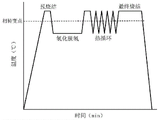
(2) the step (2) comprises a step (2a) thermal cycle and a step (2b) hydrogenation-dehydrogenation cycle, and the step (2a) and the step (2b) are not sequentially carried out;
thermal cycling: heating to a temperature above the phase change point of the material in a vacuum environment, preserving heat, performing presintering, cooling the furnace to a temperature below the phase change point of the material, and performing one or more cycles;
hydrogenation-dehydrogenation cycle: introducing high-purity hydrogen to make the hydrogen concentration reach more than 30 at%, preserving the heat, then pumping out the hydrogen in the furnace to keep vacuum, and performing one or more cycles;
(3) heating to the temperature above the phase change point of the material, preserving heat and finally sintering to obtain a finished titanium alloy product.
In addition, the invention also provides a method for preparing the titanium-based composite material based on the hydrogenation dehydrogenation thermal cycle sintering process, which comprises the following steps:
(1) mixing raw materials, molding or cold isostatic pressing, wherein the raw materials comprise one or two of titanium powder or titanium hydride powder, master alloy powder and ceramic reinforcing phase powder;
(2) the step (2) comprises a step (2a) thermal cycle and a step (2b) hydrogenation-dehydrogenation cycle, and the step (2a) and the step (2b) are not sequentially carried out;
thermal cycling: heating to a temperature above the phase change point of the material in a vacuum environment, preserving heat, performing presintering, cooling the furnace to a temperature below the phase change point of the material, and performing one or more cycles;
hydrogenation-dehydrogenation cycle: introducing high-purity hydrogen to make the hydrogen concentration reach more than 30 at%, preserving the heat, then pumping out the hydrogen in the furnace to keep vacuum, and performing one or more cycles;
(3) heating to the temperature above the phase transition point of the material, preserving heat and finally sintering to obtain the titanium-based composite material.
Further setting the vacuum environment of the method to be less than 1 x 10⁻³pa。
In addition, the invention also provides a titanium alloy or titanium-based composite material prepared based on the method.
The invention has the advantages that:
in the pre-sintering process, the alloy element/ceramic reinforcing phase particles in the powder pressed compact and the titanium matrix are subjected to preliminary diffusion, so that the uniformity of the material structure can be improved, and the communicated pore structures among the powder particles of the pressed compact are converted into equiaxial separation pores with higher density, thereby being beneficial to the diffusion and solid solution effects of hydrogen in the matrix in the subsequent hydrogen sintering.
It is widely recognized that a large number of high density lattice defects can significantly improve sintering activity. The hydrogenation-dehydrogenation process utilizes reversible alloying of hydrogen in titanium to cause the hydrogen element to generate solid solution/desorption behavior in the titanium matrix so as to causePhase transitions, defect motion, and changes in tissue. Hydrogen is an active beta-stabilizing element of titanium, and can obviously reduce alpha/beta phase transition temperature so as to enable betaHAnd delta-TiHx increased significantly. A large amount of betaHAnd the lattice size difference between delta-TiHx and unhydrogenated parts, namely original alpha and beta phases, can cause the number of lattice defects such as dislocation and the like in the titanium alloy lattice to be increased dramatically; promoting the diffusion and acceleration of elements, improving the uniformity of the structure, refining crystal grains and playing a role in accelerating the sintering and compacting process. The diffusion speed of hydrogen in the grain boundary is far greater than that in the grain boundary, so that the hydrogenation-dehydrogenation cycle can effectively heal pores which are partially gathered at the grain boundary.
The thermal cycle process enables the material to repeatedly generate phase change and volume change near the temperature of a phase change point, and influences the internal structure of the material particles, so that the pore defects in the particles can be effectively repaired, and coarse particles are refined into a plurality of fine grain structures. The alpha phase (hcp) and the beta phase (bcc) have different crystal structures, and can cause violent volume change macroscopically in the phase change process, microscopically form a canine staggered alpha/beta phase compact network, promote the proliferation and the expansion of crystal defects, accelerate the diffusion process and improve the sintering density.
In the final sintering process, the defects in the tissue structure can be further utilized to improve the sintering activity, so that elements are fully and uniformly diffused, the pore structure is effectively repaired and healed, and the uniformity and the density of the tissue are improved.
Based on the above expression, the pressing-hydrogenation dehydrogenation thermal cycle sintering process based on the mixed element powder metallurgy method can effectively control the grain size, repair and heal the pores in the grains and at the grain boundary under the conditions of low cost and short process flow, so that the material density is improved, and the mechanical property is obviously improved.
Detailed Description
In order to make the objects, technical solutions and advantages of the present invention more apparent, the present invention will be described in further detail with reference to the accompanying drawings.
Example 1 (preparation of Ti6Al4V titanium alloy)
Adopts 88um titanium hydride (TiH)2) Mixing the powder with 63um alumite intermediate alloy powder according to the mass ratio of Ti6Al4V under the protection of argon gas for 6h, then carrying out die pressing at 600MPa, forming and sending into a sintering furnace. When the vacuum degree reaches 1 x 10⁻³pa heating to 1100 deg.C at a speed of 10 deg.C/min, and maintaining for 30 min; the subsequent furnace cooling to 850 ℃ begins the hydrodehydrogenation cycle: introducing high-purity hydrogen to ensure that the hydrogen partial pressure reaches 50kpa, hydrogenating for 45min, pumping out the hydrogen, and carrying out vacuum heat preservation for 30 min. Repeating the hydrogenation and dehydrogenation cycles twice, heating to 1100 ℃ at the speed of 10 ℃/min, and keeping the temperature for 30 min; the thermal cycle is then started: the furnace is cooled to 850 ℃ and the temperature is raised to 1100 ℃ at the speed of 20 ℃/min. Repeating the thermal cycle for 5 times, and then preserving the temperature at 1100 ℃ for 2h to finish the final sintering. The sintering process is abbreviated as "HT 1100". In addition, the thermal cycle and the hydrogenation-dehydrogenation cycle of this example can be performed in the same order.
The specific sintering process is shown in table 1:
TABLE 1
Example 2 (preparation of Ti6Al4V/TiB titanium alloy composite)
Adopts 88um titanium hydride (TiH)2) About 63um alumite master alloy powder and about 15um titanium diboride (TiB)2) The powder is prepared according to the formula of Ti6Al4V-10vThe mass proportion of the ol percent TiB is mixed with powder under the protection of argon for 8 hours, and then the mixture is molded under 600MPa and sent into a sintering furnace. When the vacuum degree reaches 1 x 10⁻³pa, heating to 1200 ℃ at the speed of 10 ℃/min, and keeping the temperature for 30 min; the subsequent furnace cooling to 850 ℃ begins the hydrodehydrogenation cycle: introducing high-purity hydrogen to make the hydrogen partial pressure reach 50kpa, hydrogenating for 45min, and then vacuum-dehydrogenating for 30 min. Repeating the hydrogenation and dehydrogenation cycles twice, heating to 1200 ℃ at the speed of 10 ℃/min, and keeping the temperature for 30 min; the thermal cycle is then started: the furnace is cooled to 850 ℃ and the temperature is raised to 1200 ℃ at the speed of 20 ℃/min. Repeating the thermal cycle for 5 times, and then preserving the temperature at 1200 ℃ for 2h to finish the final sintering. The sintering process is abbreviated as HT 1200. In addition, the thermal cycle and the hydrogenation-dehydrogenation cycle of this example can be performed in the same order.
The specific sintering process is shown in table 2:
TABLE 2
The above disclosure is only for the purpose of illustrating the preferred embodiments of the present invention, and it is therefore to be understood that the invention is not limited by the scope of the appended claims.