Disclosure of Invention
Aiming at the defects in the prior art, the invention aims to provide a quaternary polycrystalline anode material, a preparation method and application thereof, wherein the crystal microstructure of the ultrahigh nickel anode material is adjusted by Co/Ta Co-doping to stabilize the material structure, reduce the mixed arrangement degree of lithium and nickel, improve the capacity and cycle life of the ultrahigh nickel anode material, and the quaternary polycrystalline anode material has the characteristics of simple preparation process, high stability, excellent electrical property and the like.
In order to achieve the purpose, the invention adopts the following technical scheme:
in a first aspect, the invention provides a quaternary polycrystalline cathode material, which is prepared by the preparation method of the first aspect.
As a preferable technical scheme of the invention, the chemical formula of the quaternary polycrystalline positive electrode material is LiNiaCobMncAldTa(1-a-b-c-d)O2Where 0.9. ltoreq. a < 1, 0. ltoreq. b < 0.07, 0. ltoreq. c < 0.03, 0. ltoreq. d < 0.002, where 0.9. ltoreq. a < 1, for example a is 0.90, 0.91, 0.92, 0.93, 0.94, 0.95, 0.96, 0.97, 0.98 or 0.99, 0. ltoreq. b < 0.07, for example b is 0.01, 0.02, 0.03, 0.04, 0.05, 0.06 or 0.07, 0. ltoreq. c < 0.03, for example c is 0.005, 0.010, 0.015, 0.020, 0.025 or 0.030, 0. ltoreq. d.002, for example d is 0.0005, 0.0010, 0.0015 or 0.0020.
According to the invention, the crystal microstructure of the quaternary polycrystalline anode material is adjusted by Co-doping Co/Ta, so that the lattice structure is stabilized, wherein cobalt doping mainly inhibits divalent nickel from entering a lithium position, the lithium-nickel mixed-discharging degree is reduced, and then the electronic conductivity of the material is improved by gradient doping on the surface; the tantalum doping can improve the interlayer spacing of the transition metal layer, thereby improving the diffusion rate of lithium ions and further improving the cycle life of the ultra-high nickel cathode material. Furthermore, the Co/Ta Co-doping adjusts the microstructure of the anode material, stabilizes the crystal lattice, reduces the mixed arrangement degree of lithium and nickel, and improves the electronic conductivity and the lithium ion diffusion rate of the material, thereby improving the capacity and the cycling stability of the material.
In a preferred embodiment of the present invention, the quaternary polycrystalline positive electrode material is coated with a boron coating layer.
In a second aspect, the present invention provides a method for preparing a quaternary polycrystalline positive electrode material, the method comprising: and mixing the nickel-cobalt-manganese-aluminum quaternary precursor, a lithium source, a tantalum source and a cobalt source to obtain a mixture, and calcining the mixture to obtain the quaternary polycrystalline positive electrode material.
In a preferred embodiment of the present invention, the molar ratio of the lithium element in the lithium source to the total of the non-lithium metal elements in the mixture is (1-1.05): 1, for example, 1.005:1, 1.010:1, 1.015:1, 1.020:1, 1.025:1, 1.030:1, 1.035:1, 1.040:1, 1.045:1 or 1.050: 1.
Note that, the non-lithium metal elements in the mixture, that is, all other metal elements except lithium in the mixture, are represented by nickel, cobalt, manganese, aluminum, tantalum, and cobalt in the present invention.
Preferably, the molar ratio of the tantalum source to the nickel-cobalt-manganese-aluminum quaternary precursor is (0.0005-0.0015): 1, for example, 0.0005:1, 0.0006:1, 0.0007:1, 0.0008:1, 0.0009:1, 0.0010:1, 0.0011:1, 0.0012:1, 0.0013:1, 0.0014:1, or 0.0015: 1.
According to the invention, the molar ratio of the tantalum source to the nickel-cobalt-manganese-aluminum quaternary precursor is controlled to be (0.0005-0.00015): 1, so that the growth of primary particles in the preparation process is ensured, the spacing of transition metal layers is increased, and if the molar ratio is lower than 0.0005:1, the effect of increasing the spacing of the transition metal layers is not achieved; if the molar ratio is higher than 0.0015:1, the growth of primary particles is inhibited.
Preferably, the molar ratio of the cobalt source to the nickel-cobalt-manganese-aluminum quaternary precursor is (0.006-0.01): 1, such as 0.0060, 0.0065, 0.0070, 0.0075, 0.0080, 0.0085, 0.0090, 0.0095 or 0.0100.
According to the invention, the molar ratio of the cobalt source to the nickel-cobalt-manganese-aluminum quaternary precursor is controlled to be (0.006-0.01): 1, so that the stability is effectively enhanced, and if the molar ratio is lower than 0.006:1, the material has poor stability effect; if the molar ratio is higher than 0.010:1, the cost is high.
Preferably, in the nickel-cobalt-manganese-aluminum quaternary precursor, the molar ratio of the elements Ni, Co, Mn and Al is (85-95): (5-9): 1-3): 0.5-1.5, such as 85:9:1:1.5, 95:9:3:1.5, 85:3:1:0.5 or 90:7:2:1, preferably 90:7:2: 1.
Preferably, the nickel-cobalt-manganese-aluminum quaternary precursor comprises nickel-cobalt-manganese-aluminum hydroxide.
Illustratively, there is provided a preparation method of the above nickel cobalt manganese aluminum hydroxide, the preparation method comprising: respectively weighing a nickel source, a cobalt source, a manganese source and an aluminum source according to the molar ratio of metal elements, and preparing the nickel-cobalt-manganese-aluminum hydroxide by adopting a coprecipitation method, wherein preparation parameters can be reasonably selected by a person skilled in the art according to the requirements of products.
As a preferred embodiment of the present invention, the lithium source includes one or a combination of at least two of lithium hydroxide, lithium carbonate, and lithium nitrate.
Preferably, the tantalum source comprises Ta2O5And/or TaC.
Preferably, the cobalt source comprises Co3O4And/or Co (OH)2。
In a preferred embodiment of the present invention, the calcination temperature is 700 to 800 ℃, for example 700 ℃, 710 ℃, 720 ℃, 730 ℃, 740 ℃, 750 ℃, 760 ℃, 770 ℃, 780 ℃, 790 ℃ or 800 ℃.
According to the invention, the calcination temperature is controlled to be 700-800 ℃, the particle size and morphology of the particles are ensured, the material capacity is improved, and if the temperature is lower than 700 ℃, the primary particles are not large in length and the gas generation is serious; if the temperature is higher than 800 ℃, the problem of overburning exists, and the capacity exertion of the material is influenced.
Preferably, the calcination time is 7-9 h, such as 7.0h, 7.2h, 7.4h, 7.6h, 7.8h, 8.0h, 8.2h, 8.4h, 8.6h, 8.8h or 9.0 h.
Preferably, the calcination is carried out under an oxygen atmosphere.
Preferably, the mixing is performed by dry mixing.
Preferably, the calcination is followed by cooling, crushing and sieving in that order.
As a preferred technical solution of the present invention, the quaternary polycrystalline positive electrode material is subjected to coating treatment.
Preferably, the coating treatment is boron coating.
According to the invention, the quaternary polycrystalline anode material is further coated with boron, the coating can be carried out at a lower temperature by adopting the boron coating, and a uniform protective film can be formed, so that the capacity and the cycle stability of the material are further enhanced.
Preferably, the boron cladding comprises: and stirring and mixing the quaternary polycrystalline anode material with distilled water, drying, mixing with a boron coating agent, and coating and calcining to obtain the coated quaternary polycrystalline anode material.
It should be noted that the coating calcination should be followed by cooling and sieving treatment according to the particle size of the material.
Preferably, the volume ratio of the quaternary polycrystalline positive electrode material to distilled water is 1: (1-2) is, for example, 1:1.0, 1:1.1, 1:1.2, 1:1.3, 1:1.4, 1:1.5, 1:1.6, 1:1.7, 1:1.8, 1:1.9 or 1: 2.0.
Preferably, the stirring speed is 200-400 r/min, such as 200r/min, 220r/min, 240r/min, 260r/min, 280r/min, 300r/min, 320r/min, 340r/min, 360r/min, 380r/min or 400 r/min.
Preferably, the stirring time is 5-15 min, such as 5min, 6min, 7min, 8min, 9min, 10min, 11min, 12min, 13min, 14min or 15 min.
Preferably, the drying temperature is 100-200 ℃, such as 100 ℃, 110 ℃, 120 ℃, 130 ℃, 140 ℃, 150 ℃, 160 ℃, 170 ℃, 180 ℃, 190 ℃ or 200 ℃.
Preferably, the drying time is 5-10 h, such as 5.0h, 5.5h, 6.0h, 6.5h, 7.0h, 7.5h, 8.0h, 8.5h, 9.0h, 9.5h or 10.0 h.
Preferably, the drying is performed in a vacuum drying oven.
In a preferred embodiment of the present invention, the molar ratio of the boron capping agent to the quaternary polycrystalline positive electrode material is (0.01 to 0.03):1, and is, for example, 0.010:1, 0.012:1, 0.014:1, 0.016:1, 0.018:1, 0.020:1, 0.022:1, 0.024:1, 0.026:1, 0.028:1, or 0.030: 1.
Preferably, the boron capping agent comprises boric acid and/or boron oxide.
Preferably, the temperature of the coating calcination is 250 to 350 ℃, for example, 250 ℃, 260 ℃, 270 ℃, 280 ℃, 290 ℃, 300 ℃, 310 ℃, 320 ℃, 330 ℃, 340 ℃ or 350 ℃.
Preferably, the coating calcination time is 7-9 h, such as 7.0h, 7.2h, 7.4h, 7.6h, 7.8h, 8.0h, 8.2h, 8.4h, 8.6h, 8.8h or 9.0 h.
Preferably, the mixing mode of the boron coating agent and the quaternary polycrystalline positive electrode material is dry mixing.
As a preferred technical scheme of the invention, the preparation method specifically comprises the following steps:
the method comprises the following steps of (I) mixing a nickel-cobalt-manganese-aluminum quaternary precursor, a lithium source, a tantalum source and a cobalt source in a dry method to obtain a mixture, wherein the molar ratio of lithium elements in the lithium source to the sum of non-lithium metal elements in the mixture is (1-1.05): 1, the molar ratio of the tantalum source to the nickel-cobalt-manganese-aluminum quaternary precursor is (0.0005-0.0015): 1, and the molar ratio of the cobalt source to the nickel-cobalt-manganese-aluminum quaternary precursor is (0.006-0.01): 1;
calcining the mixture obtained in the step (I) for 7-9 hours at 700-800 ℃ in an oxygen atmosphere, cooling, crushing and sieving to obtain the quaternary polycrystalline anode material;
and (III) stirring and mixing the quaternary polycrystalline anode material obtained in the step (II) with distilled water according to the ratio of (1) - (2) to (200-400 r/min for 5-15 min, drying at 100-200 ℃ for 5-10 h, drying, mixing with a boron coating agent in a dry method, wherein the molar ratio of the boron coating agent to the quaternary polycrystalline anode material is (0.01-0.03): 1, and coating and calcining at 250-350 ℃ for 7-9 h to obtain the coated quaternary polycrystalline anode material.
In a third aspect, the present invention provides a battery comprising a positive electrode, a negative electrode and a separator, wherein the positive electrode material in the positive electrode comprises the quaternary polycrystalline positive electrode material of the second aspect.
The recitation of numerical ranges herein includes not only the above-recited numerical values, but also any numerical values between non-recited numerical ranges, and is not intended to be exhaustive or to limit the invention to the precise numerical values encompassed within the range for brevity and clarity.
Compared with the prior art, the invention has the beneficial effects that:
according to the invention, the crystal microstructure of the quaternary polycrystalline anode material is adjusted by Co-doping Co/Ta, so that the lattice structure is stabilized, wherein cobalt doping mainly inhibits divalent nickel from entering a lithium position, the lithium-nickel mixed-discharging degree is reduced, and then the electronic conductivity of the material is improved by gradient doping on the surface; the tantalum doping can improve the interlayer spacing of the transition metal layer, thereby improving the diffusion rate of lithium ions and further improving the cycle life of the ultra-high nickel cathode material. Furthermore, the Co/Ta Co-doping is adopted to adjust the microstructure of the anode material, stabilize the crystal lattice, reduce the lithium-nickel mixed discharge degree and improve the electronic conductivity and the lithium ion diffusion rate of the material, so that the capacity and the cycle stability of the material are improved, the first effect is more than 86.2%, the 50-turn cycle retention rate is more than 90.5%, and further, in the preferred range, the first effect is more than 93.1%, and the 50-turn cycle retention rate is more than 96.5%.
Detailed Description
In order to better illustrate the present invention and facilitate the understanding of the technical solutions of the present invention, the present invention is further described in detail below. However, the following examples are only simple examples of the present invention and do not represent or limit the scope of the present invention, which is defined by the claims.
Example 1
The embodiment provides a preparation method of a quaternary polycrystalline positive electrode material, which specifically comprises the following steps:
(I) Nickel-cobalt-manganese-aluminum hydroxide (molar ratio of Ni: Co: Mn: Al elements is 90:7:2:1), lithium hydroxide, Ta2O5And Co3O4Performing dry mixing to obtain a mixture, wherein the molar ratio of lithium elements in a lithium source to the sum of non-lithium metal elements in the mixture is 1.025:1, the molar ratio of a tantalum source to a nickel-cobalt-manganese-aluminum quaternary precursor is 0.0001:1, and the molar ratio of a cobalt source to the nickel-cobalt-manganese-aluminum quaternary precursor is 0.008: 1;
calcining the mixture obtained in the step (I) for 8 hours at 750 ℃ in an oxygen atmosphere, cooling, crushing and sieving to obtain the quaternary polycrystalline anode material;
and (III) stirring and mixing the quaternary polycrystalline anode material obtained in the step (II) with distilled water according to a ratio of 1:1, stirring at a speed of 300r/min for 10min, drying at 150 ℃ for 10h, drying, mixing with boric acid in a dry method, coating and calcining at 300 ℃ for 8h, cooling and sieving to obtain the coated quaternary polycrystalline anode material, wherein the molar ratio of the boric acid to the quaternary polycrystalline anode material is 0.01: 1.
The chemical formula of the prepared quaternary polycrystalline anode material is LiNi0.891Co0.078Mn0.02Al0.011Ta0.001O2。
Example 2
The embodiment provides a preparation method of a quaternary polycrystalline positive electrode material, which specifically comprises the following steps:
(I) Nickel-cobalt-manganese-aluminum hydroxide (Ni: Co: Mn: Al element molar ratio is 90:7:2:1), hydroxideLithium, Ta2O5And Co3O4Performing dry mixing to obtain a mixture, wherein the molar ratio of lithium elements in a lithium source to the sum of non-lithium metal elements in the mixture is 1:1, the molar ratio of a tantalum source to a nickel-cobalt-manganese-aluminum quaternary precursor is 0.0005:1, and the molar ratio of a cobalt source to the nickel-cobalt-manganese-aluminum quaternary precursor is 0.006: 1;
calcining the mixture obtained in the step (I) for 9 hours at 700 ℃ in an oxygen atmosphere, cooling, crushing and sieving to obtain the quaternary polycrystalline anode material;
and (III) stirring and mixing the quaternary polycrystalline anode material obtained in the step (II) with distilled water according to a ratio of 1:2, stirring at a speed of 200r/min for 15min, drying at 100 ℃ for 10h, drying, mixing with boric acid in a dry method, coating and calcining at 250 ℃ for 9h, cooling and sieving to obtain the coated quaternary polycrystalline anode material, wherein the molar ratio of the boric acid to the quaternary polycrystalline anode material is 0.02: 1.
The chemical formula of the prepared quaternary polycrystalline anode material is LiNi0.8935Co0.076Mn0.02Al0.01Ta0.0005O2。
Example 3
The embodiment provides a preparation method of a quaternary polycrystalline positive electrode material, which specifically comprises the following steps:
(I) Nickel-cobalt-manganese-aluminum hydroxide (molar ratio of Ni: Co: Mn: Al elements is 90:7:2:1), lithium hydroxide, Ta2O5And Co3O4Performing dry mixing to obtain a mixture, wherein the molar ratio of lithium elements in a lithium source to the sum of non-lithium metal elements in the mixture is 1.05:1, the molar ratio of a tantalum source to a nickel-cobalt-manganese-aluminum quaternary precursor is 0.0015:1, and the molar ratio of a cobalt source to the nickel-cobalt-manganese-aluminum quaternary precursor is 0.01: 1;
calcining the mixture obtained in the step (I) for 7 hours at 800 ℃ in an oxygen atmosphere, cooling, crushing and sieving to obtain the quaternary polycrystalline anode material;
and (III) stirring and mixing the quaternary polycrystalline anode material obtained in the step (II) with distilled water according to a ratio of 1:1.5, stirring at a speed of 400r/min for 5min, drying at 200 ℃ for 5h, drying, mixing with boric acid in a dry method, coating and calcining at 350 ℃ for 7h, cooling and sieving to obtain the coated quaternary polycrystalline anode material, wherein the molar ratio of the boric acid to the quaternary polycrystalline anode material is 0.03: 1.
The chemical formula of the prepared quaternary polycrystalline anode material is LiNi0.8885Co0.08Mn0.02Al0.01Ta0.0015O2。
Example 4
This example provides a method for preparing a quaternary polycrystalline positive electrode material, which is different from example 1 in that the molar ratio of the tantalum source to the nickel-cobalt-manganese-aluminum quaternary precursor is 0.0003:1, and the rest steps and parameters are completely the same as those in example 1.
Example 5
The embodiment provides a preparation method of a quaternary polycrystalline cathode material, compared with the embodiment 1, the difference is that the molar ratio of a tantalum source to a nickel-cobalt-manganese-aluminum quaternary precursor is 0.0020:1, and the rest steps and parameters are completely the same as those of the embodiment 1.
Example 6
This example provides a method for preparing a quaternary polycrystalline positive electrode material, which is different from example 1 in that the molar ratio of the cobalt source to the nickel-cobalt-manganese-aluminum quaternary precursor is 0.003:1, and the rest steps and parameters are completely the same as those in example 1.
Example 7
The embodiment provides a preparation method of a quaternary polycrystalline cathode material, compared with the embodiment 1, the difference is that the molar ratio of a cobalt source to a nickel-cobalt-manganese-aluminum quaternary precursor is 0.012:1, and the rest steps and parameters are completely the same as the embodiment 1.
Example 8
This example provides a method for preparing a quaternary polycrystalline positive electrode material, which is different from example 1 in that the calcination temperature in step (ii) is 600 ℃, and the rest of the steps and parameters are exactly the same as those in example 1.
Example 9
This example provides a method for preparing a quaternary polycrystalline positive electrode material, which is different from example 1 in that the calcination temperature in step (ii) is 900 ℃, and the remaining steps and parameters are exactly the same as those in example 1.
Example 10
This example provides a method for preparing a quaternary polycrystalline positive electrode material, which is different from example 1 in that boron coating, i.e., step (iii), is not performed, and the remaining steps and parameters are exactly the same as those of example 1.
Example 11
Compared with the embodiment 1, the difference of the preparation method of the quaternary polycrystalline anode material is that the cobalt doping is not carried out, the content of the cobalt element in the nickel-cobalt-manganese-aluminum hydroxide is adjusted, the element composition of the finally prepared material is completely the same as that of the embodiment 1, and the rest steps and parameters are completely the same as those of the embodiment 1.
Comparative example 1
This comparative example provides a method for preparing a quaternary polycrystalline positive electrode material, which is different from example 1 in that cobalt doping and tantalum doping are not performed, i.e., a cobalt source and a tantalum source are not added, and the remaining steps and parameters are completely the same as those of example 1.
Comparative example 2
This comparative example provides a method of making a quaternary polycrystalline positive electrode material, which differs from example 1 in that no tantalum doping, i.e., no tantalum source, is added, and the remaining steps and parameters are exactly the same as in example 1.
Comparative example 3
This comparative example provides a method of preparing a quaternary polycrystalline positive electrode material, which, compared to example 1, differs in that no cobalt doping, i.e. no cobalt source, is added, and the remaining steps and parameters are exactly the same as in example 1.
The invention also provides a battery, which comprises a positive electrode, a negative electrode and a diaphragm, wherein the positive electrode material in the positive electrode is the quaternary polycrystalline positive electrode material in the embodiment.
The cathode materials prepared in the above examples and comparative examples were assembled into button cells, and the assembly method included:
weighing the quaternary polycrystalline positive electrode material, the carbon black conductive agent, the binder PVDF and the NMP according to the mass ratio of 90:2.5:2.5:5, and uniformly mixing to prepare the battery positive electrode slurry. Coating the slurry on an aluminum foil with the thickness of 30um, preparing a positive electrode plate by vacuum drying and rolling, taking a lithium metal plate as a negative electrode, and assembling the positive electrode plate and the negative electrode plate to obtain the button cell, wherein the electrolyte ratio is 1.15M LiPF6EC: DMC (1:1 vol%).
And (3) carrying out an electrical property test on the assembled battery, wherein the test method comprises the following steps:
testing at 45 ℃ by adopting a blue battery testing system, wherein the testing voltage range is 3-4.3V; capacity and capacity retention was tested for 1 week, 20 weeks and 50 weeks.
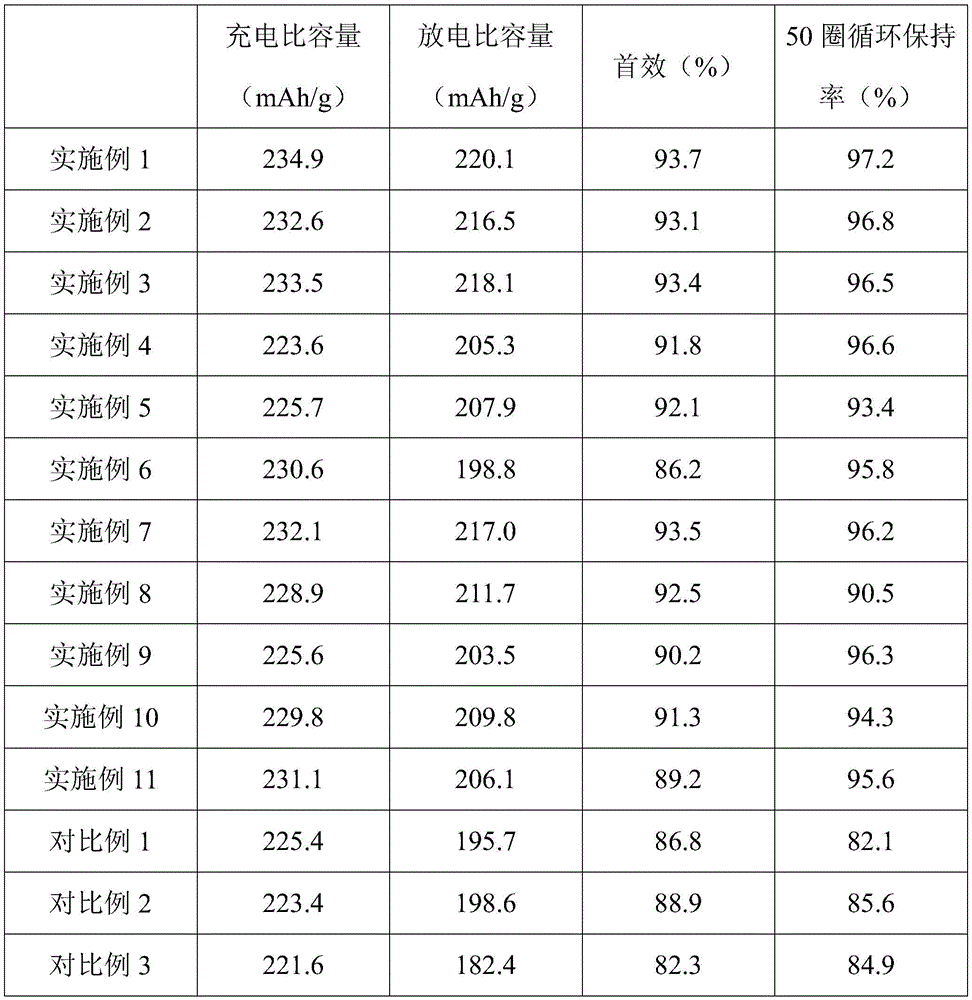
The test results are shown in table 1, fig. 1 is a graph showing the first charge and discharge of example 1, and fig. 2 is a graph showing the first charge and discharge of comparative example 1.
TABLE 1
From the above table, it can be seen that:
(1) compared with the embodiments 4 and 5, the performance data of the embodiment 1 is superior to those of the embodiments 4 and 5, and therefore, the invention can be seen that the invention ensures the growth of primary particles in the preparation process, increases the spacing between transition metal layers and improves the capacity and the cycle retention rate by controlling the molar ratio of the tantalum source to the nickel-cobalt-manganese-aluminum quaternary precursor to be (0.0005-0.0015): 1, and if the molar ratio is lower than 0.0005:1, the tantalum element cannot play a role in increasing the spacing between the transition metal layers, so that the capacity is lower; if the molar ratio is higher than 0.0015:1, the tantalum element inhibits the growth of primary particles, and there is a problem that the cycle retention rate is low.
(2) Compared with the embodiments 6 and 7, the performance data of the embodiment 1 is superior to those of the embodiments 6 and 7, and therefore, the invention can be seen that the stability is effectively enhanced by controlling the molar ratio of the cobalt source to the nickel-cobalt-manganese-aluminum quaternary precursor to be (0.006-0.010): 1, and the invention has the advantage of high first effect, and if the molar ratio is lower than 0.006:1, the material stability is poor and the first effect is low; if the molar ratio is higher than 0.01:1, the cost is disadvantageously high.
(3) Compared with the embodiments 8 and 9, the performance data of the embodiment 1 is superior to those of the embodiments 8 and 9, and therefore, the calcining temperature is controlled to be 700-800 ℃, the uniformity of the size of primary particles in the preparation process is effectively ensured, the material capacity is improved, and if the temperature is lower than 700 ℃, the primary particles are smaller, the gas generation is serious, and the cycle retention rate is low; if the temperature is higher than 800 ℃, the material capacity cannot be exerted due to overburning.
(4) Compared with the embodiment 10, the performance data of the embodiment 1 is better than that of the embodiment 10, so that the invention can be seen that the quaternary polycrystalline positive electrode material is further coated with boron, the coating can be carried out at a lower temperature by adopting the boron coating, a uniform protective film can be formed, the capacity and the cycling stability of the material are further enhanced, and the cycle retention rate is improved.
(5) Compared with the example 11, the performance data of the example 1 is better than that of the example 11, so that the cobalt doping is carried out in the doping stage instead of regulating and controlling the cobalt content of the whole material in the raw material, the doped cobalt element can effectively play a role in inhibiting divalent nickel from entering a lithium position, reducing the lithium-nickel mixed-discharging degree, and then the electronic conductivity of the material is improved by carrying out gradient doping on the surface.
(6) Compared with the comparative examples 1 to 3, the performance data of the example 1 is superior to that of the comparative examples 1 to 3, and therefore, the invention can be seen that the adjustment of the crystal microstructure of the quaternary polycrystalline positive electrode material is carried out by Co-doping Co/Ta, so that the lattice structure is stabilized, wherein the cobalt doping mainly inhibits divalent nickel from entering a lithium position, the lithium-nickel mixed-discharging degree is reduced, and the electronic conductivity of the material is improved by carrying out gradient doping on the surface; the tantalum doping can improve the interlayer spacing of the transition metal layer, thereby improving the diffusion rate of lithium ions and further improving the cycle life of the ultra-high nickel cathode material. Furthermore, the Co/Ta Co-doping adjusts the microstructure of the anode material, stabilizes the crystal lattice, reduces the mixed arrangement degree of lithium and nickel, and improves the electronic conductivity and the lithium ion diffusion rate of the material, thereby improving the capacity and the cycling stability of the material.
The applicant declares that the above description is only a specific embodiment of the present invention, but the scope of the present invention is not limited thereto, and it should be understood by those skilled in the art that any changes or substitutions that can be easily conceived by those skilled in the art within the technical scope of the present invention are within the scope and disclosure of the present invention.