CN113683625A - Metal-Assisted Delayed Fluorescence Emitters for Organic Light Emitting Diodes - Google Patents
Metal-Assisted Delayed Fluorescence Emitters for Organic Light Emitting Diodes Download PDFInfo
- Publication number
- CN113683625A CN113683625A CN202110548036.3A CN202110548036A CN113683625A CN 113683625 A CN113683625 A CN 113683625A CN 202110548036 A CN202110548036 A CN 202110548036A CN 113683625 A CN113683625 A CN 113683625A
- Authority
- CN
- China
- Prior art keywords
- alr
- independently
- equiv
- independently represents
- absent
- Prior art date
- Legal status (The legal status is an assumption and is not a legal conclusion. Google has not performed a legal analysis and makes no representation as to the accuracy of the status listed.)
- Granted
Links
Images


Classifications
-
- H—ELECTRICITY
- H10—SEMICONDUCTOR DEVICES; ELECTRIC SOLID-STATE DEVICES NOT OTHERWISE PROVIDED FOR
- H10K—ORGANIC ELECTRIC SOLID-STATE DEVICES
- H10K85/00—Organic materials used in the body or electrodes of devices covered by this subclass
- H10K85/30—Coordination compounds
- H10K85/341—Transition metal complexes, e.g. Ru(II)polypyridine complexes
-
- C—CHEMISTRY; METALLURGY
- C07—ORGANIC CHEMISTRY
- C07D—HETEROCYCLIC COMPOUNDS
- C07D495/00—Heterocyclic compounds containing in the condensed system at least one hetero ring having sulfur atoms as the only ring hetero atoms
- C07D495/12—Heterocyclic compounds containing in the condensed system at least one hetero ring having sulfur atoms as the only ring hetero atoms in which the condensed system contains three hetero rings
- C07D495/14—Ortho-condensed systems
-
- C—CHEMISTRY; METALLURGY
- C07—ORGANIC CHEMISTRY
- C07D—HETEROCYCLIC COMPOUNDS
- C07D519/00—Heterocyclic compounds containing more than one system of two or more relevant hetero rings condensed among themselves or condensed with a common carbocyclic ring system not provided for in groups C07D453/00 or C07D455/00
-
- C—CHEMISTRY; METALLURGY
- C07—ORGANIC CHEMISTRY
- C07F—ACYCLIC, CARBOCYCLIC OR HETEROCYCLIC COMPOUNDS CONTAINING ELEMENTS OTHER THAN CARBON, HYDROGEN, HALOGEN, OXYGEN, NITROGEN, SULFUR, SELENIUM OR TELLURIUM
- C07F15/00—Compounds containing elements of Groups 8, 9, 10 or 18 of the Periodic Table
- C07F15/0006—Compounds containing elements of Groups 8, 9, 10 or 18 of the Periodic Table compounds of the platinum group
- C07F15/006—Palladium compounds
-
- C—CHEMISTRY; METALLURGY
- C07—ORGANIC CHEMISTRY
- C07F—ACYCLIC, CARBOCYCLIC OR HETEROCYCLIC COMPOUNDS CONTAINING ELEMENTS OTHER THAN CARBON, HYDROGEN, HALOGEN, OXYGEN, NITROGEN, SULFUR, SELENIUM OR TELLURIUM
- C07F15/00—Compounds containing elements of Groups 8, 9, 10 or 18 of the Periodic Table
- C07F15/0006—Compounds containing elements of Groups 8, 9, 10 or 18 of the Periodic Table compounds of the platinum group
- C07F15/0086—Platinum compounds
-
- C—CHEMISTRY; METALLURGY
- C09—DYES; PAINTS; POLISHES; NATURAL RESINS; ADHESIVES; COMPOSITIONS NOT OTHERWISE PROVIDED FOR; APPLICATIONS OF MATERIALS NOT OTHERWISE PROVIDED FOR
- C09K—MATERIALS FOR MISCELLANEOUS APPLICATIONS, NOT PROVIDED FOR ELSEWHERE
- C09K11/00—Luminescent materials, e.g. electroluminescent or chemiluminescent
- C09K11/06—Luminescent materials, e.g. electroluminescent or chemiluminescent containing organic luminescent materials
-
- H—ELECTRICITY
- H10—SEMICONDUCTOR DEVICES; ELECTRIC SOLID-STATE DEVICES NOT OTHERWISE PROVIDED FOR
- H10K—ORGANIC ELECTRIC SOLID-STATE DEVICES
- H10K85/00—Organic materials used in the body or electrodes of devices covered by this subclass
- H10K85/30—Coordination compounds
- H10K85/341—Transition metal complexes, e.g. Ru(II)polypyridine complexes
- H10K85/346—Transition metal complexes, e.g. Ru(II)polypyridine complexes comprising platinum
-
- C—CHEMISTRY; METALLURGY
- C09—DYES; PAINTS; POLISHES; NATURAL RESINS; ADHESIVES; COMPOSITIONS NOT OTHERWISE PROVIDED FOR; APPLICATIONS OF MATERIALS NOT OTHERWISE PROVIDED FOR
- C09K—MATERIALS FOR MISCELLANEOUS APPLICATIONS, NOT PROVIDED FOR ELSEWHERE
- C09K2211/00—Chemical nature of organic luminescent or tenebrescent compounds
- C09K2211/10—Non-macromolecular compounds
- C09K2211/1003—Carbocyclic compounds
- C09K2211/1007—Non-condensed systems
-
- C—CHEMISTRY; METALLURGY
- C09—DYES; PAINTS; POLISHES; NATURAL RESINS; ADHESIVES; COMPOSITIONS NOT OTHERWISE PROVIDED FOR; APPLICATIONS OF MATERIALS NOT OTHERWISE PROVIDED FOR
- C09K—MATERIALS FOR MISCELLANEOUS APPLICATIONS, NOT PROVIDED FOR ELSEWHERE
- C09K2211/00—Chemical nature of organic luminescent or tenebrescent compounds
- C09K2211/10—Non-macromolecular compounds
- C09K2211/1003—Carbocyclic compounds
- C09K2211/1014—Carbocyclic compounds bridged by heteroatoms, e.g. N, P, Si or B
-
- C—CHEMISTRY; METALLURGY
- C09—DYES; PAINTS; POLISHES; NATURAL RESINS; ADHESIVES; COMPOSITIONS NOT OTHERWISE PROVIDED FOR; APPLICATIONS OF MATERIALS NOT OTHERWISE PROVIDED FOR
- C09K—MATERIALS FOR MISCELLANEOUS APPLICATIONS, NOT PROVIDED FOR ELSEWHERE
- C09K2211/00—Chemical nature of organic luminescent or tenebrescent compounds
- C09K2211/10—Non-macromolecular compounds
- C09K2211/1018—Heterocyclic compounds
- C09K2211/1022—Heterocyclic compounds bridged by heteroatoms, e.g. N, P, Si or B
-
- C—CHEMISTRY; METALLURGY
- C09—DYES; PAINTS; POLISHES; NATURAL RESINS; ADHESIVES; COMPOSITIONS NOT OTHERWISE PROVIDED FOR; APPLICATIONS OF MATERIALS NOT OTHERWISE PROVIDED FOR
- C09K—MATERIALS FOR MISCELLANEOUS APPLICATIONS, NOT PROVIDED FOR ELSEWHERE
- C09K2211/00—Chemical nature of organic luminescent or tenebrescent compounds
- C09K2211/10—Non-macromolecular compounds
- C09K2211/1018—Heterocyclic compounds
- C09K2211/1025—Heterocyclic compounds characterised by ligands
- C09K2211/1029—Heterocyclic compounds characterised by ligands containing one nitrogen atom as the heteroatom
-
- C—CHEMISTRY; METALLURGY
- C09—DYES; PAINTS; POLISHES; NATURAL RESINS; ADHESIVES; COMPOSITIONS NOT OTHERWISE PROVIDED FOR; APPLICATIONS OF MATERIALS NOT OTHERWISE PROVIDED FOR
- C09K—MATERIALS FOR MISCELLANEOUS APPLICATIONS, NOT PROVIDED FOR ELSEWHERE
- C09K2211/00—Chemical nature of organic luminescent or tenebrescent compounds
- C09K2211/10—Non-macromolecular compounds
- C09K2211/1018—Heterocyclic compounds
- C09K2211/1025—Heterocyclic compounds characterised by ligands
- C09K2211/1044—Heterocyclic compounds characterised by ligands containing two nitrogen atoms as heteroatoms
-
- C—CHEMISTRY; METALLURGY
- C09—DYES; PAINTS; POLISHES; NATURAL RESINS; ADHESIVES; COMPOSITIONS NOT OTHERWISE PROVIDED FOR; APPLICATIONS OF MATERIALS NOT OTHERWISE PROVIDED FOR
- C09K—MATERIALS FOR MISCELLANEOUS APPLICATIONS, NOT PROVIDED FOR ELSEWHERE
- C09K2211/00—Chemical nature of organic luminescent or tenebrescent compounds
- C09K2211/10—Non-macromolecular compounds
- C09K2211/1018—Heterocyclic compounds
- C09K2211/1025—Heterocyclic compounds characterised by ligands
- C09K2211/1044—Heterocyclic compounds characterised by ligands containing two nitrogen atoms as heteroatoms
- C09K2211/1051—Heterocyclic compounds characterised by ligands containing two nitrogen atoms as heteroatoms with sulfur
-
- C—CHEMISTRY; METALLURGY
- C09—DYES; PAINTS; POLISHES; NATURAL RESINS; ADHESIVES; COMPOSITIONS NOT OTHERWISE PROVIDED FOR; APPLICATIONS OF MATERIALS NOT OTHERWISE PROVIDED FOR
- C09K—MATERIALS FOR MISCELLANEOUS APPLICATIONS, NOT PROVIDED FOR ELSEWHERE
- C09K2211/00—Chemical nature of organic luminescent or tenebrescent compounds
- C09K2211/10—Non-macromolecular compounds
- C09K2211/1018—Heterocyclic compounds
- C09K2211/1025—Heterocyclic compounds characterised by ligands
- C09K2211/1059—Heterocyclic compounds characterised by ligands containing three nitrogen atoms as heteroatoms
-
- C—CHEMISTRY; METALLURGY
- C09—DYES; PAINTS; POLISHES; NATURAL RESINS; ADHESIVES; COMPOSITIONS NOT OTHERWISE PROVIDED FOR; APPLICATIONS OF MATERIALS NOT OTHERWISE PROVIDED FOR
- C09K—MATERIALS FOR MISCELLANEOUS APPLICATIONS, NOT PROVIDED FOR ELSEWHERE
- C09K2211/00—Chemical nature of organic luminescent or tenebrescent compounds
- C09K2211/10—Non-macromolecular compounds
- C09K2211/1018—Heterocyclic compounds
- C09K2211/1025—Heterocyclic compounds characterised by ligands
- C09K2211/1074—Heterocyclic compounds characterised by ligands containing more than three nitrogen atoms as heteroatoms
-
- C—CHEMISTRY; METALLURGY
- C09—DYES; PAINTS; POLISHES; NATURAL RESINS; ADHESIVES; COMPOSITIONS NOT OTHERWISE PROVIDED FOR; APPLICATIONS OF MATERIALS NOT OTHERWISE PROVIDED FOR
- C09K—MATERIALS FOR MISCELLANEOUS APPLICATIONS, NOT PROVIDED FOR ELSEWHERE
- C09K2211/00—Chemical nature of organic luminescent or tenebrescent compounds
- C09K2211/18—Metal complexes
- C09K2211/185—Metal complexes of the platinum group, i.e. Os, Ir, Pt, Ru, Rh or Pd
-
- H—ELECTRICITY
- H10—SEMICONDUCTOR DEVICES; ELECTRIC SOLID-STATE DEVICES NOT OTHERWISE PROVIDED FOR
- H10K—ORGANIC ELECTRIC SOLID-STATE DEVICES
- H10K2101/00—Properties of the organic materials covered by group H10K85/00
- H10K2101/10—Triplet emission
-
- H—ELECTRICITY
- H10—SEMICONDUCTOR DEVICES; ELECTRIC SOLID-STATE DEVICES NOT OTHERWISE PROVIDED FOR
- H10K—ORGANIC ELECTRIC SOLID-STATE DEVICES
- H10K50/00—Organic light-emitting devices
- H10K50/10—OLEDs or polymer light-emitting diodes [PLED]
- H10K50/11—OLEDs or polymer light-emitting diodes [PLED] characterised by the electroluminescent [EL] layers
Landscapes
- Chemical & Material Sciences (AREA)
- Organic Chemistry (AREA)
- Engineering & Computer Science (AREA)
- Materials Engineering (AREA)
- Crystallography & Structural Chemistry (AREA)
- Inorganic Chemistry (AREA)
- Electroluminescent Light Sources (AREA)
- Heterocyclic Carbon Compounds Containing A Hetero Ring Having Oxygen Or Sulfur (AREA)
Abstract
本申请涉及用于有机发光二极管的金属辅助延迟荧光发射体。通式I化合物可以通过金属辅助延迟荧光MADF收获电生成的激子。所述化合物用于发光二极管和发光装置中。

The present application relates to metal-assisted delayed fluorescence emitters for organic light emitting diodes. Compounds of general formula I can harvest electrogenerated excitons by metal-assisted delayed fluorescence MADF. The compounds are used in light emitting diodes and light emitting devices.
Description
Cross Reference to Related Applications
This application claims priority to U.S. provisional application No. 63/026,806, filed on 19/5/2020, which is incorporated herein by reference in its entirety.
Statement regarding federally sponsored research or development
The invention was made with government support in accordance with DE-EE0008721 awarded by the U.S. department of energy. The government has certain rights in the invention.
Technical Field
The present application relates generally to metal-assisted delayed fluorescence emitters.
Background
Photovoltaic devices utilizing organic materials are becoming increasingly desirable for a variety of reasons. Many of the materials used to make such devices are relatively inexpensive, and therefore organic photovoltaic devices have the potential for cost advantages over inorganic devices. In addition, the inherent properties of organic materials (such as their flexibility) can make them well suited for particular applications, such as fabrication on flexible substrates. Examples of organic optoelectronic devices include Organic Light Emitting Diodes (OLEDs), organic phototransistors, organic photovoltaic cells, and organic photodetectors. For OLEDs, organic materials may have performance advantages over conventional materials. For example, the wavelength at which the organic emissive layer emits light can generally be readily tuned with appropriate dopants.
In recent years, Organic Light Emitting Diodes (OLEDs) have attracted great attention in both academic and industrial fields due to their outstanding advantages such as high color quality, wide viewing angle, low-cost manufacturing, low power consumption, fast response speed, and high electron-to-photon conversion efficiency. Most Organic Light Emitting Diodes (OLEDs) are phosphorescent OLEDs using iridium (Ir), palladium (Pd), and platinum (Pt) complexes because these metal complexes have strong spin-orbit coupling, which can efficiently emit light from a triplet excited state and achieve almost 100% internal efficiency.
There remains a need in the art for efficient and stable OLED assemblies. The present invention addresses this unmet need.
Disclosure of Invention
In one aspect, the disclosure relates to compounds of formula I;

wherein:
m represents Pt (II) or Pd (II);
R1、R2、R3、R4、R5and R6Each independently is absent or allowed in valenceIn the form of a single substituent or a plurality of substituents, and R1、R3、R4、R5、R6And R8Each of which independently represents hydrogen, deuterium, halogen, hydroxyl, thiol, nitro, cyano, nitrile, isonitrile, sulfinyl, mercapto, sulfo, carboxyl, hydrazino; substituted or unsubstituted: aryl, cycloalkyl, cycloalkenyl, heterocyclyl, heteroaryl, alkyl, alkenyl, alkynyl, amino, monoalkylamino, dialkylamino, monoarylamino, diarylamino, alkoxy, aryloxy, haloalkyl, aralkyl, ester, alkoxycarbonyl, amido, alkoxycarbonylamino, aryloxycarbonylamino, sulfonylamino, sulfamoyl, carbamoyl, alkylthio, ureido, phosphoramide, silyl, polymers; or any conjugate or combination thereof;
in which two adjacent substituents R are present2With a radical R2Bound radical Y4a、Y4b、Y4cOr Y4dEach is C, and the two adjacent radicals R2Represented by formula a:

wherein represents a bond of formula I;
x represents a single bond, O, S, Se, P-O, As-O, Bi-O, CR7R8、C=O、SiR7R8、GeR7R8、NR7、PR7、PR7R8、R7P=O、AsR7、R7As=O、S=O、SO2、Se=O、SeO2、BR7、BR7R8、AlR7、AlR7R8、R7Bi ═ O or BiR7Or X is absent, wherein when X is absent, L4And comprises Z2There is no bond between the rings;
X1represents a single bond, O, S, Se, P-O, As-O, Bi-O, CR7R8、C=O、SiR7R8、GeR7R8、NR7、PR7、PR7R8、R7P=O、AsR7、R7As=O、S=O、SO2、Se=O、SeO2、BR7、BR7R8、AlR7、AlR7R8、R7Bi ═ O or BiR7;
R7And R8Independently for each occurrence of (a) is absent or present as a single substituent or as multiple substituents, as valency permits, and R7And R8Each of which independently represents hydrogen, deuterium, halogen, hydroxyl, thiol, nitro, cyano, nitrile, isonitrile, sulfinyl, mercapto, sulfo, carboxyl, hydrazino; substituted or unsubstituted: aryl, cycloalkyl, cycloalkenyl, heterocyclyl, heteroaryl, alkyl, alkenyl, alkynyl, amino, monoalkylamino, dialkylamino, monoarylamino, diarylamino, alkoxy, aryloxy, haloalkyl, aralkyl, ester, alkoxycarbonyl, amido, alkoxycarbonylamino, aryloxycarbonylamino, sulfonylamino, sulfamoyl, carbamoyl, alkylthio, ureido, phosphoramide, silyl, polymers; or any conjugate or combination thereof; or R1、R2、R3、R4、R5、R6、R7And R8Represents a covalent bond;
R1、R2、R3、R4、R5、R6、R7、R8x and X1Any two of which may together form a fused ring;
A. b, C and D each independently represent C, N, O or S;
Y1and Y2Each independently represents hydrogen, deuterium, halogen, hydroxyl, thiol, nitro, cyano, nitrile, isonitrile, sulfinyl, mercapto, sulfo, carboxyl, hydrazino; substituted or unsubstituted: aryl, cycloalkyl, cycloalkenyl, heterocyclyl, heteroaryl, alkyl, alkenyl, alkynyl, amino, monoalkylaminoA group, dialkylamino group, monoarylamino group, diarylamino group, alkoxy group, aryloxy group, haloalkyl group, aralkyl group, ester, alkoxycarbonyl group, acylamino group, alkoxycarbonylamino group, aryloxycarbonylamino group, sulfonylamino group, sulfamoyl group, carbamoyl group, alkylthio group, ureido group, phosphoramide group, silane group, polymer; or any conjugate or combination thereof; wherein Y is1And Y2May optionally together form a fused aromatic or heteroaromatic ring;
Y3a、Y3b、Y4a、Y4b、Y4c、Y4d、Y4e、Y4f、Y4g、Y4heach independently represents C or N;
Z1、Z2、Z3and Z4Each independently represents C or N;
L4、L5and L6Each independently represents a 5-to 10-membered aryl, heteroaryl, fused aryl or fused heteroaryl group;
L5presence or absence;
V1and V2Independently present or absent; wherein V1And V2Each of which, if present, independently represents a covalent bond, O, S, Se, P-O, As-O, Bi-O, CR7R8、C=O、SiR7R8、GeR7R8、NR7、PR7、PR7R8、R7P=O、AsR7、R7As=O、S=O、SO2、Se=O、SeO2、BR7、BR7R8、AlR7、AlR7R8、R7Bi ═ O or BiR7(ii) a Wherein when V1In the absence, then L4Not in contact with L5Combining; and when V2In the absence, then L6Not in contact with L5Combining;
V3is present or absent, wherein V3If present, represents a covalent bond, C, N, Si, O, S, Ge, P, As, Se, B, Al or Bi, or if presentWhen the valence is allowed, each independently represents CR7、SiR7、GeR7、NR7、P=O、As=O、B、BR7、AlR7、Bi=O、CR7R8、C=O、SiR7R8、GeR7R8、NR7、PR7、PR7R8、R7P=O、AsR7、R7As=O、S=O、SO2、Se=O、SeO2、BR7、BR7R8、AlR7、AlR7R8、R7Bi ═ O or BiR7(ii) a Wherein when V3In the absence, then Y2aDirectly with Y2bCombining; and is
Where valency permits, each n is independently an integer.
In one embodiment, an Organic Light Emitting Diode (OLED) comprising the compound is provided. According to another embodiment, a light emitting device including the light emitting diode is provided.
Drawings
The following detailed description of the preferred embodiments of the present disclosure will be better understood when read in conjunction with the appended drawings. For the purpose of illustrating the invention, there is shown in the drawings embodiments which are presently preferred. It should be understood, however, that the invention is not limited to the precise arrangements and instrumentalities of the embodiments shown in the drawings.
Fig. 1 is a schematic view of an organic light emitting device.
FIG. 2 is a schematic diagram depicting a delayed fluorescence process.
Figure 3 depicts exemplary compounds.
FIG. 4 is a graph of photoluminescence for an exemplary compound Pd3O8-cz 56.
FIG. 5 is a graph of photoluminescence for an exemplary compound PtON2-Cz 56.
FIG. 6 is a graph of photoluminescence for an exemplary compound PtON2-Sz 56.
FIG. 7 is a graph of electroluminescence spectra (a) and EQE versus luminance (b) for a device using PtON2-Cz56-tbu as the emitter. The structure of the universal device is HATCN (10nm)/NPD (40nm)/BCN34(10 nm)/6% PtON2-Cz56-tbu mCBP (20nm)/BALq (10nm)/BPyTP (40nm)/Liq (2 nm)/Al.
Detailed Description
The present disclosure is directed, in part, to the following unexpected findings: increased conjugation increases MADF efficiency.
Definition of
It is to be understood that for the sake of clarity, the figures and descriptions in this disclosure have been simplified to illustrate elements that are relevant for a clear understanding of the present invention, while eliminating many other elements found in the art that are relevant for phosphorescent organic light-emitting devices and the like. One of ordinary skill in the art may recognize that other elements and/or steps are desirable and/or required in implementing the disclosed embodiments. However, because such elements and steps are well known in the art, and because such elements do not facilitate a better understanding of the present disclosure, a discussion of such elements and steps is not provided herein. The present disclosure herein relates to all such variations and modifications to such elements and methods known to those skilled in the art.
Unless defined otherwise, all technical and scientific terms used herein have the same meaning as commonly understood by one of ordinary skill in the art to which this disclosure belongs. Although any methods, materials, and components similar or equivalent to those described herein can be used in the practice or testing of the disclosed embodiments, the preferred methods and materials are described.
As used herein, each of the following terms has its associated meaning in this section.
The articles "a" and "an" are used herein to refer to one or to more than one (i.e., to at least one) of the grammatical object of the article. For example, "an element" means one element or more than one element.
As used herein, when referring to a measurable value such as an amount, duration, etc., about is meant to encompass variations from the specified value by ± 20%, 10%, 5%, 1%, or 0.1%, as such variations are appropriate.
Throughout this disclosure, various aspects of the present invention may be presented in a range format. It should be understood that the description in range format is merely for convenience and brevity and should not be construed as an inflexible limitation on the scope of the invention. Accordingly, the description of a range should be considered to have exactly disclosed all the possible sub-ranges as well as individual numerical values within that range. For example, a description of a range of 1 to 6 should be considered to have specifically disclosed sub-ranges such as 1 to 3, 1 to 4,1 to 5,2 to 4, 2 to 6,3 to 6, etc., as well as individual numbers within the range, e.g., 1,2, 2.7, 3,4, 5, 5.3, 6, and any whole or partial increments therebetween. This applies regardless of the breadth of the range.
Disclosed are the components used to prepare the compositions of the present disclosure, as well as the compositions themselves used in the methods disclosed herein. These and other materials are disclosed herein, and it is understood that when combinations, subsets, interactions, groups, etc. of these materials are disclosed that while specific reference of each various individual and collective combinations and permutation of these compounds may not be explicitly disclosed, each is specifically contemplated and described herein. For example, if a particular compound is disclosed and discussed, and a number of modifications that may be made to a plurality of molecules comprising the compound are discussed, each combination and permutation in the compound, as well as the modifications that are possible, are specifically contemplated unless specifically indicated to the contrary. Thus, if a class of molecules A, B and C and a class of molecules D, E and F are disclosed and an example of a combination molecule a-D is disclosed, then even though each molecule is not individually recited, each molecule is considered individually and collectively, which is meant to be considered disclosed as a combination a-E, A-F, B-D, B-E, B-F, C-D, C-E and C-F. Also, any subset or combination of these is also disclosed. Thus, for example, it is believed that a subset of A-E, B-F and C-E are disclosed. This concept applies to all aspects of this application, including but not limited to steps in methods of making and using the compositions of the present invention. Thus, if there are a variety of additional steps that can be performed it is understood that each of these additional steps can be performed with any specific embodiment or combination of embodiments of the methods of the present invention.
As referred to herein, a linking atom or linking group may link two groups, for example N and C groups. The linking atom may optionally have other chemical moieties attached if valency permits. For example, in one aspect, once an oxygen is bonded to two groups (e.g., N and/or C groups), the oxygen will not have any other chemical groups attached because of the valency satisfied. On the other hand, when carbon is a linking atom, two additional chemical moieties may be attached to the carbon. Suitable chemical moieties include, but are not limited to, hydrogen, hydroxy, alkyl, alkoxy, ═ O, halogen, nitro, amine, amide, thiol, aryl, heteroaryl, cycloalkyl, and heterocyclyl.
The term "cyclic structure" or similar terms, as used herein, refers to any cyclic chemical structure including, but not limited to, aryl, heteroaryl, cycloalkyl, cycloalkenyl, and heterocyclyl.
As used herein, the term "substituted" is contemplated to encompass all permissible substituents of organic compounds. In a broad aspect, the permissible substituents include acyclic and cyclic, branched and unbranched, carbocyclic and heterocyclic, and aromatic and nonaromatic substituents of organic compounds. Illustrative substituents include, for example, those described below. For suitable organic compounds, the permissible substituents can be one or more and can be the same or different. For purposes of this disclosure, a heteroatom (e.g., nitrogen) may have a hydrogen substituent and/or any permissible substituents of organic compounds described herein that will satisfy the valence of the heteroatom. The present disclosure is not intended to be limited in any way by the permissible substituents of organic compounds. Furthermore, the term "substituted" or "substituted with … …" includes the implicit condition: such substitutions are consistent with the allowed valences of the substituted atoms and substituents, and result in stable compounds, e.g., compounds that do not spontaneously undergo transformation (e.g., by rearrangement, cyclization, elimination, etc.). It is also contemplated that, in certain aspects, individual substituents may be further optionally substituted (i.e., further substituted or unsubstituted), unless expressly stated to the contrary.
As used herein, the term "alkyl" is a branched or unbranched saturated hydrocarbon group having 1 to 24 carbon atoms, such as methyl, ethyl, n-propyl, isopropyl, n-butyl, isobutyl, sec-butyl, tert-butyl, n-pentyl, isopentyl, sec-pentyl, neopentyl, hexyl, heptyl, octyl, nonyl, decyl, dodecyl, tetradecyl, hexadecyl, eicosyl, tetracosyl and the like. The alkyl group may be cyclic or acyclic. The alkyl group may be branched or unbranched. Alkyl groups may also be substituted or unsubstituted. For example, an alkyl group may be substituted with one or more groups including, but not limited to, alkyl, cycloalkyl, alkoxy, amino, ether, halide, hydroxy, nitro, silyl, sulfo-oxo, or thiol as described herein. "lower alkyl" is an alkyl group containing one to six (e.g., one to four) carbon atoms.
Throughout this specification, "alkyl" is generally used to refer to both unsubstituted alkyl and substituted alkyl; however, substituted alkyl groups are also specifically mentioned herein by identifying one or more particular substituents on the alkyl group. For example, the term "haloalkyl" or "haloalkyl" specifically refers to an alkyl group substituted with one or more halide ions (e.g., fluoride, chloride, bromide, or iodide). The term "alkoxyalkyl" specifically refers to an alkyl group substituted with one or more alkoxy groups, as described below. The term "alkylamino" specifically refers to an alkyl group substituted with one or more amino groups or the like as described below. When "alkyl" is used in one instance and a specific term such as "alkyl alcohol" is used in another instance, this is not meant to imply that the term "alkyl" also does not refer to a specific term such as "alkyl alcohol" or the like.
This practice is also used for the other groups described herein. That is, although terms such as "cycloalkyl" refer to both unsubstituted and substituted cycloalkyl moieties, the substituted moieties may otherwise be specifically identified herein; for example, a particular substituted cycloalkyl group may be referred to as, for example, "alkylcycloalkyl". Similarly, a substituted alkoxy group may be specifically referred to as, for example, a "halogenated alkoxy group," and a particular substituted alkenyl group may be, for example, "alkenyl alcohol" or the like. Again, practice of using generic terms such as "cycloalkyl" and specific terms such as "alkylcycloalkyl" is not meant to imply that the generic term does not also encompass the specific term.
As used herein, the term "cycloalkyl" is a non-aromatic carbon-based ring composed of at least three carbon atoms. Examples of cycloalkyl groups include, but are not limited to, cyclopropyl, cyclobutyl, cyclopentyl, cyclohexyl, norbornyl, and the like. The term "heterocycloalkyl" is a type of cycloalkyl as defined above and is included within the meaning of the term "cycloalkyl" wherein at least one of the carbon atoms of the ring is replaced by a heteroatom such as, but not limited to, nitrogen, oxygen, sulfur, or phosphorus. Cycloalkyl and heterocycloalkyl groups may be substituted or unsubstituted. The cycloalkyl and heterocycloalkyl groups may be substituted with one or more groups including, but not limited to, alkyl, cycloalkyl, alkoxy, amino, ether, halide, hydroxy, nitro, silyl, sulfo-oxo, or thiol as described herein.
As used herein, the term "polyalkylene" is a compound having two or more CH groups attached to each other2The radical of (a). The polyalkylene may be of the formula- (CH)2)a-represents, wherein "a" is an integer from 2 to 500.
As used herein, the terms "alkoxy" and "alkoxy" refer to an alkyl or cycloalkyl group bonded through an ether linkage; that is, "alkoxy" may be defined as-OA1Wherein A is1Is alkyl or cycloalkyl as defined above. "alkoxy" also includes polymers of the alkoxy groups just described; that is, the alkoxy group may be a polyether, such as-OA1-OA2or-OA1-(OA2)a-OA3Wherein "a" is an integer of 1 to 200, and A1、A2And A3Is an alkyl and/or cycloalkyl group.
As used hereinAs used herein, the term "alkenyl" is a hydrocarbon group having from 2 to 24 carbon atoms and a structural formula containing at least one carbon-carbon double bond. Such as (A)1A2)C=C(A3A4) An iso-asymmetric structure is intended to encompass both the E and Z isomers. This may be assumed in the structural formulae herein where asymmetric olefins are present or may be represented by the bond symbol C ═ C. The alkenyl group may be substituted with one or more groups including, but not limited to, alkyl, cycloalkyl, alkoxy, alkenyl, cycloalkenyl, alkynyl, cycloalkynyl, aryl, heteroaryl, aldehyde, amino, carboxylic acid, ester, ether, halide, hydroxy, ketone, azide, nitro, silyl, sulfo-oxo, or thiol as described herein.
As used herein, the term "cycloalkenyl" is a non-aromatic carbon-based ring consisting of at least three carbon atoms and containing at least one carbon-carbon double bond (i.e., C ═ C). Examples of cycloalkenyl groups include, but are not limited to, cyclopropenyl, cyclobutenyl, cyclopentenyl, cyclopentadienyl, cyclohexenyl, cyclohexadienyl, norbornenyl, and the like. The term "heterocycloalkenyl" is one type of cycloalkenyl group as defined above, and is included within the meaning of the term "cycloalkenyl" wherein at least one of the carbon atoms of the ring is replaced with a heteroatom such as, but not limited to, nitrogen, oxygen, sulfur, or phosphorus. Cycloalkenyl and heterocycloalkenyl groups may be substituted or unsubstituted. The cycloalkenyl group and heterocycloalkenyl group can be substituted with one or more groups including, but not limited to, alkyl, cycloalkyl, alkoxy, alkenyl, cycloalkenyl, alkynyl, cycloalkynyl, aryl, heteroaryl, aldehyde, amino, carboxylic acid, ester, ether, halide, hydroxy, ketone, azide, nitro, silyl, sulfo-oxo, or thiol as described herein.
As used herein, the term "alkynyl" is a hydrocarbon group having from 2 to 24 carbon atoms, the structural formula of which contains at least one carbon-carbon triple bond. The alkynyl group can be unsubstituted or substituted with one or more groups including, but not limited to, alkyl, cycloalkyl, alkoxy, alkenyl, cycloalkenyl, alkynyl, cycloalkynyl, aryl, heteroaryl, aldehyde, amino, carboxylic acid, ester, ether, halide, hydroxy, ketone, azide, nitro, silyl, sulfo-oxo, or thiol as described herein.
As used herein, the term "cycloalkynyl" is a non-aromatic carbon-based ring consisting of at least seven carbon atoms and containing at least one carbon-carbon triple bond. Examples of cycloalkynyl include, but are not limited to, cycloheptynyl, cyclooctynyl, cyclononynyl, and the like. The term "heterocycloalkynyl" is a type of heterocycloalkynyl as defined above and is included within the meaning of the term "cycloalkynyl" in which at least one of the carbon atoms of the ring is replaced by a heteroatom such as, but not limited to, nitrogen, oxygen, sulfur, or phosphorus. The cycloalkynyl and heterocycloalkynyl can be substituted or unsubstituted. The cycloalkynyl group and the heterocycloalkynyl group may be substituted with one or more groups including, but not limited to, alkyl, cycloalkyl, alkoxy, alkenyl, cycloalkenyl, alkynyl, cycloalkynyl, aryl, heteroaryl, aldehyde, amino, carboxylic acid, ester, ether, halide, hydroxy, ketone, azide, nitro, silyl, sulfo-oxo, or thiol as described herein.
As used herein, the term "aryl" is a group containing any carbon-based aromatic group including, but not limited to, benzene, naphthalene, phenyl, biphenyl, phenoxybenzene, and the like. The term "aryl" also encompasses "heteroaryl," which is defined as a group containing an aromatic group having at least one heteroatom incorporated into the ring of the aromatic group. Examples of heteroatoms include, but are not limited to, nitrogen, oxygen, sulfur, and phosphorus. Likewise, the term "non-heteroaryl", also included in the term "aryl", defines a group containing an aromatic group that does not contain heteroatoms. The aryl group may be substituted or unsubstituted. The aryl group may be substituted with one or more groups including, but not limited to, alkyl, cycloalkyl, alkoxy, alkenyl, cycloalkenyl, alkynyl, cycloalkynyl, aryl, heteroaryl, aldehyde, amino, carboxylic acid, ester, ether, halide, hydroxy, ketone, azide, nitro, silyl, sulfo-oxo, or thiol as described herein. The term "biaryl" is a specific type of aryl group and is included in the definition of "aryl". Biaryl refers to two aryl groups that are joined together by a fused ring structure, as in naphthalene, or by one or more carbon-carbon bonds, as in biphenyl.
As used herein, the term "aldehyde" is represented by the formula-c (o) H. Throughout the specification, "C (O)" is a simplified symbol of a carbonyl group (i.e., C ═ O).
As used herein, the term "amine" or "amino" is represented by the formula-NA1A2Is shown in the specification, wherein A1And A2May independently be hydrogen or an alkyl, cycloalkyl, alkenyl, cycloalkenyl, alkynyl, cycloalkynyl, aryl or heteroaryl group as described herein.
As used herein, the term "alkylamino" is represented by the formula-NH (-alkyl), wherein alkyl is as described herein. Representative examples include, but are not limited to, methylamino, ethylamino, propylamino, isopropylamino, butylamino, isobutylamino, (sec-butyl) amino, (tert-butyl) amino, pentylamino, isopentylamino, (tert-pentyl) amino, hexylamino, and the like.
As used herein, the term "dialkylamino" is represented by the formula-N (-alkyl)2Wherein alkyl is as described herein. Representative examples include, but are not limited to, dimethylamino, diethylamino, dipropylamino, diisopropylamino, dibutylamino, diisobutylamino, di (sec-butyl) amino, di (tert-butyl) amino, dipentylamino, diisopentylamino, di (tert-pentyl) amino, dihexylamino, N-ethyl-N-methylamino, N-methyl-N-propylamino, N-ethyl-N-propylamino, and the like.
As used herein, the term "carboxylic acid" is represented by the formula-c (o) OH.
As used herein, the term "ester" is represented by the formula-OC (O) A1or-C (O) OA1Is shown in the specification, wherein A1May be alkyl, cycloalkyl, alkenyl, cycloalkenyl, alkynyl, cycloalkynyl, aryl or heteroaryl as described herein. As used herein, the term "polyester" is represented by the formula- (A)1O(O)C-A2-C (O) or- (A)1O(O)C-A2-OC(O))a-is represented by, wherein A1And A2May independently be an alkyl, cycloalkyl, alkenyl, cycloalkenyl, alkynyl, cycloalkynyl, aryl, or heteroaryl group as described herein, and "a" is an integer from 1 to 500. "polyester" is a term as used to describe a group produced by a reaction between a compound having at least two carboxylic acid groups and a compound having at least two hydroxyl groups.
As used herein, the term "ether" is represented by formula A1OA2Is shown in the specification, wherein A1And A2May independently be an alkyl, cycloalkyl, alkenyl, cycloalkenyl, alkynyl, cycloalkynyl, aryl, or heteroaryl group as described herein. As used herein, the term "polyether" is represented by the formula- (A)1O-A2O)a-is represented by, wherein A1And A2May independently be an alkyl, cycloalkyl, alkenyl, cycloalkenyl, alkynyl, cycloalkynyl, aryl, or heteroaryl group as described herein, and "a" is an integer from 1 to 500. Examples of polyethers include polyethylene oxide, polypropylene oxide and polybutylene oxide.
As used herein, the term "halide" refers to the halogens fluorine, chlorine, bromine, and iodine.
As used herein, the term "heterocyclyl" refers to monocyclic and polycyclic non-aromatic ring systems, and as used herein, "heteroaryl" refers to monocyclic and polycyclic aromatic ring systems: wherein at least one of the ring members is not carbon. The term "heterocyclyl" includes azetidine, dioxane, furan, imidazole, isothiazole, isoxazole, morpholine, oxazole (including 1,2, 3-oxadiazole, 1,2, 5-oxadiazole and 1,3, 4-oxadiazole), piperazine, piperidine, pyrazine, pyrazole, pyridazine, pyridine, pyrimidine, pyrrole, pyrrolidine, tetrahydrofuran, tetrahydropyran, tetrazine (including 1,2,4, 5-tetrazine), tetrazole (including 1,2,3, 4-tetrazole and 1,2,4, 5-tetrazole), thiadiazole (including 1,2, 3-thiadiazole, 1,2, 5-thiadiazole and 1,3, 4-thiadiazole), thiazole, thiophene, triazine (including 1,3, 5-triazine and 1,2, 4-triazine), triazole (including 1,2, 3-triazole, triazole, 1,3, 4-triazole), and the like.
As used herein, the term "hydroxy" is represented by the formula-OH.
As used herein, the term "ketone" is represented by formula A1C(O)A2Is shown in the specification, wherein A1And A2May independently be an alkyl, cycloalkyl, alkenyl, cycloalkenyl, alkynyl, cycloalkynyl, aryl, or heteroaryl group as described herein.
As used herein, the term "azide" is represented by the formula-N3And (4) showing.
As used herein, the term "nitro" is defined by the formula-NO2And (4) showing.
As used herein, the term "nitrile" is represented by the formula-CN.
As used herein, the term "ureido" refers to the formula-NHC (O) NH2or-NHC (O) NH-.
As used herein, the term "phosphoramide" refers to the formula-P (O) (NA)1A2)2A group of (A), wherein1And A2May independently be hydrogen or an alkyl, cycloalkyl, alkoxy, alkenyl, cycloalkenyl, alkynyl, cycloalkynyl, aryl or heteroaryl group as described herein.
As used herein, the term "carbamoyl" refers to a compound of the formula-CONA1A2Amide group of (A), wherein1And A2May independently be hydrogen or an alkyl, cycloalkyl, alkoxy, alkenyl, cycloalkenyl, alkynyl, cycloalkynyl, aryl or heteroaryl group as described herein.
As used herein, the term "sulfamoyl" refers to compounds of the formula-S (O)2NA1A2A group of (A), wherein1And A2May independently be hydrogen or an alkyl, cycloalkyl, alkoxy, alkenyl, cycloalkenyl, alkynyl, cycloalkynyl, aryl or heteroaryl group as described herein.
As used herein, the term "silyl group" is represented by the formula-SiA 1A2A3Is shown in the specification, wherein A1、A2And A3May independently be hydrogen or an alkyl, cycloalkyl, alkoxy, alkenyl, cycloalkenyl, alkynyl, cycloalkynyl, aryl or heteroaryl group as described herein.
As used hereinAs used herein, the term "sulfo-oxo" is defined by the formula-S (O) A1、-S(O)2A1、-OS(O)2A1or-OS (O)2OA1Is shown in the specification, wherein A1Is hydrogen or an alkyl, cycloalkyl, alkenyl, cycloalkenyl, alkynyl, cycloalkynyl, aryl, or heteroaryl group as described herein. Throughout the specification, "S (O)" is a simplified symbol of S ═ O. The term "sulfonyl", as used herein, refers to a compound of the formula-S (O)2A1A sulfo-oxo group represented by1Is hydrogen or an alkyl, cycloalkyl, alkenyl, cycloalkenyl, alkynyl, cycloalkynyl, aryl, or heteroaryl group as described herein. The term "sulfone," as used herein, is represented by formula a1S(O)2A2Is shown in the specification, wherein A1And A2May independently be an alkyl, cycloalkyl, alkenyl, cycloalkenyl, alkynyl, cycloalkynyl, aryl, or heteroaryl group as described herein. As used herein, the term "sulfoxide" is represented by formula A1S(O)A2Is shown in the specification, wherein A1And A2May independently be an alkyl, cycloalkyl, alkenyl, cycloalkenyl, alkynyl, cycloalkynyl, aryl, or heteroaryl group as described herein.
As used herein, the term "thiol" is represented by the formula-SH.
The term "polymer" encompasses polyalkylenes, polyethers, polyesters and other groups having repeating units, such as but not limited to- (CH)2O)n-CH3、-(CH2CH2O)n-CH3、-[CH2CH(CH3)]n-CH3、-[CH2CH(COOCH3)]n-CH3、-[CH2CH(COOCH2CH3)]n-CH3And- [ CH ]2CH(COOtBu)]n-CH3Where n is an integer (e.g., n)>1 or n>2)。
As used herein, "R", "A", "R", "A1”、“R2”、“R3”、“Rn"(where n is an integer) may independently comprise hydrogen or one or more of the groups listed above. For example, if R1Is a straight chain alkyl group, one of the hydrogen atoms of the alkyl group may be optionally substituted with a hydroxyl group, an alkoxy group, an alkyl group, a halide, or the like. Depending on the group selected, the first group may be incorporated into the second group, or alternatively, the first group may be pendant from (i.e., attached to) the second group. For example, for the phrase "alkyl group including an amino group," the amino group can be incorporated into the backbone of the alkyl group. Alternatively, the amino group may be linked to the backbone of the alkyl group. The nature of the selected one or more groups will determine whether the first group is embedded in the second group or connected to the second group.
As used herein, a compound of the present disclosure may contain an "optionally substituted" moiety. In general, the term "substituted" whether preceded by the term "optionally" or not, means that one or more hydrogens of the designated moiety are replaced with a suitable substituent. Unless otherwise indicated, an "optionally substituted" group may have a suitable substituent at each substitutable position of the group, and when more than one position in any given structure may be substituted with more than one substituent selected from a specified group, at each position, the substituents may be the same or different. The combinations of substituents contemplated by the present disclosure are preferably combinations of substituents that result in the formation of stable or chemically feasible compounds. It is also contemplated that, in certain aspects, individual substituents may be further optionally substituted (i.e., further substituted or unsubstituted), unless expressly stated to the contrary.
In some aspects, the structure of a compound may be represented by the formula:

it is understood to be equivalent to the following formula:

where n is typically an integer. That is, RnIs to be understood as meaning fiveEach independent substituent Rn(a)、Rn(b)、Rn (c)、Rn(d)、Rn(e). By "independent substituents" is meant that each R substituent may be independently defined. For example, if in one instance Rn(a)Is halogen, then in that case Rn(b)Not necessarily halogen.
Pair R, R in the chemical structures and moieties disclosed and described herein1、R2、R3、R4、R5、R6Etc. are referred to a number of times. Pair R, R in this specification1、R2、R3、R4、R5、R6Etc. are suitable for use in the respective citations R, R1、R2、R3、R4、R5、R6Etc. to any structure or portion thereof.
Compound (I)
The compounds disclosed herein are suitable for use in a variety of optical and electro-optical devices, including but not limited to light absorbing devices such as solar and photosensitive devices, Organic Light Emitting Devices (OLEDs), light emitting devices, or devices that are capable of both absorbing and emitting light and that are markers for biological applications.
The compounds disclosed herein can be used in a variety of applications. As a light emitting material, the compound may be used in Organic Light Emitting Devices (OLEDs), light emitting devices, and displays, as well as other light emitting devices.
On the other hand, the compounds may provide improved efficiency, improved operating life, or both in lighting devices (e.g., organic light emitting devices) as compared to conventional materials.
The compounds of the present disclosure may be prepared using a variety of methods, including but not limited to those described in the examples provided herein.
Compounds of the invention
In one aspect, the invention relates to a compound of formula I:

wherein:
m represents Pt (II) or Pd (II);
R1、R2、R3、R4、R5and R6Each independently is absent or present as a single substituent or multiple substituents, as valency permits, and R1、R3、R4、R5、R6And R8Each of which independently represents hydrogen, deuterium, halogen, hydroxyl, thiol, nitro, cyano, nitrile, isonitrile, sulfinyl, mercapto, sulfo, carboxyl, hydrazino; substituted or unsubstituted: aryl, cycloalkyl, cycloalkenyl, heterocyclyl, heteroaryl, alkyl, alkenyl, alkynyl, amino, monoalkylamino, dialkylamino, monoarylamino, diarylamino, alkoxy, aryloxy, haloalkyl, aralkyl, ester, alkoxycarbonyl, amido, alkoxycarbonylamino, aryloxycarbonylamino, sulfonylamino, sulfamoyl, carbamoyl, alkylthio, ureido, phosphoramide, silyl, polymers; or any conjugate or combination thereof;
in which two adjacent substituents R are present2With a radical R2Bound radical Y4a、Y4b、Y4cOr Y4dEach is C, and the two adjacent radicals R2Represented by formula a:

wherein represents a bond of formula I;
x represents a single bond, O, S, Se, P-O, As-O, Bi-O, CR7R8、C=O、SiR7R8、GeR7R8、NR7、PR7、PR7R8、R7P=O、AsR7、R7As=O、S=O、SO2、Se=O、SeO2、BR7、BR7R8、AlR7、AlR7R8、R7Bi ═ O or BiR7Or X is absent, wherein when X is absent, L4And comprises Z2There is no bond between the rings;
X1represents a single bond, O, S, Se, P-O, As-O, Bi-O, CR7R8、C=O、SiR7R8、GeR7R8、NR7、PR7、PR7R8、R7P=O、AsR7、R7As=O、S=O、SO2、Se=O、SeO2、BR7、BR7R8、AlR7、AlR7R8、R7Bi ═ O or BiR7;
R7And R8Independently for each occurrence of (a) is absent or present as a single substituent or as multiple substituents, as valency permits, and R7And R8Each of which independently represents hydrogen, deuterium, halogen, hydroxyl, thiol, nitro, cyano, nitrile, isonitrile, sulfinyl, mercapto, sulfo, carboxyl, hydrazino; substituted or unsubstituted: aryl, cycloalkyl, cycloalkenyl, heterocyclyl, heteroaryl, alkyl, alkenyl, alkynyl, amino, monoalkylamino, dialkylamino, monoarylamino, diarylamino, alkoxy, aryloxy, haloalkyl, aralkyl, ester, alkoxycarbonyl, amido, alkoxycarbonylamino, aryloxycarbonylamino, sulfonylamino, sulfamoyl, carbamoyl, alkylthio, ureido, phosphoramide, silyl, polymers; or any conjugate or combination thereof; or R1、R2、R3、R4、R5、R6、R7And R8Represents a covalent bond;
R1、R2、R3、R4、R5、R6、R7、R8x and X1Any two of which may together form a fused ring;
A. b, C and D each independently represent C, N, O or S;
Y1and Y2Each independently represents hydrogen, deuterium, halogen, hydroxyl, thiol, nitro, cyano, nitrile, isonitrile, sulfinyl, mercapto, sulfo, carboxyl, hydrazino; substituted or unsubstituted: aryl, cycloalkyl, cycloalkenyl, heterocyclyl, heteroaryl, alkyl, alkenyl, alkynyl, amino, monoalkylamino, dialkylamino, monoarylamino, diarylamino, alkoxy, aryloxy, haloalkyl, aralkyl, ester, alkoxycarbonyl, amido, alkoxycarbonylamino, aryloxycarbonylamino, sulfonylamino, sulfamoyl, carbamoyl, alkylthio, ureido, phosphoramide, silyl, polymers; or any conjugate or combination thereof; wherein Y is1And Y2May optionally together form a fused aromatic or heteroaromatic ring;
Y3a、Y3b、Y4a、Y4b、Y4c、Y4d、Y4e、Y4f、Y4g、Y4heach independently represents C or N;
Z1、Z2、Z3and Z4Each independently represents C or N;
L4、L5and L6Each independently represents a 5-to 10-membered aryl, heteroaryl, fused aryl or fused heteroaryl group;
L5presence or absence;
V1and V2Independently present or absent; wherein V1And V2Each of which, if present, independently represents a covalent bond, O, S, Se, P-O, As-O, Bi-O, CR7R8、C=O、SiR7R8、GeR7R8、NR7、PR7、PR7R8、R7P=O、AsR7、R7As=O、S=O、SO2、Se=O、SeO2、BR7、BR7R8、AlR7、AlR7R8、R7Bi=OOr BiR7(ii) a Wherein when V1In the absence, then L4Not in contact with L5Combining; and when V2In the absence, then L6Not in contact with L5Combining;
V3is present or absent, wherein V3If present, represents a covalent bond, C, N, Si, O, S, Ge, P, As, Se, B, Al or Bi, or, if valency permits, each independently represents CR7、SiR7、GeR7、NR7、P=O、As=O、B、BR7、AlR7、Bi=O、CR7R8、C=O、SiR7R8、GeR7R8、NR7、PR7、PR7R8、R7P=O、AsR7、R7As=O、S=O、SO2、Se=O、SeO2、BR7、BR7R8、AlR7、AlR7R8、R7Bi ═ O or BiR7(ii) a Wherein when V3In the absence, then Y2aDirectly with Y2bCombining; and is
Where valency permits, each n is independently an integer.
In one embodiment, two further vicinal radicals R2Together represented by formula B:

wherein X2Represents a single bond, O, S, Se, P-O, As-O, Bi-O, CR7R8、C=O、SiR7R8、GeR7R8、NR7、PR7、PR7R8、R7P=O、AsR7、R7As=O、S=O、SO2、Se=O、SeO2、BR7、BR7R8、AlR7、AlR7R8、R7Bi ═ O or BiR7;
Y5a、Y5b、Y5c、Y5dEach independently represents C or N;
R9represents hydrogen, deuterium, halogen, hydroxyl, thiol, nitro, cyano, nitrile, isonitrile, sulfinyl, mercapto, sulfo, carboxyl, hydrazino; substituted or unsubstituted: aryl, cycloalkyl, cycloalkenyl, heterocyclyl, heteroaryl, alkyl, alkenyl, alkynyl, amino, monoalkylamino, dialkylamino, monoarylamino, diarylamino, alkoxy, aryloxy, haloalkyl, aralkyl, ester, alkoxycarbonyl, amido, alkoxycarbonylamino, aryloxycarbonylamino, sulfonylamino, sulfamoyl, carbamoyl, alkylthio, ureido, phosphoramide, silyl, polymers; or any conjugate or combination thereof; or R1、R2、R3、R4、R5、R6、R7、R8And R9Represents a covalent bond; and is
Where valency permits, each n is independently an integer.
In one embodiment, the compound is represented by formula II, formula III, formula IV, formula V, formula VI, or formula VII:


wherein:
Y1a、Y1b、Y1c、Y1d、Y2a、Y2b、Y3a、Y3b、Y4a、Y4b、Y4c、Y4d、Y4e、Y4f、Y4gand Y4hEach independently represents C or N;
Z1、Z2、Z3and Z4Each independently represents C or N;
c and D each independently represent C, N, O or S;
x represents a single bond, O, S, Se, P-O, As-O, Bi-O, CR7R8、C=O、SiR7R8、GeR7R8、NR7、PR7、PR7R8、R7P=O、AsR7、R7As=O、S=O、SO2、Se=O、SeO2、BR7、BR7R8、AlR7、AlR7R8、R7Bi ═ O or BiR7Or X is absent, wherein when X is absent, L4And comprises Z2There is no bond between the rings;
X1represents a single bond, O, S, Se, P-O, As-O, Bi-O, CR7R8、C=O、SiR7R8、GeR7R8、NR7、PR7、PR7R8、R7P=O、AsR7、R7As=O、S=O、SO2、Se=O、SeO2、BR7、BR7R8、AlR7、AlR7R8、R7Bi ═ O or BiR7;
R1、R2、R3、R4、R5、R6、R7And R8Each independently is absent or present as a single substituent or multiple substituents, as valency permits, and R1、R3、R4、R5、R6And R7Each independently represents deuterium, halogen, hydroxyl, thiol, nitro, cyano, nitrile, isonitrile, sulfinyl, mercapto, sulfo, carboxyl, hydrazino; substituted or unsubstituted: aryl, cycloalkyl, cycloalkenyl, heterocyclyl, heteroaryl, alkyl, alkenyl, alkynyl, aminoA group, monoalkylamino group, dialkylamino group, monoarylamino group, diarylamino group, alkoxy group, aryloxy group, haloalkyl group, aralkyl group, ester, alkoxycarbonyl group, acylamino group, alkoxycarbonylamino group, aryloxycarbonylamino group, sulfonylamino group, sulfamoyl group, carbamoyl group, alkylthio group, ureido group, phosphoramide group, silyl group, polymer; or any conjugate or combination thereof; or R1、R2、R3、R4、R5、R6、R7And R8Represents a covalent bond;
R1、R2、R3、R4、R5、R6、R7、R8x and X1Any two of which may together form a fused ring;
L4、L5and L6Each independently represents a 5-to 10-membered aryl, heteroaryl, fused aryl or fused heteroaryl group;
L5presence or absence;
V1and V2Independently present or absent; wherein V1And V2Each of which, if present, independently represents a covalent bond, O, S, Se, P-O, As-O, Bi-O, CR7R8、C=O、SiR7R8、GeR7R8、NR7、PR7、PR7R8、R7P=O、AsR7、R7As=O、S=O、SO2、Se=O、SeO2、BR7、BR7R8、AlR7、AlR7R8、R7Bi ═ O or BiR7(ii) a Wherein when V1In the absence, then L4Not in contact with L5Combining; and when V2In the absence, then L6Not in contact with L5Combining;
V3is present or absent, wherein V3If present, represents a covalent bond, C, N, Si, O, S, Ge, P, As, Se, B, Al or Bi, or, if valency permits, each independently represents CR7、SiR7、GeR7、NR7、P=O、As=O、B、BR7、AlR7、Bi=O、CR7R8、C=O、SiR7R8、GeR7R8、NR7、PR7、PR7R8、R7P=O、AsR7、R7As=O、S=O、SO2、Se=O、SeO2、BR7、BR7R8、AlR7、AlR7R8、R7Bi ═ O or BiR7(ii) a Wherein when V3In the absence, then Y2aDirectly with Y2bCombining; and is
Where valency permits, each n is independently an integer.
In one embodiment, the compound is represented by formula VIII, formula IX, formula X, formula XI, formula XII, or formula XIII:


wherein:
Y2a、Y2b、Y3a、Y3b、Y4a、Y4b、Y4c、Y4d、Y4e、Y4f、Y4gand Y4hEach independently represents C or N;
Z1、Z2、Z3and Z4Each independently represents C or N;
A. b, C and D each independently represent C, N, O or S;
x represents a single bond, O, S, Se, P ═O、As=O、Bi=O、CR7R8、C=O、SiR7R8、GeR7R8、NR7、PR7、PR7R8、R7P=O、AsR7、R7As=O、S=O、SO2、Se=O、SeO2、BR7、BR7R8、AlR7、AlR7R8、R7Bi ═ O or BiR7Or X is absent, wherein when X is absent, L4And comprises Z2There is no bond between the rings;
X1represents a single bond, O, S, Se, P-O, As-O, Bi-O, CR7R8、C=O、SiR7R8、GeR7R8、NR7、PR7、PR7R8、R7P=O、AsR7、R7As=O、S=O、SO2、Se=O、SeO2、BR7、BR7R8、AlR7、AlR7R8、R7Bi ═ O or BiR7;
Y1And Y2Each independently represents hydrogen, deuterium, halogen, hydroxyl, thiol, nitro, cyano, nitrile, isonitrile, sulfinyl, mercapto, sulfo, carboxyl, hydrazino; substituted or unsubstituted: aryl, cycloalkyl, cycloalkenyl, heterocyclyl, heteroaryl, alkyl, alkenyl, alkynyl, amino, monoalkylamino, dialkylamino, monoarylamino, diarylamino, alkoxy, aryloxy, haloalkyl, aralkyl, ester, alkoxycarbonyl, amido, alkoxycarbonylamino, aryloxycarbonylamino, sulfonylamino, sulfamoyl, carbamoyl, alkylthio, ureido, phosphoramide, silyl, polymers; or any conjugate or combination thereof; wherein Y is1And Y2May optionally together form a fused aromatic or heteroaromatic ring;
R1、R2、R3、R4、R5、R6、R7and R8Each independently is absent or at valenceWhere permitted, in the form of a single substituent or a plurality of substituents, and R1、R3、R4、R5、R6、R7And R8Each independently represents deuterium, halogen, hydroxyl, thiol, nitro, cyano, nitrile, isonitrile, sulfinyl, mercapto, sulfo, carboxyl, hydrazino; substituted or unsubstituted: aryl, cycloalkyl, cycloalkenyl, heterocyclyl, heteroaryl, alkyl, alkenyl, alkynyl, amino, monoalkylamino, dialkylamino, monoarylamino, diarylamino, alkoxy, aryloxy, haloalkyl, aralkyl, ester, alkoxycarbonyl, amido, alkoxycarbonylamino, aryloxycarbonylamino, sulfonylamino, sulfamoyl, carbamoyl, alkylthio, ureido, phosphoramide, silyl, polymers; or any conjugate or combination thereof; or R1、R2、R3、R4、R5、R6、R7And R8Represents a covalent bond;
R1、R2、R3、R4、R5、R6、R7、R8x and X1Any two of which may together form a fused ring;
L4、L5and L6Each independently represents a 5-to 10-membered aryl, heteroaryl, fused aryl or fused heteroaryl group;
L5presence or absence;
V1and V2Independently present or absent; wherein V1And V2Each of which, if present, independently represents a covalent bond, O, S, Se, P-O, As-O, Bi-O, CR7R8、C=O、SiR7R8、GeR7R8、NR7、PR7、PR7R8、R7P=O、AsR7、R7As=O、S=O、SO2、Se=O、SeO2、BR7、BR7R8、AlR7、AlR7R8、R7Bi ═ O or BiR7(ii) a Wherein when V1In the absence, then L4Not in contact with L5Combining; and when V2In the absence, then L6Not in contact with L5Combining;
V3is present or absent, wherein V3If present, represents a covalent bond, C, N, Si, O, S, Ge, P, As, Se, B, Al or Bi, or, if valency permits, each independently represents CR7、SiR7、GeR7、NR7、P=O、As=O、B、BR7、AlR7、Bi=O、CR7R8、C=O、SiR7R8、GeR7R8、NR7、PR7、PR7R8、R7P=O、AsR7、R7As=O、S=O、SO2、Se=O、SeO2、BR7、BR7R8、AlR7、AlR7R8、R7Bi ═ O or BiR7(ii) a Wherein when V3In the absence, then Y2aDirectly with Y2bCombining; and is
Where valency permits, each n is independently an integer.
In one embodiment, the compound is represented by formula XIV, formula XV, formula XVI, or formula XVII:


wherein:
Y1a、Y1b、Y1c、Y1d、Y2a、Y2b、Y3a、Y3b、Y4e、Y4f、Y4g、Y4h、Y5a、Y5b、Y5cand Y5dEach independently represents C or N;
Z1、Z2、Z3and Z4Each independently represents C or N;
c and D each independently represent C, N, O or S;
x represents a single bond, O, S, Se, P-O, As-O, Bi-O, CR7R8、C=O、SiR7R8、GeR7R8、NR7、PR7、PR7R8、R7P=O、AsR7、R7As=O、S=O、SO2、Se=O、SeO2、BR7、BR7R8、AlR7、AlR7R8、R7Bi ═ O or BiR7Or X is absent, wherein when X is absent, L4And comprises Z2There is no bond between the rings;
X1and X2Each independently represents a single bond, O, S, Se, P-O, As-O, Bi-O, CR7R8、C=O、SiR7R8、GeR7R8、NR7、PR7、PR7R8、R7P=O、AsR7、R7As=O、S=O、SO2、Se=O、SeO2、BR7、BR7R8、AlR7、AlR7R8、R7Bi ═ O or BiR7;
R1、R2、R3、R4、R5、R6、R7、R8、R9And R10Each independently is absent or present as a single substituent or multiple substituents, as valency permits, and R1、R2、R3、R4、R5、R6、R7、R8、R9And R10Each of which independently represents hydrogen, deuterium, halogen, hydroxyl, thiol, nitro, cyano, nitrile, isonitrile, sulfinyl, mercapto, sulfo, carboxyl, hydrazino; substituted or unsubstituted: aryl, cycloalkyl, cycloalkenyl, heterocyclyl, heteroaryl, alkyl, alkenyl, alkynyl, amino, monoalkylamino, dialkylamino, monoarylamino, diarylamino, alkoxy, aryloxy, haloalkyl, aralkyl, ester, alkoxycarbonyl, amido, alkoxycarbonylamino, aryloxycarbonylamino, sulfonylamino, sulfamoyl, carbamoyl, alkylthio, ureido, phosphoramide, silyl, polymers; or any conjugate or combination thereof; or R1、R2、R3、R4、R5、R6、R7、R8、R9And R10Represents a covalent bond;
R1、R2、R3、R4、R5、R6、R7、R8、R9、R10、X、X1and X2Any two of which may together form a fused ring;
L4、L5and L6Each independently represents a 5-to 10-membered aryl, heteroaryl, fused aryl or fused heteroaryl group;
L5presence or absence;
V1and V2Independently present or absent; wherein V1And V2Each of which, if present, independently represents a covalent bond, O, S, Se, P-O, As-O, Bi-O, CR7R8、C=O、SiR7R8、GeR7R8、NR7、PR7、PR7R8、R7P=O、AsR7、R7As=O、S=O、SO2、Se=O、SeO2、BR7、BR7R8、AlR7、AlR7R8、R7Bi ═ O or BiR7(ii) a Wherein when V1In the absence, then L4Not in contact with L5Combining; and when V2In the absence, then L6Not in contact with L5Combining;
V3is present or absent, wherein V3If present, represents a covalent bond, C, N, Si, O, S, Ge, P, As, Se, B, Al or Bi, or, if valency permits, each independently represents CR7、SiR7、GeR7、NR7、P=O、As=O、B、BR7、AlR7、Bi=O、CR7R8、C=O、SiR7R8、GeR7R8、NR7、PR7、PR7R8、R7P=O、AsR7、R7As=O、S=O、SO2、Se=O、SeO2、BR7、BR7R8、AlR7、AlR7R8、R7Bi ═ O or BiR7(ii) a Wherein when V3In the absence, then Y2aDirectly with Y2bCombining; and is
Where valency permits, each n is independently an integer.
In one embodiment, the compound is represented by formula XVIII, formula XIX, formula XX, or formula XXI:


wherein:
Y2a、Y2b、Y3a、Y3b、Y4e、Y4f、Y4g、Y4h、Y5a、Y5b、Y5cand Y5dEach independently represents C or N;
Z1、Z2、Z3and Z4Each independently represents C or N;
A. b, C and D each independently represent C, N, O or S;
x represents a single bond, O, S, Se, P-O, As-O, Bi-O, CR7R8、C=O、SiR7R8、GeR7R8、NR7、PR7、PR7R8、R7P=O、AsR7、R7As=O、S=O、SO2、Se=O、SeO2、BR7、BR7R8、AlR7、AlR7R8、R7Bi ═ O or BiR7Or X is absent, wherein when X is absent, L4And comprises Z2There is no bond between the rings;
X1and X2Each independently represents a single bond, O, S, Se, P-O, As-O, Bi-O, CR7R8、C=O、SiR7R8、GeR7R8、NR7、PR7、PR7R8、R7P=O、AsR7、R7As=O、S=O、SO2、Se=O、SeO2、BR7、BR7R8、AlR7、AlR7R8、R7Bi ═ O or BiR7;
Y1And Y2Each independently represents hydrogen, deuterium, halogen, hydroxyl, thiol, nitro, cyano, nitrile, isonitrile, sulfinyl, mercapto, sulfo, carboxyl, hydrazino; substituted or unsubstituted: aryl, cycloalkyl, cycloalkenyl, heterocyclyl, heteroaryl, alkyl, alkenyl, alkynyl, amino, monoalkylamino, dialkylamino, monoarylamino, diarylamino, alkoxy, aryloxy, haloalkyl, aralkyl, ester, alkoxycarbonyl, amido, alkoxycarbonylamino, aryloxycarbonylamino, sulfonylamino, sulfamoyl, carbamoyl, alkylthio, ureido, phosphoramide, silyl, polymers; or any conjugate or combination thereof; wherein Y is1And Y2May optionally together form a fused aromatic or heteroaromatic ring;
R1、R2、R3、R4、R5、R6、R7、R8and R9Each independently does not exist or is inIn the form of a single substituent or a plurality of substituents, where the valency permits, and R1、R2、R3、R4、R5、R6、R7、R8And R9Each of which independently represents hydrogen, deuterium, halogen, hydroxyl, thiol, nitro, cyano, nitrile, isonitrile, sulfinyl, mercapto, sulfo, carboxyl, hydrazino; substituted or unsubstituted: aryl, cycloalkyl, cycloalkenyl, heterocyclyl, heteroaryl, alkyl, alkenyl, alkynyl, amino, monoalkylamino, dialkylamino, monoarylamino, diarylamino, alkoxy, aryloxy, haloalkyl, aralkyl, ester, alkoxycarbonyl, amido, alkoxycarbonylamino, aryloxycarbonylamino, sulfonylamino, sulfamoyl, carbamoyl, alkylthio, ureido, phosphoramide, silyl, polymers; or any conjugate or combination thereof; or R1、R2、R3、R4、R5、R6、R7、R8And R9Represents a covalent bond;
R1、R2、R3、R4、R5、R6、R7、R8、R9、X、X1and X2Any two of which may together form a fused ring;
L4、L5and L6Each independently represents a 5-to 10-membered aryl, heteroaryl, fused aryl or fused heteroaryl group;
L5presence or absence;
V1and V2Independently present or absent; wherein V1And V2Each of which, if present, independently represents a covalent bond, O, S, Se, P-O, As-O, Bi-O, CR7R8、C=O、SiR7R8、GeR7R8、NR7、PR7、PR7R8、R7P=O、AsR7、R7As=O、S=O、SO2、Se=O、SeO2、BR7、BR7R8、AlR7、AlR7R8、R7Bi ═ O or BiR7(ii) a Wherein when V1In the absence, then L4Not in contact with L5Combining; and when V2In the absence, then L6Not in contact with L5Combining;
V3is present or absent, wherein V3If present, represents a covalent bond, C, N, Si, O, S, Ge, P, As, Se, B, Al or Bi, or, if valency permits, each independently represents CR7、SiR7、GeR7、NR7、P=O、As=O、B、BR7、AlR7、Bi=O、CR7R8、C=O、SiR7R8、GeR7R8、NR7、PR7、PR7R8、R7P=O、AsR7、R7As=O、S=O、SO2、Se=O、SeO2、BR7、BR7R8、AlR7、AlR7R8、R7Bi ═ O or BiR7(ii) a Wherein when V3In the absence, then Y2aDirectly with Y2bCombining; and is
Where valency permits, each n is independently an integer.
In one embodiment of the present invention,

represented by one of the following structures:


wherein:
m represents Pt (II) or Pd (II);
Y1a、Y1b、Y1c、Y1d、Y3a、Y3b、Y4e、Y4f、Y4g、Y4h、Y5a、Y5b、Y5cand Y5dEach independently represents C or N;
X1and X2Each independently represents a single bond, O, S, Se, P-O, As-O, Bi-O, CR7R8、C=O、SiR7R8、GeR7R8、NR7、PR7、PR7R8、R7P=O、AsR7、R7As=O、S=O、SO2、Se=O、SeO2、BR7、BR7R8、AlR7、AlR7R8、R7Bi ═ O or BiR7;
R1、R6、R7、R8、R9And R10Each independently is absent or present as a single substituent or multiple substituents, as valency permits, and R1、R6、R9And R10Each of which independently represents hydrogen, deuterium, halogen, hydroxyl, thiol, nitro, cyano, nitrile, isonitrile, sulfinyl, mercapto, sulfo, carboxyl, hydrazino; substituted or unsubstituted: aryl, cycloalkyl, cycloalkenyl, heterocyclyl, heteroaryl, alkyl, alkenyl, alkynyl, amino, monoalkylamino, dialkylamino, monoarylamino, diarylamino, alkoxy, aryloxy, haloalkyl, aralkyl, ester, alkoxycarbonyl, amido, alkoxycarbonylamino, aryloxycarbonylamino, sulfonylamino, sulfamoyl, carbamoyl, alkylthio, ureido, phosphoramide, silyl, polymers; or any conjugate or combination thereof; or R1、R6、R9And R10Represents a covalent bond;
R1、R6、R9and R10Any two of (a) and (b) may beTo form fused rings together;
where valency permits, each n is independently an integer.
In one embodiment of the present invention,

represented by one of the following structures:

wherein:
Y1a、Y1b、Y1c、Y1d、Y2a、Y2b、Y2c、Y2d、Y3a、Y3band Y3cEach independently represents C or N;
R1、R2、R3、R4、R5each independently is absent or present as a single substituent or multiple substituents, as valency permits, and R1、R3、R4、R5、R6And R7Each independently represents deuterium, halogen, hydroxyl, thiol, nitro, cyano, nitrile, isonitrile, sulfinyl, mercapto, sulfo, carboxyl, hydrazino; substituted or unsubstituted: aryl, cycloalkyl, cycloalkenyl, heterocyclyl, heteroaryl, alkyl, alkenyl, alkynyl, amino, monoalkylamino, dialkylamino, monoarylamino, diarylamino, alkoxy, aryloxy, haloalkyl, aralkyl, ester, alkoxycarbonyl, amido, alkoxycarbonylamino, aryloxycarbonylamino, sulfonylamino, sulfamoyl, carbamoyl, alkylthio, ureido, phosphoramide, silyl, polymers; or any conjugate or combination thereof.
In one embodiment of the present invention,

represented by one of the following structures:

wherein:
Y1a、Y1b、Y1c、Y1d、Y1e、Y1fand Y1gEach independently represents C or N;
R1and R2Each independently is absent or present as a single substituent or multiple substituents, as valency permits, and R1And R2Each independently represents deuterium, halogen, hydroxyl, thiol, nitro, cyano, nitrile, isonitrile, sulfinyl, mercapto, sulfo, carboxyl, hydrazino; substituted or unsubstituted: aryl, cycloalkyl, cycloalkenyl, heterocyclyl, heteroaryl, alkyl, alkenyl, alkynyl, amino, monoalkylamino, dialkylamino, monoarylamino, diarylamino, alkoxy, aryloxy, haloalkyl, aralkyl, ester, alkoxycarbonyl, amido, alkoxycarbonylamino, aryloxycarbonylamino, sulfonylamino, sulfamoyl, carbamoyl, alkylthio, ureido, phosphoramide, silyl, polymers; or any conjugate or combination thereof; and R is1And R2Any two of which may be joined together to form a ring;
Y1、Y2、Y3and Y4Each of which is independently absent or present, and Y1、Y2、Y3And Y4Each of which independently represents hydrogen, deuterium, halogen, hydroxyl, thiol, nitro, cyano, nitrile, isonitrile, sulfinyl, mercapto, sulfo, carboxyl, hydrazino; substituted or unsubstituted: aryl, cycloalkyl, cycloalkenyl, heterocyclyl, heteroaryl, alkyl, alkenyl, alkynyl, amino, monoalkylamino, dialkylamino, monoarylamino, diarylamino, alkyl, and the likeOxy, aryloxy, haloalkyl, aralkyl, ester, alkoxycarbonyl, amido, alkoxycarbonylamino, aryloxycarbonylamino, sulfonylamino, sulfamoyl, carbamoyl, alkylthio, ureido, phosphoramide, silyl, polymer; or any conjugate or combination thereof; and is
Y1、Y2、Y3And Y4Any two of which may be joined together to form a ring.
In one embodiment, the compound is selected from the following structures:


compositions and devices of the invention
Also disclosed herein are organic light emitting diodes or light emitting devices comprising one or more compounds and/or compositions disclosed herein.
In one aspect, the device is an electro-optic device. Electro-optic devices include, but are not limited to, light absorbing devices such as solar and photosensitive devices, organic light emitting devices, or devices that are capable of both absorbing and emitting light and that serve as markers for biological applications. For example, the device may be an OLED.
OLEDs utilize thin organic films that emit light when a voltage is applied across the device. OLEDs are becoming an increasingly interesting technology for use in applications such as flat panel displays, lighting and backlighting. Several OLED materials and configurations are described in U.S. patent nos. 5,844,363, 6,303,238, and 5,707,745, which are incorporated herein by reference in their entirety.
OLEDs typically include at least one organic layer disposed between and electrically connected to an anode and a cathode. When a current is applied, the anode injects holes and the cathode injects electrons into one or more organic layers. The injected holes and electrons each migrate toward the oppositely charged electrode. When an electron and a hole are localized on the same molecule, an "exciton," which is a localized electron-hole pair with an excited energy state, is formed. When excitons relax via the light emission mechanism, light is emitted. In some cases, the exciton may be localized on an excimer or exciplex. Non-radiative mechanisms such as thermal radiation may also occur, but are generally considered undesirable.
The emissive molecules used in the initial OLEDs emit light from their singlet ("fluorescent") state, such as disclosed in U.S. patent No. 4,769,292, which is incorporated by reference in its entirety. Fluorescence emission typically occurs in a time frame of less than 10 nanoseconds.
More recently, OLEDs having emissive materials that emit light from the triplet ("phosphorescent") state have been demonstrated. Baldo (Baldo) et al, "high efficiency Phosphorescent Emission from Organic Electroluminescent Devices", Nature (Nature), 395, 151-; ("Baldolo-I") and Baldolo et al, "Very high efficiency green organic light-emitting devices based on electro-phosphorescence" (Very high-efficiency green organic light-emitting devices), applied physical letters (appl. Phys. Lett.), Vol.75, No. 3, No. 4-6 (1999) ("Baldolo-II"), which are incorporated herein by reference in their entirety. Phosphorescence is described in more detail in U.S. Pat. No. 7,279,704, columns 5-6, which is incorporated by reference.
One application of phosphorescent emissive molecules is in full color displays. Industry standards for such displays require pixels adapted to emit a particular color, known as a "saturated" color. In particular, these standards require saturated red, green and blue pixels. Color can be measured using CIE coordinates well known in the art. Disclosed herein are such devices comprising one or more compounds or compositions disclosed herein.
OLEDs can be produced by methods known to those skilled in the art. Typically, OLEDs are produced by sequential vapor deposition of individual layers onto a suitable substrate. Suitable substrates include, for example, glass, inorganic materials such as ITO or IZO, or polymer films. For vapor deposition, conventional techniques such as thermal evaporation, Chemical Vapor Deposition (CVD), Physical Vapor Deposition (PVD), and the like may be used.
In an alternative process, the organic layer may be coated from a solution or dispersion in a suitable solvent, in which case coating techniques known to those skilled in the art are employed. Suitable coating techniques are, for example, spin coating, casting processes, the Langmuir-Blodgett ("LB") process, inkjet printing processes, dip coating, letterpress printing, screen printing, doctor blade printing, slot coating, roller printing, reverse roller printing, offset lithographic printing, flexographic printing, web printing, spraying, coating by brushing or pad printing, etc. Among the mentioned methods, in addition to the above-mentioned vapor deposition, spin coating, inkjet printing methods and casting methods are preferred, since the methods are particularly simple and inexpensive to perform. In the case of obtaining a layer of the OLED by a spin coating method, a casting method, or an inkjet printing method, a coating layer may be obtained using a solution prepared by dissolving the composition at a concentration of 0.0001 to 90 wt% in a suitable organic solvent, such as benzene, toluene, xylene, tetrahydrofuran, methyltetrahydrofuran, N-dimethylformamide, acetone, acetonitrile, anisole, dichloromethane, dimethyl sulfoxide, water, and a mixture thereof.
The compounds described herein can be used in light emitting devices such as OLEDs. Fig. 1 depicts a cross-sectional view of an OLED 100. The OLED 100 includes a substrate 102, an anode 104, one or more hole transport materials (HTLs) 106, a photo-processing material 108, one or more electron transport materials (ETLs) 110, and a metallic cathode layer 112. The anode 104 is typically a transparent material such as indium tin oxide. The light management material 108 may be an Emissive Material (EML) that includes an emitter and a host.
In various aspects, any of the one or more layers depicted in fig. 1 can comprise Indium Tin Oxide (ITO), poly (3, 4-ethylenedioxythiophene) (PEDOT), polystyrene sulfonate (PSS), N ' -di-1-naphthyl-N, N-diphenyl-1, 1' -biphenyl-4, 4' diamine (NPD), 1-bis ((di-4-tolylamino) phenyl) cyclohexane (TAPC), 2, 6-bis (N-carbazolyl) pyridine (mCpy), 2, 8-bis (diphenylphosphoryl) dibenzothiophene (PO15), LiF, Al, or a combination thereof.
The light treatment material 108 may comprise one or more compounds of the present disclosure, along with optionally a host material. The host material may be any suitable host material known in the art. The emission color of the OLED is determined by the emission energy (optical bandgap) of the light management material 108, which can be tuned by adjusting the electronic structure of the emissive compound, the host material, or both. Both the hole transport material in the HTL layer 106 and the one or more electron transport materials in the ETL layer 110 may comprise any suitable hole transporter known in the art.
The compounds described herein may exhibit phosphorescence. Phosphorescent OLEDs (i.e., OLEDs having phosphorescent emitters) generally have higher device efficiencies than other OLEDs, such as fluorescent OLEDs. Light emitting devices based on electrophosphorescent emitters are described in more detail in WO2000/070655 to baldo et al, which is incorporated herein by reference for its teachings of OLEDs and in particular phosphorescent OLEDs.
As contemplated herein, the OLED of the present invention may comprise an anode, a cathode, and an organic layer disposed between the anode and the cathode. The organic layer may include a host and a phosphorescent dopant. The organic layer may comprise the compounds of the present invention as well as variants thereof as described herein.
In some embodiments, the OLED has one or more characteristics selected from the group consisting of: flexible, rollable, foldable, stretchable, and bendable. In some embodiments, the OLED is transparent or translucent. In some embodiments, the OLED further comprises a layer comprising carbon nanotubes.
In some embodiments, the OLED further comprises a layer comprising a delayed fluorescence emitter. In some embodiments, the OLED comprises an RGB pixel arrangement or a white plus color filter pixel arrangement. In some embodiments, the OLED is a mobile device, a handheld device, or a wearable device. In some embodiments, the OLED is a display panel having an area of less than 10 inches diagonal or 50 square inches. In some embodiments, the OLED is a display panel having an area of at least 10 inches diagonal or 50 square inches. In some embodiments, the OLED is a lighting panel.
In one embodiment, the consumer product is selected from the group consisting of: a flat panel display, a computer display, a medical monitor, a television, a billboard, a light for interior or exterior illumination and/or signaling, a heads-up display, a fully or partially transparent display, a flexible display, a laser printer, a telephone, a cell phone, a tablet computer, a tablet cell phone, a Personal Digital Assistant (PDA), a wearable device, a laptop computer, a digital camera, a camcorder, a viewfinder, a less than 2 inch diagonal microdisplay, a 3D display, a virtual reality or augmented reality display, a vehicle, a video wall comprising multiple displays tiled together, a theater or stadium screen, and a sign.
In some embodiments of the emission area, the emission area further comprises a body, wherein the body comprises at least one selected from the group consisting of: metal complexes, triphenylenes, carbazoles, dibenzothiophenes, dibenzofurans, dibenzoselenophenes, aza-triphenylenes, aza-carbazoles, aza-dibenzothiophenes, aza-dibenzofurans, and aza-dibenzoselenophenes.
The organic layer may also comprise a host. In some embodiments, two or more bodies are preferred. In some embodiments, the subject used may be: a) a bipolar material; b) an electron transport material; c) a hole transport material; or d) wide band gap materials that play little role in charge transport. In some embodiments, the body may comprise a metal complex. The host may be a benzophenanthrene containing a benzo-fused thiophene or a benzo-fused furan. Any substituent in the subject may be an unfused substituent independently selected from the group consisting of: CnH2N +1, OCnH2N +1, OAr1, N (CnH2N +1)2, N (Ar1) (Ar2), CH ═ CH-CnH2N +1, C ≡ C-CnH2N +1, Ar1, Ar1-Ar2, and CnH2N-Ar1, or the host has no substituent. In the foregoing substituents, n may be in the range of 1 to 10; and Ar1 and Ar2 may be independently selected from the group consisting of: benzene, biphenyl, naphthalene, triphenylene, carbazole, and heteroaromatic analogs thereof. The host may be an inorganic compound. For example, an inorganic material containing Zn, for example, ZnS.
Suitable hosts may include, but are not limited to: mCP (1, 3-bis (carbazol-9-yl) benzene), mCPy (2, 6-bis (N-carbazolyl) pyridine), TCP (1,3, 5-tris (carbazol-9-yl) benzene), TCTA (4,4' -tris (carbazol-9-yl) triphenylamine), TPBi (1,3, 5-tris (1-phenyl-1-H-benzimidazol-2-yl) benzene), mCBP (3, 3-bis (9H-carbazol-9-yl) biphenyl), pCBP (4,4' -bis (carbazol-9-yl) biphenyl), CDBP (4,4' -bis (9-carbazolyl) -2,2' -dimethyldiphenyl), DMFL-CBP (4,4' -bis (carbazol-9-yl) -9, 9-dimethylfluorene), FL-4CBP (4,4' -bis (carbazol-9-yl) -9, 9-bis (9-phenyl-9H-carbazole) fluorene), FL-2CBP (9, 9-bis (4-carbazol-9-yl) phenyl) fluorene (also abbreviated as CPF), DPFL-CBP (4,4' -bis (carbazol-9-yl) -9, 9-xylylfluorene), FL-2CBP (9, 9-bis (9-phenyl-9H-carbazole) fluorene), spiro-CBP (2,2',7,7' -tetrakis (carbazol-9-yl) -9,9' -spirobifluorene), ADN (9, 10-bis (naphthalen-2-yl) anthracene), TBADN (3-tert-butyl-9, 10-bis (naphthalen-2-yl) anthracene), DPVBi (4,4' -bis (2, 2-diphenylethen-1-yl) -4,4' -dimethylphenyl), p-DMDPVBi (4,4' -bis (2, 2-diphenylethen-1-yl) -4,4' -dimethylphenyl), TDAF (tert-9, 9-diarylfluorene)), BSBF (2- (9,9' -spirobifluoren-2-yl) -9,9' -spirobifluorene), TSBF (2, 7-bis (9,9' -spirobifluoren-2-yl) -9,9' -spirobifluorene), BDAF (bis (9, 9-diarylfluorene)), p-TDPVBi (4,4' -bis (2, 2-diphenylethen-1-yl) -4,4' -di- (tert-butyl) phenyl), TPB3(1,3, 5-tris (pyrene-1-yl) benzene, PBD (2- (4-biphenyl) -5- (4-tert-butylphenyl) -1,3, 4-oxadiazole), BCP (2, 9-dimethyl-4, 7-diphenyl-1, 10-phenanthroline), BP-OXD-Bpy (6,6' -bis [5- (biphenyl-4-yl) -1,3, 4-oxadiazol-2-yl ] -2,2' -bipyridyl), NTAZ (4- (naphthalen-1-yl) -3, 5-diphenyl-4H-1, 2, 4-triazole), Bpy-OXD (1, 3-bis [2- (2,2 '-bipyridin-6-yl) -1,3, 4-oxadiazol-5-yl ] benzene), BPhen (4, 7-diphenyl-1, 10-phenanthroline), TAZ (3- (4-biphenyl) -4-phenyl-5-tert-butylphenyl-1, 2, 4-triazole), PADN (2-phenyl-9, 10-di (naphthalen-2-yl) anthracene), Bpy-FOXD (2, 7-bis [2- (2,2' -bipyridin-6-yl) -1,3, 4-oxadiazol-5-yl ] -9, 9-dimethylfluorene), OXD-7(1, 3-bis [2- (4-tert-butylphenyl) -1,3, 4-oxadiazol-5-yl ] benzene), HNBphen (2- (naphthalen-2-yl) -4, 7-diphenyl-1, 10-phenanthroline), NBphen (2, 9-bis (naphthalen-2-yl) -4, 7-diphenyl-1, 10-phenanthroline), 3TPYMB (tris (2,4, 6-trimethyl-3-pyridin-3-yl) phenyl) borane), 2-NPIP (1-methyl-2- (4- (naphthalen-2-yl) phenyl) -1H-imidazo [4,5-f ] - [1,10] phenanthroline), Liq (lithium 8-hydroxyquinoline), and Alq (bis (2-methyl-8-quinoline) -4- (phenoxide) aluminum) and mixtures of the foregoing.
The materials described herein that can be used for particular layers in an organic light emitting device can be used in combination with a variety of other materials present in the device. For example, the light emitting dopants disclosed herein may be used in combination with a variety of hosts, transport layers, barrier layers, injection layers, electrodes, and other layers that may be present. The materials described or referenced below are non-limiting examples of materials that can be used in combination with the compounds disclosed herein, and one skilled in the art can readily review the literature to identify other materials that can be used in combination.
The charge transport layer may be doped with a conductivity dopant to substantially change the density of charge carriers of the charge transport layer, which in turn will change the conductivity of the charge transport layer. Conductivity is enhanced by generating charge carriers in the host material, and depending on the type of dopant, variations in the fermi level of the semiconductor can also be achieved. The hole transport layer may be doped with a p-type conductivity dopant and an n-type conductivity dopant is used in the electron transport layer.
Non-limiting examples of conductivity dopants that can be used in combination with the materials disclosed herein in OLEDs are exemplified below along with references that disclose such materials: EP01617493, EP01968131, EP2020694, EP2684932, US20050139810, US20070160905, US20090167167, US2010288362, WO06081780, WO 2009003455, WO 2009008277, WO 2009011327, WO 2014009310, US2007252140, US2015060804, US20150123047 and US 2012146012.
The hole injecting/transporting material used in the present invention is not particularly limited, and any compound may be used as long as the compound is generally used as a hole injecting/transporting material. Examples of such materials include, but are not limited to: phthalocyanine or porphyrin derivatives; an aromatic amine derivative; indolocarbazole derivatives; a fluorohydrocarbon-containing polymer; a polymer having a conductive dopant; conductive polymers such as PEDOT/PSS; self-assembling monomers derived from compounds such as phosphonic acids and silane derivatives; metal oxide derivatives, e.g. MoOx(ii) a p-type semiconducting organic compounds, such as 1,4,5,8,9,12-hexaazatriphenylene hexacarbonitrile (1,4,5,8,9,12-hexaazatriphenylene hexacarbonitrile); metal complexes and crosslinkable compounds.
An Electron Blocking Layer (EBL) may be used to reduce the number of electrons and/or excitons that leave the emissive layer. The presence of such a barrier layer in a device may result in substantially higher efficiency and/or longer lifetime compared to a similar device lacking the barrier layer. Furthermore, the blocking layer can be used to confine the emission to a desired region of the OLED. In some embodiments, the EBL material has a higher LUMO (closer to vacuum level) and/or higher triplet energy level than the emitter closest to the EBL interface. In some embodiments, the EBL material has a higher LUMO (closer to vacuum level) and/or higher triplet energy level than one or more of the bodies closest to the EBL interface. In one aspect, the compound used in the EBL contains the same molecules or functional groups as used in one of the hosts described below.
The light-emitting layer of the organic EL device of the present invention preferably contains at least a metal complex as a light-emitting material, and may contain a host material using the metal complex as a dopant material. Examples of the host material are not particularly limited, and any metal complex or organic compound may be used as long as the triplet energy level of the host is greater than that of the dopant. Any host material can be used with any dopant so long as the triplet criteria are met.
One or more additional emitter dopants may be used in combination with the compounds of the present disclosure. Examples of the additional emitter dopant are not particularly limited, and any compound may be used as long as the compound is generally used as an emitter material. Examples of suitable emitter materials include, but are not limited to, compounds that can produce emission by phosphorescence, fluorescence, thermally activated delayed fluorescence (i.e., TADF (also known as E-type delayed fluorescence)), triplet-triplet annihilation, or a combination of these processes.
Hole Blocking Layers (HBLs) may be used to reduce the number of holes and/or excitons that leave the emissive layer. The presence of such a barrier layer in a device may result in substantially higher efficiency and/or longer lifetime compared to a similar device lacking the barrier layer. Furthermore, the blocking layer can be used to confine the emission to a desired region of the OLED. In some embodiments, the HBL material has a lower HOMO (further from vacuum level) and/or a higher triplet energy level than the emitter closest to the HBL interface. In some embodiments, the HBL material has a lower HOMO (further from the vacuum level) and/or a higher triplet energy level than one or more of the hosts closest to the HBL interface.
The Electron Transport Layer (ETL) may comprise a material capable of transporting electrons. The electron transport layer may be intrinsic (undoped) or doped. Doping may be used to enhance conductivity. Examples of the ETL material are not particularly limited, and any metal complex or organic compound may be used as long as it is generally used to transport electrons.
In tandem or stacked OLEDs, CGL plays a crucial role in performance, consisting of an n-doped layer and a p-doped layer for injecting electrons and holes, respectively. Electrons and holes are supplied by the CGL and the electrodes. Electrons and holes consumed in the CGL are refilled by electrons and holes injected from the cathode and the anode, respectively; then, the bipolar current gradually reaches a steady state. Typical CGL materials contain n-and p-conductivity dopants used in the transport layer.
In any of the above compounds used in each layer of an OLED device, the hydrogen atoms may be partially or fully deuterated. Thus, any of the specifically listed substituents, such as, but not limited to, methyl, phenyl, pyridyl, and the like, can be in their undeuterated, partially deuterated, and fully deuterated forms. Similarly, the class of substituents, such as but not limited to alkyl, aryl, cycloalkyl, heteroaryl, and the like, can also be in their undeuterated, partially deuterated, and fully deuterated forms.
In yet another aspect of the present disclosure, formulations are described that include the novel compounds disclosed herein. The formulation may comprise one or more components selected from the group consisting of: a solvent, a host, a hole injection material, a hole transport material, and an electron transport layer material.
Experimental examples
The present invention is described in further detail with reference to the following experimental examples. These examples are provided for illustrative purposes only and are not intended to be limiting unless otherwise specified. Accordingly, the present invention should in no way be construed as limited to the following examples, but rather should be construed to cover any and all variations which become evident as a result of the teachings provided herein.
Without further description, it is believed that one skilled in the art can, using the preceding description and the following illustrative examples, make and use the composite materials of the present invention and practice the claimed methods. The following working examples therefore particularly point out preferred embodiments of the invention and should not be construed as limiting the remainder of the disclosure in any way.
Example 1: increasing conjugation during MADF
The metal-assisted delayed fluorescence (MADF) emission process is capable of harvesting all electrically generated excitons. As shown in fig. 2, when the lowest triplet excited state (T)1) And the lowest singlet excited state (S)1) Can pass through intersystem crossing (T)1→S1) And delayed fluorescence (S)1→S0) The combination of processes radiatively attenuates. When making energy S1Energy level close to T1At energy level, the metal-assisted delayed fluorescence process is more efficient.
Ligands designed according to this protocol are concentrated on either 8 base or 2 base ligands. T is1Energy level maintenanceRelatively constant, while extension of conjugation reduces S1Energy levels (fig. 3).
In one embodiment, exemplary compounds may be prepared according to the following scheme. PL data for the compounds are presented in figure 4.

A0(10mmol, 1.0 equiv.), B0(12mmol, 1.2 equiv.), Pd (dppf) Cl2(0.8mmol, 0.08 equiv.) and K2CO3(30mmol, 3.0 equiv.) was added to a dry schlenk (Shlenck) tube equipped with a magnetic stir bar. The tube was evacuated and backfilled with nitrogen. The evacuation and backfill procedure was repeated a total of three times. Then adding solvent THF/H under the protection of nitrogen2O (5/3, 80 mL). The mixture was stirred in an oil bath at reflux overnight and then cooled to ambient temperature. The solvent was removed under reduced pressure and the residue was purified by silica gel column chromatography using hexane/ethyl acetate as eluent to obtain the desired product C0 in 95% yield.
C0(8mmol, 1.0 equiv.), D0(8mmol, 1.0 equiv.), 45mL of DMF and 5mL of distilled water were added to a flask equipped with a magnetic stir bar. The mixture was stirred in an oil bath for 2 days at 90 ℃ and then cooled to ambient temperature. 200mL of distilled water was added to the mixture. The system was then filtered and washed with ethyl acetate and acetone to obtain the desired product E0 in 86% yield.
Mixing E0(1mmol, 1.0 equiv.), Pd (OAc)2(0.1mmol, 0.1 equiv.), Xphos (0.2mmol, 0.2 equiv.), K2CO3(3mmol, 3.0 equiv.) and 15mL of DMF were added to a flask equipped with a magnetic stir bar. The flask was evacuated and backfilled with nitrogen. The evacuation and backfill procedure was repeated a total of three times. The mixture was stirred in an oil bath for 2 days at 160 ℃ and then cooled to ambient temperature. The solvent was removed under reduced pressure and the residue was purified by silica gel column chromatography using hexane/ethyl acetate as eluent to obtain the desired product F0 in 43% yield.
F0(0.4mmol, 1.0 equiv.) was added along with 6mL HOAc and 2mL HBr in a flask equipped with a magnetic stir bar. The mixture was stirred in an oil bath under reflux for several days and then cooled to ambient temperature. By K2CO3The solvent was neutralized and then filtered and washed with distilled water to obtain the desired product 7-phenyl-7H-benzo [4,5 ] in a yield of 95%]Imidazo [1, 2-f)]Indolo [2,3-c ]]Phenanthridin-2-ol.
Reacting 7-phenyl-7H-benzo [4,5 ]]Imidazo [1, 2-f)]Indolo [2,3-c ]]Phenanthridin-2-ol (1mmol, 1.0 equiv.), 2- (3-bromophenyl) pyridine (1.2mmol, 1.2 equiv.), CuI (0.2mmol, 0.2 equiv.), picolinic acid (0.4mmol, 0.4 equiv.), and K3PO4(2mmol, 2.0 equiv.) was added to a dry schlenk tube equipped with a magnetic stir bar. The tube was evacuated and backfilled with nitrogen. The evacuation and backfill procedure was repeated a total of three times. The solvent DMSO (10mL) was then added under nitrogen blanket. The mixture was stirred in an oil bath at a temperature of 100 ℃ for 3 days and then cooled to ambient temperature, diluted with ethyl acetate. The mixture was washed three times with water, and then dried over sodium sulfate and filtered. The solvent was removed under reduced pressure and the residue was purified by silica gel column chromatography using hexane/ethyl acetate as eluent to give the desired product 3O8-Cz56 in 70% yield.
Mixing 3O8-Cz56(0.20mmol, 1.0 equiv.), Pd (OAc)2(0.24mmol, 1.2 equiv.) and n-Bu4NBr (0.02mmol, 0.1 equiv.) was added to a dry three-neck flask. The flask was then subjected to a procedure of evacuation and backfilling with nitrogen three times. HOAc (10mL) solvent was added under nitrogen. The mixture was then stirred in an oil bath at reflux for 3 days and then cooled to ambient temperature. The solid was then purified by silica gel column chromatography using dichloromethane as eluent to obtain the desired product Pd3O8-Cz56 in 10% to 50% yield.
In one example, exemplary compounds may be prepared according to the following scheme:

reacting 7-phenyl-7H-benzo [4,5 ]]Imidazo [1, 2-f)]Indolo [2,3-c ]]Phenanthridin-2-ol (1mmol, 1.0 equiv.), 2- (3-bromophenyl) -4- (tert-butyl) pyridine (1.2mmol, 1.2 equiv.), CuI (0.2mmol, 0.2 equiv.), picolinic acid (0.4mmol, 0.4 equiv.), and K3PO4(2mmol, 2.0 equiv.) was added to a dry schlenk tube equipped with a magnetic stir bar. The tube was evacuated and backfilled with nitrogen. The evacuation and backfill procedure was repeated a total of three times. The solvent DMSO (10mL) was then added under nitrogen blanket. The mixture was stirred in an oil bath at a temperature of 100 ℃ for 3 days and then cooled to ambient temperature, diluted with ethyl acetate. The mixture was washed three times with water, and then dried over sodium sulfate and filtered. The solvent was removed under reduced pressure and the residue was purified by silica gel column chromatography using hexane/ethyl acetate as eluent to obtain the desired product L1 in 30% to 70% yield.
Mixing L1(0.20mmol, 1.0 equiv.), Pd (OAc)2(0.24mmol, 1.2 equiv.) and n-Bu4NBr (0.02mmol, 0.1 equiv.) was added to a dry three-neck flask. The flask was then subjected to a procedure of evacuation and backfilling with nitrogen three times. HOAc (10mL) solvent was added under nitrogen. The mixture was then stirred in an oil bath at reflux for 3 days and then cooled to ambient temperature. The solid was then purified by silica gel column chromatography using dichloromethane as eluent to obtain the desired product MC1 in 10% to 50% yield.
In one example, exemplary compounds may be prepared according to the following scheme:

reacting 7-phenyl-7H-benzo [4,5 ]]Imidazo [1, 2-f)]Indolo [2,3-c ]]Phenanthridin-2-ol (1mmol, 1.0 equiv.), 2- (3-bromo-5- (tert-butyl) phenyl) -4- (tert-butyl) pyridine (1.2mmol, 1.2 equiv.), CuI (0.2mmol, 0.2 equiv.), picolinic acid (0.4mmol, 0.4 equiv.), and K3PO4(2mmol, 2.0 equiv.) is added to the reaction mixtureDried schlenk tubes equipped with a magnetic stir bar. The tube was evacuated and backfilled with nitrogen. The evacuation and backfill procedure was repeated a total of three times. The solvent DMSO (10mL) was then added under nitrogen blanket. The mixture was stirred in an oil bath at a temperature of 100 ℃ for 3 days and then cooled to ambient temperature, diluted with ethyl acetate. The mixture was washed three times with water, and then dried over sodium sulfate and filtered. The solvent was removed under reduced pressure and the residue was purified by silica gel column chromatography using hexane/ethyl acetate as eluent to obtain the desired product L2 in 30% to 70% yield.
Mixing L2(0.20mmol, 1.0 equiv.), Pd (OAc)2(0.24mmol, 1.2 equiv.) and n-Bu4NBr (0.02mmol, 0.1 equiv.) was added to a dry three-neck flask. The flask was then subjected to a procedure of evacuation and backfilling with nitrogen three times. HOAc (10mL) solvent was added under nitrogen. The mixture was then stirred in an oil bath at reflux for 3 days and then cooled to ambient temperature. The solid was then purified by silica gel column chromatography using dichloromethane as eluent to obtain the desired product MC2 in 10% to 50% yield.
In one example, exemplary compounds may be prepared according to the following scheme:

reacting 7-phenyl-7H-benzo [4,5 ]]Imidazo [1, 2-f)]Indolo [2,3-c ]]Phenanthridin-2-ol (1mmol, 1.0 equiv.), 11-bromodibenzo [ f, h ]]Quinoline (1.2mmol, 1.2 equiv.), CuI (0.2mmol, 0.2 equiv.), picolinic acid (0.4mmol, 0.4 equiv.), and K3PO4(2mmol, 2.0 equiv.) was added to a dry schlenk tube equipped with a magnetic stir bar. The tube was evacuated and backfilled with nitrogen. The evacuation and backfill procedure was repeated a total of three times. The solvent DMSO (10mL) was then added under nitrogen blanket. The mixture was stirred in an oil bath at a temperature of 100 ℃ for 3 days and then cooled to ambient temperature, diluted with ethyl acetate. The mixture was washed three times with water, and then dried over sodium sulfate and filtered. Under reduced pressureThe solvent was removed and the residue was purified by silica gel column chromatography using hexane/ethyl acetate as eluent to obtain the desired product L3 in yields of 30% to 70%.
Mixing L3(0.20mmol, 1.0 equiv.), Pd (OAc)2(0.24mmol, 1.2 equiv.) and n-Bu4NBr (0.02mmol, 0.1 equiv.) were added to a dry three-neck flask. The flask was then subjected to a procedure of evacuation and backfilling with nitrogen three times. HOAc (10mL) solvent was added under nitrogen. The mixture was then stirred in an oil bath at reflux for 3 days and then cooled to ambient temperature. The solid was then purified by silica gel column chromatography using dichloromethane as eluent to obtain the desired product MC3 in 10% to 50% yield.
In one example, exemplary compounds may be prepared according to the following scheme:

reacting 7-phenyl-7H-benzo [4,5 ]]Imidazo [1, 2-f)]Indolo [2,3-c ]]Phenanthridin-2-ol (1mmol, 1.0 equiv.), 2-bromo-7-phenyl-7H-benzo [4, 5%]Imidazo [1, 2-f)]Indolo [2,3-c ]]Phenanthridine (1.2mmol, 1.2 equiv.), CuI (0.2mmol, 0.2 equiv.), picolinic acid (0.4mmol, 0.4 equiv.), and K3PO4(2mmol, 2.0 equiv.) was added to a dry schlenk tube equipped with a magnetic stir bar. The tube was evacuated and backfilled with nitrogen. The evacuation and backfill procedure was repeated a total of three times. The solvent DMSO (10mL) was then added under nitrogen blanket. The mixture was stirred in an oil bath at a temperature of 100 ℃ for 3 days and then cooled to ambient temperature, diluted with ethyl acetate. The mixture was washed three times with water, and then dried over sodium sulfate and filtered. The solvent was removed under reduced pressure and the residue was purified by silica gel column chromatography using hexane/ethyl acetate as eluent to obtain the desired product L4 in 30% to 70% yield.
Mixing L4(0.20mmol, 1.0 equiv.), Pd (OAc)2(0.24mmol, 1.2 equiv.) and n-Bu4NBr (0.02mmol, 0.1 equiv.) was added to a dry three-neck flask.The flask was then subjected to a procedure of evacuation and backfilling with nitrogen three times. HOAc (10mL) solvent was added under nitrogen. The mixture was then stirred in an oil bath at reflux for 3 days and then cooled to ambient temperature. The solid was then purified by silica gel column chromatography using dichloromethane as eluent to obtain the desired product MC4 in 10% to 50% yield.
In one example, exemplary compounds may be prepared according to the following scheme:

mixing L4(0.20mmol, 1.0 equiv.), K2PtCl4(0.24mmol, 1.2 equiv.) and n-Bu4NBr (0.02mmol, 0.1 equiv.) was added to a dry three-neck flask. The flask was then subjected to a procedure of evacuation and backfilling with nitrogen three times. HOAc (10mL) solvent was added under nitrogen. The mixture was then stirred in an oil bath at reflux for 3 days and then cooled to ambient temperature. The solid was then purified by silica gel column chromatography using dichloromethane as eluent to obtain the desired product MC5 in 10% to 50% yield.
In one example, exemplary compounds may be prepared according to the following scheme:

reacting 7-phenyl-7H-benzo [4,5 ]]Imidazo [1, 2-f)]Indolo [2,3-c ]]Phenanthridin-2-ol (1mmol, 1.0 equiv.), 2-bromo-9- (pyridin-2-yl) -9H-carbazole (1.2mmol, 1.2 equiv.), CuI (0.2mmol, 0.2 equiv.), picolinic acid (0.4mmol, 0.4 equiv.), and K3PO4(2mmol, 2.0 equiv.) was added to a dry schlenk tube equipped with a magnetic stir bar. The tube was evacuated and backfilled with nitrogen. The evacuation and backfill procedure was repeated a total of three times. The solvent DMSO (10mL) was then added under nitrogen blanket. The mixture was stirred in an oil bath for 3 days at a temperature of 100 ℃ and then cooled to ambient temperature with ethyl acetateAnd (5) ester dilution. The mixture was washed three times with water, and then dried over sodium sulfate and filtered. The solvent was removed under reduced pressure and the residue was purified by silica gel column chromatography using hexane/ethyl acetate as eluent to obtain the desired product L6 in 30% to 70% yield.
Mixing L6(0.20mmol, 1.0 equiv.), Pd (OAc)2(0.24mmol, 1.2 equiv.) and n-Bu4NBr (0.02mmol, 0.1 equiv.) was added to a dry three-neck flask. The flask was then subjected to a procedure of evacuation and backfilling with nitrogen three times. HOAc (10mL) solvent was added under nitrogen. The mixture was then stirred in an oil bath at reflux for 3 days and then cooled to ambient temperature. The solid was then purified by silica gel column chromatography using dichloromethane as eluent to obtain the desired product MC6 in 10% to 50% yield.
In one example, exemplary compounds may be prepared according to the following scheme:

reacting 7-phenyl-7H-benzo [4,5 ]]Imidazo [1, 2-f)]Indolo [2,3-c ]]Phenanthridin-2-ol (1mmol, 1.0 equiv.), 2-bromo-9- (4- (tert-butyl) pyridin-2-yl) -9H-carbazole (1.2mmol, 1.2 equiv.), CuI (0.2mmol, 0.2 equiv.), picolinic acid (0.4mmol, 0.4 equiv.), and K3PO4(2mmol, 2.0 equiv.) was added to a dry schlenk tube equipped with a magnetic stir bar. The tube was evacuated and backfilled with nitrogen. The evacuation and backfill procedure was repeated a total of three times. The solvent DMSO (10mL) was then added under nitrogen blanket. The mixture was stirred in an oil bath at a temperature of 100 ℃ for 3 days and then cooled to ambient temperature, diluted with ethyl acetate. The mixture was washed three times with water, and then dried over sodium sulfate and filtered. The solvent was removed under reduced pressure and the residue was purified by silica gel column chromatography using hexane/ethyl acetate as eluent to obtain the desired product L7 in 30% to 70% yield.
Mixing L7(0.20mmol, 1.0 equiv.), Pd (OAc)2(0.24mmol,1.2 equivalents) and n-Bu4NBr (0.02mmol, 0.1 equiv.) was added to a dry three-neck flask. The flask was then subjected to a procedure of evacuation and backfilling with nitrogen three times. HOAc (10mL) solvent was added under nitrogen. The mixture was then stirred in an oil bath at reflux for 3 days and then cooled to ambient temperature. The solid was then purified by silica gel column chromatography using dichloromethane as eluent to obtain the desired product MC7 in 10% to 50% yield.
In one example, exemplary compounds may be prepared according to the following scheme:

reacting 7-phenyl-7H-benzo [4,5 ]]Imidazo [1, 2-f)]Indolo [2,3-c ]]Phenanthridin-2-ol (1mmol, 1.0 equiv.), 2-bromo-6- (tert-butyl) -9- (4- (tert-butyl) pyridin-2-yl) -9H-carbazole (1.2mmol, 1.2 equiv.), CuI (0.2mmol, 0.2 equiv.), picolinic acid (0.4mmol, 0.4 equiv.), and K3PO4(2mmol, 2.0 equiv.) was added to a dry schlenk tube equipped with a magnetic stir bar. The tube was evacuated and backfilled with nitrogen. The evacuation and backfill procedure was repeated a total of three times. The solvent DMSO (10mL) was then added under nitrogen blanket. The mixture was stirred in an oil bath at a temperature of 100 ℃ for 3 days and then cooled to ambient temperature, diluted with ethyl acetate. The mixture was washed three times with water, and then dried over sodium sulfate and filtered. The solvent was removed under reduced pressure and the residue was purified by silica gel column chromatography using hexane/ethyl acetate as eluent to obtain the desired product L8 in 30% to 70% yield.
Mixing L8(0.20mmol, 1.0 equiv.), Pd (OAc)2(0.24mmol, 1.2 equiv.) and n-Bu4NBr (0.02mmol, 0.1 equiv.) was added to a dry three-neck flask. The flask was then subjected to a procedure of evacuation and backfilling with nitrogen three times. HOAc (10mL) solvent was added under nitrogen. The mixture was then stirred in an oil bath at reflux for 3 days and then cooled to ambient temperature. Then the solid is fixed by silica gel column chromatography using dichloromethane as eluentThe body was purified to obtain the desired product MC8 in 10% to 50% yield.
In one example, exemplary compounds may be prepared according to the following scheme:

reacting 7-phenyl-7H-benzo [4,5 ]]Imidazo [1, 2-f)]Indolo [2,3-c ]]Phenanthridin-2-ol (1mmol, 1.0 eq.), 3-bromo-9, 9-dimethyl-10- (pyridin-2-yl) -9, 10-dihydroacridine (1.2mmol, 1.2 eq.), CuI (0.2mmol, 0.2 eq.), picolinic acid (0.4mmol, 0.4 eq.), and K3PO4(2mmol, 2.0 equiv.) was added to a dry schlenk tube equipped with a magnetic stir bar. The tube was evacuated and backfilled with nitrogen. The evacuation and backfill procedure was repeated a total of three times. The solvent DMSO (10mL) was then added under nitrogen blanket. The mixture was stirred in an oil bath at a temperature of 100 ℃ for 3 days and then cooled to ambient temperature, diluted with ethyl acetate. The mixture was washed three times with water, and then dried over sodium sulfate and filtered. The solvent was removed under reduced pressure and the residue was purified by silica gel column chromatography using hexane/ethyl acetate as eluent to obtain the desired product L9 in 30% to 70% yield.
Mixing L9(0.20mmol, 1.0 equiv.), Pd (OAc)2(0.24mmol, 1.2 equiv.) and n-Bu4NBr (0.02mmol, 0.1 equiv.) was added to a dry three-neck flask. The flask was then subjected to a procedure of evacuation and backfilling with nitrogen three times. HOAc (10mL) solvent was added under nitrogen. The mixture was then stirred in an oil bath at reflux for 3 days and then cooled to ambient temperature. The solid was then purified by silica gel column chromatography using dichloromethane as eluent to obtain the desired product MC9 in 10% to 50% yield.
In one example, exemplary compounds may be prepared according to the following scheme:

reacting 7-phenyl-7H-benzo [4,5 ]]Imidazo [1, 2-f)]Indolo [2,3-c ]]Phenanthridin-2-ol (1mmol, 1.0 eq.), 3-bromo-10- (4- (tert-butyl) pyridin-2-yl) -9, 9-dimethyl-9, 10-dihydroacridine (1.2mmol, 1.2 eq.), CuI (0.2mmol, 0.2 eq.), picolinic acid (0.4mmol, 0.4 eq.), and K3PO4(2mmol, 2.0 equiv.) was added to a dry schlenk tube equipped with a magnetic stir bar. The tube was evacuated and backfilled with nitrogen. The evacuation and backfill procedure was repeated a total of three times. The solvent DMSO (10mL) was then added under nitrogen blanket. The mixture was stirred in an oil bath at a temperature of 100 ℃ for 3 days and then cooled to ambient temperature, diluted with ethyl acetate. The mixture was washed three times with water, and then dried over sodium sulfate and filtered. The solvent was removed under reduced pressure and the residue was purified by silica gel column chromatography using hexane/ethyl acetate as eluent to obtain the desired product L10 in 30% to 70% yield.
Mixing L10(0.20mmol, 1.0 equiv.), Pd (OAc)2(0.24mmol, 1.2 equiv.) and n-Bu4NBr (0.02mmol, 0.1 equiv.) was added to a dry three-neck flask. The flask was then subjected to a procedure of evacuation and backfilling with nitrogen three times. HOAc (10mL) solvent was added under nitrogen. The mixture was then stirred in an oil bath at reflux for 3 days and then cooled to ambient temperature. The solid was then purified by silica gel column chromatography using dichloromethane as eluent to obtain the desired product MC10 in 10% to 50% yield.
In one example, exemplary compounds may be prepared according to the following scheme:

reacting 7-phenyl-7H-benzo [4,5 ]]Imidazo [1, 2-f)]Indolo [2,3-c ]]Phenanthridin-2-ol (1mmol, 1.0 eq.), 3-bromo-9, 9-diphenyl-10- (pyridin-2-yl) -9, 10-dihydroacridine (1.2mmol, 1.2 eq.), CuI (0.2mmol, 0.2 eq.), picolinic acid (0.4mmol, 0.4 eq.), and K3PO4(2mmol, 2.0 eq.)Add to a dry schlenk tube equipped with a magnetic stir bar. The tube was evacuated and backfilled with nitrogen. The evacuation and backfill procedure was repeated a total of three times. The solvent DMSO (10mL) was then added under nitrogen blanket. The mixture was stirred in an oil bath at a temperature of 100 ℃ for 3 days and then cooled to ambient temperature, diluted with ethyl acetate. The mixture was washed three times with water, and then dried over sodium sulfate and filtered. The solvent was removed under reduced pressure and the residue was purified by silica gel column chromatography using hexane/ethyl acetate as eluent to obtain the desired product L11 in 30% to 70% yield.
Mixing L11(0.20mmol, 1.0 equiv.), Pd (OAc)2(0.24mmol, 1.2 equiv.) and n-Bu4NBr (0.02mmol, 0.1 equiv.) was added to a dry three-neck flask. The flask was then subjected to a procedure of evacuation and backfilling with nitrogen three times. HOAc (10mL) solvent was added under nitrogen. The mixture was then stirred in an oil bath at reflux for 3 days and then cooled to ambient temperature. The solid was then purified by silica gel column chromatography using dichloromethane as eluent to obtain the desired product MC11 in 10% to 50% yield.
In one example, exemplary compounds may be prepared according to the following scheme:

reacting 7-phenyl-7H-benzo [4,5 ]]Imidazo [1, 2-f)]Indolo [2,3-c ]]Phenanthridin-2-ol (1mmol, 1.0 eq.), 3-bromo-10- (4- (tert-butyl) pyridin-2-yl) -9, 9-diphenyl-9, 10-dihydroacridine (1.2mmol, 1.2 eq.), CuI (0.2mmol, 0.2 eq.), picolinic acid (0.4mmol, 0.4 eq.), and K3PO4(2mmol, 2.0 equiv.) was added to a dry schlenk tube equipped with a magnetic stir bar. The tube was evacuated and backfilled with nitrogen. The evacuation and backfill procedure was repeated a total of three times. The solvent DMSO (10mL) was then added under nitrogen blanket. The mixture was stirred in an oil bath at a temperature of 100 ℃ for 3 days and then cooled to ambient temperature, diluted with ethyl acetate. The mixture was washed three times with water,and then dried over sodium sulfate and filtered. The solvent was removed under reduced pressure and the residue was purified by silica gel column chromatography using hexane/ethyl acetate as eluent to obtain the desired product L12 in 30% to 70% yield.
Mixing L12(0.20mmol, 1.0 equiv.), Pd (OAc)2(0.24mmol, 1.2 equiv.) and n-Bu4NBr (0.02mmol, 0.1 equiv.) was added to a dry three-neck flask. The flask was then subjected to a procedure of evacuation and backfilling with nitrogen three times. HOAc (10mL) solvent was added under nitrogen. The mixture was then stirred in an oil bath at reflux for 3 days and then cooled to ambient temperature. The solid was then purified by silica gel column chromatography using dichloromethane as eluent to obtain the desired product MC12 in 10% to 50% yield.
In one example, exemplary compounds may be prepared according to the following scheme:

reacting 7-phenyl-7H-benzo [4,5 ]]Imidazo [1, 2-f)]Indolo [2,3-c ]]Phenanthridin-2-ol (1mmol, 1.0 equiv.), 11-bromo-8, 8-dimethyl-8H-pyrido [3',2':4,5]Pyrrolo [3,2,1-de]Acridine (1.2mmol, 1.2 equiv.), CuI (0.2mmol, 0.2 equiv.), picolinic acid (0.4mmol, 0.4 equiv.), and K3PO4(2mmol, 2.0 equiv.) was added to a dry schlenk tube equipped with a magnetic stir bar. The tube was evacuated and backfilled with nitrogen. The evacuation and backfill procedure was repeated a total of three times. The solvent DMSO (10mL) was then added under nitrogen blanket. The mixture was stirred in an oil bath at a temperature of 100 ℃ for 3 days and then cooled to ambient temperature, diluted with ethyl acetate. The mixture was washed three times with water, and then dried over sodium sulfate and filtered. The solvent was removed under reduced pressure and the residue was purified by silica gel column chromatography using hexane/ethyl acetate as eluent to obtain the desired product L13 in 30% to 70% yield.
Mixing L13(0.20mmol, 1.0 equiv.), Pd (OAc)2(0.24mmol, 1.2 equiv.) andn-Bu4NBr (0.02mmol, 0.1 equiv.) was added to a dry three-neck flask. The flask was then subjected to a procedure of evacuation and backfilling with nitrogen three times. HOAc (10mL) solvent was added under nitrogen. The mixture was then stirred in an oil bath at reflux for 3 days and then cooled to ambient temperature. The solid was then purified by silica gel column chromatography using dichloromethane as eluent to obtain the desired product MC13 in 10% to 50% yield.
In one example, exemplary compounds may be prepared according to the following scheme:

reacting 7-phenyl-7H-benzo [4,5 ]]Imidazo [1, 2-f)]Indolo [2,3-c ]]Phenanthridin-2-ol (1mmol, 1.0 equiv.), 11-bromo-8, 8-diphenyl-8H-pyrido [3',2':4,5]Pyrrolo [3,2,1-de]Acridine (1.2mmol, 1.2 equiv.), CuI (0.2mmol, 0.2 equiv.), picolinic acid (0.4mmol, 0.4 equiv.), and K3PO4(2mmol, 2.0 equiv.) was added to a dry schlenk tube equipped with a magnetic stir bar. The tube was evacuated and backfilled with nitrogen. The evacuation and backfill procedure was repeated a total of three times. The solvent DMSO (10mL) was then added under nitrogen blanket. The mixture was stirred in an oil bath at a temperature of 100 ℃ for 3 days and then cooled to ambient temperature, diluted with ethyl acetate. The mixture was washed three times with water, and then dried over sodium sulfate and filtered. The solvent was removed under reduced pressure and the residue was purified by silica gel column chromatography using hexane/ethyl acetate as eluent to obtain the desired product L14 in 30% to 70% yield.
Mixing L14(0.20mmol, 1.0 equiv.), Pd (OAc)2(0.24mmol, 1.2 equiv.) and n-Bu4NBr (0.02mmol, 0.1 equiv.) was added to a dry three-neck flask. The flask was then subjected to a procedure of evacuation and backfilling with nitrogen three times. HOAc (10mL) solvent was added under nitrogen. The mixture was then stirred in an oil bath at reflux for 3 days and then cooled to ambient temperature. Then the solid is fixed by silica gel column chromatography using dichloromethane as eluentThe body was purified to obtain the desired product MC14 in 10% to 50% yield.
In one example, exemplary compounds may be prepared according to the following scheme:

reacting 7-phenyl-7H-benzo [4,5 ]]Imidazo [1, 2-f)]Indolo [2,3-c ]]Phenanthridin-2-ol (1mmol, 1.0 equiv.), 11-bromo-5, 5-dimethyl-5H- [1,8]Naphthyridino [3,2,1-jk]Carbazole (1.2mmol, 1.2 equiv.), CuI (0.2mmol, 0.2 equiv.), picolinic acid (0.4mmol, 0.4 equiv.), and K3PO4(2mmol, 2.0 equiv.) was added to a dry schlenk tube equipped with a magnetic stir bar. The tube was evacuated and backfilled with nitrogen. The evacuation and backfill procedure was repeated a total of three times. The solvent DMSO (10mL) was then added under nitrogen blanket. The mixture was stirred in an oil bath at a temperature of 100 ℃ for 3 days and then cooled to ambient temperature, diluted with ethyl acetate. The mixture was washed three times with water, and then dried over sodium sulfate and filtered. The solvent was removed under reduced pressure and the residue was purified by silica gel column chromatography using hexane/ethyl acetate as eluent to obtain the desired product L15 in 30% to 70% yield.
Mixing L15(0.20mmol, 1.0 equiv.), Pd (OAc)2(0.24mmol, 1.2 equiv.) and n-Bu4NBr (0.02mmol, 0.1 equiv.) was added to a dry three-neck flask. The flask was then subjected to a procedure of evacuation and backfilling with nitrogen three times. HOAc (10mL) solvent was added under nitrogen. The mixture was then stirred in an oil bath at reflux for 3 days and then cooled to ambient temperature. The solid was then purified by silica gel column chromatography using dichloromethane as eluent to obtain the desired product MC15 in 10% to 50% yield.
In one example, exemplary compounds may be prepared according to the following scheme:

reacting 7-phenyl-7H-benzo [4,5 ]]Imidazo [1, 2-f)]Indolo [2,3-c ]]Phenanthridin-2-ol (1mmol, 1.0 equiv.), 11-bromo-5, 5-diphenyl-5H- [1,8]Naphthyridino [3,2,1-jk]Carbazole (1.2mmol, 1.2 equiv.), CuI (0.2mmol, 0.2 equiv.), picolinic acid (0.4mmol, 0.4 equiv.), and K3PO4(2mmol, 2.0 equiv.) was added to a dry schlenk tube equipped with a magnetic stir bar. The tube was evacuated and backfilled with nitrogen. The evacuation and backfill procedure was repeated a total of three times. The solvent DMSO (10mL) was then added under nitrogen blanket. The mixture was stirred in an oil bath at a temperature of 100 ℃ for 3 days and then cooled to ambient temperature, diluted with ethyl acetate. The mixture was washed three times with water, and then dried over sodium sulfate and filtered. The solvent was removed under reduced pressure and the residue was purified by silica gel column chromatography using hexane/ethyl acetate as eluent to obtain the desired product L16 in 30% to 70% yield.
Mixing L16(0.20mmol, 1.0 equiv.), Pd (OAc)2(0.24mmol, 1.2 equiv.) and n-Bu4NBr (0.02mmol, 0.1 equiv.) was added to a dry three-neck flask. The flask was then subjected to a procedure of evacuation and backfilling with nitrogen three times. HOAc (10mL) solvent was added under nitrogen. The mixture was then stirred in an oil bath at reflux for 3 days and then cooled to ambient temperature. The solid was then purified by silica gel column chromatography using dichloromethane as eluent to obtain the desired product MC16 in 10% to 50% yield.
In one example, exemplary compounds may be prepared according to the following scheme:

reacting 5, 20-diphenyl-5, 20-dihydrobenzo [4,5 ]]Imidazo [1, 2-f)]Diindolo [2,3-a:2',3' -c]Phenanthridin-8-ol (1mmol, 1.0 equiv.), 2- (3-bromophenyl) pyridine (1.2mmol, 1.2 equiv.), CuI (0.2mmol, 0.2 equiv.), picolinic acid (0.4mmol, 0.4 equiv.), and K3PO4(2mmol, 2.0 equiv.) is added to the flask equipped withIn a dry schlenk tube with a magnetic stir bar. The tube was evacuated and backfilled with nitrogen. The evacuation and backfill procedure was repeated a total of three times. The solvent DMSO (10mL) was then added under nitrogen blanket. The mixture was stirred in an oil bath at a temperature of 100 ℃ for 3 days and then cooled to ambient temperature, diluted with ethyl acetate. The mixture was washed three times with water, and then dried over sodium sulfate and filtered. The solvent was removed under reduced pressure and the residue was purified by silica gel column chromatography using hexane/ethyl acetate as eluent to obtain the desired product L17 in 30% to 70% yield.
Mixing L17(0.20mmol, 1.0 equiv.), Pd (OAc)2(0.24mmol, 1.2 equiv.) and n-Bu4NBr (0.02mmol, 0.1 equiv.) was added to a dry three-neck flask. The flask was then subjected to a procedure of evacuation and backfilling with nitrogen three times. HOAc (10mL) solvent was added under nitrogen. The mixture was then stirred in an oil bath at reflux for 3 days and then cooled to ambient temperature. The solid was then purified by silica gel column chromatography using dichloromethane as eluent to obtain the desired product MC17 in 10% to 50% yield.
In one example, exemplary compounds may be prepared according to the following scheme:

reacting 5, 20-diphenyl-5, 20-dihydrobenzo [4,5 ]]Imidazo [1, 2-f)]Diindolo [2,3-a:2',3' -c]Phenanthridin-8-ol (1mmol, 1.0 equiv.), 8-bromo-5, 20-diphenyl-5, 20-dihydrobenzo [4,5 ]]Imidazo [1, 2-f)]Diindolo [2,3-a:2',3' -c]Phenanthridine (1.2mmol, 1.2eq), CuI (0.2mmol, 0.2 equiv.), picolinic acid (0.4mmol, 0.4 equiv.), and K3PO4(2mmol, 2.0 equiv.) was added to a dry schlenk tube equipped with a magnetic stir bar. The tube was evacuated and backfilled with nitrogen. The evacuation and backfill procedure was repeated a total of three times. The solvent DMSO (10mL) was then added under nitrogen blanket. The mixture was stirred in an oil bath at a temperature of 100 ℃ for 3 days and then cooled to ambient temperature, diluted with ethyl acetate. By usingThe mixture was washed three times with water, and then dried over sodium sulfate and filtered. The solvent was removed under reduced pressure and the residue was purified by silica gel column chromatography using hexane/ethyl acetate as eluent to obtain the desired product L18 in 30% to 70% yield.
Mixing L18(0.20mmol, 1.0 equiv.), Pd (OAc)2(0.24mmol, 1.2 equiv.) and n-Bu4NBr (0.02mmol, 0.1 equiv.) was added to a dry three-neck flask. The flask was then subjected to a procedure of evacuation and backfilling with nitrogen three times. HOAc (10mL) solvent was added under nitrogen. The mixture was then stirred in an oil bath at reflux for 3 days and then cooled to ambient temperature. The solid was then purified by silica gel column chromatography using dichloromethane as eluent to obtain the desired product MC18 in 10% to 50% yield.
In one example, exemplary compounds may be prepared according to the following scheme:

mixing L18(0.20mmol, 1.0 equiv.), K2PtCl4(0.24mmol, 1.2 equiv.) and n-Bu4NBr (0.02mmol, 0.1 equiv.) was added to a dry three-neck flask. The flask was then subjected to a procedure of evacuation and backfilling with nitrogen three times. HOAc (10mL) solvent was added under nitrogen. The mixture was then stirred in an oil bath at reflux for 3 days and then cooled to ambient temperature. The solid was then purified by silica gel column chromatography using dichloromethane as eluent to obtain the desired product MC19 in 10% to 50% yield.
In one example, exemplary compounds may be prepared according to the following scheme:

reacting 5, 20-diphenyl-5, 20-dihydrobenzo [4,5 ]]Imidazo [1, 2-f)]Diindolo [2,3-a:2',3' -c]Phenanthridine-8-ol (1mmol, 1.0 mm)Amount), 11-bromodibenzo [ f, h ]]Quinoline (1.2mmol, 1.2 equiv.), CuI (0.2mmol, 0.2 equiv.), picolinic acid (0.4mmol, 0.4 equiv.), and K3PO4(2mmol, 2.0 equiv.) was added to a dry schlenk tube equipped with a magnetic stir bar. The tube was evacuated and backfilled with nitrogen. The evacuation and backfill procedure was repeated a total of three times. The solvent DMSO (10mL) was then added under nitrogen blanket. The mixture was stirred in an oil bath at a temperature of 100 ℃ for 3 days and then cooled to ambient temperature, diluted with ethyl acetate. The mixture was washed three times with water, and then dried over sodium sulfate and filtered. The solvent was removed under reduced pressure and the residue was purified by silica gel column chromatography using hexane/ethyl acetate as eluent to obtain the desired product L20 in 30% to 70% yield.
Mixing L20(0.20mmol, 1.0 equiv.), Pd (OAc)2(0.24mmol, 1.2 equiv.) and n-Bu4NBr (0.02mmol, 0.1 equiv.) was added to a dry three-neck flask. The flask was then subjected to a procedure of evacuation and backfilling with nitrogen three times. HOAc (10mL) solvent was added under nitrogen. The mixture was then stirred in an oil bath at reflux for 3 days and then cooled to ambient temperature. The solid was then purified by silica gel column chromatography using dichloromethane as eluent to obtain the desired product MC20 in 10% to 50% yield.
In one example, exemplary compounds may be prepared according to the following scheme:

reacting 5, 20-diphenyl-5, 20-dihydrobenzo [4,5 ]]Imidazo [1, 2-f)]Diindolo [2,3-a:2',3' -c]Phenanthridin-8-ol (1mmol, 1.0 equiv.), 2-bromo-9- (pyridin-2-yl) -9H-carbazole (1.2mmol, 1.2 equiv.), CuI (0.2mmol, 0.2 equiv.), picolinic acid (0.4mmol, 0.4 equiv.), and K3PO4(2mmol, 2.0 equiv.) was added to a dry schlenk tube equipped with a magnetic stir bar. The tube was evacuated and backfilled with nitrogen. The evacuation and backfill procedure was repeated a total of three times. Then adding a solvent DMSO under the protection of nitrogen(10 mL). The mixture was stirred in an oil bath at a temperature of 100 ℃ for 3 days and then cooled to ambient temperature, diluted with ethyl acetate. The mixture was washed three times with water, and then dried over sodium sulfate and filtered. The solvent was removed under reduced pressure and the residue was purified by silica gel column chromatography using hexane/ethyl acetate as eluent to obtain the desired product L21 in 30% to 70% yield.
Mixing L21(0.20mmol, 1.0 equiv.), Pd (OAc)2(0.24mmol, 1.2 equiv.) and n-Bu4NBr (0.02mmol, 0.1 equiv.) was added to a dry three-neck flask. The flask was then subjected to a procedure of evacuation and backfilling with nitrogen three times. HOAc (10mL) solvent was added under nitrogen. The mixture was then stirred in an oil bath at reflux for 3 days and then cooled to ambient temperature. The solid was then purified by silica gel column chromatography using dichloromethane as eluent to obtain the desired product MC21 in 10% to 50% yield.
In one example, exemplary compounds may be prepared according to the following scheme:

reacting 5, 20-diphenyl-5, 20-dihydrobenzo [4,5 ]]Imidazo [1, 2-f)]Diindolo [2,3-a:2',3' -c]Phenanthridin-8-ol (1mmol, 1.0 equiv.), 11-bromo-5, 5-dimethyl-5H- [1, 8%]Naphthyridino [3,2,1-jk]Carbazole (1.2mmol, 1.2 equiv.), CuI (0.2mmol, 0.2 equiv.), picolinic acid (0.4mmol, 0.4 equiv.), and K3PO4(2mmol, 2.0 equiv.) was added to a dry schlenk tube equipped with a magnetic stir bar. The tube was evacuated and backfilled with nitrogen. The evacuation and backfill procedure was repeated a total of three times. The solvent DMSO (10mL) was then added under nitrogen blanket. The mixture was stirred in an oil bath at a temperature of 100 ℃ for 3 days and then cooled to ambient temperature, diluted with ethyl acetate. The mixture was washed three times with water, and then dried over sodium sulfate and filtered. The solvent was removed under reduced pressure and the residue was purified by silica gel column chromatography using hexane/ethyl acetate as eluentTo obtain the desired product L22 in yields of 30% to 70%.
Mixing L22(0.20mmol, 1.0 equiv.), Pd (OAc)2(0.24mmol, 1.2 equiv.) and n-Bu4NBr (0.02mmol, 0.1 equiv.) was added to a dry three-neck flask. The flask was then subjected to a procedure of evacuation and backfilling with nitrogen three times. HOAc (10mL) solvent was added under nitrogen. The mixture was then stirred in an oil bath at reflux for 3 days and then cooled to ambient temperature. The solid was then purified by silica gel column chromatography using dichloromethane as eluent to obtain the desired product MC22 in 10% to 50% yield.
In one example, exemplary compounds may be prepared according to the following scheme:

reacting 5, 20-diphenyl-5, 20-dihydrobenzo [4,5 ]]Imidazo [1, 2-f)]Diindolo [2,3-a:2',3' -c]Phenanthridin-8-ol (1mmol, 1.0 eq.), 3-bromo-9, 9-dimethyl-10- (pyridin-2-yl) -9, 10-dihydroacridine (1.2mmol, 1.2 eq.), CuI (0.2mmol, 0.2 eq.), picolinic acid (0.4mmol, 0.4 eq.), and K3PO4(2mmol, 2.0 equiv.) was added to a dry schlenk tube equipped with a magnetic stir bar. The tube was evacuated and backfilled with nitrogen. The evacuation and backfill procedure was repeated a total of three times. The solvent DMSO (10mL) was then added under nitrogen blanket. The mixture was stirred in an oil bath at a temperature of 100 ℃ for 3 days and then cooled to ambient temperature, diluted with ethyl acetate. The mixture was washed three times with water, and then dried over sodium sulfate and filtered. The solvent was removed under reduced pressure and the residue was purified by silica gel column chromatography using hexane/ethyl acetate as eluent to obtain the desired product L23 in 30% to 70% yield.
Mixing L23(0.20mmol, 1.0 equiv.), Pd (OAc)2(0.24mmol, 1.2 equiv.) and n-Bu4NBr (0.02mmol, 0.1 equiv.) was added to a dry three-neck flask. The flask was then subjected to a procedure of evacuation and backfilling with nitrogen three times. Under the protection of nitrogenHOAc (10mL) solvent was added. The mixture was then stirred in an oil bath at reflux for 3 days and then cooled to ambient temperature. The solid was then purified by silica gel column chromatography using dichloromethane as eluent to obtain the desired product MC23 in 10% to 50% yield.
In one example, exemplary compounds may be prepared according to the following scheme:

reacting 5, 20-diphenyl-5, 20-dihydrobenzo [4,5 ]]Imidazo [1, 2-f)]Diindolo [2,3-a:2',3' -c]Phenanthridin-8-ol (1mmol, 1.0 equiv.), 11-bromo-8, 8-dimethyl-8H-pyrido [3',2':4,5]Pyrrolo [3,2,1-de]Acridine (1.2mmol, 1.2 equiv.), CuI (0.2mmol, 0.2 equiv.), picolinic acid (0.4mmol, 0.4 equiv.), and K3PO4(2mmol, 2.0 equiv.) was added to a dry schlenk tube equipped with a magnetic stir bar. The tube was evacuated and backfilled with nitrogen. The evacuation and backfill procedure was repeated a total of three times. The solvent DMSO (10mL) was then added under nitrogen blanket. The mixture was stirred in an oil bath at a temperature of 100 ℃ for 3 days and then cooled to ambient temperature, diluted with ethyl acetate. The mixture was washed three times with water, and then dried over sodium sulfate and filtered. The solvent was removed under reduced pressure and the residue was purified by silica gel column chromatography using hexane/ethyl acetate as eluent to obtain the desired product L24 in 30% to 70% yield.
Mixing L24(0.20mmol, 1.0 equiv.), Pd (OAc)2(0.24mmol, 1.2 equiv.) and n-Bu4NBr (0.02mmol, 0.1 equiv.) was added to a dry three-neck flask. The flask was then subjected to a procedure of evacuation and backfilling with nitrogen three times. HOAc (10mL) solvent was added under nitrogen. The mixture was then stirred in an oil bath at reflux for 3 days and then cooled to ambient temperature. The solid was then purified by silica gel column chromatography using dichloromethane as eluent to obtain the desired product MC24 in 10% to 50% yield.
In one example, exemplary compounds may be prepared according to the following scheme:

reacting 13-phenyl-13H-imidazo [1,2-f]Indolo [3,2-b ]]Phenanthridin-5-ol (1mmol, 1.0 equiv.), 2- (3-bromophenyl) pyridine (1.2mmol, 1.2 equiv.), CuI (0.2mmol, 0.2 equiv.), picolinic acid (0.4mmol, 0.4 equiv.), and K3PO4(2mmol, 2.0 equiv.) was added to a dry schlenk tube equipped with a magnetic stir bar. The tube was evacuated and backfilled with nitrogen. The evacuation and backfill procedure was repeated a total of three times. The solvent DMSO (10mL) was then added under nitrogen blanket. The mixture was stirred in an oil bath at a temperature of 100 ℃ for 3 days and then cooled to ambient temperature, diluted with ethyl acetate. The mixture was washed three times with water, and then dried over sodium sulfate and filtered. The solvent was removed under reduced pressure and the residue was purified by silica gel column chromatography using hexane/ethyl acetate as eluent to obtain the desired product L25 in 30% to 70% yield.
Mixing L25(0.20mmol, 1.0 equiv.), Pd (OAc)2(0.24mmol, 1.2 equiv.) and n-Bu4NBr (0.02mmol, 0.1 equiv.) was added to a dry three-neck flask. The flask was then subjected to a procedure of evacuation and backfilling with nitrogen three times. HOAc (10mL) solvent was added under nitrogen. The mixture was then stirred in an oil bath at reflux for 3 days and then cooled to ambient temperature. The solid was then purified by silica gel column chromatography using dichloromethane as eluent to obtain the desired product MC25 in 10% to 50% yield.
In one example, exemplary compounds may be prepared according to the following scheme:

mixing L25(0.20mmol, 1.0 equiv.), K2PtCl4(0.24mmol, 1.2 equiv.) and n-Bu4NBr(0.02mmol,0.1 eq) was added to a dry three-neck flask. The flask was then subjected to a procedure of evacuation and backfilling with nitrogen three times. HOAc (10mL) solvent was added under nitrogen. The mixture was then stirred in an oil bath at reflux for 3 days and then cooled to ambient temperature. The solid was then purified by silica gel column chromatography using dichloromethane as eluent to obtain the desired product MC26 in 10% to 50% yield.
In one example, exemplary compounds may be prepared according to the following scheme:

reacting 13-phenyl-13H-imidazo [1,2-f]Indolo [3,2-b ]]Phenanthridin-5-ol (1mmol, 1.0 equiv.), 11-bromoimidazo [1,2-f]Phenanthridine (1.2mmol, 1.2 equiv.), CuI (0.2mmol, 0.2 equiv.), picolinic acid (0.4mmol, 0.4 equiv.), and K3PO4(2mmol, 2.0 equiv.) was added to a dry schlenk tube equipped with a magnetic stir bar. The tube was evacuated and backfilled with nitrogen. The evacuation and backfill procedure was repeated a total of three times. The solvent DMSO (10mL) was then added under nitrogen blanket. The mixture was stirred in an oil bath at a temperature of 100 ℃ for 3 days and then cooled to ambient temperature, diluted with ethyl acetate. The mixture was washed three times with water, and then dried over sodium sulfate and filtered. The solvent was removed under reduced pressure and the residue was purified by silica gel column chromatography using hexane/ethyl acetate as eluent to obtain the desired product L27 in 30% to 70% yield.
Mixing L27(0.20mmol, 1.0 equiv.), Pd (OAc)2(0.24mmol, 1.2 equiv.) and n-Bu4NBr (0.02mmol, 0.1 equiv.) was added to a dry three-neck flask. The flask was then subjected to a procedure of evacuation and backfilling with nitrogen three times. HOAc (10mL) solvent was added under nitrogen. The mixture was then stirred in an oil bath at reflux for 3 days and then cooled to ambient temperature. The solid was then purified by silica gel column chromatography using dichloromethane as eluent to obtain the desired product MC27 in 10% to 50% yield.
In one example, exemplary compounds may be prepared according to the following scheme:

mixing L27(0.20mmol, 1.0 equiv.), K2PtCl4(0.24mmol, 1.2 equiv.) and n-Bu4NBr (0.02mmol, 0.1 equiv.) was added to a dry three-neck flask. The flask was then subjected to a procedure of evacuation and backfilling with nitrogen three times. HOAc (10mL) solvent was added under nitrogen. The mixture was then stirred in an oil bath at reflux for 3 days and then cooled to ambient temperature. The solid was then purified by silica gel column chromatography using dichloromethane as eluent to obtain the desired product MC28 in 10% to 50% yield.
In one example, exemplary compounds may be prepared according to the following scheme:

reacting 13-phenyl-13H-imidazo [1,2-f]Indolo [3,2-b ]]Phenanthridin-5-ol (1mmol, 1.0 equiv.), 5-bromo-13-phenyl-13H-imidazo [1,2-f]Indolo [3,2-b ]]Phenanthridine (1.2mmol, 1.2 equiv.), CuI (0.2mmol, 0.2 equiv.), picolinic acid (0.4mmol, 0.4 equiv.), and K3PO4(2mmol, 2.0 equiv.) was added to a dry schlenk tube equipped with a magnetic stir bar. The tube was evacuated and backfilled with nitrogen. The evacuation and backfill procedure was repeated a total of three times. The solvent DMSO (10mL) was then added under nitrogen blanket. The mixture was stirred in an oil bath at a temperature of 100 ℃ for 3 days and then cooled to ambient temperature, diluted with ethyl acetate. The mixture was washed three times with water, and then dried over sodium sulfate and filtered. The solvent was removed under reduced pressure and the residue was purified by silica gel column chromatography using hexane/ethyl acetate as eluent to obtain the desired product L29 in 30% to 70% yield.
Mixing L29(0.20 mmol)1.0 equiv), Pd (OAc)2(0.24mmol, 1.2 equiv.) and n-Bu4NBr (0.02mmol, 0.1 equiv.) was added to a dry three-neck flask. The flask was then subjected to a procedure of evacuation and backfilling with nitrogen three times. HOAc (10mL) solvent was added under nitrogen. The mixture was then stirred in an oil bath at reflux for 3 days and then cooled to ambient temperature. The solid was then purified by silica gel column chromatography using dichloromethane as eluent to obtain the desired product MC29 in 10% to 50% yield.
In one example, exemplary compounds may be prepared according to the following scheme:

mixing L29(0.20mmol, 1.0 equiv.), K2PtCl4(0.24mmol, 1.2 equiv.) and n-Bu4NBr (0.02mmol, 0.1 equiv.) was added to a dry three-neck flask. The flask was then subjected to a procedure of evacuation and backfilling with nitrogen three times. HOAc (10mL) solvent was added under nitrogen. The mixture was then stirred in an oil bath at reflux for 3 days and then cooled to ambient temperature. The solid was then purified by silica gel column chromatography using dichloromethane as eluent to obtain the desired product MC30 in 10% to 50% yield.
In one example, exemplary compounds may be prepared according to the following scheme:

reacting 13-phenyl-13H-imidazo [1,2-f]Indolo [3,2-b ]]Phenanthridin-5-ol (1mmol, 1.0 equiv.), 2-bromo-9- (pyridin-2-yl) -9H-carbazole (1.2mmol, 1.2 equiv.), CuI (0.2mmol, 0.2 equiv.), picolinic acid (0.4mmol, 0.4 equiv.), and K3PO4(2mmol, 2.0 equiv.) was added to a dry schlenk tube equipped with a magnetic stir bar. The tube was evacuated and backfilled with nitrogen. The evacuation and backfill procedure was repeated a total of three times. Then under the protection of nitrogenThe solvent DMSO (10mL) was added. The mixture was stirred in an oil bath at a temperature of 100 ℃ for 3 days and then cooled to ambient temperature, diluted with ethyl acetate. The mixture was washed three times with water, and then dried over sodium sulfate and filtered. The solvent was removed under reduced pressure and the residue was purified by silica gel column chromatography using hexane/ethyl acetate as eluent to obtain the desired product L31 in 30% to 70% yield.
Mixing L31(0.20mmol, 1.0 equiv.), Pd (OAc)2(0.24mmol, 1.2 equiv.) and n-Bu4NBr (0.02mmol, 0.1 equiv.) was added to a dry three-neck flask. The flask was then subjected to a procedure of evacuation and backfilling with nitrogen three times. HOAc (10mL) solvent was added under nitrogen. The mixture was then stirred in an oil bath at reflux for 3 days and then cooled to ambient temperature. The solid was then purified by silica gel column chromatography using dichloromethane as eluent to obtain the desired product MC31 in 10% to 50% yield.
In one example, exemplary compounds may be prepared according to the following scheme:

mixing L31(0.20mmol, 1.0 equiv.), K2PtCl4(0.24mmol, 1.2 equiv.) and n-Bu4NBr (0.02mmol, 0.1 equiv.) was added to a dry three-neck flask. The flask was then subjected to a procedure of evacuation and backfilling with nitrogen three times. HOAc (10mL) solvent was added under nitrogen. The mixture was then stirred in an oil bath at reflux for 3 days and then cooled to ambient temperature. The solid was then purified by silica gel column chromatography using dichloromethane as eluent to obtain the desired product MC32 in 10% to 50% yield.
In one example, exemplary compounds may be prepared according to the following scheme:

reacting 13-phenyl-13H-imidazo [1,2-f]Indolo [3,2-b ]]Phenanthridin-5-ol (1mmol, 1.0 equiv.), 11-bromo-5, 5-dimethyl-5H- [1,8]Naphthyridino [3,2,1-jk]Carbazole (1.2mmol, 1.2 equiv.), CuI (0.2mmol, 0.2 equiv.), picolinic acid (0.4mmol, 0.4 equiv.), and K3PO4(2mmol, 2.0 equiv.) was added to a dry schlenk tube equipped with a magnetic stir bar. The tube was evacuated and backfilled with nitrogen. The evacuation and backfill procedure was repeated a total of three times. The solvent DMSO (10mL) was then added under nitrogen blanket. The mixture was stirred in an oil bath at a temperature of 100 ℃ for 3 days and then cooled to ambient temperature, diluted with ethyl acetate. The mixture was washed three times with water, and then dried over sodium sulfate and filtered. The solvent was removed under reduced pressure and the residue was purified by silica gel column chromatography using hexane/ethyl acetate as eluent to obtain the desired product L33 in 30% to 70% yield.
Mixing L33(0.20mmol, 1.0 equiv.), Pd (OAc)2(0.24mmol, 1.2 equiv.) and n-Bu4NBr (0.02mmol, 0.1 equiv.) was added to a dry three-neck flask. The flask was then subjected to a procedure of evacuation and backfilling with nitrogen three times. HOAc (10mL) solvent was added under nitrogen. The mixture was then stirred in an oil bath at reflux for 3 days and then cooled to ambient temperature. The solid was then purified by silica gel column chromatography using dichloromethane as eluent to obtain the desired product MC34 in 10% to 50% yield.
In one example, exemplary compounds may be prepared according to the following scheme:

mixing L33(0.20mmol, 1.0 equiv.), K2PtCl4(0.24mmol, 1.2 equiv.) and n-Bu4NBr (0.02mmol, 0.1 equiv.) was added to a dry three-neck flask. The flask was then subjected to a procedure of evacuation and backfilling with nitrogen three times. HOAc (10mL) solvent was added under nitrogen. The mixture was then stirred in an oil bath at reflux for 3 days,and then cooled to ambient temperature. The solid was then purified by silica gel column chromatography using dichloromethane as eluent to obtain the desired product MC34 in 10% to 50% yield.
In one example, exemplary compounds may be prepared according to the following scheme:

reacting 13-phenyl-13H-imidazo [1,2-f]Indolo [3,2-b ]]Phenanthridin-5-ol (1mmol, 1.0 equiv.), 3-bromo-9, 9-dimethyl-10- (pyridin-2-yl) -9, 10-dihydroacridine (1.2mmol, 1.2 equiv.), CuI (0.2mmol, 0.2 equiv.), picolinic acid (0.4mmol, 0.4 equiv.), and K3PO4(2mmol, 2.0 equiv.) was added to a dry schlenk tube equipped with a magnetic stir bar. The tube was evacuated and backfilled with nitrogen. The evacuation and backfill procedure was repeated a total of three times. The solvent DMSO (10mL) was then added under nitrogen blanket. The mixture was stirred in an oil bath at a temperature of 100 ℃ for 3 days and then cooled to ambient temperature, diluted with ethyl acetate. The mixture was washed three times with water, and then dried over sodium sulfate and filtered. The solvent was removed under reduced pressure and the residue was purified by silica gel column chromatography using hexane/ethyl acetate as eluent to obtain the desired product L35 in 30% to 70% yield.
Mixing L35(0.20mmol, 1.0 equiv.), Pd (OAc)2(0.24mmol, 1.2 equiv.) and n-Bu4NBr (0.02mmol, 0.1 equiv.) was added to a dry three-neck flask. The flask was then subjected to a procedure of evacuation and backfilling with nitrogen three times. HOAc (10mL) solvent was added under nitrogen. The mixture was then stirred in an oil bath at reflux for 3 days and then cooled to ambient temperature. The solid was then purified by silica gel column chromatography using dichloromethane as eluent to obtain the desired product MC35 in 10% to 50% yield.
In one example, exemplary compounds may be prepared according to the following scheme:

mixing L35(0.20mmol, 1.0 equiv.), K2PtCl4(0.24mmol, 1.2 equiv.) and n-Bu4NBr (0.02mmol, 0.1 equiv.) was added to a dry three-neck flask. The flask was then subjected to a procedure of evacuation and backfilling with nitrogen three times. HOAc (10mL) solvent was added under nitrogen. The mixture was then stirred in an oil bath at reflux for 3 days and then cooled to ambient temperature. The solid was then purified by silica gel column chromatography using dichloromethane as eluent to obtain the desired product MC36 in 10% to 50% yield.
In one example, exemplary compounds may be prepared according to the following scheme:

reacting 13-phenyl-13H-imidazo [1,2-f]Indolo [3,2-b ]]Phenanthridin-5-ol (1mmol, 1.0 equiv.), 11-bromo-8, 8-dimethyl-8H-pyrido [3',2':4,5]Pyrrolo [3,2,1-de]Acridine (1.2mmol, 1.2 equiv.), CuI (0.2mmol, 0.2 equiv.), picolinic acid (0.4mmol, 0.4 equiv.), and K3PO4(2mmol, 2.0 equiv.) was added to a dry schlenk tube equipped with a magnetic stir bar. The tube was evacuated and backfilled with nitrogen. The evacuation and backfill procedure was repeated a total of three times. The solvent DMSO (10mL) was then added under nitrogen blanket. The mixture was stirred in an oil bath at a temperature of 100 ℃ for 3 days and then cooled to ambient temperature, diluted with ethyl acetate. The mixture was washed three times with water, and then dried over sodium sulfate and filtered. The solvent was removed under reduced pressure and the residue was purified by silica gel column chromatography using hexane/ethyl acetate as eluent to obtain the desired product L37 in 30% to 70% yield.
Mixing L37(0.20mmol, 1.0 equiv.), Pd (OAc)2(0.24mmol, 1.2 equiv.) and n-Bu4NBr (0.02mmol, 0.1 equiv.) was added to a dry three-neck flask. The flask was then subjected to evacuation and useProcedure of nitrogen backfilling three times. HOAc (10mL) solvent was added under nitrogen. The mixture was then stirred in an oil bath at reflux for 3 days and then cooled to ambient temperature. The solid was then purified by silica gel column chromatography using dichloromethane as eluent to obtain the desired product MC37 in 10% to 50% yield.
In one example, exemplary compounds may be prepared according to the following scheme:

mixing L37(0.20mmol, 1.0 equiv.), K2PtCl4(0.24mmol, 1.2 equiv.) and n-Bu4NBr (0.02mmol, 0.1 equiv.) was added to a dry three-neck flask. The flask was then subjected to a procedure of evacuation and backfilling with nitrogen three times. HOAc (10mL) solvent was added under nitrogen. The mixture was then stirred in an oil bath at reflux for 3 days and then cooled to ambient temperature. The solid was then purified by silica gel column chromatography using dichloromethane as eluent to obtain the desired product MC38 in 10% to 50% yield.
In one example, exemplary compounds may be prepared according to the following scheme:

reacting 7-phenyl-7H-imidazo [1,2-f]Indolo [2,3-c ]]Phenanthridin-2-ol (1mmol, 1.0 equiv.), 2- (3-bromophenyl) pyridine (1.2mmol, 1.2 equiv.), CuI (0.2mmol, 0.2 equiv.), picolinic acid (0.4mmol, 0.4 equiv.), and K3PO4(2mmol, 2.0 equiv.) was added to a dry schlenk tube equipped with a magnetic stir bar. The tube was evacuated and backfilled with nitrogen. The evacuation and backfill procedure was repeated a total of three times. The solvent DMSO (10mL) was then added under nitrogen blanket. The mixture was stirred in an oil bath at a temperature of 100 ℃ for 3 days and then cooled to ambient temperature, diluted with ethyl acetate. The mixture was washed three times with water, and thenThen dried over sodium sulfate and filtered. The solvent was removed under reduced pressure and the residue was purified by silica gel column chromatography using hexane/ethyl acetate as eluent to obtain the desired product L39 in 30% to 70% yield.
Mixing L39(0.20mmol, 1.0 equiv.), Pd (OAc)2(0.24mmol, 1.2 equiv.) and n-Bu4NBr (0.02mmol, 0.1 equiv.) was added to a dry three-neck flask. The flask was then subjected to a procedure of evacuation and backfilling with nitrogen three times. HOAc (10mL) solvent was added under nitrogen. The mixture was then stirred in an oil bath at reflux for 3 days and then cooled to ambient temperature. The solid was then purified by silica gel column chromatography using dichloromethane as eluent to obtain the desired product MC39 in 10% to 50% yield.
In one example, exemplary compounds may be prepared according to the following scheme:

reacting 7-phenyl-7H-imidazo [1,2-f]Indolo [2,3-c ]]Phenanthridin-2-ol (1mmol, 1.0 equiv.), 2-bromo-9- (pyridin-2-yl) -9H-carbazole (1.2mmol, 1.2 equiv.), CuI (0.2mmol, 0.2 equiv.), picolinic acid (0.4mmol, 0.4 equiv.), and K3PO4(2mmol, 2.0 equiv.) was added to a dry schlenk tube equipped with a magnetic stir bar. The tube was evacuated and backfilled with nitrogen. The evacuation and backfill procedure was repeated a total of three times. The solvent DMSO (10mL) was then added under nitrogen blanket. The mixture was stirred in an oil bath at a temperature of 100 ℃ for 3 days and then cooled to ambient temperature, diluted with ethyl acetate. The mixture was washed three times with water, and then dried over sodium sulfate and filtered. The solvent was removed under reduced pressure and the residue was purified by silica gel column chromatography using hexane/ethyl acetate as eluent to obtain the desired product ON2-Cz56 in 30% to 70% yield.
Mixing ON2-Cz56(0.20mmol, 1.0 equiv.), Pd (OAc)2(0.24mmol, 1.2 equiv.) and n-Bu4NBr (0.02mmol, 0.1 equiv.) was addedInto a dry three-neck flask. The flask was then subjected to a procedure of evacuation and backfilling with nitrogen three times. HOAc (10mL) solvent was added under nitrogen. The mixture was then stirred in an oil bath at reflux for 3 days and then cooled to ambient temperature. The solid was then purified by silica gel column chromatography using dichloromethane as eluent to obtain the desired product PdON2-CZ56 in 10% to 50% yield.
In one embodiment, exemplary compounds may be prepared according to the following scheme. The photoluminescence spectrum of this compound is presented in fig. 5.

Mixing ON2-CZ56(0.20mmol, 1.0 equiv.), K2PtCl4(0.24mmol, 1.2 equiv.) and n-Bu4NBr (0.02mmol, 0.1 equiv.) was added to a dry three-neck flask. The flask was then subjected to a procedure of evacuation and backfilling with nitrogen three times. HOAc (10mL) solvent was added under nitrogen. The mixture was then stirred in an oil bath at reflux for 3 days and then cooled to ambient temperature. The solid was then purified by silica gel column chromatography using dichloromethane as eluent to obtain the desired product PtON2-CZ56 in 10% to 50% yield.
In one example, exemplary compounds may be prepared according to the following scheme:

reacting 7-phenyl-7H-imidazo [1,2-f]Indolo [2,3-c ]]Phenanthridin-2-ol (1mmol, 1.0 equiv.), 2-bromo-9- (4- (tert-butyl) pyridin-2-yl) -9H-carbazole (1.2mmol, 1.2 equiv.), CuI (0.2mmol, 0.2 equiv.), picolinic acid (0.4mmol, 0.4 equiv.), and K3PO4(2mmol, 2.0 equiv.) was added to a dry schlenk tube equipped with a magnetic stir bar. The tube was evacuated and backfilled with nitrogen. The evacuation and backfill procedure was repeated a total of three times. Then adding solvent DMSO (10mL) under the protection of nitrogen. The mixture was stirred in an oil bath at a temperature of 100 ℃ for 3 days and then cooled to ambient temperature, diluted with ethyl acetate. The mixture was washed three times with water, and then dried over sodium sulfate and filtered. The solvent was removed under reduced pressure and the residue was purified by silica gel column chromatography using hexane/ethyl acetate as eluent to obtain the desired product ON2-Cz56-tbu in 30% to 70% yield.
Mixing ON2-Cz56-tbu (0.20mmol, 1.0 equivalent), K2PtCl4(0.24mmol, 1.2 equiv.) and n-Bu4NBr (0.02mmol, 0.1 equiv.) was added to a dry three-neck flask. The flask was then subjected to a procedure of evacuation and backfilling with nitrogen three times. HOAc (10mL) solvent was added under nitrogen. The mixture was then stirred in an oil bath at reflux for 3 days and then cooled to ambient temperature. The solid was then purified by silica gel column chromatography using dichloromethane as eluent to obtain the desired product PtON2-CZ56-tbu in 10% to 50% yield.
In one example, exemplary compounds may be prepared according to the following scheme:

benzo [4,5 ]]Imidazo [1, 2-f)]Benzo [4,5 ]]Thieno [2,3-c]Phenanthridin-2-ol (1mmol, 1.0 equiv.), 2- (3-bromophenyl) pyridine (1.2mmol, 1.2 equiv.), CuI (0.2mmol, 0.2 equiv.), picolinic acid (0.4mmol, 0.4 equiv.), and K3PO4(2mmol, 2.0 equiv.) was added to a dry schlenk tube equipped with a magnetic stir bar. The tube was evacuated and backfilled with nitrogen. The evacuation and backfill procedure was repeated a total of three times. The solvent DMSO (10mL) was then added under nitrogen blanket. The mixture was stirred in an oil bath at a temperature of 100 ℃ for 3 days and then cooled to ambient temperature, diluted with ethyl acetate. The mixture was washed three times with water, and then dried over sodium sulfate and filtered. The solvent was removed under reduced pressure and the residue was purified by silica gel column chromatography using hexane/ethyl acetate as eluent to give a yield of 56%Desired product L40.
Mixing L40(0.20mmol, 1.0 equiv.), K2PtCl4(0.24mmol, 1.2 equiv.) and n-Bu4NBr (0.02mmol, 0.1 equiv.) was added to a dry three-neck flask. The flask was then subjected to a procedure of evacuation and backfilling with nitrogen three times. HOAc (10mL) solvent was added under nitrogen. The mixture was then stirred in an oil bath at reflux for 3 days and then cooled to ambient temperature. The solid was then purified by silica gel column chromatography using dichloromethane as eluent to obtain the desired product MC40 in 59% yield.
In one example, exemplary compounds may be prepared according to the following scheme:

benzo [4,5 ]]Imidazo [1, 2-f)]Benzo [4,5 ]]Thieno [2,3-c]Phenanthridin-2-ol (1mmol, 1.0 equiv.), 2- (3-bromophenyl) -4- (tert-butyl) pyridine (1.2mmol, 1.2 equiv.), CuI (0.2mmol, 0.2 equiv.), picolinic acid (0.4mmol, 0.4 equiv.), and K3PO4(2mmol, 2.0 equiv.) was added to a dry schlenk tube equipped with a magnetic stir bar. The tube was evacuated and backfilled with nitrogen. The evacuation and backfill procedure was repeated a total of three times. The solvent DMSO (10mL) was then added under nitrogen blanket. The mixture was stirred in an oil bath at a temperature of 100 ℃ for 3 days and then cooled to ambient temperature, diluted with ethyl acetate. The mixture was washed three times with water, and then dried over sodium sulfate and filtered. The solvent was removed under reduced pressure and the residue was purified by silica gel column chromatography using hexane/ethyl acetate as eluent to obtain the desired product L41 in 30% to 70% yield.
Mixing L41(0.20mmol, 1.0 equiv.), K2PtCl4(0.24mmol, 1.2 equiv.) and n-Bu4NBr (0.02mmol, 0.1 equiv.) was added to a dry three-neck flask. The flask was then subjected to a procedure of evacuation and backfilling with nitrogen three times. HOAc (10mL) solvent was added under nitrogen. The mixture was then stirred in an oil bath under refluxStir for 3 days and then cool to ambient temperature. The solid was then purified by silica gel column chromatography using dichloromethane as eluent to obtain the desired product MC41 in 10% to 50% yield.
In one example, exemplary compounds may be prepared according to the following scheme:

benzo [4,5 ]]Imidazo [1, 2-f)]Benzo [4,5 ]]Thieno [2,3-c]Phenanthridin-2-ol (1mmol, 1.0 equiv.), 2-bromobenzo [4, 5%]Imidazo [1, 2-f)]Benzo [4,5 ]]Thieno [2,3-c]Phenanthridine (1.2mmol, 1.2 equiv.), CuI (0.2mmol, 0.2 equiv.), picolinic acid (0.4mmol, 0.4 equiv.), and K3PO4(2mmol, 2.0 equiv.) was added to a dry schlenk tube equipped with a magnetic stir bar. The tube was evacuated and backfilled with nitrogen. The evacuation and backfill procedure was repeated a total of three times. The solvent DMSO (10mL) was then added under nitrogen blanket. The mixture was stirred in an oil bath at a temperature of 100 ℃ for 3 days and then cooled to ambient temperature, diluted with ethyl acetate. The mixture was washed three times with water, and then dried over sodium sulfate and filtered. The solvent was removed under reduced pressure and the residue was purified by silica gel column chromatography using hexane/ethyl acetate as eluent to obtain the desired product L42 in 30% to 70% yield.
Mixing L42(0.20mmol, 1.0 equiv.), K2PtCl4(0.24mmol, 1.2 equiv.) and n-Bu4NBr (0.02mmol, 0.1 equiv.) was added to a dry three-neck flask. The flask was then subjected to a procedure of evacuation and backfilling with nitrogen three times. HOAc (10mL) solvent was added under nitrogen. The mixture was then stirred in an oil bath at reflux for 3 days and then cooled to ambient temperature. The solid was then purified by silica gel column chromatography using dichloromethane as eluent to obtain the desired product MC42 in 10% to 50% yield.
In one example, exemplary compounds may be prepared according to the following scheme:

mixing L42(0.20mmol, 1.0 equiv.), K2PtCl4(0.24mmol, 1.2 equiv.) and n-Bu4NBr (0.02mmol, 0.1 equiv.) was added to a dry three-neck flask. The flask was then subjected to a procedure of evacuation and backfilling with nitrogen three times. HOAc (10mL) solvent was added under nitrogen. The mixture was then stirred in an oil bath at reflux for 3 days and then cooled to ambient temperature. The solid was then purified by silica gel column chromatography using dichloromethane as eluent to obtain the desired product MC43 in 10% to 50% yield.
In one example, exemplary compounds may be prepared according to the following scheme:

benzo [4,5 ]]Thieno [2,3-c]Imidazo [1, 2-f)]Phenanthridin-2-ol (1mmol, 1.0 equiv.), 2-bromo-9- (pyridin-2-yl) -9H-carbazole (1.2mmol, 1.2 equiv.), CuI (0.2mmol, 0.2 equiv.), picolinic acid (0.4mmol, 0.4 equiv.), and K3PO4(2mmol, 2.0 equiv.) was added to a dry schlenk tube equipped with a magnetic stir bar. The tube was evacuated and backfilled with nitrogen. The evacuation and backfill procedure was repeated a total of three times. The solvent DMSO (10mL) was then added under nitrogen blanket. The mixture was stirred in an oil bath at a temperature of 100 ℃ for 3 days and then cooled to ambient temperature, diluted with ethyl acetate. The mixture was washed three times with water, and then dried over sodium sulfate and filtered. The solvent was removed under reduced pressure and the residue was purified by silica gel column chromatography using hexane/ethyl acetate as eluent to obtain the desired product L44 in 30% to 70% yield.
Mixing L44(0.20mmol, 1.0 equiv.), K2PtCl4(0.24mmol, 1.2 equiv.) and n-Bu4NBr (0.02mmol, 0.1 equiv.) was added to a dry three-neck flask. The flask was then subjected to drainingEmpty and backfilled with nitrogen three times. HOAc (10mL) solvent was added under nitrogen. The mixture was then stirred in an oil bath at reflux for 3 days and then cooled to ambient temperature. The solid was then purified by silica gel column chromatography using dichloromethane as eluent to obtain the desired product MC44 in 10% to 50% yield.
In one example, exemplary compounds may be prepared according to the following scheme:

benzo [4,5 ]]Thieno [2,3-c]Imidazo [1, 2-f)]Phenanthridin-2-ol (1mmol, 1.0 equiv.), 2-bromo-9- (4- (tert-butyl) pyridin-2-yl) -9H-carbazole (1.2mmol, 1.2 equiv.), CuI (0.2mmol, 0.2 equiv.), picolinic acid (0.4mmol, 0.4 equiv.), and K3PO4(2mmol, 2.0 equiv.) was added to a dry schlenk tube equipped with a magnetic stir bar. The tube was evacuated and backfilled with nitrogen. The evacuation and backfill procedure was repeated a total of three times. The solvent DMSO (10mL) was then added under nitrogen blanket. The mixture was stirred in an oil bath at a temperature of 100 ℃ for 3 days and then cooled to ambient temperature, diluted with ethyl acetate. The mixture was washed three times with water, and then dried over sodium sulfate and filtered. The solvent was removed under reduced pressure and the residue was purified by silica gel column chromatography using hexane/ethyl acetate as eluent to obtain the desired product ON2-Sz56-tbu in 30% to 70% yield.
Mixing ON2-Sz56-tbu (0.20mmol, 1.0 equivalent), K2PtCl4(0.24mmol, 1.2 equiv.) and n-Bu4NBr (0.02mmol, 0.1 equiv.) was added to a dry three-neck flask. The flask was then subjected to a procedure of evacuation and backfilling with nitrogen three times. HOAc (10mL) solvent was added under nitrogen. The mixture was then stirred in an oil bath at reflux for 3 days and then cooled to ambient temperature. The solid was then purified by silica gel column chromatography using dichloromethane as eluent to obtain the desired product PtON2-Sz56-tbu in 10% to 50% yield.
The disclosures of each and every patent, patent application, and publication cited herein are hereby incorporated by reference in their entirety. Although the present invention has been disclosed with reference to specific embodiments, it is apparent that other embodiments and variations of the present invention may be devised by others skilled in the art without departing from the true spirit and scope of the present invention. It is intended that the following claims be interpreted to embrace all such embodiments and equivalent variations.
Claims (20)
1. A compound of formula I

Wherein:
m represents Pt (II) or Pd (II);
R1、R2、R3、R4、R5and R6Each independently is absent or present as a single substituent or multiple substituents, as valency permits, and R1、R3、R4、R5、R6And R8Each of which independently represents hydrogen, deuterium, halogen, hydroxyl, thiol, nitro, cyano, nitrile, isonitrile, sulfinyl, mercapto, sulfo, carboxyl, hydrazino; substituted or unsubstituted: aryl, cycloalkyl, cycloalkenyl, heterocyclyl, heteroaryl, alkyl, alkenyl, alkynyl, amino, monoalkylamino, dialkylamino, monoarylamino, diarylamino, alkoxy, aryloxy, haloalkyl, aralkyl, ester, alkoxycarbonyl, amido, alkoxycarbonylamino, aryloxycarbonylamino, sulfonylamino, sulfamoyl, carbamoyl, alkylthio, ureido, phosphoramide, silyl, polymers; or any conjugate or combination thereof;
in which two adjacent substituents R are present2With a radical R2Bound radical Y4a、Y4b、Y4cOr Y4dAre each independentlyC, and the two adjacent radicals R2Represented by formula a:

wherein represents a bond of formula I;
x represents a single bond, O, S, Se, P-O, As-O, Bi-O, CR7R8、C=O、SiR7R8、GeR7R8、NR7、PR7、PR7R8、R7P=O、AsR7、R7As=O、S=O、SO2、Se=O、SeO2、BR7、BR7R8、AlR7、AlR7R8、R7Bi ═ O or BiR7Or X is absent, wherein when X is absent, L4And comprises Z2There is no bond between the rings;
X1represents a single bond, O, S, Se, P-O, As-O, Bi-O, CR7R8、C=O、SiR7R8、GeR7R8、NR7、PR7、PR7R8、R7P=O、AsR7、R7As=O、S=O、SO2、Se=O、SeO2、BR7、BR7R8、AlR7、AlR7R8、R7Bi ═ O or BiR7;
R7And R8Independently for each occurrence of (a) is absent or present as a single substituent or as multiple substituents, as valency permits, and R7And R8Each of which independently represents hydrogen, deuterium, halogen, hydroxyl, thiol, nitro, cyano, nitrile, isonitrile, sulfinyl, mercapto, sulfo, carboxyl, hydrazino; substituted or unsubstituted: aryl, cycloalkyl, cycloalkenyl, heterocyclyl, heteroaryl, alkyl, alkenyl, alkynyl, amino, monoalkylamino, dialkylamino, monoarylamino, diarylamino, alkoxy, aryloxy, heteroaryl, and the like,Haloalkyl, aralkyl, ester, alkoxycarbonyl, amido, alkoxycarbonylamino, aryloxycarbonylamino, sulfonylamino, sulfamoyl, carbamoyl, alkylthio, ureido, phosphoramide, silyl, polymer; or any conjugate or combination thereof; or R1、R2、R3、R4、R5、R6、R7And R8Represents a covalent bond;
R1、R2、R3、R4、R5、R6、R7、R8x and X1Any two of (a) may together form a fused ring;
A. b, C and D each independently represent C, N, O or S;
Y1and Y2Each independently represents hydrogen, deuterium, halogen, hydroxyl, thiol, nitro, cyano, nitrile, isonitrile, sulfinyl, mercapto, sulfo, carboxyl, hydrazino; substituted or unsubstituted: aryl, cycloalkyl, cycloalkenyl, heterocyclyl, heteroaryl, alkyl, alkenyl, alkynyl, amino, monoalkylamino, dialkylamino, monoarylamino, diarylamino, alkoxy, aryloxy, haloalkyl, aralkyl, ester, alkoxycarbonyl, amido, alkoxycarbonylamino, aryloxycarbonylamino, sulfonylamino, sulfamoyl, carbamoyl, alkylthio, ureido, phosphoramide, silyl, polymers; or any conjugate or combination thereof; wherein Y is1And Y2Optionally together form a fused aromatic or heteroaromatic ring;
Y3a、Y3b、Y4a、Y4b、Y4c、Y4d、Y4e、Y4f、Y4g、Y4heach independently represents C or N;
Z1、Z2、Z3and Z4Each independently represents C or N;
L4、L5and L6Each independently represents a 5-to 10-membered aryl, heteroaryl, fused aryl or fused heteroaryl group;
L5presence or absence;
V1and V2Independently present or absent; wherein V1And V2Each of which, if present, independently represents a covalent bond, O, S, Se, P-O, As-O, Bi-O, CR7R8、C=O、SiR7R8、GeR7R8、NR7、PR7、PR7R8、R7P=O、AsR7、R7As=O、S=O、SO2、Se=O、SeO2、BR7、BR7R8、AlR7、AlR7R8、R7Bi ═ O or BiR7(ii) a Wherein when V1In the absence, then L4Not in contact with L5Combining; and when V2In the absence, then L6Not in contact with L5Combining;
V3is present or absent, wherein V3If present, represents a covalent bond, C, N, Si, O, S, Ge, P, As, Se, B, Al or Bi, or, if valency permits, each independently represents CR7、SiR7、GeR7、NR7、P=O、As=O、B、BR7、AlR7、Bi=O、CR7R8、C=O、SiR7R8、GeR7R8、NR7、PR7、PR7R8、R7P=O、AsR7、R7As=O、S=O、SO2、Se=O、SeO2、BR7、BR7R8、AlR7、AlR7R8、R7Bi ═ O or BiR7(ii) a Wherein when V3In the absence, then Y2aDirectly with Y2bCombining; and is
Where valency permits, each n is independently an integer.
2. The compound of claim 1, wherein two additional vicinal radicals R2Together represented by formula B:

wherein X2Represents a single bond, O, S, Se, P-O, As-O, Bi-O, CR7R8、C=O、SiR7R8、GeR7R8、NR7、PR7、PR7R8、R7P=O、AsR7、R7As=O、S=O、SO2、Se=O、SeO2、BR7、BR7R8、AlR7、AlR7R8、R7Bi ═ O or BiR7;
Y5a、Y5b、Y5c、Y5dEach independently represents C or N;
R9represents hydrogen, deuterium, halogen, hydroxyl, thiol, nitro, cyano, nitrile, isonitrile, sulfinyl, mercapto, sulfo, carboxyl, hydrazino; substituted or unsubstituted: aryl, cycloalkyl, cycloalkenyl, heterocyclyl, heteroaryl, alkyl, alkenyl, alkynyl, amino, monoalkylamino, dialkylamino, monoarylamino, diarylamino, alkoxy, aryloxy, haloalkyl, aralkyl, ester, alkoxycarbonyl, amido, alkoxycarbonylamino, aryloxycarbonylamino, sulfonylamino, sulfamoyl, carbamoyl, alkylthio, ureido, phosphoramide, silyl, polymers; or any conjugate or combination thereof; or R1、R2、R3、R4、R5、R6、R7And R8Represents a covalent bond; and is
Where valency permits, each n is independently an integer.
3. The compound of claim 1, wherein the compound is represented by formula II, formula III, formula IV, formula V, formula VI, or formula VII:


wherein:
Y1a、Y1b、Y1c、Y1d、Y2a、Y2b、Y3a、Y3b、Y4a、Y4b、Y4c、Y4d、Y4e、Y4f、Y4gand Y4hEach independently represents C or N;
Z1、Z2、Z3and Z4Each independently represents C or N;
c and D each independently represent C, N, O or S;
x represents a single bond, O, S, Se, P-O, As-O, Bi-O, CR7R8、C=O、SiR7R8、GeR7R8、NR7、PR7、PR7R8、R7P=O、AsR7、R7As=O、S=O、SO2、Se=O、SeO2、BR7、BR7R8、AlR7、AlR7R8、R7Bi ═ O or BiR7Or X is absent, wherein when X is absent, L4And comprises Z2There is no bond between the rings;
X1represents a single bond, O, S, Se, P-O, As-O, Bi-O, CR7R8、C=O、SiR7R8、GeR7R8、NR7、PR7、PR7R8、R7P=O、AsR7、R7As=O、S=O、SO2、Se=O、SeO2、BR7、BR7R8、AlR7、AlR7R8、R7Bi ═ O or BiR7;
R1、R2、R3、R4、R5、R6、R7And R8Each independently is absent or present as a single substituent or multiple substituents, as valency permits, and R1、R3、R4、R5、R6And R7Each independently represents deuterium, halogen, hydroxyl, thiol, nitro, cyano, nitrile, isonitrile, sulfinyl, mercapto, sulfo, carboxyl, hydrazino; substituted or unsubstituted: aryl, cycloalkyl, cycloalkenyl, heterocyclyl, heteroaryl, alkyl, alkenyl, alkynyl, amino, monoalkylamino, dialkylamino, monoarylamino, diarylamino, alkoxy, aryloxy, haloalkyl, aralkyl, ester, alkoxycarbonyl, amido, alkoxycarbonylamino, aryloxycarbonylamino, sulfonylamino, sulfamoyl, carbamoyl, alkylthio, ureido, phosphoramide, silyl, polymers; or any conjugate or combination thereof; or R1、R2、R3、R4、R5、R6、R7And R8Represents a covalent bond;
R1、R2、R3、R4、R5、R6、R7、R8x and X1Any two of (a) may together form a fused ring;
L4、L5and L6Each independently represents a 5-to 10-membered aryl, heteroaryl, fused aryl or fused heteroaryl group;
L5presence or absence;
V1and V2Independently present or absent; wherein V1And V2Each of which, if present, independently represents a covalent bond, O, S, Se, P-O, As-O, Bi-O, CR7R8、C=O、SiR7R8、GeR7R8、NR7、PR7、PR7R8、R7P=O、AsR7、R7As=O、S=O、SO2、Se=O、SeO2、BR7、BR7R8、AlR7、AlR7R8、R7Bi ═ O or BiR7(ii) a Wherein when V1In the absence, then L4Not in contact with L5Combining; and when V2In the absence, then L6Not in contact with L5Combining;
V3is present or absent, wherein V3If present, represents a covalent bond, C, N, Si, O, S, Ge, P, As, Se, B, Al or Bi, or, if valency permits, each independently represents CR7、SiR7、GeR7、NR7、P=O、As=O、B、BR7、AlR7、Bi=O、CR7R8、C=O、SiR7R8、GeR7R8、NR7、PR7、PR7R8、R7P=O、AsR7、R7As=O、S=O、SO2、Se=O、SeO2、BR7、BR7R8、AlR7、AlR7R8、R7Bi ═ O or BiR7(ii) a Wherein when V3In the absence, then Y2aDirectly with Y2bCombining;
and is
Where valency permits, each n is independently an integer.
4. The compound of claim 1, wherein the compound is represented by formula VIII, formula IX, formula X, formula XI, formula XII, or formula XIII:
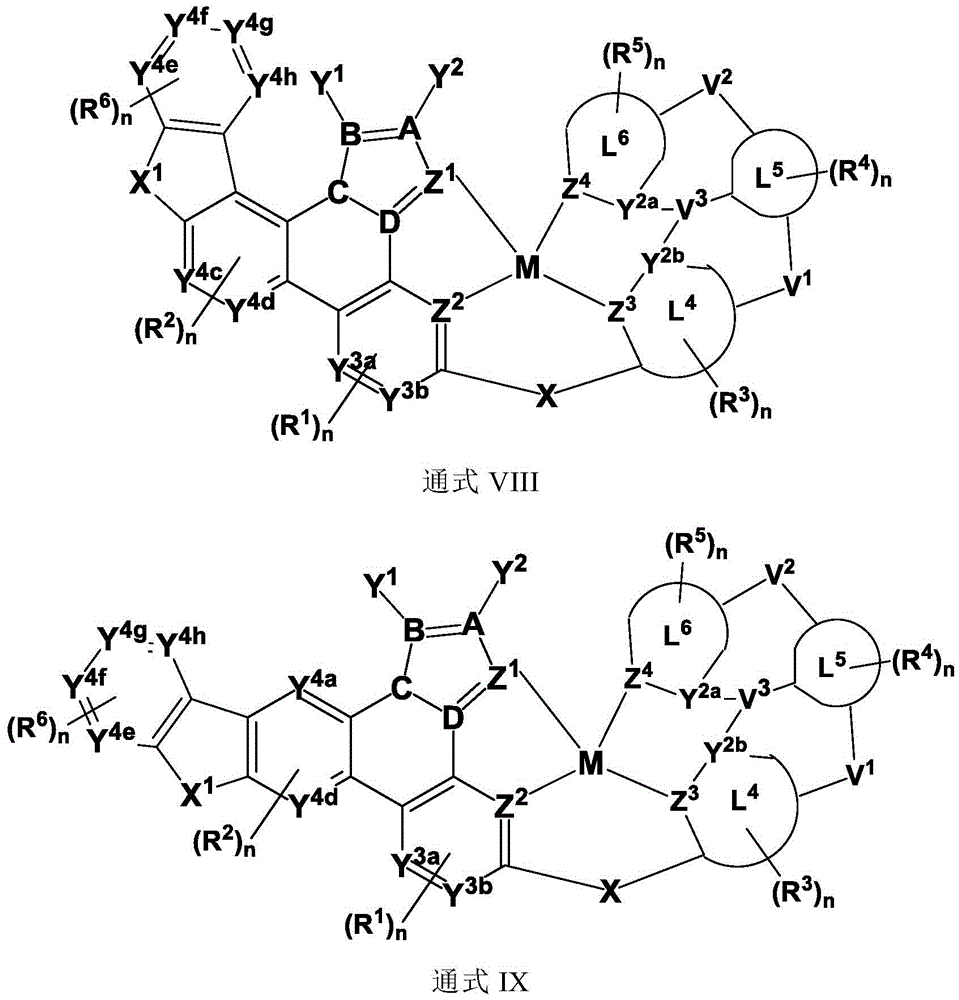


wherein:
Y2a、Y2b、Y3a、Y3b、Y4a、Y4b、Y4c、Y4d、Y4e、Y4f、Y4gand Y4hEach independently represents C or N;
Z1、Z2、Z3and Z4Each independently represents C or N;
A. b, C and D each independently represent C, N, O or S;
x represents a single bond, O, S, Se, P-O, As-O, Bi-O, CR7R8、C=O、SiR7R8、GeR7R8、NR7、PR7、PR7R8、R7P=O、AsR7、R7As=O、S=O、SO2、Se=O、SeO2、BR7、BR7R8、AlR7、AlR7R8、R7Bi ═ O or BiR7Or X is absent, wherein when X is absent, L4And comprises Z2There is no bond between the rings;
X1represents a single bond, O, S, Se, P-O, As-O, Bi-O, CR7R8、C=O、SiR7R8、GeR7R8、NR7、PR7、PR7R8、R7P=O、AsR7、R7As=O、S=O、SO2、Se=O、SeO2、BR7、BR7R8、AlR7、AlR7R8、R7Bi ═ O or BiR7;
Y1And Y2Each independently represents hydrogen, deuterium, halogen, hydroxyl, thiol, nitro, cyano, nitrile, isonitrile, sulfinyl, mercapto, sulfo, carboxyl, hydrazino; substitutedOr unsubstituted: aryl, cycloalkyl, cycloalkenyl, heterocyclyl, heteroaryl, alkyl, alkenyl, alkynyl, amino, monoalkylamino, dialkylamino, monoarylamino, diarylamino, alkoxy, aryloxy, haloalkyl, aralkyl, ester, alkoxycarbonyl, amido, alkoxycarbonylamino, aryloxycarbonylamino, sulfonylamino, sulfamoyl, carbamoyl, alkylthio, ureido, phosphoramide, silyl, polymers; or any conjugate or combination thereof; wherein Y is1And Y2Optionally together form a fused aromatic or heteroaromatic ring;
R1、R2、R3、R4、R5、R6、R7and R8Each independently is absent or present as a single substituent or multiple substituents, as valency permits, and R1、R3、R4、R5、R6、R7And R8Each independently represents deuterium, halogen, hydroxyl, thiol, nitro, cyano, nitrile, isonitrile, sulfinyl, mercapto, sulfo, carboxyl, hydrazino; substituted or unsubstituted: aryl, cycloalkyl, cycloalkenyl, heterocyclyl, heteroaryl, alkyl, alkenyl, alkynyl, amino, monoalkylamino, dialkylamino, monoarylamino, diarylamino, alkoxy, aryloxy, haloalkyl, aralkyl, ester, alkoxycarbonyl, amido, alkoxycarbonylamino, aryloxycarbonylamino, sulfonylamino, sulfamoyl, carbamoyl, alkylthio, ureido, phosphoramide, silyl, polymers; or any conjugate or combination thereof; or R1、R2、R3、R4、R5、R6、R7And R8Represents a covalent bond;
R1、R2、R3、R4、R5、R6、R7、R8x and X1Any two of (a) may together form a fused ring;
L4、L5and L6Each of which isIndependently represent a 5-to 10-membered aryl, heteroaryl, fused aryl or fused heteroaryl group; l is5Presence or absence;
V1and V2Independently present or absent; wherein V1And V2Each of which, if present, independently represents a covalent bond, O, S, Se, P-O, As-O, Bi-O, CR7R8、C=O、SiR7R8、GeR7R8、NR7、PR7、PR7R8、R7P=O、AsR7、R7As=O、S=O、SO2、Se=O、SeO2、BR7、BR7R8、AlR7、AlR7R8、R7Bi ═ O or BiR7(ii) a Wherein when V1In the absence, then L4Not in contact with L5Combining; and when V2In the absence, then L6Not in contact with L5Combining;
V3is present or absent, wherein V3If present, represents a covalent bond, C, N, Si, O, S, Ge, P, As, Se, B, Al or Bi, or, if valency permits, each independently represents CR7、SiR7、GeR7、NR7、P=O、As=O、B、BR7、AlR7、Bi=O、CR7R8、C=O、SiR7R8、GeR7R8、NR7、PR7、PR7R8、R7P=O、AsR7、R7As=O、S=O、SO2、Se=O、SeO2、BR7、BR7R8、AlR7、AlR7R8、R7Bi ═ O or BiR7(ii) a Wherein when V3In the absence, then Y2aDirectly with Y2bCombining; and is
Where valency permits, each n is independently an integer.
5. The compound of claim 2, wherein the compound is represented by formula XIV, formula XV, formula XVI, or formula XVII:


wherein:
Y1a、Y1b、Y1c、Y1d、Y2a、Y2b、Y3a、Y3b、Y4e、Y4f、Y4g、Y4h、Y5a、Y5b、Y5cand Y5dEach independently represents C or N;
Z1、Z2、Z3and Z4Each independently represents C or N;
c and D each independently represent C, N, O or S;
x represents a single bond, O, S, Se, P-O, As-O, Bi-O, CR7R8、C=O、SiR7R8、GeR7R8、NR7、PR7、PR7R8、R7P=O、AsR7、R7As=O、S=O、SO2、Se=O、SeO2、BR7、BR7R8、AlR7、AlR7R8、R7Bi ═ O or BiR7Or X is absent, wherein when X is absent, L4And comprises Z2There is no bond between the rings;
X1and X2Each independently represents a single bond, O, S, Se, P-O, As-O, Bi-O, CR7R8、C=O、SiR7R8、GeR7R8、NR7、PR7、PR7R8、R7P=O、AsR7、R7As=O、S=O、SO2、Se=O、SeO2、BR7、BR7R8、AlR7、AlR7R8、R7Bi ═ O or BiR7;
R1、R2、R3、R4、R5、R6、R7、R8、R9And R10Each independently is absent or present as a single substituent or multiple substituents, as valency permits, and R1、R2、R3、R4、R5、R6、R7、R8、R9And R10Each of which independently represents hydrogen, deuterium, halogen, hydroxyl, thiol, nitro, cyano, nitrile, isonitrile, sulfinyl, mercapto, sulfo, carboxyl, hydrazino; substituted or unsubstituted: aryl, cycloalkyl, cycloalkenyl, heterocyclyl, heteroaryl, alkyl, alkenyl, alkynyl, amino, monoalkylamino, dialkylamino, monoarylamino, diarylamino, alkoxy, aryloxy, haloalkyl, aralkyl, ester, alkoxycarbonyl, amido, alkoxycarbonylamino, aryloxycarbonylamino, sulfonylamino, sulfamoyl, carbamoyl, alkylthio, ureido, phosphoramide, silyl, polymers; or any conjugate or combination thereof; or R1、R2、R3、R4、R5、R6、R7、R8、R9And R10Represents a covalent bond;
R1、R2、R3、R4、R5、R6、R7、R8、R9、R10、X、X1and X2Any two of (a) may together form a fused ring;
L4、L5and L6Each independently represents a 5-to 10-membered aryl, heteroaryl, fused aryl or fused heteroaryl group; l is5Presence or absence;
V1and V2Independently present or absent; wherein V1And V2Each of which, if present, independently represents a covalent bond, O, S, Se, P-O, As-O, Bi-O, CR7R8、C=O、SiR7R8、GeR7R8、NR7、PR7、PR7R8、R7P=O、AsR7、R7As=O、S=O、SO2、Se=O、SeO2、BR7、BR7R8、AlR7、AlR7R8、R7Bi ═ O or BiR7(ii) a Wherein when V1In the absence, then L4Not in contact with L5Combining; and when V2In the absence, then L6Not in contact with L5Combining;
V3is present or absent, wherein V3If present, represents a covalent bond, C, N, Si, O, S, Ge, P, As, Se, B, Al or Bi, or, if valency permits, each independently represents CR7、SiR7、GeR7、NR7、P=O、As=O、B、BR7、AlR7、Bi=O、CR7R8、C=O、SiR7R8、GeR7R8、NR7、PR7、PR7R8、R7P=O、AsR7、R7As=O、S=O、SO2、Se=O、SeO2、BR7、BR7R8、AlR7、AlR7R8、R7Bi ═ O or BiR7(ii) a Wherein when V3In the absence, then Y2aDirectly with Y2bCombining; and is
Where valency permits, each n is independently an integer.
6. The compound of claim 2, wherein the compound is represented by formula XVIII, formula XIX, formula XX, or formula XXI:


wherein:
Y2a、Y2b、Y3a、Y3b、Y4e、Y4f、Y4g、Y4h、Y5a、Y5b、Y5cand Y5dEach independently represents C or N;
Z1、Z2、Z3and Z4Each independently represents C or N;
A. b, C and D each independently represent C, N, O or S;
x represents a single bond, O, S, Se, P-O, As-O, Bi-O, CR7R8、C=O、SiR7R8、GeR7R8、NR7、PR7、PR7R8、R7P=O、AsR7、R7As=O、S=O、SO2、Se=O、SeO2、BR7、BR7R8、AlR7、AlR7R8、R7Bi ═ O or BiR7Or X is absent, wherein when X is absent, L4And comprises Z2There is no bond between the rings;
X1and X2Each independently represents a single bond, O, S, Se, P-O, As-O, Bi-O, CR7R8、C=O、SiR7R8、GeR7R8、NR7、PR7、PR7R8、R7P=O、AsR7、R7As=O、S=O、SO2、Se=O、SeO2、BR7、BR7R8、AlR7、AlR7R8、R7Bi ═ O or BiR7;
Y1And Y2Each independently represents hydrogen, deuterium, halogen, hydroxy, thiol, nitro, cyano, nitrileIsonitrile, sulfinyl, mercapto, sulfo, carboxyl, hydrazino; substituted or unsubstituted: aryl, cycloalkyl, cycloalkenyl, heterocyclyl, heteroaryl, alkyl, alkenyl, alkynyl, amino, monoalkylamino, dialkylamino, monoarylamino, diarylamino, alkoxy, aryloxy, haloalkyl, aralkyl, ester, alkoxycarbonyl, amido, alkoxycarbonylamino, aryloxycarbonylamino, sulfonylamino, sulfamoyl, carbamoyl, alkylthio, ureido, phosphoramide, silyl, polymers; or any conjugate or combination thereof; wherein Y is1And Y2Optionally together form a fused aromatic or heteroaromatic ring;
R1、R2、R3、R4、R5、R6、R7、R8and R9Each independently is absent or present as a single substituent or multiple substituents, as valency permits, and R1、R2、R3、R4、R5、R6、R7、R8And R9Each of which independently represents hydrogen, deuterium, halogen, hydroxyl, thiol, nitro, cyano, nitrile, isonitrile, sulfinyl, mercapto, sulfo, carboxyl, hydrazino; substituted or unsubstituted: aryl, cycloalkyl, cycloalkenyl, heterocyclyl, heteroaryl, alkyl, alkenyl, alkynyl, amino, monoalkylamino, dialkylamino, monoarylamino, diarylamino, alkoxy, aryloxy, haloalkyl, aralkyl, ester, alkoxycarbonyl, amido, alkoxycarbonylamino, aryloxycarbonylamino, sulfonylamino, sulfamoyl, carbamoyl, alkylthio, ureido, phosphoramide, silyl, polymers; or any conjugate or combination thereof; or R1、R2、R3、R4、R5、R6、R7、R8And R9Represents a covalent bond;
R1、R2、R3、R4、R5、R6、R7、R8、R9、X、X1and X2Any two of (a) may together form a fused ring;
L4、L5and L6Each independently represents a 5-to 10-membered aryl, heteroaryl, fused aryl or fused heteroaryl group;
L5presence or absence;
V1and V2Independently present or absent; wherein V1And V2Each of which, if present, independently represents a covalent bond, O, S, Se, P-O, As-O, Bi-O, CR7R8、C=O、SiR7R8、GeR7R8、NR7、PR7、PR7R8、R7P=O、AsR7、R7As=O、S=O、SO2、Se=O、SeO2、BR7、BR7R8、AlR7、AlR7R8、R7Bi ═ O or BiR7(ii) a Wherein when V1In the absence, then L4Not in contact with L5Combining; and when V2In the absence, then L6Not in contact with L5Combining;
V3is present or absent, wherein V3If present, represents a covalent bond, C, N, Si, O, S, Ge, P, As, Se, B, Al or Bi, or, if valency permits, each independently represents CR7、SiR7、GeR7、NR7、P=O、As=O、B、BR7、AlR7、Bi=O、CR7R8、C=O、SiR7R8、GeR7R8、NR7、PR7、PR7R8、R7P=O、AsR7、R7As=O、S=O、SO2、Se=O、SeO2、BR7、BR7R8、AlR7、AlR7R8、R7Bi ═ O or BiR7(ii) a Wherein when V3In the absence, then Y2aDirectly with Y2bCombining; and is
Where valency permits, each n is independently an integer.
7. The compound of claim 1, wherein

Represented by one of the following structures:


wherein:
m represents Pt (II) or Pd (II);
Y1a、Y1b、Y1c、Y1d、Y3a、Y3b、Y4e、Y4f、Y4g、Y4h、Y5a、Y5b、Y5cand Y5dEach independently represents C or N;
X1and X2Each independently represents a single bond, O, S, Se, P-O, As-O, Bi-O, CR7R8、C=O、SiR7R8、GeR7R8、NR7、PR7、PR7R8、R7P=O、AsR7、R7As=O、S=O、SO2、Se=O、SeO2、BR7、BR7R8、AlR7、AlR7R8、R7Bi ═ O or BiR7;
R1、R6、R7、R8、R9And R10Each independently is absent or present as a single substituent or multiple substituents, as valency permits, and R1、R6、R9And R10Each of which independently represents hydrogen, deuterium, halogen, hydroxyl, thiol, nitro, cyano, nitrile, isonitrile, sulfinyl, mercapto, sulfo, carboxyl, hydrazino; substituted or unsubstituted: aryl, cycloalkyl, cycloalkenyl, heterocyclyl, heteroaryl, alkyl, alkenyl, alkynyl, amino, monoalkylamino, dialkylamino, monoarylamino, diarylamino, alkoxy, aryloxy, haloalkyl, aralkyl, ester, alkoxycarbonyl, amido, alkoxycarbonylamino, aryloxycarbonylamino, sulfonylamino, sulfamoyl, carbamoyl, alkylthio, ureido, phosphoramide, silyl, polymers; or any conjugate or combination thereof; or R1、R6、R9And R10Represents a covalent bond;
R1、R6、R9and R10Any two of (a) may together form a fused ring;
where valency permits, each n is independently an integer.
8. The compound of claim 1, wherein

Represented by one of the following structures:

wherein:
Y1a、Y1b、Y1c、Y1d、Y2a、Y2b、Y2c、Y2d、Y3a、Y3band Y3cEach independently represents C or N;
R1、R2、R3、R4、R5each independently is absent or present as a single substituent or multiple substituents, as valency permits, and R1、R3、R4、R5、R6And R7Each independently represents deuterium, halogen, hydroxyl, thiol, nitro, cyano, nitrile, isonitrile, sulfinyl, mercapto, sulfo, carboxyl, hydrazino; substituted or unsubstituted: aryl, cycloalkyl, cycloalkenyl, heterocyclyl, heteroaryl, alkyl, alkenyl, alkynyl, amino, monoalkylamino, dialkylamino, monoarylamino, diarylamino, alkoxy, aryloxy, haloalkyl, aralkyl, ester, alkoxycarbonyl, amido, alkoxycarbonylamino, aryloxycarbonylamino, sulfonylamino, sulfamoyl, carbamoyl, alkylthio, ureido, phosphoramide, silyl, polymers; or any conjugate or combination thereof.
9. The compound of claim 1, wherein

Represented by one of the following structures:

wherein:
Y1a、Y1b、Y1c、Y1d、Y1e、Y1fand Y1gEach independently represents C or N;
R1and R2Each of which is independently absent or mono-as valency permitsA substituent or substituents, and R1And R2Each independently represents deuterium, halogen, hydroxyl, thiol, nitro, cyano, nitrile, isonitrile, sulfinyl, mercapto, sulfo, carboxyl, hydrazino; substituted or unsubstituted: aryl, cycloalkyl, cycloalkenyl, heterocyclyl, heteroaryl, alkyl, alkenyl, alkynyl, amino, monoalkylamino, dialkylamino, monoarylamino, diarylamino, alkoxy, aryloxy, haloalkyl, aralkyl, ester, alkoxycarbonyl, amido, alkoxycarbonylamino, aryloxycarbonylamino, sulfonylamino, sulfamoyl, carbamoyl, alkylthio, ureido, phosphoramide, silyl, polymers; or any conjugate or combination thereof; and R is1And R2Any two of which may be joined together to form a ring;
Y1、Y2、Y3and Y4Each of which is independently absent or present, and Y1、Y2、Y3And Y4Each of which independently represents hydrogen, deuterium, halogen, hydroxyl, thiol, nitro, cyano, nitrile, isonitrile, sulfinyl, mercapto, sulfo, carboxyl, hydrazino; substituted or unsubstituted: aryl, cycloalkyl, cycloalkenyl, heterocyclyl, heteroaryl, alkyl, alkenyl, alkynyl, amino, monoalkylamino, dialkylamino, monoarylamino, diarylamino, alkoxy, aryloxy, haloalkyl, aralkyl, ester, alkoxycarbonyl, amido, alkoxycarbonylamino, aryloxycarbonylamino, sulfonylamino, sulfamoyl, carbamoyl, alkylthio, ureido, phosphoramide, silyl, polymers; or any conjugate or combination thereof; and is
Y1、Y2、Y3And Y4Any two of which may be joined together to form a ring.
10. The compound of claim 1, wherein the compound is selected from the structures:


11. an organic light emitting diode comprising the compound of claim 1.
12. An organic light emitting diode comprising the compound of claim 3.
13. An organic light emitting diode comprising the compound of claim 4.
14. An organic light emitting diode comprising the compound of claim 5.
15. An organic light emitting diode comprising the compound of claim 6.
16. A light emitting device comprising the light emitting diode according to claim 11.
17. A light emitting device comprising the light emitting diode according to claim 12.
18. A light emitting device comprising the light emitting diode according to claim 13.
19. A light emitting device comprising the light emitting diode according to claim 14.
20. A light emitting device comprising the light emitting diode according to claim 15.
Applications Claiming Priority (4)
| Application Number | Priority Date | Filing Date | Title |
|---|---|---|---|
| US202063026806P | 2020-05-19 | 2020-05-19 | |
| US63/026,806 | 2020-05-19 | ||
| US17/316,800 US11945985B2 (en) | 2020-05-19 | 2021-05-11 | Metal assisted delayed fluorescent emitters for organic light-emitting diodes |
| US17/316,800 | 2021-05-11 |
Publications (2)
| Publication Number | Publication Date |
|---|---|
| CN113683625A true CN113683625A (en) | 2021-11-23 |
| CN113683625B CN113683625B (en) | 2025-06-10 |
Family
ID=78576425
Family Applications (1)
| Application Number | Title | Priority Date | Filing Date |
|---|---|---|---|
| CN202110548036.3A Active CN113683625B (en) | 2020-05-19 | 2021-05-19 | Metal-assisted delayed fluorescence emitters for organic light emitting diodes |
Country Status (2)
| Country | Link |
|---|---|
| US (1) | US12503644B2 (en) |
| CN (1) | CN113683625B (en) |
Citations (6)
| Publication number | Priority date | Publication date | Assignee | Title |
|---|---|---|---|---|
| CN106972109A (en) * | 2017-04-21 | 2017-07-21 | 瑞声科技(南京)有限公司 | A kind of luminescent device |
| CN109309168A (en) * | 2017-07-26 | 2019-02-05 | 环球展览公司 | Organic electroluminescent material and device |
| US20190074455A1 (en) * | 2017-09-07 | 2019-03-07 | Universal Display Corporation | Organic electroluminescent materials and devices |
| US20190214584A1 (en) * | 2018-01-10 | 2019-07-11 | Universal Display Corporation | Organic electroluminescent materials and devices |
| CN110066296A (en) * | 2018-01-23 | 2019-07-30 | 三星电子株式会社 | Organo-metallic compound and organic luminescent device and diagnosis composition including it |
| CN110240606A (en) * | 2018-03-09 | 2019-09-17 | 亚利桑那州立大学董事会 | Blue- and narrow-band green- and red-emitting metal complexes, and organic light-emitting diodes and light-emitting devices incorporating same |
Family Cites Families (308)
| Publication number | Priority date | Publication date | Assignee | Title |
|---|---|---|---|---|
| US4769292A (en) | 1987-03-02 | 1988-09-06 | Eastman Kodak Company | Electroluminescent device with modified thin film luminescent zone |
| GB2239705B (en) | 1989-11-08 | 1993-05-12 | Nat Res Dev | Gas sensors and compounds suitable therefor |
| US5641878A (en) | 1991-05-15 | 1997-06-24 | Diatron Corporation | Porphyrin, azaporphyrin, and related fluorescent dyes free of aggregation and serum binding |
| US5707745A (en) | 1994-12-13 | 1998-01-13 | The Trustees Of Princeton University | Multicolor organic light emitting devices |
| US5844363A (en) | 1997-01-23 | 1998-12-01 | The Trustees Of Princeton Univ. | Vacuum deposited, non-polymeric flexible organic light emitting devices |
| US6303238B1 (en) | 1997-12-01 | 2001-10-16 | The Trustees Of Princeton University | OLEDs doped with phosphorescent compounds |
| JP4142782B2 (en) | 1998-06-26 | 2008-09-03 | Tdk株式会社 | Organic EL device |
| EP1729327B2 (en) | 1999-05-13 | 2022-08-10 | The Trustees Of Princeton University | Use of a phosphorescent iridium compound as emissive molecule in an organic light emitting device |
| US6821645B2 (en) | 1999-12-27 | 2004-11-23 | Fuji Photo Film Co., Ltd. | Light-emitting material comprising orthometalated iridium complex, light-emitting device, high efficiency red light-emitting device, and novel iridium complex |
| JP2002010505A (en) | 2000-06-16 | 2002-01-11 | Fuji Electric Co Ltd | Charge control device |
| JP4154140B2 (en) | 2000-09-26 | 2008-09-24 | キヤノン株式会社 | Metal coordination compounds |
| JP4460743B2 (en) | 2000-09-29 | 2010-05-12 | 富士フイルム株式会社 | Method for producing iridium complex or tautomer thereof |
| JP5329734B2 (en) | 2001-08-15 | 2013-10-30 | スリーエム イノベイティブ プロパティズ カンパニー | Curable self-supporting structure and method |
| JP4166455B2 (en) | 2001-10-01 | 2008-10-15 | 株式会社半導体エネルギー研究所 | Polarizing film and light emitting device |
| US20030186077A1 (en) | 2001-12-31 | 2003-10-02 | Chen Jian P. | Bis- and tris- (di) benzocarbazole-based materials as hole transport materials for organic light emitting devices |
| TW536924B (en) | 2002-02-22 | 2003-06-11 | E Ray Optoelectronics Technolo | Efficient organic electroluminescent device with new red fluorescent dopants |
| JP2003342284A (en) | 2002-05-30 | 2003-12-03 | Canon Inc | Metal coordination compound, light emitting element and display device |
| GB0215153D0 (en) | 2002-07-01 | 2002-08-07 | Univ Hull | Luminescent compositions |
| DE10238903A1 (en) | 2002-08-24 | 2004-03-04 | Covion Organic Semiconductors Gmbh | New heteroaromatic rhodium and iridium complexes, useful in electroluminescent and/or phosphorescent devices as the emission layer and for use in solar cells, photovoltaic devices and organic photodetectors |
| AU2003301680A1 (en) | 2002-11-01 | 2004-05-25 | Takasago International Corporation | Platinum complexes |
| US7646899B2 (en) | 2003-02-04 | 2010-01-12 | Vanderbilt University | Apparatus and methods of determining marker orientation in fiducial registration |
| US7037599B2 (en) | 2003-02-28 | 2006-05-02 | Eastman Kodak Company | Organic light emitting diodes for production of polarized light |
| US7338722B2 (en) | 2003-03-24 | 2008-03-04 | The University Of Southern California | Phenyl and fluorenyl substituted phenyl-pyrazole complexes of Ir |
| US6998492B2 (en) | 2003-05-16 | 2006-02-14 | Semiconductor Energy Laboratory Co., Ltd. | Organometallic complex and light-emitting element containing the same |
| EP2924094B1 (en) | 2003-06-02 | 2017-04-05 | UDC Ireland Limited | Organic electroluminescent devices and metal complex compounds |
| CN100551994C (en) | 2003-06-02 | 2009-10-21 | 富士胶片株式会社 | Organic electroluminescent device and metal complex compound |
| JP4460952B2 (en) | 2003-06-02 | 2010-05-12 | 富士フイルム株式会社 | Organic electroluminescent device and complex compound |
| JP4498841B2 (en) | 2003-07-11 | 2010-07-07 | 三星電子株式会社 | GPS correlation peak signal search method and system therefor. |
| US6917159B2 (en) | 2003-08-14 | 2005-07-12 | Eastman Kodak Company | Microcavity OLED device |
| US7268485B2 (en) | 2003-10-07 | 2007-09-11 | Eastman Kodak Company | White-emitting microcavity OLED device |
| DE10350722A1 (en) | 2003-10-30 | 2005-05-25 | Covion Organic Semiconductors Gmbh | metal complexes |
| US7442797B2 (en) | 2003-11-04 | 2008-10-28 | Takasago International Corporation | Platinum complex and light emitting device |
| DE10357044A1 (en) | 2003-12-04 | 2005-07-14 | Novaled Gmbh | Process for doping organic semiconductors with quinonediimine derivatives |
| DE10359341A1 (en) | 2003-12-16 | 2005-07-28 | Basell Polyolefine Gmbh | New monocyclopentadienyl complex useful in catalyst system used in prepolymerized catalyst system and for the polymerization or copolymerization of olefins |
| US7332232B2 (en) | 2004-02-03 | 2008-02-19 | Universal Display Corporation | OLEDs utilizing multidentate ligand systems |
| JP2005267557A (en) | 2004-03-22 | 2005-09-29 | Ntt Docomo Inc | Server device |
| US20050211974A1 (en) | 2004-03-26 | 2005-09-29 | Thompson Mark E | Organic photosensitive devices |
| US7279704B2 (en) | 2004-05-18 | 2007-10-09 | The University Of Southern California | Complexes with tridentate ligands |
| US7393599B2 (en) | 2004-05-18 | 2008-07-01 | The University Of Southern California | Luminescent compounds with carbene ligands |
| US7445855B2 (en) | 2004-05-18 | 2008-11-04 | The University Of Southern California | Cationic metal-carbene complexes |
| WO2005113704A2 (en) | 2004-05-18 | 2005-12-01 | The University Of Southern California | Luminescent compounds with carbene ligands |
| JP4925569B2 (en) | 2004-07-08 | 2012-04-25 | ローム株式会社 | Organic electroluminescent device |
| KR20060011537A (en) | 2004-07-30 | 2006-02-03 | 주식회사 하이닉스반도체 | Device Separation Method of Semiconductor Devices |
| JP4576605B2 (en) | 2004-08-09 | 2010-11-10 | 独立行政法人産業技術総合研究所 | Identification method of oligosaccharide |
| US7300731B2 (en) | 2004-08-10 | 2007-11-27 | E.I. Du Pont De Nemours And Company | Spatially-doped charge transport layers |
| KR20060015371A (en) | 2004-08-14 | 2006-02-17 | 윤희찬 | Hybrid one-chip data recognition device |
| JP4500735B2 (en) | 2004-09-22 | 2010-07-14 | 富士フイルム株式会社 | Organic electroluminescence device |
| US7002013B1 (en) | 2004-09-23 | 2006-02-21 | National Tsing Hua University | Pt complexes as phosphorescent emitters in the fabrication of organic light emitting diodes |
| JP4531509B2 (en) | 2004-09-27 | 2010-08-25 | 富士フイルム株式会社 | Light emitting element |
| US7489074B2 (en) | 2004-09-28 | 2009-02-10 | Osram Opto Semiconductors Gmbh | Reducing or eliminating color change for microcavity OLED devices |
| ATE430789T1 (en) | 2004-12-23 | 2009-05-15 | Ciba Holding Inc | ELECTROLUMINESCENT METAL COMPLEXES WITH NUCLEOPHILIC CARBENE LIGANDS |
| CN100348594C (en) | 2005-01-12 | 2007-11-14 | 武汉大学 | Bidentate ligand and its iridium complex and electroluminescent device therewith |
| JP2008530773A (en) | 2005-02-04 | 2008-08-07 | ノヴァレッド・アクチエンゲゼルシャフト | Additives to organic semiconductors |
| JP4773109B2 (en) | 2005-02-28 | 2011-09-14 | 高砂香料工業株式会社 | Platinum complex and light emitting device |
| JP2006242080A (en) | 2005-03-02 | 2006-09-14 | Denso Corp | Abnormality diagnosis device for exhaust gas recirculation system |
| JP4425816B2 (en) | 2005-03-02 | 2010-03-03 | 富士重工業株式会社 | Electronically controlled throttle device |
| KR101280587B1 (en) | 2005-03-16 | 2013-07-02 | 후지필름 가부시키가이샤 | Platinum complex compound and organic electroluminescent device |
| JP4399429B2 (en) | 2005-03-16 | 2010-01-13 | 富士フイルム株式会社 | Organic electroluminescence device |
| JP4399382B2 (en) | 2005-03-16 | 2010-01-13 | 富士フイルム株式会社 | Organic electroluminescence device |
| JP4727262B2 (en) | 2005-03-16 | 2011-07-20 | 富士フイルム株式会社 | Organic electroluminescence device |
| AU2006235061A1 (en) | 2005-04-07 | 2006-10-19 | The Regents Of The University Of California | Highly efficient polymer solar cell by polymer self-organization |
| JP4790298B2 (en) | 2005-04-08 | 2011-10-12 | 日本放送協会 | Good solubility iridium complex and organic EL device |
| US9070884B2 (en) | 2005-04-13 | 2015-06-30 | Universal Display Corporation | Hybrid OLED having phosphorescent and fluorescent emitters |
| JP4934346B2 (en) | 2005-04-25 | 2012-05-16 | 富士フイルム株式会社 | Organic electroluminescence device |
| TWI418606B (en) | 2005-04-25 | 2013-12-11 | Udc Ireland Ltd | Organic electroluminescent device |
| US7758971B2 (en) | 2005-04-25 | 2010-07-20 | Fujifilm Corporation | Organic electroluminescent device |
| TWI391027B (en) | 2005-04-25 | 2013-03-21 | Fujifilm Corp | Organic electroluminescent device |
| JP5046548B2 (en) | 2005-04-25 | 2012-10-10 | 富士フイルム株式会社 | Organic electroluminescence device |
| JP2006303394A (en) | 2005-04-25 | 2006-11-02 | Fuji Photo Film Co Ltd | Organic electroluminescence device |
| JP4533796B2 (en) | 2005-05-06 | 2010-09-01 | 富士フイルム株式会社 | Organic electroluminescence device |
| EP1887640A4 (en) | 2005-05-24 | 2012-04-04 | Pioneer Corp | ORGANIC ELECTROLUMINESCENCE DEVICE |
| JP2006351638A (en) | 2005-06-13 | 2006-12-28 | Fujifilm Holdings Corp | Light emitting element |
| JP2007031678A (en) | 2005-07-29 | 2007-02-08 | Showa Denko Kk | Polymer light emitting material and organic electroluminescence device using the polymer light emitting material |
| JP2007042875A (en) | 2005-08-03 | 2007-02-15 | Fujifilm Holdings Corp | Organic electroluminescence device |
| JP4796802B2 (en) | 2005-08-15 | 2011-10-19 | 富士フイルム株式会社 | Organic electroluminescence device |
| JP4923478B2 (en) | 2005-08-19 | 2012-04-25 | コニカミノルタホールディングス株式会社 | Organic electroluminescence element, display device and lighting device |
| JP2007066581A (en) | 2005-08-29 | 2007-03-15 | Fujifilm Holdings Corp | Organic electroluminescence device |
| US8778509B2 (en) | 2005-09-01 | 2014-07-15 | Konica Minolta Holdings, Inc. | Organic electroluminescence element, display device and lighting device |
| JP2007073620A (en) | 2005-09-05 | 2007-03-22 | Fujifilm Corp | Organic electroluminescence device |
| JP5076900B2 (en) | 2005-09-06 | 2012-11-21 | コニカミノルタホールディングス株式会社 | Organic electroluminescence element, display device and lighting device |
| JP2007073845A (en) | 2005-09-08 | 2007-03-22 | Fujifilm Holdings Corp | Organic laser oscillator |
| JP5208391B2 (en) | 2005-09-09 | 2013-06-12 | 住友化学株式会社 | Metal complex, light emitting material and light emitting device |
| JP2007073900A (en) | 2005-09-09 | 2007-03-22 | Fujifilm Corp | Organic electroluminescence device |
| JP2007080593A (en) | 2005-09-12 | 2007-03-29 | Fujifilm Corp | Electrochemiluminescence device |
| JP2007110067A (en) | 2005-09-14 | 2007-04-26 | Fujifilm Corp | Composition for organic electroluminescent device, method for producing organic electroluminescent device, and organic electroluminescent device |
| JP2007080677A (en) | 2005-09-14 | 2007-03-29 | Fujifilm Corp | Organic electroluminescent device and manufacturing method thereof |
| JP2007110102A (en) | 2005-09-15 | 2007-04-26 | Fujifilm Corp | Organic electroluminescence device |
| US7839078B2 (en) | 2005-09-15 | 2010-11-23 | Fujifilm Corporation | Organic electroluminescent element having a luminescent layer and a buffer layer adjacent thereto |
| JP2007088105A (en) | 2005-09-20 | 2007-04-05 | Fujifilm Corp | Organic electroluminescence device |
| JP4789556B2 (en) | 2005-09-21 | 2011-10-12 | 富士フイルム株式会社 | Organic electroluminescence device |
| TWI268952B (en) | 2005-09-21 | 2006-12-21 | Au Optronics Corp | Spiro silane compound and organic electroluminescent device using the same |
| JP2007186490A (en) | 2005-12-14 | 2007-07-26 | Sumitomo Seika Chem Co Ltd | Compound for electroluminescent device and method for producing the same |
| JP4929186B2 (en) | 2005-12-27 | 2012-05-09 | 出光興産株式会社 | Material for organic electroluminescence device and organic electroluminescence device |
| JPWO2007080801A1 (en) | 2006-01-11 | 2009-06-11 | 出光興産株式会社 | Novel imide derivative, material for organic electroluminescence device and organic electroluminescence device using the same |
| JP5520479B2 (en) | 2006-02-20 | 2014-06-11 | コニカミノルタ株式会社 | ORGANIC ELECTROLUMINESCENT ELEMENT, WHITE LIGHT EMITTING ELEMENT, AND LIGHTING DEVICE |
| US7854513B2 (en) | 2006-03-03 | 2010-12-21 | Quach Cang V | One-way transparent display systems |
| DE502006000749D1 (en) | 2006-03-21 | 2008-06-19 | Novaled Ag | Heterocyclic radical or diradical, their dimers, oligomers, polymers, dispiro compounds and polycycles, their use, organic semiconducting material and electronic component |
| JP4945156B2 (en) | 2006-03-24 | 2012-06-06 | 富士フイルム株式会社 | Organic electroluminescence device |
| US20090128024A1 (en) | 2006-04-20 | 2009-05-21 | Kenichi Fukuoka | Organic light-emitting device |
| JP5144034B2 (en) | 2006-05-31 | 2013-02-13 | 富士フイルム株式会社 | Organic electroluminescence device |
| TW200815446A (en) | 2006-06-05 | 2008-04-01 | Idemitsu Kosan Co | Organic electroluminescent device and material for organic electroluminescent device |
| JP2008010353A (en) | 2006-06-30 | 2008-01-17 | Seiko Epson Corp | Mask manufacturing method, wiring pattern manufacturing method, and plasma display manufacturing method |
| DE102006035018B4 (en) | 2006-07-28 | 2009-07-23 | Novaled Ag | Oxazole triplet emitter for OLED applications |
| JP2008037848A (en) | 2006-08-10 | 2008-02-21 | Takasago Internatl Corp | Platinum complex and light emitting device |
| JP5205584B2 (en) | 2006-09-06 | 2013-06-05 | ユー・ディー・シー アイルランド リミテッド | Organic electroluminescence device and display device |
| US7598381B2 (en) | 2006-09-11 | 2009-10-06 | The Trustees Of Princeton University | Near-infrared emitting organic compounds and organic devices using the same |
| JP5049711B2 (en) | 2006-09-27 | 2012-10-17 | 富士フイルム株式会社 | Organic electroluminescence device |
| JP2008109085A (en) | 2006-09-29 | 2008-05-08 | Fujifilm Corp | Organic electroluminescence device |
| JP2008103535A (en) | 2006-10-19 | 2008-05-01 | Takasago Internatl Corp | Light emitting element |
| JP2008108617A (en) | 2006-10-26 | 2008-05-08 | Fujifilm Corp | Organic electroluminescence device |
| US8945722B2 (en) | 2006-10-27 | 2015-02-03 | The University Of Southern California | Materials and architectures for efficient harvesting of singlet and triplet excitons for white light emitting OLEDs |
| JP2008117545A (en) | 2006-11-01 | 2008-05-22 | Nix Inc | Liquid transmission / reception joint device and fuel cell system including the same |
| JP4924878B2 (en) | 2006-11-06 | 2012-04-25 | 株式会社ニコン | Absolute encoder |
| JP4478166B2 (en) | 2006-11-09 | 2010-06-09 | 三星モバイルディスプレイ株式會社 | Organic light-emitting device provided with organic film containing organometallic complex |
| JP5282260B2 (en) | 2006-11-27 | 2013-09-04 | ユー・ディー・シー アイルランド リミテッド | Organic electroluminescence device |
| JP2009076834A (en) | 2006-11-27 | 2009-04-09 | Fujifilm Corp | Organic electroluminescent devices and novel indole derivatives |
| JP5187493B2 (en) | 2006-11-27 | 2013-04-24 | ユー・ディー・シー アイルランド リミテッド | Organic electroluminescent devices and novel indole derivatives |
| WO2008066933A2 (en) | 2006-12-01 | 2008-06-05 | The Regents Of The University Of California | Enhancing performance characteristics of organic semiconducting films by improved solution processing |
| CN101616947B (en) | 2006-12-26 | 2012-06-06 | 旭化成电子材料株式会社 | Resin composition for printing plate |
| JP4833106B2 (en) | 2007-02-13 | 2011-12-07 | 富士フイルム株式会社 | Organic light emitting device |
| US8106199B2 (en) | 2007-02-13 | 2012-01-31 | Arizona Board Of Regents For And On Behalf Of Arizona State University | Organometallic materials for optical emission, optical absorption, and devices including organometallic materials |
| JP5546255B2 (en) | 2007-02-23 | 2014-07-09 | ビーエーエスエフ ソシエタス・ヨーロピア | Metal complexes with electroluminescent benzotriazole |
| US20080241518A1 (en) | 2007-03-26 | 2008-10-02 | Tasuku Satou | Organic electroluminescence element |
| JP5230218B2 (en) | 2007-03-26 | 2013-07-10 | ユー・ディー・シー アイルランド リミテッド | Organic electroluminescence device |
| JP5081010B2 (en) | 2007-03-26 | 2012-11-21 | 富士フイルム株式会社 | Organic electroluminescence device |
| US20100084967A1 (en) | 2007-03-28 | 2010-04-08 | Fujifilm Corporation | Organic electroluminescent device |
| JP5430073B2 (en) | 2007-03-30 | 2014-02-26 | ユー・ディー・シー アイルランド リミテッド | Organic electroluminescence device |
| JPWO2008132965A1 (en) | 2007-04-17 | 2010-07-22 | コニカミノルタホールディングス株式会社 | White organic electroluminescence element and lighting device |
| EP1988079A1 (en) | 2007-04-25 | 2008-11-05 | Lonza Ag | Process for the preparation of optically active ethenylphenyl-alcohols |
| JP5084361B2 (en) | 2007-06-18 | 2012-11-28 | 株式会社リコー | Image forming apparatus |
| JP2009016579A (en) | 2007-07-04 | 2009-01-22 | Fujifilm Corp | Organic electroluminescence device and manufacturing method |
| JP2009016184A (en) | 2007-07-04 | 2009-01-22 | Fujifilm Corp | Organic electroluminescence device |
| DE102007031220B4 (en) | 2007-07-04 | 2022-04-28 | Novaled Gmbh | Quinoid compounds and their use in semiconducting matrix materials, electronic and optoelectronic components |
| KR20100031127A (en) | 2007-07-11 | 2010-03-19 | 이데미쓰 고산 가부시키가이샤 | Materials for organic electroluminescent devices and organic electroluminescent devices |
| KR101414914B1 (en) | 2007-07-18 | 2014-07-04 | 이데미쓰 고산 가부시키가이샤 | Material for organic electroluminescent device and organic electroluminescent device |
| GB2451106A (en) | 2007-07-18 | 2009-01-21 | Cis Bio Int | Lanthanide (III) ion complexing pyrazoyl-aza(thio)xanthone comprising compounds, their complexes and their use as fluorescent labels |
| WO2009013285A1 (en) | 2007-07-25 | 2009-01-29 | Polymers Crc Ltd. | Solar cell and method for preparation thereof |
| JP2009055010A (en) | 2007-07-27 | 2009-03-12 | Fujifilm Corp | Organic electroluminescence device |
| JP5255794B2 (en) | 2007-07-27 | 2013-08-07 | ユー・ディー・シー アイルランド リミテッド | Organic electroluminescence device |
| JP5497259B2 (en) | 2007-07-27 | 2014-05-21 | ユー・ディー・シー アイルランド リミテッド | Organic electroluminescence device |
| JP2009032989A (en) | 2007-07-27 | 2009-02-12 | Fujifilm Corp | Organic electroluminescence device |
| EP2179458A1 (en) | 2007-08-13 | 2010-04-28 | University Of Southern California | Organic photosensitive optoelectronic devices with triplet harvesting |
| JP5119812B2 (en) | 2007-09-03 | 2013-01-16 | コニカミノルタホールディングス株式会社 | Organic electroluminescence element, display device and lighting device |
| KR101548382B1 (en) | 2007-09-14 | 2015-08-28 | 유디씨 아일랜드 리미티드 | Organic electroluminescence device |
| JP5014036B2 (en) | 2007-09-18 | 2012-08-29 | 富士フイルム株式会社 | Organic electroluminescence device |
| GB0718577D0 (en) | 2007-09-24 | 2007-10-31 | Acal Energy Ltd | Fuel cells |
| JP5438941B2 (en) | 2007-09-25 | 2014-03-12 | ユー・ディー・シー アイルランド リミテッド | Organic electroluminescence device |
| US7862908B2 (en) | 2007-11-26 | 2011-01-04 | National Tsing Hua University | Conjugated compounds containing hydroindoloacridine structural elements, and their use |
| KR100905951B1 (en) | 2007-12-06 | 2009-07-06 | 주식회사 잉크테크 | Iridium-based compounds having carbazole pyridine and phenyl derivatives as main ligands and organic electroluminescent devices comprising the same |
| JP5438955B2 (en) | 2007-12-14 | 2014-03-12 | ユー・ディー・シー アイルランド リミテッド | Platinum complex compound and organic electroluminescence device using the same |
| WO2009086209A2 (en) | 2007-12-21 | 2009-07-09 | Arizona Board Of Regents For And On Behalf Of Arizona State University | Platinum(ii) di(2-pyrazolyl)benzene chloride analogs and uses |
| US9293720B2 (en) | 2008-02-19 | 2016-03-22 | New Jersey Institute Of Technology | Carbon nanotubes as charge carriers in organic and hybrid solar cells |
| JP5243972B2 (en) | 2008-02-28 | 2013-07-24 | ユー・ディー・シー アイルランド リミテッド | Organic electroluminescence device |
| US8389725B2 (en) | 2008-02-29 | 2013-03-05 | Arizona Board Of Regents For And On Behalf Of Arizona State University | Tridentate platinum (II) complexes |
| JP2009211892A (en) | 2008-03-03 | 2009-09-17 | Fujifilm Corp | Organic electroluminescent element |
| DE102008015526B4 (en) | 2008-03-25 | 2021-11-11 | Merck Patent Gmbh | Metal complexes |
| JP5228578B2 (en) | 2008-03-31 | 2013-07-03 | 株式会社ジェイテクト | Motor control device and electric power steering device |
| JP4531836B2 (en) | 2008-04-22 | 2010-08-25 | 富士フイルム株式会社 | Organic electroluminescent device, novel platinum complex compound and novel compound that can be a ligand |
| JP2009266943A (en) | 2008-04-23 | 2009-11-12 | Fujifilm Corp | Organic field light-emitting element |
| JP4531842B2 (en) | 2008-04-24 | 2010-08-25 | 富士フイルム株式会社 | Organic electroluminescence device |
| JP2009267171A (en) | 2008-04-25 | 2009-11-12 | Fujifilm Corp | Organic electric field light emitting element |
| JP2009267244A (en) | 2008-04-28 | 2009-11-12 | Fujifilm Corp | Organic electroluminescent element |
| JP2009272339A (en) | 2008-04-30 | 2009-11-19 | Fujifilm Corp | Organic electric field light-emitting element |
| EP2307521A1 (en) | 2008-07-16 | 2011-04-13 | Solvay SA | Light-emitting material comprising multinuclear complexes |
| US20100043876A1 (en) | 2008-08-20 | 2010-02-25 | Plextronics, Inc. | Solvent system |
| WO2010022353A1 (en) | 2008-08-21 | 2010-02-25 | Innova Meterials, Llc | Enhanced surfaces, coatings, and related methods |
| US7635792B1 (en) | 2008-10-14 | 2009-12-22 | General Electric Company | 2,5-linked polyfluorenes for optoelectronic devices |
| KR101843201B1 (en) | 2008-11-11 | 2018-03-28 | 유니버셜 디스플레이 코포레이션 | Phosphorescent emitters |
| JP5507185B2 (en) | 2008-11-13 | 2014-05-28 | ユー・ディー・シー アイルランド リミテッド | Organic electroluminescence device |
| WO2010059240A1 (en) | 2008-11-21 | 2010-05-27 | Plextronics, Inc. | Doped interfacial modification layers for stability enhancement for bulk heterojunction organic solar cells |
| JP5497284B2 (en) | 2008-12-08 | 2014-05-21 | ユー・ディー・シー アイルランド リミテッド | White organic electroluminescence device |
| JP5414544B2 (en) | 2009-01-06 | 2014-02-12 | ユー・ディー・シー アイルランド リミテッド | Organic electroluminescence device |
| JP5627883B2 (en) | 2009-01-07 | 2014-11-19 | ユー・ディー・シー アイルランド リミテッド | Organic electroluminescence device |
| JP5210187B2 (en) | 2009-01-22 | 2013-06-12 | ユー・ディー・シー アイルランド リミテッド | Organic electroluminescence device |
| KR101066743B1 (en) | 2009-02-13 | 2011-09-21 | 부산대학교 산학협력단 | Iridium complex and organic light emitting device comprising the same |
| US8469401B2 (en) | 2009-02-23 | 2013-06-25 | Amsafe, Inc. | Seat harness pretensioner |
| US20120108806A1 (en) | 2009-03-12 | 2012-05-03 | Jian Li | Azaporphyrins and applications thereof |
| JP5644143B2 (en) | 2009-03-25 | 2014-12-24 | 住友化学株式会社 | Coating method and manufacturing method of organic electroluminescence element |
| WO2010118026A2 (en) | 2009-04-06 | 2010-10-14 | Arizona Board Of Regents Acting For And On Behalf Of Arizona State University | Synthesis of four coordinated platinum complexes and their applications in light emitting devices thereof |
| CN102396250A (en) | 2009-04-17 | 2012-03-28 | 松下电器产业株式会社 | Apparatus for management of local ip access in segmented mobile communication system |
| US8603642B2 (en) | 2009-05-13 | 2013-12-10 | Global Oled Technology Llc | Internal connector for organic electronic devices |
| WO2010135701A1 (en) | 2009-05-21 | 2010-11-25 | Polyera Corporation | Conjugated polymers and their use in optoelectronic devices |
| JP5456554B2 (en) | 2009-06-01 | 2014-04-02 | ユー・ディー・シー アイルランド リミテッド | Organic electroluminescence device |
| JP2010185068A (en) | 2009-08-31 | 2010-08-26 | Fujifilm Corp | Organic electroluminescent device |
| JP5770441B2 (en) | 2009-09-30 | 2015-08-26 | ユー・ディー・シー アイルランド リミテッド | Material for organic electroluminescence device and organic electroluminescence device |
| DE102009048791A1 (en) | 2009-10-08 | 2011-04-14 | Merck Patent Gmbh | Materials for organic electroluminescent devices |
| KR101820178B1 (en) | 2009-10-14 | 2018-01-18 | 유디씨 아일랜드 리미티드 | Dinuclear platinum-carbene complexes and the use thereof in oleds |
| US20120204960A1 (en) | 2009-10-30 | 2012-08-16 | Takehito Kato | Organic photovoltaic cell and method for manufacturing the same |
| WO2011057207A2 (en) | 2009-11-06 | 2011-05-12 | Nano-C, Inc. | Fullerene-functionalized particles, methods for making the same and their use in blukheterojunction organic photovoltaic devices |
| CN102695775B (en) | 2009-11-27 | 2015-12-02 | 辛诺拉有限公司 | Functionalized triplet emission body in electroluminescent device |
| JP5495746B2 (en) | 2009-12-08 | 2014-05-21 | キヤノン株式会社 | Novel iridium complex and organic light emitting device having the same |
| CN102668152A (en) | 2009-12-23 | 2012-09-12 | 默克专利有限公司 | Composition including polymeric binder |
| DE102010005463A1 (en) | 2010-01-20 | 2011-07-21 | cynora GmbH, 76344 | Singlet Harvesting Blue Light Emitter for use in OLEDs and other organic electronic devices |
| JP2013525436A (en) | 2010-04-30 | 2013-06-20 | アリゾナ ボード オブ リージェンツ アクティング フォー アンド オン ビハーフ オブ アリゾナ ステイト ユニバーシティ | Synthesis of tetracoordinated gold complex and its application in light-emitting devices |
| JP2013530135A (en) | 2010-04-30 | 2013-07-25 | アリゾナ ボード オブ リージェンツ アクティング フォー アンド オン ビハーフ オブ アリゾナ ステイト ユニバーシティ | Synthesis of tetracoordinate palladium complex and its application in light-emitting devices |
| JP5707818B2 (en) | 2010-09-28 | 2015-04-30 | コニカミノルタ株式会社 | Material for organic electroluminescence element, organic electroluminescence element, display element, lighting device and metal complex compound |
| JP5627979B2 (en) | 2010-09-30 | 2014-11-19 | ユー・ディー・シー アイルランド リミテッド | Organic electroluminescence device |
| JP5973692B2 (en) | 2010-09-30 | 2016-08-23 | ユー・ディー・シー アイルランド リミテッド | Organic electroluminescence device |
| US20140147996A1 (en) | 2010-11-29 | 2014-05-29 | Arizon Board of Regents Acting for and on Behalf Arizona State University | Methods for fabricating bulk heterojunctions using solution processing techniques |
| DE102010054893A1 (en) | 2010-12-17 | 2012-06-21 | Osram Opto Semiconductors Gmbh | Radiation-emitting organic-electronic device and method for its production |
| TWI541247B (en) | 2011-02-18 | 2016-07-11 | 美國亞利桑那州立大學董事會 | Four-coordinate platinum and palladium complex with geometrically distortion charge transfer state and its application in illuminating devices |
| KR102120606B1 (en) | 2011-02-23 | 2020-06-09 | 유니버셜 디스플레이 코포레이션 | Novel tetradentate platinum complexes |
| JP6014350B2 (en) | 2011-04-12 | 2016-10-25 | ユー・ディー・シー アイルランド リミテッド | Organic electroluminescent device, organic electroluminescent device material, film, light emitting layer, and organic electroluminescent device manufacturing method |
| JP5794813B2 (en) | 2011-04-12 | 2015-10-14 | ユー・ディー・シー アイルランド リミテッド | Organic electroluminescent element, organic electroluminescent element material, film, and method for producing organic electroluminescent element |
| US9221857B2 (en) | 2011-04-14 | 2015-12-29 | Arizona Board Of Regents Acting For And On Behalf Of Arizona State University | Pyridine-oxyphenyl coordinated iridium (III) complexes and methods of making and using |
| WO2012162488A1 (en) | 2011-05-26 | 2012-11-29 | Arizona Board Of Regents Acting For And On Behalf Of Arizona State University | Synthesis of platinum and palladium complexes as narrow-band phosphorescent emitters for full color displays |
| KR101972184B1 (en) | 2011-06-03 | 2019-04-24 | 메르크 파텐트 게엠베하 | Metal complexes |
| KR101950039B1 (en) | 2011-07-25 | 2019-02-19 | 유니버셜 디스플레이 코포레이션 | Tetradentate platinum complexes |
| US9783564B2 (en) | 2011-07-25 | 2017-10-10 | Universal Display Corporation | Organic electroluminescent materials and devices |
| US9493698B2 (en) | 2011-08-31 | 2016-11-15 | Universal Display Corporation | Organic electroluminescent materials and devices |
| KR101897044B1 (en) | 2011-10-20 | 2018-10-23 | 에스에프씨 주식회사 | Organic metal compounds and organic light emitting diodes comprising the same |
| US8987451B2 (en) | 2012-01-03 | 2015-03-24 | Universal Display Corporation | Synthesis of cyclometallated platinum(II) complexes |
| US9461254B2 (en) | 2012-01-03 | 2016-10-04 | Universal Display Corporation | Organic electroluminescent materials and devices |
| US9705099B2 (en) | 2012-01-26 | 2017-07-11 | Universal Display Corporation | Phosphorescent organic light emitting devices having a hole transporting cohost material in the emissive region |
| JP5978843B2 (en) | 2012-02-02 | 2016-08-24 | コニカミノルタ株式会社 | Iridium complex compound, organic electroluminescence device material, organic electroluminescence device, lighting device and display device |
| CN104272487B (en) | 2012-02-27 | 2017-09-01 | 李坚 | With arrowband phosphorescent emissive material in the Organic Light Emitting Diode for possessing micro chamber structure |
| DE102012205945A1 (en) | 2012-04-12 | 2013-10-17 | Siemens Aktiengesellschaft | Organic super donors with at least two coupled carbene groups and their use as n-dopants |
| JP6158542B2 (en) | 2012-04-13 | 2017-07-05 | 株式会社半導体エネルギー研究所 | LIGHT EMITTING ELEMENT, LIGHT EMITTING DEVICE, ELECTRONIC DEVICE, AND LIGHTING DEVICE |
| JP6076153B2 (en) | 2012-04-20 | 2017-02-08 | 株式会社半導体エネルギー研究所 | LIGHT EMITTING ELEMENT, LIGHT EMITTING DEVICE, DISPLAY DEVICE, ELECTRONIC DEVICE, AND LIGHTING DEVICE |
| CN202549937U (en) | 2012-05-10 | 2012-11-21 | 京东方科技集团股份有限公司 | Organic light-emitting diode (OLED) display structure and OLED display device |
| DE102012209523A1 (en) | 2012-06-06 | 2013-12-12 | Osram Opto Semiconductors Gmbh | Main group metal complexes as p-dopants for organic electronic matrix materials |
| KR101338250B1 (en) | 2012-06-07 | 2013-12-09 | 삼성디스플레이 주식회사 | Display device |
| US9502672B2 (en) | 2012-06-21 | 2016-11-22 | Universal Display Corporation | Organic electroluminescent materials and devices |
| EP2684932B8 (en) | 2012-07-09 | 2016-12-21 | Hodogaya Chemical Co., Ltd. | Diarylamino matrix material doped with a mesomeric radialene compound |
| US9231218B2 (en) | 2012-07-10 | 2016-01-05 | Universal Display Corporation | Phosphorescent emitters containing dibenzo[1,4]azaborinine structure |
| US9059412B2 (en) | 2012-07-19 | 2015-06-16 | Universal Display Corporation | Transition metal complexes containing substituted imidazole carbene as ligands and their application in OLEDs |
| GB201213392D0 (en) | 2012-07-27 | 2012-09-12 | Imp Innovations Ltd | Electroluminescent compositions |
| KR101947815B1 (en) | 2012-08-07 | 2019-02-14 | 한국전자통신연구원 | The dual display device with the vertical structure |
| US9312502B2 (en) | 2012-08-10 | 2016-04-12 | Arizona Board Of Regents Acting For And On Behalf Of Arizona State University | Iridium complexes demonstrating broadband emission through controlled geometric distortion and applications thereof |
| WO2014031977A1 (en) | 2012-08-24 | 2014-02-27 | Arizona Board Of Regents For And On Behalf Of Arizona State University | Metal compounds and methods and uses thereof |
| US9882150B2 (en) | 2012-09-24 | 2018-01-30 | Arizona Board Of Regents For And On Behalf Of Arizona State University | Metal compounds, methods, and uses thereof |
| US9312505B2 (en) | 2012-09-25 | 2016-04-12 | Universal Display Corporation | Organic electroluminescent materials and devices |
| KR102145982B1 (en) | 2012-10-24 | 2020-08-19 | 엘지디스플레이 주식회사 | Method for mnufacturing of blue phosphorescence composition and organic light emittin diode comprising the same |
| WO2014109814A2 (en) | 2012-10-26 | 2014-07-17 | Arizona Board Of Regents Acting For And On Behalf Of Arizona State University | Metal complexes, methods, and uses thereof |
| KR102017743B1 (en) | 2013-01-04 | 2019-09-04 | 삼성디스플레이 주식회사 | Organic light-emitting device having improved efficiency characterisitics and organic light-emitting display apparatus including the same |
| KR102120894B1 (en) | 2013-05-03 | 2020-06-10 | 삼성디스플레이 주식회사 | Organic light emitting device |
| CN104232076B (en) | 2013-06-10 | 2019-01-15 | 代表亚利桑那大学的亚利桑那校董会 | Phosphorescent tetradentate metal complexes with improved emission spectra |
| WO2015027060A1 (en) | 2013-08-21 | 2015-02-26 | Arizona Board Of Regents On Behalf Of Arizona State University | Phosphorescent tetradentate metal complexes having modified emission spectra |
| JP6148731B2 (en) | 2013-06-26 | 2017-06-14 | 出光興産株式会社 | COMPOUND, MATERIAL FOR ORGANIC ELECTROLUMINESCENT ELEMENT, ORGANIC ELECTROLUMINESCENT ELEMENT, AND ELECTRONIC DEVICE |
| JPWO2014208271A1 (en) | 2013-06-28 | 2017-02-23 | コニカミノルタ株式会社 | ORGANIC ELECTROLUMINESCENT ELEMENT, ITS MANUFACTURING METHOD, AND ORGANIC ELECTROLUMINESCENT DEVICE |
| WO2015000546A1 (en) | 2013-07-02 | 2015-01-08 | Merck Patent Gmbh | Polycyclic compounds |
| US9735378B2 (en) | 2013-09-09 | 2017-08-15 | Universal Display Corporation | Organic electroluminescent materials and devices |
| JP6804823B2 (en) | 2013-10-14 | 2020-12-23 | アリゾナ・ボード・オブ・リージェンツ・オン・ビハーフ・オブ・アリゾナ・ステイト・ユニバーシティーArizona Board of Regents on behalf of Arizona State University | Platinum complex and device |
| CN104576934A (en) | 2013-10-16 | 2015-04-29 | 海洋王照明科技股份有限公司 | White-light OLED (organic light emission diode) device and preparation method thereof |
| US9224963B2 (en) | 2013-12-09 | 2015-12-29 | Arizona Board Of Regents On Behalf Of Arizona State University | Stable emitters |
| US9666822B2 (en) | 2013-12-17 | 2017-05-30 | The Regents Of The University Of Michigan | Extended OLED operational lifetime through phosphorescent dopant profile management |
| US10020455B2 (en) | 2014-01-07 | 2018-07-10 | Arizona Board Of Regents On Behalf Of Arizona State University | Tetradentate platinum and palladium complex emitters containing phenyl-pyrazole and its analogues |
| US10056567B2 (en) | 2014-02-28 | 2018-08-21 | Arizona Board Of Regents On Behalf Of Arizona State University | Chiral metal complexes as emitters for organic polarized electroluminescent devices |
| KR102388398B1 (en) | 2014-05-08 | 2022-04-20 | 유니버셜 디스플레이 코포레이션 | Stabilized imidazophenanthridine materials |
| US9941479B2 (en) | 2014-06-02 | 2018-04-10 | Arizona Board Of Regents On Behalf Of Arizona State University | Tetradentate cyclometalated platinum complexes containing 9,10-dihydroacridine and its analogues |
| US9911931B2 (en) | 2014-06-26 | 2018-03-06 | Universal Display Corporation | Organic electroluminescent materials and devices |
| US9923155B2 (en) | 2014-07-24 | 2018-03-20 | Arizona Board Of Regents On Behalf Of Arizona State University | Tetradentate platinum (II) complexes cyclometalated with functionalized phenyl carbene ligands and their analogues |
| US9502671B2 (en) | 2014-07-28 | 2016-11-22 | Arizona Board Of Regents On Behalf Of Arizona State University | Tridentate cyclometalated metal complexes with six-membered coordination rings |
| US9818959B2 (en) | 2014-07-29 | 2017-11-14 | Arizona Board of Regents on behlaf of Arizona State University | Metal-assisted delayed fluorescent emitters containing tridentate ligands |
| WO2016025921A1 (en) | 2014-08-15 | 2016-02-18 | Arizona Board Of Regents On Behalf Of Arizona State University | Non-platinum metal complexes for excimer based single dopant white organic light emitting diodes |
| US9920242B2 (en) | 2014-08-22 | 2018-03-20 | Arizona Board Of Regents On Behalf Of Arizona State University | Metal-assisted delayed fluorescent materials as co-host materials for fluorescent OLEDs |
| US11329244B2 (en) | 2014-08-22 | 2022-05-10 | Arizona Board Of Regents On Behalf Of Arizona State University | Organic light-emitting diodes with fluorescent and phosphorescent emitters |
| US10424803B2 (en) | 2014-09-15 | 2019-09-24 | Arizona Board Of Regents On Behalf Of Arizona State University | Ionic liquid catholytes and electrochemical devices containing same |
| US9865825B2 (en) | 2014-11-10 | 2018-01-09 | Arizona Board Of Regents On Behalf Of Arizona State University | Emitters based on octahedral metal complexes |
| US10033003B2 (en) | 2014-11-10 | 2018-07-24 | Arizona Board Of Regents On Behalf Of Arizona State University | Tetradentate metal complexes with carbon group bridging ligands |
| CN104377231B (en) | 2014-12-03 | 2019-12-31 | 京东方科技集团股份有限公司 | A double-sided OLED display panel and display device |
| WO2016088354A1 (en) | 2014-12-05 | 2016-06-09 | 出光興産株式会社 | Metal complex compound, material for organic electroluminescent element, composition, organic electroluminescent element, and electronic device |
| KR101604339B1 (en) | 2014-12-09 | 2016-03-18 | 엘지전자 주식회사 | Light conversion film, baclight unit and display devive comprising the same |
| US9450195B2 (en) | 2014-12-17 | 2016-09-20 | Universal Display Corporation | Organic electroluminescent materials and devices |
| US9406892B2 (en) | 2015-01-07 | 2016-08-02 | Universal Display Corporation | Organic electroluminescent materials and devices |
| US10144867B2 (en) | 2015-02-13 | 2018-12-04 | Universal Display Corporation | Organic electroluminescent materials and devices |
| KR20170117584A (en) | 2015-02-18 | 2017-10-23 | 캠브리지 디스플레이 테크놀로지 리미티드 | Organic light-emitting polymers containing light-emitting repeating units in the polymer backbone and devices containing them |
| GB201511300D0 (en) | 2015-06-26 | 2015-08-12 | Cambridge Display Tech Ltd | Metal complex and organic light-emitting device |
| US9711739B2 (en) | 2015-06-02 | 2017-07-18 | Arizona Board Of Regents On Behalf Of Arizona State University | Tetradentate metal complexes containing indoloacridine and its analogues |
| US9879039B2 (en) | 2015-06-03 | 2018-01-30 | Arizona Board Of Regents On Behalf Of Arizona State University | Tetradentate and octahedral metal complexes containing naphthyridinocarbazole and its analogues |
| WO2016197019A1 (en) | 2015-06-04 | 2016-12-08 | Jian Li | Transparent electroluminescent devices with controlled one-side emissive displays |
| US20190221757A1 (en) | 2015-06-26 | 2019-07-18 | Cambridge Display Technology Limited | Metal complex and organic light-emitting device |
| US10158091B2 (en) | 2015-08-04 | 2018-12-18 | Arizona Board Of Regents On Behalf Of Arizona State University | Tetradentate platinum (II) and palladium (II) complexes, devices, and uses thereof |
| US10211411B2 (en) | 2015-08-25 | 2019-02-19 | Arizona Board Of Regents On Behalf Of Arizona State University | Thermally activated delayed fluorescent material based on 9,10-dihydro-9,9-dimethylacridine analogues for prolonging device longevity |
| KR20180089464A (en) | 2015-12-03 | 2018-08-08 | 사빅 글로벌 테크놀러지스 비.브이. | Flexible phototherapy device for wound healing |
| CN105609656B (en) | 2016-01-06 | 2017-05-17 | 京东方科技集团股份有限公司 | Organic light-emitting diode (OLED) and display device |
| US11335865B2 (en) | 2016-04-15 | 2022-05-17 | Arizona Board Of Regents On Behalf Of Arizona State University | OLED with multi-emissive material layer |
| JP6807178B2 (en) | 2016-07-07 | 2021-01-06 | 株式会社ジャパンディスプレイ | Display device, manufacturing method of display device |
| US10177323B2 (en) | 2016-08-22 | 2019-01-08 | Arizona Board Of Regents On Behalf Of Arizona State University | Tetradentate platinum (II) and palladium (II) complexes and octahedral iridium complexes employing azepine functional groups and their analogues |
| CN107799658B (en) | 2016-08-29 | 2021-05-28 | 株式会社半导体能源研究所 | Light-emitting element, light-emitting device, electronic equipment, lighting device and organometallic complex |
| KR102888327B1 (en) | 2016-10-12 | 2025-11-18 | 아리조나 보드 오브 리젠츠 온 비하프 오브 아리조나 스테이트 유니버시티 | Narrow band red phosphorescent tetradentate platinum (ii) complexes |
| US11548905B2 (en) | 2016-12-15 | 2023-01-10 | Universal Display Corporation | Organic electroluminescent materials and devices |
| US11183670B2 (en) | 2016-12-16 | 2021-11-23 | Arizona Board Of Regents On Behalf Of Arizona State University | Organic light emitting diode with split emissive layer |
| CN106783922A (en) | 2016-12-26 | 2017-05-31 | 武汉华星光电技术有限公司 | Oled display |
| US10804475B2 (en) | 2017-01-11 | 2020-10-13 | Universal Display Corporation | Organic electroluminescent materials and devices |
| WO2018140765A1 (en) | 2017-01-27 | 2018-08-02 | Jian Li | Metal-assisted delayed fluorescent emitters employing pyrido-pyrrolo-acridine and analogues |
| US10392387B2 (en) | 2017-05-19 | 2019-08-27 | Arizona Board Of Regents On Behalf Of Arizona State University | Substituted benzo[4,5]imidazo[1,2-a]phenanthro[9,10-c][1,8]naphthyridines, benzo[4,5]imidazo[1,2-a]phenanthro[9,10-c][1,5]naphthyridines and dibenzo[f,h]benzo[4,5]imidazo[2,1-a]pyrazino[2,3-c]isoquinolines as thermally assisted delayed fluorescent materials |
| US11101435B2 (en) | 2017-05-19 | 2021-08-24 | Arizona Board Of Regents On Behalf Of Arizona State University | Tetradentate platinum and palladium complexes based on biscarbazole and analogues |
| US10516117B2 (en) | 2017-05-19 | 2019-12-24 | Arizona Board Of Regents On Behalf Of Arizona State University | Metal-assisted delayed fluorescent emttters employing benzo-imidazo-phenanthridine and analogues |
| US10615349B2 (en) | 2017-05-19 | 2020-04-07 | Arizona Board Of Regents On Behalf Of Arizona State University | Donor-acceptor type thermally activated delayed fluorescent materials based on imidazo[1,2-F]phenanthridine and analogues |
| US11802136B2 (en) | 2017-06-23 | 2023-10-31 | Universal Display Corporation | Organic electroluminescent materials and devices |
| US11725022B2 (en) | 2017-06-23 | 2023-08-15 | Universal Display Corporation | Organic electroluminescent materials and devices |
| US11832510B2 (en) | 2017-06-23 | 2023-11-28 | Universal Display Corporation | Organic electroluminescent materials and devices |
| KR102504132B1 (en) | 2017-08-21 | 2023-02-28 | 삼성디스플레이 주식회사 | Cyclometallic compound, organic light emitting device comprising the same and emitting apparatus comprising the organic light emitting device |
| WO2019079508A2 (en) | 2017-10-17 | 2019-04-25 | Jian Li | Phosphorescent excimers with preferred molecular orientation as monochromatic emitters for display and lighting applications |
| US11647643B2 (en) | 2017-10-17 | 2023-05-09 | Arizona Board Of Regents On Behalf Of Arizona State University | Hole-blocking materials for organic light emitting diodes |
| US20200287153A1 (en) | 2017-10-17 | 2020-09-10 | Arizona Board Of Regents On Behalf Of Arizona State University | Single-doped white oleds with extraction layer doped with down-conversion red emitters |
| US11990456B2 (en) | 2018-06-04 | 2024-05-21 | Arizona Board Of Regents On Behalf Of Arizona State University | Color tunable hybrid LED-OLED illumination devices |
| US12091429B2 (en) | 2018-07-16 | 2024-09-17 | Arizona Board Of Regents On Behalf Of Arizona State University | Fluorinated porphyrin derivatives for optoelectronic applications |
| US11476430B2 (en) | 2018-10-15 | 2022-10-18 | Universal Display Corporation | Organic electroluminescent materials and devices |
| KR102738039B1 (en) | 2018-11-23 | 2024-12-06 | 삼성디스플레이 주식회사 | Organometallic compound and organic light-emitting device including the same |
| US11878988B2 (en) | 2019-01-24 | 2024-01-23 | Arizona Board Of Regents On Behalf Of Arizona State University | Blue phosphorescent emitters employing functionalized imidazophenthridine and analogues |
| US11594691B2 (en) | 2019-01-25 | 2023-02-28 | Arizona Board Of Regents On Behalf Of Arizona State University | Light outcoupling efficiency of phosphorescent OLEDs by mixing horizontally aligned fluorescent emitters |
| US11785838B2 (en) | 2019-10-02 | 2023-10-10 | Arizona Board Of Regents On Behalf Of Arizona State University | Green and red organic light-emitting diodes employing excimer emitters |
| US12187751B2 (en) | 2020-01-08 | 2025-01-07 | Universal Display Corporation | Organic electroluminescent materials and devices |
| US12084465B2 (en) | 2020-02-24 | 2024-09-10 | Universal Display Corporation | Organic electroluminescent materials and devices |
| US11945985B2 (en) * | 2020-05-19 | 2024-04-02 | Arizona Board Of Regents On Behalf Of Arizona State University | Metal assisted delayed fluorescent emitters for organic light-emitting diodes |
| US20210376260A1 (en) | 2020-06-02 | 2021-12-02 | Arizona Board Of Regents On Behalf Of Arizona State University | Efficient and stable near-infrared oled employing metal complex aggregates as host materials |
-
2021
- 2021-05-19 CN CN202110548036.3A patent/CN113683625B/en active Active
-
2024
- 2024-01-22 US US18/419,007 patent/US12503644B2/en active Active
Patent Citations (6)
| Publication number | Priority date | Publication date | Assignee | Title |
|---|---|---|---|---|
| CN106972109A (en) * | 2017-04-21 | 2017-07-21 | 瑞声科技(南京)有限公司 | A kind of luminescent device |
| CN109309168A (en) * | 2017-07-26 | 2019-02-05 | 环球展览公司 | Organic electroluminescent material and device |
| US20190074455A1 (en) * | 2017-09-07 | 2019-03-07 | Universal Display Corporation | Organic electroluminescent materials and devices |
| US20190214584A1 (en) * | 2018-01-10 | 2019-07-11 | Universal Display Corporation | Organic electroluminescent materials and devices |
| CN110066296A (en) * | 2018-01-23 | 2019-07-30 | 三星电子株式会社 | Organo-metallic compound and organic luminescent device and diagnosis composition including it |
| CN110240606A (en) * | 2018-03-09 | 2019-09-17 | 亚利桑那州立大学董事会 | Blue- and narrow-band green- and red-emitting metal complexes, and organic light-emitting diodes and light-emitting devices incorporating same |
Also Published As
| Publication number | Publication date |
|---|---|
| US12503644B2 (en) | 2025-12-23 |
| CN113683625B (en) | 2025-06-10 |
| US20240191132A1 (en) | 2024-06-13 |
Similar Documents
| Publication | Publication Date | Title |
|---|---|---|
| US12448405B2 (en) | Blue phosphorescent emitters employing functionalized imidazophenthridine and analogues | |
| US12120946B2 (en) | Green and red organic light-emitting diodes employing excimer emitters | |
| US12091429B2 (en) | Fluorinated porphyrin derivatives for optoelectronic applications | |
| US20210376260A1 (en) | Efficient and stable near-infrared oled employing metal complex aggregates as host materials | |
| CN103313980B (en) | Biscarbazole derivative and organic electroluminescent element using same | |
| EP2535958B1 (en) | Organic electroluminescent element | |
| TWI555821B (en) | Electron transporting compounds | |
| EP2796529B1 (en) | Compound for an organic optoelectronic device, organic light-emitting element comprising same, and display device comprising the organic light-emitting element | |
| CN102598344A (en) | Organic electroluminescent element | |
| US11945985B2 (en) | Metal assisted delayed fluorescent emitters for organic light-emitting diodes | |
| KR20200057657A (en) | Compound, organic electronic device comprising the same, and display device and lighting device comprising the same | |
| US12168661B2 (en) | Functional materials based on stable chemical structure | |
| CN113683625B (en) | Metal-assisted delayed fluorescence emitters for organic light emitting diodes | |
| CN113292562A (en) | Functional materials based on stable chemical structures | |
| CN113149986A (en) | Donor-receptor type stable thermal activation delayed fluorescence material based on rigid molecular structure design | |
| US20250179074A1 (en) | Imidazole Compounds for Organic Light-Emitting Diodes | |
| US20240341168A1 (en) | Tetradentate Platinum And Palladium Complex Emitters with Bulky Substituents | |
| US20230147780A1 (en) | Chemical stability of blue emitting tadf materials | |
| US12545678B2 (en) | Blue thermally activated delayed fluorescent emitters and hosts based on functionalized imidazolyl groups | |
| US20220073551A1 (en) | Non-planar blue phosphorescent emitters based on functionalized imidazolyl group | |
| US20230145851A1 (en) | Interface layer design for efficient and stable white oleds | |
| US20250212599A1 (en) | OLED with Doped Transmitting Layer | |
| US20250188344A1 (en) | Tetradentate Platinum And Palladium Complex Emitters | |
| US20260052834A1 (en) | Efficient and stable all phosphorescent white organic light emitting diodes with excellent color stability | |
| US20220102641A1 (en) | Functional materials for oled applications |
Legal Events
| Date | Code | Title | Description |
|---|---|---|---|
| PB01 | Publication | ||
| PB01 | Publication | ||
| SE01 | Entry into force of request for substantive examination | ||
| SE01 | Entry into force of request for substantive examination | ||
| GR01 | Patent grant | ||
| GR01 | Patent grant |