Disclosure of Invention
The invention aims to provide a method for restoring a black start path of an electric power system by cooperatively matching new energy with stored energy, which solves the problem of insufficient black start resources possibly existing in partial areas.
The invention provides a method for restoring a black start path of an electric power system by cooperatively matching new energy with stored energy, which comprises the following steps:
1) and counting data of each unit and each line of the system and a load prediction sequence in a corresponding time period, and obtaining a limited typical output scene according to the output historical data of the new energy in the region where the system is located.
2) The method comprises the steps of considering recovery operation of each element in a power grid under a complete time scale, considering electric quantity constraint of an energy storage power station, uncertainty of output of new energy and positions of units, and establishing a black-start dynamic path recovery optimization model of the power system, wherein the new energy and the energy storage cooperate with each other and have a target function and constraint conditions; the objective function is the recovery load electric quantity and the conventional unit generating capacity during the maximum system recovery period;
3) and solving the optimization model to obtain the optimal recovery sequence and the corresponding recovery path of each unit and load in the system.
Preferably, the statistics of data of each unit and line of the system and the load prediction sequence in the corresponding time period and the obtaining of the limited typical output scene according to the historical data of the new energy output of the region where the system is located specifically include the combination of a unit black start stage, a rack reconstruction stage and a load comprehensive recovery stage of the black start of the power system into one problem to solve the problem, so that multi-period coupling is realized, and a set of black start scheme of the whole system under a complete time scale is obtained.
Preferably, the recovery operation of each element in the power grid under the complete time scale is considered, the electric quantity constraint of the energy storage power station, the new energy output uncertainty and the positions of the units are considered, and the establishment of the black-start dynamic path recovery optimization model of the power system with the collaborative coordination of the new energy and the energy storage specifically comprises the consideration of the electric quantity constraint of the energy storage power station, the new energy output uncertainty and the positions of the units, so that the collaborative coordination of the new energy and the energy storage power station is realized.
Preferably, the probability of each scene occurrence is introduced into the objective function, and the corresponding objective function is:
in the formula, S is a scene set; n is a node set; g is a generator set which comprises a black start generator set and a non-black start thermal generator set; p is a radical of
sIs the probability of occurrence of scene s; p
d,iIs the active load demand of node i; u shape
d,i(t) is a variable from 0 to 1, representing the value at node iThe recovery state of the load in the t-th time period, if the load is in the recovery state in the t-th time period, the value is 1, otherwise, the value is 0;
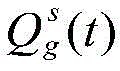
the active output of the unit g in the t-th time period under the scene s is obtained; u shape
g(t) is a variable of 0-1, which represents the recovery state of the unit g in the t-th time period, if the unit g is recovered, the unit g is 1, otherwise, the unit g is 0; p
CR,gThe starting power of the unit g is obtained; t is the total number of the optimized time periods, and delta T is the unit time step.
Preferably, the constraint conditions of the black-start dynamic path restoration optimization model of the power system cooperatively matching the new energy with the stored energy include: the system comprises a node power balance constraint, a line power flow constraint, a conventional unit starting and running constraint, a pumped storage unit constraint, a new energy unit constraint, a single input load power constraint, a generator self-excitation constraint, a network connection constraint and a system running constraint.
Preferably, the step of taking the recovery operation of each element in the power grid under the complete time scale into consideration, and considering the electric quantity constraint of the energy storage power station, the uncertainty of the output of the new energy and the positions of the units, the step of establishing the black-start dynamic path recovery optimization model of the power system with the cooperation of the new energy and the energy storage further includes the step of carrying out linearization processing on the relevant constraint, and simultaneously carrying out linearization processing on the model of the generator.
Preferably, the optimal recovery sequence and the corresponding recovery path of each unit and load in the system are obtained by solving the optimization model, the uncertainty of the new energy is marked in multiple scenes, and the influence of the uncertainty of the output of the new energy on the black start process of the power grid under the multiple scenes is comprehensively considered.
Preferably, the solving of the optimization model to obtain the optimal recovery sequence and the corresponding recovery path of each unit and load in the system further includes considering that the occurrence probability of each scene is different, and the weight of the scene with the high occurrence probability can be increased in a targeted manner.
The method of the invention has the following advantages:
1. the invention combines the black start of the unit, the reconstruction stage of the net rack and the comprehensive load recovery stage of the black start of the power system into one problem to be solved, realizes the coupling of multiple time intervals, obtains a set of black start schemes of the whole system under the complete time scale, and solves the problem of inconsistent connection of each stage possibly caused by the solution by stages.
2. The invention considers the electric quantity constraint of the energy storage power station, the uncertainty of the output of the new energy and the positions of all the units, realizes the cooperative matching of the new energy and the energy storage power station, realizes the complementation of the new energy and the energy storage power station in time and space, improves the stability in the recovery process and solves the problem of insufficient black start resources possibly existing in partial areas.
3. The invention carries out linearization processing on the related constraint and simultaneously carries out linearization processing on the model of the generator, thereby linearizing the whole model and improving the accuracy and the robustness of model solution.
4. The invention uses multiple scenes to mark the uncertainty of the new energy, and comprehensively considers the influence of the uncertainty of the new energy output under the multiple scenes on the black start process of the power grid, so that the solved black start scheme is feasible in the whole scene and has the maximum expected value. Meanwhile, the different occurrence probabilities of all scenes are considered, and the weight of the scene with the high occurrence probability can be increased in a targeted manner, so that the optimization result is more consistent with the actual situation.
Detailed Description
The following examples are intended to illustrate the invention but are not intended to limit the scope of the invention. In order to make the objects, technical solutions and advantages of the embodiments of the present invention clearer, the technical solutions of the embodiments of the present invention will be clearly and completely described below with reference to the drawings of the embodiments of the present invention. It is to be understood that the embodiments described are only a few embodiments of the present invention, and not all embodiments. All other embodiments, which can be derived by a person skilled in the art from the described embodiments of the invention without any inventive step, are within the scope of protection of the invention.
As shown in fig. 1, the present invention provides a method for recovering a black start path of an electric power system in which new energy and stored energy cooperate with each other, comprising the following steps:
1) determining the time period and step length of the problem research, and collecting the calculation data of each element in the system, wherein the method comprises the following steps: the method comprises the following steps of (1) operating parameters and the number of various units, line parameters, a prediction sequence of loads in a corresponding time period and various new energy output scenes; the unit operation parameters comprise rated capacity, minimum technical output, climbing rate, station electric power and starting time of the thermal power unit, rated capacity, climbing rate, pumping and generating hydroelectric conversion factors, power of a water pump motor, initial water quantity, upper and lower limits of reservoir capacity of the pumping and generating energy storage unit, rated capacity and power factor of the new energy unit. The line parameters of the invention include line impedance, susceptance to ground, maximum active power limit, and maximum reactive power limit.
2) The method comprises the steps of considering recovery operation of each element in a power grid under a complete time scale, considering electric quantity constraint of an energy storage power station, uncertainty of output of new energy and positions of units, and establishing a black-start dynamic path recovery optimization model of the power system, wherein the new energy and the energy storage cooperate with each other and have a target function and constraint conditions; the objective function is the recovery load electric quantity and the conventional unit generating capacity during the maximum system recovery period; the probability of each scene occurrence is introduced into the objective function, and the corresponding objective function is as follows: :
in the formula, S is a scene set; n is a node set; g is a generator set which comprises a black start generator set and a non-black start thermal generator set; p is a radical of
sIs the probability of occurrence of scene s; p
d,iIs the active load demand of node i; u shape
d,i(t) is a variable from 0 to 1, which represents the recovery state of the load on the node i in the t-th period, if the load is in the recovered state in the t-th period, the value is 1, otherwise, the value is 0;
the active output of the unit g in the t-th time period under the scene s is obtained; u shape
g(t) is a variable of 0-1, which represents the recovery state of the unit g in the t-th time period, if the unit g is recovered, the unit g is 1, otherwise, the unit g is 0; p
CR,gThe starting power of the unit g is obtained; t is the total number of the optimized time intervals, delta T is the unit time step, and the constraint conditions are equations (2) - (31).
The constraint conditions of the black-start dynamic path recovery optimization model of the power system cooperatively matched by the new energy and the stored energy comprise: the system comprises a node power balance constraint, a line power flow constraint, a conventional unit starting and running constraint, a pumped storage unit constraint, a new energy unit constraint, a single input load power constraint, a generator self-excitation constraint, a network connection constraint and a system running constraint.
The node power balance constraint is expressed as:
wherein,
wherein G (i) represents a generator set positioned at a node i, and the generator set comprises a black-start generator set and a non-black-start thermal generator set; r (i) is a new energy generator set positioned at a node i; br (i) represents a line set connected to the node i; q
d,iThe reactive load demand of the node i is;
the reactive power output of the unit g in the t-th time period under the scene s is obtained;
the active power and the reactive power of a new energy source unit r in a scene s in a time period t are sent out;
respectively the active power and the reactive power flowing from the i node to the j node through the line ij in the t period under the scene s; v
i s(t) is the voltage amplitude of the node i in the time period t under the scene s; u shape
ij(t) is a variable of 0-1, which represents the recovery state of the line ij in the period t, if the recovery state is 1, otherwise, the recovery state is 0; u shape
i(t) is a variable of 0-1, which represents the recovery state of the node i in the period t, if the node i is recovered, the node i is 1, otherwise, the node i is 0; b is
sh,i0Is a parallel susceptance at node i, B
sh,ijIs the ground susceptance of line ij;
representing the reactive power injected to ground generated by the parallel susceptance on node i during time t under scene s;
represents the injection of reactive power to ground through node i, generated by the line ij to ground susceptance during time t under scenario s;
is the upper voltage limit of node i.
The line flow constraint is expressed as:
in the formula,
the voltage phase angle of a node i in a time period t under a scene s;
respectively the upper limits of active and reactive power allowed to flow on line ij.
The starting and running constraints of the conventional unit are expressed as follows:
wherein,
in the formula,
the variable is introduced for representing the output difference of the current time period of the unit g relative to the previous time period in the scene s; t is
CR,gCharging time required for starting the unit g for service electricity; k
R,gThe climbing rate of the unit g; t is
up,gThe technical output of the unit g from grid connection to climbing to minimum
The time required;
the upper limit of active output of the unit is set;
the upper and lower limit of the reactive power output of the unit g.
The pumped-storage unit constraint comprises:
1) the pumping \ power generation constraint is expressed as:
the pumping power of the pumped storage unit in the scene s in the period t is shown as D, the power of the water pump motor is shown as D,
the variable is 0-1, the pumping state of the pumped storage unit in the time period t is represented, if the variable is 1, the unit pumps water in the time period, and if the variable is not 1, the unit does not pump water;
the active power output by the pumped storage unit in the t period under the scene s is represented,
active power is generated for the pumped storage unit; u shape
BAnd (t) is a variable of 0-1, and represents the power generation state of the pumped storage unit in the t period, if the variable is 1, the unit generates power in the period, otherwise, the unit does not generate power.
2) Capacity constraint
In the formula,
respectively are the upper limit and the lower limit of the storage capacity,
the water quantity of the reservoir is t time period; h
gIs a hydroelectric conversion factor in the state of power generation, H
pIs a water-electricity conversion factor in a water pumping state.
The new energy unit constraint is expressed as:
in the formula,
the maximum possible active power of a new energy source unit r in a time period t under a scene s is obtained; u shape
i(t) is a variable of 0 to 1, which represents the recovery state of the node i, if the node i is recovered, the value is 1, otherwise, the value is 0;
is the power factor angle of the new energy machine set.
The single input load power constraint is expressed as:
in the formula,. DELTA.fmaxThe maximum frequency deviation value allowed for the normal operation of the system; pN,gIs the rated active power of the unit g; f. ofd,gIs the frequency response value of the unit g.
The self-excitation constraint of the generator is represented as follows:
in the formula, KCB,gShort-circuit ratio of unit g, SN,gIs the rated capacity of the unit.
The network connectivity constraint is expressed as:
Ui(t)≥Ug(t),g∈G(i) (26)
Ui(t)≥Ud,i(t) (27)
Uij(t)≤Ui(t-1)+Uj(t-1) (30)
the system operation constraint is expressed as:
in the formula, thetamax、θminRespectively, the upper and lower limits of the phase angle of the node voltage, VminThe lower limit of the node voltage amplitude.
The constraint conditions of the black-start dynamic path recovery optimization model of the power system cooperatively matched by the new energy and the stored energy comprise: the system comprises a node power balance constraint, a line power flow constraint, a conventional unit starting and running constraint, a pumped storage unit constraint, a new energy unit constraint, a single input load power constraint, a generator self-excitation constraint, a network connection constraint and a system running constraint.
3) And solving the model to obtain the optimal recovery sequence and the corresponding recovery path of each unit and load in the system.
The method specifically comprises the steps of combining the black start of the unit of the black start of the power system, the reconstruction stage of the net rack and the comprehensive load recovery stage into one problem to solve, realizing multi-period coupling and obtaining a set of black start scheme of the whole system under a complete time scale.
The recovery operation of each element in the power grid under the complete time scale is considered, the electric quantity constraint of the energy storage power station, the uncertainty of the output of the new energy and the positions of all the units are considered, the black-start dynamic path recovery optimization model of the power system with the collaborative cooperation of the new energy and the energy storage is established, the electric quantity constraint of the energy storage power station, the uncertainty of the output of the new energy and the positions of all the units are considered, and the collaborative cooperation of the new energy and the energy storage power station is achieved.
Simulation calculation example:
the
new england 10 machine 39 node system is adopted for measurement and calculation, and the network topology diagram is shown in figure 2. The study time ranged from 4 hours (240 minutes) with a 15 minute step size. The starting time of the thermal power generating unit is set to be 30min, and the power factor of the new energy source unit
All set to be 0.9, the power D of a water pump motor of the pumped storage unit is set to be 200MW, and the initial water quantity of the reservoir is 9.782 multiplied by 10
5L, other specific parameters of the thermal power generating unit are shown in a table 1, other parameters of the pumped storage unit are shown in a table 2, the installed capacity of the new energy unit is shown in a table 3, the prediction sequence of the load in the corresponding time period is shown in a table 4, and the ratio of the available capacity of the new energy to the installed capacity under the selected 10 scenes is shown in a table 5.
TABLE 1 thermal power generating unit parameters
TABLE 2 pumped storage group parameters
TABLE 3 Capacity of Assembly machine for New energy machine
TABLE 4 predicted load within recovery time period
Table 510 ratio of available capacity of new energy to installed capacity in scene
The resulting solved generator and load recovery sequence is shown in table 6,
TABLE 6 units and load recovery sequence
The method comprises the steps of considering recovery operation of each element in a power grid under a complete time scale, considering electric quantity constraint of an energy storage power station, uncertainty of output of new energy and positions of units, establishing a black-start dynamic path recovery optimization model of the power system with the new energy and the energy storage in a cooperative mode, carrying out linearization processing on related constraint, carrying out linearization processing on a model of a generator, providing a linearized optimization model, and improving accuracy and robustness of model solution.
The optimal recovery sequence and the corresponding recovery path of each unit and load in the system are obtained by solving the optimization model, the uncertainty of the new energy is carved in multiple scenes, the influence of the uncertainty of the new energy output in the multiple scenes on the black start process of the power grid is comprehensively considered, the optimization result is feasible in a full scene, and the expected value is maximum.
Deterministic optimization is performed under a single scene, that is, only one scene is considered to solve the model provided by the invention, 10 scenes provided by the invention are added, and then a group of scenes with 0 output of new energy are added, so that 11 groups of black start schemes can be obtained, and the corresponding relation is shown in fig. 3. The black start scheme shown in table 6 is referred to as "black start scheme 12". When the actual recovery stage of the system is respectively in scenes 1 to 10, 12 black start schemes are respectively applied to the recovery of the system, that is, according to the black start schemes 1 to 12, in the model provided by the invention, 0 to 1 variables except the relevant variables of the black start unit are fixed, the model is solved under the condition of only considering one scene, and the obtained scheme feasibility and the average objective function value of the feasible scene are shown in table 7:
TABLE 7 feasibility and recovery Effect of different Black Start scenarios
From table 7, it can be seen that the black start scheme obtained by performing deterministic optimization on a single scene is applied to the black start of the system in other scenes, although the average objective function value of the feasible scenes is relatively high, the applicable scenes of the schemes are limited, and the more the applicable scenes are, the smaller the average objective function value is, and when the difference between the actual scene of the system and the preset scene is large, the system recovery process may not meet the partial constraint of the system safety and stability recovery, thereby causing the system recovery failure, and further causing greater economic loss. The black start scheme 11 obtained by considering the output of the new energy 0 is suitable for system black start in all the scenes, but the average objective function value is reduced by 4.13% compared with the black start scheme 12 obtained by randomly optimizing multiple scenes, namely the load recovery electric quantity and the conventional unit electric quantity in the whole recovery process are smaller, and the economy is slightly poor. Therefore, the black start scheme obtained by multi-scene random optimization balances universality and economy, and reduces economic loss possibly caused by major power failure accidents while fully considering the uncertainty of new energy.
Fig. 4 shows variation curves of the maximum value, the minimum value and the average value of the node voltage of the whole network when the black start scheme 11 and the black start scheme 12 are black start schemes, taking the scene 3 with rich new energy resources and large output variation amplitude as an example. As shown in fig. 4, the average voltage values do not differ much under the two black start schemes; in the early net rack reconstruction stage, however, the black start scheme 12 effectively inhibits the rise of the system voltage level compared with the black start scheme 11; the black start scheme 12 effectively suppresses voltage droop that may be caused by load shedding compared to the black start scheme 11 during the full load recovery phase of time periods 10-14. Therefore, the black start scheme 12 can better utilize the reactive power regulation capability of the whole network unit, enhance the voltage stability in the recovery process and reduce the probability of black start failure.
The step of solving the optimization model to obtain the optimal recovery sequence and the corresponding recovery path of each unit and load in the system further comprises the step of considering the difference of the occurrence probability of each scene, and the weight of the scene with high occurrence probability can be increased in a targeted manner.
Table 8 shows the change in the load recovery capacity throughout the recovery process under different ratios of the installed capacity of the new energy. As shown in table 8, as the installed capacity of the new energy decreases, the load recovery electric quantity in the recovery process also decreases, which indicates that the grid connection of the new energy unit enhances the power generation capacity of the system, so that the system can recover the load as much as possible, and thus the load recovery electric quantity in the recovery process of the whole system is obviously greater than those of the other two strategies, and the economic loss caused by the whole power failure accident is reduced.
TABLE 8 load recovery capacity under different new energy installed capacity
Although the invention has been described in detail above with reference to a general description and specific examples, it will be apparent to one skilled in the art that modifications or improvements may be made thereto based on the invention. Accordingly, such modifications and improvements are intended to be within the scope of the invention as claimed.