Disclosure of Invention
The invention aims to provide a battery management system with hybrid switching devices capable of being expanded in parallel.
To achieve the above object, in one embodiment of the present invention, a battery management system with hybrid switching devices expandable in parallel is provided, including:
the system comprises a bus control unit and a branch control unit;
the bus control unit comprises a main controller and a first switch module; the main controller is connected with the first switch module and controls the working condition of the first switch module; the first switch module is connected in series to the power supply main loop and used for controlling the on-off state of the power supply main loop;
the first switch module comprises a charging protection switch K1 and a discharging protection switch K2; the main controller cuts off the charging protection switch K1 when charging overcurrent and cuts off the discharging protection switch K2 when discharging overcurrent;
the power supply main loop is connected with a plurality of branch control units in parallel, and each branch control unit comprises a battery module, a second switch module, a branch controller and a detection module;
the second switch module comprises a shunt circuit breaker Bk1, the branch controller controls the on-off state of the second switch module, and the second switch module is connected in series between the battery module and the power supply main loop;
the detection module of the branch control unit is used for detecting and acquiring the physical information of the battery;
the branch controller is connected with the main controller and uploads the acquired physical information of the battery to the main controller; and the main controller sends a control command to the branch controller according to the acquired information to control the working states of the battery module and the second switch module.
In a preferred scheme of the invention, the power supply main loop comprises a positive pole loop and a negative pole loop, and the first switch module is connected in series into the negative pole loop.
In a preferred scheme of the invention, the charging protection switch K1 comprises a charging diode and a charging protection relay Q1, and the discharging protection switch K2 comprises a discharging diode and a discharging protection relay Q2; the charging diode and the discharging diode are connected in series in an opposite direction, the charging protection relay Q1 is connected with the charging diode in parallel, and the discharging protection relay Q2 is connected with the discharging diode in parallel; the main controller is connected with the charging protection relay Q1 and the discharging protection relay Q2 and controls the working conditions of the charging protection relay Q1 and the discharging protection relay Q2.
In the preferred scheme of the invention, the second switch module is provided with a shunt coil and a shunt release matched with the shunt coil, and the branch controller controls the on-off state of the shunt coil; an auxiliary switch S1 is connected in series on the shunt coil, the auxiliary switch S1 is connected with the shunt release, the auxiliary switch S1 is driven to be disconnected when the shunt release is disconnected, and the auxiliary switch S1 is driven to be closed when the shunt release is closed.
In a preferred scheme of the invention, the detection module of the branch line control unit comprises a voltage detection module, a temperature detection module and an electric quantity detection module.
In the preferred scheme of the invention, the branch controller transmits the signal to the main controller through a CAN bus, a 485 bus or a WIFI communication mode.
In the preferred scheme of the invention, the branch control unit comprises a battery equalizer, the battery equalizer is connected with the battery module and the branch controller, and the branch controller controls the equalization mode of the battery equalizer according to the instruction of the main controller.
In a preferred embodiment of the present invention, the balancing method of the spur controller includes:
(1) the main controller acquires the battery physical information of each battery module through the branch controllers, compares the voltage difference among the battery modules, and charges each battery monomer in the battery module with lower voltage through the active equalization circuit, so that the voltage of the whole battery module is gradually increased, and the inter-touch equalization is realized;
(2) and comparing the voltage difference between each battery monomer in each battery module, and charging the battery monomer with lower voltage through the active equalization circuit.
In summary, the invention has the following advantages:
1. the main controller of the invention acquires the states and signals of all branch controllers, judges through detecting the acquired information, and then can control the on-off state of the main power supply loop through the main controller; meanwhile, each branch control unit is provided with a branch controller, and the branch controller can control the on-off state of the battery module through the second switch module according to the detected information, so that the battery management system has double guarantees and improves the safety.
2. The power supply main loop is provided with a first switch module, wherein the first switch module is formed by reversely connecting two MOS body diodes in series to form a charging protection switch K1 and a discharging protection switch K2; the MOS switch has the advantage of high speed, can realize the functions of short-circuit protection and overcurrent protection, and can automatically recover after the fault is relieved.
3. The invention adopts a dual protection structure, thereby realizing dual redundancy, and when malignant accidents such as mos tube breakdown, direct connection fault and relay adhesion are caused, the second switch module adopts a pure physical structure to reliably break the current, thereby ensuring the system safety.
4. The invention can select any battery module to be connected in parallel, thereby realizing the parallel expansion of the battery capacity.
Detailed Description
Referring to fig. 1 to 3, the present invention provides a battery management system with hybrid switching devices expandable in parallel, including a bus control unit and a branch control unit.
The bus control unit comprises a main controller and a first switch module; the main controller is connected with the first switch module and controls the working condition of the first switch module; the first switch module is connected in series to the power supply main loop and used for controlling the on-off state of the power supply main loop. And the main controller judges according to the acquired data after obtaining the battery related data from the branch controllers so as to judge whether the battery is abnormal or not and performs related actions after corresponding conditions occur.
The first switch module comprises a charging protection switch K1 and a discharging protection switch K2; the main controller cuts off the charging protection switch K1 when charging overcurrent and cuts off the discharging protection switch K2 when discharging overcurrent, the charging current information can be summarized according to the information uploaded by the branch controllers, and similarly, the discharging current information is judged according to the information uploaded by the branch controllers.
For example, when the battery is overcharged, the charging overheat occurs, when the charging overcurrent occurs, the charging protection switch K1 is turned off, and when the battery is overdischarged, the discharging overheat occurs; therefore, the discharge protection switch K2 is cut off in case of discharge overcurrent and short circuit.
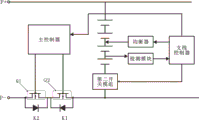
Referring to fig. 2, a power supply main loop is connected in parallel with a plurality of branch control units, and each branch control unit includes a battery module, a second switch module, a branch controller, and a detection module. Each branch control unit is connected in parallel to the power supply main loop, so that the capacity expansion can be realized by increasing the number of the branch control units.
Referring to fig. 3, the second switch module comprises a shunt breaker Bk1, and the branch controller controls the on/off state of the second switch module, and the second switch module is connected in series between the battery module and the main power supply loop. When the branch controller detects that the state of the related battery exceeds the threshold value through the detection module, the connection between the battery module of the branch control unit and the power supply main loop can be cut off by controlling the second switch module. The branch controller can control the connection or disconnection of the battery module and the power supply main loop through the second switch module, so that the safety of a battery system can be protected, and the influence on the whole battery management system caused by the problem of a certain battery module can be avoided; the auxiliary cutting can be performed when the operation such as maintenance is performed.
The second switch module is a shunt circuit breaker Bk1, which comprises an overcurrent protection switch, a thermal protection switch, a leakage protection switch, a shunt release, a shunt coil and an auxiliary switch S1. The overcurrent protection switch, the thermal protection switch and the leakage protection switch can realize the functions of short-circuit protection, high-temperature protection, leakage protection and the like. For example, when a short circuit or temperature rise and current and voltage overrun are found, the switch is automatically switched off. The shunt circuit breaker Bk1 can also be provided with a shunt release on the basis, and the shunt release is realized through a shunt coil so as to achieve other protection purposes.
The shunt circuit breaker Bk1 can be trip-protected in three ways:
(1) the branch controller energizes the shunt coil, and the shunt release triggers tripping;
(2) short-circuit current flows through the shunt circuit breaker Bk1 to trigger the magnetic tripping mechanism, so that short-circuit protection tripping is realized;
(3) when the current through the shunt breaker Bk1 exceeds the rated value, the accumulated heat triggers a thermal trip.
The detection module of the branch control unit is used for detecting and acquiring the physical information of the battery; the branch controller is connected with the main controller, and the branch controller transmits signals to the main controller through a CAN bus, a 485 bus or a WIFI communication mode.
The branch controller uploads the collected physical information of the battery to the main controller; and the main controller sends a control command to the branch controller according to the acquired information to control the working states of the battery module and the second switch module. The detection module of the branch control unit comprises a voltage detection module, a temperature detection module and an electric quantity detection module.
In an embodiment of the present invention, the power supply main circuit includes a positive circuit and a negative circuit, and the first switch module is connected in series to the negative circuit.
In order to implement the present invention, any one of the charge protection switch K1 and the discharge protection switch K2 that can realize charge/discharge protection may be selected.
For example, referring to fig. 2, the charge protection switch K1 includes a charge diode and a charge protection relay Q1, and the discharge protection switch K2 includes a discharge diode and a discharge protection relay Q2; the charging diode and the discharging diode are connected in series in an opposite direction, the charging protection relay Q1 is connected with the charging diode in parallel, and the discharging protection relay Q2 is connected with the discharging diode in parallel; the main controller is connected with the charging protection relay Q1 and the discharging protection relay Q2 and controls the working conditions of the charging protection relay Q1 and the discharging protection relay Q2.
For example, the first switch module is formed by connecting two MOS body diodes in series in reverse to form a charging protection switch K1 and a discharging protection switch K2.
In a specific embodiment of the invention, the second switch module is provided with a shunt coil and a shunt release matched with the shunt coil, and the branch controller controls the on-off state of the shunt coil; an auxiliary switch S1 is connected in series on the shunt opening coil, the auxiliary switch S1 is mechanically connected with the shunt opening release, the shunt opening release drives the auxiliary switch S1 to be opened when being opened, the shunt opening release drives the auxiliary switch S1 to be closed when being manually restored to be closed, the auxiliary switch S1 is used for protecting the shunt opening coil, and the auxiliary switch S1 can be opened after the shunt opening coil is powered off.
Shunt opening coil can not be circular telegram for a long time, otherwise burns out easily, consequently protects through auxiliary switch S1, after shunt opening coil circular telegram, will trigger shunt opening release for second switch module Bk1 disconnection, and then the disconnection of disconnection battery module and power supply total return circuit, however after shunt opening release, if do not have auxiliary switch, shunt opening coil will be circular telegram always this moment, must be burnt out. Therefore, the auxiliary switch is arranged to be linked with the shunt release, so that when the shunt breaker is disconnected, the shunt coil is also disconnected.
The shunt coils need to be independently powered, so that the branch controller controls the input current of the shunt coils, the negative poles of the shunt coils can be connected with a negative pole loop, and an auxiliary switch S1 is connected between the shunt coils and the branch controller in series.
In the embodiment of the invention, the branch control unit comprises a battery equalizer, the battery equalizer is connected with the battery module and the branch controller, and the branch controller controls the equalization mode of the battery equalizer according to the instruction of the main controller.
The battery equalizer is an outsourced electronic component, is a HA01 battery equalizer and is used for keeping the charge-discharge balance among storage batteries in a storage battery pack connected in series.
The balancing mode of the branch controller comprises the following steps:
(1) the main controller acquires the battery physical information of each battery module through the branch controllers, compares the voltage difference among the battery modules, and charges each battery monomer in the battery module with lower voltage through the active equalization circuit, so that the voltage of the whole battery module is gradually increased, and the inter-touch equalization is realized;
(2) and comparing the voltage difference between each battery monomer in each battery module, and charging the battery monomer with lower voltage through the active equalization circuit.
While the present invention has been described in detail with reference to the illustrated embodiments, it should not be construed as limited to the scope of the present patent. Various modifications and changes may be made by those skilled in the art without inventive step within the scope of the appended claims.