Disclosure of Invention
In view of the above, the present invention provides a method, an apparatus, a device and a storage medium for identifying malware, and aims to solve the technical problem in the prior art that the accuracy of identifying malware is not high.
In order to achieve the above object, the present invention provides a method for identifying malware, including:
behavior attribute data of various types of software are acquired from a preset data source, and preset labels are respectively marked for the various types of software;
respectively splicing the behavior attribute data of each software into initial time sequence data corresponding to the software according to the time sequence, and performing separation, statistics and regular replacement operation on each initial time sequence data to obtain target time sequence data corresponding to each software;
respectively extracting characteristic information of each target time sequence data, generating a sample set according to each characteristic information and a corresponding preset label, and training a preset neural network model set based on the sample set to obtain a first recognition model, a second recognition model and a third recognition model;
respectively inputting the characteristic information of the software to be recognized into a first recognition model, a second recognition model and a third recognition model to obtain corresponding first recognition results, second recognition results and third recognition results, and obtaining target recognition results of the software to be recognized based on the first recognition results, the second recognition results, the third recognition results and preset judgment rules.
Preferably, the performing separation, statistics, and regular replacement operations on each initial time-series data to obtain target time-series data corresponding to each software includes:
separating the file names of the network transmission information, the registry information, the process information and the dynamic link library information in the initial time sequence data by using separators;
counting the occurrence frequency of each behavior in the initial time sequence data, and adding the occurrence frequency of each behavior to the initial time sequence data;
and deleting the address information in the initial time series data by using a preset regular expression.
Preferably, the extracting the feature information of each of the target time-series data includes:
performing frequency domain decomposition on the time domain information of each target time sequence data based on a discrete wavelet filter group to obtain a plurality of time sequence sub-band signals of different frequency bands;
and performing feature extraction on each time sequence sub-band signal to obtain feature information of each target time sequence data.
Preferably, the training process of the first recognition model and the second recognition model includes:
dividing the sample set into a training set and a verification set according to a preset proportion;
training a convolutional neural network model by using each characteristic information and each preset label in the training set, and verifying the accuracy of the convolutional neural network model and the circular neural network model by using each characteristic information and each preset label in the verification set every preset period; and
and finishing training when the accuracy is greater than a preset threshold value, and obtaining the first recognition model and the second recognition model.
Preferably, the training of the preset neural network model based on the sample set to obtain a third recognition model includes:
inputting the target time sequence data in the sample set and a preset label to a long-term and short-term memory neural network;
preprocessing the target time sequence data according to an input layer of the long-term and short-term memory neural network;
constructing a mapping relation between the preprocessed target time series data and a preset label according to a hidden layer of the long-term and short-term memory neural network, and storing the mapping relation;
and taking the long-short term memory neural network stored with the mapping relation as the third recognition model.
Preferably, the obtaining of the target identification result of the software to be identified based on the first identification result, the second identification result, the third identification result and the preset judgment rule includes:
when any two recognition results of the first recognition result, the second recognition result and the third recognition result are first type software, taking the first type software as the target recognition result;
when only one or no identification result in the first identification result, the second identification result and the third identification result is the first type of software, judging that the software to be identified is the second type of software;
and when the software to be identified is judged to be the second type of software, and the first identification result, the second identification result and the third identification result are different, judging that the software to be identified is the third type of software, wherein the third type of software belongs to the second type of software.
Preferably, the method further comprises:
and feeding back the target identification result to a terminal corresponding to the software to be identified, and sending preset prompt information to the terminal.
In order to achieve the above object, the present invention further provides a malware recognition apparatus, including:
an acquisition module: the behavior attribute data acquisition module is used for acquiring behavior attribute data of various types of software from a preset data source and respectively labeling preset labels for various types of software;
splicing modules: the system comprises a data processing module, a data processing module and a data processing module, wherein the data processing module is used for splicing behavior attribute data of each software into initial time sequence data corresponding to the software according to time sequence, and performing separation, statistics and regular replacement operation on the initial time sequence data to obtain target time sequence data corresponding to each software;
a training module: the system comprises a sample set, a first recognition model, a second recognition model and a third recognition model, wherein the sample set is used for training a preset neural network model set to obtain the first recognition model, the second recognition model and the third recognition model;
an identification module: the software target identification method comprises the steps of inputting characteristic information of software to be identified into a first identification model, a second identification model and a third identification model respectively to obtain corresponding first identification results, second identification results and third identification results, and obtaining target identification results of the software to be identified based on the first identification results, the second identification results, the third identification results and preset judgment rules.
In order to achieve the above object, the present invention also provides an electronic device, including:
at least one processor; and the number of the first and second groups,
a memory communicatively coupled to the at least one processor; wherein,
the memory stores a program executable by the at least one processor to enable the at least one processor to perform any of the steps of the malware identification method as described above.
To achieve the above object, the present invention also provides a computer-readable storage medium storing a malware recognition program, which when executed by a processor, implements any of the steps of the malware recognition method described above.
According to the method, the device, the equipment and the storage medium for identifying the malicious software, the behavior attribute data of various types of software is used as time sequence sample data, three different identification models are obtained through training, the behavior information of the software is identified through the three identification models, whether the software is the malicious software or not is comprehensively judged according to the identification result of each identification model, the situation that the malicious software is mistakenly identified as normal software after secondary development or shell adding can be avoided, and therefore the accuracy of identifying the malicious software is improved.
Detailed Description
In order to make the objects, technical solutions and advantages of the present invention more apparent, the present invention is described in further detail below with reference to the accompanying drawings and embodiments. It should be understood that the specific embodiments described herein are merely illustrative of the invention and are not intended to limit the invention. All other embodiments, which can be derived by a person skilled in the art from the embodiments given herein without making any creative effort, shall fall within the protection scope of the present invention.
The invention provides a method for identifying malicious software. Fig. 1 is a schematic method flow diagram illustrating an embodiment of the malware identification method of the present invention. The method may be performed by an electronic device, which may be implemented by software and/or hardware. The identification method of the malicious software comprises the following steps:
step S10: behavior attribute data of various types of software are acquired from a preset data source, and preset labels are respectively marked for the various types of software.
In this embodiment, the predetermined data source may be a log file of multiple types of software stored in a local database or a third-party database, where the log file records behavior attribute data of the multiple types of software, and the behavior attribute data of the software includes but is not limited to: network transmission information, registry information, process information, interface information for calling an operating system, a called dynamic link library and file read-write information. The network transmission information comprises target IP in tls, udp, tcp, http, https, smtp, dns and domain, the registry information comprises read and opened registry entries, the interface information for calling the operating system comprises a called interface name and time for calling the interface, and the process information comprises a process ID and a corresponding parent process ID.
The types of the software comprise normal software, mining software, worm software, trojan software, Lexuan software, advertising software and spyware, and after behavior attribute data of various types of software is acquired, corresponding labels are marked for the types of the software according to the types of the software.
Step S20: and respectively splicing the behavior attribute data of each software into initial time sequence data corresponding to the software according to the time sequence, and performing separation, statistics and regular replacement operation on each initial time sequence data to obtain target time sequence data corresponding to each software.
In this embodiment, after behavior attribute data of multiple types of software is acquired, the behavior attribute data is spliced into initial time series data according to a time sequence, and since the behavior attribute data may have invalid data or repeated data, in one embodiment, the behavior attribute data may be cleaned before being spliced into the initial time series data.
And then, performing relevant preprocessing operation on the initial time sequence data, and additionally adding relevant behavior data to improve the accuracy of subsequent model identification. The preprocessing can be to perform separation, statistics, and regular replacement operations on the spliced initial time-series data to obtain target time-series data.
In an embodiment, the performing separation, statistics, and regular replacement operations on each initial time-series data to obtain target time-series data corresponding to each software includes:
A. separating the file names of the network transmission information, the registry information, the process information and the dynamic link library information in the initial time sequence data by using separators;
specifically, the network transmission information, the registry information, the process information, and the dynamic link library information in the initial time series data may be extracted according to a filtering driver, a hook, or the like, for example, by software extraction such as sysmon or procmon, the extracted network transmission information, registry information, process information, and dynamic link library information are integrated into one text file, and are separated by a special symbol (\\ 01), and are segmented by \01 before being converted into features, so as to process the file or program name with a space, because the complete path has actual meaning.
B. Counting the occurrence frequency of each behavior in the initial time sequence data, and adding the occurrence frequency of each behavior to the initial time sequence data;
since the behavior attribute data of the software acquired by the predetermined data source further includes the occurrence number of each behavior, the occurrence number of each behavior in the initial time-series data can be directly counted, for example, the occurrence number of the following behaviors is counted: network request number, request destination address blacklist IP number, blacklist IP proportion, registry open number and access number, white list registry access number and open number, and white list registry access proportion and open proportion. And the occurrence frequency is also used as the input of the model, and the behavior is associated with the occurrence frequency of the behavior, so that the accuracy of subsequent model identification is improved.
C. And deleting the address information in the initial time series data by using a preset regular expression.
And deleting hexadecimal expressions in the behavior program, and removing related address expressions from the initial time sequence data, wherein the hexadecimal expressions are all addresses basically and have no obvious relevance to the behaviors. The preset regular expression may include: "0 x [ a-f0-9] {8 }", "0 x [ a-f0-9] {16 }".
Step S30: respectively extracting characteristic information of each target time sequence data, generating a sample set according to each characteristic information and a corresponding preset label, and training a preset neural network model set based on the sample set to obtain a first recognition model, a second recognition model and a third recognition model.
In this embodiment, the extracting of the feature information may be extracting feature information in the target time series data according to an n-gram algorithm, or filtering the target time series data according to a chi-square test algorithm to filter feature vectors that have no correlation in the target time series data, and then generating a sample set of a training model according to the feature information of the target time series data and a preset tag, where the preset neural network model set includes a convolutional neural network, a cyclic neural network, and a long-short term memory neural network, the first recognition model may be obtained according to the convolutional neural network training, the second recognition model may be obtained according to the cyclic neural network training, and the third recognition model may be obtained according to the long-short term memory neural network training. Convolutional neural networks have no notion of timing, which is to identify timing features in a sample as a whole. The recurrent neural network has a concept of time sequence, and can associate each behavior in time sequence data for identification, but if the time sequence data is longer, the identification effect of the recurrent neural network is not ideal, and the long-short term memory neural network also has a better identification effect when identifying longer time sequence data. Therefore, the scheme utilizes the three models to identify the software to be identified.
In one embodiment, the extracting the feature information of each of the target time-series data includes:
performing frequency domain decomposition on the time domain information of each target time sequence data based on a discrete wavelet filter group to obtain a plurality of time sequence sub-band signals of different frequency bands;
and performing feature extraction on each time sequence sub-band signal to obtain feature information of each target time sequence data.
Because each time sequence sub-band signal corresponds to different frequency bands, the characteristics of the target time sequence data in different subdivided frequency bands can be extracted by extracting the characteristics of the time sequence sub-band signal of each frequency band, so that more characteristics of the time sequence data are obtained, and the accuracy of subsequent model prediction is improved.
In one embodiment, the training of the preset neural network model based on the sample set to obtain a first recognition model includes:
dividing the sample set into a training set and a verification set according to a preset proportion (for example, 4: 1);
training a convolutional neural network model by using each characteristic information and each preset label in the training set, and verifying the accuracy of the convolutional neural network model by using each variable and each dependent variable in the verification set every preset period (for example, every 1000 times of iteration); and
and finishing the training when the accuracy is greater than a preset threshold (for example, 90%), and obtaining the first recognition model.
The training process of the second recognition model is substantially the same as the training process of the first recognition model, and is not repeated herein.
In one embodiment, the training of the preset neural network model based on the sample set to obtain a third recognition model includes:
inputting the target time sequence data in the sample set and a preset label to a long-term and short-term memory neural network;
preprocessing the target time sequence data according to an input layer of the long-term and short-term memory neural network;
constructing a mapping relation between the preprocessed target time series data and a preset label according to a hidden layer of the long-term and short-term memory neural network, and storing the mapping relation;
and taking the long-short term memory neural network stored with the mapping relation as the third recognition model.
The long-short term memory neural network model is characterized in that on the basis of a common multilayer feedforward neural network, transverse connection among all units of a hidden layer is added, values of the neural units of a previous time sequence are transmitted to the current neural units through a weight matrix, so that the neural network has a memory function, in addition, the memory units are added in all the neural units of the hidden layer, so that memory information on the time sequence is controllable, and the memory and forgetting degree of previous information and current information can be controlled through a plurality of controllable gates (forgetting gate, input gate and output gate) during transmission among all the units of the hidden layer every time, so that the network has a long-term memory function.
Step S40: respectively inputting the characteristic information of the software to be recognized into a first recognition model, a second recognition model and a third recognition model to obtain corresponding first recognition results, second recognition results and third recognition results, and obtaining target recognition results of the software to be recognized based on the first recognition results, the second recognition results, the third recognition results and preset judgment rules.
In this embodiment, when an identification request sent by a user to identify whether software is malware is received, behavior attribute data of the software to be identified is obtained, where the request may include the behavior attribute data of the software to be identified, and may also include a storage path and an identifier of the behavior attribute data of the software to be identified. That is, the behavior attribute data of the software to be identified may be entered by the user at the time of submitting the request, or may be obtained from an address specified in the request after the user submits the request for identifying whether the software is malware.
Then, the behavior attribute data of the software to be recognized is spliced into initial time sequence data according to the time sequence, separation, statistics and regular replacement operations are performed on the initial time sequence data to obtain target time sequence data of the software to be recognized, feature information of the target time sequence data of the software to be recognized is extracted, the feature information is input into a first recognition model, a second recognition model and a third recognition model respectively to obtain corresponding first recognition results, second recognition results and third recognition results, the target recognition results of the software to be recognized are obtained according to the three recognition results and preset judgment rules, for example, the same two recognition results are used as the target recognition results, and when the three recognition results are different, the third recognition result is selected as the target recognition result.
In one embodiment, the obtaining of the target recognition result of the software to be recognized based on the first recognition result, the second recognition result, the third recognition result and the preset determination rule includes:
when any two recognition results of the first recognition result, the second recognition result and the third recognition result are first type software, taking the first type software as the target recognition result;
when only one or no identification result in the first identification result, the second identification result and the third identification result is the first type of software, judging that the software to be identified is the second type of software;
and when the software to be identified is judged to be the second type of software, and the first identification result, the second identification result and the third identification result are different, judging that the software to be identified is the third type of software, wherein the third type of software belongs to the second type of software.
The software to be identified is judged to be normal software when any two identification results in the first identification result, the second identification result and the third identification result are normal software, the software to be identified is judged to be malicious software when only one identification result or no identification result in the first identification result, the second identification result and the third identification result is normal software, and the software to be identified is judged to be mixed type malicious software when the software to be identified is judged to be malicious software and the three identification results are different from each other.
In one embodiment, the method further comprises:
and feeding back the target identification result to a terminal corresponding to the software to be identified, and sending preset prompt information to the terminal.
The recognition result of the software to be recognized is fed back to the preset terminal to prompt the user of the software type of the software to be recognized, for example, the prompt message may be "the software may be malware".
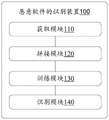
Referring to fig. 2, a functional block diagram of the apparatus 100 for identifying malware according to the present invention is shown.
The malware recognition apparatus 100 of the present invention may be installed in an electronic device. According to the implemented functions, the malware identification apparatus 100 may include an obtaining module 110, a splicing module 120, a training module 130, and an identification module 140. A module according to the present invention, which may also be referred to as a unit, refers to a series of computer program segments that can be executed by a processor of an electronic device and that can perform a fixed function, and that are stored in a memory of the electronic device.
In the present embodiment, the functions regarding the respective modules/units are as follows:
the obtaining module 110 is configured to obtain behavior attribute data of multiple types of software from a predetermined data source, and label preset labels for the multiple types of software respectively.
The splicing module 120 is configured to splice the behavior attribute data of each software into initial time sequence data corresponding to the software according to a time sequence, and perform separation, statistics, and regular replacement operations on each initial time sequence data to obtain target time sequence data corresponding to each software.
The training module 130: the device comprises a first recognition model, a second recognition model and a third recognition model, wherein the first recognition model, the second recognition model and the third recognition model are obtained by training a preset neural network model set based on a sample set.
The identification module 140 is configured to input feature information of the software to be identified into the first identification model, the second identification model, and the third identification model respectively to obtain a corresponding first identification result, a corresponding second identification result, and a corresponding third identification result, and obtain a target identification result of the software to be identified based on the first identification result, the second identification result, the third identification result, and a preset determination rule.
In an embodiment, the performing separation, statistics, and regular replacement operations on each initial time-series data to obtain target time-series data corresponding to each software includes:
separating the file names of the network transmission information, the registry information, the process information and the dynamic link library information in the initial time sequence data by using separators;
counting the occurrence frequency of each behavior in the initial time sequence data, and adding the occurrence frequency of each behavior to the initial time sequence data;
and deleting the address information in the initial time series data by using a preset regular expression.
In one embodiment, the extracting the feature information of each of the target time-series data includes:
performing frequency domain decomposition on the time domain information of each target time sequence data based on a discrete wavelet filter group to obtain a plurality of time sequence sub-band signals of different frequency bands;
and performing feature extraction on each time sequence sub-band signal to obtain feature information of each target time sequence data.
In one embodiment, the training process of the first recognition model and the second recognition model includes:
dividing the sample set into a training set and a verification set according to a preset proportion;
training a convolutional neural network model by using each characteristic information and each preset label in the training set, and verifying the accuracy of the convolutional neural network model and the circular neural network model by using each characteristic information and each preset label in the verification set every preset period; and
and finishing training when the accuracy is greater than a preset threshold value, and obtaining the first recognition model and the second recognition model.
In one embodiment, the training of the preset neural network model based on the sample set to obtain a third recognition model includes:
inputting the target time sequence data in the sample set and a preset label to a long-term and short-term memory neural network;
preprocessing the target time sequence data according to an input layer of the long-term and short-term memory neural network;
constructing a mapping relation between the preprocessed target time series data and a preset label according to a hidden layer of the long-term and short-term memory neural network, and storing the mapping relation;
and taking the long-short term memory neural network stored with the mapping relation as the third recognition model.
In one embodiment, the obtaining of the target recognition result of the software to be recognized based on the first recognition result, the second recognition result, the third recognition result and the preset determination rule includes:
when any two recognition results of the first recognition result, the second recognition result and the third recognition result are first type software, taking the first type software as the target recognition result;
when only one or no identification result in the first identification result, the second identification result and the third identification result is the first type of software, judging that the software to be identified is the second type of software;
and when the software to be identified is judged to be the second type of software, and the first identification result, the second identification result and the third identification result are different, judging that the software to be identified is the third type of software, wherein the third type of software belongs to the second type of software.
In one embodiment, the identification module 140 is further configured to:
and feeding back the target identification result to a terminal corresponding to the software to be identified, and sending preset prompt information to the terminal.
Fig. 3 is a schematic diagram of an electronic device 1 according to a preferred embodiment of the invention.
The electronic device 1 includes but is not limited to: memory 11, processor 12, display 13, and network interface 14. The electronic device 1 is connected to a network through a network interface 14 to obtain raw data. The network may be a wireless or wired network such as an Intranet (Intranet), the Internet (Internet), a Global System for Mobile communications (GSM), Wideband Code Division Multiple Access (WCDMA), a 4G network, a 5G network, Bluetooth (Bluetooth), Wi-Fi, or a communication network.
The memory 11 includes at least one type of readable storage medium including a flash memory, a hard disk, a multimedia card, a card type memory (e.g., SD or DX memory, etc.), a Random Access Memory (RAM), a Static Random Access Memory (SRAM), a Read Only Memory (ROM), an Electrically Erasable Programmable Read Only Memory (EEPROM), a Programmable Read Only Memory (PROM), a magnetic memory, a magnetic disk, an optical disk, etc. In some embodiments, the storage 11 may be an internal storage unit of the electronic device 1, such as a hard disk or a memory of the electronic device 1. In other embodiments, the memory 11 may also be an external storage device of the electronic device 1, such as a plug-in hard disk, a Smart Media Card (SMC), a Secure Digital (SD) Card, a Flash memory Card (Flash Card), and the like equipped with the electronic device 1. Of course, the memory 11 may also comprise both an internal memory unit and an external memory device of the electronic device 1. In this embodiment, the memory 11 is generally used for storing an operating system installed in the electronic device 1 and various application software, such as program codes of the identification program 10 of malware. Further, the memory 11 may also be used to temporarily store various types of data that have been output or are to be output.
Processor 12 may be a Central Processing Unit (CPU), controller, microcontroller, microprocessor, or other data Processing chip in some embodiments. The processor 12 is typically used for controlling the overall operation of the electronic device 1, such as performing data interaction or communication related control and processing. In this embodiment, the processor 12 is configured to execute the program code stored in the memory 11 or process data, for example, execute the program code of the malware recognition program 10.
The display 13 may be referred to as a display screen or display unit. In some embodiments, the display 13 may be an LED display, a liquid crystal display, a touch-sensitive liquid crystal display, an Organic Light-Emitting Diode (OLED) touch screen, or the like. The display 13 is used for displaying information processed in the electronic device 1 and for displaying a visual work interface, e.g. displaying the results of data statistics.
The network interface 14 may optionally comprise a standard wired interface, a wireless interface (e.g. WI-FI interface), the network interface 14 typically being used for establishing a communication connection between the electronic device 1 and other electronic devices.
Fig. 3 shows only the electronic device 1 with components 11-14 and the malware-identifying program 10, but it is to be understood that not all of the shown components are required to be implemented, and that more or fewer components may be implemented instead.
Optionally, the electronic device 1 may further comprise a user interface, the user interface may comprise a Display (Display), an input unit such as a Keyboard (Keyboard), and the optional user interface may further comprise a standard wired interface and a wireless interface. Alternatively, in some embodiments, the display may be an LED display, a liquid crystal display, a touch-sensitive liquid crystal display, an Organic Light-Emitting Diode (OLED) touch screen, or the like. The display, which may also be referred to as a display screen or display unit, is suitable for displaying information processed in the electronic device 1 and for displaying a visualized user interface, among other things.
The electronic device 1 may further include a Radio Frequency (RF) circuit, a sensor, an audio circuit, and the like, which are not described in detail herein.
In the above embodiment, the processor 12, when executing the malware recognition program 10 stored in the memory 11, may implement the following steps:
behavior attribute data of various types of software are acquired from a preset data source, and preset labels are respectively marked for the various types of software;
respectively splicing the behavior attribute data of each software into initial time sequence data corresponding to the software according to the time sequence, and performing separation, statistics and regular replacement operation on each initial time sequence data to obtain target time sequence data corresponding to each software;
respectively extracting characteristic information of each target time sequence data, generating a sample set according to each characteristic information and a corresponding preset label, and training a preset neural network model set based on the sample set to obtain a first recognition model, a second recognition model and a third recognition model;
respectively inputting the characteristic information of the software to be recognized into a first recognition model, a second recognition model and a third recognition model to obtain corresponding first recognition results, second recognition results and third recognition results, and obtaining target recognition results of the software to be recognized based on the first recognition results, the second recognition results, the third recognition results and preset judgment rules.
The storage device may be the memory 11 of the electronic device 1, or may be another storage device communicatively connected to the electronic device 1.
For detailed description of the above steps, please refer to the functional block diagram of the embodiment of the apparatus 100 for identifying malware in fig. 2 and the flowchart of the embodiment of the method for identifying malware in fig. 1.
In addition, an embodiment of the present invention further provides a computer-readable storage medium, where the computer-readable storage medium may be non-volatile or volatile. The computer readable storage medium may be any one or any combination of hard disks, multimedia cards, SD cards, flash memory cards, SMCs, Read Only Memories (ROMs), Erasable Programmable Read Only Memories (EPROMs), portable compact disc read only memories (CD-ROMs), USB memories, etc. The computer-readable storage medium includes a storage data area and a storage program area, the storage data area stores data created according to the use of the blockchain node, the storage program area stores a malware recognition program 10, and when executed by the processor, the malware recognition program 10 implements the following operations:
behavior attribute data of various types of software are acquired from a preset data source, and preset labels are respectively marked for the various types of software;
respectively splicing the behavior attribute data of each software into initial time sequence data corresponding to the software according to the time sequence, and performing separation, statistics and regular replacement operation on each initial time sequence data to obtain target time sequence data corresponding to each software;
respectively extracting characteristic information of each target time sequence data, generating a sample set according to each characteristic information and a corresponding preset label, and training a preset neural network model set based on the sample set to obtain a first recognition model, a second recognition model and a third recognition model;
respectively inputting the characteristic information of the software to be recognized into a first recognition model, a second recognition model and a third recognition model to obtain corresponding first recognition results, second recognition results and third recognition results, and obtaining target recognition results of the software to be recognized based on the first recognition results, the second recognition results, the third recognition results and preset judgment rules.
The specific implementation of the computer readable storage medium of the present invention is substantially the same as the specific implementation of the above-mentioned malware identification method, and will not be described herein again.
In another embodiment, in order to further ensure the privacy and security of all the data, all the data may be stored in a node of a block chain. Such as behavior attribute data and feature information, which may be stored in block link points.
It should be noted that the blockchain in the present invention is a novel application mode of computer technologies such as distributed data storage, point-to-point transmission, consensus mechanism, and encryption algorithm. A block chain (Blockchain), which is essentially a decentralized database, is a series of data blocks associated by using a cryptographic method, and each data block contains information of a batch of network transactions, so as to verify the validity (anti-counterfeiting) of the information and generate a next block. The blockchain may include a blockchain underlying platform, a platform product service layer, an application service layer, and the like.
It should be noted that the above-mentioned numbers of the embodiments of the present invention are merely for description, and do not represent the merits of the embodiments. And the terms "comprises," "comprising," or any other variation thereof, are intended to cover a non-exclusive inclusion, such that a process, apparatus, article, or method that comprises a list of elements does not include only those elements but may include other elements not expressly listed or inherent to such process, apparatus, article, or method. Without further limitation, an element defined by the phrase "comprising an … …" does not exclude the presence of other like elements in a process, apparatus, article, or method that includes the element.
Through the above description of the embodiments, those skilled in the art will clearly understand that the method of the above embodiments can be implemented by software plus a necessary general hardware platform, and certainly can also be implemented by hardware, but in many cases, the former is a better implementation manner. Based on such understanding, the technical solution of the present invention essentially or contributing to the prior art can be embodied in the form of a software product, which is stored in a storage medium (such as ROM/RAM, magnetic disk, optical disk) as described above and includes several instructions for enabling a terminal device (such as a mobile phone, a computer, an electronic device, or a network device) to execute the method according to the embodiments of the present invention.
The above description is only a preferred embodiment of the present invention, and not intended to limit the scope of the present invention, and all modifications of equivalent structures and equivalent processes, which are made by using the contents of the present specification and the accompanying drawings, or directly or indirectly applied to other related technical fields, are included in the scope of the present invention.