CN113434996B - Hoisting service scheduling method of prefabricated concrete structure tower crane - Google Patents
Hoisting service scheduling method of prefabricated concrete structure tower crane Download PDFInfo
- Publication number
- CN113434996B CN113434996B CN202110081704.6A CN202110081704A CN113434996B CN 113434996 B CN113434996 B CN 113434996B CN 202110081704 A CN202110081704 A CN 202110081704A CN 113434996 B CN113434996 B CN 113434996B
- Authority
- CN
- China
- Prior art keywords
- tower crane
- time
- hook
- travel time
- hoisting
- Prior art date
- Legal status (The legal status is an assumption and is not a legal conclusion. Google has not performed a legal analysis and makes no representation as to the accuracy of the status listed.)
- Active
Links
Images


Classifications
-
- G—PHYSICS
- G06—COMPUTING OR CALCULATING; COUNTING
- G06F—ELECTRIC DIGITAL DATA PROCESSING
- G06F30/00—Computer-aided design [CAD]
- G06F30/20—Design optimisation, verification or simulation
-
- G—PHYSICS
- G06—COMPUTING OR CALCULATING; COUNTING
- G06Q—INFORMATION AND COMMUNICATION TECHNOLOGY [ICT] SPECIALLY ADAPTED FOR ADMINISTRATIVE, COMMERCIAL, FINANCIAL, MANAGERIAL OR SUPERVISORY PURPOSES; SYSTEMS OR METHODS SPECIALLY ADAPTED FOR ADMINISTRATIVE, COMMERCIAL, FINANCIAL, MANAGERIAL OR SUPERVISORY PURPOSES, NOT OTHERWISE PROVIDED FOR
- G06Q10/00—Administration; Management
- G06Q10/04—Forecasting or optimisation specially adapted for administrative or management purposes, e.g. linear programming or "cutting stock problem"
-
- G—PHYSICS
- G06—COMPUTING OR CALCULATING; COUNTING
- G06Q—INFORMATION AND COMMUNICATION TECHNOLOGY [ICT] SPECIALLY ADAPTED FOR ADMINISTRATIVE, COMMERCIAL, FINANCIAL, MANAGERIAL OR SUPERVISORY PURPOSES; SYSTEMS OR METHODS SPECIALLY ADAPTED FOR ADMINISTRATIVE, COMMERCIAL, FINANCIAL, MANAGERIAL OR SUPERVISORY PURPOSES, NOT OTHERWISE PROVIDED FOR
- G06Q10/00—Administration; Management
- G06Q10/06—Resources, workflows, human or project management; Enterprise or organisation planning; Enterprise or organisation modelling
- G06Q10/063—Operations research, analysis or management
- G06Q10/0631—Resource planning, allocation, distributing or scheduling for enterprises or organisations
- G06Q10/06312—Adjustment or analysis of established resource schedule, e.g. resource or task levelling, or dynamic rescheduling
-
- G—PHYSICS
- G06—COMPUTING OR CALCULATING; COUNTING
- G06F—ELECTRIC DIGITAL DATA PROCESSING
- G06F2111/00—Details relating to CAD techniques
- G06F2111/06—Multi-objective optimisation, e.g. Pareto optimisation using simulated annealing [SA], ant colony algorithms or genetic algorithms [GA]
Landscapes
- Engineering & Computer Science (AREA)
- Business, Economics & Management (AREA)
- Human Resources & Organizations (AREA)
- Theoretical Computer Science (AREA)
- Physics & Mathematics (AREA)
- Economics (AREA)
- Strategic Management (AREA)
- Entrepreneurship & Innovation (AREA)
- General Physics & Mathematics (AREA)
- Marketing (AREA)
- Quality & Reliability (AREA)
- Tourism & Hospitality (AREA)
- Operations Research (AREA)
- General Business, Economics & Management (AREA)
- Game Theory and Decision Science (AREA)
- Development Economics (AREA)
- Educational Administration (AREA)
- Computer Hardware Design (AREA)
- Evolutionary Computation (AREA)
- Geometry (AREA)
- General Engineering & Computer Science (AREA)
- Conveying And Assembling Of Building Elements In Situ (AREA)
Abstract
本发明提供了一种装配式混凝土结构塔机吊装服务调度方法。该方法包括根据装配式混凝土吊装结构的特征,计算物料请求任务的塔机吊装时间;根据所述塔机吊装时间以最小化塔机吊装的完工时间与拖期惩罚为目标,建立塔机吊装服务调度的多目标调度优化模型;通过动态搜索启发式算法求解所述多目标调度优化模型,得到所有物料请求任务的塔机吊装服务序列的执行过程。本发明通过建模将装配式混凝土结构塔机吊装问题转化为考虑交货期约束的单设备多目标调度优化问题,计算吊钩行程时间并通过动态搜索启发式算法得到塔机服务序列优化方案,尽量满足构件交货期同时缩短塔机作业流程时间,并结合案例验证算法的有效性,从而通过合理的塔机服务调度有效地保证塔机作业的高效性和安全性。

The invention provides a hoisting service dispatching method for a prefabricated concrete structure tower crane. The method includes calculating the tower crane hoisting time of the material request task according to the characteristics of the prefabricated concrete hoisting structure; and establishing the tower crane hoisting service according to the tower crane hoisting time with the goal of minimizing the completion time and delay penalty of the tower crane hoisting A multi-objective scheduling optimization model for scheduling; the dynamic search heuristic algorithm is used to solve the multi-objective scheduling optimization model to obtain the execution process of the tower crane hoisting service sequence for all material request tasks. The present invention transforms the hoisting problem of the prefabricated concrete structure tower crane into a single-equipment multi-objective scheduling optimization problem considering the constraints of delivery time through modeling, calculates the travel time of the hook and obtains the tower crane service sequence optimization scheme through a dynamic search heuristic algorithm, Try to meet the component delivery date while shortening the tower crane operation process time, and combine the case to verify the effectiveness of the algorithm, so as to effectively ensure the efficiency and safety of tower crane operations through reasonable tower crane service scheduling.
Description
技术领域Technical Field
本发明涉及塔机吊装序列调度技术领域,尤其涉及一种装配式混凝土结构塔机吊装服务调度方法。The invention relates to the technical field of tower crane hoisting sequence scheduling, and in particular to a method for scheduling hoisting services of a prefabricated concrete structure tower crane.
背景技术Background Art
装配式建筑是一种新型的集设计、生产和施工一体化的建造方式,这种建造方法的创新必然会给建筑结构施工带来新的技术难题,但同时也给施工手段和方法提出新的变革。传统的结构施工通常是建立在经验的基础之上,面对要求更高、更精准的预制结构施工,施工方案的确定需要经过大量的仿真模拟和计算分析,单凭经验无法完全有效地解决问题(Feng 2016)。吊装贯穿整个装配式建筑的建设过程,更是装配式建筑施工的核心部分,保证吊装能够安全、高效地运行是装配式建筑施工的首要任务之一(Kong 2019)。Prefabricated buildings are a new type of construction method that integrates design, production and construction. The innovation of this construction method will inevitably bring new technical challenges to building structure construction, but it will also bring new changes to construction means and methods. Traditional structural construction is usually based on experience. Faced with higher requirements and more precise prefabricated structure construction, the determination of the construction plan requires a lot of simulation and calculation analysis. Experience alone cannot completely and effectively solve the problem (Feng 2016). Hoisting runs through the entire construction process of prefabricated buildings and is the core part of prefabricated building construction. Ensuring that hoisting can operate safely and efficiently is one of the primary tasks of prefabricated building construction (Kong 2019).
塔式起重机是用于垂直和水平运输材料的关键设备,特别是重型预制单元,如钢梁、预拌混凝土、预制构件和大型模板等(Tam and Tong 2003),目前被广泛应用于各种民用基础设施工程(Park et al.2013;Shapira et al.2007)。预制构件因其体积大、重量重,运输过程需要专门的起重设备和技术人员。塔机服务调度问题是保证塔机吊装安全的关键,吊装顺序的制定往往直接关系到吊装操作的安全和效率。然而,尽管起重机在建筑项目中得到了广泛的应用,但是物料请求任务的调度经常是临时的,没有预先安排或计划,并且在许多情况下仅仅基于起重机操作员的非专家判断(Zavichi et al.2011;Hasan etal.2013),施工吊装环境变得日益复杂而凭经验制定吊装方案的安全性和经济效益难以满足所需要求(Kang et al.2009)。因此,在保证吊装安全的同时,为了提高经济效益,亟需继续展开吊装流程时间的相关研究。Tower cranes are key equipment for vertical and horizontal transportation of materials, especially heavy prefabricated units such as steel beams, ready-mixed concrete, prefabricated components, and large formwork (Tam and Tong 2003). They are currently widely used in various civil infrastructure projects (Park et al. 2013; Shapira et al. 2007). Prefabricated components require specialized lifting equipment and technicians for transportation due to their large size and weight. The tower crane service scheduling problem is the key to ensuring the safety of tower crane hoisting. The formulation of the hoisting sequence is often directly related to the safety and efficiency of the hoisting operation. However, although cranes have been widely used in construction projects, the scheduling of material request tasks is often ad hoc, without pre-arrangement or planning, and in many cases is based solely on the non-expert judgment of crane operators (Zavichi et al. 2011; Hasan et al. 2013). The construction hoisting environment has become increasingly complex, and the safety and economic benefits of hoisting plans formulated based on experience are difficult to meet the required requirements (Kang et al. 2009). Therefore, in order to improve economic benefits while ensuring hoisting safety, it is urgent to continue relevant research on the hoisting process time.
吊钩的移动时间和移动顺序是塔机提升作业的关键影响因素,最早在集装箱码头考虑起重机的调度问题。Kap Hwan Kim(2004)通过建立一个混合整数规划模型,考虑了与质量控制系统运行相关的各种约束条件,提出了分支定界法获得质量控制调度问题的最优解,并提出了一种启发式搜索算法,即贪婪随机自适应搜索算法(GRASP),来克服该算法的计算困难。Zavichiet al. (2011)首次提出塔式起重机的服务序列问题(CSSP,craneservice sequence problem),开发了一个自动决策支持系统(DSS),该系统利用线性规划(LP)解决旅行商问题(TSP),以帮助起重机操作员选择服务提供的顺序,从而最大限度地减少起重机的行驶时间。由于最多只能处理15个同时进行的任务请求,Zavichi et al.(2014)通过将整数规划解决方案应用于TSP,改进了他们早期的SROMs算法,从而允许该模型在合理的时间范围内处理1000 个请求。Shahryar Monghasemi and Nikoo(2016)提出了一种将等待时间最小化并均匀分布的新方法,使用最小偏差方法对每个请求的起重机服务的等待时间进行排序。Hussein Tarhini et al(2020)基于多重旅行商问题 (MTSP)建立了两台塔机的整数规划模型,并引入了启发式方法提高模型的可处理性。The movement time and movement sequence of the hook are key factors affecting the lifting operation of tower cranes. The crane scheduling problem was first considered in container terminals. Kap Hwan Kim (2004) proposed a branch-and-bound method to obtain the optimal solution to the quality control scheduling problem by establishing a mixed integer programming model, considering various constraints related to the operation of the quality control system, and proposed a heuristic search algorithm, the greedy randomized adaptive search algorithm (GRASP), to overcome the computational difficulties of the algorithm. Zavichi et al. (2011) first proposed the tower crane service sequence problem (CSSP) and developed an automatic decision support system (DSS) that used linear programming (LP) to solve the traveling salesman problem (TSP) to help crane operators choose the order of service provision to minimize the travel time of the crane. Since only 15 simultaneous task requests can be processed at most, Zavichi et al. (2014) improved their early SROMs algorithm by applying integer programming solutions to TSP, allowing the model to process 1000 requests within a reasonable time frame. Shahryar Monghasemi and Nikoo (2016) proposed a new method to minimize and evenly distribute waiting time, using the minimum deviation method to sort the waiting time of each requested crane service. Hussein Tarhini et al (2020) established an integer programming model for two tower cranes based on the Multiple Traveling Salesman Problem (MTSP) and introduced a heuristic method to improve the tractability of the model.
对装配式预制构件的吊装而言,除了考虑最小化塔机的总流程时间或所有任务的完工时间,还需要同时考虑物料请求任务的拖期惩罚。某些重要构件的吊装任务具有严格的交货期,未准时交付会导致人员窝工等吊装增量成本增加以及施工质量和安全等问题,该问题可以通过建立多目标数学模型来解决,在最小化塔机作业流程时间和准时交付惩罚值之间找到平衡。For the hoisting of prefabricated components, in addition to minimizing the total process time of the tower crane or the completion time of all tasks, it is also necessary to consider the penalty for delays in material request tasks. The hoisting tasks of some important components have strict delivery dates. Failure to deliver on time will lead to increased incremental costs such as idle work and construction quality and safety issues. This problem can be solved by establishing a multi-objective mathematical model to find a balance between minimizing the tower crane operation process time and the penalty for on-time delivery.
上述现有技术中的装配式混凝土结构建筑塔机吊装调度方法当前缺点为:The above-mentioned prior art method for hoisting and dispatching tower cranes for assembled concrete structures currently has the following disadvantages:
目前国内施工现场中,塔机驾驶人员和现场管理人员往往根据个人经验管理塔机工作过程,致使施工现场作业调度混乱,严重影响作业效率。At present, in domestic construction sites, tower crane drivers and on-site managers often manage the tower crane working process based on their personal experience, which causes chaos in the construction site operation scheduling and seriously affects the operation efficiency.
针对装配式混凝土结构的吊装作业,尚未形成具有任务对象特征的有效的塔机调度方法。For the hoisting operations of prefabricated concrete structures, an effective tower crane scheduling method with task object characteristics has not yet been formed.
发明内容Summary of the invention
本发明的实施例提供了一种装配式混凝土结构塔机吊装服务调度方法,以实现通过合理的塔机服务调度有效地保证塔机作业的高效性和安全性。The embodiment of the present invention provides a method for scheduling the installation service of a prefabricated concrete structure tower crane, so as to effectively ensure the efficiency and safety of the tower crane operation through reasonable tower crane service scheduling.
为了实现上述目的,本发明采取了如下技术方案。In order to achieve the above object, the present invention adopts the following technical scheme.
一种装配式混凝土结构塔机吊装服务调度方法,包括:A method for dispatching hoisting services of a prefabricated concrete structure tower crane, comprising:
根据装配式混凝土吊装结构的特征,计算物料请求任务的塔机吊装时间;According to the characteristics of the prefabricated concrete lifting structure, calculate the tower crane lifting time for the material request task;
根据所述塔机吊装时间以最小化塔机吊装的完工时间与拖期惩罚为目标,建立塔机吊装服务调度的多目标调度优化模型;According to the tower crane hoisting time, a multi-objective scheduling optimization model for tower crane hoisting service scheduling is established with the goal of minimizing the completion time and delay penalty of tower crane hoisting;
通过动态搜索启发式算法求解所述多目标调度优化模型,得到所有物料请求任务的塔机吊装服务序列的执行过程。The multi-objective scheduling optimization model is solved by a dynamic search heuristic algorithm to obtain the execution process of the tower crane hoisting service sequence of all material request tasks.
优选地,所述的根据装配式混凝土吊装结构的特征,计算物料请求任务的塔机吊装时间,包括:Preferably, the calculation of the tower crane hoisting time of the material request task according to the characteristics of the assembled concrete hoisting structure includes:
根据塔机的制造规格确定塔机吊钩的径向速度,角速度和垂直速度,根据塔机吊钩的径向速度,角速度和垂直速度利用所述塔机运动水平面坐标系计算出塔机吊钩从当前位置移动到物料供应位置,再从物料供应位置到物料需求位置所用的径向时间和角行程时间,根据所述径向时间和角行程时间计算出塔机吊钩从当前位置移动到物料供应位置,再从物料供应位置到物料需求位置所用的水平行程时间,根据从当前位置、物料供应位置和物料需求位置的高度计算出塔机吊钩从当前位置移动到物料供应位置,再从物料供应位置到物料需求位置所用的垂直行程时间;Determine the radial speed, angular speed and vertical speed of the tower crane hook according to the manufacturing specifications of the tower crane, calculate the radial time and angular travel time used for the tower crane hook to move from the current position to the material supply position and then from the material supply position to the material demand position according to the radial speed, angular speed and vertical speed of the tower crane hook using the tower crane motion horizontal plane coordinate system, calculate the horizontal travel time used for the tower crane hook to move from the current position to the material supply position and then from the material supply position to the material demand position according to the radial time and angular travel time, and calculate the vertical travel time used for the tower crane hook to move from the current position to the material supply position and then from the material supply position to the material demand position according to the heights from the current position, the material supply position and the material demand position;
将所述塔机吊钩的水平行程时间和垂直行程时间,以及物料的上货时间,物料的下货时间相加得到每个物料请求任务所需要的塔机吊装总时间。The horizontal travel time and the vertical travel time of the tower crane hook, as well as the material loading time and the material unloading time are added together to obtain the total tower crane hoisting time required for each material request task.
优选地,所述的根据装配式混凝土吊装结构的特征,计算物料请求任务的塔机吊装时间,包括:Preferably, the calculation of the tower crane hoisting time of the material request task according to the characteristics of the assembled concrete hoisting structure includes:
设置每个物料请求任务Rm所需要的塔机吊装总时间

式中


以塔机位置为基准建立塔机运动水平面坐标系,塔机位置PT=(xT,yT) =(0,0),物料供应地A位置=(xA,yA),物料需求地B位置=(xB,yB);The horizontal plane coordinate system of tower crane movement is established based on the tower crane position, tower crane position PT = ( xT , yT ) = (0, 0), material supply location A location = ( xA , yA ), material demand location B location = ( xB , yB );
(1)塔机吊钩的径向运动时间和角行程时间(1) Radial movement time and angular travel time of tower crane hook
根据塔机的制造规格确定塔机吊钩的径向速度(Vr),角速度(Va)和垂直速度(Vv),塔机吊钩在A点和B点之间的径向时间(Tr (i,j))和角行程时间 (Ta (i,j))使用公式(1)和公式(2)计算,如下:The radial velocity (V r ), angular velocity (V a ) and vertical velocity (V v ) of the tower crane hook are determined according to the manufacturing specifications of the tower crane. The radial time (T r (i,j) ) and angular travel time (T a (i,j) ) of the tower crane hook between points A and B are calculated using formula (1) and formula (2), as follows:


(2)塔机吊钩的水平行程时间(2) Horizontal travel time of tower crane hook
根据径向时间和角行程时间合成吊钩在水平方向上的行程时间,考虑引入λ参数反应径向运动和角度方向上运动的重叠程度,λ是连续的正数,取值在0≤λ≤1之间,塔机吊钩在A点和B点之间的水平行程时间使用公式3计算:The travel time of the hook in the horizontal direction is synthesized according to the radial time and the angular travel time. The λ parameter is introduced to reflect the overlap between the radial motion and the angular motion. λ is a continuous positive number with a value between 0≤λ≤1. The horizontal travel time of the tower crane hook between point A and point B is calculated using formula 3:
Th (i,j)=max{Tr (i,j),Ta (i,j)}+λ·min{Tr (i,j) r,Ta (i,j)} (3)T h (i,j) =max{T r (i,j) ,T a (i,j) }+λ·min{T r (i,j) r ,T a (i,j) } (3 )
(3)塔机吊钩的垂直行程时间(3) Vertical travel time of tower crane hook
塔机吊钩在A点和B点之间的垂直行程时间Tv (i,j)使用公式4计算:The vertical travel time T v (i, j) of the tower crane hook between points A and B is calculated using Formula 4:

式中,ZA和ZB分别是点A和B的高度坐标,h是最小提升高度;Where Z A and Z B are the height coordinates of points A and B respectively, and h is the minimum lifting height;
(4)塔机吊钩的总行程时间(4) Total travel time of tower crane hook
根据吊钩水平行程时间和吊钩垂直行程时间合成吊钩的总行程时间TT,如公式5所示:The total travel time TT of the hook is synthesized based on the horizontal travel time of the hook and the vertical travel time of the hook, as shown in Formula 5:
TT=μ·(max{Th,TV}+η·min{Th,Tv}) (5)T T =μ·(max{T h ,T V }+η·min{T h ,T v }) (5)
η,μ是连续的正数,取值在0≤η≤1,1≤μ≤∞之间,参数η表示操作者在水平和垂直方向上同时移动吊钩的能力。η,μ are continuous positive numbers with values between 0≤η≤1 and 1≤μ≤∞. The parameter η represents the operator's ability to move the hook simultaneously in the horizontal and vertical directions.
优选地,基于塔机吊装时间以最小化塔机吊装的完工时间与拖期惩罚为目标,建立塔机吊装服务调度的多目标优化模型,包括:Preferably, based on the tower crane hoisting time, a multi-objective optimization model for tower crane hoisting service scheduling is established with the goal of minimizing the completion time and delay penalty of the tower crane hoisting, including:
假设某施工现场塔机在进行作业,现场有I个物料供应地点Si,其中 i=1,2…I,有J个物料需求地点Dj,j=1,2…J,有M个物料请求任务Rm, m=1,2...M,物料请求任务Rm的交货期为


假设:Assumptions:
(1)
(2)
(3)
其中,决策变量


优选地,通过动态搜索启发式方法求解所述吊装服务调度的多目标优化模型,得到所有物料请求任务的塔机吊装服务序列的执行过程,包括:Preferably, the multi-objective optimization model of the hoisting service scheduling is solved by a dynamic search heuristic method to obtain the execution process of the tower crane hoisting service sequence of all material request tasks, including:
基于物料请求任务序列的塔机吊装时间计算,根据塔机工作过程中运动特征,通过动态搜索启发式方法对所述塔机吊装服务调度的多目标优化模型进行求解,具体步骤如下:The tower crane hoisting time calculation based on the material request task sequence and the motion characteristics of the tower crane during working process are solved by the dynamic search heuristic method for the multi-objective optimization model of the tower crane hoisting service scheduling. The specific steps are as follows:
Step1初始化吊钩位置PT,物料供应地集合S={Si|i=1,2,...,I},物料需求地集合D={Dj|j=1,2,...,J},物料请求任务集合R={Rm|m=1,2,...,M},待调度任务集合R’=R;Step 1: Initialize the hook position P T , material supply set S = {S i |i = 1, 2, ..., I}, material demand set D = {D j |j = 1, 2, ..., J}, material request task set R = {R m |m = 1, 2, ..., M}, and task set to be scheduled R' = R;
Step 2设置循环变量z=1;z<=M;z++;Step 2: Set loop variable z=1; z<=M; z++;
Step 3对于

(1)根据公式(1)(2)计算吊钩径向时间和角行程时间;(1) Calculate the hook radial time and angular travel time according to formula (1) (2);
(2)结合公式(3)计算吊钩的水平行程时间;(2) Calculate the horizontal travel time of the hook by combining formula (3);
(3)利用公式(4)计算吊钩垂直行程时间;(3) Calculate the vertical travel time of the hook using formula (4);
(4)结合公式(5)合成吊钩总的行程时间;(4) Combined with formula (5), the total travel time of the hook is calculated;
Step 4对于

(1)根据公式(1)(2)计算吊钩径向时间和角行程时间;(1) Calculate the hook radial time and angular travel time according to formula (1) (2);
(2)结合公式(3)计算吊钩的水平行程时间;(2) Calculate the horizontal travel time of the hook by combining formula (3);
(3)利用公式(4)计算吊钩垂直行程时间;(3) Calculate the vertical travel time of the hook using formula (4);
(4)结合公式(5)合成吊钩总的行程时间;(4) Combined with formula (5), the total travel time of the hook is calculated;
(5)根据

Step 5:对于


Step 6:交货期检查与冲突消解Step 6: Delivery date inspection and conflict resolution
(1)循环变量n=Z;n>=2;n--;(1) Loop variable n=Z; n>=2; n--;
(2)计算完工时间
(3)If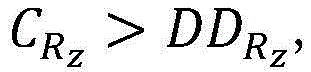

Step 7:从已调度任务集合{R-R’}中选择任务R,XR=Z,更新吊钩位置 PT=DR;Step 7: Select task R from the scheduled task set {R-R'}, X R = Z, and update the hook position P T = DR ;
Step 8:输出所有物料请求任务的吊装服务序列。Step 8: Output the lifting service sequence of all material request tasks.
由上述本发明的实施例提供的技术方案可以看出,本发明通过建模将吊装作业调度问题转化为数学问题,计算吊钩行程时间并设计了一种动态搜索启发式算法(DSF,movement Heuristic Algorithm)得到塔机服务序列优化方案,在满足构件交货期约束的同时最大化缩短塔机作业流程时间,并结合案例验证算法的有效性,从而通过合理的塔机服务调度有效地保证塔机作业的高效性和安全性。It can be seen from the technical solution provided by the above-mentioned embodiments of the present invention that the present invention converts the hoisting operation scheduling problem into a mathematical problem through modeling, calculates the hook travel time and designs a dynamic search heuristic algorithm (DSF, movement Heuristic Algorithm) to obtain a tower crane service sequence optimization solution, which maximizes the shortening of the tower crane operation process time while meeting the component delivery period constraints, and verifies the effectiveness of the algorithm in combination with cases, thereby effectively ensuring the efficiency and safety of tower crane operations through reasonable tower crane service scheduling.
本发明附加的方面和优点将在下面的描述中部分给出,这些将从下面的描述中变得明显,或通过本发明的实践了解到。Additional aspects and advantages of the present invention will be given in part in the following description, which will become obvious from the following description, or may be learned through practice of the present invention.
附图说明BRIEF DESCRIPTION OF THE DRAWINGS
为了更清楚地说明本发明实施例的技术方案,下面将对实施例描述中所需要使用的附图作简单地介绍,显而易见地,下面描述中的附图仅仅是本发明的一些实施例,对于本领域普通技术人员来讲,在不付出创造性劳动的前提下,还可以根据这些附图获得其他的附图。In order to more clearly illustrate the technical solutions of the embodiments of the present invention, the accompanying drawings required for use in the description of the embodiments will be briefly introduced below. Obviously, the accompanying drawings described below are only some embodiments of the present invention. For ordinary technicians in this field, other accompanying drawings can be obtained based on these accompanying drawings without paying creative work.
图1为本发明实施例提供的一种塔机布局说明示意图;FIG1 is a schematic diagram illustrating a tower crane layout according to an embodiment of the present invention;
图2为本发明实施例提供的一种塔机运动水平面坐标系系统示意;FIG2 is a schematic diagram of a horizontal plane coordinate system for tower crane motion provided by an embodiment of the present invention;
图3为本发明实施例提供的一种塔机垂直平面内的运动系统;FIG3 is a motion system in a vertical plane of a tower crane provided by an embodiment of the present invention;
图4为本发明实施例提供的一种建筑施工现场的布局示意图。FIG. 4 is a schematic diagram of the layout of a construction site provided by an embodiment of the present invention.
具体实施方式DETAILED DESCRIPTION
下面详细描述本发明的实施方式,所述实施方式的示例在附图中示出,其中自始至终相同或类似的标号表示相同或类似的元件或具有相同或类似功能的元件。下面通过参考附图描述的实施方式是示例性的,仅用于解释本发明,而不能解释为对本发明的限制。The embodiments of the present invention are described in detail below, examples of which are shown in the accompanying drawings, wherein the same or similar reference numerals throughout represent the same or similar elements or elements having the same or similar functions. The embodiments described below with reference to the accompanying drawings are exemplary and are only used to explain the present invention, and cannot be interpreted as limiting the present invention.
本技术领域技术人员可以理解,除非特意声明,这里使用的单数形式“一”、“一个”、“所述”和“该”也可包括复数形式。应该进一步理解的是,本发明的说明书中使用的措辞“包括”是指存在所述特征、整数、步骤、操作、元件和/或组件,但是并不排除存在或添加一个或多个其他特征、整数、步骤、操作、元件、组件和/或它们的组。应该理解,当我们称元件被“连接”或“耦接”到另一元件时,它可以直接连接或耦接到其他元件,或者也可以存在中间元件。此外,这里使用的“连接”或“耦接”可以包括无线连接或耦接。这里使用的措辞“和/或”包括一个或更多个相关联的列出项的任一单元和全部组合。It will be understood by those skilled in the art that, unless expressly stated, the singular forms "one", "said", and "the" used herein may also include plural forms. It should be further understood that the term "comprising" used in the specification of the present invention refers to the presence of the features, integers, steps, operations, elements and/or components, but does not exclude the presence or addition of one or more other features, integers, steps, operations, elements, components and/or groups thereof. It should be understood that when we refer to an element as being "connected" or "coupled" to another element, it may be directly connected or coupled to the other element, or there may be intermediate elements. In addition, the "connection" or "coupling" used herein may include wireless connection or coupling. The term "and/or" used herein includes any unit and all combinations of one or more associated listed items.
本技术领域技术人员可以理解,除非另外定义,这里使用的所有术语 (包括技术术语和科学术语)具有与本发明所属领域中的普通技术人员的一般理解相同的意义。还应该理解的是,诸如通用字典中定义的那些术语应该被理解为具有与现有技术的上下文中的意义一致的意义,并且除非像这里一样定义,不会用理想化或过于正式的含义来解释。It will be understood by those skilled in the art that, unless otherwise defined, all terms (including technical and scientific terms) used herein have the same meaning as generally understood by those skilled in the art in the art to which the present invention belongs. It should also be understood that terms such as those defined in common dictionaries should be understood to have meanings consistent with the meanings in the context of the prior art, and will not be interpreted with idealized or overly formal meanings unless defined as herein.
为便于对本发明实施例的理解,下面将结合附图以几个具体实施例为例做进一步的解释说明,且各个实施例并不构成对本发明实施例的限定。To facilitate understanding of the embodiments of the present invention, several specific embodiments will be further explained below with reference to the accompanying drawings, and each embodiment does not constitute a limitation on the embodiments of the present invention.
塔机服务调度问题可以使用与行程时间相关联的图形(即顶点和连接边的集合)来描述。图1为本发明实施例提供的一种塔机布局说明示意图。图1 表示施工现场的工作人员(C)和物料(M)节点组成的图表布局,目前在施工现场,物料主要有预制外墙、预制内墙、预制叠合板和预制梯段板等,除了预制构件外现场也需要吊运建筑垃圾,水泥、钢筋等物料。中央的塔机接收指挥人员的物料请求任务信号后把相应的物料从储存位置移到指定的工作人员位置(物料需求位置)。决策者应以总操作时间最小化为目标,以任务到期时间和优先级等不同的约束来实现目标。The tower crane service scheduling problem can be described using a graph (i.e., a collection of vertices and connecting edges) associated with travel time. FIG1 is a schematic diagram illustrating a tower crane layout provided by an embodiment of the present invention. FIG1 shows a diagram layout consisting of staff (C) and material (M) nodes at a construction site. Currently, at the construction site, the materials mainly include prefabricated exterior walls, prefabricated interior walls, prefabricated composite panels, and prefabricated stair slabs. In addition to prefabricated components, the site also needs to hoist construction waste, cement, steel bars and other materials. After receiving the material request task signal from the commander, the central tower crane moves the corresponding material from the storage location to the designated staff location (material demand location). Decision makers should aim to minimize the total operation time and use different constraints such as task expiration time and priority to achieve the goal.
假设某施工现场塔机在进行作业,现场有I个物料供应地点Si,其中 i=1,2…I;有J个物料需求地点Dj,j=1,2…J;有M个物料请求任务Rm, m=1,2...M;物料请求任务Rm的交货期为

最小化塔机作业流程时间需要准确计算出吊装的总行程时间。与传统的物料吊运不同,混凝土预制构件的吊装复杂且耗时较长,拿预制外墙的吊装来说,其吊装工序包括挂钩、安全检查、起升、回转就位、安装作业和起升回转。本发明实施例采用基于供应地、需求地和设备物理位置的塔机作业时间分析模型计算塔机吊钩行程时间。以塔机位置为基准建立如图2所示的塔机运动水平面坐标系系统,塔机位置PT=(xT,yT)=(0,0),预制构件供应地A 位置=(xA,yA),预制构件需求地B位置=(xB,yB)。Minimizing the tower crane operation process time requires accurate calculation of the total travel time of the hoisting. Unlike traditional material hoisting, the hoisting of precast concrete components is complex and time-consuming. For example, the hoisting of precast exterior walls includes hooking, safety inspection, lifting, rotation into place, installation work and lifting and rotation. The embodiment of the present invention uses a tower crane operation time analysis model based on the supply location, demand location and physical location of the equipment to calculate the tower crane hook travel time. A tower crane motion horizontal plane coordinate system as shown in Figure 2 is established based on the tower crane position, tower crane position PT = ( xT , yT ) = (0, 0), precast component supply location A location = ( xA , yA ), precast component demand location B location = ( xB , yB ).
吊装的总行程时间计算过程如下:The total travel time for lifting is calculated as follows:
(2)径向运动时间和角行程时间(2) Radial motion time and angular travel time
根据塔机的制造规格可以确定径向速度(Vr),角速度(Va)和垂直速度 (Vv)。吊钩在A点和B点之间的径向时间(Tr (i,j))和角行程时间(Ta (i,j))可以使用公式(1)和公式(2)计算,如下:The radial velocity (V r ), angular velocity (V a ) and vertical velocity (V v ) can be determined according to the manufacturing specifications of the tower crane. The radial time (T r (i,j) ) and angular travel time (T a (i,j) ) of the hook between points A and B can be calculated using formulas (1) and (2) as follows:
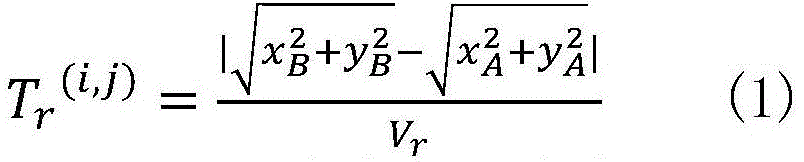

(2)吊钩水平行程时间(2) Horizontal travel time of hook
根据径向时间和角行程时间合成吊钩在水平方向上的行程时间,考虑引入λ参数反应操作者在径向和角度方向上同时移动吊钩的能力,即径向运动和角度方向上运动的重叠程度。其中λ是连续的正数,取值在0≤λ≤1之间,λ的值越小反应径向和角度方向移动吊钩的同时性越高。吊钩水平行程时间可以使用公式3计算:The travel time of the hook in the horizontal direction is synthesized based on the radial time and the angular travel time. Consider introducing the λ parameter to reflect the operator's ability to move the hook in the radial and angular directions at the same time, that is, the overlap between the radial movement and the angular movement. Among them, λ is a continuous positive number with a value between 0≤λ≤1. The smaller the value of λ, the higher the simultaneity of moving the hook in the radial and angular directions. The horizontal travel time of the hook can be calculated using Formula 3:
Th (i,j)=max{Tr (i,j),Ta (i,j)}+λ·min{Tr (i,j) r,Ta (i,j)} (3)T h (i,j) =max{T r (i,j) ,T a (i,j) }+λ·min{T r (i,j) r ,T a (i,j) } (3 )
(3)吊钩垂直行程时间(3) Hook vertical travel time
图3为本发明实施例提供的一种塔机垂直平面内的运动系统示意图,假设点A和B,如正视图(图3)所示,塔机的垂直行程时间(Tv (i,j))计算如下:FIG3 is a schematic diagram of a motion system of a tower crane in a vertical plane provided by an embodiment of the present invention. Assuming points A and B, as shown in the front view ( FIG3 ), the vertical travel time (T v (i,j) ) of the tower crane is calculated as follows:

式中,ZA和ZB分别是点A和B的z(高度)坐标,h是最小提升高度。Where Z A and Z B are the z (height) coordinates of points A and B respectively, and h is the minimum lifting height.
(4)吊钩总行程时间(4) Total hook travel time
根据吊钩水平行程时间和吊钩垂直行程时间合成吊钩的总行程时间,如公式5所示:The total travel time of the hook is synthesized based on the horizontal travel time of the hook and the vertical travel time of the hook, as shown in Formula 5:
TT=μ·(max{Th,TV}+η·min{Th,Tv}) (5)T T =μ·(max{T h ,T V }+η·min{T h ,T v }) (5)
η,μ是连续的正数,取值在0≤η≤1,1≤μ≤∞之间。参数η表示操作者在水平和垂直方向上同时移动吊钩的能力。由于施工现场存在天气、障碍物等不可控的条件,塔吊作业流程时间可能因此而发生变化,参数μ用于说明施工现场的不可控条件。η的值越小表明操作者在水平和垂直方向上移动吊钩的同时性越高。参数μ的值越小则反映施工现场的操作条件比较好。λ,η,μ的具体数值需要根据施工现场的施工情况来进行取值。η,μ are continuous positive numbers with values between 0≤η≤1, 1≤μ≤∞. Parameter η represents the operator's ability to move the hook simultaneously in the horizontal and vertical directions. Due to uncontrollable conditions such as weather and obstacles at the construction site, the tower crane operation process time may change. Parameter μ is used to describe the uncontrollable conditions at the construction site. The smaller the value of η, the higher the simultaneity of the operator moving the hook in the horizontal and vertical directions. The smaller the value of parameter μ, the better the operating conditions at the construction site. The specific values of λ, η, and μ need to be determined according to the construction conditions at the construction site.
本发明针对带有交货期的物料构件请求任务,在最小化塔机总流程时间的同时满足交货期约束。在构件吊装过程中,还应考虑存构件的装载时间和安装时间。每一个物料请求任务所需要的总时间

式中

吊装的总行程时间Ttotal的计算方法如下:The calculation method of the total lifting travel time T total is as follows:


假设:Assumptions:
(1)
(2)
(3)
其中,决策变量


基于物料请求任务序列的塔机吊装时间计算,根据塔机工作过程中运动特征,通过动态搜索启发式方法对所述塔机吊装服务调度的多目标优化模型进行求解,具体步骤如下:The tower crane hoisting time calculation based on the material request task sequence and the motion characteristics of the tower crane during working process are solved by the dynamic search heuristic method for the multi-objective optimization model of the tower crane hoisting service scheduling. The specific steps are as follows:
Step1初始化吊钩位置PT,物料供应地集合S={Si|i=1,2,...,I},物料需求地集合D={Dj|j=1,2,...,J},物料请求任务集合R={Rm|m=1,2,...,M},待调度任务集合R’=R;Step 1: Initialize the hook position P T , material supply set S = {S i |i = 1, 2, ..., I}, material demand set D = {D j |j = 1, 2, ..., J}, material request task set R = {R m |m = 1, 2, ..., M}, and task set to be scheduled R' = R;
Step 2设置循环变量z=1;z<=M;z++;Step 2: Set loop variable z=1; z<=M; z++;
Step 3对于

(1)根据公式(1)(2)计算吊钩径向时间和角行程时间;(1) Calculate the hook radial time and angular travel time according to formula (1) (2);
(2)结合公式(3)计算吊钩的水平行程时间;(2) Calculate the horizontal travel time of the hook by combining formula (3);
(3)利用公式(4)计算吊钩垂直行程时间;(3) Calculate the vertical travel time of the hook using formula (4);
(4)结合公式(5)合成吊钩总的行程时间;(4) Combined with formula (5), the total travel time of the hook is calculated;
Step 4对于

(1)根据公式(1)(2)计算吊钩径向时间和角行程时间;(1) Calculate the hook radial time and angular travel time according to formula (1) (2);
(2)结合公式(3)计算吊钩的水平行程时间;(2) Calculate the horizontal travel time of the hook by combining formula (3);
(3)利用公式(4)计算吊钩垂直行程时间;(3) Calculate the vertical travel time of the hook using formula (4);
(4)结合公式(5)合成吊钩总的行程时间;(4) Combined with formula (5), the total travel time of the hook is calculated;
(5)根据

Step 5:对于


Step 6:交货期检查与冲突消解Step 6: Delivery date inspection and conflict resolution
(1)循环变量n=Z;n>=2;n--;(1) Loop variable n=Z; n>=2; n--;
(2)计算完工时间
(3)If

Step 7:从已调度任务集合{R-R’}中选择任务R,XR=Z,更新吊钩位置 PT=DR;Step 7: Select task R from the scheduled task set {R-R'}, X R = Z, and update the hook position P T = DR ;
Step 8:输出所有物料请求任务的吊装服务序列。Step 8: Output the lifting service sequence of all material request tasks.
实施例二Embodiment 2
下面以某公寓的施工作业为例说明本发明的所述装配式混凝土结构的吊装调度方法。图4描述了北京某公寓施工现场的布局图。工程的物料类型主要有预制外墙M1、预制内墙M2、预制叠合板M3、预制楼梯M4、混凝土M5、钢筋 M6等物料。这些物料存放于四个物料供应点S①至S④,其坐标如表1所示,每个物料供应点位置坐标如表1所示,物料需求点D①-D⑨位置坐标如表2所示。The following takes the construction work of a certain apartment as an example to illustrate the hoisting scheduling method of the prefabricated concrete structure of the present invention. Figure 4 describes the layout of the construction site of a certain apartment in Beijing. The material types of the project mainly include prefabricated exterior walls M1, prefabricated interior walls M2, prefabricated composite panels M3, prefabricated stairs M4, concrete M5, steel bars M6 and other materials. These materials are stored in four material supply points S① to S④, and their coordinates are shown in Table 1. The position coordinates of each material supply point are shown in Table 1, and the position coordinates of the material demand points D①-D⑨ are shown in Table 2.
某一施工时间段内,塔机收到了10个物料请求任务,每个任务的物料供应地坐标、物料需求地坐标和各自的交货期信息如表3所示。During a certain construction period, the tower crane received 10 material request tasks. The material supply location coordinates, material demand location coordinates and respective delivery date information of each task are shown in Table 3.
表1材料供应地点的数据Table 1 Data on material supply locations


表2材料需求地的数据Table 2 Data of material demand areas

表3物料请求任务数据Table 3 Material request task data

现场使用重载4000HC100利勃海尔塔式起重机。根据其制造规格,它的垂直速度Vv=136米/分钟,径向速度Vr=60米/分钟,回转角速度Va=0.5 弧度/分钟,塔机的起重能力为30。假设天气条件良好,正常运行条件下材料供应位置和需求位置之间的吊钩运动路径没有障碍物,并且不会引起额外的时间延迟,设置μ=1。对现场塔机操作者的能力进行评估,参数λ和η的参分别设定为1.0和0.25。材料加载时间Tloading和卸载时间Tunloading,混凝土装配式构件和传统物料不同,传统物料Tloading和Tunloading均设定为1.0时间单位(分钟)并且恒定,装配式构件的材料加载时间Tloading设定为5(分钟) 卸载时间Tunloading设定为10(分钟)A heavy-duty 4000HC100 Liebherr tower crane was used on site. According to its manufacturing specifications, its vertical speed V v = 136 m/min, radial speed V r = 60 m/min, slewing angular velocity Va = 0.5 radians/min, and the lifting capacity of the tower crane is 30. Assuming good weather conditions and no obstacles in the hook movement path between the material supply location and the demand location under normal operating conditions, and no additional time delay is caused, μ is set to 1. The ability of the on-site tower crane operator is evaluated, and the parameters λ and η are set to 1.0 and 0.25, respectively. The material loading time T loading and unloading time T unloading are different for concrete prefabricated components and traditional materials. The traditional materials T loading and T unloading are both set to 1.0 time unit (minutes) and constant. The material loading time T loading of prefabricated components is set to 5 (minutes) and the unloading time T unloading is set to 10 (minutes).
针对上述具体问题和相关数据,采用动态搜索启发式算法DSF对装配式构件进行吊装计算,数据结果如表4所示,最大流程时间为94.24时间单位(分钟)。In view of the above specific problems and related data, the dynamic search heuristic algorithm DSF is used to calculate the hoisting of prefabricated components. The data results are shown in Table 4. The maximum process time is 94.24 time units (minutes).
表4 DSF算法下任务的移动数据Table 4 Motion data of tasks under DSF algorithm

综上所述,本发明实施例相对与传统启发式而言,考虑了时间约束这一特性,与实际的施工情况更加的吻合。将装配式构件吊装任务归结为带有交货期的一类任务,从而考虑塔机接受到一系列作业任务时的调度安排。通过建模将吊装作业调度问题转化为数学问题,计算吊钩行程时间并设计了一种动态搜索启发式算法(DSF)得到塔机服务序列优化方案,在满足构件交货期约束的同时最大化缩短塔机作业流程时间,并结合案例验证算法的有效性。通过算例计算,发现其在满足约束条件下的流程时间比传统启发式算法得到的流程时间要短。从而通过合理的塔机服务调度有效地保证塔机作业的高效性和安全性。In summary, compared with the traditional heuristic, the embodiment of the present invention takes into account the characteristic of time constraints, which is more consistent with the actual construction situation. The lifting task of prefabricated components is attributed to a type of task with a delivery period, so as to consider the scheduling arrangement when the tower crane receives a series of work tasks. The lifting operation scheduling problem is transformed into a mathematical problem through modeling, the hook travel time is calculated, and a dynamic search heuristic algorithm (DSF) is designed to obtain the tower crane service sequence optimization scheme, which maximizes the shortening of the tower crane operation process time while meeting the component delivery period constraints, and verifies the effectiveness of the algorithm with case studies. Through example calculations, it is found that the process time under the constraints is shorter than the process time obtained by the traditional heuristic algorithm. Therefore, the efficiency and safety of tower crane operations can be effectively guaranteed through reasonable tower crane service scheduling.
本领域普通技术人员可以理解:附图只是一个实施例的示意图,附图中的模块或流程并不一定是实施本发明所必须的。Those skilled in the art can understand that the accompanying drawings are only schematic diagrams of one embodiment, and the modules or processes in the accompanying drawings are not necessarily required to implement the present invention.
本说明书中的各个实施例均采用递进的方式描述,各个实施例之间相同相似的部分互相参见即可,每个实施例重点说明的都是与其他实施例的不同之处。尤其,对于装置或系统实施例而言,由于其基本相似于方法实施例,所以描述得比较简单,相关之处参见方法实施例的部分说明即可。以上所描述的装置及系统实施例仅仅是示意性的,其中所述作为分离部件说明的单元可以是或者也可以不是物理上分开的,作为单元显示的部件可以是或者也可以不是物理单元,即可以位于一个地方,或者也可以分布到多个网络单元上。可以根据实际的需要选择其中的部分或者全部模块来实现本实施例方案的目的。本领域普通技术人员在不付出创造性劳动的情况下,即可以理解并实施。Each embodiment in this specification is described in a progressive manner, and the same or similar parts between the embodiments can refer to each other, and each embodiment focuses on the differences from other embodiments. In particular, for the device or system embodiment, since it is basically similar to the method embodiment, the description is relatively simple, and the relevant parts can refer to the partial description of the method embodiment. The device and system embodiments described above are merely schematic, wherein the units described as separate components may or may not be physically separated, and the components displayed as units may or may not be physical units, that is, they may be located in one place, or they may be distributed on multiple network units. Some or all of the modules may be selected according to actual needs to achieve the purpose of the scheme of this embodiment. Ordinary technicians in this field can understand and implement it without paying creative labor.
以上所述,仅为本发明较佳的具体实施方式,但本发明的保护范围并不局限于此,任何熟悉本技术领域的技术人员在本发明揭露的技术范围内,可轻易想到的变化或替换,都应涵盖在本发明的保护范围之内。因此,本发明的保护范围应该以权利要求的保护范围为准。The above is only a preferred specific embodiment of the present invention, but the protection scope of the present invention is not limited thereto. Any changes or substitutions that can be easily thought of by a person skilled in the art within the technical scope disclosed by the present invention should be included in the protection scope of the present invention. Therefore, the protection scope of the present invention should be based on the protection scope of the claims.
Claims (2)


Priority Applications (1)
| Application Number | Priority Date | Filing Date | Title |
|---|---|---|---|
| CN202110081704.6A CN113434996B (en) | 2021-01-21 | 2021-01-21 | Hoisting service scheduling method of prefabricated concrete structure tower crane |
Applications Claiming Priority (1)
| Application Number | Priority Date | Filing Date | Title |
|---|---|---|---|
| CN202110081704.6A CN113434996B (en) | 2021-01-21 | 2021-01-21 | Hoisting service scheduling method of prefabricated concrete structure tower crane |
Publications (2)
| Publication Number | Publication Date |
|---|---|
| CN113434996A CN113434996A (en) | 2021-09-24 |
| CN113434996B true CN113434996B (en) | 2023-04-25 |
Family
ID=77752723
Family Applications (1)
| Application Number | Title | Priority Date | Filing Date |
|---|---|---|---|
| CN202110081704.6A Active CN113434996B (en) | 2021-01-21 | 2021-01-21 | Hoisting service scheduling method of prefabricated concrete structure tower crane |
Country Status (1)
| Country | Link |
|---|---|
| CN (1) | CN113434996B (en) |
Families Citing this family (4)
| Publication number | Priority date | Publication date | Assignee | Title |
|---|---|---|---|---|
| CN113887948A (en) * | 2021-09-30 | 2022-01-04 | 华电重工股份有限公司 | Method and system for analyzing window period and work efficiency of offshore wind power construction |
| CN115936268B (en) * | 2023-03-10 | 2023-05-23 | 北京建筑大学 | An optimization method for group tower multi-objective scheduling considering the interval time between conflicting tasks |
| CN116796983A (en) * | 2023-06-29 | 2023-09-22 | 北京建筑大学 | A scheduling optimization method for real-time hoisting of prefabricated building structures |
| CN120598320B (en) * | 2025-08-06 | 2025-10-17 | 中交第三航务工程局有限公司 | Intelligent dispatching and optimizing system for vertical transportation of wharf building materials based on Internet of things |
Citations (13)
| Publication number | Priority date | Publication date | Assignee | Title |
|---|---|---|---|---|
| GB201409883D0 (en) * | 2014-06-03 | 2014-07-16 | Ocado Ltd | Methods, systems, and apparatus for controlling movement of transporting devices |
| CN105303293A (en) * | 2015-09-18 | 2016-02-03 | 重庆富皇混凝土有限公司 | Automatic material issuing method and system |
| CN107215792A (en) * | 2017-07-11 | 2017-09-29 | 长沙海川自动化设备有限公司 | Group's tower anticollision control method, control device and control system |
| CN107310897A (en) * | 2017-05-11 | 2017-11-03 | 河北中燕科技服务有限公司 | A kind of unmanned cargo transport building hoist device people |
| CN108163718A (en) * | 2017-12-27 | 2018-06-15 | 西安理工大学 | Intelligent and accurate hoisting control method for group towers based on Internet of things |
| CN109886479A (en) * | 2019-02-01 | 2019-06-14 | 南通四建集团有限公司 | A kind of hanging device construction time positioning and monitoring method based on Beidou GNSS and BIM |
| CN110271965A (en) * | 2018-03-14 | 2019-09-24 | 清华大学 | Tower crane robot |
| CN110399629A (en) * | 2019-05-29 | 2019-11-01 | 北京工业大学 | A kind of tower crane type selecting and layout optimization modeling method based on mixing shaping planning |
| CN110733982A (en) * | 2019-12-20 | 2020-01-31 | 广东博智林机器人有限公司 | multi-tower crane transfer scheduling method and system |
| CN111008745A (en) * | 2019-12-10 | 2020-04-14 | 浙江工商大学 | Multimodal resource-constrained project scheduling optimization method based on hybrid heuristics and intelligent algorithms |
| CN111061987A (en) * | 2019-12-11 | 2020-04-24 | 北京工业大学 | A scheduling optimization method for group towers considering active avoidance |
| CN111077858A (en) * | 2019-12-06 | 2020-04-28 | 中铁四局集团建筑工程有限公司 | Construction site safety scheduling supervision method and system |
| CN112001064A (en) * | 2020-07-29 | 2020-11-27 | 浙江大学 | Full-autonomous water transport scheduling method and system between container terminals |
-
2021
- 2021-01-21 CN CN202110081704.6A patent/CN113434996B/en active Active
Patent Citations (13)
| Publication number | Priority date | Publication date | Assignee | Title |
|---|---|---|---|---|
| GB201409883D0 (en) * | 2014-06-03 | 2014-07-16 | Ocado Ltd | Methods, systems, and apparatus for controlling movement of transporting devices |
| CN105303293A (en) * | 2015-09-18 | 2016-02-03 | 重庆富皇混凝土有限公司 | Automatic material issuing method and system |
| CN107310897A (en) * | 2017-05-11 | 2017-11-03 | 河北中燕科技服务有限公司 | A kind of unmanned cargo transport building hoist device people |
| CN107215792A (en) * | 2017-07-11 | 2017-09-29 | 长沙海川自动化设备有限公司 | Group's tower anticollision control method, control device and control system |
| CN108163718A (en) * | 2017-12-27 | 2018-06-15 | 西安理工大学 | Intelligent and accurate hoisting control method for group towers based on Internet of things |
| CN110271965A (en) * | 2018-03-14 | 2019-09-24 | 清华大学 | Tower crane robot |
| CN109886479A (en) * | 2019-02-01 | 2019-06-14 | 南通四建集团有限公司 | A kind of hanging device construction time positioning and monitoring method based on Beidou GNSS and BIM |
| CN110399629A (en) * | 2019-05-29 | 2019-11-01 | 北京工业大学 | A kind of tower crane type selecting and layout optimization modeling method based on mixing shaping planning |
| CN111077858A (en) * | 2019-12-06 | 2020-04-28 | 中铁四局集团建筑工程有限公司 | Construction site safety scheduling supervision method and system |
| CN111008745A (en) * | 2019-12-10 | 2020-04-14 | 浙江工商大学 | Multimodal resource-constrained project scheduling optimization method based on hybrid heuristics and intelligent algorithms |
| CN111061987A (en) * | 2019-12-11 | 2020-04-24 | 北京工业大学 | A scheduling optimization method for group towers considering active avoidance |
| CN110733982A (en) * | 2019-12-20 | 2020-01-31 | 广东博智林机器人有限公司 | multi-tower crane transfer scheduling method and system |
| CN112001064A (en) * | 2020-07-29 | 2020-11-27 | 浙江大学 | Full-autonomous water transport scheduling method and system between container terminals |
Non-Patent Citations (5)
| Title |
|---|
| Souravik Dutta 等.联网检索平台,tower crane schedule optimization dynamic search heuristic algorithm.《Automatic in Construction》.2020,第110卷1-19. * |
| Zhiqian Zhang 等.Lift planning and optimization in construction:A thirty-year review.《Automation in Construction》.2020,第118卷1-13. * |
| 孔刘林.基于生产-运输-装配一体化建造的建模研究.《中国优秀博士学位论文全文数据库 工程科技Ⅱ辑》.2021,(第1期),C038-174. * |
| 张彦奇.装配式住宅EPC管理模式下施工进度风险管理研究.《中国优秀硕士学位论文全文数据库 工程科技Ⅱ辑》.2021,(第1期),C038-2197. * |
| 李培.北京首都机场地面保障效率优化与仿真研究.《中国优秀硕士学位论文全文数据库 信息科技辑》.2019,(第8期),C031-189. * |
Also Published As
| Publication number | Publication date |
|---|---|
| CN113434996A (en) | 2021-09-24 |
Similar Documents
| Publication | Publication Date | Title |
|---|---|---|
| CN113434996B (en) | Hoisting service scheduling method of prefabricated concrete structure tower crane | |
| Chan et al. | Production scheduling for precast plants using a flow shop sequencing model | |
| He et al. | Scheduling optimization of prefabricated buildings under resource constraints | |
| Bock | Construction automation and robotics | |
| Huang et al. | Planning gang formwork operations for building construction using simulations | |
| CN110216789B (en) | Intelligent control system of bridge segment prefabrication field | |
| Liu et al. | Comparative analysis of off-site precast concrete and cast-in-place concrete in low-carbon built environment | |
| CN108229808A (en) | A kind of assembled architecture project construction Process Control System | |
| CN110399629A (en) | A kind of tower crane type selecting and layout optimization modeling method based on mixing shaping planning | |
| Safa et al. | A decision-making method for choosing concrete forming systems | |
| CN118485550A (en) | A method and system for optimizing the layout of temporary facilities at a construction site | |
| KR102776973B1 (en) | Construction method for wall and slab type structured building | |
| CN109534189A (en) | Hoisting construction method for cast-in-situ core tube structure of assembled integral frame | |
| Hui et al. | Comparative study on precast building construction and conventional building construction for housing project in Sarawak | |
| CN113722788A (en) | BIM-based modular machine room transportation and installation determination method and system | |
| Lin et al. | An algorithm for optimizing the location and type selection of attached tower cranes based on value engineering | |
| CN118378756B (en) | Production and transportation cooperative scheduling method for directly-hoisted assembled concrete structure | |
| Alkriz et al. | A new model for optimizing the location of cranes and construction facilities using genetic algorithms | |
| Chougule et al. | Review of time and cost analysis for Prefabricated Prefinished Volumetric Construction (PPVC) | |
| Elliott | Industrial building systems (IBS) project implementation | |
| Jaśkowski et al. | Synchronizing production of precast elements with on-site erection | |
| Malaikrisanachalee et al. | Optimal Location for Tower Crane and Dynamic Trailer Parking in High-Rise Modular Building Construction Project | |
| Li et al. | IOT-enabled framework for monitoring carbon emissions in the materialization phase of modular integrated construction | |
| KR101301599B1 (en) | Construction Lift Cycle Time Calculation System Considering Increase and Decrease Velocity | |
| Zhao et al. | Research on the Application of Intelligent Scheduling for Prefabricated Beam Production Based on Dynamic Plan Driving |
Legal Events
| Date | Code | Title | Description |
|---|---|---|---|
| PB01 | Publication | ||
| PB01 | Publication | ||
| SE01 | Entry into force of request for substantive examination | ||
| SE01 | Entry into force of request for substantive examination | ||
| GR01 | Patent grant | ||
| GR01 | Patent grant | ||
| TR01 | Transfer of patent right |
Effective date of registration: 20231022 Address after: 063600 Leting Economic Development Zone, Tangshan City, Hebei Patentee after: Beijing ecological home (leting) Technology Development Co.,Ltd. Address before: 100044 No. 1, Xicheng District exhibition museum, Beijing Patentee before: Beijing University of Civil Engineering and Architecture |
|
| TR01 | Transfer of patent right |