CN113434505B - Transaction information attribute retrieval method, device, computer equipment and storage medium - Google Patents
Transaction information attribute retrieval method, device, computer equipment and storage medium Download PDFInfo
- Publication number
- CN113434505B CN113434505B CN202110724032.6A CN202110724032A CN113434505B CN 113434505 B CN113434505 B CN 113434505B CN 202110724032 A CN202110724032 A CN 202110724032A CN 113434505 B CN113434505 B CN 113434505B
- Authority
- CN
- China
- Prior art keywords
- information
- classification
- attribute
- tree model
- search
- Prior art date
- Legal status (The legal status is an assumption and is not a legal conclusion. Google has not performed a legal analysis and makes no representation as to the accuracy of the status listed.)
- Active
Links
Images


Classifications
-
- G—PHYSICS
- G06—COMPUTING OR CALCULATING; COUNTING
- G06F—ELECTRIC DIGITAL DATA PROCESSING
- G06F16/00—Information retrieval; Database structures therefor; File system structures therefor
- G06F16/20—Information retrieval; Database structures therefor; File system structures therefor of structured data, e.g. relational data
- G06F16/22—Indexing; Data structures therefor; Storage structures
- G06F16/2228—Indexing structures
- G06F16/2246—Trees, e.g. B+trees
-
- G—PHYSICS
- G06—COMPUTING OR CALCULATING; COUNTING
- G06F—ELECTRIC DIGITAL DATA PROCESSING
- G06F16/00—Information retrieval; Database structures therefor; File system structures therefor
- G06F16/20—Information retrieval; Database structures therefor; File system structures therefor of structured data, e.g. relational data
- G06F16/24—Querying
- G06F16/245—Query processing
- G06F16/2455—Query execution
-
- G—PHYSICS
- G06—COMPUTING OR CALCULATING; COUNTING
- G06F—ELECTRIC DIGITAL DATA PROCESSING
- G06F16/00—Information retrieval; Database structures therefor; File system structures therefor
- G06F16/20—Information retrieval; Database structures therefor; File system structures therefor of structured data, e.g. relational data
- G06F16/24—Querying
- G06F16/245—Query processing
- G06F16/2458—Special types of queries, e.g. statistical queries, fuzzy queries or distributed queries
- G06F16/2471—Distributed queries
-
- G—PHYSICS
- G06—COMPUTING OR CALCULATING; COUNTING
- G06Q—INFORMATION AND COMMUNICATION TECHNOLOGY [ICT] SPECIALLY ADAPTED FOR ADMINISTRATIVE, COMMERCIAL, FINANCIAL, MANAGERIAL OR SUPERVISORY PURPOSES; SYSTEMS OR METHODS SPECIALLY ADAPTED FOR ADMINISTRATIVE, COMMERCIAL, FINANCIAL, MANAGERIAL OR SUPERVISORY PURPOSES, NOT OTHERWISE PROVIDED FOR
- G06Q40/00—Finance; Insurance; Tax strategies; Processing of corporate or income taxes
- G06Q40/08—Insurance
-
- Y—GENERAL TAGGING OF NEW TECHNOLOGICAL DEVELOPMENTS; GENERAL TAGGING OF CROSS-SECTIONAL TECHNOLOGIES SPANNING OVER SEVERAL SECTIONS OF THE IPC; TECHNICAL SUBJECTS COVERED BY FORMER USPC CROSS-REFERENCE ART COLLECTIONS [XRACs] AND DIGESTS
- Y02—TECHNOLOGIES OR APPLICATIONS FOR MITIGATION OR ADAPTATION AGAINST CLIMATE CHANGE
- Y02D—CLIMATE CHANGE MITIGATION TECHNOLOGIES IN INFORMATION AND COMMUNICATION TECHNOLOGIES [ICT], I.E. INFORMATION AND COMMUNICATION TECHNOLOGIES AIMING AT THE REDUCTION OF THEIR OWN ENERGY USE
- Y02D10/00—Energy efficient computing, e.g. low power processors, power management or thermal management
Landscapes
- Engineering & Computer Science (AREA)
- Theoretical Computer Science (AREA)
- Physics & Mathematics (AREA)
- General Physics & Mathematics (AREA)
- Business, Economics & Management (AREA)
- Data Mining & Analysis (AREA)
- Databases & Information Systems (AREA)
- General Engineering & Computer Science (AREA)
- Accounting & Taxation (AREA)
- Software Systems (AREA)
- Computational Linguistics (AREA)
- Finance (AREA)
- Strategic Management (AREA)
- Economics (AREA)
- Marketing (AREA)
- Development Economics (AREA)
- Technology Law (AREA)
- General Business, Economics & Management (AREA)
- Fuzzy Systems (AREA)
- Mathematical Physics (AREA)
- Probability & Statistics with Applications (AREA)
- Information Retrieval, Db Structures And Fs Structures Therefor (AREA)
Abstract
The invention relates to the technical field of classification models of artificial intelligence, and discloses a transaction information attribute retrieval method, a device, computer equipment and a storage medium, wherein the method comprises the following steps: receiving identity information sent by a user side, and acquiring client information according to the identity information; acquiring a preset classification tree model in client information, loading classification conditions in the classification tree model into a preset feedback page to form a search page, sending the search page to a user side, and receiving search items input in the search page by the user side; and identifying attribute information matched with the retrieval items in the classification tree model, and feeding the attribute information back to the user side. The present invention also relates to blockchain techniques in which information may be stored in blockchain nodes. The method and the system not only greatly improve the acquisition efficiency of the attribute information of the target object, but also avoid the risk of employee policy leakage caused by directly acquiring transaction information by the user side.
Description
Technical Field
The present invention relates to the field of classification model technology of artificial intelligence, and in particular, to a transaction information attribute retrieval method, apparatus, computer device and storage medium.
Background
When the insurance requirements of enterprises are met, the enterprises need to be subjected to the underwriting of different attribute information (such as policy level) of staff at different posts, places, job levels and incomes according to the requirements of users, and the enterprises generally have larger scale and relate to cross-country business enterprises, and the staff are complex, so that the attribute information of the staff is also various.
However, the inventor realizes that since the transaction information (such as the policy information) belongs to confidential information for enterprises and employees, if a manager of the enterprise needs to inquire attribute information of a certain employee, the manager can only inquire about the underwriting company on line, which brings great inconvenience to the enterprise; meanwhile, when the underwriting company retrieves the attribute information of the staff, a large amount of data needs to be input, and the attribute information of the party can be traversed according to the data to the transaction information in the information base, so that the retrieval efficiency is low.
Disclosure of Invention
The invention aims to provide a transaction information attribute retrieval method, a device, computer equipment and a storage medium, which are used for solving the problems that in the prior art, an administrator of an enterprise can only inquire attribute information of staff on line to an underwriting company, great inconvenience is brought to the enterprise, and the underwriting company needs to input a large amount of data and traverse the transaction information to retrieve the attribute information, so that retrieval efficiency is low.
In order to achieve the above object, the present invention provides a transaction information attribute retrieval method, including:
receiving identity information sent by a user terminal, and acquiring client information according to the identity information;
acquiring a preset classification tree model in the client information, loading classification conditions in the classification tree model into a preset feedback page to form a search page, sending the search page to the user side, and receiving search items input in the search page by the user side;
and identifying attribute information matched with the retrieval item in the classification tree model, and feeding back the attribute information to the user side.
In the above scheme, before the receiving the identity information sent by the user terminal, the method further includes:
executing a tree structure process, which is used for acquiring client information and transaction information thereof, constructing a classification tree model taking factor information in the transaction information as a classification condition and attribute information in the transaction information as a classification target, and setting the classification tree model in the client information; the factor information is metadata for describing or summarizing transaction information, the attribute information is summary information for describing the transaction information, and the classification tree model is a tree data structure for classifying the transaction information by taking the factor information as a classification condition.
In the above scheme, the constructing a classification tree model using factor information in the transaction information as a classification condition and using attribute information in the transaction information as a classification target includes:
summarizing transaction information to form a set to be segmented, and executing a segmentation calculation thread to divide the transaction information in the set to be segmented into a first subset with one type of attribute information and a second subset with at least one type of attribute information according to attribute information; calculating probability values of the client data corresponding to the factor information in the first subset and summarizing to obtain a first probability set with at least one probability value; calculating probability values of the client data corresponding to the factor information in the second subset and summarizing to obtain a second probability set with at least one probability value;
calculating the coefficient of the factor information in the first subset according to the first probability set to obtain a first coefficient, calculating the coefficient of the factor information in the second subset according to the second probability set to obtain a second coefficient, and calculating the sum of the first coefficient and the second coefficient to obtain a factor coefficient of the factor information;
Identifying factor information corresponding to a factor coefficient with the lowest value and customer data corresponding to the factor information in the first subset, and taking the factor information and the customer data as classification conditions;
judging whether the second subset has two or more attribute information; if yes, setting the second subset as a new set to be segmented, and executing the segmentation calculation thread again; if not, constructing a classification tree model according to the classification conditions.
In the above scheme, loading the classification condition in the classification tree model into a preset feedback page to form a search page includes:
extracting classification conditions in the classification tree model;
acquiring a feedback page, inputting the classification condition into the feedback bullet frame, and setting a retrieval drop-down frame associated with the classification condition in the feedback page to obtain a retrieval page; wherein, the search drop-down box records the option of selecting the classifying condition.
In the above scheme, after the receiving user side inputs the search item in the search page, the method further includes:
acquiring a classification condition at the first position in the classification tree model, executing a bullet frame process, loading the classification condition into a preset feedback bullet frame to form a search bullet frame, sending the search bullet frame to the user side, and receiving a search item selected by the user side in the search bullet frame;
Judging whether attribute information can be obtained from the classification tree model according to the retrieval item; if yes, the attribute information is sent to the user side; if not, acquiring the classification condition of the next bit matched with the retrieval item and executing the bullet frame process.
In the above scheme, the step of loading the classification condition into a preset feedback frame to form a search frame includes:
acquiring a feedback bullet frame, and inputting the classification condition into the feedback bullet frame;
setting a search drop-down frame associated with the classification condition in the feedback bullet frame to obtain a search bullet frame; wherein, the search drop-down box records the option of selecting the classifying condition.
In the above solution, after the obtaining the client information according to the identity information, the method further includes:
receiving modification information output by the user side, modifying transaction information in the client information according to the modification information, executing the tree structure process to obtain an updated classification tree model, and setting the updated classification tree model in the client information;
after said setting said updated classification tree model in said customer information, said method further comprises:
Uploading the updated classification tree model into a blockchain.
In order to achieve the above object, the present invention further provides a transaction information attribute retrieval device, including:
the client identification module is used for receiving the identity information sent by the user terminal and acquiring the client information according to the identity information;
the page interaction module is used for acquiring a preset classification tree model in the client information, loading classification conditions in the classification tree model into a preset feedback page to form a search page, sending the search page to the user side, and receiving search items input in the search page by the user side;
and the attribute identification module is used for identifying attribute information matched with the retrieval item in the classification tree model and feeding the attribute information back to the user side.
To achieve the above object, the present invention also provides a computer device including a memory, a processor, and a computer program stored on the memory and executable on the processor, wherein the processor of the computer device implements the steps of the transaction information attribute retrieval method described above when executing the computer program.
In order to achieve the above object, the present invention further provides a computer readable storage medium having a computer program stored thereon, the computer program stored on the readable storage medium implementing the steps of the transaction information attribute retrieval method described above when executed by a processor.
According to the transaction information attribute retrieval method, the transaction information attribute retrieval device, the computer equipment and the storage medium, corresponding client information is identified according to the identity information sent by the user side, so that the safety of the client information is ensured, and meanwhile, the convenience of the user side in obtaining the client information is improved; the method comprises the steps that a search page is formed by loading classification conditions in a classification tree model into a preset feedback page, so that a user only needs to fill in a search item corresponding to the necessary classification conditions in the search page; by identifying the attribute information matched with the retrieval items in the classification tree model, the attribute information is fed back to the user side, so that the attribute information only needs to calculate the classification conditions of a limited number of classification conditions in the classification tree model according to the retrieval items, the attribute information acquisition efficiency of the target object is greatly improved, the risk that the user side directly acquires transaction information and staff warrants leakage is avoided, and therefore, the enterprise is provided with attribute information inquiry convenience and the information safety of the transaction information is ensured. Meanwhile, the situation that the information base cannot be used when the user side inquires attribute information due to the fact that the information base is occupied is avoided.
Drawings
FIG. 1 is a flowchart of a transaction information attribute retrieval method according to a first embodiment of the present invention;
FIG. 2 is a schematic view illustrating an environment application of a transaction information attribute retrieval method according to a second embodiment of the present invention;
FIG. 3 is a flowchart of a transaction information attribute retrieval method according to a second embodiment of the present invention;
FIG. 4 is a schematic diagram of a program module of a transaction information attribute retrieval device according to a third embodiment of the present invention;
fig. 5 is a schematic hardware structure of a computer device in a fourth embodiment of the computer device of the present invention.
Detailed Description
The present invention will be described in further detail with reference to the drawings and examples, in order to make the objects, technical solutions and advantages of the present invention more apparent. It should be understood that the specific embodiments described herein are for purposes of illustration only and are not intended to limit the scope of the invention. All other embodiments, which can be made by those skilled in the art based on the embodiments of the invention without making any inventive effort, are intended to be within the scope of the invention.
The transaction information attribute retrieval method, the device, the computer equipment and the storage medium are suitable for the technical field of classification models of artificial intelligence, and provide the transaction information attribute retrieval method based on the client identification module, the page interaction module and the attribute identification module. The method and the device acquire the client information according to the identity information by receiving the identity information sent by the user terminal; acquiring a preset classification tree model in client information, loading classification conditions in the classification tree model into a preset feedback page to form a search page, sending the search page to a user side, and receiving search items input in the search page by the user side; attribute information in the classification tree model that matches the search term is identified.
Embodiment one:
referring to fig. 1, a transaction information attribute retrieval method of the present embodiment includes:
s102: and receiving the identity information sent by the user terminal, and acquiring the client information according to the identity information.
S103: obtaining a preset classification tree model in the client information, loading classification conditions in the classification tree model into a preset feedback page to form a search page, sending the search page to the user terminal, and receiving search items input in the search page by the user terminal.
S104: and identifying attribute information matched with the retrieval item in the classification tree model, and feeding back the attribute information to the user side.
In an exemplary embodiment, the user side is improved in convenience of obtaining the client information while ensuring the security of the client information by identifying the corresponding client information according to the identity information sent by the user side, wherein the identity information is data information reflecting the identity of the user side, so that the convenience of obtaining the client information and the security of the client information by the user side are ensured.
The method comprises the steps that a classification tree model preset in the client information is obtained, classification conditions in the classification tree model are loaded into a preset feedback page to form a search page, and a user side only needs to fill in search items corresponding to necessary classification conditions in the search page; by identifying the attribute information matched with the retrieval items in the classification tree model, the attribute information is fed back to the user side, so that the attribute information only needs to calculate the classification conditions of a limited number of classification conditions in the classification tree model according to the retrieval items, the attribute information acquisition efficiency of a target object is greatly improved, the risk of leakage of employee insurance policy caused by the fact that the user side directly acquires transaction information is avoided, and therefore, the information security of the transaction information is ensured while the convenience of attribute information inquiry is provided for enterprises. Meanwhile, the situation that the information base cannot be used when the user side inquires attribute information due to the fact that the information base is occupied is avoided.
Embodiment two:
the present embodiment is a specific application scenario of the first embodiment, and by this embodiment, the method provided by the present invention can be more clearly and specifically described.
The method provided in this embodiment will be specifically described by taking, as an example, a method for identifying attribute information matching with a search entry in a classification tree model by loading classification conditions of the classification tree model into a feedback page to form a search page and receiving a search entry entered in the search page by a user terminal in a server running the transaction information attribute search method. It should be noted that the present embodiment is only exemplary, and does not limit the scope of protection of the embodiment of the present invention.
Fig. 2 schematically illustrates an environment application diagram of a transaction information attribute retrieval method according to a second embodiment of the present application.
In the exemplary embodiment, the server 2 where the transaction information attribute retrieval method is located is connected to the information base 3 and the user terminal 4 through a network respectively; the server 2 may provide services over one or more networks, which may include various network devices such as routers, switches, multiplexers, hubs, modems, bridges, repeaters, firewalls, proxy devices, and/or the like. The network may include physical links such as coaxial cable links, twisted pair cable links, fiber optic links, combinations thereof, and/or the like. The network may include wireless links, such as cellular links, satellite links, wi-Fi links, and/or the like; the client 4 may be a smart phone, a tablet computer, a notebook computer, a desktop computer, or other computer devices.
Fig. 3 is a flowchart of a specific method of a transaction information attribute retrieval method according to an embodiment of the present invention, and the method specifically includes steps S201 to S207.
S201: executing a tree structure process, which is used for acquiring client information and transaction information thereof, constructing a classification tree model taking factor information in the transaction information as a classification condition and attribute information in the transaction information as a classification target, and setting the classification tree model in the client information; the factor information is metadata for describing or summarizing transaction information, the attribute information is summary information for describing the transaction information, and the classification tree model is a tree data structure for classifying the transaction information by taking the factor information as a classification condition.
In the step, a classification tree model taking factor information in the transaction information as a classification condition and attribute information in the transaction information as a classification target is constructed by adopting a classification algorithm. In this embodiment, a Decision Tree algorithm is adopted as the classification algorithm, and is used to obtain the classification Tree model through the transaction information, where the Decision Tree (Decision Tree) algorithm is a graphical method for intuitively applying probability analysis on the basis of knowing occurrence probabilities of various situations, by constructing a Decision Tree to obtain a probability that an expected value of a net present value is greater than or equal to zero, and evaluating a project risk, so as to determine feasibility.
In an exemplary embodiment, the present application may be applied in a financial insurance scenario in which the transaction information is policy information and the attribute information is a policy hierarchy describing an insurance amount, a premium, an insurance period, reimbursement, or a scope of responsibility for payment. Illustratively, the customer information and its transaction information are shown in the following table:
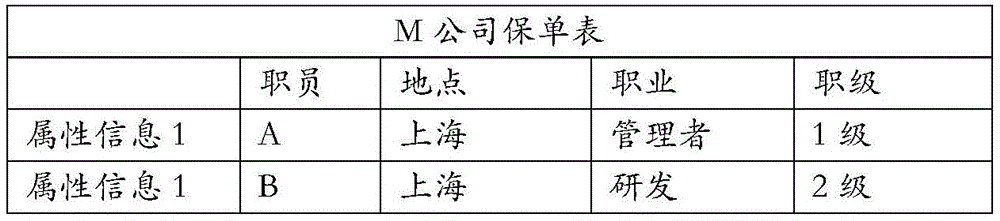
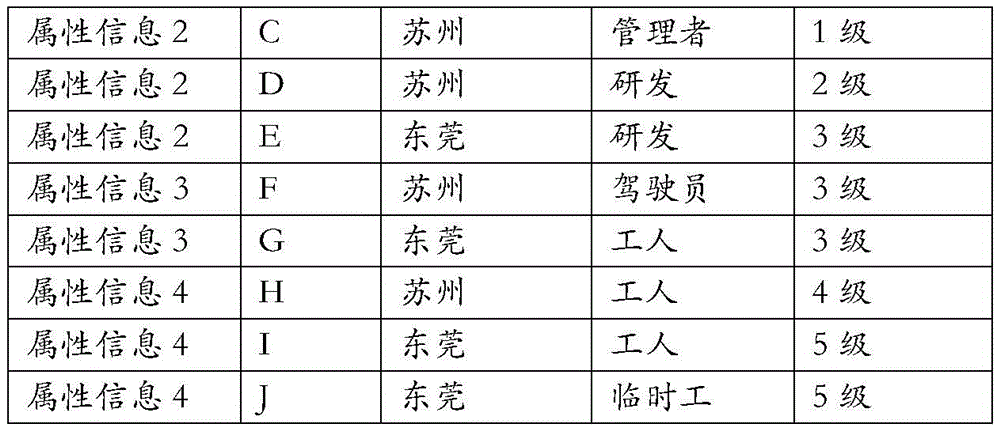
in a preferred embodiment, the building a classification tree model with factor information in the transaction information as a classification condition and attribute information in the transaction information as a classification target includes:
s11: summarizing transaction information to form a set to be segmented, and executing a segmentation calculation thread to divide the transaction information in the set to be segmented into a first subset with one type of attribute information and a second subset with at least one type of attribute information according to attribute information; calculating probability values of the client data corresponding to the factor information in the first subset and summarizing to obtain a first probability set with at least one probability value; and calculating the probability value of the client data corresponding to the factor information in the second subset, and summarizing to obtain a second probability set with at least one probability value.
Illustratively, based on the above-described client information, one kind of attribute information is classified into one type, and other kinds of attribute information are classified into another type, as follows:
in the attribute information 1, the probability value of the "place" factor information is 100% of that of Shanghai, the probability value of the "place" factor information is 0 of Suzhou, and the probability value of the "place" factor information is 0 of Dongguan, so as to obtain a first probability set (100%, 0); in the attribute information 2, 3, and 4, the "place" factor information is the Shanghai probability value of 0, the "place" factor information is the Suzhou probability value of 50%, and the "place" factor information is the Dongguan probability value of 50%, and a second probability set (0, 50%) is obtained.
In the attribute information 2, the probability value of the "place" factor information is 0 in Shanghai, the probability value of the "place" factor information is 67% in Suzhou, and the probability value of the "place" factor information is 33% in Dongguan, so as to obtain a first probability set (0,67%, 33%); in the attribute information 1, 3 and 4, the probability value of the "place" factor information is 2/7 of Shanghai, the probability value of the "place" factor information is 2/7 of Suzhou, the probability value of the "place" factor information is 3/7 of Dongguan, and a second probability set (2/7, 3/7) is obtained
In the attribute information 3, the probability value of the "place" factor information is 0, the probability value of the "place" factor information is 50% of the probability value of the Suzhou, and the probability value of the "place" factor information is 50% of the probability value of the Dongguan, so as to obtain a first probability set (0, 50%); in the attribute information 1, 2, and 4, the "place" factor information is 25% of the probability value of Shanghai, the "place" factor information is 37.5% of the probability value of Suzhou, and the "place" factor information is 37.5% of the probability value of Dongguan, and a second probability set (25%, 37.5%, and 37.5%) is obtained
In the attribute information 4, the probability value of the "place" factor information is 0 in Shanghai, the probability value of the "place" factor information is 33% in Suzhou, and the probability value of the "place" factor information is 67% in Dongguan, so as to obtain a first probability set (0,33% and 67%); in the attribute information 1, 2 and 3, the probability value of the "place" factor information is 2/7 of Shanghai, the probability value of the "place" factor information is 3/7 of Suzhou, the probability value of the "place" factor information is 2/7 of Dongguan, and a second probability set (2/7, 3/7, 2/7) is obtained
Similarly, the "job" factor information and the "job level" factor information obtain corresponding probability values and first probability sets and second probability sets thereof as described above.
S12: calculating the coefficient of the factor information in the first subset according to the first probability set to obtain a first coefficient, calculating the coefficient of the factor information in the second subset according to the second probability set to obtain a second coefficient, and calculating the sum of the first coefficient and the second coefficient to obtain the factor coefficient of the factor information.
Illustratively, based on the above examples: the attribute information is 4 kinds in total, the k-th probability set is pk, and the expression of the coefficient of the radix (namely, the first coefficient and the second coefficient) is:
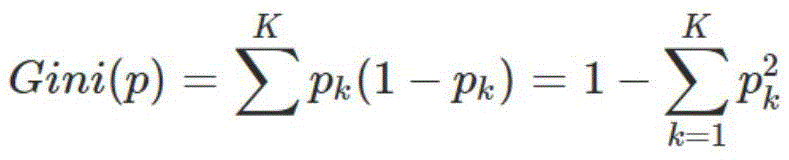
the above formula can be used to obtain: dividing the set to be segmented according to the 'place' factor information can obtain the following scheme:
h1: the attribute information 1 is divided into one type, and the factor coefficients obtained by dividing the attribute information 2, 3 and 4 into one type are as follows: 0.75;
h2: the attribute information 2 is divided into one type, and the factor coefficients obtained by dividing the attribute information 1, 3 and 4 into one type are: 1.1;
and H3: the attribute information 3 is divided into one type, and the factor coefficients obtained by dividing the attribute information 1, 2 and 4 into one type are: 1.4;
h4: the attribute information 4 is divided into one type, and the factor coefficients obtained by dividing the attribute information 1, 2 and 3 into one type are: 1.1.
In this embodiment, the above formula may be a target formula of the classification algorithm.
S13: identifying factor information corresponding to a factor coefficient with the lowest value and customer data corresponding to the factor information in the first subset, and taking the factor information and the customer data as classification conditions;
illustratively, based on the above example, the value of the factor coefficient of the H1 scheme is lowest, and the client data (Shanghai) of the "place" factor information in the first subset (the transaction information corresponding to the attribute information 1) is acquired as the classification condition, that is: "whether the place is Shanghai".
S14: judging whether the second subset has two or more attribute information;
if yes, setting the second subset as a new set to be segmented, and executing the segmentation calculation thread again;
if not, constructing a classification tree model according to the classification conditions.
Illustratively, based on the above examples, the resulting second subset is shown in the following table:
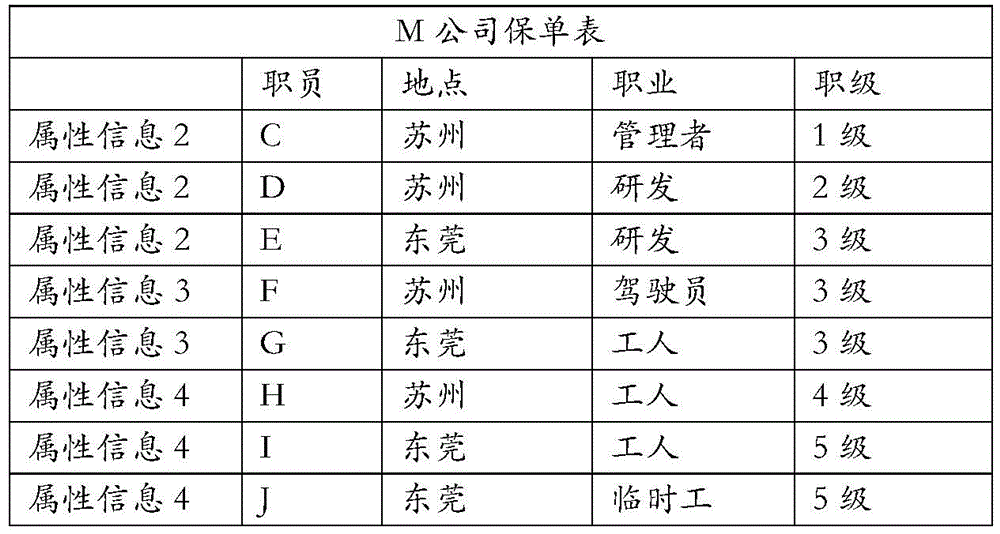
based on the above example, a classification tree model with the following classification conditions will be obtained:
classification condition 1: whether the work site is Shanghai; if yes, the attribute information is attribute information 1;
classification condition 2: whether the occupation is a manager or research and development; if yes, the attribute information is attribute information 2;
Classification condition 3: whether the job level reaches level 3; if yes, attribute information 3 is obtained; if not, the attribute information is attribute information 4.
S202: and receiving the identity information sent by the user terminal, and acquiring the client information according to the identity information.
In order to ensure the convenience of the client side for acquiring the client information and the safety of the client information, the step identifies the corresponding client information according to the identity information sent by the client side, so that the convenience of the client side for acquiring the client information is improved while the safety of the client information is ensured, wherein the identity information is data information reflecting the identity of the client side.
Specifically, the obtaining the client information according to the identity information includes:
s21: judging whether the preset registration library has registration information consistent with the identity information.
S22: if yes, extracting a mapping table from the registry, acquiring an information base corresponding to the identity information according to the mapping table, and acquiring the client information from the information base; the mapping table characterizes the mapping relation between the identity information and the address or the number of the information base, and the information base stores at least one piece of client information.
S23: if not, sending access prohibition information to the user side.
S203: obtaining a preset classification tree model in the client information, loading classification conditions in the classification tree model into a preset feedback page to form a search page, sending the search page to the user terminal, and receiving search items input in the search page by the user terminal.
In order to facilitate the user to accurately obtain the required insurance level information by only using a limited number of classification conditions, the step loads the classification conditions in the classification tree model into a preset feedback page to form a search page by acquiring the preset classification tree model in the client information, so that the user can obtain the attribute information required by the user only by filling in the search page with the search item corresponding to the necessary classification condition, and the search efficiency of the attribute information is improved.
In a preferred embodiment, the loading the classification condition in the classification tree model into a preset feedback page forms a search page, which includes:
s31: and extracting classification conditions in the classification tree model.
In this step, the classification condition is factor information for classifying the client information and the client data corresponding to the factor information in the first subset, so that the client can simply select or input the search item, and the classification of the client information can be completed.
S32: acquiring a feedback page, inputting the classification condition into the feedback bullet frame, and setting a retrieval drop-down frame associated with the classification condition in the feedback page to obtain a retrieval page; wherein, the search drop-down box records the option of selecting the classifying condition.
In the step, the user side does not need to input characters by setting the search drop-down frame, and the user side can complete the input of the search item only by selecting according to the classification condition, so that the search efficiency is improved. In this embodiment, the search drop-down box includes a "yes" option and a "no" option.
S204: and identifying attribute information matched with the retrieval item in the classification tree model, and feeding back the attribute information to the user side.
In order to ensure that a user side can obtain attribute information of a target object only by selecting or inputting limited information aiming at the target object without traversing all client information in an information base, the attribute information is fed back to the user side by identifying the attribute information matched with the retrieval items in the classification tree model, so that the attribute information can be obtained only by calculating classification conditions in the classification tree model according to the retrieval items, the attribute information obtaining efficiency of the target object is greatly improved, and the risk that the user side directly obtains transaction information to cause staff policy leakage is avoided; meanwhile, the situation that the information base cannot be used when the user side inquires attribute information is avoided because the information base is occupied.
S205: and acquiring the first classification condition in the classification tree model, executing a bullet frame process, loading the classification condition into a preset feedback bullet frame to form a search bullet frame, sending the search bullet frame to the user side, and receiving a search item selected by the user side in the search bullet frame.
For some insurance levels, the user side only needs to select one or several search items to obtain the attribute information of the target object, and if the user side selects too many search items at a time, the search efficiency of the attribute information is reduced, so that in order to avoid the problem that the search efficiency is reduced due to the fact that the user side fills too many search items at a time, the step obtains the classification conditions in the classification tree model, executes a frame process, loads the classification conditions into a preset feedback frame to form a search frame, sends the search frame to the user side, and receives the mode of the search items selected by the user side in the search frame, the user side only needs to select one or several options corresponding to the classification conditions in the search frame, and uses the options as the search items to operate the classification conditions in the classification tree model, so that the attribute information of the target object is obtained, and the search efficiency of the attribute information is improved.
In a preferred embodiment, the step of loading the sorting condition into a preset feedback frame to form a search frame includes:
s51: and acquiring a feedback bullet frame, and inputting the classification condition into the feedback bullet frame.
S52: setting a search drop-down frame associated with the classification condition in the feedback bullet frame to obtain a search bullet frame; wherein, the search drop-down box records the option of selecting the classifying condition.
In the step, the user side does not need to input characters by setting the search drop-down frame, and the user side can complete the input of the search item only by selecting according to the classification condition, so that the search efficiency is improved. In this embodiment, the search drop-down box includes a "yes" option and a "no" option.
S206: judging whether attribute information can be obtained from the classification tree model according to the retrieval item;
if yes, the attribute information is sent to the user side;
if not, acquiring the classification condition of the next bit matched with the retrieval item and executing the bullet frame process.
In the step, the classification tree model is operated according to the retrieval item to obtain attribute information;
if two or more attribute information still exist in the node obtained by the retrieval item and a classification condition exists below the node, the classification condition is acquired and set as the classification condition of the next order matched with the retrieval item, and then the bullet frame process is executed.
And if the node obtained by the retrieval item has only one attribute information or no classification condition exists below the node, transmitting the attribute information of the node to the user side.
And further, the attribute information of the target object to be searched at the user side can be obtained by selecting a limited search bullet frame or a limited search entry in the limited search bullet frames, so that the search efficiency of the attribute information is further improved.
S207: and receiving modification information output by the user terminal, modifying transaction information in the client information according to the modification information, executing the tree structure process to obtain an updated classification tree model, and setting the updated classification tree model in the client information.
In order to ensure the matching degree between the classification tree model and the modified client information and further ensure that the attribute information of the target object to be queried at the user side can be accurately searched through the classification tree model, the step is to modify the transaction information in the client information according to the modification information, execute the tree structure process to obtain an updated classification tree model, and set the updated classification tree model in the client information, so that the matching degree between the classification tree model and the client information is ensured in real time and the accuracy of attribute information query is further ensured.
Preferably, after the updated classification tree model is set in the client information, the method further includes:
uploading the updated classification tree model into a blockchain.
It should be noted that, corresponding summary information is obtained based on the updated classification tree model, specifically, the summary information is obtained by performing hash processing on the updated classification tree model, for example, processing by using the sha256s algorithm. Uploading summary information to the blockchain can ensure its security and fair transparency to the user. The user device may download the summary information from the blockchain to verify that the updated classification tree model has been tampered with. The blockchain referred to in this example is a novel mode of application for computer technology such as distributed data storage, point-to-point transmission, consensus mechanisms, encryption algorithms, and the like. The Blockchain (Blockchain), which is essentially a decentralised database, is a string of data blocks that are generated by cryptographic means in association, each data block containing a batch of information of network transactions for verifying the validity of the information (anti-counterfeiting) and generating the next block. The blockchain may include a blockchain underlying platform, a platform product services layer, an application services layer, and the like.
Embodiment III:
referring to fig. 4, a transaction information attribute retrieval device 1 of the present embodiment includes:
the client identifying module 12 is configured to receive identity information sent by a user terminal, and obtain client information according to the identity information;
the page interaction module 13 is configured to obtain a classification tree model preset in the client information, load classification conditions in the classification tree model into a preset feedback page to form a search page, send the search page to the user terminal, and receive a search entry entered in the search page by the user terminal;
and the attribute identifying module 14 is configured to identify attribute information matched with the search item in the classification tree model, and feed back the attribute information to the user side.
Optionally, the transaction information attribute retrieval device 1 further includes:
the model construction module 11 is configured to execute a tree structure process, and is configured to obtain client information and transaction information thereof, construct a classification tree model using factor information in the transaction information as a classification condition and using attribute information in the transaction information as a classification target, and set the classification tree model in the client information; the factor information is metadata for describing or summarizing transaction information, the attribute information is summary information for describing the transaction information, and the classification tree model is a tree data structure for classifying the transaction information by taking the factor information as a classification condition.
Optionally, the model building module 11 further includes:
the probability calculation unit 111 is configured to summarize the transaction information to form a set to be segmented, and execute a segmentation calculation thread, so as to divide the transaction information in the set to be segmented into a first subset with one type of attribute information and a second subset with at least one type of attribute information according to the attribute information; calculating probability values of the client data corresponding to the factor information in the first subset and summarizing to obtain a first probability set with at least one probability value; and calculating the probability value of the client data corresponding to the factor information in the second subset, and summarizing to obtain a second probability set with at least one probability value.
And a radix computing unit 112, configured to compute, according to the first probability set, a radix coefficient of the factor information in the first subset to obtain a first coefficient, compute, according to the second probability set, a radix coefficient of the factor information in the second subset to obtain a second coefficient, and compute a sum of the first coefficient and the second coefficient to obtain a factor coefficient of the factor information.
A condition setting unit 113, configured to identify factor information corresponding to a factor coefficient with a lowest value, and customer data corresponding to the factor information in the first subset, and take the factor information and the customer data as classification conditions;
A number judging unit 114 for judging whether or not there are two or more attribute information in the second subset; if yes, setting the second subset as a new set to be segmented, and executing the segmentation calculation thread again; if not, constructing a classification tree model according to the classification conditions.
Optionally, the page interaction module 13 further includes:
a condition extraction unit 131 for extracting classification conditions in the classification tree model.
The page construction unit 132 is configured to obtain a feedback page, enter the classification condition into the feedback popup frame, and set a search drop-down frame associated with the classification condition in the feedback page to obtain a search page; wherein, the search drop-down box records the option of selecting the classifying condition.
Optionally, the transaction information attribute retrieval device 1 further includes:
and the bullet frame interaction module 15 is used for acquiring the classification condition at the first position in the classification tree model, executing a bullet frame process, loading the classification condition into a preset feedback bullet frame to form a search bullet frame, sending the search bullet frame to the user side, and receiving a search item selected by the user side in the search bullet frame.
An attribute determination module 16 for determining whether attribute information can be obtained from the classification tree model according to the search entry; if yes, the attribute information is sent to the user side; if not, acquiring the classification condition of the next bit matched with the retrieval item and executing the bullet frame process.
Optionally, the bullet box interaction module 15 further includes:
and the bullet frame construction unit 151 is configured to obtain a feedback bullet frame, and input the classification condition into the feedback bullet frame.
A drop-down frame setting unit 152, configured to set a search drop-down frame associated with the classification condition in the feedback bullet frame to obtain a search bullet frame; wherein, the search drop-down box records the option of selecting the classifying condition.
Optionally, the transaction information attribute retrieval device 1 further includes:
the information modification module 17 is configured to receive modification information output by the user side, modify transaction information in the client information according to the modification information, execute the tree structure process to obtain an updated classification tree model, and set the updated classification tree model in the client information.
The technical scheme is applied to the intelligent decision field of artificial intelligence, and a classification model constructed based on a classification algorithm is as follows: the classification tree model loads the classification conditions in the classification tree model into a preset feedback page to form a search page, receives search items input in the search page by a user, and achieves the technical effect of obtaining attribute information without traversing transaction information by identifying attribute information matched with the search items in the classification tree model.
Embodiment four:
in order to achieve the above objective, the present invention further provides a computer device 5, where the components of the transaction information attribute retrieval device of the third embodiment may be dispersed in different computer devices, and the computer device 5 may be a smart phone, a tablet computer, a notebook computer, a desktop computer, a rack-mounted server, a blade server, a tower server, or a rack-mounted server (including a stand-alone server or a server cluster formed by a plurality of application servers) for executing a program, or the like. The computer device of the present embodiment includes at least, but is not limited to: a memory 51, a processor 52, which may be communicatively coupled to each other via a system bus, as shown in fig. 5. It should be noted that fig. 5 only shows a computer device with components-but it should be understood that not all of the illustrated components are required to be implemented and that more or fewer components may be implemented instead.
In the present embodiment, the memory 51 (i.e., readable storage medium) includes a flash memory, a hard disk, a multimedia card, a card memory (e.g., SD or DX memory, etc.), a Random Access Memory (RAM), a Static Random Access Memory (SRAM), a read-only memory (ROM), an electrically erasable programmable read-only memory (EEPROM), a programmable read-only memory (PROM), a magnetic memory, a magnetic disk, an optical disk, and the like. In some embodiments, the memory 51 may be an internal storage unit of a computer device, such as a hard disk or memory of the computer device. In other embodiments, the memory 51 may also be an external storage device of a computer device, such as a plug-in hard disk, a Smart Media Card (SMC), a Secure Digital (SD) Card, a Flash memory Card (Flash Card) or the like. Of course, the memory 51 may also include both internal storage units of the computer device and external storage devices. In this embodiment, the memory 51 is typically used to store an operating system installed in a computer device and various types of application software, such as program codes of the transaction information attribute retrieval device of the third embodiment. Further, the memory 51 may also be used to temporarily store various types of data that have been output or are to be output.
Processor 52 may be a central processing unit (Central Processing Unit, CPU), controller, microcontroller, microprocessor, or other data processing chip in some embodiments. The processor 52 is typically used to control the overall operation of the computer device. In this embodiment, the processor 52 is configured to execute the program code or the processing data stored in the memory 51, for example, execute the transaction information attribute retrieval device, so as to implement the transaction information attribute retrieval methods of the first and second embodiments.
Fifth embodiment:
to achieve the above object, the present invention also provides a computer-readable storage medium such as a flash memory, a hard disk, a multimedia card, a card memory (e.g., SD or DX memory, etc.), a Random Access Memory (RAM), a Static Random Access Memory (SRAM), a read-only memory (ROM), an electrically erasable programmable read-only memory (EEPROM), a programmable read-only memory (PROM), a magnetic memory, a magnetic disk, an optical disk, a server, an App application store, etc., on which a computer program is stored, which when executed by the processor 52, performs the corresponding functions. The computer-readable storage medium of the present embodiment is for storing a computer program for implementing the transaction information attribute retrieval method, and when executed by the processor 52, implements the transaction information attribute retrieval methods of the first and second embodiments.
The foregoing embodiment numbers of the present invention are merely for the purpose of description, and do not represent the advantages or disadvantages of the embodiments.
From the above description of the embodiments, it will be clear to those skilled in the art that the above-described embodiment method may be implemented by means of software plus a necessary general hardware platform, but of course may also be implemented by means of hardware, but in many cases the former is a preferred embodiment.
The foregoing description is only of the preferred embodiments of the present invention, and is not intended to limit the scope of the invention, but rather is intended to cover any equivalents of the structures or equivalent processes disclosed herein or in the alternative, which may be employed directly or indirectly in other related arts.
Claims (8)
1. A transaction information attribute retrieval method, comprising:
executing a tree structure process, wherein the tree structure process is used for acquiring client information and transaction information thereof, summarizing the transaction information to form a set to be segmented, and executing a segmentation calculation thread, wherein the transaction information in the set to be segmented is divided into a first subset with one type of attribute information and a second subset with at least one type of attribute information according to attribute information; calculating probability values of the client data corresponding to the factor information in the first subset and summarizing to obtain a first probability set with at least one probability value; calculating probability values of the client data corresponding to the factor information in the second subset and summarizing to obtain a second probability set with at least one probability value;
Calculating the coefficient of the factor information in the first subset according to the first probability set to obtain a first coefficient, calculating the coefficient of the factor information in the second subset according to the second probability set to obtain a second coefficient, and calculating the sum of the first coefficient and the second coefficient to obtain a factor coefficient of the factor information;
identifying factor information corresponding to a factor coefficient with the lowest value and customer data corresponding to the factor information in the first subset, and taking the factor information and the customer data as classification conditions;
judging whether the second subset has two or more attribute information; if yes, setting the second subset as a new set to be segmented, and executing the segmentation calculation thread again; if not, constructing a classification tree model according to the classification conditions; setting the classification tree model in the client information; the factor information is metadata used for describing or summarizing transaction information, the attribute information is summary information for describing the transaction information, and the classification tree model is a tree data structure for classifying the transaction information by taking the factor information as a classification condition;
Receiving identity information sent by a user terminal, and acquiring client information according to the identity information;
acquiring a preset classification tree model in the client information, loading classification conditions in the classification tree model into a preset feedback page to form a search page, sending the search page to the user side, and receiving search items input in the search page by the user side;
and identifying attribute information matched with the retrieval item in the classification tree model, and feeding back the attribute information to the user side.
2. The method for retrieving transaction information attributes according to claim 1, wherein loading the classification conditions in the classification tree model into a preset feedback page to form a retrieval page comprises:
extracting classification conditions in the classification tree model;
acquiring a feedback page, inputting the classification condition into the feedback page, and setting a retrieval drop-down frame associated with the classification condition in the feedback page to obtain a retrieval page; wherein, the search drop-down box records the option of selecting the classifying condition.
3. The transaction information attribute retrieval method according to claim 1, wherein after receiving a retrieval entry entered in the retrieval page by a user side, the method further comprises:
Acquiring a classification condition at the first position in the classification tree model, executing a bullet frame process, loading the classification condition into a preset feedback bullet frame to form a search bullet frame, sending the search bullet frame to the user side, and receiving a search item selected by the user side in the search bullet frame;
judging whether attribute information can be obtained from the classification tree model according to the retrieval item; if yes, the attribute information is sent to the user side; if not, acquiring the classification condition of the next bit matched with the retrieval item and executing the bullet frame process.
4. The method of claim 3, wherein the step of loading the classification condition into a preset feedback frame to form a search frame comprises:
acquiring a feedback bullet frame, and inputting the classification condition into the feedback bullet frame;
setting a search drop-down frame associated with the classification condition in the feedback bullet frame to obtain a search bullet frame; wherein, the search drop-down box records the option of selecting the classifying condition.
5. The transaction information attribute retrieval method according to claim 1, wherein after the obtaining of the customer information based on the identity information, the method further comprises:
Receiving modification information output by the user side, modifying transaction information in the client information according to the modification information, executing the tree structure process to obtain an updated classification tree model, and setting the updated classification tree model in the client information;
after said setting said updated classification tree model in said customer information, said method further comprises:
uploading the updated classification tree model into a blockchain.
6. A transaction information attribute retrieval device, comprising:
the model construction module is used for executing a tree structure process, acquiring client information and transaction information thereof, constructing a classification tree model taking factor information in the transaction information as a classification condition and attribute information in the transaction information as a classification target, and setting the classification tree model in the client information; the factor information is metadata used for describing or summarizing transaction information, the attribute information is summary information for describing the transaction information, and the classification tree model is a tree data structure for classifying the transaction information by taking the factor information as a classification condition;
The model building module further includes:
the probability calculation unit is used for summarizing the transaction information to form a set to be segmented, executing a segmentation calculation thread and dividing the transaction information in the set to be segmented into a first subset with one type of attribute information and a second subset with at least one type of attribute information according to the attribute information; calculating probability values of the client data corresponding to the factor information in the first subset and summarizing to obtain a first probability set with at least one probability value; calculating probability values of the client data corresponding to the factor information in the second subset and summarizing to obtain a second probability set with at least one probability value;
the radix computing unit is used for computing the radix coefficients of the factor information in the first subset according to the first probability set to obtain a first coefficient, computing the radix coefficients of the factor information in the second subset according to the second probability set to obtain a second coefficient, and computing the sum of the first coefficient and the second coefficient to obtain a factor coefficient of the factor information;
the condition setting unit is used for identifying factor information corresponding to the factor coefficient with the lowest value and client data corresponding to the factor information in the first subset, and taking the factor information and the client data as classification conditions;
A number judging unit, configured to judge whether the second subset has two or more attribute information; if yes, setting the second subset as a new set to be segmented, and executing the segmentation calculation thread again; if not, constructing a classification tree model according to the classification conditions;
the client identification module is used for receiving the identity information sent by the user terminal and acquiring the client information according to the identity information;
the page interaction module is used for acquiring a preset classification tree model in the client information, loading classification conditions in the classification tree model into a preset feedback page to form a search page, sending the search page to the user side, and receiving search items input in the search page by the user side;
and the attribute identification module is used for identifying attribute information matched with the retrieval item in the classification tree model and feeding the attribute information back to the user side.
7. A computer device comprising a memory, a processor and a computer program stored on the memory and executable on the processor, characterized in that the processor of the computer device implements the steps of the transaction information attribute retrieval method of any of claims 1 to 5 when the computer program is executed.
8. A computer readable storage medium having a computer program stored thereon, characterized in that the computer program stored on the readable storage medium, when executed by a processor, implements the steps of the transaction information attribute retrieval method according to any one of claims 1 to 5.
Priority Applications (1)
| Application Number | Priority Date | Filing Date | Title |
|---|---|---|---|
| CN202110724032.6A CN113434505B (en) | 2021-06-29 | 2021-06-29 | Transaction information attribute retrieval method, device, computer equipment and storage medium |
Applications Claiming Priority (1)
| Application Number | Priority Date | Filing Date | Title |
|---|---|---|---|
| CN202110724032.6A CN113434505B (en) | 2021-06-29 | 2021-06-29 | Transaction information attribute retrieval method, device, computer equipment and storage medium |
Publications (2)
| Publication Number | Publication Date |
|---|---|
| CN113434505A CN113434505A (en) | 2021-09-24 |
| CN113434505B true CN113434505B (en) | 2023-04-25 |
Family
ID=77757471
Family Applications (1)
| Application Number | Title | Priority Date | Filing Date |
|---|---|---|---|
| CN202110724032.6A Active CN113434505B (en) | 2021-06-29 | 2021-06-29 | Transaction information attribute retrieval method, device, computer equipment and storage medium |
Country Status (1)
| Country | Link |
|---|---|
| CN (1) | CN113434505B (en) |
Families Citing this family (2)
| Publication number | Priority date | Publication date | Assignee | Title |
|---|---|---|---|---|
| CN114897083B (en) * | 2022-05-23 | 2025-10-21 | 中国银行股份有限公司 | Blockchain-based secure transaction method and device |
| US12425250B2 (en) | 2022-10-25 | 2025-09-23 | Edgevana, Inc. | Systems, methods, and computer readable medium for dynamically analyzing and/or modifying blockchain networks |
Citations (2)
| Publication number | Priority date | Publication date | Assignee | Title |
|---|---|---|---|---|
| CN111652281A (en) * | 2020-04-30 | 2020-09-11 | 中国平安财产保险股份有限公司 | Information data classification method and device and readable storage medium |
| CN112000692A (en) * | 2020-09-02 | 2020-11-27 | 平安养老保险股份有限公司 | Page query feedback method and device, computer equipment and readable storage medium |
Family Cites Families (5)
| Publication number | Priority date | Publication date | Assignee | Title |
|---|---|---|---|---|
| US6363375B1 (en) * | 1998-09-30 | 2002-03-26 | Nippon Telegraph And Telephone Company | Classification tree based information retrieval scheme |
| CN108629685A (en) * | 2018-05-09 | 2018-10-09 | 平安普惠企业管理有限公司 | loan product attribute determining method and server |
| CN109255013A (en) * | 2018-08-14 | 2019-01-22 | 平安医疗健康管理股份有限公司 | Claims Resolution decision-making technique, device, computer equipment and storage medium |
| CN111241566A (en) * | 2020-01-16 | 2020-06-05 | 深圳壹账通智能科技有限公司 | Policy management method, electronic device, computer device, and storage medium |
| CN111914171A (en) * | 2020-07-23 | 2020-11-10 | 北京祥龙博瑞保险代理有限公司 | Product retrieval method, device, system and storage medium |
-
2021
- 2021-06-29 CN CN202110724032.6A patent/CN113434505B/en active Active
Patent Citations (2)
| Publication number | Priority date | Publication date | Assignee | Title |
|---|---|---|---|---|
| CN111652281A (en) * | 2020-04-30 | 2020-09-11 | 中国平安财产保险股份有限公司 | Information data classification method and device and readable storage medium |
| CN112000692A (en) * | 2020-09-02 | 2020-11-27 | 平安养老保险股份有限公司 | Page query feedback method and device, computer equipment and readable storage medium |
Also Published As
| Publication number | Publication date |
|---|---|
| CN113434505A (en) | 2021-09-24 |
Similar Documents
| Publication | Publication Date | Title |
|---|---|---|
| CN112052141B (en) | Data fragment verification method and device, computer equipment and readable storage medium | |
| CN112183782B (en) | Fault work order processing method and equipment | |
| CN114327374A (en) | Business process generation method, device and computer equipment | |
| US11971880B2 (en) | Techniques for in-memory data searching | |
| CN112418798A (en) | Information auditing method, device, electronic device and storage medium | |
| CN112631719B (en) | Data prediction model calling method, device, equipment and storage medium | |
| CN116955361A (en) | Method and system for searching key range in memory | |
| CN114265967A (en) | Sensitive data security level marking method and device | |
| CN113688923B (en) | Order abnormity intelligent detection method and device, electronic equipment and storage medium | |
| CN115099875A (en) | Data classification method based on decision tree model and related equipment | |
| CN113434505B (en) | Transaction information attribute retrieval method, device, computer equipment and storage medium | |
| CN112116436A (en) | Intelligent recommendation method and device, computer equipment and readable storage medium | |
| CN112529319A (en) | Grading method and device based on multi-dimensional features, computer equipment and storage medium | |
| CN110599354A (en) | Online reconciliation method, system, computer device and computer-readable storage medium | |
| CN112364022B (en) | Information deduction management method, device, computer equipment and readable storage medium | |
| CN111831817B (en) | Questionnaire generation analysis method, device, computer device and readable storage medium | |
| CN114358893B (en) | A method and device for identifying tax-related risk enterprises | |
| US20150095349A1 (en) | Automatically identifying matching records from multiple data sources | |
| CN119293082A (en) | A supply chain factoring repayment query method, device and medium based on high concurrency | |
| US20210409204A1 (en) | Encryption of protected data for transmission over a web interface | |
| CN110322339B (en) | Virtual resource management method, device, computer system and readable storage medium | |
| CN111027296A (en) | Method and system for generating report based on knowledge base | |
| CN114238270B (en) | Database operation method, device, computer equipment and readable storage medium | |
| US11886468B2 (en) | Fingerprint-based data classification | |
| CN117057922A (en) | Financial asset management method, device, equipment and medium based on page display |
Legal Events
| Date | Code | Title | Description |
|---|---|---|---|
| PB01 | Publication | ||
| PB01 | Publication | ||
| SE01 | Entry into force of request for substantive examination | ||
| SE01 | Entry into force of request for substantive examination | ||
| GR01 | Patent grant | ||
| GR01 | Patent grant |