Detailed Description
According to the present invention, a blister package for a contact lens is provided. The blister package includes a body having a handle and a body dome connected to the handle. The body dome has an outer surface. The outer surface of the body dome provides the seating surface for the contact lens. A seal covers the contact lens on the body dome and seals to the top surface of the body, covering the body dome. The seal includes a sealing dome having an inner sidewall shaped to receive the body dome and having an outer sidewall defining a blister package dome. In the space provided between the outer surface of the body dome and the inner surface of the seal dome, a contact lens may be placed and immersed in a contact lens solution. The inner sidewall of the sealing dome can substantially conform to the outer sidewall of the body dome while leaving sufficient space to accommodate a contact lens and a volume of contact lens solution when the seal is sealed to the top surface of the body.
The blister pack has a top surface and a blister pack dome rising from the top surface. The base of the outer sidewall of the sealed dome (which is the same as the base of the outer sidewall of the blister package dome) intersects the top surface of the blister package at an intersection point. Herein, the outer sidewall of the sealing dome is referred to as the sealing dome when the seal is not attached to the body, but the sealing dome is referred to as the blister package dome when the seal is attached to the body, thereby forming an unopened blister package. The intersection point has a shape and the shape has a maximum dimension, for example, the shape may be a circle and the maximum dimension may be a diameter of the circle. The handle of the blister package has a through hole (e.g., a circular through hole) and the through hole has a through hole diameter or other maximum dimension that is large enough to at least partially accommodate the blister package dome of a second, substantially identical, individual contact lens blister package.
The seal may be connected to the body and may seal a volume at least partially defined by an inner sidewall of the seal dome and an outer sidewall of the body dome. The seal is located on top of the blister package such that the volume defined in part by the outer sidewall of the body dome is sealed by the inner sidewall of the seal dome, for example, along the perimeter at the base of the outer sidewall of the body dome. The through hole diameter or maximum dimension may be the same size as the diameter or maximum dimension of the blister package dome at the base of the blister package dome. The intersection point may have a circular shape and may have a diameter that is the largest dimension of the blister package dome at the base of the blister package dome. The through hole may have a diameter that may be at least as large as the largest diameter or dimension of the blister package dome. Using a circular shape as an example, the diameter of the through-hole may be at least 50% of the diameter at the intersection, at least 70% of the diameter at the intersection, at least 90% of the diameter at the intersection, or 100% of the diameter at the intersection.
The seal may include a tab extending into the through bore. The tab or another component of the seal, or both, can provide indicia (e.g., prescription, lot number, and expiration date) of the contact lens packaged and sealed inside the blister package. The blister package may include a contact lens enclosed within the volume, and the connecting tab may be marked with indicia regarding the prescription of the contact lens. The tab may act as a pull tab to facilitate peeling of the seal from the body and opening of the bowl formed by the inverted dome.
The body of the blister package may comprise a foil material, or the seal may comprise a foil material, or both components may comprise a foil material. The foil material may comprise a metal foil material, such as aluminum foil. The seal may comprise a bi-layer or multi-layer material. The body and seal may comprise a foil material and the dome may be reinforced with a layer of plastic material, a foil bilayer, a plastic reinforced dome, combinations thereof, or the like. The body may comprise a plastics material and the seal may comprise a foil material.
The present invention also provides stackable contact lens blister packages and assemblies comprising a stack of separate, but identical or substantially identical contact lens blister packages. For example, each contact lens blister package may be of the type as described herein. By "substantially the same" it is meant that the two blister packs have about the same shape and size, about the same diameter of the through hole and about the same diameter of the dome at the intersection. An example is a plurality of blister packs made to the same specifications. By "about" is meant within 5% of the deviation, that is, no more than 5% greater in size than the corresponding size of a substantially identical blister package or no more than 5% less than the corresponding size.
Providing a stack of blister packages as described herein, wherein the through-hole of a first blister package is located on the blister package dome of a second, adjacent blister package in said stack of blister packages and at least partially surrounds the blister package dome. The stacking may comprise alternating blister packs, wherein the blister pack domes of each even blister pack are disposed in the through holes of each odd blister pack. The alternating configuration may be referred to as a double stacking of the mosaic blister packs. In another configuration, the stack may comprise a triple stack of tessellated blister packs. For a triple stack of inlay blister packages, the through-holes of the second blister package are disposed on the dome of the first blister package, the through-holes of the third blister package are disposed on the dome of the second blister package but not aligned with the first blister package, and the through-holes of the fourth blister package are disposed on the dome of the third blister package. The triple stack fourth blister pack is fitted directly above, aligned with, and in the same orientation as the first blister pack. The fourth blister pack and the fifth and sixth blister packs form the next sequence of three blister packs which repeats the pattern formed by the first, second and third blister packs.
A secondary container, such as a secondary package, for packaging a stack of contact lens blister packages may also be provided. For example, a diamond-shaped container, a pill-shaped container, or an oval-shaped container may be used to accommodate a dual stack of mosaic blister packages, or a container having any other suitable, convenient, and/or compact shape. Each blister pack has an outer circumference which may all have the same contour, the container has a contoured inner circumference, and the outer circumference contour of the blister pack may be complementary to the inner circumference contour of the secondary container. A lip or rim may be provided at the top of the container to prevent the blister pack from falling out of the container. A spring may be provided at the bottom wall of the container to bias the blister pack slightly upwardly towards the opening at the lip or rim of the container.
For a triple stack of tessellated blister packages, a triangular shaped container or a container having a triangular shaped footprint (footprint) may be used to accommodate the triple stack. Although each blister package may have the same outer circumference, the outer circumference of the triple stack is different from and larger than the outer circumference of the double stack, and the outer circumference of the triple stack is triangular in shape. A triangular container for receiving a triple stack may have an inner circumference with a triangular profile, for example, with rounded corners, and the outer circumferential profile of the triple stack may be complementary to the inner circumferential profile of the secondary container.
Other secondary container designs and configurations may be used, including, for example, collapsible containers, containers with removable lids, containers with hinged lids, containers with push button release features, containers with combinations of the features, or the like.
For a dual stack of tessellating blister packages, each tessellating blister package comprises a blister package dome, adjacent blister packages of the stack may be connected to each other along adjacent edges. For example, a lateral edge of a first blister package comprising a dome may be connected to a lateral edge of an adjacent but alternately configured second blister package in the stack. Such an arrangement forms a Z-shaped arrangement and although the blister packages are connected along the edges, they can be easily separated from each other by including score lines, perforations or the like along the connected edges. In such a Z-shaped configuration, it is understood that the top and bottom blister packages (each of which includes a dome) are connected only to a single adjacent blister package, while the blister package in the middle of the stack is connected to both the upper blister package in the stack and the lower blister package in the stack. Pulling one blister package from the Z-stack may position the next blister package of the Z-stack for removal from the stack. A lip or rim may be provided at the top of the container to prevent the blister pack from falling out of the container. A spring may be provided at the bottom wall of the container to bias the blister pack slightly upwardly towards the opening at the lip or rim.
According to yet another embodiment of the present invention, a blister package for a contact lens is provided that includes a body having a handle, a bowl connected to the handle, a top surface, and a bottom surface, wherein the handle has a through hole for receiving the bowl of an adjacent, identical blister package. A plurality of said blister packs may be stacked one on top of the other in an alternating manner. The bowl can have a bowl outer surface that intersects the bottom surface at an intersection point. The intersection point may have a first diameter or a first other maximum dimension. The through-hole through the handle may have a diameter or other maximum dimension that is complementary to the first diameter or first other maximum dimension. The through hole diameter or other maximum dimension can be designed to at least partially accommodate the outer surface of the bowl. A seal is also provided that is connected to the body and seals the bowl containing the contact lens and contact lens solution therein. The through-hole may be circular. The through-hole may have a diameter, the intersection may have a diameter, and the diameter of the through-hole may be at least as large as the diameter of the intersection.
The seal may comprise a foil material, such as a metal foil material, such as an aluminium foil material. The seal may include a tab extending into the through bore. The seal may comprise a two-layer foil assembly, for example, comprising a folded over and defining a foil seal, a flap, and a folded sheet of material. The foil seal and the sealing flap can intersect at a fold and the foil seal can contact the top surface of the body and seal the bowl. The flap may be configured to be pulled away from the foil seal and form a pull tab, and the pull tab may be configured to be pulled so that the foil seal can be separated from the top surface of the body and the bowl can be opened. The foil seal can be adhered to the top surface of the body and the fold can contact the top surface between the bowl and the distal end of the handle.
The body may comprise a foil material, for example a metal foil material, for example an aluminium foil material. The body may comprise a plastic material, a multi-layer material, or both. The handle can extend from the top surface of the body away from the bowl and turn downward toward the distal end. The present invention also provides a stack of such blister packages, wherein the bowl of a first blister package is placed in the through hole of a second, adjacent blister package in said blister package. Similar to the manner in which the above-mentioned blister packages having a domed top can be housed in the secondary container, a stack of blister packages (each of which includes a bowl) can likewise be housed in the secondary container. A secondary container, such as a secondary package, for packaging a stack of contact lens blister packages (each of which includes a bowl) can be provided. For example, a diamond-shaped container, a pill-shaped container, or an oval-shaped container may be used to accommodate a double stack of mosaic blister packages, with the upper and lower blister packages being arranged alternately in opposite directions. Each blister pack has an outer circumference which may all have the same contour, the container has a contoured inner circumference, and the outer circumference contour of the blister pack may be complementary to the inner circumference contour of the secondary container.
For the blister package described above having a domed top, other secondary container designs or configurations can be used to package a plurality of blister packages including a bowl. The secondary container may include, for example, a collapsible container, a container with a removable lid, a container with a hinged lid, a container with a push-button release feature, a container with a combination of the features, or the like.
The body of the blister package may be formed of a plastic material that can be shaped by injection molding or thermoforming. The plastic material used to prepare the body may comprise polypropylene, polyethylene, polystyrene or another thermoplastic material. One or more portions of the body material (particularly in the dome or bowl) can have a vapor transmission rate of less than 10 grams per 100 square inches per 24 hours at 70 ° f and 50% relative humidity.
As stated above, the body of the blister package may comprise various structures, such as a relatively rigid material or a flexible material. The body of the sealed blister package can be a thermoplastic material and the body can include a dome and a substantially planar body bottom surface surrounding the dome or a bowl and a substantially planar body top surface surrounding the bowl. The generally planar body surface provides a sealing surface for sealing the flexible top or bottom (e.g., seal) to the body. The body may be made from a variety of materials. The body may be formed using conventional methods and equipment, for example by injection molding a polypropylene resin in a body mold in an injection molding machine.
The body may comprise two or more different parts or be made of two or more different materials, for example a reinforced region defining a dome or bowl of the body. The reinforcement may be made using a plastic insert, a plastic layer, a double foil, or the like.
The flexible top or seal may also be formed from a variety of materials. For example, the flexible top or seal may be a laminate structure comprising a foil and one or more layers of plastic (e.g., polypropylene and the like). The flexible top or seal may optionally contain human readable information. The flexible top or seal may be coupled to the body surface by: the sealing surface of the body is brought into contact with the flexible top or seal and heat is applied to fuse the two parts together, providing a hermetic or gas-tight seal for the contact lens and contact lens solution defined by the dome or bowl. Spacers or other supporting structural features may be integrally formed as part of the body or inserted into the dome or bowl to support the contact lens and occupy space, thereby minimizing the amount of contact lens solution required for packaging.
The periphery of the body dome, the sealing dome, or the bowl can abut the circumference of the body dome, the sealing dome, or the bowl, respectively. The perimeter may comprise a flange region, for example extending about 5mm from the opening of the sealing dome or bowl to the gripping region. In an exemplary embodiment, the overall dimensions of the blister package may be about 30mm wide, about 47mm long and about 10mm high. However, it should be appreciated that the package may have any size and/or shape.
The body dome or bowl portion houses the contact lens and solution in a liquid-tight manner. The dome or bowl may be bounded by a sealing region that may be part of the flange region. The flexible bottom or the flexible top may be connected to the body by heat sealing in the sealing region; however, an induction seal, sonic welding, or other bonding system may be used to attach the flexible bottom or the flexible top to the body. Once sealed, the total internal volume between the body and the sealing dome or defined by the bowl can be about 2.2ml or less. The volume of packaging solution in the bowl can be, for example, from about 0.5ml to about 2.5 ml.
The flexible top or seal may comprise at least two elements, for example at least two different separate layers of material. For example, the flexible top or seal may include a first component or layer and a second component or layer overlying the first component. The first component may be made from a laminate material that is heat sealed to the sealing region of the blister package body. The second component may comprise a foil material sealed to the rim portion of the body. The second part may comprise at least one (e.g. two) foil coated polymer layers (e.g. polypropylene). The foil may comprise aluminium. The polymer coating material on the heat sealed side of the foil may be polypropylene. Examples of useful cover layers are described in U.S. Pat. No. 4,691,820, the entire contents of which are incorporated herein by reference. The second part may be sealed to the body along the entire circumference of the body around the inner side wall of the sealing dome or bowl to provide a sanitary or sterile seal, for example by means of a hermetic seal.
An unworn contact lens is sealed within a dome or bowl of a sealed contact lens blister package and packaged in a contact lens packaging solution. Any contact lens can be packaged therein. For example, the contact lens may be a hydrogel contact lens or it may be a silicone hydrogel contact lens. Examples of contact lenses that may be provided in the package include those having the following U.S. Adopted names (United States addressed Name, usa): maxafilcon a, olorffeikon B, olorffeikon C, olorffeikon D, omafeikon a, omafeikon B, corfeikon a, enoffikon B, comfilcon a, enoffikon a, sten a, stanfilcon a, etafilcon a, oloffikon B, oloffikon C, narafilcon a, narafilcon B, balanfilcon a, samnfilcon a, lotrafilcon B, momofilcon a, oloffilcon a, and delofilcon a.
The fluid medium or solution (i.e., packaging solution) contained by the dome or in the bowl can be any known solution that can be used to store contact lenses, including water, saline solution, or buffered aqueous solution. The contact lens and solution preferably fill at least 50%, such as at least 70% or at least 80% of the total volume defined by the dome or bowl after sealing by the flexible top or seal.
Contact lens packaging solutions are typically buffered saline solutions, such as phosphate buffered saline solutions or borate buffered saline solutions, which may contain one or more additives, such as surfactants, wetting agents, viscosity agents, and the like.
The blister package may also include a wrapper having one or more panels. The wrap may be sized to accommodate a sealed contact lens package and also provide the UDI in human-readable and machine-readable forms, as well as other desired specification information. As used herein, UDI is a "Unique Device Identifier". As used herein, a wrap refers to a substrate or article that includes one or more panels coupled to a sealed contact lens package, and provides a UDI in human-readable and machine-readable forms on at least one panel. Such a wrap may be understood as a "UDI wrap," or it may be understood as a wrap having a "UDI panel. Thus, the wrap contains human-readable information (e.g., letters, numbers, and images); and the wrap contains machine-readable information (e.g., bar codes and the like). The wrap may be flexible or rigid and need not completely enclose or encircle the individual sealed contact lens packages, and may instead be connected to a secondary package or container. The wrap may be coupled to the sealed contact lens package such that the wrap and sealed contact lens package do not separate until someone opens the package to remove an unworn contact lens. For example, the wrap may be adhered to the sealed contact lens package, such as by using an adhesive between the wrap surface and the sealing member surface, or the wrap may be physically wrapped around the sealed contact lens package to mechanically enclose the sealed contact lens package within the wrap. Thus, the wrap is not inadvertently removed from or separated from the sealed contact lens blister package.
Examples of blister packaging materials, methods of making blister package bodies, flexible tops, seals, methods of making flexible tops, methods of sealing flexible tops to bodies, and other ancillary components, materials, methods, and systems are described, for example, in U.S. patent No. 6,398,018, U.S. Pat. No. 7,426,993B 2 and U.S. Pat. No. 7,477,366B 2, U.S. patent application publication nos. US 2012/0061260 a1 and US 2017/0096272 a1, and WO 2013/160667, the entire contents of each being incorporated herein by reference.
Referring to the drawings, FIGS. 1A-1F are different views of a blister package 20 for a contact lens according to an embodiment of the present invention. Fig. 1A is a front right top view of blister package 20. Fig. 1B is a front left bottom view of blister package 20. Fig. 1C is a bottom view of blister package 20. Figure 1D is a top view of blister package 20. Figure 1E is a side view of blister package 20. Figure 1F is a front end view of blister package 20.
Blister package 20 comprises a two-layer structure comprising a bottom body layer 22 and a top sealing layer 24. The body 22 defines a handle 23 and a body dome 25 having an inner sidewall 27 as shown in fig. 1B. The inner side wall 27 may have a step. The top surface of the body 22 is connected or sealed to the bottom surface of the seal 24. The seal 24 defines a seal dome 30 having an outer sidewall 31. The seal dome 30 rises from the top surface 28 of the seal 24. Top surface 28 is also the top surface of blister package 20 in the unopened state of blister package 20 shown in fig. 1A-1F. The seal dome 30 intersects the top surface 28 at an intersection point 32. The seal dome 30 has a diameter D1 at the intersection point 32, as shown in the top view of fig. 1D. The seal dome 30 has an inner sidewall (not shown) defining a sealed volume with an outer sidewall of the body dome 25. Fig. 1D also shows a contour line 37 at which the material used to prepare seal 24 can be separated into a first material or section 39 and a second material or section 41. Material 39 may be used for the entire seal 24 or only for the left portion of the line 37. Material 41 may be separate from material 39 or may constitute an additional layer on top of or below material 39, for example, material 41 may be a supplement to material 39 if material 39 extends over the entire seal 24. Material 41 may comprise a reinforced plastic material.
The handle 23 has a through hole 34 and the seal 24 has a through hole 36 aligned with the through hole 34. The through holes 34 and 36 have the same through hole diameter D2 or other maximum dimension that at least partially accommodates the seal dome 30. Sealing dome 30 also defines an outer side wall of blister package 40 in the unopened state of blister package 20 shown in fig. 1A-1F. Diameter D2 may be at least as large as diameter D1. Diameter D1 may be at least as large as diameter D2.
The seal dome 30 defines and seals the volume between its inner sidewall and the outer sidewall of the body dome 25. The seal dome 30 has a diameter or other maximum dimension at the intersection 31, and the through-hole 34 has a through-hole diameter or other maximum dimension that at least partially receives the outer sidewall of the seal dome 30 and thereby the blister pack dome 40. As can be seen, the blister pack dome 40 has a circular shape at the intersection point 31. The through holes 34 and 36 also have a circular shape. The diameter of the through hole is large enough to at least partially accommodate the blister pack dome 40.
As can be seen in fig. 1A-1D, the seal 24 includes a tab 26 that extends into the double layer through hole made by the through holes 34 and 36. The tab 26 may be marked with indicia regarding the prescription of the contact lens contained within the blister pack 20. The body 22 and the seal 24 may each independently comprise a foil material, a plastic material, or both. Sealing dome 30 may be reinforced with a layer of plastic material or a plastic insert. Both the body 22 and the seal 24 may comprise a plastic material.
Due to the dome and through hole design, the blister pack 20 and a plurality of blister packs identical to the blister pack 20 may be stacked together and form a stack of mosaic blister packs. The inner side wall 27 of the body dome 25 may have a sufficient width and depth to receive adjacent or spaced apart blister package domes of an underlying blister package. Likewise, it should be understood that contact lenses having two different prescriptions may be alternately stacked, but still considered the same blister package. When stacked, for a stacked blister package, the through-hole 34 of a first blister package is placed over and at least partially surrounds the blister package dome 40 of a second, adjacent blister package. Each blister pack has an outer circumference which may all have the same profile, and the stack of blister packs may be packaged in a container having an inner circumferential profile which accommodates and is, for example, complementary to the outer circumferential profile of the blister pack. Adjacent blister packages of the stack may be connected to each other along their edges, so that the stack may comprise a Z-shaped configuration.
Figure 2 illustrates sequential steps involved in opening a blister pack 220 according to an exemplary embodiment of the present invention. Fig. 2 shows the same single blister pack 220 at three different points in time during the opening procedure. The leftmost side is a new unopened and unpeeled blister package 222. The blister package 222 includes a body 224 and a seal 224 that seals the contact lens 250 between the outer sidewall 228 of the body dome 232 and the inner sidewall 236 of the seal dome 240, which features are seen in the final state of the sequence. The outer surface 242 of the seal dome 240 is also the outer surface 244 of the assembled blister package dome 245. The body 222 defines a body dome 232 and a handle 223. In the intermediate state shown, the seal 224 has been lifted slightly from a portion of the top surface 252 of the body 222. As shown on the far right, once the seal 224 is peeled off, the contact lens 250 can be immediately contacted with a fingertip and applied to the eye.
As also shown in fig. 2, blister package 220 has a double layer through hole 260 comprised of a body through hole 270 and a sealing through hole 280 that are aligned with each other and have the same size. The double layer through-hole 260 is large enough to accommodate the blister package dome 245 so that the blister package 220 can be stacked with one or more identical blister packages in an alternating manner, as shown in fig. 3.
Referring to fig. 3, a plurality of blister packages 220 as shown in fig. 2 are stacked together in an alternating configuration to form a double stack 300 and a triple stack 310. In each stack, the blister package domes 245 of the underlying blister packages 220 are received by and protrude through the blister package through-holes 260 of the overlying blister packages. Thus, the stack may occupy very little space, providing a compact design for packaging and storing multiple blister packages.
Fig. 4 is a front right top view of an open container 400 for storing and protecting a double stack of blister packages, such as the double stack 300 shown in fig. 3. The container 400 includes a container body 410 and a removable lid 420. The inner circumference 430 of the container body 410 may be sized and shaped to be slightly larger than the outer circumference of the double stack of blister packages so that the double stack may fit inside the container 400. The container body 410 has a shoulder 415 defining a top portion 416 having an outer circumference that is smaller than the inherent outer circumference of the container body. When the lid 420 is placed on and closes the container body 410 and the outer surface 412 of the container body 410 and the outer surface 422 of the lid 420 have the same outer cross-sectional shape, the bottom edge 425 of the lid 420 sits on the shoulder 415. Outer surface 412 and outer surface 422 are flush and continuous with one another when container 400 is closed.
Fig. 5 is a front right top view of an open container 500 for storing and protecting a triple stack of blister packages, such as the triple stack 310 shown in fig. 3. The container 500 includes a container body 510 and a removable lid 520. The inner circumference 530 of the container body 510 may be sized and shaped to be slightly larger than the outer circumference of the triple stack of the blister package so that the triple stack may fit inside the container 500. The container body 510 has a shoulder 515 defining a top portion 516 having an outer circumference that is smaller than the inherent outer circumference of the container body. When the lid 520 is placed on and closes the container body 510 and the outer surface 512 of the container body 510 and the outer surface 522 of the lid 520 have the same outer cross-sectional shape, the bottom edge 525 of the lid 520 sits on the shoulder 515. When the container 500 is closed, the outer surface 512 and the outer surface 522 are flush and continuous with each other.
Fig. 6 shows another secondary container for packaging multiple blister packages of the type shown in fig. 2 in a triple stacked configuration. The container 600 shares similar design features as those shown in fig. 5, but has a shorter overall height. Configuration 610 shows container 600 with the lid partially removed. The stack 620 shows three different displayed containers 600 stacked one on top of the other. Shoulders, rims, or other alignment features may be included at the top and bottom of each secondary container to enable stable stacking.
Fig. 7 shows yet another secondary container for packaging a plurality of blister packages of the type shown in fig. 2 in a triple stacked configuration. The container 700 has rounded outer features similar to compact cases for cosmetics. Configuration 710 shows container 700 with the lid partially removed. The stack 720 shows three different displayed containers 700 stacked one on top of the other. Shoulders, rims, or other alignment features may be included at the top and bottom of each secondary container to enable stable stacking.
Fig. 8 shows yet another secondary container 810 that packages a plurality of blister packages 220 of the type shown in fig. 2 in a double stacked configuration. The container 810 may be stacked with another container 820 of the same design, as shown on the left in fig. 8. The inner circumference of the container body 810 may be sized and shaped to be slightly larger than the outer circumference of the dual stack 850 of blister packages so that the dual stack 850 may fit inside the container 810. A lip 830 may be provided at the opening 840 of the container 810 to secure the dual stack 850 of blister packages in the container 810 and provide a little resistance to the dual stack 850, thereby preventing the dual stack 850, or any blister packages thereof, from falling out of the container 810. The blister package through-hole 260 of the outermost blister package of the double stack 850 may be pulled by a finger tip to remove the outermost blister package from the double stack 850 and the container 810. The blister package domes 245 of the double stack 850 blister packages are directed toward the container 810 rather than being exposed at the opening 840. A spring or other biasing feature may be provided at the bottom of the container 810 to facilitate positioning of the outermost blister packages of the double stack 850 at the opening 840. Removable end cap 860 may close one or both ends of containers 810 and 820 and may contain indicia regarding the prescription, lot number, expiration date, and the like of the blister packages contained within the containers.
Fig. 9 shows yet another secondary container 900 that packages a plurality of blister packages 20 of the type shown in fig. 1A-1F in a double stacked configuration. The container 900 may be stacked with other containers having the same design. The inner circumference of the container 900 may be sized and shaped to be slightly larger than the outer circumference of the dual stack 910 of the blister package 20 so that the dual stack 910 may fit inside the container 900. A lip 920 may be provided at the opening 930 of the container 900 to secure the dual stack 910 in the container 900 and provide some resistance to the dual stack 910, thereby preventing the dual stack 910, or any blister package 20 thereof, from falling out of the container 900. The blister pack through-hole 35 of the outermost blister pack of the double stack 910 comprises a connecting tab 26, as can also be seen in fig. 1A-1D. The blister pack dome 40 of the second blister pack from the top protrudes through the through hole 35 forcing the tab 26 of the top blister pack of the double stack 910 to protrude upwards where it can be easily grasped by the user facilitating the removal of the top blister pack 20 from the container 900. Lip 920 may provide a degree of resistance to removal of blister package 20. Once removed, the second blister pack from the top is immediately exposed and its through-hole connecting tab will protrude from its respective blister pack through-hole. A spring or other biasing feature may be provided at the bottom of the container 900 to facilitate positioning of the outermost blister packages of the dual stack 910 at the opening 930. A removable end cap (not shown) may close one or both ends of the container 900 and may include indicia regarding the prescription, lot number, expiration date, and the like of the double stacked 910 blister packages.
Fig. 10 is a front right top view of a dual stack collapsible container 950 that may be used to store and protect a mosaic blister package according to yet another embodiment of the present invention. The container 950 includes a base 954 and a slidable container body 958 that may be positioned at different heights to adjust the overall height of the container 950. A spring-biased catch ball 964 and the same on the other side of the container 950 can fit into any of the three through holes 962 to thereby adjust the position of the slidable container body 958 relative to the base 954. The stack of contact lenses may be contained in the container 950 and as the stack is depleted and thereby shortened, the container 950 may likewise be shortened. Thus, the stacked top blister package may be made more accessible and access to the blister package may be avoided deep into the container 950. Hinged lid 968 is provided with, for example, a latch to prevent the stack from falling out of container 950. The stack may comprise a double stack of blister packages, such as a double stack of mosaic blister packages according to an embodiment of the present invention.
Fig. 11 is a front right top view of container 320 and Z-shaped dual stack 322 of blister packages 324 is partially housed within container 320. Fig. 12 is a front left top view of container 320, but empty and without a Z-shaped double stack of blister packs therein. As can be seen in fig. 11, the Z-shaped double stack 322 of blister packages 324 fits into the interior of container 320, but three blister packages 324 have been removed from container 320 to show the details of the Z-shaped double stack 322. Each blister pack 324 includes a blister pack dome 326 and a blister pack through hole 328 and may be of the type shown in fig. 2 and 3. The outermost blister package 330 of the Z-shaped double stack 322 comprises a transverse edge 334 that is not connected to any other blister package. However, the opposite lateral edge 336 of the outermost blister pack 330 is connected to the lateral edge 338 of the second blister pack 332 of the Z-shaped double stack 322. Unlike the outermost blister pack 330, both lateral edges 338 and 348 of the second blister pack 332 are connected to adjacent blister packs. Upon peeling outermost blister package 330 from blister package 332 and Z-shaped double stack 322, second blister package 332 immediately becomes the new outermost blister package. Fig. 12 shows a detent 350 that can be actuated using a button 340 to release the outermost blister package of the contained Z-shaped double stack from the interior of the container 320.
As can be seen in fig. 11, each blister package dome 326 protrudes through the through hole directly overlying the blister package and extends into the inner cavity formed bi-directionally and overlying from the blister package by the inside surface of the blister package dome. Thus, for example, upon stacking in container 320, unlike the extension shown, dome 326' will protrude through hole 328 and into the inside surface (not shown) of blister pack dome 326 ".
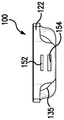
Figure 13A is a front right top view of a blister package 100 according to yet another embodiment of the present invention. Fig. 13B is a back right bottom view of blister package 100. Figure 13C is a top view of blister package 100. Fig. 13D is a bottom view of blister package 100. Fig. 13E is a right side view of blister package 100. Figure 13F is a rear end view of blister package 100. Figure 13G is a front end view of blister package 100. Blister package 100 includes a body 122 and a seal 124. Body 122 defines a handle 123 and a bowl 125 having internal sidewalls that are not shown in fig. 1A-1G because they are sealed by a seal 124. The seal 124 is connected to the top surface 127 of the body 122 and seals the bowl 125. Seal 124 has a folded configuration such that its top flap 132 can be pulled up to form a pull tab and its bottom portion 134 seals against bowl 125. The top flap 132 and the bottom portion 134 can intersect at a fold line 138, as can be seen in fig. 13A and 13C. The outer sidewall 135 of the bowl 125 can be seen at least in fig. 13A, 13B, 13D, and 13E. The seal 124 includes a recess 136 that fits into the bowl 125 and minimizes the volume occupied by the bowl 125. The recess 136 can be used to reduce the amount of contact lens solution needed to hold a contact lens within the bowl 125.
Blister package 100 is shown in an unopened state in fig. 13A-13G. As can be seen in fig. 13B and 13D, the outside wall of the bowl 125 is rectangular and slightly oval. The bowl 125 includes a slipper (beach) and the outer sidewall of the bowl 125 defining the slipper is shown as outer sidewall portion 137. The body 122 defines a through hole 140 designed to accommodate the outer sidewall 135 of the bowl 125. Similarly, the through-hole 140 is oblong, particularly oval, as most preferably seen in fig. 13C and 13D. The shapes of outer sidewall 135 and through-hole 140 are designed to complement each other so that the bowl portion of one blister package 100 can be seated within the through-hole of an underlying blister package 100. Thus, multiple blister packages 100 may be alternately stacked together and occupy a minimal height in the form of a stack. The outer sidewall 135 of the bowl 125 can have a deep hole maximum dimension D3 at the outer sidewall defining the bowl itself, excluding the area defining the slipper. The via 140 may have a maximum dimension D4 that is at least as large as the maximum dimension D3. Thus, the through-hole 140 can accommodate the outer surface 135 of the bowl 125 that defines the deep bowl portion of the bowl 125 that is free of the slipper.
As can also be seen in fig. 13A-13G, at the front and rear ends of blister package 100, protruding tips 150 and 152 are provided, respectively. When stacked with other blister packages of the same design, tips 150 and 152 engage slots 154 and 156, respectively, at opposite ends of an overlying blister package. Thus, tip 150 of first blister package 100 is configured to engage and be disposed in slot 154 of the overlying blister package and tip 152 of first blister package is configured to engage and be disposed in slot 156 of the overlying blister package 100. The tip and slit enable the stacked blister packages to be secured together, but easily separable.
Fig. 14 is a rear left top view of the blister package 100 as shown in fig. 13A-13G, wherein the top flap 136 of the seal 124 has been lifted away from the blister package to form a pull tab 139. It can be seen that the bottom portion 134 of the seal 124 continues to seal the bowl. Like reference numerals in fig. 13A-13G, 14 and 15 indicate like corresponding features.
Fig. 15 is a side view of a double stack 160 of 30 blister packages 100 of the type shown in fig. 13A-13G and 14 in an alternating configuration. The outer sidewall 135 of the stacked bottom blister package 100' can be seen. The outer sidewall 135 "of the second blister package 100" from the bottom of the stack 160 can also be seen. It can be seen that outer sidewall 135 "protrudes through a through hole (not shown) of bottom blister package 100'.
The invention comprises the following aspects/embodiments/features in any order and/or in any combination:
1. a blister package for a contact lens, the blister package comprising:
a body having a top surface and comprising a handle and a body dome connected to the handle;
a seal connected to the top surface of the body, the seal having a sealing top surface and comprising a sealing dome having an outer sidewall and an inner sidewall, the seal sealing a volume between the outer sidewall of the body dome and the inner sidewall of the sealing dome, the sealing dome intersecting the sealing top surface at an intersection point, the sealing dome having a diameter or other maximum dimension at the intersection point, the handle having a through hole, and the through hole having a through hole diameter or other maximum dimension that at least partially receives the outer sidewall of the sealing dome; and is
The outer sidewall of the sealing dome defines a blister package dome.
2. The blister package of any preceding or following embodiment/feature/aspect, further comprising a contact lens having a concave surface positioned on the body dome.
3. The blister package of any preceding or following embodiment/feature/aspect, wherein the through hole diameter or other largest dimension is the same size as a diameter or other largest dimension of the blister package dome at the intersection point.
4. The blister package of any preceding or following embodiment/feature/aspect, wherein a diameter or other maximum dimension at the intersection point forms a maximum dimension of the blister package dome, and the through hole diameter or other maximum dimension is at least generally larger than the maximum dimension of the blister package dome.
5. The blister package of any preceding or following embodiment/feature/aspect, wherein the through-hole is a circular through-hole, the circular through-hole has a diameter, the blister package dome has a diameter at the intersection, and the diameter of the through-hole is large enough to at least partially accommodate the blister package dome.
6. The blister package of any preceding or following embodiment/feature/aspect, wherein the through-hole has a diameter of at least 50% of a diameter at the intersection.
7. The blister package of any preceding or following example/feature/aspect, wherein the seal comprises a tab extending into the through-hole.
8. The blister package of any preceding or following embodiment/feature/aspect, further comprising a contact lens enclosed within the volume, and wherein the connecting tab is marked with indicia regarding a prescription for the contact lens.
9. The blister package of any preceding or following embodiment/feature/aspect, wherein the body and the seal comprise a foil material.
10. The blister package of any preceding or following embodiment/feature/aspect, wherein the body and the seal comprise a foil material and the sealing dome is reinforced with a plastic material.
11. The blister package of any preceding or following embodiment/feature/aspect, wherein the body comprises a plastic material and the seal comprises a plastic material.
12. A stack of blister packages, each blister package of the stack comprising a blister package according to any preceding or following embodiment/feature/aspect, wherein a through-hole of a first blister package is placed on top of and at least partially surrounds a blister package dome of a second, adjacent blister package of the stack.
13. The stack of blister packages and a container of any preceding or following embodiment/feature/aspect, wherein each of the blister packages has an outer circumference, the outer circumferences all having the same profile, the container has a profiled inner circumference, and the outer circumference profile is complementary to the profile of the inner circumference.
14. The stack of blister packages of any preceding or following embodiment/feature/aspect, wherein adjacent blister packages of the stack are connected to each other along an edge of each, such that the stack comprises a Z-shaped configuration.
15. A blister package for a contact lens, the blister package comprising:
a body comprising a handle and a bowl connected to the handle, the body having a top surface and a bottom surface, the bowl having a bowl outer surface that intersects the bottom surface at an intersection point, the intersection point having a diameter or other maximum dimension, the handle having a through hole, and the through hole having a through hole diameter or other maximum dimension for at least partially receiving the bowl outer surface; and
a seal connected to the body and sealing the bowl.
16. The blister package of any preceding or following embodiment/feature/aspect, further comprising a contact lens having a concave surface and positioned in the bowl.
17. The blister package of any preceding or following embodiment/feature/aspect, wherein the through-hole diameter or other maximum dimension is at least generally larger than the diameter or other maximum dimension of the intersection point.
18. The blister package of any preceding or following example/feature/aspect, wherein the seal comprises a foil material.
19. The blister package of any preceding or following embodiment/feature/aspect, wherein the handle extends from the body top surface and turns downward toward a distal end.
20. The blister package of any preceding or following example/feature/aspect, wherein the seal comprises a tab extending into the through-hole.
21. The blister package of any preceding or following embodiment/feature/aspect, wherein the seal comprises a double-layer foil assembly comprising a folded over and defining a foil seal, a flap, and a folded sheet of material, the foil seal and the sealing flap intersecting at the fold, wherein the foil seal contacts the top surface of the body to form a seal, the flap is configured to be pulled away from the foil seal to form a pull tab, and the pull tab is configured to be pulled so that the foil seal is separable from the top surface and the bowl can be opened.
22. The blister package of any preceding or following embodiment/feature/aspect, wherein the foil seal is adhered to the top surface of the body and the fold contacts the top surface between the bowl and the distal end of the handle.
23. A stack of blister packages, each blister package of the stack comprising a blister package as described in any preceding or following embodiment/feature/aspect, wherein the bowl of a first blister package is placed in a through hole of a second, adjacent blister package in the blister package.
24. The stack of blister packages and a container of any preceding or following embodiment/feature/aspect, wherein each of the blister packages has an outer circumference, the outer circumferences all having the same profile, the container has a profiled inner circumference, and the outer circumference profile is complementary to the profile of the inner circumference.
25. The stack of blister packages of any preceding or following embodiment/feature/aspect, wherein adjacent blister packages of the stack are connected to each other along an edge of each, such that the stack comprises a Z-shaped configuration.
The invention may comprise any combination of these various features or embodiments, set out above and/or below in sentence and/or paragraph. Any combination of features disclosed herein may be considered part of the disclosure and is not intended to be limiting with respect to combinable features.
All references cited in this disclosure are incorporated herein by reference in their entirety. Further, when an amount, concentration, or other value or parameter is given as either a range, preferred range, or a list of upper preferable values and lower preferable values, this is to be understood as specifically disclosing all ranges formed from any pair of any upper range limit or preferred value and any lower range limit or preferred value, regardless of whether ranges are separately disclosed. When a range of values is recited herein, unless otherwise stated, the range is intended to include the endpoints thereof, and all integers and fractions within the range. It is not intended that the scope of the invention be limited to the specific values recited when defining a range.
Other embodiments of the invention will be apparent to those skilled in the art from consideration of the specification and practice of the invention disclosed herein. It is intended that the specification and examples be considered as exemplary only, with a true scope and spirit of the invention being indicated by the following claims and their equivalents.