CN113329202A - Method, system and computer program for providing communication using video call robot - Google Patents
Method, system and computer program for providing communication using video call robot Download PDFInfo
- Publication number
- CN113329202A CN113329202A CN202110077806.0A CN202110077806A CN113329202A CN 113329202 A CN113329202 A CN 113329202A CN 202110077806 A CN202110077806 A CN 202110077806A CN 113329202 A CN113329202 A CN 113329202A
- Authority
- CN
- China
- Prior art keywords
- robot
- video call
- video
- input
- call
- Prior art date
- Legal status (The legal status is an assumption and is not a legal conclusion. Google has not performed a legal analysis and makes no representation as to the accuracy of the status listed.)
- Pending
Links
Images




Classifications
-
- H—ELECTRICITY
- H04—ELECTRIC COMMUNICATION TECHNIQUE
- H04N—PICTORIAL COMMUNICATION, e.g. TELEVISION
- H04N7/00—Television systems
- H04N7/14—Systems for two-way working
- H04N7/141—Systems for two-way working between two video terminals, e.g. videophone
- H04N7/148—Interfacing a video terminal to a particular transmission medium, e.g. ISDN
-
- H—ELECTRICITY
- H04—ELECTRIC COMMUNICATION TECHNIQUE
- H04N—PICTORIAL COMMUNICATION, e.g. TELEVISION
- H04N7/00—Television systems
- H04N7/14—Systems for two-way working
- H04N7/15—Conference systems
- H04N7/157—Conference systems defining a virtual conference space and using avatars or agents
-
- H—ELECTRICITY
- H04—ELECTRIC COMMUNICATION TECHNIQUE
- H04N—PICTORIAL COMMUNICATION, e.g. TELEVISION
- H04N7/00—Television systems
- H04N7/14—Systems for two-way working
- H04N7/141—Systems for two-way working between two video terminals, e.g. videophone
-
- G—PHYSICS
- G06—COMPUTING OR CALCULATING; COUNTING
- G06F—ELECTRIC DIGITAL DATA PROCESSING
- G06F3/00—Input arrangements for transferring data to be processed into a form capable of being handled by the computer; Output arrangements for transferring data from processing unit to output unit, e.g. interface arrangements
- G06F3/16—Sound input; Sound output
- G06F3/167—Audio in a user interface, e.g. using voice commands for navigating, audio feedback
-
- G—PHYSICS
- G06—COMPUTING OR CALCULATING; COUNTING
- G06Q—INFORMATION AND COMMUNICATION TECHNOLOGY [ICT] SPECIALLY ADAPTED FOR ADMINISTRATIVE, COMMERCIAL, FINANCIAL, MANAGERIAL OR SUPERVISORY PURPOSES; SYSTEMS OR METHODS SPECIALLY ADAPTED FOR ADMINISTRATIVE, COMMERCIAL, FINANCIAL, MANAGERIAL OR SUPERVISORY PURPOSES, NOT OTHERWISE PROVIDED FOR
- G06Q10/00—Administration; Management
- G06Q10/40—Business processes related to social networking or social networking services
-
- H—ELECTRICITY
- H04—ELECTRIC COMMUNICATION TECHNIQUE
- H04L—TRANSMISSION OF DIGITAL INFORMATION, e.g. TELEGRAPHIC COMMUNICATION
- H04L51/00—User-to-user messaging in packet-switching networks, transmitted according to store-and-forward or real-time protocols, e.g. e-mail
- H04L51/02—User-to-user messaging in packet-switching networks, transmitted according to store-and-forward or real-time protocols, e.g. e-mail using automatic reactions or user delegation, e.g. automatic replies or chatbot-generated messages
-
- H—ELECTRICITY
- H04—ELECTRIC COMMUNICATION TECHNIQUE
- H04N—PICTORIAL COMMUNICATION, e.g. TELEVISION
- H04N7/00—Television systems
- H04N7/14—Systems for two-way working
- H04N7/141—Systems for two-way working between two video terminals, e.g. videophone
- H04N7/142—Constructional details of the terminal equipment, e.g. arrangements of the camera and the display
-
- H—ELECTRICITY
- H04—ELECTRIC COMMUNICATION TECHNIQUE
- H04N—PICTORIAL COMMUNICATION, e.g. TELEVISION
- H04N7/00—Television systems
- H04N7/14—Systems for two-way working
- H04N7/141—Systems for two-way working between two video terminals, e.g. videophone
- H04N7/147—Communication arrangements, e.g. identifying the communication as a video-communication, intermediate storage of the signals
-
- H—ELECTRICITY
- H04—ELECTRIC COMMUNICATION TECHNIQUE
- H04L—TRANSMISSION OF DIGITAL INFORMATION, e.g. TELEGRAPHIC COMMUNICATION
- H04L51/00—User-to-user messaging in packet-switching networks, transmitted according to store-and-forward or real-time protocols, e.g. e-mail
- H04L51/07—User-to-user messaging in packet-switching networks, transmitted according to store-and-forward or real-time protocols, e.g. e-mail characterised by the inclusion of specific contents
- H04L51/10—Multimedia information
Landscapes
- Engineering & Computer Science (AREA)
- Multimedia (AREA)
- Signal Processing (AREA)
- Theoretical Computer Science (AREA)
- Computer Networks & Wireless Communication (AREA)
- Physics & Mathematics (AREA)
- General Physics & Mathematics (AREA)
- General Health & Medical Sciences (AREA)
- Human Computer Interaction (AREA)
- General Engineering & Computer Science (AREA)
- Audiology, Speech & Language Pathology (AREA)
- Health & Medical Sciences (AREA)
- Business, Economics & Management (AREA)
- Operations Research (AREA)
- Tourism & Hospitality (AREA)
- Entrepreneurship & Innovation (AREA)
- Marketing (AREA)
- Human Resources & Organizations (AREA)
- Quality & Reliability (AREA)
- Strategic Management (AREA)
- Economics (AREA)
- General Business, Economics & Management (AREA)
- Telephonic Communication Services (AREA)
- Information Transfer Between Computers (AREA)
- Two-Way Televisions, Distribution Of Moving Picture Or The Like (AREA)
- Telephone Function (AREA)
- User Interface Of Digital Computer (AREA)
- Computing Systems (AREA)
Abstract
The invention discloses a method, a system and a non-transitory computer readable recording medium for communication using a video call robot. The method comprises the following steps: a display step of displaying, as a participant of a video call in which a plurality of users including a user of the computer apparatus participate, a robot corresponding to a request of at least one of the plurality of users; a transmission step of transmitting, to a server, a part of inputs related to the robot among inputs input to the computer device in the course of the video call; and outputting, by the robot participating in the video call, a response related to the portion of the input in response to the portion of the input.
Description
Technical Field
The present disclosure relates to techniques for providing video telephony functionality.
Background
Recently, communication devices provide various services such as a wireless network service, a terrestrial/satellite broadcasting service, and the like, in addition to a voice call service or a text service.
In particular, with the development of video compression technology and video restoration technology and the popularization of devices provided with cameras, video call services are currently provided that can confirm the face of the other party and make a call.
As an example of a technology for providing a video call service, a technology for providing a video call service between mobile phone terminals in a mobile communication network in a wireless environment is disclosed in korean patent laid-open publication No. 10-0401262 (granted date: 09/29/2003).
Disclosure of Invention
The present invention can provide a video call robot (bot) supporting communication in the case of performing a video call.
As a participant of the video call, the robot may be invited, and an image related to the robot may be displayed on the video call screen including the video of the participant.
Content corresponding to the video or voice at a specific time point may be received in response by the robot participating in the video call.
The present invention provides a video call method, executed in a computer device comprising at least one processor executing computer readable instructions contained in a memory, the video call method comprising: a display step of displaying, by the at least one processor, a robot corresponding to a request of at least one user among a plurality of users including a user of the computer apparatus as a participant of a video call in which the plurality of users participate; a transmission step of transmitting, by the at least one processor, a part of inputs related to the robot among inputs input to the computer device in the course of the video call to a server; and outputting, by the at least one processor, a response related to the portion of the input by the robot participating in the video call in response to the portion of the input.
According to an embodiment, the displaying step may include a rendering step of receiving the video related to the robot from the server, and rendering the video of at least one of the plurality of users participating in the video call and the video related to the robot on one video call screen.
According to yet another embodiment, the displaying step may comprise: an identification step of identifying an instruction for inviting a robot input to the computer device; and a display step of displaying the robot corresponding to the instruction as a participant of the video call according to the instruction.
According to another embodiment, the video call method may further include a setting step of setting, by the at least one processor, a wake up word (wake up word) per robot capable of participating in the video call.
According to a further embodiment, the wake-up keyword is used as an instruction for inviting the robot before the robot participates in the video call and as an instruction for requesting a response by the robot after the robot participates in the video call.
According to a further embodiment, the transmitting step may comprise: an identification step of identifying an instruction relating to the robot input to the computer device; and a transmission step of transmitting the voice or the image input to the computer device to the server after the command is recognized.
According to still another embodiment, in the step of transmitting the voice or video input to the computer device to the server, the voice or video input within a predetermined time from a time point at which the instruction is recognized may be transmitted to the server.
According to still another embodiment, in the outputting step, the response searched by the server for the part of the input may be output in voice or video by the robot participating in the video call.
According to still another embodiment, in the outputting, the response to the part of the input may be displayed in an area occupied by an image of the robot in a video call screen for the video call.
According to a further embodiment, in the outputting step, the responses to the portion of the inputs may be output in corresponding voices of the robot participating in the video call.
The present invention provides a non-transitory computer-readable recording medium storing a computer program according to which the video call method is executed in the computer system.
The present invention provides a computer apparatus comprising at least one processor executing computer readable instructions contained in a memory, the at least one processor comprising: a video call providing unit configured to display, as a participant of a video call in which a plurality of users including a user of the computer device participate, a robot corresponding to a request from at least one of the plurality of users; a call input transmission unit that transmits, to a server, a part of inputs relating to the robot among inputs input to the computer device while the video call is being performed; and a response output section that outputs, in response to the part of the input, a response related to the part of the input through the robot participating in the video call.
Drawings
Fig. 1 is a diagram showing an example of a network environment of an embodiment of the present invention.
Fig. 2 is a block diagram for explaining the internal structures of the electronic apparatus and the server according to an embodiment of the present invention.
Fig. 3 is a diagram showing an example of structural elements that a processor of an electronic device of an embodiment of the present invention may include.
Fig. 4 is a flow chart illustrating an example of a method that may be performed by an electronic device of an embodiment of the invention.
Fig. 5 to 12 are exemplary diagrams for explaining a process of providing communication using a video call robot according to an embodiment of the present invention.
Detailed Description
Hereinafter, embodiments of the present invention will be described in detail with reference to the accompanying drawings.
Embodiments of the present invention relate to techniques for providing video telephony functionality.
Embodiments including those specifically disclosed herein may provide a video call robot that facilitates communication in the event of a video call.
Fig. 1 is a diagram showing an example of a network environment of an embodiment of the present invention. The network environment of fig. 1 includes a plurality of electronic devices 110, 120, 130, 140, a plurality of servers 150, 160, and a network 170. Fig. 1 is an example for explaining the present invention, and the number of electronic devices or the number of servers is not limited to fig. 1.
The plurality of electronic devices 110, 120, 130, 140 may be fixed-type terminals or mobile-type terminals embodied by a computer system. Examples of the plurality of electronic devices 110, 120, 130, 140 include smart phones (smart phones), mobile phones, navigators, computers, notebook computers, Digital broadcast terminals, Personal Data Assistants (PDAs), Portable Multimedia Players (PMPs), tablet computers, game machines (game consoles), wearable devices (wearable devices), internet of things (IoT) devices, Virtual Reality (VR) devices, Augmented Reality (AR) devices, and the like. As an example, in FIG. 1, the example of the electronic device 110 illustrates the shape of a smartphone, but in embodiments of the present invention, the electronic device 110 may be essentially one of a variety of physical computer systems that may communicate with other electronic devices 120, 130, 140 and/or servers 150, 160 over the network 170 using wireless or wired communications.
The communication means is not limited and may include a communication means using a communication network (e.g., a mobile communication network, a cable network, a wireless network, a broadcast network, a satellite network, etc.) that the network 170 may include and a short-range wireless communication between a plurality of devices. For example, the network 170 may include any one or more of Personal Area Network (PAN), Local Area Network (LAN), Campus Area Network (CAN), Metropolitan Area Network (MAN), Wide Area Network (WAN), broadband network (BBN), and the internet. Also, the network 170 may include one or more of a network topology having a bus network, a star network, a ring network, a mesh network, a star bus network, a tree network, a hierarchical (hierarchical) network, and the like, but is not limited thereto.
The servers 150, 160 may be a computer device or a plurality of computer devices that communicate with a plurality of electronic devices 110, 120, 130, 140 over a network 170 to provide instructions, code, files, content, services, etc. For example, the server 150 may be a system that provides a first service to a plurality of electronic devices 110, 120, 130, 140 connected through the network 170, and the server 160 may also be a system that provides a second service to a plurality of electronic devices 110, 120, 130, 140 connected through the network 170. As a more specific example, the server 150 may provide a service (as one example, a video call service, etc.) required by a corresponding application as a first service to the plurality of electronic devices 110, 120, 130, 140 through the application as a computer program provided to the plurality of electronic devices 110, 120, 130, 140 to drive. As another example, the server 160 may provide a service of allocating files for setting and driving the above-described application to the plurality of electronic devices 110, 120, 130, 140 as the second service.
Fig. 2 is a block diagram for explaining the internal structures of the electronic apparatus and the server according to an embodiment of the present invention. Fig. 2 illustrates internal configurations of the electronic device 110 and the server 150 as an example of the electronic device. The other electronic devices 120, 130, and 140 or the server 160 may have the same or similar internal structure as the electronic device 110 or the server 150.
The processors 212, 222 may perform basic arithmetic, logical, and input-output computations, thereby processing the instructions of the computer program. The instructions may be provided to the processors 212, 222 through the memory 211, 221 or the communication modules 213, 223. For example, the processor 212, 222 may execute the received instructions according to program code stored in a recording device such as the memory 211, 221.
The communication modules 213, 223 may provide functionality to enable the electronic device 110 and the server 150 to communicate with each other over the network 170, and may provide functionality to enable the electronic device 110 and/or the server 150 to communicate with other electronic devices (e.g., the electronic device 120) or other servers (e.g., the server 160). As an example, the processor 212 of the electronic device 110 may communicate a request generated according to program code stored in a recording apparatus such as the memory 211 to the server 150 through the network 170 according to the control of the communication module 213. In contrast, a control signal, an instruction, contents, a file, etc., provided according to the control of the processor 222 of the server 150 may be provided to the electronic device 110 through the communication module 213 of the electronic device 110 via the communication module 223 and the network 170. For example, control signals, instructions, content, files, etc. of the server 150 received through the communication module 213 may be transferred to the processor 212 or the memory 211, and the content or files, etc. may be stored in a storage device (the above-described permanent storage device) that the electronic device 110 may also include.
The input output interface 214 may be a unit for interaction with the input output device 215. For example, the input device may include a keyboard, mouse, microphone, camera, etc., and the output device may include devices such as a display, speaker, tactile feedback device (haptic feedback device), etc. As another example, the input-output interface 214 may also be a unit for interaction with a device incorporating functions for input and output, such as a touch screen. The input/output device 215 may be formed of one device with the electronic apparatus 110. Also, the input output interface 224 of the server 150 may be a unit connected with the server 150 or used for interaction with a device (not shown) for input or output that the server 150 may include. As a more specific example, the processor 212 of the electronic device 110 may display a service screen or content configured using data provided by the server 150 or the electronic device 120 on the display through the input-output interface 214 in the process of processing instructions of a computer program loaded into the memory 211.
Also, in another embodiment, the electronic device 110 and the server 150 may include more structural elements than those of fig. 2. However, it is not necessary to explicitly show most of the structural elements of the prior art. For example, the electronic device 110 includes at least a part of the input/output device 215, or may further include other components such as a transceiver (transceiver), a Global Positioning System (GPS) module, a camera, various sensors, and a database. As a more specific example, in the case where the electronic device 110 is a smartphone, the electronic device 110 may further include various structural elements such as an acceleration sensor, a gyro sensor, a camera module, various physical buttons, buttons using a touch panel, an input-output port, a vibrator for vibration, and the like, which are typically included in a smartphone.
Hereinafter, embodiments of a method and system for providing communication using a video call robot will be described.
Fig. 3 is a diagram showing an example of a structural element that a processor of an electronic device of an embodiment of the present invention may include, and fig. 4 is a flowchart showing an example of a method that an electronic device of an embodiment of the present invention may perform.
The electronic device 110 in the present embodiment may constitute a video call system embodied by a computer. As an example, the video call system may be embodied in the form of a program that operates independently or in the form of an in-application (in-app) of a specific application, so that it can operate on the specific application, and according to circumstances, can provide a video call service by interlocking with the server 150.
The video call system embodied at the electronic device 110 based on instructions provided by an application provided at the electronic device 110 may perform the video call method illustrated in fig. 4.
To perform the video call method of fig. 4, as shown in fig. 3, the processor 212 of the electronic device 110 may include a video call provider 310, a call input transmitter 320, and a response output 330. According to an embodiment, structural elements of the processor 212 may be selectively included in or excluded from the processor 212. Also, according to the embodiment, the structural elements of the processor 212 may be separated or combined for the representation of the functions of the processor 212.
The processor 212 and the components of the processor 212 can control the electronic device 110 to execute the steps (steps S410 to S440) included in the video call method of fig. 4. For example, the processor 212 and structural elements of the processor 212 may execute codes of an operating system and instructions (instructions) based on at least one program code included in the memory 211.
The structural elements of the processor 212 may be representations of different functions (differential functions) of the processor 212 executed by the processor 212 according to instructions provided by program codes stored in the electronic device 110 (for example, instructions provided by an application driven in the electronic device 110). For example, the electronic device 110 may utilize the video call provider 310 as a functional representation of the processor 212 controlling the electronic device 110 according to the instructions described above in a manner to provide a video call.
The processor 212 may read instructions from the memory 211 loaded with instructions related to the control of the electronic device 110. In this case, the read instruction may include an instruction for controlling the processor 212 to execute a plurality of steps (step S410 to step S430) described later.
Referring to fig. 4, in step S410, the video call providing part 310 may provide a video call in which a plurality of users including the user of the electronic device 110 and a robot participate. In the case where a video call is requested among the users of the electronic devices 110, 120, 130, 140, the server 150 may transmit a video call request to the electronic device of the counterpart, for which a video call channel may be connected to a plurality of users who receive participation in the video call as objects. The video call providing unit 310 may transmit the intention of the user of the electronic device 110 to the server 150, receive the participant images of the video call from the server 150 as individual images, and render (render) the received participant images into one screen to construct a video call screen. In the server 150, instead of forming one video including a plurality of participant videos and providing the video to the electronic device 110, the server 150 transmits each participant video to the electronic device 110 as an individual video, and the electronic device 110 configures the plurality of participant videos as a single video call screen.
The video call provider 310 may include a robot as a participant of a video call. In this case, an image related to the robot (hereinafter, referred to as "robot image") may be received from the server 150, and displayed on the video call screen including the robot image as one participant image. As an example, a robot is selected in selecting a participant of a video call, and thus, the robots may participate in the video call together from a video call start time point. As another example, a person participating in a video call invites friends, and a robot may also be invited to participate during the video call.
In the case of a user request and a robot invitation of the electronic device 110, the video call providing unit 310 may include the robot corresponding to the request as a participant of the video call by calling the robot in conjunction with the server 150. The robot participating in the video call may pre-store instructions for inviting to the video call or may be determined by personal settings based on the user of the electronic device 110. In contrast, the video call providing unit 310 may recognize an invitation instruction input from the user based on voice or text, and cause a different robot to participate in the video call according to the recognized invitation instruction. In addition to robot invitation with invitation instructions, robots contained in a friend list may be invited to a video call by a similar scheme as selecting friends in a friend list.
In step S420, the call input transmission unit 320 may transmit a part of the input (call video or call voice) related to the video call of the electronic device 110, which is selectively specified by the robot, to the server 150. As an example, if a call instruction with the corresponding robot is recognized from the user of the electronic device 110 in a state where the robot is engaged in a video call, the call input transmission part 320 may transmit an input within a predetermined time from the call instruction recognition time point to the server 150. The call input transfer unit 320 may selectively share a part of the packet of the contents of the video call with the server 150 based on the call command, and may specify a call voice continuously input after the call command of the robot, or specify a predetermined number of call video frames in the call video after the call command recognition time point as a reference to transmit the specified number of call video frames to the server 150. The input related to the video call may include all types of data that can be input during the video call, such as text, images, and the like, in addition to the call video and the call voice.
In step S430, the response output part 330 may receive a response corresponding to an input specific to a call instruction by the robot from the server 150, and may output the received response through the corresponding robot participating in the video call. The server 150 may share a part of the packets of the video call contents through the robots participating in the video call including the user of the electronic device 110, and may provide various forms of contents such as video, voice, text, and the like in response to the shared packets. As one example, the response output section 330 may output the received content to an area occupied by the robot image in the video call screen as a response corresponding to the input. As another example, the response output part 330 may output the received content in the voice of the robot participating in the video call as a response corresponding to the input.
The server 150 may use a call instruction-specific input through the robot in the video call as a challenge for selecting contents within the service corresponding to the corresponding robot. In this case, the input communicated to the server 150 may include a portion of video or a portion of voice sent as the content of the video call. The server 150 may also include a plurality of inputs that can be used with reference to the content of selecting input values through various input interfaces included in the electronic device 110, for example, detection values detected before and after the call instruction recognition time point.
Therefore, the video call system of the present invention can use the robot as a user and as an invitation for a participant of a video call, and can provide a content corresponding to a call video or a call voice at a specific time point as a response through the robot participating in the video call.
Fig. 5 to 12 are exemplary diagrams for explaining a process of providing communication using a video call robot according to an embodiment of the present invention.
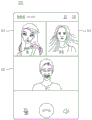
Referring to fig. 5, the server 150 may receive and transfer the videos 511, 512, and 513 in real time between the electronic devices 110, 120, and 130 of the participants participating in the video call, thereby providing the video call service. In the case where the user of the electronic device 110 is engaged in a video call, the participant images 511, 512, 513 engaged in the corresponding video call may be delivered to the electronic device 110 as individual images. In this case, the processor 212 may display the video call screen 500 by rendering the video 511 input through the camera of the electronic device 110 and the participant videos 512 and 513 received from the server 150 together on one screen.
Referring to fig. 6, the processor 212 may provide a menu screen 610 related to a video call to the video call screen 500 at the request of the user of the electronic device 110. In this case, the menu screen 610 may include a "robot" menu 611 for inviting robots.
In the event that the user of the electronic device 110 selects the "robots" menu 611 in the menu screen 610, the processor 212 may provide a robot directory screen 620 that includes at least one robot that can invite to the video call. As one example, the robot directory screen 620 may include a user-specific robot directory through the electronic device 110, for example, a robot that has been recently invited to a video call, a robot that is preset such as a favorite, a robot that is recommended for the user, or the like may be provided as a directory. The robot directory screen 620 may include a menu or the like for accessing the entire robot directory that can be invited to the video call, in addition to the robot directory described above.
Referring to fig. 7, the processor 212 may invite the user of the electronic device 110 to the video call a specific robot selected through the robot directory screen 620, in which case the video call screen 500 including the robot image 714 may be configured to be displayed after the robot image 714 is received as one participant image from the server 150.
In other words, at the video call start time point or during the video call, in the case where one of the video call participants invites a robot to the video call, the processor 212 may configure and display the video call screen 500 including the robot image 714 after receiving the robot image 714 as one participant image from the server 150.
In addition to utilizing menus related to the video call, the processor 212 may invite a particular robot to the video call using a voice or text based wake up word (wake up word) as an instruction for inviting the robot. Referring to fig. 8, the processor 212 may store the wake-up keyword 820 of each robot 810 in a local storage space (as one example, the memory 211), in which case the wake-up keyword 820 of each robot 810 may be predefined or may be directly set by a user of the electronic device 110.
The processor 212 may call a robot of a different role or tool to invite to the video call based on a wake-up keyword input from a user of the electronic device 110.
The processor 212 may provide a robot directory capable of participating in a video call by cooperating with the server 150, and in the robot directory, the wake-up keyword 820 of each robot 810 may be stored for a robot that the user of the electronic device 110 requests to add to the friend directory.
In the event that the wake keyword 820 is recognized as a voice input or a text input by the user of the electronic device 110, the processor 212 may call the robot 810 corresponding to the input wake keyword 820 to include as a participant of the video call.
The wake up keyword 820 may be used as an instruction for inviting the robot before inviting the robot to the video call, and may be used as a call instruction for requesting a response of the robot after inviting the robot to the video call. The invite command and the call command may be set differently.
The processor 212 may utilize the friends directory to invite the robots contained in the friends directory to the video call in addition to the invitation utilizing the wake up keyword 820.
Referring to fig. 9, the processor 212 may provide an interface screen 900 including a friend list as one of interfaces related to a video call according to a request of a user of the electronic device 110, and provide a robot list 901 that can participate in the video call through the interface screen 900. In this case, the robot directory 901 may include robots added by the user as friends or robots recommended in the server 150.
The video call robot may be embodied as a role of a famous person such as a human actor or may be a robot having a tool function to perform a specific function. Further, the video call robot may be a commodity transaction on a platform linked with the server 150, and a robot purchased by a user of the electronic device 110 may be added to a friend list of the user. Also, the server 150 may be provided as a robot that generates customized characters or tools required by the user according to a request of the user of the electronic device 110. Also, the server 150 can recommend at least one robot based on video call participants, user profile information, user content consumption history, and the like.
The processor 212 may output the reaction of the character within the robot imagery based on the response received from the server 150 for the shared data packet of the video call content. In other words, the video call robot may provide voice or video based responses to the video call content. For example, in a case where the user of the electronic device 110 issues the call instruction "brown" and "today is the birthday of sara (Sarah)" together during the video call, the processor 212 may transmit the voice packet issued after recognizing the call instruction "brown" to the server 150 "today is the birthday of sara (Sarah)". Referring to fig. 10, the processor 212 may output a birthday congratulatory voice as a reaction of a character within the robot image 714 based on a response received from the server 150 with respect to recognizing that a call voice packet "today is a Sarah birthday" after a call command "brown" during a video call. In this case, while the birthday congratulatory voice is being output, the user interface 1020 for displaying the output voice may be additionally displayed in the robot image 714. Although not shown, the processor 212 may provide the appearance that the character in the robot image 714 is changed to another character such as clothing or a hat on the head, or apply a filter related to the birthday to the robot image 714 based on the response received from the server 150 in response to recognizing that the call voice packet after the call command "brown" is today a Sarah birthday during the video call.
The processor 212 may output map information via the robotic imagery based on responses received from the server 150 for shared packets of video call content. In other words, the video-call robot may function as a tool to provide location-based servers, e.g., map services, within the video-call environment. For example, during a video call, the user of the electronic device 110 issues a call instruction "brown" and "where is the nearest coffee shop? "in case, processor 212 may transmit to server 150, through the robot operating as a mapping tool, a recognition of where the voice data packet" nearest coffee shop "is sent after the call instruction" brown "? ". Referring to fig. 11, the processor 212 may identify, during the video call, where is the nearest cafe for the call voice data packet "after the call instruction" brown "? "based on the response received from the server 150, a map screen 1130 is output to the area occupied by the robot image 714 for a predetermined time.
The processor 212 may output the translation result through the robot imagery based on the response received from the server 150 for the shared data bar of the video call content. In other words, the video call robot may function as a tool to provide translation services within the video call environment. For example, referring to fig. 12, in a case where the user of the electronic device 110 issues a call instruction "brown" and "please translate this" during a video call and captures a translation object through the camera of the electronic device 110, the processor 212 may transmit, to the server 150, a video data packet issued from the electronic device 110 after recognizing the call instruction "brown" through a robot operating as a translation tool, that is, a text image 1201 captured in an area occupied by a video 511 of the user of the electronic device 110. The processor 212 may output an image 1240 containing a translation result for text within the original image 1201 to the area occupied by the robot image 714 for a prescribed time based on the response received from the server 150 for the call image packet after recognizing the call instruction "brown" during the video call.
Similarly, when the video call machine operates as a shopping tool, in a case where the user issues a call instruction "brown" and "wants to buy" and captures an image of a commodity through the camera of the electronic device 110 during the video call, an image data packet issued from the electronic device 110 after recognizing the call instruction "brown" is transmitted to the server 150, that is, an image of a commodity captured in an area occupied by the image 511 of the user of the electronic device 110. The processor 212 may output website information enabling purchase of goods to an area occupied by the robot image 714 for a prescribed time based on a response received from the server 150 for a call image packet after recognizing the call instruction "brown" during the video call.
In the present embodiment, the contents provided by the video call robot are output to the area occupied by the robot image 714 in the video call screen 500, but not limited thereto. According to an embodiment, the contents provided by the video call robot may be temporarily displayed in the entire area of the video call screen 500. As an example, the processor 212 may selectively display the entire area of the video call screen 500 or the area occupied by the robot image 714 according to the type of the video call robot or the type of the content provided by the video call robot. As another example, the processor 212 displays the contents provided by the video call robot in a popup manner in a partial area of the video call screen 500, independently of the robot image 714.
In the course of a video call, the contents that can be provided through the robot may include reaction to the call contents, map information, translation information, shopping information. The above-described contents are exemplary embodiments, and may include all types of information on a network that can respond based on a voice or video packet transmitted during a video call such as image search, video search, news search, dictionary (dictionary) information, movie information, music information, book information, explanation of a hand or a sight, and a lover's disposition.
As another example, as described above, during a video call, at least a portion of the content provided by the bot may be received as a message to a chat room associated with the corresponding video call. During the video call, the contents provided through the robot may be received as a message through a value selected by a user or set in advance.
As described above, according to the embodiments of the present invention, a user invites a robot as a participant of a video call, and responds to various information through the robot in a video call environment, so that communication of a wireless function can be supported.
The systems or devices described above may be embodied as hardware structural elements, software structural elements, and/or combinations of hardware structural elements and software structural elements. For example, the devices and components described in the embodiments may be implemented by one or more general purpose or special purpose computers such as a processor, a controller, an Arithmetic Logic Unit (ALU), a digital signal processor (digital signal processor), a microcomputer, a Field Programmable Gate Array (FPGA), a Programmable Logic Unit (PLU), a microprocessor, or other devices that may execute and respond to instructions (instructions). The processing device may execute an Operating System (OS) and one or more software applications executing on the OS. Also, the processing device accesses, stores, manipulates, processes, and generates data in response to execution of the software. For convenience of understanding, the case where only one processing device is used is described, and a person having ordinary skill in the art to which the present invention pertains may know that a processing device may include a plurality of processing elements and/or a plurality of types of processing elements. For example, the processing device may include multiple processors or a processor and a controller. Further, other processing configuration such as a parallel processor (parallel processor) may be used.
The software may comprise a computer program (computer program), code, instructions (instructions), or a combination of one or more of them, to configure the processing device to operate as desired or to instruct the processing device independently or in combination (collectively). The software and/or data may be embodied (embodied) in any type of machine, component, physical device, computer storage medium or device for interpretation by a processing device or for providing instructions or data to a processing device. The software is distributed over computer systems connected via a network so that it can be stored or executed in a distributed manner. The software and data may be stored in more than one computer-readable recording medium.
The methods of the embodiments are embodied in the form of program instructions that are executable by various computer units and recorded in a computer-readable medium. In this case, the medium may continue to store the program that can be executed by the computer or temporarily store it for execution or download. The medium may be a plurality of recording units or storage units in the form of a single or a combination of one or more hardware, and is not limited to a medium directly connected to one computer system, and may be distributed over a network. Examples of the medium include magnetic media such as hard disks, floppy disks, and magnetic disks, optical recording media such as CD-ROMs and DVDs, magneto-optical media such as floptical disks, and magnetic media such as read only memories, random access memories, flash memories, and the like, so that program instructions can be stored. Further, as an example of the other medium, an application store for distributing applications, a web page for supplying or distributing other various kinds of software, a recording medium or a storage medium managed by a server or the like may be used.
As described above, although the embodiments have been described with reference to the limited embodiments and the accompanying drawings, various modifications and variations can be made by those skilled in the art to which the present invention pertains from the above description. For example, even if the technique described is executed in a different order from the method described and/or the constituent elements of the system, structure, device, circuit, and the like described are combined or combined with a different form from the method described, or replaced by other constituent elements or equivalent technical means, the corresponding result can be achieved.
Therefore, other examples, other embodiments, and equivalents to the claimed invention also fall within the claimed invention.
Claims (20)
Applications Claiming Priority (2)
| Application Number | Priority Date | Filing Date | Title |
|---|---|---|---|
| KR1020200017048A KR102755156B1 (en) | 2020-02-12 | 2020-02-12 | Method, system, and computer program for providing communication using video call bot |
| KR10-2020-0017048 | 2020-02-12 |
Publications (1)
| Publication Number | Publication Date |
|---|---|
| CN113329202A true CN113329202A (en) | 2021-08-31 |
Family
ID=77177805
Family Applications (1)
| Application Number | Title | Priority Date | Filing Date |
|---|---|---|---|
| CN202110077806.0A Pending CN113329202A (en) | 2020-02-12 | 2021-01-20 | Method, system and computer program for providing communication using video call robot |
Country Status (4)
| Country | Link |
|---|---|
| US (2) | US11343468B2 (en) |
| JP (2) | JP7729726B2 (en) |
| KR (1) | KR102755156B1 (en) |
| CN (1) | CN113329202A (en) |
Families Citing this family (6)
| Publication number | Priority date | Publication date | Assignee | Title |
|---|---|---|---|---|
| JP7142315B2 (en) * | 2018-09-27 | 2022-09-27 | パナソニックIpマネジメント株式会社 | Explanation support device and explanation support method |
| US11093691B1 (en) * | 2020-02-14 | 2021-08-17 | Capital One Services, Llc | System and method for establishing an interactive communication session |
| GB2606713A (en) * | 2021-05-13 | 2022-11-23 | Twyn Ltd | Video-based conversational interface |
| CN114040142A (en) * | 2021-11-05 | 2022-02-11 | 深圳壹账通智能科技有限公司 | Video calling method, device, equipment and storage medium of intelligent outbound robot |
| US11880560B1 (en) * | 2022-07-09 | 2024-01-23 | Snap Inc. | Providing bot participants within a virtual conferencing system |
| WO2025169374A1 (en) * | 2024-02-07 | 2025-08-14 | 株式会社Nttドコモ | Network node and communication method |
Citations (5)
| Publication number | Priority date | Publication date | Assignee | Title |
|---|---|---|---|---|
| CN105187768A (en) * | 2015-07-29 | 2015-12-23 | 苏州乐聚一堂电子科技有限公司 | Chatting robot and chatting system |
| CN106465074A (en) * | 2014-06-19 | 2017-02-22 | 微软技术许可有限责任公司 | Use of digital assistant in communication |
| CN107636710A (en) * | 2015-05-15 | 2018-01-26 | 苹果公司 | Virtual assistant in a communication session |
| CN108292203A (en) * | 2015-12-23 | 2018-07-17 | 苹果公司 | Active Assistance Based on Inter-Device Dialog Communication |
| US20180349389A1 (en) * | 2017-06-02 | 2018-12-06 | Microsoft Technology Licensing, Llc | Task creation and completion with bi-directional user interactions |
Family Cites Families (7)
| Publication number | Priority date | Publication date | Assignee | Title |
|---|---|---|---|---|
| KR100401262B1 (en) | 2001-05-08 | 2003-10-17 | 에스케이 텔레콤주식회사 | An apparatus and method for providing a video telephone service over the packet data network |
| US8700665B2 (en) * | 2009-04-27 | 2014-04-15 | Avaya Inc. | Intelligent conference call information agents |
| US9614969B2 (en) * | 2014-05-27 | 2017-04-04 | Microsoft Technology Licensing, Llc | In-call translation |
| US11025566B2 (en) * | 2017-04-12 | 2021-06-01 | Facebook, Inc. | Techniques for intent-based search for bots |
| US10404636B2 (en) * | 2017-06-15 | 2019-09-03 | Google Llc | Embedded programs and interfaces for chat conversations |
| US10540971B2 (en) * | 2017-12-15 | 2020-01-21 | Blue Jeans Network, Inc. | System and methods for in-meeting group assistance using a virtual assistant |
| US10521185B1 (en) * | 2019-02-19 | 2019-12-31 | Blackberry Limited | Privacy-enabled voice-assisted intelligent automated assistant user interface device |
-
2020
- 2020-02-12 KR KR1020200017048A patent/KR102755156B1/en active Active
-
2021
- 2021-01-20 CN CN202110077806.0A patent/CN113329202A/en active Pending
- 2021-02-02 JP JP2021015005A patent/JP7729726B2/en active Active
- 2021-02-05 US US17/168,936 patent/US11343468B2/en active Active
-
2022
- 2022-04-26 US US17/729,262 patent/US11785178B2/en active Active
-
2025
- 2025-08-14 JP JP2025135047A patent/JP2025161866A/en active Pending
Patent Citations (5)
| Publication number | Priority date | Publication date | Assignee | Title |
|---|---|---|---|---|
| CN106465074A (en) * | 2014-06-19 | 2017-02-22 | 微软技术许可有限责任公司 | Use of digital assistant in communication |
| CN107636710A (en) * | 2015-05-15 | 2018-01-26 | 苹果公司 | Virtual assistant in a communication session |
| CN105187768A (en) * | 2015-07-29 | 2015-12-23 | 苏州乐聚一堂电子科技有限公司 | Chatting robot and chatting system |
| CN108292203A (en) * | 2015-12-23 | 2018-07-17 | 苹果公司 | Active Assistance Based on Inter-Device Dialog Communication |
| US20180349389A1 (en) * | 2017-06-02 | 2018-12-06 | Microsoft Technology Licensing, Llc | Task creation and completion with bi-directional user interactions |
Also Published As
| Publication number | Publication date |
|---|---|
| KR20210102698A (en) | 2021-08-20 |
| JP2025161866A (en) | 2025-10-24 |
| JP7729726B2 (en) | 2025-08-26 |
| US11785178B2 (en) | 2023-10-10 |
| US20220256115A1 (en) | 2022-08-11 |
| US11343468B2 (en) | 2022-05-24 |
| US20210250548A1 (en) | 2021-08-12 |
| JP2021129296A (en) | 2021-09-02 |
| KR102755156B1 (en) | 2025-01-17 |
Similar Documents
| Publication | Publication Date | Title |
|---|---|---|
| CN113630511B (en) | Reaction display method, computer device, and computer-readable recording medium | |
| CN113329202A (en) | Method, system and computer program for providing communication using video call robot | |
| KR102590492B1 (en) | Method, system, and computer program for providing ruputation badge for video chat | |
| KR20200120288A (en) | Method, system, and non-transitory computer readable record medium for providing multiple group call in one chat room | |
| JP7252748B2 (en) | Information recommendation method and computer system | |
| CN113836400A (en) | Keyword search method and system using communication tool service | |
| CN111464424A (en) | Information sharing method, system, and non-transitory computer-readable recording medium | |
| KR102408778B1 (en) | Method, system, and computer program for sharing conten during voip-based call | |
| CN114430406A (en) | Head portrait communication service providing method and device based on position | |
| JP7393487B2 (en) | Method and system for recommending profile pictures and non-transitory computer-readable storage medium | |
| KR20200123560A (en) | Method, system, and non-transitory computer readable record medium for providing reminder messages | |
| JP7505902B2 (en) | Method, system, and non-transitory computer-readable recording medium for managing event messages - Patents.com | |
| KR20220105017A (en) | Method, computer device, and computer program to display content of interest | |
| KR20200133965A (en) | Method and system for creating sub-chat rooms in open talk | |
| CN112313690A (en) | Method, system, and non-transitory computer-readable recording medium for providing content based on user reaction | |
| JP7212696B2 (en) | METHOD AND SYSTEM FOR PROVIDING PRODUCT INFORMATION USING MESSENGER AND NON-TEMPORARY COMPUTER-READABLE RECORDING MEDIUM | |
| KR20200122602A (en) | Method, system, and non-transitory computer readable record medium for image retrieval and delivery | |
| KR20200138977A (en) | Method, system, and non-transitory computer readable record medium for picking content creator from chat room | |
| KR102243964B1 (en) | Method, system, and computer program to express good feeling during video chat | |
| KR20210069629A (en) | Method, system, and non-transitory computer-readable recording medium for providing novel via messenger | |
| JP2026008967A (en) | AI assistant information providing method, computer device, and program | |
| CN118055284A (en) | Resource recommendation method and device, electronic equipment and storage medium | |
| CN114896016A (en) | Information processing method and device | |
| CN112990905A (en) | Settlement method, non-transitory computer-readable recording medium, and computer device | |
| CN112204950A (en) | Method and system for displaying personalized background using chroma-key at broadcast listening end and non-transitory computer-readable recording medium |
Legal Events
| Date | Code | Title | Description |
|---|---|---|---|
| PB01 | Publication | ||
| PB01 | Publication | ||
| SE01 | Entry into force of request for substantive examination | ||
| SE01 | Entry into force of request for substantive examination |