CN113268745B - Soft PUF Based on Camellia Encryption Algorithm - Google Patents
Soft PUF Based on Camellia Encryption Algorithm Download PDFInfo
- Publication number
- CN113268745B CN113268745B CN202110388098.2A CN202110388098A CN113268745B CN 113268745 B CN113268745 B CN 113268745B CN 202110388098 A CN202110388098 A CN 202110388098A CN 113268745 B CN113268745 B CN 113268745B
- Authority
- CN
- China
- Prior art keywords
- bit
- clock cycle
- output
- data
- operation result
- Prior art date
- Legal status (The legal status is an assumption and is not a legal conclusion. Google has not performed a legal analysis and makes no representation as to the accuracy of the status listed.)
- Active
Links
Images


Classifications
-
- G—PHYSICS
- G06—COMPUTING OR CALCULATING; COUNTING
- G06F—ELECTRIC DIGITAL DATA PROCESSING
- G06F21/00—Security arrangements for protecting computers, components thereof, programs or data against unauthorised activity
- G06F21/60—Protecting data
- G06F21/602—Providing cryptographic facilities or services
-
- G—PHYSICS
- G06—COMPUTING OR CALCULATING; COUNTING
- G06F—ELECTRIC DIGITAL DATA PROCESSING
- G06F21/00—Security arrangements for protecting computers, components thereof, programs or data against unauthorised activity
- G06F21/70—Protecting specific internal or peripheral components, in which the protection of a component leads to protection of the entire computer
- G06F21/71—Protecting specific internal or peripheral components, in which the protection of a component leads to protection of the entire computer to assure secure computing or processing of information
- G06F21/72—Protecting specific internal or peripheral components, in which the protection of a component leads to protection of the entire computer to assure secure computing or processing of information in cryptographic circuits
-
- H—ELECTRICITY
- H04—ELECTRIC COMMUNICATION TECHNIQUE
- H04L—TRANSMISSION OF DIGITAL INFORMATION, e.g. TELEGRAPHIC COMMUNICATION
- H04L9/00—Cryptographic mechanisms or cryptographic arrangements for secret or secure communications; Network security protocols
- H04L9/08—Key distribution or management, e.g. generation, sharing or updating, of cryptographic keys or passwords
- H04L9/0861—Generation of secret information including derivation or calculation of cryptographic keys or passwords
Landscapes
- Engineering & Computer Science (AREA)
- Theoretical Computer Science (AREA)
- Physics & Mathematics (AREA)
- Computer Hardware Design (AREA)
- Computer Security & Cryptography (AREA)
- General Engineering & Computer Science (AREA)
- Software Systems (AREA)
- General Physics & Mathematics (AREA)
- Mathematical Physics (AREA)
- Computer Networks & Wireless Communication (AREA)
- Signal Processing (AREA)
- Health & Medical Sciences (AREA)
- Bioethics (AREA)
- General Health & Medical Sciences (AREA)
- Storage Device Security (AREA)
Abstract
本发明公开了一种基于Camellia加密算法的软PUF,包括硬件平台,硬件平台为128位Camellia加密算法硬件电路,通过利用基于Camellia加密算法硬件电路中路径延迟偏差获取PUF响应数据,无需专用硬件开销,且在固定时钟频率下进行PUF响应的采集,避免了频率变化过程中导致的不稳定现象,另外PUF响应经过Camellia加密算法的多轮数据随机化,唯一性和随机性较高,且从Camellia加密算法硬件电路的输出中提取PUF响应采集难度低并且位数较多,安全性较强;优点是具有抗频率扰动能力,可靠性较高,且具有良好唯一性和随机性,安全性较高,有利于在信息安全领域的应用。
The invention discloses a soft PUF based on the Camellia encryption algorithm, including a hardware platform. The hardware platform is a 128-bit Camellia encryption algorithm hardware circuit, and the PUF response data is obtained by utilizing the path delay deviation in the Camellia encryption algorithm-based hardware circuit, and no dedicated hardware overhead is required. , and the PUF response is collected at a fixed clock frequency, which avoids the instability caused by the frequency change process. In addition, the PUF response undergoes multiple rounds of data randomization by the Camellia encryption algorithm, with high uniqueness and randomness. The output of the encryption algorithm hardware circuit extracts the PUF response, which is difficult to collect and has a large number of bits, and has strong security; the advantage is that it has the ability to resist frequency disturbance, high reliability, good uniqueness and randomness, and high security , which is beneficial to the application in the field of information security.
Description
技术领域technical field
本发明涉及一种软PUF,尤其是涉及一种基于Camellia加密算法的软PUF。The invention relates to a soft PUF, in particular to a soft PUF based on the Camellia encryption algorithm.
背景技术Background technique
随着物联网(Internet of Things,IoT)时代的到来,如何保证设备间安全通信成为关键。传统的安全措施将密钥存储在非易失性存储器(Non-volatile Memory,NVM)中,但极易受到版图逆向工程、微探测等方式攻击造成密钥泄露。物理不可克隆函数(PhysicalUnclonable Function,PUF)利用集成电路制造过程中存在的随机工艺偏差产生可以抵抗各种物理攻击的高安全性密钥,可广泛应用于设备防伪、用户认证以及集成电路知识产权(Intellectual Property,IP)核保护等场合。With the advent of the Internet of Things (IoT) era, how to ensure secure communication between devices becomes the key. Traditional security measures store keys in non-volatile memory (NVM), but they are extremely vulnerable to layout reverse engineering, microprobing and other attacks resulting in key leakage. Physical Unclonable Function (PUF) utilizes random process deviations in the manufacturing process of integrated circuits to generate high-security keys that can resist various physical attacks, and can be widely used in equipment anti-counterfeiting, user authentication, and integrated circuit intellectual property ( Intellectual Property, IP) nuclear protection and other occasions.
传统的PUF电路依赖特殊的硬件结构产生所需的PUF响应,通常被归为硬PUF(Hardware PUF,HPUF,又称硬件PUF)类别。例如仲裁器PUF(Arbiter PUF,APUF)比较相同两条路径的延迟偏差产生PUF响应,环形振荡器PUF(Ring Oscillator PUF,RO PUF)的响应则依赖于相同振荡器的频率差异。此类型PUF在物联网领域的应用往往因为功耗和面积开销等原因受到限制。静态随机存取存储器(Static Random-Access Memory,SRAM)PUF是解决上述问题的一种方式,静态随机存取存储器PUF通过提取SRAM单元内随机的上电状态产生PUF响应。由于存储器广泛存在于电子设备中,静态随机存取存储器PUF实现比较方便且无需消耗额外的硬件资源,但是其随机特征依赖上电循环,在不允许频繁断电的场合需要存储产生的响应,导致安全性降低。MScanPUF利用时序违例情况下触发器采样数据的不确定性产生PUF数据,解决了静态随机存取存储器PUF获取响应的问题,安全性较高,但是需要在原有扫描链结构上增加数据选择器,产生额外的成本。The traditional PUF circuit relies on a special hardware structure to generate the required PUF response, and is usually classified as a hard PUF (Hardware PUF, HPUF, also known as hardware PUF). For example, the arbiter PUF (Arbiter PUF, APUF) compares the delay deviation of the same two paths to generate a PUF response, and the ring oscillator PUF (Ring Oscillator PUF, RO PUF) The response depends on the frequency difference of the same oscillator. The application of this type of PUF in the IoT field is often limited due to reasons such as power consumption and area overhead. A static random-access memory (SRAM) PUF is a way to solve the above problem. The static random-access memory PUF generates a PUF response by extracting a random power-on state in the SRAM unit. Since memory widely exists in electronic devices, SRAM PUF is more convenient to implement and does not need to consume additional hardware resources, but its random characteristics depend on the power-on cycle, and the generated response needs to be stored in the case where frequent power failure is not allowed, resulting in Security is reduced. MScanPUF uses the uncertainty of trigger sampling data to generate PUF data in the case of timing violation, which solves the problem of static random access memory PUF obtaining response, and has high security, but it needs to add a data selector to the original scan chain structure to generate extra cost.
微处理器PUF是近年来出现的一种不需要独立的硬件作为物理随机源的PUF,被归为软PUF(Software PUF,SPUF)类别。微处理器PUF根据建立时间约束条件,利用不同芯片在超频下多次执行指令的错误情况差异,设计特定的编码规则产生PUF响应,用于FPGA的安全认证。该微处理器PUF设计过程中将微处理本身的电路结构作为硬件平台,整个PUF机制可由软件程序实现,解决了仲裁器PUF、环形振荡器PUF及MScanPUF等硬件PUF需要专用硬件开销的问题,并且该微处理器PUF响应提取方式较简单,解决了静态随机存取存储器PUF需要上电循环的问题。Microprocessor PUF is a kind of PUF that does not require independent hardware as a physical random source in recent years, and is classified as a soft PUF (Software PUF, SPUF). According to the establishment time constraints, the microprocessor PUF uses the error conditions of different chips to execute instructions multiple times under overclocking, and designs specific coding rules to generate PUF responses for FPGA security authentication. In the design process of the microprocessor PUF, the circuit structure of the microprocessor itself is used as the hardware platform, and the entire PUF mechanism can be implemented by software programs, which solves the problem that hardware PUFs such as the arbiter PUF, ring oscillator PUF and MScanPUF require dedicated hardware overhead, and The microprocessor PUF response extraction method is relatively simple, and solves the problem that the static random access memory PUF needs a power cycle.
但是,在获取响应时,微处理器PUF需要在不同的时钟频率下多次执行相同的指令,并根据处理器指令执行失败情况设计一定的编码规则以获得对应的PUF响应。在改变时钟频率时,由于测试过程中频率可能发生小幅度的波动,导致相同指令可能在不同的时钟频率下执行,降低了可靠性。此外,该微处理器PUF在实施过程中,需要在一个频率范围内选取目标采样点数并在每个采样频率下重复执行指令。根据编码规则每个采样点只能产生2比特响应,由于响应位数较少,该微处理器PUF的破解难度较低,同时不利于芯片认证。根据实验结果,微处理器PUF的唯一性和随机性也较低。However, when acquiring the response, the microprocessor PUF needs to execute the same instruction multiple times at different clock frequencies, and design certain coding rules to obtain the corresponding PUF response according to the failure of the processor instruction execution. When changing the clock frequency, since the frequency may fluctuate slightly during the test, the same instruction may be executed at different clock frequencies, reducing reliability. In addition, during the implementation process of the microprocessor PUF, it is necessary to select the target number of sampling points within a frequency range and repeatedly execute instructions at each sampling frequency. According to the coding rules, each sampling point can only generate a 2-bit response. Due to the small number of response bits, the microprocessor PUF is less difficult to crack, and is not conducive to chip authentication. According to the experimental results, the uniqueness and randomness of the microprocessor PUF are also low.
发明内容SUMMARY OF THE INVENTION
本发明所要解决的技术问题是提供一种具有抗频率扰动能力,可靠性较高,且具有良好唯一性和随机性,安全性较高的基于Camellia加密算法的软PUF。The technical problem to be solved by the present invention is to provide a soft PUF based on the Camellia encryption algorithm with anti-frequency disturbance capability, high reliability, good uniqueness and randomness, and high security.
本发明解决上述技术问题所采用的技术方案为:一种基于Camellia加密算法的软PUF,包括硬件平台,所述的硬件平台为128位Camellia加密算法硬件电路,所述的128位Camellia加密算法硬件电路具有以下几个端口:128位密钥输入端口key_in[0]-[127]、128位明文输入端口data_in[0]-[127]、时钟输入端口clk、128位密文输出端口data_out[0]-[127];所述的128位Camellia加密算法硬件电路中预存有128位子密钥k1、128位子密钥k2和时序路径信息,时序路径信息包括关键路径延迟Tpath和不同输入信号激励下激活的与128位密文输出端口data_out[0]-[127]直接相关的128条时序路径;The technical solution adopted by the present invention to solve the above technical problems is: a soft PUF based on the Camellia encryption algorithm, including a hardware platform, the hardware platform is a 128-bit Camellia encryption algorithm hardware circuit, and the 128-bit Camellia encryption algorithm hardware circuit The circuit has the following ports: 128-bit key input port key_in[0]-[127], 128-bit plaintext input port data_in[0]-[127], clock input port clk, 128-bit ciphertext output port data_out[0 ]-[127]; 128-bit subkey k 1 , 128-bit sub-key k 2 and timing path information are pre-stored in the described 128-bit Camellia encryption algorithm hardware circuit, and the timing path information includes critical path delay T path and different input signals 128 timing paths directly related to the 128-bit ciphertext output port data_out[0]-[127] activated under excitation;
该128位Camellia加密算法硬件电路工作过程包括18轮加密操作,其中第1轮、第6轮、第12轮和第18轮加密操作分别需要花费两个时钟周期来完成加密操作,其他轮加密操作仅需要一个时钟周期来完成加密操作,该128位Camellia加密算法硬件电路整个工作过程需要22个时钟周期,其中,第1轮加密操作在第1个时钟周期和第2个时钟周期进行,且第1个时钟周期和第2个时钟周期分别在128位密文输出端口data_out[0]-[127]产生一个128位密文输出,第2轮加密操作在第3个时钟周期进行,在128位密文输出端口data_out[0]-[127]产生一个128位密文输出,第3轮加密操作在第4个时钟周期进行,在128位密文输出端口data_out[0]-[127]产生一个128位密文输出,第4轮加密操作在第5个时钟周期进行,在128位密文输出端口data_out[0]-[127]产生一个128位密文输出,第5轮加密操作在第6个时钟周期进行,在128位密文输出端口data_out[0]-[127]产生一个128位密文输出,第6轮加密操作在第7个时钟周期和第8个时钟周期进行,且第7个时钟周期和第8个时钟周期分别在128位密文输出端口data_out[0]-[127]产生一个128位密文输出,第7轮加密操作在第9个时钟周期进行,在128位密文输出端口data_out[0]-[127]产生一个128位密文输出,第8轮加密操作在第10个时钟周期进行,在128位密文输出端口data_out[0]-[127]产生一个128位密文输出,第9轮加密操作在第11个时钟周期进行,在128位密文输出端口data_out[0]-[127]产生一个128位密文输出,第10轮加密操作在第12个时钟周期进行,在128位密文输出端口data_out[0]-[127]产生一个128位密文输出,第11轮加密操作在第13个时钟周期进行,在128位密文输出端口data_out[0]-[127]产生一个128位密文输出,第12轮加密操作在第14个时钟周期和第15个时钟周期进行,且第14个时钟周期和第15个时钟周期分别在128位密文输出端口data_out[0]-[127]产生一个128位密文输出,第13轮加密操作在第16个时钟周期进行,在128位密文输出端口data_out[0]-[127]产生一个128位密文输出,第14轮加密操作在第17个时钟周期进行,在128位密文输出端口data_out[0]-[127]产生一个128位密文输出,第15轮加密操作在第18个时钟周期进行,在128位密文输出端口data_out[0]-[127]产生一个128位密文输出,第16轮加密操作在第19个时钟周期进行,在128位密文输出端口data_out[0]-[127]产生一个128位密文输出,第17轮加密操作在第20个时钟周期进行,在128位密文输出端口data_out[0]-[127]产生一个128位密文输出,第18轮加密操作在第21个时钟周期和第22个时钟周期进行,且第21个时钟周期和第22个时钟周期分别在128位密文输出端口data_out[0]-[127]产生一个128位密文输出;该128位Camellia加密算法硬件电路内部具有F函数、FL函数及FL-1函数,FL-1函数为FL函数的逆函数,关键路径延迟Tpath为与128位Camellia加密算法硬件电路的128位密文输出端口data_out[0]-[127]直接相关的128条时序路径中的最大路径延迟,将128位Camellia加密算法硬件电路正常工作的时钟周期长度记为Tclk,Tclk=Tpath;The working process of the hardware circuit of the 128-bit Camellia encryption algorithm includes 18 rounds of encryption operations, of which the first round, the sixth round, the 12th round and the 18th round of encryption operations respectively take two clock cycles to complete the encryption operation, and the other rounds of encryption operations Only one clock cycle is needed to complete the encryption operation. The entire working process of the 128-bit Camellia encryption algorithm hardware circuit requires 22 clock cycles. Among them, the first round of encryption operation is performed in the first clock cycle and the second clock cycle. In 1 clock cycle and the second clock cycle, a 128-bit ciphertext output is generated at the 128-bit ciphertext output port data_out[0]-[127] respectively, and the second round of encryption operation is performed in the third clock cycle. The ciphertext output port data_out[0]-[127] generates a 128-bit ciphertext output, the third round of encryption operation is performed in the fourth clock cycle, and the 128-bit ciphertext output port data_out[0]-[127] generates a 128-bit ciphertext output, the fourth round of encryption operation is performed in the fifth clock cycle, and a 128-bit ciphertext output is generated at the 128-bit ciphertext output port data_out[0]-[127], and the fifth round of encryption operation is performed in the sixth A 128-bit ciphertext output is generated at the 128-bit ciphertext output port data_out[0]-[127], and the sixth round of encryption is performed in the seventh and eighth clock cycles, and the seventh The 128-bit ciphertext output port data_out[0]-[127] generates a 128-bit ciphertext output in the 128-bit ciphertext output port data_out[0]-[127] respectively in the 8th clock cycle and the 8th clock cycle. The text output port data_out[0]-[127] generates a 128-bit ciphertext output, the 8th round of encryption operation is performed in the 10th clock cycle, and the 128-bit ciphertext output port data_out[0]-[127] generates a 128 Bit ciphertext output, the 9th round of encryption operation is performed in the 11th clock cycle, a 128-bit ciphertext output is generated at the 128-bit ciphertext output port data_out[0]-[127], and the 10th round of encryption operation is performed in the 12th The clock cycle is performed, and a 128-bit ciphertext output is generated at the 128-bit ciphertext output port data_out[0]-[127]. The 11th round of encryption operation is performed in the 13th clock cycle, and the 128-bit ciphertext output port data_out[0 ]-[127] produces a 128-bit ciphertext output, the 12th round of encryption is performed on the 14th and 15th clock cycles, and the 14th and 15th clock cycles are respectively in the 128-bit ciphertext. The output port data_out[0]-[127] generates a 128-bit ciphertext output, the 13th round of encryption operation is performed on the 16th clock cycle, and the 128-bit ciphertext output port data_out[0]-[127] generates a 128-bit ciphertext output ciphertext output, The 14th round of encryption operation is performed in the 17th clock cycle, and a 128-bit ciphertext output is generated at the 128-bit ciphertext output port data_out[0]-[127]. The 15th round of encryption operation is performed in the 18th clock cycle. The 128-bit ciphertext output port data_out[0]-[127] generates a 128-bit ciphertext output, the 16th round of encryption operation is performed in the 19th clock cycle, and the 128-bit ciphertext output port data_out[0]-[127] Generate a 128-bit ciphertext output, the 17th round of encryption operation is performed in the 20th clock cycle, and a 128-bit ciphertext output is generated at the 128-bit ciphertext output port data_out[0]-[127], the 18th round of encryption operation is in The 21st clock cycle and the 22nd clock cycle are performed, and the 21st clock cycle and the 22nd clock cycle respectively generate a 128-bit ciphertext output at the 128-bit ciphertext output port data_out[0]-[127]; the The 128-bit Camellia encryption algorithm hardware circuit has F function, FL function and FL -1 function. The FL -1 function is the inverse function of the FL function, and the critical path delay T path is the 128-bit ciphertext of the 128-bit Camellia encryption algorithm hardware circuit. The maximum path delay in the 128 timing paths directly related to the output port data_out[0]-[127], the clock cycle length of the normal operation of the 128-bit Camellia encryption algorithm hardware circuit is denoted as T clk , T clk =T path ;
所述的基于Camellia加密算法的软PUF生成PUF响应的具体步骤如下:The concrete steps that the described soft PUF based on Camellia encryption algorithm generates PUF response are as follows:
①在时钟输入端口clk输入包含22个时钟周期并且每个时钟周期长度均为Tclk的时钟信号,在128位密钥输入端口key_in[0]-[127]输入128位密钥信号K1,在128位明文输入端口data_in[0]-[127]输入128位明文信号P1,此时与128位密文输出端口data_out[0]-[127]直接相关的128条时序路径会被激活,所述的128位密文输出端口data_out[0]-[127]在每个时钟周期内分别产生一个128位密文输出,22个时钟周期一共得到22个128位密文输出,将该22个128位密文输出分别作为22个时钟周期的128位参考输出;① Input a clock signal containing 22 clock cycles and each clock cycle length is T clk at the clock input port clk, input a 128-bit key signal K 1 at the 128-bit key input port key_in[0]-[127], The 128-bit plaintext signal P 1 is input to the 128-bit plaintext input port data_in[0]-[127], and 128 timing paths directly related to the 128-bit ciphertext output port data_out[0]-[127] will be activated. The 128-bit ciphertext output ports data_out[0]-[127] respectively generate a 128-bit ciphertext output in each clock cycle, and a total of 22 128-bit ciphertext outputs are obtained in 22 clock cycles. The 128-bit ciphertext output is used as the 128-bit reference output for 22 clock cycles;
②在128位密钥输入端口key_in[0]-[127]输入128位密钥信号K1和在128位明文输入端口data_in[0]-[127]输入128位明文信号P1,然后在时钟输入端口clk上输入包含22个时钟周期并且时钟周期长度大于70%Tclk且小于Tclk的任意一个时钟信号C1,最后记录该时钟信号下,每个时钟周期产生的128位密文输出,从第1个时钟周期开始,将该时钟周期产生的128位密文输出与该时钟周期的128位参考输出进行比较,如果两者相同,则进行下一个时钟周期的比较,直至两者不同,如果两者不同,则结束比较,并确定该时钟周期的位数以及所处加密操作的轮数,将该时钟周期的位数记为n,轮数记为m,然后进入步骤③进行判断及处理;② Input the 128-bit key signal K 1 at the 128-bit key input port key_in[0]-[127] and input the 128-bit plaintext signal P 1 at the 128-bit plaintext input port data_in[0]-[127], and then at the clock Input any clock signal C 1 containing 22 clock cycles and the clock cycle length is greater than 70% of T clk and less than T clk on the input port clk, and finally record the 128-bit ciphertext output generated by each clock cycle under the clock signal, Starting from the 1st clock cycle, compare the 128-bit ciphertext output generated by this clock cycle with the 128-bit reference output of this clock cycle, if the two are the same, then compare the next clock cycle until the two are different, If the two are different, end the comparison, and determine the number of bits of the clock cycle and the number of rounds of the encryption operation, record the number of bits of the clock cycle as n, and the number of rounds as m, and then enter
③当轮数m为1,时钟周期位数n为1时,则将128位明文信号P1与128位子密钥k1按位进行异或操作,得到第一个128位异或操作结果,然后将该第一个128位异或操作结果与第1个时钟周期的128位参考输出按位进行异或操作,得到第二个128位异或操作结果,该第二个128位异或操作结果即为PUF响应;③ When the number of rounds m is 1 and the number of clock cycles n is 1, the 128-bit plaintext signal P 1 and the 128-bit subkey k 1 are bit-wise XORed to obtain the first 128-bit XOR operation result, Then the first 128-bit XOR operation result and the 128-bit reference output of the first clock cycle are bit-wise XORed to obtain the second 128-bit XOR operation result. The second 128-bit XOR operation The result is the PUF response;
当轮数m为1,时钟周期位数n为2时,则将第1个时钟周期的128位密文输出的高64位数据输入到128位Camellia加密算法硬件电路的F函数中进行处理,得到64位F函数运算结果,然后将该64位F函数运算结果与第1个时钟周期的128位密文输出的低64位数据按位进行异或操作,得到64位异或操作结果,将该64位异或操作结果作为高64位数据,第1个时钟周期的128位密文输出的高64位作为低64位数据,拼接为128位密文输出,最后将128位密文输出与第2个时钟周期的128位参考输出按位进行异或操作,得到128位异或操作结果,该128位异或操作结果即为PUF响应;When the number of rounds m is 1 and the number of clock cycles n is 2, the high 64-bit data output by the 128-bit ciphertext of the first clock cycle is input into the F function of the hardware circuit of the 128-bit Camellia encryption algorithm for processing. Obtain the operation result of the 64-bit F function, and then perform the bitwise XOR operation between the operation result of the 64-bit F function and the lower 64-bit data output by the 128-bit ciphertext of the first clock cycle, and obtain the result of the 64-bit XOR operation. The result of the 64-bit XOR operation is used as the upper 64-bit data, the upper 64 bits of the 128-bit ciphertext output in the first clock cycle are used as the lower 64-bit data, spliced into 128-bit ciphertext output, and finally the 128-bit ciphertext output is combined with The 128-bit reference output of the second clock cycle is XORed bit by bit, and the 128-bit XOR operation result is obtained. The 128-bit XOR operation result is the PUF response;
当轮数m为6,时钟周期位数n为7时,则将第6个时钟周期的128位密文输出的高64位数据输入到128位Camellia加密算法硬件电路的F函数中进行处理,得到64位F函数运算结果,然后将64位F函数运算结果与第6个时钟周期的128位密文输出的低64位数据按位进行异或操作,得到64位异或操作结果,将该64位异或操作结果作为高64位数据,第6个时钟周期的128位密文输出的高64位作为低64位数据,拼接为128位密文输出,最后将该128位密文输出与第7个时钟周期的128位参考输出按位进行异或操作,得到128位异或操作结果,该128位异或操作结果即为PUF响应;When the number of rounds m is 6 and the number of clock cycles n is 7, the high 64-bit data output by the 128-bit ciphertext of the sixth clock cycle is input into the F function of the 128-bit Camellia encryption algorithm hardware circuit for processing. Obtain the operation result of the 64-bit F function, and then perform the bitwise XOR operation between the operation result of the 64-bit F function and the lower 64-bit data output by the 128-bit ciphertext in the sixth clock cycle, and obtain the 64-bit XOR operation result. The result of the 64-bit XOR operation is used as the upper 64-bit data, the upper 64 bits of the 128-bit ciphertext output in the sixth clock cycle are used as the lower 64-bit data, spliced into 128-bit ciphertext output, and finally the 128-bit ciphertext output is combined with The 128-bit reference output of the 7th clock cycle is XORed bit by bit, and the 128-bit XOR operation result is obtained. The 128-bit XOR operation result is the PUF response;
当轮数m为6,时钟周期位数n为8时,则将第7个时钟周期的128位密文输出的高64位数据输入到128位Camellia加密算法硬件电路的FL函数中,得到64位FL函数运算结果,然后将第7个时钟周期的128位密文输出的低64位数据输入到128位Camellia加密算法硬件电路的FL-1函数中,得到64位FL-1函数运算结果,将64位FL函数运算结果作为高64位数据,64位FL-1函数运算结果作为低64位数据,拼接为128位密文输出,最后将128位密文输出与第8个时钟周期的128位参考输出按位进行异或操作,得到128位异或操作结果,该128位异或操作结果即为PUF响应;When the number of rounds m is 6 and the number of clock cycles n is 8, the high 64-bit data output by the 128-bit ciphertext of the seventh clock cycle is input into the FL function of the hardware circuit of the 128-bit Camellia encryption algorithm to obtain 64 Bit FL function operation result, and then input the low 64-bit data output by the 128-bit ciphertext of the seventh clock cycle into the FL -1 function of the 128-bit Camellia encryption algorithm hardware circuit to obtain the 64-bit FL -1 function operation result, The 64-bit FL function operation result is used as the upper 64-bit data, and the 64-bit FL -1 function operation result is used as the lower 64-bit data, which is spliced into 128-bit ciphertext output, and finally the 128-bit ciphertext output is combined with 128 of the 8th clock cycle. The bit-reference output performs bit-by-bit XOR operation to obtain a 128-bit XOR operation result, and the 128-bit XOR operation result is the PUF response;
当轮数m为12,时钟周期位数n为14时,则将第13个时钟周期的128位密文输出的高64位数据输入到128位Camellia加密算法硬件电路的F函数中进行处理,得到64位F函数运算结果,然后将64位F函数运算结果与第13个时钟周期的128位密文输出的低64位数据按位进行异或操作,得到64位异或操作结果,将64位异或操作结果作为高64位数据,第13个时钟周期的128位密文输出的高64位数据作为低64位数据,拼接为128位密文输出,最后将128位密文输出与第14个时钟周期的128位参考输出按位进行异或操作,得到128位异或操作结果,该128位异或操作结果即为PUF响应;When the number of rounds m is 12 and the number of clock cycles n is 14, the high 64-bit data output by the 128-bit ciphertext of the 13th clock cycle is input into the F function of the hardware circuit of the 128-bit Camellia encryption algorithm for processing. Obtain the operation result of the 64-bit F function, and then perform the bitwise XOR operation between the operation result of the 64-bit F function and the lower 64-bit data output by the 128-bit ciphertext in the 13th clock cycle, and obtain the 64-bit XOR operation result. The result of the bit XOR operation is used as the high 64-bit data, the high 64-bit data output by the 128-bit ciphertext in the 13th clock cycle is used as the low-order 64-bit data, spliced into 128-bit ciphertext output, and finally the 128-bit ciphertext output is combined with the first ciphertext output. The 128-bit reference output of 14 clock cycles performs bitwise XOR operation to obtain a 128-bit XOR operation result, and the 128-bit XOR operation result is the PUF response;
当轮数m为12,时钟周期位数n为15时,则将第14个时钟周期的128位密文输出的高64位数据输入到128位Camellia加密算法硬件电路的FL函数中,得到64位FL函数运算结果,然后将第14个时钟周期的128位密文输出的低64位数据输入到128位Camellia加密算法硬件电路的FL-1函数中,得到64位FL-1函数运算结果,将64位FL函数运算结果作为高64位数据,64位FL-1函数运算结果作为低64位数据,拼接为128位密文输出,最后将128位密文输出与第15个时钟周期的128位参考输出按位进行异或操作,得到128位异或操作结果,该128位异或操作结果即为PUF响应;When the number of rounds m is 12 and the number of clock cycles n is 15, the high 64-bit data output by the 128-bit ciphertext of the 14th clock cycle is input into the FL function of the hardware circuit of the 128-bit Camellia encryption algorithm to obtain 64 Bit FL function operation result, and then input the low 64-bit data outputted by the 128-bit ciphertext of the 14th clock cycle into the FL -1 function of the 128-bit Camellia encryption algorithm hardware circuit to obtain the 64-bit FL -1 function operation result, The 64-bit FL function operation result is used as the upper 64-bit data, and the 64-bit FL -1 function operation result is used as the lower 64-bit data, which is spliced into 128-bit ciphertext output, and finally the 128-bit ciphertext output is combined with the 128-bit data of the 15th clock cycle. The bit-reference output performs bit-by-bit XOR operation to obtain a 128-bit XOR operation result, and the 128-bit XOR operation result is the PUF response;
当轮数m为18,时钟周期位数n为21时,则将第20个时钟周期的128位密文输出的高64位数据输入到128位Camellia加密算法硬件电路的F函数中进行处理,得到64位F函数运算结果,然后将64位F函数运算结果与第20个周期的128位密文输出的低64位数据按位进行异或操作,得到64位异或操作结果,将64位异或操作结果作为高64位数据,第20个时钟周期的128位密文输出的高64位数据作为低64位数据,拼接为128位密文输出,最后将128位密文输出与第21个时钟周期的128位参考输出按位进行异或操作,得到128位异或操作结果,该128位异或操作结果即为PUF响应;When the number of rounds m is 18 and the number of clock cycles n is 21, the high 64-bit data output by the 128-bit ciphertext in the 20th clock cycle is input into the F function of the 128-bit Camellia encryption algorithm hardware circuit for processing. Obtain the operation result of the 64-bit F function, and then perform the bitwise XOR operation between the operation result of the 64-bit F function and the lower 64-bit data output by the 128-bit ciphertext of the 20th cycle to obtain the 64-bit XOR operation result. The result of the XOR operation is used as the high 64-bit data, the high 64-bit data output by the 128-bit ciphertext in the 20th clock cycle is used as the low-order 64-bit data, spliced into 128-bit ciphertext output, and finally the 128-bit ciphertext output is combined with the 21st The 128-bit reference output of each clock cycle is XORed bit by bit, and the 128-bit XOR operation result is obtained, and the 128-bit XOR operation result is the PUF response;
当轮数m为18,时钟周期位数n为22时,则将第21个时钟周期的128位密文输出的高64位数据与128位子密钥k2的低64位数据按位进行异或操作,得到第一个64位异或操作结果,然后将第21个时钟周期的128位密文输出的低64位数据与128位子密钥k2的高64位数据按位进行异或操作,得到第二个异或操作结果,将第二个异或操作结果作为高64位数据,第一个异或操作结果作为低64位数据,拼接为128位密文输出,最后将128位密文输出与第22个时钟周期的128位参考输出按位进行异或操作,得到128位异或操作结果,该128位异或操作结果即为PUF响应;When the number of rounds m is 18 and the number of clock cycles n is 22, the high-order 64-bit data output from the 128-bit ciphertext of the 21st clock cycle and the low-order 64-bit data of the 128-bit subkey k 2 are bit-wise exclusive OR operation to get the result of the first 64-bit XOR operation, and then perform bitwise XOR operation on the lower 64-bit data output from the 128-bit ciphertext in the 21st clock cycle and the upper 64-bit data in the 128-bit subkey k 2 , get the second XOR operation result, use the second XOR operation result as the high 64-bit data, the first XOR operation result as the low 64-bit data, splicing it into 128-bit ciphertext output, and finally convert the 128-bit ciphertext The text output and the 128-bit reference output of the 22nd clock cycle are XORed bit by bit, and the 128-bit XOR operation result is obtained. The 128-bit XOR operation result is the PUF response;
当轮数m为2、3、4、5时,则将第m个时钟周期的128位密文输出的高64位数据输入到128位Camellia加密算法硬件电路的F函数中进行处理,得到64位F函数运算结果,然后将64位F函数运算结果与第m个时钟周期的128位密文输出的低64位数据按位进行异或操作,得到64位异或操作结果,将64位异或操作结果作为高64位数据,第m个时钟周期的128位密文输出的高64位数据作为低64位数据,拼接为128位密文输出,最后将128位密文输出与第m+1个时钟周期的128位参考输出按位进行异或操作,得到128位异或操作结果,该128位异或操作结果即为PUF响应;When the number of rounds m is 2, 3, 4, and 5, the high 64-bit data output by the 128-bit ciphertext of the mth clock cycle is input into the F function of the 128-bit Camellia encryption algorithm hardware circuit for processing, and 64 Bit F function operation result, and then XOR the 64-bit F function operation result with the low 64-bit data output by the 128-bit ciphertext of the mth clock cycle bit by bit, get the 64-bit XOR operation result, and XOR the 64-bit XOR operation. The result of the OR operation is taken as the high 64-bit data, the high 64-bit data output by the 128-bit ciphertext of the mth clock cycle is taken as the low-order 64-bit data, spliced into 128-bit ciphertext output, and finally the 128-bit ciphertext output is combined with the m+th ciphertext output. The 128-bit reference output of 1 clock cycle is XORed bit by bit, and the 128-bit XOR operation result is obtained. The 128-bit XOR operation result is the PUF response;
当轮数m为7、8、9、10、11时,则将第m+1个时钟周期的128位密文输出的高64位数据输入到128位Camellia加密算法硬件电路的F函数中进行处理,得到64位F函数运算结果,然后将64位F函数运算结果与第m+1个时钟周期的128位密文输出的低64位数据按位进行异或操作,得到64位异或操作结果,将64位异或操作结果作为高64位数据,第m+1个时钟周期的128位密文输出的高64位数据作为低64位数据,拼接为128位密文输出,最后将128位密文输出与第m+2个时钟周期的128位参考输出按位进行异或操作,得到128位异或操作结果,该128位异或操作结果即为PUF响应;When the number of rounds m is 7, 8, 9, 10, and 11, the high 64-bit data output by the 128-bit ciphertext of the m+1th clock cycle is input into the F function of the hardware circuit of the 128-bit Camellia encryption algorithm. Processing, get the 64-bit F function operation result, and then perform the bitwise XOR operation on the 64-bit F function operation result and the lower 64-bit data output by the 128-bit ciphertext of the m+1th clock cycle to obtain a 64-bit XOR operation As a result, the result of the 64-bit XOR operation is taken as the high 64-bit data, the high 64-bit data output by the 128-bit ciphertext of the m+1th clock cycle is taken as the low-order 64-bit data, spliced into 128-bit ciphertext output, and finally 128 The bit ciphertext output and the 128-bit reference output of the m+2th clock cycle are XORed bit by bit, and the 128-bit XOR operation result is obtained, and the 128-bit XOR operation result is the PUF response;
当轮数m为13、14、15、16、17时,则将第m+2个时钟周期的128位密文输出的高64位数据输入到128位Camellia加密算法硬件电路的F函数中进行处理,得到64位F函数运算结果,然后将64位F函数运算结果与第m+2个时钟周期的128位密文输出的低64位数据按位进行异或操作,得到64位异或操作结果,将64位异或操作结果作为高64位数据,第m+2个时钟周期的128位密文输出的高64位数据作为低64位数据,拼接为128位密文输出,最后将128位密文输出与第m+3个时钟周期的128位参考输出按位进行异或操作,得到128位异或操作结果,该128位异或操作结果即为PUF响应;When the number of rounds m is 13, 14, 15, 16, and 17, the upper 64-bit data of the 128-bit ciphertext output in the m+2th clock cycle is input into the F function of the hardware circuit of the 128-bit Camellia encryption algorithm. Processing, get the 64-bit F function operation result, and then perform the bitwise XOR operation on the 64-bit F function operation result and the lower 64-bit data output by the 128-bit ciphertext of the m+2th clock cycle to obtain a 64-bit XOR operation As a result, the result of the 64-bit XOR operation is used as the high 64-bit data, the high 64-bit data output by the 128-bit ciphertext in the m+2th clock cycle is used as the low-order 64-bit data, spliced into 128-bit ciphertext output, and finally 128 The bit ciphertext output and the 128-bit reference output of the m+3th clock cycle are XORed bit by bit, and the 128-bit XOR operation result is obtained, and the 128-bit XOR operation result is the PUF response;
当改变所述的128位密钥输入端口key_in[0]-[127]、所述的128位明文输入端口data_in[0]-[127]和所述的时钟输入端口clk中至少一个端口接入的信号,就能够改变所述的基于Camellia加密算法的软PUF生成的PUF响应。When changing at least one of the 128-bit key input port key_in[0]-[127], the 128-bit plaintext input port data_in[0]-[127] and the clock input port clk signal, it can change the PUF response generated by the soft PUF based on the Camellia encryption algorithm.
与现有技术相比,本发明的优点在于通过利用基于Camellia加密算法硬件电路中路径延迟偏差获取PUF响应数据,无需专用硬件开销,且在固定时钟频率下进行PUF响应的采集,避免了频率变化过程中导致的不稳定现象,另外PUF响应经过Camellia加密算法的多轮数据随机化,唯一性和随机性较高,且从Camellia加密算法硬件电路的输出中提取PUF响应采集难度低并且位数较多,安全性较强,由此本发明具有抗频率扰动能力,可靠性较高,且具有良好唯一性和随机性,安全性较高,有利于在信息安全领域的应用。Compared with the prior art, the present invention has the advantages that the PUF response data is obtained by utilizing the path delay deviation in the hardware circuit based on the Camellia encryption algorithm, no dedicated hardware overhead is required, and the PUF response is collected at a fixed clock frequency, avoiding frequency changes. Instability caused by the process, in addition, the PUF response has undergone multiple rounds of data randomization of the Camellia encryption algorithm, and the uniqueness and randomness are high, and the PUF response is extracted from the output of the Camellia encryption algorithm hardware circuit. Therefore, the invention has anti-frequency disturbance capability, high reliability, good uniqueness and randomness, and high security, which is beneficial to the application in the field of information security.
附图说明Description of drawings
图1为本发明的基于Camellia加密算法的软PUF的随机性仿真图;Fig. 1 is the randomness simulation diagram of the soft PUF based on Camellia encryption algorithm of the present invention;
图2为本发明的基于Camellia加密算法的软PUF在输出阶段所得最终PUF响应的二维分布图;Fig. 2 is the two-dimensional distribution diagram of the final PUF response obtained in the output stage of the soft PUF based on the Camellia encryption algorithm of the present invention;
图3为本发明的基于Camellia加密算法的软PUF 50次蒙特卡洛仿真DE PUF输出响应的HD分布图;Fig. 3 is the HD distribution diagram of the
图4为本发明的基于Camellia加密算法的软PUF的PUF输出数据流ACF测试结果图;Fig. 4 is the PUF output data stream ACF test result diagram of the soft PUF based on Camellia encryption algorithm of the present invention;
图5(a)为本发明的基于Camellia加密算法的软PUF的功耗开销曲线图;Fig. 5 (a) is the power consumption overhead curve diagram of the soft PUF based on Camellia encryption algorithm of the present invention;
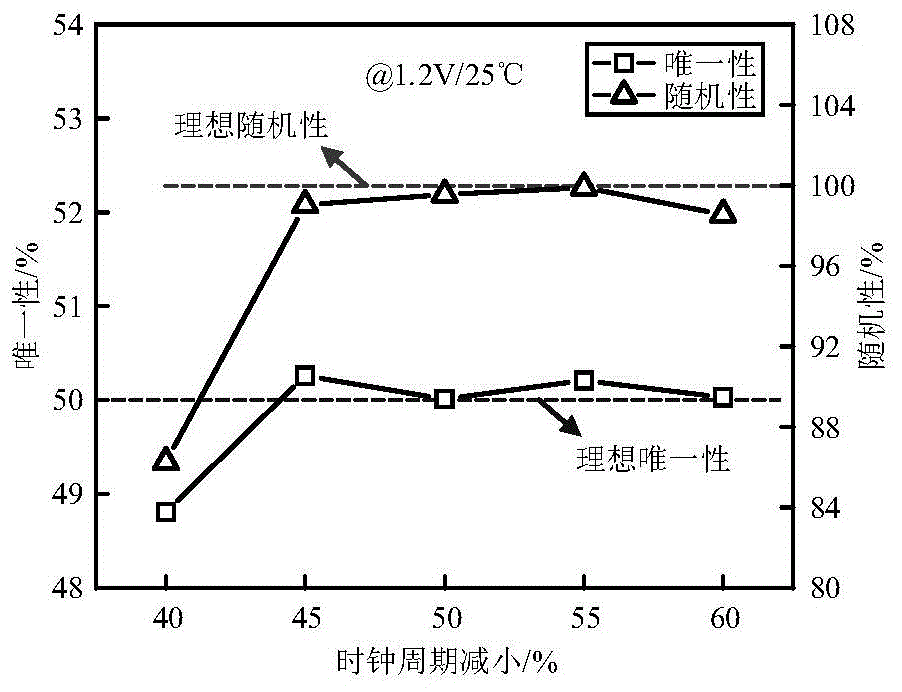
图5(b)为本发明的基于Camellia加密算法的软PUF的唯一性及随机性随时钟周期变化曲线图。FIG. 5( b ) is a graph showing the variation of the uniqueness and randomness of the soft PUF with the clock cycle based on the Camellia encryption algorithm of the present invention.
具体实施方式Detailed ways
以下结合附图实施例对本发明作进一步详细描述。The present invention will be further described in detail below with reference to the embodiments of the accompanying drawings.
实施例:一种基于Camellia加密算法的软PUF,包括硬件平台,硬件平台为128位Camellia加密算法硬件电路,128位Camellia加密算法硬件电路具有以下几个端口:用于输入128位密钥信号K1(128位二进数数据)的128位密钥输入端口key_in[0]-[127]、用于输入128位明文信号P1(128位二进数数据)的128位明文输入端口data_in[0]-[127]、时钟输入端口clk、128位密文输出端口data_out[0]-[127];128位Camellia加密算法硬件电路中预存有128位子密钥k1、128位子密钥k2和时序路径信息,128位子密钥k1和128位子密钥k2分别为128位二进制数据,且128位子密钥k1和128位子密钥k2互不相同,时序路径信息包括关键路径延迟Tpath和不同输入信号激励下激活的与128位密文输出端口data_out[0]-[127]直接相关的128条时序路径;Embodiment: A soft PUF based on Camellia encryption algorithm, including a hardware platform, the hardware platform is a 128-bit Camellia encryption algorithm hardware circuit, and the 128-bit Camellia encryption algorithm hardware circuit has the following ports: used to input a 128-bit key signal K 1 (128-bit binary data) 128-bit key input port key_in[0]-[127], 128-bit plaintext input port data_in[ for inputting 128-bit plaintext signal P 1 (128-bit binary data) 0]-[127], clock input port clk, 128-bit ciphertext output port data_out[0]-[127]; 128-bit Camellia encryption algorithm hardware circuit is pre-stored with 128-bit sub-key k 1 and 128-bit sub-key k 2 and timing path information, 128-bit subkey k1 and 128-bit subkey k2 are 128 - bit binary data respectively, and 128-bit subkey k1 and 128 - bit subkey k2 are different from each other, timing path information includes critical path delay T path and 128 timing paths directly related to the 128-bit ciphertext output ports data_out[0]-[127] activated under the excitation of different input signals;
该128位Camellia加密算法硬件电路工作过程包括18轮加密操作,其中第1轮、第6轮、第12轮和第18轮加密操作分别需要花费两个时钟周期来完成加密操作,其他轮加密操作仅需要一个时钟周期来完成加密操作,该128位Camellia加密算法硬件电路整个工作过程需要22个时钟周期,其中,第1轮加密操作在第1个时钟周期和第2个时钟周期进行,且第1个时钟周期和第2个时钟周期分别在128位密文输出端口data_out[0]-[127]产生一个128位密文输出,第2轮加密操作在第3个时钟周期进行,在128位密文输出端口data_out[0]-[127]产生一个128位密文输出,第3轮加密操作在第4个时钟周期进行,在128位密文输出端口data_out[0]-[127]产生一个128位密文输出,第4轮加密操作在第5个时钟周期进行,在128位密文输出端口data_out[0]-[127]产生一个128位密文输出,第5轮加密操作在第6个时钟周期进行,在128位密文输出端口data_out[0]-[127]产生一个128位密文输出,第6轮加密操作在第7个时钟周期和第8个时钟周期进行,且第7个时钟周期和第8个时钟周期分别在128位密文输出端口data_out[0]-[127]产生一个128位密文输出,第7轮加密操作在第9个时钟周期进行,在128位密文输出端口data_out[0]-[127]产生一个128位密文输出,第8轮加密操作在第10个时钟周期进行,在128位密文输出端口data_out[0]-[127]产生一个128位密文输出,第9轮加密操作在第11个时钟周期进行,在128位密文输出端口data_out[0]-[127]产生一个128位密文输出,第10轮加密操作在第12个时钟周期进行,在128位密文输出端口data_out[0]-[127]产生一个128位密文输出,第11轮加密操作在第13个时钟周期进行,在128位密文输出端口data_out[0]-[127]产生一个128位密文输出,第12轮加密操作在第14个时钟周期和第15个时钟周期进行,且第14个时钟周期和第15个时钟周期分别在128位密文输出端口data_out[0]-[127]产生一个128位密文输出,第13轮加密操作在第16个时钟周期进行,在128位密文输出端口data_out[0]-[127]产生一个128位密文输出,第14轮加密操作在第17个时钟周期进行,在128位密文输出端口data_out[0]-[127]产生一个128位密文输出,第15轮加密操作在第18个时钟周期进行,在128位密文输出端口data_out[0]-[127]产生一个128位密文输出,第16轮加密操作在第19个时钟周期进行,在128位密文输出端口data_out[0]-[127]产生一个128位密文输出,第17轮加密操作在第20个时钟周期进行,在128位密文输出端口data_out[0]-[127]产生一个128位密文输出,第18轮加密操作在第21个时钟周期和第22个时钟周期进行,且第21个时钟周期和第22个时钟周期分别在128位密文输出端口data_out[0]-[127]产生一个128位密文输出;该128位Camellia加密算法硬件电路内部具有F函数、FL函数及FL-1函数,FL-1函数为FL函数的逆函数,关键路径延迟Tpath为与128位Camellia加密算法硬件电路的128位密文输出端口data_out[0]-[127]直接相关的128条时序路径中的最大路径延迟,将128位Camellia加密算法硬件电路正常工作的时钟周期长度记为Tclk,Tclk=Tpath;The working process of the hardware circuit of the 128-bit Camellia encryption algorithm includes 18 rounds of encryption operations, of which the first round, the sixth round, the 12th round and the 18th round of encryption operations respectively take two clock cycles to complete the encryption operation, and the other rounds of encryption operations Only one clock cycle is needed to complete the encryption operation. The entire working process of the 128-bit Camellia encryption algorithm hardware circuit requires 22 clock cycles. Among them, the first round of encryption operation is performed in the first clock cycle and the second clock cycle. In 1 clock cycle and the second clock cycle, a 128-bit ciphertext output is generated at the 128-bit ciphertext output port data_out[0]-[127] respectively, and the second round of encryption operation is performed in the third clock cycle. The ciphertext output port data_out[0]-[127] generates a 128-bit ciphertext output, the third round of encryption operation is performed in the fourth clock cycle, and the 128-bit ciphertext output port data_out[0]-[127] generates a 128-bit ciphertext output, the fourth round of encryption operation is performed in the fifth clock cycle, and a 128-bit ciphertext output is generated at the 128-bit ciphertext output port data_out[0]-[127], and the fifth round of encryption operation is performed in the sixth A 128-bit ciphertext output is generated at the 128-bit ciphertext output port data_out[0]-[127], and the sixth round of encryption is performed in the seventh and eighth clock cycles, and the seventh The 128-bit ciphertext output port data_out[0]-[127] generates a 128-bit ciphertext output in the 128-bit ciphertext output port data_out[0]-[127] respectively in the 8th clock cycle and the 8th clock cycle. The text output port data_out[0]-[127] generates a 128-bit ciphertext output, the 8th round of encryption operation is performed in the 10th clock cycle, and the 128-bit ciphertext output port data_out[0]-[127] generates a 128 Bit ciphertext output, the 9th round of encryption operation is performed in the 11th clock cycle, a 128-bit ciphertext output is generated at the 128-bit ciphertext output port data_out[0]-[127], and the 10th round of encryption operation is performed in the 12th The clock cycle is performed, and a 128-bit ciphertext output is generated at the 128-bit ciphertext output port data_out[0]-[127]. The 11th round of encryption operation is performed in the 13th clock cycle, and the 128-bit ciphertext output port data_out[0 ]-[127] produces a 128-bit ciphertext output, the 12th round of encryption is performed on the 14th and 15th clock cycles, and the 14th and 15th clock cycles are respectively in the 128-bit ciphertext. The output port data_out[0]-[127] generates a 128-bit ciphertext output, the 13th round of encryption operation is performed on the 16th clock cycle, and the 128-bit ciphertext output port data_out[0]-[127] generates a 128-bit ciphertext output ciphertext output, The 14th round of encryption operation is performed in the 17th clock cycle, and a 128-bit ciphertext output is generated at the 128-bit ciphertext output port data_out[0]-[127]. The 15th round of encryption operation is performed in the 18th clock cycle. The 128-bit ciphertext output port data_out[0]-[127] generates a 128-bit ciphertext output, the 16th round of encryption operation is performed in the 19th clock cycle, and the 128-bit ciphertext output port data_out[0]-[127] Generate a 128-bit ciphertext output, the 17th round of encryption operation is performed in the 20th clock cycle, and a 128-bit ciphertext output is generated at the 128-bit ciphertext output port data_out[0]-[127], the 18th round of encryption operation is in The 21st clock cycle and the 22nd clock cycle are performed, and the 21st clock cycle and the 22nd clock cycle respectively generate a 128-bit ciphertext output at the 128-bit ciphertext output port data_out[0]-[127]; the The 128-bit Camellia encryption algorithm hardware circuit has F function, FL function and FL -1 function. The FL -1 function is the inverse function of the FL function, and the critical path delay T path is the 128-bit ciphertext of the 128-bit Camellia encryption algorithm hardware circuit. The maximum path delay in the 128 timing paths directly related to the output port data_out[0]-[127], the clock cycle length of the normal operation of the 128-bit Camellia encryption algorithm hardware circuit is denoted as T clk , T clk =T path ;
基于Camellia加密算法的软PUF生成PUF响应的具体步骤如下:The specific steps for generating a PUF response from soft PUF based on the Camellia encryption algorithm are as follows:
①在时钟输入端口clk输入包含22个时钟周期并且每个时钟周期长度均为Tclk的时钟信号,在128位密钥输入端口key_in[0]-[127]输入128位密钥信号K1(用户设定),在128位明文输入端口data_in[0]-[127]输入128位明文信号P1(用户设定),此时与128位密文输出端口data_out[0]-[127]直接相关的128条时序路径会被激活,128位密文输出端口data_out[0]-[127]在每个时钟周期内分别产生一个128位密文输出,22个时钟周期一共得到22个128位密文输出,将该22个128位密文输出分别作为22个时钟周期的128位参考输出;① Input a clock signal containing 22 clock cycles and each clock cycle length is T clk at the clock input port clk, and input a 128-bit key signal K 1 ( User setting), input the 128-bit plaintext signal P 1 (user setting) to the 128-bit plaintext input port data_in[0]-[127], and directly connect with the 128-bit ciphertext output port data_out[0]-[127] The related 128 timing paths will be activated, and the 128-bit ciphertext output port data_out[0]-[127] will generate a 128-bit ciphertext output in each clock cycle, and a total of 22 128-bit ciphertext output will be obtained in 22 clock cycles. Text output, the 22 128-bit ciphertext outputs are respectively used as 128-bit reference outputs for 22 clock cycles;
②在128位密钥输入端口key_in[0]-[127]输入128位密钥信号K1和在128位明文输入端口data_in[0]-[127]输入128位明文信号P1,然后在时钟输入端口clk上输入包含22个时钟周期并且时钟周期长度大于70%Tclk且小于Tclk的任意一个时钟信号C1,最后记录该时钟信号下,每个时钟周期产生的128位密文输出,从第1个时钟周期开始,将该时钟周期产生的128位密文输出与该时钟周期的128位参考输出进行比较,如果两者相同,则进行下一个时钟周期的比较,直至两者不同,如果两者不同,则结束比较,并确定该时钟周期的位数以及所处加密操作的轮数,将该时钟周期的位数记为n,轮数记为m,然后进入步骤③进行判断及处理;② Input the 128-bit key signal K 1 at the 128-bit key input port key_in[0]-[127] and input the 128-bit plaintext signal P 1 at the 128-bit plaintext input port data_in[0]-[127], and then at the clock Input any clock signal C 1 containing 22 clock cycles and the clock cycle length is greater than 70% of T clk and less than T clk on the input port clk, and finally record the 128-bit ciphertext output generated by each clock cycle under the clock signal, Starting from the first clock cycle, compare the 128-bit ciphertext output generated by this clock cycle with the 128-bit reference output of this clock cycle, and if the two are the same, proceed to the next clock cycle comparison until the two are different, If the two are different, end the comparison, and determine the number of bits of the clock cycle and the number of rounds of the encryption operation, record the number of bits of the clock cycle as n, and the number of rounds as m, and then enter
③当轮数m为1,时钟周期位数n为1时,则将128位明文信号P1与128位子密钥k1按位进行异或操作,得到第一个128位异或操作结果,然后将该第一个128位异或操作结果与第1个时钟周期的128位参考输出按位进行异或操作,得到第二个128位异或操作结果,该第二个128位异或操作结果即为PUF响应;③ When the number of rounds m is 1 and the number of clock cycles n is 1, the 128-bit plaintext signal P 1 and the 128-bit subkey k 1 are bit-wise XORed to obtain the first 128-bit XOR operation result, Then the first 128-bit XOR operation result and the 128-bit reference output of the first clock cycle are bit-wise XORed to obtain the second 128-bit XOR operation result. The second 128-bit XOR operation The result is the PUF response;
当轮数m为1,时钟周期位数n为2时,则将第1个时钟周期的128位密文输出的高64位数据输入到128位Camellia加密算法硬件电路的F函数中进行处理,得到64位F函数运算结果,然后将该64位F函数运算结果与第1个时钟周期的128位密文输出的低64位数据按位进行异或操作,得到64位异或操作结果,将该64位异或操作结果作为高64位数据,第1个时钟周期的128位密文输出的高64位作为低64位数据,拼接为128位密文输出,最后将128位密文输出与第2个时钟周期的128位参考输出按位进行异或操作,得到128位异或操作结果,该128位异或操作结果即为PUF响应;When the number of rounds m is 1 and the number of clock cycles n is 2, the high 64-bit data output by the 128-bit ciphertext of the first clock cycle is input into the F function of the hardware circuit of the 128-bit Camellia encryption algorithm for processing. Obtain the operation result of the 64-bit F function, and then perform the bitwise XOR operation between the operation result of the 64-bit F function and the lower 64-bit data output by the 128-bit ciphertext of the first clock cycle, and obtain the result of the 64-bit XOR operation. The result of the 64-bit XOR operation is used as the upper 64-bit data, the upper 64 bits of the 128-bit ciphertext output in the first clock cycle are used as the lower 64-bit data, spliced into 128-bit ciphertext output, and finally the 128-bit ciphertext output is combined with The 128-bit reference output of the second clock cycle is XORed bit by bit, and the 128-bit XOR operation result is obtained. The 128-bit XOR operation result is the PUF response;
当轮数m为6,时钟周期位数n为7时,则将第6个时钟周期的128位密文输出的高64位数据输入到128位Camellia加密算法硬件电路的F函数中进行处理,得到64位F函数运算结果,然后将64位F函数运算结果与第6个时钟周期的128位密文输出的低64位数据按位进行异或操作,得到64位异或操作结果,将该64位异或操作结果作为高64位数据,第6个时钟周期的128位密文输出的高64位作为低64位数据,拼接为128位密文输出,最后将该128位密文输出与第7个时钟周期的128位参考输出按位进行异或操作,得到128位异或操作结果,该128位异或操作结果即为PUF响应;When the number of rounds m is 6 and the number of clock cycles n is 7, the high 64-bit data output by the 128-bit ciphertext of the sixth clock cycle is input into the F function of the 128-bit Camellia encryption algorithm hardware circuit for processing. Obtain the operation result of the 64-bit F function, and then perform the bitwise XOR operation between the operation result of the 64-bit F function and the lower 64-bit data output by the 128-bit ciphertext in the sixth clock cycle, and obtain the 64-bit XOR operation result. The result of the 64-bit XOR operation is used as the upper 64-bit data, the upper 64 bits of the 128-bit ciphertext output in the sixth clock cycle are used as the lower 64-bit data, spliced into 128-bit ciphertext output, and finally the 128-bit ciphertext output is combined with The 128-bit reference output of the 7th clock cycle is XORed bit by bit, and the 128-bit XOR operation result is obtained. The 128-bit XOR operation result is the PUF response;
当轮数m为6,时钟周期位数n为8时,则将第7个时钟周期的128位密文输出的高64位数据输入到128位Camellia加密算法硬件电路的FL函数中,得到64位FL函数运算结果,然后将第7个时钟周期的128位密文输出的低64位数据输入到128位Camellia加密算法硬件电路的FL-1函数中,得到64位FL-1函数运算结果,将64位FL函数运算结果作为高64位数据,64位FL-1函数运算结果作为低64位数据,拼接为128位密文输出,最后将128位密文输出与第8个时钟周期的128位参考输出按位进行异或操作,得到128位异或操作结果,该128位异或操作结果即为PUF响应;When the number of rounds m is 6 and the number of clock cycles n is 8, the high 64-bit data output by the 128-bit ciphertext of the seventh clock cycle is input into the FL function of the hardware circuit of the 128-bit Camellia encryption algorithm to obtain 64 Bit FL function operation result, and then input the low 64-bit data output by the 128-bit ciphertext of the seventh clock cycle into the FL -1 function of the 128-bit Camellia encryption algorithm hardware circuit to obtain the 64-bit FL -1 function operation result, The 64-bit FL function operation result is used as the upper 64-bit data, and the 64-bit FL -1 function operation result is used as the lower 64-bit data, which is spliced into 128-bit ciphertext output, and finally the 128-bit ciphertext output is combined with 128 of the 8th clock cycle. The bit-reference output performs bit-by-bit XOR operation to obtain a 128-bit XOR operation result, and the 128-bit XOR operation result is the PUF response;
当轮数m为12,时钟周期位数n为14时,则将第13个时钟周期的128位密文输出的高64位数据输入到128位Camellia加密算法硬件电路的F函数中进行处理,得到64位F函数运算结果,然后将64位F函数运算结果与第13个时钟周期的128位密文输出的低64位数据按位进行异或操作,得到64位异或操作结果,将64位异或操作结果作为高64位数据,第13个时钟周期的128位密文输出的高64位数据作为低64位数据,拼接为128位密文输出,最后将128位密文输出与第14个时钟周期的128位参考输出按位进行异或操作,得到128位异或操作结果,该128位异或操作结果即为PUF响应;When the number of rounds m is 12 and the number of clock cycles n is 14, the high 64-bit data output by the 128-bit ciphertext of the 13th clock cycle is input into the F function of the hardware circuit of the 128-bit Camellia encryption algorithm for processing. Obtain the operation result of the 64-bit F function, and then perform the bitwise XOR operation between the operation result of the 64-bit F function and the lower 64-bit data output by the 128-bit ciphertext in the 13th clock cycle, and obtain the 64-bit XOR operation result. The result of the bit XOR operation is used as the high 64-bit data, the high 64-bit data output by the 128-bit ciphertext in the 13th clock cycle is used as the low-order 64-bit data, spliced into 128-bit ciphertext output, and finally the 128-bit ciphertext output is combined with the first ciphertext output. The 128-bit reference output of 14 clock cycles performs bitwise XOR operation to obtain a 128-bit XOR operation result, and the 128-bit XOR operation result is the PUF response;
当轮数m为12,时钟周期位数n为15时,则将第14个时钟周期的128位密文输出的高64位数据输入到128位Camellia加密算法硬件电路的FL函数中,得到64位FL函数运算结果,然后将第14个时钟周期的128位密文输出的低64位数据输入到128位Camellia加密算法硬件电路的FL-1函数中,得到64位FL-1函数运算结果,将64位FL函数运算结果作为高64位数据,64位FL-1函数运算结果作为低64位数据,拼接为128位密文输出,最后将128位密文输出与第15个时钟周期的128位参考输出按位进行异或操作,得到128位异或操作结果,该128位异或操作结果即为PUF响应;When the number of rounds m is 12 and the number of clock cycles n is 15, the high 64-bit data output by the 128-bit ciphertext of the 14th clock cycle is input into the FL function of the hardware circuit of the 128-bit Camellia encryption algorithm to obtain 64 Bit FL function operation result, and then input the low 64-bit data outputted by the 128-bit ciphertext of the 14th clock cycle into the FL -1 function of the 128-bit Camellia encryption algorithm hardware circuit to obtain the 64-bit FL -1 function operation result, The 64-bit FL function operation result is used as the upper 64-bit data, and the 64-bit FL -1 function operation result is used as the lower 64-bit data, which is spliced into 128-bit ciphertext output, and finally the 128-bit ciphertext output is combined with the 128-bit data of the 15th clock cycle. The bit-reference output performs bit-by-bit XOR operation to obtain a 128-bit XOR operation result, and the 128-bit XOR operation result is the PUF response;
当轮数m为18,时钟周期位数n为21时,则将第20个时钟周期的128位密文输出的高64位数据输入到128位Camellia加密算法硬件电路的F函数中进行处理,得到64位F函数运算结果,然后将64位F函数运算结果与第20个周期的128位密文输出的低64位数据按位进行异或操作,得到64位异或操作结果,将64位异或操作结果作为高64位数据,第20个时钟周期的128位密文输出的高64位数据作为低64位数据,拼接为128位密文输出,最后将128位密文输出与第21个时钟周期的128位参考输出按位进行异或操作,得到128位异或操作结果,该128位异或操作结果即为PUF响应;When the number of rounds m is 18 and the number of clock cycles n is 21, the high 64-bit data output by the 128-bit ciphertext in the 20th clock cycle is input into the F function of the 128-bit Camellia encryption algorithm hardware circuit for processing. Obtain the operation result of the 64-bit F function, and then perform the bitwise XOR operation between the operation result of the 64-bit F function and the lower 64-bit data output by the 128-bit ciphertext of the 20th cycle to obtain the 64-bit XOR operation result. The result of the XOR operation is used as the high 64-bit data, the high 64-bit data output by the 128-bit ciphertext in the 20th clock cycle is used as the low-order 64-bit data, spliced into 128-bit ciphertext output, and finally the 128-bit ciphertext output is combined with the 21st The 128-bit reference output of each clock cycle is XORed bit by bit, and the 128-bit XOR operation result is obtained, and the 128-bit XOR operation result is the PUF response;
当轮数m为18,时钟周期位数n为22时,则将第21个时钟周期的128位密文输出的高64位数据与128位子密钥k2的低64位数据按位进行异或操作,得到第一个64位异或操作结果,然后将第21个时钟周期的128位密文输出的低64位数据与128位子密钥k2的高64位数据按位进行异或操作,得到第二个异或操作结果,将第二个异或操作结果作为高64位数据,第一个异或操作结果作为低64位数据,拼接为128位密文输出,最后将128位密文输出与第22个时钟周期的128位参考输出按位进行异或操作,得到128位异或操作结果,该128位异或操作结果即为PUF响应;When the number of rounds m is 18 and the number of clock cycles n is 22, the high-order 64-bit data output from the 128-bit ciphertext of the 21st clock cycle and the low-order 64-bit data of the 128-bit subkey k 2 are bit-wise exclusive OR operation to get the result of the first 64-bit XOR operation, and then perform bitwise XOR operation on the lower 64-bit data output from the 128-bit ciphertext in the 21st clock cycle and the upper 64-bit data in the 128-bit subkey k 2 , get the second XOR operation result, use the second XOR operation result as the high 64-bit data, the first XOR operation result as the low 64-bit data, splicing it into 128-bit ciphertext output, and finally convert the 128-bit ciphertext The text output and the 128-bit reference output of the 22nd clock cycle are XORed bit by bit, and the 128-bit XOR operation result is obtained. The 128-bit XOR operation result is the PUF response;
当轮数m为2、3、4、5时,则将第m个时钟周期的128位密文输出的高64位数据输入到128位Camellia加密算法硬件电路的F函数中进行处理,得到64位F函数运算结果,然后将64位F函数运算结果与第m个时钟周期的128位密文输出的低64位数据按位进行异或操作,得到64位异或操作结果,将64位异或操作结果作为高64位数据,第m个时钟周期的128位密文输出的高64位数据作为低64位数据,拼接为128位密文输出,最后将128位密文输出与第m+1个时钟周期的128位参考输出按位进行异或操作,得到128位异或操作结果,该128位异或操作结果即为PUF响应;When the number of rounds m is 2, 3, 4, and 5, the high 64-bit data output by the 128-bit ciphertext of the mth clock cycle is input into the F function of the 128-bit Camellia encryption algorithm hardware circuit for processing, and 64 Bit F function operation result, and then XOR the 64-bit F function operation result with the low 64-bit data output by the 128-bit ciphertext of the mth clock cycle bit by bit, get the 64-bit XOR operation result, and XOR the 64-bit XOR operation. The result of the OR operation is taken as the high 64-bit data, the high 64-bit data output by the 128-bit ciphertext of the mth clock cycle is taken as the low-order 64-bit data, spliced into 128-bit ciphertext output, and finally the 128-bit ciphertext output is combined with the m+th ciphertext output. The 128-bit reference output of 1 clock cycle is XORed bit by bit, and the 128-bit XOR operation result is obtained. The 128-bit XOR operation result is the PUF response;
当轮数m为7、8、9、10、11时,则将第m+1个时钟周期的128位密文输出的高64位数据输入到128位Camellia加密算法硬件电路的F函数中进行处理,得到64位F函数运算结果,然后将64位F函数运算结果与第m+1个时钟周期的128位密文输出的低64位数据按位进行异或操作,得到64位异或操作结果,将64位异或操作结果作为高64位数据,第m+1个时钟周期的128位密文输出的高64位数据作为低64位数据,拼接为128位密文输出,最后将128位密文输出与第m+2个时钟周期的128位参考输出按位进行异或操作,得到128位异或操作结果,该128位异或操作结果即为PUF响应;When the number of rounds m is 7, 8, 9, 10, and 11, the high 64-bit data output by the 128-bit ciphertext of the m+1th clock cycle is input into the F function of the hardware circuit of the 128-bit Camellia encryption algorithm. Processing, get the 64-bit F function operation result, and then perform the bitwise XOR operation on the 64-bit F function operation result and the lower 64-bit data output by the 128-bit ciphertext of the m+1th clock cycle to obtain a 64-bit XOR operation As a result, the result of the 64-bit XOR operation is taken as the high 64-bit data, the high 64-bit data output by the 128-bit ciphertext of the m+1th clock cycle is taken as the low-order 64-bit data, spliced into 128-bit ciphertext output, and finally 128 The bit ciphertext output and the 128-bit reference output of the m+2th clock cycle are XORed bit by bit, and the 128-bit XOR operation result is obtained, and the 128-bit XOR operation result is the PUF response;
当轮数m为13、14、15、16、17时,则将第m+2个时钟周期的128位密文输出的高64位数据输入到128位Camellia加密算法硬件电路的F函数中进行处理,得到64位F函数运算结果,然后将64位F函数运算结果与第m+2个时钟周期的128位密文输出的低64位数据按位进行异或操作,得到64位异或操作结果,将64位异或操作结果作为高64位数据,第m+2个时钟周期的128位密文输出的高64位数据作为低64位数据,拼接为128位密文输出,最后将128位密文输出与第m+3个时钟周期的128位参考输出按位进行异或操作,得到128位异或操作结果,该128位异或操作结果即为PUF响应;When the number of rounds m is 13, 14, 15, 16, and 17, the upper 64-bit data of the 128-bit ciphertext output in the m+2th clock cycle is input into the F function of the hardware circuit of the 128-bit Camellia encryption algorithm. Processing, get the 64-bit F function operation result, and then perform the bitwise XOR operation on the 64-bit F function operation result and the lower 64-bit data output by the 128-bit ciphertext of the m+2th clock cycle to obtain a 64-bit XOR operation As a result, the result of the 64-bit XOR operation is used as the high 64-bit data, the high 64-bit data output by the 128-bit ciphertext in the m+2th clock cycle is used as the low-order 64-bit data, spliced into 128-bit ciphertext output, and finally 128 The bit ciphertext output and the 128-bit reference output of the m+3th clock cycle are XORed bit by bit, and the 128-bit XOR operation result is obtained, and the 128-bit XOR operation result is the PUF response;
当改变128位密钥输入端口key_in[0]-[127]、128位明文输入端口data_in[0]-[127]和时钟输入端口clk中至少一个端口接入的信号,就能够改变基于Camellia加密算法的软PUF生成的PUF响应。When changing the signal connected to at least one of the 128-bit key input port key_in[0]-[127], the 128-bit plaintext input port data_in[0]-[127] and the clock input port clk, the Camellia-based encryption can be changed. The PUF response generated by the soft PUF of the algorithm.
本实施例中,128位子密钥k1与128位密钥输入K1相同;128位子密钥k2通过以下方式确定:128位密钥输入K1经过4轮密钥扩展操作,产生128位密钥扩展结果,将该128位密钥扩展结果按位循环左移111位得到的128位数据,该128位数据即为k2。In this embodiment, the 128-bit subkey k 1 is the same as the 128-bit key input K 1 ; the 128-bit sub-key k 2 is determined in the following manner: 128-bit key input K 1 undergoes four rounds of key expansion operations to generate 128 bits For the key expansion result, the 128-bit data obtained by cyclically shifting the 128-bit key expansion result to the left by 111 bits is k 2 .
在台积电65nm工艺下利用IC Compiler对本发明的基于Camellia加密算法的软PUF进行布局布线,采用Calibre进行物理验证及寄生参数提取。PUF响应数据采集流程中,使用NClaunch对Camellia加密算法硬件电路进行后仿真判断Camellia加密算法硬件电路时序的正确性。选取快速模拟仿真工具CustomSim进行仿真,仿真实验结合Camellia加密算法硬件电路静态时序分析结果与所提仿真流程,提取不同输入激励下的PUF响应并进行如下安全性及开销评估分析:The soft PUF based on the Camellia encryption algorithm of the present invention is placed and routed by IC Compiler under the 65nm process of TSMC, and physical verification and parasitic parameter extraction are performed by Calibre. In the PUF response data acquisition process, NClaunch is used to perform post-simulation on the Camellia encryption algorithm hardware circuit to judge the correctness of the Camellia encryption algorithm hardware circuit timing sequence. The rapid simulation tool CustomSim is selected for simulation. The simulation experiment combines the static timing analysis results of the Camellia encryption algorithm hardware circuit and the proposed simulation process to extract the PUF responses under different input excitations and conduct the following security and cost evaluation analysis:
一、随机性1. Randomness
随机性由PUF电路输出逻辑1的概率计算,理想情况下逻辑0和1概率均为0.5,随机性为100%。随机性计算公式如下:The randomness is calculated by the probability of the PUF circuit outputting a
Randomness=(1-|2P(r=1)-1|)×100% (1)Randomness=(1-|2P(r=1)-1|)×100% (1)
式中P(r=1)为响应中逻辑1的概率。在时钟周期减小50%情况下,本发明的基于Camellia加密算法的软PUF的随机性仿真图如图1所示,图1中(a)图为时序波形,其中以X表示未知状态,(b)图和(c)图分别为进行50次蒙特卡洛仿真模拟不同芯片间的随机工艺偏差,分别统计密钥扩展和加密过程中随机化前后两个时钟周期的响应,得到的PUF响应的逻辑0和1概率分布。分析图1可知,该时钟频率下电路分别在密钥扩展和加密过程中的第2轮发生时序违例,经过一次随机化处理后响应中逻辑0和1的分布更加均匀。where P(r=1) is the probability of
本发明的基于Camellia加密算法的软PUF在输出阶段所得最终PUF响应的二维分布如图2所示,黑白方格分别代表逻辑1和逻辑0。图中逻辑1的概率为0.5022,通过式(1)计算可得该PUF随机性为99.56%。The two-dimensional distribution of the final PUF response obtained in the output stage of the soft PUF based on the Camellia encryption algorithm of the present invention is shown in FIG. 2 , and the black and white squares represent logical 1 and logical 0 respectively. In the figure, the probability of
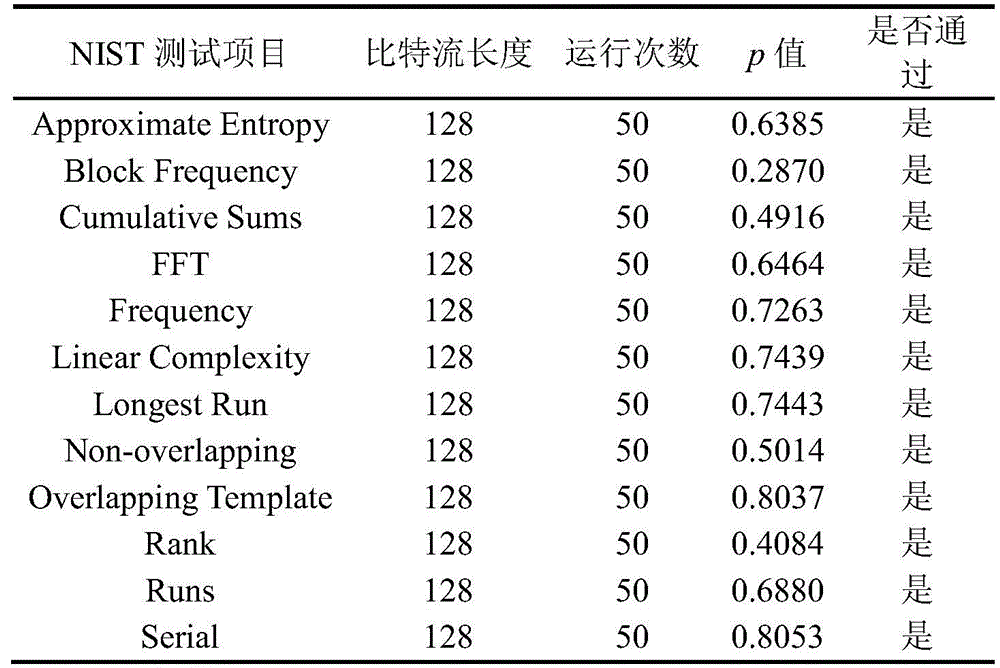
通过美国国家标准技术(National Institute of Standards and Technology,NIST)测试评估PUF随机性,是一种更加严格和系统的方法。NIST测试中,评估p值以量化PUF输出响应的随机性。一般认为评估数据的p值大于0.01,则密钥的随机性置信度达到99%,并且p值越高表明数据随机性的置信度越高。对本发明的基于Camellia加密算法的软PUF的PUF输出响应进行NIST测试,结果如表1所示。从表1中可知,本发明的基于Camellia加密算法的软PUF的PUF响应可以通过所有适用的NIST测试,并且测试得到的平均p值都相对较高,表明该软PUF具有较高随机性。Assessing PUF randomness through the National Institute of Standards and Technology (NIST) test is a more rigorous and systematic approach. In the NIST test, p-values were evaluated to quantify the randomness of the PUF output response. It is generally believed that the p-value of the evaluation data is greater than 0.01, the confidence of the randomness of the key reaches 99%, and the higher the p-value indicates the higher the confidence of the randomness of the data. The NIST test is performed on the PUF output response of the soft PUF based on the Camellia encryption algorithm of the present invention, and the results are shown in Table 1. It can be seen from Table 1 that the PUF response of the soft PUF based on the Camellia encryption algorithm of the present invention can pass all applicable NIST tests, and the average p values obtained by the tests are relatively high, indicating that the soft PUF has high randomness.
表1 NIST随机性测试Table 1 NIST randomness test
二、唯一性及自相关性2. Uniqueness and Autocorrelation
唯一性表征同类型PUF电路中任意个体间的区分度,即产生唯一标识自身数字信息的能力。通常采用统计同一类型PUF不同个体输出响应间汉明距离(Hamming Distance,HD)的方式衡量,理想情况下平均汉明距离为响应长度的50%。k个PUF的片间汉明距离均值E(HDinter)可通过式(2)计算:Uniqueness characterizes the degree of discrimination between any individuals in the same type of PUF circuit, that is, the ability to generate unique digital information that identifies itself. Usually, the Hamming distance (HD) between the output responses of different individuals of the same type of PUF is measured. Ideally, the average Hamming distance is 50% of the response length. The inter-chip Hamming distance mean E(HD inter ) of k PUFs can be calculated by formula (2):

其中,ri和rj分别表示第i和第j个PUF电路在相同激励下产生的n比特响应。Among them, r i and r j represent the n-bit responses generated by the i-th and j-th PUF circuits under the same excitation, respectively.
统计本发明的基于Camellia加密算法的软PUF50次蒙特卡洛仿真的PUF输出响应的HD分布如图3所示,服从数学期望μ=0.5001,标准差σ=0.0452的正态分布。通过式(2)计算唯一性为50.01%,接近理想值。电路模块处于芯片中不同的位置可能会对电路的性能产生影响,在PUF电路中则表现为生成数据与PUF单元位置呈现一定的函数关系,对PUF安全性造成威胁。因此,PUF电路生成的密钥应独立于PUF单元的位置,不受芯片内部电路布局的影响。PUF电路的空间独立性可以利用自相关函数(Auto-correlation Function,ACF)评估。对本发明的基于Camellia加密算法的软PUF的PUF输出数据流进行ACF测试,结果如图4所示。由图4可知,本发明的基于Camellia加密算法的软PUF在95%置信区间情况下σ=0.025,均值接近于0,表明本发明的基于Camellia加密算法的软PUF产生的每比特数据与相邻位数据基本独立,PUF数据与版图布局没有必然的相关性。Figure 3 shows the HD distribution of the PUF output response of the
三、开销分析3. Cost Analysis
本发明的基于Camellia加密算法的软PUF利用现有Camellia加密算法硬件电路产生PUF响应,无需额外的电路设计与硬件开销。但该PUF工作时需要提高频率,产生额外的功耗开销。因此,在不同时钟和数据信号下对该软PUF的功耗开销进行分析,所选数据输入组合见表2。当时钟周期减小幅度约40%时,算法电路在所选择输入信号激励下开始发生时序违例。因此,以该时钟周期为起点,每减少5%选取一个点进行仿真。经过测试得到本发明的基于Camellia加密算法的软PUF的功耗开销曲线如图5(a)所示,其中工作电压和温度分别为1.2V和25℃。由图5(a)可知,相同频率下功耗受输入影响较小,但随着时钟周期减小,SPUF的功耗增加明显。在不同的输入下,时钟周期减小50%情况下的平均额外功耗为829μW。The soft PUF based on the Camellia encryption algorithm of the present invention utilizes the existing Camellia encryption algorithm hardware circuit to generate a PUF response, without additional circuit design and hardware overhead. However, when the PUF works, the frequency needs to be increased, resulting in additional power consumption overhead. Therefore, the power consumption of the soft PUF is analyzed under different clock and data signals, and the selected data input combinations are shown in Table 2. When the clock period is reduced by approximately 40%, the algorithm circuit begins to experience timing violations when excited by the selected input signal. Therefore, starting from this clock cycle, select a point for each 5% reduction to simulate. After testing, the power consumption overhead curve of the soft PUF based on the Camellia encryption algorithm of the present invention is obtained as shown in Figure 5(a), where the operating voltage and temperature are 1.2V and 25°C, respectively. It can be seen from Figure 5(a) that the power consumption is less affected by the input at the same frequency, but as the clock cycle decreases, the power consumption of the SPUF increases significantly. The average additional power dissipation with a 50% reduction in clock cycles is 829 μW at different inputs.
为测试本发明的基于Camellia加密算法的软PUF的安全性、功耗与时钟频率之间的关联性,对不同时钟周期下本发明的基于Camellia加密算法的软PUF的唯一性和随机性进行评估,如图5(b)所示。实验数据表明该PUF在时钟周期减小程度较低时唯一性和随机性较差,但所需额外功耗较低。当时钟周期逐渐减小时,SPUF的唯一性和随机性保持在理想值附近。In order to test the correlation between the security, power consumption and clock frequency of the soft PUF based on the Camellia encryption algorithm of the present invention, the uniqueness and randomness of the soft PUF based on the Camellia encryption algorithm of the present invention under different clock cycles are evaluated. , as shown in Figure 5(b). Experimental data show that the PUF is less unique and random when the clock cycle reduction is low, but requires less additional power. The uniqueness and randomness of SPUF remain around ideal values as the clock period is gradually reduced.
表2不同输入激励Table 2 Different input excitations


本发明的基于Camellia加密算法的软PUF与不同类型的PUF电路性能比较如表3所示。由表3可知,本发明的基于Camellia加密算法的软PUF拥有较高的唯一性和随机性,并且无需额外硬件开销。The performance comparison between the soft PUF based on the Camellia encryption algorithm of the present invention and different types of PUF circuits is shown in Table 3. It can be seen from Table 3 that the soft PUF based on the Camellia encryption algorithm of the present invention has high uniqueness and randomness, and does not require additional hardware overhead.
表3不同类型PUF性能对比Table 3 Performance comparison of different types of PUF

表3中,文献1为HE Z,CHEN W,ZHANG L,et al.A Highly Reliable Arbiter PUFwith Improved Uniqueness in FPGA Implementation Using Bit-Self-Test[J].IEEEAccess,2020,8:181751-181762.,文献2为RAHMAN M T,RAHMAN F,FORTE D,et al.AnAging-Resistant RO-PUF for Reliable Key Generation[J].IEEE Transactions onEmerging Topics in Computing,2015,4(3):335-348.;文献3为WANG S J,LIEN C H,LI KS M.Register PUF with No Power-Up Restrictions[C]//2018IEEE InternationalSymposium on Circuits and Systems(ISCAS).Florence:IEEE,2018:1-5.;文献4为MAITIA,SCHAUMONT P.A Novel Microprocessor-Intrinsic Physical Unclonable Function[C]//International Conference on Field Programmable Logic&Applications.Oslo:IEEE,2012:380-387.;文献5为AYSU A,SCHAUMONT P.Hardware/Software Co-Design ofPhysical Unclonable Function Based Authentications on FPGAs[J].Microprocessors and Microsystems,2015,39(7):589-597.。In Table 3,
综上所述,本发明的基于Camellia加密算法的软PUF利用Camellia算法硬件电路内部时序路径延迟偏差,通过电路延迟差异影响超频条件下时序违例情况,使得无需额外电路设计便可实现输出变化,且经过Camellia加密算法多周期迭代产生高安全性输出响应。在数字与模拟联合仿真下,采集Camellia算法硬件电路错误输出数据并比较产生PUF响应。与传统利用特殊硬件结构PUF电路相比,本发明的基于Camellia加密算法的软PUF在具有良好的安全性之外无需增加硬件成本。在同类型PUF之中,其安全性更强。实验结果表明,在时钟周期减小50%情况下,PUF响应唯一性为50.01%,随机性通过NIST测试,可广泛应用于资源受限设备的安全防护等领域。To sum up, the soft PUF based on the Camellia encryption algorithm of the present invention utilizes the internal timing path delay deviation of the Camellia algorithm hardware circuit, and affects the timing violation under the overclocking condition through the circuit delay difference, so that the output change can be realized without additional circuit design, and The output response with high security is generated through multi-cycle iteration of the Camellia encryption algorithm. Under the co-simulation of digital and analog, the error output data of Camellia algorithm hardware circuit are collected and compared to generate PUF response. Compared with the traditional PUF circuit using a special hardware structure, the soft PUF based on the Camellia encryption algorithm of the present invention does not need to increase the hardware cost in addition to having good security. Among the same type of PUF, its security is stronger. The experimental results show that when the clock period is reduced by 50%, the uniqueness of the PUF response is 50.01%, and the randomness passes the NIST test, which can be widely used in the fields of security protection of resource-constrained devices.
Claims (1)
Priority Applications (1)
| Application Number | Priority Date | Filing Date | Title |
|---|---|---|---|
| CN202110388098.2A CN113268745B (en) | 2021-04-12 | 2021-04-12 | Soft PUF Based on Camellia Encryption Algorithm |
Applications Claiming Priority (1)
| Application Number | Priority Date | Filing Date | Title |
|---|---|---|---|
| CN202110388098.2A CN113268745B (en) | 2021-04-12 | 2021-04-12 | Soft PUF Based on Camellia Encryption Algorithm |
Publications (2)
| Publication Number | Publication Date |
|---|---|
| CN113268745A CN113268745A (en) | 2021-08-17 |
| CN113268745B true CN113268745B (en) | 2022-06-21 |
Family
ID=77228707
Family Applications (1)
| Application Number | Title | Priority Date | Filing Date |
|---|---|---|---|
| CN202110388098.2A Active CN113268745B (en) | 2021-04-12 | 2021-04-12 | Soft PUF Based on Camellia Encryption Algorithm |
Country Status (1)
| Country | Link |
|---|---|
| CN (1) | CN113268745B (en) |
Families Citing this family (2)
| Publication number | Priority date | Publication date | Assignee | Title |
|---|---|---|---|---|
| CN114491681B (en) * | 2022-01-10 | 2025-04-25 | 温州大学 | A voltage controlled processor SPUF |
| CN115659886B (en) * | 2022-12-27 | 2023-04-07 | 南京航空航天大学 | Software PUF configuration method based on over-frequency state DEC circuit time sequence error |
Citations (5)
| Publication number | Priority date | Publication date | Assignee | Title |
|---|---|---|---|---|
| CN103198268A (en) * | 2013-03-18 | 2013-07-10 | 宁波大学 | Reconfigurable multi-port physical unclonable functions (PUF) circuit |
| CN104318181A (en) * | 2014-09-22 | 2015-01-28 | 宁波大学 | PUF circuit based on threshold deviation delay |
| CN105119595A (en) * | 2015-08-14 | 2015-12-02 | 宁波大学 | BLAKE algorithm based on precharge type PUF circuit |
| CN106888093A (en) * | 2017-01-05 | 2017-06-23 | 宁波大学 | A kind of multiport PUF circuits of NMOS zero temperature coefficient points |
| CN107769910A (en) * | 2017-11-15 | 2018-03-06 | 东南大学 | A kind of anti-side channel analysis DES means of defences and circuit based on Latch PUF |
Family Cites Families (1)
| Publication number | Priority date | Publication date | Assignee | Title |
|---|---|---|---|---|
| US9361482B2 (en) * | 2011-12-22 | 2016-06-07 | Mitsubishi Electric Corporation | Device specific information generation device and device specific generation method |
-
2021
- 2021-04-12 CN CN202110388098.2A patent/CN113268745B/en active Active
Patent Citations (5)
| Publication number | Priority date | Publication date | Assignee | Title |
|---|---|---|---|---|
| CN103198268A (en) * | 2013-03-18 | 2013-07-10 | 宁波大学 | Reconfigurable multi-port physical unclonable functions (PUF) circuit |
| CN104318181A (en) * | 2014-09-22 | 2015-01-28 | 宁波大学 | PUF circuit based on threshold deviation delay |
| CN105119595A (en) * | 2015-08-14 | 2015-12-02 | 宁波大学 | BLAKE algorithm based on precharge type PUF circuit |
| CN106888093A (en) * | 2017-01-05 | 2017-06-23 | 宁波大学 | A kind of multiport PUF circuits of NMOS zero temperature coefficient points |
| CN107769910A (en) * | 2017-11-15 | 2018-03-06 | 东南大学 | A kind of anti-side channel analysis DES means of defences and circuit based on Latch PUF |
Non-Patent Citations (4)
| Title |
|---|
| 《面向密码算法IP固核的状态混淆研究》;潘钊;《中国优秀硕士学位论文全文数据库》;20200615;全文 * |
| A Reliable Strong PUF Based on Switched-Capacitor Circuit;He Zhangqing;《 IEEE Transactions on Very Large Scale Integration (VLSI) Systems》;20180630;全文 * |
| Robustness Analysis of a Memristive Crossbar PUF Against Modeling Attacks;Uddin Mesbah;《IEEE Transactions on Nanotechnology》;20170331;全文 * |
| 基于微胶囊技术对油脂包埋的研究进展;王慧梅等;《现代食品科技》;20180908(第10期);全文 * |
Also Published As
| Publication number | Publication date |
|---|---|
| CN113268745A (en) | 2021-08-17 |
Similar Documents
| Publication | Publication Date | Title |
|---|---|---|
| He et al. | A highly reliable arbiter PUF with improved uniqueness in FPGA implementation using bit-self-test | |
| Gao et al. | PUF-FSM: a controlled strong PUF | |
| Li et al. | A survey of hardware Trojan threat and defense | |
| Li et al. | At-speed delay characterization for IC authentication and Trojan horse detection | |
| Majzoobi et al. | Techniques for design and implementation of secure reconfigurable PUFs | |
| CA2971212C (en) | Reliability enhancement methods for physically unclonable function bitstring generation | |
| Hou et al. | A lightweight LFSR-based strong physical unclonable function design on FPGA | |
| Chatterjee et al. | Theory and application of delay constraints in arbiter PUF | |
| CN101478404A (en) | Extraction apparatus and method for chip finger print | |
| CN113268745B (en) | Soft PUF Based on Camellia Encryption Algorithm | |
| Yu et al. | Can deep learning break a true random number generator? | |
| Naveenkumar et al. | Design and evaluation of XOR arbiter physical unclonable function and its implementation on FPGA in hardware security applications | |
| Rathor et al. | A novel low complexity logic encryption technique for design-for-trust | |
| Ni et al. | Pi puf: a processor-intrinsic puf for iot | |
| Tripathy et al. | MARPUF: physical unclonable function with improved machine learning attack resistance | |
| CN119814318A (en) | A clock signal controlled soft PUF based on coding circuit and its application method | |
| Wang et al. | A reconfigurable PUF structure with dual working modes based on entropy separation model | |
| Delvaux et al. | Upper bounds on the min-entropy of RO sum, arbiter, feed-forward arbiter, and S-ArbRO PUFs | |
| Kamadi et al. | Implementation of TRNG with SHA-3 for hardware security | |
| Chen et al. | SPUF design based on Camellia encryption algorithm | |
| Bian et al. | A chaotic strong transition effect ring oscillator PUF with effective immunity to modeling attacks | |
| Yu et al. | Profiled deep learning side-channel attack on a protected arbiter PUF combined with bitstream modification | |
| Nguyen et al. | Lightweight and secure PUFs: A survey | |
| Zhou et al. | Reliable SoC design and implementation of SHA-3-HMAC algorithm with attack protection | |
| Wang et al. | Register PUF with no power-up restrictions |
Legal Events
| Date | Code | Title | Description |
|---|---|---|---|
| PB01 | Publication | ||
| PB01 | Publication | ||
| SE01 | Entry into force of request for substantive examination | ||
| SE01 | Entry into force of request for substantive examination | ||
| GR01 | Patent grant | ||
| GR01 | Patent grant | ||
| EE01 | Entry into force of recordation of patent licensing contract | ||
| EE01 | Entry into force of recordation of patent licensing contract |
Application publication date: 20210817 Assignee: NINGBO XUNGAO INTELLIGENT SCIENCE AND TECHNOLOGY Co.,Ltd. Assignor: Wenzhou University Contract record no.: X2022330000627 Denomination of invention: Soft PUF Based on Camellia Encryption Algorithm Granted publication date: 20220621 License type: Common License Record date: 20221025 |