CN113214672A - Amide substituted azaindole-pentamethine cyanine dye, its synthesis method and application - Google Patents
Amide substituted azaindole-pentamethine cyanine dye, its synthesis method and application Download PDFInfo
- Publication number
- CN113214672A CN113214672A CN202110392999.9A CN202110392999A CN113214672A CN 113214672 A CN113214672 A CN 113214672A CN 202110392999 A CN202110392999 A CN 202110392999A CN 113214672 A CN113214672 A CN 113214672A
- Authority
- CN
- China
- Prior art keywords
- compound
- carbons
- dye
- substituted
- organic solvent
- Prior art date
- Legal status (The legal status is an assumption and is not a legal conclusion. Google has not performed a legal analysis and makes no representation as to the accuracy of the status listed.)
- Granted
Links
Images


Classifications
-
- C—CHEMISTRY; METALLURGY
- C09—DYES; PAINTS; POLISHES; NATURAL RESINS; ADHESIVES; COMPOSITIONS NOT OTHERWISE PROVIDED FOR; APPLICATIONS OF MATERIALS NOT OTHERWISE PROVIDED FOR
- C09B—ORGANIC DYES OR CLOSELY-RELATED COMPOUNDS FOR PRODUCING DYES, e.g. PIGMENTS; MORDANTS; LAKES
- C09B23/00—Methine or polymethine dyes, e.g. cyanine dyes
- C09B23/02—Methine or polymethine dyes, e.g. cyanine dyes the polymethine chain containing an odd number of >CH- or >C[alkyl]- groups
- C09B23/08—Methine or polymethine dyes, e.g. cyanine dyes the polymethine chain containing an odd number of >CH- or >C[alkyl]- groups more than three >CH- groups, e.g. polycarbocyanines
- C09B23/083—Methine or polymethine dyes, e.g. cyanine dyes the polymethine chain containing an odd number of >CH- or >C[alkyl]- groups more than three >CH- groups, e.g. polycarbocyanines five >CH- groups
-
- C—CHEMISTRY; METALLURGY
- C07—ORGANIC CHEMISTRY
- C07D—HETEROCYCLIC COMPOUNDS
- C07D471/00—Heterocyclic compounds containing nitrogen atoms as the only ring hetero atoms in the condensed system, at least one ring being a six-membered ring with one nitrogen atom, not provided for by groups C07D451/00 - C07D463/00
- C07D471/02—Heterocyclic compounds containing nitrogen atoms as the only ring hetero atoms in the condensed system, at least one ring being a six-membered ring with one nitrogen atom, not provided for by groups C07D451/00 - C07D463/00 in which the condensed system contains two hetero rings
- C07D471/04—Ortho-condensed systems
-
- C—CHEMISTRY; METALLURGY
- C09—DYES; PAINTS; POLISHES; NATURAL RESINS; ADHESIVES; COMPOSITIONS NOT OTHERWISE PROVIDED FOR; APPLICATIONS OF MATERIALS NOT OTHERWISE PROVIDED FOR
- C09K—MATERIALS FOR MISCELLANEOUS APPLICATIONS, NOT PROVIDED FOR ELSEWHERE
- C09K11/00—Luminescent materials, e.g. electroluminescent or chemiluminescent
- C09K11/06—Luminescent materials, e.g. electroluminescent or chemiluminescent containing organic luminescent materials
-
- G—PHYSICS
- G01—MEASURING; TESTING
- G01N—INVESTIGATING OR ANALYSING MATERIALS BY DETERMINING THEIR CHEMICAL OR PHYSICAL PROPERTIES
- G01N21/00—Investigating or analysing materials by the use of optical means, i.e. using sub-millimetre waves, infrared, visible or ultraviolet light
- G01N21/62—Systems in which the material investigated is excited whereby it emits light or causes a change in wavelength of the incident light
- G01N21/63—Systems in which the material investigated is excited whereby it emits light or causes a change in wavelength of the incident light optically excited
- G01N21/64—Fluorescence; Phosphorescence
- G01N21/6428—Measuring fluorescence of fluorescent products of reactions or of fluorochrome labelled reactive substances, e.g. measuring quenching effects, using measuring "optrodes"
-
- G—PHYSICS
- G01—MEASURING; TESTING
- G01N—INVESTIGATING OR ANALYSING MATERIALS BY DETERMINING THEIR CHEMICAL OR PHYSICAL PROPERTIES
- G01N21/00—Investigating or analysing materials by the use of optical means, i.e. using sub-millimetre waves, infrared, visible or ultraviolet light
- G01N21/62—Systems in which the material investigated is excited whereby it emits light or causes a change in wavelength of the incident light
- G01N21/63—Systems in which the material investigated is excited whereby it emits light or causes a change in wavelength of the incident light optically excited
- G01N21/64—Fluorescence; Phosphorescence
- G01N21/6486—Measuring fluorescence of biological material, e.g. DNA, RNA, cells
-
- C—CHEMISTRY; METALLURGY
- C09—DYES; PAINTS; POLISHES; NATURAL RESINS; ADHESIVES; COMPOSITIONS NOT OTHERWISE PROVIDED FOR; APPLICATIONS OF MATERIALS NOT OTHERWISE PROVIDED FOR
- C09K—MATERIALS FOR MISCELLANEOUS APPLICATIONS, NOT PROVIDED FOR ELSEWHERE
- C09K2211/00—Chemical nature of organic luminescent or tenebrescent compounds
- C09K2211/10—Non-macromolecular compounds
- C09K2211/1018—Heterocyclic compounds
- C09K2211/1025—Heterocyclic compounds characterised by ligands
- C09K2211/1029—Heterocyclic compounds characterised by ligands containing one nitrogen atom as the heteroatom
-
- C—CHEMISTRY; METALLURGY
- C09—DYES; PAINTS; POLISHES; NATURAL RESINS; ADHESIVES; COMPOSITIONS NOT OTHERWISE PROVIDED FOR; APPLICATIONS OF MATERIALS NOT OTHERWISE PROVIDED FOR
- C09K—MATERIALS FOR MISCELLANEOUS APPLICATIONS, NOT PROVIDED FOR ELSEWHERE
- C09K2211/00—Chemical nature of organic luminescent or tenebrescent compounds
- C09K2211/10—Non-macromolecular compounds
- C09K2211/1018—Heterocyclic compounds
- C09K2211/1025—Heterocyclic compounds characterised by ligands
- C09K2211/1044—Heterocyclic compounds characterised by ligands containing two nitrogen atoms as heteroatoms
-
- G—PHYSICS
- G01—MEASURING; TESTING
- G01N—INVESTIGATING OR ANALYSING MATERIALS BY DETERMINING THEIR CHEMICAL OR PHYSICAL PROPERTIES
- G01N21/00—Investigating or analysing materials by the use of optical means, i.e. using sub-millimetre waves, infrared, visible or ultraviolet light
- G01N21/62—Systems in which the material investigated is excited whereby it emits light or causes a change in wavelength of the incident light
- G01N21/63—Systems in which the material investigated is excited whereby it emits light or causes a change in wavelength of the incident light optically excited
- G01N21/64—Fluorescence; Phosphorescence
- G01N21/6428—Measuring fluorescence of fluorescent products of reactions or of fluorochrome labelled reactive substances, e.g. measuring quenching effects, using measuring "optrodes"
- G01N2021/6439—Measuring fluorescence of fluorescent products of reactions or of fluorochrome labelled reactive substances, e.g. measuring quenching effects, using measuring "optrodes" with indicators, stains, dyes, tags, labels, marks
Landscapes
- Chemical & Material Sciences (AREA)
- Health & Medical Sciences (AREA)
- Organic Chemistry (AREA)
- Life Sciences & Earth Sciences (AREA)
- Immunology (AREA)
- Physics & Mathematics (AREA)
- Analytical Chemistry (AREA)
- Nuclear Medicine, Radiotherapy & Molecular Imaging (AREA)
- Biochemistry (AREA)
- General Health & Medical Sciences (AREA)
- General Physics & Mathematics (AREA)
- Pathology (AREA)
- Engineering & Computer Science (AREA)
- Optics & Photonics (AREA)
- Chemical Kinetics & Catalysis (AREA)
- Biomedical Technology (AREA)
- Molecular Biology (AREA)
- Materials Engineering (AREA)
- Investigating Or Analysing Materials By The Use Of Chemical Reactions (AREA)
Abstract
The invention discloses an amide substituted azaindole-pentamethine cyanine dye, a synthesis method and application thereof, and mainly relates to the synthesis of the amide substituted azaindole-pentamethine cyanine dye and the application thereof in the aspects of biological recognition imaging, nucleic acid labeling, DNA sequencing and the like. The dye has a reactive group for further amide reaction and a water-soluble group. The dye has near infrared absorption and high fluorescence quantum yield, can be used for biological recognition and detection of amino compounds, and is applied to the fields of protein labeling, nucleic acid detection, DNA sequencing and the like.
Description
Technical Field
The invention belongs to the technical field of biological recognition reagents, and relates to synthesis of amide-substituted azaindole-pentamethine cyanine dyes and application thereof in biological dyeing.
Background
The fluorescent dye is an important tool for biological marking and identification, and has important significance in sequencing biological specific protein, tumor marker and DNA identification gene.
In recent years, with the continuous progress of laser technology and fluorescent dyes, fluorescence analysis methods have some advantages such as simple equipment, convenient operation, high sensitivity and fast response, which are particularly prominent compared with isotope labeling methods, and thus, the fluorescence response technology becomes a very important research means. At present, commercial fluorescent dyes such as fluorescein, rhodamine, coumarin, 7-nitrobenzofurazanoaminocaproic acid (NBD), tetramethylrhodamine, Texas red and the like play a very important role in the fields of cell analysis, tumor marker identification, genomics analysis and the like. However, each of these dyes has its own limitations for use. First, a considerable portion of the excitation light of the fluorescent dye is in the ultraviolet region, and the ultraviolet light can cause serious damage to nucleic acid, protein and other components in the cell, so that the use of the fluorescent dye in the fluorescence microscopy is limited by the light excitation time. In addition, when fluorescence detection is performed in an ultraviolet region, the absorption of the biological sample in the region makes it difficult for light to enter the biological tissue, and meanwhile, autofluorescence of certain components in the biological sample forms strong background interference, so that the detection efficiency is greatly reduced. And secondly, when the fluorescent dye is conjugated or covalently linked with the marker, whether the fluorescence of the dye molecule is influenced or not and whether the activity of the marked object is influenced or not are influenced by the dye. Thirdly, the fluorescence quantum yield of the fluorescent dye should be high so that label recognition can be imaged at a low concentration. And fourthly, the molar extinction coefficient of the fluorescent dye is as large as possible, so that the dye molecules can be ensured to fully absorb exciting light. Fifthly, the dye molecules have high stability.
Therefore, research and development of novel fluorescent dyes with good fluorescence spectrum performance, high fluorescence quantum yield, longer excitation wavelength and emission wavelength, selectivity to special cells and low toxicity are still the key and core for promoting development of fields such as fluorescence analysis technology and life science.
Disclosure of Invention
The invention aims to provide a near-infrared amide-substituted azaindole (cyanine) cyanine dye for biological labeling and a synthesis method thereof. Relates to a near-infrared fluorescent probe in the field of biological identification and dyeing. In particular, the invention relates to a fluorescent detection dye for biospecific protein, tumor marker, DNA recognition gene sequencing and the like.
For biospecific protein recognition, i.e., specific selective binding of the dye host to the guest (substrate) through the synergistic effect of intermolecular forces. The invention takes the carboxyl of the dye molecule as the active group to chemically bond with the amino residue of the protein, thereby achieving the purpose of marking the protein. For DNA recognition gene sequencing, DNA sequencing is also accomplished by binding of the carboxyl group of the dye or the activated carboxyl group to a nucleobase having an amino modification.
The design scheme of the invention is that the amide modified azaindole is used for synthesizing the asymmetric cyanine dye so as to improve the absorption and emission wavelength of the cyanine dye, on the other hand, the mobility of molecular electron cloud is improved to increase the fluorescence quantum yield of dye molecules, and meanwhile, sulfonic acid groups or sulfonate are introduced to the dye molecules to improve the water solubility of the molecules, avoid self-quenching and improve the practicability of the dye.
The technical scheme of the application is as follows:
a first aspect of the present application is directed to a class of amide substituted azaindole pentamethine (cyanine) cyanine dye compounds, said dyes having the structure of formula I:

in the general formula I, the compound is shown in the specification,
R1and R2Each independently selected from hydrogen, alkyl having 1 to 18 carbons, carboxyalkyl having 1 to 18 carbons, aryl, arylcarboxylic acid, alkylsulfonate, arylsulfonate, alkylsulfonate, or arylsulfonate;
R3and R4Each independently selected from hydrogenAlkyl having 1-18 carbons, carboxyalkyl having 1-18 carbons, alkylsulfonate having 1-18 carbons, aryl, arylcarboxylic acid group, alkylsulfonate, arylsulfonate, alkylsulfonate, or arylsulfonate;
R5selected from hydrogen, alkyl having 1-18 carbons, alkylhydroxy having 1-18 carbons or haloalkyl having 1-18 carbons
Y-Selected from halogen ion, ClO4 -、BF4 -、CH3COO-、CF3COO-Or OTs-。
Of the above-described embodiments, it is further preferred that R is1Is p-carboxyphenyl, R2When it is a sulfonate, sulfonic acid group or sulfonate, R3Hydrogen, alkyl having 1 to 18 carbons, carboxyalkyl having 1 to 18 carbons, alkylsulfonate having 1 to 18 carbons.
Of the above-described embodiments, it is further preferred that R4Is hydrogen, an alkyl sulfonate having 1-18 carbons, an alkyl sulfonate or sulfonic acid having 1-18 carbons, an alkyl group having 1-18 carbons, a carboxyalkyl group having 1-18 carbons.
Of the above-described embodiments, it is further preferred that R5Are hydrogen, alkylhydroxy having 1 to 18 carbons, alkyl having 1 to 18 carbons, haloalkyl having 1 to 18 carbons, carboxyalkyl having 1 to 18 carbons.
Of the above-described embodiments, further preferred is Y-Can be selected from halogen ion, ClO4 -、 BF4 -、CH3COO-、CF3COO-Or OTs-Any one of the above.
A second aspect of the present application is directed to a method of synthesizing an amide substituted azaindole pentamethine (cyanine) cyanine dye compound comprising the steps of:
(1) TBTU and N-1 in anhydrous DMF (N, N-dimethylformamide) at-10 to 0 deg.CDIPEA, stirring for 0.5-2h, cooling to room temperature, adding R5Substituted amine, reacting for 1-4h, filtering, removing impurity salt, purifying on silica gel column to obtain intermediate 5-R-containing5Substituted amide-2, 3, 3-trimethyl-3H-pyrrolo [2,3-b]Pyridine N-2.
(2) In an organic solvent at 60-90 deg.C, containing R5Substituted 5-amide-2, 3, 3-trimethyl-3H-pyrrolo [2,3-b ] s]Pyridine N-2 reacts with halogenated alkane substituted by N alkylating reagent R4 for 3-24h to convert into the compound containing N-R4Substituted side chain 5-containing R5Substituted amide-2, 3, 3-trimethyl-3H-pyrrolo [2,3-b]And (3) pyridine quaternary ammonium salt N-4. The molar ratio of the compound N-3 to the N-alkylating agent is 1: 1-10. Recrystallizing the compound N-3 by an organic solvent to obtain a pure product.
(3) In an organic solvent at 60-120 deg.C, containing R1And R2Substituted-2, 3-dimethyl-3H-indoles Y-1 with N-alkylating agents R3Substituted halogenated alkane reacts for 8 to 48 hours and is converted into the compound containing N-R3Of substituted side chains-containing R1And R2Substituted-2, 3-dimethyl-3H-indole quaternary ammonium salt Y-2. The molar ratio of the compound Y-1 to the N-alkylating agent is 1: 1-10. Recrystallizing the compound Y-2 by an organic solvent to obtain a pure product.
(4) Reacting the compound Y-2 with the condensing agent S-1 in an organic solvent at 78-125 ℃, reacting for 30-60min, and stopping the reaction to obtain the hemicyanine Y-3. The molar ratio of the compound Y-2 to the condensing agent S-1 is 1: 0.5 to 1.5, and recrystallizing the compound Y-3 by using an organic solvent to obtain a pure product.
(5) In an organic solvent, reacting the compound Y-3 and the compound N-3 for 8-24h under the catalysis of organic base at room temperature to obtain the product, namely the amide-substituted azaindole-pentamethylcyanine dye compound I. The molar ratio of the compound Y-3 to the compound N-4 is 1: 1-4.

In the step (2), the organic solvent is any one of ethanol, benzene, toluene and o-dichlorobenzene. The recrystallization solvent is any one or a mixture of several of methanol, ethanol, acetonitrile, ethyl acetate, diethyl ether, acetone and propanol.
In the step (3), the organic solvent is any one of benzene, toluene, o-dichlorobenzene and DMF. The recrystallization solvent is any one or a mixture of several of methanol, ethanol, acetonitrile, ethyl acetate, diethyl ether, acetone and propanol.
In the step (4), the organic solvent is any one of ethanol, acetic acid, acetic anhydride and DMF. The recrystallization solvent is any one or a mixture of more of methanol, ethanol, acetonitrile, water, ethyl acetate, diethyl ether, acetone and propanol.
In the step (5), the organic solvent is any one of acetonitrile, DMSO, and DMF. The reaction catalyst organic base is any one of triethylamine, pyridine and DIPEA.
The cyanine dye activation product is characterized in that carboxyl of the cyanine dye is activated by an active imide group or a polypeptide reagent TNTU.
A third aspect of the present application is directed to the use of protected amide substituted azaindole pentamethine (cyanine) cyanine dye compounds for applications in cellular imaging, amino acid labeling, protein labeling, antibody specific recognition, nucleic acid labeling, and DNA sequencing.
The dye is a specific dyeing reagent for four deoxynucleotides of a DNA constituent unit or four deoxynucleotides of an amino-modified DNA constituent unit.
The dye is a specific staining reagent for four nucleotides in a RNA constituent unit or four nucleotides in an amino-modified RNA constituent unit.
The fluorescence imaging emission wavelength is 600-950nm in the detection application.
The invention has the following beneficial effects:
(1) the amide-substituted azaindole pentamethine cyanine dye has near-infrared light absorption, the maximum absorption wavelength is 20nm red-shifted compared with that of the amide-substituted dye, the maximum absorption wavelength reaches 680nm, and the maximum emission wavelength is about 710 nm.
(2) The dye provided by the invention has better water solubility and higher fluorescence quantum yield in aqueous solution.
(3) The dye has strong applicability, can realize the marking of various species, and has flexible marking method.
Drawings
FIG. 1 is a normalized absorption spectrum of compounds 1-3 in methanol;
FIG. 2 is a normalized fluorescence spectrum of compounds 1-3 in methanol;
FIG. 3 is a normalized absorption spectrum of Compound 1 and its activated product in methanol;
FIG. 4 is a normalized fluorescence spectrum of Compound 1 and its activated product in methanol;
FIG. 5 is an HPLC chromatogram of Compound 1 and its activation product;
FIG. 6 is an HPLC chromatogram of compound 1 and its activated product after reaction with L-lysine.
Detailed Description
The present invention will be described in further detail below.
Unless otherwise indicated, the terms used herein have the following meanings.
The term "halogen" as used herein includes fluorine, chlorine, bromine and iodine.
The term "alkyl" as used herein includes both straight chain and branched chain alkyl groups.
Y-is used herein to denote a negative ion, which can be any suitable negative ion, including inorganic and organic negative ions, such as, but not limited to, halide, ClO4-、PF6-、BF4-、CH3COO-、CF3COO-Or OTs-。
The salt forms of the dyes described herein can be used directly for staining biological samples. Alternatively, in one embodiment, the compounds of the invention may be used as derivatives of the compounds of formula I.
The instruments and equipment used in the examples:
in the column chromatography process, 200-300 mesh and 100-200 mesh column chromatography silica gel purchased from Qingdao Meigaoji Co Ltd and 20-40 mesh analytical pure quartz sand purchased from Tianda chemical reagent factory are adopted. The low-temperature reaction is realized by a magnetic stirring low-temperature constant-temperature reactor. The reversed-phase purification chromatograph is a CHEETAH rapid purification preparative chromatograph produced by Bora Aijier technologies.
Dye absorption and emission spectra were measured using the Cary 60 uv-vis spectrophotometer and Cary Eclipse fluorescence spectrophotometer from Agilent corporation. The absolute fluorescence quantum yield of the dye was measured using a C11347 absolute fluorescence quantum yield instrument of hamamatsu photonics trade (china) ltd.
EXAMPLE 1 production of Compound 1
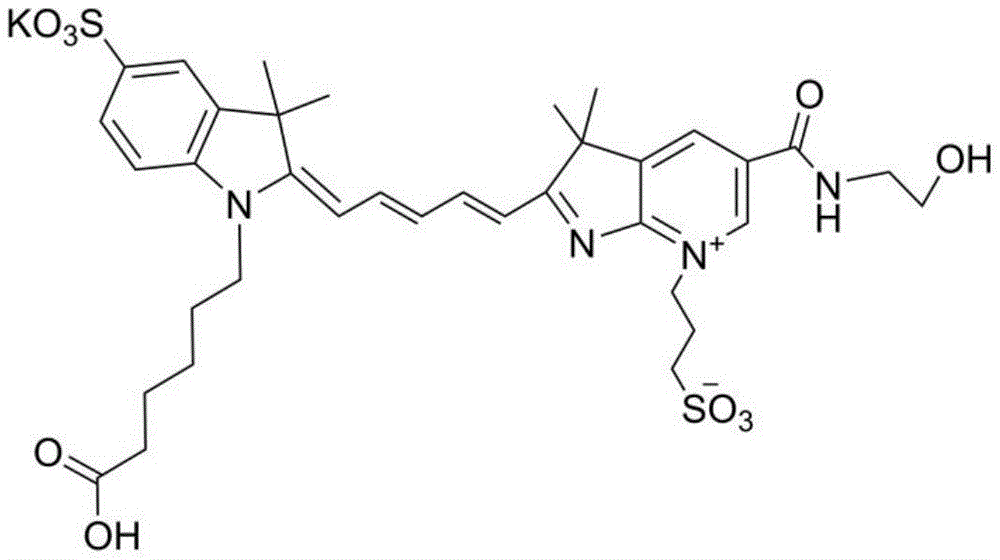
Structural formula of Compound 1
Example 1.1

To a solution of p-hydrazinylbenzenesulfonic acid (5.00g, 26.6mmol, 1.0eq) in acetic acid was added 3-methyl-2-butanone (5.70mL, 53.1mmol, 2.0eq) at room temperature, the reaction was stopped after refluxing for 4h, filtered, washed 3 times with ethyl acetate, the solid was dissolved in 30mL of methanol, slowly added dropwise to a solution of potassium hydroxide (1.50g, 26.6mmol, 1.0eq) dissolved in 30mL of propanol, and stirred at room temperature for 24 h. Filtration gave the title compound 1.1(6.04g, 21.8mmol, Y ═ 82%).
Example 1.2

The compound (1.00g, 3.6mmol, 1.0eq) from example 1.1 and 6-bromohexanoic acid (1.40g, 7.2mmol, 2.0eq) were dissolved in 10mL of o-dichlorobenzene and the reaction was stopped by refluxing under nitrogen for 24 h. Isopropanol was added and filtration was performed to obtain the objective compound 1.2(1.14g, 2.4mmol, Y67%).
Example 1.3

The compound (1.00g, 2.1mmol, 1.0eq) of example 1.2 and malonaldehyde diphenylamine hydrochloride (0.60g, 2.3mmol, 1.1eq) were added to a mixed solution of 5mL of acetic acid and 5mL of acetic anhydride, reacted at 120 ℃ for 1 hour, stopped, cooled to room temperature, added with 50mL of ethyl acetate, and filtered to obtain the objective compound 1.3(0.76g, 1.1mmol, Y ═ 55%).
Example 1.4

To a solution of 2-hydrazino-5-bromopyridine (9.40g,50.0mmol,1.0eq) in toluene (150mL) was added 3-methyl-2-butanone (8.61g,100.0mmol,2.0eq) at room temperature. Heating and refluxing are carried out in the whole process under the conditions of magneton stirring and nitrogen protection, and the reaction can be stopped after 12 hours of reaction. And cooling to room temperature. Most of the toluene was removed, polyphosphoric acid (30mL) was added to the residue, heated and stirred at 140 ℃ and after 45min of reaction, the mixture was poured into ice water (500 mL). NaOH (5N) was added to neutralize the solution to pH 8.0, followed by extraction with ethyl acetate (500 mL). With Na2SO4After drying, the residue was purified on a silica gel column to give example 1.4(3.9g, 16.0mmol, Y ═ 33%) as a yellow solid compound.
Example 1.5

To a solution (20mL) of the compound of example 1.4(1.0g, 4.2 mmol,1.0eq) in anhydrous THF (tetrahydrofuran) was slowly added n-BuLi (2.5M in hexane, 3.7mL, 9.2mmol, 2.2eq) dropwise at-78 ℃. After the reaction is carried out for 1 hour,continuously introducing CO into the reaction solution2After bubbling the gas for 1h, the reaction was stopped, warmed to room temperature, quenched with 25mL of ice water, and purified by HPLC to give compound example 1.5(0.584g, 2.86mmol, Y ═ 68%).
Example 1.6

To a solution (5mL) of compound example 1.5(0.400g, 1.96mmol, 1.0eq) in anhydrous DMF (N, N-dimethylformamide) was added TBTU (0.818g, 2.55mmol, 1.3eq) and DIPEA (0.329g, 2.55mmol, 1.3eq) at 0 ℃ and stirred for 0.5h to room temperature, ethanolamine (0.239 g, 3.92mmol, 2.0eq) was added, reacted for 1.5h, filtered, the impurity salts removed, and purified on a silica gel column to give compound example 1.6(0.363g, 1.47mmol, Y75%).
Example 1.7

To a solution (3mL) of the compound in o-dichlorobenzene (example 1.6(0.300g, 1.21mmol, 1.0eq) at room temperature was added 1, 3-propanesultone (0.295g, 2.42mmol, 2.0eq), heated to 65 ℃ and reacted for 6h, the reaction was stopped, cooled to room temperature, ether (30mL) was added, and the precipitate was collected to give the compound example 1.7(0.358g, 0.968mmol, Y80%)
Production of Compound 1
To a solution of compound example 1.3(0.325g, 0.54mmol, 1.0eq) in DMF (3mL) at room temperature was added compound example 1.7(0.200g, 0.54mmol, 1.0eq), followed by triethylamine (0.273g, 2.70mmol, 5.0eq) and reaction was stopped for 12h, ether (30mL) was added, the precipitate was collected and purified by HPLC to give compound 1(0.129g, 0.162mmol, Y ═ 32%)
Preparation of activated Compound 1

To a solution of compound 1(0.050g, 0.06mmol, 1eq) in DMF (2mL) was added N, N' -tetramethyl-O- (N-succinimide) urea tetrafluoroborate (0.021g, 0.07mmol, 1.2eq) followed by triethylamine (0.160mL) at room temperature, the reaction was stopped, ethyl acetate (50mL × 3), diethyl ether (50mL × 2), 9000 rpm, centrifuged, the precipitate was collected, and purified by HPLC to give activated compound 1(0.047g, 0.05mmol, Y89%).
Example 2 preparation of Compound 2
Structural formula of Compound 2

Example 2.1

4- [ (2, 3-dimethyl-5-sulfo-3H-indol-3-yl) methyl ] benzoic acid (2.000g, 5.56mmol, 1.0eq) and methyl iodide (0.947g, 6.67mmol, 1.2eq) were dissolved in 10mL acetonitrile and the reaction was stopped by refluxing under nitrogen for 24H. Ethyl acetate (50mL) was added, and the mixture was filtered to obtain the objective compound 2.1 (1.614g, 3.22mmol, and Y ═ 58%).
Example 2.2

The compound (1.000g, 2.0mmol, 1.0eq) of example 2.1 and malonaldehyde diphenylamine hydrochloride (0.569g, 2.2mmol, 1.1eq) were added to a mixed solution of 4mL of acetic acid and 4mL of acetic anhydride, reacted at 120 ℃ for 1 hour, stopped, cooled to room temperature, added with 50mL of ethyl acetate, and filtered to obtain the objective compound 2.2(1.008g, 1.6mmol, Y ═ 80%).
Example 2.3
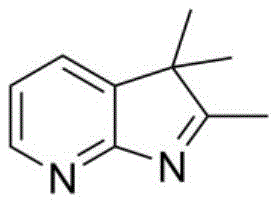
To a solution of 2-hydrazinopyridine (2.182g,20mmol) in toluene (60mL) was added 3-methyl-2-butanone (3.445g,40mmol) at room temperature. Heating and refluxing are carried out in the whole process under the conditions of magneton stirring and nitrogen protection, and the reaction can be stopped after 12 hours of reaction. And cooling to room temperature. Most of the toluene was removed, polyphosphoric acid (12mL) was added to the residue, heated and stirred at 140 ℃ and after 45min of reaction, the mixture was poured into ice water (200 mL). NaOH (5N) was added to neutralize the solution to pH 8.0, followed by extraction with ethyl acetate (300 mL). With Na2SO4After drying, the residue was purified on a silica gel column to give example 2.3(1.280g, 8mmol, Y ═ 40%) as a nitrogen yellow solid compound.
Example 2.4

To a solution (12mL) of the compound in o-dichlorobenzene (example 2.3(0.640g, 4mmol, 1.0eq) was added 1, 3-propanesultone (0.977g, 8mmol, 2.0eq) at room temperature, the mixture was heated to 65 ℃ and reacted for 6 hours, the reaction was stopped, the mixture was cooled to room temperature, diethyl ether (100mL) was added, and the precipitate was collected to give the compound example 2.4(0.960g, 3.4mmol, Y85%)
Preparation of Compound 2

To a solution (5mL) of compound example 2.2(0.400g, 0.63mmol, 1.0eq) in DMF at room temperature was added compound example 2.4(0.211g, 0.75mmol, 1.2eq), followed by triethylamine (0.318g, 437 μ L, 3.15mmol, 5.0eq) and reacted for 12h, the reaction was stopped, ethyl acetate (50mL) was added, the precipitate was collected and purified by HPLC to give compound 1(0.109g, 0.16 mmol, Y25%)
Activated Compound 2

To a solution (3mL) of compound 2(0.100g, 0.14mmol, 1eq) in DMF at room temperature was added N, N' -tetramethyl-O- (N-succinimide) urea tetrafluoroborate (0.050g, 0.17mmol, 1.2eq), followed by triethylamine (0.18mL), reacted for 2h, the reaction was stopped, the reaction solution was poured into ethyl acetate (50mL × 3), diethyl ether (50mL × 2), 9000 rpm, centrifuged, the precipitate was collected, and purified by HPLC to give activated compound 1(0.100g, 0.13mmol, Y ═ 91%)
Example 3 production of Compound 3

Structural formula of Compound 3
Preparation of Compound 3
To a solution of compound example 1.3(0.325g, 0.54mmol, 1.0eq) in DMF (3mL) at room temperature was added compound example 2.4(0.211g, 0.75mmol, 1.2eq), followed by triethylamine (0.273g, 2.70mmol, 5.0eq) and reaction was stopped for 12h, ether (30mL) was added, the precipitate was collected and purified by HPLC to give compound 1(0.142g, 0.200mmol, Y-37%)
Activated Compound 3

To a solution (2mL) of compound 3(0.050g, 0.070mmol, 1.0eq) in DMF was added N, N' -tetramethyl-O- (N-succinimide) urea tetrafluoroborate (0.025g, 0.084mmol, 1.2eq) followed by triethylamine (0.160mL) at room temperature, the reaction was stopped, the reaction solution was poured into ethyl acetate (50mL × 3), diethyl ether (50mL × 2), 9000 rpm, centrifuged, the precipitate was collected, and purified by HPLC to give activated compound 3(0.052g, 0.064mmol, Y ═ 92%).
EXAMPLE 4 measurement of ultraviolet-visible absorption Spectroscopy and fluorescence Spectroscopy of Compounds 1 to 3
The dye after vacuum drying is accurately weighed by a ten-thousandth balance, 5mmol/L DMSO dye mother liquor is prepared in a brown sample bottle and stored in a refrigerator (0-4 ℃) for standby.
When testing the ultraviolet visible absorption spectrum and the fluorescence spectrum, a micro liquid-transferring gun is used for measuring 1.2 mu L of probe mother liquor, the probe mother liquor is dissolved in a quartz cuvette containing 3mL of a solvent to be tested, the mixture is uniformly mixed, the concentration of the obtained probe is 2.0 mu mol/L, and the probe is used for testing the absorption spectrum and the fluorescence emission spectrum. All tests were done at 25 ℃.
As shown in fig. 1, the maximum absorption wavelength of compound 1 was red-shifted by 21nm and 23nm compared to that of compounds 2 and 3, respectively, demonstrating that compound 1 can achieve near-infrared absorption. As shown in fig. 2, the maximum emission wavelength of compound 1 was also red-shifted by 10nm compared to compounds 2 and 3, demonstrating that compound 1 can achieve an emission wavelength of 710 nm.
EXAMPLE 5 determination of Absolute fluorescence Quantum yields of Compounds 1-3
From the mother liquor of example 4, 2umol/L solutions of 1-3 compounds in different solvents were prepared and analyzed by a standard fluorescence quantum yield instrument (Hamamatsu, C11347) Ex: the corresponding absolute fluorescence quantum yield was measured at 650nm and is shown in Table 1.
TABLE 1
| Ethanol | Methanol | Water (W) | |
| Compound 1 | 0.425 | 0.421 | 0.231 |
| Compound 2 | 0.405 | 0.406 | 0.258 |
| Compound 3 | 0.471 | 0.392 | 0.262 |
| Indocyanine green | 0.076 | 0.059 | 0.019 |
From the data analysis of table 1, it is proved that the fluorescence quantum yield of the compounds 1-3 in polar organic solvent is as high as more than 40%, and the compound 1 also shows great improvement compared with the commercialized indocyanine green in water. The introduced sulfonic acid group is shown to increase the water solubility of the dye and reduce the self-quenching of the dye in water.
EXAMPLE 6 fluorescent labeling of lysine by activated Compound 1
Preparing 10 mmol/L-lysine mother liquor by PBS (pH 7.4) in a 5mL brown sample bottle, taking 50 mu L-lysine mother liquor with the concentration of 10mmol/L in a 0.5mL centrifuge tube, adding 100 mu L of compound 3 mother liquor with the concentration of 5mmol/L or activated compound 3 mother liquor, reacting for 6h by a table type constant temperature shaker, and separating and detecting dye-lysine bonding substances by a high performance liquid chromatograph (Agilent 1100 reversed phase).
Theoretically, in HPLC separation, the peak position of a substance is related to the polarity and molecular weight of the compound being separated. As shown in FIG. 5, compound 1 peaked at 23.6min when measured at 680nm, and activated compound 1 peaked 24.4min later than compound 1, indicating that compound 1 after activation had less polarity than non-activated compound 1. FIG. 6 is an HPLC chromatogram of compound 1 and its activated product after reaction with L-lysine. As can be seen from the figure, the non-activated compound 1 has no labeling ability on L-lysine, while the HPLC separation spectrum of the activated compound 1 and L-lysine has a larger peak at 21.4min, which indicates that the activated compound 1 has a labeling ability on L-lysine, and the peak position is earlier due to the introduction of lysine on the compound 1 after the labeling, which increases the polarity. Through data analysis, the activated compound 1 can be used for derivatization fluorescent labeling of lysine containing amino groups in molecules or proteins containing at least one lysine structure in molecules.
The foregoing is a further description of the invention in connection with specific preferred embodiments thereof and is not intended to limit the invention to the particular forms disclosed. It will be apparent to those skilled in the art that various changes and modifications can be made therein without departing from the scope of the invention as defined in the appended claims.
Claims (12)
1. An amide-substituted azaindole-pentamethine cyanine dye, which has a structure shown in a general formula I:

in the general formula I, the compound is shown in the specification,
R1and R2Each independently selected from hydrogen, alkyl having 1 to 18 carbons, carboxyalkyl having 1 to 18 carbons, aryl, arylcarboxylic acid, alkylsulfonate, arylsulfonate, alkylsulfonate, or arylsulfonate;
R3and R4Each independently selected from hydrogen, alkyl having 1-18 carbons, carboxyalkyl having 1-18 carbonsAn alkylsulfonate, an alkylsulfonate having from 1 to 18 carbons, an aryl, an arylcarboxylic acid group, an alkylsulfonate, an arylsulfonate, an alkylsulfonate, or an arylsulfonate;
R5selected from hydrogen, alkyl having 1-18 carbons, alkylhydroxy having 1-18 carbons, or haloalkyl having 1-18 carbons;
Y-selected from halogen ion, ClO4 -、BF4 -、CH3COO-、CF3COO-Or OTs-。
2. Dye according to claim 1, characterized in that: when R is1Is p-carboxyphenyl, R2When it is a sulfonate, sulfonic acid group or sulfonate, R3Selected from hydrogen, alkyl having 1-18 carbons, carboxyalkyl having 1-18 carbons, alkylsulfonate having 1-18 carbons, or alkylsulfonate having 1-18 carbons.
3. Dye according to claim 1, characterized in that said R is4Selected from hydrogen, alkyl sulfonates having 1-18 carbons, alkyl sulfonates or sulfonic acids having 1-18 carbons, alkyl groups having 1-18 carbons, or carboxyalkyl groups having 1-18 carbons.
4. Dye according to claim 1, characterized in that said R is5Selected from hydrogen, alkylhydroxy having 1-18 carbons, alkyl having 1-18 carbons, haloalkyl having 1-18 carbons, or carboxyalkyl having 1-18 carbons.
5. Dye according to claim 1, characterized in that n is chosen from 1, 2 or 3.
6. Dye according to claim 1, characterized in that Y is-Selected from halogen ion, ClO4 -、BF4 -、CH3COO-、CF3COO-Or OTs-Any one of the above.
7. The method for synthesizing amide-substituted azaindole-pentamethylcyanine dyes according to claim 1, characterized in that: the method comprises the following steps:

(1) adding TBTU and DIPEA into N-1 solution in anhydrous DMF (N, N-dimethylformamide) at-10 to 0 deg.C, stirring for 0.5-2h, cooling to room temperature, adding R5Substituted amine is reacted for 1 to 4 hours, filtered, removed of impurity salt and purified to obtain an intermediate 5-R-containing compound5Substituted amide-2, 3, 3-trimethyl-3H-pyrrolo [2,3-b]Pyridine N-2;
(2) in an organic solvent at 60-90 deg.C, containing R5Substituted 5-amide-2, 3, 3-trimethyl-3H-pyrrolo [2,3-b ] s]Pyridine N-2 with N-alkylating agents R4Substituted halogenated alkane reacts for 3 to 24 hours and is converted into the compound containing N-R4Substituted side chain 5-containing R5Substituted amide-2, 3, 3-trimethyl-3H-pyrrolo [2,3-b]Pyridine quaternary ammonium salt N-4(ii) a Wherein the mol ratio of the compound N-3 to the N-alkylating reagent is 1: 1-10; the compound N-3 is recrystallized by an organic solvent to obtain a pure product;
(3) in an organic solvent, at 60-120 ℃, the substituted-2, 3-dimethyl-3H-indole Y-1 containing R1 and R2 is reacted with an N alkylating agent R3Substituted halogenated alkane reacts for 8 to 48 hours and is converted into the compound containing N-R3Of substituted side chains-containing R1And R2Substituted-2, 3-dimethyl-3H-indole quaternary ammonium salt Y-2; the molar ratio of the compound Y-1 to the N alkylating reagent is 1: 1-10; the compound Y-2 is a pure product recrystallized by an organic solvent;
(4) reacting the compound Y-2 with a condensing agent S-1 in an organic solvent at 78-125 ℃, reacting for 30-60min, and stopping the reaction to obtain hemicyanine Y-3; the molar ratio of the compound Y-2 to the condensing agent S-1 is 1: 0.5-1.5, and the compound Y-3 is a pure product obtained by recrystallization of an organic solvent;
(5) reacting the compound Y-3 and the compound N-3 in an organic solvent at room temperature for 8-24h under the catalysis of organic base to obtain an amide-substituted azaindole-pentamethylcyanine dye compound I; wherein the molar ratio of the compound Y-3 to the compound N-4 is 1: 1-4.
Wherein, in the step (2), the organic solvent is selected from any one of ethanol, benzene, toluene and o-dichlorobenzene; the recrystallization solvent is selected from one or a mixture of more of methanol, ethanol, acetonitrile, ethyl acetate, diethyl ether, acetone and propanol;
in the step (3), the organic solvent is selected from any one of benzene, toluene, o-dichlorobenzene and DMF; the recrystallization solvent is selected from one or a mixture of more of methanol, ethanol, acetonitrile, ethyl acetate, diethyl ether, acetone and propanol;
in the step (4), the organic solvent is selected from any one of ethanol, acetic acid, acetic anhydride and DMF; the recrystallization solvent is selected from one or a mixture of more of methanol, ethanol, acetonitrile, water, ethyl acetate, ether, acetone and propanol;
in the step (5), the organic solvent is selected from any one of acetonitrile, DMSO and DMF; the reaction catalyst organic base is any one of triethylamine, pyridine and DIPEA.
8. The dye activation product of claim 1, wherein the carboxyl group of the amide-containing substituted azaindole-pentamethylcyanine dye of claim 1 is activated by an active imide group or by a polypeptide reagent TNTU.
9. Use of a dye according to claim 1, wherein: the probe prepared by the amide-substituted azaindole-pentamethine cyanine dye as claimed in claim 1, and can be used for cell imaging, protein labeling, antibody specific recognition, nucleic acid labeling and DNA sequencing.
10. Use according to claim 9, characterized in that: the dye is a specific dyeing reagent of four deoxynucleotides of a DNA composition unit or four deoxynucleotides of an amino-modified DNA composition unit.
11. Use according to claim 9, characterized in that: the dye is a specific staining reagent of four nucleotides of a composition unit of RNA or four nucleotides of a composition unit of amino modified RNA.
12. Use according to claim 9, characterized in that: the fluorescence imaging emission wavelength is 600-950nm in the detection application.
Priority Applications (1)
| Application Number | Priority Date | Filing Date | Title |
|---|---|---|---|
| CN202110392999.9A CN113214672B (en) | 2021-04-13 | 2021-04-13 | Amide-substituted azaindole-pentamethine dyes, their synthesis and their applications |
Applications Claiming Priority (1)
| Application Number | Priority Date | Filing Date | Title |
|---|---|---|---|
| CN202110392999.9A CN113214672B (en) | 2021-04-13 | 2021-04-13 | Amide-substituted azaindole-pentamethine dyes, their synthesis and their applications |
Publications (2)
| Publication Number | Publication Date |
|---|---|
| CN113214672A true CN113214672A (en) | 2021-08-06 |
| CN113214672B CN113214672B (en) | 2022-11-04 |
Family
ID=77087514
Family Applications (1)
| Application Number | Title | Priority Date | Filing Date |
|---|---|---|---|
| CN202110392999.9A Active CN113214672B (en) | 2021-04-13 | 2021-04-13 | Amide-substituted azaindole-pentamethine dyes, their synthesis and their applications |
Country Status (1)
| Country | Link |
|---|---|
| CN (1) | CN113214672B (en) |
Cited By (7)
| Publication number | Priority date | Publication date | Assignee | Title |
|---|---|---|---|---|
| CN114773875A (en) * | 2022-03-15 | 2022-07-22 | 大连理工大学 | Azaindole-squarylium cyanine dye, and synthesis method and application thereof |
| CN114874639A (en) * | 2022-05-12 | 2022-08-09 | 大连理工大学 | Novel hemicyanine near-infrared fluorescent dye, and synthetic method and application thereof |
| CN115403577A (en) * | 2022-09-21 | 2022-11-29 | 凤翔万生源医药科技有限公司 | Synthesis method of carboxyl azaindole |
| CN116836565A (en) * | 2023-07-11 | 2023-10-03 | 大连理工大学 | Water-soluble squaraine dye, and synthetic method and application thereof |
| CN116903513A (en) * | 2023-07-14 | 2023-10-20 | 江汉大学 | A synthesis method of asymmetric bioluminescent probe Cy5 |
| CN118027702A (en) * | 2023-12-26 | 2024-05-14 | 大连理工大学 | A dye with up-conversion performance, its synthesis method and application |
| WO2026040751A1 (en) * | 2024-08-23 | 2026-02-26 | 华东师范大学 | Amide cyanine dye, synthesis method therefor and use thereof in fluorescence imaging |
Citations (2)
| Publication number | Priority date | Publication date | Assignee | Title |
|---|---|---|---|---|
| CN102268191A (en) * | 2010-06-06 | 2011-12-07 | 史春梦 | Heptamethine indocyanine dye, synthetic method thereof and applications thereof |
| CN104704366A (en) * | 2012-10-24 | 2015-06-10 | 贝克顿·迪金森公司 | Hydroxamate substituted azaindoline-cyanine dyes and bioconjugates of the same |
-
2021
- 2021-04-13 CN CN202110392999.9A patent/CN113214672B/en active Active
Patent Citations (2)
| Publication number | Priority date | Publication date | Assignee | Title |
|---|---|---|---|---|
| CN102268191A (en) * | 2010-06-06 | 2011-12-07 | 史春梦 | Heptamethine indocyanine dye, synthetic method thereof and applications thereof |
| CN104704366A (en) * | 2012-10-24 | 2015-06-10 | 贝克顿·迪金森公司 | Hydroxamate substituted azaindoline-cyanine dyes and bioconjugates of the same |
Cited By (10)
| Publication number | Priority date | Publication date | Assignee | Title |
|---|---|---|---|---|
| CN114773875A (en) * | 2022-03-15 | 2022-07-22 | 大连理工大学 | Azaindole-squarylium cyanine dye, and synthesis method and application thereof |
| CN114773875B (en) * | 2022-03-15 | 2023-09-12 | 大连理工大学 | Azaindole-squaraine dye, and synthetic method and application thereof |
| CN114874639A (en) * | 2022-05-12 | 2022-08-09 | 大连理工大学 | Novel hemicyanine near-infrared fluorescent dye, and synthetic method and application thereof |
| CN115403577A (en) * | 2022-09-21 | 2022-11-29 | 凤翔万生源医药科技有限公司 | Synthesis method of carboxyl azaindole |
| CN115403577B (en) * | 2022-09-21 | 2024-04-26 | 西安宇特邦医药科技有限公司 | Synthesis method of carboxyl azaindole |
| CN116836565A (en) * | 2023-07-11 | 2023-10-03 | 大连理工大学 | Water-soluble squaraine dye, and synthetic method and application thereof |
| CN116903513A (en) * | 2023-07-14 | 2023-10-20 | 江汉大学 | A synthesis method of asymmetric bioluminescent probe Cy5 |
| CN118027702A (en) * | 2023-12-26 | 2024-05-14 | 大连理工大学 | A dye with up-conversion performance, its synthesis method and application |
| CN118027702B (en) * | 2023-12-26 | 2026-02-13 | 大连理工大学 | A dye with upconversion properties, its synthesis method and application. |
| WO2026040751A1 (en) * | 2024-08-23 | 2026-02-26 | 华东师范大学 | Amide cyanine dye, synthesis method therefor and use thereof in fluorescence imaging |
Also Published As
| Publication number | Publication date |
|---|---|
| CN113214672B (en) | 2022-11-04 |
Similar Documents
| Publication | Publication Date | Title |
|---|---|---|
| CN113214672A (en) | Amide substituted azaindole-pentamethine cyanine dye, its synthesis method and application | |
| CN114591632B (en) | A class of azaindole-semicyanine dyes, its synthesis method and application | |
| CN111961040B (en) | Carbazolyl-based organic diheterocyclic near-infrared fluorescent probe and preparation method and application thereof | |
| CN107850601A (en) | Dye composition | |
| CN114591633A (en) | Xanthene-hemicyanine near-infrared fluorescent dye, and synthesis method and application thereof | |
| CN114773875B (en) | Azaindole-squaraine dye, and synthetic method and application thereof | |
| CN115160345A (en) | A class of azaindole-heptamethine cyanine dyes, their synthesis methods and applications | |
| JPH09100416A (en) | Fixed monomethinecyanine dye | |
| CN111333641A (en) | An enhanced fluorescent probe for tetrazine bioorthogonal labeling and its synthesis | |
| CN104650610A (en) | Asymmetric near-infrared BODIPY fluorescent dye as well as preparation method and application thereof | |
| CN112174885B (en) | P-dimethylamino styrene quinoline derivative, synthetic method thereof and application thereof in nucleic acid fluorescent probe | |
| CN114702447B (en) | Naphthalimide derivative and preparation method and application thereof | |
| CN107311977A (en) | A kind of indoles ethylene compounds and its preparation method and application | |
| CN115286627A (en) | Azaindole hemicyanine dyes, and synthesis method and application thereof | |
| CN120272028A (en) | Fluorine-substituted pentamethine cyanine dye and preparation method and application thereof | |
| CN113201007A (en) | Fluorescent probe for detecting fluorine ions, application thereof and method for detecting fluorine ions in sample to be detected | |
| CN114874639B (en) | Novel hemicyanine near infrared fluorescent dye, and synthesis method and application thereof | |
| CN118126032A (en) | Fluorescent probe and preparation method and application thereof | |
| CN111333618A (en) | 488nm excited wash-free SNAP-tag probe and preparation method thereof | |
| CN116239893B (en) | Quaternary ammonium salt modified cyanine fluorescent dye and its synthesis and application | |
| CN112940714B (en) | Wash-free Halo-tag probe with high fluorescence quantum yield and synthetic method and application thereof | |
| EP1163372A1 (en) | Chemically reactive plane-rigidized cyanine dyes and their derivatives | |
| CN111334080A (en) | A high brightness, high photostability carbonic anhydrase fluorescent probe | |
| CN115894334A (en) | Fluorescent probe derived from a compound perylene and its preparation method and application | |
| CN110143975B (en) | Fluorescent-labeled O of naphthalimide or perylene bisimide6-benzylguanine derivatives and process for the preparation thereof |
Legal Events
| Date | Code | Title | Description |
|---|---|---|---|
| PB01 | Publication | ||
| PB01 | Publication | ||
| SE01 | Entry into force of request for substantive examination | ||
| SE01 | Entry into force of request for substantive examination | ||
| GR01 | Patent grant | ||
| GR01 | Patent grant |