CN113185421B - Lipid compounds and compositions thereof - Google Patents
Lipid compounds and compositions thereof Download PDFInfo
- Publication number
- CN113185421B CN113185421B CN202110617445.4A CN202110617445A CN113185421B CN 113185421 B CN113185421 B CN 113185421B CN 202110617445 A CN202110617445 A CN 202110617445A CN 113185421 B CN113185421 B CN 113185421B
- Authority
- CN
- China
- Prior art keywords
- compound
- glycero
- lipid
- alkyl
- independently selected
- Prior art date
- Legal status (The legal status is an assumption and is not a legal conclusion. Google has not performed a legal analysis and makes no representation as to the accuracy of the status listed.)
- Active
Links
Images


Classifications
-
- C—CHEMISTRY; METALLURGY
- C07—ORGANIC CHEMISTRY
- C07C—ACYCLIC OR CARBOCYCLIC COMPOUNDS
- C07C229/00—Compounds containing amino and carboxyl groups bound to the same carbon skeleton
- C07C229/02—Compounds containing amino and carboxyl groups bound to the same carbon skeleton having amino and carboxyl groups bound to acyclic carbon atoms of the same carbon skeleton
- C07C229/04—Compounds containing amino and carboxyl groups bound to the same carbon skeleton having amino and carboxyl groups bound to acyclic carbon atoms of the same carbon skeleton the carbon skeleton being acyclic and saturated
- C07C229/06—Compounds containing amino and carboxyl groups bound to the same carbon skeleton having amino and carboxyl groups bound to acyclic carbon atoms of the same carbon skeleton the carbon skeleton being acyclic and saturated having only one amino and one carboxyl group bound to the carbon skeleton
- C07C229/10—Compounds containing amino and carboxyl groups bound to the same carbon skeleton having amino and carboxyl groups bound to acyclic carbon atoms of the same carbon skeleton the carbon skeleton being acyclic and saturated having only one amino and one carboxyl group bound to the carbon skeleton the nitrogen atom of the amino group being further bound to acyclic carbon atoms or to carbon atoms of rings other than six-membered aromatic rings
- C07C229/12—Compounds containing amino and carboxyl groups bound to the same carbon skeleton having amino and carboxyl groups bound to acyclic carbon atoms of the same carbon skeleton the carbon skeleton being acyclic and saturated having only one amino and one carboxyl group bound to the carbon skeleton the nitrogen atom of the amino group being further bound to acyclic carbon atoms or to carbon atoms of rings other than six-membered aromatic rings to carbon atoms of acyclic carbon skeletons
-
- A—HUMAN NECESSITIES
- A61—MEDICAL OR VETERINARY SCIENCE; HYGIENE
- A61K—PREPARATIONS FOR MEDICAL, DENTAL OR TOILETRY PURPOSES
- A61K9/00—Medicinal preparations characterised by special physical form
- A61K9/48—Preparations in capsules, e.g. of gelatin, of chocolate
- A61K9/50—Microcapsules having a gas, liquid or semi-solid filling; Solid microparticles or pellets surrounded by a distinct coating layer, e.g. coated microspheres, coated drug crystals
- A61K9/51—Nanocapsules; Nanoparticles
- A61K9/5107—Excipients; Inactive ingredients
- A61K9/5123—Organic compounds, e.g. fats, sugars
-
- A—HUMAN NECESSITIES
- A61—MEDICAL OR VETERINARY SCIENCE; HYGIENE
- A61K—PREPARATIONS FOR MEDICAL, DENTAL OR TOILETRY PURPOSES
- A61K9/00—Medicinal preparations characterised by special physical form
- A61K9/48—Preparations in capsules, e.g. of gelatin, of chocolate
- A61K9/50—Microcapsules having a gas, liquid or semi-solid filling; Solid microparticles or pellets surrounded by a distinct coating layer, e.g. coated microspheres, coated drug crystals
- A61K9/51—Nanocapsules; Nanoparticles
- A61K9/5107—Excipients; Inactive ingredients
- A61K9/513—Organic macromolecular compounds; Dendrimers
- A61K9/5146—Organic macromolecular compounds; Dendrimers obtained otherwise than by reactions only involving carbon-to-carbon unsaturated bonds, e.g. polyethylene glycol, polyamines, polyanhydrides
-
- C—CHEMISTRY; METALLURGY
- C07—ORGANIC CHEMISTRY
- C07C—ACYCLIC OR CARBOCYCLIC COMPOUNDS
- C07C229/00—Compounds containing amino and carboxyl groups bound to the same carbon skeleton
- C07C229/02—Compounds containing amino and carboxyl groups bound to the same carbon skeleton having amino and carboxyl groups bound to acyclic carbon atoms of the same carbon skeleton
- C07C229/04—Compounds containing amino and carboxyl groups bound to the same carbon skeleton having amino and carboxyl groups bound to acyclic carbon atoms of the same carbon skeleton the carbon skeleton being acyclic and saturated
- C07C229/06—Compounds containing amino and carboxyl groups bound to the same carbon skeleton having amino and carboxyl groups bound to acyclic carbon atoms of the same carbon skeleton the carbon skeleton being acyclic and saturated having only one amino and one carboxyl group bound to the carbon skeleton
- C07C229/10—Compounds containing amino and carboxyl groups bound to the same carbon skeleton having amino and carboxyl groups bound to acyclic carbon atoms of the same carbon skeleton the carbon skeleton being acyclic and saturated having only one amino and one carboxyl group bound to the carbon skeleton the nitrogen atom of the amino group being further bound to acyclic carbon atoms or to carbon atoms of rings other than six-membered aromatic rings
- C07C229/16—Compounds containing amino and carboxyl groups bound to the same carbon skeleton having amino and carboxyl groups bound to acyclic carbon atoms of the same carbon skeleton the carbon skeleton being acyclic and saturated having only one amino and one carboxyl group bound to the carbon skeleton the nitrogen atom of the amino group being further bound to acyclic carbon atoms or to carbon atoms of rings other than six-membered aromatic rings to carbon atoms of hydrocarbon radicals substituted by amino or carboxyl groups, e.g. ethylenediamine-tetra-acetic acid, iminodiacetic acids
-
- C—CHEMISTRY; METALLURGY
- C07—ORGANIC CHEMISTRY
- C07C—ACYCLIC OR CARBOCYCLIC COMPOUNDS
- C07C237/00—Carboxylic acid amides, the carbon skeleton of the acid part being further substituted by amino groups
- C07C237/02—Carboxylic acid amides, the carbon skeleton of the acid part being further substituted by amino groups having the carbon atoms of the carboxamide groups bound to acyclic carbon atoms of the carbon skeleton
- C07C237/04—Carboxylic acid amides, the carbon skeleton of the acid part being further substituted by amino groups having the carbon atoms of the carboxamide groups bound to acyclic carbon atoms of the carbon skeleton the carbon skeleton being acyclic and saturated
- C07C237/10—Carboxylic acid amides, the carbon skeleton of the acid part being further substituted by amino groups having the carbon atoms of the carboxamide groups bound to acyclic carbon atoms of the carbon skeleton the carbon skeleton being acyclic and saturated having the nitrogen atom of at least one of the carboxamide groups bound to an acyclic carbon atom of a hydrocarbon radical substituted by nitrogen atoms not being part of nitro or nitroso groups
-
- C—CHEMISTRY; METALLURGY
- C07—ORGANIC CHEMISTRY
- C07D—HETEROCYCLIC COMPOUNDS
- C07D249/00—Heterocyclic compounds containing five-membered rings having three nitrogen atoms as the only ring hetero atoms
- C07D249/02—Heterocyclic compounds containing five-membered rings having three nitrogen atoms as the only ring hetero atoms not condensed with other rings
- C07D249/04—1,2,3-Triazoles; Hydrogenated 1,2,3-triazoles
-
- C—CHEMISTRY; METALLURGY
- C07—ORGANIC CHEMISTRY
- C07D—HETEROCYCLIC COMPOUNDS
- C07D295/00—Heterocyclic compounds containing polymethylene-imine rings with at least five ring members, 3-azabicyclo [3.2.2] nonane, piperazine, morpholine or thiomorpholine rings, having only hydrogen atoms directly attached to the ring carbon atoms
- C07D295/04—Heterocyclic compounds containing polymethylene-imine rings with at least five ring members, 3-azabicyclo [3.2.2] nonane, piperazine, morpholine or thiomorpholine rings, having only hydrogen atoms directly attached to the ring carbon atoms with substituted hydrocarbon radicals attached to ring nitrogen atoms
- C07D295/08—Heterocyclic compounds containing polymethylene-imine rings with at least five ring members, 3-azabicyclo [3.2.2] nonane, piperazine, morpholine or thiomorpholine rings, having only hydrogen atoms directly attached to the ring carbon atoms with substituted hydrocarbon radicals attached to ring nitrogen atoms substituted by singly bound oxygen or sulfur atoms
- C07D295/084—Heterocyclic compounds containing polymethylene-imine rings with at least five ring members, 3-azabicyclo [3.2.2] nonane, piperazine, morpholine or thiomorpholine rings, having only hydrogen atoms directly attached to the ring carbon atoms with substituted hydrocarbon radicals attached to ring nitrogen atoms substituted by singly bound oxygen or sulfur atoms with the ring nitrogen atoms and the oxygen or sulfur atoms attached to the same carbon chain, which is not interrupted by carbocyclic rings
- C07D295/088—Heterocyclic compounds containing polymethylene-imine rings with at least five ring members, 3-azabicyclo [3.2.2] nonane, piperazine, morpholine or thiomorpholine rings, having only hydrogen atoms directly attached to the ring carbon atoms with substituted hydrocarbon radicals attached to ring nitrogen atoms substituted by singly bound oxygen or sulfur atoms with the ring nitrogen atoms and the oxygen or sulfur atoms attached to the same carbon chain, which is not interrupted by carbocyclic rings to an acyclic saturated chain
-
- C—CHEMISTRY; METALLURGY
- C07—ORGANIC CHEMISTRY
- C07D—HETEROCYCLIC COMPOUNDS
- C07D401/00—Heterocyclic compounds containing two or more hetero rings, having nitrogen atoms as the only ring hetero atoms, at least one ring being a six-membered ring with only one nitrogen atom
- C07D401/02—Heterocyclic compounds containing two or more hetero rings, having nitrogen atoms as the only ring hetero atoms, at least one ring being a six-membered ring with only one nitrogen atom containing two hetero rings
- C07D401/06—Heterocyclic compounds containing two or more hetero rings, having nitrogen atoms as the only ring hetero atoms, at least one ring being a six-membered ring with only one nitrogen atom containing two hetero rings linked by a carbon chain containing only aliphatic carbon atoms
-
- C—CHEMISTRY; METALLURGY
- C07—ORGANIC CHEMISTRY
- C07C—ACYCLIC OR CARBOCYCLIC COMPOUNDS
- C07C2601/00—Systems containing only non-condensed rings
- C07C2601/04—Systems containing only non-condensed rings with a four-membered ring
Landscapes
- Chemical & Material Sciences (AREA)
- Organic Chemistry (AREA)
- Health & Medical Sciences (AREA)
- Bioinformatics & Cheminformatics (AREA)
- Engineering & Computer Science (AREA)
- Optics & Photonics (AREA)
- Life Sciences & Earth Sciences (AREA)
- Nanotechnology (AREA)
- Physics & Mathematics (AREA)
- Medicinal Chemistry (AREA)
- Pharmacology & Pharmacy (AREA)
- Epidemiology (AREA)
- Biomedical Technology (AREA)
- Animal Behavior & Ethology (AREA)
- General Health & Medical Sciences (AREA)
- Public Health (AREA)
- Veterinary Medicine (AREA)
- Pharmaceuticals Containing Other Organic And Inorganic Compounds (AREA)
- Medicinal Preparation (AREA)
Abstract
本发明涉及一种脂质化合物及其组合物,包含其的脂质纳米颗粒,及其制备方法和在药物递送中的用途。The present invention relates to a lipid compound and composition thereof, lipid nanoparticles comprising the same, and preparation method thereof and use in drug delivery.
Description
Technical Field
The invention belongs to the field of biomedicine and biotechnology, and relates to a therapeutic drug delivery system of lipid compounds.
Background
Exogenous biological molecules and some drug molecules are difficult to penetrate cell membranes to reach cytoplasm to achieve a therapeutic effect. mRNA is a highly negatively charged biomolecule that must overcome the cell membrane barrier to translate into protein for biological function, and thus therapeutic applications of such biomolecules for efficient delivery in vivo are a major challenge.
Lipid Nanoparticles (LNPs) are a novel nucleic acid biomolecule delivery technology, and LNPs are generally composed of four components: (1) ionizable lipids that self-assemble with mRNA into virus-sized particles and release mRNA from the endosome into the cytoplasm; (2) the polyethylene glycol lipid can improve the half-life period of LNP in blood; (3) cholesterol, which can increase nanoparticle stability; (4) natural phospholipids contribute to the formation of lipid bilayer structures. LNP can protect mRNA from being decomposed by RNase, can protect mRNA molecules from being recognized by TLRs, and avoids the over-activation of the innate immune system; the ionizable lipid not only can promote cellular uptake, but also can help drug molecules escape from the endosome, thereby achieving the therapeutic effect.
The first LNP encapsulated siRNA drug of MC3 cationized lipid has been approved for marketing, demonstrating that LNP can deliver nucleic acid drugs efficiently in vivo and with certain safety. Research in recent years finds that LNP also shows great application potential in the field of mRNA drugs and vaccines. The development of LNP delivery systems has focused primarily on ionizable lipids and formulations, and how to overcome the toxicity of some lipid formulations, among others.
PCT/US2016/052352 discloses compounds and compositions for intracellular delivery of therapeutic agents, comprising a plurality of novel lipid structures capable of delivering mRNA molecules to target cells. PCT/US2010/038224 discloses the chemical structure of MC3, which is capable of encapsulating siRNA drug molecules with high efficiency, protected from degradation and clearance during delivery. Currently, LNP delivery systems are still considered to be one of the key technologies to drive nucleic acid drug molecules into therapeutic applications.
Disclosure of Invention
Based on this, there is a need to address the problems of the prior art by finding novel ionized lipid compounds that improve delivery efficiency and reduce toxicity. The invention provides an ionizable lipid compound with a novel structure, wherein a fat chain is formed by an ester group and an ether bond of glycerol in the ionizable lipid compound, and the delivery effect of the ionizable lipid compound is better than that of an ionizable lipid with a fat chain structure. After forming lipid nanoparticles with other lipid components, the lipid nanoparticles can effectively deliver mRNA or drug molecules into cells to perform biological functions, such as delivering siRNA into cells in vivo to perform gene silencing treatment, delivering mRNA into cells in vivo can be efficiently translated into protein or antigen to be used as vaccine or drug treatment, delivering antibodies into cells in vivo to perform treatment and delivering Cas 9 mRNA into cells in vivo to perform gene editing function.
The invention provides a novel ionizable lipid, a synthesis method thereof, a nanoparticle delivery system formed by mixing the ionizable lipid with a polyethylene glycol lipid compound, structural lipid cholesterol, natural phospholipid and the like to encapsulate drug molecules, and the nanoparticle delivery system can be used for in-vitro cell delivery and in-vivo organ targeted cell delivery, and specifically comprises the following steps:
in one embodiment, the present invention discloses compounds of the following formula (I):

wherein R is1Is selected from R1’-X;
R1' is- (CH)2)0-6-, X is amino, hydroxy, ethynyl, cyano, -C (O) (CH)2)1-3NRaRb、-C(O)O(CH2)1- 3NRaRb、-OC(O)(CH2)1-3NRaRb、-C(O)NH(CH2)1-3NRaRb、-NHC(O)(CH2)1-3NRaRb、- NHC(O)CH(NRaRb)(CH2)1-3NRaRb、C3-7Cycloalkyl, 4-7 membered heterocyclyl, C6-10Aryl or 5-10 membered heteroaryl, said cycloalkyl, heterocyclyl, aryl or heteroaryl groups being optionally substituted by a group selected from; - (CH)2)1-3OH、 -(CH2)1-3NRaRb、-(CH2)1-3C(O)NRaRb(ii) a Or X can also be:

Ra、Rbeach independently selected from H, C1-3Alkyl radical, - (A)CH2)1-3NH2、-(CH2)1-3NH(CH2)1-3NH2(ii) a Or RaAnd RbTogether with the nitrogen atom to which it is attached form a 5-10 membered heterocyclic ring containing 1-3 heteroatoms selected from N, O or S, which heterocyclic ring is optionally substituted with a group selected from; c1-6Alkyl radical, C1-6Haloalkyl, C1-6Alkyl hydroxy, C1-6An alkylamino group;
R2、R3independently selected from H, C2-18Alkyl radical, C4-18Alkenyl or
Each M is independently selected from-CH2-、-CH=CH-、-NH-、-C(O)-、-O-、-C(O)O-、-OC(O)-、 -C(O)NH-、-NHC(O)-;
Each R is independently selected from H, R ', -OR', OR-R 'OR';
each R' is independently selected from C1-10Alkyl or C3-12An alkenyl group;
each R is independently selected from C1-10Alkyl or C3-12An alkenyl group;
n and m are each independently selected from integers of 1 to 9;
or a salt or isomer thereof.
Alternatively, in the compound of formula (I):
R1' is- (CH)2)2-3-, X is hydroxy, -C (O) (CH)2)2-3NRaRb、-C(O)O(CH2)2-3NRaRb、- C(O)NH(CH2)2-3NRaRbOr 5-10 membered heteroaryl, said heteroaryl optionally substituted with a group selected from; - (CH)2)2-3OH、-(CH2)2-3NRaRb、-(CH2)2-3C(O)NRaRb(ii) a Or X can also be:

Ra、Rbeach independently selected from H, C1-3Alkyl, - (CH)2)2-3NH2、-(CH2)2-3NH(CH2)2-3NH2(ii) a Or RaAnd RbTogether with the nitrogen atom to which it is attached form a 5-10 membered heterocyclic ring containing 1-3 heteroatoms selected from N or O, which heterocyclic ring is optionally substituted by a group selected from; c1-6Alkyl radical, C1-6Haloalkyl, C1-6Alkyl hydroxy, C1-6An alkylamino group.
Alternatively, in the compound of formula (I):
each M is independently selected from-CH2-、-CH=CH-、-C(O)O-、-OC(O)-、-C(O)NH-、-NHC(O)-。
Alternatively, the compound of formula (I) is a compound of formula (II):

wherein each R is independently selected from C2-10Alkyl, preferably C6-10Alkyl, preferably C6An alkyl group.
Optionally, in the compound of formula (II), each M is independently selected from-C (O) O-or-OC (O) -, preferably-C (O) O-.
Optionally, in the compound of formula (II), R1Is selected from R1’-X,R1' is- (CH)2)1-6-, X is hydroxy.
Optionally, in the compound of formula (II), R1Is selected from R1’-X,R1' is- (CH)2)1-6-, X is-C (O) (CH)2)2- 3NRaRb、 -C(O)O(CH2)2-3NRaRb、-C(O)NH(CH2)2-3NRaRb,
Ra、RbEach independently selected from H, C1-3Alkyl, - (CH)2)2-3NH2(ii) a Or RaAnd RbTogether with the nitrogen atom to which it is attached form a 5-10 membered heterocyclic ring containing 1-3 heteroatoms selected from N or O, preferably morpholinyl or piperidinyl, the heterocyclic ring being optionally substituted with a group selected from; c1-6An alkyl hydroxy group.
Optionally, in the compound of formula (II), R1Is selected from R1’-X,R1' is- (CH)2)1-6-X is a 5-6 membered heteroaryl group, preferably triazolyl, said heteroaryl group being optionally substituted by a group selected from; - (CH)2)2-3OH、-(CH2)2-3NRaRb、 -(CH2)2-3C(O)NRaRb,
Ra、RbEach independently selected from H, C1-3Alkyl, - (CH)2)2-3NH2、-(CH2)2-3NH(CH2)2-3NH2(ii) a Or RaAnd RbTogether with the nitrogen atom to which it is attached form a 5-10 membered heterocyclic ring containing 1-3 heteroatoms selected from N or O, preferably morpholinyl, piperazinyl or piperidinyl, which heterocyclic ring is optionally substituted by a group selected from; c1-6An alkyl hydroxy group.
Optionally, in the compound of formula (II), R1Is selected from R1’-X,R1' is- (CH)2)1-6-, X is

Alternatively, in the compound of formula (II), each n is 7 and m is 7.
Alternatively, the compound of formula (I) is a compound of formula (III):

optionalIn the compound of formula (III), each R' is independently selected from C1-10Alkyl, preferably C2-8An alkyl group.
Optionally, in the compound of formula (III), each M is independently-C (O) O-or-OC (O) -, preferably-C (O) O-.
Alternatively, the compound of formula (I) is a compound of formula (IV):

optionally, in the compound of formula (IV), each R is independently selected from C2-10Alkyl, preferably C6-10Alkyl, preferably C6An alkyl group.
Optionally, in the compound of formula (IV), each M is independently-C (O) O-or-OC (O) -, preferably-C (O) O-.
Alternatively, the compound of formula (I) is a compound of formula (V):

optionally, in the compound of formula (V), each R is independently selected from C2-10Alkyl, preferably C6-10Alkyl, preferably C6An alkyl group.
Optionally, in the compound of formula (V), each M is independently-CH ═ CH-, -c (O) O-, or-oc (O) -, preferably-CH ═ CH-or-c (O) O-.
Optionally, in the compound of formula (V), each R' is independently selected from C1-10Alkyl or C3-12Alkenyl, preferably C10Alkyl or C8An alkenyl group.
In one embodiment, the compound is selected from any at least one of the following compounds, salts thereof, or isomers thereof: a1, A5-A7, A9-A13, A15-A32 and A34-A48.
In one embodiment, the present invention also discloses a composition comprising an ionizable lipid compound of claim 1, a pegylated lipid compound, a structural lipid, and a phospholipid.
Optionally, the phospholipid is selected from 1, 2-dilinoleoyl-sn-glycero-3-phosphocholine (DLPC), 1, 2-dimyristoyl-sn-glycero-phosphocholine (DMPC), 1, 2-dioleoyl-sn-glycero-3-phosphocholine (DOPC), 1, 2-dipalmitoyl-sn-glycero-3-phosphocholine (DPPC), 1, 2-distearoyl-sn-glycero-3-phosphocholine (DSPC), 1, 2-dioctadecyl-sn-glycero-phosphocholine (DUPC), 1-palmitoyl-2-oleoyl-sn-glycero-3-phosphocholine (POPC), 1, 2-di-O-octadecenyl-sn-glycero-3-phosphocholine (18:0Diether PC), 1-oleoyl-2-cholesteryl hemisuccinyl-sn-glycero-3-phosphocholine (OChemsPC), 1-hexadecyl-sn-glycero-3-phosphocholine (C16 Ly PC), 1, 2-dilinolacyl-sn-glycero-3-phosphocholine, 1, 2-dineoyl-sn-glycero-3-phosphocholine, 1, 2-didodecanoyl-sn-glycero-3-phosphocholine, 1, 2-dioleoyl-sn-glycero-3-phosphoethanolamine (DOPE), 1, 2-diphytanoyl-sn-glycero-3-phosphoethanolamine (ME 16.0PE), 1, 2-distearoyl-sn-glycero-3-phosphoethanolamine, 1, 2-dioleoyl-sn-glycero-3-phosphoethanolamine, 1, 2-dilinoleoyl-sn-glycero-3-phosphoethanolamine, 1, 2-dioleoyl-sn-glycero-3-phosphoethanolamine, 1, 2-didecylhexaenoyl-sn-glycero-3-phosphoethanolamine, 1, 2-dioleoyl-sn-glycero-3-phospho-rac- (1-glycero) sodium salt (DOPG), At least one of dipalmitoyl phosphatidylglycerol (DPPG), Palmitoyl Oleoyl Phosphatidylethanolamine (POPE), distearoyl-phosphatidyl-ethanolamine (DSPE), dipalmitoyl phosphatidylethanolamine (DPPE), dimyristoyl phosphoethanolamine (DMPE), 1-stearoyl-2-oleoyl-stearoyl-ethanolamine (SOPE), 1-stearoyl-2-oleoyl-phosphatidylcholine (SOPC), sphingomyelin, phosphatidylcholine, phosphatidylethanolamine, phosphatidylserine, phosphatidylinositol, phosphatidic acid, palmitoyl oleoyl phosphatidylcholine, lysophosphatidylcholine, and Lysophosphatidylethanolamine (LPE).
Optionally, the pegylated (PEGylation) lipid compound comprises at least one of PEG-modified phosphatidylethanolamine, PEG-modified phosphatidic acid, PEG-modified ceramide, PEG-modified dialkylamine, PEG-modified diacylglycerol, PEG-modified dialkylglycerol, and cell-targeting ligand-modified PEG-modified lipids above.
Optionally, the structural lipid includes at least one of cholesterol, coprosterol, sitosterol, ergosterol, campesterol, stigmasterol, brassicasterol, tomatidine, ursolic acid, and alpha-tocopherol.
Optionally, in the composition, the ionizable lipid compound is 20% -80%, the pegylated lipid compound is 1% -10%, the structured lipid is 10% -50%, and the phospholipid is 5% -30% by mole. Optionally, the ionizable lipid compound is present in an amount of 20%, 25%, 30%, 35%, 40%, 45%, 50%, 55%, 60%, 65%, 70%, 75%, 80% by mole. Optionally, the amount of pegylated lipid compound is 1%, 1.5%, 2%, 2.5%, 3%, 3.5%, 4%, 4.5%, 5%, 5.5%, 6%, 6.5%, 7%, 7.5%, 8%, 8.5%, 9%, 9.5%, 10% by moles. Optionally, the content of structural lipids is 10%, 15%, 20%, 25%, 30%, 35%, 40%, 45%, 50% by moles. Optionally, the phospholipid content is 5%, 10%, 15%, 20%, 25%, 30% by mole.
Optionally, the composition is a lipid nanoparticle.
Optionally, the lipid nanoparticle further comprises an active ingredient selected from at least one of DNA, RNA, protein, and pharmaceutically active molecule.
Optionally, the RNA is selected from at least any one of mRNA, siRNA, aiRNA, miRNA, dsRNA, arnna, lncRNA, antisense nucleotide (ASO), or oligonucleotide (oligonucleotide).
Optionally, the protein is selected from any at least one of an antibody, an enzyme, a recombinant protein, a polypeptide, and a short peptide.
In one embodiment, the present invention also discloses a method for preparing lipid nanoparticles, comprising the step of (1) mixing and dissolving the ionizable lipid compound, the polyethyleneglycol lipid compound, the structural lipid and the phospholipid in an ethanol solution.
Optionally, the method further comprises the step (2) of mixing the lipid nanoparticles with the active ingredient through a mixer.
Optionally, the ionizable lipid compound, the polyethylene glycol or modified polyethylene glycol lipid compound, the structural lipid and the phospholipid are dissolved and mixed in ethanol, and are mixed with the active ingredient through a mixer to form the lipid nanoparticle.
In one embodiment, the invention also discloses the use of the compounds of the invention in the preparation of lipid nanoparticles.
Optionally, the lipid nanoparticle is neutral and uncharged in a neutral medium, and is positively charged after being protonated in an acidic medium.
Optionally, the lipid nanoparticle is as defined in the description of the invention.
In one embodiment, the invention also discloses a pharmaceutical composition comprising the lipid nanoparticle of the invention and a pharmaceutically acceptable carrier.
In one embodiment, the invention also discloses the application of the lipid nanoparticle or the pharmaceutical composition thereof in preparing medicines.
Optionally, the medicament further comprises an active ingredient, wherein the active ingredient is selected from at least one of DNA, RNA, protein and pharmaceutically active molecules.
Optionally, the RNA is selected from at least one of mRNA, siRNA, aiRNA, miRNA, dsRNA, arnna, lncRNA.
In one embodiment, the invention also discloses the use of a lipid nanoparticle for the preparation of a medicament, the pharmaceutically active ingredient being encapsulated within the lipid nanoparticle.
In one embodiment, the invention also discloses a use method of the medicine, and the medicine is used for human beings or animals by intravenous injection, intramuscular injection, subcutaneous injection, microneedle patch, oral administration, oral cavity, nasal cavity spraying and smearing.
Alternatively, the ionizable lipid compound of the invention has the following chemical formula:

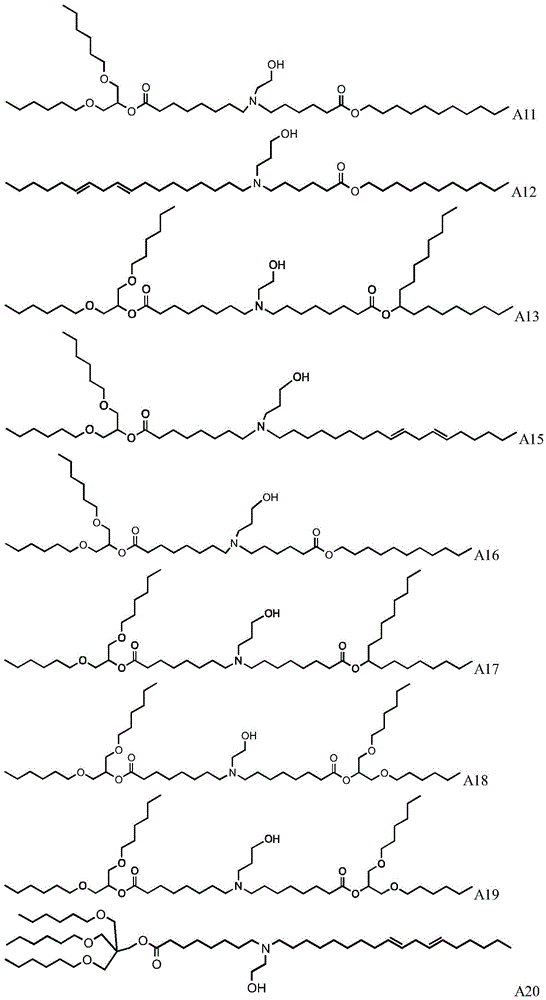


compared to the prior art such as PCT/US2016/052352, PCT/US2010/038224, the ionizable lipids of the present application differ in that:
1. the chemical structures are different: 2 or 1 of the aliphatic chains containing ester groups, which are connected with the nitrogen atom (N) of the tertiary amine, form novel aliphatic chains containing ether bonds with saturated aliphatic chains or unsaturated aliphatic chains through a glycerol structure respectively, and the result shows that the ionizable lipofection efficiency of the aliphatic chains is better;
2. the metabolites are different: the fatty chain of the ionizable lipid is formed by an ester group, glycerol and a shorter fatty chain, and the metabolic products are shorter and smaller micromolecular compounds such as fatty acid, fatty alcohol or ether, so that the ionizable lipid is easier to metabolize and excrete in vivo, is less prone to accumulate in vivo and has lower toxicity.
3. Novel alkyne-containing intermediate structures: alkyne-containing intermediate products formed by propynylamine and brominated aliphatic chains can react with a plurality of azide-containing compounds to generate a series of novel ionizable lipid compounds.
4. The synthesis is simple and the raw materials are easy to obtain: the starting raw materials are glycerol, short fatty alcohol and fatty acid, and the raw materials are cheap and easy to obtain and simple to synthesize.
Drawings
FIG. 1: male rat body weight changes in LNP safety assessment
FIG. 2: female rat body weight changes in LNP safety assessment
FIG. 3: male rat food intake changes in LNP safety assessment
FIG. 4: female rat dietary changes in LNP safety assessment
FIG. 5: immunogenicity of LNP-Encapsulated mRNA study IgG antibody titers
Definition of
When a range of values is recited, it is intended to include each value and every subrange within the range. E.g. "C1-6Alkyl "includes C1、C2、C3、C4、C5、C6、C1-6、C1-5、C1-4、C1-3、C1-2、C2-6、C2-5、C2-4、C2-3、C3-6、 C3-5、C3-4、C4-6、C4-5And C5-6An alkyl group.
The term "alkyl" refers to a straight or branched chain saturated hydrocarbon group including one or more carbon atoms (e.g., 1,2, 3, 4, 5, 6, 7, 8, 9, 10, 11, 12, 13, 14, 15, 16, 17, 18, 19, 20 or more carbon atoms). Specifically, "C1-10Alkyl "refers to a straight or branched chain saturated hydrocarbon group comprising 1 to 10 carbon atoms. "C2-18Alkyl "refers to an optionally substituted straight or branched chain saturated hydrocarbon group comprising 2 to 18 carbon atoms. Unless otherwise indicated, alkyl groups described herein refer to both unsubstituted and substituted alkyl groups.
The term "alkenyl" or "alkenyl" refers to a compound containing two or more carbon atoms and at least oneStraight or branched chain hydrocarbon groups of carbon-carbon double bonds (e.g., 2, 3, 4, 5, 6, 7, 8, 9, 10, 11, 12, 13, 14, 15, 16, 17, 18, 19, 20 or more carbon atoms). The alkenyl group may include one, two, three, four or more carbon-carbon double bonds. Specifically, "C3-12Alkenyl "means a straight or branched chain hydrocarbon group comprising 3 to 12 carbon atoms and at least one carbon-carbon double bond. "C4-18Alkenyl "means a straight or branched chain hydrocarbon group comprising 4 to 18 carbon atoms and at least one carbon-carbon double bond. Unless otherwise specified, alkenyl groups described herein refer to both unsubstituted and substituted alkenyl groups.
The term "halo" or "halogen" refers to fluorine (F), chlorine (Cl), bromine (Br), and iodine (I).
The term "C1-6Haloalkyl "means" C "as defined above1-6Alkyl "is substituted with one or more halo groups. Exemplary said haloalkyl groups include, but are not limited to: -CF3、-CH2F、-CHF2、-CHFCH2F、-CH2CHF2、-CF2CF3、-CCl3、 -CH2Cl、- CHCl 22, 2, 2-trifluoro-1, 1-dimethyl-ethyl, and the like.
The term "C3-7Cycloalkyl "refers to a non-aromatic cyclic hydrocarbon group having 3 to 7 ring carbon atoms and zero heteroatoms. Exemplary such cycloalkyl groups include, but are not limited to: cyclopropyl (C3), cyclopropenyl (C3), cyclobutyl (C4), cyclobutenyl (C4), cyclopentyl (C5), cyclopentenyl (C5), cyclohexyl (C6), cyclohexenyl (C6), cyclohexadienyl (C6), cycloheptyl (C7), cycloheptenyl (C7), cycloheptadienyl (C7), cycloheptatrienyl (C7), and the like. The cycloalkyl group may be optionally substituted with one or more substituents, for example, 1 to 5 substituents, 1 to 3 substituents, or 1 substituent.
The term "4-10 membered heterocyclyl" refers to a radical of a4 to 10 membered non-aromatic ring system having ring carbon atoms and 1 to 3 ring heteroatoms, wherein each heteroatom is independently selected from nitrogen, oxygen, sulfur, boron, phosphorus and silicon. Likewise, the terms "4-7 membered heterocyclyl" and "5-10 membered heterocyclyl" are also defined as such. In heterocyclic groups containing one or more nitrogen atoms, the point of attachment may be carbon or a nitrogen atom, as valency permits. Exemplary 3-membered heterocyclic groups containing one heteroatom include, but are not limited to: aziridinyl, oxacyclopropaneyl, thienylyl. Exemplary 4-membered heterocyclic groups containing one heteroatom include, but are not limited to: azetidinyl, oxetanyl and thietanyl. Exemplary 5-membered heterocyclic groups containing one heteroatom include, but are not limited to: tetrahydrofuranyl, dihydrofuranyl, tetrahydrothienyl, dihydrothienyl, pyrrolidinyl, dihydropyrrolyl, and pyrrolyl-2, 5-dione. Exemplary 5-membered heterocyclic groups containing two heteroatoms include, but are not limited to: dioxolanyl, oxathiolanyl (oxathiolanyl), dithiolanyl (disulphuryl), and oxazolidin-2-one. Exemplary 5-membered heterocyclic groups containing three heteroatoms include, but are not limited to: triazolinyl, oxadiazolinyl and thiadiazolinyl. Exemplary 6-membered heterocyclic groups containing one heteroatom include, but are not limited to: piperidinyl, tetrahydropyranyl, dihydropyridinyl and thiacyclohexyl (thianyl). Exemplary 6-membered heterocyclic groups containing two heteroatoms include, but are not limited to: piperazinyl, morpholinyl, dithiinyl, dioxanyl. Exemplary 6-membered heterocyclic groups containing three heteroatoms include, but are not limited to: hexahydrotriazinyl (triazinanyl). Exemplary 7-membered heterocyclic groups containing one heteroatom include, but are not limited to: azepane, oxepanyl and thiepane.
The term "C6-10Aryl "refers to a group having a monocyclic or polycyclic (e.g., bicyclic) 4n +2 aromatic ring system (e.g., having 6 or 10 pi electrons shared in a cyclic arrangement) of 6 to 10 ring carbon atoms and zero heteroatoms. In some embodiments, an aryl group has six ring carbon atoms ("C)6Aryl "; for example, phenyl). In some embodiments, an aryl group has ten ring carbon atoms ("C)10Aryl "; e.g., naphthyl, e.g., 1-naphthyl and 2-naphthyl).
The term "5-10 membered heteroaryl" refers to a group having a 5-10 membered monocyclic or bicyclic 4n +2 aromatic ring system (e.g., having 6 or 10 pi electrons shared in a cyclic arrangement) with ring carbon atoms and 1-4 ring heteroatoms, wherein each heteroatom is independently selected from nitrogen, oxygen, and sulfur. In heteroaryl groups containing one or more nitrogen atoms, the point of attachment may be a carbon or nitrogen atom, as valency permits. Heteroaryl bicyclic ring systems may include one or more heteroatoms in one or both rings. Heteroaryl also includes ring systems in which the aforementioned heteroaryl ring is fused to one or more cycloalkyl or heterocyclyl groups, and the point of attachment is on the heteroaryl ring, in which case the number of carbon atoms continues to represent the number of carbon atoms in the heteroaryl ring system. Exemplary 5-membered heteroaryl groups containing one heteroatom include, but are not limited to: pyrrolyl, furanyl and thienyl. Exemplary 5-membered heteroaryl groups containing two heteroatoms include, but are not limited to: imidazolyl, pyrazolyl, oxazolyl, isoxazolyl, thiazolyl and isothiazolyl. Exemplary 5-membered heteroaryl groups containing three heteroatoms include, but are not limited to: triazolyl, oxadiazolyl (e.g., 1,2, 4-oxadiazolyl), and thiadiazolyl. Exemplary 5-membered heteroaryl groups containing four heteroatoms include, but are not limited to: a tetrazolyl group. Exemplary 6-membered heteroaryl groups containing one heteroatom include, but are not limited to: a pyridyl group. Exemplary 6-membered heteroaryl groups containing two heteroatoms include, but are not limited to: pyridazinyl, pyrimidinyl and pyrazinyl. Exemplary 6-membered heteroaryl groups containing three or four heteroatoms include, but are not limited to: triazinyl and tetrazinyl. Exemplary 7-membered heteroaryl groups containing one heteroatom include, but are not limited to: azepinyl, oxacycloheptyl, and thiacycloheptyl trienyl groups. Exemplary 5, 6-bicyclic heteroaryls include, but are not limited to: indolyl, isoindolyl, indazolyl, benzotriazolyl, benzothienyl, isobenzothienyl, benzofuranyl, benzisothiafuranyl, benzimidazolyl, benzoxazolyl, benzisoxazolyl, benzooxadiazolyl, benzothiazolyl, benzisothiazolyl, benzothiadiazolyl, indezinyl, and purinyl. Exemplary 6, 6-bicyclic heteroaryls include, but are not limited to: naphthyridinyl, pteridinyl, quinolinyl, isoquinolinyl, cinnolinyl, quinoxalinyl, phthalazinyl and quinazolinyl.
The term "isomers" is different compounds having the same molecular formula. Stereoisomers are particularly preferred according to the invention, the term "stereoisomers" being isomers differing only in the arrangement of the atoms in space.
In some cases, the compounds of the invention may form salts, and these salts are also within the scope of the invention where the term "salt(s)" refers to acidic and/or basic salts formed with inorganic and/or organic acids and bases. Pharmaceutically acceptable salts are particularly preferred in the present invention.
The term "pharmaceutically acceptable salts" refers to those carboxylic acid salts, amino acid addition salts of the compounds of the present invention which are, within the scope of sound medical judgment, suitable for use in contact with the tissues of patients without undue toxicity, irritation, allergic response, and the like, commensurate with a reasonable benefit/risk ratio, and effective for their intended use, including, where possible, the zwitterionic forms of the compounds of the present invention.
Pharmaceutically acceptable base addition salts are formed with metals or amines, such as alkali metal and alkaline earth metal hydroxides or organic amines. Examples of metals used as cations are sodium, potassium, magnesium, calcium, and the like. Examples of suitable amines are N, N' -dibenzylethylenediamine, chloroprocaine, choline, diethanolamine, ethylenediamine, N-methylglucamine and procaine.
Base addition salts of acidic compounds can be prepared by contacting the free acid form with a sufficient amount of the desired base to form the salt in a conventional manner. The free acid may be regenerated by contacting the salt form with an acid and separating the free acid in a conventional manner. The free acid forms differ somewhat from their respective salt forms in certain physical properties, such as solubility in polar solvents, but the salts are also equivalent to their respective free acids for the purposes of the present invention.
The salts can be sulfates, pyrosulfates, bisulfates, sulfites, bisulfites, nitrates, phosphates, monohydrogen phosphates, dihydrogen phosphates, metaphosphates, pyrophosphates, chlorides, bromides, iodides prepared from inorganic acids such as hydrochloric acid, nitric acid, sulfuric acid, hydrobromic acid, hydroiodic acid, phosphoric acid, and the like. Representative salts include: hydrobromide, hydrochloride, sulfate, bisulfate, nitrate, acetate, oxalate, valerate, oleate, palmitate, stearate, laurate, borate, benzoate, lactate, phosphate, tosylate, citrate, maleate, fumarate, succinate, tartrate, naphthoate, mesylate, glucoheptonate, lactobionate, lauryl sulfonate, isethionate and the like. Salts may also be prepared from organic acids such as aliphatic mono-and dicarboxylic acids, phenyl substituted alkanoic acids, hydroxy alkanoic acids, alkanedioic acids, aromatic acids, aliphatic and aromatic sulfonic acids, and the like. Representative salts include acetate, propionate, octanoate, isobutyrate, oxalate, malonate, succinate, suberate, sebacate, fumarate, maleate, mandelate, benzoate, chlorobenzoic acid basin, methylbenzoate, dinitrobenzoate, naphthoate, benzenesulfonate, tosylate, phenylacetate, citrate, lactate, maleate, tartrate, mesylate, and the like. Pharmaceutically acceptable salts can include cations based on the alkali and alkaline earth metals, such as sodium, lithium, potassium, calcium, magnesium, and the like, as well as non-toxic ammonium, quaternary ammonium, and amine cations, including but not limited to ammonium, tetramethylammonium, tetraethylammonium, methylamine, dimethylamine, trimethylamine, triethylamine, ethylamine, and the like. Also contemplated are Salts of amino acids such as arginine, gluconate, galacturonate, and the like (see, e.g., Berge S.M.et.,., "Pharmaceutical Salts," J.pharm.Sci., 1977; 66: 1-19, incorporated herein by reference).
Examples of pharmaceutically acceptable non-toxic amides of the compounds of the present invention include those derived from C1-C6Alkyl esters, wherein the alkyl group is linear or branched. Acceptable esters also include C5-C7Cycloalkyl esters and arylalkyl esters, such as but not limited to benzyl esters. C1-C4Alkyl esters are preferred. Esters of the compounds of the invention may be prepared according to conventional methods, for example: march's Advanced Organic Chemistry, 5Edition "M.B. Smith&J.March,John Wiley&Sons,2001。
Pharmaceutically acceptable non-toxic amide forms of the compounds of the present inventionExamples include from ammonia, primary C1-C6Alkylamine and secondary C1-C6Dialkylamine derived amides in which the alkyl group is linear or branched. In the case of secondary amines, the amines may also be in the form of 5-or 6-membered heterocycles containing one nitrogen atom. From ammonia, C1-C3Alkyl primary amines and C1-C2Secondary dialkylamine derived amides are preferred. Amides of the compounds of the invention may be prepared according to conventional methods, for example: march's Advanced Organic Chemistry, 5Edition ", m.b. smith&J.March,John Wiley&Sons,2001。
The term "acceptable carrier" refers to a suitable carrier that can be used to utilize an existing agent for the purposes of the present invention without undue toxicity, irritation, allergic response, and the like, commensurate with a reasonable benefit/risk ratio.
Detailed Description
In order to make the objects, technical solutions and advantages of the present invention more apparent, the present invention is further described in detail by the following embodiments in conjunction with the accompanying drawings.
Example 1 Synthesis of A1

Bromohexadecane (2.22g, 7.28mmol) was dissolved in 50ml of absolute ethanol, DIEA (1.17g, 9.10mmol) and an amino alcohol compound (2g, 6.07mmol) were added, reaction was carried out at 80 ℃ for 18 hours, after completion of the reaction, the solvent was concentrated and removed, 200ml of EA was added for dilution, 200ml of water was washed once, extraction and liquid separation were carried out, the organic phase was dried, concentration was carried out until dryness, and separation and purification by silica gel column (DCM: MeOH 3% — 5%) were carried out to obtain 1.2g of an oily product. Ms (es): m/z (M + H)+553.54。1HNMR (CDCl3)δ:ppm:4.06(t,2H),3.57(t,2H),2.62(bs,2H),2.50(br,4H),2.29(m,2H),1.68- 1.25(m,52H),0.88(m,6H)。
The subsequent synthesis ideas of A5-A7, A9-A13 and A15-A32 can be designed by referring to the embodiment, and basically comprise the following steps: through substitution reaction of bromo compound or keto-ene compound and primary/secondary amine compound (such as alcohol amine compound).
Example 2 Synthesis of A5

Referring to the procedure of example 1, preparation A5 gave 0.75g of an oily product. Ms (es): m/z (M + H)+835.80。1HNMR(CDCl3)δ:ppm:4.87(m,2H),3.79(t,2H),2.67(br,2H),2.45(br,4H),2.27(t,4H),1.70- 1.25(m,78H),0.90(m,12H)。
Example 3 Synthesis of A6

Referring to the procedure of example 1, preparation A6 gave 0.51g of an oily product. Ms (es): m/z (M + H)+611.55。1HNMR(CDCl3)δ:ppm:4.05(t,4H),3.78(m,2H),2.65(t,2H),2.43(br,4H),2.29(m,4H),1.69- 1.31(m,50H),0.90(m,6H)。
Example 4 Synthesis of A7

Referring to the procedure of example 1, preparation A7 gave 2.45g of an oily product. Ms (es): m/z (M + H)+703.68。1HNMR(CDCl3)δ:ppm:5.38-5.31(m,4H),4.86(m,1H),3.79(t,2H),2.77(m,2H),2.67(br,2H), 2.45(br,4H),2.27(m,2H),2.04(m,4H),1.70-1.25(m,58H),0.90(m,9H)。
Example 5 Synthesis of A9

Referring to the procedure of example 1, preparation A9 gave 1.6g of an oily product. Ms (es): m/z (M + H)+577.54。1HNMR(CDCl3)δ:ppm:5.38-5.33(m,4H),4.06(t,2H),3.60(t,2H),2.77(t,2H),2.66(m,2H), 2.54(bs,4H),2.30(m,2H),2.05(m,4H),1.68-1.25(m,42H),0.88(m,6H)。
Example 6 Synthesis of A10

Referring to the procedure of example 1, preparation A10 gave 0.4g of an oily product. Ms (es): m/z (M + H)+693.63。1HNMR(CDCl3)δ:ppm:5.36(m,4H),5.10(m,1H),3.56(t,4H),3.46-3.40(br,4H),2.76(t,2H),2.64(br,4H),2.51(bs,4H),2.32(m,2H),2.05(m,6H),1.67-1.25(m,44H),0.88(m,9H)。
Example 7 Synthesis of A11

Referring to the procedure of example 1, preparation A11 gave 0.5g of an oily product. Ms (es): m/z (M + H)+713.62。1HNMR(CDCl3)δ:ppm:5.10(m,1H),4.05(d,4H),4.03(t,4H),3.54(m,2H),3.43(s,2H), 3.16(t,2H),3.10(br,4H),2.32(t,4H),1.66-1.27(m,50H),0.88(m,9H)。
Example 8 Synthesis of A12

Referring to the procedure of example 1, preparation A12 gave 2.68g of an oily product. Ms (es): m/z (M + H)+591.56,1HNMR(CDCl3)δ:ppm:5.37-5.35(m,4H),4.05(t,2H),3.78(t,2H),2.77(t,2H),2.64(m,2H), 2.41(bs,4H),2.31(m,2H),2.03(m,4H),1.68-1.25(m,44H),0.88(m,6H)。
Example 9 Synthesis of A13

Referring to the procedure of example 1, preparation A13 gave 1.2g of an oily product. Ms (es): m/z (M + H)+825.74;1HNMR(CDCl3)δ:ppm:5.12(m,1H),4.86(m,1H),3.65-3.40(m,10H),2.72(br,2H),2.60(br,4H), 2.34-2.26(m,4H),1.62-1.25(m,64H),0.88(m,12H)。
Example 10 Synthesis of A15

Referring to the procedure of example 1, preparation A15 gave 0.4g of an oily product. Ms (es): m/z (M + H)+707.64。1HNMR(CDCl3)δ:ppm:5.34(m,4H),5.10(m,1H),3.79(t,2H),3.56-3.41(m,8H),2.80(t,2H), 2.77(t,2H),2.46(br,4H),2.32(m,2H),2.05(m,4H),1.67-1.25(m,46H),0.88(m,9H)。
Example 11 Synthesis of A16

Referring to the procedure of example 1, preparation A16 gave 0.59g of an oily product. Ms (es): m/z (M + H)+727.63。1HNMR(CDCl3)δ:ppm:5.10(m,1H),4.05(dd,2H),3.77(t,2H),3.54(dd,4H),3.46-3.38(m,4H), 3.19(t,2H),3.01(br,4H),2.32(t,4H),1.66-1.27(m,52H),0.88(m,9H)。
Example 12 Synthesis of A17

Referring to the procedure of example 1, preparation A17 gave 1.1g of an oily product. Ms (es): m/z (M + H)+839.76;1HNMR(CDCl3)δ:ppm:5.12(m,1H),4.86(m,1H),3.79(t,2H),3.55(t,4H),3.41(m,4H), 2.67(br,2H),2.44(br,4H),2.32-2.26(t,4H),1.62-1.25(m,66H),0.88(m,12H)。
Example 13 Synthesis of A18

Referring to the procedure of example 1, preparation A18 gave 1.44g of an oily product.1HNMR(CDCl3)δ:ppm.5.11(t, 2H),3.57-3.37(m,18H),2.57(t,2H),2.44(t,4H),2.32(m,4H),1.62-1.27(m,52H), 0.88(m,12H),MS(ES):m/z(M+H)+829.70。
Synthesis of example 14-A19

Referring to the procedure of example 1, preparation A19 gave 2.3g of an oily product.1HNMR(CDCl3)δ:ppm.5.06(t, 2H),3.72(t,2H),3.50-3.33(m,16H),2.27(t,2H),2.25-2.24(m,8H),1.56-1.19(m, 52H),0.88(m,12H),MS(ES):m/z(M+H)+843.72。
Example 15 Synthesis of A20
The synthetic route is as follows:
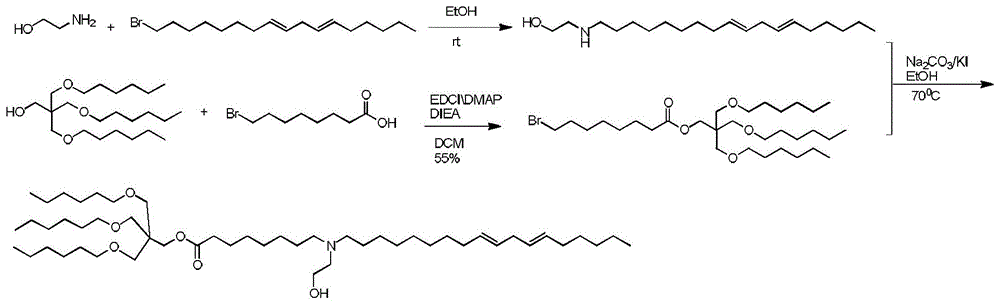
referring to the procedure of example 1, preparation A20 gave 0.95g of an oily product. Ms (es): m/z (MH)+)821.75;1H-NMR(400MHz,CDCl3)δ:ppm 5.29(m,4H),4.03(s,2H),3.51(t,2H),3.30- 3.27(m,12H),2.70(m,2H),2.57(t,2H),2.46(br,4H),2.21(m,2H),1.30-1.19(br. m,52H),0.89(m,12H)。
Example 16 Synthesis of A21
The synthetic route is as follows:

referring to the procedure of example 1, preparation A21 gave 0.68g of an oily product. Ms (es): m/z (MH)+)835.76;1H-NMR(400MHz,CDCl3)δ:ppm5.35(m,4H),4.10(s,2H),3.79(t,2H),3.30(m, 12H),2.76(br,m,4H),2.50(br,4H),2.28(m,2H),2.05(m,4H),1.61(br,4H), 1.57(m,4H),1.54-1.24(br.m,54H),0.88(m,12H)。
Example 17 Synthesis of A22
The synthetic route is as follows:

referring to the procedure of example 1, preparation A22 gave 0.43g of an oily product.1HNMR(400MHz,CDCl3)δ:ppm.4.03(s,2H),3.98(t,2H),3.72(t,2H),3.28(m,12H),2.65(t,2H),2.45(t,4H), 2.25-2.20(m,4H),1.66-1.19(m,60H),0.83(m,12H),MS(ES):m/z(M+H)+855.75。
Example 18 Synthesis of A23
The synthetic route is as follows:

referring to the procedure of example 1, preparation A23 gave 1.8g of an oily product.1HNMR(400MHz,CDCl3) δ:ppm.4.10(s,2H),4.06(t,2H),3.56(t,2H),3.36-3.34(m,12H),2.61(t,2H),2.49(t, 4H),2.30(m,4H),1.67-1.26(m,58H),0.88(m,12H),MS(ES):m/z(M+H)+841.74。
Example 19 Synthesis of A24

Referring to the procedure of example 1, preparation A24 gave 0.72g of an oily product.1HNMR(400MHz,CDCl3) δ:ppm.4.10(s,4H),3.67(br,2H),3.35(m,24H),2.80-2.50(br,6H),2.28(m,4H), 1.67-1.23(m,68H),0.89(m,18H),MS(ES):m/z(M+H)+1085.94。
Example 20 Synthesis of A25
The synthetic route is as follows:

referring to the procedure of example 1, preparation A25 gave 0.3g of an oily product.1HNMR(400MHz,CDCl3) δ:ppm.5.23(m,1H),5.05(t,1H),4.11(br,4H),3.78(t,2H),3.49-3.34(br,m,16H), 3.15(t,2H),3.01(t,4H),2.26(m,2H),2.10(m,2H),2.01(m,2H),1.79-1.18(br,m, 52H),0.83(br,m,12H),MS(ES):m/z(M+H)+842.73。
Example 21 Synthesis of A26
The synthetic route is as follows:

referring to the procedure of example 1, preparation A26 gave 0.46g of an oily product.1HNMR(400MHz,CDCl3) δ:ppm.5.03(m,2H),3.75(t,2H),3.48-3.34(br,m,16H),2.91(br,2H),2.72(br,4H), 2.27(t,4H),1.85(m,2H),1.58-1.10(br,m,48H),0.81(br,m,6H),MS(ES):m/z(M+H)+ 787.65。
Example 22 Synthesis of A27
The synthetic route is as follows:

cbz-1, 3-propanediamine octanoate was prepared by the method of reference example 1. Cbz-1, 3-propanediamine octanoate (3.5g, 5.9mmol), anhydrous sodium carbonate (0.94g, 8.8mmol), KI (0.19g, 1.18 mmol). ) Dissolved in 30mL of anhydrous ethanol and 30mL of anhydrous acetonitrile, followed by addition of bromide, and reacted at 75 ℃ for 24 hours. After completion of the reaction, the solvent was removed by concentration, 200mL of dichloromethane was added to the reaction mixture to dilute, washed with 200mL of water, extracted, the organic layer was dried, concentrated, and purified by silica gel column (DCM: MeOH ═ 3% to 10%) to obtain the product Cbz-amine as an oil. Cbz-amine (2.1g, 2.43mmol) was dissolved in 20mL of anhydrous methanol and 20mL of ethyl acetate, followed by addition of palladium (0.35g, 10%), replacement of hydrogen for 3 times, and hydrogenation of 20H at room temperature. After the reaction is completed, the palladium is removed by filtration, the reaction mixture is concentrated and the solvent is removed, and the amine product is obtained by extraction. The resulting amine product (1.1g, 1.51mmol) was dissolved in 20mL of anhydrous ethanol, keto-methylamine (0.22g, 1.51mmol) was added, the solution was stirred and reacted at room temperature for 20 hours. After completion of the reaction, the reaction mixture was concentrated and the solvent was removed, and the filtrate was dried, concentrated and purified by silica gel column (DCM: MeOH ═ 3% to 10%) to obtain 270.6g of a.1HNMR(d-DMSO)δ:ppm.4.99(p,1H),3.98(t,2H),3.50- 3.31(m,8H),3.10(d,3H),2.49(dt,8H),2.26(m,4H),1.52(dd,6H),1.43(m,6H), 1.26(m,40H),0.84(m,9H),MS(ES):m/z(M+H)+835.66。
Example 23 Synthesis of A28
The synthetic route is as follows:

preparation A28 by the method of reference example 22 to giveProduct 1.3 g.1HNMR(CDCl3)δ:ppm.5.04(t, 2H),3.61(t,2H),3.50-3.31(m,16H),3.21(s,3H),2.71(t,2H),2.55(t,4H),2.28-2.24(m, 4H),1.86-1.19(m,54H),0.82(m,12H),MS(ES):m/z(M+H)+951.75。
Example 24 Synthesis of A29
The synthetic route is as follows:

referring to the procedure of example 22, preparation A29 gave 0.11g of product.1HNMR(d-DMSO)δ:ppm. 5.00(m,2H),3.60-3.30(m,16H),3.11(s,3H),2.63-2.49(m,10H),2.36(m,2H),2.26(m,4H),1.80(m,2H),1.46-1.26(m,54H),0.85(t,12H),MS(ES):m/z(M+H)+1103.81。
Example 25 Synthesis of A30
The synthetic route is as follows:

referring to the procedure of example 22, preparation A30 gave 0.34g of product.1HNMR(d-DMSO)δ:ppm. 4.99(m,4H),3.60-3.30(m,32H),2.63-2.40(m,20H),2.25(m,8H),1.80-1.20(m,110H), 0.81(m,24H),MS(ES):m/z(M+H)+1915.5。
Example 26 Synthesis of A31
The synthetic route is as follows:

referring to the procedure of example 22, preparation A31 gave 0.7g of product.1HNMR(d-DMSO)δ:ppm.5.05(m, 2H),3.60-3.30(m,20H),2.63-2.40(m,12H),2.2(m,6H),1.80-1.20(m,64H),0.85(m, 12H)。MS(ES):m/z(M+H)+1134.95。
Example 27 Synthesis of A32

Referring to the procedure of example 22, preparation A32 gave 1.5g of product.1HNMR(d-DMSO)δ:ppm.5.1(m, 2H),3.60-3.30(m,24H),2.5(m,4H),2.4(m,4H),2.3(m,4H),2.2(m,6H),1.95(m, 2H),1.8(m,2H),1.5-1.6(m,8H),1.2-1.4(m,48H),0.9(m,8H),MS(ES):m/z(M+H)+ 1174.88。
Example 28 Synthesis of A34
The synthetic route is as follows:

an alkynyl lipid compound intermediate was synthesized by the method of reference example 1.Bromo-oxy-ether ester (11g), sodium carbonate (2.5g) and KI (0.4g) were dissolved in 50ml of acetonitrile, and acetylenic amine (0.65g) was added thereto, after completion of the reaction, the acetonitrile was concentrated and removed, and the organic phase was dried and concentrated after stirring and extraction with ethyl acetate and 150ml of water, and then purified by column separation (PE: EA ═ 10: 1 to 5: 1) to obtain an intermediate product of an alkynyl lipid compound.
Preparation A34 step:3-Azidopropanol-1 (0.5g), anhydrous copper sulfate (0.15g), sodium ascorbate (0.24g) and alkynyl compound (0.08g) were dissolved in 10ml of THF and 10ml of water, reacted at room temperature, concentrated to remove THF, diluted with 100ml of dichloromethane, filtered to remove insoluble matter, the filtrate was extracted with water under stirring, the organic phase was dried and concentrated, and purified by column chromatography (DCM: MeOH: 1% -2%) to obtain A34 (0.39 g).1HNMR (CDCl3)δ:ppm.7.56(s,1H),5.12(p,2H),4.50(m,2H),3.77(s,2H),3.62-3.43(m, 18H),2.44(s,4H),2.32(t,4H),2.13(tt,2H),1.70-1.50(m,16H),1.26(m,36H), 0.87(m,12H);MS(ES):m/z(M+H)+925.37。
Example 29 Synthesis of A35
The synthetic route is as follows:

referring to the procedure of example 28, preparation A35 gave 2.2g of product.1HNMR(CDCl3)δ:ppm.7.50(d,1H),5.11(p,2H),4.45(t,2H),3.77(s,2H),3.68-3.43(m,20H),2.82(t,2H),2.49(m, 4H),2.41(s,4H),2.32(t,4H),1.70-1.50(m,20H),1.26(m,32H),0.88(m,12H);MS(ES): m/z(M+H)+980.45。
Example 30 Synthesis of A36
The synthetic route is as follows:

referring to the procedure of example 28, preparation A36 gave 2.4 g. 1H NMR (500MHz, DMSO) δ 7.86(s, 1H), 5.00(p, J ═ 5.2Hz, 2H), 4.41(t, J ═ 6.3Hz, 2H), 3.62(s, 2H), 3.55-3.41(m, 10H), 3.42-3.35(m, 8H), 2.68(d, J ═ 5.9Hz, 4H), 2.36(s, 4H), 2.32-2.27(m, 4H), 2.25(t, J ═ 7.3Hz, 4H), 1.55-1.48(m, 4H), 1.46-1.43(m, 6H), 1.41-1.36(m, 4H), 1.25(dd, J ═ 16.2, 4.5, 38H), 1.10(s, 1H), 0.84(t, 6H), 6H (m, 4H), 1.25(dd, J ═ 16.2, 4.5, 38H). Ms (es): m/z (M + H)+979.47。
Example 31 Synthesis of A37
The synthetic route is as follows:

referring to the procedure of example 28, preparation A37 gave 1.7g of product.1HNMR(CDCl3)δ:ppm.7.59(d, 1H),5.10(p,2H),4.46(t,2H),3.75(s,2H),3.75-3.43(m,20H),2.94-2.87(t,4H),2.69- 2.43(m,4H),2.41(s,4H),2.33(t,4H),1.70-1.50(m,22H),1.26(m,32H),0.88(m, 12H);MS(ES):m/z(M+H)+1037.54。
Example 32 Synthesis of A38
The synthetic route is as follows:

referring to the procedure of example 28, preparation A38 gave 2.5 g.1HNMR(CDCl3)δ:ppm.7.53(d, 1H),5.11(p,2H),4.42(t,2H),3.76(s,2H),3.68-3.41(m,20H),2.83(t,2H),2.49(s, 6H),2.32(t,4H),1.70-1.50(m,20H),1.26(m,32H),0.87(m,12H);MS(ES):m/z (M+H)+953.45。
Example 33 Synthesis of A39
The synthetic route is as follows:

referring to the procedure of example 28, preparation A39 gave 1.7g of product.1HNMR(CDCl3)δ:ppm.7.59(d, 1H),5.11(p,2H),4.47(t,2H),3.73(s,2H),3.70-3.41(m,24H),2.78(t,2H),2.51(4, 4H),2.42(m,2H),2.32(t,4H),1.59-1.25(m,59H),0.87(m,12H);MS(ES):m/z(M+H)+ 1036.56。
Example 34 Synthesis of A40
The synthetic route is as follows:

referring to the procedure of example 28, preparation A40 gave 1.4g of product.1HNMR(CDCl3)δ:ppm.7.53(d,1H),5.11(p,2H),4.47(t,2H),3.72(s,2H),3.70-3.40(m,22H),2.66(t,2H),2.65- 2.55(m,6H),2.32(t,4H),1.59-1.25(m,44H),0.87(m,12H);MS(ES):m/z(M+H)+1052.54。
Example 35 Synthesis of A42
The synthetic route is as follows:

an alkynyl lipid compound intermediate was synthesized by the method of reference example 1.Bromo-oxygen ether ester (10.6g), sodium carbonate (2.42g) and KI (0.4g) were dissolved in 50ml of acetonitrile, benzyl-alanine (2.04g) was added thereto, the mixture was refluxed and reacted completely, then the acetonitrile was concentrated and removed, ethyl acetate and water were added thereto, the mixture was stirred and extracted, the organic phase was dried and concentrated, and the product was separated and purified by column chromatography (DCM: MeOH: 2% -3%) to obtain 7.5g of A42-I.
Dissolving A42-I intermediate (2g) and palladium carbon (0.5g) in 50ml of methanol, hydrogenating at room temperature, filtering to remove the palladium carbon, and concentrating the filtrate to dryness to obtain 1.7g of A42-II product.
Preparation A42 step:A42-II intermediate (1.5g), DCC (0.54g) and DMAP (0.21g) are dissolved in 50ml of dichloromethane, morpholine ethanol (0.23g) is added, the reaction is completely finished at room temperature, dichloromethane and water are added for stirring and extraction, the organic phase is dried and concentrated, and the mixture is separated and purified by a column (DCM: MeOH is 1% -3%) to obtainA42Product 1.1 g.1HNMR (CDCl3)δ:ppm.5.12(p,2H),4.41(t,2H),3.76(t,2H),3.55-3.40(m,20H),3.01-2.76(m,10H),2.49(t,6H),2.32(t,4H),1.59-1.25(m,52H),0.87(m,12H);MS(ES):m/z(M+H)+ 971.44。
Example 36 Synthesis of A43
The synthetic route is as follows:

preparation A43 by the method of reference example 35 to giveA430.5g of product.1HNMR(CDCl3)δ:ppm. 5.12(p,2H),4.41(t,2H),3.76(t,2H),3.55-3.40(m,20H),3.01-2.76(m,10H),2.49(t, 2H),2.32(t,4H),1.59-1.25(m,54H),0.87(m,12H);MS(ES):m/z(M+H)+942.44。
Example 37 Synthesis of A44
The synthetic route is as follows:

referring to the procedure of example 35, a Boc protected piperazine alcohol ester intermediate was obtained.
Preparation A44 step: the Boc protected piperazine ethanol ester intermediate (1.1g) was dissolved in 20ml of 2mol/L ethanol hydrochloride, and after completion of the reaction at room temperature, it was concentrated to dryness to obtain A44 (0.8 g).1HNMR(CDCl3)δ:ppm. 5.10(p,2H),4.35(t,2H),3.60-3.40(m,18H),3.01-2.85(m,6H),2.65-2.50(t,10H), 2.32(t,4H),1.59-1.25(m,52H),0.87(m,12H);MS(ES):m/z(M+H)+970.45。
Example 38 Synthesis of A45
The synthetic route is as follows:

by a method similar to that of example 37, A44 was obtained.
Preparation A45 step: a44(1.6g), sodium carbonate (0.17g) and KI (0.054g) were dissolved in 50ml of acetonitrile, bromoethanol (0.2g) was added thereto, the mixture was refluxed and completely concentrated, and then acetonitrile was removed, ethyl acetate and water were added thereto, and the mixture was extracted with stirring, dried and concentrated, and then purified by column chromatography (DCM: MeOH: 3% to 5%) to obtain about 1.1g of product A45.1HNMR(CDCl3) δ:ppm.5.10(p,2H),4.35(t,2H),3.60-3.40(m,18H),3.32(t,2H),3.01-2.90(m,6H), 2.53(t,2H),2.49-2.35(t,10H),2.32(t,4H),1.59-1.25(m,52H),0.87(m,12H);MS(ES): m/z(M+H)+1014.50。
Example 39 Synthesis of A46
The synthetic route is as follows:

by a method similar to that of example 35, A42-II was obtained.
Preparation A46-I step: A42-II (1.5g), DCC (0.39g) and PFP-OH (0.35g) were dissolved in 50ml of dichloromethane, reacted at room temperature, concentrated to remove DCM, diluted with ethyl acetate, filtered to remove white insoluble matter, extracted with 10% sodium carbonate solution under stirring, concentrated with organic phase by drying, and purified by column chromatography (DCM: MeOH: 1% -3%) to obtain about 1.2g of product A46-I.
Preparation A46-II step: the mono-Boc-diaminodipropylamine (0.23g), DIEA (0.19g) and a46-I (1g) were dissolved in 20ml of dichloromethane, reacted at room temperature, followed by addition of dichloromethane and sodium carbonate solution, extraction with stirring, drying and concentration of the organic phase, and purification by column chromatography (DCM: MeOH 1% to 3%) to obtain about a46-II as a product (about 0.8 g).
Preparation A46 step: reference example 37 preparation of A44 gave A46.1HNMR(CDCl3)δ: ppm.5.10(p,2H),3.60-3.40(m,18H),3.37(t,2H),2.70-2.55(m,10H),.2.50(t,2H),2.32(t,4H),1.72(m,4H),1.59-1.25(m,52H),0.87(m,12H);MS(ES):m/z(M+H)+971.48。
Example 40 Synthesis of A47
The synthetic route is as follows:

preparation A47-I step: reference example 35 preparation of A42-I gave A47-I.
Preparation A47-II step: referring to the procedure for the preparation of A42-II in example 35, A47-II was prepared.
Preparation A47-III step: reference example 39 preparation of A46-I gave A47-III.
Preparation A47-IV step: reference example 39 preparation of A46-II gave A47-IV.
Preparation A47 step: referring to the procedure for the preparation of A44 in example 37, approximately 1.1g of A47 was prepared.1HNMR(400 MHz,CD3OD)δ:ppm.5.10(m,2H),3.53(m,8H),3.44(m,9H),3.20-3.0(m,16H), 2.34(t,4H),2.09(m,4H),1.98(dt,4H),1.84(dd,4H),1.71(s,4H),1.63(dd,4H),1.53(m, 8H),1.40-1.20(m,40H),0.88(m,12H);MS(ES):m/z(M+H)+1071.65。
Example 41 Synthesis of A48
The synthetic route is as follows:
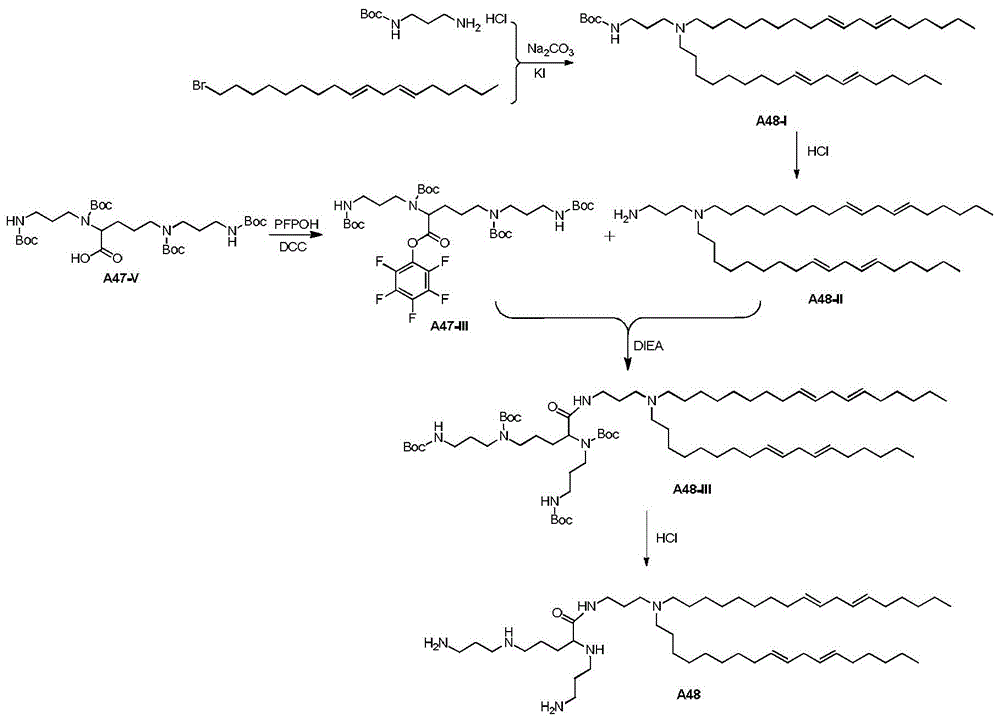
preparation A48-I step: reference example 35 preparation of A42-I gave A48-I.
Preparation A48-II step: referring to the procedure for the preparation of A42-II in example 35, A48-II was prepared.
Preparation A48-III step: reference example 39 preparation of A46-II gave A48-III.
Preparation A48 step: referring to the procedure for the preparation of A44 in example 37, A48 of about 0.5g was prepared.1HNMR(400 MHz,CD3OD)δ:ppm.7.78(m,7H),5.08(m,8H),3.87(m,1H),3.0-2.91(m,2H), 2.71(m,4H),2.50(m,12H),1.84(dd,4H),1.71(m,4H),1.63-1.53(m,12H),1.40-1.20(m, 36H),0.88(m,6H);MS(ES):m/z(M+H)+799.35。
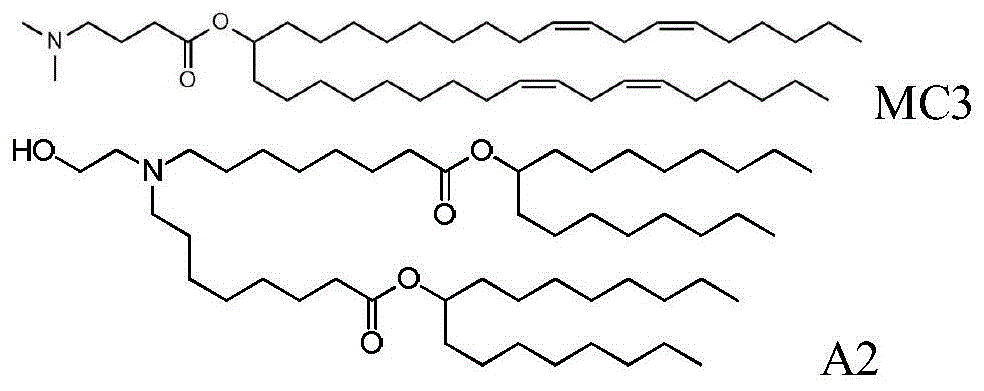
Comparative examples MC3, A2, A3, A4, A8 and A33
MC3, A2, A3, A4, A8 and A33 are used as comparative examples, because MC3, A2, A3, A4, A8 and A33 are known cationic liposomes, the specific synthetic method is not repeated, and MC3, A2, A3, A4, A8 and A33 are as follows:

example 42 preparation of lipid nanoparticles
Lipid nanoparticles include (1) ionizable lipid compounds, which are commercially or commercially available, for example MC3 (available from Avanti) and a1-a 33; (2) phospholipids (such as DOPE or DSPC, available from Avanti); (3) pegylated lipid compounds (such as PEG-DMG, available from Avanti or homemade); (4) structural lipids (such as cholesterol, purchased from Sigma-Aldrich); (5) effective components (such as Luciferase mRNA, siRNA, SARS-CoV-2S protein mRNA, Cas 9 mRNA, etc.).
The preparation and packaging method comprises the following steps: (1) the ionizable lipid, phospholipid, pegylated lipid and structured lipid are dissolved and mixed in ethanol in sequence, typically in terms of (mole) 50%, 10%, 1.5% and 38.5%, respectively; (2) the lipid nano-particles are obtained by uniformly mixing the lipid mixture and the active ingredient (mRNA) according to the proportion of 1: 3 by using a micro-fluidic chip or a T-shaped mixer.
The encapsulation efficiency reflects the degree of encapsulation of the encapsulated substance. The higher the encapsulation efficiency, the less likely the encapsulated substance will be broken down during in vivo delivery.
Table 1: ionizable lipids and properties of lipid nanoparticles thereof


Example 43 experiment to demonstrate transfection efficiency
Various cationic lipid compounds were encapsulated with luciferase mRNA nanoparticles as in example 42, and the fluorescence intensity or total photon number of the different LNP-encapsulated luciferase mrnas was tested.
Test animals: SPF-grade BALB/c mice, female, 6-8 weeks old, and 18-22g in weight, purchased from Beijing Wittingle laboratory animals technologies, Inc., production license number: SXCK (Kyoto) 2016-. All animals are adaptively raised for more than 7 days before the test, and freely eat and drink water during the test, the illumination is 12/12 hours, the light and shade are alternated, the indoor temperature is 20-26 ℃, and the humidity is 40-70%.
The test method comprises the following steps: female BALB/c mice administered different LNP-encapsulated luciferase mRNA using four different modes of administration, subcutaneous (axillary), caudal intravenous, intraperitoneal, intramuscular (mouse hind leg tibialis anterior); bioluminescence detection was carried out 3, 6, 24, 48h after administration using a small animal in vivo imaging system (brand: Bruker, model: XTREME) with the following specific operating steps: preparing a substrate: a proper amount of substrate Luciferin (brand: Promega) is added into normal saline to prepare a solution of 10mg/ml, and the solution is kept in the dark for standby, and 100 mu l of the solution is injected into the abdominal cavity of each mouse. The mice were allowed to move freely for 5-10min after substrate administration, and then were placed in an anesthesia box for anesthesia with isoflurane at a concentration of 2.5%. Placing the anesthetized mouse into a machine, setting bioluminescence parameters and taking a picture, adjusting the upper limit and the lower limit of the picture according to the fluorescence intensities of different groups after acquiring the image, and carrying out data acquisition (such as fluorescence intensity, average photon number and total photon number) and data processing on the part with the fluorescence in concentrated distribution. Statistical analysis: in vivo imaging results are expressed as the mean value of the fluorescence intensity or total photon number of different animals in the same test object group, so that the fluorescence intensity or total photon number of different LNP encapsulated luciferase mRNA is judged.
The fluorescence intensity and total photon number reflect the transfection efficiency of LNP, with higher values indicating a higher efficiency of LNP delivery of the encapsulated substance into the cell.
Table 2: induction of luciferase expression by ionizable lipid nanoparticle formulations

Note: the administration route is as follows: (1) intramuscular injection; (2) tail vein injection; dosage: 10 mu g of the mixture; detection time: 3, 6 and 24h after administration
Table 3: induction of luciferase expression by ionizable lipid nanoparticle formulations


Note: NA: no relevant data is recorded; the administration route is as follows: intramuscular injection; dosage: 1 mu g/mouse; detection time: 3, 6 and 24h after administration
Table 4: induction of luciferase expression by ionizable lipid nanoparticle formulations

Note: the administration route is as follows: intramuscular injection; dosage: 5 mu g/mouse; detection time: 3, 6 and 24h after administration
Example 44 evaluation of LNP Security
Taking 8 Wistar rats with half weight difference of 10% or less, randomly dividing into 2 groups, namely a solvent control group and a test object group, applying A18 to package liposome nanoparticles, wherein the LNP preparation encapsulation condition and particle size distribution are shown in Table 5, and the measured concentration is 2 mg/mL. Each animal was administered 3 times a day with 250 μ l injections at 4h intervals, with alternating administration to the left and right legs. The total dose is 1.50mg each, corresponding to 1200 times the maximum unit weight dose in humans (assuming that the maximum dose administered in humans is 0.25 mg). And (3) clinical observation: within 24h after administration, 1 observation is carried out every hour, 24-72h after administration, 1 observation is carried out every 6 hours, 4-14 days after administration, 1 observation is carried out every day, and the symptoms of toxicity reaction, the time of appearance and disappearance of the symptoms and the death time (if any) are recorded in detail. Body weight was recorded 1 time per day after dosing and 1 food intake was recorded every 2 days after dosing. All remaining animals were weighed at day14 post-dose and euthanized and necropsied for major organs: heart, liver, spleen, lung, kidney, thymus, lymph nodes were weighed and organ coefficients were calculated. After dissection, heart, liver, spleen, lung, kidney, intestinal tract, thymus, lymph node, muscle tissue at the injection site and other organs with pathological changes observed were preserved in a fixed solution, pathological changes of each tissue and organ were examined by H & E staining, and the lesion degree scores were referred to table 7.
Table 5: injection conditions in rats
| Ionizable lipids | Particle size (nanometer) | Particle size distribution (PDI) | |
| Solvent control group | - | - | - |
| Test group (LNP empty vector control) | A18 | 147 | 0.088 |
The results of the body weight changes are shown in FIGS. 1-2, in which the body weight of the male rats in the solvent control group continuously increased, and the body weight of the rats in the test group initially decreased to the level of Day4-Day6 restored to the level before administration, and then continuously increased. The results of the change in food intake are shown in FIGS. 3-4, the food intake of a single rat in the solvent control group is stabilized between 18-35g in 24h, and the initial food intake of the rat in the test group is slightly reduced until Day4-Day7 returns to the normal level. The results of organ coefficients are shown in table 6, and the test groups showed no significant difference from the solvent control group. The results of pathological changes of the tissues are shown in Table 8, and the heart, liver, kidney, spleen, thymus and lymph node of the rats in the test group were not pathologically changed as compared with the rats in the solvent control group (one for each of the male and female). Wherein the test groups: there were no other abnormal pathological changes except for interstitial cell proliferation in the lung and a small amount of inflammatory cell infiltration in the muscle tissue. Taken together with the above results, rats had only slight pathological changes in the lungs and legs after 1200-fold large dose injection of lipid nanoparticles.
Table 6: results of organ coefficient of acute toxicity test in rats

Total: mean organ coefficients of male and female rats.
Table 7: lesion severity scoring criteria

Table 8: histopathological results of acute toxicity test in rats

"-" indicates no abnormality
Example 45 immunogenicity Studies of LNP Encapsulated mRNA
S protein mRNA of SARS-CoV-2 was prepared by T7 in vitro transcription method, and nanoparticle encapsulation was performed according to the preparation method of example 42 using ionizable lipids A7, A18 and A33, respectively, and the packaging conditions, LNP formulation encapsulation efficiency and particle size distribution are shown in Table 9.
Table 9: encapsulation results
| Ionizable lipids | Encapsulation efficiency (%) | Particle size (nanometer) | Particle size distribution (PI) |
| A33 | 95 | 76 | 0.104 |
| A7 | 97 | 79 | 0.060 |
| A18 | 94 | 86 | 0.075 |
Immunization protocol:

the 3 LNP preparations obtained are used for BALB/c mouse immunity test, and the specific operation is as follows: BALB/c mice, females 6-8 weeks old, 9 mice per group were inoculated with two doses of LNP formulation intramuscularly at 50 μ L volume in Day0 and Day14, respectively. After 7 days of immunization, spleen lymphocytes were isolated from the spleens of mice, and gamma interferon-secreting T lymphocytes were detected in the mice by the ELISPOT method, and as a result, mRNA induced stronger cellular immunity in BALB/c mice as shown in Table 10. After 14 days of the second immunization, the S protein-specific IgG antibodies were detected by indirect ELISA, and the EC50 titer of the IgG antibodies was calculated by fitting a dose-response curve as shown in FIG. 5, which indicates that A7, A18 and A33 all induced the production of high-level IgG antibodies in BALB/c mice.
The ELISPOT assay was performed according to the Dauyu Mouse IFN-. gamma.coated ELISPOT kit instructions.
Table 10: elispot counts INF gamma-secreting T lymphocytes following immunization with different mRNA sequence vaccines

The specific operation of detecting the S protein specific IgG antibody titer by the indirect ELISA method is as follows:
1. coating antigen: protein S was diluted to 2ng/uL, 100 uL/well in coating buffer and coated overnight at 4 ℃.
2.1 XPBST wash the plate 3 times, 5min each time.
3. Blocking with 1% BSA blocking solution at 200 uL/well, and standing at 37 deg.C for 1 h.
4.1 XPBST wash the plate 3 times, 5min each time.
5. Diluting the serum to be detected by using dilution buffer solution in a multiple ratio, adding the dilution buffer solution into the dilution buffer solution per hole, incubating the dilution buffer solution at 37 ℃ for 1h, and simultaneously setting a negative serum control hole and a blank control hole without serum.
6.1 XPBST wash the plate 3 times, 5min each time.
7. anti-IgG secondary antibody was diluted 1: 000, added at 100 ul/well and incubated at 37 ℃ for 1 h.
8.1 XPBST wash the plate 3 times, 5min each time.
9. Adding a TMB substrate developing solution which is prepared freshly, 100 ul/hole, and incubating for a proper time at 37 ℃.
10. 2mol/L sulfuric acid of stop solution and 50 ul/hole are added.
11. And measuring the light absorption value of OD450nm by using a microplate reader.
ELISA detection antibody
1. Sample preparation: immune group, solvent control group, one-time immunization of 14 days mouse serum, each group of 6 mouse serum mixture
2. Antigen protein: SARS-CoV-2(COVID-19) S protein (R683A, R685A), His Tag (SPN-C52H 4)
3. Antigen protein coating: 2 ng/. mu.L, 100 uL/well
4. Secondary antibody: goat anti-mouse IgG (H + L), HRP conjugate 1: 1000 dilution
Antibody detection of secondary immune for 14 days
1. Sample preparation: serum of mice in immune group and solvent control group for two-immunization for 14 days, and serum of 6 mice in each group is mixed
2. Antigen protein: SARS-CoV-2(COVID-19) S protein (R683A, R685A), His Tag (SPN-C52H 4)
3. Antigen protein coating: 2 ng/. mu.L, 100 uL/well
4. Secondary antibody: goat anti-mouse IgG (H + L), HRP conjugate 1: 1000 dilution
5. The results are shown in FIG. 5
The contents of all references (including literature references, issued patents, published patent applications, and co-pending patent applications) cited throughout this application are hereby expressly incorporated by reference in their entirety. Unless defined otherwise, all technical and scientific terms used herein have the same meaning as commonly understood by one of ordinary skill in the art.
All features disclosed in this specification may be combined in any combination. Each feature disclosed in this specification may be replaced by alternative features serving the same, equivalent or similar purpose. Thus, unless expressly stated otherwise, each feature disclosed is one example only of a generic series of equivalent or similar features.
From the above description, one skilled in the art can easily ascertain the essential characteristics of the present invention, and without departing from the spirit and scope thereof, can make various changes and modifications of the invention to adapt it to various usages and conditions. Accordingly, other embodiments are within the scope of the following claims.
Claims (47)


Priority Applications (1)
| Application Number | Priority Date | Filing Date | Title |
|---|---|---|---|
| TW111100326A TWI850613B (en) | 2020-11-27 | 2022-01-05 | Lipid compound, composition thereof, pharmaceutical composition thereof, method for preparing lipid nanoparticles and use thereof |
Applications Claiming Priority (2)
| Application Number | Priority Date | Filing Date | Title |
|---|---|---|---|
| CN202011355845 | 2020-11-27 | ||
| CN2020113558454 | 2020-11-27 |
Publications (2)
| Publication Number | Publication Date |
|---|---|
| CN113185421A CN113185421A (en) | 2021-07-30 |
| CN113185421B true CN113185421B (en) | 2022-01-25 |
Family
ID=76975907
Family Applications (1)
| Application Number | Title | Priority Date | Filing Date |
|---|---|---|---|
| CN202110617445.4A Active CN113185421B (en) | 2020-11-27 | 2021-06-02 | Lipid compounds and compositions thereof |
Country Status (2)
| Country | Link |
|---|---|
| CN (1) | CN113185421B (en) |
| TW (1) | TWI850613B (en) |
Cited By (1)
| Publication number | Priority date | Publication date | Assignee | Title |
|---|---|---|---|---|
| WO2025092756A1 (en) * | 2023-10-30 | 2025-05-08 | Guangzhou Ribobio Co., Ltd. | Lipid compound and composition thereof |
Families Citing this family (25)
| Publication number | Priority date | Publication date | Assignee | Title |
|---|---|---|---|---|
| CA3234127A1 (en) * | 2021-10-08 | 2023-04-13 | Suzhou Abogen Biosciences Co., Ltd. | Lipid compounds and lipid nanoparticle compositions |
| CN114306279A (en) * | 2021-12-30 | 2022-04-12 | 复旦大学 | Lipid nanoparticle system based on corosolic acid or its analogs, preparation method and application thereof |
| CN117377651B (en) * | 2021-12-31 | 2025-04-01 | 厦门赛诺邦格生物科技股份有限公司 | Cationic lipid with functional groups on side chains and its application |
| WO2023133089A1 (en) * | 2022-01-04 | 2023-07-13 | Massachusetts Institute Of Technology | Ionizable lipids for multiple organ targeting |
| TW202330457A (en) * | 2022-01-19 | 2023-08-01 | 大陸商蘇州艾博生物科技有限公司 | Lipid compounds and lipid nanoparticle compositions |
| CN114805113B (en) * | 2022-01-22 | 2023-09-15 | 苏州天澜生物材料科技有限公司 | Safe and efficient degradable lipid nanoparticle as well as preparation method and application thereof |
| WO2023179497A1 (en) * | 2022-03-21 | 2023-09-28 | 苏州科锐迈德生物医药科技有限公司 | Lipid compound, lipid carrier based on lipid compound, nucleic acid lipid nanoparticle composition and pharmaceutical formulation |
| KR102560772B1 (en) * | 2022-03-21 | 2023-07-28 | 주식회사 메디치바이오 | Novel ionizable lipids and lipid nanoparticle compositions thereof |
| CN114814023B (en) * | 2022-04-24 | 2024-07-30 | 江苏省中医院 | Application of lipid molecules as predictive markers of gastric cancer chemotherapeutic drug resistance |
| CN115887674B (en) * | 2022-04-29 | 2023-08-25 | 北京剂泰医药科技有限公司 | lipid nanoparticles |
| CN117285474A (en) * | 2022-06-16 | 2023-12-26 | 南京诺唯赞生物科技股份有限公司 | A new class of lipid compounds and their uses |
| CN114773217B (en) * | 2022-06-20 | 2022-10-18 | 深圳市瑞吉生物科技有限公司 | Cationic lipid compounds and compositions for delivery of nucleic acids and uses |
| CN117917398A (en) * | 2022-10-21 | 2024-04-23 | 华中师范大学 | An ionizable lipid compound, nucleic acid drug molecule delivery system and application thereof |
| CN120225500A (en) * | 2022-11-18 | 2025-06-27 | 韩国生命工学研究院 | Lipid compounds and compositions for active substance delivery |
| CN118108613B (en) * | 2022-12-26 | 2025-05-06 | 北京新合睿恩生物医疗科技有限公司 | Cationic lipid compound, preparation method and application, and mRNA delivery system |
| CN118359516A (en) * | 2023-01-18 | 2024-07-19 | 尧唐(上海)生物科技有限公司 | Lipid compounds for delivering therapeutic agents and preparation methods and applications thereof |
| KR20240159310A (en) * | 2023-04-28 | 2024-11-05 | 주식회사 메디치바이오 | Lipid nanoparticle compositions using novel ionizable lipids |
| CN116554046B (en) * | 2023-04-17 | 2024-05-28 | 武汉滨会生物科技股份有限公司 | An ionizable lipid compound and lipid nanoparticles thereof |
| US12311033B2 (en) | 2023-05-31 | 2025-05-27 | Capstan Therapeutics, Inc. | Lipid nanoparticle formulations and compositions |
| CN117447352B (en) * | 2023-10-26 | 2025-10-10 | 尧唐(上海)生物科技有限公司 | Lipid compounds and their applications |
| WO2025124541A1 (en) * | 2023-12-13 | 2025-06-19 | 上海瑞宏迪医药有限公司 | Cationic lipid and use thereof |
| CN118026881A (en) * | 2024-01-16 | 2024-05-14 | 宁波君健生物科技有限公司 | A nanolipid particle containing cationic lipids and its application in self-replicating mRNA delivery system |
| CN118146143A (en) * | 2024-02-27 | 2024-06-07 | 深圳市人民医院 | Quinoline lipid derivatives and uses thereof |
| CN119019272A (en) * | 2024-08-14 | 2024-11-26 | 中国药科大学 | Ionizable lipids, compositions containing the same and uses thereof |
| CN120943786A (en) * | 2025-07-17 | 2025-11-14 | 深圳市艾迪贝克生物技术有限公司 | Lipid compounds, their nanoparticles and applications |
Family Cites Families (16)
| Publication number | Priority date | Publication date | Assignee | Title |
|---|---|---|---|---|
| TWI361082B (en) * | 2008-01-15 | 2012-04-01 | Ind Tech Res Inst | Biocompatible polymer and magnetic nanoparticle with biocompatibilities |
| WO2013016058A1 (en) * | 2011-07-22 | 2013-01-31 | Merck Sharp & Dohme Corp. | Novel bis-nitrogen containing cationic lipids for oligonucleotide delivery |
| JP6294229B2 (en) * | 2011-10-18 | 2018-03-14 | ダイセルナ ファーマシューティカルズ, インコーポレイテッドDicerna Pharmaceuticals, Inc. | Amine cationic lipids and uses thereof |
| BR112014022847B1 (en) * | 2012-03-16 | 2022-08-23 | Merck Patent Gmbh | LIPIDS Amino Acids, VESICULAR COMPOSITION, AND KIT |
| EP3608308B1 (en) * | 2013-03-08 | 2021-07-21 | Novartis AG | Lipids and lipid compositions for the delivery of active agents |
| US20180303925A1 (en) * | 2015-04-27 | 2018-10-25 | The Trustees Of The University Of Pennsylvania | Nucleoside-Modified RNA For Inducing an Adaptive Immune Response |
| EP3313449B1 (en) * | 2015-06-24 | 2020-09-23 | Nitto Denko Corporation | Ionizable compounds and compositions and uses thereof |
| EP4286012A3 (en) * | 2015-09-17 | 2024-05-29 | ModernaTX, Inc. | Compounds and compositions for intracellular delivery of therapeutic agents |
| IL307179A (en) * | 2015-10-28 | 2023-11-01 | Acuitas Therapeutics Inc | Novel lipids and lipid nanoparticle formulations for delivery of nucleic acids |
| KR20230074598A (en) * | 2016-05-18 | 2023-05-30 | 모더나티엑스, 인크. | Polynucleotides encoding relaxin |
| EP3538515B1 (en) * | 2016-11-08 | 2022-07-20 | Ramot at Tel-Aviv University Ltd. | Cationic lipids for nucleic acid delivery and preparation thereof |
| SMT202300097T1 (en) * | 2017-03-15 | 2023-05-12 | Modernatx Inc | Compound and compositions for intracellular delivery of therapeutic agents |
| CA3080592A1 (en) * | 2017-10-31 | 2019-05-09 | Modernatx, Inc. | Lipid nanoparticles for delivering modified rna encoding a vegf-a polypeptide |
| US12263248B2 (en) * | 2018-09-19 | 2025-04-01 | Modernatx, Inc. | Compounds and compositions for intracellular delivery of therapeutic agents |
| MA53650A (en) * | 2018-09-19 | 2021-07-28 | Modernatx Inc | PEG LIPIDS AND THEIR USES |
| US11141491B2 (en) * | 2018-10-15 | 2021-10-12 | National Yang Ming Chiao Tung University | PH-sensitive lipid nanoparticles for encapsulation of anticancer drugs and microRNA and use thereof |
-
2021
- 2021-06-02 CN CN202110617445.4A patent/CN113185421B/en active Active
-
2022
- 2022-01-05 TW TW111100326A patent/TWI850613B/en active
Cited By (1)
| Publication number | Priority date | Publication date | Assignee | Title |
|---|---|---|---|---|
| WO2025092756A1 (en) * | 2023-10-30 | 2025-05-08 | Guangzhou Ribobio Co., Ltd. | Lipid compound and composition thereof |
Also Published As
| Publication number | Publication date |
|---|---|
| CN113185421A (en) | 2021-07-30 |
| TW202248190A (en) | 2022-12-16 |
| TWI850613B (en) | 2024-08-01 |
Similar Documents
| Publication | Publication Date | Title |
|---|---|---|
| CN113185421B (en) | Lipid compounds and compositions thereof | |
| WO2022112855A1 (en) | Lipid compound and the composition thereof | |
| TWI712422B (en) | FAT-SOLUBLE VITAMIN COMPOUNDS FOR TARGETING DRUG DELIVERY AND ENHANCING siRNA ACTIVITY | |
| CA3206128A1 (en) | Polyoxazoline-lipid conjugates and lipid nanoparticles and pharmaceutical compositions including same | |
| EA004459B1 (en) | Esters of l-carnitine or alkanoyl l-carnitines useful as cationic lipids for the intracellular delivery of pharmacologically active compounds | |
| CN117964577B (en) | Cationic lipid compound, preparation method thereof, composition containing same and application thereof | |
| JP7419542B2 (en) | Lipid compounds and compositions thereof | |
| EP4628496A1 (en) | Steroid-cationic lipid compound and use thereof | |
| CN121889371A (en) | Lipids and their compositions | |
| WO2024107906A2 (en) | Ionizable lipids and lipid nanoparticle compositions for the delivery of nucleic acids | |
| CN115894281B (en) | Cationic lipid compound, preparation method, composition and application thereof | |
| AU2021245162B2 (en) | Lipid compound and the composition thereof | |
| CN117417264B (en) | Amino lipid compound, preparation method and application thereof | |
| HK40047437B (en) | Lipid compounds and compositions thereof | |
| HK40047437A (en) | Lipid compounds and compositions thereof | |
| EP4725938A1 (en) | Ionizable lipid compound, lipid carrier comprising same and use thereof | |
| JP2025508877A (en) | Aminolipid compounds, methods for their preparation, compositions thereof and uses thereof | |
| RU2825571C1 (en) | Lipid compound and composition based thereon | |
| BR112021021361B1 (en) | Lipid compounds, compositions comprising said compounds and method for producing a lipid nanoparticle. | |
| WO2025092756A1 (en) | Lipid compound and composition thereof | |
| CN116284006B (en) | Ionizable lipid compound, lipid carrier comprising same and application thereof | |
| CN121930111A (en) | Amino lipid compound, preparation method and application thereof | |
| HK40106681B (en) | Amino lipid compound, preparation method therefor, and use thereof | |
| WO2026036299A1 (en) | Steroid-cationic lipid compound and use thereof | |
| CN118027129A (en) | An ionizable lipid compound and its application |
Legal Events
| Date | Code | Title | Description |
|---|---|---|---|
| PB01 | Publication | ||
| PB01 | Publication | ||
| SE01 | Entry into force of request for substantive examination | ||
| SE01 | Entry into force of request for substantive examination | ||
| REG | Reference to a national code |
Ref country code: HK Ref legal event code: DE Ref document number: 40047437 Country of ref document: HK |
|
| GR01 | Patent grant | ||
| GR01 | Patent grant |