CN112996782A - Pyridylphenylaminoquinolines and analogs - Google Patents
Pyridylphenylaminoquinolines and analogs Download PDFInfo
- Publication number
- CN112996782A CN112996782A CN201980068747.1A CN201980068747A CN112996782A CN 112996782 A CN112996782 A CN 112996782A CN 201980068747 A CN201980068747 A CN 201980068747A CN 112996782 A CN112996782 A CN 112996782A
- Authority
- CN
- China
- Prior art keywords
- alkyl
- halogen atoms
- formula
- different
- methyl
- Prior art date
- Legal status (The legal status is an assumption and is not a legal conclusion. Google has not performed a legal analysis and makes no representation as to the accuracy of the status listed.)
- Pending
Links
Classifications
-
- A—HUMAN NECESSITIES
- A01—AGRICULTURE; FORESTRY; ANIMAL HUSBANDRY; HUNTING; TRAPPING; FISHING
- A01N—PRESERVATION OF BODIES OF HUMANS OR ANIMALS OR PLANTS OR PARTS THEREOF; BIOCIDES, e.g. AS DISINFECTANTS, AS PESTICIDES OR AS HERBICIDES; PEST REPELLANTS OR ATTRACTANTS; PLANT GROWTH REGULATORS
- A01N43/00—Biocides, pest repellants or attractants, or plant growth regulators containing heterocyclic compounds
- A01N43/34—Biocides, pest repellants or attractants, or plant growth regulators containing heterocyclic compounds having rings with one nitrogen atom as the only ring hetero atom
- A01N43/40—Biocides, pest repellants or attractants, or plant growth regulators containing heterocyclic compounds having rings with one nitrogen atom as the only ring hetero atom six-membered rings
- A01N43/42—Biocides, pest repellants or attractants, or plant growth regulators containing heterocyclic compounds having rings with one nitrogen atom as the only ring hetero atom six-membered rings condensed with carbocyclic rings
-
- A—HUMAN NECESSITIES
- A01—AGRICULTURE; FORESTRY; ANIMAL HUSBANDRY; HUNTING; TRAPPING; FISHING
- A01N—PRESERVATION OF BODIES OF HUMANS OR ANIMALS OR PLANTS OR PARTS THEREOF; BIOCIDES, e.g. AS DISINFECTANTS, AS PESTICIDES OR AS HERBICIDES; PEST REPELLANTS OR ATTRACTANTS; PLANT GROWTH REGULATORS
- A01N43/00—Biocides, pest repellants or attractants, or plant growth regulators containing heterocyclic compounds
- A01N43/48—Biocides, pest repellants or attractants, or plant growth regulators containing heterocyclic compounds having rings with two nitrogen atoms as the only ring hetero atoms
- A01N43/54—1,3-Diazines; Hydrogenated 1,3-diazines
-
- A—HUMAN NECESSITIES
- A01—AGRICULTURE; FORESTRY; ANIMAL HUSBANDRY; HUNTING; TRAPPING; FISHING
- A01N—PRESERVATION OF BODIES OF HUMANS OR ANIMALS OR PLANTS OR PARTS THEREOF; BIOCIDES, e.g. AS DISINFECTANTS, AS PESTICIDES OR AS HERBICIDES; PEST REPELLANTS OR ATTRACTANTS; PLANT GROWTH REGULATORS
- A01N43/00—Biocides, pest repellants or attractants, or plant growth regulators containing heterocyclic compounds
- A01N43/48—Biocides, pest repellants or attractants, or plant growth regulators containing heterocyclic compounds having rings with two nitrogen atoms as the only ring hetero atoms
- A01N43/58—1,2-Diazines; Hydrogenated 1,2-diazines
-
- A—HUMAN NECESSITIES
- A01—AGRICULTURE; FORESTRY; ANIMAL HUSBANDRY; HUNTING; TRAPPING; FISHING
- A01N—PRESERVATION OF BODIES OF HUMANS OR ANIMALS OR PLANTS OR PARTS THEREOF; BIOCIDES, e.g. AS DISINFECTANTS, AS PESTICIDES OR AS HERBICIDES; PEST REPELLANTS OR ATTRACTANTS; PLANT GROWTH REGULATORS
- A01N43/00—Biocides, pest repellants or attractants, or plant growth regulators containing heterocyclic compounds
- A01N43/48—Biocides, pest repellants or attractants, or plant growth regulators containing heterocyclic compounds having rings with two nitrogen atoms as the only ring hetero atoms
- A01N43/60—1,4-Diazines; Hydrogenated 1,4-diazines
-
- A—HUMAN NECESSITIES
- A01—AGRICULTURE; FORESTRY; ANIMAL HUSBANDRY; HUNTING; TRAPPING; FISHING
- A01P—BIOCIDAL, PEST REPELLANT, PEST ATTRACTANT OR PLANT GROWTH REGULATORY ACTIVITY OF CHEMICAL COMPOUNDS OR PREPARATIONS
- A01P3/00—Fungicides
-
- C—CHEMISTRY; METALLURGY
- C07—ORGANIC CHEMISTRY
- C07D—HETEROCYCLIC COMPOUNDS
- C07D401/00—Heterocyclic compounds containing two or more hetero rings, having nitrogen atoms as the only ring hetero atoms, at least one ring being a six-membered ring with only one nitrogen atom
- C07D401/02—Heterocyclic compounds containing two or more hetero rings, having nitrogen atoms as the only ring hetero atoms, at least one ring being a six-membered ring with only one nitrogen atom containing two hetero rings
- C07D401/10—Heterocyclic compounds containing two or more hetero rings, having nitrogen atoms as the only ring hetero atoms, at least one ring being a six-membered ring with only one nitrogen atom containing two hetero rings linked by a carbon chain containing aromatic rings
-
- C—CHEMISTRY; METALLURGY
- C07—ORGANIC CHEMISTRY
- C07D—HETEROCYCLIC COMPOUNDS
- C07D401/00—Heterocyclic compounds containing two or more hetero rings, having nitrogen atoms as the only ring hetero atoms, at least one ring being a six-membered ring with only one nitrogen atom
- C07D401/02—Heterocyclic compounds containing two or more hetero rings, having nitrogen atoms as the only ring hetero atoms, at least one ring being a six-membered ring with only one nitrogen atom containing two hetero rings
- C07D401/12—Heterocyclic compounds containing two or more hetero rings, having nitrogen atoms as the only ring hetero atoms, at least one ring being a six-membered ring with only one nitrogen atom containing two hetero rings linked by a chain containing hetero atoms as chain links
-
- C—CHEMISTRY; METALLURGY
- C07—ORGANIC CHEMISTRY
- C07D—HETEROCYCLIC COMPOUNDS
- C07D401/00—Heterocyclic compounds containing two or more hetero rings, having nitrogen atoms as the only ring hetero atoms, at least one ring being a six-membered ring with only one nitrogen atom
- C07D401/14—Heterocyclic compounds containing two or more hetero rings, having nitrogen atoms as the only ring hetero atoms, at least one ring being a six-membered ring with only one nitrogen atom containing three or more hetero rings
-
- C—CHEMISTRY; METALLURGY
- C07—ORGANIC CHEMISTRY
- C07D—HETEROCYCLIC COMPOUNDS
- C07D403/00—Heterocyclic compounds containing two or more hetero rings, having nitrogen atoms as the only ring hetero atoms, not provided for by group C07D401/00
- C07D403/14—Heterocyclic compounds containing two or more hetero rings, having nitrogen atoms as the only ring hetero atoms, not provided for by group C07D401/00 containing three or more hetero rings
-
- C—CHEMISTRY; METALLURGY
- C07—ORGANIC CHEMISTRY
- C07D—HETEROCYCLIC COMPOUNDS
- C07D407/00—Heterocyclic compounds containing two or more hetero rings, at least one ring having oxygen atoms as the only ring hetero atoms, not provided for by group C07D405/00
- C07D407/14—Heterocyclic compounds containing two or more hetero rings, at least one ring having oxygen atoms as the only ring hetero atoms, not provided for by group C07D405/00 containing three or more hetero rings
-
- C—CHEMISTRY; METALLURGY
- C07—ORGANIC CHEMISTRY
- C07D—HETEROCYCLIC COMPOUNDS
- C07D409/00—Heterocyclic compounds containing two or more hetero rings, at least one ring having sulfur atoms as the only ring hetero atoms
- C07D409/14—Heterocyclic compounds containing two or more hetero rings, at least one ring having sulfur atoms as the only ring hetero atoms containing three or more hetero rings
Landscapes
- Chemical & Material Sciences (AREA)
- Organic Chemistry (AREA)
- Life Sciences & Earth Sciences (AREA)
- Wood Science & Technology (AREA)
- Environmental Sciences (AREA)
- Engineering & Computer Science (AREA)
- Zoology (AREA)
- Plant Pathology (AREA)
- Pest Control & Pesticides (AREA)
- Agronomy & Crop Science (AREA)
- Health & Medical Sciences (AREA)
- Dentistry (AREA)
- General Health & Medical Sciences (AREA)
- General Chemical & Material Sciences (AREA)
- Microbiology (AREA)
- Chemical Kinetics & Catalysis (AREA)
- Mycology (AREA)
- Agricultural Chemicals And Associated Chemicals (AREA)
- Plural Heterocyclic Compounds (AREA)
- Low-Molecular Organic Synthesis Reactions Using Catalysts (AREA)
Abstract
本公开内容涉及杀菌活性化合物,更具体地涉及吡啶基苯基氨基喹啉及其类似物、其制备方法和用于其制备的中间体,以及其作为杀菌活性化合物、特别是杀菌剂组合物的形式的用途。本公开内容还涉及使用这些化合物或包含其的组合物防治植物的植物病原性菌的方法。The present disclosure relates to fungicidally active compounds, and more particularly to pyridylphenylaminoquinolines and analogs thereof, processes for their preparation, and intermediates for their preparation, and their use as fungicidal active compounds, particularly bactericide compositions. form of use. The present disclosure also relates to methods of controlling phytopathogenic fungi of plants using these compounds or compositions comprising the same.
Description
Technical Field
The present disclosure relates to fungicidal active compounds, more particularly to pyridylphenylaminoquinolines and analogs thereof, processes and intermediates for their preparation, and their use as fungicidal active compounds, particularly in the form of fungicidal compositions. The disclosure also relates to methods of controlling phytopathogenic fungi of plants using these compounds or compositions comprising them.
Background
WO 2011/081174 and WO 2012/161071 disclose nitrogen containing heterocyclic compounds suitable for use as fungicides.
WO 2013/058256 also discloses nitrogen containing heterocyclic compounds suitable for use as fungicides.
However, because of the increasing ecological and economic requirements placed on the fungicidal active compounds, for example with regard to activity spectrum, toxicity, selectivity, application rate, residue formation and favourable preparation methods, and because of the problems associated with resistance, there is a continuing need to develop new fungicidal compounds and fungicidal compositions which are superior to the known compounds and compositions in at least some of these respects.
Disclosure of Invention
Accordingly, the present invention provides pyridylphenylaminoquinolines and analogs thereof as described hereinafter which are useful as microbicides, preferably as fungicides.
Active ingredient
The present invention provides compounds of formula (I) and salts, N-oxides, metal complexes, metalloid complexes and optically active or geometric isomers thereof,

wherein
A is phenyl or a 5-or 6-membered unsaturated heterocyclic ring containing 1,2 or 3 heteroatoms independently selected from N, O and S, wherein the two points of attachment of ring a to group B and group L, respectively, are adjacent carbon atoms (represented by · S);
b is a partially saturated or unsaturated 6-membered heterocyclic ring comprising 1,2, 3 or 4 heteroatoms independently selected from N, O and S;
·Q1is CY1Or N, wherein:
Y1selected from hydrogen atoms, halogen atoms, C1-C8Alkyl, C containing up to 9 halogen atoms which may be the same or different1-C8-haloalkyl group, C2-C8Alkenyl, C containing up to 9 halogen atoms which may be the same or different2-C8-haloalkenyl, C2-C8Alkynyl, C containing up to 9 halogen atoms which may be the same or different2-C8-haloalkynyl, C3-C7-cycloalkyl, C4-C7Cycloalkenyl, hydroxy, C1-C8Alkoxy, C containing up to 9 halogen atoms which may be the same or different1-C8-haloalkoxy, formylAmino group, C1-C8-alkylamino, di-C1-C8Alkylamino, sulfanyl, C1-C8Alkyl sulfanyl, C1-C8-alkylsulfinyl, C1-C8-alkylsulfonyl, C1-C6-trialkylsilyl, cyano and nitro groups,
wherein said C3-C7-cycloalkyl and C4-C7Cycloalkenyl may be substituted by one or more YaSubstituent group substitution:
·Y2、Y3、Y4and Y5Independently selected from hydrogen atom, halogen atom, C1-C8Alkyl, C containing up to 9 halogen atoms which may be the same or different1-C8-haloalkyl group, C2-C8Alkenyl, C containing up to 9 halogen atoms which may be the same or different2-C8-haloalkenyl, C2-C8Alkynyl, C containing up to 9 halogen atoms which may be the same or different2-C8-haloalkynyl, C3-C7-cycloalkyl, C4-C7Cycloalkenyl, hydroxy, C1-C8Alkoxy, C containing up to 9 halogen atoms which may be the same or different1-C8Halogenoalkoxy, formyl, amino, C1-C8-alkylamino, di-C1-C8Alkylamino, sulfanyl, C1-C8Alkyl sulfanyl, C1-C8-alkylsulfinyl, C1-C8-alkylsulfonyl, C1-C6-trialkylsilyl, cyano and nitro groups,
wherein said C3-C7-cycloalkyl and C4-C7Cycloalkenyl may be substituted by one or more YaSubstituent group substitution;
z is selected from the group consisting of a hydrogen atom, a halogen atom, a hydroxyl group, and C1-C8Alkyl radical, C2-C8-alkenyl, C2-C8Alkynyl radicals containing up to 9 halogen atoms which may be identical or differentC of (A)2-C8-haloalkynyl, C1-C8Alkoxy, C containing up to 9 halogen atoms which may be the same or different1-C8Haloalkyl, C containing up to 9 halogen atoms which may be the same or different2-C8Haloalkenyl, C containing up to 9 halogen atoms which may be the same or different1-C8-haloalkoxy, C3-C7-cycloalkyl, C4-C7-cycloalkenyl, formyl, C1-C8-alkylamino, di-C1-C8Alkylamino, sulfanyl, C1-C8Alkyl sulfanyl, C1-C8-alkylsulfinyl, C1-C8-alkylsulfonyl, C1-C6-trialkylsilyl, cyano and nitro groups,
wherein said C3-C7-cycloalkyl and C4-C7Cycloalkenyl can be substituted by one or more ZaSubstituent group substitution;
m is 0, 1,2, 3 or 4;
n is 0, 1,2, 3 or 4;
l is CR1R2Or NR3Wherein
R1And R2Independently selected from hydrogen atom, halogen atom, C1-C8-alkoxy and C1-C8An alkyl group, a carboxyl group,
R3selected from hydrogen atoms, C1-C8Alkyl, C containing up to 9 halogen atoms which may be the same or different1-C8-haloalkyl group, C2-C8Alkenyl, C containing up to 9 halogen atoms which may be the same or different2-C8-haloalkenyl, C3-C8Alkynyl, C containing up to 9 halogen atoms which may be the same or different3-C8-haloalkynyl, C3-C7Cycloalkyl, C containing up to 9 halogen atoms which may be the same or different3-C7-halocycloalkyl, C3-C7-cycloalkyl-C1-C8Alkyl radical, C1-C8-alkylcarbonyl, C containing up to 9 halogen atoms which may be the same or different1-C8-haloalkylcarbonyl, C1-C8Alkoxycarbonyl, C containing up to 9 halogen atoms which may be the same or different1-C8-haloalkoxycarbonyl, C1-C8Alkylsulfonyl, C containing up to 9 halogen atoms which may be the same or different1-C8-haloalkylsulfonyl, aryl-C1-C8-an alkyl group and a phenylsulfonyl group,
wherein said C3-C7-cycloalkyl, C3-C7-cycloalkyl-C1-C8Alkyl, aryl-C1-C8Alkyl and phenylsulfonyl groups may be substituted by one or more R3aSubstituent group substitution;
w is independently selected from halogen atom, hydroxyl, C1-C8Alkyl, C containing up to 9 halogen atoms which may be the same or different1-C8-haloalkyl group, C1-C8Alkoxy, C containing up to 9 halogen atoms which may be the same or different1-C8-haloalkoxy, C1-C8-hydroxyalkyl, C1-C8-alkoxy-C1-C8Alkyl radical, C2-C8Alkenyl, C containing up to 9 halogen atoms which may be the same or different2-C8-haloalkenyl, C2-C8Alkynyl, C containing up to 9 halogen atoms which may be the same or different2-C8-haloalkynyl, C3-C7-cycloalkyl, C4-C8Cycloalkenyl, aryl-C1-C8Alkyl, heterocyclyl-C1-C8-alkyl, aryloxy, heteroaryloxy, arylsulfanyl (arylsulfanyl), arylsulfinyl, arylsulfonyl, heteroarylsulfanyl, heteroarylsulfinyl, heteroarylsulfonyl, arylamino, heteroarylamino, aryloxy-C1-C8-alkyl, heteroaryloxy-C1-C8Alkyl, arylsulfanyl-C1-C8-alkyl, arylsulfinyl-C1-C8-alkyl, arylsulfonyl-C1-C8Alkyl, heteroarylsulfanyl-C1-C8-alkyl, heteroarylsulfinyl-C1-C8-alkyl, heteroarylsulfonyl-C1-C8Alkyl, arylamino-C1-C8-alkyl, heteroarylamino-C1-C8Alkyl, aryl-C1-C8-alkoxy, heteroaryl-C1-C8Alkoxy, aryl-C1-C8Alkyl sulfanyl, aryl-C1-C8-alkylsulfinyl, aryl-C1-C8-alkylsulfonyl, heteroaryl-C1-C8Alkyl sulfanyl, heteroaryl-C1-C8-alkylsulfinyl, heteroaryl-C1-C8-alkylsulfonyl, aryl-C1-C8-alkylamino, heteroaryl-C1-C8Alkylamino, formyl, C1-C8-alkylcarbonyl, (hydroxyimino) C1-C8Alkyl radicals, (C)1-C8-alkoxyimino) C1-C8Alkyl, carboxyl, C1-C8Alkoxycarbonyl, carbamoyl, C1-C8-alkylcarbamoyl, di-C1-C8-alkylcarbamoyl, amino, C1-C8-alkylamino, di-C1-C8Alkylamino, sulfanyl, C1-C8Alkyl sulfanyl, C1-C8-alkylsulfinyl, C1-C8-alkylsulfonyl, C1-C6-trialkylsilyl, tri (C)1-C8-alkyl) silyloxy, tri (C)1-C8-alkyl) siloxy-C1-C8-alkyl, oxo, cyano and nitro,
wherein said C3-C7-cycloalkyl, C4-C8Cycloalkenyl, heterocyclyl, aryl, and aryl-C1-C8-alkyl, heterocyclyl-C1-C8Alkyl, arylOxy, heteroaryloxy, arylsulfanyl, arylsulfinyl, arylsulfonyl, heteroarylsulfanyl, heteroarylsulfinyl, heteroarylsulfonyl, arylamino, heteroarylamino, aryloxy-C1-C8-alkyl, heteroaryloxy-C1-C8Alkyl, arylsulfanyl-C1-C8-alkyl, arylsulfinyl-C1-C8-alkyl, arylsulfonyl-C1-C8Alkyl, heteroarylsulfanyl-C1-C8-alkyl, heteroarylsulfinyl-C1-C8-alkyl, heteroarylsulfonyl-C1-C8Alkyl, arylamino-C1-C8-alkyl, heteroarylamino-C1-C8Alkyl, aryl-C1-C8-alkoxy, heteroaryl-C1-C8Alkoxy, aryl-C1-C8Alkyl sulfanyl, aryl-C1-C8-alkylsulfinyl, aryl-C1-C8-alkylsulfonyl, heteroaryl-C1-C8Alkyl sulfanyl, heteroaryl-C1-C8-alkylsulfinyl, heteroaryl-C1-C8-alkylsulfonyl, aryl-C1-C8-alkylamino, heteroaryl-C1-C8The aryl, heterocyclyl and heteroaryl moieties in alkylamino may be substituted by one or more WaSubstituent group substitution;
x is independently selected from a halogen atom, a hydroxyl group, C1-C8Alkyl, C containing up to 9 halogen atoms which may be the same or different1-C8-haloalkyl group, C1-C8Alkoxy, C containing up to 9 halogen atoms which may be the same or different1-C8-haloalkoxy, C2-C8Alkenyl, C containing up to 9 halogen atoms which may be the same or different2-C8-haloalkenyl, C2-C8Alkynyl, C containing up to 9 halogen atoms which may be the same or different2-C8-haloalkynyl, C3-C7-cycloalkyl, C4-C7Cycloalkenyl, formylRadical, amino radical, C1-C8-alkylamino, di-C1-C8Alkylamino, sulfanyl, C1-C8Alkyl sulfanyl, C1-C8-alkylsulfinyl, C1-C8-alkylsulfonyl, C1-C6-trialkylsilyl, cyano, nitro and C1-C8-a hydroxyalkyl group,
wherein said C3-C7-cycloalkyl and C4-C7Cycloalkenyl can be interrupted by one or more XaSubstituent group substitution;
Za、R3a、Wa、Xaand YaIndependently selected from halogen atom, nitro group, hydroxyl group, cyano group, carboxyl group, amino group, sulfanyl group, pentafluoro-lambda6Sulfanyl, formyl, carbamoyl, carbamate, C1-C8Alkyl radical, C3-C7Cycloalkyl, C having 1 to 5 halogen atoms1-C8Haloalkyl, C having 1 to 5 halogen atoms3-C8-halocycloalkyl, C2-C8-alkenyl, C2-C8-alkynyl, C1-C8-alkylamino, di-C1-C8-alkylamino radical, C1-C8Alkoxy, C having 1 to 5 halogen atoms1-C8-haloalkoxy, C1-C8Alkylsulfanyl, C having 1 to 5 halogen atoms1-C8Halogenoalkylsulfanyl, C1-C8-alkylcarbonyl, C having 1 to 5 halogen atoms1-C8-haloalkylcarbonyl, C1-C8-alkylcarbamoyl, di-C1-C8-alkylcarbamoyl, C1-C8Alkoxycarbonyl, C having 1 to 5 halogen atoms1-C8-haloalkoxycarbonyl, C1-C8-alkylcarbonyloxy, C having 1 to 5 halogen atoms1-C8-haloalkylcarbonyloxy, C1-C8-alkylcarbonylamino, C having 1 to 5 halogen atoms1-C8-haloalkylcarbonylamino, C1-C8Alkylsulfanyl, C having 1 to 5 halogen atoms1-C8Halogenoalkylsulfanyl, C1-C8-alkylsulfinyl, C having 1 to 5 halogen atoms1-C8-haloalkylsulfinyl, C1-C8-alkylsulfonyl and C having 1 to 5 halogen atoms1-C8-a haloalkylsulfonyl group;
with the proviso that the compound of formula (I) is not:
2- {2- [ (6, 7-dimethyl-3-oxo-3, 4-dihydroquinoxalin-2-yl) methyl ] phenyl } -3, 5-dioxo-2, 3,4, 5-tetrahydro-1, 2, 4-triazine-6-carbonitrile [713527-70-9], and
3, 5-dioxo-2- {2- [ (3-oxo-3, 4-dihydroquinoxalin-2-yl) methyl ] phenyl } -2,3,4, 5-tetrahydro-1, 2, 4-triazine-6-carbonitrile [426815-75-0 ].
As used herein, the expression "one or more substituents" refers to a number of substituents ranging from one to the maximum number of substituents possible based on the number of available bonding sites, provided that the conditions of stability and chemical feasibility are met.
As used herein, halogen means fluorine, chlorine, bromine or iodine; formyl means-CH (═ O); carboxy means — C (═ O) OH; carbonyl means-C (═ O) -; carbamoyl means-C (═ O) NH2(ii) a N-hydroxycarbamoyl means — C (═ O) NHOH; SO represents a sulfoxide group; SO (SO)2Represents a sulfone group; heteroatom means sulfur, nitrogen or oxygen; methylene means the divalent radical-CH2-; aryl means an organic group derived by removing one hydrogen atom of an aromatic hydrocarbon, such as phenyl or naphthyl; unless otherwise specified, heterocyclyl means an unsaturated, saturated or partially saturated 5 to 7 membered ring, preferably a 5 to 6 membered ring, containing 1 to 4 heteroatoms independently selected from N, O and S. As used herein, the term "heterocyclyl" includes heteroaryl.
As used herein, the term "member", for example in the expression "6-membered ring" or "5 to 6-membered ring", denotes the number of backbone atoms constituting the ring.
As used herein, alkyl, alkenyl, and alkynyl groups, as well as moieties containing these terms, may be straight or branched chain.
When the amino group or the amino moiety of any other amino-containing group is substituted with two substituents, which may be the same or different, the two substituents together with the nitrogen atom to which they are attached may form a heterocyclic group, preferably a 5-to 7-membered heterocyclic group, which may be substituted or may include other heteroatoms, such as morpholinyl or piperidinyl.
Any of the compounds of the present invention may exist in the form of one or more optical or chiral isomers, depending on the number of asymmetric centers in the compound. The invention therefore likewise relates to all optical isomers and racemic or partially racemic (scalemic) mixtures thereof (the term "partially racemic" denotes a mixture of enantiomers in different proportions) and to mixtures of all possible stereoisomers in all proportions. Diastereomers and/or optical isomers may be separated according to methods known per se to those of ordinary skill in the art.
Any of the compounds of the present invention may also exist in one or more geometric isomers, depending on the number of double bonds in the compound. The invention therefore relates equally to all geometric isomers and to all possible mixtures formed in all proportions. The geometric isomers can be isolated according to general methods known per se to the person skilled in the art.
Depending on the relative positions of the substituents of the chain or ring (syn/anti) or cis/trans (cis/trans)), any of the compounds of the invention may also exist as one or more geometric isomers. The invention therefore likewise relates to all cis/trans (or cis/trans) isomers and all possible cis/trans (or cis/trans) mixtures formed in all ratios. The cis/trans (or cis/trans) isomers can be isolated according to general methods known per se to those of ordinary skill in the art.
When a compound of the invention may exist in tautomeric forms, the invention also includes any tautomeric form of the compound even if these forms are not specifically mentioned.
The compounds of formula (I) are referred to herein as "active ingredient(s)".
In the above formula (I), A is preferably selected from phenyl, thienyl, pyridyl and pyrimidyl, more preferably A is selected from A-G1, A-G2, A-G3, A-G4, A-G5, A-G6 and A-G7:

wherein ". sup." indicates the linkage to L and "#" indicates the linkage to B.
In some embodiments, A is phenyl, preferably A is selected from A-G1, A-G2, A-G3, A-G4, and A-G5. In some embodiments, A is A-G1, A-G2, or A-G3. In some embodiments, A is A-G2 or A-G3.
In formula (I) above, B may be a partially saturated or unsaturated 6-membered heterocyclic ring containing 1,2 or 3 heteroatoms selected from nitrogen atoms or oxygen atoms (e.g. pyridyl, pyrimidinyl, pyrazinyl, pyridazinyl, dihydropyranyl, dihydropyridinyl), preferably B is selected from dihydropyranyl, dihydropyridinyl, pyridyl and pyrimidinyl.
In formula (I) above, B is preferably a partially saturated or unsaturated 6-membered heterocyclic ring comprising 1,2 or 3 nitrogen atoms, more preferably B is selected from pyridyl (e.g. pyridin-2-yl, pyridin-3-yl, pyridin-4-yl), pyrimidinyl (pyrimidin-2-yl, pyrimidin-4-yl, pyrimidin-5-yl), pyrazinyl (e.g., pyrazin-2-yl, pyrazin-3-yl), pyridazinyl (e.g., pyridazin-3-yl and pyridazin-4-yl), dihydropyranyl (e.g., 3, 4-dihydro-2H-pyran-6-yl), and dihydropyridinyl (e.g., 5, 6-dihydropyridin-2-yl), and in some embodiments, B is pyridyl or pyrimidinyl.
In the above formula (I), Z is preferably selected from a hydrogen atom, a halogen atom, C1-C6Alkyl, C containing up to 9 halogen atoms which may be the same or different1-C6-haloalkyl group, C1-C6Alkoxy, C containing up to 9 halogen atoms which may be the same or different1-C6-haloalkoxy, and cyano. More preferably Z is a hydrogen atomHalogen atom (e.g. chlorine), C1-C6Alkyl (e.g. methyl) or C containing up to 9 halogen atoms which may be the same or different1-C6Haloalkyl (e.g. difluoromethyl), even more preferably Z is a hydrogen atom or C1-C6Alkyl (e.g. methyl).
In the above formula (I), X is preferably independently selected from a halogen atom, C1-C6Alkyl, C containing up to 9 halogen atoms which may be the same or different1-C6-haloalkyl, hydroxy, C1-C6Alkoxy and C containing up to 9 halogen atoms which may be the same or different1-C6Haloalkoxy, more preferably X is a halogen atom (e.g. chlorine, fluorine), C1-C6Alkyl (e.g. methyl), C containing up to 9 halogen atoms which may be the same or different1-C6Haloalkyl (trifluoromethyl) or C containing up to 9 halogen atoms which may be the same or different1-C6-haloalkoxy (e.g. trifluoromethoxy), even more preferably X, if present, is a halogen atom (e.g. fluorine).
In the above formula (I), n is preferably 0, 1 or 2, more preferably 0 or 1.
In the above formula (I), n is preferably 0, 1 or 2, more preferably 0 or 1, while X is preferably selected from a halogen atom, C1-C6Alkyl, C containing up to 9 halogen atoms which may be the same or different1-C6-haloalkyl, hydroxy, C1-C6Alkoxy and C containing up to 9 halogen atoms which may be the same or different1-C6Haloalkoxy, more preferably X is a halogen atom (e.g. chlorine, fluorine), C1-C6Alkyl (e.g. methyl), C containing up to 9 halogen atoms which may be the same or different1-C6Haloalkyl (trifluoromethyl) or C containing up to 9 halogen atoms which may be the same or different1-C6-haloalkoxy (e.g. trifluoromethoxy), even more preferably X, if present, is a halogen atom (e.g. fluorine).
In the above formula (I), Q1Preferably CY1Or N, wherein Y1Selected from hydrogen atoms, halogen atoms, C1-C6Alkyl, halogeno C containing up to 9 halogen atoms which may be the same or different1-C6Alkyl radical, C3-C7-cycloalkyl, hydroxy, C1-C6Alkoxy, C containing up to 9 halogen atoms which may be the same or different1-C6-haloalkoxy, C1-C6-alkoxycarbonyl, formyl and cyano, wherein said C3-C7Cycloalkyl groups may be substituted by one or more YaSubstituted by a substituent, preferably Y1Selected from hydrogen, halogen (e.g. chlorine) and C1-C6Alkyl (e.g. methyl), more preferably Y1Is a hydrogen atom.
In some embodiments, in formula (I) above, Q1Is CY1Wherein Y is1Is a hydrogen atom.
In the above formula (I), Y2、Y3、Y4And Y5Preferably independently selected from hydrogen atom, halogen atom, C1-C6Alkyl, C containing up to 9 halogen atoms which may be the same or different1-C6-haloalkyl group, C3-C7-cycloalkyl, hydroxy, C1-C6Alkoxy, C containing up to 9 halogen atoms which may be the same or different1-C6-haloalkoxy, C1-C6-alkylcarbonyl, formyl and cyano, wherein said C3-C7Cycloalkyl groups may be substituted by one or more YaSubstituted by a substituent, more preferably Y2、Y3、Y4And Y5Independently selected from hydrogen atom, halogen atom, C1-C6Alkyl, C containing up to 9 halogen atoms which may be the same or different1-C6Haloalkyl (e.g. trifluoromethyl) or cyano, even more preferably Y2、Y3、Y4And Y5Independently a hydrogen atom or a halogen atom (e.g., fluorine).
In formula (I) above, W is preferably independently selected from a halogen atom (e.g., chlorine, bromine), C1-C6Alkyl radical, containingC of up to 9 halogen atoms which may be the same or different1-C6-haloalkyl group, C1-C6Alkoxy (e.g. methoxy), C1-C6-hydroxyalkyl, C1-C6Alkyl sulfanyl, C2-C6-alkenyl, C1-C6Alkoxycarbonyl, C3-C7Cycloalkyl (e.g. cyclopropyl), aryl-C1-C6-alkyl (wherein the aryl group may be substituted by one or more halogen atoms), heterocyclyl, carboxyl, tri (C)1-C6-alkyl) siloxy-C1-C6-alkyl, heteroaryl-C1-C6Alkyl radical, C1-C6-alkoxy-C1-C6-alkyl, oxo and cyano.
In some embodiments, W is independently selected from a halogen atom (e.g., chlorine, bromine), C1-C6Alkyl, C containing up to 9 halogen atoms which may be the same or different1-C6-haloalkyl group, C1-C6Alkoxy (e.g. methoxy), C1-C6Alkyl sulfanyl, C3-C7Cycloalkyl (e.g. cyclopropyl), oxo and cyano.
In some embodiments, W is a halogen atom or C1-C6-alkoxy groups.
In the above formula (I), m is preferably 0, 1,2 or 3, more preferably m is 0, 1 or 2, and even more preferably m is 0 or 1.
In the above formula (I), m is preferably 0, 1,2 or 3, more preferably m is 0 or 1, and W is independently selected from a halogen atom (e.g., chlorine, bromine), C1-C6Alkyl, C containing up to 9 halogen atoms which may be the same or different1-C6-haloalkyl group, C1-C6Alkoxy (e.g. methoxy), C1-C6-hydroxyalkyl, C1-C6Alkyl sulfanyl, C2-C6-alkenyl, C1-C6Alkoxycarbonyl, C3-C7Cycloalkyl (e.g. cyclopropyl), aryl-C1-C6-alkyl (wherein saidAryl group which may be substituted by one or more halogen atoms), heterocyclic group, carboxyl group, tri (C)1-C6-alkyl) siloxy-C1-C6-alkyl, heteroaryl-C1-C6Alkyl radical, C1-C6-alkoxy-C1-C6-alkyl, oxo and cyano.
In the above formula (I), R1Preferably a hydrogen atom or a halogen atom, more preferably R1Is a hydrogen atom.
In the above formula (I), R2Preferably a hydrogen atom or a halogen atom, more preferably R2Is a hydrogen atom.
In the above formula (I), R3Preferably a hydrogen atom or a substituted or unsubstituted C1-C6-alkyl, preferably R3Is a hydrogen atom or a methyl group, even more preferably R3Is a hydrogen atom.
In some embodiments, the compounds of the present invention are of formula (I), wherein Y is2And Y3Is a hydrogen atom and Y4And Y5Is a halogen atom. .
In some embodiments, the compounds of the present invention are of formula (I), wherein Y is2、Y3And Y4Is a hydrogen atom and Y5Is a halogen atom.
Q1、Y1、Y2、Y3、Y4、Y5、R1、R2、R3The above definitions (e.g., broad definitions and preferred, more preferred, even more preferred definitions) of Z, L, A, B, X, W, n and m can be combined in various ways to provide subclasses of the compounds of the invention.
In some embodiments, referred to herein as embodiment (a), the compounds of the present invention are of formula (I) below,

wherein
A is selected from phenyl, thienyl, pyridyl and pyrimidinyl, preferably A is phenyl;
b is a partially saturated or unsaturated 6-membered heterocyclic ring comprising 1,2 or 3 heteroatoms selected from nitrogen atoms or oxygen atoms, preferably B is selected from the group consisting of dihydropyranyl, dihydropyridinyl, pyridinyl and pyrimidinyl;
Q1is CY1Or N, wherein Y1Selected from hydrogen atoms, halogen atoms, C1-C6Alkyl, C containing up to 9 halogen atoms which may be the same or different1-C6-haloalkyl group, C3-C7-cycloalkyl, hydroxy, C1-C6Alkoxy, C containing up to 9 halogen atoms which may be the same or different1-C6-haloalkoxy, C1-C6-alkoxycarbonyl, formyl and cyano, wherein said C3-C7Cycloalkyl groups may be substituted by one or more YaSubstituted by a substituent, preferably Y1Selected from hydrogen, halogen (e.g. chlorine) and C1-C6Alkyl (e.g. methyl), more preferably Y1Is a hydrogen atom, more preferably Q1Is CY1Wherein Y is1Is a hydrogen atom;
Y2、Y3、Y4and Y5Independently selected from hydrogen atom, halogen atom, C1-C6Alkyl, C containing up to 9 halogen atoms which may be the same or different1-C6-haloalkyl group, C3-C7-cycloalkyl, hydroxy, C1-C6Alkoxy, C containing up to 9 halogen atoms which may be the same or different1-C6-haloalkoxy, C1-C6-alkylcarbonyl, formyl and cyano, wherein said C3-C7Cycloalkyl groups may be substituted by one or more YaSubstituted by a substituent, preferably Y2、Y3、Y4And Y5Independently selected from hydrogen atom, halogen atom, C1-C6Alkyl, C containing up to 9 halogen atoms which may be the same or different1-C6Haloalkyl (e.g. trifluoromethyl) or cyano, even more preferably Y2、Y3、Y4And Y5Independently a hydrogen atom or a halogen atom (e.g., fluorine);
z is selected from hydrogen atom, halogen atom, C1-C6Alkyl, C containing up to 9 halogen atoms which may be the same or different1-C6-haloalkyl group, C1-C6Alkoxy, C containing up to 9 halogen atoms which may be the same or different1-C6Haloalkoxy and cyano, preferably Z is a hydrogen atom, a halogen atom (e.g. chlorine), C1-C6Alkyl (e.g. methyl) or C containing up to 9 halogen atoms which may be the same or different1-C6Haloalkyl (e.g. difluoromethyl), more preferably Z is a hydrogen atom or C1-C6-alkyl (e.g. methyl);
m is 0, 1,2 or 3, preferably m is 0, 1 or 2, more preferably m is 0 or 1;
n is 0, 1 or 2, preferably 0 or 1;
l is CR1R2Or NR3Wherein R is1And R2Independently a hydrogen atom or a halogen atom, preferably R1And R2Are all hydrogen atoms, R3Is a hydrogen atom, or a substituted or unsubstituted C1-C6-alkyl, preferably R3Is a hydrogen atom or a methyl group, more preferably R3Is a hydrogen atom, and is a hydrogen atom,
w is independently selected from halogen atom (e.g. chlorine, bromine), C1-C6Alkyl, C containing up to 9 halogen atoms which may be the same or different1-C6-haloalkyl group, C1-C6Alkoxy (e.g. methoxy), C1-C6-hydroxyalkyl, C1-C6Alkyl sulfanyl, C2-C6-alkenyl, C1-C6Alkoxycarbonyl, C3-C7Cycloalkyl (e.g. cyclopropyl), aryl-C1-C6-alkyl (wherein the aryl group may be substituted by one or more halogen atoms), heterocyclyl, carboxyl, tri (C)1-C6-alkyl) siloxy-C1-C6-alkyl, heteroaryl-C1-C6Alkyl radical, C1-C6-alkoxy radicalradical-C1-C6-alkyl, oxo and cyano, preferably W is selected from halogen atom, C1-C6Alkyl, C containing up to 9 halogen atoms which may be the same or different1-C6-haloalkyl group, C1-C6-alkoxy, C1-C6Hydroxyalkyl radical, C2-C6-alkenyl, C1-C6Alkoxycarbonyl, C3-C7Cycloalkyl, aryl-C1-C6-alkyl (wherein the aryl group may be substituted by one or more halogen atoms), heterocyclyl, carboxyl, tri (C)1-C6-alkyl) siloxy-C1-C6-alkyl, heteroaryl-C1-C6-alkyl and C1-C6-alkoxy-C1-C6-an alkyl group;
x is independently selected from halogen atom, C1-C6Alkyl, C containing up to 9 halogen atoms which may be the same or different1-C6-haloalkyl, hydroxy, C1-C6Alkoxy and C containing up to 9 halogen atoms which may be the same or different1-C6Haloalkoxy, preferably X is a halogen atom (e.g. chlorine, fluorine), C1-C6Alkyl (e.g. methyl), C containing up to 9 halogen atoms which may be the same or different1-C6Haloalkyl (trifluoromethyl) or C containing up to 9 halogen atoms which may be the same or different1-C6Haloalkoxy (e.g. trifluoromethoxy), more preferably X is a halogen atom (e.g. fluorine).
In some embodiments, referred to herein as embodiment (b), the compounds of the present invention are of formula (I) below,

wherein
A is selected from phenyl, thienyl, pyridyl and pyrimidinyl, preferably A is phenyl;
b is a partially saturated or unsaturated 6-membered heterocyclic ring comprising 1,2 or 3 heteroatoms selected from nitrogen atoms or oxygen atoms, preferably B is selected from the group consisting of dihydropyranyl, dihydropyridinyl, pyridinyl and pyrimidinyl;
Q1is N or CY1Wherein Y is1Is a hydrogen atom;
Y2、Y3、Y4and Y5Independently a hydrogen atom or a halogen atom;
z is a hydrogen atom or C1-C6-an alkyl group;
m is 0, 1 or 2;
n is 0 or 1;
l is CR1R2Wherein R is1And R2Is a hydrogen atom, or L is NR3Wherein R is3Is a hydrogen atom;
w is independently selected from halogen atom (e.g. chlorine, bromine), C1-C6Alkyl, C containing up to 9 halogen atoms which may be the same or different1-C6-haloalkyl group, C1-C6Alkoxy (e.g. methoxy), C1-C6-hydroxyalkyl, C1-C6Alkyl sulfanyl, C2-C6-alkenyl, C1-C6Alkoxycarbonyl, C3-C7Cycloalkyl (e.g. cyclopropyl), aryl-C1-C6-alkyl (wherein the aryl group may be substituted by one or more halogen atoms), heterocyclyl, carboxyl, tri (C)1-C6-alkyl) siloxy-C1-C6-alkyl, heteroaryl-C1-C6Alkyl radical, C1-C6-alkoxy-C1-C6-alkyl, oxo and cyano, more preferably W is independently selected from halogen atoms (e.g. chlorine, bromine), C1-C6Alkyl, C containing up to 9 halogen atoms which may be the same or different1-C6-haloalkyl group, C1-C6Alkoxy (e.g. methoxy), C1-C6Alkyl sulfanyl, C3-C7-cycloalkyl (e.g. cyclopropyl), oxo and cyano;
x is a halogen atom.
In some embodiments, according to embodiment (a) or (b), the compounds of the present invention are compounds of formula (I) wherein A is selected from A-G1, A-G2, A-G3, A-G4, A-G5, A-G6 and A-G7, preferably A-G1, A-G2, A-G3, A-G4 and A-G5.

Wherein ". sup." indicates a link to L and "#" indicates a link to B.
In some embodiments, according to embodiment (a) or (b), the compounds of the present invention are compounds of formula (I) wherein a is a-G1, a-G2 or a-G3.
In some embodiments, according to embodiment (a) or (b), the compounds of the present invention are wherein L is NR3And R is3A compound of formula (I) which is a hydrogen atom.
In some embodiments, according to embodiment (a) or (b), the compounds of the present invention are wherein Y is2And Y3Is a hydrogen atom and Y4And Y5A compound of formula (I) which is a halogen atom.
In some embodiments, according to embodiment (a) or (b), the compounds of the present invention are wherein Y is2、Y3And Y4Is a hydrogen atom and Y5A compound of formula (I) which is a halogen atom.
Method for preparing active ingredients
The invention also relates to a process for the preparation of the compounds of formula (I). Unless otherwise stated, the group A, B, Q1、Y1、Y2、Y3、Y4、Y5Z, L, m, n, W and X have the meanings given above for the compounds of the formula (I). These definitions apply not only to the final compounds of formula (I) but also to all intermediates.
The compound of formula (I) as defined herein may be prepared by process P1, comprising the step of reacting a compound of formula (II) with a compound of formula (III),

process P1 can be carried out according to known methods in the presence of a transition metal catalyst, such as metallic palladium, and, if appropriate, in the presence of phosphine ligands or N-heterocyclic carbene ligands; if appropriate in the presence of a base and, if appropriate, in the presence of a solvent.
The haloaryl derivatives of formula (II) can be prepared by diazotization of the aniline of formula (IV) or one of its salts according to known methods (Patai's Chemistry of Functional Groups-Amino, Nitroso, Nitro and Related Groups-1996).

The haloaryl derivatives of the formula (II) can also be prepared by aromatic nucleophilic substitution according to known methods (Journal of Heterocyclic Chemistry (2008), 45, 1199 and Synthetic Communications (1999), 29, 1393).
The anilines of the formula (IV) can be prepared by reducing the Nitro group of the formula (V) or one of its salts according to known methods ((Patai's Chemistry of Functional Groups-Amino, Nitroso, Nitro and Related Groups-1996).

The boronic acid or boronic ester derivatives of formula (III) are commercially available or can be prepared by known methods.
Process P1 can be carried out in the presence of a catalyst, for example a metal salt or complex. Suitable metal derivatives for this purpose are transition metal (e.g. palladium) catalysts. Suitable metal salts or complexes for this purpose are, for example, palladium chloride, palladium acetate, tetrakis (triphenylphosphine) palladium (0), bis (dibenzylideneacetone) palladium (0), tris (dibenzylideneacetone) dipalladium (0), bis (triphenylphosphine) palladium (II) dichloride, [1, 1 '-bis (diphenylphosphino) ferrocene ] palladium (II) dichloride, bis (cinnamyl) dichloropalladium (II), bis (allyl) dichloropalladium (II) or [1, 1' -bis (di-tert-butylphosphino) ferrocene ] palladium (II) dichloride.
It is also possible to generate the palladium complex in the reaction mixture by adding to the reaction separately a palladium salt and a ligand or salt such as triethylphosphine, tri-tert-butylphosphine tetrafluoroborate, tricyclohexylphosphine, 2- (dicyclohexylphosphino) biphenyl, 2- (di-tert-butylphosphino) biphenyl, 2- (dicyclohexylphosphino) -2 '- (N, N-dimethylamino) biphenyl, 2- (tert-butylphosphino) -2' - (N, N-dimethylamino) biphenyl, 2-di-tert-butylphosphino-2 ', 4', 6 '-triisopropylbiphenyl, 2-dicyclohexylphosphino-2, 6' -dimethoxybiphenyl, 2-dicyclohexylphosphino-2 ', 6' -diisopropyloxybiphenyl, triphenylphosphine, tris- (o-tolyl) phosphine, sodium 3- (diphenylphosphino) benzenesulfonate, tris-2- (methoxyphenyl) phosphine, 2 '-bis (diphenylphosphino) -1, 1' -binaphthyl, 1, 4-bis (diphenylphosphino) butane, 1, 2-bis (diphenylphosphino) ethane, 1, 4-bis (dicyclohexylphosphino) butane, 1, 2-bis (dicyclohexylphosphino) -ethane, 2- (dicyclohexylphosphino) -2 '- (N, N-dimethylamino) -biphenyl, 1' -bis (diphenylphosphino) -ferrocene, (R) - (-) -1- [ (S) -2-diphenyl-phosphino) ferrocenyl ] ethyldicyclohexylphosphino) -ferrocene Phenylphosphine, tris- (2, 4-tert-butylphenyl) phosphite, bis (1-adamantyl) -2-morpholinophenylphosphine or 1, 3-bis (2, 4, 6-trimethylphenyl) imidazolium chloride.
It is also advantageous to select suitable Catalysts and/or Ligands from commercial catalogues such as "Metal Catalysts for Organic Synthesis" by Strem Chemicals or "Phosphorus Ligands and Compounds" by Strem Chemicals.
Suitable bases for carrying out process P1 can be the inorganic and organic bases customary for such reactions. Preference is given to using alkaline earth metal or alkali metal hydroxides, such as sodium hydroxide, calcium hydroxide, potassium hydroxide or other ammonium hydroxide derivatives; alkaline earth metal, alkali metal or ammonium fluorides such as potassium fluoride, cesium fluoride or tetrabutylammonium fluoride; carbonates of alkaline earth metals or alkali metals, such as sodium carbonate, potassium bicarbonate, sodium bicarbonate or cesium carbonate; alkali metal or alkaline earth metal acetates, such as sodium acetate, lithium acetate, potassium acetate or calcium acetate; alkali metal or alkaline earth metal phosphates such as tripotassium phosphate; alkali metal alkoxides such as potassium tert-butoxide or sodium tert-butoxide; tertiary amines, such as trimethylamine, triethylamine, tributylamine, N-dimethylaniline, N-dicyclohexylmethylamine, N-diisopropylethylamine, N-methylpiperidine, N-dimethylaminopyridine, Diazabicyclooctane (DABCO), Diazabicyclononene (DBN) or Diazabicycloundecene (DBU); and aromatic bases such as pyridine, picoline, lutidine, or collidine.
Suitable solvents for carrying out process P1 may be the customary inert organic solvents. Preference is given to using optionally halogenated aliphatic, cycloaliphatic or aromatic hydrocarbons, such as petroleum ether, pentane, hexane, heptane, cyclohexane, methylcyclohexane, benzene, toluene, xylene or decalin; chlorobenzene, dichlorobenzene, dichloromethane, chloroform, carbon tetrachloride, dichloroethane or trichloroethane; ethers such as diethyl ether, diisopropyl ether, methyl tert-butyl ether, methyl tert-amyl ether, dioxane, tetrahydrofuran, 2-methyltetrahydrofuran, 1, 2-dimethoxyethane, 1, 2-diethoxyethane or anisole; nitriles, such as acetonitrile, propionitrile, n-or isobutyronitrile or benzonitrile; amides, such as N, N-dimethylformamide, N-dimethylacetamide, N-methylformanilide, N-methylpyrrolidone or hexamethylphosphoric triamide; ureas, such as 1, 3-dimethyl-3, 4,5, 6-tetrahydro-2 (1H) -pyrimidinone; esters, such as methyl acetate or ethyl acetate; sulfoxides such as dimethyl sulfoxide; or a sulfone, such as sulfolane; and mixtures thereof.
It is also advantageous to carry out process P1 using a cosolvent, for example water or an alcohol, such as methanol, ethanol, propanol, isopropanol or tert-butanol.
Process P1 may be carried out in an inert atmosphere, such as an argon or nitrogen atmosphere. When carrying out process P1, 1 mole or excess of the compound of formula (III) and 1 to 5 moles of a base and 0.01 to 20 mole% of a palladium complex may be used per mole of the compound of formula (II). Other proportions of the reaction components may also be used. The post-treatment is carried out by known methods.
The compound of formula (I) as defined herein may be prepared by process P2, comprising the step of reacting a compound of formula (VI) with a compound of formula (VII),

process P2 can be carried out according to known methods in the presence of a transition metal catalyst, such as metallic palladium, and, if appropriate, in the presence of phosphine ligands or N-heterocyclic carbene ligands; if appropriate in the presence of a base and, if appropriate, in the presence of a solvent.
The boronic acid or boronic ester derivatives of formula (VI) can be prepared from the haloaryl derivatives (III) according to known methods using reagents such as bis (pinacolato) diboron, in the presence of a transition metal catalyst such as metallic palladium and, if appropriate, in the presence of a phosphine ligand or an N-heterocyclic carbene ligand; if appropriate in the presence of a base and, if appropriate, in the presence of a solvent.
Suitable catalysts, bases and solvents for carrying out process P2 and for synthesizing intermediates of formula (VI) may be as disclosed for process P1.
Process P2 may be carried out in an inert atmosphere, such as an argon or nitrogen atmosphere. When carrying out process P2, 1 mole or excess of the compound of formula (VII) and 1 to 5 moles of a base and 0.01 to 20 mole% of a palladium complex may be used per mole of the compound of formula (VI). Other proportions of the reaction components may also be used. The post-treatment is carried out by known methods.
Alternatively, the boronic acid or boronic ester of formula (VI) is prepared as follows: prepared by halogen-metal exchange from the haloaryl derivative (III) in the presence of a suitable organic solvent such as an ether (preferably tetrahydrofuran or diethyl ether) using a suitable organometallic reagent (e.g. n-butyllithium) and a suitable boron derivative (e.g. trimethyl borate).
The halide derivatives of formula (VII) are commercially available or can be prepared by methods known to those skilled in the art.
A compound of formula (Ia) as defined herein, i.e. a compound of formula (I) wherein L is NH, may be prepared by process P3 comprising the step of reacting a compound of formula (VIII) with a compound of formula (IX):

process P3 can be carried out according to known methods in the presence of a transition metal catalyst, for example palladium, and, if appropriate, in the presence of phosphine ligands or N-heterocyclic carbene ligands; if appropriate in the presence of a base and, if appropriate, in the presence of a solvent.
The amines of formula (VIII) and the haloaryl groups of formula (IX) are commercially available or can be prepared by methods known to those skilled in the art.
Catalysts, bases and solvents suitable for carrying out process P3 may be as disclosed for process P1.
Process P3 may be carried out in an inert atmosphere, such as an argon or nitrogen atmosphere. When carrying out process P3, 1 mole or excess of the compound of formula (VIII) and 1 to 5 moles of a base and 0.01 to 20 mole% of the palladium complex can be used per mole of the compound of formula (IX). Other proportions of the reaction components may also be used. The post-treatment is carried out by known methods.
Alternatively, a compound of formula (Ia) as defined herein may be prepared by process P4, comprising the step of reacting a compound of formula (X) with a compound of formula (XI):

process P4 can be carried out according to known methods in the presence of a transition metal catalyst, for example palladium, and, if appropriate, in the presence of phosphine ligands or N-heterocyclic carbene ligands; if appropriate in the presence of a base and, if appropriate, in the presence of a solvent.
The halogenated aryl groups of formula (X) and the amines of formula (XI) are commercially available or can be prepared by methods known to those skilled in the art.
Catalysts, bases and solvents suitable for carrying out process P4 may be as disclosed for process P1.
Process P4 may be carried out in an inert atmosphere, such as an argon or nitrogen atmosphere. When carrying out process P4, 1 mole or excess of the compound of formula (X) and 1 to 5 moles of a base and 0.01 to 20 mole% of a palladium complex may be used per mole of the compound of formula (XI). Other proportions of the reaction components may also be used. The post-treatment is carried out by known methods.
A compound of formula (Ib) as defined herein, i.e. wherein L is CH2The compound of formula (I) can be prepared by process P5, which includes the step of reacting a compound of formula (XII) with a compound of formula (XIII):

process P5 can be carried out according to known methods in the presence of a transition metal catalyst, for example palladium, and, if appropriate, in the presence of phosphine ligands or N-heterocyclic carbene ligands; if appropriate in the presence of a base and, if appropriate, in the presence of a solvent.
The boron derivatives of formula (XII) are commercially available or can be prepared by methods known to those skilled in the art.
The halides of the formula (XIII) can be prepared in a known manner by halogenation of the alcohols of the formula (XIV).

Catalysts, bases and solvents suitable for carrying out process P5 may be as disclosed for process P1.
Process P5 may be carried out in an inert atmosphere, such as an argon or nitrogen atmosphere. When carrying out process P5, 1 mole or excess of the compound of formula (XIII) and 1 to 5 moles of a base and 0.01 to 20 mole% of the palladium complex may be used per mole of the compound of formula (XIII). Other proportions of the reaction components may also be used. The post-treatment is carried out by known methods.
Alternatively, a compound of formula (Ib) as defined herein may be prepared by process P6, comprising the step of reacting a compound of formula (XV) with a compound of formula (XVI):

process P6 can be carried out according to known methods in the presence of a transition metal catalyst, for example palladium, and, if appropriate, in the presence of phosphine ligands or N-heterocyclic carbene ligands; if appropriate in the presence of a base and, if appropriate, in the presence of a solvent.
The halides of formula (XV) and boron derivatives of formula (XVI) are commercially available or can be prepared by methods known to those skilled in the art.
Catalysts, bases and solvents suitable for carrying out process P6 may be as disclosed for process P1.
Process P6 may be carried out in an inert atmosphere, such as an argon or nitrogen atmosphere. When carrying out process P6, 1 mole or excess of the compound of formula (XV) and 1 to 5 moles of a base and 0.01 to 20 mole% of a palladium complex can be used per mole of the compound of formula (XVI). Other proportions of the reaction components may also be used. The post-treatment is carried out by known methods.
The compound of formula (Ia) can be used for the preparation of compound (Id) (i.e. the compound of formula (I) wherein L is NR) according to process P73Wherein R is3Is C1-C8-alkyl):

the compounds of formula (Ia) prepared according to process P1, P2, P3 or P4 may be used for the preparation of compounds of formula (Id). Typically, the compound of formula (Ia) is treated with a base such as sodium hydride and an alkyl halide, preferably an alkyl iodide such as methyl iodide. The reaction is usually carried out in a polar aprotic solvent such as dimethylformamide.
When carrying out process P7, 1 mol or an excess of the compound of the formula (Ia) and 1 to 5 mol of base are used per mole of alkyl halide. Other proportions of the reaction components may also be used. The post-treatment is carried out by known methods.
The processes P1, P2, P3, P4, P5, P6 and P7 are generally carried out at atmospheric pressure. It may be carried out under increased pressure or reduced pressure.
When carrying out the processes P1, P2, P3, P4, P5, P6 and P7, the reaction temperature can be varied within a relatively wide range. In general, these processes are carried out at temperatures of from-78 ℃ to 200 ℃, preferably from-78 ℃ to 150 ℃. One way to control the temperature of these processes is to use microwave technology.
Generally, the reaction mixture is concentrated under reduced pressure. Any impurities which may still be present in the residual residue can be removed by known methods, such as chromatography or crystallization.
The work-up is carried out by conventional methods. In general, the reaction mixture is treated with water, the organic phase is separated off, dried and concentrated under reduced pressure. The residue which remains can, if appropriate, be freed of any impurities which may still be present by customary methods, for example chromatography, crystallization or distillation.
The compounds of formula (I) can be prepared according to the general preparation methods described above. It will be appreciated, however, that one skilled in the art, on the basis of common general knowledge and available publications, will be able to vary the method in accordance with the details of the compounds which it is desired to synthesize.
Compositions and formulations
The invention also relates to a composition, in particular a composition for controlling unwanted microorganisms. The composition may be applied to the microorganism and/or its habitat.
The compositions generally comprise at least one compound of formula (I) and at least one agriculturally suitable adjuvant, such as a carrier and/or a surfactant.
The carrier is a generally inert solid or liquid, natural or synthetic, organic or inorganic substance. The carrier generally allows for better application of the compound to, for example, plants, plant parts, or seeds. Examples of suitable solid supports include, but are not limited to, ammonium salts; natural rock flour, such as kaolin, clay, talc, chalk, quartz, attapulgite, montmorillonite or diatomaceous earth; and synthetic rock powders such as finely divided silica, alumina and silicates. Examples of useful solid carriers commonly used to prepare granules include, but are not limited to, crushed and fractionated natural rocks such as calcite, marble, pumice, sepiolite and dolomite; synthetic particles of inorganic and organic powders, and particles of organic materials such as paper, sawdust, coconut shells, corn cobs and tobacco stalks. Examples of suitable liquid carriers include, but are not limited to, water, organic solvents, and combinations thereof. Examples of suitable solvents include polar and non-polar organic chemical liquids, such as: aromatic and non-aromatic hydrocarbons (e.g. cyclohexane, paraffin, alkylbenzenes, xylenes, toluene, alkylnaphthalenes, chlorinated aromatic or chlorinated aliphatic hydrocarbons such as chlorobenzene, vinyl chloride or dichloromethane), alcohols and polyols (which may also be optionally substituted, etherified and/or esterified, for example butanol or ethylene glycol), ketones (e.g. acetone, methyl ethyl ketone, methyl isobutyl ketone or cyclohexanone), esters (including fats and oils), and (poly) ethers, unsubstituted and substituted amines, amides (e.g. dimethylformamide), lactams (e.g. N-alkylpyrrolidones) and lactones, sulfones and sulfoxides (e.g. dimethylsulfoxide). The carrier may also be a liquefied gaseous extender, i.e. a liquid which is gaseous at standard temperature and standard pressure, for example aerosol propellants such as halogenated hydrocarbons, butane, propane, nitrogen and carbon dioxide. The amount of carrier is typically from 1 to 99.99 wt%, preferably from 5 to 99.9 wt%, more preferably from 10 to 99.5 wt%, most preferably from 20 to 99 wt% of the composition.
The surfactant may be an ionic (cationic or anionic) or nonionic surfactant, such as ionic or nonionic emulsifiers, foaming agents, dispersants, wetting agents, and any mixtures thereof. Examples of suitable surfactants include, but are not limited to, salts of polyacrylic acids; salts of lignosulfonic acid; a phenol sulfonate or naphthalene sulfonate; polycondensates of ethylene oxide and/or propylene oxide with fatty alcohols or with fatty acids or with fatty amines (polyoxyethylene fatty acid esters, polyoxyethylene fatty alcohol ethers, for example alkylaryl polyglycol ethers), substituted phenols, preferably alkylphenols or arylphenols, salts of sulfosuccinic acid esters, taurine derivatives, preferably alkyl taurates, phosphoric esters of polyethoxylated alcohols or phenols, fatty acid esters of polyhydric alcohols, and derivatives of compounds containing sulfates, sulfonates and phosphates (for example alkylsulfonates, alkylsulfates, arylsulfonates), protein hydrolysates, lignosulfite waste liquors and methylcellulose. When the compound of formula (I) and/or the carrier are not soluble in water and application is carried out with water, a surfactant is generally used. The amount of surfactant is then typically from 5 to 40% by weight of the composition.
Further examples of suitable auxiliaries include water repellents, drying agents, binders (adhesives; tackifiers; fixatives, for example carboxymethylcellulose; natural and synthetic polymers in powder, granule or latex form, for example gum arabic, polyvinyl alcohol and polyvinyl acetate; natural phospholipids, for example cephalins and lecithins, and synthetic phospholipids; polyvinylpyrrolidone; and methylcellulose (tylose)), thickeners, stabilizers (for example low-temperature stabilizers, preservatives, antioxidants, light stabilizers or other agents which improve the chemical and/or physical stability), dyes or pigments (for example inorganic pigments, such as iron oxide, titanium oxide and prussian blue; organic dyes, such as alizarin dyes, azo dyes and metal phthalocyanine dyes), antifoams (for example silicone antifoams and magnesium stearate), preservatives (for example dichlorophenol and benzyl alcohol), Secondary thickeners (cellulose derivatives, acrylic acid derivatives, xanthan gum, modified clays and finely divided silica), binders, gibberellins and processing aids, mineral and vegetable oils, perfumes, waxes, nutrients (including micronutrients such as salts of iron, manganese, boron, copper, cobalt, molybdenum and zinc), protective colloids, thixotropic substances, penetrants, chelating agents and complex formers.
The choice of carrier is related to the intended mode of administration and/or physical properties of the compound of formula (I). In addition, adjuvants may be selected to impart specific properties (technical, physical and/or biological) to the composition or to provide a dosage form for use prepared therefrom. The choice of adjuvant may allow the composition to be tailored to specific needs.
The compositions may be in any conventional formulation form, for example solutions (e.g. aqueous), emulsions, wettable powders, water-and oil-based suspensions, powders, dusts, pastes, soluble powders, soluble granules, granules for broadcasting, suspoemulsion concentrates, natural or synthetic products impregnated with a compound of formula (I), fertilisers and microcapsules in polymeric materials. The compounds of formula (I) may be present in suspended, emulsified or dissolved form.
The compositions may be provided to the end user as a ready-to-use formulation, i.e. the composition may be applied directly to the plant or seed by a suitable means, such as a spraying or dusting device. Alternatively, the composition may be provided to the end user as a concentrate which must be diluted (preferably with water) prior to use.
The compositions may be prepared in conventional manner, for example by mixing a compound of formula (I) with one or more suitable adjuvants, for example as disclosed above.
The composition typically comprises from 0.01 to 99 wt%, from 0.05 to 98 wt%, preferably from 0.1 to 95 wt%, more preferably from 0.5 to 90 wt%, most preferably from 1 to 80 wt% of a compound of formula (I). The composition may also comprise two or more compounds of formula (I). In this case, the outlined ranges refer to the total amount of the compounds of the invention.
Mixtures/combinations
The compounds of formula (I) and compositions containing them may be mixed with other active ingredients such as fungicides, bactericides, acaricides, nematicides, insecticides, herbicides, fertilizers, growth regulators, safeners or semiochemicals. It may also allow for broadening the spectrum of activity or preventing resistance development. Examples of known fungicides, insecticides, acaricides, nematicides or bactericides are disclosed in Pesticide Manual, 17 th edition.
Examples of particularly preferred fungicides which can be mixed with the compounds and compositions of formula (I) are:
1) inhibitors of ergosterol biosynthesis, such as (1.001) cyproconazole (cyproconazole), (1.002) difenoconazole (difenoconazole), (1.003) epoxiconazole (epoxyconazole), (1.004) fenhexamid (fenhexamide), (1.005) fenpropidin (fenpropidin), (1.006) fenpropimorph (fenpropimorph), (1.007) fenpyrazamide (fenpyrazamine), (1.008) fluquinconazole (fluquinconazole), (1.009) flutriafol, (1.010) imazalil (imazalil), (1.011) imazalil sulfate (imazalil), (1.012) ipconazole, (1.013) metconazole (mezalil), (1.014) fenpropiconazole (1.022), (1.022) propiconazole (fenpyrazalil), (1.0221.022) propiconazole (fenpyrazalil), (1.022) propiconazole (1.022), (1.022) propiconazole (fenpyrazalil), (1.015) propiconazole (fenpyrazalil), (1.023) propiconazole (propiconazole), (1.022) propiconazole (propiconazole) (1.023) propiconazole), (1.022) propiconazole (propiconazole) (1.024) tridemorph (tridemorph), (1.025) triticonazole (triticonazole), (1.026) (1R, 2S, 5S) -5- (4-chlorobenzyl) -2- (chloromethyl) -2-methyl-1- (1H-1, 2, 4-triazol-1-ylmethyl) cyclopentanol, (1.027) (1S, 2R, 5R) -5- (4-chlorobenzyl) -2- (chloromethyl) -2-methyl-1- (1H-1, 2, 4-triazol-1-ylmethyl) cyclopentanol, (1.028) (2R) -2- (1-chlorocyclopropyl) -4- [ (1R) -2, 2-dichlorocyclopropyl ] -1- (1H-1, 2, 4-triazol-1-yl) butan-2-ol, (1.029) (2R) -2- (1-chlorocyclopropyl) -4- [ (1S) -2, 2-dichlorocyclopropyl ] -1- (1H-1, 2, 4-triazol-1-yl) butan-2-ol, (1.030) (2R) -2- [4- (4-chlorophenoxy) -2- (trifluoromethyl) phenyl ] -1- (1H-1, 2, 4-triazol-1-yl) propan-2-ol, (1.031) (2S) -2- (1-chlorocyclopropyl) -4- [ (1R) -2, 2-dichlorocyclopropyl ] -1- (1H-1, 2, 4-triazol-1-yl) butan-2-ol, (1.032) (2S) -2- (1-chlorocyclopropyl) -4- [ (1S) -2, 2-dichlorocyclopropyl ] -1- (1H-1, 2, 4-triazol-1-yl) butan-2-ol, (1.033) (2S) -2- [4- (4-chlorophenoxy) -2- (trifluoromethyl) phenyl ] -1- (1H-1, 2, 4-triazol-1-yl) propan-2-ol, (1.034) (R) - [3- (4-chloro-2-fluorophenyl) -5- (2, 4-difluorophenyl) -1, 2-oxazol-4-yl ] (pyridin-3-yl) methanol, (1.035) (S) - [3- (4-chloro-2-fluorophenyl) -5- (2, 4-difluorophenyl) -1, 2-oxazol-4-yl ] (pyridin-3-yl) methanol, (1.036) [3- (4-chloro-2-fluorophenyl) -5- (2, 4-difluorophenyl) -1, 2-oxazol-4-yl ] (pyridin-3-yl) methanol, (1.037)1- ({ (2R, 4S) -2- [ 2-chloro-4- (4-chlorophenoxy) phenyl ] -4-methyl-1, 3-Dioxolan-2-yl } methyl) -1H-1, 2, 4-triazole, (1.038)1- ({ (2S, 4S) -2- [ 2-chloro-4- (4-chlorophenoxy) phenyl ] -4-methyl-1, 3-dioxolan-2-yl } methyl) -1H-1, 2, 4-triazole, (1.039)1- { [3- (2-chlorophenyl) -2- (2, 4-difluorophenyl) oxiran-2-yl ] methyl } -1H-1, 2, 4-triazol-5-yl thiocyanate, (1.040)1- { [ rel (2R, 3R) -3- (2-chlorophenyl) -2- (2, 4-difluorophenyl) oxiran-2-yl ] methyl } -1H-1, 2, 4-triazol-5-yl thiocyanate, (1.041)1- { [ rel (2R, 3S) -3- (2-chlorophenyl) -2- (2, 4-difluorophenyl) oxiran-2-yl ] methyl } -1H-1, 2, 4-triazol-5-yl thiocyanate, (1.042)2- [ (2R, 4R, 5R) -1- (2, 4-dichlorophenyl) -5-hydroxy-2, 6, 6-trimethylhept-4-yl ] -2, 4-dihydro-3H-1, 2, 4-triazol-3-thione, (1.043)2- [ (2R, 4R, 5S) -1- (2, 4-dichlorophenyl) -5-hydroxy-2, 6, 6-trimethylhept-4-yl ] -2, 4-dihydro-3H-1, 2, 4-triazole-3-thione, (1.044)2- [ (2R, 4S, 5R) -1- (2, 4-dichlorophenyl) -5-hydroxy-2, 6, 6-trimethylhept-4-yl ] -2, 4-dihydro-3H-1, 2, 4-triazole-3-thione, (1.045)2- [ (2R, 4S, 5S) -1- (2, 4-dichlorophenyl) -5-hydroxy-2, 6, 6-trimethylhept-4-yl ] -2, 4-dihydro-3H-1, 2, 4-triazole-3-thione, (1.046)2- [ (2S, 4R, 5R) -1- (2, 4-dichlorophenyl) -5-hydroxy-2, 6, 6-trimethylhept-4-yl ] -2, 4-dihydro-3H-1, 2, 4-triazole-3-thione, (1.047)2- [ (2S, 4R, 5S) -1- (2, 4-dichlorophenyl) -5-hydroxy-2, 6, 6-trimethylhept-4-yl ] -2, 4-dihydro-3H-1, 2, 4-triazole-3-thione, (1.048)2- [ (2S, 4S, 5R) -1- (2, 4-dichlorophenyl) -5-hydroxy-2, 6, 6-trimethylhept-4-yl ] -2, 4-dihydro-3H-1, 2, 4-triazole-3-thione, (1.049)2- [ (2S, 4S, 5S) -1- (2, 4-dichlorophenyl) -5-hydroxy-2, 6, 6-trimethylhept-4-yl ] -2, 4-dihydro-3H-1, 2, 4-triazole-3-thione, (1.050)2- [1- (2, 4-dichlorophenyl) -5-hydroxy-2, 6, 6-trimethylhept-4-yl ] -2, 4-dihydro-3H-1, 2, 4-triazole-3-thione, (1.051)2- [ 2-chloro-4- (2, 4-dichlorophenoxy) phenyl ] -1- (1H-1, 2, 4-triazol-1-yl) propan-2-ol, (1.052)2- [ 2-chloro-4- (4-chlorophenoxy) phenyl ] -1- (1H-1, 2, 4-triazol-1-yl) butan-2-ol, (1.053)2- [4- (4-chlorophenoxy) -2- (trifluoromethyl) phenyl ] -1- (1H-1, 2, 4-triazol-1-yl) butan-2-ol, (1.054)2- [4- (4-chlorophenoxy) -2- (trifluoromethyl) phenyl ] -1- (1H-1, 2, 4-triazol-1-yl) pentan-2-ol, (1.055) chlorofluoromethoxyfen-azole (Mefentrifluconazo ] e), (1.056)2- { [3- (2-chlorophenyl) -2- (2, 4-difluorophenyl) oxiran-2-yl ] methyl } -2, 4-dihydro-3H-1, 2, 4-triazol-3-thione, (1.057)2- { [ rel (2R, 3R) -3- (2-chlorophenyl) -2- (2, 4-difluorophenyl) oxiran-2-yl ] methyl } -2, 4-dihydro-3H-1, 2, 4-triazole-3-thione, (1.058)2- { [ rel (2R, 3S) -3- (2-chlorophenyl) -2- (2, 4-difluorophenyl) oxiran-2-yl ] methyl } -2, 4-dihydro-3H-1, 2, 4-triazole-3-thione, (1.059)5- (4-chlorobenzyl) -2- (chloromethyl) -2-methyl-1- (1H-1, 2, 4-triazole-1-ylmethyl) cyclopentanol, (1.060)5- (allylsulfanyl) -1- { [3- (2-chlorophenyl) -2- (2, 4-difluorophenyl) oxiran-2-yl ] methyl } -1H-1, 2, 4-triazole, (1.061)5- (allylsulfanyl) -1- { [ ret (2R, 3R) -3- (2-chlorophenyl) -2- (2, 4-difluorophenyl) oxiran-2-yl ] methyl } -1H-1, 2, 4-triazole, (1.062)5- (allylsulfanyl) -1- { [ ret (2R, 3S) -3- (2-chlorophenyl) -2- (2, 4-difluorophenyl) oxiran-2-yl ] methyl } -1H-1, 2, 4-triazole, (1.063) N' - (2, 5-dimethyl-4- { [3- (1, 1,2, 2-tetrafluoroethoxy) phenyl ] sulfanyl } phenyl) -N-ethyl-N-methyliminocarboxamide, (1.064) N '- (2, 5-dimethyl-4- { [3- (2, 2, 2-trifluoroethoxy) phenyl ] sulfanyl } phenyl) -N-ethyl-N-methyliminocarboxamide, (1.065) N' - (2, 5-dimethyl-4- { [3- (2, 2,3, 3-tetrafluoropropoxy) phenyl ] sulfanyl } phenyl) -N-ethyl-N-methyliminocarboxamide, (1.066) N '- (2, 5-dimethyl-4- { [3- (pentafluoroethoxy) phenyl ] sulfanyl } phenyl) -N' - (2, 5-dimethyl-4- { [3- (pentafluoroethoxy) phenyl ] sulfanyl } phenyl) -ethyl-N-methyliminocarboxamide, (1.067) N ' - (2, 5-dimethyl-4- {3- [ (1, 1,2, 2-tetrafluoroethyl) sulfanyl ] phenoxy } phenyl) -N-ethyl-N-methyliminocarboxamide, (1.068) N ' - (2, 5-dimethyl-4- {3- [ (2, 2, 2-trifluoroethyl) sulfanyl ] phenoxy } phenyl) -N-ethyl-N-methyliminocarboxamide, (1.069) N ' - (2, 5-dimethyl-4- {3- [ (2, 2,3, 3-tetrafluoropropyl) sulfanyl ] phenoxy } phenyl) -N-ethyl-N-methyliminocarboxamide, (1.070) N '- (2, 5-dimethyl-4- {3- [ (pentafluoroethyl) sulfanyl ] phenoxy } phenyl) -N-ethyl-N-methyliminocarboxamide, (1.071) N' - (2, 5-dimethyl-4-phenoxyphenyl) -N-ethyl-N-methyliminocarboxamide, (1.072) N '- (4- { [3- (difluoromethoxy) phenyl ] sulfanyl } -2, 5-dimethylphenyl) -N-ethyl-N-methyliminocarboxamide, (1.073) N' - (4- {3- [ (difluoromethyl) sulfanyl ] phenoxy } -2, 5-dimethylphenyl) -N-ethyl-N-methyliminocarboxamide, N-methyl-N-methyliminocarboxamide, N-ethyl-N-methyliminocarboxamide, N-methyl-2, 5-dimethylphenyl-N-ethyl-N-methyliminocarboxamide, (1.074) N ' - [ 5-bromo-6- (2, 3-dihydro-1H-inden-2-yloxy) -2-methylpyridin-3-yl ] -N-ethyl-N-methyliminocarboxamide, (1.075) N ' - {4- [ (4, 5-dichloro-1, 3-thiazol-2-yl) oxy ] -2, 5-dimethylphenyl } -N-ethyl-N-methyliminocarboxamide, (1.076) N ' - { 5-bromo-6- [ (1R) -1- (3, 5-difluorophenyl) ethoxy ] -2-methylpyridin-3-yl } -N-ethyl-N-methyliminocarboxamide, (1.077) N ' - { 5-bromo-6- [ (1S) -1- (3, 5-difluorophenyl) ethoxy ] -2-methylpyridin-3-yl } -N-ethyl-N-methyliminocarboxamide, (1.078) N ' - { 5-bromo-6- [ (cis-4-isopropylcyclohexyl) oxy ] -2-methylpyridin-3-yl } -N-ethyl-N-methyliminocarboxamide, (1.079) N ' - { 5-bromo-6- [ (trans-4-isopropylcyclohexyl) oxy ] -2-methylpyridin-3-yl } -N-ethyl-N-methyliminocarboxamide, (1.080) N' - { 5-bromo-6- [1- (3, 5-difluorophenyl) ethoxy ] -2-methylpyridin-3-yl } -N-ethyl-N-methyliminocarboxamide, (1.081) Ipfentifluconazole.
2) Inhibitors of respiratory chain complex I or II, for example (2.001) benzovindiflupyr (benzovindiflupyr), (2.002) bixafen (bixafen), (2.003) boscalid (boscald), (2.004) carboxin (carboxin), (2.005) fluopyram (fluopyram), (2.006) flutolanil (flutolanil), (2.007) fluxapyroxad, (2.008) furametpyr), (2.009) isotianil (isoflutamide), (2.010) isopyrazam (isopyrazam) (trans epimer 1R, 4S, 9S), (2.011) isopyram (trans epimer 1S, 4R, 9R), (2.012) isopyram (trans epimer 1S, 4S, 9S), (2.011) isopyram (trans epimer 1S, 4 RS, 9RS) and (SR epimer 4 RS 9RS) racemic mixture of SR 1S, SR 9RS, SR 4 RS, SR, 2.5, SR 4 RS, SR 9RS, 2.5, SR 4 RS, SR 9, SR, (2.014) isopyrazam (cis epimer 1R, 4S, 9R), (2.015) isopyrazam (cis epimer 1S, 4R, 9S), (2.016) isopyrazam (cis epimer 1RS, 4SR, 9RS), (2.017) penflufen (penflufen), (2.018) penthiopyrad (penthiopyrad), (2.019) pyrazoylhydroxylamine (pydiflumetofen), (2.020) pyraziflumumid, (2.021) sedaxane, (2.022)1, 3-dimethyl-N- (1, 1, 3-trimethyl-2, 3-dihydro-1H-inden-4-yl) -1H-pyrazole-4-carboxamide, (2.023)1, 3-dimethyl-N- [ (3R) -1, 1, 3-trimethyl-2, 3-dihydro-1H-inden-4-yl ] -1H-pyrazole-4-carboxamide, (2.024)1, 3-dimethyl-N- [ (3S) -1, 1, 3-trimethyl-2, 3-dihydro-1H-inden-4-yl ] -1H-pyrazole-4-carboxamide, (2.025) 1-methyl-3- (trifluoromethyl) -N- [ 2' - (trifluoromethyl) biphenyl-2-yl ] -1H-pyrazole-4-carboxamide, (2.026) 2-fluoro-6- (trifluoromethyl) -N- (1, 1, 3-trimethyl-2, 3-dihydro-1H-inden-4-yl) benzamide, and pharmaceutically acceptable salts thereof, (2.027)3- (difluoromethyl) -1-methyl-N- (1, 1, 3-trimethyl-2, 3-dihydro-1H-inden-4-yl) -1H-pyrazole-4-carboxamide, (2.028)3- (difluoromethyl) -1-methyl-N- [ (3R) -1, 1, 3-trimethyl-2, 3-dihydro-1H-inden-4-yl ] -1H-pyrazole-4-carboxamide, (2.029)3- (difluoromethyl) -1-methyl-N- [ (3S) -1, 1, 3-trimethyl-2, 3-dihydro-1H-inden-4-yl ] -1H-pyrazole-4-carboxamide, (2.030) Fluindapyr, (2.031)3- (difluoromethyl) -N- [ (3R) -7-fluoro-1, 1, 3-trimethyl-2, 3-dihydro-1H-inden-4-yl ] -1-methyl-1H-pyrazole-4-carboxamide, (2.032)3- (difluoromethyl) -N- [ (3S) -7-fluoro-1, 1, 3-trimethyl-2, 3-dihydro-1H-inden-4-yl ] -1-methyl-1H-pyrazole-4-carboxamide, (2.033)5, 8-difluoro-N- [2- (2-fluoro-4- { [4- (trifluoromethyl) pyridin-2-yl ] oxy } phenyl) ethyl ] quinazoline -4-amine, (2.034) N- (2-cyclopentyl-5-fluorobenzyl) -N-cyclopropyl-3- (difluoromethyl) -5-fluoro-1-methyl-1H-pyrazole-4-carboxamide, (2.035) N- (2-tert-butyl-5-methylbenzyl) -N-cyclopropyl-3- (difluoromethyl) -5-fluoro-1-methyl-1H-pyrazole-4-carboxamide, (2.036) N- (2-tert-butylbenzyl) -N-cyclopropyl-3- (difluoromethyl) -5-fluoro-1-methyl-1H-pyrazole-4-carboxamide, (2.037) N- (5-chloro-2-ethylbenzyl) -N-cyclopropyl-3- (difluoromethyl) -5-fluoro-1-methyl-1H-pyrazole-4-carboxamide, (2.038) isoflurypram, (2.039) N- [ (1R, 4S) -9- (dichloromethylene) -1,2, 3, 4-tetrahydro-1, 4-methylnaphthalene (methanoaphthalen) -5-yl ] -3- (difluoromethyl) -1-methyl-1H-pyrazole-4-carboxamide, (2.040) N- [ (1S, 4R) -9- (dichloromethylene) -1,2, 3, 4-tetrahydro-1, 4-methylnaphthalene-5-yl ] -3- (difluoromethyl) -1- methyl-1H-pyrazole-4-carboxamide, (2.041) N- [1- (2, 4-dichlorophenyl) -1-methoxypropan-2-yl ] -3- (difluoromethyl) -1-methyl-1H-pyrazole-4-carboxamide, (2.042) N- [ 2-chloro-6- (trifluoromethyl) benzyl ] -N-cyclopropyl-3- (difluoromethyl) -5-fluoro-1-methyl-1H-pyrazole-4-carboxamide, (2.043) N- [ 3-chloro-2-fluoro-6- (trifluoromethyl) benzyl ] -N-cyclopropyl-3- (difluoromethyl) -5-fluoro-1-methyl-1H-pyrazole- 4-carboxamide, (2.044) N- [ 5-chloro-2- (trifluoromethyl) benzyl ] -N-cyclopropyl-3- (difluoromethyl) -5-fluoro-1-methyl-1H-pyrazole-4-carboxamide, (2.045) N-cyclopropyl-3- (difluoromethyl) -5-fluoro-1-methyl-N- [ 5-methyl-2- (trifluoromethyl) benzyl ] -1H-pyrazole-4-carboxamide, (2.046) N-cyclopropyl-3- (difluoromethyl) -5-fluoro-N- (2-fluoro-6-isopropylbenzyl) -1-methyl-1H-pyrazole-4-carboxamide, (2.047) N-cyclopropyl-3- (difluoromethyl) -5-fluoro-N- (2-isopropyl-5-methylbenzyl) -1-methyl-1H-pyrazole-4-carboxamide, (2.048) N-cyclopropyl-3- (difluoromethyl) -5-fluoro-N- (2-isopropylbenzyl) -1-methyl-1H-pyrazole-4-carbothioamide, (2.049) N-cyclopropyl-3- (difluoromethyl) -5-fluoro-N- (2-isopropylbenzyl) -1-methyl-iH-pyrazole-4-carboxamide, (2.050) N-cyclopropyl-3- (difluoromethyl) -5-fluoro-N- (5- Fluoro-2-isopropylbenzyl) -1-methyl-1H-pyrazole-4-carboxamide, (2.051) N-cyclopropyl-3- (difluoromethyl) -N- (2-ethyl-4, 5-dimethylbenzyl) -5-fluoro-1-methyl-1H-pyrazole-4-carboxamide, (2.052) N-cyclopropyl-3- (difluoromethyl) -N- (2-ethyl-5-fluorobenzyl) -5-fluoro-1-methyl-1H-pyrazole-4-carboxamide, (2.053) N-cyclopropyl-3- (difluoromethyl) -N- (2-ethyl-5-methylbenzyl) -5-fluoro-1-methyl- 1H-pyrazole-4-carboxamide, (2.054) N-cyclopropyl-N- (2-cyclopropyl-5-fluorobenzyl) -3- (difluoromethyl) -5-fluoro-1-methyl-1H-pyrazole-4-carboxamide, (2.055) N-cyclopropyl-N- (2-cyclopropyl-5-methylbenzyl) -3- (difluoromethyl) -5-fluoro-1-methyl-1H-pyrazole-4-carboxamide, (2.056) N-cyclopropyl-N- (2-cyclopropylbenzyl) -3- (difluoromethyl) -5-fluoro-1-methyl-1H-pyrazole-4-carboxamide, (2.057) pyrapropofol.
3) Inhibitors of respiratory chain complex III, such as (3.001) ametoctradin (ametoctradin), (3.002) ametryn (amisulbactam), (3.003) azoxystrobin (azoxystrobin), (3.004) tolutrobin (coumethoxyystron), (3.005) coumoxystrobin (coumoxystrobin), (3.006) cyazofamid, (3.007) dimoxystrobin, (3.008) enoximtrobin (enostrobtrobin), (3.009) famoxadone (famoxadone), (3.010) fenamidone (fenaminolone), (3.011) flufenamido (flufenoxystrobin), (3.012) fluoxystrobin (fluoxystrobin), (3.013) fluoxystrobin (kresoxim-metystrobin), (3.014) fluoxystrobin (fluoxystrobin) (3.2-362) (fluoxystrobin) (3.11-2) fluoxystrobin (fluoxystrobin), (3.014) fluoxystrobin (fluoxystrobin) (3.2) fluoxystrobin (fluoxystrobin) (3.11-2) (fluoxystrobin) (flutrobin) (3.11-flutrobin) (fludioxonil) (flutrobin) (fludioxonil) (3.014) (3.8.8) -phenylvinyl ] oxy } phenyl) ethylidene ] amino } oxy) methyl ] phenyl } -2- (methoxyimino) -N-methylacetamide, (3.022) (2E, 3Z) -5- { [1- (4-chlorophenyl) -1H-pyrazol-3-yl ] oxy } -2- (methoxyimino) -N, 3-dimethylpent-3-enamide, (3.023) (2R) -2- {2- [ (2, 5-dimethylphenoxy) methyl ] phenyl } -2-methoxy-N-methylacetamide, (3.024) (2S) -2- {2- [ (2, 5-dimethylphenoxy) methyl ] phenyl } -2-methoxy-N-methylacetamide, methyl-p-henyl-N-methylacetamide, methyl-N-methyl-2-methyl-acetamide, methyl-2-methoxy-methyl-2-methyl-acetamide, methyl-2-methyl-, (3.025) 2-Methylpropionic acid (3S, 6S, 7R, 8R) -8-benzyl-3- [ ({3- [ (isobutyryloxy) methoxy ] -4-methoxypyridin-2-yl } carbonyl) amino ] -6-methyl-4, 9-dioxo-1, 5-dioxononan-7-yl ester, (3.026) mandestrobin, (3.027) N- (3-ethyl-3, 5, 5-trimethylcyclohexyl) -3-carboxamido-2-hydroxybenzamide, (3.028) (2E, 3Z) -5- { [1- (4-chloro-2-fluorophenyl) -1H-pyrazol-3-yl ] oxy } -2- (methoxyimino) -N, 3-dimethylpent-3-enamide, methyl (3.029) {5- [3- (2, 4-dimethylphenyl) -1H-pyrazol-1-yl ] -2-methylbenzyl } carbamate, (3.030) metyltetrapole, (3.031) florylpicoxamide.
4) Inhibitors of mitosis and cell division, for example (4.001) carbendazim (carbendazim), (4.002) diethofencarb (diethofencarb), (4.003) ethaboxam (ethaboxam), (4.004) fluopicolide (fluopicolide), (4.005) pencycuron (pencycuron), (4.006) thiabendazole (thiabendazole), (4.007) thiophanate-methyl (thiophanate-methyl), (4.008) zoxamide (zoxamide), (4.009) 3-chloro-4- (2, 6-difluorophenyl) -6-methyl-5-phenylpyridazine, (4.010) 3-chloro-5- (4-chlorophenyl) -4- (2, 6-difluorophenyl) -6-methylpyridazine, (4.011) 3-chloro-5- (6-chloropyridin-3-yl) -6-methyl-4- (2, 4, 6-trifluorophenyl) pyridazine, (4.012)4- (2-bromo-4-fluorophenyl) -N- (2, 6-difluorophenyl) -1, 3-dimethyl-1H-pyrazol-5-amine, (4.013)4- (2-bromo-4-fluorophenyl) -N- (2-bromo-6-fluorophenyl) -1, 3-dimethyl-1H-pyrazol-5-amine, (4.014)4- (2-bromo-4-fluorophenyl) -N- (2-bromophenyl) -1, 3-dimethyl-1H-pyrazol-5-amine, (4.015)4- (2-bromo-4-fluorophenyl) -N- (2-chloro-6-fluorophenyl) -1, 3-dimethyl-1H-pyrazol-5-amine, (4.016)4- (2-bromo-4-fluorophenyl) -N- (2-chlorophenyl) -1, 3-dimethyl-1H-pyrazol-5-amine, (4.017)4- (2-bromo-4-fluorophenyl) -N- (2-fluorophenyl) -1, 3-dimethyl-1H-benzenoid-5-amine, (4.018)4- (2-chloro-4-fluorophenyl) -N- (2, 6-difluorophenyl) -1, 3-dimethyl-1H-pyrazol-5-amine, (4.019)4- (2-chloro-4-fluorophenyl) -N- (2-chloro-6-fluoro-phenyl) -N- (2-chloro-6-fluoro-5-amine Phenyl) -1, 3-dimethyl-1H-pyrazol-5-amine, (4.020)4- (2-chloro-4-fluorophenyl) -N- (2-chlorophenyl) -1, 3-dimethyl-1H-pyrazol-5-amine, (4.021)4- (2-chloro-4-fluorophenyl) -N- (2-fluorophenyl) -1, 3-dimethyl-1H-pyrazol-5-amine, (4.022)4- (4-chlorophenyl) -5- (2, 6-difluorophenyl) -3, 6-dimethylpyridazine, (4.023) N- (2-bromo-6-fluorophenyl) -4- (2-chloro-4-fluorophenyl) -1, 3-dimethyl-1H-pyrazol-5-amine, (4.024) N- (2-bromophenyl) -4- (2-chloro-4-fluorophenyl) -1, 3-di-methyl-1H-pyrazol-5-amine, (4.025) N- (4-chloro-2, 6-difluorophenyl) -4- (2-chloro-4-fluorophenyl) -1, 3-dimethyl-1H-pyrazol-5-amine.
5) Compounds capable of multidot action, such as (5.001) Bordeaux mix (Bordeaux mix), (5.002) captafol, (5.003) captan (captan), (5.004) chlorothalonil (chlorothalonil), (5.005) copper hydroxide, (5.006) copper naphthenate, (5.007) copper oxide, (5.008) copper oxychloride, (5.009) copper sulfate (2+), (5.010) dithianon (dithianon), (5.011) dodine (dodine), (567) folpet, (5.013) mancozeb (mancozeb), (5.014) maneb), (5.015) metiram, (5.016) metiram (metiram), (5.017) copper hydroxyquinoline (oxine-copper), (5.016) methyl propineb (28), (28) zinc disulfide (metiram) including zinc disulfide, (365.4936) zinc disulfide, (3623) zinc disulfide, 7-dioxo-6, 7-dihydro-SH-pyrrolo [3 ', 4': 5, 6] [1, 4] dithiino [2, 3-c ] [1, 2] thiazole-3-carbonitrile.
6) Compounds capable of inducing host defenses, such as (6.001) benzothiadiazole (acibenzolar-S-methyl), (6.002) isotianil (isotianil), (6.003) probenazole (probenazole), (6.004) tiadinil (tiadinil).
7) Inhibitors of amino acid and/or protein biosynthesis, for example (7.001) cyprodinil (cyprodinil), (7.002) kasugamycin (kasugamycin), (7.003) kasugamycin hydrochloride hydrate, (7.004) oxytetracycline (oxytetracycline), (7.005) pyrimethanil, (7.006)3- (5-fluoro-3, 3,4, 4-tetramethyl-3, 4-dihydroisoquinolin-1-yl) quinoline.
8) Inhibitors of ATP production, for example (8.001) silthiopham (silthiofam).
9) Inhibitors of cell wall synthesis, for example (9.001) benthiavalicarb (benthiavalicarb), (9.002) dimethomorph, (9.003) flumorph (flumorph), (9.004) iprovalicarb, (9.005) mandipropamid (maninparamide), (9.006) pyrimorph (pyrimorph), (9.007) pyrimethanil (valifenate), (9.008) (2E) -3- (4-tert-butylphenyl) -3- (2-chloropyridin-4-yl) -1- (morpholin-4-yl) prop-2-en-1-one, (9.009) (2Z) -3- (4-tert-butylphenyl) -3- (2-chloropyridin-4-yl) -1- (morpholin-4-yl) prop-2-en-1-one.
10) Inhibitors of lipid and membrane synthesis, for example (10.001) propamocarb (propamocarb), (10.002) propamocarb hydrochloride (propamocarb hydrochloride), (10.003) tolclofos-methyl.
11) Inhibitors of melanin biosynthesis, for example (11.001) tricyclazole, (11.002) { 3-methyl-1- [ (4-methylbenzoyl) amino ] but-2-yl } carbamic acid 2, 2, 2-trifluoroethyl ester.
12) Inhibitors of nucleic acid synthesis, for example (12.001) benalaxyl (benalaxyl), (12.002) benalaxyl-M (benalaxyl-M, kiralaxyl), (12.003) metalaxyl (metalaxyl), (12.004) metalaxyl-M (mefenoxam)).
13) Inhibitors of signal transduction, for example (13.001) fludioxonil (fludioxonil), (13.002) iprodione (iprodione), (13.003) procymidone (procymidone), (13.004) proquinazid (proquinazid), (13.005) quinoxyfen (quinoxyfen), (13.006) vinclozolin (vinclozolin).
14) Compounds capable of acting as uncouplers, for example (14.001) fluazinam, (14.002) meptyldinocap.
15) Other compounds, such as (15.001) abscisic acid (abscisic acid), (15.002) thiocyanobenzothioide (benthiazole), (15.003) betaxazine, (15.004) carbapenem (capsomycin), (15.005) carvone, (15.006) chlorfenapyr (chinomethionat), (15.007) thiabendazole (cufraneb), (15.008) cyflufenamid (15.009) cyflucyanamide, (15.009) cymoxalachlor (cymoxanil), (15.010) cyclopropanesulfonamide (cyprosfamide), (15.011) fluvalinil, (15.012) fosetyl-aluminum (fosetyl-aliminium), (15.013) calcium fosetyl-calcoacetate, (15.014) sodium fosetyl-sodium (fosetyl-sodium), (15.015) methyl isothiocyanate (cyathinochromycin), (966) benzophenon (3642), (3645) fluorofenacet (3655), (3655) haloxyfen (15.018), (3655) flufenacetophenone (3655), (15.024) pentachlorophenol and its salts, (15.025) phosphorous acid and its salts, (15.026) propamocarb-fosetylate (propamocarb-fosetylate), (15.027) pyriofenone (chlazafenone), (15.028) isobutoxyquinoline (tebufloquin), (15.029) biscumylphthalam (tecloftalam), (15.030) sulfenamide (tolnifanide), (15.031)1- (4- {4- [ (5R) -5- (2, 6-difluorophenyl) -4, 5-dihydro-1, 2-oxazol-3-yl ] -1, 3-thiazol-2-yl } piperidin-1-yl) -2- [ 5-methyl-3- (trifluoromethyl) -1H-pyrazol-1-yl ] ethanone, (15.032)1- (4- {4- [ (5S) -5- (2, 6-difluorophenyl) -4, 5-dihydro-1, 2-oxazol-3-yl ] -1, 3-thiazol-2-yl } piperidin-1-yl) -2- [ 5-methyl-3- (trifluoromethyl) -1H-pyrazol-1-yl ] ethanone, (15.033)2- (6-benzylpyridin-2-yl) quinazoline, (15.034) dipyrmetitrone, (15.035)2- [3, 5-bis (difluoromethyl) -1H-pyrazol-1-yl ] -1- [4- (4- {5- [ 2-prop-2-yn-1-yloxy) phenyl ] -4, 5-dihydro-1, 2-oxazol-3-yl } -1, 3-thiazol-2-yl) piperidin-1-yl ] ethanone, (15.036)2- [3, 5-bis (difluoromethyl) -1H-pyrazol-1-yl ] -1- [4- (4- {5- [ 2-chloro-6- (prop-2-yn-1-yloxy) phenyl ] -4, 5-dihydro-1, 2-oxazol-3-yl } -1, 3-thiazol-2-yl) piperidin-1-yl ] ethanone, (15.037)2- [3, 5-bis (difluoromethyl) -1H-pyrazol-1-yl ] -1- [4- (4- {5- [ 2-fluoro-6-, ( Prop-2-yn-1-yloxy) phenyl ] -4, 5-dihydro-1, 2-oxazol-3-yl } -1, 3-thiazol-2-yl) piperidin-1-yl ] ethanone, (15.038)2- [6- (3-fluoro-4-methoxyphenyl) -5-methylpyridin-2-yl ] quinazoline, (15.039)2- { (5R) -3- [2- (1- { [3, 5-bis (difluoromethyl) -1H-pyrazol-1-yl ] acetyl } piperidin-4-yl) -1, 3-thiazol-4-yl ] -4, 5-dihydro-1, 2-oxazol-5-yl } -3-chlorophenyl methanesulfonate, (15.040)2- { (5S) -3- [2- (1- { [3, 5-bis (difluoromethyl) -1H-pyrazol-1-yl ] acetyl } piperidin-4-yl) -1, 3-thiazol-4-yl ] -4, 5-dihydro-1, 2-oxazol-5-yl } -3-chlorophenyl methanesulfonate, (15.041) Iflufenoquin, (15.042)2- { 2-fluoro-6- [ (8-fluoro-2-methylquinolin-3-yl) oxy ] phenyl } propan-2-ol, (15.043)2- {3- [2- (1- { [3, 5-bis (difluoromethyl) -1H-pyrazol-1-yl ] acetyl } piperidin-4-yl) -1, 3-thiazol-4-yl ] -4, 5-dihydro-1, 2-oxazol-5-yl } -3-chlorophenyl methanesulfonate, (15.044)2- {3- [2- (1- { [3, 5-bis (difluoromethyl) -1H-pyrazol-1-yl ] acetyl } piperidin-4-yl) -1, 3-thiazol-4-yl ] -4, 5-dihydro-1, 2-oxazol-5-yl } phenylmethanesulfonate, (15.045) 2-phenylphenol and salts thereof, (15.046)3- (4, 4, 5-trifluoro-3, 3-dimethyl-3, 4-dihydroisoquinolin-1-yl) quinoline, (15.047) quinofumelin, (15.048) 4-amino-5-fluoropyrimidin-2-ol (tautomeric form: 4-amino-5-fluoropyrimidin-2 (1H) -one), (15.049) 4-oxo-4- [ (2-phenylethyl) amino ] butanoic acid, (15.050) 5-amino-1, 3, 4-thiadiazole-2-thiol, (15.051) 5-chloro-N '-phenyl-N' - (prop-2-yn-1-yl) thiophene-2-sulfonylhydrazide, (15.052) 5-fluoro-2- [ (4-fluorobenzyl) oxy ] pyrimidin-4-amine, (15.053) 5-fluoro-2- [ (4-methylbenzyl) oxy ] pyrimidin-4-amine, (15.054) 9-fluoro-2, 2-dimethyl-5- (quinolin-3-yl) -2, 3-dihydro-1, 4-benzooxazepine, (15.055) {6- [ ({ [ (Z) - (1-methyl-1H-tetrazol-5-yl) (phenyl) methylidene ] amino } oxy) methyl ] pyridin-2-yl } carbamic acid but-3-yn-1-yl ester, (15.056) (2Z) -3-amino-2-cyano-3-phenylacrylic acid ethyl ester, (15.057) phenazine-1-carboxylic acid, (15.058) propyl 3,4, 5-trihydroxybenzoate, (15.059) quinolin-8-ol, (15.060) quinolin-8-ol sulfate (2: 1), (15.061) {6- [ ({ [ (1-methyl-1H-tetrazol-5-yl) (phenyl) methylidene ] amino } oxy) methyl ] pyridine- Tert-butyl 2-yl } carbamate, (15.062) 5-fluoro-4-imino-3-methyl-1- [ (4-methylphenyl) sulfonyl ] -3, 4-dihydropyrimidin-2 (1H) -one, (15.063) aminopyrifen.
All named mixed components of classes (1) to (15) indicated above may be present in the form of the free compounds and/or, if their functional groups are capable of salifying, in the form of their agriculturally acceptable salts.
The compounds of formula (I) and compositions comprising them may also be combined with one or more biocontrol agents.
Examples of biological control agents that can be combined with the compounds of formula (I) and compositions comprising the same are:
(A) an antibacterial agent selected from the group consisting of:
(A1) bacteria, such as (A1.1) Bacillus subtilis, in particular strain QST713/AQ713 (obtainable from Bayer Crop science LP, US as SERENDE OPTI or SERENDE ASO under accession number NRRL B21661 and described in U.S. Pat. No. 6,060,051); (A1.2) Bacillus amyloliquefaciens, in particular strain D747 (available from Certis, US as Double Nickel)TMObtained under accession number FERM BP-8234 and described in U.S. Pat. No. 7,094,592); (A1.3) Bacillus pumilus (Bacillus pumilus), in particular strain BU F-33 (accession number NRRL 50185); (A1.4) Bacillus subtilis var. amyloliquefaciens strain FZB24 (available from Novozymes, US as To obtain); (A1.5) a Paenibacillus (Paenibacillus sp.) strain of accession No. NRRL B-50972 or of accession No. NRRL B-67129, described in International patent publication No. WO 2016/154297; and
(A2) fungi, such as (a2.1) Aureobasidium pullulans (Aureobasidium pullulans), in particular blastospores of the strain DSM 14940; (a2.2) a budding spore of aureobasidium pullulans strain DSM 14941; (a2.3) a mixture of blastospores of a. pullulans, in particular of the strains DSM14940 and DSM 14941;
(B) a fungicide selected from the group consisting of:
(B1) bacteria, such as (B1.1) Bacillus subtilis, in particular strain QST713/AQ713 (available from Bayer Crop science LP, US as SERENDE OPTI or SERENDEASSO, accession No. NRRL B21661 and described in U.S. Pat. No. 6,060,051); (B1.2) Bacillus pumilus, in particular the strain QST2808 (available from Bayer crop science LP, US, for example Obtained under accession number NRRL B-30087 and described in U.S. patent No. 6,245,551); (B1.3) Bacillus pumilus, in particular strain GB34 (available from Bayer AG, DE as Yield)
 To obtain); (B1.4) bacillus pumilus, in particular strain BU F-33 (accession number NRRL 50185); (B1.5) Bacillus amyloliquefaciens, in particular strain D747 (Double Nickel from Certis, US)TMObtained under accession number FERM BP-8234 and disclosed in U.S. Pat. No. 7,094,592); (B1.6) Bacillus subtilis Y1336 (available from Bio-Tech, Taiwan, China)
 WP available, registered as a biological fungicide in taiwan as accession numbers 4764, 5454, 5096 and 5277); (B1.7) Bacillus amyloliquefaciens strain MBI600 (available as SUBTILEX from BASF SE); (B1.8) Bacillus subtilis Strain GB03 (available from Bayer AG, DE and
 to obtain); (B1.9) Bacillus subtilis var. amyloliquefaciens strain FZB24 (available from Novozymes Biologicals Inc., Salem, Virginia or Syngenta Crop Protection, LLC, Greensboro, North Carolina as fungicide
 Or
Or ECO (EPA accession number 70127-5); (B1.10) Bacillus mycoides, isolate J (obtainable from Certis USA as BmJ TGAI or WG); (B1.11) Bacillus licheniformis (Bacillus licheniformis), in particular strain SB3086 (available from Novozymes as EcoRoward TM Biofungicide and Green Releaf); (B1.12) a Paenibacillus strain of accession No. NRRL B-50972 or No. NRRL B-67129, and is described in International patent publication No. WO 2016/154297.
In some embodiments, the biocontrol agent is a bacillus subtilis or bacillus amyloliquefaciens strain that produces a fengycin or plipasatin-type compound, an iturin-type compound, and/or a surfactin-type compound. For background, see the following review articles: oncogene, m., et al, "Bacillus lipids: versatile Weapons for Plant Disease Biocontrol, "Trends in Microbiology, Vol.16, No. 3, month 3 2008, p.115-. The Bacillus strains capable of producing lipopeptides include Bacillus subtilis QST713 (available from Bayer crop science LP, US as SERENDE OPTI or SERENDE ASO, accession No. NRRL B21661 and described in U.S. Pat. No. 6,060,051), Bacillus amyloliquefaciens strain D747 (available from Certis, US as Double Nickel)TMObtained under accession number FERM BP-8234 and disclosed in U.S. Pat. No. 7,094,592); bacillus subtilis MBI600 (available from Becker Underwood, US and so on) Obtained, EPA accession number 71840-8); bacillus subtilis Y1336 (available from Bio-Tech, Taiwan, China)
 WP available, registered as a biological fungicide in taiwan as accession numbers 4764, 5454, 5096 and 5277); bacillus amyloliquefaciens, in particular strain FZB42 (obtainable from ABiTE)P, DE and
 to obtain); and Bacillus subtilis var. amyloliquefaciens FZB24 (available from Novozymes Biologicals Inc., Salem, Virginia or Syngenta Crop Protection, LLC, Greensboro, North Carolina as fungicide
 Or
Or ECO (EPA accession number 70127-5); and
(B2) fungi, for example: (B2.1) Coniothyrium minitans, in particular strain CON/M/91-8 (accession number DSM-9660; e.g.from Bayer) ) (ii) a (B2.2) Saccharomyces coreana (Metschnikowia fructicola), in particular strain NRRL Y-30752 (for example)
 ) (ii) a (B2.3) Microphaeropsis ochracea (e.g. from Prophyta)
 ) (ii) a (B2.5) Trichoderma (Trichoderma spp.), including Trichoderma atroviride (Trichoderma atroviride), strain SC1 described in international application No. PCT/IT 2008/000196; (B2.6) Trichoderma harzianum rifai Strain KRL-AG2 (also referred to as strain T-22,/ATCC 208479, e.g. PLANTSHIELD T-22G, ex BioWorks, US,
 And turkshield): (B2.14) Gliocladium roseum, strain 321U from w.f. stoneman Company LLC; (B2.35) helminthosporium flavum (Talaromyces flavus), strain V117B; (B2.36) Trichoderma asperellum, strain ICC 012 from Isagro; (B2.37) Trichoderma asperellum, Strain SKT-1 (e.g. from Kumiai Chemical InduOf stry
 ) (ii) a (B2.38) Trichoderma atroviride (Trichoderma atroviride), Strain CNCM I-1237 (e.g.from Agrauxine, FR)
 WP); (B2.39) trichoderma aureoviride, strain No. V08/002387; (B2.40) trichoderma atroviride, strain NMI No. V08/002388; (B2.41) trichoderma atroviride, strain NMI No. V08/002389; (B2.42) trichoderma atroviride, strain NMI No. V08/002390; (B2.43) Trichoderma atroviride, strain LC52 (e.g. Tenet supplied by Agrimem Technologies Limited); (B2.44) trichoderma atroviride, strain ATCC 20476(IMI 206040); (B2.45) Trichoderma atroviride, strain T11(IMI352941/CECT 20498; (B2.46); (B2.47) Trichoderma harzianum (Trichoderma harzianum); (B2.48) Trichoderma harzianum (Trichoderma harzianum rifai) T39 (e.g., from Makhteshim;, US)
 ) (ii) a (B2.49) Trichoderma harzianum, in particular strain KD (e.g.Trichoplus from Biological Control Products, SA, available from Becker Underwood)); (B2.50) trichoderma harzianum, strain ITEM 908 (e.g. Trianum-P from Koppert); (B2.51) trichoderma harzianum, strain TH35 (e.g. Root-Pro supplied by Mycontrol); (B2.52) Trichoderma virens (Trichoderma virens) (also known as Gliocladium virens), in particular strain GL-21 (e.g. soligard 12G supplied by Certis, US); (B2.53) Trichoderma viride (Trichoderma viride), strain TV1 (e.g. Trianum-P supplied by Koppert); (B2.54) Erysiphe cichoracearum (Ampelomyces quisqualis), in particular the strain AQ 10 (e.g. AQ supplied by IntrachemBio Italia)
 ) (ii) a (B2.56) a blastospore of a. pullulans, in particular of the strain DSMl 4940; (B2.57) a blastospore of a. pullulans, in particular of the strain DSM 14941; (B2.58) A mixture of Aureobasidium pullulans, in particular of blastospores of the strains DSMl4940 and DSM14941 (for example from bio-f)Provided by erm, CH
 ) (ii) a (B2.64) Cladosporium cladosporioides (Cladosporium cladosporioides), strain H39 (supplied by Stichting Dienst Landbowklung Onderzoek); (B2.69) Gliocladium catenulatum (Gliocladium catenulatum) (synonyms: Clinostasys roseaf. catenulate) strain J1446 (provided, for example, by AgBio Inc
 And provided by Kemira Agro Oy, for example
 ) (ii) a (B2.70) conidia of Verticillium lecanii (Lecanicilliumlecanii) (previously known as: Verticillium lecanii) strain KV01 (e.g.supplied by Koppert/Arysta)
 ) (ii) a (B2.71) Penicillium helminthium (Penicillium vernulatum); (B2.72) Pichia anomala (Pichia anomala), Strain WRL-076(NRRL Y-30842); (B2.75) Trichoderma atroviride, strain SKT-1(FERM P-16510); (B2.76) Trichoderma atroviride, strain SKT-2(FERM P-16511); (B2.77) Trichoderma atroviride, strain SKT-3(FERM P-17021); (B2.78) Trichoderma gamsii (Trichoderma gamsii) (previously t.viride), strain ICC080(IMI CC 392151 cab i, e.g. BioDerma supplied by AGROBIOSOL DE MEXICO, s.a.de c.v.); (B2.79) Trichoderma harzianum, strain DB 103 (e.g.T-Gro 7456 supplied by Datutat Biolab); (B2.80) Trichoderma polyspora (Trichoderma polyspora), strain IMI 206039 (e.g., Binab TF WP supplied by BINAB Bio-Innovation AB, Sweden); (B2.81) Trichoderma stromatum (e.g. Tricovab supplied by Ceplac, Brazil); (B2.83) Ulocladium oudemansii, in particular the strain HRU3 (for example supplied by Botry-Zen Ltd, NZ)
 ) (ii) a (B2.84) Verticillium albo-atrum (previously V.dahliae), Strain WCS850(CBS 276.92; e.g.by Tree Care Dutch Trig supplied by Innovations); (B2.86) Verticillium chlamydosporia (Verticillium chlamydosporium); (B2.87) mixture of Trichoderma asperellum strain ICC 012 and Trichoderma gamsii strain ICC080 (e.g. from Bayer crop science LP, US designation BIO-TAM)TMThe product of (1).
Further examples of biological control agents that can be combined with the compounds of formula (I) and compositions comprising the same are:
a bacterium selected from the group consisting of: bacillus cereus (Bacillus cereus), in particular Bacillus cereus (B.cereus) strain CNCM I-1562 and Bacillus firmus (Bacillus firmus), strain I-1582 (accession number CNCM I-1582), Bacillus subtilis strain OST 30002 (accession number NRRL B-50421), Bacillus thuringiensis (Bacillus thuringiensis), in particular Bacillus israelensis (B.thuringiensis subspecies israelensis) (serotype H-14), strain AM65-52 (accession number ATCC 1276), Bacillus thuringiensis subspecies silurushiensis (B.thunbergensis subsp.aizawai), in particular strain ABTS-1857(SD-1372), Bacillus thuringiensis subspecies kuwanensis (B.thunbergensis subspecies sp.HD-1, Bacillus thuringiensis subspecies B (B.thunbergensis subspecies sp.sp.sp.hd-1857), Bacillus thuringiensis subspecies kuchenkianus subspecies sp.sp.sp.sp.sp.sp.hd-176, Bacillus thuringiensis subspecies strain SD-176, Bacillus thuringiensis strain NB (B.sp.sp.sp.sp.sp.sp.176), Bacillus thuringiensis strain HD-28), pasteurella spp (reniform spp.) -PR3 (accession number ATCC SD-5834), Streptomyces microflavus strain AQ6121 (QRD 31.013, NRRL B-50550), Streptomyces fulvus strain AQ 6047 (accession number NRRL 30232).
Fungi and yeasts selected from the group consisting of: beauveria bassiana (Beauveria bassiana), in particular the strain ATCC 74040; lecanicillium spp, in particular strain HRO LEC 12; metarhizium anisopliae (Metarhizium anisopliae), in particular strain F52(DSM3884 or ATCC 90448); paecilomyces fumosoroseus (now: Isaria fumosorosea), in particular strain IFPC 200613 or strain Apopka 97 (accession number ATCC 20874); paecilomyces lilacinus (Paecilomyces lilacinus), in particular Paecilomyces lilacinus strain 251(AGAL 89/030550);
a virus selected from the group consisting of: spodoptera fusca (Adoxophycochines orana) (summer fruit leafroller) Granulosis Virus (GV), codling moth (codling moth) (GV), Heliothis armigera (cotton bollworm) Nucleopolyhedrovirus (NPV), Spodoptera exigua (Spodoptera exigua) (Beet armyworm) mNPV, Spodoptera frugiperda (Spodoptera frugiperda) (fall armyworm) mNPV, Spodoptera frugiperda (Spodoptera littoralis), Spodoptera litura (African cottonleaf worm) (NPV).
Bacteria and fungi which can be added to plants or plant parts or plant organs as "inoculants" and which, by virtue of their specific properties, promote plant growth and plant health. Examples of such bacteria and fungi are: agrobacterium spp, nitrorhizobium rhizogenes (Azorhizobium caerudians), Azospirillum spp, Azotobacter spp, Chronic rhizobium spp, Burkholderia spp, in particular, Burkholderia cepacia (Burkholderia cepacia) (previously known as Pseudomonas cepacia (Pseudomonas cepacia)), Microcystis (Gigaspora spp.) or Gigaspora monospora, Glomus spp, Ceramia spp, Lactaria spp, Lactobacillus buchneri, Paraglomonus spp, Pisolithus tinctorus, Pseudomonas spp, Rhizobium spp, in particular Rhizobium trifolium (Rhizobium trifolii), Rhizopus (Rhizopogen spp.), Marburg (Scleroderma spp.), Boletus (Suillus spp.), Streptomyces (Streptomyces spp.).
Plant extracts and products formed by microorganisms (including proteins and secondary metabolites) useful as biological control agents are: for example garlic (Allium sativum), wormwood (Artemisia absinthium), azadirachtin (azadirachtin), Biokeeper WP, Cassia nigrans, Celastrus angulatus (Celastrus angulus), Chenopodium album (Chemorphus antointicum), chitin, Armour-Zen, Dryopteris filix-mas, Equisetum arvense (Equisetum arvense), Fortune Aza, fungalto, Heads Up (Chenopodium saponin extract (Chenopodium quinoa saponin extract)) (Allium sativum ) and their pharmaceutically acceptable salts,Pyrethrum (Pyrethrum)/pyrethrin (Pyrethrins), Quassia amara (Quassia amara), Quercus (Quercus), Quillaja (Quillaja), Regalia, RequiemTMInsecticides ", rotenone (rotenone), ryanodine (ryania)/ryanodine (ryanodine), comfrey (Symphytum officinale), Tanacetum vulgare (Tanacetum vulgare), thymol (thymol), Triact 70, TriCon, tropieullum maju, Urtica dioica (Urtica dioica), veratrine (Veratrin), Viscum album (Viscum album), Brassicaceae (Brassicaceae) extracts (especially rape seed powder or mustard powder).
Examples of insecticides, acaricides and nematicides that can be mixed individually with the compounds of formula (I) and compositions comprising them are:
(1) acetylcholinesterase (AChE) inhibitors, such as carbamates, e.g. gossypol (alanycarb), aldicarb (aldicarb), bendiocarb (benfuracarb), benfuracarb (benfuracarb), butocarb (butocarboxin), butoxycarb (butoxycarb), carbaryl (baryl), carbofuran (carbofuran), carbosulfan (carbosulfan), ethiofencarb (ethiofencarb), fenobucarb (fenobucarb), varroate (formanate), furacarb (furacarbox), isoprocarb (isoprocarb), methiocarb (methiocarb), methiocarb (methocarb), methomyl (methomyl), oxamyl (oxamyl), pirimicarb (pirimicarb), propoxocarb), propoxur (propocarb), methiocarb (methocarb), methocarb (methocarb), methomyl (methomyl), methiocarb (s (methomyl), methiocarb), methomyl (s (methomyl), methiocarb), methomyl (s (methomyl), methiocarb (e (, Cadusafos, chlorophenoxyfos, chlorfenvinphos (chlorophenoxyfos), chlorfenvinphos (chlorophenoxyphos), chlorfenapyr (chlorophenoxyphos), chlorpyrifos-methyl), coumaphos (coumaphos), cyanophos (cyanophos), demeton-S-methyl), diazinon (diazinon), dichlorvos (dichlorvos)/DDVP, chlormephos (dicrotophos), dimethoate (dimethoate), chlorfenvinphos (dimethyvinphos), ethoprophos (disulfoton), thiophosphoryl (EPN), ethion (ethion), ethoprophos (ethoprophos), valphos (fahur), fenthiophos (fenfenamate), thiophosphoryl (ethiophos), chlorfenapyr (isopropyl), triazophos (isopropyl), triazophos (isopropyl), triazophos (isopropyl, triazophos), triazophos (isopropyl, triazophos, Monocrotophos (monocrotophos), naled (naled), omethoate (omethoate), sulfoxyphosphate (oxydemeton-methyl), parathion-methyl, phenthoate (phenthoate), phorate (phosphate), chlorthion (phosmet), phosmet (phosphoamine), phoxim (phoxim), pirimiphos-methyl, profenofos (profenofos), meprophos (propeptate), prothiocfos (prothiochions), pyraclofos (pyraclofos), pyridaphenthion (pyridaphenthion), quinalphos (quinalphos), fenitrothion (sulfotep), butylpyrimidine (butylphosphine), temephos (temephos), terbufos (terbufos), thion (thiophosphors), thiophosphors (thiophosphors), triazophos (thion), and triazophos (phors).
(2) GABA-gated chloride channel blockers, such as cyclopentadiene organochlorines, e.g. chlordane (chlordane) and endosulfan (endosulfan), or phenylpyrazoles (fiproles), e.g. ethiprole (ethiprole) and fipronil (fipronil).
(3) Sodium channel modulators, such as pyrethroids, e.g., bifenthrin (acrinathrin), allethrin (allethrin), d-cis-trans allethrin, d-trans allethrin, bifenthrin (bifenthrin), bioallethrin (bioallethrin), bioallethrin S-cyclopentenyl isomer, bioresmethrin (bioresmethrin), cycloprothrin (cycloprothrin), cyfluthrin (cyfluthrin), beta-cyfluthrin, cyhalothrin (cyhalothrin), lambda-cyhalothrin, gamma-cyhalothrin, cypermethrin (cypermethrin), alpha-cypermethrin, beta-cypermethrin, theta-cypermethrin, cyhalothrin, cyphenothrin [ (1R) -trans isomer ] (cyphenothrin [ (1R) -tramoiss ], deltamethrin (tahrin), D-empenthrin [ (EZ) - (1R) isomer ] (empenthrin [ (EZ) - (1R) isomer ]), esfenvalerate (esfenvaletate), ethofenprox (etofenprox), fenpropathrin (fenpropathrin), fenvalerate (fenvaletate), flucythrinate (fluythrinate), flumethrin (flumethrin), tau-fluvalinate (tau-fluvalinate), benzofenapyr (halfenprox), imiprothrin (improtrin), kadethrin (kadethrin), momfluothrin, permethrin (permethrin), phenothrin [ (1R) -trans isomer ] (phenothrin [ (1R) -trans isr ]), prallethrin (prallethrin), pyrethrins (pyrethrins) (permethrin), tefluthrin (tefluthrin), tefluthrin (1R) -tefluthrin (fluthrin), tefluthrin (fluthrin), fluthrin (fluthrin), fluthrin) (fluthrin), fluthrin) (fluthrin), fluthrin (, Tetrabromthrin and transfluthrin, or dichlorodiphenyl trichloroethane (DDT), or dichlorodiphenyl trichloroethane (methoxychlor).
(4) Nicotinic acetylcholine receptor (nAChR) competitive modulators, such as neonicotinoids (neonicotinoids), for example acetamiprid (acetamiprid), clothianidin (clothianidin), dinotefuran (dinotefuran), imidacloprid (imidacloprid), nitenpyram (nitenpyram), thiacloprid (thiacloprid) and thiamethoxam (thiamethoxam), or nicotine (nicotinine), or sulfoxaflor (sulfoxaflor), or flupyradifurone (flupyradifurone).
(5) Nicotinic acetylcholine receptor (nAChR) allosteric modulators, such as spinosyns, e.g., spinetoram (spinetoram) and spinosad (spinosad).
(6) Glutamate-gated chloride channel (GluCl) allosteric modulators, such as avermectins (avermectins)/milbemycins (milbemycins), for example, abamectin (abamectin), emamectin benzoate (emamectin benzoate), lepimectin (lepimectin), and milbemectin (milbemectin).
(7) Juvenile hormone mimics, such as juvenile hormone analogs, e.g. methoprene (hydroprene), methoprene (kinoprene) and methoprene (methoprene), or fenoxycarb (fenoxycarb), or pyriproxyfen (pyriproxyfen).
(8) Other non-specific (multi-site) inhibitors, such as alkyl halides, e.g., methyl bromide and other alkyl halides; or chloropicrine or sulfuryl fluoride or borax or tartrazine or methyl isocyanate generators such as dazomet and metam.
(9) Chordophone Organ (chordophonal Organ) modulators, such as pymetrozine, or flonicamid.
(10) Mite growth inhibitors, such as clofentezine (cloventezine), hexythiazox (hexythiazox) and flutenzine (diflovidazin), or etoxazole (etoxazole).
(11) Insect gut membrane microbe disruptors, for example, Bacillus thuringiensis subspecies israelensis, Bacillus sphaericus subspecies, Bacillus thuringiensis subspecies aizawai, Bacillus thuringiensis kurstaki, Bacillus thuringiensis subspecies tenuisaki, and B.t plant proteins: cry1Ab, Cry1Ac, Cry1Fa, Cry1A.105, Cry2Ab, Vip3A, mCry3A, Cry3Ab, Cry3Bb, Cry34Ab1/35Ab 1.
(12) Mitochondrial ATP synthase inhibitors, for example ATP disruptors, such as diafenthiuron (diafenthiuron), or organotin compounds, such as azocyclotin (azocyclotin), cyhexatin (cyclohexadin) and fenbutatin oxide (fenbutin oxide), or propargite (propagite), or tetradifon (tetradifon).
(13) Uncouplers of oxidative phosphorylation by interrupted proton gradients, such as chlorfenapyr (chlorofenapyr), Dinitrocresol (DNOC) and flubendiamide (sulfluramid).
(14) Nicotinic acetylcholine receptor channel blockers such as bensultap, cartap hydrochloride, thiocyclam, and thiosultap-sodium.
(15) Type 0 chitin biosynthesis inhibitors, such as bistrifluron (bistrifluron), chlorfluazuron (chlorofluazuron), difluorourea (diflubenzuron), flucyclourea (flucycloxuron), flufenoxuron (flufenoxuron), hexaflumuron (hexaflumuron), lufenuron (lufenuron), novaluron (novaluron), noviflumron (novaluron), teflubenzuron (teflubenzuron) and triflumuron (triflumuron).
(16) Type 1 chitin biosynthesis inhibitors, such as buprofezin (buprofezin).
(17) Molting disruptors (especially for dipterans, i.e. dipterans), for example cyromazine (cyromazine).
(18) Ecdysone receptor agonists, such as chromafenozide (chromafenozide), chlorfenozide (halofenozide), methoxyfenozide (methoxyfenozide), and tebufenozide (tebufenozide).
(19) Octopamine receptor agonists, such as amitraz.
(20) Mitochondrial complex III electron transport inhibitors such as hydramethylnon (hydramethylnoe) or acequinocyl (acequinocyl) or fluacrypyrim (fluacrypyrim).
(21) Mitochondrial complex I electron transport inhibitors, such as METI acaricides, for example fenazaquin (fenazaquin), fenpyroximate (fenpyroximate), pyriminofen (pyrimidifen), pyridaben (pyridaben), tebufenpyrad (tebufenpyrad) and tolfenpyrad (tolfenpyrd), or rotenone (Derris).
(22) Voltage-dependent sodium channel blockers, such as indoxacarb (indoxacarb) or metaflumizone (metaflumizone).
(23) Acetyl-coenzyme a (coa) carboxylase inhibitors, such as tetronic and tetramic acid derivatives, for example spirodiclofen (spirodiclofen), spiromesifen (spiromesifen) and spirotetramat (spirotetramat).
(24) Mitochondrial complexes IV electron transport inhibitors, for example phosphines, such as aluminum phosphide, calcium phosphide, phosphines and zinc phosphide, or cyanides, such as calcium cyanide, potassium cyanide and sodium cyanide.
(25) Mitochondrial complex II electron transport inhibitors, such as β -ketonitrile derivatives (beta-keto nitrile derivatives), for example cyenopyrafen (cyenopyrafen) and cyflumetofen (cyflumetofen) and carboxanilides (carboxanilides), for example pyfiaumide.
(28) Ryanodine (ryanodine) receptor modulators, such as diamides, e.g., chlorantraniliprole (chlorantraniliprole), cyantraniliprole (cyantraniliprole), and flubendiamide (flubendiamide),
other active compounds, for example, pyriproxyfen (Afidopyropen), alfopran (Afoxelaner), Azadirachtin (Azadirachtin), Benclothiaz, fenpyroximate (Benzoximate), Bifenazate (Bifenazate), flubendiamide (Brofanilide), Bromopropylate (Bromopropyralate), chlorfenapyr (Chinomethiona), chlorprophrin (Chloroproethrin), Cryolite (Cryolite), cyromanilide (Cycliniprolode), Cycloxaprid (Cyclofenapid), cyclofenamide (Cyhalodiamide), diclomethaz, Dicofol (Dicofol), Epsilon-methoxybenzylfluthrin (Epsilon ofluorthrin), Epsilon-methrin (Epsilon-flufenflurthrin), fluflufluthrin (Flufenpyrafluthrin), fluquinate (flufenoxafen), flufenoxafen (Fluorofen), flufenozide (Fluorofenozide), flufenozide (Fluoropyrifos (Fluorofen), flufenozide (Fluorofenozide), flufenozide), flufenoxatin (Fluorofen), flufenoxazide), flufenoxatin (Fluoroben-ethyl (Fluorofen), flufenoxazide), flufenoxatin (Fluoroben-flufenoxazide), flufenoxasulfone (Fluoroben-flufenoxazide), flufenoxasulfone (Fluoroben-flufenoxad, flufenoxaben-flufenoxasulfone (flufenoxad, flufenoxabenone (flufenoxabenamide (flufenoxad), flufenoxad, flufenoxabenone (flufenoxaben-flufenoxad, flufenoxafen, Lotilaner, Meperfluthrin (Meperfluthrin), meperidine (Paichoding), Pyridalyl (Pyridalyl), pyrifuuquinazon, Pyriminostrobin (Pyriminostrobin), spirobiclofen, tetradifluthrin (tetramethyhrin), flucyantraniliprole (Tetrachlororaphole), Tigolan, Tioxazafen, Thioflime (Thiofiuoximate), trifluoropyrimidine (triflumzolrim), and iodomethane (iodomethane); also preparations based on Bacillus firmus (I-1582, BioNeem, Votivo), and the following compounds: 1- { 2-fluoro-4-methyl-5- [ (2, 2, 2-trifluoroethyl) sulfinyl ] phenyl } -3- (trifluoromethyl) -1H-1, 2, 4-triazol-5-amine (known from WO 2006/043635) (CAS 885026-50-6), {1 '- [ (2E) -3- (4-chlorophenyl) prop-2-en-1-yl ] -5-fluorospiro [ indol-3, 4' -piperidin ] -1(2H) -yl } (2-chloropyridin-4-yl) methanone (known from WO 2003/106457) (CAS 637360-23-7), 2-chloro-N- [2- {1- [ (2E) -3- (4-chlorophenyl) prop-2-one En-1-yl ] piperidin-4-yl } -4- (trifluoromethyl) phenyl ] isonicotinamide (known from WO 2006/003494) (CAS 872999-66-1), 3- (4-chloro-2, 6-dimethylphenyl) -4-hydroxy-8-methoxy-1, 8-diazaspiro [4.5] dec-3-en-2-one (known from WO 2010052161) (CAS 1225292-17-0), 3- (4-chloro-2, 6-dimethylphenyl) -8-methoxy-2-oxo-1, 8-diazaspiro [4.5] dec-3-en-4-ylethylcarbonate (known from EP 2647626) (CAS-1440516-42-6), 4- (but-2-yn-1-yloxy) -6- (3, 5-dimethylpiperidin-1-yl) -5-fluoropyrimidine (known from WO 2004/099160) (CAS 792914-58-0), PF1364 (known from JP 2010/018586) (CAS registry No. 1204776-60-2), N- [ (2E) -1- [ (6-chloropyridin-3-yl) methyl ] pyridin-2 (1H) -ylidene ] -2, 2, 2-trifluoroacetamide (known from WO 2012/029672) (CAS 1363400-41-2), (3E) -3- [1- [ (6-chloro-3-pyridinyl) methyl ] -2-pyridylidene ] -1, 1, 1-trifluoro-propan-2-one (known from WO 2013/144213) (CAS 1461743-15-6), N- [3- (benzylcarbamoyl) -4-chlorophenyl ] -1-methyl-3- (pentafluoroethyl) -4- (trifluoromethyl) -1H-pyrazole-5-carboxamide (known from WO 2010/051926) (CAS 1226889-14-0), 5-bromo-4-chloro-N- [ 4-chloro-2-methyl-6- (methylcarbamoyl) phenyl ] -2- (3-chloro-2-pyridyl) pyrazole-3-carboxamide (known from CN 103232431) (CAS 1449220-44-3), 4- [5- (3, 5-dichlorophenyl) -4, 5-dihydro-5- (trifluoromethyl) -3-isoxazolyl ] -2-methyl-N- (cis-1-oxo-3-thiacyclobutyl) benzamide, 4- [5- (3, 5-dichlorophenyl) -4, 5-dihydro-5- (trifluoromethyl) -3-isoxazolyl ] -2-methyl-N- (trans-1-oxo-3-thiacyclobutyl) benzamide and 4- [ (5S) -5- (3, 5-dichlorophenyl) -4, 5-dihydro-5- (trifluoromethyl) -3-isoxazolyl ] -2-methyl-N- (cis- 1-oxo-3-thietanyl) benzamide (known from WO 2013/050317A 1) (CAS 1332628-83-7), N- [ 3-chloro-1- (3-pyridyl) -1H-pyrazol-4-yl ] -N-ethyl-3- [ (3, 3, 3-trifluoropropyl) sulfinyl ] propionamide, (+) -N- [ 3-chloro-1- (3-pyridyl) -1H-pyrazol-4-yl ] -N-ethyl-3- [ (3, 3, 3-trifluoropropyl) sulfinyl ] propionamide and (-) -N- [ 3-chloro-1- (3-pyridyl) -1H-pyrazol-4-yl ] -N-ethylpropionamide -3- [ (3, 3, 3-trifluoropropyl) sulfinyl ] propanamide (known from WO 2013/162715 a2, WO 2013/162716 a2, US 2014/0213448 a1) (CAS 1477923-37-7), 5- [ [ (2E) -3-chloro-2-propen-1-yl ] amino ] -1- [2, 6-dichloro-4- (trifluoromethyl) phenyl ] -4- [ (trifluoromethyl) sulfinyl ] -1H-pyrazole-3-carbonitrile (known from CN 101337937 a) (CAS 1105672-77-2), 3-bromo-N- [ 4-chloro-2-methyl-6- [ (methylamino) thiomethyl ] phenyl ] -1- (3-chloro-2-pyridinyl) -1H Pyrazole-5-carboxamide, (Liudiibenjiaxuanan, known from CN 103109816A) (CAS 1232543-85-9); n- [ 4-chloro-2- [ [ (1, 1-dimethylethyl) amino ] carbonyl ] -6-methylphenyl ] -1- (3-chloro-2-pyridinyl) -3- (fluoromethoxy) -1H-pyrazole-5-carboxamide (known from WO 2012/034403A 1) (CAS 1268277-22-0), N- [2- (5-amino-1, 3, 4-thiadiazol-2-yl) -4-chloro-6-methylphenyl ] -3-bromo-1- (3-chloro-2-pyridinyl) -1H-pyrazole-5-carboxamide (known from WO 2011/085575A 1) (CAS 1233882-22-8), 4- [3- [2, 6-dichloro-4- [ (3, 3-dichloro-2-propen-1-yl) oxy ] phenoxy ] propoxy ] -2-methoxy-6- (trifluoromethyl) -pyrimidine (known from CN 101337940 a) (CAS 1108184-52-6); (2E) -2- [2- (4-cyanophenyl) -1- [3- (trifluoromethyl) phenyl ] ethylene ] -N- [4- (difluoromethoxy) phenyl ] hydrazinecarboxamide and 2(Z) -2- [2- (4-cyanophenyl) -1- [3- (trifluoromethyl) phenyl ] ethylene ] -N- [4- (difluoromethoxy) phenyl ] hydrazinecarboxamide (known from CN 101715774 a) (CAS 1232543-85-9); 3- (2, 2-dichlorovinyl) -2, 2-dimethyl-4- (1H-benzoimidazol-2-yl) phenyl-cyclopropanecarboxylate (known from CN 103524422 a) (CAS 1542271-46-4); (4aS) -7-chloro-2, 5-dihydro-2- [ [ (methoxycarbonyl) [4- [ (trifluoromethyl) thio ] phenyl ] amino ] carbonyl ] -indeno [1, 2-e ] [1, 3, 4] oxadiazine-4 a (3H) -carboxylic acid methyl ester (known from CN 102391261 a) (CAS 1370358-69-2); 6-deoxy-3-O-ethyl-2, 4-di O-methyl 1- [ N- [4- [1- [4- (1, 1,2, 2, 2-pentafluoroethoxy) phenyl ] -1H-1, 2, 4-triazol-3-yl ] phenyl ] carbamate ] -alpha-L-mannopyranose (known from US 2014/0275503A 1) (CAS 1181213-14-8); 8- (2-Cyclopropylmethoxy-4-trifluoromethyl-phenoxy) -3- (6-trifluoromethylpyridazin-3-yl) -3-azabicyclo [3.2.1] octane (CAS 1253850-56-4), (8-trans) -8- (2-cyclopropylmethoxy-4-trifluoromethyl-phenoxy) -3- (6-trifluoromethyl-pyridazin-3-yl) -3-aza-bicyclo [3.2.1] octane (CAS 933798-27-7), (8-cis) -8- (2-cyclopropylmethoxy-4-trifluoromethyl-phenoxy) -3- (6-trifluoromethyl-pyridazin-3-yl) -3-azabicyclo [3.2.1] octane (consisting of WO 2007040280A 1, WO 2007040282A 1 (CAS 934001-66-8), N- [ 3-chloro-1- (3-pyridyl) -1H-pyrazol-4-yl ] -N-ethyl-3- [ (3, 3, 3-trifluoropropyl) thio ] propionamide (known from WO 2015/058021A 1, WO 2015/058028A 1) (CAS 1477919-27-9) and N- [4- (aminothiomethyl) -2-methyl-6- [ (methylamino) carbonyl ] phenyl ] -3-bromo-1- (3-chloro-2-pyridyl) -1H-pyrazole-5-carboxamide (known from CN 103265527A) (CAS 1452877-50-7), 5- (1, 3-dioxan-2-yl) -4- [ [4- (trifluoromethyl) phenyl ] methoxy ] -pyrimidine (known from WO 2013/115391A 1) (CAS 1449021-97-9), 3- (4-chloro-2, 6-dimethylphenyl) -4-hydroxy-8-methoxy-1-methyl-1, 8-diazaspiro [4.5] dec-3-en-2-one (known from WO 2010/066780A 1, WO 2011/151146A 1) (CAS 1229023-34-0), 3- (4-chloro-2, 6-dimethylphenyl) -8-methoxy-1-methyl-1, 8-diazaspiro [4.5] decane-2, 4-dione (known from WO 2014/187846A 1) (CAS 1638765-58-8), 3- (4-chloro-2, 6-dimethylphenyl) -8-methoxy-1-methyl-2-oxo-1, 8-diazaspiro [4.5] dec-3-en-4-yl-ethyl carbonate (known from WO 2010/066780A 1, WO 2011151146A 1) (CAS 1229023-00-0), N- [1- [ (6-chloro-3-pyridyl) methyl ] -2(1H) -pyridylidene ] -2, 2, 2-trifluoro-acetamide (known from DE 3639877A 1, WO 2012029672A 1) (CAS 1363400-41-2), [ N (E) ] -N- [1- [ (6-chloro-3-pyridyl) methyl ] -2(1H) -pyridinylene ] -2, 2, 2-trifluoro-acetamide (known from WO 2016005276A 1) (CAS 1689566-03-7), [ N (Z)) ] -N- [1- [ (6-chloro-3-pyridyl) methyl ] -2(1H) -pyridinylene ] -2, 2, 2-trifluoro-acetamide (CAS 1702305-40-5), 3-endo-3- [ 2-propoxy-4- (trifluoromethyl) propoxy ] -9- [ [5- (trifluoromethyl) -2-pyridyl ] oxy ] -9-azabicyclo [3.3.1] nonane (from WO 2011/105506A 1, Known from WO 2016/133011A 1) (CAS 1332838-17-1).
Examples of safeners which can be admixed with the compounds of the formula (I) and with the compositions comprising them are, for example, benoxacor (benoxacor), cloquintocet (mexyl)), oxabetrinil (cyclometrinil), cyprosulfamide (cyprosulfamide), dichlormid (dichlormid), fenchlorazole (fenclozole (ethyl)), fenclorim (fenclorim), fluzazole (fluxofenim), furilazole (furilazole), isoxadifen (ethyl)), mefenapyr (mefenpyr (-diethyl)), naphthalic anhydride (naphthyride), oxabetrinil (oxabetrinil), 2-methoxy-N- ({4- [ (methylcarbamoyl) amino ] phenyl } sulfonyl) benzamide (CAS 129531-12-0), dichloro-N- ({4- [ (methylcarbamoyl) amino ] phenyl } sulfonyl) benzamide (CAS 4-350), dichloro-4-5-azadecane (CAS 4-355) 3.84-oxaspiro (CAS 07), 2, 2, 5-trimethyl-3- (dichloroacetyl) -1, 3-oxazolidine (CAS 52836-31-4).
Examples of herbicides that can be mixed with the compounds of formula (I) and compositions comprising them are:
acetochlor (acetochlor), acifluorfen (acifluorfen), acifluorfen sodium salt (acifluorfen-sodium), aclonifen (aclonifen), alachlor (alachlor), diachlor (alloidochlor), diclofen (alloxydim), ametryn (ametryn), amicarbazone (amicarbazone), amethol (amirochlorir), amidosulfuron (amisulfuron), 4-amino-3-chloro-6- (4-chloro-2-fluoro-3-methylphenyl) -5-fluoropyridine-2-carboxylic acid, aminocyclopyrachlor (aminocyclopyrachlor), potassium cyclamate (aminocyclopyrachlor-potasum), methyl cyclamate (aminocyclopyrachlor), pyrithiobac (amicarbazone-sodium), pyrithion (amidopyrin), pyrin (aminocyclopyrachlor-sodium), pyrin (aminocyclopyrachlor), pyrin (anilide), pyrithion (aniliprodione), pyrin (anilox (aniliprodione), pyrin (aminocyclopyrafen-sodium, pyrin (aminocyclopyrachlor, pyrin) and pyrin (aminocyclopyrachlor, pyrin) sulfonate (aminocyclopyrachlor, pyrin), pyrin (aminocyclopyrachlor, pyrin) sulfate), pyrin (aminocyclopyrachlor, Azimsulfuron (azimsulfuron), beflubutamid (flubutamid), benazolin (benazolin), benazolin ethyl ester (benazolin-ethyl), benfluralin (benfluralin), benfuresate (benfuresate), bensulfuron-methyl (bensulfuron-methyl), bensulide (bensulide), bentazone (bentazone), benzobicycyclone (benzobicyclon), pyroxene (benzofenap), fluroxypyr (bicyclopropyron), bifenox (bifenox), bialaphos (bialaphos), bialaphos sodium salt (bialaphos-sodium), bispyribac (bispyribac), bispyribac sodium salt (bispyribac-sodium), bromoxynil (bromoxynil-sodium), butyronitrile (bromoxynil), bromoxynil (bromoxynil-sodium), bromoxynil (bromoxynil-n), bromoxynil (bromoxynil) and bromoxynil (bromoxynil-n (bromoxynil), bromoxynil-n-bromoxynil (bromoxynil), bromoxynil-n, bromoxynil (bromoxynil), bromoxynil-n-, Butafenacil (butafenacil), butachlor (buticachlor), butralin (butralin), cyclobutyloxide (butroxydim), buthylate (buthylate), cafenstrole (cafenstrole), fenflurazone (carfentrazone), carfentrazone-ethyl, chlorambucil (chlortoluron), chlorfluron (chlorfluazuron), varron (chlorfenapyr), chlorambucil (chlorfenapyr), valacil (chlorfenac), valaciclofen-sodium (chlorfenac-sodium), avenyl (chlorfenamate), chlorflufenapyr (chlorflufenapyr), chlorfluoren (chlorflufen-methyl), chlorfenapyr (chlorsulfuron), chlorfenapyr (chlorfenapyr), chlorfenapyr (chlorsulfuron), chlorfenapyr (chlorfenapyr), fenil (chlorfenapyr), chlorfenapyr (chlorfenapyr), chlorfenapyr (chlorfenapyr, Clodinafop, clodinafop-propargyl, clodinafop-methyl, cloransulam, clomeprop, clopyralid, cloransulam-methyl, cumyluron, cyanamide, cyanazine, cyhalofop, cycloprozole, cycloamimorate, cyclosulforon, cycloxydim, cyclohalofop, cyhalofop-butyl, cyromazine, 2, 4-D-butoxyethyl ester (2, 4-D-butoxyethyl ester), 2, 4-D-butyl ester, 2, 4-dimethyl-ammonium ester, 2, 4-dimethyl-butyl ester, 2, 4-dimethyl-2, 4-D-butyl ester, 2, 4-dimethyl-ethyl ester, 2, 4-dimethyl-4-butyl ester, 2, 4-dimethyl-butyl ester, 2, 4-dimethyl-butyl ester, 2, 4-dimethyl-butyl ester, 2, 4-ethyl-butyl ester, 2, 4-dimethyl-butyl ester, 2, 2, 4-D-isooctyl ester, 2, 4-D-isopropylammonium, 2, 4-D-potassium, 2, 4-D-triisopropanolammonium and 2, 4-D-triethanolamine (2, 4-D-tromine), 2, 4-DB-butyl ester, 2, 4-DB-dimethylammonium, 2, 4-DB-isooctyl ester, 2, 4-DB-potassium and 2, 4-DB-sodium, chlordiazuron (dymron), dalton (dalapon), dazomet (dazomet), n-decanol, desmedipham, desosyl-pyrazolite (DTP), dicamba (dicamba), dichlobenil (dichlobenil), 2- (2, 4-dichlorobenzyl) -4, 4-dimethyl-1, 2-oxazolidin-3-one, 2- (2, 5-dichlorobenzyl) -4, 4-dimethyl-1, 2-oxazolidin-3-one, 2, 4-dichlorprop-P, dichlorphenoxyprop-P, diclofop-methyl, diclofop-P-methyl, diclosamide, difloram, difenoconazole, diflufenzopyr, difenoconazole, dimegluron, dimepiperate, dimethenamid, dimethomochlon, isoethazine, dimethenamid-P, dimethenamid-P, diclofen-methyl, dimethenamid-P, diclofen-methyl, diclofen, Dithiopyr (dithiopyr), diuron (diuron), DNOC, endothal (endothial), EPTC, penflufen (esprocarb), ethalfluralin (ethalfluralin), ethalfuron (ethalfuron-methyl), ethazine (ethazine), ethofumesate (ethofumesate), flufenofen (ethofumefen), ethyl flufenofen-ethyl (ethofenofen-ethyl), ethoxysulfuron (ethofulfon), ethoxybenemide (etobenzanid), F-9600, F-5231, N- [ 2-chloro-4-fluoro-5- [4- (3-fluoropropyl) -5-oxo-4, 5-dihydro-1H-tetrazol-1-yl ] phenyl ] ethanesulfonamide, F-797, 5-chloro-4-fluoro-5- [4- (3-fluoropropyl) -5-oxo-4, 5-dihydro-1H-tetrazol-1-yl ] phenyl ] ethanesulfonamide, F-797, 3-trifluoromethyl-1H-methyl-1-yl ] -ethanesulfonamide - (trifluoromethyl) pyrimidine-2, 4(1H, 3H) -dione, fenoxaprop (fenoxaprop), fenoxaprop-P (fenoxaprop-P), fenoxaprop-ethyl (fenoxaprop-ethyl), fenoxaprop-P-ethyl (fenoxaprop-P-ethyl), fenoxaprop-P-ethyl (fenoxaprop-P-ethyl), fenoxaprop-ethyl (fenquinotrione), fentrazamide (fentrazamide), wheatgrass fluorine (flumiprop), flamprop-M-isopropyl (fluprophy-M-isopropyl), flamprop-methyl (fluprop-M-methyl), flazasulfuron (flazasulfuron), diflufenican (flusulam), flufenoxaprop-P (fluazifop-P), flufenoxaprop-butyl (fluazifop-butyl), fluazifop-butyl (fluazifop-P), fluazifop (fluazifop-P (fluazifop-P), fluazifop (fluazifop-P (fluazifop), fluazifop-P (fluazifop-P-n-P) and fluazifop-butyl, Flufluralin (fluroxypalin), flufenacet (flufenacet), flufenpyr, flurazifop-ethyl (flufenpyr-ethyl), flumetsulam (fluetsulam), flumiclorac (fluriclorac), flumiclorac-pentyl (fluiclorac-pentyl), flumioxazin (fluoxazin), flumuron (fluometuron), 9-hydroxyfluorenol (flurenol), fluorenol-butyl (flurenol-butyl), fluorenyldimethylammonium (flurenol-dimethylammonium), fluorenylmethyl ester (flurenol-methyl), fluorofluroxypyr ether (fluorosulfuron-methyl), fluorofluroxypyr ethyl ester (fluoroglycofen-ethyl), tetrafluoropropionic acid (fluroxypyr), flupyrsulfuron (flupyrsulfuron methyl), flupyruron methyl ester (flufluroxypyr-methyl), flupyruvyl-methyl acetate (flufluroxypyr-methyl ester), flufluroxypyr-butyl (flufluroxypyr-methyl), flufenacet (flufluroxypyr-butyl), flufenac (flufluroxypyr), flufenacet-methyl ester (flupyr-methyl ester), flupyr-methyl ester (flufluroxypyr-methyl ester), flupyr-butyl, flufenamate), flufluroxypyr (flufenacet-butyl, flufluroxypyr, flufenacet-fluroxypyr (flufenacet-methyl ester (flufluroxypyr, flufenacet-fluroxypyr, flufenacet-butyl, flufluroxypyr-butyl, flufenacet-butyl, flufluroxypyr (flufluroxypyr, flufluroxypyr-butyl, flufluroxyp, Fomesafen (fomesafen), fomesafen sodium salt (fomesafen-sodium), foramsulfuron (fomasulfuron), glufosinate-P-sodium, glufosinate-P-ammonium, glyphosate-dimethyl, glyphosate-potassium, glyphosate-isopropyl, glyphosate-diamine (glyphosate-dimethyl), glyphosate-dimethyl, glyphosate-potassium, sulfamethoxide sodium salt (fomesafen-2-sodium), glyphosate-isopropyl, sulfamoyl-ethyl, sulfamoyl-2-methyl, sulfamoyl-ethyl, sulfamoyl-methyl-ammonium, sulfamoyl-methyl-ethyl-2-methyl-ammonium, sulfamoyl-ethyl-methyl-2-methyl-ammonium, sulfamoyl-ethyl-methyl-ethyl-4-methyl-phosphate, sulfamoyl-ethyl-methyl-2-methyl-phosphate, 4-dimethyl-6-nitrophenyl O-ethyl isophosphoramidothioate, halauxifen (halauxifen), halauxifen (methyl ester), halauxifen-methyl (halauxifen-methyl), nitrofen (halasafen), halosulfuron-methyl (halauxin-methyl), haloxyfop (halauxin-P), haloxyfop-ethyl (halazoxyfop-ethyl), haloxyfop-ethoxyethyl (halazoxyfop-ethyl), haloxyfop-ethoxy ethyl (halazoxyfop-P-ethoxyethyl), haloxyfop-methyl (haloxyfop-methyl-ethyl), haloxyfop-methyl (halazoxyfop-methyl), haloxyfop-methyl (halazoxyethyl), haloxyethyl (methyl ester), haloxyethyl (2-ethoxyethyl (halazoxymethyl ester), haloxymex-methyl (4-ethoxymexofenamate), haloxymexyl (4-ethoxymexyl-methyl), haloxymexyl (ethyl-2-ethoxymexyl), haloxymexyl (halazone-methyl (4-ethoxymexyl), haloxymexyl (4-mexyl), haloxymexyl (haloxymexyl), haloxymexyl (4-methyl), haloxymexyl (haloxymexyl), haloxymexyl (halomexyl), haloxymexyl-methyl (halomexyl), halomexyl-methyl), halomexyl (halomexyl), halomexyl-2-methyl), halomexyl (halomexyl-methyl), halo, Imazapic, imazapic-ammonium salts, imazaquin, imazapyr-isopropylammonium, imazaquin-ammonium imidazoquinolinate, imazapyr-ammonium, imazapyr-imine, imazosulfuron-methyl, indoxacarb, imazafluzachlor, iosulfuron-methyl-sodium, ioxynil-azonitrile, ioxynil octanoate, ioxynil-octoate, potassium ioxynil-potassium, and isoxynil-sodium, isoxynil-methyl-sodium, isoxynil-ethyl, isoxynil-3-isoxynil, isoxynil-ethyl, isoxynil-isopropyl, isoxynil-methyl-isoxynil, isoxynil-3- (isoxynil) -isoxynil-3-isoxynil, isoxynil-methyl-isopropyl, isoxynil-isopropyl, isoxynil-isopropyl, isoxynil Pyrazol-4-yl ] methyl } sulfonyl) -5, 5-dimethyl-4, 5-dihydro-1, 2-oxazole, ketospiradox, lactofen (lactofen), lenacil (lenacil), linuron (linuron), MCPA-butoxyethyl ester (MCPA-butotyl), MCPA-dimethylammonium, MCPA-2-ethylhexyl ester, MCPA-isopropylammonium, MCPA-potassium, MCPA-sodium, MCPB-methyl ester, MCPB-ethyl ester, MCPB-sodium, 2-methyl-4-chloropropionic acid (mecoprop), sodium 2-methyl-4-chloropropionate (mecoprop-sodium), butoxyethyl 2-methyl-4-chloropropionate (mecoprop-butotyl), 2-methyl-4-chloropropionic acid (mecoprop-P), refined 2-methyl-4-chloropropionic acid (mecoprop-P), Butoxyethyl 2-methyl-4-chloropropionate (mecoprop-P-butoxyethyl), dimethylammonium 2-methyl-4-chloropropionate (mecoprop-P-dimethylammonioium), 2-methyl-4-chloropropionate-2-ethylhexyl (mecoprop-P-2-ethylhexyl), potassium 2-methyl-4-chloropropionate (mecoprop-P-potassium), mefenacet (mefenacet), mefenacet (mefludidide), mesosulfuron (mesosulfuron-methyl), mefenacet (mesotrione), methabenzthiazone (methabenzthiazosulfuron), metam (metam), metamifop (metamitron), metamitron (metamitron), pyrazosulfuron (metamitron), metamifop (metamitron), pyrazosulfuron (metamitron), metamitron (metamitron), metosulsulfuron (metosulsulfuron), metosulsulfuron (thiuron (methyl ether (metosulsulfuron), metosulsulfuron (metosuluron (methyl), metosulsulfuron (metosulsulfuron), metosulsulfuron (methyl-bensulfuron (metosul-methyl-bensulfuron), metosul-methyl-bensulfuron (metosul-methyl, methiozolin, methyl isothiocyanate, bromosulfuron (metoclopron), metolachlor (metolachlor), S-metolachlor (S-metolachlor), metosulam (metosulam), metoxuron (metoxuron), metribuzin (metribuzin), sulforon (metsulfuron), metsuluron (metsulfuron-methyl), molinate (molinate), chlorsulfuron (monolinuron), monosulfuron (monosulfuron), monosulfuron-ester (monosulfuron-ester), MT-5950 i.e. N- [ 3-chloro-4-isopropylphenyl ] -2-methylpentanamide, NGGC-011, napropamide (napropamide), NC-310 i.e. [ 5-benzyloxy-1-methyl-1H-pyrazol-4-yl ] (2, 4-dichlorophenyl) ketone, glufosron (butoron), nicosulfuron (butasulfuron), nicosulfuron (oleic acid), nonafluocinolic acid (fatty acid) (fluroxypyr), bensulfuron (oleic acid), bensulfuron (fluroxypyr), bensulfuron (bensulfuron), bensulfuron (methyl) and bensulfuron (methyl) esters (bensulam), bensul-methyl) and bensul-ethyl, bensulfuron (methyl) as-ethyl), bensulam (ben, Prosulfocarb (orbencarb), orthosulfamuron (orthosulfamuron), oryzalin (oryzalin), oxadiargyl (oxadiargyl), oxadiazon (oxadiarzone), sulfometin (oxasulfofuron), penoxsulam (oxadiargyl), penoxsulam (paraquat), dichlorphenan (paraquat dichloride), penoxsulam (peforate), pendimethalin (penoxsulam), pentachlorophenol, pentoxazone (pentoxazone), pethoxamid (penoxxamid), petroselinum (pethoxamid), petroleum oil, phenmedipham (phenodil), picloram (piclonil), picolinic acid (picloram), picolinafamol (picolinafen), pinoxaden (oxyphos), prophos (propafen), propafen (propafenone (propafen), propaferon (propafen), propafenone (propaferin), propaferin (propaferin), propaferin (propaferin, Anilazine (propham), propisochlor (propisochlor), prosulfuron (propyxarbazone), propyzamide (propyzamide), prosulfocarb (propyzarbazole-sodium), prosulfuron (propyrisulfuron), propyrisulfuron (propyrisulfuron), propyzamide (propyzamide), prosulfocarb (propthiocarb), prosulfocarb (prosulfuron), pyraclonil (pyraclonil), pyraflufen-ethyl, pyrazosulfuron (pyrazosulfuron), pyrazosulfuron-ethyl (pyrazosulfuron-ethyl), pyrazosulfuron-ethyl, pyrithiobac (pyrazosulfuron-ethyl), pyrithion (pyribenzopyrithion), pyribenzopyribenzopyriproxyfen (pyriproxyfen), pyribenzopyribenzopyriproxyfen, pyriproxyfen (pyriproxyfen-ethyl), pyriproxyfen (pyriproxyfen), pyriproxyfen (pyriproxyfen), pyriproxyfen (pyriproxyfen, Chloramphenimine (quinocloamine), quizalofop (quizalofop), quizalofop-ethyl (quizalofop-ethyl), quizalofop-P (quizalofop-P), quizalofop-P-ethyl (quizalofop-P-ethyl), quizalofop-P-tefuryl (quizalofop-P-tefuryl), rimsulfuron (rimsulfuron), saflufenacil (saflufenacil), sethoxydim (sethoxydim), siduron (simazine), simazine (simetryn), simetryn (simetryn), SL-261, sulcotrione (sulcotrione), sulfentrazone (sulfentrazone), sulfometuron (sulfometuron), meturon methyl ester (sulfometuron-methyl), sulfometuron (sulfometuron), SYN-523, SYP-5- [2- (4-2-3-2-oxo-2-1-3-2-methyl-ethyl-3-ethyl-2-3-1-2-methyl-ethyl-3-1-3-2-3-2-one, 3-2-one, 3-one, and 5-one, SYP-300, 1- [ 7-fluoro-3-oxo-4- (prop-2-yn-1-yl) -3, 4-dihydro-2H-1, 4-benzoxazin-6-yl ] -3-propyl-2-thioimidazolidine-4, 5-dione, 2,3, 6-TBA, TCA (trichloroacetic acid), TCA-sodium, buthiuron (tebuthiuron), terfurylketone (tefuryltrione), tembotrione (tembotrione), tepraloxydim, terbacil, terbufarb (terbufulb), metoxydim (terbuteton), terbuthylazine (terbuthylazine), terbutyrin (terbutryn), thienyloxamine (thienylchloride), nicotinic acid (thiazoulyr), thiencarbazone (thiencarbazone-methyl), thifensulfuron-methyl, thifenflurazone (terbuthylazine), thifenflurazone, thifen, Thiobencarb (thiobencarb), tiafenacin, tolpyrate, topramezone (topramezone), tralkoxydim (tralkoxydim), triafamone (triafamone), triallate (tri-allate), triasulfuron (triasulfuron), triaziflam (triaziflam), tribenuron-mother (tribenuron), tribenuron-methyl (tribenuron-methyl), triclopyr (triclopyr), metribuzin (triazine), trifloxysulfuron (trifloxysulfuron), trifloxysulfuron sodium (trifloxysulfuron-sodium), triflumimoxazin, trifluralin (trifluralin), triflusflusulfuron (triflusflursulfuron), triflusulfuron methyl (triflussulfuron-methyl), triflusulfuron (triflusulfuron-methyl), triflusulfuron-methyl (triflusuron (2-methyl), triflusuron (triflusuron-methyl 848), triflusuron (triflusuron-methyl-3-methyl), triflusuron (triflusuron-methyl), triflusurea), triflusuron (triflusuron-methyl-3-848), triflusurea), and the following compounds:

examples of plant growth regulators are:
benzothiadiazole (acibenzolar), benzothiadiazole-S-methyl (acibenzolar-S-methyl), 5-aminolevulinic acid (5-aminolevulinic acid), cyprodinol (ancymidol), 6-benzylaminopurine (6-benzylaminopurin), brassinolide (Brassicaled), catechin (catezine), chlormequat chloride (chloridazole), clopropyric acid (cyclopropp), cyclamic acid (cyclidine), 3- (cycloprop-1-enyl) propionic acid, daminozide (daminozide), dazomet (dazomet), decanol, difuramic acid (dikegulac), sodium difuramate (dikegula-sodium), endotherm (endothil), dipotassium diformate (othiaum-dipotassium), disodium difuradate (sodium-phosphate), ammonium diformate (sodium-phosphate), ammonium dihydroxanthate (sodium-phosphate), disodium diflorate (sodium-phosphate), disodium difloram-phosphate (sodium difloram-phosphate), disodium diflorate (sodium difloram-phosphate), ammonium diflorate (sodium difloram-phosphate), sodium diflorate (sodium difloram-phosphate (sodium difloram), sodium difloram (sodium difloram), sodium benzoate (sodium benzoate), sodium benzoate (, Butyl fluorenylate (flurenol-butyl), flurprimidol (flurprimidol), forchlorfenuron (formolrenuon), gibberellic acid (gibberellac acid), trinexapac (inabenfide), indole-3-acetic acid (indol-3-acetic acid (IAA)), 4-indol-3-ylbutyric acid, isoprothiolane (isoprothiolane), probenazole (probenazole), jasmonic acid (jasmonic acid), maleic acid hydrazide (malehydrazide), methylpiperidine (mepiquat chloride), 1-methylcyclopropene, jasmonic acid methyl ester (methyl japonate), 2- (1-naphthyl) acetamide, 1-naphthylacetic acid, 2-naphthyloxyacetic acid, nitrophenylate mixture (nitrophenoxide mix), paclobutrazol (paclobutrazol), N- (2-phenylethyl) -beta-aminopropionic acid, N-phenylthiocarboxylic acid (phenacyl) benzoic acid (N-benzoylaminobenzoate), Prohexadione (prohexadione), prohexadione-calcium (prohexadione-calcium), jasmone (prohydrojasmonone), salicylic acid, strigolactone (strigolactone), tetrachloronitrobenzene (tecnazene), thidiazuron (thidiazuron), triacontanol (triacontanol), trinexapac-ethyl (trinexapac-ethyl), tsutodef, uniconazole (uniconazole), uniconazole (uniconazole-P).
Method and use
The compounds of formula (I) and compositions comprising them have potential microbicidal activity and/or plant defense modulating potential. They can be used for controlling unwanted microorganisms, such as unwanted fungi, oomycetes and bacteria. They can be used in particular for crop protection (they control microorganisms which cause diseases to plants) or for the protection of materials described in more detail below (e.g. industrial materials, wood, stored goods). More specifically, the compounds of formula (I) and compositions comprising the same are useful for protecting seeds, germinating seeds, emerging seedlings, plants, plant parts, fruits, harvested goods and/or the soil in which the plants are grown from attack by unwanted microorganisms.
Control as described herein includes prophylactic, therapeutic, and eradication treatments of unwanted microorganisms. The unwanted microorganism may be a pathogenic bacterium, a pathogenic virus, a pathogenic oomycete or a pathogenic fungus, more particularly a phytopathogenic bacterium, a phytopathogenic virus, a phytopathogenic oomycete or a phytopathogenic fungus. As described in detail below, these phytopathogenic microorganisms are causative agents of a broad spectrum of plant diseases.
More specifically, the compounds of formula (I) and compositions containing them are useful as fungicides. For the purposes of the present invention, the term "fungicide" means a compound or composition which can be used in crop protection to control unwanted fungi, such as Plasmodiophoromycetes, chytrid (Chytridiomycetes), zygomycotes (Zygomycetes), Ascomycetes (Ascomycetes), Basidiomycetes (Basidiomycetes) and Deuteromycetes (Deuteromycetes), and/or to control Oomycetes (Oomycetes).
The compounds of formula (I) and compositions containing them may also be used as antibacterial agents. In particular, they can be used in crop protection, for example to combat undesirable bacteria, such as pseudomonas (pseudomonas adaceae), Rhizobiaceae (rhizobium), xanthomonas (xanthomonaceae), enterobacter (enterobacter), corynebacterium (corynebacterium) and streptomyces (Streptomycetaceae).
The compounds of formula (I) and compositions comprising them may also be used as antiviral agents in crop protection. For example, the compounds of formula (I) and compositions comprising the same may have an effect on diseases caused by plant viruses such as Tobacco Mosaic Virus (TMV), tobacco rattle virus (tobaco rate virus), tobacco stunt virus (tstuyv), tobacco leaf curl virus (VLCV), tobacco mosaic virus (tobaco neural virus) (TVBMV), tobacco necrotic stunt virus (tbucc dwarf virus) (TNDV), tobacco stripe virus (tobaco virus) (TSV), potato virus x (patato virus x (pvx)), potato virus Y, S, M a, potato needle leaf virus (patato virus) (PAMV), potato virus (patato virus) (pmv-tv), and potato virus (patato virus) (pmv-tv) on the plant, Alfalfa Mosaic Virus (AMV), Cucumber Mosaic Virus (CMV), Cucumber Green Mottle Mosaic Virus (CGMMV), cucumber yellows virus (CuYV), Watermelon Mosaic Virus (WMV), tomato spotted virus (TSWV), tomato ring spot virus (TomRSV), sugarcane mosaic virus (SCMV), rice dwarf virus (rice dwarf virus), rice stripe virus (rice black-streaked dwarf virus) (SMV), strawberry yellow streak virus (SMBV), cucumber green virus (WMV), cucumber yellow streak virus (CGV), cucumber yellow streak virus (strawberry yellow streak virus (SCBV), strawberry yellow streak virus (SVBV), strawberry yellow streak virus (BV), strawberry streak virus (SwV), and strawberry streak virus (BV), and strawberry streak virus (SwV), Broad Bean Wilting Virus (BBWV), and Melon Necrotic Spot Virus (MNSV).
The invention also relates to a method for controlling undesired phytopathogenic microorganisms, such as undesired fungi, oomycetes and bacteria, comprising the step of applying at least one compound of formula (I) or at least one composition to the plants, to parts of plants, to seeds, to fruits or to the soil in which the plants are growing.
Generally, when the compounds of formula (I) and compositions comprising them are used in therapeutic or protective methods for the control of phytopathogenic fungi and/or phytopathogenic oomycetes, they are applied to the plants, to parts of plants, to fruits, to seeds or to the soil or substrate in which the plants are growing, in an effective and plant-compatible amount. Suitable substrates which can be used for growing plants include inorganic-based substrates, such as mineral wool, especially asbestos, perlite, sandy soil or gravel; organic substrates such as peat, pine bark or sawdust; and petroleum-based substrates such as polymer foams or plastic beads. An effective and plant-compatible amount is an amount sufficient to control or destroy fungi present or liable to occur on agricultural land, and which does not cause any significant symptoms of phytotoxicity to the crop. The amount may vary within wide limits depending on the fungus to be controlled, the type of crop, the growth stage of the crop, the climatic conditions and the individual compounds or compositions of formula (I) used. This amount can be determined by systematic field trials and is within the ability of those skilled in the art.
Plants and plant parts
The compounds of formula (I) and compositions comprising the same may be applied to any plant or plant part.
By plants is meant all plants and plant populations, such as desired and undesired wild plants or crop plants (including naturally occurring crop plants). Crop plants may be plants which may be obtained by conventional breeding and optimization methods or by biotechnological and genetic engineering methods or a combination of these methods, including genetically modified plants (GMOs or transgenic plants) and plant cultivars which may or may not be protected by plant breeders' rights.
Genetically modified plants (GMO)
Genetically modified plants (GMO or transgenic plants) are plants in which a heterologous gene is stably integrated into the genome. The term "heterologous gene" mainly means a gene that is provided or assembled outside the plant body and is introduced into the nucleus, chloroplast or mitochondrial genome. New or improved agronomic or other characteristics are conferred to the transformed plant by expression of a protein or polypeptide of interest or by down-regulation or silencing of other genes present in the plant (using for example antisense technology, co-suppression technology, RNA interference-RNAi-technology or microRNA-mirMA-technology). Heterologous genes located in the genome are also referred to as transgenes. The transgene defined by its specific location in the plant genome is referred to as a transformation line or a transgenic line.
Plant cultivars are to be understood as meaning plants which have novel properties ("traits") and which have been obtained by conventional breeding, mutagenesis or recombinant DNA techniques. They may be cultivars, varieties, biotypes or genotypes.
Plant parts are to be understood as meaning all parts and organs of plants above and below the ground, such as shoots, leaves, needles, stems, trunks, flowers, fruit bodies, fruits, seeds, roots, tubers and rhizomes. Plant parts also include harvested material and vegetative and generative propagation material, for example cuttings, tubers, rhizomes, ramets and seeds.
Plants that can be treated according to the methods described herein include the following: cotton, flax, grapevine, fruit, vegetables, such as rosaceous species (Rosaceae sp), such as pomelo species (e.g. apples and pears, and stone fruit, such as apricots, cherries, almonds and peaches, and seedless small fruits, such as strawberries), ricesiodae sp, Juglandaceae species (juglaceae sp), betula species (betula sp), Anacardiaceae species (anacardiiaceae sp), Fagaceae species (Fagaceae sp), Moraceae species (Moraceae sp), woody species (Oleaceae sp), actinidiaceae species (actinoidaceae sp), Lauraceae species (Lauraceae sp), caesalpinia species (Musaceae sp), camellia species (Rosaceae sp), camellia species (e sp), camellia species (Rosaceae sp), citrus plants (camellia sp), citrus plants (citrus plants), citrus plants (rosaea sp), citrus plants (rosaea) and citrus plants (rosaea), citrus plants (rosaea) are provided Solanaceae (Solanaceae sp.) (e.g., tomato), Liliaceae (Liliaceae sp.), Asteraceae (Asteraceae sp.) (e.g., lettuce), Umbelliferae (Umbelliferae sp.), Cruciferae (Cruciferae sp.), Chenopodiaceae (Chenopodiaceae sp.), Cucurbitaceae (Curcumaria sp.) (e.g., cucumber), Alliaceae (Alliaceae sp.) (e.g., leek, onion), and sphenoideae (Papilionoceae sp.) (e.g., pea); major crop plants, such as graminaceous species (Gramineae sp.) (e.g. maize, turf grass, cereals (e.g. wheat, rye, rice, barley, oats, millet and triticale)), compositae species (Asteraceae sp.) (e.g. sunflower), Brassicaceae species (Brassicaceae sp.) (e.g. white cabbage, red cabbage, broccoli, cauliflower, brussel sprouts, bok choy, kohlrabi, russet, and also rape, mustard, horseradish and cress), fabaceae species (fabaceae sp.) (e.g. beans, peanuts), pteraceae species (palionoaceae sp.) (e.g. soybeans), Solanaceae species (Solanaceae sp.) (e.g. potatoes), Chenopodiaceae species (Chenopodiaceae sp.) (e.g. sugar beet, swiss, beet root); useful and ornamental plants in gardens and forests; and genetically modified variants of each of these plants.
Plants and plant cultivars that can be treated by the methods disclosed above include plants and plant cultivars that are resistant to one or more biotic stresses, i.e., plants that have improved defense against animal or microbial pests (e.g., against nematodes, insects, mites, phytopathogenic fungi, bacteria, viruses and/or viroids).
Plants and plant cultivars that can be treated by the methods disclosed above include those plants that are resistant to one or more abiotic stresses. Abiotic stress conditions can include, for example, drought, low temperature exposure, heat exposure, osmotic stress, water logging, increased soil salinity, enhanced mineral exposure, ozone exposure, intense light exposure, limited nitrogen nutrient utilization, limited phosphorus nutrient utilization, shade avoidance.
Plants and plant cultivars that can be treated by the methods disclosed above include those plants characterized by improved yield characteristics. The increased yield in the plant may be the result of: for example, improved plant physiology, growth and development, such as water use efficiency, water retention efficiency, improved nitrogen utilization, enhanced carbon assimilation, improved photosynthesis, increased germination and accelerated maturation. Yield can also be influenced (under stress and non-stress conditions) by improved plant architecture (plant architecture), including but not limited to: early flowering, flowering control for hybrid seed production, seedling vigor, plant size, internode number and internode spacing, root growth, seed size, fruit size, pod number or ear number, seed number per pod or ear, seed quality, enhanced seed plumpness, reduced seed spread, reduced pod dehiscence, and lodging resistance. Other yield traits include seed composition, such as carbohydrate content and composition, e.g. cotton or starch, protein content, oil content and composition, nutritional value, reduction in anti-nutritional compounds, improved processability and better storage stability.
Plants and plant cultivars that can be treated by the methods disclosed above include plants and plant cultivars that are hybrid plants that have expressed a trait of hybrid vigour or hybrid vigor, which generally results in higher yield, vigor, health, and resistance to biotic and abiotic stress.
Plants and plant cultivars (obtained by plant biotechnology methods such as genetic engineering) that can be treated by the methods disclosed above include plants or plant cultivars that are herbicide tolerant plants, i.e., plants that are tolerant to one or more given herbicides. Such plants may be obtained by genetic transformation or by selection of plants comprising mutations conferring tolerance to such herbicides.
Plants and plant cultivars (obtained by plant biotechnology methods such as genetic engineering) that can be treated by the methods disclosed above include plants or plant cultivars that are insect-resistant transgenic plants, i.e., plants that are resistant to attack by certain target insects. Such plants may be obtained by genetic transformation or by selection of plants comprising mutations conferring resistance to such insects.
Plants and plant cultivars (obtained by plant biotechnology methods such as genetic engineering) that can be treated by the methods disclosed above include plants or plant cultivars that are disease-resistant transgenic plants, i.e., plants that are resistant to attack by certain target insects. Such plants may be obtained by genetic transformation or by selection of plants comprising mutations conferring resistance to such insects.
Plants and plant cultivars (obtained by plant biotechnology methods such as genetic engineering) that can be treated by the methods disclosed above include plants and plant cultivars that are tolerant to abiotic stress. Such plants may be obtained by genetic transformation or by selection of plants comprising mutations conferring such stress resistance.
Plants and plant cultivars (obtained by plant biotechnology methods such as genetic engineering) that can be treated by the methods disclosed above include plants or plant cultivars that exhibit altered quantity, quality, and/or storage stability of the harvested product and/or altered properties of specific ingredients of the harvested product.
Plants and plant cultivars (which can be obtained by plant biotechnology methods such as genetic engineering) which can be treated by the methods disclosed above include plants and plant cultivars with altered fiber characteristics, for example, cotton plants. Such plants may be obtained by genetic transformation or by selection of plants comprising mutations conferring such altered fiber properties.
Plants and plant cultivars (which can be obtained by plant biotechnology methods such as genetic engineering) which can be treated by the methods disclosed above include plants and plant cultivars having altered oil distribution characteristics, such as oilseed rape or related Brassica (Brassica) plants. Such plants may be obtained by genetic transformation or by selection of plants comprising mutations conferring such altered oil distribution characteristics.
Plants and plant cultivars (which can be obtained by plant biotechnology methods such as genetic engineering) which can be treated by the methods disclosed above include plants and plant cultivars having altered seed shattering (shattering) characteristics, such as oilseed rape or related Brassica (Brassica) plants. Such plants may be obtained by genetic transformation or by selection of plants comprising mutations conferring such altered seed shatter characteristics, and include plants having delayed or reduced seed shattering, such as oilseed rape plants.
Plants and plant cultivars (which can be obtained by plant biotechnology methods such as genetic engineering) which can be treated by the methods disclosed above include plants and plant cultivars with altered post-translational protein modification patterns, e.g., tobacco plants.
Pathogens
Non-limiting examples of pathogens of diseases that can be treated according to the present invention include:
diseases caused by powdery mildew pathogens, such as species of the genus Blumeria (Blumeia), such as Blumeria graminis (Blumeia graminis); genus species of Podosphaera (Podosphaera), such as Podosphaera leucotricha (Podosphaera leucotricha); species of the genus Sphaerotheca (Sphaerotheca), such as Sphaerotheca fuliginea (Sphaerotheca fuliginea); devil's claw (Uncinula) species, such as grape devil's claw (Uncinula necator);
diseases caused by rust pathogens, such as species of the genus, e.g., the genus, colletotrichum (Gymnosphaera), such as, e.g., brown colletotrichum sabinae; camelina rust (Hemileia) species, such as Bactria coformis (Hemileia vastatrix); species of the genus Phakopsora (Phakopsora), such as Phakopsora pachyrhizi (Phakopsora pachyrhizi) and Phakopsora meibomiae (Phakopsora meibomiae); puccinia species (Puccinia), such as Puccinia recondita (Puccinia recondita), Puccinia graminis (Puccinia graminis) or Puccinia striiformis (Puccinia striiformis); species of the genus unicellular (Uromyces), such as, for example, Ruscus verrucosa (Uromyces apendiculus);
diseases caused by pathogens selected from the class oomycetes (oomycene), such as species of the genus Albugo (Albugo), such as white rust (algobo Candida); species of the genus Bremia (Bremia), such as Bremia lactucae (Bremia lactucae); peronospora species, such as Peronospora pisi (Peronospora pisi) or Peronospora crucifer (p.brassicae); phytophthora species (Phytophthora), such as Phytophthora infestans; species of the genus Plasmopara (Plasmopara), such as Plasmopara viticola (Plasmopara viticola); pseudoperonospora species (Pseudoperonospora), such as Pseudoperonospora praecox (Pseudoperonospora humuli) or Pseudoperonospora cubensis; pythium species, such as Pythium ultimum;
leaf spot blight and leaf wilting disease caused by the following pathogens: such as species of the genus Alternaria (Alternaria), such as Alternaria solani (Alternaria solani); cercospora (Cercospora) species, such as beta vulgaris (Cercospora beta); cladosporium species, such as Cladosporium cucumerinum; species of the genus Sporotrichum (Cochliobolus), such as, for example, Cochliobolus graminis (Cochliobolus sativus) (conidia form: Helminthosporium (Drechslera), synonym: Helminthosporium (Helminthosporium)) or Neurospora gondii (Cochliobolus miyabenus); anthrax (Colletotrichum) species, such as colcotrichum vulgaris (Colletotrichum nodermum lindemuthanum); species of the genus corynebacterium (Corynespora), such as corynebacterium senecio (Corynespora cassicola); species of the genus Puccinia (Cyclosonium), such as the species Epilobium oleaefolium (Cyclosonium oleginum); diaporthe species, such as citrus Diaporthe citri (Diaporthe citri); elsinoe species, such as Elsinoe fawcettii; species of the genus discothrium (Gloeosporium), such as Gloeosporium discodermatum (Gloeosporium laetiicolor); pleurotus species (Glomeella), such as Pleurotus circulans (Glomeella cingulata); species of the genus globefish (Guignardia), such as globefish (Guignardia bidwelli); species of the genus Leptosphaeria (Leptosphaeria), such as Leptosphaeria maculans (Leptosphaeria maculans); large destructed shell (Magnaporthe) species, such as gray large destructed shell (Magnaporthe grisea); species of the genus Microdochium (Microdochium), such as for example, Securium nivale (Microdochium nivale); mycosphaerella (Mycosphaerella) species, such as Mycosphaerella graminicola (Mycosphaerella graminicola), Mycosphaerella arachidis (Mycosphaerella arachidicola) and Mycosphaerella fijiensis (Mycosphaerella fijiensis); species of the genus septoria (phaesphaeria), such as septoria nodorum (Phaeosphaeria nodorum); pyrenophora species, such as Pyrenophora teres (Pyrenophora teres), Pyrenophora tritici-repentis (Pyrenophora tritici-repentis); species of the genus Podospora (Ramularia), such as, for example, Podospora Citrari (Ramularia collo-cygni) or Podospora viticola (Ramularia areola); species of the genus rhynchophorium (rhynchophorrium), such as rhynchophorrium secalium (rhynchophorrium secalis); species of the genus Septoria (Septoria), such as Septoria apiacea (Septoria apii), Septoria lycopersici (Septoria lycopersii); species of the genus Stagonospora, such as Stagonospora nodorum; corallina species (Typhula) such as Scleronaria carolina (Typhula incana); species of the genus Venturia (Venturia), such as apple scab (Venturia inaqualis);
root and stem diseases caused by the following pathogens: such as species of the genus humicola (cornium), such as the species humicola (cornium graminearum); fusarium species, such as Fusarium oxysporum (Fusarium oxysporum); species of the genus Gaeumannomyces (Gaeumannomyces), such as Gaeumannomyces graminis (Gaeumannomyces graminis); plasmodiophora species, such as, for example, Leptoma brassicae (Plasmodiophora brassicae); rhizoctonia (Rhizoctonia) species, such as Rhizoctonia solani (Rhizoctonia solani); the genus cladosporium (Sarocladium), such as cladosporium oryzae (Sarocladium oryzae), Sclerotium species (Sclerotium), such as Sclerotium oryzae (Sclerotium oryzae), species of the genus Tapesia, such as Tapesia acuformis; species of the genus Leuconostoc (Thielavirosis), such as Leuconostoc rhizogenes (Thielavirosis basicola);
panicle or panicle diseases (including corn cobs) caused by the following pathogens: such as species of the genus Alternaria (Alternaria), such as Alternaria (Alternaria spp.); aspergillus (Aspergillus) species, such as Aspergillus flavus; cladosporium species, such as Cladosporium cladosporioides (Cladosporium cladosporioides); species of the genus Claviceps (Claviceps), such as, for example, Claviceps (Claviceps purpurea); fusarium species, such as Fusarium flavum (Fusarium culmorum); species of the genus Gibberella (Gibberella), such as Gibberella zeae (Gibberella zeae); small-lined shell species (Monographella), such as snow rot small-lined shells (Monographella nivalis); species of the genus Stagonospora, such as Stagonospora nodorum;
diseases caused by smut, such as: neisseria (Sphacelotheca) species, such as Sphacelotheca reiliana; tilletia species (Tilletia), such as Tilletia grisea (Tilletia caries), Tilletia controversa (Tilletia controversa); species of the genus Ustilago (Urocystis), such as, for example, Ustilago occulta (Urocystis occulta); species of the genus Ustilago (Ustilago), such as, for example, Ustilago nuda (Ustilago nuda);
fruit rot caused by the following pathogens: for example, species of the genus Aspergillus (Aspergillus), such as Aspergillus flavus; botrytis species, such as Botrytis cinerea (Botrytis cinerea); species of the genus Streptomyces (Monilinia), such as, for example, Sclerotinia sclerotiorum (Monilinia laxa); penicillium species (Penicillium species), such as Penicillium expansum (Penicillium expansum) and Penicillium purpurogenum (Penicillium purpurogenum); rhizopus species (Rhizopus), such as Rhizopus stalonifer (Rhizopus stolonifer); species of the genus Sclerotinia (Sclerotinia), such as Sclerotinia sclerotiorum (sclerotiorum); verticillium species, such as Verticillium alboatrum (Verticillium alboatrum);
seed-and soil-borne rot and wilting diseases, and seedling diseases caused by the following pathogens: such as species of the genus Alternaria (Alternaria), such as Alternaria brassicae (Alternaria brassicola); species of the genus Aphanomyces (Aphanomyces), such as rhizopus myceliophthora (Aphanomyces euteiches); species of the genus Ascochyta (Ascochyta), such as, for example, Bisporum lenticularis (Ascochyta lentis); aspergillus (Aspergillus) species, such as Aspergillus flavus; cladosporium species, such as Cladosporium herbarum (Cladosporium herbarum); species of the genus Cochliobolus (Cochliobolus), such as Cochliobolus graminis (Cochliobolus sativus) (conidiospore form: Helminthosporium umbilicalis (Drechslera), synonym of Helminthosporium (Bipolaris): Helminthosporium); anthrax (Colletotrichum) species, such as Colletotrichum fuliginosum (Colletotrichum coccodes); fusarium species, such as Fusarium flavum (Fusarium culmorum); species of the genus Gibberella (Gibberella), such as Gibberella zeae (Gibberella zeae); species of the genus ascochyta (macrophospora), such as ascochyta phaseoloides (macrophospora phaseolina); species of the genus Microdochium (Microdochium), such as for example, Securium nivale (Microdochium nivale); small-lined shell species (Monographella), such as snow rot small-lined shells (Monographella nivalis); penicillium (Penicillium) species, such as Penicillium expansum (Penicillium expansum); phoma species, such as Phoma nigricans (Phoma linggam); phomopsis species (Phomopsis) such as Phomopsis sojae; phytophthora species (Phytophthora), such as Phytophthora infestans (Phytophthora cactorum); species of the genus Pyrenophora (Pyrenophora), such as Pyrenophora graminea (Pyrenophora graminea); pyricularia species (Pyricularia) such as Pyricularia oryzae (Pyricularia oryzae); pythium species, such as Pythium ultimum (Pythium ultimum); rhizoctonia (Rhizoctonia) species, such as Rhizoctonia solani (Rhizoctonia solani); rhizopus species (Rhizopus), such as Rhizopus oryzae (Rhizopus oryzae); sclerotinia species (Sclerotium), such as Sclerotinia sclerotiorum (Sclerotium rolfsii); septoria species (Septoria), such as Septoria nodorum (Septoria nodorum); corallina species (Typhula) such as Scleronaria carolina (Typhula incana); verticillium species, such as Verticillium dahliae (Verticillium dahliae);
cancerous diseases, galls and broom diseases caused by the following pathogens: such as species of the genus Nectria (Nectria), for example, Nectria carinata (Nectria galligena);
wilting diseases caused by the following pathogens: such as species of the genus Verticillium (Verticillium), such as Verticillium longisporum; fusarium (Fusarium) species, such as (Fusarium oxysporum);
malformations of leaves, flowers and fruits caused by the following pathogens: for example, species of the genus Exobasidium (Exobasidium), such as Exobasidium putida (Exobasidium vexans); species of the genus exocystium (Taphrina), such as, for example, exocystis malformation (Taphrina formals);
degenerative diseases of woody plants caused by the following pathogens: such as species of the genus Esca (Esca), for example, Rhizopus (Phaemoniaella chlamydospora), Coprinus comatus (Phaeoacremonium aleophilum) or Haematococcus (Fomitosporium mediterrana); such as species of the genus Ganoderma (Ganoderma), e.g., Ganoderma boninense (Ganoderma boninense);
diseases of plant tubers caused by the following pathogens: such as species of the genus Rhizoctonia (Rhizoctonia), for example, Rhizoctonia solani (Rhizoctonia solani); helminthosporium species, such as Helminthosporium solani (Helminthosporium solani);
diseases caused by bacterial pathogens, such as species of the genus Xanthomonas (Xanthomonas), for example Xanthomonas oryzae var alba (Xanthomonas campestris pv. oryzae); pseudomonas species, such as Pseudomonas syringae Cucumaria var syringae (Pseudomonas syringae pv. lachrymans); species of the genus Erwinia (Erwinia), such as Erwinia amylovora (Erwinia amylovora); species of the genus Liberibacter, such as Liberibacter asiaticus; xyella species, such as Xylella fastidiosa (Xylella fastidiosa); a species of the genus Ralstonia (Ralstonia), such as Ralstonia solanacearum (Ralstonia solanacearum); dickeya species, such as Dickeya solani; corynebacterium (Clavibacter) species, such as Clavibacter microorganissis; streptomyces species, such as Streptomyces scabies (Streptomyces scabies).
Soybean diseases:
fungal diseases of leaves, stems, pods and seeds caused by the following pathogens: for example, Alternaria leaf spot (Alternaria leaf spot), Anthracnose (Anthracnose) (Colletotrichum gloosporides dematum var. truncataum), brown spot (Septoria glycines), Cercospora leaf spot and leaf blight (Cercospora leaf spot and blight) (Cercospora kikuchi), northern mildew leaf blight (Choanephora leaf spot) (Choaneta neospora trispora (synonym)), Dactulipora leaf spot (Dactulipora hsycine), soybean downy de (downy de leaf spot) (Dryophora solani), northern mildew (Pseudoperonospora solani) (Drynaria leaf spot), soybean downy mildew (Gray leaf blight), soybean downy mildew (Drynaria leaf spot) (Phosphoria leaf blight (Drynaria leaf spot), soybean downy leaf blight (Gray leaf blight), soybean stem blight (Gray leaf spot), soybean stem blight (Drynamia) and phomopora Phomopsis (Gray leaf spot), etc.) Powdery mildew (microphaera diffussa), acanthosporium leaf spot (Pyrenochaeta leaf spot) (sorethophyta rosea (Pyrenochaeta glycerins), Rhizoctonia aeroginosa (Rhizoctonia aestivum), leaf blight and damping off (web bleght) (Rhizoctonia solani)), rust disease (Phakopsora pachyrhizi), Phakopsora meibomiae (Phakopsora meibomiae)), scab (scab) (phakomycelia sojae), Stemphylium leaf blight (Stemphylium botrytis), sudden death syndrome (Fusarium virgiforum), and target corynebacterium (Cornespora Corynespora).
Fungal diseases of roots and stems caused by the following pathogens: such as black root rot (black rot), Fusarium wilt or wilting disease, root rot and pod and root neck rot (Fusarium oxysporum), Fusarium trichothecum (Fusarium semitectum), Fusarium equiseti (Fusarium oxysporum), mycolopsis root rot (Fusarium wilt), neocallipsis neospora (neocalliphyromophora), Phytophthora infestans (Phytophthora parasitica), Phytophthora sojae (Phytophthora infestans), and stem blight (trichophyma), Phytophthora infestans (trichophysum solanum), Phytophthora sojae (trichophytum), Phytophthora sojae (Phytophthora infestans), Phytophthora sojae (Phytophthora infestaphylum), Phytophthora sojae (Phytophthora infestans), Phytophthora sojae (Phytophthora infestaphylum blight), and Phytophthora infestaphylum wilt (trichophysum (Phytophthora infestaphylum (Phytophthora) are (Phytophthora infestaphylum Pythium mass (Pythium moniotium), Pythium ultimum, Rhizoctonia root rot, stem rot and damping off (Rhizoctonia solani), Sclerotinia stem rot (Sclerotinia sclerotiorum), Sclerotinia sclerotiorum (sclerotiorum rolfsii), Rhizoctonia root rot (Thielaviopsis root rot) (Rhizoctonia moniliforme (Thielaviopsis basicola)).
Mycotoxins
In addition, the compounds of formula (I) and compositions comprising the same may reduce the level of mycotoxins in harvested materials and food and feed produced therefrom. Mycotoxins include in particular, but are not limited to, the following: deoxynivalenol (DON), cycolatol (nivalenol), 15-Ac-DON, 3-Ac-DON, T2-toxin and HT 2-toxin, fumonisin (fumonisin), zearalenone (zearalenone), moniliformin (moniliformin), fusarin (fusarin), serpentine (diacetoxicinol, DAS), beauvericin (beauvericin), fusarin (enniatin), fusarium (fusaroproliferin), fusanol (fusarenol), ochratoxins (ochratoxins), patulin (patulin), ergot alkaloids (ergot alkaloids) and aflatoxins (lataflatoxins) which can be produced by, for example, the following fungi: fusarium (Fusarium) species, such as Fusarium acuminatum (f.acuminatum), f.asiticum, Fusarium avenaceum (f.avenaceum), Fusarium crookwellense (f.crookwellense), Fusarium flavum (f.culmorum), Fusarium graminearum (f.graminearum) (Gibberella zeae)), Fusarium equiseti (f.equisimiseikori), f.fujikooi, Fusarium banana (f.musarum), Fusarium oxysporum (f.oxysporum), Fusarium reportens (f.proliferum), Fusarium pearium (f.poae), f.pseudomoniumum, Fusarium sambucinum (f.sambucinum), Fusarium solanum (f.sciurensis), Fusarium semitectum (f.rhizophilum), Fusarium solani (f.seofibrinoculmorum), Fusarium solanum (f.seoulense), Fusarium solanum trichothecoides (f.f.f.seoulense), Fusarium solanum sp.f.f.f.f.seoulense (f.f.f.sp.f.f.f.; and Aspergillus species (Aspergillus), such as Aspergillus flavus (a. flavus), Aspergillus parasiticus (a. paraticus), Aspergillus rubrus (a. nomius), Aspergillus ochraceus (a. ochraceus), Aspergillus clavatus (a. clavatus), Aspergillus terreus (a. terreus), Aspergillus versicolor (a. versicolor); penicillium species, such as Penicillium verrucosum (p. verrucosum), Penicillium vividicum (p. viridicum), Penicillium citrinum (p. citrinum), Penicillium expansum (p. expansum), Penicillium clavulanum (p. claviferme), Penicillium roqueforti (p. roqueforti); species of the genus ergot (Claviceps), such as, for example, ergot purpurea (c.purpurea), ergot fusiformis (c.fusiformis), ergot paspalum (c.paspali), c.africana; stachybotrys (Stachybotrys) species and others.
Material protection
The compounds of formula (I) and compositions comprising them are also useful in material protection, especially for protecting industrial materials from attack and destruction by phytopathogenic bacteria.
Furthermore, the compounds of formula (I) and compositions comprising them can be used as antifouling compositions, alone or in combination with other active ingredients.
Industrial materials are herein understood to mean non-living materials prepared for industrial applications. For example, industrial materials that can be protected from microbial alteration or destruction can be adhesives, glues, paper, wallpaper and wood/cardboard, textiles, carpets, leather, wood, fibers and tissue, paints and plastic articles, cooling lubricants and other materials that can be infected or destroyed by microorganisms. Parts of production plants and buildings which can be damaged by the proliferation of microorganisms, such as cooling water circuits, cooling and heating systems and ventilation and air-conditioning units, are also included within the scope of the materials to be protected. Within the scope of the present invention, industrial materials preferably include adhesives, sizes (sizes), paper and card, leather, wood, paints, cooling lubricants and heat transfer fluids, more preferably wood.
The compounds of formula (I) and compositions comprising the same can prevent adverse effects such as decay, spoilage, discoloration, or mold.
In the case of wood treatment, the compounds of formula (I) and compositions comprising them may also be used to combat fungal diseases susceptible to growth on or in wood.
Wood means all types of wood species and all types of finished products of the wood used for construction, such as solid wood, high-density wood, laminated wood (plywood) and plywood (plywood). In addition, the compounds of formula (I) and compositions comprising the same are useful for protecting objects that may come into contact with salt water or brackish water from contamination, particularly hulls, screens, nets, buildings, moorings and signalling systems.
The compounds of formula (I) and compositions comprising them may also be used to protect stored materials. Stock is understood to mean natural substances of plant or animal origin or processed products thereof, which are of natural origin and require long-term protection. Storage products of plant origin, for example plants or plant parts (such as stems, leaves, tubers, seeds, fruits, grains) can be protected immediately after harvesting or after processing by (pre) drying, moistening, comminuting, grinding, pressing or baking. The storage also includes wood, including raw wood (e.g., construction lumber, utility poles, and fences) or wood in finished form (e.g., furniture). Animal derived stores are for example hides, leather, skins and hair. The compounds of formula (I) and compositions comprising the same can prevent adverse effects such as decay, spoilage, discoloration, or mold.
Microorganisms capable of degrading or altering industrial materials include, for example, bacteria, fungi, yeasts, algae, and slime organisms (slime organisms). The compounds of formula (I) and compositions comprising them preferably act on fungi, in particular moulds, wood-discolouring and wood-destroying fungi (ascomycetes), basidiomycetes (basidiomycetes), deuteromycetes (deuteromycetes) and zygomycetes (zygomyycetes)), as well as on slime organisms and algae. Examples include microorganisms of the following genera: alternaria (Alternaria), such as Alternaria tenuis; aspergillus (Aspergillus), such as Aspergillus niger (Aspergillus niger); chaetomium, such as Chaetomium globosum (Chaetomium globosum); phanerochaete (Coniophora), such as Phanerochaete (Coniophora puetana); lentinus (Lentinus), for example Lentinus tigrinus (Lentinus tigrinus); penicillium (Penicillium), such as Penicillium glaucum; polyporus (Polyporus), such as Polyporus versicolor; aureobasidium (Aureobasidium), for example Aureobasidium pullulans (Aureobasidium pullulans); the genus Sclerophoma (Sclerophoma), such as Sclerophoma pitypophila; trichoderma (Trichoderma), such as Trichoderma viride (Trichoderma viride); genus ophiospora (Ophiostoma spp.), genus brachiocephalus (ceratococcus spp.), genus Humicola (Humicola spp.), genus pethidea (Petriella spp.), genus trichoderma spp (Coriolus spp.), genus pleomophthora (Gloeophyllum spp.), genus Pleurotus (pleeurotius spp.), genus fomes (Poria spp.), genus xeromycaromyces (serrulata spp.) and genus casei (Tyromyces spp.), genus Cladosporium (Cladosporium spp.), genus Paecilomyces (pallidomyces spp.), genus trichoderma (Mucor spp.), genus Escherichia spp.); pseudomonas, such as Pseudomonas aeruginosa (Pseudomonas aeruginosa); staphylococci (Staphylococcus), such as Staphylococcus aureus (Staphylococcus aureus), Candida (Candida spp.) and Saccharomyces spp, such as Saccharomyces cerevisiae (Saccharomyces cerevisiae).
Seed treatment
The compounds of formula (I) and compositions comprising them are useful for protecting seeds from infestation by unwanted microorganisms, such as phytopathogenic microorganisms, e.g. phytopathogenic fungi or phytopathogenic oomycetes. The term "seed" as used herein includes dormant seeds, pre-treated (primed) seeds, pre-germinated seeds and seeds in which roots and leaves have emerged.
The present invention therefore also relates to a method for protecting seeds from infestation by unwanted microorganisms, comprising the step of treating the seeds with a compound or composition of formula (I).
Treatment of seeds with a compound or composition of formula (I) may protect the seeds from infestation by phytopathogenic microorganisms, but also may protect germinated seeds, emerging seedlings and plants after emergence from the treated seeds. The invention therefore also relates to a method for protecting seeds, germinating seeds and emerging seedlings.
The seed treatment may be performed before, at or shortly after sowing.
When the seed treatment is carried out before sowing (for example, so-called application on seed), the seed treatment can be carried out as follows: the seed may be placed in a mixer containing the desired amount of the compound or composition of formula (I) and the seed and the compound or composition of formula (I) mixed until evenly distributed on the seed. If appropriate, the seeds can be dried.
The invention also relates to seeds coated with a compound of formula (I) or a composition comprising the same.
Preferably, the seed is treated in a state where the seed is sufficiently stable to not be damaged during the treatment. In general, the seed may be treated at any time between harvest and immediately after sowing. Seeds are generally used which have been isolated from the plant and from which the core, shell, stem, bark, fuzz or pulp has been removed. For example, seeds that have been harvested, cleaned and dried to a moisture content of less than 15% by weight may be used. Alternatively, it is also possible to use seeds which have been dried, for example treated with water and dried again, or only pretreated seeds, or seeds stored in pretreated conditions or pre-germinated seeds, or seeds planted on nursery trays, strips or paper.
The amount of the compound of formula (I) or composition comprising it applied to the seed is generally such that germination of the seed is not impaired, or the growing plant is not impaired. This must be ensured in particular in the case of compounds of the formula (I) which exhibit phytotoxic effects at certain application rates. The inherent phenotype of the transgenic plants should also be taken into account in determining the amount of compound of formula (I) to be applied to the seeds, so that optimum protection of the seeds and the germinating plants is achieved with a minimum amount of compound used.
The compound of formula (I) may be applied directly to the seed as such, i.e. without the use of any other components and without having to be diluted. Compositions comprising the same may also be applied to seeds.
The compounds of formula (I) and compositions comprising them are suitable for protecting the seed of any plant variety. Preferred seeds are seeds of cereals (such as wheat, barley, rye, millet, triticale and oats), oilseed rape, maize, cotton, soya, rice, potato, sunflower, beans, coffee, peas, beets (such as sugar and fodder beets), peanuts, vegetables (such as tomatoes, cucumbers, onions and lettuce), turf grasses and ornamentals. More preferably wheat, soybean, rape, corn and rice seeds.
The compounds of formula (I) and compositions comprising them are useful for treating transgenic seed, particularly seed of plants capable of expressing polypeptides or proteins against pest, herbicide damage or abiotic stress, to increase protection. The seed of a plant capable of expressing a polypeptide or protein that is resistant to pest, herbicide damage or abiotic stress may comprise at least one heterologous gene that allows expression of the polypeptide or protein. These heterologous genes in the transgenic seed can be derived, for example, from microorganisms of the following genera: bacillus (Bacillus), Rhizobium (Rhizobium), Pseudomonas (Pseudomonas), Serratia (Serratia), Trichoderma (Trichoderma), Corynebacterium (Clavibacter), mycorrhiza (Glomus) or Gliocladium (Gliocladium). Preferably, the heterologous gene is derived from Bacillus (Bacillus sp.) in which the gene product is effective against European corn borer (European corn borer) and/or corn rootworm (Western corn rootworm). Particularly preferably, the heterologous gene is derived from Bacillus thuringiensis (Bacillus thuringiensis).
Administration of
The compounds of formula (I) can be used as such or applied in the form of microcapsules in, for example, ready-to-use solutions, emulsions, aqueous and oil-based suspensions, powders, wettable powders, pastes, soluble powders, dusts, soluble granules, granules for broadcasting, suspension concentrates, natural products impregnated with compounds of formula (I), synthetic substances impregnated with compounds of formula (I), fertilizers and polymeric substances.
Application is carried out in the customary manner, for example by pouring, spraying, atomizing, broadcasting, dusting, foaming, spreading, etc. The compounds of formula (I) can also be used by ultra-low volume methods, by means of drip irrigation systems or irrigation applications, to apply them in furrow or to inject them into the stems or trunks of the soil. The compounds of formula (I) may also be applied by wound sealing, coating or other wound dressing.
The effective and plant compatible amount of a compound of formula (I) to be applied to a plant, plant part, fruit, seed or soil will depend on a variety of factors, such as the compound/composition used, the subject of treatment (plant, plant part, fruit, seed or soil), the type of treatment (dusting, spraying, dressing), the purpose of the treatment (therapeutic and protective), the type of microorganism, the stage of development of the microorganism, the sensitivity of the microorganism, the stage of growth of the crop plant and the environmental conditions.
When using the compounds of the formula (I) as fungicides, the application rates can be varied within a wide range, depending on the type of application. In the case of treatment of plant parts, for example leaves, the application rate may be from 0.1 to 10000g/ha, preferably from 10 to 1000g/ha, more preferably from 50 to 300g/ha (in the case of application by watering or drip application, the application rate may even be reduced, in particular when inert substances such as rockwool or perlite are used). In the case of seed treatment, the application rate may be from 0.1 to 200g per 100kg of seed, preferably from 1 to 150g per 100kg of seed, more preferably from 2.5 to 25g per 100kg of seed, even more preferably from 2.5 to 12.5g per 100kg of seed. In the case of soil treatment, the application rate may be from 0.1 to 10000g/ha, preferably from 1 to 5000 g/ha.
These application rates are merely examples and do not limit the scope of the invention.
The teachings of the present invention can be further understood in light of the following examples, which should not be construed as in any way limiting the scope of the teachings of the present invention.
Examples
Preparation examples
In the following examples, logP values and mass spectral peaks are described in table 1.
Preparation example 1:7, 8-difluoro-3- [ 3-fluoro-2- (6-fluoropyridin-3-yl) benzyl]-2-methylquinoline (Compound I.042)
In a 5mL microwave tube, 73mg (0.51mmol) of (6-fluoropyridin-3-yl) boronic acid, 10mg (0.047mmol) of palladium (II) acetate and 38mg (0.094mmol) of dicyclohexyl (2 ', 6' -dimethoxybiphenyl-2-yl) phosphine were weighed out. 214mg (1.41mmol) caesium fluoride is added, followed by 172mg (0.47mmol) of a solution of 3- (2-bromo-3-fluorobenzyl) -7, 8-difluoro-2-methylquinoline in 2.9mL of a 2: 1 mixture of 1, 2-dimethoxyethane and methanol. Subjecting the reaction mixture to microwave irradiation,Heating at 80 ℃ for 1 hour. The cooled reaction mixture was transferred to a 2g silica gel column and eluted 3 times with 8mL dichloromethane. The filtrate was concentrated in vacuo and purified by preparative HPLC (gradient acetonitrile/water + 0.1% HCO)2H) Purification gave 117mg (61%) of 7, 8-difluoro-3- [ 3-fluoro-2- (6-fluoropyridin-3-yl) benzyl]-2-methylquinoline. LogP is 3.70. Mass (M + H) ═ 383.
Preparation example 2:n- [2- (4-Cyclopropylpyridin-3-yl) -3-fluorophenyl]-7, 8-difluoro-2-methylquinolin-3-amine (Compound I.104)
Step 1:preparation of N- (2-bromo-3-fluorophenyl) -7, 8-difluoro-2-methylquinolin-3-amine
A mixture of 2.5g (12.23mmol) of 7, 8-difluoro-2-methylquinolin-3-amine and 3.32g (12.84mmol) of 1, 2-dibromo-3-fluorobenzene was mixed with 11.95mg (36.69mmol) of cesium carbonate and 708mg (1.22mmol) of 9, 9-dimethyl-9H- Xanthene-4, 5-diyl bis- (diphenylphosphine [ Xantphos)]The solution in 70mL of 1, 4-dioxane was degassed with argon for 30 minutes. 896mg (0.97mmol) of tris (dibenzylideneacetone) palladium (0) were added and the reaction mixture was heated under reflux for 26 hours. The cooled reaction mixture was filtered through a silica gel pad, and the silica gel pad was washed with ethyl acetate. The organic phase is concentrated in vacuo and purified by column chromatography on silica gel (300g column-gradient N-heptane/ethyl acetate) to yield 2.31g (49%) of N- (2-bromo-3-fluorophenyl) -7, 8-difluoro-2-methylquinolin-3-amine. LogP is 3.28. Mass (M + H) ═ 367.
Step 2:n- [2- (4-cyclopropylpyridin-3-yl) -3-fluorophenyl-]-7, 8-difluoro-2-methylquinolin-3-amine (Compound I.104)
To a solution of 8mL of 1, 4-dioxane and 1.5mL of water, which had been degassed with argon for 15 minutes, 130mg (0.35mm0l) of N- (2-bromo-3-fluorophenyl-) -7, 8-difluoro-2-methylquinolin-3-amine, 115mg (0.70mmol) of (4-cyclopropylpyridin-3-yl) boronic acid, 134mg (0.88mmol) of cesium fluoride, 14.5mg (0.035mmol) of tris (dibenzylideneacetone) palladium (0) and 14.5mg (0.035mmol) of 2-dicyclohexylphosphino-2 ', 6' -di-p-henylene were added in that order in a 25mL microwave tubeMethoxybiphenyl [ S-Phos ]]. The reaction mixture was heated at 150 ℃ for 1 hour under microwave. The cooled reaction mixture was diluted with ethyl acetate and passed through CeliteTMThe pad is filtered. The organic phase was washed with brine and dried over magnesium sulfate. The organic phase is concentrated in vacuo and purified by column chromatography on silica gel (12g column-gradient N-heptane/ethyl acetate) to yield 43mg (29%) of N- [2- (4-cyclopropylpyridin-3-yl) -3-fluorophenyl-]-7, 8-difluoro-2-methylquinolin-3-amine. LogP ═ 2.12. Mass (M + H) ═ 406.
Preparation example 3:preparation of 5, 6-difluoro-N- [2- (3-fluoropyridin-4-yl) phenyl]-3-methylquinoxaline-2-amine (Compound I.014)
Step 1:preparation of 2- (3-fluoropyridin-4-yl) aniline
To a solution of 20mL of 1, 4-dioxane and 3mL of water, which had been degassed with argon for 15 minutes, 900mg (4.73mmol) of 2-bromo-3-fluoroaniline, 2.64g (11.84mmol) of 3-fluoro-4- (4, 4,5, 5-tetramethyl-1, 3, 2-dioxaborolan-2-yl) pyridine, 1798mg (11.84mmol) of cesium fluoride, 216mg (0.237mmol) of tris (dibenzylideneacetone) palladium (0) and 194mg (0.474mmol) of S-Phos were added successively in a 50mL microwave tube. The reaction mixture was heated at 150 ℃ for 1 hour under microwave. The cooled reaction mixture was diluted with ethyl acetate and passed through CeliteTMThe pad is filtered. The organic phase was washed with brine and dried over magnesium sulfate. The organic phase is concentrated in vacuo and purified by column chromatography on silica gel (40g column-gradient n-heptane/ethyl acetate) to give 775mg (72%) of 2- (3-fluoropyridin-4-yl) aniline. LogP is 2.38. Mass (M + H) 207.
Step 2:preparation of 5, 6-difluoro-N- [2- (3-fluoropyridin-4-yl) phenyl]-3-methylquinoxaline-2-amine (Compound I.014)
To a mixture of 295mg (1.22mmol) of 2-bromo-5-fluoro-3-methylquinoxaline and 252mg (1.22mmol) of 2- (3-fluoropyridin-4-yl) aniline together with 1.19g (3.67mmol) of cesium carbonate and 70mg (0.122mmol) of Xantphos in 25mL of degassed 1, 4-dioxane was added 31mg (0.61mmol) of palladium- (Pi-cinnamyl) chloride dimer. The reaction mixture was heated at reflux for 2.5 hours. Cooling the reaction mixture with ethyl acetateDiluted with ethyl acetate and passed through CeliteTMThe pad is filtered. The organic phase is concentrated in vacuo and purified by column chromatography on silica gel (12g column-gradient N-heptane/ethyl acetate) to yield 113mg (25%) of 5, 6-difluoro-N- [2- (3-fluoropyridin-4-yl) phenyl]-3-methylquinoxalin-2-amine as a pale yellow solid. LogP is 2.83. Mass (M + H) ═ 367.
Preparation example 4:preparation of 7, 8-difluoro-3- { [4- (2-fluoropyridin-4-yl) -3-thienyl]Methyl } -2-methylquinoline (Compound I.138)
Step 1:preparation of 3-bromo-4- (chloromethyl) thiophene
To a mixture of 1g (5.02mmol) (4-bromo-3-thienyl) methanol and 770mg (7.53mmol) triethylamine in 20mL dichloromethane was added 867mg (7.53mmol) methanesulfonyl chloride. The reaction mixture was stirred at ambient temperature overnight. The mixture was concentrated in vacuo to give a residue as an orange oil, 3.19 g. The residue was purified by column chromatography on silica gel (40g column-gradient n-heptane/ethyl acetate) to yield 1.01g (95%) 3-bromo-4- (chloromethyl) thiophene as a pale yellow oil. LogP is 2.99. Mass (M + H): there is no ionization. Mass (M) was measured by GC mass analysis as 210.
Step 2:preparation of 3- [ (4-bromo-3-thienyl) methyl group]-7, 8-difluoro-2-methylquinoline
In a 5mL microwave tube, 99mg (0.43mmol) of (7, 8-difluoro-2-methylquinolin-3-yl) boronic acid and 100mg (0.47mmol) of 3-bromo-4- (chloromethyl) thiophene were dissolved in 4mL1, 4-dioxane. A solution of 178mg (1.29mmol) potassium carbonate in 1mL water was added and the reaction mixture was degassed with argon for 5 minutes. A further 24.8mg (0.021mmol) of tetrakis (triphenylphosphine) palladium (0) are added and the reaction mixture is heated at 100 ℃ for 20 minutes under microwave. The same reaction as above was repeated 4 times. The combined 5 reaction mixtures were poured into 100mL of water and back-extracted with ethyl acetate. The organic phase was dried over magnesium sulfate and concentrated in vacuo to give 978mg of residue as an orange solid. The residue was purified by column chromatography on silica gel (80g column-gradient n-heptane/ethyl acetate) to give 609mg (80%) of 3- [ (4-bromo-3-thienyl) methyl ] -7, 8-difluoro-2-methylquinoline as a light yellow solid. LogP ═ 4.01. Mass (M + H) 354.
And step 3:preparation of 7, 8-difluoro-3- { [4- (2-fluoropyridin-4-yl) -3-thienyl]Methyl } -2-methylquinoline (Compound I.138)
In a 5mL microwave tube, 100mg (0.28mmol) of 3- [ (4-bromo-3-thienyl) methyl ] -7, 8-difluoro-2-methylquinoline and 265mg (1.12mm0l) of 2-fluoro-4- (4, 4,5, 5-tetramethyl-1, 3, 2-dioxaborolan-2-yl) pyridine were dissolved in 5mL of 1, 4-dioxane. 129mg (0.84mmol) of cesium fluoride and 12mg (0.028mmol) of S-Phos were added and the reaction mixture was degassed with argon for 5 minutes. 13mg (0.014mmol) of tris (dibenzylideneacetone) palladium (0) were further added, and the reaction mixture was heated in a microwave at 150 ℃ for 3 hours. The cooled reaction mixture was filtered through a silica gel pad, and the silica gel pad was washed with ethyl acetate. The organic phase is concentrated in vacuo and purified by column chromatography on silica gel (40g column-gradient n-heptane/ethyl acetate) to give 87mg (78%) of 7, 8-difluoro-3- { [4- (2-fluoropyridin-4-yl) -3-thienyl ] methyl } -2-methylquinoline as an orange solid. LogP is 3.64. Mass (M + H) ═ 371.
Table 1: examples of compounds of formula (I) are shown in a non-limiting manner:

wherein A may be selected from: A-G1, A-G2, A-G3, A-G4, A-G5, A-G6, and A-G7:

wherein the group a-Gn is connected to L of formula (I) via the bond identified with "#", and the group a-Gn is connected to the B-ring of formula (I) via the bond identified with "#".
The compounds shown in table 1 were prepared analogously to the examples provided above.
In table 1, the logP values were determined by HPLC (high performance liquid chromatography) according to EEC Directive 79/831 Annex v.a8 on a reverse phase column (C18) using the following method:
temperature: 40 ℃; mobile phase: 0.1% aqueous formic acid and acetonitrile; linear gradient from 10% acetonitrile to 95% acetonitrile;
if more than one LogP value is available in the same method, all values are given and used "; "separate.
Calibration was carried out using unbranched alk-2-ones (containing 3 to 16 carbon atoms) having known logP values (logP values determined by retention time between two successive alkanones using linear interpolation). The lambda maxima were determined using UV spectra from 200nm to 400nm and the peaks of the chromatographic signals.


NMR-Peak Listing
Selected embodiments of1H-NMR data of1The tabulated form of the H-NMR peak is shown. For each signal peak, the δ values in ppm and the signal intensities in brackets are listed.
The intensity of the spike is highly correlated with the signal in cm in the printed example of the NMR spectrum and shows the true proportion of the signal intensity. For a broad-peak signal, several signal peaks or median peaks of the signal may be shown, and their relative intensities compared to the strongest signal in the spectrum.
1List of H-NMR peaks and typical1H-NMR prints are similar and are therefore often included in the model1All peaks listed in the H-NMR interpretation. In addition, like the typical1H-NMR prints which show the signal of the solvent, the stereoisomer of the target compound (which is also an object of the present invention) and/or the impurity peaks. To show compound signals in the delta range of solvent and/or water, in the present application1The common peaks of solvents, such as the DMSO and water peaks in d6-DMSO, are shown in the H-NMR peak list and on average they usually have high intensity.
On average, the peaks of stereoisomers of the target compound and/or impurity peaks generally have a lower intensity than the peaks of the target compound (e.g. > 90% purity). Such stereoisomers and/or impurities may be typical for a particular method of preparation. Thus, their peaks can help identify the reproducibility of the manufacturing process by "by-product fingerprinting".
The practitioner calculates the target compound peak using known methods (MestreC, ACD simulation, and empirically estimated expected values) and may optionally use additional intensity filters to separate the desired target compound peak. This separation is typical of1The pick-up correlation peaks in the H-NMR interpretation were similar.
Further details of the description of NMR Data in the form of a list of peaks can be found in the publication "circulation of NMR Peaklist Data with Patent Applications" of Research Disclosure Database Number 564025.
List of NMR peaks for selected compounds of formula (I)


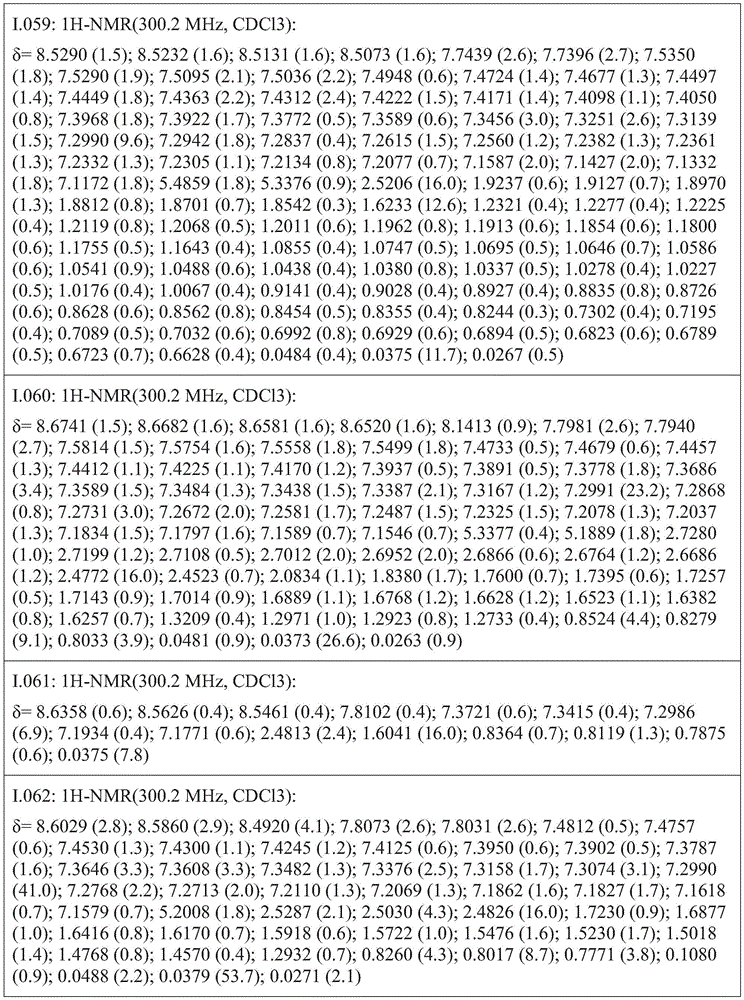


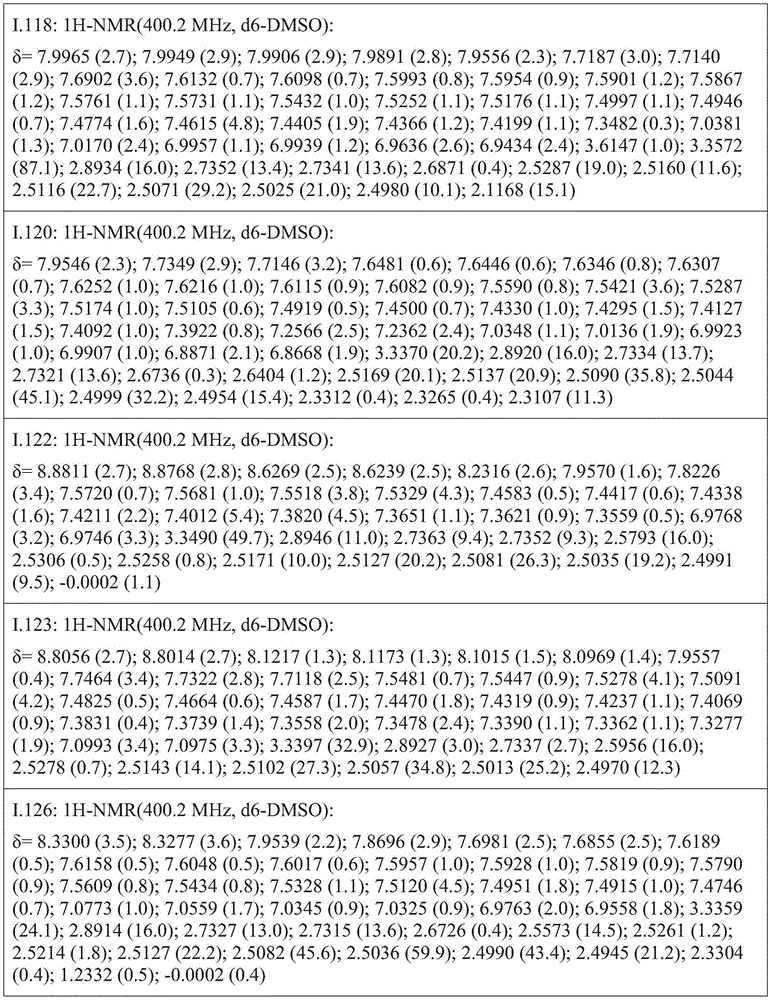


Application examples
Example A: in vitro cell assay for Pyricularia oryzae (Pyricularia oryzae)
Solvent: dimethyl sulfoxide
Culture medium: 14.6g of anhydrous D-glucose (VWR),
7.1g fungal peptone (Oxoid),
1.4g of granular yeast extract (Merck), QSP 1 liter
Inoculum: spore suspension
The test compound was dissolved in dimethyl sulfoxide and the solution was used to prepare the desired concentration range. The final concentration of dimethyl sulfoxide used in this test was ≦ 1%.
Spore suspensions of Pyricularia oryzae were prepared and diluted to the desired spore density.
Compounds were evaluated for their ability to inhibit spore germination and mycelium growth in liquid medium assays. The compound is added to the medium containing the spores at the desired concentration. After 5 days of incubation, the compounds were assayed for fungal toxicity by spectrometric measurement of mycelium growth. Inhibition of fungal growth was determined by comparing the absorbance values in wells containing the test compound to the absorbance in control wells without the test compound.
In this test, the following compounds according to the invention show an efficacy of 70% to 79% at a concentration of 20ppm of test compound: i.015; i.020; 026; i.030; i.032; i.057; i.079; i.085; i.086; i.087; i.107; i.122; i.123; I.134.
in this test, the following compounds according to the invention show an efficacy of 80% to 89% at a concentration of 20ppm of test compound: i.004; i.006; i.010; i.012; 024; i.033; i.036; i.048; i.052; i.053; i.055; i.066; i.095; i.100; i.106; i.115; i.120; i.131; I.133.
in this test, the following compounds of the invention show an efficacy of 90% to 100% at a concentration of 20ppm of the test compound: i.009; i.018; i.022; i.023; i.025; i.027; i.028; i.034; i.035; i.038; i.040; i.044; i.045; i.046; i.047; i.049; i.058; i.059; i.060; i.061; 1.062; 1.067; i.068; i.069; i.070; 072; i.074; i.075; i.076; i.077; i.080; i.081; i.083; i.084; i.090; i.091; i.093; i.094; i.096; i.097; i.099; i.101; i.103; i.104; i.105; i.108; i.109; i.110; i.111; i.113; i.117; i.118; i.119; i.125; i.126; i.127; I.129.
example B: in vitro cell assay for Colletotrichum vulgaris (Colletotrichum lindemunianum)
Solvent: dimethyl sulfoxide
Culture medium: 14.6g of anhydrous D-glucose (VWR),
7.1g fungal peptone (Oxoid),
1.4g of granular yeast extract (Merck), QSP 1 liter
Inoculum: spore suspension
The test compound was dissolved in dimethyl sulfoxide and the solution was used to prepare the desired concentration range. The final concentration of dimethyl sulfoxide used in this test was ≦ 1%.
A spore suspension of the colletotrichum phaseoloides is prepared and diluted to the desired spore density.
Compounds were evaluated for their ability to inhibit spore germination and mycelium growth in liquid medium assays. The compound is added to the medium containing the spores at the desired concentration. After 6 days of incubation, the compounds were assayed for fungal toxicity by spectrometric measurement of mycelium growth. Inhibition of fungal growth was determined by comparing the absorbance values in wells containing the test compound to the absorbance in control wells without the test compound.
In this test, the following compounds according to the invention show an efficacy of 70% to 79% at a concentration of 20ppm of test compound: i.018; i.032; i.040; i.043; i.050; i.059; i.065; 072; i.073; i.080; i.084; i.085; i.086; i.087; i.088; i.089; i.094; i.095; i.099; i.103; i.107; i.112; i.118; i.120; I.132.
in this test, the following compounds according to the invention show an efficacy of 80% to 89% at a concentration of 20ppm of test compound: i.004; i.005; i.009; i.011; i.014; i.016; i.019; i.022; i.023; i.028; i.031; i.036; i.037; i.038; i.042; i.044; i.047; i.048; i.054; i.055; i.063; i.068; i.074; i.075; i.076; i.078; i.083; i.090; i.092; i.100; i.111; i.113; i.115; i.116; i.119; i.122; i.125; I.133.
in this test, the following compounds of the invention show an efficacy of 90% to 100% at a concentration of 20ppm of the test compound: i.001; i.002; i.007; i.008; i.010; i.012; i.015; 024; i.025; i.027; i.033; i.034; i.041; i.045; i.046; i.049; i.051; i.052; i.053; i.056; i.057; i.058; i.060; i.061; i.062; i.066; i.067; i.069; i.070; i.071; i.079; i.081; i.091; i.093; i.096; i.101; i.104; i.105; i.106; i.108; i.109; i.110; i.114; i.117; i.126; i.129; I.131.
example C: in vitro cell assay for P.glumae (Leptosphaeria nodorum)
Solvent: dimethyl sulfoxide
Culture medium: 14.6g of anhydrous D-glucose (VWR),
7.1g fungal peptone (Oxoid),
1.4g of granular yeast extract (Merck), QSP 1 liter
Inoculum: spore suspension
The test compound was dissolved in dimethyl sulfoxide and the solution was used to prepare the desired concentration range. The final concentration of dimethyl sulfoxide used in this test was ≦ 1%.
A spore suspension of microsporum glumae was prepared and diluted to the desired spore density.
Compounds were evaluated for their ability to inhibit spore germination and mycelium growth in liquid medium assays. The compound is added to the medium containing the spores at the desired concentration. After 6 days of incubation, the compounds were assayed for fungal toxicity by spectrometric measurement of mycelium growth. Inhibition of fungal growth was determined by comparing the absorbance values in wells containing the test compound to the absorbance in control wells without the test compound.
In this test, the following compounds according to the invention show an efficacy of 80% to 89% at a concentration of 20ppm of test compound: I.001.
in this test, the following compounds of the invention show an efficacy of 90% to 100% at a concentration of 20ppm of the test compound: i.007; i.008; i.009; i.010; i.011; i.017; i.018; i.041; i.042; i.043; i.044; i.045; i.046; i.047; i.074; i.075; i.076; I.077.
example D: in vivo preventive test on Botrytis cinerea (Botrytis cinerea) gray mold
Solvent: 5% by volume of dimethyl sulfoxide
10% by volume acetone
Emulsifier: 1 μ L 80/mg active ingredient
Test compounds are tested in dimethyl sulfoxide/acetone- 80, and then diluted in water to the desired concentration.
Young plants of gherkin or cabbage were treated by spraying with the test compounds prepared as described above. Control plants were treated with acetone/dimethyl sulfoxide alone 80 in an aqueous solution.
After 24 hours, the plants were infested by spraying the leaves with an aqueous suspension of botrytis cinerea spores. Infected gherkin plants were cultivated at 17 ℃ and 90% relative humidity for 4 to 5 days. Infected cabbage plants are cultured for 4 to 5 days at 20 ℃ and 100% relative humidity.
The test was evaluated 4 to 5 days after inoculation. 0% means efficacy corresponding to that of the control plants, whereas 100% efficacy means that no disease is observed.
In this test, the following compounds according to the invention show an efficacy of 70% to 79% at a concentration of 500ppm of the test compound: I.001.
in this test, the following compounds according to the invention show an efficacy of 80% to 89% at a concentration of 500ppm of the test compound: i.017; I.078.
in this test, the following compounds of the invention show an efficacy of 90% to 100% at a concentration of 500ppm of the test compound: i.002; i.007; i.008; i.010; i.011; i.014; i.015; i.018; i.022; i.023; 024; i.041; i.042; i.043; i.044; i.045; i.049; i.056; i.057; i.058; i.059; i.060; i.061; i.062; i.067; i.068; i.069; i.074; i.075; i.076; i.104; i.105; i.109; I.110.
example E: in vivo prophylactic testing of Venturia inauaalis (apple)
Solvent: 24.5 parts by weight of acetone
24.5 parts by weight of dimethyl sulfoxide
Emulsifier: 1 part by weight of polyoxyethylene sorbitan monooleate (polyoxyyethylene sorbitan monooleate)
To prepare a suitable test compound formulation, 1 part by weight of the test compound is mixed with the stated amounts of solvent and emulsifier, and the concentrated solution is diluted with water to the desired concentration.
To test for prophylactic activity, young plants are sprayed with the test compound preparation at the stated application rate.
After the spray coating has dried, the plants are inoculated with an aqueous suspension of conidia of the causative agent of apple scab (venturia inaequalis) and then left to stand in an incubator at about 20 ℃ and 100% relative atmospheric humidity for 1 day.
The plants were then placed in a greenhouse at about 21 ℃ and about 90% relative atmospheric humidity.
The test was evaluated 10 days after inoculation. 0% means efficacy corresponding to untreated control plants, whereas 100% efficacy means that no disease was observed.
In this test, the following compounds according to the invention show an efficacy of 90% to 100% at a concentration of 100ppm of active ingredient: i.041; i.043; I.044.
example F: in vivo preventive test for Pyrenophora teres (barley)
Solvent: 24.5 parts by weight of acetone
24.5 parts by weight of dimethyl sulfoxide
Emulsifier: 1 part by weight of polyoxyethylene sorbitan monooleate
To prepare a suitable test compound formulation, 1 part by weight of the test compound or compound combination is mixed with the stated amounts of solvent and emulsifier, and the concentrated solution is diluted with water to the desired concentration.
To test for prophylactic activity, young plants are sprayed with the test compound preparation at the stated application rate.
After the spray coating has dried, the plants are sprayed with a spore suspension of Pyrenophora teres and then left to stand in an incubator at about 20 ℃ and about 100% relative atmospheric humidity for 48 hours.
The plants were then placed in a greenhouse at about 20 ℃ and about 80% relative atmospheric humidity.
The trial was evaluated 8 days after inoculation. 0% means efficacy corresponding to untreated control plants, whereas 100% efficacy means that no disease was observed.
In this test, the following compounds according to the invention show an efficacy of 70% to 79% at a concentration of 500ppm of active ingredient: I.007.
in this test, the following compounds according to the invention show an efficacy of 80% to 89% at a concentration of 500ppm of active ingredient: I.067.
in this test, the following compounds according to the invention show an efficacy of 90% to 100% at a concentration of 500ppm of active ingredient: I.041.
Claims (15)
1. compounds of formula (I) and salts, N-oxides, metal complexes, metalloid complexes and optically active or geometric isomers thereof,

wherein
A is phenyl or a 5-or 6-membered unsaturated heterocyclic ring comprising 1,2 or 3 heteroatoms independently selected from N, O and S, wherein the two points of attachment of ring a to group B and group L, respectively, are adjacent carbon atoms;
b is a partially saturated or unsaturated 6-membered heterocyclic ring comprising 1,2, 3 or 4 heteroatoms independently selected from N, O and S;
·Q1is CY1Or N, wherein:
Y1selected from hydrogen atoms, halogen atoms, C1-C8Alkyl, C containing up to 9 halogen atoms which may be the same or different1-C8-haloalkyl group, C2-C8Alkenyl, C containing up to 9 halogen atoms which may be the same or different2-C8-haloalkenyl, C2-C8Alkynyl, C containing up to 9 halogen atoms which may be the same or different2-C8-haloalkynyl, C3-C7-cycloalkyl, C4-C7Cycloalkenyl, hydroxy, C1-C8Alkoxy, C containing up to 9 halogen atoms which may be the same or different1-C8Halogenoalkoxy, formyl, amino, C1-C8-alkylamino, di-C1-C8Alkylamino, sulfanyl, C1-C8Alkyl sulfanyl, C1-C8-alkylsulfinyl, C1-C8-alkylsulfonyl, C1-C6-trialkylsilyl, cyano and nitro groups,
wherein said C3-C7-cycloalkyl and C4-C7Cycloalkenyl may be substituted by one or more YaSubstituent group substitution;
·Y2、Y3、Y4and Y5Independently selected from hydrogen atom, halogen atom, C1-C8Alkyl, C containing up to 9 halogen atoms which may be the same or different1-C8-haloalkyl group, C2-C8Alkenyl, C containing up to 9 halogen atoms which may be the same or different2-C8-haloalkenyl, C2-C8Alkynyl, C containing up to 9 halogen atoms which may be the same or different2-C8-haloalkynyl group,C3-C7-cycloalkyl, C4-C7Cycloalkenyl, hydroxy, C1-C8Alkoxy, C containing up to 9 halogen atoms which may be the same or different1-C8Halogenoalkoxy, formyl, amino, C1-C8-alkylamino, di-C1-C8Alkylamino, sulfanyl, C1-C8Alkyl sulfanyl, C1-C8-alkylsulfinyl, C1-C8-alkylsulfonyl, C1-C6-trialkylsilyl, cyano and nitro groups,
wherein said C3-C7-cycloalkyl and C4-C7Cycloalkenyl may be substituted by one or more YaSubstituent group substitution;
z is selected from the group consisting of a hydrogen atom, a halogen atom, a hydroxyl group, and C1-C8Alkyl radical, C2-C8-alkenyl, C2-C8Alkynyl, C containing up to 9 halogen atoms which may be the same or different2-C8-haloalkynyl, C1-C8Alkoxy, C containing up to 9 halogen atoms which may be the same or different1-C8Haloalkyl, C containing up to 9 halogen atoms which may be the same or different2-C8Haloalkenyl, C containing up to 9 halogen atoms which may be the same or different1-C8-haloalkoxy, C3-C7-cycloalkyl, C4-C7-cycloalkenyl, formyl, C1-C8-alkylamino, di-C1-C8Alkylamino, sulfanyl, C1-C8Alkyl sulfanyl, C1-C8-alkylsulfinyl, C1-C8-alkylsulfonyl, C1-C6-trialkylsilyl, cyano and nitro groups,
wherein said C3-C7-cycloalkyl and C4-C7Cycloalkenyl can be substituted by one or more ZaSubstituent group substitution;
m is 0, 1,2, 3 or 4;
n is 0, 1,2, 3 or 4;
l is CR1R2Or NR3Wherein
R1And R2Independently selected from hydrogen atom, halogen atom, C1-C8-alkoxy and C1-C8An alkyl group, a carboxyl group,
R3selected from hydrogen atoms, C1-C8Alkyl, C containing up to 9 halogen atoms which may be the same or different1-C8-haloalkyl group, C2-C8Alkenyl, C containing up to 9 halogen atoms which may be the same or different2-C8-haloalkenyl, C3-C8Alkynyl, C containing up to 9 halogen atoms which may be the same or different3-C8-haloalkynyl, C3-C7Cycloalkyl, C containing up to 9 halogen atoms which may be the same or different3-C7-halocycloalkyl, C3-C7-cycloalkyl-C1-C8Alkyl radical, C1-C8-alkylcarbonyl, C containing up to 9 halogen atoms which may be the same or different1-C8-haloalkylcarbonyl, C1-C8Alkoxycarbonyl, C containing up to 9 halogen atoms which may be the same or different1-C8-haloalkoxycarbonyl, C1-C8Alkylsulfonyl, C containing up to 9 halogen atoms which may be the same or different1-C8-haloalkylsulfonyl, aryl-C1-C8-an alkyl group and a phenylsulfonyl group,
wherein said C3-C7-cycloalkyl, C3-C7-cycloalkyl-C1-C8Alkyl, aryl-C1-C8Alkyl and phenylsulfonyl groups may be substituted by one or more R3aSubstituent group substitution;
w is independently selected from halogen atom, hydroxyl, C1-C8Alkyl, C containing up to 9 halogen atoms which may be the same or different1-C8-haloalkyl group, C1-C8Alkoxy, containing up to 9 groups which may be identicalOr C of different halogen atoms1-C8-haloalkoxy, C1-C8-hydroxyalkyl, C1-C8-alkoxy-C1-C8Alkyl radical, C2-C8Alkenyl, C containing up to 9 halogen atoms which may be the same or different2-C8-haloalkenyl, C2-C8Alkynyl, C containing up to 9 halogen atoms which may be the same or different2-C8-haloalkynyl, C3-C7-cycloalkyl, C4-C8Cycloalkenyl, aryl-C1-C8Alkyl, heterocyclyl-C1-C8-alkyl, aryloxy, heteroaryloxy, arylsulfanyl, arylsulfinyl, arylsulfonyl, heteroarylsulfanyl, heteroarylsulfinyl, heteroarylsulfonyl, arylamino, heteroarylamino, aryloxy-C1-C8-alkyl, heteroaryloxy-C1-C8Alkyl, arylsulfanyl-C1-C8-alkyl, arylsulfinyl-C1-C8-alkyl, arylsulfonyl-C1-C8Alkyl, heteroarylsulfanyl-C1-C8-alkyl, heteroarylsulfinyl-C1-C8-alkyl, heteroarylsulfonyl-C1-C8Alkyl, arylamino-C1-C8-alkyl, heteroarylamino-C1-C8Alkyl, aryl-C1-C8-alkoxy, heteroaryl-C1-C8Alkoxy, aryl-C1-C8Alkyl sulfanyl, aryl-C1-C8-alkylsulfinyl, aryl-C1-C8-alkylsulfonyl, heteroaryl-C1-C8Alkyl sulfanyl, heteroaryl-C1-C8-alkylsulfinyl, heteroaryl-C1-C8-alkylsulfonyl, aryl-C1-C8-alkylamino, heteroaryl-C1-C8Alkylamino, formyl, C1-C8-alkylcarbonyl, (hydroxyimino) C1-C8Alkyl radicals, (C)1-C8Alkoxy groupAmino) C1-C8Alkyl, carboxyl, C1-C8Alkoxycarbonyl, carbamoyl, C1-C8-alkylcarbamoyl, di-C1-C8-alkylcarbamoyl, amino, C1-C8-alkylamino, di-C1-C8Alkylamino, sulfanyl, C1-C8Alkyl sulfanyl, C1-C8-alkylsulfinyl, C1-C8-alkylsulfonyl, C1-C6-trialkylsilyl, tri (C)1-C8-alkyl) silyloxy, tri (C)1-C8-alkyl) siloxy-C1-C8-alkyl, oxo, cyano and nitro,
wherein said C3-C7-cycloalkyl, C4-C8Cycloalkenyl, heterocyclyl, aryl, and aryl-C1-C8-alkyl, heterocyclyl-C1-C8-alkyl, aryloxy, heteroaryloxy, arylsulfanyl, arylsulfinyl, arylsulfonyl, heteroarylsulfanyl, heteroarylsulfinyl, heteroarylsulfonyl, arylamino, heteroarylamino, aryloxy-C1-C8-alkyl, heteroaryloxy-C1-C8Alkyl, arylsulfanyl-C1-C8-alkyl, arylsulfinyl-C1-C8-alkyl, arylsulfonyl-C1-C8Alkyl, heteroarylsulfanyl-C1-C8-alkyl, heteroarylsulfinyl-C1-C8-alkyl, heteroarylsulfonyl-C1-C8Alkyl, arylamino-C1-C8-alkyl, heteroarylamino-C1-C8Alkyl, aryl-C1-C8-alkoxy, heteroaryl-C1-C8Alkoxy, aryl-C1-C8Alkyl sulfanyl, aryl-C1-C8-alkylsulfinyl, aryl-C1-C8-alkylsulfonyl, heteroaryl-C1-C8Alkyl sulfanyl, heteroaryl-C1-C8-alkylsulfinyl, heteroaryl-C1-C8-alkylsulfonyl, aryl-C1-C8-alkylamino, heteroaryl-C1-C8The aryl, heterocyclyl and heteroaryl moieties in alkylamino may be substituted by one or more WaSubstituent group substitution;
x is independently selected from a halogen atom, a hydroxyl group, C1-C8Alkyl, C containing up to 9 halogen atoms which may be the same or different1-C8-haloalkyl group, C1-C8Alkoxy, C containing up to 9 halogen atoms which may be the same or different1-C8-haloalkoxy, C2-C8Alkenyl, C containing up to 9 halogen atoms which may be the same or different2-C8-haloalkenyl, C2-C8Alkynyl, C containing up to 9 halogen atoms which may be the same or different2-C8-haloalkynyl, C3-C7-cycloalkyl, C4-C7Cycloalkenyl, formyl, amino, C1-C8-alkylamino, di-C1-C8Alkylamino, sulfanyl, C1-C8Alkyl sulfanyl, C1-C8-alkylsulfinyl, C1-C8-alkylsulfonyl, C1-C6-trialkylsilyl, cyano, nitro and C1-C8-a hydroxyalkyl group,
wherein said C3-C7-cycloalkyl and C4-C7Cycloalkenyl can be interrupted by one or more XaSubstituent group substitution;
Za、R3a、Wa,Xaand YaIndependently selected from halogen atom, nitro group, hydroxyl group, cyano group, carboxyl group, amino group, sulfanyl group, pentafluoro-lambda6Sulfanyl, formyl, carbamoyl, carbamate, C1-C8Alkyl radical, C3-C7Cycloalkyl, C having 1 to 5 halogen atoms1-C8Haloalkyl, C having 1 to 5 halogen atoms3-C8-halocycloalkyl, C2-C8-alkenyl, C2-C8-alkynyl, C1-C8-alkylamino, di-C1-C8-alkylamino radical, C1-C8Alkoxy, C having 1 to 5 halogen atoms1-C8-haloalkoxy, C1-C8Alkylsulfanyl, C having 1 to 5 halogen atoms1-C8Halogenoalkylsulfanyl, C1-C8-alkylcarbonyl, C having 1 to 5 halogen atoms1-C8-haloalkylcarbonyl, C1-C8-alkylcarbamoyl, di-C1-C8-alkylcarbamoyl, C1-C8Alkoxycarbonyl, C having 1 to 5 halogen atoms1-C8-haloalkoxycarbonyl, C1-C8-alkylcarbonyloxy, C having 1 to 5 halogen atoms1-C8-haloalkylcarbonyloxy, C1-C8-alkylcarbonylamino, C having 1 to 5 halogen atoms1-C8-haloalkylcarbonylamino, C1-C8Alkylsulfanyl, C having 1 to 5 halogen atoms1-C8Halogenoalkylsulfanyl, C1-C8-alkylsulfinyl, C having 1 to 5 halogen atoms1-C8-haloalkylsulfinyl, C1-C8-alkylsulfonyl and C having 1 to 5 halogen atoms1-C8-a haloalkylsulfonyl group;
with the proviso that the compound of formula (I) is not:
2- {2- [ (6, 7-dimethyl-3-oxo-3, 4-dihydroquinoxalin-2-yl) methyl ] phenyl } -3, 5-dioxo-2, 3,4, 5-tetrahydro-1, 2, 4-triazine-6-carbonitrile [713527-70-9], and
3, 5-dioxo-2- {2- [ (3-oxo-3, 4-dihydroquinoxalin-2-yl) methyl ] phenyl } -2,3,4, 5-tetrahydro-1, 2, 4-triazine-6-carbonitrile [426815-75-0 ].
2. A compound of formula (I) according to claim 1, wherein a is selected from phenyl, thienyl, pyridyl and pyrimidinyl.
3. A compound of formula (I) according to claim 1, wherein a is selected from a-G1, a-G2, a-G3, a-G4, a-G5, a-G6 and a-G7:

wherein ". sup." indicates a link to L and "#" indicates a link to B.
4. A compound of formula (I) according to any one of the preceding claims, wherein B is selected from the group consisting of dihydropyranyl, dihydropyridinyl, pyridinyl and pyrimidinyl.
5. A compound of formula (I) according to any one of the preceding claims, wherein L is CR1R2Wherein R is1And R2Is a hydrogen atom, or L is NR3Wherein R is3Is a hydrogen atom.
6. A compound of formula (I) according to any one of the preceding claims, wherein X is independently a halogen atom.
7. A compound of formula (I) according to any one of the preceding claims, wherein n is 0 or 1.
8. A compound of formula (I) according to any one of the preceding claims, wherein W is independently selected from a halogen atom, C1-C6Alkyl, C containing up to 9 halogen atoms which may be the same or different1-C6-haloalkyl group, C1-C6-alkoxy, C1-C6-hydroxyalkyl, C1-C6Alkyl sulfanyl, C2-C6-alkenyl, C1-C6Alkoxycarbonyl, C3-C7Cycloalkyl, aryl-C1-C6Alkyl, heterocyclyl, carboxyl, tri (C)1-C6-alkyl) siloxy-C1-C6-alkyl, heteroaryl-C1-C6Alkyl radical, C1-C6-alkoxy-C1-C6-alkyl, oxo and cyano.
9. A compound of formula (I) according to any one of the preceding claims, wherein W is independently selected from a halogen atom, C1-C6Alkyl, C containing up to 9 halogen atoms which may be the same or different1-C6-haloalkyl group, C1-C6-alkoxy, C1-C6Alkyl sulfanyl, C3-C7-cycloalkyl, oxo and cyano.
10. A compound of formula (I) according to any one of the preceding claims, wherein m is 0, 1 or 2.
11. A compound of formula (I) according to any one of the preceding claims, wherein Z is a hydrogen atom or C1-C6-an alkyl group.
12. A compound of formula (I) according to any one of the preceding claims, wherein Y2、Y3、Y4And Y5Independently a hydrogen atom or a halogen atom.
13. A compound of formula (I) according to any one of the preceding claims, wherein Q1Is N or CY1Wherein Y is1Is a hydrogen atom.
14. A composition comprising at least one compound of formula (I) as defined in any one of claims 1 to 13 and at least one agriculturally suitable adjuvant.
15. A method for controlling unwanted phytopathogenic microorganisms, comprising the step of applying one or more compounds of formula (I) according to any of claims 1 to 13 or a composition according to claim 14 to the plants, to parts of plants, to seeds, to fruits or to the soil in which the plants are growing.
Applications Claiming Priority (3)
| Application Number | Priority Date | Filing Date | Title |
|---|---|---|---|
| EP18201297 | 2018-10-18 | ||
| EP18201297.1 | 2018-10-18 | ||
| PCT/EP2019/078260 WO2020079173A1 (en) | 2018-10-18 | 2019-10-17 | Pyridylphenylaminoquinolines and analogues |
Publications (1)
| Publication Number | Publication Date |
|---|---|
| CN112996782A true CN112996782A (en) | 2021-06-18 |
Family
ID=63914912
Family Applications (1)
| Application Number | Title | Priority Date | Filing Date |
|---|---|---|---|
| CN201980068747.1A Pending CN112996782A (en) | 2018-10-18 | 2019-10-17 | Pyridylphenylaminoquinolines and analogs |
Country Status (11)
| Country | Link |
|---|---|
| US (1) | US20210386069A1 (en) |
| EP (1) | EP3867241A1 (en) |
| JP (1) | JP2022512719A (en) |
| KR (1) | KR20210081370A (en) |
| CN (1) | CN112996782A (en) |
| AR (1) | AR116747A1 (en) |
| BR (1) | BR112021007312A2 (en) |
| CA (1) | CA3116629A1 (en) |
| MX (1) | MX2021004449A (en) |
| TW (1) | TW202028187A (en) |
| WO (1) | WO2020079173A1 (en) |
Families Citing this family (1)
| Publication number | Priority date | Publication date | Assignee | Title |
|---|---|---|---|---|
| US12466773B2 (en) * | 2025-02-07 | 2025-11-11 | Hubert Dadie DANCHI | Multifunctional agricultural composition and method for preparation thereof |
Citations (2)
| Publication number | Priority date | Publication date | Assignee | Title |
|---|---|---|---|---|
| CN102844304A (en) * | 2010-01-04 | 2012-12-26 | 日本曹达株式会社 | Nitrogen-containing heterocyclic compounds and fungicides for agriculture and gardening |
| JP2014166991A (en) * | 2013-01-31 | 2014-09-11 | Nippon Soda Co Ltd | Nitrogen-containing heterocyclic compound and agricultural and horticultural bactericidal agent |
Family Cites Families (43)
| Publication number | Priority date | Publication date | Assignee | Title |
|---|---|---|---|---|
| DE3639877A1 (en) | 1986-11-21 | 1988-05-26 | Bayer Ag | HETARYLALKYL SUBSTITUTED 5- AND 6-RINGHETEROCYCLES |
| PL198772B1 (en) | 1997-05-09 | 2008-07-31 | Agraquest | Novel Bacillus strain for fighting against plant diseases and root pests of Diabrotica cereals |
| US6245551B1 (en) | 1999-03-30 | 2001-06-12 | Agraquest, Inc. | Strain of Bacillus pumilus for controlling plant diseases caused by fungi |
| JP4071036B2 (en) | 2001-11-26 | 2008-04-02 | クミアイ化学工業株式会社 | Bacillus sp. D747 strain and plant disease control agent and pest control agent using the same |
| GB0213715D0 (en) | 2002-06-14 | 2002-07-24 | Syngenta Ltd | Chemical compounds |
| TWI312272B (en) | 2003-05-12 | 2009-07-21 | Sumitomo Chemical Co | Pyrimidine compound and pests controlling composition containing the same |
| GB0414438D0 (en) | 2004-06-28 | 2004-07-28 | Syngenta Participations Ag | Chemical compounds |
| JP4970950B2 (en) | 2004-10-20 | 2012-07-11 | クミアイ化学工業株式会社 | 3-Triazolylphenyl sulfide derivatives and insecticides, acaricides, nematicides containing them as active ingredients |
| MY141762A (en) | 2005-10-06 | 2010-06-30 | Nippon Soda Co | Cross-linked cyclic amine compounds and agents for pest control |
| JP5268461B2 (en) | 2008-07-14 | 2013-08-21 | Meiji Seikaファルマ株式会社 | PF1364 substance, its production method, production strain, and agricultural and horticultural insecticide containing the same as an active ingredient |
| CN101337940B (en) | 2008-08-12 | 2012-05-02 | 国家农药创制工程技术研究中心 | Nitrogen heterocyclic ring dichloro allyl ether compound with insecticidal activity |
| CN101337937B (en) | 2008-08-12 | 2010-12-22 | 国家农药创制工程技术研究中心 | N-benz-3-substituted amino pyrazoles compounds with insecticidal activity |
| CN101715774A (en) | 2008-10-09 | 2010-06-02 | 浙江化工科技集团有限公司 | Preparation and use of compound having insecticidal activity |
| EP2184273A1 (en) | 2008-11-05 | 2010-05-12 | Bayer CropScience AG | Halogen substituted compounds as pesticides |
| GB0820344D0 (en) | 2008-11-06 | 2008-12-17 | Syngenta Ltd | Herbicidal compositions |
| ES2468215T3 (en) | 2008-12-12 | 2014-06-16 | Syngenta Participations Ag | Spiroheterocyclic N-Oxypiperidines as pesticides |
| WO2011085575A1 (en) | 2010-01-15 | 2011-07-21 | 江苏省农药研究所股份有限公司 | Ortho-heterocyclyl formanilide compounds, their synthesis methods and use |
| AR081721A1 (en) | 2010-02-25 | 2012-10-17 | Nippon Soda Co | CYCLING AND ACARICIDE AMINA COMPOUND |
| BR112012030408A2 (en) | 2010-05-31 | 2015-09-29 | Syngenta Participations Ag | crop breeding method |
| PH12013500237A1 (en) | 2010-08-31 | 2013-03-11 | Mitsui Chemicals Crop & Life Solutions Inc | Pest control agent |
| CN101967139B (en) | 2010-09-14 | 2013-06-05 | 中化蓝天集团有限公司 | Fluoro methoxylpyrazole-containing o-formylaminobenzamide compound, synthesis method and application thereof |
| AR086411A1 (en) | 2011-05-20 | 2013-12-11 | Nippon Soda Co | HETEROCICLIC COMPOUND CONTAINING NITROGEN AND FUNGICIDE FOR USE IN AGRICULTURE AND GARDENING |
| WO2013050317A1 (en) | 2011-10-03 | 2013-04-11 | Syngenta Limited | Polymorphs of an isoxazoline derivative |
| CN102391261A (en) | 2011-10-14 | 2012-03-28 | 上海交通大学 | N-substituted dioxazine compound as well as preparation method and application thereof |
| JP5729889B2 (en) | 2011-10-17 | 2015-06-03 | 日本曹達株式会社 | Nitrogen-containing heterocyclic compounds and agricultural and horticultural fungicides |
| TWI566701B (en) | 2012-02-01 | 2017-01-21 | 日本農藥股份有限公司 | Arylalkyloxypyrimidine derivatives and agrohorticultural insecticides comprising said derivatives as active ingredients, and method of use thereof |
| CN104202981B (en) | 2012-03-30 | 2018-01-30 | 巴斯夫欧洲公司 | Prevent and treat the pyridylidene compound and derivative of the N substitutions of animal pest |
| EP2647626A1 (en) | 2012-04-03 | 2013-10-09 | Syngenta Participations AG. | 1-Aza-spiro[4.5]dec-3-ene and 1,8-diaza-spiro[4.5]dec-3-ene derivatives as pesticides |
| CN104822266B (en) | 2012-04-27 | 2017-12-05 | 陶氏益农公司 | Pesticidal compositions and methods related thereto |
| US9282739B2 (en) | 2012-04-27 | 2016-03-15 | Dow Agrosciences Llc | Pesticidal compositions and processes related thereto |
| CN103232431B (en) | 2013-01-25 | 2014-11-05 | 青岛科技大学 | Dihalogenated pyrazole amide compound and its use |
| CN103109816B (en) | 2013-01-25 | 2014-09-10 | 青岛科技大学 | Thiobenzamide compounds and application thereof |
| US20140275503A1 (en) | 2013-03-13 | 2014-09-18 | Dow Agrosciences Llc | Process for the preparation of certain triaryl rhamnose carbamates |
| WO2014187846A1 (en) | 2013-05-23 | 2014-11-27 | Syngenta Participations Ag | Tank-mix formulations |
| CN103265527B (en) | 2013-06-07 | 2014-08-13 | 江苏省农用激素工程技术研究中心有限公司 | Anthranilamide compound as well as preparation method and application thereof |
| CN103524422B (en) | 2013-10-11 | 2015-05-27 | 中国农业科学院植物保护研究所 | Benzimidazole derivative, and preparation method and purpose thereof |
| CN105636440A (en) | 2013-10-17 | 2016-06-01 | 美国陶氏益农公司 | Processes for the preparation of pesticidal compounds |
| WO2015058028A1 (en) | 2013-10-17 | 2015-04-23 | Dow Agrosciences Llc | Processes for the preparation of pesticidal compounds |
| WO2016005276A1 (en) | 2014-07-07 | 2016-01-14 | Bayer Cropscience Aktiengesellschaft | Process for preparing fluorinated iminopyridine compounds |
| US10492495B2 (en) | 2015-02-17 | 2019-12-03 | Nippon Soda Co., Ltd. | Agrochemical composition |
| PL3594225T3 (en) | 2015-03-26 | 2022-01-31 | Bayer Cropscience Lp | Paenibacillus strain, antifungal compounds, and methods for their use |
| TWI782983B (en) * | 2017-04-27 | 2022-11-11 | 德商拜耳廠股份有限公司 | Heteroarylphenylaminoquinolines and analogues |
| JP2022512712A (en) * | 2018-10-18 | 2022-02-07 | バイエル・アクチエンゲゼルシヤフト | Heteroarylaminoquinolines and analogs |
-
2019
- 2019-10-17 KR KR1020217014688A patent/KR20210081370A/en not_active Withdrawn
- 2019-10-17 BR BR112021007312-4A patent/BR112021007312A2/en not_active Application Discontinuation
- 2019-10-17 CN CN201980068747.1A patent/CN112996782A/en active Pending
- 2019-10-17 AR ARP190102961A patent/AR116747A1/en not_active Application Discontinuation
- 2019-10-17 US US17/285,840 patent/US20210386069A1/en not_active Abandoned
- 2019-10-17 JP JP2021521012A patent/JP2022512719A/en active Pending
- 2019-10-17 CA CA3116629A patent/CA3116629A1/en not_active Abandoned
- 2019-10-17 TW TW108137518A patent/TW202028187A/en unknown
- 2019-10-17 EP EP19790197.8A patent/EP3867241A1/en not_active Withdrawn
- 2019-10-17 MX MX2021004449A patent/MX2021004449A/en unknown
- 2019-10-17 WO PCT/EP2019/078260 patent/WO2020079173A1/en not_active Ceased
Patent Citations (2)
| Publication number | Priority date | Publication date | Assignee | Title |
|---|---|---|---|---|
| CN102844304A (en) * | 2010-01-04 | 2012-12-26 | 日本曹达株式会社 | Nitrogen-containing heterocyclic compounds and fungicides for agriculture and gardening |
| JP2014166991A (en) * | 2013-01-31 | 2014-09-11 | Nippon Soda Co Ltd | Nitrogen-containing heterocyclic compound and agricultural and horticultural bactericidal agent |
Non-Patent Citations (2)
| Title |
|---|
| IVETA WIEDERMANNOVA ET AL.: "Synthesis of some Isomeric Quinoxaline Derivatives with 6-Azauracil Cycle[1]", J. HETEROCYCLIC CHEM., vol. 38, pages 1465 - 1468, XP055065586, DOI: 10.1002/jhet.5570380633 * |
| IVETA WIEDERMANNOVA ET AL.: "The synthesis of some polycyclic N-H acids with quinoxaline and [1, 2, 4]triazines", ARKIVOC, pages 65 - 74 * |
Also Published As
| Publication number | Publication date |
|---|---|
| US20210386069A1 (en) | 2021-12-16 |
| AR116747A1 (en) | 2021-06-09 |
| JP2022512719A (en) | 2022-02-07 |
| KR20210081370A (en) | 2021-07-01 |
| BR112021007312A2 (en) | 2021-07-20 |
| MX2021004449A (en) | 2021-07-07 |
| WO2020079173A1 (en) | 2020-04-23 |
| TW202028187A (en) | 2020-08-01 |
| EP3867241A1 (en) | 2021-08-25 |
| CA3116629A1 (en) | 2020-04-23 |
Similar Documents
| Publication | Publication Date | Title |
|---|---|---|
| CN112601744B (en) | Substituted thiophenecarboxamides and analogues as antibacterial agents | |
| CN118496197A (en) | Substituted thiophenecarboxamides, thiophenecarboxylic acids and derivatives thereof | |
| JP7157077B2 (en) | Heteroarylphenylaminoquinolines and analogues | |
| CN112888682A (en) | Heteroaryl aminoquinolines and analogs | |
| TW201927768A (en) | Trisubstitutedsilylmethylheteroaryloxyquinolines and analogues | |
| CN112996782A (en) | Pyridylphenylaminoquinolines and analogs | |
| TW201843138A (en) | Trisubstitutedsilylmethylphenoxyquinolines and analogues | |
| TW201843162A (en) | Trisubstitutedsilylbenzylbenzimidazoles and analogues | |
| CN110650628A (en) | Trisubstituted silylheteroaryloxyquinolines and analogs thereof | |
| CN112912374A (en) | Oxocyclobutylphenoxyquinolines and analogs | |
| TW202115000A (en) | Hydroxyisoxazolines and derivatives thereof | |
| TW202116761A (en) | Hydroxyisoxazolines and derivatives thereof |
Legal Events
| Date | Code | Title | Description |
|---|---|---|---|
| PB01 | Publication | ||
| PB01 | Publication | ||
| SE01 | Entry into force of request for substantive examination | ||
| SE01 | Entry into force of request for substantive examination | ||
| WD01 | Invention patent application deemed withdrawn after publication | ||
| WD01 | Invention patent application deemed withdrawn after publication |
Application publication date: 20210618 |