The present application is a divisional application of the issued patent application:
The invention name is as follows: registration and automatic management method of intelligent contracts executed by block chains
Disclosure of Invention
According to one aspect of the invention, there is provided a computer-implemented method of controlling visibility and/or fulfillment of a contract, the method comprising the steps of:
(a) storing the contract in a computer-based repository;
(b) broadcasting a transaction to the blockchain, the transaction comprising:
i) at least one unspent output (UTXO); and
ii) metadata including an identifier indicating a location where the contract is stored; and
(c) continuing or extending the contract by:
generating a new key using data associated with the previous key; and the previous key is associated with the contract;
generating a script, the script containing the new key, the location of the contract, and a hash of the contract; and
the script is paid an amount of currency.
By generating a new key using data related to a previous key associated with a contract, generating a script containing the new key, the contract location, and a hash of the contract, and paying an amount of currency to the script to continue or extend the contract, the following advantages are achieved: since the new key is related to the previous key, the authorizer can view the source contract through its contact with the renewed or deferred contract, thereby enabling the deferred contract to be verified without loss of certainty or privacy. Still have more advantages: because the keys associated with the contracted or deferred contracts are associated with the keys of the source contract, storage and processing capabilities may be reduced without loss of certainty or privacy by storing the contracts in an off-chain (i.e., not forming part of the blockchain) store of the computer.
In the case of "roll", the UTXO may be spent sending it to a "new" rolled contract. However, the entire contract may be cancelled by spending the existing contract before the lock time.
The present invention may provide a computer-implemented method and system for controlling visibility and/or fulfillment of contracts. "visibility" may mean the existence of the contract and/or how the content is provided to/by and accessed. The contract may be a "smart contract". The method may be an automated intelligent contract method. It may be a method of automating the process of monitoring the presence, effectiveness, and/or fulfillment of contracts. Because the contract may be represented in the form of at least a portion of a blockchain transaction, the present invention may be referred to as a tokenization (tokenization) method/system. Metadata in the transaction may provide a token for blockchain enforcement that is used to represent and/or access the contract.
The present invention may provide a method/system that enables storing contracts in a repository (registry), where a hash of the contract may be used as a look-up key (look-up key) to look up the contract.
The method comprises the following steps:
storing the contract in a computer-based repository; and is
Broadcasting a transaction to the blockchain, the transaction comprising:
i) at least one unspent output (UTXO); and
ii) metadata including an identifier indicating a location where the contract is stored.
The contract can be interpreted as open or valid until the UTXO is spent on the blockchain. The blockchain may or may not be a bitcoin blockchain. This shows the strength of a new mechanism for representing the status or validity of a contract on a blockchain represented by UTXO.
The method may include the step of using an off-chain computer implemented process, agent or other entity to observe the state of the blockchain and perform some action depending on whether the output is currently not being expended. This process is used to interpret the unspent output as an indicator of contract status. That is, when the output remains within the UTXO list on the blockchain, i.e., the transaction is still not spent, this may be used to indicate the validity or open status of the contract pointing to or referenced by the metadata. Once the UTXO is spent, the contract may be considered complete (terminated). This condition may be specified within the contract. However, once the UTXO is spent, the metadata may continue to contain pointers to the contract or references to the contract and hashes of the contract so that the contract may retain its functionality.
The method may include the step of publishing the existence of the contract, which may be accomplished by:
the Contract publisher (Contract issue) can create a new Contract document and publish it to the repository. The location of the document and the secure hash may be stored for later use;
creating a redemption script (redeemscript) that encompasses the protected contract document in an m/n multiple signature structure,
wherein:
omicm is at least 1; and
n is m plus the number of metadata blocks
Including at least one public key in the script; this may be the public key of the contract issuer. However, other signatures may also be required
Paying a certain amount of money, e.g. a bitcoin, to the script, preferably by paying a hash of the script (P2SH)
Wait until the transaction is published to the blockchain and extract the transaction ID for the published transaction
Create a new transaction, set the lock time to the expiration time of the contract, pay the output of the transaction back to the public key hash; or
For extended duration contracts: detecting transactions on the blockchain by using an automated computing agent, and triggering a code to convert the transactions into a new contract after the contract expiration time; or
For completion-based contracts (where x of y entities agree that the contract has been fulfilled): an m/n multi-signed transaction is created and issued to these entities to collectively sign upon completion.
A repository may be an off-block storage resource. In other words, a bank may not form part of the blockchain itself. The computer-based repository may be or include a server. The repository may be a database or other storage facility provided on a computer-based resource. The repository may be indexed to allow searching thereof. The repository may include a Distributed Hash Table (DHT). The contract may be stored in or associated with a Distributed Hash Table (DHT).
The transaction may also include a deterministic redemption or locking of the script address. The address may be a payment to script hash (P2SH) address. Thus, the existence of the contract (or elements defined in the contract) can be made publicly available through the use of the metadata of the transaction and/or contract. Where the P2SH address may be used to post the transaction to the blockchain, and the contract publisher may decide or provide the P2SH address.
The method may further comprise the step of terminating the contract by broadcasting (further) transactions to the blockchain at the expense of the output (UTXO). Further transactions may include as input to the output (UTXO) a signed unlock script, metadata and a public key.
This may provide the benefit of automatically terminating the contract by using blockchain transaction cost outputs.
A contract may define: i) at least one condition; ii) at least one action, the fulfillment of which depends on the evaluation of the condition. The condition may be a test that can be evaluated as true or false. The condition may be part of a contract (e.g., a clause). Completion or fulfillment conditions may be required to satisfy the contract. If the evaluation is true, the condition may be completed.
The metadata may include i) addresses or representations of addresses that are contractually stored in the computer-based repository; and/or ii) a hash of the contract.
The method may include the step of observing the state of the blockchain. It may include searching the block chain for a transaction containing a UTXO. It may include the step of checking whether the contract has terminated by determining whether the unspent transaction UTXO is in the unspent transaction output list of the blockchain. The monitoring or inspection process may be automated. It may be performed by a suitably programmed computing agent or resource. It may be substantially as described below in the section entitled "illustrative computing agent for use with the invention". The proxy may perform actions based on the spent or unspent state of the UTXO. Thus, the state of the UTXO may control or affect the behavior of an off-block computing agent.
The method may include the step of broadcasting a transaction to the blockchain, the transaction including an instruction to spend output at a specified date and/or time. The instruction may be a check lock time verify (CheckLockTimeVerify) instruction.
Access to some or all of the contents of the contract may be limited to at least one designated authorized party. In other words, authorization may be required to access or view some or all of the contract. In some embodiments, the protection mechanism may be applied to the contract itself. For example, one or more portions of a file may be protected, but the entire content may be public. This partial protection may be applied to encryption of information within the contract and detection of changes to the hash of its contents.
The contract may include a Deterministic Finite Automaton ("DFA") to implement the contract. Deterministic finite automata can be defined using an encoding scheme. Deterministic finite automata can be implemented by:
i) at least one blockchain transaction, preferably using a scripting language;
ii) a compute agent for monitoring blockchain status (this may be as described below in the section entitled "illustrative compute agent for the present invention"); and/or
iii) a set of instructions for the digital wallet.
According to another aspect of the present invention, there is provided a computer-implemented method of controlling visibility and/or fulfillment of a contract, the method comprising the steps of:
(a) storing contracts in a computer-based repository
(b) Broadcasting a transaction to the blockchain, the transaction comprising:
i) at least one unspent output (UTXO); and
ii) metadata including an identifier indicating a storage location of the contract; and
(c) generating a sub-contract derived from the contract, wherein the sub-contract is associated with a deterministic address and is generated in the following manner:
iii) using a new public key derived with the seed (seed);
iv) storing the sub-contract in a repository by reference to the contract and broadcasting the transaction to the blockchain containing the script of the reference; and/or
v) adding a reference to the sub-contract to the metadata of the existing contract. By generating sub-contracts derived from the contract, wherein the sub-contracts are associated with deterministic addresses, and are generated in the following manner: using a new public key derived from the seed; storing the sub-contract in or on a repository by reference to the contract and broadcasting the transaction to a blockchain containing the referenced script; and/or adding references to sub-contracts to the metadata of existing contracts, this provides the following advantages: sub-contracts can be managed independently without loss of certainty or privacy because they are cryptographically bound to the source contract. Further, by storing the sub-contracts in an off-block store, memory and processing resources may be minimized.
The method may include using a computer-based agent to monitor the blockchain and/or perform actions based on contract content. Such an agent may be substantially as described below in the section entitled "illustrative computing agent for use with the invention".
The present invention may also provide a computer-implemented system configured to perform any of the method steps described above, or any embodiment of the method described herein. The present invention may provide a computer-implemented system for controlling visibility and/or fulfillment of contracts, the system comprising:
a computer-based repository for storing contracts; and
a blockchain comprising transactions, the transactions comprising:
i) at least one unspent output (UTXO); and
ii) metadata containing an identifier that represents a location where the contract is stored.
The metadata may also store a hash of the contract. The contract may be a smart contract.
The repository may include a database. It may include DHT. It can be indexed, searched. It may include at least one security mechanism to control access to the contract.
The system may also include appropriately configured computing-based entities or agents. The agent may be arranged to monitor and/or search the blockchain. It may be arranged to perform at least one action based on the state of the blockchain. Can be used to determine if the UTXO has been expended. May be used to perform one or more actions based on whether the UTXO has been expended.
Any feature described herein with respect to one embodiment or aspect may be used in relation to any other embodiment or aspect. For example, any feature described with respect to the method may also be used in relation to the system, and vice versa.
A non-exhaustive list of some of the benefits that may be provided by the present invention is now provided.
The present invention may provide a technical agreement that simplifies the automated management of structured control conditions (which may be referred to as "contracts" in this document). This in turn makes it easier to agree on the status of the contract when disputes occur. The invention can also provide a mechanism to ensure the safe and open recording of the contract, and the method comprises the following steps: allowing its validity to be automatically determined by the computer and its details to be issued to authorized entities when validated. Thus, the present invention may provide a security enhanced control mechanism that allows or prohibits intelligent access to resources.
The present invention also provides the ability to publish contracts to viewers via a computer system such that the details of the contract can be limited to authorized entities only, but the existence of the contract is well known. That is, the contract between a and B is a well-known knowledge and can be publicly verified, but any knowledge other than its existence is limited to authorized parties (typically only a and B may be possible).
The present invention also provides a computer-implemented mechanism that allows a contract to be time-limited (i.e., the contract expires after a certain time or after a given date), condition-limited (i.e., the contract expires once the deliveries specified in the contract have been fulfilled), or indefinite (i.e., the contract continues to be delayed with a notification period to terminate the contract).
The present invention may provide a mechanism for providing notification of termination of the contract in a public manner. For example, n locktime + check locktime validation (nLockTime + CheckLockTime Verify (CLTV)) is used in spending transactions to "issue" an expiration date.
The present invention may provide a mechanism to construct a hierarchy of sub-contracts in a deterministic manner to allow control over different aspects of the contract to be divided. For example, in a technology development process, the demand phase may have a different set of control triggers than the development phase.
The present invention may provide an improved blockchain system or platform, as the present invention may be implemented on a blockchain platform and may extend the functionality of the blockchain such that the blockchain platform may be used in a technically different manner.
The invention can be used to convert any non-spent transaction (UTXO) into a smart contract, for example for digital access. For example, consider a scenario in which: the consumer pays the merchant to enjoy the service for a period of time. If the merchant's payment address is implemented as an intelligent contract, the present invention can be used to implement an access control mechanism for the service. A check may be made to ensure that the fee has been paid and an automated process may be used to clear the funds to the merchant's account at the end of the service time.
Detailed Description
The intelligent contracts built into the blockchain may be executed by logic embedded directly into the bitcoin transaction (i.e., within the lock/unlock script) and/or by an external computer-based application. Such external computer-based applications may be referred to as "agents", "Oracle", or "bots". In addition, some contract terms may be performed by other bitcoin transaction elements, such as an n-lock clock field (nLockTime field).
This document describes an invention where a contract is considered to continue to be valid as long as there is a valid uneconomical transaction output, UTXO, on the blockchain representing the contract. Since the behavior of various mechanisms (e.g., programmed computing agents) is governed by the conditions or regulations of the contract itself, this unspent state may be affected and changed. For example, a contract specifies that it will expire on a certain date, or when a certain value reaches a specified threshold.
This principle of representing contracts using the unspent transaction output can be used in conjunction with other features, such as encryption techniques. This enables complex scenarios and activities. In effect, around the occasion of outputting UTXO for unsigned transactions and the associated metadata in the script that allows it to be spent, the transaction is allowed to act as a pointer or reference to an off-chain (off-chain) store containing the formal details of the contract. In this document, "off-chain" means that it is not part of the block chain itself. This provides a mechanism by which anyone can use a software-based element or tool to determine whether a contract has terminated or is still valid/open by examining the blockchain. Once the contract is terminated, it will be recorded on the blockchain as an output of the cost in the transaction and for public review. Blockchain transactions become permanent, and public records of the existence and status of contracts.
A store (which may also be referred to as a "registry" or "register") may be implemented in a variety of ways, including, for example, as a Distributed Hash Table (DHT). A hash of the contract can be generated and stored as metadata in the blockchain transaction, and the hash of the contract can be used as a lookup key to reference the contract from the blockchain. A reference to the contract location is also provided in the transaction metadata. For example, a link (URL) to a repository may be provided. While the metadata is open for public viewing, the contract itself may not be, or may be partially, protected.
Standard bitcoin features, such as check Lock time verification ("CLTV"), allow for the formal, automated expiration of contracts at some future time. The use of blockchains may make this due date a secure (unalterable) public record. This concept, in conjunction with the use of multiple encryption keys described below, enables the CLTV model to automatically defer or renew a contract unless the contract is explicitly revoked.
The use of deterministic subkeys, in combination with the tokenization mechanism described herein, allows the creation of sub-contracts or projects as opposed to contracts.
In addition, the use of off-block computing agents (Oracle) allows contract conditions to be established and modified by a trusted third party. This means that the behavior of the agent can be influenced by the conditions provided in the contract definition (e.g., the "IF" statement).
Key terms
The following terminology may be used herein.
Contract publisher (Contract issuers):
the entity represents the role responsible for publishing the contract onto the blockchain.
Interested party (Interested party):
the entity represents a role that may need to determine whether a particular contract still exists or may need to determine the details of the contract.
Storage library (reproducibility)
The entity represents a location that secures/stores a structured representation of a contract referenced by a blockchain intelligent contract;
contract counter (Contract counter):
the entity represents the counterpart of a particular contract. It should be noted that this entity does not appear in many cases.
Contract (Contract):
this is a structured document or file stored in a repository, which is referenced from the blockchain. The contract may be any type of contract or agreement. This may include, for example, financial contracts, ownership certificates, service contracts, and so forth. The contract content may or may not be public. Contracts are formalized, which are represented in a structured manner using an encoding scheme.
Contract model:
The basic elements of the contract model are as follows:
coding schemes that allow a complete description of any type of contract. The scheme can be a new construction, and can also use the existing tools such as XBRL, XML, JSON and the like;
DFA (deterministic finite automata) to implement a contract that can be fully defined in an encoding scheme, consisting of:
omicron a set of parameters, and the sources of these parameters
Omicron group of state definitions
Transitions between a set of states, including triggers for transitions and rules to be followed during transitions
Omicron rule definition table
Definition of specific parameters for an instance of a contract;
mechanisms to secure and protect contracts;
"browser" to enable the contract to be read by a person in formal legal language; and
"compiler" converts the coding scheme into Oracle code and/or script, such as bitcoin script.
Contract execution
When a contract is registered in the repository, the associated address (e.g., URL and hash) can be used as metadata in blockchain transactions to associate the transactions on the chain with the control contract itself. This can be achieved in a number of forms but a suitable coding scheme is provided below for doing so in the section entitled "coding scheme".
There are a number of different ways how the DFA contained in the contract definition can be implemented:
as a blockchain transaction or sequence of transactions. DFAs in various forms can be directly realized in the bitcoin scripting language; those skilled in the art will appreciate this and the invention is not limited to the manner in which DFA is implemented by a block chain.
As a proxy-based process (e.g., Oracle) or sequence of processes. The following section entitled "illustrative computing Agents for the invention" describes the basic process of defining and running appropriate agents to monitor blockchains and other possible foreign sources.
A set of instructions that is a smart wallet. In this context, the smart wallet is actually just a local Oracle process that can handle certain contract conditions, such as assigning transaction inputs to blockchain transactions.
It should be noted that a given contract definition may be implemented as a hybrid of the three mechanisms described above, where each contract state transition is actually a separate implementation. There are many ways to create an implementation from a contract definition, including manually writing the relevant transaction/code.
Publishing the Presence of a contract
To publish the existence of the contract (or one of the defined elements in the contract), the transaction Tx is issued to the blockchain using the hash address paid to the script (P2 SH). In a P2SH transaction, the recipient must provide a script that matches the script hash, as well as data that makes the script evaluate to true, in order for the transaction to be used. In connection with embodiments of the present invention, payment to script hash (P2SH) may be readily determined from:
-a publisher of the contract; and
-metadata of the contract.
According to some embodiments of the invention, an unused transaction may be interpreted as an indicator of contract status. An off-chain process may be used to monitor the block chain and take some action depending on whether the output is unused. In other words, when this output remains within the UTXO list on the blockchain (i.e., the transaction is still unused), this indicates the validity of the contract to which the metadata is directed or referenced. Once this output is used, the contract is considered complete. This condition (contract still valid/open as long as UTXO is present) may be a condition of the contract itself. However, it is not a necessary provision of a protocol, as in other embodiments, alternative termination conditions may exist. It should be noted that even when the transaction is already in use (and therefore no longer exists in the UTXO list), it still resides permanently on the blockchain and still retains a pointer or reference to the contract, and a hash of the contract, to the extent that it retains its functionality even if used.
Sub-contracts/conditions
A sub-contract is a contract that is directly related to an existing contract. The conditions are terms in an existing contract that must be fulfilled to satisfy the terms in the contract.
According to one embodiment of the invention, both sub-contracts and conditions may be implemented in the same manner, i.e., a contract implemented as a UTXO with a deterministic redemption script address. In both cases, the entity may be understood as complete when the UTXO is spent (which indicates that the condition has been met with respect to the condition). As described above, the metadata will still contain a pointer or reference to a physical location within the repository, as well as a hash thereof. Thus, in other embodiments, sub-contracts or conditions may still exist and still retain functionality, depending on the conditions agreed upon by the contract, even after the output has been used.
There are a number of mechanisms available for creating a deterministic address for a condition or sub-contract:
-deriving a new public key using the seed information;
-creating and publishing within the repository a sub-contract with a reference to the main contract as a metadata reference; and
-adding a reference to the condition/sub-contract to the metadata of the existing contract.
Contract security protection
The formal representation of the contract (i.e., the document or file specifying the content of the contract) may be protected in various ways depending on the formal requirements of the particular contract, although in all cases the public record of the existence of the contract will be published on the blockchain contained on the metadata record (see the section entitled "encoding scheme" for details of the particular metadata structure).
Based on this blockchain record, the authorized entity will be able to know the location of the formal expression, as well as the hash, to determine that the formal expression has not been modified since the transaction was released.
However, the formal representation itself may be further protected by a variety of methods:
the document repository itself may provide access control mechanisms; and
the contract itself can be protected by standard encryption techniques that restrict access to the entity by accessing the relevant decryption key.
In many cases, the contract itself will have partial protection. For example, where the entire content is public, certain parts of the document may be protected, for example, to disclose details of how to implement a fixed interest rate loan, but only the parties to the contract know as to who borrowed the loan, how much was the amount, and how much was the interest rate.
This partial protection applies both to the encryption of information within a contract and to the hash detection of changes to its contents.
For multiple contracts, the details of the contract can be modified within its validity period, and the contract itself should not be required to be reissued. This may be accomplished by determining the range of hashes on the contract subset. One potentially useful example is the implementation of a unit trust. The contract supporting the trust of the unit may not change, but the beneficiary of the unit may modify by selling the contract. In one embodiment, the recording of changes may be accomplished using sub-contracts.
Terminating the contract
Because the blockchain provides a permanent, immutable transaction record, the contract cannot be terminated by simply deleting the associated contract document. This means that the security contract store must have the same storage and retention rules as the blockchain itself, which is supported through multiple standard mechanisms. This means that the solution must provide a mechanism to detect the expiration of the contract directly through blockchain recording.
The method of termination is defined as a condition in the contract and can be implemented in a variety of ways, all of which are conceptually covered by the present invention. In a preferred embodiment of the invention, termination is handled by the cost of the UTXO representing the contract.
For multiple contract types, the expiration of the contract can occur simultaneously with the publication of the contract itself. In effect, two deals are created, one for issuing the contract and obtaining a deal output representing the contract, and the other for spending the output. The second transaction has a check lock time verification set (CheckLockTime Verify set) on it for spending the output on a given future date (representing the end of the contract).
From the foregoing, this is our standard method, but not the only method.
This automatic expense can be extended to support a postponement of the contract (e.g., automatically extending a twelve month contract if not cancelled). In this case, the UTXO costs by sending it to a "new" deferred contract. However, the entire contract can be cancelled by canceling the old contract by spending the output before the lock time.
Use case model
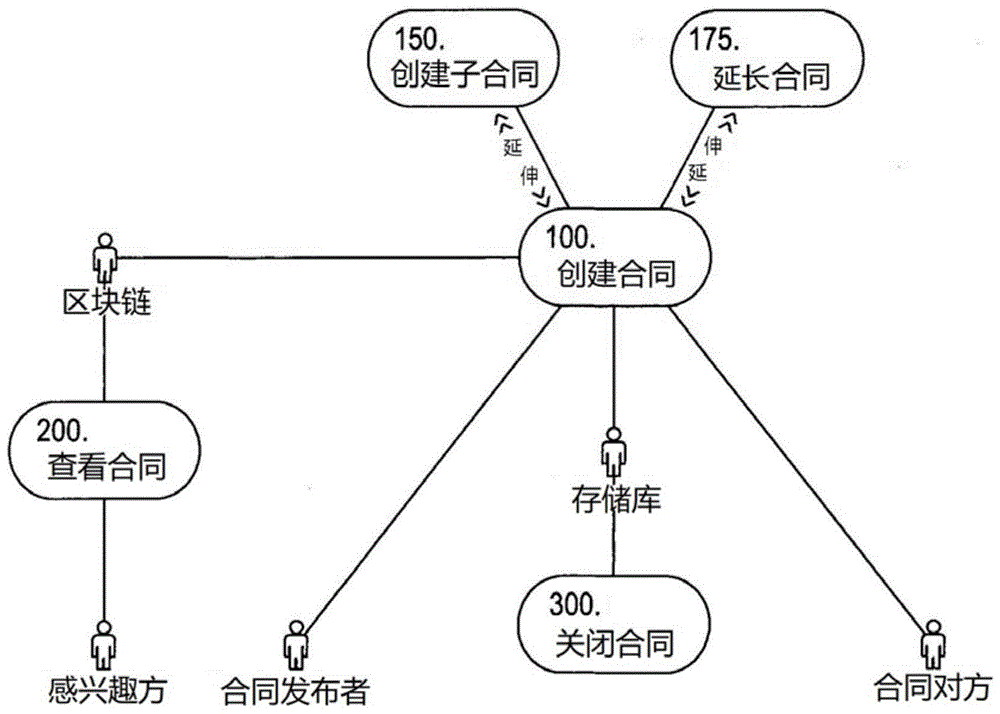
FIG. 1 shows an overview of a use case model according to an embodiment of the invention. This illustrative use case model demonstrates how elements of a DFA can be implemented directly in a bitcoin script using standard bitcoin transactions. For purposes of illustration, examples of key use cases are provided below.
Creating contracts
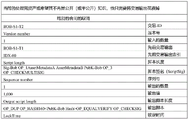
The contract publisher, which in this example is the primary role, wishes to publish a contract on the blockchain for public review. This process is summarized in table 1:
there are two key embodiments or variations thereof in this context, specifically as follows:
creating sub-contracts from existing contracts
Postponing an existing contract into a new contract (renewal)
Creating sub-contracts
In this case, the contract publisher wishes to create a sub-contract from an existing contract, the process of which is summarized as Table 2:
in accordance with one or more embodiments, sub-contracts may be monitored independently. For example, consider a real estate construction contract, requiring an inspector to sign, the contract specifying "must be signed by < x >. To accomplish this, step 150.60 is created and loops to < x > to sign. The repayment script is not time-locked, but is created as an m/n multiple signature element, with the desired signer < x >. In some embodiments, the transaction will have two outputs: the charge paid to < x > plus the payment of the UTXO generated in step 150.50.
Example use case: extending existing contracts
In this example, the contract publisher wishes to extend an existing contract to a new contract. An illustrative procedure as shown in table 3:
example (c): viewing contracts
In this use case, the interested party wishes to confirm the existence of the contract to cover the activity he (she) is asking for. This process is shown in table 4:
the main variables above assume that interested parties know to manage the trading of contracts through other means (generally, they are either contract publishers or contract partners). However, any entity that has access to the treaty document and the treaty publisher information can view it in the following manner:
-deriving a redemption script for the UTXO transaction; and
-scanning the block chain for UTXO with a matching redemption script hash.
Example (c): closing contract
In such a use case, the contract issuer or the contract partner wishes to close an existing contract. This process is shown in table 5:
contract conditions
The same mechanisms described above can be used to monitor conditions in a given contract, such as checkpoints. For example, if the contract value is determined to be 100BTC and 20BTC is paid at checkpoints 1 through 5, the sub-contract model described above can be used to derive a main contract and five sub-contracts. Each of these sub-contracts may be marked as complete using the same or different signature (e.g., notary or similar signer). In this way, a common record may be maintained indicating that the conditions attendant to the contract have been met. This concept can then be used in conjunction with a flow or application ("bot") that can be used to trigger payment 20BTC once the contract is marked as complete.
For purposes of illustration, the following provides some example scenarios illustrating some applications in which the present invention may be used. In all of these scenarios, the content of the contract itself is considered irrelevant and non-limiting.
Example scenario 1: common registry of assets
In this scenario, Bob (Bob) decides to publish his ownership of the asset (e.g., his home) onto the blockchain. There is no other work to do at this stage; it is just an asset that can be used in subsequent transactions. In this case, the contract has no expiration date. Fig. 2a shows a simple state machine with two states: (i) contract open and (ii) contract close. FIG. 2b shows the metadata definition at the bitcoin transaction output, which specifies the contract location and proof of validity by hashing. Figure 2c shows a "publish" transaction that initially stores the contracts on the blockchain (although it actually stores only the hash and not the actual contract). FIG. 2d cancels the contract by spending bitcoins.
Example scenario 2: creation and registration of hidden-ownership assets
Which is a slightly enhanced version of scenario 1. In this example, bob wants to publish the asset onto the blockchain, but does not want to directly reveal his ownership.
In this case, bob first creates a subkey from his public key to represent the asset. The subkey is then published onto the blockchain as part of the asset details. In this case, the asset has no expiration date. (example details of one manner in which subkeys may be generated are provided below-see section below entitled "subkey generation methods").
The state machine for this scenario is the same as the state machine for scenario 1, as shown in FIG. 2 a. FIG. 3a shows the metadata definition for this scenario. The metadata is carried on the bitcoin transaction output and specifies (by hashing) the contract location and proof of validity. Figure 3b illustrates a transaction to "invest" in assets. That is, some bitcoin is put into the asset's public key so that the asset can fund its transaction (e.g., the issue transaction in FIG. 3 c). FIG. 3b does not show the creation of Bob's asset subkey because it is not a bitcoin transaction.
Fig. 3c shows a blockchain transaction for asset distribution. Figure 3d shows a closed transaction for a contract. UTXO is costly when a cancellation of coincidence is required. In this case, the asset and the hidden owner signature of the asset are required.
Example scenario 3: lease contract
In this case, bob enters into a lease contract with eval (Eve) for a duration of three years. The contract terms specify a number of payment terms. The payment details are not relevant to the present invention. However, contracts have a fixed duration, with no default terms.
There is a simple state machine model, as shown in fig. 4 a. FIG. 4b shows the metadata for this scenario. Fig. 4c shows a transaction that publishes asset ownership to the blockchain. First, bob provides some funds for the asset, and then the asset releases itself.
Example scenario 4: postponement contract
In this illustrative case, Bob decides to rent houses to Afu in a deferred annual manner. If he wants to cancel the lease on the contract renewal day, he needs to be notified two months earlier, otherwise he will automatically renew. This has a simple state machine model, as shown in fig. 5 a. FIG. 5b shows the metadata for this scenario. FIG. 5c shows a transaction issuing an initial contract and an initial extension (rolover) of the contract onto the blockchain.
After the first year, bob continues to lease without terminating the contract. Immediately after the release of the Aft-S3-T2 (EVE-S3-T2), it was obtained by the automated computing agent and postponed for one year. It should be noted that this could also be done by the Ill using her own internal logic.
After the second year, Bob chooses to terminate the lease and submit the transaction using the same inputs as for Evoo-S3-T3. However, since this transaction has not yet been committed, the input is not spent, invalidating EVE-S3-T3 if Bob' S transaction was first posted to the blockchain. Although the amount involved is trivial, the bot will not sign the transaction unless the output is a public key hash for Evoh (or whatever the contract actually states). The transaction for terminating bob's contract is shown in fig. 5 d.
Example scenario 5: limitation of contract
In this case bob contracts with some builders to deliver a new property and specifies in the contract several conditions that need to be independently signed (the first is approval of the plan by the local planning department). This has a simple state machine model, as shown in fig. 6 a. FIG. 6b shows the metadata for this scenario. Fig. 6c illustrates a transaction in which bob creates an initial contract and two sub-contracts (after deriving the relevant sub-keys, possibly using sub-key generation techniques described below) and publishes them. Figure 6d shows the transaction after the planning permission has been signed.
Coding scheme
The metadata used to refer to the contract can be in a variety of formats. However, suitable coding schemes are described herein.
Contracts can be transferred if the rights specified by the contract are assigned to the contract holder or owner. One example of an undeliverable contract is a contract in which the contracting parties are named, that is, rights are granted to a particular designated entity rather than to the holder of the contract. The present encoding scheme only discusses negotiable contracts.
The token represents a particular contract that details or defines the rights granted by the contract. According to the invention, the token is a representation of a contract in the form of a bitcoin transaction.
The encoding method uses metadata that includes three parameters or data items. This data may indicate that:
i) the contractually-defined number of available shares (which may be referred to herein as "NumShares");
ii) a number of transfer units (which may be denoted herein as "sharefal") to be transferred from the sender to at least one recipient; and
iii) a factor (which may be referred to herein as a "hooking rate") for calculating a value for the number of transfer units.
One advantage of this encoding scheme is that it can encapsulate the contract using only the three parameters described above, or represent the contract as a token on a blockchain. In practice, contracts can be specified using at least these three data items. Since the encoding scheme can be used for any type of negotiable contract, a generic algorithm can be designed and applied. Further details of these metadata items are detailed below.
Partitionable tokens are tokens in which a value on the transaction output can be subdivided into smaller amounts allocated across multiple tokens (i.e., allocated across multiple transactions). The prototype is tokenized legal currency. A partitionable contract is defined as a contract that specifies a non-zero hook rate. For partitionable contracts, the tokenized value passed in the transaction output is associated with a base Bitcoin (BTC) value by a hook rate. That is, the contract specifies the holder's rights in hook rates. For an indivisible token, without a hook rate, the contract specifies the holder's rights at a fixed value (e.g., don't remember a bond: 'this contract can be redeemed for $ 1000' or by 'this contract can be used to cut hair once'). For an indivisible contract, the base deal BTC value is independent of the contract value.
The "base BTC value" refers to the bitcoin amount (BTC) that is appended to the transaction output. In bitcoin protocols, each transaction output must have a non-zero BTC number to be considered valid. In fact, the BTC quantity must be greater than a set minimum value (called "dust"), currently set to 546 clever (satoshis) at the time of writing this document. A 1-bit currency is defined as equal to 1 hundred million clever. Since bitcoin transactions are only used as a means to facilitate ownership exchanges, the actual underlying BTC number is arbitrary: the true value is in the contract document. Theoretically, each token can be carried by dust.
According to current coding schemes, especially for partitionable tokens, the base BTC value does have meaning: it is related to the contract value by the hook rate. The hook rate itself is arbitrary and is chosen so as to keep the base BTC amount small. The reason for using the hooking rate rather than simply making each token transaction dirty is because the protocol of the present invention facilitates separability: the original contract does not have to be adjusted when the token is divided into several smaller amounts of transaction output. Instead, the contract value of each segment token is calculated based only on the segment amounts of the hook rate and the base BTC value.
A limited token is a token in which the total issued value is fixed (or "limited") by a fixed, non-zero number of shares, defined by a quantity called numtokens. Thus, no more shares must be issued under a limited contract. For example, a partial ownership contract for a horse race is limited to only 100% of the horse race (e.g., 100 shares, 1% or 10 shares per share, 10% per share, etc.). An unlimited contract means that the publisher can sell further stock issues, such as adding the required amount of legal currency to its reserve account. Numcharacters must be specified in all contracts. The limited contract must satisfy NumShares > 0; an unlimited contract is represented by setting numcontracts to 0.
A typical example is a monetary reserve (similar to a gold reserve) such that the total value held in the reserve bank account matches the total value in the existing promissory note (i.e. the uncancelled token). This concept is not limited to monetary reserves, but also includes inventory. For example, a publisher holding printed T-shirt tokens may start with 10,000T-shirts in stock and may issue one divisible token to represent the 10,000T-shirts (where, for example, 1T-shirt is worth each). The original tokens may be subdivided and each subdivided token may be redeemed for a plurality of T-shirts according to a base BTC value of the transaction output defined by the hook rate. However, if demand increases, the publisher may decide to publish more shares (i.e., increase the number of currency shares (e.g., plus 10,000 shares)). In this case, the issuer is responsible for depositing 10,000 more T-shirts in their reserve account (i.e., inventory warehouse) for further distribution. Thus, at any time the total number of T-shirts in inventory (where the stock acts as a "reserve account") -the total number of un-redeemed stocks.
The hooking rate only applies to partitionable contracts where the value of the stock (represented by the quantity named sharefal) is hooked up to the base BTC amount. For example, a contract may specify that the publisher promise to redeem tokens at a rate of $ 10,000 per base 1 BTC. This means that a transaction with a tokenized base output value of 15,400 clever, for example, would be redeemable for $ 1.54. A value of 0 for the hook rate indicates that the contract is indivisible (i.e., only transfers in bulk, such as bearer bonds). When the hook rate is set to 0 (representing an indivisible token), the base BTC value is independent of the contract value and can be set to any amount. Generally in such a situation, it is desirable to keep the base BTC amount as small as possible (i.e., set as dust) to minimize operating costs.
Numcharacters is the total (fixed) number of shares available under a (limited) contract. For a limited contract, NumShares must be an integer greater than zero. For an unlimited contract, NumShares is not fixed, as more stocks can be released at any time (as long as they are bought), represented by setting the value to 0.
Shares are defined as transfer units and sharefal is the value of the unit. For example, for legal currency, the transfer unit may be set to 1 cent. Or, for example, it may be set to 50 cents, in which case the transfer can only be performed in "many" 50 cents. Sharefal may also be expressed as a percentage: for example, if a breeder wishes to sell racehorses on 10 equal shares, sharefal becomes 10%. Sharefal must be >0 and must be contractually defined.
The total issuance (totallssance) represents the total value of the issued stock ticket. The value relates to only limited contracts, the distribution of unlimited contracts is not fixed, and more shares can be distributed. If the shares are expressed as percentages, totallssance is 100% by definition.
For a limited contract, NumShares, ShareVal and Totalssuance are associated in the following manner:
NumShares x ShareVal=Totallssuance
a value of 0 for Totallssuance indicates that it is an infinite contract. An example of an unlimited contract is legal currency (so Totallssuance is set to 0); examples of limited contracts are: (i) limited edition commemorative coin (cast 1000, wherein 1 share is 1 coin): totallssuance 1000x 1 1000 coins; (ii) seats in a ticketing venue, wherein totallssance is the total number of available seats.
The traffic is defined as the total value of the unused tokens (i.e., determined by the transaction in the UTXO — the unused transaction output). The complete set of all unused transactions is kept in a list of available all bitcoin nodes. For example, if the publisher initially issued $ 10,000 as a legal currency type token and over time a 5500 worth of tokens were redeemed, then the traffic is $ 4500 (i.e., the value of the uncancelled token). This value should be consistent with the balance in the associated reserve account.
Subkey generation method
In the above, table 3 and the example scenario refer to the case where it is advantageous to generate the subkey from the original (master) key. A method for accomplishing this is now provided to illustrate one manner in which this may be performed.
Fig. 7 shows a system 1 comprising a first node 3 communicating with a second node 7 over a communication network 5. The first node 3 has an associated first processing device 23 and the second node 5 has an associated second processing device 27. The first and second nodes 3,7 may comprise electronic devices such as computers, telephones, tablet computers, mobile communication devices, computer servers, etc. In one example, the first node 3 may be a client (user) device and the second node 7 may be a server. The server may be a server of the digital wallet provider.
The first node 3 has a first node master private key (V)1C) And a first node master public key (P)1C) Is associated with the first asymmetric cryptographic pair. A second node (7) and a master/private node having the second nodeKey (V)1S) And a second node master public key (P)1S) Is associated with the second asymmetric cryptographic pair. In other words, the first and second nodes each possess a respective public-private key pair.
The first and second asymmetric cryptographic pairs for the respective first and second nodes 3,7 may be generated during an enrollment process, e.g. an enrollment of a wallet. The public key of each node may be shared publicly, for example, through the communication network 5.
In order to determine a Common Secret (CS) at the first node 3 and the second node 7, the nodes 3,7 each perform the steps of the respective methods 300, 400 without transmitting the private key over the communication network 5.
The method 300 performed by the first node 3 comprises a step 330 of basing at least on a first node master private key (V)1C) The sum Generator Value (GV) determines the first node second private key (V)2C). The generator value may be based on a message (M) shared between the first and second nodes, which may include sharing the message over the communication network 5, as will be described in further detail below. The method 300 further includes a step 370 of basing at least on the second node master public key (P)1S) The sum Generator Value (GV) determines a second node second public key (P)2S). The method 300 includes a step 380 of basing a second private key (V) of the first node on the first node2C) And a second node second public key (P)2S) A Common Secret (CS) is determined.
Importantly, the same Common Secret (CS) can also be determined at the second node 7 by the method 400. Method 400 includes step 430 of basing a first node master public key (P)1C) The sum Generator Value (GV) determines the first node second public key (P)2C). The method 400 further includes a step 470 of assigning a second node master private key (V) based on the second node master private key (V)1S) The sum Generator Value (GV) determines a second node second private key (V)2S). The method 400 includes a step 480 of basing a second private key (V) of a second node2S) And a first node second public key (P)2C) A public key (CS) is determined.
The communication network 5 may include a local area network, a wide area network, a cellular network, a wireless communication network, the internet, and so forth. In these networks, data may be transmitted over a communications propagation medium such as wire, fiber optics, or wirelessly, and the data is susceptible to eavesdropping, such as by eavesdropper 11. The methods 300, 400 may enable both the first node 3 and the second node 7 to independently determine the common secret without transmitting the common secret through the communication network 5.
Thus, one advantage is that the Common Secret (CS) can be determined securely and independently by each node without having to send the private key over the possibly insecure communication network 5. The common secret can then be used as (or as a basis for) a secret key.
The method 300, 400 may include additional steps. See fig. 11. The method 300 may include: based on the message (M) and the first node second private key (V) at the first node 32C) A signed message is generated (SM 1). The method 300 further comprises the step 360 of sending the first signed message (SM1) to the second node 7 over the communication network. Next, in step 440, the second node 7 may perform receiving the first signed message (SM 1). The method 400 further includes the steps of: step 450, using the first node second public key (P)2C) Verifies the first signed message (SM1), and step 460 authenticates the first node 3 based on the result of verifying the first signed message (SM 1). Advantageously, this allows the second node 7 to authenticate that the purported first node (in which the first signed message was generated) is the first node 3. This is based on the following assumptions: only the first node 3 has access to the first node master private key (V)1C) Thus, only the first node 3 can determine the first node second private key (V) used to generate the first signed message (SM1)2C). It should be understood that similarly, a second signature message (SM2) may be generated at the second node 7 and sent to the first node 3 so that the first node 3 may authenticate the second node 7, for example in a point-to-point (peer) context.
The sharing of the message (M) between the first and second nodes may be implemented in various ways. In one example, the message may be generated at the first node 3 and then sent to the second node 7 over the communication network 5. Alternatively, the message may be generated at the second node 7 and then sent to the second node 7 over the communication network 5. In some examples, the message (M) may be public and thus may be sent over an unsecured network 5. One or more messages (M) may be stored in the data storage 13, 17, 19. Those skilled in the art will recognize that the sharing of messages may be implemented in a variety of ways.
Advantageously, a record may be maintained that allows the Common Secret (CS) to be recreated without the record itself having to be stored privately or transmitted securely.
Registration method 100, 200
An example of the registration method 100, 200 is described with reference to fig. 9, where the method 100 is performed by the first node 3 and the method 200 is performed by the second node 7. This includes establishing first and second asymmetric cryptographic pairs for respective first and second nodes 3, 7.
An asymmetric cryptographic pair includes an associated private key and a public key, such as the key used in public key cryptography. In this example, asymmetric cryptographic pairs are generated using Elliptic Curve Cryptography (ECC) and the properties of elliptic curve operations.
In the method 100, 200, this comprises steps 110, 210, the first and second nodes agree on a common ECC system and use a base point (G). (note: radix may be referred to as a common generator, but the term "radix" is used to avoid confusion with the generator values GV). In one example, the common ECC system may be based on the secp256K1, with the secp256K1 being the ECC system used by bitcoins. The base points (G) may be selected, randomly generated, or assigned.
As for the first node 3, the method 100 comprises a step 110 of selecting a common ECC system and a base point (G). This may include receiving the common ECC system and base point from the second node 7 or the third node 9. Alternatively, the user interface 15 may be associated with the first node 3, whereby a user may selectively provide a common ECC system and/or a base point (G). In another alternative, one or both of the common ECC system and/or the base point (G) may be randomly selected by the first node 3. The first node 3 may send an indication notification to the second node 7 over the communication network 5 using a common ECC system with a base point (G). And in step 210 the second node 7 may be selected by sending an indication notification confirming use of the common ECC system and the base point (G).
The method 100 further comprises a step 120, a first stepThe node 3 generates a first asymmetric cryptographic pair comprising a first node master private key (V)1C) And a first node master public key (P)1C). This includes generating a first node master private key (V) based at least in part on random integers within an allowable range specified in a public ECC system1C) Further comprising a first node-based master private key (P) according to the following formula1C) Determining a first node master public key (P) by point multiplication with an elliptic curve of a base point (G)1C):
P1C=V1Cx G (equation 1)
Thus, the first asymmetric cryptographic pair comprises:
V1Ca first node master private key kept secret by the first node.
P1C: the first node master public key is known.
The first node 3 may master a first node private key (V)1C) And a first node master public key (P)1C) Is stored in a first data memory 13 associated with the first node 3. For security, the first node hosts a private key (V)1C) May be stored in a secure portion of the first data store 13 to ensure that the key remains private.
The method 100 further comprises a step 130 of applying the first node master public key (P) over the communication network 51C) To the second node 7 as shown in figure 9. The second node 7 may receive the first node master public key (P) in step 2201C) Then, the first node master public key (P) is used in step 2301C) Is stored in a second data memory 17 associated with the second node 7.
Similar to the first node 3, the method 200 of the second node 7 comprises a step 240 of generating a second asymmetric cryptographic pair comprising a second node master private key (V)1S) And a second node master public key (P)1S). Second node master private key (V)1S) And is also a random integer within the allowable range. And the second node master public key (P)1S) Determined by the following equation:
P1S=V1Sx G (equation 2)
Thus, the second asymmetric cryptographic pair comprises:
V1S: a second node master private key kept secret by the second node.
P1S: the second node master public key is known.
The second node 7 may store the second asymmetric cryptographic pair in the second data store 17. Method 200 also includes step 250 of applying a second node master public key (P)1S) To the first node 3. And in steps 140 and 150 the first node 3 may receive and store the second node master public key (P)1S)。
It will be appreciated that in some alternatives the respective public master key may be received and stored at a third data store 19 associated with the third node 9 (such as a trusted third party). This may include a third party acting as a public directory, such as a certificate authority. Thus, in some examples, the first node master public key (P)1C) May be requested and received by the second node 7 only when it is determined that a Common Secret (CS) is required (or vice versa).
The registration step may only need to be performed once as an initial setting.
Session initiation and determination of a common secret by the first node 3
An example of determining a Common Secret (CS) will now be explained with reference to fig. 10. The Common Secret (CS) may be used for a specific session, time, transaction or other purpose between the first node 3 and the second node 7. One may not want to use the same Common Secret (CS) or it may not be safe to do so. Thus, the Common Secret (CS) may be changed between different sessions, times, transactions, etc.
The following is provided to illustrate the secure transmission techniques described above.
Generating a message (M)310
In this example, the method 300 performed by the first node 3 comprises a step 310 of generating a message (M). The message (M) may be random, pseudo-random or user defined. In one example, the message (M) is based on a Unix system Time (Unix Time) and a random number (and arbitrary values). For example, the message (M) may be:
message (M) ═ Unix system time + random number (equation 3)
In some examples, the message (M) is arbitrary. However, it should be understood that the message (M) may have a selectivity value (e.g., Unix system time, etc.) that may be useful in certain applications.
The method 300 comprises a step 315 of sending the message (M) to the second node 7 through the communication network 5. The message (M) may be sent over an unsecured network because the message (M) does not contain information about the private key.
Determining a value of a Generator (GV)320
The method 300 further includes a step 320 of determining a Generator Value (GV) based on the message (M). In this example, this includes determining a cryptographic hash of the message. An example of a cryptographic hash algorithm includes SHA-256 to create a 256-bit Generator Value (GV). Namely:
GV ═ SHA-256(M) (formula 4)
It should be understood that other hashing algorithms may be used. Which may include other Hash algorithms in the Secure Hash Algorithm (SHA) family. Some specific examples include instances in the SHA-3 subset, including SHA3-224, SHA3-256, SHA3-384, SHA3-512, SHAKE 128, SHAKE 256. Other hashing algorithms may include those in the RACE raw Integrity verification Message Digest (abbreviated "ripemmd") series. Particular examples may include ripemm-160. Other hash functions may include Zemor-tilrich based hash functions and knapsack (knapack) based series of hash functions.
Determining first node second private key 330
Method 300 then includes step 330, based on the second node master private key (V)1C) The sum Generator Value (GV) determines the first node second private key (V)2C). According to the following formula, V2CMay be based on a first node master private key (V)1C) Scalar addition sum of sum Generator Value (GV):
V2C=V1C+ GV (formula)5)
Thus, the first node second private key (V)2C) Not a random value but rather derived deterministically from the first node master private key. The corresponding public key in the encrypted pair, i.e. the first node's second public key (P)2C) Having the following relationship:
P2C=V2Cx G (equation 6)
V in the formula 52CSubstituting in equation 6, then:
P2C=(V1C+ GV) x G (equation 7)
Wherein the "+" operator is used for adding the index quantity, and the "x" operator is used for multiplying the elliptic curve points. Note that elliptic curve cryptography algebra has a distribution law, and equation 7 can be expressed as:
P2C=V1Cx G + GV x G (equation 8)
Finally, equation 1 can be substituted into equation 7, then:
P2C=P1C+ GV x G (equation 9.1)
P2C=P1C+ SHA-256(M) x G (equation 9.2)
In equations 8 through 9.2, the "+" operator refers to elliptic curve point addition. Thus, the first node is known to have a master public key (P)1C) And a message (M), a corresponding first node second public key (P) may be derived2C). The second node 7 may have such knowledge to independently determine the first node second public key (P)2C) This will be discussed in further detail below with respect to method 400.
Generating a first signed message (SM1)350 based on the message and a first node second private key
The method 300 further comprises a step 350 of determining a second private key (V) of the first node based on the message (M) and the determined second private key (V) of the first node2C) A first signed message (SM1) is generated. Generating the signed message comprises applying a digital signature algorithm to digitally sign the message (M). In one example, this includes applying a first node second private key (V)2C) Applied to Elliptic Curve Digital Signature Algorithm (Elliptic Curve Digital Signature Algorithm)Abbreviated as "ECDSA") to obtain a first signed message (SM 1). Examples of ECDSA include elliptic curve digital signature algorithms based on ECC systems with secp256k1, secp256r1, secp384r1, se3cp521r 1.
At the second node 7, the corresponding first node second public key (P) is taken2C) To verify the first signed message (SM 1). The second node 7 may authenticate the first node 3 using verification of the first signed message (SM1), as will be discussed in method 400 below.
Determining a second node second public key 370'
Then, in step 370, the first node 3 may determine a second node second public key (P)2S). As described above, the second node second public key (P)2S) May be based on at least a second node master public key (P)1S) And a Generator Value (GV). In this example, since the public key is determined to have the private key point-multiplied by an elliptic curve with the base point (G) (step 370'), the second node second public key (P) may be expressed in a manner similar to equation 62S) Such as:
P2S=V2Sx G (equation 10.1)
P2S=P1S+ GV x G (equation 10.2)
The mathematical proof of equation 10.2 is consistent with the above description for deriving the first node second public key (P)2C) The same is true for the mathematical demonstration of equation 9.1. It should be appreciated that in step 370, the first node 3 may determine the second node second public key independently of the second node 7.
Determining a common secret 380 at the first node 3
Then, in step 380, the first node 3 may be based on the determined first node second private key (V)2C) And the determined second node second public key (P)2S) To determine a Common Secret (CS). The Common Secret (CS) may be determined by the first node 3 by the following formula:
S=V2C x P2S(formula 11)
At the second node 7Method 400 of rows
A corresponding method 400 performed at the second node 7 will now be described. It should be understood that some of these steps are similar to the steps performed by the first node 3 described above.
The method 400 comprises a step 410 of receiving a message (M) from the first node 3 over the communication network 5. This may include the message (M) sent by the first node 3 at step 315. The second node 7 then determines a Generator Value (GV) based on the message (M) in step 420. The step 420 of determining the Generator Value (GV) by the second node 7 is similar to the step 320 performed by the first node described above. In this example, the second node 7 performs this determination step 420 independently of the first node 3.
A next step includes step 430, based on the first node master public key (P)1C) The sum Generator Value (GV) determines the first node second public key (P)2C). In this example, since the public key is determined (step 430') as having the private key point-multiplied by an elliptic curve with the base point (G), the first node second public key (P) may be expressed in a manner similar to equation 92C) Such as:
P2C=V2Cx G (equation 12.1)
P2C=P1C+ GV x G (equation 12.2)
The mathematical demonstration of equations 12.1 and 12.2 is the same as discussed above for equations 10.1 and 10.2.
The second node 7 authenticates the first node 3
The method 400 may comprise the steps performed by the second node 7 to authenticate that the purported first node 3 is the first node 3. As previously described, this includes the step 440 of receiving a first signed message (SM1) from the first node 3. The second node 7 may then use the first node second public key (P) determined in step 4302C) The signature on the first signed message (SM1) is verified (step 450).
Verifying the digital signature may be done according to the Elliptic Curve Digital Signature Algorithm (ECDSA) as described above. Importantly, the second private key (V) of the first node is used2C) Signed first signed message(SM1) applying only the corresponding first node second public key (P)2C) Correct verification because of V2CAnd P2CA password pair is formed. A first node master private key (V) generated due to these keys at registration with the first node 31C) And a first node master public key (P)1C) Is deterministic and therefore verifies that the first signed message (SM1) can be used as a basis for authentication, i.e. that the so-called first node sending the first signed message (SM1) is the same first node 3 as during registration. Thus, the second node 7 may also perform the step of authenticating (460) the first node 3 based on the result of verifying (450) the first signed message.
The second node 7 determines a common secret
The method 400 may further comprise the second node 7 based on a second node master private key (V)1S) The sum Generator Value (GV) determines (step 470) the second node second private key (V)2S). Similar to step 330 performed by the first node 3, the second node second private key (V)2S) May be based on a second node master private key (V) according to the following formula1S) Scalar addition sum of sum Generator Value (GV):
V2S=V1S+ GV (equation 13.1)
V2S=V1S+ SHA-256(M) (equation 13.2)
The second node 7 may then be independent of the first node 3, based on a second node second private key (V)2S) And a first node second public key (P)2C) Determining (step 480) a Common Secret (CS) based on the following formula:
S=V2S x P2C(formula 14)
Proof of a Common Secret (CS) determined by a first node 3 and a second node 7
The Common Secret (CS) determined by the first node 3 is the same as the Common Secret (CS) determined at the second node 7. The mathematical proof that equations 11 and 14 provide the same Common Secret (CS) will now be described.
As regards the Common Secret (CS) determined by the first node 3, equation 10.1 can be substituted into equation 11, as follows:
S=V2C x P2S(formula 11)
S=V2C x(V2S x G)
S=(V2C x V2S) x G (equation 15)
As for the Common Secret (CS) determined by the second node 7, equation 12.1 may be substituted into equation 14, as follows:
S=V2S x P2C(formula 14)
S=V2S x(V2C x G)
S=(V2S x V2C) x G (equation 16)
Since ECC algebra is commutative, equations 15 and 16 are equivalent because:
S=(V2C x V2S)x G=(V2S x V2C) x G (equation 17)
Common Secret (CS) and secret key
The Common Secret (CS) can now be used as a secret key or as a basis for a secret key in a symmetric key algorithm for secure communication between the first node 3 and the second node 7.
The Common Secret (CS) may be in the form of elliptic curve points (xs, ys). This may be converted to a standard key format using standard publicly known operations agreed upon by the nodes 3, 7. For example, the xs value may be a 256-bit integer, which may be used as AES256An encrypted key. It may also be converted to a 160-bit integer using the RIREMD160 for any application that requires a key of this length.
The Common Secret (CS) may be determined as desired. Importantly, the first node 3 does not need to store the Common Secret (CS), as this can be re-determined based on the message (M). In some examples, the message (M) used may be stored in the data store 13, 17, 19 (or other data store) without requiring the same level of security required by the master private key. In some examples, the message (M) may be publicly available.
However, according to some applications, the Common Secret (CS) may be stored in a first data store (X) associated with the first node, provided that the Common Secret (CS) is associated with a first node master private key (V)1C) Is equally safe.
Advantageously, the technique may be used to determine a plurality of common secrets for a corresponding plurality of security keys based on a single master key encryption pair.
Hierarchy of generator values (keys)
For example, a series of successive producer values (GVs) may be determined, where each successive GV may be determined based on previous producer values (GVs). For example, rather than repeating steps 310-370 and 410-470 to generate a continuous single-use key, both parties may repeatedly re-hash the previously used Generator Value (GV) to establish a hierarchy of generator values, via a previous agreement between the nodes. In practice, the generator value based on the hash of the message (M) may be the next generation message (M ') of the next generation generator value (GV'). This allows successive generations of the shared secret to be computed without further protocol setup transmissions, particularly multiple messages for each generation of the common secret. The next generation public secret (CS') may be calculated as follows.
First, the first node 3 and the second node 7 independently determine a next-generation builder value (GV'). This is similar to step 320 and step 420, but applies to the following equation:
m' ═ SHA-256(M) (formula 18)
GV ═ SHA-256 (M') (equation 19.1)
GV' ═ SHA-256(M)) (formula 19.2)
The first node 3 may then determine a next generation second node second public key (P)2S') and a first node second private key (V)2C') similar to steps 370 and 330 above, but applying the following formula:
P2S’=P1S+ GV' x G (equation 20.1)
V2C’=V1C+GV’ (equation 20.2)
The second node 7 may then determine a next generation first node second public key (P)2C') and a second node second private key (V)2S') similar to steps 430 and 470 described above, but applying the following formula:
P2C’=P1C+ GV' x G (equation 21.1)
V2S’=V1S+ GV' (equation 21.2)
The first node 3 and the second node 7 may then each determine a next generation common secret (CS'). In particular, the first node 3 determines the next generation public secret (CS') using the following formula:
CS’=V2C’x P2S' (formula 22)
The second node 7 determines the next generation public secret (CS') using the following formula:
CS’=V2S’x P2C' (formula 23)
More generations (CS ", CS'", etc.) may be computed in the same manner to create a chain hierarchy. This technique requires that both the first node 3 and the second node 7 keep track of the original message (M) or the originally calculated producer value (GV) and the nodes it refers to. Since this is public information, there is no security issue regarding retaining this information. Thus, this information may be kept in a "hash table" (linking hash values to public keys) and freely distributed over the network 5 (e.g., using Torrent). Furthermore, if any single Common Secret (CS) in the hierarchy is corrupted, the security of any other common secret in the hierarchy is not affected, provided that private key V1C、V1SIt is still safe.
Tree structure of keys
In addition to the chain (linear) hierarchy as described above, a hierarchy in the form of a tree structure may be created. With a tree structure, various keys for different purposes may be determined, such as authentication keys, encryption keys, signature keys, payment keys, etc., all linked to a single securely maintained master key. This is most fully illustrated in fig. 12, which shows a tree structure 901 with various different keys, each of which may be used to create a shared key with another party. Branches can be completed in several ways, three of which are described below.
(i) Master key generation
In the chain hierarchy, each new "link" (public/private key pair) is created by adding a multiplicative rehash message to the original master key. For example, (for clarity, only the private key of the first node 3 is shown):
V2C=V1C+ SHA-256(M) (formula 24)
V2C’=V1C+ SHA-256(SHA-256(M)) (equation 25)
V2C”=V1C+ SHA-256(SHA-256(SHA-256(M))) (equation 26)
…
To create a branch, any key may be used as the child master key. For example, V2C' can be used as a child master key (V) by adding a hash to a regular master key3C):
V3C=V2C' + SHA-256(M) (equation 27)
Sub-master key (V)3C) May itself have a next generation key (V)3C') such as:
V3C’=V2C' + SHA-256(SHA-256(M)) (equation 28)
This provides a tree structure 903 using the master key generation method as shown in fig. 13.
(ii) Logical association
In this approach, all nodes on a tree (public/private key pair) are generated as chains (or in other forms), the logical relationships between the nodes in the tree are maintained by a table, and each node in the tree in the table is associated with a parent node in the tree using only pointers. Thus, the pointer may be used to determine the relevant public/private key pair to determine the public key (CS) of the session.
(iii) Message multiplicity
A new private/public key pair may be generated by introducing a new message at any point in the chain or tree. The message itself may be arbitrary or may carry some meaning or function (e.g. it may relate to a "real" bank account number, etc.). It may be desirable to securely retain such new messages for forming new private/public key pairs.
Illustrative computing agent for use with the invention
The present invention may utilize computing resources or agents to perform automated aspects of the contractual process. Examples of suitable agents are provided below (other embodiments may also be used).
The agent may operate with a blockchain, which is used as a non-erasable tape (tape) in a Turing machine (Turing machine) implementation. The agent runs in parallel with the blockchain network, oversees and handles (loops) the execution of the process. A cyclic process is designed to perform a given task, e.g., automation of a process or control of a device or system. The parallel resource monitors the state of the blockchain and can write transactions to the blockchain. In a sense, it utilizes a blockchain as an indelible paper strip for turing machines, with the following definitions and characteristics:
1. the blockchain acts as a belt for the turing machine. Each transaction in the blockchain represents a unit on the strip. The cell may contain symbols from a limited alphabet.
2. A tape head (tape head) may read information from a block to which a block chain has been written.
3. The tape header may write a new block containing many transactions to the end of the block chain. However, they cannot write to an existing block. Therefore, the block chain belt is not erasable.
4. The metadata for each transaction may be stored as part of a multi-signature pay-to-script hash (P2SH) transaction.
An important function of the proxy is to act as an automation entity that monitors the current state of the blockchain. It may also receive signals or inputs from any off-block source. Depending on the blockchain state and/or the received input, the agent may perform certain actions. The agent decides which action(s) to perform. These may or may not involve actions in the "real world" (i.e., off-block) and/or actions on the block chain (e.g., creating and broadcasting new transactions). The actions taken by the agent may be triggered by a blockchain state. The agent may also decide the next set of transactions to be broadcast to the bitcoin network and then write to the blockchain.
The actions of the agents run in parallel and simultaneously to the blockchain (e.g., bitcoin) network. In a sense, this extends the functionality of blockchain (e.g., bitcoin) scripts. This continuous monitoring implements a "round-robin" control flow construct that allows for graphical integrity of the combined proxy and blockchain system.
The turing machine includes two stacks:
data stack: this is represented by the above-described blockchain.
The control stack: this is represented by a proxy function. It stores information related to repetitive control flow functions.
The separation of the control stack from the data stack provides the advantage of preventing infinite loops from occurring within the bitcoin core, mitigating denial-of-service attacks (denial-of-service attacks).
The agent manages and runs subroutines that can be looped through any type of loop construct (e.g., FOR-NEXT, REPEAT unt, etc.). The illustrative embodiments described herein include a process using one example of a "repeat" configuration. The user may specify the index (i) and the limit (J). These represent the current number of iterations (usually counting from 0) and the total number of iterations of the repeated loop, respectively.
For each iteration:
1. the index increment is 1. For the exit condition, when the index reaches a limit, the iteration will stop;
2. executing code containing an "if condition action (ICTA) statement
A block; the action may be any action on or off the blockchain;
3. a cryptographic hash of the subroutine is computed. This may be stored in the blockchain as part of the transaction. Since the hash is unique for each code, the used code can be verified.
The loop body includes code blocks. Each code block contains an "if condition the action" (ICTA) statement. This monitors the current state of the blockchain for transactions matching:
a start or trigger condition (e.g., when a particular date is reached).
A repetition condition (i.e., metadata or hash associated with a previous iteration).
A stop condition (i.e., the last iteration of the loop).
The ICTA statements enable the agent to decide on the next transaction to be conducted based on the current state of the blockchain. Making the next transaction involves broadcasting the transaction to the bitcoin network and writing the new transaction to the blockchain. This serves as a record that this iteration has been performed. Once the transaction is written to the blockchain, the Manager (Manager) will then find that the last iteration has been performed and written to the blockchain, and will perform the next iteration. The latter continues until the loop exits repeatedly when index (i) reaches the limit (J) specified in the code block.
Each transaction is stored in a reusable manner in the blockchain. In bitcoin implementations, a signature hash (SIGHASH) flag is appended to each signature in the transaction. The flag may take on different values, each value indicating whether other portions of the transaction may be modified without the owner of the signature participating. One of the reusable transactions in the transaction input has the SIGHASH flag "signature hash _ anyone payable (SIGHASH _ AnyoneCanPay)". This allows any person to contribute to the input of the transaction. This parameter enables the ICTA functionality of the agent to perform and repeat multiple times and use different inputs. The use of this functionality may be limited to authorized parties-e.g., by copyrights of reusable transactions.
The "If condition" part of the ICTA code block may monitor any type of condition. This is similar to other programming languages (e.g., C + +, Java) and is not limited to information stored on blockchains. For example, it may monitor the date and time (i.e., by a certain date and time) or the weather (i.e., when the temperature is below 10 ℃ and it is raining), the contract or trusted conditions (i.e., when company a purchases company B).
The "in action" portion of the ICTA code block may perform a number of actions. The invention does not limit the number or types of actions that can be taken. The action is not limited to transactions on the blockchain, although transactions containing metadata related to the action may be written to the blockchain.
The metadata may be in any form. However, in one embodiment, the metadata may store the hyperlink to a file containing further data or instructions related to the action. The metadata may store the hyperlinks to a hash table containing further data or instructions related to the action and a hash of the action as a circular key to the hash table.
The control stack of the agent may be implemented in a number of ways that pertain to the specific needs of each user. For example, the repeating loop of the control stack may be based on any turing-complete language. One possible language selection is the Forth style stack-based language. One advantage of using this language is that it allows the control stack to be consistent in programming style with bitcoin scripts, which are well known and widely used.
Spare stack using bitcoin scripts as data storage space
Bitcoin scripts contain commands, also known as operation codes (op codes), that enable a user to move data to an alternative stack called an "alt stack".
The operation code is:
OP _ TOALSTACK represents moving data from the top of the master stack to the top of the alt stack.
OP _ FROMLSTATCK represents moving data from the top of the alt stack to the top of the master stack.
This enables data from the intermediate step of the computation to be stored in the alt stack, similar to the "memory" function that allows data to be stored on the calculator. In one embodiment, the alt stack is used to configure bitcoin scripts to solve small computational tasks and return the computation results.
Managing agents using code registries
The agent also manages a registry of all code it owns and runs. The structure of this registry is similar to a look-up table or dictionary that maps a particular key to a particular value. Key and value pairs are hashes of code blocks (H)1) And an internet protocol version 6 (IPv6) address representation of the respective stored code. To use the key H1A block of code is retrieved and a look-up table is used to retrieve the associated value (which is the location where the code is stored) and the source code accordingly. The implementation of the code registry may vary.
Transactional metadata for code of agent, and recurrent regeneration
The information needed to regenerate the proxy loop in a particular iteration is stored as metadata in the transactions recorded on the blockchain.
In this way, transactions on the blockchain store or provide access to information about a given iteration of the loop executing on the agent. This information may include the value of any variable associated with the loop, such as the index i, as well as any other necessary information, such as parameter values used in the code block or location-related data specifying that other desired information may be accessed.
The metadata itself is stored as part of the multi-signature pay-to-script hash script (P2SH) in the transaction. Metadata that records transactions can also record how audit trails of code were performed in the past.
The agent may regenerate the repeating loop code block at each iteration in a number of ways. The code blocks may be hard coded into the agents themselves, may be stored in a non-public or public file, or may be stored as entries in a non-public or public hash table file, or a combination of the above. The code block may be a static code with hard coded variables or a static code block but containing parameters that can be filled. The parameter may be a single value in any data format or may be a small block code or a combination of the above. Parameters may be populated by retrieving them directly from metadata in the transaction (e.g., bitcoin transactions) or from an external source such as an internal database or a non-public/public file or hash table or any combination of the above. Pointers to external sources of parameter values may be stored in metadata in the transaction.
The following steps provide one example of how the agent regenerates the repeating loop code block in the ith iteration. In this example, the code registry is a hash table, and the hash value serves as a lookup key for the table and is stored in metadata about the transaction.
1. The agent monitors the blockchain for transactions that contain hash values of code blocks that match entries in the code registry.
2. The proxy finds that it contains the corresponding hash (H)1) The transaction of (2).
3. The proxy reads the "Metadata-code hash (Metadata-CodeHash)" and obtains the code hash (CodeHash) field to obtain H1And uses it to retrieve the code (C)1). If RIPEMD-160(SHA256 (C)1) Is equal to H1The code is not changed and the next step can be safely continued.
4. The agent reads the "metadata-code hash" of the storage index and regenerates the code in the ith iteration. In other words, the loop is "reloaded" in the appropriate iteration.
5. The user's signature is included in the P2SH command to verify the source of the metadata.
6. If this iteration of the loop requires such data, the proxy reads the "Metadata-output hash (Metadata-OutputHash)" and the "Metadata-output pointer (Metadata-OutputPointer)" to retrieve the output of the previous step.
It should be noted that the above-mentioned embodiments illustrate rather than limit the invention, and that those skilled in the art will be able to design many alternative embodiments without departing from the scope of the appended claims. In the claims, any reference signs placed between parentheses shall not be construed as limiting the claim. The words "comprising" and "comprises", and the like, do not exclude the presence of elements or steps other than those listed in any claim or the specification as a whole. In the present specification, "including" means "including or consisting of. The singular reference of an element is not intended to exclude the plural reference of such elements and vice-versa. The invention may be implemented by means of hardware comprising several distinct elements, and by means of a suitably programmed computer. In the device claim enumerating several means, several of these means may be embodied by one and the same item of hardware. The mere fact that certain measures are recited in mutually different dependent claims does not indicate that a combination of these measures cannot be used to advantage.