CN112638749B - Vehicle travel control method and travel control device - Google Patents
Vehicle travel control method and travel control device Download PDFInfo
- Publication number
- CN112638749B CN112638749B CN201880096859.3A CN201880096859A CN112638749B CN 112638749 B CN112638749 B CN 112638749B CN 201880096859 A CN201880096859 A CN 201880096859A CN 112638749 B CN112638749 B CN 112638749B
- Authority
- CN
- China
- Prior art keywords
- lane change
- lane
- vehicle
- automatic
- change control
- Prior art date
- Legal status (The legal status is an assumption and is not a legal conclusion. Google has not performed a legal analysis and makes no representation as to the accuracy of the status listed.)
- Active
Links
Images





Classifications
-
- B—PERFORMING OPERATIONS; TRANSPORTING
- B62—LAND VEHICLES FOR TRAVELLING OTHERWISE THAN ON RAILS
- B62D—MOTOR VEHICLES; TRAILERS
- B62D6/00—Arrangements for automatically controlling steering depending on driving conditions sensed and responded to, e.g. control circuits
-
- B—PERFORMING OPERATIONS; TRANSPORTING
- B60—VEHICLES IN GENERAL
- B60W—CONJOINT CONTROL OF VEHICLE SUB-UNITS OF DIFFERENT TYPE OR DIFFERENT FUNCTION; CONTROL SYSTEMS SPECIALLY ADAPTED FOR HYBRID VEHICLES; ROAD VEHICLE DRIVE CONTROL SYSTEMS FOR PURPOSES NOT RELATED TO THE CONTROL OF A PARTICULAR SUB-UNIT
- B60W30/00—Purposes of road vehicle drive control systems not related to the control of a particular sub-unit, e.g. of systems using conjoint control of vehicle sub-units
- B60W30/18—Propelling the vehicle
- B60W30/18009—Propelling the vehicle related to particular drive situations
- B60W30/18163—Lane change; Overtaking manoeuvres
-
- B—PERFORMING OPERATIONS; TRANSPORTING
- B60—VEHICLES IN GENERAL
- B60W—CONJOINT CONTROL OF VEHICLE SUB-UNITS OF DIFFERENT TYPE OR DIFFERENT FUNCTION; CONTROL SYSTEMS SPECIALLY ADAPTED FOR HYBRID VEHICLES; ROAD VEHICLE DRIVE CONTROL SYSTEMS FOR PURPOSES NOT RELATED TO THE CONTROL OF A PARTICULAR SUB-UNIT
- B60W30/00—Purposes of road vehicle drive control systems not related to the control of a particular sub-unit, e.g. of systems using conjoint control of vehicle sub-units
- B60W30/14—Adaptive cruise control
- B60W30/143—Speed control
- B60W30/146—Speed limiting
-
- B—PERFORMING OPERATIONS; TRANSPORTING
- B60—VEHICLES IN GENERAL
- B60W—CONJOINT CONTROL OF VEHICLE SUB-UNITS OF DIFFERENT TYPE OR DIFFERENT FUNCTION; CONTROL SYSTEMS SPECIALLY ADAPTED FOR HYBRID VEHICLES; ROAD VEHICLE DRIVE CONTROL SYSTEMS FOR PURPOSES NOT RELATED TO THE CONTROL OF A PARTICULAR SUB-UNIT
- B60W40/00—Estimation or calculation of non-directly measurable driving parameters for road vehicle drive control systems not related to the control of a particular sub unit, e.g. by using mathematical models
- B60W40/02—Estimation or calculation of non-directly measurable driving parameters for road vehicle drive control systems not related to the control of a particular sub unit, e.g. by using mathematical models related to ambient conditions
- B60W40/04—Traffic conditions
-
- B—PERFORMING OPERATIONS; TRANSPORTING
- B60—VEHICLES IN GENERAL
- B60W—CONJOINT CONTROL OF VEHICLE SUB-UNITS OF DIFFERENT TYPE OR DIFFERENT FUNCTION; CONTROL SYSTEMS SPECIALLY ADAPTED FOR HYBRID VEHICLES; ROAD VEHICLE DRIVE CONTROL SYSTEMS FOR PURPOSES NOT RELATED TO THE CONTROL OF A PARTICULAR SUB-UNIT
- B60W40/00—Estimation or calculation of non-directly measurable driving parameters for road vehicle drive control systems not related to the control of a particular sub unit, e.g. by using mathematical models
- B60W40/10—Estimation or calculation of non-directly measurable driving parameters for road vehicle drive control systems not related to the control of a particular sub unit, e.g. by using mathematical models related to vehicle motion
- B60W40/105—Speed
-
- B—PERFORMING OPERATIONS; TRANSPORTING
- B60—VEHICLES IN GENERAL
- B60W—CONJOINT CONTROL OF VEHICLE SUB-UNITS OF DIFFERENT TYPE OR DIFFERENT FUNCTION; CONTROL SYSTEMS SPECIALLY ADAPTED FOR HYBRID VEHICLES; ROAD VEHICLE DRIVE CONTROL SYSTEMS FOR PURPOSES NOT RELATED TO THE CONTROL OF A PARTICULAR SUB-UNIT
- B60W60/00—Drive control systems specially adapted for autonomous road vehicles
- B60W60/001—Planning or execution of driving tasks
- B60W60/0015—Planning or execution of driving tasks specially adapted for safety
- B60W60/0018—Planning or execution of driving tasks specially adapted for safety by employing degraded modes, e.g. reducing speed, in response to suboptimal conditions
- B60W60/00182—Planning or execution of driving tasks specially adapted for safety by employing degraded modes, e.g. reducing speed, in response to suboptimal conditions in response to weather conditions
-
- B—PERFORMING OPERATIONS; TRANSPORTING
- B62—LAND VEHICLES FOR TRAVELLING OTHERWISE THAN ON RAILS
- B62D—MOTOR VEHICLES; TRAILERS
- B62D15/00—Steering not otherwise provided for
- B62D15/02—Steering position indicators ; Steering position determination; Steering aids
- B62D15/025—Active steering aids, e.g. helping the driver by actively influencing the steering system after environment evaluation
- B62D15/0255—Automatic changing of lane, e.g. for passing another vehicle
-
- G—PHYSICS
- G08—SIGNALLING
- G08G—TRAFFIC CONTROL SYSTEMS
- G08G1/00—Traffic control systems for road vehicles
- G08G1/16—Anti-collision systems
- G08G1/167—Driving aids for lane monitoring, lane changing, e.g. blind spot detection
-
- B—PERFORMING OPERATIONS; TRANSPORTING
- B60—VEHICLES IN GENERAL
- B60W—CONJOINT CONTROL OF VEHICLE SUB-UNITS OF DIFFERENT TYPE OR DIFFERENT FUNCTION; CONTROL SYSTEMS SPECIALLY ADAPTED FOR HYBRID VEHICLES; ROAD VEHICLE DRIVE CONTROL SYSTEMS FOR PURPOSES NOT RELATED TO THE CONTROL OF A PARTICULAR SUB-UNIT
- B60W2520/00—Input parameters relating to overall vehicle dynamics
- B60W2520/12—Lateral speed
-
- B—PERFORMING OPERATIONS; TRANSPORTING
- B60—VEHICLES IN GENERAL
- B60W—CONJOINT CONTROL OF VEHICLE SUB-UNITS OF DIFFERENT TYPE OR DIFFERENT FUNCTION; CONTROL SYSTEMS SPECIALLY ADAPTED FOR HYBRID VEHICLES; ROAD VEHICLE DRIVE CONTROL SYSTEMS FOR PURPOSES NOT RELATED TO THE CONTROL OF A PARTICULAR SUB-UNIT
- B60W2555/00—Input parameters relating to exterior conditions, not covered by groups B60W2552/00, B60W2554/00
- B60W2555/20—Ambient conditions, e.g. wind or rain
-
- B—PERFORMING OPERATIONS; TRANSPORTING
- B60—VEHICLES IN GENERAL
- B60W—CONJOINT CONTROL OF VEHICLE SUB-UNITS OF DIFFERENT TYPE OR DIFFERENT FUNCTION; CONTROL SYSTEMS SPECIALLY ADAPTED FOR HYBRID VEHICLES; ROAD VEHICLE DRIVE CONTROL SYSTEMS FOR PURPOSES NOT RELATED TO THE CONTROL OF A PARTICULAR SUB-UNIT
- B60W2556/00—Input parameters relating to data
- B60W2556/10—Historical data
-
- B—PERFORMING OPERATIONS; TRANSPORTING
- B60—VEHICLES IN GENERAL
- B60W—CONJOINT CONTROL OF VEHICLE SUB-UNITS OF DIFFERENT TYPE OR DIFFERENT FUNCTION; CONTROL SYSTEMS SPECIALLY ADAPTED FOR HYBRID VEHICLES; ROAD VEHICLE DRIVE CONTROL SYSTEMS FOR PURPOSES NOT RELATED TO THE CONTROL OF A PARTICULAR SUB-UNIT
- B60W2720/00—Output or target parameters relating to overall vehicle dynamics
- B60W2720/12—Lateral speed
Landscapes
- Engineering & Computer Science (AREA)
- Transportation (AREA)
- Mechanical Engineering (AREA)
- Automation & Control Theory (AREA)
- Physics & Mathematics (AREA)
- Mathematical Physics (AREA)
- Combustion & Propulsion (AREA)
- Chemical & Material Sciences (AREA)
- Human Computer Interaction (AREA)
- General Physics & Mathematics (AREA)
- Traffic Control Systems (AREA)
- Control Of Driving Devices And Active Controlling Of Vehicle (AREA)
- Steering Control In Accordance With Driving Conditions (AREA)
Abstract
在本车辆(V0)执行从本车道(L1)向相邻车道(L2)的第一次的自动车道变更控制之后,连续地向相同方向的相邻车道(L3)执行自动车道变更控制的情况下,与执行第一次的自动车道变更控制的横向速度(Vh1)相比,减慢执行第二次以后的自动车道变更控制的横向速度(Vh2),由此,因为第二次以后的向相同方向的相邻车道的自动车道变更控制与即将进行的自动车道变更控制相比,较缓慢地进行,所以用于确认周围的状况的时间变长,能够在车道变更前适当地确认周围的状况。

After the host vehicle (V 0 ) executes the first automatic lane change control from its own lane (L1) to the adjacent lane (L2), it continuously performs automatic lane change control to the adjacent lane (L3) in the same direction In this case, the lateral speed (Vh2) at which the automatic lane change control is performed for the second time and subsequent times is slowed down compared with the lateral speed (Vh1) at which the automatic lane change control is performed for the first time. The automatic lane change control to the adjacent lane in the same direction is performed more slowly than the automatic lane change control to be performed, so it takes longer to check the surrounding conditions, and it is possible to properly check the surrounding conditions before the lane change. situation.
Description
技术领域technical field
本发明涉及一种包括自动车道变更控制的车辆的行驶控制方法及行驶控制装置。The invention relates to a driving control method and a driving control device of a vehicle including automatic lane change control.
背景技术Background technique
已知一种技术,其在使车辆自动进行车道变更时,在车道变更目标的车道内或该车道附近检测到物体的情况下,减小预定的横向加速度或横向速度进行车道变更(专利文献)。A technique is known in which, when an object is detected in or near the lane of the lane change target when the vehicle is automatically changed lanes, the lane change is performed by reducing a predetermined lateral acceleration or lateral velocity (patent document) .
现有技术文献prior art literature
专利文献patent documents
专利文献1:日本特开2017-100534号公报Patent Document 1: Japanese Patent Laid-Open No. 2017-100534
发明内容Contents of the invention
发明要解决的问题The problem to be solved by the invention
以往技术为了减少在车道变更时带给乘员的不适而减小横向加速度或横向速度。因此,在以往技术中,因为未对向从本车道向相邻车道进行车道变更,接着从相邻车道向相邻车道的相邻车道进行车道变更这样的连续两次以上向相同方向的相邻车道自动进行车道变更的情况进行任何考虑,所以有时在结束第一次的车道变更并执行下一次车道变更时,难以确认周围的状况。Conventional technologies reduce lateral acceleration or lateral velocity in order to reduce discomfort to occupants when changing lanes. Therefore, in the prior art, because there is no lane change from the own lane to the adjacent lane, and then a lane change from the adjacent lane to the adjacent lane of the adjacent lane, there are more than two consecutive adjacent lanes in the same direction. It is difficult to check the surrounding conditions when the first lane change is completed and the next lane change is executed, because no consideration is given to the situation of the automatic lane change.
本发明要解决的问题是提供一种车辆的行驶控制方法及行驶控制装置,其能够连续进行自动车道变更控制,使得在第二次以后的向相同方向的相邻车道进行车道变更时能够适当地确认周围的状况。The problem to be solved by the present invention is to provide a driving control method and a driving control device of a vehicle, which can continuously perform automatic lane change control, so that when changing lanes to adjacent lanes in the same direction after the second time, it can properly Check the surrounding conditions.
用于解决问题的技术方案Technical solutions for problem solving
本发明通过如下方式解决上述问题:在执行了本车辆从本车道向相邻车道的第一次的自动车道变更控制之后,连续地向相同方向的相邻车道执行自动车道变更控制的情况下,与执行第一次的自动车道变更控制的横向速度相比,减慢执行第二次以后的自动车道变更控制的横向速度。The present invention solves the above-mentioned problems in the following manner: after performing the first automatic lane change control of the own vehicle from the own lane to the adjacent lane, in the case of continuously performing the automatic lane change control to the adjacent lane in the same direction, The lateral speed at which the automatic lane change control is executed for the second time or later is reduced compared to the lateral speed at which the automatic lane change control is executed for the first time.
发明效果Invention effect
根据本发明,因为第二次以后的向相同方向的相邻车道的自动车道变更控制与即将进行的自动车道变更控制相比,较缓慢地进行,所以用于确认周围的状况的时间变长。因此,能够在车道变更前适当地确认周围的状况。According to the present invention, since the automatic lane change control for the adjacent lane in the same direction after the second time is performed more slowly than the automatic lane change control to be performed immediately, it takes longer to check the surrounding conditions. Therefore, it is possible to appropriately check the surrounding conditions before changing lanes.
附图说明Description of drawings
图1是表示本发明的车辆的行驶控制装置的一实施方式的框图。FIG. 1 is a block diagram showing an embodiment of a vehicle travel control device according to the present invention.
图2是表示用于行驶场景的判定的场景判定表的一例的图。FIG. 2 is a diagram showing an example of a scene determination table used for determining a driving scene.
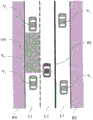
图3A是示出表示本发明的实施方式的3车道道路中的车道变更的场景的俯视图和对本发明的车辆的行驶控制装置的第一实施方式的横向速度控制进行说明的图表的图。3A is a diagram showing a plan view showing a lane change scene on a three-lane road according to the embodiment of the present invention and a graph illustrating lateral speed control according to the first embodiment of the vehicle travel control device according to the present invention.
图3B是示出表示本发明的实施方式的4车道道路中的车道变更的场景的俯视图和对本发明的车辆的行驶控制装置的第一实施方式的横向速度控制进行说明的图表的图。3B is a diagram showing a plan view showing a lane change scene on a four-lane road according to the embodiment of the present invention and a graph illustrating lateral speed control according to the first embodiment of the vehicle travel control device according to the present invention.
图3C是示出表示本发明的实施方式的车道变更的场景的俯视图和对在本发明的车辆的行驶控制装置的第一实施方式中将第二次的车道变更前将横向速度暂时设为零的横向速度控制进行说明的图表的图。3C is a plan view showing a scene of a lane change according to an embodiment of the present invention and the lateral velocity is temporarily set to zero before a second lane change in the first embodiment of the vehicle travel control device according to the present invention. A diagram of the diagram illustrating the lateral velocity control.
图3D是示出表示本发明的实施方式的车道变更的场景的俯视图和对本发明的车辆的行驶控制装置的第二实施方式的横向速度控制进行说明的图表的图(之一)。3D is a diagram (part 1 ) showing a plan view showing a scene of a lane change according to the embodiment of the present invention and a graph illustrating lateral speed control according to a second embodiment of the vehicle travel control device according to the present invention.
图3E是示出表示本发明的实施方式的车道变更的场景的俯视图和对本发明的车辆的行驶控制装置的第二实施方式的横向速度控制进行说明的图表的图(之二)。3E is a diagram (part 2 ) showing a plan view showing a scene of a lane change according to the embodiment of the present invention and a graph illustrating lateral speed control according to a second embodiment of the vehicle travel control device according to the present invention.
图3F是示出表示本发明的实施方式的车道变更的场景的俯视图和对本发明的车辆的行驶控制装置的第三实施方式的横向速度控制进行说明的图表的图。3F is a diagram showing a plan view showing a scene of a lane change according to the embodiment of the present invention and a graph illustrating lateral speed control according to a third embodiment of the vehicle travel control device according to the present invention.
图3G是示出表示本发明的实施方式的车道变更的场景的俯视图和对本发明的车辆的行驶控制装置的第四实施方式的横向速度控制进行说明的图表的图。3G is a diagram showing a plan view showing a scene of a lane change according to an embodiment of the present invention and a graph illustrating lateral speed control according to a fourth embodiment of the vehicle travel control device according to the present invention.
图3H是示出对本发明的车辆的行驶控制装置的第五实施方式的横向速度控制进行说明的图表的图。3H is a diagram showing a graph for explaining lateral speed control in a fifth embodiment of the vehicle travel control device according to the present invention.
图4是对本发明的实施方式的横向速度进行说明的俯视图。Fig. 4 is a plan view illustrating lateral velocity in the embodiment of the present invention.
图5A是表示本发明的实施方式的车辆的行驶控制装置的自动车道变更控制处理的流程图(之一)。5A is a flowchart (Part 1) showing automatic lane change control processing by the vehicle travel control device according to the embodiment of the present invention.
图5B是表示本发明的实施方式的车辆的行驶控制装置的自动车道变更控制处理的流程图(之二)。5B is a flowchart (Part 2) showing automatic lane change control processing by the vehicle travel control device according to the embodiment of the present invention.
图5C是表示本发明的实施方式的车辆的行驶控制装置的自动车道变更控制处理的流程图(之三)。5C is a flowchart (Part 3) showing automatic lane change control processing by the vehicle travel control device according to the embodiment of the present invention.
图5D是表示本发明的实施方式的车辆的行驶控制装置的自动车道变更控制处理的流程图(之四)。5D is a flowchart (Part 4) showing automatic lane change control processing by the vehicle travel control device according to the embodiment of the present invention.
图5E是表示本发明的实施方式的车辆的行驶控制装置的自动车道变更控制处理的流程图(之五)。5E is a flowchart (Part 5) showing automatic lane change control processing by the vehicle travel control device according to the embodiment of the present invention.
图6A是用于对本发明的实施方式的车辆的行驶控制装置的对象范围的检测方法进行说明的俯视图(之一)。6A is a plan view (part 1) for explaining a detection method of a target range of the vehicle travel control device according to the embodiment of the present invention.
图6B是用于对本发明的实施方式的车辆的行驶控制装置的对象范围的检测方法进行说明的俯视图(之二)。6B is a plan view (Part 2) for explaining a detection method of a target range of the vehicle travel control device according to the embodiment of the present invention.
图6C是用于对本发明的实施方式的车辆的行驶控制装置的对象范围的检测方法进行说明的俯视图(之三)。6C is a plan view (Part 3 ) for explaining the detection method of the target range of the vehicle travel control device according to the embodiment of the present invention.
图6D是用于对本发明的实施方式的车辆的行驶控制装置的对象范围的检测方法进行说明的俯视图(之四)。6D is a plan view (Part 4 ) for explaining the detection method of the target range of the vehicle travel control device according to the embodiment of the present invention.
图6E是用于对本发明的实施方式的车辆的行驶控制装置的对象范围的检测方法进行说明的俯视图(之五)。6E is a plan view (No. 5 ) for explaining the detection method of the target range of the vehicle travel control device according to the embodiment of the present invention.
图6F是用于对本发明的实施方式的车辆的行驶控制装置的对象范围的检测方法进行说明的俯视图(之六)。6F is a plan view (sixth) for explaining a detection method of a target range of the vehicle travel control device according to the embodiment of the present invention.
图7是用于对本发明的实施方式的车辆的行驶控制装置的车道变更的目标位置的设定方法进行说明的俯视图。7 is a plan view for explaining a method of setting a target position for a lane change in the vehicle travel control device according to the embodiment of the present invention.
图8A是用于对预测本发明的实施方式的车辆的行驶控制装置的所需时间后的其它车辆的位置的方法进行说明的俯视图(之一)。8A is a plan view (part 1) for explaining a method of predicting the position of another vehicle after a required time of the travel control device for a vehicle according to the embodiment of the present invention.
图8B是用于对预测本发明的实施方式的车辆的行驶控制装置的所需时间后的其它车辆的位置的方法进行说明的俯视图(之二)。8B is a plan view (Part 2 ) for explaining a method of predicting the position of another vehicle after a required time of the travel control device for a vehicle according to the embodiment of the present invention.
图9A是用于对判断本发明的实施方式的车辆的行驶控制装置的车道变更的可否的方法进行说明的俯视图(之一)。9A is a plan view (Part 1) for explaining a method of judging whether or not a lane change is possible by the vehicle travel control device according to the embodiment of the present invention.
图9B是用于对判断本发明的实施方式的车辆的行驶控制装置的车道变更的可否的方法进行说明的俯视图(之二)。9B is a plan view (Part 2 ) for explaining a method of judging whether or not a lane change is possible by the vehicle travel control device according to the embodiment of the present invention.
图10是用于对本发明的实施方式的对象车道标记和本车辆的宽度方向上的位置关系进行说明的俯视图。10 is a plan view for explaining the positional relationship between the target lane marking and the host vehicle in the width direction according to the embodiment of the present invention.
具体实施方式Detailed ways
图1是表示本实施方式的车辆的行驶控制装置1的结构的框图。本实施方式的车辆的行驶控制装置1也是实施本发明的车辆的行驶控制方法的一实施方式。如图1所示,本实施方式的车辆的行驶控制装置1具备传感器11、自车位置检测装置12、地图数据库13、车载设备14、提示装置15、输入装置16、通信装置17、驱动控制装置18以及控制装置19。这些装置为相互进行信息的收发,例如通过CAN(Controller Area Network)其它车载LAN连接。FIG. 1 is a block diagram showing the configuration of a
传感器11检测本车辆的行驶状态。例如,作为传感器11,可举出拍摄本车辆的前方的前方摄像头、拍摄本车辆的后方的后方摄像头、检测本车辆的前方的障碍物的前方雷达、检测本车辆的后方的障碍物的后方雷达、检测存在于本车辆的左右的侧方的障碍物的侧方雷达、检测本车辆的车速的车速传感器、及拍摄司机的车内摄像头等。此外,作为传感器11,可以设为使用上述的多个传感器中的一个的结构,也可以设为将两种以上的传感器组合使用的结构。将传感器11的检测结果以规定时间间隔输出到控制装置19。The sensor 11 detects the running state of the host vehicle. For example, as the sensor 11, a front camera that captures the front of the vehicle, a rear camera that captures the rear of the vehicle, a front radar that detects obstacles in front of the vehicle, and a rear radar that detects obstacles behind the vehicle , a side radar for detecting obstacles existing on the left and right sides of the own vehicle, a vehicle speed sensor for detecting the speed of the own vehicle, and an in-vehicle camera for photographing the driver. In addition, as the sensor 11, one of the above-mentioned plurality of sensors may be used, or a configuration in which two or more sensors are used in combination may be used. The detection results of the sensor 11 are output to the
自车位置检测装置12由GPS单元、陀螺仪传感器及车速传感器等构成,通过GPS单元检测从多个卫星通信发送的电波,周期性获取对象车辆(本车辆)的位置信息,并且基于获取到的对象车辆的位置信息、从陀螺仪传感器获取的角度变化信息、以及从车速传感器获取的车速,检测对象车辆的当前位置。将通过自车位置检测装置12检测到的对象车辆的位置信息以规定时间间隔输出到控制装置19。The vehicle position detection device 12 is composed of a GPS unit, a gyro sensor, a vehicle speed sensor, etc., detects radio waves transmitted from a plurality of satellite communications through the GPS unit, periodically acquires the position information of the target vehicle (own vehicle), and based on the acquired The position information of the target vehicle, the angle change information acquired from the gyro sensor, and the vehicle speed acquired from the vehicle speed sensor detect the current position of the target vehicle. The position information of the target vehicle detected by the vehicle position detection device 12 is output to the
地图数据库13存储包括各种设施或特定的地点的位置信息的地图信息。具体而言,将合流地点、分支地点、收费站、车道数的减少位置、服务区(SA)/停车区(PA)等位置信息与地图信息一起存储。另外,在地图信息中包括道路类别、道路宽度、车道数、道路半径、左转右转专用车道的有无和该专用车道的数及限制速度等与道路有关的信息。能够通过控制装置19参照存储于地图数据库的地图信息。The map database 13 stores map information including positional information of various facilities or specific spots. Specifically, positional information such as merging points, branching points, tollbooths, reduction positions of the number of lanes, and service areas (SA)/parking areas (PA) are stored together with map information. In addition, the map information includes road-related information such as road type, road width, number of lanes, road radius, presence or absence of a left-turn and right-turn special lane, the number of the special lane, and speed limit. The map information stored in the map database can be referred to by the
车载设备14是搭载于车辆的各种设备,通过由司机操作而动作。作为这样的车载设备,可举出转向装置、加速踏板、制动踏板、导航装置、音响装置、空调、免提开关、电动窗、雨刷、灯、方向指示器、喇叭、特定的开关等。在由司机操作车载设备14的情况下,将其信息输出到控制装置19。The in-vehicle device 14 is various devices mounted on the vehicle, and is operated by the driver. Examples of such in-vehicle devices include steering devices, accelerator pedals, brake pedals, navigation devices, audio devices, air conditioners, hands-free switches, power windows, wipers, lights, direction indicators, horns, specific switches, and the like. When the vehicle-mounted device 14 is operated by the driver, the information is output to the
提示装置15是例如导航装置具备的显示器、组装于后视镜的显示器、组装于仪表部的显示器、在挡风玻璃上放映的平视显示器、音响装置具备的扬声器及埋设有振动体的座椅装置等装置。提示装置15根据控制装置19的控制,将后述的提示信息及车道变更信息报知给司机。The presentation device 15 is, for example, a display included in a navigation device, a display incorporated in a rearview mirror, a display incorporated in an instrument section, a head-up display projected on a windshield, a speaker included in an audio device, and a seat device in which a vibrating body is embedded. and other devices. The notification device 15 notifies the driver of the notification information and the lane change information which will be described later under the control of the
输入装置16是例如通过司机的手动操作能够输入的拨盘开关、配置于显示器画面上的触摸面板、或通过司机的语音能够输入的麦克风等装置。在本实施方式中,司机通过操作输入装置16,能够输入针对于由提示装置15提示的提示信息的响应信息。例如,也能够设为如下结构:在本实施方式中,也能够将方向指示器或其它车载设备14的开关用作输入装置16,针对控制装置19是否自动进行车道变更的查询,司机通过打开方向指示器的开关,输入车道变更的同意或允许。此外,将通过输入装置16输入的响应信息输出到控制装置19。The input device 16 is, for example, a device such as a dial switch capable of input through manual operation by the driver, a touch panel disposed on the display screen, or a microphone capable of input through the voice of the driver. In the present embodiment, the driver can input response information to the presentation information presented by the presentation device 15 by operating the input device 16 . For example, it can also be configured as follows: in this embodiment, the switch of the direction indicator or other vehicle-mounted equipment 14 can also be used as the input device 16, and for the query of whether the
通信装置17与本车辆的外部的通信设备进行通信。例如,通信装置17通过在和其它车辆之间进行车车间通信、在和设置于路肩的设备之间进行路车间通信、或在和设置于车辆的外部的信息服务器之间进行无线通信,能够从外部设备获取各种信息。此外,将通过通信装置17获取的信息输出到控制装置19。The communication device 17 communicates with an external communication device of the own vehicle. For example, the communication device 17 can communicate from vehicle to vehicle by performing vehicle-to-vehicle communication with other vehicles, performing road-to-vehicle communication with equipment installed on the road shoulder, or performing wireless communication with an information server installed outside the vehicle. The external device acquires various information. In addition, the information acquired by the communication device 17 is output to the
驱动控制装置18控制本车辆的行驶。例如,驱动控制装置18在本车辆追随先行车辆进行行驶控制的情况下,控制用于实现加减速度及车速的驱动机构的动作(包括发动机汽车中的内燃机的动作、电动汽车系统中的行驶用电动机的动作,也包括混合动力汽车中的内燃机和行驶用电动机的扭矩分配)及制动动作,使得本车辆和先行车辆的车间距离为恒定距离。另外,检测本车辆行驶的车道(以下,也称为本车道。)的车道标记,在进行控制本车辆的宽度方向上的行驶位置的车道保持控制,以使本车辆在本车道内行驶的情况、本车辆进行先行车辆的超车或行驶方向的变更等自动车道变更控制的情况、进行在交叉点等右转或左转的行驶控制的情况下,除了用于实现加减速度及车速的驱动机构的动作以及制动动作,还控制转向执行器的动作,由此,执行本车辆的转向控制。此外,驱动控制装置18根据后述的控制装置19的指示控制本车辆的行驶。另外,也能够将其它周知的方法用作基于驱动控制装置18的行驶控制方法。The drive control device 18 controls running of the host vehicle. For example, the drive control device 18 controls the operation of the drive mechanism for realizing acceleration, deceleration and vehicle speed (including the operation of the internal combustion engine in the engine vehicle and the operation of the electric vehicle system in the electric vehicle system) when the host vehicle follows the preceding vehicle and performs travel control. The operation of the electric motor, including the torque distribution of the internal combustion engine and the electric motor for running in the hybrid vehicle) and the braking operation, make the inter-vehicle distance between the host vehicle and the preceding vehicle a constant distance. In addition, when the lane markings of the lane in which the own vehicle is running (hereinafter also referred to as the own lane) are detected, and the lane keeping control is performed to control the traveling position of the own vehicle in the width direction so that the own vehicle travels in the own lane , When the vehicle performs automatic lane change control such as overtaking of the preceding vehicle or changing the direction of travel, and when performing driving control such as right-turning or left-turning at intersections, etc. and braking actions, and also controls the action of the steering actuator, thereby performing steering control of the own vehicle. In addition, the drive control device 18 controls the travel of the host vehicle in accordance with instructions from the
控制装置19由存储用于控制本车辆的行驶的程序的ROM(Read Only Memory)、执行存储于该ROM的程序的CPU(Central Processing Unit)、以及作为能够访问的存储装置发挥作用的RAM(Random Access Memory)构成。此外,作为动作电路,能够取代CPU(CentralProcessing Unit),或与其一起使用MPU(Micro Processing Unit)、DSP(Digital SignalProcessor)、ASIC(Application Specific Integrated Circuit)、FPGA(FieldProgrammable Gate Array)等。The
控制装置19通过由CPU执行存储于ROM的程序来实现获取与本车辆的行驶状态有关的信息的行驶信息获取功能、判定本车辆的行驶场景的行驶场景判定功能、控制本车辆的行驶的行驶控制功能、自动判断车道变更的可否并控制车道变更的自动车道变更控制功能、将与基于自动车道变更控制的本车辆的行驶动作有关的车道变更信息提示给司机的车道变更信息提示功能、以及针对提示的车道变更信息确认司机是否同意该车道变更的同意确认功能。以下,对控制装置19具备的各功能进行说明。The
控制装置19的行驶信息获取功能是获取与本车辆的行驶状态有关的行驶信息的功能。例如,控制装置19通过行驶信息获取功能获取由传感器11所包括的前方摄像头及后方摄像头拍摄的车辆外部的图像信息或前方雷达、后方雷达及侧方雷达形成的检测结果作为行驶信息。另外,控制装置19通过行驶信息获取功能还获取由传感器11所包括的车速传感器检测到的本车辆的车速信息或由车内摄像头拍摄的司机的面部的图像信息作为行驶信息。The travel information acquisition function of the
而且,控制装置19通过行驶信息获取功能从自车位置检测装置12获取本车辆的当前位置的信息作为行驶信息。另外,控制装置19通过行驶信息获取功能从地图数据库13获取合流地点、分支地点、收费站、车道数的减少位置、服务区(SA)/停车区(PA)等位置信息作为行驶信息。而且,控制装置19通过行驶信息获取功能从地图数据库13还获取道路类别、道路宽度、车道数、道路半径、左转右转专用车道的有无和该专用车道的的数量及限制速度等信息作为行驶信息。此外,控制装置19通过行驶信息获取功能从车载设备14获取基于司机的车载设备14的操作信息,例如雨刷的间歇速度等作为行驶信息。Furthermore, the
控制装置19的行驶场景判定功能是参照存储于控制装置19的ROM的表,判定本车辆行驶的行驶场景的功能。图2是表示表的一例的图。如图2所示,在表中,针对每个行驶场景存储适于车道变更的行驶场景和其判定条件。控制装置19通过行驶场景判定功能,参照图2所示的表,判定本车辆的行驶场景是否是适于车道变更的行驶场景。The running scene determination function of the
例如,在图2所示的例子中,设定“在前方存在先行车辆”、“先行车辆的车速<本车辆的设定车速”、“在规定时间以内到达先行车辆”、及“车道变更的方向不是车道变更禁止条件”这四个条件作为“向先行车辆的追赶场景”的判定条件。控制装置19通过行驶场景判定功能,基于例如传感器11所包括的前方摄像头或前方雷达形成的检测结果、由车速传感器检测到的本车辆的车速、及自车位置检测装置12形成的本车辆的位置信息等,判断本车辆是否满足上述条件,在满足上述条件的情况下,判定为本车辆是“向先行车辆的追赶场景”。同样地,控制装置19通过行驶场景判定功能,对登记到图2所示的场景判定表的所有行驶场景判定是否满足判定条件。For example, in the example shown in FIG. 2 , "there is a preceding vehicle in front", "the speed of the preceding vehicle < the set speed of the own vehicle", "arriving at the preceding vehicle within a predetermined time", and "time for lane change" are set. The four conditions that the direction is not a lane change prohibition condition" are used as the determination conditions of the "chasing scene to the preceding vehicle". The
此外,作为车道变更禁止条件,例如,可举出“在车道变更禁止区域行驶”、“在车道变更方向上存在障碍物”、“每次跨越中心线(道路中央线)”及“进入路肩或跨越道路端”等。另外,在“紧急退避场景”中允许路肩等中的紧急停车的道路中,在“紧急退避场景”中,也能够容许“进入路肩或跨越道路端”等条件。此外,后述图2所示的表中的车道变更的必要度、限制时间及车道变更的方向。In addition, as the lane change prohibition conditions, for example, "traveling in the lane change prohibition area", "there is an obstacle in the lane change direction", "every time the center line (road center line) is crossed", and "entering the shoulder or crossing the end of the road", etc. In addition, in the "emergency evacuation scene", conditions such as "entering the shoulder or crossing the road edge" can also be allowed in the "emergency evacuation scene" on a road where emergency parking on the shoulder or the like is allowed. In addition, the degree of necessity of lane change, the time limit, and the direction of lane change in the table shown in FIG. 2 will be described later.
另外,在本车辆的行驶场景符合多个行驶场景的情况下,控制装置19通过行驶场景判定功能将车道变更的必要度高的一方的行驶场景判定为本车辆的行驶场景。例如,在图2所示的表中,设为:本车辆的行驶场景符合“先行车辆的超车场景”及“向目的地的车道改换场景”,“先行车辆的超车场景”中的车道变更的必要度X1比“向目的地的车道改换场景”中的车道变更的必要度X8低(X1<X8)。在该情况下,控制装置19通过行驶场景判定功能将车道变更的必要度较高的“向目的地的车道改换场景”判定为本车辆的行驶场景。此外,“向目的地的车道改换场景”是指在具有多个车道的道路的分支地点或出口的跟前等为了从当前本车辆行驶的车道向作为目的的分支方向或出口方向的车道改换而进行车道变更的场景。Also, when the driving scene of the own vehicle corresponds to a plurality of driving scenes, the
控制装置19的行驶控制功能是控制本车辆的行驶的功能。例如,控制装置19通过行驶控制功能,基于传感器11的检测结果,检测本车辆行驶的本车道的车道标记,进行控制本车辆的宽度方向上的行驶位置的车道保持控制,以使本车辆在本车道内行驶。在该情况下,控制装置19通过行驶控制功能使驱动控制装置18控制转向执行器等的动作,以使本车辆在适当的行驶位置行驶。另外,控制装置19还能够通过行驶控制功能与先行车辆隔开恒定的车间距离,进行自动追随先行车辆的追随行驶控制。在进行该追随行驶控制的情况下,控制装置19通过行驶控制功能向驱动控制装置18输出控制信号,控制发动机或制动器等驱动机构的动作,以使本车辆和先行车辆以恒定的车间距离行驶。此外,以下,包括车道保持控制、追随行驶控制、右左转行驶控制、自动车道变更控制作为自动行驶控制进行说明。The running control function of the
控制装置19的自动车道变更控制功能是基于本车辆的行驶场景或存在于本车辆的周边的障碍物的信息来判断是否进行车道变更的功能。另外,自动车道变更控制功能也是在判断为进行车道变更的情况下使驱动控制装置18控制发动机或制动器等驱动机构的动作及转向执行器的动作的功能。而且,自动车道变更控制功能也是基于本车辆的行驶状态或司机的状态来设定开始自动车道变更控制的开始定时并根据设定的开始定时来执行自动车道变更控制的功能。The automatic lane change control function of the
在自动车道变更控制功能中包括从本车道连续向相同方向进行2车道以上的车道变更的功能和在该连续进行2车道以上的车道变更时控制车辆的横向速度的功能。在连续向相同方向进行2车道以上的车道变更的情况下,在各车道变更开始前由传感器11等确认周围的状况,但根据开始第二次以后的车道变更之前的时间经过,周围的状况可能变化。在本实施方式中,即使在周围的状况变化的情况下,为了能够连续向相同方向进行2车道以上的车道变更,控制横向速度,使得第二次以后的自动车道变更控制的横向速度比第一次的自动车道变更控制的横向速度慢。在此,车辆的横向速度是相对于与以车辆的行驶方向为基准的轴垂直的轴的移动速度。即,在车辆在行驶车道行驶的情况下,向该行驶车道的宽度方向的移动速度为车辆的横向速度。The automatic lane change control function includes a function of continuously changing lanes of two or more lanes in the same direction from the own lane and a function of controlling the lateral speed of the vehicle during the continuous lane changes of two or more lanes. In the case of continuous lane changes of two or more lanes in the same direction, the surrounding conditions are confirmed by sensors 11 etc. before starting each lane change, but the surrounding conditions may Variety. In this embodiment, even when the surrounding conditions change, in order to continuously perform lane changes of two or more lanes in the same direction, the lateral speed is controlled so that the lateral speed of the second and subsequent automatic lane change control is faster than that of the first automatic lane change control. The lateral speed of the second automatic lane change control is slow. Here, the lateral speed of the vehicle is a moving speed with respect to an axis perpendicular to an axis based on the traveling direction of the vehicle. That is, when the vehicle is traveling on the driving lane, the moving speed in the width direction of the driving lane is the lateral speed of the vehicle.
以下,对本发明的第一实施方式的横向速度控制进行说明。图3A是表示本发明的实施方式的连续车道变更时的横向速度控制的图,示出表示本车辆V0的车道变更时的行驶场景的俯视图和对车道变更时的本车辆V0的横向位置和横向速度进行说明的图表。图3A的俯视图是表示如下自动车道变更控制的例子的俯视图:在左侧通行的单侧3车道L1、L2、L3的道路中,因为在前方存在道路的分支地点,所以执行从本车辆V0行驶中的车道L1经由相邻车道L2连续到相邻车道的相邻车道L3的车道变更。此外,虽省略图示,但在本车辆V0在最右端的车道L3行驶中,自前方左侧存在自动车专用道路的出口,向该出口变更行驶方向的情况下,需要从当前的车道L3经由车道L2向最左端的车道L1连续进行车道变更,但对这样的情况也执行相同的控制。Hereinafter, lateral velocity control in the first embodiment of the present invention will be described. 3A is a diagram illustrating lateral speed control during continuous lane changes according to an embodiment of the present invention, showing a plan view showing the driving scene of the host vehicle V 0 when changing lanes and the lateral position of the host vehicle V 0 when changing lanes and lateral velocity diagrams. The top view of FIG. 3A is a top view showing an example of automatic lane change control: on a road with three lanes L1, L2, and L3 that pass on the left side, since there is a branch point of the road ahead, the automatic lane change control is executed from the own vehicle V 0 The lane change of the running lane L1 continues to the adjacent lane L3 of the adjacent lane via the adjacent lane L2. In addition, although not shown in the figure, when the host vehicle V0 is traveling in the rightmost lane L3, there is an exit of the vehicle-only road from the front left. The lane change is performed continuously to the leftmost lane L1 via the lane L2, but the same control is executed even in such a case.
如图3A的图表所示,控制装置19通过自动车道变更控制功能在本车道L1内将本车辆V0的横向速度Vh(m/s)加速到预先设定的第一横向速度Vh1,在维持该第一横向速度Vh1的状态下从本车道L1变更到相邻车道L2。接着,控制装置19通过自动车道变更控制功能在相邻车道L2内将本车辆V0的横向速度Vh减速到预先设定的第二横向速度Vh2,在维持该第二横向速度Vh2的状态下从相邻车道L2变更到相邻车道的相邻车道L3。第一横向速度Vh1和第二横向速度Vh2的关系为Vh1>Vh2。As shown in the graph of FIG. 3A, the
此外,本车辆V0进行车道变更时的横向速度是本车辆V0横穿配置于车道间的车道标记(以下,也称为对象车道标记)CL时的横向速度。另外,本车辆V0横穿对象车道标记CL时是指,例如如图4的(A)、(B)所示,在从左侧的车道L1向右侧的车道L2进行车道变更的情况下,从本车辆V0的右侧前轮踩到对象车道标记CL到左侧后轮越过对象车道标记CL。Note that the lateral velocity when the host vehicle V0 changes lanes is the lateral velocity when the host vehicle V0 crosses a lane marking (hereinafter, also referred to as a target lane marking) CL arranged between lanes. In addition, when the host vehicle V0 crosses the target lane marking CL, for example, as shown in (A) and (B) of FIG. , from when the right front wheel of the host vehicle V 0 steps on the target lane marking CL to when the left rear wheel crosses the target lane marking CL.
根据基于本实施方式的自动车道变更控制功能的横向速度控制,因为使本车辆V0在相邻车道L2和相邻车道的相邻车道L3之间进行第二次的自动车道变更控制时的第二横向速度Vh2比本车辆V0在本车道L1和相邻车道L2之间进行第一次的自动车道变更控制时的第一横向速度Vh1慢,所以第二次的自动车道变更控制与第一次的自动车道变更控制相比,以较低的速度进行。因此,因为用于在开始第二次以后的自动车道变更控制之前由传感器11等确认周围的状况的时间变长,所以能够适当地确认周围的状况。另外,通过以比第一次的自动车道变更控制低的速度进行第二次的自动车道变更控制,后续车辆确认本车辆V0的车道变更的时间变长,因此,后续车辆的司机容易辨识本车辆V0的车道变更。因此,自动车道变更控制的安全性进一步提高。According to the lateral speed control based on the automatic lane change control function of the present embodiment, since the second automatic lane change control is performed between the adjacent lane L2 and the adjacent lane L3 of the adjacent lane V0 , the host vehicle V0 The second lateral velocity Vh2 is slower than the first lateral velocity Vh1 when the vehicle V0 performs the first automatic lane change control between the own lane L1 and the adjacent lane L2, so the second automatic lane change control is the same as the first This is done at a lower speed than the subsequent automatic lane change control. Therefore, since the time for checking the surrounding conditions by the sensor 11 or the like becomes longer before starting the automatic lane change control for the second time or later, it is possible to appropriately check the surrounding conditions. In addition, by performing the second automatic lane change control at a lower speed than the first automatic lane change control, the time for the subsequent vehicle to confirm the lane change of the host vehicle V0 becomes longer, so the driver of the subsequent vehicle can easily recognize the host vehicle V0. Lane change for vehicle V 0 . As a result, the safety of the automatic lane change control is further increased.
此外,在单侧3车道以上的道路中进行连续的两次以上的自动车道变更控制的情况下,控制装置19也通过自动车道变更控制功能进行相同的横向速度控制。例如,在左侧通行的单侧4车道的道路中连续进行三次自动车道变更控制的情况下,与上述相同地,将第一次的自动车道变更控制的横向速度设定为第一横向速度Vh1,将第二次及第三次的自动车道变更控制的横向速度设定为比第一横向速度Vh1慢的第二横向速度Vh2。即,在将比第一次车道变更靠后的车道变更设为第(n+1)次的车道变更(n为自然数)的情况下,将第(n+1)次的自动车道变更控制的横向速度和第(n+2)次的自动车道变更控制的横向速度相同。由此,在第二次以后的车道变更中也能够适当地确认周围的状况,使后续车辆明确地识别本车辆V0的车道变更。Also, when two or more consecutive automatic lane change controls are performed on a road with three or more lanes on one side, the
另外,也可以与上述不同地,将第(n+2)次的自动车道变更控制的横向速度设定为比第(n+1)次的自动车道变更控制的横向速度慢。具体而言,如图3B所示,在左侧通行的单侧4车道L1~L4的道路中,在从左端的车道L1到右端的车道L4连续进行三次自动车道变更控制的情况下,将从车道L1向车道L2的第一次的自动车道变更控制的横向速度设为第一横向速度Vh1。接着,将从车道L2向车道L3的第二次的自动车道变更控制的横向速度设为比第一横向速度Vh1慢的第二横向速度Vh2,将从车道L3向车道L4的第三次的自动车道变更控制的横向速度设为比第二横向速度Vh2慢的第三横向速度Vh3。据此,因为每次重复车道变更的次数,都以低速进行自动车道变更控制,所以在第二次以后的车道变更中也能够适当地确认周围的状况,使后续车辆明确地识别本车辆V0的车道变更。Also, unlike the above, the lateral speed of the (n+2)th automatic lane change control may be set slower than the lateral speed of the (n+1)th automatic lane change control. Specifically, as shown in FIG. 3B , in a road with four lanes L1 to L4 on one side with left-hand traffic, when the automatic lane change control is continuously performed three times from the left end lane L1 to the right end lane L4, the The lateral speed of the first automatic lane change control from lane L1 to lane L2 is set to first lateral speed Vh1 . Next, the lateral speed of the second automatic lane change control from lane L2 to lane L3 is set to a second lateral speed Vh2 slower than the first lateral speed Vh1, and the third automatic lane change control from lane L3 to lane L4 is set to a second lateral speed Vh2 slower than the first lateral speed Vh1. The lateral speed of the lane change control is set to a third lateral speed Vh3 that is slower than the second lateral speed Vh2. Accordingly, since the automatic lane change control is performed at a low speed every time the lane change is repeated, the surrounding conditions can be appropriately confirmed even in the second and subsequent lane changes, and the subsequent vehicle can clearly recognize the host vehicle V. lane change.
另外,在图3A所示的横向速度控制中,在车道L2内将本车辆V0的横向速度Vh从第一横向速度Vh1减速到第二横向速度Vh2,但如图3C所示,也可以在车道L2内将第一横向速度Vh1暂时设为零进行车道保持控制,在车道L2内加速到第二横向速度Vh2进行第二次的自动车道变更控制。在这样控制横向速度的情况下,也能够在第二次以后的车道变更中适当地确认周围的状况,使后续车辆明确地识别本车辆V0的车道变更。In addition, in the lateral speed control shown in FIG. 3A, the lateral speed Vh of the host vehicle V0 is decelerated from the first lateral speed Vh1 to the second lateral speed Vh2 in the lane L2, but as shown in FIG. In the lane L2, the first lateral velocity Vh1 is temporarily set to zero for lane keeping control, and in the lane L2 the vehicle accelerates to the second lateral velocity Vh2 for the second automatic lane change control. Even when the lateral speed is controlled in this way, it is possible to properly check the surrounding situation in the second and subsequent lane changes, and make the following vehicle clearly recognize the lane change of the host vehicle V0 .
在上述的第一实施方式的横向速度控制中,在第二次以后的自动车道变更控制的横向速度中使用预先设定的第二横向速度Vh2、第三横向速度Vh3等,但也可以根据行驶信息来设定第二次以后的自动车道变更控制的横向速度。以下,基于通过控制装置19的行驶信息获取功能获取的行驶信息,对设定第二次以后的横向速度的第二~第五实施方式进行说明。In the lateral speed control of the first embodiment described above, the preset second lateral speed Vh2, third lateral speed Vh3, etc. are used as the lateral speeds of the automatic lane change control after the second time. Information to set the lateral speed of the automatic lane change control after the second time. Hereinafter, the second to fifth embodiments in which the lateral velocity is set for the second time and later will be described based on the travel information acquired by the travel information acquisition function of the
图3D及图3E表示本发明的第二实施方式的横向速度控制。在该实施方式中,控制装置19通过自动车道变更控制功能,根据车道变更的方向,设定第二次以后的自动车道变更控制的横向速度。即,在从平均行驶速度慢的车道向平均行驶速度快的车道进行车道变更的情况下,因为后续车辆相对于本车辆V0的相对速度快而本车辆V0和后续车辆的车间距离变近,所以本车辆V0为了第二次以后的车道变更而确认周围的状况的时间变短。为了解决这个问题,在本实施方式中,在从平均行驶速度慢的车道向平均行驶速度快的车道进行车道变更的情况下,设定横向速度,使得以较低速进行第二次以后的自动车道变更控制。3D and 3E show lateral speed control in the second embodiment of the present invention. In this embodiment, the
控制装置19通过自动车道变更控制功能,基于行驶信息,判定本车辆V0行驶的本车道的平均行驶速度是否比车道变更目标的车道的平均行驶速度宽。本车道的平均行驶速度可以应用本车辆V0的行驶速度,或者也可以基于由本车辆V0的后方摄像头拍摄的车辆外部的图像信息或后方雷达形成的检测结果来检测。另外,车道变更目标的车道的平均行驶速度也可以基于由本车辆V0的后方摄像头拍摄的车辆外部的图像信息或后方雷达形成的检测结果来检测。The
另外,也可以是,从地图信息获取与本车道的车道位置有关的信息和与车道变更目标的车道的车道位置有关的信息作为行驶信息,基于获取到的与车道位置有关的信息,判定本车道的平均行驶速度是否比车道变更目标的车道的平均行驶速度快。例如,在单侧2车道以上的道路中,有时根据其车道位置而平均行驶速度不同,在日本国内的道路中,相对于左端的行驶车道,右端的超车车道的平均行驶速度更快。因此,参照与车道位置有关的信息,能够判定本车道的平均行驶速度是否比车道变更目标的车道的平均行驶速度快。此外,因为行驶车道及超车车道的车道位置根据国家或地域、右侧通行或者左侧通行的不同、交通规则等而不同,所以期望根据车辆行驶的道路来判定。In addition, information on the lane position of the own lane and information on the lane position of the lane of the lane change target lane may be acquired from map information as travel information, and the own lane may be determined based on the acquired information on the lane position. Whether the average travel speed of is faster than the average travel speed of the lane of the lane change target. For example, on a road with two or more lanes on one side, the average traveling speed may vary depending on the lane position. On roads in Japan, the average traveling speed of the passing lane on the right end is faster than that of the passing lane on the left end. Therefore, by referring to the information on the lane position, it can be determined whether the average traveling speed of the own lane is faster than the average traveling speed of the lane of the lane change target. In addition, since the lane positions of the driving lane and the passing lane differ depending on the country or region, right-hand traffic or left-hand traffic, traffic regulations, etc., it is desirable to determine them based on the road on which the vehicle is traveling.
接着,车道变更目标的车道的平均行驶速度比本车道的平均行驶速度快的情况与车道变更目标的车道的平均行驶速度比本车道的平均行驶速度慢的情况相比,控制装置19通过自动车道变更控制功能将在第二次以后的自动车道变更控制中设定的横向速度设定为较慢。即,在从平均行驶速度慢的车道向快的车道进行车道变更的情况下,控制装置19通过自动车道变更控制功能以较低的速度进行第二次以后的自动车道变更控制。Next, when the average traveling speed of the lane of the lane change target is faster than the average traveling speed of the own lane, the
图3D的俯视图所示的行驶场景表示从右端的超车车道L3向左端的行驶车道L1进行连续的两次自动车道变更控制的情况。例如,在根据行驶信息求出的车道L1、L2、L3的平均行驶速度分别为80km/h、90km/h、100km/h的情况下,判定为本车辆V0行驶的本车道L3的平均行驶速度比车道变更目标的车道L1的平均行驶速度快。此外,该判定结果即使基于车道L1和车道L3的车道位置来判定也是相同的。这样的行驶场景是从平均行驶速度快的车道向平均行驶速度慢的车道的车道变更。因此,由于车道变更而后续车辆相对于本车辆V0的相对速度不加速,因此,如图3D的图表所示,控制装置19通过自动车道变更控制功能在第一次的自动车道变更控制中设定预先设定的第一横向速度Vh1并执行,在第二次的自动车道变更控制中设定预先设定的第二横向速度Vh2并执行。The driving scene shown in the top view of FIG. 3D shows a situation in which two consecutive automatic lane change controls are performed from the passing lane L3 at the right end to the driving lane L1 at the left end. For example, when the average running speeds of the lanes L1, L2, and L3 obtained from the running information are 80 km/h, 90 km/h, and 100 km/h, respectively, it is determined that the average running speed of the own lane L3 that the own vehicle V 0 travels is The speed is faster than the average traveling speed of the lane L1 of the lane change target. In addition, the determination result is the same even if it is determined based on the lane positions of the lane L1 and the lane L3. Such a traveling scene is a lane change from a lane with a fast average traveling speed to a lane with a slow average traveling speed. Therefore, the relative speed of the subsequent vehicle relative to the own vehicle V0 does not accelerate due to the lane change, and therefore, as shown in the graph of FIG. 3D , the
与此相对,图3E的俯视图所示的行驶场景表示从左端的行驶车道L1向右端的超车车道L3进行连续的两次自动车道变更控制的情况。例如,在根据行驶信息求出的车道L1、L2、L3的平均行驶速度与图3D相同地分别为80km/h、90km/h、100km/h的情况下,判定为本车辆V0行驶的本车道L1的平均行驶速度比车道变更目标的车道L3的平均行驶速度慢。此外,该判定结果即使基于车道L1和车道L3的车道位置来判定也是相同的。这样的行驶场景是从平均行驶速度慢的车道向平均行驶速度快的车道的车道变更。因此,如图3E的图表所示,控制装置19通过自动车道变更控制功能在第一次的自动车道变更控制中设定预先设定的第一横向速度Vh1并执行,在第二次的自动车道变更控制中设定比第二横向速度Vh2慢的第四横向速度Vh4并执行。On the other hand, the driving scene shown in the top view of FIG. 3E shows a case where two consecutive automatic lane change controls are performed from the driving lane L1 at the left end to the passing lane L3 at the right end. For example, when the average running speeds of the lanes L1, L2, and L3 obtained from the running information are 80 km/h, 90 km/h, and 100 km/h, respectively, as in FIG . The average traveling speed of the lane L1 is slower than the average traveling speed of the lane L3 of the lane change target. In addition, the determination result is the same even if it is determined based on the lane positions of the lane L1 and the lane L3. Such a traveling scene is a lane change from a lane with a slow average traveling speed to a lane with a fast average traveling speed. Therefore, as shown in the graph of FIG. 3E , the
此外,第一横向速度Vh1、第二横向速度Vh2、第四横向速度Vh4的关系为Vh1>Vh2>Vh4。另外,通过控制装置19的自动车道变更控制功能,使用下述式(a)计算第四横向速度Vh4。下述式(a)的C1是用于第四横向速度Vh4的计算的系数,使用1以下的数值。另外,也可以是,本车道和车道变更目标的车道的速度差越大,系数C1越小。In addition, the relationship among the first lateral velocity Vh1, the second lateral velocity Vh2, and the fourth lateral velocity Vh4 is Vh1>Vh2>Vh4. In addition, the fourth lateral velocity Vh4 is calculated by the automatic lane change control function of the
Vh4=Vh2×C1···(a)Vh4=Vh2×C1...(a)
这样,在第二次以后的车道变更中,在从平均行驶速度慢的车道向平均行驶速度快的车道移动的情况下,因为进一步减慢第二次以后的自动车道变更控制的横向速度,所以以较低的速度进行第二次以后的自动车道变更控制,用于在开始第二次以后的自动车道变更控制之前由传感器11等确认周围的状况的时间变长。因此,能够适当地确认周围的状况。另外,因为后续车辆确认本车辆V0的车道变更的时间变长,所以容易识别车道变更。因此,自动车道变更控制的安全性进一步提高。另外,本车道和车道变更目标的车道的速度差越大,越减小系数C1,由此,速度差越小,越以较低的速度进行第二次以后的自动车道变更控制,因此能够适当地确认周围的状况,并且使后续车辆明确地识别本车辆V0的车道变更。In this way, in the second and subsequent lane changes, when moving from a lane with a slow average travel speed to a lane with a fast average travel speed, the lateral speed of the automatic lane change control for the second and subsequent times is further reduced. The automatic lane change control after the second time is performed at a low speed, and the time for checking the surrounding conditions by the sensor 11 or the like becomes longer before the automatic lane change control after the second time is started. Therefore, it is possible to appropriately check the surrounding conditions. In addition, since it takes longer for the subsequent vehicle to confirm the lane change of the host vehicle V0 , it becomes easier to recognize the lane change. As a result, the safety of the automatic lane change control is further increased. In addition, the greater the speed difference between the current lane and the lane of the lane change target, the smaller the coefficient C1 is, thus, the smaller the speed difference is, the lower the automatic lane change control after the second time is performed, so it can be appropriately The surrounding conditions can be clearly confirmed, and the following vehicle can clearly recognize the lane change of the host vehicle V0 .
图3F表示本发明的第三实施方式的横向速度控制。在该实施方式中,控制装置19通过自动车道变更控制功能,根据交通拥挤度K,设定第二次以后的自动车道变更控制的横向速度。即,在本车辆V0的周围的交通拥挤度K高的情况下,因为本车辆V0和周围的其它车辆的距离变近,所以本车辆V0为了第二次以后的车道变更而确认周围的状况的时间变短。为了解决这个问题,在本实施方式中,在交通拥挤度K高的情况下,设定横向速度,使得以较低的速度进行第二次以后的自动车道变更控制。Fig. 3F shows the lateral speed control of the third embodiment of the present invention. In this embodiment, the
控制装置19通过自动车道变更控制功能,基于行驶信息,求出交通拥挤度K。交通拥挤度K例如基于和先行车辆V2的车间距离、和后续车辆V3的车间距离、周边车辆的数量、VICS(注册商标)信息所包含的拥挤度、法定速度和本车辆V0的实际的车速的背离度等而求出。和先行车辆V2的车间距离越短、和后续车辆V3的车间距离越短、周边车辆的数量越多、VICS信息所包含的拥挤度越高、或法定速度和本车辆的实际的车速的背离度越大,将交通拥挤度K判断为越高。The
在交通拥挤度K比规定值Kth低的情况下,如图3F的图表所示,控制装置19通过自动车道变更控制功能在第一次的自动车道变更控制中设定预先设定的第一横向速度Vh1并执行,在第二次的自动车道变更控制中设定第二横向速度Vh2并执行。另外,在交通拥挤度K比规定值Kth高的情况下,控制装置19通过自动车道变更控制功能在第一次的自动车道变更控制中设定预先设定的第一横向速度Vh1并执行,在第二次的自动车道变更控制中设定比第二横向速度Vh2慢的第五横向速度Vh5并执行。When the traffic congestion degree K is lower than the predetermined value Kth, as shown in the graph of FIG. 3F , the
此外,第一横向速度Vh1、第二横向速度Vh2、第五横向速度Vh5的关系为Vh1>Vh2>Vh5。另外,通过控制装置19的自动车道变更控制功能,使用下述式(b)计算第五横向速度Vh5。下述式(b)的C2是用于第五横向速度Vh5的计算的系数,使用1以下的数值。另外,也可以是,交通拥挤度K越高,系数C2越小。In addition, the relationship among the first lateral velocity Vh1, the second lateral velocity Vh2, and the fifth lateral velocity Vh5 is Vh1>Vh2>Vh5. In addition, the automatic lane change control function of the
Vh5=Vh2×C2···(b)Vh5=Vh2×C2...(b)
这样,在以交通拥挤度K高的状况进行连续的两次以上的自动车道变更控制的情况下,因为进一步减慢第二次以后的自动车道变更控制的横向速度,所以以较低的速度进行第二次以后的自动车道变更控制,用于在开始第二次以后的车道变更之前确认周围的状况的时间变长。因此,能够适当地确认周围的状况。另外,因为后续车辆确认本车辆V0的车道变更的时间变长,所以容易识别车道变更。因此,自动车道变更控制的安全性进一步提高。另外,交通拥挤度K越高,越减小系数C2,由此,交通拥挤度K越高,越以较低的速度进行第二次以后的自动车道变更控制,因此,能够适当地确认周围的状况,并且使后续车辆明确地识别本车辆V0的车道变更。In this way, in the case where two or more consecutive automatic lane change controls are performed in a situation where the traffic congestion degree K is high, the lateral speed of the automatic lane change control after the second time is further slowed down, so the automatic lane change control is performed at a lower speed. In the automatic lane change control after the second time, the time for checking the surrounding conditions before starting the lane change after the second time becomes longer. Therefore, it is possible to appropriately check the surrounding conditions. In addition, since it takes longer for the subsequent vehicle to confirm the lane change of the host vehicle V0 , it becomes easier to recognize the lane change. As a result, the safety of the automatic lane change control is further increased. In addition, the higher the traffic congestion degree K, the smaller the coefficient C2 is, and thus, the higher the traffic congestion degree K is, the lower the automatic lane change control is performed after the second time, so it is possible to appropriately check the surrounding traffic conditions. situation, and make the following vehicle unambiguously recognize the lane change of the host vehicle V0 .
图3G表示本发明的第四实施方式的横向速度控制。在该实施方式中,控制装置19通过自动车道变更控制功能,根据本车辆V0行驶的行驶道路的半径Lr,设定第二次以后的自动车道变更控制的横向速度。即,在行驶道路的半径Lr小的情况下,因为视线不清,所以本车辆V0难以为了第二次的车道变更而由传感器11等确认周围的状况。为了解决这个问题,在本实施方式中,在行驶道路的半径Lr小的情况下,设定横向速度,使得以较低的速度进行第二次以后的自动车道变更控制。FIG. 3G shows lateral velocity control in a fourth embodiment of the present invention. In this embodiment, the
控制装置19通过自动车道变更控制功能,根据作为行驶信息的地图信息求出行驶道路的半径Lr。此外,求半径Lr的车道可以是本车道,也可以是车道变更目标的车道。在行驶道路的半径Lr大于规定值Lrth的情况下,如图3G的图表所示,控制装置19通过自动车道变更控制功能在第一次的自动车道变更控制中设定预先设定的第一横向速度Vh1并执行,在第二次的自动车道变更控制中设定第二横向速度Vh2并执行。另外,在行驶道路的半径Lr小于规定值Lrth的情况下,控制装置19通过自动车道变更控制功能在第一次的自动车道变更控制中设定预先设定的第一横向速度Vh1并执行,在第二次的自动车道变更控制中设定比第二横向速度Vh2慢的第六横向速度Vh6并执行。The
此外,第一横向速度Vh1、第二横向速度Vh2、第六横向速度Vh6的关系为Vh1>Vh2>Vh6。另外,通过控制装置19的自动车道变更控制功能,使用下述式(c)计算第六横向速度Vh6。下述式(c)的C3是用于第六横向速度Vh6的计算的系数,使用1以下的数值。另外,也可以是,行驶道路的半径Lr越小,系数C3越小。In addition, the relationship among the first lateral velocity Vh1, the second lateral velocity Vh2, and the sixth lateral velocity Vh6 is Vh1>Vh2>Vh6. In addition, the sixth lateral velocity Vh6 is calculated using the following equation (c) by the automatic lane change control function of the
Vh6=Vh2×C3···(c)Vh6=Vh2×C3...(c)
这样,在以行驶道路的半径Lr小的交通状况进行连续的两次以上的车道变更的情况下,因为进一步减慢第二次以后的自动车道变更控制的横向速度,所以以较低的速度进行第二次以后的自动车道变更控制,用于在开始第二次的车道变更之前确认周围的状况的时间变长。因此,能够适当地确认周围的状况。另外,因为后续车辆确认本车辆V0的车道变更的时间变长,所以容易识别车道变更。因此,自动车道变更控制的安全性进一步提高。另外,行驶道路的半径Lr越小,越减小系数C3,由此,行驶道路的半径Lr越小,越以较低的速度进行第二次以后的自动车道变更控制,因此,能够适当地确认周围的状况,并且使后续车辆明确地辨识本车辆V0的车道变更。In this way, in the case of performing two or more consecutive lane changes in a traffic condition with a small radius Lr of the traveling road, the lateral speed of the automatic lane change control after the second time is further slowed down, so it is performed at a lower speed. In the automatic lane change control after the second time, the time for checking the surrounding conditions before starting the second lane change becomes longer. Therefore, it is possible to appropriately check the surrounding conditions. In addition, since it takes longer for the subsequent vehicle to confirm the lane change of the host vehicle V0 , it becomes easier to recognize the lane change. As a result, the safety of the automatic lane change control is further increased. In addition, the smaller the radius Lr of the traveling road is, the smaller the coefficient C3 is. Accordingly, the smaller the radius Lr of the traveling road, the lower the automatic lane change control after the second time is performed. Therefore, it can be properly confirmed that surrounding conditions, and make subsequent vehicles clearly recognize the lane change of the own vehicle V0 .
图3H是表示本发明的第五实施方式的横向速度控制的图表。在该实施方式中,控制装置19通过自动车道变更控制功能,根据雨量Rf,设定第二次以后的自动车道变更控制的横向速度。即,在雨量Rf多的情况下,难以由本车辆V0的传感器11等为了第二次的车道变更而确认周围的状况。为了解决这个问题,在本实施方式中,在雨量Rf多的情况下,设定横向速度,使得以较低的速度进行第二次以后的自动车道变更控制。Fig. 3H is a graph showing lateral speed control in the fifth embodiment of the present invention. In this embodiment, the
控制装置19通过自动车道变更控制功能,根据作为行驶信息的雨刷的间歇速度求出雨量Rf。此外,在本车辆V0具备雨滴传感器的情况下,可以根据雨滴传感器的检测结果获取行驶信息“雨量”,也可以将雨滴传感器的检测结果和雨刷的间歇速度组合来判断“雨量”。在雨量Rf比规定值Rfth多的情况下,如图3H的图表所示,控制装置19通过自动车道变更控制功能在第一次的自动车道变更控制中设定预先设定的第一横向速度Vh1并执行,在第二次的自动车道变更控制中设定第二横向速度Vh2并执行。另外,在雨量Rf比规定值Rfth少的情况下,控制装置19通过自动车道变更控制功能在第一次的自动车道变更控制中设定预先设定的第一横向速度Vh1并执行,在第二次的自动车道变更控制中设定比第二横向速度Vh2慢的第七横向速度Vh7并执行。The
此外,第一横向速度Vh1、第二横向速度Vh2、第七横向速度Vh7的关系为Vh1>Vh2>Vh7。另外,通过控制装置19的自动车道变更控制功能,使用下述式(d)计算第七横向速度Vh7。下述式(d)的C4是用于第七横向速度Vh7的计算的系数,使用1以下的数值。另外,也可以是,雨量Rf越多,系数C4越小。In addition, the relationship among the first lateral velocity Vh1, the second lateral velocity Vh2, and the seventh lateral velocity Vh7 is Vh1>Vh2>Vh7. In addition, the automatic lane change control function of the
Vh7=Vh2×C4···(d)Vh7=Vh2×C4···(d)
这样,在以雨量Rf多的交通状况进行连续的两次以上的车道变更的情况下,因为进一步减慢第二次以后的自动车道变更控制的横向速度,所以以较低的速度进行第二次以后的自动车道变更控制,用于在开始第二次的车道变更之前确认周围的状况的时间变长。因此,能够适当地确认周围的状况。另外,因为后续车辆确认本车辆V0的车道变更的时间变长,所以容易识别车道变更。因此,自动车道变更控制的安全性进一步提高。而且,雨量Rf越多,越减小系数C4,由此,雨量Rf越多,越以较低的速度进行第二次以后的自动车道变更控制,因此,能够适当地确认周围的状况,并且使后续车辆明确地识别本车辆V0的车道变更。In this way, in the case of performing more than two consecutive lane changes in a traffic situation with a lot of rainfall Rf, the second time is performed at a lower speed because the lateral speed of the automatic lane change control after the second time is further slowed down. In the subsequent automatic lane change control, the time required to check the surrounding conditions before starting the second lane change becomes longer. Therefore, it is possible to appropriately check the surrounding conditions. In addition, since it takes longer for the subsequent vehicle to confirm the lane change of the host vehicle V0 , it becomes easier to recognize the lane change. As a result, the safety of the automatic lane change control is further increased. Furthermore, the greater the rainfall Rf is, the smaller the coefficient C4 is, and thus the more the rainfall Rf is, the lower the automatic lane change control after the second time is performed. The following vehicle unambiguously recognizes the lane change of host vehicle V 0 .
此外,第二~第五实施方式可各自单独使用,也可以适当地组合使用。在将第二~第五实施方式组合使用的情况下,例如,如下述式(e)所示,能够将第二横向速度Vh2乘以C1~C4系数求出第二次以后的自动车道变更控制的横向速度。此外,在本车辆V0的行驶状况符合第二~第五实施方式的多个行驶信息的条件的情况下,根据第二横向速度Vh2求出的第二次以后的自动车道变更控制的横向速度变得极慢,在车道变更中花费过多时间。因此,预先对第二次以后的自动车道变更控制的横向速度设定下限值,在算出的横向速度低于下限值的情况下,也可以将下限值设定为第二次以后的自动车道变更控制的横向速度。In addition, the second to fifth embodiments may be used alone or in combination as appropriate. When the second to fifth embodiments are used in combination, for example, as shown in the following formula (e), the second lateral speed Vh2 can be multiplied by the coefficients C1 to C4 to obtain the automatic lane change control after the second time. the lateral speed. In addition, when the running state of the host vehicle V0 meets the conditions of a plurality of driving information in the second to fifth embodiments, the lateral speed of the second and subsequent automatic lane change control calculated from the second lateral speed Vh2 Becomes extremely slow, spending too much time in lane changes. Therefore, the lower limit value is set in advance for the lateral speed of the automatic lane change control after the second time, and when the calculated lateral speed is lower than the lower limit value, the lower limit value may be set to the second time or later. Lateral speed for automatic lane change control.
另外,在第二~第五实施方式的横向速度控制中,在单侧3车道以上的道路中进行连续的两次以上的自动车道变更控制的情况下,与第一实施方式的横向速度控制相同地,可以将第(n+1)次的自动车道变更控制的横向速度和第(n+2)次的车道变更的横向速度设为相同,也可以将第(n+2)次的自动车道变更控制的横向速度设定为比第(n+1)次的自动车道变更控制的横向速度慢。在将第(n+2)次的自动车道变更控制的横向速度设定为比第(n+1)次的自动车道变更控制的横向速度慢的情况下,优选的是,将即将进行的自动车道变更控制的横向速度乘以系数,求出下一次的自动车道变更控制的横向速度。例如,如果以图3E所示的第二实施方式为例,则将为了第二次的自动车道变更控制而求出的第四横向速度乘以系数C1,求出用于第三次的自动车道变更控制的横向速度。In addition, in the lateral speed control of the second to fifth embodiments, when two or more continuous automatic lane change controls are performed on a road with three or more lanes on one side, the same as the lateral speed control of the first embodiment. Therefore, the lateral speed of the (n+1)th automatic lane change control can be set to be the same as the lateral speed of the (n+2)th automatic lane change control, or the (n+2)th automatic lane change control can be set to The lateral speed of the change control is set to be slower than the lateral speed of the (n+1)th automatic lane change control. In the case where the lateral speed of the (n+2)th automatic lane change control is set to be slower than the lateral speed of the (n+1)th automatic lane change control, it is preferable that the upcoming automatic lane change control The lateral speed of the lane change control is multiplied by the coefficient to obtain the lateral speed of the next automatic lane change control. For example, taking the second embodiment shown in FIG. 3E as an example, the fourth lateral speed obtained for the second automatic lane change control is multiplied by the coefficient C1 to obtain the third automatic lane change control. Change the lateral speed of the control.
另外,如图3C所示,第二~第五实施方式的横向速度控制也可以与第一实施方式的横向速度控制相同地在车道L2内将第一横向速度Vh1暂时设为零进行车道保持控制,在车道L2内加速到第二横向速度Vh2进行第二次的自动车道变更控制。In addition, as shown in FIG. 3C , in the lateral speed control of the second to fifth embodiments, the same as the lateral speed control of the first embodiment, the first lateral speed Vh1 in the lane L2 may be temporarily set to zero to perform lane keeping control. , accelerate to the second lateral speed Vh2 in the lane L2 to perform the second automatic lane change control.
接下来,对控制装置19的车道变更信息提示功能进行说明。车道变更信息提示功能是经由提示装置15将与基于自动车道变更控制的本车辆的行驶动作有关的车道变更信息提示给司机的功能。例如,有时在执行车道保持控制中,如果在前方存在道路的分支地点,或存在自动车专用道路的出口,则变更本车辆的行驶方向,需要车道变更。另外,有时在执行先行车辆的追随行驶控制中,如果先行车辆进行车道变更,则本车辆随之也进行车道变更。在执行这样的自动车道变更控制的情况下,判断能否进行车道变更,并且在能够进行车道变更的情况下,为了提醒司机自身的安全确认,控制装置19通过车道变更信息提示功能将车道变更信息提示给司机。因为车道变更信息的提示定时以司机自身的安全确认为目的,所以至少在自动车道变更控制开始前即可,但也可以在自动车道变更控制的执行中和/或自动车道变更控制完成时提示车道变更信息。Next, the lane change information presenting function of the
此外,基于车道变更信息提示功能的向提示装置15的提示方式除了在提示装置15具备显示器的情况下包括图像或语言等的视觉图案的显示之外,还可以在提示装置15具备扬声器的情况下,将包括本车辆通过自动车道变更控制而移动的宽度方向的朝向的车道变更信息(例如向左方向或右方向的车道进行自动车道变更的内容的指导信息)设为听觉信息(语音或声音)提示给司机。另外,在提示装置15具备设置于仪表面板等的一个或多个警示灯的情况下,也可以通过以特定的提示方案打开特定的警示灯,将包括本车辆通过自动车道变更控制而移动的宽度方向的朝向的车道变更信息提示给司机。而且,在提示装置15具备埋设有多个振动体的座椅装置的情况下,也可以通过以特定的提示方案使特定的振动体振动,将包括本车辆通过自动车道变更控制而移动的宽度方向的朝向的车道变更信息提示给司机。In addition, the presentation method to the presentation device 15 based on the lane change information presentation function may include display of visual patterns such as images or language when the presentation device 15 is provided with a display, and may also be provided when the presentation device 15 is provided with a speaker. , the lane change information including the orientation of the width direction of the vehicle moving through the automatic lane change control (for example, the guidance information of the content of the automatic lane change to the left or right lane) is set as auditory information (voice or sound) Tip to the driver. In addition, in the case where the prompting device 15 is provided with one or more warning lights arranged on the instrument panel, etc., it is also possible to turn on a specific warning light with a specific prompting scheme to include the width of the vehicle moving through the automatic lane change control. The direction and direction of the lane change information is prompted to the driver. Moreover, in the case where the prompting device 15 is provided with a seat device in which a plurality of vibrating bodies are buried, it is also possible to vibrate a specific vibrating body with a specific prompting scheme to include the vehicle in the width direction that is moved by the automatic lane change control. The direction of the lane change information will be prompted to the driver.
这样,取代将车道变更信息设为视觉信息显示在显示器上,或除了设为视觉信息显示在显示器上之外,能够设为语音或声音等听觉信息、警示灯的显示形成的视觉信息、或者振动形成的触觉信,通过提示给司机,使司机更直观地把握车道变更信息。In this way, instead of displaying the lane change information as visual information on the display, or in addition to displaying the visual information on the display, it can be displayed as auditory information such as voice or sound, visual information formed by the display of warning lights, or vibration. The formed tactile signal, by prompting the driver, enables the driver to grasp the lane change information more intuitively.
控制装置19的同意确认功能是针对通过车道变更信息提示功能提示的车道变更信息确认司机是否同意该自动车道变更控制的功能。控制装置19通过同意确认功能在通过车道变更信息提示功能提示车道变更信息后接收司机进行的向输入装置16的输入操作,例如拨盘开关的操作或配置于显示器画面上的触摸面板的操作、或向麦克风的语音输入、或方向指示器的操作等。控制装置19通过同意确认功能,基于这些输入操作,判定司机是否同意自动车道变更控制。The agreement confirmation function of the
接下来,参照图5A~图5E,对本实施方式的自动车道变更控制处理进行说明。图5A~图5E是表示本实施方式的自动车道变更控制处理的流程图。此外,以下说明的自动车道变更控制处理由控制装置19以规定时间间隔执行。另外,以下,设为如下情况进行说明:在通过控制装置19的行驶控制功能进行控制本车辆的宽度方向上的行驶位置的车道保持控制,以使本车辆在本车道内行驶期间,需要对预先输入的目的地进行向相邻车道的相邻车道(相邻车道的更靠另一边的车道)的车道变更。另外,对在自动车道变更时进行的横向速度控制根据第三实施方式的交通拥挤度来设定第二次以后的自动车道变更控制的横向速度的情况进行说明。Next, automatic lane change control processing according to the present embodiment will be described with reference to FIGS. 5A to 5E . 5A to 5E are flowcharts showing automatic lane change control processing in this embodiment. In addition, automatic lane change control processing described below is executed by the
首先,在图5A的步骤S1中,控制装置19通过行驶信息获取功能获取与本车辆的行驶状态有关的行驶信息。在之后的步骤S2中,控制装置19通过行驶场景判定功能,基于在步骤S1中获取的行驶信息,判定本车辆的行驶场景。First, in step S1 of FIG. 5A , the
在步骤S3中,控制装置19通过行驶场景判定功能判断在步骤S2中判定的本车辆的行驶场景是否是适于车道变更的行驶场景。具体而言,在本车辆的行驶场景是图2所示的任一个行驶场景的情况下,行驶场景判定功能判定为本车辆的行驶场景是适于车道变更的行驶场景。在本车辆的行驶场景不是适于车道变更的行驶场景的情况下,回到步骤S1,重复行驶场景的判定。另一方面,在本车辆的行驶场景是适于车道变更的行驶场景的情况下,进入步骤S4。In step S3, the
在步骤S4中,控制装置19通过自动车道变更控制功能进行对象范围的检测。具体而言,控制装置19通过自动车道变更控制功能,基于包括由传感器11所包括的前方摄像头及后方摄像头拍摄的车辆外部的图像信息或前方雷达、后方雷达及侧方雷达形成的检测结果的行驶信息,检测存在于本车辆的周边的障碍物。而且,控制装置19通过自动车道变更控制功能,将位于本车辆的侧方且不存在障碍物的范围检测为对象范围。In step S4, the
此外,本实施方式的“对象范围”是以本车辆以当前的速度行驶时的行驶位置为基准的相对范围,在存在于本车辆的周围的其它车辆以与本车辆相同的速度直行的情况下,对象范围不变化。另外,“本车辆的侧方”是在本车辆进行车道变更的情况下可以作为车道变更的目标位置(此外,该目标位置也为以本车辆以当前的速度行驶时的行驶位置为基准的相对位置。)的范围,该范围(方向、面积、角度等)能够适当地设定。以下,参照图6A~图6F,对对象范围OS的检测方法进行说明。此外,图6A~图6F是用于对对象范围进行说明的俯视图。In addition, the "target range" of this embodiment is a relative range based on the traveling position when the own vehicle is traveling at the current speed, and when other vehicles existing around the own vehicle are going straight at the same speed as the own vehicle , the object range does not change. In addition, "the side of the host vehicle" is a target position that can be used as a lane change when the host vehicle performs a lane change (in addition, the target position is also a relative position based on the running position of the host vehicle at the current speed). position.), the range (direction, area, angle, etc.) can be appropriately set. Hereinafter, a method of detecting the object range OS will be described with reference to FIGS. 6A to 6F . In addition, FIGS. 6A to 6F are plan views for describing the target range.
图6A所示的例子是在与本车辆V0行驶的车道L1相邻的相邻车道L2及相邻车道L2的更靠另一边的车道L3(以下,也称为相邻车道的相邻车道L3。)不存在作为障碍物的其它车辆V1的场景。在该情况下,控制装置19通过自动车道变更控制功能将该相邻车道L2及相邻车道的相邻车道L3检测为对象范围OS。此外,路肩RS因为原则上是不能进行车道变更的范围,所以从对象范围OS去除。但是,本车辆V0的行驶场景是“紧急退避场景”,在紧急时容许向路肩RS的停车等的道路中,能够将路肩RS包含在对象范围OS内(下同)。The example shown in FIG. 6A is in the adjacent lane L2 adjacent to the lane L1 where the vehicle V0 travels and the lane L3 on the other side of the adjacent lane L2 (hereinafter also referred to as the adjacent lane of the adjacent lane). L3.) A scene where there is no other vehicle V1 as an obstacle. In this case, the
图6B所示的例子是如下场景:在与本车辆V0行驶的车道L1相邻的相邻车道L2存在称为障碍物的其它车辆V1、V1,但在相邻车道L2的与本车辆V0行驶的车道L1相邻的靠前方的其它车辆V1和靠后方的其它车辆V1之间有不存在其它车辆V1、V1的范围,而且在相邻车道的相邻车道L3不存在作为障碍物的其它车辆V1。控制装置19通过自动车道变更控制功能将该相邻车道L2的不存在其它车辆的范围和相邻车道的相邻车道L3检测为对象范围OS。The example shown in FIG. 6B is the following scene: there are other vehicles V 1 ,
图6C所示的例子是如下场景:与图6B所示的例子相同地,在相邻车道L2有不存在其它车辆V1、V1的范围,在相邻车道的相邻车道L3也有在前方及后方的其它车辆V1、V1之间不存在其它车辆的范围。在该情况下,控制装置19通过自动车道变更控制功能将在相邻车道L2不存在其它车辆V1、V1的范围和在相邻车道的相邻车道L3不存在其它车辆V1、V1的范围检测为对象范围OS。The example shown in FIG. 6C is a scene where, similar to the example shown in FIG. 6B , there is a range in which other vehicles V 1 and V 1 do not exist in the adjacent lane L2, and there is also a range ahead in the adjacent lane L3 of the adjacent lane. There is no range of other vehicles between V 1 and V 1 of other vehicles in the rear. In this case, the
图6D所示的例子为如下场景:与图6B所示的例子相同地,在相邻车道L2有不存在其它车辆V1、V1的范围,在相邻车道的相邻车道L3不存在其它车辆,但在相邻车道的相邻车道L3存在施工区间或事故车辆等本车辆V0不能行驶的范围RA。在该情况下,控制装置19通过自动车道变更控制功能将施工区间或事故车辆等本车辆V0不行驶的范围RA从对象范围OS去除,检测对象范围OS。作为本车辆V0不能行驶的范围RA,除了施工区间之外,还有其它车辆V1泊车或停车的范围或由于交通管制等而禁止车辆的行驶的范围等。此外,如图6D所示,在由于施工区间等而本车辆V0不能行驶的范围RA例如是相邻车道的相邻车道L3的一半以上(宽度方向上的一半以上)的情况下,也可以将剩下的低于一半的范围从对象范围OS去除。The example shown in FIG. 6D is the following scene: the same as the example shown in FIG. 6B , there is no range for other vehicles V 1 and
图6E所示的例子为如下场景:在相邻车道L2有不存在其它车辆V1、V1的范围,但在相邻车道的相邻车道L3其它车辆V1连续行驶,在相邻车道的相邻车道L3没有能够进行车道变更的空间。在该情况下,控制装置19通过自动车道变更控制功能判断为不能检测到对象范围OS。The example shown in Fig. 6E is the following scene: there is no range of other vehicles V 1 and V 1 in the adjacent lane L2, but other vehicles V 1 continue to drive in the adjacent lane L3 of the adjacent lane. The adjacent lane L3 has no space for a lane change. In this case, the
图6F所示的例子为如下场景:从相邻车道L2向相邻车道的相邻车道L3的车道变更被车道变更禁止标记RL禁止。在这样的道路中,控制装置19通过自动车道变更控制功能判断为能够检测到对象范围OS。The example shown in FIG. 6F is a scene where a lane change from the adjacent lane L2 to the adjacent lane L3 of the adjacent lane is prohibited by the lane change prohibition flag RL. On such a road, the
此外,本实施方式的控制装置19通过自动车道变更控制功能对左右方向中在本车辆V0的行驶场景中要进行车道变更的方向检测适于车道变更的方向的对象范围OS。在本实施方式中,在各行驶场景中适于车道变更的方向预先存储于图2所示的表中。控制装置19通过自动车道变更控制功能,参照图2所示的表,获取本车辆的行驶场景中的“车道变更的方向”的信息。例如,在本车辆的行驶场景是“向目的地的车道改换场景”的情况下,通过自动车道变更控制功能,参照图2,获取“朝向目的地的车道侧”作为“车道变更的方向”。而且,通过自动车道变更控制功能在获取到的“车道变更的方向”上检测对象范围OS。Furthermore, the
另外,控制装置19通过自动车道变更控制功能在本车辆V0的侧方检测对象范围OS。例如,即使在相邻车道L2及相邻车道的相邻车道L3检测到不存在障碍物的范围的情况下,在该范围位于远离本车辆V0的当前位置规定距离以上的本车辆的后方侧或前方侧时,因为难以在这样的范围内进行车道变更,所以不检测为对象范围OS。In addition, the
回到图5A,在步骤S5中,通过自动车道变更控制功能进行车道变更的目标位置的设定。图7是用于对车道变更的目标位置的设定方法进行说明的图。例如,如图7所示,控制装置19通过自动车道变更控制功能将在步骤S4中检测到的相邻车道L2的对象范围OS内的位置及相邻车道的相邻车道L3的对象范围OS内的位置且比本车辆V0的当前位置稍微向后方偏离的位置设定为车道变更的目标位置(例如,图7所示的车辆V01、V02的位置)。车道变更的目标位置(车辆V01、V02的位置)是相对于本车辆V0行驶的位置的相对位置。即,在将本车辆V0以当前的速度原样行驶时的位置作为基准位置的情况下,将比基准位置稍微靠后侧方的位置设定为车道变更的目标位置。由此,在使本车辆V0移动到车道变更的目标位置时,能够不使本车辆V0加速而将本车辆V0经由相邻车道L2变更到相邻车道的相邻车道L3。Returning to FIG. 5A , in step S5 , the target position of the lane change is set by the automatic lane change control function. FIG. 7 is a diagram for explaining a method of setting a target position for a lane change. For example, as shown in FIG. 7, the
此外,控制装置19也可以通过自动车道变更控制功能,结合在相邻车道L2及相邻车道的相邻车道L3的对象范围OS内有本车辆V0能够移动的范围、或在本车辆V0的周围不存在可能进入对象范围OS的其它车辆V1等车道变更的容易度,设定车道变更的目标位置。例如,也可以是,通过自动车道变更控制功能判断为在存在于对象范围OS的周围的其它车辆V1向对象范围OS的方向打开方向灯的情况、或靠对象范围OS侧行驶的情况下其它车辆V1可能进入对象范围OS,将其它车辆V1进入的可能性较小的对象范围OS内的另外的位置设定为目标位置。另外,示出了将车道变更的目标位置设定为相邻车道L2及相邻车道的相邻车道L3的对象范围OS中比本车辆V0靠后方的位置的例子,但也可以将车道变更的目标位置设定为相邻车道L2及相邻车道的相邻车道L3的对象范围OS中比本车辆V0靠前方的位置。另外,在步骤S5中,也可以设定用于进行车道变更的目标路径来取代车道变更的目标位置。In addition, the
回到图5A,在步骤S6中,控制装置19通过自动车道变更控制功能进行第一次的自动车道变更控制的横向速度的设定。具体而言,如图3F的图表所示,设定预先设定的第一横向速度Vh1作为第一次的自动车道变更控制的横向速度。Returning to FIG. 5A , in step S6 , the
在步骤S7中,控制装置19通过自动车道变更控制功能进行车道变更的所需时间T1的预测。例如,通过自动车道变更控制功能,基于本车辆的车速或加速度,预测从本车辆的当前位置到车道变更的目标位置的移动所需的时间作为所需时间T1。因此,例如,在车道的宽度宽的情况、道路拥挤的情况、如本例这样进行连续的车道变更的情况下,以长时间预测所需时间T1。In step S7, the
在步骤S8中,控制装置19通过自动车道变更控制功能预测在步骤S7中预测的所需时间T1后的对象范围OS。具体而言,通过自动车道变更控制功能,基于存在于本车辆V0的周边的其它车辆V1的速度及加速度,预测所需时间T1后的其它车辆V1的行驶位置。例如,控制装置19通过自动车道变更控制功能重复检测其它车辆V1的位置信息,由此,如图8A所示,运算其它车辆V1的速度向量v0、加速度向量a0及位置向量p0。In step S8, the
在此,如图8A所示,在将本车辆V0的前进方向设为X轴,将道路的宽度方向设为Y轴的情况下,其它车辆V1的速度向量v0由下述式(1)表示。Here, as shown in FIG. 8A , when the advancing direction of the host vehicle V0 is defined as the X-axis and the width direction of the road is defined as the Y-axis, the velocity vector v0 of the other vehicle V1 is given by the following equation ( 1) Representation.
v0=vx0i+vy0j···(1)v 0 =vx 0 i+vy 0 j···(1)
此外,在上述式(1)中,vx0是其它车辆V1的速度向量v0中的X轴方向的速度分量,vy0是其它车辆V1的速度向量v0中的Y轴方向的速度分量。另外,i是X轴方向的单位向量,j是Y轴方向的单位向量(在下述式(2)、(3)、(6)中也相同)。In addition, in the above formula (1), vx 0 is the velocity component in the X-axis direction in the velocity vector v 0 of the other vehicle V 1 , and vy 0 is the velocity in the Y-axis direction in the velocity vector v 0 of the other vehicle V 1 portion. In addition, i is a unit vector in the X-axis direction, and j is a unit vector in the Y-axis direction (the same applies to the following expressions (2), (3), and (6)).
另外,其它车辆V1的加速度向量a0能够如下述式(2)所示求出,其它车辆V1的位置向量p0能够如下述式(3)所示求出。In addition, the acceleration vector a0 of the other vehicle V1 can be obtained as shown in the following equation (2), and the position vector p0 of the other vehicle V1 can be obtained as shown in the following equation (3).
a0=ax0i+ay0j···(2)a 0 =ax 0 i+ay 0 j···(2)
p0=px0i+py0j···(3)p 0 =px 0 i+py 0 j···(3)
此外,在上述式(2)中,ax0是其它车辆V1的加速度向量a0中的X轴方向的加速度分量,ay0是其它车辆V1的加速度向量a0中的Y轴方向的加速度分量。另外,在上述式(3)中,px0是其它车辆V1的位置向量p0中的X轴方向的位置分量,py0是其它车辆V1的位置向量p0中的Y轴方向的位置分量。In addition, in the above formula (2), ax 0 is the acceleration component in the X-axis direction in the acceleration vector a 0 of the other vehicle V 1 , and ay 0 is the acceleration in the Y-axis direction in the acceleration vector a 0 of the other vehicle V 1 portion. In addition, in the above formula (3), px 0 is the position component in the X-axis direction in the position vector p 0 of the other vehicle V 1 , and py 0 is the position in the Y-axis direction in the position vector p 0 of the other vehicle V 1 portion.
而且,控制装置19通过自动车道变更控制功能如图8B所示计算所需时间T1后的其它车辆V1的位置向量pT1。具体而言,通过自动车道变更控制功能,基于下述式(4)~(6),计算所需时间T1后的其它车辆V1的位置向量pT1。Furthermore, the
pxT1=px0+vx0T1+1/2(ax0T1)2···(4)pxT 1 =px 0 +vx 0 T1+1/2(ax 0 T1) 2 ···(4)
pyT1=py0+vy0T1+1/2(ay0T1)2···(5)pyT 1 =py 0 +vy 0 T1+1/2(ay 0 T1) 2 ···(5)
pT1=pxT1i+pyT1j···(6)pT 1 =pxT 1 i+pyT 1 j···(6)
此外,在上述式(4)、(5)中,pxT1是所需时间T1后的其它车辆V1的位置向量pT1中的X轴方向的位置分量,pyT1是所需时间T1后的其它车辆V1的位置向量pT1中的Y轴方向的位置分量。另外,vx0T1是所需时间T1后的其它车辆V1的X轴方向的移动速度,vy0T1是所需时间T1后的其它车辆V1的Y轴方向的移动速度。而且,ax0T1是所需时间T1后的其它车辆V1的X轴方向上的加速度,ay0T1是所需时间T1后的其它车辆V1的Y轴方向上的加速度。In addition, in the above formulas (4) and (5), pxT1 is the position component in the X-axis direction of the position vector pT1 of the other vehicle V1 after the required time T1, and pyT1 is the position component of the other vehicle V1 after the required time T1. The position component of the Y-axis direction in the position vector pT1 of the other vehicle V1 . Also, vx 0 T1 is the moving speed of the other vehicle V 1 in the X-axis direction after the required time T1 , and vy 0 T1 is the moving speed in the Y-axis direction of the other vehicle V 1 after the required time T1 . Also, ax 0 T1 is the acceleration in the X-axis direction of the other vehicle V 1 after the required time T1 , and ay 0 T1 is the acceleration in the Y-axis direction of the other vehicle V 1 after the required time T1 .
接下来,控制装置19通过自动车道变更控制功能对存在于本车辆V0的周围的所有其它车辆V1预测所需时间T1后的位置。而且,通过自动车道变更控制功能,基于所需时间T1后的其它车辆V1的位置,预测所需时间T1后的对象范围OS。另外,通过自动车道变更控制功能,进一步结合所需时间T1后的车道管制状况、路上障碍物的存在、相邻车道L2及相邻车道的相邻车道L3的封闭的有无、及施工区间等本车辆不能移动的区间的存在等,预测所需时间T1后的对象范围OS。此外,通过自动车道变更控制功能,能够与步骤S4相同地预测所需时间T1后的对象范围OS。Next, the
在步骤S9中,控制装置19通过自动车道变更控制功能进行要求范围RR的信息的获取。该要求范围RR是本车辆V0在进行车道变更时需要的大小的范围,是至少具有本车辆V0占据路面的大小以上的大小的范围。在本实施方式中,在车道变更的目标位置中设定要求范围RR的情况下,在相邻车道L2及相邻车道的相邻车道L3的对象范围OS包含要求范围RR时,判断为在相邻车道L2及相邻车道的相邻车道L3的对象范围OS内存在相当于要求范围RR的空间,允许车道变更。在本实施方式中,在控制装置19的存储器中存储有包含要求范围RR的形状、大小的信息,通过自动车道变更控制功能从控制装置19的存储器获取要求范围RR的信息。In step S9, the
在步骤S10中,控制装置19通过车道变更控制功能进行在由步骤S8预测的所需时间T1后的相邻车道L2及相邻车道的相邻车道L3的对象范围OS内是否有相当于在步骤S9中获取的要求范围RR的空间的判断。具体而言,如图9A所示,通过自动车道变更控制功能在由步骤S5设定的车道变更的目标位置(本车辆V01的位置)设定要求范围RR。而且,通过自动车道变更控制功能判断在所需时间T1后的相邻车道L2及相邻车道的相邻车道L3的对象范围OS中的任一个是否包含要求范围RR。In step S10, the
例如,在图9A所示的例子中,因为在所需时间T1后的相邻车道L2及相邻车道的相邻车道L3的对象范围OS双方中不包含要求范围RR的后方侧,所以通过自动车道变更控制功能判断为在所需时间T1后的相邻车道的对象范围OS内没有相当于要求范围RR的空间。另一方面,如图9B所示,在所需时间T1后的相邻车道L2及相邻车道的相邻车道L3的对象范围OS中的任一个包含要求范围RR的情况下,通过自动车道变更控制功能判断为在所需时间T1后的相邻车道L2及相邻车道的相邻车道L3的对象范围OS内有相当于要求范围RR的空间。在所需时间T1后的相邻车道L2及相邻车道的相邻车道L3的对象范围OS内中的任一个有相当于要求范围RR的空间的情况下,进入图5B所示的步骤S12,在没有空间的情况下,进入步骤S11。For example, in the example shown in FIG. 9A, since the object range OS of the adjacent lane L2 after the required time T1 and the adjacent lane L3 of the adjacent lane do not include the rear side of the required range RR, the automatic The lane change control function determines that there is no space corresponding to the required range RR within the target range OS of the adjacent lane after the required time T1. On the other hand, as shown in FIG. 9B , if any of the object range OS of the adjacent lane L2 after the required time T1 and the adjacent lane L3 of the adjacent lane includes the required range RR, the automatic lane change The control function determines that there is a space corresponding to the required range RR in the object range OS of the adjacent lane L2 and the adjacent lane L3 after the required time T1. When any one of the object range OS of the adjacent lane L2 and the adjacent lane L3 of the adjacent lane after the required time T1 has a space equivalent to the required range RR, enter step S12 shown in FIG. 5B, If there is no space, go to step S11.
此外,在步骤S11中,判断为所需时间T1后的相邻车道L2及相邻车道的相邻车道L3的对象范围OS内中的至少一方不包含要求范围RR,在所需时间T1后的相邻车道L2及相邻车道的相邻车道L3的对象范围OS内不能检测到相当于要求范围RR的空间。因此,在步骤S10中,控制装置19通过自动车道变更控制功能进行车道变更的目标位置的变更。具体而言,通过自动车道变更控制功能重新设定车道变更的目标位置,使得所需时间T1后的相邻车道L2及相邻车道的相邻车道L3的对象范围OS内的任何一个包含要求范围RR。例如,如图9A所示,在要求范围RR的后方部分不包含在所需时间T1后的相邻车道L2及相邻车道的相邻车道L3的对象范围OS内的情况下,向前方变更车道变更的目标位置。由此,如图9B所示,判断为在所需时间T1后的相邻车道L2及相邻车道的相邻车道L3的对象范围OS内的双方包含要求范围RR,在所需时间T1后的相邻车道L2及相邻车道的相邻车道L3的对象范围OS内能够检测到相当于要求范围RR的空间。此外,在步骤S11之后回到步骤S6,再次进行横向速度的设定、所需时间T1的预测、对象范围OS的检测等。In addition, in step S11, it is determined that at least one of the object range OS of the adjacent lane L2 after the required time T1 and the adjacent lane L3 of the adjacent lane does not include the required range RR. A space corresponding to the required range RR cannot be detected within the object range OS of the adjacent lane L2 and the adjacent lane L3 of the adjacent lane. Therefore, in step S10, the
另一方面,在图5A的步骤S10中,在判断为在所需时间T1后的相邻车道L2及相邻车道的相邻车道L3的对象范围OS双方包含要求范围RR的情况下,进入图5B所示的步骤S12。在图5B的步骤S12中,控制装置19通过自动车道变更控制功能进行连续的自动车道变更控制的同意请求处理。在该步骤S12中,控制装置19判断为在步骤S1~S10的处理中是能够进行连续的自动车道变更控制的状况,在实际执行该自动车道变更控制之前,为了向司机自身提醒安全确认,对该司机请求是否同意自动车道变更控制的执行的回答。On the other hand, in step S10 of FIG. 5A , when it is judged that both the object range OS of the adjacent lane L2 and the adjacent lane L3 of the adjacent lane after the required time T1 include the required range RR, the process proceeds to FIG. Step S12 shown in 5B. In step S12 of FIG. 5B , the
通过步骤S11执行的自动车道变更控制的同意请求处理通过经由提示装置15的显示器或扬声器、警示灯、座椅的振动体等将第一次车道变更的车道变更信息提示给司机来进行。司机根据通过车道变更信息提示功能提示的车道变更信息,自己目视确认周围的状况等,在判断为也可以进行车道变更的情况下,操作输入装置16的拨盘开关、触摸面板或者车载设备14的方向指示器等,或进行向麦克风的语音输入等。The approval request process of the automatic lane change control executed in step S11 is performed by presenting the lane change information of the first lane change to the driver through the display or speaker of the presenting device 15, the warning light, the vibrating body of the seat, and the like. Based on the lane change information presented by the lane change information presentation function, the driver visually confirms the surrounding conditions, etc., and when it is judged that the lane change is possible, the driver operates the dial switch of the input device 16, the touch panel or the vehicle-mounted device 14. direction indicators, etc., or perform voice input into the microphone, etc.
在步骤S13中,控制装置19针对步骤S12的同意请求判断司机是否同意连续的自动车道变更控制。在司机同意自动车道变更控制的情况下,进入步骤S14,另一方面,在司机不同意自动车道变更控制的情况下,不执行自动车道变更控制,回到步骤S1。In step S13, the
在步骤S14中,控制装置19通过自动车道变更控制功能获取车道变更的限制时间Z。在本实施方式中,如图2所示,将直至本车辆在各行驶场景中接近车道变更变得困难的地点为止的时间作为限制时间Z存储于表中。控制装置19通过自动车道变更控制功能,参照图2所示的表,获取本车辆的行驶场景中的限制时间Z。例如,在图2所示的例子中,在“向目的地的车道改换场景”中,将限制时间作为到达车道变更地点的时间-α秒进行存储。在该情况下,控制装置19通过行驶控制功能,参照图2所示的表,计算到达车道变更地点的时间,获取算出的到达车道变更地点的时间-α秒作为限制时间Z。此外,α是规定的秒数(例如5秒等),也能够针对每个行驶场景适当地设定。例如,在到达车道变更地点的时间是30秒,α是5秒的情况下,车道变更的限制时间Z为25秒。In step S14, the
在步骤S15中,进行第一次的自动车道变更控制的开始处理。在该第一次的自动车道变更控制的开始处理中,控制装置19通过自动车道变更控制功能来设定开始自动车道变更控制的开始定时L。开始定时L的设定方法没有特别限制,例如能够通过以下的(1)~(8)所示的方法来设定。即,(1)将固有的定时设定为自动车道变更控制的开始定时L。例如,将司机同意自动车道变更控制之后规定的时间后(例如6秒后)的定时设定为自动车道变更控制的开始定时L。(2)基于图2所示的车道变更的必要度,设定自动车道变更控制的开始定时L。具体而言,从图2所示的表获取本车辆的行驶场景中的车道变更的必要度,在车道变更的必要度为规定值以上的情况下,与车道变更的必要度低于规定值的情况相比,将自动车道变更控制的开始定时L设定为较早的定时。(3)基于图2所示的车道变更的限制时间Z,设定自动车道变更控制的开始定时L。具体而言,从图2所示的表获取本车辆的行驶场景中的车道变更的限制时间Z,在车道变更的限制时间Z低于规定时间Zth的情况下,与车道变更的限制时间Z为规定时间Zth以上的情况相比,将自动车道变更控制的开始定时L设定为较早的定时。(4)基于车道变更的所需时间T1,设定自动车道变更控制的开始定时L。具体而言,在由图5A的步骤S6预测的车道变更的所需时间T1低于规定时间Tth的情况下,与车道变更的所需时间T1为规定时间Tth以上的情况相比,将自动车道变更控制的开始定时L设定为较早的定时。In step S15, the first automatic lane change control start process is performed. In this first automatic lane change control start process, the
(5)基于车道变更的限制时间Z及所需时间T1,设定自动车道变更控制的开始定时L。具体而言,根据车道变更的所需时间T1和车道变更的限制时间Z求出余裕时间Y(例如,限制时间Z-所需时间T1=余裕时间Y),在余裕时间Y低于规定时间Yth的情况下,与余裕时间Y为规定时间Yth以上的情况相比,将自动车道变更控制的开始定时L设定为较早的定时。(6)基于司机对驾驶表示关心的程度即注意度(关注度)O,设定自动车道变更控制的开始定时L。例如,通过由车载麦克风或免提装置等输入装置16检测司机的语音,判断司机是否在会话或通过免提打电话,在司机在会话或通过免提打电话的情况下,判断为司机的注意度O低于阈值Oth,与司机的注意度为阈值Oth以上的情况相比,将自动车道变更控制的开始定时L设定为较晚的定时。(5) The start timing L of the automatic lane change control is set based on the time limit Z and the required time T1 of the lane change. Specifically, the remaining time Y is obtained from the required time T1 for lane change and the restricted time Z for lane change (for example, restricted time Z−required time T1=remaining time Y), and when the remaining time Y is lower than the specified time Y In the case of th , the automatic lane change control start timing L is set earlier than when the remaining time Y is equal to or greater than the predetermined time Y th . (6) The start timing L of the automatic lane change control is set based on the degree of attention (degree of attention) O which is the degree of driver's interest in driving. For example, by detecting the driver's voice by input devices 16 such as a vehicle-mounted microphone or a hands-free device, it is judged whether the driver is talking or making a phone call through the hands-free device. The degree O is lower than the threshold value O th , and the start timing L of the automatic lane change control is set to a later timing than when the driver's attention degree is equal to or greater than the threshold value O th .
(7)基于交通拥挤度K,设定自动车道变更控制的开始定时L。如在第三实施方式中说明的那样,例如,基于和先行车辆的车间距离、和后续车辆的车间距离、周边车辆的数量、VICS(注册商标)信息所包括的拥挤度、法定速度和本车辆的实际的车速的背离度求出交通拥挤度K。控制装置19在交通拥挤度K为规定值Kth以上的情况下,与交通拥挤度K低于规定值Kth的情况相比,将自动车道变更控制的开始定时L设定为较早的定时。(7) Based on the traffic congestion degree K, the start timing L of the automatic lane change control is set. As described in the third embodiment, for example, based on the inter-vehicle distance to the preceding vehicle, the inter-vehicle distance to the following vehicle, the number of surrounding vehicles, the degree of congestion included in the VICS (registered trademark) information, the legal speed, and the own vehicle The degree of deviation of the actual vehicle speed to obtain the traffic congestion degree K. The
(8)基于车道变更的似然B,设定自动车道变更控制的开始定时L。例如,能够基于目的地的设定的有无、和先行车辆的车间距离求出能够确认本车辆进行车道变更的程度作为似然B。具体而言,在目的地被设定且本车辆为了到达目的地而需要进行车道变更的情况下,判断为车道变更的似然B为阈值Bth以上。另外,在和先行车辆的车间距离低于规定距离的情况下,判断为司机希望车道变更,将车道变更的似然B判断为阈值Bth以上。而且,在车道变更的似然B为阈值Bth以上的情况下,与车道变更的似然B低于阈值Bth的情况相比,将自动车道变更控制的开始定时L设定为较早的定时。如上设定自动车道变更控制的开始定时L。此外,上述的(1)~(8)是开始定时L的设定方法的一例,不限于上述的结构。(8) Based on the likelihood B of the lane change, the start timing L of the automatic lane change control is set. For example, the degree to which the own vehicle can be confirmed to have changed lanes can be obtained as the likelihood B based on whether or not the destination is set and the inter-vehicle distance of the preceding vehicle. Specifically, when the destination is set and the own vehicle needs to change the lane in order to reach the destination, it is determined that the likelihood B of the lane change is equal to or greater than the threshold value B th . Also, when the inter-vehicle distance to the preceding vehicle is less than a predetermined distance, it is determined that the driver desires a lane change, and the likelihood B of the lane change is determined to be equal to or greater than the threshold value B th . Furthermore, when the likelihood B of the lane change is equal to or greater than the threshold B th , the start timing L of the automatic lane change control is set earlier than when the likelihood B of the lane change is lower than the threshold B th . timing. The start timing L of the automatic lane change control is set as described above. In addition, above-mentioned (1)-(8) is an example of the setting method of the start timing L, and is not limited to the above-mentioned structure.
在设定了开始定时L之后,控制装置19也可以在自动车道变更控制开始前设定提示开始自动车道变更控制的内容的车道变更信息的预告提示定时P。After the start timing L is set, the
控制装置19在到达设定的开始定时L之后通过自动车道变更控制功能开始自动车道变更控制。具体而言,控制装置19通过自动车道变更控制功能使驱动控制装置18开始转向执行器的动作的控制,使得本车辆移动到在图5A的步骤S5或步骤S11中设定的车道变更的目标位置。如果开始了自动车道变更控制,则也可以在提示装置15中进行在自动车道变更控制的执行中的内容的车道变更信息的提示。The
控制装置19通过自动车道变更控制功能控制第一次的自动车道变更控制时的横向速度。如图3F的图表所示,控制装置19通过自动车道变更控制功能在本车道L1内将本车辆V0的横向速度Vh加速到预先设定的第一横向速度Vh1,在维持该第一横向速度Vh1的状态下从本车道L1变更到相邻车道L2。The
在图5B的步骤S16~S18中,与图5A的步骤S4、S7~S8相同地进行当前的对象范围OS和本车辆V0移动到第一次车道变更(图3F的从车道L1向车道L2的车道变更)的目标位置的所需时间T2后的对象范围OS的检测。而且,在步骤S19中,控制装置19通过自动车道变更控制功能进行在由步骤S18预测的所需时间T2后的相邻车道L2及相邻车道的相邻车道L3的对象范围OS内是否有相当于在步骤S9中获取的要求范围RR的空间的判断。而且,控制装置19通过自动车道变更控制功能在第一次及第二次的车道变更的目标位置设定要求范围RR,在所需时间T2后的相邻车道L2及相邻车道的相邻车道L3的对象范围OS包含要求范围RR的情况下,判断为在所需时间T2后的相邻车道L2及相邻车道的相邻车道L3的对象范围OS内有相当于要求范围RR的空间,进入图5C的步骤S20。另一方面,在判断为在所需时间T2后的相邻车道L2及相邻车道的相邻车道L3的对象范围OS中的至少一方没有相当于要求范围RR的空间的情况下,进入步骤S20。此外,参照图5E后述步骤S20的处理及其之后的处理。In steps S16~S18 of Fig. 5B, carry out current object scope OS and own vehicle V 0 to move to lane change (from lane L1 to lane L2 of Figure 3F) identically with steps S4, S7~S8 of Fig. 5A The detection of the object range OS after the required time T2 of the target position of the lane change). And in step S19,
在图5C的步骤S21中,控制装置19通过自动车道变更控制功能判断在步骤S15中开始第一次的自动车道变更控制之后是否经过了在步骤S14中获取的限制时间Z。在开始第一次的自动车道变更控制を开始之后的经过时间S1超过限制时间Z的情况下,即,如果即使开始自动车道变更控制之后经过了限制时间Z,也不能到达第一次车道变更的目标位置,则进入步骤S23。在该步骤S23中,控制装置19通过自动车道变更控制功能进行第一次的自动车道变更控制的中止处理。具体而言,控制装置19通过自动车道变更控制功能将中止自动车道变更控制的内容的信息报知给司机。例如,在经由提示装置15将“因为超时,所以中断车道变更”等消息报知给司机之后,结束自动车道变更控制。此外,在自动车道变更控制的中止处理中,可以将本车辆的宽度方向上的行驶位置原样设为自动车道变更控制的结束时的位置,也可以回到自动车道变更控制开始时的位置。在回到自动车道变更控制开始时的位置的情况下,也可以将例如“因为超时,所以回到原来的位置”等消息报知给司机。In step S21 of FIG. 5C , the
另一方面,在步骤S21中,在开始自动车道变更控制之后的经过时间S1为超过限制时间Z的情况下,进入步骤S22。在步骤S22中,控制装置19通过自动车道变更控制功能判断本车辆是否到达了第一次车道变更的目标位置。在本车辆到达了第一次车道变更的目标位置的情况下,进入步骤S24。在步骤S24中,因为完成了基于自动车道变更控制功能的第一次的自动车道变更控制,所以在提示装置15中提示第一次的自动车道变更完成的内容的车道变更信息。此外,在步骤S22中,在判断为本车辆未到达第一次车道变更的目标位置的情况下,回到步骤S16,继续自动车道变更控制。On the other hand, in step S21, when the elapsed time S1 after the start of the automatic lane change control exceeds the limit time Z, the process proceeds to step S22. In step S22, the
在步骤S25中,控制装置19通过自动车道变更控制功能转变到第二次的自动车道变更控制。即,在步骤S25~S29中,与图5A的步骤S4、S6~S8及图5B的步骤S16~S18相同的进行本车辆V0移动到第二次的车道变更(图3F的从车道L2向车道L3的车道变更)的目标位置的所需时间T3后的对象范围OS的检测和第二次的自动车道变更控制的横向速度的设定。In step S25, the
为了设定第二次的自动车道变更控制的横向速度,控制装置19通过自动车道变更控制功能,基于行驶信息求出交通拥挤度K。此外,在步骤S15中,在自动车道变更控制的开始定时L的设定中使用交通拥挤度K的情况下,能够使用该交通拥挤度K。控制装置19通过自动车道变更控制功能比较求出的交通拥挤度K和预先设定的交通拥挤度的规定值Kth。在交通拥挤度K低于规定值Kth的情况下,如图3F的图表所示,控制装置19在第二次的自动车道变更控制中设定第二横向速度Vh2。In order to set the lateral speed for the second automatic lane change control, the
另外,在交通拥挤度K比规定值Kth高的情况下,通过自动车道变更控制功能,使用上述的数式(b),计算第二次的自动车道变更控制的横向速度即第五横向速度Vh5。例如,在第二横向速度Vh2是5m/s,系数C2是0.8的情况下,第五横向速度Vh5为4m/s。控制装置19将算出的第五横向速度Vh5设定为第二次的自动车道变更控制的横向速度。Also, when the traffic congestion degree K is higher than the predetermined value Kth, the automatic lane change control function calculates the fifth lateral speed Vh5 which is the lateral speed for the second automatic lane change control using the above-mentioned equation (b). For example, in the case where the second lateral velocity Vh2 is 5 m/s and the coefficient C2 is 0.8, the fifth lateral velocity Vh5 is 4 m/s. The
控制装置19通过自动车道变更控制功能在步骤S29中,控制装置19通过自动车道变更控制功能进行在由步骤S27预测的所需时间T3后的相邻车道的相邻车道L3的对象范围OS内是否有相当于在步骤S9中获取的要求范围RR的空间的判断。而且,控制装置19通过自动车道变更控制功能在车道变更的目标位置设定要求范围RR,在所需时间T3后的相邻车道的相邻车道L3的对象范围OS包含要求范围RR的情况下,判断为在所需时间T3后的相邻车道的相邻车道L3的对象范围OS内有相当于要求范围RR的空间,进入步骤S28。另一方面,在判断为在所需时间T3后的相邻车道的相邻车道L3的对象范围OS内内有相当于要求范围RR的空间的情况下,进入步骤S30。此外,参照图5E后述步骤S30的处理及其之后的处理。The
在步骤S31中,控制装置19通过自动车道变更控制功能进行第二次的自动车道变更控制的同意请求处理。在该步骤S31中,因为控制装置19判断为在步骤S1~S10的处理中是能够进行连续的自动车道变更控制的状况,且判断为在步骤S25~S29的处理中是能够进行第二次的自动车道变更控制的状况,所以在实际执行该第二次的自动车道变更控制之前,为了向司机自身提醒安全确认,对该司机请求是否同意第二次的自动车道变更控制的执行的回答。另外,在步骤S32中,控制装置19针对步骤S31的同意请求判断司机是否同意第二次的自动车道变更控制。此外,因为对于第二次的自动车道变更控制的同意请求及同意确认与第一次的自动车道变更控制时相同,所以省略详细的说明。In step S31 , the
在步骤S34中,与上述的步骤S14的处理相同地,控制装置19通过自动车道变更控制功能获取第二次的车道变更的限制时间Z。在本实施方式中,如图2所示,将直至本车辆在各行驶场景中接近车道变更变得困难的地点为止的时间作为限制时间Z存储于表中。控制装置19通过自动车道变更控制功能,参照图2所示的表,获取本车辆的行驶场景中的限制时间Z。例如,在图2所示的例子中的“向目的地的车道改换场景”中,将限制时间作为到达车道变更地点的时间-α秒进行存储。在该情况下,控制装置19通过行驶控制功能,参照图2所示的表,计算到达车道变更地点的时间,获取算出的到达车道变更地点的时间-α秒作为限制时间Z。此外,α是规定的秒数(例如5秒等),也能够针对每个行驶场景适当地设定。例如,在到达车道变更地点的时间是30秒,α是5秒的情况下,车道变更的限制时间Z为25秒。In step S34, the
在步骤S35中,进行第二次的自动车道变更控制的开始处理。在该自动车道变更控制的开始处理中,控制装置19通过自动车道变更控制功能来设定开始第二次的自动车道变更控制的开始定时L。开始定时L的设定方法没有特别限制,例如能够通过在图5B的步骤S15中已述的(1)~(8)所示的方法来设定。另外,也可以是,在设定了开始定时L之后,控制装置19在第二次的自动车道变更控制开始前设定提示开始第二次的自动车道变更控制的内容的车道变更信息的预告提示定时P。In step S35, the second automatic lane change control start process is performed. In the start process of the automatic lane change control, the
在到达了设定的开始定时L之后,控制装置19通过自动车道变更控制功能开始第二次的自动车道变更控制。具体而言,控制装置19通过自动车道变更控制功能使驱动控制装置18开始转向执行器的动作的控制,以使本车辆移动到在图5A的步骤S5或步骤S11中设定的车道变更的目标位置。如果开始了自动车道变更控制,则也可以在提示装置15中进行在自动车道变更控制的执行中的内容的车道变更信息的提示。When the set start timing L is reached, the
控制装置19通过自动车道变更控制功能控制第二次的自动车道变更控制时的横向速度。如图3F的图表所示,控制装置19通过自动车道变更控制功能在相邻车道L2内将本车辆V0的横向速度Vh从第一横向速度Vh1减速到第五横向速度Vh5,在维持该第五横向速度Vh5的状态下从相邻车道L2变更到相邻车道的相邻车道L3。The
在图5D的步骤S36~S38中,与图5A的步骤S4、S7~S8及图5B的步骤S16~S18相同地进行当前的对象范围OS和本车辆V0移动到第二次的车道变更(图3F的从车道L2向车道L3的车道变更)的目标位置的所需时间T4后的对象范围OS的检测。而且,在步骤S39中,控制装置19通过自动车道变更控制功能进行在由步骤S38预测的所需时间T4后的相邻车道的相邻车道L3的对象范围OS内是否有相当于在步骤S9中获取的要求范围RR的空间的判断。而且,控制装置19通过自动车道变更控制功能在第二次的车道变更的目标位置设定要求范围RR,在所需时间T4后的相邻车道的相邻车道L3的对象范围OS包含要求范围RR的情况下,判断为在所需时间T4后的相邻车道的相邻车道L3的对象范围OS内有相当于要求范围RR的空间,进入步骤S40。另一方面,在判断为在所需时间T4后的相邻车道的相邻车道L3的对象范围OS内没有相当于要求范围RR的空间的情况下,进入步骤S41。此外,参照图5E后述的步骤S41的处理及其之后的处理。In steps S36-S38 of FIG. 5D , the same as steps S4, S7-S8 of FIG. 5A and steps S16-S18 of FIG . Detection of the object range OS after the required time T4 of the target position (lane change from lane L2 to lane L3) in FIG. 3F. And in step S39,
在步骤S40中,控制装置19通过自动车道变更控制功能判断在步骤S35中开始第二次的自动车道变更控制之后是否经过了在步骤S34中获取的限制时间Z。在开始第二次的自动车道变更控制之后的经过时间S2超过限制时间Z的情况下,即,如果即使开始自动车道变更控制之后经过了限制时间Z,也不能到达第二次的车道变更的目标位置,则进行步骤S42。在该步骤S42中,控制装置19通过自动车道变更控制功能进行第二次的自动车道变更控制的中止处理。具体而言,控制装置19通过自动车道变更控制功能将中止自动车道变更控制的内容的信息报知给司机。例如,在经由提示装置15将“因为超时,所以中断车道变更”等消息报知给司机之后,结束自动车道变更控制。此外,在自动车道变更控制的中止处理中,可以将本车辆的宽度方向上的行驶位置原样设为自动车道变更控制结束时的位置,也可以回到自动车道变更控制开始时的位置。在回到自动车道变更控制开始时的位置的情况下,也可以将例如“因为超时,所以回到原来的位置”等消息报知给司机。In step S40, the
另一方面,在步骤S40中,在开始第二次的自动车道变更控制之后的经过时间S2未超过限制时间Z的情况下,进入步骤S43。在步骤S43中,控制装置19通过自动车道变更控制功能判断本车辆是否到达了第二次的车道变更的目标位置。在本车辆到达了第二次的车道变更的目标位置的情况下,进入步骤S44。在步骤S44中,因为完成了基于自动车道变更控制功能的第二次的自动车道变更控制,所以在提示装置15中提示第二次即连续的自动车道变更控制完成的内容的车道变更信息。此外,在步骤S43中,在判断为本车辆未到达第二次的车道变更的目标位置的情况下,回到步骤S36,继续自动车道变更控制。On the other hand, in step S40, when the elapsed time S2 after the start of the second automatic lane change control has not exceeded the limit time Z, the process proceeds to step S43. In step S43, the
另外,在图5B的步骤S19中,在判断为在所需时间T2后的相邻车道L2及相邻车道的相邻车道L3的对象范围OS内没有相当于要求范围RR的空间的情况下,进入步骤S20。即,在开始连续的自动车道变更控制的步骤S10的时刻,在相邻车道L2及相邻车道的相邻车道L3的对象范围OS内存在相当于要求范围RR的空间,但在第一次的自动车道变更控制开始后在相邻车道L2及相邻车道的相邻车道L3的对象范围OS内没有相当于要求范围RR的空间的情况下,进入步骤S20。在步骤S20中,进行在车道变更中本车辆跨越的车道标记(以下,也称为对象车道标记。)和本车辆的宽度方向上的位置关系的检测。In addition, in step S19 of FIG. 5B, when it is determined that there is no space corresponding to the required range RR in the object range OS of the adjacent lane L2 and the adjacent lane L3 of the adjacent lane after the required time T2, Go to step S20. That is, at the moment of step S10 of starting the continuous automatic lane change control, there is a space equivalent to the required range RR in the object range OS of the adjacent lane L2 and the adjacent lane L3 of the adjacent lane, but at the first When the automatic lane change control starts and there is no space corresponding to the required range RR within the object range OS of the adjacent lane L2 and the adjacent lane L3 of the adjacent lane, the process proceeds to step S20. In step S20 , the positional relationship between the lane markings (hereinafter, also referred to as target lane markings) that the own vehicle crosses during the lane change and the width direction of the own vehicle is detected.
例如,图10例示出本车辆V0向在图中箭头所示的方向(图中,从左侧的车道向右侧的车道)进行车道变更的场景。在该情况下,控制装置19通过自动车道变更控制功能判断是如图10(A)所示本车辆V0的一部分也未跨越对象车道标记CL的状态、如图10(B)所示本车辆V0的一部分跨越了对象车道标记CL但本车辆V0的中心线VC未跨越对象车道标记CL的状态、如图10(C)所示本车辆V0的整体未跨越对象车道标记CL但本车辆V0的中心线VC跨越了对象车道标记CL的状态、如图10(D)所示本车辆V0的整体跨越了对象车道标记CL的状态中的哪一个状态。For example, FIG. 10 illustrates a scene where the host vehicle V 0 changes lanes in the direction indicated by the arrow in the figure (from the left lane to the right lane in the figure). In this case, the
在图5E所示的步骤S51中,控制装置19通过自动车道变更控制功能,基于在图5B的步骤S19中判定的对象车道标记CL和本车辆V0的宽度方向上的位置关系,进行用于中止或继续自动车道变更控制的控制处理。具体而言,基于对象车道标记CL和本车辆V0的宽度方向上的位置关系,确定(a)中止或继续自动车道变更控制时的向司机的信息的提示方法、(b)中止或继续自动车道变更控制后的控制、(c)中止或继续自动车道变更控制时的本车辆V0地行驶位置。In step S51 shown in FIG. 5E , the
例如,(a)作为中止或继续自动车道变更控制时的向司机的信息的提示方法,进行以下四个方法中的任一个:(a1)没有时间限制,向司机提示用于选择自动车道变更控制的中止或继续的选项的信息,在司机选择任一个选项的情况下,执行司机选择的选项的控制(自动车道变更控制的中止或继续)、(a2)有时间限制,向司机提示用于选择自动车道变更控制的中止或继续的选项的信息,在司机在限制时间内选择任一个选项的情况下,执行司机选择的选项的控制(自动车道变更控制的中止或继续),在司机在限制时间内未选择任一个选项的情况下,执行自动车道变更控制的中止及继续中预定的选项的一方的控制(默认控制)、(a3)自动执行自动车道变更控制的中止或继续,向司机明确指示取消自动执行的自动车道变更控制的中止或继续的方法、及(a4)自动执行自动车道变更控制的中止或继续,不向司机明确指示取消自动执行的自动车道变更控制的中止或继续的方法。For example, (a) as a method of presenting information to the driver when the automatic lane change control is stopped or continued, any one of the following four methods is performed: (a1) There is no time limit, and the driver is presented with information for selecting the automatic lane change control The information of the option to suspend or continue, in the case that the driver selects any option, execute the control of the option selected by the driver (suspend or continue of automatic lane change control), (a2) There is a time limit, prompting the driver for selection Information on options for suspending or continuing automatic lane change control, in the case where the driver selects either option within the time limit When none of the options is selected, the control of the party that executes the suspension and continuation of the automatic lane change control (default control), (a3) automatically executes the suspension or continuation of the automatic lane change control, and clearly instructs the driver A method of canceling the suspension or continuation of the automatically performed automatic lane change control, and (a4) a method of automatically performing the suspension or continuation of the automatically performed automatic lane change control without clearly instructing the driver to cancel the suspension or continuation of the automatically performed automatic lane change control.
另外,(b)作为自动车道变更控制的中止或继续后的控制内容,执行以下三个控制中的任一个:(b1)中止自动车道变更控制,并且也中止自动行驶控制、(b2)仅解除自动车道变更控制,继续自动行驶控制、(b3)直至在相邻车道L2及相邻车道的相邻车道L3的对象范围OS内再次检测到相当于要求范围RR的空间为止,中断自动车道变更控制,设为待机状态,在相邻车道L2及相邻车道的相邻车道L3的对象范围OS再次检测到相当于要求范围RR的空间的情况下,重新开始自动车道变更控制。In addition, (b) as the control content after the suspension or continuation of the automatic lane change control, any one of the following three controls is executed: (b1) the automatic lane change control is suspended and the automatic driving control is also suspended, (b2) only the Automatic lane change control, continue automatic driving control, (b3) until a space corresponding to the required range RR is detected again in the object range OS of the adjacent lane L2 and the adjacent lane L3 of the adjacent lane, the automatic lane change control is interrupted , set to the standby state, and when the object range OS of the adjacent lane L2 and the adjacent lane L3 of the adjacent lane detects a space corresponding to the required range RR again, the automatic lane change control is restarted.
而且,(c)作为中止或继续自动车道变更控制时的本车辆的行驶位置,执行以下三个位置调整中的任一个:(c1)使本车辆回到自动车道变更控制开始前的位置、(c2)使本车辆移动到在自动车道变更控制开始前本车辆行驶的车道中的对象车道标记CL的附近的位置、(c3)维持当前位置。And (c) as the running position of the host vehicle when the automatic lane change control is stopped or continued, any one of the following three position adjustments is performed: (c1) returning the host vehicle to the position before the start of the automatic lane change control, ( c2) Move the host vehicle to a position in the vicinity of the target lane marking CL in the lane in which the host vehicle travels before the start of the automatic lane change control, and (c3) maintain the current position.
而且,控制装置19通过自动车道变更控制功能,基于对象车道标记CL和本车辆V0的宽度方向上的位置关系,将(a)中止或继续自动车道变更控制时的向司机的信息的提示方法、(b)自动车道变更控制的中止或继续后的控制内容、(c)中止或继续自动车道变更控制时的本车辆的行驶位置适当地组合,进行用于自动车道变更控制的中止或继续的控制处理。Furthermore, the
例如,如图10(A)所示,在本车辆V0未跨越对象车道标记CL的情况下,能够设为如下结构:(a4)自动执行自动车道变更控制的中止,不向司机明确指示取消自动车道变更控制的中止的方法。另外,在该情况下,自动车道变更控制功能能够设为如下结构:(b1)与自动车道变更控制的中止一起也中止自动行驶控制、(c1)使本车辆回到自动车道变更控制开始前的位置。另外,在这样的情况下,能够像“因为车道变更空间可能用完,所以回到原来的位置。”、“回到原来的位置之后,取消自动行驶控制。”这样将由此进行的自动车道变更控制的中止的控制内容报知给司机。在该情况下,处理进入图5D的步骤S44,结束自动车道变更控制。For example, as shown in FIG. 10(A), when the host vehicle V 0 has not crossed the target lane marking CL, the following structure can be adopted: (a4) The suspension of the automatic lane change control is automatically executed without explicitly instructing the driver to cancel it. A method of aborting automatic lane change control. In this case, the automatic lane change control function can be configured to (b1) stop the automatic driving control together with the stop of the automatic lane change control; Location. In addition, in such a case, it is possible to reverse the automatic lane change thus performed, such as "Because the lane change space may be exhausted, return to the original position.", "After returning to the original position, cancel the automatic driving control." The control content of the suspension of the control is notified to the driver. In this case, the process proceeds to step S44 in FIG. 5D , and the automatic lane change control ends.
另外,如图10(B)所示,在本车辆V0的一部分跨越了对象车道标记CL,但本车辆V0的中心线VC未跨越对象车道标记CL的情况下,能够设为如下结构:(a3)自动执行自动车道变更控制的中止,向司机明确指示取消自动车道变更控制的中止的方法。另外,在该情况下,自动车道变更控制功能能够设为如下结构:(c2)使本车辆V0移动到在自动车道变更控制开始前本车辆行驶的车道中的对象车道标记CL的附近的位置后,(b2)仅中止自动车道变更控制,继续自动行驶控制。另外,在这样的情况下,能够像“因为车道变更空间可能用完,所以回到原来的车道内。”、“在回到了原来的位置之后,继续以前的自动行驶控制。”这样将由此进行的自动车道变更控制的中止的控制内容报知给司机。另外,也能够将用于继续自动车道变更控制的按钮与“在想要继续车道变更的情况下请按以下的按钮。”等消息一起显示在显示器上。在司机按下用于继续自动车道变更控制的按钮的情况下,处理进入图5E的步骤S52,另一方面,在司机未按下用于继续自动车道变更控制的按钮的情况下,处理进入图5D的步骤S44。In addition, as shown in FIG. 10(B), when a part of the host vehicle V0 crosses the target lane marking CL, but the centerline VC of the host vehicle V0 does not cross the target lane marking CL, the following configuration can be adopted: (a3) A method of automatically executing the suspension of the automatic lane change control and clearly instructing the driver to cancel the suspension of the automatic lane change control. In addition, in this case, the automatic lane change control function can be configured as follows: (c2) The host vehicle V0 is moved to a position near the target lane marking CL in the lane in which the host vehicle was traveling before the automatic lane change control was started. After that, (b2) only the automatic lane change control is stopped, and the automatic driving control is continued. In addition, in such a situation, it is possible to perform actions such as "Because the lane change space may be exhausted, return to the original lane.", "After returning to the original position, continue the previous automatic driving control." The control content of the suspension of the automatic lane change control is notified to the driver. In addition, a button for continuing the automatic lane change control can also be displayed on the display together with a message such as "If you want to continue the lane change, please press the following button." If the driver presses the button for continuing the automatic lane change control, the process proceeds to step S52 of FIG. Step S44 of 5D.
而且,如图10(C)所示,在本车辆V0整体未跨越对象车道标记CL但本车辆V0的中心线VC跨越了对象车道标记CL的情况下,能够设为如下结构:(a4)自动执行自动车道变更控制的继续,不向司机明确指示取消自动车道变更控制的继续的方法。另外,在该情况下,能够设为如下结构:(c3)将本车辆的行驶位置原样维持在当前位置并待机,(b3)直至在相邻车道L2及相邻车道的相邻车道L3的对象范围OS再次检测到相当于要求范围RR的空间为止,中断自动车道变更控制,在相邻车道L2及相邻车道的相邻车道L3的对象范围OS内再次检测到相当于要求范围RR的空间的情况下,重新开始自动车道变更控制。例如,在该情况下,能够像“因为车道变更空间可能用完,所以在当前的位置待机。”、“在车道变更空间可能空出的情况下重新开始车道变更控制。”这样将由此进行的自动车道变更控制的继续的控制内容报知给司机。在该情况下,处理进入图5E的步骤S52。Moreover, as shown in FIG. 10(C), when the host vehicle V 0 does not cross the target lane marking CL as a whole but the centerline VC of the host vehicle V 0 crosses the target lane marking CL, the following configuration can be adopted: (a4 ) automatically executes the continuation of the automatic lane change control without expressly instructing the driver to cancel the continuation of the automatic lane change control. In addition, in this case, it is possible to adopt a configuration in which (c3) the traveling position of the own vehicle is maintained at the current position and waits, and (b3) until the object in the adjacent lane L2 and the adjacent lane L3 of the adjacent lane Until the area OS detects a space corresponding to the required range RR again, the automatic lane change control is interrupted, and a space corresponding to the required range RR is detected again in the object area OS of the adjacent lane L2 and the adjacent lane L3 of the adjacent lane. In this case, automatic lane change control is restarted. For example, in this case, it is possible to perform actions such as "Because the lane change space may be exhausted, so wait at the current position.", "Restart the lane change control when the lane change space may be vacant." The continued control content of the automatic lane change control is notified to the driver. In this case, the process proceeds to step S52 of Fig. 5E.
另外,如图10(D)所示,在本车辆V0整体跨越了对象车道标记CL的情况下,能够设为如下结构:(a4)自动执行自动车道变更控制的中止,不向司机明确指示取消自动车道变更控制的中止的方法。另外,在该情况下,能够设为如下结构:(c3)将本车辆的行驶位置原样维持在当前位置,(b2)仅中止自动车道变更控制,继续自动行驶控制。在该情况下,能够像“因为车道变更空间可能用完,所以在当前的位置待机。”、“继续以前的自动行驶控制。”这样将由此进行的自动车道变更控制的中止的控制内容报知给司机。在该情况下,处理进入图5D的步骤S448,结束行驶控制处理。In addition, as shown in FIG. 10(D), when the host vehicle V0 has crossed the target lane marking CL as a whole, it can be configured as follows: (a4) The suspension of the automatic lane change control is automatically performed without explicitly instructing the driver. A method of canceling the suspension of automatic lane change control. In addition, in this case, a configuration can be adopted in which (c3) the traveling position of the own vehicle is maintained at the current position, and (b2) only the automatic lane change control is stopped, and the automatic traveling control is continued. In this case, it is possible to report the control content of the suspension of the automatic lane change control thus performed, such as "Because the lane change space may be exhausted, so wait at the current position.", "Continue the previous automatic driving control." to the driver. In this case, the process proceeds to step S448 in FIG. 5D , and the travel control process ends.
此外,对象车道标记CL和本车辆V0的宽度方向上的位置关系不限于图10(A)~(D)所示的四个,可以设为五个以上,也可以设为三个以下。另外,对于各个位置关系的控制的组合不限于上述的组合,能够将(a)中止或继续自动车道变更控制时的向司机的信息的提示方法、(b)自动车道变更控制的中止或继续后的控制内容、(c)中止或继续自动车道变更控制时的本车辆的行驶位置分别适当地组合。In addition, the positional relationship in the width direction between the target lane marking CL and the own vehicle V0 is not limited to four as shown in FIGS. In addition, the combination of control for each positional relationship is not limited to the above-mentioned combination, and (a) the method of presenting information to the driver when the automatic lane change control is suspended or continued, (b) after the automatic lane change control is suspended or continued The control content of (c) the running position of the own vehicle when the automatic lane change control is stopped or continued is appropriately combined.
接下来,对在图5E的步骤S51中执行自动车道变更控制的继续的情况进行说明。如果在步骤S51中开始自动车道变更控制的继续,则进入步骤S52。在步骤S52中,控制装置19通过自动车道变更控制功能进行在步骤S51中自动车道变更控制成为待机状态之后的经过时间S3的测定。即,在本实施方式中,如果在步骤S51中继续自动车道变更控制,则直至在相邻车道L2及相邻车道的相邻车道L3的对象范围OS内再次检测到相当于要求范围RR的空间为止,中断自动车道变更控制,自动车道变更控制成为待机状态。在步骤S52中,这样测定开始自动车道变更控制的待机之后的经过时间S3。Next, a case where the continuation of the automatic lane change control is executed in step S51 of FIG. 5E will be described. If the continuation of the automatic lane change control is started in step S51, the process proceeds to step S52. In step S52, the
在步骤S53中,控制装置19通过自动车道变更控制功能进行直至本车辆从当前位置移动到车道变更的目标位置为止的所需时间T5的预测。此外,所需时间T5能够按照与图5A的步骤S7相同的方法来预测。In step S53, the
在步骤S54中,控制装置19通过自动车道变更控制功能进行在步骤S52中测定的经过时间S3和在步骤S53中预测的所需时间T5的合计时间(S3+T5)是否超过在图5B的步骤S14中获取的限制时间Z的判断。在合计时间(S3+T5)超过限制时间Z的情况下,进入步骤S55,通过自动车道变更控制功能解除自动车道变更控制的待机状态,使本车辆移动到自动车道变更控制开始前的本车辆的行驶位置。之后,进入图5D的步骤S44,结束自动车道变更控制。另一方面,在合计时间(S3+T5)不超过限制时间Z的情况下,进入步骤S56。In step S54, the
在步骤S56中,控制装置19继续自动车道变更控制的待机状态,在之后的步骤S57~S58中,与图5A的步骤S4、S8相同地检测当前的对象范围及所需时间T5后的对象范围。而且,在步骤S59中,与图5A的步骤S10相同地判断在由步骤S58预测的所需时间T5后的相邻车道L2及相邻车道的相邻车道L3的对象范围OS内是否有相当于要求范围RR的空间。在步骤S59中,控制装置19在车道变更的目标位置设定要求范围RR,在所需时间T5后的相邻车道L2及相邻车道的相邻车道L3的对象范围OS包含要求范围RR的情况下,判断为在所需时间T5后的相邻车道L2及相邻车道的相邻车道L3的对象范围OS内有相当于要求范围RR的空间,进入步骤S60。在步骤S60中,因为在相邻车道L2及相邻车道的相邻车道L3的对象范围OS内检测到相当于要求范围RR的空间,所以控制装置19通过自动车道变更控制功能解除自动车道变更控制的待机状态,重新开始自动车道变更控制。该情况下的处理回到图5B的步骤S16。另一方面,在步骤S59中,在判断为在所需时间T5后的相邻车道L2及相邻车道的相邻车道L3的对象范围OS没有相当于要求范围RR的空间的情况下,进入步骤S61,继续自动车道变更控制的待机状态,回到步骤S52。In step S56, the
图5E所示的以上的处理也引用于图5C的步骤S30之后的处理和图5D的步骤S41之后的处理。但是,图5C的步骤S30之后的处理成为从图5E的步骤S60返回图5C的步骤S25的处理,图5D的步骤S43之后的处理成为从图5E的步骤S60返回图5D的步骤S36的处理。The above processing shown in FIG. 5E is also referred to the processing after step S30 in FIG. 5C and the processing after step S41 in FIG. 5D . However, the processing after step S30 in FIG. 5C is the processing returning from step S60 in FIG. 5E to step S25 in FIG. 5C , and the processing after step S43 in FIG. 5D is processing returning from step S60 in FIG. 5E to step S36 in FIG. 5D .
此外,对在图5A的步骤S6及图5C的步骤S26中执行根据交通拥挤度K设定第二次以后的自动车道变更控制的横向速度的第三实施方式的例子进行了说明。但是,不限于此,可以取代第三实施方式,执行根据车道变更的方向设定第二次以后的自动车道变更控制的横向速度的第二实施方式、或根据行驶道路的半径Lr设定第二次以后的自动车道变更控制的横向速度的第四实施方式、或者根据雨量Rf设定第二次以后的自动车道变更控制的横向速度的第五实施方式中的任一个,也可以将第二~第五实施方式适当地组合,在步骤S6及步骤S26中执行。In addition, an example of the third embodiment in which the lateral speed of the second and subsequent automatic lane change control is set according to the traffic congestion level K in step S6 of FIG. 5A and step S26 of FIG. 5C has been described. However, the present invention is not limited to this, and instead of the third embodiment, the second embodiment in which the lateral speed of the second and subsequent automatic lane change control is set according to the direction of the lane change, or the second embodiment is set according to the radius Lr of the traveling road. In any one of the fourth embodiment of the lateral speed of the second and later automatic lane change control, or the fifth embodiment of setting the lateral speed of the second and subsequent automatic lane change control according to the rainfall Rf, the second to subsequent The fifth embodiment is appropriately combined and executed in step S6 and step S26.
如上,根据本实施方式的车辆的行驶控制装置1及行驶控制方法,在本车辆V0执行了从本车道L1向相邻车道L2的第一次的自动车道变更控制之后向相同方向的相邻车道(从相邻车道L2向相邻车道的相邻车道L3)执行自动车道变更控制的情况下,与执行第一次的自动车道变更控制的第一横向速度Vh1相比,减慢执行第二次以后的自动车道变更控制的第二横向速度Vh2。由此,因为以比第一次的自动车道变更控制低的速度进行第二次的自动车道变更控制,所以用于在开始第二次以后的车道变更之前由传感器11等确认周围的状况的时间变长,能够适当地确认周围的状况。另外,通过以比第一次的自动车道变更控制低的速度进行第二次的自动车道变更控制,后续车辆确认本车辆V0的车道变更的时间变长,因此,后续车辆易于识别本车辆V0的车道变更。因此,自动车道变更控制的安全性进一步提高。As described above, according to the vehicle
另外,根据本实施方式的车辆的行驶控制装置1及行驶控制方法,将自动车道变更控制时的横向速度设为本车辆V0横穿配置于车道间的对象车道标记CL时的移动速度。即,在自动车道变更控制中,因为控制在相邻的两个车道间实际移动时的移动速度作为横向速度,所以通过控制该横向速度,能够容易地控制确认周围的状况所需的时间的调节或使后续车辆识别本车辆V0的车道变更所需的时间的调节。Also, according to the vehicle
另外,根据本实施方式的车辆的行驶控制装置1及行驶控制方法,获取与本车辆V0的行驶状态有关的行驶信息,基于获取到的行驶信息,设定第二次以后的自动车道变更控制的横向速度。即,在判断为在当前的行驶状况下难以确认周围的状况的情况或者判断为难以从后续车辆V3确认本车辆V0的车道变更的情况下,基于行驶信息设定第二次以后的自动车道变更控制的横向速度。由此,通过根据行驶状况以较低的速度进行第二次以后的自动车道变更控制,能够更适当地确认周围的状况。另外,通过根据行驶状况以较低的速度进行第二次以后的自动车道变更控制,能够使后续车辆明确地识别本车辆V0的车道变更。In addition, according to the vehicle
另外,根据本实施方式的车辆的行驶控制装置1及行驶控制方法,基于获取到的行驶信息,判定本车辆V0行驶的本车道的平均行驶速度是否比车道变更目标的车道的平均行驶速度快,在车道变更目标的车道的平均行驶速度比本车道的平均行驶速度快的情况下,与车道变更目标的车道的平均行驶速度比本车道的平均行驶速度慢的情况相比,减慢在第二次以后的自动车道变更控制中设定的横向速度。即,在从行驶速度慢的车道向快的车道进行车道变更的情况下,后续车辆相对于本车辆V0的相对速度变快,本车辆V0和后续车辆的车间距离变近,因此,本车辆V0为了第二次以后的车道变更而确认周围的状况的时间变短。但是,在本实施方式中,在从行驶速度慢的车道向快的车道进行车道变更的情况下,因为以较低的速度进行第二次以后的自动车道变更控制,所以能够更适当地确认周围的状况,并且使后续车辆明确地识别本车辆V0的车道变更。In addition, according to the vehicle
另外,根据本实施方式的车辆的行驶控制装置1及行驶控制方法,获取与在本车辆V0的周围行驶的其它车辆有关的信息作为行驶信息,基于与该其它车辆有关的信息判定道路的交通拥挤度K,根据交通拥挤度K设定第二次以后的自动车道变更控制的横向速度。即,在本车辆V0的周围的交通拥挤度K高的情况下,因为本车辆V0和周围的其它车辆的距离变近,所以本车辆V0为了第二次以后的车道变更而确认周围的状况的时间变短。但是,在本实施方式中,因为根据交通拥挤度K以较低的速度进行第二次以后的自动车道变更控制,所以能够更适当地确认周围的状况,并且使后续车辆明确地识别本车辆V0的车道变更。In addition, according to the vehicle
另外,根据本实施方式的车辆的行驶控制装置1及行驶控制方法,获取本车辆V0行驶的行驶道路的半径作为行驶信息,根据行驶道路的半径设定第二次以后的自动车道变更控制的横向速度。即,在行驶道路的半径Lr小的情况下,因为视线不清,所以本车辆V0难以为了第二次的车道变更而由传感器11等确认周围的状况。但是,在本实施方式中,因为根据行驶道路的半径Lr以较低的速度进行第二次以后的自动车道变更控制,所以能够更适当地确认周围的状况,并且使后续车辆明确地识别本车辆V0的车道变更。In addition, according to the vehicle
另外,根据本实施方式的车辆的行驶控制装置1及行驶控制方法,获取与雨量Rf有关的信息作为行驶信息,根据雨量Rf设定第二次以后的自动车道变更控制的横向速度。执行权利要求3所述的车辆的行驶控制方法。即,在雨量Rf多的情况下,难以由本车辆V0的传感器11等为了第二次的车道变更而确认周围的状况,但在本实施方式中,因为根据雨量Rf以较低的速度进行第二次以后的自动车道变更控制,所以能够更适当地确认周围的状况,并且使后续车辆明确地识别本车辆V0的车道变更。Also, according to the vehicle
另外,根据本实施方式的车辆的行驶控制装置1及行驶控制方法,因为设定为第(n+2)次的自动车道变更控制的横向速度与第(n+1)次的自动车道变更控制的横向速度相同或比其慢,所以即使在进行连续的三次以上的自动车道变更控制的情况下,也能够以较低的速度进行自动车道变更控制,能够更适当地确认周围的状况,并且使后续车辆明确地识别本车辆V0的车道变更。In addition, according to the
符号说明Symbol Description
1 行驶控制装置1 Ride Control
11 传感器11 sensors
12 自车位置检测装置12 Self-vehicle position detection device
13 地图数据库13 map database
14 车载设备14 Vehicle Equipment
15 提示装置15 reminder device
16 输入装置16 input device
17 通信装置17 communication device
18 驱动控制装置18 drive control unit
19 控制装置19 Controls
V0 本车辆V 0 the vehicle
V1 其它车辆V 1 other vehicles
V2 先行车辆V 2 leading vehicle
V3 后续车辆V 3 successor vehicle
L1、L2、L3、L4 车道L1, L2, L3, L4 lanes
RS 路肩RS shoulder
OS 对象范围OS object scope
RR 要求范围RR Requirements Scope
RA 本车辆不能行驶的范围RA Range where the vehicle cannot travel
RL 车道变更禁止标记RL lane change prohibition sign
CL 对象车道标记CL object lane marking
VC 本车辆的中心线VC Centerline of own vehicle
Vh1 第一横向速度Vh1 first lateral speed
Vh2 第二横向速度Vh2 second lateral velocity
Vh3 第三横向速度Vh3 third lateral speed
Vh4 第四横向速度Vh4 Fourth lateral speed
Vh5 第五横向速度Vh5 fifth lateral speed
Vh6 第六横向速度Vh6 Sixth lateral speed
Vh7 第七横向速度Vh7 Seventh lateral speed
Claims (9)
Applications Claiming Priority (1)
| Application Number | Priority Date | Filing Date | Title |
|---|---|---|---|
| PCT/JP2018/033227 WO2020049722A1 (en) | 2018-09-07 | 2018-09-07 | Vehicle traveling control method and traveling control device |
Publications (2)
| Publication Number | Publication Date |
|---|---|
| CN112638749A CN112638749A (en) | 2021-04-09 |
| CN112638749B true CN112638749B (en) | 2023-03-24 |
Family
ID=69722513
Family Applications (1)
| Application Number | Title | Priority Date | Filing Date |
|---|---|---|---|
| CN201880096859.3A Active CN112638749B (en) | 2018-09-07 | 2018-09-07 | Vehicle travel control method and travel control device |
Country Status (6)
| Country | Link |
|---|---|
| US (1) | US11524689B2 (en) |
| EP (1) | EP3848272B1 (en) |
| JP (1) | JP7040621B2 (en) |
| CN (1) | CN112638749B (en) |
| RU (1) | RU2758918C1 (en) |
| WO (1) | WO2020049722A1 (en) |
Families Citing this family (37)
| Publication number | Priority date | Publication date | Assignee | Title |
|---|---|---|---|---|
| US10599143B1 (en) | 2017-01-13 | 2020-03-24 | United Services Automobile Association (Usaa) | Systems and methods for controlling operation of autonomous vehicle systems |
| JP6976142B2 (en) * | 2017-11-09 | 2021-12-08 | 日立Astemo株式会社 | Vehicle motion control device, method, program, and system, and target trajectory generator, method, program, and system. |
| CN114208226A (en) * | 2019-07-22 | 2022-03-18 | 高通股份有限公司 | Priority lane change with V2X assistance |
| EP3999973A4 (en) | 2019-09-20 | 2023-08-09 | Sonatus, Inc. | SYSTEM, METHOD AND APPARATUS FOR SUPPORTING MIXED NETWORK TRANSMISSIONS TO A VEHICLE |
| US12261747B2 (en) * | 2019-09-20 | 2025-03-25 | Sonatus, Inc. | System, method, and apparatus to execute vehicle communications using a zonal architecture |
| US11538287B2 (en) * | 2019-09-20 | 2022-12-27 | Sonatus, Inc. | System, method, and apparatus for managing vehicle data collection |
| US11407419B2 (en) * | 2019-12-30 | 2022-08-09 | Baidu Usa Llc | Central line shifting based pre-change lane path planning |
| JP6940640B2 (en) * | 2020-03-04 | 2021-09-29 | 本田技研工業株式会社 | Vehicle control device and vehicle control method |
| US12094259B2 (en) | 2020-03-06 | 2024-09-17 | Sonatus, Inc. | System, method, and apparatus for managing vehicle automation |
| US12403921B2 (en) | 2020-03-06 | 2025-09-02 | Sonatus, Inc. | System, method, and apparatus for managing vehicle automation |
| US12211323B2 (en) | 2020-03-06 | 2025-01-28 | Sonatus, Inc. | System, method, and apparatus for managing vehicle automation |
| US12528442B2 (en) * | 2020-03-06 | 2026-01-20 | Sonatus, Inc. | System, method, and apparatus for managing vehicle data collection |
| US12103479B2 (en) | 2020-03-06 | 2024-10-01 | Sonatus, Inc. | System, method, and apparatus for managing vehicle automation |
| US12573245B2 (en) | 2020-03-06 | 2026-03-10 | Sonatus, Inc. | System, method, and apparatus for managing vehicle automation |
| US11772583B2 (en) | 2020-03-06 | 2023-10-03 | Sonatus, Inc. | System, method, and apparatus for managing vehicle automation |
| CN113442830B (en) * | 2020-03-24 | 2023-07-18 | 荷兰移动驱动器公司 | Traffic safety management and control method, vehicle-mounted device |
| US11904890B2 (en) * | 2020-06-17 | 2024-02-20 | Baidu Usa Llc | Lane change system for lanes with different speed limits |
| JP7167963B2 (en) * | 2020-07-01 | 2022-11-09 | トヨタ自動車株式会社 | Lane change planning device and computer program for lane change planning |
| WO2022202032A1 (en) * | 2021-03-23 | 2022-09-29 | 株式会社デンソー | Automated driving control device, automated driving control program, presentation control device, and presentation control program |
| JP7481680B2 (en) * | 2021-05-11 | 2024-05-13 | トヨタ自動車株式会社 | Lane Departure Prevention Device |
| BR112023024581A2 (en) * | 2021-05-31 | 2024-02-06 | Nissan Motor | IMAGE CONTROL METHOD AND IMAGE CONTROL DEVICE |
| DE102021205751A1 (en) * | 2021-06-08 | 2022-12-08 | Robert Bosch Gesellschaft mit beschränkter Haftung | Method for communication between at least two participants in a networked transport system |
| US11891060B2 (en) | 2021-07-13 | 2024-02-06 | Canoo Technologies Inc. | System and method in lane departure warning with full nonlinear kinematics and curvature |
| US11840147B2 (en) | 2021-07-13 | 2023-12-12 | Canoo Technologies Inc. | System and method in data-driven vehicle dynamic modeling for path-planning and control |
| US11845428B2 (en) | 2021-07-13 | 2023-12-19 | Canoo Technologies Inc. | System and method for lane departure warning with ego motion and vision |
| US12017661B2 (en) | 2021-07-13 | 2024-06-25 | Canoo Technologies Inc. | System and method in vehicle path prediction based on full nonlinear kinematics |
| US11891059B2 (en) | 2021-07-13 | 2024-02-06 | Canoo Technologies Inc. | System and methods of integrating vehicle kinematics and dynamics for lateral control feature at autonomous driving |
| US11908200B2 (en) * | 2021-07-13 | 2024-02-20 | Canoo Technologies Inc. | System and method in the prediction of target vehicle behavior based on image frame and normalization |
| WO2023026707A1 (en) * | 2021-08-25 | 2023-03-02 | 株式会社デンソー | Vehicle control device and vehicle control method |
| US11887200B2 (en) * | 2021-12-10 | 2024-01-30 | GM Global Technology Operations LLC | Systems and methods for enabling yielding decisions, conflict resolution, and user profile generation |
| JP7475386B2 (en) * | 2022-03-29 | 2024-04-26 | 本田技研工業株式会社 | Vehicle control device |
| US12162492B2 (en) * | 2022-07-13 | 2024-12-10 | Waymo Llc | Lane adjustment techniques for slow lead agents |
| JP7831265B2 (en) * | 2022-12-13 | 2026-03-17 | トヨタ自動車株式会社 | Vehicle driving assistance method and driving assistance device |
| JP7715139B2 (en) * | 2022-12-14 | 2025-07-30 | トヨタ自動車株式会社 | Vehicle control device |
| CN118545052A (en) * | 2023-02-27 | 2024-08-27 | 魔门塔(苏州)科技有限公司 | Vehicle lane change determination method and device and vehicle |
| CN116215584B (en) * | 2023-05-09 | 2023-07-21 | 智道网联科技(北京)有限公司 | Variable road diameter planning method, device, equipment and storage medium |
| WO2025088724A1 (en) * | 2023-10-25 | 2025-05-01 | 日産自動車株式会社 | Driving control method and driving control device |
Citations (7)
| Publication number | Priority date | Publication date | Assignee | Title |
|---|---|---|---|---|
| JP2010030424A (en) * | 2008-07-29 | 2010-02-12 | Nissan Motor Co Ltd | Traveling control device and traveling control method |
| CN105835886A (en) * | 2015-02-02 | 2016-08-10 | 丰田自动车株式会社 | Drive assistance apparatus |
| WO2017017794A1 (en) * | 2015-07-28 | 2017-02-02 | 日産自動車株式会社 | Method for controlling travel control device, and travel control device |
| WO2017017755A1 (en) * | 2015-07-27 | 2017-02-02 | 日産自動車株式会社 | Route guidance device and route guidance method |
| CN106809215A (en) * | 2015-12-01 | 2017-06-09 | 本田技研工业株式会社 | Track Variation control device |
| JP2017167737A (en) * | 2016-03-15 | 2017-09-21 | 株式会社デンソー | Approval control device and approval control method |
| DE102016216135A1 (en) * | 2016-08-29 | 2018-03-01 | Bayerische Motoren Werke Aktiengesellschaft | Lane change assistance system and method for automatically performing multiple lane changes |
Family Cites Families (34)
| Publication number | Priority date | Publication date | Assignee | Title |
|---|---|---|---|---|
| DE102006057276B4 (en) * | 2006-12-05 | 2023-09-28 | Robert Bosch Gmbh | Method and device for object tracking in a driver assistance system of a motor vehicle |
| US8244408B2 (en) * | 2009-03-09 | 2012-08-14 | GM Global Technology Operations LLC | Method to assess risk associated with operating an autonomic vehicle control system |
| DE102011018159A1 (en) * | 2011-04-19 | 2012-10-25 | GM Global Technology Operations LLC (n. d. Gesetzen des Staates Delaware) | Device and method for driver assistance |
| DE102012221650B4 (en) * | 2012-11-27 | 2025-07-31 | Bayerische Motoren Werke Aktiengesellschaft | Lane departure warning system |
| CN110920609B (en) * | 2013-12-04 | 2023-08-22 | 移动眼视力科技有限公司 | System and method for imitating a preceding vehicle |
| EP2942765B1 (en) * | 2014-05-07 | 2018-12-26 | Honda Research Institute Europe GmbH | Method and system for predictive lane change assistance, program software product and vehicle |
| JP6206595B2 (en) * | 2014-08-11 | 2017-10-04 | 日産自動車株式会社 | Travel control device and travel control method |
| KR101724887B1 (en) * | 2015-08-10 | 2017-04-07 | 현대자동차주식회사 | Autonomous Driving Control Apparatus and Method for Determining Lane Change and Timing thereof Based on Analysis for Shapes and Links of Forward Road |
| JP6409720B2 (en) * | 2015-09-10 | 2018-10-24 | トヨタ自動車株式会社 | Vehicle travel control device |
| JP2017073060A (en) * | 2015-10-09 | 2017-04-13 | トヨタ自動車株式会社 | Lane change support device |
| JP6439657B2 (en) * | 2015-11-09 | 2018-12-19 | 株式会社デンソー | Presentation control apparatus and presentation control method |
| JP6631289B2 (en) * | 2016-02-08 | 2020-01-15 | トヨタ自動車株式会社 | Vehicle control system |
| DE112017000797T5 (en) * | 2016-02-12 | 2018-11-29 | Honda Motor Co., Ltd. | VEHICLE CONTROL DEVICE, VEHICLE CONTROL PROCEDURE AND VEHICLE CONTROL PROGRAM |
| JP6535634B2 (en) * | 2016-05-26 | 2019-06-26 | 本田技研工業株式会社 | Route guidance apparatus and route guidance method |
| EP3494445B1 (en) * | 2016-08-02 | 2020-11-04 | PCMS Holdings, Inc. | System and method for optimizing autonomous vehicle capabilities in route planning |
| DE102016216134A1 (en) * | 2016-08-29 | 2018-03-01 | Bayerische Motoren Werke Aktiengesellschaft | Shifting the lateral position of an automated lateral guide to inform the driver of a required lane change |
| CN110383008B (en) * | 2017-01-12 | 2024-01-23 | 御眼视觉技术有限公司 | Navigation based on vehicle activity |
| JP6638178B2 (en) * | 2017-08-29 | 2020-01-29 | 本田技研工業株式会社 | Vehicle control system, vehicle control method, and program |
| RU2741529C1 (en) * | 2017-08-30 | 2021-01-26 | Ниссан Мотор Ко., Лтд. | Position correcting method and position error correction device for vehicle with drive support |
| CN108284833B (en) * | 2017-09-12 | 2019-10-25 | 腾讯科技(深圳)有限公司 | Method and device for driving control of a vehicle |
| JP6976142B2 (en) * | 2017-11-09 | 2021-12-08 | 日立Astemo株式会社 | Vehicle motion control device, method, program, and system, and target trajectory generator, method, program, and system. |
| KR20190075221A (en) * | 2017-12-21 | 2019-07-01 | 현대자동차주식회사 | Vehicle, and control method for the same |
| JP7054048B2 (en) * | 2018-02-19 | 2022-04-13 | マツダ株式会社 | Vehicle control unit |
| DE102018104104A1 (en) * | 2018-02-23 | 2019-08-29 | Valeo Schalter Und Sensoren Gmbh | Driver assistance method for a vehicle |
| JP7067291B2 (en) * | 2018-06-11 | 2022-05-16 | トヨタ自動車株式会社 | Rear structure of the vehicle |
| US11661065B2 (en) * | 2018-09-07 | 2023-05-30 | Nissan Motor Co., Ltd. | Vehicle travel control method and vehicle travel control apparatus |
| JP2020052559A (en) * | 2018-09-25 | 2020-04-02 | 本田技研工業株式会社 | Vehicle control device, vehicle control method, and program |
| US11077878B2 (en) * | 2018-11-02 | 2021-08-03 | Zoox, Inc. | Dynamic lane biasing |
| GB2579020B (en) * | 2018-11-14 | 2021-05-12 | Jaguar Land Rover Ltd | Vehicle control system and method |
| JP7128152B2 (en) * | 2019-06-14 | 2022-08-30 | 株式会社東芝 | Learning method and program |
| US11110924B2 (en) * | 2019-06-24 | 2021-09-07 | GM Global Technology Operations LLC | Method and apparatus for dynamic adjustment of vehicle motion profiles |
| JP7267874B2 (en) * | 2019-08-27 | 2023-05-02 | 本田技研工業株式会社 | Traffic flow estimation device, traffic flow estimation method, and program |
| US11904890B2 (en) * | 2020-06-17 | 2024-02-20 | Baidu Usa Llc | Lane change system for lanes with different speed limits |
| US20220073098A1 (en) * | 2020-09-09 | 2022-03-10 | GM Global Technology Operations LLC | Method and apparatus for predicting lateral acceleration prior to an automated lane change |
-
2018
- 2018-09-07 EP EP18932769.5A patent/EP3848272B1/en active Active
- 2018-09-07 RU RU2021105653A patent/RU2758918C1/en active
- 2018-09-07 US US17/270,294 patent/US11524689B2/en active Active
- 2018-09-07 WO PCT/JP2018/033227 patent/WO2020049722A1/en not_active Ceased
- 2018-09-07 CN CN201880096859.3A patent/CN112638749B/en active Active
- 2018-09-07 JP JP2020540973A patent/JP7040621B2/en active Active
Patent Citations (7)
| Publication number | Priority date | Publication date | Assignee | Title |
|---|---|---|---|---|
| JP2010030424A (en) * | 2008-07-29 | 2010-02-12 | Nissan Motor Co Ltd | Traveling control device and traveling control method |
| CN105835886A (en) * | 2015-02-02 | 2016-08-10 | 丰田自动车株式会社 | Drive assistance apparatus |
| WO2017017755A1 (en) * | 2015-07-27 | 2017-02-02 | 日産自動車株式会社 | Route guidance device and route guidance method |
| WO2017017794A1 (en) * | 2015-07-28 | 2017-02-02 | 日産自動車株式会社 | Method for controlling travel control device, and travel control device |
| CN106809215A (en) * | 2015-12-01 | 2017-06-09 | 本田技研工业株式会社 | Track Variation control device |
| JP2017167737A (en) * | 2016-03-15 | 2017-09-21 | 株式会社デンソー | Approval control device and approval control method |
| DE102016216135A1 (en) * | 2016-08-29 | 2018-03-01 | Bayerische Motoren Werke Aktiengesellschaft | Lane change assistance system and method for automatically performing multiple lane changes |
Also Published As
| Publication number | Publication date |
|---|---|
| EP3848272A4 (en) | 2021-08-25 |
| JPWO2020049722A1 (en) | 2021-08-12 |
| JP7040621B2 (en) | 2022-03-23 |
| EP3848272A1 (en) | 2021-07-14 |
| RU2758918C1 (en) | 2021-11-03 |
| US20210171042A1 (en) | 2021-06-10 |
| WO2020049722A1 (en) | 2020-03-12 |
| EP3848272B1 (en) | 2023-11-01 |
| US11524689B2 (en) | 2022-12-13 |
| CN112638749A (en) | 2021-04-09 |
Similar Documents
| Publication | Publication Date | Title |
|---|---|---|
| CN112638749B (en) | Vehicle travel control method and travel control device | |
| CN112601690B (en) | Vehicle driving control method and driving control device | |
| CN112533812B (en) | Vehicle travel control method and travel control device | |
| JP7610388B2 (en) | Driving Support Devices | |
| US11964668B2 (en) | Vehicle travel control method and travel control device | |
| JPWO2020003452A1 (en) | Driving support method and driving support device | |
| WO2020065892A1 (en) | Travel control method and travel control device for vehicle | |
| WO2024122303A1 (en) | Vehicle control device and vehicle control method | |
| JP7573672B2 (en) | Vehicle control device, vehicle control method, and program | |
| RU2792474C1 (en) | Driving control method and driving control device | |
| JP2023069812A (en) | Vehicle travel control method and travel control device |
Legal Events
| Date | Code | Title | Description |
|---|---|---|---|
| PB01 | Publication | ||
| PB01 | Publication | ||
| SE01 | Entry into force of request for substantive examination | ||
| SE01 | Entry into force of request for substantive examination | ||
| GR01 | Patent grant | ||
| GR01 | Patent grant |