CN112637854B - Collusion attack resistant robust data aggregation method - Google Patents
Collusion attack resistant robust data aggregation method Download PDFInfo
- Publication number
- CN112637854B CN112637854B CN202011328131.4A CN202011328131A CN112637854B CN 112637854 B CN112637854 B CN 112637854B CN 202011328131 A CN202011328131 A CN 202011328131A CN 112637854 B CN112637854 B CN 112637854B
- Authority
- CN
- China
- Prior art keywords
- data
- nodes
- sensor node
- data aggregation
- sensor
- Prior art date
- Legal status (The legal status is an assumption and is not a legal conclusion. Google has not performed a legal analysis and makes no representation as to the accuracy of the status listed.)
- Expired - Fee Related
Links
Images


Classifications
-
- H—ELECTRICITY
- H04—ELECTRIC COMMUNICATION TECHNIQUE
- H04L—TRANSMISSION OF DIGITAL INFORMATION, e.g. TELEGRAPHIC COMMUNICATION
- H04L41/00—Arrangements for maintenance, administration or management of data switching networks, e.g. of packet switching networks
- H04L41/14—Network analysis or design
-
- H—ELECTRICITY
- H04—ELECTRIC COMMUNICATION TECHNIQUE
- H04W—WIRELESS COMMUNICATION NETWORKS
- H04W84/00—Network topologies
- H04W84/18—Self-organising networks, e.g. ad-hoc networks or sensor networks
Landscapes
- Engineering & Computer Science (AREA)
- Computer Networks & Wireless Communication (AREA)
- Signal Processing (AREA)
- Mobile Radio Communication Systems (AREA)
Abstract
本发明属于无线传感器网络(Wireless SensorNetworks,简称WSNs)领域,具体提供一种抗共谋攻击的鲁棒数据聚合方法,用以更有效地克服WSNs数据聚合中存在的缺陷。本发明方法能够检测并直接剔除共谋攻击中的伪攻击节点,使其休眠;其次针对真实攻击节点采取信誉值评估的方法,降低不可靠节点的权重;进而对评估后的传感器节点数据进行迭代滤波处理。通过仿真结果表明,本发明所提出的方法降低了结果数据相对真实数据的均方根误差,提高了数据聚合方法的鲁棒性,即提高WSNs数据聚合抗共谋攻击能力,使之有效应用于实际传感器网络中。
The invention belongs to the field of Wireless Sensor Networks (WSNs for short), and specifically provides a robust data aggregation method against collusion attack, which is used to more effectively overcome the defects existing in WSNs data aggregation. The method of the invention can detect and directly eliminate the fake attack nodes in the collusion attack, and make them dormant; secondly, the method of reputation value evaluation is adopted for the real attack nodes, so as to reduce the weight of the unreliable nodes; and then the evaluated sensor node data is iterated. filter processing. The simulation results show that the method proposed in the present invention reduces the root mean square error of the result data relative to the real data, improves the robustness of the data aggregation method, that is, improves the anti-collusion attack capability of WSNs data aggregation, so that it can be effectively applied to in the actual sensor network.
Description
技术领域technical field
本发明属于无线传感器网络(Wireless SensorNetworks,简称WSNs)领域,涉及无线传感器网络中实现传感器节点安全数据聚合的技术,具体为一种抗共谋攻击的鲁棒数据聚合方法。The invention belongs to the field of wireless sensor networks (Wireless Sensor Networks, WSNs for short), and relates to a technology for realizing security data aggregation of sensor nodes in wireless sensor networks, in particular to a robust data aggregation method against collusion attacks.
背景技术Background technique
无线传感器网络(WSNs)因其有效地频谱利用、自组网能力和自身强大的功能在空间安全监测、军队科技传播、生态环境监测、物联网、智能交通系统,灾害预警监测、战场态势感知等民用和军事领域展现出了广阔的应用前景。然而,WSNs通常无人值守并且缺少防篡改硬件支持,同时由于无线信道的开放性,脆弱的传感器节点非常容易脱离网络的控制,甚至被攻击者所俘获,使得整个网络中数据面临着严重的安全隐患,容易遭受各种安全威胁和攻击。Wireless sensor networks (WSNs) are widely used in space security monitoring, military technology dissemination, ecological environment monitoring, Internet of Things, intelligent transportation systems, disaster warning monitoring, battlefield situational awareness, etc. Civil and military fields have shown broad application prospects. However, WSNs are usually unattended and lack tamper-proof hardware support. At the same time, due to the openness of wireless channels, vulnerable sensor nodes are easily out of the control of the network or even captured by attackers, which makes the data in the entire network face serious security problems. It is vulnerable to various security threats and attacks.
为了解决这个问题,已经提出了许多改进的迭代滤波算法,这些方法可以分为两类;To solve this problem, many improved iterative filtering algorithms have been proposed, which can be divided into two categories;
一类是改进迭代滤波算法的判别函数,如文献“Zhou YB,Lei T,Zhou T.A robustran king algorithm to spamming[J].EPL,2011,94(4)”中以皮尔逊相关系数为基础改进迭代滤波算法的判别函数;这种方法在一定程度上可避免迭代算法快速收敛到倾斜值,但无法消除恶意节点产生的离群值对算法的影响;One is the discriminant function that improves the iterative filtering algorithm. For example, in the literature "Zhou YB, Lei T, Zhou T.A robustran king algorithm to spamming[J].EPL, 2011, 94(4)", the improved iteration is based on the Pearson correlation coefficient. The discriminant function of the filtering algorithm; this method can prevent the iterative algorithm from quickly converging to the inclined value to a certain extent, but cannot eliminate the influence of the outlier generated by the malicious node on the algorithm;
另一类是在迭代算法前评价传感器节点的可靠性,如文献“Rezvani M,Ignjatovic A,B ertino E,Jha S.Secure Data Aggregation Technique for WirelessSensor Networks in the P resence of Collusion Attacks[J].IEEE TRANSACTIONS ONDEPENDABLE AND SECUR E COMPUTING,2015,12(1)”提出一种改进的迭代方法,在迭代前先对数据进行最大似然估计,将估计得到的信誉向量作为初始迭代向量,但随着恶意节点数增加,在随机噪声场景下该方法不可避免地受到离群值的共同影响;又如文献“Firoozi F,Zadorozhny VI,Li FY.Su bjective Logic-Based In-Network Data Processing forTrust Management in Collocated and Distributed Wireless Sensor Networks[J].IEEE SENSORS JOURNAL,2018,18(15)”基于主观逻辑机制,根据所提出的信誉门限,采用滑窗法剔除传感器中离群值较大的节点,但未对剩余传感器数据进行可靠性评价。The other is to evaluate the reliability of sensor nodes before the iterative algorithm, such as the document "Rezvani M, Ignjatovic A, Bertino E, Jha S. Secure Data Aggregation Technique for Wireless Sensor Networks in the Presence of Collusion Attacks [J]. IEEE TRANSACTIONS ONDEPENDABLE AND SECUR E COMPUTING, 2015, 12(1)" proposes an improved iterative method, which performs maximum likelihood estimation on the data before iteration, and uses the estimated reputation vector as the initial iteration vector. In the case of random noise, the method is inevitably affected by outliers; another example is the literature "Firoozi F, Zadorozhny VI, Li FY. Subjective Logic-Based In-Network Data Processing for Trust Management in Collocated and Distributed Wireless Sensor Networks[J].IEEE SENSORS JOURNAL,2018,18(15)"Based on the subjective logic mechanism, according to the proposed reputation threshold, the sliding window method is used to eliminate the nodes with large outliers in the sensor, but the remaining sensors are not analyzed. The reliability of the data is evaluated.
为了进一步提高WSNs的鲁棒性,使其在共谋攻击的场景下节点仍能传输可靠数据,本发明提供一种抗共谋攻击的鲁棒数据聚合方法。In order to further improve the robustness of WSNs so that nodes can still transmit reliable data in the scenario of collusion attack, the present invention provides a robust data aggregation method against collusion attack.
发明内容SUMMARY OF THE INVENTION
本发明目的在于提供一种抗共谋攻击的鲁棒数据聚合方法,用以更有效地克服WSNs数据聚合中存在的缺陷,本发明方法能够检测并直接剔除共谋攻击中的伪攻击节点,使其休眠;其次针对真实攻击节点采取信誉值评估的方法,降低不可靠节点的权重;进而对评估后的传感器节点数据进行迭代滤波处理。通过仿真结果表明,本发明所提出的方法降低了结果数据相对真实数据的均方根误差,提高了数据聚合方法的鲁棒性,即提高WSNs数据聚合抗共谋攻击能力,使之有效应用于实际传感器网络中。The purpose of the present invention is to provide a robust data aggregation method against collusion attack, so as to more effectively overcome the defects existing in the data aggregation of WSNs. It is dormant; secondly, the method of reputation value evaluation is adopted for the real attack nodes to reduce the weight of unreliable nodes; and then the evaluated sensor node data is iteratively filtered. The simulation results show that the method proposed in the present invention reduces the root mean square error of the result data relative to the real data, improves the robustness of the data aggregation method, that is, improves the anti-collusion attack capability of WSNs data aggregation, so that it can be effectively applied to in the actual sensor network.
为实现上述目的,本发明采用的技术方案为:To achieve the above object, the technical scheme adopted in the present invention is:
一种抗共谋攻击的鲁棒数据聚合方法,包括以下步骤:A robust data aggregation method against collusion attacks, including the following steps:
步骤1.输入n个传感器节点的m个采样时刻的历史数据X={x1,x2,...,xn},其中,

步骤2.针对传感器节点i的历史数据

其中,
步骤3.对经步骤2后剩余n′个传感器节点的有效数据作估计,求解以下二次规划问题得到传感器节点i的偏差估计bi、i=1,2,...,n′:Step 3. Estimate the valid data of the remaining n' sensor nodes after


其中,
步骤4.求解以下二次规划问题得到传感器节点i的方差估计vi、i=1,2,...,n′:Step 4. Solve the following quadratic programming problem to obtain the variance estimates v i , i=1,2,...,n' of sensor node i:


其中,
步骤5.设定期望值向量的初始信誉向量

步骤6.令扰动向量d=[d1,d2,...,dn′]T,权值向量w=[w1,w2,...,wn′]T,设置判别函数g(d),给定精度precision,重复迭代直到||r(l+1)-r(l)||2<precision,输出期望值向量r(l+1);所述迭代具体为:Step 6. Let the disturbance vector d=[d 1 ,d 2 ,...,d n′ ] T , the weight vector w=[w 1 ,w 2 ,...,w n′ ] T , set the discriminant function g(d), given the precision precision, repeat the iteration until ||r (l+1) -r (l) || 2 < precision, output the expected value vector r (l+1) ; the iteration is specifically:


其中,l表示迭代次数,X={x1,x2,...,xn′}、
进一步的,所述步骤6中判别函数为:Further, the discriminant function in the step 6 is:
g(d)=d-k;g(d)=d -k ;
或者,g(d)=1-kld,kl>0且
本发明的有益效果在于:The beneficial effects of the present invention are:
本发明提供一种抗共谋攻击的鲁棒数据聚合方法,首先,通过离群值检测方法对传感器节点的历史数据做预处理,检测并直接剔除共谋攻击中的伪攻击节点、使其休眠,能够减轻信誉值估计和迭代算法的压力,以解决共谋攻击场景下真实攻击节点不易被察觉的问题,并且所提出的滑窗检测方法具有较低的复杂度,在WSNs能量受限的条件下所需的能量供应比传统离群值检测方法低;其次,针对真实攻击节点采取信誉值评估的方法降低不可靠节点的权重,并且采用最大似然估计方法生成每个采样点的信誉向量作为迭代滤波算法的初始权重,能够较好地规避共谋攻击场景下迭代算法收敛到倾斜值附近的问题;最后,对评估后的传感器节点数据进行迭代滤波处理;经过仿真结果表明,本发明相比于传统的数据聚合方法,能够检测出共谋攻击节点,结果数据相对原始数据的偏差更小,能够提高WSNs的鲁棒性,即有效防御共谋攻击对WSNs数据聚合的影响。The present invention provides a robust data aggregation method against collusion attack. First, the historical data of sensor nodes is preprocessed by the outlier detection method, and the pseudo attack nodes in the collusion attack are detected and directly eliminated, so as to make them dormant , which can reduce the pressure of reputation value estimation and iterative algorithms to solve the problem that real attack nodes are not easily detected in collusion attack scenarios, and the proposed sliding window detection method has low complexity, under the condition of limited WSNs energy The required energy supply is lower than the traditional outlier detection method; secondly, the reputation value evaluation method is used to reduce the weight of the unreliable nodes for the real attack nodes, and the maximum likelihood estimation method is used to generate the reputation vector of each sampling point as The initial weight of the iterative filtering algorithm can better avoid the problem that the iterative algorithm converges to the vicinity of the inclination value in the collusion attack scenario; finally, iterative filtering is performed on the evaluated sensor node data; the simulation results show that compared with the present invention Compared with traditional data aggregation methods, collusion attack nodes can be detected, and the resulting data has less deviation from the original data, which can improve the robustness of WSNs, that is, effectively defend against the impact of collusion attacks on WSNs data aggregation.
附图说明Description of drawings
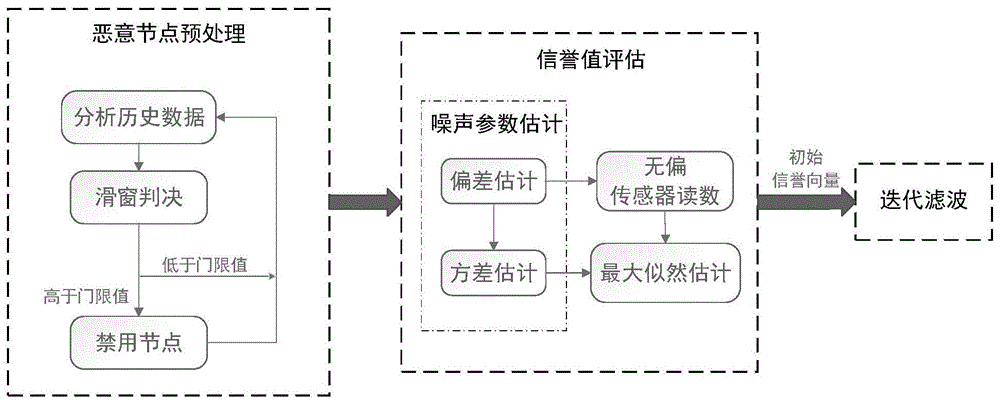
图1为本发明实施例中抗共谋攻击的鲁棒数据聚合方法的流程示意图。FIG. 1 is a schematic flowchart of a robust data aggregation method against collusion attacks in an embodiment of the present invention.
图2为本发明实施例中WSNs网络模型拓扑图。FIG. 2 is a topology diagram of a WSNs network model in an embodiment of the present invention.
图3为本发明实施例中倒数形式下数据聚合方法均方根误差性能曲面图。FIG. 3 is a performance surface diagram of the root mean square error of the data aggregation method in the reciprocal form according to the embodiment of the present invention.
图4为本发明实施例中线性形式下数据聚合方法均方根误差性能曲面图。FIG. 4 is a performance surface graph of the root mean square error of the data aggregation method in a linear form according to an embodiment of the present invention.
具体实施方式Detailed ways
下面结合附图和实施例对本发明做进一步详细说明。The present invention will be further described in detail below with reference to the accompanying drawings and embodiments.
本实施例提供一种抗共谋攻击的鲁棒数据聚合方法,其采用的WSNs网络模型如图2所示,包括三级节点:第一级为基站(BS)、第二级为聚合节点簇头(FC)、第三级为传感器节点(SN),其中,传感器节点(SN)中的受损节点包括共谋攻击场景下的真实攻击节点和伪攻击节点;本实施例的鲁棒数据聚合方法针对单一聚合节点簇头(FC)进行说明,所述聚合节点簇头对应的簇包括n个传感器节点,所述抗共谋攻击的鲁棒数据聚合方法具体包括以下步骤:This embodiment provides a robust data aggregation method against collusion attacks. The WSNs network model used in the method is shown in Figure 2, and includes three levels of nodes: the first level is a base station (BS), and the second level is a cluster of aggregation nodes. The head (FC) and the third level are the sensor nodes (SN), wherein the damaged nodes in the sensor nodes (SN) include real attack nodes and fake attack nodes in a collusion attack scenario; the robust data aggregation of this embodiment The method is described for a single aggregation node cluster head (FC), the cluster corresponding to the aggregation node cluster head includes n sensor nodes, and the robust data aggregation method against collusion attack specifically includes the following steps:
步骤1.输入n个传感器节点的m个采样时刻的历史数据X={x1,x2,...,xn},其中,

步骤2.对每一时刻t={1,2,...,m}的n个传感器数据作离群值检测;
每一时刻t有传感器数据


其中,
若任意窗口内判决成立的个数≥k/2,则有理由怀疑第i个传感器节点已遭受攻击,上级聚合节点簇头责令其休眠;If the number of valid decisions in any window is ≥ k/2, it is reasonable to suspect that the i-th sensor node has been attacked, and the cluster head of the superior aggregation node orders it to sleep;
步骤3.对步骤2中剩余n′个传感器节点的有效数据作估计,求解以下二次规划问题得到第i个传感器节点的偏差估计bi、i=1,2,...,n′:Step 3. Estimate the valid data of the remaining n' sensor nodes in


其中,
即得到第i个传感器节点的偏差估计bi;That is, the bias estimate bi of the i -th sensor node is obtained;
步骤4.计算第i个传感器节点的方差估计vi、i=1,2,...,n′;Step 4. Calculate the variance estimation vi, i =1,2,...,n' of the ith sensor node;
令

S(t)为方差和
求解以下二次规划问题得到第i个传感器节点的方差估计vi:Solve the following quadratic programming problem to get the variance estimate vi for the ith sensor node:


其中,
即得到第i个传感器节点的方差估计vi;That is, the variance estimate vi of the ith sensor node is obtained;
步骤5.由于能够达到克拉美罗下界,故使用最大似然估计方法,假设期望值向量初始信誉向量r=[r1,r2,...,rm]T是被测量的真实值,即似然函数中的唯一参数,从而有似然函数:Step 5. Since the Cramero lower bound can be reached, the maximum likelihood estimation method is used, and it is assumed that the expected value vector initial reputation vector r=[r 1 , r 2 ,..., r m ] T is the true value of the measured value, that is The only parameter in the likelihood function, and thus the likelihood function:

似然函数对rt求导并令导数为零,得到:Taking the derivative of the likelihood function with respect to r t and setting the derivative to zero yields:

即为步骤6中迭代算法的初始迭代值;is the initial iteration value of the iterative algorithm in step 6;
步骤6.令扰动向量d=[d1,d2,...,dn′]T,权值向量w=[w1,w2,...,wn′]T,设置判别函数g(d),给定精度precision,重复以下步骤:Step 6. Let the disturbance vector d=[d 1 ,d 2 ,...,d n′ ] T , the weight vector w=[w 1 ,w 2 ,...,w n′ ] T , set the discriminant function g(d), given the precision precision, repeat the following steps:
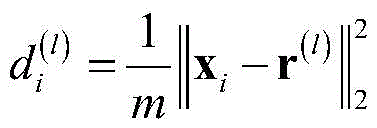


其中,l表示迭代次数,
倒数:g(d)=d-k;Reciprocal: g(d)=d -k ;
线性:g(d)=1-kld,kl>0且
直到

如图3所示的曲面显示了判别函数为倒数形式时本发明方法与传统数据聚合方法的抗共谋攻击能力对比;从图中可以看到:随着恶意节点数量的增加,传统数据聚合算法的均方根误差增大,准确性显著降低;如前所述,算法收敛于真实攻击节点的读数,即报告非常接近倾斜平均值的节点读数;可以看出,本发明优于传统数据聚合方法。The surface shown in Figure 3 shows the comparison of the anti-collusion attack capability of the method of the present invention and the traditional data aggregation method when the discriminant function is in the reciprocal form; it can be seen from the figure: with the increase of the number of malicious nodes, the traditional data aggregation algorithm The root mean square error increases and the accuracy decreases significantly; as mentioned above, the algorithm converges on the readings of the real attacking nodes, that is, the node readings that are very close to the skewed average are reported; it can be seen that the present invention is superior to the traditional data aggregation method .
如图4所示的曲面显示了判别函数为线性形式时本发明方法与传统数据聚合方法的抗共谋攻击能力对比;相比于倒数形式,线性形式下本发明方法对迭代滤波的改进较小,这得益于线性判别函数的因子kl,在迭代算法收敛到给定精度时,能极大降低最不可靠读数的权值,使之趋于零。The curved surface shown in Fig. 4 shows the comparison of the anti-collusion attack ability between the method of the present invention and the traditional data aggregation method when the discriminant function is in the linear form; compared with the reciprocal form, the improvement of the iterative filtering by the method of the present invention is smaller in the linear form. , thanks to the factor k l of the linear discriminant function, when the iterative algorithm converges to a given accuracy, it can greatly reduce the weight of the least reliable reading and make it tend to zero.
以上所述,仅为本发明的具体实施方式,本说明书中所公开的任一特征,除非特别叙述,均可被其他等效或具有类似目的的替代特征加以替换;所公开的所有特征、或所有方法或过程中的步骤,除了互相排斥的特征和/或步骤以外,均可以任何方式组合。The above descriptions are only specific embodiments of the present invention, and any feature disclosed in this specification, unless otherwise stated, can be replaced by other equivalent or alternative features with similar purposes; all the disclosed features, or All steps in a method or process, except mutually exclusive features and/or steps, may be combined in any way.
Claims (1)


Priority Applications (1)
| Application Number | Priority Date | Filing Date | Title |
|---|---|---|---|
| CN202011328131.4A CN112637854B (en) | 2020-11-24 | 2020-11-24 | Collusion attack resistant robust data aggregation method |
Applications Claiming Priority (1)
| Application Number | Priority Date | Filing Date | Title |
|---|---|---|---|
| CN202011328131.4A CN112637854B (en) | 2020-11-24 | 2020-11-24 | Collusion attack resistant robust data aggregation method |
Publications (2)
| Publication Number | Publication Date |
|---|---|
| CN112637854A CN112637854A (en) | 2021-04-09 |
| CN112637854B true CN112637854B (en) | 2022-07-29 |
Family
ID=75304122
Family Applications (1)
| Application Number | Title | Priority Date | Filing Date |
|---|---|---|---|
| CN202011328131.4A Expired - Fee Related CN112637854B (en) | 2020-11-24 | 2020-11-24 | Collusion attack resistant robust data aggregation method |
Country Status (1)
| Country | Link |
|---|---|
| CN (1) | CN112637854B (en) |
Citations (3)
| Publication number | Priority date | Publication date | Assignee | Title |
|---|---|---|---|---|
| CN102244658A (en) * | 2011-06-28 | 2011-11-16 | 南京工业大学 | Partitioned Dynamic Security Routing Method for Wireless Sensor Networks Based on Hash Chain |
| CN105407483A (en) * | 2015-12-28 | 2016-03-16 | 黑龙江大学 | Method for safe aggregation model communication based on public-state key in wireless sensor network |
| CN111343631A (en) * | 2020-03-16 | 2020-06-26 | 河海大学常州校区 | Source node privacy protection method based on position push in underwater acoustic sensor network |
Family Cites Families (6)
| Publication number | Priority date | Publication date | Assignee | Title |
|---|---|---|---|---|
| US8107397B1 (en) * | 2006-06-05 | 2012-01-31 | Purdue Research Foundation | Protocol for secure and energy-efficient reprogramming of wireless multi-hop sensor networks |
| CN101998503B (en) * | 2009-08-12 | 2013-03-13 | 中国科学院沈阳自动化研究所 | Mixed topology structured wireless sensor network-oriented two-grade packet aggregation method |
| US8873438B2 (en) * | 2010-09-29 | 2014-10-28 | Infosys Limited | Method and system for adaptive aggregation of data in a wireless sensor network |
| CN104185237B (en) * | 2014-08-04 | 2018-04-03 | 西安电子科技大学 | A kind of robust optimized algorithm based on ant group algorithm |
| CN107708173B (en) * | 2017-09-25 | 2020-06-19 | 京东方科技集团股份有限公司 | Selection method and device of fusion node |
| CN109474461B (en) * | 2018-10-31 | 2022-02-22 | 上海无线通信研究中心 | Wireless sensor network trust management method and system based on credit poisson distribution |
-
2020
- 2020-11-24 CN CN202011328131.4A patent/CN112637854B/en not_active Expired - Fee Related
Patent Citations (3)
| Publication number | Priority date | Publication date | Assignee | Title |
|---|---|---|---|---|
| CN102244658A (en) * | 2011-06-28 | 2011-11-16 | 南京工业大学 | Partitioned Dynamic Security Routing Method for Wireless Sensor Networks Based on Hash Chain |
| CN105407483A (en) * | 2015-12-28 | 2016-03-16 | 黑龙江大学 | Method for safe aggregation model communication based on public-state key in wireless sensor network |
| CN111343631A (en) * | 2020-03-16 | 2020-06-26 | 河海大学常州校区 | Source node privacy protection method based on position push in underwater acoustic sensor network |
Also Published As
| Publication number | Publication date |
|---|---|
| CN112637854A (en) | 2021-04-09 |
Similar Documents
| Publication | Publication Date | Title |
|---|---|---|
| Varela et al. | Wireless sensor network for forest fire detection | |
| CN113094707B (en) | Lateral movement attack detection method and system based on heterogeneous graph network | |
| CN108076040B (en) | A method for mining APT attack scenarios based on kill chain and fuzzy clustering | |
| CN114741310B (en) | Transferable image adversarial sample generation and deep neural network testing method and system | |
| CN118659907B (en) | A method and system for generating adversarial samples of network traffic based on time series | |
| CN108601026B (en) | Perception data error attack detection method based on random sampling consistency | |
| CN117579290A (en) | A malicious traffic detection method based on integrated spatiotemporal graph convolutional neural network that fuses spatiotemporal attention | |
| CN116095100B (en) | Internal intrusion detection method for Internet of Vehicles based on abnormal behavior discovery | |
| CN109951499A (en) | An Anomaly Detection Method Based on Network Structure Features | |
| CN120408615A (en) | Network viral propagation prediction method based on spatiotemporal graph attention model | |
| CN115883152A (en) | Network traffic attack detection method, system and storage medium based on federated learning | |
| CN115017499A (en) | False data attack detection method for smart grid based on robust state observer | |
| CN112637854B (en) | Collusion attack resistant robust data aggregation method | |
| CN117829271A (en) | A resilient decentralized federated learning approach to resist false data injection attacks | |
| Abuzainab et al. | A multiclass mean-field game for thwarting misinformation spread in the Internet of Battlefield Things | |
| CN120110748B (en) | A malicious traffic detection method based on hyperbolic space modeling and graph neural networks | |
| CN115913616A (en) | Method and device for lateral movement attack detection based on heterogeneous graph abnormal link discovery | |
| Miao et al. | State estimation for a class of nonlinear non‐Gaussian cyber–physical systems under false data injection attacks | |
| Ma et al. | A collusion attack resistance data aggregation scheme in internet of things | |
| Mao et al. | EScope: Effective event validation for IoT systems based on state correlation | |
| CN118296599A (en) | Method for defending poisoning attack in federal learning | |
| CN104901908B (en) | Random censorship parameter adaptive method of estimation based on information theory study | |
| Du et al. | A novel secure diffusion Kalman filter algorithm against false data injection attacks | |
| Zhang et al. | Dual Gradient Evaluation-Based Defense Method Against Poisoning Attacks in Federated Learning | |
| Dong et al. | Dmra: Model usability detection scheme against model-reuse attacks in the internet of things |
Legal Events
| Date | Code | Title | Description |
|---|---|---|---|
| PB01 | Publication | ||
| PB01 | Publication | ||
| SE01 | Entry into force of request for substantive examination | ||
| SE01 | Entry into force of request for substantive examination | ||
| GR01 | Patent grant | ||
| GR01 | Patent grant | ||
| CF01 | Termination of patent right due to non-payment of annual fee | ||
| CF01 | Termination of patent right due to non-payment of annual fee |
Granted publication date: 20220729 |