CN112585119A - Substituted indoles and methods of use thereof - Google Patents
Substituted indoles and methods of use thereof Download PDFInfo
- Publication number
- CN112585119A CN112585119A CN201980054976.8A CN201980054976A CN112585119A CN 112585119 A CN112585119 A CN 112585119A CN 201980054976 A CN201980054976 A CN 201980054976A CN 112585119 A CN112585119 A CN 112585119A
- Authority
- CN
- China
- Prior art keywords
- group
- alkyl
- alkyl group
- hydroxy
- cycloalkyl
- Prior art date
- Legal status (The legal status is an assumption and is not a legal conclusion. Google has not performed a legal analysis and makes no representation as to the accuracy of the status listed.)
- Pending
Links
Images


Classifications
-
- C—CHEMISTRY; METALLURGY
- C07—ORGANIC CHEMISTRY
- C07D—HETEROCYCLIC COMPOUNDS
- C07D209/00—Heterocyclic compounds containing five-membered rings, condensed with other rings, with one nitrogen atom as the only ring hetero atom
- C07D209/02—Heterocyclic compounds containing five-membered rings, condensed with other rings, with one nitrogen atom as the only ring hetero atom condensed with one carbocyclic ring
- C07D209/04—Indoles; Hydrogenated indoles
- C07D209/30—Indoles; Hydrogenated indoles with hetero atoms or with carbon atoms having three bonds to hetero atoms with at the most one bond to halogen, directly attached to carbon atoms of the hetero ring
- C07D209/42—Carbon atoms having three bonds to hetero atoms with at the most one bond to halogen, e.g. ester or nitrile radicals
-
- A—HUMAN NECESSITIES
- A61—MEDICAL OR VETERINARY SCIENCE; HYGIENE
- A61K—PREPARATIONS FOR MEDICAL, DENTAL OR TOILETRY PURPOSES
- A61K31/00—Medicinal preparations containing organic active ingredients
- A61K31/33—Heterocyclic compounds
- A61K31/395—Heterocyclic compounds having nitrogen as a ring hetero atom, e.g. guanethidine or rifamycins
- A61K31/435—Heterocyclic compounds having nitrogen as a ring hetero atom, e.g. guanethidine or rifamycins having six-membered rings with one nitrogen as the only ring hetero atom
- A61K31/44—Non condensed pyridines; Hydrogenated derivatives thereof
- A61K31/4427—Non condensed pyridines; Hydrogenated derivatives thereof containing further heterocyclic ring systems
- A61K31/4439—Non condensed pyridines; Hydrogenated derivatives thereof containing further heterocyclic ring systems containing a five-membered ring with nitrogen as a ring hetero atom, e.g. omeprazole
-
- A—HUMAN NECESSITIES
- A61—MEDICAL OR VETERINARY SCIENCE; HYGIENE
- A61K—PREPARATIONS FOR MEDICAL, DENTAL OR TOILETRY PURPOSES
- A61K31/00—Medicinal preparations containing organic active ingredients
- A61K31/33—Heterocyclic compounds
- A61K31/395—Heterocyclic compounds having nitrogen as a ring hetero atom, e.g. guanethidine or rifamycins
- A61K31/495—Heterocyclic compounds having nitrogen as a ring hetero atom, e.g. guanethidine or rifamycins having six-membered rings with two or more nitrogen atoms as the only ring heteroatoms, e.g. piperazine or tetrazines
- A61K31/496—Non-condensed piperazines containing further heterocyclic rings, e.g. rifampin, thiothixene or sparfloxacin
-
- A—HUMAN NECESSITIES
- A61—MEDICAL OR VETERINARY SCIENCE; HYGIENE
- A61P—SPECIFIC THERAPEUTIC ACTIVITY OF CHEMICAL COMPOUNDS OR MEDICINAL PREPARATIONS
- A61P35/00—Antineoplastic agents
-
- A—HUMAN NECESSITIES
- A61—MEDICAL OR VETERINARY SCIENCE; HYGIENE
- A61P—SPECIFIC THERAPEUTIC ACTIVITY OF CHEMICAL COMPOUNDS OR MEDICINAL PREPARATIONS
- A61P35/00—Antineoplastic agents
- A61P35/02—Antineoplastic agents specific for leukemia
-
- C—CHEMISTRY; METALLURGY
- C07—ORGANIC CHEMISTRY
- C07D—HETEROCYCLIC COMPOUNDS
- C07D209/00—Heterocyclic compounds containing five-membered rings, condensed with other rings, with one nitrogen atom as the only ring hetero atom
- C07D209/56—Ring systems containing three or more rings
- C07D209/96—Spiro-condensed ring systems
-
- C—CHEMISTRY; METALLURGY
- C07—ORGANIC CHEMISTRY
- C07D—HETEROCYCLIC COMPOUNDS
- C07D401/00—Heterocyclic compounds containing two or more hetero rings, having nitrogen atoms as the only ring hetero atoms, at least one ring being a six-membered ring with only one nitrogen atom
- C07D401/02—Heterocyclic compounds containing two or more hetero rings, having nitrogen atoms as the only ring hetero atoms, at least one ring being a six-membered ring with only one nitrogen atom containing two hetero rings
- C07D401/06—Heterocyclic compounds containing two or more hetero rings, having nitrogen atoms as the only ring hetero atoms, at least one ring being a six-membered ring with only one nitrogen atom containing two hetero rings linked by a carbon chain containing only aliphatic carbon atoms
-
- C—CHEMISTRY; METALLURGY
- C07—ORGANIC CHEMISTRY
- C07D—HETEROCYCLIC COMPOUNDS
- C07D401/00—Heterocyclic compounds containing two or more hetero rings, having nitrogen atoms as the only ring hetero atoms, at least one ring being a six-membered ring with only one nitrogen atom
- C07D401/02—Heterocyclic compounds containing two or more hetero rings, having nitrogen atoms as the only ring hetero atoms, at least one ring being a six-membered ring with only one nitrogen atom containing two hetero rings
- C07D401/12—Heterocyclic compounds containing two or more hetero rings, having nitrogen atoms as the only ring hetero atoms, at least one ring being a six-membered ring with only one nitrogen atom containing two hetero rings linked by a chain containing hetero atoms as chain links
-
- C—CHEMISTRY; METALLURGY
- C07—ORGANIC CHEMISTRY
- C07D—HETEROCYCLIC COMPOUNDS
- C07D401/00—Heterocyclic compounds containing two or more hetero rings, having nitrogen atoms as the only ring hetero atoms, at least one ring being a six-membered ring with only one nitrogen atom
- C07D401/14—Heterocyclic compounds containing two or more hetero rings, having nitrogen atoms as the only ring hetero atoms, at least one ring being a six-membered ring with only one nitrogen atom containing three or more hetero rings
-
- C—CHEMISTRY; METALLURGY
- C07—ORGANIC CHEMISTRY
- C07D—HETEROCYCLIC COMPOUNDS
- C07D403/00—Heterocyclic compounds containing two or more hetero rings, having nitrogen atoms as the only ring hetero atoms, not provided for by group C07D401/00
- C07D403/02—Heterocyclic compounds containing two or more hetero rings, having nitrogen atoms as the only ring hetero atoms, not provided for by group C07D401/00 containing two hetero rings
- C07D403/12—Heterocyclic compounds containing two or more hetero rings, having nitrogen atoms as the only ring hetero atoms, not provided for by group C07D401/00 containing two hetero rings linked by a chain containing hetero atoms as chain links
-
- C—CHEMISTRY; METALLURGY
- C07—ORGANIC CHEMISTRY
- C07D—HETEROCYCLIC COMPOUNDS
- C07D403/00—Heterocyclic compounds containing two or more hetero rings, having nitrogen atoms as the only ring hetero atoms, not provided for by group C07D401/00
- C07D403/14—Heterocyclic compounds containing two or more hetero rings, having nitrogen atoms as the only ring hetero atoms, not provided for by group C07D401/00 containing three or more hetero rings
-
- C—CHEMISTRY; METALLURGY
- C07—ORGANIC CHEMISTRY
- C07D—HETEROCYCLIC COMPOUNDS
- C07D405/00—Heterocyclic compounds containing both one or more hetero rings having oxygen atoms as the only ring hetero atoms, and one or more rings having nitrogen as the only ring hetero atom
- C07D405/02—Heterocyclic compounds containing both one or more hetero rings having oxygen atoms as the only ring hetero atoms, and one or more rings having nitrogen as the only ring hetero atom containing two hetero rings
- C07D405/12—Heterocyclic compounds containing both one or more hetero rings having oxygen atoms as the only ring hetero atoms, and one or more rings having nitrogen as the only ring hetero atom containing two hetero rings linked by a chain containing hetero atoms as chain links
-
- C—CHEMISTRY; METALLURGY
- C07—ORGANIC CHEMISTRY
- C07D—HETEROCYCLIC COMPOUNDS
- C07D405/00—Heterocyclic compounds containing both one or more hetero rings having oxygen atoms as the only ring hetero atoms, and one or more rings having nitrogen as the only ring hetero atom
- C07D405/14—Heterocyclic compounds containing both one or more hetero rings having oxygen atoms as the only ring hetero atoms, and one or more rings having nitrogen as the only ring hetero atom containing three or more hetero rings
-
- C—CHEMISTRY; METALLURGY
- C07—ORGANIC CHEMISTRY
- C07D—HETEROCYCLIC COMPOUNDS
- C07D409/00—Heterocyclic compounds containing two or more hetero rings, at least one ring having sulfur atoms as the only ring hetero atoms
- C07D409/02—Heterocyclic compounds containing two or more hetero rings, at least one ring having sulfur atoms as the only ring hetero atoms containing two hetero rings
- C07D409/12—Heterocyclic compounds containing two or more hetero rings, at least one ring having sulfur atoms as the only ring hetero atoms containing two hetero rings linked by a chain containing hetero atoms as chain links
-
- C—CHEMISTRY; METALLURGY
- C07—ORGANIC CHEMISTRY
- C07D—HETEROCYCLIC COMPOUNDS
- C07D413/00—Heterocyclic compounds containing two or more hetero rings, at least one ring having nitrogen and oxygen atoms as the only ring hetero atoms
- C07D413/02—Heterocyclic compounds containing two or more hetero rings, at least one ring having nitrogen and oxygen atoms as the only ring hetero atoms containing two hetero rings
- C07D413/12—Heterocyclic compounds containing two or more hetero rings, at least one ring having nitrogen and oxygen atoms as the only ring hetero atoms containing two hetero rings linked by a chain containing hetero atoms as chain links
-
- C—CHEMISTRY; METALLURGY
- C07—ORGANIC CHEMISTRY
- C07D—HETEROCYCLIC COMPOUNDS
- C07D413/00—Heterocyclic compounds containing two or more hetero rings, at least one ring having nitrogen and oxygen atoms as the only ring hetero atoms
- C07D413/14—Heterocyclic compounds containing two or more hetero rings, at least one ring having nitrogen and oxygen atoms as the only ring hetero atoms containing three or more hetero rings
-
- C—CHEMISTRY; METALLURGY
- C07—ORGANIC CHEMISTRY
- C07D—HETEROCYCLIC COMPOUNDS
- C07D417/00—Heterocyclic compounds containing two or more hetero rings, at least one ring having nitrogen and sulfur atoms as the only ring hetero atoms, not provided for by group C07D415/00
- C07D417/02—Heterocyclic compounds containing two or more hetero rings, at least one ring having nitrogen and sulfur atoms as the only ring hetero atoms, not provided for by group C07D415/00 containing two hetero rings
- C07D417/12—Heterocyclic compounds containing two or more hetero rings, at least one ring having nitrogen and sulfur atoms as the only ring hetero atoms, not provided for by group C07D415/00 containing two hetero rings linked by a chain containing hetero atoms as chain links
-
- C—CHEMISTRY; METALLURGY
- C07—ORGANIC CHEMISTRY
- C07D—HETEROCYCLIC COMPOUNDS
- C07D417/00—Heterocyclic compounds containing two or more hetero rings, at least one ring having nitrogen and sulfur atoms as the only ring hetero atoms, not provided for by group C07D415/00
- C07D417/14—Heterocyclic compounds containing two or more hetero rings, at least one ring having nitrogen and sulfur atoms as the only ring hetero atoms, not provided for by group C07D415/00 containing three or more hetero rings
-
- C—CHEMISTRY; METALLURGY
- C07—ORGANIC CHEMISTRY
- C07D—HETEROCYCLIC COMPOUNDS
- C07D471/00—Heterocyclic compounds containing nitrogen atoms as the only ring hetero atoms in the condensed system, at least one ring being a six-membered ring with one nitrogen atom, not provided for by groups C07D451/00 - C07D463/00
- C07D471/02—Heterocyclic compounds containing nitrogen atoms as the only ring hetero atoms in the condensed system, at least one ring being a six-membered ring with one nitrogen atom, not provided for by groups C07D451/00 - C07D463/00 in which the condensed system contains two hetero rings
- C07D471/04—Ortho-condensed systems
-
- C—CHEMISTRY; METALLURGY
- C07—ORGANIC CHEMISTRY
- C07D—HETEROCYCLIC COMPOUNDS
- C07D471/00—Heterocyclic compounds containing nitrogen atoms as the only ring hetero atoms in the condensed system, at least one ring being a six-membered ring with one nitrogen atom, not provided for by groups C07D451/00 - C07D463/00
- C07D471/02—Heterocyclic compounds containing nitrogen atoms as the only ring hetero atoms in the condensed system, at least one ring being a six-membered ring with one nitrogen atom, not provided for by groups C07D451/00 - C07D463/00 in which the condensed system contains two hetero rings
- C07D471/08—Bridged systems
-
- C—CHEMISTRY; METALLURGY
- C07—ORGANIC CHEMISTRY
- C07D—HETEROCYCLIC COMPOUNDS
- C07D471/00—Heterocyclic compounds containing nitrogen atoms as the only ring hetero atoms in the condensed system, at least one ring being a six-membered ring with one nitrogen atom, not provided for by groups C07D451/00 - C07D463/00
- C07D471/02—Heterocyclic compounds containing nitrogen atoms as the only ring hetero atoms in the condensed system, at least one ring being a six-membered ring with one nitrogen atom, not provided for by groups C07D451/00 - C07D463/00 in which the condensed system contains two hetero rings
- C07D471/10—Spiro-condensed systems
-
- C—CHEMISTRY; METALLURGY
- C07—ORGANIC CHEMISTRY
- C07D—HETEROCYCLIC COMPOUNDS
- C07D487/00—Heterocyclic compounds containing nitrogen atoms as the only ring hetero atoms in the condensed system, not provided for by groups C07D451/00 - C07D477/00
- C07D487/02—Heterocyclic compounds containing nitrogen atoms as the only ring hetero atoms in the condensed system, not provided for by groups C07D451/00 - C07D477/00 in which the condensed system contains two hetero rings
- C07D487/04—Ortho-condensed systems
-
- C—CHEMISTRY; METALLURGY
- C07—ORGANIC CHEMISTRY
- C07D—HETEROCYCLIC COMPOUNDS
- C07D487/00—Heterocyclic compounds containing nitrogen atoms as the only ring hetero atoms in the condensed system, not provided for by groups C07D451/00 - C07D477/00
- C07D487/02—Heterocyclic compounds containing nitrogen atoms as the only ring hetero atoms in the condensed system, not provided for by groups C07D451/00 - C07D477/00 in which the condensed system contains two hetero rings
- C07D487/08—Bridged systems
-
- C—CHEMISTRY; METALLURGY
- C07—ORGANIC CHEMISTRY
- C07D—HETEROCYCLIC COMPOUNDS
- C07D487/00—Heterocyclic compounds containing nitrogen atoms as the only ring hetero atoms in the condensed system, not provided for by groups C07D451/00 - C07D477/00
- C07D487/02—Heterocyclic compounds containing nitrogen atoms as the only ring hetero atoms in the condensed system, not provided for by groups C07D451/00 - C07D477/00 in which the condensed system contains two hetero rings
- C07D487/10—Spiro-condensed systems
-
- C—CHEMISTRY; METALLURGY
- C07—ORGANIC CHEMISTRY
- C07D—HETEROCYCLIC COMPOUNDS
- C07D491/00—Heterocyclic compounds containing in the condensed ring system both one or more rings having oxygen atoms as the only ring hetero atoms and one or more rings having nitrogen atoms as the only ring hetero atoms, not provided for by groups C07D451/00 - C07D459/00, C07D463/00, C07D477/00 or C07D489/00
- C07D491/02—Heterocyclic compounds containing in the condensed ring system both one or more rings having oxygen atoms as the only ring hetero atoms and one or more rings having nitrogen atoms as the only ring hetero atoms, not provided for by groups C07D451/00 - C07D459/00, C07D463/00, C07D477/00 or C07D489/00 in which the condensed system contains two hetero rings
- C07D491/08—Bridged systems
-
- C—CHEMISTRY; METALLURGY
- C07—ORGANIC CHEMISTRY
- C07D—HETEROCYCLIC COMPOUNDS
- C07D491/00—Heterocyclic compounds containing in the condensed ring system both one or more rings having oxygen atoms as the only ring hetero atoms and one or more rings having nitrogen atoms as the only ring hetero atoms, not provided for by groups C07D451/00 - C07D459/00, C07D463/00, C07D477/00 or C07D489/00
- C07D491/02—Heterocyclic compounds containing in the condensed ring system both one or more rings having oxygen atoms as the only ring hetero atoms and one or more rings having nitrogen atoms as the only ring hetero atoms, not provided for by groups C07D451/00 - C07D459/00, C07D463/00, C07D477/00 or C07D489/00 in which the condensed system contains two hetero rings
- C07D491/10—Spiro-condensed systems
- C07D491/107—Spiro-condensed systems with only one oxygen atom as ring hetero atom in the oxygen-containing ring
-
- C—CHEMISTRY; METALLURGY
- C07—ORGANIC CHEMISTRY
- C07D—HETEROCYCLIC COMPOUNDS
- C07D498/00—Heterocyclic compounds containing in the condensed system at least one hetero ring having nitrogen and oxygen atoms as the only ring hetero atoms
- C07D498/02—Heterocyclic compounds containing in the condensed system at least one hetero ring having nitrogen and oxygen atoms as the only ring hetero atoms in which the condensed system contains two hetero rings
- C07D498/04—Ortho-condensed systems
-
- C—CHEMISTRY; METALLURGY
- C07—ORGANIC CHEMISTRY
- C07D—HETEROCYCLIC COMPOUNDS
- C07D498/00—Heterocyclic compounds containing in the condensed system at least one hetero ring having nitrogen and oxygen atoms as the only ring hetero atoms
- C07D498/02—Heterocyclic compounds containing in the condensed system at least one hetero ring having nitrogen and oxygen atoms as the only ring hetero atoms in which the condensed system contains two hetero rings
- C07D498/08—Bridged systems
-
- C—CHEMISTRY; METALLURGY
- C07—ORGANIC CHEMISTRY
- C07D—HETEROCYCLIC COMPOUNDS
- C07D498/00—Heterocyclic compounds containing in the condensed system at least one hetero ring having nitrogen and oxygen atoms as the only ring hetero atoms
- C07D498/02—Heterocyclic compounds containing in the condensed system at least one hetero ring having nitrogen and oxygen atoms as the only ring hetero atoms in which the condensed system contains two hetero rings
- C07D498/10—Spiro-condensed systems
-
- C—CHEMISTRY; METALLURGY
- C07—ORGANIC CHEMISTRY
- C07D—HETEROCYCLIC COMPOUNDS
- C07D513/00—Heterocyclic compounds containing in the condensed system at least one hetero ring having nitrogen and sulfur atoms as the only ring hetero atoms, not provided for in groups C07D463/00, C07D477/00 or C07D499/00 - C07D507/00
- C07D513/02—Heterocyclic compounds containing in the condensed system at least one hetero ring having nitrogen and sulfur atoms as the only ring hetero atoms, not provided for in groups C07D463/00, C07D477/00 or C07D499/00 - C07D507/00 in which the condensed system contains two hetero rings
- C07D513/10—Spiro-condensed systems
-
- C—CHEMISTRY; METALLURGY
- C12—BIOCHEMISTRY; BEER; SPIRITS; WINE; VINEGAR; MICROBIOLOGY; ENZYMOLOGY; MUTATION OR GENETIC ENGINEERING
- C12Q—MEASURING OR TESTING PROCESSES INVOLVING ENZYMES, NUCLEIC ACIDS OR MICROORGANISMS; COMPOSITIONS OR TEST PAPERS THEREFOR; PROCESSES OF PREPARING SUCH COMPOSITIONS; CONDITION-RESPONSIVE CONTROL IN MICROBIOLOGICAL OR ENZYMOLOGICAL PROCESSES
- C12Q1/00—Measuring or testing processes involving enzymes, nucleic acids or microorganisms; Compositions therefor; Processes of preparing such compositions
- C12Q1/68—Measuring or testing processes involving enzymes, nucleic acids or microorganisms; Compositions therefor; Processes of preparing such compositions involving nucleic acids
- C12Q1/6876—Nucleic acid products used in the analysis of nucleic acids, e.g. primers or probes
- C12Q1/6883—Nucleic acid products used in the analysis of nucleic acids, e.g. primers or probes for diseases caused by alterations of genetic material
- C12Q1/6886—Nucleic acid products used in the analysis of nucleic acids, e.g. primers or probes for diseases caused by alterations of genetic material for cancer
-
- C—CHEMISTRY; METALLURGY
- C12—BIOCHEMISTRY; BEER; SPIRITS; WINE; VINEGAR; MICROBIOLOGY; ENZYMOLOGY; MUTATION OR GENETIC ENGINEERING
- C12Q—MEASURING OR TESTING PROCESSES INVOLVING ENZYMES, NUCLEIC ACIDS OR MICROORGANISMS; COMPOSITIONS OR TEST PAPERS THEREFOR; PROCESSES OF PREPARING SUCH COMPOSITIONS; CONDITION-RESPONSIVE CONTROL IN MICROBIOLOGICAL OR ENZYMOLOGICAL PROCESSES
- C12Q2600/00—Oligonucleotides characterized by their use
- C12Q2600/106—Pharmacogenomics, i.e. genetic variability in individual responses to drugs and drug metabolism
Landscapes
- Chemical & Material Sciences (AREA)
- Organic Chemistry (AREA)
- Health & Medical Sciences (AREA)
- Life Sciences & Earth Sciences (AREA)
- General Health & Medical Sciences (AREA)
- Animal Behavior & Ethology (AREA)
- Pharmacology & Pharmacy (AREA)
- Medicinal Chemistry (AREA)
- Public Health (AREA)
- Veterinary Medicine (AREA)
- Nuclear Medicine, Radiotherapy & Molecular Imaging (AREA)
- General Chemical & Material Sciences (AREA)
- Chemical Kinetics & Catalysis (AREA)
- Proteomics, Peptides & Aminoacids (AREA)
- Pathology (AREA)
- Engineering & Computer Science (AREA)
- Zoology (AREA)
- Immunology (AREA)
- Oncology (AREA)
- Genetics & Genomics (AREA)
- Analytical Chemistry (AREA)
- Wood Science & Technology (AREA)
- Epidemiology (AREA)
- Biotechnology (AREA)
- Biochemistry (AREA)
- Physics & Mathematics (AREA)
- Microbiology (AREA)
- Molecular Biology (AREA)
- Hematology (AREA)
- Hospice & Palliative Care (AREA)
- Biophysics (AREA)
- Bioinformatics & Cheminformatics (AREA)
- General Engineering & Computer Science (AREA)
- Pharmaceuticals Containing Other Organic And Inorganic Compounds (AREA)
- Nitrogen Condensed Heterocyclic Rings (AREA)
- Nitrogen And Oxygen Or Sulfur-Condensed Heterocyclic Ring Systems (AREA)
- Plural Heterocyclic Compounds (AREA)
Abstract
本披露提供了具有式I的经取代的吲哚化合物:(I)及其药学上可接受的盐和溶剂化物,其中R1a、R1e、G1、G2、Q1、Q2、Q3、以及(II)是如在说明书中阐述而定义的。本披露还针对具有式I的化合物用于治疗受试者的疾病、障碍、或病症,例如癌症的用途。


This disclosure provides substituted indole compounds having formula I: (I) and pharmaceutically acceptable salts and solvates thereof, wherein R1a , R1e , G1 , G2 , Q1 , Q2 , Q3 , and (II) are as defined as set forth in the specification. This disclosure also relates to the use of compounds having formula I for treating a subject's disease, disorder, or condition, such as cancer.
Description
Background
Technical Field
The present disclosure provides substituted indoles and methods of using the same. In some embodiments, the substituted indole is a SETD2 protein inhibitor. In some embodiments, substituted indoles are useful in methods of treating a disease, disorder, or condition in a subject.
Background
The selective addition of methyl groups to specific amino acid sites of histones is controlled by the action of a family of enzymes known as Histone Methyltransferases (HMTs). The expression level of a particular gene is affected by the presence or absence of one or more methyl groups at the relevant histone sites. The specific action of the methyl group at a particular histone site persists until the methyl group is removed by histone demethylase, or until the modified histone is replaced by nucleosome turnover. In a similar manner, other classes of enzymes can modify DNA and histones with other chemical species, while still other enzymes can remove these species to provide control over gene expression.
SETD2 is a human histone methyltransferase, which is found in chromosome 3 cells with p21.31(3p 21.31). The acronym "SETD 2" stands for protein 2 containing a plaque inhibitor (super of variation), an enhancer of zeste and a Trithorax domain. The SETD2 protein contains three conserved functional domains: (1) a triple AWS-SET-PostSET domain; (2) a WW domain; and (3) Set2-Rbp1 interaction ("SRI") domain. These three functional domains define the biological functions of SETD 2. See, Li, J, et al, Oncotarget [ cancer target ]7:50719-50734 (2016). SETD2 is thought to be a single human gene responsible for the trimethylation (H3K36me3) of lysine 36(Lys-36) of histone H3 using dimethylated Lys-36(H3K36me2) as a substrate. Edmunds, J.W. et al, The EMBO Journal [ Proc. European society of molecular biology ]27: 406-.
Human SETD2 has been shown to have tumor suppressor function. Li, J. et al, Oncotarget [ cancer target ]7:50719-50734 (2016). For example, inactivation of human SETD2 in Renal Cell Carcinoma (RCC) has been reported. Larkin, J., et al, Nature Reviews [ Nature review ]9: 147-. Furthermore, it has been reported that the expression level of SETD2 in breast cancer samples is significantly lower than in adjacent non-cancerous tissue (ANCT) samples. Newbold, R.F. and Mokbel, K., Anticancer Research 30: 3309-. In addition, biallelic and loss-of-function point mutations in SETD2 were reported in patients with acute leukemia. Zhu, X.et al, Nature Genetics [ Nature Genetics ]46:287-293 (2014). Mutations in SETD2 have been reported in pediatric high-grade gliomas. Fontbasso, a.m. et al, Acta neuropathohol [ neuropathology report ]125: 659-.
Disclosure of Invention
The present disclosure relates to the surprising and unexpected discovery that inhibition of human SETD2 protein, although known to have functionality as a tumor suppressor, can be used to treat cancer. The present disclosure also provides novel substituted indoles. In some embodiments, the substituted indole is a SETD2 inhibitor. In some embodiments, substituted indoles can be used in methods of treating a disease (e.g., cancer), disorder, or condition in a subject. In some embodiments, substituted indoles exhibit selective antiproliferative effects in t (4; 14) multiple myeloma cell lines.
In one aspect, the present disclosure provides substituted indoles represented by any one of formulas I, II-A, III-A, IV-A, IV-B, IV-C, IV-D, V, V-A, V-B, VI, VII-A, VII-B, VII-C, VII-D, VII-E, VII-F, VII-G, VII-H, VIII-A, and VIII-B below, and pharmaceutically acceptable salts and solvates thereof, collectively referred to herein as "compounds of the present disclosure".
In another aspect, the disclosure provides a pharmaceutical composition comprising a compound of the disclosure and one or more pharmaceutically acceptable carriers.
In another aspect, the disclosure provides a method of inhibiting SETD2 protein in a subject, the method comprising administering to the mammal an effective amount of at least one compound of the disclosure.
In another aspect, the disclosure provides a method for treating a disease, disorder, or condition (e.g., cancer) in a subject, comprising administering to the subject a therapeutically effective amount of a compound of the disclosure.
In another aspect, the disclosure provides a method for treating a disease, disorder, or condition (e.g., cancer) that is responsive to inhibition of SETD2 protein, comprising administering to a subject a therapeutically effective amount of a compound of the disclosure.
In another aspect, the disclosure provides the use of the disclosed compounds as inhibitors of SETD2 protein.
In another aspect, the disclosure provides a pharmaceutical composition for treating a disease, disorder, or condition that is responsive to inhibition of SETD2 protein, wherein the pharmaceutical composition comprises a therapeutically effective amount of a compound of the disclosure in admixture with one or more pharmaceutically acceptable carriers.
In another aspect, the disclosure provides a compound of the disclosure for use in treating cancer (e.g., multiple myeloma) in a subject in need thereof.
In another aspect, the disclosure provides a compound of the disclosure for use in the manufacture of a medicament for treating cancer in a mammal.
In another aspect, the disclosure provides kits comprising a compound of the disclosure.
In another aspect, the disclosure provides a method of treating a subject with multiple myeloma, the method comprising: (a) determining whether a chromosomal translocation is present in a biological sample taken from the subject; and (b) administering to the subject a therapeutically effective amount of a compound of the disclosure if a chromosomal translocation is present in the biological sample.
Additional embodiments and advantages of the present disclosure will be set forth in part in the description which follows and, in part, will be obvious from the description, or may be learned by practice of the present disclosure. The embodiments and advantages of the disclosure will be realized and attained by means of the elements and combinations particularly pointed out in the appended claims.
It is to be understood that both the foregoing summary as claimed and the following detailed description are exemplary and explanatory only and are not restrictive of the invention as claimed.
Drawings
FIG. 1 is a scatter plot showing the selective antiproliferative effect of Compound No. 15 in t (4; 14) and non-t (4; 14) multiple myeloma cell lines.
FIG. 2 shows KMS-34 (a t (4; 14) multiple medullary bone marrowTumor cell line) had a cytotoxic response to compound No. 15 with a proliferation IC of 80nM in the 14 day assay50. The Y-axis is the number of cells per time point on a logarithmic scale. Each line represents compound number 15 for the indicated dose.
Fig. 3 is a line graph comparing the H3K36me3 inhibitory and anti-proliferative potency of representative compounds of the disclosure. Each dot represents a compound of the disclosure assayed in the a 549H 3K36me3 assay and the KMS-34 proliferation assay.
Fig. 4 is a line graph showing the antitumor activity of compound No. 15 in the KMS11 xenograft model.
Fig. 5 is a line graph showing the antitumor activity of compound No. 15 in the mm.1s xenograft model.
Detailed Description
The compounds of the present disclosure are useful for treating a disease, disorder, or condition in a subject, such as cancer. In one embodiment, the disease, disorder, or condition is responsive to inhibition of SETD2 protein. In some embodiments, the compounds of the present disclosure are SETD2 inhibitors.
I. Compounds of the disclosure
In one embodiment, the compounds of the present disclosure are compounds having formula I:

wherein:
R1aselected from the group consisting of: halogen, alkyl, alkoxy, cycloalkyl, (hydroxy) alkyl, and (cycloalkyl) alkyl;
Q1Selected from the group consisting of: -C (R)1b) and-N ═ N;
Q2selected from the group consisting of: -C (R)1c) and-N ═ N;
Q3selected from the group consisting of: -C (R)1d) and-N ═ N;
provided that Q is1、Q2Or Q3In (1)At least one is respectively-C (R)1b)=、-C(R1c) or-C (R)1d)=;
R1b、R1cAnd R1dEach independently selected from the group consisting of: hydrogen, halogen, alkyl, alkenyl, (hydroxy) alkyl, and alkoxy;
R1eselected from the group consisting of: hydrogen, halogen, alkyl, cycloalkyl, (hydroxy) alkyl, and (cycloalkyl) alkyl;

G1selected from the group consisting of: optionally substituted aryl, optionally substituted heteroaryl, optionally substituted heterocycle, optionally substituted cycloalkyl, (aryl) alkyl, (heteroaryl) alkyl, (heterocycle) alkyl, (amino) (aryl) alkyl, (heteroaryl) (heterocycle) alkyl, (heteroaryl) (carboxamido) alkyl, (heteroaryl) (cycloalkyl) alkyl, (aryl) (alkoxycarbonyl) alkyl, (cycloalkyl) alkyl, (heteroaryl) (amino) alkyl, (cycloalkyl) (alkoxycarbonyl) alkyl, (heteroaryl) (alkoxycarbonyl) alkyl, (heterocycle) (cycloalkyl) alkyl, (aryl) (hydroxy) alkyl, (cycloalkyl) (hydroxy) alkyl, optionally substituted alkyl, (aryl) (haloalkyl) alkyl, substituted heteroaryl (aryl) (haloalkyl) alkyl, substituted aryl, heteroaryl, and heteroaryl, (cycloalkyl) (haloalkyl) alkyl, (hydroxy) (haloalkyl) alkyl, and (alkoxycarbonyl) (haloalkyl) alkyl; and is
G2Selected from the group consisting of: hydrogen and alkyl; or
G1And G2Together with the nitrogen atom to which they are attached form an optionally substituted heterocyclic ring, or a pharmaceutically acceptable salt or solvate thereof.
In another embodiment, the compound having formula I is not:

in another embodiment, the compounds of the present disclosure are compounds having formula I, wherein:
R1aselected from the group consisting of: halogen, C1-C6Alkyl radical, C1-C6Alkoxy radical, C3-C8Cycloalkyl, (hydroxy) C1-6Alkyl, and (C)3-C6Cycloalkyl) C1-6An alkyl group;
R1b、R1cand R1dEach independently selected from the group consisting of: hydrogen, halogen, C1-C6Alkyl radical, C2-C6Alkenyl, (hydroxy) C1-C6Alkyl, and C1-C6An alkoxy group;
R1eselected from the group consisting of: hydrogen and C1-C6An alkyl group;
G1selected from the group consisting of: optionally substituted C6-C10Aryl, optionally substituted 5-to 10-membered heteroaryl, optionally substituted 3-to 10-membered heterocycle, optionally substituted C3-C8Cycloalkyl group, (C)6-C10Aryl) C1-C6Alkyl, (5-to 10-membered heteroaryl) C1-C6Alkyl, (3 to 10 membered heterocycle) C1-C6Alkyl, (amino) (C)6-C10Aryl) C1-C6Alkyl, (5-to 14-membered heteroaryl) (C)6-C10Aryl) C1-C6Alkyl, (5-to 10-membered heteroaryl) (3-to 10-membered heterocycle) C1-C6Alkyl, (5-to 10-membered heteroaryl) (carboxamido) C 1-C6Alkyl, (5-to 10-membered heteroaryl) (C)3-C6Cycloalkyl) C1-C6Alkyl, (C)6-C10Aryl) (alkoxycarbonyl) C1-C6Alkyl, (C)3-C6Cycloalkyl) C1-C6Alkyl, (5-to 10-membered heteroaryl) (amino) C1-C6Alkyl, (C)3-C6Cycloalkyl) (alkoxycarbonyl) C1-C6Alkyl, (5-to 14-membered heteroaryl) (alkoxycarbonyl) C1-C6Alkyl, (3-to 14-membered heterocycle) (C)3-C8Cycloalkyl) C1-C6Alkyl, (C)6-10Aryl) (C3-C8Cycloalkyl) C1-C6Alkyl, (C)6-C10Aryl) (hydroxy) C1-C6Alkyl, (C)3-C6Cycloalkyl) (hydroxy) C1-C6Alkyl, (hydroxy) C1-C6Alkyl, optionally substituted C1-C6Alkyl, (C)6-C10Aryl) (C1-C6Haloalkyl) C1-C6Alkyl, (C)3-C6Cycloalkyl) (C)1-C6Haloalkyl) C1-C6Alkyl, (hydroxy) (C)1-C6Haloalkyl) C1-C6An alkyl group; and (alkoxycarbonyl) (C)1-C6Haloalkyl) C1-C6An alkyl group; and is
G2Selected from the group consisting of: hydrogen and C1-C6An alkyl group; or
G1And G2Together with the nitrogen atom to which they are attached form a 5-to 10-membered optionally substituted heterocyclic ring, or a pharmaceutically acceptable salt or solvate thereof.
In another embodiment, the compounds of the present disclosure are compounds having formula I, wherein:
R1aselected from the group consisting of: halogen, C1-C3Alkyl radical, C1-C3Alkoxy radical, C3-C6Cycloalkyl, (hydroxy) C1-4Alkyl, and (C)3-C6Cycloalkyl) C1-4An alkyl group;
R1b、R1cand R1dEach independently selected from the group consisting of: hydrogen, halogen, C 1-C3Alkyl radical, C2-C4Alkenyl, (hydroxy) C1-C4Alkyl, and C1-C3An alkoxy group;
R1eselected from the group consisting of: hydrogen and C1-C3An alkyl group;
G1selected from the group consisting of: optionally substituted C6-C10Aryl, optionally substituted 5-to 10-membered heteroaryl, optionally substituted 3-to 10-membered heterocycle, optionally substituted C3-C8Cycloalkyl group, (C)6-C10Aryl) C1-C4Alkyl, (5-to 10-membered heteroaryl) C1-C6Alkyl, (3 to 10 membered heterocycle) C1-C4Alkyl, (amino) (C)6-C10Aryl) C1-C6Alkyl, (5-to 14-membered heteroaryl) (C)6-C10Aryl) C1-C4Alkyl, (5-to 10-membered heteroaryl) (3-to 10-membered heterocycle) C1-C4Alkyl, (5-to 10-membered heteroaryl) (carboxamido) C1-C4Alkyl, (5-to 10-membered heteroaryl) (C)3-C6Cycloalkyl) C1-C4Alkyl, (C)6-C10Aryl) (alkoxycarbonyl) C1-C4Alkyl, (C)3-C6Cycloalkyl) C1-C4Alkyl, (5-to 10-membered heteroaryl) (amino) C1-C4Alkyl, (C)3-C6Cycloalkyl) (alkoxycarbonyl) C1-C4Alkyl, (5-to 14-membered heteroaryl) (alkoxycarbonyl) C1-C4Alkyl, (3-to 14-membered heterocycle) (C)3-C6Cycloalkyl) C1-C4Alkyl, (C)6-10Aryl) (C3-C6Cycloalkyl) C1-C4Alkyl, (C)6-C10Aryl) (hydroxy) C1-C4Alkyl, (C)3-C6Cycloalkyl) (hydroxy) C1-C4Alkyl, (hydroxy) C1-C4Alkyl, optionally substituted C1-C4Alkyl, (C)6-C10Aryl) (C1-C4Haloalkyl) C1-C4Alkyl, (C)3-C6Cycloalkyl) (C)1-C4Haloalkyl) C1-C4Alkyl, (hydroxy) (C) 1-C4Haloalkyl) C1-C4Alkyl, and (alkoxycarbonyl) (C)1-C4Haloalkyl) C1-C4An alkyl group; and is
G2Selected from the group consisting of: hydrogen and C1-C4An alkyl group; or
G1And G2Together with the nitrogen atom to which they are attached form a 5-to 10-membered optionally substituted heterocyclic ring, or a pharmaceutically acceptable salt or solvate thereof.
In another embodiment, the compounds of the present disclosure are compounds having formula I or a pharmaceutically acceptable salt or solvate thereof, wherein Is a double bond.
In another embodiment, the compounds of the present disclosure are compounds having formula I or a pharmaceutically acceptable salt or solvate thereof, wherein Q is1And Q2Is-c (h) ═ c.
In another embodiment, the compounds of the present disclosure are compounds having formula I or a pharmaceutically acceptable salt or solvate thereof, wherein Q is3is-C (R)1d) Is as follows; and R is1dSelected from the group consisting of: hydrogen and halo.
In another embodiment, the compounds of the present disclosure are compounds having formula I or a pharmaceutically acceptable salt or solvate thereof, wherein R is1eIs hydrogen.
In another embodiment, the compounds of the present disclosure are compounds having formula I or a pharmaceutically acceptable salt or solvate thereof, wherein R is1aIs C 1-C3An alkyl group.
In another embodiment the compounds of the present disclosure are compounds having formula I or a pharmaceutically acceptable salt or solvate thereof, wherein G2Is hydrogen.
In another embodiment, the compound of the present disclosure is a compound of formula II:

or a pharmaceutically acceptable salt or solvate thereof, wherein R1dAnd G1Is as defined for formula I.
In another embodiment, the compounds of the present disclosure are compounds having formula I or II, or a pharmaceutically acceptable salt or solvate thereof, wherein R is1dSelected from the group consisting of: hydrogen and fluorine.
In another embodiment, the compounds of the present disclosure are compounds having formula II-a:

or a pharmaceutically acceptable salt or solvate thereof, wherein G1Is as defined for formula II.
In another embodiment, the compound of the present disclosure is a compound having formula I, II, or II-a, or a pharmaceutically acceptable salt or solvate thereof, wherein G1Selected from the group consisting of: optionally substituted C6-C10Aryl, optionally substituted 5-to 9-membered heteroaryl, optionally substituted 3-to 10-membered heterocycle, optionally substituted C6-C8Cycloalkyl, (5-to 9-membered heteroaryl) C1-C6Alkyl, (5-to 9-membered heteroaryl) (C) 6-10Aryl) C1-C4Alkyl, (5-to 9-membered heteroarylheteroaryl) (C)3-C6Cycloalkyl) C1-C4Alkyl, and (C)3-C6Cycloalkyl) C1-C4An alkyl group.
In another embodiment, the compound of the present disclosure is a compound of formula III:

wherein:
A1selected from the group consisting of: -N ═ and-C (R)2a)=;
R2aSelected from the group consisting of: hydrogen, alkyl, halogen, and haloalkyl;
R2bselected from the group consisting of: optionally substituted alkyl, optionally substituted heterocycle, optionally substituted cycloalkyl, optionally substituted heteroaryl, optionally substituted aryl, (carboxamido) alkyl, -OR10cAmino, (heterocycle) alkyl, (amino) alkyl, (hydroxy) alkyl, carboxamido, (heteroaryl) alkyl, -S (═ O) R9b、-S(=O)2R9band-C (═ O) R9c;
A2Selected from the group consisting of: -N ═ and-C (R)2c)=;
R2cSelected from the group consisting of: hydrogen, alkyl, halogen, and haloalkyl;
R2dselected from the group consisting of: hydrogen, alkyl, halogen, cyano, and haloalkyl;
R2eselected from the group consisting of: hydrogen, alkyl, halogen, and haloalkyl;
R9bselected from the group consisting of: amino, alkyl, optionally substituted cycloalkyl, optionally substituted aryl, optionally substituted heterocycle, and optionally substituted heteroaryl;
R9cSelected from the group consisting of: amino, alkyl, optionally substituted cycloalkyl, optionally substituted aryl, optionally substituted heterocycle, and optionally substituted heteroaryl; and is
R10cSelected from the group consisting of: alkyl, (hydroxy) alkyl, and (amino) alkyl; and is
R1dIs as defined for formula I, or a pharmaceutically acceptable salt or solvate thereof.
In another embodiment, the compounds of the present disclosure are compounds having formula III-a:

wherein R is1d、R2a、R2b、R2c、R2dAnd R2eIs as defined for formula III, or a pharmaceutically acceptable salt or solvate thereof.
In another embodiment, the compounds of the present disclosure are compounds having formula III or formula III-a, wherein:
R2aselected from the group consisting of: hydrogen, C1-C4Alkyl, halogen, and C1-C4A haloalkyl group;
R2bselected from the group consisting of:
(A) an unsubstituted 4 to 10 membered heterocyclic ring;
(B) a substituted 4 to 10 membered heterocyclic ring having one, two, three, or four substituents independently selected from the group consisting of: (i) -N (R)3a)C(=O)R4a;(ii)-NR5aR5b(ii) a (iii) An unsubstituted 4 to 10 membered heterocyclic ring; (iv) a substituted 4 to 10 membered heterocyclic ring having one, two, three, or four substituents independently selected from the group consisting of: hydroxy, -NR 5cR5d、C1-C4Alkyl radical, C1-C6Alkoxy, -C (R)6a)(R6b)C(=O)NR5eR5f、-C(=O)R4bAnd (hydroxy) C1-C4Alkyl, and halo; (v) unsubstituted C3-C6A cycloalkyl group; (vi) (hydroxy) C1-C4An alkyl group; (vii) c1-C6An alkyl group; (viii) -C (═ O) NR5gR5h(ii) a (ix) Halogenating; (x) -C (═ O) R4c;(xi)C1-C6A haloalkyl group; (xii) A hydroxyl group; (xiii) (amino) C1-C4An alkyl group; (xiv) (C)1-C4Alkoxy) C1-C4An alkyl group; (xv) -S (═ O)2R9a(ii) a (xvi) (3-to 8-membered heterocycle) C1-C4An alkyl group; (xvii)C1-C6An alkoxy group; (xviii) (C)3-C6Cycloalkyl) C1-4An alkyl group; (xix) (C)6-10Aryl) C1-C4An alkyl group; and (xxii) -OR10b;
(C) Unsubstituted C3-C8A cycloalkyl group;
(D) substituted C3-C8Cycloalkyl having one, two, three, or four substituents independently selected from the group consisting of: (i) an unsubstituted 4 to 10 membered heterocyclic ring; (ii) a substituted 4 to 10 membered heterocyclic ring having one or two substituents independently selected from the group consisting of: amino and C1-C4An alkyl group; (iii) unsubstituted 5 or 6 membered heteroaryl; (iv) a substituted 5 or 6 membered heteroaryl having one, two, or three substituents independently selected from the group consisting of: halo, C1-C4Alkyl, (3-to 8-membered heterocycle) alkyl, hydroxy, and amino; (v) -NR5iR5j(ii) a (vi) A cyano group; (vii) -N (R)3d)C(=O)R4f(ii) a (viii) A hydroxyl group; and (ix) C1-C4An alkyl group;
(E) Unsubstituted 5 to 10 membered heteroaryl;
(F) a substituted 5 to 10 membered heteroaryl having one, two, three, or four substituents independently selected from the group consisting of: (i) halogenating; (ii) c1-C4An alkyl group; (C)1-C4Alkoxy) C1-C4An alkyl group; (hydroxy) C1-C4An alkyl group; c3-C6A cycloalkyl group; (amino) C1-C4An alkyl group; unsubstituted C3-C6A cycloalkyl group; substituted C3-C6Cycloalkyl having one, two, three, or four substituents independently selected from the group consisting of: -NR5gR5h(ii) a An unsubstituted 4 to 14 membered heterocyclic ring; a substituted 4 to 14 membered heterocyclic ring having one or two substituents independently selected from the group consisting of: hydroxy, amino, and C1-C4An alkyl group; -NR5qR5r(ii) a And (ix) (3-to 8-membered heterocycle) C1-C4An alkyl group;
(G) unsubstituted C6-C10An aryl group;
(H) substituted C6-C10Aryl having one, two, three, or four substituents independently selected from the group consisting of: (i) halogenating; (ii) c1-C4An alkyl group; (iii) -CH2N(H)S(=O)2R8(ii) a (iv) (5-to 9-membered heteroaryl) C1-C4An alkyl group; (v) -OR10a;(vi)-N(R3b)C(=O)R4b(ii) a (vii) (amino) C1-C4An alkyl group; and (viii) (hydroxy) C1-C4An alkyl group;
(I) (carboxamido) C1-C4An alkyl group;
(J)-OR10c;
(K)-NR5oR5p;
(L) (3-to 8-membered heterocycle) C1-C4An alkyl group;
(M) (amino) C1-C4An alkyl group;
(N) (hydroxy) C1-C4An alkyl group;
(O)-C(=O)NR5sR5t;
(P) (5-to 9-membered heteroaryl) C1-C4An alkyl group; and is
(Q)-S(=O)2R9b;
R2cSelected from the group consisting of: hydrogen, C1-C4Alkyl, halogen, and C1-C4A haloalkyl group;
R2dselected from the group consisting of: hydrogen, C1-C4Alkyl, halogen, cyano, and C1-C4A haloalkyl group;
R2eselected from the group consisting of: hydrogen, C1-C4Alkyl, halogen, and C1-C4A haloalkyl group;
R3a、R3b、R3cand R3dEach independently selected from the group consisting of: hydrogen, C1-C4Alkyl, optionally substituted C3-C6Cycloalkyl, and optionally substituted 4-to 14-membered heterocycle;
R4a、R4b、R4c、R4d、R4eand R4fEach independently selected from the group consisting of: c1-C6An alkyl group; c1-C6A haloalkyl group; c3-C6A cycloalkyl group; c1-C6An alkoxy group; (C)1-C4Alkoxy) C1-C4An alkyl group; (C)6-10Aryl) C1-C4An alkyl group; (5-to 9-membered heteroaryl) C1-C4An alkyl group; (amino) C1-C4An alkyl group; (hydroxy) C1-C4An alkyl group; (cyano) C1-C4An alkyl group; an unsubstituted 4 to 14 membered heterocyclic ring; a substituted 4 to 14 membered heterocyclic ring having one or two substituents independently selected from the group consisting of: halo and C1-C4An alkyl group; unsubstituted C6-C10An aryl group; substituted C6-C10Aryl having one, two, three, or four substituents independently selected from the group consisting of: halo and C1-C4An alkyl group; unsubstituted 5 or 6 membered heteroaryl; and a substituted 5 or 6 membered heteroaryl having one, two, three, or four substituents independently selected from the group consisting of: halo and C 1-C4An alkyl group;
R5aand R5bIndependently selected from the group consisting of: hydrogen; c1-C4An alkyl group; c1-C4A haloalkyl group; (hydroxy) C1-C4An alkyl group; (amino) C1-C4An alkyl group; (C)1-C4Alkoxy) C1-C4An alkyl group; (5-to 9-membered heteroaryl) C1-C4An alkyl group; unsubstituted 5 or 6 membered heteroaryl; a substituted 5 or 6 membered heteroaryl having one or two independently selected from the group consisting ofA substituent of the group: halo and C1-C4An alkyl group; an unsubstituted 4 to 14 membered heterocyclic ring; and a substituted 4 to 14 membered heterocyclic ring having one or two substituents independently selected from the group consisting of: hydroxy, amino, and C1-C4An alkyl group;
R5cand R5dIndependently selected from the group consisting of: hydrogen; c1-C4An alkyl group; c1-C4A haloalkyl group; (hydroxy) C1-C4An alkyl group; (amino) C1-C4An alkyl group; (C)1-C4Alkoxy) C1-C4An alkyl group; (5-to 9-membered heteroaryl) C1-C4An alkyl group; unsubstituted 5 or 6 membered heteroaryl; a substituted 5 or 6 membered heteroaryl having one or two substituents independently selected from the group consisting of: halo and C1-C4An alkyl group; an unsubstituted 4 to 14 membered heterocyclic ring; and a substituted 4 to 14 membered heterocyclic ring having one or two substituents independently selected from the group consisting of: hydroxy, amino, and C 1-C4An alkyl group; or
R5cAnd R5dTogether with the nitrogen atom to which they are attached form an optionally substituted 4-to 14-membered heterocyclic ring;
R5eand R5fIndependently selected from the group consisting of: hydrogen; c1-C4An alkyl group; c1-C4A haloalkyl group; (hydroxy) C1-C4An alkyl group; (amino) C1-C4An alkyl group; (C)1-C4Alkoxy) C1-C4An alkyl group; (5-to 9-membered heteroaryl) C1-C4An alkyl group; unsubstituted 5 or 6 membered heteroaryl; a substituted 5 or 6 membered heteroaryl having one or two substituents independently selected from the group consisting of: halo and C1-C4An alkyl group; an unsubstituted 4 to 14 membered heterocyclic ring; and a substituted 4 to 14 membered heterocyclic ring having one or two substituents independently selected from the group consisting of: hydroxy, amino, and C1-C4An alkyl group; or
R5eAnd R5fTogether with the nitrogen atom to which they are attached form an optionally substituted 4-to 14-membered heterocyclic ring;
R5gand R5hIndependently selected from the group consisting of: hydrogen; c1-C4An alkyl group; c1-C4A haloalkyl group; (hydroxy) C1-C4An alkyl group; (amino) C1-C4An alkyl group; (C)1-C4Alkoxy) C1-C4An alkyl group; (5-to 9-membered heteroaryl) C1-C4An alkyl group; unsubstituted 5 or 6 membered heteroaryl; a substituted 5 or 6 membered heteroaryl having one or two substituents independently selected from the group consisting of: halo and C 1-C4An alkyl group; an unsubstituted 4 to 14 membered heterocyclic ring; and a substituted 4 to 14 membered heterocyclic ring having one or two substituents independently selected from the group consisting of: hydroxy, amino, and C1-C4An alkyl group; or
R5gAnd R5hTogether with the nitrogen atom to which they are attached form an optionally substituted 4-to 14-membered heterocyclic ring;
R5iand R5jIndependently selected from the group consisting of: hydrogen; c1-C4An alkyl group; c1-C4A haloalkyl group; (hydroxy) C1-C4An alkyl group; (amino) C1-C4An alkyl group; (C)1-C4Alkoxy) C1-C4An alkyl group; (5-to 9-membered heteroaryl) C1-C4An alkyl group; unsubstituted 5 or 6 membered heteroaryl; a substituted 5 or 6 membered heteroaryl having one or two substituents independently selected from the group consisting of: halo and C1-C4An alkyl group; an unsubstituted 4 to 14 membered heterocyclic ring; and a substituted 4 to 14 membered heterocyclic ring having one or two substituents independently selected from the group consisting of: hydroxy, amino, and C1-C4An alkyl group; or
R5iAnd R5jTogether with the nitrogen atom to which they are attached form an optionally substitutedThe 4 to 14 membered heterocyclic ring of (a);
R5kand R5lIndependently selected from the group consisting of: hydrogen; c1-C4An alkyl group; c1-C4A haloalkyl group; (hydroxy) C1-C4An alkyl group; (amino) C1-C4An alkyl group; (C)1-C4Alkoxy) C 1-C4An alkyl group; (5-to 9-membered heteroaryl) C1-C4An alkyl group; unsubstituted 5 or 6 membered heteroaryl; a substituted 5 or 6 membered heteroaryl having one or two substituents independently selected from the group consisting of: halo and C1-C4An alkyl group; an unsubstituted 4 to 14 membered heterocyclic ring; and a substituted 4 to 14 membered heterocyclic ring having one or two substituents independently selected from the group consisting of: hydroxy, amino, and C1-C4An alkyl group; or
R5kAnd R5lTogether with the nitrogen atom to which they are attached form an optionally substituted 4-to 14-membered heterocyclic ring;
R5mand R5nIndependently selected from the group consisting of: hydrogen; c1-C4An alkyl group; c1-C4A haloalkyl group; (hydroxy) C1-C4An alkyl group; (amino) C1-C4An alkyl group; (C)1-C4Alkoxy) C1-C4An alkyl group; (5-to 9-membered heteroaryl) C1-C4An alkyl group; unsubstituted 5 or 6 membered heteroaryl; a substituted 5 or 6 membered heteroaryl having one or two substituents independently selected from the group consisting of: halo and C1-C4An alkyl group; an unsubstituted 4 to 14 membered heterocyclic ring; and a substituted 4 to 14 membered heterocyclic ring having one or two substituents independently selected from the group consisting of: hydroxy, amino, and C1-C4An alkyl group; or
R5mAnd R5nTogether with the nitrogen atom to which they are attached form an optionally substituted 4-to 14-membered heterocyclic ring;
R5oAnd R5pIndependently selected from the group consisting of:hydrogen; c1-C4An alkyl group; c1-C4A haloalkyl group; (hydroxy) C1-C4An alkyl group; (amino) C1-C4An alkyl group; (C)1-C4Alkoxy) C1-C4An alkyl group; (5-to 9-membered heteroaryl) C1-C4An alkyl group; unsubstituted 5 or 6 membered heteroaryl; a substituted 5 or 6 membered heteroaryl having one or two substituents independently selected from the group consisting of: halo and C1-C4An alkyl group; an unsubstituted 4 to 14 membered heterocyclic ring; and a substituted 4 to 14 membered heterocyclic ring having one or two substituents independently selected from the group consisting of: hydroxy, amino, and C1-C4An alkyl group; or
R5oAnd R5pTogether with the nitrogen atom to which they are attached form an optionally substituted 4-to 14-membered heterocyclic ring;
R5qand R5rIndependently selected from the group consisting of: hydrogen; c1-C4An alkyl group; c1-C4A haloalkyl group; (hydroxy) C1-C4An alkyl group; (amino) C1-C4An alkyl group; (C)1-C4Alkoxy) C1-C4An alkyl group; (5-to 9-membered heteroaryl) C1-C4An alkyl group; unsubstituted 5 or 6 membered heteroaryl; a substituted 5 or 6 membered heteroaryl having one or two substituents independently selected from the group consisting of: halo and C1-C4An alkyl group; an unsubstituted 4 to 14 membered heterocyclic ring; and a substituted 4 to 14 membered heterocyclic ring having one or two substituents independently selected from the group consisting of: hydroxy, amino, and C 1-C4An alkyl group;
R5sand R5tIndependently selected from the group consisting of: hydrogen; c1-C4An alkyl group; c1-C4A haloalkyl group; (hydroxy) C1-C4An alkyl group; (amino) C1-C4An alkyl group; (C)1-C4Alkoxy) C1-C4An alkyl group; (5-to 9-membered heteroaryl) C1-C4An alkyl group; unsubstituted 5 or 6 membered heteroaryl; a substituted 5 or 6 membered heteroaryl having one or two substituents independently selected from the group consisting of: halo and C1-C4An alkyl group; an unsubstituted 4 to 14 membered heterocyclic ring; and a substituted 4 to 14 membered heterocyclic ring having one or two substituents independently selected from the group consisting of: hydroxy, amino, and C1-C4An alkyl group;
R6a、R6b、R6cand R6dEach independently selected from the group consisting of: hydrogen and C1-C4An alkyl group;
R8is C1-C6An alkyl group;
R9aselected from the group consisting of: c1-C6An alkyl group; unsubstituted C3-C8A cycloalkyl group; and substituted C3-C8Cycloalkyl having one or two substituents independently selected from the group consisting of: halo, C1-C4Alkyl, amino, and (amino) C1-C4An alkyl group;
R9bselected from the group consisting of: c1-C6Alkyl and amino;
R10aselected from the group consisting of: alkyl, (hydroxy) C1-C4Alkyl, and (amino) C1-C4An alkyl group;
R10bis (amino) C1-C4An alkyl group; and is
R10cIs (amino) C 1-C4An alkyl group, or a pharmaceutically acceptable salt or solvate thereof.
In another embodiment, the compounds of the present disclosure are compounds having formula III or formula III-a, wherein R is2bIs an optionally substituted 3-to 10-membered heterocyclic ring connected to the rest of the molecule via a nitrogen atom, e.g. R2bThe method comprises the following steps:

In another embodiment, the compounds of the present disclosure are compounds having formula III or formula III-a, wherein:
R2bselected from the group consisting of:


Ra1selected from the group consisting of: -N (R)3a)C(=O)R4a;-NR5aR5b(ii) a An unsubstituted 4 to 10 membered heterocyclic ring; a substituted 4 to 10 membered heterocyclic ring having one, two, or three substituents independently selected from the group consisting of: hydroxy, -NR5cR5d、C1-C4Alkyl radical, C1-C6Alkoxy, -C (R)6a)(R6b)C(=O)NR5eR5f、-C(=O)R4bAnd (hydroxy) C1-C4Alkyl, and halo;
Ra2and Ra3Each is hydrogen; or
Ra2And Ra3Together with the carbon atom to which they are attached form a C (═ O) group;
Ra4selected from the group consisting of: hydrogen, halo, and hydroxy;
Ra5selected from the group consisting of: hydrogen, C1-C4Alkyl, and C3-C6A cycloalkyl group;
Rb1selected from the group consisting of: hydrogen, C1-C4Alkyl, and C3-C6A cycloalkyl group;
Rc1selected from the group consisting of: hydrogen, C1-C4Alkyl radical, C3-C6Cycloalkyl, and-C (═ O) R4c;
Rc2And Rc3Each independently selected from the group consisting of: hydrogen, C 1-C4Alkyl, and C1-C4A haloalkyl group; or
Rc2And Rc3Together with the carbon atom to which they are attached form a C (═ O) group;
Rc4selected from the group consisting of: hydrogen and C1-C4An alkyl group;
m is 1 or 2;
Rd1selected from the group consisting of: hydrogen, C1-C4Alkyl, and-C (═ O) R4c,
Rd2And Rd3Each independently selected from the group consisting of: hydrogen and fluorine;
Re1selected from the group consisting of: hydrogen, C1-C4Alkyl radical, C3-C6Cycloalkyl, and-C (═ O) R4c;
Rf1Selected from the group consisting of: hydrogen, C1-C4Alkyl radical, C3-C6Cycloalkyl, and-C (═ O) R4c,
Rg1Selected from the group consisting of: hydrogen, C1-C4Alkyl, -C (═ O) R4c、C1-C4Haloalkyl, (C)1-C4Alkoxy) C1-C4Alkyl radical
Rh1Selected from the group consisting of: hydrogen, C1-C4Alkyl radical, C3-C6Cycloalkyl, and-C (═ O) R4c;
Rh2Selected from the group consisting of: hydrogen and C1-C4An alkyl group;
Rh3and Rh4Each independently selected from the group consisting of: hydrogen and C1-C4An alkyl group; or
Rh3And Rh4Together with the carbon atom to which they are attached form a C (═ O) group;
Ri1selected from the group consisting of: hydrogen, C1-C4Alkyl radical, C3-C6Cycloalkyl, (hydroxy) C1-C4Alkyl, -N (R)3a)C(=O)R4aAnd (amino) C1-C4An alkyl group;
Z1selected from the group consisting of: -CH2-and-O-;
Rj1selected from the group consisting of: hydrogen, C1-C4Alkyl radical, C3-C6Cycloalkyl, and-C (═ O) R4c;
Rk1Selected from the group consisting of: c 1-C4Alkyl, unsubstituted 4-to 14-membered heterocycle and-NR5aR5b;
Rk2Selected from the group consisting of: hydrogen, hydroxy, and C1-C4An alkyl group;
r is 0, 1, or 2;
Z2selected from the group consisting of: -O-and-N (R)m3)-;
Rm3Selected from the group consisting of: hydrogen, C1-C4Alkyl, and C1-C4A haloalkyl group;
Rn3selected from the group consisting of: hydrogen, C1-C4Alkyl, and-C (═ O) R4c;
Ro1Selected from the group consisting of: hydroxy, (hydroxy) C1-C4Alkyl, (amino) C1-C4Alkyl, (C)1-C4Alkoxy) C1-C4Alkyl radical, C1-C4Alkoxy, -NR5aR5bAn unsubstituted 4 to 14 membered heterocyclic ring, a substituted 4 to 14 membered heterocyclic ring, said substituted 4 to 14 membered heterocyclic ring having one, two, or three substituents independently selected from the group consisting of: halo, C1-C4Alkyl and C1-C4An alkoxy group;
Ro2selected from the group consisting of: hydrogen, C1-C4Alkyl, and (C)1-C4Alkoxy) C1-C4Alkyl radical
Ro3Selected from the group consisting of: hydrogen, fluorine, and C1-C4An alkyl group;
Rp1selected from the group consisting of: hydrogen, C1-C4Alkyl, and-C (═ O) R4c;
Z3Selected from the group consisting of: -O-and-N (R)q1)-;
Rq1Selected from the group consisting of: hydrogen and C1-C4An alkyl group;
Rr1selected from the group consisting of: hydrogen, C1-C4Alkyl, and-C (═ O) R4c;
Rs1Selected from the group consisting of: hydrogen, C1-C4Alkyl, and-C (═ O) R4c;
Rt1Selected from the group consisting of: hydrogen, C 1-C4Alkyl, and-C (═ O) R4c;
Ru1Selected from the group consisting of: hydrogen, C1-C4Alkyl, and-C (═ O) R4c;
Rv1Selected from the group consisting of: hydrogen, C1-C4Alkyl, and-C (═ O) R4c;
Rw1Selected from the group consisting of: hydrogen, C1-C4Alkyl, and-C (═ O) R4c;
Rx1Selected from the group consisting of: hydrogen, C1-C4Alkyl, and-C (═ O) R4c;
Ry1Selected from the group consisting of: hydrogen and C1-C4An alkyl group; and is
Rz1Selected from the group consisting of: hydrogen and C1-C4An alkyl group, or a pharmaceutically acceptable salt or solvate thereof.
In another embodiment, the compounds of the present disclosure are compounds having formula III or formula III-a, wherein:
R2bselected from the group consisting of:


or a pharmaceutically acceptable salt or solvate thereof.
In another embodiment, the compounds of the present disclosure are compounds having formula III or formula III-a, or a pharmaceutically acceptable salt or solvate thereof, wherein R is2bIs R2b-1、R2b-1A、R2b-1B、R2b-1C, or R2b-1D. In another embodiment, Ra1is-N (R)3a)C(=O)R4a. In another embodiment, Ra1is-NR5aR5b. In another embodiment, Ra1is-NR5aR5bAnd R is5aAnd R5bIndependently selected from the group consisting of: hydrogen and C1-C4An alkyl group. In another embodiment, Ra1Is an optionally substituted 4-to 10-membered heterocyclic ring.
In another embodiment, the compounds of the present disclosure are compounds having formula III or formula III-a, or a pharmaceutically acceptable salt or solvate thereof, wherein R is 2bIs R2b-2、R2b-2A, or R2b-2 b. In another embodiment, Rb1Is C1-C4An alkyl group.
In another embodiment, the compounds of the present disclosure are compounds having formula III or formula III-a, or a pharmaceutically acceptable salt or solvate thereof, wherein R is2bIs R2b-3、R2b-3A, or R2b-3B. In another embodiment, Rc1Selected from the group consisting of: c1-C4Alkyl radical, C3-C6Cycloalkyl, and-C (═ O) R4c. In another embodiment, Rc2And Rc3Each is hydrogen. In another embodiment, Rc2And Rc3Together with the carbon atom to which they are attached form a C (═ O) group. In another embodiment, Rc4Is hydrogen. In another embodiment, m is 1.
In another embodiment, the compounds of the present disclosure are compounds having formula III or formula III-a, or a pharmaceutically acceptable salt or solvate thereof, wherein R is2bIs R2b-4. In another embodiment, Rd1Is C (═ O) R4c. In another embodiment, Rd2And Rd3Each hydrogen or fluorine.
In another embodiment, the compounds of the present disclosure are compounds having formula III or formula III-a, or a pharmaceutically acceptable salt or solvate thereof, wherein R is2bIs R2b-5、R2b-5A, or R2b-5B. In another embodiment, Re1is-C (═ O) R4c。
In another embodiment, the compounds of the present disclosure are compounds having formula III or formula III-a, or a pharmaceutically acceptable salt or solvate thereof, wherein R is 2bIs R2b-6、R2b-6A, or R2b-6B. In another embodiment, Rf1Is C (═ O) R4c。
In another embodiment, the compounds of the present disclosure are compounds having formula III or formula III-a, or a pharmaceutically acceptable salt or solvate thereof, wherein R is2bIs R2b-7. In another embodiment, Rg1Is C (═ O) R4c。
In another embodiment, the compounds of the present disclosure are compounds having formula III or formula III-a, or a pharmaceutically acceptable salt or solvate thereof, wherein R is2bIs R2b-8、R2b-8A、R2b-8B、R2b-8C, or R2b-8D. In another embodiment, Rh1is-C (═ O) R4c. In another embodiment, Rh2Selected from the group consisting of: hydrogen and C1-C3An alkyl group. In another embodiment, Rh3Is hydrogen.
In another embodiment, the compounds of the present disclosure are compounds having formula III or formula III-a, or a pharmaceutically acceptable salt or solvate thereof, wherein R is2bIs R2b-9。
In another embodiment, the compounds of the present disclosure are compounds having formula III or formula III-a, or a pharmaceutically acceptable salt or solvate thereof, wherein R is2bSelected from the group consisting of: r2b-10、R2b-10A、R2b-10B、R2b-10C, and R2b-10d。
In another embodiment, the compounds of the present disclosure are of formula III or formula III-a or a pharmaceutically acceptable salt or solvate thereof, wherein R is 2bSelected from the group consisting of: r2b-11、R2b-11A and R2b-11B。
In another embodiment, the compounds of the present disclosure are compounds having formula III or formula III-a, or a pharmaceutically acceptable salt or solvate thereof, wherein R is2bIs R2b-12. In another embodiment, Rj1is-C (═ O) R4c。
In another embodiment, the compounds of the present disclosure are compounds having formula III or formula III-a, or a pharmaceutically acceptable salt or solvate thereof, wherein R is2bSelected from the group consisting of: r2b-13、R2b-13A、R2b-13B、R2b-13C、R2b-13D、R2b-13E, and R2b-13F。
In another embodiment, the compounds of the present disclosure are compounds having formula III or formula III-a, or a pharmaceutically acceptable salt or solvate thereof, wherein R is2bIs R2b-14。
In another embodiment, the compounds of the present disclosure are compounds having formula III or formula III-a, or a pharmaceutically acceptable salt or solvate thereof, wherein R is2bIs R2b-15。
In another embodiment, the present capeThe disclosed compounds are compounds having formula III or formula III-A or a pharmaceutically acceptable salt or solvate thereof, wherein R is2bSelected from the group consisting of: r2b-16、R2b-16A and R2b-16B. In another embodiment, Rn3is-C (═ O) R4c。
In another embodiment, the compounds of the present disclosure are compounds having formula III or formula III-a, or a pharmaceutically acceptable salt or solvate thereof, wherein R is 2bIs R2b-17。
In another embodiment, the compounds of the present disclosure are compounds having formula III or formula III-a, or a pharmaceutically acceptable salt or solvate thereof, wherein R is2bIs R2b-18。
In another embodiment, the compounds of the present disclosure are compounds having formula III or formula III-a, or a pharmaceutically acceptable salt or solvate thereof, wherein R is2bIs R2b-19。
In another embodiment, the compounds of the present disclosure are compounds having formula III or formula III-a, or a pharmaceutically acceptable salt or solvate thereof, wherein R is2bIs R2b-20。
In another embodiment, the compounds of the present disclosure are compounds having formula III or formula III-a, or a pharmaceutically acceptable salt or solvate thereof, wherein R is2bSelected from the group consisting of: r2b-21、R2b-21A and R2b-21B。
In another embodiment, the compounds of the present disclosure are compounds having formula III or a pharmaceutically acceptable salt or solvate thereof, wherein R is2bSelected from the group consisting of: r2b-22、R2b-22A and R2b-22B。
In another embodiment, the compounds of the present disclosure are compounds having formula III or formula III-a, or a pharmaceutically acceptable salt or solvate thereof, wherein R is2bIs R2b-23。
In another embodiment, the compound of the present disclosure is a compound having formula III or formula III-a or a pharmaceutically acceptable salt thereof A salt or solvate thereof, wherein R2bIs R2b-24。
In another embodiment, the compounds of the present disclosure are compounds having formula III or formula III-a, or a pharmaceutically acceptable salt or solvate thereof, wherein R is2bIs R2b-25。
In another embodiment, the compounds of the present disclosure are compounds having formula III or formula III-a, or a pharmaceutically acceptable salt or solvate thereof, wherein R is2bSelected from the group consisting of: r2b-26、R2b-26A and R2b-26B。
In another embodiment, the compounds of the present disclosure are compounds having formula III or formula III-a, or a pharmaceutically acceptable salt or solvate thereof, wherein R is2bSelected from the group consisting of: r2b-27、R2b-27A and R2b-27B。
In another embodiment, the compounds of the present disclosure are compounds having formula III or formula III-a, or a pharmaceutically acceptable salt or solvate thereof, wherein R is2bSelected from the group consisting of: r2b-28、R2b-28A and R2b-28B。
In another embodiment, the compounds of the present disclosure are compounds having formula III or formula III-a, or a pharmaceutically acceptable salt or solvate thereof, wherein R is2bIs R2b-29。
In another embodiment, the compounds of the present disclosure are compounds having formula III or formula III-a, or a pharmaceutically acceptable salt or solvate thereof, wherein R is2bIs R2b-30、R2b-30A, or R 2b-30B。
In another embodiment, the compounds of the present disclosure are compounds having formula III or formula III-a, or a pharmaceutically acceptable salt or solvate thereof, wherein R is2bIs with respect to R provided by formula IV11aAny one or more of the groups, see below.
In another embodiment, the compounds of the present disclosure are compounds having formula III or formula III-a, or a pharmaceutically acceptable salt or solvate thereof, wherein R is4cIs C1-C4An alkyl group.
In another embodiment, the compounds of the present disclosure are compounds having formula III or formula III-a, or a pharmaceutically acceptable salt or solvate thereof, wherein R is2dSelected from the group consisting of: hydrogen, fluorine, and chlorine.
In another embodiment, the compounds of the present disclosure are compounds having formula III or formula III-a, or a pharmaceutically acceptable salt or solvate thereof, wherein R is2dIs hydrogen.
In another embodiment, the compound of the present disclosure is a compound having formula III as described in any one of the above embodiments, or a pharmaceutically acceptable salt or solvate thereof, wherein a1And A2Is-c (h) ═ c; r2eIs hydrogen; and R is2dSelected from the group consisting of: hydrogen and halogen.
In another embodiment, the compounds of the present disclosure are compounds having formula III or formula III-a, or a pharmaceutically acceptable salt or solvate thereof, wherein R is 2dIs fluorine.
In another embodiment, the compound of the present disclosure is a compound of formula IV:

wherein:
Z4selected from the group consisting of: -O-, -C (R)28a)(R28b) -, and-N (R)23) -; or Z4Is absent;
Z5selected from the group consisting of: -CH2-and-CH2CH2-;
R11aSelected from the group consisting of: optionally substituted alkyl, optionally substituted heterocycle, optionally substituted heteroaryl, and-N (R)12b)C(=O)R13c;
R12bSelected from the group consisting of: hydrogen, alkyl, cycloalkyl, and heterocycle;
R13cselected from the group consisting of: alkyl, haloalkyl, alkoxy, (alkoxy) alkyl, (hydroxy) alkyl, (cyano) alkyl, optionally substituted aryl, optionally substituted heteroaryl, optionally substituted cycloalkyl, and optionally substituted heterocycle, amino, (amino) alkyl, (C) alkyl3-C6Cycloalkyl) oxy, and (4-to 8-membered heterocyclic) oxy;
R23selected from the group consisting of: hydrogen and C1-C4An alkyl group;
R28aand R28bIndependently selected from the group consisting of: hydrogen, alkyl, and halo; and is
R1dIs as defined for formula I, or a pharmaceutically acceptable salt or solvate thereof.
In another embodiment, the compound of the present disclosure is a compound having formula IV or a pharmaceutically acceptable salt or solvate thereof, wherein Z is 4Selected from the group consisting of: -O-and-CH2-; or Z4Is absent.
In another embodiment, the compounds of the present disclosure are compounds having formula IV, wherein:
Z4selected from the group consisting of: -O-and-CH2-; or Z4Is absent;
Z5selected from the group consisting of: -CH2-and-CH2CH2-;
R13cSelected from the group consisting of: alkyl, haloalkyl, alkoxy, (alkoxy) alkyl, (hydroxy) alkyl, (cyano) alkyl, optionally substituted aryl, optionally substituted heteroaryl, optionally substituted cycloalkyl, and optionally substituted heterocycle, and
R1dis as defined for formula I, or a pharmaceutically acceptable salt or solvate thereof.
In another embodiment, the compounds of the present disclosure are compounds having formula IV-a:

or a pharmaceutically acceptable salt or solvate thereof, wherein R1d、R11aAnd Z4As defined with respect to formula IV.
In another embodiment, the compounds of the present disclosure are compounds having formula IV-B:

or a pharmaceutically acceptable salt or solvate thereof, wherein R1d、R11aAnd Z4As defined with respect to formula IV.
In another embodiment, the compounds of the present disclosure are compounds having formula IV-C:

or a pharmaceutically acceptable salt or solvate thereof, wherein R 1d、R11aAnd Z4As defined with respect to formula IV.
In another embodiment, the compounds of the present disclosure are compounds having formula IV-D:

or a pharmaceutically acceptable salt or solvate thereof, wherein R1d、R11aAnd Z4As defined with respect to formula IV.
In another embodiment, a compound of the disclosure is a compound having any one of formulas IV, IV-A, IV-B, IV-C, or IV-D, wherein:
R11aselected from the group consisting of: (A) an unsubstituted 4 to 14 membered heterocyclic ring; (B) substituted 4 to 14 memberedA heterocycle having one, two, or three substituents independently selected from the group consisting of: -N (R)12a)C(=O)R13a;-C(=O)R13b;C1-C4An alkyl group; (C)1-C4Alkoxy) C1-C4An alkyl group; (hydroxy) C1-C4An alkyl group; c1-C4A haloalkyl group; an amino group; a hydroxyl group; -N (R)12a)S(=O)2R24;-S(=O)2R24(ii) a Unsubstituted C3-C6A cycloalkyl group; substituted C3-C6Cycloalkyl having one or two substituents independently selected from the group consisting of: halo, hydroxy, C1-C4Alkyl, amino, and (amino) C1-C4An alkyl group; an unsubstituted 4 to 14 membered heterocyclic ring; and a substituted 4 to 14 membered heterocyclic ring having one or two substituents independently selected from the group consisting of: amino, hydroxy, and C1-C4An alkyl group; (C) unsubstituted 5 to 10 membered heteroaryl; (D) a substituted 5 or 6 membered heteroaryl having one, two, three, or four substituents independently selected from the group consisting of: halo, C 1-C4Alkyl, and (amino) alkyl; (E) c1-C6An alkyl group; and (F) -N (R)12b)C(=O)R13c;
R12aAnd R12bEach independently selected from the group consisting of: hydrogen, C1-C4Alkyl, (C)1-C4Alkoxy) C1-C4Alkyl, and (hydroxy) C1-C4An alkyl group;
R13a、R13band R13cEach independently selected from the group consisting of: c1-C6An alkyl group; c1-C6A haloalkyl group; unsubstituted C3-C6A cycloalkyl group; c1-C6An alkoxy group; (C)1-C4Alkoxy) C1-C4An alkyl group; (hydroxy) C1-C4An alkyl group; (cyano) alkyl; unsubstituted C6-C10An aryl group; substituted C6-C10Aryl having one, two, three, or four substituents independently selected from the group consisting of: halo, amino, hydroxy, and C1-C4An alkyl group; unsubstituted 5 or 6 membered heteroaryl; a substituted 5 or 6 membered heteroaryl having one, two, three, or four substituents independently selected from the group consisting of: halo, amino, hydroxy, and C1-C4An alkyl group; an unsubstituted 4 to 14 membered heterocyclic ring; a substituted 4 to 14 membered heterocyclic ring having one or two substituents independently selected from the group consisting of: amino, hydroxy, and C1-C4An alkyl group; an amino group; (amino) alkyl; (C)3-C6Cycloalkyl) oxy; and (4-to 8-membered heterocyclic) oxy; and is
R24Selected from the group consisting of: c 1-C4Alkyl and (hydroxy) C1-C4An alkyl group.
In another embodiment, the compounds of the present disclosure are compounds having formula IV, IV-A, IV-B, IV-C, or IV-D, wherein Z is4is-C (R)28a)(R28b) -; and R is28aAnd R28bIndependently selected from the group consisting of: hydrogen, C1-C4Alkyl, and fluorine, or a pharmaceutically acceptable salt or solvate thereof.
In another embodiment, the compounds of the present disclosure are compounds having formula IV, IV-A, IV-B, IV-C, or IV-D, wherein Z is4is-C (R)28a)(R28b)-;R28aIs hydrogen; and R is28bSelected from the group consisting of: c1-C4Alkyl and fluoro, or a pharmaceutically acceptable salt or solvate thereof.
In another embodiment, the compounds of the present disclosure are compounds having formula IV, IV-A, IV-B, IV-C, or IV-D, or a pharmaceutically acceptable salt or solvate thereof, wherein Z4is-C (R)28a)(R28b) -; and R is28aAnd R28bIndependently is C1-C4An alkyl group.
In another embodiment, the compounds of the present disclosure are compounds having formula IV, IV-A, IV-B, IV-C, or IV-D, or a pharmaceutically acceptable salt or solvate thereof, wherein Z4Selected from the group consisting of: -O-, -CH2-, and-N (R)23) Or Z4Is absent.
In another embodiment, the compounds of the present disclosure are compounds having any one of formulas IV, IV-A, IV-B, IV-C, or IV-D, or a pharmaceutically acceptable salt or solvate thereof, wherein Z is 4is-CH2-。
In another embodiment, a compound of the disclosure is a compound having any one of formulas IV, IV-A, IV-B, IV-C, or IV-D, wherein R is11aIs an optionally substituted 3-to 10-membered heterocyclic ring connected to the rest of the molecule via a nitrogen atom, e.g. R11aIs that

In another embodiment, a compound of the disclosure is a compound having any one of formulas IV, IV-A, IV-B, IV-C, or IV-D, wherein R is11aIs a substituted 4 to 14 membered heterocyclic ring selected from the group consisting of:

R12aselected from the group consisting of: hydrogen, C1-C3Alkyl, (C)1-C4Alkoxy) C1-C4An alkyl group; and (hydroxy) C1-C4An alkyl group;
R13aselected from the group consisting of: c1-C4An alkyl group; an amino group; unsubstituted C3-C6A cycloalkyl group; substituted C3-C6Cycloalkyl having one or two substituents independently selected from the group consisting of: halo, hydroxy, C1-C4Alkyl, amino, and (amino) C1-C4An alkyl group; (C)1-C4Alkoxy) C1-C4An alkyl group; (hydroxy) C1-C4An alkyl group; an unsubstituted 4 to 14 membered heterocyclic ring; and a substituted 4 to 14 membered heterocyclic ring having one or two substituents independently selected from the group consisting of: amino, hydroxy, and C1-C4An alkyl group;
R13bselected from the group consisting of: c 1-C4An alkyl group; an amino group; c1-C4A haloalkyl group; c1-C4An alkoxy group; (hydroxy) C1-C4An alkyl group; (C)1-C4Alkoxy) C1-C4An alkyl group; (amino) alkyl; unsubstituted C3-C6A cycloalkyl group; substituted C3-C6Cycloalkyl having one or two substituents independently selected from the group consisting of: halo, hydroxy, C1-C4Alkyl, amino, and (amino) C1-C4An alkyl group; an unsubstituted 4 to 14 membered heterocyclic ring; and a substituted 4 to 14 membered heterocyclic ring having one or two substituents independently selected from the group consisting of: amino, hydroxy, and C1-C4An alkyl group; (C)3-C6Cycloalkyl) oxy; and (4-to 8-membered heterocyclic) oxy;
R21selected from the group consisting of: hydrogen, -C (═ O) R13b、C1-C4Alkyl radical, C1-C4Haloalkyl, unsubstituted 4-to 14-membered heterocycle, and-S (═ O)2R24;
R22Is C1-C4An alkyl group; unsubstituted C3-C6A cycloalkyl group; substituted C3-C6Cycloalkyl having one or two substituents independently selected from the group consisting of: halo, hydroxy, C1-C4Alkyl, amino, and (amino) C1-C4An alkyl group; an unsubstituted 4 to 14 membered heterocyclic ring; and a substituted 4 to 14 membered heterocyclic ring, saidThe heterocycle has one or two substituents independently selected from the group consisting of: amino, hydroxy, and C 1-C4An alkyl group;
R24selected from the group consisting of: c1-C4Alkyl and (hydroxy) C1-C4An alkyl group;
R25selected from the group consisting of: hydrogen, C1-C4Alkyl, and C1-C4A haloalkyl group;
R25band R25cIndependently selected from the group consisting of: c1-C4Alkyl and C1-C4A haloalkyl group;
R26selected from the group consisting of: an unsubstituted 4 to 14 membered heterocyclic ring; and a substituted 4 to 14 membered heterocyclic ring having one or two substituents independently selected from the group consisting of: amino, hydroxy, and C1-C4An alkyl group; and is
R21aAnd R25aTogether with the atoms to which they are attached form an optionally substituted 4-to 8-membered heterocyclic ring, or a pharmaceutically acceptable salt or solvate thereof.
In another embodiment, a compound of the disclosure is a compound having any one of formulas IV, IV-A, IV-B, IV-C, or IV-D, wherein R is11aSelected from the group consisting of:


wherein:
R27aand R27bEach independently selected from the group consisting of: hydrogen, C1-C4Alkyl radical, C1-C4Haloalkyl, (C)1-C4Alkoxy) C1-C4An alkyl group; and (hydroxy)Group) C1-C4An alkyl group;
R27cselected from the group consisting of: hydrogen; -C (═ O) R13b;C1-C4An alkyl group; c1-C4A haloalkyl group; an unsubstituted 4 to 14 membered heterocyclic ring; and a substituted 4 to 14 membered heterocyclic ring having one or two substituents independently selected from the group consisting of: amino, hydroxy, and C 1-C4An alkyl group; and-S (═ O)2R24;
R27dSelected from the group consisting of: hydrogen; c1-C4An alkyl group; and C1-C4A haloalkyl group;
R13bselected from the group consisting of: c1-C4An alkyl group; amino group C1-C4A haloalkyl group; c1-C4An alkoxy group; (hydroxy) C1-C4An alkyl group; (C)1-C4Alkoxy) C1-C4An alkyl group; (amino) alkyl; unsubstituted C3-C6A cycloalkyl group; substituted C3-C6Cycloalkyl having one or two substituents independently selected from the group consisting of: halo, hydroxy, C1-C4Alkyl, amino, and (amino) C1-C4An alkyl group; an unsubstituted 4 to 14 membered heterocyclic ring; a substituted 4 to 14 membered heterocyclic ring having one or two substituents independently selected from the group consisting of: amino, hydroxy, and C1-C4An alkyl group; (C)3-C6Cycloalkyl) oxy; and (4-to 8-membered heterocyclic) oxy; and is
R24Selected from the group consisting of: c1-C4Alkyl and (hydroxy) C1-C4An alkyl group, or a pharmaceutically acceptable salt or solvate thereof.
In another embodiment, a compound of the disclosure is a compound having any one of formulas IV, IV-A, IV-B, IV-C, or IV-D, wherein R is11aSelected from the group consisting of:


or a pharmaceutically acceptable salt or solvate thereof.
In another embodiment, a compound of the disclosure is a compound having any one of formulas IV, IV-A, IV-B, IV-C, or IV-D, wherein R is 11aSelected from the group consisting of: an unsubstituted 4 to 14 membered heterocyclic ring; a substituted 4 to 14 membered heterocyclic ring having one or two substituents independently selected from the group consisting of: -N (R)12a)C(=O)R13a、-C(=O)R13bAnd C1-C4An alkyl group; unsubstituted 5 to 10 membered heteroaryl; and a substituted 5 or 6 membered heteroaryl having one or two substituents independently selected from the group consisting of: halo and C1-C4An alkyl group, or a pharmaceutically acceptable salt or solvate thereof.
In another embodiment, a compound of the disclosure is a compound having any one of formulas IV, IV-A, IV-B, IV-C, or IV-D, wherein R is11aIs a substituted 4 to 14 membered heterocyclic ring selected from the group consisting of:

or a pharmaceutically acceptable salt or solvate thereof. In another embodiment, R12aSelected from the group consisting of: hydrogen and C1-C3An alkyl group; r13aIs C1-C4An alkyl group; and R is13bIs C1-C4An alkyl group, or a pharmaceutically acceptable salt or solvate thereof. In another embodiment, R12aSelected from the group consisting of: hydrogen and methyl; r13aIs methyl; and R is13bIs a firstOr a pharmaceutically acceptable salt or solvate thereof.
In another embodiment, a compound of the disclosure is a compound having any one of formulas IV, IV-A, IV-B, IV-C, or IV-D, or a pharmaceutically acceptable salt or solvate thereof, wherein R is 11aIs about R provided in formula III2bAny one or more of the groups, see below.
In another embodiment, a compound of the disclosure is a compound having any one of formulas IV, IV-A, IV-B, IV-C, or IV-D, wherein:
R11aselected from the group consisting of:


and R isa1、Ra2、Ra3、Ra4、Ra5、Rb1、Rc1、Rc2、Rc3、Rc4、m、Rd1、Rd2、Rd3、Re1、Rf1、Rg1、Rh1、Rh2、Rh3、Rh4、Ri1、Z1、Rj1、Rk1、Rk2、r、Z2、Rn3、Ro1、Ro2、Ro3、Rp1、Z3、Rr1、Rs1、Rt1、Ru1、Rv1、Rw1、Rx1、Ry1And Rz1Is as defined for formula III; or a pharmaceutically acceptable salt or solvate thereof.
In another embodiment, a compound of the disclosure is a compound having any one of formulas IV, IV-A, IV-B, IV-C, or IV-D, wherein:
R11ais selected from the group consisting ofThe group consisting of:


and R isa1、Ra5、Rb1、Re1、Rf1、Rh1、Rh2、Rh3、Rk1、Rn3、Rs1、Rt1、Rw1、Rx1And Ry1Is as defined for formula III; or a pharmaceutically acceptable salt or solvate thereof.
In another embodiment, a compound of the disclosure is a compound having any one of formulas IV, IV-A, IV-B, IV-C, or IV-D, or a pharmaceutically acceptable salt or solvate thereof, wherein R is11aIs R11a-1、R11a-1A、R11a-1B、R11a-1C, or R11a-1D. In another embodiment, Ra1is-N (R)3a)C(=O)R4a. In another embodiment, Ra1is-NR5aR5b. In another embodiment, Ra1is-NR5aR5bAnd R is5aAnd R5bIndependently selected from the group consisting of: hydrogen and C1-C4An alkyl group. In another embodiment, Ra1Is an optionally substituted 4-to 10-membered heterocyclic ring.
In another embodiment, a compound of the disclosure is a compound having any one of formulas IV, IV-A, IV-B, IV-C, or IV-D, or a pharmaceutically acceptable salt or solvate thereof, wherein R is11aIs R11a-2、R11a-2A, or R11a-2 b. In another embodiment, Rb1Is C1-C4An alkyl group.
In another embodiment, the compounds of the present disclosure are of formula IV, IV-A, IV-B, IV-COr IV-D, or a pharmaceutically acceptable salt or solvate thereof, wherein R11aIs R11a-3、R11a-3A, or R11a-3B. In another embodiment, Rc1Selected from the group consisting of: c1-C4Alkyl radical, C3-C6Cycloalkyl, and-C (═ O) R4c. In another embodiment, Rc2And Rc3Each is hydrogen. In another embodiment, Rc2And Rc3Together with the carbon atom to which they are attached form a C (═ O) group. In another embodiment, Rc4Is hydrogen. In another embodiment, m is 1.
In another embodiment, a compound of the disclosure is a compound having any one of formulas IV, IV-A, IV-B, IV-C, or IV-D, or a pharmaceutically acceptable salt or solvate thereof, wherein R is11aIs R11a-4. In another embodiment, Rd1Is C (═ O) R4c. In another embodiment, Rd2And Rd3Each hydrogen or fluorine.
In another embodiment, a compound of the disclosure is a compound having any one of formulas IV, IV-A, IV-B, IV-C, or IV-D, or a pharmaceutically acceptable salt or solvate thereof, wherein R is11aIs R11a-5、R11a-5A, or R11a-5B. In another embodiment, Re1is-C (═ O) R4c。
In another embodiment, a compound of the disclosure is a compound having any one of formulas IV, IV-A, IV-B, IV-C, or IV-D, or a pharmaceutically acceptable salt or solvate thereof, wherein R is11aIs R11a-6、R11a-6A, or R11a-6B. In another embodiment, Rf1Is C (═ O) R4c。
In another embodiment, a compound of the disclosure is a compound having any one of formulas IV, IV-A, IV-B, IV-C, or IV-D, or a pharmaceutically acceptable salt or solvate thereof, wherein R is11aIs R11a-7. In another embodiment, Rg1Is C (═ O) R4c。
In another embodiment, a compound of the disclosure is a compound having any one of formulas IV, IV-A, IV-B, IV-C, or IV-D, or a pharmaceutically acceptable salt or solvate thereof, wherein R is11aIs R11a-8、R11a-8A、R11a-8B、R11a-8C, or R11a-8D. In another embodiment, Rh1is-C (═ O) R4c. In another embodiment, Rh2Selected from the group consisting of: hydrogen and C1-C3An alkyl group. In another embodiment, R h3Is hydrogen.
In another embodiment, a compound of the disclosure is a compound of any one of formulas IV, IV-A, IV-B, IV-C, or IV-D, or a pharmaceutically acceptable salt or solvate thereof, wherein R is11aIs R11a-9。
In another embodiment, a compound of the disclosure is a compound having any one of formulas IV, IV-A, IV-B, IV-C, or IV-D, or a pharmaceutically acceptable salt or solvate thereof, wherein R is11aSelected from the group consisting of: r11a-10、R11a-10A、R11a-10B、R11a-10C, and R11a-10d。
In another embodiment, a compound of the disclosure is a compound having any one of formulas IV, IV-A, IV-B, IV-C, or IV-D, or a pharmaceutically acceptable salt or solvate thereof, wherein R is11aSelected from the group consisting of: r11a-11、R11a-11A and R11a-11B。
In another embodiment, a compound of the disclosure is a compound having any one of formulas IV, IV-A, IV-B, IV-C, or IV-D, or a pharmaceutically acceptable salt or solvate thereof, wherein R is11aIs R11a-12. In another embodiment, Rj1is-C (═ O) R4c。
In another embodiment, a compound of the disclosure is a compound having any one of formulas IV, IV-A, IV-B, IV-C, or IV-D, or a pharmaceutically acceptable salt or solvate thereof, wherein R is11aSelected from the group consisting of: r 11a-13、R11a-13A、R11a-13B、R11a-13C、R11a-13D、R11a-13E, and R11a-13F。
In another embodiment, a compound of the disclosure is a compound having any one of formulas IV, IV-A, IV-B, IV-C, or IV-D, or a pharmaceutically acceptable salt or solvate thereof, wherein R is11aIs R11a-14。
In another embodiment, a compound of the disclosure is a compound having any one of formulas IV, IV-A, IV-B, IV-C, or IV-D, or a pharmaceutically acceptable salt or solvate thereof, wherein R is11aIs R11a-15。
In another embodiment, a compound of the disclosure is a compound having any one of formulas IV, IV-A, IV-B, IV-C, or IV-D, or a pharmaceutically acceptable salt or solvate thereof, wherein R is11aSelected from the group consisting of: r11a-16、R11a-16A and R11a-16B. In another embodiment, Rn3is-C (═ O) R4c。
In another embodiment, a compound of the disclosure is a compound having any one of formulas IV, IV-A, IV-B, IV-C, or IV-D, or a pharmaceutically acceptable salt or solvate thereof, wherein R is11aIs R11a-17。
In another embodiment, a compound of the disclosure is a compound having any one of formulas IV, IV-A, IV-B, IV-C, or IV-D, or a pharmaceutically acceptable salt or solvate thereof, wherein R is11aIs R11a-18。
In another embodiment, a compound of the disclosure is a compound having any one of formulas IV, IV-A, IV-B, IV-C, or IV-D, or a pharmaceutically acceptable salt or solvate thereof, wherein R is 11aIs R11a-19。
In another embodiment, a compound of the disclosure is a compound having any one of formulas IV, IV-A, IV-B, IV-C, or IV-D, or a pharmaceutically acceptable salt or solvate thereof, wherein R is11aIs R11a-20。
In another embodiment, a compound of the disclosure is a compound having any one of formulas IV, IV-A, IV-B, IV-C, or IV-D, or a pharmaceutically acceptable salt or solvate thereof, wherein R is11aSelected from the group consisting of: r11a-21、R11a-21A and R11a-21B。
In another embodiment, a compound of the disclosure is a compound having any one of formulas IV, IV-A, IV-B, IV-C, or IV-D, or a pharmaceutically acceptable salt or solvate thereof, wherein R is11aSelected from the group consisting of: r11a-22、R11a-22A and R11a-22B。
In another embodiment, a compound of the disclosure is a compound having any one of formulas IV, IV-A, IV-B, IV-C, or IV-D, or a pharmaceutically acceptable salt or solvate thereof, wherein R is11aIs R11a-23。
In another embodiment, a compound of the disclosure is a compound having any one of formulas IV, IV-A, IV-B, IV-C, or IV-D, or a pharmaceutically acceptable salt or solvate thereof, wherein R is11aIs R11a-24。
In another embodiment, a compound of the disclosure is a compound having any one of formulas IV, IV-A, IV-B, IV-C, or IV-D, or a pharmaceutically acceptable salt or solvate thereof, wherein R is 11aIs R11a-25。
In another embodiment, a compound of the disclosure is a compound having any one of formulas IV, IV-A, IV-B, IV-C, or IV-D, or a pharmaceutically acceptable salt or solvate thereof, wherein R is11aSelected from the group consisting of: r11a-26、R11a-26A and R11a-26B。
In another embodiment, a compound of the disclosure is a compound having any one of formulas IV, IV-A, IV-B, IV-C, or IV-D, or a pharmaceutically acceptable salt or solvate thereof, wherein R is11aSelected from the group consisting of: r11a-27、R11a-27A and R11a-27B。
In another embodiment, of the present disclosureThe compound is a compound having any one of formulas IV, IV-A, IV-B, IV-C, or IV-D, or a pharmaceutically acceptable salt or solvate thereof, wherein R11aSelected from the group consisting of: r11a-28、R11a-28A and R11a-28B。
In another embodiment, a compound of the disclosure is a compound having any one of formulas IV, IV-A, IV-B, IV-C, or IV-D, or a pharmaceutically acceptable salt or solvate thereof, wherein R is11aIs R11a-29。
In another embodiment, a compound of the disclosure is a compound having any one of formulas IV, IV-A, IV-B, IV-C, or IV-D, or a pharmaceutically acceptable salt or solvate thereof, wherein R is11aIs R11a-30、R11a-30A, or R11a-30B。
In another embodiment, a compound of the disclosure is a compound having any one of formulas IV-A, IV-B, IV-C, or IV-D, wherein:
Z4is-CH2-;
R11aSelected from the group consisting of:

R12aselected from the group consisting of: hydrogen and C1-C3An alkyl group;
R21is-C (═ O) R13b;
R27cis-C (═ O) R13b;
R13bSelected from the group consisting of: c1-C4Alkyl and (hydroxy) C1-C4An alkyl group;
R24is C1-C4An alkyl group;
R25selected from the group consisting of: hydrogen, C1-C4Alkyl, and C1-C4A haloalkyl group; and is
R25bAnd R25cIndependently selected from the group consisting of: c1-C4Alkyl and C1-C4Haloalkyl, or a pharmaceutically acceptable salt or solvate thereof.
In another embodiment, a compound of the disclosure is a compound having any one of formulas IV-A, IV-B, IV-C, or IV-D, wherein:
Z4is-CH2-;
R11aSelected from the group consisting of:

or a pharmaceutically acceptable salt or solvate thereof.
In another embodiment, the compound of the present disclosure is a compound having formula V:

wherein:
R14aselected from the group consisting of: optionally substituted alkyl and optionally substituted heteroaryl;
R14bselected from the group consisting of: optionally substituted alkyl, optionally substituted heteroaryl, optionally substituted aryl, optionally substituted heterocycle, optionally substituted cycloalkyl, and carboxamido; and is
P is 0, 1, 2, or 3; or a pharmaceutically acceptable salt or solvate thereof.
In another embodiment, the compounds of the present disclosure are compounds having formula V-a:

wherein R is1d、R14a、R14dAnd p is asAs defined for formula V, or a pharmaceutically acceptable salt or solvate thereof.
In another embodiment, the compounds of the present disclosure are compounds having formula V-B:

wherein R is1d、R14a、R14dAnd p is as defined for formula V, or a pharmaceutically acceptable salt or solvate thereof.
In another embodiment, a compound of the disclosure is a compound having any one of formulas V, V-a, or V-B, wherein:
R14aselected from the group consisting of: (A) unsubstituted 5 to 10 membered heteroaryl; (B) a substituted 5 or 10 membered heteroaryl having one, two, three, or four substituents independently selected from the group consisting of: (i) halogenating; (ii) c1-C4An alkyl group; (iii) c1-C4An alkoxy group; (iv) (3-to 8-membered heterocycle) C1-C4An alkyl group; (v) (5-to 9-membered heteroaryl) C1-C4An alkyl group; (vi) -C (═ O) NR15aR15b(ii) a (vii) Unsubstituted 5 to 10 membered heteroaryl; (viii) a substituted 5 or 10 membered heteroaryl having one, two, or three substituents independently selected from the group consisting of: halo, C1-C4Alkyl, (3-to 8-membered heterocycle) C1-C4Alkyl, 5-to 9-membered heteroaryl, and-NR 15eR15f;(ix)-OR16(x) Unsubstituted C3-C6A cycloalkyl group; (xi) Substituted C3-C6Cycloalkyl having one, two, three, or four substituents independently selected from the group consisting of: c1-C4Alkyl and-N (R)17a)C(=O)R18a(ii) a (xii) A cyano group; (xiii) An unsubstituted 4 to 14 membered heterocyclic ring; (xiv) A substituted 4 to 14 membered heterocyclic ring having one or two substituents independently selected from the group consisting of: c1-C4Alkyl, (5-to 9-membered heteroaryl) C1-C4An alkyl group; (xv) (carboxy) C1-C4An alkyl group; (xvi) (carboxamido) C1-C4An alkyl group; and (xvii) a carboxyl group; and (C) C1-C6An alkyl group;
R14bselected from the group consisting of: (A) unsubstituted 5 to 10 membered heteroaryl; (B) a substituted 5 or 10 membered heteroaryl having one, two, three, or four substituents independently selected from the group consisting of: halo, C1-C4Alkyl, and (C)3-C6Cycloalkyl) C1-C4An alkyl group; (C) unsubstituted C6-C10An aryl group; (D) substituted C6-C10Aryl having one, two, three, or four substituents independently selected from the group consisting of: halo, C1-C4Alkyl, and (3-to 8-membered heterocycle) C1-C4An alkyl group; (E) an unsubstituted 4 to 14 membered heterocyclic ring; (F) a substituted 4 to 14 membered heterocyclic ring having one, two, three, or four substituents independently selected from the group consisting of: hydroxy, amino, and C 1-C4An alkyl group; (G) -C (═ O) NR15cR15d(ii) a (H) Unsubstituted C3-C6A cycloalkyl group; and (I) C1-C6An alkyl group;
p is 0, 1, 2, or 3;
R15aand R15bIndependently selected from the group consisting of: (A) hydrogen; (B) c1-C6An alkyl group; (C) c1-C6A haloalkyl group; (D) (C)1-C4Alkoxy) C1-C4An alkyl group; (E) (hydroxy) C1-C4An alkyl group; (F) (cyano) alkyl; (G) unsubstituted C6-C10An aryl group; (H) substituted C6-C10Aryl having one, two, three, or four substituents independently selected from the group consisting of: halo, amino, hydroxy, and C1-C4An alkyl group; (I) unsubstituted 5 or 6 membered heteroaryl; (J) substituted 5 or 6 membered heteroaryl, said heteroaryl havingThere are one, two, three, or four substituents independently selected from the group consisting of: halo, amino, hydroxy, and C1-C4An alkyl group; (K) an unsubstituted 4 to 14 membered heterocyclic ring; (L) a substituted 4 to 14 membered heterocyclic ring having one or two substituents independently selected from the group consisting of: amino, hydroxy, and C1-C4An alkyl group; (M) unsubstituted C3-C8A cycloalkyl group; and (N) substituted C3-C8Cycloalkyl having one, two, three, or four substituents independently selected from the group consisting of: c1-C6Alkyl and-NR 15gR15h(ii) a Or
R15aAnd R15bTogether with the nitrogen atom to which they are attached form an optionally substituted 4-to 14-membered heterocyclic ring;
R15cand R15dIndependently selected from the group consisting of: (A) hydrogen; (B) c1-C6An alkyl group; (C) c1-C6A haloalkyl group; (D) (C)1-C4Alkoxy) C1-C4An alkyl group; (E) (hydroxy) C1-C4An alkyl group; (F) (cyano) alkyl; (G) unsubstituted C6-C10An aryl group; (H) substituted C6-C10Aryl having one, two, three, or four substituents independently selected from the group consisting of: halo, amino, hydroxy, and C1-C4An alkyl group; (I) unsubstituted 5 or 6 membered heteroaryl; (J) a substituted 5 or 6 membered heteroaryl having one, two, three, or four substituents independently selected from the group consisting of: halo, amino, hydroxy, and C1-C4An alkyl group; (K) an unsubstituted 4 to 14 membered heterocyclic ring; (L) a substituted 4 to 14 membered heterocyclic ring having one or two substituents independently selected from the group consisting of: amino, hydroxy, and C1-C4An alkyl group; (M) unsubstituted C3-C8A cycloalkyl group; and (N) substituted C3-C8Cycloalkyl having one, two, three, or four independently selected from the group consisting ofA substituent of the group: c1-C6Alkyl and-NR15gR15h(ii) a Or
R15cAnd R15dTogether with the nitrogen atom to which they are attached form an optionally substituted 4-to 14-membered heterocyclic ring;
R15eand R15fIndependently selected from the group consisting of: (A) hydrogen; (B) c1-C6An alkyl group; (C) c1-C6A haloalkyl group; (D) (C)1-C4Alkoxy) C1-C4An alkyl group; (E) (hydroxy) C1-C4An alkyl group; (F) (cyano) alkyl; (G) unsubstituted C6-C10An aryl group; (H) substituted C6-C10Aryl having one, two, three, or four substituents independently selected from the group consisting of: halo, amino, hydroxy, and C1-C4An alkyl group; (I) unsubstituted 5 or 6 membered heteroaryl; (J) a substituted 5 or 6 membered heteroaryl having one, two, three, or four substituents independently selected from the group consisting of: halo, amino, hydroxy, and C1-C4An alkyl group; (K) an unsubstituted 4 to 14 membered heterocyclic ring; (L) a substituted 4 to 14 membered heterocyclic ring having one or two substituents independently selected from the group consisting of: amino, hydroxy, and C1-C4An alkyl group; (M) unsubstituted C3-C8A cycloalkyl group; and (N) substituted C3-C8Cycloalkyl having one, two, three, or four substituents independently selected from the group consisting of: c1-C6Alkyl and-NR15gR15h(ii) a Or
R15eAnd R 15fTogether with the nitrogen atom to which they are attached form an optionally substituted 4-to 14-membered heterocyclic ring;
R15gand R15hIndependently selected from the group consisting of: (A) hydrogen; (B) c1-C6An alkyl group; (C) c1-C6A haloalkyl group; (D) c1-C6An alkoxy group; (E) (C)1-C4Alkoxy) C1-C4An alkyl group; (F) (hydroxy) C1-C4An alkyl group; (G) (cyano) alkyl; (H) unsubstituted C6-C10An aryl group; (I) substituted C6-C10Aryl having one, two, three, or four substituents independently selected from the group consisting of: halo, amino, hydroxy, and C1-C4An alkyl group; (J) unsubstituted 5 or 6 membered heteroaryl; (K) a substituted 5 or 6 membered heteroaryl having one, two, three, or four substituents independently selected from the group consisting of: halo, amino, hydroxy, and C1-C4An alkyl group; (L) an unsubstituted 4 to 14 membered heterocyclic ring; (M) a substituted 4 to 14 membered heterocyclic ring having one or two substituents independently selected from the group consisting of: amino, hydroxy, and C1-C4An alkyl group; (N) unsubstituted C3-C8A cycloalkyl group; and (O) substituted C3-C8Cycloalkyl having one, two, three, or four substituents independently selected from the group consisting of: c1-C6Alkyl and-NR15gR15h(ii) a Or
R15gAnd R15gTogether with the nitrogen atom to which they are attached form an optionally substituted 4-to 14-membered heterocyclic ring;
R16is (amino) (hydroxy) C1-C4An alkyl group;
R17aselected from the group consisting of: hydrogen and C1-C4An alkyl group;
R18aselected from the group consisting of: (A) c1-C6An alkyl group; (B) c1-C6A haloalkyl group; (C) c1-C6An alkoxy group; (D) (C)1-C4Alkoxy) C1-C4An alkyl group; (E) (hydroxy) C1-C4An alkyl group; (F) (cyano) alkyl; (G) unsubstituted C6-C10An aryl group; (H) substituted C6-C10Aryl having one, two, three, or four substituents independently selected from the group consisting of: halo, aminoA hydroxyl group, and C1-C4An alkyl group; (I) unsubstituted 5 or 6 membered heteroaryl; (J) a substituted 5 or 6 membered heteroaryl having one, two, three, or four substituents independently selected from the group consisting of: halo, amino, hydroxy, and C1-C4An alkyl group; (K) an unsubstituted 4 to 14 membered heterocyclic ring; (L) a substituted 4 to 14 membered heterocyclic ring having one or two substituents independently selected from the group consisting of: amino, hydroxy, and C1-C4An alkyl group; (M) unsubstituted C3-C8A cycloalkyl group; and (N) substituted C3-C8Cycloalkyl having one, two, three, or four substituents independently selected from the group consisting of: amino, hydroxy, and C 1-C4Alkyl radical
Or a pharmaceutically acceptable salt or solvate thereof.
In another embodiment, a compound of the disclosure is a compound having any one of formulas V, V-A, or V-B, wherein R14aSelected from the group consisting of: unsubstituted 5 to 10 membered heteroaryl; and a substituted 5 or 10 membered heteroaryl having one, two, or three substituents independently selected from the group consisting of: c1-C4An alkyl group; c1-C4An alkoxy group; (3-to 8-membered heterocycle) C1-C4An alkyl group; (5-to 9-membered heteroaryl) C1-C4An alkyl group; -C (═ O) NR15aR15b(ii) a Unsubstituted 5 to 10 membered heteroaryl; a substituted 5 or 10 membered heteroaryl having one, two, or three substituents independently selected from the group consisting of: halo, C1-C4Alkyl, (3-to 8-membered heterocycle) C1-C4Alkyl, 5-to 9-membered heteroaryl, and-NR15eR15f(ii) a Unsubstituted C3-C6A cycloalkyl group; and substituted C3-C6Cycloalkyl having one, two, or three substituents independently selected from the group consisting of: c1-C4Alkyl and-N (R)17a)C(=O)R18aOr pharmaceutically acceptable thereofA salt or solvate thereof.
In another embodiment, a compound of the disclosure is a compound having any one of formulas V, V-A, or V-B, wherein R 14aIs a substituted pyridyl having one, two, or three substituents independently selected from the group consisting of: c1-C4An alkyl group; c1-C4An alkoxy group; (3-to 8-membered heterocycle) C1-C4An alkyl group; (5-to 9-membered heteroaryl) C1-C4An alkyl group; -C (═ O) NR15aR15b(ii) a Unsubstituted 5 to 10 membered heteroaryl; a substituted 5 to 10 membered heteroaryl having one, two, or three substituents independently selected from the group consisting of: halo, C1-C4Alkyl, (3-to 8-membered heterocycle) C1-C4Alkyl, 5-to 9-membered heteroaryl, and-NR15eR15f(ii) a Unsubstituted C3-C6A cycloalkyl group; and substituted C3-C6Cycloalkyl having one, two, or three substituents independently selected from the group consisting of: c1-C4Alkyl and-N (R)17a)C(=O)R18aOr a pharmaceutically acceptable salt or solvate thereof.
In another embodiment, a compound of the disclosure is a compound having any one of formulas V, V-A, or V-B, wherein R14bSelected from the group consisting of: unsubstituted 5 to 10 membered heteroaryl; a substituted 5 to 10 membered heteroaryl having one or two substituents independently selected from the group consisting of: c1-C4Alkyl and (C)3-C6Cycloalkyl) C1-C4An alkyl group; unsubstituted C6-C10An aryl group; substituted C 6-C10An aryl group having one or two substituents independently selected from the group consisting of: c1-C4Alkyl and (3-to 8-membered heterocycle) C1-C4An alkyl group; an unsubstituted 4 to 14 membered heterocyclic ring; a substituted 4 to 14 membered heterocyclic ring having one or two substituents independently selected from the group consisting of: hydroxy, amino, and C1-C4An alkyl group; and unsubstituted C3-C6Cycloalkyl, or a pharmaceutically acceptable salt or solvate thereof.
In another embodiment, a compound of the disclosure is a compound having any one of formulas V, V-A, or V-B, wherein R14bSelected from the group consisting of: unsubstituted 5 or 6 membered heteroaryl; a substituted 5 or 6 membered heteroaryl having one or two substituents independently selected from the group consisting of: c1-C4Alkyl and (C)3-C6Cycloalkyl) C1-C4An alkyl group; unsubstituted phenyl; a substituted phenyl group having one or two substituents independently selected from the group consisting of: c1-C4Alkyl and (3-to 8-membered heterocycle) C1-C4An alkyl group; and unsubstituted C3-C6Cycloalkyl, or a pharmaceutically acceptable salt or solvate thereof.
In another embodiment, the compound of the present disclosure is a compound having any one of formulas V, V-a, or V-B, or a pharmaceutically acceptable salt or solvate thereof, wherein p is 0.
In another embodiment, the compound of the present disclosure is a compound having any one of formulas V, V-a, or V-B, or a pharmaceutically acceptable salt or solvate thereof, wherein p is 1.
In another embodiment, the compound of the present disclosure is a compound having formula VI:

wherein:
R19selected from the group consisting of: an unsubstituted 4 to 14 membered heterocyclic ring; and a substituted 4 to 14 membered heterocyclic ring having one or two substituents independently selected from the group consisting of: amino, hydroxy, and C1-C4An alkyl group;
R20selected from the group consisting of: hydrogen, halo, and C1-C4An alkyl group; and is
q is 1, 2, or 3, or a pharmaceutically acceptable salt or solvate thereof.
In another embodiment, the compound of the present disclosure is a compound having formula VI, wherein q is 1.
In another embodiment, the compound of the present disclosure is a compound having formula VII:

wherein:
R11bselected from the group consisting of: c1-C4Alkyl, halo, and C1-C4A haloalkyl group; and is
R1dAnd R11aIs as defined for formula IV, or a pharmaceutically acceptable salt or solvate thereof in another embodiment, the compound of the present disclosure is a compound having formula VII-a:

wherein R is1d、R11aAnd R 11bIs as defined for formula VII, or a pharmaceutically acceptable salt or solvate thereof.
In another embodiment, the compounds of the present disclosure are compounds having formula VII-B:

wherein R is1d、R11aAnd R11bIs as defined for formula VII, or a pharmaceutically acceptable salt or solvate thereof.
In another embodiment, the compounds of the present disclosure are compounds having formula VII-C:

wherein R is1d、R11aAnd R11bIs as defined for formula VII, or a pharmaceutically acceptable salt or solvate thereof.
In another embodiment, the compounds of the present disclosure are compounds having formula VII-D:

wherein R is1d、R11aAnd R11bIs as defined for formula VII, or a pharmaceutically acceptable salt or solvate thereof.
In another embodiment, the compounds of the present disclosure are compounds having formula VII-E:

wherein R is1d、R11aAnd R11bIs as defined for formula VII, or a pharmaceutically acceptable salt or solvate thereof.
In another embodiment, the compounds of the present disclosure are compounds having formula VII-F:

wherein R is1d、R11aAnd R11bIs as defined for formula VII, or a pharmaceutically acceptable salt or solvate thereof.
In another embodiment, the compounds of the present disclosure are compounds having the formula VII-G:

Wherein R is1d、R11aAnd R11bIs as defined for formula VII, or a pharmaceutically acceptable salt or solvate thereof.
In another embodiment, the compounds of the present disclosure are compounds having the formula VII-H:

wherein R is1d、R11aAnd R11bIs as defined for formula VII, or a pharmaceutically acceptable salt or solvate thereof.
In another embodiment, the compound of the present disclosure is a compound having formula VIII:

wherein:
R30selected from the group consisting of: hydrogen; c1-C6An alkyl group; unsubstituted C3-C6A cycloalkyl group; substituted C3-C6Cycloalkyl having one or two substituents independently selected from the group consisting of: halo, hydroxy, C1-C4Alkyl, amino, and (amino) C1-C4An alkyl group; an unsubstituted 4 to 14 membered heterocyclic ring; and a substituted 4 to 14 membered heterocyclic ring having one or two substituents independently selected from the group consisting of: amino, hydroxy, and C1-C4An alkyl group; -C (═ O) R13band-S (═ O)2R24;
R13bSelected from the group consisting of: c1-C4An alkyl group; an amino group; c1-C4A haloalkyl group; c1-C4An alkoxy group; (hydroxy) C1-C4An alkyl group; (C)1-C4Alkoxy radicalGroup) C1-C4An alkyl group; (amino) alkyl; unsubstituted C3-C6A cycloalkyl group; substituted C3-C6Cycloalkyl having one or two substituents independently selected from the group consisting of: halo, hydroxy, C 1-C4Alkyl, amino, and (amino) C1-C4An alkyl group; an unsubstituted 4 to 14 membered heterocyclic ring; a substituted 4 to 14 membered heterocyclic ring having one or two substituents independently selected from the group consisting of: amino, hydroxy, and C1-C4An alkyl group; (C)3-C6Cycloalkyl) oxy; and (4-to 8-membered heterocyclic) oxy;
R24selected from the group consisting of: c1-C4Alkyl and (hydroxy) C1-C4An alkyl group;
u is 0, 1, 2, or 3; and is
R1dIs as defined for formula I, or a pharmaceutically acceptable salt or solvate thereof.
In another embodiment, the compounds of the present disclosure are compounds having formula VIII-a:

wherein R is1d、R30And u is as defined for formula VIII, or a pharmaceutically acceptable salt or solvate thereof.
In another embodiment, the compounds of the present disclosure are compounds having formula VIII-B:

wherein R is1d、R30And u is as defined for formula VIII, or a pharmaceutically acceptable salt or solvate thereof.
In another embodiment, the compounds of the present disclosure are the compounds of table 1 and pharmaceutically acceptable salts or solvates thereof. Table 1B provides mass spectra and representative biological data for the compounds of the present disclosure. The "SMYD 2" and "SYMD 3" assays of table 1B are described in WO 2016/040515.
In another embodiment, the compounds of the present disclosure are selected from the group consisting of: compound numbers 1, 2, 3, 4, 5, 6, 7, 8, 9, 10, 11, 12, 13, 14, 15, 16, 17, 18, 824, 828, 839, 870, 922, 930, 942, 995, 1007, 1025, 1043, 1044, 1045, 1048, 1051, 1055, 1070, 1078, 1083, 1097, 1117, 1138, 1180, 1184, and 1192, and pharmaceutically acceptable salts or solvates thereof. In another embodiment, the compounds of the present disclosure are selected from the group consisting of: compound numbers 15, 922, 930, 942, 1055, 1070, 1117, 1180, 1184, and 1192, and pharmaceutically acceptable salts or solvates thereof.
TABLE 1


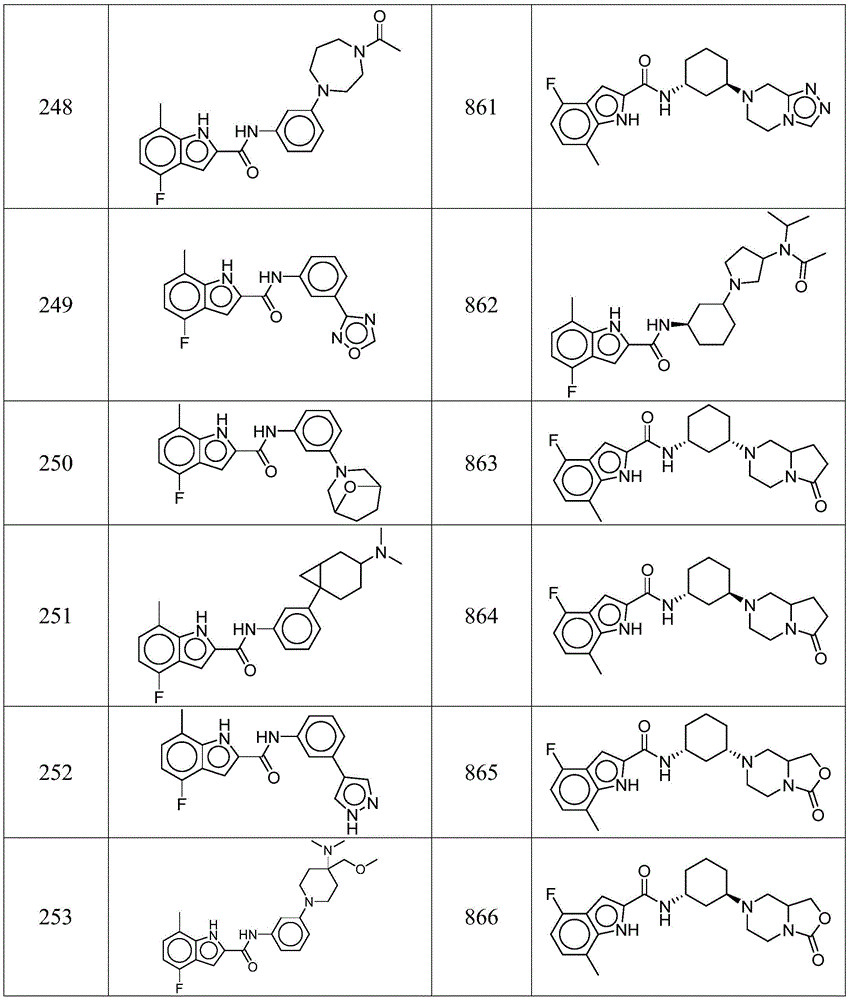


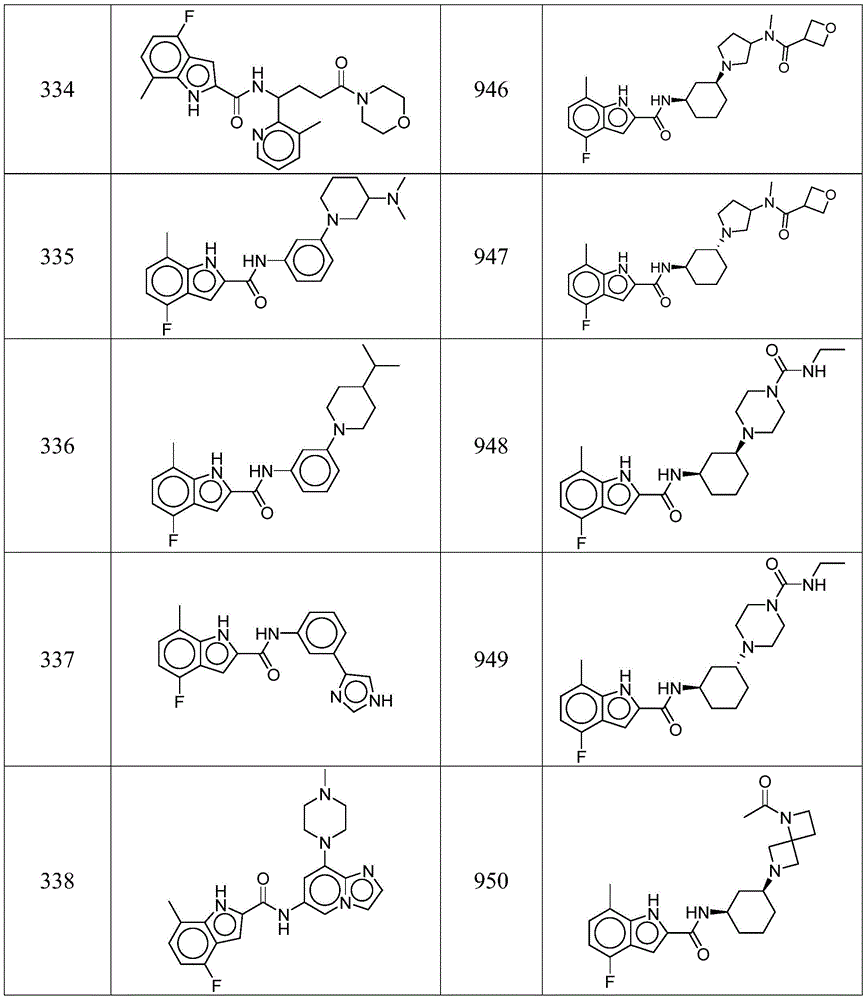


TABLE 1B


The disclosure includes the preparation and use of salts of the compounds of the disclosure, including non-toxic pharmaceutically acceptable salts. Examples of pharmaceutically acceptable addition salts include inorganic and organic acid addition salts and base salts. Pharmaceutically acceptable salts include, but are not limited to, metal salts such as sodium, potassium, cesium and the like; alkaline earth metals such as calcium salts, magnesium salts, etc.; organic amine salts such as triethylamine salt, pyridine salt, picoline salt, ethanolamine salt, triethanolamine salt, dicyclohexylamine salt, N' -dibenzylethylenediamine salt and the like; inorganic acid salts such as hydrochloride, hydrobromide, phosphate, sulfate, etc.; organic acid salts such as citrate, lactate, tartrate, maleate, fumarate, mandelate, acetate, dichloroacetate, trifluoroacetate, oxalate, formate and the like; sulfonates such as methanesulfonate, benzenesulfonate, p-toluenesulfonate and the like; and amino acid salts such as arginine salt, aspartic acid salt, glutamic acid salt, etc. The term "pharmaceutically acceptable salt" as used herein refers to a compound of the disclosure that is physiologically tolerated in the subject of interest (e.g., a mammal, e.g., a human).
Acid addition salts can be formed by mixing a solution of a particular compound of the present disclosure with a solution of a pharmaceutically acceptable non-toxic acid (e.g., hydrochloric acid, fumaric acid, maleic acid, succinic acid, acetic acid, citric acid, tartaric acid, carbonic acid, phosphoric acid, oxalic acid, dichloroacetic acid, and the like). Basic salts can be formed by mixing a solution of a compound of the present disclosure with a solution of a pharmaceutically acceptable non-toxic base (e.g., sodium hydroxide, potassium hydroxide, choline hydroxide, sodium carbonate, etc.).
The present disclosure includes the preparation and use of solvates of the compounds of the present disclosure. Solvates do not generally significantly alter the physiological activity or toxicity of the compound and are therefore useful as pharmacological equivalents. The term "solvate" as used herein is a combination, physical association, and/or solvation of a compound of the disclosure with solvent molecules, such as, for example, a di-solvate, mono-solvate, or semi-solvate, wherein the ratio of solvent molecules to a compound of the disclosure is about 2:1, about 1:1, or about 1:2, respectively. This physical association involves varying degrees of ionic and covalent bonding, including hydrogen bonding. In some cases, the solvate may be isolated, for example, when one or more solvent molecules are incorporated into the crystalline lattice of a crystalline solid. Thus, "solvate" encompasses both solution phases as well as isolatable solvates. The compounds of the present disclosure may exist in solvated forms with pharmaceutically acceptable solvents such as water, methanol, ethanol and the like, and the present disclosure is intended to include both solvated and unsolvated forms of the compounds of the present disclosure. One type of solvate is a hydrate. "hydrates" refers to a particular subset of solvates in which the solvent molecule is water. Solvates are generally useful as pharmacological equivalents. The preparation of solvates is known in the art. See, e.g., m.caira (kela) et al, j.pharmaceut.sci. (journal of pharmaceutical salt science) 93 (3): 601-611(2004), which describes the preparation of solvates of fluconazole using ethyl acetate and water. Similar preparations of solvates, hemisolvates, hydrates, etc. are prepared by e.c. van binder (fantoni) et al, AAPS pharm.sci.tech. (journal of AAPS pharmaceutical science and technology), 5 (1): number 12(2004) and a.l. bingham et al, chem.commu 603-604 (2001). A typical, non-limiting method of preparing a solvate will involve dissolving a compound of the present disclosure in the desired solvent (organic, water, or mixtures thereof) at a temperature of from greater than 20 ℃ to about 25 ℃, then cooling the solution at a rate sufficient to form crystals, and isolating the crystals by known methods (e.g., filtration). Analytical techniques such as infrared spectroscopy can be used to confirm the presence of the solvent in the crystalline form of the solvate.
Methods of treatment
The present disclosure relates generally to a method for treating a disease, condition, or disorder in a subject having, or at risk of having, the disease, condition, or disorder, the method comprising administering to the subject an effective amount of a compound of the present disclosure. In one embodiment, the disease, condition or disorder is responsive to inhibition of the SETD2 protein or is mediated by inhibition of the SETD2 protein.
The disclosure also relates to methods of inhibiting SETD2 protein in a subject in need thereof comprising administering to the subject a therapeutically effective amount of a compound of the disclosure.
In one aspect, the disclosure provides a method of treating a disease, disorder or condition in a subject, the method comprising administering a therapeutically effective amount of a compound of the disclosure.
In another aspect, the disclosure provides a method of treating cancer in a subject comprising administering a therapeutically effective amount of a compound of the disclosure. While not limited to a particular mechanism, in some embodiments, the compounds of the present disclosure treat cancer by inhibiting SETD2 protein. Examples of cancers that may be treated include, but are not limited to, the cancers listed in table 2.
TABLE 2


In another embodiment, the cancer is pancreatic cancer or esophageal cancer.
In another embodiment, the cancer is selected from the group consisting of: esophageal cancer, renal cancer, gastric cancer, hepatocellular cancer, glioblastoma, Central Nervous System (CNS) cancer, soft tissue cancer, lung cancer, breast cancer, bladder/urinary tract cancer, head and neck cancer, prostate cancer, hematologic cancer, pancreatic cancer, skin cancer, endometrial cancer, ovarian cancer, and colorectal cancer.
In another embodiment, the cancer or cancer cell is a hematologic cancer. Exemplary hematologic cancers include, but are not limited to, the cancers listed in table 3.
TABLE 3
| Acute Lymphocytic Leukemia (ALL) | Acute eosinophilic leukemia |
| Acute Myeloid Leukemia (AML) | Acute erythrocytic leukemia |
| Chronic Lymphocytic Leukemia (CLL) | Acute lymphoblastic leukemia |
| Small Lymphocytic Lymphoma (SLL) | Acute megakaryocytic leukemia |
| Multiple Myeloma (MM) | Acute monocytic leukemia |
| Hodgkin Lymphoma (HL) | Acute promyelocytic leukemia |
| Non-hodgkin lymphoma (NHL) | Acute myeloid leukemia |
| Mantle Cell Lymphoma (MCL) | B cell prolymphocytic leukemia |
| Marginal zone B cell lymphoma | B cell lymphoma |
| Marginal zone lymphoma of spleen | MALT lymphoma |
| Follicular Lymphoma (FL) | Precursor T lymphoblastic lymphoma |
| Waldenstrom Macroglobulinemia (WM) | T cell lymphoma |
| Diffuse Large B Cell Lymphoma (DLBCL) | Mastocytic leukemia |
| Marginal Zone Lymphoma (MZL) | Adult T cell leukemia/lymphoma |
| Hairy Cell Leukemia (HCL) | Aggressive NK cell leukemia |
| Burkitt's lymphTumor (BL) | Angioimmunoblastic T cell lymphoma |
| Transfer of Richter scales |
In another embodiment, the cancer is multiple myeloma.
In another embodiment, the multiple myeloma is characterized as having a chromosomal translocation that involves the immunoglobulin heavy chain locus at 14q 32. In another embodiment, the chromosomal translocation is a t (4; 14) translocation, i.e., the multiple myeloma is a t (4; 14) multiple myeloma.
In another embodiment, the disclosure provides a method of treatment to modulate protein methylation, gene expression, cell proliferation, cell differentiation and/or apoptosis in the above cancers by administering a therapeutically effective amount of a compound of the disclosure to a subject in need of such treatment.
The present disclosure provides the following specific embodiments.
A method of treating a subject in need thereof, comprising administering to the subject a therapeutically effective amount of a compound of the disclosure, wherein the subject has cancer.
The method of embodiment I, wherein the cancer is any one or more of the cancers of table 2.
The method of embodiment I, wherein the cancer is a hematological cancer.
The method of embodiment III, wherein the hematologic cancer is any one or more of the cancers of table 3, e.g., multiple myeloma.
The method of embodiment IV, wherein the hematological cancer is t (4; 14) multiple myeloma.
The method of any one of embodiments I-V, further comprising administering a therapeutically effective amount of a second therapeutic agent useful in treating cancer.
Example vii. a pharmaceutical composition comprising a compound of the disclosure and a pharmaceutically acceptable carrier for use in treating cancer.
The pharmaceutical composition of embodiment VII, wherein the cancer is any one or more of the cancers of table 2.
Example IX. the pharmaceutical composition of example VII, wherein the cancer is a hematologic cancer.
The pharmaceutical composition of embodiment IX, wherein the hematologic cancer is any one or more of the cancers of table 3, e.g., multiple myeloma.
The pharmaceutical composition of embodiment X, wherein the hematologic cancer is t (4; 14) multiple myeloma.
Example xii. a compound of the disclosure for use in the treatment of cancer.
A compound for use as described in example XII, wherein the cancer is any one or more of the cancers of table 2.
The compound for use as described in example XII, wherein the cancer is a hematological cancer.
Example XV. the compound for use as described in example XIV, wherein the hematological cancer is any one or more of the cancers of table 3, e.g., multiple myeloma.
A compound for use as described in example XV, wherein the hematological cancer is t (4; 14) multiple myeloma.
Example xvii use of a compound of the present disclosure for the manufacture of a medicament for the treatment of cancer.
Example xviii the use of example XVII, wherein the cancer is any one or more of the cancers of table 2.
Example xviii the use of example XVII, wherein the cancer is a hematological cancer.
The use of example XVII, wherein the hematologic cancer is any one or more of the cancers of table 3, e.g., multiple myeloma.
Example XX. the use of example XIX, wherein the hematologic cancer is t (4; 14) multiple myeloma.
Example XXI the use as described in any one of examples XVII-XX, for comprising one or more additional therapeutic agents.
Example xxii. a kit comprising a compound of the disclosure and instructions for administering the compound of the disclosure to a subject having cancer.
The kit of example xxiii as described in example XXII, wherein the cancer is any one or more of the cancers of table 2.
Example xxiv. the kit of example XXII, wherein the cancer is a hematologic cancer.
The kit of example xxv as described in example XXIV, wherein the hematologic cancer is any one or more of the cancers of table 3, e.g., multiple myeloma.
Example xxvi. the kit of example XXV, wherein the hematologic cancer is t (4; 14) multiple myeloma.
Example xxvii. a kit as described in any of examples XXII-XXVI, further comprising one or more additional therapeutic agents.
The compounds of the present disclosure may be administered to a subject in the form of raw chemicals (in the absence of any other ingredients). The compounds of the present disclosure may also be administered to a mammal as part of a pharmaceutical composition comprising the compound (in combination with a suitable pharmaceutically acceptable carrier). Such carriers may be selected from pharmaceutically acceptable excipients and adjuvants. The term "pharmaceutically acceptable carrier" or "pharmaceutically acceptable carrier" includes any standard pharmaceutical carrier, solvent, surfactant, or vehicle. Suitable pharmaceutically acceptable carriers include aqueous carriers and non-aqueous carriers. Standard Pharmaceutical carriers and their formulations are described in Remington's Pharmaceutical Sciences [ Ramington's Pharmaceutical Sciences ], Mac Publishing Co., Mack Publishing Co., Iston (Easton), Pa., 19 th edition 1995.
Pharmaceutical compositions within the scope of the disclosure include all compositions wherein a compound of the disclosure is combined with one or more pharmaceutically acceptable carriers. In one embodiment, the compounds of the present disclosure are present in the composition in an amount effective to achieve their intended therapeutic purpose. While individual requirements may vary, the determination of an optimal range for an effective amount of each compound is within the skill of the art. Typically, a compound of the disclosure may be administered orally to a mammal, such as a human, daily at a dose of from about 0.0025 to about 1500mg/kg of the mammal's body weight, or the same equivalent amount of a pharmaceutically acceptable salt or solvate thereof, to treat a particular disease. Useful oral dosages of the compounds of the present disclosure administered to a mammal are from about 0.0025 to about 50mg/kg of mammal body weight, or the same equivalent amount of a pharmaceutically acceptable salt or solvate thereof. For intramuscular injection, the dose is usually about half of the oral dose.
A unit oral dose may comprise from about 0.01mg to about 1g of a compound of the present disclosure, for example from about 0.01mg to about 500mg, from about 0.01mg to about 250mg, from about 0.01mg to about 100mg, from 0.01mg to about 50mg, for example from about 0.1mg to about 10mg of the compound. Unit doses may be administered once or more times daily, for example as one or more tablets or capsules, each containing from about 0.01mg to about 1g of the compound, or the same equivalent amount of a pharmaceutically acceptable salt or solvate thereof.
The compounds of the present disclosure or pharmaceutical compositions comprising the compounds of the present disclosure can be administered to any subject who may experience the beneficial effects of the compounds of the present disclosure, for example, a cancer patient in need thereof. Of the most importance of these subjects are mammals, such as humans and companion animals, although the disclosure is not so limited. In one embodiment, the subject is a human.
The pharmaceutical compositions disclosed herein may be administered by any means that achieves their intended purpose. For example, administration can be by oral, parenteral, subcutaneous, intravenous, intramuscular, intraperitoneal, transdermal, intranasal, transmucosal, rectal, intravaginal, or buccal routes, or by inhalation. The dosage and route of administration will vary depending upon the circumstances of the particular subject, and taking into account the age, sex, health and weight of the subject, the condition or disorder to be treated, the nature of concurrent therapy (if any), the frequency of treatment, and the nature of the effect desired.
In one embodiment, the pharmaceutical compositions of the present disclosure may be administered orally. In another embodiment, the pharmaceutical compositions of the present disclosure may be administered orally and formulated into tablets, dragees, capsules, or oral liquid formulations. In one embodiment, an oral formulation comprises extruded multiparticulates comprising a compound of the disclosure.
Alternatively, the pharmaceutical compositions of the present disclosure may be administered rectally and formulated as suppositories.
Alternatively, the pharmaceutical compositions of the present disclosure may be administered by injection.
Alternatively, the pharmaceutical compositions of the present disclosure may be administered transdermally.
Alternatively, the pharmaceutical compositions of the present disclosure may be administered by inhalation or by intranasal or transmucosal administration.
Alternatively, the pharmaceutical compositions of the present disclosure may be administered by the intravaginal route.
A pharmaceutical composition of the disclosure may contain from about 0.01 to 99% by weight, for example from about 0.25 to 75% by weight, of a compound of the disclosure, for example about 1%, about 5%, about 10%, about 15%, about 20%, about 25%, about 30%, about 35%, about 40%, about 45%, about 50%, about 55%, about 60%, about 65%, about 70%, or about 75% by weight of a compound of the disclosure.
In view of the present disclosure, the pharmaceutical compositions of the present disclosure are manufactured in a manner that is itself known, e.g., by means of conventional mixing, granulating, dragee-making, dissolving, extruding, or lyophilizing processes. Thus, pharmaceutical compositions for oral use can be obtained by combining the active compounds with solid excipients, optionally grinding a resulting mixture, and processing the mixture of granules, if desired or necessary after addition of suitable auxiliaries, to obtain tablets or dragee cores.
Suitable excipients include fillers such as sugars (e.g. lactose, sucrose, mannitol or sorbitol), cellulose preparations, calcium phosphates (e.g. tricalcium phosphate or calcium hydrogen phosphate), and binders such as starch pastes (e.g. using corn, wheat, rice or potato starch), gelatin, tragacanth, methyl cellulose, hydroxypropylmethyl cellulose, sodium carboxymethylcellulose and/or polyvinylpyrrolidone. If desired, one or more disintegrating agents may be added, for example the above-mentioned starches and also carboxymethyl starch, cross-linked polyvinylpyrrolidone, agar, or alginic acid or a salt thereof such as sodium alginate.
Adjuvants are usually flow-regulating agents and lubricants, for example silicon dioxide, talc, stearic acid or salts thereof (e.g. magnesium or calcium stearate) and polyethylene glycol. Dragee cores are provided with suitable coatings which are resistant to gastric juices. For this purpose, concentrated sugar solutions may be used, which may optionally contain gum arabic, talc, polyvinyl pyrrolidone, polyethylene glycol and/or titanium dioxide, lacquer solutions, and various suitable organic solvents or solvent mixtures. For producing coatings resistant to gastric juices, solutions of suitable cellulose preparations, such as acetyl cellulose phthalate or hydroxypropylmethylcellulose phthalate, can be used. Dyes or colorants can be added to the tablets or dragee coatings, for example, for identifying or characterizing combinations of active compound doses.
Examples of other pharmaceutical preparations which can be used orally include push-fit capsules made of gelatin or soft, sealed capsules made of gelatin and a plasticizer, such as glycerol or sorbitol. Plug-in capsules may contain the compound in the form of granules, which may be mixed with fillers (such as lactose), binders (such as starches), and/or lubricants (such as talc or magnesium stearate) and optionally stabilizers, or in the form of extruded multiparticulates. In soft capsules, the active compounds are preferably dissolved or suspended in suitable liquids, for example fatty oils, liquid paraffin. In addition, stabilizers may also be added.
Pharmaceutical preparations which can be used for rectal administration include, for example, suppositories which consist of a combination of one or more active compounds with a suppository base. Suitable suppository bases include natural and synthetic triglycerides, as well as paraffin hydrocarbons and the like. It is also possible to use gelatin rectal capsules consisting of a combination of the active compound with a base material, such as, for example, liquid triglycerides, polyethylene glycols or alkanes.
Suitable formulations for parenteral administration include aqueous solutions of the active compounds in water-soluble form, for example water-soluble salts, alkaline solutions or acidic solutions. Alternatively, suspensions of the active compounds may be prepared as oily suspensions. Suitable lipophilic solvents or vehicles such as suspensions may include fatty oils (e.g. sesame oil), synthetic fatty acid esters (e.g. ethyl oleate), triglycerides or polyethylene glycols such as polyethylene glycol 400 (PEG-400). Aqueous suspensions may contain one or more substances which increase the viscosity of the suspension, including, for example, sodium carboxymethyl cellulose, sorbitol, and/or dextran. The suspension may also optionally contain a stabilizer.
In another embodiment, the disclosure provides kits comprising a compound of the disclosure (or a composition comprising a compound of the disclosure) packaged in a manner that facilitates their use in performing the methods of the disclosure. In one embodiment, a kit comprises a compound of the present disclosure (or a composition comprising a compound of the present disclosure) packaged in a container, such as a sealed bottle or sealed tube, with a label affixed to or contained in the container that describes the use of the compound or composition to perform a method of the present disclosure. In one embodiment, the compound or composition is packaged in unit dosage form. The kit may also include a device suitable for administering the composition according to the intended route of administration.
Biomarkers
In another embodiment, the disclosure provides a method of treating a subject having cancer, e.g., multiple myeloma, the method comprising (a) determining the presence or absence of a biomarker in a biological sample taken from the subject; and (b) administering to the subject a therapeutically effective amount of a compound of the disclosure if the biomarker is present in the biological sample. See, e.g., Goosens et al, Transl Cancer Res. [ Cancer transformation study ]4: 256-; kamel and Al-Amodi, Genomics Proteomics Bioinformatics [ genome Proteomics and Bioinformatics ]15: 220-; and Konikova and Kusenda, Neoplama [ tumors ]50:31-40 (2003).
As used herein, the term "biomarker" refers to any biological compound, such as a gene, protein, fragment of a protein, peptide, polypeptide, nucleic acid, etc., or chromosomal abnormality (e.g., a chromosomal translocation) that can be detected and/or quantified in a cancer patient or in a biological sample obtained from a cancer patient (e.g., in a cancer cell). The biomarker may be the entire molecule as well as a portion or fragment thereof. In one embodiment, the expression level of the biomarker is measured. The expression level of the biomarker can be measured, for example, by detecting the protein or RNA (e.g., mRNA) level of the biomarker. In some embodiments, portions or fragments of a biomarker may be detected or measured, for example, by an antibody or other specific binding agent. In some embodiments, the measurable aspect of the biomarker is associated with a given state of the patient, e.g., a particular stage of cancer. For biomarkers detected at the protein or RNA level, such measurable aspects can include, for example, the presence, absence, or concentration (i.e., expression level) of the biomarker in the cancer patient or in a biological sample obtained from the cancer patient. For biomarkers detected at the nucleic acid level, such measurable aspects may include, for example, the allelic version of the biomarker or the type, rate, and/or extent of mutation of the biomarker, also referred to herein as the mutation status.
For biomarkers detected based on the expression level of a protein or RNA, for example, if the mean or median expression level of the biomarkers in different groups is calculated to be statistically significant, the expression levels measured between different phenotypic states may be considered different. Common tests for statistical significance include: t-test, ANOVA, Kruskal-Wallis, Wilcoxon, Mann-Whitney test, significance analysis of microarray, odds ratio, and the like. The use of biomarkers, alone or in combination, can provide a measure of the relative likelihood that a subject belongs to one phenotypic state or another. They are therefore particularly useful as markers of disease and as indicators of the outcome that a particular treatment regimen may lead to patient benefit.
Biomarkers include, but are not limited to, cancer (e.g., multiple myeloma), chromosomal translocations in cells, and WHSC1/NSD2/MMSET expression. In one embodiment, the measurable aspect of a biomarker is its expression status. In one embodiment, the measurable aspect of the biomarker is its mutation status.
In one embodiment, the biomarker is WHSC1/NSD2/MMSET expression, which is differentially present in a subject of one phenotypic state (e.g., a subject with a hematological cancer) compared to a subject of another phenotypic state (e.g., a normal non-diseased subject or a cancer patient that does not overexpress WHSC1/NSD 2/MMSET). In one embodiment, the biomarker is overexpression of WHSC1/NSD 2/MMSET.
Biomarker criteria may be predetermined, determined concurrently, or determined after obtaining a biological sample from a subject. Biomarker criteria for use with the methods described herein may, for example, include data from a sample from a subject without cancer; data from a sample from a subject with a non-metastatic cancer (breast cancer); and data from a sample from a subject having a metastatic cancer (e.g., breast cancer). Comparisons can be made to establish predetermined threshold biomarker criteria for different classes of subjects (e.g., diseased versus non-diseased subjects). The standard may be run in the same assay or may be a known standard of a previous assay.
If the mean or median expression or mutation level of the biomarker is calculated to be different, i.e. higher or lower, between the groups, the biomarker is differentially present between the different phenotypic state groups. Thus, a biomarker provides an indication that a subject (e.g., a cancer patient) belongs to one phenotypic state or another.
As used herein, the term "biomarker" refers to a group, collection, or array comprising a plurality of biological compounds, in addition to an individual biological compound, such as WHSC1/NSD 2/MMSET. For example, a combination of WHSC1/NSD2/MMSET expression status and one or more chromosomal translocations may comprise a biomarker. The term "biomarker" may include one, two, three, four, five, six, seven, eight, nine, ten, fifteen, twenty-five, thirty or more biological compounds.
The expression level or mutation status of a biomarker in a patient may be determined using any of a number of methods known in the art. Any method known in the art for quantifying a particular protein in a patient or biological sample and/or detecting WHSC1/NSD2/MMSET expression and/or chromosomal translocation, or the expression or mutation level of any other biomarker, can be used in the methods of the disclosure. Examples include, but are not limited to: PCR (polymerase chain reaction), or RT-PCR, flow cytometry, northern blotting, Western blotting, ELISA (enzyme-linked immunosorbent assay), RIA (radioimmunoassay), gene chip analysis of RNA expression, immunohistochemistry, or immunofluorescence. See, e.g., Slagle et al Cancer 83:1401 (1998); hudlebusch et al, Clin Cancer Res [ clinical Cancer research ]17: 2919-. Certain embodiments of the present disclosure include methods wherein biomarker RNA expression (transcription) is determined. Other embodiments of the disclosure include methods wherein protein expression in a biological sample is determined. See, e.g., Harlow et al, Antibodies: antibody Manual [ Antibodies: a Laboratory manual, Cold Spring Harbor Laboratory Press, Cold Spring Harbor, New York, (1988); ausubel et al, Current Protocols in Molecular Biology [ Molecular Biology laboratory Manual ], John Wiley & Sons [ John Willi father, N.Y. (1995); kamel and Al-Amodi, Genomics Proteomics Bioinformatics [ genome Proteomics and Bioinformatics ]15: 220-. For northern blot or RT-PCR analysis, RNA was isolated from tumor tissue samples using RNAse-free techniques. Such techniques are well known in the art.
In one embodiment of the disclosure, a biological sample is obtained from a patient and assayed to determine biomarker expression or mutation status.
In another embodiment of the disclosure, northern blot analysis of biomarker transcripts in tumor cell samples is performed. Northern blot analysis is a standard method for detecting and/or quantifying mRNA levels in a sample. Initially, RNA is isolated from a sample to be assayed using northern blot analysis. In the analysis, RNA samples were first separated by size via agarose gel electrophoresis under denaturing conditions. The RNA is then transferred to a membrane, crosslinked and hybridized to a labeled probe. In general, RNA hybridization involves polymerizing radiolabeled or non-isotopically labeled DNA in vitro, or generating oligonucleotides as hybridization probes. Typically, the membrane containing the RNA sample is prehybridized or blocked prior to probe hybridization to prevent the probe from coating the membrane, thereby reducing non-specific background signal. After hybridization, the unhybridized probe is usually removed by washing several times with buffer changes. The stringency of washing and hybridization conditions can be designed, selected and carried out by one of ordinary skill in the art. Detection is accomplished using a detectably labeled probe and a suitable detection method. Radiolabeled and non-radioactive probes and their use are well known in the art. The presence and or relative level of expression of the biomarker determined may be quantified using, for example, densitometry.
In another embodiment, the expression and/or mutation status of the biomarker is determined using RT-PCR. RT-PCR allows real-time detection of the progress of PCR amplification of a target gene. The design of primers and probes required to detect the expression and/or mutation status of the biomarkers of the present disclosure is within the skill of one of ordinary skill in the art. RT-PCR can be used to determine the level of RNA encoding a biomarker of the disclosure in a tumor tissue sample. In embodiments of the disclosure, RNA from a biological sample is isolated in the absence of rnases and then converted to DNA by treatment with reverse transcriptase. Methods for converting RNA to DNA using reverse transcriptase are well known in the art. The following references provide a description of PCR: mullis et al, Cold Spring Harbor Symp. Quant.biol. [ Cold Spring Harbor BioScenario in quantitative biology ]51:263 (1986); EP 50,424; EP 84,796; EP 258,017; EP 237,362; EP 201,184; U.S. Pat. nos. 4,683,202; 4,582,788, respectively; 4,683,194.
RT-PCR probes depend on the 5'-3' nuclease activity of the DNA polymerase used for PCR to hydrolyze oligonucleotides that hybridize to the target amplicon (biomarker gene). RT-PCR probes are oligonucleotides with a fluorescent reporter dye attached to the 5 'end and a quencher moiety coupled to the 3' end (or vice versa). These probes are designed to hybridize to an internal region of the PCR product. In the unhybridized state, the proximity of the fluorescent molecule and the quencher molecule prevents detection of the fluorescent signal of the probe. During PCR amplification, when a polymerase replicates a template to which an RT-PCR probe is bound, the 5'-3' nuclease activity of the polymerase cleaves the probe. This decouples the fluorescent and quenching dyes and FRET no longer occurs. Thus, fluorescence increases in each cycle in a manner proportional to the amount of probe cleaved. The fluorescent signal emitted from the reaction can be measured or tracked over time using conventional and conventional techniques using commercially available equipment.
In another embodiment of the disclosure, the expression of the protein encoded by the biomarker is detected by western blot analysis. Western blotting (also known as immunoblotting) is a method for detecting proteins in a given sample of a tissue homogenate or extract. Western blotting denatured proteins were separated by mass using gel electrophoresis. The proteins are then transferred from the gel and transferred to a membrane (e.g., nitrocellulose or polyvinylidene fluoride (PVDF)) where they are detected using primary antibodies that specifically bind to the proteins. The bound antibody can then be detected by a secondary antibody conjugated to a detectable label (e.g., biotin, horseradish peroxidase or alkaline phosphatase). Detection of the second label signal indicates the presence of the protein.
In another embodiment of the disclosure, the expression of the protein encoded by the biomarker is detected by enzyme-linked immunosorbent assay (ELISA). In one embodiment of the present disclosure, a "sandwich ELISA" comprises coating a plate with a capture antibody; adding the sample, wherein any antigen present binds to the capture antibody; adding a detection antibody that also binds to the antigen; adding an enzyme-linked secondary antibody that binds to the detection antibody; and substrate converted to a detectable form by the enzyme on the secondary antibody is added. Detection of a signal from the secondary antibody indicates the presence of the biomarker antigen protein.
Multiple myeloma is a heterogeneous plasma cell disorder characterized by genetic abnormalities (including chromosomal translocations, deletions, duplications) and genetic mutations. Translocations involving the immunoglobulin heavy chain region at chromosome 14q32 were observed in approximately 40% of patients with multiple myeloma. Translocation of an oncogene to this region may result in increased expression thereof, thereby promoting disease development, disease progression and resistance to treatment. For example, t (4; 14) translocation is associated with upregulation of fibroblast growth factor receptor 3(FGFR3) and myeloma SET domain proteins. Subjects with t (4; 14) showed an overall poor prognosis, which was only partially alleviated using existing chemotherapeutic agents. There is an unmet medical need for subjects with such abnormalities. Table 4 lists IgH translocations in multiple myeloma patients. See, e.g., Kalff and Spencer, Blood Cancer Journal 2: e89 (2012).
TABLE 4
| Translocation | Prevalence rate% | Oncogene upregulation | Prognosis |
| t(4;14) | 15 | MMSET、FGFR3 | Is disadvantageous |
| t(14;16) | 5 | MAF | Is disadvantageous |
| t(14;20) | 1-2 | MAF | Is disadvantageous |
| t(8;14) | 2 | MAF | Is disadvantageous |
| t(11;14) | 15-17 | Cyclin D1 | Advantageous/neutral |
| t(6;14) | 4 | Cyclin D3 | Advantageous/neutral |
Abbreviations: FGFR, fibroblast growth factor receptor; IgH, immunoglobulin heavy chain; MM, multiple myeloma; MMSET, myeloma SET domain protein
WHSC1/NSD2/MMSET is a histone methyltransferase located at the chromosome 4p16 locus. In a subset of multiple myeloma, a chromosomal translocation occurs in which this region is fused to chromosome 14q 32. This translocation is commonly referred to as t (4; 14). The result of t (4; 14) in multiple myeloma is that the WHSC1/NSD2/MMSET gene is under the transcriptional control of the IgH promoter. This results in a large up-regulation of WHSC1/NSD2/MMSET (Chesi et al, Blood 92:3025-3034 (1998)). An increase in WHSC1/NSD2/MMSET resulted in an increase in the dimethylation of histone H3 at lysine 36(H3K 36). (Kuo et al, mol. cell [ molecular cell ]44:609-620 (2011)). Like WHSC1/NSD2/MMSET, SETD2 also methylated H3K36, but three methyl groups were added instead of two. Based on the sensitivity of the t (4; 14) multiple myeloma cell line to inhibition by SETD2, oncogenic function resulting from the increase in H3K36me2 caused by WHSC1 overexpression may also require the ability of SETD2 to add additional methyl groups.
In one embodiment, the present disclosure provides a method of treating a subject with multiple myeloma, the method comprising: (a) determining whether a chromosomal translocation is present in a biological sample taken from the subject; and (b) administering to the subject a therapeutically effective amount of a compound of the disclosure if a chromosomal translocation is present in the biological sample.
In another embodiment, the disclosure provides a method of treating a subject with multiple myeloma, comprising administering to a subject with a chromosomal translocation a therapeutically effective amount of a compound of the disclosure.
In another embodiment, the disclosure provides a method of identifying whether a subject with multiple myeloma can be a candidate for treatment with a compound of the disclosure, the method comprising: (a) determining whether a chromosomal translocation is present in a biological sample taken from the subject; and (b) identifying the subject as a candidate for treatment if a chromosomal translocation is present; or (c) not identifying the subject as a candidate for treatment if a chromosomal translocation is not present.
In another embodiment, the disclosure provides a method of predicting treatment outcome in a subject with multiple myeloma, the method comprising determining whether a chromosomal translocation is present in a biological sample taken from the subject, wherein (a) the presence of a chromosomal translocation in the biological sample indicates that administration of a compound of the disclosure to the subject will likely elicit a favorable therapeutic response; and (b) the absence of chromosomal translocations in the biological sample indicates that administration of a compound of the disclosure to the subject will likely elicit an adverse therapeutic response.
In another embodiment, the present disclosure provides a method comprising administering to a subject in need thereof a therapeutically effective amount of a compound of the present disclosure, wherein: (a) the subject has multiple myeloma; and (b) the multiple myeloma is characterized as having a chromosomal translocation.
In any of the above embodiments, the chromosomal translocation is a t (4; 14) translocation.
In one embodiment, the present disclosure provides a method of treating a subject with multiple myeloma, the method comprising: (a) determining whether there is overexpression of WHSC1/NSD2/MMSET in a biological sample taken from the subject; and (b) administering to the subject a therapeutically effective amount of a compound of the disclosure if there is overexpression of WHSC1/NSD2/MMSET in the biological sample.
In one embodiment, the disclosure provides a method of treating a subject with multiple myeloma comprising administering to the subject a therapeutically effective amount of a compound of the disclosure if overexpression of WHSC1/NSD2/MMSET is present in the subject.
In another embodiment, the disclosure provides a method of identifying whether a subject with multiple myeloma can be a candidate for treatment with a compound of the disclosure, the method comprising: (a) determining whether there is overexpression of WHSC1/NSD2/MMSET in a biological sample taken from the subject; and (b) identifying the subject as a candidate for treatment if there is overexpression of WHSC1/NSD 2/MMSET; or (c) not identifying the subject as a candidate for treatment if there is no overexpression of WHSC1/NSD 2/MMSET.
In another embodiment, the disclosure provides a method of predicting treatment outcome in a subject with multiple myeloma, the method comprising determining whether there is overexpression of WHSC1/NSD2/MMSET in a biological sample taken from the subject, wherein: (a) the presence of overexpression of WHSC1/NSD2/MMSET in the biological sample indicates that administration of a compound of the disclosure to the subject will likely elicit a favorable therapeutic response; and (b) the absence of overexpression of WHSC1/NSD2/MMSET in the biological sample indicates that administration of a compound of the disclosure to the subject will likely elicit an adverse therapeutic response.
In another embodiment, the present disclosure provides a method comprising administering to a subject in need thereof a therapeutically effective amount of a compound of the present disclosure, wherein: (a) the subject has multiple myeloma; and (b) the multiple myeloma is characterized as having overexpression of WHSC1/NSD 2/MMSET.
Definition of
The term "halo" as employed herein by itself or as part of another group refers to-Cl, -F, -Br, or-I.
The term "nitro" as employed herein by itself or as part of another group refers to-NO 2。
The term "cyano" as employed herein by itself or as part of another group refers to — CN.
The term "hydroxy" as employed by itself or as part of another group refers to-OH.
The term "alkyl" as employed herein by itself or as part of another group refers to a group containing one to twelve carbon atoms (i.e., C)1-C12Alkyl) or a specified number of carbon atoms (e.g. C)1Alkyl radicals such as methyl, C2Alkyl groups such as ethyl, etc.). In one embodiment, alkyl is C1-C10An alkyl group. In another embodiment, alkyl is C1-C6An alkyl group. In another embodiment, alkyl is C1-C4An alkyl group. In another embodiment, alkyl is C1-C3Alkyl, i.e., methyl, ethyl, propyl, or isopropyl. Non-limiting exemplary C1-C12The alkyl group includes AAlkyl, ethyl, propyl, isopropyl, butyl, sec-butyl, tert-butyl, isobutyl, 3-pentyl, hexyl, heptyl, octyl, nonyl and decyl.
The term "optionally substituted alkyl" as employed herein by itself or as part of another group refers to an unsubstituted alkyl group or an alkyl group substituted with one, two or three substituents, wherein each substituent is independently nitro, haloalkoxy, aryloxy, aralkoxy, alkylthio, sulfonamide, alkylcarbonyl, arylcarbonyl, alkylsulfonyl, arylsulfonyl, ureido, guanidino, carbamate, carboxyl, alkoxycarbonyl, carboxyalkyl, -N (R is alkyl, aryl, heteroaryl 56a)C(=O)R56b、-N(R56c)S(=O)2R56d、-C(=O)R57、-S(=O)R56e、-S(=O)2R58、-N(R56a)C(=N-R60)R61、-N(R56a)C(=C-NO2)R64、-C(=N-R60)R61or-C (═ C-NO)2)R64(ii) a Wherein:
R56ais hydrogen or alkyl;
R56bis alkyl, haloalkyl, optionally substituted cycloalkyl, alkoxy, (alkoxy) alkyl, (aryl) alkyl, (heteroaryl) alkyl, (amino) alkyl, (hydroxy) alkyl, (cyano) alkyl, optionally substituted alkenyl, optionally substituted alkynyl, optionally substituted cycloalkyl, optionally substituted heterocycle, optionally substituted C6-C10Aryl, or optionally substituted heteroaryl;
R56cis hydrogen or alkyl;
R56dis alkyl, haloalkyl, optionally substituted cycloalkyl, alkoxy, (alkoxy) alkyl, (aryl) alkyl, (heteroaryl) alkyl, (amino) alkyl, (hydroxy) alkyl, (cyano) alkyl, optionally substituted alkenyl, optionally substituted alkynyl, optionally substituted cycloalkyl, optionally substituted heterocycle, optionally substituted C6-C10Aryl, or optionally substituted heteroAn aryl group;
R56eis alkyl, haloalkyl, optionally substituted cycloalkyl, alkoxy, (alkoxy) alkyl, (aryl) alkyl, (heteroaryl) alkyl, (amino) alkyl, (hydroxy) alkyl, (cyano) alkyl, optionally substituted alkenyl, optionally substituted alkynyl, optionally substituted cycloalkyl, optionally substituted heterocycle, optionally substituted C 6-C10Aryl, or optionally substituted heteroaryl;
R57is haloalkyl, amino, optionally substituted cycloalkyl, alkoxy, (alkoxy) alkyl, (aryl) alkyl, (heteroaryl) alkyl, (amino) alkyl, (hydroxy) alkyl, (cyano) alkyl, optionally substituted alkenyl, optionally substituted alkynyl, optionally substituted cycloalkyl, optionally substituted heterocycle, optionally substituted heteroaryl, (C)3-C6Cycloalkyl) oxy, or (4-to 8-membered heterocyclic) oxy;
R58is haloalkyl, optionally substituted cycloalkyl, alkoxy, (alkoxy) alkyl, (aryl) alkyl, (heteroaryl) alkyl, (amino) alkyl, (hydroxy) alkyl, (cyano) alkyl, optionally substituted alkenyl, optionally substituted alkynyl, optionally substituted cycloalkyl, optionally substituted heterocycle, or optionally substituted heteroaryl;
R60selected from the group consisting of: cyano, nitro, hydroxy, C1-C6Alkoxy, -C (═ O) R62and-S (═ O)2R62;
R61Selected from the group consisting of: c1-C6Alkyl radical, C3-C6Cycloalkyl, and-NR63aR63b;
R62Selected from the group consisting of: c1-C6Alkyl radical, C3-C6Cycloalkyl, and-NR63aR63b;
R63aSelected from the group consisting of: hydrogen, C1-C6Alkyl, and C 3-C6A cycloalkyl group;
R63bselected from the group consisting of: hydrogen, C1-C6Alkyl, and C3-C6A cycloalkyl group; or
R63aAnd R63bTogether with the nitrogen atom to which they are attached form a 4-to 6-membered optionally substituted heterocyclic ring;
R64selected from the group consisting of: c1-C6Alkyl radical, C3-C6Cycloalkyl, and-NR63cR63d(ii) a And is
R63cSelected from the group consisting of: hydrogen, C1-C6Alkyl, and C3-C6A cycloalkyl group;
R63dselected from the group consisting of: hydrogen, C1-C6Alkyl, and C3-C6A cycloalkyl group; or
R63cAnd R63dTogether with the nitrogen atom to which they are attached form a 4-to 6-membered optionally substituted heterocyclic ring.
In one embodiment, optionally substituted alkyl is unsubstituted or substituted with one, two or three substituents, wherein each substituent is independently nitro, haloalkoxy, aryloxy, aralkoxy, alkylthio, sulfonamido, alkylcarbonyl, arylcarbonyl, alkylsulfonyl, arylsulfonyl, ureido, guanidino, carbamate, carboxyl, alkoxycarbonyl, carboxyalkyl, -N (R) is unsubstituted or substituted with one, two or three substituents56a)C(=O)R56b、-N(R56c)S(=O)2R56d、-C(=O)R57、-S(=O)R56eor-S (═ O)2R58。
In another embodiment, the optionally substituted alkyl is substituted with two substituents. In another embodiment, the optionally substituted alkyl is substituted with one substituent. In another embodiment, the optionally substituted alkyl is optionally substituted C 1-C6An alkyl group. In another embodiment, the optionally substituted alkyl is optionally substituted C1-C4An alkyl group. In thatIn one embodiment, the optionally substituted alkyl is optionally substituted C1Or C2An alkyl group. Non-limiting exemplary optionally substituted alkyl groups include: -CH (CO)2Me)CH2CO2Me and-CH (CH)3)CH2N(H)C(=O)O(CH3)3。
The term "alkenyl" as employed herein by itself or as part of another group refers to an alkyl group containing one, two, or three carbon-carbon double bonds. In one embodiment, the alkenyl group is C2-C6An alkenyl group. In another embodiment, the alkenyl group is C2-C4An alkenyl group. In another embodiment, the alkenyl group has one carbon-carbon double bond. Non-limiting exemplary alkenyl groups include: ethenyl, propenyl, isopropenyl, butenyl, sec-butenyl, pentenyl, and hexenyl.
The term "optionally substituted alkenyl" as employed herein by itself or as part of another group refers to an unsubstituted alkenyl group or an alkenyl group substituted with one, two, or three substituents, wherein each substituent is independently halo, nitro, cyano, hydroxy, amino (e.g., alkylamino, dialkylamino), haloalkyl, hydroxyalkyl, alkoxy, haloalkoxy, aryloxy, aralkoxy, alkylthio, carboxamido, sulfonamido, alkylcarbonyl, arylcarbonyl, alkylsulfonyl, arylsulfonyl, ureido, guanidino, carboxy, carboxyalkyl, optionally substituted cycloalkyl, alkenyl, alkynyl, optionally substituted aryl, optionally substituted heteroaryl, or optionally substituted heterocycle. Non-limiting exemplary optionally substituted alkenyl groups include-CH ═ CHPh.
The term "alkynyl" as employed herein by itself or as part of another group refers to an alkyl group containing one, two or three carbon-carbon triple bonds. In one embodiment, the alkynyl group has one carbon-carbon triple bond. In another embodiment, alkynyl is C1-C6Alkynyl. In another embodiment, alkynyl is C2-C4Alkynyl. In addition toIn one embodiment, the alkynyl group has one carbon-carbon triple bond. Non-limiting exemplary alkynyl groups include: ethynyl, propynyl, butynyl, 2-butynyl, pentynyl, and hexynyl groups.
The term "optionally substituted alkynyl" as employed herein by itself or as part of another group refers to an unsubstituted alkynyl group or an alkynyl group substituted with one, two or three substituents, wherein each substituent is independently halo, nitro, cyano, hydroxy, amino (e.g., alkylamino, dialkylamino), haloalkyl, hydroxyalkyl, alkoxy, haloalkoxy, aryloxy, aralkoxy, alkylthio, carboxamido, sulfonamido, alkylcarbonyl, arylcarbonyl, alkylsulfonyl, arylsulfonyl, ureido, guanidino, carboxy, carboxyalkyl, optionally substituted cycloalkyl, alkenyl, alkynyl, optionally substituted aryl, optionally substituted heteroaryl, or optionally substituted heterocycle. Non-limiting exemplary optionally substituted alkynyl groups include-CH ≡ CHPh.
The term "haloalkyl" as employed herein by itself or as part of another group, refers to an alkyl group substituted with one or more fluorine, chlorine, bromine, and/or iodine atoms. In one embodiment, the alkyl group is substituted with one, two or three fluorine and/or chlorine atoms. In another embodiment, the alkyl group is substituted with one, two, or three fluorine atoms. In another embodiment, alkyl is C1-C6An alkyl group. In another embodiment, alkyl is C1-C4An alkyl group. In another embodiment, the alkyl group is C1Or C2An alkyl group. Non-limiting exemplary haloalkyl groups include fluoromethyl, difluoromethyl, trifluoromethyl, pentafluoroethyl, 1-difluoroethyl, 2,2, 2-trifluoroethyl, 3,3, 3-trifluoropropyl, 4,4, 4-trifluorobutyl, and trichloromethyl groups.
The term "hydroxyalkyl" or "(hydroxy) alkyl" as employed herein by itself or as part of another group refers to an alkyl group substituted with one, two or three hydroxy groups. In one embodiment, an alkyl groupIs C1-C6An alkyl group. In another embodiment, alkyl is C1-C4An alkyl group. In another embodiment, alkyl is C1Or C2An alkyl group. In another embodiment, the hydroxyalkyl group is a monohydroxyalkyl group, i.e., substituted with one hydroxyl group. In another embodiment, the hydroxyalkyl group is a dihydroxyalkyl group, i.e., substituted with two hydroxyl groups. Non-limiting exemplary (hydroxy) alkyl groups include hydroxymethyl, hydroxyethyl, hydroxypropyl, and hydroxybutyl groups, such as 1-hydroxyethyl, 2-hydroxyethyl, 1, 2-dihydroxyethyl, 2-hydroxypropyl, 3-hydroxybutyl, 4-hydroxybutyl, 2-hydroxy-1-methylpropyl, and 1, 3-dihydroxypropan-2-yl.
The term "alkoxy" as employed herein by itself or as part of another group refers to an alkyl group attached to a terminal oxygen atom. In one embodiment, alkyl is C1-C6An alkyl group. In another embodiment, alkyl is C1-C4An alkyl group. Non-limiting exemplary alkoxy groups include methoxy, ethoxy, and t-butoxy.
The term "haloalkoxy" as employed herein by itself or as part of another group refers to a haloalkyl group attached to a terminal oxygen atom. In one embodiment, haloalkyl is C1-C6An alkyl group. In another embodiment, the haloalkyl group is C1-C4A haloalkyl group. Non-limiting exemplary haloalkoxy groups include: fluoromethoxy, difluoromethoxy, trifluoromethoxy, and 2,2, 2-trifluoroethoxy.
The term "alkylthio" as employed herein by itself or as part of another group, refers to an alkyl group attached to a terminal oxygen atom. In one embodiment, the alkyl group is C1-C4An alkyl group. Non-limiting exemplary alkylthio groups include-SCH3and-SCH2CH3。
The term "alkoxyalkyl" or "(alkoxy) alkyl" as employed herein by itself or as part of another group refers to a substituted or unsubstituted alkyl group substituted with one alkoxy group Alkyl groups substituted with radical groups. In one embodiment, alkoxy is C1-C6An alkoxy group. In another embodiment, alkoxy is C1-C4An alkoxy group. In another embodiment, alkyl is C1-C6An alkyl group. In another embodiment, alkyl is C1-C4An alkyl group. Non-limiting exemplary alkoxyalkyl groups include: methoxymethyl, methoxyethyl, methoxypropyl, methoxybutyl, ethoxymethyl, ethoxyethyl, ethoxypropyl, ethoxybutyl, propoxymethyl, isopropoxymethyl, propoxyethyl, propoxypropyl, butoxymethyl, tert-butoxymethyl, isobutoxymethyl, sec-butoxymethyl, and phenoxymethyl.
The term "heteroalkyl", as employed herein by itself or as part of another group, refers to a stable straight or branched chain hydrocarbon radical containing from 1 to 10 carbon atoms and at least two heteroatoms, which may be the same or different, selected from O, N or S, in which one or more sulfur atoms may be optionally oxidized. The heteroatom may be located at any internal position of the heteroalkyl group or at a position where the heteroalkyl group is attached to the remainder of the molecule. In one embodiment, the heteroalkyl group contains two oxygen atoms. In another embodiment, the heteroalkyl group contains one oxygen atom and one nitrogen atom. In another embodiment, the heteroalkyl group contains two nitrogen atoms. Non-limiting exemplary heteroalkyl groups include: -OCH 2CH2NH2、-NHCH2CH2OCH3and-OCH2CH2OCH3。
The term "cycloalkyl" as employed herein by itself or as part of another group refers to saturated and partially unsaturated (e.g., containing one or two double bonds) monocyclic, bicyclic, or tricyclic aliphatic hydrocarbons containing three to twelve carbon atoms (i.e., C)3-12Cycloalkyl) or contain the indicated number of carbons (e.g. C)3Cycloalkyl (e.g. cyclopropyl, C)4Cycloalkyl (e.g., cyclobutyl), and the like). In one embodiment, the cycloalkyl group is bicyclic, i.e., it has two rings. In another embodiment, the cycloalkaneThe radical is monocyclic, i.e. it has one ring. In another embodiment, cycloalkyl is C3-8A cycloalkyl group. In another embodiment, cycloalkyl is C3-6Cycloalkyl, i.e. cyclopropyl, cyclobutyl, cyclopentyl, or cyclohexyl. In another embodiment, cycloalkyl is C5Cycloalkyl, i.e. cyclopentyl. In another embodiment, cycloalkyl is C6Cycloalkyl, i.e. cyclohexyl. Non-limiting exemplary C3-12Cycloalkyl groups include cyclopropyl, cyclobutyl, cyclopentyl, cyclohexyl, cycloheptyl, cyclooctyl, norbornyl, decalin, adamantyl, cyclohexenyl and spiro [3.3]Heptane.
The term "optionally substituted cycloalkyl" as employed herein by itself or as part of another group refers to an unsubstituted cycloalkyl group or a cycloalkyl group substituted with one, two or three substituents, wherein each substituent is independently halo, nitro, cyano, hydroxy, amino (e.g., -NH 2Alkylamino, dialkylamino, aralkylamino, hydroxyalkylamino, or (hetero) alkylamino), heteroalkyl, haloalkyl, hydroxyalkyl, alkoxy, haloalkoxy, aryloxy, aralkyl, aralkoxy, alkylthio, carboxamido, sulfonamido, alkylcarbonyl, arylcarbonyl, alkylsulfonyl, arylsulfonyl, ureido, guanidino, carboxyl, carboxyalkyl, optionally substituted alkyl, optionally substituted cycloalkyl, alkenyl, alkynyl, optionally substituted aryl, optionally substituted heteroaryl, optionally substituted heterocycle, alkoxyalkyl, (amino) alkyl, (cyano) alkyl, (carboxamido) alkyl, mercaptoalkyl, (hetero) alkyl, (heteroaryl) alkyl, -N (R) alkylamino56a)C(=O)R56b、-N(R56c)S(=O)2R56d、-C(=O)R57、-S(=O)R56e、-S(=O)2R58、-OR59、-N(R56a)C(=N-R60)R61、-N(R56a)C(=C-NO2)R64、-C(=N-R60)R61or-C (═ C-NO)2)R64(ii) a Wherein R is56a、R56b、R56c、R56d、R56e、R57、R58、R60、R61And R64Is as defined for the term "optionally substituted alkyl" and R59Is (hydroxy) alkyl or (amino) alkyl. Non-limiting exemplary optionally substituted cycloalkyl groups include 3- (4-acetylpiperazin-1-yl) cyclohexyl, 3- (3- (N-methylacetamido) pyrrolidin-1-yl) cyclohexyl, 3-morpholinocyclohexyl, and 3- (pyrimidin-5-yl) cyclohexyl. In one embodiment, optionally substituted cycloalkyl is unsubstituted or substituted with one, two or three substituents, wherein each substituent is independently halo, nitro, cyano, hydroxy, amino (e.g., -NH) 2Alkylamino, dialkylamino, aralkylamino, hydroxyalkylamino, or (hetero) alkylamino), heteroalkyl, haloalkyl, hydroxyalkyl, alkoxy, haloalkoxy, aryloxy, aralkyl, aralkoxy, alkylthio, carboxamido, sulfonamido, alkylcarbonyl, arylcarbonyl, alkylsulfonyl, arylsulfonyl, ureido, guanidino, carboxyl, carboxyalkyl, optionally substituted alkyl, optionally substituted cycloalkyl, alkenyl, alkynyl, optionally substituted aryl, optionally substituted heteroaryl, optionally substituted heterocycle, alkoxyalkyl, (amino) alkyl, (cyano) alkyl, (carboxamido) alkyl, mercaptoalkyl, (hetero) alkyl, (heteroaryl) alkyl, -N (R) alkylamino56a)C(=O)R56b、-N(R56c)S(=O)2R56d、-C(=O)R57、-S(=O)R56e、-S(=O)2R58and-OR59。
The term "heterocycle" as employed herein by itself or as part of another group refers to saturated and partially unsaturated (e.g., containing one or two double bonds) monocyclic, bicyclic, or tricyclic groups containing three to fourteen ring members, i.e., 3-to 14-membered heterocyclic rings, containing one, two, three, or four heteroatoms. Each heteroatom is independently oxygen, sulfur, or nitrogen. Each sulfur atom is independently oxidized to give a sulfoxide (i.e., S (═ O)) or sulfone (i.e., S (═ O) 2)。
The term heterocycle includes those in which one or more-CH groups2Groups in which the-group is substituted by one or more-C (═ O) -groups, include cyclic ureido groups (e.g. imidazolidin-2-one), cyclic amide groups (e.g. pyrrolidin-2-one or piperidin-2-one), and cyclic carbamate groups (e.g. oxazolidinyl-2-one).
The term heterocycle also includes groups having a fused optionally substituted aryl or optionally substituted heteroaryl group, e.g., indoline, indolin-2-one, 2, 3-dihydro-1H-pyrrolo [2,3-c]Pyridine, 2,3,4, 5-tetrahydro-1H-benzo [ d]Aza derivatives Or 1,3,4, 5-tetrahydro-2H-benzo [ d]Aza derivatives
 -2-ketones.
In one embodiment, the heterocyclic group is a 4 to 8 membered ring group containing one ring and one or two oxygen atoms (e.g., tetrahydrofuran or tetrahydropyran), or one or two nitrogen atoms (e.g., pyrrolidine, piperidine, or piperazine), or one oxygen and one nitrogen atom (e.g., morpholine), and optionally, one-CH2-the group is replaced by a-C (═ O) -group (e.g. pyrrolidin-2-one or piperazin-2-one). In another embodiment, the heterocyclic group is a 5 to 8 membered ring group containing one ring and one or two nitrogen atoms, and optionally, one-CH 2-the group is replaced by a-C (═ O) -group. In another embodiment, the heterocyclic group is a 5 or 6 membered ring group containing one ring and one or two nitrogen atoms, and optionally, one-CH2-the group is replaced by a-C (═ O) -group. In another embodiment, the heterocyclic group is an 8-to 12-membered ring group containing two rings and one or two nitrogen atoms. The heterocyclic ring may be attached to the rest of the molecule through any available carbon or nitrogen atom. Non-limiting exemplary heterocyclic groups include:


the term "optionally substituted heterocycle" as employed herein by itself or as part of another group refers to an unsubstituted heterocyclic group or a heterocyclic group substituted with one to four substituents, wherein each substituent is independently halo, nitro, cyano, hydroxy, amino (e.g., -NH-)2Alkylamino, dialkylamino, aralkylamino, hydroxyalkylamino, or (hetero) alkylamino), heteroalkyl, haloalkyl, hydroxyalkyl, alkoxy, haloalkoxy, aryloxy, aralkyl, aralkoxy, alkylthio, carboxamido, sulfonamido, alkylcarbonyl, arylcarbonyl, alkylsulfonyl, arylsulfonyl, ureido, guanidino, carboxyl, carboxyalkyl, optionally substituted alkyl, optionally substituted cycloalkyl, alkenyl, alkynyl, optionally substituted aryl, optionally substituted heteroaryl, optionally substituted heterocycle, alkoxyalkyl, (amino) alkyl, (cyano) alkyl, (carboxamido) alkyl, mercaptoalkyl, (hetero) alkyl, (heteroaryl) alkyl, -N (R) alkylamino 56a)C(=O)R56b、-N(R56c)S(=O)2R56d、-C(=O)R57、-S(=O)R56e、-S(=O)2R58、-OR59、-N(R56a)C(=N-R60)R61、-N(R56a)C(=C-NO2)R64、-C(=N-R60)R61or-C (═ C-NO)2)R64(ii) a Wherein R is56a、R56b、R56c、R56d、R56e、R57、R58、R59、R60、R61And R64Is as defined for the term "optionally substituted cycloalkyl". Substitutions may occur on any possible carbon or nitrogen atom of the heterocyclic group. In one embodiment, the optionally substituted heterocycle is unsubstituted or substituted with one to four substituents, which areWherein each substituent is independently halo, nitro, cyano, hydroxy, amino (e.g. -NH)2Alkylamino, dialkylamino, aralkylamino, hydroxyalkylamino, or (hetero) alkylamino), heteroalkyl, haloalkyl, hydroxyalkyl, alkoxy, haloalkoxy, aryloxy, aralkyl, aralkoxy, alkylthio, carboxamido, sulfonamido, alkylcarbonyl, arylcarbonyl, alkylsulfonyl, arylsulfonyl, ureido, guanidino, carboxyl, carboxyalkyl, optionally substituted alkyl, optionally substituted cycloalkyl, alkenyl, alkynyl, optionally substituted aryl, optionally substituted heteroaryl, optionally substituted heterocycle, alkoxyalkyl, (amino) alkyl, (cyano) alkyl, (carboxamido) alkyl, mercaptoalkyl, (hetero) alkyl, (heteroaryl) alkyl, -N (R) alkylamino 56a)C(=O)R56b、-N(R56c)S(=O)2R56d、-C(=O)R57、-S(=O)R56e、-S(=O)2R58OR-OR59。
Non-limiting exemplary optionally substituted heterocyclic groups include:


the term "aryl" as employed herein by itself or as part of another group refers to an aromatic ring system having six to fourteen carbon atoms (i.e., C)6-C14Aryl). Non-limiting exemplary aryl groups include: phenyl (abbreviated as "Ph"), naphthyl, phenanthryl, anthracyl, indenyl, azulenyl, biphenyl, biphenylene, and fluorenyl groups. In one embodiment, the aryl group is phenyl or naphthyl. In another embodiment, the aryl group is phenyl.
The term "optionally as such or as part of another group" as used hereinSubstituted aryl "refers to an unsubstituted aryl group or an aryl group substituted with one to five substituents, wherein each substituent is independently halo, nitro, cyano, hydroxy, amino (e.g., -NH)2Alkylamino, dialkylamino, aralkylamino, hydroxyalkylamino, or (hetero) alkylamino), heteroalkyl, haloalkyl, hydroxyalkyl, alkoxy, haloalkoxy, aryloxy, aralkyl, aralkoxy, alkylthio, carboxamido, sulfonamido, alkylcarbonyl, arylcarbonyl, alkylsulfonyl, arylsulfonyl, ureido, guanidino, carboxyl, carboxyalkyl, optionally substituted alkyl, optionally substituted cycloalkyl, alkenyl, alkynyl, optionally substituted aryl, optionally substituted heteroaryl, optionally substituted heterocycle, alkoxyalkyl, (amino) alkyl, (cyano) alkyl, (carboxamido) alkyl, mercaptoalkyl, (hetero) alkyl, (heteroaryl) alkyl, -N (R) alkylamino 56a)C(=O)R56b、-N(R56c)S(=O)2R56d、-C(=O)R57、-S(=O)R56e、-S(=O)2R58、-OR59、-N(R56a)C(=N-R60)R61、-N(R56a)C(=C-NO2)R64、-C(=N-R60)R61or-C (═ C-NO)2)R64(ii) a Wherein R is56a、R56b、R56c、R56d、R56e、R57、R58、R59、R60、R61And R64Is as defined for the term "optionally substituted cycloalkyl". In one embodiment, optionally substituted aryl is unsubstituted or substituted with one to five substituents, wherein each substituent is independently halo, nitro, cyano, hydroxy, amino (e.g., -NH)2Alkylamino, dialkylamino, aralkylamino, hydroxyalkylamino, or (hetero) alkylamino), heteroalkyl, haloalkyl, hydroxyalkyl, alkoxy, haloalkoxy, aryloxy, aralkyl, aralkoxy, alkylthio, carboxamide, sulfonamide, alkylcarbonyl, arylcarbonyl, alkylsulfoAcyl, arylsulfonyl, ureido, guanidino, carboxyl, carboxyalkyl, optionally substituted alkyl, optionally substituted cycloalkyl, alkenyl, alkynyl, optionally substituted aryl, optionally substituted heteroaryl, optionally substituted heterocycle, alkoxyalkyl, (amino) alkyl, (cyano) alkyl, (carboxamido) alkyl, mercaptoalkyl, (heterocycle) alkyl, (heteroaryl) alkyl, -N (R) alkyl56a)C(=O)R56b、-N(R56c)S(=O)2R56d、-C(=O)R57、-S(=O)R56e、-S(=O)2R58OR-OR59。
In one embodiment, optionally substituted aryl is optionally substituted phenyl. In another embodiment, the optionally substituted phenyl has four substituents. In another embodiment, the optionally substituted phenyl has three substituents. In another embodiment, the optionally substituted phenyl has two substituents. In another embodiment, the optionally substituted phenyl group has one substituent. Non-limiting exemplary optionally substituted aryl groups include: 2-methylphenyl, 2-methoxyphenyl, 2-fluorophenyl, 2-chlorophenyl, 2-bromophenyl, 3-methylphenyl, 3-methoxyphenyl, 3-fluorophenyl, 3-chlorophenyl, 4-methylphenyl, 4-ethylphenyl, 4-methoxyphenyl, 4-fluorophenyl, 4-chlorophenyl, 2, 6-di-fluorophenyl, 2, 6-di-chlorophenyl, 2-methyl, 3-methoxyphenyl, 2-ethyl, 3-methoxyphenyl, 3, 4-di-methoxyphenyl, 3, 5-di-fluorophenyl, 3, 5-di-methylphenyl, 3, 5-dimethoxy, 4-methylphenyl, 2-fluoro-3-chlorophenyl, 3-chloro-4-fluorophenyl, and 2-phenylpropan-2-amine. The term optionally substituted aryl includes aryl groups having fused optionally substituted cycloalkyl groups and fused optionally substituted heterocyclic groups. Non-limiting examples include: 2, 3-dihydro-1H-inden-1-yl, 1,2,3, 4-tetrahydronaphthalen-1-yl, 1,3,4, 5-tetrahydro-2H-benzo [ c ] ]Aza derivatives -2-yl, 1,2,3, 4-tetrahydroisoquinolin-1-yl, and 2-oxo-2, 3,4, 5-tetrahydro-1H-benzo[d]Aza derivatives
 -1-yl.
The term "heteroaryl" as used herein by itself or as part of another group refers to monocyclic and bicyclic aromatic ring systems having five to 14 fourteen ring atoms (i.e., 5-to 14-membered heteroaryl groups containing one, two, three, or four heteroatoms). Each heteroatom is independently oxygen, sulfur, or nitrogen. In one embodiment, the heteroaryl group has three heteroatoms. In another embodiment, the heteroaryl group has two heteroatoms. In another embodiment, the heteroaryl group has one heteroatom. In another embodiment, the heteroaryl is a 5 to 10 membered heteroaryl. In another embodiment, the heteroaryl group has 5 ring atoms, such as thienyl, a 5-membered heteroaryl group having 4 carbon atoms and 1 sulfur atom. In another embodiment, the heteroaryl group has 6 ring atoms, such as pyridyl, a 6 membered heteroaryl group having 5 carbon atoms and 1 nitrogen atom. Non-limiting exemplary heteroaryl groups include: thienyl, benzo [ b ] thienyl, naphtho [2,3-b ] thienyl, thianthrenyl, furyl, benzofuryl, pyranyl, isobenzofuryl, benzoxazolyl, benzopyranyl, xanthenyl, 2H-pyrrolyl, imidazolyl, pyrazolyl, pyridyl, pyrazinyl, pyrimidinyl, pyridazinyl, isoindolyl, 3H-indolyl, indazolyl, purinyl, isoquinolyl, quinolyl, phthalazinyl, naphthyridinyl, cinnolinyl, quinazolinyl, pteridinyl, 4 aH-carbazolyl, beta-carbolinyl, phenanthridinyl, acridinyl, pyrimidinyl, phenanthrolinyl, phenazinyl, thiazolyl, isothiazolyl, phenothiazinyl, isoxazolyl, furazanyl and phenoxazinyl. In one embodiment, the heteroaryl group is selected from thienyl (e.g., thiophen-2-yl and thiophen-3-yl), furyl (e.g., 2-furyl and 3-furyl), pyrrolyl (e.g., 1H-pyrrol-2-yl and 1H-pyrrol-3-yl), imidazolyl (e.g., 2H-imidazol-2-yl and 2H-imidazol-4-yl), pyrazolyl (e.g., 1H-pyrazol-3-yl, 1H-pyrazol-4-yl and 1H-pyridin-5-yl), pyridyl (e.g., pyridin-2-yl, pyridin-3-yl and pyridin-4-yl), pyrimidinyl (e.g., pyrimidin-2-yl, pyrimidin-3-yl, pyridazin-4-yl), and the like, Pyrimidin-4-yl and pyrimidin-5-yl), thiazolyl (e.g., thiazol-2-yl, thiazol-4-yl, and thiazol-5-yl), isothiazolyl (e.g., isothiazol-3-yl, isothiazol-4-yl, and isothiazol-5-yl), oxazolyl (e.g., oxazol-2-yl, oxazol-4-yl, and oxazol-5-yl), and isoxazolyl (e.g., isoxazol-3-yl, isoxazol-4-yl, and isoxazol-5-yl). The term heteroaryl also includes N-oxides. A non-limiting exemplary N-oxide is pyridyl N-oxide.
The term "optionally substituted heteroaryl" as employed herein by itself or as part of another group refers to unsubstituted heteroaryl or heteroaryl substituted with one to four substituents, wherein the substituents are independently halo, nitro, cyano, hydroxy, amino (e.g., -NH)2Alkylamino, dialkylamino, aralkylamino, hydroxyalkylamino, or (hetero) alkylamino), heteroalkyl, haloalkyl, hydroxyalkyl, alkoxy, haloalkoxy, aryloxy, aralkyl, aralkoxy, alkylthio, carboxamido, sulfonamido, alkylcarbonyl, arylcarbonyl, alkylsulfonyl, arylsulfonyl, ureido, guanidino, carboxyl, carboxyalkyl, optionally substituted alkyl, optionally substituted cycloalkyl, alkenyl, alkynyl, optionally substituted aryl, optionally substituted heteroaryl, optionally substituted heterocycle, alkoxyalkyl, (amino) alkyl, (cyano) alkyl, (carboxamido) alkyl, mercaptoalkyl, (hetero) alkyl, (heteroaryl) alkyl, -N (R) alkylamino56a)C(=O)R56b、-N(R56c)S(=O)2R56d、-C(=O)R57、-S(=O)R56e、-S(=O)2R58、-OR59、-N(R56a)C(=N-R60)R61、-N(R56a)C(=C-NO2)R64、-C(=N-R60)R61or-C (═ C-NO)2)R64(ii) a Wherein R is56a、R56b、R56c、R56d、R56e、R57、R58、R59、R60、R61And R64Is as defined for the term "optionally substituted cycloalkyl In (1). In one embodiment, optionally substituted heteroaryl is unsubstituted or substituted with one to four substituents, wherein the substituents are independently halo, nitro, cyano, hydroxy, amino (e.g., -NH)2Alkylamino, dialkylamino, aralkylamino, hydroxyalkylamino, or (hetero) alkylamino), heteroalkyl, haloalkyl, hydroxyalkyl, alkoxy, haloalkoxy, aryloxy, aralkyl, aralkoxy, alkylthio, carboxamido, sulfonamido, alkylcarbonyl, arylcarbonyl, alkylsulfonyl, arylsulfonyl, ureido, guanidino, carboxyl, carboxyalkyl, optionally substituted alkyl, optionally substituted cycloalkyl, alkenyl, alkynyl, optionally substituted aryl, optionally substituted heteroaryl, optionally substituted heterocycle, alkoxyalkyl, (amino) alkyl, (cyano) alkyl, (carboxamido) alkyl, mercaptoalkyl, (hetero) alkyl, (heteroaryl) alkyl, -N (R) alkylamino56a)C(=O)R56b、-N(R56c)S(=O)2R56d、-C(=O)R57、-S(=O)R56e、-S(=O)2R58OR-OR59。
In one embodiment, the optionally substituted heteroaryl has two substituents. In another embodiment, the optionally substituted heteroaryl has one substituent. Any available carbon or nitrogen atom may be substituted.
The term "aryloxy" as employed herein by itself or as part of another group refers to an optionally substituted aryl group attached to a terminal oxygen atom. A non-limiting exemplary aryloxy group is PhO-.
The term "heteroaryloxy" as employed herein by itself or as part of another group refers to an optionally substituted heteroaryl group attached to a terminal oxygen atom. A non-limiting exemplary aryloxy group is pyridyl-O-.
The term "aralkoxy" as employed herein, by itself or as part of another group, refers to an aralkyl group attached to a terminal oxygen atom. A non-limiting exemplary aralkyloxy group is PhCH2O-。
The term "(cycloalkyl) oxy" as employed herein by itself or as part of another group refers to a cycloalkyl group attached to a terminal oxygen atom. Non-limiting exemplary cycloalkoxy groups are:

the term "(heterocyclo) oxy" as used herein by itself or as part of another group refers to a heterocyclic group attached to a terminal oxygen atom. Non-limiting exemplary (heterocyclic) oxy groups are:

the term "(cyano) alkyl" as used herein by itself or as part of another group refers to an alkyl group substituted with one, two or three cyano groups. In one embodiment, the alkyl group is substituted with one cyano group. In another embodiment, alkyl is C 1-C6An alkyl group. In another embodiment, alkyl is C1-C4An alkyl group. Non-limiting exemplary (cyano) alkyl groups include: -CH2CH2CN and-CH2CH2CH2CN。
The term "(cycloalkyl) alkyl" as employed herein by itself or as part of another group refers to an alkyl group substituted with one optionally substituted cycloalkyl group. In one embodiment, the cycloalkyl group is optionally substituted C3-C6A cycloalkyl group. In another embodiment, alkyl is C1-C6An alkyl group. In another embodiment, alkyl is C1-C4An alkyl group. In another embodiment, alkyl is C1Or C2An alkyl group. Non-limiting exemplary (cycloalkyl) alkyl groups include:

the term "sulfonamide" as used herein, by itself or as part of another group, refers to a compound having the formula-SO2NR50aR50bWherein R is50aAnd R50bEach independently is hydrogen, alkyl, optionally substituted cycloalkyl, optionally substituted heterocycle, optionally substituted aryl, or optionally substituted heteroaryl; or R50aAnd R50bTogether with the nitrogen to which they are attached form a 3-to 8-membered optionally substituted heterocyclic group. Non-limiting exemplary sulfonamide groups include: -SO2NH2、-SO2N(H)CH3and-SO2N(H)Ph。
The term "alkylcarbonyl", as employed herein, by itself or as part of another group, refers to a carbonyl group (i.e., -C (═ O) -) substituted with an alkyl group. In one embodiment, alkyl is C 1-C4An alkyl group. A non-limiting exemplary alkylcarbonyl group is-COCH3。
The term "arylcarbonyl", as employed herein, by itself or as part of another group, refers to a carbonyl group (i.e., -C (═ O) -) substituted with an optionally substituted aryl group. A non-limiting exemplary arylcarbonyl group is-COPh.
The term "alkylsulfonyl" as employed herein by itself or as part of another group, refers to a sulfonyl group substituted with an alkyl group (i.e., -SO2-). A non-limiting exemplary alkylsulfonyl group is-SO2CH3。
The term "arylsulfonyl" as employed herein by itself or as part of another group refers to a sulfonyl group substituted with an optionally substituted aryl group (i.e., -SO2-). A non-limiting exemplary arylsulfonyl group is-SO2Ph。
The term "mercaptoalkyl" as employed herein by itself or as part of another group refers to an alkyl group substituted with an-SH group.
The term "carboxy" as employed by itself or as part of another group refers to a group having the formula-C (═ O) OH.
The term "ureido" as used herein by itself or as part of another group refers to a compound having the formula-NR51a-C(=O)-NR51bR51cWherein R is 51aIs hydrogen or alkyl; and R is51bAnd R51cEach independently is hydrogen, alkyl, optionally substituted cycloalkyl, optionally substituted heterocycle, optionally substituted aryl, or optionally substituted heteroaryl, or R51bAnd R51cTogether with the nitrogen to which they are attached form a 4-to 8-membered optionally substituted heterocyclic group. Non-limiting exemplary ureido groups include: -NH-C (C ═ O) -NH2and-NH-C (C ═ O) -NHCH3。
The term "guanidino" as used herein by itself or as part of another group refers to a compound having the formula-NR52a-C(=NR53)-NR52bR52cWherein R is52aIs hydrogen or alkyl; r52bAnd R53cEach independently is hydrogen, alkyl, optionally substituted cycloalkyl, optionally substituted heterocycle, optionally substituted aryl, or optionally substituted heteroaryl; or R52bAnd R52cTogether with the nitrogen to which they are attached form a 4-to 8-membered optionally substituted heterocyclic group; and R is53Is hydrogen, alkyl, cyano, alkylsulfonyl, alkylcarbonyl, carboxamido, or sulfonamido. Non-limiting exemplary guanidino groups include-NH-C (C ═ NH) -NH2、-NH-C(C=NCN)-NH2and-NH-C (C ═ NH) -NHCH3。
The term "(heterocyclo) alkyl" as used herein by itself or as part of another group refers to an alkyl group substituted with one, two or three optionally substituted heterocyclyl groups. In one embodiment, the alkyl is substituted with an optionally substituted 5-to 8-membered heterocyclic group. In another embodiment, alkyl is C 1-C6An alkyl group. In another embodiment, alkyl is C1-C4An alkyl group. The heterocyclic group may be through a carbon or nitrogen atomAnd a substituent is attached to the alkyl group. Non-limiting exemplary (hetero) alkyl groups include:

the term "carbamate" as used herein, by itself or as part of another group, refers to a compound having the formula-NR54a-C(=O)-OR54bWherein R is54aIs hydrogen or alkyl, and R54bIs hydrogen, alkyl, optionally substituted cycloalkyl, optionally substituted heterocycle, optionally substituted aryl, or optionally substituted heteroaryl. A non-limiting exemplary carbamate group is-NH- (C ═ O) -OtBu.
The term "(heteroaryl) alkyl" as used herein by itself or as part of another group refers to an alkyl group substituted with one or two optionally substituted heteroaryl groups. In one embodiment, the alkyl group is substituted with one optionally substituted 5-to 14-membered heteroaryl group. In another embodiment, the alkyl group is substituted with two optionally substituted 5-to 14-membered heteroaryl groups. In another embodiment, the alkyl group is substituted with one optionally substituted 5-to 9-membered heteroaryl group. In another embodiment, the alkyl group is substituted with two optionally substituted 5-to 9-membered heteroaryl groups. In another embodiment, the alkyl group is substituted with one optionally substituted 5 or 6 membered heteroaryl group. In another embodiment, the alkyl group is substituted with two optionally substituted 5 or 6 membered heteroaryl groups. In one embodiment, the alkyl group is C 1-C6An alkyl group. In another embodiment, the alkyl group is C1-C4An alkyl group. In another embodiment, the alkyl group is C1Or C2An alkyl group. Non-limiting exemplary (heteroaryl) alkyl groups include:

the term "(heteroaryl) (aryl) alkyl" as employed herein by itself or as part of another group refers to an alkyl group substituted with one optionally substituted heteroaryl group and one optionally substituted aryl group. In one embodiment, heteroaryl is an optionally substituted 5-to 9-membered heteroaryl group. In another embodiment, heteroaryl is an optionally substituted 5 or 6 membered heteroaryl group. In one embodiment, aryl is an optionally substituted phenyl group or an optionally substituted naphthyl group. In one embodiment, alkyl is C1-C6An alkyl group. In another embodiment, alkyl is C1-C4An alkyl group. In another embodiment, alkyl is C1Or C2An alkyl group. Non-limiting exemplary (heteroaryl) (aryl) alkyl groups include:

the term "(heteroaryl) (heterocycle) alkyl" as used herein by itself or as part of another group refers to an alkyl group substituted with one optionally substituted heteroaryl group and one optionally substituted heterocyclic group. In one embodiment, heteroaryl is an optionally substituted 5-to 9-membered heteroaryl group. In another embodiment, heteroaryl is an optionally substituted 5 or 6 membered heteroaryl group. In one embodiment, the heterocycle is an optionally substituted 5-to 8-membered heterocycle. In another embodiment, the heterocycle is an optionally substituted 5 or 6 membered heterocycle. In one embodiment, alkyl is C 1-C6An alkyl group. In another embodiment, alkyl is C1-C4An alkyl group. In another embodiment, alkyl is C1Or C2An alkyl group. Non-limiting exemplary (heteroaryl) (heterocyclic) alkyl groups are:

the term "(heteroaryl) (carboxamido) alkyl" as used herein by itself or as part of another group refers to an alkyl group substituted with one optionally substituted heteroaryl group and one carboxamido group. In one embodiment, heteroaryl is an optionally substituted 5-to 9-membered heteroaryl group. In another embodiment, heteroaryl is an optionally substituted 5 or 6 membered heteroaryl group. In one embodiment, alkyl is C1-C6An alkyl group. In another embodiment, alkyl is C1-C4An alkyl group. In another embodiment, alkyl is C1-C3An alkyl group. Non-limiting exemplary (heteroaryl) (carboxamido) alkyl groups include:

the term "carboxamide" as employed herein by itself or as part of another group refers to a compound having the formula-C (═ O) NR55aR55bWherein R is55aAnd R55bEach independently is hydrogen, optionally substituted alkyl, optionally substituted alkenyl, optionally substituted alkynyl, haloalkyl, (alkoxy) alkyl, (hydroxy) alkyl, (cyano) alkyl, optionally substituted cycloalkyl, optionally substituted heterocycle, optionally substituted aryl, optionally substituted heteroaryl, (aryl) alkyl, (cycloalkyl) alkyl, (heterocycle) alkyl, or (heteroaryl) alkyl; or R 55aAnd R55bTogether with the nitrogen to which they are attached form a 4-to 8-membered optionally substituted heterocyclic group. Non-limiting exemplary carboxamide groups include: morpholine-4-carbonyl, N-dimethylaminocarbonyl, N- (1-methylpiperidin-4-yl) aminocarbonyl, 4-methylpiperazine-1-carbonyl, N- (3-aminocyclopentyl) aminocarbonyl, N- (pyridin-3-yl) aminocarbonyl, and N- (tetrahydrofuran-3-yl) aminocarbonyl.
The term "(heteroaryl) (cycloalkyl) alkyl" as used herein by itself or as part of another group refers to a heteroaryl group optionally substituted and oneAn alkyl group optionally substituted with a substituted cycloalkyl group. In one embodiment, heteroaryl is an optionally substituted 5-to 9-membered heteroaryl group. In another embodiment, heteroaryl is an optionally substituted 5 or 6 membered heteroaryl group. In one embodiment, cycloalkyl is optionally substituted C3-C6A cycloalkyl group. In one embodiment, alkyl is C1-C6An alkyl group. In another embodiment, alkyl is C1-C4An alkyl group. In another embodiment, alkyl is C1-C3An alkyl group. Non-limiting exemplary (heteroaryl) (C)3-C6Cycloalkyl) alkyl groups are:

the term "(aryl) (alkoxycarbonyl) alkyl" as employed herein by itself or as part of another group refers to an alkyl group substituted with one optionally substituted aryl group and one alkoxycarbonyl group. In one embodiment, aryl is an optionally substituted phenyl group or an optionally substituted naphthyl group. In another embodiment, aryl is an optionally substituted phenyl group. In one embodiment, alkyl is C 1-C6An alkyl group. In another embodiment, alkyl is C1-C4An alkyl group. In another embodiment, alkyl is C1Or C2An alkyl group. Non-limiting exemplary (aryl) (alkoxycarbonyl) alkyl groups are:

the term "alkoxycarbonyl" as employed herein by itself or as part of another group means substituted with C1-C6An alkoxy group substituted carbonyl group (i.e., -C (═ O) -). In one embodiment, the alkoxy group is C1-C4An alkoxy group. In another embodiment, an alkoxy groupThe radical being C1-C3An alkoxy group. Non-limiting exemplary alkoxycarbonyl groups include-CO2Me and-CO2Et。
The term "(heteroaryl) (amino) alkyl" as employed herein by itself or as part of another group refers to an alkyl group substituted with one optionally substituted heteroaryl group and one amino group. In one embodiment, heteroaryl is an optionally substituted 5-to 9-membered heteroaryl group. In another embodiment, heteroaryl is an optionally substituted 5 or 6 membered heteroaryl group. In one embodiment, alkyl is C1-C6An alkyl group. In another embodiment, alkyl is C1-C4An alkyl group. In another embodiment, alkyl is C1Or C2An alkyl group. Non-limiting exemplary (heteroaryl) (amino) alkyl groups are:

The term "(cycloalkyl) (alkoxycarbonyl) alkyl" as employed herein by itself or as part of another group refers to an alkyl group substituted with one optionally substituted cycloalkyl group and one alkoxycarbonyl group. In one embodiment, cycloalkyl is optionally substituted C3-C6A cycloalkyl group. In one embodiment, alkyl is C1-C6An alkyl group. In another embodiment, alkyl is C1-C4An alkyl group. In another embodiment, alkyl is C1Or C2An alkyl group. Non-limiting exemplary (cycloalkyl) (alkoxycarbonyl) alkyl groups are:

the term "(heteroaryl) (alkoxycarbonyl) alkyl" as used herein by itself or as part of another group refers to a heteroaryl group optionally substituted and an alkoxycarbonyl groupA group-substituted alkyl group. In one embodiment, heteroaryl is an optionally substituted 5-to 9-membered heteroaryl group. In another embodiment, heteroaryl is an optionally substituted 5 or 6 membered heteroaryl group. In one embodiment, alkyl is C1-C6An alkyl group. In another embodiment, alkyl is C1-C4An alkyl group. In another embodiment, alkyl is C1Or C2An alkyl group. Non-limiting exemplary (heteroaryl) (alkoxycarbonyl) alkyl groups include:

The term "(heterocyclyl) (cycloalkyl) alkyl" as used herein by itself or as part of another group refers to an alkyl group substituted with one optionally substituted heterocyclyl group and one optionally substituted cycloalkyl group. In one embodiment, the heterocycle is an optionally substituted 5-to 8-membered heterocycle. In another embodiment, the heterocycle is an optionally substituted 5 or 6 membered heterocycle. In one embodiment, cycloalkyl is optionally substituted C3-C6A cycloalkyl group. In one embodiment, alkyl is C1-C6An alkyl group. In another embodiment, alkyl is C1-C4An alkyl group. In another embodiment, alkyl is C1Or C2An alkyl group. Non-limiting exemplary (heterocyclic) (cycloalkyl) alkyl groups are:

the term "(aryl) (cycloalkyl) alkyl" as employed herein by itself or as part of another group refers to an alkyl group substituted with one optionally substituted aryl group and one optionally substituted cycloalkyl group. In one embodiment, aryl is an optionally substituted phenyl group or an optionally substituted naphthyl group. In another embodiment, aryl is optionally substitutedA substituted phenyl group. In one embodiment, cycloalkyl is optionally substituted C 3-C6A cycloalkyl group. In one embodiment, alkyl is C1-C6An alkyl group. In another embodiment, alkyl is C1-C4An alkyl group. In another embodiment, alkyl is C1Or C2An alkyl group. Non-limiting exemplary (aryl) (cycloalkyl) alkyl groups are:

the term "aralkyl" or "(aryl) alkyl" as employed herein by itself or as part of another group refers to an alkyl group substituted with one, two or three optionally substituted aryl groups. In one embodiment, the alkyl is substituted with one optionally substituted aryl group. In another embodiment, the alkyl is substituted with two optionally substituted aryl groups. In one embodiment, aryl is optionally substituted phenyl or optionally substituted naphthyl. In another embodiment, aryl is optionally substituted phenyl. In one embodiment, alkyl is C1-C6An alkyl group. In another embodiment, alkyl is C1-C4An alkyl group. In another embodiment, alkyl is C1Or C2An alkyl group. Non-limiting exemplary (aryl) alkyl groups include: benzyl, phenethyl, -CHPh2and-CH (4-F-Ph)2。
The term "(aryl) (hydroxy) alkyl" as employed herein by itself or as part of another group refers to an alkyl group substituted with one optionally substituted aryl group and one hydroxy group. In one embodiment, aryl is an optionally substituted phenyl group or an optionally substituted naphthyl group. In another embodiment, aryl is an optionally substituted phenyl group. In one embodiment, alkyl is C 1-C6An alkyl group. In another embodiment, alkyl is C1-C4An alkyl group. In another embodiment, alkyl is C1Or C2An alkyl group. Non-limiting exemplary (aryl) (hydroxy) alkyl groups include:

the term "(cycloalkyl) (hydroxy) alkyl" as employed herein by itself or as part of another group refers to an alkyl group substituted with one optionally substituted cycloalkyl group and one hydroxy group. In one embodiment, the cycloalkyl group is optionally substituted C3-C6A cycloalkyl group. In one embodiment, alkyl is C1-C6An alkyl group. In another embodiment, alkyl is C1-C4An alkyl group. In another embodiment, alkyl is C1Or C2An alkyl group. Non-limiting exemplary (cycloalkyl) (hydroxy) alkyl groups are:

the term "(alkoxycarbonyl) alkyl" as used herein by itself or as part of another group refers to an alkyl group substituted with one or two alkoxycarbonyl groups. In one embodiment, alkyl is C1-C4An alkyl group. In another embodiment, alkyl is C1Or C2An alkyl group. Non-limiting exemplary (alkoxycarbonyl) alkyl groups are:

the term "(aryl) (haloalkyl) alkyl" as employed herein by itself or as part of another group refers to alkyl substituted with one optionally substituted aryl group and one haloalkyl group. In one embodiment, aryl is an optionally substituted group or an optionally substituted naphthyl. In another embodiment, aryl is optionally A substituted phenyl group. In one embodiment, haloalkyl is C1-C4A haloalkyl group. In one embodiment, alkyl is C1-C4An alkyl group. In another embodiment, alkyl is C1Or C2An alkyl group. Non-limiting exemplary (aryl) (haloalkyl) alkyl groups are:

the term "(cycloalkyl) (haloalkyl) alkyl" as employed herein by itself or as part of another group refers to alkyl substituted with one optionally substituted cycloalkyl group and one haloalkyl group. In one embodiment, cycloalkyl is optionally substituted C3-C6A cycloalkyl group. In one embodiment, haloalkyl is C1-C4A haloalkyl group. In one embodiment, alkyl is C1-C4An alkyl group. In another embodiment, alkyl is C1Or C2An alkyl group. Non-limiting exemplary (cycloalkyl) (haloalkyl) alkyl groups are:

the term "(hydroxy) (haloalkyl) alkyl" as employed herein by itself or as part of another group refers to an alkyl group substituted with one hydroxy group and one haloalkyl group. In one embodiment, haloalkyl is C1-C4A haloalkyl group. In one embodiment, alkyl is C1-C4An alkyl group. In another embodiment, alkyl is C 1Or C2An alkyl group. Non-limiting exemplary (hydroxy) (haloalkyl) alkyl groups:

itself isOr as part of another group, the term "(alkoxycarbonyl) (haloalkyl) alkyl" as used herein refers to an alkyl group substituted with one alkoxycarbonyl group and one haloalkyl group. In one embodiment, haloalkyl is C1-C4A haloalkyl group. In one embodiment, alkyl is C1-C4An alkyl group. In another embodiment, alkyl is C1Or C2An alkyl group. Non-limiting exemplary (alkoxycarbonyl) (haloalkyl) alkyl groups are:

the term "(carboxamido) alkyl" as employed herein by itself or as part of another group refers to an alkyl group substituted with a carboxamido group. In one embodiment, alkyl is C1-C4An alkyl group. In another embodiment, alkyl is C1Or C2An alkyl group. Non-limiting exemplary (carboxamido) alkyl groups include-CH2C(=O)NH2、-C(H)(CH3)C(=O)NH2、-CH2C(=O)N(H)CH3and-CH2C(=O)N(CH3)2。
The term "(carboxy) alkyl" as employed herein by itself or as part of another group refers to an alkyl group substituted with — C (═ O) OH. In one embodiment, alkyl is C1-C4An alkyl group. In another embodiment, alkyl is C1Or C2An alkyl group. A non-limiting exemplary (carboxy) alkyl group is-CH 2CO2H。
The term "(amino) (hydroxy) alkyl" as employed herein by itself or as part of another group refers to an alkyl group substituted with one hydroxy group and one amino group. In one embodiment, alkyl is C1-C4An alkyl group. Non-limiting exemplary "(amino) (hydroxy) alkyl groups are:

the term "(amino) (aryl) alkyl" as employed herein by itself or as part of another group refers to an alkyl group substituted with one amino group and one optionally substituted aryl group. In one embodiment, the amino group is-NH2An alkylamino group, or a dialkylamino group. In one embodiment, the aryl group is an optionally substituted phenyl. In one embodiment, alkyl is C1-C6An alkyl group. In another embodiment, alkyl is C1-C4An alkyl group. Non-limiting exemplary (amino) (aryl) alkyl groups include:

the term "amino" as employed by itself or as part of another group refers to a compound having the formula-NR55aR55bWherein R is55aAnd R55bIndependently is hydrogen, optionally substituted alkyl, haloalkyl, (hydroxy) alkyl, (alkoxy) alkyl, (amino) alkyl, heteroalkyl, optionally substituted cycloalkyl, optionally substituted heterocycle, optionally substituted aryl, optionally substituted heteroaryl, (aryl) alkyl, (cycloalkyl) alkyl, (heterocycle) alkyl, or (heteroaryl) alkyl.
In one embodiment, amino is-NH2。
In another embodiment, amino is "alkylamino", i.e., an amino group, wherein R is55aIs C1-6Alkyl and R55bIs hydrogen. In one embodiment, R55aIs C1-C4An alkyl group. Non-limiting exemplary alkylamino groups include-N (H) CH3and-N (H) CH2CH3。
In another embodiment, the amino group is a "dialkylamino," i.e., an amino group, wherein R is55aAnd R55bEach independently is C1-6An alkyl group. In one embodiment, R55aAnd R55bEach independently is C1-C4An alkyl group. Non-limiting exemplary dialkylamino groups include-N (CH)3)2and-N (CH)3)CH2CH(CH3)2。
In another embodiment, amino is a "hydroxyalkylamino", i.e., an amino group, wherein R is55aIs (hydroxy) alkyl and R55bIs hydrogen or C1-C4An alkyl group.
In another embodiment, amino is "cycloalkylamino", i.e., an amino group, wherein R is55aIs optionally substituted cycloalkyl and R55bIs hydrogen or C1-C4An alkyl group.
In another embodiment, amino is "aralkylamino", i.e., an amino group, wherein R is55aIs aralkyl and R55bIs hydrogen or C1-C4An alkyl group. Non-limiting exemplary aralkylamino groups include-N (H) CH2Ph、-N(H)CHPh2and-N (CH)3)CH2Ph。
In another embodiment, amino is a "(cycloalkyl) alkylamino", i.e., an amino group, wherein R is 55aIs (cycloalkyl) alkyl and R55bIs hydrogen or C1-C4An alkyl group. Non-limiting exemplary (cycloalkyl) alkylamino groups include:

in another embodiment, amino is a "(hetero) alkylamino", i.e., an amino group, wherein R is55aIs (hetero) alkyl and R55bIs hydrogen or C1-C4An alkyl group. Non-limiting exemplary (heterocyclyl) alkylamino groups include:

the term "(amino) alkyl" as employed herein by itself or as part of another group refers to an alkyl group substituted with an amino group. In one embodiment, the amino group is-NH2. In one embodiment, the amino group is alkylamino. In another embodiment, the amino group is a dialkylamino group. In another embodiment, alkyl is C1-C6An alkyl group. In another embodiment, alkyl is C1-C4An alkyl group. Non-limiting exemplary (amino) alkyl groups include-CH2NH2、CH2CH2N(H)CH3、-CH2CH2N(CH3)2、CH2N (H) cyclopropyl, -CH2N (H) cyclobutyl, and-CH2N (H) cyclohexyl, and-CH2CH2CH2N(H)CH2Ph and-CH2CH2CH2N(H)CH2(4-CF3-Ph)。
The present disclosure includes any of the compounds of the present disclosure that are isotopically labeled (i.e., radiolabeled) by having one or more atoms replaced by an atom having a different atomic mass or mass number. Examples of isotopes that can be included in compounds of the present disclosure include isotopes of hydrogen, carbon, nitrogen, oxygen, phosphorus, fluorine and chlorine, such as 2H (or deuterium (D)), (ii) and (iii) a salt of hydrogen,3H、11C、13C、14C、15N、18O、17O、31P、32P、35S、18F. And36cl, e.g. of3H、11C. And14C. in one embodiment, a composition is provided in which substantially all of the atoms at positions within a compound of the present disclosure are replaced with atoms having a different atomic mass or mass number. In another embodiment, a composition is provided wherein a portion of the atoms at positions within a compound of the disclosure are replaced, i.e., a compound of the disclosure is enriched at positions having atoms of different atomic masses or mass numbers. Isotopically labeled compounds of the present disclosure can be prepared by methods known in the artAnd (4) preparing.
The compounds of the present disclosure may contain one or more asymmetric centers and thus may give rise to enantiomers, diastereomers, and other stereoisomeric forms. The present disclosure encompasses all of these possible forms, as well as their use in racemic and resolved forms and mixtures thereof. In view of this disclosure, the individual enantiomers may be separated according to methods known in the art. When the compounds described herein contain olefinic double bonds or other centers of geometric asymmetry, and unless otherwise indicated, it is intended that they include both E and Z geometric isomers. The present disclosure encompasses all tautomers.
As used herein, the term "stereoisomer" is a generic term for all isomers of a single molecule that differ only in the spatial orientation of the atoms. It includes enantiomers and isomers of compounds having more than one chiral center that are not mirror images of each other (diastereomers).
The term "chiral center" or "asymmetric carbon atom" refers to a carbon atom attached to four different groups.
The terms "enantiomer" and "enantiomeric" refer to a molecule that does not superpose on its mirror image, and is therefore optically active, wherein the enantiomer rotates the plane of polarized light in one direction, and its mirror image compound rotates the plane of polarized light in the opposite direction.
The term "racemic" refers to a mixture of equal parts of enantiomers which is optically inactive. In one embodiment, the compounds of the present disclosure are racemic.
The term "absolute configuration" refers to the spatial arrangement of the atoms of a chiral molecular entity (or group) and their stereochemical descriptions (e.g., R or S).
Stereochemical terms and conventions used in this specification are intended to be in Pure agreement with applied chemistry (Pure & appl. chem.)68:2193(1996), unless otherwise indicated.
The term "enantiomeric excess" or "ee" refers to a measure of the amount of one enantiomer present as compared to the other. For the R and S enantiomersIs defined as | R-S | 100, where R and S are each the molar or weight fraction of an enantiomer in the mixture, such that R + S is 1. By knowing the optical rotation of the chiral material, the enantiomeric excess percentage is defined as ([ alpha ])]obs/[α]max) 100 of [ α ], wherein]obsIs the optical rotation of a mixture of enantiomers, and [ alpha ]]maxIs the optical rotation of a pure enantiomer. Enantiomeric excess can be determined using various analytical techniques including NMR spectroscopy, chiral column chromatography or optical polarization.
In one embodiment, a compound of the present disclosure having one or more chiral centers is enantiomerically enriched, e.g., has an ee of about 5% or more. In another embodiment, the ee is about 10%. In another embodiment, the ee is about 20%. In another embodiment, the ee is about 30%. In another embodiment, the ee is about 40%. In another embodiment, the ee is about 50%. In another embodiment, the ee is about 60%. In another embodiment, the ee is about 70%. In another embodiment, the ee is about 80%. In another embodiment, the ee is about 85%. In another embodiment, the ee is about 90%. In another embodiment, the ee is about 91%. In another embodiment, the ee is about 92%. In another embodiment, the ee is about 93%. In another embodiment, the ee is about 94%. In another embodiment, the ee is about 95%. In another embodiment, the ee is about 96%. In another embodiment, the ee is about 97%. In another embodiment, the ee is about 98%. In another embodiment, the ee is about 99%.
The terms "a" and "an" mean "one or more than one".
The term "about" as used herein includes the listed values ± 10%. Thus, "about 10" means 9 to 11.
As used herein, the terms "treat," "treating," or the like refer to eliminating, reducing, or ameliorating a disease or disorder, and/or symptoms associated therewith. Although not excluded, treating a disease or condition does not require that the disease, condition, or symptoms associated therewith be completely eliminated. As used herein, the terms "treat," "treating," or the like can include "prophylactic treatment," which refers to reducing the likelihood of recurrence of a disease or disorder or a previously controlled disease or disorder in a subject who does not have the disease or disorder but who is at risk of, or susceptible to, re-development of the disease or disorder or recurrence of the disease or disorder. The terms "treatment" (treat) and synonyms contemplate administering a therapeutically effective amount of a compound of the disclosure to an individual in need of such treatment.
Within the meaning of the present disclosure, "treatment" also includes relapse prevention or stage prevention, as well as treatment of acute or chronic signs, symptoms and/or dysfunctions. For example, treatment may be directed to the symptoms, thereby suppressing the symptoms. It may be achieved over a short period, targeted over a medium period, or may be a long-term treatment, for example in the context of maintenance therapy.
The term "therapeutically effective amount" or "effective dose" as used herein refers to an amount of one or more active ingredients that, when administered by the methods of the present disclosure, is sufficient to effectively deliver the one or more active ingredients for the treatment of a disorder or disease of interest to an individual in need thereof. In the case of cancer or other proliferative disorders, a therapeutically effective amount of an agent may reduce (i.e., slow to some extent and preferably stop) undesired cellular proliferation; reducing the number of cancer cells; reducing tumor size; inhibit (i.e., slow to some extent and preferably stop) cancer cell infiltration into peripheral organs; inhibit (i.e., slow to some extent and preferably stop) tumor metastasis; inhibit tumor growth to some extent; modulating protein methylation in a target cell; and/or relieve to some extent one or more symptoms associated with cancer. The administered compound or composition prevents growth and/or kills to some extent existing cancer cells, which may be cytostatic and/or cytotoxic.
The term "container" refers to any container and closure suitable for storing, transporting, dispensing and/or handling pharmaceutical products.
The term "insert" means information accompanying a pharmaceutical product that provides instructions on how to administer the product, along with safety and efficacy data required to allow physicians, pharmacists, and patients to make informed decisions about the use of the product. The package insert is generally considered to be a "label" for the pharmaceutical product.
The terms "disease" or "condition" or "disorder" mean disorders and/or abnormalities which are generally considered to be in a pathological state or function and which may manifest themselves in the form of specific signs, symptoms, and/or malfunctions. The compounds of the present disclosure inhibit SETD2 protein and may be used to treat diseases and disorders, such as proliferative diseases, where inhibition of SETD2 protein provides a benefit. See, for example, U.S. patent publication No. 62/545,353.
In some embodiments, the compounds of the present disclosure are useful for treating "disorders mediated by the SETD2 protein". Disorders mediated by the SETD2 protein are any pathological condition in which the SETD2 protein is known to play a role. In some embodiments, the SETD 2-mediated disorder is a proliferative disorder.
In some embodiments, inhibiting the activity of SETD2 protein is an activity inhibition of one or more activities of SETD2 protein. In some embodiments, the activity of the SETD2 protein is the ability of the SETD2 protein to transfer a methyl group to a target protein (e.g., a histone). It is understood that the activity of SETD2 may be inhibited in vitro or in vivo. Exemplary levels of inhibition of SETD2 activity include at least 5% inhibition, at least 10% inhibition, at least 20% inhibition, at least 30% inhibition, at least 40% inhibition, at least 50% inhibition, at least 60% inhibition, at least 70% inhibition, at least 80% inhibition, at least 90% inhibition, and up to about 100% inhibition.
As used herein, the term "biological sample" refers to any tissue or fluid from a subject suitable for detecting chromosomal translocations. Examples of useful biological samples include, but are not limited to, biopsied tissue and/or cells (e.g., solid tumors, lymph glands, inflamed tissue, tissue and/or cells associated with a disorder or disease), blood, plasma, cerebrospinal fluid, saliva, urine, lymph fluid, cerebrospinal fluid, and the like. One of ordinary skill in the relevant art will be familiar with other suitable biological samples. The biological sample may be analyzed for chromosomal translocations using any technique known in the art. Such techniques include, but are not limited to, Polymerase Chain Reaction (PCR) methods, reverse transcription-polymerase chain reaction (RT-PCR) methods, or cytoplasmic light chain immunofluorescence combined with fluorescence in situ hybridization (cIg-FISH). The biological sample may be obtained using techniques well within the general knowledge of the clinician. In one embodiment of the disclosure, the biological sample comprises blood cells.
General Synthesis of Compounds
In view of this disclosure, or by illustrative methods shown in the following general schemes, compounds of the present disclosure are prepared using methods known to those skilled in the art. In the general scheme, R 1d、R2b、R2d、R2e、A1、A2、R11a、R14a、R14b、R19、R20、G、Z4And q are as defined for formula II, III, IV, V, or VI, unless otherwise indicated. In any general scheme, suitable protecting groups may be used in the synthesis, for example when Z is (amino) alkyl or any other group which may require protection, or when R8Is amino, (amino) alkyl or any other group that may need protection. (see, Wuts P.G.M. and T.W.Greene, "Greene's Protective Groups in Organic Synthesis]", 4 th edition, J.Wiley&Sons [ John Willi father and son]New york, 2007) unless otherwise indicated.
In general scheme 1, an arylhydrazine having formula (1) is reacted with ethyl 2-oxopropionate to give a compound having formula (2). In step 2, a compound having formula (2) is converted to an indole having formula (3) under acidic conditions. In step 3, the compound having formula (3) is hydrolyzed to give indole-2-carboxylic acid having formula (4). In step 4, a compound having formula (4) is reacted with G under standard coupling conditions1NH2React to giveTo give a compound of formula II.
General scheme 1

In general scheme 2, a compound having formula (5) is reacted with R2b-H (wherein R 2bIs a heterocyclic ring (e.g. R)2bH is piperidine), or an amine (e.g. R)2b-H is dimethylamine)) to give a compound of formula (6). The nitro group of the compound having formula (6) is reduced to give a compound having formula (7). In step 3, a compound having formula (7) is reacted with a compound having formula (4) under standard coupling conditions to give a compound having formula III, see general scheme 1, wherein a1And A2Is CH and R2bIs an optionally substituted heterocyclic or amino group.
General scheme 2

In general scheme 3, a compound having formula (8) is reacted with R2b-H (wherein R2bIs a heterocyclic ring (e.g. R)2bH is piperidine), or an amine (e.g. R)2b-H is dimethylamine)) to give a compound of formula (9). In step 2, a compound having formula (9) is reacted with a compound having formula (10) to give a compound having formula III, wherein a1And/or A2Is N, and R2bIs an optionally substituted heterocyclic or amino group.
General scheme 3

In general scheme 4, a compound having formula (11) is reacted with R11a-H reaction (wherein R11aIs a heterocyclic ring, e.g. R11a-H is piperidine) to giveA compound having formula (12). In step 2, the Cbz group is removed to give a compound of formula (13). Coupling a compound having formula (13) with a compound having formula (4) to give a compound having formula IV, wherein R is 11aIs an optionally substituted heterocycle, and Z5is-CH2-。

In step 1 of general scheme 5, a nitrile having formula (14) is reacted with a Grignard reagent (R)14aMgBr) and reducing the resulting product to give a compound of formula (15). Coupling a compound having formula (15) with a compound having formula (4) to give a compound having formula V, wherein p is 0.

In general scheme 6, an aldehyde having formula (16) is reacted with an ester having formula (17) to give a compound having formula (18). In step 2, the compound having formula (18) is hydrolyzed to give the compound having formula (19). In step 3, the compound having formula (19) is converted to an isocyanate having formula (20). The compound having formula (20) is reacted with benzyl alcohol to give a compound of formula (21). Hydrogenation of the compound of formula (21) and removal of the Cbz group gives the amine of formula (23). Coupling a compound having formula (23) with a compound having formula (4) gives a compound having formula V, wherein p is 1.
General scheme 6

In general scheme 7, a nitrile of formula (24) is reduced to give an amine of formula (25). Coupling a compound having formula (25) with a compound having formula (4) to give a compound having formula VI.
General scheme 7

Examples of the invention
General synthetic method
General methods and experimental procedures for preparing and characterizing the compounds of the present disclosure are set forth in the general schemes described above and in the examples below. The reaction is heated wherever necessary using a conventional hot plate apparatus or heating mantle or microwave radiation device. The reaction is carried out in open or closed tubes at atmospheric pressure or at elevated pressure with or without stirring. The progress of the reaction is monitored using conventional techniques (e.g., TLC, HPLC, UPLC or LCMS) using the instruments and methods described below. The reaction is quenched and the crude compound isolated using conventional methods as described in the specific examples provided herein. The solvent is removed using a rotary evaporator or a centrifugal evaporator under atmospheric pressure or reduced pressure with or without heating.
If desired, compound purification is carried out using normal or reverse phase HPLC or flash columns or Prep-TLC plates, using a variety of conventional methods including, but not limited to, preparative chromatography under acidic, neutral or basic conditions. The compound purity and quality was confirmed using standard HPLC and/or UPLC and/or MS spectrometers and/or LCMS and/or GC equipment (which may include, but is not limited to, instruments: Waters Alliance 2695 with 2996PDA detector connected to ZQ detector and ESI source; Shimadzu LDMS-2020; class H Waters Acquity with PDA detector connected to SQ detector and ESI source; Agilent 1100 series with PDA detector; Waters Alliance 2695 with 2998PDA detector; AB SCIEX API 2000 with ESI source; Agilent 7890 GC). Exemplary compounds were dissolved in MeOH or MeCN to a concentration of about 1mg/mL and analyzed using an appropriate method by injecting 0.5-10 μ L into an appropriate LCMS system. MS data are presented in table 1B. In all cases, the quality detection method was ESI.
Compound structure confirmation was performed using a standard 300 or 400MHz NMR spectrometer. Unless otherwise indicated, the LCMS method used in the examples is as follows:
method A
The instrument comprises the following steps: SHIMADZU LCMS-2010EV
Analysis conditions were as follows:
LC parameters are as follows:
column: shim-pack XR-ODS 2.2um 3.0 x 50 mm; mobile phase A: water/0.05% TFA; mobile phase B: acetonitrile/0.05% TFA; gradient: 5% to 100% B in 2.0 minutes, 100% B for 0.7 minutes, 100% to 5% B in 0.05 minutes, then stop; flow rate: 1.2 mL/min; column temperature: 40 ℃; a detector: PDA and ELSD; sample preparation: 1mg/mL in methanol; injection volume: 1 mu L of the solution; reporting: area normalized purity.
MS parameters:
interface: ESI (positive ion mode); interface voltage: 4.5 kv;
heating block: 250 ℃; atomizing gas: 1.50L/min; scanning range: 90-900 (m/z); detector voltage: 1.6 kv.
Method B
The instrument comprises the following steps: SHIMADZU LCMS-2020
Analysis conditions were as follows:
LC parameters are as follows:
column: kinetex evo C182.6 um 2.1 x 50 mm; mobile phase A: 6.5mM ammonium bicarbonate in water (adjusted to pH 10 with ammonia solution); mobile phase B: acetonitrile; gradient: 5% to 100% B in 2.0 minutes, 100% B for 0.7 minutes, 100% to 5% B in 0.1 minutes, then stop; flow rate: 1.0 mL/min; column temperature: 35 ℃; a detector: PDA and ELSD; sample preparation: 1mg/mL in methanol; injection volume: 1 mu L of the solution; reporting: area normalized purity.
MS parameters:
interface: ESI (positive ion mode & negative ion mode); interface voltage: a Tuning File (Tuning File); heating block: 200 ℃; atomizing gas: 1.50L/min; scanning range: 90-900 (m/z); detector voltage: 0.9 kv.
Method C
The instrument comprises the following steps: SHIMADZULCMS-2020
Analysis conditions were as follows:
LC parameters are as follows:
column: CORTECSC18+2.7um2.1 x 50 mm; mobile phase A: water/0.1% FA; mobile phase B: acetonitrile/0.05% FA; gradient: 5% to 100% B in 2.0 minutes, 100% B for 0.7 minutes, 100% to 5% B in 0.1 minutes, then stop; flow rate: 1.0 mL/min; column temperature: 40 ℃; a detector: PDA and ELSD; sample preparation: 1mg/mL in acetonitrile; injection volume: 1 mu L of the solution; reporting: area normalized purity.
MS parameters:
interface: ESI (positive ion mode & negative ion mode); interface voltage: a Tuning File (Tuning File); heating block: 200 ℃; atomizing gas: 1.50L/min; scanning range: 90-900 (m/z); detector voltage: 1.2 kv.
Method D
The instrument comprises the following steps: SHIMADZU LCMS-2020
Analysis conditions were as follows:
LC parameters are as follows:
column: shim-pack XR-ODS2.2 um 3.0 x 50 mm; mobile phase A: water/0.05% TFA; mobile phase B: acetonitrile/0.05% TFA; gradient: 5% to 100% B in 2.0 minutes, 100% B for 0.7 minutes, 100% to 5% B in 0.05 minutes, then stop; flow rate: 1.2 mL/min; column temperature: 40 ℃; a detector: PDA and ELSD; sample preparation: 1mg/mL in acetonitrile; injection volume: 1 mu L of the solution; reporting: area normalized purity.
MS parameters:
interface: ESI (positive ion mode); interface voltage: a Tuning File (Tuning File); heating block: 250 ℃;
atomizing gas: 1.50L/min; scanning range: 90-900 (m/z); detector voltage: 1.0 kv.
Method E
The instrument comprises the following steps: SHIMADZU LCMS-2020
Analysis conditions were as follows:
LC parameters are as follows:
column: shim-pack XR-ODS2.2 um 3.0 x 50 mm; mobile phase A: water/0.05% TFA; mobile phase B: acetonitrile/0.05% TFA; gradient: 5% to 100% B in 2.0 minutes, 100% B for 0.7 minutes, 100% to 5% B in 0.05 minutes, then stop; flow rate: 1.2 mL/min; column temperature: 40 ℃; a detector: PDA and ELSD; sample preparation: 1mg/mL in acetonitrile; injection volume: 1 mu L of the solution; reporting: area normalized purity.
MS parameters:
interface: ESI (positive ion mode); interface voltage: a Tuning File (Tuning File); heating block: 300 ℃; atomizing gas: 1.50L/min; scanning range: 90-900 (m/z); detector voltage: 1.1 kv.
The following abbreviations are used herein:


example 1
Synthesis of N- ((1R,3S) -3- (4-acetylpiperazin-1-yl) cyclohexyl) -4-fluoro-7-methyl-1H-indole-2-carboxamide (Compound No. 15)
Step 1. Synthesis of Ethyl (2E) -2- [2- (5-fluoro-2-methylphenyl) hydrazine-1-ylidene ] propionate

To a 1000-mL round bottom flask was placed a solution of (5-fluoro-2-methylphenyl) hydrazine hydrochloride (100g, 572.73mmol, 1.00 equiv.) in ethanol (400mL), ethyl 2-oxopropionate (66g, 1.20 equiv.), sulfuric acid (10 mL). The resulting solution was stirred at 25 ℃ for 2 h. The progress of the reaction was monitored by LCMS. The resulting mixture was concentrated under vacuum. The solid was collected by filtration. This gave 120g (yield: 88%) of ethyl (2E) -2- [2- (5-fluoro-2-methyl) as a yellow solidPhenyl) hydrazine-1-ylidene]Propionate ester. LCMS (method A: ESI): RT 1.399min, M/z 239.0[ M + H ]]+。1H NMR(400MHz,DMSO-d6)δ11.96(d,J=2.0Hz,1H),7.15(m,2H),6.62(m,1H),4.25(q,J=7.1Hz,2H),2.12(d,J=9.3Hz,6H),1.29(t,J=7.1Hz,3H)ppm。
Step 2. Synthesis of Ethyl 4-fluoro-7-methyl-1H-indole-2-carboxylate

To a 1000-mL round bottom flask was placed ethyl (2E) -2- [2- (5-fluoro-2-methylphenyl) hydrazine-1-ylidene]A solution of propionate (40g, 167.89mmol, 1.00 equiv.) in toluene (400mL), 4-toluene-1-sulfonic acid (50g, 290.36mmol, 1.70 equiv.). The resulting solution was stirred at 100 ℃ for 18 h. The progress of the reaction was monitored by LCMS. The resulting solution was concentrated in vacuo and the residue was dissolved in 100ml of ethyl acetate. The resulting mixture was taken up in 3 × 200mL saturated aqueous NaHCO3And (6) washing. The residue was applied to a silica gel column using ethyl acetate/petroleum ether (1: 5). The resulting mixture was concentrated under vacuum. The solid was purified by recrystallization from ethanol. This gave 9.0g (yield ═ 24%) of ethyl 4-fluoro-7-methyl-1H-indole-2-carboxylate as a yellow solid. LCMS (method a, ESI): RT 1.354min, M/z 222.0[ M + H ] ]+。1H NMR(400MHz,DMSO-d6)δ12.07(s,1H),7.17(d,J=2.1Hz,1H),7.00(m,1H),6.77(m,7.8Hz,1H),4.36(q,J=7.1Hz,2H),2.49(d,J=1.0Hz,3H),1.35(t,J=7.1Hz,3H)ppm。
Step 3.4 Synthesis of fluoro-7-methyl-1H-indole-2-carboxylic acid

A500-mL round-bottom flask was charged with a solution of ethyl 4-fluoro-7-methyl-1H-indole-2-carboxylate (9.1g, 41.13mmol, 1.00 equiv.) in tetrahydrofuran (150mL), sodium hydroxide (8g, 200.00mmol, 5.00 equiv.), water (50mL), methanol (2 mL). Dissolving the obtained solutionThe solution was stirred at 25 ℃ for 6 h. The resulting mixture was concentrated under vacuum. The residue was diluted with 50ml of water and then adjusted to pH 5 with hydrogen chloride (3.0 mol/L). The resulting solution was extracted with 3 × 50mL ethyl acetate. The solid was collected by filtration. This gave 8.0 g (yield 81%) of 4-fluoro-7-methyl-1H-indole-2-carboxylic acid as a brown solid. LCMS (method C, ESI): RT 0.989min, M/z 192.0[ M-H ═]+。1H NMR(300MHz,DMSO-d6)δ13.10(s,1H),11.94(s,1H),7.09(d,J=2.1Hz,1H),6.96(m,1H),6.73(m,1H),2.46(d,J=1.1Hz,3H)ppm。

Into a 100-mL round-bottom flask was placed tert-butyl N- (3-oxocyclohexyl) carbamate (800mg, 3.75mmol, 1.00 equiv.), 1- (piperazin-1-yl) ethan-1-one (800mg, 6.24mmol, 1.66 equiv.), methanol (10mL), Pd/C (0.2g), and hydrogen was introduced into the above mixture. The resulting solution was stirred at 25 ℃ for 2 h. The progress of the reaction was monitored by LCMS. The solid was filtered off. The resulting mixture was concentrated under vacuum. The crude product (900mg) was purified by flash preparative HPLC using the following conditions: column, C18 silica gel; a mobile phase; detector, UV 254/220 nm. This gave 700mg (yield: 57%) of tert-butyl N- [3- (4-acetylpiperazin-1-yl) cyclohexyl as a colorless oil ]A carbamate ester. LCMS (method a, ESI): RT 1.361min, M/z 325.9[ M + H ]]+。
Step 5.1 Synthesis of- [4- (3-aminocyclohexyl) piperazin-1-yl ] ethan-1-one

Into a 100-mL round-bottom flask was placed tert-butyl N- [3- (4-acetylpiperazin-1-yl) cyclohexyl]Carbamate (700mg, 2.15mmol, 1.00 equiv.) dichloromethane (3mL), trifluoroacetic acid (2mL) were added dropwise. Dissolving the obtained solutionThe solution was stirred at 25 ℃ for 2 h. The progress of the reaction was monitored by LCMS. The resulting mixture was concentrated under vacuum. This gave 700mg of 1- [4- (3-aminocyclohexyl) piperazin-1-yl ] as a brown oil]Ethan-1-one. LCMS (method a, ES): RT 0.647min, M/z 225.95[ M + H ]]+。
Step 6 Synthesis of N- [ (1R,3S) -3- (4-acetylpiperazin-1-yl) cyclohexyl ] -4-fluoro-7-methyl-1H-indole-2-carboxamide (as TFA salt)

Into a 100-mL round bottom flask was placed 4-fluoro-7-methyl-1H-indole-2-carboxylic acid (100mg, 0.52mmol, 1.00 eq.) and 1- [4- (3-aminocyclohexyl) piperazin-1-yl was added portionwise]Ethan-1-one (110mg, 0.49mmol, 0.94 equiv.), N-dimethylformamide (4mL), DIEA (200mg, 1.55mmol, 2.99 equiv.), HATU (260mg, 0.68mmol, 1.32 equiv.). The resulting solution was stirred at 25 ℃ for 2 h. The progress of the reaction was monitored by LCMS and the reaction solution was quenched with 10ml of water. The resulting solution was extracted with 3 × 15ml of ethyl acetate and the organic layers were combined and concentrated in vacuo. The residue was applied to a silica gel column using ethyl acetate/petroleum ether (1: 1). The crude product was purified by chiral preparative HPLC using the following conditions: column, (R, R) -WHELK-014.6 × 50mm, 3.5 μm: 1-78220-30056749; mobile phase, hexane (0.1% DEA) EtOH 85: 15; detector, UV 254nm/220 nm. The product thus obtained was further purified by preparative HPLC using the following conditions: column, XBridge Prep phenyl OBD column, 5 μm, 19 x 150 mm; mobile phase, water (with 10mmol TFA) and MeCN (20.0% MeCN up to 30.0% in 10min, 95.0% in 1min, 20.0% in 2 min); detector, UV 254/220 nm. This gave 30.5mg (yield 11%) of N- [ (1R,3S) -3- (4-acetylpiperazin-1-yl) cyclohexyl as a white solid ]-4-fluoro-7-methyl-1H-indole-2-carboxamide trifluoroacetate salt. LCMS (method B, ES): RT 1.138min, M/z 401.0[ M-TFA]+。1H NMR (300MHz, methanol-d 4) δ 7.18(s,1H),6.94-6.92(m,1H),6.64-6.62(m,1H),4.03-3.88(m,1H),3.57-3.55(m,4H),2.65(t, J ═ s)16.4Hz,5H),2.48(t,J=1.0Hz,3H),2.23(d,J=12.0Hz,1H),2.09(s,3H),1.93(d,J=12.2Hz,3H),1.53-1.18(m,4H)ppm。
Example 2
Synthesis of 4-fluoro-7-methyl-N- (2- (4-methylpiperazin-1-yl) pyridin-4-yl) -1H-indole-2-carboxamide (Compound No. 340)

Into a 100-mL round-bottom flask purged and maintained with a nitrogen inert atmosphere were placed a solution of 4-fluoro-7-methyl-1H-indole-2-carboxamide (632mg, 3.29mmol, 1.20 equivalents) in N, N-dimethylformamide (15mL), 1- (4-bromopyridin-2-yl) -4-methylpiperazine (700mg, 2.73mmol, 1.00 equivalents), (1R,2S) -1-N, 2-N-dimethylcyclohexane-1, 2-diamine (785mg, 5.52mmol, 2.00 equivalents), CuI (522mg, 2.74mmol, 1.00 equivalents), Cs2CO3(2.7g, 8.29mmol, 3.00 equiv.). The resulting solution was stirred at 80 ℃ for 15 h. The progress of the reaction was monitored by LCMS. The crude product (100mg) was purified by preparative HPLC using the following conditions: column, xsselect CSH Prep C18 OBD column, 5 μm, 19 × 150 mm; mobile phase, water (0.05% TFA) and ACN (15.0% ACN, up to 40.0% in 9 min); detector, UV 254/220 nm. This gave 58.8mg (4%) of 4-fluoro-7-methyl-N- [2- (4-methylpiperazin-1-yl) pyridin-4-yl as trifluoroacetate salt as a white solid ]-1H-indole-2-carboxamide. LCMS (method B, ESI): RT 2.543min, M/z 368.0[ M + H ]]+。1H NMR (400MHz, methanol-d 4) δ 8.14(dd, J ═ 2.4Hz,4.5Hz,1H),7.88(s,1H),7.51(d, J ═ 1.5Hz,1H),7.38(d, J ═ 5.1Hz,1H),7.08(dd, J ═ 3.9Hz,5.7Hz,1H),6.72(dd, J ═ 6.0Hz,7.8Hz,1H),3.93(br,4H),3.51(s,4H),3.02(s,3H),2.54(s,3H) ppm.
Example 3
Synthesis of 4-fluoro-7-methyl-N- ((1- (2- (4-methylpiperazin-1-yl) phenyl) cyclopropyl) methyl) -1H-indole-2-carboxamide (Compound No. 392)
Step 1.1 Synthesis of- [2- (4-methylpiperazin-1-yl) phenyl ] cyclopropane-1-carbonitrile

To a 30-mL microwave tube purged and maintained with a nitrogen inert atmosphere was placed 1- (2-bromophenyl) cyclopropane-1-carbonitrile (2.0g, 9.01mmol, 1.00 equiv.), 1-methylpiperazine (4.5g, 44.93mmol, 4.99 equiv.), Pd2(dba)3(800mg, 0.87mmol, 0.10 equiv.), P (t-Bu)3BF4(0.52g, 1.79mmol, 2.00 equiv.), Cs2CO3(8.8g, 27.01mmol, 3.00 equiv.), dioxane (8 mL). The resulting solution was stirred in an oil bath at 90 ℃ for 3 h. The progress of the reaction was monitored by LCMS. The resulting solution was extracted with (30mL x3) dichloromethane and the organic layers were combined and dried over anhydrous sodium sulfate and concentrated in vacuo. The residue was applied to a silica gel column using dichloromethane/methanol (10: 1). The collected fractions were combined and concentrated under vacuum. This gave 0.2g (yield 9%) of 1- [2- (4-methylpiperazin-1-yl) phenyl as a brown oil ]Cyclopropane-1-carbonitrile. LCMS (method a, ESI): RT 1.05min, M/z 323.0[ M +1 ]]+。
Step 2 Synthesis of (1- (2- (4-methylpiperazin-1-yl) phenyl) cyclopropyl) methylamine

To a 25-mL round-bottom flask was placed 1- [2- (4-methylpiperazin-1-yl) phenyl ] phenyl]Cyclopropane-1-carbonitrile (200mg, 0.83mmol, 1.00 equiv.), tetrahydrofuran (4.1mL), BH3THF (4.1 mL). The resulting solution was stirred at 25 ℃ under nitrogen atmosphere for 3 h. The progress of the reaction was monitored by LCMS. The pH of the solution was adjusted to 8 with sodium bicarbonate (20%, aqueous). The resulting solution was extracted with (3 × 15mL) dichloromethane and the organic layers were combined, concentrated in vacuo and yielded 120mg (yield ═ 60%) of (1- (2- (4-methylpiperazin-1-yl) phenyl) cyclopropyl) methylamine. LCMS (method a, ESI): RT is 0.92min, M/z is 246.0[ M + 1%]+。
Step 3.4 Synthesis of 4-fluoro-7-methyl-N- ([1- [2- (4-methylpiperazin-1-yl) phenyl ] cyclopropyl ] methyl) -1H-indole-2-carboxamide

Into a 25-mL round bottom flask was placed 4-fluoro-7-methyl-1H-indole-2-carboxylic acid (50mg, 0.26mmol, 1.00 eq.) and 1- [2- (4-methylpiperazin-1-yl) phenyl group was added portionwise]Cyclopropylmethylamine (82.5mg, 0.34mmol, 1.30 equiv.), N-dimethylformamide (1mL), DIEA (166mg, 1.28mmol, 4.96 equiv.), HATU (98mg, 0.26mmol, 1.00 equiv.). The resulting solution was stirred at 25 ℃ for 30 min. The crude product (80mg) was purified by preparative HPLC using the following conditions: column, Kinetex EVO C18 column, 21.2 × 150, 5 μm; mobile phase, water (10mmol/L NH) 4HCO3) And ACN (50.0% ACN, up to 70.0% in 7 min); detector, UV 254/220 nm. This gave 23mg (yield ═ 21%) of 4-fluoro-7-methyl-N- ([1- [2- (4-methylpiperazin-1-yl) phenyl) as an off-white solid]Cyclopropyl group]Methyl) -1H-indole-2-carboxamide. LCMS (method B, ESI): RT 1.95min, M/z 421.1[ M +1 ]]+。1H NMR (400MHz, methanol-d 4) δ 7.33(dd, J ═ 7.6,1.5Hz,1H),7.29-7.19(m,2H),7.10-7.02(m,2H),6.98-6.91(m,1H),6.65(dd, J ═ 10.4,7.8Hz,1H),3.82(s,2H),3.09(s,4H),2.72(s,4H),2.46(d, J ═ 1.0Hz,3H),2.41(s,3H),1.08-0.97(m,2H),0.95-0.80(m,2H) ppm.
Example 4
Synthesis of N- (cyclopropyl (isoquinolin-1-yl) methyl) -4-fluoro-7-methyl-1H-indole-2-carboxamide (Compound No. 507)
Step 1. Synthesis of cyclopropyl (isoquinolin-1-yl) methylamine

To a 250-mL 3-necked round bottom flask was placed isoquinoline-1-carbonitrile (500mg, 3.24mmol, 1.00 equiv.) in tetrahydrofuran (10mL) and the solution was cooled to 0 deg.C, magnesium bromo (cyclopropyl) (1mol/L) (33mL, 1.00 equiv.) was added dropwise, after stirring at this temperature for 30min, methanol (10mL) was added and the reaction solution was stirred at 0 deg.CAdd NaBH in portions at DEG C4(350mg, 9.25mmol, 2.85 equiv.). The resulting solution was stirred at 25 ℃ for 4 h. The progress of the reaction was monitored by LCMS. The reaction solution was quenched with 10ml of ice/water. The resulting solution was extracted with 3 × 30mL of ethyl acetate and the organic layers were combined and dried over anhydrous sodium sulfate and concentrated in vacuo. The residue was applied to a silica gel column with dichloromethane/methanol (10/1), which gave 300mg (yield 60%) of cyclopropyl (isoquinolin-1-yl) methylamine as an off-white solid. LCMS (method a, ESI): RT is 0.865min, M/z is 199.00[ M + H ═ M ]+。
Step 2 Synthesis of N- (cyclopropyl (isoquinolin-1-yl) methyl) -4-fluoro-7-methyl-1H-indole-2-carboxamide
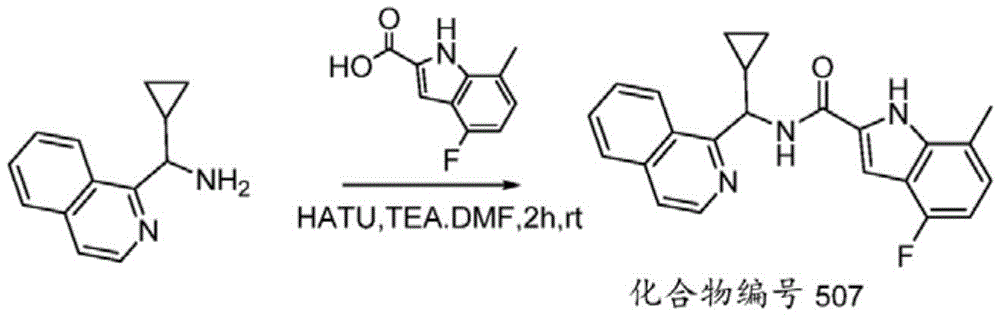
To a 100-mL round bottom flask was placed cyclopropyl (isoquinolin-1-yl) methylamine (300mg, 1.51mmol, 1.00 equiv.), TEA (450mg, 4.45mmol, 2.94 equiv.), N-dimethylformamide (30mL), 4-fluoro-7-methyl-1H-indole-2-carboxylic acid (300mg, 1.55mmol, 1.03 equiv.), HATU (550mg, 1.45mmol, 0.96 equiv.). The resulting solution was stirred at 25 ℃ for 2 h. The progress of the reaction was monitored by LCMS. The resulting solution was quenched with 10mL of ice/water. The resulting solution was extracted with 3 × 50mL of ethyl acetate and the organic layers were combined and dried over anhydrous sodium sulfate and concentrated in vacuo. The crude product (100mg) was purified by preparative HPLC using the following conditions: column, Kinetex EVO C18 column, 21.2 × 150, 5 μm; mobile phase, water (10mmol/L NH)4HCO3) And ACN (50.0% ACN, up to 75.0% in 7 min); detector, UV 254/220 nm. This gave 60.2mg (yield 11%) of N- [ cyclopropyl (isoquinolin-1-yl) methyl as a white solid]-4-fluoro-7-methyl-1H-indole-2-carboxamide. LCMS (method D, ESI): RT 1.55min, M/z 374.00[ M + H ═]+。1H NMR (300MHz, methanol-d 4) δ 8.47(t, J ═ 6.5Hz,2H),8.00-7.90(m,1H),7.83-7.65(m,3H),7.24(s,1H),7.00-6.89(m,1H),6.67-6.61(m,1H),5.65(d, J ═ 8.6Hz,1H),2.48(s,3H),1.72-1.55(m,1H),0.65-0.42(m,4H) ppm.
Example 5
Synthesis of N- (3- (1,3, 4-oxadiazol-2-yl) phenyl) -4-fluoro-7-methyl-1H-indole-2-carboxamide (Compound No. 60)

Into a 15-mL vial was placed 3- (1,3, 4-oxadiazol-2-yl) aniline (120mg, 0.74mmol, 1.00 eq) and 4-fluoro-7-methyl-1H-indole-2-carboxylic acid (168mg, 0.87mmol, 1.17 eq), N-dimethylformamide (3mL), DIEA (288mg, 2.23mmol, 2.99 eq), HATU (336mg, 0.88mmol, 1.19 eq) were added portionwise. The resulting solution was stirred at 25 ℃ for 2 h. The progress of the reaction was monitored by LCMS. The reaction was quenched with 10ml ice/water. The resulting solution was extracted with 3 × 12mL of ethyl acetate and the organic layers were combined. The organic phase was concentrated under vacuum. The residue was applied to a silica gel column using ethyl acetate/petroleum ether (1: 4). The crude product was purified by preparative HPLC using the following conditions: column, XBridge Prep phenyl OBD column, 5 μm, 19 x 150 mm; mobile phase, water (with 10mmol NH)4HCO3) And MeCN (20.0% MeCN to 30.0% in 10min, 95.0% in 1min, 20.0% in 2 min); detector, UV254/220 nm. This gave 51.1mg (yield ═ 20%) of 4-fluoro-7-methyl-N- [3- (1,3, 4-oxadiazol-2-yl) phenyl as an off-white solid ]-1H-indole-2-carboxamide. LCMS (method E, ESI): RT is 0.924min, M/z is 337.1[ M + H ]]+。1H-NMR(300MHz,DMSO-d6):δ11.98(s,1H);10.55(s,1H);9.38(s,1H);8.59(s,1H);8.14-8.11(d,J=12.0Hz,1H);7.78-7.76(m,1H);7.01-6.97(m,1H);6.81-6.75(m,1H);2.51(s,3H)ppm。
Example 6
Synthesis of N- ((5- ((1H-imidazol-1-yl) methyl) -3-methylpyridin-2-yl) (cyclopropyl) methyl) -4-fluoro-7-methyl-1H-indole-2-carboxamide (Compound No. 161)
Step 1. Synthesis of (5-bromo-3-methylpyridin-2-yl) (cyclopropyl) methylamine

To a 100-mL 3-necked round bottom flask purged with and maintained under an inert atmosphere of nitrogen was placed a solution of 5-bromo-3-methylpyridine-2-carbonitrile (1g, 5.10mmol, 1.00 equiv.) in tetrahydrofuran (10mL) and magnesium bromo (cyclopropyl) (1mol/L) (5.1mL, 5.10mmol, 1.00 equiv.) was added dropwise at 0 ℃. The resulting solution was stirred at this temperature for 30min, methanol (10ml) was added and NaBH was added portionwise at 0 ℃4(0.58g, 15.30mmol, 3.00 equiv.). The resulting solution was stirred at 25 ℃ for 12 h. The progress of the reaction was monitored by LCMS. The reaction solution was quenched with 10ml of ice/water. The resulting solution was extracted with 3 × 30mL of ethyl acetate and the organic layers were combined and dried over anhydrous sodium sulfate and concentrated in vacuo. The residue was applied to a silica gel column using methylene chloride/methanol (10/1). This gave 600mg (yield ═ 60%) of (5-bromo-3-methylpyridin-2-yl) (cyclopropyl) methylamine as an orange oil. LCMS (method a, ESI): RT 1.109min, M/z 241.0[ M + H ═ ]+。
Step 2. Synthesis of t-butyl N- [ (5-bromo-3-methylpyridin-2-yl) (cyclopropyl) methyl ] carbamate

To a 250-mL round bottom flask was placed (5-bromo-3-methylpyridin-2-yl) (cyclopropyl) methylamine (5g, 20.74mmol, 1.00 equiv.) in dichloromethane (150mL), TEA (10.37g, 103.7mmol, 5.00 equiv.) and di-tert-butyl dicarbonate (8.8g, 40.32mmol, 2.00 equiv.) in dichloromethane 10mL was added dropwise at 0 ℃. The resulting solution was stirred at 25 ℃ for 12 h. The progress of the reaction was monitored by LCMS. The resulting mixture was washed with 3x100mL water. The mixture was dried over anhydrous sodium sulfate and concentrated under vacuum. The residue was applied to a silica gel column using ethyl acetate/petroleum ether (1: 3). This gave 6.00g (yield 85%) of tert-butyl N- [ (5-bromo-3-methylpyridin-2-yl) (cyclopropyl) methyl) as a yellow solid]A carbamate ester. LCMS (method C, ESI): RT 1.356min, M/z 341.0[ M + H ]]+。
Step 3.6 Synthesis of- ([ [ (tert-butoxy) carbonyl ] amino ] (cyclopropyl) methyl) -5-methylpyridine-3-carboxylate

To a 100-mL round-bottom flask purged and maintained with a nitrogen inert atmosphere was placed tert-butyl N- [ (5-bromo-3-methylpyridin-2-yl) (cyclopropyl) methyl group in 30mL of methanol ]Carbamate (5.0g, 14.65mmol, 1.00 equiv.), Pd (dppf) Cl2(1.8g, 2.46mmol, 0.17 equiv.), TEA (5.0g, 49.41mmol, 3.37 equiv.). Carbon monoxide is introduced into the above mixture. The resulting solution was stirred in an oil bath at 80 ℃ for 16 h. The progress of the reaction was monitored by LCMS. The resulting mixture was concentrated under vacuum. The residue was applied to a silica gel column using ethyl acetate/petroleum ether (1: 2). This gave 4.3g (yield 80%) of methyl 6- ([ [ (tert-butoxy) carbonyl ] as a yellow oil]Amino group](cyclopropyl) methyl) -5-methylpyridine-3-carboxylic acid ester. LCMS (method a, ESI): RT 1.263min, M/z 321.0[ M + H ═]+。1H NMR (300MHz, methanol-d4)δ8.95(s,1H),8.15(s,1H),3.95(s,3H),3.36-3.30(m,1H),2.50(s,3H),2.46-2.38(m,1H),1.52(s,9H),0.53-0.48(m,4H)

To a 100-mL round bottom flask was placed methyl 6- ([ [ (tert-butoxy) carbonyl ] group]Amino group](cyclopropyl) methyl) -5-methylpyridine-3-carboxylate (600mg, 1.87mmol, 1.00 eq), NH3/MeOH (10 mL). The resulting solution was stirred in an oil bath at 80 ℃ for 16 h. The progress of the reaction was monitored by LCMS. The resulting mixture was concentrated under vacuum. This gave 450mg (yield 79%) of tert-butyl N- [ (5-carbamoyl-3-methylpyridin-2-yl) (cyclopropyl) methyl ] as a yellow oil ]A carbamate ester. LCMS (Method a, ESI): RT 0.978min, M/z 306.0[ M + H ]]+。

To a 100-mL round bottom flask purged and maintained with a nitrogen inert atmosphere was placed tert-butyl N- [ (5-carbamoyl-3-methylpyridin-2-yl) (cyclopropyl) methyl group]Carbamate (400mg, 1.31mmol, 1.00 equiv.) was added in portions to tetrahydrofuran (2mL) and NaBH at 0 deg.C4(250mg, 6.61mmol, 5.05 equiv.), stirring the resulting solution for 1h, and dropwise adding BF at 0 deg.C3-Et2O (1.5 mL). The resulting solution was stirred at 25 ℃ for 3 h. The progress of the reaction was monitored by LCMS. The reaction solution was quenched with 5ml methanol, the resulting mixture was concentrated, and the residue was dissolved with 20ml dichloromethane, the solution was washed with water (3 × 10ml), the organic phase was dried over anhydrous sodium sulfate, and concentrated. This gave 300mg (yield: 79%) of tert-butyl N- [ [5- (aminomethyl) -3-methylpyridin-2-yl ] as a yellow oil](cyclopropyl) methyl group]Carbamate, which was used directly in the next step. LCMS (method a, ESI): RT 0.837min, M/z 292.0[ M + H ]]+。
Step 6. Synthesis of tert-butyl N- [ cyclopropyl [5- (1H-imidazol-1-ylmethyl) -3-methylpyridin-2-yl ] methyl ] carbamate

To a 100-mL round bottom flask was placed tert-butyl N- [ [5- (aminomethyl) -3-methylpyridin-2-yl ] ester](cyclopropyl) methyl group]Carbamate (300mg, 1.03mmol, 1.00 equiv.), HCHO (40% in water) (2mL), NH3/MeOH (7mol/L) (3mL), glyoxal (2 mL). The resulting solution was stirred in an oil bath at 60 ℃ for 4 h. The reaction was monitored by LCMS and the resulting solution was concentrated under vacuum. The residue is applied using dichloromethane/methanolAlcohol (10:1) on silica gel column. This gave 300mg (yield 85%) of tert-butyl N- [ cyclopropyl [5- (1H-imidazol-1-ylmethyl) -3-methylpyridin-2-yl ] as a yellow oil]Methyl radical]A carbamate ester. LCMS (method a, ESI): RT 1.291min, M/z 343.0[ M + H ]]+。
Step 7 Synthesis of (5- ((1H-imidazol-1-yl) methyl) -3-methylpyridin-2-yl) (cyclopropyl) methylamine hydrochloride

To a 25-mL round bottom flask was placed tert-butyl (5- ((1H-imidazol-1-yl) methyl) -3-methylpyridin-2-yl) (cyclopropyl) methylcarbamate (300.00mg, 0.87mmol, 1.00 equivalents), hcl (g)/dioxane (2mol/L) (4.00mL), and the resulting solution was stirred at 25 ℃ for 30 min. The progress of the reaction was monitored by LCMS. The resulting mixture was concentrated under vacuum. This gave 260.00mg (crude) of (5- ((1H-imidazol-1-yl) methyl) -3-methylpyridin-2-yl) (cyclopropyl) methylamine hydrochloride as an off-white solid. LCMS (method a, ESI): RT is 0.861min, M/z is 243.0[ M + H ]+。
Synthesis of N- ((5- ((1H-imidazol-1-yl) methyl) -3-methylpyridin-2-yl) (cyclopropyl) methyl) -4-fluoro-7-methyl-1H-indole-2-carboxamide

To a 100-mL round bottom flask was placed cyclopropyl [5- (1H-imidazol-1-ylmethyl) -3-methylpyridin-2-yl]Methylamine (260mg, 0.95mmol, 1.00 eq), TEA (375mg, 3.71mmol, 2.99 eq), N-dimethylformamide (2mL), 4-fluoro-7-methyl-1H-indole-2-carboxylic acid (263mg, 1.36mmol, 1.10 eq), HATU (565mg, 1.49mmol, 1.20 eq) were added portionwise. The resulting solution was stirred at 25 ℃ for 2 h. The progress of the reaction was monitored by LCMS and the reaction solution was quenched with 5ml of water and the solid was collected by filtration. The crude product was purified by preparative HPLC using the following conditions: column, X-bridge Shield RP 18, 5 μm, 19X 150 mm; flow ofMobile phase, water (with 10mmol NH)4HCO3) And CH3CN (10.0% CH in 2 min)3CN up to 28.0%, 46.0% in 10min, 100.0% in 1min, and 10.0% in 1 min); detector, UV 254/220 nm. This gave 11.5mg (yield ═ 2%) of N- ((5- ((1H-imidazol-1-yl) methyl) -3-methylpyridin-2-yl) (cyclopropyl) methyl) -4-fluoro-7-methyl-1H-indole-2-carboxamide as a white solid. LCMS (method B, ESI): RT 1.27min, M/z 418.0[ M + H ] ]+。1H NMR (400MHz, methanol-d)4)δ8.37(s,1H),7.81(s,1H),7.52(s,1H),7.22(s,1H),7.17(s,1H),7.04(s,1H),7.01-6.92(m,1H),6.66(t,J=10.3Hz,1H),5.27(s,2H),4.93(d,J=8.9Hz,1H),2.50(s,6H),1.51-1.45(m,1H),0.72-0.62(m,1H),0.60-0.47(m,1H),0.47(t,J=5.3Hz,2H)ppm。
Example 7
Synthesis of N- (1- ((1r,4r) -4- (dimethylamino) cyclohexyl) -1H-indazol-4-yl) -4-fluoro-7-methyl-1H-indole-2-carboxamide (Compound No. 213)
Step 1. Synthesis of t-butyl N- [ (1r,4r) -4- (4-nitro-1H-indazol-1-yl) cyclohexyl ] carbamate

Into a 25-mL 2-necked round bottom flask purged and maintained with a nitrogen inert atmosphere was placed a solution of 4-nitro-1H-indazole (500mg, 3.06mmol, 1.00 equiv.) in tetrahydrofuran (12mL), tert-butyl N- [ (1s,4s) -4-hydroxycyclohexyl ] benzene]Carbamate (700mg, 3.25mmol, 1.20 equiv.), PPh3(700mg, 2.67mmol, 1.20 equiv.). This was followed by dropwise addition of DIAD (700mg, 3.46mmol, 1.20 equiv.) over 10min with stirring at 0 ℃. The resulting solution was stirred at 25 ℃ for 12 h. The progress of the reaction was monitored by LCMS. The resulting mixture was concentrated under vacuum. The residue was applied to a silica gel column using ethyl acetate/petroleum ether (1: 6). This gave 260mg (yield ═ 24%) of tert-butyl N- [ (1r,4r) -4- (4-nitro-1H-indazol-1-yl) cyclohexyl as a pale yellow solid]A carbamate ester. LCMS (method a, ESI): m/z 361.2[ M + H ]]+。1H NMR(400MHz,DMSO-d6)δ8.91(s,1H),8.21-8.19(dd,J=8.1,4.8Hz,2H),7.51-7.47(t,J=8.1Hz,1H),6.88-6.86(d,J=7.7Hz,1H),4.68-4.62(m,1H),3.46-3.34(m,1H),2.12-2.07(m,4H),2.03-1.96(m,2H),1.52-1.44(m,2H),1.40(s,9H)ppm。
Step 2. Synthesis of tert-butyl N- [ (1r,4r) -4- (4-amino-1H-indazol-1-yl) cyclohexyl ] carbamate

Into a 40-mL vial was placed tert-butyl N- [ (1r,4r) -4- (4-nitro-1H-indazol-1-yl) cyclohexyl]Solution of carbamate (100mg, 0.28mmol, 1.00 equiv.) in ethanol (20mL), Fe powder (100mg, 5.00 equiv.) in water (3mL), NH4Cl (100mg, 1.87mmol, 5.00 equiv.). The resulting solution was stirred at 80 ℃ for 2 h. The progress of the reaction was monitored by LCMS. The solids were removed by filtration. The filtrate was concentrated in vacuo. The residue was applied to a silica gel column using methylene chloride/methanol (10/1). This gave 80mg (yield: 87%) of tert-butyl N- [ (1r,4r) -4- (4-amino-1H-indazol-1-yl) cyclohexyl as a pale yellow solid]A carbamate ester. LCMS (method a, ESI): RT is 0.753min, M/z is 331.2[ M + H [ ]]+。1H NMR(400MHz,DMSO-d6)δ8.05(s,1H),7.01-6.97(dd,J=8.3,7.4Hz,1H),6.85-6.83(d,J=7.8Hz,1H),6.73-6.71(d,J=8.3Hz,1H),6.14-6.12(d,J=7.4Hz,1H),5.71(s,2H),4.36-4.33(m,1H),3.38-3.35(m,1H),1.99-1.89(m,6H),1.48-1.41(m,2H),1.40(s,9H)ppm。
Step 3 Synthesis of tert-butyl N- [ (1r,4r) -4- [4- (4-fluoro-7-methyl-1H-indol-2-ylamino) -1H-indazol-1-yl ] cyclohexyl ] carbamate

Into a 40-mL round bottom flask was placed tert-butyl N- [ (1r,4r) -4- (4-amino-1H-indazol-1-yl) cyclohexyl]Solution of carbamate (200mg, 0.61mmol, 1.00 equiv.) in N, N-dimethylformamide (10mL), 4-fluoro-7-methyl-1H-indole-2-carboxylic acid (160mg, 0.83mmol, 1.20 equiv.), TEA (260mg, 2.57mmol, 3.00 equiv.), HATU (423mg, 1.11mmol, 1.30 equiv.) added portionwise. The resulting solution was stirred at 25 ℃ for 2 h. The progress of the reaction was monitored by LCMS. The resulting mixture was quenched with 30mL of water. The resulting solution was extracted with 3 × 10mL of ethyl acetate and the organic layers were combined. The filtrate was concentrated in vacuo. The residue was applied to a silica gel column using ethyl acetate/petroleum ether (1: 1). This gave 190mg (yield 62%) of tert-butyl N- [ (1r,4r) -4- [4- (4-fluoro-7-methyl-1H-indol-2-ylamino) -1H-indazol-1-yl) -as a pale yellow oil ]Cyclohexyl radical]A carbamate ester. LCMS (method D, ESI): RT 1.253min, M/z 506.2[ M + H ═ M + H]+。1H NMR(400MHz,DMSO-d6)δ11.95(s,1H),10.39(s,1H),8.26(s,1H),7.60-7.59(d,J=2.1Hz,1H),7.56-7.50(dd,J=18.3,7.9Hz,2H),7.40-7.36(dd,J=8.4,7.5Hz,1H),7.01-6.97(dd,J=7.8,5.2,1.0Hz,1H),6.89-6.87(d,J=7.7Hz,1H),6.80-6.75(dd,J=10.4,7.8Hz,1H),4.60-4.57(m,1H),3.17(s,1H),2.52(s,3H),2.05-1.93(m,6H),1.56-1.46(m,5.9Hz,2H),1.41(s,9H)ppm。
Step 4.4 Synthesis of 4-fluoro-7-methyl-N- [1- [ (1r,4r) -4-aminocyclohexyl ] -1H-indazol-4-yl ] -1H-indole-2-carboxamide

Into a 8-mL vial was placed tert-butyl N- [ (1r,4r) -4- [4- (4-fluoro-7-methyl-1H-indol-2-ylamino) -1H-indazol-1-yl]Cyclohexyl radical]Carbamate (200mg, 0.40mmol, 1.00 equiv.), hydrogen chloride/1, 4-dioxane (2mol/L) (10 mL). The resulting solution was stirred at 25 ℃ for 2 h. The progress of the reaction was monitored by LCMS. The resulting mixture was concentrated under vacuum. This gave 150mg (yield 94%) of 4-fluoro-7-methyl-N- [1- [ (1r,4r) -4-aminocyclohexyl) as a pale yellow oil]-1H-indazol-4-yl]-1H-indole-2-carboxamide. LCMS (method a, ESI): RT 1.423min, M/z 406.2[ M + H ]]+。1H NMR(400MHz,DMSO-d6)δ12.22(s,1H),10.64(s,1H),8.33(s,1H),7.59-7.53(m,3H),7.41-7.36(dd,J=8.3,7.6Hz,1H),7.00-6.97(dd,J=7.7,5.2Hz,1H),6.79-6.75(dd,J=10.4,7.8Hz,1H),4.67-4.58(d,J=8.0Hz,1H),3.63-3.60(m,1H),2.54(s,3H),2.17-2.10(m,6H),2.08-1.99(m.2H),1.72-1.59(m,2H)ppm。

Into a 40-mL round-bottomed flask was placed 4-fluoro-7-methyl-N- [1- [ (1r,4r) -4-aminocyclohexyl group]-1H-indazol-4-yl]-1H-indole-2-carboxamide (350mg, 0.86mmol, 1.00 equiv.) in methanol (10 mL). Followed by addition of CH2O (40% in water) (3 mL). To this solution was added NaBH in portions 3CN (160mg, 2.5mmol, 3.00 equiv.). The resulting solution was stirred at 25 ℃ for 2 h. The progress of the reaction was monitored by LCMS. The resulting mixture was quenched with 30mL of water. The resulting solution was extracted with 3 × 10mL of ethyl acetate and the organic layers were combined. The resulting mixture was concentrated under vacuum. The crude product (180mg) was purified by preparative HPLC using the following conditions: column, xsselect CSH Prep C18 OBD column, 5 μm, 19 × 150 mm; mobile phase, water (0.05% TFA) and ACN (22.0% ACN, up to 45.0% in 7 min); detector, UV 220/254 nm. This gave 36.2mg (yield 9.6%) of 4-fluoro-7-methyl-N- [1- [ (1r,4r) -4- (dimethylamino) cyclohexyl ] as a white solid]-1H-indazol-4-yl]-1H-indole-2-carboxamide trifluoroacetate salt. LCMS (method D, ESI): RT 1.510min, M/z 434.2[ M + H ]]+。1H NMR (300MHz, methanol-d4)δ8.22(s,1H),7.47-7.43(m,4H),7.02-6.97(m,1H),6.74-6.64(m,1H),4.72-4.62(m,1H),3.43-3.41(m,1H),2.93(s,6H),2.53(s,3H),2.32-2.15(m,6H),1.98-1.80(m,2H)ppm。
Example 8
Synthesis of 4-fluoro-N- (7-fluoroisoquinolin-5-yl) -7-methyl-1H-indole-2-carboxamide (Compound No. 82)

Into a 40-mL vial purged with nitrogen inert atmosphere and maintained was placed a solution of 4-fluoro-7-methyl-1H-indole-2-carboxamide (100mg, 0.52mmol, 1.00 equiv.) in N, N-dimethylformamide (10mL), 7-fluoroisoquinolin-5-amine (100mg, 0.62mmol, 1.20 equiv.), CuI (110mg, 0.58mmol, 1.00 equiv.), Cs 2CO3(537mg, 1.65mmol, 3.00 equiv.), (1S,2S) -1-N, 2-N-dimethylcyclohexane-1, 2-diamine (100mg, 0.70mmol, 1.40 equiv.). The resulting solution was stirred at 80 ℃ for 2 h. The progress of the reaction was monitored by LCMS. The resulting solution was quenched with 20ml of water/ice. The resulting solution was extracted with 3 × 10mL of ethyl acetate and the organic layers were combined. The resulting mixture was taken up in 3X10mL H2And O washing. The crude product (300mg) was purified by preparative HPLC using the following conditions: column, XBridge Prep OBD C18 column, 30 x 150mm 5 μm; mobile phase, water (10mmol/L NH)4HCO3) And ACN (39% ACN, up to 61% in 7 min); detector, UV 254/220 nm. This gave 31.8mg (yield ═ 18%) of 4-fluoro-N- (7-fluoroisoquinolin-5-yl) -7-methyl-1H-indole-2-carboxamide as a white solid. LCMS (method B, ESI): m/z 337.9[ M + H ]]+。1H NMR(300MHz,DMSO-d6)δ12.03(s,1H),10.69(s,1H),9.37(s,1H),8.58(d,J=6.0Hz,1H),8.03(t,J=4.5Hz,6.0Hz,2H),7.91(d,J=9.0Hz,1H),7.68(s,1H),7.01(t,J=6.9Hz,5.7Hz,1H),6.85-6.75(m,1H),3.30(s,3H)ppm。
Example 9
Synthesis of 4-fluoro-7-methyl-N- (2- (1-methyl-1H-pyrazol-4-yl) -1- (3-methylpyridin-2-yl) ethyl) -1H-indole-2-carboxamide (Compound No. 85)
Step 1.1 Synthesis of 1-methyl-1H-pyrazole-4-carbaldehyde

An 8-mL vial was charged with a solution of 1H-pyrazole-4-carbaldehyde (50mg, 0.52mmol, 1.00 equiv.) in N, N-dimethylformamide (1mL), CH3I (96mg, 0.68mmol, 1.30 equiv.), Cs 2CO3(510mg,1.57mmol, 3.00 equivalents). The resulting solution was stirred at 60 ℃ for 1 h. The progress of the reaction was monitored by LCMS. The reaction was quenched with 10ml water. The resulting solution was extracted with 3 × 12mL of ethyl acetate and the organic layers were combined. The organic phase was concentrated under vacuum. The residue was applied to a silica gel column using ethyl acetate/petroleum ether (1: 4). This gave 40mg (yield 80%) of 1-methyl-1H-pyrazole-4-carbaldehyde as a white solid. LCMS (method a, ESI): RT is 0.699min, M/z is 111.1[ M + H ]]+。
Step 2. Synthesis of E) -Ethyl 3- (1-methyl-1H-pyrazol-4-yl) -2- (3-methylpyridin-2-yl) acrylate

A40-mL vial purged with a nitrogen inert atmosphere and maintained was charged with a solution of 1-methyl-1H-pyrazole-4-carbaldehyde (465mg, 4.22mmol, 1.50 equivalents) in ethanol (20mL), ethyl 2- (3-methylpyridin-2-yl) acetate (500mg, 2.79mmol, 1.00 equivalents), acetic acid (840mg, 13.99mmol, 5.00 equivalents), piperidine (1.2g, 14.09mmol, 5.00 equivalents). The resulting solution was stirred at 80 ℃ for 48 h. The progress of the reaction was monitored by LCMS. The resulting solution was concentrated in vacuo and the residue was dissolved in 20ml of dichloromethane and the resulting mixture was washed with 3 × 15ml water, the organic phase was dried over anhydrous sodium sulfate and concentrated. The residue was applied to a silica gel column using dichloromethane/methanol (10: 1). This gave 620.00mg (yield 75%) of (E) -ethyl 3- (1-methyl-1H-pyrazol-4-yl) -2- (3-methylpyridin-2-yl) acrylate as a white solid. LCMS (method a, ESI): RT is 0.842min, M/z is 272.1[ M + H ═ M + H ]+。1H NMR(300MHz,DMSO-d6)δ8.48(t,J=3.0Hz,1H),7.75(s,2H),7.37(t,J=6.0Hz,1H),7.30(s,1H),6.44(s,1H),4.14(q,J=6.0Hz,15Hz,2H),3.72(s,3H),2.06(s,3H),1.17(t,J=6.0Hz,3H)ppm。
Step 3. Synthesis of E) -3- (1-methyl-1H-pyrazol-4-yl) -2- (3-methylpyridin-2-yl) acrylic acid

A40-mL vial was charged with a solution of ethyl (2E) -3- (1-methyl-1H-pyrazol-4-yl) -2- (3-methylpyridin-2-yl) prop-2-enoate (620mg, 2.29mmol, 1.00 equiv.) in hydrogen chloride (6mol/L) (20 mL). The resulting solution was stirred at 80 ℃ for 15 h. The progress of the reaction was monitored by LCMS. The resulting solution was concentrated in vacuo to give 500.00mg (yield 80%) of (E) -3- (1-methyl-1H-pyrazol-4-yl) -2- (3-methylpyridin-2-yl) acrylic acid as a white solid, which was used in the next step without further purification. LCMS (method a, ESI): RT is 0.745min, M/z is 244.0[ M + H ═ M + H]+。

To a 40-mL vial purged with and maintained under an inert atmosphere of nitrogen were placed a solution of (2E) -3- (1-methyl-1H-pyrazol-4-yl) -2- (3-methylpyridin-2-yl) prop-2-enoic acid (500mg, 2.06mmol, 1.00 equiv.) in N, N-dimethylformamide (20mL), DPPA (850mg, 3.09mmol, 1.50 equiv.), TEA (1.05g, 10.38mmol, 5.00 equiv.). The resulting solution was stirred at 80 ℃ for 2 h. The progress of the reaction was monitored by LCMS. The resulting solution was quenched with 30ml water and the resulting mixture was extracted with 3x35ml dichloromethane and the organic phase was dried over anhydrous sodium sulfate and concentrated. The residue was applied to a silica gel column using methylene chloride/methanol (20: 1). This gave 170.00mg (yield ═ 34%) of (E) -2- (1-isocyanate-2- (1-methyl-1H-pyrazol-4-yl) vinyl) -3-methylpyridine as a solid. Lcms (esi): RT is 0.736min, M/z is 241.0[ M + H ═ ]+。

Into a 20-mL vial was placed 2- [ (E) -1-isocyanate-2- (1-methyl-1H-pyrazol-4-yl) vinyl]-a solution of 3-methylpyridine (170mg, 0.71mmol, 1.00 equiv.) in benzyl alcohol (2 mL). The resulting solution was stirred at 100 ℃ for 15 h. The progress of the reaction was monitored by LCMS. The resulting solution was quenched with 30ml of water and the resulting mixture was extracted with 3 × 20ml dichloromethane, the organic phase was dried over anhydrous sodium sulfate and concentrated. The residue was applied to a silica gel column using dichloromethane/methanol (15: 1). This gave 80.00mg (yield ═ 46%) of (E) -benzyl 2- (1-methyl-1H-pyrazol-4-yl) -1- (3-methylpyridin-2-yl) vinylcarbamate as a white solid. LCMS (method, ESI): RT is 0.859min, M/z is 349.0[ M + H ]]+。
Step 6.2 Synthesis of 2- (1-methyl-1H-pyrazol-4-yl) -1- (3-methylpyridin-2-yl) ethylamine

To a 50-mL round bottom flask was placed benzyl N- [ (E) -2- (1-methyl-1H-pyrazol-4-yl) -1- (3-methylpyridin-2-yl) ethenyl]Carbamate (80mg, 0.23mmol, 1.00 equiv.) in MeOH (5mL), PtO2(20 mg). Hydrogen is introduced into the mixture. The resulting solution was stirred at 25 ℃ for 20 min. The progress of the reaction was monitored by LCMS. The solids were removed by filtration, the resulting mixture was concentrated in vacuo, and 70mg (yield 85%) of 2- (1-methyl-1H-pyrazol-4-yl) -1- (3-methylpyridin-2-yl) ethylamine was obtained. LCMS (method a, ESI): RT 0.326min, M/z 216.0[ M + H ═ ]+。
Step 7.4 Synthesis of 4-fluoro-7-methyl-N- (2- (1-methyl-1H-pyrazol-4-yl) -1- (3-methylpyridin-2-yl) ethyl) -1H-indole-2-carboxamide

Into a 100-mL round-bottom flask was placed 2- (1-methyl-1H-pyrazol-4-yl) -1- (3-methylpyridin-2-yl)Solution of ethan-1-amine (80mg, 0.37mmol, 1.00 equiv.) in N, N-dimethylformamide (3mL), 4-fluoro-7-methyl-1H-indole-2-carboxylic acid (80mg, 0.41mmol, 1.10 equiv.), TEA (113mg, 1.12mmol, 3.00 equiv.), and HATU (183mg, 0.48mmol, 1.30 equiv.) were added in portions. The resulting solution was stirred at 25 ℃ for 1 h. The crude product (100mg) was purified by preparative HPLC using the following conditions: column, xsselect CSH Prep C18 OBD column, 5 μm, 19 × 150 mm; mobile phase, water (0.05% TFA) and ACN (16.0% ACN, reaching 42.0% in 7 min); detector, UV 220/254 nm. This gave 37.5mg (yield ═ 20%) of 4-fluoro-7-methyl-N- [2- (1-methyl-1H-pyrazol-4-yl) -1- (3-methylpyridin-2-yl) ethyl as the trifluoroacetate salt as a white solid]-1H-indole-2-carboxamide. LCMS (method a, ESI): 391.9[ M + H ] M/z]+。1H NMR (400MHz, methanol-d)4)δ8.56(s,1H),8.16(s,1H),7.68(s,1H),7.41(d,J=2.7Hz,1H),7.32(d,J=1.1Hz,1H),7.20(d,J=4.7Hz,1H),6.99-6.96(m,1H),6.73-6.63(m,1H),5.56(t,J=7.6Hz,1H),4.86(s,3H),3.36(s,1H),3.27-3.17(m,1H),2.53-2.45(m,6H)ppm。
Example 10
Synthesis of 4-fluoro-N- (3-fluoro-5- (3- (N-methylacetamido) pyrrolidin-1-yl) phenyl) -7-methyl-1H-indole-2-carboxamide (Compound No. 1)
Step 1 Synthesis of t-butyl N- [1- (3-fluoro-5-nitrophenyl) pyrrolidin-3-yl ] -N-methylcarbamate

Into a 250-mL round bottom flask was placed 1, 3-difluoro-5-nitrobenzene (2g, 12.57mmol, 1.00 equiv.), Cs2CO3(13g, 39.90mmol, 3.17 equiv.), DMSO (30mL), tert-butyl N-methyl-N- (pyrrolidin-3-yl) carbamate (2.6g, 12.98mmol, 1.03 equiv.). The resulting solution was stirred at 100 ℃ for 2 h. The progress of the reaction was monitored by LCMS. The resulting mixture was concentrated under vacuum. The residue was applied to a silica gel column using ethyl acetate/petroleum ether (1: 1). The collected fractions were combined and concentrated under vacuum. This gave 680mg (yield 16%) asPale yellow solid tert-butyl N- [1- (3-fluoro-5-nitrophenyl) pyrrolidin-3-yl]-N-methylcarbamate. LCMS (method a, ESI): RT 2.876min, M/z 340.00[ M + H ]]+。
Step 2.1 Synthesis of- (3-fluoro-5-nitrophenyl) -N-methylpyrrolidin-3-amine

A40-mL vial was charged with tert-butyl N- [1- (3-fluoro-5-nitrophenyl) pyrrolidin-3-yl in dichloromethane (7mL), trifluoroacetic acid (3mL)]-N-methylcarbamate (650mg, 1.92mmol, 1.00 equiv.). The resulting solution was stirred at 25 ℃ for 1h and the progress of the reaction was monitored by LCMS. The resulting mixture was concentrated under vacuum. This gave 350mg (yield ═ 76%) of 1- (3-fluoro-5-nitrophenyl) -N-methylpyrrolidin-3-amine as a pale yellow solid. LCMS (method a, ES): RT 0.900min, M/z 240.00[ M + H ═ ]+。
Step 3 Synthesis of N- [1- (3-fluoro-5-nitrophenyl) pyrrolidin-3-yl ] -N-methylacetamide
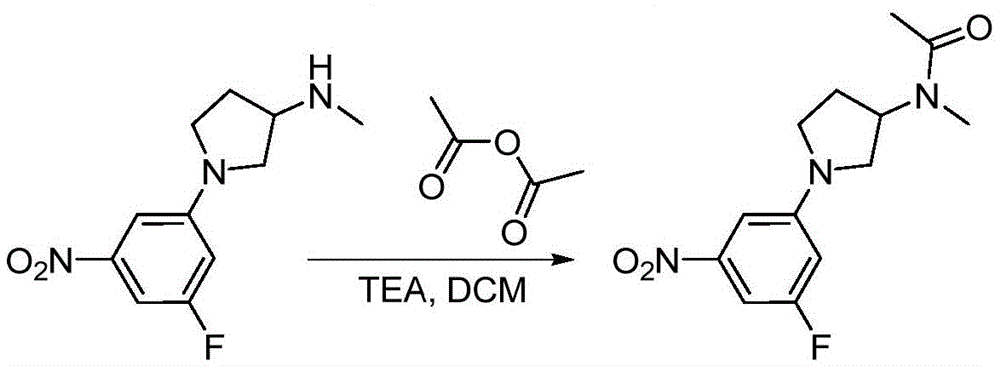
To a 40-mL vial was placed 1- (3-fluoro-5-nitrophenyl) -N-methylpyrrolidin-3-amine (1g, 4.18mmol, 1.00 equiv.), TEA (2g, 19.76mmol, 4.73 equiv.) in dichloromethane (10mL), and acetoacetate (750mg, 7.35mmol, 1.76 equiv.) was added dropwise at 0 ℃. The resulting solution was stirred at 25 ℃ for 2 h. The progress of the reaction was monitored by LCMS. The resulting mixture was concentrated under vacuum. The residue was applied to a silica gel column using ethyl acetate/petroleum ether (1: 1). The collected fractions were combined and concentrated under vacuum. This gave 900mg (yield 77%) of N- [1- (3-fluoro-5-nitrophenyl) pyrrolidin-3-yl as a pale yellow solid]-N-methylacetamide. LCMS (method a, ES): RT 1.188min, M/z 282.00[ M + H ]]+。
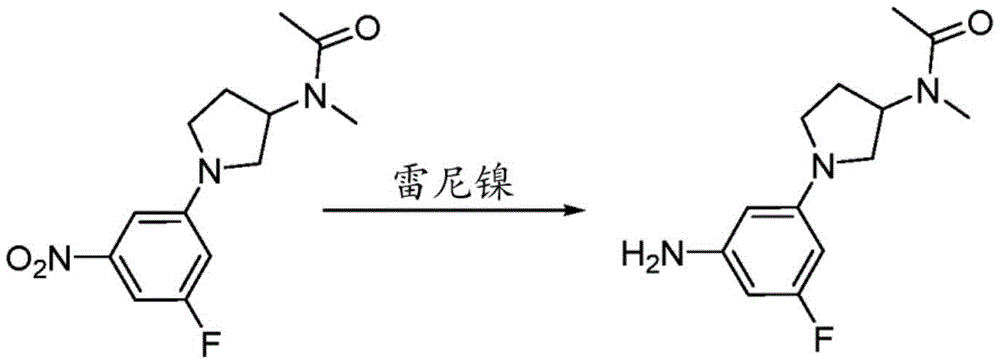
Into a 100-mL round-bottomed flask was placed N- [1- (3-fluoro-5-nitrophenyl) pyrrolidin-3-yl]N-methylacetamide (300mg, 1.07mmol, 1.00 equiv), Raney Nickel (100mg) (in methanol (10 mL)). Hydrogen is introduced into the mixture. The resulting solution was stirred at 25 ℃ for 1 h. The progress of the reaction was monitored by LCMS. The solid was filtered off. The resulting mixture was concentrated under vacuum. This gave 220mg (yield 82%) of N- [1- (3-amino-5-fluorophenyl) pyrrolidin-3-yl as an off-white solid ]-N-methylacetamide. LCMS (method a, ESI): RT 0.834min, M/z 252.00[ M + H ]]+。
Step 5.4 Synthesis of 4-fluoro-N- (3-fluoro-5- (3- (N-methylacetamido) pyrrolidin-1-yl) phenyl) -7-methyl-1H-indole-2-carboxamide

Into a 40-mL vial was placed N- [1- (3-amino-5-fluorophenyl) pyrrolidin-3-yl]-N-methylacetamide (330mg, 1.31mmol, 1.00 equiv), TEA (700mg, 6.92mmol, 5.27 equiv) (in N, N-dimethylformamide (10 mL)), 4-fluoro-7-methyl-1H-indole-2-carboxylic acid (250mg, 1.29mmol, 0.99 equiv) and HATU (649mg, 1.71mmol, 1.30 equiv) added portionwise. The resulting solution was stirred at 25 ℃ for 2 h. The resulting mixture was concentrated under vacuum. The progress of the reaction was monitored by LCMS and the reaction solution was quenched with 20ml of water. The resulting solution was extracted with 3 × 20ml ethyl acetate and the organic layers were combined and concentrated in vacuo. The residue was applied to a silica gel column using ethyl acetate/petroleum ether (1: 1). The crude product (200mg) was purified by preparative HPLC using the following conditions: column, XBridge Shield RP18 OBD column, 5 μm, 19 × 150 mm; mobile phase, water (10mmol/L NH)4HCO3) And ACN (40.0% ACN, up to 68.0% in 7 min); detector, UV 220/254 nm. This gave 47.4mg (yield ═ 8%) as a pale yellow color Solid 4-fluoro-N- (3-fluoro-5- (3- (N-methylacetamido) pyrrolidin-1-yl) phenyl) -7-methyl-1H-indole-2-carboxamide. LCMS (method B, ES): RT 3.206min, M/z 427[ M + H ]]+。1H NMR(400MHz,DMSO-d6)δ11.92(s,1H),10.19(s,1H),7.51(s,1H),7.19-7.08(m,1H),7.03-6.93(m,1H),6.87(d,J=2.1Hz,1H),6.86-6.73(m,1H),6.17-6.13(m,1H),5.23-4.63(m,1H),3.54-3.33(m,2H),3.26-3.16(m,2H),2.90(s,2H),2.76(s,1H),2.61-2.51(s,3H),2.24-2.00(m,5H)ppm。
Example 11
Intracellular Western (ICW) assay (A549 assay) of SETD2 inhibitors
Representative compounds of the present disclosure were tested in an a549 assay according to the following protocol. The results of the a549 assay are provided in table 1B.
The scheme is as follows:
1. reagents and consumables:


2. tools and devices:

3. screening method
Plates were prepared with the compound. A549 cells were seeded onto plates with compound, 4,000 cells/well, 50 μ Ι/well. The plates were placed on a non-vibrating surface for 20 minutes at room temperature and then placed in an incubator. The plates were incubated with CO at 37 deg.C2Incubate together for 3 days. The plate was removed from the incubator and returned to room temperature. Media was aspirated from the plate and 50 μ L of ice-cold 100% methanol was added. Incubate at room temperature for 30 minutes. The methanol was removed by suction. Wash 3X with PBST. Add 50. mu.L blocking buffer + 0.1%Tween 20. Incubate for 1 hour. The blocking buffer was removed and washed 3X with PBST. Add 20. mu.L of H3K36me3(1:1000 dilution). (Cell Signaling Technologies) mAb # 4909). Incubate overnight at 4 ℃. Wash plate 5X with PBS-T. Add 20. mu.L of DRAQ5(1:1000) and IRDye 800CW goat anti-rabbit IgG (1: 500). Incubate in dark for 1 hour. Wash plate 5X with PBS-T. Plate 3X was washed with water. Dry by blotting onto a paper towel, then invert the plate onto a paper towel and centrifuge at 1000rpm for 1 minute to remove excess reagent. The plates were exposed to direct light for about 10 minutes before reading. Read on a Licor instrument.
Licor instrument settings:
presetting: a plate; resolution ratio: 84 μm; quality: low; focusing and deflecting focus: 4.0; 700 channel strength: 2; and 800 channel strength: 3.
example 12
SETD2(1434-
Representative compounds of the disclosure were tested in the SETD2(1434-1711) assay using the following protocol. The results of the SETD2(1434-1711) assay are provided in Table 1B.
1. Reagent

2. Tool/device inventory


3. Reagent formulations

4. Description of the procedures

Example 13
14-day KMS-34 Long-term proliferation (LTP) assay
Representative compounds of the disclosure were tested in a 14 day KMS-34LTP assay using the following protocol. Table 5 and FIG. 2 provide the results of the 14-day KMS-34LTP assay. Figure 3 compares KMS-34LTP activity with a 549H 3K36me3 activity, see example 11 for compound numbers 7, 11, 15, 22, 31, 32, 34, 64, 65, 66, 76, 115, 134, 151, 194, and 221.
1. Reagents, consumables, and equipment:


2. screening method
Day 0:
in flat bottom 96 well plates, at 1.25X10⁵Add 100. mu.l cells per well at density of one cell/ml (note: inner wells only. PBS is placed in all outer wells to avoid evaporation of inner wells.) 50. mu.l of compound is added to each well. The final volume in each well was 150. mu.l. The plates were incubated for 96 hours.
Days 1, 2, and 3: wait for
Day 4:
cells were pipetted up and down each well to mix. Mu.l of the cell suspension in the V-shaped bottom plate was aspirated and added to the poly-D-lysine coated 96-well plate. Mu.l HBSS and 50. mu.l HBSS containing 2 μm calcein-AM were added. The final concentration was 1 μm. The cells were allowed to stand at room temperature for 10 minutes and then spun rapidly to allow the cells to settle at the bottom of the wells. Plates were incubated in the incubator for an additional 40 minutes (to load calcein AM and allow more time for cells to attach). The plate was removed and read through Acumen. The number of cells was calculated (taking into account the dilution factor). The master plate was partitioned by the total number of live cells calculated. Cells were pipetted up and down each well to mix. The cell suspension was aspirated 1.1 x from each well and added to the V-shaped bottom plate. Spin plate at 1100rpm for 5 minutes. After spinning, the medium was removed, taking care not to disturb the cell pellet. Resuspend pellet in 110. mu.l fresh medium. Cells were pipetted up and down each well to mix. 100 μ l of cell suspension was aspirated from each well and added to a new 96-well flat bottom plate. Add 50. mu.l of compound solution. Plates were incubated for 72 hours.
Day 7:
Cells were pipetted up and down each well to mix. Mu.l of the cell suspension in the V-shaped bottom plate was aspirated and added to the poly-D-lysine coated 96-well plate. Mu.l HBSS and 50. mu.l HBSS containing 2 μm calcein-AM were added. The final concentration was 1 μm. The cells were allowed to stand at room temperature for 10 minutes and then spun rapidly to allow the cells to settle at the bottom of the wells. Plates were incubated in the incubator for an additional 40 minutes (to load calcein AM and allow more time for cells to attach). The plate was removed and read through Acumen. The number of cells was calculated (taking into account the dilution factor). The master plate was partitioned by the total number of live cells calculated. Cells were pipetted up and down each well to mix. The cell suspension was aspirated 1.1 x from each well and added to the V-shaped bottom plate. Spin plate at 1100rpm for 5 minutes. After spinning, the medium was removed, taking care not to disturb the cell pellet. Resuspend pellet in 110uL of fresh medium. Cells were pipetted up and down each well to mix. 100 μ l of cell suspension was aspirated from each well and added to a new 96-well flat bottom plate. Add 50. mu.l of compound solution. The plates were incubated for 96 hours.
Day 11:
cells were pipetted up and down each well to mix. Mu.l of the cell suspension in the V-shaped bottom plate was aspirated and added to the poly-D-lysine coated 96-well plate. Mu.l HBSS and 50. mu.l HBSS containing 2 μm calcein-AM were added. The final concentration was 1 μm. The cells were allowed to stand at room temperature for 10 minutes and then spun rapidly to allow the cells to settle at the bottom of the wells. Plates were incubated in the incubator for an additional 40 minutes (to load calcein AM and allow more time for cells to attach). The plate was removed and read through Acumen. The number of cells was calculated (taking into account the dilution factor). The master plate was partitioned by the total number of live cells calculated. To reduce variations that may be caused by pipetting: cells were pipetted up and down each well to mix. All cell suspensions of B1-2, C1-2, D1-2 were aspirated and added to the V-plate. The 1.1 × counted cell suspension was aspirated from the other wells and added to the V-shaped bottom plate. Spin plate at 1100rpm for 5 minutes. After spinning, the medium was removed, taking care not to disturb the cell pellet. Resuspend the pellet in 100uL of fresh medium in B1-2, C1-2, D1-2. Cells were pipetted up and down each well to mix. Resuspend pellet in 110 μ l fresh medium in other wells. Cells were pipetted up and down each well to mix. 100 μ l of cell suspension was aspirated from each well and added to a new 96-well flat bottom plate.
Day 14: cells were pipetted up and down each well to mix. Mu.l of the cell suspension in the V-shaped bottom plate was aspirated and added to the poly-D-lysine coated 96-well plate. Mu.l HBSS and 50. mu.l HBSS containing 2 μm calcein-AM were added. The final concentration was 1 μm. The cells were allowed to stand at room temperature for 10 minutes and then spun rapidly to allow the cells to settle at the bottom of the wells. Plates were incubated in the incubator for an additional 40 minutes (to load calcein AM and allow more time for cells to attach). The plate was removed and read through Acumen. The number of cells was calculated (taking into account the dilution factor).
Growth on days 4, 7, 11 and 14 was calculated:
1. partition factors were calculated for days 4 to 7, 7 to 11, and 11-14. The partition factor is the viable cells/mL at day X (4, 7 or 11) divided by the density to which the cells are to be partitioned.
2. For cell growth from day 4 to day 7, the viable cells/mL density at day 7 was multiplied by the splitting factor at day 4.
3. For cell growth from day 7 to day 11, the viable cell/mL density at day 11 was multiplied by the splitting factors at day 4 and day 7.
4. For cell growth from day 11 to day 14, the viable cell/mL density at day 14 was multiplied by the partition factors at day 4, day 7 and day 11.
5. Growth was plotted on a semi-logarithmic graph (viable cells/mL in log on the Y-axis and days on the X-axis).
Preparation of the compound:
compounds were dissolved at 10mM in DMSO and stored at-20 ℃. Compounds were serially diluted 3-fold in DMSO. From 5mM to 0.25. mu.m. 1.2. mu.l of compound was transferred from the compound plate and added to a 96-well plate with 200. mu.l of medium in each well. Mix well by pipetting up and down. 50 μ l of the compound-containing medium was transferred to a cell plate.
TABLE 5
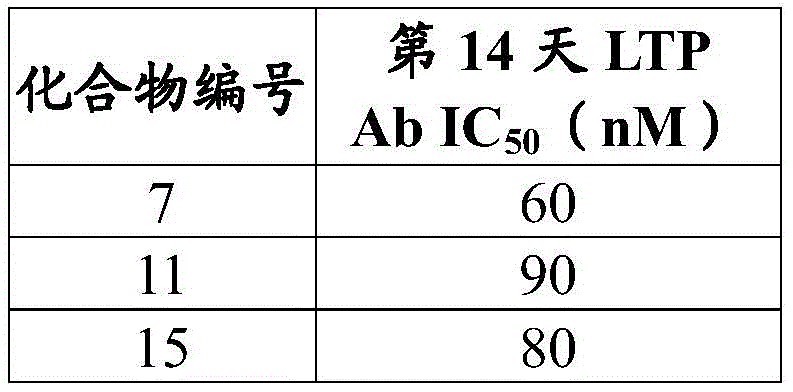

Example 14
14-day LTP assay in multiple myeloma cells
Compound No. 15 was tested in several multiple myeloma cell lines in the LTP assay described in example 13. The results are presented in table 6 and fig. 1.
TABLE 6
| | Translocation | 14 day LTP IC50(μM) | |
| NCI-H929 | t(4:14) | 0.24 | |
| LP-1 | t(4:14) | 0.07 | |
| OPM-2 | t(4:14) | 0.09 | |
| KMS-11 | t(4:14) | 0.14 | |
| KMS-28-BM | t(4:14) | >10 | |
| KMS-34 | t(4:14) | 0.08 | |
| KMS-12-BM | t(11:14) | 1.9 | |
| MM.1R | t(4:16) | 1.2 | |
| MM.1S | t(4:16) | 3 | |
| U266B1 | t(11:14) | 6.1 | |
| HuNS1 | Is free of | 0.6 | |
| RPMI | t(14:16) | 3.3 |
Example 15
Evaluation of antitumor Activity of Compound No. 15 as a Single agent in human myeloma KMS-11 tumor NOD SCID mice
Animal(s) production
Species and strains: NOD SCID mice; age: 6 to 8 weeks; total number: 75 mice (including spare), 50 mice were used for the study; sex: a female; weight: 18 to 22g
Grouping and treatment
When the average tumor size reaches 118mm3The grouping and treatment is started. Based on tumor volume and body weight, mice were assigned to individual groups such that the average starting tumor size and body weight were the same for each treatment group. Table 7 shows the study groups and the number of animals per group.
TABLE 7 grouping and treatment for efficacy studies

Cell culture method
KMS-11 tumor cell line was cultured in RPMI-1640+ 10% FBS at 37 ℃ in air with 5% CO2In vitro monolayer culture in the atmosphere of. Tumor cells were routinely subcultured for no more than 4-5 passages prior to confluency. Cells grown in logarithmic growth phase were harvested and counted for tumor inoculation.
Method for tumor vaccination
The right flank of each mouse was inoculated subcutaneously with KMS-11 tumor cells (1X 10) in 0.1ml of RPMI-16407) And matrigel mixture (1:1 ratio) for tumor development. When the average tumor size reaches 118mm3Treatment is initiated. Mice were then assigned to groups such that the mean tumor volume was the same for each treatment group and time point. Treatment was administered to tumor-bearing mice according to the study design shown in table 7.
Tumor measurement
Tumor size was measured twice weekly with calipers and tumor volume (mm3) was estimated using the following formula: TV is a × b × b/2, where "a" and "b" are the major and minor diameters of the tumor, respectively. The TV was used to calculate tumor growth inhibition and tumor growth delay. For Tumor Growth Inhibition (TGI), the value was calculated using the following formula:
a.% Δ T/Δ C ═ (treatment group TV final-treatment group TV start)/(carrier group TV final-carrier group TV start) 100
b.% TGI ═ 100 [1- (treatment group TV final-treatment group VT start)/(carrier group TV final-carrier group TV start) ]
"TV final" and "TV start" are mean tumor volumes on the last day of dosing and the day of start.
5G 2-G5 mice were sacrificed after the last dose, and the remaining mice were raised for monitoring tumor growth twice weekly.
Termination criteria
For observation in a continuously progressing state or tumor size exceeding 3,000mm3 (individual tumor or group mean value)>3,000mm3) The animals were euthanized before death or before a coma was reached. Animals showing obvious signs of severe distress and/or pain were humanely sacrificed by carbon dioxide and then cervical dislocation was performed to ensure death.
Sample collection
Tumor samples and plasma were collected on the indicated days.
Data acquisition and statistical analysis
Data acquisition: the measurements and observations required for the protocol are recorded manually in a suitable form or directly in a computer database.
Statistical analysis: all statistical tests were performed and the significance level was set at 5% or P < 0.05. Group mean, standard deviation of all measured parameters were calculated according to the study design. Two-way RM ANOVA of mean, followed by Tukey post-test comparisons.
Tumor volume
The therapeutic effect of the compounds as single agents in the KMS-11 subcutaneous xenograft model was evaluated. Tables 8 and 9 and fig. 4 show the tumor sizes in different groups at different time points during the treatment period.
TABLE 8 mean values of tumor size [ tumor volume (mm3, mean. + -. SEM) in different treatment groups ]

TABLE 9 mean values of tumor size [ tumor volume (mm3, mean. + -. SEM) in different treatment groups after the last dose group ]


Inhibition of tumor growth
The inhibition rate of tumor growth by each group is shown in table 10.
TABLE 10 antitumor Activity in KMS-11 subcutaneous xenograft model

Compound No. 15 was also tested in the MM.1S non-t (4; 14) multiple myeloma xenograft model using similar methods and BID dosing. The results are provided in fig. 5.
Having now fully described this invention, it will be appreciated by those of ordinary skill in the art that the same can be performed within a wide and equivalent range of conditions, formulations, and other parameters without affecting the scope of the invention or any embodiment thereof.
Other embodiments of the invention will be apparent to those skilled in the art from consideration of the specification and practice of the invention disclosed herein. It is intended that the specification and examples be considered as exemplary only, with a true scope and spirit of the invention being indicated by the following claims.
All patents and publications cited herein are hereby incorporated by reference in their entirety.
Claims (104)
1. A compound having the formula I:

wherein:
R1aselected from the group consisting of: halogen, alkyl, alkoxy, cycloalkyl, (hydroxy) alkyl, and (cycloalkyl) alkyl;
Q1selected from the group consisting of: -C (R)1b) and-N ═ N;
Q2selected from the group consisting of: -C (R)1c) and-N ═ N;
Q3selected from the group consisting of: -C (R)1d) and-N ═ N;
provided that Q is1、Q2Or Q3At least one of eachis-C (R)1b)=、-C(R1c) or-C (R)1d)=;
R1b、R1cAnd R1dEach independently selected from the group consisting of: hydrogen, halogen, alkyl, alkenyl, (hydroxy) alkyl, and alkoxy;
R1eselected from the group consisting of: hydrogen, halogen, alkyl, cycloalkyl, (hydroxy) alkyl, and (cycloalkyl) alkyl;

G1selected from the group consisting of: optionally substituted aryl;
optionally substituted heteroaryl; an optionally substituted heterocycle; optionally substituted cycloalkyl; (aryl) alkyl; (heteroaryl) alkyl; (heterocyclic) alkyl; (amino) (aryl) alkyl; (heteroaryl) (aryl) alkyl; (heteroaryl) (heterocyclic) alkyl; (heteroaryl) (carboxamido) alkyl; (heteroaryl) (cycloalkyl) alkyl; (aryl) (alkoxycarbonyl) alkyl; (cycloalkyl) alkyl; (heteroaryl) (amino) alkyl; (cycloalkyl) (alkoxycarbonyl) alkyl; (heteroaryl) (alkoxycarbonyl) alkyl; (heterocyclic) (cycloalkyl) alkyl; (aryl) (cycloalkyl) alkyl; (aryl) (hydroxy) alkyl; (cycloalkyl) (hydroxy) alkyl; (hydroxy) alkyl; optionally substituted alkyl; (aryl) (haloalkyl) alkyl; (cycloalkyl) (haloalkyl) alkyl; (hydroxy) (haloalkyl) alkyl; and (alkoxycarbonyl) (haloalkyl) alkyl; and is
G2Selected from the group consisting of: hydrogen and alkyl; or
G1And G2Together with the nitrogen atom to which they are attached form an optionally substituted heterocyclic ring,
with the proviso that the compound having formula I is not N- (1- (1- (L-alanyl) piperidin-4-yl) ethyl) -7-methyl-1H-indole-2-carboxamide; n- ((1r,4r) -4- (3-aminopropionylamino) cyclohexyl) -7-methyl-1H-indole-2-carboxamide; or N- ((1r,4r) -4-aminocyclohexyl) -7-methyl-1H-indole-2-carboxamide, or a pharmaceutically acceptable salt or solvate thereof.
2. The compound of claim 1, wherein:
R1aselected from the group consisting of: halogen, C1-C6Alkyl radical, C1-C6Alkoxy radical, C3-C8Cycloalkyl, (hydroxy) C1-6Alkyl, and (C)3-C6Cycloalkyl) C1-6An alkyl group;
R1b、R1cand R1dEach independently selected from the group consisting of: hydrogen, halogen, C1-C6Alkyl radical, C2-C6Alkenyl, (hydroxy) C1-C6Alkyl, and C1-C6An alkoxy group;
R1eselected from the group consisting of: hydrogen and C1-C6An alkyl group;
G1selected from the group consisting of:
optionally substituted C6-C10An aryl group; optionally substituted 5-to 10-membered heteroaryl; an optionally substituted 3-to 10-membered heterocycle; optionally substituted C3-C8A cycloalkyl group; (C)6-C10Aryl) C1-C6An alkyl group; (5-to 10-membered heteroaryl) C1-C6An alkyl group; (3-to 10-membered heterocycle) C 1-C6An alkyl group; (amino) (C)6-C10Aryl) C1-C6An alkyl group; (5-to 14-membered heteroaryl) (C)6-C10Aryl) C1-C6An alkyl group; (5-to 10-membered heteroaryl) (3-to 10-membered heterocycle) C1-C6An alkyl group; (5-to 10-membered heteroaryl) (carboxamido) C1-C6An alkyl group; (5-to 10-membered heteroaryl) (C)3-C6Cycloalkyl) C1-C6An alkyl group; (C)6-C10Aryl) (alkoxycarbonyl) C1-C6An alkyl group; (C)3-C6Cycloalkyl) C1-C6An alkyl group; (5-to 10-membered heteroaryl) (amino) C1-C6Alkyl radical;(C3-C6Cycloalkyl) (alkoxycarbonyl) C1-C6An alkyl group; (5-to 14-membered heteroaryl) (alkoxycarbonyl) C1-C6An alkyl group; (3-to 14-membered heterocycle) (C)3-C8Cycloalkyl) C1-C6An alkyl group; (C)6-10Aryl) (C3-C8Cycloalkyl) C1-C6An alkyl group; (C)6-C10Aryl) (hydroxy) C1-C6An alkyl group; (C)3-C6Cycloalkyl) (hydroxy) C1-C6An alkyl group; (hydroxy) C1-C6An alkyl group; optionally substituted C1-C6An alkyl group; (C)6-C10Aryl) (C1-C6Haloalkyl) C1-C6An alkyl group; (C)3-C6Cycloalkyl) (C)1-C6Haloalkyl) C1-C6An alkyl group; (hydroxy) (C)1-C6Haloalkyl) C1-C6An alkyl group; and (alkoxycarbonyl) (C)1-C6Haloalkyl) C1-C6An alkyl group; and is
G2Selected from the group consisting of: hydrogen and C1-C6An alkyl group; or
G1And G2Together with the nitrogen atom to which they are attached form a 5-to 10-membered optionally substituted heterocyclic ring, or a pharmaceutically acceptable salt or solvate thereof.
3. The compound of claim 2, wherein:
R1aselected from the group consisting of: halogen, C 1-C3Alkyl radical, C1-C3Alkoxy radical, C3-C6Cycloalkyl, (hydroxy) C1-4Alkyl, and (C)3-C6Cycloalkyl) C1-4An alkyl group;
R1b、R1cand R1dEach independently selected from the group consisting of: hydrogen, halogen, C1-C3Alkyl radical, C2-C4Alkenyl, (hydroxy) C1-C4Alkyl, andC1-C3an alkoxy group;
R1eselected from the group consisting of: hydrogen and C1-C3An alkyl group;
G1selected from the group consisting of: optionally substituted C6-C10An aryl group; optionally substituted 5-to 10-membered heteroaryl; an optionally substituted 3-to 10-membered heterocycle; optionally substituted C3-C8A cycloalkyl group; (C)6-C10Aryl) C1-C4An alkyl group; (5-to 10-membered heteroaryl) C1-C6An alkyl group; (3-to 10-membered heterocycle) C1-C4An alkyl group; (amino) (C)6-C10Aryl) C1-C6An alkyl group; (5-to 14-membered heteroaryl) (C)6-C10Aryl) C1-C4An alkyl group; (5-to 10-membered heteroaryl) (3-to 10-membered heterocycle) C1-C4An alkyl group; (5-to 10-membered heteroaryl) (carboxamido) C1-C4An alkyl group; (5-to 10-membered heteroaryl) (C)3-C6Cycloalkyl) C1-C4An alkyl group; (C)6-C10Aryl) (alkoxycarbonyl) C1-C4An alkyl group; (C)3-C6Cycloalkyl) C1-C4An alkyl group; (5-to 10-membered heteroaryl) (amino) C1-C4An alkyl group; (C)3-C6Cycloalkyl) (alkoxycarbonyl) C1-C4An alkyl group; (5-to 14-membered heteroaryl) (alkoxycarbonyl) C1-C4An alkyl group; (3-to 14-membered heterocycle) (C)3-C6Cycloalkyl) C1-C4An alkyl group; (C)6-10Aryl) (C3-C6Cycloalkyl) C1-C4An alkyl group; (C)6-C10Aryl) (hydroxy) C1-C4An alkyl group; (C)3-C6Cycloalkyl) (hydroxy) C 1-C4An alkyl group; (hydroxy) C1-C4An alkyl group; optionally substituted C1-C4An alkyl group; (C)6-C10Aryl) (C1-C4Haloalkyl) C1-C4An alkyl group; (C)3-C6Cycloalkyl) (C)1-C4Haloalkyl) C1-C4An alkyl group; (hydroxy) (C)1-C4Haloalkyl) C1-C4An alkyl group; and (alkoxycarbonyl) (C)1-C4Haloalkyl) C1-C4An alkyl group; and is
G2Selected from the group consisting of: hydrogen and C1-C4An alkyl group; or
G1And G2Together with the nitrogen atom to which they are attached form a 5-to 10-membered optionally substituted heterocyclic ring, or a pharmaceutically acceptable salt or solvate thereof.
4. A compound according to any one of claims 1 to 3, wherein Is a double bond, or a pharmaceutically acceptable salt or solvate thereof.
5. The compound of any one of claims 1-4, wherein Q1And Q2Is-c (h) ═ or a pharmaceutically acceptable salt or solvate thereof.
6. The compound of any one of claims 1-4, wherein Q3is-C (R)1d) Is as follows; and R is1dSelected from the group consisting of: hydrogen and halo, or a pharmaceutically acceptable salt or solvate thereof.
7. The compound of any one of claims 1-6, wherein R1eIs hydrogen, or a pharmaceutically acceptable salt or solvate thereof.
8. The compound of any one of claims 1-7, wherein R1aIs C 1-C3An alkyl group, or a pharmaceutically acceptable salt or solvate thereof.
9. The compound of any one of claims 1-8, wherein G2Is hydrogen, or a pharmaceutically acceptable salt or solvate thereof.
10. The compound of any one of claims 1-9, having formula II:

or a pharmaceutically acceptable salt or solvate thereof.
11. The compound of claim 10, wherein R1dSelected from the group consisting of: hydrogen and fluorine, or a pharmaceutically acceptable salt or solvate thereof.
12. The compound of claim 11, having formula II-a:

or a pharmaceutically acceptable salt or solvate thereof.
13. The compound of any one of claims 10-12, wherein G1Selected from the group consisting of: optionally substituted C6-C10An aryl group; optionally substituted 5-to 9-membered heteroaryl; an optionally substituted 3-to 10-membered heterocycle; optionally substituted C6-C8A cycloalkyl group; (5-to 9-membered heteroaryl) C1-C6An alkyl group; (5-to 9-membered heteroaryl) (C)6-10Aryl) C1-C4An alkyl group; (5-to 9-membered heteroarylheteroaryl) (C3-C6Cycloalkyl) C1-C4An alkyl group; and (C)3-C6Cycloalkyl) C1-C4An alkyl group, or a pharmaceutically acceptable salt or solvate thereof.
14. The compound of claim 13, having formula III:

Wherein:
A1selected from the group consisting of: -N ═ and-C (R)2a)=;
R2aSelected from the group consisting of: hydrogen, alkyl, halogen, and haloalkyl;
R2bselected from the group consisting of: optionally substituted alkyl, optionally substituted heterocycle, optionally substituted cycloalkyl, optionally substituted heteroaryl, optionally substituted aryl, (carboxamido) alkyl, -OR10cAmino, (heterocycle) alkyl, (amino) alkyl, (hydroxy) alkyl, carboxamido, (heteroaryl) alkyl, -S (═ O) R9b、-S(=O)2R9band-C (═ O) R9c;
A2Selected from the group consisting of: -N ═ and-C (R)2c)=;
R2cSelected from the group consisting of: hydrogen, alkyl, halogen, and haloalkyl;
R2dselected from the group consisting of: hydrogen, alkyl, halogen, cyano, and haloalkyl;
R2eselected from the group consisting of: hydrogen, alkyl, halogen, and haloalkyl;
R9bselected from the group consisting of: amino, alkyl, optionally substituted cycloalkyl, optionally substituted aryl, optionally substituted heterocycle, and optionally substituted heteroaryl;
R9cselected from the group consisting of: amino, alkyl, optionally substituted cycloalkyl, optionally substituted aryl, optionally substituted heterocycle, and optionally substituted heteroaryl; and is
R10cSelected from the group consisting of: alkyl, aryl, heteroaryl, and heteroaryl,(hydroxy) alkyl, and (amino) alkyl, or a pharmaceutically acceptable salt or solvate thereof.
15. The compound of claim 14, having formula III-a:

or a pharmaceutically acceptable salt or solvate thereof.
16. The compound of claim 14 or 15, wherein:
R2aselected from the group consisting of: hydrogen, C1-C4Alkyl, halogen, and C1-C4A haloalkyl group;
R2bselected from the group consisting of:
(A) an unsubstituted 4 to 10 membered heterocyclic ring;
(B) a substituted 4 to 10 membered heterocyclic ring having one, two, three, or four substituents independently selected from the group consisting of: (i) -N (R)3a)C(=O)R4a;(ii)-NR5aR5b(ii) a (iii) An unsubstituted 4 to 10 membered heterocyclic ring; (iv) a substituted 4 to 10 membered heterocyclic ring having one, two, or three substituents independently selected from the group consisting of: hydroxy, -NR5cR5d、C1-C4Alkyl radical, C1-C6Alkoxy, -C (R)6a)(R6b)C(=O)NR5eR5f、-C(=O)R4bAnd (hydroxy) C1-C4Alkyl, and halo; (v) unsubstituted C3-C6A cycloalkyl group; (vi) (hydroxy) C1-C4An alkyl group; (vii) c1-C6An alkyl group; (viii) -C (═ O) NR5gR5h(ii) a (ix) Halogenating; (x) -C (═ O) R4c;(xi)C1-C6A haloalkyl group; (xii) A hydroxyl group; (xiii) (amino) C1-C4An alkyl group; (xiv) (C)1-C4Alkoxy) C1-C4An alkyl group; (xv) -S (═ O) 2R9a(ii) a (xvi) (3-to 8-membered heterocycle) C1-C4An alkyl group; (xvii) C1-C6An alkoxy group; (xviii) (C)3-C6Cycloalkyl) C1-4An alkyl group; (xix) (C)6-10Aryl) C1-C4An alkyl group; and (xxii) -OR10b;
(C) Unsubstituted C3-C8A cycloalkyl group;
(D) substituted C3-C8Cycloalkyl having one, two, three, or four substituents independently selected from the group consisting of: (i) an unsubstituted 4 to 10 membered heterocyclic ring; (ii) a substituted 4 to 10 membered heterocyclic ring having one or two substituents independently selected from the group consisting of: amino and C1-C4An alkyl group;
(iii) unsubstituted 5 or 6 membered heteroaryl; (iv) a substituted 5 or 6 membered heteroaryl having one, two, or three substituents independently selected from the group consisting of: halo, C1-C4Alkyl, (3-to 8-membered heterocycle) alkyl, hydroxy, and amino; (v) -NR5iR5j(ii) a (vi) A cyano group; (vii) -N (R)3d)C(=O)R4f(ii) a (viii) A hydroxyl group; and (ix) C1-C4An alkyl group;
(E) unsubstituted 5 to 10 membered heteroaryl;
(F) a substituted 5 to 10 membered heteroaryl having one, two, three, or four substituents independently selected from the group consisting of: (i) halogenating; (ii) c1-C4An alkyl group; (iii) (C)1-C4Alkoxy) C1-C4An alkyl group; (iv) (hydroxy) C1-C4An alkyl group; (v) c3-C6A cycloalkyl group; (vi) (amino) C 1-C4An alkyl group; (vii) unsubstituted C3-C6A cycloalkyl group; (viii) substituted C3-C6Cycloalkyl having one, two, three, or four substituents independently selected from the group consisting of: -NR5gR5h(ii) a (xi) Without usingA substituted 4 to 14 membered heterocyclic ring; (xii) A substituted 4 to 14 membered heterocyclic ring having one or two substituents independently selected from the group consisting of: hydroxy, amino, and C1-C4An alkyl group; (xiii) -NR5qR5r(ii) a And (ix) (3-to 8-membered heterocycle) C1-C4An alkyl group;
(G) unsubstituted C6-C10An aryl group;
(H) substituted C6-C10Aryl having one, two, three, or four substituents independently selected from the group consisting of: (i) halogenating; (ii) c1-C4An alkyl group; (iii) -CH2N(H)S(=O)2R8(ii) a (iv) (5-to 9-membered heteroaryl) C1-C4An alkyl group; (v) -OR10a;(vi)-N(R3b)C(=O)R4b(ii) a (vii) (amino) C1-C4An alkyl group; and (viii) (hydroxy) C1-C4An alkyl group;
(I) (carboxamido) C1-C4An alkyl group;
(J)-OR10c;
(K)-NR5oR5p;
(L) (3-to 8-membered heterocycle) C1-C4An alkyl group;
(M) (amino) C1-C4An alkyl group;
(N) (hydroxy) C1-C4An alkyl group;
(O)-C(=O)NR5sR5t;
(P) (5-to 9-membered heteroaryl) C1-C4An alkyl group; and
(Q)-S(=O)2R9b;
R2cselected from the group consisting of: hydrogen, C1-C4Alkyl, halogen, and C1-C4A haloalkyl group;
R2dselected from the group consisting of: hydrogen, C1-C4Alkyl, halogen, cyano, and C1-C4A haloalkyl group;
R2eselected from the group consisting of Group (2): hydrogen, C1-C4Alkyl, halogen, and C1-C4A haloalkyl group;
R3a、R3b、R3cand R3dEach independently selected from the group consisting of: hydrogen, C1-C4Alkyl, optionally substituted C3-C6Cycloalkyl, and optionally substituted 4-to 14-membered heterocycle;
R4a、R4b、R4c、R4d、R4eand R4fEach independently selected from the group consisting of: c1-C6An alkyl group; c1-C6A haloalkyl group; c3-C6A cycloalkyl group; c1-C6An alkoxy group; (C)1-C4Alkoxy) C1-C4An alkyl group; (C)6-10Aryl) C1-C4An alkyl group; (5-to 9-membered heteroaryl) C1-C4An alkyl group; (amino) C1-C4An alkyl group; (hydroxy) C1-C4An alkyl group; (cyano) C1-C4An alkyl group; an unsubstituted 4 to 14 membered heterocyclic ring; a substituted 4 to 14 membered heterocyclic ring having one or two substituents independently selected from the group consisting of: halo and C1-C4An alkyl group; unsubstituted C6-C10An aryl group; substituted C6-C10Aryl having one, two, three, or four substituents independently selected from the group consisting of: halo and C1-C4An alkyl group; unsubstituted 5 or 6 membered heteroaryl; and a substituted 5 or 6 membered heteroaryl having one, two, three, or four substituents independently selected from the group consisting of: halo and C1-C4An alkyl group;
R5aand R5bIndependently selected from the group consisting of: hydrogen; c1-C4An alkyl group; c1-C4A haloalkyl group; (hydroxy) C 1-C4An alkyl group; (amino) C1-C4An alkyl group; (C)1-C4Alkoxy) C1-C4An alkyl group; (5To 9-membered heteroaryl) C1-C4An alkyl group; unsubstituted 5 or 6 membered heteroaryl; a substituted 5 or 6 membered heteroaryl having one or two substituents independently selected from the group consisting of: halo and C1-C4An alkyl group; an unsubstituted 4 to 14 membered heterocyclic ring; and a substituted 4 to 14 membered heterocyclic ring having one or two substituents independently selected from the group consisting of: hydroxy, amino, and C1-C4An alkyl group;
R5cand R5dIndependently selected from the group consisting of: hydrogen; c1-C4An alkyl group; c1-C4A haloalkyl group; (hydroxy) C1-C4An alkyl group; (amino) C1-C4An alkyl group; (C)1-C4Alkoxy) C1-C4An alkyl group; (5-to 9-membered heteroaryl) C1-C4An alkyl group; unsubstituted 5 or 6 membered heteroaryl; a substituted 5 or 6 membered heteroaryl having one or two substituents independently selected from the group consisting of: halo and C1-C4An alkyl group; an unsubstituted 4 to 14 membered heterocyclic ring; and a substituted 4 to 14 membered heterocyclic ring having one or two substituents independently selected from the group consisting of: hydroxy, amino, and C1-C4An alkyl group; or
R5cAnd R5dTogether with the nitrogen atom to which they are attached form an optionally substituted 4-to 14-membered heterocyclic ring;
R5eAnd R5fIndependently selected from the group consisting of: hydrogen; c1-C4An alkyl group; c1-C4A haloalkyl group; (hydroxy) C1-C4An alkyl group; (amino) C1-C4An alkyl group; (C)1-C4Alkoxy) C1-C4An alkyl group; (5-to 9-membered heteroaryl) C1-C4An alkyl group; unsubstituted 5 or 6 membered heteroaryl; a substituted 5 or 6 membered heteroaryl having one or two substituents independently selected from the group consisting of: halo and C1-C4An alkyl group; an unsubstituted 4 to 14 membered heterocyclic ring; and the warpA substituted 4 to 14 membered heterocyclic ring having one or two substituents independently selected from the group consisting of: hydroxy, amino, and C1-C4An alkyl group; or
R5eAnd R5fTogether with the nitrogen atom to which they are attached form an optionally substituted 4-to 14-membered heterocyclic ring;
R5gand R5hIndependently selected from the group consisting of: hydrogen; c1-C4An alkyl group; c1-C4A haloalkyl group; (hydroxy) C1-C4An alkyl group; (amino) C1-C4An alkyl group; (C)1-C4Alkoxy) C1-C4An alkyl group; (5-to 9-membered heteroaryl) C1-C4An alkyl group; unsubstituted 5 or 6 membered heteroaryl; a substituted 5 or 6 membered heteroaryl having one or two substituents independently selected from the group consisting of: halo and C1-C4An alkyl group; an unsubstituted 4 to 14 membered heterocyclic ring; and a substituted 4 to 14 membered heterocyclic ring having one or two substituents independently selected from the group consisting of: hydroxy, amino, and C 1-C4An alkyl group; or
R5gAnd R5hTogether with the nitrogen atom to which they are attached form an optionally substituted 4-to 14-membered heterocyclic ring;
R5iand R5jIndependently selected from the group consisting of: hydrogen; c1-C4An alkyl group; c1-C4A haloalkyl group; (hydroxy) C1-C4An alkyl group; (amino) C1-C4An alkyl group; (C)1-C4Alkoxy) C1-C4An alkyl group; (5-to 9-membered heteroaryl) C1-C4An alkyl group; unsubstituted 5 or 6 membered heteroaryl; a substituted 5 or 6 membered heteroaryl having one or two substituents independently selected from the group consisting of: halo and C1-C4An alkyl group; an unsubstituted 4 to 14 membered heterocyclic ring; and a substituted 4 to 14 membered heterocyclic ring having one or two substituents independently selected from the group consisting of: hydroxy, amino, and C1-C4An alkyl group; or
R5iAnd R5jTogether with the nitrogen atom to which they are attached form an optionally substituted 4-to 14-membered heterocyclic ring;
R5kand R5lIndependently selected from the group consisting of: hydrogen; c1-C4An alkyl group; c1-C4A haloalkyl group; (hydroxy) C1-C4An alkyl group; (amino) C1-C4An alkyl group; (C)1-C4Alkoxy) C1-C4An alkyl group; (5-to 9-membered heteroaryl) C1-C4An alkyl group; unsubstituted 5 or 6 membered heteroaryl; a substituted 5 or 6 membered heteroaryl having one or two substituents independently selected from the group consisting of: halo and C 1-C4An alkyl group; an unsubstituted 4 to 14 membered heterocyclic ring; and a substituted 4 to 14 membered heterocyclic ring having one or two substituents independently selected from the group consisting of: hydroxy, amino, and C1-C4An alkyl group; or
R5kAnd R5lTogether with the nitrogen atom to which they are attached form an optionally substituted 4-to 14-membered heterocyclic ring;
R5mand R5nIndependently selected from the group consisting of: hydrogen; c1-C4An alkyl group; c1-C4A haloalkyl group; (hydroxy) C1-C4An alkyl group; (amino) C1-C4An alkyl group; (C)1-C4Alkoxy) C1-C4An alkyl group; (5-to 9-membered heteroaryl) C1-C4An alkyl group; unsubstituted 5 or 6 membered heteroaryl; a substituted 5 or 6 membered heteroaryl having one or two substituents independently selected from the group consisting of: halo and C1-C4An alkyl group; an unsubstituted 4 to 14 membered heterocyclic ring; and a substituted 4 to 14 membered heterocyclic ring having one or two substituents independently selected from the group consisting of: hydroxy, amino, and C1-C4An alkyl group; or
R5mAnd R5nWith nitrogen atoms to which they are attachedTogether form an optionally substituted 4-to 14-membered heterocyclic ring;
R5oand R5pIndependently selected from the group consisting of: hydrogen; c1-C4An alkyl group; c1-C4A haloalkyl group; (hydroxy) C1-C4An alkyl group; (amino) C1-C4An alkyl group; (C)1-C4Alkoxy) C 1-C4An alkyl group; (5-to 9-membered heteroaryl) C1-C4An alkyl group; unsubstituted 5 or 6 membered heteroaryl; a substituted 5 or 6 membered heteroaryl having one or two substituents independently selected from the group consisting of: halo and C1-C4An alkyl group; an unsubstituted 4 to 14 membered heterocyclic ring; and a substituted 4 to 14 membered heterocyclic ring having one or two substituents independently selected from the group consisting of: hydroxy, amino, and C1-C4An alkyl group; or
R5oAnd R5pTogether with the nitrogen atom to which they are attached form an optionally substituted 4-to 14-membered heterocyclic ring;
R5qand R5rIndependently selected from the group consisting of: hydrogen; c1-C4An alkyl group; c1-C4A haloalkyl group; (hydroxy) C1-C4An alkyl group; (amino) C1-C4An alkyl group; (C)1-C4Alkoxy) C1-C4An alkyl group; (5-to 9-membered heteroaryl) C1-C4An alkyl group; unsubstituted 5 or 6 membered heteroaryl; a substituted 5 or 6 membered heteroaryl having one or two substituents independently selected from the group consisting of: halo and C1-C4An alkyl group; an unsubstituted 4 to 14 membered heterocyclic ring; and a substituted 4 to 14 membered heterocyclic ring having one or two substituents independently selected from the group consisting of: hydroxy, amino, and C1-C4An alkyl group;
R5sand R5tIndependently selected from the group consisting of: hydrogen; c 1-C4An alkyl group; c1-C4A haloalkyl group; (hydroxy) C1-C4An alkyl group; (Ammonia)Group) C1-C4An alkyl group; (C)1-C4Alkoxy) C1-C4An alkyl group; (5-to 9-membered heteroaryl) C1-C4An alkyl group; unsubstituted 5 or 6 membered heteroaryl; a substituted 5 or 6 membered heteroaryl having one or two substituents independently selected from the group consisting of: halo and C1-C4An alkyl group; an unsubstituted 4 to 14 membered heterocyclic ring; and a substituted 4 to 14 membered heterocyclic ring having one or two substituents independently selected from the group consisting of: hydroxy, amino, and C1-C4An alkyl group;
R6a、R6b、R6cand R6dEach independently selected from the group consisting of: hydrogen and C1-C4An alkyl group;
R8is C1-C6An alkyl group;
R9aselected from the group consisting of: c1-C6An alkyl group; unsubstituted C3-C8A cycloalkyl group; and substituted C3-C8Cycloalkyl having one or two substituents independently selected from the group consisting of: halo, C1-C4Alkyl, amino, and (amino) C1-C4An alkyl group;
R9bselected from the group consisting of: c1-C6Alkyl and amino;
R10aselected from the group consisting of: alkyl, (hydroxy) C1-C4Alkyl, and (amino) C1-C4An alkyl group;
R10bis (amino) C1-C4An alkyl group; and is
R10cIs (amino) C1-C4An alkyl group, or a pharmaceutically acceptable salt or solvate thereof.
17. The compound of any one of claims 14-16, wherein: a. the 1And A2Is-c (h) ═ c; r2eIs hydrogen; and R is2dIs selected from the group consisting ofThe group consisting of: hydrogen and halogen, or a pharmaceutically acceptable salt or solvate thereof.
18. The compound of any one of claims 14-17, wherein:
R2bselected from the group consisting of:


Ra1selected from the group consisting of: -N (R)3a)C(=O)R4a;-NR5aR5b(ii) a An unsubstituted 4 to 10 membered heterocyclic ring; a substituted 4 to 10 membered heterocyclic ring having one, two, or three substituents independently selected from the group consisting of: hydroxy, -NR5cR5d、C1-C4Alkyl radical, C1-C6Alkoxy, -C (R)6a)(R6b)C(=O)NR5eR5f、-C(=O)R4bAnd (hydroxy) C1-C4Alkyl, and halo;
Ra2and Ra3Each is hydrogen; or
Ra2And Ra3Together with the carbon atom to which they are attached form a C (═ O) group;
Ra4selected from the group consisting of: hydrogen, halo, and hydroxy;
Ra5selected from the group consisting of: hydrogen, C1-C4Alkyl, and C3-C6A cycloalkyl group;
Rb1selected from the group consisting of: hydrogen, C1-C4Alkyl, and C3-C6A cycloalkyl group;
Rc1selected from the group consisting of: hydrogen, C1-C4Alkyl radical, C3-C6Cycloalkyl, and-C (═ O) R4c;
Rc2And Rc3Each independently selected from the group consisting of: hydrogen, C1-C4Alkyl, and C1-C4A haloalkyl group; or
Rc2And Rc3Together with the carbon atom to which they are attached form a C (═ O) group;
Rc4selected from the group consisting of: hydrogen and C 1-C4An alkyl group;
m is 1 or 2;
Rd1selected from the group consisting of: hydrogen, C1-C4Alkyl, and-C (═ O) R4c,
Rd2And Rd3Each independently selected from the group consisting of: hydrogen and fluorine;
Re1selected from the group consisting of: hydrogen, C1-C4Alkyl radical, C3-C6Cycloalkyl, and-C (═ O) R4c;
Rf1Selected from the group consisting of: hydrogen, C1-C4Alkyl radical, C3-C6Cycloalkyl, and-C (═ O) R4c,
Rg1Selected from the group consisting of: hydrogen, C1-C4Alkyl, -C (═ O) R4c、C1-C4Haloalkyl, (C)1-C4Alkoxy) C1-C4Alkyl radical
Rh1Selected from the group consisting of: hydrogen, C1-C4Alkyl radical, C3-C6Cycloalkyl, and-C (═ O) R4c;
Rh2Selected from the group consisting of: hydrogen and C1-C4An alkyl group;
Rh3and Rh4Each independently selected from the group consisting of: hydrogen and C1-C4An alkyl group; or
Rh3And Rh4Together with the carbon atom to which they are attachedForming a C (═ O) group;
Ri1selected from the group consisting of: hydrogen, C1-C4Alkyl radical, C3-C6Cycloalkyl, (hydroxy) C1-C4Alkyl, -N (R)3a)C(=O)R4aAnd (amino) C1-C4An alkyl group;
Z1selected from the group consisting of: -CH2-and-O-;
Rj1selected from the group consisting of: hydrogen, C1-C4Alkyl radical, C3-C6Cycloalkyl, and-C (═ O) R4c;
Rk1Selected from the group consisting of: c1-C4Alkyl, unsubstituted 4-to 14-membered heterocycle and-NR5aR5b;
Rk2Selected from the group consisting of: hydrogen, hydroxy, and C1-C4An alkyl group;
r is 0, 1, or 2;
Z2Selected from the group consisting of: -O-and-N (R)m3)-;
Rm3Selected from the group consisting of: hydrogen, C1-C4Alkyl, and C1-C4A haloalkyl group;
Rn1selected from the group consisting of: hydrogen, C1-C4Alkyl, and-C (═ O) R4c;
Ro1Selected from the group consisting of: hydroxy, (hydroxy) C1-C4Alkyl, (amino) C1-C4Alkyl, (C)1-C4Alkoxy) C1-C4Alkyl radical, C1-C4Alkoxy, -NR5aR5bAn unsubstituted 4 to 14 membered heterocyclic ring, a substituted 4 to 14 membered heterocyclic ring, said substituted 4 to 14 membered heterocyclic ring having one, two, or three substituents independently selected from the group consisting of: halo, C1-C4Alkyl and C1-C4An alkoxy group;
Ro2selected from the group consisting of: hydrogen, hydrogen,C1-C4Alkyl, and (C)1-C4Alkoxy) C1-C4Alkyl radical
Ro3Selected from the group consisting of: hydrogen, fluorine, and C1-C4An alkyl group;
Rp1selected from the group consisting of: hydrogen, C1-C4Alkyl, and-C (═ O) R4c;
Z3Selected from the group consisting of: -O-and-N (R)q1)-;
Rq1Selected from the group consisting of: hydrogen, C1-C4Alkyl, and-C (═ O) R4c;
Rr1Selected from the group consisting of: hydrogen, C1-C4Alkyl, and-C (═ O) R4c;
Rs1Selected from the group consisting of: hydrogen, C1-C4Alkyl, and-C (═ O) R4c;
Rt1Selected from the group consisting of: hydrogen, C1-C4Alkyl, and-C (═ O) R4c;
Ru1Selected from the group consisting of: hydrogen, C1-C4Alkyl, and-C (═ O) R 4c;
Rv1Selected from the group consisting of: hydrogen, C1-C4Alkyl, and-C (═ O) R4c;
Rw1Selected from the group consisting of: hydrogen, C1-C4Alkyl, and-C (═ O) R4c;
Rx1Selected from the group consisting of: hydrogen, C1-C4Alkyl, and-C (═ O) R4c;
Ry1Selected from the group consisting of: hydrogen and C1-C4An alkyl group; and is
Rz1Selected from the group consisting of: hydrogen and C1-C4An alkyl group, or a pharmaceutically acceptable salt or solvate thereof.
19. The compound of claim 18, wherein
R2bSelected from the group consisting of:


or a pharmaceutically acceptable salt or solvate thereof.
20. The compound of claim 19, wherein R2bSelected from the group consisting of: r2b-1A、R2b-1B、R2b-1C, and R2b-1D, or a pharmaceutically acceptable salt or solvate thereof.
21. The compound of claim 19, wherein: r2bSelected from the group consisting of: r2b-2A and R2b-2B; and R isb1Is C1-C4An alkyl group, or a pharmaceutically acceptable salt or solvate thereof.
22. The compound of claim 19, wherein: r2bSelected from the group consisting of: r2b-5A and R2b-5B; and R ise1is-C (═ O) R4cOr a pharmaceutically acceptable salt or solvate thereof.
23. The compound of claim 19, wherein: r2bSelected from the group consisting of: r 2b-6A and R2b-6B; and R isf1is-C (═ O) R4cOr a pharmaceutically acceptable salt or solvate thereof.
24. The compound of claim 19, wherein: r2bSelected from the group consisting of: r2b-10A、R2b-10B、R2b-10C, and R2b-10d, or a pharmaceutically acceptable salt or solvate thereof.
25. The compound of claim 19, wherein: r2bSelected from the group consisting of: r2b-11A and R2b-11B, or a pharmaceutically acceptable salt or solvate thereof.
26. The compound of claim 18, wherein: r2bIs R2b-4;Rd1is-C (═ O) R4c(ii) a And R isd2And Rd3Each is hydrogen or fluorine, or a pharmaceutically acceptable salt or solvate thereof.
27. The compound of claim 18, wherein:
R2bis R2b-3;
Rc1Selected from the group consisting of: c1-C4Alkyl radical, C3-C6Cycloalkyl, and-C (═ O) R4c;
Rc2And Rc3Each is hydrogen; or
Rc2And Rc3Together with the carbon atom to which they are attached form a C (═ O) group;
Rc4is hydrogen; and is
m is 1;
or a pharmaceutically acceptable salt or solvate thereof.
28. The compound of claim 18, wherein: r2bIs R2b-8;Rh1is-C (═ O) R4c(ii) a And R ish2Selected from the group consisting of: hydrogen and C1-C3An alkyl group, or a pharmaceutically acceptable salt or solvate thereof.
29. The compound of claim 18, wherein: r 2bIs R2b-12; and R isj1is-C (═ O) R4c,
Or a pharmaceutically acceptable salt or solvate thereof.
30. The compound of any one of claims 18, 19, 22, 23, and 26-29, wherein R4cIs C1-C4An alkyl group, or a pharmaceutically acceptable salt or solvate thereof.
31. The compound of any one of claims 14-30, wherein R2dSelected from the group consisting of: hydrogen, fluorine, and chlorine, or a pharmaceutically acceptable salt or solvate thereof.
32. The compound of claim 13, having formula IV:

wherein:
Z4selected from the group consisting of: -O-, -C (R)28a)(R28b) -, and-N (R)23) -; or Z4Is absent;
Z5selected from the group consisting of: -CH2-and-CH2CH2-;
R11aSelected from the group consisting of: optionally substituted alkyl, optionally substituted heterocycle, optionally substituted heteroaryl, and-N (R)12b)C(=O)R13c;
R12bSelected from the group consisting of: hydrogen, alkyl, cycloalkyl, and heterocycle, (C)1-C4Alkoxy) C1-C4Alkyl, and (hydroxy) C1-C4An alkyl group; and is
R13cSelected from the group consisting of: alkyl, haloalkyl, alkoxy, (alkoxy) alkyl, (hydroxy) alkyl, (cyano) alkyl, optionally viaSubstituted aryl, optionally substituted heteroaryl, optionally substituted cycloalkyl, and optionally substituted heterocycle, amino, (amino) alkyl, (C) 3-C6Cycloalkyl) oxy, and (4-to 8-membered heterocyclic) oxy;
R23selected from the group consisting of: hydrogen and C1-C4An alkyl group; and is
R28aAnd R28bIndependently selected from the group consisting of: hydrogen, alkyl, and halo; a
Or a pharmaceutically acceptable salt or solvate thereof.
33. The compound of claim 32, having formula IV-a:

or a pharmaceutically acceptable salt or solvate thereof.
34. The compound of claim 32, having formula IV-B:

or a pharmaceutically acceptable salt or solvate thereof.
35. The compound of claim 32, having formula IV-C:

or a pharmaceutically acceptable salt or solvate thereof.
36. The compound of claim 32, having formula IV-D:

or a pharmaceutically acceptable salt or solvate thereof.
37. The compound of any one of claims 32-36, wherein:
R11aselected from the group consisting of:
(A) an unsubstituted 4 to 14 membered heterocyclic ring;
(B) a substituted 4 to 14 membered heterocyclic ring having one, two or three substituents independently selected from the group consisting of:
(i)-N(R12a)C(=O)R13a;(ii)-C(=O)R13b;(iii)C1-C4an alkyl group; (iv) (C)1-C4Alkoxy) C1-C4An alkyl group; (v) (hydroxy) C 1-C4An alkyl group; (vi) c1-C4A haloalkyl group; (vii) an amino group; (vii) a hydroxyl group; (viii) -N (R)12a)S(=O)2R24;(ix)-S(=O)2R24(ii) a (x) Unsubstituted C3-C6A cycloalkyl group; (xi) Substituted C3-C6Cycloalkyl having one or two substituents independently selected from the group consisting of: halo, hydroxy, C1-C4Alkyl, amino, and (amino) C1-C4An alkyl group; (xii) An unsubstituted 4 to 14 membered heterocyclic ring; and a substituted 4 to 14 membered heterocyclic ring having one or two substituents independently selected from the group consisting of: amino, hydroxy, and C1-C4An alkyl group; (xiii) -C (═ N-R)60)R61(ii) a And (xiv) -C (═ C-NO)2)R64;
(C) Unsubstituted 5 to 10 membered heteroaryl;
(D) a substituted 5 or 6 membered heteroaryl having one, two, three, or four independently selected fromA substituent of the group consisting of: halo and C1-C4An alkyl group;
(E)C1-C6an alkyl group; and
(F)-N(R12b)C(=O)R13c;
R12aand R12bEach independently selected from the group consisting of: hydrogen, C1-C4Alkyl, (C)1-C4Alkoxy) C1-C4Alkyl, and (hydroxy) C1-C4An alkyl group;
R13a、R13band R13cEach independently selected from the group consisting of: (A) c1-C6An alkyl group; (B) c1-C6A haloalkyl group; (C) unsubstituted C3-C6A cycloalkyl group; (D) c1-C6An alkoxy group; (E) (C)1-C4Alkoxy) C1-C4An alkyl group; (F) (hydroxy) C1-C4An alkyl group; (G) (cyano) alkyl; (H) unsubstituted C 6-C10An aryl group; (I) substituted C6-C10Aryl having one, two, three, or four substituents independently selected from the group consisting of: halo, amino, hydroxy, and C1-C4An alkyl group; (J) unsubstituted 5 or 6 membered heteroaryl; (K) a substituted 5 or 6 membered heteroaryl having one, two, three, or four substituents independently selected from the group consisting of: halo, amino, hydroxy, and C1-C4An alkyl group; (L) an unsubstituted 4 to 14 membered heterocyclic ring; (M) a substituted 4 to 14 membered heterocyclic ring having one or two substituents independently selected from the group consisting of: amino, hydroxy, and C1-C4An alkyl group; (N) an amino group; (O) (amino) alkyl; (P) (C)3-C6Cycloalkyl) oxy; and (Q) (4-to 8-membered heterocyclic) oxy; and is
R24Selected from the group consisting of: c1-C4Alkyl and (hydroxy) C1-C4An alkyl group;
R60selected from the group consisting of: cyanogen (CN)Radical, nitro radical, hydroxy radical, C1-C6Alkoxy, -C (═ O) R62and-S (═ O)2R62;
R61Selected from the group consisting of: c1-C6Alkyl radical, C3-C6Cycloalkyl, and-NR63aR63b;
R62Selected from the group consisting of: c1-C6Alkyl radical, C3-C6Cycloalkyl, and-NR63aR63b;
R63aSelected from the group consisting of: hydrogen, C1-C6Alkyl, and C3-C6A cycloalkyl group;
R63bselected from the group consisting of: hydrogen, C 1-C6Alkyl, and C3-C6A cycloalkyl group; or
R63aAnd R63bTogether with the nitrogen atom to which they are attached form a 4-to 6-membered optionally substituted heterocyclic ring;
R64selected from the group consisting of: c1-C6Alkyl radical, C3-C6Cycloalkyl, and-NR63cR63d;
R63cSelected from the group consisting of: hydrogen, C1-C6Alkyl, and C3-C6A cycloalkyl group;
R63dselected from the group consisting of: hydrogen, C1-C6Alkyl, and C3-C6A cycloalkyl group; or
R63cAnd R63dTogether with the nitrogen atom to which they are attached form a 4-to 6-membered optionally substituted heterocyclic ring, or a pharmaceutically acceptable salt or solvate thereof.
38. The compound of claim 37, wherein R11aIs a substituted 4 to 14 membered heterocyclic ring selected from the group consisting of:

R12aselected from the group consisting of: hydrogen, C1-C3Alkyl, (C)1-C4Alkoxy) C1-C4An alkyl group; and (hydroxy) C1-C4An alkyl group;
R13aselected from the group consisting of: c1-C4An alkyl group; an amino group; unsubstituted C3-C6A cycloalkyl group; substituted C3-C6Cycloalkyl having one or two substituents independently selected from the group consisting of: halo, hydroxy, C1-C4Alkyl, amino, and (amino) C1-C4An alkyl group; (C)1-C4Alkoxy) C1-C4An alkyl group; (hydroxy) C1-C4An alkyl group; an unsubstituted 4 to 14 membered heterocyclic ring; and a substituted 4 to 14 membered heterocyclic ring having one or two substituents independently selected from the group consisting of: amino, hydroxy, and C 1-C4An alkyl group;
R13bselected from the group consisting of: c1-C4An alkyl group; an amino group; c1-C4A haloalkyl group; c1-C4An alkoxy group; (hydroxy) C1-C4An alkyl group; (C)1-C4Alkoxy) C1-C4An alkyl group; (amino) alkyl; unsubstituted C3-C6A cycloalkyl group; substituted C3-C6Cycloalkyl having one or two substituents independently selected from the group consisting of: halo, hydroxy, C1-C4Alkyl, amino, and (amino) C1-C4An alkyl group; an unsubstituted 4 to 14 membered heterocyclic ring; and a substituted 4 to 14 membered heterocyclic ring having one or two substituents independently selected from the group consisting of: amino, hydroxy, and C1-C4An alkyl group; (C)3-C6Cycloalkyl) oxy; and (4-to 8-membered heterocyclic) oxy;
R21is selected from the group consisting ofGroup consisting of: hydrogen, -C (═ O) R13b、C1-C4Alkyl radical, C1-C4Haloalkyl, unsubstituted 4-to 14-membered heterocycle, and-S (═ O)2R24;
R22Is C1-C4An alkyl group; unsubstituted C3-C6A cycloalkyl group; substituted C3-C6Cycloalkyl having one or two substituents independently selected from the group consisting of: halo, hydroxy, C1-C4Alkyl, amino, and (amino) C1-C4An alkyl group; an unsubstituted 4 to 14 membered heterocyclic ring; and a substituted 4 to 14 membered heterocyclic ring having one or two substituents independently selected from the group consisting of: amino, hydroxy, and C 1-C4An alkyl group;
R24selected from the group consisting of: c1-C4Alkyl and (hydroxy) C1-C4An alkyl group;
R25selected from the group consisting of: hydrogen, C1-C4Alkyl, and C1-C4A haloalkyl group;
R25band R25cIndependently selected from the group consisting of: c1-C4Alkyl and C1-C4A haloalkyl group;
R26selected from the group consisting of: an unsubstituted 4 to 14 membered heterocyclic ring; and a substituted 4 to 14 membered heterocyclic ring having one or two substituents independently selected from the group consisting of: amino, hydroxy, and C1-C4An alkyl group; and is
R21aAnd R25aTogether with the atoms to which they are attached form an optionally substituted 4-to 8-membered heterocyclic ring, or a pharmaceutically acceptable salt or solvate thereof.
39. The compound of claim 37, wherein R11aIs a substituted 4 to 14 membered heterocyclic ring selected from the group consisting of:


R27aand R27bEach independently selected from the group consisting of: hydrogen, C1-C4Alkyl radical, C1-C4Haloalkyl, (C)1-C4Alkoxy) C1-C4An alkyl group; and (hydroxy) C1-C4An alkyl group;
R27cselected from the group consisting of: hydrogen; -C (═ O) R13b;C1-C4An alkyl group; c1-C4A haloalkyl group; an unsubstituted 4 to 14 membered heterocyclic ring; and a substituted 4 to 14 membered heterocyclic ring having one or two substituents independently selected from the group consisting of: amino, hydroxy, and C 1-C4An alkyl group; and-S (═ O)2R24;
R27dSelected from the group consisting of: hydrogen; c1-C4An alkyl group; and C1-C4A haloalkyl group;
R13bselected from the group consisting of: c1-C4An alkyl group; amino group C1-C4A haloalkyl group; c1-C4An alkoxy group; (hydroxy) C1-C4An alkyl group; (C)1-C4Alkoxy) C1-C4An alkyl group; (amino) alkyl; unsubstituted C3-C6A cycloalkyl group; substituted C3-C6Cycloalkyl having one or two substituents independently selected from the group consisting of: halo, hydroxy, C1-C4Alkyl, amino, and (amino) C1-C4An alkyl group; an unsubstituted 4 to 14 membered heterocyclic ring; a substituted 4 to 14 membered heterocyclic ring having one or two substituents independently selected from the group consisting ofSubstitution: amino, hydroxy, and C1-C4An alkyl group; (C)3-C6Cycloalkyl) oxy; and (4-to 8-membered heterocyclic) oxy; and is
R24Selected from the group consisting of: c1-C4Alkyl and (hydroxy) C1-C4An alkyl group, or a pharmaceutically acceptable salt or solvate thereof.
40. The compound of claim 39, wherein R11aIs a substituted 4 to 14 membered heterocyclic ring selected from the group consisting of:


or a pharmaceutically acceptable salt or solvate thereof.
41. The compound of claim 37, wherein R11aIs a substituted 4 to 14 membered heterocyclic ring selected from the group consisting of:

Or a pharmaceutically acceptable salt or solvate thereof.
42. The compound of any one of claims 32-41, wherein Z4is-CH2Or a pharmaceutically acceptable salt or solvate thereof.
43. The compound of any one of claims 32-38 or 42, wherein R11aSelected from the group consisting of: an unsubstituted 4 to 14 membered heterocyclic ring; substitutedA 4 to 14 membered heterocyclic ring having one or two substituents independently selected from the group consisting of: -N (R)12a)C(=O)R13a、-C(=O)R13bAnd C1-C4An alkyl group; unsubstituted 5 to 10 membered heteroaryl; and a substituted 5 or 6 membered heteroaryl having one or two substituents independently selected from the group consisting of: halo and C1-C4An alkyl group, or a pharmaceutically acceptable salt or solvate thereof.
44. The compound of any one of claims 32-38, 42, or 43, wherein R11aIs a substituted 4 to 14 membered heterocyclic ring selected from the group consisting of:

or a pharmaceutically acceptable salt or solvate thereof.
45. The compound of claim 44, wherein: r12aSelected from the group consisting of: hydrogen and C1-C3An alkyl group; r13aIs C1-C4An alkyl group; and R is13bIs C1-C4An alkyl group, or a pharmaceutically acceptable salt or solvate thereof.
46. The compound of claim 45, wherein: r12aSelected from the group consisting of: hydrogen and methyl; r13aIs methyl; and R is13bIs methyl, or a pharmaceutically acceptable salt or solvate thereof.
47. The compound of claim 13, having formula V:

wherein:
R14aselected from the group consisting of: optionally substituted alkyl and optionally substituted heteroaryl;
R14bselected from the group consisting of: optionally substituted alkyl, optionally substituted heteroaryl, optionally substituted aryl, optionally substituted heterocycle, optionally substituted cycloalkyl, and carboxamido; and is
P is 0, 1, 2, or 3;
or a pharmaceutically acceptable salt or solvate thereof.
48. The compound of claim 47, having formula V-A:

or a pharmaceutically acceptable salt or solvate thereof.
49. The compound of claim 47, having formula V-B:

or a pharmaceutically acceptable salt or solvate thereof.
50. The compound of any one of claims 47-49, wherein:
R14aselected from the group consisting of:
(A) unsubstituted 5 to 10 membered heteroaryl;
(B) a substituted 5 to 10 membered heteroaryl having one, two, three, or four substituents independently selected from the group consisting of: (i) halogenating; (ii) c 1-C4An alkyl group; (iii) c1-C4Alkoxy radical(ii) a (iv) (3-to 8-membered heterocycle) C1-C4An alkyl group; (v) (5-to 9-membered heteroaryl) C1-C4An alkyl group; (vi) -C (═ O) NR15aR15b(ii) a (vii) Unsubstituted 5 to 10 membered heteroaryl; (viii) a substituted 5 to 10 membered heteroaryl having one, two, or three substituents independently selected from the group consisting of: halo, C1-C4Alkyl, (3-to 8-membered heterocycle) C1-C4Alkyl, 5-to 9-membered heteroaryl, and-NR15eR15f;(ix)-OR16(ii) a (x) Unsubstituted C3-C6A cycloalkyl group; (xi) Substituted C3-C6Cycloalkyl having one, two, three, or four substituents independently selected from the group consisting of: c1-C4Alkyl and-N (R)17a)C(=O)R18a(ii) a (xii) A cyano group; (xiii) An unsubstituted 4 to 14 membered heterocyclic ring; (xiv) A substituted 4 to 14 membered heterocyclic ring having one or two substituents independently selected from the group consisting of: c1-C4Alkyl, (5-to 9-membered heteroaryl) C1-C4An alkyl group; (xv) (carboxy) C1-C4An alkyl group; (xvi) (carboxamido) C1-C4An alkyl group; and (xvii) a carboxyl group; and
(C)C1-C6an alkyl group;
R14bselected from the group consisting of:
(A) unsubstituted 5 to 10 membered heteroaryl;
(B) a substituted 5 or 10 membered heteroaryl having one, two, three, or four substituents independently selected from the group consisting of: halo, C 1-C4Alkyl, and (C)3-C6Cycloalkyl) C1-C4An alkyl group;
(C) unsubstituted C6-C10An aryl group;
(D) substituted C6-C10Aryl having one, two, three, or four substituents independently selected from the group consisting of: halo, C1-C4Alkyl, and (3-to 8-membered heterocycle) C1-C4An alkyl group;
(E) an unsubstituted 4 to 14 membered heterocyclic ring;
(F) a substituted 4 to 14 membered heterocyclic ring having one, two, three, or four substituents independently selected from the group consisting of: hydroxy, amino, and C1-C4An alkyl group;
(G)-C(=O)NR15cR15d;
(H) unsubstituted C3-C6A cycloalkyl group; and
(I)C1-C6an alkyl group;
p is 0, 1, 2, or 3;
R15aand R15bIndependently selected from the group consisting of: (A) hydrogen; (B) c1-C6An alkyl group; (C) c1-C6A haloalkyl group; (D) (C)1-C4Alkoxy) C1-C4An alkyl group; (E) (hydroxy) C1-C4An alkyl group; (F) (cyano) alkyl; (G) unsubstituted C6-C10An aryl group; (H) substituted C6-C10Aryl having one, two, three, or four substituents independently selected from the group consisting of: halo, amino, hydroxy, and C1-C4An alkyl group; (I) unsubstituted 5 or 6 membered heteroaryl; (J) a substituted 5 or 6 membered heteroaryl having one, two, three, or four substituents independently selected from the group consisting of: halo, amino, hydroxy, and C 1-C4An alkyl group; (K) an unsubstituted 4 to 14 membered heterocyclic ring; (L) a substituted 4 to 14 membered heterocyclic ring having one or two substituents independently selected from the group consisting of: amino, hydroxy, and C1-C4An alkyl group; (M) unsubstituted C3-C8A cycloalkyl group; and (N) substituted C3-C8Cycloalkyl having one, two, three, or four substituents independently selected from the group consisting of: c1-C6Alkyl and-NR15gR15h(ii) a Or
R15aAnd R15bAnd their placeThe attached nitrogen atoms together form an optionally substituted 4-to 14-membered heterocyclic ring;
R15cand R15dIndependently selected from the group consisting of: (A) hydrogen; (B) c1-C6An alkyl group; (C) c1-C6A haloalkyl group; (D) (C)1-C4Alkoxy) C1-C4An alkyl group; (E) (hydroxy) C1-C4An alkyl group; (F) (cyano) alkyl; (G) unsubstituted C6-C10An aryl group; (H) substituted C6-C10Aryl having one, two, three, or four substituents independently selected from the group consisting of: halo, amino, hydroxy, and C1-C4An alkyl group; (I) unsubstituted 5 or 6 membered heteroaryl; (J) a substituted 5 or 6 membered heteroaryl having one, two, three, or four substituents independently selected from the group consisting of: halo, amino, hydroxy, and C1-C4An alkyl group; (K) an unsubstituted 4 to 14 membered heterocyclic ring; (L) a substituted 4 to 14 membered heterocyclic ring having one or two substituents independently selected from the group consisting of: amino, hydroxy, and C 1-C4An alkyl group; (M) unsubstituted C3-C8A cycloalkyl group; and (N) substituted C3-C8Cycloalkyl having one, two, three, or four substituents independently selected from the group consisting of: c1-C6Alkyl and-NR15gR15h(ii) a Or
R15cAnd R15dTogether with the nitrogen atom to which they are attached form an optionally substituted 4-to 14-membered heterocyclic ring;
R15eand R15fIndependently selected from the group consisting of: (A) hydrogen (B) C1-C6An alkyl group; (C) c1-C6A haloalkyl group; (D) (C)1-C4Alkoxy) C1-C4An alkyl group; (E) (hydroxy) C1-C4An alkyl group; (F) (cyano) alkyl; (G) unsubstituted C6-C10Aryl, (G') substituted C6-C10Aryl having one, two, threeOr four substituents independently selected from the group consisting of: halo, amino, hydroxy, and C1-C4An alkyl group; (I) unsubstituted 5 or 6 membered heteroaryl; (J) a substituted 5 or 6 membered heteroaryl having one, two, three, or four substituents independently selected from the group consisting of: halo, amino, hydroxy, and C1-C4An alkyl group; (K) an unsubstituted 4 to 14 membered heterocyclic ring; (L) a substituted 4 to 14 membered heterocyclic ring having one or two substituents independently selected from the group consisting of: amino, hydroxy, and C1-C4An alkyl group; (M) unsubstituted C 3-C8A cycloalkyl group; and (N) substituted C3-C8Cycloalkyl having one, two, three, or four substituents independently selected from the group consisting of: c1-C6Alkyl and-NR15gR15h(ii) a Or
R15eAnd R15fTogether with the nitrogen atom to which they are attached form an optionally substituted 4-to 14-membered heterocyclic ring;
R15gand R15hIndependently selected from the group consisting of: (A) hydrogen; (B) c1-C6An alkyl group; (C) c1-C6A haloalkyl group; (D) c1-C6An alkoxy group; (E) (C)1-C4Alkoxy) C1-C4An alkyl group; (F) (hydroxy) C1-C4An alkyl group; (G) (cyano) alkyl; (H) unsubstituted C6-C10An aryl group; (I) substituted C6-C10Aryl having one, two, three, or four substituents independently selected from the group consisting of: halo, amino, hydroxy, and C1-C4An alkyl group; (J) unsubstituted 5 or 6 membered heteroaryl; (K) a substituted 5 or 6 membered heteroaryl having one, two, three, or four substituents independently selected from the group consisting of: halo, amino, hydroxy, and C1-C4An alkyl group; (L) an unsubstituted 4 to 14 membered heterocyclic ring; (M) a substituted 4 to 14 membered heterocyclic ring having one or two substituents independently selected from the group consisting ofSubstitution: amino, hydroxy, and C1-C4An alkyl group; (N) unsubstituted C 3-C8A cycloalkyl group; and (O) substituted C3-C8Cycloalkyl having one, two, three, or four substituents independently selected from the group consisting of: c1-C6Alkyl and-NR15gR15h(ii) a Or
R15gAnd R15gTogether with the nitrogen atom to which they are attached form an optionally substituted 4-to 14-membered heterocyclic ring;
R16is (amino) (hydroxy) C1-C4An alkyl group;
R17aselected from the group consisting of: hydrogen and C1-C4An alkyl group;
R18aselected from the group consisting of: (A) c1-C6An alkyl group; (B) c1-C6A haloalkyl group; (C) c1-C6An alkoxy group; (D) (C)1-C4Alkoxy) C1-C4An alkyl group; (E) (hydroxy) C1-C4An alkyl group; (F) (cyano) alkyl; (G) unsubstituted C6-C10An aryl group; (H) substituted C6-C10Aryl having one, two, three, or four substituents independently selected from the group consisting of: halo, amino, hydroxy, and C1-C4An alkyl group; (I) unsubstituted 5 or 6 membered heteroaryl; (J) a substituted 5 or 6 membered heteroaryl having one, two, three, or four substituents independently selected from the group consisting of: halo, amino, hydroxy, and C1-C4An alkyl group; (K) an unsubstituted 4 to 14 membered heterocyclic ring; (L) a substituted 4 to 14 membered heterocyclic ring having one or two substituents independently selected from the group consisting of: amino, hydroxy, and C 1-C4An alkyl group; (M) unsubstituted C3-C8A cycloalkyl group; and (N) substituted C3-C8Cycloalkyl having one, two, three, or four substituents independently selected from the group consisting of: amino, hydroxy, and C1-C4An alkyl group, or a pharmaceutically acceptable salt or solvate thereof.
51. The compound of any one of claims 47-50, wherein R14aSelected from the group consisting of: unsubstituted 5 to 10 membered heteroaryl; and a substituted 5 to 10 membered heteroaryl having one, two, or three substituents independently selected from the group consisting of: c1-C4An alkyl group; c1-C4An alkoxy group; (3-to 8-membered heterocycle) C1-C4An alkyl group; (5-to 9-membered heteroaryl) C1-C4An alkyl group; -C (═ O) NR15aR15b(ii) a Unsubstituted 5 to 10 membered heteroaryl; a substituted 5 to 10 membered heteroaryl having one, two, or three substituents independently selected from the group consisting of: halo, C1-C4Alkyl, (3-to 8-membered heterocycle) C1-C4Alkyl, 5-to 9-membered heteroaryl, and-NR15eR15f(ii) a Unsubstituted C3-C6A cycloalkyl group; and substituted C3-C6Cycloalkyl having one, two, or three substituents independently selected from the group consisting of: c1-C4Alkyl and-N (R)17a)C(=O)R18aOr a pharmaceutically acceptable salt or solvate thereof.
52. The compound of any one of claims 47-51, wherein R14aIs a substituted pyridyl group having one, two, or three substituents independently selected from the group consisting of: c1-C4An alkyl group; c1-C4An alkoxy group; (3-to 8-membered heterocycle) C1-C4An alkyl group; (5-to 9-membered heteroaryl) C1-C4An alkyl group; -C (═ O) NR15aR15b(ii) a Unsubstituted 5 to 10 membered heteroaryl; a substituted 5 to 10 membered heteroaryl having one, two, or three substituents independently selected from the group consisting of: halo, C1-C4Alkyl, (3-to 8-membered heterocycle) C1-C4Alkyl, 5-to 9-membered heteroaryl, and-NR15eR15f(ii) a Unsubstituted C3-C6A cycloalkyl group; and substituted C3-C6Cycloalkyl having one, two, or three substituents independently selected from the group consisting of: c1-C4Alkyl and-N (R)17a)C(=O)R18aOr a pharmaceutically acceptable salt or solvate thereof.
53. The compound of any one of claims 47-52, wherein R14bSelected from the group consisting of: unsubstituted 5 to 10 membered heteroaryl; a substituted 5 to 10 membered heteroaryl having one or two substituents independently selected from the group consisting of: c1-C4Alkyl and (C)3-C6Cycloalkyl) C1-C4An alkyl group; unsubstituted C 6-C10An aryl group; substituted C6-C10An aryl group having one or two substituents independently selected from the group consisting of: c1-C4Alkyl and (3-to 8-membered heterocycle) C1-C4An alkyl group; an unsubstituted 4 to 14 membered heterocyclic ring; a substituted 4 to 14 membered heterocyclic ring having one or two substituents independently selected from the group consisting of: hydroxy, amino, and C1-C4An alkyl group; and unsubstituted C3-C6Cycloalkyl, or a pharmaceutically acceptable salt or solvate thereof.
54. The compound of any one of claims 47-53, wherein R14bSelected from the group consisting of: unsubstituted 5 or 6 membered heteroaryl; a substituted 5 or 6 membered heteroaryl having one or two substituents independently selected from the group consisting of: c1-C4Alkyl and (C)3-C6Cycloalkyl) C1-C4An alkyl group; unsubstituted phenyl; a substituted phenyl group having one or two substituents independently selected from the group consisting of: c1-C4Alkyl radicals and(3-to 8-membered heterocycle) C1-C4An alkyl group; and unsubstituted C3-C6Cycloalkyl, or a pharmaceutically acceptable salt or solvate thereof.
55. The compound of any one of claims 47-54, wherein p is 0, or a pharmaceutically acceptable salt or solvate thereof.
56. The compound of any one of claims 47-54, wherein p is 1, or a pharmaceutically acceptable salt or solvate thereof.
57. The compound of claim 13, having formula VI:

wherein:
R19selected from the group consisting of:
an unsubstituted 4 to 14 membered heterocyclic ring; and
a substituted 4 to 14 membered heterocyclic ring having one or two substituents independently selected from the group consisting of: amino, hydroxy, and C1-C4An alkyl group;
R20selected from the group consisting of: hydrogen, halo, and C1-C4An alkyl group; and is
q is 1, 2, or 3,
or a pharmaceutically acceptable salt or solvate thereof.
58. The compound of claim 13, having formula VII:

wherein:
R11aselected from the group consisting of: optionally substituted alkyl, optionally substituted heterocycle, optionally substituted heteroaryl, and-N (R)12b)C(=O)R13c;
R12bSelected from the group consisting of: hydrogen, alkyl, cycloalkyl, and heterocycle, (C)1-C4Alkoxy) C1-C4Alkyl, and (hydroxy) C1-C4An alkyl group;
R13cselected from the group consisting of: alkyl, haloalkyl, alkoxy, (alkoxy) alkyl, (hydroxy) alkyl, (cyano) alkyl, optionally substituted aryl, optionally substituted heteroaryl, optionally substituted cycloalkyl, and optionally substituted heterocycle, amino, (amino) alkyl, (C) alkyl 3-C6Cycloalkyl) oxy, and (4-to 8-membered heterocyclic) oxy; and is
R11bSelected from the group consisting of: c1-C4Alkyl, halo, and C1-C4Haloalkyl, or a pharmaceutically acceptable salt or solvate thereof.
59. The compound of claim 58, having formula VII-A:

or a pharmaceutically acceptable salt or solvate thereof.
60. The compound of claim 58, having formula VII-B:

or a pharmaceutically acceptable salt or solvate thereof.
61. The compound of claim 58, having formula VII-C:
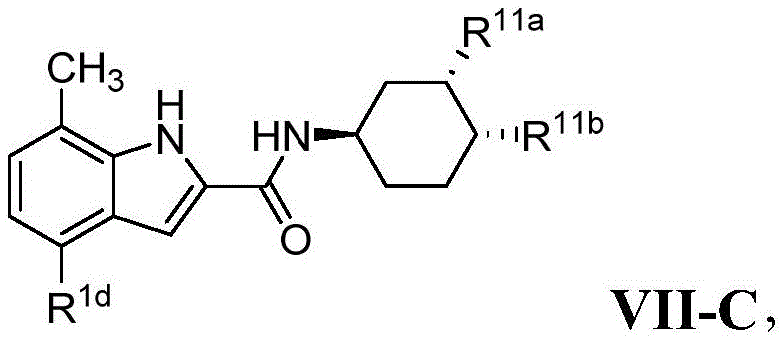
or a pharmaceutically acceptable salt or solvate thereof.
62. The compound of claim 58, having formulas VII-D:

or a pharmaceutically acceptable salt or solvate thereof.
63. The compound of claim 58, having formulas VII-E:

or a pharmaceutically acceptable salt or solvate thereof.
64. The compound of claim 58, having the formula VII-F:

or a pharmaceutically acceptable salt or solvate thereof.
65. The compound of claim 58, having the formula VII-G:

or a pharmaceutically acceptable salt or solvate thereof.
66. The compound of claim 58, having the formula VII-H:
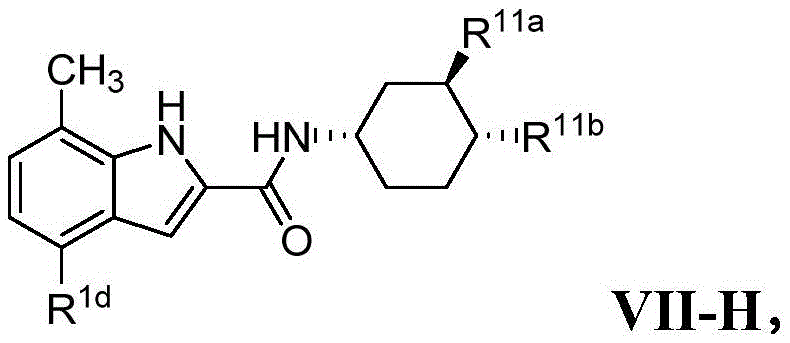
or a pharmaceutically acceptable salt or solvate thereof.
67. The compound of claim 13, having formula VIII:

wherein:
R30selected from the group consisting of: hydrogen; c1-C6An alkyl group; unsubstituted C3-C6A cycloalkyl group; substituted C3-C6Cycloalkyl having one or two substituents independently selected from the group consisting of: halo, hydroxy, C1-C4Alkyl, amino, and (amino) C1-C4An alkyl group; an unsubstituted 4 to 14 membered heterocyclic ring; and a substituted 4 to 14 membered heterocyclic ring having one or two substituents independently selected from the group consisting of: amino, hydroxy, and C1-C4An alkyl group; -C (═ O) R13band-S (═ O)2R24;
R13bSelected from the group consisting of: c1-C4An alkyl group; an amino group; c1-C4A haloalkyl group; c1-C4An alkoxy group; (hydroxy) C1-C4An alkyl group; (C)1-C4Alkoxy) C1-C4An alkyl group; (amino) alkyl; unsubstituted C3-C6A cycloalkyl group; substituted C3-C6Cycloalkyl having one or two substituents independently selected from the group consisting of: halo, hydroxy, C1-C4Alkyl, amino, and (amino) C1-C4An alkyl group; an unsubstituted 4 to 14 membered heterocyclic ring; a substituted 4 to 14 membered heterocyclic ring having one or two substituents independently selected from the group consisting of: amino, hydroxy, and C 1-C4An alkyl group; (C)3-C6Cycloalkyl) oxy; and (4-to 8-membered heterocyclic) oxy;
R24selected from the group consisting of: c1-C4Alkyl and (hydroxy) C1-C4An alkyl group; and is
u is 0, 1, 2, or 3, or a pharmaceutically acceptable salt or solvate thereof.
68. The compound of claim 67, having formula VIII-A:

or a pharmaceutically acceptable salt or solvate thereof.
69. The compound of claim 67, having formula VIII-B:

or a pharmaceutically acceptable salt or solvate thereof.
70. The compound of any one of claims 1-11 or 13-69, wherein R1dIs fluorine, or a pharmaceutically acceptable salt or solvate thereof.
71. The compound of claim 1, selected from the group consisting of the compounds of table 1, or a pharmaceutically acceptable salt or solvate thereof.
72. A pharmaceutical composition comprising a compound of any one of claims 1-71, or a pharmaceutically acceptable salt or solvate thereof, and a pharmaceutically acceptable carrier.
73. A method of treating a subject in need thereof, the method comprising administering to the subject a therapeutically effective amount of the compound of any one of claims 1-71, or a pharmaceutically acceptable salt or solvate thereof, wherein the subject has cancer.
74. The method of claim 73, wherein the cancer is any one or more of the cancers of Table 2.
75. The method of claim 73, wherein the cancer is a hematologic cancer.
76. The method of claim 75, wherein the hematologic cancer is any one or more of the cancers of Table 3.
77. The method of claim 76, wherein the hematological cancer is t (4; 14) multiple myeloma.
78. The method of any one of claims 73-77, further comprising administering a therapeutically effective amount of a second therapeutic agent useful in treating cancer.
79. The pharmaceutical composition of claim 72, for use in the treatment of cancer.
80. The pharmaceutical composition of claim 79, wherein the cancer is any one or more of the cancers of Table 2.
81. The pharmaceutical composition of claim 79, wherein the cancer is a hematologic cancer.
82. The pharmaceutical composition of claim 81, wherein the hematologic cancer is any one or more of the cancers of Table 3.
83. The pharmaceutical composition of claim 82, wherein the hematological cancer is t (4; 14) multiple myeloma.
84. The compound of any one of claims 1-71, or a pharmaceutically acceptable salt or solvate thereof, for use in the treatment of cancer.
85. The compound for use of claim 84, wherein the cancer is any one or more of the cancers of Table 2.
86. The compound for use of claim 84, wherein the cancer is a hematological cancer.
87. The compound for use of claim 86, wherein the hematological cancer is any one or more of the cancers of Table 3.
88. The compound for use of claim 87, wherein the hematological cancer is t (4; 14) multiple myeloma.
89. Use of a compound of any one of claims 1-71, or a pharmaceutically acceptable salt or solvate thereof, for the manufacture of a medicament for the treatment of cancer.
90. The use of claim 89, wherein the cancer is any one or more of the cancers of Table 2.
91. The use of claim 89, wherein the cancer is a hematological cancer.
92. The use of claim 91, wherein the hematologic cancer is any one or more of the cancers of Table 3.
93. The use of claim 92, wherein the hematological cancer is t (4; 14) multiple myeloma.
94. A kit comprising the compound of any one of claims 1-71, or a pharmaceutically acceptable salt or solvate thereof, and instructions for administering the compound, or a pharmaceutically acceptable salt or solvate thereof, to a subject having cancer.
95. The kit of claim 94, wherein the cancer is any one or more of the cancers of Table 2.
96. The kit of claim 94, wherein the cancer is a hematologic cancer.
97. The kit of claim 96, wherein the hematologic cancer is any one or more of the cancers of Table 3.
98. The kit of claim 97, wherein the hematological cancer is t (4; 14) multiple myeloma.
99. The kit of any one of claims 94-98, further comprising one or more additional therapeutic agents.
100. A method of treating a subject with multiple myeloma, the method comprising:
(a) determining whether a chromosomal translocation is present in a biological sample taken from the subject; and is
(b) Administering to the subject a therapeutically effective amount of the compound of any one of claims 1-71, or a pharmaceutically acceptable salt thereof, if a chromosomal translocation is present in the biological sample.
101. A method of identifying whether a subject with multiple myeloma can be a candidate for treatment with a compound of any one of claims 1-71, or a pharmaceutically acceptable salt or solvate thereof, comprising: (a) determining whether a chromosomal translocation is present in a biological sample taken from the subject; and (b) identifying the subject as a candidate for treatment if a chromosomal translocation is present; or (c) not identifying the subject as a candidate for treatment if a chromosomal translocation is not present.
102. A method of predicting treatment outcome in a subject with multiple myeloma, the method comprising determining whether a chromosomal translocation is present in a biological sample taken from the subject, wherein: (a) the presence of a chromosomal translocation in the biological sample indicates that administration of the compound of any one of claims 1-71, or a pharmaceutically acceptable salt thereof, to the subject will likely elicit a favorable therapeutic response; and (b) the absence of a chromosomal translocation in the biological sample indicates that administration of the compound of any one of claims 1-71, or a pharmaceutically acceptable salt thereof, to the subject may elicit an adverse therapeutic response.
103. A method comprising administering to a subject in need thereof a therapeutically effective amount of a compound of any one of claims 1-71, or a pharmaceutically acceptable salt or solvate thereof, wherein: (a) the subject has multiple myeloma; and (b) the multiple myeloma is characterized as having a chromosomal translocation.
104. The method of any one of claims 100-103, wherein the chromosomal translocation is a t (4; 14) translocation.
Applications Claiming Priority (7)
| Application Number | Priority Date | Filing Date | Title |
|---|---|---|---|
| US201862718746P | 2018-08-14 | 2018-08-14 | |
| US62/718,746 | 2018-08-14 | ||
| US201862773770P | 2018-11-30 | 2018-11-30 | |
| US62/773,770 | 2018-11-30 | ||
| US201962857120P | 2019-06-04 | 2019-06-04 | |
| US62/857,120 | 2019-06-04 | ||
| PCT/US2019/046569 WO2020037079A1 (en) | 2018-08-14 | 2019-08-14 | Substituted indoles and methods of use thereof |
Publications (1)
| Publication Number | Publication Date |
|---|---|
| CN112585119A true CN112585119A (en) | 2021-03-30 |
Family
ID=69525931
Family Applications (1)
| Application Number | Title | Priority Date | Filing Date |
|---|---|---|---|
| CN201980054976.8A Pending CN112585119A (en) | 2018-08-14 | 2019-08-14 | Substituted indoles and methods of use thereof |
Country Status (16)
| Country | Link |
|---|---|
| US (1) | US12116358B2 (en) |
| EP (1) | EP3837240A4 (en) |
| JP (2) | JP7627209B2 (en) |
| KR (1) | KR20210065097A (en) |
| CN (1) | CN112585119A (en) |
| AU (2) | AU2019321464B2 (en) |
| BR (1) | BR112021002633A2 (en) |
| CA (1) | CA3109214A1 (en) |
| CO (1) | CO2021003300A2 (en) |
| IL (2) | IL280709B2 (en) |
| MA (1) | MA53235A (en) |
| MX (2) | MX2021001690A (en) |
| MY (1) | MY207663A (en) |
| PH (1) | PH12021550296A1 (en) |
| SG (1) | SG11202101367YA (en) |
| WO (1) | WO2020037079A1 (en) |
Cited By (2)
| Publication number | Priority date | Publication date | Assignee | Title |
|---|---|---|---|---|
| WO2023274251A1 (en) * | 2021-06-29 | 2023-01-05 | 深圳开悦生命科技有限公司 | Polycyclic compound for inhibiting rna helicase dhx33, and application of compound |
| WO2024067709A1 (en) * | 2022-09-30 | 2024-04-04 | 苏州阿尔脉生物科技有限公司 | Pyridinylamide derivative, pharmaceutical composition comprising same, and medical use thereof |
Families Citing this family (14)
| Publication number | Priority date | Publication date | Assignee | Title |
|---|---|---|---|---|
| CN119405809A (en) | 2017-08-14 | 2025-02-11 | Epizyme股份有限公司 | Cancer treatment by inhibiting SETD2 |
| MX2021006347A (en) * | 2018-11-30 | 2021-10-13 | Epizyme Inc | METHODS OF TREATMENT OF CANCERS THAT OVEREXPRESS WHSC1 THROUGH THE INHIBITION OF SETD2. |
| WO2021032935A1 (en) * | 2019-08-21 | 2021-02-25 | Kalvista Pharmaceuticals Limited | Enzyme inhibitors |
| CN115151540A (en) | 2019-12-02 | 2022-10-04 | 风暴治疗有限公司 | Polyheterocyclic compounds as METTL3 inhibitors |
| IL295654A (en) * | 2020-02-19 | 2022-10-01 | Epizyme Inc | setd2 inhibitors and related methods and uses, including combination therapies |
| KR102682775B1 (en) * | 2020-06-26 | 2024-07-08 | 홀로스메딕 주식회사 | Method for preparing novel compounds |
| US20240228667A9 (en) * | 2021-02-26 | 2024-07-11 | Celgene Corporation | Methods for Treating Multiple Myeloma |
| KR20220148758A (en) * | 2021-04-29 | 2022-11-07 | 홀로스메딕 주식회사 | Novel compounds and pharmaceutical composition for preventing or treating comprising the same |
| IL308868A (en) * | 2021-06-09 | 2024-01-01 | Epizyme Inc | Combination therapies with setd2 inhibitors |
| WO2023077117A1 (en) * | 2021-11-01 | 2023-05-04 | Epizyme, Inc. | Crystalline forms of n-((1r,3s)-3-(4-acetylpiperazin-1-yl)cyclohexyl)-4-fluoro-7-methyl-1h-indole-2-carboxamide |
| CN116794170B (en) * | 2022-03-18 | 2025-11-14 | 上海润石医药科技有限公司 | A method for detecting a compound in biological samples |
| WO2024091450A1 (en) * | 2022-10-24 | 2024-05-02 | The Regents Of The University Of California | Compounds and methods for treating cancer |
| KR20250095720A (en) * | 2022-10-31 | 2025-06-26 | 일라이 릴리 앤드 캄파니 | AHR agonist |
| EP4652168A1 (en) * | 2023-01-19 | 2025-11-26 | Beone Medicines I GmbH | 5-amino-1h-pyrrolo [3, 2-b] pyridine-2-carboxamide derivatives as mta-cooperative inhibitors of prmt5 |
Family Cites Families (37)
| Publication number | Priority date | Publication date | Assignee | Title |
|---|---|---|---|---|
| IL63907A0 (en) | 1980-09-24 | 1981-12-31 | Cetus Corp | Diagnostic method and antibody probe for use therein |
| US4582788A (en) | 1982-01-22 | 1986-04-15 | Cetus Corporation | HLA typing method and cDNA probes used therein |
| ATE53862T1 (en) | 1982-01-22 | 1990-06-15 | Cetus Corp | METHODS FOR THE CHARACTERIZATION OF HLA AND THE CDNS TEST AGENTS USED THEREIN. |
| US4683194A (en) | 1984-05-29 | 1987-07-28 | Cetus Corporation | Method for detection of polymorphic restriction sites and nucleic acid sequences |
| US4595766A (en) | 1984-10-26 | 1986-06-17 | Ciba-Geigy Corporation | Process for the preparation of an indoline carboxylic acid |
| US4683202A (en) | 1985-03-28 | 1987-07-28 | Cetus Corporation | Process for amplifying nucleic acid sequences |
| CA1284931C (en) | 1986-03-13 | 1991-06-18 | Henry A. Erlich | Process for detecting specific nucleotide variations and genetic polymorphisms present in nucleic acids |
| CA1338457C (en) | 1986-08-22 | 1996-07-16 | Henry A. Erlich | Purified thermostable enzyme |
| US6921763B2 (en) | 1999-09-17 | 2005-07-26 | Abbott Laboratories | Pyrazolopyrimidines as therapeutic agents |
| AU2003265382A1 (en) | 2002-08-23 | 2004-03-11 | Pharmacia & Upjohn Company Llc | Antibacterial benzoic acid derivatives |
| US20040110802A1 (en) * | 2002-08-23 | 2004-06-10 | Atli Thorarensen | Antibacterial benzoic acid derivatives |
| EP1880994A4 (en) | 2005-05-11 | 2010-04-14 | Eisai R&D Man Co Ltd | Crystal of indole derivative having piperidine ring and process for production thereof |
| CA2628074C (en) * | 2005-10-25 | 2014-01-14 | Shionogi & Co., Ltd. | Aminodihydrothiazine derivative |
| US7838542B2 (en) * | 2006-06-29 | 2010-11-23 | Kinex Pharmaceuticals, Llc | Bicyclic compositions and methods for modulating a kinase cascade |
| WO2009158375A1 (en) * | 2008-06-25 | 2009-12-30 | Abbott Laboratories | Aza-cylic indole- 2 -carboxamides and methods of use thereof |
| AU2009289649B2 (en) * | 2008-09-03 | 2016-05-05 | Biomarin Pharmaceutical Inc. | Compositions including 6-aminohexanoic acid derivatives as HDAC inhibitors |
| WO2011011366A2 (en) | 2009-07-20 | 2011-01-27 | Constellation Pharmaceuticals | Agents for stimulating activity of methyl modifying enzymes and methods of use thereof |
| AU2010333779A1 (en) * | 2009-12-23 | 2012-07-12 | Sanofi | Indolyl-piperidinyl benzylamines as beta-tryptase inhibitors |
| JP2013518560A (en) | 2010-02-03 | 2013-05-23 | オンコセラピー・サイエンス株式会社 | WHSC1 and WHSC1L1 as target genes for cancer treatment and diagnosis |
| JP2012107001A (en) * | 2010-10-22 | 2012-06-07 | Shionogi & Co Ltd | Drug containing indole amide compound |
| CA2853501A1 (en) | 2011-10-27 | 2013-05-02 | Memorial Sloan-Kettering Cancer Center | Methyltransferase inhibitors for treating cancer |
| US9446064B2 (en) | 2013-03-14 | 2016-09-20 | Epizyme, Inc. | Combination therapy for treating cancer |
| WO2015143424A2 (en) | 2014-03-21 | 2015-09-24 | Glaxosmithkline Intellectual Property (No. 2) Limited | Methods of treating cancer |
| US10167257B2 (en) | 2014-04-04 | 2019-01-01 | Iomet Pharma Ltd. | Indole derivatives for use in medicine |
| WO2015164482A1 (en) * | 2014-04-22 | 2015-10-29 | The Johns Hopkins University | Inhibitors of drug-resistant mycobacterium tuberculosis |
| US9902702B2 (en) * | 2014-07-15 | 2018-02-27 | Bristol-Myers Squibb Company | Spirocycloheptanes as inhibitors of rock |
| AU2015301746A1 (en) | 2014-08-13 | 2017-02-16 | Celgene Corporation | Combination therapy for treating cancer |
| BR112017004612A2 (en) * | 2014-09-10 | 2018-01-30 | Epizyme, Inc. | compounds, pharmaceutical composition, uses of a compound, and kit |
| WO2016079321A1 (en) | 2014-11-20 | 2016-05-26 | Cemm Forschungszentrum Für Molekulare Medizin Gmbh | Antagonists of setdb2 for use in the therapy of infectious diseases |
| US9717745B2 (en) | 2015-03-19 | 2017-08-01 | Zhejiang DTRM Biopharma Co. Ltd. | Pharmaceutical compositions and their use for treatment of cancer and autoimmune diseases |
| US20190026440A1 (en) | 2015-12-17 | 2019-01-24 | Albert Einstein College Of Medicine, Inc. | Nuclear receptor set domain containing protein 2 transition state and uses thereof |
| CN106317043B (en) * | 2016-08-19 | 2018-11-02 | 成都理工大学 | A kind of 2 agonist of Cannabined receptor |
| CN119405809A (en) | 2017-08-14 | 2025-02-11 | Epizyme股份有限公司 | Cancer treatment by inhibiting SETD2 |
| MX2021006347A (en) | 2018-11-30 | 2021-10-13 | Epizyme Inc | METHODS OF TREATMENT OF CANCERS THAT OVEREXPRESS WHSC1 THROUGH THE INHIBITION OF SETD2. |
| IL295654A (en) | 2020-02-19 | 2022-10-01 | Epizyme Inc | setd2 inhibitors and related methods and uses, including combination therapies |
| IL308868A (en) | 2021-06-09 | 2024-01-01 | Epizyme Inc | Combination therapies with setd2 inhibitors |
| WO2023077117A1 (en) | 2021-11-01 | 2023-05-04 | Epizyme, Inc. | Crystalline forms of n-((1r,3s)-3-(4-acetylpiperazin-1-yl)cyclohexyl)-4-fluoro-7-methyl-1h-indole-2-carboxamide |
-
2019
- 2019-08-14 CN CN201980054976.8A patent/CN112585119A/en active Pending
- 2019-08-14 IL IL280709A patent/IL280709B2/en unknown
- 2019-08-14 MX MX2021001690A patent/MX2021001690A/en unknown
- 2019-08-14 IL IL310632A patent/IL310632A/en unknown
- 2019-08-14 SG SG11202101367YA patent/SG11202101367YA/en unknown
- 2019-08-14 US US17/268,151 patent/US12116358B2/en active Active
- 2019-08-14 EP EP19849109.4A patent/EP3837240A4/en active Pending
- 2019-08-14 MY MYPI2021000755A patent/MY207663A/en unknown
- 2019-08-14 MA MA053235A patent/MA53235A/en unknown
- 2019-08-14 WO PCT/US2019/046569 patent/WO2020037079A1/en not_active Ceased
- 2019-08-14 KR KR1020217006988A patent/KR20210065097A/en active Pending
- 2019-08-14 CA CA3109214A patent/CA3109214A1/en active Pending
- 2019-08-14 BR BR112021002633-9A patent/BR112021002633A2/en unknown
- 2019-08-14 AU AU2019321464A patent/AU2019321464B2/en active Active
- 2019-08-14 JP JP2021507444A patent/JP7627209B2/en active Active
-
2021
- 2021-02-10 PH PH12021550296A patent/PH12021550296A1/en unknown
- 2021-02-11 MX MX2025006292A patent/MX2025006292A/en unknown
- 2021-03-12 CO CONC2021/0003300A patent/CO2021003300A2/en unknown
-
2025
- 2025-01-24 JP JP2025010749A patent/JP2025063306A/en active Pending
- 2025-06-19 AU AU2025204601A patent/AU2025204601A1/en active Pending
Cited By (2)
| Publication number | Priority date | Publication date | Assignee | Title |
|---|---|---|---|---|
| WO2023274251A1 (en) * | 2021-06-29 | 2023-01-05 | 深圳开悦生命科技有限公司 | Polycyclic compound for inhibiting rna helicase dhx33, and application of compound |
| WO2024067709A1 (en) * | 2022-09-30 | 2024-04-04 | 苏州阿尔脉生物科技有限公司 | Pyridinylamide derivative, pharmaceutical composition comprising same, and medical use thereof |
Also Published As
| Publication number | Publication date |
|---|---|
| AU2019321464A1 (en) | 2021-04-08 |
| CO2021003300A2 (en) | 2021-06-21 |
| MX2025006292A (en) | 2025-07-01 |
| MA53235A (en) | 2022-04-27 |
| MY207663A (en) | 2025-03-11 |
| EP3837240A4 (en) | 2022-04-27 |
| IL310632A (en) | 2024-04-01 |
| KR20210065097A (en) | 2021-06-03 |
| BR112021002633A2 (en) | 2021-05-04 |
| IL280709A (en) | 2021-03-25 |
| JP2021536428A (en) | 2021-12-27 |
| US20230075198A1 (en) | 2023-03-09 |
| AU2025204601A1 (en) | 2025-07-10 |
| MX2021001690A (en) | 2021-07-21 |
| CA3109214A1 (en) | 2020-02-20 |
| WO2020037079A1 (en) | 2020-02-20 |
| SG11202101367YA (en) | 2021-03-30 |
| US12116358B2 (en) | 2024-10-15 |
| IL280709B2 (en) | 2024-07-01 |
| JP7627209B2 (en) | 2025-02-05 |
| EP3837240A1 (en) | 2021-06-23 |
| PH12021550296A1 (en) | 2021-10-25 |
| JP2025063306A (en) | 2025-04-15 |
| AU2019321464B2 (en) | 2025-03-27 |
| IL280709B1 (en) | 2024-03-01 |
Similar Documents
| Publication | Publication Date | Title |
|---|---|---|
| CN112585119A (en) | Substituted indoles and methods of use thereof | |
| CN107922417B (en) | Use of pteridinone derivatives as EGFR inhibitors | |
| CN113490495A (en) | Small molecule degradation agent of HELIOS and use method thereof | |
| JP2019518776A (en) | Crystals of Aniline Pyrimidine Compounds as EGFR Inhibitors | |
| CN103930425A (en) | Pteridinone derivatives and their application as EGFR, BLK, FLT3 inhibitors | |
| CN105315285A (en) | 2,4-disubstituted 7H-pyrrolo[2,3-d]pyrimidine derivative, preparation method and medical uses thereof | |
| WO2020125759A1 (en) | Compound as wnt signal pathway inhibitor and medical use thereof | |
| CN115380033B (en) | SETD2 inhibitors and related methods and uses, including combination therapy | |
| US20190375714A1 (en) | Quinoline compound, preparation method and medical use therefor | |
| JP2024522184A (en) | Combination therapy with SETD2 inhibitors | |
| CN104910140A (en) | Quinazoline compound, preparation method and application thereof | |
| TWI443095B (en) | Novel salt | |
| CN111349093B (en) | 5,6-bicyclic compounds as WNT signaling pathway inhibitors and their medical applications | |
| Yu et al. | Design, synthesis and antitumor activity of 4-aminoquinazoline derivatives targeting VEGFR-2 tyrosine kinase | |
| CN108250187B (en) | Indole-1-carbonate compound, its preparation method and application | |
| CN111247137A (en) | Pyrimidine compound, preparation method and medical application thereof | |
| CN119176770A (en) | HDAC inhibitors, compositions and uses thereof | |
| CN111116572A (en) | Oxadiazole derivatives, their preparation and use | |
| JP2024537790A (en) | Small molecule inhibitors of oncogenic CHD1L for treating cancer - Patent Application 20070229633 | |
| CN116655600B (en) | A substituted 2-arylaminopyrimidine compound, pharmaceutical composition and use thereof | |
| HK40084091A (en) | Setd2 inhibitors and related methods and uses, including combination therapies | |
| JP2025526715A (en) | Crystals of pyridinopyrimidinone compounds, acid salts thereof, crystals of acid salts thereof and use thereof | |
| HK40019956A (en) | Pyrimidine compound, preparation method therefor and medical use thereof | |
| HK40081466A (en) | Efgr inhibitor, preparation method therefor, and application thereof | |
| WO2021254464A1 (en) | Substituted quinazoline compound, and preparation method therefor, pharmaceutical composition thereof, and use thereof |
Legal Events
| Date | Code | Title | Description |
|---|---|---|---|
| PB01 | Publication | ||
| PB01 | Publication | ||
| SE01 | Entry into force of request for substantive examination | ||
| SE01 | Entry into force of request for substantive examination |