CN112565767B - Video decoding method, video encoding method and related equipment - Google Patents
Video decoding method, video encoding method and related equipment Download PDFInfo
- Publication number
- CN112565767B CN112565767B CN202010500079.XA CN202010500079A CN112565767B CN 112565767 B CN112565767 B CN 112565767B CN 202010500079 A CN202010500079 A CN 202010500079A CN 112565767 B CN112565767 B CN 112565767B
- Authority
- CN
- China
- Prior art keywords
- string
- current
- string vector
- vector
- resolution
- Prior art date
- Legal status (The legal status is an assumption and is not a legal conclusion. Google has not performed a legal analysis and makes no representation as to the accuracy of the status listed.)
- Active
Links
- 238000000034 method Methods 0.000 title claims abstract description 119
- 239000013598 vector Substances 0.000 claims abstract description 748
- 238000003860 storage Methods 0.000 claims description 33
- 238000004590 computer program Methods 0.000 claims description 11
- 230000003044 adaptive effect Effects 0.000 claims description 10
- 238000005520 cutting process Methods 0.000 claims description 9
- 238000010586 diagram Methods 0.000 description 20
- 238000007906 compression Methods 0.000 description 13
- 230000006835 compression Effects 0.000 description 13
- 238000006073 displacement reaction Methods 0.000 description 13
- 239000004814 polyurethane Substances 0.000 description 13
- 238000013139 quantization Methods 0.000 description 11
- 101000832455 Pimpla hypochondriaca Small venom protein 1 Proteins 0.000 description 10
- 230000006870 function Effects 0.000 description 10
- 238000005516 engineering process Methods 0.000 description 9
- 238000001914 filtration Methods 0.000 description 9
- 241000657949 Elderberry carlavirus D Species 0.000 description 7
- 230000008569 process Effects 0.000 description 6
- 101000820662 Pimpla hypochondriaca Small venom protein 2 Proteins 0.000 description 5
- 238000004458 analytical method Methods 0.000 description 5
- 238000004891 communication Methods 0.000 description 5
- 238000012545 processing Methods 0.000 description 5
- 230000002123 temporal effect Effects 0.000 description 5
- 230000000694 effects Effects 0.000 description 4
- 230000003287 optical effect Effects 0.000 description 4
- FGUUSXIOTUKUDN-IBGZPJMESA-N C1(=CC=CC=C1)N1C2=C(NC([C@H](C1)NC=1OC(=NN=1)C1=CC=CC=C1)=O)C=CC=C2 Chemical compound C1(=CC=CC=C1)N1C2=C(NC([C@H](C1)NC=1OC(=NN=1)C1=CC=CC=C1)=O)C=CC=C2 FGUUSXIOTUKUDN-IBGZPJMESA-N 0.000 description 3
- 230000009466 transformation Effects 0.000 description 3
- 101150083341 LOG2 gene Proteins 0.000 description 2
- 241000023320 Luma <angiosperm> Species 0.000 description 2
- 230000009471 action Effects 0.000 description 2
- 238000013459 approach Methods 0.000 description 2
- 238000013144 data compression Methods 0.000 description 2
- 230000006837 decompression Effects 0.000 description 2
- 238000011161 development Methods 0.000 description 2
- OSWPMRLSEDHDFF-UHFFFAOYSA-N methyl salicylate Chemical compound COC(=O)C1=CC=CC=C1O OSWPMRLSEDHDFF-UHFFFAOYSA-N 0.000 description 2
- 238000010295 mobile communication Methods 0.000 description 2
- 238000005192 partition Methods 0.000 description 2
- 230000000644 propagated effect Effects 0.000 description 2
- 239000004065 semiconductor Substances 0.000 description 2
- GNFTZDOKVXKIBK-UHFFFAOYSA-N 3-(2-methoxyethoxy)benzohydrazide Chemical compound COCCOC1=CC=CC(C(=O)NN)=C1 GNFTZDOKVXKIBK-UHFFFAOYSA-N 0.000 description 1
- 108091026890 Coding region Proteins 0.000 description 1
- 230000006978 adaptation Effects 0.000 description 1
- 230000005540 biological transmission Effects 0.000 description 1
- 238000004364 calculation method Methods 0.000 description 1
- 239000003086 colorant Substances 0.000 description 1
- 230000000295 complement effect Effects 0.000 description 1
- 238000009826 distribution Methods 0.000 description 1
- 230000002349 favourable effect Effects 0.000 description 1
- 239000000835 fiber Substances 0.000 description 1
- 210000004966 intestinal stem cell Anatomy 0.000 description 1
- 239000004973 liquid crystal related substance Substances 0.000 description 1
- 230000007246 mechanism Effects 0.000 description 1
- 238000012986 modification Methods 0.000 description 1
- 230000004048 modification Effects 0.000 description 1
- 239000013307 optical fiber Substances 0.000 description 1
- 238000005457 optimization Methods 0.000 description 1
- 229920002635 polyurethane Polymers 0.000 description 1
- 238000011002 quantification Methods 0.000 description 1
- 230000010076 replication Effects 0.000 description 1
- 238000011160 research Methods 0.000 description 1
Images




Classifications
-
- H—ELECTRICITY
- H04—ELECTRIC COMMUNICATION TECHNIQUE
- H04N—PICTORIAL COMMUNICATION, e.g. TELEVISION
- H04N19/00—Methods or arrangements for coding, decoding, compressing or decompressing digital video signals
- H04N19/10—Methods or arrangements for coding, decoding, compressing or decompressing digital video signals using adaptive coding
- H04N19/169—Methods or arrangements for coding, decoding, compressing or decompressing digital video signals using adaptive coding characterised by the coding unit, i.e. the structural portion or semantic portion of the video signal being the object or the subject of the adaptive coding
- H04N19/17—Methods or arrangements for coding, decoding, compressing or decompressing digital video signals using adaptive coding characterised by the coding unit, i.e. the structural portion or semantic portion of the video signal being the object or the subject of the adaptive coding the unit being an image region, e.g. an object
- H04N19/176—Methods or arrangements for coding, decoding, compressing or decompressing digital video signals using adaptive coding characterised by the coding unit, i.e. the structural portion or semantic portion of the video signal being the object or the subject of the adaptive coding the unit being an image region, e.g. an object the region being a block, e.g. a macroblock
-
- H—ELECTRICITY
- H04—ELECTRIC COMMUNICATION TECHNIQUE
- H04N—PICTORIAL COMMUNICATION, e.g. TELEVISION
- H04N19/00—Methods or arrangements for coding, decoding, compressing or decompressing digital video signals
- H04N19/10—Methods or arrangements for coding, decoding, compressing or decompressing digital video signals using adaptive coding
- H04N19/102—Methods or arrangements for coding, decoding, compressing or decompressing digital video signals using adaptive coding characterised by the element, parameter or selection affected or controlled by the adaptive coding
- H04N19/103—Selection of coding mode or of prediction mode
- H04N19/105—Selection of the reference unit for prediction within a chosen coding or prediction mode, e.g. adaptive choice of position and number of pixels used for prediction
-
- H—ELECTRICITY
- H04—ELECTRIC COMMUNICATION TECHNIQUE
- H04N—PICTORIAL COMMUNICATION, e.g. TELEVISION
- H04N19/00—Methods or arrangements for coding, decoding, compressing or decompressing digital video signals
- H04N19/10—Methods or arrangements for coding, decoding, compressing or decompressing digital video signals using adaptive coding
- H04N19/134—Methods or arrangements for coding, decoding, compressing or decompressing digital video signals using adaptive coding characterised by the element, parameter or criterion affecting or controlling the adaptive coding
- H04N19/136—Incoming video signal characteristics or properties
-
- H—ELECTRICITY
- H04—ELECTRIC COMMUNICATION TECHNIQUE
- H04N—PICTORIAL COMMUNICATION, e.g. TELEVISION
- H04N19/00—Methods or arrangements for coding, decoding, compressing or decompressing digital video signals
- H04N19/10—Methods or arrangements for coding, decoding, compressing or decompressing digital video signals using adaptive coding
- H04N19/134—Methods or arrangements for coding, decoding, compressing or decompressing digital video signals using adaptive coding characterised by the element, parameter or criterion affecting or controlling the adaptive coding
- H04N19/146—Data rate or code amount at the encoder output
- H04N19/147—Data rate or code amount at the encoder output according to rate distortion criteria
-
- H—ELECTRICITY
- H04—ELECTRIC COMMUNICATION TECHNIQUE
- H04N—PICTORIAL COMMUNICATION, e.g. TELEVISION
- H04N19/00—Methods or arrangements for coding, decoding, compressing or decompressing digital video signals
- H04N19/10—Methods or arrangements for coding, decoding, compressing or decompressing digital video signals using adaptive coding
- H04N19/169—Methods or arrangements for coding, decoding, compressing or decompressing digital video signals using adaptive coding characterised by the coding unit, i.e. the structural portion or semantic portion of the video signal being the object or the subject of the adaptive coding
- H04N19/182—Methods or arrangements for coding, decoding, compressing or decompressing digital video signals using adaptive coding characterised by the coding unit, i.e. the structural portion or semantic portion of the video signal being the object or the subject of the adaptive coding the unit being a pixel
-
- H—ELECTRICITY
- H04—ELECTRIC COMMUNICATION TECHNIQUE
- H04N—PICTORIAL COMMUNICATION, e.g. TELEVISION
- H04N19/00—Methods or arrangements for coding, decoding, compressing or decompressing digital video signals
- H04N19/10—Methods or arrangements for coding, decoding, compressing or decompressing digital video signals using adaptive coding
- H04N19/169—Methods or arrangements for coding, decoding, compressing or decompressing digital video signals using adaptive coding characterised by the coding unit, i.e. the structural portion or semantic portion of the video signal being the object or the subject of the adaptive coding
- H04N19/186—Methods or arrangements for coding, decoding, compressing or decompressing digital video signals using adaptive coding characterised by the coding unit, i.e. the structural portion or semantic portion of the video signal being the object or the subject of the adaptive coding the unit being a colour or a chrominance component
-
- H—ELECTRICITY
- H04—ELECTRIC COMMUNICATION TECHNIQUE
- H04N—PICTORIAL COMMUNICATION, e.g. TELEVISION
- H04N19/00—Methods or arrangements for coding, decoding, compressing or decompressing digital video signals
- H04N19/42—Methods or arrangements for coding, decoding, compressing or decompressing digital video signals characterised by implementation details or hardware specially adapted for video compression or decompression, e.g. dedicated software implementation
- H04N19/436—Methods or arrangements for coding, decoding, compressing or decompressing digital video signals characterised by implementation details or hardware specially adapted for video compression or decompression, e.g. dedicated software implementation using parallelised computational arrangements
-
- H—ELECTRICITY
- H04—ELECTRIC COMMUNICATION TECHNIQUE
- H04N—PICTORIAL COMMUNICATION, e.g. TELEVISION
- H04N19/00—Methods or arrangements for coding, decoding, compressing or decompressing digital video signals
- H04N19/44—Decoders specially adapted therefor, e.g. video decoders which are asymmetric with respect to the encoder
-
- H—ELECTRICITY
- H04—ELECTRIC COMMUNICATION TECHNIQUE
- H04N—PICTORIAL COMMUNICATION, e.g. TELEVISION
- H04N19/00—Methods or arrangements for coding, decoding, compressing or decompressing digital video signals
- H04N19/50—Methods or arrangements for coding, decoding, compressing or decompressing digital video signals using predictive coding
- H04N19/503—Methods or arrangements for coding, decoding, compressing or decompressing digital video signals using predictive coding involving temporal prediction
-
- H—ELECTRICITY
- H04—ELECTRIC COMMUNICATION TECHNIQUE
- H04N—PICTORIAL COMMUNICATION, e.g. TELEVISION
- H04N19/00—Methods or arrangements for coding, decoding, compressing or decompressing digital video signals
- H04N19/90—Methods or arrangements for coding, decoding, compressing or decompressing digital video signals using coding techniques not provided for in groups H04N19/10-H04N19/85, e.g. fractals
- H04N19/91—Entropy coding, e.g. variable length coding [VLC] or arithmetic coding
Landscapes
- Engineering & Computer Science (AREA)
- Multimedia (AREA)
- Signal Processing (AREA)
- Computing Systems (AREA)
- Theoretical Computer Science (AREA)
- Compression Or Coding Systems Of Tv Signals (AREA)
Abstract
The disclosure provides a video decoding method, a video decoding method and related equipment. The method comprises the following steps: acquiring a code stream to be decoded, wherein the code stream to be decoded comprises a current decoding block, the current decoding block adopts an intra-frame string copying mode, and the current decoding block comprises a current string; determining at least two candidate string vector encoding resolutions for the current string; decoding the code stream to be decoded to obtain string vector coding information of the current string; determining a target string vector encoding resolution of the current string from the at least two candidate string vector encoding resolutions according to the string vector encoding information; and obtaining the target string vector of the current string according to the string vector coding information of the current string and the target string vector coding resolution thereof. The scheme provided in the embodiment of the disclosure can improve the coding efficiency.
Description
Technical Field
The present disclosure relates to the field of video encoding and decoding technologies, and in particular, to a video decoding method, a video encoding method, an electronic device, and a computer-readable storage medium.
Background
On the one hand, the internet is about to enter the new 5G (5th Generation mobile networks or 5th Generation wireless systems, 5th-Generation, fifth Generation mobile communication technology), and images (videos) appearing in various internet applications have become major consumers of internet bandwidth. Especially, the image flow of the mobile internet is increasing day by day, and the image coding and decoding technology is more explosively increased in the 5G era, so that brand new strong driving force is injected into the accelerated development of the image coding and decoding technology. Meanwhile, many new challenges that have not been encountered in the past are presented to the image coding and decoding technology. In the 5G era, everything is interconnected, and novel internet images generated in various emerging applications have diversity and difference. Therefore, how to research an efficient image coding and decoding technology aiming at the characteristics of novel internet images with diversity and difference is an urgent need.
On the other hand, the amount of video data required for portraying even relatively short movies may be quite large, which may create difficulties when the data is streamed or otherwise transmitted over a communication network having limited bandwidth capacity. Therefore, video data is typically compressed before being transmitted over modern telecommunication networks. Prior to transmission, video compression devices typically use software and/or hardware on the source side to encode the video data, thereby reducing the amount of data required to represent the digital video images. The compressed data is then received at the destination by a video decompression device, which decodes the video data. With limited network resources and an increasing demand for higher video quality, there is a need for improved compression and decompression techniques that improve image quality without increasing bit rate.
The related art string prediction scheme (which may also be referred to as an intra-frame string copy technique or a string matching technique) defaults to integer-pixel precision or resolution when encoding a string vector, resulting in a high encoding cost of the string vector.
Accordingly, there is a need for a new video decoding method, video encoding method, electronic device, and computer-readable storage medium.
It is to be noted that the information disclosed in the above background section is only for enhancement of understanding of the background of the present disclosure.
Disclosure of Invention
The disclosed embodiments provide a video decoding method, a video encoding method, an electronic device, and a computer-readable storage medium that allow string vectors to be encoded using different resolutions, thereby enabling the encoding efficiency of the string vectors to be improved.
Additional features and advantages of the disclosure will be set forth in the detailed description which follows, or in part will be obvious from the description, or may be learned by practice of the disclosure.
The embodiment of the present disclosure provides a video decoding method, which includes: acquiring a code stream to be decoded, wherein the code stream to be decoded comprises a current decoding block, the current decoding block adopts an intra-frame string copying mode, and the current decoding block comprises a current string; determining at least two candidate string vector encoding resolutions for the current string; decoding the code stream to be decoded to obtain string vector coding information of the current string; determining a target string vector encoding resolution of the current string from the at least two candidate string vector encoding resolutions according to the string vector encoding information; and obtaining the target string vector of the current string according to the string vector coding information of the current string and the target string vector coding resolution thereof.
The embodiment of the present disclosure provides a video encoding method, which includes: acquiring a current coding block; adopting an intra-frame string copy mode for the current coding block, and dividing the current coding block into strings, wherein the strings comprise the current string; determining at least two candidate string vector encoding resolutions for the current string; determining a target string vector encoding resolution for the current string from the at least two candidate string vector encoding resolutions; and coding the target string vector of the current string according to the target string vector coding resolution of the current string to obtain string vector coding information of the current string.
The disclosed embodiments provide a computer-readable storage medium on which a computer program is stored, which when executed by a processor implements a video decoding method or a video encoding method as described in the above embodiments.
An embodiment of the present disclosure provides an electronic device, including: at least one processor; a storage device configured to store at least one program that, when executed by the at least one processor, causes the at least one processor to implement the video decoding method or the video encoding method as described in the above embodiments.
In some embodiments of the present disclosure, by allowing string vectors to be encoded with different resolutions and encoding string vectors by adaptively selecting resolutions, the encoding efficiency of string vectors can be improved, thereby improving the overall encoding efficiency of video data.
It is to be understood that both the foregoing general description and the following detailed description are exemplary and explanatory only and are not restrictive of the disclosure.
Drawings
The accompanying drawings, which are incorporated in and constitute a part of this specification, illustrate embodiments consistent with the present disclosure and together with the description, serve to explain the principles of the disclosure. It is to be understood that the drawings in the following description are merely exemplary of the disclosure, and that other drawings may be derived from those drawings by one of ordinary skill in the art without the exercise of inventive faculty. In the drawings:
fig. 1 schematically shows a basic block diagram of video encoding in the related art;
fig. 2 is a diagram schematically illustrating inter prediction in the related art;
fig. 3 is a schematic diagram illustrating a position of a candidate MVP of a spatial domain in a Merge (Merge) mode of inter-prediction in the related art;
fig. 4 is a diagram schematically illustrating a position of a candidate MVP of a time domain of a Merge mode of inter prediction in the related art;
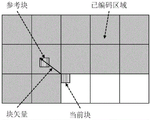
fig. 5 is a diagram schematically illustrating intra block copy in the related art;
fig. 6 is a diagram schematically showing intra string copy in the related art;
fig. 7 schematically shows a schematic diagram of a video decoding method according to an embodiment of the present disclosure;
fig. 8 schematically shows a schematic diagram of a video encoding method according to an embodiment of the present disclosure;
FIG. 9 shows a schematic structural diagram of an electronic device suitable for use in implementing embodiments of the present disclosure.
Detailed Description
Example embodiments will now be described more fully with reference to the accompanying drawings. Example embodiments may, however, be embodied in many different forms and should not be construed as limited to the examples set forth herein; rather, these embodiments are provided so that this disclosure will be thorough and complete, and will fully convey the concept of example embodiments to those skilled in the art.
Furthermore, the described features, structures, or characteristics may be combined in any suitable manner in one or more embodiments. In the following description, numerous specific details are provided to give a thorough understanding of embodiments of the disclosure. One skilled in the relevant art will recognize, however, that the subject matter of the present disclosure can be practiced without one or more of the specific details, or with other methods, components, devices, steps, and so forth. In other instances, well-known methods, devices, implementations, or operations have not been shown or described in detail to avoid obscuring aspects of the disclosure.
The block diagrams shown in the figures are functional entities only and do not necessarily correspond to physically separate entities. I.e. these functional entities may be implemented in the form of software, or in at least one hardware module or integrated circuit, or in different networks and/or processor means and/or microcontroller means.
The flow charts shown in the drawings are merely illustrative and do not necessarily include all of the contents and operations/steps, nor do they necessarily have to be performed in the order described. For example, some operations/steps may be decomposed, and some operations/steps may be combined or partially combined, so that the actual execution sequence may be changed according to the actual situation.
First, some terms referred to in the embodiments of the present disclosure will be described.
AVS: audio Video Coding Standard, Audio Video Coding Standard.
HEVC: high Efficiency Video Coding, also known as h.265.
VVC: versatile Video Coding, multi-function Video Coding, also known as h.266.
Intra (picture) Prediction: and (4) intra-frame prediction.
Inter (picture) Prediction: and (4) performing inter-frame prediction.
SCC: screen content coding, screen content/image coding.
Loop Filter: and (4) loop filtering.
QP: quantization Parameter, quantification Parameter.
LCU: a target Coding Unit, maximum Coding Unit.
And (3) CTU: coding Tree Unit, the Coding Tree Unit, is generally divided from the largest Coding Unit down.
CU: coding Unit, Coding Unit.
PU (polyurethane): prediction Unit, Prediction Unit.
MV: motion Vector, Motion Vector.
MVP: motion Vector Prediction, Motion Vector predictor.
MVD: motion Vector Difference, the Difference between the true estimates of MVP and MV.
AMVP: advanced Motion Vector Prediction, Advanced Motion Vector Prediction.
ME: the process of Motion Estimation to obtain Motion vector MV is called Motion Estimation as a technique in Motion Compensation (MC).
MC: and obtaining the estimation value of the current image according to the motion vector and the inter-frame prediction method. Motion compensation is a method of describing the difference between adjacent frames (adjacent here means adjacent in coding relation, two frames are not necessarily adjacent in playing order), and specifically how each small block of the previous frame moves to a certain position in the current frame. This approach is often used by video compression/video codecs to reduce spatial redundancy in video sequences. Adjacent frames are usually very similar, i.e. contain much redundancy. The purpose of using motion compensation is to increase the compression ratio by eliminating this redundancy.
BV: block Vector, Block displacement Vector/Block Vector.
BVP: block Vector Prediction, Block Vector predictor.
BVD: block Vector Difference, Difference between BVP and true estimate of BV.
I Slice: intra Slice, Intra Slice/Slice. The image may be divided into one frame (frame) or two fields (field), and the frame may be divided into one or several slices (Slice).
The video signal can be obtained by two modes of shooting by a camera and computer generation. Due to the difference of statistical characteristics, the corresponding compression encoding modes may be different.
Some video coding technologies such as HEVC, VVC and AVS adopt a hybrid coding framework, as shown in fig. 1, and sequentially encode pictures (pictures) in an input original video signal (input video), and perform a series of operations and processes as follows:
1) block partition structure (block partition structure): the input image is divided into several non-overlapping processing units, for each of which a similar compression operation will be performed. This processing unit may be referred to as a CTU or LCU. The CTU or LCU may continue to be more finely divided further down to obtain at least one elementary coded unit, referred to as a CU. Each CU is the most basic element in an encoding link. Described below are various possible encoding schemes for each CU.
2) Predictive Coding (Predictive Coding): the method comprises the modes of intra-frame prediction, inter-frame prediction and the like, and residual video signals are obtained after the original video signals are predicted by the selected reconstructed video signals. The encoding side needs to decide for the current CU the most suitable one among the many possible predictive coding modes and inform the decoding side.
a. Intra-frame prediction: the predicted signal comes from an already encoded reconstructed region within the same image.
The basic idea of intra prediction is to remove spatial redundancy by using the correlation of neighboring pixels. In video coding, neighboring pixels refer to reconstructed (reconstructed) pixels of the coded CU surrounding the current CU.
b. Inter-frame prediction: the predicted signal comes from a picture that has already been coded and is different from the current picture (called the reference picture).
3) Transform coding and Quantization (Transform & Quantization): the residual video signal is subjected to Transform operations such as DFT (Discrete Fourier Transform), DCT (Discrete Cosine Transform), etc., to convert the residual video signal into a Transform domain, which is referred to as Transform coefficients. And performing lossy quantization operation on the residual video signals in the transform domain, and losing certain information, so that the quantized signals are favorable for compressed expression.
In some video coding standards, there may be more than one transform mode that can be selected, so the encoding side also needs to select one of the transforms for the current CU to be encoded and inform the decoding side.
The Quantization fineness is usually determined by Quantization Parameters (QPs), and when the QP value is large, the transform coefficients representing a larger value range are quantized into the same output, which generally causes larger distortion and lower code rate; conversely, when the value of QP is small, the transform coefficients representing a small value range will be quantized to the same output, which usually results in less distortion and corresponds to a higher code rate.
4) Entropy Coding (Entropy Coding) or statistical Coding: and (3) carrying out statistical compression coding on the quantized transform domain signals according to the frequency of each value, and finally outputting a binary (0 or 1) compressed code stream (bitstream).
Meanwhile, the encoding generates other information such as selected coding modes (coding modes), motion vectors, etc., which also need to be entropy encoded to reduce the code rate.
The statistical coding is a lossless coding mode, and can effectively reduce the code rate required by expressing the same signal. Common statistical Coding methods are Variable Length Coding (VLC) or context-based Binary Arithmetic Coding (CABAC).
5) Loop Filtering (Loop Filtering): the coded picture is subjected to operations of inverse quantization, inverse transformation and prediction compensation (the operations of steps 2 to 4) to obtain a reconstructed decoded picture. The reconstructed decoded image is different from the original input image in part information due to the influence of quantization compared to the original input image, and Distortion (Distortion) occurs. The distortion degree generated by quantization can be effectively reduced by performing filtering operation on the reconstructed decoded image, such as deblocking filtering (deblocking), SAO (Sample Adaptive Offset), ALF (Adaptive Loop Filter), or other filters. The above-described filtering operation is also referred to as loop filtering, and filtering operations within the coding loop, since these filtered reconstructed decoded pictures will be used as references for subsequent coded pictures for prediction of future signals.
Fig. 1 shows a basic flow diagram of a video encoder. In FIG. 1, the k-th CU (labeled s)k[x,y]) Examples are given for illustration. Where k is a positive integer greater than or equal to 1 and less than or equal to the number of CUs in the input current image, sk[x,y]Denotes the coordinates [ x, y ] in the k-th CU]X represents the abscissa of the pixel, and y represents the ordinate of the pixel. sk[x,y]Obtaining a prediction signal after one of motion compensation or intra prediction sk[x,y]And
 subtracting to obtain a residual signal uk[x,y]Then on the residual signal uk[x,y]The transformation and quantization are performed, and the quantized output data has two different origins: one is to send to entropy coder to do entropy coding, the coded code stream is output to a buffer (buffer) to be stored, and waits for being transmitted; another application is after inverse quantization and inverse transformationTo obtain a signal u'k[x,y]. Will signal u'k[x,y]And
 adding to obtain a new prediction signal s* k[x,y]And then s is* k[x,y]Sending the current image to a buffer for storage. s* k[x,y]Obtaining f(s) via intra-picture prediction* k[x,y])。s* k[x,y]Obtaining s 'after loop filtering'k[x,y]And is prepared from s'k[x,y]And sending the video to a decoded image buffer for storage, so as to generate reconstructed video. s'k[x,y]Obtaining s 'after motion-compensated prediction'r[x+mx,y+my],s'r[x+mx,y+my]Denotes a reference block, mxAnd myRepresenting the horizontal and vertical components of the motion vector, respectively.
Some video coding standards, such as HEVC, VVC, AVS3, all employ a block-based hybrid coding framework. The original video data are divided into a series of coding blocks, and the compression of the video data is realized by combining video coding methods such as prediction, transformation, entropy coding and the like. Motion compensation is a type of prediction method commonly used in video coding, and the motion compensation derives a prediction value of a current coding block from a coded area based on the redundancy characteristic of video content in a time domain or a space domain. Such prediction methods include: inter prediction, intra block copy prediction, intra string copy prediction, etc. In a particular coding implementation, these prediction methods may be used alone or in combination. For coding blocks using these prediction methods, it is generally necessary to encode, either explicitly or implicitly in the code stream, at least one two-dimensional displacement vector indicating the displacement of the current block (or of a co-located block of the current block) with respect to at least one of its reference blocks.
In the embodiments of the present disclosure, the displacement vector may have different names in different prediction modes and different implementations, and is described in the following manner: 1) the displacement vector in inter prediction is called a Motion Vector (MV); 2) the displacement vector in the intra block copy is called block vector or block displacement vector (BV); 3) the displacement Vector in intra-frame String copy is called String Vector (SV).
The following first introduces the related techniques in inter prediction and intra block copy prediction.
Fig. 2 schematically shows a diagram of inter prediction in the related art.
As shown in fig. 2, inter-frame prediction uses the correlation of the video time domain, and uses the pixels of the neighboring encoded images to predict the pixels of the current image, so as to achieve the purpose of effectively removing the video time domain redundancy, and effectively save the bits of the encoded residual data. Wherein P is the current frame, PrIs a reference frame, B is a current block to be coded, BrIs the reference block for B. And B' has the same coordinate position in the image as B.
Suppose the Br coordinate is (x)r,yr) And the B' coordinate is (x, y). Current block B to be coded and reference block B thereofrThe displacement between, called Motion Vector (MV), i.e.:
MV=(xr-x,yr-y) (1)
the bits required to encode MVs can be further reduced by using MV prediction techniques, considering that temporal or spatial neighboring blocks have strong correlation. In h.265/HEVC, inter prediction includes both Merge and AMVP MV prediction techniques.
The Merge mode establishes an MV candidate list for the current PU, wherein 5 candidate MVs (and their corresponding reference pictures) exist. And traversing the 5 candidate MVs, and selecting the optimal MV with the minimum rate-distortion cost. If the codec builds the MV candidate list in the same way, the encoder only needs to transmit the index of the optimal MV in the MV candidate list.
It should be noted that the MV prediction technique in HEVC also has a skip mode, which is a special case of merge mode. After finding the optimal MV in merge mode, if the current block to be coded is basically the same as the reference block, the residual data does not need to be transmitted, and only the index of the MV and a skip flag (a flag indicating whether the coding is skip mode) need to be transmitted.
The MV candidate list established by the Merge mode includes two situations of space domain and time domain.
Wherein the spatial domain provides a maximum of 4 candidate MVs, which are constructed as shown in fig. 3. The MV candidate list in the current block spatial domain is built according to the sequence of A1- > B1- > B0- > A0- > B2, wherein B2 is alternative, i.e. when at least one of A1, B1, B0 and A0 does not exist, the motion information of B2 needs to be used. I.e. the size of the MV candidate list is 5, but at most 4 of them are used in HEVC (even if five are present) and when one of them is not available, the next one is used in the sequence.
Wherein, the analog space domain, the space domain uses the neighboring blocks, and the time domain uses the MV of the co-located (corresponding position) PU of the neighboring frame to estimate the MV of the current position. The time domain provides only 1 candidate MV at most, which is set up as shown in fig. 4. An inter-predicted picture has a reference picture, like a B-frame, to refer to a picture before it. The current picture is called cur, the reference picture of the current picture is called cur _ ref, the co-located picture of the current picture is called col, and the reference picture of the co-located picture is called col _ ref. Assuming that the distance between the collocated picture col and its reference picture col _ ref is tb, and the distance between the current picture cur and its reference picture cur _ ref is td, in a specific implementation, tb may be a difference between the serial numbers (POC) of the collocated picture and its reference picture, and td may be a difference between the serial numbers (POC) of the current picture and its reference picture, and may be obtained by the MV of the collocated PU being scaled according to the following formula:
curMV=td*colMV/tb (2)
wherein, curMV and colMV represent the MVs of the current PU and the co-located PU, respectively, so that the MV of the current picture can be derived from the col (co-located) picture. If the PU at the D0 position on the co-located block is not available, the co-located PU at the D1 position is used for replacement.
The MV candidate list established in the Merge mode includes the above spatial domain and time domain, and for the B Slice, also includes a combined list manner. For B frames, which are frames that need to reference both forward and backward frames MV, there are two MV lists, list0, list. Therefore, for a PU in B Slice, since there are two MVs, its MV candidate list also needs to provide two MVPs. HEVC generates a combined list for B Slice by pairwise combining the first 4 candidate MVs in the MV candidate list.
The MVP is directly used as the MV in merge mode mentioned above. The AMVP mode, like merge mode, first builds a candidate prediction MV list for the current PU using MV correlation of spatial and temporal neighboring blocks. The AMVP can respectively establish a spatial domain candidate list and a temporal domain candidate list by using the correlation of spatial and temporal motion vectors, and then select a final MVP from the candidate lists. Unlike the Merge mode, in the AMVP mode, the MVP, which is the most predicted MV, is selected from the candidate predicted MV list, and is differentially encoded with the optimal MV (i.e., true MV) obtained by motion search of the current block to be encoded, that is, the encoded MVD is MV-MVP. The decoding end can calculate the MV of the current decoding block by establishing the same list and only needing the serial numbers of the MVD and the MVP in the list. The AMVP candidate prediction MV list also contains both spatial and temporal cases, except that the AMVP list is only 2 in length.
As described above, in the AMVP mode of HEVC, MVDs need to be encoded. In HEVC, the resolution of MVD is controlled by use _ integer _ mv _ flag in slice _ header (slice header or slice data header), and when the value of the flag is 0, MVD is encoded at 1/4 (luma) pixel resolution; when the flag has a value of 1, the MVD is encoded with full (luminance) pixel resolution.
A method of Adaptive Motion Vector Resolution (AMVR) is used in the VVC. This approach allows each CU to adaptively select the resolution at which to encode the MVD. In the normal AMVP mode, the selectable resolutions include 1/4, 1/2, 1 and 4 pixels. For a CU with at least one non-zero MVD component, a flag is first encoded to indicate whether quarter luma sample MVD precision is used for the CU. If the flag is 0, the MVD of the current CU is encoded with 1/4 pixel resolution. Otherwise, a second flag needs to be encoded to indicate that the CU uses 1/2 pixel resolution or other MVD resolution. Otherwise, a third flag is encoded to indicate whether 1-pixel resolution or 4-pixel resolution is used for the CU. In the affinity AMVP mode, the selectable resolution includes 1/16 pixels, 1/4 (luminance) pixels, 1 pixel.
Screen images, i.e., images generated by electronic devices such as computers, mobile phones, televisions, etc., mainly include two types of contents: one is the content of non-continuous color tone generated by a computer, and comprises a large number of small and sharp line shapes, such as characters, icons, buttons, grids and the like; another category is content captured by cameras that contain a large number of continuous tones, such as movies, television clips, natural image video, and the like. Video coding standards such as AVS and HEVC based on a block-based hybrid coding scheme in the related art have a high compression ratio for natural images and videos containing a large amount of continuous content, but do not have a good compression effect for screen images containing non-continuous tone content.
With the rapid development of cloud computing, mobile communication technology and wireless display technology, how to display screen images on various electronic terminal devices at high quality under low code rate is a problem to be solved by SCC. To improve the screen image coding performance, the SCC version of the HEVC standard was developed, and some tools for facilitating screen image coding, such as IBC (intra block copy), have been adopted.
IBC is an intra coding tool adopted in the HEVC Screen Content Coding (SCC) extension, which significantly improves the coding efficiency of the screen content. In AVS3, VVC, IBC techniques have also been adopted to improve the performance of screen content coding. The IBC uses the spatial correlation of the screen content video to predict the pixel of the current block to be encoded (referred to as the current block in fig. 5) by using the pixel of the image already encoded on the current image, so as to effectively save the bits required for encoding the pixel.
As shown in fig. 5, the displacement between the current block and its reference block in IBC is called Block Vector (BV). VVC predicts BV using AMVP mode similar to that in inter prediction and allows BVD to be encoded using 1 or 4 pixel resolution.
The Intra String Copy (ISC)/String prediction technique preferably improves the screen image coding effect, which one-dimensionalizes two-dimensional images one coding unit CU by one. ISCs divide an encoded block into a series of pixel strings or unmatched pixels in some scan order (raster scan, round-trip scan, Zig-Zag scan, etc.). Similar to IBC, each string finds a reference string of the same shape in the encoded region of the current picture, derives the predicted value of the current string, and can effectively save bits by encoding the residual between the pixel value of the current string and the predicted value instead of directly encoding the pixel value.
Fig. 6 shows a schematic diagram of intra-frame string replication, where dark regions are coded regions, 28 pixels in white are strings 1, 35 pixels in light colors are strings 2, and 1 pixel in black indicates an unmatched pixel. If a pixel does not find a corresponding reference in the referenceable region, i.e. called an unmatched pixel, also called an outlier, the pixel value of the unmatched pixel is directly encoded, instead of being derived from the predicted value of the reference string.
The ISC technique needs to encode String Vectors (SVs) corresponding to each String in the current coding block, String lengths, and flags indicating whether there is a matching reference String. Where the String Vector (SV) represents the displacement of the string to be coded (the current string, i.e. the current string to be coded) to its reference string. The string length indicates the number of pixels contained in the string to be encoded.
The current ISC scheme uses integer pixel precision by default when encoding string vectors, resulting in higher encoding cost of string vectors. The embodiment of the present disclosure provides a video encoding method, which allows string vectors to be encoded using different resolutions, and improves the encoding efficiency of the string vectors. The embodiment of the disclosure further provides a video decoding method, which can improve the decoding efficiency of the string vectors when decoding the code streams which encode the string vectors by adopting different resolutions.
The method provided by the embodiment of the disclosure can be applied to a video codec or a video compression product using the ISC, and can be applied to coding and decoding of lossy data compression, and also can be applied to coding and decoding of lossless data compression. Wherein, the data involved in the encoding and decoding process refers to one or a combination of the following:
1) one-dimensional data;
2) two-dimensional data;
3) multidimensional data;
4) a graph;
5) an image;
6) a sequence of images;
7) video;
8) a three-dimensional scene;
9) a sequence of continuously changing three-dimensional scenes;
10) a virtual reality scene;
11) a sequence of scenes of continuously changing virtual reality;
12) an image in the form of pixels;
13) transform domain data of the image;
14) a set of bytes in two or more dimensions;
15) a set of bits in two or more dimensions;
16) a set of pixels;
17) a set of three-component pixels (Y, U, V);
18) a set of three-component pixels (Y, Cb, Cr);
19) a set of three-component pixels (Y, Cg, Co);
20) a set of three-component pixels (R, G, B);
21) a set of four component pixels (C, M, Y, K);
22) a set of four component pixels (R, G, B, A);
23) a set of four component pixels (Y, U, V, A);
24) a set of four component pixels (Y, Cb, Cr, A);
25) a set of four component pixels (Y, Cg, Co, a).
When the data is a picture, or a sequence of pictures, or a video as listed above, the coding block is a coding region of the picture, and should include at least one of the following: a group of pictures, a predetermined number of pictures, a picture, a frame of a picture, a field of a picture, a sub-picture of a picture, a slice, a macroblock, a maximum coding unit LCU, a coding tree unit CTU, a coding unit CU.
Fig. 7 schematically shows a schematic diagram of a video decoding method according to an embodiment of the present disclosure. The embodiment of fig. 7 is described by taking the decoding end as an example. In the embodiment of fig. 7, a method called Adaptive String Vector Resolution (ASVR) is used to decode or encode String vectors, that is, String vectors are allowed to be decoded or encoded with different resolutions. As shown in fig. 7, the method provided by the embodiment of the present disclosure may include the following steps.
In step S710, a code stream to be decoded is obtained, where the code stream to be decoded includes a current decoding block, the current decoding block adopts an intra-frame string copy mode, and the current decoding block includes a current string.
In the embodiment of the disclosure, at the encoding end, when encoding a coding block, the coding block is a sub-image, and at least one of the following is included: in the following description, CU, PU, and TU are all described as examples of CU, but the present disclosure is not limited thereto. And coding the pixels in the coding block by adopting an intra-frame string copy mode, expressing a corresponding reference string by SV and/or string length to obtain a predicted value of the current pixel through a preset operation, namely generating an encoding information compressed data code stream of the ISC, and transmitting the encoding information compressed data code stream of the ISC to a decoding end as a code stream to be decoded at the decoding end.
And the decoding end analyzes the code stream to be decoded, acquires information indicating that the coding block adopts ISC (interference signal coding), and decodes the pixels in the current decoding block (the current block to be decoded) by adopting ISC. Wherein the current string is a string to be currently decoded in the currently decoded block.
It should be noted that, in the embodiment of the present disclosure, at a decoding end, a current CU corresponds to a current decoding block; at the encoding end, the current CU corresponds to the current encoding block.
In step S720, at least two candidate string vector encoding resolutions for the current string are determined.
In an exemplary embodiment, the at least two candidate string vector encoding resolutions are at least two of: 1 integer sample, 2 integer samples, 4 integer samples, 1/2 samples, 1/4 samples. The present disclosure is not limited thereto. In video coding standards, "pixels" may also be used in the expression "samples".
In the disclosed embodiment, the string vector is allowed to be encoded using a combination of 2 or more resolutions:
a) the basic unit of the string vector is 1 integer sample;
b) the basic unit of the string vector is 2 integer samples;
c) the basic unit of the string vector is 4 integer samples;
d) the basic unit of the string vector is 1/2 samples;
e) the basic unit of the string vector is 1/4 samples.
At the encoding end, corresponding resolution combinations can be selected from the encoding end according to various factors such as the implementation, the performance and the complexity of an encoder and the like to serve as at least two candidate string vector encoding resolutions of the current string.
It should be noted that, in the embodiment of the present disclosure, the larger or higher the resolution is, the smaller the basic unit is, the higher the corresponding precision is, and the larger the number of pixels/samples is represented.
In embodiments of the present disclosure, at least two candidate string vector encoding resolutions for a current string may be selected in view of the encoder implementation. For example: in the encoder, if the ISC is allowed to interpolate the reference frame, the SV selectable resolution may include 1/4 samples, 1/2 samples, 1 integer sample, and 4 integer samples; if the ISC is not allowed to perform interpolation, SV can only be integer pixel resolution of 1 integer sample, 2 integer samples, 4 integer samples, etc.
In the disclosed embodiments, at least two candidate string vector encoding resolutions for the current string may also be selected based on coding performance and complexity considerations. For example: scheme 1 uses a combination of 1 integer sample, 2 integer samples, and 4 integer samples for the current string, and scheme 2 uses a combination of 1 integer sample and 4 integer samples for the current string, with scheme 1 having better compression performance but higher complexity than scheme 2. Which combination can be chosen at the encoding end based on compression performance and complexity tradeoffs.
In step S730, the code stream to be decoded is decoded to obtain the string vector encoding information of the current string.
In step S740, a target string vector encoding resolution of the current string is determined from the at least two candidate string vector encoding resolutions according to the string vector encoding information.
In an exemplary embodiment, determining the target string vector encoding resolution of the current string from the at least two candidate string vector encoding resolutions may include: and if the values of all components of the string vector coding information of the current string are smaller than or equal to a first threshold value, determining that the target string vector coding resolution of the current string is any preset value of the at least two candidate string vector coding resolutions. Wherein the first threshold is an integer greater than or equal to 0.
In an exemplary embodiment, obtaining the target string vector of the current string according to the string vector encoding information of the current string and the target string vector encoding resolution thereof may include: and zooming the string vector coding information of the current string by using the preset value to obtain a target string vector of the current string.
In an exemplary embodiment, determining the target string vector encoding resolution of the current string from the at least two candidate string vector encoding resolutions may further include: if the value of at least one component of the string vector coding information of the current string is larger than the first threshold value, decoding the code stream to be decoded to obtain a string vector coding resolution index; and determining the target string vector coding resolution of the current string from the at least two candidate string vector coding resolutions according to the string vector coding resolution index, and determining the target string vector shift information of the current string.
In an exemplary embodiment, determining the target string vector encoding resolution of the current string from the at least two candidate string vector encoding resolutions may include: decoding the code stream to be decoded to obtain a string vector coding resolution index; and determining the target string vector coding resolution of the current string from the at least two candidate string vector coding resolutions according to the string vector coding resolution index, and determining the target string vector shift information of the current string.
In an exemplary embodiment, a sequence header of a video sequence corresponding to the code stream to be decoded may include the string vector encoding resolution index, where the string vector encoding resolution index indicates a target string vector encoding resolution of a string in the video sequence; or a picture header of a current picture to which the current decoding block corresponds may include the string vector encoding resolution index indicating a target string vector encoding resolution of a string in the current picture; or the slice header of the current slice corresponding to the current decoded block may include the string vector encoding resolution index indicating a target string vector encoding resolution of a string in the current slice.
In an exemplary embodiment, the code stream to be decoded may include a maximum coding unit corresponding to the current decoding block and a string vector coding resolution index thereof, where the string vector coding resolution index indicates a target string vector coding resolution of a string in the maximum coding unit corresponding to the current decoding block; or the code stream to be decoded may include a string vector coding resolution index of the current decoding block, where the string vector coding resolution index indicates a target string vector coding resolution of a string in the current decoding block; or the code stream to be decoded may include a string vector encoding resolution index of the current string, where the string vector encoding resolution index indicates a target string vector encoding resolution of the current string.
In the embodiment of the disclosure, a string vector resolution index asvr _ index is obtained by decoding from a code stream to be decoded, the coding resolution of the SV of the current string, that is, the target string vector coding resolution is indicated, and the corresponding target string vector shift information asvr _ shift is confirmed. There are the following alternatives:
a) and decoding the asvr _ index at the sequence head, wherein the asvr _ index indicates that all the SVs in the video sequence corresponding to the sequence head are decoded according to the asvr _ index.
b) And decoding the asvr _ index at the picture header, wherein the asvr _ index indicates that all the SVs in the current picture corresponding to the picture header are decoded according to the asvr _ index.
c) And decoding the asvr _ index at the slice header, wherein the asvr _ index indicates that all the SVs in the current slice corresponding to the slice header are decoded according to the asvr _ index.
d) One asvr _ index is decoded for each Largest Coding Unit (LCU), indicating that all SVs in the corresponding LCU are decoded from the asvr _ index.
In the embodiment of the present disclosure, how the encoding end determines the asvr _ index is not limited, and the encoding end may set the asvr _ index according to the consideration of the encoding performance and the complexity. For example: 1) can be directly set to some common value (such as 1 integer sample or 4 integer samples); 2) by analyzing the selection, for example, different asvr _ index is used to analyze the area of the range of video sequence, image, slice/stripe, multiple or one LCU, etc., the asvr _ index with the best performance is transmitted in the code stream.
e) And if the prediction mode of the current CU is the serial prediction, decoding the asvr _ index for the current CU, wherein the asvr _ index represents that all the SVs (or prediction residuals SVDs of the SVs) in the current CU are decoded according to the asvr _ index.
In the embodiment of the disclosure, the encoding end may select to use different asvr _ indices to perform encoding analysis on the current CU through analysis, and send the asvr _ index with the best performance in the code stream. The analysis method comprises the following steps: 1) and respectively coding the current CU by using different asvr _ indexes, balancing the distortion and the code rate of the current CU, and coding the best asvr _ index. 2) The target string vector encoding resolution is set to X provided that SVs are all integer multiples of X (X being the largest resolution among resolutions that can be evenly divided).
f) If the prediction mode of the current CU is string prediction, one asvr _ index is decoded for each string, indicating that the SV in the string (or the prediction residual SVD of the SV) is decoded from the asvr _ index.
In the embodiment of the disclosure, the encoding end can select different asvr _ indices to perform encoding analysis on the strings through analysis, and sends the asvr _ index with the best performance in the code stream.
g) Based on the step f), the stream vector coding information of the current string is obtained by decoding from the code stream to be decoded (for example, the coded string vector SV0 or the first coded string vector difference SVD0 may be included), and the values of each component thereof, such as the horizontal component and the vertical component, are less than or equal to the first threshold T1(T1 is an integer greater than or equal to 0), at this time, considering that the value of SV of the current string is small, the number of bits that can be saved by using ASVR is small, ASVR may be skipped directly, that is, the string vector of the current string is not coded and decoded by using ASVR method. Then SV0 or SVD0 can be scaled implicitly with a preset resolution (preset value) without decoding asvr _ index.
In the embodiment of the present disclosure, decoding according to the asvr _ index means determining a target string vector coding resolution of the current string according to the asvr _ index, and scaling the decoded SV0 or SVD0 according to the target string vector coding resolution of the current string, so as to obtain a correct SV of the current string.
Here, taking the SV0 of the current string obtained by decoding as an example, the following two decoding procedures can be adopted to achieve the effect of decoding according to asvr _ index:
the first mode is that the code stream to be decoded is decoded in the first step to obtain SV0 of the current string; secondly, decoding asvr _ index, and determining the target string vector coding resolution of the current string; and thirdly, scaling SV0 according to the target string vector coding resolution of the current string determined by asvr _ index to obtain the SV of the current string, and acquiring the predicted value of the current string according to the SV of the current string.
The second mode is that the asvr _ index is decoded in the first step, and the target string vector coding resolution of the current string is determined; secondly, decoding a code stream to be decoded to obtain SV0 of a current string; and thirdly, scaling SV0 according to the target string vector coding resolution of the current string determined by asvr _ index to obtain the SV of the current string, and acquiring the predicted value of the current string according to the SV of the current string.
The step f) may adopt any one of the above two ways to obtain the SV of the current string, while the step g) may only use the first way, i.e. decode to obtain SV0, and then determine whether SV0 meets the condition (the horizontal and vertical component values of SV0 are both less than or equal to the first threshold T1), if so, it is not necessary to decode asvr _ index, and directly set the target string vector encoding resolution of the current string to the preset value. Here, "implicit" means "there is no need to decode asvr _ index".
In an exemplary embodiment, the string vector coding resolution index and the block vector coding resolution index in intra block copy mode share a context model in case the string vector coding resolution index and the block vector coding resolution index have been coded using context-based adaptive binary arithmetic coding.
In the disclosed embodiment, the asvr _ index may share one syntax element with the abvr _ index (block vector coding resolution index) in the IBC mode. Alternatively, the same arithmetic coding context model may be shared. ASVR and ABVR (Adaptive Block Vector Resolution) both control the Resolution of the displacement Vector coding, and have similar distribution of values, and share the same entropy coding context model to save one entropy coding context model and reduce complexity under the condition of negligible influence. The entropy coding context model is related to the entropy coding stage described above. At the encoding end, the asvr _ index is firstly encoded by binarization and then encoded by using a context-based adaptive binary arithmetic coding method. Here context denotes a probability model of binary values.
In an exemplary embodiment, determining at least two candidate string vector encoding resolutions for the current string comprises: obtaining the size of the current decoding block; determining at least two candidate string vector encoding resolutions for the current string based on a size of the current decoded block.
In an exemplary embodiment, the size of the current decoded block is within a preset size range. The preset size range is a positive integer greater than or equal to 1. For example, the width or height of the current CU may be limited to be less than or equal to a predetermined threshold (e.g., 16). For another example, the width and height of the current CU may be limited to be less than or equal to a predetermined area (e.g., 16 and 16).
Optionally, based on the provided optional string vector basic units, different string vector coding resolution combinations may be selected for CUs of different sizes as string vector candidate coding resolutions; alternatively, the ASVR method provided by embodiments of the present disclosure may be applied only within a preset size range. This is to consider that the ASVR method provided by the embodiment of the present disclosure may lose SV accuracy, and for small blocks, ASVR encoding has a smaller influence on SV accuracy of encoded blocks and a larger influence on large blocks.
In the embodiment of the present disclosure, based on the step e) or f), if the size of the current CU is greater than or equal to the preset size threshold, ASVR is not used by default, and ASVR _ index does not need to be decoded. The size threshold value may be a positive integer, for example, it may be determined whether the width of the current CU is greater than or equal to any one of 4 × 4, 4 × 8, 8 × 8, 32 × 32, and the like. This is because when a large coding block occurs, the area around the large coding block is relatively smooth, and it is easy to find a reference string nearby, i.e. with a smaller SV, and the performance brought by ASVR may be smaller.
In step S750, a target string vector of the current string is obtained according to the string vector encoding information of the current string and the target string vector encoding resolution thereof.
In an exemplary embodiment, obtaining the target string vector of the current string according to the string vector encoding information of the current string and the target string vector encoding resolution thereof may include: and if the string vector coding information of the current string comprises the coded string vector of the current string, left-shifting each component of the coded string vector according to the target string vector shifting information to obtain the target string vector of the current string.
In an exemplary embodiment, the method may further include: and cutting the value of each component of the target string vector of the current string into a preset interval.
In the embodiment of the present disclosure, if the SV of the current string is encoded without using a string vector prediction technique, that is, the encoded string vector of the current string, which is recorded as SV0, obtained by decoding from the code stream to be decoded, the SV of the current string may be derived in the following manner:
a) shifting asvr _ shift bits to the left of each component of SV0 of the current string to obtain the value of SV of the current string;
b) optionally, the values of the SV components of the current string may be clipped (clip) to a preset interval [ i, j ] according to the following formula (1):

the values of the components of SV for the current string are brought into the valid range by clipping. i and j are positive integers greater than or equal to 1, j is greater than i, and i and j can be set according to an effective range, which is not limited by the disclosure.
In an exemplary embodiment, obtaining the target string vector of the current string according to the string vector encoding information of the current string and the target string vector encoding resolution thereof may include: if the string vector coding information of the current string comprises a first coded string vector difference of the current string, obtaining a first predicted string vector of the current string; shifting left each component of the first encoded string vector difference according to the target string vector shift information to obtain a second encoded string vector difference of the current string; converting the first predicted string vector to obtain a second predicted string vector of the current string, the resolution of the second predicted string vector being equal to the target string vector encoding resolution; according to the target string vector shift information, left-shifting each component of the second prediction string vector to obtain a third prediction string vector of the current string; and obtaining the target string vector of the current string according to the difference between the third predicted string vector and the second coded string vector.
In an exemplary embodiment, converting the first predicted string vector to obtain a second predicted string vector of the current string may include: determining a resolution of the first prediction string vector; if the resolution of the first prediction string vector is greater than the target string vector coding resolution, obtaining first shift information according to the target string vector coding resolution and the resolution of the first prediction string vector; and right shifting each component of the first predicted string vector according to the first shifting information to obtain the second predicted string vector.
In an exemplary embodiment, when right-shifting the first shift information for each component of the first predicted string vector, any one of rounding, rounding up, or rounding down may be used.
In an exemplary embodiment, converting the first predicted string vector to obtain a second predicted string vector of the current string may include: determining a resolution of the first prediction string vector; if the resolution of the first prediction string vector is less than or equal to the target string vector coding resolution, obtaining second shift information according to the target string vector coding resolution and the resolution of the first prediction string vector; and according to the second shifting information, left-shifting each component of the first prediction string vector to obtain the second prediction string vector.
In an exemplary embodiment, before obtaining the target string vector of the current string based on the third predicted string vector and the second encoded string vector difference, the method may further include: and cutting the value of each component of the third prediction string vector into a preset interval.
In an exemplary embodiment, the method may further include: and cutting the value of each component of the target string vector of the current string into a preset interval.
In the embodiment of the present disclosure, if a string vector is encoded in a manner similar to AMVP, a first encoded string vector difference obtained by decoding from a code stream to be decoded is recorded as SVD0, and at this time, a first predicted string vector SVP0 of a current string may be obtained according to an SV prediction method. The SV of the current string can be derived in the following way:
one) left-shifting asvr _ shift bits of each component of the SVD0 to obtain a value of a second encoded string vector difference SVD1 of the current string;
two) the SVP0 is converted to obtain a second predicted string vector SVP 1. Alternatively, the SVP1 may be quantized with the precision indicated by asvr _ index. For example, asvr _ index indicates that the SV for the current string is 4 integer sample precision, then the value of SVP1 will be quantized to 4 integer sample precision, i.e., the resolution of SVP1 is equal to the target string vector encoding resolution SVR for the current string. The specific calculation procedure is given below:
i. if the basic unit of the SVP0 is less than or equal to SVR (indicating that the resolution of the SVP0 (denoted as SVP0_ R) is greater than SVR, i.e. the accuracy of the SVP0 is high), let the first displacement information N1 be LOG2(SVR/SVP0_ R). The values of the components of SVP0 are right shifted by N1 bits to obtain the converted SVP 1.
Note that when the resolution of SVP0 is equal to SVR, N1 is equal to 0, and this operation is equivalent to SVP1 being SVP 0;
the rounding method used for right-shifting the SVP0 may be any one of rounding, rounding up, and rounding down.
if the basic unit of the SVP0 is larger than the SVR (SVP0 is less accurate), the second shift information N2 is made LOG2(SVP0_ R/SVR). The values of the components of SVP0 are left shifted by N2 bits to obtain the converted SVP 1.
And iii, left-shifting the values of all the components of the SVP1 by asvr _ shift bits to obtain the value of a third predicted string vector SVP2 of the current string:
alternatively, the values of the components of SVP2 may be clipped (clip) into a preset interval according to equation (1) above.
And three) obtaining SV by calculating the sum of SVP2 and SVD1, i.e., SV ═ SVP2+ SVD 1.
Alternatively, the values of the SV components may be clipped (clip) into a preset interval according to the above formula (1).
In an exemplary embodiment, obtaining the target string vector of the current string according to the string vector encoding information of the current string and the target string vector encoding resolution thereof may include: if the string vector coding information of the current string comprises a first coded string vector difference of the current string, obtaining a first predicted string vector of the current string; converting the first predicted string vector to obtain a second predicted string vector of the current string, the resolution of the second predicted string vector being equal to the target string vector encoding resolution; obtaining a first run vector of the current run based on the difference between the second predicted run vector and the first encoded run vector; and according to the target string vector shift information, left-shifting each component of the first string vector to obtain the target string vector of the current string.
In an exemplary embodiment, the method may further include: and cutting the value of each component of the target string vector of the current string into a preset interval.
In the embodiment of the present disclosure, right shift operation may be performed on SVP0 of the current string to obtain SVP1, then the sum of SVP1 and SVD0 is calculated to obtain the value of the first string vector SV0 of the current string, and then left shift asvr _ shift is performed on SV0 to obtain SV, that is, SV ═ SVP1+ SVD0 < < avsr _ shift. Optionally, the values of the SV components are clipped (clip) into a preset interval according to the above formula (1).
In an exemplary embodiment, the target string vector encoding resolution of the current string is less than a predetermined value. The predetermined value may be set according to coding performance and complexity, which is not limited in this disclosure.
Optionally, at some string vector encoding resolution, the string vector prediction method is disabled. For example, assuming that the candidate string vector encoding resolution of the current string is 1 integer sample and 4 integer samples, string vector prediction is disabled when the target string vector encoding resolution SVR of the current string is 4. Here, it is considered that after the SVP of a string is obtained by applying string vector prediction, a variable to be encoded is changed from SV to SVD, and the value becomes smaller, and the effect that the SVR can provide is limited to a larger value.
A specific example is given below for illustration:
1) it is assumed that the allowed candidate string vector encoding resolution may be a combination of 2 or more of the following:
a)1 integer sample;
b)4 integer samples.
2) Decoding the string vector resolution index asvr _ index, indicating the target string vector encoding resolution of the string vector, may be performed in the following manner:
a) and if the prediction mode of the current CU is string prediction, decoding an asvr _ index for each string in the current CU, and confirming the target string vector coding resolution corresponding to each string by the asvr _ index. Assuming that string vectors in the decoder are stored with 1/4 samples each (called intermediate string vector coding resolution, decoding results in one SV, which needs to be converted into 1/4 samples first according to the resolution of the SV), table 1 below gives the relationship of the target string vector coding resolution to asvr _ index and asvr _ shift:
TABLE 1
| SVR | 1 | 4 |
| asvr_index | 0 | 1 |
| asvr_shift | 2 | 4 |
3) Let SV be the target string vector of the current string in the decoder, SVP0 be the first predicted string vector, and the difference between the target string vector and the first predicted string vector be the first encoded string vector difference SVD 0. Assuming that the resolution SVP0_ R of SVP0 is 1/4 samples (equal to the intermediate string vector resolution), the target string vector encoding resolution SVR is 4 integer samples, and the corresponding asvr _ shift is 4.
a) Decoding from the code stream to be decoded to obtain SVD0 (assuming that the encoder uses a similar AMVP to encode SV), SV can be derived as follows:
i. the SVP0 is first right-shifted, assuming rounding to the nearest, i.e.:
SVP1_x=Rounding(SVP0_x,asvr_shift) (2)
SVP1_y=Rounding(SVP0_y,asvr_shift) (3)
wherein:

in the above formula (4), Sign is a Sign function, and when x >0, Sign (x) is 1; sign (x) 1 when x < 0; when x is 0, sign (x) is 0. Abs (x) is an absolute value function, i.e. the absolute value of x is calculated. The operator "<" indicates left shift, which is used to shift all the binary bits of a number left corresponding to the bit, discard the high bit, and complement the low bit with 0. The ">" operator represents a right shift, each binary bit of a number is right shifted by the corresponding bit, the lower bit shifted to the right end is discarded, and for unsigned numbers, the upper bit is complemented by 0.
Left-shifting SVP1 to obtain SVP 2:
SVP2_x=SVP1_x<<asvr_shift (5)
SVP2_y=SVP1_y<<asvr_shift (6)
wherein SVP1_ x represents a value of a horizontal component of SVP1, and SVP1_ y represents a value of a vertical component of SVP 1; SVP2_ x represents the value of the horizontal component of SVP2, and SVP2_ y represents the value of the vertical component of SVP 2.
b) Decoding the code stream to be decoded to obtain SVD0, and calculating SVD1 according to the following mode:
SVD1_x=SVD0_x<<asvr_shift (7)
SVD1_y=SVD0_y<<asvr_shift (8)
wherein SVD0_ x represents the value of the horizontal component of SVD0 and SVD0_ y represents the value of the vertical component of SVD 0; SVD1_ x represents the value of the horizontal component of SVD1, and SVD1_ y represents the value of the vertical component of SVD 1.
c) And (3) calculating SV:
SV_x=SVP2_x+SVD1_x (9)
SV_y=SVP2_y+SVD1_y (10)
where SV _ x represents the value of the horizontal component of SV and SV _ y represents the value of the vertical component of SV.
d) The value of SV is subjected to Clip operation:
SV_x=Clip3(-32768,32767,SV_x) (11)
SV_y=Clip3(-32768,32767,SV_y) (12)
here, it is assumed that i is-32768 and j is 32767 in the above formula (1).
In an exemplary embodiment, the method further comprises: storing a target string vector for the current string.
In an exemplary embodiment, the method further comprises: storing the target string vector of the current string when the target string vector encoding resolution is less than or equal to a second threshold. Wherein the second threshold is less than or equal to a maximum value of the at least two candidate string vector encoding resolutions, and the second threshold is an integer.
In the embodiment of the present disclosure, the predicted value of the current string may be obtained according to the SV of the current string, and the SV of the current string is stored for decoding of the subsequent string, which may be implemented in the following optional manners:
A) the SV of the current string is stored only when the target string vector encoding resolution SVR of the current string is less than or equal to the second threshold T2. Where the second threshold T2 is an integer less than or equal to the maximum allowed SV coding resolution, the size of the second threshold T2 may be determined according to coding performance and complexity. This is to take into account that when SVR is large, SV may be inaccurate.
B) All SVs are stored.
In an exemplary embodiment, the method further comprises: if the target string vector of the current string is derived by using a string vector prediction mode, establishing a string vector candidate list for the current string; decoding a string vector index of the current string from the code stream to be decoded; and determining the target string vector of the current string according to the string vector index of the current string and the string vector candidate list.
In the embodiment of the present disclosure, based on step f), if the SV of the current string is derived by a string vector prediction method such as large or Skip (taking SVP (string vector predictor, predicted string vector) as the SV), ASVR is not used by default, and ASVR _ index does not need to be decoded. At this time, an SV candidate list may be established for the current string, and a string vector index is decoded from the code stream to be decoded, indicating which candidate in the SV candidate list is the SV of the current string. In this mode, only one string vector index is decoded, indicating which candidate in the SV candidate list is the SV of the current string, without encoding the value of SV (svd).
Fig. 8 schematically shows a schematic diagram of a video decoding method according to an embodiment of the present disclosure. The embodiment of fig. 8 is described by taking the encoding end as an example. As shown in fig. 8, the method provided by the embodiment of the present disclosure may include the following steps.
In step S810, a current encoding block is acquired.
In the embodiment of the present disclosure, the current coding block may be a sub-picture in a current picture coded in sequence in an original video sequence to be coded, and at least one of the following is included: in the following description, CU, PU, and TU are all described as examples of CU, but the present disclosure is not limited thereto. Assuming that the best coding mode of the current coding block, e.g., the current CU, is ISC, the corresponding syntax element of ISC is coded.
In step S820, an intra-string copy mode is applied to the current coding block, and the current coding block is divided into strings, where the strings include the current string.
All pixels within the current CU are found matching reference strings in some scanning order, which may be horizontal or vertical, or other order. Since ISC searches for a matching reference string for a pixel in a current CU in a one-dimensional dictionary (one-dimensional search buffer), the pixel of the current CU must be reordered (converted from a two-dimensional format to a one-dimensional format) and stored in the dictionary according to a predetermined scan order before searching, and the historical pixel data already stored in the dictionary, i.e., the reconstructed pixel of the already-encoded CU, is also reordered according to a horizontal scan order.
The search buffer is a dictionary, the reference string search for matching is performed in the encoder/encoder, the reference string reconstruction for matching is performed in the decoder, and all the reconstructed pixels of the encoded CU can be used for searching the pixels of the current CU.
It should be noted that the dictionary illustrated above is only one implementation manner, and the disclosure is not limited thereto, for example, a reference pixel matching with a pixel to be processed next to the current ISC block may be directly found in the current encoded region, and then whether a difference value between the next pixel and the reference pixel is within a preset threshold range may be sequentially calculated according to the scanning order, so as to obtain a string.
In step S830, at least two candidate string vector encoding resolutions for the current string are determined.
In step S840, a target string vector encoding resolution for the current string is determined from the at least two candidate string vector encoding resolutions.
In step S850, the target string vector of the current string is encoded according to the target string vector encoding resolution of the current string, and the string vector encoding information of the current string is obtained.
According to HEVC coding including ISC, after each input CU is coded in an interframe mode, an intraframe mode, an IBC mode and an ISC mode, a coding mode with the minimum Rate Distortion cost function (RD cost) is selected through a Rate Distortion optimization selection mechanism of HEVC, and a coding result is put into a code stream. The ISC encoding process may be: 1) and searching a matched reference string which is as long as possible in the search cache for pixels in the CU by taking the CU as a unit. And searching in the horizontal direction, then searching in the vertical direction, wherein the minimum value of the string length L of the string is 1, and the maximum value is the sum of pixels in the CU. 2) If a matched reference string is found, saving the string length L and the matching position P; if no matched reference string is found in the search range, saving the current pixel, namely an unmatched pixel Pix; 3) updating the hash table, and continuing searching from the pixel of the next position; 4) after the entire CU search is completed, the results of the search, i.e., search order (horizontal or vertical), (P, L), and Pix, are entropy encoded, and HEVC mode selection is performed according to RD cost.
Corresponding ISC decoding procedure: 1) and entropy decoding the code stream to obtain a search sequence and syntax elements such as (P, L) and Pix. 2) Within the reconstruction cache, the current CU is restored according to the above syntax elements. If the matched reference string exists, finding a corresponding position in the reconstruction cache according to the matching position P, and copying a corresponding pixel to the current position according to the length L of the string according to the searching sequence; if there is no matching reference string, the decoded unmatched pixel Pix is directly filled to the current position.
The fast search can be realized by adopting the search based on the hash table, the hash value is calculated according to the YUV component of each pixel, the position of the pixel in the image is stored in the hash table, and the hash collision is processed by adopting a zipper-open hash method. During searching, only the search position is obtained from the corresponding chain in the hash table according to the hash value of the current pixel, matching is tried, then the next search position is obtained from the chain, and matching is continuously tried until the best match is found, or no match is found within the limited search times.
The encoding end and the decoding end correspond to each other, and the specific implementation of the video encoding method provided by the embodiment of the present disclosure may refer to the content in the embodiment of the video decoding method.
Further, an embodiment of the present disclosure also provides a video decoding apparatus, where the apparatus may include: a decoding code stream obtaining unit, configured to obtain a code stream to be decoded, where the code stream to be decoded includes a current decoding block, the current decoding block adopts an intra-frame string copy mode, and the current decoding block includes a current string; a candidate resolution determination unit operable to determine at least two candidate string vector encoding resolutions of the current string; the code stream decoding unit can be used for decoding the code stream to be decoded to obtain the string vector coding information of the current string; a target resolution determination unit operable to determine a target string vector encoding resolution of the current string from the at least two candidate string vector encoding resolutions, according to the string vector encoding information; a string vector obtaining unit, configured to obtain a target string vector of the current string according to the string vector encoding information of the current string and a target string vector encoding resolution thereof.
In an exemplary embodiment, the at least two candidate string vector encoding resolutions are at least two of: 1 integer sample, 2 integer samples, 4 integer samples, 1/2 samples, 1/4 samples.
In an exemplary embodiment, the target resolution determination unit may include: the preset value determining unit may be configured to determine that the target string vector encoding resolution of the current string is any one preset value of the at least two candidate string vector encoding resolutions, if the values of the components of the string vector encoding information of the current string are all less than or equal to the first threshold. Wherein the first threshold is an integer greater than or equal to 0.
In an exemplary embodiment, the string vector obtaining unit may include: the string vector implicit scaling unit may be configured to scale the string vector encoding information of the current string by using the preset value, so as to obtain a target string vector of the current string.
In an exemplary embodiment, the target resolution determination unit may further include: a first string vector encoding resolution index obtaining unit, configured to decode the code stream to be decoded to obtain a string vector encoding resolution index if a value of at least one component of the string vector encoding information of the current string is greater than the first threshold; a first resolution shift information obtaining unit, configured to determine a target string vector encoding resolution of the current string from the at least two candidate string vector encoding resolutions according to the string vector encoding resolution index, and determine target string vector shift information of the current string.
In an exemplary embodiment, the target resolution determination unit may include: a second string vector encoding resolution index obtaining unit, configured to decode the code stream to be decoded to obtain a string vector encoding resolution index; a second resolution shift information obtaining unit, configured to determine a target string vector encoding resolution of the current string from the at least two candidate string vector encoding resolutions according to the string vector encoding resolution index, and determine target string vector shift information of the current string.
In an exemplary embodiment, a sequence header of a video sequence corresponding to the code stream to be decoded may include the string vector encoding resolution index, where the string vector encoding resolution index indicates a target string vector encoding resolution of a string in the video sequence; or a picture header of a current picture to which the current decoding block corresponds may include the string vector encoding resolution index indicating a target string vector encoding resolution of a string in the current picture; or the slice header of the current slice corresponding to the current decoded block may include the string vector encoding resolution index indicating a target string vector encoding resolution of a string in the current slice.
In an exemplary embodiment, the code stream to be decoded may include a maximum coding unit corresponding to the current decoding block and a string vector coding resolution index thereof, where the string vector coding resolution index indicates a target string vector coding resolution of a string in the maximum coding unit corresponding to the current decoding block; or the code stream to be decoded may include a string vector coding resolution index of the current decoding block, where the string vector coding resolution index indicates a target string vector coding resolution of a string in the current decoding block; or the code stream to be decoded may include a string vector encoding resolution index of the current string, where the string vector encoding resolution index indicates a target string vector encoding resolution of the current string.
In an exemplary embodiment, the string vector coding resolution index and the block vector coding resolution index in intra block copy mode share a context model in case the string vector coding resolution index and the block vector coding resolution index have been coded using context-based adaptive binary arithmetic coding.
In an exemplary embodiment, the string vector obtaining unit may include: the encoded string vector scaling unit may be configured to, if the string vector encoding information of the current string includes an encoded string vector of the current string, left-shift components of the encoded string vector according to the target string vector shift information, to obtain a target string vector of the current string.
In an exemplary embodiment, the video decoding apparatus may further include: the first clipping unit may be configured to clip values of components of a target string vector of the current string into a preset interval.
In an exemplary embodiment, the string vector obtaining unit may include: a first prediction string vector obtaining unit, configured to obtain a first prediction string vector of the current string if the string vector encoding information of the current string includes a first encoded string vector difference of the current string; a second encoded string vector difference obtaining unit operable to left shift components of said first encoded string vector difference based on said target string vector shift information to obtain a second encoded string vector difference for said current string; a second prediction string vector obtaining unit operable to convert the first prediction string vector to obtain a second prediction string vector of the current string, a resolution of the second prediction string vector being equal to the target string vector encoding resolution; a third predicted string vector obtaining unit operable to shift left components of the second predicted string vector according to the target string vector shift information, to obtain a third predicted string vector of the current string; a first target run vector obtaining unit may be configured to obtain a target run vector for the current run based on the third predicted run vector and the second encoded run vector difference.
In an exemplary embodiment, the second prediction string vector obtaining unit may include: a first prediction string vector resolution determination unit operable to determine a resolution of the first prediction string vector; a first shift information obtaining unit, configured to obtain first shift information according to the target string vector encoding resolution and the resolution of the first predicted string vector if the resolution of the first predicted string vector is greater than the target string vector encoding resolution; the second predicted string vector determining unit may be configured to right-shift each component of the first predicted string vector according to the first shift information to obtain the second predicted string vector.
In an exemplary embodiment, when right-shifting the first shift information for each component of the first predicted string vector, any one of rounding, rounding up, or rounding down may be used.
In an exemplary embodiment, the second prediction string vector obtaining unit may include: a first prediction string vector resolution obtaining unit operable to determine a resolution of the first prediction string vector; a second shift information obtaining unit, configured to obtain second shift information according to the target string vector encoding resolution and the resolution of the first predicted string vector if the resolution of the first predicted string vector is less than or equal to the target string vector encoding resolution; the second predicted string vector obtaining unit may be configured to obtain the second predicted string vector by left-shifting each component of the first predicted string vector according to the second shift information.
In an exemplary embodiment, the video decoding apparatus may further include: a second clipping unit may be configured to clip values of components of the third predicted string vector into a preset interval before obtaining the target string vector of the current string according to the difference between the third predicted string vector and the second encoded string vector.
In an exemplary embodiment, the video decoding apparatus may further include: and the third clipping unit may be configured to clip values of components of the target string vector of the current string into a preset interval.
In an exemplary embodiment, the target string vector encoding resolution of the current string may be less than a predetermined value.
In an exemplary embodiment, the string vector obtaining unit may include: a first prediction string vector obtaining unit, configured to obtain a first prediction string vector of the current string if the string vector encoding information of the current string includes a first encoded string vector difference of the current string; a second prediction string vector obtaining unit operable to convert the first prediction string vector to obtain a second prediction string vector of the current string, a resolution of the second prediction string vector being equal to the target string vector encoding resolution; a first run vector obtaining unit operable to obtain a first run vector of the current run based on a difference between the second predicted run vector and the first encoded run vector; the second target string vector obtaining unit may be configured to obtain the target string vector of the current string by left-shifting each component of the first string vector according to the target string vector shift information.
In an exemplary embodiment, the video decoding apparatus may further include: and the fourth clipping unit may be configured to clip values of components of the target string vector of the current string into a preset interval.
In an exemplary embodiment, the target string vector encoding resolution of the current string is less than a predetermined value.
In an exemplary embodiment, the candidate resolution determination unit may include: a decoding block size obtaining unit operable to obtain a size of the current decoding block; a candidate resolution selection unit, configured to determine at least two candidate string vector coding resolutions of the current string according to a size of the current decoded block.
In an exemplary embodiment, the size of the current decoded block is within a preset size range.
In an exemplary embodiment, the video decoding apparatus may further include: a first string vector storage unit, which may be used to store a target string vector of the current string.
In an exemplary embodiment, the video decoding apparatus may further include: a second string vector storage unit operable to store the target string vector of the current string when the target string vector encoding resolution is less than or equal to a second threshold. Wherein the second threshold is less than or equal to a maximum value of the at least two candidate string vector encoding resolutions, and the second threshold is an integer.
In an exemplary embodiment, the video decoding apparatus may further include: a string vector candidate list establishing unit, configured to establish a string vector candidate list for the current string if a target string vector of the current string is derived in a string vector prediction manner; a string vector index decoding unit, configured to decode a string vector index of the current string from the code stream to be decoded; the target string vector direct determination unit may be configured to determine the target string vector of the current string according to the string vector index of the current string and the string vector candidate list.
The specific implementation of each unit in the video decoding apparatus provided in the embodiment of the present disclosure may refer to the content in the video decoding method, and is not described herein again.
Further, the embodiment of the present disclosure also provides a video encoding apparatus, which may include: the encoding block acquisition unit can be used for acquiring a current encoding block; a string dividing unit, configured to apply an intra-frame string copy mode to the current coding block, and divide the current coding block into strings, where the strings include a current string; a string vector resolution selection range determining unit operable to determine at least two candidate string vector encoding resolutions of the current string; a target string vector resolution determination unit operable to determine a target string vector encoding resolution for the current string from the at least two candidate string vector encoding resolutions; a string vector encoding unit, configured to encode the target string vector of the current string according to the target string vector encoding resolution of the current string, and obtain string vector encoding information of the current string.
The specific implementation of each unit in the video encoding apparatus provided in the embodiment of the present disclosure may refer to the content in the video decoding method and the video encoding method, and is not described herein again.
It should be noted that although in the above detailed description several units of the device for action execution are mentioned, this division is not mandatory. Indeed, the features and functions of two or more units described above may be embodied in one unit, in accordance with embodiments of the present disclosure. Conversely, the features and functions of one unit described above may be further divided into embodiments by a plurality of units.
The disclosed embodiments provide a computer-readable storage medium on which a computer program is stored, which when executed by a processor implements a video decoding method as described in the above embodiments.
The disclosed embodiments provide a computer-readable storage medium on which a computer program is stored, which when executed by a processor implements a video encoding method as described in the above embodiments.
An embodiment of the present disclosure provides an electronic device, including: at least one processor; a storage device configured to store at least one program that, when executed by the at least one processor, causes the at least one processor to implement the video decoding method as described in the above embodiments.
An embodiment of the present disclosure provides an electronic device, including: at least one processor; a storage device configured to store at least one program that, when executed by the at least one processor, causes the at least one processor to implement the video encoding method as described in the above embodiments.
FIG. 9 shows a schematic structural diagram of an electronic device suitable for use in implementing embodiments of the present disclosure.
It should be noted that the electronic device 900 shown in fig. 9 is only an example, and should not bring any limitation to the functions and the scope of the embodiments of the present disclosure.
As shown in fig. 9, the electronic apparatus 900 includes a Central Processing Unit (CPU)901 that can perform various appropriate actions and processes in accordance with a program stored in a Read-Only Memory (ROM) 902 or a program loaded from a storage portion 908 into a Random Access Memory (RAM) 903. In the RAM 903, various programs and data necessary for system operation are also stored. The CPU901, ROM 902, and RAM 903 are connected to each other via a bus 904. An input/output (I/O) interface 905 is also connected to bus 904.
The following components are connected to the I/O interface 905: an input portion 906 including a keyboard, a mouse, and the like; an output section 907 including a Cathode Ray Tube (CRT), a Liquid Crystal Display (LCD), and the like, a speaker, and the like; a storage portion 908 including a hard disk and the like; and a communication section 909 including a Network interface card such as a LAN (Local Area Network) card, a modem, or the like. The communication section 909 performs communication processing via a network such as the internet. The drive 910 is also connected to the I/O interface 905 as necessary. A removable medium 911 such as a magnetic disk, an optical disk, a magneto-optical disk, a semiconductor memory, or the like is mounted on the drive 910 as necessary, so that a computer program read out therefrom is mounted into the storage section 908 as necessary.
In particular, the processes described below with reference to the flowcharts may be implemented as computer software programs, according to embodiments of the present disclosure. For example, embodiments of the present disclosure include a computer program product comprising a computer program embodied on a computer readable storage medium, the computer program containing program code for performing the method illustrated by the flow chart. In such an embodiment, the computer program may be downloaded and installed from a network through the communication section 909, and/or installed from the removable medium 911. The computer program, when executed by a Central Processing Unit (CPU)901, performs various functions defined in the methods and/or apparatus of the present application.
It should be noted that the computer readable storage medium shown in the present disclosure may be a computer readable signal medium or a computer readable storage medium or any combination of the two. A computer readable storage medium may be, for example, but not limited to, an electronic, magnetic, optical, electromagnetic, infrared, or semiconductor system, apparatus, or device, or any combination of the foregoing. More specific examples of the computer readable storage medium may include, but are not limited to: an electrical connection having at least one wire, a portable computer diskette, a hard disk, a Random Access Memory (RAM), a Read-Only Memory (ROM), an Erasable Programmable Read-Only Memory (EPROM) or flash Memory), an optical fiber, a portable compact disc Read-Only Memory (CD-ROM), an optical storage device, a magnetic storage device, or any suitable combination of the foregoing. In the present disclosure, a computer readable storage medium may be any tangible medium that can contain, or store a program for use by or in connection with an instruction execution system, apparatus, or device. In contrast, in the present disclosure, a computer-readable signal medium may include a propagated data signal with computer-readable program code embodied therein, for example, in baseband or as part of a carrier wave. Such a propagated data signal may take many forms, including, but not limited to, electro-magnetic, optical, or any suitable combination thereof. A computer readable signal medium may also be any computer readable storage medium that is not a computer readable storage medium and that can communicate, propagate, or transport a program for use by or in connection with an instruction execution system, apparatus, or device. Program code embodied on a computer readable storage medium may be transmitted using any appropriate medium, including but not limited to: wireless, wire, fiber optic cable, RF (Radio Frequency), etc., or any suitable combination of the foregoing.
The flowchart and block diagrams in the figures illustrate the architecture, functionality, and operation of possible implementations of methods, apparatus, and computer program products according to various embodiments of the present disclosure. In this regard, each block in the flowchart or block diagrams may represent a module, segment, or portion of code, which comprises at least one executable instruction for implementing the specified logical function(s). It should also be noted that, in some alternative implementations, the functions noted in the block may occur out of the order noted in the figures. For example, two blocks shown in succession may, in fact, be executed substantially concurrently, or the blocks may sometimes be executed in the reverse order, depending upon the functionality involved. It will also be noted that each block of the block diagrams or flowchart illustration, and combinations of blocks in the block diagrams or flowchart illustration, can be implemented by special purpose hardware-based systems which perform the specified functions or acts, or combinations of special purpose hardware and computer instructions.
The units described in the embodiments of the present disclosure may be implemented by software, or may be implemented by hardware, and the described units may also be disposed in a processor. Wherein the names of the elements do not in some way constitute a limitation on the elements themselves.
As another aspect, the present application also provides a computer-readable storage medium, which may be included in the electronic device described in the above embodiments; or may exist separately without being assembled into the electronic device. The computer-readable storage medium carries one or more programs which, when executed by an electronic device, cause the electronic device to implement the method as described in the embodiments below. For example, the electronic device may implement the steps shown in fig. 7 or fig. 8.
Through the above description of the embodiments, those skilled in the art will readily understand that the exemplary embodiments described herein may be implemented by software, or by software in combination with necessary hardware. Therefore, the technical solution according to the embodiments of the present disclosure may be embodied in the form of a software product, which may be stored in a non-volatile storage medium (which may be a CD-ROM, a usb disk, a removable hard disk, etc.) or on a network, and includes several instructions to enable a computing device (which may be a personal computer, a server, a touch terminal, or a network device, etc.) to execute the method according to the embodiments of the present disclosure.
Other embodiments of the disclosure will be apparent to those skilled in the art from consideration of the specification and practice of the disclosure disclosed herein. This application is intended to cover any variations, uses, or adaptations of the disclosure following, in general, the principles of the disclosure and including such departures from the present disclosure as come within known or customary practice within the art to which the disclosure pertains. It is intended that the specification and examples be considered as exemplary only, with a true scope and spirit of the disclosure being indicated by the following claims.
It will be understood that the present disclosure is not limited to the precise arrangements described above and shown in the drawings and that various modifications and changes may be made without departing from the scope thereof. The scope of the present disclosure is limited only by the appended claims.
Claims (46)
1. A video decoding method, comprising:
acquiring a code stream to be decoded, wherein the code stream to be decoded comprises a current decoding block, the current decoding block adopts an intra-frame string copying mode, and the current decoding block comprises a current string;
determining at least two candidate string vector encoding resolutions for the current string;
decoding the code stream to be decoded to obtain string vector coding information of the current string;
determining a target string vector encoding resolution of the current string from the at least two candidate string vector encoding resolutions according to the string vector encoding information;
obtaining a target string vector of the current string according to the string vector coding information of the current string and the target string vector coding resolution thereof;
wherein determining the target string vector encoding resolution for the current string from the at least two candidate string vector encoding resolutions comprises:
decoding the code stream to be decoded to obtain a string vector coding resolution index, wherein the string vector coding resolution index indicates the coding resolution of the string vector of the current string, namely the target string vector coding resolution;
and determining the target string vector coding resolution of the current string from the at least two candidate string vector coding resolutions according to the string vector coding resolution index, and determining the target string vector shift information of the current string.
2. The video decoding method of claim 1, wherein the at least two candidate string vector encoding resolutions are at least two of: 1 integer sample, 2 integer samples, 4 integer samples, 1/2 samples, 1/4 samples.
3. The video decoding method of claim 1, wherein determining the target string vector encoding resolution for the current string from the at least two candidate string vector encoding resolutions comprises:
if the value of each component of the string vector coding information of the current string is smaller than or equal to a first threshold value, determining that the target string vector coding resolution of the current string is any preset value of the at least two candidate string vector coding resolutions;
wherein the first threshold is an integer greater than or equal to 0.
4. The video decoding method of claim 3, wherein obtaining the target string vector of the current string according to the string vector encoding information of the current string and the target string vector encoding resolution thereof comprises:
and zooming the string vector coding information of the current string by using the preset value to obtain a target string vector of the current string.
5. The video decoding method of claim 3, wherein determining the target string vector encoding resolution for the current string from the at least two candidate string vector encoding resolutions, further comprises:
if the value of at least one component of the string vector coding information of the current string is larger than the first threshold value, decoding the code stream to be decoded to obtain a string vector coding resolution index;
and determining the target string vector coding resolution of the current string from the at least two candidate string vector coding resolutions according to the string vector coding resolution index, and determining the target string vector shift information of the current string.
6. The video decoding method according to claim 1 or 5, wherein a sequence header of a video sequence corresponding to the code stream to be decoded includes the string vector coding resolution index, and the string vector coding resolution index indicates a target string vector coding resolution of a string in the video sequence; or
A picture header of a current picture corresponding to the current decoding block includes the string vector encoding resolution index, the string vector encoding resolution index indicating a target string vector encoding resolution of a string in the current picture; or
A slice header of a current slice corresponding to the current decoded block includes the string vector encoding resolution index, which indicates a target string vector encoding resolution of a string in the current slice.
7. The video decoding method of claim 1 or 5, wherein the code stream to be decoded comprises a maximum coding unit corresponding to the current decoding block and a string vector coding resolution index thereof, and the string vector coding resolution index indicates a target string vector coding resolution of a string in the maximum coding unit corresponding to the current decoding block; or
The code stream to be decoded comprises a string vector coding resolution index of the current decoding block, wherein the string vector coding resolution index indicates a target string vector coding resolution of a string in the current decoding block; or
The code stream to be decoded comprises a string vector coding resolution index of the current string, and the string vector coding resolution index indicates a target string vector coding resolution of the current string.
8. The video decoding method according to claim 1 or 5, wherein, in case the string vector coding resolution index and the block vector coding resolution index in intra block copy mode have been coded using context-based adaptive binary arithmetic coding, the string vector coding resolution index shares a context model with the block vector coding resolution index.
9. The video decoding method of claim 1 or 5, wherein obtaining the target string vector of the current string according to the string vector encoding information of the current string and the target string vector encoding resolution thereof comprises:
and if the string vector coding information of the current string comprises the coded string vector of the current string, left-shifting each component of the coded string vector according to the target string vector shifting information to obtain the target string vector of the current string.
10. The video decoding method of claim 9, further comprising:
and cutting the value of each component of the target string vector of the current string into a preset interval.
11. The video decoding method of claim 1 or 5, wherein obtaining the target string vector of the current string according to the string vector encoding information of the current string and the target string vector encoding resolution thereof comprises:
if the string vector coding information of the current string comprises a first coded string vector difference of the current string, obtaining a first predicted string vector of the current string;
shifting left each component of the first encoded string vector difference according to the target string vector shift information to obtain a second encoded string vector difference of the current string;
converting the first predicted string vector to obtain a second predicted string vector of the current string, the resolution of the second predicted string vector being equal to the target string vector encoding resolution;
according to the target string vector shift information, left-shifting each component of the second prediction string vector to obtain a third prediction string vector of the current string;
and obtaining the target string vector of the current string according to the difference between the third predicted string vector and the second coded string vector.
12. The video decoding method of claim 11, wherein converting the first prediction string vector to obtain a second prediction string vector for the current string comprises:
determining a resolution of the first prediction string vector;
if the resolution of the first prediction string vector is greater than the target string vector coding resolution, obtaining first shift information according to the target string vector coding resolution and the resolution of the first prediction string vector;
and right shifting each component of the first predicted string vector according to the first shifting information to obtain the second predicted string vector.
13. The video decoding method of claim 12, wherein any one of rounding, rounding up, or rounding down is used to right-shift the first shift information for each component of the first prediction string vector.
14. The video decoding method of claim 11, wherein converting the first prediction string vector to obtain a second prediction string vector for the current string comprises:
determining a resolution of the first prediction string vector;
if the resolution of the first prediction string vector is less than or equal to the target string vector coding resolution, obtaining second shift information according to the target string vector coding resolution and the resolution of the first prediction string vector;
and according to the second shifting information, left-shifting each component of the first prediction string vector to obtain the second prediction string vector.
15. The video decoding method of claim 11, wherein before obtaining the target run vector for the current run based on the third prediction run vector and the second encoded run vector difference, the method further comprises:
and cutting the value of each component of the third prediction string vector into a preset interval.
16. The video decoding method of claim 11, further comprising:
and cutting the value of each component of the target string vector of the current string into a preset interval.
17. The video decoding method of claim 11, wherein the target string vector encoding resolution of the current string is less than a predetermined value.
18. The video decoding method of claim 1 or 5, wherein obtaining the target string vector of the current string according to the string vector encoding information of the current string and the target string vector encoding resolution thereof comprises:
if the string vector coding information of the current string comprises a first coded string vector difference of the current string, obtaining a first predicted string vector of the current string;
converting the first predicted string vector to obtain a second predicted string vector of the current string, the resolution of the second predicted string vector being equal to the target string vector encoding resolution;
obtaining a first run vector of the current run based on the difference between the second predicted run vector and the first encoded run vector;
and according to the target string vector shift information, left-shifting each component of the first string vector to obtain the target string vector of the current string.
19. The video decoding method of claim 1, wherein determining at least two candidate string vector encoding resolutions for the current string comprises:
obtaining the size of the current decoding block;
determining at least two candidate string vector encoding resolutions for the current string based on a size of the current decoded block.
20. The video decoding method of claim 1, further comprising:
storing the target string vector of the current string when the target string vector encoding resolution is less than or equal to a second threshold;
wherein the second threshold is less than or equal to a maximum value of the at least two candidate string vector encoding resolutions, and the second threshold is an integer.
21. The video decoding method of claim 1, further comprising:
if the target string vector of the current string is derived by using a string vector prediction mode, establishing a string vector candidate list for the current string;
decoding a string vector index of the current string from the code stream to be decoded;
and determining the target string vector of the current string according to the string vector index of the current string and the string vector candidate list.
22. A video encoding method, comprising:
acquiring a current coding block;
adopting an intra-frame string copy mode for the current coding block, and dividing the current coding block into strings, wherein the strings comprise the current string;
determining at least two candidate string vector encoding resolutions for the current string;
determining a target string vector encoding resolution for the current string from the at least two candidate string vector encoding resolutions;
coding the target string vector of the current string according to the target string vector coding resolution of the current string to obtain string vector coding information of the current string;
wherein determining the target string vector encoding resolution for the current string from the at least two candidate string vector encoding resolutions comprises:
obtaining a string vector encoding resolution index indicating an encoding resolution of a string vector of a current string, i.e., the target string vector encoding resolution;
and determining the target string vector coding resolution of the current string from the at least two candidate string vector coding resolutions according to the string vector coding resolution index, and determining the target string vector shift information of the current string.
23. A video decoding apparatus, comprising:
a decoding code stream obtaining unit, configured to obtain a code stream to be decoded, where the code stream to be decoded includes a current decoding block, the current decoding block adopts an intra-frame string copy mode, and the current decoding block includes a current string;
a candidate resolution determination unit for determining at least two candidate string vector encoding resolutions of the current string;
the code stream decoding unit is used for decoding the code stream to be decoded to obtain the string vector coding information of the current string;
a target resolution determination unit for determining a target string vector encoding resolution of the current string from the at least two candidate string vector encoding resolutions according to the string vector encoding information;
a string vector obtaining unit, configured to obtain a target string vector of the current string according to string vector coding information of the current string and a target string vector coding resolution thereof;
wherein the target resolution determination unit includes:
a second string vector encoding resolution index obtaining unit, configured to decode the code stream to be decoded to obtain a string vector encoding resolution index, where the string vector encoding resolution index indicates an encoding resolution of a string vector of a current string, that is, the target string vector encoding resolution;
a second resolution shift information obtaining unit, configured to determine, according to the string vector coding resolution index, a target string vector coding resolution of the current string from the at least two candidate string vector coding resolutions, and determine target string vector shift information of the current string.
24. The video decoding apparatus of claim 23, wherein the at least two candidate string vector encoding resolutions are at least two of: 1 integer sample, 2 integer samples, 4 integer samples, 1/2 samples, 1/4 samples.
25. The video decoding apparatus of claim 23, wherein the target resolution determination unit comprises:
a preset value determining unit, configured to determine that a target string vector encoding resolution of the current string is any one preset value of the at least two candidate string vector encoding resolutions if values of components of the string vector encoding information of the current string are less than or equal to a first threshold;
wherein the first threshold is an integer greater than or equal to 0.
26. The video decoding apparatus of claim 25, wherein the string vector obtaining unit comprises:
and the string vector implicit scaling unit is used for scaling the string vector coding information of the current string by using the preset value to obtain a target string vector of the current string.
27. The video decoding apparatus of claim 25, wherein the target resolution determination unit further comprises:
a first string vector encoding resolution index obtaining unit, configured to decode the code stream to be decoded to obtain a string vector encoding resolution index if a value of at least one component of the string vector encoding information of the current string is greater than the first threshold;
a first resolution shift information obtaining unit, configured to determine, according to the string vector coding resolution index, a target string vector coding resolution of the current string from the at least two candidate string vector coding resolutions, and determine target string vector shift information of the current string.
28. The video decoding apparatus according to claim 23 or 27, wherein a sequence header of a video sequence corresponding to the code stream to be decoded includes the string vector coding resolution index, and the string vector coding resolution index indicates a target string vector coding resolution of a string in the video sequence; or
A picture header of a current picture corresponding to the current decoding block includes the string vector encoding resolution index, the string vector encoding resolution index indicating a target string vector encoding resolution of a string in the current picture; or
A slice header of a current slice corresponding to the current decoded block includes the string vector encoding resolution index, which indicates a target string vector encoding resolution of a string in the current slice.
29. The video decoding apparatus of claim 23 or 27, wherein the code stream to be decoded comprises a maximum coding unit corresponding to the current decoding block and a string vector coding resolution index thereof, and the string vector coding resolution index indicates a target string vector coding resolution of a string in the maximum coding unit corresponding to the current decoding block; or
The code stream to be decoded comprises a string vector coding resolution index of the current decoding block, wherein the string vector coding resolution index indicates a target string vector coding resolution of a string in the current decoding block; or
The code stream to be decoded comprises a string vector coding resolution index of the current string, and the string vector coding resolution index indicates a target string vector coding resolution of the current string.
30. The video decoding apparatus according to claim 23 or 27, wherein in a case where the string vector coding resolution index and the block vector coding resolution index in intra block copy mode have been coded using context-based adaptive binary arithmetic coding, the string vector coding resolution index shares a context model with the block vector coding resolution index.
31. The video decoding apparatus of claim 23 or 27, wherein the string vector obtaining unit comprises:
and the coded string vector scaling unit is used for shifting left components of the coded string vector according to the target string vector shifting information to obtain the target string vector of the current string if the string vector coding information of the current string comprises the coded string vector of the current string.
32. The video decoding apparatus of claim 31, further comprising:
and the first clipping unit is used for clipping the values of all the components of the target string vector of the current string into a preset interval.
33. The video decoding apparatus of claim 23 or 27, wherein the string vector obtaining unit comprises:
a first prediction string vector obtaining unit, configured to obtain a first prediction string vector of the current string if string vector encoding information of the current string includes a first encoded string vector difference of the current string;
a second encoded string vector difference obtaining unit for left-shifting each component of the first encoded string vector difference according to the target string vector shift information to obtain a second encoded string vector difference for the current string;
a second prediction string vector obtaining unit configured to convert the first prediction string vector to obtain a second prediction string vector of the current string, where a resolution of the second prediction string vector is equal to the target string vector encoding resolution;
a third predicted string vector obtaining unit, configured to shift left components of the second predicted string vector according to the target string vector shift information, and obtain a third predicted string vector of the current string;
a first target string vector obtaining unit, configured to obtain a target string vector of the current string according to the difference between the third predicted string vector and the second encoded string vector.
34. The video decoding apparatus of claim 33, wherein the second prediction string vector obtaining unit comprises:
a first prediction string vector resolution determination unit for determining a resolution of the first prediction string vector;
a first shift information obtaining unit, configured to obtain first shift information according to the target string vector encoding resolution and the resolution of the first predicted string vector if the resolution of the first predicted string vector is greater than the target string vector encoding resolution;
a second predicted string vector determination unit configured to right-shift each component of the first predicted string vector according to the first shift information to obtain the second predicted string vector.
35. The video decoding apparatus of claim 34, wherein any rounding from rounding, rounding up, or rounding down is used when right-shifting the first shift information for each component of the first prediction string vector.
36. The video decoding apparatus of claim 33, wherein the second prediction string vector obtaining unit comprises:
a first prediction string vector resolution obtaining unit for determining a resolution of the first prediction string vector;
a second shift information obtaining unit configured to obtain second shift information according to the target string vector encoding resolution and the resolution of the first predicted string vector if the resolution of the first predicted string vector is less than or equal to the target string vector encoding resolution;
a second predicted string vector obtaining unit configured to obtain the second predicted string vector by left-shifting each component of the first predicted string vector according to the second shift information.
37. The video decoding apparatus of claim 33, wherein the apparatus further comprises:
a second clipping unit configured to clip values of components of the third predicted string vector into a preset interval before obtaining the target string vector of the current string according to the difference between the third predicted string vector and the second encoded string vector.
38. The video decoding apparatus of claim 33, further comprising:
and the third cutting unit is used for cutting the values of all components of the target string vector of the current string into a preset interval.
39. The video decoding apparatus of claim 33, wherein the target string vector encoding resolution of the current string is less than a predetermined value.
40. The video decoding apparatus of claim 23 or 27, wherein the string vector obtaining unit comprises:
a first prediction string vector obtaining unit, configured to obtain a first prediction string vector of the current string if string vector encoding information of the current string includes a first encoded string vector difference of the current string;
a second prediction string vector obtaining unit configured to obtain a second prediction string vector of the current string by converting the first prediction string vector, wherein a resolution of the second prediction string vector is equal to the target string vector encoding resolution;
a first run vector obtaining unit configured to obtain a first run vector of the current run based on a difference between the second predicted run vector and the first encoded run vector;
and the second target string vector obtaining unit is used for left-shifting each component of the first string vector according to the target string vector shifting information to obtain the target string vector of the current string.
41. The video decoding apparatus of claim 23, wherein the candidate resolution determination unit comprises:
a decoding block size obtaining unit for obtaining the size of the current decoding block;
and the candidate resolution selection unit is used for determining at least two candidate string vector coding resolutions of the current string according to the size of the current decoding block.
42. The video decoding apparatus of claim 23, further comprising:
a second string vector storage unit configured to store a target string vector of the current string when the target string vector encoding resolution is less than or equal to a second threshold;
wherein the second threshold is less than or equal to a maximum value of the at least two candidate string vector encoding resolutions, and the second threshold is an integer.
43. The video decoding apparatus of claim 23, further comprising:
a string vector candidate list establishing unit, configured to establish a string vector candidate list for the current string if a target string vector of the current string is derived using a string vector prediction manner;
a string vector index decoding unit, configured to decode a string vector index of the current string from the code stream to be decoded;
and the target string vector direct determination unit is used for determining the target string vector of the current string according to the string vector index of the current string and the string vector candidate list.
44. A video encoding apparatus, comprising:
the coding block acquisition unit is used for acquiring a current coding block;
a string dividing unit, configured to adopt an intra-frame string copy mode for the current coding block, and divide the current coding block into strings, where the strings include a current string;
a string vector resolution selection range determining unit for determining at least two candidate string vector encoding resolutions of the current string;
a target string vector resolution determination unit for determining a target string vector encoding resolution of the current string from the at least two candidate string vector encoding resolutions;
a string vector encoding unit, configured to encode a target string vector of the current string according to a target string vector encoding resolution of the current string, and obtain string vector encoding information of the current string;
wherein the target string vector resolution determination unit is further configured to: obtaining a string vector encoding resolution index indicating an encoding resolution of a string vector of a current string, i.e., the target string vector encoding resolution; and determining the target string vector coding resolution of the current string from the at least two candidate string vector coding resolutions according to the string vector coding resolution index, and determining the target string vector shift information of the current string.
45. An electronic device, comprising:
at least one processor;
storage means configured to store at least one program which, when executed by the at least one processor, causes the at least one processor to implement the video decoding method of any one of claims 1 to 21 or the video encoding method of claim 22.
46. A computer-readable storage medium, in which a computer program is stored which, when being executed by a processor, carries out a video decoding method according to any one of claims 1 to 21 or a video encoding method according to claim 22.
Priority Applications (1)
| Application Number | Priority Date | Filing Date | Title |
|---|---|---|---|
| CN202010500079.XA CN112565767B (en) | 2020-06-04 | 2020-06-04 | Video decoding method, video encoding method and related equipment |
Applications Claiming Priority (1)
| Application Number | Priority Date | Filing Date | Title |
|---|---|---|---|
| CN202010500079.XA CN112565767B (en) | 2020-06-04 | 2020-06-04 | Video decoding method, video encoding method and related equipment |
Publications (2)
| Publication Number | Publication Date |
|---|---|
| CN112565767A CN112565767A (en) | 2021-03-26 |
| CN112565767B true CN112565767B (en) | 2022-04-01 |
Family
ID=75040799
Family Applications (1)
| Application Number | Title | Priority Date | Filing Date |
|---|---|---|---|
| CN202010500079.XA Active CN112565767B (en) | 2020-06-04 | 2020-06-04 | Video decoding method, video encoding method and related equipment |
Country Status (1)
| Country | Link |
|---|---|
| CN (1) | CN112565767B (en) |
Families Citing this family (2)
| Publication number | Priority date | Publication date | Assignee | Title |
|---|---|---|---|---|
| CN117356094A (en) * | 2021-04-02 | 2024-01-05 | 抖音视界有限公司 | Methods, equipment and media for video processing |
| CN115209152B (en) * | 2021-04-13 | 2025-07-15 | 腾讯科技(深圳)有限公司 | Coding and decoding method, device and equipment for string copy intra-frame prediction |
Citations (3)
| Publication number | Priority date | Publication date | Assignee | Title |
|---|---|---|---|---|
| WO2011053054A2 (en) * | 2009-10-30 | 2011-05-05 | 에스케이텔레콤 주식회사 | Method and apparatus for motion vector encoding/decoding using a motion vector resolution limitation, and image encoding/decoding method and apparatus using same |
| WO2016052977A1 (en) * | 2014-10-01 | 2016-04-07 | 주식회사 케이티 | Method and apparatus for processing video signal |
| CN110913216A (en) * | 2013-10-12 | 2020-03-24 | 洪学文 | Image compression method combining block matching and string matching |
Family Cites Families (2)
| Publication number | Priority date | Publication date | Assignee | Title |
|---|---|---|---|---|
| JP5717548B2 (en) * | 2011-06-09 | 2015-05-13 | 日本放送協会 | Super-resolution auxiliary information generation device, encoding device, decoding device, and programs thereof |
| US10638137B2 (en) * | 2018-03-07 | 2020-04-28 | Tencent America LLC | Method and apparatus for video coding |
-
2020
- 2020-06-04 CN CN202010500079.XA patent/CN112565767B/en active Active
Patent Citations (3)
| Publication number | Priority date | Publication date | Assignee | Title |
|---|---|---|---|---|
| WO2011053054A2 (en) * | 2009-10-30 | 2011-05-05 | 에스케이텔레콤 주식회사 | Method and apparatus for motion vector encoding/decoding using a motion vector resolution limitation, and image encoding/decoding method and apparatus using same |
| CN110913216A (en) * | 2013-10-12 | 2020-03-24 | 洪学文 | Image compression method combining block matching and string matching |
| WO2016052977A1 (en) * | 2014-10-01 | 2016-04-07 | 주식회사 케이티 | Method and apparatus for processing video signal |
Also Published As
| Publication number | Publication date |
|---|---|
| CN112565767A (en) | 2021-03-26 |
Similar Documents
| Publication | Publication Date | Title |
|---|---|---|
| US11985320B2 (en) | Early termination for optical flow refinement | |
| CN112543332B (en) | Video decoding method, video encoding method and related equipment | |
| CN113597769A (en) | Video inter-frame prediction based on optical flow | |
| CN113615194A (en) | DMVR using decimated prediction blocks | |
| CN112565767B (en) | Video decoding method, video encoding method and related equipment | |
| US12063353B2 (en) | Video encoding method, video decoding method, and related device | |
| CN112543333B (en) | Video decoding method, video encoding method and related equipment | |
| HK40040676A (en) | Video decoding method, video encoding method, and related device | |
| HK40040676B (en) | Video decoding method, video encoding method, and related device | |
| CN112532989B (en) | Video coding method, video decoding method and related equipment | |
| HK40040672A (en) | Video decoding method, video encoding method, and related device | |
| HK40040672B (en) | Video decoding method, video encoding method, and related device | |
| HK40040665A (en) | Video encoding method, video decoding method, and related device | |
| HK40040665B (en) | Video encoding method, video decoding method, and related device | |
| HK40040668A (en) | Video encoding method, video decoding method, and related device | |
| HK40040668B (en) | Video encoding method, video decoding method, and related device | |
| HK40040655A (en) | Video decoding method, video encoding method, and related device | |
| HK40040655B (en) | Video decoding method, video encoding method, and related device | |
| CN121239851A (en) | Predictive coding methods and related equipment | |
| CN121012922A (en) | Inter-frame predictive coding methods and related equipment | |
| CN121012931A (en) | Template matching search range setting method and related equipment | |
| CN121056648A (en) | Predictive coding methods, video decoding methods and related equipment | |
| CN121239852A (en) | Predictive coding methods and related equipment |
Legal Events
| Date | Code | Title | Description |
|---|---|---|---|
| PB01 | Publication | ||
| PB01 | Publication | ||
| SE01 | Entry into force of request for substantive examination | ||
| SE01 | Entry into force of request for substantive examination | ||
| REG | Reference to a national code |
Ref country code: HK Ref legal event code: DE Ref document number: 40040676 Country of ref document: HK |
|
| GR01 | Patent grant | ||
| GR01 | Patent grant |