Disclosure of Invention
The technical problem to be solved by the invention is to provide a compressed sensing radar interference suppression sparse observation method, which can actively suppress space interference signals and improve the target detection performance of a compressed sensing radar under an interference background.
The invention adopts the following technical scheme for solving the technical problems: the invention designs a compressed sensing radar interference suppression sparse observation method, which is used for realizing result detection aiming at echo pulse signals actually received by a compressed sensing radar, and comprises the following steps of:
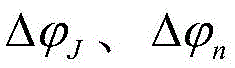
step A, respectively aiming at L transmitted pulse signals to be transmitted of the compressed sensing radar, obtaining modulation additional phases corresponding to the transmitted pulse signals respectively
1, 2, …, L, and performing additional phase modulation on the transmission pulse signal to obtain modulated transmission pulse signalNumber; obtaining L modulated transmission pulse signals, sending the L modulated transmission pulse signals by a compressed sensing radar, and entering the step B;
b, discretizing a preset detection distance space corresponding to the compressed sensing radar, establishing a distance dimension sparse dictionary psi of a compressed sensing radar echo pulse string, wherein the dimension is NxD, D represents the number of range gates after discretization of the target distance space, N represents the length of a single transmitted pulse signal, and then entering step C;
step C, aiming at a specified target in a preset detection distance space of the compressed sensing radar, establishing a target Doppler frequency scanning vector v ═ v1,ν2,…,νQ]Wherein each element represents a doppler frequency value and Q represents the number of doppler frequencies scanned, and then step D is entered;
step D, constructing an interference suppression observation matrix phi according to the target Doppler frequency scanning vector vsThen entering step E;
step E, observing the matrix phi according to the interference suppression
sPush-button
Echo pulse signal group actually received by aiming at compressed sensing radar
Performing interference suppression sparse observation to obtain an observation signal Z, and then entering the step F;
step f. for the following models:
solving to obtain a sparse target information matrix theta, namely obtaining Doppler frequency and distance information estimated values of each target in a preset detection distance space corresponding to the compressed sensing radar, namely realizing result detection of echo pulse signals; wherein Q is 1, 2, …, Q, ΘqRepresents the qth column, Θ, in the sparse target information matrix ΘdRepresents the d-th row in the sparse target information matrix theta, | | · | | non-woven0Representing a 0 norm function.
As a preferred technical scheme of the invention: the method also comprises the following step DE, after the step D is executed, the step DE is started;
step DE., according to the length N of a single emission pulse signal, constructing a sparse sampling observation matrix phi with dimension of M multiplied by NcWherein M represents the length of the compressed pulse signal, and then entering the step E;
the step E is as follows:
step E, observing the matrix phi according to the interference suppression
sSparse sampling observation matrix phi
cPush-button
Echo pulse signal group actually received by aiming at compressed sensing radar
Performing interference suppression sparse observation to obtain an observation signal Z, and then entering the step F;
in step F, the following models are targeted:
and solving to obtain a sparse target information matrix theta.
As a preferred technical scheme of the invention: the sparse sampling observation matrix phicThe structure of the method adopts a structured observation matrix based on a filter or a random observation matrix based on a chaos theory.
As a preferred technical scheme of the invention: the step A comprises the following steps A1 to A3;
step A1, constructing a prime number vector with the length of L according to L transmitted pulse signals to be transmitted of the compressed sensing radar
Where L is 1, 2, …, L, each xi
lAre all prime numbers xi
lRepresents the l-th prime number, and then proceeds to step a 2;
step A2, aiming at L transmitted pulse signals to be transmitted of the compressed sensing radar, respectively, according to the following formula:
obtaining modulation additional phases corresponding to the transmission pulse signals respectively
Indicating the modulation additional phase corresponding to the l-th transmitted pulse signal, and then entering step a 3;
step A3, additional modulation phases corresponding to the transmission pulse signals respectively
And respectively carrying out additional phase modulation on L transmitted pulse signals to be transmitted of the compressed sensing radar to obtain the L modulated transmitted pulse signals, transmitting the L modulated transmitted pulse signals by the compressed sensing radar, and entering the step B.
As a preferred technical scheme of the invention: the step C comprises the following steps C1 to C2:
step C1, aiming at a specified target in a preset detection distance space of the compressed sensing radar, selecting a target normalized Doppler frequency detection range, discretely dividing the normalized Doppler frequency detection range into Q grids according to the following rule, and then entering the step C2;
rule 1) if the target Doppler frequency prior information is definitely determined, uniformly and discretely dividing to obtain Q grids by using preset first interval prior information aiming at the prior information within a preset fluctuation threshold range from top to bottom;
rule 2) if only the range of the interval where the target Doppler frequency priori information is located is determined, applying preset first interval priori information in a preset fluctuation threshold range up and down aiming at the priori information, applying preset second interval priori information aiming at the rest range, and performing non-uniform discrete division to obtain Q grids; the size of the second interval prior information is larger than that of the first interval prior information;
rule 3) if no target Doppler frequency prior information exists, uniformly and discretely dividing a coverage fully normalized Doppler frequency interval [ -pi, pi ] to obtain Q grids;
c2., obtaining the value of the preset rule corresponding to the prior information of each grid according to the prior information corresponding to each of the Q grids, using the value as each doppler frequency value, and constructing a target doppler frequency scanning vector v ═ v [ v ] according to the sequence number of each grid1,ν2,…,νQ]。
As a preferred technical scheme of the invention: the step D comprises the following steps D1 to D2;
step D1, respectively aiming at the target Doppler frequency scanning vector v ═ v1,ν2,…,νQ]Of (2) each doppler frequency value vqAccording to the following formula:
constructing each Doppler frequency value v
qRespectively corresponding interference suppression observation basis vectors
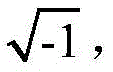
Wherein e represents a natural constant, and j represents an imaginary number
T
pRepresenting the period of a single emission pulse]
TRepresenting a transposed function, and then proceeding to step D2;
step D2. for each Doppler frequency value v
qRespectively corresponding interference suppression observation basis vectors
Make upBuilding an interference suppression observation matrix
As a preferred technical scheme of the invention: in the step F, the following steps F1 to F9 are performed for the following models:
solving is carried out to obtain a sparse target information matrix theta;
step F1, defining a sensing matrix gamma phicΨ, Unit matrix I with dimension Q × QQAnd a vectorization vector Z ═ vec (Z) of the observation signal Z, where vec () is a vectorization function, and then proceed to step F2;
step F2. is based on
Obtaining an equivalent perception matrix xi, wherein
Representing a kronecker product operation, and then proceeding to step F3;
step F3. initializes the redundancy vector δ
0Z, sparse vector to be estimated θ
(0)0, set
Π
0When t is 0, the loop count t is 1, and then the process proceeds to step F4;
step F4. is based on
Calculating to obtain kappa, wherein xi
mM columns representing the equivalent perception matrix xi,<·>denotes an inner product function, | - | denotes an absolute value function, arg denotes an index function, and κ denotes an equivalent perception matrix xi and a current residual δ
tThe number of columns with the largest inner product value, and then step F5 is performed;
step F5. provides Ω ═ $ @, Π @ κ, according to Ω ═ Ω @t=[Πt-1,Ξκ]Updating the set omega and obtaining ΠtWherein xi isκThe kth column representing the equivalent perception matrix xi, then proceeds to step F6;
step F6. is based on
Calculating to obtain theta
(t)Wherein
Indicating Π
tThen proceeds to step F7;
step F7. depends on δt=δt-1-Πtθ(t)And updating to obtain a redundancy vector deltatAnd judge [ Delta ]t||2If < ε is true, proceed to step F9; otherwise go to step F8; wherein epsilon is a preset termination decision threshold, | | | | | non-calculation2Represents a 2-norm function;
step F8. is zero for each of the kappa- (μ -1) D, the kappa- (μ -2) D and the kappa- (μ -Q) D columns in the equivalent perception matrix xi, wherein
floor (·) is a floor rounding function, and then returns to step F4;
step F9. depends on θ(t)Ve (Θ), for θ(t)And performing matrixing to obtain a sparse target information matrix theta.
Compared with the prior art, the compressed sensing radar interference suppression sparse observation method has the following technical effects:
aiming at the characteristics of the compressed sensing radar, from the perspective of observing the design of a matrix, the compressed sensing radar interference suppression sparse observation method firstly modulates each transmitted pulse of the compressed sensing radar by using a structured observation matrix so as to effectively separate a real target echo and an interference signal, further suppresses the interference signal while accumulating the target echo and improves the signal-to-interference ratio; meanwhile, a sparse sampling observation matrix is utilized to further compress interference suppression observation data, so that the signal processing efficiency of the compressed sensing radar is further improved; then, an optimization solving problem aiming at interference suppression observation is provided, and the efficiency of solving the optimization problem is improved by adding constraint conditions; finally, by solving the sparse optimization solving problem, the target parameters of the compressed sensing radar are accurately estimated under the interference background, so that the spatial interference signals are actively inhibited, and the target detection performance of the compressed sensing radar under the interference background is improved.
Detailed Description
The following description will explain embodiments of the present invention in further detail with reference to the accompanying drawings.
The invention designs a compressed sensing radar interference suppression sparse observation method, which is used for realizing result detection aiming at echo pulse signals actually received by a compressed sensing radar.
Step A, respectively aiming at L transmitted pulse signals to be transmitted of the compressed sensing radar, obtaining modulation additional phases corresponding to the transmitted pulse signals respectively
1, 2, … and L, and performing additional phase modulation on the transmission pulse signal to obtain a modulated transmission pulse signal; and then L modulated transmission pulse signals are obtained and sent out by a compressed sensing radar, and then the step B is carried out.
In practical applications, the step a is executed as the following step a1 to step A3.
Step A1. radar to be sent according to compressed sensingL transmitting pulse signals to construct a prime vector with length L
Where L is 1, 2, …, L, each xi
lAre all prime numbers xi
lIndicating the ith prime number and then proceeds to step a2.
Step A2, aiming at L transmitted pulse signals to be transmitted of the compressed sensing radar, respectively, according to the following formula:
obtaining modulation additional phases corresponding to the transmission pulse signals respectively
Indicating the additional phase of modulation corresponding to the ith transmit pulse signal, and then proceeds to step a3.
The modulation additional phase corresponding to each transmitted pulse signal is defined and obtained by selecting the prime number, so that on one hand, the appearance of the mirror image phase can be effectively avoided based on the characteristic of the prime number, and the independence of each modulation additional phase is ensured; on the other hand, the modulation additional phase defined in the formula (1) can enable the residual phase of each pulse to be approximately distributed in [ -pi, pi ] in the subsequent observation process, and further enable the residual component of each pulse to represent anisotropy in the observation process, so that the residual component of each pulse can be eliminated and inhibited in the accumulation process.
Step A3, additional modulation phases corresponding to the transmission pulse signals respectively
And respectively carrying out additional phase modulation on L transmitted pulse signals to be transmitted of the compressed sensing radar to obtain the L modulated transmitted pulse signals, transmitting the L modulated transmitted pulse signals by the compressed sensing radar, and entering the step B.
And performing additional phase modulation on each transmitted pulse signal, aiming at identifying the transmitted pulse and providing separability of a real target echo signal and an interference signal.
For the transponder interference signal, the corresponding phase relationship between each interference pulse and the transmission pulse is shown in fig. 2. It can be seen from the figure that the phase information corresponding to the target echo signal and the forwarding spoofed interference signal are different, and the difference provides separability of the target echo and the interference signal based on the phase, thereby providing an idea for the forwarding spoofed interference suppression.
For the non-repeating type noise interference signal, it can be regarded as several pulse signals with random phase essentially, in the invention, the ith noise interference pulse signal N is used
i(t) has a phase of
The p-th echo pulse baseband signal received by the compressed sensing radar can be expressed as
Wherein beta is
c,
And
the amplitude, the time delay and the doppler frequency of the c-th interference component are respectively. Likewise, σ
k,τ
kAnd v
kRespectively, the reflection coefficient, the time delay and the doppler frequency of the kth target. n (t) is a noise interference amplitude signal.
In order to separate and observe target echo and interference signal based on formula (2), the invention plans to design a forwarding interference suppression observation matrix phi
sTo achieve the above separation. Make the received signal group of L sampling echo pulses as
And designing a frequency v based on Doppler scanning
qInterference suppression observation basis vector
By using
The scanning frequency v can be obtained by observing the receiving signal group
qCorresponding accumulated observed signal
For a Doppler frequency of fdThe observation process shown in the above formula can be equivalent to the following operation process:
wherein
Frequency v of observation basis vector when interference suppressionqWith the target Doppler frequency fdWhen the target echo is the same, the observed target echo can obtain L-time gain, that is to say
In contrast, for a repeating interference signal, the interference signal is generated by
If residual phase still exists after the phase decoding observation, the observed retransmission type interference signal cannot be accumulated, that is, the observation result is
Similarly, for noise interference pulse signals, there are
Therefore, both the forward interference and the noise interference cannot obtain the gain of the amplitude voltage through interference suppression observation.
The SIR of the kth target echo, the c-th Interference Signal and the noise Interference pulse Signal before the Interference suppression observation, analyzed from the aspect of Signal-to-Interference Ratio (SIR), can be expressed as SIR
Wherein σ
nThe power spectral density of the noise interference pulse signal. Assumed to be at the target Doppler frequency f
dkCorresponding accumulated observation basis vectors
Observing the received signal matrix, the accumulated observed signal corresponding to the kth target is
The observed SIR may be expressed as
Order to
Respectively representing residual phases contained in observed post-retransmission interference signal and noise interference signal components when
Is uniformly distributed in [ -pi, pi [ -]Then can obtain
In combination (6), the observed SIR is
Therefore, when phase demodulation accumulates the frequency v of the observation basis vector and the target Doppler frequency fdWhen the signal interference ratio is consistent with the signal interference ratio, the signal interference ratio gain of L times can be obtained through phase demodulation accumulation observation. On the other hand, when v ≠ fdAnd in time, according to the analysis, the target echo and the forwarding type interference signal can not be accumulated. Therefore, the phase demodulation corresponding to each frequency accumulates the observation basis vector hνBoth the suppression of the transfer type interference signal and the noise interference pulse signal can be realized.
An interference suppression observation matrix aiming at the forwarding type deception jamming signal can be constructed and obtained according to observation basis vectors corresponding to different scanning frequencies
The observed process can be expressed as
Wherein the Doppler frequency of the scanning is defined by a Doppler frequency scanning vector v ═ v
1,ν
2,…,ν
Q]The division mode of the Doppler frequency scanning vector can be flexibly selected according to the current actual combat situation according to different situations, and the invention provides Doppler frequency scanning vector design criteria under three different situations:
A) when accurate Doppler frequency prior information of the target is possessed, the discrete division process adopts small-interval uniform discrete division to obtain Q grids within a certain range near the prior information;
B) when only rough target Doppler frequency prior information is possessed, the discrete division process obtains Q grids by adopting non-uniform discrete division of a certain range near the prior information at small intervals and adopting large intervals in other ranges;
C) when no target Doppler frequency prior information exists, the discrete division process adopts uniform discrete division covering a fully normalized Doppler frequency interval, namely [ -pi, pi ], to obtain Q grids;
by the Doppler frequency scanning vector design criterion aiming at different detection scenes, the applicability of the method in different scenes can be improved, and meanwhile, the interference suppression observation efficiency in corresponding scenes can be improved.
Based on the above analysis, the following steps B to D are continuously performed.
And B, discretizing a preset detection distance space corresponding to the compressed sensing radar, establishing a distance dimension sparse dictionary psi of the compressed sensing radar echo pulse train, wherein the dimension is NxD, D represents the number of range gates after discretization of the target distance space, N represents the length of a single transmitted pulse signal, and then entering the step C.
Step C, aiming at a specified target in a preset detection distance space of the compressed sensing radar, establishing a target Doppler frequency scanning vector v ═ v1,ν2,…,νQ]Where each element represents a doppler frequency value and Q represents the number of doppler frequencies swept, then step D is entered.
In practical applications, the step C is performed as the following steps C1 to C2.
And C1, selecting a target normalized Doppler frequency detection range for a specified target in a preset detection distance space of the compressed sensing radar, discretely dividing the normalized Doppler frequency detection range into Q grids according to the following rule, and then entering the step C2.
Rule 1) if the target Doppler frequency prior information is definitely determined, aiming at the prior information within a preset fluctuation threshold range from top to bottom, using preset first interval prior information, and performing uniform discrete division to obtain Q grids.
Rule 2) if only the range of the interval where the target Doppler frequency priori information is located is determined, applying preset first interval priori information in a preset fluctuation threshold range up and down aiming at the priori information, applying preset second interval priori information aiming at the rest range, and performing non-uniform discrete division to obtain Q grids; wherein the second interval prior information size is larger than the first interval prior information size.
Rule 3) if there is no target Doppler frequency prior information, then obtaining Q grids by uniformly and discretely dividing a coverage fully normalized Doppler frequency interval [ -pi, pi ].
C2., obtaining the value of the preset rule corresponding to the prior information of each grid according to the prior information corresponding to each of the Q grids, using the value as each doppler frequency value, and constructing a target doppler frequency scanning vector v ═ v [ v ] according to the sequence number of each grid1,ν2,…,νQ]。
Step D, constructing an interference suppression observation matrix phi according to the target Doppler frequency scanning vector vsThen proceed to step DE.
In practical applications, the step D specifically performs the following steps D1 to D2.
Step D1, respectively aiming at the target Doppler frequency scanning vector v ═ v1,ν2,…,νQ]Of (2) each doppler frequency value vqAccording to the following formula:
constructing each Doppler frequency value v
qRespectively corresponding interference suppression observation basis vectors
Wherein e represents a natural constant, and j represents an imaginary number
T
pRepresenting the period of a single emission pulse]
TRepresenting a transposed function, and then proceeds to step D2.
Step D2. for each Doppler frequency value v
qRespectively corresponding interference suppression observation basis vectors
Combining to construct interference suppression observation matrix
Interference suppression observation matrix phi based on Doppler frequency scanning vectorsAnd the device is used for accumulating and observing the echo signal group on each scanning Doppler frequency and separating targets of each Doppler frequency.
In order to further reduce the processing and transmission data volume of the compressed sensing radar and improve the real-time performance of the compressed sensing radar signal processing, the invention constructs and adopts a sparse sampling observation matrix phi for compressing the observation data volumecThe dimension of the sparse sampling observation matrix is M multiplied by N, the sparse sampling length M is smaller than the original signal length N, namely M is smaller than N. The Gaussian random observation matrix is applied to actual engineeringThe method is difficult to obtain in use, and according to actual application requirements, a structured observation matrix based on a filter or a random observation matrix based on a chaos theory is adopted, so that the observation matrixes can be realized in engineering, the correlation of a perception matrix after observation can be ensured, and the sparse optimization reconstruction effect can be ensured.
Step DE., according to the length N of a single emission pulse signal, constructing a sparse sampling observation matrix phi with dimension of M multiplied by NcWhere M denotes the compressed pulse signal length, and then proceeds to step E. In practical applications, the sparse sampling observation matrix ΦcThe structure of the method adopts a structured observation matrix based on a filter or a random observation matrix based on a chaos theory.
Constructing a sparse sampling observation matrix phi
cFor further reducing the echo pulse signal group
The sampling data quantity of the compressed sensing radar is increased, and the signal processing efficiency of the compressed sensing radar is improved.
Because the Doppler frequency shift of the target is compensated in the interference suppression observation process, a time delay information dictionary is adopted for the signal after the interference suppression observation
Ψ=[T1s,T2s,…,TDs] (15)
Wherein s is a pulse sampling vector of the transmitted signal, and T is a unit time delay matrix
Therefore, the observation signal Z is compressed and sampled by interference suppression based on the doppler scan pattern with a joint sparse representation as follows
In the above formula, Θ is a sparse target information matrix, and its elements are distributed as
Wherein
And elements representing the d-th row and the q-th column of the sparse target information matrix. The meaning of the above equation is that when the delay and doppler frequency of the kth target fall in the d-th range gate and the q-th doppler scanning frequency, the corresponding element of the sparse target information matrix Θ
Is equal to the equivalent reflection coefficient alpha of the target
k. When there is no target on the corresponding range gate and doppler scan frequency, then the corresponding element value is 0. Therefore, the Doppler frequency and distance information estimation values of the targets in the scene can be obtained through the distribution of the non-zero elements in the sparse target information matrix theta obtained through reconstruction.
Step E, observing the matrix phi according to the interference suppression
sSparse sampling observation matrix phi
cPush-button
Echo pulse signal group actually received by aiming at compressed sensing radar
And F, carrying out interference suppression sparse observation to obtain an observation signal Z, and then entering the step F.
Step F, taking the 'same-distance door can not have a plurality of targets simultaneously' as a constraint condition of the optimization problem, aiming at the following models:
solving is carried out to obtain a sparse target information matrix theta, namely the preset detection corresponding to the compressed sensing radar is obtainedThe Doppler frequency and the distance information estimation value of each target in the distance space realize the result detection of the echo pulse signal; wherein Q is 1, 2, …, Q, ΘqRepresents the qth column, Θ, in the sparse target information matrix ΘdRepresents the d-th row in the sparse target information matrix theta, | | · | | non-woven0Representing a 0 norm function.
And establishing and solving a sparse optimization problem, and reconstructing to obtain a sparse vector corresponding to a real target space, thereby estimating to obtain the target distance and Doppler information.
In practical applications, the above step F1 to step F9 are performed for the following models:
and solving to obtain a sparse target information matrix theta.
Step F1, defining a sensing matrix gamma phicΨ, Unit matrix I with dimension Q × QQAnd a vectorized vector Z ═ vec (Z) of the observation signal Z, where vec () is a vectorization function, and then proceeds to step F2.
Step F2. is based on
Obtaining an equivalent perception matrix xi, wherein
Representing a kronecker product operation, and then proceeds to step F3.
Step F3. initializes the redundancy vector δ
0Z, sparse vector to be estimated θ
(0)0, set
Π
0When the loop count t is 0, the process proceeds to step F4.
Step F4. is based on
Calculating to obtain kappa, wherein xi
mM columns representing the equivalent perception matrix xi,<·>denotes an inner product function, | - | denotes an absolute value function, arg denotes an index function, and κ denotes an equivalent perception matrix xi and a current residual δ
tThe number of columns having the largest inner product value is entered in step F5.
Step F5. provides Ω ═ $ @, Π @ κ, according to Ω ═ Ω @t=[Πt-1,Ξκ]Updating the set omega and obtaining ΠtWherein xi isκThe k-th column representing the equivalent perception matrix xi then proceeds to step F6.
Step F6. is based on
Calculating to obtain theta
(t)Wherein
Indicating Π
tThen proceeds to step F7.
Step F7. depends on δt=δt-1-Πtθ(t)And updating to obtain a redundancy vector deltatAnd judge [ Delta ]t||2If < ε is true, proceed to step F9; otherwise go to step F8; wherein epsilon is a preset termination decision threshold, | | | | | non-calculation2Representing a 2-norm function.
Step F8. is zero for each of the kappa- (μ -1) D, the kappa- (μ -2) D and the kappa- (μ -Q) D columns in the equivalent perception matrix xi, wherein
floor (·) is a floor rounding function, and then returns to step F4.
Step F9. depends on θ(t)Ve (Θ), for θ(t)And performing matrixing to obtain a sparse target information matrix theta.
According to the technical scheme, the compressed sensing radar interference suppression sparse observation method is designed, aiming at the characteristics of the compressed sensing radar, firstly, phase modulation is carried out on each transmitted pulse of the compressed sensing radar, and the separability of an interference signal and a real target echo is provided; and then, by designing a specific observation matrix, the accumulation of echo pulse groups is realized while the phase demodulation is carried out on the received pulse, and the received signal-to-interference ratio is improved, so that the suppression is actively carried out on the space interference signal, and the target detection performance of the compressed sensing radar under the interference background is improved.
The embodiments of the present invention have been described in detail with reference to the drawings, but the present invention is not limited to the above embodiments, and various changes can be made within the knowledge of those skilled in the art without departing from the gist of the present invention.