Detailed Description
In order to make the technical solutions of the present application better understood, the technical solutions in the embodiments of the present application will be clearly and completely described below with reference to the drawings in the embodiments of the present application, and it is obvious that the described embodiments are some embodiments of the present application, but not all embodiments. All other embodiments, which can be derived by a person skilled in the art from the embodiments given herein without making any creative effort, shall fall within the protection scope of the present application.
In order to clearly explain the scheme of the present application, some terms are explained below.
Vehicle-mounted cinema system: the system for film delivery in the vehicle can comprise a projector, an electric curtain, a sound device and the like;
vehicle-mounted cinema mode: when the system is used for representing the image playing in the vehicle, hardware and/or viewing factors in the vehicle are in a preset contextual model, such as the expansion of an electric curtain, the projection of the image of a film to the electric curtain by a projector, the closing of a vehicle window, the lowering of the curtain and the like;
electric curtain: the electric equipment is used for projection display, and can be controlled to expand or contract through a remote controller or electric buttons;
a projector: the device for projecting images or videos onto a curtain may include a Video Graphics Array (VGA) Interface projector, a High Definition Multimedia Interface (HDMI) Interface projector, a network Interface projector, and the like;
a functional module: the equipment which is used for representing the configuration of the vehicle and can adjust the environment in the vehicle, such as a vehicle-mounted air conditioner, a vehicle-mounted camera, a vehicle-mounted door lock and the like;
and (3) viewing factors: the system is used for representing conditions which need to be met by the environment in the vehicle when the vehicle-mounted cinema system in the vehicle releases the film;
thermal imaging image: receiving and recording an image formed by thermal radiation energy emitted by a target object through a thermal infrared scanner, the image is called an infrared image for short and is also called a thermal image;
an infrared imager: a device for acquiring a thermographic image of an in-vehicle area of a vehicle, the device having a plurality of degrees of freedom of movement, such as an opto-electronic infrared temperature sensor or a pyroelectric infrared temperature sensor;
vehicle-mounted film watching rules: the device is used for representing a rule that the distance between an electric curtain and a seat needs to be met when a vehicle-mounted cinema system in a vehicle is used for delivering a film;
light intensity parameters: the illumination intensity parameter is used for representing the target area in the vehicle.
The following describes an application scenario provided in the embodiment of the present application.
Referring to fig. 1, a schematic diagram of an application scenario of a vehicle-mounted theater system control method provided in an embodiment of the present application is shown, where the application scenario includes a vehicle 100, and the vehicle 100 may include: a vehicle theater system 110, a control center 120, a function module 130, a seat 140, and the like. The vehicle-mounted theater system 110 may include a control module 111, an electric curtain 112, and a projector 113; the control module 111 may communicate with the electric curtain 112, the projector 113, the control center 120, and the function module 130 through Network connections, so as to implement data interaction between the control module 111 and the electric curtain 112, the projector 113, the control center 120, and the function module 130, respectively, where the Network connections may be based on a Network connection formed by at least any one of a Controller Area Network (CAN), a bluetooth Network, an infrared Network, a Digital Living Network Alliance (DLNA) Network, a ZigBee (ZigBee) Network, and a wireless internet access (Wi-Fi) Network.
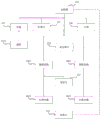
Referring to fig. 2, in some embodiments, the vehicle 100 may be an automobile, and the function modules 130 may include windows 131, curtains 1311, reading lights 135, mood lights 137, and air conditioners 139. The control module 111 of the vehicle-mounted cinema system 110 may include a central control screen 111, the central control screen 111 may be connected to both the electric curtain 112 and the projector 113 through a bluetooth network, the central control screen 111 may be connected to both the window 131, the curtain 1311, the reading lamp 135, the atmosphere lamp 137, the air conditioner 139 and the seat 140 through a CAN network, and may control the electric curtain 112, the projector 113, the window 131, the curtain 1311, the reading lamp 135, the atmosphere lamp 137, the air conditioner 139 and the seat 140 to adjust, respectively, and the seat 140 may include a front seat 1401 and a rear seat 1403.
In this embodiment, when the central control panel 111 receives the projection instruction, the electronic curtain 112 and the projector 113 can be respectively controlled to be turned on through the bluetooth network, the projector 113 is controlled to focus according to the distance between the electronic curtain 112 and the projector 113, and the projector 113 is controlled to project the image data obtained according to the image information carried by the projection instruction to the electronic curtain 112. In some embodiments, the central control panel 111 can also control the operation of the functional modules of the vehicle 100 according to the actual environmental conditions inside the vehicle 100 to make the environment inside the vehicle meet the requirements of the user for comfortable viewing, for example, the central control panel 111 can selectively perform the following steps according to the internal environmental conditions of the vehicle 100: the vehicle window 131 is controlled to be closed, the curtain 1311 is controlled to adjust the shading degree, the reading lamp 135 is controlled to conduct brightness adjustment, and the brightness and the light emitting angle of the atmosphere lamp 137 are controlled through the CAN network respectively, so that the light intensity parameter in the vehicle meets the preset light intensity, and the air conditioner 139 is controlled through the CAN network to adjust the temperature in the vehicle, so that the temperature in the vehicle meets the preset temperature. Further, in some embodiments, in order to improve the viewing experience and the projection stability, the central control panel 111 may be configured to control the air conditioner 139 to adjust the air outlet angle to a foot blowing mode, so as to prevent the electric curtain from shaking, and control the front seat 1401 and the rear seat 1403 to adjust, so that the front seat 1401 and the rear seat 1403 meet the preset viewing conditions of the passenger, for example, control the front seat 1401 to move forward, and when no passenger 1401 is detected on the front seat 1401, control the front seat 1401 to lie flat to the lowest state, so as to provide a leg mop in a lying posture for the viewing passenger on the rear seat 1403, and control the rear seat 1403 to adjust the seat back angle, so as to provide a comfortable lying posture for the viewing passenger on the rear seat.
Referring to fig. 3, in some embodiments, the in-vehicle theater system 110 may further include a speaker 114 and a mobile terminal 115, the speaker 114 is connected to the central control screen 111 through a CAN network, and the terminal 115 is connected to the projector 113 through a DLNA network. When the central control screen 111 receives the projection instruction, the image information may be transmitted to the projector 113 through the DLNA network, or the projector 113 may be controlled to obtain the image information from the mobile terminal 115 through the DLNA network, for example, the image information may be obtained from a mobile phone, a tablet computer (PAD), and the like through the DLNA network, and the projector 113 is controlled to project the image corresponding to the image information to the electric curtain 112, and the projector 113 is controlled to transmit the audio corresponding to the image information to the speaker 114 through the bluetooth network, and the speaker 114 is controlled to play the audio corresponding to the image information.
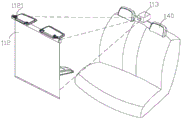
As shown in fig. 4, in some embodiments, the electric curtain 112 may be provided with a hook 1121, the electric curtain 112 may be hung inside the vehicle 100 through the hook 1121, the projector 113 may be disposed at a suitable position inside the vehicle 100 and opposite to the electric curtain 112, for example, the projector 113 may be disposed on the rear seat 140 of the vehicle 100, or hung at the roof of the vehicle on the rear side inside the vehicle, etc.
It can be understood that, when the passenger needs to view the image in the vehicle 100, the passenger may send a control instruction to the vehicle-mounted theater system 110, when the control module 111 receives a preset opening instruction of the vehicle-mounted theater mode, the control module 111 may establish a network connection channel between the control module 111 and the control center 120 of the vehicle 100, establish a network connection channel between the control module 111 and the electric curtain 112, and control the electric curtain 112 to expand, may also establish a network connection channel between the control module 111 and the projector 113, and control the projector 113 to open, and may control the function module 130 of the vehicle 100 to operate according to preset theater environment parameters and the network connection channel between the control module 111 and the control center 120, thereby completing the control process of building the vehicle-mounted theater system 110.
Please refer to fig. 5, which shows a flowchart of a vehicle-mounted theater system control method according to an embodiment of the present application, the vehicle-mounted theater system control method is configured to automatically control a vehicle-mounted theater system and a vehicle control center to establish a network connection channel according to a received preset opening instruction of a vehicle-mounted theater mode, control an electric curtain to be deployed and a projector to be opened, and control a function module of a vehicle to work, so as to automatically control the building of the vehicle-mounted theater system, reduce operations of passengers during the building of the vehicle-mounted theater system, and simplify the building process of the vehicle-mounted theater system. In a specific embodiment, the vehicle-mounted cinema system control method is applied to the vehicle-mounted cinema system 110 adapted to the vehicle 100 shown in fig. 1, and the flow shown in fig. 5 will be described in detail below by taking the vehicle 100 as an example, and the vehicle-mounted cinema system control method may include the following steps S510-S540.
Step S510: and when a preset opening instruction of the vehicle-mounted cinema mode is received, establishing a network connection channel between the vehicle-mounted cinema system and a control center of the vehicle.
In this embodiment, the vehicle-mounted theater system may include a control module, where the control module may send a network connection request to a control center of the vehicle when receiving a preset opening instruction of the vehicle-mounted theater mode, may determine a transmission protocol for the control module to perform network connection with the control center of the vehicle according to the network connection request, and may send a confirmation message corresponding to the network connection request to the control module according to the transmission protocol and the network connection request, where the control module responds to the received confirmation message and may establish a network connection channel between the control module and the control center of the vehicle according to the confirmation message. The transmission protocol CAN comprise at least one of a CAN bus transmission protocol, a Bluetooth transmission protocol, an infrared transmission protocol, a DLNA transmission protocol, a ZigBee transmission protocol, a Wi-Fi transmission protocol and the like; the network connection request is used for indicating the control module to establish a network connection channel with the control center.
Step S520: and controlling the electric curtain to be unfolded.
In this embodiment of the application, after the control module receives the opening instruction of the preset vehicle-mounted cinema mode, a network connection channel between the control module and the electric curtain can be established, and the electric curtain can be controlled to be unfolded according to the network connection channel between the control module and the electric curtain.
Step S530: and controlling the projector to be started.
In this embodiment of the application, after the control module receives the opening instruction of the preset vehicle-mounted cinema mode, a network connection channel between the control module and the projector may be established, and the projector may be controlled to be opened according to the network connection channel between the control module and the projector.
Step S540: and controlling the functional modules of the vehicle to work according to preset cinema environment parameters and a network connection channel.
In the embodiment of the application, the vehicle can include the function module, control module is after receiving the opening instruction of predetermined on-vehicle cinema mode, can be according to predetermined cinema environment parameter and the network connection passageway between control module and the control center, control function module work, so that the car internal environment of vehicle is in on-vehicle cinema mode, thereby realized according to the opening instruction of received predetermined on-vehicle cinema mode, the buildding of automatic control on-vehicle cinema system, the operation of passenger in the on-vehicle cinema system buildding process has been reduced, the buildding process of on-vehicle cinema system has been simplified. The cinema environment parameters are used for representing that the internal environment conditions of the vehicle meet a preset scene. The internal environmental conditions may be used to include in-vehicle hardware conditions, such as: vehicle-mounted air conditioner, vehicle-mounted reading lamp, vehicle-mounted atmosphere lamp, seat, curtain and the like, and in-vehicle viewing factors, such as: temperature parameters, light intensity parameters, distance parameters, and the like.
According to the scheme provided by the application, when the vehicle-mounted cinema system receives the opening instruction of the preset vehicle-mounted cinema mode, the network connection channel between the vehicle-mounted cinema system and the control center of the vehicle can be established, the electric curtain can be controlled to be expanded, the projector can be controlled to be opened, the function module of the vehicle can be controlled to work according to the preset cinema environment parameter and the network connection channel, the environment in the vehicle of the vehicle is in the vehicle-mounted cinema mode, the cinema environment parameter is used for representing that the internal environment condition of the vehicle meets the preset scene, therefore, the network connection channel is automatically established between the vehicle-mounted cinema system and the control center of the vehicle, the electric curtain is controlled to be expanded, the projector is controlled to be opened, the function module of the vehicle is controlled to work according to the received opening instruction of the preset vehicle-mounted cinema mode, and the building of the vehicle-mounted cinema, the operation of passengers in the process of building the vehicle-mounted cinema system is reduced, and the building process of the vehicle-mounted cinema system is simplified.
Referring to fig. 6, which shows a flowchart of an in-vehicle theater system control method provided in another embodiment of the present application, the in-vehicle theater system control method is applied to an in-vehicle theater system 110 adapted to a vehicle 100 shown in fig. 1, and the flowchart shown in fig. 6 will be described in detail by taking the vehicle 100 as an example, and the in-vehicle theater system control method may include the following steps S610-S670.
Step S610: and when a preset opening instruction of the vehicle-mounted cinema mode is received, establishing a network connection channel between the vehicle-mounted cinema system and a control center of the vehicle.
In this embodiment, the step S610 may refer to the content of the corresponding step in the foregoing embodiment, which is not described herein again.
In some embodiments, the in-vehicle theater system can include a voice recognition module, which can be used to collect voice information of occupants in the vehicle, and carries out voice recognition on the acquired voice information, the starting instruction can comprise voice starting information, the voice starting information is used for indicating the starting of a preset vehicle-mounted cinema mode, when the voice recognition module collects the voice information of passengers in the vehicle, can carry out voice recognition on the collected voice information, when carrying out voice recognition according to the voice information to obtain a keyword for indicating voice opening information, for example, "the vehicle-mounted theater mode is turned on," the vehicle-mounted theater mode "or" turn on "or the like, which indicates that the vehicle-mounted theater system has received a preset turn-on instruction of the vehicle-mounted theater mode, and the control module may establish a network connection channel between the control module and the control center of the vehicle.
In some embodiments, the in-vehicle theater system may detect an operation of an occupant, and the control module may establish a network connection channel between the control module and a control center of the vehicle when it is determined that the occupant inputs an opening instruction of the in-vehicle theater mode according to the detected operation of the occupant, that is, the in-vehicle theater system has received the preset opening instruction of the in-vehicle theater mode.
In some embodiments, the in-vehicle theater system may interact with a client associated with the occupant through a network, and upon receiving an opening instruction of the in-vehicle theater mode sent by the occupant through the client, the control module may establish a network connection channel between the control module and a control center of the vehicle.
Of course, the manner in which the vehicle-mounted theater system receives the preset opening instruction of the vehicle-mounted theater mode may not be limited.
Step S620: a first position of the motorized curtain is obtained.
In this embodiment of the application, the vehicle may further include an image acquisition module, the image acquisition module may interact with the control module through the network connection channel, when the control module receives a preset opening instruction of the vehicle-mounted theater mode, after the network connection channel between the vehicle-mounted theater system and the control center of the vehicle is established, the image acquisition module may be controlled to acquire the in-vehicle area image, and the pixel coordinates (PiX, PiY) of the electric curtain image in the in-vehicle area image may be determined according to the in-vehicle area image, that is, the first position of the electric curtain in the vehicle. For example, the pixel coordinates of the electric curtain image in the in-vehicle area image obtained by the control module may be (600,500), that is, the first position of the electric curtain in the vehicle; the pixel coordinates of the electric curtain image in the in-vehicle area image may also be (400,800), the pixel coordinates of the electric curtain image in the in-vehicle area image may also be (900), and the like, which are not limited herein.
In some embodiments, the image obtaining module may include a camera, the camera may be configured to capture an in-vehicle area image, and the control module may control the camera to capture the in-vehicle area image, obtain the in-vehicle area image, and determine, according to the in-vehicle area image, a pixel coordinate (PiX, PiY) of the electric curtain in the in-vehicle area image, that is, a first position of the electric curtain in the vehicle. Wherein, the camera can include: digital cameras, analog cameras, and the like.
In this embodiment of the application, the electronic curtain may be fixedly disposed in the vehicle in advance, the first location of the electronic curtain may be pre-stored in an internal memory of the vehicle, and the control module may acquire the first location stored in the internal memory through a network connection channel after establishing the network connection channel between the vehicle-mounted theater system and the control center of the vehicle when receiving a preset opening instruction of the vehicle-mounted theater mode.
It can be understood that the first position of the electric curtain in the vehicle can be set according to the needs of the viewing passengers, for example, in a five-seat vehicle, the electric curtain can be hung on the sun visor of the vehicle, and the electric curtain can also be hung on the seat back of the front seat; for example, in a seven-seat vehicle, the electric curtain can be hung on a sun visor of the vehicle, the electric curtain can also be hung on the seat backs of the front-row seats, the electric curtain can also be hung on the seat backs of the middle-row seats, and the like; the motorized curtain is in a first position within the vehicle, and is not limited herein.
Step S630: a first target seat to be adjusted is determined based on the first position.
In this embodiment of the application, after the control module obtains the first position of the electric curtain in the vehicle, the control module may determine a first distance between the electric curtain and the seat according to the first position of the electric curtain in the vehicle, and may determine, according to the first distance and a preset vehicle-mounted viewing rule, a target seat corresponding to a value of the first distance being smaller than a first preset threshold from the seat, which indicates that the distance between the first target seat to be adjusted and the electric curtain is too close, and use the target seat as the first target seat to be adjusted.
In some embodiments, the control module may determine, according to the acquired in-vehicle area image, pixel coordinates of the seat image in the in-vehicle area image, and may acquire a first distance between the electric curtain and the seat in the in-vehicle space according to the pixel coordinates of the electric curtain image in the in-vehicle area image, the pixel coordinates of the seat image in the in-vehicle area image, and a preset image scale.
In some embodiments, a distance sensor is preset on the electric curtain, and the control module can control the distance sensor to acquire a first distance between the electric curtain and the seat.
In some embodiments, the control module has a seat position pre-stored therein, and the control module may determine the first distance between the power curtain and the seat according to the acquired first position and the pre-stored seat position.
Step S640: the position of the first target seat is adjusted.
In this embodiment, the vehicle may further include a position adjustment module, where the position adjustment module is configured to adjust a position of the seat in the vehicle, and the control module may control the position adjustment module to adjust the position of the first target seat after determining the first target seat to be adjusted according to the first position of the electric curtain, so that the first target seat is located at the first preset position. The first preset position is used for indicating the spatial position of the seat in the vehicle, and the spatial position may include the position of the seat from the vehicle head, the inclination angle of the seat back and the like.
It can be understood that the first target seat may be a front seat of the vehicle, and when there is no passenger on the front seat, the front seat may be folded to a first preset position to ensure that the descending space of the electric curtain is sufficient, and when there is a passenger on the front seat, the front seat may be retracted to the first preset position to ensure the viewing distance of the passenger; the first target seat may also be another seat in the vehicle, and is not limited herein.
In some embodiments, a pressure sensor is disposed below the first target seat, the control module may control the pressure sensor to detect a pressure on the first target seat, determine whether an occupant is in the first target seat according to the detected pressure on the first target seat, determine that no occupant is in the first target seat when the detected pressure on the first target seat is less than a preset pressure threshold, and control the position adjustment module to adjust the position of the first target seat to enable the first target seat to be in the first preset position.
In some embodiments, the vehicle may further include an infrared imaging module, a feature extraction model, and a feature matching model, the control module may control the infrared imaging module to perform infrared thermal imaging scanning on a first target space region corresponding to the first target seat, acquire a thermal imaging image of the first target space region, input the acquired thermal imaging image of the first target space region to a pre-trained feature extraction model to obtain feature data of the thermal imaging image, and input the feature data to the pre-trained feature matching model, the feature matching model matches the feature data with pre-stored human feature data in response to the received feature data to obtain a matching result, the control module determines whether there is a member on the first target seat according to the matching result, when the control module acquires a failed matching result indicating that the feature data fails to match with the pre-stored human feature data, then it is determined that there is no member in the first target seat, and the position adjustment module may be controlled to adjust the position of the first target seat to bring the first target seat to a first preset position.
The feature extraction model and the feature matching model may be a neural network, a Long Short-Term Memory (LSTM) network, a threshold cycle unit, a simple cycle unit, an automatic encoder, a Decision Tree (DT), a random forest, a feature mean classification, a classification regression Tree, hidden markov, a K-nearest neighbor (KNN) algorithm, a logistic regression model, Naive Bayes (NB), a Support Vector Machine (SVM), a gaussian model, and a KL divergence (kulback-Leibler) or the like. Of course, the specific feature extraction model and the feature matching model may not be limiting.
Step S650: and controlling the electric curtain to be unfolded.
In the embodiment of the present application, step S650 may refer to the content of the corresponding step in the foregoing embodiment, which is not described herein again.
In some embodiments, the control module can control the electric curtain to be unfolded to the preset height according to the first preset position of the first target seat, so that the electric curtain is automatically controlled to be unfolded to the preset height according to the first preset position of the first target seat, and the building process of the vehicle-mounted cinema system is further simplified.
Step S660: and controlling the projector to be started.
Step S670: and controlling the functional modules of the vehicle to work according to preset cinema environment parameters and a network connection channel.
In the embodiment of the present application, step S660 and step S670 may refer to the content of the corresponding steps in the foregoing embodiment, and are not described herein again.
According to the scheme provided by the application, when the vehicle-mounted cinema system receives the opening instruction of the preset vehicle-mounted cinema mode, the network connection channel between the vehicle-mounted cinema system and the control center of the vehicle can be established, the electric curtain can be controlled to be expanded, the projector can be controlled to be opened, the function module of the vehicle can be controlled to work according to the preset cinema environment parameter and the network connection channel, the environment in the vehicle of the vehicle is in the vehicle-mounted cinema mode, the cinema environment parameter is used for representing that the internal environment condition of the vehicle meets the preset scene, therefore, the network connection channel is automatically established between the vehicle-mounted cinema system and the control center of the vehicle, the electric curtain is controlled to be expanded, the projector is controlled to be opened, the function module of the vehicle is controlled to work according to the received opening instruction of the preset vehicle-mounted cinema mode, and the building of the vehicle-mounted cinema, the operation of passengers in the process of building the vehicle-mounted cinema system is reduced, and the building process of the vehicle-mounted cinema system is simplified.
Further, when the vehicle-mounted cinema system receives a preset opening instruction of the vehicle-mounted cinema mode, after a network connection channel between the vehicle-mounted cinema system and a control center of a vehicle is established, a first position of the electric curtain can be obtained, a first target seat to be adjusted can be determined according to the first position, whether a passenger is on the first target seat or not is determined, and when no passenger is on the first target seat, the position of the first target seat is adjusted to enable the first target seat to be located at the first preset position, so that the seat position is automatically adjusted according to the first position of the electric curtain, and the building process of the vehicle-mounted cinema system is further simplified.
Referring to fig. 7, which shows a flowchart of an in-vehicle theater system control method according to still another embodiment of the present application, the in-vehicle theater system control method is applied to an in-vehicle theater system 110 adapted to a vehicle 100 shown in fig. 1, and the flowchart shown in fig. 7 will be described in detail by taking the vehicle 100 as an example, and the in-vehicle theater system control method may include the following steps S710-S770.
Step S710: and when a preset opening instruction of the vehicle-mounted cinema mode is received, establishing a network connection channel between the vehicle-mounted cinema system and a control center of the vehicle.
Step S720: a thermographic image of an area within the vehicle is acquired.
In the embodiment of the present application, step S710 and step S720 may refer to the content of the corresponding steps in the foregoing embodiments, and are not described herein again.
Step S730: and determining a second target seat corresponding to the viewing occupant according to the thermal imaging image.
In this embodiment of the application, after the control module acquires the thermal imaging image of the in-vehicle area, when the thermal imaging image is analyzed to have the face image of the viewing passenger, the control module may acquire the pixel coordinates of the face image of the viewing passenger in the thermal imaging image, and may search the preset second target seat table according to the pixel coordinates of the face image of the viewing passenger in the thermal imaging image to acquire the second target seat corresponding to the viewing passenger. The second target seat table is used for representing the corresponding relation between the pixel coordinates of the human face image of the viewing passenger in the thermal imaging image and the second target seat.
For example, the correspondence between the pixel coordinates of the face image of the viewing passenger in the thermal imaging image and the second target seat may be as shown in table 1, where table 1 shows the second target seats corresponding to the pixel coordinates of the face images of different viewing passengers in the thermal imaging image, and the control module may obtain the second target seat corresponding to the viewing passenger according to the correspondence table.
TABLE 1
It should be noted that, in table 1, 1#, 2#, 3#, …,40 #, 42#, and 43# respectively represent numbers corresponding to each seat, that is, the numbers are second target seats corresponding to different pixel coordinates, and if the pixel coordinates of the face image of the viewing passenger acquired by the control module in the thermal imaging image are (300,400), it is determined that the second target seat corresponding to the viewing passenger is 4 #; if the pixel coordinates of the face image of the viewing passenger acquired by the control module in the thermal imaging image are (700,800), determining that the second target seat corresponding to the viewing passenger is 31 #; if the pixel coordinates of the face image of the viewing passenger acquired by the control module in the thermal imaging image are (800,900), determining that the second target seat corresponding to the viewing passenger is 43 #; the correspondence relationship between the pixel coordinates of the face image of the viewing occupant in the thermal imaging image and the second target seat is not limited to that shown in table 1.
Step S740: and determining a second position corresponding to the second target seat according to the second target seat.
In this embodiment of the application, after determining the second target seat corresponding to the viewing occupant according to the thermal imaging image, the control module may search a preset second position table according to the second target seat to obtain a second position corresponding to the second target seat. The second position table is used for representing the corresponding relation between the second target seat and the second position.
For example, the correspondence between the second target seat and the second position may be as shown in table 2, where table 2 shows the second position corresponding to a different second target seat, and the control module may obtain the second position corresponding to the second target seat according to the correspondence table.
TABLE 2
In table 2, if the control module determines that the second target seat corresponding to the viewing occupant is 1#, the control module determines that the second position corresponding to the second target seat is (1,1), and the second target seat is represented as a seat in row 1 and column 1, i.e., a driver seat; if the control module determines that the second target seat corresponding to the audience is 15#, determining that the second position corresponding to the second target seat is (4,3), and representing the second target seat as a 4 th row and a 3 rd column seat; if the control module determines that the second target seat corresponding to the viewing passenger is 25#, determining that the second position corresponding to the second target seat is (6,3), and representing the second target seat as a 6 th row and a 3 rd column seat; the correspondence relationship between the second target seat and the second position is not limited to that shown in table 2.
Step S750: and controlling the electric curtain to be unfolded to a second preset position corresponding to the second position according to a preset vehicle-mounted film watching rule and the second position.
In the embodiment of the application, after the control module determines the second position corresponding to the second target seat, the distance between the electric curtain and the second target seat corresponding to the viewing passenger can be determined according to the preset vehicle-mounted viewing rule and the second position, the second preset position corresponding to the second position can be determined according to the distance between the electric target and the second target seat corresponding to the viewing passenger, and the electric curtain is controlled to be unfolded to the second preset position corresponding to the second position, so that the unfolding of the electric curtain is automatically controlled according to the second target seat, and the building process of the vehicle-mounted cinema system is further simplified.
Step S760: and controlling the projector to be started, and controlling the projector to focus according to the second preset position.
In the embodiment of the application, the control module controls the projector to be started after the electric curtain is controlled to be unfolded to the second preset position corresponding to the second position according to the preset vehicle-mounted viewing rule and the second position, and controls the projector to focus according to the second preset position, so that the projector is automatically controlled to focus according to the second preset position of the electric curtain, and the building process of the vehicle-mounted cinema system is further simplified.
Step S770: and controlling the functional modules of the vehicle to work according to preset cinema environment parameters and a network connection channel.
In the embodiment of the present application, step S770 may refer to the content of the corresponding step in the foregoing embodiment, which is not described herein again.
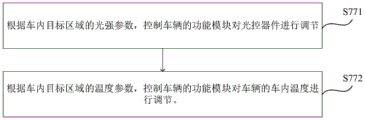
In an application scenario, as shown in fig. 8, which shows a flowchart of the in-vehicle theater system controlling the function modules of the vehicle, step S770 may include the following steps S771-S772.
Step S771: and controlling a functional module of the vehicle to adjust the light control device according to the light intensity parameter of the target area in the vehicle.
In the embodiment of the present application, the cinema environment parameters may include light intensity parameters of a target area in the vehicle, and the function module may be configured to adjust a light control device of the vehicle, where the light control device is configured to characterize an element generating light or an element blocking light in the vehicle; after the control module receives the opening instruction of the preset vehicle-mounted cinema mode, the control module can control the functional module of the vehicle to adjust the light control device according to the light intensity parameter of the target area in the vehicle, so that the light intensity parameter of the target area in the vehicle meets the preset light intensity.
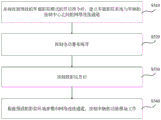
In some embodiments, as shown in fig. 9, step S771 may include the following steps S7711-S7715.
In this embodiment, the light control device may include an in-vehicle lighting fixture, and the control module may control the functional module of the vehicle to adjust the working parameters of the in-vehicle lighting fixture according to the light intensity parameter of the in-vehicle target area, such as turning off the in-vehicle lighting fixture or turning down the brightness of the in-vehicle lighting fixture, so that the light intensity parameter of the in-vehicle target area is the preset light intensity.
Step S7712: and controlling a functional module of the vehicle to adjust working parameters of the atmosphere lamp in the vehicle according to the light intensity parameter of the target area in the vehicle.
In this embodiment, the light control device may include an in-vehicle atmosphere lamp, and the control module may control the functional module of the vehicle to adjust the operating parameter of the in-vehicle atmosphere lamp according to the light intensity parameter of the in-vehicle target area, such as adjusting the brightness of the in-vehicle atmosphere lamp, and/or the light emitting angle of the in-vehicle atmosphere lamp, so that the light intensity parameter of the in-vehicle target area is the preset light intensity.
Step S7713: and controlling a functional module of the vehicle to adjust the shading degree of the shading curtain according to the light intensity parameter of the target area in the vehicle.
In this embodiment, the light control device may include a window shade, and the control module may control the functional module of the vehicle to adjust the light-shielding degree of the window shade according to the light intensity parameter of the target area in the vehicle, so that the light intensity parameter of the target area in the vehicle satisfies the preset light intensity.
Step S7714: and controlling a functional module of the vehicle to adjust the shading degree of the vehicle window according to the light intensity parameter of the target area in the vehicle.
In this embodiment, the light control device may include a window, and the control module may control the function module of the vehicle to adjust the light-shielding degree of the window according to the light intensity parameter of the target area in the vehicle, so that the light intensity parameter of the target area in the vehicle satisfies the preset light intensity.
Step S7715: and controlling a functional module of the vehicle to adjust the shading degree of the skylight according to the light intensity parameter of the target area in the vehicle.
In this embodiment, the light control device may include a sunroof, and the control module may control the functional module of the vehicle to adjust the light-shielding degree of the sunroof according to the light intensity parameter of the target area in the vehicle, so that the light intensity parameter of the target area in the vehicle satisfies the preset light intensity.
Step S772: and controlling a functional module of the vehicle to regulate the temperature in the vehicle according to the temperature parameter of the target area in the vehicle.
In the embodiment of the application, the cinema environment parameters may include temperature parameters of a target area in the vehicle, the functional module may be configured to adjust an in-vehicle temperature of the vehicle, and the control module may control the functional module of the vehicle to adjust the in-vehicle temperature of the vehicle according to the temperature parameters of the target area in the vehicle after receiving a preset opening instruction of the vehicle-mounted cinema mode, so that the in-vehicle temperature of the vehicle meets a preset temperature. For example, the function module includes an air conditioner, and the control module may control the air conditioner to adjust the temperature in the vehicle.
In some embodiments, after the control module controls the function module of the vehicle to operate according to the preset cinema environment parameters and the network connection channel, when receiving a starting command of a preset driving mode, can control the disconnection of a network connection channel between the vehicle-mounted cinema system and a control center of a vehicle, control the electric curtain to ascend to an initial position, control the closing of a projector, and controlling the functional module of the vehicle to work according to the preset driving environment parameters to enable the environment in the vehicle to be in a driving mode, for example, the functional module of the vehicle is controlled to work, so that the light intensity parameter, the temperature parameter, the seat position parameter and the like of the environment in the vehicle are in the parameters corresponding to the driving mode, the vehicle-mounted cinema system is automatically controlled to be dismantled according to the received opening instruction of the driving mode, and the dismantling process of the vehicle-mounted cinema system is simplified.
According to the scheme provided by the application, when the vehicle-mounted cinema system receives the opening instruction of the preset vehicle-mounted cinema mode, the network connection channel between the vehicle-mounted cinema system and the control center of the vehicle can be established, the electric curtain can be controlled to be expanded, the projector can be controlled to be opened, the function module of the vehicle can be controlled to work according to the preset cinema environment parameter and the network connection channel, the environment in the vehicle of the vehicle is in the vehicle-mounted cinema mode, the cinema environment parameter is used for representing that the internal environment condition of the vehicle meets the preset scene, therefore, the network connection channel is automatically established between the vehicle-mounted cinema system and the control center of the vehicle, the electric curtain is controlled to be expanded, the projector is controlled to be opened, the function module of the vehicle is controlled to work according to the received opening instruction of the preset vehicle-mounted cinema mode, and the building of the vehicle-mounted cinema, the operation of passengers in the process of building the vehicle-mounted cinema system is reduced, and the building process of the vehicle-mounted cinema system is simplified.
Further, when the vehicle-mounted cinema system receives a preset opening instruction of the vehicle-mounted cinema mode, after a network connection channel between the vehicle-mounted cinema system and a control center of a vehicle is established, a thermal imaging image of an area in the vehicle can be acquired, the electric curtain is controlled to be unfolded to a second preset position, and the projector is controlled to focus according to the second preset position, so that the thermal imaging image of the area in the vehicle is realized, the electric curtain is automatically controlled to be unfolded, the projector is controlled to be opened and focus, and the building process of the vehicle-mounted cinema system is further simplified.
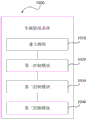
Referring to fig. 10, which shows a functional block diagram of an in-vehicle theater system according to an embodiment of the present application, in the embodiment of the present application, an in-vehicle theater system 1000 may include an electric curtain and a projector, and the in-vehicle theater system 1000 may further include: a setup module 1010, a first control module 1020, a second control module 1030, and a third control module 1040.
The establishing module 1010 is configured to establish a network connection channel between the vehicle-mounted theater system and a control center of the vehicle when receiving a preset opening instruction of the vehicle-mounted theater mode;
the first control module 1020 is used for controlling the electric curtain to be unfolded;
the second control module 1030 is used for controlling the projector to be turned on; and
the third control module 1040 is configured to control the functional modules of the vehicle to operate according to preset theater environment parameters and network connection channels, so that the environment inside the vehicle is in a vehicle-mounted theater mode, and the theater environment parameters are used to represent that the internal environment conditions of the vehicle meet the preset scenario.
In some embodiments, the in-vehicle theater system 1000 may further include: the device comprises an acquisition module, a determination module and an adjustment module.
The acquiring module is used for acquiring a first position of the electric curtain before the first control module 1020 controls the electric curtain to be unfolded;
the determining module is used for determining a first target seat to be adjusted according to the first position; and
the adjusting module is used for adjusting the position of the first target seat to enable the first target seat to be located at a first preset position.
As an embodiment, the adjusting module may include: a first determining unit and an adjusting unit.
A first determination unit for determining whether an occupant is present in the first target seat; and
the adjusting unit is used for adjusting the position of the first target seat when the first target seat is determined to be free of passengers, so that the first target seat is located at a first preset position.
In some embodiments, the first control module 1020 may include: the device comprises an acquisition unit, a second determination unit, a third determination unit and a first control unit; the second control unit 1030 may include a second control unit.
The acquisition unit is used for acquiring a thermal imaging image in the vehicle;
the second determining unit is used for determining a second target seat corresponding to the viewing passenger according to the thermal imaging image;
the third determining unit is used for determining a second position corresponding to the second target seat according to the second target seat;
the first control unit is used for controlling the electric curtain to be unfolded to a second preset position corresponding to the second position according to a preset vehicle-mounted film watching rule and the second position;
the second control unit is used for controlling the projector to be started and controlling the projector to focus according to a second preset position.
In some embodiments, the theatre environment parameter comprises a light intensity parameter of a target area within the vehicle, the functional module is for adjusting a light control device of the vehicle, the light control device is for characterizing an element that generates light or blocks light within the vehicle; the third control module 1040 may include a third control unit.
The third control unit is used for controlling the functional module of the vehicle to adjust the light control device according to the light intensity parameter of the target area in the vehicle, so that the light intensity parameter of the target area in the vehicle meets the preset light intensity.
As an embodiment, the light control device comprises a lamp, and the third control unit may comprise the first control sub-unit.
The first control subunit is used for controlling the functional module of the vehicle to adjust the working parameters of the lamp according to the light intensity parameters of the target area in the vehicle, so that the light intensity parameters of the target area in the vehicle meet the preset light intensity.
As an embodiment, the light control device comprises a window shade, and the third control unit may comprise a second control subunit.
The second control subunit is used for controlling the functional module of the vehicle to adjust the shading degree of the shading curtain according to the light intensity parameter of the target area in the vehicle, so that the light intensity parameter of the target area in the vehicle meets the preset light intensity.
In some embodiments, the theatre environment parameter includes a temperature parameter, the function module to adjust an in-vehicle temperature of the vehicle; the third control module 1040 may also include a fourth control unit.
The fourth control unit is used for controlling the functional module of the vehicle to adjust the in-vehicle temperature of the vehicle according to the temperature parameter, so that the in-vehicle temperature of the vehicle meets the preset temperature.
In some embodiments, the in-vehicle theater system 1000 may further include: the device comprises a fourth control module, a fifth control module and a sixth control module.
The fourth control module is used for disconnecting a network connection channel between the vehicle-mounted cinema system and a control center of the vehicle when receiving a starting instruction of a preset driving mode;
the fifth control module is used for controlling the electric curtain to ascend to the initial position and controlling the projector to be closed; and
the sixth control module is used for controlling the functional module of the vehicle to work according to preset driving environment parameters, so that the environment in the vehicle is in a driving mode.
According to the scheme provided by the application, when the vehicle-mounted cinema system receives the opening instruction of the preset vehicle-mounted cinema mode, the network connection channel between the vehicle-mounted cinema system and the control center of the vehicle can be established, the electric curtain can be controlled to be expanded, the projector can be controlled to be opened, the function module of the vehicle can be controlled to work according to the preset cinema environment parameter and the network connection channel, the environment in the vehicle of the vehicle is in the vehicle-mounted cinema mode, the cinema environment parameter is used for representing that the internal environment condition of the vehicle meets the preset scene, therefore, the network connection channel is automatically established between the vehicle-mounted cinema system and the control center of the vehicle, the electric curtain is controlled to be expanded, the projector is controlled to be opened, the function module of the vehicle is controlled to work according to the received opening instruction of the preset vehicle-mounted cinema mode, and the building of the vehicle-mounted cinema, the operation of passengers in the process of building the vehicle-mounted cinema system is reduced, and the building process of the vehicle-mounted cinema system is simplified.
Referring to fig. 11, a functional block diagram of a vehicle 100 according to an embodiment of the present application is shown, where the vehicle 100 may include: a processor 150, a communication module 160, a memory 170, and a bus. The processor 150, the communication module 160 and the memory 170 are connected to each other through a bus and perform communication with each other. The bus may be an ISA bus, PCI bus, EISA bus, or the like. The bus may be divided into an address bus, a data bus, a control bus, etc. Wherein:
and a memory 170 for storing programs. In particular, the memory 170 may be used to store software programs as well as various data. The memory 170 may mainly include a program storage area and a data storage area, wherein the program storage area may store an application program required to operate at least one function and may include program codes including computer operating instructions. In addition to storing programs, the memory 630 may temporarily store messages or the like that the communication module 160 needs to send.
The processor 150 is configured to execute programs stored in the memory 170. The program, when executed by a processor, implements the steps of the in-vehicle theater system control method of each of the above embodiments. Alternatively, the processor 150 may be implemented in hardware using at least one of Digital Signal Processing (DSP), Field-Programmable Gate Array (FPGA), and Programmable Logic Array (PLA). The processor 150 may integrate one or more of a Central Processing Unit (CPU), a Graphics Processing Unit (GPU), a modem, and the like. Wherein, the CPU mainly processes an operating system, a user interface, an application program and the like; the GPU is used for rendering and drawing display content; the modem is used to handle wireless communications. It is understood that the modem may not be integrated into the processor 150, but may be implemented by a single communication chip.
The Memory 170 may include a Random Access Memory (RAM) or a Read-Only Memory (Read-Only Memory). The memory 170 may be used to store instructions, programs, code sets, or instruction sets. The memory 170 may include a stored program area and a stored data area, wherein the stored program area may store instructions for implementing an operating system, instructions for implementing at least one function (e.g., turn on instructions, establish a network connection channel, control power curtain deployment, control projector turn on, control function module operation, obtain a first position, determine a first target seat, adjust a position of the first target seat, determine an occupant, obtain a thermographic image and determine a second position, etc.), instructions for implementing various method embodiments described below, and the like. The storage data area may further store data created by the vehicle 100 during the vehicle-mounted theater system construction process (such as a preset vehicle-mounted theater mode, theater environment parameters, a first position, a first target seat, a position of the first target seat, a first preset position, a thermal imaging image, a second target seat, a second position, vehicle-mounted viewing rules, a second preset position, a light intensity parameter, a temperature parameter, a driving mode, and an initial position), and the like.
Referring to fig. 12, a computer readable storage medium 1200 provided by an embodiment of the present application is shown, in which a program code is stored, and the program code can be called by a processor to execute the method described in the foregoing method embodiment.
The computer-readable storage medium 1200 may be an electronic memory such as a flash memory, an EEPROM (electrically erasable programmable read only memory), an EPROM, a hard disk, or a ROM. Alternatively, the computer-readable storage medium 1200 includes a non-volatile computer-readable storage medium. The computer readable storage medium 1200 has storage space for program code 1210 that performs any of the method steps described above. The program code can be read from or written to one or more computer program products. The program code 1210 may be compressed, for example, in a suitable form.
Finally, it should be noted that: the above embodiments are only used to illustrate the technical solutions of the present application, and not to limit the same; although the present application has been described in detail with reference to the foregoing embodiments, it will be understood by those of ordinary skill in the art that: the technical solutions described in the foregoing embodiments may still be modified, or some technical features may be equivalently replaced; such modifications and substitutions do not necessarily depart from the spirit and scope of the corresponding technical solutions in the embodiments of the present application.