CN112288142B - Short video memory prediction method and device - Google Patents
Short video memory prediction method and device Download PDFInfo
- Publication number
- CN112288142B CN112288142B CN202011090457.8A CN202011090457A CN112288142B CN 112288142 B CN112288142 B CN 112288142B CN 202011090457 A CN202011090457 A CN 202011090457A CN 112288142 B CN112288142 B CN 112288142B
- Authority
- CN
- China
- Prior art keywords
- matrix
- frame
- loss function
- video
- memory
- Prior art date
- Legal status (The legal status is an assumption and is not a legal conclusion. Google has not performed a legal analysis and makes no representation as to the accuracy of the status listed.)
- Active
Links
Images

Classifications
-
- G—PHYSICS
- G06—COMPUTING OR CALCULATING; COUNTING
- G06Q—INFORMATION AND COMMUNICATION TECHNOLOGY [ICT] SPECIALLY ADAPTED FOR ADMINISTRATIVE, COMMERCIAL, FINANCIAL, MANAGERIAL OR SUPERVISORY PURPOSES; SYSTEMS OR METHODS SPECIALLY ADAPTED FOR ADMINISTRATIVE, COMMERCIAL, FINANCIAL, MANAGERIAL OR SUPERVISORY PURPOSES, NOT OTHERWISE PROVIDED FOR
- G06Q10/00—Administration; Management
- G06Q10/04—Forecasting or optimisation specially adapted for administrative or management purposes, e.g. linear programming or "cutting stock problem"
-
- G—PHYSICS
- G06—COMPUTING OR CALCULATING; COUNTING
- G06F—ELECTRIC DIGITAL DATA PROCESSING
- G06F18/00—Pattern recognition
- G06F18/20—Analysing
- G06F18/21—Design or setup of recognition systems or techniques; Extraction of features in feature space; Blind source separation
- G06F18/214—Generating training patterns; Bootstrap methods, e.g. bagging or boosting
-
- G—PHYSICS
- G06—COMPUTING OR CALCULATING; COUNTING
- G06F—ELECTRIC DIGITAL DATA PROCESSING
- G06F30/00—Computer-aided design [CAD]
- G06F30/20—Design optimisation, verification or simulation
- G06F30/27—Design optimisation, verification or simulation using machine learning, e.g. artificial intelligence, neural networks, support vector machines [SVM] or training a model
-
- G—PHYSICS
- G06—COMPUTING OR CALCULATING; COUNTING
- G06N—COMPUTING ARRANGEMENTS BASED ON SPECIFIC COMPUTATIONAL MODELS
- G06N3/00—Computing arrangements based on biological models
- G06N3/02—Neural networks
- G06N3/04—Architecture, e.g. interconnection topology
- G06N3/044—Recurrent networks, e.g. Hopfield networks
-
- G—PHYSICS
- G06—COMPUTING OR CALCULATING; COUNTING
- G06N—COMPUTING ARRANGEMENTS BASED ON SPECIFIC COMPUTATIONAL MODELS
- G06N3/00—Computing arrangements based on biological models
- G06N3/02—Neural networks
- G06N3/04—Architecture, e.g. interconnection topology
- G06N3/045—Combinations of networks
-
- G—PHYSICS
- G06—COMPUTING OR CALCULATING; COUNTING
- G06N—COMPUTING ARRANGEMENTS BASED ON SPECIFIC COMPUTATIONAL MODELS
- G06N3/00—Computing arrangements based on biological models
- G06N3/02—Neural networks
- G06N3/08—Learning methods
Landscapes
- Engineering & Computer Science (AREA)
- Theoretical Computer Science (AREA)
- Physics & Mathematics (AREA)
- Evolutionary Computation (AREA)
- General Physics & Mathematics (AREA)
- Data Mining & Analysis (AREA)
- General Engineering & Computer Science (AREA)
- Artificial Intelligence (AREA)
- Life Sciences & Earth Sciences (AREA)
- Software Systems (AREA)
- Computing Systems (AREA)
- Molecular Biology (AREA)
- Biophysics (AREA)
- General Health & Medical Sciences (AREA)
- Biomedical Technology (AREA)
- Mathematical Physics (AREA)
- Business, Economics & Management (AREA)
- Computational Linguistics (AREA)
- Health & Medical Sciences (AREA)
- Economics (AREA)
- Computer Vision & Pattern Recognition (AREA)
- Strategic Management (AREA)
- Human Resources & Organizations (AREA)
- Game Theory and Decision Science (AREA)
- Evolutionary Biology (AREA)
- Bioinformatics & Computational Biology (AREA)
- Development Economics (AREA)
- Bioinformatics & Cheminformatics (AREA)
- Computer Hardware Design (AREA)
- Medical Informatics (AREA)
- Geometry (AREA)
- Entrepreneurship & Innovation (AREA)
- Marketing (AREA)
- Operations Research (AREA)
- Quality & Reliability (AREA)
- Tourism & Hospitality (AREA)
- General Business, Economics & Management (AREA)
- Image Analysis (AREA)
Abstract
The invention provides a short video memory prediction method and a device, comprising the following steps: A. extracting features; B. calculating a criticality score for each frame and applying a first penalty function Constraining; C. obtain abstract video Gs(x) And calculating the reconstructability loss function in the process of generating the abstract video
 D. Obtaining the memory fraction of each frame; E. multiplying the memory fraction of each frame with the critical score of each frame respectively and summing to obtain a predicted memory fraction and a predicted loss function
 F. Constructing a final loss function
 G. Training is carried out until the final loss function
 And (6) converging. The invention combines a plurality of ideas together, better combines visual information on time and space dimensions, obtains enhanced feature representation and obtains better prediction effect.
Description
Technical Field
The invention relates to a short video memory prediction method and a short video memory prediction device.
Background
With the rapid development of multimedia information processing technology, media platforms such as social networks, media advertisements, information retrieval and recommendation systems need more powerful functions to process data that is changing day by day. Thus, the ability to understand the content of information plays a key role in such media systems. The understanding of content may be affected by different concepts of visual prominence, aesthetics, emotion, popularity, and memory, which measure how well an image or video is remembered, an emerging and less well-known concept in multimedia and computer vision.
The memory prediction has wide practical applications, such as designing impressive promotional advertisements, making impressive educational demonstration videos, and content retrieval, filtering and summarization.
The memory prediction of video involves two core problems: feature characterization and prediction models. The current research on the memory prediction focuses on exploring visual factors influencing the memory prediction, and the prediction process adopts a mode of separating feature extraction from prediction, so that the prediction performance is greatly limited by the previous feature extraction.
Disclosure of Invention
The invention aims to provide a short video memory prediction method and a short video memory prediction device aiming at the defects of the prior art, combines multiple ideas, better combines visual information on time and space dimensions, obtains enhanced feature representation and obtains better prediction effect.
The invention is realized by the following technical scheme:
a short video memory prediction method comprises the following steps:
A. extracting visual characteristic vectors of each frame from videos in a data set by using a residual error network to form a multi-dimensional visual characteristic matrix v, performing spatial pooling on the matrix v to obtain a matrix x, and equally dividing the matrix v and the matrix x into a training set and a test set;
B. taking the training set corresponding to the matrix x as the input of the bidirectional long-short term memory network to obtain the possibility data of each frame as the key frame, and calculating according to the possibility dataCalculating criticality scores for frames and applying a first penalty function Constraining;
C. selecting the first s key frames with the highest key score to form a prediction abstract video, and reconstructing corresponding feature vectors through convolution operation to obtain an abstract video Gs(x) And calculating the reconstructability loss function in the process of generating the abstract video
D. Constructing a space attention graph S by using the matrix v, obtaining a reconstruction characteristic matrix F by using the matrix v and the space attention graph S, and inputting the reconstruction characteristic matrix F into a bidirectional long-short term memory network to obtain the memory fraction of each frame;
E. multiplying the memory fraction of each frame with the critical score of each frame respectively and summing to obtain a predicted memory fraction and a predicted loss function
F. Constructing a final loss function Wherein λ is the equilibrium coefficient;
G. training completely end to end by using ADAM optimizer at fixed learning rate, and iteratively updating corresponding parameters until final loss function And (6) converging.
Further, the step a comprises:
a1, respectively sampling each video of the data set, obtaining T frame images after each video is sampled, inputting the T frame images into a trained Resnet50, and obtaining a T frame multidimensional visual feature matrix v corresponding to each video from a conv4_3 layer of Resnet 50: v ═ v1,v2,…,vt,…,vT};
A2, obtaining a matrix x after spatial pooling of the matrix v: x ═ x1,x2,…,xt,…,xT};
A3, dividing the matrix v and the matrix x into a training set and a test set.
Further, the step B includes:
b1, taking a matrix x of a training set as an input of a bidirectional long-short term memory network capable of capturing timing information:


wherein T is (0, T)],xtA visual characteristic representing the t-th frame, and
and function f representing forward and backward information of bidirectional long and short term memory network outputv_sum() Hiding state of bidirectional long-short term memory network
 And an initial feature xtCritical score, W, mapped to Each framex、Wf、WbB is weight and bias, respectively, and tanh is activation function;
 indicating the likelihood that the tth frame is a key frame;
b2, calculating the criticality score alpha of each frame by the following formulat:
B3, applying a first penalty function in order to encourage the critical scores of different frames to be able to make a gap And (3) constraint:
further, the reconstructability loss function in the step C Comprises the following steps:
 wherein G iss(x)tAnd
 respectively, abstract video Gs(x) And the tth frame of matrix xtCharacteristics of the frame, ft∈Λs,ΛsIs an index used for indicating s key frames for abstract video selection, | · | calving2Is the norm of L2.
Further, the step D includes:
d1, changing v to { v ═ v1,v2,…,vt,…,vTVisual characteristics v of each frame intDenoted by Z, for a given Z, it is fed into two different convolutional layers respectively to generate two new signatures P and Q, which, after reshaping, perform a matrix multiplication between the transposes of P and Q and apply the softmax function to calculate the spatial attention map S:

wherein i and j represent position indexes, s, respectivelyijMeasuring the influence of the ith position on the jth position, wherein N is the space size of the feature map;
d2, feeding Z into the convolutional layer to generate a new characteristic diagram O, performing matrix multiplication between O and S, multiplying by a proportional parameter beta, and performing element-by-element summation operation on the characteristic Z to obtain a reconstructed characteristic matrix F:

d3, performing space and channel pooling on the reconstruction characteristic matrix F, inputting the reconstruction characteristic matrix F of different frames into a bidirectional long-short term memory network to obtain the hidden state of each frame, mapping the memory fraction of each frame of image through a multilayer neural network and a single output neuron, and using ytAnd (4) showing.
Further, the step E includes:
e1, multiplying the memory fraction of each frame with the criticality score of each frame respectively and summing to obtain the predicted memory fraction
E2 prediction loss function Is a predicted value
 And true value mkThe error between:

further, the method also comprises the step H: and obtaining a final result by using the data of the test set, and evaluating the result according to the Spearman ordering correlation coefficient and the mean square error.
The invention is also realized by the following technical scheme:
a short video memory prediction apparatus comprising:
a feature extraction module: the device comprises a matrix v, a training set and a test set, wherein the matrix v is used for extracting visual characteristic vectors of each frame from videos in a data set by using a residual error network to form a multi-dimensional visual characteristic matrix v, pooling the matrix v in space to obtain a matrix x, and equally dividing the matrix v and the matrix x into the training set and the test set;
a first loss function construction module: the method is used for taking a training set of a matrix x as the input of a bidirectional long-short term memory network, obtaining probability data of each frame as a key frame, calculating a criticality score of each frame according to the probability data, and applying a first loss function Constraining;
a reconstructability loss function construction module: the method is used for selecting the first s key frames with the highest key scores to form a prediction abstract video, and reconstructing corresponding feature vectors through convolution operation to obtain an abstract video Gs(x) And calculating the reconstructability loss function in the process of generating the abstract video
The prediction loss function building module: the device is used for constructing a space attention graph S by using the matrix v, obtaining a reconstruction characteristic matrix F by using the matrix v and the space attention graph S, and inputting the reconstruction characteristic matrix F into a bidirectional long-short term memory network to obtain the memory fraction of each frame; multiplying the memory fraction of each frame with the critical score of each frame respectively and summing to obtain a predicted memory fraction and a predicted loss function
A final loss function construction module: for constructing the final loss function
 Training completely end-to-end at a fixed learning rate using an ADAM optimizer, iteratively updating corresponding parameters until a final loss function
 Convergence, where λ is the equilibrium coefficient.
The invention has the following beneficial effects:
1. the invention utilizes a bidirectional long-short term memory network to obtain the key score of each frame, applies a first loss function constraint to encourage the key degrees of different frames to generate a difference, provides a differential attention degree for subsequent memory degree prediction, forms a summary video according to the key scores, obtains a reconstructive loss function according to the summary video, obtains the memory degree score of each frame through a space attention and the long-short term memory network, multiplies and sums the memory degree score of each frame and the key score of each frame respectively to obtain a predicted memory degree score, obtains a predicted loss function, better combines visual information on time and space dimensions, obtains enhanced characteristic representation, obtains a final loss function according to the first loss function, the reconstructive loss function and the predicted loss function, uses an ADAM optimizer to carry out end-to-end training, the method combines multiple ideas, adopts end-to-end learning, can obtain better prediction effect, and is particularly suitable for the memory prediction of short videos.
Drawings
The present invention will be described in further detail with reference to the accompanying drawings.
FIG. 1 is a flow chart of the present invention.
Detailed Description
As shown in fig. 1, the short video memory prediction method includes the following steps:
A. extracting visual characteristic vectors of each frame from videos in a data set by using a residual error network to form a multi-dimensional visual characteristic matrix v, performing spatial pooling on the matrix v to obtain a matrix x, and equally dividing the matrix v and the matrix x into a training set and a test set; the method specifically comprises the following steps:
a1, down-sampling each video of the data set to 2fps, adjusting the size of each frame of image to 224 x 224, obtaining a T frame image after each video is sampled, inputting the T frame image into a trained Resnet50, and obtaining a T frame multidimensional visual feature matrix v corresponding to each video from a conv4_3 layer of Resnet 50: v ═ v1,v2,…,vt,…,vT},vtThe size is [ 14X 1024 ]];
A2, obtaining a matrix x after spatial pooling of the matrix v: x ═ x1,x2,…,xt,…,xT},xtThe size is [ 1X 1024 ]];
A3, equally dividing the matrix v and the matrix x into a training set and a test set;
B. taking a training set corresponding to the matrix x as the input of a bidirectional long-short term memory network capable of capturing time sequence information to obtain probability data of each frame as a key frame, calculating the key score of each frame according to the probability data, and applying a first loss function Constraining; the method specifically comprises the following steps:
b1, using the training set corresponding to the matrix x as the input of a bidirectional long-short term memory network (BilSTM network) capable of capturing the timing information:

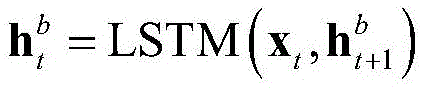


wherein T is (0, T)],xtA visual characteristic representing the t-th frame, and
and function f representing forward and backward information of bidirectional long and short term memory network outputv_sum() Hiding state of bidirectional long-short term memory network
 And an initial feature xtCritical score, W, mapped to Each framex、Wf、WbB is weight and bias, respectively, and tanh is activation function;
 represents a score, i.e., the likelihood that the tth frame is a key frame;
b2, calculating a criticality score (weight vector generated by softmax function) α of each frame by the following formulat:

Wherein exp represents an exponential function with a natural constant as a base;
b3, applying a first penalty function in order to encourage the critical scores of different frames to be able to make a gap And (3) constraint:
C. selecting the first s key frames with the highest criticality score to form a prediction summary video, and reconstructing the prediction summary video through convolution operationPredicting the corresponding visual feature vector in the abstract video to obtain an abstract video Gs(x) And calculating the reconstructability loss function in the process of generating the abstract video Wherein G iss(x)tAnd
 respectively, abstract video Gs(x) And the tth frame of matrix xtFeatures of the frame, whereint∈Λs,ΛsIs an index, s key frames for indicating the selection of the summarized video, | · | | luminous flux2Is the norm of L2;
D. constructing a space attention diagram S by using the matrix v, obtaining a reconstruction characteristic matrix F (the reconstruction characteristic matrix F is a new transformed matrix v) by using the matrix v and the space attention diagram S, and inputting the reconstruction characteristic matrix F into a bidirectional long-short term memory network (BilSTM network) to obtain the memory fraction of each frame; the method specifically comprises the following steps:
d1, for convenience of description, will v ═ v1,v2,…,vt,…,vTVisual characteristics v of each frame intDenoted by Z, for a given Z, it is fed into two different convolutional layers, i.e. conv4_3 layer of Resnet50, respectively, to generate two new signatures P and Q, after unfolding the two signatures P and Q into vectors, performing a matrix multiplication between the transposes of P and Q, and applying the softmax function to calculate the spatial attention S:

wherein i and j represent position indexes, s, respectivelyijMeasuring the influence of the ith position on the jth position, wherein N is the space size of the feature map, and the space size of the feature map is the length multiplied by the width of the feature map;
d2, feeding Z into a convolutional layer to generate a new feature map O, where the convolutional layer is the conv4_3 layer of Resnet50, performing matrix multiplication between O and S, multiplying by the scaling parameter β, and performing element-by-element summation with the feature Z to obtain a reconstructed feature matrix F:

d3, performing space and channel pooling on the reconstruction feature matrix F, inputting the reconstruction feature matrix F of different frames into a bidirectional long-short term memory network (BilSTM network) to obtain the hidden state of each frame, mapping the memory fraction of each frame image through a multilayer neural network and a single output neuron, and using ytRepresents;
E. multiplying the memory fraction of each frame with the critical score of each frame respectively and summing to obtain a predicted memory fraction and a predicted loss function The method specifically comprises the following steps:
e1, multiplying the memory fraction of each frame with the criticality score of each frame respectively and summing to obtain the predicted memory fraction
E2 prediction loss function Is a predicted value
 With the true value mkThe error between:

the real value is a known number, when a data set is given, the real value is given, and the data set comprises a video and a label corresponding to the video, wherein the label is the real value;
F. build FinalLoss function Wherein, λ is a balance coefficient and is a self-defined parameter greater than zero;
G. training completely end-to-end at a fixed learning rate using an ADAM optimizer, iteratively updating corresponding parameters until a final loss function Converging; the learning rate and the end-to-end are the existing terms in the field, the learning rate can be regarded as a self-defined parameter, and the specific value needs to be determined by combining a specific task; the corresponding parameters refer to the parameters involved in the method;
H. and obtaining a final result (namely a result predicted by the model) by using the data of the test set, and evaluating the result according to the Spearman ordering correlation coefficient and the mean square error.
A short video memory prediction apparatus comprising:
a feature extraction module: the system comprises a video acquisition module, a data processing module, a training set and a test set, wherein the data acquisition module is used for acquiring a multi-dimensional visual characteristic matrix v by extracting visual characteristic vectors of each frame from videos in a data set by using a residual error network, obtaining a matrix x after spatial pooling the matrix v, and equally dividing the matrix v and the matrix x into a training set and a test set;
a first loss function construction module: the method is used for taking a training set of a matrix x as the input of a bidirectional long-short term memory network, obtaining probability data of each frame as a key frame, calculating a criticality score of each frame according to the probability data, and applying a first loss function Constraining;
a reconstructability loss function construction module: the method is used for selecting the first s key frames with the highest key scores to form a prediction abstract video, and reconstructing corresponding feature vectors through convolution operation to obtain an abstract video Gs(x) And calculating the reconstructability loss function in the process of generating the abstract video
The prediction loss function building module: the device is used for constructing a space attention graph S by using the matrix v, obtaining a reconstruction characteristic matrix F by using the matrix v and the space attention graph S, and inputting the reconstruction characteristic matrix F into a bidirectional long-short term memory network to obtain the memory fraction of each frame; multiplying the memory fraction of each frame with the critical score of each frame respectively and summing to obtain a predicted memory fraction and a predicted loss function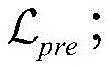
A final loss function construction module: for constructing the final loss function
 Training completely end-to-end at a fixed learning rate using an ADAM optimizer, iteratively updating corresponding parameters until a final loss function
 Convergence, where λ is the equilibrium coefficient.
The above description is only a preferred embodiment of the present invention, and therefore should not be taken as limiting the scope of the invention, which is defined by the appended claims and their equivalents and modifications within the scope of the description.
Claims (8)
1. A short video memory prediction method is characterized in that: the method comprises the following steps:
A. extracting visual characteristic vectors of each frame from videos in a data set by using a residual error network to form a multi-dimensional visual characteristic matrix v, performing spatial pooling on the matrix v to obtain a matrix x, and equally dividing the matrix v and the matrix x into a training set and a test set;
B. taking the training set corresponding to the matrix x as the input of the bidirectional long-short term memory network to obtain that each frame is offLikelihood data for key frames, and calculating a criticality score for each frame based on the likelihood data, and applying a first penalty function Constraining;
C. selecting the first s key frames with the highest key score to form a prediction abstract video, and reconstructing corresponding feature vectors through convolution operation to obtain an abstract video Gs(x) And calculating the reconstructability loss function in the process of generating the abstract video
D. Constructing a space attention graph S by using the matrix v, obtaining a reconstruction characteristic matrix F by using the matrix v and the space attention graph S, and inputting the reconstruction characteristic matrix F into a bidirectional long-short term memory network to obtain the memory fraction of each frame;
E. multiplying the memory fraction of each frame with the critical score of each frame respectively and summing to obtain a predicted memory fraction and a predicted loss function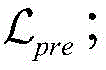
F. Constructing a final loss function Wherein λ is the equilibrium coefficient;
G. training completely end to end by using ADAM optimizer at fixed learning rate, and iteratively updating corresponding parameters until final loss function And (6) converging.
2. The method of claim 1, wherein the short video memory prediction method comprises: the step A comprises the following steps:
a1, sampling each video of the data set respectivelyAnd after sampling each video, obtaining a T frame image, inputting the T frame image into a trained Resnet50, and obtaining a T frame multidimensional visual feature matrix v corresponding to each video from a conv4_3 layer of Resnet 50: v ═ v1,v2,…,vt,…,vT};
A2, obtaining a matrix x after spatial pooling of the matrix v: x ═ x1,x2,…,xt,…,xT};
A3, dividing the matrix v and the matrix x into a training set and a test set.
3. The method of claim 2, wherein the short video memory prediction method comprises: the step B comprises the following steps:
b1, and taking a matrix x of the training set as an input of a bidirectional long-short term memory network capable of capturing timing information:


wherein T is (0, T)],xtA visual characteristic representing the t-th frame, and
and indicating two-way lengthForward and backward information output by short-term memory network, function fv_sum() Hiding state of bidirectional long-short term memory network
 And an initial feature xtCritical score, W, mapped to Each framex、Wf、WbB is weight and bias, respectively, and tanh is activation function;
 indicating the likelihood that the tth frame is a key frame;
b2, calculating the criticality score alpha of each frame by the following formulat:
B3, applying a first penalty function in order to encourage the critical scores of different frames to be able to make a gap And (3) constraint:
4. the method of claim 3, wherein the short video memory prediction method comprises: the reconstructability loss function in step C Comprises the following steps:
 wherein G iss(x)tAnd
 respectively, abstract video Gs(x) And the tth frame of matrix xtCharacteristics of the frame, ft∈Λs,ΛsIs an index, s key frames for indicating the selection of the summarized video, | · | | luminous flux2Is the norm of L2.
5. The method of claim 4, wherein the method further comprises: the step D comprises the following steps:
d1, changing v to { v ═ v1,v2,…,vt,…,vTVisual characteristics v of each frame intDenoted by Z, for a given Z, it is fed into two different convolutional layers respectively to generate two new signatures P and Q, which, after reshaping, perform a matrix multiplication between the transposes of P and Q, and apply the softmax function to calculate the spatial attention map S:

wherein i and j represent position indexes, s, respectivelyijThe influence of the ith position on the jth position is measured, and N is the space size of the feature map;
d2, feeding Z into the convolutional layer to generate a new characteristic diagram O, performing matrix multiplication between O and S, multiplying by a proportional parameter beta, and performing element-by-element summation operation on the characteristic Z to obtain a reconstructed characteristic matrix F:

d3, performing space and channel pooling on the reconstruction characteristic matrix F, inputting the reconstruction characteristic matrix F of different frames into a bidirectional long-short term memory network to obtain the hidden state of each frame, mapping the memory fraction of each frame of image through a multilayer neural network and a single output neuron, and using ytAnd (4) showing.
6. The method of claim 5, wherein the short video memory prediction method comprises: the step E comprises the following steps:
e1, multiplying the memory score of each frame and the criticality score of each frame respectively and summing to obtain the predicted memory score
E2 prediction loss function Is a predicted value
 With the true value mkThe error between:

7. a method for short video memory prediction according to any of claims 1-6, characterized by: further comprising the step H: and obtaining a final result by using the data of the test set, and evaluating the result according to the Spearman ordering correlation coefficient and the mean square error.
8. A short video memory prediction apparatus, characterized by: the method comprises the following steps:
a feature extraction module: the device comprises a matrix v, a training set and a test set, wherein the matrix v is used for extracting visual characteristic vectors of each frame from videos in a data set by using a residual error network to form a multi-dimensional visual characteristic matrix v, pooling the matrix v in space to obtain a matrix x, and equally dividing the matrix v and the matrix x into the training set and the test set;
a first loss function construction module: the method is used for taking a training set of a matrix x as the input of a bidirectional long-short term memory network, obtaining probability data of each frame as a key frame, calculating a criticality score of each frame according to the probability data, and applying a first loss function Constraining;
a reconstructability loss function construction module: the method is used for selecting the first s key frames with the highest key scores to form a prediction abstract video, and reconstructing corresponding feature vectors through convolution operation to obtain an abstract video Gs(x) And calculating the reconstructability loss function in the process of generating the abstract video
The prediction loss function building module: the device is used for constructing a space attention graph S by using the matrix v, obtaining a reconstruction characteristic matrix F by using the matrix v and the space attention graph S, and inputting the reconstruction characteristic matrix F into a bidirectional long-short term memory network to obtain the memory fraction of each frame; multiplying the memory fraction of each frame with the critical score of each frame respectively and summing to obtain a predicted memory fraction and a predicted loss function
A final loss function construction module: for constructing the final loss function
 Training completely end-to-end at a fixed learning rate using an ADAM optimizer, iteratively updating corresponding parameters until a final loss function
 Convergence, where λ is the equilibrium coefficient.
Priority Applications (1)
| Application Number | Priority Date | Filing Date | Title |
|---|---|---|---|
| CN202011090457.8A CN112288142B (en) | 2020-10-13 | 2020-10-13 | Short video memory prediction method and device |
Applications Claiming Priority (1)
| Application Number | Priority Date | Filing Date | Title |
|---|---|---|---|
| CN202011090457.8A CN112288142B (en) | 2020-10-13 | 2020-10-13 | Short video memory prediction method and device |
Publications (2)
| Publication Number | Publication Date |
|---|---|
| CN112288142A CN112288142A (en) | 2021-01-29 |
| CN112288142B true CN112288142B (en) | 2022-06-10 |
Family
ID=74496682
Family Applications (1)
| Application Number | Title | Priority Date | Filing Date |
|---|---|---|---|
| CN202011090457.8A Active CN112288142B (en) | 2020-10-13 | 2020-10-13 | Short video memory prediction method and device |
Country Status (1)
| Country | Link |
|---|---|
| CN (1) | CN112288142B (en) |
Families Citing this family (3)
| Publication number | Priority date | Publication date | Assignee | Title |
|---|---|---|---|---|
| CN114120166B (en) * | 2021-10-14 | 2023-09-22 | 北京百度网讯科技有限公司 | Video question and answer method, device, electronic equipment and storage medium |
| CN115205745B (en) * | 2022-07-15 | 2026-01-27 | 中国传媒大学 | Video memory prediction method, apparatus, device and storage medium |
| CN116344061B (en) * | 2023-03-29 | 2026-03-17 | 天津大学 | Amnesia Detection Device Based on Visual Attention Representation |
Citations (2)
| Publication number | Priority date | Publication date | Assignee | Title |
|---|---|---|---|---|
| US10311913B1 (en) * | 2018-02-22 | 2019-06-04 | Adobe Inc. | Summarizing video content based on memorability of the video content |
| CN111062284A (en) * | 2019-12-06 | 2020-04-24 | 浙江工业大学 | Visual understanding and diagnosing method of interactive video abstract model |
-
2020
- 2020-10-13 CN CN202011090457.8A patent/CN112288142B/en active Active
Patent Citations (2)
| Publication number | Priority date | Publication date | Assignee | Title |
|---|---|---|---|---|
| US10311913B1 (en) * | 2018-02-22 | 2019-06-04 | Adobe Inc. | Summarizing video content based on memorability of the video content |
| CN111062284A (en) * | 2019-12-06 | 2020-04-24 | 浙江工业大学 | Visual understanding and diagnosing method of interactive video abstract model |
Non-Patent Citations (2)
| Title |
|---|
| Object Memorability Prediction using Deep Learning: Location and Size;Sathisha Basavaraju 等;《Journal of Visual Communication and Image Representation》;20190108;第117-127页 * |
| 基于多特征表征学习的多媒体数据预测方法研究;井佩光;《中国优秀博硕士学位论文全文数据库(博士)》;20191015;全文 * |
Also Published As
| Publication number | Publication date |
|---|---|
| CN112288142A (en) | 2021-01-29 |
Similar Documents
| Publication | Publication Date | Title |
|---|---|---|
| CN111091045B (en) | Sign language identification method based on space-time attention mechanism | |
| CN116580257B (en) | Feature fusion model training and sample retrieval method, device and computer equipment | |
| CN111246256B (en) | Video recommendation method based on multimodal video content and multi-task learning | |
| CN114419351B (en) | Image-text pre-training model training and image-text prediction model training method and device | |
| CN112288142B (en) | Short video memory prediction method and device | |
| CN114862844A (en) | Infrared small target detection method based on feature fusion | |
| CN116933051A (en) | Multi-mode emotion recognition method and system for modal missing scene | |
| CN116756314B (en) | GCN-based aspect-level multi-mode emotion analysis method | |
| CN113064968A (en) | Social media emotion analysis method and system based on tensor fusion network | |
| CN112132770A (en) | Image restoration method and device, computer readable medium and electronic equipment | |
| CN114723787A (en) | Optical flow calculation method and system | |
| CN113850182A (en) | Action recognition method based on DAMR_3DNet | |
| CN115496989B (en) | Generator, generator training method and method for avoiding image coordinate adhesion | |
| CN108985899A (en) | Recommended method, system and storage medium based on CNN-LFM model | |
| CN118334549A (en) | Short video label prediction method and system for multi-mode collaborative interaction | |
| Gao | A two-channel attention mechanism-based MobileNetV2 and bidirectional long short memory network for multi-modal dimension dance emotion recognition | |
| CN117009560A (en) | Image processing methods, devices, equipment and computer storage media | |
| WO2023185320A1 (en) | Cold start object recommendation method and apparatus, computer device and storage medium | |
| CN111325068A (en) | Video description method and device based on convolutional neural network | |
| CN118014860A (en) | A multi-source and multi-scale image fusion method and device based on attention mechanism | |
| CN113011334A (en) | Video description method based on graph convolution neural network | |
| CN117251622A (en) | Object recommended methods, devices, computer equipment and storage media | |
| CN119580034A (en) | Training method for generating picture description model, picture description generation method, device, equipment, medium and program product | |
| CN120658789A (en) | Information pushing method, device, computer equipment and storage medium | |
| CN117033804B (en) | A Click-Induced Detection Method Guided by Subjective and Objective Perspectives |
Legal Events
| Date | Code | Title | Description |
|---|---|---|---|
| PB01 | Publication | ||
| PB01 | Publication | ||
| SE01 | Entry into force of request for substantive examination | ||
| SE01 | Entry into force of request for substantive examination | ||
| GR01 | Patent grant | ||
| GR01 | Patent grant |