CN112152803B - A multi-receiver ciphertext searchable identity-based encryption method - Google Patents
A multi-receiver ciphertext searchable identity-based encryption method Download PDFInfo
- Publication number
- CN112152803B CN112152803B CN202010971811.1A CN202010971811A CN112152803B CN 112152803 B CN112152803 B CN 112152803B CN 202010971811 A CN202010971811 A CN 202010971811A CN 112152803 B CN112152803 B CN 112152803B
- Authority
- CN
- China
- Prior art keywords
- ciphertext
- receiver
- index
- identity
- parameter set
- Prior art date
- Legal status (The legal status is an assumption and is not a legal conclusion. Google has not performed a legal analysis and makes no representation as to the accuracy of the status listed.)
- Expired - Fee Related
Links
Images


Classifications
-
- H—ELECTRICITY
- H04—ELECTRIC COMMUNICATION TECHNIQUE
- H04L—TRANSMISSION OF DIGITAL INFORMATION, e.g. TELEGRAPHIC COMMUNICATION
- H04L9/00—Cryptographic mechanisms or cryptographic arrangements for secret or secure communications; Network security protocols
- H04L9/08—Key distribution or management, e.g. generation, sharing or updating, of cryptographic keys or passwords
- H04L9/0861—Generation of secret information including derivation or calculation of cryptographic keys or passwords
- H04L9/0866—Generation of secret information including derivation or calculation of cryptographic keys or passwords involving user or device identifiers, e.g. serial number, physical or biometrical information, DNA, hand-signature or measurable physical characteristics
-
- G—PHYSICS
- G06—COMPUTING OR CALCULATING; COUNTING
- G06F—ELECTRIC DIGITAL DATA PROCESSING
- G06F21/00—Security arrangements for protecting computers, components thereof, programs or data against unauthorised activity
- G06F21/60—Protecting data
- G06F21/62—Protecting access to data via a platform, e.g. using keys or access control rules
- G06F21/6218—Protecting access to data via a platform, e.g. using keys or access control rules to a system of files or objects, e.g. local or distributed file system or database
- G06F21/6245—Protecting personal data, e.g. for financial or medical purposes
- G06F21/6263—Protecting personal data, e.g. for financial or medical purposes during internet communication, e.g. revealing personal data from cookies
-
- H—ELECTRICITY
- H04—ELECTRIC COMMUNICATION TECHNIQUE
- H04L—TRANSMISSION OF DIGITAL INFORMATION, e.g. TELEGRAPHIC COMMUNICATION
- H04L63/00—Network architectures or network communication protocols for network security
- H04L63/06—Network architectures or network communication protocols for network security for supporting key management in a packet data network
- H04L63/062—Network architectures or network communication protocols for network security for supporting key management in a packet data network for key distribution, e.g. centrally by trusted party
Landscapes
- Engineering & Computer Science (AREA)
- Computer Security & Cryptography (AREA)
- General Engineering & Computer Science (AREA)
- Bioethics (AREA)
- General Health & Medical Sciences (AREA)
- Health & Medical Sciences (AREA)
- Signal Processing (AREA)
- Computer Hardware Design (AREA)
- Computer Networks & Wireless Communication (AREA)
- Theoretical Computer Science (AREA)
- Medical Informatics (AREA)
- General Physics & Mathematics (AREA)
- Physics & Mathematics (AREA)
- Software Systems (AREA)
- Databases & Information Systems (AREA)
- Computing Systems (AREA)
- Storage Device Security (AREA)
Abstract
本发明公开了一种多接收者密文可搜索的基于身份加密方法和系统,所述方法包括生成系统的全局公开参数和主密钥、生成实体的私钥、生成索引密文、生成搜索陷门和匹配测试的步骤。本发明还提供了一种多接收者密文可搜索的基于身份加密系统,包括系统初始化模块、实体私钥生成模块、索引密文生成模块、搜索陷门生成模块和匹配测试模块。本发明所述技术方案不仅能支持多接收者密文搜索的功能,减少了通信和计算的代价,而且能有效抵抗针对搜索陷门的关键词猜测攻击,达到保护接收者隐私的目的。

The invention discloses a multi-receiver ciphertext searchable identity-based encryption method and system. The method includes generating a global public parameter and a master key of the system, generating a private key of an entity, generating an index ciphertext, and generating a search trap. Steps for gate and match testing. The invention also provides a multi-receiver ciphertext searchable identity-based encryption system, comprising a system initialization module, an entity private key generation module, an index ciphertext generation module, a search trapdoor generation module and a matching test module. The technical solution of the invention can not only support the function of multi-receiver ciphertext search, reduce the cost of communication and calculation, but also effectively resist the keyword guessing attack for search trapdoors, so as to achieve the purpose of protecting the privacy of the receivers.
Description
技术领域technical field
本发明涉及信息安全中的数据加密技术领域,特别是一种多接收者密文可搜索的基于身份加密方法。The invention relates to the technical field of data encryption in information security, in particular to a multi-receiver ciphertext searchable identity-based encryption method.
背景技术Background technique
为解决加密数据检索的难题,Song等人在2000年提出了可搜索加密的技术。这一新型密码技术克服了传统加密技术无法对密文直接检索的缺陷,迅速引起密码学界的关注和研究。然而,Song等人所提出的可搜索加密基于对称密码体制,因此存在密钥管理和密钥分发问题。2004年,Boneh等人首次提出可搜索公钥加密方法。该方法使得用户可以授权不可信的密文存储服务器检测发送给他的且以其公钥加密的密文中是否包含有特定的关键词。可搜索公钥加密方法实现密文检索的基本思想如下:密文发送者使用接收者的公钥加密与数据密文相关联的关键词生成索引密文,并将之附加在数据密文上一并发送给密文存储服务器;接收者使用自己的私钥生成待搜索关键词的搜索陷门,并将之发送给密文存储服务器;收到搜索陷门后,密文存储服务器使用它对发送给接收者的数据密文上所附加的索引密文进行测试,然后将所有匹配的数据密文发送给接收者;接收到数据密文后,接收者使用自己的私钥解密数据密文即可获得包含有所搜索关键词的数据信息。Boneh等人所提出的可搜索公钥加密方法有效解决了公钥密码系统中密文检索的问题,但由于基于传统的公钥密码体制,需要使用公钥证书认证用户公钥的真实性,因此存在复杂的证书管理问题以及证书状态的第三方询问问题。In order to solve the difficult problem of encrypted data retrieval, Song et al. proposed the technology of searchable encryption in 2000. This new cryptographic technology overcomes the defect that traditional encryption technology cannot directly retrieve ciphertext, and quickly attracts the attention and research of the cryptography community. However, the searchable encryption proposed by Song et al. is based on a symmetric cryptosystem, so there are key management and key distribution problems. In 2004, Boneh et al. first proposed a searchable public key encryption method. The method enables the user to authorize the untrusted ciphertext storage server to detect whether the ciphertext sent to him and encrypted with his public key contains specific keywords. The basic idea of searchable public key encryption method to achieve ciphertext retrieval is as follows: the ciphertext sender uses the receiver's public key to encrypt the keywords associated with the data ciphertext to generate an index ciphertext, and append it to the data ciphertext and send it to the ciphertext storage server; the receiver uses its own private key to generate the search trapdoor of the keyword to be searched, and sends it to the ciphertext storage server; after receiving the search trapdoor, the ciphertext storage server uses it to send Test the index ciphertext attached to the receiver's data ciphertext, and then send all matching data ciphertexts to the receiver; after receiving the data ciphertext, the receiver can decrypt the data ciphertext with his own private key Obtain data information containing the searched keywords. The searchable public key encryption method proposed by Boneh et al. effectively solves the problem of ciphertext retrieval in the public key cryptosystem. However, based on the traditional public key cryptosystem, the public key certificate needs to be used to verify the authenticity of the user's public key. There are complex certificate management issues and third-party inquiries about certificate status.
1984年,Shamir等人提出了基于身份密码体制的概念。在基于身份密码系统中,用户的公钥是唯一标识该用户的身份,如身份证号、邮箱地址、手机号等。而用户的私钥则由一个可信第三方——私钥生成中心根据用户的身份信息来生成。由于用户的身份即为其公钥,不需要使用公钥证书解决用户公钥与其身份的绑定问题,因此有效克服了证书管理产生的一系列问题。2008年,Abdalla等人结合基于身份密码体制和可搜索公钥加密,首次提出了可搜索基于身份加密的方法,克服了传统可搜索公钥加密方法中存在的证书问题。但是,已有方法存在如下两点不足。首先,仅支持单一接收者。在实际应用中,经常需要将相同的数据信息分发给多个用户。如果使用单一接收者的可搜索基于身份加密方法,发送方需要针对每一个接收者生成并发送密文。显然,这会产生高昂的计算和通信代价。其次,易遭受关键词猜测攻击。已有方法使用接收者的身份加密关键词产生索引密文,这使得攻击者能够生成其猜测的关键词的索引密文并通过匹配测试算法揭露任意给定搜索陷门中关键词信息,从而造成接收者的搜索信息的泄露,损坏接收者的隐私。In 1984, Shamir et al proposed the concept of identity-based cryptosystem. In an identity-based cryptosystem, a user's public key is the identity that uniquely identifies the user, such as ID number, email address, mobile phone number, etc. The user's private key is generated by a trusted third party - the private key generation center based on the user's identity information. Since the user's identity is his public key, there is no need to use a public key certificate to solve the binding problem between the user's public key and its identity, thus effectively overcoming a series of problems arising from certificate management. In 2008, Abdalla et al. combined identity-based cryptosystem and searchable public key encryption, and proposed a searchable identity-based encryption method for the first time, which overcomes the certificate problem existing in the traditional searchable public key encryption method. However, the existing methods have the following two shortcomings. First, only a single receiver is supported. In practical applications, it is often necessary to distribute the same data information to multiple users. With single-receiver searchable identity-based encryption, the sender needs to generate and send a ciphertext for each recipient. Obviously, this incurs high computational and communication costs. Second, it is vulnerable to keyword guessing attacks. Existing methods use the recipient's identity to encrypt keywords to generate index ciphertext, which enables the attacker to generate the index ciphertext of his guessed keywords and reveal the keyword information in any given search trapdoor through the matching test algorithm, resulting in The disclosure of the receiver's search information damages the receiver's privacy.
发明内容SUMMARY OF THE INVENTION
发明目的:本发明所要解决的技术问题是克服现有技术的不足而提供一种多接收者密文可搜索的基于身份加密方法和系统,本发明所提出的多接收者密文可搜索的基于身份加密方法不仅支持多接收者密文搜索的功能,显著降低计算代价和通信代价,提高系统的实用性,而且能够有效抵抗关键词猜测攻击问题,有效保护搜索者的隐私。Purpose of the invention: The technical problem to be solved by the present invention is to overcome the deficiencies of the prior art and provide a multi-receiver ciphertext searchable identity-based encryption method and system. The identity encryption method not only supports the function of multi-receiver ciphertext search, significantly reduces the computational cost and communication cost, and improves the practicability of the system, but also can effectively resist keyword guessing attacks and effectively protect the privacy of searchers.
本发明为解决上述技术问题采用以下技术方案:一种多接收者密文可搜索的基于身份加密方法,所述方法包含以下步骤:The present invention adopts the following technical scheme in order to solve the above-mentioned technical problems: a multi-receiver ciphertext searchable identity-based encryption method, the method comprises the following steps:
步骤A、根据安全参数,密钥生成中心生成系统的全局参数集和主秘密钥;Step A, according to the security parameter, the key generation center generates the global parameter set and the master secret key of the system;
步骤B、根据系统的全局参数集、系统的主秘密钥和实体的身份标识,密钥生成中心生成实体的私钥,实体包括发送者和接收者;Step B, according to the global parameter set of the system, the master secret key of the system and the identity of the entity, the key generation center generates the private key of the entity, and the entity includes a sender and a receiver;
步骤C、根据系统的全局参数集、发送者的私钥、多个接收者的身份标识和一个与待发送数据密文相关联的关键词,发送者生成索引密文,并将之附加在待发送数据密文后;Step C. According to the global parameter set of the system, the private key of the sender, the identities of multiple recipients and a keyword associated with the ciphertext of the data to be sent, the sender generates an index ciphertext and appends it to the ciphertext to be sent. After sending the data ciphertext;
步骤D、根据系统的全局参数集、发送者的身份标识、接收者的私钥和待搜索的关键词,接收者生成搜索陷门;Step D, according to the global parameter set of the system, the identity of the sender, the private key of the receiver and the keyword to be searched, the receiver generates a search trapdoor;
步骤E、根据系统的全局参数集、索引密文和搜索陷门,密文存储服务器测试索引密文和搜索陷门是否匹配,即测试索引密文和搜索陷门所包含的关键词是否相同,若索引密文和搜索陷门匹配成功,密文存储服务器将该索引密文对应的数据密文发送给接收者;否则,密文存储服务器忽略该索引密文对应的数据密文。Step E, according to the global parameter set of the system, the index ciphertext and the search trapdoor, the ciphertext storage server tests whether the index ciphertext matches the search trapdoor, that is, whether the keywords contained in the test index ciphertext and the search trapdoor are identical, If the index ciphertext matches the search trapdoor successfully, the ciphertext storage server sends the data ciphertext corresponding to the index ciphertext to the receiver; otherwise, the ciphertext storage server ignores the data ciphertext corresponding to the index ciphertext.
进一步的,所述步骤A的详细步骤如下:Further, the detailed steps of the step A are as follows:
步骤A.1、密钥生成中心根据安全参数λ∈Z+生成一个λ比特的素数q,一个q阶加法循环群G和一个q阶乘法循环群GT,并定义一个双线性映射fbp:G×G→GT,其中Z+为正整数集合,fbp:G×G→GT是加法循环群G和自身的笛卡尔积G×G到乘法循环群 GT的映射,即双线性映射fbp:G×G→GT是指函数z=fbp(x,y),其中,x,y∈G为自变量,z∈GT为因变量;Step A.1. The key generation center generates a prime number q of λ bits, a q-order addition cyclic group G and a q-order multiplication cyclic group G T according to the security parameter λ∈Z + , and defines a bilinear map f bp :G×G→G T , where Z + is the set of positive integers, f bp :G×G→G T is the mapping from the Cartesian product of the additive cyclic group G and itself to the multiplicative cyclic group G T , that is, double The linear mapping f bp : G×G→G T refers to the function z=f bp (x, y), where x, y∈G are independent variables, and z∈G T is the dependent variable;
步骤A.2、从加法循环群G中选择一个生成元P,并随机选择一个整数

步骤A.3、定义四个哈希函数H1:{0,1}*→G,


步骤A.4、生成系统的全局参数集prms={q,G,GT,fbp,P,Ppub,H1,H2,H3,H4}和系统的主秘密钥msk=α。Step A.4. Generate the global parameter set prms={q, G, G T , f bp , P, P pub , H 1 , H 2 , H 3 , H 4 } and the master secret key msk=α of the system .
进一步的,所述步骤B的详细步骤如下:根据系统的全局参数集prms={q,G,GT,fbp,P,Ppub,H1,H2,H3,H4},系统的主秘密钥msk=α和实体的身份标识 ID,私钥生成中心生成实体的私钥skID=αQID,其中,QID=H1(ID)为哈希函数H1输出的身份标识ID的哈希值,将发送者的身份标识和私钥分别表示为IDS和

进一步的,所述步骤C的详细步骤如下:Further, the detailed steps of the step C are as follows:
步骤C.1、根据系统的全局参数集prms={q,G,GT,fbp,P,Ppub,H1,H2,H3,H4}和n个接收者的身份标识{IDR,1,IDR,2,…,IDR,n},发送者根据自己的私钥


步骤C.2、计算索引密文的第一部分C1=rP和索引密文的第二部分
步骤C.3、发送者组合C1,C2,C3,C4生成索引密文IC,即索引密文IC=(C1,C2,C3,C4)由C1,C2,C3,C4四个部分构成,然后将之附加在数据密文上发送给密文存储服务器。Step C.3, the sender combines C 1 , C 2 , C 3 , C 4 to generate an index ciphertext IC, that is, the index ciphertext IC=(C 1 , C 2 , C 3 , C 4 ) is composed of C 1 , C 2 , C 3 , C 4 are composed of four parts, which are then attached to the data ciphertext and sent to the ciphertext storage server.
进一步的,所述步骤D的详细步骤如下:Further, the detailed steps of the step D are as follows:
步骤D.1、第i个接收者随机选择一个整数
步骤D.2、根据系统的全局参数集prms={q,G,GT,fbp,P,Ppub,H1,H2,H3,H4},发送者的身份标识IDS,第i个接收者的私钥


步骤D.3、第i个接收者组合T1和T2生成搜索陷门ST,即搜索陷门ST=(T1,T2)由 T1和T2两个部分构成,然后发送给密文存储服务器。Step D.3, the i-th receiver combines T 1 and T 2 to generate a search trapdoor ST, that is, the search trap door ST=(T 1 , T 2 ) consists of two parts T 1 and T 2 , and then sends it to the encrypted file storage server.
进一步的,所述步骤E的详细步骤如下:Further, the detailed steps of the step E are as follows:
步骤E.1、根据系统的全局参数集prms={q,G,GT,fbp,P,Ppub,H1,H2,H3,H4},索引密文IC=(C1,C2,C3,C4)和搜索陷门ST=(T1,T2),密文存储服务器计算 v′i=H3(fbp(T2,C1)·fbp(T1,C2)),并利用索引密文的第三部分C3=(c0,c1,…,cn-1)重构多项式g(x)=c0+c1x+...+cn-1xn-1+xn,其中,v′i=H3(fbp(T2,C1)·fbp(T1,C2))为哈希函数H3输出的双线性映射值fbp(T2,C1)和双线性映射值fbp(T1,C2)乘积的哈希值;Step E.1. According to the global parameter set of the system prms={q, G, G T , f bp , P, P pub , H 1 , H 2 , H 3 , H 4 }, the index ciphertext IC=(C 1 ,C 2 ,C 3 ,C 4 ) and the search trapdoor ST=(T 1 ,T 2 ), the ciphertext storage server calculates v′ i =H 3 (f bp (T 2 ,C 1 )·f bp (T 1 , C 2 )), and reconstruct the polynomial g(x) =c 0 + c 1 x + ... +c n-1 x n-1 +x n , where v′ i =H 3 (f bp (T 2 ,C 1 )·f bp (T 1 ,C 2 )) is the output of the hash function H 3 The hash value of the product of the bilinear map value f bp (T 2 , C 1 ) and the bilinear map value f bp (T 1 , C 2 );
步骤E.2、密文存储服务器计算β′=g(vi′),检查等式C4=H4(C1,C2,c0,c1,…,cn-1,β′) 是否成立,如果等式成立,则表示索引密文和搜索陷门相匹配,将索引密文IC对应的数据密文发送给接收者;否则,匹配测试失败,忽略该索引密文IC。Step E.2. The ciphertext storage server calculates β′=g(v i ′), and checks the equation C 4 =H 4 (C 1 ,C 2 ,c 0 ,c 1 ,...,cn -1 ,β′ ) is established, if the equation is established, it means that the index ciphertext matches the search trapdoor, and the data ciphertext corresponding to the index ciphertext IC is sent to the receiver; otherwise, the matching test fails, and the index ciphertext IC is ignored.
本发明还提出一种多接收者密文可搜索的基于身份加密系统,包括系统参数生成模块、实体私钥生成模块、关键词密文生成模块、关键词陷门生成模块和测试模块:The present invention also proposes a multi-receiver ciphertext searchable identity-based encryption system, including a system parameter generation module, an entity private key generation module, a keyword ciphertext generation module, a keyword trapdoor generation module and a test module:
系统参数生成模块,用于根据输入的安全参数生成系统的全局参数集和主秘密钥;The system parameter generation module is used to generate the global parameter set and master secret key of the system according to the input security parameters;
实体私钥生成模块,用于根据所述系统的全局参数集、系统的主秘密钥和实体的身份标识,生成实体的私钥;an entity private key generation module for generating an entity's private key according to the global parameter set of the system, the master secret key of the system and the identity of the entity;
索引密文生成模块,用于根据所述系统的全局参数集、发送者的私钥、多个接收者的身份标识和一个与待发送数据密文相关联的关键词,生成索引密文;an index ciphertext generating module, used for generating an index ciphertext according to the global parameter set of the system, the sender's private key, the identities of multiple recipients and a keyword associated with the data ciphertext to be sent;
搜索陷门生成模块,用于根据所述系统的全局参数集、发送者的身份标识、接收者的私钥和待搜索关键词,生成搜索陷门;A search trapdoor generating module is used to generate a search trapdoor according to the global parameter set of the system, the sender's identity, the receiver's private key and the keywords to be searched;
匹配测试模块,用于根据所述系统的全局参数集、索引密文和搜索陷门,测试索引密文和搜索陷门是否匹配,若索引密文和搜索陷门匹配成功,则将该索引密文对应的数据密文发送给接收者;否则,忽略该索引密文对应的数据密文。The matching test module is used to test whether the index ciphertext and the search trapdoor match according to the global parameter set of the system, the index ciphertext and the search trapdoor. The data ciphertext corresponding to the index is sent to the receiver; otherwise, the data ciphertext corresponding to the index ciphertext is ignored.
有益效果:与现有技术相比,本发明 的技术方案具有以下有益技术效果:Beneficial effects: compared with the prior art, the technical scheme of the present invention has the following beneficial technical effects:
首先,由于该方法支持多接收者搜索功能,在计算代价和通信代价方面与现有密文可搜索的基于身份加密方法相比具有明显的优势,因此能极大地提高系统的运行效率。First of all, since the method supports multi-receiver search function, it has obvious advantages compared with the existing ciphertext searchable identity-based encryption methods in terms of computational cost and communication cost, so it can greatly improve the operating efficiency of the system.
其次,由于该方法在需要同时使用发送者的私钥和接收者的身份生成关键词的索引密文,因此攻击者无法产生其所猜测关键词的索引密文,进而无法对搜索陷门中的关键词发起有效的猜测攻击。因此,该方法能够有效抵抗关键词猜测攻击,保护接收者的搜索隐私。Secondly, because this method needs to use the sender's private key and the receiver's identity to generate the index ciphertext of the keyword at the same time, the attacker cannot generate the index ciphertext of the keyword he guessed, and thus cannot search the trapdoor. Keywords launch an effective guessing attack. Therefore, this method can effectively resist keyword guessing attacks and protect the receiver's search privacy.
附图说明Description of drawings
图1是本发明所述的多接收者密文可搜索的基于身份加密方法的流程图。FIG. 1 is a flowchart of the multi-receiver ciphertext searchable identity-based encryption method according to the present invention.
图2依照本发明所述的多接收者密文可搜索的基于身份加密系统执行的操作流程图。FIG. 2 is a flow chart of operations performed by the multi-receiver ciphertext searchable identity-based encryption system according to the present invention.
图3是本发明所述的多接收者密文可搜索的基于身份加密系统的示意图。FIG. 3 is a schematic diagram of the multi-receiver ciphertext searchable identity-based encryption system according to the present invention.
具体实施方式Detailed ways
下面结合附图对本发明的技术方案做进一步的详细说明:Below in conjunction with accompanying drawing, the technical scheme of the present invention is described in further detail:
本发明所述多接收者密文可搜索的基于身份加密方法可利用双线性映射来实现,下面首先简要地介绍双线性映射的基本知识。The multi-receiver ciphertext searchable identity-based encryption method of the present invention can be implemented by using bilinear mapping. The basic knowledge of bilinear mapping is briefly introduced below.
令q为素数,G为q阶加法循环群,GT为q阶乘法循环群,P是加法循环群G的生成元。若定义在加法循环群G和乘法循环群GT上的一个映射fbp:G×G→GT满足下面的三个性质,则称该映射为有效的双线性映射。其中,fbp:G×G→GT是加法循环群G 和自身的笛卡尔积G×G到乘法循环群GT的映射,即双线性映射fbp:G×G→GT是指函数z=fbp(x,y),其中x,y∈G为自变量,z∈GT为因变量。Let q be a prime number, G be the additive cyclic group of order q, G T be the multiplicative cyclic group of order q, and P be the generator of the additive cyclic group G. If a mapping f bp : G×G→G T defined on the additive cyclic group G and the multiplicative cyclic group G T satisfies the following three properties, then the mapping is called an effective bilinear mapping. Among them, f bp : G×G→G T is the mapping from the Cartesian product G×G of the additive cyclic group G and itself to the multiplicative cyclic group G T , that is, the bilinear mapping f bp : G×G→G T refers to The function z=f bp (x, y), where x, y∈G is the independent variable, and z∈GT is the dependent variable.
一个有效的双线性映射fbp:G×G→GT需满足以下三条性质:An effective bilinear map f bp : G×G→G T must satisfy the following three properties:
(1)双线性:对于任意的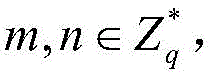
(2)非退化性:

(3)可计算性:对任意的
其中,群和循环群的概念为:设G为群,如果存在一个元素P∈G使得G={nP|n∈Z}(或G={Pn|n∈Z}),则称G为加法循环群(或乘法循环群),称P是群G的生成元。若生成元P的阶为q(即q是使得P的幂等于群G的单位元的最小正整数),则称G为q 阶循环群。此外,
根据以上双线性对的描述,下面结合附图和实现例对本发明提出的多接收者密文可搜索的基于身份加密方法作进一步说明,但并不作为对本发明的限定。Based on the description of the bilinear pairing above, the following describes the multi-receiver ciphertext searchable identity-based encryption method proposed by the present invention with reference to the accompanying drawings and implementation examples, but it is not intended to limit the present invention.
本发明所述方法涉及的实体如下:The entities involved in the method of the present invention are as follows:
(1)密钥生成中心:系统中唯一的可信第三方,负责生成系统的全局参数集和主秘密钥,以及所有其它实体(包括发送者和接收者)的私钥;(1) Key generation center: the only trusted third party in the system, responsible for generating the global parameter set and master secret key of the system, as well as the private keys of all other entities (including senders and receivers);
(2)密文存储服务器:负责存储系统中接收者的密文,并负责在收到接收者的搜索陷门后,对密文进行检索,将符合要求的密文发送给接收者;(2) Ciphertext storage server: responsible for storing the receiver's ciphertext in the system, and is responsible for retrieving the ciphertext after receiving the receiver's search trapdoor, and sending the ciphertext that meets the requirements to the receiver;
(4)发送者:密文的发送实体,将待发送的数据加密成数据密文,然后将与数据相关联的关键词加密成索引密文并附加在数据密文上发送给密文存储服务器;(4) Sender: the sending entity of the ciphertext, encrypts the data to be sent into a data ciphertext, then encrypts the keywords associated with the data into an index ciphertext and attaches it to the data ciphertext and sends it to the ciphertext storage server ;
(5)接收者:密文的接收实体,生成待搜索关键词的搜索陷门并发送给密文存储服务器,授权密文存储服务器通过搜索陷门检索其接收到的密文。(5) Receiver: the entity that receives the ciphertext, generates a search trapdoor for the keyword to be searched and sends it to the ciphertext storage server, and authorizes the ciphertext storage server to retrieve the ciphertext it receives through the search trapdoor.
参照图附图1和附图2,本发明所述方法的步骤具体描述如下:Referring to Figure 1 and Figure 2, the steps of the method of the present invention are specifically described as follows:
一种多接收者密文可搜索的基于身份加密方法,所述方法包含以下步骤:A multi-receiver ciphertext searchable identity-based encryption method comprising the following steps:
步骤A、根据安全参数,密钥生成中心生成系统的全局参数集和主秘密钥;Step A, according to the security parameter, the key generation center generates the global parameter set and the master secret key of the system;
步骤B、根据系统的全局参数集、系统的主秘密钥和实体的身份标识,密钥生成中心生成实体的私钥,实体包括发送者和接收者;Step B, according to the global parameter set of the system, the master secret key of the system and the identity of the entity, the key generation center generates the private key of the entity, and the entity includes a sender and a receiver;
步骤C、根据系统的全局参数集、发送者的私钥、多个接收者的身份标识和一个与待发送数据密文相关联的关键词,发送者生成索引密文,并将之附加在待发送数据密文后;Step C. According to the global parameter set of the system, the private key of the sender, the identities of multiple recipients and a keyword associated with the ciphertext of the data to be sent, the sender generates an index ciphertext and appends it to the ciphertext to be sent. After sending the data ciphertext;
步骤D、根据系统的全局参数集、发送者的身份标识、接收者的私钥和待搜索的关键词,接收者生成搜索陷门;Step D, according to the global parameter set of the system, the identity of the sender, the private key of the receiver and the keyword to be searched, the receiver generates a search trapdoor;
步骤E、根据系统的全局参数集、索引密文和搜索陷门,密文存储服务器测试索引密文和搜索陷门是否匹配,即测试索引密文和搜索陷门所包含的关键词是否相同,若索引密文和搜索陷门匹配成功,密文存储服务器将该索引密文对应的数据密文发送给接收者;否则,密文存储服务器忽略该索引密文对应的数据密文。Step E, according to the global parameter set of the system, the index ciphertext and the search trapdoor, the ciphertext storage server tests whether the index ciphertext matches the search trapdoor, that is, whether the keywords contained in the test index ciphertext and the search trapdoor are identical, If the index ciphertext matches the search trapdoor successfully, the ciphertext storage server sends the data ciphertext corresponding to the index ciphertext to the receiver; otherwise, the ciphertext storage server ignores the data ciphertext corresponding to the index ciphertext.
进一步的,所述步骤A的详细步骤如下:Further, the detailed steps of the step A are as follows:
步骤A.1、密钥生成中心根据安全参数λ∈Z+生成一个λ比特的素数q,一个q阶加法循环群G和一个q阶乘法循环群GT,并定义一个双线性映射fbp:G×G→GT,其中Z+为正整数集合,fbp:G×G→GT是加法循环群G和自身的笛卡尔积G×G到乘法循环群 GT的映射,即双线性映射fbp:G×G→GT是指函数z=fbp(x,y),其中,x,y∈G为自变量,z∈GT为因变量;Step A.1. The key generation center generates a prime number q of λ bits, a q-order addition cyclic group G and a q-order multiplication cyclic group G T according to the security parameter λ∈Z + , and defines a bilinear map f bp :G×G→G T , where Z + is the set of positive integers, f bp :G×G→G T is the mapping from the Cartesian product of the additive cyclic group G and itself to the multiplicative cyclic group G T , that is, double The linear mapping f bp : G×G→G T refers to the function z=f bp (x, y), where x, y∈G are independent variables, and z∈G T is the dependent variable;
步骤A.2、从加法循环群G中选择一个生成元P,并随机选择一个整数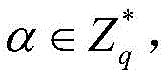

步骤A.3、定义四个哈希函数H1:{0,1}*→G,


步骤A.4、生成系统的全局参数集prms={q,G,GT,fbp,P,Ppub,H1,H2,H3,H4}和系统的主秘密钥msk=α。Step A.4. Generate the global parameter set prms={q, G, G T , f bp , P, P pub , H 1 , H 2 , H 3 , H 4 } and the master secret key msk=α of the system .
进一步的,所述步骤B的详细步骤如下:根据系统的全局参数集 prms={q,G,GT,fbp,P,Ppub,H1,H2,H3,H4},系统的主秘密钥msk=α和实体的身份标识 ID,私钥生成中心生成实体的私钥skID=αQID,其中,QID=H1(ID)为哈希函数H1输出的身份标识ID的哈希值,将发送者的身份标识和私钥分别表示为IDS和

进一步的,所述步骤C的详细步骤如下:Further, the detailed steps of the step C are as follows:
步骤C.1、根据系统的全局参数集prms={q,G,GT,fbp,P,Ppub,H1,H2,H3,H4}和n个接收者的身份标识{IDR,1,IDR,2,…,IDR,n},发送者根据自己的私钥


步骤C.2、计算索引密文的第一部分C1=rP和索引密文的第二部分
步骤C.3、发送者组合C1,C2,C3,C4生成索引密文IC,即索引密文IC=(C1,C2,C3,C4)由C1,C2,C3,C4四个部分构成,然后将之附加在数据密文上发送给密文存储服务器。Step C.3, the sender combines C 1 , C 2 , C 3 , C 4 to generate an index ciphertext IC, that is, the index ciphertext IC=(C 1 , C 2 , C 3 , C 4 ) is composed of C 1 , C 2 , C 3 , C 4 are composed of four parts, which are then attached to the data ciphertext and sent to the ciphertext storage server.
进一步的,所述步骤D的详细步骤如下:Further, the detailed steps of the step D are as follows:
步骤D.1、第i个接收者随机选择一个整数
步骤D.2、根据系统的全局参数集prms={q,G,GT,fbp,P,Ppub,H1,H2,H3,H4},发送者的身份标识IDS,第i个接收者的私钥


步骤D.3、第i个接收者组合T1和T2生成搜索陷门ST,即搜索陷门ST=(T1,T2)由 T1和T2两个部分构成,然后发送给密文存储服务器。Step D.3, the i-th receiver combines T 1 and T 2 to generate a search trapdoor ST, that is, the search trap door ST=(T 1 , T 2 ) consists of two parts T 1 and T 2 , and then sends it to the encrypted file storage server.
进一步的,所述步骤E的详细步骤如下:Further, the detailed steps of the step E are as follows:
步骤E.1、根据系统的全局参数集prms={q,G,GT,fbp,P,Ppub,H1,H2,H3,H4},索引密文IC=(C1,C2,C3,C4)和搜索陷门ST=(T1,T2),密文存储服务器计算 v′i=H3(fbp(T2,C1)·fbp(T1,C2)),并利用索引密文的第三部分C3=(c0,c1,…,cn-1)重构多项式g(x)=c0+c1x+...+cn-1xn-1+xn,其中,v′i=H3(fbp(T2,C1)·fbp(T1,C2))为哈希函数H3输出的双线性映射值fbp(T2,C1)和双线性映射值fbp(T1,C2)乘积的哈希值;Step E.1. According to the global parameter set of the system prms={q, G, G T , f bp , P, P pub , H 1 , H 2 , H 3 , H 4 }, the index ciphertext IC=(C 1 ,C 2 ,C 3 ,C 4 ) and the search trapdoor ST=(T 1 ,T 2 ), the ciphertext storage server calculates v′ i =H 3 (f bp (T 2 ,C 1 )·f bp (T 1 , C 2 )), and reconstruct the polynomial g(x) =c 0 + c 1 x + ... +c n-1 x n-1 +x n , where v′ i =H 3 (f bp (T 2 ,C 1 )·f bp (T 1 ,C 2 )) is the output of the hash function H 3 The hash value of the product of the bilinear map value f bp (T 2 , C 1 ) and the bilinear map value f bp (T 1 , C 2 );
步骤E.2、密文存储服务器计算β′=g(v′i),检查等式C4=H4(C1,C2,c0,c1,…,cn-1,β′) 是否成立,如果等式成立,则表示索引密文和搜索陷门相匹配,将索引密文IC对应的数据密文发送给接收者;否则,匹配测试失败,忽略该索引密文IC。Step E.2, the ciphertext storage server calculates β′=g(v′ i ), and checks the equation C 4 =H 4 (C 1 ,C 2 ,c 0 ,c 1 ,...,cn -1 ,β′ ) is established, if the equation is established, it means that the index ciphertext matches the search trapdoor, and the data ciphertext corresponding to the index ciphertext IC is sent to the receiver; otherwise, the matching test fails, and the index ciphertext IC is ignored.
参见附图3,本发明还提出一种多接收者密文可搜索的基于身份加密系统,包括系统参数生成模块、实体私钥生成模块、关键词密文生成模块、关键词陷门生成模块和测试模块:Referring to Figure 3, the present invention also proposes a multi-receiver ciphertext searchable identity-based encryption system, including a system parameter generation module, an entity private key generation module, a keyword ciphertext generation module, a keyword trapdoor generation module and Test module:
系统参数生成模块,用于根据输入的安全参数生成系统的全局参数集和主秘密钥;The system parameter generation module is used to generate the global parameter set and master secret key of the system according to the input security parameters;
实体私钥生成模块,用于根据所述系统的全局参数集、系统的主秘密钥和实体的身份标识,生成实体的私钥;an entity private key generation module for generating an entity's private key according to the global parameter set of the system, the master secret key of the system and the identity of the entity;
索引密文生成模块,用于根据所述系统的全局参数集、发送者的私钥、多个接收者的身份标识和一个与待发送数据密文相关联的关键词,生成索引密文;an index ciphertext generating module, used for generating an index ciphertext according to the global parameter set of the system, the sender's private key, the identities of multiple recipients and a keyword associated with the data ciphertext to be sent;
搜索陷门生成模块,用于根据所述系统的全局参数集、发送者的身份标识、接收者的私钥和待搜索关键词,生成搜索陷门;A search trapdoor generating module is used to generate a search trapdoor according to the global parameter set of the system, the sender's identity, the receiver's private key and the keywords to be searched;
匹配测试模块,用于根据所述系统的全局参数集、索引密文和搜索陷门,测试索引密文和搜索陷门是否匹配,若索引密文和搜索陷门匹配成功,则将该索引密文对应的数据密文发送给接收者;否则,忽略该索引密文对应的数据密文。The matching test module is used to test whether the index ciphertext and the search trapdoor match according to the global parameter set of the system, the index ciphertext and the search trapdoor. The data ciphertext corresponding to the index is sent to the receiver; otherwise, the data ciphertext corresponding to the index ciphertext is ignored.
本技术领域技术人员可以理解的是,除非另外定义,这里使用的所有术语(包括技术术语和科学术语)具有与本发明所属领域中的普通技术人员的一般理解相同的意义。还应该理解的是,诸如通用字典中定义的那些术语应该被理解为具有与现有技术的上下文中的意义一致的意义,并且除非像这里一样定义,不会用理想化或过于正式的含义来解释。It will be understood by those skilled in the art that, unless otherwise defined, all terms (including technical and scientific terms) used herein have the same meaning as commonly understood by one of ordinary skill in the art to which this invention belongs. It should also be understood that terms such as those defined in general dictionaries should be understood to have meanings consistent with their meanings in the context of the prior art and, unless defined as herein, are not to be taken in an idealized or overly formal sense. explain.
以上所述的具体实施方式,对本发明的目的、技术方案和有益效果进行了进一步详细说明,所应理解的是,以上所述仅为本发明的具体实施方式而已,并不用于限制本发明,凡在本发明的精神和原则之内,所做的任何修改、等同替换、改进等,均应包含在本发明的保护范围之内。The specific embodiments described above further describe the objectives, technical solutions and beneficial effects of the present invention in detail. It should be understood that the above descriptions are only specific embodiments of the present invention, and are not intended to limit the present invention. Any modification, equivalent replacement, improvement, etc. made within the spirit and principle of the present invention shall be included within the protection scope of the present invention.
以上所述,仅是本发明的优选实施例,并非对本发明做任何形式上的限制,基于本发明中的实施例,本领域普通技术人员在没有做出创造性劳动前提下所获得的所有其他实施例,都属于本发明的保护范围;凡是依据本发明的技术实质,对以上实施例所做出任何简单修改或同等变化,均落入本发明的保护范围之内。The above are only preferred embodiments of the present invention, and do not limit the present invention in any form. Based on the embodiments of the present invention, all other implementations obtained by those of ordinary skill in the art without creative work All examples belong to the protection scope of the present invention; any simple modifications or equivalent changes made to the above embodiments according to the technical essence of the present invention all fall within the protection scope of the present invention.
Claims (3)





Priority Applications (1)
| Application Number | Priority Date | Filing Date | Title |
|---|---|---|---|
| CN202010971811.1A CN112152803B (en) | 2020-09-15 | 2020-09-15 | A multi-receiver ciphertext searchable identity-based encryption method |
Applications Claiming Priority (1)
| Application Number | Priority Date | Filing Date | Title |
|---|---|---|---|
| CN202010971811.1A CN112152803B (en) | 2020-09-15 | 2020-09-15 | A multi-receiver ciphertext searchable identity-based encryption method |
Publications (2)
| Publication Number | Publication Date |
|---|---|
| CN112152803A CN112152803A (en) | 2020-12-29 |
| CN112152803B true CN112152803B (en) | 2021-12-21 |
Family
ID=73892857
Family Applications (1)
| Application Number | Title | Priority Date | Filing Date |
|---|---|---|---|
| CN202010971811.1A Expired - Fee Related CN112152803B (en) | 2020-09-15 | 2020-09-15 | A multi-receiver ciphertext searchable identity-based encryption method |
Country Status (1)
| Country | Link |
|---|---|
| CN (1) | CN112152803B (en) |
Families Citing this family (4)
| Publication number | Priority date | Publication date | Assignee | Title |
|---|---|---|---|---|
| CN113422685B (en) * | 2021-06-22 | 2022-06-24 | 南京师范大学 | A certificateless searchable public key encryption method and system for time-limited revocation of search tokens |
| CN113836553B (en) * | 2021-09-22 | 2023-10-20 | 北京计算机技术及应用研究所 | Distributed storage data protection method for dynamic reconstruction of cryptographic algorithm |
| CN115021934A (en) * | 2022-05-31 | 2022-09-06 | 福建师范大学 | Authentication searchable encryption system and method based on BB signature |
| CN115473703B (en) * | 2022-08-24 | 2024-04-12 | 华南农业大学 | Authentication ciphertext equivalent test method, device, system and medium based on identity |
Citations (7)
| Publication number | Priority date | Publication date | Assignee | Title |
|---|---|---|---|---|
| CN103873236A (en) * | 2012-12-12 | 2014-06-18 | 华为技术有限公司 | Searchable encryption method and equipment thereof |
| CN104852801A (en) * | 2015-02-13 | 2015-08-19 | 陕西师范大学 | Searchable public key encryption method |
| CN106549753A (en) * | 2016-10-18 | 2017-03-29 | 电子科技大学 | The encipherment scheme that a kind of support ciphertext of identity-based compares |
| CN106803784A (en) * | 2017-03-30 | 2017-06-06 | 福州大学 | The multi-user based on lattice is fuzzy in secure multimedia cloud storage can search for encryption method |
| CN108924103A (en) * | 2018-06-22 | 2018-11-30 | 广东石油化工学院 | The on-line/off-line of identity-based towards cloud storage can search for encryption method |
| CN110602064A (en) * | 2019-08-29 | 2019-12-20 | 河海大学 | Identity-based encryption method and system supporting multi-keyword search |
| CN111416710A (en) * | 2020-03-24 | 2020-07-14 | 国网山东省电力公司 | A certificateless searchable encryption method and system applied to multiple receivers |
Family Cites Families (3)
| Publication number | Priority date | Publication date | Assignee | Title |
|---|---|---|---|---|
| CN107395568A (en) * | 2017-06-21 | 2017-11-24 | 西安电子科技大学 | A kind of cipher text retrieval method of more data owner's certifications |
| EP3623980B1 (en) * | 2018-09-12 | 2021-04-28 | British Telecommunications public limited company | Ransomware encryption algorithm determination |
| CN109614818B (en) * | 2018-11-30 | 2020-06-05 | 西南石油大学 | Authorized identity-based keyword search encryption method |
-
2020
- 2020-09-15 CN CN202010971811.1A patent/CN112152803B/en not_active Expired - Fee Related
Patent Citations (7)
| Publication number | Priority date | Publication date | Assignee | Title |
|---|---|---|---|---|
| CN103873236A (en) * | 2012-12-12 | 2014-06-18 | 华为技术有限公司 | Searchable encryption method and equipment thereof |
| CN104852801A (en) * | 2015-02-13 | 2015-08-19 | 陕西师范大学 | Searchable public key encryption method |
| CN106549753A (en) * | 2016-10-18 | 2017-03-29 | 电子科技大学 | The encipherment scheme that a kind of support ciphertext of identity-based compares |
| CN106803784A (en) * | 2017-03-30 | 2017-06-06 | 福州大学 | The multi-user based on lattice is fuzzy in secure multimedia cloud storage can search for encryption method |
| CN108924103A (en) * | 2018-06-22 | 2018-11-30 | 广东石油化工学院 | The on-line/off-line of identity-based towards cloud storage can search for encryption method |
| CN110602064A (en) * | 2019-08-29 | 2019-12-20 | 河海大学 | Identity-based encryption method and system supporting multi-keyword search |
| CN111416710A (en) * | 2020-03-24 | 2020-07-14 | 国网山东省电力公司 | A certificateless searchable encryption method and system applied to multiple receivers |
Non-Patent Citations (1)
| Title |
|---|
| 《安全的指定发送者的基于身份的可搜索加密方案》;魏晶等;《计算机应用与软件》;20200412;正文第285-288页 * |
Also Published As
| Publication number | Publication date |
|---|---|
| CN112152803A (en) | 2020-12-29 |
Similar Documents
| Publication | Publication Date | Title |
|---|---|---|
| Baek et al. | Public key encryption with keyword search revisited | |
| CN112152803B (en) | A multi-receiver ciphertext searchable identity-based encryption method | |
| Amanatidis et al. | Provably-secure schemes for basic query support in outsourced databases | |
| Yang et al. | Achieving efficient and privacy-preserving cross-domain big data deduplication in cloud | |
| Van Liesdonk et al. | Computationally efficient searchable symmetric encryption | |
| Ma et al. | Public key encryption with delegated equality test in a multi-user setting | |
| Wu et al. | Verifiable public key encryption with keyword search based on homomorphic encryption in multi-user setting | |
| Xu et al. | Verifiable public key encryption scheme with equality test in 5G networks | |
| CN111786790A (en) | A privacy-preserving identity-based encryption method and system with keyword search | |
| CN110602064A (en) | Identity-based encryption method and system supporting multi-keyword search | |
| CN111934875B (en) | A public key encryption method and system supporting ciphertext fuzzy search function | |
| CN113407966B (en) | Searchable public key encryption method and system with key update and ciphertext sharing functions | |
| CN114039725B (en) | A fuzzy identity-based encryption method based on SM9 | |
| Lu et al. | Constructing pairing-free certificateless public key encryption with keyword search | |
| Zhang et al. | Secure cloud-assisted data pub/sub service with fine-grained bilateral access control | |
| Tuo et al. | An effective fuzzy keyword search scheme in cloud computing | |
| Zhang et al. | Secure and efficient searchable public key encryption for resource constrained environment based on pairings under prime order group | |
| CN114338025A (en) | Ciphertext equivalence testing method in cloud environment | |
| CN113422685B (en) | A certificateless searchable public key encryption method and system for time-limited revocation of search tokens | |
| Hwang et al. | An ElGamal-like secure channel free public key encryption with keyword search scheme | |
| CN111966802A (en) | Attribute-based encryption method and system supporting keyword Boolean search | |
| Choudhary et al. | A comparative analysis of cryptographic keys and security | |
| Kerschbaum | Secure conjunctive keyword searches for unstructured text | |
| Yang et al. | Keyword searchable encryption scheme based on blockchain in cloud environment | |
| Zhang et al. | Leakage-resilient hierarchical identity-based encryption with recipient anonymity |
Legal Events
| Date | Code | Title | Description |
|---|---|---|---|
| PB01 | Publication | ||
| PB01 | Publication | ||
| SE01 | Entry into force of request for substantive examination | ||
| SE01 | Entry into force of request for substantive examination | ||
| GR01 | Patent grant | ||
| GR01 | Patent grant | ||
| CF01 | Termination of patent right due to non-payment of annual fee | ||
| CF01 | Termination of patent right due to non-payment of annual fee |
Granted publication date: 20211221 |