Disclosure of Invention
In order to overcome the defects in the prior art, the application provides a distributed photovoltaic power station power data virtual acquisition method.
In order to achieve the above purpose, the invention adopts the following technical scheme:
a virtual power data acquisition method for a distributed photovoltaic power station comprises the following steps:
step 1: selecting a similar day of a power station acquisition day to be acquired according to the meteorological feature similarity, and taking power data of a benchmarking power station and current data of the power station to be acquired on the similar day as training samples of the wavelet neural network;
and 2, step: constructing a wavelet neural network, and optimizing parameters of the wavelet neural network by using a bat algorithm;
and step 3: taking the wavelet neural network parameters obtained by optimization in the step (2) as initial parameters of the wavelet neural network, and training the wavelet neural network by using training samples to obtain a power data virtual acquisition model;
and 4, step 4: and inputting power data of the acquired sun post power station and current data of the power station to be acquired, and performing data fitting by using a power data virtual acquisition model to realize virtual acquisition of the power data.
The invention further comprises the following preferred embodiments:
preferably, the benchmark power station and the power station to be collected are distributed photovoltaic power stations in the same meteorological area range in the step 1, the equipment parameters of the benchmark power station and the power station to be collected are the same, the benchmark power station is provided with a power data collection terminal, and the power station to be collected is provided with a current collection terminal.
Preferably, step 1 specifically comprises the following steps:
step 1.1: acquiring meteorological data of an acquisition day and P historical days before the acquisition day, wherein P is more than 1;
step 1.2: and respectively constructing meteorological feature vectors for the acquisition day and each historical day:
X=[F 1 ,F 2 ,…,F n-1 ,F av ];
F av average value of daily irradiance, F m (m-1, 2, …, n-1) is meteorological data at each time of the day;
step 1.3: respectively carrying out component normalization processing on each meteorological feature vector constructed in the step 1.2;
the meteorological feature vectors after the acquisition day and the historical day are normalized respectively as follows:
x 0 =(x 0 (1),x 0 (2),…,x 0 (n))
x i =(x i (1),x i (2),…,x i (n))
in the formula, x 0 For collecting weather feature vector, x, normalized by day i The meteorological feature vector is normalized for the ith historical day; x is a radical of a fluorine atom 0 (n) is the normalized component of the nth day of acquisition, x i (n) is the nth normalized component on the ith history day, i is 1, … P;
step 1.4: calculating x i Relative to x 0 Similarity comprehensive index S of i ;
Step 1.5: the comprehensive similarity index values of all the historical days are arranged in a descending manner, the previous Q historical days are selected as similar days, and Q is smaller than P;
step 1.6: and taking the power data of the benchmarking power station and the current data of the power station to be collected on similar days as training samples of the wavelet neural network.
Preferably, in step 1.1, the meteorological data acquired is irradiance.
Preferably, in step 1.3, the following normalization is used:
in the formula, x min 、x max The data are respectively original data, a minimum value in the original data and a maximum value in the original data, and x' is normalized data.
Preferably, step 1.4 comprises the steps of:
step 1.4.1: separately calculate x 0 And x i Correlation coefficient at nth component:
wherein Δ ═ x 0 (n)-x i (n)|,ξ i (n) is a correlation coefficient, and r is a resolution coefficient;
step 1.4.2: separately calculate x 0 And x i The similarity of (2):
wherein N is the total number of the correlation coefficients of each component;
step 1.4.3: separately calculate x 0 And x i Cosine similarity of (c):
wherein x is ok 、x ik Respectively acquiring the kth component of the feature vector of the daily and ith historical solar weather;
step 1.4.4: calculating x i Relative to x 0 Similarity comprehensive index S of i :
S i =αR i +(1-α)D cosi
Where α is an empirical weighting factor.
Preferably, the wavelet neural network replaces the activation function of the neural network with the wavelet function, and the corresponding weight and activation threshold from the input layer to the hidden layer are replaced by the scale expansion factor and the translation factor of the wavelet function;
the network structure of the wavelet neural network comprises three layers, namely an input layer, a hidden layer and an output layer;
the number of hidden layer nodes is:
in the formula: n is the number of hidden layer nodes, i is the number of input layer nodes, k is the number of output layer nodes, and a is a constant between 1 and 10;
the wavelet basis function of the wavelet neural network is a Morlet function:
the hidden layer output formula is:
in the formula:
the output of the jth node of the hidden layer; n is the total number of nodes of the hidden layer;
the output layer calculation formula is as follows:
in the formula: k is the number of output layer nodes;
the network error is:
in the formula: y is n (k) To the desired output, y (k) is the fitted output value.
Preferably, the wavelet neural network parameters include a weight, a scaling factor and a shifting factor.
Preferably, the step 2 of optimizing parameters of the wavelet neural network by using the bat algorithm comprises the following steps:
step 2.1: setting a bat algorithm initial value: maximum iteration number IMAX, population size N, population dimension, range f of pulse frequency i ∈[f min ,f max ]Frequency of pulses r 0 Loudness A 0 The pulse loudness control coefficient alpha, the frequency control coefficient mu and the precision are epsilon, and the population dimension is the total number of weight, translation factors and expansion factors which need to be optimized;
step 2.2: randomly initializing bat individual position X i (i ═ 1,2, …, m), and finding the optimal position X based on the minimum value of the Fitness function Fitness * ;
In the formula: y is n (k) Y (k) is the fitted output value for the desired output;
step 2.3: optimizing the position of each individual, and updating each individual position, speed and echo frequency as follows:
f i =f min +(f max -f min )β
in the formula:
and
respectively representing the positions of the bat individual i at the time t +1 and t; p is a radical of formula
best Represents the optimal position of all bat individuals at present; beta is uniformly distributed in [0,1 ]]A random number above; f. of
i Echo frequency, f, of an individual bat
i ∈[f
min ,f
max ];
And
the speed of the bat i at the time t and t +1 respectively;
step 2.4: generating a random number rand 1 If rand 1 <r i Disturbing the bat individual at the optimal position, and replacing the current position with the disturbed position;
step 2.5: generating a random number rand 1 If rand 2 <r i And f (X) i )<f(X * ) Moving the bat individual to an updated position;
step 2.6: when step 2.5 is satisfied, the pulse frequency r and the tone a are adjusted according to the following formula:
in the formula: alpha is a pulse loudness control coefficient, mu is a frequency control coefficient, and alpha and mu are constants;
is the maximum pulse frequency;
the pulse frequency at time t + 1;
step 2.7: finding out the optimal position of the optimized bat individual according to the bat group fitness value;
step 2.8: judging whether the maximum search frequency is reached or the search precision is met, if the maximum search frequency is reached or the search precision is met, turning to the step 2.9, otherwise, turning to the step 2.2 to search
Step 2.9: and outputting the global optimal solution, and finishing the algorithm.
Preferably, step 3 comprises the steps of:
step 3.1: inputting a training sample, and training a wavelet neural network;
step 3.2: calculating an error value between the output value and the expected value;
step 3.3: and (3) reversely propagating errors, correcting parameters of the wavelet neural network, returning to the step 3.1 until the error precision or the maximum training times is reached, ending the training, and taking the current wavelet neural network as a virtual power data acquisition model.
The beneficial effect that this application reached:
in the same region, a distributed photovoltaic power station is provided with a completely installed data acquisition device, other distributed photovoltaic power stations are provided with current acquisition terminals with lower price, a power data virtual acquisition model is established by the method based on the combination of similar days and BA-WNN, and the actual data acquisition of data acquisition equipment such as sensors is replaced by a virtual prediction mode of power data, so that the problems that the quantity of data points to be monitored for acquiring data of the distributed photovoltaic power station is very huge and the data acquisition cost is too high only by increasing the data acquisition equipment such as sensors due to the fact that most distributed photovoltaic power stations have the characteristics of a plurality of points and scattered disorder are solved.
Detailed Description
The present application is further described below with reference to the accompanying drawings. The following examples are only for illustrating the technical solutions of the present invention more clearly, and the protection scope of the present application is not limited thereby.
As shown in fig. 1 and 2, the virtual collection method for power data of a distributed photovoltaic power station of the present invention includes the following steps:
step 1: selecting a similar day of a power station acquisition day to be acquired according to the meteorological feature similarity, and taking power data of a benchmarking power station and current data of the power station to be acquired on the similar day as training samples of the wavelet neural network;
the utility model discloses a power station, including sighting post power station, sighting post power station, sighting post, power station, current acquisition terminal.
In the embodiment of the present application, the step 1 is to select a similar day based on the combination of a gray correlation theory and a cosine similarity, and use power data and current data of the similar day as training samples of a wavelet neural network, and specifically includes the following steps:
step 1.1: acquiring meteorological data of an acquisition day and a plurality of historical days before the acquisition day: by referring to relevant documents and combining with actual existing data, in the specific implementation of the method, selected meteorological data irradiance is used as a feature vector selected on a similar day, the characteristic that historical data has 'big-end-up-end-down' on photovoltaic power generation is considered, and irradiance of nearly three months is selected;
step 1.2: and respectively constructing meteorological feature vectors for the acquisition day and each historical day:
X=[F 1 ,F 2 ,…,F n-1 ,F av ];
F av average value of daily irradiance, F m (m-1, 2, …, n-1) is the irradiance at each moment of the day;
step 1.3: and (3) respectively carrying out component normalization processing on each meteorological feature vector constructed in the step 1.2:
in the formula, x min 、x max The data are respectively original data, a minimum value in the original data and a maximum value in the original data, and x' is normalized data.
The meteorological feature vectors after the normalization of the acquisition day and the historical day are respectively as follows:
x 0 =(x 0 (1),x 0 (2),…,x 0 (n))
x i =(x i (1),x i (2),…,x i (n))
in the formula, x 0 For collecting weather feature vector, x, normalized by day i The meteorological feature vector is normalized for the ith historical day; x is the number of 0 (n) is the nth normalized component of the day of acquisition, x i (n) is the nth normalized component of the ith history day.
Step 1.4: calculating x i Relative to x 0 Similarity comprehensive index S of i The method comprises the following steps:
step 1.4.1: separately calculate x 0 And x i Correlation coefficient at nth component:
wherein Δ ═ x 0 (n)-x i (n)|,ξ i (n) is a correlation coefficient, and r is a resolution coefficient;
step 1.4.2: because the correlation coefficients are many, the information is too scattered and inconvenient to compare, and in order to synthesize the correlation coefficients of each component, the average value is generally adopted for processing, namely, x is calculated respectively 0 And x i Similarity of (2):
wherein N is the total number of the correlation coefficients of each component;
step 1.4.3: separately calculate x 0 And x i Cosine similarity of (c):
wherein x is ok 、x ik The kth component of the feature vector of the acquired day and the ith historical day weather picture is respectively;
step 1.4.4: the grey correlation degree analysis method is one of grey system analysis methods, judges the correlation degree according to the similarity degree between data sequence numerical values, and is a method for measuring the correlation degree between factor numerical values. Cosine similarity is a method for measuring the similarity between the variation trends of data sequences. In order to avoid the limitation of a single evaluation method, the similarity D of the data sequence values is comprehensively considered cosi Similarity to the trend of change, the overall degree of association R i Combines the 2 indexes with the cosine similarity into a similarity comprehensive index S i Overall similarity is characterized, with values closer to 1 representing more similarity.
x i Relative to x 0 Similarity comprehensive index S of i The calculation formula is as follows:
S i =αR i +(1-α)D cosi
where α is an empirical weight coefficient, and is preferably 0.5.
Step 1.5: the comprehensive similarity index values of all the historical days are arranged in a descending manner, and the previous 10 historical days are selected as similar days;
step 1.6: and taking the power data of the benchmarking power station and the current data of the power station to be collected on similar days as training samples of the wavelet neural network.
Step 2: constructing a wavelet neural network, and optimizing parameters such as a weight, a scaling factor, a translation factor and the like of the wavelet neural network by using a bat algorithm;
the wavelet neural network replaces the activation function of the neural network with the wavelet function, and the corresponding weight and activation threshold from the input layer to the hidden layer are replaced by the scale expansion factor and the translation factor of the wavelet function;
the wavelet neural network uses the most extensive compact structure, and the network structure is shown in fig. 3;
in FIG. 3, x
1 ,x
2 ,…,x
i Is input data of wavelet neural network, Y is output data set obtained by fitting, omega
ij Weight, ω, representing the input and hidden layers
jk Weight values representing a hidden layer and an output layer, a
j And b
j Scale factors and translation factors, respectively.
The wavelet basis function is represented, and a Morlet function is selected as the wavelet basis function in the embodiment of the invention:
the hidden layer output formula is:
in the formula:
for the jth section of the hidden layerOutputting the points; n is the total number of nodes of the hidden layer;
the output layer calculation formula is as follows:
in the formula: k is the number of output layer nodes;
the network error is:
in the formula: y is n (k) To the desired output, y (k) is the fitted output value.
Compared with a BP neural network, the elements and the whole structure of the wavelet neural network are determined according to a wavelet analysis theory, so that the blindness in structural design of the BP neural network and the like is effectively avoided; in addition, the wavelet theory is full-scale analysis, and not only is a global optimal solution, but also a local detail optimal solution is kept, so that the wavelet neural network has relatively stronger learning capability and higher precision. However, as the input dimension increases, the training sample increases, and the convergence rate of the wavelet neural network is greatly reduced. Meanwhile, when the initialization parameters of the wavelet neural network are unreasonable, the whole network learning process can not be converged [15] Therefore, the invention adopts the bat algorithm to optimize the neural network parameter initialization problem.
The number of nodes in the hidden layer is as follows:
in the formula: n is the number of nodes of the hidden layer, i is the number of nodes of the input layer, k is the number of nodes of the output layer, and a is a constant between 1 and 10;
step 2, optimizing parameters of the wavelet neural network by using the bat algorithm, comprising the following steps of:
the Bat Algorithm (BA) is a global search optimization algorithm, the basic idea is to map Bat population individuals into feasible solutions in space, simulate the search process and the optimization process into Bat individual hunting and moving processes, measure the advantages and disadvantages of the positions of bats by using a fitness function for solving problems, and analogize the optimizing process into an individual selection process. The basic principle of the bat algorithm is as follows:
step 2.1: setting a bat algorithm initial value: maximum iteration number IMAX, population size N, population dimension, range f of pulse frequency i ∈[f min ,f max ]Frequency of pulses r 0 Loudness A 0 The pulse loudness control coefficient alpha, the frequency control coefficient mu and the precision are epsilon, and the population dimension is the total number of weight, translation factors and expansion factors which need to be optimized;
step 2.2: randomly initializing bat individual position X i (i=1 , 2, …, m) and find the optimum position X based on the minimum value of the Fitness function Fitness * ;
In the formula: y is n (k) Y (k) is the fitted output value for the desired output;
step 2.3: optimizing the position of each individual, and updating each individual position, speed and echo frequency as follows:
f i =f min +(f max -f min )β
in the formula:
and
respectively representing the positions of the bat individual i at t +1 and t; p is a radical of
best Represents the optimal positions of all bat individuals at present; beta is uniformly distributed in [0,1 ]]A random number of (c); f. of
i Echo frequency, f, of an individual bat
i ∈[f
min ,f
max ];
And
the speed of the bat i at the time t and t +1 respectively;
step 2.4: generating random number rand 1 If rand 1 <r i Disturbing the bat individual at the optimal position, and replacing the current position with the disturbed position;
step 2.5: generating a random number rand 1 If rand 2 <r i And f (X) i )<f(X * ) Moving the bat individual to an updated location;
step 2.6: when step 2.5 is satisfied, the pulse frequency r and the tone a are adjusted according to the following formula:
in the formula: alpha is a pulse loudness control coefficient, mu is a frequency control coefficient, and alpha and mu are constants;
is the maximum pulse frequency;
the pulse frequency at time t + 1. Loudness and pulse frequency only in the process of solutionUpdated at the time of change, which means that the bat algorithm proceeds only towards the optimal solution.
Step 2.7: finding out the optimal position of the optimized bat individual according to the bat group fitness value;
step 2.8: judging whether the maximum search frequency is reached or the search precision is met, if the maximum search frequency is reached or the search precision is met, turning to the step 2.9, otherwise, turning to the step 2.2 to search
Step 2.9: and outputting the global optimal solution, and finishing the algorithm.
The bat algorithm has better convergence and global search capability and has no many parameters to adjust. If the wavelet neural network is combined with the wavelet neural network, the weight, the expansion factor and the translation factor in the wavelet neural network can be continuously adjusted and optimized by utilizing the stronger global convergence capability of the bat algorithm, so that the performance of the wavelet neural network is obviously improved.
And step 3: taking the wavelet neural network parameters obtained by optimization in the step 2 as initial parameters of the wavelet neural network, training the wavelet neural network by using training samples to obtain a virtual power data acquisition model, and comprising the following steps of:
step 3.1: inputting a training sample, and training a wavelet neural network;
step 3.2: calculating an error value between the output value and the expected value; namely, calculating the network error:
in the formula: y is n (k) To the desired output, y (k) is the fitted output value.
Step 3.3: and (3) reversely propagating errors, correcting parameters of the wavelet neural network, returning to the step 3.1 until the error precision or the maximum training times is reached, ending the training, and taking the current wavelet neural network as a virtual power data acquisition model.
And 4, step 4: and inputting power data of the acquired sun post power station and current data of the power station to be acquired, and performing data fitting by using a power data virtual acquisition model to realize virtual acquisition of the power data.
In order to verify the applicability of the virtual acquisition algorithm, stable weather and fluctuating weather are respectively selected for verification experiments, and similar day data of each acquisition day is firstly respectively selected as a training sample of a neural network; the specific selection method is that S i The data of the first 10 days are selected as training samples according to the size sequence, the comprehensive similar day selection result is shown in figures 4 and 5, the line with the asterisk in the figures is the acquisition day irradiance, the other solid lines are the similar day irradiance, and the observation trend is used for verifying the accuracy of similar day selection.
It can be seen from fig. 4 and 5 that the selection mode of the similar days of the present invention has a better effect, and the irradiance of each similar day has stronger similarity in value or variation trend, which can provide a powerful support for the subsequent training of the neural network.
The power data and the current data of similar days are used as training samples of the wavelet neural network, the wavelet neural network is trained on stable weather and sudden change weather respectively after the data are normalized, and the related parameters of the wavelet neural network are set as follows: the training times are 100 times, the learning efficiency of the weight factor is 0.01, the network structure is three layers, the number of nodes of an input layer is 2, the number of nodes of an output layer is 1, and the empirical formula for selecting the nodes of the output power hidden layer of the power station of which the data are to be acquired is as follows:
in the formula: n is the number of hidden layer nodes, i is the number of input layer nodes, k is the number of output layer nodes, and a is a constant between 1 and 10.
Through comparison results of multiple experiments, the number of the hidden layer nodes selected in the embodiment of the invention is determined to be 4.
The bat algorithm related parameters are set as follows: setting the maximum iteration times of the bat algorithm to be 100 times, setting the population scale to be 25, and setting the total number of the weight, the translation factors and the expansion factors needing to be optimized to be 2 multiplied by 4+4 multiplied by 1+4+4 as 20, so the bat algorithmThe dimension of the normal space is 20, the bat pulse frequency range f min ,f max ]=[0,2]The loudness is 0.9, the pulse emissivity is 0.5, the loudness control parameter is 0.98, the frequency emissivity control parameter is 0.98, and the precision is 0.01. After the setting is finished, the wavelet neural network is trained to obtain a virtual power data acquisition model and perform virtual power data acquisition, wherein the virtual acquisition results of each power station in steady weather and the virtual acquisition results of each power station in sudden change weather are respectively shown in fig. 6 and 7:
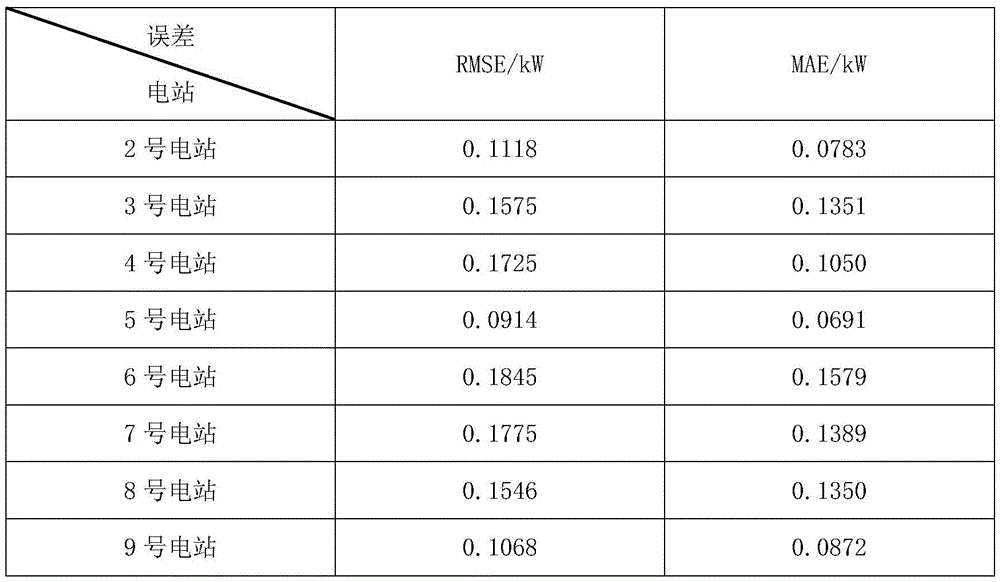
the embodiment of the invention evaluates the virtual acquisition result by mean square error RMSE and mean absolute error MAE, and the calculation method is respectively shown as formula (20) and formula (21):
the error of the stationary weather and the error of the sudden change weather are shown in table 1 and table 2, respectively:
in the formula: n is the total number of collected data points,
in order to virtually collect photovoltaic output power data,
i is the actual value and i is the time of the virtual acquisition.
TABLE 1 Steady weather error index
TABLE 2 sudden change of weather error
As can be seen from fig. 6 and 7, the predicted value of the real-time data of the virtual acquisition model is very close to the true value, and as can be seen from tables 1 and 2, the error between the predicted result of the real-time data and the true value of the virtual acquisition model is small, and the acquisition effect of the virtual acquisition model is good. In order to further verify the superiority of the invention, the invention also establishes a BPNN model, a WNN model, a historical day-BA-WNN based model and a similar day-BA-WNN based model of the invention, namely a virtual acquisition model, and the results are shown in FIG. 8, FIG. 9 and Table 3:
TABLE 3 error index for each model
From the results in fig. 8, fig. 9 and table 3, the following conclusions can be drawn:
(1) the data acquired through virtual acquisition based on the BP neural network has larger error, but the training process is better, which indicates that the data has an obvious overfitting state and cannot be well fitted with the required data.
(2) Compared with a general WNN-based virtual acquisition model and a historical day-based BA-WNN virtual acquisition model in a steady weather or a sudden change weather, the photovoltaic output power condition can be better reflected by the similar day-based BA-WNN virtual acquisition model, errors of the virtual acquisition model are reduced to a certain extent by selecting the similar day and optimizing an algorithm, and the effectiveness of the method is verified.
In summary, in order to reduce the complexity of the prediction model and improve the accuracy of data acquisition, the invention selects the similar days by using the indexes of combining the grey correlation theory and the cosine similarity, and establishes the training sample of the wavelet neural network by using the power and current data of the selected similar days; then, the bat algorithm is utilized to optimize the weight, the expansion factor and the translation factor of the wavelet neural network model, so that the wavelet neural network model is prevented from falling into local convergence, and the virtual acquisition precision is improved. Finally, by taking a simulation experiment as an example, the virtual acquisition model based on the similar day-BA-WNN provided by the invention has better performance for virtually acquiring photovoltaic output data of the distributed power station in an area range compared with other models, realizes the virtual acquisition of power data of the distributed photovoltaic power station, and verifies the feasibility and effectiveness of the model provided by the invention.
The present applicant has described and illustrated embodiments of the present invention in detail with reference to the accompanying drawings, but it should be understood by those skilled in the art that the above embodiments are merely preferred embodiments of the present invention, and the detailed description is only for the purpose of helping the reader to better understand the spirit of the present invention, and not for limiting the scope of the present invention, and on the contrary, any improvement or modification made based on the spirit of the present invention should fall within the scope of the present invention.