CN112000975A - Key management system - Google Patents
Key management system Download PDFInfo
- Publication number
- CN112000975A CN112000975A CN202011168684.8A CN202011168684A CN112000975A CN 112000975 A CN112000975 A CN 112000975A CN 202011168684 A CN202011168684 A CN 202011168684A CN 112000975 A CN112000975 A CN 112000975A
- Authority
- CN
- China
- Prior art keywords
- key
- public
- encryption
- private key
- pair
- Prior art date
- Legal status (The legal status is an assumption and is not a legal conclusion. Google has not performed a legal analysis and makes no representation as to the accuracy of the status listed.)
- Granted
Links
Images



Classifications
-
- G—PHYSICS
- G06—COMPUTING OR CALCULATING; COUNTING
- G06F—ELECTRIC DIGITAL DATA PROCESSING
- G06F21/00—Security arrangements for protecting computers, components thereof, programs or data against unauthorised activity
- G06F21/60—Protecting data
- G06F21/602—Providing cryptographic facilities or services
-
- G—PHYSICS
- G06—COMPUTING OR CALCULATING; COUNTING
- G06F—ELECTRIC DIGITAL DATA PROCESSING
- G06F21/00—Security arrangements for protecting computers, components thereof, programs or data against unauthorised activity
- G06F21/60—Protecting data
- G06F21/64—Protecting data integrity, e.g. using checksums, certificates or signatures
Landscapes
- Engineering & Computer Science (AREA)
- Theoretical Computer Science (AREA)
- Computer Security & Cryptography (AREA)
- Health & Medical Sciences (AREA)
- Bioethics (AREA)
- General Health & Medical Sciences (AREA)
- Computer Hardware Design (AREA)
- Software Systems (AREA)
- Physics & Mathematics (AREA)
- General Engineering & Computer Science (AREA)
- General Physics & Mathematics (AREA)
- Storage Device Security (AREA)
Abstract
The invention discloses a key management system, which comprises: the system comprises a key management server, Linux embedded business processing equipment and an encryption card arranged in the Linux embedded business processing equipment; the key management server is used for generating a signature public and private key pair, an encryption public and private key pair and a storage key, storing the signature public and private key pair, encrypting the signature public and private key pair by a public key of the equipment public and private key pair and then sending the signature public and private key pair to the encryption card; and is also used for resending according to the import application; the encryption card is used for storing the received signed public and private key pair, encrypted public and private key pair and storage key, and respectively generating a file key, a storage key, a session key or a key encryption key for storage and transmission according to a service request of the service processing equipment; the key management system is used for updating, recovering and destroying the stored key; the device is also used for generating a device public and private key pair when leaving a factory; the service processing equipment is used for receiving service requests of other terminals, sending and receiving corresponding service keys of the encryption card to the encryption card and sending the corresponding service keys to the corresponding terminals; and is also used for self-checking of the cryptographic algorithm.
Description
Technical Field
The invention relates to the field of data encryption, in particular to a key management system.
Background
In the prior art, when data is encrypted, the used encryption algorithm is usually a fixed key and cannot be easily modified, and the key is mixed with a software program and is encrypted in a software mode. An attacker can easily break this fixed key by simulating the data. When the key and the software program are mixed and stored, an attacker can obtain the key by decompiling the software program. Once the key is obtained, the encrypted data can be decrypted, so that the originally encrypted sensitive data can be stolen in a large amount, and even the whole system is cracked. Therefore, the encryption is performed in a software mode, and the key is unchanged, so that the risk that an attacker steals the key and private data of a user is leaked is realized.
The reason for the above problems is mainly that in the prior art, keys are not classified according to different purposes, and a set of methods for generating, storing, updating, backing up, recovering and destroying the keys is not used, so that an attacker can easily obtain sensitive information by cracking the keys.
Disclosure of Invention
The invention aims to overcome the defects of the prior art and provides a key management method and a device. The generation and the use of the key are finished in the security chip, and the plaintext of the key does not generate an encryption card.
The invention provides a key management system, which comprises: the system comprises a key management server, Linux embedded business processing equipment and an encryption card arranged in the business processing equipment; wherein,
the key management server is used for generating a signature public and private key pair, an encryption public and private key pair and a storage key according to a cryptographic algorithm, storing in a backup manner, encrypting through a public key of a pre-obtained equipment public and private key pair and then sending to an encryption card; the encryption card is also used for retransmitting the signed public and private key pair, the encrypted public and private key pair and the storage key to the encryption card according to the import application of the encryption card;
the encryption card is used for storing the received signed public and private key pair, encrypted public and private key pair and storage key, and respectively generating a file key, a storage key, a session key or a key encryption key for storage according to a service request of the service processing equipment and sending the file key, the storage key, the session key or the key encryption key to the service processing equipment; the key management system is used for updating, recovering and destroying the stored key; the device is also used for generating a device public and private key pair when the service processing device leaves a factory;
the service processing device is used for receiving service requests of other terminals, sending a service key acquisition application to the encryption card, receiving a file key, a storage key, a session key or a key encryption key sent by the encryption card, and sending a corresponding service key to a corresponding terminal for service processing; the system is also used for self-checking of the cryptographic algorithm during starting and running;
the device public and private key pair is used for protecting other key information;
the signature public and private key pair is used for signature verification;
the encryption public and private key pair is used for generating a key encryption key with the signature public and private key pair;
the file key is used for carrying out encryption protection on the user file;
the storage key is used for carrying out encryption protection on the database;
the session key is used for encrypting messages transmitted between the service processing equipment and other terminals;
and the key encryption key is used for encrypting the information transmitted between the key management server and the service processing equipment.
As an improvement of the above system, the public and private key pair and the encrypted public and private key pair of the device both adopt an encryption and decryption algorithm of an SM2 asymmetric cryptographic algorithm, the generated public keys are 512 bytes long, and the private keys are 256 bytes long;
the signature public and private key pair adopts a signature verification algorithm of an SM2 asymmetric cryptographic algorithm, the generated public key is 512 bytes long, and the private key is 256 bytes long;
the file key is 128 bytes long, and is generated by acquiring random numbers by adopting an SM4 symmetric cryptographic algorithm, wherein one file key corresponds to one file;
the storage key is 128 bytes long and is generated by adopting an SM4 symmetric cryptographic algorithm;
the session key is 128 bytes long, and is generated by acquiring a random number by adopting an SM4 symmetric cryptographic algorithm, and the current session is valid;
the key encryption key is 128 bytes long, and is generated by adopting an SM4 symmetric cryptographic algorithm according to the signature public and private key pair and the encryption public and private key pair, and the session is valid.
As an improvement to the above-described system,
the private key of the public and private key pair of the equipment, the private key of the signed public and private key pair, the private key of the encrypted public and private key pair, the storage key and the key encryption key are all stored in a secure storage area of the encryption card;
the file key is encrypted by a public key of a device public and private key pair and stored in the service processing device;
the session key is stored in a volatile storage area of the encryption card.
As an improvement to the above-described system,
the public and private key pair of the equipment is powered on and updated again after entering a factory state through the encryption card zeroing operation;
the storage key is updated by a key management server;
the signature public and private key pair and the encryption public and private key pair do not need to be updated;
the key encryption key and the session key are updated every time;
the file key is one file key for each file and does not need to be updated.
As an improvement to the above-described system,
the signed public and private key pair, the encrypted public and private key pair and the storage key are restored by being reintroduced from the key management server;
the device public and private key pair, key encryption key, session key and file key do not need to be recovered.
As an improvement to the above-described system,
the public and private key pair of the equipment is destroyed by the zeroing operation of the encryption card;
the signature public and private key pair is destroyed by zeroing the encryption card; or receiving a new signed public-private key pair from the key management server to destroy an old signed public-private key pair;
the encrypted public and private key pair is destroyed by zeroing the encryption card; or receiving a new encrypted public-private key pair from the key management server to destroy the old encrypted public-private key pair;
the storage key is destroyed by carrying out zero setting operation on the encryption card, or a new storage key is received from the key management server to destroy an old storage key;
the key is encrypted and is automatically destroyed after being used each time;
the session key is automatically destroyed after being used each time;
the file key does not need to be destroyed.
As an improvement of the above system, the service processing device further includes a cryptographic algorithm self-checking module and a random number self-checking module; wherein,
the cryptographic algorithm self-checking module is used for checking the correctness of the SM2 asymmetric cryptographic algorithm and the SM4 symmetric cryptographic algorithm;
and the random number self-checking module is used for performing self-checking, condition detection and single detection on the random number generated by the encryption card when the business processing equipment is started and operated.
As an improvement of the above system, the specific processing procedure of the self-checking module of the cryptographic algorithm is as follows:
generating a public key and a private key by using an encryption and decryption algorithm of an SM2 asymmetric cryptographic algorithm, encrypting fixed plaintext data by using the public key, decrypting the encrypted data by using the private key, comparing the decrypted data with a preset plaintext, and if the decrypted data is inconsistent with the preset plaintext, returning to the self-checking failure and stopping using the encryption and decryption algorithm of the SM2 asymmetric cryptographic algorithm;
generating a public key and a private key by using a signature verification algorithm of an SM2 asymmetric cryptographic algorithm, signing the fixed data to be signed by using the private key, verifying the signature result and the data to be signed by using the public key, and returning to the signature verification algorithm of the SM2 asymmetric cryptographic algorithm after the self-check fails if the verification is inconsistent;
generating a key by using an SM4 symmetric cryptographic algorithm, encrypting preset plaintext data by using the key and an initial vector, comparing the encrypted data with preset ciphertext data, and if the encrypted data is inconsistent with the preset ciphertext data, returning to the SM4 symmetric cryptographic algorithm to ensure that self-checking fails and stopping using the cryptographic algorithm; and if the two data are consistent, decrypting the preset ciphertext data by using the key pair IV, comparing the decrypted data with the preset plaintext data, and if the two data are not consistent, returning to the self-checking failure and stopping using the SM4 symmetric cryptographic algorithm.
As an improvement of the above system, the specific processing procedure of the random number self-checking module is as follows:
when the business processing equipment is started, calling an encryption card to obtain random numbers, collecting 2 groups of random number samples, wherein the length of each group of data is 256 bits, carrying out poker detection, if the detection fails, calling the encryption card again to obtain the random numbers, collecting 2 groups of random number samples, wherein the length of each group of random number samples is 256 bits, carrying out poker detection, and if the detection fails, prompting the encryption card to generate the random number to fail;
when the business processing equipment runs, calling an encryption card to obtain random numbers with the data length being integral multiple of 8192 bits, collecting 2 groups of random number samples, wherein the data length of each group is 256 bits, carrying out poker detection, if the detection fails, collecting 2 groups of random number samples again, wherein the data length of each group is 256 bits, carrying out poker detection, and if the detection fails, prompting the encryption card to generate random number and disable the function;
when the business processing equipment runs, before the random number is obtained every time, the encryption card is called to obtain the random number with the data length of at least 128 bits, poker card detection is carried out, if the detection fails, the encryption card is called again to obtain the random number with the data length of at least 128 bits, poker card detection is carried out, and if the detection fails, the function of the encryption card for generating the random number is prompted to be invalid.
Compared with the prior art, the invention has the advantages that:
1. the invention classifies the secret keys according to different service purposes, defines different rules of generation, storage, updating, backup, recovery and destruction, completes the generation and the storage of the secret keys in the encryption card, and does not generate the secret key plaintext, which is completely different from the encryption in the prior art by using a software mode, thereby greatly preventing the influence on user data and the whole system due to the secret key leakage in the using process;
2. the system adopts a series of self-checking measures when the equipment is powered on, started and operated, and ensures that the password operation is normal, the equipment is stable and reliable, and the secret key is safely stored by verifying the correctness of the password algorithm and the correctness of the random number generation.
Drawings
FIG. 1 is a schematic diagram of a key management system of the present invention;
FIG. 2 is a hierarchical structure diagram of various keys provided by the present invention;
FIG. 3 is a schematic diagram of the generation and life cycle of various keys provided by the present invention;
FIG. 4 is an exemplary diagram of a system for storing pictures of a personal mobile device to a file storage hard disk and database using the present invention.
Detailed Description
Firstly, the key is divided into a plurality of types, and different encryption modes are used for different keys; different algorithms are used for generating and storing each type of key, and different strategies are used for updating, backing up, recovering and destroying the key, so that the key leakage risk is reduced, and the key information is prevented from being illegally acquired; even if an attacker uses a brute force cracking method to crack a key for a large amount of time and money, the attacker can only use a certain type of key of a certain user at a certain time point, and cannot obtain sensitive data of other time points, other users and other types by changing the key.
The technical solution of the present invention will be described in detail below with reference to the accompanying drawings.
As shown in fig. 1, the present invention proposes a key management system. The system comprises: the system comprises a key management server, Linux embedded business processing equipment and an encryption card arranged in the business processing equipment. The method comprises the steps of generating true random numbers in a key management server, using an encryption channel to send part of keys to service processing equipment, and using an encryption card to perform storage, updating, backup, recovery and destruction functions on the keys according to the following method when the service processing equipment performs various actual operations.
The key management server is used for generating a signature public and private key pair, an encryption public and private key pair and a storage key, storing in a backup way, encrypting through a public key of a pre-obtained equipment public and private key pair and then sending the encrypted public and private key pair to the encryption card; the encryption card is also used for retransmitting the signed public and private key pair, the encrypted public and private key pair and the storage key to the encryption card according to the import application of the encryption card;
the encryption card is used for storing the received signed public and private key pair, encrypted public and private key pair and storage key, respectively generating a file key, a session key or a key encryption key for storage according to a service request of the service processing equipment, and sending the file key, the session key or the key encryption key to the service processing equipment; the key management system is used for updating, recovering and destroying the stored key; the device is also used for generating a device public and private key pair when the service processing device leaves a factory;
the service processing equipment is used for receiving service requests of other terminals, sending service key applications to the encryption card, receiving a file key, a key encryption key, a session key or a key encryption key sent by the encryption card, and sending the corresponding key to the corresponding terminal for service processing;
the following describes the key of the system in detail:
1. first, the system divides the keys into 7 types, as shown in table 1.
TABLE 1
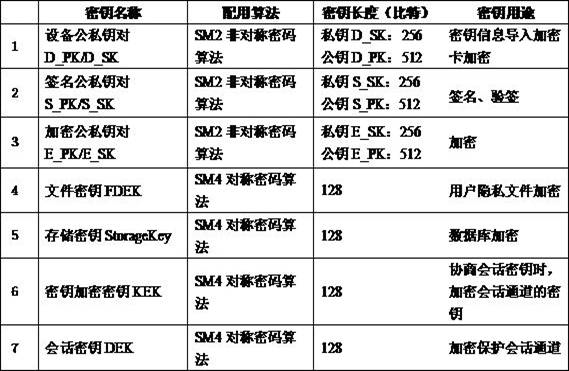
These keys are managed using a hierarchical protection mechanism, and a hierarchical diagram of the various keys is shown in fig. 2.
The public-private key pair E _ SK/E _ PK is encrypted for use in the calculation of the SM2 algorithm. Wherein the private key E _ SK is protected by the cryptographic card.
The signature public and private key pair S _ SK/S _ PK is used for SM2 signature verification, and the private key S _ SK is protected by an encryption card.
The key encryption key KEK is an encryption key of a secure channel of the password management system.
The session key DEK is a session information protection key and is a session encryption key used for information exchange with other terminals.
The file key FDEK is an encryption key that holds client privacy data.
The storage key StorageKey is a database protection key;
the public key D _ PK of the device public and private key pair D _ SK/D _ PK is used as a key for importing the information to protect the key, and the private key D _ PK is protected by the encryption card, and the key is used for protecting other key information.
2. Adapted for use in cryptographic algorithm
The modules use SM2 elliptic curve public key cryptographic algorithm and SM4 block cryptographic algorithm issued by the State crypto administration.
The algorithm uses and characteristics are shown in table 2:
TABLE 2

3. Key generation mode:
1) device public and private key pair D _ SK/D _ PK: the Linux embedded device is generated when the encryption card is initialized.
2) The signed public-private key pair S _ SK/S _ PK is generated by a key management server for signing.
3) The encrypted public-private key pair E _ SK/E _ PK is generated by the key management server for SM2 encryption.
4) The file key FDEK is generated from a random number of the encryption card.
5) Storage key StorageKey: generated by the key management server.
6) Key encryption key KEK: generated by signature public and private key, encryption public and private key and SM2 algorithm negotiation
7) Session key DEK: the key management server distributes the random number as the key by obtaining the random number from the random number pool.
4. Key storage mode
1) Device public and private key pair D _ SK/D _ PK
D _ SK/D _ PK is stored in a secure storage area of the encryption card;
2) storage key Storagey Key
The StorageKey is stored in a secure storage area of the encryption card;
3) signed public and private key pair S _ SK/S _ PK storage
The S _ SK/S _ PK is stored in a secure storage area of the encryption card, and a user can call a secret key in the secure storage area to carry out cryptographic operation after inputting a PIN password and does not provide an interface for reading the private key E _ SK;
4) encrypted public and private key pair E _ SK/E _ PK storage
E _ SK/E _ PK is stored in a secure storage area of the encryption card, and a user can call a secret key in the secure storage area to carry out cryptographic operation after inputting a PIN password and does not provide an interface for reading the private key E _ SK;
5) key encryption key KEK
The KEK is stored in a secure storage area of the encryption card. After a user needs to input a PIN password, a secret key in a safe storage area of the user can be called to carry out cryptographic operation, and an interface for reading the private key S _ SK is not provided;
6) session key DEK
The session key DEK is cached in a volatile memory of the encryption card, and a user can call a key in a security storage area to perform cryptographic operation after inputting a PIN password;
7) file key FDEK
The method is stored in the Linux embedded device, and is encrypted by a device public key, and one file is encrypted by one secret key.
5. Key renewal
In order to reduce the risk of key leakage, the keys in the modules need to be updated according to a certain strategy.
1) Device public and private key pair D _ SK/D _ PK
The encryption card equipment is set to zero to enable the module to enter a factory state and then to be electrified and updated again;
2) storage key Storagey Key
Issuing updates along with the key management server;
3) signed public and private key pair S _ SK/S _ PK updates
Only used for generating the key encryption key KEK without updating;
4) encrypted public and private key pair E _ SK/E _ PK update
The key KEK is only used for generating an encryption key and does not need to be updated;
5) key encryption key KEK
After negotiation, the KEK is generated again, and the one-time pad is generated;
6) session key DEK
The DEK is generated again after the user requests, and the one-time pad is generated;
7) file key FDEK
One file and one key, do not provide the update function.
6. Key backup
1) Device public and private key pair D _ SK/D _ PK
D _ SK/D _ PK is automatically generated by the module and is used in the module without backup;
2) signed public and private key pair S _ SK/S _ PK backup
The secret pipe provides backup without providing the backup function of the secret key;
3) e _ SK/E _ PK backup of encrypted public and private key pair
The secret pipe provides backup without providing the backup function of the secret key;
4) storage key Storagey Key
The secret pipe provides backup without providing the backup function of the secret key;
5) key encryption key KEK
The water-saving agent is not required to be backed up and is automatically destroyed after being used every time;
6) session key DEK
The water-saving agent is not required to be backed up and is automatically destroyed after being used every time;
7) file key FDEK
One file and one key do not provide backup functionality.
7. Key recovery
1) Device public and private key pair D _ SK/D _ PK
Do not provide recovery functions;
2) signed public and private key pair S _ SK/S _ PK
Re-importing recovery from the key management server;
3) encrypted public and private key pair E _ SK/E _ PK
Re-importing recovery from the key management server;
4) storage key Storagey Key
Re-importing recovery from the key management server;
5) key encryption key KEK
Do not provide recovery functions;
6) session key DEK
Do not provide recovery functions;
7) the file key FDEK is set to the file key FDEK,
one file and one key, do not provide recovery functions. (ii) a
8. Key destruction
1) Device public and private key pair D _ SK/D _ PK
The encryption card equipment is reset to a factory state through a zero setting operation;
2) signed public and private key pair S _ SK/S _ PK
The encryption card device is used for carrying out zero setting operation, or a new public and private key pair is introduced to destroy an old public and private key pair;
3) encrypted public and private key pair E _ SK/E _ PK
The encryption card device is used for carrying out zero setting operation, or a new public and private key pair is introduced to destroy an old public and private key pair;
4) storage key Storagey Key
Zero setting operation is carried out through password encryption card equipment, or a new StorageKey is introduced to destroy an old StorageKey;
5) key encryption key KEK
Automatically destroying the waste water after each use;
6) session key DEK
Automatically destroying the waste water after each use;
7) the file key FDEK is set to the file key FDEK,
one file and one key do not provide the destroying function;
9. self-checking measures
In order to ensure that the equipment is stable and reliable, the secret key is safely stored, the password operation module normally works, the correctness of the password algorithm is verified, the generation quality of the random number is ensured to be in accordance with the specification and the like, and the encryption terminal adopts a series of self-checking measures.
1) Cryptographic algorithm self-checking
When the module is started, self-checking is carried out through the cryptographic algorithm, and the cryptographic algorithm is ensured to operate correctly.
SM2 encryption and decryption cryptographic algorithm correctness checking: and encrypting the fixed plaintext data by using the public key, decrypting the encrypted data by using the private key, and comparing the decrypted data with a preset plaintext. If the two are consistent, returning to success; if the two are not consistent, the SM2 encryption and decryption algorithm self-check is failed and the security service is stopped;
SM2 signature verification cryptographic algorithm correctness check: and signing the fixed data to be signed by using the private key, and verifying the signature result and the data to be signed by using the public key. If the verification is successful, returning to success; if the verification is unsuccessful, the SM2 signature verification algorithm is returned, the self-check fails, and the security service is stopped;
SM4 symmetric cipher algorithm correctness checking: first, a fixed key and an initial Vector IV (IV is an english abbreviation of an Initialization Vector) are used to encrypt preset plaintext data, and the encrypted data is compared with preset ciphertext data. If the two are consistent, continuing to execute the next step; if the difference is not consistent, the SM4 algorithm is returned to have failure self-checking and the safety service is stopped; then, the fixed key and the IV are used for decrypting the preset ciphertext data, the decrypted data and the preset plaintext data are compared, and if the decrypted data and the preset plaintext data are consistent, success is returned; the inconsistency returns to the SM4 algorithm to fail self-check and stop the security service.
In the Wired Equivalent Privacy (WEP) protocol, the IV and key are combined into a key seed that is used as input to the RC4 algorithm to produce an encrypted byte stream to encrypt the data. A standard 64-bit WEP uses a 40-bit key plus a 24-bit initial vector IV to become the key used by RC 4.
2) Random number self-check
The method comprises three application stages of power-on self-test, condition detection and single detection:
electrifying and detecting: when the module is started, the password card is called to obtain the random number interface, 2 groups of random number samples are collected, the length of each group of data is 256 bits, and poker detection is carried out. If the detection is not passed, the operation is repeatedly executed once. If the repeated detection still fails, prompting that the random number generator fails;
and (3) condition detection: when the module runs, the password card is called to obtain random numbers with the total amount of integral multiples of 8192 bits, 2 groups of random number samples are collected, the length of each group of data is 256 bits, and poker detection is carried out. If the detection is not passed, the operation is repeatedly executed once. If the repeated detection still fails, prompting that the random number generator fails;
single detection: when the module program runs, when the random number is obtained each time, the password card is called to obtain the random number interface, and the random number with the length of at least 128 bits is obtained. And detecting the acquired random number by using a poker detection method. If the detection is not passed, the operation is repeatedly executed once. If the duplicate detection is still not passed, the random number generator is prompted to fail.
As shown in fig. 4, an example of an application for storing pictures by a personal mobile device to a file storage hard disk and database using the system of the present invention. The system comprises: the system comprises a key management server, a picture storage device (Linux embedded type), an encryption card arranged in the picture storage device, a file storage hard disk, a database and a mobile device; the method comprises the following specific steps:
1. equipment initialization: when the picture storage device leaves a factory, the public and private keys of the device are initialized and stored in the encryption card, and the key is used for encrypting and decrypting other keys stored in the encryption card in subsequent operation;
2. establishing a secure session: before a user uses a mobile device (such as a mobile phone and the like) to perform any operation, the user needs to acquire a session key to encrypt data and send the encrypted data to a picture storage device, and therefore:
1) initiating a request to the picture storage device to obtain a session key, and calling an encryption card interface by the picture storage device to request the session key;
2) the encryption card generates a key encryption key through the signature public key and the encryption public and private key and returns the key encryption key to the picture storage device;
3) the picture storage device sends the session key to the mobile device;
4) the mobile device uses the session key to encrypt the contents of the session, thus establishing a secure session;
3. uploading a file:
1) after a safe session is established in the last step, uploading a picture and a remark name of the picture from the mobile equipment to the picture storage equipment;
2) after receiving the file, acquiring a file encryption key from an encryption card;
3) the picture storage device encrypts the file by using the file encryption key and stores the file into a file storage hard disk;
4) after the file is encrypted and stored, the file encryption key needs to be encrypted by using the equipment public key of the equipment, and is stored in a database of the picture storage equipment together with the remark information of the picture in the following steps;
5) the database with the picture remark name to be stored acquires a storage key from the encryption card;
6) this storage key is used to open and write to the database.
It should be noted that this example is only for explaining the picture storage process, and in a specific application, the business processing device is not limited to the picture storage device. The file storage hard disk, the database and the mobile device are increased or decreased according to specific applications, and are not limited to the above.
Finally, it should be noted that the above embodiments are only used for illustrating the technical solutions of the present invention and are not limited. Although the present invention has been described in detail with reference to the embodiments, it will be understood by those skilled in the art that various changes may be made and equivalents may be substituted without departing from the spirit and scope of the invention as defined in the appended claims.
Claims (9)
1. A key management system, characterized in that the system comprises: the system comprises a key management server, Linux embedded business processing equipment and an encryption card arranged in the business processing equipment; wherein,
the key management server is used for generating a signature public and private key pair, an encryption public and private key pair and a storage key according to a cryptographic algorithm, storing in a backup manner, encrypting through a public key of a pre-obtained equipment public and private key pair and then sending to an encryption card; the encryption card is also used for retransmitting the signed public and private key pair, the encrypted public and private key pair and the storage key to the encryption card according to the import application of the encryption card;
the encryption card is used for storing the received signed public and private key pair, encrypted public and private key pair and storage key, and respectively generating a file key, a storage key, a session key or a key encryption key for storage according to a service request of the service processing equipment and sending the file key, the storage key, the session key or the key encryption key to the service processing equipment; the key management system is used for updating, recovering and destroying the stored key; the device is also used for generating a device public and private key pair when the service processing device leaves a factory;
the service processing device is used for receiving service requests of other terminals, sending a service key acquisition application to the encryption card, receiving a file key, a storage key, a session key or a key encryption key sent by the encryption card, and sending a corresponding service key to a corresponding terminal for service processing; the system is also used for self-checking of the cryptographic algorithm during starting and running;
the device public and private key pair is used for protecting other key information;
the signature public and private key pair is used for signature verification;
the encryption public and private key pair is used for generating a key encryption key with the signature public and private key pair;
the file key is used for carrying out encryption protection on the file of the user;
the storage key is used for carrying out encryption protection on the database;
the session key is used for encrypting messages transmitted between the service processing equipment and other terminals;
and the key encryption key is used for encrypting the information transmitted between the key management server and the service processing equipment.
2. The key management system of claim 1, wherein the device public-private key pair and the encrypted public-private key pair both use an encryption and decryption algorithm of an SM2 asymmetric cryptographic algorithm, and the generated public keys are 512 bytes long and the private keys are 256 bytes long;
the signature public and private key pair adopts a signature verification algorithm of an SM2 asymmetric cryptographic algorithm, the generated public key is 512 bytes long, and the private key is 256 bytes long;
the file key is 128 bytes long, and is generated by acquiring random numbers by adopting an SM4 symmetric cryptographic algorithm, wherein one file key corresponds to one file;
the storage key is 128 bytes long and is generated by adopting an SM4 symmetric cryptographic algorithm;
the session key is 128 bytes long, and is generated by acquiring a random number by adopting an SM4 symmetric cryptographic algorithm, and the current session is valid;
the key encryption key is 128 bytes long, and is generated by adopting an SM4 symmetric cryptographic algorithm according to the signature public and private key pair and the encryption public and private key pair, and the session is valid.
3. The key management system according to claim 1,
the private key of the public and private key pair of the equipment, the private key of the signed public and private key pair, the private key of the encrypted public and private key pair, the storage key and the key encryption key are all stored in a secure storage area of the encryption card;
the file key is encrypted by a public key of a device public and private key pair and stored in the service processing device;
the session key is stored in a volatile storage area of the encryption card.
4. The key management system according to claim 1,
the public and private key pair of the equipment is powered on and updated again after entering a factory state through the encryption card zeroing operation;
the storage key is updated by a key management server;
the signature public and private key pair and the encryption public and private key pair do not need to be updated;
the key encryption key and the session key are updated every time;
the file key is one file key for each file and does not need to be updated.
5. The key management system according to claim 1,
the signed public and private key pair, the encrypted public and private key pair and the storage key are restored by being reintroduced from the key management server;
the device public and private key pair, key encryption key, session key and file key do not need to be recovered.
6. The key management system according to claim 1,
the public and private key pair of the equipment is destroyed by the zeroing operation of the encryption card;
the signature public and private key pair is destroyed by zeroing the encryption card; or receiving a new signed public-private key pair from the key management server to destroy an old signed public-private key pair;
the encrypted public and private key pair is destroyed by zeroing the encryption card; or receiving a new encrypted public-private key pair from the key management server to destroy the old encrypted public-private key pair;
the storage key is destroyed by carrying out zero setting operation on the encryption card, or a new storage key is received from the key management server to destroy an old storage key;
the key is encrypted and is automatically destroyed after being used each time;
the session key is automatically destroyed after being used each time;
the file key does not need to be destroyed.
7. The key management system according to claim 1, wherein the service processing device further comprises a cryptographic algorithm self-checking module and a random number self-checking module; wherein,
the cryptographic algorithm self-checking module is used for checking the correctness of the SM2 asymmetric cryptographic algorithm and the SM4 symmetric cryptographic algorithm;
and the random number self-checking module is used for performing self-checking, condition detection and single detection on the random number generated by the encryption card when the business processing equipment is started and operated.
8. The key management system according to claim 7, wherein the specific processing procedure of the cryptographic algorithm self-checking module is as follows:
generating a public key and a private key by using an encryption and decryption algorithm of an SM2 asymmetric cryptographic algorithm, encrypting fixed plaintext data by using the public key, decrypting the encrypted data by using the private key, comparing the decrypted data with a preset plaintext, and if the decrypted data is inconsistent with the preset plaintext, returning to the self-checking failure and stopping using the encryption and decryption algorithm of the SM2 asymmetric cryptographic algorithm;
generating a public key and a private key by using a signature verification algorithm of an SM2 asymmetric cryptographic algorithm, signing the fixed data to be signed by using the private key, verifying the signature result and the data to be signed by using the public key, and returning to the signature verification algorithm of the SM2 asymmetric cryptographic algorithm after the self-check fails if the verification is inconsistent;
generating a key by using an SM4 symmetric cryptographic algorithm, encrypting preset plaintext data by using the key and an initial vector, comparing the encrypted data with preset ciphertext data, and if the encrypted data is inconsistent with the preset ciphertext data, returning to the SM4 symmetric cryptographic algorithm to ensure that self-checking fails and stopping using the cryptographic algorithm; and if the two data are consistent, decrypting the preset ciphertext data by using the key pair IV, comparing the decrypted data with the preset plaintext data, and if the two data are not consistent, returning to the self-checking failure and stopping using the SM4 symmetric cryptographic algorithm.
9. The key management system according to claim 7, wherein the random number self-check module performs the following specific processing procedures:
when the business processing equipment is started, calling an encryption card to obtain random numbers, collecting 2 groups of random number samples, wherein the length of each group of data is 256 bits, carrying out poker detection, if the detection fails, calling the encryption card again to obtain the random numbers, collecting 2 groups of random number samples, wherein the length of each group of random number samples is 256 bits, carrying out poker detection, and if the detection fails, prompting the encryption card to generate the random number to fail;
when the business processing equipment runs, calling an encryption card to obtain random numbers with the data length being integral multiple of 8192 bits, collecting 2 groups of random number samples, wherein the data length of each group is 256 bits, carrying out poker detection, if the detection fails, collecting 2 groups of random number samples again, wherein the data length of each group is 256 bits, carrying out poker detection, and if the detection fails, prompting the encryption card to generate random number and disable the function;
when the business processing equipment runs, before the random number is obtained every time, the encryption card is called to obtain the random number with the data length of at least 128 bits, poker card detection is carried out, if the detection fails, the encryption card is called again to obtain the random number with the data length of at least 128 bits, poker card detection is carried out, and if the detection fails, the function of the encryption card for generating the random number is prompted to be invalid.
Priority Applications (1)
| Application Number | Priority Date | Filing Date | Title |
|---|---|---|---|
| CN202011168684.8A CN112000975B (en) | 2020-10-28 | 2020-10-28 | Key management system |
Applications Claiming Priority (1)
| Application Number | Priority Date | Filing Date | Title |
|---|---|---|---|
| CN202011168684.8A CN112000975B (en) | 2020-10-28 | 2020-10-28 | Key management system |
Publications (2)
| Publication Number | Publication Date |
|---|---|
| CN112000975A true CN112000975A (en) | 2020-11-27 |
| CN112000975B CN112000975B (en) | 2021-02-09 |
Family
ID=73474455
Family Applications (1)
| Application Number | Title | Priority Date | Filing Date |
|---|---|---|---|
| CN202011168684.8A Expired - Fee Related CN112000975B (en) | 2020-10-28 | 2020-10-28 | Key management system |
Country Status (1)
| Country | Link |
|---|---|
| CN (1) | CN112000975B (en) |
Cited By (19)
| Publication number | Priority date | Publication date | Assignee | Title |
|---|---|---|---|---|
| CN112417491A (en) * | 2020-12-11 | 2021-02-26 | 合肥大唐存储科技有限公司 | Data encryption key obtaining and recovering method and data reading and writing method of solid state disk |
| CN112800439A (en) * | 2020-12-02 | 2021-05-14 | 中国电子科技集团公司第三十研究所 | Key management protocol design method and system for secure storage |
| CN113037483A (en) * | 2021-04-20 | 2021-06-25 | 重庆九格慧科技有限公司 | Distributed key management method based on threshold |
| CN113285950A (en) * | 2021-05-21 | 2021-08-20 | 清创网御(合肥)科技有限公司 | Encryption card-based key transmission and storage method |
| CN113726509A (en) * | 2021-08-30 | 2021-11-30 | 北京天融信网络安全技术有限公司 | Key destroying method, cipher machine and terminal equipment |
| CN113779634A (en) * | 2021-09-17 | 2021-12-10 | 江苏通付盾区块链科技有限公司 | Data storage method and system |
| CN113961957A (en) * | 2021-10-28 | 2022-01-21 | 中国电影科学技术研究所 | KDM manufacturing model verification method and system based on state cryptographic algorithm |
| CN114143026A (en) * | 2021-10-26 | 2022-03-04 | 福建福诺移动通信技术有限公司 | Data security interface based on asymmetric and symmetric encryption and working method thereof |
| CN114139221A (en) * | 2022-02-07 | 2022-03-04 | 浪潮(山东)计算机科技有限公司 | Key state detection method, device, equipment and medium |
| CN114238937A (en) * | 2021-11-12 | 2022-03-25 | 贵州电网有限责任公司 | Method for backup recovery and key destruction of device key |
| CN114884661A (en) * | 2022-07-13 | 2022-08-09 | 麒麟软件有限公司 | Hybrid security service password system and implementation method thereof |
| CN114978774A (en) * | 2022-07-28 | 2022-08-30 | 四川九洲空管科技有限责任公司 | Multi-level key management method based on nested protection structure |
| CN115134076A (en) * | 2022-06-30 | 2022-09-30 | 支付宝(杭州)信息技术有限公司 | Data processing method and system |
| CN115174068A (en) * | 2022-07-06 | 2022-10-11 | 北京神州安付科技股份有限公司 | Key management system |
| CN115276964A (en) * | 2022-06-24 | 2022-11-01 | 麒麟软件有限公司 | Sqlite-based key management method |
| CN115544583A (en) * | 2022-10-08 | 2022-12-30 | 江南信安(北京)科技有限公司 | Data processing method and device for server cipher machine |
| CN116318821A (en) * | 2023-01-03 | 2023-06-23 | 江苏徐工国重实验室科技有限公司 | A hierarchical security protection system for construction machinery Internet of Things data |
| CN116886356A (en) * | 2023-07-04 | 2023-10-13 | 广州链融信息技术有限公司 | A chip-level transparent file encryption storage system, method and device |
| CN118611995A (en) * | 2024-08-08 | 2024-09-06 | 天翼物联科技有限公司 | Terminal key management method, device, equipment and storage medium |
Citations (6)
| Publication number | Priority date | Publication date | Assignee | Title |
|---|---|---|---|---|
| US8111828B2 (en) * | 2007-07-31 | 2012-02-07 | Hewlett-Packard Development Company, L.P. | Management of cryptographic keys for securing stored data |
| CN102833075A (en) * | 2012-09-05 | 2012-12-19 | 北京市科学技术情报研究所 | Identity authentication and digital signature method based on three-layered overlapping type key management technology |
| CN102970299A (en) * | 2012-11-27 | 2013-03-13 | 西安电子科技大学 | File safe protection system and method thereof |
| CN106330868A (en) * | 2016-08-14 | 2017-01-11 | 北京数盾信息科技有限公司 | Encrypted storage key management system and method of high-speed network |
| CN106773941A (en) * | 2016-12-12 | 2017-05-31 | 中国航天系统工程有限公司 | Safety collection remote-terminal unit based on national password high performance chipses |
| CN111654372A (en) * | 2019-11-29 | 2020-09-11 | 江苏芯盛智能科技有限公司 | Key management method and related device |
-
2020
- 2020-10-28 CN CN202011168684.8A patent/CN112000975B/en not_active Expired - Fee Related
Patent Citations (6)
| Publication number | Priority date | Publication date | Assignee | Title |
|---|---|---|---|---|
| US8111828B2 (en) * | 2007-07-31 | 2012-02-07 | Hewlett-Packard Development Company, L.P. | Management of cryptographic keys for securing stored data |
| CN102833075A (en) * | 2012-09-05 | 2012-12-19 | 北京市科学技术情报研究所 | Identity authentication and digital signature method based on three-layered overlapping type key management technology |
| CN102970299A (en) * | 2012-11-27 | 2013-03-13 | 西安电子科技大学 | File safe protection system and method thereof |
| CN106330868A (en) * | 2016-08-14 | 2017-01-11 | 北京数盾信息科技有限公司 | Encrypted storage key management system and method of high-speed network |
| CN106773941A (en) * | 2016-12-12 | 2017-05-31 | 中国航天系统工程有限公司 | Safety collection remote-terminal unit based on national password high performance chipses |
| CN111654372A (en) * | 2019-11-29 | 2020-09-11 | 江苏芯盛智能科技有限公司 | Key management method and related device |
Cited By (28)
| Publication number | Priority date | Publication date | Assignee | Title |
|---|---|---|---|---|
| CN112800439A (en) * | 2020-12-02 | 2021-05-14 | 中国电子科技集团公司第三十研究所 | Key management protocol design method and system for secure storage |
| CN112417491A (en) * | 2020-12-11 | 2021-02-26 | 合肥大唐存储科技有限公司 | Data encryption key obtaining and recovering method and data reading and writing method of solid state disk |
| CN113037483A (en) * | 2021-04-20 | 2021-06-25 | 重庆九格慧科技有限公司 | Distributed key management method based on threshold |
| CN113285950B (en) * | 2021-05-21 | 2023-02-24 | 清创网御(合肥)科技有限公司 | Encryption card-based key transmission and storage method |
| CN113285950A (en) * | 2021-05-21 | 2021-08-20 | 清创网御(合肥)科技有限公司 | Encryption card-based key transmission and storage method |
| CN113726509A (en) * | 2021-08-30 | 2021-11-30 | 北京天融信网络安全技术有限公司 | Key destroying method, cipher machine and terminal equipment |
| CN113779634A (en) * | 2021-09-17 | 2021-12-10 | 江苏通付盾区块链科技有限公司 | Data storage method and system |
| CN114143026B (en) * | 2021-10-26 | 2024-01-23 | 福建福诺移动通信技术有限公司 | Data security interface based on asymmetric and symmetric encryption and working method thereof |
| CN114143026A (en) * | 2021-10-26 | 2022-03-04 | 福建福诺移动通信技术有限公司 | Data security interface based on asymmetric and symmetric encryption and working method thereof |
| CN113961957A (en) * | 2021-10-28 | 2022-01-21 | 中国电影科学技术研究所 | KDM manufacturing model verification method and system based on state cryptographic algorithm |
| CN113961957B (en) * | 2021-10-28 | 2025-08-05 | 中国电影科学技术研究所 | A KDM production model verification method and system based on national secret algorithm |
| CN114238937A (en) * | 2021-11-12 | 2022-03-25 | 贵州电网有限责任公司 | Method for backup recovery and key destruction of device key |
| CN114139221A (en) * | 2022-02-07 | 2022-03-04 | 浪潮(山东)计算机科技有限公司 | Key state detection method, device, equipment and medium |
| CN115276964A (en) * | 2022-06-24 | 2022-11-01 | 麒麟软件有限公司 | Sqlite-based key management method |
| CN115276964B (en) * | 2022-06-24 | 2024-08-09 | 麒麟软件有限公司 | Key management method based on sqlite |
| CN115134076A (en) * | 2022-06-30 | 2022-09-30 | 支付宝(杭州)信息技术有限公司 | Data processing method and system |
| CN115134076B (en) * | 2022-06-30 | 2025-01-24 | 支付宝(杭州)信息技术有限公司 | Data processing method and system |
| CN115174068A (en) * | 2022-07-06 | 2022-10-11 | 北京神州安付科技股份有限公司 | Key management system |
| CN114884661A (en) * | 2022-07-13 | 2022-08-09 | 麒麟软件有限公司 | Hybrid security service password system and implementation method thereof |
| CN114978774B (en) * | 2022-07-28 | 2022-10-04 | 四川九洲空管科技有限责任公司 | Multi-level key management method based on nested protection structure |
| CN114978774A (en) * | 2022-07-28 | 2022-08-30 | 四川九洲空管科技有限责任公司 | Multi-level key management method based on nested protection structure |
| CN115544583B (en) * | 2022-10-08 | 2023-05-05 | 江南信安(北京)科技有限公司 | Data processing method and device of server cipher machine |
| CN115544583A (en) * | 2022-10-08 | 2022-12-30 | 江南信安(北京)科技有限公司 | Data processing method and device for server cipher machine |
| CN116318821A (en) * | 2023-01-03 | 2023-06-23 | 江苏徐工国重实验室科技有限公司 | A hierarchical security protection system for construction machinery Internet of Things data |
| CN116886356A (en) * | 2023-07-04 | 2023-10-13 | 广州链融信息技术有限公司 | A chip-level transparent file encryption storage system, method and device |
| CN116886356B (en) * | 2023-07-04 | 2024-02-02 | 广州链融信息技术有限公司 | Chip-level transparent file encryption storage system, method and equipment |
| CN118611995A (en) * | 2024-08-08 | 2024-09-06 | 天翼物联科技有限公司 | Terminal key management method, device, equipment and storage medium |
| CN118611995B (en) * | 2024-08-08 | 2024-11-26 | 天翼物联科技有限公司 | Terminal key management method, device, equipment and storage medium |
Also Published As
| Publication number | Publication date |
|---|---|
| CN112000975B (en) | 2021-02-09 |
Similar Documents
| Publication | Publication Date | Title |
|---|---|---|
| CN112000975B (en) | Key management system | |
| US11831753B2 (en) | Secure distributed key management system | |
| CN113472793B (en) | Personal data protection system based on hardware password equipment | |
| US9893892B2 (en) | Authenticated remote pin unblock | |
| US6073237A (en) | Tamper resistant method and apparatus | |
| US6950523B1 (en) | Secure storage of private keys | |
| CN109981255B (en) | Method and system for updating key pool | |
| KR20140126787A (en) | Puf-based hardware device for providing one time password, and method for 2-factor authenticating using thereof | |
| CN105915338B (en) | Generate the method and system of key | |
| CN107920052B (en) | Encryption method and intelligent device | |
| CN112565265B (en) | Authentication method, authentication system and communication method between terminal devices of Internet of things | |
| CN112865965B (en) | Train service data processing method and system based on quantum key | |
| CN115529591B (en) | Authentication method, device, equipment and storage medium based on token | |
| CN106953732A (en) | The key management system and method for chip card | |
| CN110493177A (en) | Based on unsymmetrical key pond to and sequence number quantum communications service station AKA cryptographic key negotiation method and system | |
| CN118761107A (en) | A security management method for solid state hard disk and solid state hard disk | |
| CN112787996B (en) | Password equipment management method and system | |
| CN109412799B (en) | System and method for generating local key | |
| CN120528652A (en) | Communication data encryption method, device, equipment and medium | |
| CN116112234B (en) | A method, system, medium and device for electronic signature security verification | |
| CN111628864A (en) | Method for carrying out secret key safety recovery by using SIM card | |
| KR101947408B1 (en) | Puf-based hardware device for providing one time password, and method for 2-factor authenticating using thereof | |
| CN110535632A (en) | Based on unsymmetrical key pond to and DH agreement quantum communications service station AKA cryptographic key negotiation method and system | |
| KR20190002388A (en) | Puf-based hardware device for providing one time password, and method for 2-factor authenticating using thereof | |
| CN118054901B (en) | Network communication method and storage device based on key identification quick transfer |
Legal Events
| Date | Code | Title | Description |
|---|---|---|---|
| PB01 | Publication | ||
| PB01 | Publication | ||
| SE01 | Entry into force of request for substantive examination | ||
| SE01 | Entry into force of request for substantive examination | ||
| GR01 | Patent grant | ||
| GR01 | Patent grant | ||
| CF01 | Termination of patent right due to non-payment of annual fee | ||
| CF01 | Termination of patent right due to non-payment of annual fee |
Granted publication date: 20210209 |