CN111807425A - A method for preparing high-performance lithium-ion battery ternary cathode material at low ammonia concentration - Google Patents
A method for preparing high-performance lithium-ion battery ternary cathode material at low ammonia concentration Download PDFInfo
- Publication number
- CN111807425A CN111807425A CN202010787238.9A CN202010787238A CN111807425A CN 111807425 A CN111807425 A CN 111807425A CN 202010787238 A CN202010787238 A CN 202010787238A CN 111807425 A CN111807425 A CN 111807425A
- Authority
- CN
- China
- Prior art keywords
- ion battery
- ammonia concentration
- positive electrode
- performance lithium
- electrode material
- Prior art date
- Legal status (The legal status is an assumption and is not a legal conclusion. Google has not performed a legal analysis and makes no representation as to the accuracy of the status listed.)
- Pending
Links
Images


Classifications
-
- C—CHEMISTRY; METALLURGY
- C01—INORGANIC CHEMISTRY
- C01G—COMPOUNDS CONTAINING METALS NOT COVERED BY SUBCLASSES C01D OR C01F
- C01G53/00—Compounds of nickel
- C01G53/40—Complex oxides containing nickel and at least one other metal element
- C01G53/42—Complex oxides containing nickel and at least one other metal element containing alkali metals, e.g. LiNiO2
- C01G53/44—Complex oxides containing nickel and at least one other metal element containing alkali metals, e.g. LiNiO2 containing manganese
- C01G53/50—Complex oxides containing nickel and at least one other metal element containing alkali metals, e.g. LiNiO2 containing manganese of the type (MnO2)n-, e.g. Li(NixMn1-x)O2 or Li(MyNixMn1-x-y)O2
-
- H—ELECTRICITY
- H01—ELECTRIC ELEMENTS
- H01M—PROCESSES OR MEANS, e.g. BATTERIES, FOR THE DIRECT CONVERSION OF CHEMICAL ENERGY INTO ELECTRICAL ENERGY
- H01M10/00—Secondary cells; Manufacture thereof
- H01M10/05—Accumulators with non-aqueous electrolyte
- H01M10/052—Li-accumulators
- H01M10/0525—Rocking-chair batteries, i.e. batteries with lithium insertion or intercalation in both electrodes; Lithium-ion batteries
-
- H—ELECTRICITY
- H01—ELECTRIC ELEMENTS
- H01M—PROCESSES OR MEANS, e.g. BATTERIES, FOR THE DIRECT CONVERSION OF CHEMICAL ENERGY INTO ELECTRICAL ENERGY
- H01M4/00—Electrodes
- H01M4/02—Electrodes composed of, or comprising, active material
- H01M4/36—Selection of substances as active materials, active masses, active liquids
- H01M4/48—Selection of substances as active materials, active masses, active liquids of inorganic oxides or hydroxides
- H01M4/50—Selection of substances as active materials, active masses, active liquids of inorganic oxides or hydroxides of manganese
- H01M4/505—Selection of substances as active materials, active masses, active liquids of inorganic oxides or hydroxides of manganese of mixed oxides or hydroxides containing manganese for inserting or intercalating light metals, e.g. LiMn2O4 or LiMn2OxFy
-
- H—ELECTRICITY
- H01—ELECTRIC ELEMENTS
- H01M—PROCESSES OR MEANS, e.g. BATTERIES, FOR THE DIRECT CONVERSION OF CHEMICAL ENERGY INTO ELECTRICAL ENERGY
- H01M4/00—Electrodes
- H01M4/02—Electrodes composed of, or comprising, active material
- H01M4/36—Selection of substances as active materials, active masses, active liquids
- H01M4/48—Selection of substances as active materials, active masses, active liquids of inorganic oxides or hydroxides
- H01M4/52—Selection of substances as active materials, active masses, active liquids of inorganic oxides or hydroxides of nickel, cobalt or iron
- H01M4/525—Selection of substances as active materials, active masses, active liquids of inorganic oxides or hydroxides of nickel, cobalt or iron of mixed oxides or hydroxides containing iron, cobalt or nickel for inserting or intercalating light metals, e.g. LiNiO2, LiCoO2 or LiCoOxFy
-
- C—CHEMISTRY; METALLURGY
- C01—INORGANIC CHEMISTRY
- C01P—INDEXING SCHEME RELATING TO STRUCTURAL AND PHYSICAL ASPECTS OF SOLID INORGANIC COMPOUNDS
- C01P2004/00—Particle morphology
- C01P2004/01—Particle morphology depicted by an image
- C01P2004/03—Particle morphology depicted by an image obtained by SEM
-
- C—CHEMISTRY; METALLURGY
- C01—INORGANIC CHEMISTRY
- C01P—INDEXING SCHEME RELATING TO STRUCTURAL AND PHYSICAL ASPECTS OF SOLID INORGANIC COMPOUNDS
- C01P2004/00—Particle morphology
- C01P2004/01—Particle morphology depicted by an image
- C01P2004/04—Particle morphology depicted by an image obtained by TEM, STEM, STM or AFM
-
- C—CHEMISTRY; METALLURGY
- C01—INORGANIC CHEMISTRY
- C01P—INDEXING SCHEME RELATING TO STRUCTURAL AND PHYSICAL ASPECTS OF SOLID INORGANIC COMPOUNDS
- C01P2004/00—Particle morphology
- C01P2004/30—Particle morphology extending in three dimensions
- C01P2004/32—Spheres
-
- C—CHEMISTRY; METALLURGY
- C01—INORGANIC CHEMISTRY
- C01P—INDEXING SCHEME RELATING TO STRUCTURAL AND PHYSICAL ASPECTS OF SOLID INORGANIC COMPOUNDS
- C01P2004/00—Particle morphology
- C01P2004/51—Particles with a specific particle size distribution
- C01P2004/52—Particles with a specific particle size distribution highly monodisperse size distribution
-
- C—CHEMISTRY; METALLURGY
- C01—INORGANIC CHEMISTRY
- C01P—INDEXING SCHEME RELATING TO STRUCTURAL AND PHYSICAL ASPECTS OF SOLID INORGANIC COMPOUNDS
- C01P2004/00—Particle morphology
- C01P2004/60—Particles characterised by their size
- C01P2004/61—Micrometer sized, i.e. from 1-100 micrometer
-
- C—CHEMISTRY; METALLURGY
- C01—INORGANIC CHEMISTRY
- C01P—INDEXING SCHEME RELATING TO STRUCTURAL AND PHYSICAL ASPECTS OF SOLID INORGANIC COMPOUNDS
- C01P2004/00—Particle morphology
- C01P2004/60—Particles characterised by their size
- C01P2004/62—Submicrometer sized, i.e. from 0.1-1 micrometer
-
- C—CHEMISTRY; METALLURGY
- C01—INORGANIC CHEMISTRY
- C01P—INDEXING SCHEME RELATING TO STRUCTURAL AND PHYSICAL ASPECTS OF SOLID INORGANIC COMPOUNDS
- C01P2006/00—Physical properties of inorganic compounds
- C01P2006/11—Powder tap density
-
- C—CHEMISTRY; METALLURGY
- C01—INORGANIC CHEMISTRY
- C01P—INDEXING SCHEME RELATING TO STRUCTURAL AND PHYSICAL ASPECTS OF SOLID INORGANIC COMPOUNDS
- C01P2006/00—Physical properties of inorganic compounds
- C01P2006/40—Electric properties
-
- H—ELECTRICITY
- H01—ELECTRIC ELEMENTS
- H01M—PROCESSES OR MEANS, e.g. BATTERIES, FOR THE DIRECT CONVERSION OF CHEMICAL ENERGY INTO ELECTRICAL ENERGY
- H01M4/00—Electrodes
- H01M4/02—Electrodes composed of, or comprising, active material
- H01M2004/021—Physical characteristics, e.g. porosity, surface area
-
- H—ELECTRICITY
- H01—ELECTRIC ELEMENTS
- H01M—PROCESSES OR MEANS, e.g. BATTERIES, FOR THE DIRECT CONVERSION OF CHEMICAL ENERGY INTO ELECTRICAL ENERGY
- H01M4/00—Electrodes
- H01M4/02—Electrodes composed of, or comprising, active material
- H01M2004/026—Electrodes composed of, or comprising, active material characterised by the polarity
- H01M2004/028—Positive electrodes
-
- Y—GENERAL TAGGING OF NEW TECHNOLOGICAL DEVELOPMENTS; GENERAL TAGGING OF CROSS-SECTIONAL TECHNOLOGIES SPANNING OVER SEVERAL SECTIONS OF THE IPC; TECHNICAL SUBJECTS COVERED BY FORMER USPC CROSS-REFERENCE ART COLLECTIONS [XRACs] AND DIGESTS
- Y02—TECHNOLOGIES OR APPLICATIONS FOR MITIGATION OR ADAPTATION AGAINST CLIMATE CHANGE
- Y02E—REDUCTION OF GREENHOUSE GAS [GHG] EMISSIONS, RELATED TO ENERGY GENERATION, TRANSMISSION OR DISTRIBUTION
- Y02E60/00—Enabling technologies; Technologies with a potential or indirect contribution to GHG emissions mitigation
- Y02E60/10—Energy storage using batteries
Landscapes
- Chemical & Material Sciences (AREA)
- Inorganic Chemistry (AREA)
- Chemical Kinetics & Catalysis (AREA)
- Electrochemistry (AREA)
- General Chemical & Material Sciences (AREA)
- Organic Chemistry (AREA)
- Engineering & Computer Science (AREA)
- Materials Engineering (AREA)
- Manufacturing & Machinery (AREA)
- Battery Electrode And Active Subsutance (AREA)
Abstract
本发明公开一种在低氨浓度下制备高性能锂离子电池三元正极材料的方法,属于锂离子电池正极材料技术领域。该方法先取含有镍、钴、锰的盐溶于去离子水中配制混合盐溶液;向混合盐溶液中加入络合剂,并加入酸,得到混合溶液;将混合溶液和NaOH溶液分别持续泵入装有底液氨水的连续共沉淀反应釜中,使反应过程中反应釜的总氨浓度与底液氨水中的浓度相同,持续反应获得前驱体材料;将前驱体材料与LiOH·H2O研磨混合,经过烧结得到锂化三元材料。本发明制备的NCM622材料形貌良好、晶体结构完整、元素分布均匀,且该材料具有高放电容量、良好循环稳定性和倍率性能,且与石墨和Si/C负极匹配的全电池也具有良好的电化学性能。
The invention discloses a method for preparing a high-performance lithium ion battery ternary positive electrode material under low ammonia concentration, and belongs to the technical field of lithium ion battery positive electrode materials. In the method, salts containing nickel, cobalt and manganese are firstly dissolved in deionized water to prepare a mixed salt solution; a complexing agent is added to the mixed salt solution, and an acid is added to obtain a mixed solution; the mixed solution and the NaOH solution are continuously pumped into the In the continuous co-precipitation reactor with bottom liquid ammonia water, the total ammonia concentration of the reactor during the reaction process is the same as the concentration in bottom liquid ammonia water, and the precursor material is obtained by continuous reaction; the precursor material is ground and mixed with LiOH·H 2 O , the lithiated ternary material is obtained after sintering. The NCM622 material prepared by the invention has good morphology, complete crystal structure and uniform element distribution, and the material has high discharge capacity, good cycle stability and rate performance, and the full battery matched with graphite and Si/C negative electrodes also has good performance. electrochemical performance.
Description
技术领域technical field
本发明属于锂离子电池正极材料领域,具体涉及一种在低氨浓度下制备高性能锂离子电池三元正极材料的方法。The invention belongs to the field of positive electrode materials for lithium ion batteries, and in particular relates to a method for preparing ternary positive electrode materials for high performance lithium ion batteries under low ammonia concentration.
背景技术Background technique
当前,由于锂离子电池的能量密度高和循环寿命长等优势,它已经成为便携式电子设备和电动交通工具使用的最有前景的能源设备。在锂离子电池所用的众多正极材料中,三元材料(LiNixCoyMnzO2,x+y+z=1)由于其高的可逆容量、良好的安全性和相对低的成本而受到广泛的关注。其最常用且最优异的制备方法为利用氢氧化物共沉淀-控制结晶法合成前驱体材料,后通过锂化焙烧获得成品材料。Currently, due to the advantages of high energy density and long cycle life, lithium-ion batteries have become the most promising energy devices for portable electronic devices and electric vehicles. Among the many cathode materials used in Li-ion batteries, ternary materials (LiNi x Co y Mn z O 2 , x+y+z=1) are favored due to their high reversible capacity, good safety and relatively low cost Widespread concern. The most common and excellent preparation method is to synthesize the precursor material by the hydroxide co-precipitation-controlled crystallization method, and then obtain the finished material by lithiation and roasting.
氢氧化物共沉淀-控制结晶法通常以NaOH为沉淀剂,NH3的水溶液为络合剂,通过蠕动泵控制进料速度而连续进料,并控制一定的反应温度、搅拌速度、溶液总氨浓度和适宜的pH值,NixCoyMnz(OH)2不断成核并发生团聚,随着反应时间的增加而生长至10~20μm的二次球前驱体。其存在的反应机理为盐溶液在滴入反应釜后,在搅拌扩散过程中过渡金属离子完成成核反应生成大量Me(OH)2小晶核,在生长阶段OH-的沉淀作用和NH3的络合作用存在一种竞争关系,沉淀作用过强时前驱体材料无法生长,粒径尺寸小,振实密度低。而NH3的络合作用能使具有不同沉淀能力的镍钴锰三种元素能够均匀的沉淀,且其减缓成核速率,使前驱体材料缓慢有序的生长长大,有利于获得元素分布均匀、粒径均一且振实密度高的前驱体材料。The hydroxide co-precipitation-controlled crystallization method usually uses NaOH as the precipitant, and the aqueous solution of NH3 as the complexing agent, and the feeding speed is controlled by the peristaltic pump to continuously feed, and control a certain reaction temperature, stirring speed, and total ammonia in the solution. Concentration and suitable pH value, Ni x Co y Mn z (OH) 2 continuously nucleates and agglomerates, and grows to 10-20 μm secondary sphere precursor with the increase of reaction time. The reaction mechanism of its existence is that after the salt solution is dropped into the reaction kettle, the transition metal ions complete the nucleation reaction during the stirring and diffusion process to generate a large number of Me(OH) 2 small crystal nuclei, and in the growth stage , the precipitation of OH and the complexation of NH 3 There is a competitive relationship in the cooperation. When the precipitation is too strong, the precursor material cannot grow, the particle size is small, and the tap density is low. The complexation of NH3 can make the three elements of nickel, cobalt, and manganese with different precipitation ability to precipitate uniformly, and it slows down the nucleation rate, so that the precursor material grows slowly and orderly, which is beneficial to obtain uniform distribution of elements , Precursor material with uniform particle size and high tap density.
那么当前为获得具有良好电化学性能的锂离子电池三元正极材料,利用氨的水溶液作为络合剂,采用氢氧化物共沉淀法材料合成材料时反应釜中所用的总氨浓度普遍偏高,例如:专利CN1966410A公布了一种在总氨浓度为0.5~2mol L-1的条件下制备镍锰钴氢氧化物的方法;专利CN103979611A公布了一种在总氨浓度为2.3mol L-1的条件下制备高振实密度镍钴锰酸锂层状正极材料的方法;专利CN106784783A公布一种在总氨浓度为0.24~0.47mol L-1的条件下锂离子电池镍钴锰正极材料的方法;专利CN109205685A公布了一种在总氨浓度为0.5~0.7mol L-1的条件下连续制备锂离子电池用高镍三元前驱体的方法;专利CN108807968A公布了一种在总氨浓度为0.5~1.5mol L-1条件下合成镍钴锰三元前驱体材料的方法;专利CN109250765A公布了一种在总氨浓度为2.0mol L-1的条件下生产镍钴锰氢氧化物的方法;专利CN107507970A公布了所用氨浓度为1-8mol L-1时制备镍钴锰氢氧化物前驱体的方法;专利CN103259007A公布了一种在总氨浓度为1.8mol L-1的条件下制备高电压锂离子电池材料的方法。这些公开的专利所采用的氨浓度均相对较高,这将产生大量难以处理的高浓度含氨生产废水,污染环境,同时高氨浓度下空气中散发着强烈的氨的刺激性气味,工厂生产条件恶劣,对工人身体健康具有极大危害,故降低所用氨浓度和无氨化生产被广泛研究。但仅通过降低氨浓度和pH值协同作用所制备的三元材料粒径偏大,振实密度较低,储锂性能较差。因此,通过相关改性方法在低氨浓度条件下制备物理化学性质和电化学储锂性能优异的三元正极材料具有极大的应用意义。Then, in order to obtain a ternary cathode material for lithium-ion batteries with good electrochemical performance, the aqueous solution of ammonia is used as a complexing agent, and the total ammonia concentration used in the reactor is generally high when the material is synthesized by the hydroxide co-precipitation method. For example: Patent CN1966410A discloses a method for preparing nickel-manganese-cobalt hydroxide under the condition that the total ammonia concentration is 0.5~2mol L -1 ; Patent CN103979611A discloses a method under the condition that the total ammonia concentration is 2.3mol L -1 The method of preparing high tap density nickel-cobalt manganese lithium manganate layered cathode material under the condition of patent CN106784783A discloses a method for lithium-ion battery nickel-cobalt-manganese cathode material under the condition that the total ammonia concentration is 0.24~0.47mol L -1 ; patent CN109205685A publishes A method for continuously preparing high-nickel ternary precursors for lithium - ion batteries under the condition that the total ammonia concentration is 0.5-0.7 mol L A method for synthesizing nickel-cobalt-manganese ternary precursor materials under 1 conditions; patent CN109250765A discloses a method for producing nickel-cobalt-manganese hydroxide under the condition that the total ammonia concentration is 2.0mol L -1 ; patent CN107507970A discloses the use of ammonia A method for preparing nickel-cobalt-manganese hydroxide precursor when the concentration is 1-8 mol L -1 ; patent CN103259007A discloses a method for preparing high-voltage lithium-ion battery materials under the condition that the total ammonia concentration is 1.8 mol L -1 . The ammonia concentration used in these disclosed patents is relatively high, which will produce a large amount of difficult-to-handle high-concentration ammonia-containing production wastewater, polluting the environment, and at the same time, the air under high ammonia concentration emits a strong pungent odor of ammonia. Factory production The conditions are harsh and have great harm to the health of workers, so reducing the concentration of ammonia used and ammonia-free production have been widely studied. However, the ternary materials prepared only by reducing the synergistic effect of ammonia concentration and pH value are larger in particle size, lower in tap density and poor in lithium storage performance. Therefore, it is of great application significance to prepare ternary cathode materials with excellent physicochemical properties and electrochemical lithium storage performance under the condition of low ammonia concentration by related modification methods.
发明内容SUMMARY OF THE INVENTION
本发明的目的是提供一种在低氨浓度下制备高性能锂离子电池三元正极材料的方法,该方法在低氨条件下制备得到的三元正极材料,具有优异的充放电循环性能、倍率性能及全电池性能。The purpose of the present invention is to provide a method for preparing high-performance lithium ion battery ternary positive electrode material under low ammonia concentration, the ternary positive electrode material prepared by this method under low ammonia condition has excellent charge-discharge cycle performance, rate performance and full battery performance.
为实现上述技术目的,达到上述技术效果,本发明是通过以下技术方案实现:In order to realize the above-mentioned technical purpose and achieve the above-mentioned technical effect, the present invention is realized through the following technical solutions:
一种在低氨浓度下制备高性能锂离子电池三元正极材料的方法,包括以下步骤:A method for preparing a high-performance lithium-ion battery ternary positive electrode material under low ammonia concentration, comprising the following steps:
步骤一:取含有镍、钴、锰的盐溶于去离子水中配制混合盐溶液;Step 1: Dissolve the salt containing nickel, cobalt and manganese in deionized water to prepare a mixed salt solution;
步骤二:向步骤一得到的混合盐溶液中加入络合剂,并加入酸,调节pH值在1以下,得到混合溶液;所述的络合剂为含铵根的铵盐;Step 2: adding a complexing agent to the mixed salt solution obtained in step 1, and adding an acid, and adjusting the pH value to be below 1 to obtain a mixed solution; the complexing agent is an ammonium salt containing ammonium radicals;
步骤三:将步骤二的混合溶液和NaOH溶液分别持续泵入装有浓度为0.1mol L-1以下的底液氨水的连续共沉淀反应釜中,使反应过程中反应釜的总氨浓度与底液氨水中的浓度相同,在50~60℃的温度和800~1000r/min的转速条件下控制pH值在10~10.5之间,持续反应至前驱体尺寸10~20μm之间,经陈化水洗调节pH值为7-7.5,获得前驱体材料NixCoyMnz(OH)2,0<x<1,0<y<1,0<z<1,x+y+z=1;Step 3: The mixed solution of
步骤四:将步骤三获得的前驱体材料与LiOH·H2O研磨混合,先在500℃~550℃下保温3~5h,后在780℃~820℃范围内保温4~8h最后在840~900℃下保温8~15h,之后降温冷却,研磨过目筛,得到锂化三元材料LiNixCoyMnzO2,0<x<1,0<y<1,0<z<1,x+y+z=1。Step 4: Grind and mix the precursor material obtained in Step 3 with LiOH·H 2 O, first keep it at 500℃~550℃ for 3~5h, then keep it at 780℃~820℃ for 4~8h, and finally keep it at 840~500℃. Keep the temperature at 900℃ for 8-15h, then cool down and cool, grind and pass through a mesh sieve to obtain a lithiated ternary material LiNi x Co y Mn z O 2 , 0<x<1,0<y<1,0<z<1,x +y+z=1.
优选的是,所述的步骤一镍、钴、锰的盐分别为NiSO4·6H2O、COSO4·7H2O、MnSO4·H2O。Preferably, in the first step, the salts of nickel, cobalt and manganese are NiSO 4 ·6H 2 O, COSO 4 ·7H 2 O, and MnSO 4 ·H 2 O, respectively.
优选的是,所述的步骤一混合盐溶液中,镍、钴和锰总浓度为1~2mol L-1。Preferably, in the step 1 mixed salt solution, the total concentration of nickel, cobalt and manganese is 1-2 mol L -1 .
优选的是,所述的步骤二的含铵根的铵盐为硝酸铵、硫酸铵、碳酸氨或碳酸氢铵。Preferably, the ammonium-containing ammonium salt in the second step is ammonium nitrate, ammonium sulfate, ammonium carbonate or ammonium bicarbonate.
优选的是,所述的步骤二的酸为硝酸、硫酸、盐酸或醋酸。Preferably, the acid in the second step is nitric acid, sulfuric acid, hydrochloric acid or acetic acid.
优选的是,所述的步骤二中络合剂中的铵根与镍钴锰三者的摩尔数之和的摩尔比为0.1:1。Preferably, the molar ratio of the sum of the molar numbers of ammonium root and nickel, cobalt, and manganese in the complexing agent in the second step is 0.1:1.
优选的是,所述的步骤三中NaOH溶液的浓度为6~10mol L-1。Preferably, the concentration of the NaOH solution in the third step is 6-10 mol L -1 .
优选的是,所述的步骤三中底液氨水的浓度为0.1mol L-1。Preferably, the concentration of the bottom liquid ammonia water in the third step is 0.1 mol L −1 .
优选的是,所述的在进行步骤四之前,将所得前驱体材料进行干燥和筛分。Preferably, before step 4, the obtained precursor material is dried and sieved.
优选的是,所述的步骤四中前驱体材料与LiOH·H2O的摩尔比为1:(1.05~1.2)。Preferably, in the step 4, the molar ratio of the precursor material to LiOH·H 2 O is 1:(1.05-1.2).
本发明的有益效果The beneficial effects of the present invention
本发明提供一种在低氨浓度下制备高性能锂离子电池三元正极材料的方法,在制备过程中,本发明不直接使用氨水,而是用铵根作为络合剂,可与OH-反应生成NH3后再与过渡金属络合,降低成核速率;同时通过加入酸降低盐溶液的pH值至1左右;NH4 +和H+均可以与OH-反应,使得上述混合盐溶液在滴入反应釜后扩散至与釜中体相溶液相同pH值时的扩散时间和扩散范围增大(降低反应物浓度),就可以降低沉淀作用而提升络合作用,降低晶体成核速率,从而利于晶核的团聚和生长,实现在低氨浓度(低络合能力)下制备粒径均一的10~20μm大小的球形团聚体三元前驱体材料。The invention provides a method for preparing a high-performance lithium ion battery ternary positive electrode material under low ammonia concentration. In the preparation process, the invention does not directly use ammonia water, but uses ammonium root as a complexing agent, which can react with OH - After the NH 3 is generated, it is complexed with transition metals to reduce the nucleation rate; meanwhile, the pH value of the salt solution is reduced to about 1 by adding acid; both NH 4 + and H + can react with OH - , so that the above mixed salt solution drops After entering the reaction kettle and diffusing to the same pH value as the bulk solution in the kettle, the diffusion time and diffusion range increase (reduce the concentration of reactants), which can reduce the precipitation effect, improve the complexation effect, and reduce the crystal nucleation rate. The agglomeration and growth of crystal nuclei enable the preparation of spherical agglomerate ternary precursor materials with uniform particle size of 10-20 μm under low ammonia concentration (low complexing ability).
实验结果证明:采用上述方法在0.1mol L-1的低氨浓度条件下所制备的NCM622三元材料粒径均一,尺寸大多在12~15μm之间,层状结构良好无杂质,元素分布均匀。且所得材料具有优异的电化学储锂性能,该材料的对锂半电池在3-4.3V的电压范围下,首圈库伦效率90.1%,0.1C电流密度下首次放电比容量176.7mAh g-1。在0.5C电流密度下循环100次后输出比容量146mAh g-1,容量保持率可达91.9%。在3C高电流密度下可输出比容量115.7mAh g-1。且该材料与商业化石墨负极匹配的全电池,在0.5C电流密度下循环150次后输出比容量152.4mAh g-1,容量保持率可达91.8%,在5C高电流密度下可输出比容量107.5mAh g-1。其与商业化Si/C负极材料匹配的全电池,在0.5C电流密度下循环150次后输出比容量139mAh g-1,容量保持率可达85.3%,在5C高电流密度下可输出比容量84.4mAh g-1。The experimental results show that the NCM622 ternary material prepared by the above method under the condition of low ammonia concentration of 0.1mol L -1 has a uniform particle size, the size is mostly between 12 and 15 μm, the layered structure is good without impurities, and the element distribution is uniform. And the obtained material has excellent electrochemical lithium storage performance. Under the voltage range of 3-4.3V, the material's first-cycle Coulomb efficiency is 90.1%, and the first discharge specific capacity is 176.7mAh g -1 at 0.1C current density. . After 100 cycles at a current density of 0.5 C, the output specific capacity was 146 mAh g -1 , and the capacity retention rate could reach 91.9%. It can output a specific capacity of 115.7mAh g -1 at 3C high current density. And the full battery matched with the commercial graphite anode can output a specific capacity of 152.4mAh g -1 after 150 cycles at a current density of 0.5C, and the capacity retention rate can reach 91.8%. It can output a specific capacity at a high current density of 5C. 107.5mAh g -1 . The full battery matched with the commercial Si/C anode material can output a specific capacity of 139mAh g -1 after 150 cycles at a current density of 0.5C, and the capacity retention rate can reach 85.3%. It can output a specific capacity at a high current density of 5C. 84.4mAh g -1 .
因此采用该发明方法在低氨浓度下制备的三元材料具有优异的充放电循环性能、倍率性能及全电池性能,可广泛应用于锂离子电池正极材料,适合推广应用。Therefore, the ternary material prepared by the method of the invention at low ammonia concentration has excellent charge-discharge cycle performance, rate performance and full battery performance, and can be widely used in lithium-ion battery cathode materials, and is suitable for popularization and application.
附图说明Description of drawings
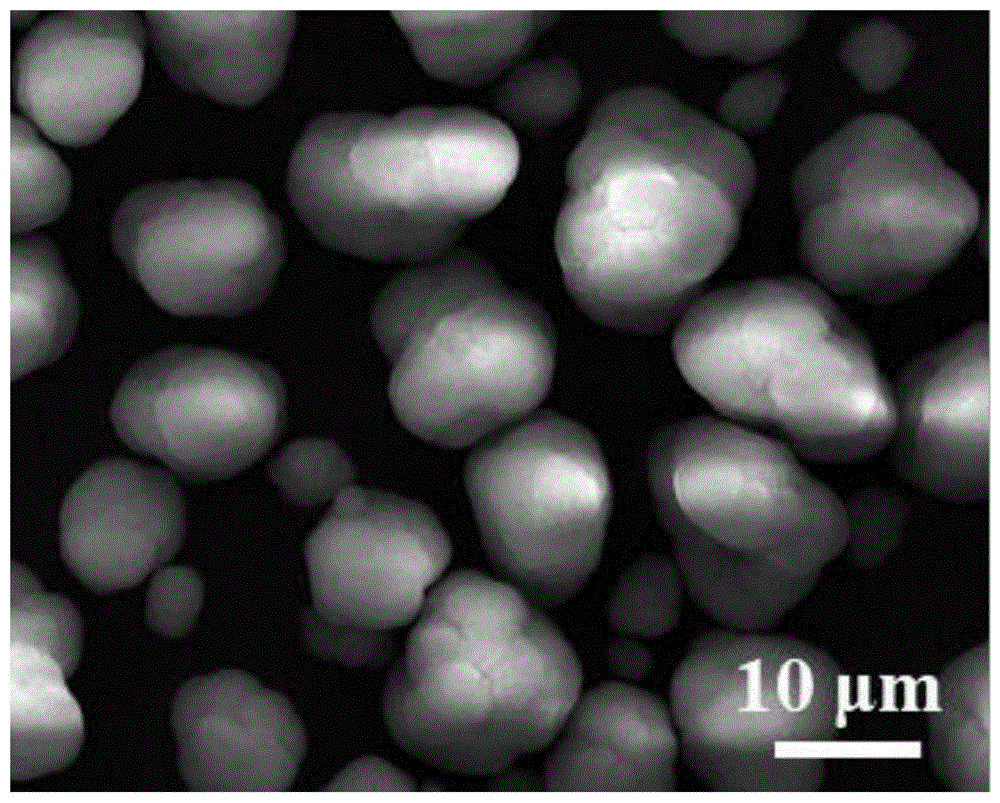
图1为实施例1所得的Ni0.6Co0.2Mn0.2(OH)2前驱体材料的SEM图片。FIG. 1 is a SEM picture of the Ni 0.6 Co 0.2 Mn 0.2 (OH) 2 precursor material obtained in Example 1. FIG.
图2为实施例1所得的LiNi0.6Co0.2Mn0.2O2成品材料的SEM、TEM、EDS图片。其中a为实施例1所得的NCM622成品材料的SEM图片;b为实施例1所得的NCM622成品材料的SEM放大图;c为实施例1所得的NCM622成品材料的HRTEM图片;d-g为实施例1所得的NCM622成品材料的EDS能谱图片。FIG. 2 is the SEM, TEM and EDS pictures of the LiNi 0.6 Co 0.2 Mn 0.2 O 2 finished material obtained in Example 1. FIG. Wherein a is the SEM picture of the NCM622 finished material obtained in Example 1; b is the SEM enlarged image of the NCM622 finished material obtained in Example 1; c is the HRTEM picture of the NCM622 finished material obtained in Example 1; dg is the obtained NCM622 finished product in Example 1 The EDS spectrum picture of the NCM622 finished material.
图3为实施例1所得的Ni0.6Co0.2Mn0.2(OH)2前驱体材料和LiNi0.6Co0.2Mn0.2O2成品材料的XRD谱图。3 is the XRD pattern of the Ni 0.6 Co 0.2 Mn 0.2 (OH) 2 precursor material and the LiNi 0.6 Co 0.2 Mn 0.2 O 2 product material obtained in Example 1. FIG.
图4为实施例1所得的NCM622成品材料对锂半电池在3-4.3V电压区间和0.1C电流密度下的首次充放电曲线图。4 is a graph showing the first charge-discharge curve of the NCM622 finished material obtained in Example 1 to a lithium half-cell in a voltage range of 3-4.3V and a current density of 0.1C.
图5为实施例1-3所得的NCM622成品材料对锂半电池的电化学性能图。其中a为在3-4.3V电压区间和0.5C电流密度下的循环稳定性测试图;b为在3-4.3V电压区间内的倍率性能测试图。5 is a graph showing the electrochemical performance of the NCM622 finished material obtained in Examples 1-3 on a lithium half-cell. Where a is the cycle stability test chart in the 3-4.3V voltage range and 0.5C current density; b is the rate performance test chart in the 3-4.3V voltage range.
图6为实施例1、实施例4和对比例1-3所得的NCM622成品材料对锂半电池的电化学性能图。其中a为在3-4.3V电压区间和0.5C电流密度下的循环稳定性测试图;b为在3-4.3V电压区间内的倍率性能测试图。6 is a graph showing the electrochemical performance of NCM622 finished materials obtained in Example 1, Example 4 and Comparative Examples 1-3 on lithium half cells. Where a is the cycle stability test chart in the 3-4.3V voltage range and 0.5C current density; b is the rate performance test chart in the 3-4.3V voltage range.
图7为实施例1所得的NCM622成品材料与商业化石墨和Si/C分别匹配的全电池电化学性能图。其中a为0.5C电流密度下的循环稳定性测试图;b为倍率性能测试图。FIG. 7 is a graph showing the full-cell electrochemical performance of the NCM622 finished material obtained in Example 1, which is matched with commercial graphite and Si/C, respectively. Among them, a is the cycle stability test chart at 0.5C current density; b is the rate performance test chart.
具体实施方式Detailed ways
一种在低氨浓度下制备高性能锂离子电池三元正极材料的方法,包括以下步骤:A method for preparing a high-performance lithium-ion battery ternary positive electrode material under low ammonia concentration, comprising the following steps:
步骤一:取含有镍、钴、锰的盐溶于去离子水中配制混合盐溶液;所述的镍、钴、锰的盐优选分别为NiSO4·6H2O、COSO4·7H2O、MnSO4·H2O,所述的混合盐溶液中,镍、钴和锰总浓度优选为1~2mol L-1;所述的镍、钴、锰的盐溶液的摩尔比为x:y:z,其中0<x<1,0<y<1,0<z<1,且x+y+z=1;更优选为0.6:0.2:0.2;Step 1: Dissolve the salt containing nickel, cobalt and manganese in deionized water to prepare a mixed salt solution; the salts of nickel, cobalt and manganese are preferably NiSO 4 ·6H 2 O, COSO 4 ·7H 2 O, MnSO respectively 4. H 2 O, in the mixed salt solution, the total concentration of nickel, cobalt and manganese is preferably 1 to 2 mol L −1 ; the molar ratio of the salt solution of nickel, cobalt and manganese is x:y:z , where 0<x<1, 0<y<1, 0<z<1, and x+y+z=1; more preferably 0.6:0.2:0.2;
步骤二:向步骤一得到的混合盐溶液中加入络合剂,并搅拌溶解获得混合均匀的盐和络合剂混合溶液,然后加入酸,调节pH值在1以下,得到混合溶液;所述的络合剂为含铵根的铵盐类,优选为硝酸铵、硫酸铵、碳酸氨或碳酸氢铵;所述的酸优选为硝酸、硫酸、盐酸或醋酸;所述的络合剂中的铵根与镍钴锰三者的摩尔数之和的摩尔比为0.1:1;所述的盐溶液和络合剂使用一个原料桶混合盛装;Step 2: adding a complexing agent to the mixed salt solution obtained in step 1, stirring and dissolving to obtain a mixed solution of salt and complexing agent that is evenly mixed, then adding an acid, and adjusting the pH value to be below 1 to obtain a mixed solution; the The complexing agent is an ammonium salt containing ammonium, preferably ammonium nitrate, ammonium sulfate, ammonium carbonate or ammonium bicarbonate; the acid is preferably nitric acid, sulfuric acid, hydrochloric acid or acetic acid; the ammonium in the complexing agent The molar ratio of the root and the sum of the moles of nickel, cobalt, and manganese is 0.1:1; the salt solution and the complexing agent are mixed and packed in a raw material barrel;
步骤三:将步骤二的混合溶液和NaOH溶液分别持续泵入装有浓度为0.1mol L-1以下的底液氨水的连续共沉淀反应釜中,通过调节混合溶液和NaOH溶液两者的进料速度,使反应过程中反应釜的总氨浓度与底液氨水中的浓度相同,通过在线pH值检测仪监控反应釜中溶液pH值,在50~60℃的温度和800~1000r/min的转速条件下控制pH值在10~10.5之间,持续反应至前驱体尺寸10~20μm之间,经陈化采用去离子水洗涤过滤调节滤液pH值为7~7.5,获得前驱体材料NixCoyMnz(OH)2,0<x<1,0<y<1,0<z<1,x+y+z=1;所述的NaOH溶液的浓度优选为6~10mol L-1;Step 3: The mixed solution and the NaOH solution of
本发明所述的混合溶液和NaOH溶液两者的进料速度没有特殊限定,需要根据反应釜的大小而定,进料速度需要保证进料氨浓度为设计值。The feeding speed of the mixed solution and the NaOH solution of the present invention is not particularly limited, and needs to be determined according to the size of the reaction kettle, and the feeding speed needs to ensure that the feeding ammonia concentration is the design value.
步骤四:将步骤三获得的前驱体材料优选先在100℃的烘箱中干燥过夜,后进行筛分,再与LiOH·H2O研磨混合,先在500℃~550℃下保温3~5h,后在780℃~820℃范围内保温4~8h最后在840~900℃下保温8~15h,之后降温冷却,研磨过200~400目筛,得到锂化三元材料LiNixCoyMnzO2,0<x<1,0<y<1,0<z<1,x+y+z=1。所述的前驱体材料与LiOH·H2O的摩尔比优选为1:(1.05~1.2),更优选为1:1.05。Step 4: The precursor material obtained in Step 3 is preferably dried in an oven at 100°C overnight, then sieved, and then ground and mixed with LiOH·H 2 O, and firstly kept at 500°C to 550°C for 3 to 5 hours. After that, the temperature is kept at 780-820°C for 4-8 hours, and finally, the temperature is kept at 840-900°C for 8-15 hours, and then the temperature is cooled down and ground through a 200-400 mesh sieve to obtain the lithiated ternary material LiNi x Co y Mn z O 2 , 0<x<1, 0<y<1, 0<z<1, x+y+z=1. The molar ratio of the precursor material to LiOH·H 2 O is preferably 1:(1.05-1.2), more preferably 1:1.05.
下面结合具体实施例对本发明做进一步详细的说明,实施例中涉及到的原料均为商购获得。The present invention will be described in further detail below with reference to specific examples, and the raw materials involved in the examples are all commercially available.
实施例1Example 1
1)取摩尔比为0.6:0.2:0.2的NiSO4·6H2O、COSO4·7H2O、MnSO4·H2O溶于去离子水中配制成1.25mol L-1的镍、钴、锰的混合盐溶液。1) Take NiSO 4 ·6H 2 O, COSO 4 ·7H 2 O, MnSO 4 ·H 2 O with a molar ratio of 0.6:0.2:0.2 and dissolve them in deionized water to prepare 1.25mol L -1 of nickel, cobalt, manganese mixed salt solution.
2)向上述步骤1)盐溶液中加入硝酸铵(在混合溶液中浓度为0.125mol L-1)并搅拌溶解获得混合均匀的盐和络合剂混合溶液。2) Add ammonium nitrate (concentration in the mixed solution is 0.125mol L −1 ) to the salt solution in the above step 1) and stir and dissolve to obtain a well-mixed mixed solution of salt and complexing agent.
3)通过添加硝酸将上述步骤2)中混合溶液pH值调节为1.0。3) The pH value of the mixed solution in the above step 2) was adjusted to 1.0 by adding nitric acid.
4)通过蠕动泵将上述步骤3)中混合溶液以及8mol L-1的NaOH溶液分别持续泵入呈有0.8L氨浓度为0.1mol L-1的底液氨水的2L的连续共沉淀反应釜中,调节步骤3)中混合溶液进料速度为5.76mL min-1,NaOH溶液的进料速度为1.44mL min-1,以此达到控制反应釜中总氨浓度为0.1mol L-1,且在58℃的温度和1000r/min的转速条件下控制pH值为10.25持续反应10h得到尺寸约12μm的前驱体,陈化过夜后采用去离子水洗涤过滤至滤液pH值为7,获得Ni0.6Co0.2Mn0.2(OH)2前驱体材料。4) by peristaltic pump, the NaOH solution of mixed solution and 8mol L -1 in above-mentioned steps 3) is continuously pumped into the continuous co-precipitation reactor of 2L that has 0.8L ammonia concentration and is the bottom liquid ammonia water of 0.1mol L -1 respectively. , adjust the mixed solution feeding speed in step 3) to be 5.76 mL min -1 , and the feeding speed of NaOH solution to be 1.44 mL min -1 , so that the total ammonia concentration in the control reactor is 0.1 mol L -1 , and in the At a temperature of 58 °C and a rotation speed of 1000 r/min, the pH value was controlled to be 10.25 , and the reaction was continued for 10 h to obtain a precursor with a size of about 12 μm. After aging overnight, it was washed with deionized water and filtered until the pH value of the filtrate was 7. Mn 0.2 (OH) 2 precursor material.
5)将步骤4)中所得前驱体材料在100℃的烘箱中干燥过夜,后进行筛分。5) The precursor material obtained in step 4) is dried in an oven at 100° C. overnight, and then sieved.
6)将步骤5)中所得干燥前驱体材料与LiOH·H2O按1:1.05的摩尔比均匀研磨混合,先在500℃下保温3h,后在800℃下保温5h,最后在850℃下保温10h,之后降温冷却,研磨过300目筛,得到锂化三元材料LiNi0.6Co0.2Mn0.2O2(NCM622)。6) The dried precursor material obtained in step 5) and LiOH·H 2 O are uniformly ground and mixed at a molar ratio of 1:1.05, firstly kept at 500°C for 3h, then at 800°C for 5h, and finally at 850°C Incubate for 10h, then cool down and cool, and grind through a 300-mesh sieve to obtain a lithiated ternary material LiNi 0.6 Co 0.2 Mn 0.2 O 2 (NCM622).
实施例1制备所得Ni0.6Co0.2Mn0.2(OH)2前驱体材料SEM测试结果见图1,从图1可以看到其粒径均一,颗粒尺寸大多在12μm左右,振实密度为1.57g cm-3。The SEM test results of the Ni 0.6 Co 0.2 Mn 0.2 (OH) 2 precursor material prepared in Example 1 are shown in Figure 1. From Figure 1, it can be seen that the particle size is uniform, the particle size is mostly about 12 μm, and the tap density is 1.57 g cm -3 .
所得LiNi0.6Co0.2Mn0.2O2成品三元材料SEM测试结果见图2a-b,可以看到其由300~350nm大小的一次单晶块组装的密实的二次球三元材料。图2c为其HRTEM结果,可以看到其明显且良好的101晶面。图2d-g为其EDS能谱图,可以看到Ni、Co、Mn三种元素均匀分布。The SEM test results of the obtained LiNi 0.6 Co 0.2 Mn 0.2 O 2 finished ternary material are shown in Figure 2a-b. It can be seen that it is a dense secondary spherical ternary material assembled from primary single crystal blocks with a size of 300-350 nm. Figure 2c is its HRTEM result, which shows a distinct and good 101 crystal plane. Figure 2d-g is its EDS energy spectrum, it can be seen that the three elements Ni, Co, and Mn are evenly distributed.
所得Ni0.6Co0.2Mn0.2(OH)2前驱体和LiNi0.6Co0.2Mn0.2O2成品三元材料的XRD图谱如图3所示,其中Ni0.6Co0.2Mn0.2(OH)2前驱体材料展现纯的Ni(OH)2相,所有衍射线对应六方结构,其空间群为

实施例2Example 2
具体步骤和反应条件和实施例1相同,不同之处在于,步骤4)中控制反应pH值为10.0。The specific steps and reaction conditions are the same as in Example 1, except that the pH value of the control reaction in step 4) is 10.0.
实施例3Example 3
具体步骤和反应条件和实施例1相同,不同之处在于,步骤4)中控制反应pH值为10.5。The specific steps and reaction conditions are the same as in Example 1, except that the pH value of the control reaction in step 4) is 10.5.
实施例4Example 4
具体步骤和反应条件和实施例1相同,不同之处在于,步骤2)中加入硝酸铵的浓度减半为0.0625mol L-1,控制相同的进料速度,,控制反应釜中总氨浓度为0.05mol L-1,且配制0.05mol L-1的氨水为底液,且控制反应pH值为10.0。以此来对此降氨方法进行扩展,观察其在更低总氨浓度(0.05mol L-1)下的材料合成情况。Concrete steps and reaction conditions are the same as in Example 1, the difference is that the concentration of adding ammonium nitrate in step 2) is halved to 0.0625mol L -1 , and the same feed rate is controlled, and the total ammonia concentration in the control reactor is 0.05mol L -1 , and 0.05mol L -1 of ammonia water was prepared as the bottom liquid, and the pH value of the reaction was controlled to be 10.0. In this way, the ammonia reduction method was extended to observe its material synthesis at a lower total ammonia concentration (0.05mol L -1 ).
对比例1Comparative Example 1
具体步骤和反应条件和实施例1相同,不同之处在于,没有步骤3)操作,不添加硝酸来调节混合溶液pH至更低值,仅以NH4 +为络合剂,与实施例1做对比,从而验证加入酸的作用。The specific steps and reaction conditions are the same as in Example 1, the difference is that there is no operation in step 3), no nitric acid is added to adjust the pH of the mixed solution to a lower value, only NH 4 + is used as a complexing agent, and the same as in Example 1. Contrast to verify the effect of adding acid.
对比例2Comparative Example 2
具体步骤和反应条件和实施例1相同,不同之处在于,没有步骤2)操作,不向盐溶液中添加硝酸铵络合剂(反应时所用总氨浓度为0),仅以H+为络合剂,与实施例1做对比,从而验证加入硝酸铵做络合剂的作用。The specific steps and reaction conditions are the same as in Example 1, the difference is that there is no step 2) operation, no ammonium nitrate complexing agent is added to the salt solution (the total ammonia concentration used during the reaction is 0 ), and only H is used as the complex The mixture is compared with Example 1 to verify the effect of adding ammonium nitrate as a complexing agent.
对比例3Comparative Example 3
具体步骤和反应条件和实施例1相同,不同之处在于,在步骤2)操作中不向盐溶液中添加硝酸铵,而是单独盛装另一桶用市售25%~28%的浓氨水所配制的浓度为0.125molL-1的氨水溶液;且无步骤3)操作,不向盐溶液中添加酸来降低pH值。在步骤4)中通过调节盐溶液桶、氨水桶、NaOH桶的进料速度来控制反应釜中总氨浓度为0.1mol L-1。以此来对比NH4 +和H+作络合剂与常规NH3做络合剂在低氨条件下的材料合成情况。The specific steps and reaction conditions are the same as in Example 1, the difference is that in step 2), ammonium nitrate is not added to the salt solution, but another barrel is filled with commercially available 25%-28% concentrated ammonia water. The prepared ammonia solution with a concentration of 0.125 mol L -1 ; and without the operation of step 3), without adding acid to the salt solution to lower the pH value. In step 4), the total ammonia concentration in the reaction kettle is controlled to be 0.1 mol L -1 by adjusting the feeding speed of the salt solution barrel, the ammonia water barrel and the NaOH barrel. In this way, the synthesis of NH 4 + and H + as complexing agent and conventional NH 3 as complexing agent under the condition of low ammonia is compared.
应用例1Application example 1
将实施例1-4和对比例1-3所制备的NCM622正极材料均进行电化学储锂性能测试。具体步骤如下:The NCM622 cathode materials prepared in Examples 1-4 and Comparative Examples 1-3 were all tested for electrochemical lithium storage performance. Specific steps are as follows:
将正极活性材料、C45、KS-6和PVDF按照95:2:1.5:1.5的质量比在N-甲基吡咯烷酮(NMP)溶剂中混合,设置浆液固含量为55%,利用匀浆机均匀混合后涂布于铝箔上,在100℃烘箱中烘干1h,经过辊压和裁片后在真空烘箱中过夜。所得极片活性材料负载量约5.5mgcm-2。负极采用金属锂片,隔膜为聚丙烯多孔膜,电解液采用1mol L-1的LiPF6锂盐溶于体积比为EC/EMC=3/7的溶剂体系中,电池采用2025型扣式电池,在3-4.3V的电压区间进行储锂性能测试。The positive active material, C45, KS-6 and PVDF were mixed in N-methylpyrrolidone (NMP) solvent according to the mass ratio of 95:2:1.5:1.5, the solid content of the slurry was set to 55%, and the homogenizer was used to uniformly mix It was then coated on aluminum foil, dried in a 100°C oven for 1 hour, rolled and cut into pieces and then placed in a vacuum oven overnight. The resulting pole piece active material loading was about 5.5 mgcm −2 . The negative electrode is a metal lithium sheet, the separator is a polypropylene porous film, the electrolyte is 1mol L -1 LiPF 6 lithium salt dissolved in a solvent system with a volume ratio of EC/EMC=3/7, and the battery is a 2025 type button battery. Lithium storage performance test was carried out in the voltage range of 3-4.3V.
实施例1所得材料制备电池在0.1C电流密度下的首次充放电曲线如图4所示,其首次库伦效率可达90.1%,首次放电比容量176.7mAh g-1。Figure 4 shows the first charge-discharge curve of the battery prepared with the material obtained in Example 1 at a current density of 0.1C, the first-time Coulombic efficiency can reach 90.1%, and the first-time discharge specific capacity is 176.7mAh g -1 .
图5为实施例1-3所得的NCM622成品材料对锂半电池的电化学性能图。其中a为在3-4.3V电压区间和0.5C电流密度下的循环稳定性测试图;b为在3-4.3V电压区间内的倍率性能测试图。5 is a graph showing the electrochemical performance of the NCM622 finished material obtained in Examples 1-3 on a lithium half-cell. Where a is the cycle stability test chart in the 3-4.3V voltage range and 0.5C current density; b is the rate performance test chart in the 3-4.3V voltage range.
图6为实施例1、实施例4和对比例1-3所得的NCM622成品材料对锂半电池的电化学性能图。其中a为在3-4.3V电压区间和0.5C电流密度下的循环稳定性测试图;b为在3-4.3V电压区间内的倍率性能测试图。6 is a graph showing the electrochemical performance of NCM622 finished materials obtained in Example 1, Example 4 and Comparative Examples 1-3 on lithium half cells. Where a is the cycle stability test chart in the 3-4.3V voltage range and 0.5C current density; b is the rate performance test chart in the 3-4.3V voltage range.
从图5和6对比分析发现:在0.5C电流密度下,实施例1材料在100次循环后具有最高的放电容量146mAh g-1,且容量保持率可达91.9%。实施例1材料在3C高电流密度下可输出最高的比容量115.7mAh g-1。实施例2和3在改变不同pH值的条件下,输出比容量和倍率性能相较于实施例1有所下降,但他们仍然均具有较好的循环稳定性,实施例4在总氨浓度为0.05mol L-1时,同样其所获得的材料的输出比容量和倍率性能相较于实施例1有所下降,但其具有极好的循环稳定性,100次循环后容量保持率几乎接近100%。因此,实施例2、3和4所得材料的电化学性能虽然相较于实施例1有所下降,但总体上也都表现良好。From the comparative analysis of Figures 5 and 6, it is found that at a current density of 0.5C, the material of Example 1 has the highest discharge capacity of 146mAh g -1 after 100 cycles, and the capacity retention rate can reach 91.9%. The material of Example 1 can output the highest specific capacity of 115.7mAh g -1 at 3C high current density. Compared with Example 1, the output specific capacity and rate performance of Examples 2 and 3 decreased under the condition of changing different pH values, but they still had good cycle stability. In Example 4, the total ammonia concentration was At 0.05mol L -1 , the output specific capacity and rate performance of the obtained material are also lower than those of Example 1, but it has excellent cycle stability, and the capacity retention rate after 100 cycles is almost close to 100. %. Therefore, although the electrochemical properties of the materials obtained in Examples 2, 3 and 4 are lower than that in Example 1, they all perform well on the whole.
而从对比例1可以看出,在反应过程中,不加入酸,会使反应过程中成核速率加快,材料生长控制困难,所得材料粒径不均一,从而使其电化学循环性能和倍率性能下降。对比例2中不向盐溶液中添加硝酸铵络合剂,会造成镍钴锰三种元素快速沉淀,造成相分离而使元素分布不均匀,同时所得前驱体材料质地疏松易破碎,这使得其具有非常低的输出容量和极差的倍率性能。对比例3中采用常规NH3做络合剂,在0.1mol L-1的较低总氨浓度下,NH3的络合能力有限,使得前驱体材料难以缓慢有序堆积生长,而造成所获得的前驱体材料大小不一,振实密度较低,因而具有较低的输出比容量,较差的循环性能和倍率性能。因此,通过对比例我们可以看出在实施例1的合成条件下所得的三元材料具有极佳的电化学性能。From Comparative Example 1, it can be seen that in the reaction process, without adding acid, the nucleation rate will be accelerated during the reaction process, the material growth control will be difficult, and the particle size of the obtained material will be non-uniform, so that its electrochemical cycle performance and rate performance will be improved. decline. In Comparative Example 2, no ammonium nitrate complexing agent was added to the salt solution, which would cause the three elements of nickel, cobalt, and manganese to precipitate rapidly, resulting in phase separation and uneven distribution of the elements. Has very low output capacity and extremely poor rate capability. In Comparative Example 3, conventional NH 3 was used as the complexing agent. At a lower total ammonia concentration of 0.1 mol L -1 , the complexing ability of NH 3 was limited, making it difficult for the precursor materials to grow slowly and orderly, resulting in the obtained Precursor materials of different sizes and lower tap density result in lower output specific capacity, poor cycle performance and rate capability. Therefore, we can see from the comparative example that the ternary material obtained under the synthesis conditions of Example 1 has excellent electrochemical performance.
从上面的实施例和对比例可以充分证明采用本发明方法在低氨浓度条件下所制备的NCM622材料具有优异的电化学性能,因此,本发明更具商业化推广优越性。From the above examples and comparative examples, it can be fully proved that the NCM622 material prepared by the method of the present invention under the condition of low ammonia concentration has excellent electrochemical performance. Therefore, the present invention is more advantageous for commercialization.
应用例2Application example 2
将实施例1所得材料与商业化石墨和Si/C负极材料分别匹配全电池进行电化学储锂性能测试,具体步骤如下:The material obtained in Example 1 is matched with the commercial graphite and Si/C negative electrode material to carry out the electrochemical lithium storage performance test by matching the full battery respectively, and the specific steps are as follows:
采用上述应用例1所制备的实施例1材料的电极片。商业化石墨和Si/C负极材料电极片制备过程如下:将商业化石墨(Si/C)、乙炔黑、CMC和SBR按照90:6:2:2的质量比在水溶剂中混合,设置浆液固含量为40%,利用匀浆机均匀混合后涂布于铜箔上,在80℃烘箱中烘干1h,经过辊压和裁片后在真空烘箱中过夜。所得极片活性材料负载量约4.0mg cm-2(石墨)和2.8mg cm-2(Si/C)。设计N/P为1.2,进行全电池匹配。隔膜为聚丙烯多孔膜,电解液采用1mol L-1的LiPF6锂盐溶于体积比为EC/EMC=3/7的溶剂体系,另外加入2wt%的VC添加剂,电池采用2025型扣式电池,NCM622对商业化石墨全电池在2.75-4.25V的电压区间进行储锂性能测试,NCM622对商业化Si/C全电池在2.6-4.25V的电压区间进行储锂性能测试。The electrode sheet of the material of Example 1 prepared in the above Application Example 1 was used. The preparation process of commercial graphite and Si/C anode material electrode sheet is as follows: commercial graphite (Si/C), acetylene black, CMC and SBR are mixed in water solvent according to the mass ratio of 90:6:2:2, and the slurry is set The solid content is 40%. After uniform mixing with a homogenizer, it is coated on copper foil, dried in an oven at 80°C for 1 hour, rolled and sliced, and then left in a vacuum oven overnight. The resulting electrode active material loadings were about 4.0 mg cm -2 (graphite) and 2.8 mg cm -2 (Si/C). The design N/P is 1.2 for full cell matching. The separator is a polypropylene porous film, the electrolyte is 1mol L -1 LiPF 6 lithium salt dissolved in a solvent system with a volume ratio of EC/EMC=3/7, and 2wt% VC additive is added, and the battery uses a 2025 type button battery , NCM622 tests the lithium storage performance of commercial graphite full cells in the voltage range of 2.75-4.25V, and NCM622 tests the lithium storage performance of commercial Si/C full cells in the voltage range of 2.6-4.25V.
实施例1所得材料与商业化石墨和Si/C负极材料分别匹配全电池的充放电循环性能和倍率性能测试如图7a-b所示,其中a为0.5C电流密度下的循环稳定性测试图;b为倍率性能测试图。NCM622对商业化石墨全电池在0.5C电流密度下循环150次后输出比容量152.4mAh g-1,容量保持率可达91.8%,在5C高电流密度下可输出比容量107.5mAh g-1。NCM622对商业化Si/C全电池在0.5C电流密度下循环150次后输出比容量139mAh g-1,容量保持率可达85.3%,在5C高电流密度下可输出比容量84.4mAh g-1。这充分说明了实施例1所得NCM622材料在全电池中也表现出良好的电化学性能,而不仅限于锂半电池,因此,本发明具有广泛应用的实际意义。The charge-discharge cycle performance and rate performance test of the material obtained in Example 1 and commercial graphite and Si/C anode materials matching the full battery, respectively, are shown in Figure 7a-b, where a is the cycle stability test graph at a current density of 0.5C ; b is the test chart of rate performance. NCM622 can output a specific capacity of 152.4mAh g -1 and a capacity retention rate of 91.8% after 150 cycles at a current density of 0.5C for a commercial graphite full cell, and a specific capacity of 107.5mAh g -1 at a high current density of 5C. NCM622 can output a specific capacity of 139mAh g -1 for commercial Si/C full cells after 150 cycles at a current density of 0.5C, the capacity retention rate can reach 85.3%, and a specific capacity of 84.4mAh g -1 at a high current density of 5C . This fully demonstrates that the NCM622 material obtained in Example 1 also exhibits good electrochemical performance in the full cell, and is not limited to the lithium half cell. Therefore, the present invention has practical significance for wide application.
本发明包括但不限于以上实施例,凡是在本发明精神的原则之下进行的任何等同替换或局部改进,都将视为在本发明的保护范围之内。The present invention includes but is not limited to the above embodiments, and any equivalent replacement or partial improvement made under the spirit of the present invention will be deemed to be within the protection scope of the present invention.
Claims (10)
Priority Applications (1)
| Application Number | Priority Date | Filing Date | Title |
|---|---|---|---|
| CN202010787238.9A CN111807425A (en) | 2020-08-07 | 2020-08-07 | A method for preparing high-performance lithium-ion battery ternary cathode material at low ammonia concentration |
Applications Claiming Priority (1)
| Application Number | Priority Date | Filing Date | Title |
|---|---|---|---|
| CN202010787238.9A CN111807425A (en) | 2020-08-07 | 2020-08-07 | A method for preparing high-performance lithium-ion battery ternary cathode material at low ammonia concentration |
Publications (1)
| Publication Number | Publication Date |
|---|---|
| CN111807425A true CN111807425A (en) | 2020-10-23 |
Family
ID=72864608
Family Applications (1)
| Application Number | Title | Priority Date | Filing Date |
|---|---|---|---|
| CN202010787238.9A Pending CN111807425A (en) | 2020-08-07 | 2020-08-07 | A method for preparing high-performance lithium-ion battery ternary cathode material at low ammonia concentration |
Country Status (1)
| Country | Link |
|---|---|
| CN (1) | CN111807425A (en) |
Cited By (4)
| Publication number | Priority date | Publication date | Assignee | Title |
|---|---|---|---|---|
| CN114655998A (en) * | 2022-03-01 | 2022-06-24 | 西安理工大学 | Preparation method of high nickel ternary cathode precursor |
| CN114804223A (en) * | 2021-01-21 | 2022-07-29 | 中国石油化工股份有限公司 | Continuous and stable preparation method of ternary precursor for lithium ion battery |
| CN116102087A (en) * | 2023-02-27 | 2023-05-12 | 荆门市格林美新材料有限公司 | Nickel-manganese binary precursor and preparation method and application thereof |
| WO2024222641A1 (en) * | 2023-04-24 | 2024-10-31 | 珠海冠宇动力电池有限公司 | Battery |
Citations (6)
| Publication number | Priority date | Publication date | Assignee | Title |
|---|---|---|---|---|
| CN1767233A (en) * | 2004-10-26 | 2006-05-03 | 深圳市比克电池有限公司 | Multi-element metal oxide, lithium-ion battery cathode material and preparation method thereof |
| CN106935847A (en) * | 2017-03-03 | 2017-07-07 | 南京航空航天大学 | A kind of preparation method of the anode material for lithium-ion batteries controllable based on pH value |
| CN107204423A (en) * | 2017-05-18 | 2017-09-26 | 山东玉皇新能源科技有限公司 | A kind of preparation method and applications of high magnification tertiary cathode material |
| CN109721109A (en) * | 2018-12-07 | 2019-05-07 | 北京理工大学 | A kind of lithium battery nickel-cobalt-manganternary ternary anode material presoma and preparation method thereof and the positive electrode being prepared |
| KR20190121857A (en) * | 2017-03-15 | 2019-10-28 | 유미코아 | Nitrate process for preparing transition metal hydroxide precursors |
| CN111029561A (en) * | 2019-12-20 | 2020-04-17 | 大连博融新材料有限公司 | Ternary lithium battery positive electrode material precursor and preparation method thereof, ternary lithium battery positive electrode material and preparation method and application thereof |
-
2020
- 2020-08-07 CN CN202010787238.9A patent/CN111807425A/en active Pending
Patent Citations (6)
| Publication number | Priority date | Publication date | Assignee | Title |
|---|---|---|---|---|
| CN1767233A (en) * | 2004-10-26 | 2006-05-03 | 深圳市比克电池有限公司 | Multi-element metal oxide, lithium-ion battery cathode material and preparation method thereof |
| CN106935847A (en) * | 2017-03-03 | 2017-07-07 | 南京航空航天大学 | A kind of preparation method of the anode material for lithium-ion batteries controllable based on pH value |
| KR20190121857A (en) * | 2017-03-15 | 2019-10-28 | 유미코아 | Nitrate process for preparing transition metal hydroxide precursors |
| CN107204423A (en) * | 2017-05-18 | 2017-09-26 | 山东玉皇新能源科技有限公司 | A kind of preparation method and applications of high magnification tertiary cathode material |
| CN109721109A (en) * | 2018-12-07 | 2019-05-07 | 北京理工大学 | A kind of lithium battery nickel-cobalt-manganternary ternary anode material presoma and preparation method thereof and the positive electrode being prepared |
| CN111029561A (en) * | 2019-12-20 | 2020-04-17 | 大连博融新材料有限公司 | Ternary lithium battery positive electrode material precursor and preparation method thereof, ternary lithium battery positive electrode material and preparation method and application thereof |
Cited By (5)
| Publication number | Priority date | Publication date | Assignee | Title |
|---|---|---|---|---|
| CN114804223A (en) * | 2021-01-21 | 2022-07-29 | 中国石油化工股份有限公司 | Continuous and stable preparation method of ternary precursor for lithium ion battery |
| CN114804223B (en) * | 2021-01-21 | 2023-11-10 | 中国石油化工股份有限公司 | A continuous and stable preparation method of ternary precursor for lithium-ion batteries |
| CN114655998A (en) * | 2022-03-01 | 2022-06-24 | 西安理工大学 | Preparation method of high nickel ternary cathode precursor |
| CN116102087A (en) * | 2023-02-27 | 2023-05-12 | 荆门市格林美新材料有限公司 | Nickel-manganese binary precursor and preparation method and application thereof |
| WO2024222641A1 (en) * | 2023-04-24 | 2024-10-31 | 珠海冠宇动力电池有限公司 | Battery |
Similar Documents
| Publication | Publication Date | Title |
|---|---|---|
| JP7475451B2 (en) | Cobalt-free positive electrode material for lithium-ion batteries, its manufacturing method, and lithium-ion battery | |
| CN110518219B (en) | Core-shell structured high nickel gradient nickel-cobalt-manganese-aluminum quaternary positive electrode material and preparation method thereof | |
| CN110518220B (en) | A kind of high-nickel gradient nickel-cobalt-manganese-aluminum quaternary positive electrode material and preparation method thereof | |
| CN108878818B (en) | Core-shell structure nickel-cobalt-manganese ternary cathode material precursor and preparation method thereof | |
| CN109817970B (en) | Single crystal sodium ion battery electrode material and preparation method thereof | |
| WO2022048346A1 (en) | Vanadium pentoxide/rgo-coated lithium nickel cobalt manganese oxide positive electrode material and preparation method therefor | |
| CN110540254A (en) | A boron-magnesium co-doped gradient nickel-cobalt lithium manganese oxide positive electrode material and preparation method thereof | |
| CN108767216B (en) | Lithium ion battery anode material with variable slope and full concentration gradient and synthesis method thereof | |
| CN113479944A (en) | Preparation method of modified high-nickel ternary cathode material | |
| WO2015039490A1 (en) | Lithium-rich anode material and preparation method thereof | |
| CN114084914A (en) | A kind of ternary precursor and its preparation method and application | |
| CN111807425A (en) | A method for preparing high-performance lithium-ion battery ternary cathode material at low ammonia concentration | |
| CN113809294A (en) | Cobalt-free high-nickel ternary positive electrode material, preparation method and method for preparing battery positive electrode | |
| CN103474638A (en) | Anode material for lithium ion battery and preparation method of anode material | |
| CN101783408B (en) | Cathode material, preparation method thereof and battery using cathode material | |
| CN111302407A (en) | High nickel quaternary cathode material precursor and preparation method, high nickel quaternary cathode material and preparation method, lithium ion battery | |
| CN110534737A (en) | A kind of high magnification doping type nickel-cobalt-manganese ternary material and preparation method thereof | |
| CN115632115B (en) | A lanthanum aluminate-coated lithium nickel cobalt manganate ternary positive electrode material and its preparation method | |
| CN117059795A (en) | High-entropy alloy modified high-nickel cobalt-free positive electrode material and preparation method thereof | |
| CN110931763A (en) | Lithium ion battery anode material and preparation method and application thereof | |
| CN111933914B (en) | Vanadium pentoxide and rGO co-cladding gradient ternary positive electrode material and preparation method thereof | |
| CN115432743A (en) | High-nickel ternary precursor material, preparation method thereof, positive electrode material and lithium ion battery | |
| US20250122094A1 (en) | Aluminum-doped cathode material precursor, and preparation method therefor and use thereof | |
| JP7733842B2 (en) | Lithium oxide-containing positive electrode material precursor, lithium oxide-containing positive electrode material, preparation method thereof and use thereof, positive electrode sheet and use thereof | |
| CN116675264A (en) | Nickel-manganese binary precursor, preparation method and application thereof, positive electrode material and lithium ion battery |
Legal Events
| Date | Code | Title | Description |
|---|---|---|---|
| PB01 | Publication | ||
| PB01 | Publication | ||
| SE01 | Entry into force of request for substantive examination | ||
| SE01 | Entry into force of request for substantive examination | ||
| WD01 | Invention patent application deemed withdrawn after publication |
Application publication date: 20201023 |
|
| WD01 | Invention patent application deemed withdrawn after publication |