CN111786712B - A CR-based UAV communication network secondary link throughput optimization method - Google Patents
A CR-based UAV communication network secondary link throughput optimization method Download PDFInfo
- Publication number
- CN111786712B CN111786712B CN202010472139.1A CN202010472139A CN111786712B CN 111786712 B CN111786712 B CN 111786712B CN 202010472139 A CN202010472139 A CN 202010472139A CN 111786712 B CN111786712 B CN 111786712B
- Authority
- CN
- China
- Prior art keywords
- uav
- sensing
- micro
- communication network
- secondary link
- Prior art date
- Legal status (The legal status is an assumption and is not a legal conclusion. Google has not performed a legal analysis and makes no representation as to the accuracy of the status listed.)
- Expired - Fee Related
Links
- 238000004891 communication Methods 0.000 title claims abstract description 57
- 238000005457 optimization Methods 0.000 title claims abstract description 50
- 238000000034 method Methods 0.000 title claims abstract description 48
- 238000001228 spectrum Methods 0.000 claims abstract description 43
- 238000001514 detection method Methods 0.000 claims abstract description 36
- 230000001149 cognitive effect Effects 0.000 claims abstract description 24
- 230000004927 fusion Effects 0.000 claims abstract description 13
- 230000008447 perception Effects 0.000 claims description 23
- 230000014509 gene expression Effects 0.000 claims description 16
- 230000005540 biological transmission Effects 0.000 claims description 14
- 238000005070 sampling Methods 0.000 claims description 6
- 230000007613 environmental effect Effects 0.000 claims description 5
- 230000006870 function Effects 0.000 claims description 3
- 238000004590 computer program Methods 0.000 claims description 2
- 230000033001 locomotion Effects 0.000 abstract description 8
- 238000005562 fading Methods 0.000 abstract description 5
- 230000000694 effects Effects 0.000 abstract description 4
- 238000012545 processing Methods 0.000 abstract description 2
- 238000005516 engineering process Methods 0.000 description 9
- 230000008569 process Effects 0.000 description 8
- 230000008859 change Effects 0.000 description 4
- 230000007423 decrease Effects 0.000 description 4
- 230000000737 periodic effect Effects 0.000 description 4
- 230000003068 static effect Effects 0.000 description 4
- 230000007547 defect Effects 0.000 description 3
- 238000004458 analytical method Methods 0.000 description 2
- 238000003491 array Methods 0.000 description 2
- 238000010586 diagram Methods 0.000 description 2
- 230000006872 improvement Effects 0.000 description 2
- 230000019771 cognition Effects 0.000 description 1
- 238000011161 development Methods 0.000 description 1
- 238000001914 filtration Methods 0.000 description 1
- 238000012986 modification Methods 0.000 description 1
- 230000004048 modification Effects 0.000 description 1
- 230000003287 optical effect Effects 0.000 description 1
- 230000008092 positive effect Effects 0.000 description 1
- 239000004065 semiconductor Substances 0.000 description 1
- 230000003595 spectral effect Effects 0.000 description 1
- 239000002699 waste material Substances 0.000 description 1
Images


Classifications
-
- H—ELECTRICITY
- H04—ELECTRIC COMMUNICATION TECHNIQUE
- H04B—TRANSMISSION
- H04B7/00—Radio transmission systems, i.e. using radiation field
- H04B7/14—Relay systems
- H04B7/15—Active relay systems
- H04B7/185—Space-based or airborne stations; Stations for satellite systems
- H04B7/18502—Airborne stations
- H04B7/18506—Communications with or from aircraft, i.e. aeronautical mobile service
-
- H—ELECTRICITY
- H04—ELECTRIC COMMUNICATION TECHNIQUE
- H04B—TRANSMISSION
- H04B17/00—Monitoring; Testing
- H04B17/30—Monitoring; Testing of propagation channels
- H04B17/382—Monitoring; Testing of propagation channels for resource allocation, admission control or handover
-
- H—ELECTRICITY
- H04—ELECTRIC COMMUNICATION TECHNIQUE
- H04W—WIRELESS COMMUNICATION NETWORKS
- H04W72/00—Local resource management
- H04W72/04—Wireless resource allocation
- H04W72/044—Wireless resource allocation based on the type of the allocated resource
- H04W72/0453—Resources in frequency domain, e.g. a carrier in FDMA
-
- H—ELECTRICITY
- H04—ELECTRIC COMMUNICATION TECHNIQUE
- H04W—WIRELESS COMMUNICATION NETWORKS
- H04W72/00—Local resource management
- H04W72/50—Allocation or scheduling criteria for wireless resources
- H04W72/54—Allocation or scheduling criteria for wireless resources based on quality criteria
- H04W72/542—Allocation or scheduling criteria for wireless resources based on quality criteria using measured or perceived quality
-
- H—ELECTRICITY
- H04—ELECTRIC COMMUNICATION TECHNIQUE
- H04W—WIRELESS COMMUNICATION NETWORKS
- H04W72/00—Local resource management
- H04W72/50—Allocation or scheduling criteria for wireless resources
- H04W72/54—Allocation or scheduling criteria for wireless resources based on quality criteria
- H04W72/543—Allocation or scheduling criteria for wireless resources based on quality criteria based on requested quality, e.g. QoS
-
- H—ELECTRICITY
- H04—ELECTRIC COMMUNICATION TECHNIQUE
- H04W—WIRELESS COMMUNICATION NETWORKS
- H04W16/00—Network planning, e.g. coverage or traffic planning tools; Network deployment, e.g. resource partitioning or cells structures
- H04W16/14—Spectrum sharing arrangements between different networks
-
- Y—GENERAL TAGGING OF NEW TECHNOLOGICAL DEVELOPMENTS; GENERAL TAGGING OF CROSS-SECTIONAL TECHNOLOGIES SPANNING OVER SEVERAL SECTIONS OF THE IPC; TECHNICAL SUBJECTS COVERED BY FORMER USPC CROSS-REFERENCE ART COLLECTIONS [XRACs] AND DIGESTS
- Y02—TECHNOLOGIES OR APPLICATIONS FOR MITIGATION OR ADAPTATION AGAINST CLIMATE CHANGE
- Y02D—CLIMATE CHANGE MITIGATION TECHNOLOGIES IN INFORMATION AND COMMUNICATION TECHNOLOGIES [ICT], I.E. INFORMATION AND COMMUNICATION TECHNOLOGIES AIMING AT THE REDUCTION OF THEIR OWN ENERGY USE
- Y02D30/00—Reducing energy consumption in communication networks
- Y02D30/70—Reducing energy consumption in communication networks in wireless communication networks
Landscapes
- Engineering & Computer Science (AREA)
- Computer Networks & Wireless Communication (AREA)
- Signal Processing (AREA)
- Quality & Reliability (AREA)
- Physics & Mathematics (AREA)
- Astronomy & Astrophysics (AREA)
- Aviation & Aerospace Engineering (AREA)
- General Physics & Mathematics (AREA)
- Electromagnetism (AREA)
- Mobile Radio Communication Systems (AREA)
Abstract
本发明属于无人机通信处理技术领域,公开了一种基于CR的UAV通信网络次级链路吞吐量优化方法,无人机在单个微感知弧度内进行能量检测和本地决策;无人机将每个微感知弧度的感知结果分别传输给融合中心;融合中心利用OR准则对所有感知结果做出全局决策;认知无人机网络根据融合中心的感知结果进行动态频谱接入决策;联合优化微感知弧度和弧度数量,使无人机正常工作时吞吐量最优。UAV在信道衰落严重的情况下,利用本发明,对于保障服务质量(QoS)和提升UAV吞吐量有着更好的效果。本发明以无人机圆周运动飞行角度的弧度值为对象,巧妙的分析了无人机周期运动过程中频谱感知性能以及谱效优化方案。

The invention belongs to the technical field of unmanned aerial vehicle communication processing, and discloses a CR-based UAV communication network secondary link throughput optimization method. The unmanned aerial vehicle performs energy detection and local decision-making within a single micro-sensing arc; The sensing results of each micro-sensing arc are respectively transmitted to the fusion center; the fusion center uses the OR criterion to make global decisions on all sensing results; the cognitive UAV network makes dynamic spectrum access decisions based on the sensing results of the fusion center; Perceives arcs and arcs to optimize throughput when the drone is operating normally. In the case of serious channel fading of UAV, using the present invention has better effect on guaranteeing quality of service (QoS) and improving UAV throughput. The invention takes the radian value of the flight angle of the circular motion of the UAV as the object, and skillfully analyzes the spectrum sensing performance and the spectrum efficiency optimization scheme during the periodical motion of the UAV.
Description
技术领域technical field
本发明属于无人机通信处理技术领域.,尤其涉及一种基于CR的UAV通信网络次级链路吞吐量优化方法。The invention belongs to the technical field of unmanned aerial vehicle communication processing, and in particular relates to a CR-based UAV communication network secondary link throughput optimization method.
背景技术Background technique
目前,无人机通常使用未经许可的频段(如IEEE S波段、IEEE L波段、工业科学和医疗(ISM)波段),并使用静态的频谱分配政策。近年来5G网络、 D2D(Device-to-Device)通信和物联网(Internet of Things,IoT)快速发展,频谱需求急剧增长。由于这些因素的影响,无人机的工作频段将变得过于拥挤,无人机将面临频谱短缺问题。认知无线电(CR)通过机会式地接入授权频段来解决频谱占而不用的浪费问题,采用先进的通信手段提升频谱利用效率。作为一种新的智能无线通信技术,无人机上装备认知传感器可以连续不断地感知周围的无线环境,在不影响PU正常工作的前提下择机利用这些空闲频谱,从而提升频谱利用率,有效缓解频谱资源匮乏的局面。Currently, drones typically use unlicensed frequency bands (such as IEEE S-Band, IEEE L-Band, Industrial Scientific and Medical (ISM) Band) and use static spectrum allocation policies. In recent years, the rapid development of 5G network, D2D (Device-to-Device) communication and the Internet of Things (IoT) has resulted in a sharp increase in spectrum demand. Due to these factors, the working frequency bands of UAVs will become overcrowded, and UAVs will face a shortage of spectrum. Cognitive Radio (CR) solves the waste of spectrum occupation by opportunistically accessing licensed frequency bands, and adopts advanced communication methods to improve spectrum utilization efficiency. As a new intelligent wireless communication technology, the cognitive sensor equipped on the UAV can continuously perceive the surrounding wireless environment, and select the opportunity to use the idle spectrum without affecting the normal operation of the PU, thereby improving the spectrum utilization rate and effectively reducing the The situation of scarcity of spectrum resources.
在解决频谱资源稀缺问题上,研发人员研发出许多无线通信新技术,如可见光通信、太赫兹通信、非正交多址接入(NOMA)技术、多输入多输出(MIMO) 技术等。CR作为一种可以大幅提升频谱使用效率的方法,是解决频谱稀缺最直接、最有效的手段。To solve the problem of scarcity of spectrum resources, researchers have developed many new wireless communication technologies, such as visible light communication, terahertz communication, non-orthogonal multiple access (NOMA) technology, multiple input multiple output (MIMO) technology, etc. As a method that can greatly improve the efficiency of spectrum use, CR is the most direct and effective means to solve spectrum scarcity.
单用户感知包括许多方法,例如能量检测、特征检测、匹配滤波等,但是由于信道衰落和噪声干扰等影响,单用户感知性能并不理想。Single-user perception includes many methods, such as energy detection, feature detection, matched filtering, etc. However, due to the influence of channel fading and noise interference, the performance of single-user perception is not ideal.
通过上述分析,现有技术存在的问题及缺陷为:Through the above analysis, the existing problems and defects in the prior art are:
(1)现有技术中,无人机通信网络频谱资源稀缺以及频谱效率低。(1) In the prior art, the spectrum resources of the UAV communication network are scarce and the spectrum efficiency is low.
(2)无人机对续航时间要求较高,无人机电池供电有限,通信质量受能量预算约束。(2) UAVs have higher requirements on the endurance time, the battery power supply of UAVs is limited, and the communication quality is constrained by the energy budget.
(3)地面通信设备之间频谱感知性能较差,存在隐藏终端问题。(3) The spectrum sensing performance between ground communication devices is poor, and there is a problem of hidden terminals.
解决以上问题及缺陷的难度为:单个无人机频谱感知时接收能量较小,感知性能不理想;维持自身运动状态消耗能量较大;为实现较好的频谱感知性能,对于无人机携带的通信设备精度有较高要求。The difficulty of solving the above problems and defects is as follows: the received energy of a single UAV in spectrum sensing is small, and the sensing performance is not ideal; maintaining its own motion state consumes a large amount of energy; in order to achieve better spectrum sensing performance, for the UAV carried The precision of communication equipment has higher requirements.
解决以上问题及缺陷的意义为:本发明提出协作频谱感知(CSS)。CSS可以解决隐藏终端问题,处于高空的UAV受衰落和阴影的影响较小,可以接收到更高强度的信号,与地面频谱感知相比,UAV频谱感知可以获得更好的感知性能。通过对认知无人机网络中的感知参数进行优化,可以实现通信网络中频谱效率的提升。The significance of solving the above problems and defects is that the present invention proposes cooperative spectrum sensing (CSS). CSS can solve the hidden terminal problem. UAVs at high altitudes are less affected by fading and shadows, and can receive higher-strength signals. Compared with ground-based spectrum sensing, UAV spectrum sensing can achieve better sensing performance. By optimizing the sensing parameters in the cognitive UAV network, the spectral efficiency improvement in the communication network can be achieved.
发明内容SUMMARY OF THE INVENTION
针对无人机通信网络频谱资源稀缺以及频谱效率低的现状,本发明提供了一种基于CR的UAV(无人机)通信网络次级链路吞吐量优化方法,通过设计动态频谱接入方案以及优化次级链路单位带宽下的吞吐量,解决了无人机通信网络中频谱资源稀缺以及频谱效率低等问题。Aiming at the current situation of scarce spectrum resources and low spectrum efficiency in the UAV communication network, the present invention provides a CR-based UAV (UAV) communication network secondary link throughput optimization method. By designing a dynamic spectrum access scheme and The throughput of the secondary link unit bandwidth is optimized, which solves the problems of scarcity of spectrum resources and low spectrum efficiency in the UAV communication network.
本发明是这样实现的,一种基于CR的UAV通信网络次级链路吞吐量优化方法,包括:The present invention is implemented in this way, a CR-based UAV communication network secondary link throughput optimization method, comprising:
步骤一,UAV在单个微感知弧度内进行能量检测和本地决策;
步骤二,UAV将每个微感知弧度的感知结果分别传输给融合中心(FC);In
步骤三,FC利用“OR”准则对所有感知结果做出全局决策;
步骤四,认知无人机网络根据FC的感知结果进行动态频谱接入决策;Step 4: The cognitive UAV network makes a dynamic spectrum access decision according to the sensing result of the FC;
步骤五,联合优化微感知弧度和弧度数量,使UAV正常工作时吞吐量最优。Step 5: Jointly optimize the micro-perception radian and the number of radians, so that the throughput is optimal when the UAV is working normally.
进一步,所述步骤一中UAV在单个微感知弧度内进行能量检测和本地决策的过程为:Further, in the
构建多微感知弧度CSS帧结构模型以及A2G信道认知无人机通信网络系统模型,UAV利用其内置传感器并使用能量检测方法感知PU的存在状态,通过比较能量统计量与预先设定的能量检测阈值,可以确定PU是否存在。Build a multi-microsensing arc CSS frame structure model and an A2G channel cognitive UAV communication network system model. UAV uses its built-in sensors and uses the energy detection method to sense the existence of the PU. By comparing the energy statistics with the preset energy detection Threshold, can determine whether the PU exists.
假设UAV接收到的信号如下:Suppose the signal received by the UAV is as follows:
y(m)=μs(m)hij(m)+n(m),m=1,2,...,M (1)y(m)=μs(m)h ij (m)+n(m), m=1,2,...,M (1)
其中μ为主用户(PU)的状态参数,μ=1表示PU存在,μ=0表示PU空闲;s(m) 为PU发射机的发射信号,hij(m)表示i与j之间的信道增益,n(m)表示UAV接收到的噪声;M为采样点数,M=tβfs,fs为采样频率。y(m)的能量统计量:Among them, μ is the state parameter of the primary user (PU), μ=1 indicates that the PU exists, μ=0 indicates that the PU is idle; s(m) is the transmission signal of the PU transmitter, and h ij (m) indicates the connection between i and j. Channel gain, n(m) represents the noise received by the UAV; M is the number of sampling points, M=t β f s , and f s is the sampling frequency. Energy statistics for y(m):

虚警概率和检测概率分别为:The false alarm probability and detection probability are:
Pf=Pr(E(y)>λ|μ=0) (3)P f =P r (E(y)>λ|μ=0) (3)
Pd=Pr(E(y)>λ|μ=1) (4)P d =P r (E(y)>λ|μ=1) (4)
进一步,所述步骤三中FC利用“OR”准则对所有感知结果做出全局决策的过程为:Further, in the described
在每个微感知弧度内,UAV基于其局部检测做出二元决策,将1位的决策信息Di(1表示PU存在,0表示PU空闲)发送给FC,根据“OR”准则做出判决:Within each micro-sensing radian, UAV makes a binary decision based on its local detection, and sends 1-bit decision information Di (1 means PU exists, 0 means PU idle) to FC, and makes a decision according to the "OR" criterion :

其中H1和H0分别表示FC得出的PU存在或空闲的推断。多弧度CSS采用“OR”准则的协作虚警概率和检测概率表达式为:where H 1 and H 0 represent the FC-derived PU presence or idle inference, respectively. The expression of cooperative false alarm probability and detection probability of multi-radian CSS using "OR" criterion is:
Qf=1-(1-Pf)N (6)Q f =1-(1-P f ) N (6)
Qd=1-(1-Pd)N (7)Q d =1-(1-P d ) N (7)
其中N为微感知弧度的数量。FC基于多个微感知弧度的本地决策结果,进一步做出全局决策;该“OR”准则为硬判决准则,即所有的N个本地决策中,如果至少有1个微感知弧度的本地决策为1,则判定全局决策为1,即当前PU存在,授权信道不可用;否则,判定全局决策为0,即当前PU空闲,授权信道可用。where N is the number of micro-perceptual radians. FC further makes global decisions based on the local decision results of multiple micro-sensing radians; the "OR" criterion is a hard decision criterion, that is, among all N local decisions, if at least one local decision of micro-sensing radians is 1 , then it is determined that the global decision is 1, that is, the current PU exists and the authorized channel is unavailable; otherwise, the global decision is determined to be 0, that is, the current PU is idle and the authorized channel is available.
所述步骤五中,联合优化微感知弧度和弧度数量,使UAV正常工作时吞吐量最优的过程为:In the fifth step, the process of jointly optimizing the micro-perception radian and the number of radians to optimize the throughput when the UAV works normally is as follows:
可以对微感知弧度和弧度数量分别优化,得出单一变量优化方案的吞吐量最优值,也可利用交替迭代优化方法实现对微感知弧度β0和弧度数量N的联合优化,该方法最终迭代收敛得到最优的微感知弧度和弧度数量,以寻求认知无人机网络中次级链路吞吐量最优值。The micro-sensing radian and the number of radians can be optimized separately to obtain the optimal throughput value of the single-variable optimization scheme, and the alternate iterative optimization method can also be used to realize the joint optimization of the micro-sensing radian β 0 and the number of radians N. The method finally iterates Convergence to obtain the optimal micro-sensing radian and radian number to find the optimal value of secondary link throughput in cognitive UAV network.
本发明另一目的在于提供一种实施所述基于CR的UAV通信网络次级链路吞吐量优化方法的基于CR的UAV通信网络次级链路吞吐量优化系统。Another object of the present invention is to provide a CR-based UAV communication network secondary link throughput optimization system implementing the CR-based UAV communication network secondary link throughput optimization method.
本发明另一目的在于提供一种接收用户输入程序存储介质,所存储的计算机程序使电子设备执行所述基于CR的UAV通信网络次级链路吞吐量优化方法。Another object of the present invention is to provide a program storage medium for receiving user input, and the stored computer program enables an electronic device to execute the CR-based UAV communication network secondary link throughput optimization method.
本发明另一目的在于提供一种执行所述基于CR的UAV通信网络次级链路吞吐量优化方法的无人机。Another object of the present invention is to provide an unmanned aerial vehicle that implements the method for optimizing the throughput of a secondary link of a CR-based UAV communication network.
结合上述的所有技术方案,本发明所具备的优点及积极效果为:本发明提出了基于认知无线电技术(CR)的无人机(UAV)通信网络次级链路吞吐量优化方法。针对UAV通信网络中频谱资源短缺,UAV次级链路吞吐量较低的问题,将认知无线电技术应用于UAV通信网络。对传统的单个感知时隙的频谱感知技术进行改进,提出以弧度为单位的多个微感知弧度协作频谱感知(CSS)方法,通过联合优化微感知弧度和弧度数量,使无人机通信网络中次级链路吞吐量达到最大值。UAV在信道衰落严重的情况下,利用本发明,对于保障服务质量(QoS)和提升UAV吞吐量有着更好的效果。Combined with all the above technical solutions, the advantages and positive effects of the present invention are as follows: the present invention proposes a method for optimizing secondary link throughput of an unmanned aerial vehicle (UAV) communication network based on cognitive radio technology (CR). Aiming at the shortage of spectrum resources and low throughput of UAV secondary link in UAV communication network, cognitive radio technology is applied to UAV communication network. The traditional spectrum sensing technology of single sensing time slot is improved, and the cooperative spectrum sensing (CSS) method of multiple micro-sensing radians in radians is proposed. Secondary link throughput reaches maximum. In the case of serious channel fading of UAV, using the present invention has better effect on guaranteeing quality of service (QoS) and improving UAV throughput.
与现有技术相比,本发明的优点进一步包括:Compared with the prior art, the advantages of the present invention further include:
本发明中构建了多微感知弧度CSS帧结构模型以及A2G信道认知无人机通信网络系统模型,以无人机圆周运动飞行角度的弧度值为对象,巧妙的分析了无人机周期运动过程中频谱感知性能以及谱效优化方案。In the present invention, the multi-micro-sensing radian CSS frame structure model and the A2G channel cognition UAV communication network system model are constructed, and the radian value of the UAV's circular motion flight angle is used as the object to skillfully analyze the UAV's periodic motion process. Medium spectrum sensing performance and spectrum efficiency optimization scheme.
现有的谱效优化方案中,往往忽略无人机运动过程中感知信噪比的变化,本发明中的吞吐量优化方案,分析了感知信噪比变化对吞吐量的影响。In the existing spectrum efficiency optimization scheme, the change of the perceptual signal-to-noise ratio during the movement of the UAV is often ignored. The throughput optimization scheme of the present invention analyzes the influence of the perceptual signal-to-noise ratio change on the throughput.
本发明提出多个微感知弧度的CSS方法,通过联合优化系统参数,证明UAV 在信道衰落严重的情况下,利用本发明,对于保障服务质量(QoS)和提升UAV 吞吐量有着更好的效果。如图4所示,证明存在最优的弧度数量,使吞吐量达到最大值,且随着微感知弧度增加,最优的弧度数量减小。由此证明本发明提出的联合优化算法经过多次迭代后具有收敛性。如图5所示,证明存在最优的微感知弧度,使吞吐量达到最大值。当感知弧度足够大时,不需要多弧度CSS 方案对感知性能进行优化,此时最优的感知弧度数量N=1。如图6所示,证明在感知信噪比较低时,无人机采用本发明提出的多弧度CSS技术对于提升次级链路平均吞吐量具有更好的效果,可以保障主用户QoS。The present invention proposes multiple micro-sensing radian CSS methods, and through joint optimization of system parameters, it is proved that the present invention has better effects for ensuring quality of service (QoS) and improving UAV throughput when the UAV suffers from severe channel fading. As shown in Figure 4, it is proved that there is an optimal number of radians to maximize the throughput, and as the micro-perceptual radians increase, the optimal number of radians decreases. This proves that the joint optimization algorithm proposed by the present invention has convergence after several iterations. As shown in Figure 5, it is proved that there is an optimal micro-perceptual arc that maximizes the throughput. When the perceptual radian is large enough, the multi-radian CSS scheme does not need to optimize the perceptual performance, and the optimal number of perceptual radians is N=1. As shown in FIG. 6 , it is proved that when the perceived signal-to-noise ratio is low, the multi-radian CSS technology proposed by the present invention has a better effect on improving the average throughput of the secondary link and can guarantee the QoS of the primary user.
附图说明Description of drawings
为了更清楚地说明本申请实施例的技术方案,下面将对本申请实施例中所需要使用的附图做简单的介绍,显而易见地,下面所描述的附图仅仅是本申请的一些实施例,对于本领域普通技术人员来讲,在不付出创造性劳动的前提下还可以根据这些附图获得其他的附图。In order to explain the technical solutions of the embodiments of the present application more clearly, the following will briefly introduce the drawings that need to be used in the embodiments of the present application. Obviously, the drawings described below are only some embodiments of the present application. For those of ordinary skill in the art, other drawings can also be obtained from these drawings without creative effort.
图1是本发明实施例提供的无人机通信网络次级链路吞吐量优化方法流程图。FIG. 1 is a flowchart of a method for optimizing the throughput of a secondary link of a UAV communication network provided by an embodiment of the present invention.
图2是本发明实施例提供的多微感知弧度周期性CSS帧结构模型图。图2 中:FIG. 2 is a schematic diagram of a multi-micro-sensing radian periodic CSS frame structure model provided by an embodiment of the present invention. In Figure 2:
图3是本发明实施例提供的A2G信道下认知无人机通信网络模型图。FIG. 3 is a model diagram of a cognitive drone communication network under an A2G channel provided by an embodiment of the present invention.
图4是本发明实施例提供的微感知弧度β0不同时,弧度数量N与吞吐量RA的关系曲线图。FIG. 4 is a graph showing the relationship between the number of radians N and the throughput RA when the micro-sensing radians β 0 are different according to an embodiment of the present invention.
图5是本发明实施例提供的弧度数量N不同时,微感知弧度β0与吞吐量RA的关系曲线图。FIG. 5 is a graph showing the relationship between the micro-perceived radian β 0 and the throughput RA when the number of radians N provided by the embodiment of the present invention is different.
图6是本发明实施例提供的UAV位置不同时,微感知弧度β0与最优弧度数量N*的关系曲线图。FIG. 6 is a graph showing the relationship between the micro-sensing radian β 0 and the optimal radian number N * when the positions of the UAVs provided by the embodiment of the present invention are different.
具体实施方式Detailed ways
为了使本发明的目的、技术方案及优点更加清楚明白,以下结合实施例,对本发明进行进一步详细说明。应当理解,此处所描述的具体实施例仅仅用以解释本发明,并不用于限定本发明。In order to make the objectives, technical solutions and advantages of the present invention clearer, the present invention will be further described in detail below with reference to the embodiments. It should be understood that the specific embodiments described herein are only used to explain the present invention, but not to limit the present invention.
针对现有技术存在的问题,本发明提供了一种基于CR的UAV通信网络次级链路吞吐量优化方法,下面结合附图对本发明作详细的描述。Aiming at the problems existing in the prior art, the present invention provides a CR-based UAV communication network secondary link throughput optimization method. The present invention is described in detail below with reference to the accompanying drawings.
如图1所示,本发明提供一种基于CR的UAV通信网络次级链路吞吐量优化方法,认知无线电(CR)、空对地(A2G)信道、联合优化算法、次级链路吞吐量优化。包括以下步骤:As shown in FIG. 1, the present invention provides a CR-based UAV communication network secondary link throughput optimization method, cognitive radio (CR), air-to-ground (A2G) channel, joint optimization algorithm, secondary link throughput volume optimization. Include the following steps:
S101,UAV在单个微感知弧度内进行能量检测和本地决策。S101, the UAV performs energy detection and local decision-making within a single micro-sensing arc.
S102,UAV将每个微感知弧度的感知结果分别传输给融合中心(FC)。S102, the UAV transmits the sensing result of each micro-sensing radian to the fusion center (FC) respectively.
S103,FC利用“OR”准则对所有感知结果做出全局决策。S103, FC makes a global decision on all sensing results using the "OR" criterion.
S104,认知无人机网络根据FC的感知结果进行动态频谱接入决策。S104, the cognitive UAV network makes a dynamic spectrum access decision according to the sensing result of the FC.
S105,联合优化微感知弧度和弧度数量,使UAV正常工作时吞吐量最优。S105, jointly optimize the micro-sensing radian and the number of radians, so that the throughput is optimal when the UAV is working normally.
步骤S101 UAV在单个微感知弧度内进行能量检测和频谱感知决策的过程中,UAV内部配置能量检测器以及FC,收集与地面节点之间空对地(Air to Ground,A2G)信道上的信号,在单个微感知弧度内得出本地决策,并将所有决策信息传输给FC。Step S101 In the process of UAV performing energy detection and spectrum sensing decision within a single micro-sensing arc, the UAV is internally configured with an energy detector and an FC to collect signals on the Air to Ground (A2G) channel between the UAV and the ground node, Local decisions are derived within a single micro-perceptual arc, and all decision information is transmitted to the FC.
步骤S101中,所述的能量检测作为一种有效的频谱感知方法已经广泛应用于认知无线网络中,通过比较接收信号的能量统计量与预设的阈值来获得感知结果。In step S101, the energy detection has been widely used in cognitive wireless networks as an effective spectrum sensing method, and the sensing result is obtained by comparing the energy statistics of the received signal with a preset threshold.
假设UAV接收到的信号如下:Suppose the signal received by the UAV is as follows:
y(m)=μs(m)hij(m)+n(m),m=1,2,...,M (1)y(m)=μs(m)h ij (m)+n(m), m=1,2,...,M (1)
其中μ为主用户(PU)的状态参数,μ=1表示PU存在,μ=0表示PU空闲;s(m) 为PU发射机的发射信号,hij(m)表示i与j之间的信道增益,n(m)表示UAV接收到的噪声;M为采样点数,M=tβfs,fs为采样频率。y(m)的能量统计量:Among them, μ is the state parameter of the primary user (PU), μ=1 indicates that the PU exists, μ=0 indicates that the PU is idle; s(m) is the transmission signal of the PU transmitter, and h ij (m) indicates the connection between i and j. Channel gain, n(m) represents the noise received by the UAV; M is the number of sampling points, M=t β f s , and f s is the sampling frequency. Energy statistics for y(m):

当M数量足够大时,该统计量服从高斯分布。通过比较能量统计量与预先设定的能量检测阈值λ,可以确定PU是否存在。虚警概率和检测概率分别为:When the number of M is large enough, the statistic obeys a Gaussian distribution. By comparing the energy statistics with a preset energy detection threshold λ, it can be determined whether a PU exists. The false alarm probability and detection probability are:
Pf=Pr(E(y)>λ|μ=0) (3)P f =P r (E(y)>λ|μ=0) (3)
Pd=Pr(E(y)>λ|μ=1) (4)P d =P r (E(y)>λ|μ=1) (4)
步骤S103中,所述的FC利用“OR”准则对所有感知结果做出全局决策,在每个微感知弧度内,UAV基于其局部检测做出二元决策,将1位的决策信息Di(1 表示PU存在,0表示PU空闲)发送给FC,根据“OR”准则做出判决:In step S103, described FC utilizes " OR " criterion to make global decision to all perception results, in each micro-perception radian, UAV makes binary decision based on its local detection, and 1-bit decision information D i ( 1 indicates that the PU exists, 0 indicates that the PU is idle) sent to the FC, and a decision is made according to the "OR" criterion:

其中H1和H0分别表示FC得出的PU存在或空闲的推断。多弧度CSS采用“OR”准则的协作虚警概率和检测概率表达式为:where H 1 and H 0 represent the FC-derived PU presence or idle inference, respectively. The expression of cooperative false alarm probability and detection probability of multi-radian CSS using "OR" criterion is:
Qf=1-(1-Pf)N (6)Q f =1-(1-P f ) N (6)
Qd=1-(1-Pd)N (7)Q d =1-(1-P d ) N (7)
其中N为微感知弧度的数量。where N is the number of micro-perceptual radians.
步骤S105中,所述的联合优化微感知弧度和弧度数量,使UAV正常工作时吞吐量最优,可以对微感知弧度和弧度数量分别优化,也可利用交替迭代优化方法实现对微感知弧度β0和弧度数量N的联合优化,以寻求认知无人机网络中次级链路吞吐量最优值。In step S105, the micro-sensing radian and the number of radians are jointly optimized, so that the throughput is optimal when the UAV is working normally. Joint optimization of 0 and the number of radians N to find the optimal value of secondary link throughput in cognitive UAV networks.
下面结合具体实施例对本发明作进一步描述。The present invention will be further described below in conjunction with specific embodiments.
实施例Example
本发明提出一种基于CR的UAV通信网络次级链路吞吐量优化方法,其基本思路是利用认知无线电技术解决无人机通信网络频谱资源稀缺以及频谱效率较低的现状,通过构建A2G信道下的认知无人机网络模型,联合优化系统感知参数,在保障PU的QoS前提下,提升了系统谱效。The present invention proposes a CR-based UAV communication network secondary link throughput optimization method. The Cognitive UAV network model under the PU, jointly optimizes the system perception parameters, and improves the system spectrum efficiency under the premise of ensuring the QoS of the PU.
建立A2G信道下认知无人机通信网络模型,如图3所示,认知无人机网络由基站(BS)和UAV组成,PU与BS距离为RP,UAV以均匀的飞行速度v飞行于以BS为中心的圆形轨道上,轨道半径为RS,飞行高度为H。以BS为中心 UAV做周期性圆周运动,一个飞行周期内包含l帧飞行时隙,飞行时隙由感知时隙和传输时隙构成。UAV仅在检测到PU空闲的情况下,利用PU频谱资源并在传输时隙内传输数据。在该模型中,为方便分析UAV圆周飞行特点,以弧度为单位,将感知时隙和传输时隙定义为微感知弧度和传输弧度,假设一个飞行时隙对应的弧度为Β,微感知弧度为β,传输弧度为Β-β。A cognitive UAV communication network model under the A2G channel is established. As shown in Figure 3, the cognitive UAV network consists of a base station (BS) and a UAV. The distance between the PU and the BS is R P , and the UAV flies at a uniform flight speed v On a circular orbit centered on BS, the orbit radius is R S , and the flying height is H. With the BS as the center, the UAV performs periodic circular motion. One flight cycle includes one frame of flight time slots. The flight time slot is composed of a sensing time slot and a transmission time slot. UAV utilizes the PU spectrum resources and transmits data in the transmission slot only when it detects that the PU is idle. In this model, in order to facilitate the analysis of UAV circular flight characteristics, the sensing time slot and transmission time slot are defined as micro-sensing radians and transmission radians in radians, assuming that the radian corresponding to a flight time slot is Β, and the micro-sensing radian is β, the transmission arc is β-β.
以BS为原点,BS与PU之间的连线为x轴建立坐标系,BS、PU和UAV 的位置点如图3所示,图3(I)为二维认知无人机网络模型;图3(II)为三维认知无人机网络模型。Taking the BS as the origin, the connection between the BS and the PU is the x-axis to establish a coordinate system, and the position points of the BS, PU and UAV are shown in Figure 3, and Figure 3(I) is a two-dimensional cognitive UAV network model; Figure 3(II) shows the 3D cognitive UAV network model.
分别为B点、P点和S点。设UAV与x轴之间的夹角为α。由坐标系可知, UAV与PU之间的距离dSP为:Points B, P and S, respectively. Let the angle between the UAV and the x-axis be α. It can be known from the coordinate system that the distance d SP between UAV and PU is:

UAV与BS之间的距离dSB为:The distance d SB between the UAV and the BS is:

用hSB、hSP和hPB分别表示模型中UAV与BS、UAV与PU以及PU与BS之间三条不同链路的信道增益。假设所有的信道增益在相干时间内相互独立,与信道相干时间相比,系统总传输时间相对较长,因此在研究路劲损耗时,主要关注信道的平均统计量,只考虑信道中的大尺度路径损耗,表达式为:The channel gains of three different links between UAV and BS, UAV and PU, and PU and BS in the model are denoted by h SB , h SP and h PB , respectively. It is assumed that all channel gains are independent of each other in the coherence time. Compared with the channel coherence time, the total transmission time of the system is relatively long. Therefore, when studying the road strength loss, the main focus is on the average statistics of the channel, and only the large scale in the channel is considered. Path loss, which is expressed as:

其中hij代表三条不同链路的信道增益,i∈{S,P},j∈{P,B}。PLij(dij)是关于距离dij的函数,表示i与j之间的路径损耗。在该网络中,存在两种信道模型:where h ij represents the channel gains of three different links, i∈{S,P}, j∈{P,B}. PL ij (d ij ) is a function of the distance d ij and represents the path loss between i and j. In this network, there are two channel models:
1)地面(ground to ground,G2G)信道,例如模型中的hPB。PU与BS之间存在障碍物遮挡,无法实现视距(line of sight,LoS)通信,因此PU与BS之间的G2G 信道是非视距(non-line of sight,NLoS)链路。1) A ground to ground (G2G) channel, such as h PB in the model. Obstacles exist between the PU and the BS, and line of sight (LoS) communication cannot be achieved. Therefore, the G2G channel between the PU and the BS is a non-line of sight (NLoS) link.
2)空地(air to ground,A2G)信道,例如模型中的hSB和hSP,表示连接无人机与地面节点之间的A2G信道。该信道存在一定的概率为LoS链路或NLoS链路,这取决于无人机与地面通信设备的仰角以及环境特征。2) Air to ground (A2G) channels, such as h SB and h SP in the model, represent the A2G channel connecting the UAV and the ground node. There is a certain probability that this channel is a LoS link or an NLoS link, which depends on the elevation angle of the UAV and the ground communication equipment and environmental characteristics.
i与j两节点之间信道为LoS信道的概率表达式为:The probability expression that the channel between the two nodes i and j is a LoS channel is:

其中θij为无人机与地面通信设备的仰角(角度),ω1和ω2为环境特征参数。可以得出G2G和A2G信道的路径损耗表达式:Among them, θ ij is the elevation angle (angle) between the UAV and the ground communication equipment, and ω 1 and ω 2 are the environmental characteristic parameters. The path loss expressions for G2G and A2G channels can be derived:

公式中的


其中f为载波频率,C为光速,LX为LoS或NLoS链路的平均附加损耗。where f is the carrier frequency, C is the speed of light, and L X is the average additional loss of the LoS or NLoS link.
UAV处于不同的微感知弧度(mini-slots),具有不同的感知路径,通过从多个感知路径收集感知信息,实现协同分集增益。UAV在每个局部微感知弧度中获得局部决策,并将所有决策结果通过FC组合,得出最终决策,如图2所示。UAVs are in different mini-slots and have different sensing paths. By collecting sensing information from multiple sensing paths, cooperative diversity gain is achieved. UAV obtains local decisions in each local micro-perception arc, and combines all decision results through FC to obtain the final decision, as shown in Figure 2.
图2(a)为二维认知无人机网络模型;图2(b)为认知无人机网络周期性CSS 帧结构。Figure 2(a) is the two-dimensional cognitive UAV network model; Figure 2(b) is the periodic CSS frame structure of the cognitive UAV network.
UAV飞行速度快,可以同时获得所有的局部感知结果,因此单个无人机的多弧度频谱感知可以看作是CSS。UAV flies fast and can obtain all local sensing results at the same time, so the multi-radian spectrum sensing of a single UAV can be regarded as CSS.
假设每帧中的总感知弧度由多个微感知弧度β0构成,N为微感知弧度的数量,感知过程总弧度β=Nβ0,每帧中传输弧度为Β-Nβ0。FC在接收到所有微感知弧度的局部决策后,采用“OR”准则,即如果任何一个局部检测结果显示PU 存在,则最终决策将判定PU存在。每个微感知弧度的虚警概率Pf(λ,β0)和检测概率Pd(λ,β0)为:Assuming that the total perceptual arc in each frame is composed of multiple micro-perceptual arcs β 0 , N is the number of micro-perceptual arcs, the total perceptual arc β=Nβ 0 in the sensing process, and the transmission arc in each frame is β-Nβ 0 . After receiving the local decisions of all micro-sensing radians, the FC adopts the "OR" criterion, that is, if any one of the local detection results shows that the PU exists, the final decision will determine that the PU exists. The false alarm probability P f (λ,β 0 ) and detection probability P d (λ,β 0 ) of each micro-perception radian are:


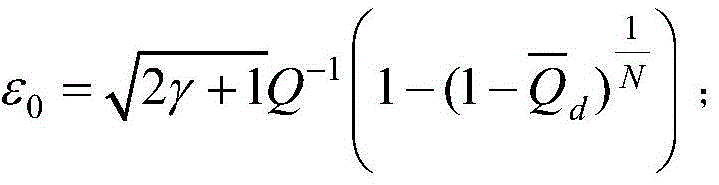
表达式中


设定CSS的目标检测概率


UAV作为SU占用PU的频段进行工作时,存在两种情形:When the UAV works as the SU occupying the frequency band of the PU, there are two situations:
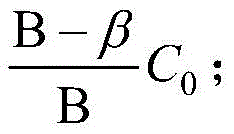
情形1:PU空闲,且UAV在感知时无虚警情况发生。该情形下UAV次级链路的传输速率为
情形2:PU存在,但UAV在感知时出现漏检情况。该情形下UAV次级链路的传输速率为
UAV在两种情形下工作时,吞吐量分别定义为:When UAV works in two scenarios, the throughput is defined as:


在保证CSS整体感知性能的前提下,优化局部微感知弧度和弧度数量,从而最大化UAV次级链路的平均吞吐量,该优化问题数学表达式为:Under the premise of ensuring the overall perception performance of CSS, optimize the local micro-perception radian and the number of radians to maximize the average throughput of the UAV secondary link. The mathematical expression of the optimization problem is:

由于C0>C1,UAV次级链路平均吞吐量的优化问题可近似为:Since C 0 >C 1 , the optimization problem of the average throughput of UAV secondary links can be approximated as:

λ=λ0是满足


其中


UAV存在两种感知状态:UAVs exist in two perception states:
状态1:静态感知。研究UAV在一个帧结构内的最佳感知弧度时,由于感知弧度较小,忽略UAV飞行过程中dSP变化对γ的影响,认为γ在感知过程中保持不变。因此,在一个帧结构内,该感知过程可近似为静态感知。State 1: Static perception. When studying the optimal perceptual arc of UAV within a frame structure, due to the small perceptual arc, the influence of d SP changes on γ during UAV flight is ignored, and it is considered that γ remains unchanged during the perception process. Therefore, within a frame structure, the perception process can be approximated as static perception.
状态2:动态感知。UAV以BS为圆心做圆周运动,假设UAV飞行一周共进行l帧频谱感知,每一帧对应的弧度为
在静态感知状态下,假设图3模型中UAV与x轴之间的夹角α=π(rad), UAV的飞行速度v=40m/s。In the static perception state, it is assumed that the angle α=π(rad) between the UAV and the x-axis in the model of Fig. 3, and the flight speed of the UAV is v=40m/s.
图4是本发明实施例提供的微感知弧度β0不同时,弧度数量N与吞吐量RA的关系曲线图。FIG. 4 is a graph showing the relationship between the number of radians N and the throughput RA when the micro-sensing radians β 0 are different according to an embodiment of the present invention.
图5是本发明实施例提供的弧度数量N不同时,微感知弧度β0与吞吐量RA的关系曲线图。FIG. 5 is a graph showing the relationship between the micro-perceived radian β 0 and the throughput RA when the number of radians N provided by the embodiment of the present invention is different.
图6是本发明实施例提供的UAV位置不同时,微感知弧度β0与最优弧度数量N*的关系曲线图。FIG. 6 is a graph showing the relationship between the micro-sensing radian β 0 and the optimal radian number N * when the positions of the UAVs provided by the embodiment of the present invention are different.
由图4可知,存在最优的弧度数量N*,使RA达到最大值,且随着β0增加, N*减小。由此证明本发明提出的联合优化算法经过多次迭代后具有收敛性。It can be seen from Figure 4 that there is an optimal number of radians N * , which makes RA reach the maximum value, and as β 0 increases, N * decreases. This proves that the joint optimization algorithm proposed by the present invention has convergence after several iterations.
由图5可知,存在最优的微感知弧度β0 *,使RA达到最大值,且随着微感知弧度β0的增加,使RA取得最大值的感知弧度数量N在不断变化。当β0增大到一定程度时,最优的感知弧度数量N=1,这是因为当感知弧度足够大时,不需要多弧度CSS方案对感知性能进行优化。It can be seen from FIG. 5 that there is an optimal micro-perceptual arc β 0 * to make RA reach the maximum value, and with the increase of the micro-perceptual arc β 0 , the number N of perceptual arcs that makes RA achieve the maximum value is constantly changing. When β 0 increases to a certain extent, the optimal number of perceptual radians N=1, because when the perceptual radian is large enough, the multi-radian CSS scheme does not need to optimize the perceptual performance.
当UAV处于动态感知状态时,即考虑UAV的飞行轨迹,在一个飞行周期内,UAV的飞行状态关于x轴对称,图6给出半个飞行周期内,UAV处于不同帧结构时,微感知弧度β0与使RA达到最大值的最优弧度数量N*的关系曲线。由图6可知,随着β0的增大,使RA达到最大值的N*呈阶梯型趋势下降。同样如图 5所示结论,当β0足够大时,N*=1;随着UAV飞行位置的改变,夹角α增加,认知无人机网络中的感知信噪比γ降低,最优弧度数量N*增加。当α=π时,UAV与PU距离最远,此时,γ最小,N*最大,由此可知,在感知信噪比γ较低时, UAV更需要采用本发明提出的多弧度CSS技术来提升次级链路的平均吞吐量,以保证QoS。When the UAV is in a dynamic sensing state, that is, considering the UAV's flight trajectory, in a flight cycle, the UAV's flight state is symmetrical about the x-axis. Figure 6 shows the micro-sensing radian when the UAV is in different frame structures in half a flight cycle. β 0 versus the optimal number of radians N * to maximize RA . It can be seen from Fig. 6 that with the increase of β 0 , N * , which makes RA reach the maximum value, decreases in a step-like trend. Also as shown in Figure 5, when β 0 is large enough, N * = 1; with the change of the UAV flight position, the included angle α increases, the perceived signal-to-noise ratio γ in the cognitive UAV network decreases, and the optimal The number of radians N * increases. When α=π, the distance between the UAV and the PU is the farthest. At this time, γ is the smallest and N * is the largest. It can be seen that when the perceptual signal-to-noise ratio γ is low, the UAV needs to use the multi-radian CSS technology proposed by the present invention. Increase the average throughput of secondary links to ensure QoS.
应当注意,本发明的实施方式可以通过硬件、软件或者软件和硬件的结合来实现。硬件部分可以利用专用逻辑来实现;软件部分可以存储在存储器中,由适当的指令执行系统,例如微处理器或者专用设计硬件来执行。本领域的普通技术人员可以理解上述的设备和方法可以使用计算机可执行指令和/或包含在处理器控制代码中来实现,例如在诸如磁盘、CD或DVD-ROM的载体介质、诸如只读存储器(固件)的可编程的存储器或者诸如光学或电子信号载体的数据载体上提供了这样的代码。本发明的设备及其模块可以由诸如超大规模集成电路或门阵列、诸如逻辑芯片、晶体管等的半导体、或者诸如现场可编程门阵列、可编程逻辑设备等的可编程硬件设备的硬件电路实现,也可以用由各种类型的处理器执行的软件实现,也可以由上述硬件电路和软件的结合例如固件来实现。It should be noted that the embodiments of the present invention may be implemented by hardware, software, or a combination of software and hardware. The hardware portion may be implemented using special purpose logic; the software portion may be stored in memory and executed by a suitable instruction execution system, such as a microprocessor or specially designed hardware. Those of ordinary skill in the art will appreciate that the apparatus and methods described above may be implemented using computer-executable instructions and/or embodied in processor control code, for example on a carrier medium such as a disk, CD or DVD-ROM, such as a read-only memory Such code is provided on a programmable memory (firmware) or a data carrier such as an optical or electronic signal carrier. The device of the present invention and its modules can be implemented by hardware circuits such as very large scale integrated circuits or gate arrays, semiconductors such as logic chips, transistors, etc., or programmable hardware devices such as field programmable gate arrays, programmable logic devices, etc., It can also be implemented by software executed by various types of processors, or by a combination of the above-mentioned hardware circuits and software, such as firmware.
以上所述,仅为本发明的具体实施方式,但本发明的保护范围并不局限于此,任何熟悉本技术领域的技术人员在本发明揭露的技术范围内,凡在本发明的精神和原则之内所作的任何修改、等同替换和改进等,都应涵盖在本发明的保护范围之内。The above are only specific embodiments of the present invention, but the protection scope of the present invention is not limited to this. Any person skilled in the art is within the technical scope disclosed by the present invention, and all within the spirit and principle of the present invention Any modifications, equivalent replacements and improvements made within the scope of the present invention should be included within the protection scope of the present invention.
Claims (8)









Priority Applications (1)
| Application Number | Priority Date | Filing Date | Title |
|---|---|---|---|
| CN202010472139.1A CN111786712B (en) | 2020-05-29 | 2020-05-29 | A CR-based UAV communication network secondary link throughput optimization method |
Applications Claiming Priority (1)
| Application Number | Priority Date | Filing Date | Title |
|---|---|---|---|
| CN202010472139.1A CN111786712B (en) | 2020-05-29 | 2020-05-29 | A CR-based UAV communication network secondary link throughput optimization method |
Publications (2)
| Publication Number | Publication Date |
|---|---|
| CN111786712A CN111786712A (en) | 2020-10-16 |
| CN111786712B true CN111786712B (en) | 2022-07-12 |
Family
ID=72754454
Family Applications (1)
| Application Number | Title | Priority Date | Filing Date |
|---|---|---|---|
| CN202010472139.1A Expired - Fee Related CN111786712B (en) | 2020-05-29 | 2020-05-29 | A CR-based UAV communication network secondary link throughput optimization method |
Country Status (1)
| Country | Link |
|---|---|
| CN (1) | CN111786712B (en) |
Families Citing this family (7)
| Publication number | Priority date | Publication date | Assignee | Title |
|---|---|---|---|---|
| CN112865855B (en) * | 2021-01-04 | 2022-04-08 | 福州大学 | High-efficiency wireless covert transmission method based on unmanned aerial vehicle relay |
| CN113709072B (en) * | 2021-07-29 | 2022-07-29 | 电子科技大学 | Collaborative automatic modulation classification method based on UAV dynamic wireless sensor network |
| CN113852966B (en) * | 2021-10-22 | 2025-05-09 | 北京科技大学 | A 3D spectrum sharing method and device for cognitive drone network |
| CN115021842B (en) * | 2021-11-19 | 2023-10-31 | 荣耀终端有限公司 | Task processing method, device and storage medium |
| CN114501471B (en) * | 2022-02-14 | 2025-05-23 | 中国人民解放军空军工程大学 | Optimization method for cognitive unmanned aerial vehicle track and resource allocation |
| CN115843005B (en) * | 2022-10-28 | 2024-04-19 | 苏州科技大学 | Multi-point multi-dimensional access method, system and storage medium of universal unmanned aerial vehicle network |
| CN115988534A (en) * | 2022-12-22 | 2023-04-18 | 西北工业大学 | A communication method and system based on aerial UAV-assisted 5G ground base station |
Family Cites Families (5)
| Publication number | Priority date | Publication date | Assignee | Title |
|---|---|---|---|---|
| CN104579523B (en) * | 2014-12-31 | 2016-11-16 | 重庆邮电大学 | Joint Optimization Method for Spectrum Sensing and Access Decision-Making in Cognitive Wireless Networks |
| US10321461B2 (en) * | 2016-05-06 | 2019-06-11 | Bridgewest Finance Llc | Unmanned aerial vehicle (UAV) beam pointing and data rate optimization for high throughput broadband access |
| EP3506665B1 (en) * | 2017-12-28 | 2020-10-21 | Tata Consultancy Services Limited | An aerial communication framework for providing communication services to users trapped in emergency |
| CN109088684B (en) * | 2018-07-27 | 2021-04-20 | 南京航空航天大学 | Heterogeneous spectrum network three-dimensional spectrum sensing method based on unmanned aerial vehicle |
| CN108988969B (en) * | 2018-08-27 | 2020-07-21 | 北京邮电大学 | Spectrum sensing method and device based on energy detection |
-
2020
- 2020-05-29 CN CN202010472139.1A patent/CN111786712B/en not_active Expired - Fee Related
Also Published As
| Publication number | Publication date |
|---|---|
| CN111786712A (en) | 2020-10-16 |
Similar Documents
| Publication | Publication Date | Title |
|---|---|---|
| CN111786712B (en) | A CR-based UAV communication network secondary link throughput optimization method | |
| Khasawneh et al. | Convergence of IoT and cognitive radio networks: A survey of applications, techniques, and challenges | |
| Nouri et al. | Multi-UAV placement and user association in uplink MIMO ultra-dense wireless networks | |
| Wang et al. | Thirty years of machine learning: The road to pareto-optimal next-generation wireless networks | |
| US12470326B2 (en) | Method, sender, processing device, and storage medium for transmitting data in semantic-based wireless communication system, and method, receiver, and storage medium for receiving data | |
| Rihan et al. | D2D communication underlaying UAV on multiple bands in disaster area: Stochastic geometry analysis | |
| Hu et al. | Energy-efficient cooperative spectrum sensing in cognitive satellite terrestrial networks | |
| Wang et al. | An novel spectrum sensing scheme combined with machine learning | |
| WO2012055355A1 (en) | Spectrum sharing with implicit power control in cognitive radio networks | |
| US20220286262A1 (en) | Spatial inter-cell interference aware downlink coordination | |
| US11412521B1 (en) | Machine learning aided location-based downlink interference assistance information | |
| Zhang et al. | Spectrum Efficiency Optimization for UAV‐Based Cognitive Radio Network | |
| Bhattacharya et al. | Smart radio spectrum management for cognitive radio | |
| CN111866890A (en) | An efficient spectrum sharing method and system in a cognitive UAV network | |
| Murugan et al. | Energy Efficient Cognitive Radio Spectrum Sensing for 5G Networks-A Survey. | |
| Vinod et al. | Optimal sensing duration and threshold selection approach in cognitive radio networks with cooperative spectrum sensing | |
| CN111343722B (en) | Cognitive radio-based energy efficiency optimization method in edge calculation | |
| CN115314099B (en) | Method and system for enhancing communication coverage network of UAV base station | |
| Singh et al. | Multi-layer perceptron based spectrum prediction in cognitive radio network | |
| Xiao et al. | Edge-Learning-Based Sensor Allocation Strategy in Internet of Things System | |
| Poonguzhali et al. | An energy-optimized green cooperative cognitive radio network for better spectrum sharing | |
| Ning et al. | AAV-Assisted AmBC Network: Performance Analysis in Nakagami-$ m $ Fading Channel | |
| Gu et al. | Optimization of spectrum efficiency in UAV cognitive communication network based on trajectory planning | |
| KR20240118769A (en) | Methods for updating knowledge for semantic communication in wireless communication systems, communication devices, processing devices and storage media | |
| Ouyang et al. | Optimal interference range for minimum Bayes risk in binomial and Poisson wireless networks |
Legal Events
| Date | Code | Title | Description |
|---|---|---|---|
| PB01 | Publication | ||
| PB01 | Publication | ||
| SE01 | Entry into force of request for substantive examination | ||
| SE01 | Entry into force of request for substantive examination | ||
| GR01 | Patent grant | ||
| GR01 | Patent grant | ||
| CF01 | Termination of patent right due to non-payment of annual fee |
Granted publication date: 20220712 |