Disclosure of Invention
The problem that this application will be solved is: disclosed is a novel pyridone derivative which has high bioavailability and can be converted into a compound having extremely high inhibitory activity against influenza A virus and influenza B virus after administration to a human body.
The present application also provides various crystals of the novel pyridone derivative or solvate thereof, which meet the requirements for pharmaceutical use in terms of stability, hygroscopicity, solubility, and the like.
The application also provides a preparation method of the crystals and application of the crystals in preparing anti-influenza virus medicines.
To solve the above problems, the present application provides, in one aspect, a crystal of a compound of formula (1) or a solvate thereof:
the compound of formula (1) is referred to by the Chinese name:
((R) -methyl 12' - ((S) -7, 8-difluoro-6, 11-dihydrodibenzo [ b, e ] thiepin-11-yl) -6',8' -dioxo-6 ',8',12',12a ' tetrahydro-1 ' H-,4' H-spiro [ cyclopropane-1, 3' - [1,4] oxazino [3,4-c ] pyrido [2,1-f ] [1,2,4] triazin-7 ' -yl) oxy) methyl carbonate;
the compound of formula (1) has the english name:
(((R)-12'-((S)-7,8-difluoro-6,11-dihydrodibenzo[b,e]thiepin-11-yl)-6',8'-dioxo-6',8',12',12a'-tetrahydro-1'H,4'H-spiro[cyclopropane-1,3'-[1,4]oxazino[3,4-c]pyrido[2,1-f][1,2,4]triazin]-7'-yl)oxy)methyl methyl carbonate。
according to some preferred aspects of the present application, there is provided form a crystalline form of the compound of formula (1) having an X-ray powder diffraction pattern (using a radiation source of Cu-ka, the same applies hereinafter) with characteristic peaks at 2 Θ angles of 3.10 ° ± 0.2 °, 8.74 ° ± 0.2 °, 15.44 ° ± 0.2 °, 21.91 ° ± 0.2 °. In some embodiments, the compound of formula (1) may also have an X-ray powder diffraction pattern for form a crystalline form a with characteristic peaks at one or more of 2 Θ angles of 13.08 ° ± 0.2 °, 26.35 ° ± 0.2 ° and 30.83 ° ± 0.2 °.
According to some particular aspects of the present application, the form a crystalline form of the compound of formula (1) exhibits a weight loss on heating to 26.8 ± 2 ℃ and a weight loss of 1.8 ± 0.2% on heating to 150 ± 2 ℃ in a thermogravimetric analysis determined profile.
According to some specific aspects of the present application, the form a of the compound of formula (1) exhibits an endothermic peak in a differential scanning calorimetry pattern, indicating that the melting point onset temperature of form a is 230.5 ± 2 ℃ and that the form a has an endothermic peak at 232 ± 2 ℃.
According to a particular and preferred aspect of the present application, the form a crystal form of the compound of formula (1) is an anhydrous crystal form.
According to further preferred aspects of the present application, there is provided form B of the compound of formula (1) having an X-ray powder diffraction pattern with characteristic peaks at 2 Θ angles of 8.42 ° ± 0.2 °, 14.27 ° ± 0.2 °, 16.04 ° ± 0.2 ° and 25.41 ° ± 0.2 °. In some embodiments, the form B crystalline form of the compound of formula (1) may also have an X-ray powder diffraction pattern with characteristic peaks at one or both of 2 Θ angles of 10.75 ° ± 0.2 °, 16.87 ° ± 0.2 °.
According to a particular aspect of the present application, the X-ray powder diffraction pattern of form B of the compound of formula (1) also has characteristic peaks at one or more of 2 Θ angles of 18.21 ° ± 0.2 °, 18.78 ° ± 0.2 °, 19.26 ° ± 0.2 °, 19.60 ° ± 0.2 °, 20.40 ° ± 0.2 °, 21.39 ° ± 0.2 °, 21.66 ° ± 0.2 °, 23.38 ° ± 0.2 °, 27.32 ° ± 0.2 °, 29.17 ° ± 0.2 ° and 34.08 ° ± 0.2 °.
According to some particular aspects of the present application, the form B crystalline form of the compound of formula (1) exhibits a weight loss onset when heated to 22.6 ± 2 ℃ and a weight loss of 2.2 ± 0.2% when heated to 150 ± 2 ℃ in a thermogravimetric analysis determined profile.
According to some specific aspects of the present application, the form B crystal form of the compound of formula (1) exhibits two endothermic peaks in a differential scanning calorimetry assay, the onset temperatures of the two endothermic peaks are 208.5.5 ± 2 ℃, 233.8 ± 2 ℃, and the endothermic peaks at 213.5 ± 2 ℃, 235.1 ± 2 ℃.
According to a particular aspect of the application, the form B crystalline form of the compound of formula (1) is an anhydrous crystalline form.
According to some preferred aspects of the present application, there is provided form C crystalline form of the compound of formula (1) having an X-ray powder diffraction pattern with characteristic peaks at 2 Θ angles of 7.73 ° ± 0.2 °, 17.13 ° ± 0.2 °, 20.08 ° ± 0.2 °, 21.74 ° ± 0.2 °. In some embodiments, the compound of formula (1) has an X-ray powder diffraction pattern for form C further comprising characteristic peaks at one or more of 2 Θ angles of 13.13 ° ± 0.2 °, 13.65 ° ± 0.2 °, 20.98 ° ± 0.2 ° and 23.22 ° ± 0.2 °.
In some embodiments, the X-ray powder diffraction pattern of the form C crystalline form of the compound of formula (1) may also have characteristic peaks at one or more of 2 Θ angles of 12.51 ° ± 0.2 °, 14.76 ° ± 0.2 °, 15.21 ° ± 0.2 °, 18.39 ° ± 0.2 ° and 24.13 ° ± 0.2 °.
According to some particular aspects of the present application, the compound of formula (1) has a form C crystal form exhibiting an onset of weight loss when heated to 25.9 ± 2 ℃ and a weight loss of 12.1 ± 0.2% when heated to 150 ± 2 ℃ in a thermogravimetric analysis determined profile.
According to some specific aspects of the present application, the form C crystal form of the compound of formula (1) exhibits two endothermic peaks in a differential scanning calorimetry pattern, the onset temperatures of the two endothermic peaks are 86.8 ± 2 ℃, 233.9 ± 2 ℃, and the endothermic peaks at 94.9 ± 2 ℃, 234.8 ± 2 ℃.
According to a particular aspect of the present application, the form C crystalline form of the compound of formula (1) is a tetrahydrofuran solvate of the compound of formula (1).
According to some preferred aspects of the present application, there is provided form D of the compound of formula (1) having an X-ray powder diffraction pattern with characteristic peaks at 2 Θ angles of 7.94 ° ± 0.2 °, 22.16 ° ± 0.2 °, 28.03 ° ± 0.2 °. In some embodiments, the X-ray powder diffraction pattern of form D crystalline form of the compound of formula (1) may also have characteristic peaks at one or more of 2 Θ angles of 15.09 ° ± 0.2 °, 15.50 ° ± 0.2 °, 19.63 ° ± 0.2 °, 23.56 ° ± 0.2 °, 25.86 ° ± 0.2 °.
According to some particular aspects of the present application, the compound of formula (1) has a form D crystal form showing an onset of weight loss when heated to 23.5 ± 2 ℃ and a 7.5 ± 0.2% weight loss when heated to 150 ± 2 ℃ in a thermogravimetric analysis determined profile.
According to some specific aspects of the present application, the form D crystal form of the compound of formula (1) exhibits two endothermic peaks in a differential scanning calorimetry assay profile, the onset temperatures of the two endothermic peaks are 113.2 ± 2 ℃, 230.6 ± 2 ℃, and the endothermic peaks at 140.4 ± 2 ℃, 232.4 ± 2 ℃.
According to a particular aspect of the application, the form D crystal form of the compound of formula (1) is an N-methylpyrrolidone solvate of the compound of formula (1).
According to some preferred aspects of the present application, there is provided form E crystalline form of the compound of formula (1) having an X-ray powder diffraction pattern with characteristic peaks at 2 Θ angles of 8.01 ° ± 0.2 °, 8.78 ° ± 0.2 °, 26.33 ° ± 0.2 °.
In some embodiments, the compound of formula (1) has an X-ray powder diffraction pattern for form E crystalline form further having characteristic peaks at one or more of 2 Θ angles of 4.44 ° ± 0.2 °, 17.56 ° ± 0.2 °, 21.95 ° ± 0.2 °, 22.25 ° ± 0.2 °.
In some embodiments, the compound of formula (1) has an X-ray powder diffraction pattern for form E crystalline form further having characteristic peaks at one or more of 2 Θ angles of 5.87 ° ± 0.2 °, 19.64 ° ± 0.2 °, 28.15 ° ± 0.2 °, 29.07 ° ± 0.2 °, 30.86 ° ± 0.2 °.
According to some preferred aspects of the present application, there is provided crystalline form F of the compound of formula (1) having an X-ray powder diffraction pattern with characteristic peaks at 2 Θ angles of 5.77 ° ± 0.2 °, 8.69 ° ± 0.2 °, 17.48 ° ± 0.2 °, 22.84 ° ± 0.2 °.
In some embodiments, the compound of formula (1) has an X-ray powder diffraction pattern for form F further having characteristic peaks at one or both of 11.61 ° ± 0.2 °, 19.47 ° ± 0.2 ° 2 Θ angles.
In some embodiments, the X-ray powder diffraction pattern of the form F crystalline form of the compound of formula (1) also has characteristic peaks at one or more of 11.98 ° ± 0.2 °, 13.84 ° ± 0.2 °, 14.30 ° ± 0.2 °, 18.33 ° ± 0.2 °, 18.95 ° ± 0.2 ° 2 Θ angles.
According to some particular aspects of the present application, the crystalline form F of the compound of formula (1) exhibits a weight loss onset when heated to 29.6 ± 2 ℃ and a weight loss of 1.2 ± 0.2% when heated to 150 ± 2 ℃ in a thermogravimetric analysis determined profile.
According to some particular aspects of the present application, said crystalline form F of the compound of formula (1) exhibits an endothermic peak in a differential scanning calorimetry pattern with an onset temperature of 231.1 ± 2 ℃ and an endothermic peak at 234.5 ± 2 ℃.
According to a particular aspect of the application, the crystalline form F of the compound of formula (1) is an anhydrous crystalline form.
According to a particular aspect of the application, the compound of formula (1) is in form F having an X-ray powder diffraction pattern substantially in accordance with fig. 14, fig. 19 or fig. 20.
According to some preferred aspects of the present application, there is also provided crystals of the compound of formula (1) in the form of a single crystal belonging to the orthorhombic system,
space group P2 12
12
1The unit cell parameters are:
α=90°±0.2°,β=90°±0.2°,γ=90°±0.2°。
according to some preferred aspects of the present application, the unit cell parameters are:
α=89.9-90.1°,β=89.9-90.1°,γ=89.9-90.1°。
according to some specific and preferred aspects of the present application, the unit cell parameters are:
α=89.95-90.05°,β=89.95-90.05°,γ=89.95-90.05°。
in one embodiment, the unit cell parameters are:
α=β=γ=90°。
according to a particular aspect of the application, the unit cell of the single crystal comprises 8 molecules.
According to some specific and preferred aspects of the present application, the single crystal has a unit cell volume of
According to a particular aspect of the application, the single crystal has a unit cell volume of
According to some specific and preferred aspects of the present application, the calculated density of the single crystal is 1.480 ± 0.1g/cm3. According to a particular aspect of the present application, the calculated density of the single crystal is 1.480g/cm3。
According to some preferred aspects of the present application, the method of preparing a single crystal comprises: dissolving the compound shown in the formula (1) in an alcohol solvent, filtering, volatilizing the solvent from the filtrate at room temperature, separating out crystals, filtering, collecting the obtained crystals, and airing at room temperature to obtain the compound. According to some particular aspects of the present application, the alcoholic solvent includes methanol, ethanol, and the like.
This application has provided a technical scheme again simultaneously: the present application provides a process for preparing form a crystalline form of the compound of formula (1) as described above, said process comprising:
1) adding the compound of the formula (1) into a mixed system of one or more of an ester solvent (for example, isopropyl acetate, ethyl acetate and the like), an alcohol solvent (for example, methanol, ethanol, isopropanol and the like) and a ketone solvent (for example, acetone, butanone and the like), dissolving, mixing with a hydrocarbon solvent (for example, n-heptane and the like), crystallizing, filtering and drying to obtain the A-type crystal form of the compound of the formula (1); or
2) Adding the compound of the formula (1) into a ketone solvent (such as acetone) to volatilize at room temperature to obtain a solid, and drying the solid to obtain an A-type crystal form of the compound of the formula (1); or
3) Adding the compound shown in the formula (1) into an ether solvent (such as methyl tert-butyl ether) and stirring at room temperature, filtering to obtain a solid, and drying the solid to obtain the A-type crystal form of the compound shown in the formula (1); or
3) Adding the compound shown in the formula (1) into water, stirring at 45-55 ℃, filtering to obtain a solid, and drying the obtained solid to obtain an A-type crystal form of the compound shown in the formula (1); or
4) Adding the compound of the formula (1) into a mixed solvent of a hydrocarbon solvent (such as toluene) and an ether solvent (such as methyl tert-butyl ether), stirring for 1-3 h at a set temperature, heating or cooling at a speed of 0.1 +/-0.05 ℃/min to ensure that the temperature of a system is circulated for multiple times between the set temperature and 5 ℃, finally stirring at 3-7 ℃, filtering to obtain a solid, and drying the obtained solid to obtain the A-type crystal form of the compound of the formula (1), wherein the set temperature is 45-55 ℃.
This application has provided a technical scheme again simultaneously: the present application provides a process for preparing form B crystal form of the compound of formula (1) described above, said process comprising:
1) adding the compound shown in the formula (1) into an alcohol solvent (such as methanol) or a ketone solvent (such as acetone) or a mixed system thereof for dissolving, mixing with water, crystallizing, filtering to obtain a solid, and drying the obtained solid to obtain a B-type crystal form of the compound shown in the formula (1); or
2) Adding the compound shown in the formula (1) into a halogenated hydrocarbon solvent (such as chloroform and the like), volatilizing at room temperature to obtain a solid, and drying the obtained solid to obtain a B-type crystal form of the compound shown in the formula (1); or
3) Adding the compound shown in the formula (1) into a hydrocarbon solvent (such as toluene and the like), dissolving at room temperature, stirring, filtering to obtain a solid, and drying the obtained solid to obtain a B-type crystal form of the compound shown in the formula (1); or
4) Adding the compound shown in the formula (1) into 2-methyltetrahydrofuran, stirring at a first set temperature, filtering to obtain a supernatant, cooling the obtained supernatant from the first set temperature to a second set temperature at the speed of 0.1 +/-0.05 ℃/min, keeping the temperature constant at the second set temperature, collecting precipitated solid, and drying the obtained solid to obtain the B-type crystal form of the compound shown in the formula (1), wherein the first set temperature is 45-55 ℃, and the second set temperature is 0-10 ℃.
The application also provides a preparation method of the C-type crystal form of the compound shown in the formula (1): adding the compound shown in the formula (1) into a mixed system of tetrahydrofuran and a hydrocarbon solvent to form a turbid liquid, stirring at a first set temperature, filtering to obtain a supernatant, cooling the obtained supernatant from the first set temperature to a second set temperature at a speed of 0.1 +/-0.05 ℃/min, keeping the temperature constant at the second set temperature, collecting precipitated solids, and drying the obtained solids to obtain the C-type crystal form of the compound shown in the formula (1), wherein the first set temperature is 45-55 ℃, and the second set temperature is 0-10 ℃.
The application also provides a preparation method of the D-type crystal form of the compound shown in the formula (1): adding the compound shown in the formula (1) into a mixed system of N-methyl pyrrolidone and water to form turbid liquid, stirring the obtained turbid liquid at 45-55 ℃, filtering to obtain solid, and drying the obtained solid to obtain the D-type crystal form of the compound shown in the formula (1).
The application also provides a preparation method of the E-type crystal form of the compound shown in the formula (1): the method comprises the following steps: dissolving the compound shown in the formula (1) in N, N-dimethylacetamide, performing gas-liquid diffusion in the atmosphere of water or alcohol solvent to obtain a solid, and filtering to obtain the E-type crystal form of the compound shown in the formula (1).
The present application also provides a process for preparing said form F crystalline form of the compound of formula (1), said process comprising: adding the compound shown in the formula (1) into an ester solvent, an alcohol solvent or a mixed system thereof to form turbid liquid, stirring at 0-10 ℃, filtering to obtain solid, and drying the obtained solid to obtain the F-type crystal form of the compound shown in the formula (1).
According to some specific and preferred aspects of the present application, the ester solvent may be ethyl acetate.
According to some specific and preferred aspects of the present application, the alcoholic solvent may be methanol and/or ethanol.
According to some specific and preferred aspects of the present application, the stirring time is 2-4 h.
In some preferred embodiments (e.g. in large scale production of form F), the turbid liquid is heated to 30-60 ℃ and stirred at this temperature for more than 5 minutes, preferably more than 30 minutes, in particular for example 1-1.5 hours, before the turbid liquid is placed at 0-10 ℃ for stirring. The grain diameter uniformity of the crystal form F product prepared in the way is better.
The application also provides a pharmaceutical composition which contains one or more of the crystals and a pharmaceutically acceptable carrier.
The application further provides application of the crystal in preparing anti-influenza virus medicines.
To aid in understanding the various embodiments disclosed herein, the following description is provided:
the "solvate of the compound of formula (1)" is a compound formed by the interaction of the compound of formula (1) with a solvent through a hydrogen bond, a salt bond or the like.
The term "compound of formula (1) in any form" includes amorphous forms, crystal forms, solvates and the like of the compound of formula (1) in any form.
"isomers" refer to compounds having the same molecular formula but differing in the bonding nature or order of their atoms or in the spatial arrangement of their atoms. Isomers that differ in their arrangement in atomic space are referred to as "stereoisomers". Stereoisomers that are non-mirror images of each other are referred to as "diastereomers", and stereoisomers that are real and mirror images of each other without superimposability are referred to as "enantiomers". When a compound has an asymmetric center, for example, if a carbon atom is bonded to four different groups, a pair of enantiomers may be present. Enantiomers can be characterized by the absolute configuration of their asymmetric centers and described by the R and S order rules of Cahn-Ingold-Prelog, or by the manner in which a molecule rotates the plane of polarized light and is designated as dextrorotatory or levorotatory (i.e., the (+) or (-) isomers, respectively). The method for measuring the absolute configuration of the chiral compound mainly comprises a single crystal X-ray diffraction method, a nuclear magnetic resonance method and a circular dichroism method.
"pharmaceutically acceptable carrier" refers to a carrier for administration of a therapeutic agent, including various excipients and diluents. The term refers to such pharmaceutical carriers: they are not essential active ingredients per se and are not unduly toxic after administration. Suitable carriers are well known to those of ordinary skill in the art. A thorough discussion of pharmaceutically acceptable excipients can be found in Remington's Pharmaceutical Sciences (Mack pub. co., n.j.1991). Pharmaceutically acceptable carriers in the compositions may include liquids such as water, saline, glycerol and ethanol. In addition, auxiliary substances such as disintegrating agents, wetting agents, emulsifying agents, pH buffering substances and the like may also be present in these carriers.
The X-ray powder diffraction pattern is characteristic for a particular crystalline form. To determine if it is the same as the known crystal type, care should be taken with respect to the relative positions of the peaks (i.e., 2 θ) rather than their relative intensities. This is because the relative intensities of the spectra vary due to the dominant orientation effect resulting from differences in crystal conditions, particle size and other assay conditions, particularly the low intensity peak (intensity less than 20%) may not be present in some cases, the relative intensities of the diffraction peaks are not characteristic of the determination of the crystal form, in fact, the relative intensities of the diffraction peaks in the XRPD spectra are related to the preferred orientation of the crystals, and the peak intensities shown herein are illustrative and not used for absolute comparison. In addition, it is known in the art that when crystals of a compound are measured by X-ray diffraction, a certain measurement error of about ± 0.2 ° may exist in 2 θ values of the same crystal form due to the influence of a measuring instrument or measuring conditions, etc. Therefore, this error should be taken into account when determining each crystalline structure. The peak position is usually expressed in the XRD pattern by the 2 theta angle or the d value of the interplanar distance, with a simple conversion relationship between them: where d represents the interplanar spacing d, λ represents the wavelength of the incident X-rays, and θ is the diffraction angle. It should also be noted that in the identification of mixtures, a partial loss of diffraction lines may occur due to, for example, a reduction in the content. In addition, due to the influence of experimental factors such as sample height, an overall shift in peak angle is caused, and a certain shift is usually allowed. Thus, it will be understood by those skilled in the art that the X-ray diffraction patterns of the crystalline forms referred to herein need not be identical to the X-ray diffraction patterns of the examples referred to herein, that "the same XRPD patterns" as used herein does not mean absolute identity, that the same peak positions may differ by + -0.2 deg. (or more) and that the peak intensities allow for some variability. Any crystalline form having the same or similar pattern as the characteristic peaks in these maps is within the scope of the present application. One skilled in the art can compare the profiles listed in this application to a profile of an unknown crystalline form to confirm whether the two sets of profiles reflect the same or different crystalline forms.
On the basis of a specific X-ray crystal diffraction pattern, a person skilled in the art is generally allowed to select several characteristic peaks to define the crystal form, and the selection of the characteristic peaks is comprehensively considered for a certain purpose without strict limitation, for example, the person skilled in the art is more inclined to select a peak with higher relative intensity, a peak with relatively low angle and a characteristic peak with complete peak shape, and select a characteristic peak which is enough to be distinguished from other crystals, so that the characteristic peaks have the significance of being distinguished, identified and identified. Thus, it cannot be concluded that a different crystal form is constituted or that the range of crystal forms is beyond the original request merely because the combination of selected characteristic peaks changes.
DSC measures the transition temperature when a crystal absorbs or releases heat due to a change in its crystal structure or melting of the crystal. For the same crystal form of the same compound, the thermal transition temperature and melting point errors are typically within about 5 ℃ in a continuous analysis. When we say that a compound has a given DSC peak or melting point, this means that the DSC peak or melting point ± 5 ℃. It is noted that the DSC peak or melting point for the mixture may vary over a larger range. Furthermore, the melting temperature is related to the rate of temperature rise due to decomposition that accompanies the process of melting the substance.
It should be noted that the numerical values and numerical ranges mentioned in this application should not be construed narrowly as numerical values or numerical ranges per se, and those skilled in the art will appreciate that they can be varied in accordance with specific technical circumstances and that they can be varied widely around specific numerical values without departing from the spirit and principles of this application.
Due to the implementation of the technical scheme, compared with the prior art, the method has the following advantages:
the application provides a novel pyridone derivative which has high bioavailability, can be converted into a compound with extremely strong inhibitory activity on influenza virus A and influenza virus B after being taken by a human body, can be independently used for clinical treatment or combined with other anti-influenza medicaments such as neuraminidase inhibitors, nucleoside medicaments and PB2 inhibitors, can quickly cure influenza patients clinically, and is superior to the existing pyridone derivative in at least one aspect of activity, pharmacokinetic characteristics (such as bioavailability), cytotoxicity and the like. Meanwhile, the crystal of the compound shown in the formula (1) or the solvate thereof meets the requirements of medicine in the aspects of stability, hygroscopicity, solubility, storage property and the like, and is suitable for application in preparing medicines for treating influenza.
Detailed Description
As used herein, "room temperature" refers to the natural ambient temperature achieved without additional heating or cooling, and may correspond to a specific temperature of between 10-30 ℃. In this application, the test instruments and conditions used for the experiments are as follows:
1. single crystal X-ray diffraction
The instrument model is as follows: bruker D8 Venture single crystal diffractometer
Light source: mo target
a detector: CMOS area detector
current and voltage: 50kV, 1.4A
X-ray powder diffraction (XRPD)
The instrument model is as follows: PANALYTICAL X' Pert3 Power
X-ray: cu,
Ka 1
1.540598;Kα2
1.544426
X-ray light pipe setting: 45kV and 40mA
Divergent slit: 1/8 degree
Scanning mode: continuos
Scanning range (2 θ): 3-40 degree
Scanning step (2 θ): 0.0263 °
3. Differential Scanning Calorimetry (DSC)
The instrument model is as follows: TA Q2000/2500 type differential scanning calorimeter
The heating rate is as follows: 10 ℃/min
Temperature range: 25 ℃ to a set end point temperature
Protective gas: nitrogen gas
4. Thermogravimetric analysis (TGA)
The instrument model is as follows: TA Q5000/5500 type thermogravimetric analyzer
The heating rate is as follows: 10 ℃/min
Temperature range: room temperature to set end point temperature
Protective gas: nitrogen gas
5. Dynamic water adsorption (DVS)
The instrument model is as follows: SMS DVS Intrasic type moisture adsorption analyzer
Temperature: 25 deg.C
RH range: 0% RH-95% RH
Protective gas: nitrogen gas
The present application will be further described with reference to the following specific examples:
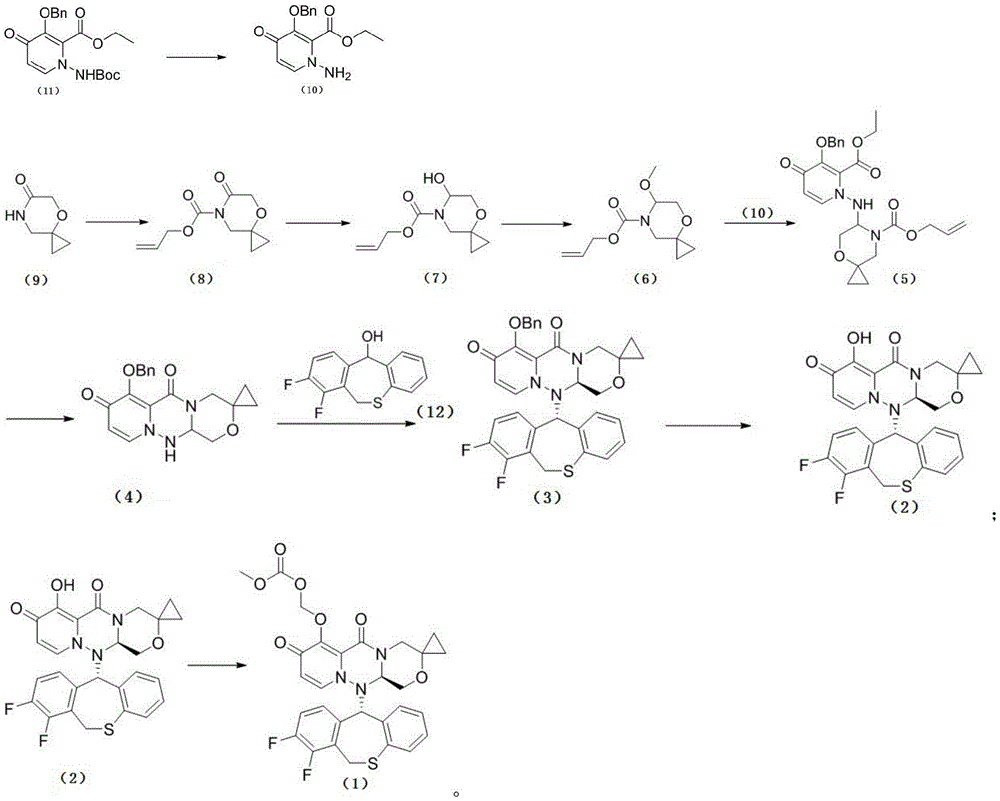
EXAMPLE 1 preparation of Compound of formula (1)
The route is as follows:
preparation of a Compound of formula (10): the compound of formula (11) (388mg, 1mmol) was dissolved in 3mL of dichloromethane, 1mL of trifluoroacetic acid was added, and the mixture was stirred at room temperature for 3 hours. TLC indicated complete reaction and adjusted to pH 9-10 by addition of 3N sodium hydroxide solution. The dichloromethane extraction, the organic phases were combined, washed with saturated brine, dried and concentrated to give 270mg of solid which was used directly in the next step.
Preparation of the compound of formula (8): formula (9) the compound (1.0g,7.8mmol) was dissolved in 10mL of anhydrous tetrahydrofuran, and a 2.5M n-butyllithium solution (3.1mL,7.8mmol) was slowly added dropwise under nitrogen at-78 ℃. After the completion of the dropping, the reaction was stirred at this temperature for 2 hours. Allyl chloroformate (0.94g,7.8mmol) was then added dropwise. After dropping, the reaction was stirred for 2h, TLC monitored that the starting material was substantially reacted, the reaction solution was quenched by pouring into saturated ammonium chloride solution, and extracted with ethyl acetate (15 mL. times.3). The combined organic phases were dried over anhydrous sodium sulfate, concentrated and evaporated to dryness to give 1.65g of an oil.
Preparation of the compound of formula (7): the compound of formula (8) (1.65g,7.8mmol) was dissolved in 15mL of anhydrous tetrahydrofuran, and 1M diisobutylaluminum hydride solution (11.7mL,11.7mmol) was slowly added dropwise at-78 ℃ under nitrogen. After the completion of the dropping, the reaction was stirred at this temperature for 2 hours. TLC monitors the starting material for substantial completion of the reaction, and the reaction solution is quenched by pouring into saturated sodium potassium tartrate solution and extracted with ethyl acetate (20 mL. times.3). The combined organic phases were dried over anhydrous sodium sulfate, concentrated and evaporated to dryness to give 1.57g of an oil.
Preparation of the compound of formula (6): the compound of formula (7) (1.57g,7.4mmol) was dissolved in 15mL of methanol, p-toluenesulfonic acid monohydrate (140mg, 0.74mmol) was added, and the mixture was stirred at room temperature overnight. TLC was used to monitor the completion of the basic reaction of the starting material, saturated sodium bicarbonate solution was added to adjust to neutrality and concentrated. The residue was separated by column chromatography to give 0.86g of a yellow oil.
Preparation of a Compound of formula (5): the compound of formula (10) (270mg, 0.94mmol) and the compound of formula (6) (255mg, 1.13mmol) were dissolved in 5mL of acetonitrile. Under nitrogen, a 1M solution of tin tetrachloride in methylene chloride (1.4mL,1.41mmol) was added dropwise at-20 ℃. After the completion of the dropping, the mixture was stirred at this temperature for 3 hours. Adding saturated sodium bicarbonate solution, stirring for 30min, separating, and extracting the water phase with dichloromethane. The organic phases were combined, washed with saturated brine, dried and concentrated to give 428mg of crude product.
Preparation of the compound of formula (4): the compound of formula (5) (428mg, 0.89mmol) was dissolved in 5mL of tetrahydrofuran, and tetrakis (triphenylphosphine) palladium (104mg, 0.09mmol) and morpholine (774mg,8.9mmol) were added to react at room temperature for 2 hours. The plate reaction is terminated. Concentrating, and performing column chromatography to obtain 216mg of product.
Preparation of the compound of formula (3): the compound of formula (4) (216mg,0.61mmol) and the compound of formula (12) (242mg,0.92mmol) were reacted in 3mL of a solution of T3P in ethyl acetate at 100 ℃ for 3 hours under sealed conditions. Cooling, adding saturated NaHCO3Diluted and then extracted with ethyl acetate. The organic phases are combined, dried, concentrated and separated by column chromatography to obtain 200mg of crude product, and then separated by chiral column to obtain 40mg of product.
Preparation of the compound of formula (2): the compound of formula (3) (40mg, 0.067mmol) and lithium chloride (20mg,0.48mmol) were reacted in 1mL of DMA at 100 ℃ for 3 hours. After completion of the reaction, 10mL of water was added to dilute the reaction mixture, and the pH was adjusted to 3-4 with 2N hydrochloric acid. Filtering, and pumping the solid to obtain 25mg of product.1HNMR(400MHz,CDCl3)δ:7.05-7.15(m,5H),6.85(m,1H),6.70(d,1H,J=7.6Hz),5.78(d,1H,J=7.6Hz),5.3(m,2H),4.69(d,1H,J=6.8Hz),4.17(d,1H,J=14Hz),4.09(d,1H,J=14Hz),3.90(m,1H),3.69(m,1H),3.44(d,1H,J=15.2Hz),0.95(m,1H),0.74(m,3H);ESI-MS m/z(M+H)+510.1。
Preparation of a Compound of formula (1): the compound of formula (2) (40mg,0.08mmol), chloromethyl methyl carbonate (25mg, 0.2mmol), potassium carbonate (28mg,0.2mmol) and potassium iodide (3mg, 0.02mmol) were reacted in 1mL of N, N-dimethylacetamide at 60 ℃ for 5 hours. The plate reaction was complete, quenched by addition of water and then adjusted to pH 3-4 with 1N dilute hydrochloric acid. The solid was filtered, dried and chromatographed to give 35mg of the product, a compound of formula (1), which was analyzed to be amorphous and used as starting material for the preparation of various crystalline forms in the subsequent examples.1HNMR(400MHz,DMSO-d6)δ:7.40-7.42(m,2H),7.25(d,1H,J=7.6Hz),7.15(m,1H),7.10(m,1H),7.00(d,1H,J=7.2Hz),6.84(t,1H,J=7.6Hz),5.75(m,4H),5.43(d,1H,J=16.4Hz),4.57(dd,1H,J=3.2,9.6Hz),3.96-4.03(m,3H),3.73(s,3H),3.51(t,1H,J=10.0Hz),3.41(s,1H),0.75(t,2H,J=8.4Hz),0.50(m,2H);ESI-MS m/z(M+H)+598.1。
EXAMPLE 2 pharmacodynamic test of Compound of formula (1)
2.1 in vitro bioactivity and cytotoxicity studies
In practice, the compound of formula (1) is a prodrug of the compound of formula (2), which is converted in vivo to the active drug (the compound of formula (2)) to exert its pharmacological effect, and the activity data and toxicity data of the compound of formula (2) are shown in table a.
Test methods for in vitro bioactivity studies: MDCK cells were seeded into 384-well cell culture plates at a density of 2,000 cells per well, followed by incubation at 37 ℃ with 5% CO2The culture was carried out overnight in an incubator. The following day, compounds of formula (2) were diluted and added to the wells individually (3 fold-fold dilution, 8 concentration points tested), and influenza a/PR/8/34(H1N1) strain was subsequently added to the cell culture wells at 2 x TCID90 per well, with a final DMSO concentration of 0.5% in the culture medium. The cell plates were incubated at 37 ℃ with 5% CO2Culturing in an incubator for 5 days. After 5 days of culture, cell viability was measured using CCK8 cell viability assay kit. Carrying out nonlinear fitting analysis on the inhibition rate and cytotoxicity of the compound by using GraphPad Prism software on the raw data to obtain EC50Values (results see table a).
Investigation of cytotoxicity StudiesThe method comprises the following steps: the cytotoxicity assay and the antiviral activity assay of the compound of formula (2) were carried out in parallel, except that no virus was added, and the other experimental conditions were identical to those of the antiviral activity assay. After 5 days of culture, cell viability was measured using CCK8 cell viability assay kit. Raw data for Compound Cytotoxicity (CC)50) Calculation (see table a for results).
TABLE a inhibitory Activity and toxicity of Compounds against influenza Virus A/PR/8/34(H1N1)
The results show that the compounds according to the present application have a more excellent activity of inhibiting H1N1 than the control compound, and at the same time have a very low cytotoxicity.
2.2 rat PK Studies
Intravenous injection, accurately weighing about 2mg of the compound sample of the formula (2), adding a proper amount of DMA, and performing vortex oscillation to completely dissolve solid substances; adding a proper volume of 30% solutol HS-15 aqueous solution, adding salene after vortex oscillation to ensure that DMA (30% solutol HS-15) and salene (20: 20:60 (v/v/v)) are mixed uniformly by vortex oscillation, and filtering to obtain the solution with the concentration of 0.05 mg/mL-1The administration preparation of (1). SD rats are administered with 0.25 mg/kg by single intravenous injection-1The compound of formula (2) of (1) is administered intravenously. Collecting blood from jugular vein for 0.20mL at 0.083, 0.25, 0.5, 1,2,4, 8, 12 and 24 hr before and after administration, and placing in EDTA-K2In an anticoagulation tube. Immediately, 150. mu.L of whole blood was accurately aspirated, precipitated with protein in a tube to which 450. mu.L of acetonitrile had been added, vortexed, and placed on wet ice. Stored in a refrigerator at-90 to-60 ℃ and used for biological sample analysis. The concentration of the corresponding compound in the plasma of S-D rats was determined by LC-MS/MS analysis. The corresponding pharmacokinetic parameters were calculated using the non-compartmental model in Pharsight Phoenix 7.0. See table b for results.
Administration by intragastric administration: accurately weighing 4mg of a compound sample of the formula (1), adding a proper amount of PEG400, and carrying out vortex oscillation to dissolve solid substances;adding appropriate volume of 30% solutol HS-15 aqueous solution and Saline, making PEG400: 30% solutol HS15(w/v) and Saline 2:2:6 (v/v) shake by vortex to obtain concentration of 0.3 mg/mL-1The administration preparation of (1). SD rat is administered 3.0 mg/kg by single intragastric administration-1The compound of formula (1) in (1) is orally administered, and then the concentration of the corresponding compound of formula (2) in the plasma of S-D rats is measured before administration and at 0.25, 0.5, 1,2,4, 8, 12 and 24 hours after administration. See table c for results.
Table b PK parameters for compounds of formula (2) (i.v.)
TABLE c PK parameters for compounds of formula (1) (gavage)
The results show that the compound of formula (1) has low clearance rate in vivo, long half-life period, high bioavailability and high absorption in vivo.
2.3 mouse drug action
Female BALB/c mice were inoculated with influenza A virus (H1N1, A/WSN/33) by nasal drip to establish a model of IAV mouse infection. Vehicle, compound of formula (1) (15mpk) or oseltamivir phosphate (15mpk) was administered orally 2 times daily. Animals were monitored daily for weight and survival during the trial, and on day 5, a portion of the animals were sacrificed and lung tissue was taken for virus titer detection, and the remaining mice were used for survival monitoring. The in vivo anti-influenza virus efficacy of the test compound was determined by lung tissue virus titer, mouse weight change and survival rate.
Lung tissue virus titer: on day 5 after viral infection, the mean value of the viral titer in lung tissue of mice in the vehicle group was 7.20Log10 (number of plaques per gram of lung tissue), and the mean value of the viral titer in lung tissue of mice in the oseltamivir phosphate group was 3.74Log 10 (number of plaques per gram of lung tissue). Compared with the vehicle group, the oseltamivir phosphate significantly inhibits the replication of the virus in mice, the titer mean value of the virus is reduced by 3.46Log10 (plaque number per gram of lung tissue), and the result has very significant statistical difference (p <0.01), and the expected drug effect is shown; after infected mice were treated with the compound of formula (1), the mean viral titer in lung tissue of mice on day 5 was 3.28Log 10 (plaques per gram of lung tissue), the test compound significantly inhibited viral replication in mice compared to the vehicle group, the mean viral titer was reduced by 3.92Log10 (plaques per gram of lung tissue), and the results were extremely statistically different (p <0.001) and superior to the control compound oseltamivir phosphate (table d).
TABLE d pulmonary tissue Virus Titers
P <0.01 indicates a very significant difference, and P <0.001 indicates a very significant difference
Weight change and results analysis: vehicle group mice began to show significant weight loss on day 3 post infection, followed by continued loss or even death; the weight of mice in the oseltamivir phosphate group and the compound group shown in the formula (1) is maintained stably in the experimental process, and the mice have good health condition without obvious reduction.
Survival rate and result analysis: vehicle group mice were found dead on day 7 after infection, and by day 10 they were either all dead or euthanized by weight loss to the humane endpoint with a survival rate of 0%; the oseltamivir phosphate and the compound shown in the formula (1) group mice maintain health in the experimental process, all animals survive to a preset experimental end point, the survival rate is 100%, and the excellent in-vivo anti-influenza drug effect is shown.
Example 3: preparation of form A crystal form of compound of formula (1)
The method comprises the following steps: 15 mg of the compound of formula (1) was weighed out and completely dissolved in 1ml of isopropyl acetate. To the clear solution was slowly added 4ml of n-heptane with stirring, and a solid precipitated. After stirring for 1 hour, filtration was carried out and the solid was air-dried at 50 ℃ for 4 hours to give 13.6 mg, yield 90.7% and HPLC purity 99.3%.
The method 2 comprises the following steps: 15 mg of the compound of formula (1) was weighed out and completely dissolved in 1ml of ethyl acetate. In a 20ml vial was added 4ml of n-heptane, and the ethyl acetate solution of the compound was slowly added to n-heptane, dropwise with stirring, and a solid precipitated. After stirring for 1 hour, filtration was carried out and the solid was air-dried at 50 ℃ for 4 hours to give 14.0 mg, yield 93.3% and HPLC purity 99.1%.
The method 3 comprises the following steps: 15 mg of the compound of formula (1) are weighed out, dissolved completely in 1ml of acetone and then slowly evaporated at room temperature, the solid obtained is collected and dried by forced air at 50 ℃ for 4 h.
The method 4 comprises the following steps: 15 mg of the compound of the formula (1) was weighed, 0.5 ml of methyl t-butyl ether was added, the resulting turbid solution was placed at room temperature and magnetically stirred for 3 days, and the resulting solid was collected by centrifugation and air-dried at 50 ℃ for 4 hours.
The method 5 comprises the following steps: 15 mg of the compound of the formula (1) was weighed, 0.5 ml of water was added, the resulting turbid solution was placed at 50 ℃ and magnetically stirred for 3 days, and the resulting solid was collected by centrifugation and air-dried at 50 ℃ for 4 hours.
The method 6 comprises the following steps: 15 mg of the compound of formula (1) was weighed, 0.1 ml of toluene and 0.4 ml of methyl t-butyl ether were added, and the obtained turbid solution was stirred at 50 ℃ for about 2 hours, and then the sample was placed in a biochemical incubator, and the temperature was raised and lowered at a rate of 0.1 ℃/min, and three cycles of temperature raising and lowering tests were performed at 50 ℃ to 5 ℃. The sample was finally stirred at 5 ℃ and the resulting solid was collected by centrifugation and dried by air blowing at 50 ℃ for 4 h.
The solid obtained in the method 1 is subjected to an XRPD test, and a spectrum as shown in figure 1 has characteristic peaks at diffraction angles 2 theta of 3.10, 8.74, 13.08, 15.44, 21.91, 26.35 and 30.83 degrees, and the error range of 2 theta is +/-0.2 degrees. The x-ray powder diffraction data are shown in table 1.
TGA (fig. 2) and DSC results (fig. 3) show that the sample heated to 150 ℃ had a 1.8% weight loss and an endothermic peak at 232.0 ℃ (peak), and the compound of formula (1) form a was anhydrous.
Table 1: details of the XRPD pattern of form A crystal form of the compound of formula (1)
XRPD tests are respectively carried out on the solids obtained by other methods, and the test spectrograms are basically consistent with those of figure 1, which shows that the obtained solids are the A type crystal form of the compound shown in the formula (1).
Example 4: preparation of form B crystal form of compound of formula (1)
The method comprises the following steps: 15 mg of the compound of formula (1) was weighed out and completely dissolved in 1ml of methanol. To the clear solution was slowly added 4ml of water with stirring, and a solid precipitated. After stirring for 1 hour, filtration was carried out and the solid was air-dried at 50 ℃ for 4 hours to give 14.1 mg, yield 94% and HPLC purity 99.2%.
The method 2 comprises the following steps: 15 mg of the compound of formula (1) was weighed out and completely dissolved in 1ml of acetone. In a 20ml vial was added 4ml of water, the acetone solution of the compound was slowly added to the water, and dropwise added with stirring, whereupon a solid precipitated out. After stirring for 1 hour, filtration was carried out and the solid was air-dried at 50 ℃ for 4 hours to give 13.8 mg, 92% yield and 99.2% HPLC purity.
The method 3 comprises the following steps: 15 mg of the compound of formula (1) was weighed out, completely dissolved in 1ml of chloroform, then slowly evaporated at room temperature, and the resulting solid was collected and air-dried at 50 ℃ for 4 hours.
The method 4 comprises the following steps: 15 mg of the compound of the formula (1) was weighed, 0.5 ml of toluene was added, the resulting turbid solution was placed at room temperature and magnetically stirred for 3 days, and the resulting solid was collected by centrifugation and air-dried at 50 ℃ for 4 hours.
The method 5 comprises the following steps: 15 mg of the compound of the formula (1) was weighed, 0.5 ml of 2-methyltetrahydrofuran was added, and the obtained turbid solution was stirred at 50 ℃ for 2 hours, and then the supernatant was collected by filtration. The obtained supernatant was cooled from 50 ℃ to 5 ℃ at 0.1 ℃/min and kept at a constant temperature of 5 ℃. The precipitated solid was collected and air-dried at 50 ℃ for 4 h.
The solid obtained by the method 1 is subjected to XRPD test, and the spectrum is shown in figure 4, and has characteristic peaks at diffraction angles of 2 theta which are 8.42 degrees, 10.75 degrees, 14.27 degrees, 16.04 degrees, 16.87 degrees, 19.60 degrees, 20.40 degrees, 21.39 degrees, 21.66 degrees, 23.38 degrees, 25.41 degrees, 27.32 degrees, 29.17 degrees and 34.08 degrees, and the error range of 2 theta is +/-0.2 degrees. The x-ray powder diffraction data are shown in table 2.
TGA (fig. 5) and DSC results (fig. 6) show 2.2% weight loss when the sample is heated to 150 ℃ and 2 endothermic peaks at 213.5 ℃ and 231.5 ℃ (peaks), the form B crystal form of the compound of formula (1) is an anhydrous crystal form.
Table 2: details of the XRPD pattern of form B crystal form of the compound of formula (1)
XRPD tests are respectively carried out on the solids obtained by other methods, and the test spectrograms are basically consistent with those in figure 4, which shows that the obtained solids are B type crystal forms of the compound shown as the formula (1).
Example 5: preparation of the C-form of the Compound of formula (1)
The method comprises the following steps: 15 mg of the compound of the formula (1) was weighed, 0.25 ml of tetrahydrofuran and 0.25 ml of n-heptane were added, and the obtained turbid solution was stirred at 50 ℃ for 2 hours, and then the supernatant was collected by filtration. The obtained supernatant was cooled from 50 ℃ to 5 ℃ at 0.1 ℃/min and kept at a constant temperature of 5 ℃. The precipitated solid was collected and air-dried at 50 ℃ for 4 h.
The solid obtained by the above method is subjected to XRPD test, and the spectrum is shown in fig. 7, and has characteristic peaks at diffraction angles 2 theta of 7.73, 12.51, 13.13, 13.65, 14.76, 15.21, 17.13, 18.39, 20.08, 20.98, 21.74, 23.22 and 24.13 degrees, and the error range of 2 theta is +/-0.2 degrees. The x-ray powder diffraction data are shown in table 3.
The TGA (fig. 8) and DSC (fig. 9) results show a 12.1% weight loss when the sample is heated to 150 ℃ and 2 endothermic peaks at 94.9 ℃ and 234.8 ℃ (peaks), with the form C crystal form of the compound of formula (1) being a THF solvate.
Table 3: details of the XRPD pattern of form C of the compound of formula (1)
Example 6: preparation of compound of formula (1) in form D
The method comprises the following steps: 15 mg of the compound of the formula (1) was weighed, 0.05 ml of N-methylpyrrolidone and 0.45 ml of water were added, and the resulting turbid solution was stirred at 50 ℃ for 3 days, and then the solid was collected by centrifugation and air-dried at 50 ℃ for 4 hours.
The solid obtained by the above method is subjected to XRPD test, and the spectrum is shown in fig. 10, and has characteristic peaks at diffraction angles 2 theta of 7.94, 15.09, 15.50, 19.63, 22.16, 23.56, 25.86 and 28.03 degrees, and the error range of 2 theta is +/-0.2 degrees. The x-ray powder diffraction data are shown in table 4.
The TGA (fig. 11) and DSC (fig. 12) results show a 7.5% weight loss when the sample is heated to 150 ℃ and 2 endothermic peaks at 140.4 ℃ and 232.4 ℃ (peaks), and the form D crystal form of the compound of formula (1) is an N-methylpyrrolidone solvate.
Table 4: details of the XRPD pattern of form D of the compound of formula (1)
Example 7: preparation of form E crystal form of compound of formula (1)
The method comprises the following steps: weighing 15 mg of the compound of formula (1), dissolving in 0.5 mL of N, N-dimethylacetamide, placing a 3mL vial containing the solution in a 20mL vial containing 4mL of water, sealing the 20mL vial and standing at room temperature for 7 days to give 14.3 mg of a white solid with a yield of 95.2% and an HPLC purity of 99.2%
The solid obtained by the above method is subjected to XRPD test, and the spectrum is shown in fig. 13, and has characteristic peaks at diffraction angles 2 theta of 4.44, 5.87, 8.01, 8.78, 17.56, 19.64, 21.95, 22.25, 26.33, 28.15, 29.07 and 30.86 degrees, and the error range of 2 theta is +/-0.2 degrees. The x-ray powder diffraction data are shown in table 5.
Table 5: details of the XRPD pattern of form E of the compound of formula (1)
Example 8: preparation of form F crystal form of compound of formula (1)
The method comprises the following steps: 33 g of the compound of the formula (1) is weighed, 40ml of methanol is added, and the mixture is stirred for 3 hours at the temperature of 0-10 ℃ and then filtered. The solid was air dried at 50 ℃ for 8h to give 31.88 g of a white solid in 96.6% yield and 99.4% HPLC purity.
The method 2 comprises the following steps: 33 g of the compound of the formula (1) is weighed, 40ml of ethanol is added, and the mixture is stirred for 3 hours at the temperature of 0-10 ℃ and then filtered. The solid was air dried at 50 ℃ for 8h to give 30.76 g of a white solid in 93.2% yield and 99.5% HPLC purity.
The method 3 comprises the following steps: 33 g of the compound of the formula (1) is weighed, 40ml of ethyl acetate is added, and the mixture is stirred for 3 hours at the temperature of 0-10 ℃ and then filtered. The solid was air dried at 50 ℃ for 8h to give 31.24 g of a white solid in 94.7% yield and 99.5% HPLC purity.
The solid obtained by the method 1 is subjected to XRPD test, and a spectrum is shown in figure 14, wherein the solid has characteristic peaks at diffraction angles of 2 theta which are 5.77 degrees, 8.69 degrees, 11.61 degrees, 11.98 degrees, 13.84 degrees, 14.30 degrees, 17.48 degrees, 18.33 degrees, 18.95 degrees, 19.47 degrees and 22.84 degrees, and the error range of 2 theta is +/-0.2 degree. The x-ray powder diffraction data are shown in Table 6.
The TGA (fig. 15) and DSC (fig. 16) results show a 1.2% weight loss when the sample is heated to 150 ℃ and 1 endothermic peak at 234.5 ℃ (peak), with the form F of the compound of formula (1) being anhydrous.
Table 6: details of the XRPD pattern of form F of the compound of formula (1)
XRPD tests are respectively carried out on the solids obtained by other methods, and the test spectrograms are basically consistent with those in figure 14, which shows that the obtained solids are the F-type crystal form of the compound shown as the formula (1).
A single crystal of form F of the compound of formula (1) may be prepared by: dissolving the compound shown in the formula (1) in methanol, filtering, slowly volatilizing the methanol from the filtrate at room temperature to separate out crystals, filtering, collecting the obtained crystals, and airing at room temperature to obtain the compound.
The single crystal obtained was subjected to single crystal X-ray diffraction data collection and its single crystal structure was analyzed. The single crystal structure data of the compound of formula (1) is shown in table 7. The absolute configuration of the chiral center of the compound of formula (1) is determined by single crystal structure analysis. As shown in FIG. 17, according to the R and S ordering rules of Cahn-Ingold-Prelog, C15Is R, C16Is S.
Table 7: single crystal structure data of form F crystal form of compound of formula (1)
Example 9: evaluation of solid State stability of crystalline forms
Samples of form F crystal form of the compound of formula (1) were placed at 60 ℃ for 30 days, 25 ℃/92.5% RH for 30 days, and illuminated for 15 days, respectively. Physical and chemical stability of the samples were checked by XRPD and HPLC. The results show that under each stability test condition, no crystal form transformation and HPLC purity reduction occurred in the form F crystal sample of the compound of formula (1), indicating that it has good physicochemical stability under the test conditions (table 8).
Table 8: solid state stability of form F crystal form of compound of formula (1)
| Condition
|
Purity (area%)
|
Purity/onset (%)
|
Crystal form change
|
Appearance character
|
| Initiation of
|
98.6
|
-
|
Whether or not
|
White powder
|
| 60 ℃/30 days
|
98.7
|
100.1
|
Whether or not
|
White powder
|
| 25 ℃/92.5% RH/30 days
|
99.0
|
100.4
|
Whether or not
|
White powder
|
| Illumination for 15 days
|
98.5
|
99.9
|
Whether or not
|
White powder |
White light: 4500Lux, ultraviolet light: 90 μ w/cm2
Example 10: evaluation of hygroscopicity of crystalline form
The hygroscopicity of the sample of form F crystal of the compound of formula (1) was measured by a dynamic moisture sorption test (DVS) at 25 ℃, and the result showed that the hygroscopicity increase of the sample was 0.10% at 25 ℃/80% RH (fig. 18), indicating that the sample was almost free from hygroscopicity. Meanwhile, XRPD results show that form F of the compound of formula (1) does not undergo a crystal transformation before and after DVS testing.
The stability and hygroscopicity of other crystal forms are also researched, and the results show that the crystal forms all meet the medicinal requirements, wherein the crystal form F of the compound shown in the formula (1) is the most stable and the hygroscopicity is the best.
Example 11: scale-up production of crystalline form F of the compound of formula (1)
In a 2L three-necked flask, 1215mL of N, N-dimethylacetamide was charged with 243.31g of the compound of formula (2), 89.90g of chloromethyl dimethyl carbonate, 133.20g of potassium carbonate, and 79.19g of potassium iodide, and heated to 45-55 ℃ for reaction for 5 hours. HPLC monitored the reaction complete. The hot solution is filtered, the solid is rinsed with 1215mL of N, N-dimethylacetamide, and the filtrates are combined, cooled and kept at 0-10 ℃. And then, dripping 240mL of 1N hydrochloric acid solution to adjust the pH value to 1-2, dripping 4860mL of water, stirring for 0.5h, filtering, rinsing the filter cake with 1L of water, and performing suction filtration till the filter cake is dry to obtain a crude product of the compound shown in the formula (1). Dissolving the crude product with 3600mL of dichloromethane, separating out a water layer, extracting the water layer with 480mL of dichloromethane, combining organic layers, washing with 1200mL of water, concentrating and drying at 40-50 ℃ under reduced pressure, adding 1215mL of acetone and 500mL of methanol, heating to 50-60 ℃ for reflux, supplementing 480mL of acetone, clearing, concentrating and drying at 40-50 ℃ under reduced pressure, adding 730mL of methanol, heating to 50-60 ℃, stirring for 1h, cooling to 0-10 ℃ for crystallization for 1h, filtering, rinsing a filter cake with 310mL of cold methanol, and drying by blowing at 50 ℃ for 8h to obtain 237.18g of the compound shown in the formula (1). The compound is detected as an F crystal form by XRPD, a spectrogram is shown in figure 19, and characteristic peaks exist at diffraction angles 2 theta of 5.77 +/-0.2, 8.69 +/-0.2, 11.61 +/-0.2, 11.98 +/-0.2, 13.84 +/-0.2, 14.30 +/-0.2, 17.48 +/-0.2, 18.33 +/-0.2, 18.95 +/-0.2, 19.47 +/-0.2 and 22.84 +/-0.2 degrees, which indicates that the prepared compound of the formula (1) is the F crystal form. The relative intensities of the diffraction peaks are shown in table 9.
Table 9: detail of XRPD pattern of F crystal form obtained by amplification production
In addition, 224.90g of the compound of the formula (1) is taken and subjected to jet milling (the feeding pressure is 0.4-0.5 MPa, and the milling pressure is 0.18-0.22 MPa) to obtain 212.00g of sample, wherein the particle size is D90 which is less than or equal to 10 um. The crushed samples were examined by XRPD and the X-ray diffraction data are shown in Table 10, as shown in FIG. 20. The result shows that the crystal form is not changed before and after crushing, and shows that the crushing process cannot influence the crystal form F, and the crystal form F has good mechanical stability.
Table 10: XRPD pattern details after pulverization
The above description of the embodiments is only intended to help understand the method of the present application and its core ideas. It should be noted that, for those skilled in the art, it is possible to make several improvements and modifications to the present application without departing from the principle of the present application, and such improvements and modifications also fall within the scope of the claims of the present application.