CN111665848B - Formation tracking control method for heterogeneous swarms of unmanned aerial vehicles and unmanned vehicles under topology switching - Google Patents
Formation tracking control method for heterogeneous swarms of unmanned aerial vehicles and unmanned vehicles under topology switching Download PDFInfo
- Publication number
- CN111665848B CN111665848B CN202010597290.8A CN202010597290A CN111665848B CN 111665848 B CN111665848 B CN 111665848B CN 202010597290 A CN202010597290 A CN 202010597290A CN 111665848 B CN111665848 B CN 111665848B
- Authority
- CN
- China
- Prior art keywords
- formation
- heterogeneous
- time
- varying
- state
- Prior art date
- Legal status (The legal status is an assumption and is not a legal conclusion. Google has not performed a legal analysis and makes no representation as to the accuracy of the status listed.)
- Active
Links
Images


Classifications
-
- G—PHYSICS
- G05—CONTROLLING; REGULATING
- G05D—SYSTEMS FOR CONTROLLING OR REGULATING NON-ELECTRIC VARIABLES
- G05D1/00—Control of position, course, altitude or attitude of land, water, air or space vehicles, e.g. using automatic pilots
- G05D1/02—Control of position or course in two dimensions
- G05D1/021—Control of position or course in two dimensions specially adapted to land vehicles
- G05D1/0287—Control of position or course in two dimensions specially adapted to land vehicles involving a plurality of land vehicles, e.g. fleet or convoy travelling
- G05D1/0291—Fleet control
- G05D1/0295—Fleet control by at least one leading vehicle of the fleet
-
- G—PHYSICS
- G05—CONTROLLING; REGULATING
- G05D—SYSTEMS FOR CONTROLLING OR REGULATING NON-ELECTRIC VARIABLES
- G05D1/00—Control of position, course, altitude or attitude of land, water, air or space vehicles, e.g. using automatic pilots
- G05D1/10—Simultaneous control of position or course in three dimensions
- G05D1/101—Simultaneous control of position or course in three dimensions specially adapted for aircraft
- G05D1/104—Simultaneous control of position or course in three dimensions specially adapted for aircraft involving a plurality of aircrafts, e.g. formation flying
Landscapes
- Engineering & Computer Science (AREA)
- Aviation & Aerospace Engineering (AREA)
- Radar, Positioning & Navigation (AREA)
- Remote Sensing (AREA)
- Physics & Mathematics (AREA)
- General Physics & Mathematics (AREA)
- Automation & Control Theory (AREA)
- Control Of Position, Course, Altitude, Or Attitude Of Moving Bodies (AREA)
Abstract
Description
技术领域technical field
本发明涉及编队控制技术领域,特别是涉及拓扑切换下无人机与无人车异构集群编队跟踪控制方法。The invention relates to the technical field of formation control, in particular to a formation tracking control method for a heterogeneous cluster of unmanned aerial vehicles and unmanned vehicles under topology switching.
背景技术Background technique
集群系统协同控制在包括航空航天在内的众多军事和民用领域中展现出了强大的应用潜力,如多微纳卫星深空探测、多无人机协同侦察、多导弹饱和攻击、多无人艇协同巡逻及多机器人协同搬运等。编队控制是集群系统协同控制中的重要课题之一。通过调整智能体之间的相对阵位关系,使得集群系统形成特定的编队队形,可以为包括协同侦察、探测、突防、围捕及打击等任务创造有利条件,提供技术保障。考虑到外部态势和任务需求的高动态性,集群系统的编队队形往往不是固定不变的,需要能够根据实际需求实时动态调整,即需要时变编队控制。The cooperative control of swarm systems has shown strong application potential in many military and civil fields including aerospace, such as multi-micro-nano satellite deep space exploration, multi-UAV cooperative reconnaissance, multi-missile saturation attack, multi-UAV Collaborative patrols and multi-robot collaborative handling, etc. Formation control is one of the important topics in the cooperative control of cluster systems. By adjusting the relative positional relationship between the agents, the swarm system can form a specific formation, which can create favorable conditions and provide technical support for tasks including cooperative reconnaissance, detection, penetration, round-up and strike. Considering the high dynamics of external situation and mission requirements, the formation of cluster systems is often not fixed, and needs to be dynamically adjusted in real time according to actual needs, that is, time-varying formation control is required.
无人机与无人车在机器人集群系统中最具有代表性,通过无人机与无人车的合理搭配,可以弥补同类机器人的不足,实现无人车与无人机资源的有效互补,大幅提升协同作业效能。由于无人机与无人车具有完全不同的动力学与运动学模型,并且无人机在空中三维运动,无人车在地面二维运动,所考虑的多机器人系统是异构的。无人机-无人车异构集群系统时变编队控制问题是解决包括空地协同在内的跨域协同应用过程中的关键技术问题,具有重要理论价值和实际应用意义。Unmanned aerial vehicles and unmanned vehicles are the most representative in the robot swarm system. Through the reasonable combination of unmanned aerial vehicles and unmanned vehicles, the deficiencies of similar robots can be compensated, and the resources of unmanned vehicles and unmanned vehicles can be effectively complemented. Improve collaborative work efficiency. Since UAVs and unmanned vehicles have completely different dynamics and kinematics models, and UAVs move in three dimensions in the air and unmanned vehicles move in two dimensions on the ground, the multi-robot systems considered are heterogeneous. The time-varying formation control problem of the UAV-UAV heterogeneous swarm system is a key technical problem in solving the cross-domain collaborative application process including air-ground coordination, and has important theoretical value and practical application significance.
目前,现有的基于一致性的编队控制方法主要针对同构多机器人系统,即要求多机器人系统中每个机器人都属于同一类型,并具有完全相同的数学模型。由于无人机与无人车具有不同的动力学模型,并且其状态维度存在差异,已有的针对同构集群系统的编队控制方法难以直接应用。此外,现有方法大多只能够实现时不变的编队构型,而在实际应用中,为了应对复杂的外部环境以及任务的变化,多机器人系统需要能够实时动态调整自身的编队队形,时变编队更具有实际意义与一般性。集群系统中个体间的信息交互是保证整个编队控制的基础,但是在实际应用中,受制于环境限制,个体间通信往往难以稳定保持,个体间链路可能发生中断和重新连接,因此研究拓扑切换条件下实现无人机-无人车异构集群系统的时变编队跟踪控制是有待突破的技术难题。At present, the existing consensus-based formation control methods are mainly aimed at homogeneous multi-robot systems, that is, each robot in the multi-robot system is required to belong to the same type and have the exact same mathematical model. Since UAVs and unmanned vehicles have different dynamic models and their state dimensions are different, the existing formation control methods for homogeneous swarm systems are difficult to apply directly. In addition, most of the existing methods can only realize the time-invariant formation configuration. In practical applications, in order to cope with the complex external environment and changes in tasks, the multi-robot system needs to be able to dynamically adjust its formation in real time. Formation is more practical and general. The information interaction between individuals in a cluster system is the basis for ensuring the control of the entire formation. However, in practical applications, due to environmental constraints, it is often difficult to maintain stable communication between individuals, and the links between individuals may be interrupted and reconnected. Therefore, topology switching is studied. It is a technical problem to be solved to realize the time-varying formation tracking control of the UAV-UAV heterogeneous swarm system under the conditions.
发明内容SUMMARY OF THE INVENTION
本发明的目的是提供一种拓扑切换下无人机与无人车异构集群编队跟踪控制方法,以在拓扑切换条件下实现无人机与无人车异构集群系统的时变编队跟踪控制。The purpose of the present invention is to provide a method for tracking and controlling the formation of heterogeneous swarms of unmanned aerial vehicles and unmanned vehicles under topology switching, so as to realize the time-varying formation tracking control of heterogeneous swarm systems of unmanned aerial vehicles and unmanned vehicles under the condition of topology switching. .
为实现上述目的,本发明提供了如下方案:For achieving the above object, the present invention provides the following scheme:
一种拓扑切换下无人机与无人车异构集群编队跟踪控制方法,所述跟踪控制方法包括如下步骤:A method for tracking and controlling the formation of a heterogeneous cluster of unmanned aerial vehicles and unmanned vehicles under topology switching, the tracking control method comprising the following steps:
构建异构编队的虚拟领导者;Build virtual leaders of heterogeneous formations;
构建异构编队的期望时变编队构型;Build the desired time-varying formation configuration of heterogeneous formations;
根据异构编队的期望时变编队构型,构建异构编队的时变编队向量;According to the expected time-varying formation configuration of the heterogeneous formation, construct the time-varying formation vector of the heterogeneous formation;
建立异构编队中的成员在拓扑切换条件下对虚拟领导者的状态进行估计的分布式状态观测器;其中,异构编队中的成员为异构编队包含的无人机或无人车;Establish a distributed state observer that estimates the state of the virtual leader under the condition of topology switching by the members in the heterogeneous formation; the members of the heterogeneous formation are UAVs or unmanned vehicles included in the heterogeneous formation;
建立对异构编队中的成员的状态进行估计的系统状态观测器;Build a system state observer that estimates the states of members in a heterogeneous formation;
根据所述时变编队向量、所述分布式状态观测器和所述系统状态观测器,构造分布式时变编队跟踪控制器;Constructing a distributed time-varying formation tracking controller according to the time-varying formation vector, the distributed state observer and the system state observer;
控制虚拟领导者按照异构编队的期望运动轨迹运动;Control the virtual leader to move according to the desired trajectory of the heterogeneous formation;
通过分布式时变编队跟踪控制器控制异构编队的成员跟踪虚拟领导者的运动轨迹。The members of the heterogeneous formation are controlled by the distributed time-varying formation tracking controller to track the movement trajectory of the virtual leader.
可选的,所述根据异构编队的期望时变编队构型,构建异构编队的时变编队向量,具体包括:Optionally, constructing the time-varying formation vector of the heterogeneous formation according to the expected time-varying formation configuration of the heterogeneous formation specifically includes:
根据异构编队的期望时变编队构型,构建异构编队的时变编队向量:
其中,h1(t)、h2(t)、hM+N(t)分别表示异构编队中第1个、第2个和第M+N个成员的时变编队向量;M表示异构编队中无人机的数量、N表示异构编队中无人车的数量,对于异构编队中第i个成员的时变编队向量hi(t),满足公式hyi(t)=C0hi(t),hyi(t)表示异构编队对中第i个成员的期望时变编队构型,C0为虚拟领导者的状态控制方程的第三系数矩阵,t表示时间;Among them, h 1 (t), h 2 (t), h M+N (t) represent the time-varying formation vectors of the 1st, 2nd and M+Nth members in the heterogeneous formation, respectively; M represents the heterogeneous formation. The number of UAVs in the formation, N represents the number of unmanned vehicles in the heterogeneous formation, for the time-varying formation vector h i (t) of the i-th member in the heterogeneous formation, the formula h yi (t)=C is satisfied 0 h i (t), h yi (t) represents the expected time-varying formation configuration of the i-th member in the heterogeneous formation pair, C 0 is the third coefficient matrix of the virtual leader's state control equation, and t represents time;
判断对于异构编队的每个成员,是否都存在编队补偿输入ri(t)使得公式


若所述判断结果表示否则返回步骤“根据异构编队的期望时变编队构型,构建异构编队的时变编队向量:
若所述判断结果表示是则输出异构编队的时变编队向量和编队补偿输入。If the judgment result indicates yes, the time-varying formation vector of the heterogeneous formation and the formation compensation input are output.
可选的,所述建立异构编队中的成员在拓扑切换条件下对虚拟领导者的状态进行估计的分布式状态观测器,具体包括:Optionally, the establishment of a distributed state observer for estimating the state of the virtual leader under the condition of topology switching by members in the heterogeneous formation specifically includes:
建立异构编队中的成员在拓扑切换条件下对虚拟领导者的状态进行估计的分布式状态观测器为:
其中,


确定满足线性不等式A0P+PA0 T+Iq-PC0C0 TP≤0的正定矩阵P;其中,Iq表示单位矩阵;Determine a positive definite matrix P that satisfies the linear inequality A 0 P+PA 0 T +I q -PC 0 C 0 T P≤0; wherein, I q represents the identity matrix;
根据所述正定矩阵P,利用公式K=PC0 T计算分布式状态观测器的增益矩阵。According to the positive definite matrix P, the gain matrix of the distributed state observer is calculated using the formula K=PC 0 T.
可选的,所述建立对异构编队中的成员的状态进行估计的系统状态观测器,具体包括:Optionally, establishing a system state observer for estimating states of members in a heterogeneous formation specifically includes:
利用异构编队中的成员的输出信息构造龙伯格状态观测器对成员的状态信息进行估计;Using the output information of the members in the heterogeneous formation to construct a Lomborg state observer to estimate the state information of the members;
所述龙伯格状态观测器为:The Lomborg state observer is:

其中,
可选的,所述根据所述时变编队向量、分布式状态观测器和系统状态观测器,构造分布式时变编队跟踪控制器,具体包括:Optionally, constructing a distributed time-varying formation tracking controller according to the time-varying formation vector, the distributed state observer and the system state observer, specifically includes:
根据所述时变编队向量、分布式状态观测器和系统状态观测器,构造分布式时变编队跟踪控制器为:According to the time-varying formation vector, the distributed state observer and the system state observer, the distributed time-varying formation tracking controller is constructed as:

其中,K1i与K2i分别表示第i个成员的分布式时变编队跟踪控制器的第一增益矩阵和第二增益矩阵,ri(t)表示在t时刻异构编队中第i个成员的时变编队跟踪补偿输入;Among them, K 1i and K 2i represent the first gain matrix and the second gain matrix of the distributed time-varying formation tracking controller of the ith member, respectively, and ri (t) represents the ith member in the heterogeneous formation at time t The time-varying formation tracking compensation input;
确定使系数矩阵Ai+BiK1i为Hurwitz的第i个成员的分布式时变编队跟踪控制器的第一增益矩阵K1i;Determine the first gain matrix K 1i of the distributed time-varying formation tracking controller that makes the coefficient matrix A i +B i K 1i the ith member of Hurwitz;
确定使第i个成员的调节器方程:
根据第i个成员的分布式时变编队跟踪控制器的第一增益矩阵K1i,确定第i个成员的分布式时变编队跟踪控制器的第二增益矩阵为:K2i=Ui-K1iXi。According to the first gain matrix K 1i of the distributed time-varying formation tracking controller of the ith member, the second gain matrix of the distributed time-varying formation tracking controller of the ith member is determined as: K 2i =U i -K 1i X i .
可选的,所述异构编队的成员通过分布式时变编队跟踪控制器跟踪虚拟领导者的运动轨迹,具体包括:Optionally, the members of the heterogeneous formation track the movement trajectory of the virtual leader through a distributed time-varying formation tracking controller, specifically including:
确定满足公式

在所述驻留时间内异构编队的成员通过分布式状态观测器对虚拟领导者的状态进行观测,确定虚拟领导者的状态估计值;During the dwell time, the members of the heterogeneous formation observe the state of the virtual leader through the distributed state observer, and determine the state estimation value of the virtual leader;
根据虚拟领导者的状态估计值,利用分布式时变编队跟踪控制器跟踪虚拟领导者的运动轨迹。According to the estimated state of the virtual leader, a distributed time-varying formation tracking controller is used to track the virtual leader's trajectory.
一种拓扑切换下无人机与无人车异构集群编队跟踪控制系统,所述跟踪控制系统包括:A heterogeneous cluster formation tracking control system for unmanned aerial vehicles and unmanned vehicles under topology switching, the tracking control system includes:
虚拟领导者构建模块,用于构建异构编队的虚拟领导者;Virtual leader building block for building virtual leaders of heterogeneous formations;
期望时变编队构型形成模块,用于构建异构编队的期望时变编队构型;A desired time-varying formation configuration forming module is used to construct the expected time-varying formation configuration of heterogeneous formations;
时变编队向量构建模块,用于根据异构编队的期望时变编队构型,构建异构编队的时变编队向量;The time-varying formation vector building module is used to construct the time-varying formation vector of the heterogeneous formation according to the expected time-varying formation configuration of the heterogeneous formation;
分布式状态观测器建立模块,用于建立异构编队中的成员在拓扑切换条件下对虚拟领导者的状态进行估计的分布式状态观测器;其中,异构编队中的成员为异构编队包含的无人机或无人车;The distributed state observer establishment module is used to establish a distributed state observer for members in a heterogeneous formation to estimate the state of the virtual leader under the condition of topology switching; drones or unmanned vehicles;
系统状态观测器建立模块,用于建立对异构编队中的成员的状态进行估计的系统状态观测器;The system state observer establishment module is used to establish the system state observer for estimating the states of the members in the heterogeneous formation;
分布式时变编队跟踪控制器构造模块,用于根据所述时变编队向量、所述分布式状态观测器和所述系统状态观测器,构造分布式时变编队跟踪控制器;a distributed time-varying formation tracking controller construction module, configured to construct a distributed time-varying formation tracking controller according to the time-varying formation vector, the distributed state observer and the system state observer;
虚拟领导者控制模块,用于控制虚拟领导者按照异构编队的期望运动轨迹运动;The virtual leader control module is used to control the virtual leader to move according to the desired trajectory of the heterogeneous formation;
运动跟踪模块,用于通过分布式时变编队跟踪控制器控制异构编队的成员跟踪虚拟领导者的运动轨迹。The motion tracking module is used to control the members of the heterogeneous formation to track the movement trajectory of the virtual leader through the distributed time-varying formation tracking controller.
可选的,所述时变编队向量构建模块,具体包括:Optionally, the time-varying formation vector building module specifically includes:
时变编队向量构建子模块,用于根据异构编队的期望时变编队构型,构建异构编队的时变编队向量:
其中,h1(t)、h2(t)、hM+N(t)分别表示异构编队中第1个、第2个和第M+N个成员的时变编队向量;M表示异构编队中无人机的数量、N表示异构编队中无人车的数量,对于异构编队中第i个成员的时变编队向量hi(t),满足公式hyi(t)=C0hi(t),hyi(t)表示异构编队对中第i个成员的期望时变编队构型,C0为虚拟领导者的状态控制方程的第三系数矩阵,t表示时间;Among them, h 1 (t), h 2 (t), h M+N (t) represent the time-varying formation vectors of the 1st, 2nd and M+Nth members in the heterogeneous formation, respectively; M represents the heterogeneous formation. The number of UAVs in the formation, N represents the number of unmanned vehicles in the heterogeneous formation, for the time-varying formation vector h i (t) of the i-th member in the heterogeneous formation, the formula h yi (t)=C is satisfied 0 h i (t), h yi (t) represents the expected time-varying formation configuration of the i-th member in the heterogeneous formation pair, C 0 is the third coefficient matrix of the virtual leader's state control equation, and t represents time;
判断子模块,用于判断对于异构编队的每个成员,是否都存在编队补偿输入ri(t)使得公式


时变编队向量重新构建子模块,用于若所述判断结果表示否则返回步骤“根据异构编队的期望时变编队构型,构建异构编队的时变编队向量:
时变编队向量输出子模块,用于若所述判断结果表示是则输出异构编队的时变编队向量和编队补偿输入。The time-varying formation vector output sub-module is configured to output the time-varying formation vector and formation compensation input of the heterogeneous formation if the judgment result indicates yes.
可选的,所述分布式状态观测器建立模块,具体包括:Optionally, the distributed state observer establishment module specifically includes:
分布式状态观测器建立子模块,用于建立异构编队中的成员在拓扑切换条件下对虚拟领导者的状态进行估计的分布式状态观测器为:
其中,


正定矩阵求解子模块,用于确定满足线性不等式A0P+PA0 T+Iq-PC0C0 TP≤0的正定矩阵P;其中,Iq表示单位矩阵;The positive definite matrix solving submodule is used to determine the positive definite matrix P satisfying the linear inequality A 0 P+PA 0 T +I q -PC 0 C 0 T P≤0; wherein, I q represents the identity matrix;
分布式状态观测器的增益矩阵计算子模块,用于根据所述正定矩阵P,利用公式K=PC0 T计算分布式状态观测器的增益矩阵。The gain matrix calculation sub-module of the distributed state observer is configured to calculate the gain matrix of the distributed state observer by using the formula K=PC 0 T according to the positive definite matrix P.
可选的,所述系统状态观测器建立模块,具体包括:Optionally, the system state observer establishment module specifically includes:
系统状态观测器建立子模块,用于利用异构编队中的成员的输出信息构造龙伯格状态观测器对成员的状态信息进行估计;The system state observer establishes a sub-module, which is used to construct a Lomborg state observer using the output information of the members in the heterogeneous formation to estimate the state information of the members;
所述龙伯格状态观测器为:The Lomborg state observer is:

其中,
与现有技术相比,本发明的有益效果是:Compared with the prior art, the beneficial effects of the present invention are:
本发明提出了一种拓扑切换下无人机与无人车异构集群编队跟踪控制方法,所述跟踪控制方法包括如下步骤:构建异构编队的虚拟领导者;根据异构编队的期望时变编队构型,构建异构编队的时变编队向量;建立异构编队中的成员在拓扑切换条件下对虚拟领导者的状态进行估计的分布式状态观测器;其中,异构编队中的成员为异构编队包含的无人机或无人车;建立对异构编队中的成员的状态进行估计的系统状态观测器;根据所述时变编队向量、所述分布式状态观测器和所述系统状态观测器,构造分布式时变编队跟踪控制器;控制虚拟领导者按照异构编队的期望运动轨迹运动;通过分布式时变编队跟踪控制器控制异构编队的成员跟踪虚拟领导者的运动轨迹。使得多无人机与无人车组成的集群系统在拓扑切换条件下形成期望的时变编队构型的同时,能够跟踪期望的参考航迹,实现异构集群系统的分布式时变编队跟踪运动。The invention proposes a method for tracking and controlling the formation of a heterogeneous group of unmanned aerial vehicles and unmanned vehicles under topology switching. The tracking control method includes the following steps: constructing a virtual leader of the heterogeneous formation; Formation configuration, constructing a time-varying formation vector of heterogeneous formations; establishing a distributed state observer that estimates the state of virtual leaders under the condition of topology switching among members in heterogeneous formations; among them, the members of heterogeneous formations are Unmanned aerial vehicles or unmanned vehicles included in a heterogeneous formation; establishing a system state observer for estimating the states of members in a heterogeneous formation; according to the time-varying formation vector, the distributed state observer and the system State observer, constructs a distributed time-varying formation tracking controller; controls the virtual leader to move according to the desired trajectory of the heterogeneous formation; controls the members of the heterogeneous formation to track the movement trajectory of the virtual leader through the distributed time-varying formation tracking controller . It enables the swarm system composed of multiple UAVs and unmanned vehicles to form the desired time-varying formation configuration under the condition of topology switching, and at the same time, can track the desired reference track, and realize the distributed time-varying formation tracking motion of the heterogeneous swarm system. .
附图说明Description of drawings
为了更清楚地说明本发明实施例或现有技术中的技术方案,下面将对实施例中所需要使用的附图作简单地介绍,显而易见地,下面描述中的附图仅仅是本发明的一些实施例,对于本领域普通技术人员来讲,在不付出创造性劳动性的前提下,还可以根据这些附图获得其他的附图。In order to more clearly illustrate the embodiments of the present invention or the technical solutions in the prior art, the accompanying drawings required in the embodiments will be briefly introduced below. Obviously, the drawings in the following description are only some of the present invention. In the embodiments, for those of ordinary skill in the art, other drawings can also be obtained according to these drawings without creative labor.
图1为本发明提供的一种拓扑切换下无人机与无人车异构集群编队跟踪控制方法的流程图;1 is a flowchart of a method for tracking and controlling the formation of a heterogeneous cluster of unmanned aerial vehicles and unmanned vehicles under topology switching provided by the present invention;
图2为本发明实施例3提供的无人机-无人车异构集群系统作用拓扑图;FIG. 2 is a topological diagram of the role of the drone-unmanned vehicle heterogeneous cluster system provided in
图3为本发明实施例3提供的无人机-无人车异构集群系统拓扑切换信号图;3 is a topology switching signal diagram of a UAV-UAV heterogeneous cluster system provided in
图4为本发明实施例3提供的无人机-无人车异构集群系统运动轨迹图;4 is a motion trajectory diagram of a UAV-unmanned vehicle heterogeneous cluster system provided in
图5为本发明实施例3提供的无人机与无人车的编队跟踪误差曲线图。FIG. 5 is a formation tracking error curve diagram of an unmanned aerial vehicle and an unmanned vehicle according to
具体实施方式Detailed ways
下面将结合本发明实施例中的附图,对本发明实施例中的技术方案进行清楚、完整地描述,显然,所描述的实施例仅仅是本发明一部分实施例,而不是全部的实施例。基于本发明中的实施例,本领域普通技术人员在没有做出创造性劳动前提下所获得的所有其他实施例,都属于本发明保护的范围。The technical solutions in the embodiments of the present invention will be clearly and completely described below with reference to the accompanying drawings in the embodiments of the present invention. Obviously, the described embodiments are only a part of the embodiments of the present invention, but not all of the embodiments. Based on the embodiments of the present invention, all other embodiments obtained by those of ordinary skill in the art without creative efforts shall fall within the protection scope of the present invention.
本发明的目的是提供一种拓扑切换下无人机与无人车异构集群编队跟踪控制方法,以在拓扑切换条件下实现无人机与无人车异构集群系统的时变编队跟踪控制。The purpose of the present invention is to provide a method for tracking and controlling the formation of heterogeneous swarms of unmanned aerial vehicles and unmanned vehicles under topology switching, so as to realize the time-varying formation tracking control of heterogeneous swarm systems of unmanned aerial vehicles and unmanned vehicles under the condition of topology switching. .
为使本发明的上述目的、特征和优点能够更加明显易懂,下面结合附图和具体实施方式对本发明作进一步详细的说明。In order to make the above objects, features and advantages of the present invention more clearly understood, the present invention will be described in further detail below with reference to the accompanying drawings and specific embodiments.
实施例1,如图1所示,本发明提供一种拓扑切换下无人机与无人车异构集群编队跟踪控制方法,所述跟踪控制方法包括如下步骤:
步骤101,构建异构编队的虚拟领导者。
步骤102,构建异构编队的期望时变编队构型;
步骤103,根据异构编队的期望时变编队构型,构建异构编队的时变编队向量;
步骤103所述根据异构编队的期望时变编队构型,构建异构编队的时变编队向量,具体包括:In
根据异构编队的期望时变编队构型,构建异构编队的时变编队向量:
其中,h1(t)、h2(t)、hM+N(t)分别表示异构编队中第1个、第2个和第M+N个成员的时变编队向量;M表示异构编队中无人机的数量、N表示异构编队中无人车的数量,对于异构编队中第i个成员的时变编队向量hi(t),满足公式hyi(t)=C0hi(t),hyi(t)表示异构编队对中第i个成员的期望时变编队构型,C0为虚拟领导者的状态控制方程的第三系数矩阵,t表示时间。Among them, h 1 (t), h 2 (t), h M+N (t) represent the time-varying formation vectors of the 1st, 2nd and M+Nth members in the heterogeneous formation, respectively; M represents the heterogeneous formation. The number of UAVs in the formation, N represents the number of unmanned vehicles in the heterogeneous formation, for the time-varying formation vector h i (t) of the i-th member in the heterogeneous formation, the formula h yi (t)=C is satisfied 0 h i (t), h yi (t) represent the expected time-varying formation configuration of the i-th member in the heterogeneous formation pair, C 0 is the third coefficient matrix of the virtual leader's state control equation, and t represents time.
判断对于异构编队的每个成员,是否都存在编队补偿输入ri(t)使得公式


若所述判断结果表示否则返回步骤“根据异构编队的期望时变编队构型,构建异构编队的时变编队向量:
若所述判断结果表示是则输出异构编队的时变编队向量和编队补偿输入。If the judgment result indicates yes, the time-varying formation vector of the heterogeneous formation and the formation compensation input are output.
步骤104,建立异构编队中的成员在拓扑切换条件下对虚拟领导者的状态进行估计的分布式状态观测器;其中,异构编队中的成员为异构编队包含的无人机或无人车。
步骤104,所述建立异构编队中的成员在拓扑切换条件下对虚拟领导者的状态进行估计的分布式状态观测器,具体包括:
建立异构编队中的成员在拓扑切换条件下对虚拟领导者的状态进行估计的分布式状态观测器为:
其中,


确定满足线性不等式A0P+PA0 T+Iq-PC0C0 TP≤0的正定矩阵P;其中,Iq表示单位矩阵。Determine a positive definite matrix P that satisfies the linear inequality A 0 P+PA 0 T +I q -PC 0 C 0 T P≤0; where I q represents the identity matrix.
根据所述正定矩阵P,利用公式K=PC0 T计算分布式状态观测器的增益矩阵。According to the positive definite matrix P, the gain matrix of the distributed state observer is calculated using the formula K=PC 0 T.
步骤105,建立对异构编队中的成员的状态进行估计的系统状态观测器。
步骤105所述建立对异构编队中的成员的状态进行估计的系统状态观测器,具体包括:In
利用异构编队中的成员的输出信息构造龙伯格状态观测器对成员的状态信息进行估计。Using the output information of the members in the heterogeneous formation, a Lomborg state observer is constructed to estimate the state information of the members.
所述龙伯格状态观测器为:The Lomborg state observer is:

其中,
步骤106,根据所述时变编队向量、所述分布式状态观测器和所述系统状态观测器,构造分布式时变编队跟踪控制器。Step 106: Construct a distributed time-varying formation tracking controller according to the time-varying formation vector, the distributed state observer and the system state observer.
步骤106所述根据所述时变编队向量、分布式状态观测器和系统状态观测器,构造分布式时变编队跟踪控制器,具体包括:In
根据所述时变编队向量、分布式状态观测器和系统状态观测器,构造分布式时变编队跟踪控制器为:According to the time-varying formation vector, the distributed state observer and the system state observer, the distributed time-varying formation tracking controller is constructed as:

其中,K1i与K2i分别表示第i个成员的分布式时变编队跟踪控制器的第一增益矩阵和第二增益矩阵,ri(t)表示在t时刻异构编队中第i个成员的时变编队跟踪补偿输入。Among them, K 1i and K 2i represent the first gain matrix and the second gain matrix of the distributed time-varying formation tracking controller of the ith member, respectively, and ri (t) represents the ith member in the heterogeneous formation at time t The time-varying formation tracking compensation input.
确定使系数矩阵Ai+BiK1i为Hurwitz的第i个成员的分布式时变编队跟踪控制器的第一增益矩阵K1i。Determine the first gain matrix K 1i of the distributed time-varying formation tracking controller making the coefficient matrix A i +B i K 1i the ith member of Hurwitz.
确定使第i个成员的调节器方程:
根据第i个成员的分布式时变编队跟踪控制器的第一增益矩阵K1i,确定第i个成员的分布式时变编队跟踪控制器的第二增益矩阵为:K2i=Ui-K1iXi。According to the first gain matrix K 1i of the distributed time-varying formation tracking controller of the ith member, the second gain matrix of the distributed time-varying formation tracking controller of the ith member is determined as: K 2i =U i -K 1i X i .
步骤107,控制虚拟领导者按照异构编队的期望运动轨迹运动;
步骤108,通过分布式时变编队跟踪控制器控制异构编队的成员跟踪虚拟领导者的运动轨迹。In
步骤108所述异构编队的成员通过分布式时变编队跟踪控制器跟踪虚拟领导者的运动轨迹,具体包括:The members of the heterogeneous formation in
确定满足公式

在所述驻留时间内异构编队的成员通过分布式状态观测器对虚拟领导者的状态进行观测,确定虚拟领导者的状态估计值。During the dwell time, the members of the heterogeneous formation observe the state of the virtual leader through the distributed state observer, and determine the state estimation value of the virtual leader.
根据虚拟领导者的状态估计值,利用分布式时变编队跟踪控制器跟踪虚拟领导者的运动轨迹。According to the estimated state of the virtual leader, a distributed time-varying formation tracking controller is used to track the virtual leader's trajectory.
实施例2,本发明提出一种基于一致性理论的存在拓扑切换条件下的无人机-无人车异构集群系统时变编队跟踪控制方法,其目的是设计一种基于分布式状态观测器的编队跟踪控制器,使得多无人机与无人车组成的集群系统在拓扑切换条件下形成期望的时变编队构型的同时,能够跟踪期望的参考航迹,实现异构集群系统的分布式时变编队跟踪运动。具体的方案如下:
(1)建立无人机与无人车的动力学与运动学模型(1) Establish the dynamics and kinematics models of UAVs and unmanned vehicles
无人机选择四旋翼飞行器,其动力学模型如下:The UAV chooses a quadrotor aircraft, and its dynamic model is as follows:

其中,x,y,z表示无人机在空间的位置,φ,θ,ψ表示滚转角、俯仰角、偏航角,m表示无人机的质量,Ixx,Iyy,Izz分别表示关于x,y,z轴的转动惯量,L表示电机轴与机身中心的距离,g表示重力加速度,u1,u2,u3,u4表示无人机的控制输入。Among them, x, y, z represent the position of the drone in space, φ, θ, ψ represent the roll angle, pitch angle, and yaw angle, m represents the mass of the drone, and I xx , I yy , and I zz represent the Regarding the moment of inertia of the x, y, and z axes, L represents the distance between the motor shaft and the center of the fuselage, g represents the acceleration of gravity, and u 1 , u 2 , u 3 , and u 4 represent the control input of the drone.
控制输入u1,u2,u3,u4的定义如下:The control inputs u 1 , u 2 , u 3 , u 4 are defined as follows:

其中,b表示升力系数,d表示扭矩系数,ω1,ω2,ω3,ω4分别表示旋翼1,2,3,4的转速。u1表示垂直于机身方向的总升力,u2表示影响飞机俯仰运动的升力差,u3表示影响飞机滚转运动的升力差,u4表示影响飞机偏航运动的扭矩。Among them, b represents the lift coefficient, d represents the torque coefficient, and ω 1 , ω 2 , ω 3 , and ω 4 represent the rotational speeds of
无人车选择麦克纳姆轮全向移动机器人,其运动学模型如下:The unmanned vehicle chooses the Mecanum wheel omnidirectional mobile robot, and its kinematic model is as follows:

其中,vx,vy分别表示无人车沿车体x轴与y轴的速度,ω表示无人车的旋转角速度,ωmi(i=1,2,3,4)分别表示第i个麦克纳姆轮的旋转角速度,R表示麦克纳姆轮的半径,α表示麦克纳姆轮的辊轴与轮轴之间的夹角,lx,ly分别表示麦克纳姆轮中心与无人车中心沿x轴与y轴的相对距离。Among them, v x , v y represent the speed of the unmanned vehicle along the x-axis and y-axis of the vehicle body, respectively, ω represents the rotational angular velocity of the unmanned vehicle, and ω mi (i=1, 2, 3, 4) represents the i-th The rotational angular velocity of the Mecanum wheel, R represents the radius of the Mecanum wheel, α represents the angle between the roller axis of the Mecanum wheel and the wheel axis, l x , ly represent the center of the Mecanum wheel and the unmanned vehicle, respectively The relative distance of the center along the x-axis and the y-axis.
(2)采用分为内外环的控制架构,获得用于编队控制的无人机-无人车集群模型(2) Using a control architecture divided into inner and outer loops to obtain a UAV-UAV swarm model for formation control
在多无人机-无人车时变编队跟踪问题中,重点关注的是各机器人的相对位置关系,因此采用分为内外环的控制架构。对于无人机,外环为位置控制环,内环为姿态控制环;对于无人车,外环为位置控制环,内环为轮子转速控制环。In the multi-UAV-UAV time-varying formation tracking problem, the focus is on the relative positional relationship of each robot, so a control architecture divided into inner and outer loops is adopted. For drones, the outer loop is the position control loop, and the inner loop is the attitude control loop; for unmanned vehicles, the outer loop is the position control loop, and the inner loop is the wheel speed control loop.
考虑由M架无人机和N辆无人车(M≥1,N≥1)组成的无人机-无人车集群系统,将无人机集合记为FA={1,2,…,M},无人车集合记为FG={M+1,M+2,…,M+N}。在编队控制层面,将第i架(i∈FA)无人机建模如下:Consider a UAV-UAV swarm system consisting of M UAVs and N UAVs (M≥1, N≥1), and denote the UAV set as F A = {1,2,… ,M}, the set of unmanned vehicles is denoted as F G ={M+1,M+2,...,M+N}. At the formation control level, the i-th (i∈F A ) UAV is modeled as follows:

其中,
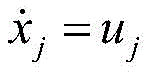
其中,
(3)定义时变编队跟踪控制问题(3) Define the time-varying formation tracking control problem
在地面惯性系O-XYZ下,由于无人车仅在水平面(XY平面)内运动,不存在Z轴方向的运动,并且各无人机的高度可以单独控制,因此,仅考虑无人机-无人车集群在XY平面内的编队跟踪运动。为方便编队跟踪问题的描述与分析,在编队控制层面,将无人机与无人车的状态控制方程统一表示为:Under the ground inertial system O-XYZ, since the unmanned vehicle only moves in the horizontal plane (XY plane), there is no movement in the Z-axis direction, and the height of each UAV can be controlled independently. Therefore, only the UAV- Formation tracking motion of a swarm of unmanned vehicles in the XY plane. In order to facilitate the description and analysis of the formation tracking problem, at the formation control level, the state control equations of UAVs and unmanned vehicles are unifiedly expressed as:

对于无人机i(i∈FA),有


编队跟踪控制要求无人机-无人车集群在形成期望时变编队构型的同时,编队整体能够跟踪期望的轨迹运动。因此,引入如下的虚拟领导者来刻画期望的运动轨迹:Formation tracking control requires the UAV-UAV swarm to form the desired time-varying formation configuration, and the formation as a whole can track the desired trajectory movement. Therefore, the following virtual leaders are introduced to characterize the desired trajectory:

其中,
采用代数图论描述多无人机/无人车之间的作用拓扑关系,定义G为集群系统作用拓扑所对应的有向图,将无人机、无人车以及虚拟领导者表示为图G中的节点,令wij为节点j到节点i的作用强度。要求有向图G具有生成树,并以虚拟领导者为根节点。虚拟领导者没有邻居,无人机/无人车作为跟随者,至少有一个邻居。图G所对应的拉普拉斯矩阵记为


利用时变向量

则称无人机-无人车集群实现了期望的输出时变编队跟踪。It is said that the UAV-UAV swarm achieves the desired output time-varying formation tracking.
(4)构造分布式状态观测器(4) Constructing a distributed state observer
对于无人车-无人机集群,为实现集群系统中每个无人机/无人车对虚拟领导者的状态估计,构造如下的分布式状态观测器:For the UAV-UAV swarm, in order to realize the state estimation of each UAV/UAV in the swarm system to the virtual leader, the following distributed state observer is constructed:

其中,η为增益系数,是一个正常数,K为增益矩阵。Among them, η is the gain coefficient, which is a constant, and K is the gain matrix.
(5)构造集群系统状态观测器(5) Construct the cluster system state observer
由于无人机无人车的部分状态信息不能够由传感器测量,故利用输出信息构造龙伯格状态观测器对状态信息进行估计,构造如下龙伯格状态观测器:Since part of the state information of the unmanned vehicle cannot be measured by the sensor, the output information is used to construct a Lumberg state observer to estimate the state information, and the following Lunberg state observer is constructed:

其中,
(6)构造分布式时变编队跟踪控制器(6) Constructing a distributed time-varying formation tracking controller
对于无人车-无人机集群,构造如下的分布式时变编队跟踪控制器:For the unmanned vehicle-UAV swarm, the following distributed time-varying formation tracking controller is constructed:

其中,K1i与K2i表示待设计的增益矩阵,ri表示时变编队跟踪补偿输入。Among them, K 1i and K 2i represent the gain matrix to be designed, and ri represents the time-varying formation tracking compensation input.
(7)设计编队跟踪控制器的参数(7) Design the parameters of the formation tracking controller
对于第i个无人机/无人车(i=1,2,…,M+N),时变编队跟踪控制器的设计步骤如下。For the i-th UAV/UAV (i=1,2,...,M+N), the design steps of the time-varying formation tracking controller are as follows.
首先,选择矩阵Xi与Ui,使得如下的调节器方程成立:First, the matrices X i and U i are chosen such that the following regulator equation holds:

其次,检验如下的时变编队跟踪可行性条件:Second, the following feasibility conditions for time-varying formation tracking are examined:

如果对于所有的无人机与无人车,都存在编队补偿输入ri使得上式成立,则给定的时变编队是可行的;否则,该期望编队是不可行的,需要重新给定编队向量hi。If there is a formation compensation input r i for all UAVs and unmanned vehicles such that the above formula holds, the given time-varying formation is feasible; otherwise, the expected formation is not feasible, and the formation needs to be re-given vector h i .
然后,设计K1i使得矩阵Ai+BiK1i是Hurwitz,并令K2i=Ui-K1iXi。Then, design K 1i such that the matrix A i +B i K 1i is Hurwitz, and let K 2i =U i -K 1i X i .
最后,选择充分大的η使得
A0P+PA0 T+Iq-PC0C0 TP≤0A 0 P+PA 0 T +I q -PC 0 C 0 T P≤0
得到满足条件的正定矩阵P,并令K=PC0 T。Obtain a positive definite matrix P that satisfies the condition, and let K=PC 0 T .
(8)拓扑切换驻留时间条件(8) Topology switching dwell time condition
有向拓扑切换的驻留时间满足

实施例3,本发明提供一个具体的存在切换拓扑条件的无人机-无人车异构集群系统时变编队跟踪控制的实例来验证本发明所提出方法的有效性。本实例的具体实施步骤如下:
(1)无人机-无人车异构集群系统设置(1) UAV-Unmanned Vehicle Heterogeneous Cluster System Setup
考虑由2架无人机(编号为1,2)和2辆无人车(编号为3,4)组成的异构集群系统,其作用拓扑如图1所示。无人机与无人车以旋转圆形编队的形式执行空地协同侦查任务。两架无人机定高飞行,故本实例中只需考虑XY平面内的编队跟踪控制问题。将虚拟领导者定义为二阶积分器模型,其参数设置为
(2)期望的时变编队设计(2) Desired time-varying formation design
为刻画期望的旋转圆形编队构型,对于各无人机与无人车,将时变编队向量


如果异构集群系统实现了期望的编队跟踪,各无人机与无人车将会在XY平面内以半径为γ、角速度为
(3)编队跟踪控制器参数设计(3) Parameter design of formation tracking controller
为使得调节器方程成立,对于无人机1和2,选择


r3=r4=0r 3 =r 4 =0
设计增益矩阵
(4)仿真条件设置及结果分析(4) Simulation condition setting and result analysis
在本实例中,令γ=1.5m,
详细参数设置Detailed parameter settings
(1)期望编队(1) Expected formation
为刻画期望的旋转圆形编队构型,选取半径γ=1.5m、角速度

h1=[1.5cos(π+0.1t),-0.15sin(π+0.1t),1.5sin(π+0.1t),0.15cos(π+0.1t)]T h 1 =[1.5cos(π+0.1t),-0.15sin(π+0.1t),1.5sin(π+0.1t),0.15cos(π+0.1t)] T
h2=[1.5cos(0.1t),-0.15sin(0.1t),1.5sin(0.1t),0.15cos(0.1t)]T h 2 =[1.5cos(0.1t),-0.15sin(0.1t),1.5sin(0.1t),0.15cos(0.1t)] T
h3=[1.5cos(0.1t),-0.15sin(0.1t),1.5sin(0.1t),0.15cos(0.1t)]T h 3 =[1.5cos(0.1t),-0.15sin(0.1t),1.5sin(0.1t),0.15cos(0.1t)] T
h4=[1.5cos(π+0.1t),-0.15sin(π+0.1t),1.5sin(π+0.1t),0.15cos(π+0.1t)]T h 4 =[1.5cos(π+0.1t),-0.15sin(π+0.1t),1.5sin(π+0.1t),0.15cos(π+0.1t)] T
(2)虚拟领导者0(2)

q0=[χ0X,v0X,χ0Y,v0Y]T表示虚拟领导者沿X轴与Y轴的位置与速度,取q0=[1,0,1,0]T,则虚拟领导者将在XY平面内绕圆心作角速度为0.06rad/s的圆周运动。q 0 =[χ 0X ,v 0X ,χ 0Y ,v 0Y ] T represents the position and velocity of the virtual leader along the X-axis and the Y-axis, taking q 0 =[1,0,1,0] T , then the virtual leader The person will make a circular motion around the center of the circle in the XY plane with an angular velocity of 0.06rad/s.
(3)无人机1(3)





(4)无人机2(4)


(5)无人车3(5)


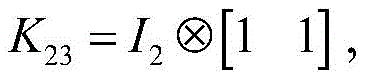
(6)无人车4(6)


实施例4,本发明还提供一种拓扑切换下无人机与无人车异构集群编队跟踪控制系统,所述跟踪控制系统包括:
虚拟领导者构建模块,用于构建异构编队的虚拟领导者。Virtual leader building block for building virtual leaders of heterogeneous formations.
期望时变编队构型形成模块,用于构建异构编队的期望时变编队构型。The expected time-varying formation configuration forming module is used to construct the expected time-varying formation configuration of the heterogeneous formation.
时变编队向量构建模块,用于根据异构编队的期望时变编队构型,构建异构编队的时变编队向量。The time-varying formation vector building module is used to construct the time-varying formation vector of the heterogeneous formation according to the expected time-varying formation configuration of the heterogeneous formation.
所述时变编队向量构建模块,具体包括:The time-varying formation vector building module specifically includes:
时变编队向量构建子模块,用于根据异构编队的期望时变编队构型,构建异构编队的时变编队向量:
其中,h1(t)、h2(t)、hM+N(t)分别表示异构编队中第1个、第2个和第M+N个成员的时变编队向量;M表示异构编队中无人机的数量、N表示异构编队中无人车的数量,对于异构编队中第i个成员的时变编队向量hi(t),满足公式hyi(t)=C0hi(t),hyi(t)表示异构编队对中第i个成员的期望时变编队构型,C0为虚拟领导者的状态控制方程的第三系数矩阵,t表示时间。Among them, h 1 (t), h 2 (t), h M+N (t) represent the time-varying formation vectors of the 1st, 2nd and M+Nth members in the heterogeneous formation, respectively; M represents the heterogeneous formation. The number of UAVs in the formation, N represents the number of unmanned vehicles in the heterogeneous formation, for the time-varying formation vector h i (t) of the i-th member in the heterogeneous formation, the formula h yi (t)=C is satisfied 0 h i (t), h yi (t) represent the expected time-varying formation configuration of the i-th member in the heterogeneous formation pair, C 0 is the third coefficient matrix of the virtual leader's state control equation, and t represents time.
判断子模块,用于判断对于异构编队的每个成员,是否都存在编队补偿输入ri(t)使得公式


时变编队向量重新构建子模块,用于若所述判断结果表示否则返回步骤“根据异构编队的期望时变编队构型,构建异构编队的时变编队向量:
时变编队向量输出子模块,用于若所述判断结果表示是则输出异构编队的时变编队向量和编队补偿输入。The time-varying formation vector output sub-module is configured to output the time-varying formation vector and formation compensation input of the heterogeneous formation if the judgment result indicates yes.
分布式状态观测器建立模块,用于建立异构编队中的成员在拓扑切换条件下对虚拟领导者的状态进行估计的分布式状态观测器;其中,异构编队中的成员为异构编队包含的无人机或无人车。The distributed state observer establishment module is used to establish a distributed state observer for members in a heterogeneous formation to estimate the state of the virtual leader under the condition of topology switching; drones or unmanned vehicles.
所述分布式状态观测器建立模块,具体包括:The distributed state observer establishment module specifically includes:
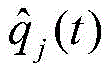
分布式状态观测器建立子模块,用于建立异构编队中的成员在拓扑切换条件下对虚拟领导者的状态进行估计的分布式状态观测器为:
其中,

正定矩阵求解子模块,用于确定满足线性不等式A0P+PA0 T+Iq-PC0C0 TP≤0的正定矩阵P;其中,Iq表示单位矩阵。The positive definite matrix solving submodule is used to determine the positive definite matrix P satisfying the linear inequality A 0 P+PA 0 T +I q -PC 0 C 0 T P≤0; where, I q represents the identity matrix.
分布式状态观测器的增益矩阵计算子模块,用于根据所述正定矩阵P,利用公式K=PC0 T计算分布式状态观测器的增益矩阵。The gain matrix calculation sub-module of the distributed state observer is configured to calculate the gain matrix of the distributed state observer by using the formula K=PC 0 T according to the positive definite matrix P.
系统状态观测器建立模块,用于建立对异构编队中的成员的状态进行估计的系统状态观测器。The system state observer establishment module is used to establish a system state observer for estimating the states of the members in the heterogeneous formation.
所述系统状态观测器建立模块,具体包括:The system state observer establishment module specifically includes:
系统状态观测器建立子模块,用于利用异构编队中的成员的输出信息构造龙伯格状态观测器对成员的状态信息进行估计。The system state observer establishes a sub-module, which uses the output information of the members in the heterogeneous formation to construct a Lomborg state observer to estimate the state information of the members.
所述龙伯格状态观测器为:The Lomborg state observer is:

其中,
分布式时变编队跟踪控制器构造模块,用于根据所述时变编队向量、所述分布式状态观测器和所述系统状态观测器,构造分布式时变编队跟踪控制器。A distributed time-varying formation tracking controller construction module, configured to construct a distributed time-varying formation tracking controller according to the time-varying formation vector, the distributed state observer and the system state observer.
虚拟领导者控制模块,用于控制虚拟领导者按照异构编队的期望运动轨迹运动。The virtual leader control module is used to control the virtual leader to move according to the desired trajectory of the heterogeneous formation.
运动跟踪模块,用于通过分布式时变编队跟踪控制器控制异构编队的成员跟踪虚拟领导者的运动轨迹。The motion tracking module is used to control the members of the heterogeneous formation to track the movement trajectory of the virtual leader through the distributed time-varying formation tracking controller.
本发明提出了一种一种拓扑切换下无人机与无人车异构集群编队跟踪控制方法,使得多无人机与无人车系统在形成期望的时变编队构型的同时,能够跟踪期望的参考航迹运动。该方法的主要优点如下:1)该方法能够实现由无人机与无人车组成的异构集群系统的输出时变编队跟踪,而常见的编队控制方法仅仅适用于同构集群系统,难以扩展到异构场景。2)该方法能够实现拓扑切换条件下的异构集群系统的时变编队跟踪,对于实际应用中,系统的通信拓扑往往不是固定不变的,该方法具有良好的实际工程应用价值。3)该方法能够实现时变的编队构型,更好地应对外部环境和系统任务的快速变化,具有较强的灵活性和适用性。4)该方法仅利用邻居节点的相对作用信息设计分布式编队控制器,结构简单,具有较好的可扩展性与自组织性,能够有效提高计算效率。The invention proposes a method for tracking and controlling the formation of a heterogeneous cluster of unmanned aerial vehicles and unmanned vehicles under topology switching, so that the multiple unmanned aerial vehicles and unmanned vehicles can track the desired time-varying formation configuration while forming a desired time-varying formation configuration. Desired reference track motion. The main advantages of this method are as follows: 1) This method can realize the output time-varying formation tracking of the heterogeneous swarm system composed of UAVs and unmanned vehicles, while the common formation control method is only suitable for homogeneous swarm systems and is difficult to expand to heterogeneous scenarios. 2) This method can realize the time-varying formation tracking of heterogeneous cluster systems under the condition of topology switching. For practical applications, the communication topology of the system is often not fixed, and this method has good practical engineering application value. 3) The method can realize the time-varying formation configuration, better cope with the rapid changes of the external environment and system tasks, and has strong flexibility and applicability. 4) This method only uses the relative action information of neighbor nodes to design a distributed formation controller, which has a simple structure, good scalability and self-organization, and can effectively improve computing efficiency.
本说明书中各个实施例采用递进的方式描述,每个实施例重点说明的都是与其他实施例的不同之处,各个实施例之间相同相似部分互相参见即可。对于实施例公开的系统而言,由于其与实施例公开的方法相对应,所以描述的比较简单,相关之处参见方法部分说明即可。The various embodiments in this specification are described in a progressive manner, and each embodiment focuses on the differences from other embodiments, and the same and similar parts between the various embodiments can be referred to each other. For the system disclosed in the embodiment, since it corresponds to the method disclosed in the embodiment, the description is relatively simple, and the relevant part can be referred to the description of the method.
本文中应用了具体个例对本发明的原理及实施方式进行了阐述,以上实施例的说明只是用于帮助理解本发明的方法及其核心思想;同时,对于本领域的一般技术人员,依据本发明的思想,在具体实施方式及应用范围上均会有改变之处。综上,本说明书内容不应理解为对本发明的限制。In this paper, specific examples are used to illustrate the principles and implementations of the present invention. The descriptions of the above embodiments are only used to help understand the methods and core ideas of the present invention; meanwhile, for those skilled in the art, according to the present invention There will be changes in the specific implementation and application scope. In conclusion, the contents of this specification should not be construed as limiting the present invention.
Claims (8)


Priority Applications (1)
| Application Number | Priority Date | Filing Date | Title |
|---|---|---|---|
| CN202010597290.8A CN111665848B (en) | 2020-06-28 | 2020-06-28 | Formation tracking control method for heterogeneous swarms of unmanned aerial vehicles and unmanned vehicles under topology switching |
Applications Claiming Priority (1)
| Application Number | Priority Date | Filing Date | Title |
|---|---|---|---|
| CN202010597290.8A CN111665848B (en) | 2020-06-28 | 2020-06-28 | Formation tracking control method for heterogeneous swarms of unmanned aerial vehicles and unmanned vehicles under topology switching |
Publications (2)
| Publication Number | Publication Date |
|---|---|
| CN111665848A CN111665848A (en) | 2020-09-15 |
| CN111665848B true CN111665848B (en) | 2020-12-11 |
Family
ID=72390091
Family Applications (1)
| Application Number | Title | Priority Date | Filing Date |
|---|---|---|---|
| CN202010597290.8A Active CN111665848B (en) | 2020-06-28 | 2020-06-28 | Formation tracking control method for heterogeneous swarms of unmanned aerial vehicles and unmanned vehicles under topology switching |
Country Status (1)
| Country | Link |
|---|---|
| CN (1) | CN111665848B (en) |
Families Citing this family (27)
| Publication number | Priority date | Publication date | Assignee | Title |
|---|---|---|---|---|
| CN112887931B (en) * | 2021-01-12 | 2022-03-15 | 中国人民解放军军事科学院国防科技创新研究院 | Heterogeneous cluster multi-service networking method based on center node assistance |
| CN112987790B (en) * | 2021-03-04 | 2022-05-10 | 北京航空航天大学 | Grouping formation tracking control method and system for distributed heterogeneous cluster system |
| CN113220021B (en) * | 2021-05-06 | 2022-08-09 | 西北工业大学 | Flight formation cooperative self-adaptive tracking control method based on virtual leader |
| CN113419535B (en) * | 2021-07-05 | 2024-02-27 | 鹏城实验室 | Dual boat path planning method, device, equipment and computer-readable storage medium |
| CN113253764B (en) * | 2021-07-14 | 2021-10-01 | 北京大学 | An affine formation control method for unmanned swarms based on dimensionality reduction observer |
| CN113900380B (en) * | 2021-11-17 | 2023-02-28 | 北京航空航天大学 | Robust output formation tracking control method and system for heterogeneous cluster system |
| CN114115289A (en) * | 2021-12-07 | 2022-03-01 | 湖南大学 | An autonomous unmanned swarm reconnaissance system |
| CN114020042A (en) * | 2021-12-14 | 2022-02-08 | 北京航空航天大学 | A heterogeneous unmanned swarm formation encirclement tracking control method and system |
| CN114237247A (en) * | 2021-12-17 | 2022-03-25 | 广东工业大学 | Consistent control method for nonholonomic mobile robot with variable formation based on prediction |
| CN114527794B (en) * | 2022-01-28 | 2024-10-18 | 南京信息工程大学 | Heterogeneous unmanned aerial vehicle cluster control method based on event triggering |
| CN114610072B (en) * | 2022-04-07 | 2026-01-23 | 北京航空航天大学 | Unmanned aerial vehicle cluster system distributed time-varying formation tracking control method and system |
| CN114935943A (en) * | 2022-06-09 | 2022-08-23 | 北京航空航天大学 | Unmanned aerial vehicle and unmanned vehicle cluster formation tracking control method and system |
| CN114879743B (en) * | 2022-06-28 | 2025-07-22 | 北京航空航天大学 | Unmanned cluster distributed time-varying optimal control method and system considering interference |
| CN115220472B (en) * | 2022-07-13 | 2023-07-21 | 南京航空航天大学 | A fault-tolerant control method for space-ground heterogeneous formation system under switching topology |
| CN115877718B (en) * | 2023-02-23 | 2023-05-30 | 北京航空航天大学 | Data-driven communication topology cooperative control method for heterogeneous missile formation switching |
| CN116166021B (en) * | 2023-03-01 | 2023-11-24 | 海南大学 | Unmanned ship formation control method based on double observers |
| CN116700332B (en) * | 2023-06-14 | 2026-04-24 | 南京理工大学 | A cooperative control method and system for amphibious unmanned aerial vehicle (UAV) swarms |
| CN116755440A (en) * | 2023-06-16 | 2023-09-15 | 北京航空航天大学 | Heterogeneous distributed multi-agent formation control method under switching topology constraints |
| CN116820100B (en) * | 2023-06-25 | 2024-02-27 | 中国矿业大学 | Unmanned vehicle formation control method under spoofing attack |
| CN117519228A (en) * | 2023-11-01 | 2024-02-06 | 西北工业大学 | An aircraft maneuver formation control method based on distributed extended state observer |
| CN117687309B (en) * | 2024-02-04 | 2024-04-16 | 北京航空航天大学 | Asynchronous constraint output formation tracking method and system for heterogeneous cluster system |
| CN118068713A (en) * | 2024-03-04 | 2024-05-24 | 北京航空航天大学 | An optimal control method and system for formation encirclement and tracking of nonlinear swarm systems |
| CN118819156B (en) * | 2024-07-17 | 2026-01-23 | 中国地质大学(武汉) | Robot formation control method, system and medium based on distributed observer |
| CN119024857B (en) * | 2024-10-29 | 2025-05-16 | 南京航空航天大学 | A method for controlling air-ground heterogeneous cluster coordinated formations triggered by fixed-time events |
| CN119717793B (en) * | 2024-11-05 | 2026-03-03 | 南京邮电大学 | An optimal control method and system for UAV-UGV under a preset time. |
| CN119536266B (en) * | 2024-11-21 | 2025-10-03 | 北京理工大学 | Multi-agent distributed formation control method based on hybrid event triggering mechanism |
| CN119556703B (en) * | 2024-11-29 | 2025-09-26 | 华南理工大学 | Collaborative formation control method based on distributed filtering synchronous estimator |
Citations (11)
| Publication number | Priority date | Publication date | Assignee | Title |
|---|---|---|---|---|
| CN101382429A (en) * | 2008-10-17 | 2009-03-11 | 北京航空航天大学 | A ground-air heterogeneous multi-robot search and rescue system |
| CN106054922A (en) * | 2016-06-22 | 2016-10-26 | 长安大学 | Unmanned aerial vehicle (UAV)-unmanned ground vehicle (UGV) combined formation cooperative control method |
| CN108519741A (en) * | 2018-05-14 | 2018-09-11 | 中国人民解放军火箭军工程大学 | A Guaranteed Capacity Formation Control Method with Communication Fault Tolerance |
| CN109240331A (en) * | 2018-09-30 | 2019-01-18 | 北京航空航天大学 | A kind of unmanned plane-unmanned vehicle cluster models time-varying formation control method and system |
| CN109613931A (en) * | 2019-01-07 | 2019-04-12 | 北京航空航天大学 | Target tracking system and method of heterogeneous UAV swarm based on biological social force |
| CN109656255A (en) * | 2019-01-28 | 2019-04-19 | 湖南大学 | Consider the vehicle platoon under communication topology time-varying with stability control method of speeding |
| CN109901616A (en) * | 2019-03-29 | 2019-06-18 | 北京航空航天大学 | A Distributed Mission Planning Method for Heterogeneous UAV Swarms |
| CN110109351A (en) * | 2019-04-08 | 2019-08-09 | 广东工业大学 | A kind of multiple agent consistency control method based on specified performance |
| CN110162074A (en) * | 2019-06-05 | 2019-08-23 | 南京航空航天大学 | A kind of posture health control method for going straight up to a group of planes based on hierarchical structure |
| CN110716582A (en) * | 2019-10-16 | 2020-01-21 | 东南大学 | Multi-agent consistency tracking protocol design method suitable for intermittent DoS attack on communication |
| CN111176327A (en) * | 2020-01-16 | 2020-05-19 | 北京航空航天大学 | Multi-agent system enclosure control method and system |
Family Cites Families (2)
| Publication number | Priority date | Publication date | Assignee | Title |
|---|---|---|---|---|
| US20060256733A1 (en) * | 2005-05-12 | 2006-11-16 | Yigal Bejerano | Methods and devices for discovering the topology of large multi-subnet LANs |
| US11366455B2 (en) * | 2016-05-09 | 2022-06-21 | Strong Force Iot Portfolio 2016, Llc | Methods and systems for optimization of data collection and storage using 3rd party data from a data marketplace in an industrial internet of things environment |
-
2020
- 2020-06-28 CN CN202010597290.8A patent/CN111665848B/en active Active
Patent Citations (11)
| Publication number | Priority date | Publication date | Assignee | Title |
|---|---|---|---|---|
| CN101382429A (en) * | 2008-10-17 | 2009-03-11 | 北京航空航天大学 | A ground-air heterogeneous multi-robot search and rescue system |
| CN106054922A (en) * | 2016-06-22 | 2016-10-26 | 长安大学 | Unmanned aerial vehicle (UAV)-unmanned ground vehicle (UGV) combined formation cooperative control method |
| CN108519741A (en) * | 2018-05-14 | 2018-09-11 | 中国人民解放军火箭军工程大学 | A Guaranteed Capacity Formation Control Method with Communication Fault Tolerance |
| CN109240331A (en) * | 2018-09-30 | 2019-01-18 | 北京航空航天大学 | A kind of unmanned plane-unmanned vehicle cluster models time-varying formation control method and system |
| CN109613931A (en) * | 2019-01-07 | 2019-04-12 | 北京航空航天大学 | Target tracking system and method of heterogeneous UAV swarm based on biological social force |
| CN109656255A (en) * | 2019-01-28 | 2019-04-19 | 湖南大学 | Consider the vehicle platoon under communication topology time-varying with stability control method of speeding |
| CN109901616A (en) * | 2019-03-29 | 2019-06-18 | 北京航空航天大学 | A Distributed Mission Planning Method for Heterogeneous UAV Swarms |
| CN110109351A (en) * | 2019-04-08 | 2019-08-09 | 广东工业大学 | A kind of multiple agent consistency control method based on specified performance |
| CN110162074A (en) * | 2019-06-05 | 2019-08-23 | 南京航空航天大学 | A kind of posture health control method for going straight up to a group of planes based on hierarchical structure |
| CN110716582A (en) * | 2019-10-16 | 2020-01-21 | 东南大学 | Multi-agent consistency tracking protocol design method suitable for intermittent DoS attack on communication |
| CN111176327A (en) * | 2020-01-16 | 2020-05-19 | 北京航空航天大学 | Multi-agent system enclosure control method and system |
Non-Patent Citations (3)
| Title |
|---|
| Leader-Following Sample data Formation Control of Nonholonomic Robots with Switching Network Topologies;Mairaj Ali等;《2018 22nd International Conference on System Theory, Control and Computing》;20181231;第445-451页 * |
| 基于事件触发的拓扑切换异构多智能体协同输出调节;杨若涵等;《自动化学报》;20170331;第43卷(第3期);第472-477页 * |
| 基于拓扑切换的异构多智能体系统协同输出调节;马羊琴等;《系统科学与数学》;20191231;第39卷(第6期);第845-856页 * |
Also Published As
| Publication number | Publication date |
|---|---|
| CN111665848A (en) | 2020-09-15 |
Similar Documents
| Publication | Publication Date | Title |
|---|---|---|
| CN111665848B (en) | Formation tracking control method for heterogeneous swarms of unmanned aerial vehicles and unmanned vehicles under topology switching | |
| CN109240331B (en) | Unmanned aerial vehicle-unmanned vehicle cluster model time-varying formation control method and system | |
| CN109582036B (en) | Consistent formation control method of quadrotor UAV | |
| CN113342037A (en) | Multi-rotor unmanned aerial vehicle time-varying formation control method and system with input saturation function | |
| CN114610072B (en) | Unmanned aerial vehicle cluster system distributed time-varying formation tracking control method and system | |
| Wu et al. | Nonlinear control of quadrotor for fault tolerance: A total failure of one actuator | |
| CN112947086B (en) | Self-adaptive compensation method for actuator faults in formation control of heterogeneous multi-agent system consisting of unmanned aerial vehicle and unmanned vehicle | |
| CN114935943A (en) | Unmanned aerial vehicle and unmanned vehicle cluster formation tracking control method and system | |
| CN112859913B (en) | Multi-quad-rotor unmanned helicopter attitude consistency optimal control method considering output constraint | |
| CN110658821A (en) | Multi-robot anti-interference grouping time-varying formation control method and system | |
| Rojo-Rodriguez et al. | Robust consensus-based formation flight for multiple quadrotors | |
| CN112379596A (en) | RBF neural network-based cooperative fault-tolerant control method for heterogeneous multi-agent system | |
| Guerrero-Castellanos et al. | Real-time event-based formation control of a group of VTOL-UAVs | |
| CN116483124A (en) | A quadrotor UAV formation control method based on wireless speed measurement and anti-jamming | |
| CN118331040A (en) | Self-adaptive collaborative handling method for multi-unmanned aerial vehicle hanging load system | |
| CN110658811B (en) | A Neural Network-Based Cooperative Path Tracking Control Method for Constrained Mobile Robots | |
| CN112650290A (en) | High-rise fire-fighting unmanned aerial vehicle formation optimization control method and system with disturbance compensation | |
| CN120178894A (en) | A time-determined distributed optimal inclusion control method for drone swarms | |
| Li et al. | Distributed formation control for multiple quadrotor uavs based on distributed estimator and singular perturbation system | |
| CN116841319A (en) | Distributed self-adaptive unmanned aerial vehicle azimuth formation control method, system and electronic equipment | |
| CN117148861A (en) | A fixed-time distributed adaptive formation control method for quad-rotor UAVs | |
| CN120406507A (en) | A six-rotor UAV control method and system with disturbance and performance constraints | |
| Mousavifard et al. | Formation control of multi-quadrotors based on deep Q-learning | |
| Housny et al. | Robust sliding mode control for quadrotor UAV | |
| CN118884997A (en) | An adaptive fault-tolerant control method for multi-UAV cooperative loading under state constraints |
Legal Events
| Date | Code | Title | Description |
|---|---|---|---|
| PB01 | Publication | ||
| PB01 | Publication | ||
| SE01 | Entry into force of request for substantive examination | ||
| SE01 | Entry into force of request for substantive examination | ||
| GR01 | Patent grant | ||
| GR01 | Patent grant | ||
| EE01 | Entry into force of recordation of patent licensing contract | ||
| EE01 | Entry into force of recordation of patent licensing contract |
Application publication date: 20200915 Assignee: BEIJING ANGFEI TECHNOLOGY CO.,LTD. Assignor: BEIHANG University Contract record no.: X2025980004845 Denomination of invention: Tracking and Control Method for Heterogeneous Cluster Formation of Unmanned Aerial Vehicles and Vehicles under Topology Switching Granted publication date: 20201211 License type: Common License Record date: 20250306 |