CN111527170B - Optically clear pressure sensitive adhesives and uses thereof - Google Patents
Optically clear pressure sensitive adhesives and uses thereof Download PDFInfo
- Publication number
- CN111527170B CN111527170B CN201880084244.9A CN201880084244A CN111527170B CN 111527170 B CN111527170 B CN 111527170B CN 201880084244 A CN201880084244 A CN 201880084244A CN 111527170 B CN111527170 B CN 111527170B
- Authority
- CN
- China
- Prior art keywords
- meth
- optically clear
- curable
- clear adhesive
- adhesive
- Prior art date
- Legal status (The legal status is an assumption and is not a legal conclusion. Google has not performed a legal analysis and makes no representation as to the accuracy of the status listed.)
- Expired - Fee Related
Links
Images


Classifications
-
- C—CHEMISTRY; METALLURGY
- C09—DYES; PAINTS; POLISHES; NATURAL RESINS; ADHESIVES; COMPOSITIONS NOT OTHERWISE PROVIDED FOR; APPLICATIONS OF MATERIALS NOT OTHERWISE PROVIDED FOR
- C09J—ADHESIVES; NON-MECHANICAL ASPECTS OF ADHESIVE PROCESSES IN GENERAL; ADHESIVE PROCESSES NOT PROVIDED FOR ELSEWHERE; USE OF MATERIALS AS ADHESIVES
- C09J183/00—Adhesives based on macromolecular compounds obtained by reactions forming in the main chain of the macromolecule a linkage containing silicon, with or without sulfur, nitrogen, oxygen, or carbon only; Adhesives based on derivatives of such polymers
- C09J183/04—Polysiloxanes
-
- C—CHEMISTRY; METALLURGY
- C09—DYES; PAINTS; POLISHES; NATURAL RESINS; ADHESIVES; COMPOSITIONS NOT OTHERWISE PROVIDED FOR; APPLICATIONS OF MATERIALS NOT OTHERWISE PROVIDED FOR
- C09J—ADHESIVES; NON-MECHANICAL ASPECTS OF ADHESIVE PROCESSES IN GENERAL; ADHESIVE PROCESSES NOT PROVIDED FOR ELSEWHERE; USE OF MATERIALS AS ADHESIVES
- C09J7/00—Adhesives in the form of films or foils
-
- C—CHEMISTRY; METALLURGY
- C09—DYES; PAINTS; POLISHES; NATURAL RESINS; ADHESIVES; COMPOSITIONS NOT OTHERWISE PROVIDED FOR; APPLICATIONS OF MATERIALS NOT OTHERWISE PROVIDED FOR
- C09J—ADHESIVES; NON-MECHANICAL ASPECTS OF ADHESIVE PROCESSES IN GENERAL; ADHESIVE PROCESSES NOT PROVIDED FOR ELSEWHERE; USE OF MATERIALS AS ADHESIVES
- C09J7/00—Adhesives in the form of films or foils
- C09J7/30—Adhesives in the form of films or foils characterised by the adhesive composition
- C09J7/38—Pressure-sensitive adhesives [PSA]
-
- C—CHEMISTRY; METALLURGY
- C08—ORGANIC MACROMOLECULAR COMPOUNDS; THEIR PREPARATION OR CHEMICAL WORKING-UP; COMPOSITIONS BASED THEREON
- C08G—MACROMOLECULAR COMPOUNDS OBTAINED OTHERWISE THAN BY REACTIONS ONLY INVOLVING UNSATURATED CARBON-TO-CARBON BONDS
- C08G77/00—Macromolecular compounds obtained by reactions forming a linkage containing silicon with or without sulfur, nitrogen, oxygen or carbon in the main chain of the macromolecule
- C08G77/04—Polysiloxanes
- C08G77/12—Polysiloxanes containing silicon bound to hydrogen
-
- C—CHEMISTRY; METALLURGY
- C08—ORGANIC MACROMOLECULAR COMPOUNDS; THEIR PREPARATION OR CHEMICAL WORKING-UP; COMPOSITIONS BASED THEREON
- C08K—Use of inorganic or non-macromolecular organic substances as compounding ingredients
- C08K5/00—Use of organic ingredients
- C08K5/0008—Organic ingredients according to more than one of the "one dot" groups of C08K5/01 - C08K5/59
- C08K5/005—Stabilisers against oxidation, heat, light, ozone
-
- C—CHEMISTRY; METALLURGY
- C09—DYES; PAINTS; POLISHES; NATURAL RESINS; ADHESIVES; COMPOSITIONS NOT OTHERWISE PROVIDED FOR; APPLICATIONS OF MATERIALS NOT OTHERWISE PROVIDED FOR
- C09J—ADHESIVES; NON-MECHANICAL ASPECTS OF ADHESIVE PROCESSES IN GENERAL; ADHESIVE PROCESSES NOT PROVIDED FOR ELSEWHERE; USE OF MATERIALS AS ADHESIVES
- C09J153/00—Adhesives based on block copolymers containing at least one sequence of a polymer obtained by reactions only involving carbon-to-carbon unsaturated bonds; Adhesives based on derivatives of such polymers
- C09J153/02—Vinyl aromatic monomers and conjugated dienes
- C09J153/025—Vinyl aromatic monomers and conjugated dienes modified
-
- C—CHEMISTRY; METALLURGY
- C09—DYES; PAINTS; POLISHES; NATURAL RESINS; ADHESIVES; COMPOSITIONS NOT OTHERWISE PROVIDED FOR; APPLICATIONS OF MATERIALS NOT OTHERWISE PROVIDED FOR
- C09J—ADHESIVES; NON-MECHANICAL ASPECTS OF ADHESIVE PROCESSES IN GENERAL; ADHESIVE PROCESSES NOT PROVIDED FOR ELSEWHERE; USE OF MATERIALS AS ADHESIVES
- C09J4/00—Adhesives based on organic non-macromolecular compounds having at least one polymerisable carbon-to-carbon unsaturated bond ; adhesives, based on monomers of macromolecular compounds of groups C09J183/00 - C09J183/16
- C09J4/06—Organic non-macromolecular compounds having at least one polymerisable carbon-to-carbon unsaturated bond in combination with a macromolecular compound other than an unsaturated polymer of groups C09J159/00 - C09J187/00
-
- C—CHEMISTRY; METALLURGY
- C08—ORGANIC MACROMOLECULAR COMPOUNDS; THEIR PREPARATION OR CHEMICAL WORKING-UP; COMPOSITIONS BASED THEREON
- C08G—MACROMOLECULAR COMPOUNDS OBTAINED OTHERWISE THAN BY REACTIONS ONLY INVOLVING UNSATURATED CARBON-TO-CARBON BONDS
- C08G77/00—Macromolecular compounds obtained by reactions forming a linkage containing silicon with or without sulfur, nitrogen, oxygen or carbon in the main chain of the macromolecule
- C08G77/04—Polysiloxanes
- C08G77/20—Polysiloxanes containing silicon bound to unsaturated aliphatic groups
-
- C—CHEMISTRY; METALLURGY
- C08—ORGANIC MACROMOLECULAR COMPOUNDS; THEIR PREPARATION OR CHEMICAL WORKING-UP; COMPOSITIONS BASED THEREON
- C08K—Use of inorganic or non-macromolecular organic substances as compounding ingredients
- C08K3/00—Use of inorganic substances as compounding ingredients
- C08K3/01—Use of inorganic substances as compounding ingredients characterized by their specific function
- C08K3/014—Stabilisers against oxidation, heat, light or ozone
-
- C—CHEMISTRY; METALLURGY
- C09—DYES; PAINTS; POLISHES; NATURAL RESINS; ADHESIVES; COMPOSITIONS NOT OTHERWISE PROVIDED FOR; APPLICATIONS OF MATERIALS NOT OTHERWISE PROVIDED FOR
- C09J—ADHESIVES; NON-MECHANICAL ASPECTS OF ADHESIVE PROCESSES IN GENERAL; ADHESIVE PROCESSES NOT PROVIDED FOR ELSEWHERE; USE OF MATERIALS AS ADHESIVES
- C09J2203/00—Applications of adhesives in processes or use of adhesives in the form of films or foils
- C09J2203/318—Applications of adhesives in processes or use of adhesives in the form of films or foils for the production of liquid crystal displays
-
- C—CHEMISTRY; METALLURGY
- C09—DYES; PAINTS; POLISHES; NATURAL RESINS; ADHESIVES; COMPOSITIONS NOT OTHERWISE PROVIDED FOR; APPLICATIONS OF MATERIALS NOT OTHERWISE PROVIDED FOR
- C09J—ADHESIVES; NON-MECHANICAL ASPECTS OF ADHESIVE PROCESSES IN GENERAL; ADHESIVE PROCESSES NOT PROVIDED FOR ELSEWHERE; USE OF MATERIALS AS ADHESIVES
- C09J2301/00—Additional features of adhesives in the form of films or foils
- C09J2301/30—Additional features of adhesives in the form of films or foils characterized by the chemical, physicochemical or physical properties of the adhesive or the carrier
- C09J2301/302—Additional features of adhesives in the form of films or foils characterized by the chemical, physicochemical or physical properties of the adhesive or the carrier the adhesive being pressure-sensitive, i.e. tacky at temperatures inferior to 30°C
-
- C—CHEMISTRY; METALLURGY
- C09—DYES; PAINTS; POLISHES; NATURAL RESINS; ADHESIVES; COMPOSITIONS NOT OTHERWISE PROVIDED FOR; APPLICATIONS OF MATERIALS NOT OTHERWISE PROVIDED FOR
- C09J—ADHESIVES; NON-MECHANICAL ASPECTS OF ADHESIVE PROCESSES IN GENERAL; ADHESIVE PROCESSES NOT PROVIDED FOR ELSEWHERE; USE OF MATERIALS AS ADHESIVES
- C09J2301/00—Additional features of adhesives in the form of films or foils
- C09J2301/30—Additional features of adhesives in the form of films or foils characterized by the chemical, physicochemical or physical properties of the adhesive or the carrier
- C09J2301/312—Additional features of adhesives in the form of films or foils characterized by the chemical, physicochemical or physical properties of the adhesive or the carrier parameters being the characterizing feature
-
- C—CHEMISTRY; METALLURGY
- C09—DYES; PAINTS; POLISHES; NATURAL RESINS; ADHESIVES; COMPOSITIONS NOT OTHERWISE PROVIDED FOR; APPLICATIONS OF MATERIALS NOT OTHERWISE PROVIDED FOR
- C09J—ADHESIVES; NON-MECHANICAL ASPECTS OF ADHESIVE PROCESSES IN GENERAL; ADHESIVE PROCESSES NOT PROVIDED FOR ELSEWHERE; USE OF MATERIALS AS ADHESIVES
- C09J2301/00—Additional features of adhesives in the form of films or foils
- C09J2301/40—Additional features of adhesives in the form of films or foils characterized by the presence of essential components
- C09J2301/416—Additional features of adhesives in the form of films or foils characterized by the presence of essential components use of irradiation
-
- C—CHEMISTRY; METALLURGY
- C09—DYES; PAINTS; POLISHES; NATURAL RESINS; ADHESIVES; COMPOSITIONS NOT OTHERWISE PROVIDED FOR; APPLICATIONS OF MATERIALS NOT OTHERWISE PROVIDED FOR
- C09J—ADHESIVES; NON-MECHANICAL ASPECTS OF ADHESIVE PROCESSES IN GENERAL; ADHESIVE PROCESSES NOT PROVIDED FOR ELSEWHERE; USE OF MATERIALS AS ADHESIVES
- C09J2425/00—Presence of styrenic polymer
-
- C—CHEMISTRY; METALLURGY
- C09—DYES; PAINTS; POLISHES; NATURAL RESINS; ADHESIVES; COMPOSITIONS NOT OTHERWISE PROVIDED FOR; APPLICATIONS OF MATERIALS NOT OTHERWISE PROVIDED FOR
- C09J—ADHESIVES; NON-MECHANICAL ASPECTS OF ADHESIVE PROCESSES IN GENERAL; ADHESIVE PROCESSES NOT PROVIDED FOR ELSEWHERE; USE OF MATERIALS AS ADHESIVES
- C09J2453/00—Presence of block copolymer
-
- C—CHEMISTRY; METALLURGY
- C09—DYES; PAINTS; POLISHES; NATURAL RESINS; ADHESIVES; COMPOSITIONS NOT OTHERWISE PROVIDED FOR; APPLICATIONS OF MATERIALS NOT OTHERWISE PROVIDED FOR
- C09J—ADHESIVES; NON-MECHANICAL ASPECTS OF ADHESIVE PROCESSES IN GENERAL; ADHESIVE PROCESSES NOT PROVIDED FOR ELSEWHERE; USE OF MATERIALS AS ADHESIVES
- C09J2483/00—Presence of polysiloxane
Landscapes
- Chemical & Material Sciences (AREA)
- Organic Chemistry (AREA)
- Chemical Kinetics & Catalysis (AREA)
- Health & Medical Sciences (AREA)
- Medicinal Chemistry (AREA)
- Polymers & Plastics (AREA)
- Adhesives Or Adhesive Processes (AREA)
- Polarising Elements (AREA)
- Laminated Bodies (AREA)
Abstract
本发明描述了在低于380nm具有UV阻挡的光学透明的粘合剂(OCA)。所述OCA包含UV吸收剂的UV阻挡套装和受阻胺光稳定剂。UV阻挡套装适用于各种OCA,包括基于PIB的OCA、基于苯乙烯类嵌段共聚物的OCA、基于有机硅的OCA、或基于丙烯酸类的OCA。本发明中具有UV阻挡的OCA特别适合用作层合膜、胶带或密封剂来粘结显示电子装置,例如LCD显示器、LED显示器、柔性可折叠显示器以及触摸屏。

The present invention describes optically clear adhesives (OCAs) with UV blocking below 380 nm. The OCA comprises a UV blocking package of UV absorbers and a hindered amine light stabilizer. UV blocking kits are available for a variety of OCAs, including PIB-based OCAs, styrenic block copolymer-based OCAs, silicone-based OCAs, or acrylic-based OCAs. The OCA with UV blocking in the present invention is particularly suitable as a lamination film, tape or sealant to bond display electronics, such as LCD displays, LED displays, flexible foldable displays, and touch screens.
Description
技术领域technical field
本发明涉及具有UV阻挡(blocking)的光学透明的粘合剂(OCA)。所述光学透明的粘合剂具有在可见光范围内大于90%并且在UV光范围内小于10%的透射率。所述光学透明的粘合剂特别适合作为层合膜、胶带或密封剂来粘结电子装置,例如,LCD显示器、LED显示器、柔性可折叠显示器以及触摸屏。The present invention relates to optically clear adhesives (OCAs) with UV blocking. The optically clear adhesive has a transmission of greater than 90% in the visible range and less than 10% in the UV range. The optically clear adhesive is particularly suitable as a lamination film, tape or sealant to bond electronic devices such as LCD displays, LED displays, flexible and foldable displays, and touch screens.
背景技术Background technique
现代显示装置包含易受紫外线降解影响的有机成分,特别是如果它们暴露于室外环境或紧挨荧光黑灯和/或其他短波。在显示装置中以色移的形式或褪色的外观看到降解。Modern display units contain organic components that are susceptible to UV degradation, especially if they are exposed to outdoor environments or next to fluorescent black lights and/or other short wavelengths. Degradation is seen in the form of a color shift or faded appearance in the display device.
UV辐射分为三个波段:UV C(低于280nm)、UV B(280-320nm)和UV A(320-390nm)。为了最大程度地减小降解,显示装置需要防护所有三个波段。UV阻挡层诸如显示装置上的盖玻璃会阻挡UVC发射。为了使LCD显示器中的UVB辐射最小化,通常用UV阻挡玻璃涂料密封显示装置(displace device)。UVA范围(320-390nm)的很大一部分从LCD的正面透过。当长时间暴露在阳光下时,这种UV A降解会在日常物品中显示出褪色改变、裂纹或崩解。UV radiation is divided into three bands: UV C (below 280nm), UV B (280-320nm) and UV A (320-390nm). To minimize degradation, display devices need to be shielded from all three bands. A UV blocking layer such as a cover glass on a display device blocks UVC emission. To minimize UVB radiation in LCD displays, the display device is usually sealed with UV blocking glass coatings. A large part of the UVA range (320-390nm) is transmitted from the front side of the LCD. This UV A degradation can show in everyday objects as fading changes, cracks or disintegration when exposed to sunlight for long periods of time.
显示装置通常包含多层,各层彼此粘合并密封以防止降解和湿气逸出。光学透明的粘合剂(OCA)膜用于粘合显示装置中的各层,包括盖玻璃、触摸板和其他层,以填充显示器不同层之间的气隙,并提高显示器的图像质量和耐用性。通常,在任何LCD或LED显示器中至少有一层OCA膜。虽然显示装置在装置中使用了某种类型的UV阻挡层,诸如UV阻挡盖玻璃、塑料膜和涂层;在制造具有UV阻挡的光学透明的粘合剂(OCA)方面所做的工作很少。Display devices typically contain multiple layers that are bonded to each other and sealed to prevent degradation and moisture escape. Optically clear adhesive (OCA) films are used to bond layers in display devices, including cover glass, touch panels, and other layers, to fill air gaps between different layers of the display, and to improve the image quality and durability of the display sex. Generally, there is at least one layer of OCA film in any LCD or LED display. Although display devices use some type of UV blocking layer in the device, such as UV blocking cover glass, plastic films and coatings; little work has been done on making optically clear adhesives (OCAs) with UV blocking .
在US 2013/0321991中公开了一种包括UV阻挡粘合剂层的溶液聚合的OCA层;但是,该方案有若干缺点。该溶液聚合的OCA层在UV固化时会收缩,因此使基材脱粘。此外,产生粘合剂的不均匀层,其中粘合剂的边缘比中心薄。In US 2013/0321991 a solution polymerized OCA layer comprising a UV blocking adhesive layer is disclosed; however, this solution has several disadvantages. The solution polymerized OCA layer shrinks upon UV curing, thus debonding the substrate. In addition, an uneven layer of adhesive is produced, where the edge of the adhesive is thinner than the center.
在US 2003/0109599中公开了与用于透明基材的UV阻挡油墨有关的油墨组合物和方法。尽管油墨组合物可以防止UV透射,但是它们不具有将基材粘合在一起的粘合性能。Ink compositions and methods relating to UV blocking inks for transparent substrates are disclosed in US 2003/0109599. Although ink compositions can prevent UV transmission, they do not have the adhesive properties to bond substrates together.
在本领域中仍然需要用于显示电子装置的光学透明的粘合剂膜,该粘合剂膜在可见光范围内具有高的光学透明度,同时在延长的时段内阻挡有害的UV A、B和C辐射的显著百分比的透射。本发明满足了该需求。There remains a need in the art for optically clear adhesive films for display electronic devices that have high optical clarity in the visible range while blocking harmful UV A, B and C for extended periods of time Transmission of a significant percentage of radiation. The present invention fulfills this need.
发明内容Contents of the invention
本发明涉及具有UV阻挡的光学透明的粘合剂组合物,其适合于在显示装置中密封和粘结基材。The present invention relates to optically clear adhesive compositions with UV blocking suitable for sealing and bonding substrates in display devices.
本发明的一个目的是通过组合多于一种UV吸收剂来提供UV吸收剂套装(package)。通过将OCA组合物与UV阻挡套装混合来制备UV阻挡OCA组合物。优选地,UV阻挡OCA组合物吸收大于约90%的低于380nm的UV透射和小于约10%的高于410nm的UV透射。It is an object of the present invention to provide a UV absorber package by combining more than one UV absorber. A UV blocking OCA composition is prepared by mixing the OCA composition with a UV blocking kit. Preferably, the UV blocking OCA composition absorbs greater than about 90% of UV transmission below 380 nm and less than about 10% of UV transmission above 410 nm.
本发明的一个方面是一种光学透明的粘合剂组合物,其包含以下组分的混合物:One aspect of the invention is an optically clear adhesive composition comprising a mixture of the following components:
(a)约85%至约99.7%的压敏粘合剂;(a) from about 85% to about 99.7% pressure sensitive adhesive;
(b)约0.3%至约15%的UV吸收剂套装,其包含:(b) from about 0.3% to about 15% of a UV absorber kit comprising:
(i)约0.1%至约5%的羟基苯基苯并三唑或其衍生物;(i) from about 0.1% to about 5% of hydroxyphenylbenzotriazole or derivatives thereof;
(ii)约0.1%至约5%的二苯甲酮或其衍生物;和(ii) from about 0.1% to about 5% of benzophenone or derivatives thereof; and
(iii)约0.1%至约5%的受阻胺光稳定剂;(iii) from about 0.1% to about 5% hindered amine light stabilizer;
其中固化的粘合剂在380nm或更小下具有小于10%的透射百分率,并且在410nm或更大下具有大于90%的透射百分率,所述透射百分率是根据ASTM E903测量的。wherein the cured adhesive has a percent transmission of less than 10% at 380 nm or less and greater than 90% at 410 nm or greater, as measured in accordance with ASTM E903.
在下面的详细描述中描述了本发明的这些和其他方面。在任何情况下,以上概述都不应被解释为对所要求保护的主题的限制,该主题仅由本文所述的要求保护的权利要求来限定。These and other aspects of the invention are described in the detailed description below. In no event should the above summary be construed as a limitation of the claimed subject matter, which subject matter is defined only by the claimed claims set forth herein.
附图说明Description of drawings
图1是含有和不含UV吸收剂的基于聚异丁烯的压敏粘合剂的UV-vis光谱。Figure 1 is the UV-vis spectra of polyisobutylene based pressure sensitive adhesives with and without UV absorbers.
图2是含有和不含UV吸收剂的基于苯乙烯丁二烯嵌段共聚物的压敏粘合剂的UV-vis光谱。Figure 2 is the UV-vis spectra of styrene butadiene block copolymer based pressure sensitive adhesives with and without UV absorbers.
图3是含有和不含UV吸收剂的基于聚丙烯酸酯的压敏粘合剂的UV-vis光谱。Figure 3 is the UV-vis spectra of polyacrylate based pressure sensitive adhesives with and without UV absorbers.
图4是含有和不含UV吸收剂的可UV固化的基于有机硅的压敏粘合剂的UV-vis光谱。Figure 4 is a UV-vis spectrum of a UV-curable silicone-based pressure sensitive adhesive with and without a UV absorber.
图5是含有和不含UV吸收剂的可热固化的基于有机硅的压敏粘合剂的UV-vis光谱。Figure 5 is a UV-vis spectrum of a thermally curable silicone-based pressure sensitive adhesive with and without UV absorber.
具体实施方式detailed description
本文引用的所有文件均通过引用的方式整体并入本文。All documents cited herein are hereby incorporated by reference in their entirety.
除非另有明确说明,否则百分比是指基于组分总重量的干燥固体重量百分比。Percentages are by weight dry solids based on the total weight of the components unless expressly stated otherwise.
如本文所用,聚合物或低聚物是由等于或大于约两个单体单元的单体单元组成的大分子。聚合物和低聚物在本文中可互换使用。As used herein, a polymer or oligomer is a macromolecule composed of monomer units equal to or greater than about two monomer units. Polymer and oligomer are used interchangeably herein.
如本文所用,术语“反应性”是指分子在酸或碱催化剂的存在下进行缩合反应的能力。As used herein, the term "reactivity" refers to the ability of a molecule to undergo a condensation reaction in the presence of an acid or base catalyst.
如本文所用,术语“烷基”是指包含C1至C24碳的一价线性、环状或支化部分,并且所述部分中的碳原子之间仅有单键,包括例如甲基、乙基、丙基、异丙基、正丁基、仲丁基、异丁基、叔丁基、正戊基、正己基、庚基、2,4,4-三甲基戊基、2-乙基己基、正辛基、正壬基、正癸基、正十一烷基、正十二烷基、正十六烷基、正十八烷基和正二十烷基。As used herein, the term "alkyl" refers to a monovalent linear, cyclic or branched moiety comprising C1 to C24 carbons and having only single bonds between carbon atoms in said moiety, including for example methyl, ethyl , propyl, isopropyl, n-butyl, sec-butyl, isobutyl, tert-butyl, n-pentyl, n-hexyl, heptyl, 2,4,4-trimethylpentyl, 2-ethyl Hexyl, n-octyl, n-nonyl, n-decyl, n-undecyl, n-dodecyl, n-hexadecyl, n-octadecyl and n-eicosyl.
如本文所用,术语“芳基”是指具有单个环(例如,苯基)或多个缩合(稠合)环的6至24个碳原子的一价不饱和芳族碳环基团,其中至少一个环是芳族的(例如,萘基、二氢菲基、芴基或蒽基)。优选的实例包括苯基、甲基苯基、乙基苯基、甲基萘基、乙基萘基等。As used herein, the term "aryl" refers to a monovalent unsaturated aromatic carbocyclic group of 6 to 24 carbon atoms having a single ring (e.g., phenyl) or multiple condensed (fused) rings, wherein at least One ring is aromatic (eg, naphthyl, dihydrophenanthrenyl, fluorenyl, or anthracenyl). Preferable examples include phenyl, methylphenyl, ethylphenyl, methylnaphthyl, ethylnaphthyl and the like.
如本文所用,术语“烷氧基”是指基团-O-R,其中R是如上所定义的烷基。As used herein, the term "alkoxy" refers to the group -O-R, wherein R is alkyl as defined above.
如本文所用,术语“(甲基)丙烯酰氧基”表示丙烯酰氧基和甲基丙烯酰氧基。As used herein, the term "(meth)acryloyloxy" means acryloyloxy and methacryloyloxy.
如本文所用,术语“压敏粘合剂”或“PSA”可互换使用,是指粘弹性材料,其在施用轻微压力的情况下瞬间粘附至大多数基材并保持永久粘性。As used herein, the term "pressure sensitive adhesive" or "PSA" is used interchangeably to refer to a viscoelastic material that adheres instantaneously to most substrates and remains permanently tacky with the application of light pressure.
如本文所用,术语“膜”是指自支撑形式的粘合剂,其将装置中的各部件和/或基材粘合在一起。As used herein, the term "film" refers to a self-supporting form of adhesive that bonds together components and/or substrates in a device.
如本文所用,术语“光学透明的(optically clear)”或“光学透明度(opticalclarity)”是指根据ASTM E903在500nm或更高下测得的膜透射率为90%或更高。As used herein, the term "optically clear" or "optical clarity" refers to a film with a transmittance of 90% or greater measured at 500 nm or greater according to ASTM E903.
如本文所用,术语“显示装置”和“显示电子装置”可互换使用,是指这样的物品,其在盖前板与基材后板之间具有各种部件诸如电路或活性层,并且通过操纵电子流动来工作,例如显示器,包括柔性可折叠显示器、户外显示器、LCD显示器、LED显示器;漫射器;刚性补偿器;加热器;柔性偏光片;触摸屏;柔性薄膜光伏电池;移动电话;平板电脑;电视;笔记本电脑;数码相机;相框;汽车导航;等等。As used herein, the terms "display device" and "display electronics" are used interchangeably to refer to an item having various components such as circuitry or active layers between the cover front plate and the substrate back plate, and through Manipulating the flow of electrons to work, such as displays, including flexible and foldable displays, outdoor displays, LCD displays, LED displays; diffusers; rigid compensators; heaters; flexible polarizers; touch screens; flexible thin-film photovoltaic cells; mobile phones; tablets Computer; TV; Laptop; Digital Camera; Photo Frame; Car Navigation; etc.
本发明提供光学透明的粘合剂(OCA),其包含(a)可固化压敏粘合剂(PSA)和(b)UV吸收剂的套装,所述UV吸收剂的套装可以阻挡低于380nm波长的UV光,但是在高于400nm波长的可见光范围内是透明的。可固化PSA的实例包括但不限于可UV固化聚异丁烯PSA、可UV固化苯乙烯类嵌段共聚物PSA、以及可UV固化或可热固化的有机硅PSA、可UV固化丙烯酸类PSA等。在一个实施方案中,光学透明的粘合剂组合物包含:(a)约85%至约99.7%的压敏粘合剂;和(b)约0.3-15%的UV吸收剂的混合物,其包含:(i)约0.1%至约5%的羟基苯基苯并三唑或其衍生物;(ii)约0.1%至5%的二苯甲酮或其衍生物;和(iii)约0.1-5%的受阻胺光稳定剂。所述光学透明的粘合剂组合物的透射百分率(%T)在小于380nm下小于10%并且在大于410nm下大于90%,所述透射百分率(%T)是根据ASTM E903测量的。The present invention provides an optically clear adhesive (OCA) comprising (a) a curable pressure sensitive adhesive (PSA) and (b) a set of UV absorbers that can block wavelength of UV light, but is transparent in the visible range above 400nm wavelength. Examples of curable PSAs include, but are not limited to, UV curable polyisobutylene PSAs, UV curable styrenic block copolymer PSAs, and UV curable or heat curable silicone PSAs, UV curable acrylic PSAs, and the like. In one embodiment, the optically clear adhesive composition comprises: (a) from about 85% to about 99.7% of a pressure sensitive adhesive; and (b) from about 0.3% to about 15% of a mixture of UV absorbers which Comprising: (i) about 0.1% to about 5% of hydroxyphenylbenzotriazole or derivatives thereof; (ii) about 0.1% to 5% of benzophenone or derivatives thereof; and (iii) about 0.1% -5% HALS. The optically clear adhesive composition has a percent transmission (%T) less than 10% at less than 380 nm and greater than 90% at greater than 410 nm, as measured according to ASTM E903.
UV吸收剂通过对有害UV辐射的竞争性吸收起作用。与其所保护的显示装置中的其他粘合剂组分和活性层相比,它们通常吸收UV辐射要强得多。吸收UV后形成的激发态通过无辐射过程(例如热)快速有效地驰豫到基态,然后无辐射过程(例如热)通过粘合剂层和显示装置的表面消散,从而赋予了高稳定效率和优异的UV稳定性。UV absorbers work by competitive absorption of harmful UV radiation. They generally absorb UV radiation much more strongly than other adhesive components and active layers in the display device they protect. The excited state formed after absorbing UV is quickly and efficiently relaxed to the ground state by a non-radiative process (such as heat), which is then dissipated through the adhesive layer and the surface of the display device, thus endowing high stabilization efficiency and Excellent UV stability.
许多市售UV吸收剂适合作为本发明中的OCA套装。UV吸收剂按化学类别分类,例如苯并三唑及其衍生物、二苯甲酮及其衍生物、氰基丙烯酸酯及其衍生物、三嗪及其衍生物、取代和未取代的苯甲酸的酯、及它们的混合物。每种类别都有其自己的UV吸收特性。例如,与苯并三唑类型相比,二苯甲酮和三嗪类型倾向于在短波长UV-B区域更强地吸收。Many commercially available UV absorbers are suitable as OCA kits in the present invention. UV absorbers are classified by chemical class such as benzotriazoles and their derivatives, benzophenones and their derivatives, cyanoacrylates and their derivatives, triazines and their derivatives, substituted and unsubstituted benzoic acids esters, and mixtures thereof. Each class has its own UV absorbing properties. For example, benzophenone and triazine types tend to absorb more strongly in the short wavelength UV-B region than benzotriazole types.
受阻胺光稳定剂(HALS)不吸收辐射;相反,它们通过将光化学产生的“自由基”的中和、阻碍化学降解,来保护粘合剂膜或显示装置免于所述“自由基”的有害影响。HALS在中和过程期间会自我再生,从而在OCA膜的整个寿命中提供保护。通常,受阻胺光稳定剂是仲、叔、乙酰化、N-烃氧基取代的、羟基取代的N-烃氧基取代的、或其他取代的环状胺,其特征在于大量的位阻,通常衍生自与胺官能相邻的碳原子上的脂族取代。Hindered Amine Light Stabilizers (HALS) do not absorb radiation; instead, they protect the adhesive film or display device from photochemically generated "free radicals" by neutralizing them, hindering their chemical degradation. harmful effects. HALS self-regenerate during the neutralization process, providing protection throughout the life of the OCA membrane. Typically, hindered amine light stabilizers are secondary, tertiary, acetylated, N-oxyl-substituted, hydroxyl-substituted N-oxyl-substituted, or other substituted cyclic amines, characterized by substantial steric hindrance, Usually derived from aliphatic substitution on carbon atoms adjacent to the amine function.
不同的UV吸收剂和HALS的混合物对于完全阻挡低于380nm的辐射是必需的。已经发现,UV吸收剂和受阻胺光稳定剂的特定组合显示出协同性能,获得最佳耐候性,并在各种聚合物、涂料和其他塑料中提供光稳定性。令人意外的是,苯并三唑衍生物、二苯甲酮衍生物和HALS的组合或套装阻挡低于380nm的UV光,但对大于400nm的可见光透明。特别地,羟基苯基苯并三唑或其衍生物、二苯甲酮或其衍生物、和受阻胺光稳定剂的组合阻挡大多数低于380nm的UV光,同时允许透明的可见光通过不同类型的PSA。最优选的套装是2-[2-羟基-3-二甲基苄基苯基-5-(1,1,3,3-四甲基丁基)]-2h-苯并三唑、2-羟基-4-正辛基氧基二苯甲酮和癸二酸双(2,2,6,6,-四甲基-4-哌啶基)酯。这种组合的实例包括Tinuvin-928、Chimassorb-81和Tinuvin-770。基于OCA组合物的总重量,UV吸收剂和HALS的优选含量为约0.3%至不超过约15%。Mixtures of different UV absorbers and HALS are necessary for complete blocking of radiation below 380nm. Specific combinations of UV absorbers and hindered amine light stabilizers have been found to exhibit synergistic performance for optimum weatherability and provide light stability in a wide variety of polymers, coatings and other plastics. Surprisingly, the combination or set of benzotriazole derivatives, benzophenone derivatives and HALS blocks UV light below 380nm but is transparent to visible light above 400nm. In particular, the combination of hydroxyphenylbenzotriazole or its derivatives, benzophenone or its derivatives, and a hindered amine light stabilizer blocks most UV light below 380 nm while allowing transparent visible light to pass through different types of PSA. The most preferred set is 2-[2-hydroxy-3-dimethylbenzylphenyl-5-(1,1,3,3-tetramethylbutyl)]-2h-benzotriazole, 2- Hydroxy-4-n-octyloxybenzophenone and bis(2,2,6,6,-tetramethyl-4-piperidinyl) sebacate. Examples of such combinations include Tinuvin-928, Chimassorb-81 and Tinuvin-770. UV absorbers and HALS are preferably present in an amount of from about 0.3% to not more than about 15%, based on the total weight of the OCA composition.
羟基苯基苯并三唑、二苯甲酮和受阻胺光稳定剂的这种特定组合令人意外地将低于380nm的UV光减至最小,而不会负面影响各种压敏粘合剂体系中对可见光的透明度。该套装在基于聚异丁烯、可UV固化的基于苯乙烯嵌段共聚物、可UV固化的基于丙烯酸类、和可UV固化或可热固化的基于有机硅的压敏粘合剂中有效地阻挡低于380nm的UV光,同时在高于410nm的可见光区域保持透明度。This specific combination of hydroxyphenylbenzotriazole, benzophenone and hindered amine light stabilizer surprisingly minimizes UV light below 380nm without negatively affecting various pressure sensitive adhesives The transparency of the system to visible light. The kit effectively blocks low UV light at 380nm while maintaining transparency in the visible region above 410nm.
可固化PSA的一个实施方案是可UV固化聚异丁烯(PIB)PSA,其包含聚异丁烯、多官能(甲基)丙烯酸酯、稀释剂、增粘剂和光引发剂。基于压敏粘合剂的总重量,可UV固化的基于聚异丁烯的压敏粘合剂组合物包含:(i)约1%至约30%的(甲基)丙烯酸酯单体、(甲基)丙烯酸酯低聚物或它们的混合物;(ii)约10%至约90%的聚异丁烯聚合物;(iii)约5%至约50%的液体稀释剂、增粘剂或它们的混合物;和(iv)约0.001%至5%的光引发剂。PIB基本上是异丁烯的均聚物。市售的PIB包括但不限于Oppanol、Glissopal和Indopol。尽管这些PIB中的许多可以包含甚至高达75%的末端αC=C键,但这些PIB对UV自由基反应的反应性相对较低且不完全,因此被认为是非反应性或不可固化的PIB。此外,PIB的重均分子量(Mw)为约1,000-约1,000,000g/mol。基于可固化OCA的总重量而不考虑任何溶剂,可固化PSA中的PIB的量为约5-约99重量%,更优选为约30-95重量%。One embodiment of a curable PSA is a UV curable polyisobutylene (PIB) PSA comprising polyisobutylene, a multifunctional (meth)acrylate, a diluent, a tackifier, and a photoinitiator. Based on the total weight of the pressure sensitive adhesive, the UV curable polyisobutylene based pressure sensitive adhesive composition comprises: (i) from about 1% to about 30% of a (meth)acrylate monomer, (meth)acrylate ) acrylate oligomers or mixtures thereof; (ii) from about 10% to about 90% polyisobutylene polymers; (iii) from about 5% to about 50% liquid diluents, tackifiers, or mixtures thereof; and (iv) from about 0.001% to 5% of a photoinitiator. PIB is essentially a homopolymer of isobutylene. Commercially available PIBs include, but are not limited to, Oppanol, Glissopal, and Indopol. Although many of these PIBs can contain even up to 75% terminal αC=C bonds, the reactivity of these PIBs to UV radical reactions is relatively low and incomplete and thus considered non-reactive or non-curable PIBs. In addition, PIB has a weight average molecular weight (Mw) of about 1,000 to about 1,000,000 g/mol. The amount of PIB in the curable PSA is from about 5 to about 99 weight percent, more preferably from about 30 to 95 weight percent, based on the total weight of the curable OCA, without regard to any solvent.
(i)(甲基)丙烯酸酯单体是单或多官能(甲基)丙烯酸类单体,并且(甲基)丙烯酸酯低聚物是(甲基)丙烯酸类官能化的聚异丁烯、聚丁二烯、氢化聚丁二烯,或每分子具有多于一个(甲基)丙烯酸类官能团的聚烯烃,其中反应性官能团选自末端甲基丙烯酸酯、侧接甲基丙烯酸酯、末端丙烯酸酯和/或侧接丙烯酸酯;及它们的混合物。(甲基)丙烯酸酯低聚物或它们的混合物的重均分子量(Mw)为约1000-约95,000g/mol。液体稀释剂是矿物油、蜡、聚异丁烯、聚丁烯或合成的液体聚合物。增粘剂是完全氢化的软嵌段、部分氢化的软嵌段、脂族硬嵌段改性的增粘剂、或芳族硬嵌段改性的增粘剂。(i) The (meth)acrylate monomer is a mono- or polyfunctional (meth)acrylic monomer, and the (meth)acrylate oligomer is a (meth)acrylic functionalized polyisobutylene, polybutylene Diene, hydrogenated polybutadiene, or polyolefin having more than one (meth)acrylic functional group per molecule, wherein the reactive functional group is selected from terminal methacrylate, pendant methacrylate, terminal acrylate and and/or pendant acrylates; and mixtures thereof. The (meth)acrylate oligomers or mixtures thereof have a weight average molecular weight (Mw) of from about 1000 to about 95,000 g/mol. Liquid diluents are mineral oil, wax, polyisobutylene, polybutene, or synthetic liquid polymers. The tackifier is a fully hydrogenated soft block, a partially hydrogenated soft block, an aliphatic hard block modified tackifier, or an aromatic hard block modified tackifier.
可固化PSA的另外的实施方案是可UV固化苯乙烯嵌段共聚物(SBC)PSA,其包含完全氢化的软嵌段、多官能(甲基)丙烯酸酯、液体稀释剂、增粘剂和光引发剂。基于压敏粘合剂的总重量,可UV固化的基于苯乙烯类嵌段共聚物的压敏粘合剂包含(i)约5%至约30%的(甲基)丙烯酸酯单体、或(甲基)丙烯酸酯低聚物或它们的混合物;(ii)约5%至约30%的具有完全氢化的饱和软嵌段的苯乙烯类嵌段共聚物;(iii)约55%至约79.99%的液体稀释剂、增粘剂或它们的混合物;和(iv)约0.01%至约5%的光引发剂。An additional embodiment of a curable PSA is a UV curable styrenic block copolymer (SBC) PSA comprising a fully hydrogenated soft block, a multifunctional (meth)acrylate, a liquid diluent, a tackifier, and a photoinitiated agent. The UV-curable styrenic block copolymer-based pressure sensitive adhesive comprises (i) from about 5% to about 30% of a (meth)acrylate monomer, based on the total weight of the pressure sensitive adhesive, or (meth)acrylate oligomers or mixtures thereof; (ii) from about 5% to about 30% of styrenic block copolymers with fully hydrogenated saturated soft blocks; (iii) from about 55% to about 79.99% liquid diluent, tackifier or mixture thereof; and (iv) from about 0.01% to about 5% photoinitiator.
苯乙烯类嵌段共聚物是三嵌段的、二嵌段的或它们的混合物。苯乙烯类嵌段共聚物是具有A-B-A或A-B的通用嵌段构型的线性嵌段共聚物,其中A是具有高于20℃的均聚物玻璃化转变温度(Tg)的非弹性体聚合物硬嵌段,B是具有约-30℃至约室温、更优选约-30℃至约10℃的Tg的饱和弹性体软嵌段。硬或苯乙烯类嵌段可以包括以下物质的均聚物或共聚物:乙烯基单体,诸如乙烯基芳烃、乙烯基吡啶、乙烯基卤化物和乙烯基羧酸酯,以及丙烯酸类单体,诸如丙烯腈、甲基丙烯腈、(甲基)丙烯酸的甲酯等,乙烯基芳烃(vinyl areneshydrocarbon),特别地包括苯系列的那些,诸如苯乙烯、α-甲基苯乙烯、乙烯基甲苯、乙烯基二甲苯、乙基乙烯基苯,以及双环单乙烯基化合物,诸如乙烯基萘等。优选苯乙烯单体作为硬嵌段。Styrenic block copolymers are triblock, diblock or mixtures thereof. Styrenic block copolymers are linear block copolymers with a general block configuration of A-B-A or A-B, where A is a non-elastomeric polymer with a homopolymer glass transition temperature (Tg) above 20°C The hard block, B is a saturated elastomeric soft block having a Tg of from about -30°C to about room temperature, more preferably from about -30°C to about 10°C. The hard or styrenic blocks may include homopolymers or copolymers of vinyl monomers such as vinyl aromatics, vinyl pyridines, vinyl halides, and vinyl carboxylates, and acrylic monomers, Such as acrylonitrile, methacrylonitrile, methyl ester of (meth)acrylic acid, etc., vinyl arene hydrocarbons (vinyl areneshydrocarbon), particularly including those of the benzene series, such as styrene, α-methylstyrene, vinyltoluene, Vinylxylene, ethylvinylbenzene, and bicyclic monovinyl compounds such as vinylnaphthalene, etc. Styrenic monomers are preferred as hard blocks.
饱和软或饱和弹性体(以下可互换使用)嵌段B选自乙烯、丙烯、丁烯、异丁烯、乙烯-丙烯、乙烯-丁烯及它们的混合物,例如在美国专利号3,700,633中所教导。氢化将不饱和C=C键转化为饱和C-C键。可以采用选定的条件使软嵌段完全氢化,同时不改变苯乙烯类硬嵌段。可以选择其他条件以沿着聚合物链基本上均匀地氢化,其软和硬苯乙烯类嵌段都被氢化至实际相同的程度。具有完全氢化的软嵌段的嵌段聚合物使加工过程和装置使用寿命期间暴露在热和光下的降解减至最少。因此,优选具有异戊二烯、丁二烯或它们的混合物的完全氢化的饱和软嵌段的苯乙烯类嵌段共聚物。此外,有用的其他软嵌段组分是异丁烯、(甲基)丙烯酸的C4-C24脂族酯。Saturated soft or saturated elastomer (used interchangeably below) block B is selected from ethylene, propylene, butene, isobutylene, ethylene-propylene, ethylene-butene, and mixtures thereof, such as taught in US Pat. No. 3,700,633. Hydrogenation converts unsaturated C=C bonds into saturated C-C bonds. Selected conditions can be used to fully hydrogenate the soft block without altering the styrenic hard block. Other conditions may be selected to substantially uniformly hydrogenate along the polymer chain, with both the soft and hard styrenic blocks being hydrogenated to substantially the same extent. Block polymers with fully hydrogenated soft blocks minimize degradation during processing and exposure to heat and light during device lifetime. Thus, styrenic block copolymers having fully hydrogenated saturated soft blocks of isoprene, butadiene or mixtures thereof are preferred. In addition, useful other soft block components are isobutylene, C4-C24 aliphatic esters of (meth)acrylic acid.
苯乙烯类嵌段共聚物可以具有硬嵌段与软嵌段的宽比率,并且可以具有约5∶95或更低至约40∶60或更高的比率。Styrenic block copolymers can have a wide ratio of hard blocks to soft blocks, and can have ratios of about 5:95 or less to about 40:60 or more.
嵌段共聚物的非限制性实例包括以KRATON G系列获得的三嵌段苯乙烯-乙烯/丁烯-苯乙烯嵌段共聚物(SEBS)和苯乙烯-乙烯/丙烯-苯乙烯类、嵌段共聚物(SEPS)。可用于本发明的其它三嵌段共聚物包括可从Kuraray以SEPTON 4033-4055获得的具有苯乙烯单体单元和氢化共轭二烯单体的氢化聚异戊二烯/丁二烯(SEEPS);和由苯乙烯单体和氢化共轭二烯单体单元的嵌段组成的氢化聚异戊二烯/丁二烯聚合物。还包括三嵌段共聚物,诸如可从Kaneka以商品名SIBSTAR 062T、073T获得的苯乙烯-异丁烯-苯乙烯嵌段(SIBS)共聚物。苯乙烯类嵌段共聚物也可以是支化或放射状的。典型的支化结构包含具有至少三个分支的弹性体部分,所述分支可从中央中心向外辐射或者可以其它方式偶联或接枝在一起。放射状的嵌段共聚物包含(聚苯乙烯-中间嵌段)nX的结构,其中X是用于制备放射状嵌段共聚物的多官能偶联剂的残基,且n是等于或大于3的数,并且表示附接至X的聚苯乙烯-中间嵌段臂的数目。数n的范围平均为约3至不超过约10。在一个实施方案中,不超过75%的线性嵌段共聚物可以被支化或放射状的苯乙烯类嵌段共聚物替代。SBC组分的量优选为约0.01至约50重量份,更优选约0.5至约20重量份。Non-limiting examples of block copolymers include triblock styrene-ethylene/butylene-styrene block copolymers (SEBS) and styrene-ethylene/propylene-styrenes, block Copolymer (SEPS). Other triblock copolymers useful in the present invention include hydrogenated polyisoprene/butadiene (SEEPS) having styrene monomer units and hydrogenated conjugated diene monomers available from Kuraray as SEPTON 4033-4055 and hydrogenated polyisoprene/butadiene polymers composed of blocks of styrene monomer and hydrogenated conjugated diene monomer units. Also included are triblock copolymers such as styrene-isobutylene-styrene block (SIBS) copolymers available from Kaneka under the tradename SIBSTAR 062T, 073T. Styrenic block copolymers can also be branched or radial. A typical branched structure comprises an elastomeric portion with at least three branches that may radiate outward from a central center or may be otherwise coupled or grafted together. Radial block copolymers comprising the structure of (polystyrene-middle block)nX, where X is the residue of a multifunctional coupling agent used to prepare the radial block copolymer and n is a number equal to or greater than 3 , and represents the number of polystyrene-midblock arms attached to X. The number n ranges from about 3 to not more than about 10 on average. In one embodiment, no more than 75% of the linear block copolymers may be replaced by branched or radial styrenic block copolymers. The amount of the SBC component is preferably from about 0.01 to about 50 parts by weight, more preferably from about 0.5 to about 20 parts by weight.
在另外的实施方案中,苯乙烯类嵌段共聚物包括单独的具有通用的A-B构型的二嵌段共聚物,其中A和B如上所述,并且在25℃在甲苯中20wt%时的粘度大于1000cps。优选的二嵌段共聚物是KRATON G1701X或1702X,它们都是苯乙烯乙烯丙烯二嵌段聚合物。最优选KRATON G1702X。尽管粘合剂配制物优选包含上述二嵌段组分以具有更好的剥离粘合性,但是该二嵌段共聚物可以被与该粘合剂配制物相容的其他非嵌段聚合物部分或全部地替代。例如,聚异丁烯(例如,来自BASF的OPPANOL)、聚异戊二烯(例如,来自Kuraray的液态异戊二烯橡胶)、聚丁烯(例如,来自Ineos的Indopol)、聚丙烯(例如,来自Exxon MobilChemicals的VISTAMAXXTM)、或苯乙烯/丁二烯共聚物(例如,来自Goodyear的PLIOFLEX)、或高可流动性嵌段共聚物(来自Kuraray的SEPTON 2063、2043&2002)也可以至多40重量份的量使用。In additional embodiments, the styrenic block copolymers include a single diblock copolymer having the general AB configuration, where A and B are as described above, and the viscosity at 20 wt% in toluene at 25°C is Greater than 1000cps. Preferred diblock copolymers are KRATON G1701X or 1702X, which are styrene ethylene propylene diblock polymers. Most preferred is KRATON G1702X. Although adhesive formulations preferably contain the diblock components described above for better peel adhesion, the diblock copolymers can be replaced with other non-block polymer moieties that are compatible with the adhesive formulation. or replace it entirely. For example, polyisobutylene (eg, OPPANOL from BASF), polyisoprene (eg, liquid isoprene rubber from Kuraray), polybutene (eg, Indopol from Ineos), polypropylene (eg, from VISTAMAXX ™ from Exxon Mobil Chemicals), or styrene/butadiene copolymers (for example, PLIOFLEX from Goodyear), or high flowable block copolymers (SEPTON 2063, 2043 & 2002 from Kuraray) can also be up to 40 parts by weight Quantity used.
任选地,一部分苯乙烯类嵌段共聚物可以被与苯乙烯类嵌段共聚物相容的非嵌段聚合物替代。这种聚合物的实例包括无定形聚α-烯烃(APAO),其是乙烯、丙烯和丁烯的无规共聚物或三元共聚物,和其它基本上无定形或半结晶的聚合物。商业上合适的APAO包括REXTAC(Rexene LLC)、EASTOFLEX(Eastman Corporation)和VESTOLAST(EvonikCorporation)。熔点低于约100℃的茂金属催化的半结晶聚烯烃也可适用于压敏粘合剂。低熔点半结晶聚烯烃也可替代粘合剂中的苯乙烯类嵌段共聚物,并且此类半结晶聚烯烃的实例包括具有小于约3的多分散性指数的C2-C6聚烯烃。这些低熔点半结晶聚烯烃可以作为LINXAR系列从Exxon Mobil商购。液体稀释剂是矿物油、蜡、聚异丁烯、聚丁烯或合成的液体聚合物。增粘剂为完全氢化的软嵌段、部分氢化的软嵌段、脂族硬嵌段改性的增粘剂或芳族硬嵌段改性的增粘剂。Optionally, a portion of the styrenic block copolymer may be replaced by a non-block polymer compatible with the styrenic block copolymer. Examples of such polymers include amorphous polyalphaolefins (APAO), which are random copolymers or terpolymers of ethylene, propylene, and butene, and other substantially amorphous or semicrystalline polymers. Commercially suitable APAOs include REXTAC (Rexene LLC), EASTOFLEX (Eastman Corporation) and VESTOLAST (Evonik Corporation). Metallocene-catalyzed semi-crystalline polyolefins with melting points below about 100°C are also suitable for use in pressure sensitive adhesives. Low melting point semi-crystalline polyolefins may also be substituted for styrenic block copolymers in adhesives, and examples of such semi-crystalline polyolefins include C2-C6 polyolefins having a polydispersity index of less than about 3. These low melting semicrystalline polyolefins are commercially available from Exxon Mobil as the LINXAR series. Liquid diluents are mineral oil, wax, polyisobutylene, polybutene, or synthetic liquid polymers. The tackifier is a fully hydrogenated soft block, a partially hydrogenated soft block, an aliphatic hard block modified tackifier or an aromatic hard block modified tackifier.
PIB和SBC的可UV固化PSA可进一步包含液体稀释剂、增粘剂或它们的混合物。液体稀释剂包括油、液体增塑剂和液体橡胶。已知稀释剂与一种或多种苯乙烯类嵌段聚合物的特定嵌段(区域)缔合,从而相应地改变那些部分的行为。更详细地,聚合物的软嵌段部分或区域(即″B-嵌段″)需要具有低于约室温的Tg。当添加其它软嵌段相容组分诸如液体稀释剂和增粘剂时,这些组分与B区域缔合,使这些区域溶胀,并通常导致其Tg的变化。对于大多数压敏粘合剂应用,Tg应在约0℃至25℃的范围内;然而,对于本文中的应用,软嵌段Tg的范围可以是-40℃至不超过约10℃,优选约-20℃至约10℃,有用的稀释剂的主要特性是脂族的且与聚合物软嵌段相容。这些材料中包括增塑剂诸如链烷烃型和环烷烃型石油、高度精炼的无芳族的链烷烃型和环烷烃型食品和工业级白色石油矿物油,以及液体增塑剂,诸如聚合的C5石油进料流的合成液体油或橡胶、聚丁烯、聚异丁烯、聚异戊二烯、聚丙烯、多萜、聚丁二烯、或其后的共聚物和氢化衍生物等,重均分子量(Mw)小于100,000g/mol。合成油是低粘度低聚物,其永久地是液体单烯烃、异链烷烃或链烷烃。优选地,稀释剂是在升高的温度下和/或随时间推移不变黄的白油。市售的液体聚丁烯、聚异丁烯、聚异戊二烯、聚丁二烯包括但不限于以LIR 50购自Kuraray的聚异戊二烯、以INDOOL的名称购自Ineos的聚丁烯、以OPPANOL和GLISSOPAL的名称购自BASF的聚异丁烯;以Polybd45CT、Polybd2000CT、Polybd3000CT的名称得自Sartomer的聚丁二烯。聚异戊二烯LIR-30、LIR-50、LIR-290(得自Kuraray);TEA-1000、TE2000、GI-1000、GI-2000、GI-3000、BI-2000、BI-3000、JP-100(得自Nippon Soda);和BI-2000是数均分子量为约2100的氢化1,2-聚丁二烯均聚物。GI-2000是羟基封端的氢化1,2-聚丁二烯,数均分子量为约2100。粘合剂中的液体稀释剂的量为约0.01%至约80%,优选大于约10%。The UV-curable PSAs of PIBs and SBCs may further comprise liquid diluents, tackifiers, or mixtures thereof. Liquid diluents include oils, liquid plasticizers and liquid rubbers. Diluents are known to associate with specific blocks (regions) of one or more styrenic block polymers, altering the behavior of those portions accordingly. In more detail, the soft block portion or region of the polymer (ie, the "B-block") needs to have a Tg below about room temperature. When other soft block compatibilizing components such as liquid diluents and tackifiers are added, these components associate with the B domains, causing these domains to swell and generally causing a change in their Tg. For most pressure sensitive adhesive applications, the Tg should be in the range of about 0°C to 25°C; however, for the applications herein, the soft block Tg can range from -40°C to no more than about 10°C, preferably From about -20°C to about 10°C, useful diluents are primarily aliphatic in character and compatible with the polymer soft block. These materials include plasticizers such as paraffinic and naphthenic petroleum, highly refined non-aromatic paraffinic and naphthenic food and technical grade white petroleum mineral oils, and liquid plasticizers such as polymerized C5 Synthetic liquid oils or rubber, polybutene, polyisobutylene, polyisoprene, polypropylene, polyterpene, polybutadiene, or subsequent copolymers and hydrogenated derivatives of petroleum feed streams, etc., weight average molecular weight (Mw) less than 100,000 g/mol. Synthetic oils are low viscosity oligomers that are permanently liquid monoolefins, isoparaffins or paraffins. Preferably, the diluent is a white oil that does not yellow at elevated temperatures and/or over time. Commercially available liquid polybutenes, polyisobutylenes, polyisoprenes, polybutadiene include but are not limited to polyisoprene available as LIR 50 from Kuraray, polybutene available as INDOOL from Ineos, Polyisobutenes are available from BASF under the names OPPANOL and GLISSOPAL; polybutadienes are available from Sartomer under the names Polybd45CT, Polybd2000CT, Polybd3000CT. Polyisoprene LIR-30, LIR-50, LIR-290 (from Kuraray); TEA-1000, TE2000, GI-1000, GI-2000, GI-3000, BI-2000, BI-3000, JP- 100 (available from Nippon Soda); and BI-2000 is a hydrogenated 1,2-polybutadiene homopolymer having a number average molecular weight of about 2100. GI-2000 is a hydroxyl terminated hydrogenated 1,2-polybutadiene with a number average molecular weight of about 2100. The amount of liquid diluent in the adhesive is from about 0.01% to about 80%, preferably greater than about 10%.
液体增粘剂的实例包括聚合的C5石油进料流的橡胶和多萜,诸如可从Goodyear获得的WINGTACK 10和可从Exxon Chemical获得的ESCOREZ 2520。合适的增粘剂是软嵌段增粘剂,它们包括任何相容的树脂或它们的混合物,诸如(1)天然或改性松香,例如脂松香(gum rosin)、木松香、妥尔油松香、蒸馏松香、氢化松香、二聚松香和聚合松香;(2)天然或改性松香的甘油酯和季戊四醇酯,例如浅色木松香的甘油酯、氢化松香的甘油酯、聚合松香的甘油酯、氢化松香的季戊四醇酯和酚改性的松香的季戊四醇酯;(3)天然萜烯的共聚物和三元共聚物,例如苯乙烯/萜烯和α-甲基苯乙烯/萜烯;(4)通过ASTM方法E28,58T测定的软化点为约80℃至150℃的多萜树脂;后述多萜树脂通常在Friedel-Crafts催化剂的存在下在适度低温下使萜烯烃诸如称为蒎烯的双环单萜聚合得到;也包括氢化多萜树脂;(5)酚改性的萜烯树脂及其氢化衍生物,例如,作为由双环萜烯和苯酚在酸性介质中缩合得到的树脂产物;(6)环球软化点为约50-135℃的脂族石油烃树脂;后述树脂由主要由烯烃和二烯烃组成的单体聚合得到;也包括氢化的脂族石油烃树脂;(7)脂环族石油烃树脂及其氢化衍生物;和(8)脂族/芳族或脂环族芳族共聚物及其氢化衍生物。可用于本文的优选的增粘剂包括多萜,诸如得自Piova的PICCOLYTE A125;脂族树脂诸如得自Goodvear的Wingtack 95;脂环族树脂诸如得自Eastman的EASTOTAC H100;和脂族/芳族或脂环族/芳族树脂及其氢化衍生物,诸如得自Exxon Chemical的ECR 149B、ECR 179A、ESCOREZ 5380。最优选的是脂族或脂环族树脂,而最不期望的是松香酯,或酚改性的多萜是最不优选的。特定增粘剂的需要性和选择在很大程度上取决于所用的具体嵌段共聚物。粘合剂中的中间嵌段增粘剂的量为约0.01至约80份,更优选约10至约60份。Examples of liquid viscosifiers include polymerized C5 petroleum feedstream rubbers and polyterpenes such as
另外,可能期望在粘合剂中掺入硬嵌段增粘树脂。硬嵌段增粘树脂是描述于美国专利号6,448,303中的那些树脂,在粘合剂冷却之后存在于橡胶的非弹性体区域中。代表性的这类树脂是基于混合C9石油蒸馏流的主要为芳族的树脂,诸如得自Eastman的PICCO材料,或基于芳族的单体纯的或混合的单体流的树脂,诸如乙烯基甲苯、苯乙烯、α-甲基苯乙烯、苯并呋喃或茚的均聚物或共聚物。优选以商品名KRISTALEX得自Eastman的基于α-甲基苯乙烯的那些。如果存在,硬嵌段树脂的用量通常为1-30重量份,优选小于10重量份。Additionally, it may be desirable to incorporate hard block tackifying resins in the adhesive. Hard block tackifying resins are those described in US Pat. No. 6,448,303 and are present in the non-elastomeric regions of the rubber after the adhesive has cooled. Representative of such resins are predominantly aromatic resins based on mixed C9 petroleum distillation streams, such as PICCO materials from Eastman, or resins based on aromatic monomer pure or mixed monomer streams, such as vinyl Homopolymers or copolymers of toluene, styrene, alpha-methylstyrene, benzofuran or indene. Preferred are those based on alpha-methylstyrene available under the trade name KRISTALEX from Eastman. If present, hard block resins are generally used in amounts of 1 to 30 parts by weight, preferably less than 10 parts by weight.
PIB或SBC的可UV固化PSA进一步包含多官能(甲基)丙烯酸酯或其混合物。一种特别合适的反应性官能组分是(甲基)丙烯酸类单体或每个低聚物链具有至少两个(甲基)丙烯酸类官能团的(甲基)丙烯酸酯封端的低聚物。基于粘合剂的总重量,本发明中反应性官能组分的量为约1-约60重量份,更优选约0.5-约50重量份,更优选约5-约30重量份,最优选约10-约25重量份The UV-curable PSA of PIB or SBC further comprises multifunctional (meth)acrylates or mixtures thereof. A particularly suitable reactive functional component is a (meth)acrylic monomer or a (meth)acrylate terminated oligomer having at least two (meth)acrylic functional groups per oligomer chain. Based on the total weight of the adhesive, the amount of reactive functional components in the present invention is about 1 to about 60 parts by weight, more preferably about 0.5 to about 50 parts by weight, more preferably about 5 to about 30 parts by weight, most preferably about 10-about 25 parts by weight
本发明中合适的(甲基)丙烯酸酯单体的实例是包含脂族、脂环族、芳族、杂环和/或环氧官能团的(甲基)丙烯酸的酯。在一些实施方案中,饱和长链(甲基)丙烯酸烷基酯、(甲基)丙烯酸脂环族酯、(甲基)丙烯酸酯/环氧单体或它们的组合可以用作单体,因为它们可以增强与高分子三嵌段共聚物和任选存在的液体稀释剂和增粘剂的混溶性。(甲基)丙烯酸酯单体可以未被取代或被各种基团诸如羟基或烷氧基取代。示例性的(甲基)丙烯酸长链烷基酯包括但不限于(甲基)丙烯酸辛酯、(甲基)丙烯酸硬脂酯。示例性的(甲基)丙烯酸脂环族酯包括但不限于(甲基)丙烯酸异冰片酯、甲基丙烯酸四甲基哌啶酯、甲基丙烯酸五甲基哌啶酯、(甲基)丙烯酸二环戊酯、(甲基)丙烯酸二环戊烯酯和(甲基)丙烯酸酯化的环氧化物。Examples of suitable (meth)acrylate monomers in the present invention are esters of (meth)acrylic acid containing aliphatic, cycloaliphatic, aromatic, heterocyclic and/or epoxy functional groups. In some embodiments, saturated long-chain alkyl (meth)acrylates, cycloaliphatic (meth)acrylates, (meth)acrylate/epoxy monomers, or combinations thereof can be used as monomers because They enhance the miscibility with the polymeric triblock copolymer and optionally with liquid diluents and tackifiers. The (meth)acrylate monomers may be unsubstituted or substituted with various groups such as hydroxyl or alkoxy. Exemplary long chain alkyl (meth)acrylates include, but are not limited to, octyl (meth)acrylate, stearyl (meth)acrylate. Exemplary cycloaliphatic (meth)acrylates include, but are not limited to, isobornyl (meth)acrylate, tetramethylpiperidinyl methacrylate, pentamethylpiperidinyl methacrylate, Dicyclopentyl esters, dicyclopentenyl (meth)acrylates and (meth)acrylated epoxides.
在一些实施方案中,可以使用并且甚至优选具有两个、三个、四个或甚至多于四个(甲基)丙烯酸酯基团的(甲基)丙烯酸酯单体,其被称为多官能(甲基)丙烯酸酯单体。本领域技术人员还将理解,可以使用多官能(甲基)丙烯酸酯单体的混合物。可以选择多官能(甲基)丙烯酸酯单体以便增强UV或热固化之后的粘合剂内聚强度,并优化粘合剂组合物的粘合性和润湿性。本发明中合适的多官能(甲基)丙烯酸酯单体的实例是但不限于1,9-壬二醇二(甲基)丙烯酸酯、1,10-癸二醇二(甲基)丙烯酸酯和三环癸烷二醇二(甲基)丙烯酸酯、三环癸烷二甲醇二(甲基)丙烯酸酯、四乙二醇二丙烯酸酯、二季戊四醇五丙烯酸酯。In some embodiments, (meth)acrylate monomers having two, three, four or even more than four (meth)acrylate groups, referred to as multifunctional (meth)acrylate monomer. Those skilled in the art will also appreciate that mixtures of multifunctional (meth)acrylate monomers may be used. Multifunctional (meth)acrylate monomers can be selected to enhance the cohesive strength of the adhesive after UV or heat curing, and to optimize the adhesion and wetting properties of the adhesive composition. Examples of suitable multifunctional (meth)acrylate monomers in the present invention are, but not limited to, 1,9-nonanediol di(meth)acrylate, 1,10-decanediol di(meth)acrylate and tricyclodecanediol di(meth)acrylate, tricyclodecanedimethanol di(meth)acrylate, tetraethylene glycol diacrylate, dipentaerythritol pentaacrylate.
在本发明中合适的(甲基)丙烯酸酯封端的低聚物的实例包括但不限于在美国专利号5,171,760、美国专利号5,665,823和PolymerBulletin,Vol.6,pp.135-141(1981),T.P.Liao和J.P.Kennedy中描述的(甲基)丙烯酸酯官能的聚异丁烯(PIB)。优选的(甲基)丙烯酸酯官能的PIB是具有以下特征的(甲基)丙烯酸类封端的PIB:(i)Mw为约1,000-约100,000g/mol,和(ii)每条聚合物链包含多于一个(甲基)丙烯酸类基团。本发明中的其他(甲基)丙烯酸酯低聚物还包括但不限于(甲基)丙烯酸类封端和侧接的液体聚合物,或丁二烯、异戊二烯、乙烯、丙烯、丁烯和它们的衍生物的共聚物。这些官能化的低聚物的Mw为约1,000-约100,000g/mol,并且在聚合物链中包含多于一个自由基反应性官能团。官能化低聚物优选选自末端甲基丙烯酸酯、侧接甲基丙烯酸酯、末端丙烯酸酯和/或侧接丙烯酸酯。示例性的官能化低聚物包括但不限于二(甲基)丙烯酸酯化的聚丁二烯、二(甲基)丙烯酸酯化的聚异戊二烯、氢化的二(甲基)丙烯酸酯化的聚丁二烯、氢化的二(甲基)丙烯酸酯化的聚异戊二烯、(甲基)丙烯酸酯化的EPDM橡胶(乙烯丙烯二烯共聚物)和(甲基)丙烯酸酯化的丁基橡胶,它们中的许多可从Sartomer和Kuraray获得。“(甲基)丙烯酸酯化”在本文中定义为用丙烯酸酯或甲基丙烯酸酯官能化。示例性的其他自由基反应性低聚物是(甲基)丙烯酸酯化的并且可以部分或完全地替代官能性PIB或类聚烯烃的低聚物,包括但不限于(甲基)丙烯酸酯化的聚氨酯、(甲基)丙烯酸酯化的聚酯、(甲基)丙烯酸酯化的苯乙烯-丁二烯共聚物、(甲基)丙烯酸酯化的丙烯腈-丁二烯共聚物、(甲基)丙烯酸酯化的聚硅氧烷、(甲基)丙烯酸酯化的溴丁基橡胶(溴异丁烯-异戊二烯共聚物)、(甲基)丙烯酸化的氯丁橡胶(氯异丁烯-异戊二烯共聚物)。这些树脂可以以没有(甲基)丙烯酸酯官能团的形式商购获得,并且可以由本领域技术人员在不需要过度实验的情况下进行官能化。Examples of suitable (meth)acrylate-terminated oligomers in the present invention include, but are not limited to, those described in U.S. Patent No. 5,171,760, U.S. Patent No. 5,665,823 and Polymer Bulletin, Vol. (Meth)acrylate functional polyisobutylene (PIB) described in Liao and J.P. Kennedy. A preferred (meth)acrylate-functional PIB is a (meth)acrylic-terminated PIB characterized by (i) a Mw of from about 1,000 to about 100,000 g/mol, and (ii) each polymer chain comprising More than one (meth)acrylic group. Other (meth)acrylate oligomers in the present invention also include but are not limited to (meth)acrylic terminated and pendent liquid polymers, or butadiene, isoprene, ethylene, propylene, butadiene Copolymers of alkenes and their derivatives. These functionalized oligomers have a Mw of from about 1,000 to about 100,000 g/mol and contain more than one free radical reactive functional group in the polymer chain. The functionalized oligomer is preferably selected from terminal methacrylates, pendant methacrylates, terminal acrylates and/or pendant acrylates. Exemplary functionalized oligomers include, but are not limited to, di(meth)acrylated polybutadiene, di(meth)acrylated polyisoprene, hydrogenated di(meth)acrylate Hydrogenated polybutadiene, hydrogenated di(meth)acrylated polyisoprene, (meth)acrylated EPDM rubber (ethylene propylene diene copolymer) and (meth)acrylated butyl rubbers, many of which are available from Sartomer and Kuraray. "(Meth)acrylated"is defined herein as functionalization with acrylates or methacrylates. Exemplary other radically reactive oligomers are (meth)acrylated and can partially or completely replace functional PIB or polyolefin-like oligomers, including but not limited to (meth)acrylated polyurethane, (meth)acrylated polyester, (meth)acrylated styrene-butadiene copolymer, (meth)acrylated acrylonitrile-butadiene copolymer, (meth)acrylated base) acrylated polysiloxane, (meth)acrylated bromobutyl rubber (bromoisobutylene-isoprene copolymer), (meth)acrylated neoprene (chloroisobutylene-isoprene pentadiene copolymer). These resins are commercially available without (meth)acrylate functionality and can be functionalized by one skilled in the art without undue experimentation.
PIB或SBC的可UV固化PSA进一步包含光引发剂或其混合物。光引发剂是自由基聚合引发剂,其通过电磁能射线诸如UV光产生自由基。包含一种或多种光引发剂的光聚合引发体系可见于Fouassier,J-P.,Photoinitiation,Photopolymerization andPhotocuring Fundamentals and Applications 1995,Hanser/Gardner Publications,Inc.,New York,NY。合适的自由基光引发剂包括I型α裂解引发剂,诸如苯乙酮衍生物如2-羟基-2-甲基苯丙酮和1-羟基环己基苯基酮;酰基氧化膦衍生物,如双(2,4,6-三甲基苯甲酰基)苯基氧化膦;和安息香醚衍生物,如安息香甲基醚和安息香乙基醚。然而,由于在本发明中使用UV吸收剂的套装来阻挡<380nm的UV光,因此,合适的光引发剂是对>380nm表现出光吸收的光引发剂,这不同于UV吸收剂的光吸收。红移的光引发剂或光敏剂与光引发剂一起混入光引发体系,以增加向光引发剂的能量转移。这种光引发剂的实例包括但不限于

本文中的术语辐射固化是指通过光化辐射暴露使PIB或SBC PSA的可固化部分交联、韧化、硬化或硫化。光化辐射是引起材料化学变化的电磁辐射,出于本说明书和权利要求书中的目的,将包括电子束固化。在大多数情况下,此类辐射是紫外(UV)或可见光。辐射固化的引发通过添加适当的光引发剂来实现。粘合剂的固化通过直接暴露于紫外(UV)或可见光或通过经由聚酯、聚碳酸酯、玻璃等制成的透明盖片间接暴露来实现。非官能PIB或苯乙烯类共聚物的完全氢化的饱和软嵌段,以及(甲基)丙烯酸酯单体或每个低聚物链具有至少两个(甲基)丙烯酸类官能团的低聚物在辐照时,在PIB或软嵌段区域上形成聚合物交联网络。PIB或SBC PSA的软嵌段与交联的单体或低聚物部分交织,但彼此不共价连接。该网络以无法轻易分离的方式缠结在一起。IPN将苯乙烯类嵌段共聚物的软嵌段和交联的(甲基)丙烯酸酯锁定在适当的位置,并防止粘合剂在暴露于热时流动。在形成IPN结构之后,在升高的温度下所述粘合剂的弹性模量(G′)会增加。一旦形成IPN结构,在升高的温度下固化的粘合剂的弹性模量(G’)和损耗模量(G”)均增加至少一个数量级。The term radiation curing herein refers to crosslinking, toughening, hardening or vulcanization of the curable portion of the PIB or SBC PSA by exposure to actinic radiation. Actinic radiation is electromagnetic radiation that causes a chemical change in a material, and for purposes of this specification and claims will include electron beam curing. In most cases, such radiation is ultraviolet (UV) or visible light. Initiation of radiation curing is achieved by addition of appropriate photoinitiators. Curing of the adhesive is accomplished by direct exposure to ultraviolet (UV) or visible light or by indirect exposure through a transparent cover sheet made of polyester, polycarbonate, glass, or the like. Fully hydrogenated saturated soft blocks of non-functional PIB or styrenic copolymers, and (meth)acrylate monomers or oligomers with at least two (meth)acrylic functional groups per oligomer chain in Upon irradiation, a polymeric crosslink network forms on the PIB or soft block regions. The soft blocks of PIB or SBC PSA are interleaved with cross-linked monomer or oligomer moieties, but are not covalently linked to each other. This web is tangled in ways that cannot be easily separated. The IPN locks the soft blocks of the styrenic block copolymer and the crosslinked (meth)acrylates in place and prevents the adhesive from flowing when exposed to heat. After forming the IPN structure, the elastic modulus (G') of the adhesive increases at elevated temperatures. Once the IPN structure is formed, both the elastic modulus (G') and loss modulus (G") of the adhesive cured at elevated temperatures increase by at least an order of magnitude.
可固化PSA的另外的实施方案是可UV固化或可热固化有机硅PSA,其包含:(i)反应性硅氧烷聚合物、反应性有机硅树脂与反应性官能硅烷和/或反应性官能硅氧烷聚合物的反应产物;(ii)交联剂;和(iii)催化剂。反应性硅氧烷聚合物是具有α,ω-封端的OH或烷氧基的聚二有机硅氧烷聚合物。在优选实施方案中,聚二有机硅氧烷聚合物是具有至少两个或更多个(RR’SiO)单元的聚二烷基硅氧烷、聚二芳基硅氧烷、聚烷基芳基硅氧烷聚合物或低聚物,其中R和R’是烷基或芳基。在一个更优选的实施方案中,聚二有机硅氧烷聚合物是硅醇(OH)封端的聚二甲基硅氧烷聚合物(PDMS)。其他二有机硅氧烷聚合物包括具有甲基乙烯基、甲基乙基和3,3,3-三氟丙基甲基二有机取代基的硅氧烷聚合物。An additional embodiment of a curable PSA is a UV curable or thermally curable silicone PSA comprising: (i) a reactive silicone polymer, a reactive silicone resin and a reactive functional silane and/or reactive functional A reaction product of a silicone polymer; (ii) a crosslinker; and (iii) a catalyst. Reactive silicone polymers are polydiorganosiloxane polymers with α,ω-terminated OH or alkoxy groups. In preferred embodiments, the polydiorganosiloxane polymer is a polydialkylsiloxane, polydiarylsiloxane, polyalkylarylsiloxane having at least two or more (RR'SiO) units. Based silicone polymer or oligomer, wherein R and R' are alkyl or aryl. In a more preferred embodiment, the polydiorganosiloxane polymer is a silanol (OH) terminated polydimethylsiloxane polymer (PDMS). Other diorganosiloxane polymers include siloxane polymers having methylvinyl, methylethyl, and 3,3,3-trifluoropropylmethyl diorgano substituents.
反应性有机硅树脂是一种有机硅聚合物网络,其包含笼状Si-O-Si化学结构的R3SiO1/2(M单元)、R2SiO2/2(D单元)、RSiO3/2(T单元)和/或SiO4/2(Q单元)的组合。可以根据美国专利号2,676,182、美国专利号2,814,601制备或从各种商业来源获得它们。优选的官能化有机硅树脂是具有M单元和Q单元二者的有机硅树脂,也称为MQ树脂。在本发明中有用的反应性MQ有机硅树脂包括包含0.05-5重量%的有机硅键合的羟基的有机硅树脂,并且进一步包含M和Q单元,对于每个Q,M单元的摩尔比为0.5至1.5。MQ树脂可溶于甲苯、二甲苯、庚烷等。M单元中优选的R基团是甲基和羟基。SiO4/2(Q单元)与R3SiO1/2(M单元)的摩尔比为1∶2至2∶1一个优选的R基团是羟基和甲基的组合,对于每个Si-Me,具有0.001至1个Si-OH。优选的MQ树脂的重均分子量为约500-约200,000g/mol。Reactive silicone resin is a silicone polymer network comprising R 3 SiO 1/2 (M units), R 2 SiO 2/2 (D units), RSiO 3 /2 (T unit) and/or SiO 4/2 (Q unit) combination. They can be prepared according to US Patent No. 2,676,182, US Patent No. 2,814,601 or obtained from various commercial sources. Preferred functionalized silicone resins are silicone resins having both M and Q units, also known as MQ resins. Reactive MQ silicone resins useful in the present invention include silicone resins comprising 0.05-5% by weight of silicone-bonded hydroxyl groups, and further comprising M and Q units in a molar ratio of M units for each Q of 0.5 to 1.5. MQ resin is soluble in toluene, xylene, heptane, etc. Preferred R groups in the M unit are methyl and hydroxyl. The molar ratio of SiO 4/2 (Q units) to R 3 SiO 1/2 (M units) is 1:2 to 2:1 A preferred R group is a combination of hydroxyl and methyl for each Si-Me , with 0.001 to 1 Si-OH. Preferred MQ resins have a weight average molecular weight of from about 500 to about 200,000 g/mol.
用于热固化有机硅PSA的反应性官能硅烷是具有R’x(R”O-)vSi(乙烯基)4-n结构的乙烯基烷氧基官能硅烷,其中n为1至3;x+y=4-n,R’、R”是烷基或芳基。乙烯基烷氧基官能团的实例是乙烯基三甲氧基硅烷、乙烯基甲基二甲氧基硅烷。Reactive functional silanes for heat curing silicone PSAs are vinyl alkoxy functional silanes with the structure R' x (R"O-) v Si(vinyl) 4-n , where n is 1 to 3; x +y=4-n, R', R" are alkyl or aryl. Examples of vinylalkoxy functional groups are vinyltrimethoxysilane, vinylmethyldimethoxysilane.
UV固化有机硅PSA的反应性官能硅烷是具有RSi(OR’)nR”3-n的结构的(甲基)丙烯酰氧基烷基烷氧基官能硅烷,其中n为1至3,R’、R”为烷基或芳基。R为甲基丙烯酰氧基烷基或丙烯酰氧基烷基。(甲基)丙烯酰氧基烷基烷氧基官能硅烷的实例是甲基丙烯酰氧基丙基三甲氧基硅烷、丙烯酰氧基丙基三甲氧基硅烷、甲基丙烯酰氧基乙基三甲氧基硅烷和甲基丙烯酰氧基丙基二甲氧基甲基硅烷。Reactive functional silanes for UV-curing silicone PSAs are (meth)acryloyloxyalkylalkoxyfunctional silanes having the structure RSi(OR') n R" 3-n , where n is 1 to 3, R ', R" are alkyl or aryl. R is methacryloyloxyalkyl or acryloyloxyalkyl. Examples of (meth)acryloxyalkylalkoxyfunctional silanes are methacryloxypropyltrimethoxysilane, acryloxypropyltrimethoxysilane, methacryloxyethyl Trimethoxysilane and Methacryloxypropyldimethoxymethylsilane.
反应性官能硅氧烷聚合物是具有α,ω-封端的RR’nR”2-nSiO的聚二有机硅氧烷聚合物结构的(甲基)丙烯酰氧基烷基烷氧基封端的硅氧烷聚合物,其中R是(甲基)丙烯酰氧基乙基或(甲基)丙烯酰氧基丙基;R’是烷氧基;R”为烷基,n为1至2。在优选实施方案中,(甲基)丙烯酰氧基烷基烷氧基封端的硅氧烷聚合物是具有以下末端官能团的聚二甲基硅氧烷:(甲基)丙烯酰氧基丙基二甲氧基甲硅烷基、(甲基)丙烯酰氧基丙基甲基甲氧基甲硅烷基、(甲基)丙烯酰氧基乙基二甲氧基甲硅烷基、(甲基)丙烯酰氧基乙基甲基甲氧基甲硅烷基或它们的混合物。一种特别优选的反应性官能PDMS是Henkel Corporation制造的甲基丙烯酰氧基丙基二甲氧基封端的PDMS,如美国专利号5,300,608中所述。(甲基)丙烯酰氧基烷基烷氧基封端的硅氧烷聚合物的平均分子量为约100-300,000g/mol。(甲基)丙烯酰氧基烷基烷氧基封端的硅氧烷聚合物的优选的平均分子量为约400-100,000g/mol。Reactive functional siloxane polymers are (meth)acryloyloxyalkylalkoxy-terminated polydiorganosiloxane polymer structures with α,ω-terminated RR' n R" 2-n SiO Terminated silicone polymer, wherein R is (meth)acryloxyethyl or (meth)acryloxypropyl; R' is alkoxy; R" is alkyl, and n is 1 to 2 . In a preferred embodiment, the (meth)acryloxyalkylalkoxy terminated silicone polymer is a polydimethylsiloxane having the following terminal functional groups: (meth)acryloxypropyl Dimethoxysilyl, (meth)acryloxypropylmethylmethoxysilyl, (meth)acryloxyethyldimethoxysilyl, (meth)acryl an acyloxyethylmethylmethoxysilyl group or a mixture thereof. A particularly preferred reactive functional PDMS is methacryloxypropyldimethoxy terminated PDMS manufactured by Henkel Corporation, as described in US Patent No. 5,300,608. The average molecular weight of the (meth)acryloyloxyalkylalkoxy-terminated silicone polymer is from about 100 to 300,000 g/mol. The preferred average molecular weight of the (meth)acryloyloxyalkylalkoxy-terminated silicone polymer is from about 400 to 100,000 g/mol.
在强碱催化剂的存在下,通过反应性硅氧烷聚合物、反应性有机硅树脂和反应性官能硅烷和/或反应性官能硅氧烷聚合物的缩合反应获得反应产物。优选的催化剂的实例是KOH、NaOH、LiOH、有机锂试剂、格氏试剂。反应在选自脂族烃、芳族烃、乙醚、四氢呋喃、酮、乙酸酯、水及它们的混合物的有机溶剂或共溶剂中进行。优选的溶剂包括二甲苯、甲苯、庚烷、四氢呋喃及它们的混合物。反应通过这些反应物之间的Si-O-Si缔合键产生轻度交联网络产物。同时,反应释放出水和醇作为副产物。缩合反应通常在室温和/或不超过约150℃发生。优选的温度在60-120℃的范围内。通常,反应为约1-约24小时。任选地,可以添加六甲基二硅氮烷以与任何残留的硅醇反应。该反应将被二氧化碳终止。反应性官能硅烷或硅氧烷包含乙烯基或(甲基)丙烯酸酯,反应产物可以在相应条件下通过加热、UV光进一步交联。因此,如本发明中所述,这些反应物的反应可产生可UV固化或可热固化OCA。反应产物的固体含量为约20-80%,并且可以通过添加或除去溶剂来调节。所得溶液将用于进一步制备可热固化或可UV固化有机硅OCA。The reaction product is obtained by condensation reaction of the reactive siloxane polymer, the reactive silicone resin and the reactive functional silane and/or the reactive functional siloxane polymer in the presence of a strong base catalyst. Examples of preferred catalysts are KOH, NaOH, LiOH, organolithium reagents, Grignard reagents. The reaction is carried out in an organic solvent or co-solvent selected from aliphatic hydrocarbons, aromatic hydrocarbons, diethyl ether, tetrahydrofuran, ketones, acetates, water and mixtures thereof. Preferred solvents include xylene, toluene, heptane, tetrahydrofuran and mixtures thereof. The reaction produces a lightly crosslinked network product through the Si-O-Si associative bonds between these reactants. At the same time, the reaction releases water and alcohol as by-products. The condensation reaction typically occurs at room temperature and/or not exceeding about 150°C. The preferred temperature is in the range of 60-120°C. Typically, the reaction is from about 1 to about 24 hours. Optionally, hexamethyldisilazane can be added to react with any remaining silanols. The reaction will be terminated by carbon dioxide. Reactive functional silanes or siloxanes contain vinyl or (meth)acrylates, the reaction products can be further crosslinked by heating, UV light under corresponding conditions. Thus, the reaction of these reactants can produce a UV curable or thermally curable OCA as described in the present invention. The solids content of the reaction product is about 20-80%, and can be adjusted by adding or removing solvent. The resulting solution will be used for further preparation of thermally curable or UV curable silicone OCA.
本发明中的可热固化有机硅OCA进一步包含以上反应产物和氢化物官能硅氧烷聚合物以及热固化催化剂。本文中的术语“热固化”是指通过暴露于烘箱中的热量、红外线(IR)、近IR或微波来韧化、硬化或硫化粘合剂的可固化部分。热固化温度为50-200℃,优选60-150℃。通过添加适当的热催化剂来实现热固化的引发。可热固化有机硅压敏粘合剂包含:(i)约94.5%-约99.998%的乙烯基官能有机硅;(ii)约0.001-约5%的氢化物官能的硅氧烷聚合物或低聚物;和(iii)约0.001-约0.5%的Pt催化剂。乙烯基官能有机硅是聚二甲基硅氧烷聚合物、有机硅树脂和含有一个或多个乙烯基官能团的硅烷的任何混合物和/或反应产物。The heat-curable silicone OCA in the present invention further comprises the above reaction product and a hydride-functional siloxane polymer and a heat-curing catalyst. The term "thermal cure" herein refers to the toughening, hardening or vulcanization of the curable portion of the adhesive by exposure to heat in an oven, infrared (IR), near IR or microwaves. The thermal curing temperature is 50-200°C, preferably 60-150°C. Initiation of thermal curing is achieved by adding an appropriate thermal catalyst. The heat curable silicone pressure sensitive adhesive comprises: (i) from about 94.5% to about 99.998% vinyl functional silicone; (ii) from about 0.001% to about 5% hydride functional siloxane polymer or low polymer; and (iii) from about 0.001 to about 0.5% Pt catalyst. Vinyl functional silicones are any mixture and/or reaction product of a polydimethylsiloxane polymer, a silicone resin, and a silane containing one or more vinyl functional groups.
氢化物官能的硅氧烷聚合物或低聚物是H-封端的聚二有机硅氧烷聚合物。在优选实施方案中,聚二有机硅氧烷聚合物是具有至少两个或更多个(RR’SiO)单元的聚二烷基硅氧烷、聚二芳基硅氧烷、聚烷基芳基硅氧烷聚合物,其中R和R’是烷基或/和芳基。在最优选的实施方案中,聚二有机硅氧烷聚合物是SiMe2H封端的聚二甲基硅氧烷聚合物(PDMS)。氢化物官能的硅氧烷聚合物(ii)是具有SiMe2H末端官能团或SiMeH侧接官能团或它们的混合物的聚二甲基硅氧烷聚合物或低聚物,并且重均分子量为约400-100,000g/mol。另一种氢化物官能的硅氧烷聚合物或低聚物是具有(SiR’R”O)m-(SiRH)n-结构的聚二有机硅氧烷聚合物,其中R、R’和R”是烷基、芳基。n/(m+n)的摩尔百分比为约0.1-50%,优选为约1-20%。Hydride functional silicone polymers or oligomers are H-terminated polydiorganosiloxane polymers. In preferred embodiments, the polydiorganosiloxane polymer is a polydialkylsiloxane, polydiarylsiloxane, polyalkylarylsiloxane having at least two or more (RR'SiO) units. Based siloxane polymers, wherein R and R' are alkyl or/and aryl. In the most preferred embodiment, the polydiorganosiloxane polymer is SiMe2H terminated polydimethylsiloxane polymer (PDMS). The hydride functional siloxane polymer (ii) is a polydimethylsiloxane polymer or oligomer having SiMe2H terminal functional groups or SiMeH pendant functional groups or mixtures thereof and has a weight average molecular weight of about 400 -100,000 g/mol. Another hydride functional siloxane polymer or oligomer is a polydiorganosiloxane polymer having the structure (SiR'R"O) m -(SiRH) n -, where R, R' and R "It is an alkyl group, an aryl group. The molar percentage of n/(m+n) is about 0.1-50%, preferably about 1-20%.
用于本发明中的可热固化有机硅压敏粘合剂组合物的催化剂是Pt、Rh、Ru的过渡金属络合物。优选的催化剂是Speier′s催化剂H2PtCl6,或Karstedt’s催化剂、烯烃稳定的铂(0)。The catalyst used in the heat curable silicone pressure sensitive adhesive composition in the present invention is a transition metal complex of Pt, Rh, Ru. Preferred catalysts are Speier's catalyst H2PtCl6 , or Karstedt's catalyst, olefin - stabilized platinum(0).
本发明有两种形式的可热固化有机硅OCA:1K为一种组分,或2K为两种组分。对于1K可热固化压敏粘合剂,添加氢化物官能硅氧烷聚合物和热固化催化剂以形成1K可热固化压敏粘合剂。如本领域所公知,将抑制剂添加到1K可热固化压敏粘合剂溶液中。抑制剂的实例包括α-炔属化合物,诸如炔属醇、炔属α,α′-二醇、2-甲基-3-丁炔-2-醇和乙炔基环己醇(ECH)、2,4,7,9-四甲基-5-癸炔-4,7-二醇(TMDD)、4,7-二甲基癸-5-炔-4,7-二醇、3,6-二甲基辛-4-炔-3,6-二醇、十四碳-7-炔-6,9-二醇、3,6-二异丙基-2,7-二甲基辛-4-炔-3,6-二醇、1,3-二乙烯基四甲基二硅氧烷;乙烯基三甲基硅烷、二乙烯基二甲基硅烷、3-甲基-3-丁炔-3-醇、马来酸二甲酯、富马酸二甲酯、富马酸二乙酯及它们的混合物。The present invention has two forms of heat curable silicone OCA: 1K as one component, or 2K as two components. For 1K heat curable pressure sensitive adhesives, a hydride functional siloxane polymer and a heat cure catalyst are added to form a 1K heat curable pressure sensitive adhesive. The inhibitor was added to the 1K heat curable pressure sensitive adhesive solution as known in the art. Examples of inhibitors include α-acetylenic compounds such as acetylenic alcohols, acetylenic α,α'-diols, 2-methyl-3-butyn-2-ol and ethynylcyclohexanol (ECH), 2, 4,7,9-tetramethyl-5-decyne-4,7-diol (TMDD), 4,7-dimethyldec-5-yne-4,7-diol, 3,6-diol Methyloct-4-yne-3,6-diol, Tetradec-7-yne-6,9-diol, 3,6-diisopropyl-2,7-dimethyloct-4- Alkyne-3,6-diol, 1,3-divinyltetramethyldisiloxane; vinyltrimethylsilane, divinyldimethylsilane, 3-methyl-3-butyne-3 - Alcohols, dimethyl maleate, dimethyl fumarate, diethyl fumarate and mixtures thereof.
对于本发明中的2K可热固化Si OCA,A部分包含反应溶液并且添加了热固化催化剂。反应的固体含量为约20-80%,并且可以通过添加或除去溶剂来调节。B部分是100%的氢化物官能硅氧烷聚合物。将A部分和B部分混合以形成最终的可固化粘合剂组合物。开放时间为1-24小时。For the 2K thermally curable Si OCA in the present invention, part A contains the reaction solution and the thermal curing catalyst is added. The solids content of the reaction is about 20-80% and can be adjusted by adding or removing solvent. Part B is 100% hydride functional silicone polymer. Part A and Part B are mixed to form the final curable adhesive composition. Opening hours are 1-24 hours.
在一个实施方案中,通过以下方法形成可热固化有机硅PSA溶液:首先在有机溶剂中制备(a)反应产物,以形成可溶的乙烯基官能的有机硅网络,所述反应产物(a)包含:(i)平均分子量>100,000g/mol的反应性硅氧烷聚合物;(ii)平均分子量<50,000g/mol的反应性硅氧烷聚合物;(iii)反应性有机硅树脂;和(iv)乙烯基烷氧基官能硅烷;和(iv)碱催化剂;然后将反应产物与氢化物官能的硅氧烷聚合物(b)和热固化催化剂混合。In one embodiment, a heat-curable silicone PSA solution is formed by first preparing the reaction product of (a) in an organic solvent to form a soluble vinyl-functional silicone network, said reaction product (a) Comprising: (i) reactive silicone polymers with an average molecular weight > 100,000 g/mol; (ii) reactive silicone polymers with an average molecular weight < 50,000 g/mol; (iii) reactive silicone resins; and (iv) a vinyl alkoxy functional silane; and (iv) a base catalyst; the reaction product is then mixed with a hydride functional siloxane polymer (b) and a thermal cure catalyst.
本发明的可UV固化有机硅OCA进一步包含反应组合物和光引发剂。混合物的固体含量为约20-80%,并且可以通过添加或除去溶剂来调节。可UV固化有机硅OSA中的可用光引发剂(b)与用于可UV固化PIB和SBC PSA的光引发剂相似。基于压敏粘合剂的总重量,可UV固化有机硅压敏粘合剂包含:(i)约99.5%至约99.999%的(甲基)丙烯酰氧基官能的有机硅和(ii)约0.001-约0.5%的光引发剂催化剂。基于100份粘合剂的总重量,光引发剂优选以约0.01-约1份存在。The UV curable silicone OCA of the present invention further comprises a reactive composition and a photoinitiator. The solids content of the mixture is about 20-80% and can be adjusted by adding or removing solvent. Useful photoinitiators (b) in UV-curable silicone OSAs are similar to those used for UV-curable PIBs and SBC PSAs. The UV-curable silicone pressure sensitive adhesive comprises, based on the total weight of the pressure sensitive adhesive: (i) from about 99.5% to about 99.999% of a (meth)acryloxy-functional silicone and (ii) from about 0.001 to about 0.5% photoinitiator catalyst. The photoinitiator is preferably present from about 0.01 to about 1 part based on 100 parts total weight of the adhesive.
(甲基)丙烯酰氧基官能的有机硅是聚二甲基硅氧烷聚合物、有机硅树脂和包含一个或多个(甲基)丙烯酰氧基官能团的硅烷或/和硅氧烷聚合物的混合物和/或反应产物。在一个实施方案中,通过以下方法形成可UV固化有机硅PSA溶液:首先在有机溶剂中制备(a)反应产物,以形成可溶的(甲基)丙烯酸类官能的有机硅网络,所述反应产物(a)包含:(i)平均分子量>100,000g/mol的反应性硅氧烷聚合物;(ii)平均分子量<50,000g/mol的反应性硅氧烷聚合物;(iii)反应性有机硅树脂;和(iv)(甲基)丙烯酰氧基烷基烷氧基官能的硅烷;和(v)碱催化剂;以及然后与(b)光引发剂组合。(Meth)acryloxy functional silicones are polydimethylsiloxane polymers, silicone resins and silane or/and siloxane polymers containing one or more (meth)acryloxy functional groups mixtures and/or reaction products. In one embodiment, a UV-curable silicone PSA solution is formed by first preparing the (a) reaction product in an organic solvent to form a soluble (meth)acrylic-functional silicone network, the reaction Product (a) comprises: (i) reactive silicone polymers with average molecular weight > 100,000 g/mol; (ii) reactive silicone polymers with average molecular weight < 50,000 g/mol; (iii) reactive organic a silicone resin; and (iv) a (meth)acryloxyalkylalkoxy functional silane; and (v) a base catalyst; and then combined with (b) a photoinitiator.
光学透明的粘合剂组合物可以形成为膜。The optically clear adhesive composition can be formed into a film.
一个实施方案涉及一种制备光学透明的粘合剂膜的方法,其包括以下步骤:(1)在有机溶剂中制备根据权利要求1所述的可固化的光学透明的粘合剂;(2)将可固化的光学透明的粘合剂溶液涂布到第一剥离衬垫上;(3)在约60℃至约150℃的温度下,蒸发有机溶剂以形成基本上无溶剂的膜;和(4)将第二剥离衬垫层合到基本上无溶剂的膜上。另外,所述方法进一步包括以下步骤:(5)用250-410nm的UV光,以UVA&V 1-5J/cm2的剂量照射基本上无溶剂的膜。One embodiment relates to a method of preparing an optically clear adhesive film comprising the steps of: (1) preparing the curable optically clear adhesive according to claim 1 in an organic solvent; (2) coating a curable optically clear adhesive solution onto a first release liner; (3) at a temperature of about 60°C to about 150°C, evaporating the organic solvent to form a substantially solvent-free film; and ( 4) Laminate a second release liner to the substantially solvent-free film. In addition, the method further comprises the step of: (5) irradiating the substantially solvent-free film with UV light of 250-410 nm at a dose of UVA&V 1-5 J/cm 2 .
在另外的实施方案中,通过以下方法形成可UV固化有机硅PSA溶液:首先在有机溶剂中制备(a)反应产物,以形成可溶的(甲基)丙烯酸类官能的有机硅网络,所述(a)反应产物包含:(i)平均分子量>100,000g/mol的反应性硅氧烷聚合物;(ii)平均分子量<50,000g/mol的反应性硅氧烷聚合物;(iii)反应性有机硅树脂;和(iv)(甲基)丙烯酰基烷氧基官能的硅烷;和(v)碱催化剂;然后与(b)(甲基)丙烯酰基烷氧基封端的硅氧烷聚合物和(c)光引发组合。In another embodiment, the UV-curable silicone PSA solution is formed by first preparing the (a) reaction product in an organic solvent to form a soluble (meth)acrylic-functional silicone network, the (a) The reaction product comprises: (i) reactive silicone polymers with average molecular weight > 100,000 g/mol; (ii) reactive silicone polymers with average molecular weight < 50,000 g/mol; (iii) reactive silicone polymers with average molecular weight < 50,000 g/mol; a silicone resin; and (iv) a (meth)acryloylalkoxy functional silane; and (v) a base catalyst; and (b) a (meth)acryloylalkoxy-terminated siloxane polymer and (c) Photoinitiated combination.
如果粘合剂膜在500-900nm范围内在石英载片之间表现出至少90%,优选>99%的透光率,且雾度和黄度b*<1%,则将其定义为OCA膜。透光率的测量是本领域技术人员已知的。可以使用来自Agilent的Cary 300,根据ASTM E903和ASTM D1003,测量固化的PSA膜的光学性能(T%、雾度%和黄变指数b*)。通常根据ASTM E903在125μm厚的样品上进行透光率。透射的优选测试方法如下。将一小块粘合剂膜放在75mm x 50mm的石英载片上,该载片已用异丙醇擦拭了3次。第二玻璃载片在力的作用下附着在粘合剂上。然后使粘合剂在UV源下完全固化。在波长300-900nm范围内测量透光率。一个空白的50mm石英载片用作背景。An adhesive film is defined as an OCA film if it exhibits at least 90%, preferably >99% light transmission between quartz slides in the 500-900nm range, and haze and yellowness b*<1% . The measurement of light transmittance is known to those skilled in the art. The optical properties (T%, haze % and yellowing index b*) of the cured PSA film can be measured according to ASTM E903 and ASTM D1003 using a
通过以下方法使粘合剂膜形成为电子装置:(1)制备光学透明的粘合剂膜,(2)制备第一基材,其中第一基材为装置的前盖板(front cover sheet)或后基材(backsubstrate);(3)去除剥离衬垫之一;(4)在约0.01-约0.5MPa的压力下,将光学透明的粘合剂膜层合到第一基材上;(5)去除另一个剥离衬垫;(6)制备第二基材,其中第二基材为装置的前盖板或后基材;和(7)在约0.01-约0.5MPa的压力下;和/或约0.01-约0.1MPa的真空,和/或约30-80℃的温度下,将光学透明的粘合剂膜层合到第二基材上。The adhesive film is formed into an electronic device by (1) preparing an optically clear adhesive film, (2) preparing a first substrate, wherein the first substrate is a front cover sheet of the device or the back substrate (backsubstrate); (3) remove one of the release liners; (4) under a pressure of about 0.01 to about 0.5MPa, laminate an optically clear adhesive film to the first substrate; ( 5) removing another release liner; (6) preparing a second substrate, wherein the second substrate is the front cover or rear substrate of the device; and (7) under a pressure of about 0.01 to about 0.5 MPa; and The optically clear adhesive film is laminated to the second substrate at/or a vacuum of about 0.01 to about 0.1 MPa, and/or a temperature of about 30 to 80°C.
优选将OCA作为膜涂布并层合在具有压敏粘合剂性能的两个剥离衬垫之间。光学透明的粘合剂通常以称为OCA膜的完全固化的膜的形式递送。推荐的固化条件是通过UV剂量为1-5J/cm2的UV,或者在60-150℃加热。完全固化的OCA膜可在应力下承受运输和存储温度,并在-40℃或更低的温度下保持压力敏感性,并且在存储中的冷流最小化或为零。片材和卷材随后可以模切成所需的尺寸和形状。The OCA is preferably coated as a film and laminated between two release liners having pressure sensitive adhesive properties. Optically clear adhesives are typically delivered as fully cured films known as OCA films. Recommended curing conditions are by UV with a dose of 1-5J/ cm2 , or by heating at 60-150°C. Fully cured OCA films can withstand shipping and storage temperatures under stress and maintain pressure sensitivity at -40 °C or lower with minimal or zero cold flow in storage. Sheets and rolls can then be die cut to the desired size and shape.
包含粘合剂膜的片材或卷材可以通过任何合适的方法来生产。例如,可以通过溶液涂布或流延形成片材。使用本领域已知的技术制备光学透明的粘合剂溶液。通常,将光学透明的粘合剂组分全部溶解在溶剂或溶剂的混合物中,例如二甲苯、甲苯、庚烷、己烷、环己烷等,以形成溶液。本发明中的粘合剂溶液具有在约20-40℃的范围内为约100-约100,000cps,在25-30℃优选为约1,000-约10,000cps的Brookfield粘度。这样的粘度范围允许粘合剂在环境温度下可涂布成15-250um厚的膜。粘度可通过从20%到80%的固体%调节。可以使用实验室中的溶液膜施用器将粘合剂溶液涂布成PSA膜以进行实验室测试。涂布过程是本领域技术人员公知的。将溶液以每平方米规定重量以膜形式涂布,然后将溶剂蒸发以形成固体粘合剂膜。膜厚度为约0.01mm至约10mm,优选约0.03-约1mm。可固化粘合剂膜在95℃或低于95℃保持为压敏粘合剂膜,并且在存储中具有最小化的冷流。PSA膜可以进一步用D-灯泡(Fusion Systems)进行UV固化,剂量为UVA&V 1-5J/cm2,或在约60-150℃加热5分钟以热固化。The sheet or web comprising the adhesive film may be produced by any suitable method. For example, a sheet can be formed by solution coating or casting. Optically clear adhesive solutions are prepared using techniques known in the art. Typically, the optically clear adhesive components are all dissolved in a solvent or mixture of solvents, such as xylene, toluene, heptane, hexane, cyclohexane, and the like, to form a solution. The binder solution in the present invention has a Brookfield viscosity of about 100 to about 100,000 cps in the range of about 20-40°C, preferably about 1,000 to about 10,000 cps at 25-30°C. This viscosity range allows the adhesive to be spread as a 15-250um thick film at ambient temperature. Viscosity can be adjusted by % solids from 20% to 80%. The adhesive solution can be coated into a PSA film using a solution film applicator in the laboratory for laboratory testing. Coating procedures are well known to those skilled in the art. The solution is applied as a film at a specified weight per square meter, and the solvent is evaporated to form a solid adhesive film. The film thickness is from about 0.01 mm to about 10 mm, preferably from about 0.03 to about 1 mm. The curable adhesive film remains a pressure sensitive adhesive film at or below 95°C and has minimized cold flow in storage. The PSA film can be further UV cured with a D-bulb (Fusion Systems) at a dose of UVA & V 1-5 J/cm 2 , or thermally cured by heating at about 60-150° C. for 5 minutes.
本发明的光学透明的粘合剂可用于需要光学透明度和/或触觉灵敏性的显示装置。将OCA掺入到显示装置中的方法可以通过若干方式来完成。在一个示例中,“顶部基材”是光学透明的盖透镜。“底部基材(base substrate)”可以例如是显示面板或LCD;其作为顶部基材的基础。优选将OCA膜施用在底部基材的顶侧上。OCA膜通常在两个剥离衬垫之间受到保护,第一衬垫较薄(12-30μm)且易于去除,另一个衬垫较厚(35-50μm)且具有更高的剥离力。在去除第一衬垫之后,通过橡胶辊在一个方向上缓慢地加压和层合,将OCA膜施用到底部基材的顶侧上。除去第二衬垫,然后将顶部基材贴附至粘合剂膜的表面,优选在真空条件下进行。对于无气泡粘合,真空条件是优选的。如果使用真空条件,则真空水平应优选小于约0.1MPa。如果加热,优选的温度范围为约40-约80℃。在一些情况下,对于无气泡层合需要压力,优选的压力范围为约0.1-约0.6MPa。The optically clear adhesives of the present invention are useful in display devices requiring optical clarity and/or tactile sensitivity. The method of incorporating OCA into a display device can be accomplished in several ways. In one example, the "top substrate" is an optically clear cover lens. A "base substrate" may be, for example, a display panel or an LCD; it serves as a basis for the top substrate. Preferably the OCA film is applied on the top side of the base substrate. The OCA film is usually protected between two release liners, the first liner is thin (12-30 μm) and easy to remove, and the other liner is thicker (35-50 μm) and has a higher release force. After removing the first liner, the OCA film was applied on the top side of the bottom substrate by slow pressure and lamination in one direction by a rubber roller. The second liner is removed and the top substrate is then attached to the surface of the adhesive film, preferably under vacuum. For bubble-free bonding, vacuum conditions are preferred. If vacuum conditions are used, the vacuum level should preferably be less than about 0.1 MPa. If heated, the preferred temperature range is from about 40°C to about 80°C. In some cases, pressure is required for bubble-free lamination, and the preferred pressure range is from about 0.1 to about 0.6 MPa.
光学透明的粘合剂(OCA)广泛用于触摸板和显示装置中,以将盖透镜、塑料或其他光学材料粘合至主传感器单元。OCA用于改进装置的光学特性以及改进其他属性诸如耐用性和加工效率。OCA将触摸板粘合至主液晶显示器,还将保护盖(例如透镜)粘合至触摸板。OCA的主要应用包括电容式触摸板、3D电视和玻璃延迟器。本发明的OCA膜可用于手机、平板电脑、电视、笔记本电脑PC、数码相机、相框、汽车导航、户外显示器等。Optically clear adhesives (OCAs) are widely used in touch panels and display devices to bond cover lenses, plastic or other optical materials to the main sensor unit. OCA is used to improve the optical properties of the device as well as improve other attributes such as durability and processing efficiency. The OCA glues the touchpad to the main LCD and also glues a protective cover (such as a lens) to the touchpad. Key applications for OCAs include capacitive touch panels, 3D TVs, and glass retarders. The OCA film of the present invention can be used in mobile phones, tablet computers, televisions, notebook PCs, digital cameras, photo frames, car navigation, outdoor displays and the like.
在优选实施方案中,顶部基材选自玻璃和聚合物,优选塑料膜,特别地包括聚对苯二甲酸乙二醇酯、聚(甲基)丙烯酸甲酯和/或纤维素三乙酸酯(TAC)。在另外的优选实施方案中,顶部基材选自反射器、盖透镜、触摸板、延迟膜、延迟玻璃、LCD、柱状透镜、镜子、防眩光或防反射膜、防碎膜、漫射器或电磁干扰过滤器。例如,对于3D TV应用,将玻璃或膜延迟器粘合到用于无源3D TV的LCD上,或者将TN LCD或柱状透镜粘合到用于裸眼3D的常规TFTLCD上。底部基材是顶部有偏振膜的LCD模块。底部基材可以是显示面板,优选地选自液晶显示器、等离子显示器、发光二极管(LED)显示器、电泳显示器和阴极射线管显示器。In a preferred embodiment, the top substrate is selected from glass and polymers, preferably plastic films, including in particular polyethylene terephthalate, polymethyl (meth)acrylate and/or cellulose triacetate (TAC). In further preferred embodiments, the top substrate is selected from reflectors, cover lenses, touch panels, retardation films, retardation glasses, LCDs, lenticular lenses, mirrors, anti-glare or anti-reflection films, anti-shatter films, diffusers or EMI filter. For example, for 3D TV applications, glass or film retarders are bonded to LCDs for passive 3D TVs, or TN LCDs or lenticular lenses are bonded to conventional TFTLCDs for naked-eye 3D. The bottom substrate is an LCD module with a polarizing film on top. The base substrate may be a display panel, preferably selected from liquid crystal displays, plasma displays, light emitting diode (LED) displays, electrophoretic displays and cathode ray tube displays.
在另外优选的实施方案中,显示面板具有触摸功能。本发明的粘合剂和施用方法可以用于任何触摸板传感器组件。它们可以优选地用于粘合需要两层氧化铟锡涂布玻璃的触摸板传感器。它们可以优选地用于盖透镜粘合,并且特别地,以填充利用盖透镜(诸如透明塑料聚(甲基)丙烯酸甲酯)和玻璃触摸板传感器的触摸板传感器中的气隙。它们可以优选地用于直接粘合,优选地将盖透镜直接粘合至LCD模块。在另外的实施方案中,本发明包括两个或更多个顶部基材一个接一个地粘合至底部基材上的可能性,其中OCA位于层之间。In another preferred embodiment, the display panel has touch functionality. The adhesives and application methods of the present invention can be used with any touchpad sensor assembly. They can preferably be used to bond touchpad sensors that require two layers of ITO-coated glass. They may preferably be used for cover lens bonding, and in particular, to fill air gaps in touchpad sensors utilizing cover lenses (such as clear plastic polymethyl(meth)acrylate) and glass touchpad sensors. They can preferably be used for direct bonding, preferably direct bonding of the cover lens to the LCD module. In a further embodiment, the invention includes the possibility of bonding two or more top substrates to a bottom substrate one after the other, with the OCA between the layers.
如本领域技术人员将显而易见的,可以在不脱离本发明的精神和范围的情况下对本发明进行许多修改和变化。本文描述的具体实施方案仅通过示例的方式提供,并且本发明仅由所附权利要求的术语以及这些权利要求所赋予的等同物的全部范围来限制。提供以下实施例以更详细地描述本发明。这些实施例阐明了目前预期用于实施本发明的优选方式,旨在说明而不是限制本发明。Many modifications and variations of this invention can be made without departing from the spirit and scope of the invention, as will be apparent to those skilled in the art. The specific embodiments described herein are offered by way of example only, and the invention is to be limited only by the terms of the appended claims, along with the full scope of equivalents to which such claims are entitled. The following examples are provided to describe the invention in more detail. These examples illustrate the preferred mode presently contemplated for carrying out the invention and are intended to illustrate, not limit, the invention.
实施例Example
在下面的实施例中将进一步描述本发明,这些实施例是出于说明的目的而包括的,绝不以任何方式限制本发明的范围。在下面的实施例中,除非另有说明,否则所有份数均以重量计,所有温度均为摄氏度。The present invention will be further described in the following examples, which are included for purposes of illustration and in no way limit the scope of the invention. In the following examples, all parts are by weight and all temperatures are in degrees Celsius unless otherwise indicated.
温度扫描测试:使用TA instruments的RDA-III型动态机械分析仪获得相对于温度扫描的弹性模量(G′),损耗模量(G”)和tanΔ。该仪器由Rhios软件4.3.2版控制。使用直径为8mm并由约2mm的间隙隔开的平行板。加载样品,然后冷却至约-100℃,开始计时程序。程序测试以5℃的间隔升高温度,然后在每个温度下保持10秒。用氮气连续冲洗对流烘箱。频率保持在10rad/s。测试开始时的初始应变为0.05%(在板的外缘处)。在整个测试过程中,使用软件中的自动应变选项来保持准确可测定的扭矩。配置该选项,使得软件允许的最大外加应变为80%。如果允许使用以下程序,则自动应变程序在每个温度增量处调节应变。如果扭矩低于200g-cm,应变将增加当前值的25%。如果扭矩高于1200g-cm,则将降低当前值的25%。扭矩在200g-cm至1200g-cm之间时,在该温度增量下不改变应变。由软件根据扭矩和应变数据计算剪切存储或弹性模量(G′)和剪切损耗模量(G”)。还计算了它们的比率G″/G′,也称为tanΔ。 Temperature sweep test: The elastic modulus (G′), loss modulus (G”) and tanΔ relative to the temperature sweep were obtained using the RDA-III dynamic mechanical analyzer of TA instruments. The instrument is controlled by Rhios software version 4.3.2 .Use parallel plates with a diameter of 8 mm and separated by a gap of about 2 mm. Load the sample, then cool to about -100°C and start the timed program. The program test increases the temperature at 5°C intervals and then holds at each
T-剥离试验:根据ASTM D1876在Instron Sintech1/D上进行T-剥离粘合试验。程序如下:(1)将粘合剂膜转移到两个2-3密耳的PET膜之间;(2)用UVA&V 1-5J/cm2的剂量用D-灯泡(Fusion Systems)UV固化层合粘合剂;(3)将试样切割成1.0英寸宽x 6-12英寸长的条;(4)在23℃和50%相对湿度的调适12小时;(5)在23℃和50%相对湿度下进行T-剥离粘合:以12.0英寸/分钟的速率,在粘合线长度上,将T-剥离试样的每一端夹在Instron的单独的测试夹中。 T-Peel Test: T-Peel Adhesion Test was performed on Instron Sintech 1/D according to ASTM D1876. The procedure is as follows: (1) Transfer the adhesive film between two 2-3 mil PET films; (2) UV cure the layer with a D-bulb (Fusion Systems) with a dose of UVA & V 1-5 J/cm (3) Cut the specimen into strips 1.0 inches wide x 6-12 inches long; (4) Condition at 23°C and 50% relative humidity for 12 hours; (5) At 23°C and 50% relative humidity T-Peel Bonding at Relative Humidity: Clamp each end of the T-peel specimen in individual Instron test clips over the bond line length at a rate of 12.0 inches per minute.
透射测试:根据ASTM E903和ASTM D1003,通过使用来自Agilent的Cary 300,测量光学性能(T%、雾度%和黄变指数b*)来测定。优选的透射测试方法如下:(1)将一小块粘合剂膜放在75mm x 50mm的石英载片上,该载片已用异丙醇擦拭了3次;(2)将第二石英载片在力的作用下贴附到粘合剂上;(3)用D-灯泡(Fusion Systems)以UVA&V 1-5J/cm2使粘合剂固化;并用光谱仪测量300-900nm的透光率。 Transmission test: determined by measuring the optical properties (T%, haze % and yellowing index b*) according to ASTM E903 and ASTM D1003, using a
实施例中的各组分如下:Each component in the embodiment is as follows:
OPPANOLB15和N50是聚异丁烯,可从BASF获得。OPPANOLB15 and N50 are polyisobutylenes available from BASF.
SR262、CN308是反应性二丙烯酸酯,可从Sartomer获得。SR262, CN308 are reactive diacrylates available from Sartomer.
Irgacure TPO和TPO-L是固化剂,可从BASF获得。Irgacure TPO and TPO-L are curing agents available from BASF.
SEPTON 4033是来自Kuraray的SEEPS三嵌段共聚物。SEPTON 4033 is a SEEPS triblock copolymer from Kuraray.
Indopol H1500是油,可从Ineos USA LLC.获得。Indopol H1500 is an oil available from Ineos USA LLC.
Risella 430油可从Shell Oil获得。Risella 430 oil is available from Shell Oil.
Elastomer 350N(Mn 350,000g/mol)是来自Wacker的硅氧烷聚合物。Elastomer 350N (Mn 350,000 g/mol) is a silicone polymer ex Wacker.
Pt、S27、乙烯基三甲氧基硅烷、HMS301、甲基丙烯酰氧基丙基三甲氧基硅烷可从Gelest获得。Pt, S27, Vinyltrimethoxysilane, HMS301, Methacryloxypropyltrimethoxysilane are available from Gelest.
PDMS-MA是甲基丙烯酰氧基丙基二甲氧基封端的聚二甲基硅氧烷(Mn 40,000g/mol),可从Henkel获得。PDMS-MA is methacryloxypropyldimethoxy terminated polydimethylsiloxane (Mn 40,000 g/mol), available from Henkel.
MQ为羟基官能的有机硅树脂(Mn~8000g/mol),可从Gelest或Momentive获得。MQ is a hydroxyl functional silicone resin (Mn ~ 8000 g/mol), available from Gelest or Momentive.
庚烷和正丁基锂(1.6M,在己烷中)(nBuLi)可从Aldrich获得。Heptane and n-butyllithium (1.6M in hexane) (nBuLi) were obtained from Aldrich.
实施例1:PIB压敏粘合剂Example 1: PIB Pressure Sensitive Adhesive
在室温下,通过将表1中的所有组分在一加仑罐中混合24小时,来制备实施例1的可UV固化PIB压敏粘合剂(PSA)。The UV-curable PIB pressure sensitive adhesive (PSA) of Example 1 was prepared by mixing all the components in Table 1 in a one gallon pot for 24 hours at room temperature.
表1.PIB PSATable 1. PIB PSAs
将各种UV吸收剂添加到实施例1的PBI PSA中以制备样品1-5。添加的UV吸收剂列于表2中。样品1-5的性能,包括T-剥离、模量和低于400nm的UV-vis透射率,也记录于表2中。Various UV absorbers were added to the PBI PSA of Example 1 to prepare Samples 1-5. The added UV absorbers are listed in Table 2. The properties of Samples 1-5, including T-peel, modulus, and UV-vis transmission below 400 nm, are also reported in Table 2.
表2.在PIB PSA中添加UV吸收剂Table 2. Addition of UV absorbers in PIB PSA
*(C)表示对比例*(C) indicates comparative example
进行样品1-5的UV-vis光谱,并示于图1中。样品1-4在低于400nm具有吸光度(峰)。具有UV吸收剂套装的样品5在相同范围内具有最小的吸光度。样品3,虽然是最右边的曲线,但在270nm处具有明显的峰;而样品5在230-370nm具有零个明显的峰。UV-vis spectra of samples 1-5 were performed and are shown in Figure 1. Samples 1-4 had absorbance (peak) below 400 nm. Sample 5 with the UV absorber package had the smallest absorbance in the same range. Sample 3, although the rightmost curve, has a distinct peak at 270nm; while sample 5 has zero distinct peaks at 230-370nm.
实施例2:SBC压敏粘合剂Example 2: SBC Pressure Sensitive Adhesive
在室温下,通过在一加仑罐中将表3中的所有组分混合24小时,来制备实施例2的苯乙烯-丁二烯共聚物(SBC)PSA。The styrene-butadiene copolymer (SBC) PSA of Example 2 was prepared by mixing all the ingredients in Table 3 in a one gallon jug for 24 hours at room temperature.
表3.SBC PSA中的各组分Table 3. Components in SBC PSA
将UV吸收剂添加到实施例2的SBC PSA中。对于样品6-7,添加的UV吸收剂列于表4中。样品6-7的性能,包括T-剥离、模量和低于400nm的UV-vis透射率,也记录在表4中。A UV absorber was added to the SBC PSA of Example 2. The added UV absorbers are listed in Table 4 for samples 6-7. The properties of Samples 6-7, including T-peel, modulus, and UV-vis transmission below 400 nm, are also reported in Table 4.
表4.SBCPSA中UV吸收剂的比较Table 4. Comparison of UV Absorbers in SBCPSA
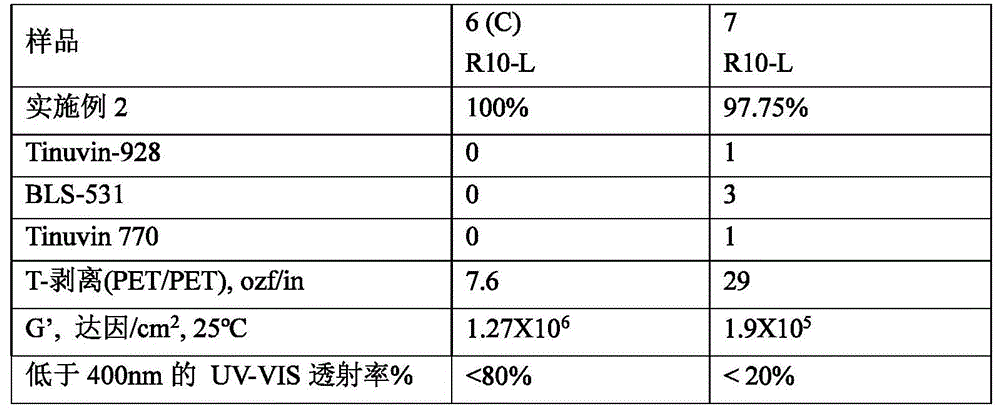
进行样品6和7的UV-vis光谱,并示于图2中。在低于400nm的波长处,样品6具有比具有UV吸收剂套装的样品7大得多的吸光度(峰)。UV-vis spectra of
实施例3.丙烯酸类压敏粘合剂Example 3. Acrylic pressure sensitive adhesive
在500mL三颈烧瓶中,通过将丙烯酸(0.5g)、2-EHA(43.5g)、4-HBA(6.0g)和GMA(6.0g)在丙酮(50g)中混合,制备实施例3的丙烯酸类PSA。在氮气下、在丙酮温度下将混合物回流15分钟。将AZO-64(0.015g)添加到混合物中,再继续回流一小时。在2小时内逐滴添加Azo-64(0.015g)的丙酮(20g)溶液,并继续再混合2小时。将反应产物排入玻璃广口瓶中,并将固体调节至50%固体。Acrylic acid of Example 3 was prepared by mixing acrylic acid (0.5 g), 2-EHA (43.5 g), 4-HBA (6.0 g) and GMA (6.0 g) in acetone (50 g) in a 500 mL three-necked flask Class PSA. The mixture was refluxed for 15 minutes at the temperature of acetone under nitrogen. AZO-64 (0.015 g) was added to the mixture and reflux was continued for an additional hour. A solution of Azo-64 (0.015 g) in acetone (20 g) was added dropwise over 2 hours and mixing was continued for a further 2 hours. The reaction product was drained into a glass jar and the solids were adjusted to 50% solids.
将UV吸收剂添加到实施例3的丙烯酸类PSA中,混合24小时以形成样品8-9。添加的UV吸收剂列于表5中。样品8-9的性能,包括T-剥离、模量和低于400nm的UV-vis透射率,也记录在表5中。The UV absorber was added to the acrylic PSA of Example 3 and mixed for 24 hours to form samples 8-9. The added UV absorbers are listed in Table 5. The properties of Samples 8-9, including T-peel, modulus, and UV-vis transmission below 400 nm, are also reported in Table 5.
表5.table 5.
进行样品8和9的UV-vis光谱,并示于图3中。在低于400nm的波长处,样品8具有比具有UV吸收剂套装的样品9大得多的吸光度(峰)。UV-vis spectra of
实施例4.可UV固化的有机硅光学透明粘合剂Example 4. UV Curable Silicone Optically Clear Adhesive
通过形成有机硅聚合物(Wacker Elastomer 350N,5g)、有机硅MQ树脂(25g)、PDMS-MA(20g)、甲基丙烯酰氧基丙基三甲氧基硅烷(0.3g)和庚烷(50g)的混合物,在氩气下回流搅拌,来制备实施例4的可UV固化有机硅粘合剂。反应催化剂是nBuLi(0.2mL,1.6M,在己烷中),然后混合约2小时,如表6所示。将反应混合物在回流下用CO2吹扫1小时,然后将产物冷却至室温。添加TPOL(0.1g)。将产物混合15分钟并包装在玻璃广口瓶中。By forming silicone polymer (Wacker Elastomer 350N, 5g), silicone MQ resin (25g), PDMS-MA (20g), methacryloxypropyltrimethoxysilane (0.3g) and heptane (50g ) mixture, stirred under reflux under argon to prepare the UV-curable silicone adhesive of Example 4. The reaction catalyst was nBuLi (0.2 mL, 1.6 M in hexane), followed by mixing for about 2 hours, as shown in Table 6. The reaction mixture was purged with CO2 at reflux for 1 h, then the product was cooled to room temperature. TPOL (0.1 g) was added. The product was mixed for 15 minutes and packaged in glass jars.
将UV吸收剂添加到实施例4的可UV固化有机硅粘合剂中,以制备样品10-11。添加的UV吸收剂列于表6中。样品10和11的性能,包括T-剥离、模量和低于400nm的UV-vis透射率,也记录在表6中。A UV absorber was added to the UV-curable silicone adhesive of Example 4 to prepare Samples 10-11. The added UV absorbers are listed in Table 6. The properties of
表6.Table 6.
进行样品10和11的UV-vis光谱,并示于图4中。在低于400nm的波长处,样品10具有比具有UV吸收剂套装的样品11大得多的吸光度(峰)。UV-vis spectra of
实施例5.可热固化的有机硅光学透明粘合剂Example 5. Heat Curable Silicone Optically Clear Adhesive
通过形成有机硅聚合物(Wacker Elastomer 350N,24g)、有机硅MQ树脂(24g)、乙烯基三甲氧基硅烷(2.0g)和庚烷(50g)的混合物,并将混合物在氩气下回流搅拌,来制备实施例5的可热固化有机硅粘合剂。添加反应催化剂nBuLi(0.2mL,1.6M,在己烷中),在氩气下回流搅拌约2小时。将反应混合物在回流下用CO2吹扫1小时,然后将产物冷却至室温。添加Pt(0)(500ppm)和有机硅交联剂HMS301。将产物混合15分钟,然后包装在玻璃广口瓶中。By forming a mixture of silicone polymer (Wacker Elastomer 350N, 24 g), silicone MQ resin (24 g), vinyltrimethoxysilane (2.0 g) and heptane (50 g), and stirring the mixture at reflux under argon , to prepare the heat-curable silicone adhesive of Example 5. The reaction catalyst nBuLi (0.2 mL, 1.6 M in hexanes) was added and stirred at reflux for about 2 hours under argon. The reaction mixture was purged with CO2 at reflux for 1 h, then the product was cooled to room temperature. Add Pt(0) (500ppm) and silicone crosslinker HMS301. The product was mixed for 15 minutes and then packaged in glass jars.
将UV吸收剂套装添加到实施例5的可热固化有机硅粘合剂中,以制备样品12-13。添加的UV吸收剂列于表7中。样品12-13的性能,包括T-剥离、模量和低于400nm的UV-vis透射率,也记录在表7中。The UV absorber package was added to the heat curable silicone adhesive of Example 5 to prepare samples 12-13. The added UV absorbers are listed in Table 7. The properties of samples 12-13, including T-peel, modulus, and UV-vis transmission below 400 nm, are also reported in Table 7.
表7.Table 7.

进行样品12和13的UV-vis光谱,并示于图5中。在低于400nm的波长处,样品12具有比具有UV吸收剂套装的样品13大得多的吸光度(峰)。UV-vis spectra of
在不背离本发明的精神和范围的情况下,可以对本发明进行许多修改和变化,这对于本领域技术人员来说是显而易见的。本文所述的具体实施方案仅以示例的方式提供,并且本发明仅受所附权利要求书以及这些权利要求书所赋予的等同物的全部范围的限制。Many modifications and variations of this invention can be made without departing from the spirit and scope of the invention, as will be apparent to those skilled in the art. The specific embodiments described herein are offered by way of example only, and the invention is to be limited only by the claims which follow, along with the full scope of equivalents to which such claims are entitled.
Claims (6)
Applications Claiming Priority (3)
| Application Number | Priority Date | Filing Date | Title |
|---|---|---|---|
| US201762610555P | 2017-12-27 | 2017-12-27 | |
| US62/610,555 | 2017-12-27 | ||
| PCT/US2018/067468 WO2019133580A1 (en) | 2017-12-27 | 2018-12-26 | Optically clear pressure sensitive adhesives and uses thereof |
Publications (2)
| Publication Number | Publication Date |
|---|---|
| CN111527170A CN111527170A (en) | 2020-08-11 |
| CN111527170B true CN111527170B (en) | 2022-12-09 |
Family
ID=67068100
Family Applications (1)
| Application Number | Title | Priority Date | Filing Date |
|---|---|---|---|
| CN201880084244.9A Expired - Fee Related CN111527170B (en) | 2017-12-27 | 2018-12-26 | Optically clear pressure sensitive adhesives and uses thereof |
Country Status (8)
| Country | Link |
|---|---|
| US (1) | US11427739B2 (en) |
| EP (1) | EP3732265A4 (en) |
| JP (1) | JP7319279B2 (en) |
| KR (2) | KR20200100610A (en) |
| CN (1) | CN111527170B (en) |
| CA (1) | CA3078301A1 (en) |
| MX (1) | MX2020006710A (en) |
| WO (1) | WO2019133580A1 (en) |
Families Citing this family (13)
| Publication number | Priority date | Publication date | Assignee | Title |
|---|---|---|---|---|
| US20220119683A1 (en) * | 2019-07-10 | 2022-04-21 | Hewlett-Packard Development Company, L.P. | Reworkable Optical Clear Adhesive |
| JP7828713B2 (en) * | 2019-12-06 | 2026-03-12 | リンテック株式会社 | Adhesive sheets, optical films with adhesive layers, and optical laminates |
| CN111171767A (en) * | 2020-02-21 | 2020-05-19 | 新纶科技(常州)有限公司 | Optical adhesive of curable (meth)acrylate copolymer and preparation method of OCA pressure-sensitive adhesive tape without substrate |
| CN114829477B (en) * | 2020-04-23 | 2024-04-12 | 瓦克化学股份公司 | Optically bonded silicones with UV blockers for outdoor applications |
| US12454637B2 (en) * | 2020-05-07 | 2025-10-28 | Dow Silicones Corporation | Silicone hybrid pressure sensitive adhesive and methods for its preparation and use in protective films for (opto)electronic device fabrication |
| CN112500816B (en) * | 2020-12-08 | 2021-07-16 | 深圳市撒比斯科技有限公司 | Self-exhaust OCA optical cement and preparation method and application thereof |
| US20240150526A1 (en) * | 2021-03-05 | 2024-05-09 | Dow Toray Co., Ltd. | Co-modified organopolysiloxane and curable organopolysiloxane composition including same |
| JP7824733B2 (en) * | 2021-03-30 | 2026-03-05 | 日東電工株式会社 | Radiation-curable adhesive sheet |
| US20220402234A1 (en) * | 2021-06-18 | 2022-12-22 | Schott Gemtron Corporation | Decorative panel assemblies |
| WO2023003714A1 (en) * | 2021-07-22 | 2023-01-26 | Corning Incorporated | Films, laminates, and methods of making compositions |
| US12520696B2 (en) * | 2021-12-14 | 2026-01-06 | Samsung Display Co., Ltd. | Electronic device |
| CN118414392A (en) * | 2021-12-15 | 2024-07-30 | 3M创新有限公司 | Acrylate film composition for preventing migration of small molecules |
| CN114891447B (en) * | 2022-05-18 | 2024-02-20 | 江苏翎慧材料科技有限公司 | Acrylate/polyisobutylene rubber hybrid pressure-sensitive adhesive composition |
Citations (3)
| Publication number | Priority date | Publication date | Assignee | Title |
|---|---|---|---|---|
| CN1349552A (en) * | 1999-05-03 | 2002-05-15 | 西巴特殊化学品控股有限公司 | Stabilized adhesive compositions containing highly soluble, red-shifted, photostable benzotriazole UV absorbers and laminated articles derived therefrom |
| CN107474753A (en) * | 2016-06-08 | 2017-12-15 | 张家港康得新光电材料有限公司 | Composition, OCA optical adhesive films and the thin-film solar cells of OCA optical cements |
| CN107474754A (en) * | 2016-06-08 | 2017-12-15 | 张家港康得新光电材料有限公司 | Composition, OCA optical adhesive films and the thin-film solar cells of OCA optical cements |
Family Cites Families (45)
| Publication number | Priority date | Publication date | Assignee | Title |
|---|---|---|---|---|
| US2676182A (en) | 1950-09-13 | 1954-04-20 | Dow Corning | Copolymeric siloxanes and methods of preparing them |
| US2814601A (en) | 1954-04-29 | 1957-11-26 | Dow Corning | Organopolysiloxane adhesive and pressure-sensitive adhesive tape containing same |
| US3700633A (en) | 1971-05-05 | 1972-10-24 | Shell Oil Co | Selectively hydrogenated block copolymers |
| US4313988A (en) | 1980-02-25 | 1982-02-02 | Minnesota Mining And Manufacturing Company | Epoxypolysiloxane release coatings for adhesive materials |
| US4536265A (en) | 1984-04-19 | 1985-08-20 | Loctite Corporation | Siloxane polyphotoinitiators of the substituted acetophenone type |
| US4534838A (en) | 1984-04-16 | 1985-08-13 | Loctite Corporation | Siloxane polyphotoinitiators of the substituted acetophenone type |
| US4507187A (en) | 1984-04-19 | 1985-03-26 | Loctite Corporation | Siloxane photoinitiators with aryoyl formate groups |
| US5171760A (en) | 1988-08-05 | 1992-12-15 | Edison Polymer Innovation Corp. | UV curable polymer formulation |
| US5300608A (en) | 1992-03-31 | 1994-04-05 | Loctite Corporation | Process for preparing alkoxy-terminated organosiloxane fluids using organo-lithium reagents |
| US5665823A (en) | 1996-08-30 | 1997-09-09 | Dow Corning Corporation | Polyisobutylene polymers having acrylic functionality |
| US6140444A (en) | 1999-01-19 | 2000-10-31 | Loctite Corporation | Catalyst system, process, and silicone compositions |
| US6187834B1 (en) | 1999-09-08 | 2001-02-13 | Dow Corning Corporation | Radiation curable silicone compositions |
| GB2360283B (en) | 2000-02-08 | 2002-08-21 | Ciba Sc Holding Ag | Monoacylarylphosphines and acylphosphine oxides and sulphides |
| GB2365430B (en) | 2000-06-08 | 2002-08-28 | Ciba Sc Holding Ag | Acylphosphine photoinitiators and intermediates |
| US6448303B1 (en) | 2000-12-29 | 2002-09-10 | National Starch And Chemical Investment Holding Corporation | Hot melt adhesives for dermal application |
| US6827985B2 (en) | 2001-05-02 | 2004-12-07 | Henkel Corporation | Curable silicone compositions having enhanced cure-through-volume |
| EP1463780A4 (en) | 2001-07-10 | 2004-12-08 | Deco Patents Inc | Uv cured uv blocking compositions and methods for making and using the same |
| ATE527304T1 (en) | 2003-06-06 | 2011-10-15 | Basf Se | NEW SURFACE-ACTIVE POLYSILOXANE PHOTOINITIATORS |
| EP1833884B1 (en) | 2004-12-01 | 2015-06-24 | Henkel US IP LLC | Curable silicone compositions incorporating a fluorescent detection system |
| US7911699B2 (en) | 2005-12-22 | 2011-03-22 | Guardian Industries Corp. | Optical diffuser with UV blocking coating |
| KR101177912B1 (en) * | 2005-11-03 | 2012-08-29 | 도레이첨단소재 주식회사 | Pressure sensitive adhesive composition with excellent reliability and absorbability of ultraviolet |
| JP5117713B2 (en) | 2006-12-25 | 2013-01-16 | 東レ・ダウコーニング株式会社 | Silicone pressure-sensitive adhesive composition and adhesive tape |
| US8518305B2 (en) | 2009-10-28 | 2013-08-27 | Transitions Optical, Inc. | Photochromic materials |
| WO2011133408A2 (en) | 2010-04-23 | 2011-10-27 | Henkel Corporation | Silicone-acrylic copolymer |
| CN102471150B (en) | 2010-06-30 | 2014-05-07 | 帝斯曼知识产权资产管理有限公司 | D1492 Liquid bisacylphosphine oxide photoinitiators and their use in radiation curable compositions |
| KR101267776B1 (en) * | 2010-11-10 | 2013-05-24 | (주)엘지하우시스 | Silicon pressure-sensitive adhesive composition for window film with excellent rework porperties and compatibility and window film using the silicon pressure-sensitive adhesive |
| KR20120072163A (en) * | 2010-12-23 | 2012-07-03 | 제일모직주식회사 | Adhesive film for optically clear adhesive film |
| BR112013016067A2 (en) | 2010-12-24 | 2016-09-20 | Bluestar Silicones France | "crosslinkable and / or hardenable composition, silicone composition and elastomer, use of silicone composition, coated solid support and coating process on a flexible support" |
| KR101362881B1 (en) * | 2010-12-31 | 2014-02-14 | 제일모직주식회사 | Adhesive composition for display |
| EP2634219B1 (en) * | 2012-02-29 | 2017-01-04 | SABIC Global Technologies B.V. | Thermoplastic polycarbonate copolymer compositions, methods of their manufacture, and articles thereof |
| CN104584257B (en) | 2012-05-02 | 2017-06-20 | 汉高知识产权控股有限责任公司 | Curable encapsulants and uses thereof |
| KR101286829B1 (en) | 2012-05-31 | 2013-07-17 | (주)티엠에스 | Optically clear adhesive film and electronic device using the same |
| WO2014095724A1 (en) | 2012-12-19 | 2014-06-26 | Basf Se | Derivatives of bisacylphosphinic acid, their preparation and use as photoinitiators |
| CN103333276B (en) | 2013-06-08 | 2015-07-29 | 新丰博兴聚合材料有限公司 | Longwave absorption light trigger of a kind of silicone-containing group and preparation method thereof |
| HUE052630T2 (en) | 2014-07-17 | 2021-05-28 | Henkel Ag & Co Kgaa | Photo-curable liquid optically clear adhesive composition and use thereof |
| JP2016029430A (en) | 2014-07-25 | 2016-03-03 | セイコーエプソン株式会社 | Electro-optical device, method of manufacturing electro-optical device, and electronic apparatus |
| TWI679259B (en) * | 2014-08-11 | 2019-12-11 | 德商漢高智慧財產控股公司 | Optically clear hot melt adhesives and uses thereof |
| US20170247581A1 (en) * | 2014-09-02 | 2017-08-31 | 3M Innovative Properties Company | Protection of new electro-conductors based on nano-sized metals using direct bonding with optically clear adhesives |
| CN107849253B (en) | 2015-03-10 | 2021-02-05 | 汉高知识产权控股有限责任公司 | Polyorganosiloxane and moisture and radiation curable adhesive composition containing the same |
| CN108603089B (en) | 2015-03-10 | 2021-05-11 | 汉高知识产权控股有限责任公司 | Moisture and radiation curable adhesive compositions and uses thereof |
| CN107530471B (en) | 2015-04-30 | 2020-10-16 | 科洛普拉斯特公司 | Adhesive composition |
| JP2018524423A (en) | 2015-06-03 | 2018-08-30 | スリーエム イノベイティブ プロパティズ カンパニー | Silicone-based assembly layer for flexible display applications |
| KR102575896B1 (en) | 2016-01-11 | 2023-09-07 | 헨켈 아게 운트 코. 카게아아 | Silicone-compatible compounds |
| US10816710B2 (en) * | 2016-03-18 | 2020-10-27 | Samsung Sdi Co., Ltd. | Polarizing plate for light emitting display device and light emitting display device including same |
| CN106047184A (en) * | 2016-05-25 | 2016-10-26 | 张家港康得新光电材料有限公司 | Liquid optical adhesive and 3D image structure with liquid optical adhesive |
-
2018
- 2018-12-26 CN CN201880084244.9A patent/CN111527170B/en not_active Expired - Fee Related
- 2018-12-26 WO PCT/US2018/067468 patent/WO2019133580A1/en not_active Ceased
- 2018-12-26 MX MX2020006710A patent/MX2020006710A/en unknown
- 2018-12-26 KR KR1020207013409A patent/KR20200100610A/en not_active Abandoned
- 2018-12-26 KR KR1020237034572A patent/KR20230148381A/en active Pending
- 2018-12-26 JP JP2020535970A patent/JP7319279B2/en active Active
- 2018-12-26 CA CA3078301A patent/CA3078301A1/en active Pending
- 2018-12-26 EP EP18894872.3A patent/EP3732265A4/en not_active Withdrawn
-
2020
- 2020-06-26 US US16/913,607 patent/US11427739B2/en active Active
Patent Citations (3)
| Publication number | Priority date | Publication date | Assignee | Title |
|---|---|---|---|---|
| CN1349552A (en) * | 1999-05-03 | 2002-05-15 | 西巴特殊化学品控股有限公司 | Stabilized adhesive compositions containing highly soluble, red-shifted, photostable benzotriazole UV absorbers and laminated articles derived therefrom |
| CN107474753A (en) * | 2016-06-08 | 2017-12-15 | 张家港康得新光电材料有限公司 | Composition, OCA optical adhesive films and the thin-film solar cells of OCA optical cements |
| CN107474754A (en) * | 2016-06-08 | 2017-12-15 | 张家港康得新光电材料有限公司 | Composition, OCA optical adhesive films and the thin-film solar cells of OCA optical cements |
Also Published As
| Publication number | Publication date |
|---|---|
| CN111527170A (en) | 2020-08-11 |
| WO2019133580A1 (en) | 2019-07-04 |
| CA3078301A1 (en) | 2019-07-04 |
| EP3732265A4 (en) | 2021-10-06 |
| US11427739B2 (en) | 2022-08-30 |
| US20200325372A1 (en) | 2020-10-15 |
| EP3732265A1 (en) | 2020-11-04 |
| KR20200100610A (en) | 2020-08-26 |
| MX2020006710A (en) | 2020-08-20 |
| JP2021508755A (en) | 2021-03-11 |
| KR20230148381A (en) | 2023-10-24 |
| JP7319279B2 (en) | 2023-08-01 |
Similar Documents
| Publication | Publication Date | Title |
|---|---|---|
| CN111527170B (en) | Optically clear pressure sensitive adhesives and uses thereof | |
| US11891550B2 (en) | Curable and optically clear pressure sensitive adhesives and uses thereof | |
| US10266733B2 (en) | Optically clear hot melt adhesives and uses thereof | |
| CN105849598B (en) | Laminated polarizing film, method for producing same, laminated optical film, and image display device | |
| JP2022130696A (en) | Curable silicone optically clear adhesive and its use | |
| TW201221605A (en) | Pressure-sensitive adhesive composition for touch panel, pressure-sensitive adhesive film and touch panel | |
| CA2688618A1 (en) | Method for encapsulating an electronic arrangement | |
| CN102618179A (en) | Optical pressure-sensitive adhesive sheet | |
| TW201606017A (en) | Pressure-sensitive adhesive composition, pressure-sensitive adhesive polarizing plate and liquid crystal display device | |
| WO2015182369A1 (en) | Pressure-sensitive adhesive composition, process for producing same, and pressure-sensitive adhesive layer and process for producing same | |
| JP7650716B2 (en) | Pressure-sensitive adhesive composition, photocurable pressure-sensitive adhesive layer, and photocurable pressure-sensitive adhesive sheet | |
| JP5852796B2 (en) | Adhesive composition and coating layer using the same | |
| WO2023074558A1 (en) | Optical adhesive sheet | |
| WO2023074553A1 (en) | Photocurable adhesive sheet | |
| WO2023074554A1 (en) | Photocurable adhesive sheet | |
| WO2022045131A1 (en) | Adhesive agent composition, photocurable adhesive agent layer, and photocurable adhesive sheet |
Legal Events
| Date | Code | Title | Description |
|---|---|---|---|
| PB01 | Publication | ||
| PB01 | Publication | ||
| SE01 | Entry into force of request for substantive examination | ||
| SE01 | Entry into force of request for substantive examination | ||
| TA01 | Transfer of patent application right |
Effective date of registration: 20220803 Address after: Dusseldorf Applicant after: HENKEL AG & Co.KGaA Address before: Dusseldorf Applicant before: HENKEL IP & HOLDING GmbH |
|
| TA01 | Transfer of patent application right | ||
| GR01 | Patent grant | ||
| GR01 | Patent grant | ||
| CF01 | Termination of patent right due to non-payment of annual fee |
Granted publication date: 20221209 |
|
| CF01 | Termination of patent right due to non-payment of annual fee |