CN111480177A - Improved Inverse Tone Mapping Method and Corresponding Apparatus - Google Patents
Improved Inverse Tone Mapping Method and Corresponding Apparatus Download PDFInfo
- Publication number
- CN111480177A CN111480177A CN201880080048.4A CN201880080048A CN111480177A CN 111480177 A CN111480177 A CN 111480177A CN 201880080048 A CN201880080048 A CN 201880080048A CN 111480177 A CN111480177 A CN 111480177A
- Authority
- CN
- China
- Prior art keywords
- image
- value
- lightness
- bright
- pixel
- Prior art date
- Legal status (The legal status is an assumption and is not a legal conclusion. Google has not performed a legal analysis and makes no representation as to the accuracy of the status listed.)
- Granted
Links
Images


Classifications
-
- G—PHYSICS
- G06—COMPUTING OR CALCULATING; COUNTING
- G06T—IMAGE DATA PROCESSING OR GENERATION, IN GENERAL
- G06T5/00—Image enhancement or restoration
- G06T5/90—Dynamic range modification of images or parts thereof
- G06T5/94—Dynamic range modification of images or parts thereof based on local image properties, e.g. for local contrast enhancement
-
- G—PHYSICS
- G06—COMPUTING OR CALCULATING; COUNTING
- G06F—ELECTRIC DIGITAL DATA PROCESSING
- G06F17/00—Digital computing or data processing equipment or methods, specially adapted for specific functions
- G06F17/10—Complex mathematical operations
- G06F17/11—Complex mathematical operations for solving equations, e.g. nonlinear equations, general mathematical optimization problems
-
- G—PHYSICS
- G06—COMPUTING OR CALCULATING; COUNTING
- G06T—IMAGE DATA PROCESSING OR GENERATION, IN GENERAL
- G06T5/00—Image enhancement or restoration
- G06T5/40—Image enhancement or restoration using histogram techniques
-
- G—PHYSICS
- G06—COMPUTING OR CALCULATING; COUNTING
- G06T—IMAGE DATA PROCESSING OR GENERATION, IN GENERAL
- G06T5/00—Image enhancement or restoration
- G06T5/50—Image enhancement or restoration using two or more images, e.g. averaging or subtraction
-
- G—PHYSICS
- G06—COMPUTING OR CALCULATING; COUNTING
- G06T—IMAGE DATA PROCESSING OR GENERATION, IN GENERAL
- G06T5/00—Image enhancement or restoration
- G06T5/70—Denoising; Smoothing
-
- G—PHYSICS
- G06—COMPUTING OR CALCULATING; COUNTING
- G06T—IMAGE DATA PROCESSING OR GENERATION, IN GENERAL
- G06T5/00—Image enhancement or restoration
- G06T5/90—Dynamic range modification of images or parts thereof
- G06T5/92—Dynamic range modification of images or parts thereof based on global image properties
-
- G—PHYSICS
- G06—COMPUTING OR CALCULATING; COUNTING
- G06T—IMAGE DATA PROCESSING OR GENERATION, IN GENERAL
- G06T2207/00—Indexing scheme for image analysis or image enhancement
- G06T2207/20—Special algorithmic details
- G06T2207/20004—Adaptive image processing
- G06T2207/20012—Locally adaptive
-
- G—PHYSICS
- G06—COMPUTING OR CALCULATING; COUNTING
- G06T—IMAGE DATA PROCESSING OR GENERATION, IN GENERAL
- G06T2207/00—Indexing scheme for image analysis or image enhancement
- G06T2207/20—Special algorithmic details
- G06T2207/20172—Image enhancement details
- G06T2207/20208—High dynamic range [HDR] image processing
Landscapes
- Engineering & Computer Science (AREA)
- Physics & Mathematics (AREA)
- General Physics & Mathematics (AREA)
- Theoretical Computer Science (AREA)
- Mathematical Physics (AREA)
- Data Mining & Analysis (AREA)
- Computational Mathematics (AREA)
- Mathematical Analysis (AREA)
- Mathematical Optimization (AREA)
- Pure & Applied Mathematics (AREA)
- Databases & Information Systems (AREA)
- Software Systems (AREA)
- Algebra (AREA)
- Operations Research (AREA)
- General Engineering & Computer Science (AREA)
- Image Processing (AREA)
- Picture Signal Circuits (AREA)
- Computer Vision & Pattern Recognition (AREA)
- Health & Medical Sciences (AREA)
- Artificial Intelligence (AREA)
- Computing Systems (AREA)
- Evolutionary Computation (AREA)
- General Health & Medical Sciences (AREA)
- Medical Informatics (AREA)
- Multimedia (AREA)
Abstract
Description
技术领域technical field
本发明总体上涉及高动态范围成像的领域,并提出了一种扩展低或标准动态范围图像的动态范围的方式。The present invention relates generally to the field of high dynamic range imaging and proposes a way to extend the dynamic range of low or standard dynamic range images.
背景技术Background technique
显示技术的最近进展正开始允许显示图像中颜色、明度和对比度的扩充动态范围。术语“图像”指的是可以是例如视频或静止画面的图像内容。Recent advances in display technology are beginning to allow an expanded dynamic range of color, brightness, and contrast in display images. The term "image" refers to image content, which may be, for example, video or still pictures.
允许图像明度或亮度的扩充动态范围的技术已知为高动态范围成像、或HDR成像。许多具有处理和显示具有扩充动态范围的HDR图像的能力的显示装置已经可供客户使用。也正在开发能够捕获具有这种增加的动态范围的图像的图像捕获装置。然而,HDR图像还没有很好地普及,并且存在作为SDR(标准动态范围)图像或LDR(低动态范围)图像的许多现有图像。因此,需要在最近的高动态范围(HDR)装置上使得低或标准动态范围(LDR或SDR)的图像可视化。A technique that allows for an extended dynamic range of image brightness or brightness is known as high dynamic range imaging, or HDR imaging. Many display devices are already available to customers with the ability to process and display HDR images with extended dynamic range. Image capture devices capable of capturing images with this increased dynamic range are also being developed. However, HDR images are not well popularized, and there are many existing images as SDR (Standard Dynamic Range) images or LDR (Low Dynamic Range) images. Therefore, there is a need to visualize low or standard dynamic range (LDR or SDR) images on recent high dynamic range (HDR) devices.
为此目的,已经开发了反转或逆色调映射算子(iTMO)。它们允许通过使用为了恢复或再造(recreating)原始场景的外观的目的、而处理图像中像素的明度信息的算法,从传统(LDR或SDR)图像生成HDR图像。For this purpose, the inverse or inverse tone mapping operator (iTMO) has been developed. They allow HDR images to be generated from conventional (LDR or SDR) images by using algorithms that process the luminance information of pixels in the image for the purpose of restoring or recreating the appearance of the original scene.
存在不同种类的逆色调映射算法,作为例如局部色调映射算法和全局色调映射算法。例如,在局部色调映射算法的领域,专利申请WO2015/096955公开了一种方法,该方法包括以下步骤:对于图像的每个像素p,获得像素扩展指数值E(p),并然后通过计算以下等式将像素p的明度Y(p)逆色调映射为扩展明度值Yexp(p):There are different kinds of inverse tone-mapping algorithms, such as local tone-mapping algorithms and global tone-mapping algorithms. For example, in the field of local tone mapping algorithms, patent application WO2015/096955 discloses a method comprising the following steps: for each pixel p of the image, obtain a pixel expansion index value E(p), and then by calculating the following The equation inverse tone-maps the luminance Y(p) of pixel p to an extended luminance value Y exp (p):
Yexp(p)=Y(p)E(p)*[Yenhance(p)]c (1)Y exp (p)=Y(p) E(p) *[Y enhance (p)] c (1)
其中:in:
Yexp(p)是像素p的扩展明度值;Y exp (p) is the expanded luminance value of pixel p;
Y(p)是SDR(或LDR)输入图像内的像素p的明度值;Y(p) is the luminance value of pixel p in the SDR (or LDR) input image;
Yenhance(p)是通过高通滤波获得的SDR(或LDR)输入图像内的像素p的明度增强值;Y enhance (p) is the brightness enhancement value of pixel p in the SDR (or LDR) input image obtained by high-pass filtering;
E(p)是像素p的像素扩展指数值。E(p) is the pixel expansion index value of pixel p.
图像的所有像素的值E(p)的集合形成该图像的扩展指数图或“扩展图”。该扩展指数图可以通过不同的方法生成,例如通过对每个像素p的明度值Y(p)进行低通滤波以获得低通滤波后的明度值Ybase(p),并对低通滤波后的明度值应用二次函数,所述二次函数由参数a、b和c根据以下等式定义:The set of values E(p) of all pixels of an image forms an expanded exponential map or "expanded map" of the image. The extended index map can be generated by different methods, for example, by low-pass filtering the lightness value Y(p) of each pixel p to obtain the low-pass filtered lightness value Y base (p), and The lightness value of is applied a quadratic function, which is defined by the parameters a, b and c according to the following equation:
E(p)=a[Ybase(p)]2+b[Ybase(p)]+cE(p)=a[Y base (p)] 2 +b[Y base (p)]+c
可以在以下情况中使用被称为逆色调映射算子(iTMO)的专用工具,该专用工具被开发来实现对SDR图像的逆色调映射方法:A dedicated tool called the Inverse Tone Mapping Operator (iTMO), which was developed to implement the inverse tone mapping method for SDR images, can be used in the following situations:
-要么在后期制作工具中来帮助色彩师进行手动分级,- Either in a post production tool to help the colorist do manual grading,
-要么作为例如在机顶盒或电视机中集成的SoC(片上系统)内的硬件实现来执行自动分级。- Either the automatic grading is performed as a hardware implementation within a SoC (system on chip) eg integrated in a set-top box or a TV.
在第一种情况下,图像是由色彩师手工处理的,由于电影制作者的艺术意图可以被保留,这产生了良好的效果。然而,这种方法不能即时(on the fly)执行,例如当以流化模式接收视频时实时执行。In the first case, the image was hand-processed by a colorist, which produced good results since the artistic intent of the filmmaker could be preserved. However, this approach cannot be performed on the fly, such as when video is received in streaming mode.
在第二种情况下,预定的扩展参数(在上述例子中的参数a、b和c)被应用于SDR(或LDR)图像,而不需要对原始视频或图像内容进行任何适配,也不需要色彩师的任何手动干预。这种逆色调映射可以即时执行,并因此可以用在诸如机顶盒或电视机的装置中。但是因为逆色调映射的操作不能很好地适配图像,结果不如色彩师手动分级所发布的结果好。In the second case, predetermined extension parameters (parameters a, b and c in the above example) are applied to SDR (or LDR) pictures without any adaptation to the original video or picture content, nor Requires any manual intervention by the colorist. This inverse tone mapping can be performed on-the-fly and thus can be used in devices such as set-top boxes or televisions. But because the operation of inverse tone mapping does not fit the image well, the results are not as good as the results published by the colorist for manual grading.
为了解决上述问题,EP3249605公开了一种用于图像的逆色调映射的方法,该方法能够自动适配色调映射的内容。该方法使用形成模板的简档(profile)的集合。这些简档在作为离线处理的学习阶段确定。每个简档由视觉特征定义,诸如与扩展图相关联的明度直方图。在学习阶段,根据大量参考图像确定简档,这些参考图像由色彩师手动分级,色彩师手动设置ITM参数并为这些图像生成扩展图。然后基于这些生成的扩展图对参考图像进行聚类。对每个聚类进行处理,以便提取明度的代表性直方图和与其相关联的代表性扩展图,从而形成从所述聚类发布的简档。包括多个简档的模板然后被存储在硬件存储器中,例如机顶盒或电视装置中。In order to solve the above problems, EP3249605 discloses a method for inverse tone mapping of images, which can automatically adapt the content of tone mapping. The method uses a collection of profiles that form a template. These profiles are determined during the learning phase as an offline process. Each profile is defined by visual features, such as a lightness histogram associated with an extension map. During the learning phase, profiles are determined from a large number of reference images that are manually graded by a colorist who manually sets the ITM parameters and generates extended maps for these images. The reference images are then clustered based on these generated expanded maps. Each cluster is processed to extract a representative histogram of lightness and a representative expansion map associated therewith to form a profile published from that cluster. The template including the multiple profiles is then stored in hardware memory, such as in a set-top box or television set.
在随后的操作阶段,例如由机顶盒以流化模式接收新的SDR图像内容。在输入端,处理单元(例如,CPU、SoC或FPGA)实时分析SDR视频流。实时直方图处理模块确定内容的SDR图像的直方图。例如,在内容中的每个剪切检测之后,处理单元计算检测到的剪切之后的第一帧的直方图。或者,可以在检测的剪切之后、在下一剪切之前的第n帧上计算直方图。将所接收的SDR图像内容的计算直方图与从学习阶段发布的模板中保存的直方图中的每一个进行比较,以便找到该模板的最佳匹配直方图。例如,计算所接收内容的计算直方图和在模板中保存的每个直方图之间的距离。然后,选择与给出最佳匹配的模板的直方图相关的扩展图,并使用该扩展图即时地执行对同一镜头的所有图像(即,在检测到的剪切和随后的剪切之间的所有图像)的逆色调映射,并输出对应的HDR图像。这样,模板的最佳扩充图被应用于输出HDR视频。In a subsequent stage of operation, the new SDR image content is received eg by the set-top box in streaming mode. On the input side, a processing unit (eg, CPU, SoC or FPGA) analyzes the SDR video stream in real time. The real-time histogram processing module determines the histogram of the SDR image of the content. For example, after each cut detection in the content, the processing unit calculates a histogram of the first frame after the detected cut. Alternatively, the histogram can be computed on the nth frame after the detected cut, before the next cut. The computed histograms of the received SDR image content are compared with each of the histograms saved from the template published in the learning phase in order to find the best matching histogram for that template. For example, calculate the distance between the calculated histogram of the received content and each histogram saved in the template. Then, select the expansion map associated with the histogram of the template that gives the best match, and use this expansion map to perform on-the-fly all images of the same shot (i.e. between the detected cut and the subsequent cut) All images) inverse tone mapping and output the corresponding HDR image. In this way, the best augmented map of the template is applied to the output HDR video.
使用这种逆色调映射方法,分级的质量取决于模板或模型中不同简档的数目:简档越多,分级越好。因此,一种改进分级质量的方式是在学习阶段生成更多的简档。然而,由于处理装置(机顶盒或电视装置)中的存储资源有限,这种方案实际上不是解决方案。Using this inverse tone mapping method, the quality of the grading depends on the number of different profiles in the template or model: the more profiles, the better the grading. Therefore, one way to improve the quality of the ranking is to generate more profiles during the learning phase. However, due to the limited storage resources in the processing device (set-top box or TV device), this approach is not really a solution.
因此,已知的从SDR到HDR的ITM转换、或逆色调映射方法可能导致某些明度范围的不良分级。特别是,SDR图像中宽区域的高光或亮部会导致HDR图像中过于明亮的区域。本发明旨在改进这种情况。Therefore, known ITM conversion from SDR to HDR, or inverse tone mapping methods, may result in poor grading of certain luminance ranges. In particular, wide areas of highlights or highlights in SDR images can lead to overly bright areas in HDR images. The present invention aims to improve this situation.
发明内容SUMMARY OF THE INVENTION
本发明的目的是提出一种用于逆色调映射的方法,该方法可以应用于图像,例如即时视频序列中,该方法使用预定的扩展图,并且可以更好地适配图像,特别是避免输出图像中过于明亮的一些区域。The aim of the present invention is to propose a method for inverse tone mapping that can be applied to images, such as instant video sequences, that uses a predetermined expansion map and that allows better adaptation of the image, especially avoiding output Some areas in the image that are too bright.
本发明的主题是一种用于对图像进行逆色调映射的方法,包括:The subject of the present invention is a method for inverse tone mapping an image, comprising:
-获得所述图像的第一扩展指数图;- obtaining a first expanded exponential map of said image;
-对于该图像的每个像素,通过利用根据所述第一扩展指数图确定的扩展指数值来对所述像素的明度值执行指数运算,而确定扩展明度值,- for each pixel of the image, an extended lightness value is determined by performing an exponential operation on the lightness value of said pixel using the extended exponent value determined from said first extended exponent map,
所述方法还包括:The method also includes:
-对于所述图像的所述像素,通过使用调制函数来获得扩展校正值,所述调制函数将表示所述像素的明度的值作为输入,并且所述调制函数是对于更高输入值具有更高递增值的递增函数;- for said pixels of said image, an extended correction value is obtained by using a modulation function which takes as input a value representing the lightness of said pixel, and said modulation function is higher for higher input values Increment function that increments the value;
-通过从第一扩展指数图的扩展指数值中减去所述扩展校正值,来获得校正后的扩展指数值;以及- obtaining a corrected spread index value by subtracting said spread correction value from the spread index value of the first spread index map; and
-对于所述图像的所述像素,通过利用所述校正后的扩展指数值来对所述像素的明度值执行指数运算,而确定(S4)扩展明度值。- For said pixel of said image, determining (S4) an extended lightness value by performing an exponential operation on the lightness value of said pixel using said corrected extended exponent value.
应用于从第一预定扩展图取得的扩展指数值的校正允许在图像的明亮区域中局部减少该第一预定扩展图的影响。The correction applied to the expansion index value taken from the first predetermined expansion map allows to locally reduce the influence of the first predetermined expansion map in bright regions of the image.
有利地,所述调制函数利用固定指数参数对输入值实现指数运算。所述输入值例如是所述图像像素的低通滤波明度值的归一化值。该固定指数参数可以等于或高于3,优选等于6。Advantageously, the modulation function implements an exponential operation on the input value using a fixed exponential parameter. The input value is, for example, a normalized value of the low-pass filtered lightness value of the image pixel. The fixed exponent parameter may be equal to or higher than 3, preferably equal to 6.
有利地,通过将加权因子应用到由利用固定指数参数进行的指数运算所得到的参考扩展校正值,来确定所述扩展校正值,并且所述加权因子取决于图像和第一预定扩展指数图。Advantageously, the extended correction value is determined by applying a weighting factor to a reference extended correction value resulting from an exponential operation with a fixed exponential parameter, and the weighting factor depends on the image and the first predetermined extended exponential map.
在本发明的特定实施例中,所述加权因子根据以下各项计算In certain embodiments of the present invention, the weighting factor is calculated according to
-第一明度阈值,其是确保图像的第一百分比的像素具有高于所述第一明度阈值的明度值的明度值;- a first lightness threshold, which is a lightness value that ensures that a first percentage of pixels of the image have lightness values higher than said first lightness threshold;
-第二明度阈值,其对应于使用第一扩展图被色调映射到扩展明度的目标最大值的图像的像素的明度值。- a second lightness threshold corresponding to the lightness value of the pixel of the image tone-mapped to the target maximum value of the extended lightness using the first extended map.
有利地,所述加权因子是使用以下各项计算的:Advantageously, the weighting factor is calculated using:
-通过所述第一预定扩展指数图向所述图像的所述第一明度阈值分配的第一扩展指数值;- a first expansion index value assigned to said first luminance threshold of said image by said first predetermined expansion index map;
-通过所述扩展指数图向所述第二明度阈值分配的第二扩展指数值;- a second spread index value assigned to the second lightness threshold by the spread index map;
-通过利用所述固定指数参数对所述第一明度阈值的归一化值进行指数运算而得到的参考衰减值。- a reference attenuation value obtained by exponentiating the normalized value of the first lightness threshold with the fixed exponent parameter.
因此,加权因子pbright可以使用以下表达式计算:Therefore, the weighting factor p bright can be calculated using the following expression:

其中in
-E(p1)表示第一扩展指数值;-E(p 1 ) represents the first extended exponent value;
-E(p2)表示第二扩展指数值;-E(p 2 ) represents the second extended exponent value;
-
根据本发明的另一方面,所述调制函数通过计算表达式

有利地,通过将所述扩展明度的目标最大值的对数除以所述第二明度阈值的对数,来计算所述第二扩展指数值。Advantageously, said second spread index value is calculated by dividing the logarithm of said target maximum value of spread lightness by the logarithm of said second lightness threshold value.
优选地,本发明的方法包括比较所述第一明度阈值和所述第二明度阈值,并且仅当满足所述第一明度阈值优于所述第二明度阈值的条件时,才执行校正。Preferably, the method of the invention comprises comparing said first lightness threshold with said second lightness threshold, and performing correction only if the condition that said first lightness threshold is superior to said second lightness threshold is satisfied.
在特定实施例中,所述第一预定扩展指数图E(p)是使用由以下关系式定义的二次函数根据图像像素p的低通滤波明度值Ybase(p)而生成的:In a particular embodiment, the first predetermined expanded exponential map E(p) is generated from the low-pass filtered luminance value Ybase (p) of the image pixel p using a quadratic function defined by the following relation:
E(p)=a[Ybase(p)]2+b[Ybase(p)]+c,E(p)=a[Y base (p)] 2 +b[Y base (p)]+c,
其中a、b和c是二次函数的参数。where a, b and c are the parameters of the quadratic function.
有利地,获得所述图像的扩展指数图的步骤包括:Advantageously, the step of obtaining an expanded exponential map of the image comprises:
-获得表示所述图像的明度的所述图像的视觉特征,- obtaining a visual characteristic of said image representing the lightness of said image,
-根据距离标准将所述图像的视觉特征与参考图像的至少两个聚类的视觉特征进行比较,其中聚类的视觉特征表示该聚类的参考图像的明度,- comparing the visual features of the image with the visual features of at least two clusters of a reference image according to a distance criterion, wherein the visual features of a cluster represent the lightness of the reference image of the cluster,
-为所述图像选择与最接近所述图像的视觉特征的聚类的视觉特征相关的扩展指数图。- selecting for the image an expanded index map associated with the visual features closest to the cluster of visual features of the image.
例如,所述图像的视觉特征包括所述图像的像素的明度的直方图。For example, the visual characteristics of the image include a histogram of lightness of pixels of the image.
本发明还涉及:The present invention also relates to:
-一种图像处理装置,包括用于实现前面定义的方法以便逆色调映射图像的部件;- an image processing apparatus comprising means for implementing the method defined above for inverse tone mapping an image;
-一种电子装置,包括图像处理装置。- An electronic device including an image processing device.
附图说明Description of drawings
参考作为示例给出并且不限制保护范围的以下描述和附图,可以更好地理解本发明,其中:The present invention may be better understood with reference to the following description and accompanying drawings, which are given by way of example and do not limit the scope of protection, in which:
-图1是被配置为执行根据本发明实施例的方法的图像处理装置的框图;- Figure 1 is a block diagram of an image processing device configured to perform a method according to an embodiment of the invention;
-图2表示根据本发明实施例的方法步骤的组织图;和- Figure 2 represents an organizational chart of method steps according to an embodiment of the invention; and
-图3A是表示图像像素的输入明度、和在应用预定的扩展图之后对应的输出明度之间的关系的曲线图;- Figure 3A is a graph representing the relationship between the input lightness of an image pixel and the corresponding output lightness after applying a predetermined expanded map;
-图3B表示所述预定扩展图;- Figure 3B represents said predetermined expanded graph;
-图4A是表示图像像素的输入明度、和在应用基于预定扩展图的扩展图并根据本发明实施例校正之后的对应输出明度之间的关系的曲线图;- Figure 4A is a graph representing the relationship between the input lightness of an image pixel and the corresponding output lightness after applying an extension map based on a predetermined extension map and corrected according to an embodiment of the invention;
-图4B表示图4A中使用的展开图;- Figure 4B represents the expanded view used in Figure 4A;
-图5表示明度直方图,其中像素的数目被归一化,并且示出了第一明度阈值“TH1”;- Figure 5 represents a lightness histogram, in which the number of pixels is normalized, and a first lightness threshold "TH 1 " is shown;
-图6是与图3A中所示相同的曲线图,并且示出了第二明度阈值“TH2”。- Figure 6 is the same graph as shown in Figure 3A, and shows the second lightness threshold "TH 2 ".
具体实施方式Detailed ways
可以通过使用专用硬件以及与适当软件相关联的能够执行软件的硬件,来提供附图中所示的各个元素的功能。The functions of the various elements shown in the figures can be provided through the use of dedicated hardware as well as hardware capable of executing software in association with appropriate software.
应当理解,本发明可以以各种形式的硬件、软件、固件、特定用途处理器或其组合来实现。术语“处理器”不应被解释为排他地指代能够执行软件的硬件,并且可以隐含地包括但不限于数字信号处理器(“DSP”)硬件、用于存储软件的只读存储器(“ROM”)、随机存取存储器(“RAM”)和非易失性储存器。本发明可以特别实现为硬件和软件的组合。此外,软件可以实现为有形地包含在程序储存单元上的应用程序。这种软件可以采用插件的形式以集成到另一软件中。应用程序可以被上载到包括任何合适的架构的图像处理装置,并由该图像处理装置执行。优选地,图像处理装置在具有诸如一个或多个中央处理单元(“CPU”)、随机存取存储器(“RAM”)、和输入/输出(“I/O”)接口的硬件的计算机平台上实现。计算机平台还可以包括操作系统和微指令代码。这里描述的各种处理和功能可以是可以由CPU执行的微指令代码的一部分或应用程序的一部分,或者它们的任意组合。此外,各种其他外围单元可以连接到计算机平台,诸如附加数据储存单元、显示装置、打印单元……。实现根据本发明的方法的实施例的图像处理装置可以是能够接收图像的任何电子装置的一部分,例如电视机、机顶盒、网关、手机、平板电脑。电子装置还包括能够以扩展的明度显示HDR图像的HDR显示器。在本实施例中,HDR装置的明度范围包括0到1000之间的整数明度值,而SDR图像I的明度范围包括0到255之间的整数明度值。It should be understood that the present invention may be implemented in various forms of hardware, software, firmware, special purpose processors, or combinations thereof. The term "processor" should not be construed to refer exclusively to hardware capable of executing software, and may implicitly include, but is not limited to, digital signal processor ("DSP") hardware, read-only memory for storing software ("DSP") ROM"), random access memory ("RAM"), and nonvolatile storage. The present invention may particularly be implemented as a combination of hardware and software. Furthermore, the software may be implemented as an application program tangibly contained on a program storage unit. Such software may take the form of a plug-in for integration into another software. The application program can be uploaded to and executed by an image processing apparatus including any suitable architecture. Preferably, the image processing apparatus is on a computer platform having hardware such as one or more central processing units ("CPU"), random access memory ("RAM"), and input/output ("I/O") interfaces accomplish. The computer platform may also include an operating system and microinstruction code. The various processes and functions described herein may be part of the microinstruction code or part of the application program that may be executed by the CPU, or any combination thereof. Furthermore, various other peripheral units can be connected to the computer platform, such as additional data storage units, display devices, printing units . . . The image processing device implementing the embodiments of the method according to the invention may be part of any electronic device capable of receiving images, such as a television set, a set-top box, a gateway, a mobile phone, a tablet computer. The electronic device also includes an HDR display capable of displaying HDR images at extended brightness. In this embodiment, the luminance range of the HDR device includes integer luminance values between 0 and 1000, and the luminance range of the SDR image I includes integer luminance values between 0 and 255.
本发明涉及一种对作为SDR(或LDR)图像的图像I进行逆色调映射的方法。图像I例如是从包括图像处理装置的电子装置接收的视频内容中提取的图像。应用于SDR图像I的逆色调映射将所述SDR图像I转换为可以由HDR显示器在扩展明度范围内显示的HDR图像I’。The present invention relates to a method for inverse tone mapping of an image I as an SDR (or LDR) image. The image I is, for example, an image extracted from video content received from an electronic device including an image processing device. Inverse tone mapping applied to the SDR image I converts the SDR image I into an HDR image I' that can be displayed by an HDR display in an extended luminance range.
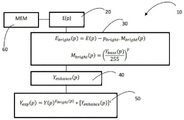
如图1所示,图像处理装置10包括:As shown in Figure 1, the
-扩展图确定模块20,被配置为获得预定的扩展指数图E(p)以应用于图像I;- an expansion
-调制模块30,被配置为在某些明度范围内调制明度扩展;- a
-高频提取模块40,被配置为通过提取该像素的明度邻域中的像素颜色的明度值的高频,来获得图像的每个/任意像素的像素明度增强值;- a high
-逆色调映射模块50,被配置为将图像I的每个/任意像素p的明度逆色调映射为扩展明度,该扩展使用由调制模块30校正或衰减的预定扩展指数图E(p),如稍后在描述中更详细描述的;- an inverse
-存储器60,用于存储包括多个N个简档Pi的模型或模板,其中,2≤N并且1≤i≤N。-
现在将参考图2,使用如上所述的处理装置来描述图像I的逆色调映射方法的第一实施例。Referring now to Figure 2, a first embodiment of a method of inverse tone mapping of image I will be described using the processing apparatus as described above.
该方法包括第一步骤S1,获得预定扩展指数图E(p)以应用于图像I。该第一步骤使用包括多个N个简档Pi的模型或模板,其中,2≤N并且1≤i≤N。The method comprises a first step S1 of obtaining a predetermined expanded exponential map E(p) to apply to the image I. This first step uses a model or template comprising a plurality of N profiles Pi, where 2≤N and 1≤i≤N .
如在EP3249605中所描述的,在学习阶段,基于它们各自的明度直方图,从排列成聚类的多个参考图像中获得N个简档Pi。N个简档Pi是从参考图像的N个聚类发布的。代表性明度直方图HLi和扩展指数图Ei(p)被分配到参考图像的N个聚类中的每一个。因此,两个以下关联的元素被分配到从参考图像的聚类发布的每个简档Pi:As described in EP3249605 , in the learning phase, N profiles Pi are obtained from a plurality of reference images arranged into clusters based on their respective lightness histograms. N profiles Pi are published from N clusters of reference images. A representative lightness histogram HL i and an extended index map E i (p) are assigned to each of the N clusters of the reference image. Therefore, two following associated elements are assigned to each profile Pi published from a cluster of reference images:
-视觉特征,诸如,明度直方图HLi,其代表该聚类的参考图像的明度,以及- visual features, such as a lightness histogram HL i , which represents the lightness of the reference image for the cluster, and
-扩展指数图Ei(p)。- Extended exponential graph E i (p).
图像的所有像素的值Ei(p)的集合形成图像的扩展指数图或“扩展图”。该扩展图可以通过不同的方法生成,例如通过对每个像素p的明度值Y(p)进行低通滤波以获得低通滤波后的明度值Ybase(p),并对低通滤波后的明度值应用由参数a、b和c定义的二次函数,根据以下等式:The set of values E i (p) of all pixels of the image forms the expanded exponential map or "expanded map" of the image. The expanded map can be generated by different methods, for example, by performing low-pass filtering on the luminance value Y(p) of each pixel p to obtain the low-pass filtered luminance value Y base (p), and The lightness value is applied with a quadratic function defined by parameters a, b and c, according to the following equation:
Ei(p)=ai[Ybase(p)]2+bi[Ybase(p)]+ci (1)E i (p)=a i [Y base (p)] 2 +b i [Y base (p)]+c i (1)
因此,每个模型简档Pi由代表性明度直方图HLi和定义用于计算扩展指数值和扩展图Ei(p)的二次函数的参数ai、bi、ci的集合来定义。Thus, each model profile P i is derived from a representative lightness histogram HL i and the set of parameters a i , bi , c i that define the quadratic function used to compute the extended index value and the extended map E i (p). definition.
N个简档Pi的数据存储在图像处理装置10的存储器60中。The data of the N profiles P i are stored in the
在第一步骤S1中使用扩展图确定模块20,为图像I计算代表性明度直方图HLi,以在子步骤S10中进行处理。Using the extended
在子步骤S11中,然后根据距离标准,将图像I的直方图HLi与从学习阶段发布的、保存在存储器60的模板中的直方图HLi中的每一个进行比较,以便找到最佳匹配模型直方图。换句话说,根据距离标准将图像I的视觉特征HLI与参考图像的N个聚类的视觉特征HLi进行比较,其中聚类的视觉特征代表该聚类的参考图像的明度。In sub-step S11, the histogram HL i of the image I is then compared with each of the histograms HL i released from the learning phase and stored in the template of the
最后,在子步骤S12中,选择与给出最佳匹配的模型直方图相关的扩展图Ei(p)(1≤i≤N)。因此,选择模板的最佳扩展图来处理输入SDR图像I。Finally, in sub-step S12, the expanded graph E i (p) (1≤i≤N) associated with the model histogram giving the best match is selected. Therefore, the best expansion map of the template is chosen to process the input SDR image I.
在下面的描述中,从步骤S1发布的预定扩展图被标注为E(p)。In the following description, the predetermined expanded graph issued from step S1 is denoted as E(p).
关于生成形成模型或模板的N个简档、以及选择用于图像I的扩展图来处理的更多细节,请读者参考EP3249605。The reader is referred to EP3249605 for further details on the generation of the N profiles forming the model or template, and the selection of the expanded graph for image I to process.
使用调制模块30,在第二步骤S2中,执行亮点调制的操作,以便仅在图像I的一些明亮区域中局部减少由步骤S1中获得的预定扩展图E(p)引起的亮度扩展的影响,同时保持与周围环境的平滑过渡。现在将针对输入的SDR图像I描述亮点调制。Using the
亮点调制的操作使用调制函数(也称为衰减函数或校正函数)。该调制函数计算参考调制(或“校正”或“衰减”)图Mbright(p)与加权因子pbright的乘积,并从在步骤S1获得的预定扩展图E(p)中减去该乘积。因此,根据以下等式计算校正的(新的)扩展指数图Ebright(p):The operation of bright spot modulation uses a modulation function (also known as a decay function or correction function). The modulation function calculates the product of the reference modulation (or "correction" or "attenuation") map M bright (p) and the weighting factor p bright , and subtracts this product from the predetermined expanded map E(p) obtained at step S1. Therefore, the corrected (new) expanded exponential map E bright (p) is calculated according to the following equation:
Ebright(p)=E(p)-pbright.Mbright(p) (2)E bright (p)=E (p)-p bright .M bright (p) (2)
其中in
-Ebright(p)表示校正后的扩展图;-E bright (p) indicates the corrected expanded image;
-E(p)是在步骤S1中获得的预定扩展图;-E(p) is the predetermined expanded graph obtained in step S1;
-Mbrigth(p)是调制函数,其为所有图像像素生成由该函数给出的值形成的参考调制或校正图;-M brigth (p) is the modulation function that generates a reference modulation or correction map formed by the values given by this function for all image pixels;
-pbright是用于控制校正强度的加权因子。-p bright is a weighting factor used to control the strength of the correction.
执行以现在将描述的以下子步骤,以实现亮点调制并生成形成图Ebright(p)的校正后的扩展指数值。The following sub-steps, which will now be described, are performed to achieve bright spot modulation and generate corrected spread index values forming the graph E bright (p).
在子步骤S20中,通过使用参考调制函数Mbrigth(p)来计算参考扩展衰减或校正图Mbrigth(p),该参考调制函数将表示图像I的每个像素p的明度的值作为输入。该函数是对于越高的输入值变得越来越大的递增函数。换句话说,该递增函数对于更高的输入值实现更高的递增值。输入值越高,递增值越高。输入值越高,递增值越重要。在本实施例中,输入值是归一化的像素p的低通滤波后的明度值Ybase(p)。参考衰减函数利用固定指数参数γ对此输入值实现指数运算。换句话说,它根据以下等式以固定参数γ的幂来计算归一化低通滤波后的明度值Ybase(p):In sub-step S20, a reference extended attenuation or correction map M brigth (p) is calculated by using a reference modulation function M brigth (p) which takes as input a value representing the lightness of each pixel p of the image I. The function is an increasing function that becomes larger and larger for higher input values. In other words, the increment function achieves higher increment values for higher input values. The higher the input value, the higher the increment value. The higher the input value, the more important the incremental value is. In this embodiment, the input value is the low-pass filtered lightness value Y base (p) of the normalized pixel p. The reference decay function implements an exponential operation on this input value with a fixed exponential parameter γ. In other words, it computes the normalized low-pass filtered lightness value Y base (p) in powers of a fixed parameter γ according to the following equation:

其中in
-255是SDR图像I中的最大明度值;-255 is the maximum lightness value in SDR image I;
-γ是固定的指数值,其例如等于或高于3,例如等于6;- γ is a fixed exponential value, eg equal to or higher than 3, eg equal to 6;
-Ybase(p)是图像I的像素p的低通滤波明度值,以及- Y base (p) is the low-pass filtered luminance value of pixel p of image I, and
-Mbrigth(p)是图像I的像素p的参考校正或衰减值。-M brigth (p) is the reference correction or attenuation value for pixel p of image I.
函数Mbrigth(p)被适配以主要对较高的明度值操作。The function M brigth (p) is adapted to operate mainly on higher lightness values.
加权因子pbright用于对应用于预定扩展值E(p)的校正进行加权,从而控制该校正的强度。其值取决于要处理的图像I和预定的扩展图E(p)(在步骤S1中获得)。其是用于控制应用于扩展值E(p)的校正的强度的参数。它允许取决于图像I和所述扩展图E(p)来量化必须应用于预定扩展图E(p)的校正量。The weighting factor bright is used to weight the correction applied to the predetermined spread value E(p), thereby controlling the strength of the correction. Its value depends on the image I to be processed and the predetermined expanded map E(p) (obtained in step S1). It is a parameter for controlling the strength of the correction applied to the extension value E(p). It allows to quantify the amount of correction that has to be applied to a predetermined extended map E(p) depending on the image I and said extended map E(p).
在子步骤S21中,计算加权因子pbright,以便降低高亮的大区域中的扩展明度。加权因子pbright旨在应用于(此处乘以)参考扩展校正值Mbrigth(p),其是
-第一明度阈值TH1,其是确保图像I的预定百分比的像素具有高于第一明度阈值TH1的明度值的明度值;- a first lightness threshold TH 1 , which is a lightness value that ensures that a predetermined percentage of the pixels of the image I have lightness values higher than the first lightness threshold TH 1 ;
-第二明度阈值TH2,其对应于使用预定扩展图E(p)被色调映射到扩展明度的目标最大值的图像I的像素p的明度值。- a second lightness threshold TH 2 corresponding to the lightness value of the pixel p of the image I tone-mapped to the target maximum value of the extended lightness using the predetermined extended map E(p).
更准确地说,加权因子pbright是使用以下各项计算的:More precisely, the weighting factor p bright is calculated using:
-通过所述预定扩展指数图E(p)分配到所述图像I的所述第一明度阈值TH1的第一扩展指数值E(P1);- a first extension index value E(P 1 ) assigned to said first luminance threshold TH 1 of said image I by said predetermined extension index map E(p);
-通过所述扩展指数图E(p)分配到所述第二明度阈值TH2的第二扩展指数值E(p2);- a second spread index value E(p 2 ) assigned to said second lightness threshold TH 2 by said spread index map E(p);
-通过利用所述固定指数参数γ对所述第一明度阈值TH1的归一化值进行指数运算而得到的参考校正值
用于确定亮度阈值TH1的图像I的像素p的预定百分比例如是图像I中像素总数的0.5%。The predetermined percentage of pixels p of the image I used to determine the luminance threshold TH 1 is, for example, 0.5% of the total number of pixels in the image I.
现在将描述由调制模块30实现的第一扩展指数值E(p1)的计算。元素“p1”表示具有阈值明度值TH1的图像I的像素,该阈值明度值TH1确保图像像素的总数中的预定百分比具有高于TH1的明度值。阈值明度值TH1优选为低通滤波明度值。这个百分比的优选值是0.5%。然而,可以使用图像像素p的不同百分比用于确定明度阈值TH1。图5表示SDR图像I的明度的归一化直方图,示出了阈值明度值TH1。在SDR图像I中,明度值的范围包括在0和255之间。因此,明度阈值TH1根据以下关系确定:The calculation of the first spreading exponent value E(p 1 ) implemented by the

其中in
-bin(k)表示具有明度值k(优选为低通滤波明度值)的图像I的像素的数目;- bin(k) represents the number of pixels of image I with a lightness value k (preferably a low-pass filtered lightness value);
-Np表示图像I中的像素总数。-N p represents the total number of pixels in image I.
第一扩展指数值E(p1)根据以下等式计算:The first extended exponent value E(p 1 ) is calculated according to the following equation:
E(p1)=a[TH1]2+b[TH1]+c (5)E(p 1 )=a[TH 1 ] 2 +b[TH 1 ]+c (5)
此外,调制模块30根据以下等式计算针对明度值TH1的像素p1的参考衰减或校正值Mbright(p1):Furthermore, the

换句话说,
现在将描述由调制模块30实现的第二扩展指数值E(p2)的计算。元素“p2”表示具有阈值明度值TH2的图像I的像素。该阈值TH2是与要设置的输出明度YexpTarget相匹配的图像I中的像素p2的输入明度的值,输出明度YexpTarget是通过预定扩展图E(p)的扩展明度的目标最大值。该扩展明度YexpTarget的目标最大值取决于由HDR显示器固定的最大明度(这里为1000)。在本实施例中,目标扩展明度YexpTarget略小于HDR显示器的最大明度,例如等于900。图6表示预定扩展图E(p)上的点,该点由阈值明度值TH2和匹配TH2的目标扩展明度YexpTarget定义为扩展的输出。通过将扩展明度的所述目标最大值的对数除以第二明度阈值TH2的对数,来计算第二扩展指数值E(p2),根据以下等式:The calculation of the second spreading exponent value E(p 2 ) implemented by the

该扩展指数值E(p2)对应于在具有高明度值的图像像素(诸如具有明度值TH1的像素p1)的扩展指数值的校正或衰减之后作为目标的扩展指数值。如下所述,当TH1>TH2,它可以被记为Ebright(p1)。This spread index value E(p 2 ) corresponds to the spread index value to be targeted after correction or attenuation of the spread index value of image pixels with high lightness values, such as pixel p 1 with lightness value TH 1 . As described below, when TH 1 >TH 2 , it can be denoted as E bright (p 1 ).
在确定了两个阈值明度值TH1和TH2之后,执行测试子步骤,以便确定是否应该激活亮点调制。该测试包括比较两个阈值明度值TH1和TH2,并确定是否满足TH1优于TH2的条件。如果满足条件TH1>TH2,则实现亮点调制。如果未满足,则不执行亮点调制。After the two threshold lightness values TH 1 and TH 2 have been determined, a test sub-step is performed in order to determine whether the bright spot modulation should be activated. The test consists of comparing two threshold lightness values TH 1 and TH 2 and determining whether the condition that TH 1 is better than TH 2 is met. If the condition TH 1 >TH 2 is satisfied, bright spot modulation is achieved. If not satisfied, no bright spot modulation is performed.
然后,在pbrigth计算子步骤S21中,使用值E(p1)、E(p2)和

在计算图像I的参考调制图或函数Mbrigth(p)以及加权因子pbrigth和预定扩展图E(p)之后,在Ebright(p)计算子步骤E23中,根据等式(2)Ebright(p)=E(p)-pbright.Mbright(p),来计算校正的扩展指数图Ebright(p)。After calculating the reference modulation map or function M brigth (p) of the image I and the weighting factor p brigth and the predetermined expansion map E(p), in the E bright (p) calculation sub-step E23, according to equation (2) E bright (p)=E(p)-p bright .M bright (p), to calculate the corrected expanded index map E bright (p).
使用高频提取模块40,在本实施例的第三步骤S3中,提取原始图像I中明度值的高空间频率,以获得具有其明度值Y(p)的图像I的每个像素p的像素明度增强值Yenhance(p)。该步骤例如如在WO 2015/096955中描述的那样执行。Using the high
使用逆色调映射模块50,在本实施例的第四步骤S4中,图像I的每个像素p的明度Y(p)被逆色调映射(或转换)为扩展明度Yexp(p),该扩展明度Yexp(p)是通过以从第二步骤S2为该像素p获得的校正扩展指数值Ebright(p)为幂的该像素p的明度、与以指数参数c为幂的从第三步骤S3为该像素p获得的像素明度增强值Yenhance(p)的乘积而获得的,其中c大于或等于1。这意味着原始图像I的像素p的扩展明度Yexp(p)是根据以下等式计算的:Using the inverse
Yexp(p)=Y(p)Ebright(p)*[Yenhance(p)]c (9)Y exp (p)=Y(p)E bright(p) *[Y enhance (p)] c (9)
该指数参数c控制由像素明度增强值带来的细节增强量。因此,c的较大值逐渐增加图像边缘的对比度。优选使用值c=1.5。The exponent parameter c controls the amount of detail enhancement brought about by the pixel luminance enhancement value. Therefore, larger values of c gradually increase the contrast at the edges of the image. Preferably the value c=1.5 is used.
因此,原始图像I的所有像素p的扩展明度值Yexp(p)是使用衰减的扩展图Ebright(p)来计算的。后一个图基于预定的扩展图,特别适配图像I,该扩展图被进一步校正以便避免图像I的亮区中的不良分级。因此,生成HDR图像I’,并且HDR图像I’可以被显示在HDR显示装置上。Therefore, the expanded brightness values Y exp (p) of all pixels p of the original image I are calculated using the decayed expanded map E bright (p). The latter map is specially adapted to the image I based on a predetermined expansion map, which is further corrected in order to avoid bad grading in the bright areas of the image I. Therefore, the HDR image I' is generated, and the HDR image I' can be displayed on the HDR display device.
优点advantage
一方面,图3B表示在第一步骤S1中获得的预定扩展图E(p)。更准确地说,图像像素p的输入明度值(即低通滤波明度Ybase(p))在横坐标上表示,而图像像素p的预定扩展指数值E(p)在纵坐标上表示。图3A在纵坐标上表示图像像素p的扩展明度值,并在横坐标上表示图像像素的输入明度值(即像素p的低通滤波明度Ybase(p)),在这种情况下,其中使用预定的扩展图E(p)来实现明度扩展(不对该扩展进行任何校正或衰减)。On the one hand, Figure 3B represents the predetermined expanded map E(p) obtained in the first step S1. More precisely, the input luminance value of the image pixel p (ie the low-pass filtered luminance Y base (p)) is represented on the abscissa, and the predetermined expansion index value E(p) of the image pixel p is represented on the ordinate. FIG. 3A represents the extended lightness value of the image pixel p on the ordinate and the input lightness value of the image pixel (ie, the low-pass filtered lightness Y base (p) of the pixel p) on the abscissa, in this case, where Luminance extension is achieved using a predetermined extension map E(p) (without any correction or attenuation of this extension).
另一方面,图4B表示在第三步骤S3中获得的校正后的扩展图Ebright(p)。更准确地说,图像像素p的输入明度值(即低通滤波明度Ybase(p))在横坐标上表示,而图像像素p的校正后的扩展指数值Ebright(p)在纵坐标上表示。图4A在纵坐标上表示图像像素p的扩展明度值,并在横坐标上表示图像像素的输入明度值(即像素p的低通滤波明度Ybase(p)),在这种情况下,其中使用校正的扩展图Ebright(p)来实现明度扩展。On the other hand, FIG. 4B shows the corrected expanded map E bright (p) obtained in the third step S3. More precisely, the input luminance value of the image pixel p (i.e., the low-pass filtered luminance Y base (p)) is represented on the abscissa, and the corrected expansion index value E bright (p) of the image pixel p is on the ordinate. express. Figure 4A represents the extended luminance value of the image pixel p on the ordinate and the input luminance value of the image pixel (ie the low-pass filtered lightness Y base (p) of the pixel p) on the abscissa, in this case where Brightness expansion is achieved using the corrected expansion map E bright (p).
因为HDR显示器的最大明度值在这里等于1000,因此图3A示出了对应于像素p的剪裁区域CA,其中扩展的明度值降低到等于显示装置的最大明度1000的固定值,因为扩展操作为这些像素生成比显示装置的最大容量更高的扩展明度值。Since the maximum luma value of an HDR display is here equal to 1000, FIG. 3A shows a clipping area CA corresponding to pixel p, where the expanded luma value is reduced to a fixed value equal to the display device's maximum luma value of 1000, since the expansion operation is these The pixel generates an expanded lightness value higher than the maximum capacity of the display device.
相反,图4A示出了避免生成比显示装置的最大明度容量更高的扩展明度值的校正扩展图。In contrast, FIG. 4A shows a corrected expansion map that avoids generating expanded luma values higher than the maximum luma capacity of the display device.
本发明的方法允许在图像I上自动地并且可能即时地执行完全适配于图像I的逆色调映射,而不需要增加处理装置的存储容量。图像的高亮度区域没有被剪裁。它们被很好地分级(不太亮),并且通过逆色调映射保持与周围环境的平滑过渡。The method of the invention allows an inverse tone mapping fully adapted to the image I to be performed automatically and possibly instantaneously on the image I, without the need to increase the storage capacity of the processing device. Highlight areas of the image are not clipped. They are well graded (not too bright) and maintain a smooth transition to their surroundings with inverse tone mapping.
Claims (15)


Applications Claiming Priority (3)
| Application Number | Priority Date | Filing Date | Title |
|---|---|---|---|
| EP17306862.8A EP3503019A1 (en) | 2017-12-21 | 2017-12-21 | Improved inverse tone mapping method and corresponding device |
| EP17306862.8 | 2017-12-21 | ||
| PCT/US2018/065143 WO2019125857A1 (en) | 2017-12-21 | 2018-12-12 | Improved inverse tone mapping method and corresponding device |
Publications (2)
| Publication Number | Publication Date |
|---|---|
| CN111480177A true CN111480177A (en) | 2020-07-31 |
| CN111480177B CN111480177B (en) | 2023-10-20 |
Family
ID=60957091
Family Applications (1)
| Application Number | Title | Priority Date | Filing Date |
|---|---|---|---|
| CN201880080048.4A Active CN111480177B (en) | 2017-12-21 | 2018-12-12 | Improved inverse tone mapping method and corresponding device |
Country Status (7)
| Country | Link |
|---|---|
| US (1) | US11348210B2 (en) |
| EP (2) | EP3503019A1 (en) |
| KR (1) | KR102567860B1 (en) |
| CN (1) | CN111480177B (en) |
| BR (1) | BR112020009819A2 (en) |
| CA (1) | CA3086523A1 (en) |
| WO (1) | WO2019125857A1 (en) |
Families Citing this family (12)
| Publication number | Priority date | Publication date | Assignee | Title |
|---|---|---|---|---|
| CN112154474A (en) * | 2019-07-30 | 2020-12-29 | 深圳市大疆创新科技有限公司 | Image processing method, system, movable platform and storage medium |
| CN115335853A (en) * | 2020-03-02 | 2022-11-11 | 交互数字Vc控股法国公司 | Method and apparatus for inverse tone mapping |
| KR102903495B1 (en) * | 2020-04-03 | 2025-12-24 | 에스케이하이닉스 주식회사 | Image sensing device and operating method of the same |
| JP7744937B2 (en) * | 2020-06-26 | 2025-09-26 | インターディジタル・シーイー・パテント・ホールディングス・ソシエテ・パ・アクシオンス・シンプリフィエ | Inverse tone mapping with adaptive bright spot attenuation. |
| KR102875579B1 (en) * | 2020-12-21 | 2025-10-22 | 폰데이션 비-컴 | Converting images to output images with higher dynamic range |
| WO2023009392A1 (en) * | 2021-07-29 | 2023-02-02 | Dolby Laboratories Licensing Corporation | Neural networks for dynamic range conversion and display management of images |
| CN117716385A (en) * | 2021-07-29 | 2024-03-15 | 杜比实验室特许公司 | Neural network for dynamic range conversion and display management of images |
| US12260526B2 (en) | 2021-08-13 | 2025-03-25 | Samsung Electronics Co., Ltd. | Self-emitting display (SED) burn-in prevention based on stationary luminance reduction |
| US12211434B2 (en) | 2021-08-13 | 2025-01-28 | Samsung Electronics Co., Ltd. | Detecting stationary regions for organic light emitting diode (OLED) television (TV) luminance reduction |
| US12367565B2 (en) * | 2021-08-18 | 2025-07-22 | Samsung Electronics Co., Ltd. | Efficient inverse tone mapping network for standard dynamic range (SDR) to high dynamic range (HDR) conversion on HDR display |
| CN114584701A (en) * | 2021-11-26 | 2022-06-03 | 钧捷科技(北京)有限公司 | Method for realizing image histogram adjustment and dynamic range expansion by adopting FPGA |
| KR102564447B1 (en) * | 2021-11-30 | 2023-08-08 | 엘지전자 주식회사 | Display device |
Citations (14)
| Publication number | Priority date | Publication date | Assignee | Title |
|---|---|---|---|---|
| EP2098060A2 (en) * | 2006-11-27 | 2009-09-09 | Dolby Laboratories Licensing Corporation | Apparatus and methods for boosting dynamic range in digital images |
| CN102385746A (en) * | 2010-09-06 | 2012-03-21 | 索尼公司 | Image processing apparatus, method of the same, and program |
| US20120201456A1 (en) * | 2009-10-08 | 2012-08-09 | International Business Machines Corporation | Transforming a digital image from a low dynamic range (ldr) image to a high dynamic range (hdr) image |
| CN103493487A (en) * | 2011-04-28 | 2014-01-01 | 皇家飞利浦有限公司 | Apparatuses and methods for HDR image encoding and decoding |
| US20150213766A1 (en) * | 2014-01-29 | 2015-07-30 | Canon Kabushiki Kaisha | Display apparatus and control method thereof |
| CN105009580A (en) * | 2013-02-21 | 2015-10-28 | 杜比实验室特许公司 | Display management for high dynamic range video |
| CN105850114A (en) * | 2013-12-27 | 2016-08-10 | 汤姆逊许可公司 | Method for inverse tone mapping of an image |
| CN106464892A (en) * | 2014-05-28 | 2017-02-22 | 皇家飞利浦有限公司 | Method and apparatus for encoding HDR images and method and apparatus for using such encoded images |
| CN106488141A (en) * | 2015-08-13 | 2017-03-08 | 汤姆逊许可公司 | HDR is to the method for HDR inverse tone mapping (ITM), system and equipment |
| FR3045903A1 (en) * | 2015-12-16 | 2017-06-23 | B<>Com | METHOD FOR PROCESSING DIGITAL IMAGE, DEVICE, TERMINAL EQUIPMENT AND COMPUTER PROGRAM THEREOF |
| CN107077726A (en) * | 2014-10-27 | 2017-08-18 | 杜比实验室特许公司 | Use the content map of extension color scope |
| CN107111980A (en) * | 2014-12-11 | 2017-08-29 | 皇家飞利浦有限公司 | Optimize high dynamic range images for particular display |
| CN107211142A (en) * | 2015-01-30 | 2017-09-26 | 汤姆逊许可公司 | The method and apparatus decoded to coloured image |
| US20170337670A1 (en) * | 2016-05-23 | 2017-11-23 | Thomson Licensing | Inverse tone mapping method and corresponding device |
Family Cites Families (3)
| Publication number | Priority date | Publication date | Assignee | Title |
|---|---|---|---|---|
| US6813041B1 (en) | 2000-03-31 | 2004-11-02 | Hewlett-Packard Development Company, L.P. | Method and apparatus for performing local color correction |
| US9733465B2 (en) * | 2015-02-12 | 2017-08-15 | The Penn State Research Foundation | Waveguides for enhanced total internal reflection fluorescence microscopy |
| CN107949864B (en) * | 2015-08-25 | 2023-05-16 | 交互数字麦迪逊专利控股公司 | Inverse tone mapping based on luma regions |
-
2017
- 2017-12-21 EP EP17306862.8A patent/EP3503019A1/en not_active Withdrawn
-
2018
- 2018-12-12 KR KR1020207017537A patent/KR102567860B1/en active Active
- 2018-12-12 CN CN201880080048.4A patent/CN111480177B/en active Active
- 2018-12-12 US US16/955,850 patent/US11348210B2/en active Active
- 2018-12-12 CA CA3086523A patent/CA3086523A1/en active Pending
- 2018-12-12 BR BR112020009819-1A patent/BR112020009819A2/en unknown
- 2018-12-12 EP EP18834095.4A patent/EP3729365B1/en active Active
- 2018-12-12 WO PCT/US2018/065143 patent/WO2019125857A1/en not_active Ceased
Patent Citations (15)
| Publication number | Priority date | Publication date | Assignee | Title |
|---|---|---|---|---|
| EP2098060A2 (en) * | 2006-11-27 | 2009-09-09 | Dolby Laboratories Licensing Corporation | Apparatus and methods for boosting dynamic range in digital images |
| US20100208143A1 (en) * | 2006-11-27 | 2010-08-19 | Dolby Laboratories Licensing Corporation | Apparatus and methods for boosting dynamic range in digital images |
| US20120201456A1 (en) * | 2009-10-08 | 2012-08-09 | International Business Machines Corporation | Transforming a digital image from a low dynamic range (ldr) image to a high dynamic range (hdr) image |
| CN102385746A (en) * | 2010-09-06 | 2012-03-21 | 索尼公司 | Image processing apparatus, method of the same, and program |
| CN103493487A (en) * | 2011-04-28 | 2014-01-01 | 皇家飞利浦有限公司 | Apparatuses and methods for HDR image encoding and decoding |
| CN105009580A (en) * | 2013-02-21 | 2015-10-28 | 杜比实验室特许公司 | Display management for high dynamic range video |
| CN105850114A (en) * | 2013-12-27 | 2016-08-10 | 汤姆逊许可公司 | Method for inverse tone mapping of an image |
| US20150213766A1 (en) * | 2014-01-29 | 2015-07-30 | Canon Kabushiki Kaisha | Display apparatus and control method thereof |
| CN106464892A (en) * | 2014-05-28 | 2017-02-22 | 皇家飞利浦有限公司 | Method and apparatus for encoding HDR images and method and apparatus for using such encoded images |
| CN107077726A (en) * | 2014-10-27 | 2017-08-18 | 杜比实验室特许公司 | Use the content map of extension color scope |
| CN107111980A (en) * | 2014-12-11 | 2017-08-29 | 皇家飞利浦有限公司 | Optimize high dynamic range images for particular display |
| CN107211142A (en) * | 2015-01-30 | 2017-09-26 | 汤姆逊许可公司 | The method and apparatus decoded to coloured image |
| CN106488141A (en) * | 2015-08-13 | 2017-03-08 | 汤姆逊许可公司 | HDR is to the method for HDR inverse tone mapping (ITM), system and equipment |
| FR3045903A1 (en) * | 2015-12-16 | 2017-06-23 | B<>Com | METHOD FOR PROCESSING DIGITAL IMAGE, DEVICE, TERMINAL EQUIPMENT AND COMPUTER PROGRAM THEREOF |
| US20170337670A1 (en) * | 2016-05-23 | 2017-11-23 | Thomson Licensing | Inverse tone mapping method and corresponding device |
Also Published As
| Publication number | Publication date |
|---|---|
| KR20200100077A (en) | 2020-08-25 |
| EP3729365A1 (en) | 2020-10-28 |
| CN111480177B (en) | 2023-10-20 |
| EP3503019A1 (en) | 2019-06-26 |
| KR102567860B1 (en) | 2023-08-18 |
| WO2019125857A1 (en) | 2019-06-27 |
| EP3729365B1 (en) | 2022-02-09 |
| US20200320672A1 (en) | 2020-10-08 |
| US11348210B2 (en) | 2022-05-31 |
| CA3086523A1 (en) | 2019-06-27 |
| BR112020009819A2 (en) | 2020-10-13 |
Similar Documents
| Publication | Publication Date | Title |
|---|---|---|
| CN111480177B (en) | Improved inverse tone mapping method and corresponding device | |
| EP2076013B1 (en) | Method of high dynamic range compression | |
| JP5105209B2 (en) | Image processing apparatus and method, program, and recording medium | |
| EP3087730B1 (en) | Method for inverse tone mapping of an image | |
| US10672112B2 (en) | Method and system for real-time noise removal and image enhancement of high-dynamic range images | |
| EP2833317B1 (en) | Image display device and/or method therefor | |
| US8610738B2 (en) | Image processing apparatus and method with dynamic range processing | |
| US8391598B2 (en) | Methods for performing local tone mapping | |
| CN113674193B (en) | Image fusion method, electronic device and storage medium | |
| US10535124B2 (en) | Inverse tone mapping method and corresponding device | |
| US20150109525A1 (en) | Image processing apparatus, image processing method, and storage medium | |
| JP6818463B2 (en) | Image processing equipment, image processing methods and programs | |
| JP4639037B2 (en) | Image processing method and apparatus | |
| US10019645B2 (en) | Image processing apparatus and method, and electronic equipment | |
| CN106488080A (en) | Method and apparatus for high dynamic range dynamic noise reduction in digital imaging | |
| JP5410378B2 (en) | Video signal correction apparatus and video signal correction program | |
| EP3054416B1 (en) | Method, system and device for generating more natural images | |
| JP5932392B2 (en) | Image processing apparatus and image processing method | |
| KR102111317B1 (en) | System and method of transmission rate calculation for suppression of degradation of image quality | |
| JP5624896B2 (en) | Image processing apparatus, image processing program, and image processing method | |
| JP2005039458A (en) | Image processing apparatus and method | |
| JP5483949B2 (en) | Image processing apparatus, image processing method, and program | |
| Bilcu et al. | A novel tone mapping method for image contrast enhancement | |
| CN115880160A (en) | Image processing method and device |
Legal Events
| Date | Code | Title | Description |
|---|---|---|---|
| PB01 | Publication | ||
| PB01 | Publication | ||
| SE01 | Entry into force of request for substantive examination | ||
| SE01 | Entry into force of request for substantive examination | ||
| GR01 | Patent grant | ||
| GR01 | Patent grant |