CN111384371A - Compression-resistant positive active material and electrochemical energy storage device - Google Patents
Compression-resistant positive active material and electrochemical energy storage device Download PDFInfo
- Publication number
- CN111384371A CN111384371A CN201811637371.5A CN201811637371A CN111384371A CN 111384371 A CN111384371 A CN 111384371A CN 201811637371 A CN201811637371 A CN 201811637371A CN 111384371 A CN111384371 A CN 111384371A
- Authority
- CN
- China
- Prior art keywords
- positive electrode
- active material
- electrode active
- primary particles
- particles
- Prior art date
- Legal status (The legal status is an assumption and is not a legal conclusion. Google has not performed a legal analysis and makes no representation as to the accuracy of the status listed.)
- Granted
Links
Images



Classifications
-
- H—ELECTRICITY
- H01—ELECTRIC ELEMENTS
- H01M—PROCESSES OR MEANS, e.g. BATTERIES, FOR THE DIRECT CONVERSION OF CHEMICAL ENERGY INTO ELECTRICAL ENERGY
- H01M4/00—Electrodes
- H01M4/02—Electrodes composed of, or comprising, active material
- H01M4/36—Selection of substances as active materials, active masses, active liquids
- H01M4/48—Selection of substances as active materials, active masses, active liquids of inorganic oxides or hydroxides
- H01M4/50—Selection of substances as active materials, active masses, active liquids of inorganic oxides or hydroxides of manganese
- H01M4/505—Selection of substances as active materials, active masses, active liquids of inorganic oxides or hydroxides of manganese of mixed oxides or hydroxides containing manganese for inserting or intercalating light metals, e.g. LiMn2O4 or LiMn2OxFy
-
- G—PHYSICS
- G01—MEASURING; TESTING
- G01N—INVESTIGATING OR ANALYSING MATERIALS BY DETERMINING THEIR CHEMICAL OR PHYSICAL PROPERTIES
- G01N3/00—Investigating strength properties of solid materials by application of mechanical stress
- G01N3/08—Investigating strength properties of solid materials by application of mechanical stress by applying steady tensile or compressive forces
-
- G—PHYSICS
- G01—MEASURING; TESTING
- G01N—INVESTIGATING OR ANALYSING MATERIALS BY DETERMINING THEIR CHEMICAL OR PHYSICAL PROPERTIES
- G01N33/00—Investigating or analysing materials by specific methods not covered by groups G01N1/00 - G01N31/00
-
- H—ELECTRICITY
- H01—ELECTRIC ELEMENTS
- H01M—PROCESSES OR MEANS, e.g. BATTERIES, FOR THE DIRECT CONVERSION OF CHEMICAL ENERGY INTO ELECTRICAL ENERGY
- H01M10/00—Secondary cells; Manufacture thereof
- H01M10/05—Accumulators with non-aqueous electrolyte
- H01M10/052—Li-accumulators
- H01M10/0525—Rocking-chair batteries, i.e. batteries with lithium insertion or intercalation in both electrodes; Lithium-ion batteries
-
- H—ELECTRICITY
- H01—ELECTRIC ELEMENTS
- H01M—PROCESSES OR MEANS, e.g. BATTERIES, FOR THE DIRECT CONVERSION OF CHEMICAL ENERGY INTO ELECTRICAL ENERGY
- H01M4/00—Electrodes
- H01M4/02—Electrodes composed of, or comprising, active material
- H01M4/36—Selection of substances as active materials, active masses, active liquids
- H01M4/362—Composites
- H01M4/366—Composites as layered products
-
- H—ELECTRICITY
- H01—ELECTRIC ELEMENTS
- H01M—PROCESSES OR MEANS, e.g. BATTERIES, FOR THE DIRECT CONVERSION OF CHEMICAL ENERGY INTO ELECTRICAL ENERGY
- H01M4/00—Electrodes
- H01M4/02—Electrodes composed of, or comprising, active material
- H01M4/36—Selection of substances as active materials, active masses, active liquids
- H01M4/48—Selection of substances as active materials, active masses, active liquids of inorganic oxides or hydroxides
- H01M4/52—Selection of substances as active materials, active masses, active liquids of inorganic oxides or hydroxides of nickel, cobalt or iron
- H01M4/525—Selection of substances as active materials, active masses, active liquids of inorganic oxides or hydroxides of nickel, cobalt or iron of mixed oxides or hydroxides containing iron, cobalt or nickel for inserting or intercalating light metals, e.g. LiNiO2, LiCoO2 or LiCoOxFy
-
- H—ELECTRICITY
- H01—ELECTRIC ELEMENTS
- H01M—PROCESSES OR MEANS, e.g. BATTERIES, FOR THE DIRECT CONVERSION OF CHEMICAL ENERGY INTO ELECTRICAL ENERGY
- H01M4/00—Electrodes
- H01M4/02—Electrodes composed of, or comprising, active material
- H01M4/62—Selection of inactive substances as ingredients for active masses, e.g. binders, fillers
- H01M4/628—Inhibitors, e.g. gassing inhibitors, corrosion inhibitors
-
- Y—GENERAL TAGGING OF NEW TECHNOLOGICAL DEVELOPMENTS; GENERAL TAGGING OF CROSS-SECTIONAL TECHNOLOGIES SPANNING OVER SEVERAL SECTIONS OF THE IPC; TECHNICAL SUBJECTS COVERED BY FORMER USPC CROSS-REFERENCE ART COLLECTIONS [XRACs] AND DIGESTS
- Y02—TECHNOLOGIES OR APPLICATIONS FOR MITIGATION OR ADAPTATION AGAINST CLIMATE CHANGE
- Y02E—REDUCTION OF GREENHOUSE GAS [GHG] EMISSIONS, RELATED TO ENERGY GENERATION, TRANSMISSION OR DISTRIBUTION
- Y02E60/00—Enabling technologies; Technologies with a potential or indirect contribution to GHG emissions mitigation
- Y02E60/10—Energy storage using batteries
Landscapes
- Chemical & Material Sciences (AREA)
- Chemical Kinetics & Catalysis (AREA)
- General Chemical & Material Sciences (AREA)
- Electrochemistry (AREA)
- Engineering & Computer Science (AREA)
- Life Sciences & Earth Sciences (AREA)
- Health & Medical Sciences (AREA)
- Inorganic Chemistry (AREA)
- Composite Materials (AREA)
- Pathology (AREA)
- Physics & Mathematics (AREA)
- Immunology (AREA)
- General Health & Medical Sciences (AREA)
- Biochemistry (AREA)
- Analytical Chemistry (AREA)
- General Physics & Mathematics (AREA)
- Medicinal Chemistry (AREA)
- Food Science & Technology (AREA)
- Materials Engineering (AREA)
- Manufacturing & Machinery (AREA)
- Battery Electrode And Active Subsutance (AREA)
Abstract
本发明涉及电池技术领域,特别是涉及一种抗压的正极活性材料及电化学储能装置。所述正极活性材料包括由一次颗粒组成的二次颗粒,所述二次颗粒的SEM图谱中单位球面积内一次颗粒的个数σ为5个/μm2~30个/μm2,所述二次颗粒的单颗粒抗压强度为60MPa~300MPa,所述正极活性材料的分子式为LixNiyCozMkMepOrAm,0.95≤x≤1.05,0≤y≤1,0≤z≤1,0≤k≤1,0≤p≤0.1,1≤r≤2,0≤m≤2,m+r≤2,M选自Mn和/或Al,Me选自Zr、Zn、Cu、Cr、Mg、Fe、V、Ti、Sr、Sb、Y、W、Nb中的一种或多种的组合,A选自N、F、S、Cl中的一种或多种的组合。本发明的正极活性材料的颗粒结构紧实、具有较高的单颗粒抗压强度,使用本发明所述正极活性材料的锂离子电池具有良好的循环性能、较低的体积膨胀率以及良好的动力学性能。

The invention relates to the technical field of batteries, in particular to a pressure-resistant positive electrode active material and an electrochemical energy storage device. The positive electrode active material includes secondary particles composed of primary particles, the number σ of the primary particles per unit spherical area in the SEM image of the secondary particles is 5/μm 2 to 30/μm 2 , and the secondary particles are The single particle compressive strength of the secondary particles is 60 MPa to 300 MPa, and the molecular formula of the positive electrode active material is Li x Ni y Co z M k Me p O r A m , 0.95≤x≤1.05, 0≤y≤1, 0≤ z≤1, 0≤k≤1, 0≤p≤0.1, 1≤r≤2, 0≤m≤2, m+r≤2, M is selected from Mn and/or Al, Me is selected from Zr, Zn, A combination of one or more of Cu, Cr, Mg, Fe, V, Ti, Sr, Sb, Y, W, Nb, A is selected from a combination of one or more of N, F, S, Cl . The positive electrode active material of the present invention has a compact particle structure and high single particle compressive strength, and the lithium ion battery using the positive electrode active material of the present invention has good cycle performance, low volume expansion rate and good power. academic performance.
Description
技术领域technical field
本发明涉及电池技术领域,特别是涉及一种抗压的正极活性材料及电化学储能装置。The invention relates to the technical field of batteries, in particular to a pressure-resistant positive electrode active material and an electrochemical energy storage device.
背景技术Background technique
随着能源危机以及环境问题的不断升级,开发新型绿色能源已迫在眉睫。锂离子电池具有比能量高、应用温度范围宽、自放电率低、循环寿命长、安全性能好、无污染等优点,现已被应用于各个领域中。锂离子电池作为汽车的能源系统取代传统内燃机车已在世界各地逐步尝试。然而目前常用的磷酸铁锂(LiFePO4)、低镍三元(LiNi1/3Co1/3Mn1/3O2)等,由于受到材料本身的性质局限,不能完全满足动力电池对锂离子电池正极活性材料能量密度的需求。提高高镍三元正极材料的镍含量可以提升电池的能量密度,因此,高镍三元正极材料是目前动力电池的主要研究对象之一。但是,随着镍含量的增加,正极活性材料与电解液直接的副反应也明显加剧,循环性能明显恶化,是目前量产商业化的瓶颈之一。With the continuous escalation of energy crisis and environmental problems, the development of new green energy has become imminent. Lithium-ion batteries have the advantages of high specific energy, wide application temperature range, low self-discharge rate, long cycle life, good safety performance, and no pollution, and have been used in various fields. Lithium-ion batteries have been gradually tried all over the world as the energy system of automobiles to replace traditional diesel locomotives. However, currently commonly used lithium iron phosphate (LiFePO 4 ), low nickel ternary (LiNi 1/3 Co 1/3 Mn 1/3 O 2 ), etc., cannot fully meet the requirements of power batteries for lithium ions due to the limitations of the properties of the materials themselves. Demand for energy density of battery cathode active materials. Increasing the nickel content of the high-nickel ternary cathode material can improve the energy density of the battery. Therefore, the high-nickel ternary cathode material is one of the main research objects of power batteries at present. However, with the increase of nickel content, the direct side reaction between the positive electrode active material and the electrolyte also intensifies, and the cycle performance deteriorates significantly, which is one of the bottlenecks in the current mass production and commercialization.
目前在材料层面,解决循环性能主要手段为主元素含量优化、增加掺杂及包覆改性技术。这三种手段均能一定程度的提高循环性能,但仍与市场需求存在差距。多晶的高镍三元材料的由于镍含量高,表面活性强,容易与电解液发生副反应,导致电芯循环性能恶化明显,是目前市场化应用的主要难点之一。通过研究发现,三元正极材料在循环过程中,会存在颗粒开裂的现象,而电芯失效分析发现颗粒开裂是电芯循环性能恶化的主要原因。因此,如何改善循环过程中的颗粒破碎问题对循环性能的提升尤为重要。At present, at the material level, the main means to solve the cycle performance are mainly element content optimization, increase doping and coating modification technology. These three methods can improve the cycle performance to a certain extent, but there is still a gap with the market demand. Due to the high nickel content and strong surface activity of polycrystalline high-nickel ternary materials, it is easy to have side reactions with the electrolyte, resulting in a significant deterioration of the cell cycle performance, which is one of the main difficulties in current market applications. Through the research, it is found that the ternary cathode material will have the phenomenon of particle cracking during the cycle process, and the cell failure analysis shows that the particle cracking is the main reason for the deterioration of the cell cycle performance. Therefore, how to improve the particle breakage in the cycle process is particularly important for the improvement of cycle performance.
发明内容SUMMARY OF THE INVENTION
鉴于以上所述现有技术的缺点,本发明的目的在于提供一种结构紧密、抗压性能较好的正极活性材料以及使用该正极活性材料的电化学储能装置,通过使用力学强度优良、导离子性能较好的正极活性材料,提升电池的循环使用寿命、控制循环过程的体积膨胀率、提升电池的动力学性能。In view of the above-mentioned shortcomings of the prior art, the purpose of the present invention is to provide a positive electrode active material with a compact structure and good compressive performance and an electrochemical energy storage device using the positive electrode active material. Cathode active materials with better ionic performance can improve the cycle life of the battery, control the volume expansion rate during the cycle, and improve the kinetic performance of the battery.
为实现上述目的及其他相关目的,本发明的一方面提供一种正极活性材料,正极活性材料包括由一次颗粒组成的二次颗粒,二次颗粒的SEM图谱中单位面积内一次颗粒的个数σ为5个/μm2~30个/μm2,正极活性材料的单颗粒抗压强度为60MPa~300MPa,正极活性材料的分子式为LixNiyCozMkMepOrAm,0.95≤x≤1.05,0≤y≤1,0≤z≤1,0≤k≤1,0≤p≤0.1,1≤r≤2,0≤m≤2,m+r≤2,M选自Mn和/或Al,Me选自Zr、Zn、Cu、Cr、Mg、Fe、V、Ti、Sr、Sb、Y、W、Nb中的一种或多种的组合,A选自N、F、S、Cl中的一种或多种的组合。In order to achieve the above purpose and other related purposes, one aspect of the present invention provides a positive electrode active material, the positive electrode active material includes secondary particles composed of primary particles, and the number σ of the primary particles per unit area in the SEM spectrum of the secondary particles is It is 5 pieces/μm 2 to 30 pieces/μm 2 , the single particle compressive strength of the positive active material is 60 MPa to 300 MPa, and the molecular formula of the positive active material is Li x Ni y Co z M k Me p O r A m , 0.95≤ x≤1.05, 0≤y≤1, 0≤z≤1, 0≤k≤1, 0≤p≤0.1, 1≤r≤2, 0≤m≤2, m+r≤2, M is selected from Mn And/or Al, Me is selected from the combination of one or more in Zr, Zn, Cu, Cr, Mg, Fe, V, Ti, Sr, Sb, Y, W, Nb, A is selected from N, F, A combination of one or more of S and Cl.
本发明的另一方面提供一种正极材料,包括本发明的正极活性材料,正极活性材料表面设置有外包覆层,所述外包覆层包括包覆元素,所述外包覆层的包覆元素选自Al、Ba、Zn、Ti、Co、W、Y、Si、Sn、B、P中的一种或多种的组合。Another aspect of the present invention provides a positive electrode material, comprising the positive electrode active material of the present invention, wherein the surface of the positive electrode active material is provided with an outer cladding layer, the outer cladding layer includes a cladding element, and the outer cladding layer has a cladding layer. The cladding element is selected from one or a combination of Al, Ba, Zn, Ti, Co, W, Y, Si, Sn, B, and P.
本发明的另一方面提供一种测定本发明的正极活性材料或正极材料中二次颗粒的单位球表面积内一次颗粒的个数的方法,包括以下步骤:Another aspect of the present invention provides a method for measuring the number of primary particles per unit spherical surface area of secondary particles in the positive electrode active material or the positive electrode material of the present invention, comprising the following steps:
(1)选取粒径为所述二次颗粒平均粒径Dv50±20%的正极活性材料样品,对样品进行SEM检测,得到10K倍数下的SEM图谱;(1) Select a positive electrode active material sample with a particle size of the average particle size D v of the secondary particles of 50±20%, carry out SEM inspection on the sample, and obtain an SEM spectrum at a multiple of 10K;
(2)根据步骤(1)得到的SEM图谱,通过以下公式计算正极活性材料中单位球表面积内一次颗粒的个数σ:(2) According to the SEM spectrum obtained in step (1), the number σ of primary particles per unit spherical surface area in the positive electrode active material is calculated by the following formula:
σ=(x1+x2)/2*(y1+y2)/2/(A/C*B/C)σ=(x1+x2)/2*(y1+y2)/2/(A/C*B/C)
其中,in,
x1表示在二次颗粒10K倍数的SEM图中,图片下边缘横向上的一次颗粒的个数;x1 represents the number of primary particles on the lateral direction of the lower edge of the image in the SEM image of the secondary particle at a multiple of 10K;
x2表示在二次颗粒10K倍数的SEM图中,图片上边缘横向上的一次颗粒的个数;x2 represents the number of primary particles in the lateral direction of the upper edge of the image in the SEM image of the secondary particle at a multiple of 10K;
y1表示在二次颗粒10K倍数的SEM图中,图片左边缘纵向上的一次颗粒的个数;y1 represents the number of primary particles in the longitudinal direction of the left edge of the picture in the SEM image of the secondary particle with a multiple of 10K;
y2表示在二次颗粒10K倍数的SEM图中,图片右边缘纵向上的一次颗粒的个数;y2 represents the number of primary particles in the longitudinal direction of the right edge of the picture in the SEM image of the secondary particle with a multiple of 10K;
A表示二次颗粒10K倍数的SEM图的横向实际测量长度,单位为mm;A represents the actual measurement length in the lateral direction of the SEM image of the secondary particle with a multiple of 10K, in mm;
B表示二次颗粒10K倍数的SEM图的纵向实际测量长度,单位为mm;B represents the actual measured longitudinal length of the SEM image of the secondary particle with a multiple of 10K, in mm;
C表示在二次颗粒10K倍数的SEM图中,标尺为1μm时对应的实际测量长度,单位为mm/μm;C represents the actual measured length when the scale is 1 μm in the SEM image of the secondary particle with a multiple of 10K, and the unit is mm/μm;
在计算二次颗粒10K倍数的SEM图中的一次颗粒的个数时,只要出现了一次颗粒的一部分,就算作一个一次颗粒。When calculating the number of primary particles in the SEM image of the 10K multiple of the secondary particles, as long as a part of the primary particle appears, it is regarded as one primary particle.
本发明的另一方面提供一种电化学储能装置,包括本发明的正极活性材料或正极材料。Another aspect of the present invention provides an electrochemical energy storage device comprising the positive electrode active material or positive electrode material of the present invention.
相对于现有技术,本发明的有益效果为:Compared with the prior art, the beneficial effects of the present invention are:
本发明的正极活性材料包括由一次颗粒组成的二次颗粒,所述二次颗粒的结构紧实、抗压强度高、离子传输距离适中,能够有效改善循环过程中的颗粒开裂问题,避免因颗粒破碎而引起的产气问题,并且导离子性能优良,因此使用本发明所述正极活性材料的锂离子电池具有良好的循环性能、较低的体积膨胀率以及良好的动力学性能。The positive electrode active material of the present invention includes secondary particles composed of primary particles. The secondary particles have a compact structure, high compressive strength and moderate ion transmission distance, which can effectively improve the problem of particle cracking in the cycle process, and avoid the problem of particle cracking during the cycle. The problem of gas generation caused by crushing is eliminated, and the ion conduction performance is excellent, so the lithium ion battery using the positive electrode active material of the present invention has good cycle performance, low volume expansion rate and good dynamic performance.
附图说明Description of drawings
图1是本发明实施例4颗粒抗压强度曲线图。Figure 1 is a graph showing the compressive strength of particles in Example 4 of the present invention.
图2是本发明对比例3颗粒抗压强度曲线图。Figure 2 is a graph showing the compressive strength of particles of Comparative Example 3 of the present invention.
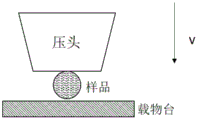
图3是本发明抗压强度测试装置图。Figure 3 is a diagram of the compressive strength testing device of the present invention.
图4是本发明实施例1颗粒10K倍下的SEM图。FIG. 4 is a SEM image of the particles of Example 1 of the present invention at 10K times.
具体实施方式Detailed ways
下面详细说明根据本发明的正极活性材料、正极材料以及使用本发明正极活性材料或正极材料的电化学储能装置。The positive electrode active material, the positive electrode material, and the electrochemical energy storage device using the positive electrode active material or the positive electrode material according to the present invention are described in detail below.
本发明的第一方面提供一种正极活性材料,所述正极活性材料包括由一次颗粒组成的二次颗粒,所述二次颗粒的SEM图谱中单位球表面积内一次颗粒的个数σ为5个/μm2~30个/μm2,所述二次颗粒的单颗粒抗压强度为60MPa~300MPa,所述正极活性材料的分子式为LixNiyCozMkMepOrAm,0.95≤x≤1.05,0≤y≤1,0≤z≤1,0≤k≤1,0≤p≤0.1,1≤r≤2,0≤m≤2,m+r≤2,M选自Mn和/或Al,Me选自Zr、Zn、Cu、Cr、Mg、Fe、V、Ti、Sr、Sb、Y、W、Nb中的一种或多种的组合,A选自N、F、S、Cl中的一种或多种的组合。锂金属过渡氧化物的正极活性材料为一次颗粒组成的二次颗粒,相比于单晶颗粒,二次颗粒的极化较小,能够有效降低锂离子电池的内阻;但是由于二次颗粒内部的一次颗粒之间存在一定间隙且不同的合成工艺导致一次颗粒间的结合力有明显差异,通过控制二次颗粒表层单位球表面积内一次颗粒的个数,能够提高二次颗粒的表面结构的紧实度。本发明中的正极活性材料的表面结构紧实度较高、单颗粒抗压强度优良、离子传输距离适中,能够改善循环过程中的颗粒开裂问题,同时保证正极活性材料的导离子性能良好,从而保证使用本发明所述正极活性材料的锂离子电池具有良好的循环性能、较低的体积膨胀率以及良好的动力学性能。A first aspect of the present invention provides a positive electrode active material, the positive electrode active material includes secondary particles composed of primary particles, and the number σ of primary particles per unit spherical surface area in the SEM image of the secondary particles is 5 /μm 2 to 30 pieces/μm 2 , the single particle compressive strength of the secondary particles is 60 MPa to 300 MPa, and the molecular formula of the positive electrode active material is Li x Ni y Co z M k Me p O r A m , 0.95 ≤x≤1.05, 0≤y≤1, 0≤z≤1, 0≤k≤1, 0≤p≤0.1, 1≤r≤2, 0≤m≤2, m+r≤2, M is selected from Mn and/or Al, Me is selected from the combination of one or more of Zr, Zn, Cu, Cr, Mg, Fe, V, Ti, Sr, Sb, Y, W, Nb, A is selected from N, F A combination of one or more of , S, and Cl. The positive active material of lithium metal transition oxide is secondary particles composed of primary particles. Compared with single crystal particles, the polarization of secondary particles is smaller, which can effectively reduce the internal resistance of lithium-ion batteries; however, due to the internal resistance of secondary particles There is a certain gap between the primary particles, and different synthesis processes lead to obvious differences in the binding force between the primary particles. By controlling the number of primary particles per unit spherical surface area on the surface of the secondary particles, the tightness of the surface structure of the secondary particles can be improved. solidity. The positive electrode active material in the present invention has high surface structure compactness, excellent single particle compressive strength, and moderate ion transmission distance, which can improve the particle cracking problem in the cycle process, and at the same time ensure good ion-conducting performance of the positive electrode active material. It is ensured that the lithium ion battery using the positive electrode active material of the present invention has good cycle performance, low volume expansion rate and good dynamic performance.
本发明所提供的正极活性材料中,所述正极活性材料为锂过渡金属氧化物,由于在制备过程中存在一定的元素含量偏析,因此所述正极活性材料的分子式中锂元素可能在一定程度上存在贫锂或者富锂的情况,锂元素的相对含量范围在0.95≤x≤1.05时,对所述正极活性材料的容量发挥影响不大,可选的,锂元素的相对含量为0.95≤x≤1、1≤x≤1.05。In the positive electrode active material provided by the present invention, the positive electrode active material is a lithium transition metal oxide. Due to the segregation of a certain element content during the preparation process, the lithium element in the molecular formula of the positive electrode active material may be to a certain extent. In the presence of lithium-poor or lithium-rich conditions, when the relative content of lithium is in the range of 0.95≤x≤1.05, it has little effect on the capacity of the positive electrode active material. Optionally, the relative content of lithium is 0.95≤x≤ 1. 1≤x≤1.05.
本发明所提供的正极活性材料中,优选的,所述正极活性材料为同时含有Ni、Co,以及Mn或Al中至少一种元素的三元锂过渡金属氧化物,所述正极活性材料的分子式中:0<y<1,0<z<1,0<k<1,0≤p≤0.1,1≤r≤2,0≤m≤2,m+r≤2。In the positive electrode active material provided by the present invention, preferably, the positive electrode active material is a ternary lithium transition metal oxide containing Ni, Co, and at least one element of Mn or Al at the same time, and the molecular formula of the positive electrode active material is Medium: 0<y<1, 0<z<1, 0<k<1, 0≤p≤0.1, 1≤r≤2, 0≤m≤2, m+r≤2.
作为本发明的进一步优选方式,所述正极活性材料为高镍正极活性材料,在所述正极活性材料的分子式中,0.50<y≤0.95,0.05≤z≤0.2,0.05≤k≤0.4,0≤p≤0.05。具体的,所述正极活性材料可以为LiNi1/3Co1/3Mn1/3O2、LiNi0.5Co0.2Mn0.3O2、LiNi0.5Co0.25Mn0.25O2、LiNi0.55Co0.15Mn0.3O2、LiNi0.55Co0.1Mn0.35O2、LiNi0.55Co0.05Mn0.4O2、LiNi0.6Co0.2Mn0.2O2、LiNi0.75Co0.1Mn0.15O2、LiNi0.8Co0.1Mn0.1O2、LiNi0.85Co0.05Mn0.1O2、LiNi0.88Co0.05Mn0.07O2、LiNi0.9Co0.05Mn0.05O2、LiNi0.72Co0.18Al0.1O2、LiNi0.81Co0.045Mn0.045Al0.1O2,也可以为上述物质经过Me和/或A对进行部分取代改性后的活性材料,其中,Me选自Zr、Zn、Cu、Cr、Mg、Fe、V、Ti、Sr、Sb、Y、W、Nb中的一种或多种的组合,A选自N、F、S、Cl中的一种或多种的组合。As a further preferred embodiment of the present invention, the positive electrode active material is a high-nickel positive electrode active material, and in the molecular formula of the positive electrode active material, 0.50<y≤0.95, 0.05≤z≤0.2, 0.05≤k≤0.4, 0≤ p≤0.05. Specifically, the positive active material may be LiNi 1/3 Co 1/3 Mn 1/3 O 2 , LiNi 0.5 Co 0.2 Mn 0.3 O 2 , LiNi 0.5 Co 0.25 Mn 0.25 O 2 , LiNi 0.55 Co 0.15 Mn 0.3 O 2. LiNi 0.55 Co 0.1 Mn 0.35 O 2 , LiNi 0.55 Co 0.05 Mn 0.4 O 2 , LiNi 0.6 Co 0.2 Mn 0.2 O 2 , LiNi 0.75 Co 0.1 Mn 0.15 O 2 , LiNi 0.8 Co 0.1 Mn 0.1 O 2 , LiNi 0.85 Co 0.8 0.05 Mn 0.1 O 2 , LiNi 0.88 Co 0.05 Mn 0.07 O 2 , LiNi 0.9 Co 0.05 Mn 0.05 O 2 , LiNi 0.72 Co 0.18 Al 0.1 O 2 , LiNi 0.81 Co 0.045 Mn 0.045 Al 0.1 O 2 . The active material after partial substitution and modification of Me and/or A pair, wherein Me is selected from one of Zr, Zn, Cu, Cr, Mg, Fe, V, Ti, Sr, Sb, Y, W, Nb or a combination of more than one, A is selected from a combination of one or more of N, F, S, and Cl.
更为优选的,在所述正极活性材料的分子式中,0.70≤y≤0.95,0≤z≤0.2,0≤k≤0.2,0≤p≤0.05。More preferably, in the molecular formula of the positive electrode active material, 0.70≤y≤0.95, 0≤z≤0.2, 0≤k≤0.2, 0≤p≤0.05.
本发明中正极活性材料中选择镍含量较高的正极活性材料,由于Ni元素的相对含量越高、该材料的理论克容量越高,能够有效提高电池的体积能量密度,但是高镍正极活性材料的表面残锂量较高、颗粒更加容易发生破碎,通过控制高镍正极活性材料的二次颗粒表面紧实度、单颗粒的抗压强度,能够有效解决高容量电池在循环过程的产气问题,提高电池的能量密度和使用寿命。In the present invention, the positive electrode active material with higher nickel content is selected. Since the higher the relative content of Ni element, the higher the theoretical gram capacity of the material, the volume energy density of the battery can be effectively improved, but the high nickel positive electrode active material The amount of residual lithium on the surface is higher, and the particles are more likely to be broken. By controlling the surface compactness of the secondary particle and the compressive strength of the single particle of the high-nickel cathode active material, the gas production problem of the high-capacity battery during the cycle can be effectively solved. , improve the energy density and service life of the battery.
本发明所提供的正极活性材料中,所述二次颗粒的单颗粒抗压强度,是指“粒径在平均粒径Dv50上下波动10%范围、单独的一个二次颗粒作为单颗粒,在外力作用下,压碎时的最小压强”。本发明中二次颗粒的单颗粒抗压强度选自60MPa~300MPa、60MPa~80MPa、80MPa~100MPa、100MPa~120MPa、120MPa~150MPa、150MPa~180MPa、180MPa~200MPa、200MPa~220Mpa、220MPa~240Mpa、240MPa~260MPa、260MPa~280MPa、280MPa~300MPa。In the positive electrode active material provided by the present invention, the single particle compressive strength of the secondary particles refers to "the particle size fluctuates by 10% up and down the average
本发明所提供的正极活性材料中,所述正极活性材料的粉体压实密度不低于3.3g/cm3。本发明所述的正极活性材料的抗压性能良好、粉体压实密度高,因此在极片制作过程中,能够承受较大的压力而不发生破碎,有利于提高正极极片的压实密度,提高电池的体积能量密度。In the positive electrode active material provided by the present invention, the powder compaction density of the positive electrode active material is not less than 3.3 g/cm 3 . The positive electrode active material of the present invention has good compression resistance and high powder compaction density. Therefore, in the process of making the pole piece, it can withstand a large pressure without breaking, which is beneficial to improve the compaction density of the positive pole piece. , improve the volume energy density of the battery.
本发明所提供的正极活性材料中,所述二次颗粒的Dv10为2μm~8μm,Dv50为5μm~18μm,Dv90为10μm~30μm。可选的,Dv10为2μm~3μm、3μm~4μm、4μm~5μm、5μm~6μm、6μm~7μm、7μm~8μm,Dv50为5μm~18μm、5μm~8μm、8μm~10μm、10μm~12μm、12μm~15μm、15μm~18μm,Dv90为10μm~30μm、10μm~15μm、15μm~20μm、20μm~25μm、25μm~30μm。In the positive electrode active material provided by the present invention, the D v 10 of the secondary particles is 2 μm to 8 μm, the
本发明所提供的正极活性材料中,所述二次颗粒为一次颗粒按一次颗粒的延伸方向堆积获得,所述一次颗粒为棒状、锥状、或针状,一次颗粒沿其径向方向延伸堆积形成二次颗粒。所述一次颗粒的长度为100nm~1000nm,截面宽度为50nm~400nm。可选的,所述一次颗粒长度为100nm~1000nm、100nm~200nm、200nm~300nm、300nm~400nm、400nm~500nm、500nm~600nm、600nm~700nm、700nm~800nm、800nm~900nm、900nm~1000nm;截面宽度为50nm~400nm、50nm~100nm、100nm~150nm、150nm~200nm、200nm~300nm、300nm~350nm、350nm~400nm。In the positive electrode active material provided by the present invention, the secondary particles are obtained by stacking the primary particles in the extending direction of the primary particles, the primary particles are rod-shaped, cone-shaped, or needle-shaped, and the primary particles are extended and stacked along the radial direction thereof. Secondary particles are formed. The length of the primary particles is 100 nm to 1000 nm, and the cross-sectional width is 50 nm to 400 nm. Optionally, the length of the primary particle is 100nm~1000nm, 100nm~200nm, 200nm~300nm, 300nm~400nm, 400nm~500nm, 500nm~600nm, 600nm~700nm, 700nm~800nm, 800nm~900nm, 900nm~1000nm; The cross-sectional widths are 50 nm to 400 nm, 50 nm to 100 nm, 100 nm to 150 nm, 150 nm to 200 nm, 200 nm to 300 nm, 300 nm to 350 nm, and 350 nm to 400 nm.
作为本发明的一种优选方式,所述一次颗粒的长度与径向截面宽度的比值为2~20、2~5、5~8、8~10、10~12、12~15、15~18、18~20。As a preferred embodiment of the present invention, the ratio of the length of the primary particles to the width of the radial section is 2-20, 2-5, 5-8, 8-10, 10-12, 12-15, 15-18 , 18 to 20.
本发明所提供的正极活性材料中,所述二次颗粒的BET为0.3m2/g~0.8m2/g、0.3m2/g~0.4m2/g、0.4m2/g~0.5m2/g、0.5m2/g~0.6m2/g、0.6m2/g~0.7m2/g、0.7m2/g~0.8m2/g。In the positive electrode active material provided by the present invention, the BET of the secondary particles is 0.3m 2 /g~0.8m 2 /g, 0.3m 2 /g~0.4m 2 /g, 0.4m 2 /g~0.5m 2 /g, 0.5m 2 /g to 0.6m 2 /g, 0.6m 2 /g to 0.7m 2 /g, 0.7m 2 /g to 0.8m 2 / g .
本发明中所提供的正极活性材料中,二次颗粒的体积粒径分布在上述范围内时,能够保证正极活性材料的比表面积较低、同时离子传输距离适中。当二次颗粒的粒径在上述范围内时,进一步控制一次颗粒的长度、宽度以及长度与径向截面宽度的比值在上述范围,能够保证形成的二次颗粒的表面以及内部结构具有较高的致密度,锂离子在一次颗粒之间的传输距离适中,还有利于提升二次颗粒的力学强度。In the positive electrode active material provided in the present invention, when the volume particle diameter of the secondary particles is distributed within the above range, it can ensure that the specific surface area of the positive electrode active material is low and the ion transport distance is moderate. When the particle size of the secondary particles is within the above range, further controlling the length, width and ratio of the length to the radial section width of the primary particles within the above range can ensure that the surface and internal structure of the formed secondary particles have higher Density, the transport distance of lithium ions between primary particles is moderate, and it is also beneficial to improve the mechanical strength of secondary particles.
本发明所提供的正极活性材料中,所述二次颗粒中,至少部分的非最外层位置的一次颗粒表面设置有内包覆层,所述内包覆层包括包覆元素,所述内包覆层的包覆元素选自Al、Ba、Zn、Ti、Co、W、Y、Si、Sn、B、P中的一种或多种的组合。内包覆层的包覆元素不体现在正极活性材料分子式LixNiyCozMkMepOrAm中,通常情况下内包覆层的包覆元素并不进入晶格中。In the positive electrode active material provided by the present invention, in the secondary particles, at least part of the surfaces of the primary particles that are not at the outermost position are provided with an inner coating layer, the inner coating layer includes a coating element, and the inner coating layer includes a coating element. The cladding elements of the cladding layer are selected from Al, Ba, Zn, Ti, Co, W, Y, Si, Sn, B, and P in one or more combinations. The cladding elements of the inner cladding layer are not reflected in the molecular formula Li x Ni y Co z M k Me p O r Am of the positive electrode active material, and generally the clad elements of the inner clad layer do not enter the crystal lattice.
作为本发明的一种优选方式,所述内包覆层的包覆元素至少选自Al、Ba、Zn、Ti、Co、W、Y、Si、Sn、B、P中的两种或以上。本发明中,在一次颗粒表面的内包覆层中含有至少两种及以上的上述元素形成的氧化物,可以提高内包覆层在一次颗粒表面附着的稳定性,使内包覆层兼具一定的导离子性和导电子性,减少内包覆层对正极活性材料极化问题的影响,从而有效地避免正极活性材料与电解液的直接接触,降低与电解液的副反应,避免循环过程中大量气体,同时保证电池的阻抗较低、循环和倍率性能优良。As a preferred embodiment of the present invention, the cladding elements of the inner cladding layer are at least two or more selected from Al, Ba, Zn, Ti, Co, W, Y, Si, Sn, B, and P. In the present invention, the inner coating layer on the surface of the primary particle contains oxides formed by at least two or more of the above-mentioned elements, which can improve the adhesion stability of the inner coating layer on the surface of the primary particle, so that the inner coating layer has both Certain ionic conductivity and electronic conductivity can reduce the influence of the inner coating layer on the polarization of the positive electrode active material, thereby effectively avoiding the direct contact between the positive electrode active material and the electrolyte, reducing side reactions with the electrolyte, and avoiding the cycle process. A large amount of gas in the medium, while ensuring low impedance, excellent cycle and rate performance of the battery.
本发明第二方面提供一种正极材料,包括本发明第一方面的正极活性材料,所述正极活性材料表面设置有外包覆层,外包覆层的包覆元素选自Al、Ba、Zn、Ti、Co、W、Y、Si、Sn、B、P中的一种或多种的组合。The second aspect of the present invention provides a positive electrode material, including the positive electrode active material of the first aspect of the present invention, wherein the surface of the positive electrode active material is provided with an outer coating layer, and the coating element of the outer coating layer is selected from Al, Ba, Zn , a combination of one or more of Ti, Co, W, Y, Si, Sn, B, P.
作为本发明的一种优选方式,在所述正极材料表面设置有外包覆层的同时,所述二次颗粒中至少部分的非最外层位置的一次颗粒表面设置有内包覆层。进一步优选地,所述外包覆层与所述内包覆层的包覆物质相同。As a preferred mode of the present invention, while the outer coating layer is provided on the surface of the positive electrode material, the inner coating layer is provided on the surface of at least part of the primary particles in the non-outermost position of the secondary particles. Further preferably, the coating material of the outer coating layer and the inner coating layer is the same.
作为本发明的一种优选方式,所述外包覆层的包覆元素至少选自Al、Ba、Zn、Ti、Co、W、Y、Si、Sn、B、P中的两种或以上。本发明中,在正极活性材料表面的外包覆层中含有至少两种及以上的上述元素形成的氧化物,可以提高外包覆层在正极活性材料表面附着的稳定性,使外包覆层兼具一定的导离子性和导电子性,减少外包覆层对正极活性材料极化问题的影响,从而有效地避免正极活性材料与电解液的直接接触,降低与电解液的副反应,避免循环过程中大量气体,同时保证电池的阻抗较低、循环和倍率性能优良。As a preferred embodiment of the present invention, the cladding elements of the outer cladding layer are at least two or more selected from Al, Ba, Zn, Ti, Co, W, Y, Si, Sn, B, and P. In the present invention, the outer cladding layer on the surface of the positive electrode active material contains oxides formed by at least two or more of the above-mentioned elements, which can improve the adhesion stability of the outer cladding layer on the surface of the positive electrode active material, and make the outer cladding layer more stable. It has both ionic conductivity and electronic conductivity to reduce the influence of the outer coating on the polarization of the positive electrode active material, thereby effectively avoiding the direct contact between the positive electrode active material and the electrolyte, reducing side reactions with the electrolyte, and avoiding A large amount of gas is generated during the cycle, while ensuring low impedance and excellent cycle and rate performance of the battery.
本发明所提供的正极材料中,所述外包覆层为连续的和/或非连续的层状包覆层;优选地,所述外包覆层为连续状的第一包覆层与非连续状的第二包覆层的复合形态,更优选地,形成所述非连续的包覆层的物质与所述连续状包覆层的物质不同。其中,形成非连续状包覆层的元素选自Al、Ba、Zn、Ti、Co中的一种或多种的组合,形成连续状包覆层的元素选自W、Y、Si、B、P、Sn中一种或多种的组合。In the cathode material provided by the present invention, the outer cladding layer is a continuous and/or discontinuous layered cladding layer; preferably, the outer cladding layer is a continuous first cladding layer and a non-continuous cladding layer. In the composite form of the continuous second coating layer, it is more preferable that the substance forming the discontinuous coating layer is different from the substance of the continuous coating layer. Wherein, the elements forming the discontinuous cladding layer are selected from one or more combinations of Al, Ba, Zn, Ti, and Co, and the elements forming the continuous cladding layer are selected from W, Y, Si, B, A combination of one or more of P and Sn.
本发明所提供的正极材料中,非连续的层状包覆层可以是离散的岛状形态的外包覆层,非连续的包覆层可在正极活性材料的表面起到类似“纳米钉”的作用,这样不仅可与正极活性材料牢固地结合,有效地降低循环过程中正极活性材料颗粒破碎的概率,同时非连续的层状包覆层还能增强正极活性材料的一次颗粒与一次颗粒之间的结合力,使得正极活性材料(尤其是一次颗粒团聚形成的二次颗粒形式)整体的机械强度增加,不容易破碎。同时,还在正极活性材料表面形成连续状包覆层,能有效降低正极材料表面的粗糙度,降低正极材料的比表面积,进而减少正极材料表面与电解液的有效接触面积,降低正极材料表面与电解液的副反应,避免正极材料表面与电解液发生副反应而产生大量气体。In the positive electrode material provided by the present invention, the discontinuous layered coating layer can be a discrete island-shaped outer coating layer, and the discontinuous coating layer can act like a "nano-nail" on the surface of the positive electrode active material In this way, it can not only be firmly combined with the positive electrode active material, effectively reduce the probability of the positive electrode active material particles breaking during the cycle, and the discontinuous layered coating can also enhance the positive electrode active material. The bonding force between them increases the overall mechanical strength of the positive active material (especially in the form of secondary particles formed by agglomeration of primary particles) and is not easily broken. At the same time, a continuous coating layer is formed on the surface of the positive electrode active material, which can effectively reduce the surface roughness of the positive electrode material, reduce the specific surface area of the positive electrode material, and then reduce the effective contact area between the surface of the positive electrode material and the electrolyte, and reduce the surface of the positive electrode material. The side reaction of the electrolyte avoids the side reaction between the surface of the positive electrode material and the electrolyte to generate a large amount of gas.
本发明第三方面提供一种测定本发明第一方面的正极活性材料或第二方面的正极材料中二次颗粒的单位球表面积内一次颗粒的个数的方法,包括以下步骤:A third aspect of the present invention provides a method for measuring the number of primary particles per unit spherical surface area of secondary particles in the positive electrode active material of the first aspect of the present invention or the positive electrode material of the second aspect, comprising the following steps:
(1)选取粒径为所述二次颗粒平均粒径Dv50±20%的正极活性材料样品,对样品进行SEM检测,得到10K倍数下的SEM图谱;(1) Select a positive electrode active material sample with a particle size of the average particle size D v of the secondary particles of 50±20%, carry out SEM inspection on the sample, and obtain an SEM spectrum at a multiple of 10K;
(2)根据步骤(1)得到的SEM图谱,通过以下公式计算正极活性材料中单位面积内一次颗粒的个数σ(个/μm2):(2) According to the SEM pattern obtained in step (1), calculate the number σ (pieces/μm 2 ) of primary particles per unit area in the positive electrode active material by the following formula:
σ=(x1+x2)/2*(y1+y2)/2/(A/C*B/C)σ=(x1+x2)/2*(y1+y2)/2/(A/C*B/C)
其中,in,
x1表示在二次颗粒10K倍数的SEM图中,图片下边缘横向上的一次颗粒的个数;x1 represents the number of primary particles on the lateral direction of the lower edge of the image in the SEM image of the secondary particle at a multiple of 10K;
x2表示在二次颗粒10K倍数的SEM图中,图片上边缘横向上的一次颗粒的个数;x2 represents the number of primary particles in the lateral direction of the upper edge of the image in the SEM image of the secondary particle at a multiple of 10K;
y1表示在二次颗粒10K倍数的SEM图中,图片左边缘纵向上的一次颗粒的个数;y1 represents the number of primary particles in the longitudinal direction of the left edge of the picture in the SEM image of the secondary particle with a multiple of 10K;
y2表示在二次颗粒10K倍数的SEM图中,图片右边缘纵向上的一次颗粒的个数;y2 represents the number of primary particles in the longitudinal direction of the right edge of the picture in the SEM image of the secondary particle with a multiple of 10K;
A表示二次颗粒10K倍数的SEM图的横向实际测量长度,单位为mm;A represents the actual measurement length in the lateral direction of the SEM image of the secondary particle with a multiple of 10K, in mm;
B表示二次颗粒10K倍数的SEM图的纵向实际测量长度,单位为mm;B represents the actual measured longitudinal length of the SEM image of the secondary particle with a multiple of 10K, in mm;
C表示在二次颗粒10K倍数的SEM图中,标尺为1μm时对应的实际测量长度,单位为mm/μm;C represents the actual measured length when the scale is 1 μm in the SEM image of the secondary particle with a multiple of 10K, and the unit is mm/μm;
在计算二次颗粒10K倍数的SEM图中的一次颗粒的个数时,只要出现了一次颗粒的一部分,就算作一个一次颗粒。When calculating the number of primary particles in the SEM image of the 10K multiple of the secondary particles, as long as a part of the primary particle appears, it is regarded as one primary particle.
本发明中通过上述方法可以直观的表征单位球表面积内一次颗粒的个数σ,真实的反映出二次颗粒表面一次颗粒的大小及分布情况,相比于仅表征一次颗粒以及二次颗粒的晶粒尺寸,计算二次颗粒10K倍下SEM图中一次颗粒个数的方法,是客观表征由一次颗粒组成的二次颗粒球体结构的紧实程度的一种有效途径。In the present invention, the number σ of the primary particles per unit spherical surface area can be intuitively characterized by the above method, which truly reflects the size and distribution of the primary particles on the surface of the secondary particles. Particle size, the method of calculating the number of primary particles in the SEM image of the secondary particles at 10K times is an effective way to objectively characterize the compactness of the spherical structure of the secondary particles composed of the primary particles.
本发明的第四方面提供本发明第一方面的正极活性材料的制备方法,所述正极活性材料的方法对于本领域技术人员来说应该是已知的,例如,可以包括:本领域技术人员可根据正极活性材料的元素组成,选择合适的正极活性材料的原料和配比。例如,所述正极活性材料的原料可以包括镍钴锰和/或铝的三元材料前驱体、锂源、Me源、A源等,各原料之间的比例通常参照正极活性材料中各元素的比例进行配比。更具体的,所述三元材料前驱体可以是包括但不限于Ni1/3Co1/3Mn1/3(OH)2、Ni0.5Co0.2Mn0.3(OH)2、Ni0.5Co0.25Mn0.25(OH)2、Ni0.55Co0.15Mn0.3(OH)2、Ni0.55Co0.1Mn0.35(OH)2、Ni0.55Co0.05Mn0.4(OH)2、Ni0.6Co0.2Mn0.2(OH)2、Ni0.75Co0.1Mn0.15(OH)2、Ni0.8Co0.1Mn0.1(OH)2、Ni0.88Co0.05Mn0.07(OH)2、0.9Ni0.8Co0.2(OH)2·0.1Al(OH)3、0.9Ni0.9Co0.05Mn0.05(OH)2·0.1Al(OH)3,所述锂源可以是含锂的化合物,所述含锂化合物可以是包括但不限于LiOH·H2O、LiOH、Li2CO3、Li2O等中的一种或多种的组合,所述Me源通常可以是含Me元素的化合物,所述含Me元素的化合物可以是含有Zr、Zn、Cu、Cr、Mg、Fe、V、Ti、Sr、Sb、Y、W、Nb中至少一种元素的氧化物、硝酸盐、碳酸盐中的一种或几种,所述A源可以是含A元素的化合物,所述含A元素的化合物可以是包括但不限于LiF、NaCl、Na2S、Li3N等中的一种或多种的组合。再例如,所述烧结的条件可以是800℃、氧气浓度≥20%。The fourth aspect of the present invention provides a method for preparing the positive electrode active material of the first aspect of the present invention, and the method for the positive electrode active material should be known to those skilled in the art, for example, it may include: those skilled in the art may According to the elemental composition of the positive electrode active material, select the appropriate raw material and ratio of the positive electrode active material. For example, the raw materials of the positive electrode active material may include ternary material precursors of nickel, cobalt, manganese and/or aluminum, lithium source, Me source, A source, etc., and the ratio between the raw materials is usually referred to the ratio of each element in the positive electrode active material. Proportion to match. More specifically, the ternary material precursor may include but not limited to Ni 1/3 Co 1/3 Mn 1/3 (OH) 2 , Ni 0.5 Co 0.2 Mn 0.3 (OH) 2 , Ni 0.5 Co 0.25 Mn 0.25 (OH) 2 , Ni 0.55 Co 0.15 Mn 0.3 (OH) 2 , Ni 0.55 Co 0.1 Mn 0.35 (OH) 2 , Ni 0.55 Co 0.05 Mn 0.4 (OH) 2 , Ni 0.6 Co 0.2 Mn 0.2 (OH) 2 , Ni 0.75 Co 0.1 Mn 0.15 (OH) 2 , Ni 0.8 Co 0.1 Mn 0.1 (OH) 2 , Ni 0.88 Co 0.05 Mn 0.07 (OH) 2 , 0.9Ni 0.8 Co 0.2 (OH) 2 ·0.1Al(OH) 3 , 0.9Ni 0.9 Co 0.05 Mn 0.05 (OH) 2 ·0.1Al(OH) 3 , the lithium source can be a lithium-containing compound, and the lithium-containing compound can be including but not limited to LiOH·H 2 O, LiOH, Li A combination of one or more of 2 CO 3 , Li 2 O, etc., the Me source can generally be a compound containing Me element, and the compound containing Me element can be a compound containing Zr, Zn, Cu, Cr, Mg , one or more of oxides, nitrates and carbonates of at least one element in Fe, V, Ti, Sr, Sb, Y, W, Nb, and the A source can be a compound containing A element , the A element-containing compound may be a combination including but not limited to one or more of LiF, NaCl, Na 2 S, Li 3 N, and the like. For another example, the sintering conditions may be 800° C. and oxygen concentration ≥ 20%.
所述正极活性材料的制备方法中还可以包括在所述二次颗粒中至少部分的非最外层位置的一次颗粒表面设置有内包覆层,在一次颗粒表面形成内包覆层的方法对于本领域技术人员来说应该是已知的,例如,可以包括:将一次颗粒在含包覆元素的化合物存在的条件下烧结,以在一次颗粒表面形成内包覆层。再例如,当内层包覆物质与外层包覆物质相同时,内层包覆工艺与外层包覆工艺可以合并为一步工艺,包覆物可以穿过二次颗粒表面及内部的孔隙,对二次颗粒的外表面及至少部分的内部一次颗粒进行同时包覆。本领域技术人员可根据内包覆层的组成、正极活性材料的粉末抗压强度、电阻率粉体电阻率等参数,选择合适的含包覆元素的化合物的种类、配比和烧结条件等。例如,所述含包覆元素的化合物可以是含有Al、Ba、Zn、Ti、Co、W、Y、Si、Sn、B、P中的一种或多种元素的氧化物、硝酸盐、磷酸盐、碳酸盐等,再例如,所述含包覆元素的化合物的使用量可以是0.01%~0.5%,再例如,所述烧结的条件可以是200℃~700℃高温烧结。The preparation method of the positive electrode active material may further comprise that an inner coating layer is provided on the surface of the primary particle at least part of the non-outermost position in the secondary particle, and the method of forming the inner coating layer on the surface of the primary particle is suitable for It should be known to those skilled in the art that, for example, it may include: sintering the primary particles in the presence of a compound containing a coating element to form an inner coating layer on the surface of the primary particles. For another example, when the inner layer coating material and the outer layer coating material are the same, the inner layer coating process and the outer layer coating process can be combined into a one-step process, and the coating material can pass through the surface of the secondary particle and the pores inside, The outer surfaces of the secondary particles and at least part of the inner primary particles are simultaneously coated. Those skilled in the art can select appropriate types, proportions and sintering conditions of compounds containing coating elements according to parameters such as the composition of the inner coating layer, the powder compressive strength of the positive electrode active material, and the resistivity of the resistivity powder. For example, the compound containing the coating element may be oxide, nitrate, phosphoric acid containing one or more elements of Al, Ba, Zn, Ti, Co, W, Y, Si, Sn, B, and P Salts, carbonates, etc., for example, the used amount of the compound containing the coating element may be 0.01%-0.5%, and the sintering condition may be high-temperature sintering at 200°C to 700°C.
本发明的第五方面提供本发明第二方面的正极材料的制备方法,包括:在本发明第一方面的正极活性材料表面形成外包覆层。A fifth aspect of the present invention provides a method for preparing the positive electrode material of the second aspect of the present invention, comprising: forming an outer cladding layer on the surface of the positive electrode active material of the first aspect of the present invention.
在正极活性材料表面形成外包覆层的方法对于本领域技术人员来说应该是已知的,例如,可以包括:将正极活性材料在含包覆元素的化合物存在的条件下烧结,以在正极活性材料表面形成外包覆层。本领域技术人员可根据外包覆层的组成、正极活性材料的粉末抗压强度、电阻率粉体电阻率等参数,选择合适的含包覆元素的化合物的种类、配比和烧结条件等。例如,所述含包覆元素的化合物可以是含有Al、Ba、Zn、Ti、Co、W、Y、Si、Sn、B、P中的一种或多种元素的氧化物、硝酸盐、磷酸盐、碳酸盐等,再例如,所述含包覆元素的化合物的使用量可以是0.01%~0.5%,再例如,所述烧结的条件可以是200℃~700℃高温烧结。The method of forming the outer coating layer on the surface of the positive electrode active material should be known to those skilled in the art, for example, it may include: sintering the positive electrode active material in the presence of a compound containing a coating element, so as to form a coating on the positive electrode active material. An outer coating is formed on the surface of the active material. Those skilled in the art can select appropriate types, proportions and sintering conditions of compounds containing coating elements according to parameters such as the composition of the outer coating layer, the powder compressive strength of the positive active material, and the resistivity of the resistivity powder. For example, the compound containing the coating element may be oxide, nitrate, phosphoric acid containing one or more elements of Al, Ba, Zn, Ti, Co, W, Y, Si, Sn, B, and P Salts, carbonates, etc., for example, the used amount of the compound containing the coating element may be 0.01%-0.5%, and the sintering condition may be high-temperature sintering at 200°C to 700°C.
本发明的第六方面提供一种电化学储能装置,包括本发明第一方面的正极活性材料或本发明第二方面的正极材料。A sixth aspect of the present invention provides an electrochemical energy storage device comprising the positive electrode active material of the first aspect of the present invention or the positive electrode material of the second aspect of the present invention.
在本发明第六方面所述的电化学储能装置中,需要说明的是,所述电化学储能装置可为超级电容器、锂离子电池、锂金属电池或钠离子电池。在本发明的实施例中,仅示出电化学储能装置为锂离子电池的实施例,但本发明不限于此。In the electrochemical energy storage device according to the sixth aspect of the present invention, it should be noted that the electrochemical energy storage device may be a supercapacitor, a lithium ion battery, a lithium metal battery or a sodium ion battery. In the embodiments of the present invention, only an embodiment in which the electrochemical energy storage device is a lithium ion battery is shown, but the present invention is not limited thereto.
在锂离子电池中,包括正极极片、负极极片、间隔于正极极片和负极极片之间的隔离膜、电解液,其中,所述正极极片包括本发明第一方面的正极活性材料或本发明第二方面的正极材料。制备所述锂离子电池的方法对于本领域技术人员来说应该是已知的,例如,所述正极极片、隔离膜和负极极片各自都可以是层体,从而可以裁剪成目标尺寸后依次叠放,还可以卷绕至目标尺寸,以用于形成电芯,并可以进一步与电解液结合以形成锂离子电池。In a lithium ion battery, it includes a positive pole piece, a negative pole piece, a separator spaced between the positive pole piece and the negative pole piece, and an electrolyte, wherein the positive pole piece includes the positive active material of the first aspect of the present invention or the positive electrode material of the second aspect of the present invention. The method for preparing the lithium ion battery should be known to those skilled in the art, for example, the positive electrode, separator and negative electrode can each be a layer body, so that they can be cut into the target size and then sequentially. Stacked, it can also be rolled to target dimensions for use in forming cells, and can be further combined with electrolytes to form lithium-ion batteries.
在锂离子电池中,所述正极极片包含正极集流体和位于所述正极集流体上的正极材料层,所述正极材料层包括本发明第一方面的正极活性材料或本发明第二方面的正极材料、粘结剂、导电剂。本领域技术人员可选择合适的方法制备所述正极极片,例如,可以包括如下步骤:将正极活性材料或正极材料、粘结剂、导电剂混合形成浆料后,涂布于正极集流体上。所述粘结剂通常包括含氟聚烯烃类粘结剂,相对于所述含氟聚烯烃类粘结剂来说,水通常是良溶剂,即所述含氟聚烯烃类粘结剂通常在水中具有良好的溶解性,例如,所述含氟聚烯烃类粘结剂可以是包括但不限于聚偏氟乙烯(PVDF)、偏氟乙烯共聚物等或它们的改性(例如,羧酸、丙烯酸、丙烯腈等改性)衍生物等。所述导电剂可以是本领域各种适用于锂离子(二次)电池的导电剂,例如,可以是包括但不限于乙炔黑、导电炭黑、碳纤维(VGCF)、碳纳米管(CNT)、科琴黑等中的一种或多种的组合。所述正极集流体通常可以为层体,所述正极集流体通常是可以汇集电流的结构或零件,所述正极集流体可以是本领域各种适用于作为锂离子电池正极集流体的材料,例如,所述正极集流体可以是包括但不限于金属箔等,更具体可以是包括但不限于铜箔、铝箔等。In a lithium ion battery, the positive electrode sheet comprises a positive electrode current collector and a positive electrode material layer on the positive electrode current collector, the positive electrode material layer comprising the positive electrode active material of the first aspect of the present invention or the positive electrode active material of the second aspect of the present invention Positive electrode material, binder, conductive agent. Those skilled in the art can choose a suitable method to prepare the positive electrode sheet. For example, it may include the following steps: after mixing the positive electrode active material or the positive electrode material, the binder and the conductive agent to form a slurry, then coating the positive electrode current collector . The binder usually includes a fluoropolyolefin-based binder, and water is usually a good solvent relative to the fluoropolyolefin-based binder, that is, the fluoropolyolefin-based binder is usually It has good solubility in water, for example, the fluorine-containing polyolefin-based binder may include but not limited to polyvinylidene fluoride (PVDF), vinylidene fluoride copolymer, etc. or their modifications (for example, carboxylic acid, Modified acrylic acid, acrylonitrile, etc.) derivatives, etc. The conductive agent can be various conductive agents suitable for lithium ion (secondary) batteries in the art, for example, can be including but not limited to acetylene black, conductive carbon black, carbon fiber (VGCF), carbon nanotube (CNT), A combination of one or more of Ketjen Black and the like. The positive electrode current collector can usually be a layered body, and the positive electrode current collector is usually a structure or part that can collect current. , the positive electrode current collector may include but not limited to metal foil, etc., more specifically may include but not limited to copper foil, aluminum foil, etc.
在锂离子电池中,所述负极极片通常包括负极集流体和位于负极集流体表面的负极活性物质层,所述负极活性物质层通常包括负极活性物质。所述负极活性物质可以是本领域各种适用于锂离子电池的负极活性物质的材料,例如,可以是包括但不限于石墨、软碳、硬碳、碳纤维、中间相碳微球、硅基材料、锡基材料、钛酸锂或其他能与锂形成合金的金属等中的一种或多种的组合。其中,所述石墨可选自人造石墨、天然石墨以及改性石墨中的一种或多种的组合;所述硅基材料可选自单质硅、硅氧化合物、硅碳复合物、硅合金中的一种或多种的组合;所述锡基材料可选自单质锡、锡氧化合物、锡合金中的一种或多种的组合。所述负极集流体通常是汇集电流的结构或零件,所述负极集流体可以是本领域各种适用于作为锂离子电池负极集流体的材料,例如,所述负极集流体可以是包括但不限于金属箔等,更具体可以是包括但不限于铜箔等。In a lithium ion battery, the negative electrode sheet usually includes a negative electrode current collector and a negative electrode active material layer located on the surface of the negative electrode current collector, and the negative electrode active material layer usually includes a negative electrode active material. The negative electrode active material can be a variety of materials in the art that are suitable for the negative electrode active material of lithium-ion batteries, for example, can be including but not limited to graphite, soft carbon, hard carbon, carbon fiber, mesocarbon microspheres, silicon-based materials A combination of one or more of , tin-based materials, lithium titanate, or other metals that can form alloys with lithium, and the like. Wherein, the graphite can be selected from a combination of one or more of artificial graphite, natural graphite and modified graphite; the silicon-based material can be selected from elemental silicon, silicon-oxygen compounds, silicon-carbon composites, and silicon alloys A combination of one or more of tin-based materials; the tin-based material can be selected from a combination of one or more of elemental tin, tin oxide compounds, and tin alloys. The negative electrode current collector is usually a structure or part that collects current, and the negative electrode current collector can be any material suitable for use as a negative electrode current collector for lithium ion batteries in the art. For example, the negative electrode current collector can include but not limited to Metal foil, etc., more specifically may include but not limited to copper foil and the like.
在锂离子电池中,所述隔离膜可以是本领域各种适用于锂离子电池隔离膜的材料,例如,可以是包括但不限于聚乙烯、聚丙烯、聚偏氟乙烯、芳纶、聚对苯二甲酸乙二醇酯、聚四氟乙烯、聚丙烯腈、聚酰亚胺,聚酰胺、聚酯和天然纤维等中的一种或多种的组合。In a lithium ion battery, the separator can be any material suitable for lithium ion battery separators in the art, for example, it can be polyethylene, polypropylene, polyvinylidene fluoride, aramid, polypara A combination of one or more of ethylene phthalate, polytetrafluoroethylene, polyacrylonitrile, polyimide, polyamide, polyester, and natural fibers, among others.
在锂离子电池中,所述电解液可以是本领域各种适用于锂离子电池的电解液,例如,所述电解液通常包括电解质和溶剂,所述电解质通常可以包括锂盐等,更具体的,所述锂盐可以是无机锂盐和/或有机锂盐等,具体可以是包括但不限于,所述锂盐可选自LiPF6、LiBF4、LiN(SO2F)2(简写为LiFSI)、LiN(CF3SO2)2(简写为LiTFSI)、LiClO4、LiAsF6、LiB(C2O4)2(简写为LiBOB)、LiBF2C2O4(简写为LiDFOB)中的一种或多种的组合。再例如,所述电解质的浓度可以为0.8mol/L~1.5mol/L之间。所述溶剂可以是本领域各种适用于锂离子电池的电解液的溶剂,所述电解液的溶剂通常为非水溶剂,优选可以为有机溶剂,具体可以是包括但不限于碳酸乙烯酯、碳酸丙烯酯、碳酸丁烯酯、碳酸戊烯酯、碳酸二甲酯、碳酸二乙酯、碳酸二丙酯、碳酸甲乙酯等或它们的卤代衍生物中的一种或多种的组合。In a lithium-ion battery, the electrolyte may be any electrolyte suitable for lithium-ion batteries in the art. For example, the electrolyte usually includes an electrolyte and a solvent, and the electrolyte may generally include a lithium salt, etc. More specifically , the lithium salt may be an inorganic lithium salt and/or an organic lithium salt, etc., specifically including but not limited to, the lithium salt may be selected from LiPF 6 , LiBF 4 , LiN(SO 2 F) 2 (abbreviated as LiFSI ), LiN(CF 3 SO 2 ) 2 (abbreviated as LiTFSI), LiClO 4 , LiAsF 6 , LiB(C 2 O 4 ) 2 (abbreviated as LiBOB), LiBF 2 C 2 O 4 (abbreviated as LiDFOB) one or more combinations. For another example, the concentration of the electrolyte may be between 0.8 mol/L and 1.5 mol/L. The solvent can be a variety of solvents suitable for the electrolyte of lithium ion batteries in the art, and the solvent of the electrolyte is usually a non-aqueous solvent, preferably an organic solvent, specifically including but not limited to ethylene carbonate, carbonic acid, etc. A combination of one or more of propylene ester, butylene carbonate, pentenyl carbonate, dimethyl carbonate, diethyl carbonate, dipropyl carbonate, ethyl methyl carbonate, etc. or their halogenated derivatives.
以下结合实施例进一步说明本发明的有益效果。The beneficial effects of the present invention are further described below in conjunction with the embodiments.
为了使本发明的发明目的、技术方案和有益技术效果更加清晰,以下结合实施例进一步详细描述本发明。但是,应当理解的是,本发明的实施例仅仅是为了解释本发明,并非为了限制本发明,且本发明的实施例并不局限于说明书中给出的实施例。实施例中未注明具体实验条件或操作条件的按常规条件制作,或按材料供应商推荐的条件制作。In order to make the invention purpose, technical solution and beneficial technical effect of the present invention clearer, the present invention is further described in detail below with reference to the embodiments. However, it should be understood that the embodiments of the present invention are only for explaining the present invention, not for limiting the present invention, and the embodiments of the present invention are not limited to the embodiments given in the specification. The specific experimental conditions or operating conditions are not specified in the examples, and are made according to conventional conditions, or according to the conditions recommended by the material supplier.
此外应理解,本发明中提到的一个或多个方法步骤并不排斥在所述组合步骤前后还可以存在其他方法步骤或在这些明确提到的步骤之间还可以插入其他方法步骤,除非另有说明;还应理解,本发明中提到的一个或多个设备/装置之间的组合连接关系并不排斥在所述组合设备/装置前后还可以存在其他设备/装置或在这些明确提到的两个设备/装置之间还可以插入其他设备/装置,除非另有说明。而且,除非另有说明,各方法步骤的编号仅为鉴别各方法步骤的便利工具,而非为限制各方法步骤的排列次序或限定本发明可实施的范围,其相对关系的改变或调整,在无实质变更技术内容的情况下,当亦视为本发明可实施的范畴。Furthermore, it should be understood that the mention of one or more method steps in the present invention does not exclude that other method steps may also be present before and after said combined step or that other method steps may be inserted between these expressly mentioned steps, unless otherwise There are descriptions; it should also be understood that the combined connection relationship between one or more devices/devices mentioned in the present invention does not exclude that there may be other devices/devices before and after the combined device/device or explicitly mentioned in these Other devices/devices can be inserted between the two devices/devices unless otherwise specified. Moreover, unless otherwise specified, the numbering of each method step is only a convenient tool for identifying each method step, rather than limiting the arrangement order of each method step or limiting the scope of the present invention. In the case where the technical content is not substantially changed, it should also be regarded as the scope in which the present invention can be implemented.
在下述实施例中,所使用到的试剂、材料以及仪器如没有特殊的说明,均可商购获得。In the following examples, the reagents, materials and instruments used are commercially available unless otherwise specified.
一、电池的制备1. Preparation of batteries
实施例1Example 1
1、正极材料的制备1. Preparation of cathode materials
1)将硫酸镍、硫酸锰、硫酸钴按摩尔比8:1:1配置成浓度为1mol/L的溶液,利用氢氧化物共沉淀技术,制备得到镍钴锰三元材料前驱体Ni0.8Co0.1Mn0.1(OH)2。制备前躯体的过程中,控制共沉淀时的起始pH值为9.5、氨浓度为0.4M、反应后陈化时间5h。1) Nickel sulfate, manganese sulfate, and cobalt sulfate are configured into a solution with a concentration of 1 mol/L in a molar ratio of 8:1:1, and a hydroxide co-precipitation technology is used to prepare a nickel-cobalt-manganese ternary material precursor Ni 0.8 Co. 0.1 Mn 0.1 (OH) 2 . In the process of preparing the precursor, the initial pH value during co-precipitation was controlled to be 9.5, the ammonia concentration was 0.4M, and the post-reaction aging time was 5h.
2)将上述镍钴锰三元材料前驱体Ni0.8Co0.1Mn0.1(OH)2、含Li化合物LiOH·H2O按摩尔比1:1.05置于混料设备中进行混料,然后置于气氛炉中800℃进行烧结,冷却后通过机械研磨即为正极活性材料基体;将上述正极活性材料基体与添加剂Al2O3按质量比100:0.3置于混料设备中进行混料,然后置于气氛炉中进行烧结450℃,形成经Al2O3包覆处理的正极材料。2) The above-mentioned nickel-cobalt-manganese ternary material precursor Ni 0.8 Co 0.1 Mn 0.1 (OH) 2 and Li-containing compound LiOH·H 2 O are placed in a mixing device in a molar ratio of 1:1.05 for mixing, and then placed in a mixing device. Sinter at 800°C in an atmosphere furnace, and after cooling, mechanical grinding is used to form the positive electrode active material matrix; the above-mentioned positive electrode active material matrix and additive Al 2 O 3 are placed in a mixing equipment in a mass ratio of 100:0.3 for mixing, and then placed Sintering was carried out at 450° C. in an atmosphere furnace to form a positive electrode material coated with Al 2 O 3 .
2、正极极片的制备2. Preparation of positive electrode pieces
步骤1:将制备得到的正极材料、粘接剂聚偏氟乙烯、导电剂乙炔黑按照质量比98:1:1进行混合,加入N~甲基吡咯烷酮(NMP),在真空搅拌机作用下搅拌均匀获得正极浆料;将正极浆料均匀涂覆于厚度为12μm的铝箔上;Step 1: Mix the prepared positive electrode material, binder polyvinylidene fluoride, and conductive agent acetylene black according to a mass ratio of 98:1:1, add N-methylpyrrolidone (NMP), and stir evenly under the action of a vacuum mixer Obtain the positive electrode slurry; uniformly coat the positive electrode slurry on the aluminum foil with a thickness of 12 μm;
步骤2:将涂覆后的极片经过100℃~130℃烘箱干燥;Step 2: drying the coated pole piece in an oven at 100℃~130℃;
步骤3:经过冷压、分切得到正极极片。Step 3: After cold pressing and slitting, a positive pole piece is obtained.
3、负极极片制备3. Preparation of negative pole piece
将负极活性材料石墨、增稠剂羧甲基纤维素钠、粘接剂丁苯橡胶、导电剂乙炔黑按照质量比97:1:1:1进行混合,加入去离子水,在真空搅拌机作用下获得负极浆料;将负极浆料均匀涂覆在厚度为8μm的铜箔上;将铜箔在室温晾干后转移至120℃烘箱干燥1h,然后经过冷压、分切得到负极极片。Mix the negative electrode active material graphite, thickener sodium carboxymethyl cellulose, binder styrene-butadiene rubber, and conductive agent acetylene black according to the mass ratio of 97:1:1:1, add deionized water, and under the action of a vacuum mixer The negative electrode slurry was obtained; the negative electrode slurry was uniformly coated on the copper foil with a thickness of 8 μm; the copper foil was dried at room temperature and then transferred to a 120°C oven to dry for 1 hour, and then the negative electrode pole piece was obtained by cold pressing and slitting.
4、电解液制备4. Electrolyte preparation
有机溶剂为含有碳酸亚乙酯(EC)、碳酸甲乙酯(EMC)和碳酸二乙酯(DEC)按体积比为20:20:60混合,在含水量<10ppm的氩气气氛手套箱中,将充分干燥的浓度为1mol/L锂盐溶解于有机溶剂中,混合均匀,获得电解液。The organic solvent is a mixture of ethylene carbonate (EC), ethyl methyl carbonate (EMC) and diethyl carbonate (DEC) in a volume ratio of 20:20:60, in an argon atmosphere glove box with a water content of <10ppm , the fully dried lithium salt with a concentration of 1 mol/L is dissolved in an organic solvent, and mixed uniformly to obtain an electrolyte solution.
5、隔离膜的制备5. Preparation of isolation film
选用12μm厚的聚丙烯隔离膜。Choose 12μm thick polypropylene separator.
6、电池的制备6. Preparation of battery
将正极极片、隔离膜、负极极片按顺序叠好,使隔离膜处于正、负极极片之间起到隔离的作用,再卷绕成方形的裸电芯后,装入铝塑膜,然后在80℃下烘烤除水后,注入相应的非水电解液、封口,经静置、热冷压、化成、夹具、分容等工序后,得到成品电池。Stack the positive pole piece, the separator film and the negative pole piece in order, so that the separator is placed between the positive and negative pole pieces to play the role of isolation. Then, after baking at 80°C to remove water, the corresponding non-aqueous electrolyte is injected, sealed, and the finished battery is obtained after standing, hot and cold pressing, formation, fixture, and volume separation.
实施例2Example 2
与实施例1基本相同,不同之处在于的正极材料的制备方法:前驱体制备过程中调节共沉淀时的pH值为10.5、氨浓度为0.3M,以及反应后的陈化时间为3h。Basically the same as Example 1, the difference lies in the preparation method of the positive electrode material: the pH value of the precursor preparation process is adjusted to 10.5, the ammonia concentration is 0.3M, and the aging time after the reaction is 3h.
实施例3Example 3
与实施例1基本相同,不同之处在于正极材料的制备方法:前驱体制备过程中调节共沉淀时的pH值为11、氨浓度为0.2M,以及反应后的陈化时间为5h。Basically the same as Example 1, the difference lies in the preparation method of the positive electrode material: the pH value of the precursor preparation process during co-precipitation is adjusted to 11, the ammonia concentration is 0.2M, and the aging time after the reaction is 5h.
实施例4Example 4
与实施例1基本相同,不同之处在于正极材料的制备方法:前驱体制备过程中调节共沉淀时的pH值为10、氨浓度为0.4M,以及反应后的陈化时间为2h。Basically the same as Example 1, the difference lies in the preparation method of the positive electrode material: in the process of preparing the precursor, the pH value during co-precipitation is adjusted to 10, the ammonia concentration is 0.4M, and the aging time after the reaction is 2h.
实施例5Example 5
与实施例1基本相同,不同之处在于正极材料的制备方法:前驱体制备过程中调节共沉淀时的pH值为11.5、氨浓度为0.3M,以及反应后的陈化时间2h。Basically the same as Example 1, the difference lies in the preparation method of the positive electrode material: the pH value of the precursor is adjusted to 11.5 during co-precipitation, the ammonia concentration is 0.3M, and the aging time after the reaction is 2h.
实施例6Example 6
与实施例1基本相同,不同之处在于正极材料的制备方法:前驱体制备过程中调节共沉淀时的pH值为9.8、氨浓度为0.3M,以及反应后的陈化时间为4h。Basically the same as Example 1, the difference lies in the preparation method of the cathode material: in the process of preparing the precursor, the pH value during co-precipitation is adjusted to 9.8, the ammonia concentration is 0.3M, and the aging time after the reaction is 4h.
实施例7Example 7
与实施例1基本相同,不同之处在于正极材料的制备方法:前驱体中Ni、Co、Mn元素的相对含量为0.75:0.1:0.15,在前驱体制备过程中调节共沉淀时的pH值为10.2、氨浓度为0.5M以及反应后的陈化时间为6h。Basically the same as Example 1, the difference lies in the preparation method of the positive electrode material: the relative content of Ni, Co, and Mn elements in the precursor is 0.75:0.1:0.15, and the pH value during the co-precipitation is adjusted during the preparation of the precursor. 10.2. The ammonia concentration is 0.5M and the aging time after the reaction is 6h.
实施例8Example 8
与实施例1基本相同,不同之处在于正极材料的制备方法:前驱体中Ni、Co、Mn元素的相对含量为0.6:0.2:0.2,在前驱体制备过程中调节共沉淀时的pH值为11.5、氨浓度为0.6M,以及反应后的陈化时间为3h。Basically the same as Example 1, the difference lies in the preparation method of the positive electrode material: the relative content of Ni, Co, and Mn elements in the precursor is 0.6:0.2:0.2, and the pH value during co-precipitation is adjusted during the preparation of the precursor. 11.5, the ammonia concentration is 0.6M, and the aging time after the reaction is 3h.
实施例9Example 9
与实施例1基本相同,不同之处在于正极材料的制备方法:前驱体中Ni、Co、Mn元素的相对含量为0.55:0.15:0.3,在前驱体制备过程中调节共沉淀时的pH值为11.2、氨浓度为0.3M,以及反应后的陈化时间为2h。Basically the same as Example 1, the difference lies in the preparation method of the positive electrode material: the relative content of Ni, Co, and Mn elements in the precursor is 0.55:0.15:0.3, and the pH value of the co-precipitation is adjusted during the preparation of the precursor. 11.2. The ammonia concentration is 0.3M, and the aging time after the reaction is 2h.
实施例10Example 10
与实施例1基本相同,不同之处在于正极材料的制备方法:前驱体中Ni、Co、Mn元素的相对含量为0.33:0.33:0.33,在前驱体制备过程中调节共沉淀时的pH值为10.9、氨浓度为0.4M以及反应后的陈化时间为3h。Basically the same as Example 1, the difference lies in the preparation method of the positive electrode material: the relative content of Ni, Co, and Mn elements in the precursor is 0.33:0.33:0.33, and the pH value during the co-precipitation is adjusted during the preparation of the precursor. 10.9, the ammonia concentration is 0.4M and the aging time after the reaction is 3h.
对比例1Comparative Example 1
对比例1的制备方法参照如上所述的实施例1制备方法,不同之处在于正极材料的制备方法:前驱体制备过程中调节共沉淀时的pH值为11、氨浓度为0.5M,以及反应后的陈化时间为6h。The preparation method of Comparative Example 1 refers to the preparation method of Example 1 as described above, and the difference lies in the preparation method of the positive electrode material: the pH value during the co-precipitation is adjusted to 11, the ammonia concentration is 0.5M during the preparation of the precursor, and the reaction The subsequent aging time was 6h.
对比例2Comparative Example 2
对比例2的制备方法参照如上所述的实施例1制备方法,不同之处在于正极材料的制备方法:前驱体制备过程中调节共沉淀时的pH值为12、氨浓度为0.6M,以及反应后的陈化时间为7h。The preparation method of Comparative Example 2 refers to the preparation method of Example 1 as described above, and the difference lies in the preparation method of the positive electrode material: the pH value during the co-precipitation is adjusted to 12, the ammonia concentration is 0.6 M during the preparation of the precursor, and the reaction The subsequent aging time was 7h.
对比例3Comparative Example 3
对比例3的制备方法参照如上所述的实施例1制备方法,不同之处在于正极材料的制备方法:前驱体制备过程中调节共沉淀时的pH值为10.5、氨浓度为0.1M,以及反应后的陈化时间为6h。The preparation method of Comparative Example 3 refers to the preparation method of Example 1 as described above, and the difference lies in the preparation method of the positive electrode material: the pH value during the preparation of the precursor is adjusted to be 10.5 during co-precipitation, the ammonia concentration is 0.1 M, and the reaction The subsequent aging time was 6h.
二、性能测试2. Performance test
取实施例1~10及对比例1~3制备的正极材料,测试其二次颗粒单位球体面积内单颗粒抗压强度、一次颗粒个数σ、压实密度及BET。测试结果见表2。The positive electrode materials prepared in Examples 1-10 and Comparative Examples 1-3 were taken, and the single particle compressive strength, number σ of primary particles, compaction density and BET in the unit sphere area of the secondary particles were tested. The test results are shown in Table 2.
1、抗压强度的测试方法1. Test method for compressive strength
(1)将样品放置于载物台上;(1) Place the sample on the stage;
(2)将压头以0.1μm/min的速度向下靠近样品,直至与样品可以接触;(2) Move the indenter down to the sample at a speed of 0.1 μm/min until it can contact the sample;
(3)接触的瞬间开始记录压头的压强和位移;(3) Record the pressure and displacement of the indenter at the moment of contact;
(4)持续以恒定速度向下挤压颗粒,直至颗粒碎裂;(4) Continue to squeeze the particles downward at a constant speed until the particles are broken;
2、BET测试方法2. BET test method
BET的测试采用国标方法气体吸附BET法测定固态物质比表面积GB/T 19587-2004测试方法进行。The BET test was carried out by the national standard method, the GB/T 19587-2004 test method for the determination of the specific surface area of solid substances by gas adsorption BET method.
3、压实密度测试方法3. Test method of compaction density
压实密度的测试采用国标上的锂离子电池石墨类负极材料GB/T 24533-2009测试方法进行,测试压力为5吨。The compaction density test was carried out using the GB/T 24533-2009 test method for lithium-ion battery graphite negative electrode materials on the national standard, and the test pressure was 5 tons.
4、一次颗粒个数的测定方法4. Determination of the number of particles at a time
用于测试二次颗粒中单位面积中一次颗粒个数,并且在实施例1中制备的样品的10K倍数的SEM图如图4所示,产品一次颗粒计算如下。For testing the number of primary particles per unit area in the secondary particles, and the SEM image of the 10K multiple of the sample prepared in Example 1 is shown in Figure 4, the primary particles of the product are calculated as follows.
根据公式σ=(x1+x2)/2*(y1+y2)/2/(A/C*B/C)计算在1μm×1μm的单位面积内的一次颗粒的个数,计算结果见表1中。Calculate the number of primary particles in a unit area of 1μm×1μm according to the formula σ=(x1+x2)/2*(y1+y2)/2/(A/C*B/C). The calculation results are shown in Table 1 middle.
σ1=(32+32)/2*(22+23)/2/(112/10*75/10)=8.5个/μm2。σ 1 =(32+32)/2*(22+23)/2/(112/10*75/10)=8.5 pieces/μm 2 .
其他实施例及对比例的计算方法相同,计算结果参见表2。The calculation methods of other embodiments and comparative examples are the same, and the calculation results are shown in Table 2.
表1实施例1的单位球表面积内一次颗粒个数Table 1 Number of primary particles per unit spherical surface area of Example 1

5、电池的循环性能测试方法5. Battery cycle performance test method
在45℃的恒温环境下,在2.8V~4.2V下,按照1C充电至4.2V,然后在4.2V下恒压充电至电流≤0.05mA,静置5min,然后按照1C放电至2.8V,容量记为Dn(n=0,1,2……),重复前面过程,直至容量衰减到初始容量的80%,记录该锂离子电池的循环圈数。实施例1~10和对比例1~3结果如表3所示。Under the constant temperature environment of 45°C, at 2.8V ~ 4.2V, charge to 4.2V according to 1C, then charge to 4.2V at constant voltage at 4.2V, let stand for 5min, and then discharge to 2.8V according to 1C, the capacity Denoted as Dn (n=0, 1, 2...), repeat the previous process until the capacity decays to 80% of the initial capacity, and record the number of cycles of the lithium-ion battery. Table 3 shows the results of Examples 1 to 10 and Comparative Examples 1 to 3.
6、电池的高温产气测试方法6. Test method for high temperature gas production of batteries
将电池以1C满充电至4.2V后,于70℃恒温箱中静置30天。并通过排水法测定电池的初始体积与静置30天后的体积,得到电池的体积膨胀率。After the battery was fully charged to 4.2V at 1C, it was left for 30 days in a 70°C incubator. The initial volume of the battery and the volume after standing for 30 days were measured by the drainage method to obtain the volume expansion rate of the battery.
电池的体积膨胀率(%)=(静置30天后的体积/初始体积-1)×100%。Volume expansion rate (%) of the battery=(volume after standing for 30 days/initial volume-1)×100%.
测试结果见表3。The test results are shown in Table 3.
7、1/3C容量测试方法7. 1/3C capacity test method
将锂离子电池在25℃的恒温环境下静置2h,然后在2.8V~4.2V下,按照1/3C充电至4.2V,然后在4.2V下恒压充电至电流≤0.05mA,静置5min,然后按照1C放电至2.8V,记录该锂离子电池的容量;将该容量测试值除以锂离子电池中正极材料的质量,即为该正极材料的1/3C容量。测试结果见表3。The lithium-ion battery was left for 2 hours at a constant temperature of 25°C, then charged at 1/3C to 4.2V at 2.8V to 4.2V, and then charged at a constant voltage at 4.2V until the current ≤ 0.05mA, and left for 5 minutes. , and then discharge to 2.8V according to 1C, record the capacity of the lithium ion battery; divide the test value of the capacity by the mass of the positive electrode material in the lithium ion battery, which is the 1/3C capacity of the positive electrode material. The test results are shown in Table 3.
表2实施例1~10与对比例1~3正极活性材料粉末表征Table 2 Examples 1-10 and Comparative Examples 1-3 Positive electrode active material powder characterization


表3实施例1~10与对比例1~3电池电化学性能测试结果Table 3 Battery electrochemical performance test results of Examples 1-10 and Comparative Examples 1-3
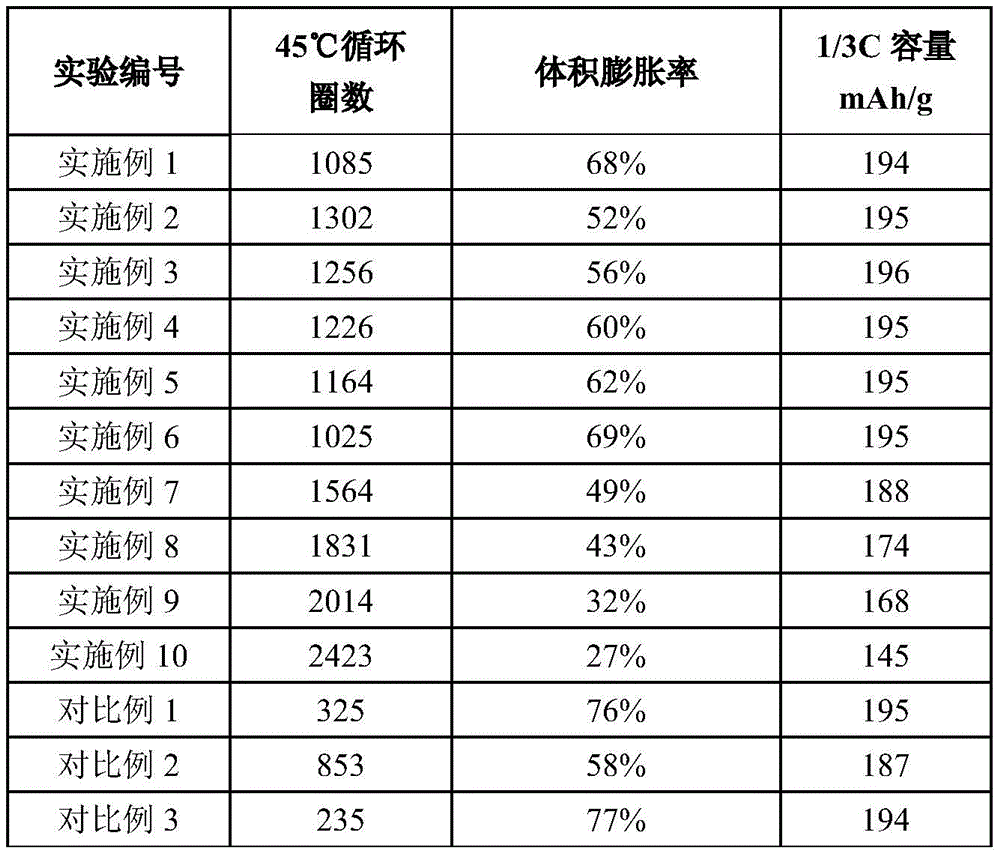
从表2和表3中可以发现:实施例1~6与对比例1~3的正极材料中Ni、Co、Mn元素的相对含量相同,由于实施例1~6中正极材料的单位球体面积中一次颗粒的个数以及单颗粒的抗压强度在特定范围,因此实施例1~6中正极材料的颗粒微观结构较紧实且粉体材料的力学强度较高、容量发挥较好,颗粒在极片制备或循环过程中不易发生破裂。实施例1~6中正极材料制备的锂离子电池的循环性能明显的高于对比例1~3,循环过程中的体积膨胀率明显下降。其中,对比例1中正极材料的单位球体面积中一次颗粒的个数适中、单颗粒的抗压强度较低,表明该二次颗粒内一次颗粒间的结合力较弱,因此制备的正极极片的压密较难提高;同时,二次颗粒容易在极片冷压以及循环过程中发生破裂,导致正极材料中大量的新鲜表面与电解液直接接触,因此产气较严重、循环性能较差。而在对比例2中,正极材料的单颗粒的单位球体面积中一次颗粒的个数偏低、单颗粒的抗压强度过高,表明此时二次颗粒内部一次颗粒的尺寸过大且相邻一次颗粒间的孔隙较少,导致正极材料的极化较高、离子传输率降低,因此电池的内阻偏高,劣化电池的循环性能。在对比例3中,正极材料的单位球体面积中一次颗粒的个数过高、单颗粒的抗压强度适中,表明该正极材料的二次颗粒中一次颗粒尺寸偏低、BET较高,因此形成的锂离子电池的产气量仍较大、循环性能较差。It can be found from Table 2 and Table 3 that the relative contents of Ni, Co and Mn elements in the positive electrode materials of Examples 1 to 6 and Comparative Examples 1 to 3 are the same. The number of primary particles and the compressive strength of a single particle are within a specific range. Therefore, in Examples 1 to 6, the particle microstructure of the positive electrode material is relatively compact, the mechanical strength of the powder material is higher, and the capacity is better. Fracture is unlikely to occur during tablet preparation or cycling. The cycle performance of the lithium ion batteries prepared from the positive electrode materials in Examples 1 to 6 is significantly higher than that of Comparative Examples 1 to 3, and the volume expansion rate during the cycle is significantly reduced. Among them, the number of primary particles in the unit sphere area of the positive electrode material in Comparative Example 1 is moderate, and the compressive strength of a single particle is low, indicating that the bonding force between primary particles in the secondary particles is weak, so the prepared positive electrode plate It is difficult to improve the compaction of the anode material; at the same time, the secondary particles are prone to rupture during the cold pressing of the pole piece and the cycle process, resulting in a large number of fresh surfaces in the positive electrode material being in direct contact with the electrolyte, resulting in serious gas production and poor cycle performance. In Comparative Example 2, the number of primary particles in the unit sphere area of a single particle of the positive electrode material is low, and the compressive strength of a single particle is too high, indicating that the size of the primary particles inside the secondary particles is too large and adjacent to each other. The pores between the primary particles are less, resulting in higher polarization of the positive electrode material and lower ion transport rate, so the internal resistance of the battery is higher, and the cycle performance of the battery is deteriorated. In Comparative Example 3, the number of primary particles per unit sphere area of the positive electrode material is too high, and the compressive strength of a single particle is moderate, indicating that the primary particle size of the secondary particles of the positive electrode material is low and the BET is high, so the formation of The gas production of the lithium-ion battery is still large and the cycle performance is poor.
而在实施例7~10中,正极材料中锂过渡金属氧化物中的Ni、Co、Mn元素的相对含量不同,正极材料的单位球体面积中一次颗粒的个数以及单颗粒的抗压强度在特定范围,随Ni含量的降低,锂离子电池的放电容量略有降低,但循环性能和产气问题有明显优化。In Examples 7 to 10, the relative contents of Ni, Co, and Mn elements in the lithium transition metal oxide in the positive electrode material were different, and the number of primary particles in the unit sphere area of the positive electrode material and the compressive strength of a single particle were In a specific range, with the decrease of Ni content, the discharge capacity of Li-ion battery is slightly reduced, but the cycle performance and gas generation problems are obviously optimized.
以上所述,仅为本发明的较佳实施例,并非对本发明任何形式上和实质上的限制,应当指出,对于本技术领域的普通技术人员,在不脱离本发明方法的前提下,还将可以做出若干改进和补充,这些改进和补充也应视为本发明的保护范围。凡熟悉本专业的技术人员,在不脱离本发明的精神和范围的情况下,当可利用以上所揭示的技术内容而做出的些许更动、修饰与演变的等同变化,均为本发明的等效实施例;同时,凡依据本发明的实质技术对上述实施例所作的任何等同变化的更动、修饰与演变,均仍属于本发明的技术方案的范围内。The above are only preferred embodiments of the present invention, and are not intended to limit the present invention in any form or substance. It should be pointed out that for those skilled in the art, without departing from the method of the present invention, the Several improvements and supplements can be made, and these improvements and supplements should also be regarded as the protection scope of the present invention. All those skilled in the art, without departing from the spirit and scope of the present invention, can utilize the above-disclosed technical content to make some changes, modifications and equivalent changes of evolution, all belong to the present invention. Equivalent embodiments; at the same time, any modification, modification and evolution of any equivalent changes made to the above embodiments according to the essential technology of the present invention still fall within the scope of the technical solutions of the present invention.
Claims (11)
Priority Applications (5)
| Application Number | Priority Date | Filing Date | Title |
|---|---|---|---|
| CN201811637371.5A CN111384371B (en) | 2018-12-29 | 2018-12-29 | Compression-resistant positive active material and electrochemical energy storage device |
| US17/416,122 US12451485B2 (en) | 2018-12-27 | 2019-11-25 | Pressure-resistant positive active material and electrochemical energy storage apparatus |
| PCT/CN2019/120511 WO2020134774A1 (en) | 2018-12-27 | 2019-11-25 | Anti-compression positive electrode active material and electrochemical energy storage device |
| EP19903072.7A EP3790083A4 (en) | 2018-12-27 | 2019-11-25 | ANTI-COMPRESSION POSITIVE ELECTRODE ACTIVE MATERIAL AND ELECTROCHEMICAL ENERGY STORAGE DEVICE |
| US19/342,552 US20260031347A1 (en) | 2018-12-27 | 2025-09-27 | Pressure-resistant positive active material and electrochemical energy storage apparatus |
Applications Claiming Priority (1)
| Application Number | Priority Date | Filing Date | Title |
|---|---|---|---|
| CN201811637371.5A CN111384371B (en) | 2018-12-29 | 2018-12-29 | Compression-resistant positive active material and electrochemical energy storage device |
Publications (2)
| Publication Number | Publication Date |
|---|---|
| CN111384371A true CN111384371A (en) | 2020-07-07 |
| CN111384371B CN111384371B (en) | 2021-05-07 |
Family
ID=71218078
Family Applications (1)
| Application Number | Title | Priority Date | Filing Date |
|---|---|---|---|
| CN201811637371.5A Active CN111384371B (en) | 2018-12-27 | 2018-12-29 | Compression-resistant positive active material and electrochemical energy storage device |
Country Status (1)
| Country | Link |
|---|---|
| CN (1) | CN111384371B (en) |
Cited By (20)
| Publication number | Priority date | Publication date | Assignee | Title |
|---|---|---|---|---|
| CN112781985A (en) * | 2020-12-29 | 2021-05-11 | 宁波杉杉新材料科技有限公司 | Method for testing bonding strength of secondary particles |
| CN113948694A (en) * | 2020-07-15 | 2022-01-18 | 比亚迪股份有限公司 | Positive electrode material and preparation method thereof, positive electrode composite material and battery |
| CN114360920A (en) * | 2022-01-06 | 2022-04-15 | 江苏理工学院 | Method for preparing flower-shaped nickel-cobalt-aluminum alloy from lithium battery aluminum plastic film reclaimed material |
| CN114583150A (en) * | 2022-02-21 | 2022-06-03 | 远景动力技术(江苏)有限公司 | Positive electrode active material and use thereof |
| CN115548328A (en) * | 2022-10-08 | 2022-12-30 | 宁波容百新能源科技股份有限公司 | a positive electrode material |
| CN115832166A (en) * | 2021-09-23 | 2023-03-21 | 宁德时代新能源科技股份有限公司 | Positive electrode sheet, secondary battery, battery module, battery pack and electrical device |
| CN115947385A (en) * | 2022-09-29 | 2023-04-11 | 宁夏汉尧富锂科技有限责任公司 | Preparation method of low-cobalt and cobalt-free precursor and lithium-poor low-cobalt and cobalt-free cathode material and product thereof |
| CN115995615A (en) * | 2023-02-24 | 2023-04-21 | 欣旺达电动汽车电池有限公司 | A kind of secondary battery and preparation method thereof |
| CN116190631A (en) * | 2023-03-28 | 2023-05-30 | 宁波容百新能源科技股份有限公司 | A lithium-rich manganese-based positive electrode active material and battery |
| WO2023132685A1 (en) * | 2022-01-07 | 2023-07-13 | 주식회사 엘지에너지솔루션 | Positive electrode material powder, and positive electrode and lithium secondary battery including same |
| CN116454253A (en) * | 2023-05-31 | 2023-07-18 | 宁波容百新能源科技股份有限公司 | Positive electrode active material, preparation method thereof and battery |
| WO2023147726A1 (en) * | 2022-09-23 | 2023-08-10 | 北京当升材料科技股份有限公司 | Precursor of lithium-containing oxide positive electrode material, lithium-containing oxide positive electrode material, preparation methods therefor and use thereof, and positive electrode plate and use thereof |
| CN117254129A (en) * | 2023-11-17 | 2023-12-19 | 宁德时代新能源科技股份有限公司 | Secondary batteries and electrical devices |
| CN117727923A (en) * | 2022-09-09 | 2024-03-19 | 比亚迪股份有限公司 | Battery cathode material and preparation method and application thereof |
| WO2024152233A1 (en) * | 2023-01-18 | 2024-07-25 | 宁德时代新能源科技股份有限公司 | Positive electrode active material, positive electrode sheet, secondary battery, and electric device |
| CN119833713A (en) * | 2024-11-28 | 2025-04-15 | 宁德时代新能源科技股份有限公司 | Lithium ion secondary battery, positive electrode active material and electric equipment |
| CN119833714A (en) * | 2024-11-28 | 2025-04-15 | 宁德时代新能源科技股份有限公司 | Lithium ion secondary battery, positive electrode active material and electric equipment |
| CN119833712A (en) * | 2024-11-28 | 2025-04-15 | 宁德时代新能源科技股份有限公司 | Lithium ion battery, positive electrode active material and electric equipment |
| CN119833709A (en) * | 2024-11-28 | 2025-04-15 | 宁德时代新能源科技股份有限公司 | Lithium ion secondary battery, positive electrode active material, preparation method and electric equipment |
| CN119833710A (en) * | 2024-11-28 | 2025-04-15 | 宁德时代新能源科技股份有限公司 | Battery, positive electrode active material, preparation method of positive electrode active material and electric equipment |
Citations (4)
| Publication number | Priority date | Publication date | Assignee | Title |
|---|---|---|---|---|
| CN103930374A (en) * | 2012-04-27 | 2014-07-16 | 三井金属矿业株式会社 | Lithium metal composite oxide with layer structure |
| US20170256790A1 (en) * | 2014-01-31 | 2017-09-07 | Panasonic Corporation | Positive electrode active material for non-aqueous electrolyte secondary battery and non-aqueous electrolyte secondary battery |
| CN108780889A (en) * | 2016-03-30 | 2018-11-09 | 松下知识产权经营株式会社 | Positive electrode active material for nonaqueous electrolyte secondary battery and nonaqueous electrolyte secondary battery |
| CN108878795A (en) * | 2017-05-15 | 2018-11-23 | 宁德时代新能源科技股份有限公司 | Modified positive electrode active material, preparation method thereof and electrochemical energy storage device |
-
2018
- 2018-12-29 CN CN201811637371.5A patent/CN111384371B/en active Active
Patent Citations (4)
| Publication number | Priority date | Publication date | Assignee | Title |
|---|---|---|---|---|
| CN103930374A (en) * | 2012-04-27 | 2014-07-16 | 三井金属矿业株式会社 | Lithium metal composite oxide with layer structure |
| US20170256790A1 (en) * | 2014-01-31 | 2017-09-07 | Panasonic Corporation | Positive electrode active material for non-aqueous electrolyte secondary battery and non-aqueous electrolyte secondary battery |
| CN108780889A (en) * | 2016-03-30 | 2018-11-09 | 松下知识产权经营株式会社 | Positive electrode active material for nonaqueous electrolyte secondary battery and nonaqueous electrolyte secondary battery |
| CN108878795A (en) * | 2017-05-15 | 2018-11-23 | 宁德时代新能源科技股份有限公司 | Modified positive electrode active material, preparation method thereof and electrochemical energy storage device |
Cited By (33)
| Publication number | Priority date | Publication date | Assignee | Title |
|---|---|---|---|---|
| KR20230038262A (en) * | 2020-07-15 | 2023-03-17 | 비와이디 컴퍼니 리미티드 | Cathode material and its manufacturing method, composite cathode material, and battery |
| CN113948694A (en) * | 2020-07-15 | 2022-01-18 | 比亚迪股份有限公司 | Positive electrode material and preparation method thereof, positive electrode composite material and battery |
| WO2022012102A1 (en) * | 2020-07-15 | 2022-01-20 | 比亚迪股份有限公司 | Positive electrode material and preparation method therefor, positive electrode composite material, and battery |
| KR102821021B1 (en) | 2020-07-15 | 2025-06-16 | 비와이디 컴퍼니 리미티드 | Cathode material and its manufacturing method, composite cathode material, and battery |
| CN112781985A (en) * | 2020-12-29 | 2021-05-11 | 宁波杉杉新材料科技有限公司 | Method for testing bonding strength of secondary particles |
| CN115832166B (en) * | 2021-09-23 | 2024-01-12 | 宁德时代新能源科技股份有限公司 | Positive electrode sheet, secondary battery, battery module, battery pack, and power consumption device |
| CN115832166A (en) * | 2021-09-23 | 2023-03-21 | 宁德时代新能源科技股份有限公司 | Positive electrode sheet, secondary battery, battery module, battery pack and electrical device |
| CN114360920A (en) * | 2022-01-06 | 2022-04-15 | 江苏理工学院 | Method for preparing flower-shaped nickel-cobalt-aluminum alloy from lithium battery aluminum plastic film reclaimed material |
| CN114360920B (en) * | 2022-01-06 | 2023-08-22 | 江苏理工学院 | A method for preparing flower-shaped nickel-cobalt aluminum alloys from lithium battery aluminum-plastic film recycling materials |
| WO2023132685A1 (en) * | 2022-01-07 | 2023-07-13 | 주식회사 엘지에너지솔루션 | Positive electrode material powder, and positive electrode and lithium secondary battery including same |
| US12580188B2 (en) | 2022-01-07 | 2026-03-17 | Lg Energy Solution, Ltd. | Positive electrode material powder, positive electrode and lithium secondary battery including the same |
| CN114583150A (en) * | 2022-02-21 | 2022-06-03 | 远景动力技术(江苏)有限公司 | Positive electrode active material and use thereof |
| CN117727923B (en) * | 2022-09-09 | 2025-10-17 | 比亚迪股份有限公司 | Battery anode material and preparation method and application thereof |
| CN117727923A (en) * | 2022-09-09 | 2024-03-19 | 比亚迪股份有限公司 | Battery cathode material and preparation method and application thereof |
| JP7733842B2 (en) | 2022-09-23 | 2025-09-03 | ベイジン イースプリング マテリアル テクノロジー カンパニー リミテッド | Lithium oxide-containing positive electrode material precursor, lithium oxide-containing positive electrode material, preparation method thereof and use thereof, positive electrode sheet and use thereof |
| WO2023147726A1 (en) * | 2022-09-23 | 2023-08-10 | 北京当升材料科技股份有限公司 | Precursor of lithium-containing oxide positive electrode material, lithium-containing oxide positive electrode material, preparation methods therefor and use thereof, and positive electrode plate and use thereof |
| US20250019257A1 (en) * | 2022-09-23 | 2025-01-16 | Beijing Easpring Material Technology Co., Ltd. | Precursor of lithium-containing oxide cathode material, lithium-containing oxide cathode material, preparation methods therefor and use thereof, and positive electrode plate and use thereof |
| JP2025511658A (en) * | 2022-09-23 | 2025-04-16 | ベイジン イースプリング マテリアル テクノロジー カンパニー リミテッド | Lithium oxide-containing positive electrode material precursor, lithium oxide-containing positive electrode material, preparation method thereof and use thereof, positive electrode sheet and use thereof |
| CN115947385A (en) * | 2022-09-29 | 2023-04-11 | 宁夏汉尧富锂科技有限责任公司 | Preparation method of low-cobalt and cobalt-free precursor and lithium-poor low-cobalt and cobalt-free cathode material and product thereof |
| CN115548328A (en) * | 2022-10-08 | 2022-12-30 | 宁波容百新能源科技股份有限公司 | a positive electrode material |
| WO2024152233A1 (en) * | 2023-01-18 | 2024-07-25 | 宁德时代新能源科技股份有限公司 | Positive electrode active material, positive electrode sheet, secondary battery, and electric device |
| CN115995615A (en) * | 2023-02-24 | 2023-04-21 | 欣旺达电动汽车电池有限公司 | A kind of secondary battery and preparation method thereof |
| CN116190631B (en) * | 2023-03-28 | 2025-09-23 | 宁波容百新能源科技股份有限公司 | A lithium-rich manganese-based positive electrode active material and battery |
| CN116190631A (en) * | 2023-03-28 | 2023-05-30 | 宁波容百新能源科技股份有限公司 | A lithium-rich manganese-based positive electrode active material and battery |
| CN116454253A (en) * | 2023-05-31 | 2023-07-18 | 宁波容百新能源科技股份有限公司 | Positive electrode active material, preparation method thereof and battery |
| CN117254129A (en) * | 2023-11-17 | 2023-12-19 | 宁德时代新能源科技股份有限公司 | Secondary batteries and electrical devices |
| CN119833710A (en) * | 2024-11-28 | 2025-04-15 | 宁德时代新能源科技股份有限公司 | Battery, positive electrode active material, preparation method of positive electrode active material and electric equipment |
| CN119833709A (en) * | 2024-11-28 | 2025-04-15 | 宁德时代新能源科技股份有限公司 | Lithium ion secondary battery, positive electrode active material, preparation method and electric equipment |
| CN119833712A (en) * | 2024-11-28 | 2025-04-15 | 宁德时代新能源科技股份有限公司 | Lithium ion battery, positive electrode active material and electric equipment |
| CN119833713B (en) * | 2024-11-28 | 2025-09-26 | 宁德时代新能源科技股份有限公司 | Lithium ion secondary battery, positive electrode active material and electric equipment |
| CN119833714A (en) * | 2024-11-28 | 2025-04-15 | 宁德时代新能源科技股份有限公司 | Lithium ion secondary battery, positive electrode active material and electric equipment |
| CN119833710B (en) * | 2024-11-28 | 2025-12-05 | 宁德时代新能源科技股份有限公司 | Batteries, positive electrode active materials and their preparation methods, and electrical equipment |
| CN119833713A (en) * | 2024-11-28 | 2025-04-15 | 宁德时代新能源科技股份有限公司 | Lithium ion secondary battery, positive electrode active material and electric equipment |
Also Published As
| Publication number | Publication date |
|---|---|
| CN111384371B (en) | 2021-05-07 |
Similar Documents
| Publication | Publication Date | Title |
|---|---|---|
| CN111384371B (en) | Compression-resistant positive active material and electrochemical energy storage device | |
| KR102746263B1 (en) | Secondary battery, its manufacturing method, and battery module, battery pack and device including the secondary battery | |
| CN112909238B (en) | Positive active material, positive pole piece and electrochemical energy storage device | |
| CN110957474B (en) | Positive electrode active material, preparation method thereof, and electrochemical energy storage device | |
| CN111435740B (en) | Positive electrode active material, positive electrode sheet and sodium ion battery | |
| CN110233247B (en) | Positive active material, positive pole piece and electrochemical energy storage device | |
| WO2024007142A1 (en) | Negative electrode plate, secondary battery, battery module, battery pack and electric device | |
| CN115472818A (en) | Positive active material, positive pole piece and sodium ion battery | |
| CN109616614B (en) | Negative pole piece and electrochemical device and electronic device using the same | |
| CN111384372A (en) | A high compaction density positive electrode material and electrochemical energy storage device | |
| CN102237511A (en) | Positive electrode for lithium secondary battery and lithium secondary battery | |
| JP7565281B2 (en) | Anode materials, anode strips, electrochemical devices and electronic devices | |
| US20260031347A1 (en) | Pressure-resistant positive active material and electrochemical energy storage apparatus | |
| WO2021108994A1 (en) | Secondary battery and device containing same | |
| JP2017520892A (en) | Positive electrode for lithium battery | |
| JP7807137B2 (en) | Negative electrode and secondary battery including the same | |
| CN115020638A (en) | Lithium ion battery | |
| CN118263398B (en) | Positive electrode sheet and preparation method thereof, and battery | |
| WO2025055580A1 (en) | Negative electrode sheet and lithium ion battery comprising same | |
| CN115939380A (en) | A kind of hard carbon negative electrode material, negative electrode sheet and battery | |
| CN115702509A (en) | Electrode and lithium ion secondary battery | |
| CN115632125B (en) | Positive electrode active material, preparation method and application thereof | |
| Xu et al. | Oxalate co-precipitation synthesis of LiNi0. 45Cr0. 05Mn1. 5O4/Ag composite for lithium-ion batteries | |
| LIU et al. | Stabilizing Phase Transition in Ni Rich Layered Oxide Cathode Material by Nanoscale Nasicon Polyanion Groups | |
| WO2025185074A1 (en) | Negative electrode sheet, battery and electric device |
Legal Events
| Date | Code | Title | Description |
|---|---|---|---|
| PB01 | Publication | ||
| PB01 | Publication | ||
| SE01 | Entry into force of request for substantive examination | ||
| SE01 | Entry into force of request for substantive examination | ||
| GR01 | Patent grant | ||
| GR01 | Patent grant |